
Remembering loved ones at a wedding can be as quiet as a folded note in a pocket or as visible as a named moment in the ceremony. This guide gives you a privacy-first options matrix, a way to find out who needs to say yes before anything happens, and a worked example, so the people you miss are present in a way the living family can actually live with.
Before choosing anything, rate each idea on three dials: how visible it is, who has to consent, and how much can go wrong on the day. Start with the quietest options, such as a private moment, a carried keepsake or a donation, and move toward public ones only when the closest relatives agree. Ask the people most affected first and in private. Write down one owner for each tribute, one backup plan, and one clear way to say no. Remembering loved ones works best when it is optional for guests and reversible for you.
Every wedding has people who are not in the room. Some died years ago, some died last winter, and some are alive but too ill, too far away or too estranged to attend. Couples often feel a pull to acknowledge them, and just as often feel stuck. Remembering loved ones in too small a way can feel like an omission. Doing it on too large a scale can make the reception feel like a funeral, or can expose a loss that a parent has not told anyone about.
Remembering loved ones at a wedding is therefore not one decision. It is a series of small ones: whether to do anything at all, who is being remembered, who has a say, where in the day it happens, how visible it is, and what happens if a person involved changes their mind at the last minute. This article treats each of those as a choice you can make on purpose.
A note on scope. This is general planning information, not legal, tax, financial or mental health advice. Grief affects people differently, and nothing here says how anyone should feel. Where a rule depends on a venue, a city or a faith tradition, the article points you to the person or office that sets it.
What remembering loved ones at a wedding really covers
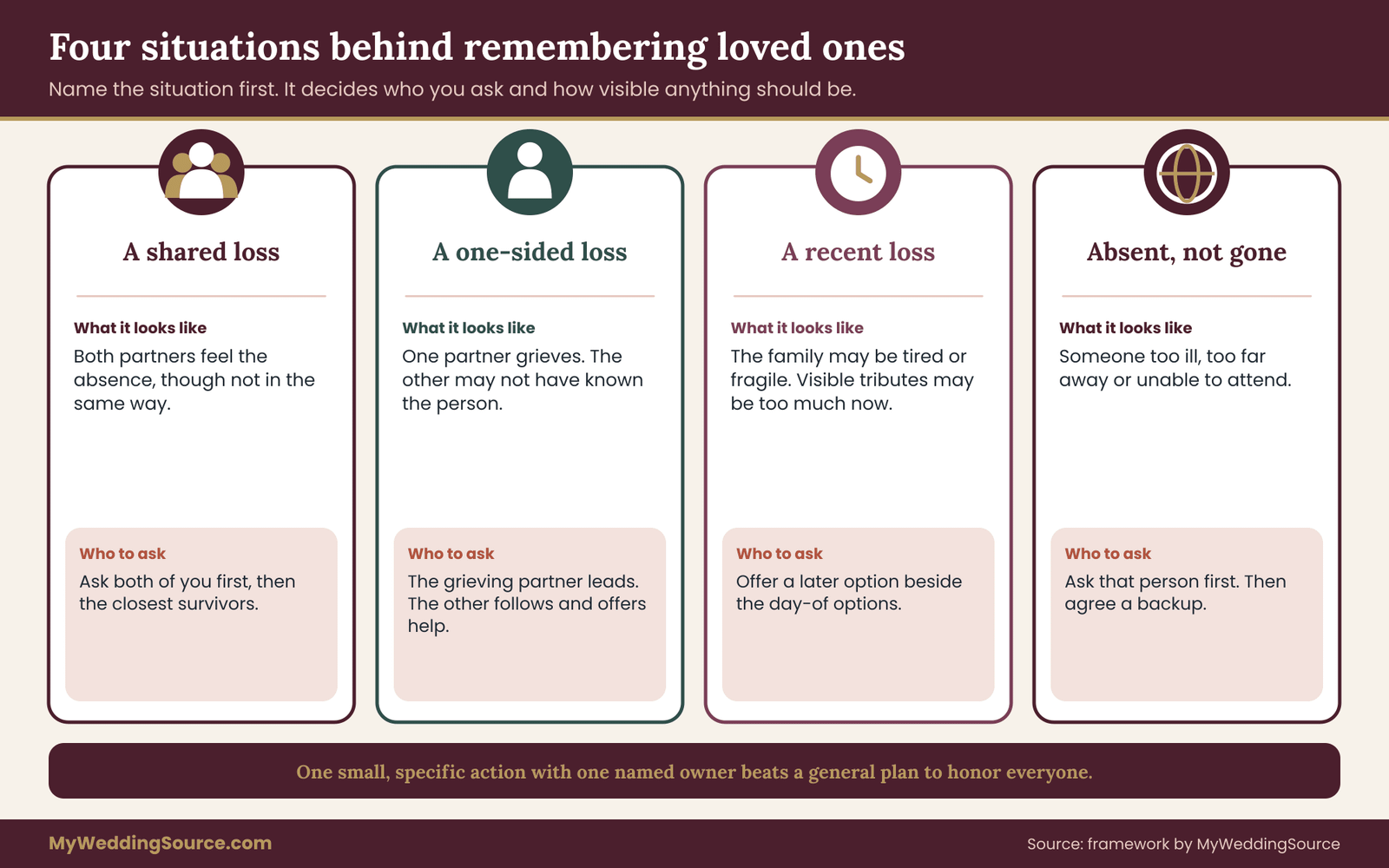
The phrase sounds simple, but it hides at least four different situations. Naming them early saves a lot of confusion later, because each one calls for a different kind of consent.
A death the couple shares. A grandparent who raised one partner, a friend from the same circle, a parent of one partner who died before the engagement. Both partners feel the absence, though not in the same way.
A death only one side feels. A father who died when one partner was a child. The other partner may not have known him, and may not know what is welcome. Their instinct to help can be wrong without being unkind.
A recent loss. A death within the past year or so changes everything. The family may be tired, the grief may be fresh, and remembering loved ones in a visible way could be comforting later but too much now. Or it could be exactly what everyone needs. Only the people involved can say.
An absence that is not a death. A sibling serving overseas, a relative too ill to travel, a guest denied a visa. These are covered more fully elsewhere on the site, but the same logic applies: how visible, who agrees, what is the backup.
Across all four, the useful unit is not “a tribute.” It is a small, specific action with a person who owns it. A candle, a reserved chair, a sentence in the ceremony, a photo in a pocket, a favorite dessert on the buffet, a donation made in a name. Each of these has a different visibility and a different set of people who must be asked.
Who counts when remembering loved ones
Most guides assume parents and grandparents. Real lists are wider. The list for remembering loved ones might include a sibling, a close friend, a mentor, a former spouse of a parent, a pet, a child who was lost in pregnancy, or someone whose relationship to the family was complicated. Some of these are easy to name aloud and some are not.
A practical rule: let the person who feels the loss most decide whether a name appears in public. If a parent lost a child, the parent decides how that child is mentioned, even if the couple would gladly say the name. If a couple lost a pregnancy, the couple decides, and nobody else should raise it on their behalf. Names are not interchangeable with grief. Some people want to hear a name said out loud; others find it unbearable in front of a crowd.
What this guide deliberately does not do
It does not tell you that every wedding should include remembering loved ones aloud. Some couples and families prefer to keep their grief private, and that is a complete answer. It also does not prescribe a “healthy” way to grieve, and it does not claim that a tribute will make anyone feel better. What it does offer is a way to match your choices to what the people involved can handle, with fewer surprises.
It also does not rank vendors or products. Where a physical item is involved, such as a memorial charm, a candle or printed signs, the guide covers what to check rather than what to buy. Prices vary by region and supplier, so anything involving money here is described as a cost logic, not a number.
Why a privacy-first approach to remembering loved ones fits most families
Privacy-first does not mean secretive. It means the default is the least visible option that still does what you want, and that visibility goes up only with permission. This ordering protects three groups of people at once.
The first group is the closest mourners. A grandmother who has not spoken about her husband in public for years may be glad to see his photo on a table and horrified to be asked to stand and say a few words. If the quiet option comes first, she can accept it, ask for more, or ask for less.
The second group is the guests who do not know the story. At many weddings, a good share of the room never met the person being remembered. A sudden formal moment of remembering loved ones can leave them unsure of what to do with their faces. A low-key option lets those who knew the person engage with it and lets others carry on without awkwardness.
The third group is the couple. The wedding is also a day on which one or both of you may be overwhelmed. Planning a way of remembering loved ones that needs constant attention, a long speech, or a fragile object adds a load you may not have the energy to carry. Choosing the quietest workable option protects the day you are actually having.
The trade-off in remembering loved ones, stated honestly
Quiet options carry a cost. A private tribute might never be noticed by anyone but you, and that can feel like too little, especially on the day. A public way of remembering loved ones can bring the room together, but can also change the mood and put people on the spot. Neither is wrong. The matrix in this guide exists so the trade-off is visible instead of felt as a vague worry.
There is also a timing trade-off. Early in the planning process, remembering loved ones is only an idea and can be adjusted freely. Close to the day, changes cost relationships and logistics. Raise it earlier than feels comfortable, with the right people, and give each person an easy way to step back.
The consent holders: who needs to say yes before remembering loved ones
Consent in this context is not a legal term. It means that the people with the strongest claim on a memory have been asked, in a way that lets them decline without explaining themselves. Many attempts at remembering loved ones go wrong not because the idea was poor but because nobody asked the right person first.
Think of four rings of people around remembering loved ones, from the center outward.
Ring one: the closest survivors. Spouse, children, parents or siblings of the person being remembered. For a grandparent, that usually means the grandparent’s spouse if living, their children (often your parents or aunts and uncles), and the grandchildren. These are the people whose permission matters most for anything visible.
Ring two: the couple. You decide what happens at your own wedding, but you are also a consent holder for your own partner. If one of you wants to remember a parent and the other has reservations about the format, that conversation comes before anyone else is brought in. The guide on how couples and families share wedding decisions explains how to separate input from final say.
Ring three: the people who run the day. The officiant, the venue, the photographer, the DJ or band. They do not hold a claim on the memory, but they hold practical veto power. A venue may prohibit open flame. An officiant may have a standard script. A photographer needs to know whether to photograph a tribute or to leave it alone.
Ring four: the guests. They do not consent in advance, but they are affected. Guests who share the loss may need a way to participate or not. Guests who are meeting this family for the first time deserve a light touch.

How to ask without pressure
When remembering loved ones, ask in private, in words that make no assumption, and ask early. A short message or call works better than a family group chat, which creates an audience for a decision someone may want to make quietly. Offer two or three options, always including “nothing public.”
A sentence you can adapt: “We have been thinking about how to remember your dad on the day. We have a few quiet ideas, and we are just as happy to do nothing. What would feel right to you?” That wording names the aim, shows the range and lets the person off the hook.
If the answer is “not sure,” treat it as a “not yet.” Come back to it in a few weeks with one specific idea, not a list. People who are overwhelmed often find it easier to react to a concrete proposal than to imagine one from nothing.
When consent holders disagree
Occasionally the closest survivors do not agree. One sibling wants a spoken tribute and another wants none. A widow wants a photo displayed and her adult children do not. In that case, do not choose a side. Pick the option that every holder can accept, even if it is not anyone’s first choice.
That is usually something very quiet, such as a private moment before the ceremony. A later section covers scripts for these conversations in detail.
The three-dial options matrix for remembering loved ones
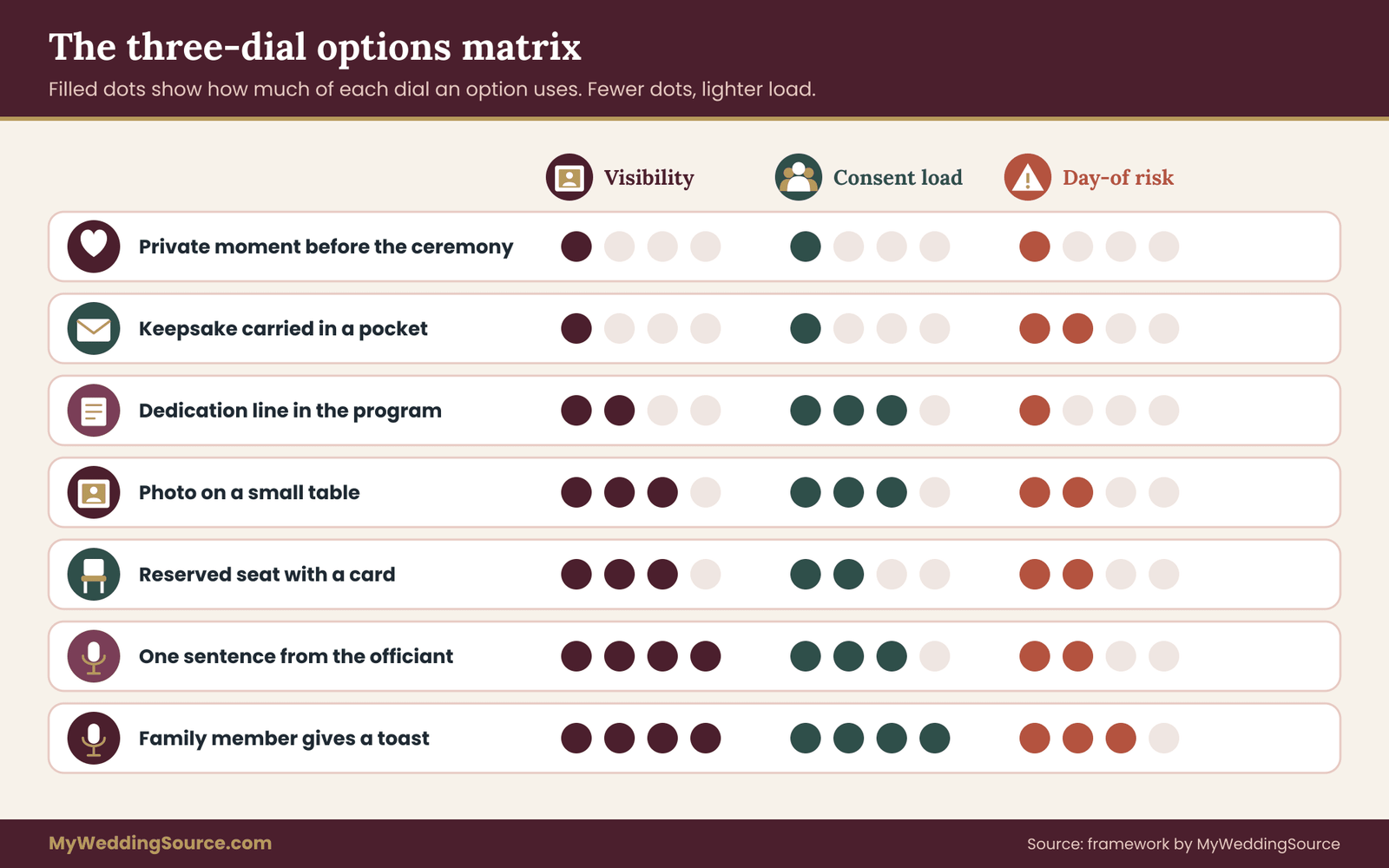
Most lists of ideas for remembering loved ones are flat: thirty suggestions with no sense of cost or risk. A flat list makes every idea look equally easy. They are not. Lighting a candle is a different act from asking a grieving parent to speak into a microphone. The matrix below sorts every idea by three dials, so you can see the trade-offs before you fall in love with one.
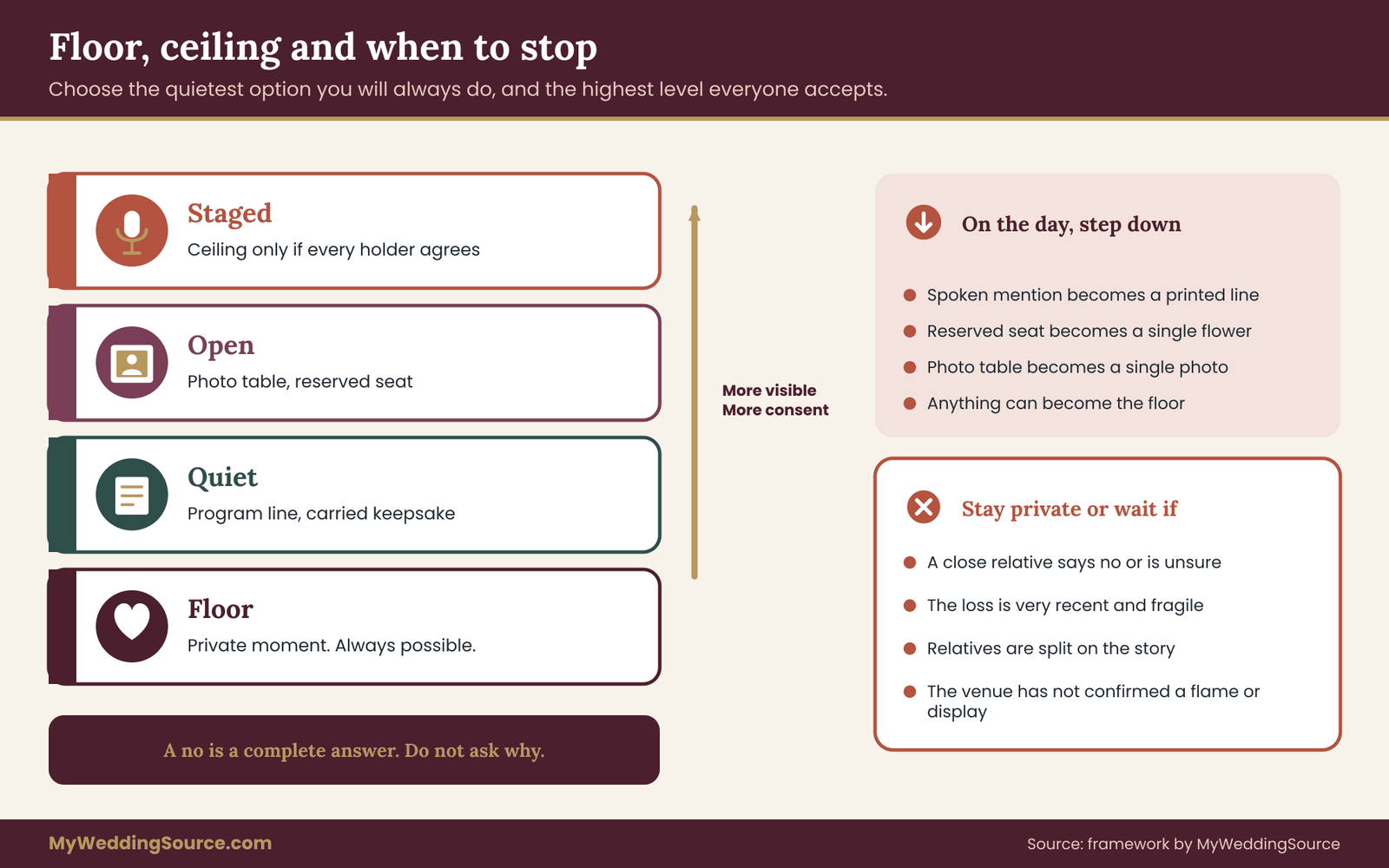
Dial one: visibility. Who will notice? Rate it from private (only the couple knows) to quiet (guests who knew the person notice) to open (the whole room is invited to notice) to staged (everyone’s attention is directed at it, for example a spoken tribute).
Dial two: consent load. How many people must agree, and how deeply? A private keepsake needs only the couple. A named mention in the ceremony needs the closest survivors. A staged form of remembering loved ones with a family member speaking needs that person’s explicit, unpressured yes, plus the officiant’s input.
Dial three: day-of risk. How much can fail on the day? Anything with fire, fragile objects, microphones, screens, timing dependencies, or a person who must perform under emotion carries more risk than a note tucked into a bouquet. Risk includes emotional risk: a tribute that depends on someone holding it together is riskier than one that works with no one’s participation.
Add a fourth, softer check, which is reversibility. If the day arrives and a family member is not up to it, can the tribute shrink into something smaller without anyone noticing? The best options can be downgraded on the day, such as a spoken mention that becomes a silent line in the program.
How to use the matrix for remembering loved ones
Write each idea you are considering on its own line. Next to it, write a rating for each dial: low, medium or high. Do not worry about precision. The point is to notice that an idea you assumed was “small” is high on consent load, or that one you thought was “big” is actually low risk and easy to adjust.
Then apply a simple decision rule. Choose a floor and a ceiling. The floor is the quietest tribute you will do no matter what, so that remembering loved ones is never left to chance. The ceiling is the most visible tribute everyone in ring one has agreed to. Anything between floor and ceiling is optional. On a hard day, you fall back to the floor and nobody has failed.
A couple might set their floor as a private moment before the ceremony and their ceiling as a short, named mention by the officiant. If the grandmother is unwell at the last minute, they keep the floor. If she is in good spirits and asks for the mention to be bigger, they do not exceed the ceiling without a new conversation.
Reading a matrix row
Take “a reserved seat with a small card.” Visibility: quiet to open, depending on the card. Consent load: medium, because a seat for a particular person implies a statement about them. Day-of risk: low, but guests may sit in it by mistake. Reversibility: high, because the card can be removed and the seat reassigned.
Take “a spoken tribute by a family member during the reception.” Visibility: staged. Consent load: high, because the speaker must truly want to do it. Day-of risk: medium to high, because emotion can overwhelm a speech, and a microphone makes everything public. Reversibility: low, because once someone is announced, an exit is awkward. That does not make it a bad idea. It makes it an idea for a person who has said yes more than once.
Quiet ways of remembering loved ones that nobody has to see
The quietest tier is easy to underrate. These options ask little of the family, put no pressure on guests, and cost very little. They are also the ones most likely to survive a rushed schedule and an emotional day. Many couples find that these quiet ways of remembering loved ones stay with them longest.
A private moment before the ceremony. Ten minutes alone, or with the closest relatives, away from the crowd. A short walk to a quiet corner of the venue, a few words spoken aloud, a hand on a photograph. This requires nothing from vendors beyond a buffer in the timeline. It is also the one option that can be done even if everything else falls apart.
A carried keepsake. A small photo folded in a pocket, a handkerchief that belonged to someone, a button, a ring worn on a chain, a note sewn into a hem or taped inside a jacket. Nobody else needs to know. Heirloom items carry practical risk, because small objects get lost and fabrics get damaged, so keep anything irreplaceable out of the way of dancing, hugging and photo lines. Whoever holds it should know exactly where it travels when the outfit changes.
A note in the bouquet or the boutonniere. A tiny card or ribbon, written by hand, attached where it will not be seen. If you use a charm or other metal item, ask the florist how it will be fastened and whether it can be removed for photos, since attachments can snag or detach.
A silent dedication. A line in the back of the program, or a single line at the bottom of the details card: “In loving memory of …” This is visible, but it does not ask anyone to do anything. Guests who knew the person will notice, and others will pass over it. It needs only the consent of the closest relatives and a careful proofread of the name and spelling.
A donation in a name. A gift to a cause the person cared about, made in the couple’s name or in the person’s. It leaves no mark on the day, and it can be mentioned in the program or on a small sign without asking anyone to perform. Check that the organization is a real charity before you advertise it, and keep the receipt with your records. If guests ask how to give in the same spirit, a short line on the program with the charity name is enough.
A favorite dish or drink that appears quietly. If a grandfather loved a particular cookie or a rye whiskey, a modest version of it can be on the table without a label, or with a tiny card. Guests who knew him will smile. Everyone else will just eat a good cookie. Mind allergens and alcohol policies here, since this is a food choice like any other and the caterer needs to know.
Why quiet ways of remembering loved ones work better than they seem
Quiet remembering loved ones respects an unspoken rule of grief: people prefer to meet it on their own terms. A relative who is not ready for anything spoken can still look at a photo table or ignore it. A guest who wants to join in can seek out the table or the program line. Nobody is forced into a role.
Quiet ways of remembering loved ones are also forgiving to timeline slippage. A reception that runs late can drop a spoken tribute and still keep a candle or a note. A staged tribute depends on the timing holding, the microphone working and the speaker feeling steady. If any of those fail, the tribute fails in public.
Finally, quiet options are easy to layer. You can start with a carried keepsake and a program line. If the family warms to the idea, add a seat or a photograph. If the family signals discomfort, you have already done something meaningful and can stop. Remembering loved ones in layers, floor first, ceiling later, is far easier than trying to pull back from a large plan.
What to avoid in the quiet tier
Quiet is not the same as hidden from the people who should know. If a parent would be hurt to learn later that a tribute to their child happened without their knowledge, the tribute is not truly private. It is simply uninvited. The test is whether the closest relatives would be glad to find out, not whether they could be kept from finding out.
Remembering loved ones should never sneak a name or a story into a vendor’s script without telling the vendor. A photographer who is not briefed may photograph the keepsake in a way you did not want, and a DJ who is told to “play his favorite song” without context may announce it. Tell the people who run the day exactly what is meant to be seen, and what is meant to stay unremarked.
Avoid placing the quiet option in a spot where it becomes a hazard. A candle on a table next to napkins, a photo on a ledge where a coat will knock it, or a ring on a chain around a neck that will be hugged fifty times are all small risks that deserve a minute of thought. A later section covers the venue and safety questions in more detail.
Remembering loved ones during the ceremony: from a line in the program to a spoken moment
The ceremony is where most couples expect remembering loved ones to happen, and it is where most of the wording problems appear. It is short, it is formal, and every second is spoken for. It also has a captive audience, which raises the stakes. The options here run from almost invisible to fully staged. Use the matrix to pick the highest level everyone in ring one has agreed to, and then keep a quieter version ready.
Program and printed options
The lowest-risk ceremony tribute is a printed line. A page of the program might carry a short dedication, such as “We remember with love …” followed by names. This works because it asks nothing of anyone in the moment. Guests read it or they do not.
Two cautions apply. First, names. Check every spelling and every form of address with a relative, not from memory or from social media. A misspelled name in print is a small injury that cannot be undone once the programs are folded. Second, order. If you list several people, think about whether the order implies a ranking.
Alphabetical, or grouped by side of the family, avoids most hurt feelings. Proof a program the way you would proof an invitation: read it aloud, and have someone who knows the family read it too.
If a name should not appear in print, because a family member does not want it made public, the option can shift to a general line: “For those we carry with us today.” That wording includes everyone without singling anyone out, and it lets each guest fill in their own names.
The reserved seat
A reserved seat, usually in the front row, with a small card or a flower, is one of the oldest tributes and one of the most misunderstood. Done well, it is a silent, dignified signal. Done badly, it is a source of confusion, or it makes a parent stare at an empty chair through the whole ceremony.
Ask the closest relative directly whether they want the seat. For some people, an empty chair is a comfort. For others, it is a reminder they would prefer to avoid. If the answer is yes, brief the ushers so nobody sits in it by mistake, and decide where the card is placed so it will not be knocked over. If the answer is “maybe,” offer a gentler variant: a small bouquet or a photograph placed on the aisle end of a row without a full chair held empty.
A spoken mention by the officiant
A single sentence from the officiant is the most common spoken tribute, and for good reason. It is brief, it is delivered by someone trained to say difficult things calmly, and it takes the pressure off family members. The officiant can say a name, acknowledge that some who are loved are not present, and move on.
The key is to agree on the wording ahead of time. Send the officiant the exact names, the exact phrasing you prefer, and any words to avoid. Some families do not want the word “death” said aloud. Others want it said plainly. Some want the sentence placed at the opening, and others at the end of the vows, so it does not interrupt the emotional arc.
Tell the officiant which of these you want. Our guide to what officiants need to know explains how to brief the person leading your ceremony, and the step-by-step view in the wedding ceremony guide shows where a short mention can sit without crowding the vows.
A sample, written in neutral wording that you can adapt: “Today we are glad to be together, and we know that some who shaped these two lives are not here in person. We hold them close in this moment.” No names, no detail, five seconds. If a name is wanted, add it after the first clause. If it is not, the sentence stands on its own.
A moment of silence
A moment of silence is a staged tribute with a quiet face. It asks everyone in the room to do something together, which makes it more visible than it looks. Done in about ten seconds, it can feel respectful. Done too long, it can feel heavy and awkward at an event where guests are also nervous and happy.
Decide where the silence goes and who signals the start and end. A line like “Let us take a moment” from the officiant works, and the officiant can close it with “Thank you.” If you add a candle or a bell, check the venue rules first. Do not include a moment of silence if you suspect a family member would find it distressing. A gentle spoken mention covers the same ground with less exposure.
A reading, a poem or a piece of music
A reading chosen because it belonged to the person, or reminds you of them, can carry a lot with little explanation. The speaker does not need to say why it was chosen. The program might say only “Reading chosen in memory of …”. If the text is under copyright, ask the publisher or rights holder about permission before you print or record it.
Music works similarly. A song the person loved can play as guests are seated, as a family member walks in, or quietly under the officiant’s mention. Instrumental versions avoid lyrics that might land too hard. Tell the musician or the DJ exactly when it starts and stops, and give them a plan for what to do if the moment is skipped on the day. The same listing of cues belongs on the ceremony cue sheet, so everybody who has a part knows its timing.
A candle or a lighting ritual
Lighting a candle in memory is a gentle ritual with a heavy practical load. Open flame is banned or restricted in many venues, in tents, in historic buildings and near decorations. Even where candles are allowed, wind, drafts and sleeves complicate them. Battery-operated candles are common stand-ins, and most guests will not mind.
If you want a real flame, ask the venue in writing whether it is allowed, who supervises it, and what kind of holder is acceptable. Consumer safety agencies and fire-safety groups publish candle guidance worth reading, and the Sources section lists two.
A lighting ritual also puts someone on stage. Decide who lights it, and whether that person has a backup. If a relative is chosen and cannot do it, the officiant or a member of the wedding party can step in without a word of explanation.
Choosing the ceremony level for remembering loved ones
Here is a simple way to choose. Start with the program line, because it is the floor. Then ask the closest relatives which of the next two steps, a reserved seat or a spoken mention, they would welcome. Add one of them, not both, unless the family asks. Reserve the moment of silence, the reading with a family speaker and the candle for situations where several people have asked for them.
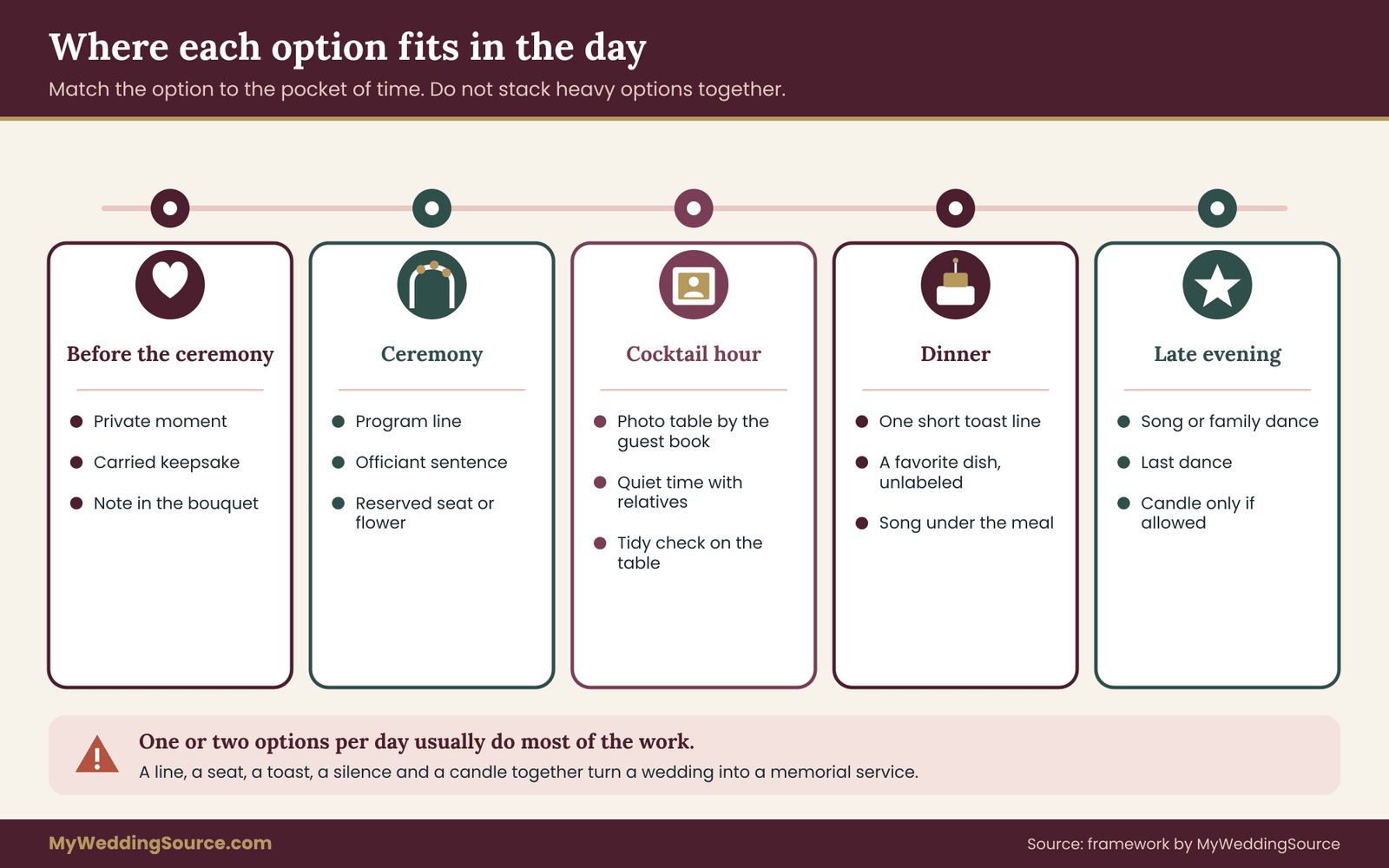
Do not stack tributes. A ceremony with a program line, a reserved seat, a spoken mention, a moment of silence, a reading and a candle is a memorial service with a wedding inside it. Even a family that wants all of these usually finds that one or two do most of the work. The rest dilute the effect and use up time and emotional energy.
A worked wording example
An invented example shows how the pieces fit. A couple decides on a program line and a one-sentence mention by the officiant. The program reads: “In loving memory of Elena Marsh.” The officiant says, before the vows: “We are also thinking of Elena, who would have loved this day.” The grandmother, Elena’s sister, knew about both beforehand and chose the wording. If she is overcome on the day, nothing needs to change.
Notice what the example leaves out. There is no speaker who must stay composed, no flame, no moment of silence, no prop. That is deliberate. The couple chose the ceiling together with the family, and they kept the ceiling modest. Remembering loved ones in a ceremony does not need volume. It needs accuracy, and consent, and about ten seconds of the room’s attention.
Interfaith and religious ceremonies
If your ceremony follows a faith tradition, it may already have fixed forms for remembering the dead, or fixed rules about what may be added. Some include a prayer for the departed. Others keep the ceremony focused on the couple and treat remembrance as a separate rite. Ask the officiant or the community leader early, before you draft anything, so that your wording fits the tradition. The guide to planning an interfaith ceremony covers who owns each part of a mixed-tradition ceremony.
Remembering loved ones at the reception: tables, toasts, food and music
The reception has more room for tributes than the ceremony, and less formality. It also has more ways to go wrong. Guests are moving, eating and drinking, a microphone may be live, and the room is louder. A way of remembering loved ones that works in a still ceremony can disappear into the noise, and a tribute that depends on silence can fail completely. Match the option to the setting.
The memory table
A table with photographs and small objects is the most common reception tribute. It is also the one that most often creates a crowd in the wrong place. It works as a quiet option when it sits somewhere calm, such as a corner near the entrance or a spot beside the guest book, and when it asks nothing of anyone.
Think about three things. Placement: away from the bar, the buffet line and the restrooms, with enough room for four or five people to stand at once. Content: only photographs and objects that the closest relatives have approved, because a photo is also a statement about who was in a person’s life. Protection: frames can be knocked, candles can drip, and objects can disappear when the room is full.
Appoint one person to check the table at the start of cocktail hour and again after dinner. If a relative is unsure about a photo, treat that as a no for now and use one of the stand-ins described below.
If a photo cannot be displayed, a small framed card with a name and a line of text can take its place. A single flower in a bud vase does the same work with no image at all.
Toasts that include absent people
A toast is a natural place for remembering loved ones, and the right shape is short. One sentence inside a longer toast usually does more than a toast devoted entirely to the person. “We wish [name] were here” followed by the planned toast keeps the mood intact. A full toast in memory is possible when a family member asks for it, but it changes the evening, so leave room for it in the schedule.
Speakers should know the boundaries. Ask each person giving a toast whether they plan to mention anyone who has died, and what they plan to say. Do not do this to censor anyone. Do it so that a parent is not surprised by a story they have not heard in years, and so that a funny anecdote does not accidentally land on a raw spot. The wedding etiquette guide covers wider reception manners, and the same habit of previewing helps here.
A useful rule is one remembered person per toast, one story, and no more than a minute. If several people want to speak about the same person, consolidate them into one voice chosen by the family.
Food and drink
Serving a favorite dish, drink or dessert is a tribute that guests can taste. It carries warm, specific meaning, and it does not need explanation. It also needs ordinary catering care. The caterer needs to know the recipe and the allergens, the quantity, and whether it is for everyone or only for a small table. A signature cocktail in a person’s name should have a non-alcoholic version, and a printed card is optional.
If a family recipe is being used, ask whether the person who owns it is willing to share it, and who will prepare it. Some families treat a recipe as private. Others are glad to see it served. Remembering loved ones through food works best when the person who inherited the recipe has been asked first, and when the caterer has tested it at a tasting rather than learning it on the day.
Music and the dance floor
A song can mark a memory without a word. A favorite tune can play during dinner, during a family dance, or as the last song of the night. Give the DJ or band the exact title, the version, the moment and the instruction not to announce it unless you want it announced. The music guide on the site, programming reception music across generations, explains how to plan these slots without breaking the flow.
A tribute dance is a stronger option and a riskier one. A parent who would have danced with a partner may be paired with a relative or may sit out. Some people find this moving, and some find it hard to watch. Ask first, offer the option of a group dance instead, and have the DJ ready to cut the song short.
A photo or an empty chair at the head table
Some couples place a small framed photo at the head table or the sweetheart table. It is visible and personal, and it is easy to undo by moving the frame. Before doing this, ask whether the family would prefer the photograph to sit apart from the eating and drinking, since a table is a place where drinks get spilled.
An empty chair at a table is more ambiguous at a reception than at a ceremony. Guests hunt for seats and may ignore it, or may take it by mistake. A small flower or card on the plate can help, and a word to the staff prevents it from being cleared.
Where the tribute sits in the timeline
The reception schedule has natural pockets. Cocktail hour suits the memory table and a quiet moment with relatives. Dinner suits a short toast and a favorite dish. After dinner and before dancing suits a song or a group moment. The end of the night suits a last dance or a quiet send-off. Match the option to the pocket, and avoid placing a heavy tribute immediately before a high-energy segment.
The way people move through the room matters too. Remembering loved ones in a way that causes a bottleneck, for example a table by the entrance during arrivals, will frustrate guests and irritate the relatives who tend it. The guide to reception guest flow explains how to read the room’s traffic, and a quick walk-through with the venue’s coordinator can save a lot of trouble.
Ways of remembering loved ones that live beyond the wedding day
Remembering loved ones does not have to happen on the day. Some of the most meaningful ones work better afterward, when the schedule is quiet and the family can take part at its own pace. If the day is already full, or if the closest relatives are not ready for a visible moment, a later option can satisfy the wish to do something without adding to the load.
A donation or a recurring gift. A single contribution to a cause in a person’s name, or a small annual gift on a date that matters. This is private, flexible and easy to adjust. Keep the receipt, and note it in your records so that it is not forgotten in a year.
A page in the album. When the wedding album is designed, a single page can honor a person: a photograph from the day with a relative, a copy of a note, a short line of text. This is a place for people who could not be named aloud on the day.
A planted tree or a bench. Planting a tree or placing a plaque involves a landowner, a park authority or a cemetery, and each has its own rules. Check permissions and any fees with the organization before you promise anything to the family. These options take time and are best treated as a later project.
A recipe card or a keepsake for relatives. A small printed recipe, a framed line of handwriting, or a photograph printed for each close relative. These give people something to hold, and they do not need to be shown to anyone.
A recorded message or a shared album. Guests who knew the person can add a photograph or a short memory afterward, if they wish. This works for people who did not feel comfortable speaking on the day. The privacy guide on the wedding photography consent page covers how to set rules for sharing and posting images, and those rules apply here as well.
An anniversary ritual. A quiet habit, such as visiting a place, cooking a dish, or lighting a candle at home, on the anniversary of the wedding or of the person’s death. This is entirely private and costs nothing.
Why timing can be a kindness when remembering loved ones
For a recent loss, a later tribute may be the kindest choice. The wedding has deadlines, a crowd and a public face. Remembering loved ones later has none of those. It also lets the couple see how the family is doing before deciding what is right. Remembering loved ones six months after the wedding, with the people who want to be there, can be more meaningful than one squeezed into a packed reception.
The same is true for relatives who are not comfortable with public tribute. A private gift, a handwritten note or a shared photograph lets them take part in a way they control. Remembering loved ones after the wedding is not a lesser version. It is a different one, and often a more personal one.
Scripts for asking: conversations about remembering loved ones
Most of the work in this topic is conversation, not décor. Remembering loved ones with ten minutes of arranging and two careful phone calls usually goes better than a version that took weeks of design and no discussion. The scripts below are starting points. Change the wording until it sounds like you, and keep the structure: say what you are thinking, offer a range, and make no an easy answer.
Asking the closest survivor about remembering loved ones
For remembering loved ones, choose a calm time, not the week of a family event, and ask in person or by phone rather than in writing. Written messages can be read many times, and can be forwarded. A call lets the person react in real time and lets you hear how they sound.
A script: “I have been thinking about how we might remember Grandpa at the wedding. I do not want to do anything that would be hard for you. There are some quiet ideas, like a line in the program or a photo on a table, and there is also the option of doing nothing visible. What feels right?” Then stop talking. Silence is part of the question.
If the answer is yes to something specific, repeat it back in plain words so there is no confusion: “So a line in the program with his name, and nothing spoken. Do I have that right?” Confirm the wording of any printed text in writing, once the person has had time to think.
If the answer is no, thank them. Do not ask why, and do not offer a “just a little” version. A no is a complete answer. You can still keep your own private floor, such as a moment alone, without involving them.
Asking the other partner’s family
When the person being remembered belongs to your partner’s family, you are the guest in their grief. Let your partner lead the conversation or be present for it. If you speak first, begin by saying you want to follow their wishes. A line such as “We want to do whatever feels right to your family, and we are glad to keep it very simple” shows respect and takes pressure off.
Avoid the temptation to over-help. An eager offer to design a large way of remembering loved ones can read as a decision already made. A better offer is a short list and a question. If the two families have different customs, settle who owns which ritual before you propose anything.
Asking an officiant, a venue or a vendor
For people who run the day, give facts and a clear boundary: what will happen, when, who is involved, and what should not happen. A note might read: “We would like one sentence about Elena before the vows. Here is the wording. Please do not announce anything else. A family member may ask to skip it on the day, and if so, we will tell you before the ceremony starts.”
Put it in writing, and keep a copy. If remembering loved ones involves an object, a flame or a display, ask the venue’s coordinator to confirm in writing that it is allowed and how it should be set up.
Asking guests to take part, or to refrain
Occasionally you will want help from guests, for example someone to read, to tend a table or to share a song. Ask each person individually and offer an easy exit. “Would you be willing to … ? It is completely fine to say no” is enough.
You may also need to ask guests not to do something, such as posting photographs of a memory table online, or sharing the story of a loss on social media before the family is ready. Gentle wording on a sign or a line in the program works better than a rule. Ask kindly, give the reason, and accept that some guests will post anyway.
When a relative changes their mind
Sometimes a person who said yes at the start feels differently a month later, or on the morning of the wedding. This is normal, and the plan should allow for it. Give every consent holder a standing offer: “If you change your mind at any point, even on the day, just tell me and we will take it out. No explanation needed.”
Then make it true. Keep each tribute downgradable, with a prepared fallback. A spoken mention becomes a line in the program. A reserved seat becomes a flower on a table. A memory table becomes a single photograph at the head table, or nothing. If you have a floor and a ceiling, the change is simple. You drop to the floor and carry on.
Handling disagreement over remembering loved ones
When relatives disagree, the aim is not to win the argument or to find a compromise that nobody likes. It is to find what each person can accept. Sit with each person separately first and ask what their worry is. Often the disagreement is not about the tribute but about something underneath: a worry that a parent will be overwhelmed, a feeling that a name was left out, an old strain between siblings.
Then look for the smallest common option. If one sibling wants a spoken tribute and another cannot bear it, a printed line may be acceptable to both. If a widow wants a photograph displayed and her children do not, the photograph can go in the couple’s own space, such as the sweetheart table, rather than a public table. If no common option exists, the private floor still works, because it needs only the couple.
When it is unclear who gets the final word, use a simple rule. In general, the couple decides what happens at their wedding, and the closest survivors decide how their own person is mentioned. Where those two conflict, the quieter option wins until the conflict is resolved.
When remembering loved ones should stay private or wait
Part of a good matrix is knowing when to stop. Some situations make visibly remembering loved ones a poor idea, and a good plan treats those conditions as ordinary, not as failure. Staying private is a valid result of this process, not a defeat.
The closest relative says no or is unsure. A hesitant yes is a no for now. If a parent seems pulled in two directions, move down a level and revisit later, or never.
The loss is very recent and the family is fragile. There is no calendar rule for this. Some families find comfort in remembering loved ones within weeks. Others need a year or more. Ask rather than guess, and offer a later option.
The relationship was complicated. Not every absence is mourned the same way. A person’s death may bring relief, anger or mixed feelings to some relatives, and publicly remembering loved ones can force a single story on a room that holds several. If the family is split, stay private.
The cause of death is sensitive. If a death involved illness, addiction, violence or suicide, some relatives will want that kept quiet, and others will want to speak openly. The tribute does not need to explain anything. A name and a line of affection say enough. The same discretion applies to any tribute that could invite questions the family would rather not answer. If any relative is in distress, a bereavement counselor or a hospice bereavement program can help, and the Sources section lists national resources.
The tribute needs a person who may not be able to do it. If a plan depends on one parent speaking steadily, and that parent is already anxious, build a version that does not need them.
The logistics are not under control. If the venue has not confirmed a flame, a screen or a table, or the timeline has no room, defer the tribute rather than rush it.
Signs that a tribute is getting too big
Watch for creeping scope. The idea began as a line in the program and has become a video montage, a spoken tribute, a candle ritual and a memorial cocktail. Each addition seemed small. Together they have turned the wedding into something else, and the person who agreed to the first idea has not agreed to the rest.
Check in with the closest relatives whenever the plan changes. Ask whether the new version still feels right to them. If you notice yourself explaining the tribute to relatives instead of consulting them, step back.
Staying kind to yourselves while remembering loved ones
Couples also carry grief of their own and may feel pressure to get remembering loved ones exactly right. There is no such thing. A wedding that includes one honest sentence is fully a tribute. If you find the planning is making you more upset than comforted, you can scale back at any time, and nobody should hold that against you.
If you or someone close to you is struggling, reach out for support. In the United States, the 988 Suicide and Crisis Lifeline offers free, confidential support by call or text for anyone in distress, and hospice organizations offer bereavement resources open to the public. Planning a wedding does not cancel the need for care.
Logistics and safety checks for remembering loved ones
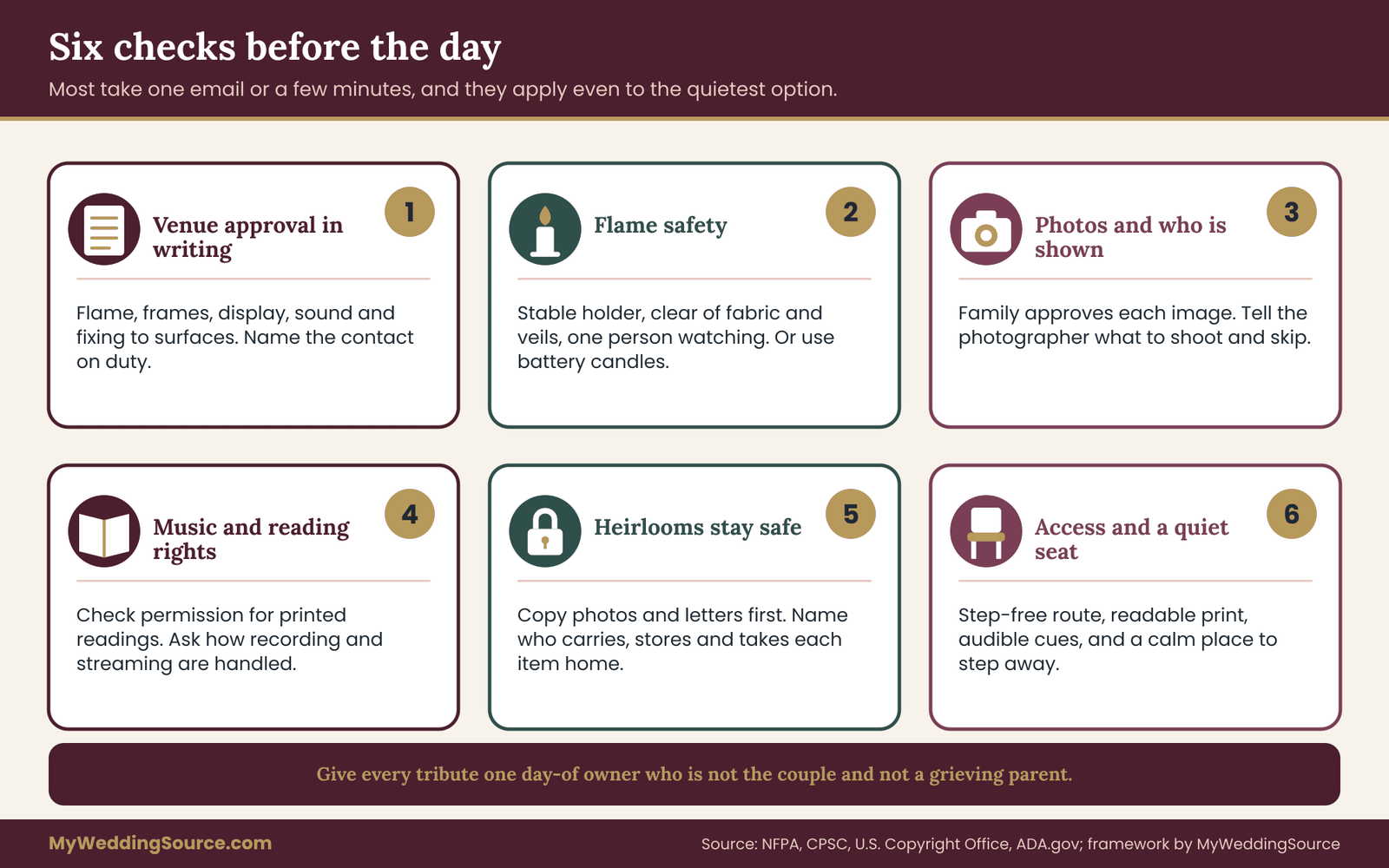
Remembering loved ones is a small production. It has props, timing, people and a venue with its own rules. The checks below keep a tender idea from turning into a day-of problem. Most take a few minutes and one email, and most are worth doing even for the quietest option.
Venue rules and written approvals
Start with the venue. Ask in writing whether each of these is allowed: open flame, battery candles, framed photographs on tables, wall or floor displays, projected images, sound for a moment of silence or a song, and any item that needs to be fixed to a surface. Rules differ widely between a hotel ballroom, a barn, a garden and a house of worship, and the venue’s answer, not an assumption, is what counts.
Ask who at the venue is the contact on the day. Remembering loved ones in a way that needs an extension cord, a table moved or a light dimmed should have a named person responsible, because the staff you meet at the walkthrough may not be the staff on duty. The guide to the venue technical walkthrough shows what to check on site, including power, access routes and setup times.
Fire safety and candles
If you want a real flame, treat it with respect. Fire-safety groups such as the National Fire Protection Association publish guidance on candle use, and the Consumer Product Safety Commission covers candle-related risks for consumers. In practice that means a stable, non-flammable holder, distance from fabric, paper and flowers, a person assigned to watch it, and a plan for wind or movement. If any doubt remains, use a battery candle and spare the family a worry.
Candles near children, near long sleeves and near veils deserve special thought. A veil that brushes a flame is a hazard, and so is a flowing sleeve reaching across a table. Place any flame where nobody needs to reach over it.
Photos, videos and who is shown
Displaying a photograph shows a person’s image to a crowd, and sometimes shows other people in that photograph. Ask the family which pictures are acceptable, and whether any should be cropped. Avoid images that show someone in a hospital bed, or that include people who are estranged from the family.
If you intend to share a tribute online, for example by posting a photo of the memory table, ask first. A relative who agreed to a table at a private wedding has not agreed to a public post. A short, clear request for guests, on a sign or in the program, helps.
Tell the photographer and the videographer what to do about remembering loved ones. Options include photographing the table and the program line, leaving the moment of silence unrecorded, or avoiding any close shots of relatives at their most upset. A short written note works better than a verbal reminder on a busy day. Ask, too, whether you want those images in the public gallery or in a private folder for family only.
Music, readings and rights
A song played in a venue is generally covered by the venue’s or the DJ’s licensing, though a recording or livestream raises other questions. If you plan to record the ceremony or to stream it, and a song or a reading is part of the tribute, ask the person who sets up the recording how rights are handled.
For printed readings, check whether the text is in the public domain or whether permission is needed. The U.S. Copyright Office publishes general information for the public, and the Sources section includes it. This is background, not legal advice.
Fragile and irreplaceable items
Heirlooms are not décor. A watch, a ring, a handwritten letter, a photograph with no copy: treat each as something that cannot be replaced. Make a copy of any photograph or letter before it goes anywhere near a table. Decide who carries the item, where it is stored during dancing and photos, and who takes it home. A short list, written down, avoids the sinking feeling of a missing keepsake at the end of the night.
For jewelry or objects that will be worn, such as a ring on a chain or a pin on a lapel, make sure the fastening has been tested and that someone knows where a spare clasp or pin is kept. If an item is insured, check what the policy covers and whether wearing it at an event matters.
Accessibility and comfort
Remembering loved ones should not create barriers. A table in a corner reached by stairs excludes older relatives who may most want to see it. A moment of silence assumes everyone can hear the start and the end. Printed text in small type or low contrast is hard for some guests to read. Think about wheelchair or walker access, lighting, seating near the display and the volume of any audio.
Plan for a quiet place. Some guests will be moved to tears, and others will find the emotion difficult. A seat in a calmer room, a small supply of tissues and water, and a trusted person who can check on them are small provisions with a large effect. The U.S. Department of Justice’s ADA information, listed in the Sources, is a starting point for accessibility basics, and your venue should know its own accessibility features.
Cost logic
Tributes range from free to expensive, and the price rarely tracks the meaning. A handwritten note costs nothing. Printed signs, framed photographs, flowers, a custom cocktail, a video montage, an engraved item or a plaque each add a cost and a lead time. Instead of quoting prices, which vary by city and supplier, use cost logic.
First, count the number of separate items. Each one needs buying, delivering, setting up and clearing. Second, ask about lead time: custom printing and engraving take longer than most people expect, and rushing adds fees. Third, ask who handles the item on the day and whether any vendor charges for extra setup or a longer staffing window. Fourth, ask whether the item has a second use. A framed photograph can go home with the family, and a printed card can be kept.
A useful check: if remembering loved ones costs more in stress than it saves in feeling, simplify. And if the budget is tight, remember that the most meaningful options are often the cheapest.
The day-of owner
Every tribute needs one named owner on the day. This is someone who is not the couple, not the grieving parent and not a vendor. A friend, a cousin or a coordinator who knows the plan, holds the list, sets up the table, lights the candle, cues the song and checks that everything is in place. They also have the authority to drop a tribute if a family member asks.
Give the owner a one-page run sheet. It should list each way of remembering loved ones, the time, the location, the people involved, the fallback and a phone number for the officiant, the coordinator and the closest relative. Do not give them an emotional role. Their job is logistics, so the family can feel without managing.
The vendor briefing for remembering loved ones
Send one short brief to every vendor who has a part in remembering loved ones: the officiant, the venue coordinator, the photographer, the DJ or band, the florist and the caterer. The brief should state what is planned, what is not, and how each vendor should treat it. Keep it brief and kind.
For example: “There will be a printed line in memory of Elena in the program, a single sentence by the officiant before the vows, and a photograph on a small table by the guest book. Please do not announce the table or photograph the family at it unless they ask.”
Ask each vendor to confirm that they have read it. The guide to a ceremony cue sheet is a good template for collecting every timed element in one place, and your tributes should live on it with everything else.
A pre-day rehearsal for remembering loved ones
If you hold a rehearsal, walk through the tribute moments. Do not rehearse the feelings. Rehearse the mechanics: where the officiant stands, when the music starts, who carries the item, where the table goes. Everyone should know their cue and know how to skip it. If there is no rehearsal, a short call the day before with the owner and the officiant is enough. Remembering loved ones should not be a surprise to anyone who has a job to do.
A worked example of remembering loved ones: one couple, three people, one floor and one ceiling
The following case of remembering loved ones is invented for illustration. It is not a report of a real wedding, and the names are made up. It shows how the matrix and the consent rings work when several people and several wishes meet.
Dana and Wes are planning an autumn wedding for about ninety guests, and both want to include remembering loved ones from each side. Dana’s father died fourteen months before the date. Wes’s grandmother, who helped raise him, died the previous spring. A close friend of Dana’s has been ill for a long time and cannot travel.
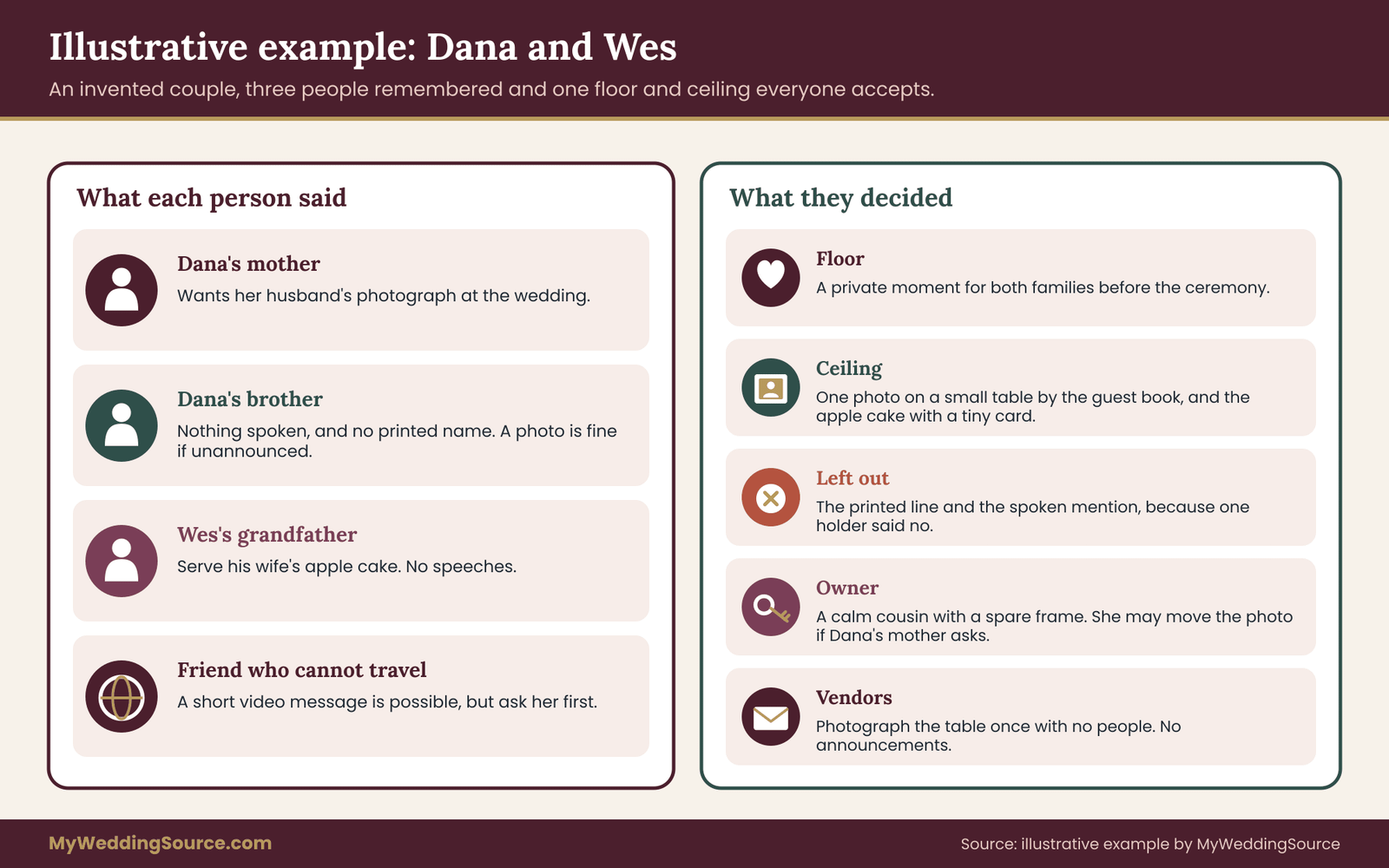
Dana’s mother says she would like her husband’s photograph at the wedding. Dana’s brother says he does not want anything spoken about their father, because he is not ready. Wes’s grandfather, now widowed, says very little.
Step one: list the people and the rings
Dana and Wes write down each person being remembered and each person with a strong claim. For Dana’s father: ring one is her mother and her brother; Dana is ring two. For Wes’s grandmother: ring one is her widower and her children, who include Wes’s parents; Wes is ring two. For the friend, who is alive, ring one is the friend and her partner.
They notice quickly that the groups disagree about one person and are silent on another. The conflict over Dana’s father is clear. The quiet of Wes’s grandfather is a different matter. They decide not to read silence as consent.
Step two: ask in private, with a range
Dana calls her mother and then her brother, separately. To her mother she says she would like to include their father in a way that works for everyone, and offers a photo on a table, a line in the program or both. To her brother she says she will not do anything spoken, and asks whether a printed line or a photograph is acceptable or whether he prefers nothing visible.
Her mother wants the photograph. Her brother says a photograph is fine as long as it is not announced, but a printed name makes him uneasy.
Wes visits his grandfather and asks gently. His grandfather takes a day, then says he would like his wife’s recipe for apple cake served and would prefer no speeches. Wes’s parents agree.
Step three: rate the options
They list five options and rate each on the three dials.
A photograph of Dana’s father on a small table by the guest book: visibility quiet, consent load medium, risk low. A printed line in the program: visibility quiet, consent load high because of the brother’s worry. A spoken mention: staged, high consent, rejected by the brother. The apple cake: quiet, low consent once the grandfather agrees, risk low if the caterer tests the recipe.
A private moment before the ceremony for both families: private, low consent, no risk. For the friend who cannot travel, a short video message is possible, which raises its own privacy questions, so they ask her first.
Step four: set the floor and the ceiling
The floor is the private moment before the ceremony, which can happen regardless of anything else. The ceiling is the photograph on a small table and the apple cake, both agreed to by the people concerned. The printed line and the spoken mention are left out, since one holder has said no. They do not argue the point.
They write a one-page run sheet. The owner on the day is Dana’s cousin, who is calm, organized and not personally in the middle of the grief.
She places the photo table at the start of cocktail hour, checks it after dinner, and carries a spare frame and a small cloth. The caterer receives the recipe and the allergen note, and plans a modest portion for each table with a tiny card that says only “Grandma’s apple cake.” Dana’s mother has a backup: if she feels unable to see the photograph on the day, she can ask the cousin to move it to the sweetheart table, and nobody will ask why.
Step five: brief the vendors and check the venue
The photographer is told to photograph the table once, without people, and not to take close shots of relatives standing at it. The DJ is told there will be no announcement. The venue confirms that frames and a small table are allowed near the guest book. The officiant is told that there is to be no mention of Dana’s father, because of her brother’s request, and that the officiant should say a general line about “those who are with us in spirit” only if Dana asks on the day.
What happens on the day, and what it shows
On the day, Dana’s mother asks the cousin to move the photograph for the first hour, because she is tired. The cousin does it quietly. Wes’s grandfather sits near the apple cake and tells a story to the table. The private moment before the ceremony takes ten minutes. Nothing goes wrong, partly because nothing depended on one person being composed, and partly because every tribute had been downgraded in advance.
Notice three things. First, the couple did not need to use the largest option to honor everyone. Second, a “no” from one person shaped the outcome without making that person the villain. Third, the floor, a private moment, was never at risk. If you can say, three weeks before the wedding, exactly what your floor is, you are well prepared.
Common mistakes when remembering loved ones
Most problems with remembering loved ones are small and avoidable. Here are the ones that appear most often, with a plain fix for each.
Asking in a group. A family chat turns a private decision into a public vote. Ask each person alone.
Assuming silence is yes. Quiet relatives are often the ones most affected. Ask twice, once early and once closer to the date, and give them a gentle way to say no.
Stacking tributes. A line, a seat, a mention, a silence, a reading and a candle can crowd out the day. Choose the one or two that matter most to the closest relatives.
Letting a vendor improvise. A DJ who announces remembering loved ones in a way that was meant to be quiet, or a photographer who zooms in on a grieving parent, can cause real hurt. Brief everyone in writing.
Forgetting the guests who did not know the person. Some of your guests will have no context. A short, warm explanation in the program, or none at all, helps them feel included rather than puzzled.
Overlooking the other partner. The partner who did not know the person may not know what is welcome. Include them in every conversation, and make sure they have a role they are comfortable with.
Tying the tribute to one person’s composure. Plans that need a grieving relative to speak, light or read are fragile. Always have a backup who can step in.
Using an unverified source or a risky object. Candles without approval, items that cannot be replaced, and printed readings without permission all cause trouble. A few minutes of checking saves a lot of regret.
Treating the tribute as a performance. The aim of remembering loved ones is not to move the room to tears. It is to give the people who loved someone a way to feel that person is not forgotten. Quiet tributes often do that best.
Failure conditions in remembering loved ones
Remembering loved ones has failed, in the sense that matters, when a close relative feels ambushed, when a guest is pressed into an emotional role, when a physical item is lost or damaged, when the schedule is pushed off course, or when the couple is more anxious than comforted. These are signals to scale back, not to push through. The remedy in each case is the same: go down a level, tell the people involved what has changed, and keep the floor.
After the wedding: closing the loop on remembering loved ones
A short follow-up is kind and costs little. Thank the people who took part, in private. Return any items to their owners and confirm they arrived safely. If a relative lent a photograph, give it back with a note. Save any wording, such as the printed line or the officiant’s sentence, in your records so that you can reuse it for an anniversary. The step-by-step view of the wedding ceremony can help you review what you kept and what you changed while the memory is fresh.
If a tribute went differently from what you hoped, resist the urge to judge it harshly. Grief and celebration share a room at a wedding, and not every moment will land. Notes made soon after, on what worked and what you would change, are useful if you want to mark an anniversary.
Your next steps
Work through these in order, and stop wherever the answer feels complete.
- List the people you want to remember, including those who are alive but absent.
- For each person, write down the rings: who feels the loss most, who is the couple, who runs the day.
- Decide your floor, the quietest tribute you will do no matter what.
- Ask the closest relatives one at a time, with a range of options that includes nothing visible.
- Rate each remaining idea on visibility, consent load and day-of risk, and set a ceiling that every consent holder accepts.
- Check venue rules, fire safety, photo permissions and any item that cannot be replaced.
- Name one owner for the day, write a one-page run sheet and send a short brief to every vendor.
- Confirm again two weeks before the wedding, and offer each person a way to step back.
- After the wedding, thank the people involved and record what you kept.
Remembering loved ones does not require a grand gesture. It requires a clear idea of who is being remembered, who has a say, and what you can do quietly. Start small, ask kindly, and let the family tell you where the ceiling is.
FAQ
Is it appropriate to include a tribute at all if a family member is still very upset?
It can be, but ask first and keep it optional. A recent or complicated loss makes visibility riskier, so start with the quietest option, such as a private moment or a carried keepsake. If the closest relative is unsure, treat that as not yet. You can always add something later, after the wedding, when the schedule is calmer and the family has had time to decide.
What is the least visible way of remembering loved ones at a wedding?
A private moment before the ceremony, or a small keepsake carried in a pocket or sewn into clothing. Neither requires guests, vendors or the family to do anything. A donation made in the person’s name is also invisible on the day. These options work even when the schedule is tight, and they cannot be spoiled by a late timeline or a failed microphone.
Who should be asked before we name someone in the ceremony?
The closest survivors of that person, such as a spouse, children, parents or siblings, should agree first, and you should also check with your partner. Ask each one privately, with a range of options that includes nothing public. Then brief the officiant with the exact wording. If any close relative says no, use a quieter option or none at all.
Can we use candles to remember someone?
Only with written approval from the venue. Many venues restrict open flame, especially in tents, historic buildings and places with decorations. Fire-safety organizations publish candle guidance, and battery-operated candles are a common, safe alternative. If you use real flame, assign a person to watch it, keep it away from fabric and veils, and have a fallback.
How do we handle a relative who wants a bigger tribute than the family agreed to?
Listen first, then return to the closest survivors. The couple decides what happens at the wedding, and the closest relatives decide how their own person is mentioned. If someone wants more, offer a separate private option, such as a note, a page in the album or a later gathering, rather than expanding what others have not accepted.
What if we are remembering someone whose death was sensitive or complicated?
Keep the tribute simple and let the family set the limits. A name and a short line of affection need no explanation. Avoid details of the cause unless the closest relatives ask for them. If the relationship was complicated and relatives disagree, stay private. A bereavement counselor or a hospice bereavement program can offer support to anyone struggling.
Should a memory table, a reserved seat or a spoken mention come first?
Start with the lowest consent load that the family welcomes. A printed line or a small table is usually easier than a spoken mention, and a reserved seat sits in between. Choose one or two, not all three. If you are unsure, ask the closest relative which they would find easiest to see on the day.
What if someone changes their mind on the wedding day?
Plan for it. Give every consent holder a standing offer to change or withdraw at any time without explaining. Prepare a smaller fallback for each way of remembering loved ones, such as a spoken mention turning into a printed line. Name a day-of owner with the authority to adjust. The floor, a private moment, can always remain, so nothing has failed.
Sources
- Hospice Foundation of America, grief and bereavement resources
- 988 Suicide and Crisis Lifeline
- National Institute on Aging, National Institutes of Health
- National Fire Protection Association, fire and life safety information
- U.S. Consumer Product Safety Commission
- U.S. Copyright Office, information for the public
- ADA.gov, U.S. Department of Justice Civil Rights Division
- Library of Congress, personal digital archiving
- Centers for Disease Control and Prevention
- Transportation Security Administration, traveling with special items