
After party transportation is the set of rides that carries guests from a late reception or after party to a bed, a car or a front door, and the single decision that governs it is the time of the last departure. This guide shows how to fix that time, count who needs a ride, size a small fleet, and give every guest a clear way out of the night.
Pick a last departure time first, then work backward to last call and forward to the final vehicle run. Sort every guest into one of five exits (walk, hotel loop, booked shuttle, personal ride, stay on site) with a short decision tree. Count the guests in each exit, divide by real seats, and schedule enough runs to empty the venue before the last departure.
Name one person who owns the curb, put a printed ride card in every guest’s hand, and keep a backup vehicle on call. Check the after party transportation plan against the numbers in this guide rather than against a feeling.
Most couples plan the first ride of a wedding carefully and the last ride almost not at all. The ceremony shuttle has a schedule, a driver and a sign. The ride home at the end of the night usually has a hopeful sentence: “People will figure it out.” Some do.
Others stand under a venue awning at one in the morning, tired, a little unsteady, holding a phone at nine percent and watching a rideshare app quote a wait that grows every minute. Good after party transportation starts from that honest picture.
That gap is where after party transportation matters. It is not glamorous work, and nobody will thank you for it in a toast. But it is the part of the evening where a good wedding can turn into a story the family tells for the wrong reasons, and the part where a few hours of planning removes nearly all of the risk.
This guide is narrow on purpose. It covers the last stretch of the night: the window between the moment the main reception winds down or the after party starts, and the moment the final guest is somewhere safe. It does not cover airport arrivals after midnight, which is its own small project with its own flight-by-flight worksheet.
It does not redesign the venue’s exits, and it does not plan the after party itself. Both of those exist elsewhere. Here the question is plain: who leaves how, and when does the last vehicle go? Everything here is about after party transportation and nothing else.
A note on scope. This is general planning information, not legal, insurance or safety advice, and local transport, alcohol and venue rules differ and change, so confirm the current rules with the venue, the licensing authority and the transport operator.
What after party transportation has to solve
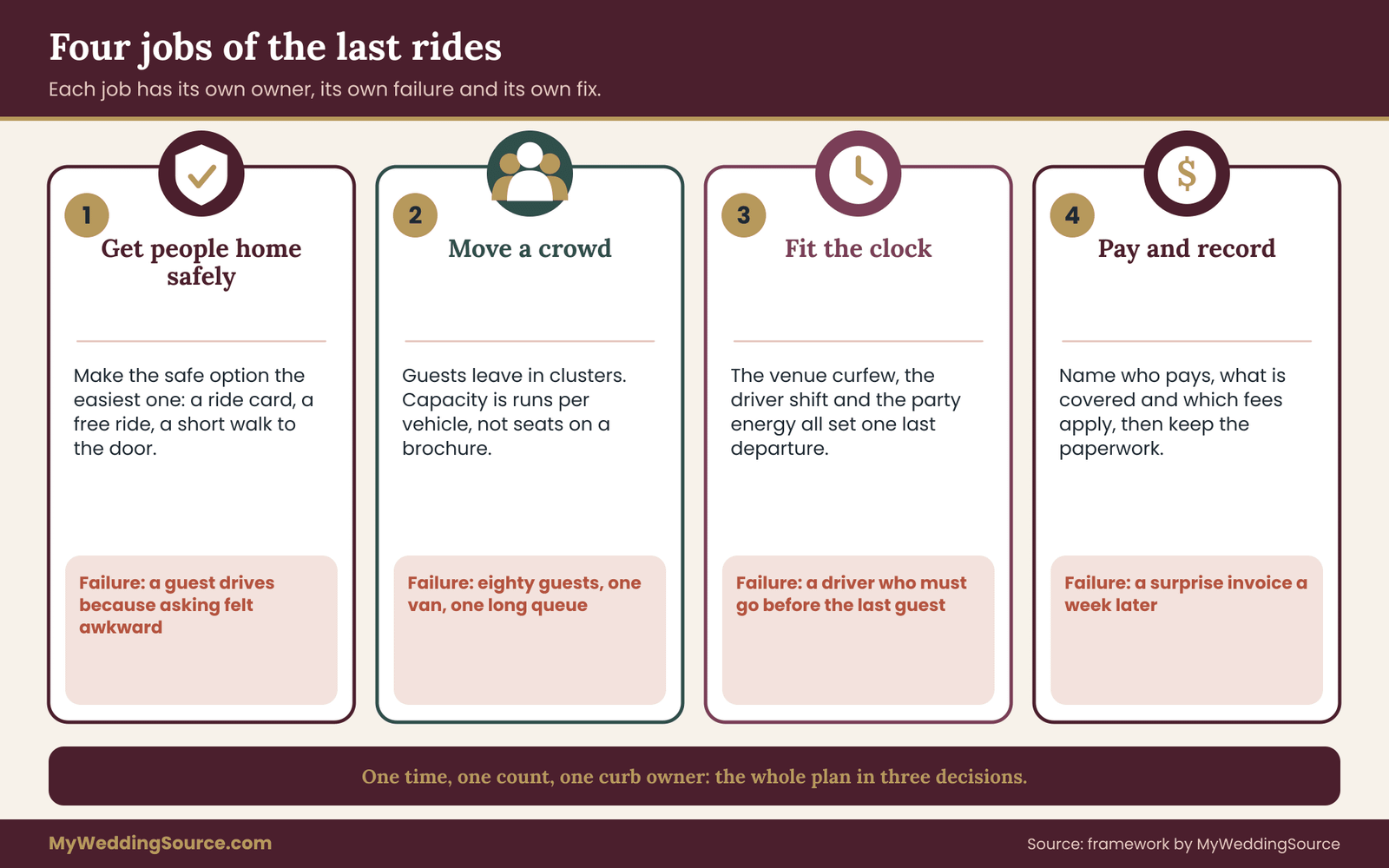
Think of the last rides of a wedding as four separate jobs. Couples tend to treat them as one, which is why the plan feels vague. Each job has a different owner, a different failure and a different fix.
The first job is getting people home safely. Some guests have been drinking, some have not, some are exhausted after a long travel day, and a few are older relatives who should have left two hours ago. The goal is not to control anyone. It is to make the safe option the easiest option, so no guest has to decide between an awkward request and a risky drive. Every other part of after party transportation serves this one.
The second job is moving a crowd without a pile-up. Guests do not leave one at a time. They leave in clusters, often at the same moment: right after the cake, right after the last dance, right when the bar closes. A single van that fits twelve will not clear a room of eighty in ten minutes, however friendly the driver.
The third job is staffing and timing. Drivers have shifts. Venues have curfews. Vendors have breakdown crews waiting for the room. The last ride is not a floating idea; it is a time on a clock that someone else also reads, and the after party transportation plan has to fit between the venue’s rules and the operator’s availability.
The fourth job is money. Someone pays for the after party transportation fleet, and someone decides what happens when a guest takes a ride the couple did not book. If this is unclear, it turns into resentment or a surprise invoice a week later.
Seen this way, a transportation plan is not a single booking. It is a small system: a time, a count, a set of vehicles, a person at the curb and a way to talk to guests. Each of the sections below builds one piece of that system, and the pieces fit together at the end into a one-page run sheet.
Where this guide sits among the others
The broader question of how guests move through a reception, from entry to exit, belongs to the guide on designing reception guest flow. That guide is the right place to decide how many doors, where the coat check goes and how the room empties. This one starts at the door and keeps going.
You may also have a hotel or room block question underneath all of this. If guests are scattered across several properties with different budgets and mobility needs, the guide to coordinating guest hotels will make the later steps easier, because the number of drop-off points is the biggest driver of how many vehicle runs you need.
What “last-trip fleet” means
The phrase last-trip fleet is used throughout this guide as a working label. It means the vehicles and drivers that are committed to run the final scheduled trips of the night, not the whole day’s transportation. A last-trip fleet might be one hotel shuttle looping every twenty minutes, or three vans plus a rideshare credit, or a single private coach and a handful of designated drivers. It is small, it has a hard stop, and it has to be reliable above all.
The reason to separate it from the day’s fleet is that the last trips are the ones most likely to be improvised. Daytime vehicles are booked months ahead because everyone knows the ceremony is at four. The last trip is booked, if at all, in a hurry, from whoever still has a vehicle and a driver.
Naming it as its own thing, with its own owner and its own budget line, is the first improvement. That is why after party transportation deserves its own line in the budget and its own owner.
The last trip: one time that decides the whole plan
Every transportation plan for the end of a wedding is anchored by one number: the time the final vehicle leaves. Call it the last departure. Everything else is arithmetic around it. If you do not pick the number, the night picks it for you, and the night usually picks the worst hour.
How to choose the last departure
Start from three constraints and take the earliest of them.
First, the venue’s end time. Many venues require music off and guests out by a set hour, with the facility cleared shortly after. Your contract and any local noise or alcohol rules set this. If the after party takes place at a second location, that location has its own end time, and the last departure is tied to that one instead.
Second, the operator’s availability. A shuttle company may price its service by the hour, apply a minimum, or have drivers whose shifts end at a certain time. A driver cannot simply stay on if the company’s rules or federal hours-of-service limits say otherwise, so ask the operator when their driver’s day ends, not whether they “can stay late.”
Third, the energy of the night. A plan that holds the last vehicle until three in the morning for a party that has thinned out by midnight wastes money and keeps staff on the clock for no reason. If your guest list skews older or has many guests with children, an earlier last departure may be what people actually want.
Take the earliest of the three and treat it as firm. Then add two small buffers: a few minutes before the last departure for the final loading, and a few minutes after it for the driver to clear the curb. The result is a window of the night that has a clear start and a clear end. Treat that number as the spine of your after party transportation schedule.
Last call, last song, last departure
Three timestamps belong together, and they should be written in that order on a single line of your run sheet.
Last call is the time the bar stops serving. Alcohol service rules are set by the venue, the caterer or bartender, and local law, so confirm who decides this. If you want help planning that side, the guide to wedding bar service planning covers how last call, service limits and bartender judgment fit together.
Last song is the time the music ends, usually a little after last call so that guests have time to drink water, find their coat and say goodbye without feeling rushed.
Last departure is the final vehicle run. It should land comfortably after the last song, with enough slack that a guest who lingers for one more photo can still make it.
A common gap is thirty to forty-five minutes between last call and the last song, and another stretch after that before the last departure. Those numbers are not rules. They are a starting point you can adjust once you know how many guests will be waiting and how many vehicles you have. The point is that the three times are decided together and written down, not allowed to drift apart.
The promise: what guests hear about the last departure
Once the time is set, it becomes a promise, and a promise only works if guests know it. Tell them in two places: on the printed ride card each guest receives, and in a short announcement from the DJ or host about fifteen minutes before the first scheduled run. The wording matters. “The last shuttle leaves at 12:45” is a fact. “Shuttles will be running later tonight” is a rumor. A published departure time is the cheapest safety feature in after party transportation.
The promise also needs a second half: what happens after the last departure. If the last vehicle has gone and a guest still needs a ride, there should be a named fallback, such as a rideshare credit, a taxi account with the company’s dispatch number, or a designated person who will drive a sober relative home. If there is no fallback, say so plainly on the ride card, so a guest can decide to leave on the last vehicle instead of staying for one more song.
Why a fixed last trip protects the couple
There is a quiet benefit to fixing the last departure: it takes the couple out of the decision. Without a firm time, the couple, the planner and the host all end up negotiating with the driver in the final hour, usually while the dance floor is full. With a firm time, the ride is a schedule, not a favor.
Guests know when it leaves, the driver knows when to arrive, and the person at the curb has a clock to work from. That single change turns a tense moment into an ordinary one. Firm times are what make after party transportation feel ordinary instead of tense.
Counting who needs a ride for after party transportation
You cannot size a fleet until you know how many people it has to move, and the honest answer is that nobody knows exactly. What you can do is get a good estimate in an hour, using information you already have. The aim is not precision. It is to avoid the two common errors: assuming everyone needs a vehicle, and assuming nobody does. Counting is the first practical step in after party transportation.
Start with the guest list, not the headcount
Open your final guest list and mark each household with one of five labels. This is the raw material for the decision tree in the next section. This sort is the raw material for every later choice about after party transportation.
Staying on site. Guests whose bed is in the venue itself or on the same property. They need no vehicle at all, only a safe walking route and lighting.
Walking distance. Guests whose hotel is close enough to walk, in a place you would be comfortable walking at that hour. Be strict here. A route that is fine at five in the afternoon may be dark, unmarked or poorly lit at one in the morning.
Staying elsewhere. Guests at hotels, rentals or family homes that need a vehicle. These are the people your fleet exists for.
Driving themselves. Guests with a car at the venue who plan to drive home. They are the group that most needs a gentle conversation, because their plan may change after a few drinks.
Local and getting a ride. Guests who live nearby and will be collected by family or take a rideshare. They are easy to forget and easy to help, with a simple credit or a pickup spot.
Turn labels into a first estimate
Add up each label. Then adjust for three realities that change the numbers at the margin.
Not everyone leaves at the last departure. Many guests, often older relatives, families with small children and early risers, will leave well before it. If you have a long evening, expect your fleet to run in two or three waves, with the heaviest wave right after the last big moment, such as the final dance or the cake cutting.
Not everyone who says they will use the shuttle will. Some will find a lift, some will prefer rideshare, some will extend the night elsewhere. For a first pass, count every guest in the “staying elsewhere” group as a rider, and treat any attrition as a buffer rather than a saving.
Some riders go in pairs or groups. A couple counts as one party but two seats. Always count seats, not households.
The simple ride survey
If you want better numbers than a guess, ask guests. A single question, added to the RSVP or the wedding website, works well: “Where will you be staying, and how do you plan to get back that night?” The answer choices are the five labels above. You do not need a long form, and you do not need to ask guests to commit. Asking costs nothing and makes after party transportation far easier to size.
Keep the survey short and private. The question is a planning question, not a judgment. Guests are more likely to answer honestly when the wording says what the information is for: “so we can arrange enough rides.” The guide to RSVP wording and etiquette is useful if you are deciding where to add the question.
When the survey answers come back, put them in the same five labels and tally them. You now have a count of seats by exit, which is what the next section needs.
What not to ask guests
Do not ask who plans to drink. Do not ask guests to sign anything. Do not build a list of who is “likely to need a ride” on the basis of your own guesses about who might overindulge. The planning question is about where people are going, not about what they will do before they go. A plan that makes every guest’s ride easy removes the need to single anyone out. Good after party transportation never depends on guessing who might need help.
The guest exit decision tree
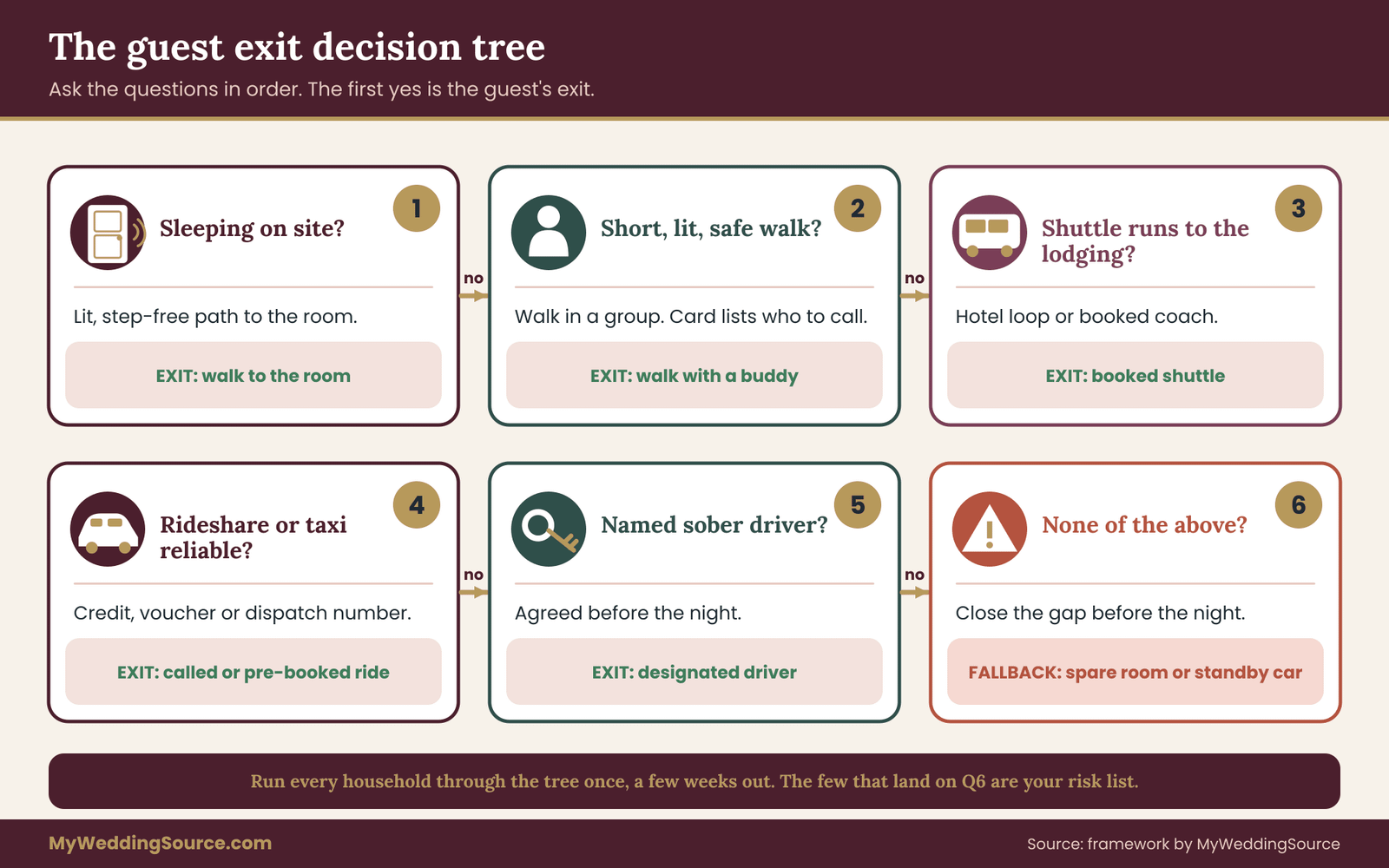
A decision tree is a short sequence of yes-or-no questions that sends each guest to exactly one exit. The value of writing it down is consistency. When a groomsman asks “how is my aunt getting back?” you can answer in ten seconds, and the answer is the same regardless of who is asking or how late it is. For after party transportation, it keeps every answer at the curb consistent.
Here is the tree, one question at a time. Each question has a “yes” branch that ends in an exit, and a “no” branch that moves to the next question.
Question one: is the guest sleeping on site?
If yes, the exit is a lit, short, step-free walk to the room. Check the route in the dark during your venue walkthrough. If the answer is no, go to question two.
Question two: is the walk home short, lit and safe at that hour?
If yes, the exit is a walk with a buddy or a group, and a ride card that says who to call if the after party transportation plan changes. The key words are short, lit and safe. If any of those fails, or if the guest has mobility needs, heels that are already off, or a heavy bag, the answer is no and the guest moves on. For guests who need extra help, the site’s guide to guest care planning covers the questions to ask before the day.
Question three: is a booked shuttle or loop running to the guest’s lodging?
If yes, the exit is the booked ride. This is the backbone of the plan for guests staying at the main hotel or at one of a few clustered properties. If no, because the guest is at a property off your route, go to question four.
Question four: can the guest get a rideshare or taxi with a credit or a dispatch number?
If yes, the exit is a ride the guest calls or that you pre-book. This is the right answer for outliers: a single guest at a distant rental, a local family, a couple leaving early. Give them either a credit, a voucher, or the company’s dispatch number and the venue’s exact pickup point. If the area has thin service late at night, the answer to this question may be no, and the guest moves on.
Question five: does the guest have a sober driver for the night?
If yes, the exit is a named designated driver, ideally someone who has agreed ahead of time and knows they will leave when the group is ready. This works for groups of friends and for family parties, and it is the cheapest solution. It fails when “designated” means “the person who happens to be least impaired at the time.” Agree the name before the night begins.
Question six: if none of the above works, what is the fallback?
If the answer is nothing, you have a gap. Close it before the night, not during. Options include a spare room at the couple’s own hotel, a reserved vehicle on standby, or a clear instruction to the guest to book a room at the venue’s hotel. The fallback should be written on the ride card.
Using the tree in practice
Run each household through the tree once, on paper, a few weeks before the wedding. Put the exit next to each name. You will find that most guests land in two or three exits, and a handful land in the fallback. Those few are your risk list, and now you know exactly who to talk to. Do this early, because the result shapes the after party transportation budget.
The tree is also a good tool for delegation in after party transportation. Give a copy to the person who will manage the curb on the night, and to the best man, the maid of honor or a cousin who knows the family. When someone asks about a ride, they use the tree, not their memory.
Handling the guest who changes their mind
Plans change at midnight. A guest who said they would take the shuttle wants to stay for the after party. A guest who planned to drive says they feel fine. A guest who has no plan appears at the curb with three friends. Your after party transportation plan has to survive exactly that.
The tree does not break when this happens. It simply restarts. Ask the same questions again, from the top, and send the guest to the new exit. The most important rule is that no guest should be sent to an exit that does not exist. If a ride is not available, say so and use the fallback. A short, calm explanation is kinder than a vague promise that turns out to be false.
Keep the tree short on the guest side
Guests do not need to see the whole tree. They need to see their own branch. On the ride card, print only the exit that applies to them, in plain words: “Your ride: hotel shuttle from the north door, last trip 12:45.” A card with an exit is more useful than a chart of all the options, and a guest who has a clear instruction will follow it.
A short check of the tree
Before you finalize, test it with three imagined guests. An older couple at a hotel off the route. A group of friends at a vacation rental across town. A local cousin who lives ten minutes away. If the tree sends each of them to a real exit with a real vehicle or a real person, it works.
If one of them lands on “figure it out,” you have found the gap while there is still time to fix it. A tree that works for those three will work for most of the guest list in after party transportation.
Choosing the after party transportation fleet: five ways to move guests, compared in plain words
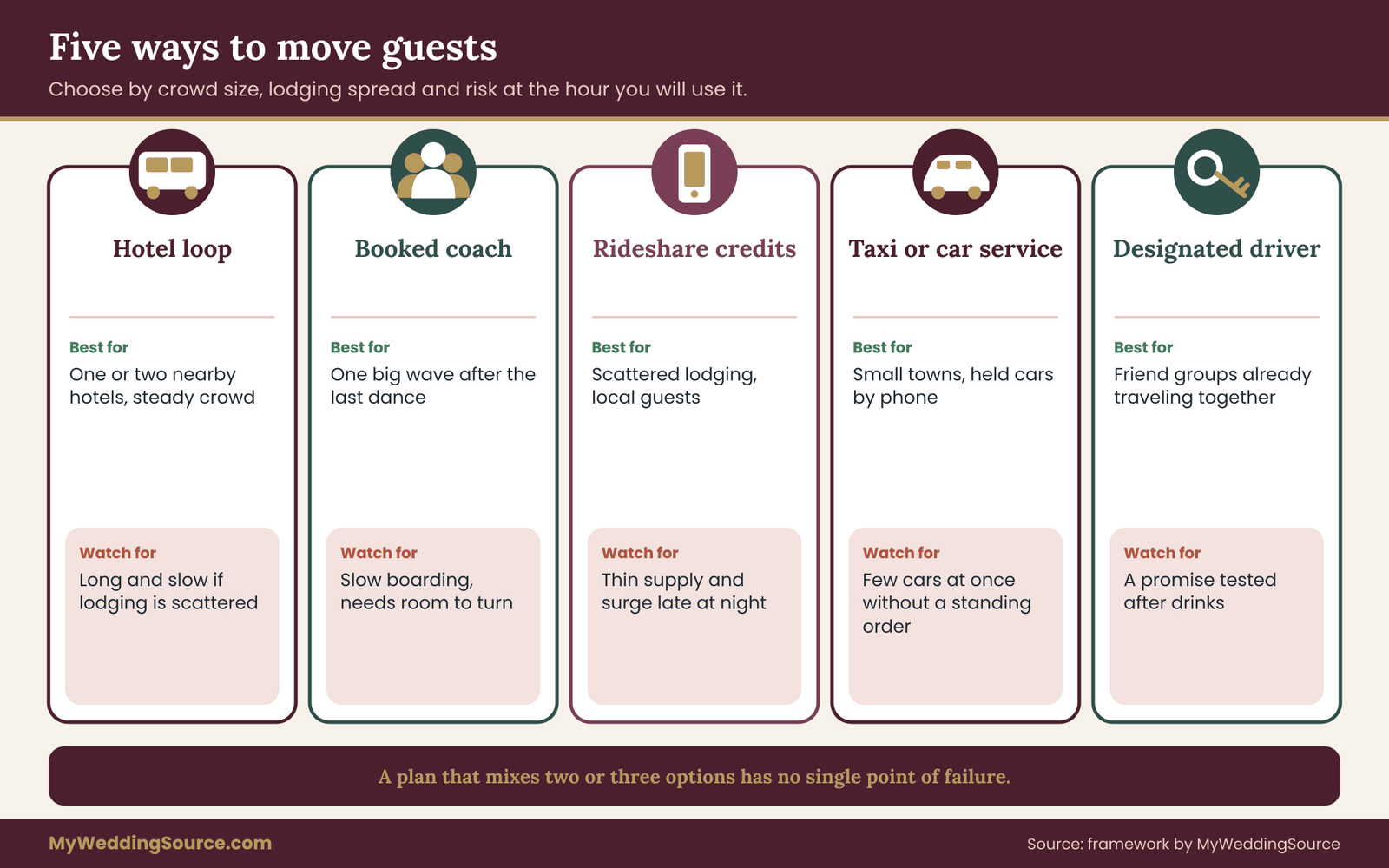
Once you know how many seats you need and where they are going, the next choice is what kind of vehicle carries them. Each option has a character, a failure mode and a situation where it is the obvious answer. None suits every wedding. The right after party transportation plan usually combines two of them. The right after party transportation setup is usually a mix.
The hotel loop
A single vehicle, often a van or a small bus, that runs a continuous loop between the venue and one or two hotels. The strength of the loop is that guests do not need a reservation or a time. They walk out, the vehicle is there or will be in a few minutes, and the driver already knows the route. It is the simplest thing to explain: “The shuttle runs every twenty minutes until 12:45.” It is the most common backbone of after party transportation.
The weakness is that a loop only works if the lodging is clustered. If your guests are spread across five hotels in three neighborhoods, the loop becomes long, slow and confusing, and the last guest on it may spend forty minutes in the vehicle. A loop also has a fixed number of seats per run, so a sudden rush at the end of the night leaves people waiting.
Use a loop when most riders are staying at one or two nearby properties, when the trip is short and when you can predict the crowd.
The booked shuttle or coach
A larger vehicle, rented with a driver for a fixed block of hours and a fixed route. A coach carries many people at once, which makes it the right tool for a big, single wave: everyone leaving at the same moment after the last dance. For some after party transportation plans it is the only sensible choice.
The strength is capacity. One coach can clear a room in one or two runs. The weakness is rigidity. A coach has a long boarding time, a larger turning circle, and often a parking or loading problem at venues with narrow drives. It is also a poor fit for a small crowd spread out over a long evening, because a mostly empty coach is the most expensive way to move six people.
Ask whether the vehicle can physically reach the pickup point. Many venues have height limits, gates or soft ground that a large vehicle cannot use.
Rideshare with credits or pre-booked rides
Each guest uses a rideshare app, and the couple or a host provides a credit or pre-pays a set number of rides. The strength is flexibility. Guests leave when they want, and the couple pays only for rides actually taken. It also copes well with scattered lodging. In after party transportation it works best as a supplement.
The weakness is the one that matters most at one in the morning: supply. Late at night in some places, wait times stretch and prices swing. A guest who is tired and a little unsteady may stand at the curb, watching an estimate climb. Rideshare also depends on the guest’s phone, battery, app and willingness to share a ride with strangers. It is a good supplement and a risky sole plan.
Taxis and dispatched cars
A local taxi or car service company with a dispatch number. The strength is that a human answers the phone, and many companies will hold a few cars for a set time if you ask in advance. Taxis are also the more predictable option in smaller towns where rideshare supply is thin.
The weakness is capacity and response time. A taxi company may not be able to send ten cars at once at midnight, and without a standing arrangement, the queue at the curb can grow. Pre-arranged pickups, with a named number and a short time window, solve most of this.
Designated drivers and family rides
A named sober person who agrees ahead of time to drive a group home. It costs nothing in fees, and it works well for friend groups and families who are already traveling together.
The weakness is that it depends on a promise made when everyone was sober and tested when they are not. If a designated driver has a drink, or is exhausted after a long day, or leaves early, the group is stranded. Use it as one exit among several, and keep a paid backup for guests who lose their ride.
Comparing the five in one pass
Rather than a ranking, think of three questions. How many people will leave at once? How far apart are the lodgings? How much risk does each option carry at the hour you will use it?
For after party transportation, if a large crowd leaves at once and the lodging is clustered, a loop or a coach is the obvious answer. If the crowd is spread out and the lodging is scattered, rideshare and taxis do the work, with a loop covering the main hotel. If the guest list is small and tight, designated drivers and a couple of pre-booked cars may be enough.
Mixing is normal. A common pattern is one loop to the main hotel, a pre-booked taxi arrangement for outliers, and credits for local guests. The loop handles the bulk, the other two handle the exceptions, and the after party transportation plan has no single point of failure. Most after party transportation that works well is a blend of two or three options.
Sizing the last-trip fleet without guessing
The most common planning mistake is booking vehicles by the number of guests instead of the number of runs. A vehicle that holds fourteen seats does not move fourteen people in one go in practice. It moves them in a cycle: load, drive, unload, return. The cycle time sets the capacity. This is where after party transportation plans most often go wrong.
The four numbers you need
You need four measurements, and you can get all of them in an afternoon.
Seats per vehicle. Use the legal and practical seat count, not the brochure number. A van that is advertised for fifteen may carry twelve comfortably once luggage, wedding dresses and a driver are counted. Ask the operator how many guests the vehicle can carry in formal wear with a coat, and use that.
Round trip time. The time from leaving the venue to being back at the venue’s pickup point. Include the drive to the farthest drop-off, the unloading time and the return. Drive the route at the hour you will use it, if you can, because traffic and lighting change the result. Add a few minutes for the driver to pull out of the curb safely.
Loading time. The time to board a full vehicle at the venue. Guests do not board like robots. A group in long dresses and dress shoes, some with a drink still in hand, takes longer than a commuter line. Test it during the walkthrough, or use a generous estimate.
The peak wave. The number of riders who will want a vehicle in the same twenty-minute window, usually right after the last song. This is the number that decides whether your fleet is enough. The survey results and the decision tree give you the first estimate.
The arithmetic
Here is the calculation in words. Take the number of riders in your peak wave. Divide by the usable seats in one vehicle. Round up. That is the number of vehicle runs you need in the wave. Then divide the length of the wave in minutes by the round trip time plus loading. That is how many runs one vehicle can do in the wave. Divide the runs you need by the runs one vehicle can do, and round up. That is the number of vehicles.
Here is a worked example with invented numbers, for illustration only. Imagine sixty riders in the peak wave, a vehicle with twelve usable seats, a round trip of twenty minutes and ten minutes of loading, and a wave that lasts forty minutes. Sixty divided by twelve is five runs. Forty divided by thirty is one run per vehicle, rounded down.
So the plan needs five vehicles, or a wave long enough to let one vehicle do several runs. If you stretch the wave to ninety minutes by staging the after party, one vehicle can do three runs and the after party transportation plan needs two vehicles.
The point of the example is not the numbers. It is the leverage. A small change in wave length, staged by a host announcement or a send-off cue, changes the fleet size dramatically. The cheapest way to reduce your fleet is to spread out the departure. In after party transportation, the length of the wave matters more than the size of the vehicle.

Staggering the wave on purpose
You can design the exit to be gradual. Three tools do most of the work.
First, a soft first departure. Announce an early run, about an hour before the last, for guests who want to go: older relatives, families with children, early risers. It pulls riders out of the peak.
Second, a staged send-off. If there is a formal send-off, such as a last dance or a toast, hold the main crowd until that moment and release the vehicles in two or three groups, by table or by hotel, not all at once.
Third, a clear last run. Guests who know the last departure time tend to leave on the second to last run rather than risk missing it. A clear deadline spreads people out.
Adding a buffer vehicle
Plan one more vehicle than the arithmetic says, or a named backup that can arrive within twenty minutes. Vehicles break down, drivers get lost, and a run that should take twenty minutes takes forty because of a road closure. A backup is the cheapest insurance in the plan, and it often costs nothing until it is used, if you arrange it as an on-call service. A spare is standard practice in after party transportation, not a luxury.
Measurable checks before the night
Make the after party transportation plan testable. Before the wedding, check four things and write the results on your run sheet.
Does the loading zone have room for the vehicle to pull in and out without blocking a fire lane or driveway? Does the route work at the hour you will use it, including any construction or event traffic? Is the pickup point lit, signed and step-free? Can you reach the driver by a phone number that is answered at that hour?
If any of these checks fails, change the plan, not the expectation. A vehicle that cannot reach the door is not part of the fleet.
Safe rides: impaired driving, handoffs and the person at the curb
The reason after party transportation exists is safety, so it deserves a plain look at how safety actually works at a curb at midnight. It is mostly about making the safe choice easy, giving someone clear authority, and writing down what happens at each handoff.
Impaired driving is a planning problem, not a moral one
Public health and traffic safety agencies, including the National Highway Traffic Safety Administration and the Centers for Disease Control and Prevention, describe alcohol-impaired driving as a preventable risk and recommend planning a safe ride before drinking begins. That is the useful framing for a wedding. You are not policing anyone. You are arranging the evening so that, when the moment comes, a safe ride is already waiting and takes less effort than a risky one.
Three design choices do most of the work. First, put the ride in front of the guest before the decision, which means the ride card in the welcome bag or at the place card, and a clear announcement before last call. Second, make the ride free or nearly free at the point of use, so cost never pushes a guest toward driving. Third, make the ride convenient: close to the door, visible, and running at a predictable time. These choices define safe after party transportation.
What a guest-facing ride plan says
A good plan has a short script that every host and vendor can repeat. It does not accuse anyone. It simply makes the ride the default.
“Your ride is arranged. The shuttle is at the north door, and the last one leaves at 12:45.” If a guest says they plan to drive, the answer is just as short: “We would like everyone to get back safely. Your car can stay in the lot overnight, and a ride is ready now.”
Notice what the script does. It offers the ride before the question of ability to drive comes up, and it removes the main cost of leaving a car, which is the worry about picking it up in the morning. Confirm with the venue that cars may stay overnight, and for how long, and write the answer on the ride card.
The car left overnight
Guests who leave a car need three pieces of information: whether it can stay, until what time the next day, and who to call if there is a problem with parking enforcement or towing. Ask the venue in advance, and if there is a risk, arrange a note for the windshield or a list of license plates with the venue manager. This is a small step that removes one of the biggest reasons a guest says “I’ll just drive.”
The person at the curb
Name one person to own the curb. Not a committee, not “whoever is around.” One person, with a phone, a copy of the run sheet and the authority to make small decisions. This role is often held by a planner, a coordinator, a family member who is not drinking and enjoys logistics, or a hired staffer. The right person is calm, sober and comfortable saying “wait here, the next one is in four minutes.” Every reliable after party transportation plan has such a person.
The curb owner has four jobs. Count riders as they board, so the vehicle never leaves overfull. Match guests to the right vehicle by hotel. Keep a short written log of departures, with the time, the vehicle and the rough number of riders. And watch for guests who are struggling, and quietly connect them with help.
Handoffs in writing
At every point where responsibility passes from one person to another, a short written note prevents mistakes. There are three handoffs in a typical night. Written handoffs keep after party transportation from depending on memory.
From the venue to the curb. The curb owner confirms with the venue manager the pickup point, the loading zone and the time the venue expects the guests to be gone.
From the curb to the driver. The driver gets a one-page sheet: stops in order, hotel names and addresses, expected number of riders per run, and the phone number of the curb owner. A driver who knows the next stop does not need to ask guests for directions.
From the driver to the hotel. If a guest is unsteady or alone, the driver should know to wait until the guest is inside. Ask the hotel whether the front desk is staffed at that hour, and if not, how guests get in. The guide to wedding vendor contracts explains how to turn promises like these into written terms.

What staff should and should not do
Drivers and venue staff are not responsible for deciding who is fit to travel, and they should not be placed in that position. What they can do is follow a short procedure. If a guest appears unwell or unable to travel alone, call the curb owner. If a guest is hurt or in danger, call emergency services.
If a guest insists on driving and appears impaired, the curb owner and a family member should step in, offer a ride, hold the keys if the guest agrees, and call emergency services if the guest drives off in a way that is a clear danger to others.
Be realistic about the limits. You cannot control another adult’s choices. What you can do is arrange the conditions so that the safe choice is simple, visible and free, and so that someone with authority is present to help.
Worker safety is part of the after party transportation plan
The people running the last trips are workers, and their conditions affect your guests. The Occupational Safety and Health Administration publishes guidance on worker safety, including fatigue and working at night, and drivers who have been awake for a long day make worse decisions. Ask the operator about driver shifts and rest, and do not pressure a driver to stay beyond their planned hours.
Curb staff also work in the dark, near moving vehicles. Give them reflective vests or lights, a clear loading zone and a plan for who stops traffic. A person standing in a dim driveway in a formal jacket is hard to see.
Lighting, signage and the physical curb
The pickup point should be easy to find from the door, lit well enough to read a sign, and free of steps or loose gravel for guests in heels or with canes. Put a sign at the pickup point with the vehicle names and hotels. The guide to wedding reception guest flow covers how guests move through a venue, and its exit advice applies directly here. Physical details like these decide whether after party transportation feels calm.
If the venue has a long driveway, decide whether vehicles will come to the door or guests will walk to a staging area. Where the answer is a staging area, check that the route is lit and that guests with mobility needs have a short way to a seat. A well-lit curb with chairs, water and a sign tends to make guests patient, which is half of good after party transportation. A dark curb with no information makes them anxious.
Water, food and a place to wait
Waiting is part of leaving. A guest who waits twenty minutes in the cold with no water and no information will start looking for another way home. A guest who waits in a warm room with a glass of water and a sign that says “next shuttle in ten minutes” will wait calmly.
A short, simple holding area near the exit, with a chair or two and a clear view of the loading zone, is worth the effort. Treat the wait as part of after party transportation, not as a gap in it.
If the late-night snack or coffee is on offer, serve it near the exit rather than at the far end of the room. Guests who have eaten and had water are better prepared for the ride home, and a short food break can also stagger the wave in a useful way.
Guests who need extra help: mobility, minors and long trips
A plan that works for most guests can fail for a few, and those few are the ones who suffer most from a failure. Plan for them directly instead of hoping the main system will cover them. After party transportation has to work for them as well.
Guests with mobility needs
If a guest uses a wheelchair, a walker or a scooter, ask in advance, privately, what they need. The question is simple: “Will you need an accessible vehicle for the ride back?” Accessible vehicles are not the same as standard vehicles, they are less common, and they often need to be booked ahead.
The Americans with Disabilities Act sets rules for accessibility in transportation, and the U.S. Department of Justice and the Department of Transportation publish guidance. For a private booking, ask the operator directly whether it has a lift or ramp vehicle, whether the driver is trained to use it, and how much time loading requires. A ramp vehicle takes longer to load, so add time to your cycle.
Do not assume a rideshare will provide an accessible vehicle on demand. Availability varies by location. Where you cannot confirm an accessible ride, book one, or arrange a family member’s vehicle ahead of time.
Older guests and early leavers
Many older guests are happy to leave early, and the best plan lets them. Offer a soft early departure, with a named driver or a short loop, so they do not have to wait for the main wave. Make sure the pickup point has seating and that the route to it is flat and lit.
Children and teenagers
Minors need an adult to travel with them. Do not plan for a child to take a ride alone, and do not rely on a rideshare to carry an unaccompanied minor, because many services have age rules. If a family with young children leaves at nine, make sure the car seat question is answered ahead of time. Vehicles for hire may not supply car seats, and rules about them differ by place, so the family may need to bring their own or arrange a seat in advance.
Guest care for children and older relatives is a larger topic. Here the key point is that these guests should be in the decision tree from the start, with a named exit.
Guests traveling alone
A guest who is traveling alone and does not know the area deserves a gentle check. Pair them with another guest at the same hotel, or give them a printed card with the hotel’s address and the curb owner’s number. Do not overdo it. The goal is that nobody is stranded, not that anyone is supervised. Small checks like this make after party transportation feel considerate.
Guests with language or phone barriers
A guest without a data plan, or with a dead phone, cannot use a rideshare app. A guest who does not read the local language cannot read a shuttle sign. Print ride cards in the languages your guests use, put the hotel name and address on the card, and place a phone charger or two at the curb. These small steps cost very little and remove the most common reasons for confusion at the end of the night.
Vendor questions and contract terms for after party transportation
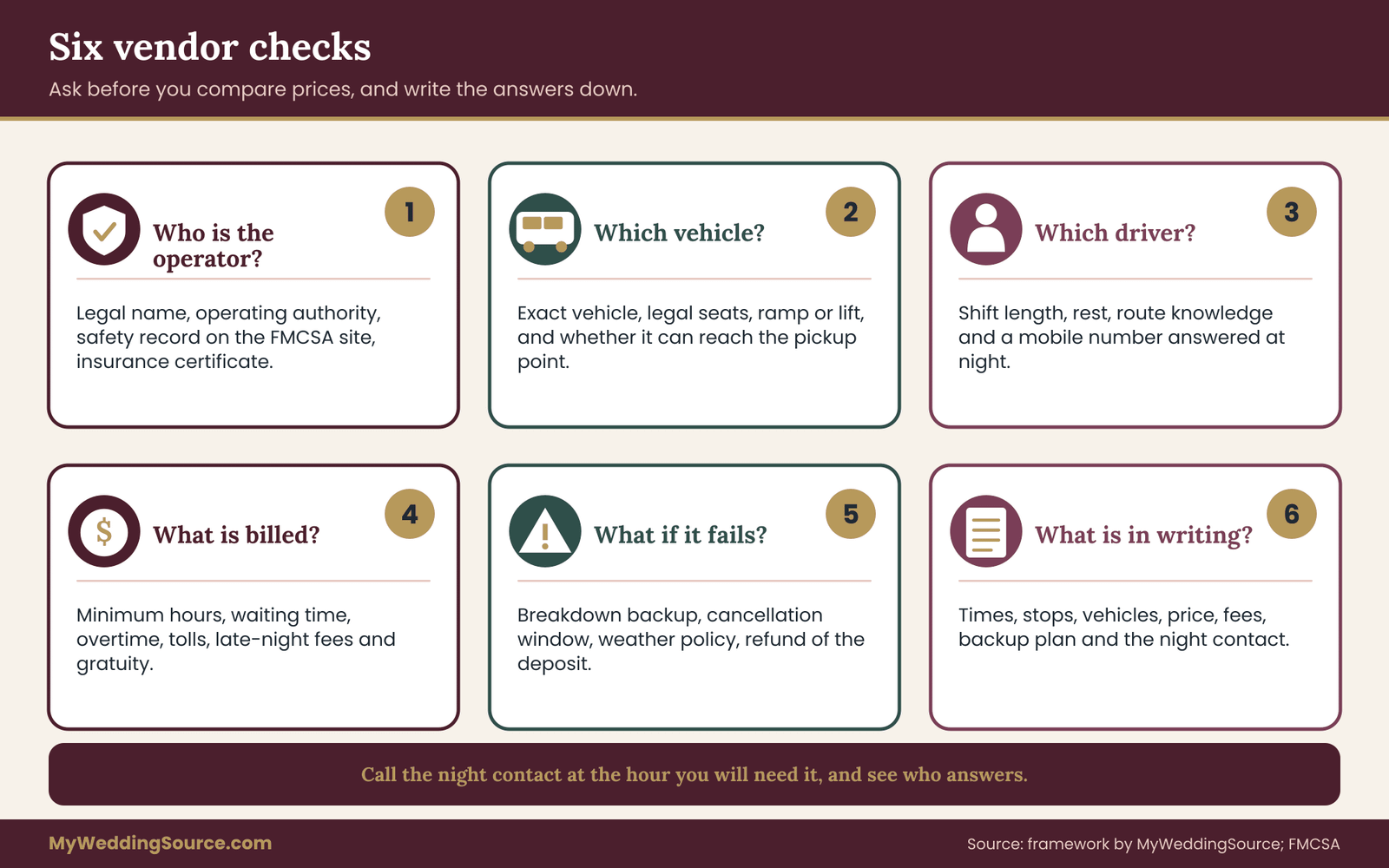
A transportation vendor sells a promise that a vehicle will be at a place at a time. The quote is the easy part. What matters is whether the promise survives a late reception, a missed turn or a driver who falls sick. The questions below turn vague confidence into specific answers you can put in writing. Treat each answer as part of your after party transportation file.
Verify the operator before you compare prices
Start with the basics that apply to any company that carries passengers for hire. Ask for the operator’s legal name and its federal and state operating authority, where those apply. The Federal Motor Carrier Safety Administration publishes registration and safety information for interstate passenger carriers, and many states and cities license local car services, taxis and limousines. The same habits apply here as with any vendor contract: ask for the operator’s identification, the insurance on the vehicles, and the exact name that will be on the agreement.
Ask for a certificate of insurance. You want to see that the vehicles used for your event are covered, what the limits are, and who is named. If the venue requires proof of insurance for any vehicle entering the property, ask the operator to send it directly to the venue.
Questions about the vehicle
Ask which vehicle will be used, not which class of vehicle. Ask its legal seating capacity and how many guests in formal wear it carries comfortably. Ask whether it is accessible, and whether a ramp or lift is available. Ask whether it can reach your pickup point, with questions about height, length and turning circle. If you are hiring a coach, ask for a photo of the vehicle. The vehicle is the physical core of after party transportation.
Ask what happens if the vehicle breaks down. A good operator has a plan: a replacement vehicle, a dispatch contact, a time within which a substitute will arrive. If the answer is “it rarely happens,” ask the question again, calmly.
Questions about the driver and schedule
Ask how long the driver will have been working when they start your event. Ask about the driver’s shift limits, break rules and whether a second driver is available. Ask whether the driver knows the route and the hotel drop-off points, and whether they will carry a printed run sheet. Driver rest is a real part of after party transportation safety.
Ask who is the contact on the night. You want a named person with a mobile number that is answered, not a general dispatch line that closes at midnight. Test it before the wedding. Call the number at the hour you will need it, if you can, and see whether someone answers.
Questions about time and billing
Quotes for after party transportation are often built from a minimum number of hours, an hourly rate or a flat route price, plus fees for waiting time, fuel, gratuity, tolls, overtime and late-night surcharges. Ask for each item in writing. Ask when the clock starts and stops: from the moment the vehicle leaves the garage, from the moment it arrives at the venue, or from the first guest boarding. Ask what happens if the event runs late, and how overtime is charged, in what increments.
Ask whether gratuity is included. Some operators include a service charge, some add a gratuity automatically and some leave it to you. It matters to check what each line is for.
Questions about cancellation and changes
Ask what happens if you reduce the order, cancel it or change the time. Ask when the deposit is refundable, and what the cancellation window is. Ask what happens if the operator cancels or cannot provide the vehicle. A good contract makes the operator responsible for finding a replacement of equal quality, or for refunding the deposit, and says so plainly.
Ask about weather. If a storm closes roads, what is the policy? Is there a rescheduling option? Is the operator’s decision to run or not run based on a stated standard?
The terms to put in writing
Convert the answers into a short written agreement. At minimum, it should say the date, the pickup times and locations, the number of vehicles and their seating capacities, the route and drop-off points, the hours included and the overtime rule, the total price and each fee, the deposit and payment schedule, the cancellation terms, the backup plan for breakdowns and the contact person on the night. This short document is the backbone of after party transportation.
If any of these is missing from your after party transportation agreement, ask for it. The goal is not to be difficult. It is to make sure that when the night goes off plan, both sides are reading the same page.
Costs, who pays and how to keep after party transportation affordable
Costs are the part of transportation planning where couples most often feel stuck, because the numbers depend on your city, your date and the vendor. This section does not offer averages, since any figure would be invented. It gives a structure for thinking about cost and a few ways to keep it under control.
The four cost drivers
Transportation cost is driven by four things. The number of vehicles. The number of hours each vehicle is committed. The distance and time of each run. And the surcharges attached to late nights, holidays and peak dates. Each of them is something you can change. Knowing them helps you keep after party transportation affordable.
You reduce vehicles by spreading the wave, as described earlier. You reduce hours by holding the last departure at a firm time and starting the loop later. You reduce run distance by clustering lodging. And you avoid surcharges by checking the date and asking for the details of any peak-date pricing.
Who pays: three common patterns
The couple pays for the whole fleet. This is the simplest and most generous, and it works when the guest list is small or the after party transportation fleet is modest. It makes the ride feel like part of the hospitality.
The couple pays for a core fleet, and guests pay for extras. A loop to the main hotel is covered, and guests who want to extend the evening or travel to a distant location pay their own way. This is a good balance for medium-sized weddings.
Guests share the cost. Some couples ask guests to pay a small fee for a private coach or to chip in for a late-night ride. This can work for friends’ after parties and for destination weddings, but it needs clear wording and a simple payment method, and it should never be required for safety.
Whichever pattern you choose, write it down and tell guests early. The wording on the website and the ride card should say what is covered. The guide to wedding budgeting can help place transportation in the overall plan, and note that a vehicle deposit often falls due before the balances for other vendors. Clear cost rules keep after party transportation friendly.
Pay for the safe option, not the cheapest option
If the budget is tight, protect the part of the after party transportation plan that carries risk. A loop to the main hotel, running reliably, is worth more than an elaborate send-off car. A rideshare credit that is large enough to cover a typical late-night ride is worth more than a small credit that leaves the guest with a bill. Where you have to choose, choose the plan that stops a guest from driving. Safe after party transportation does not need to be elaborate.
Credits and vouchers: the details
If you use rideshare credits or vouchers, check how they work before you rely on them. Ask the provider whether a credit has an expiry, a per-ride cap or a location limit. Ask how guests redeem it, and whether they need to create an account. Ask what happens to unused credits. Some providers offer a pre-paid code that guests enter in the app. Others need the host to approve each ride. Test the process with one guest ahead of time.
Spell out the rules on the ride card in a sentence or two: “Use this code in the app. It covers rides from the venue to your hotel tonight.” A guest who is unsure whether a ride is covered may choose not to take one.
Hidden costs to watch
Several costs are easy to miss. A wait-time fee, charged by the minute while a vehicle waits at the venue. A minimum charge that is higher than the actual run. An after-hours fee for a pickup after a certain time. A fuel or tolls surcharge. A fee for extra stops. A cleaning fee if a vehicle is soiled. A charge for a vehicle sent back empty. Ask each vendor to list all of them, and compare totals, not rates.
Keeping a record
Keep every quote, every written agreement and every payment record in one folder, as you would for any vendor. If a dispute comes up later, a clear record of what was promised and paid is your best protection. A tidy file makes after party transportation easier to review the next day.
A worked example: the Bellamy and Cho after party
This example is invented for illustration. The names, numbers and venue are made up, and the figures are chosen to show the method, not to suggest typical results. It follows one couple through the framework from first estimate to final run sheet.
The setup
Dana Bellamy and Joon Cho are marrying on a Saturday at a country venue about twenty-five minutes from town. The reception ends with a dance floor that the DJ will keep open until midnight, and the venue’s contract requires guests out by 1:00 a.m. About one hundred and ten guests are attending. The couple plans a small after party at a bar in town for whoever wants it. Their after party transportation plan has to cover a long drive at night.
They have a main hotel in town that holds a block, a second hotel nearby, a handful of guests in rentals and a few local relatives. Several older relatives will leave early.
Step one: fix the last departure
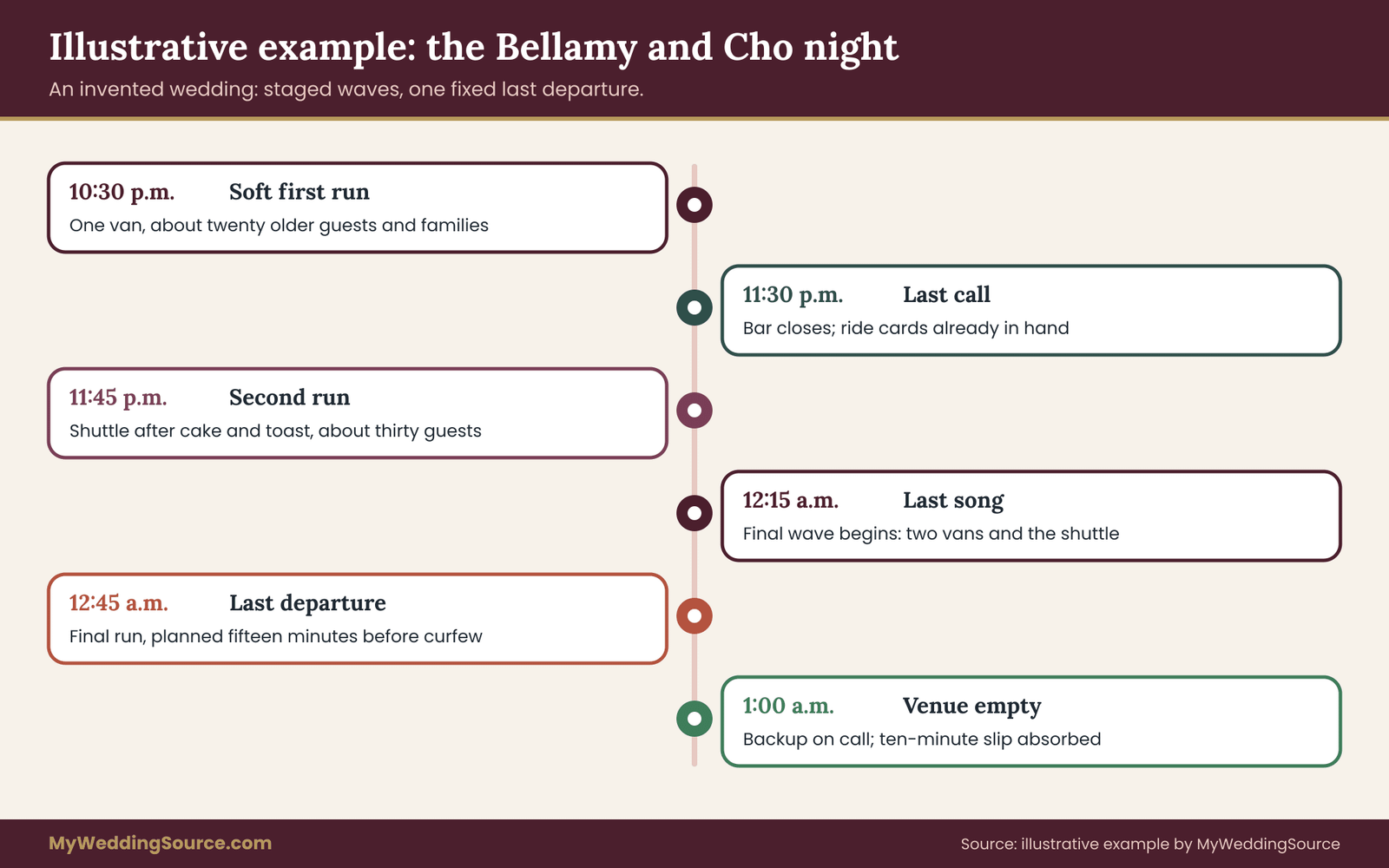
The venue clock says guests out by 1:00 a.m. The shuttle company offers a driver whose shift can run to 1:30 a.m. The couple expects the energy to fade near midnight. They take the earliest sensible time and set the last departure at 12:45 a.m., which gives a fifteen-minute buffer before the venue’s deadline. Last call is 11:30 p.m. and the last song is 12:15 a.m. All three go on the run sheet in that order. That one decision anchors their after party transportation schedule.
Step two: count the guests by exit
Dana and Joon send a short question with the final details: where will you stay, and how do you plan to get back? The answers sort into the five labels. Eighteen guests stay on site in the venue’s small cottages. Seventy-two stay in town, split between the main hotel and the second hotel. Eight are local and will be collected by family. Twelve have a car and plan to drive, and some of those live nearby.
From the second group, the couple expects several older guests to leave early, and they expect some guests to go on to the after party in town.
Step three: run the decision tree
They go through the list with the tree. The eighteen on-site guests take the lit path to the cottages, which Joon’s sister checks after dark during the walkthrough. The eight locals are given a rideshare credit and a pickup point. The twelve drivers are asked who will drive and who will not, and four of them decide to leave their cars overnight after the venue confirms that is allowed.
That leaves about eighty guests who need a vehicle. Most are at the main hotel. A smaller group is at the second hotel, close enough to share a route. Two guests at a rental across town need a separate arrangement, and one guest uses a wheelchair and needs an accessible vehicle.
Step four: pick the after party transportation fleet
The route is a loop through the main hotel and the second hotel, and the venue is twenty-five minutes away. The couple chooses a hotel loop with two vans and one larger booked shuttle for the peak wave. They arrange a standby taxi account for the rental guests and book an accessible vehicle for the guest using a wheelchair. This mix is typical of after party transportation for a mid-sized wedding.
The vans have twelve usable seats each. The shuttle has twenty-four. The round trip to the hotels is about fifty minutes, with ten minutes for loading and unloading.
Step five: size the waves
The couple stages the exit in three waves. A soft first run at 10:30 p.m. takes older guests and families with children, about twenty people, in one van. A second run at 11:45 p.m. after the cake and toast takes about thirty guests in the shuttle. The final wave leaves at 12:15 a.m. and 12:45 a.m., with the two vans and the shuttle taking the rest.
Here is the check. In the final wave, about thirty guests need to leave. Two vans carry twenty-four in a single run, and the shuttle carries up to twenty-four. One more run is covered by the second-to-last departure. The after party transportation plan holds because the waves are staggered, not because the fleet is large.
Step six: write the vendor terms
The couple asks each operator the questions from the vendor section. The shuttle company confirms the vehicles, the seat counts, the driver’s shift to 1:30 a.m., the overtime rule and a backup vehicle on call within twenty minutes. The accessible vehicle is confirmed by a separate operator, with a loading time of about fifteen minutes. The couple records each answer in a one-page agreement.
Step seven: assign the curb
Joon’s cousin, who does not drink and likes logistics, owns the curb. She has the run sheet, the driver’s mobile number and a printed list of which guests are on which vehicle. A venue staffer holds the door and keeps the pickup point clear. Reflective vests are on the shelf in the cloakroom.
What happened, and what the example shows about after party transportation
On the night, the after party transportation plan works with one adjustment. The DJ’s last song runs ten minutes over, and the final wave leaves at 12:55 instead of 12:45. The cousin notices at 12:30, calls the driver and adds a ten-minute wait, which is covered by the overtime rule in the agreement. All guests are on a vehicle by 1:00.
The example shows three things. The last departure was fixed early and everything else was built around it. The waves were staged on purpose, which kept the fleet small. And one person held the curb with a written sheet, so a ten-minute slip became a phone call instead of a crisis. It is a small model of after party transportation done calmly.
Variations on the example
If the venue were in the same town as the hotel, the couple might skip the shuttle entirely and rely on a loop and walking. If the guests were mostly local, rideshare credits would carry most of the load. If the wedding were a destination event with all guests in one resort, a short on-property shuttle might be enough. The framework is the same; only the numbers change.
Edge cases, scripts and the one-page run sheet
Even a good plan meets surprises. The most useful preparation is to decide in advance what you will do in the three or four situations that come up most often. That way the response is a decision already made, not an improvisation at one in the morning. After party transportation is no different from any other live logistics.
The vehicle does not come
A driver is late, a van breaks down or a booking is lost. The curb owner calls the driver and the operator’s dispatch. If no vehicle will arrive within fifteen minutes, the backup is activated: a taxi company with a standing arrangement, a rideshare credit used for the stranded group, or the standby vehicle. Say plainly to guests what is happening and when the next vehicle will arrive. A clear estimate calms a crowd. Every after party transportation plan should name its backup.
The weather turns
Rain, wind, fog or ice change loading times, speeds and risk. The after party transportation plan should include a covered pickup point or an umbrella station, a longer round trip estimate and a decision rule about when to stop a run. Check the forecast the day before and again at dinner.
The National Weather Service at weather.gov issues forecasts and warnings, and if a warning is issued for your area, the plan changes: hold guests inside, shorten the loop, or stop service until it is safe, according to the operator’s judgment.
A guest refuses a ride
Some guests will say they are fine. The response is calm and brief: the car can stay, the ride is already paid for, and nobody is judging. If a guest still plans to drive and appears impaired, bring in a family member or friend whom they trust. Do not argue at the curb. If a guest drives off in a way that is a clear danger to others, call emergency services.
The after party moves
A group decides to continue at another location, and the after party transportation plan for the last departure no longer applies to them. Treat the new location as a new exit. The guests who go there should have a way home from it, and a person who knows where they are. If the couple has promised a ride from the second location, put the time on the ride card. If not, say so, and tell them how to book their own.
The venue ends early
A venue may shut down earlier than the contract suggests, because of a noise complaint, a safety issue or a power problem. The curb owner calls the first vehicle forward and releases the waves faster. A backup holding area, such as a hotel lobby or a tent, can prevent a crowd from standing in the road.
A medical or safety emergency
If a guest is hurt or ill, call emergency services first and the curb owner second. Vehicles should not be used as makeshift ambulances unless there is no alternative. Keep a short list of the venue’s address and nearest hospital on the run sheet. The guide to a wedding day digital contingency plan helps with the related questions of phones, contacts and backups when something fails.
Scripts for the night
Short, repeatable sentences save time. Share these with the curb owner, the DJ and the people who will answer guests’ questions. Adapt the wording to your own voice. Scripts keep after party transportation consistent across volunteers.
For the announcement before the first run: “The shuttle to the hotels leaves from the north door at 12:15 and 12:45. The 12:45 is the last one. Your ride card shows your hotel.”
For a guest who is unsure: “Which hotel are you at? That one is on the second van, which leaves in about ten minutes. Please wait by the sign and we will call you.”
For a guest who wants to stay: “Of course. The last shuttle leaves at 12:45. After that, the rideshare credit on your card will get you back, and the venue closes at one.”
For a guest who wants to drive: “Your car is fine here overnight, and a ride is ready right now. We would feel better knowing you got back safely.”
For a driver: “Your stops are the main hotel, then the second hotel. Wait until each guest is inside if they seem unsteady, and call me if anything is unclear. My number is on the sheet.”
For a vendor who is running late: “What is your arrival time? We have a guest group waiting at the north door. If you cannot arrive in fifteen minutes, we will use our backup, so please tell us now.”
The one-page run sheet
Put the whole after party transportation plan on a single page. Keep it large enough to read in the dark. The page should have these parts, in order.
The clock. Last call, last song, last departure, and the venue’s deadline, each with its time.
The runs. A list of each vehicle run, its departure time, its stops and its approximate load.
The curb owner and contacts. The curb owner’s name and number, each driver’s number, the operator’s dispatch number, the venue manager’s number and the backup vehicle’s number.
The decision tree in short. The five exits, in a single line each.
The fallbacks. What to do if a vehicle does not arrive, if weather turns, if a guest refuses a ride and if the venue ends early.
The emergency line. The venue address, the nearest hospital and the local emergency number.
Print three copies: one for the curb owner, one for the planner or a trusted family member, and one for the couple’s emergency contact. Save a copy on the phones of the curb owner and the planner. The guide to the wedding vendor timeline helps place the confirmation calls for transport in the weeks before the wedding.
Measurable checks for the final week
Turn the after party transportation plan into checks you can tick off. In the final week, confirm each of the following in writing or by phone, and note the time and the name of the person you spoke with.
The operator has confirmed the vehicles, the number of seats, the pickup times and the driver’s mobile number. The venue has confirmed the pickup point, the loading zone, the lighting and the overnight parking policy. The curb owner has received the run sheet and has met the first driver, even by phone.
The ride cards are printed with correct hotel names and times. The announcement is scheduled with the DJ or host. The backup vehicle has been confirmed with a time window. The accessible vehicle, if needed, is confirmed with its loading time.
Two days before, call the operator again and read back the times. On the day, send a short confirmation text to the driver with the first pickup time and the curb owner’s number. These tiny habits catch most errors.
After the night
On the next day, spend ten minutes on a short review. Did every vehicle run on time? Did anyone wait more than the planned time? Were there any guests who did not have a ride? Make a note of what to change, and send the operator any feedback or any questions about the final invoice. Check the invoice against the agreement line by line, including overtime and gratuity. Keep the documents together with your other vendor records. Reviewing after party transportation once teaches more than any checklist.
If a guest left a coat, phone or shoes in a vehicle, ask the operator to hold the item and send a short message to the guest list. Small details like this are remembered kindly.
Limits of this plan
This guide gives a framework, not a guarantee. Local rules about alcohol service, parking, vehicle licensing, passenger limits and curfews differ by place, and they change. Operators have different policies, and availability varies by date and city. Before you commit, confirm the current rules with your venue, your local licensing authority and the operator. If something in this guide conflicts with advice from a licensed professional, follow the professional. After party transportation depends heavily on local conditions.
Your next steps
Start your after party transportation plan with the last departure. Pick the time, write it beside last call and last song, and tell your venue and your host. Then run your guest list through the decision tree, so each household has an exit. Count the riders in the peak wave, divide by usable seats, and decide how many vehicles you need. Ask each operator the vendor questions, put the answers in writing, and name the person who owns the curb.
Then print the ride cards, schedule the announcement, confirm the backup and book any accessible vehicle. A calm plan for after party transportation takes a few evenings, and it lets everyone, including you, enjoy the end of the night.
FAQ
How early should we book after party transportation?
Book as soon as your date and venue are firm, since vehicles and drivers are limited on popular dates. Confirm the final headcount and times closer to the wedding. Late-night service can be scarcer than daytime service, so ask operators about their availability and minimums at the start, and get any agreement in writing with a backup plan for breakdowns.
How do we choose the last departure time?
Take the earliest of three limits: the venue’s end time, the operator’s driver availability and the point where the party has naturally thinned out. Then add a short loading buffer. Write last call, last song and last departure together, tell guests the final time, and name a fallback for anyone who misses it.
Do we need to provide rides for every guest?
Not necessarily. For after party transportation, guests staying on site, walking a short safe route or arranging their own sober ride may not need one. Use the decision tree to sort each household into an exit, and provide a vehicle, credit or named driver for everyone else. The aim is that nobody is left without a safe way back.
Is rideshare enough for after party transportation?
It can work in busy areas, but supply and wait times vary, especially late at night, and guests need working phones and apps. Many couples use rideshare credits as a supplement to a hotel loop or booked shuttle. Check local availability, test the credit process, and keep a taxi or standby vehicle as a backup.
How many vehicles will we need?
Count riders in your peak wave, divide by usable seats per vehicle and round up to get the runs needed. Then see how many runs one vehicle can complete in the wave, using round trip and loading time. Staggering departures, with an early run and a staged send-off, usually reduces the after party transportation fleet more than any other change.
What should we ask a transportation company?
Ask for the operator’s legal name and licensing, insurance certificate, exact vehicle and seat count, driver shift limits, backup plan, billing items, overtime rules, cancellation terms and a mobile number that is answered at night. Also ask whether the vehicle can reach your pickup point and whether an accessible vehicle is available.
What if a guest wants to drive after drinking?
Make the ride easy and the alternative simple. Say the car can stay overnight, a ride is ready now, and nobody is judging. Bring in a trusted friend or relative if needed. Do not argue at the curb. If a guest drives off in a way that is a clear danger to others, call emergency services.
Who pays for transportation at the end of the night?
There is no single rule. Some couples pay for the whole fleet, some pay for a core loop and let guests cover extras, and some ask guests to share the cost of a private coach. Whatever you choose, state it clearly on the website and ride card, and never make payment a barrier to a safe ride.
Sources
- Drunk driving, National Highway Traffic Safety Administration
- Impaired driving, Centers for Disease Control and Prevention
- Federal Motor Carrier Safety Administration, passenger carrier safety and registration
- Americans with Disabilities Act, U.S. Department of Justice
- Accessible transportation, U.S. Department of Transportation
- Occupational Safety and Health Administration
- National Weather Service forecasts and warnings, NOAA
- Federal Transit Administration, ADA and accessibility guidance
- Child passenger safety, National Highway Traffic Safety Administration
- Federal Trade Commission, consumer protection for contracts and fees