
Marriage certificate errors are small mistakes in the official record of your marriage, such as a misspelled name, a wrong date or a wrong place, and they are far easier to fix early than late. This guide shows you how to check the record line by line, work out who owns the fix, and contact the issuing office with a written log so nothing gets lost.
Order a certified copy from the office that recorded your marriage and compare it, field by field, with your license application and your identity documents. Sort anything that does not match into one of four owners: the recording office, you, your officiant, or a court. Then contact the issuing office, ask how it handles corrections, and write down the date, the person, the answer and the next step every time. Hold name-change steps that depend on the wrong detail until the record is right.
Most couples read their marriage certificate once, if at all. It arrives in an envelope weeks after the wedding, looks official, and goes into a drawer. Then, months later, a clerk at the Social Security office or a passport agent points at a line and says the spelling of a middle name does not match your birth certificate. At that point the mistake has already travelled, and marriage certificate errors found this late are the expensive kind. It may be on your new driver’s license, your payroll record and your insurance enrollment.
Marriage certificate errors are rarely dramatic and rarely anyone’s fault in a way worth arguing about. A clerk keys in a name from handwriting that was hard to read. An officiant writes the wrong day on the line because the ceremony ran after midnight in someone’s memory. A couple fills in the application in a hurry and leaves out a suffix. What turns a small slip into a long errand is not the slip itself. It is finding out late, calling the wrong office, and having no record of who said what.
This guide to marriage certificate errors is built around two tools. The first is a record error verification checklist, which is a short sequence of passes through the certificate so that you check the same things in the same order every time. The second is a county-clerk contact log, which is a one-page habit for recording every conversation with the office that holds your record.
Around those tools you will find a worked example with an invented couple, advice on what can wait while a correction is pending, and an honest section on what this kind of guide cannot decide for you.
A note on scope. This is general information, not legal advice, and the rules for marriage records and corrections differ by state, county and sometimes by the year the marriage was recorded. Where a rule matters, the article points you to the office or agency that sets it, so you can confirm the current version yourself.
What counts as marriage certificate errors
Before you start checking, it helps to define the problem. Not every difference you notice counts among the marriage certificate errors worth a correction request, and not every error needs the same response. A useful working definition is this: a marriage certificate error is any detail on the official record that is different from the true fact, from the information you gave the office, or from the identity documents the record is meant to match.
That definition has three parts, and the parts matter because they point to different fixes.
The record differs from the truth. Your date of marriage is on a Saturday and the record shows the Friday. The record names the wrong county, or lists a ceremony in a city where you did not marry. Someone else had to supply the true fact, and the correction usually needs evidence.
The record differs from what you submitted. Your application said “Anne-Marie” and the record says “Annemarie.” The office made the change when entering the data. In many places this is the simplest kind of fix, because the office can compare the record with its own file.
The record differs from your identity documents. The certificate may be exactly what you wrote on the application, but your passport, birth certificate or Social Security record uses a different form of your name. The certificate is not wrong about what you submitted, yet it will still cause trouble because agencies compare documents against each other.
Keep these three kinds of marriage certificate errors apart in your notes. The same visible symptom, a name that looks off, can belong to any of them, and the first question when you call an office will be which one it is.
Errors, variations and choices that are not errors
Some things that look like marriage certificate errors are really choices or normal variations. Naming is the main source of confusion.
The name field on a marriage record usually shows the names the spouses had before the marriage. It may not show the names you plan to use afterward. If you wanted to take your spouse’s surname, hyphenate, or keep your own, the certificate often does not record that decision at all. The certificate proves the marriage, and the new name is something you put into effect later, by presenting the certificate to agencies. If you find that your intended new name is missing from the record, check how your state treats it before concluding anything is wrong.
Other variations are formatting. One office may print names in capital letters, drop accents and diacritical marks, shorten a long name to fit a field, or put the last name first. A middle name written out in full on your birth certificate may appear as an initial. Whether that counts as an error depends on whether the record is meant to match the other document exactly, and that depends on who is reading it. A bank may not care. A passport agency may.
A third group is data the office never collected. If you expected your occupation, your parents’ names or your previous marriages to appear and they do not, the form in your state may simply not ask for them. Compare against what your own application contained, not against what you assumed a certificate would hold.
The chain from license to certified copy
Marriage certificate errors enter the record at specific points, and knowing the chain lets you guess where a mistake began. In the usual pattern, the process has six stages.
You apply for a marriage license at a local office, commonly a county clerk, a recorder, a register of deeds or a town or city clerk, depending on the state. The office enters what you tell it and often asks you to review and sign. After the license is issued, you hold the ceremony. The officiant, and in some places witnesses, complete the signature portion.
The signed license is then returned to the issuing office, usually by the officiant or sometimes by the couple, within a time set by the state. The office records the marriage, which creates the official record, and some states also pass information to a state vital records office. Finally, you or the office order certified copies, which are issued from that record.
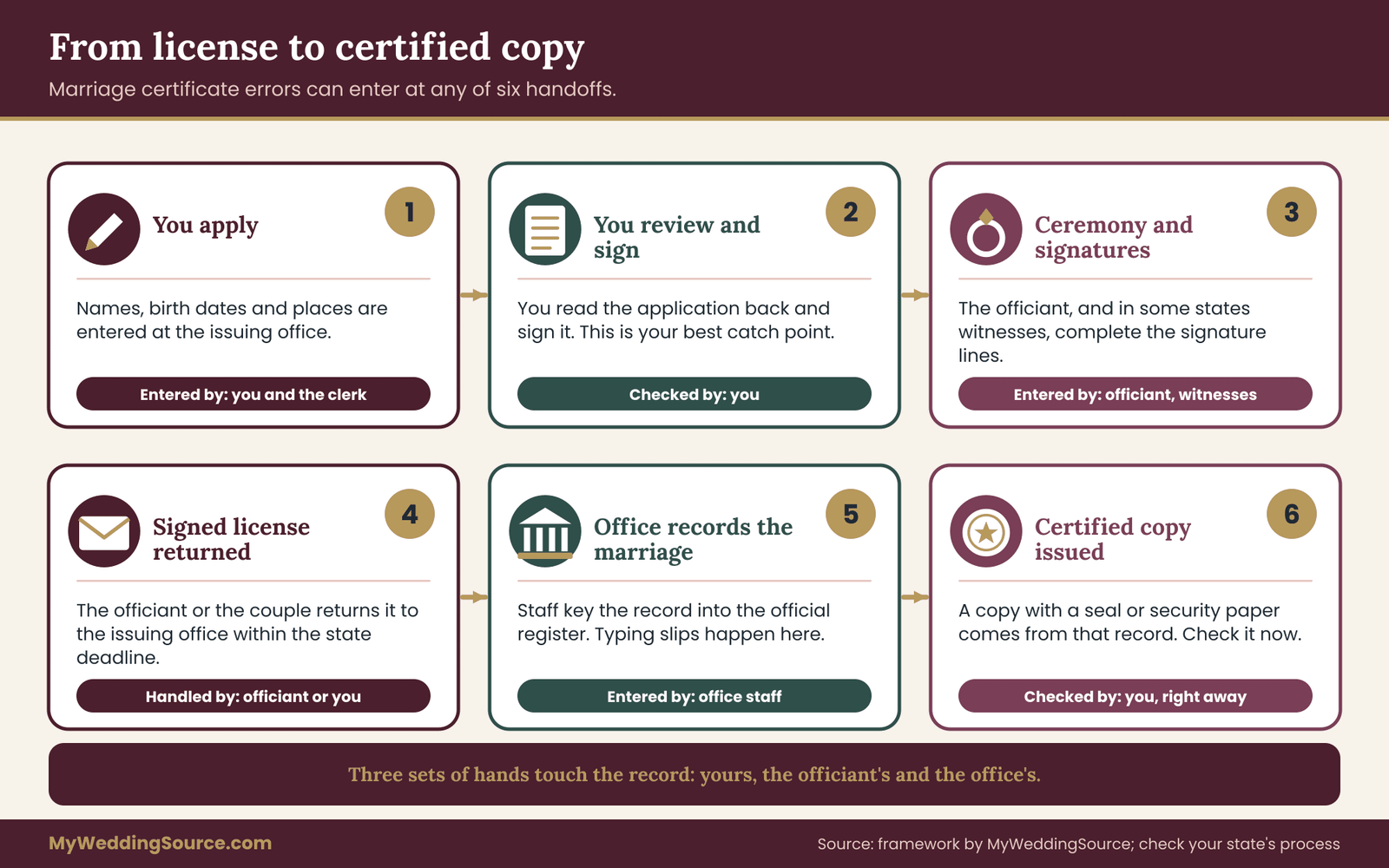
Each handoff is a place where marriage certificate errors can start: a character can be mistyped, a date misread or a box left blank. The point of the drawing is not to blame anyone. It is to show that there are three different groups of people whose handwriting or typing can shape the final record: you, the officiant and the office staff. When you contact the office later, being able to say “this looks like it entered during data entry” or “this was on the signed portion” speeds the conversation considerably.
Three documents people call a marriage certificate
It is also worth separating the documents, because people mix them up and then ask the wrong office the wrong question.
The marriage license is the permission document you obtained before the wedding. The recorded marriage record is the entry the office makes after the signed license comes back. A certified copy of the marriage certificate is an official copy of that record, issued by a government office, usually with a seal or special paper. The decorative certificate that a venue or officiant sometimes hands you is a keepsake and has no official standing.

If one of the marriage certificate errors you found sits on the decorative certificate, that is a matter between you and whoever produced it, and it does not affect your legal record at all. If it is on the license copy, it may or may not have carried into the recorded record. If it is on a certified copy, assume the official record has the same detail until the office tells you otherwise.
The broader task of keeping all of these papers together after the wedding is covered in the guide to organizing wedding records after the event, and this article picks up one narrow part of that job.
Why timing matters more than blame
It is tempting to treat marriage certificate errors as events that need an explanation. The practical question is different: how many other documents have already been built on top of the wrong detail? Every agency or employer that copies your information from the certificate multiplies the number of places that will have to be corrected later.
For that reason the sequence in this guide puts checking first, and puts everything that depends on the certificate second. If you catch marriage certificate errors before you present the certificate to any agency, your correction request involves one office. If you catch it after, you will be fixing the source and then chasing the copies.
Getting the right copy before you judge marriage certificate errors
You cannot look for marriage certificate errors in a record you do not have. Before anything else, make sure the document in your hands is the kind of document that can be checked, and that you also hold the other papers you will compare it against.
Which office issued your record
The office that issues your certified copies is usually the office that recorded the marriage, or the state vital records office that receives records from it. Which one answers your questions depends on the state and sometimes on the year. USAGov explains how to request a copy of a marriage certificate or license, and the Centers for Disease Control and Prevention keeps a directory, “Where to Write for Vital Records,” that points to the correct state or territory office for marriage records.
Start from those two pages rather than from a search result, because search engines surface many paid third-party services that charge extra to submit the same request you could make yourself.
If you are not sure which county recorded your marriage, look at the license you received before the ceremony. The issuing office is printed on it. The marriage is normally recorded in the same jurisdiction that issued the license, even if the ceremony took place elsewhere in the state, though some states have special rules. Say so on the phone: “We were licensed in this county and married in another,” and let the clerk tell you where the record lives.
Order a certified copy, not a photocopy
A certified copy is the version agencies accept. For checking purposes it has a second advantage: it shows you exactly what the official record says, in the form the office prints it. A photocopy of the license you kept, or a photo of the decorative certificate, shows what someone intended, not what was recorded.
When you place the order, ask whether the office offers different copy types. Some jurisdictions issue a short-form certificate with limited details and a long-form or full-record copy with more fields, and some offer “informational” copies that cannot be used for identity purposes. For finding marriage certificate errors, the fullest version available is usually the most useful. For later use with agencies, ask the agency which version it wants before you order extras.
Order the number of copies you actually expect to use. Several agencies may need to see one at nearly the same time, and an agency that keeps a copy cannot return it. At the same time, there is a reason not to order a large stack before you have checked the first one. If the record turns out to contain marriage certificate errors, every extra copy shows the old detail, and the office may charge again for copies issued after a correction. Order one or two, check them, and order more once the record is right.
“We were married in your county on a date we can give you. Could you tell us which copy types you issue, what each shows, and how long a mailed request usually takes?”
That question costs nothing and tells you which version to request. Record the answer in your log, which the contact-log section explains in detail.
Gather the documents to compare against
A check is a comparison, and the comparison needs a second source. Collect these before you open the certified copy.
Your copy of the marriage license application or the license itself, since that shows what you told the office. Your birth certificates or a passport, since those are the identity documents agencies will expect the marriage record to match. Your current driver’s license or state ID. If either of you has been married before, the paperwork that ended the earlier marriage, because some records carry details about prior marriages. If you had a legal name change at any point, the court order or equivalent.
Put them on a table or a single screen, with both partners’ documents side by side. It is easy to check one person’s details carefully and skim the other’s.
Check the document itself first
Before you read a single name, look at the paper. A certified copy should carry the marks that make it certified: a seal, an official signature or stamp, security paper or a printed statement of certification, and in many offices a registration or file number. If a copy has none of these, you may be holding a plain printout, and the office should be asked whether it issued a certified version.
Note the registration number, the recording date and the name of the issuing office, because they identify your record in every later conversation. Write them at the top of your first log entry. When you call and say “record number such-and-such, recorded on this date,” the clerk can find it in seconds, and you avoid the situation where two people with similar names are mixed up.
Make a digital copy for your own working use
Scan or photograph the certified copy in good light, flat, with every edge visible. This working scan is for your own notes and for pointing out a detail to an office by email if they ask for it. Treat it as sensitive: it contains full names, dates and places. Keep it in your records folder, not in a shared photo stream or a general cloud folder with broad sharing links.
A scan that shows marriage certificate errors is just as sensitive as a clean one. Never send it by an unencrypted channel unless the office specifically instructs you to, and prefer the office’s own secure upload or mailing address.
A four-pass check for marriage certificate errors
The center of this guide to marriage certificate errors is a short method. Reading a certificate top to bottom feels thorough, but people tend to read what they expect to see. A better way is to make several narrow passes, each with one question, using a pen or a cursor on the screen. The record error verification checklist for marriage certificate errors has four passes.

Pass one covers the names of both spouses. Pass two covers the event facts: date, place and type of ceremony. Pass three covers the signature and administrative portion: officiant, witnesses, license numbers, recording dates. Pass four covers the document as an object: copy type, seal, legibility and consistency between pages. Each pass takes a few minutes. Taking them in this order puts the highest-stakes details first, because a name error and a date error are the two kinds of marriage certificate errors most likely to block something.
Why four passes and not one slow read
There are three reasons for dividing the work.
First, each pass has a single comparison source. In pass one you compare against birth certificates and passports. In pass two you compare against the license and your own memory of the day. In pass three you compare against the signed license and what your officiant tells you. When you read once, you keep switching sources, and your attention drifts.
Second, each pass maps onto an owner of the fix, so the marriage certificate errors you find in a pass tell you who to contact. A name mismatch against your own application points to the issuing office. A name mismatch against a birth certificate may point to you. A wrong witness signature points to the officiant. The sorting section later in this guide turns that into a rule.
Third, you can stop at any pass. If pass one turns up one of the marriage certificate errors, such as a surname error, you do not need to finish all four before you pick up the phone. Finish the other three passes within the same week so that you can raise everything in one conversation rather than several.
Before you start: set the rules for the check
Decide in advance what counts as a match, and what will count as one of the marriage certificate errors. A sensible standard for the first three passes is exact character-by-character agreement, including spelling, hyphens, spaces, apostrophes, suffixes such as Jr. or III, and middle names written in full or as initials. Mark anything that differs, then decide afterward whether it matters. Starting strict means you will not miss a difference because you decided too early that it was close enough.
Use one marking system and keep it simple. Put a check mark beside lines that match and a question mark beside lines that do not. Do not correct anything in pen on the certified copy itself. Any mark on the document can undermine its official use, so mark a scan or a photocopy instead.
Pass one: the names
Names cause most marriage certificate errors, partly because they are the most-typed and most-handwritten part of the record, and partly because naming conventions are more varied than forms assume. Read each name on the certificate for both spouses, because name-related marriage certificate errors hide in plain sight, then compare it letter by letter with your birth certificate or passport.
Look at these elements in each name:
Spelling of the surname. Swapped letters, a dropped double letter and a missing apostrophe in names such as O’Neil are common. Read the surname backward, letter by letter, because backward reading breaks the habit of recognizing the word as a whole.
First and middle names. Check that a middle name is present if it should be, and that it is not replaced by a nickname. Check that a double first name such as Mary Beth has not been split into a first and a middle name, or fused.
Hyphens, spaces and particles. Compound surnames are a frequent trouble spot. A surname like de la Cruz may be stored as one word, two, or three, and a hyphenated name may lose its hyphen. Whether that is a meaningful error depends on how the name appears on your other documents.
Suffixes and titles. Jr., Sr., II and III are often dropped by data entry. A missing suffix can matter when a father and son share a name.
Accents and special characters. Some systems cannot store characters such as an accent mark or a tilde. If the record shows a plain letter where your name has a mark, ask the office whether its system supports the character, and whether the plain form is the one it intends to keep. Agencies handle this differently, and the answer may affect how your passport or Social Security record will line up.
Names recorded as “before the marriage.” Compare the name on the record to the name you used at the time of the license application, not to the name you plan to adopt. If you have used one name for years but your birth certificate carries a different one, the record may follow either, depending on what you wrote on the application. Whichever it is, that is the detail to raise with the office, and it is one of the marriage certificate errors worth logging.
If a name has changed in the past, through a prior marriage, a court order or an adoption, find out which form the record is meant to hold. Ask the issuing office what it expects to see in the name fields in your situation. Your answer is not a guess you should make for yourself.
Pass two: the event facts
The second pass looks at facts about the wedding itself. They are fewer than the names, but marriage certificate errors in this group carry more weight, because a wrong date or place can make a record appear to describe a different event.
Check the date of the marriage. Compare it against your own calendar and the date printed on the license. Think about edge cases: a ceremony that began before midnight and ended after, or a license signed on a date different from the ceremony. The date of the marriage is the date of the ceremony, but a few states record both the ceremony date and the date the license was filed, and they are different fields.
Check the place of the marriage. The record usually shows a county and state, and sometimes a city or township. A ceremony in a different county from the one that issued the license is normal in many states, but the record has to show the true location of the ceremony. Confirm the venue’s county rather than assuming it, because city mailing addresses often sit across county lines.
Check the type of ceremony and any other event data the record contains. Some forms ask whether the ceremony was civil or religious, or how many times each spouse has been married. If these fields are present, compare them to the truth and to your application. A “number of this marriage” box left at the wrong value is one of those marriage certificate errors that may not matter to you today and still be worth fixing.
Check the dates and places of birth if they appear. Many records include date of birth or age and place of birth for each spouse. These are common sources of mismatches, particularly for people born abroad, whose place of birth may have been written in a way that does not match their passport or foreign birth certificate. A one-digit slip in a birth date is among the marriage certificate errors that are easy to miss and create identity problems that last.
Pass three: signatures and the administrative part
The third pass moves from the spouses to the people and processes around them. This is where an officiant’s handling matters, and where marriage certificate errors are often overlooked because the lines are small and the handwriting is hasty.
Look at the officiant’s name, title and, if requested, license or ordination information. Check that the name is spelled consistently with how the officiant would sign it. Some states require a registered officiant, and the official title or authority must be written out. Your officiant is the right person to explain what they entered, and the guide to wedding officiant requirements explains why the authority line matters in the first place.
Check the witness lines if your state uses witnesses. A missing or illegible witness signature is a common reason for a record to be questioned, and in some states a missing witness can affect whether the marriage was properly documented. Do not diagnose that yourself. Ask the issuing office whether the lines on your record meet its requirements.
Check the license number, the filing or recording date and the registration number against the license you received and against each other. A recording date earlier than the ceremony date is a red flag: either the date of the ceremony or the date of recording is wrong. A recording date many weeks after the ceremony may simply reflect a delay in returning the license, and it is worth asking the office if the delay was recorded.
Check any certification statements, for example the registrar’s name and the date of the copy’s issue. These show that the copy came from the office and when. A certified copy with a date of issue that precedes the marriage record’s recording date is internally inconsistent.
Pass four: the document as an object
The fourth pass is quick but it prevents trouble later. Look at the physical or digital document.
Is it a certified copy with the marks of certification, or an informational copy? Is every page present, and are the pages consistent in the names and numbers they carry? Is anything cut off by the scanner or printer, such as the edge of a field or a seal? Are there stray marks, handwriting or corrections that were not made by the office? Is the copy legible enough that a second office could read it?
If the copy is illegible or incomplete, request a new copy before concluding that the record contains marriage certificate errors. A faint print can hide a correct entry.
Writing down what you find
After the four passes you will have a list of possible marriage certificate errors, each marked with a question mark. Turn each into a short written entry with five parts: the field, what the certificate shows, what you believe it should show, the document that proves it, and the pass that found it. For example: “Surname of spouse two; certificate shows a transposed pair of letters; the passport shows the correct order; found in pass one.”
This list does three jobs. It is the agenda for your call to the issuing office. It prevents the common problem of remembering a second issue only after hanging up. And it is the start of the correction packet, because the proofs you name in the list are the documents the office will probably ask for.
If the four passes find no marriage certificate errors, say so in your notes, with the date, and put the copy away. A clean result is a result. You now know that the record matches your documents, and you can go forward with name changes and benefit updates with confidence.
A short rule for deciding whether to act
Not every difference between documents deserves a correction request. A useful rule is to ask three questions of each marked item. Does the difference change a fact, such as a date, a place or a person, or only the appearance? Will any agency or employer that sees the document compare it with another document?
And would the difference be hard to explain in a sentence? If the answer to any is yes, treat it as something to raise with the issuing office. If all three answers are no, note it, mention it in conversation if the opportunity arises, and move on.
The same rule works for the opposite problem. Some couples, once they begin looking, start to question details that are not really in doubt. The rule keeps the process proportionate. The marriage certificate errors that matter are the ones that change a fact or that a second document will contradict. Differences in typeface or capitalization rarely deserve a form.
Sorting marriage certificate errors by who owns the fix
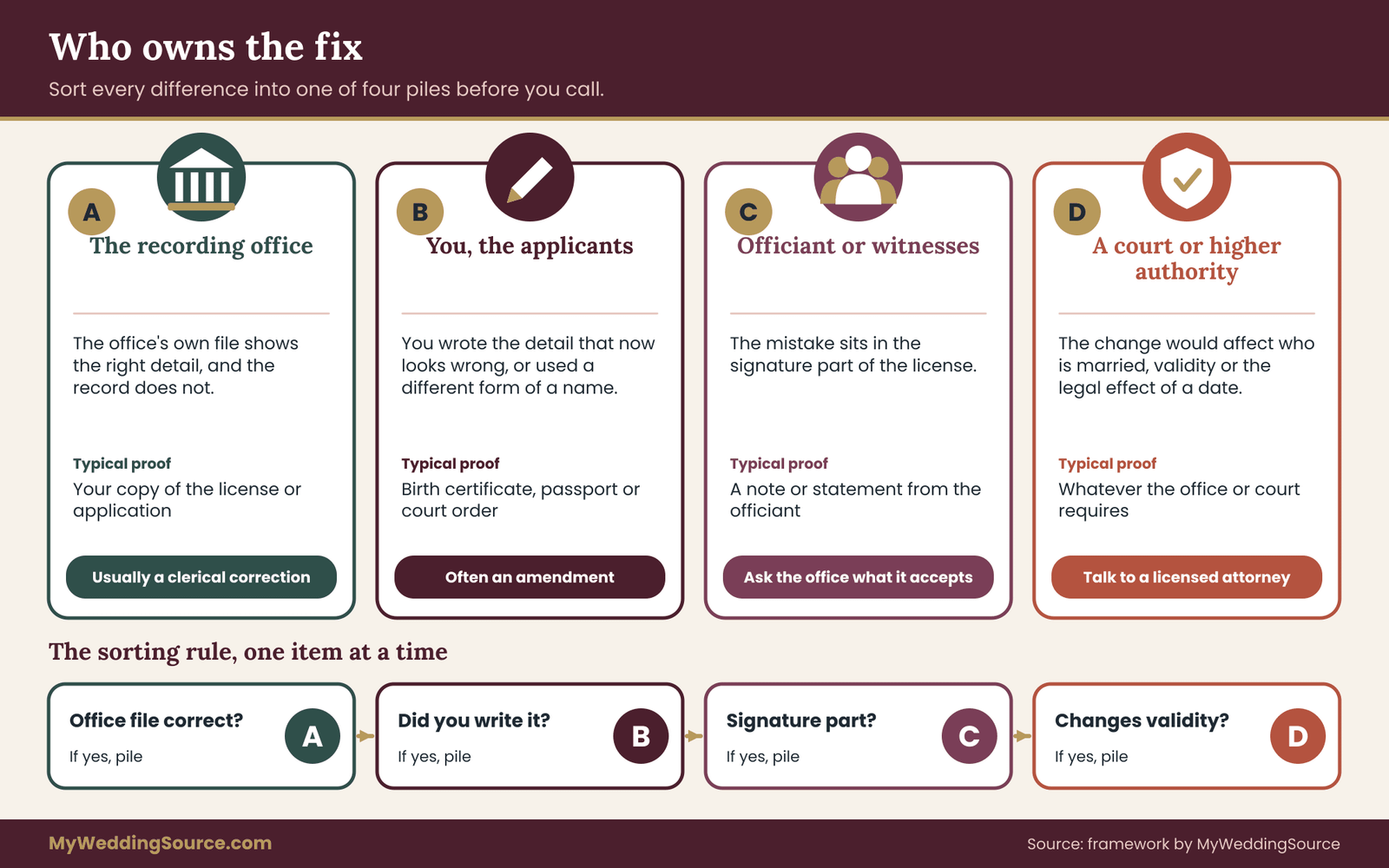
Once you have your list of marriage certificate errors, the next step is not to fill in a form. It is to decide whose mistake each item is, because the owner decides which door you knock on and what evidence is expected. This is the second tool in the method. It turns a vague worry into four labeled piles.
Owner A: the recording office
The first pile holds marriage certificate errors that the office introduced after receiving correct information. The license application says one thing, the record says another, and the application is the office’s own file. Typical examples are a mistyped letter, a transposed date, a name field split in the wrong place, or a county entered wrongly.
These marriage certificate errors tend to be the simplest to correct, because the office can compare its record with its own source documents. Offices commonly handle them as clerical corrections, and some do not charge for the correction when the error was theirs. Do not assume this, since policies differ. Ask, and write down the answer.
The evidence is often your copy of the application or license, plus a photo identification. If your copy of the license shows the correct detail, that single document may be the whole proof.
Owner B: you, the applicants
The second pile holds marriage certificate errors that began with what you submitted. You wrote the wrong date of birth, left out a suffix, listed a name in a form that does not match your birth certificate, or marked the wrong number of previous marriages. The office entered what you gave it.
Be calm about this. These are common, easy to make under pressure, and correctable. The route is usually an amendment or correction request in which both spouses, or sometimes just the person whose information is wrong, sign a statement and supply documents that prove the true fact. The proof is typically stronger than for a clerical slip, because the office has no way to verify the true fact from its own file. A birth certificate proves a birth date. A passport or court order may prove a name.
Some offices ask for a notarized statement. Some require both spouses to appear or to sign. Rules also vary on how long after the marriage a simple correction can be made. Ask the office what it needs before you gather anything, so that you do not buy a notary service for a form you were not going to submit.
Owner C: the officiant, witnesses or other signers
The third pile holds marriage certificate errors in the signature portion: the officiant’s name or title written wrongly, a missing witness signature, an unreadable signature, an incorrect date written beside the signature. These are different because the person who can supply the correction is often not you.
Contact the officiant first, politely and in writing. Explain what you see and ask what they remember entering. Some officiants will sign a corrected statement. Others will confirm in an email that the original entry was a slip. Ask the issuing office what it will accept, because some will take an affidavit from the officiant, while others require a more formal route.
If a required signature is missing altogether, the situation is more delicate, and it is one to raise with the issuing office early and without guessing about the legal effect. The office can tell you whether the record is complete and what steps exist when it is not.
Owner D: a court or a higher authority
The fourth pile is the smallest and the most serious. It holds marriage certificate errors that the office may not be permitted to change by itself: a different spouse’s name, the identity of a person, a date that would change the legal effect of the marriage, a ceremony recorded as having happened when it did not, or any item involving a legal dispute about the marriage itself.
For these, the office may tell you that a court order is required, or that the correction must be done through a different department. This is where a licensed attorney in your state is the right person to talk to, not a guide like this one. The aim of sorting is to recognize this pile early and not to waste weeks on forms that cannot solve it.
A decision rule for sorting
Use this short sequence for each of the marriage certificate errors on your list.
First ask whether the office’s own file, meaning the application or license, shows the correct detail. If yes, the item belongs to Owner A.
If the office’s file shows the same wrong detail the record shows, ask whether you wrote it. If yes, the item belongs to Owner B.
If the detail lives in the part of the license completed by the officiant or witnesses, the item belongs to Owner C.
If the item would change who is married, whether the marriage is valid, or the legal effect of the date, put it in Owner D until the office says otherwise.
An item may belong to more than one owner, and marriage certificate errors often do. A missing letter in a name might have been typed wrongly by the office, but if your handwriting on the application was unclear, the office may reasonably say it followed what it read. When ownership is uncertain, say so honestly on the call: “We think the office made a typing error, but our handwriting on the application may have been unclear. How would you like to handle that?”
What the sorting changes in practice
Sorting marriage certificate errors changes three things. It changes who you contact first. It changes what you collect, since an Owner A item may need only the license copy while an Owner B item needs identity proof. And it changes the tone. When the office made the slip, a courteous request for a correction is enough. When you made the slip, a simple acknowledgment helps. When the item sits with a court, patience helps most.
Sorting also helps you predict the timeline, because some marriage certificate errors take far longer than others. Clerical corrections within the office’s own authority can be quick in some places. Corrections that involve notarized statements, evidence and review by a registrar take longer. Anything that goes to a court takes longer again. The office will give its own estimates, and you should write them down, but you now know roughly which category you are in.
Preparing the packet before you call
Before the first call about marriage certificate errors, prepare a small packet and keep it in one folder. Put in it your marked list from the four passes, the scan of the certified copy, the registration number and recording date, the documents that prove each correct detail, a blank copy of your contact log, and a short written summary of the issue in two or three sentences.
Write the summary of the marriage certificate errors in plain words, so that you can read it aloud or paste it into an email. For example: “The certified copy shows the first spouse’s middle name as an initial, and the application and birth certificate show the full name. We would like to know how to request a correction.” That summary prevents rambling and prevents leaving out the key detail.
Think about who will make the contact. Often it is better if the person whose details are affected makes the call, since the office may need to confirm identity and may only speak with a named spouse. If one of you is more comfortable on the phone, that person can handle the first contact and bring the other in when a signature is needed.
What not to include in the packet
Leave out originals unless the office specifically requests them. Send copies. If you must send an original, such as a certified copy you do not have another of, ask the office how it will return it, and use a tracked mailing method. Leave out anything you do not need to share, such as unrelated pages of a passport or tax papers. A clerk needs the line that proves a birth date, not your entire financial history.
Do not pay third-party services that promise to fix marriage certificate errors for a fee. Government offices handle corrections themselves, and a middleman adds cost and delay. If you are unsure whether a website belongs to a government office, check that the address ends in the official suffix used by your state and use the links that USAGov and the vital records directory provide.
Contacting the issuing office about marriage certificate errors
Now you can make the call about your marriage certificate errors. The goal of the first contact is modest: find out how this office handles marriage certificate errors of the type you have, and learn what it will need. You are not asking the clerk to fix anything on the spot, and you do not have to argue your case. You are gathering the office’s own rules.
Choose the channel
Offices differ in how they like to be contacted. Many take phone calls during business hours. Some run an online form, some prefer email for questions but not for submissions, and some want a mailed or in-person request with identification. Look at the office’s own web page first, reached through the USAGov or vital records directory links rather than a search result, and see whether it lists a corrections process.
A phone call is good for the first conversation because a clerk can ask clarifying questions and tell you which form applies. A written message is good for creating a record. Combine them: call, then send a short email or letter afterward that summarizes what was said. This habit costs two minutes and prevents the most common misunderstanding in these cases, which is two people remembering a phone call differently.
In-person visits work well when the office is local and the marriage certificate errors are simple. Bring the packet, ask your questions, and request that the clerk note your visit. Many offices have a counter where a clerk can look up your record on the spot and tell you immediately what the file shows.
Know who you are speaking to
County offices, town clerks, city offices and state vital records offices often share responsibility, and they may refer you to each other. Do not be surprised if the first person you reach says that corrections are handled somewhere else. Ask for the name of the office and a direct number or address, and record it. You are not being passed around. You are learning the structure.
If you get a general information line, say clearly that you need the section that handles marriage records and corrections. If you reach a person who is not sure, ask whether there is a supervisor or a records specialist who can help, and ask for a time to call back.
A script for the first call
Many people dislike calling government offices about marriage certificate errors, and a short script helps. Keep the tone friendly and factual.
“Hello, I’m calling about a marriage record. We were married on a date I can give you, and the record was filed with your office. I think there may be an error on the certified copy. Could you tell me who handles corrections?”
Once connected to the right person:
“The certified copy shows one detail that does not match our license application and our birth certificates. How does your office handle that kind of correction, and what would you need from us?”
Then listen, and take notes. Do not interrupt the explanation with the entire story. The clerk will usually ask for the registration number or names and then tell you what the process requires.
Questions to ask
Have the following questions about marriage certificate errors ready, adjusted for your situation. You do not need all of them every time, and asking them in a natural order matters more than asking them all.
Does the office classify this as a clerical correction or an amendment, and does the distinction change the process? What form or statement is needed, and can you send it to us or do we download it? Who must sign, and does either of us have to appear in person? Does it need to be notarized? What evidence do you accept, and do you want originals or copies? Is there a fee for the correction, and a separate fee for new certified copies?
How long does a correction usually take, and how will we be told when it is done? Will the corrected record show the change, or replace the original entry, and will future copies show the amended details? If the office passes records to a state office, does that office need to be notified separately, and who does it?
The last question deserves a moment. In some places the county records the marriage and also reports it to the state, and a correction in one place does not automatically reach the other. If both hold a copy, ask who is responsible for updating the second and how you can confirm that it happened.
What to say if you are told it is not an error
Sometimes the clerk will say that what you see is not one of the marriage certificate errors you suspected, but simply how the office records things. A name may be entered in capital letters, a character may be unsupported, or a field may follow a format required by a state system. Ask the clerk to explain, and write down the reasoning.
Then ask the follow-up question that matters: “Will this version be accepted for a Social Security name change and a passport application?” The office may not know what other agencies accept, but the agencies publish their own requirements. Check them directly, using the Social Security Administration and U.S. Department of State pages in the sources list.
If an office says it cannot correct something that you believe is one of the marriage certificate errors, ask politely what the next option is. There may be a different form, an appeal to a registrar, or a court route. Do not escalate emotionally. An office that feels pressured is less helpful than one that sees a clear, documented request.
The confirmation message
After each call, send a short follow-up. It should state who you spoke with, the date, what you asked, what you were told, and what you will do next. Keep it neutral.
“Thank you for speaking with me today. To confirm, you said the correction needs a signed statement from both of us and a copy of one identity document, and that processing usually takes several weeks. We will send these by mail this week. Please let us know if anything above is wrong.”
An email like that does three jobs. It gives the clerk a chance to correct a misunderstanding. It gives you a dated record. And it gives a second clerk, if your file is picked up by someone else later, a summary to read.
The county-clerk contact log
The second tool for handling marriage certificate errors is the log. It sounds small, but in practice it is the habit that separates a correction that finishes in an orderly way from one that drifts for months. Offices handle many requests, staff change, and phone conversations leave no trace unless you create one.

What goes into each entry
Every contact about marriage certificate errors, whether a call, a visit, an email or a letter, gets one entry with the same fields. Keep it in a single document or notebook so that entries stay in order.
The date and time. The office and department. The name and title of the person, if given. The method of contact. A reference or case number, if the office gives one. The question you asked, in a sentence. The answer, in a sentence. The documents requested. The fee quoted, if any. The next step and who owns it. The date by which you will follow up.
Write the entry during or immediately after the call, while the details are fresh. If you wait until the evening, you will remember the gist and lose the specifics, which are the part that matters later.
Naming the next step and the follow-up date
The two fields that most often get skipped are the most useful. The next step turns each contact into an action: “we mail the signed statement” or “the office will email a form.” The follow-up date puts a limit on waiting. Without one, a pending request sits indefinitely and nobody notices.
Choose a follow-up date based on what the office told you. If they said processing takes several weeks, choose a date a little after that and write it in your calendar. When the date arrives, check in, and write down the result. It does not need to be a complaint. A line such as “We sent a request on this date and want to confirm it arrived” is polite and clear.
Keeping proof of what you sent
When you send documents, log what went into the envelope or email, how it was sent, and any tracking number. Photograph or scan everything before sending. If you use mail, a tracked or signature-confirmed method gives you proof of delivery. If you submit through an online system, save the confirmation page and any confirmation email.
Never send the only copy of an original document. Never send documents through a channel that the office has not named as acceptable. If you are unsure, ask which method protects your privacy best.
Keeping the log private and safe
A log of marriage certificate errors will contain registration numbers, dates and notes about identity documents. Keep it with your other sensitive records, using the same care you would for the certificate itself. It does not need to be shared with anyone outside the two of you and a trusted backup person. The broader approach to access levels, backups and retention for newlywed paperwork is in the site’s guide to keeping records after the wedding, and the contact log is meant to sit inside that archive as one of its working files.
When a log shows a pattern
Over a few weeks, the log of your marriage certificate errors shows you things you would otherwise miss. If three different people have given three different answers, the log lets you ask a supervisor to clarify and cite the dates. If a promised confirmation never came, you can see how long ago the promise was made. If you need to escalate to a registrar or to a state office, you can summarize the history in a short paragraph without reconstructing it from memory.
It also protects the people you are working with. A clerk who made an honest mistake is more likely to be generous when the request is organized and polite. A log makes that kind of request about marriage certificate errors easier to write.
A worked example: one record, three differences, four weeks
The following example of marriage certificate errors is invented to show the method in motion. The couple, the office and the dates are made up, and your own process will depend on your state and county. The point is the order of the steps and the way the log carries the work.
Priya Raman and Tom Kowalczyk marry on a Saturday in October. Their officiant mails the signed license to the county office within the week. Ten days after the wedding, the couple receives two certified copies they ordered in advance. Priya plans to start a name change at the Social Security office, and Tom wants to add Priya to his health plan at work.

Day one: the four passes
On the evening the envelope arrives, they put the certified copy on the table beside their license application, Priya’s birth certificate and passport, and Tom’s birth certificate and driver’s license. They take the four passes in order.
In pass one, Priya’s name matches her passport. Tom’s surname on the certified copy reads with the letters “zy” reversed compared with his birth certificate. They mark it with a question mark. Priya’s middle name appears as a single initial on the certificate, although her birth certificate and passport show it in full.
In pass two, the date, county and type of ceremony are correct. Birth dates match. The couple checks the venue’s county rather than relying on its mailing address, and finds the county is the one on the record.
In pass three, the officiant’s name and title match. Only one witness line is used, and the signature on it is difficult to read. They mark it. The license number and recording date are consistent with what they remember, and the recording date falls a few days after the wedding, which fits the mailing.
In pass four, the copy is certified, with a seal and a registration number, and all pages are complete.
They write down their three marriage certificate errors. Surname transposition, found in pass one. Middle name shown as initial, found in pass one. Illegible witness signature, found in pass three.
Day two: sorting by owner
They apply the decision rule to each of the marriage certificate errors. For the surname, they check their copy of the license application. It shows the surname spelled correctly in Tom’s own handwriting, so the office’s source file has the right spelling. That makes it Owner A, a likely clerical slip at the recording office.
For the middle name, they look at the application. Priya wrote only an initial, because she was filling it in quickly at the counter. The office entered what she wrote. That puts it in Owner B, an applicant item.
For the witness signature, the field belongs to someone else. This is Owner C, and the officiant may be able to explain who the witness was and whether the signature can be clarified. They also note that it may not be a problem at all, because the office accepted and recorded the license. They will ask rather than assume.
None of these marriage certificate errors looks like Owner D. They decide that the middle name, which has the least impact on them, can still be raised in the same conversation.
Day three: first contact
Priya makes the call. She begins with the first script, gets transferred to the records section, and gives the registration number and recording date. She explains the three items in the order of their importance.
The clerk looks up the file and confirms that the application shows the correct surname. The clerk says that a transposition of that kind is treated as a clerical correction, and that the office needs a signed request and a copy of one photo identification for Tom, and that the office will send a corrected record and then new certified copies.
As for the middle name, the clerk explains that because the application showed an initial, the full middle name has to be handled as an amendment, supported by Priya’s birth certificate. The clerk does not know whether the witness signature is an issue, and says that a registrar would have to answer that.
Priya writes all of this in the log, including the clerk’s name. Under “next step,” she writes: “Office emails correction form; we return it signed; ask registrar about witness line.” Under “follow up,” she writes a date one week out.
The same evening she sends the confirmation email, summarizing what she was told and asking the clerk to correct any misunderstanding. The clerk replies the next morning with a short “that is correct” and attaches the form.
Days four to nine: the officiant and the paperwork
Tom writes to the officiant, asking in a friendly way who witnessed the signing and whether the signature line could be clarified. The officiant replies that the witness was the venue manager and offers to provide a short signed note identifying the witness by printed name. Tom adds the reply to the log and asks the registrar, through Priya’s clerk contact, whether such a note would be useful.
Meanwhile, they complete the form for the surname correction. Tom signs it, adds a copy of his driver’s license, and they mail it with tracking. They log the tracking number and keep a scan of everything. For the middle name, the office sends the amendment form. Priya signs, includes a copy of her birth certificate, and they send it in the same envelope on the clerk’s advice.
Weeks two to four: what they hold and what they do not
During the pending period they have to decide what to do about the things that depend on a certificate with marriage certificate errors. Priya’s Social Security name change would use the certificate, and the surname error is Tom’s, not hers. She asks the Social Security Administration what to submit in the meantime, and learns from its published guidance that it needs an acceptable certified document and identification.
Because the error does not touch her own name fields apart from the middle initial, she decides to wait for the corrected copy rather than risk a mismatch between her card and her passport.
Tom’s health plan enrollment has a deadline, and the deadline does not stop for a records correction. He asks his employer’s benefits office whether a certified copy with a pending correction is acceptable proof of marriage, and tells them the office has confirmed the correction is in process. They accept it with the understanding that he will supply the corrected copy later. He logs the name of the benefits contact and the date.
At the follow-up date, Priya checks in. The office says the surname correction is complete and the corrected record is on file, while the amendment is awaiting review. Two weeks later, the amendment is finished, and the couple orders new certified copies. They check the new copies using the four passes again, note that all matches, and replace the old ones in their records folder. The old copies are marked “superseded” and kept in the log folder, not thrown away, in case an agency has questions about the earlier version.
What the example shows
The example of these marriage certificate errors is useful for what did not happen. They did not start every name change on the first day. They did not argue with the office. They did not order ten copies. They did not assume that the unclear witness line was a crisis. The steps were small: a careful check, a sorting rule, a single organized call, a confirmation email and a dated log.
It also shows how marriage certificate errors can split. Of three differences, one was a clerical slip, one was the applicants’ own shorthand, and one was a question for the registrar. Treating them as a single “wrong certificate” problem would have made the conversation harder, and a different owner for each item let the couple give each person the specific request that person could act on.
What can wait while a correction is pending
A correction of marriage certificate errors can take weeks. During that time, life continues, and some deadlines do not move. The question is which steps depend on the wrong detail and which do not. Sorting them avoids two opposite mistakes: rushing to use a flawed document, and freezing everything for no reason.

Steps to hold
Hold any step that would copy one of the marriage certificate errors into a new official record. The Social Security card is the clearest case, because other agencies check your name against its records. If the wrong detail involves your name, birth date or the name you are changing from, wait for the corrected certificate or ask the agency in advance whether it will accept the current one. The Social Security Administration publishes the documents it requires, and you should confirm them there.
Hold a passport name change if the certificate’s name fields differ from your current passport. The U.S. Department of State explains which form applies depending on when the passport was issued and whether the name change is within a year. A mismatch between the certificate and the passport is the kind of issue that causes a rejected application or a request for more evidence.
Hold changes to accounts that will be difficult to reverse, such as a driver’s license or a bank account in a new name, until the foundation document is right. These can often be changed again, but each reversal adds errands.
Steps that usually cannot wait
Some steps have deadlines set by other organizations. Marketplace health insurance, for example, offers a special enrollment period after marriage, and the window is measured in days or weeks. HealthCare.gov explains how the period works. An employer’s benefits enrollment window after marriage may also be short. For these, do not let a record correction run out the clock.
Contact the organization, explain that a correction is pending, and ask what documentation will meet the deadline. Many will accept a certified copy with a letter or a reference number from the records office, with the corrected copy to follow. Ask for the answer in writing.
Tax matters follow their own logic. Your marital status at the end of the tax year, and the match between names and Social Security numbers on your return, are the things the Internal Revenue Service pays attention to. The IRS publishes guidance for newly married taxpayers, and a qualified tax professional can answer questions about your return. A pending correction of marriage certificate errors does not change whether you are married, but the names on your return should match your Social Security records, so it is worth knowing what the record will say before you file.
Travel and honeymoon bookings
Airline tickets and international bookings use the name on your passport, not the name on your marriage certificate. Marriage certificate errors do not change that. If you plan to travel soon after the wedding, keep traveling under the name on your current passport, and do not use a certificate to change a booking unless the carrier or the passport agency tells you to.
A safe default
If you are unsure whether to proceed or wait while marriage certificate errors are pending, ask the organization that sets the requirement. Agencies are used to the question “our marriage certificate has a correction pending; what do you accept?” Writing down the answer, with the name of the person and the date, belongs in the same log. The result is that you do not guess, and you do not lose a deadline.
Limits, edge cases and mistakes to avoid
A method for marriage certificate errors is only useful if you know where it stops. This section covers the situations in which the checklist and the log still help but are not enough, and the habits that most often make a simple correction harder.
What this guide cannot decide
It cannot tell you your state’s rules. Each state, and in some cases each county, sets its own procedure for correcting a marriage record, its own list of acceptable evidence, its own fees and its own time limits. The method here gets you ready for the conversation, and the office answers the rules question.
It cannot tell you the legal effect of marriage certificate errors. Whether a missing signature or a wrong date affects the validity of the marriage is a legal question, and the answer depends on state law. If the issue touches who is married, whether the ceremony counted or whether the license was valid, talk to a licensed attorney in your state. Do not rely on a general guide or on a forum thread.
It cannot predict what other agencies will accept. The Social Security Administration, the State Department, your employer and your insurer each apply their own standards. Their published requirements are the final word, and the sources at the end of this article point to them.
Edge cases worth knowing about
A marriage recorded in a different state or country from where you live now. The issuing office is the one where the marriage was recorded, and distance does not change that. Mail, online forms and a trusted local contact can all help. If the marriage took place abroad, the record may be held by a foreign authority, and the U.S. rules on foreign records are a separate subject for the State Department and the foreign office.
A certificate that will be used for immigration. If either spouse is not a U.S. citizen and the certificate supports an application or petition, check requirements with the agency and consider speaking to an immigration attorney before correcting anything or submitting the record. The U.S. Citizenship and Immigration Services site explains the process, and a mismatch between documents can slow a case. A correction is still often the right step, but timing and sequence matter.
A second or later marriage. Records for people who have been married before may include fields about previous marriages and how they ended. If these entries are wrong, bring documentation of the earlier marriage and its ending, such as a court order, and ask the office what it accepts. Do not guess at dates.
A name that was legally changed before the marriage. Make sure you know which name the office intended to record. Bring the court order or other proof. Mismatches between a prior legal name and a birth name are among the most frequent reasons clerks ask for extra documents.
Characters the system does not support. If your name includes marks that the records system cannot store, ask the office what it can do. The decision may be out of the clerk’s hands, since many systems are built at the state level. Ask what agencies will accept, and keep a record of the answer.
Marriage certificate errors on an old record. If the marriage was recorded many years ago and a mistake has only now surfaced, the process may differ, and older records may be on microfilm or held in an archive. Ask the office whether corrections to older entries follow the same route.
A delayed or missing record. If you have no certified copy at all because the license was never returned or recorded, treat that as a separate problem. Contact the issuing office and your officiant at once, since some states set a deadline for returning the license. This is different from correcting marriage certificate errors on a record that exists, and it can have more serious consequences.
A deceased or unavailable spouse or officiant. If a signature needed for a correction cannot be obtained, tell the office and ask what alternatives it recognizes. Some offices have procedures for these circumstances, others route them to a court.
Common mistakes that cost time
Waiting to read the certificate. The longest delays follow from discovering marriage certificate errors after name changes have started. Read it the week it arrives.
Ordering many copies at once. Extra copies of a flawed record are a cost, not a precaution. Order one or two, check them, then order more.
Writing on the certified copy. Marks, circles and notes can raise questions about whether the document has been altered. Use a scan or photocopy for your notes.
Calling the wrong office and giving up. A referral is a normal outcome. Write down the new office, the number and the name of the person who referred you.
Paying a middleman. Websites that charge to submit corrections for you add fees and delay. Offices accept requests directly.
Sending originals without a plan. If an office asks for an original, ask how and when it will be returned, and use tracked delivery.
Skipping the written follow-up. A phone call without a confirming message leaves you with no record. A two-minute email repairs that.
Treating every difference as a crisis. Not every difference is one of the marriage certificate errors that matter. Apply the three questions from the four-pass check. Fix what changes a fact or contradicts another document, and note the rest.
Letting one error block a deadline. Enrollment windows and filing dates do not wait for corrections. Ask the organization what documentation it will accept in the meantime.
Assuming the correction is final without checking. When the office says it is done, order a new certified copy and run the four passes again. A record once cleared of marriage certificate errors can still contain a new slip, or the correction may not have reached the state office.
Keeping the corrected record in its place
Once the marriage certificate errors are fixed and the record is right, put the new certified copy where you keep your most important papers, and mark the old ones as superseded. Write a short note in your records file describing which marriage certificate errors were corrected, when, and by whom, with the reference number. If you ever need to explain why two versions exist, that note will answer it in a sentence.
It also helps to add the corrected record’s details to the rest of your wedding paperwork. The guide to keeping your wedding archive in order covers where the certificate sits among the contracts, receipts and photos, and the wedding planning checklist and twelve-month wedding checklist show how early planning steps, such as the license application, feed the record you are checking now.
Taking a few extra minutes at the application counter, reading back every name and date aloud, prevents most marriage certificate errors before they exist, and the notes on the wedding ceremony step by step explain why the signing moment deserves the same care.
One small note for couples building a registry or sending thank-you notes under a new name: those can wait until the record is settled, and the wedding registry ideas guide is one place to see how registry names and shipping details tie back to the names on your documents.
Your next steps
Pick one evening this week and do three things. First, find out whether you have a certified copy of the marriage record, and if you do not, look up the issuing office through the USAGov and vital records links and ask which copy type it offers. Second, take the four passes in order, mark every difference, and write each as a one-line entry with the field, what it shows, what it should show and the proof.
Third, sort each item by owner using the short rule, prepare the packet and start your contact log with the registration number at the top. Then make the first call, send the confirmation message and set a follow-up date. If nothing is wrong, note that in the log and file the copy. If something is, you now have the facts, the owner and a record of every step, which is what the issuing office needs to help you.
FAQ
How do I know if my marriage certificate has an error?
Compare a certified copy with your license application and your identity documents, in four passes: names, event facts, signatures and administrative details, then the document itself. Check spelling, dates, places and numbers character by character. Anything that differs from the true fact, from what you submitted or from your birth certificate or passport deserves a note. Then ask the issuing office how it treats that kind of difference.
Who do I contact to correct marriage certificate errors?
Start with the office that recorded the marriage, which is usually the one that issued your license, such as a county clerk, recorder or register of deeds. Some states route corrections through a state vital records office. USAGov and the CDC directory of vital records offices help you find the right one. If the office refers you elsewhere, record the name and number and continue there.
How long does a marriage record correction take?
It varies by office, state and type of correction. A simple clerical fix may be quick in some places, while an amendment with notarized statements and registrar review can take weeks, and anything requiring a court takes longer. Ask the office for its own estimate during your first call, write it in your contact log, and set a follow-up date shortly after that period ends.
Will it cost money to correct a marriage certificate?
Possibly, and the answer depends on the office. Some offices correct their own clerical slips without a fee, and others charge for amendments, notary services or new certified copies. Ask for the correction fee and the copy fee separately, and write down the quote. Avoid third-party websites that charge extra to submit a request you can make directly to the government office.
Can I change my name with the Social Security Administration if the certificate has a mistake?
It depends on what the mistake is and what the agency will accept. An error unrelated to your name fields may not block the process, while a name or date mismatch could. Check the Social Security Administration’s published document requirements, and ask the office directly if you are unsure. When the error touches your name, waiting for the corrected certificate usually avoids a mismatch.
What if the error is a missing or unclear witness or officiant signature?
Ask the issuing office first whether the record meets its requirements, since it recorded the license. Then contact your officiant politely and in writing, and ask what they remember entering and whether they can provide a corrected statement. Do not guess about the legal effect of a missing signature. If the office or you are uncertain, a licensed attorney in your state can advise.
Should I order extra certified copies before the correction is done?
Usually not. Extra copies of the old record show the old details, and you may have to pay again for copies of the corrected version. Order one or two to check, then order the number you need after the record is right. If a deadline forces you to use a copy sooner, ask the receiving organization whether it will accept a copy with a correction pending.
Does a certificate error change whether we are legally married?
That is a legal question that depends on your state and on the specific error. Many errors are clerical and do not affect the marriage, but some, such as a missing required signature or a wrong date, may need a closer look. Ask the issuing office what it can tell you, and consult a licensed attorney in your state if the error touches validity.
Sources
- How to get a copy of a marriage certificate or a marriage license, USAGov
- Where to write for vital records, Centers for Disease Control and Prevention, National Center for Health Statistics
- How do I change or correct my name on my Social Security number card?, Social Security Administration
- Corrected card for a U.S. citizen adult, documents required, Social Security Administration
- Change or correct a passport, U.S. Department of State
- Special enrollment period, HealthCare.gov
- Marriage means making changes before next filing season, Internal Revenue Service
- Marriage and immigration information, U.S. Citizenship and Immigration Services
- Vital records, National Association for Public Health Statistics and Information Systems