
Floral composting is the floral composting plan for what happens to your wedding flowers once the reception is over: which parts can go into a compost stream, which parts must come out first, and which real facility will actually take the load. This guide gives you a material sort, a facility verification script and a worked example, so you do not discover on the dance floor that the arch was built on foam and wire.
Treat floral composting as four decisions in order. First, can the flowers be reused or donated before they are composted? Second, sort every item into four bins: compost as is, compost after stripping, reuse, or trash. Third, call the facility or program and get its acceptance rules in your own notes, separating what you assume from what they confirmed. Fourth, assign a named person to do the stripping, bagging and drop-off within a day or two. Floral foam, wire, tape, plastic, glitter and anything glued stay out of the compost.
Most couples do not think about their flowers after the last dance. The florist or the venue staff clear the room, and the flowers disappear into a dumpster, a van or a back room. If you would like them to go somewhere better, floral composting is a reasonable goal. It is also a goal that fails quietly. A bucket of beautiful peonies tied with ribbon, held with wire and pushed into foam is not a bucket of compost. It is a bucket of trash with a nice top layer.
This guide is about the narrow job of floral composting after a wedding: sorting the materials and finding a facility that will accept them. It does not try to cover every part of a sustainable wedding. If you want the broader picture, including catering, rentals and paper, the wedding waste reduction planning guide on this site walks through a full materials audit. Here we stay with flowers and greenery.
A note on scope. This is general information, not legal, tax or financial advice. Composting rules, permits and what a facility may accept are set locally and change over time, so the only authority on whether a particular load is welcome is the facility, program or agency that runs it.
What floral composting after a wedding actually involves
Composting is the controlled breakdown of organic material, such as leaves, plant trimmings and food scraps, into a soil-like product. The U.S. Environmental Protection Agency describes it as a way to recycle organic material rather than send it to a landfill. That description is accurate and also a little misleading for weddings, because the word “composting” covers several very different systems, and your flowers will only suit some of them.
A backyard pile is slow and forgiving of almost nothing that is not plain plant matter. A municipal yard-trimmings program usually takes leaves, grass and branches, and may or may not take flower arrangements. A commercial facility that accepts food scraps often runs hotter and faster, and it publishes a list of accepted items. A community garden may take spent flowers but refuse anything with a plastic tag still in the pile. A farm or a private composter may take a large load by arrangement and refuse a small one.
So the first thing to understand is that “compostable” is not a property your flowers have by themselves. It is a combination of three things: the material, the way it was prepared, and the facility that receives it. A rose stem is compostable at one facility and refused at another because the facility only permits certain feedstocks. A rose stem with a zip tie around it is compostable almost nowhere until someone cuts the tie off.
The three questions behind every item
Everything in this floral composting guide comes back to three plain questions. You can ask them about a single boutonniere or a truckload of centerpieces.
What is it made of? Plant material, such as stems, leaves, blooms and petals, is the core of floral composting. Anything else, including wire, foam, tape, ribbon, glue, glitter, plastic sleeves and pins, is a separate material with a separate answer.
How was it treated or attached? Fresh flowers that were simply cut and arranged in water are the easiest case. Flowers that were sprayed with glitter, dyed, glued onto a frame or wired to a structure need stripping before anything else happens. Dried and preserved flowers are a different case again, and the edge cases section later explains why.
Who will take it, and on what terms? A facility has a permit, a list of accepted materials, hours, a fee schedule or none, and rules about bags and contamination. Your answer depends on theirs.
Why this is a planning topic, not a cleanup chore
The flowers leave the room only once. If you wait until the reception is ending to think about floral composting, you will find that your florist’s contract ended at the strike time, the venue staff have a closing checklist of their own, and everyone is tired. The decisions that make floral composting possible happen months earlier: how the florist builds the arrangements, who is contracted to remove them, and whether the facility has been called at all.
Think of it as a short project with four phases. Before the wedding you decide what to build and what to avoid. Two weeks before you confirm the facility. On the day you sort and hand off. In the two days after you deliver, record and close the loop. The sections below follow that order, and the checklist at the end condenses it.
You will also see that this guide separates what you assume from what you have confirmed. Many claims about floral composting circulate online as if they were universal, such as “all flowers can be composted” or “the venue’s green bin takes everything.” Those are assumptions. A confirmed fact is one that a named person at a named facility told you, on a date, in a message you saved. That habit is the most useful single idea in this article, and a later section turns it into a one-page ledger.
The four-bin method for floral composting
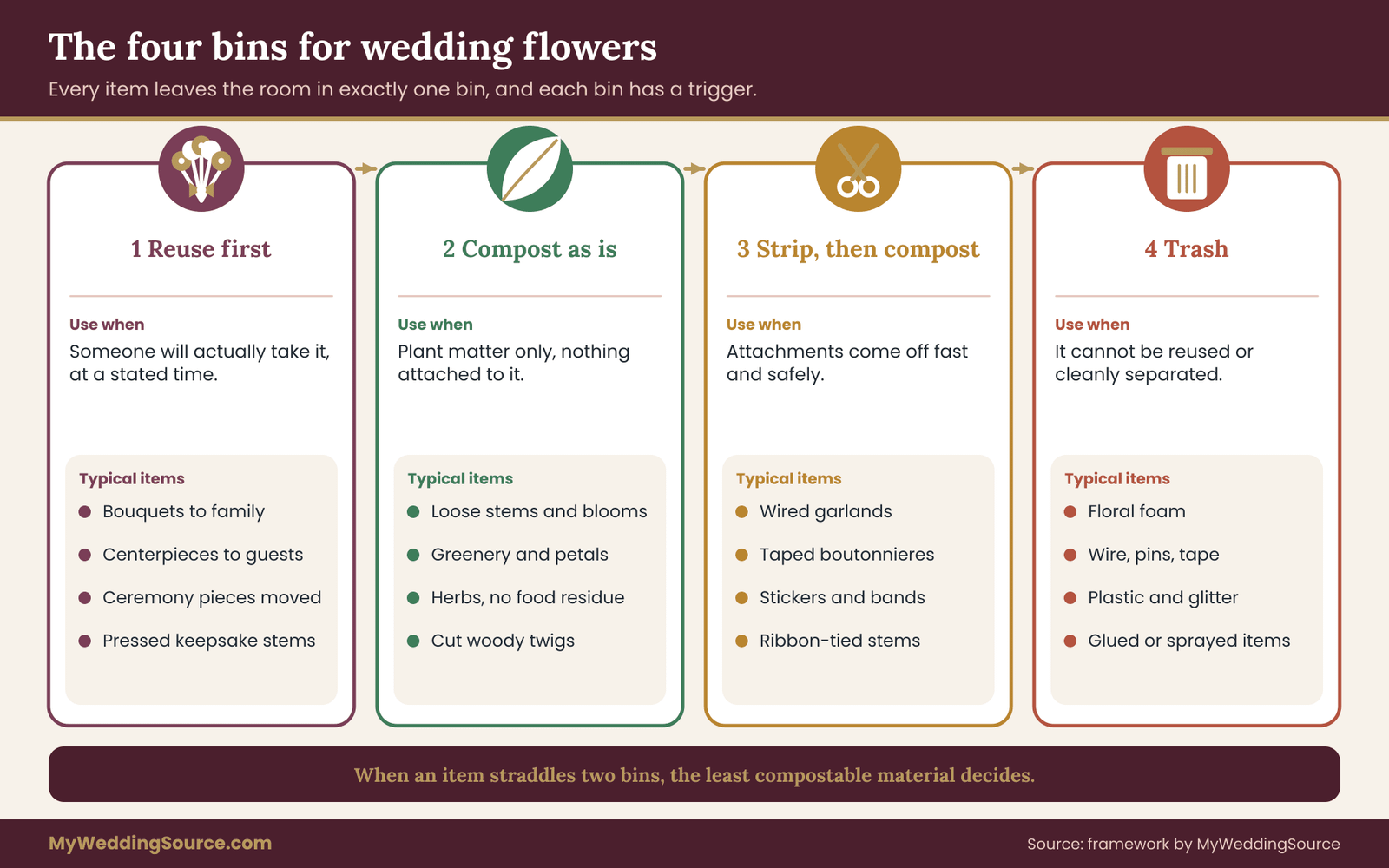
The core tool of this floral composting guide is a four-bin sort. Every item that comes out of the room goes into exactly one bin. The bins are not just containers. They are decisions, and each one has a trigger that tells you when to use it.
Bin one: reuse or donate first. Anything that still looks good and can serve a second purpose belongs here before it is considered waste. Ceremony arrangements can move to the reception. Bouquets can go to guests, to a family member’s home, to a care facility that welcomes flower donations, or to a restaurant that wants a table arrangement.
The logic is the same one that waste professionals use for food and materials in general: use the item again while it still has value, and compost it when it does not. Composting is a good ending. It is not the first choice for flowers that are still fresh.
Bin two: compost as is. Plain, fresh or fading plant material with nothing attached: loose stems, spent blooms, greenery, petals scattered on an aisle, leaves from a garland that was built without wire. If the facility accepts yard trimmings or plant matter, this bin is the easy one.
Bin three: compost after stripping. Plant material that is bound, wired, taped, glued or otherwise attached to something non-compostable, but which can be separated by a person with scissors and a few minutes. This is the bin where floral composting succeeds or fails. The rule is simple: the plant goes to the compost stream only after every non-plant item is gone. If stripping is impractical, the whole item moves to bin four.
Bin four: trash. Everything that cannot be composted and cannot be reused. Floral foam, wire, florist tape, plastic water tubes, ribbon, glitter-sprayed stems, glued items and any mixed object that nobody has time to separate.
The rule for items that straddle two bins
Real flowers do not arrive pre-sorted. A cascading bouquet is a stack of materials, and each layer has to be judged. The practical rule is this: the least compostable material decides the bin until it is removed. A garland with fresh eucalyptus and a thin wire running through it is a bin-three item at best.
If no one has time to pull the wire, it is a bin-four item, and the fresh eucalyptus goes with it. Do not talk yourself into believing that a little wire will “probably be fine.” Contamination is the main reason composting programs refuse loads, and a handful of bad items can cost the whole bin.
This sounds strict, and it is meant to be. The reward for strictness is that when you arrive at a facility, the floral composting load is clean and nobody argues with you.
How strict does each facility need you to be?
Facilities differ. A backyard pile can sometimes tolerate a small amount of natural twine, while a commercial operation that screens its finished product for plastic may refuse a load with visible film in it. You will not know which until you ask. Until you ask, sort to the strictest standard. You can always relax later. You cannot easily un-contaminate a load.
That is why the next sections move from materials to facilities in a deliberate order. You sort first, because sorting works for every facility. You then choose a facility, because the facility determines which bins you may actually deliver. Finally you adjust for the answers you receive.
The five gates every item passes
The four bins tell you where an item can end up. The five gates tell you how to get it there. Think of them as questions you ask in order, stopping at the first “no.”
Gate one: is it still useful as it is? If yes, the item belongs in bin one. A fresh centerpiece that a guest wants to take home does not need a composting plan. Say yes to reuse whenever someone is actually standing there willing to carry it out. A reuse that exists only on paper, such as “we will donate the arrangements,” is not a reuse until a person has said they will take them and has a time to arrive.
Gate two: is it plant material all the way through? Look for anything that is not a leaf, stem, bloom or petal. Run your fingers down the stem. Check the base for foam, the middle for wire, the top for glitter, the handle for tape. If the answer is “plant only,” the item can go to bin two. If not, move to gate three.
Gate three: can the non-plant part be removed quickly and safely? “Quickly” means in the time and with the tools you have on the night, or the time a paid helper can reasonably spend. “Safely” means that nobody is cutting hard wire with their thumbs or pulling pins with bare fingers. If the answer is yes, the item goes to bin three. If no, it goes to bin four.
Gate four: will the receiving facility accept this exact material? This gate cannot be answered from your own knowledge. It is answered by the facility. If the facility accepts only yard trimmings, flowers with food residue or compostable serviceware mixed in are a problem. If it accepts nothing but plant matter in loose bags, the bagged load needs to be loose. Until you have the answer, gate four is an assumption, and the floral composting ledger described later keeps it marked as one.
Gate five: can the material actually get there in time? A load that is accepted in principle but cannot be delivered within the facility’s hours or before the flowers rot has not passed. Gate five connects the abstract rules to the real calendar. A Saturday night wedding with a facility that closes Saturday noon and does not open Sunday has a gate-five problem, and that problem can only be fixed by changing the schedule, the facility or the floral composting plan for temporary storage.
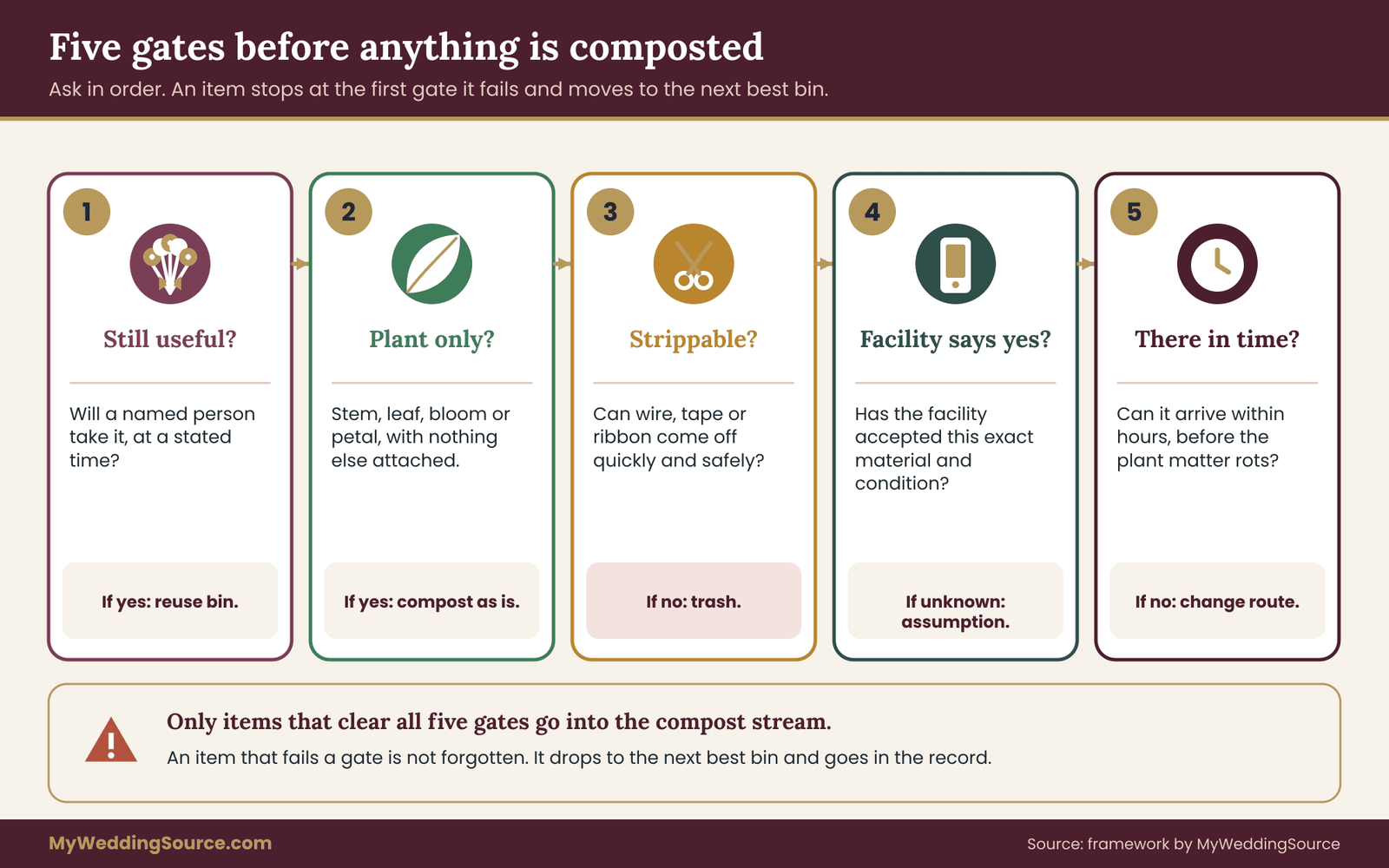
If an item fails a gate, it does not vanish from the plan. It moves to the next best bin. Only items that clear all five gates go to the floral composting stream, and that discipline is what separates a plan from a hope.
Reuse before composting: what to ask first
Because bin one comes first, it deserves a short, honest look. Reuse is often a better result than floral composting for flowers that are still fresh, and it takes less handling. It also has its own complications.
Moving ceremony flowers to the reception. This depends on the schedule and on who is doing the moving. If the florist or the venue staff will move arrangements, ask in advance and put it in writing. If the ceremony ends and the photographer needs the aisle for portraits, flowers that were meant to move may be blocked by the schedule. Decide in advance which arrangements are designed to move and which will stay.
Giving flowers to guests. Guests often like to take a centerpiece home, and there is nothing wrong with that. The risk is the opposite one: a centerpiece nobody takes. Plan for the unclaimed ones. A simple rule is that arrangements not claimed by a stated time, such as the last dance, go to the four-bin sort.
Donating to a care home, hospital or organization. Some organizations welcome flowers and others have rules against them. Rules vary, and a facility with infection-control policies may decline fresh flowers altogether. Do not assume that “donating flowers” is available in your area. Ask a specific organization, name the day and time, and find out whether they will collect or whether you must deliver. If they say no or do not answer, you have lost nothing by asking early.
Taking them home. A couple may want to press or dry a bouquet. That is a lovely way to keep a few stems and does not conflict with floral composting. What remains goes to the compost stream afterward.
The key point is that reuse is a scheduled event with a named person and a time, not a good intention. Anything that has no named person by the end of the reception falls to bin two, three or four.
Counting the time cost of stripping
Stripping is the unglamorous heart of floral composting. Before the wedding, estimate how much time it will take, because time is the thing that runs out. You do not need statistics. You need a rough walk-through.
Pick one representative arrangement from your florist’s proposal, such as a low centerpiece. Ask what it is built on. If the answer is a vase of water with stems arranged directly, stripping is nearly zero: lift the stems out, pour the water into the plant garden or drain, and the plant matter is clean. If the answer is a foam block in a container, the stems must be pulled out one at a time, and the foam goes to trash with every fragment it leaves behind. If the answer is a wired or taped frame, stripping means cutting each binding.
Multiply by the count. Twelve centerpieces built in water take little time. Twelve built in foam take real time and leave foam crumbs in the compost bag, which is a contamination problem on its own. This is why the best floral composting decision is often made at the design stage. A florist who builds without foam, with a mechanical support such as a reusable metal frame or a pinned structure that can be lifted out whole, gives you a pile that needs very little stripping.
Ask what is feasible for your design and venue, and listen to the florist’s answer about durability and cost. If a particular structure, such as a hanging installation, needs foam or glue to hold, the choice might be to accept that part as trash and keep the rest clean.
A sorting scenario with four items
Here are four items from a hypothetical reception, and where each one ends up.
A centerpiece of garden roses and ranunculus in a glass vase of water. Gate one: a guest at table six wants it. It goes to bin one. If the guest changes their mind, gate two applies: plant only and a vase of water, so it goes to bin two after the water is poured out and the vase is set aside for the florist.
A boutonniere with a single rose, a sprig of rosemary, floral tape around the stem and a pin. Gate two fails: there is tape and a pin. Gate three: removing tape and pin takes seconds, so the item goes to bin three. The rose and the rosemary move to compost after stripping, and the tape and pin go to trash.
A hanging installation of dried grasses, glued fresh blooms and fishing line on a metal ring. Gate two fails on the glue and the line. Gate three: gluing is hard to separate. It goes to bin four, and only the unglued fresh blooms that can be pulled by hand move to bin three.
A ceremony arch wrapped with fresh greenery and wired at every join. The greenery can be composted after the wire is cut, but cutting wire is a task with a tool and a safety concern. The decision is whether someone with the right gloves and cutters is on the schedule. If yes, bin three. If no, bin four for the wired sections, and the loose leftover greenery goes to bin two.
Notice that none of these decisions was about whether the flowers were “natural” or “eco-friendly.” They were about the materials attached to the flowers and the capacity of the people clearing the room. That is the point of the method. Good intentions do not clear a load, and floral composting rewards a clean sort. A clean sort does.
What to do with water, vases and hardware
Water is not compost, but it matters. Arrangements in water create a quick problem at teardown: someone has to pour out, rinse and separate containers from stems. Decide in advance where the water goes, such as a drain, a garden bed or a utility sink, and who carries it. A load of dripping stems in a bag is a mess in a car and a problem at a facility.
Vases, bowls, candle holders, stands and frames are rentals or the florist’s property, and they have their own return process. A good way to keep those separate is to give the florist or the venue a short written handoff: “Vessels and hardware go back to the florist. Plant material goes to the labeled bins.” This is a one-sentence instruction that prevents the most common mix-up, which is a bin of flowers that also contains a rented glass vase.
Disposing of what the compost stream will not take
The honest end of any floral composting effort is that some material goes to the trash, and that is acceptable. A plan that sends fewer items to the landfill, with an honest account of what was sent and why, is better than a plan that pushes contaminated material into a compost bin and puts the whole load at risk. The trash bin is part of the system. It is the bin that keeps the others clean.
The next section describes what goes in each floral composting bin, item by item, using the material-sort chart.
The material-sort chart for floral composting
The chart below groups the materials you will actually meet at a wedding into three columns: plant material that is usually welcome in a compost stream, material that needs a decision or stripping first, and material that stays out. It also shows the reuse bin, because several items belong there before anything else. Use this floral composting chart as a starting point for conversations with your florist and your facility, not as a final ruling. The facility’s own list always wins.
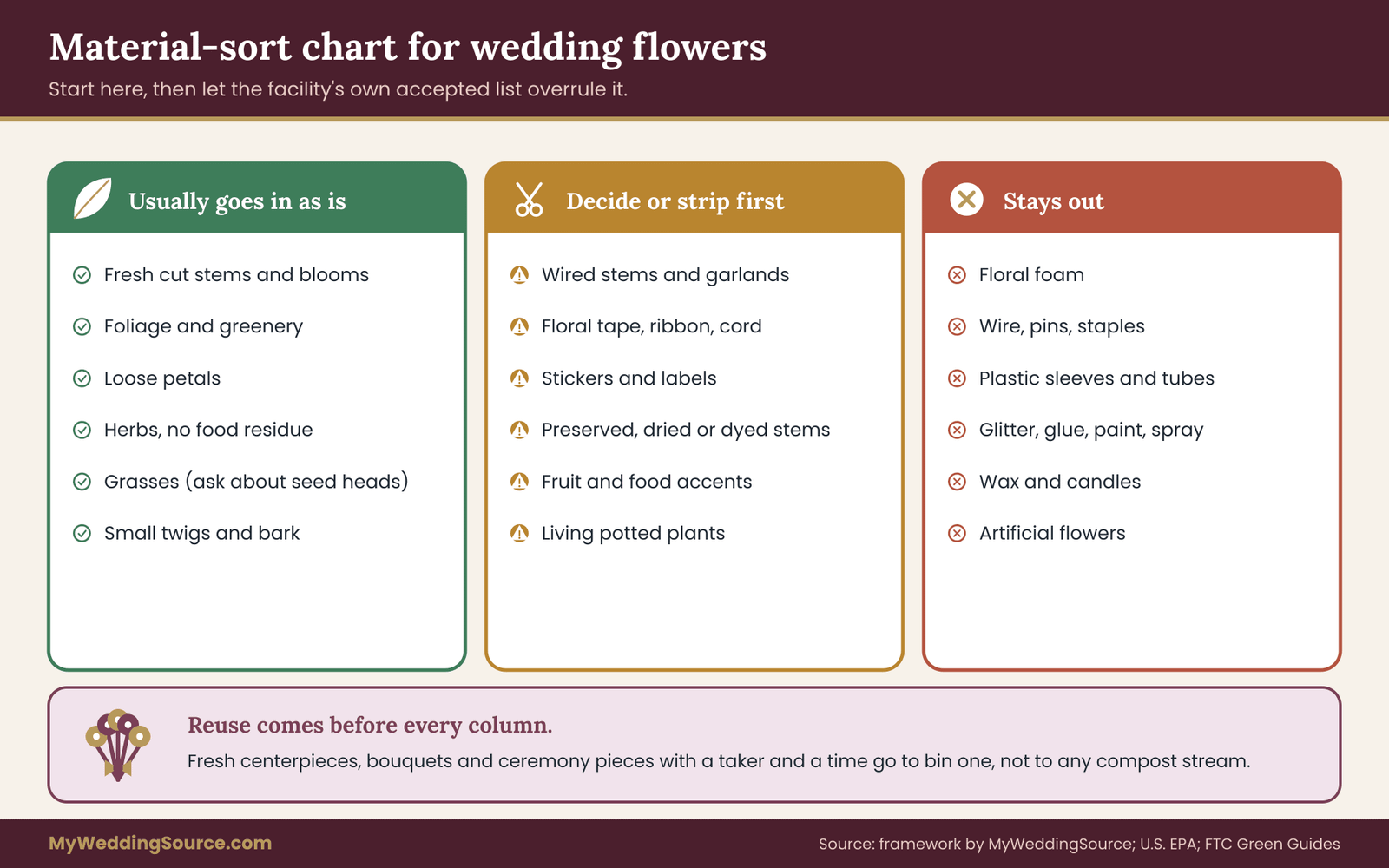
The sections that follow explain each group in plain language, including the reasons behind the placements, so that you can sort an item the chart does not name.
Plant material that usually goes in as is
Fresh cut stems and blooms. Roses, peonies, ranunculus, tulips, lisianthus, dahlias, snapdragons and most other common cut flowers are plant matter. When they are loose, or free of attachments, they are the standard feedstock of floral composting. The question is not the species, but the condition and the facility’s rules.
Foliage and greenery. Eucalyptus, ruscus, ferns, ivy, olive branches, salal, bay and similar greens are plant matter too. Thick, woody branches break down slowly. A facility that grinds or screens may want branches cut to a certain length, and a backyard pile may do better if you cut them small. Ask whether woody material is fine and whether there is a length limit.
Petals. Loose petals from an aisle, a flower girl basket or a send-off are among the easiest items. If they were thrown outdoors, the venue may have a rule about cleanup, and some venues do not allow petals at all because of staining. Collect them dry, if possible. Wet petals in a closed bag turn to slime in a day.
Herbs and edible accents. Rosemary, thyme, mint and basil used as arrangement accents are plant matter. Fruit and vegetable accents, such as lemons, pears or artichokes on a table, are food waste, and a facility that takes yard trimmings may not take them. Ask separately. A facility that accepts food scraps will usually take them as well.
Grasses and grains. Pampas, wheat, oats and ornamental grasses are plant matter. Some may carry seed heads. In a home pile, ripe seed heads may sprout where you do not want them. Ask your facility whether it screens for weed seed, and do not assume it does.
Natural fiber twine and paper wrap. Plain jute, cotton or paper twine and kraft paper are plant-based materials that many facilities allow in small amounts. Many programs still prefer them removed, because they cannot easily tell natural twine from synthetic. A small amount is a question for the facility, not a guess.
Material that needs a decision first
This middle column is where the work happens. Each of these items can reach a compost stream under some conditions, and cannot under others.
Wired stems and wired garlands. Wire can be pulled out of a stem or cut away from a garland. The plant matter that remains is compostable. The wire is not, and it should be taken out before the plant matter is bagged. Fine paddle wire, thicker stem wire and the wire frames used for wreaths all follow the same rule: the wire goes to the trash or, if the florist wants it, back to the florist.
Floral tape, ribbon and cord. Many florist tapes are paper-based or stretch-wax films, and some are plastic. Silk, satin and polyester ribbon are not compostable. Cotton and linen ribbon, if plain, may be allowed by some facilities. Because you cannot tell the fiber by looking, the safe default is to remove all ribbon and tape, and to ask the facility if natural fiber is acceptable.
Stickers and labels. Cut flowers often arrive with stickers on the stems, and arrangements may have care tags. Remove them. A sticker on a stem is a piece of plastic in a compost pile.
Potted plants and living plants. A succulent or a small potted herb is not a compost item at all unless it has died. If it is still alive, it can be planted, given to a guest or returned to a rental. Do not compost a living plant for the sake of convenience.
Preserved, dried and dyed flowers. Dried flowers are plant matter, and many can be composted. Preserved flowers, which are treated with glycerin or other solutions, and dyed or bleached flowers, may carry substances that a facility prefers not to accept. Treat these as a question for the facility, and keep them out of a load until you have an answer. The edge cases section returns to this.
Fruit, vegetables and food accents. Covered above. These move the floral composting load from “plant trimmings” to “food scraps,” and the facility may regulate them differently.
Wood. Small twigs and bark are plant material. Cut lumber, painted wood, craft sticks and anything treated are not. A branch from a tree is different from a painted wood slice used as a base.
Material that stays out
Floral foam. The green or brown blocks that hold stems in many arrangements are a synthetic foam. They do not break down in a compost pile and leave fragments behind. They go to the trash, every time. If you were hoping for a way to compost foam, there is no honest answer to give. The practical response is to ask the florist to build without it.
Metal. Floral wire, chicken wire, pins, staples and hooks go to the trash or back to the florist, or, if the venue or a hauler recycles scrap metal, to that stream. They do not go in a compost bag.
Plastic. Water tubes, sleeves, cellophane, ties, plastic leaves, plastic berries, vase fillers made of plastic gel beads, and bags that are not certified compostable. All out.
Glitter, glue, paint and spray. Craft glitter, hot glue, spray adhesive, spray paint and the sparkle sprays sometimes applied to flowers are not compostable. Any stem that has been sprayed or glittered goes to bin four unless the florist can tell you in writing what it is and the facility says yes.
Wax and candles. Candle wax is not compost, and wax-dipped flowers are a gray case that is better treated as trash unless a facility says otherwise.
Artificial flowers. Silk, paper, plastic or foam flowers are not compost, although they may be reusable. A few may be recyclable depending on materials, which you will need to confirm.
Edge cases that trip people up
Some items do not sit neatly in one column. Each of these floral composting traps has caused a ruined load somewhere, and each is easy to handle once you know it exists.
Headpieces, corsages and wearable flowers. Flower crowns, wrist corsages and hair combs are usually built on wire, elastic, tape and pins. They are small, so they are easy to forget. Put a small labeled bag at the end of the night where the wedding party can drop them, and strip them at home or at the florist.
Boutonnieres and pins. Every boutonniere has a pin and, very often, tape and a wrapped stem. Pins that end up in a compost bag are a hazard to whoever handles it later. Collect pins in a jar with a lid, not in the pocket of a jacket.
Cake flowers. Flowers on a wedding cake are a food-contact question. Some are edible and some are decorative with wired stems or plastic sleeves. If they touched food, they follow the catering waste rules, not the flower rules, and a facility that takes yard trimmings may not accept them.
Grocery or wholesale flower packaging. If you are doing DIY flowers, the floral sleeves, rubber bands, flower food sachets and plastic crates are all separate waste items. The stems themselves may carry stickers and bands. Strip them at the point of arrangement, not at the end of the night, so that the clean stems go straight into a bucket rather than a heap.
Confetti, petals and send-off materials. Real petals are plant matter. “Biodegradable” paper confetti is a marketing word, not a compost guarantee. If you plan to throw something at the exit, throw loose petals and nothing else, check the venue’s rules first, and ask the facility whether paper confetti is accepted at all.
Greenery from a florist’s own stock. Sometimes a florist uses a mix of cut stems and plants sold from a nursery in pots. The potted plants should go back to the florist or into a garden. Do not treat a living plant as a disposable item.
Hanging and suspended installations. A large installation is usually built on a frame with mechanical supports and wire. The frame is the florist’s equipment. The plant material can be stripped by hand, but it can take much longer than the ceremony arch. Ask the florist how long it takes to take down and whether that time is included in the price.
Flowers that look fine but were sprayed. Some flowers are treated by growers or by the florist with preservatives, anti-wilting sprays or colorants. Ask your florist whether anything was applied beyond the flower food in the water. If the answer is no, record that. If the answer is yes, record exactly what it was and ask the facility. A written statement from the florist is worth more than a guess.
A rule for any item not on the chart
When you meet an item the chart does not name, do not guess. Walk it through the five gates. Is it plant? Is it only plant? If not, can the non-plant part come off? Will the facility say yes? Can it get there in time? If you reach a gate where you do not know the answer, mark the item as an assumption in the floral composting ledger and send it to bin four unless someone confirms otherwise.
The cost of an extra item in the trash is small. The cost of a contaminated load is a refused drop-off and a car full of wilting flowers.
Why the chart is not a promise
A material-sort chart is useful, and it is also limited in an honest way. It reflects widely shared understandings of what plant matter is and what synthetic materials are. It cannot reflect your facility’s permit, your florist’s materials, or what a particular product contains. A flower dye, a foam alternative marketed as “biodegradable,” or a glitter labeled “eco” is a product claim, and you should treat it as a claim until you have documentation.
The Federal Trade Commission’s Green Guides explain how environmental marketing claims, including “compostable” and “biodegradable,” should be qualified and substantiated. They are written for marketers, and they are also a useful reference for readers who want to know why a vague green label does not settle anything.
So the floral composting chart is where you begin. The facility is where you finish. The next section looks at the facilities themselves.
Finding a facility that accepts floral composting loads
Once your sort is clean, you need somewhere for the plant matter to go. This is the part most couples guess at, and the part where a few phone calls change the whole result. For floral composting, the word “facility” here covers everything from a neighbor’s pile to a permitted commercial site. They differ in what they accept, who may use them, and how much work they need from you.
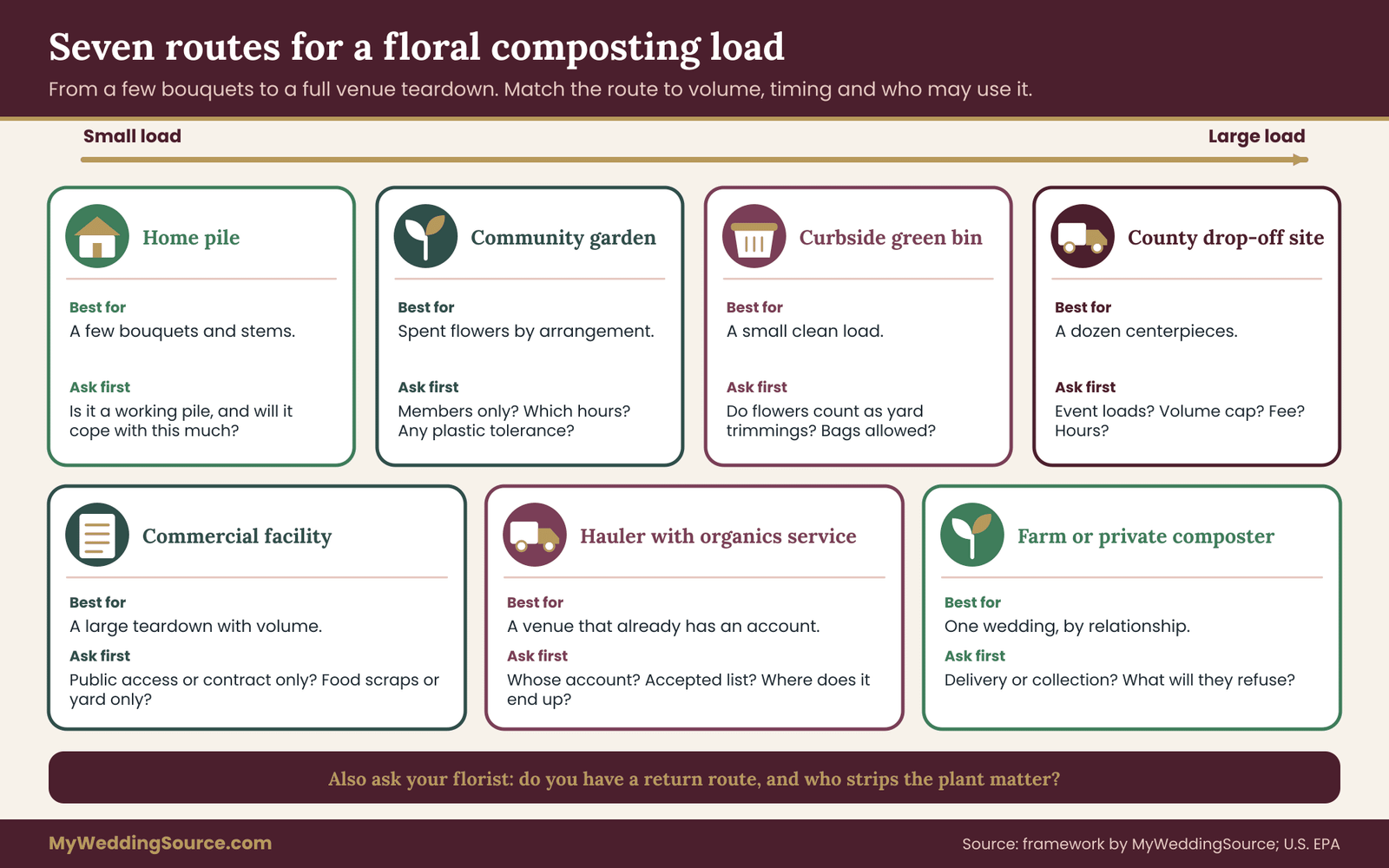
The main routes, from smallest to largest
A home compost pile or bin. If you or a family member keeps one, this is the simplest route for a small amount of clean plant material. It suits bouquets, boutonniere stems and a few centerpieces. It does not suit a large load: a pile that receives a whole venue’s greenery at once becomes wet and compacted, and it will not break down well.
A home pile also has no certification and no scrutiny, so the only quality control is you. The EPA publishes home composting guidance describing what belongs in a pile and what does not, and that is a reasonable reference for the plant-matter basics.
A community garden or neighborhood compost program. Some gardens and community groups run shared compost sites, and some welcome flower and greenery donations. The terms are informal and vary a great deal. Some accept only from members. Some only accept at set hours. Some refuse anything that is not plain kitchen scraps and garden trimmings. A garden group that says yes is giving you a favor, so treat it that way: arrive when expected, deliver a clean floral composting load, and say thank you.
Curbside yard-trimmings or green-bin collection. Many municipalities collect yard trimmings, and some collect food scraps with them. If your household has this service, a small load of clean flowers might fit in your own bin. The questions are whether flowers count as yard trimmings in your program, whether the bin must hold only loose material, and whether bags are allowed. Some programs want paper bags or no bags. Plastic bags are commonly refused, and bags marked “compostable” may be refused too if the processor cannot tell them from plastic. Do not assume. Check your hauler’s list.
A municipal or county drop-off site. Many local governments operate drop-off locations for yard trimmings, and some accept food scraps. Drop-off sites have hours, sometimes residency checks, and sometimes a fee or a volume cap. A floral composting load from a wedding is bigger than a household’s weekly trimmings, so ask whether there is a limit and whether a load that comes from an event rather than a home is allowed.
A commercial composting facility. These are the permitted operations that process material at scale. Some accept the public and some accept only commercial customers or contracts. Some accept food scraps and some accept only yard trimmings. They often publish an accepted-materials list and a contamination policy. A facility that serves commercial customers may be the right route for a large load, such as the output of a full venue teardown, but you may need to open an account or arrange a pickup through a hauler.
A commercial hauler with an organics service. In some areas a private hauler collects organics from businesses and events on a subscription or per-event basis. A venue or a caterer may already hold such an account. If so, a short conversation might put your flowers into a stream that already exists, rather than building a new one. The hauler’s accepted list governs what you can send.
A farm, a private composter or a landscaping business. Some small producers compost plant matter and welcome clean loads. Others require a relationship. This route can work well for a single wedding, but it is informal, and you should ask what they will and will not accept and whether they want the flowers delivered or collected.
Your florist’s own return program. A few florists take clean plant material back to a compost system they use. If yours does, the question becomes who strips the materials, how soon, and whether it is in the contract. Ask directly, and do not assume that a florist who says “we compost” is processing your wedding’s load unless they confirm the details.
Why “yard trimmings only” matters
The line between a facility that accepts yard trimmings and one that accepts food scraps decides a lot. Flowers and greenery are plant matter, so they fit in either, but anything with food residue does not fit in a yard-trimmings-only stream. A centerpiece that included fruit, a table arrangement that sat on a plate with food, or flowers that were bagged together with napkins and leftovers all move the floral composting load toward food waste.
If the facility only accepts yard trimmings, the floral composting load has to be cleaner. If it accepts food scraps, you have more room, but the contamination limits are often stricter, because these facilities screen for plastics.
Searching without guessing
Most people begin with a general web search and end up with a page from some other state. A better order is the following.
Start with your city or county solid-waste or recycling department. Their website often lists organics drop-off, curbside service and local composters, and many will answer an email or a call. Next, check your state environmental agency. Many states publish lists of permitted composting facilities, and a list is useful because it names the operators and the categories of material each may accept. Then look at local community garden networks, extension services and conservation districts. They are often the people who know about the small compost sites that no directory lists.
Look for the facility’s own accepted-materials page, and keep a copy. The U.S. Composting Council, a trade association, is a useful starting point for understanding how the industry describes itself, although it does not replace a local conversation. If a facility’s page does not mention flowers or event loads, send a question. A page that says “yard waste” is a good sign and an incomplete one.
Matching the route to your load
A decision rule can save a lot of time. Estimate your floral composting load in the simplest terms you can: a few bouquets and boutonnieres, a dozen centerpieces, or a full venue with arches and installations.
A few bouquets and boutonnieres can go to a home pile, a community garden or your own curbside bin if the program allows. A dozen centerpieces is a larger load, and a drop-off site or a friendly farm is more suitable. A full venue’s worth of greenery needs a facility or hauler that expects volume, and you should call earlier.
The other axis is distance and time. A facility that is perfect but an hour away, closed on Sundays and unwilling to take event loads fails gate five. A less perfect facility that is ten minutes away and open the morning after the wedding may be the better choice. Floral composting is not a contest for the best facility. It is a search for one that will say yes, within a day or two, to a clean load.
Who may use the facility for floral composting
This question surprises people. Many drop-off sites and programs are set up for residents bringing household yard waste. A load from an event, even one that you carry yourself, may fall outside the definition of residential. Ask a plain question: “I have flowers and greenery from a private event, all plant matter, about this much. May I bring them?” Do not describe it as “waste” or “household.” Describe it as it is.
Cost, fees and trade-offs in floral composting
Do not assume that composting is free or that it is expensive. Some drop-offs are free to residents and charge by the floral composting load for others. A private hauler may charge a pickup fee. A farm may ask for nothing or for a small contribution. The honest approach is to ask for the fee in advance and to compare it to the alternative, which is the cost of waste removal that your venue or caterer already includes.
Where the numbers matter, put them in your budget notes and in the vendor contract. For the broader context of what to budget in a wedding, the wedding budget guide covers the categories, and a composting line is usually small compared to the flowers themselves.
The honest summary of this section is that there is no single best route. The best facility for floral composting is the nearest one that can confirm, in writing, that it accepts your materials, your volume and your timing. The next section shows how to get that confirmation.
The acceptance call: confirming floral composting rules before the wedding
A facility that “probably” takes flowers is not a facility. Two or three weeks before the wedding, make a short call or send a short message to the place you picked, and ask the same set of questions every time. The goal of a floral composting call is not to impress anyone. The goal is to replace each assumption with a fact that has a name and a date attached.
Six questions that settle most floral composting cases
What exactly may I bring? Ask for the accepted-materials list, and ask specifically about cut flowers, greenery, woody branches, petals and herbs. If you plan to bring anything with food residue, say so now.
What must be removed first? Ask whether wire, tape, twine, ribbon, stickers and rubber bands are all out, or whether natural fiber twine is acceptable in small amounts.
How must it be packaged? Loose in a bin, in paper bags, in clear bags, or in certified compostable bags? Some programs refuse every kind of bag. Get a plain answer and ask what they do if a load arrives in the wrong bag.
How much and when? Give your rough volume, in bins or truckloads or “about a dozen centerpieces and an arch.” Ask for the days and hours you may arrive, and whether a Sunday morning drop-off is possible.
Are event loads allowed? Say that the flowers come from a private event, not a household, and ask whether that changes anything: access, fees, limits or required advance notice.
Is there a fee, and what happens if the floral composting load is contaminated? Ask whether a refused load can be re-sorted on site, whether there is a surcharge, and whether they will tell you what went wrong.
“Hello, we are planning a private event on a Saturday and would like to bring cut flowers and greenery, all plant material, for composting on Sunday morning. May we, and what do you need us to remove first?”
That short script works for a phone call or a message. The reason to ask in writing, when possible, is that a written answer is easy to forward to the person who will actually do the drop-off.
Who to ask, and what counts as an answer
Ask someone who can speak for the facility, such as a site manager, a program coordinator or the person named on the accepted-materials page. An answer from a front-desk employee who is guessing is useful as a lead and weak as a confirmation. If the first person does not know, ask for the right contact and write the name down.
An answer counts as confirmed when it has four parts: a named person or a named page, a date, the specific material, and the specific condition. “Cut flowers and greenery with no wire or tape, loose in a bin, Sundays eight to noon, confirmed by the site coordinator on this date” is a confirmed fact. “Yes, flowers are fine” is a lead.
The assumed-versus-confirmed ledger
Keep one page that lists every claim your floral composting plan depends on, with a status beside each. The plan will contain more assumptions than you expect, and listing them is the quickest way to find the weak links.
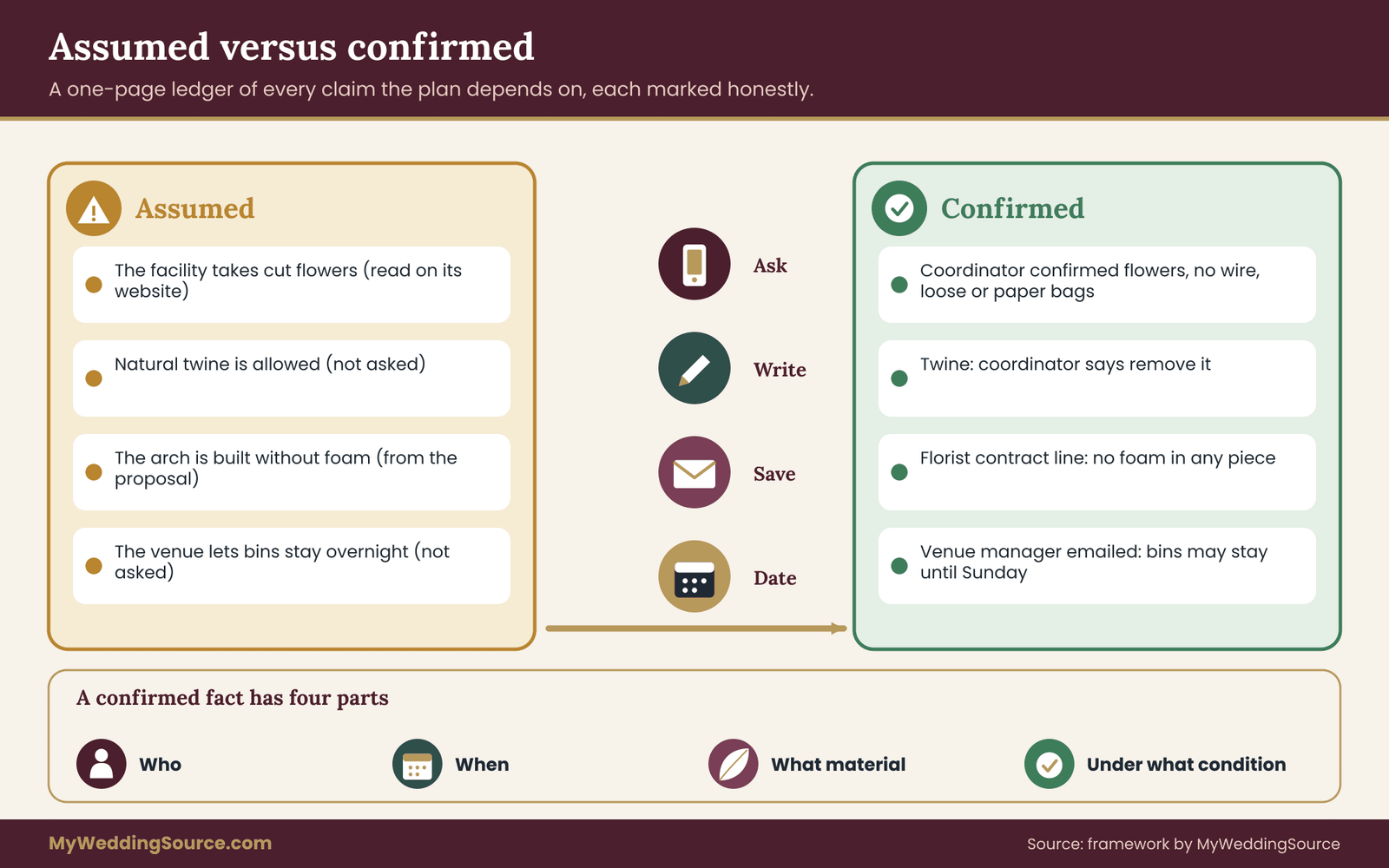
The ledger has two columns of words, not a table: on the left, the claim; on the right, the status, with the source if confirmed. Here are typical lines, written as sentences.
- The facility accepts cut flowers and greenery. Status: assumed from the website. Confirmed by phone with the coordinator on a stated date.
- Natural twine is allowed. Status: assumed. Not yet asked.
- The florist builds the arch without foam. Status: assumed from the proposal. To be confirmed in the contract.
- Venue staff will leave the arrangements in the room until the next morning. Status: assumed. To be confirmed by the venue manager.
- A relative will drive the floral composting load on Sunday. Status: confirmed by text, with a named person.
A few things happen when you keep this page. Assumptions become visible, and so do the ones nobody has checked. When something changes, such as the facility’s hours, you know which lines to update. And if someone asks you later what your floral composting claim rests on, you have a page that answers.
The ledger also helps you decide what to say publicly. A line that is still “assumed” is not a basis for telling guests, vendors or social media that your flowers will be composted. It is a basis for saying you plan to try. That distinction matters later in the section on claims.
Verify with official sources, not only with the operator
The facility is the authority on its own rules. For the general rules of what composting is and how it works, official sources help. The EPA’s materials management pages explain how composting fits into the wider hierarchy of reducing, reusing and recycling materials. Your state environmental agency may have specific rules and a list of permitted facilities. If a facility will not tell you its rules, or if you cannot find the operator’s permit status, ask the state or local agency whether the site is registered.
This is a modest effort and it protects you from one specific problem: a hauler or a “compost” service that picks up your floral composting load and sends it to a landfill. It is rare to find this out afterward. It is easy to ask beforehand where the material goes and how the operator knows.
What to do if the floral composting answer is no
Most floral composting plans need a backup. If the first facility says no, that is not a failure. It is the system working, because you found out three weeks before instead of on the night.
Ask the facility why. The reason tells you what to do next. If the reason is volume, split the floral composting load or choose a larger facility. If it is hours, look at a facility with different hours or ask a friend with the right access to do the drop-off. If it is the type of material, such as woody branches or food residue, change the sort. If it is a flat refusal of event loads, move to another route in the facility list.
Keep two facilities in your notes. A primary and a backup means that if the primary is closed, the weather is bad or the load is bigger than expected, you are not starting your search at midnight.
Reading a facility’s page critically
Some websites list “yard waste” with a photo of leaves and say nothing more. Others use broad phrases such as “all organics.” Read the exclusions, which often hold the useful details: plastics, metal, treated wood, pet waste, diseased plants and sometimes cut flowers. Some programs exclude “floral arrangements” by name because arrangements usually contain foam and wire. If you see that, ask whether loose cut flowers are different. A refusal of arrangements is not necessarily a refusal of flowers, and the difference is the work you do in sorting.
Be careful with the word “compostable” in a facility’s accepted list. A list that says “compostable bags accepted” may mean bags certified to a standard that the facility recognizes, such as those certified by the Biodegradable Products Institute, a certification organization for compostable products. A bag with a green stripe and the word “biodegradable” is not the same thing. When in doubt, ask which certification they look for, or use paper.
Keep the floral composting record
Save the answers. Take a screenshot of the accepted-materials page with the date. Save the message thread. Write the name and role of the person you spoke with. This takes five minutes and it matters in three ways: it is evidence that you did your homework, it lets you brief the person who does the drop-off, and it protects you if the facility changes its rules between your call and the wedding. If the rules do change, you will know, because you will have a record of what they were.
The final point on the call is timing. Make the first call at least three weeks before the date, when changing the floral composting plan is cheap. Make a short confirmation call or message in the last week, because hours, staffing and rules do change. A two-line message on the Wednesday before the wedding costs nothing and keeps the ledger current.
Teardown day: sorting, handoffs and timing for floral composting
Floral composting is decided in the last hour of the reception far more than in any planning meeting. People are tired, the music has stopped, vendors want to load out and the venue wants the room. A plan that depends on a heroic effort at midnight will not happen. A plan that fits into the existing teardown, with named people and a clear station, will.
Build a sorting station, not a sorting moment
Set up one small area, near where the florist or the venue staff already work, with four labeled containers that match the four bins. You do not need anything fancy. Four tubs or boxes, each with a large readable label, are enough. The labels should say what goes in, in plain words: “Reuse,” “Plant only,” “Strip first,” and “Trash.” A short list taped to each, with three or four examples, saves questions. If you are already planning signs for the event, the wedding signage system guide covers legibility and placement, and the same principles apply to a bin label.
Give the station to one person. This should not be the couple, and it should not be a person who is also expected to dance, give a toast or drive someone home. A florist’s assistant, a venue staff member who has agreed in advance, a hired helper or a friend who has said yes and has been briefed are all workable. The person at the station needs scissors, wire cutters, gloves, a jar with a lid for pins, a trash bag, labeled bins, paper bags if the facility wants them, and a copy of the floral composting sort chart.
The first hour after the last dance
Here is a workable sequence. It assumes about an hour and a handful of people.
First, claim the reuse items. Ask the guests who wanted centerpieces to collect them. Move the ceremony arrangements that were meant for the reception or for a gift. Hand the bouquets to the people they were promised to.
Second, clear the tables and the aisle into the station in order, not by dumping. Plant-only items go straight to the plant bin. Anything with attachments goes into the strip bin. Obvious trash goes to the trash.
Third, strip what can be stripped at the station, using the five gates. Anything that takes more than a minute or two per item and cannot be handled safely goes to the trash and is recorded, not argued over.
Fourth, check the plant bin before sealing it. Pull out visible wire, tape, ribbon, stickers and plastic. It takes five minutes and it is the quality control step that matters most.
Fifth, label the sealed bins with the date, the contents and the destination. A bin with a note that says “plant material for composting, drop-off Sunday at the county site” prevents it from being thrown out by the cleaning crew.
Handling and storage overnight
Fresh plant material rots, and it does so faster in a warm, closed space. A sealed bag of wet greenery in a hot car can start to smell and break down within a day. Where possible, store the floral composting load cool, dry and open to air, and use breathable containers such as open bins or paper bags if the facility accepts them. If the floral composting load must wait overnight, a garage, a cool back room or a covered outdoor space is better than a car trunk. Avoid leaving it where animals can reach it.
Drain water from stems before bagging, and do not seal wet material in plastic. This is a plain physical point, and it matters for gate five. A load that has turned slimy is not pleasant for you or for a facility’s staff, and some sites refuse it for that reason alone.
The 48-hour clock
Think of floral composting as having a clock that starts at the last dance.
In the first hour, you sort and seal. In the first twelve hours, you store the load properly and make sure it is not thrown out. In the first day or two, you deliver it, within the facility’s hours. After the drop-off, you spend ten minutes on the record: what went where, any problems and what you would change. The sooner the load is delivered, the fresher and cleaner it is. A plan that depends on a delivery four days later is a floral composting plan with a rotting step in the middle.

Naming the person who drives
Someone has to put the bins into a vehicle and take them to the facility, and that person should be named in the plan. It should not be the couple on the morning after, and it should not be “someone” from the family. Choose a named adult, who has the facility’s address, hours and rules, and who knows what to do if the site is closed or the load is turned away. A short written briefing, with the floral composting ledger summary and the backup facility, is enough.
If the drop-off is on a Sunday morning and the couple is traveling, a friend or relative, or a paid helper, should take it. If you hire a helper, tell them what to say at the gate and what proof to ask for, such as a receipt or a weight slip if the facility issues one.
Putting floral composting in your vendor contracts
Nobody can do floral composting well on the day if the vendors have not agreed to it earlier. The contract stage is where you decide how the flowers are built, who removes them and what counts as finished. The details do not need to be long. They need to be specific.
What to ask the florist
Ask these questions when you compare proposals, before you sign.
How will the arrangements be built? Specifically, will any foam, wire, tape, glue, glitter or sprays be used, and where? A florist who can describe the mechanics of each piece, such as water vases, pinned structures or reusable frames, is giving you the information you need to plan the sort. A florist who says “all natural” without explaining what holds the stems in place is not.
Who will break down the arrangements, and when? Many florists include delivery and setup but not teardown. If you need a florist to collect, strip or sort after the event, that is a service with a price, and it should be written down with a time.
Will you separate plant matter from non-plant material? Ask whether the florist will place stripped plant material in the bins you provide, or whether the florist takes it away.
Does the florist have a composting route of its own? If yes, ask for the destination and the rules. If no, ask whether they will allow your helper to collect the plant material from their teardown area.
Can you confirm what, if anything, was applied to the stems beyond flower food? Ask for the answer in writing, and keep it with the floral composting ledger.
What to ask the venue and caterer
The venue controls the room and the closing schedule, and the caterer may control the waste and the hauling. Ask the venue whether guests and vendors may leave bins in place overnight, whether there is a loading area or a place to stage the sorted load, whether outdoor petals or ground cover are allowed, and whether the venue has its own organics collection.
A venue that already has an organics account may be able to take your floral composting plant matter without extra effort, if it is clean. The caterer’s food waste, if the caterer has a composting route, is a separate stream and should not be mixed with your sorted flowers unless both parties agree.
If your venue or florist hires a waste hauler, ask what happens to the material that goes into their bins and whether you can confirm where it ends up.
For the details of how to compare and document vendor commitments in general, the wedding vendor contract guide and the wedding vendor due diligence checklist explain the structure. Here, the only point is that floral composting terms belong in the same written agreement as everything else, not in a verbal promise at a tasting.
A short clause you can adapt
You do not need legal language. A plain sentence in the contract or an attached email is enough. It might say that the florist will build the listed arrangements without floral foam, that stripped plant material will be placed in the clients’ bins at teardown by a stated time, and that vessels and hardware will be returned to the florist. If you want help wording this precisely, a licensed attorney in your state can tell you how to make it enforceable, and this floral composting guide does not substitute for that advice.
Timing in the vendor schedule
The sort needs a slot in the run of show. If the florist’s load-out is at the end of the reception and your helper is not there until later, the florist will leave with the flowers. A line in the schedule, such as “florist strikes arrangements to bins, helper takes over at the end of reception,” makes the handoff visible. The wedding vendor timeline guide shows how to place these handoffs among the other vendor times. Floral composting works when it is one more line in the schedule, not an afterthought.
Tipping and thanking
If a venue staff member or a helper takes on the stripping, tell them in advance and pay them for it, either through the contract or directly. A task that was not agreed to is a task that gets skipped. If you are tipping your vendors anyway, a note about what you appreciated, including the extra effort of sorting, is welcome and costs nothing.
A worked example of floral composting for a 110-guest wedding
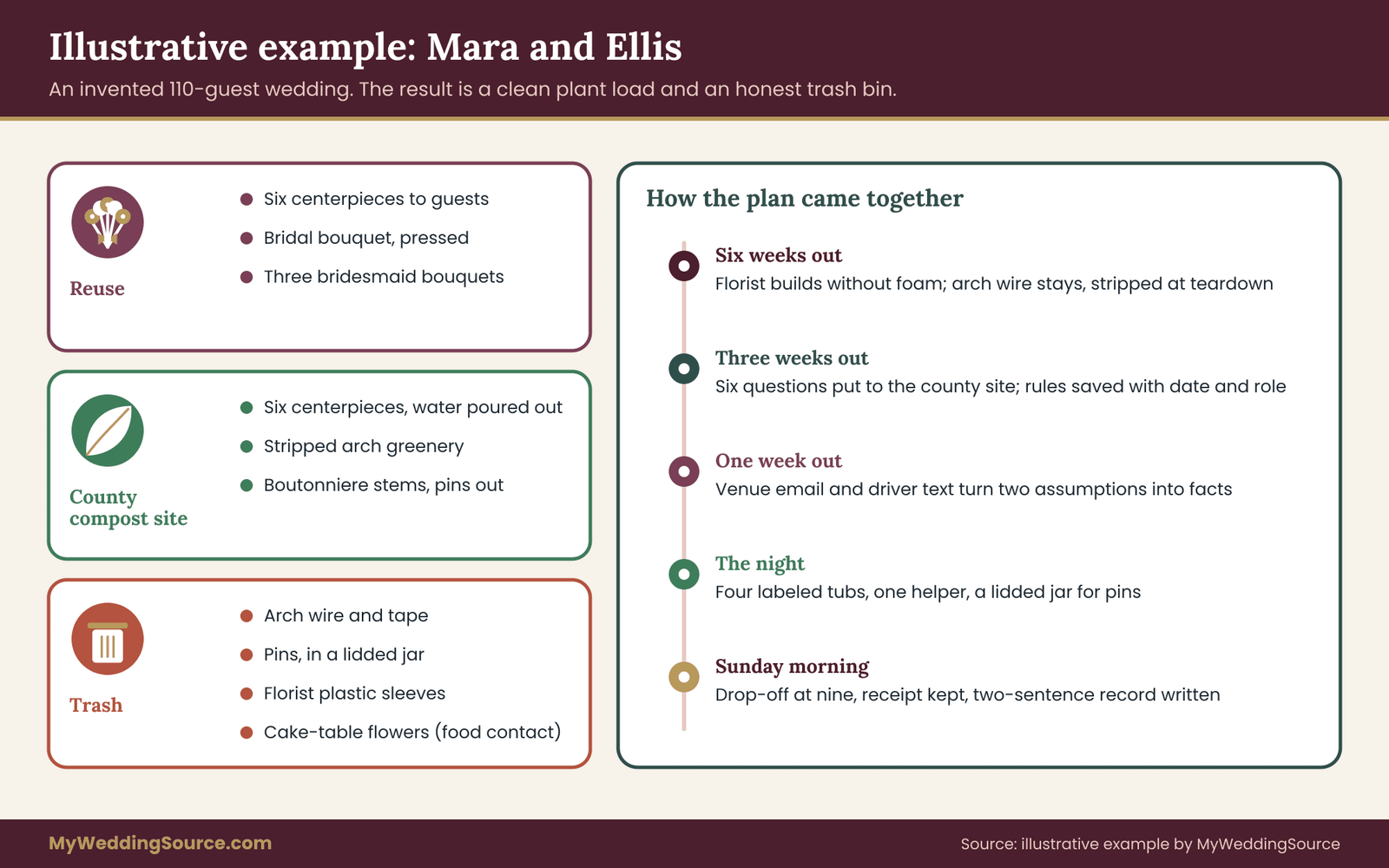
The following couple is invented, and so are the numbers. The example exists to show how the four bins, the five gates and the floral composting ledger fit together on one wedding. It does not describe a real event, and the facility rules are the example’s own.
Mara and Ellis are marrying on a Saturday evening in a rented hall. They have 110 guests, a ceremony arch, a bridal bouquet and three bridesmaid bouquets, six boutonnieres, twelve centerpieces and a small cluster of flowers on the cake table. Their florist has quoted all of it. Mara and Ellis want floral composting to be part of the plan, but not at the cost of a stressful night.
Six weeks out: the design conversation
At the proposal stage, Mara asks the florist how each piece is built. The florist explains that eight centerpieces are arranged directly in water in glass vases, four low ones are built in foam because of the shallow bowls, the arch is wired greenery on a metal frame, and the boutonnieres use tape and pins. Mara asks whether the four low centerpieces could be built in a different way.
The florist suggests a pinned mechanical support in the same bowls at a modest extra labor cost. Mara agrees, and the florist adds a line to the quote: no floral foam in any piece. The arch stays wired, because the frame needs it, and the florist agrees to strip it at teardown for an added fee.
That one conversation removes the biggest sorting problem before it exists. Notice that Mara did not ask for “eco-friendly flowers.” She asked how things were built and what held the stems.
Three weeks out: the facility
Mara checks her county’s solid-waste website. The county runs a drop-off site for yard trimmings open Sunday mornings, and the page says “leaves, grass and plant trimmings, no plastic.” The page does not mention flowers or events. She calls and asks the six questions. The coordinator says cut flowers and greenery with no wire, tape or plastic are fine, loose in a bin or in paper bags, no plastic bags, and event loads from a private person are acceptable for up to a few bins.
The coordinator adds that they refuse anything with glitter. Mara writes the coordinator’s role and the date in her ledger. She also finds a community garden that has said, by email, that it might take a few bouquets, and writes that as an assumption, since “might” is not a yes.
Her ledger now has a mix of confirmed lines and assumptions, which she keeps visibly separate. Confirmed: the county site’s rules, hours, bag type and event-load policy. Assumed: the garden’s offer, the venue’s willingness to leave the bins overnight, and a cousin’s availability to drive.
One week out: closing the assumptions
Mara asks the venue manager whether the bins can stay in a back room until Sunday morning, and the manager says yes in an email, which turns one assumption into a confirmed line. Her cousin confirms by text that he will drive at nine on Sunday, and Mara sends him the floral composting ledger summary, the address, the hours, the rules and the name of the backup site. She orders four tubs, a pack of paper bags, gloves, cutters and a pin jar. She asks the florist to keep the wire cutters handy on Saturday and confirms the teardown time in writing.
The night itself
At the end of the reception, guests take six centerpieces. The bridal bouquet goes home with Mara for pressing. The three bridesmaid bouquets go to the bridesmaids. That is the reuse bin. The florist’s assistant strips the arch, cuts the wire and puts the greenery in the plant bin. The remaining six centerpieces go into the plant bin after the water is poured into a utility sink.
The boutonnieres are stripped at the station, with pins into a jar and tape into the trash. The cake-table flowers, which sat on the cake stand, are treated as food-contact items and go to the venue’s catering waste, not to the plant bin, because the county site accepts only yard trimmings.
A trash bin collects the tape, the pins, the cut wire and the plastic sleeves from the florist’s delivery. The helper checks the plant bin and finds a stray ribbon and two stickers. She removes them. The bins are labeled with the date, contents and destination and moved to the back room.
Sunday morning and the record
The cousin drives the bins to the county site at the start of the morning, gets a receipt for the drop-off, and takes a photograph of the sealed bins. Mara writes the result in two sentences: what went to composting and what did not. The ledger now has every line confirmed. She notes that the pinned supports worked, that the arch took longer to strip than the florist estimated, and that next time she would ask for a larger tub for the greenery.
What the example shows is not a perfect result. The cake flowers went to trash, the arch wire went to trash, and the plastic sleeves went to trash. What it shows is a clean, confirmed plant-matter load going to a site that said it would take it. That is the realistic win.
Describing your floral composting honestly
After the wedding, you may want to tell people what you did. A thank-you card, a social post or a conversation with a vendor can all mention it. The way you describe floral composting matters because environmental claims are easy to overstate.
Say what you did, not what you hope it achieved
A statement such as “we delivered the plant material from our flowers to a county composting site the next morning” is specific and checkable. A statement such as “our wedding was zero waste” or “all our flowers were composted” is not. Even a well-run effort leaves foam-free arrangements with wire, tape and sleeves in the trash, and the claim “all” fails on the first item.
Avoid claims about environmental outcomes that you have not measured. Carbon savings, soil benefits and the fate of the compost after it leaves the facility are all things you did not observe. If you want to say something about the result, say what you know: where the floral composting load went, on what date, and what you kept out.
Why vendors’ claims need the same care
A florist or a product that says “compostable,” “biodegradable” or “eco-friendly” is making a claim that depends on the setting. The Federal Trade Commission’s Green Guides give marketers guidance on environmental claims, including that unqualified claims of this kind can mislead when the product will not break down in the ways consumers expect. You do not need to read them as a lawyer. Use them as a reason to ask follow-up questions: compostable where, certified by whom, and in what time frame?
If a vendor offers an alternative to foam labeled as “compostable,” ask for the manufacturer’s documentation and ask the facility whether it accepts that material. A label on a box is not evidence that your facility will take the product.
Keeping the claim in proportion
Floral composting is a modest action. It does not make a wedding sustainable on its own, and it should not be used to cancel out other choices. It is one good decision among many. A short, accurate description fits that scale and keeps your own record honest. If you want a broader frame for measuring a wedding’s materials, the wedding waste reduction planning guide describes a full audit, and a related guide covers a realistic way to track results.
Your next steps
Work through these in order, and note the date beside each one.
- Ask your florist how every arrangement is built, and request that foam be left out where a mechanical alternative exists.
- Choose one primary and one backup facility, and call each with the six questions. Write down the person, the date and the answer.
- Start the floral composting ledger, with every claim marked assumed or confirmed.
- Decide who is responsible for the sorting station, the drop-off, and the backup.
- Put the floral composting terms in your florist and venue agreements, and add the handoffs to the run of show.
- Gather supplies: bins, paper bags if required, gloves, cutters, a pin jar and a trash bag.
- In the final week, confirm the facility’s hours and rules again, and brief the driver.
- After the wedding, deliver within a day or two, keep the receipt, and write a two-sentence record of what was composted and what was not.
If you want to place this work in the larger sequence of tasks, the wedding planning checklist shows where vendor decisions and day-of logistics sit in the overall order. Rented vessels and stands are covered in the wedding rental planning checklist, which helps you keep them out of the plant bin.
FAQ
Can I compost wedding flowers at home?
Yes, if they are plain plant material and you keep a working compost pile or bin. Remove wire, tape, ribbon, stickers and foam first. A small number of bouquets or boutonniere stems suits a home pile well. A large load of greenery can overwhelm a small pile, so split it, chop woody stems and mix it with dry material.
Is floral foam compostable?
No. Floral foam is a synthetic material that does not break down in a compost pile, and it leaves fragments behind. It goes in the trash. If you want to avoid it, ask your florist to build with water, pinned supports or reusable frames instead, and confirm that in your contract.
Do I need to remove ribbon and twine?
Remove all ribbon, because you cannot easily tell natural from synthetic fiber by sight. Plain natural twine is accepted in small amounts by some facilities and refused by others, so ask. When you have no answer, take the twine off and keep the floral composting load clean.
What if my area has no composting facility?
Check your city or county solid-waste department, your state environmental agency, community gardens and farms. If nothing accepts event loads, a home pile, a friend’s pile or a small farm may work for a small amount. If none is available, reuse and donation come first, and trash is an honest answer.
Can I use compostable bags for the flowers?
Only if the facility says so. Some programs accept bags certified to a recognized compostable standard, some accept only paper, and some refuse all bags. Ask which they accept, and use loose bins or paper if you are unsure. A bag labeled biodegradable is not proof of acceptance.
Who should take the flowers to the facility?
Name a specific adult before the wedding, preferably not one of the couple. Give them the address, the hours, the rules, a backup site and a short briefing. The drop-off should happen within a day or two, because fresh plant material rots, especially in warm weather or sealed bags.
Can I compost flowers that were sprayed or dyed?
Do not, until you know what was applied. Ask the florist in writing, and then ask the facility. Glitter, paint and some sprays are not compostable. Dyed or preserved flowers are a gray case that depends on the treatment and the facility’s rules. When in doubt, leave them out of the load.
Can we say our wedding flowers were composted?
Say it only for the material that actually went to a composting site, and describe it specifically, such as which flowers, where and when. Avoid “zero waste” or “all compostable,” because foam-free arrangements still leave wire, tape and plastic. Keep your receipt and ledger so that your description is accurate.
Sources
- U.S. Environmental Protection Agency: Sustainable Management of Materials
- U.S. Environmental Protection Agency: Composting at home
- U.S. Environmental Protection Agency: Sustainable Management of Food
- U.S. Environmental Protection Agency: Recycling and waste information
- Federal Trade Commission: Green Guides for environmental marketing claims
- U.S. Composting Council
- Biodegradable Products Institute
- U.S. Department of Agriculture
- Natural Resources Conservation Service