
A convertible dress is a wedding outfit that changes shape during the day: a skirt unclips, a train detaches, a long hem becomes a short one, or a ceremony bodice turns into a party look. Each change depends on a few small fasteners, so this guide gives you an original fastener stress test and a minute-by-minute changeover timeline to check them before the wedding.
Judge a convertible dress by its fasteners, not by the photo of the finished look. Run five loads at a fitting: pull, sit, reach, twist and dance, and a long wear test. Count every pass and failure. Then time the changeover with the person who will actually do it, using a written minute-by-minute plan. If any fastener opens under normal movement, ask for a stronger closure, a second closure behind it, or a different design before you pay for alterations.
Most advice about a detachable skirt stops at “it looks gorgeous in the photos.” That is the part nobody doubts. The harder questions arrive later, usually at the worst moment: the zipper that catches the lining as the skirt comes off, the hook that bends when you sit, the snap tape that lets go during the first dance. A convertible dress carries a mechanical system inside a garment, and mechanical systems fail where the load is highest and the testing was lowest.
This article treats the fasteners the way an engineer would treat a latch, without the jargon. You will learn what each kind of closure is good at, where a convertible dress puts stress on it, and how to test it with ordinary movement and a notebook. You will get a changeover timeline you can adapt, a worked example, a list of questions for the designer or shop, and a set of edge cases such as wind, heat, a growing bump or a long ceremony.
A note on scope. This is general information, not legal, tax or financial advice. Garment construction and fit differ by designer, so the only test that counts is one done on your actual dress at a real fitting, and any return, deposit or warranty terms are in your own contract.
This guide sits beside the broader wedding dress fit and alterations guide, which covers measurements, fittings and alteration timing for any gown. Here the focus is narrower: the moving parts of one specific kind of outfit.
What a convertible dress asks of its fasteners
A standard gown is built to stay one garment from the morning fitting to the last dance. Its zipper or lacing opens once to put it on and once to take it off. A convertible dress is built to open, separate and reconnect while it is worn, sometimes more than once, sometimes in a hurry, and sometimes with a photographer waiting.
That changes the job of every closure. A fastener on a regular gown holds a seam in place and is rarely loaded as the wearer moves. A fastener on a detachable skirt is the seam. It carries the weight of the skirt, the pull of the train, the lift of the wind and the push of a crowd of guests who step on the hem while hugging you.
It helps to separate three jobs that fasteners do in a convertible dress.
Holding. The fastener keeps two pieces together while you stand, walk, sit and dance. It must resist pull from many angles, not just straight down.
Releasing. On purpose, and quickly, the fastener must let go when it is meant to. A closure that holds beautifully and takes eight minutes to open has failed the changeover, even if it never fails the ceremony.
Staying hidden. The closure should not show through fabric, print through satin, catch the light or leave a visible line at the waist. A bulky joint can make a smooth skirt look lumpy in photographs.
No fastener is best at all three. Hook-and-loop tape releases fast and holds well in shear but can scratch and show. A zipper holds firmly and hides well but can jam. A snap tape is quiet and quick but can pop under sideways strain. Choosing a convertible dress is partly choosing which trade-off you can live with, and the test later in this guide makes that trade-off visible.
Why the waist is the hard part
Almost every convertible dress has a joint at or near the waist, because that is where a skirt naturally meets a bodice. The waist is also the part of the body that moves most when you sit, bend, hug and dance. It changes length by several inches between standing and sitting. A closure there has to flex with a body that never stays the same shape for ten minutes.
Weight matters as much as movement. A full tulle or satin overskirt can weigh more than people expect, and in a long train the weight hangs from the joint like a lever. The longer the train, the more leverage it has on the waistband and on the first few fasteners at the back. Fasteners that carry the load should be spread along the joint, not clustered, and the seam they attach to should be reinforced. That is a construction question, and you can ask about it before you buy.
What to expect from a good result
A well-built convertible dress passes a plain standard. The pieces stay together through normal movement. The release works the first time, with one person helping, in a set number of minutes. The finished joint does not show. And the dress survives being reattached and reopened, because you will rehearse the change at least a couple of times before the wedding.
Notice what is not on that list: perfection. Fasteners are small parts doing a hard job, and every dress needs a plan for what happens if one of them gives up. The best convertible dress designs include a backup, a second line of defense that holds the garment closed while you fix the primary closure. Later sections explain how to ask for one.
Types of convertible dress and what each one changes
“Convertible” covers several different designs. They share fasteners but not risks, so it helps to know which one you are looking at before you test anything.
Detachable overskirt. A second skirt layer, often tulle, satin, lace or organza, attaches over a slim underskirt or a column dress. The overskirt comes off after the ceremony, leaving a shorter or slimmer reception look. This is the most common type. The joint sits at the waist, and the whole weight of the overskirt hangs from it.
Detachable train. Only the back panel comes off. The front silhouette does not change. The train may clip to loops at the waist, or button to the back seam, or hook to a belt. It releases faster than an overskirt because less fabric is involved, but it also gets stepped on more, since it drags behind you.
Long-to-short conversion. The skirt is designed to be shortened by unfastening a lower layer, tying up a hem, or folding it away. Fasteners may be inside the skirt rather than at the waist, which makes them harder to see and test.
Convertible bodice or cape layer. A jacket, bolero, sleeves or a cape-like panel attaches over a simpler dress. The fasteners sit at the shoulders, neckline or back. If a cape or veil is the layer that changes, the guide to wedding day accessories planning covers compatibility, movement and emergency backups for the pieces that sit on top of a gown.
Wrap or tie-based dresses. Ties, sashes and wrap panels can be worn several ways. These rely on knots and fabric friction instead of hardware, so they behave differently under stress: a knot that holds in a mirror may slide in a hug.
Why the type matters for your test
A detachable overskirt puts steady weight on the waist joint, so the test should include long periods of standing and walking. A detachable train takes sudden pulls from behind, so it needs a stronger tug test. A long-to-short design hides its fasteners inside layers, so you need to check them with the dress turned inside out. A convertible bodice needs a reach-and-hug test around the shoulders. A tie-based dress needs a sit-and-hug test to see whether the knots creep.
You do not need a different test for each design. You need the same five loads, applied with attention to where this particular dress will take the strain. The framework in the following sections is built that way.
Questions to settle before you test anything
Before booking a stress test, answer four plain questions. Which pieces separate? How many fasteners connect them, and of what kind? Who will do the changeover, and where? And how many times will the dress open and close between now and the wedding, including fittings and the rehearsal?
Write the answers on one page. If the designer or shop cannot describe the connection, ask them to show it on the actual dress. A vague answer about “hidden snaps” is not a plan. A clear answer names the type of closure, the count, the spacing and the backup, and it comes from someone who has built or altered the dress.
The next section looks at the closures themselves, since knowing how each one fails is the fastest way to know what to test. ## Fasteners in a convertible dress: how each one holds and fails
Here is the practical anatomy. Each closure has a normal job, a typical failure and a cheap way to spot trouble early. None of this requires special tools, only patience at a fitting.
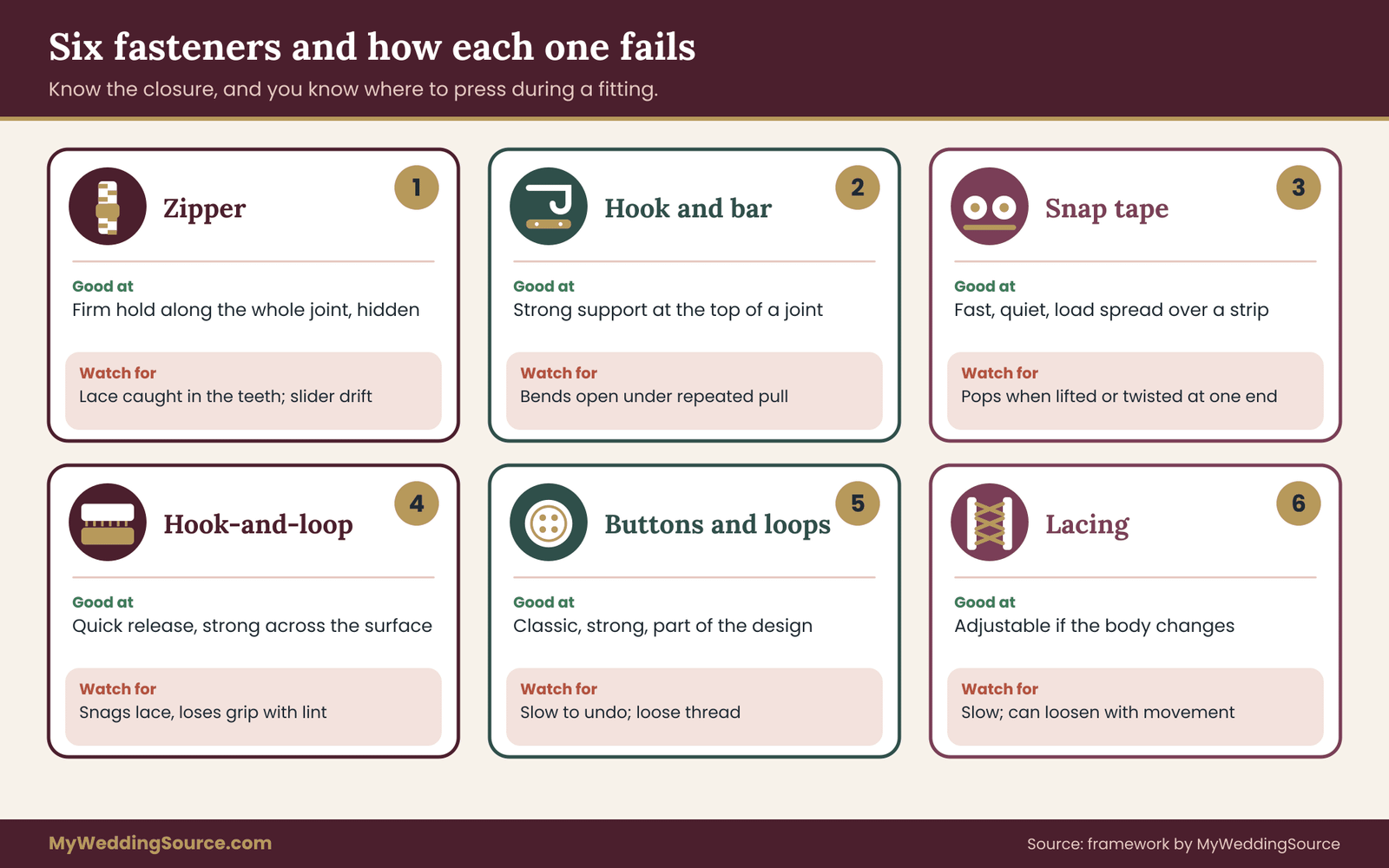
Zippers
A zipper is a strong, flat, hidden closure that holds along its whole length. It is the usual choice when an overskirt must stay firmly attached for hours. Its weak points are the slider, the stops at each end and the fabric near the teeth. Lace, tulle and fine lining can get caught in the teeth and jam the slider or tear the fabric.
Pay attention to direction. A zipper that opens downward from the waist can drift open when the wearer sits, because the slider can slip a little under strain. Ask whether the slider has a lock, whether the zipper is a metal or coil type suited to the weight, and whether a fabric guard sits behind it. If a zipper is the only thing holding a heavy overskirt, it should be longer than you think and should be supported by a hook and bar at the top, so the slider never carries the load alone.
Hooks and eyes, and hook-and-bar closures
Hooks and bars are the small steel pairs found at waistbands and tops of zippers. A hook-and-bar is stronger than a hook-and-eye because the bar is wider, so the hook sits flat and does not slide sideways. In a convertible dress, hooks are best used as supports along a joint, not as the main attachment.
Their failure modes are bending and slipping. A hook bends open under repeated pull, then slides out of its eye. Check by tugging gently in the direction the fabric would pull, not just straight across. A row of hooks that all hold when pulled outward but open when twisted is not secure.
Snaps and snap tape
Snaps are quick, quiet and easy for another person to fasten, which makes them attractive for a changeover. A strip of snap tape, a narrow ribbon with many snaps, spreads the load over a long distance. The weakness is sideways and peeling strain. A snap resists pull well when force acts straight apart, but it can pop when the fabric twists or lifts at one end, like peeling a sticker.
Test them with a slow lift and twist at one end of the strip. If one snap pops, the next often follows, a failure called unzipping that runs along the tape. Ask how many snaps are in the joint and whether the tape is sewn on with reinforcing stitches, because a snap is only as strong as its stitching.
Hook-and-loop tape
Hook-and-loop tape, often sold under brand names, grips through thousands of tiny hooks and loops. It resists pulling across the surface, called shear, very well, and it opens by peeling. It is fast and forgiving, which is why it appears in fast-change designs.
The trouble is the hooks themselves. Rough hook tape can catch lace, snag tulle and scratch skin. It also gathers lint and thread over time, which reduces its grip, and it can make a noisy ripping sound during a quiet moment. If a convertible dress uses it, the hook side should be covered or placed where fabric cannot reach it, and the tape should be wide enough to carry the load.
Buttons and loops
Buttons through fabric loops are classic, strong and visible. A row of covered buttons down a back is part of the design, and it can hold an overskirt neatly. The risks are slow release, thread wear and a missing button. Buttons also take time to undo, so they suit a convertible dress whose changeover happens in a private room with a helper and a few minutes to spare.
Check the thread. Buttons are sewn on with thread, and a loosely sewn button is a failure waiting to happen. Look for a shank, a small stem that lifts the button off the fabric, because it reduces strain on the thread. Ask about spare buttons and whether the thread is the same weight as the garment.
Lacing, corset closures and ties
Lacing spreads force across a long seam and can be adjusted as the body changes. It is a common choice when fit may change between the fitting and the wedding. It also takes the longest to open and close, and it can loosen as the wearer moves. A knot at the end of lacing should be hidden and secure.
Ties and sashes are the simplest closure of all, and the least predictable. A good bow holds for an hour and may fail at two. For a convertible dress, a tie should usually be a finishing detail with a hidden fastener behind it, not the only closure.
Magnets, clips and other hardware
Some designers use magnetic closures or small clips. Magnets are fast and satisfying, but their holding force depends on the gap between them, so a layer of thick fabric weakens them sharply. Clips can slide. Because these closures vary widely by manufacturer, ask for the specific product and test it like any other. If someone in the wedding uses a pacemaker or similar medical device, ask the manufacturer or the person’s clinician about magnets near the body before anyone wears them.
What the best designs do
Strong convertible dress designs rarely rely on one fastener type. They combine a main closure for load, a quick-release for the changeover and a hidden support behind the main closure. A zipper with a hook-and-bar at the top and a row of snaps along the lining is a common recipe. The principle is redundancy: one component can fail without the whole joint failing.
When you look at a dress, ask what holds the weight, what makes the change fast and what happens if the main closure gives up. If the answer to the last question is “nothing,” you have found the gap the stress test should probe.
Where the load goes: weight, movement and the changeover itself
Fasteners do not fail randomly. They fail where the load concentrates. Understanding the load before you test it tells you where to look.
Weight and leverage
On a convertible dress, a heavy overskirt hangs from its joint. A train adds leverage, because a long piece trailing behind you pulls the back of the joint harder than the front. If the joint has five fasteners and the back two carry most of the load, those two will fail first, and when they do the rest follow quickly.
Ask a simple question at the fitting: where does the weight hang? Hold the overskirt up by its hem and feel how much pull reaches the waist. A joint that looks balanced on a hanger may be badly loaded once the wearer moves.
Movement and the waist
The waist changes shape throughout the day. Sitting shortens the front of the torso and lengthens the back. Hugging pushes the bodice up and rotates the joint. Dancing adds twisting. Breathing alone changes the circumference slightly. A rigid closure that holds in the mirror can fail when the body moves around it.
The test later in this guide does not try to simulate these precisely. It uses ordinary versions of the movements and counts how many times the convertible dress passes, because a failure that appears in thirty seconds of movement at a fitting will appear in minutes at the reception.
Other people
A convertible dress is not worn in isolation. Guests step on trains, children grab skirts, a partner hugs from behind, a chair back catches a hem. These external loads are harder to simulate and easy to forget. They are also the reason some brides choose a detachable train for photographs and remove it before the party. The changeover is then a protection plan as much as a styling choice.
The changeover as a stress event
The moment of conversion is itself the hardest test, because it combines haste, an audience and unfamiliar hands. A fastener opened carefully in a fitting room can be yanked in a rush. Lace gets caught, a zipper slider gets forced, a snap gets pulled instead of peeled. The more complicated the sequence, the more likely a step is skipped.
That is why the second half of this guide builds a timeline. A dress that passes the stress test but needs twelve steps in a crowded hallway is not ready. Reducing the number of steps, and rehearsing them, is as valuable as buying stronger hardware.
What the weather adds
Outdoor weddings add wind, damp grass and heat. Wind lifts an overskirt like a sail, putting upward and sideways load on fasteners designed for downward weight. Damp ground adds weight to hems. Heat makes people perspire, which affects adhesives, tapes and the way fabrics grip. If your ceremony is outdoors, say so at the fitting and ask the person testing the convertible dress to include a wind test, described later, in the stress sequence.
Wear and repetition
Every opening and closing wears a fastener a little. A dress that is fitted, adjusted, rehearsed and worn will be opened many times before the wedding even starts. Plastic snaps loosen, hook tape loses grip, zipper sliders weaken. Ask the alterations professional how many cycles the closure is built for, and plan the number of rehearsals accordingly. A few rehearsals are wise. A dozen can wear a closure you needed to last.
A quick map of the risks
To summarize in plain terms: weight loads the waist joint, movement flexes it, other people and weather add surprise loads, and repeated use wears it. The five-load test that follows corresponds to these forces, so each load in the test has a reason. Before running it, though, you need to decide what you are comparing it to, and what counts as a pass. ## The convertible dress fastener stress test: five loads and a changeover
This is the core of the guide, a test built for the convertible dress: a repeatable test you can run at a fitting with one helper, a notebook, a ruler and a phone for timing. It is not a laboratory standard and it does not claim to predict failure rates. It is a structured way to make a dress show its weak points while the seamstress is still in the room and changes are still cheap.
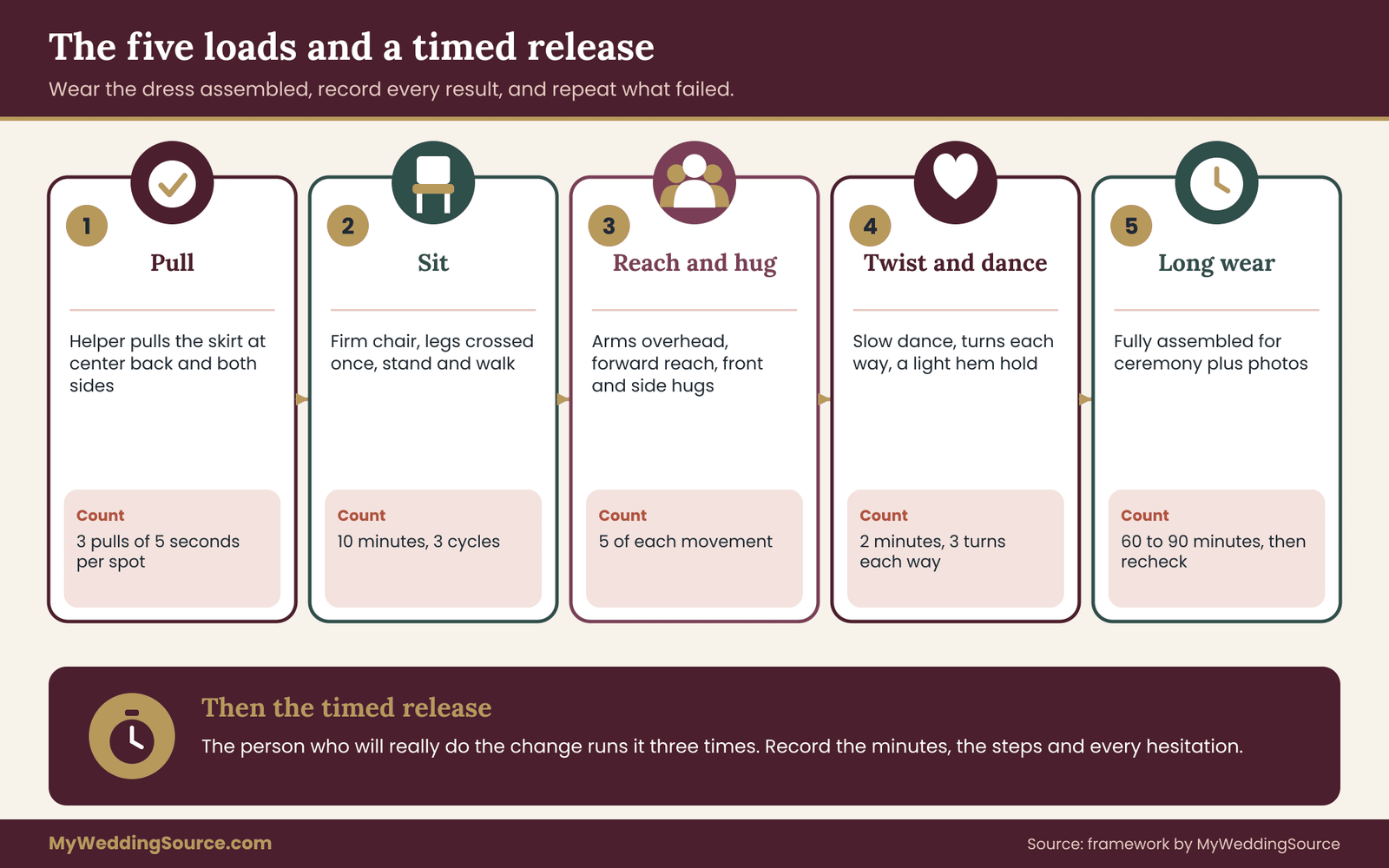
The test has five loads and one timed release. Each load is one ordinary movement, repeated a set number of times, with a recorded result. You wear the convertible dress fully assembled, in the shoes and foundation garments you plan to wear, with the hem pinned to the planned length.
Before you begin: marks and baselines
Take three baselines. First, photograph the waist joint from the front, back and both sides while you stand relaxed. Second, with a ruler, note any visible gap between the skirt and the bodice at the joint. Third, place a small strip of removable tape on the bodice and another on the skirt at the center back, level with each other, so you can measure drift later.
Write down the number and type of fasteners at the joint, and count them aloud with the seamstress. A recorded count prevents the later argument about whether a snap was missing or had popped.
Load one: the pull
The helper places two fingers inside the skirt at the center back and pulls steadily outward and downward for five seconds, then repeats at each side. Do this three times in each position. The pull should feel firm, like someone stepping on a hem, not violent. If the seamstress says a pull of that strength would harm the convertible dress, stop and ask what they consider a safe test.
Record: did any fastener open or shift? Did the joint gap grow, and by how much? Did you hear a pop? A pass means no fastener opened and the gap stayed within a few millimeters of the baseline. A fail means any fastener released.
Load two: the sit
Sit on a firm chair, not a sofa, for ten minutes. Cross your legs once if you would at the reception. Stand, walk five steps, and repeat three times. Check the joint each time: has the skirt ridden up, has the zipper slider moved, has a hook released, has a bulge appeared?
The sit load matters because it compresses the front of the waist and stretches the back, which twists the closure. It is also the load most often skipped, since a fitting is usually done standing on a platform. If the convertible dress cannot be sat in, a heavy or stiff overskirt may make it impractical for a long dinner, and that is useful to learn now.
Load three: reach and hug
Raise both arms overhead five times. Reach forward as if to hug a guest, five times, and then hug the helper from the front and from the side, five times each. Lean sideways in each direction as if reaching for a drink.
These movements lift the bodice, pull the back of the joint and rotate the waist. They are the most common cause of an overskirt riding up on one side. A pass means the joint stays within the baseline and nothing shows that was hidden before.
Load four: twist and dance
Do a slow dance with the helper for two minutes, including three turns in each direction. Then walk forward while the helper holds the hem of the skirt lightly for a single step, as a guest’s foot might. Do not use force and do not do this if the seamstress objects.
This is the sideways load that tests snaps and tape, and the one that most often finds a weak spot. A snap tape may hold in every earlier test and then pop at the third turn. If anything opens here, note which fastener and in which direction the convertible dress was moving.
Load five: the long wear
Wear the convertible dress fully assembled for the length of your ceremony plus photographs, which is often sixty to ninety minutes. Walk around, stand, sit, talk. Then run a full check: count fasteners, measure the gap, check the tape marks for drift, look for threads pulled or fabric caught.
The long wear catches what short tests miss: fasteners that creep open slowly, hook-and-loop that loses grip as it warms, and zippers that drift down a quarter inch at a time. It also tells you about comfort. A joint that digs into the ribs at minute forty will not be bearable at minute two hundred.
The release: a timed changeover
Now convert the convertible dress. Start a timer. Have the person who will actually do the change perform it, not the seamstress. Record the total time, the number of steps, and every point of hesitation. Then reattach if the design allows, and time that as well.
Do this three times. The first run will be slow. The second shows the real time. The third shows whether the person gets faster or whether a step stays awkward. If the changeover time varies a lot between runs, the process is not yet dependable.
Scoring the test and deciding what to do with the result
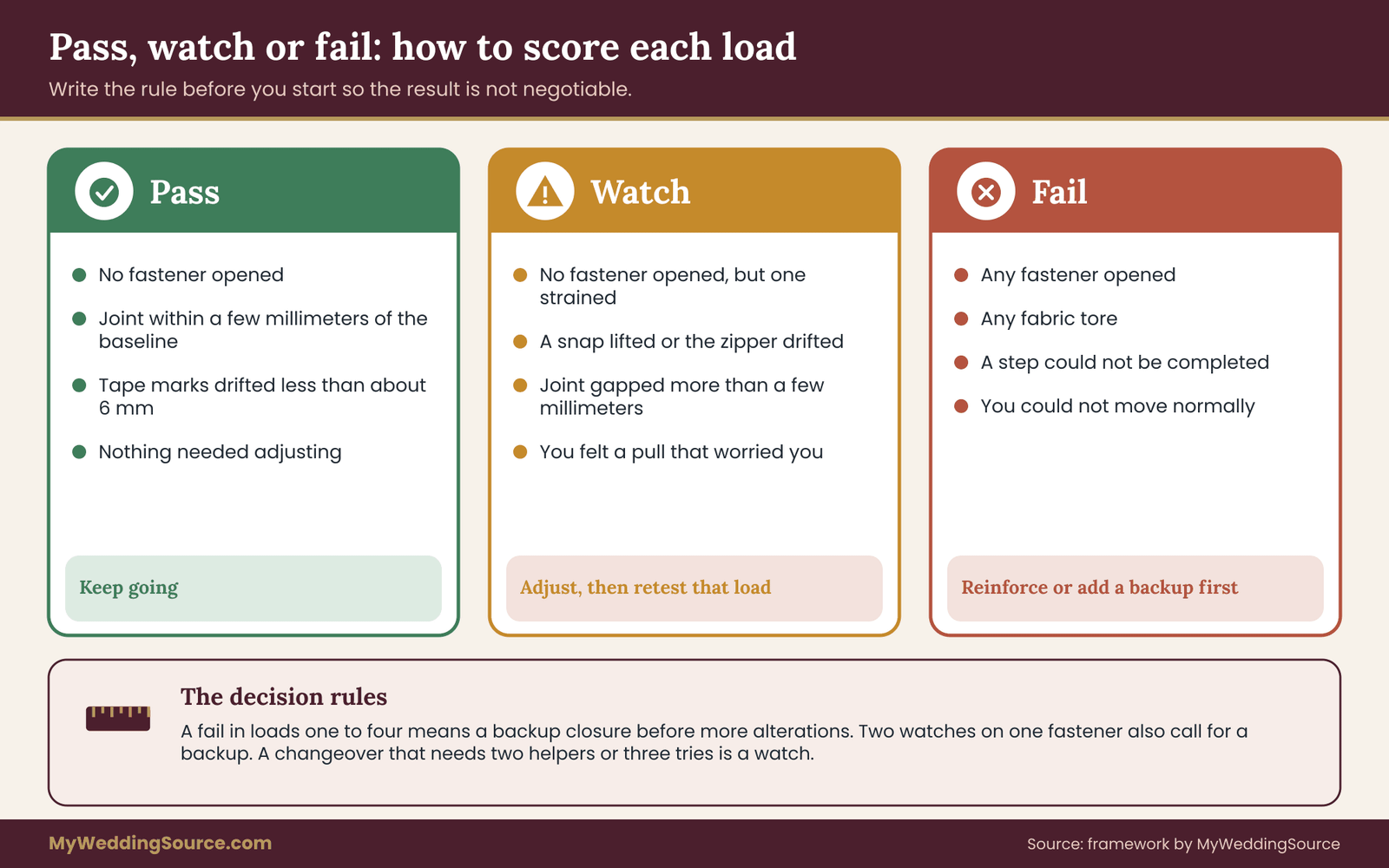
A test with no scoring rule is just fiddling with a dress. Use a simple three-level result for every load: pass, watch and fail. Write the definitions down before you start so you do not argue yourself into a pass.
Pass. No fastener opened. The joint stayed within a few millimeters of the baseline. Tape marks drifted by less than about a quarter inch, or about six millimeters. Nothing needed adjusting.
Watch. No fastener opened, but something moved or strained: a snap lifted at one edge, the zipper drifted, the joint gapped more than a few millimeters, or you felt a pull that made you uneasy. A watch means the convertible dress needs attention, not that it is unsafe.
Fail. Any fastener opened, any fabric tore, any step could not be completed, or the wearer could not move normally.
What each result means
Any fail in loads one to four means the joint needs reinforcement or a backup closure before alterations continue. Two watches on the same fastener also call for a backup. A watch on the long wear alone usually means a small adjustment, such as relocating a hook or adding a second row of stitching.
The release has its own scoring. A changeover that takes under the time you planned, with one helper, passes. A changeover that needs two helpers or three attempts is a watch. A changeover that cannot be done without risk to the fabric is a fail, whatever the convertible dress looks like.
A short log page
Keep one page with the date, who ran the test, the convertible dress version, the fastener list, the result of each load and a line on what was changed afterward. Photograph it. If you use more than one fitting, repeat the full test at the final one, because alterations can change how a joint hangs.
This log is useful beyond the fitting. If something fails on the wedding day, it shows what was tested and what the alterations professional agreed to fix. If a dispute arises about workmanship, a dated record is better than memory. Your contract terms govern what the shop or designer must do, so keep the log next to it.
Why counts beat impressions
People tend to say a dress “feels fine” after a fitting. That is not worthless, but it is not evidence. A count, such as “two snaps opened at the third turn,” gives the seamstress something to fix and gives you something to retest. A measurement, such as “the waist joint drifted nine millimeters after sitting,” tells you whether the fix worked. The point of numbers is not accuracy to the decimal. It is comparison before and after.
What the test does not tell you
The test cannot predict a hard wind, a crowded hug line or a child pulling your skirt. It cannot tell you how a fastener ages over years. It cannot replace the designer’s knowledge of how their own construction behaves. It also does not test the garment’s seams, which can tear before a fastener does.
What it does is reduce surprises. A dress that passes five loads and a timed release at a fitting is much less likely to fail on an ordinary wedding day than one that has only been looked at. And if it does fail, you will already know the backup plan, because the test told you where to put it.
Setting the retest
After any fix, retest only the loads that failed, then run the long wear once more at the final fitting. Do not trust a repaired fastener until it has repeated the movement that broke it. Put the final retest on your calendar at least two weeks before the wedding, so there is time to repair or switch plans. The wedding vendor timeline is a good place to see where such a deadline fits among the other dated tasks. ## A changeover timeline for a convertible dress
A stress test tells you whether the convertible dress holds. A timeline tells you whether the day works. The two are separate, and many couples prepare for the first and not the second. A convertible dress that holds perfectly but needs fifteen unplanned minutes in the middle of cocktail hour can throw off the photographer, the caterer and the mood.
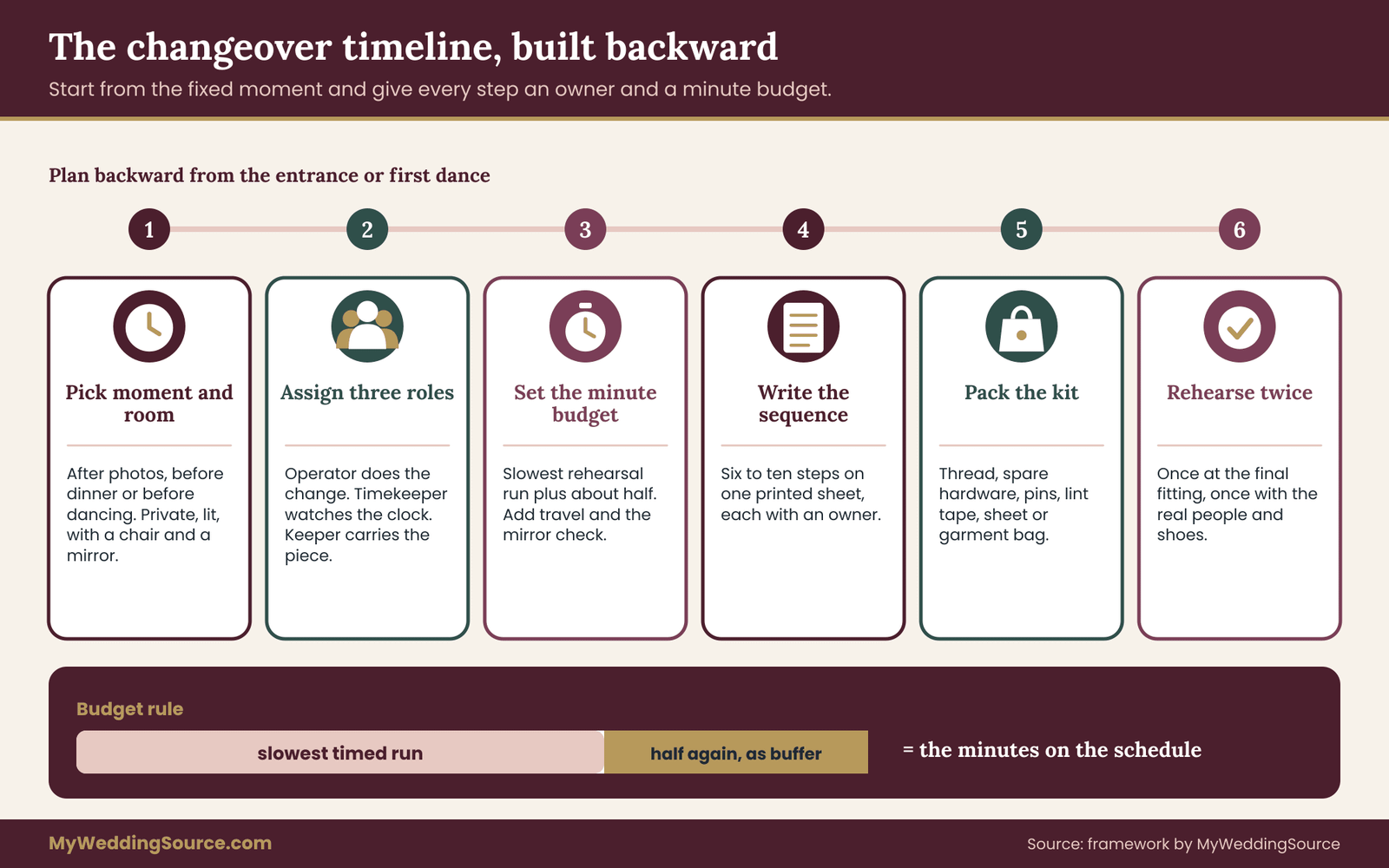
For a convertible dress, the method here is to work backward from a fixed moment, such as the grand entrance or the first dance, and assign every step a time budget based on your own timed runs. Do not borrow someone else’s numbers. The changeover time depends on the convertible dress, the helper and the place, and your rehearsal gives you the real figure.
Step one: choose the moment and the place
Pick when the change happens. The common options are right after the ceremony and photographs, between dinner and dancing, or at the start of the party. Each affects the schedule differently. A change after photos protects the convertible dress in the pictures. A change just before dancing protects the convertible dress during the part of the day with the most movement. A change before the entrance gives guests a reveal but leaves less margin.
Pick the place with equal care. You need a private, clean, well-lit room with a chair, a mirror, a hook for the removed piece and enough floor space to lay a skirt down. A bathroom stall is a poor choice. A bridal suite or a quiet side room is better. Check that the room is not locked, not used by vendors and not far from the reception space. Many venues are glad to name a room if you ask early; the venue technical walkthrough shows what to confirm on a visit.
Step two: assign roles
A changeover needs three roles, and they may overlap.
The operator does the physical change. This person has practiced the sequence, has small steady hands and is not also the person watching the clock. One operator is better than three people helping at once, which creates confusion.
The timekeeper watches the schedule, tells the DJ or coordinator when you are ready and keeps the door closed. If a planner or coordinator is hired, this is a natural job for them; the wedding ceremony cue sheet guide shows how to write such handoffs into a one-page schedule.
The keeper takes the removed piece, carries it away, protects it and knows where it goes. A detached overskirt laid on a bathroom floor is a damaged overskirt. The keeper has a garment bag or clean sheet and a place to hang it.
Step three: set the minute budget
Use your timed runs from the stress test as the base. Take the slowest of the three runs, not the fastest, and add a buffer of about half. If your slowest run was six minutes, plan for nine. The buffer is for what always happens: a hair caught in a zipper, a guest at the door, a stuck hook.
Add travel time to and from the room, and the time to check the result in a mirror, which is not optional. A mirror check catches a twisted waistband, a visible hook or a gap before it reaches photographs.
Illustrative planning figures, to be replaced by your own, might look like this for a detachable train: a few minutes for the change and a minute or two for checking. For a full overskirt with a long zipper and hooks: roughly ten minutes with a buffer. For a long-to-short conversion with hidden ties: more, because the steps are harder to see. These are rough shapes, not benchmarks, and your own rehearsal outweighs them.
Step four: write the sequence
Write every step on one sheet. A good sequence has between six and ten steps and reads like a recipe. For a detachable overskirt, it might go: remove jewelry or sash that sits over the joint; undo the top hook; open the zipper slowly while holding the lining away from the teeth; step out of the skirt; lay it on the sheet; check the underskirt for caught threads; fasten the reception accessories; mirror check.
The reverse sequence, if the convertible dress is reattached, needs its own sheet. Many designs do not reattach in the same day, but if yours does, rehearse it.
Give each step an owner and a time. Put a small mark beside any step that carries risk, such as the zipper near lace. Print the sheet and put a copy in the emergency kit. Do not rely on a phone, which may be out of reach, locked or out of battery.
Step five: build the kit
The changeover kit sits next to the convertible dress and travels with it. It should hold a few items.
A small sewing kit with thread that matches the convertible dress, two needles and scissors. Spare hooks, snaps and a few safety pins. A lint roller or tape for loose threads. A clean sheet or garment bag for the removed piece. A mini steamer or a plan for the wrinkles, if the convertible dress has delicate fabric. A card with the sequence and the name of whoever is the backup operator. Tape, in case a hem needs a quick fix, though tape on fabric is a last resort.
A longer emergency list for any wedding outfit is worth merging with this one.
Step six: rehearse twice
Rehearse the change at least twice, once at the final fitting and once at home or at the venue if you can. The first rehearsal checks the steps. The second checks the people. Use the actual operator, the actual shoes and the actual room if it is available.
Time each run. If the time drops from run one to run two, the sequence is learnable. If it does not, simplify the sequence by removing a step, replacing a slow fastener or adding a helper for a specific moment. A rehearsal is a good time to find that the hook you thought was at the left is at the right.
Planning the changeover inside the wedding schedule
A convertible dress changes your timeline in two places: the moment of the change and the minutes around it.
The photographer and the videographer
Tell your photographer about the change in advance and decide what they will shoot before and after. Many couples ask for portraits in the full look first, then the changeover, then a second set of portraits in the reception look. If the photographer plans a few shots of the detached skirt as a detail, tell the keeper so the garment is ready.
If your photographer will accompany you to the change room, set a boundary in advance. Some couples want a candid shot of a mother helping with a button. Others want complete privacy. Both are fine, and both should be decided before the day.
The coordinator, the DJ and the caterer
Give the person running the room a clear signal: the DJ announces the entrance only when the timekeeper confirms. A caterer serving courses needs to know whether the main course is delayed. If the change falls during dinner, the timing of speeches and toasts should account for it.
Build the change into the written schedule as its own line, with a start time, an end time and a buffer line. Treating it as a hidden gap is how a ten-minute change becomes a twenty-minute silence.
What if the change runs late
Decide in advance what happens if the change takes longer than planned. A common rule is that the party starts without you after a set number of minutes, with the DJ playing music, and you enter when ready. Another is that you shorten the change by leaving the least important step undone, such as a belt or a sash. Agree on this with your coordinator ahead of time, so nobody has to improvise.
What if a fastener fails during the change
Have a ranked plan. First, the backup closure holds. Second, the kit repair, such as a safety pin placed from the inside. Third, a decision to wear the convertible dress in a simpler configuration, such as the underskirt alone, which should be a look you have already approved. The test log from the fitting is useful here, because it records which fastener is the weak point and what the backup is.
What if the room is not available
Have a second location. If the primary room is double-booked, the fallback might be a quiet corner behind a screen, a vehicle, or a nearby restroom with a large stall. A fallback you have not seen is not a fallback, so visit both on the walkthrough.
Keep the changeover plan with your planning documents, alongside the schedule. The wedding planning checklist is a good place to add “rehearse the convertible dress change” as a dated task, so it does not slide to the week of the wedding when everything else is crowded in. ## A worked example: one convertible dress, tested and timed
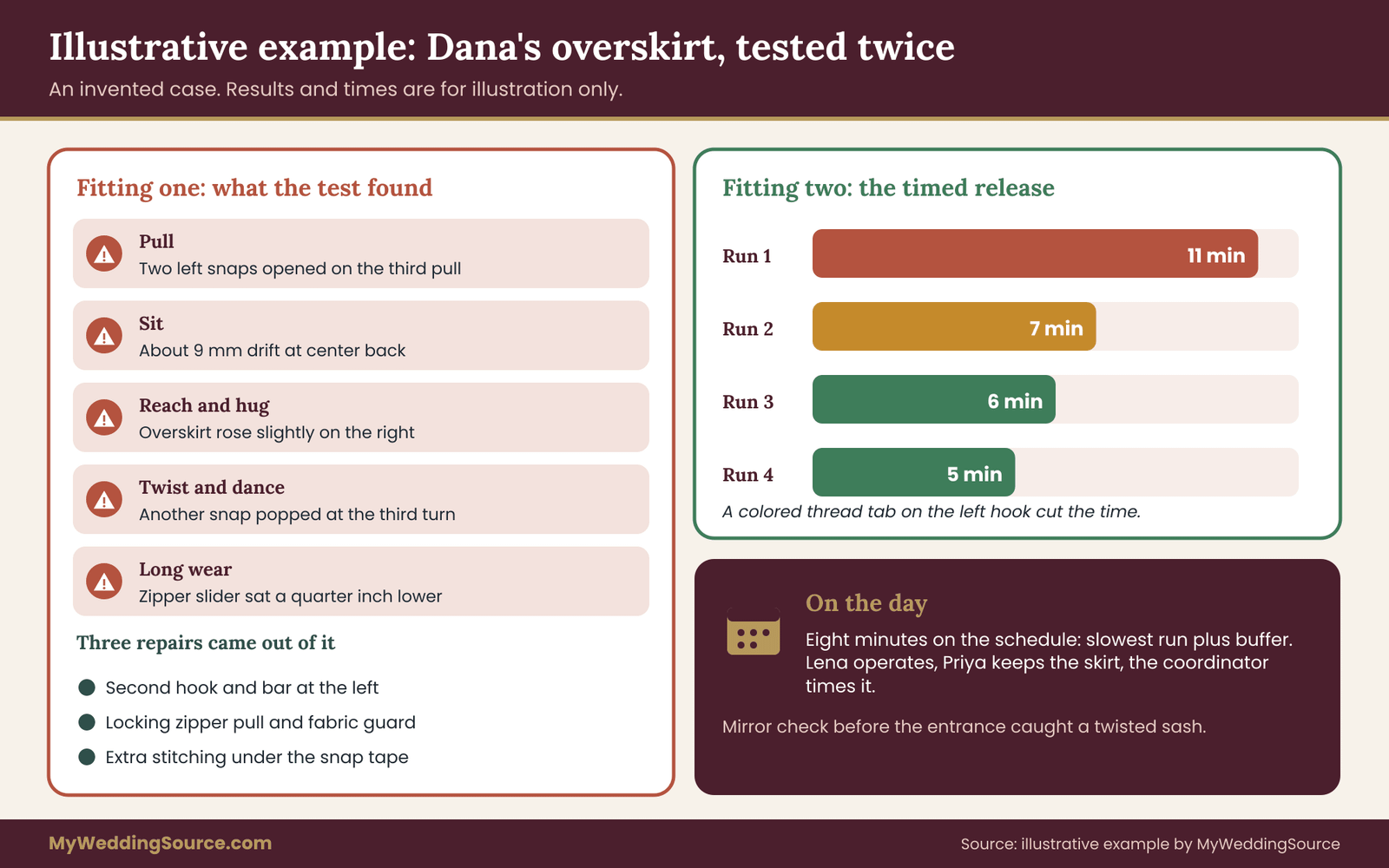
The following case is invented to show the method in motion. The people, the convertible dress and the numbers are illustrative, not drawn from a real client or study, and your own results will differ.
Imagine a couple, Dana and Marcus, planning a late-afternoon garden wedding with an indoor reception. Dana has chosen a satin column dress with a detachable tulle overskirt. The overskirt attaches at the waist with a concealed zipper, a hook-and-bar above it and eight snaps along the lining. She wants the overskirt for the ceremony and photographs, then a slimmer look for dinner and dancing.
Fitting one: finding the weak point
At the first fitting, Dana’s seamstress counts the fasteners with her: one zipper, one hook-and-bar, eight snaps. They photograph the joint and place tape marks at center back. Dana’s sister Lena is the helper.
The pull load passes at the center and fails at the left side, where two snaps open in the third pull. The sit load shows a drift of about nine millimeters at center back after ten minutes. The reach and hug load shows the overskirt rising slightly on the right. The twist-and-dance load pops another snap. The long wear, at seventy minutes, leaves the zipper slider about a quarter inch lower than where it began.
The seamstress is not alarmed, because this is exactly what a first test is for. She reads the results as a pattern: the left side carries the weight of the train, the snaps are acting as the main closure and the zipper has no lock. Three changes come out of it.
The fixes
First, she replaces the main reliance on snaps by adding a second hook-and-bar at the left, so that hooks carry the weight and the snaps keep the fabric flat. Second, she swaps the zipper slider for one with a locking pull, and sews a small fabric guard behind the teeth so the tulle cannot reach them. Third, she reinforces the waist seam where the snap tape attaches with an extra row of stitching, because the stitching was the weakest link, not the snaps.
Notice what did not happen. Nobody concluded that the convertible dress was a mistake. The test turned a vague worry into three specific repairs, with a cost the seamstress could quote. Dana kept a list: new hardware, reinforced stitching, extra fitting time. She added it to her wedding budget as a line item, so the alteration cost was visible rather than a surprise.
Fitting two: the retest
At the second fitting, they retest only the failed loads, then run a long wear again. The pull load passes on both sides. The sit load drifts only three millimeters. The twist-and-dance load passes. The long wear shows the zipper holding at its starting point.
Then they run the release. Lena does the change three times. The first takes eleven minutes, because the hook at the left is hard to find under the tulle. The second takes seven. The third takes six. The seamstress adds a small colored thread tab at the hook so it is easy to find by touch, and the fourth run takes five minutes.
Dana’s plan budgets eight minutes, the slowest run plus a buffer, and puts it on the schedule as a single line.
The wedding-day timeline
Dana and Marcus write the changeover into the day’s schedule. The ceremony ends mid-afternoon. Portraits in the full look take about forty minutes. A short cocktail hour follows, during which Dana changes in the bridal suite with Lena as operator and a friend named Priya as keeper. The timekeeper, the coordinator, tells the DJ when to announce the entrance.
The overskirt goes into a garment bag held by Priya, who also carries the kit. The mirror check catches a twisted sash. Dana walks in at the planned minute, and nobody at the reception knows that anything was complicated.
What the example shows
Three lessons apply beyond this convertible dress. First, the failure was in the stitching and the weight distribution, not in the fastener everyone suspected. A test with counts and measurements found that; an impression would not have. Second, the repairs were small and cheap compared with replacing the convertible dress. Third, the timeline was built from the slowest rehearsal run, which was more honest than the fastest.
If Dana had skipped the test, the same snaps would likely have popped during the first dance, in front of everyone, with no plan. That is a probability, not a certainty, and it is also precisely the kind of risk a few hours at a fitting can reduce.
Adapting the example to your dress
Not every dress has the same hardware. A detachable train with button loops fails differently, a tie-based dress needs a hug test more than a pull test, and a long-to-short design needs the inside-out check. Use the five loads and the scoring rule as the constant, and let the particular dress tell you where to look. Keep the log. A retest that shows improvement is the only proof that a repair worked.
Convertible dress or another way to change looks: comparing the alternatives
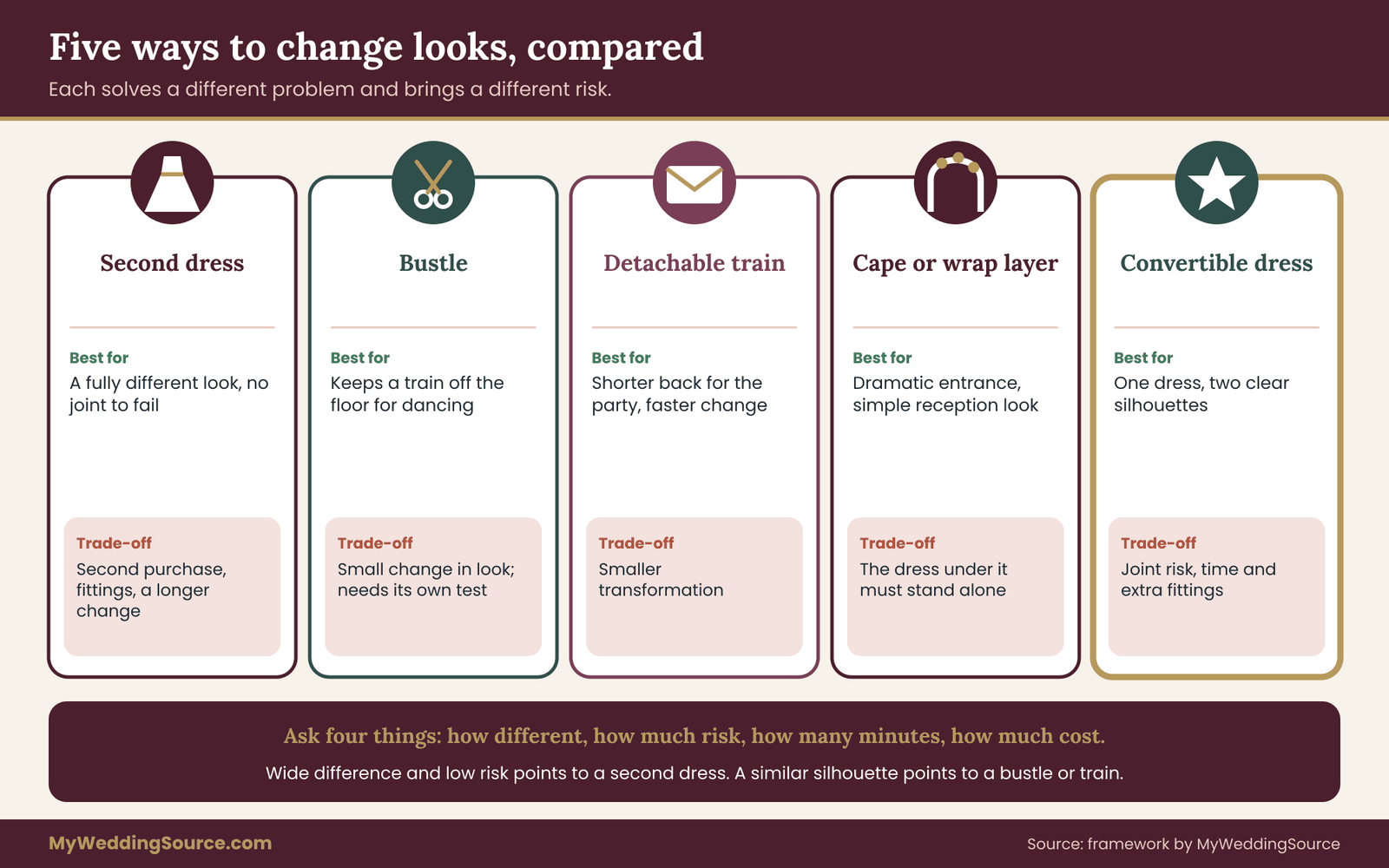
A convertible dress is one way to get two looks. Before committing, compare it honestly with the alternatives, because each solves a different problem and brings a different risk.
A second dress
A separate reception dress removes the fastener risk entirely. It also removes the joint, which is the part that can fail. The costs are a second purchase, a second set of alterations, storage and handling, and a changeover that takes longer since a full dress has to be taken off and another put on. The guide on the wedding dress fit and alterations process explains how fittings and timing work when you have more than one outfit.
A second dress suits someone who wants two entirely different looks, not a variation. A convertible dress suits someone who wants one dress that shifts form, with the same foundation and fit.
A bustle
A bustle lifts a train off the floor by looping it up behind. It is the traditional answer to the problem of a long train at a reception, and it involves hooks, buttons or ties of its own, so it also needs a test. It changes the look less than a detachable skirt does and takes less time, since nothing leaves the body.
If your main goal is to dance without stepping on your hem, a bustle may be simpler than a convertible dress. If your goal is a visibly different silhouette, it is not.
A detachable train alone
If what you want is a shorter back for the party, a detachable train is a smaller version of the overskirt idea. Less fabric means less weight on the joint and a faster change. It also means a smaller transformation. For many couples this middle path gets most of the benefit at a lower risk.
A cape, jacket or wrap layer
Adding a layer for the ceremony and removing it afterward creates a change without separating the convertible dress itself. The fasteners are at the shoulders or neckline and carry less weight. It suits a couple who want a dramatic entrance and a simple reception look. The tradeoff is that the underlying dress must be a look you love on its own.
Wearing two looks with one dress by styling
Not every change needs construction. Removing a veil, swapping a belt, adding a shawl or changing shoes can shift the feel of a dress with no joint at all. If the real goal is comfort or movement, a change of shoes and a bustle might solve it for much less effort. Be honest about what the convertible feature is for.
How to decide
Before you commit to a convertible dress, ask four questions.
How different must the second look be? How much risk are you willing to manage? How many minutes can the schedule spare? And how much extra will it cost in fittings and alterations? If the answers are “very different, low risk, many minutes, higher cost,” a second dress wins. If they are “similar silhouette, moderate risk, few minutes, lower cost,” a bustle or detachable train wins. A convertible dress fits the middle: a clearly different look, one dress and a plan you have tested. ## Questions to ask the designer, shop and alterations professional
The stress test finds problems. These questions prevent some of them. They are grouped by who can answer, because a designer, a shop and a seamstress each know different things about a convertible dress, and a good question to the wrong person gets a guess.
Questions for the designer or maker
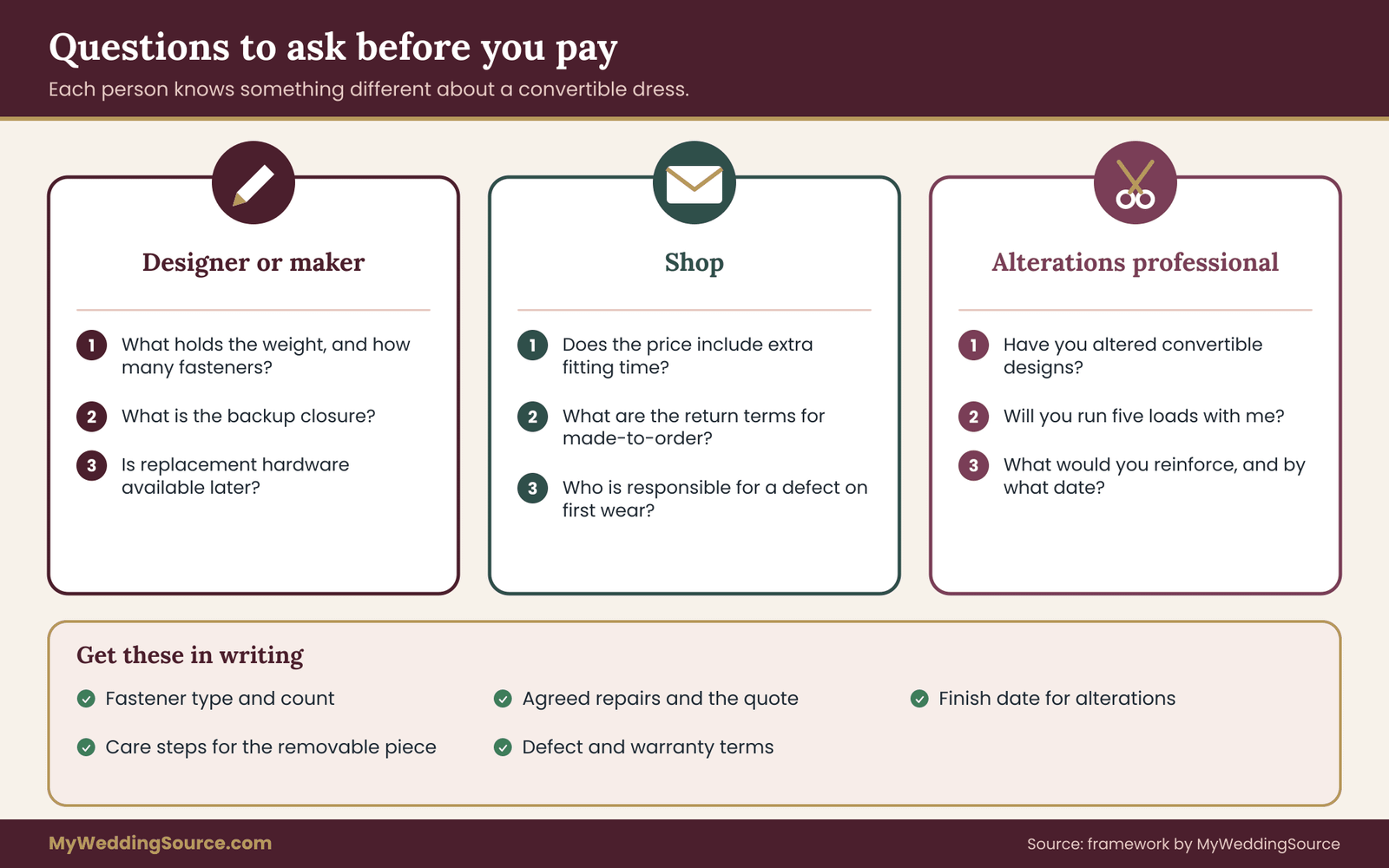
Ask what holds the weight and how it is attached. A clear answer describes the closure type, the count and where they sit. Ask whether the joint has been tested by the maker, and what they consider normal movement. Ask what the backup closure is and whether it is on every size or only some.
Ask how the convertible dress is meant to be changed and how long the maker expects it to take. A designer who has watched many changes can describe the common snag, such as a lace appliqué that catches on a hook. Ask whether replacement hardware is available later, because a custom zipper or snap tape may not be on a shelf in two months.
Ask about care. Detachable pieces often have separate cleaning needs, and a closure that is fine in the fitting room may be damaged by steaming, pressing or storage. The Federal Trade Commission’s care labeling rule requires that garments carry care instructions, so ask to see the label and ask what the maker recommends for the removable piece in particular.
Questions for the shop
Shops sell the convertible dress and often manage alterations. Ask whether the price includes a second fitting, extra fitting time for the stress test and any hardware changes. Ask about the return and exchange terms for a made-to-order dress, which are often narrow. If the convertible dress is ordered, ask for the production time in writing and the date by which a hardware problem would still be fixable.
Ask who is responsible if a fastener fails on first wear because of a manufacturing defect. The answer depends on the contract, and an unclear answer is a reason to ask for the terms in writing. The guide to the wedding vendor contract explains what to look for in cancellation, refund and responsibility clauses, and most of it applies to a dress order as much as to a venue.
Questions for the alterations professional
This is the most important conversation. Ask whether they have altered convertible designs before, and how they would reinforce the joint. Ask whether they are willing to run the five loads with you, and how much fitting time it needs. Ask how many times the closures can be opened before they wear.
Ask them to explain any change they propose in plain words: what will be added, where, and how it will look inside and outside. If they suggest moving a closure, ask what the effect on the drape will be. If they suggest a backup, ask where it will sit and whether it can be reached without help.
Ask for a written quote for the work, including any hardware, and for a date by which it will be finished. A stated deadline matters more than a promise of “plenty of time.” The wedding vendor due diligence checklist is a useful companion for confirming that a seamstress or shop has the credentials, references and insurance you expect.
A script for the first call
If you are not sure how to start, a few plain sentences work. “I am considering a dress with a detachable overskirt. I want to run a short stress test at the fitting: sitting, reaching, turning, an hour of wear and a timed change. How much fitting time should I book, and what would you reinforce if something opens?”
That one message tells the professional what you need, signals that you know what you are asking and gives them room to say what they prefer. If the answer is dismissive, that is also information.
Questions you should ask yourself
Before you spend money, ask whether you will use the feature. Will the second look appear for long enough to matter? Will the change happen in a place you can manage? Will you feel comfortable asking someone to help you out of a skirt in the middle of your wedding? A convertible dress is a good choice for people who enjoy the idea, and an irritating one for people who find it stressful. Be honest about which you are.
What to get in writing
With a convertible dress, some things should not rest on a conversation. Get the fastener type and count, the agreed repairs, the quote and the finish date, the care instructions for the removable piece and any warranty or defect terms. If a seller makes a specific claim, such as “this closure is built to survive dancing,” ask for it in writing, since the FTC expects advertising claims to be truthful and backed by evidence, and a written claim is easier to rely on than a remark.
Keep the paper. A folder with the quote, the log and the contract forms a complete record if something later goes wrong, and it takes five minutes to assemble.
Edge cases, costs and care for a convertible dress
The standard test covers the standard dress. Real weddings add complications, and a few of them deserve their own plan.
Wind and outdoor ceremonies
Wind adds sideways and upward load that the pull test does not reproduce. If your ceremony is outdoors, ask the helper to hold the overskirt out like a sail and release it twice, at gentle strength, while you stand still. Watch the joint. A skirt that lifts and tugs at one corner may need an extra anchor point or a weight sewn into the hem.
Heavy fabrics such as satin cope better than light tulle, which can billow dramatically. If the forecast is windy, consider a plan to keep the overskirt on later or to wear the underskirt alone for the ceremony. Also keep clips or pins in the kit for a quick hold.
Heat, humidity and sweat
Warm weather affects fasteners in small ways. Hook-and-loop tape loses grip as it warms and as skin oils and moisture reach it. Adhesive-backed tapes can soften. Fabrics cling, which makes a changeover harder. Test in conditions that resemble the day if you can, and keep a towel or blotting cloth in the kit. If you will be photographed outdoors in heat for an hour, treat that as a long wear.
Changes in size or shape
Bodies change between the first fitting and the wedding for many reasons: weight shifts, pregnancy, swelling in hot weather, a different bra. A fixed joint is less forgiving than lacing. If you expect change, ask whether the joint can be let out or taken in, and schedule the final fitting as close to the wedding as the seamstress allows. A convertible dress with a rigid waist is a risk if the waist is likely to move.
Mobility, comfort and accessibility
If you use a mobility aid, a heavy overskirt may catch on wheels or a cane, and a train can be a hazard on ramps. Test the convertible dress while using the aid, in the real space if possible. A changeover can be a good moment to remove a piece that gets in the way. If a helper must assist physically, decide in advance how, and who. Comfort and dignity matter more than the effect of the look.
Sitting through a long ceremony or meal
Some ceremonies are long and some cultures include extended rituals. A joint that is comfortable for ten minutes may not be for two hours. Use the long wear to find out, and consider scheduling the changeover earlier if the second look is more comfortable. If you will sit for several hours at a head table, test the convertible dress sitting at a table, not just on a chair.
Travel and destination weddings
A convertible dress has more parts to lose and more to damage in transit. Carry the convertible dress on board, not in checked luggage, and pack the removable piece separately in tissue. Bring the repair kit and extra hardware. If you are flying, check what the airline and the Transportation Security Administration allow for sewing items, since small scissors and needles are usually restricted differently by size and by carrier. Confirm the rules on the agency website close to travel.
Children, pets and crowds
Children grab skirts and pets walk under them. A long overskirt in a crowded cocktail hour is a magnet for stepped hems. If this worries you, change the convertible dress before the crowd arrives or choose a shorter train. A friend whose only job is to watch your hem can save a seam.
Costs and lead times
The cost of a convertible design depends on the maker, the fabric and the alterations. Instead of quoting figures, which vary widely, use this logic. Extra fittings and extra hardware cost money, and so does reinforcing a joint. Ask for a quote that includes the stress test time, and add a contingency for a repair after it. Setting a small reserve for alterations, kept apart from the convertible dress price, protects the rest of your budget.
Lead times matter too. Made-to-order pieces and custom hardware can take weeks, and an alteration shop’s calendar fills before the wedding season. Book the first fitting early enough to allow a repair and a retest. If you are buying second-hand or off the rack, you may have less time, so test sooner.
Care, storage and after the wedding
After the wedding, clean the convertible dress and the removable piece according to the label. Store the pieces separately, in breathable bags, with the fasteners closed so hooks do not snag fabric. Do not store a dress in plastic for long periods, and do not hang a heavy overskirt by its waist. If you plan to sell, resize or restyle the convertible dress, the log and the hardware list will help the next owner or seamstress.
When a convertible dress is not the right choice
A convertible dress is not for everyone. If you dislike the idea of a changeover, if the schedule is tight, if the room is poor or if the convertible dress failed the test and the repairs are costly, a second dress or a bustle may serve better. Choosing a simpler option is not a failure of planning. It is the planning working. ## Your next steps
Start with the convertible dress itself and work outward. This week, write the one-page description: which pieces separate, how many fasteners connect them, what type each is, what the backup is and who will do the change. If you cannot fill in a line, that line is your first question for the designer or shop.
Next, book a fitting long enough for the test. Tell the alterations professional you want to run five loads and a timed release, and ask how much time it needs. Bring the shoes, the foundation garments, a helper who will not be shy about pulling, a ruler, tape and a phone with a timer. Photograph the joint before you start and record the fastener count.
After the fitting, send the seamstress a short message with the log: which loads passed, which showed a watch and which failed, and what you agreed to change. Ask for a quote and a finish date in writing. Put the retest on the calendar at least two weeks before the wedding.
Then turn to the day, because a convertible dress is judged by the change as much as by the fit. Write the changeover sequence, assign the operator, the timekeeper and the keeper, assemble the kit and rehearse twice. Add the change as its own line in the schedule, tell the photographer and the coordinator, and name a fallback room. If you keep a master list, add these items to it.
If the convertible dress fails and the fix is too costly or too risky, choose a simpler path without guilt. A bustle, a detachable train or a second dress can all give you the day you want. A convertible dress earns its place only by passing the same checks as any other piece of hardware you rely on. The aim was never to prove the convertible dress works. It was to find out, calmly and early, whether it does.
FAQ
How many fasteners should a detachable skirt have?
There is no single correct number, because it depends on the weight, the length of the joint and the type of closure. A better question is what carries the weight and what backs it up. A good design spreads the load along the joint and includes a second line of defense behind the main closure. Ask the designer to show you both and explain the count.
Is hook-and-loop tape safe for a wedding dress?
It can be, if the hook side is covered or placed where fabric cannot reach it, and the tape is wide enough for the load. It holds well when pulled across the surface and can open when peeled. It can snag lace and tulle, lose grip as lint builds up, and make noise. Test it with a lift and twist, not only a straight pull.
How long should a changeover take?
Use your own timed runs instead of a general figure. Perform the change three times with the person who will do it, take the slowest time and add about half as a buffer. A detachable train is usually faster than a full overskirt or a long-to-short conversion, but the convertible dress, the helper and the room decide the real number.
What should I do if a zipper jams during the change?
Stop pulling. Forcing a slider can tear the fabric or break the teeth. Look for caught lining or tulle, hold the fabric away and work the slider back a little before moving forward. If it will not clear, use your backup plan, such as a safety pin from inside or the underskirt alone, and have the seamstress repair it afterward.
Can any wedding dress be made convertible?
Some can, but it depends on the fabric, the structure and the maker. A detachable overskirt can be added to a column or slim dress by a skilled seamstress, but the joint must be built to carry the weight. Ask an alterations professional who has done this kind of work, and run the stress test on the finished result, not on a sketch.
Do I need a second person to help me change?
For most designs, yes. Fasteners at the waist and back are hard to reach, and haste raises the risk of damage. One practiced operator is better than several helpers. Choose someone with steady hands, rehearse with them and give them the written sequence. A timekeeper and a keeper for the removed piece make the process smoother.
What if my fastener fails during the ceremony?
Have a ranked plan: the backup closure holds first, then a kit repair such as a hidden safety pin, then a simpler configuration you have already approved. Tell your coordinator or a trusted friend where the kit is. Most small failures are not visible to guests, and a calm response matters more than a perfect result.
Should I test the dress more than once?
Yes. Run the full test at the first fitting, retest any load that failed after repairs, and run the long wear and timed release again at the final fitting. Alterations can change how a joint hangs, so a dress that passed once should still be checked after any change. Keep the log so you can compare results.
Sources
- Federal Trade Commission, consumer protection and advertising guidance
- Federal Trade Commission, consumer advice for buyers
- Federal Trade Commission, business guidance on clothing and textile labeling
- U.S. Consumer Product Safety Commission
- Consumer Financial Protection Bureau, consumer tools for payments and disputes
- Transportation Security Administration, what can I bring
- National Institute of Standards and Technology
- ASTM International, standards for textiles and apparel
- International Organization for Standardization
- USAGov, consumer protection resources