

Mini pies on a wedding dessert bar look simple, but they fail in two predictable ways: the count runs short on the most popular flavor, and the cream or custard fillings sit out too long. This guide gives you a one-page variety yield and holding temperature sheet so you can settle both questions before you sign an order.
Decide the job the mini pies will do (the only dessert, a partner to a small cake, or a late snack). Count eaters, not invited guests, and multiply by a pies-per-eater figure that matches that job. Split the total by flavor with a minimum batch per flavor. Then sort every flavor into a cold, ambient or warm lane, and write the time each tray goes out. Cold fillings stay at or below 41°F, warm items stay at or above 135°F, and perishable food should not sit out longer than two hours.
A tray of mini pies is one of the friendliest things you can put in front of wedding guests. Nobody needs a fork lesson, nobody has to commit to a full slice, and guests who skipped the cake can still take something sweet back to the table. The trouble starts when a couple orders “enough” and discovers on the day that enough is not one number. It is a count for each flavor, a temperature for each filling, and a clock for each tray.
This article is written for couples, planners and venue coordinators who are weighing mini pies for a dessert bar. It focuses on two questions that tend to get answered casually: how many mini pies to order, and how to keep them safe and appealing from the baker’s rack to the last guest. The broader question of how a dessert course fits into the full menu is covered in the wedding menu planning guide, and the question of when the cake itself is cut and served sits in the wedding cake timeline.
A note on scope. This is general planning information, not legal, tax or financial advice, and it is not a substitute for the food-safety rules that apply to your caterer, baker and venue. Where a number matters, the article names the agency that publishes it so you can confirm the current version with your local health department.
What a mini pies dessert bar is, and what makes it different
A mini pies dessert bar is a self-serve or staffed display where individual-size pies are the main sweet item. Each pie is a complete dessert in a small crust: usually three to four inches across, baked in a tart pan or a deep muffin-style tin, and meant to be eaten with a fork or by hand. Some couples build the entire bar from pies. Others use a few pies beside cupcakes, cookies or a small cake.
Three features set mini pies apart from other dessert-bar items, and each one changes the planning math.
They come in fixed batches. Bakers produce mini pies by the tin, and a tin usually holds six or twelve. That means your order moves in steps. You cannot order 157 of anything sensibly; you order 14 dozen or 13 dozen, and then decide where the extra goes. The flavor-split section below turns that into numbers.
Flavors carry different risks. A baked apple pie and a chilled lemon cream pie are both “mini pies” on the order form, but they are very different foods once they leave the oven. Fruit fillings with a lot of sugar and acid behave differently from custard, cream, pumpkin or egg-rich fillings. The same tray can hold one safe item and one that needs a refrigerator. Mixing them on a single warm table is the most common mistake.
Crust texture has a short window. Pastry is at its best soon after baking and softens as it absorbs moisture from fillings and humid rooms. A cream pie that is perfect at 6:00 p.m. may have a soggy base by 9:30. That is a quality problem, not a safety problem, but it affects how many pies guests actually eat and how many you throw away.
The counting side of the problem is similar to other variety-yield questions on a dessert table. This article assumes you have already chosen pies over other sweets, and it spends its effort on the numbers and the holding plan. A short comparison with other formats appears later, for couples who are still deciding.
The three-lane sheet: count, hold and clock
Every decision in this guide fits on one sheet with three lanes. You can draw it on paper, build it in a spreadsheet, or ask your baker to fill it in. The point is that each flavor gets one row, and each row is answered in all three lanes before you confirm the order.

Lane one: count. How many of this flavor will you receive, in dozens, and how many of those are on the display at the start versus held back? The count lane answers “will we run out of the favorite?” and “will we be stuck with eighty leftover pecan pies?”
Lane two: hold. What temperature does this filling need from oven to plate, and which piece of equipment provides it? The hold lane answers “does this need a refrigerator, a chilled display, a warm cabinet, or just a table?” A flavor with no answer in this lane does not go on the order.
Lane three: clock. When does the first tray go out, when does each replacement go out, and when is anything left on the display removed? The clock lane answers “who watches the time, and what happens at the two-hour mark?”
The sheet is useful because it forces a conversation that otherwise happens in fragments. Couples talk to the baker about flavors, the caterer about equipment, and the venue about outlets and refrigerator space, and each person assumes someone else is managing the clock. A single sheet, shared with all three, closes those gaps.
A row on the sheet might read like this in plain words: “Key lime, 36 ordered, 24 on the display in two trays of twelve, 12 held in the caterer’s cooler. Chilled display at or below 41°F. First tray out at 8:30, second at 8:55, any tray out more than two hours is discarded, and the server initials the time on the tray card.” Nothing in that row is complicated. What makes it valuable is that it exists before the wedding, in writing, in the hands of the person who will carry out the plan.
Keep the sheet to a single page. If a flavor row runs to a paragraph, the flavor is probably too complicated for a self-serve dessert bar, and it may be better as a plated course or a favor.
Who owns each lane
Assign a name to each lane. The count lane usually belongs to the couple or planner, because it depends on the guest list and the budget. The hold lane belongs to the caterer or the baker, depending on who supplies refrigeration and who signs the food-safety paperwork. The clock lane belongs to whoever staffs the dessert bar on the day, which might be a catering server, a venue attendant or a designated friend.
If the last name on that list is a friend or a family member, give them a short written card rather than a verbal briefing, and make sure they know it is fine to remove a tray that has been out too long, even if guests are still arriving.
The rest of this guide works through each lane in the order that most couples need them: count first, then hold, then clock, with a worked example near the end that uses all three.
Counting mini pies: eaters, appetite and the job of the pie
The most common counting error is starting from the invitation list. Invited guests, confirmed guests and people who will actually eat a mini pie are three different numbers, and the gap between the first and the last can be large. Start from the confirmed count and work down.
Step one: remove people who will not take a pie. Infants and very young toddlers, guests with dietary restrictions that rule out every flavor you offer, and people who simply do not eat dessert are all part of the confirmed count and not part of the eater count. You do not need precision here. A rough share is fine, and it should come from your own guest list, not from a general statistic.
If you know that your guest list includes a large group of young children or a table of guests who avoid sugar, say so in the count. Otherwise, a small reduction is reasonable, and you can offset any error with the buffer described below.
Step two: add vendors and wedding party members who are entitled to dessert. Some catering contracts include meals for the photographer, band or coordinator, and some do not. If the vendors will be offered dessert, add them. Forgetting a dozen people matters more with mini pies than with a large cake, because the extra twelve people might each eat two.
Step three: pick a pies-per-eater figure that matches the job. This is the heart of the count lane, and it depends on what else is on the table.
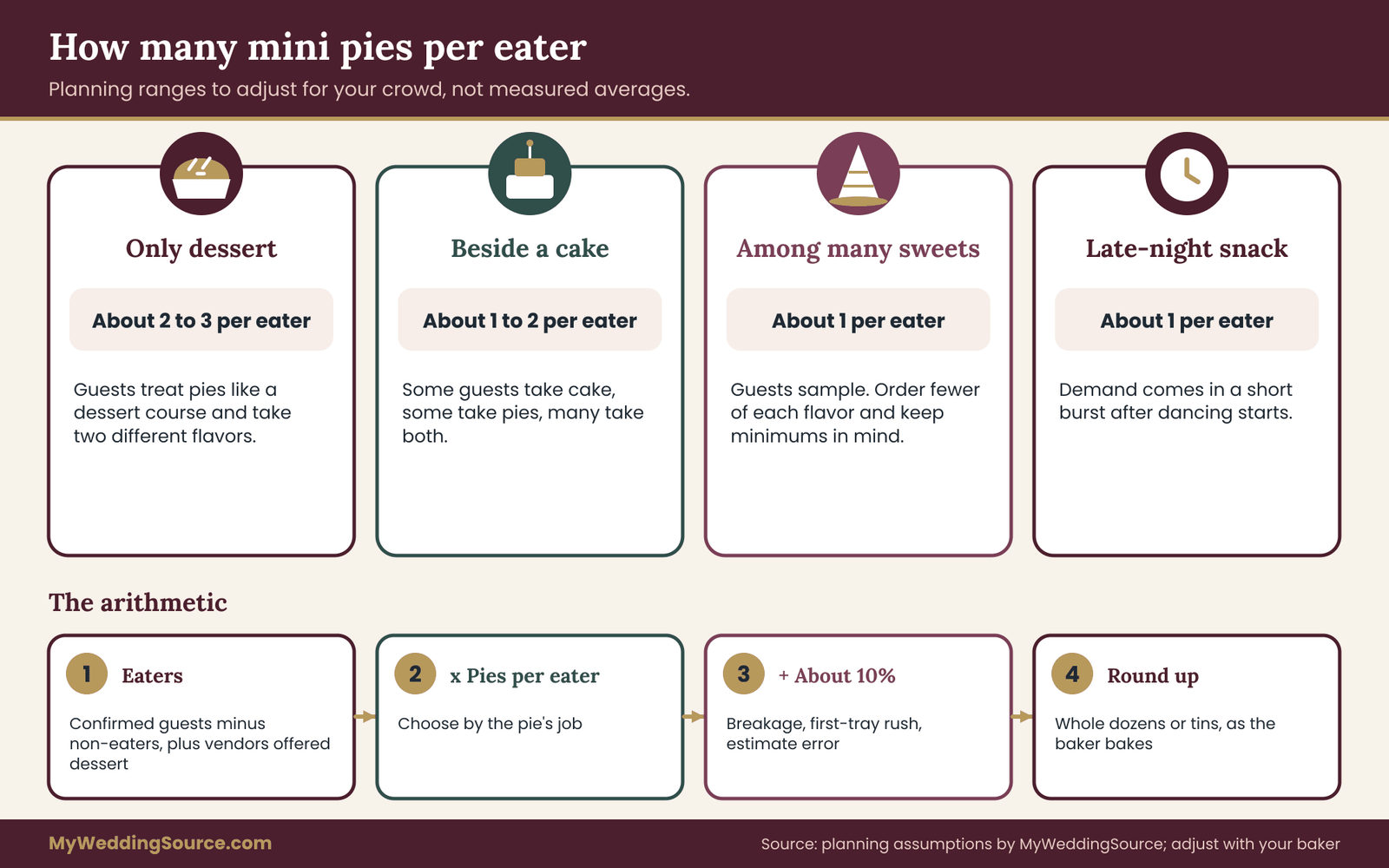
The planning ranges in the graphic are illustrative assumptions, not measured averages. They exist to give you a starting point you can argue with. Adjust them for your own crowd.
The pie has a job
Ask what the mini pies are there to do, because the answer moves the number more than any other factor.
Pies as the only dessert. When there is no cake and no other sweet, mini pies replace a plated dessert. Guests treat them like a dessert course, which means most eaters take more than one, often two or three, because the size is small. Plan for the higher end of your range, and plan for more flavors, because guests who take two pies want two different ones.
Pies alongside a cutting cake. When a small cake is cut and served, many guests take a slice and then add a pie or two for the variety. Others take only a pie. Plan for a middle figure, and expect the mini pies to be popular with guests who do not like frosting. In this setup, the guest who takes a pie often does not take cake, so you cannot assume that the cake count and pie count simply add up.
The way cake and a second sweet interact is discussed at length in the wedding cake timeline, which also covers when the cut is best scheduled relative to dessert service.
Pies beside several other sweets. On a table with cookies, bars and candy, mini pies compete with everything else. Guests sample. The figure per eater falls, but the variety-yield issue rises, because small leftovers of many things pile up. Order fewer of each pie and keep your minimums in mind.
Pies as a late-evening snack. If pies appear after dinner has been over for two hours and the dance floor has been open, the eaters are a different group. They are hungry or just in the mood for something sweet, and the demand arrives in a short, sharp burst. A lower figure per eater often works, but the clock lane matters more, because trays that were set out when the band started may need replacing before they are gone.
From per-eater figure to a total
The arithmetic is plain multiplication with a buffer.
Eaters × pies per eater = base count. Add a buffer of around ten percent to cover breakage, a first-tray rush that takes more than expected, and the difference between an estimate and a real crowd. Then round up to whole dozens or whole tins, because that is how your baker will bake.
Here is a quick illustration with invented numbers. Suppose 108 guests are confirmed and about 12 will not eat a mini pie, leaving 96 eaters. The mini pies share the table with a small cutting cake, so you choose 1.5 pies per eater. The base is 96 × 1.5 = 144. A ten percent buffer adds 14.4, for about 158.
Rounded up to dozens, that is 14 dozen, or 168 mini pies. The final figure is roughly 1.75 pies per eater, which looks high until you remember that the unused portion can be wrapped and sent home with guests if the baker and caterer agree.
If 168 sounds like a lot, check it against your own appetite scenario rather than against a number from the internet. Dessert demand depends on the meal that came before it, the time of night, whether guests have been drinking, and whether anyone has announced the dessert bar. A heavy plated dinner and a short evening reduce demand.
A light cocktail-style meal and a long evening increase it. Your caterer knows how your menu is likely to behave better than any formula does, and the wedding menu planning guide shows how the dinner choices shift appetite for the final course.
Fixed batches and what to do with the remainder
Because mini pies are baked in tins, the rounded total often leaves a gap between what you want and what you can order. You have three honest options.
You can round up and accept leftovers. This is the safest for running out and the most expensive for the budget.
You can round down and plan to supplement with a second sweet, such as cookies or fruit, so that the last guests are not stranded. This works if the second sweet is already on the table, and it is a poor fix if it is not.
You can split the remainder across flavors so that no one flavor is the strained one. For instance, if you land at 150 and your baker bakes by the dozen, you might order 12 dozen plus a half dozen each of two flavors. Ask whether the baker will do half-dozen increments. Many will, at a higher price per pie.
Whichever you choose, write it on the sheet. The count lane is a record of a decision, not a guess.
Splitting mini pies across flavors without running out of favorites
A total number does not tell you how many of each flavor to order. A split that looks fair on paper, such as five flavors at thirty each, is rarely the split guests behave according to. Familiar flavors disappear first, unusual ones linger, and the last guests find only the unusual ones.
There are two sensible ways to think about the split, and you can combine them.
Anchor and accent. Choose one or two anchor flavors that almost everybody recognizes, such as apple or cherry, and give them the biggest share of the count. Add two or three accent flavors that make the table interesting, and give them smaller shares. An anchor-and-accent plan accepts that guests choose the known flavor first and the new flavor second, and it makes sure the known flavor is still there at the end.
The minimum batch rule. A flavor with only six pies gets removed within the first fifteen minutes, which disappoints the people who wanted it and leaves a gap on the display. Set a minimum for each flavor, often one dozen, and drop any flavor that does not reach it. Fewer flavors at healthy numbers beat many flavors at scarce ones.
A starting split to argue with
For the earlier illustration of 168 mini pies, a split might look like this in words. Apple takes three dozen because it is the anchor. Cherry takes two dozen. Pecan takes two dozen. A chilled key lime takes three dozen, because it is the bright option on a heavy menu.
Chocolate cream takes two dozen. That is twelve dozen, or 144 pies, and the final two dozen are held back as reserve, assigned flexibly: one dozen of apple and one of chocolate cream, to be brought out only if the first trays go faster than expected.
The reserve is the idea worth copying. Holding back about one eighth to one sixth of the order is not wasteful when it is kept in the right conditions, because it turns a guess into a decision made at 8:45 p.m. with real information. Chilled reserve mini pies can go back into the cooler and be served the following day. Pies that were set out on the display usually cannot.
Reading your own guests
The split should come from your guest list, not a generic menu. If most of your guests are from a region where one fruit is a local favorite, that fruit earns anchor status. If many of your older relatives like a traditional pie, give it a bigger share than the trendy one. If a large part of the guest list avoids nuts, a nut-free chocolate or fruit option should not be an afterthought. The point is not to guess perfectly but to avoid a split that ignores what you already know about the people coming.
Name the dietary needs early, because they affect both the count and the labeling. A few guests with a serious allergy are not a reason to abandon pies, but they are a reason to ask the baker about shared equipment and to label every flavor. The guest care planning guide covers how to gather those needs without making guests feel singled out.
When a flavor sells out
Expect that one flavor will run out first. Decide in advance what you want to happen. Some couples are happy to let it go and replace the empty spot with a different flavor. Others prefer to keep a sign that says “more coming” and have the reserve ready. Whichever you choose, make sure the person staffing the table knows. A bare spot in the display with no explanation tends to send guests to the cake instead, which is fine if you ordered cake and not fine if the mini pies were the whole dessert.
A short note on size
Mini pies come in sizes. A pie that is three inches across and an inch tall is a few bites. A pie that is four inches and deep is closer to a small dessert. The per-eater figures in this guide assume the smaller size, where most eaters take more than one. If your baker’s mini pies are bigger, reduce the figure. Ask for the diameter and the weight when you order, and ask to see one if you can. A photo of a hand holding a pie tells you more than a spec sheet.
Which mini pies need cold, ambient or warm holding
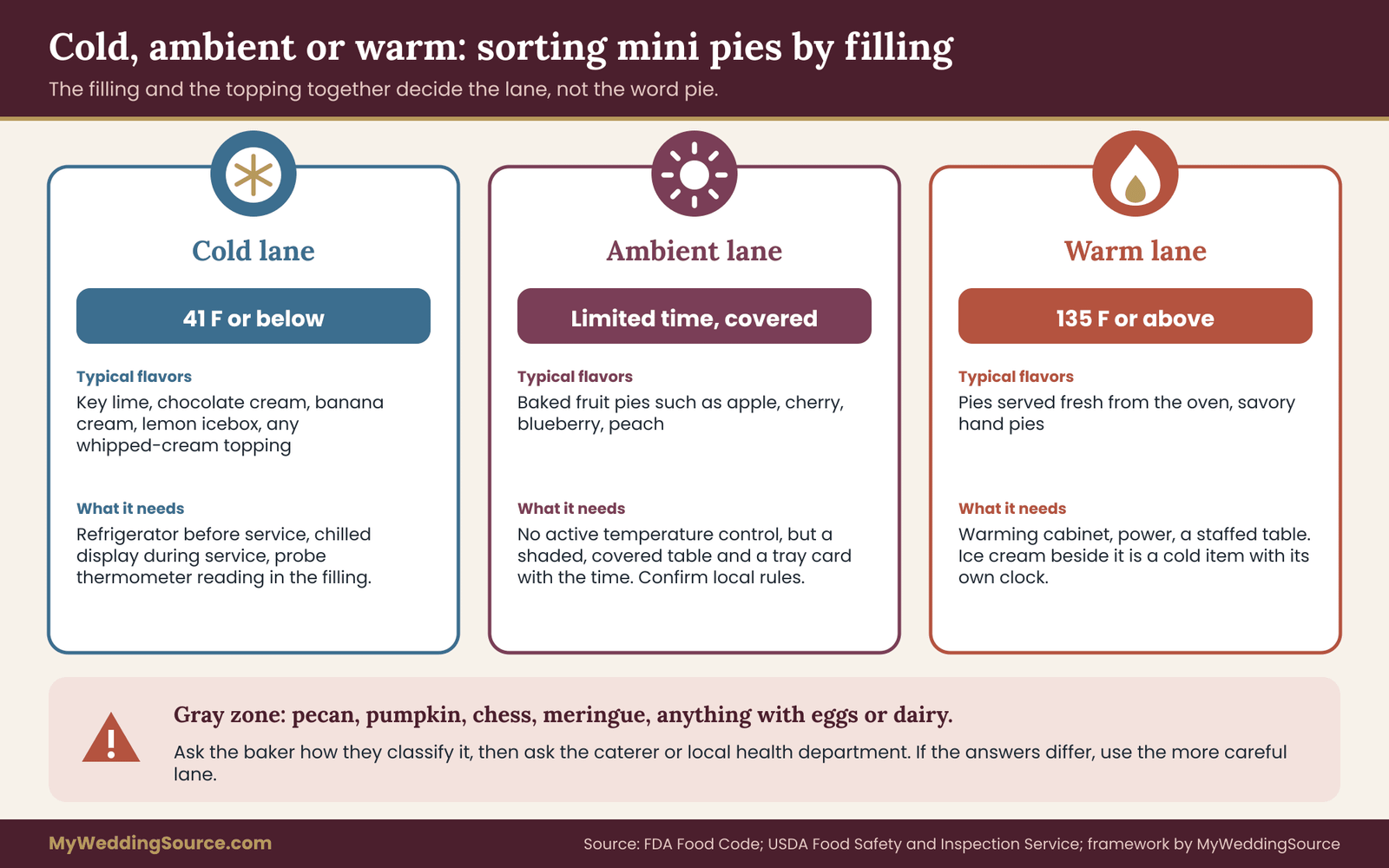
The hold lane starts with one question for each flavor: is this a food that needs temperature control for safety? Food-safety authorities use the term “time and temperature control for safety” for foods that support the growth of harmful bacteria when they are left warm. The FDA Food Code is the model code that most state and local health departments adapt, and it sets the reference points that caterers work from: cold foods at 41°F (5°C) or below, and hot foods at 135°F (57°C) or above.
The range between those two numbers is where bacteria grow fastest, which is why caterers talk about keeping food out of it.
Pies are an interesting case because the category contains very different foods. Sorting them into lanes makes the decision visible.
The cold lane
Cream pies, custard pies and any filling that depends on dairy, eggs or gelatin without a long bake belong in the cold lane. Chilled key lime, chocolate cream, banana cream, coconut cream, lemon icebox and similar fillings are typical. USDA food-safety guidance on pies lists cream and custard pies, along with pumpkin pie, among the mini pies that should be refrigerated, and a pie with whipped cream or a dairy topping is in the same position.
Cold-lane mini pies need a refrigerator at the venue before service, a chilled display or a tray set over ice during service, and a plan for the moment between the cooler and the table. A display that merely looks cold is not enough. The tray should be at or below 41°F when a thermometer reads the filling, not the air above it.
The ambient lane
Many baked fruit mini pies, such as apple, cherry, blueberry and peach, have fillings with a high proportion of sugar and acid, and food-safety guidance generally treats them differently from custards. USDA guidance says that fruit mini pies can be kept at room temperature for a limited period, but “limited” is the key word, and local rules vary. Your caterer or baker will know whether the health authority in your area treats a particular fruit pie as one that needs refrigeration, and you should ask rather than assume.
Treat ambient not as “anything goes” but as “no active temperature control required, subject to a time limit and a clean, covered display.” Ambient-lane mini pies still benefit from a cool room and shade. A fruit pie in direct afternoon sun on a patio is a quality problem even if it is not a safety one.
The warm lane
Warm pies are the ones that taste best fresh from the oven, such as small apple pies with a scoop of ice cream. If you plan to serve them warm, they enter the hot-holding rules: held at 135°F or above, or served within a short time of reheating, according to the plan your caterer follows. Warm service is a staffed activity. It requires an oven or warming cabinet, someone to move trays, and a plan for the ice cream, which is a cold-lane item sitting next to a warm-lane item.
Many couples dream of warm pies and then settle for room-temperature ones once they see the logistics. That is a reasonable outcome. Do not promise warm pies in the contract unless the caterer has the equipment and the staff.
The gray zone
Some fillings do not fit neatly. Pecan pie contains eggs, but it is baked until set and has a high sugar content. Pumpkin and sweet potato pies are baked custards. Chess and buttermilk pies are egg-and-dairy fillings. Lemon meringue adds a meringue topping that weeps in humid rooms. Hand pies with savory fillings contain meat or cheese, which puts them firmly in the cold or hot lane.
When a flavor is in the gray zone, do two things. Ask the baker how they classify it, and ask the venue’s caterer or the local health department how they treat it. If the answers disagree, put the flavor in the more careful lane.
A useful rule is that the lane is assigned by the filling and the topping together, not by the word “pie.” A fruit pie with a whipped cream rosette is a cold-lane pie. A pecan pie served with a scoop of ice cream on top is a pairing of an ambient item and a cold item, and the ice cream sets the clock.
Putting lanes on the sheet
On the sheet, each flavor row gets a lane label: cold, ambient or warm. If a row cannot be labeled with confidence, mark it “ask” and resolve it before the order is final. Rows labeled “ask” at the three-week mark are the ones that tend to cause trouble on the day.
The order of operations matters here, because it affects the count lane as well. If you have two cold-lane flavors and the venue has one small refrigerator, the cold lane limits how many mini pies you can store, and therefore how many you can order in advance. This is why the hold lane is not an afterthought. It feeds back into the count.
Holding temperatures and time limits on the dessert display
Once the lanes are set, the clock lane takes over. The clock lane is about what happens from the moment a tray leaves the cooler or oven to the moment it is cleared.
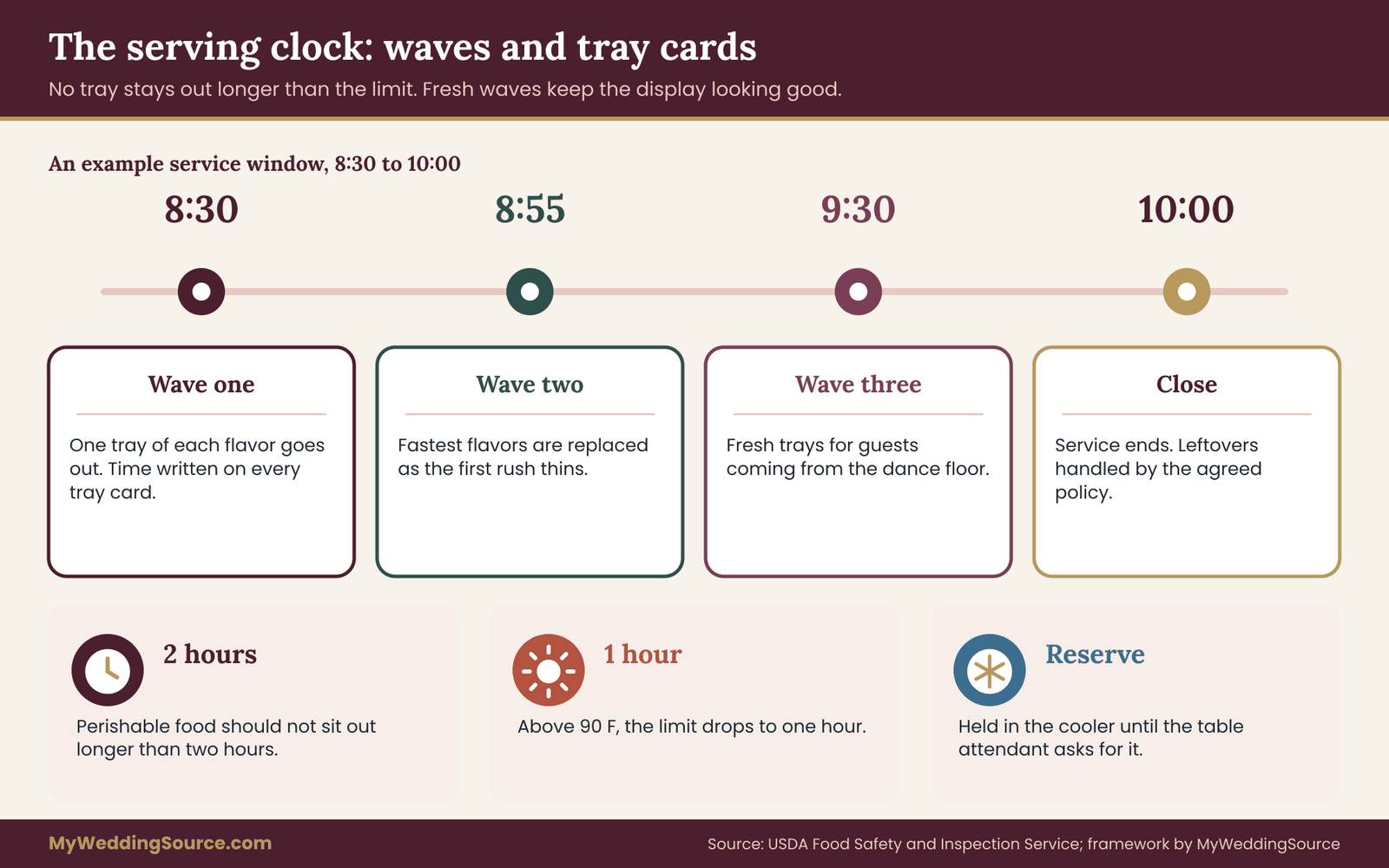
Two numbers anchor most of the guidance. The first is the temperature range, covered above. The second is time. USDA guidance says perishable food should not sit at room temperature for more than two hours, and for no more than one hour when the temperature is above 90°F. The FDA Food Code allows a different approach, using time instead of temperature as the control for a limited period, but only under written procedures that a regulator has accepted, so it is not something a couple should improvise.
For a dessert bar the practical consequence is a tray-card habit. Each tray carries a small card, and the person who sets it out writes the time on the card. At the two-hour mark, or sooner in a warm room, the tray is removed and replaced with a fresh one. This sounds fussy and takes five seconds per tray.
How trays and waves work in practice
A mini pie display is best managed in waves. A wave is a tray of one flavor, usually a dozen. Because guests tend to take pies in two surges, one right after dessert is announced and another later in the evening, waves let you refresh the display without leaving a tray out all night.
Suppose dessert service opens at 8:30 and runs until 10:00. A reasonable pattern sets out the first trays of each flavor at 8:30. A second wave of the fastest flavors goes out at about 8:55, when the first rush has thinned. A third wave goes out around 9:30 for anyone who arrives from the dance floor. The reserve stays in the cooler until the person at the table calls for it. The wave times are placeholders; yours depend on what is happening in the room.
Notice what this pattern does. No tray stays out for more than about 90 minutes, which keeps every tray inside the two-hour limit, and each tray looks fresh when guests arrive at it. The cost is some extra trips between cooler and table, and a few trays that are removed with pies on them. Plan for that loss in the count lane. It is the reason the buffer exists.
Chilling without ruining the pastry
Cold-lane mini pies have a specific problem. They need to be cold, but pastry in a humid cooler or on melting ice absorbs moisture. A few habits help without requiring special equipment.
Keep the mini pies in their baking tins or on parchment until service so that the crust does not sit in condensation. Avoid placing pies directly on ice. Instead, set a tray over a second tray that holds ice or ice packs, so that cold air rises through the display without liquid touching the crust. If the venue has a refrigerated display case, ask for its set point and ask whether it holds that temperature when the doors are opened repeatedly.
Cover or shield the display from sun and warm air. A simple lid or sneeze guard is a food-safety measure as well as a protective one, because guests lean over dessert tables and talk.
Measuring instead of guessing
Ask the caterer whether the staff will use a probe thermometer to check cold trays, and ask what they do when a reading is above 41°F. A good answer includes what happens to the mini pies: they go back to the cooler, they are discarded, or the caterer follows a written procedure. A vague answer is a reason to ask more questions.
You do not need to supervise the thermometer at your own wedding. You do need to make sure someone has the job. The clock lane is the lane most likely to be unowned, because it begins at the exact moment couples are least available.
Hot rooms, outdoor tents and the two-hour rule
The two-hour limit is a ceiling, not a target. In a warm tent or a summer garden, the practical limit is shorter, and food-safety guidance counts one hour once the temperature climbs above 90°F. If your reception is outdoors in warm weather, the clock lane tightens: smaller waves, more frequent replenishment, shaded and chilled display, and a cold-lane reserve that never leaves the cooler until it is needed.
It also means asking an honest question: does an outdoor summer reception suit a bar of cream pies at all? A fruit-only bar with a covered display and short waves might be a better match, and a few chilled items can be passed or plated rather than left on a table. The decision to remove a flavor is a hold-lane decision, not a loss of ambition.
Cleaning up and leftovers
At the end of service, decide in advance what happens to the leftovers. Pies that were on the display and out of temperature control are typically discarded, following the caterer’s procedure. Pies that never left the cooler may be eligible to be boxed for guests or for the couple, but only if the caterer’s policy and the local rules allow it.
Do not assume that “take the leftovers home” is permitted. Many caterers decline, because they cannot vouch for food after it leaves their control. Ask before the wedding, and if the answer is yes, ask for the conditions in writing.
Transport, storage and oven logistics for mini pies
The hold lane does not start at the venue. It starts at the bakery, and the weak point is usually the drive. A tray of mini pies that was chilled and crisp in the kitchen can arrive warm and damaged if nobody planned the trip.
Who delivers, and in what
Ask whether the baker delivers or whether you or the caterer collect. Delivery by the baker usually puts the responsibility for temperature in transit on the baker, which is the cleaner arrangement. If a friend is collecting the mini pies in a personal car, you have created a food-handling job for someone who is also trying to dress for a wedding. That arrangement can work for ambient-lane mini pies on a short drive. It is a poor fit for a cold-lane order or a long trip.
For a cold-lane delivery, ask what the baker uses: an insulated carrier, a refrigerated van, ice packs, or a cooler. Ask how long the mini pies are in transit and what the mini pies’ temperature will be on arrival. A baker who delivers cold-lane items regularly will have a plain answer.
Pack for the crust. Mini pies stacked in a box press on one another, and soft fillings can leak. Single-layer trays or tins with dividers keep them intact, and sturdy boxes with lids prevent a sliding disaster on a curve. Ask whether the delivery includes the trays and whether you must return them.
Receiving at the venue
When the mini pies arrive, someone should check them. This takes two minutes and prevents many problems. Count the dozens against the order, look at a few for damage, and take the temperature of at least one cold-lane tray with a probe thermometer. If the reading is above 41°F, the baker and caterer should decide what happens next before the mini pies are placed on the table. That is not a conversation to have at 8:25.
Name a receiving person on the sheet. Often it is the caterer’s lead, and often the baker hands pies directly to that person. If the venue has a loading door or a service entrance, make sure the baker knows which one to use, and confirm the arrival window with the venue’s coordinator. The wedding vendor timeline is a good place to put the baker’s delivery window beside the caterer’s setup time, so that nobody arrives to a locked door.
Space in the refrigerator
The most underestimated constraint is refrigerator space. A caterer’s kitchen or a rented reach-in cooler holds only so much, and the dinner already occupies it. Fourteen dozen mini pies on trays take up a lot of shelf area, and cold-lane flavors need a place in the cold for hours before service.
Count the trays. If the cold-lane flavors in your example total 60 pies in five dozen trays, ask the caterer how many shelves that takes and whether the dinner components leave room. If the answer is no, you have options: reduce the cold-lane count, ask for a rented cooler, swap one cold flavor for an ambient one, or deliver the mini pies closer to service time.
The wedding rental planning checklist covers how to add equipment such as a cooler or a warming cabinet to a rental order, including the delivery and pickup details that are easy to miss.
Oven and warming equipment
For couples who want warm pies, the equipment list is longer. You need an oven or a warming cabinet that is available at the right time, enough power for it, a way to transfer trays to the display, and a station that keeps pies warm without drying them. Venues vary widely. Some have a full kitchen. Others, such as barns, gardens and tents, have only what the caterer brings, and the caterer’s power supply may be limited. Ask the venue about circuits and generator capacity before you ask for a warming cabinet.
Reheating is a food-safety step, not only a taste step. Ask the caterer what temperature and time they use for reheating and what they do with trays that have already been reheated once. Reheated pies are often not reheated again.
Power, shade and the table itself
A chilled display with an electric component needs power near the table. A table placed in the corner of a tent far from an outlet is a table with no cold. Ask the venue where the nearest outlets are, whether extension cords are permitted, and who is responsible for them.
Table placement also matters for temperature. Put the dessert bar away from direct sun, away from heaters and away from the kitchen’s hot exhaust. Foot traffic matters too. A table near the dance floor sees traffic after dinner and may be bumped. A table near the entrance of the room draws guests but may get drafts or heat from doors.
The reception guest flow guide shows how to position stations so that lines do not block the path to the restrooms or the bar, which is useful for a dessert bar that is meant to draw a short, steady stream rather than a crowd.
Comparing mini pies with other individual sweets
Some couples arrive at mini pies after considering cupcakes, tarts, hand pies and cake slices. This comparison is in prose rather than a ranking, because the right choice depends on the three lanes.

Mini pies versus mini tarts
Tarts are the nearest cousin. A tart usually has a thin, firm crust and a filling that sits at the top, and it is often a little smaller and neater than a pie. Tarts are easier to hold in one hand and often stay crisp longer because the crust is thinner and has less moisture to absorb.
Mini pies have more crust and more filling and usually look homier. If you want a refined look and long-lasting crust, consider tarts. If you want a rustic look and generous bites, consider pies. The hold lane is similar for both, because the filling is what decides the lane.
Mini pies versus hand pies
Hand pies are folded or crimped pastry pockets, usually eaten without a fork. They travel well and do not need plates, which makes them popular for outdoor receptions and cocktail-style evenings. Fruit hand pies fit the ambient lane. Savory hand pies fit the warm or cold lane. Guests can walk and eat, which relieves pressure on seating. The tradeoff is that a pocket has less filling per pastry and is less visually dramatic on a display.
Mini pies versus cupcakes
Cupcakes are the most familiar format, and the most frosting-forward. Frosting, particularly cream-cheese or buttercream, raises its own hold questions, and many bakers have a standard approach. Cupcakes need no fork. Mini pies need a fork unless the crust is sturdy. For guests who do not like frosting, pies are an alternative. For guests who like cake, cupcakes keep the familiar experience.
Mini pies versus cake slices
Slices of a larger cake are the easiest to count, because most cake guidance is built around servings. They are the hardest to personalize with flavors. Mini pies make a smaller commitment per guest and allow variety, but they use more handling and more equipment for the same number of eaters. If the cake is the centerpiece, mini pies work best as a companion, not a replacement.
A rule for choosing
Choose mini pies when the guests will enjoy variety, the venue has the equipment the cold lane requires, the weather is moderate, and your budget supports a baker who bakes in small formats. Choose something else when the venue has no refrigeration, the reception is outdoors in the heat, the dessert will sit out for hours, or the head count is so large that handling hundreds of individual pies strains the staff.
None of this means mini pies are a risky choice. It means the choice is better when it is made on purpose and with the lanes in view. A mixed dessert bar with two ambient fruit mini pies, a cookie and a cup of seasonal fruit is often more forgiving than a bar of five cream pies, and it still reads as a pie bar to guests.
Cost logic without invented averages
Prices for mini pies vary by baker, region, flavor and season, so this article does not offer a price per pie. Instead it gives the logic. Mini pies are labor-heavy. Each pie has a crust that is rolled or pressed, a filling that is prepared and a finish that is applied, and small formats multiply the number of units. Bakers often price per dozen or per piece, and flavors with premium ingredients, lattice tops or meringue cost more.
Costs also come from beyond the pie: delivery fees, tray and stand rentals, service staff, refrigeration, and the time it takes to restock. When you compare quotes, compare the full cost for the same count and the same service, and ask what is included. The wedding budget guide shows how to place a dessert bar line inside the larger budget so that a decision about pies is not made in isolation from the rest of the reception.
Vendor questions and contract terms for mini pies
Most trouble with a dessert bar comes from questions that nobody asked in the first conversation. The questions below are grouped by who answers them, so you can take the sheet to each person and leave with a complete row.
Questions for the baker
What is the minimum order, and in what increments? Many bakers have a per-flavor minimum, such as one dozen, and bake in dozens or half dozens. This sets the floor for your count lane.
What size are the mini pies, and how much do they weigh? Diameter, height and weight give you a fair comparison between bakers and a better estimate of how many a guest will eat.
Which fillings are treated as needing refrigeration? Ask the baker to classify every flavor you are considering as cold, ambient or warm, and ask why. Their reasoning tells you how carefully they think about the hold lane.
How long do the mini pies stay at their best? A baker should be able to say how long the crust holds and how far ahead the mini pies are made. If the mini pies are baked the day before and stored, ask how.
What is on the label? Ask for a written ingredient list for each flavor, including the crust, any glaze and any topping, and ask which allergens are present. Ask how the kitchen handles cross-contact. A baker who cannot answer is a poor fit for a dessert bar where guests have allergies.
Can you deliver, and how? Ask about delivery windows, equipment, fees and what happens if the mini pies are late.
What happens if a flavor is not available? Ask for the substitution policy in writing, so a missing fruit does not turn into a surprise on the day.
Questions for the caterer or venue
Is there refrigerator space for the cold-lane flavors, and for how long? Ask for shelf space and a time window, not a general yes.
Who sets up, monitors and clears the dessert bar? Ask whether the caterer’s staff handles the table or whether the couple is expected to provide a person.
Does the venue or caterer permit outside dessert? Some venues charge a cake-cutting or dessert-service fee, and some require that outside desserts come from a licensed bakery. Others restrict what can be set out. Ask for the policy and the fee in writing. The wedding vendor contract guide explains the clauses worth reading in that kind of agreement.
What equipment is included? Ask about display stands, chilled display options, serving utensils, plates, forks, napkins and signage. Ask what is extra.
What are the venue’s rules on open flame, ice and electrical load? If the plan includes a warming cabinet or chilled display, the electrical capacity matters.
What happens with leftovers? Ask for the caterer’s policy on food that has been on the display and food that has not.
What to put in writing
A short written confirmation protects everyone. At minimum it should state the flavors, the quantities in dozens, the delivery date and window, the hold lane for each flavor, the equipment the baker or caterer is supplying, who staffs the table, the replacement policy and the cost. If you are relying on the baker to label allergens, write that too.
Keep the written confirmation with your other vendor papers. If the mini pies arrive wrong or short, a written order is the only thing that turns a disagreement into a correction.
Measurable checks before the day
Several checks can be completed without the wedding itself, and each one reduces risk.
The count check. Two weeks out, recompute the count with the confirmed guest total and compare it with the order. If the number has shifted by more than about ten percent, talk to the baker while changes are still possible.
The label check. Confirm that every flavor has a written ingredient and allergen list, and that the signage for the table matches it.
The space check. Confirm shelf space and cooler capacity in writing with the caterer or venue.
The clock check. Confirm who watches the time, how tray times are recorded and who has authority to remove a tray.
The thermometer check. Confirm that a probe thermometer will be on site, who uses it, and what the cutoff is.
The delivery check. Confirm the delivery window, the contact person at each end and the plan if the mini pies arrive late.
These are not elaborate. Each is a short message, and together they are the difference between a plan and a hope.
A worked example with invented numbers
The following example is invented to show how the three lanes work together. It is not drawn from a real wedding, and the numbers are planning assumptions, not statistics. The couple, Dana and Marcus, are hosting 108 confirmed guests at a late-October evening reception in a hall with a catering kitchen and one reach-in cooler.
Step one: the count lane
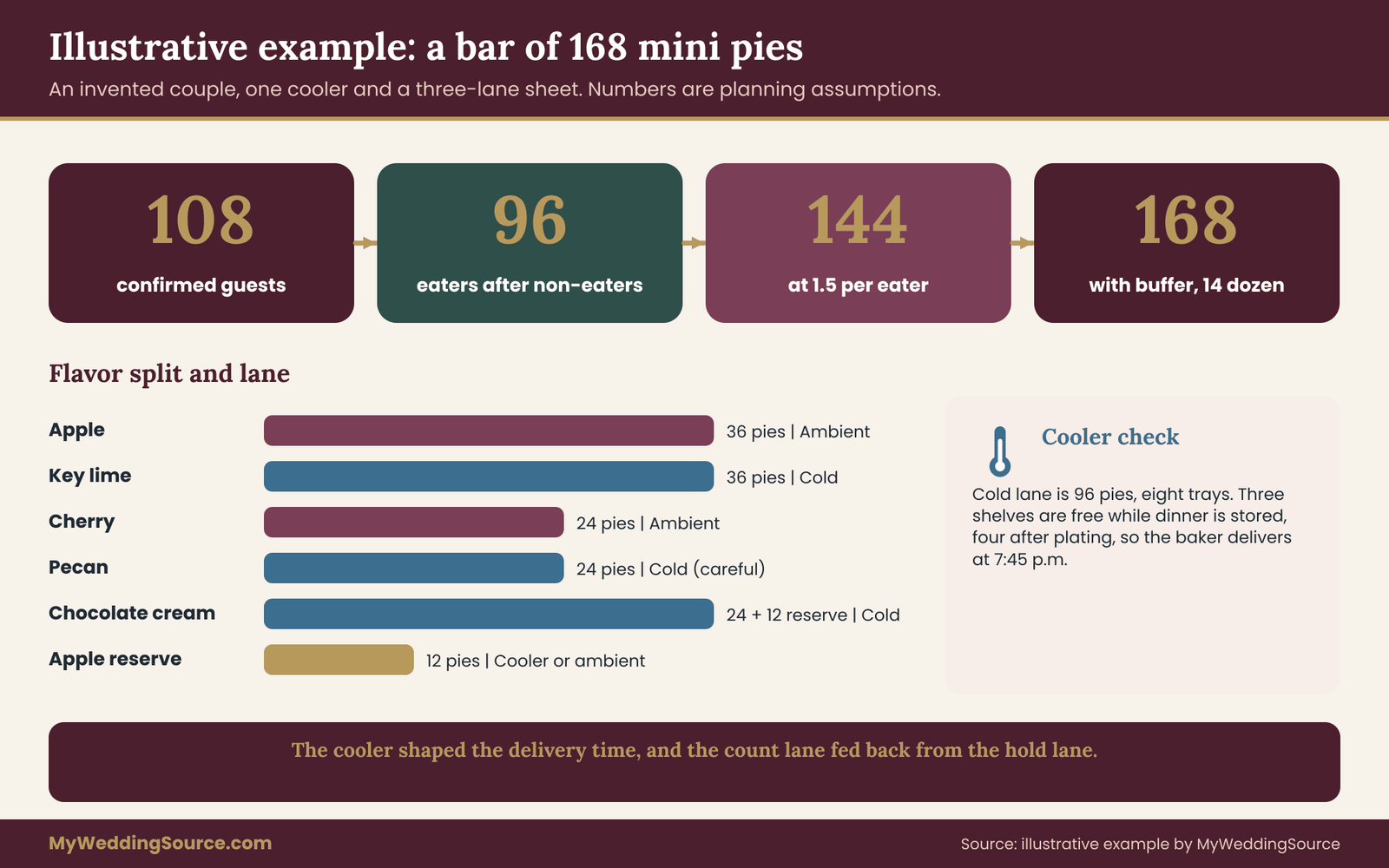
Dana and Marcus have a small cutting cake and want mini pies as the main dessert for everyone. They estimate that about 12 of the 108 confirmed guests will not eat a pie: three babies, a few guests who avoid sugar, and a few who will be elsewhere. That leaves 96 eaters.
Because the mini pies share the table with a small cake that serves only part of the room, they choose 1.5 pies per eater, a middle figure. The base is 96 × 1.5 = 144. They add a ten percent buffer, about 14, and reach about 158. Their baker bakes by the dozen, so they round up to 14 dozen: 168 mini pies.
Step two: the flavor split
They choose five flavors, with apple as the anchor. Apple gets three dozen (36), key lime three dozen (36), and cherry, pecan and chocolate cream two dozen each (24 each). That is 144 pies. The remaining two dozen are the reserve, split as one dozen apple and one dozen chocolate cream, because those two are their guess for the fastest flavors.
Each flavor meets the one-dozen minimum, and no flavor is a surprise: the three fruit and nut pies are familiar, and two chilled flavors add variety.
Step three: the hold lane
Dana asks the baker to classify each flavor. The baker says apple and cherry are fruit mini pies and can sit on the display for the service window at room temperature. The pecan pie is baked until set, but the baker’s recommendation is to treat it cautiously and keep it with the cold flavors. Key lime and chocolate cream are chilled fillings.
The caterer’s kitchen has one reach-in cooler. Dana asks how many shelves it can give to the mini pies. The caterer says three. The cold lane now includes key lime (36), chocolate cream (24 plus a reserve dozen), and pecan (24), which is 96 pies, or eight dozen. Eight trays of twelve do not fit on three shelves while dinner components are still in the cooler.
They adjust. With dinner in the cooler, the caterer can give only three shelves, but once dinner is plated, four shelves free up, and each holds two trays. The baker agrees to deliver the chilled mini pies at 7:45 p.m., after that cleanup, instead of in the morning. The pecan pies stay in the cold lane because the baker and caterer prefer to be careful with them. Eight trays across four shelves fit, and the delivery time is now on the sheet.
This is the hold lane feeding back into the count lane. If the shelves had not fit, the next move would have been to cut or swap one cold flavor, not to hope.
Step four: the clock lane
Dessert service opens at 8:30 and runs to 10:00. The caterer’s server will manage the table and keep tray cards. First trays go out at 8:30: one tray of each flavor. At about 8:55, the second wave of the fastest flavors goes out. At 9:30, a third wave goes out for guests coming from the dance floor. Any tray on the display for two hours is removed, which, with this pattern, should not occur. The reserve stays in the cooler until the server asks.
Dana asks one more question: what happens at the end? The caterer’s policy is that anything that was out of temperature control is discarded, and unopened chilled trays may be boxed for the couple if they are still at or below 41°F. Dana puts that in the written confirmation.
Step five: the written sheet
The finished sheet has five rows, one per flavor. Each row lists the quantity, the lane, the equipment, the first-out time, the replenishment plan and the allergen note. A single page goes to the baker, the caterer and the venue coordinator. Dana keeps a copy with the other vendor papers.
What the example shows
The example is useful for its process more than its numbers. The count came first, but the cooler decided the flavor mix and the delivery time. The clock lane shaped how many pies came out at once. And a short conversation about the end of the night turned into a line in the contract. Your numbers will differ. The order of questions should not.
Allergens, labels and guests with special diets at a mini pies bar
Pies are a hard food for allergen planning. Crusts contain wheat and often butter or shortening. Fillings can contain eggs, dairy, tree nuts, peanuts, soy or gluten in thickeners. Pecan pie is nuts by definition, and many chocolate and cream pies have nut-based crusts or nut garnishes. Because each pie is small and tray-presented, guests cannot easily see what is inside.
The FDA recognizes nine major food allergens in the United States: milk, eggs, fish, shellfish, tree nuts, peanuts, wheat, soy and sesame. A wedding dessert bar is not a packaged-food label, but those nine categories are a sensible checklist for the ingredient sheet you ask the baker to provide.
Label every flavor
Put a small card in front of each flavor with its name and the major allergens it contains. A guest with an allergy should be able to scan the table in a few seconds. If the baker supplies the card, check it against the written ingredient list. If you make the cards, copy from the ingredient list, not from memory.
Do not rely on appearance. A fruit pie with a crumb topping may contain wheat and tree nuts, and a pie with a shiny glaze may contain egg. Two pies that look alike may be made with different ingredients. When in doubt, ask the baker.
Cross-contact on the display
Even a correct label does not prevent cross-contact on a shared table. Tongs, spatulas and plates used across flavors can carry traces of a nut pie to a nut-free pie. Give each flavor its own utensil, or serve pies with a clean utensil that is changed regularly. If the table is staffed, the server can use a fresh utensil for each guest who asks about an allergen.
For guests with serious allergies, the fair and honest approach is to ask them what they are comfortable with. Some prefer a separately packaged pie from a nut-free kitchen, handed to them directly. If you want to provide this, ask the baker whether such an option is possible and what the extra cost is. A short, private question on the RSVP card about dietary needs is usually enough to start the conversation.
Vegetarian, vegan and gluten-free options
Mini pies have an advantage for guests with different diets, because a few flavors can cover several needs. A fruit pie made with an oil-based crust may serve vegan guests. A crustless or gluten-free option, if the baker has a separate preparation area, may serve guests who avoid wheat. Do not assume that a “plant-based” pie is also free of nuts, or that a “gluten-free” pie is safe for guests with celiac disease. Ask how it is made and whether it is baked in a dedicated area.
If you add a special-diet flavor, add it to the count lane as a normal row. A dozen is often more than needed, so check with the baker about half-dozen orders, and put the special-diet pies in a clearly marked spot so they do not get used by guests who simply like them.
Edge cases, weather and the day-of run sheet
A well-built sheet still meets surprises. The cases below come up often enough to plan for, and each one maps back to a lane.
The cocktail hour runs long
Dinner starts late, the speeches run long, and dessert service slips by 45 minutes. In the count lane, nothing changes. In the hold lane, the cold pies stay in the cooler longer, which is fine, but the baker’s delivery time may now be too early. In the clock lane, the first-out time moves, and the person managing the table needs to be told.
Put the first-out time on the sheet as “when the coordinator says go,” not as a fixed clock time, and make sure the coordinator and the table attendant have each other’s contact information.
The head count changes late
A guest list that moves by a few people is not a problem. A guest list that moves by twenty is. If the count rises, ask the baker whether a late increase is possible and by when. If the count falls, ask whether the order can be reduced. Most bakers have a cutoff after which the order is fixed. Put the cutoff date on the sheet and set a reminder a few days ahead of it.
A hot day or a tent
Outdoor heat is the biggest hold-lane stressor. Food-safety guidance shortens the time perishable food can sit out when the temperature rises above 90°F. In practice that means smaller waves, a shaded and covered table, ice beneath the trays, and a willingness to take a cold-lane flavor off the menu. If the forecast is hot two days before the wedding, ask the baker and caterer whether to swap a chilled pie for a fruit pie.
Rain or a room change
If a reception moves indoors at the last minute, the dessert bar may land in a different room, with a different outlet and a different cooler distance. The sheet should include a short plan B: where the table goes, how trays get there, and who tells the baker. Treat the dessert table as one station in a room that guests move through, and decide in advance which end of the room it can move to.
The mini pies are late or damaged
Know in advance what you want to happen. A delay of thirty minutes may be absorbed by the clock lane if the first-out time is flexible. A delay of three hours is not. Ask the baker for a contact number on the day and a backup plan, such as a smaller emergency order or a refund of the late flavors.
A damaged tray, such as one that was crushed in transit, is a different problem. If a flavor is lost, the reserve may cover it. If it is not, the missing flavor can be removed from the display and the sheet updated.
A guest gets sick, or a guest worries about a pie
Guests sometimes ask whether a pie has been out too long. If the tray cards are visible to the attendant, the answer is simple. If a guest becomes ill after the reception and suspects the food, the written sheet, tray cards and temperature log help the caterer and the health department sort out what happened. Do not discard those records on the way home. Keep them with your other vendor papers, alongside your other contracts and receipts.
The dessert bar is unattended
A self-serve table with no attendant works for ambient-lane mini pies on a short evening. It does not work well for cold-lane mini pies, because no one watches the clock. If the budget does not allow a server, assign a friend with a card that says what to do, or simplify the menu to fruit mini pies in covered trays.
Presentation and service details that change how many pies get eaten
How the table looks and works affects the count as much as the recipe does. A few small decisions are worth making deliberately.
Height and grouping. Pies set on a flat table look sparse and run together. Risers, stands or cake plates at two or three heights make a dozen pies look like a display and let guests see each flavor. Group by flavor, not by lane, but keep the cold-lane trays together so the chilled equipment serves them all. Leave a small gap between flavors so a guest can reach one without touching the next.
Plates, forks and napkins. Mini pies need something to hold them. Small plates, paper boats or pastry liners keep fingers cleaner and crumbs contained. Forks suit cream and custard pies. A sturdy fruit pie with a firm crust can be eaten by hand, but only if you say so with a sign, because many guests hesitate. Stock more napkins than seems reasonable. Sticky fillings and crumbly crusts use them quickly.
Serving style. A staffed table lets the server portion, keep utensils separate, record tray times and handle allergen questions. A self-serve table is cheaper and lets guests move at their own pace, but it depends on the clock lane being watched by someone. A middle option is a staffed opening, with a server at the table for the first forty minutes while the rush happens, and a lighter check afterward.
Signs. A sign that names each flavor, lists major allergens and says “chilled” or “baked today” tells guests what they are choosing and lets the attendant spend less time answering the same question. Keep the wording plain. A sign that says “Please take one to start” is not rude, and it can slow the first wave enough that the last guests find something left.
Pairings. Coffee and tea nearby pull guests toward the table and extend the time they linger. If you plan ice cream with warm pies, treat the ice cream as its own cold-lane item with its own freezer or cooler and its own clock. Keep the drink station a few steps from the mini pies so the two lines do not merge.
Take-home. If guests will take pies home, ask whether the caterer permits it, and provide small boxes. Take-home boxes shift the count, because guests who plan to take a pie home often take one before the lines get long. The ambient-lane mini pies are the usual candidates, and cold-lane mini pies are generally best eaten at the event.
The day-of run sheet in prose
On the day, the sheet becomes a run sheet. It has six moments.
Receive. The caterer’s lead or a designated person counts the dozens, checks a few pies and takes a cold-lane temperature.
Store. Cold-lane mini pies go to the cooler. Ambient-lane mini pies go to a cool, shaded spot, covered.
Set. At first-out time, trays go out with labels and tray cards. The time is written on each card.
Watch. The attendant checks the table every fifteen minutes, removes empty trays and brings out waves from the reserve as needed.
Remove. Any tray reaching the two-hour limit, or the shorter limit on a hot day, is removed without discussion.
Close. At the end, leftovers are handled according to the agreed policy, and the sheet and tray cards are saved.
Print one copy for the caterer, one for the baker and one for the person watching the table. Tape the third to the table’s underside or keep it in a pocket.
Your next steps
- Confirm the eaters. Take the latest confirmed guest count, subtract those who will not eat dessert, and add any vendors who will be offered some.
- Pick the pie’s job. Decide whether the mini pies are the only dessert, a partner to a cake, or a late-night snack, and choose a pies-per-eater figure.
- Draft the split. Choose anchor and accent flavors, apply a one-dozen minimum and set a reserve.
- Label the lanes. Ask the baker to classify each flavor as cold, ambient or warm, and mark any uncertain one “ask.”
- Check the space. Confirm cooler shelves, equipment, power and who staffs the table with the caterer and venue.
- Write the clock. Set first-out times, wave times, the two-hour limit and who owns the thermometer.
- Send one page. Share the finished sheet with the baker, caterer and venue coordinator, and keep a copy with your contracts and vendor papers.
FAQ
How many mini pies should I order per guest?
Start from eaters, not invitations, and match the figure to the pie’s job. As a starting range to adjust, plan about two to three per eater when pies are the only dessert, one to two beside a cake, and about one as a late snack. Add roughly ten percent for breakage and surges, then round up to whole dozens.
Do mini pies need to be refrigerated at a wedding?
It depends on the filling. Cream, custard and pumpkin pies need refrigeration, and USDA guidance lists them that way. Many baked fruit mini pies tolerate room temperature for a limited time, but local rules vary. Ask your baker to classify every flavor, then confirm with the caterer or local health department.
How long can mini pies sit out on a dessert table?
USDA guidance says perishable food should not sit at room temperature for more than two hours, or one hour when the temperature is above 90°F. Fruit mini pies are more forgiving, but a time limit still helps quality. Use tray cards with the time written on them and remove trays at the limit.
What temperature should cold mini pies be held at?
The FDA Food Code uses 41°F (5°C) or below for cold foods that need temperature control. Check the filling with a probe thermometer, not the air above the display. Warm items are held at 135°F (57°C) or above. Your caterer’s food-safety plan and local health rules take precedence over any general guide.
How many flavors of mini pies should a bar have?
Fewer, at healthy numbers, usually works better than many at scarce ones. Many couples choose three to five flavors, with one or two familiar anchors and a couple of accents. A minimum of one dozen per flavor keeps trays from emptying in the first fifteen minutes and leaving gaps.
Can I serve mini pies warm?
Yes, but warm service is a staffed job. You need an oven or warming cabinet, power, a person to move trays, and a plan for any ice cream, which is a cold item. Do not promise warm pies in a contract unless the caterer has the equipment and staff. Room-temperature pies are a common and perfectly good compromise.
What should I ask my baker about mini pies?
Ask about minimum order and increments, size and weight, which fillings need refrigeration, how far ahead the mini pies are baked, a written ingredient and allergen list, delivery method and window, and the substitution policy. Ask how the kitchen handles cross-contact if any guest has a serious allergy, and get the answers in writing.
What happens to leftover mini pies?
Plan this before the wedding. Pies that sat on the display outside temperature control are usually discarded under the caterer’s procedure. Pies that stayed chilled in the cooler may be boxed for you if the caterer’s policy and local rules allow it. Many caterers decline, so ask early and get the answer in writing.
Sources
- FDA Food Code, U.S. Food and Drug Administration
- Food allergies, U.S. Food and Drug Administration
- Retail food protection, U.S. Food and Drug Administration
- Danger zone (40 F to 140 F), USDA Food Safety and Inspection Service
- Food safety and inspection, USDA Food Safety and Inspection Service
- FoodSafety.gov, U.S. Department of Health and Human Services
- Food safety, Centers for Disease Control and Prevention
- Partnership for Food Safety Education
- Food allergy research and education, FARE