
Envelope calligraphy turns the outside of your invitation into the first thing a guest touches, and it is also the part of the suite most likely to run late, get misspelled or fail in the mail. This guide covers the styles worth knowing, how to run an address list check before any pen is uncapped, and a backward production calendar you can hand to an envelope calligraphy artist.
Choose the style by how legible it is to a mail carrier and a postal scanner, not only by how it looks in a photo. Freeze and check the address list before the envelopes leave your hands, because every correction after that costs a spoiled envelope and a calligrapher’s time. Work backward from your mailing date: return day, writing window, handoff day, list freeze, envelope delivery and booking. Count pieces, not households, and ask for the calligrapher’s own turnaround in writing.
Most couples meet envelope calligraphy as a pretty photograph: a cream envelope, a flowing name, maybe a metallic ink. What the photograph hides is the production behind it. Somebody has to decide how every name is written, someone has to confirm that every address is real, envelopes have to travel to a studio and back without a fingerprint, and the whole thing has to finish while the printed suite sits waiting to be stuffed.
This article is about that production side. It does not try to teach you to write calligraphy, and it does not rank studios. It gives you a way to choose a style on practical grounds, a short quality-control routine for your address list, and a calendar with real gaps in it for the things that always take longer than the quote suggests.
A note on scope. This is general planning information, not legal, tax or financial advice, and postal rules, prices and studio policies change, so confirm current details with the United States Postal Service and with each vendor before you commit.
What envelope calligraphy decisions actually involve
People usually frame envelope calligraphy as one decision: do we hire someone to hand-address, or not? In practice it is five smaller decisions, and the order you make them in saves you money and time.
Decision one: how much of the envelope is handwritten. Some couples want only the guest names by hand. Others want the full address, a return address and a hand-lettered envelope calligraphy line on the flap. Each addition multiplies the number of lines the writer has to produce, and the number of places an error can hide. Treat each of these as a separate line on your envelope calligraphy checklist, and settle them in order.
Decision two: which style of lettering. Pointed-pen scripts, broad-edge scripts, brush lettering and monoline lettering all look different and behave differently on paper. Legibility, speed and cost shift with the style.
Decision three: what the envelope itself is made of. Paper weight, texture, color and liner decide whether ink sits crisply or bleeds, and whether the address stays readable to automated equipment. The invitation printing guide on this site covers the printing side of that choice; here the question is how the surface treats a pen.
Decision four: who checks the list. The calligrapher writes what you give them. Almost no studio will take responsibility for a wrong apartment number on your spreadsheet. The person who owns the list owns the errors in it.
Decision five: what calendar the work runs on. Calligraphers work in queues. Your handoff date is not the date they start, and the date they finish is not the date the envelopes are back in your hands.
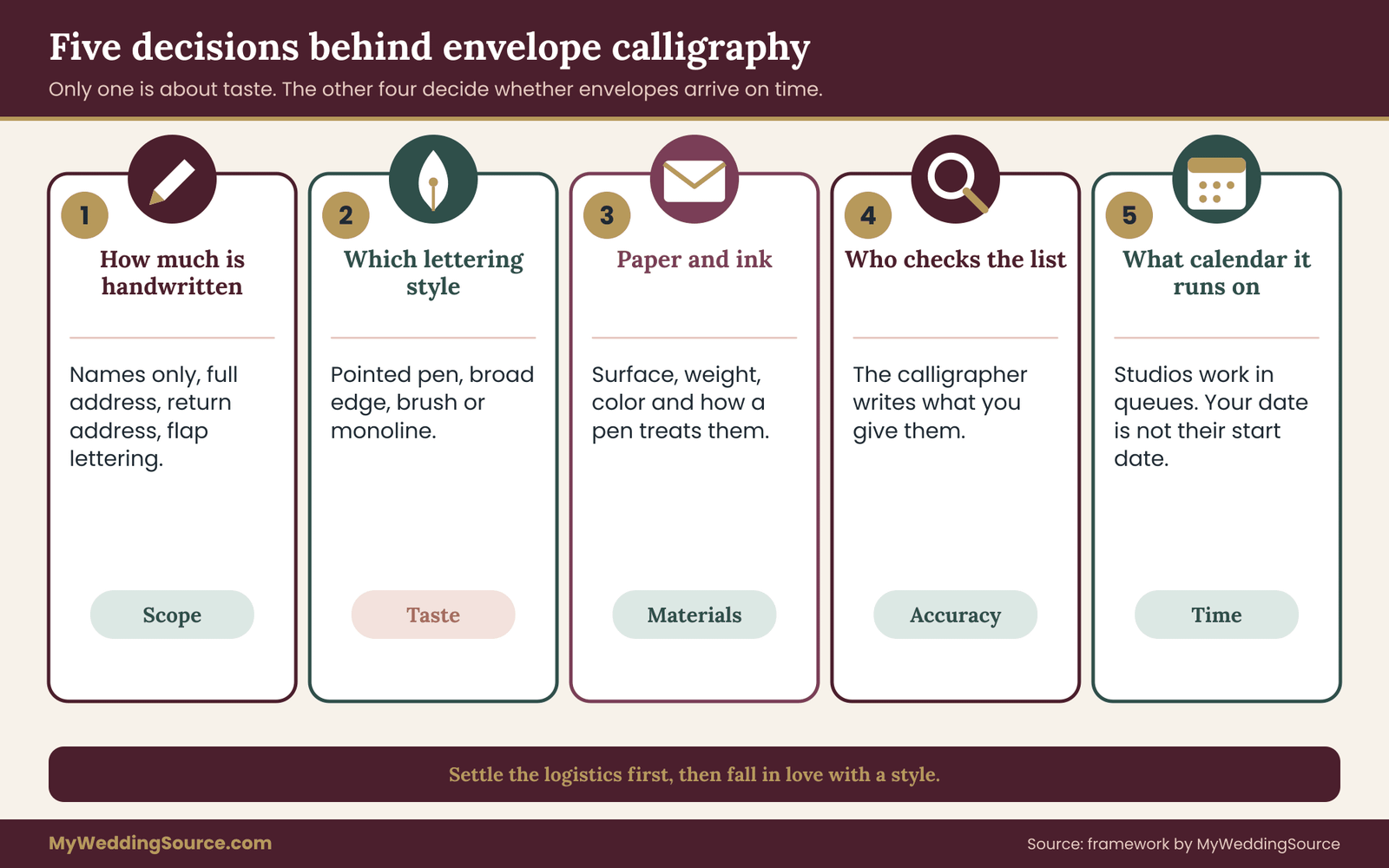
Notice that only the second decision is about taste. The other four are logistics, and they decide whether the beautiful envelope actually arrives at the right door on the right week.
Where this fits in the wider invitation plan
If you are still working out wording, enclosures and the overall suite, start with the guide to wedding invitation etiquette, which covers who is invited how and how names are written. If you are working out quantities, proofs and printer handoffs, the invitation printing guide is the place for that.
This article picks up after both of those decisions are made and the question becomes: how do we get these particular envelopes addressed well, on time? A couple who settles the lettering style first and the calendar last often finds that the envelope calligraphy they chose does not fit the weeks they have left.
Why lead times are the real subject
The phrase “real lead times” in this guide’s title is deliberate. A calligrapher’s published turnaround usually describes the writing window for a standard order. It rarely includes the days it takes you to deliver envelopes, the days spent waiting for ink to cure, the shipping back, or the week you will need to find and fix the three envelopes that came out wrong.
A calendar that only counts the writing window is a calendar that finishes late. Keep a running note of every envelope calligraphy decision and the date you made it, so both partners work from the same facts.
Throughout this guide, any number of days or weeks is an illustration you should replace with the figure in your own vendor’s written quote. The structure of the calendar is the useful part.
The Five-Gate method for envelope calligraphy
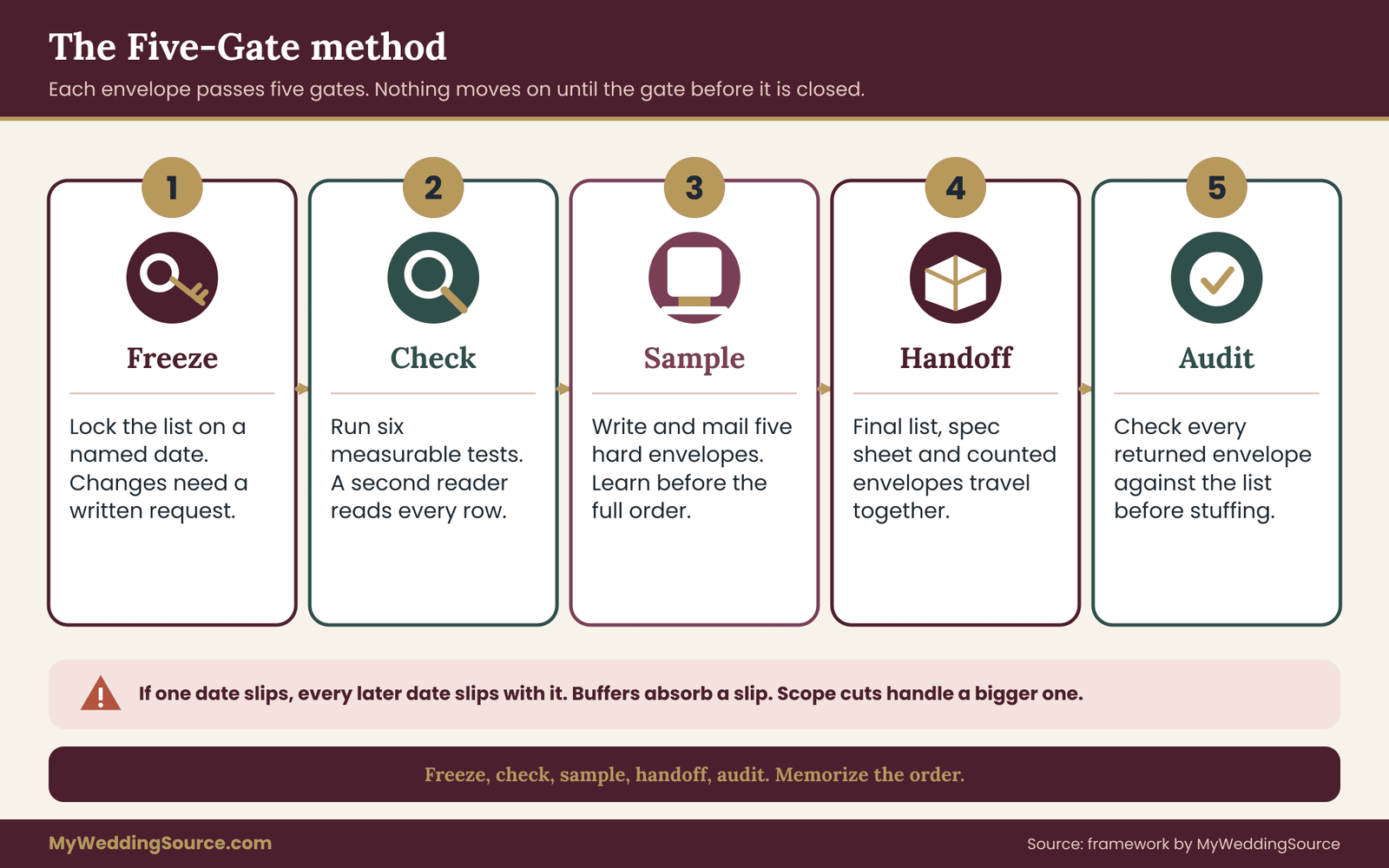
Here is the framework this article uses. It is not an industry standard; it is a simple way to organize the work so that nothing moves forward until the step before it is finished. Think of it as five gates that every envelope passes through.
Gate one: freeze. The address list is locked on a named date. After the freeze, changes go through a short written change request, not a casual text message. The point is not bureaucracy. It is that you cannot check a list that is still moving. Each gate is small, but together they turn envelope calligraphy from a hopeful errand into a tracked project.
Gate two: check. Every row is reviewed against a short list of measurable tests. A second person who did not build the list reads every row. The gate closes only when the count of unresolved flags is zero.
Gate three: sample. Before the full order, a small set of difficult envelopes is written, photographed and mailed to a real address. The sample is where you find out that the ink smudges, that the long name does not fit, or that the style you loved is hard for a relative to read.
Gate four: handoff. The final list, the envelopes and a written spec travel to the envelope calligraphy writer together. Counts are confirmed on both sides. The calligrapher acknowledges receipt of the count.
Gate five: return audit. When the envelopes come back, you check them against the list before a single invitation is stuffed. Errors found at this gate can still be fixed. Errors found at the post office counter cannot.
How the gates change the calendar
Each gate has a date, and the dates cannot overlap. The freeze comes before the check, the check comes before the handoff, and the handoff comes before the writing window opens. If the freeze slips, every later date slips with it. That is why the calendar section of this guide works backward from your mailing date, and why it leaves a buffer at the end for the audit.
You will see the gates again in the address list section, the calendar section and the worked example. They are the thread that holds the guide together, so it is worth memorizing the order: freeze, check, sample, handoff, audit.
What the method does not cover
The Five-Gate method does not decide your invitation wording, your guest list size or your budget. For the guest list itself, the wedding guest list guide walks through cutting and sizing. For the overall money picture, the wedding budget page is the place to set an envelope line before you ask for quotes. This method begins once you have names and a rough idea of how many households will receive a suite.
Counting pieces, not households
Before you can ask an envelope calligraphy artist for a quote or a timeline, you need one number that couples often get wrong: the number of pieces to be written. A household is not a piece. An envelope is.
Start with the number of households on your list. Each household gets one outer envelope. If your suite uses inner envelopes, each household also gets an inner envelope with names only. Add return-address envelopes if the response cards are pre-addressed, which is a separate writing job from the outer address and is often handled by printing, not hand lettering. If you only adopt one habit from this guide, make it the written freeze, because envelope calligraphy cannot absorb a moving list.
Then add spares. Hand lettering creates a small percentage of ruined pieces: a slipped nib, a blot, a misspelled name noticed too late. Some studios include a spoilage allowance in their price, and some expect you to supply extra envelopes. The sensible position is to ask how many spares they expect, rather than assuming. For planning purposes in this guide, an allowance of fifteen percent of your piece count is used as an illustration, and the right figure is whatever your envelope calligraphy studio states.
Finally add the late list. Almost every couple sends a handful of additional invitations after the main mailing: a waitlist, a guest whose address came in late, a replacement for an envelope the post office returned. Decide in advance how many pieces you will keep in reserve for that, and tell the calligrapher, because writing a few more pieces a month later is a separate small job that many studios will price differently.
A simple piece-count formula
Write it down in plain words so that you and your partner agree on it.
Households times envelopes per household, plus spares, plus a reserve for the late list. If you have 100 households, use an inner and an outer envelope, and keep an illustrative fifteen percent spare allowance and ten reserve pieces, the count is 200 base pieces, 30 spares and 10 reserve, or 240 pieces. That is the number you ask the calligrapher to price and schedule, not 100.
Households sometimes combine on one envelope and sometimes split. A household of two adults and three children is one outer envelope, but if you invite the children by name, the inner envelope has more lines. A couple living at two addresses is two households, even if you think of them as one unit. Piece counts get messy exactly where family structure gets messy, which is why the next sections spend time on names. Print the five gates and tape them above the desk where the envelope calligraphy materials live.
Why the count belongs in the contract
Write the agreed piece count into whatever agreement you sign, along with the price per piece or the package it falls under. If your count rises after the freeze, you want to know in advance whether the extra pieces are priced at the same rate, at a premium, or whether the studio will simply refuse them because the queue is full.
A count that lives only in a conversation will be remembered differently by each person later. The vendor contract section further on lists the other terms worth pinning down, and the broader guide to wedding vendor contracts explains how to read the clauses that tend to cause trouble.
Envelope calligraphy styles and what each one costs you in practice
Style names in calligraphy are loose. One studio’s “modern” is another’s “romantic script,” and a name on a portfolio page tells you less than a sample of your own guest names. Still, most envelope calligraphy falls into a few families, and each family has predictable strengths and predictable problems. The comparison below stays in prose on purpose, because the differences are about trade-offs, not a scoreboard.
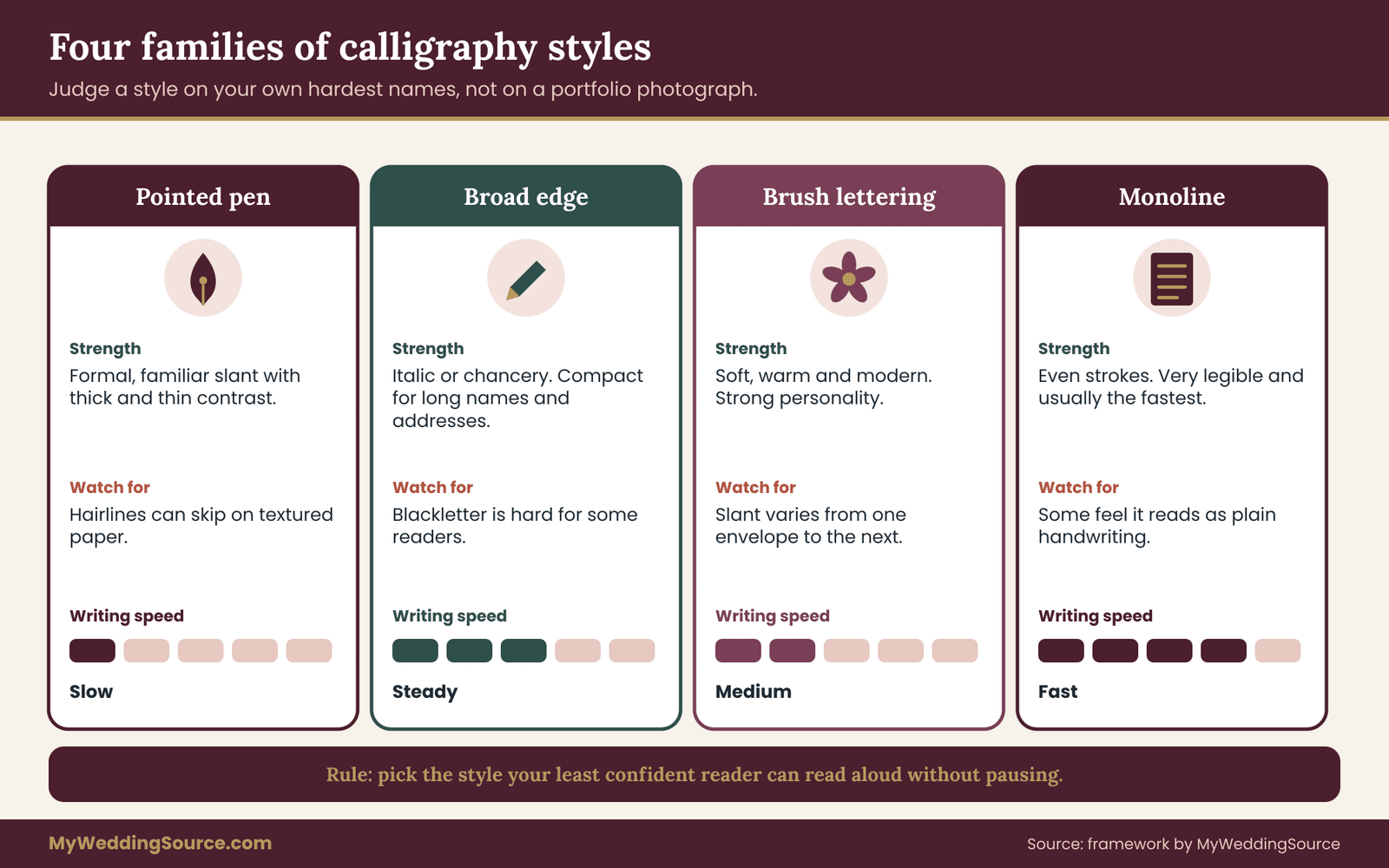
Pointed-pen scripts
Pointed-pen work uses a flexible, sharp nib that swells into a thick line under pressure and thins out when released. Traditional copperplate and its looser cousins are the classic wedding envelope look. The letterforms are regular and slanted, with contrast between thick downstrokes and hairline upstrokes.
The strengths are familiarity and formality. Almost any guest can read copperplate, because the letter shapes follow patterns people have seen on formal stationery for a long time. Names with common spellings are very legible.
The costs are time and fragility. Hairlines are thin, and thin ink lines on a textured paper can skip or fade. Writing in this style is slow, because the pen is lifted often and the writer has to reload ink. When a studio quotes a long turnaround for envelope calligraphy, pointed pen is frequently the style behind the number. Those trade-offs are why envelope calligraphy samples matter more than portfolio photographs.
Broad-edge scripts
A broad-edge pen has a flat nib. The thick and thin parts of each letter come from the angle at which the pen meets the paper, not from pressure. Italic, chancery and blackletter alphabets are written this way.
These hands read as more architectural and more historical. Italic is often more compact than copperplate, which is useful when you have long names or long street addresses on a small envelope. Blackletter looks dramatic but demands more from a reader, and the more decorative a letterform is, the more likely a mail carrier or an older relative struggles with it. Broad-edge work tends to be steadier and sometimes faster than pointed pen because the pressure control is simpler.
Brush and brush-pen lettering
Brush lettering uses a brush or a flexible brush pen, so it produces the same thick-thin contrast as pointed pen but with softer edges and more visible movement. It is the style behind much of the modern look: relaxed baselines, varied letter heights, bouncy joins.
The upside is personality. A modern brush script can feel warm and informal, which suits a casual venue. The downside is variability. Hand-lettered brush work is rarely perfectly uniform from envelope to envelope, and some couples are surprised when two names do not match in slant. That is the nature of the style, and an honest studio will say so. Legibility depends heavily on the individual hand, so judge by sample envelopes, not by the style name.
Monoline and hand-printed lettering
Monoline lettering uses a line of even thickness, often with a fine marker or a rigid pen. It can be printed-style capitals, a simple handwritten look or a stylized script with no thick and thin contrast.
This style is often the most legible to a machine and to a casual reader, because the strokes are consistent and the letterforms are simple. It is also usually faster to produce than contrast scripts. The trade-off is that some couples feel it reads as handwriting rather than as formal calligraphy, which is a matter of taste, not quality. For an informal ceremony, a rustic venue or an invitation with a strong printed design, it may be the best match.
Faux calligraphy and calligraphy-style fonts
A final category is not handwritten at all. Many fonts imitate calligraphy, and some studios scan a calligrapher’s alphabet and reproduce it digitally. That is a legitimate option and it gets its own section later. In this section the point is only that “calligraphy style” and “calligraphy” are different products. If a listing says “calligraphy-style envelope addressing” and the price is low, ask whether each envelope is written by hand or printed. Both can be fine, as long as you know which one you are buying.
How to judge a style on your own names
Photographs on a portfolio page are cropped, edited and usually written with the easiest names. The real test is how a studio handles the hardest names on your list. This is a simple exercise that takes about an hour and can prevent the most common regret. Whatever you choose, envelope calligraphy that a guest cannot read has failed at its first job.
Pick five stress names. Choose the longest surname on the list, one with an apostrophe or hyphen, one with a diacritic mark such as an accent, one with a title such as Dr. or a military rank, and one with a long street address that includes an apartment or unit. If you have none of one kind, choose another hard case.
Ask for a paid sample. A paid sample on your actual envelope stock is worth much more than a free sample on practice paper. Many studios offer a sample fee that is credited against the final order. Ask how that works before you commit.
Mail the sample. Put a stamp on it, address it to yourself or a friend, and send it through the real mail. When it arrives, look at what changed. Did the ink smear? Did the postal service stamp over any of the name? Did a barcode sticker cover part of the address? A sample is only a sample if it has been through the system.
Show it to three readers. Hand the sample to one younger adult, one older relative and one person who does not know the names. Ask each to read the name and address out loud. If any of them hesitates, the style is too decorative for your list.
A simple legibility rule
Use this decision rule when two styles are close. Choose the style that the least confident reader in your group can read aloud without pausing. A wedding invitation is not a portfolio piece; it is a message that has to work for a grandparent in a hallway with poor light. The style you love in the envelope calligraphy studio photograph may not pass that test. Ask which of these families the studio writes best, since envelope calligraphy skill is rarely equal across every style.
Reading the portfolio honestly
When you look at a studio’s portfolio, ignore the photograph first and read the writing. Are the baselines even? Is the spacing between letters regular? Do capital letters match from one example to the next? Look for envelopes with long addresses, because the way a writer handles a crowded envelope tells you more than how they handle a short one.
Look also for evidence of the exact ink color and paper you want. A portfolio full of black ink on white does not tell you how white ink on a dark envelope will behave. If your plan involves a color or a dark paper, ask for images of that combination specifically, or request a paid sample.
Style and speed: what the pen does to your calendar
Style is not only an aesthetic choice. It decides how many envelope pieces a writer can finish in a day, and that decides your calendar. This is the connection many guides skip.
A flourished pointed-pen style with ornamental capitals takes more pen lifts and more reloading than a simple monoline hand. A broad-edge italic with a steady rhythm tends to produce a steadier output. Metallic and white inks usually need more mixing, more coats or more careful drying than plain black ink. Writing on a very dark envelope adds a layer of difficulty because mistakes are harder to hide.
None of this means one style is better. It means that two couples with the same number of envelopes can get very different timelines depending on the style they choose, the ink and the paper. When a studio gives you a turnaround, ask which of those factors it assumes. If you later change the style, the ink or the number of lines per envelope, ask for the turnaround again. A change that looks small on paper can add days.
Matching style to the rest of the suite
The envelope is the first piece a guest sees, and it should agree with the invitation inside it. A formal letterpress suite with classic typography usually pairs naturally with a formal script. A minimal modern suite may look better with monoline or restrained brush lettering. A heavily decorated invitation with a florid design can overwhelm a decorative script; a quieter hand lets both shine.
The same principle applies to how much of the envelope is addressed. A full address in ornate script plus a return address plus a lettered flap can crowd the surface and create more chances for a postal scanner to struggle. Often the strongest design is the simpler one: guest names in the featured style, the address in a calm, legible form. A studio that writes only one family well is not a worse choice, only a narrower one, and honest envelope calligraphy studios will say so.
If your invitation uses a special printing process, such as foil or letterpress, the printer may have views on how the envelope should be handled before and after lettering. The invitation printing guide covers those handoffs, and it is worth reading before you ship anything to an envelope calligraphy artist.
The hidden cost of a style you cannot reproduce
One more practical point. Some styles are tied to one writer’s hand. If your envelope calligraphy studio falls ill, goes on leave or cannot finish, a replacement may not be able to match the style, which matters if you have already written half the order. Ask in advance whether the studio has a backup writer who can match the hand, or whether unfinished pieces would be returned to you so you can decide what to do. This is a rare event, but the question costs nothing and answers a lot about how the studio works.
Choosing an envelope calligraphy approach: hand, printed or hybrid
Once you know the style, the next question is how the writing gets onto the envelope. There are three realistic approaches, and the right one depends on your guest count, your calendar and how much error you can tolerate. None is the correct answer for everyone.
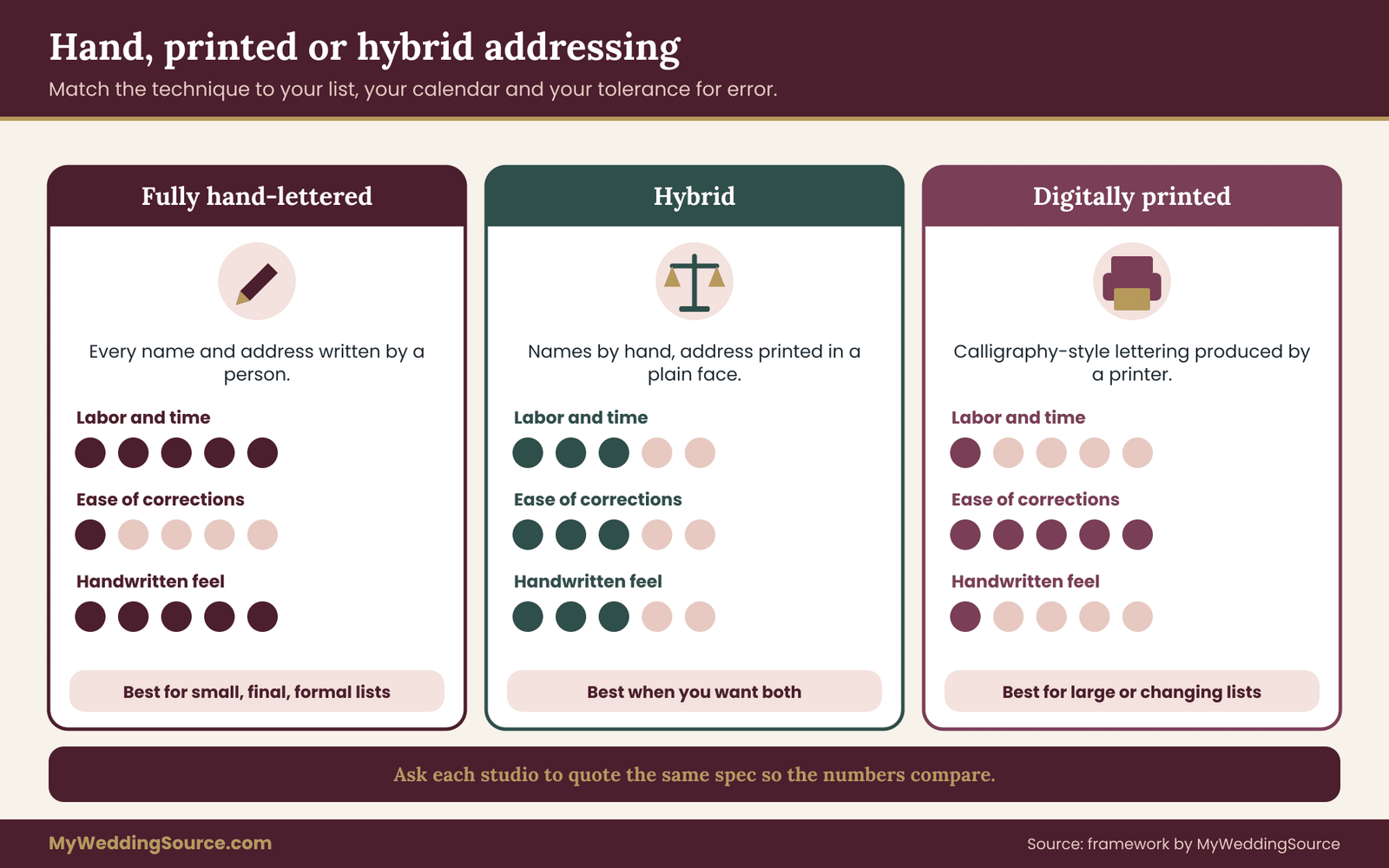
Fully hand-lettered
Every name and address is written with a pen or brush by a person. This is what most people imagine when they say envelope calligraphy, and it has a quality that printing does not: tiny variation, visible pressure, the look of a real hand. Name the approach in writing, because the price of envelope calligraphy changes a great deal between hand, printed and hybrid.
It also has the highest labor per envelope, the slowest turnaround and the least forgiving error profile. A mistake on one envelope means a replacement envelope and a rewrite, not a reprint of one line. It is a strong choice for smaller guest lists, for formal suites and for couples who value the handmade quality more than speed.
Digitally printed calligraphy
Here the lettering is produced by a printer. The calligrapher may write an alphabet that a studio digitizes, or the envelope calligraphy studio may use a script font. Names and addresses are typeset and printed in ink, foil or digital color. None of these approaches is an inferior form of envelope calligraphy; each simply spends effort in a different place.
The advantages are speed, consistency and easy corrections. If a name is misspelled, you reprint one envelope. If the list changes after the freeze, a printed run is far more forgiving than a handwritten one. For large guest lists, tight calendars or couples who worry about errors, this is a sensible approach. The trade-off is that the printed result can look flatter than a true hand-lettered envelope, especially in close inspection, and good digital calligraphy is not necessarily cheaper than a modest hand-lettered order once setup is counted.
Be wary of describing printed calligraphy as handwritten. If a vendor quotes it as hand-lettered envelope calligraphy, ask for that in writing.
Hybrid: hand for names, print for the rest
A common middle path is to hand-letter the guest names on the outer envelope and print the address and return address in a plain, readable typeface. A variation is to hand-letter the front and print only the return address on the flap.
Hybrid work cuts the writing time, gives postal equipment a very clean address to read and still keeps a handwritten feel where guests notice it most. It also splits the error risk: the names are lettered, but a typo in the address printed from a verified file is easy to fix. If you are unsure, request a hybrid quote alongside the fully handwritten one, and compare the envelope calligraphy timelines side by side.
A decision rule for choosing
Use these questions in order. If the answer to any one is “yes,” it pushes you toward the printed or hybrid side.
First, is your mailing date fixed and tight? A fully handwritten order needs the longest calendar and the biggest buffer, and the contingency options are narrower. Second, is your list still changing, with many undecided households? Handwriting punishes late changes. Third, do you have a long list of long, unusual or multi-line addresses? Fourth, is your budget for this line small? Printed and hybrid work can cost less in labor, though that depends on the quote.
If every answer is “no,” a fully hand-lettered order is a reasonable fit. If answers are mixed, hybrid is often the most defensible choice, because it spends the handwriting where it shows and the precision where it matters. The point of the rule is to make the decision before you fall in love with a portfolio, not after. Settling the approach early also tells your printer what the envelope calligraphy plan needs from the stationery.
What a fair comparison looks like
When you ask studios for quotes, ask each for the same spec so the numbers are comparable: the same piece count, the same ink color, the same paper, the same number of lines per envelope, the same return path. If one studio quotes a hand-lettered price and another quotes a printed one, you are not comparing like with like. The guide to comparing wedding vendor quotes walks through how to structure a request so the answers line up.
Envelope paper, ink and postal readability
Even a perfect hand can be undone by paper and ink that do not work together, or by an envelope that a postal scanner cannot read. These are the practical points to settle before the sample.
Paper surface and weight
Smooth, uncoated papers usually take ink cleanly, and heavily textured papers can cause pen nibs to catch, skip or feather. Very thin envelope paper can show ink through to the other side. Very thick or soft cotton paper can absorb ink and spread fine lines. Ask your envelope calligraphy studio what surfaces they are comfortable writing on, and where possible buy the envelopes from the same place as the invitation so the color and weight match the rest of the suite.
Some envelopes come with a liner that sits inside the envelope. Liners do not affect the writing on the front, but they affect weight, and weight affects postage. If you are adding liners, a wax seal or any thick insert, check postage on a complete assembled sample before the mailing date, not on paper alone. Paper, ink and address placement together decide whether envelope calligraphy survives the mail.
Ink choices
Black or dark ink on a light envelope is the most reliably readable. Colored inks can look lovely, but pale colors on cream or white paper may be hard to read at a glance. Metallic inks reflect light and can glare under scanner lighting. White or light ink on a dark envelope looks striking, yet the contrast depends entirely on opacity, and sparse coverage can read as gray.
Consider also how the ink behaves once dry. Water-based ink can smear if the envelope is damp when it passes through mail handling. Ask the envelope calligraphy writer what ink they use and whether it is water-resistant once cured. A quick home test with a damp cloth on a sample envelope will tell you what a rainy delivery day might do. Do the test on the sample, not the finished suite.
Postal readability
Postal equipment reads addresses and applies barcodes, and handwriting is read by both machines and people. The United States Postal Service publishes standards for address formatting and for how envelopes are processed, and it provides a tool to check an address.
The points that matter for calligraphy are general ones: the delivery address belongs in the usual location on the face of the envelope, the lines should be clear and have good contrast with the background, and the area along the bottom edge is used for barcodes and should be left clear. Confirm the current specifics on the Postal Service’s own pages rather than trusting memory or a vendor’s summary. Handwritten work always carries more variation than print, so envelope calligraphy deserves a real mail test.
Decorative flourishes that run into the address block, ornate capitals that look like other letters and text that slants steeply can all reduce readability. A good calligrapher will keep the delivery address in a plain, legible form even when the names are ornate. If yours does not suggest that, ask.
Shape, size and postage
Envelope shape and size affect postage. Square envelopes, unusual sizes, rigid or lumpy contents and certain closures can mean a higher rate. If your suite is a standard shape, this is usually a small matter. If your suite is unusual, price the postage before you finalize the envelope, because the envelope is hard to change once the lettering has begun. The post office can weigh a fully assembled sample and tell you the rate. A plain address block under ornate names is a quiet compromise that protects envelope calligraphy from scanner trouble.
Test the finished sample, not the idea
The sample from the earlier section is the right place to test paper, ink and readability together. Mail it. Check how it arrives. Photograph it. If there is a problem, you have time to change ink or style. If you discover the problem on the full order, you will have no easy fix. The overall workflow for proofs and printer handoffs is covered in the invitation printing guide, and many of the same habits apply here.
When printed or hybrid addressing is the wiser choice
Some couples feel that choosing printed addressing means giving up on the idea of calligraphy. It does not. It means matching the technique to the situation. Several situations favor printed or hybrid addressing, and recognizing them early avoids a stressful scramble.
A long and changing list. If your list is still moving three weeks before the freeze date, handwriting every envelope early is risky. Printed addressing lets you update.
Very long names or many lines. Multi-generation households, names with titles, or addresses with long apartment descriptions can make a handwritten envelope crowded. Printing at a smaller scale may be more legible.
A short calendar. If you are mailing sooner than planned, a handwritten order may simply not fit in the window. Hybrid work can finish faster because the writing load is lighter.
Many international addresses. Foreign addresses often have different line structures, characters and postal codes that a calligrapher may be unfamiliar with. Printing from a verified file reduces transcription risk.
Budget pressure. Hand-lettering is labor, and labor costs money. If the number is above what you planned, hybrid addressing offers a way to keep some handwriting at a lower cost.
Keeping a bit of handwriting in a printed plan
If you choose a printed approach but still want a personal touch, consider hand-writing a small number of envelopes yourself: close family, or a handful of people who matter most to you. Or have a friend with good handwriting address those few. This is not calligraphy, but it is personal, and it takes pressure off the studio. Write these test results into your notes so any later envelope calligraphy order starts from evidence.
What to tell the vendor about your plan
Whichever approach you choose, give the studio your reasoning in one short note: the mailing date, the approximate count, whether the list is final, and how you plan to handle changes. A vendor who understands your constraints can give a realistic timeline and tell you if your plan is at risk. A vendor who only hears “we want hand-lettering” has no way to warn you.
Address list QC before envelope calligraphy begins
The address list is the single most valuable document in this project, and the least glamorous. A flawless hand-lettered envelope with a wrong street number is a failed envelope. The aim of this section is to give you a list check you can complete in a few evenings, with results you can measure instead of a vague feeling that the list looks fine.
Build one source of truth
Keep one master list. Not one in your phone, one in a partner’s notes and one in an email thread. A single spreadsheet or shared document is the only version that counts, and everybody else’s copy is a draft. If you gather addresses by text or from a wedding website form, copy them into the master list with the date you received them and who provided them.
Each row should represent one household, not one person. Give each row an ID number that never changes, even if you sort the list. The ID is what you use when you talk to the calligrapher: “row 47 needs a change,” not “the Hendersons near the lake.” Think of the check as insurance for the envelope calligraphy you are about to pay for.
The columns worth having
A useful list for envelope work has more columns than a typical contact list, because lettering needs the pieces separated.
Consider these fields: row ID; outer envelope name line, written exactly as it should appear; inner envelope name line, if you use one; street line one; street line two for apartment, suite or unit; city; state; ZIP code; country if not the United States; how you obtained the address and the date; a verified flag with the date and initials of whoever checked it; a notes field for special handling; and a status field that tracks whether the row is frozen, flagged or sent.
The reason for the separated name lines is that the calligrapher should never have to decide how to write a name. The name line is a finished piece of text. If it says “Dr. Maria Alvarez and Mr. Tomas Alvarez-Reyes,” that is what is written. If you want a different form, you change the row, not the studio’s judgment.
Format the name lines before you check anything
Names are where the most decisions hide, so settle conventions once and apply them to every row. Decide how you will write couples with the same surname, couples with different surnames, unmarried partners, single guests with a plus-one, families with children and guests with titles. The guide to wedding invitation etiquette covers the traditions and the modern alternatives, and your choices should follow whichever convention matches the tone of the wedding.
Then write the rule down in a few lines at the top of the sheet, so that anyone who edits a row follows the same convention. A list that mixes “Mr. and Mrs. John Smith” with “John and Mary Smith” and “Smith Family” was built by several hands, and the envelope calligraphy writer will copy the inconsistency faithfully. Every unresolved flag on the sheet is a future spoiled envelope, and spoiled envelope calligraphy is paid for twice.
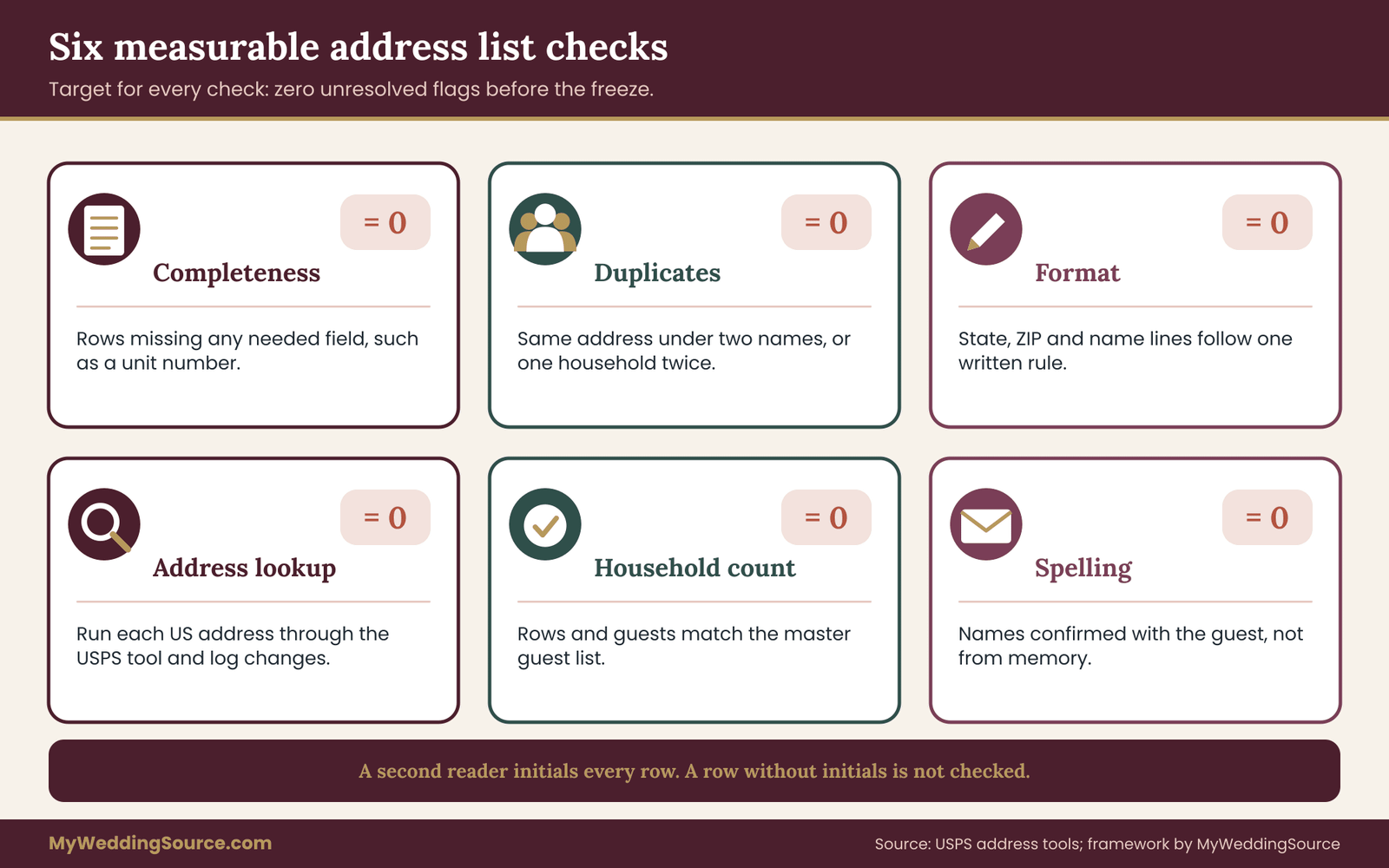
The measurable checks
Quality control should produce numbers, not impressions. Run these checks and record the result of each in a small log.
Completeness. Count the rows missing any required field. The target is zero. A row with no apartment number for a building that obviously has apartments counts as incomplete even if the field is not formally required.
Duplicates. Sort by street address and look for the same address under two names. Sort by surname and look for the same household entered twice with different spellings. Count duplicates found and resolved.
Format consistency. Check that every state is written the same way, every ZIP code has five digits, and every row’s name line follows your convention. Count exceptions.
Address verification. Run each domestic address through the Postal Service’s address lookup tool, which returns the standardized form of a deliverable address. Mark each row verified with the date. Record how many rows the tool changed or could not confirm. Those are the rows to ask about.
Household accuracy. Compare the list against your guest list. The number of households and the number of invited guests on this list should match the number on the master guest list. A mismatch means someone was added or dropped without the other document being updated.
Spelling and preference. For every name, confirm the spelling and form with the guest or with someone who knows. Do not trust spelling from memory. The most common errors are names that sound alike, such as Catherine and Katherine, or a surname spelled the way a relative assumes it is.
The second reader rule
The person who built the list cannot reliably check it, because they read what they meant to type. A second reader who did not build the list reads every row aloud against a reference: a card, a text message or a verified record. This takes time, roughly a minute per row once the reader is practiced, and it finds problems that the builder’s eye slides over.
Make it concrete. The second reader initials each row in the verified column. A row without initials is not checked, no matter how confident the builder feels. When the second reader finds a problem, they flag it rather than fix it, so that the builder can decide and record the change.
Run the lookup tool the right way
The Postal Service’s address lookup tool is a check, not an oracle. It confirms that an address exists in the postal database in a standard form. It cannot confirm that the person you are inviting lives there, that the apartment number is the right one for them, or that they receive mail at that address rather than elsewhere. Do not let the studio’s talent distract from the plain fact that envelope calligraphy copies whatever the list says.
Use it to catch typos, missing unit numbers and wrong ZIP codes. Then, for any address that the tool changes substantially, send the guest a short message to confirm. Something simple works: “We are finalizing our invitation mailing. Is this still the best address to reach you? Street, city, state, ZIP.” Keep it brief and friendly.
Handling rows you cannot verify
Some rows will resist verification. A guest who moves often, a relative in a rural area with an unusual address format, a friend who has not replied to three messages. Set a rule: flagged rows get one more attempt, then a decision. Options are to mail to a known alternate address, to deliver the invitation in person, or to move that guest to the late-mailing reserve once the address arrives. Do not hold the whole list hostage for one row.
Declare the freeze
When the completeness, duplicate, format, verification and household checks all read zero unresolved flags, announce the freeze. Write the date and time on the sheet, and save a dated copy of the file under a name that includes the word frozen. That file is what goes to the calligrapher.
After the freeze, changes follow a change request: the row ID, what changes, who requested it and why. Keep these in a short log. If a change arrives after the handoff, you will need to know whether the envelope calligraphy studio has already written that envelope. Changes before the writing window opens are cheap. Changes during it cost a spoiled envelope. Changes after the return are cheapest to handle if you planned reserve envelopes. The list stays the owner’s job even when the envelope calligraphy is someone else’s craft.
What a clean list looks like, row by row
An example makes the standard concrete. Imagine a row for a household of two adults and one child. A weak row might read: “The Okonkwos, 14 Birch, Portland.” That row gives the writer no first names, no street type, no state, no ZIP and no clue whether the child is invited by name.
A strong row has an outer name line such as “Mr. Daniel Okonkwo and Ms. Ruth Mensah,” an inner line such as “Daniel, Ruth and Adaeze,” a street line “14 Birch Lane,” a second line left blank, a city “Portland,” a state, a five-digit ZIP, a verified date and initials, and a note such as “household has two surnames, invited as written.” Nothing in that row requires the calligrapher to guess.
Two rows that look finished but are not
Watch for rows that appear complete and are not. The first is the apartment building with no unit number. The lookup tool may flag it, or it may not. A letter addressed to a large building without a unit can be delayed or returned. The second is the address that is correct but not the one the guest wants to use. A guest who spends part of the year elsewhere may prefer a different address. If your list includes seasonal residents, ask which address will be reliable on the delivery date.
Keep personal data tidy
An address list contains private information about your friends and family. Keep the master file in a place that only you and your partner, and perhaps a trusted helper, can open. When you send the list to an envelope calligraphy artist, send only the fields they need, the name lines and the address lines, and not phone numbers, email addresses or notes about family disputes.
If the file travels by email, use a file name that does not announce what it is, and delete shared copies after the project is done. Treat the list as you would any document with other people’s details in it. Share the finished check log with your partner so the envelope calligraphy handoff is a joint decision.
How long the check takes
For a list of around 100 households, plan on several evenings for the first pass and a few more for the second reader and the follow-up messages. Time spent here is cheap compared with the time spent replacing envelopes. The calendar section builds this window into the plan, and it deliberately leaves slack, because guests answer messages slowly. A freeze date that depends on every guest replying promptly is a freeze date that will slip.
The envelope calligraphy production calendar, built backward
A production calendar for envelope calligraphy starts at the end. The anchor is the day you want the invitations in the mail, and every earlier date is derived from it. Couples who start at the front, with “we will hire someone in a few months,” tend to discover that the dates were never connected. Keep this calendar next to the vendor timeline, so envelope calligraphy dates sit beside the printer’s.
The usual advice for mailing timing is a matter of etiquette and distance, covered in the wedding invitation etiquette guide: roughly six to eight weeks before a local wedding, earlier when many guests travel. This section takes your chosen mailing date as a given and builds the calendar underneath it.
The seven dates every calendar needs
Mailing date. The day the sealed, stamped suites go to the post office. Choose a weekday when the counter is open and you have time to stand in line or arrange a bulk handoff.
Assembly window. The days between the envelopes coming back and the mailing date. This is when you check, stuff, weigh, stamp and seal. Two to four days is a comfortable minimum for a list of a hundred households.
Return date. The day the lettered envelopes arrive back in your hands. It is not the day the writer finishes; it includes drying, packing and shipping, or your own pickup.
Writing window. The period the envelope calligraphy writer has the pieces. Use the studio’s written quote, then add a buffer, which the next subsection explains.
Handoff date. The day the envelopes and frozen list arrive at the studio. Account for shipping time and the chance of a delay.
Freeze date. The day the list is locked and the check is complete. It must come before the handoff by enough days to prepare the file and confirm counts.
Booking date. The day you sign the agreement and pay a deposit. Popular calligraphers fill their calendars well ahead, so the booking date often falls months before any of the others. Ask each studio how far ahead it books rather than relying on a general rule.
Buffers, and how to size them
A buffer is time you plan not to use. It exists because things go late. Three buffers belong in every calendar.
The first is a writing buffer. If the studio quotes a certain number of days for your piece count, schedule more. A reasonable starting rule is to add about half again to the quoted window for a small order, and to ask the envelope calligraphy studio whether that margin looks sensible. This is a planning habit, not a rule from any authority, so adjust it to the studio’s reputation and your own tolerance. A calendar for envelope calligraphy is only as honest as its buffers.
The second is a shipping buffer on each leg. Count the carrier’s estimated days, then add two business days for each direction. Use tracking and, if the studio and carrier allow, insurance for declared value. Write down the tracking number on a note in your records. Say the calendar out loud to the studio, and ask whether each date for the envelope calligraphy looks realistic.
The third is a recovery buffer at the end. It covers the audit and the possibility that some envelopes need rewriting. A recovery buffer is only useful if the studio will accept corrections. Ask before you sign whether a fixed number of corrections, or replacements for studio-caused errors, is included. Dates that look generous on paper are exactly where envelope calligraphy projects lose their margin.
How slips propagate
When one date moves, every date after it moves too. A freeze that slips three days pushes the handoff by three days, which pushes the return by three days, which pushes the mailing date, unless a buffer absorbs it. That is the value of buffers: they absorb a slip of a certain size. A slip larger than the buffer forces a choice.
Decide in advance what your three choices are. You can reduce scope, for example by moving to hybrid addressing for part of the list. You can move the mailing date, if the wedding timeline allows. Or you can add capacity, such as a second writer, which usually costs more and risks mismatched hands. Knowing the options before you need them turns a panic into a decision. Revisit the dates whenever the guest count or the envelope calligraphy spec changes.
A worked example: 118 households and a spring-to-summer wedding
The following is an illustration with invented numbers, meant to show the arithmetic, not to suggest that your numbers will match. Every figure should be replaced with those from your own quote.
Imagine a couple marrying on Saturday, June 12, 2027. They decide to mail on Monday, April 19, 2027, about eight weeks before the wedding, which is a little under the upper end of the range in the etiquette guide. Their list has 118 households. The suite includes an outer and an inner envelope.
Step one: count the pieces
Households times two envelopes gives 236 pieces. With an illustrative fifteen percent spare allowance on the base count, that adds 36 pieces. With a reserve of 12 for later invitations, the total is 284 pieces.
They request a quote. The studio writes back that its standard order is up to 150 pieces in a two-week writing window, and that a larger order needs a longer window or a second writer. In this example, 284 pieces is almost twice what the quote covers. The arithmetic in this example is the same for any envelope calligraphy order, whatever the numbers turn out to be.
Step two: change the plan, not just the calendar
The couple has three options. They could extend the writing window to about four weeks, which pushes everything earlier. They could ask the envelope calligraphy studio about a second writer, which raises the cost and the matching risk. Or they could reduce the piece count.
They choose to drop the inner envelopes, a common modern choice, and revisit the count. Households of 118, plus 18 spares, plus 12 reserve, is 148 pieces, which fits the studio’s two-week quote. This decision is recorded in a short note, because the invitation printer needs to know that no inner envelopes are needed, and because the invitation wording was written with an inner envelope in mind for children’s names. The etiquette guide covers how to handle that.
Step three: set the dates backward
Starting from the mailing date of Monday, April 19:
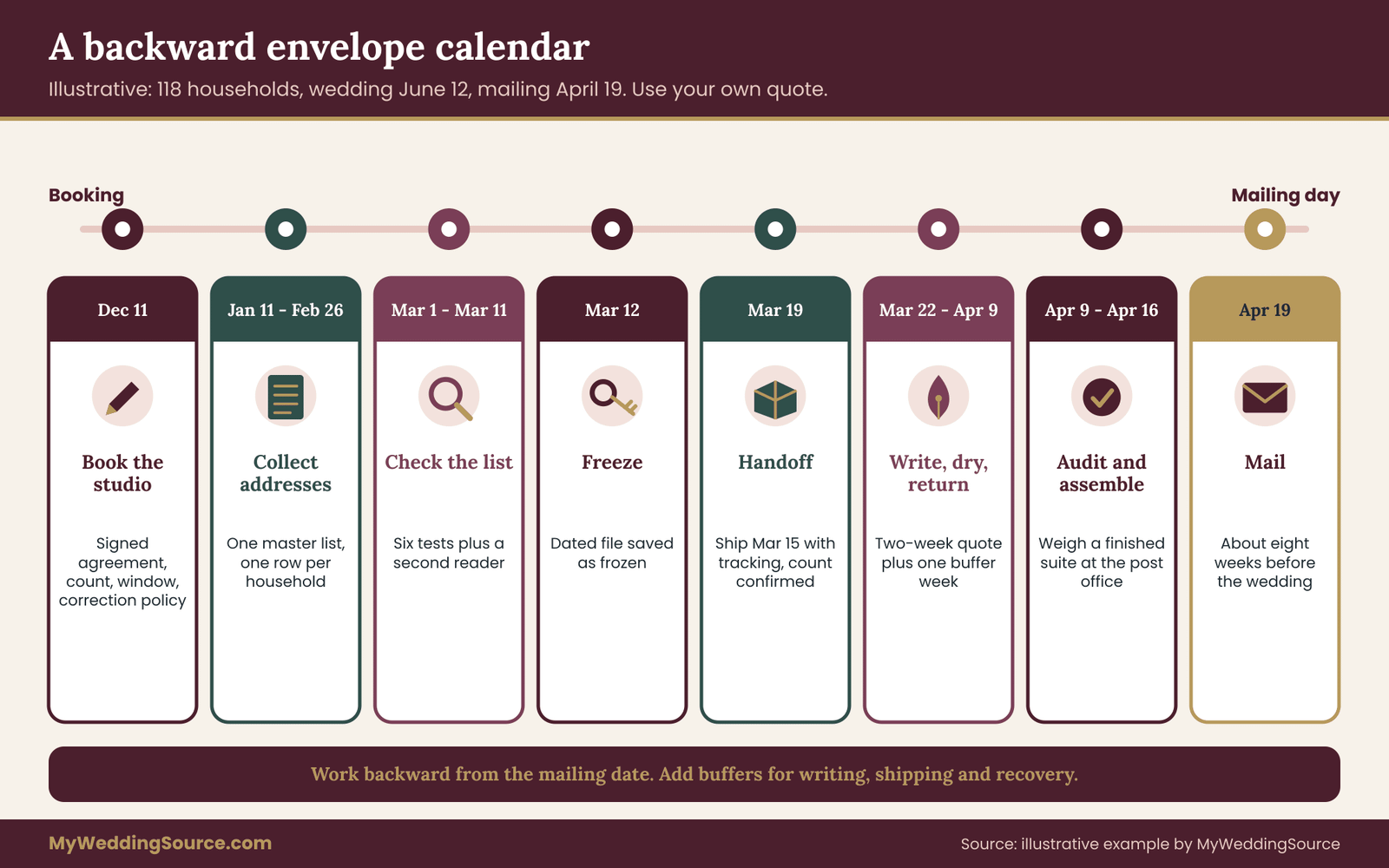
The assembly window is April 9 to April 16, with the lettered envelopes returned on Friday, April 9 and the audit running through Wednesday, April 14. The couple leaves April 15 and 16 for assembly and a weigh-in at the post office with a complete sample.
The studio’s writing window is two weeks, March 22 to April 2. The couple adds a week, April 5 to 9, for drying, packing and return shipping, which brings the return date to Friday, April 9.
The handoff date is Friday, March 19. They ship on Monday, March 15, with tracking, so that a delayed day still leaves the envelopes at the studio before the window opens.
The freeze date is Friday, March 12, one week before the handoff. The address check runs from Monday, March 1 through Thursday, March 11. Address gathering runs from Monday, January 11 to Friday, February 26.
The sample is written and mailed during the week of February 16, since Monday, February 15 is a federal holiday. The couple orders the sample in January from the studio’s sample service, using stock from the invitation printer.
The booking date is Friday, December 11, 2026, about fourteen weeks before the handoff, with a signed agreement stating the piece count, the writing window, the return date and the correction policy.
Step four: add up the slack
Between the handoff and the mailing date there are 31 days. The studio’s quoted work is 14 days of those. The rest is a mix of shipping, drying, auditing and assembly. That looks like a lot of slack, and it is, until a list freeze slips by a week and a shipment is delayed by two days. This is the reason to keep slack in the plan from the start, and to resist the temptation to compress it when the schedule feels generous. Notice how one small change, dropping the inner envelope, rescued the envelope calligraphy schedule.
Step five: check the downstream dates
The wedding is on June 12. Response cards must come back with enough time to finalize the headcount for the caterer and seating. The wedding RSVP etiquette guide covers deadline choices. In this example the couple sets the reply date for mid-May, allowing about four weeks for guests to respond, with a follow-up period before the caterer’s headcount deadline. If the mailing date slipped by two weeks, the reply window would shrink, which is why a slip in the envelope schedule is never just an envelope problem.
What the example shows
Three lessons come out of this example that apply to any list. First, the piece count, not the household count, sets the schedule. Second, a quote’s writing window is only a part of the calendar. Third, the best time to discover that the studio’s capacity does not match your count is at booking, not at handoff.
Where the calendar fits in the larger plan
The envelope calendar is one thread in a much larger timeline of vendors, deposits and decisions. The wedding vendor timeline guide shows how other vendor deadlines relate to each other, and it is worth placing your envelope dates against the printer’s proof date, the stationer’s delivery date and the post office’s holiday schedule. A good habit is to put every date from this section on a shared calendar that both partners can see, with the studio’s name and phone number in the entry.
Seasonal pressure and studio capacity
Calligraphers are busiest before the busiest wedding months and before the holidays, when many people also order holiday cards. If your handoff falls in a crowded period, the studio’s quoted turnaround may stretch, or the studio may close its books earlier than you expect. Ask when the envelope calligraphy studio last stopped accepting orders for a similar period, and whether the quote is for a firm window or an estimate. A studio that is candid about its busy periods is giving you useful information. Your own envelope calligraphy quote will replace every illustrative number above.
Mail calendar details
Check the post office’s holiday schedule for your mailing week and the weeks after. A holiday weekend can add a day to delivery times, and the counter may close early before one. If you plan a bulk drop, call the branch in advance to confirm its hours and any limits on how many pieces it can accept at the counter at once. These are small checks that prevent a bad morning.
Questions and contract terms for an envelope calligraphy studio
Most disputes about hand-addressing come from unstated assumptions: whose envelopes, whose spelling, whose deadline. A short written agreement and a set of direct questions before you pay a deposit settle most of them. This section lists the questions in the order that tends to matter, and explains what a clear answer looks like.
Questions about capacity and calendar
Ask what the studio’s current writing window is for your piece count, and whether that window starts on the day the envelopes arrive or on the day the studio begins your order. Ask how far ahead it books, and whether there is a waitlist. Ask what happens to your date if the studio falls behind, and whether it will tell you early. A studio that says “we always finish on time” has not answered the question; a studio that describes how it manages its queue has.
Ask whether the quote includes drying time, packing and return shipping, or whether those come after the writing window. Ask what days the envelope calligraphy studio is closed in your period.
Questions about scope and style
Ask for a written description of what is included: which lines of the envelope, which ink, whether the return address and flap are part of the price, how many lines per envelope the quote assumes and what happens if an address needs more. Ask whether the studio letters names with accents, apostrophes and non-Latin characters, and whether there is an extra charge. Ask whether the price changes for a dark envelope, a metallic ink or an unusual paper. Write the answers into the agreement, because verbal answers about envelope calligraphy fade quickly.
Ask what the studio does when a name is too long to fit gracefully. Some will reduce the size, some will break the line, and some will ask you. You want to know in advance which, because it affects how the finished set looks.
Questions about errors
This is where contracts earn their keep. Ask who is responsible for an error caused by the envelope calligraphy studio, such as a misspelled name that matches your list but was written wrong, or a smudge. Ask who is responsible for an error caused by the list. The usual answer is that the studio replaces its own errors at its cost, while list errors are on the client, but terms differ.
Ask how replacements work in practice. Does the studio expect you to supply replacement envelopes? Is there a deadline for reporting errors after delivery? Is there a limit on the number of replacements? Ask what happens if an error is discovered after the mailing, and whether a replacement written then can be sent separately.
Questions about handling
Ask how the envelope calligraphy studio receives, stores and returns your envelopes. Do they require a particular packaging? Do they ask you to ship insured, or do they arrange the return? Ask whether the studio will confirm the piece count when the package arrives, and in writing. Ask what protection the studio has if the envelopes are damaged or lost on their premises. A studio that answers these questions clearly is usually a studio that delivers envelope calligraphy clearly.
Questions about payment
Ask about the deposit, the schedule of the balance and what is refundable if the date changes. Ask whether the price is per piece or a package, and how a change in count affects it. Ask whether the envelope calligraphy studio charges extra for rush work and how it defines rush.
The guide to wedding vendor due diligence lists broader checks for any vendor, including how to confirm that a business is who it says it is before you send money. For consumer protection basics, the Federal Trade Commission publishes general guidance on dealing with businesses, and your state attorney general’s office handles complaints locally.
A plain-language agreement
You do not need a long document. A one- or two-page agreement can cover the essentials: the names of the parties; a description of the work, with the piece count, the lines per envelope, the style and the ink; the handoff date, writing window and return date; the price and payment schedule; what is refunded and when; the error and replacement policy; how envelopes are handled and returned; and how a change in the list is handled after the freeze.
Read the contract for any clause that surprises you. Watch for language that gives the studio broad discretion over dates, any clause that makes the deposit non-refundable without describing what the studio has done in exchange, and any statement that the envelope calligraphy studio is not responsible for a late return under any circumstances.
If you do not understand something, ask the studio to explain it in writing. For the more general rules of reading these documents, see the guide to wedding vendor contracts. If a studio declines to put the replacement policy in writing, treat that as information about the envelope calligraphy risk you are taking.
Keeping the paper trail
Keep every message about scope, price and dates in one folder. Save the final agreement as a document, not just a thread. When something is agreed by phone, write a short email afterward summarizing what was agreed and ask the studio to confirm. This is ordinary professional practice and no one should find it unfriendly. It also protects the envelope calligraphy studio from misremembering.
Edge cases: names, households and addresses that break the pattern
The standard row in an address list is easy. The rows that cause trouble are the ones where family structure, titles, languages or geography do not fit the template. Deal with them early, because each one is a place where a writer must either follow a rule you have chosen or guess.
Different surnames in one household
When partners have different surnames, write both names on one line joined by “and,” with the order chosen by your convention, and not shortened to a single surname. If the couple is married and uses different names, check what they prefer. If they are unmarried and living together, decide whether you will use one line or two. Whichever you choose, apply it to the whole list. Every one of these edge cases is cheaper to solve before the envelope calligraphy begins than after.
Children and the inner envelope
If children are invited by name, the inner envelope is where their names go in a traditional suite. If you skip inner envelopes, children can be named on the outer envelope after the adults, which lengthens the line. Some couples write “and family” for younger children. Decide based on who is actually invited, because the envelope is also a quiet signal to the guest about whether children are welcome.
Adult children living at home are their own invitees in some traditions and are named with their parents in others. If a household has a grown child you want to invite separately, give that person their own row and envelope.
Titles, honorifics and ranks
Doctors, judges, clergy and military guests are often addressed with their title, and the convention for titles differs by tradition. Ask the guest if you are unsure. Record the title in the name line exactly as it should be written, including abbreviations and punctuation. Do not leave the calligrapher to decide whether “Reverend” is spelled out. The etiquette guide on this site covers common conventions, and a guest’s own preference overrides a general rule.
Long names and long lines
A hyphenated surname with two long first names and a long street name can overflow an envelope at the studio’s usual size. Decide whether the line breaks, whether the size shrinks or whether the name is abbreviated. Check with the guest before abbreviating anything. A short name abbreviated is rarely a problem; a long name abbreviated against a guest’s wishes can be. Put the edge cases in the hard-case list that travels with the envelope calligraphy file.
Diacritics, apostrophes and non-Latin names
Names with accents, tildes or other marks need to be written correctly. Ask the studio in advance whether it is comfortable with the marks in your list, and include a note in your file that lists them, so the writer does not have to infer. For names in non-Latin scripts, ask whether a transliteration or the original script is wanted. A guest who reads that script may prefer it; the postal service reads the Latin form of the address.
Addresses that do not follow the pattern
Several kinds of address need special handling. Apartment buildings need unit numbers. Rural routes and post office boxes need the exact format the guest uses. Military mail uses special address formats, and you should confirm them against the Postal Service’s guidance. International addresses follow the receiving country’s order of lines, and the country name belongs on the last line of the address, usually in capitals. Ask the guest for the address as they write it, and then check it.
For international guests, also check postage and delivery time. International mail takes longer, and the rates are different. It may be worth mailing those invitations earlier, and including them in a separate batch with their own deadline on the calendar. The guide to wedding guest list planning covers how to track guests who need different handling. Rules chosen once and applied to the whole list keep envelope calligraphy consistent.
Returned mail and late additions
Not every envelope arrives. A guest moves, a unit number is wrong, or a letter is damaged. Keep reserve envelopes for returns and for late additions, and decide how you will reach the calligrapher for a small second batch. Some studios will do a small follow-up order at the same rate, and some charge more or decline. Ask in advance, in the original agreement, so the answer does not depend on goodwill in the week you need it.
Also keep a record of every envelope you mail, with the date, so that a guest who says “we never got it” can be answered. The row ID and status column from the address list serve that purpose.
Handoff, return audit and mailing day for envelope calligraphy
Gates four and five are where a plan becomes real, because physical objects and other people’s time are involved. A few habits here separate a calm return from a frantic one.
The handoff packet
Send the studio a packet that contains everything it needs and nothing it does not. The packet has four parts.
The first is the frozen list file, with the file name and date, containing only the row ID, the outer name line, any inner name line, and the address lines. The second is a one-page spec sheet that restates the agreement: style, ink color, which lines are written, the piece count and spares, the return date, and how special names are to be handled.
The third is a short list of the hard cases, with the row ID and a note, for example “row 31: apostrophe in surname; row 77: unit number on second line.” The fourth is the envelopes themselves, counted.
Count the envelopes before you pack them, and write the number on the spec sheet. Pack them flat in a sturdy box with no loose stacks that can slide. Handle them by the edges and keep them clean; fingerprints and skin oils can affect how some papers take ink. Ship with tracking, and send the tracking number to the envelope calligraphy studio by message so they can watch for it. The packet is short, and it carries every promise made about the envelope calligraphy.
Confirm receipt in writing
When the box arrives, ask the studio to confirm the count and to report any damage in the same message. This one confirmation settles a whole category of later arguments. If the count at the studio differs from the count you sent, you want to know that day, not on the return date.
Mid-window check-in
A short, polite message partway through the writing window, asking whether things are on track, is reasonable. It is not a request to hurry anyone. It gives the envelope calligraphy studio a chance to tell you early if something is slipping, and it gives you time to use a buffer.
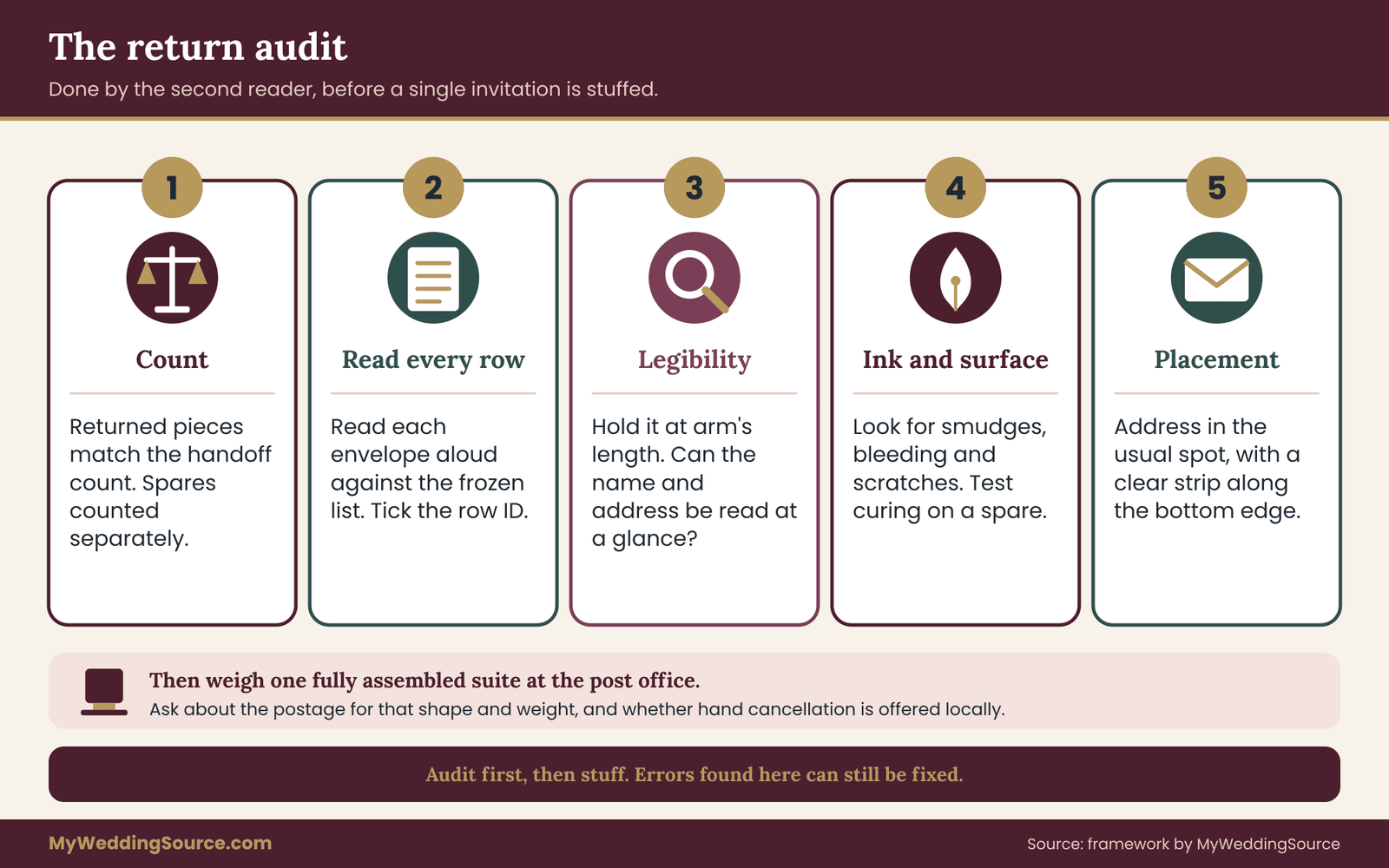
The return audit
When the envelopes come back, resist the urge to start assembling. Do the audit first. It has a simple structure, and it should be completed by the second reader, not by the person who has been staring at the list.
Count. Count the returned pieces and compare the number with the handoff count. The numbers should match, with spares counted separately.
Read every name and address against the frozen list. Read aloud, row by row, comparing the envelope to the list. This is the most important step. Mark each envelope with a small pencil dot on the back flap when it passes, in a place that the closure will hide, or keep a tally sheet by row ID.
Check legibility. Hold each envelope at arm’s length. Can you read the name and address at a glance? If one is hard to read, set it aside for a second opinion.
Check ink and surface. Look for smudges, fingerprints, bleeding, scratches and uneven coverage. Run a clean finger lightly over a corner of a spare to test whether the ink is cured; do this on a spare envelope, not on a finished one. An audit done by a fresh pair of eyes is the cheapest quality control envelope calligraphy will ever get.
Check placement. The address block should sit where mail equipment expects it, with a clear strip along the bottom. Compare against a mail-ready envelope from your own mailbox if you are unsure.
Sort errors by cause
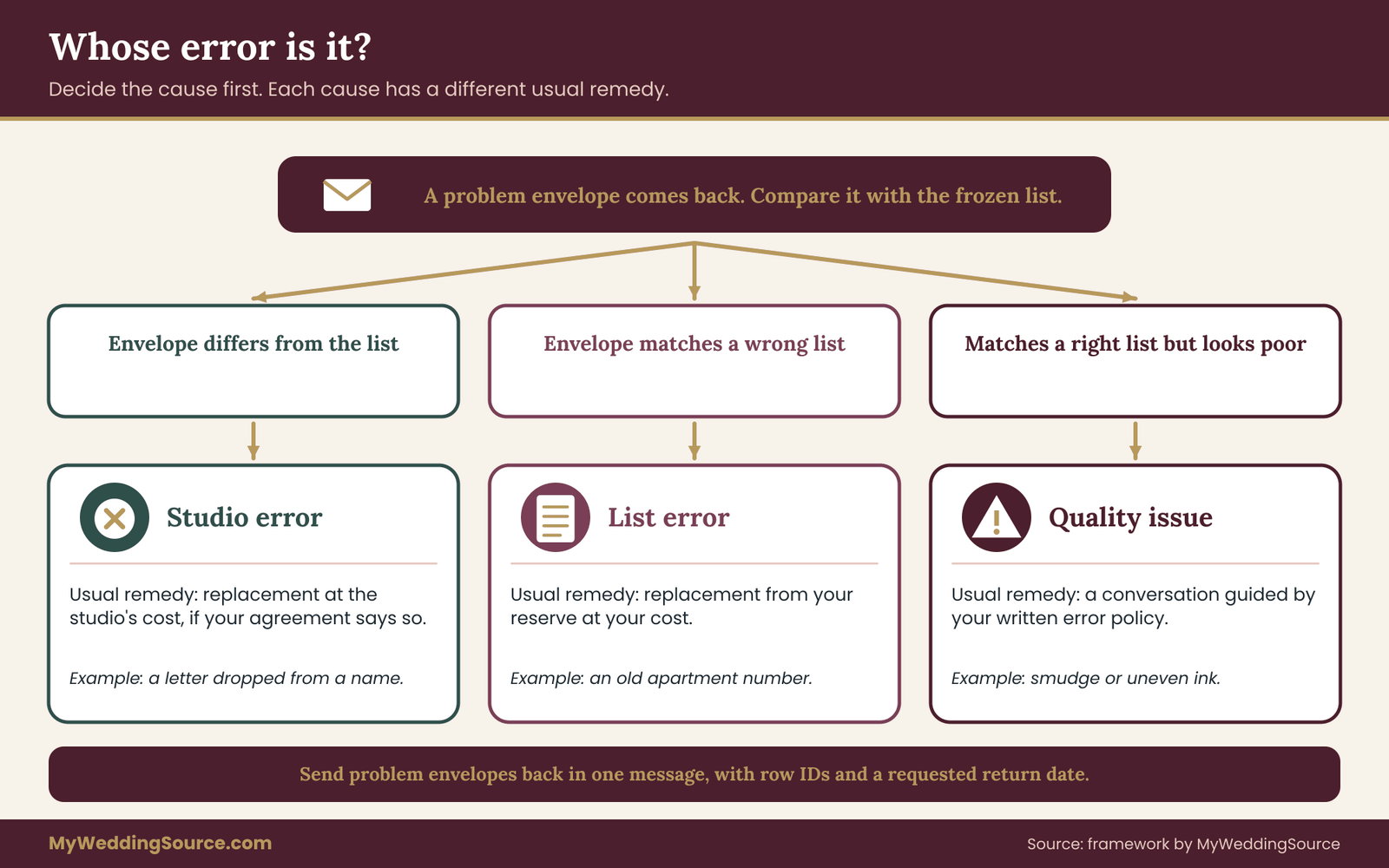
When an error shows up, decide whose it is before deciding what to do. If the envelope says something different from the frozen list, the studio made an error. If the envelope matches the list but the list is wrong, the error is yours. If the envelope matches the list and the list is right but the result looks poor, such as a smudge, it is a quality question that your agreement should answer.
Sorting errors matters because each category has a different remedy. A studio error is usually a replacement at the studio’s cost, if your agreement says so. A list error means a replacement at your cost, which is why a reserve of envelopes exists. A quality issue is a conversation. Keep a short log of each problem envelope with the row ID, the issue and the proposed fix, and send it to the studio in one message rather than in pieces.
How to handle a rewrite
Send problem envelopes back promptly, with a clear note. Ask the envelope calligraphy studio for a date for the return of the replacements, and add that date to the calendar. If the studio asks you to supply the replacement envelopes, use your reserve and recount. If the rewrite pushes the return date past your assembly window, apply the slip rule from the calendar section: absorb the delay in the buffer, reduce scope or move the mailing date. Postage is the last place a surprise can reach your envelope calligraphy, so weigh a finished suite first.
The postage weigh-in
Before you stamp everything, take one fully assembled suite to the post office. The suite should include the invitation, all enclosures, the response card and envelope, any liner and any seal. Ask the clerk to weigh it and tell you the correct postage for that shape and weight. Ask whether the envelope is considered a standard size or whether it takes a surcharge. If the postage is different from your assumption, you have time to adjust.
Ask also whether a hand-cancellation is available for your mailing. Some post offices offer it, and it can reduce the chance of a stamp or a machine mark running across the hand-lettered envelope calligraphy address, but availability is a local matter, so ask and do not assume. If you use special stamps, buy enough of the same design and check the denominations add up to the rate.
Mailing day
Pack the sealed suites in order, in sturdy boxes, flat and dry. Keep the list handy with a column for the mailing date. Take the whole batch to the counter at a quiet time, such as mid-morning on a weekday. If the clerk needs to count them or check them, let them. Keep the receipt if one is offered.
After mailing, keep a handful of reserve envelopes and the envelope calligraphy writer’s contact details within reach. In the first two weeks, most problems come from returns and late address corrections. A short, calm routine for each one, using the reserve and the studio’s small-batch policy, keeps these from turning into a crisis. Mailing day should feel uneventful, which is the sign that the envelope calligraphy project was planned well.
Record what you learned
When the project is finished, write a short note: what the studio quoted, what actually happened, which dates slipped and which buffers helped. If you have friends who are also planning, that note is more valuable than any generic advice. For couples keeping a larger archive of wedding paperwork, the same file can hold the agreement, the final invoice and the proof of payment.
What envelope calligraphy costs and how to compare quotes
You will not find a universal price in this guide, because rates differ by region, studio, style and season, and any figure printed here would be out of date or unrepresentative. What you can do is understand how a quote is built, so that you can compare quotes on the same footing and see where a decision changes the number.
The parts of a quote
A typical quote combines a per-piece rate, which may differ for outer envelopes, inner envelopes and extras; a minimum order or setup fee; surcharges for dark paper, metallic ink, extra lines, long addresses or special characters; a rush fee if the calendar is tight; the cost of return shipping and insurance; and possibly a sample fee. Some studios quote a package price for a stated number of pieces. Ask every studio to price the same envelope calligraphy spec, or the numbers will not compare.
The logic of the cost is roughly this. Total cost equals the rate per piece times the number of billable pieces, plus any fixed fees, plus surcharges, plus shipping. Everything in that formula is something you can control or at least ask about.
Levers you control
Piece count. Dropping inner envelopes, trimming the list or combining households that share an address reduces the number of pieces. Do not cut the spare allowance to save money until you have asked the envelope calligraphy studio what it expects.
Lines per envelope. Hand-lettering only the names and printing the address is the most common way to reduce labor.
Ink and paper. Plain dark ink on light paper is usually the simplest, so a quote with that spec often costs less than the same order in a metallic ink on a dark envelope. Ask the studio whether this is true for its pricing. Money saved on envelope calligraphy should never come from skipping the spare envelopes or the sample.
Timing. A rush order generally costs more. Booking early and keeping the calendar healthy usually avoids rush fees. A change after the freeze can add cost.
Approach. Printed or hybrid addressing can reduce the labor portion of the cost. If budget is a concern, request a quote for each approach and compare.
Compare like with like
When you have two or three quotes, write each on a single page using the same structure: pieces, rate, fixed fees, surcharges, shipping, rush, sample fee and the error policy. A cheaper rate with a restrictive error policy may cost more in the end than a slightly higher rate with replacements included. If a vendor does not break out the parts, ask for it. Place the final number next to the envelope line in your wedding budget, alongside postage, which is a separate line and easily forgotten.
What not to trust
Be cautious about sweeping claims, such as a studio promising that it never makes mistakes or that its work will be ready by a date it has not confirmed in writing. Be cautious too about rankings or lists of the best calligraphers, which are often paid placements. Rely on direct evidence: your own sample, a written quote and a clear agreement. If a vendor has a commercial relationship that affects a recommendation, you are entitled to ask about it. Once the quote is chosen, record the final envelope calligraphy figure beside postage in your budget.
Your next steps
- Decide which parts of the envelope are handwritten, and choose between fully hand-lettered, printed and hybrid addressing using the decision rule in this guide.
- Count pieces, including spares and a reserve, and write that number down.
- Choose your mailing date, then work backward and place the seven dates on a shared calendar with buffers.
- Build one master address list with separate name lines, and run the measurable checks with a second reader.
- Ask two or three studios for written quotes on the same spec, and order a paid sample on your actual envelope stock.
- Mail the sample through the real mail, and show it to three readers before you commit.
- Sign a short agreement that names the piece count, dates, error policy and return handling.
- Freeze the list, send the handoff packet, confirm receipt, audit the return and weigh a finished suite before mailing.
FAQ
How far ahead should I book a calligrapher for envelopes?
It depends on the studio and the season, so ask each studio how far ahead it books. Many popular calligraphers fill their calendars months before the writing window, particularly before busy wedding periods and the holidays. A reasonable approach is to contact studios as soon as you have a rough guest count and a target mailing date, then confirm the writing window and return date in writing.
How long does envelope calligraphy take for a hundred households?
There is no single answer, because style, ink, paper and the number of lines per envelope all change the pace. Ask for a written turnaround for your exact piece count, then add a buffer for drying, packing and shipping both ways. In this guide a two-week quoted window became a three-week calendar slot, but your figures should come from your own quote.
Is hand-lettered envelope calligraphy readable by the postal service?
Often yes, when the delivery address is clear, dark against a light background and placed where equipment expects it. Highly ornate scripts, pale or metallic inks and crowded layouts can reduce readability. Test a sample through the real mail, and check current formatting standards on the Postal Service’s own pages. A hybrid approach, with a plainly printed address, gives mail equipment the cleanest read.
Should I do inner envelopes if I am paying per piece?
Inner envelopes double the piece count in the simplest case, which raises cost and writing time. Many modern suites skip them. If children are named on the invitation, or you want the traditional layering, the inner envelope has a purpose. Decide on the invitation wording first, then count pieces. If budget is tight, hand-lettering only the outer envelope is a common compromise.
How many spare envelopes should I buy?
Ask the envelope calligraphy studio, because some include a spoilage allowance and others expect you to supply extras. This guide used fifteen percent of the base count as an illustration, plus a separate reserve for late additions and returned mail. A smaller list may warrant a proportionally larger reserve, since a few replacements represent a bigger share of the total.
What should I do if a name is misspelled on a finished envelope?
First decide whose error it is by comparing the envelope with your frozen list. If the envelope differs from the list, it is a studio error and your agreement should state the remedy. If it matches a wrong list, the error is yours and a replacement comes from your reserve at your cost. Either way, report it promptly and in writing, with the row ID.
Is printed calligraphy a lesser choice than hand-lettering?
No. It is a different tool with different strengths: consistency, speed and easy corrections. It can be the sounder choice for large or changing lists and tight calendars. The honest issue is labeling. If a quote says hand-lettered, confirm that each envelope is written by a person. If you are buying printed calligraphy, that is a perfectly reasonable thing to buy, as long as you know it.
What belongs in the file I send to the calligrapher?
Send only what the writer needs: row IDs, outer and inner name lines, and the address lines, in a dated frozen file. Add a short spec sheet and a list of hard cases with row IDs. Leave out phone numbers, email addresses and private notes about guests. Treat the list as other people’s personal data, and delete shared copies once the project is complete.
Sources
- United States Postal Service: mailing standards, postage and services.
- Postal Explorer, USPS: the Domestic Mail Manual and Postal Addressing Standards.
- USPS ZIP Code and address lookup tools: address standardization and ZIP code lookup.
- USPS Frequently Asked Questions: consumer help on mailing, forwarding and returned mail.
- About USPS: postal service publications and policies.
- USPS PostalPro: mailpiece design and addressing guidance for mailers.
- Federal Trade Commission: consumer protection guidance on dealing with businesses and disclosures.
- USA.gov consumer resources: directory of state and local consumer protection offices.
- National Archives: preservation guidance for paper and records.
- Library of Congress: collections and reference resources on the history of writing.