

Potted plants wedding decor works best when every pot passes two inspections before guests arrive: a stability check on the pot itself and a width check on the path around it. This guide gives you a six-step pot and path inspection, with measurable checks, vendor questions and a worked example, so potted plants add atmosphere without adding a fall.
Treat each of your potted plants as a small piece of furniture. Push it to see whether it tips or slides, keep at least 36 inches of clear width on any route guests must use, keep floor-level items out of the center of the path, check that saucers, soil and ground surfaces are dry and firm, and confirm that every plant is safe for the people and pets who will be there. Anything that fails a check moves to a wall, a table, a raised stand or off the guest route entirely.
A wedding is one of the few events where a large number of people walk through a space they have never seen, in dress shoes, in the dark, often holding a drink or a child’s hand. Add a few dozen potted plants and the odds of a stumble change.
The risk is not dramatic. It is a hem catching on a terracotta rim, a cane tip finding a saucer, a guest stepping backward to take a photo and meeting a six-foot fig tree. Those small events are exactly what a short inspection can prevent.
This article is about floor-standing and low-set potted plants, the plants most likely to sit in a walking route: the olive trees at the ceremony entrance, the rows of herbs along an aisle, the large planters that frame a photo corner, the small pots that mark seating cards. It does not cover cut flowers or arrangements in vases. Those have their own height and sightline questions, which the site covers elsewhere, and this guide stays on the problems that come from soil, weight, water and floor space.
A note on scope. This is general information, not legal, tax or financial advice. Accessibility rules, fire codes and venue policies differ by place and change over time, so where a number matters, the article names the issuing agency and asks you to confirm the current text yourself.
Why potted plants wedding decor becomes a trip hazard
Greenery feels soft and forgiving, which is part of why couples choose it. But a pot is a rigid object with a heavy base, sitting on a floor, in a path. The feeling of softness is the leaf. The hazard is everything underneath it.
It helps to name the four separate ways that potted plants cause falls, because each one needs a different fix.
Tipping. A tall plant in a light or narrow pot has a high center of mass and a small footprint. A hand on a branch, a child leaning on the pot, or a gust of wind can bring it down. The injury risk is to whoever is next to it and to anyone underneath.
Tripping. A low pot, a saucer, a wire support or a rim edge catches a foot. This is most likely in dim light, at the end of the evening, or where a pot sits at the margin of a path that guests assume is clear.
Colliding. Branches and fronds extend past the pot into the walking space at hip, shoulder or face height. Guests who use a cane, who are blind or have low vision, or who are looking at a phone may not detect them until contact.
Slipping. Water from saucers, spilled soil, fallen leaves and petals, and wet lawn or smooth stone around a watered pot can turn a dry floor into a slick one.
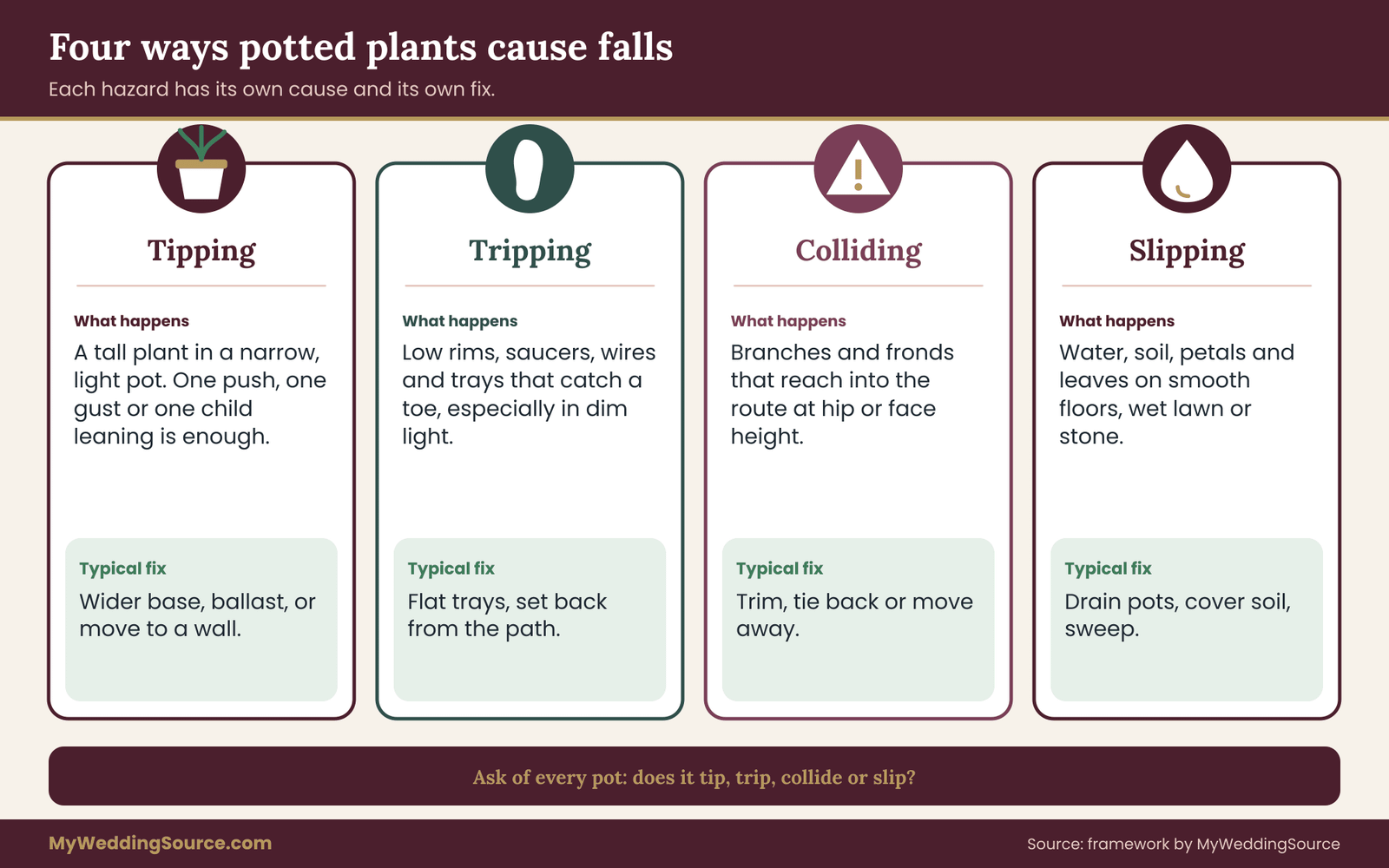
Each of these has a measurable check, and that is the idea behind the inspection in the next section. Instead of asking whether the potted plants look safe, you test it against a short list of questions that anyone on the planning team, or a venue manager, could repeat and get the same answer.
Who is most affected
Everyone benefits from a clear path, but a few groups feel the difference first. Guests who use wheelchairs or scooters need wide, level, firm routes, and they cannot step around an obstacle the way a standing guest can. Guests who use canes or walkers need predictable floor space and detectable edges. Blind and low-vision guests rely on the layout staying where it was when they first walked it.
Older guests are more likely to be seriously injured in a fall, and the Centers for Disease Control and Prevention publishes falls prevention information for older adults that is worth a read if your guest list skews older. Young children move fast and treat anything at their height as something to touch, climb or hide behind.
None of this means giving up on potted plants. It means deciding where each pot goes on purpose. The site already has a guide to accessible wedding venue red flags, which covers the venue side of this problem: steps, thresholds, restrooms and parking. This guide picks up where that one stops, at the decor you bring in yourself.
What the venue and the florist each control
Two parties usually share the responsibility, and problems appear in the gap between them. The venue controls the building: the floor surfaces, the fixed furniture, the egress routes, the fire code limits on what can sit in a corridor or near an exit, the lighting levels, and the rules about open flame and water on the floor. The florist or plant rental company controls the objects: which pots, how heavy, how tall, how they are staged and how they are removed.
Neither party controls how guests behave, and neither one is going to walk the room as a guest in heels at the end of the night unless you ask. A common failure is that the florist places pots exactly where the design sketch says, the venue manager approves the sketch without measuring anything, and the first person to find out that the aisle is too tight is a guest in a wheelchair at the ceremony.
The inspection in this guide gives you a way to have that conversation earlier and in specific terms.
Where plants fit in the wider plan
Potted plants also touch other parts of your plan, and it helps to see where. They affect the room layout, which the reception guest flow guide covers in detail: where guests enter, queue, sit, eat and leave. They affect load-in and load-out, which the venue technical walkthrough is built to settle, including loading doors, elevators and floor protection.
If the plants are rented, they also belong in your rental planning checklist alongside chairs, linens and lighting. And they affect your end-of-event plan, because live plants are one of the few wedding items that can be reused, donated or replanted rather than thrown away.
Why a plant-specific approach is worth the time
A reasonable question is whether any of this is needed. Many weddings use potted plants and nothing goes wrong. That is true, and it is also true of many events that skip a fire exit check. The point of an inspection is that it is cheap compared with the cost of a fall at your own wedding. Nothing in the process takes more than a few evenings, and most of the checks can be done with a tape measure, a phone and a friend.
There is also a design reason. Decor that blocks or crowds a path tends to be moved by venue staff on the day, usually in a hurry and without asking you. A layout that has already been measured and approved is much less likely to be rearranged under pressure at four o’clock on the wedding afternoon.
The rest of this guide is organized around a single working method for potted plants. The next section lays out the six checks. The sections after it go through each check in depth, then cover where to place pots in each part of the day, how weather and light change the picture, how to think about plant safety, which questions to ask vendors, a worked example, and a comparison of alternatives for the places where a floor pot is the wrong answer.
The pot and path inspection for potted plants
The inspection is a six-step routine you can run on every one of your potted plants. It is original to this guide, not an industry standard, and it borrows its measurements from public accessibility guidance where a published number exists. Where a threshold is a working rule of thumb, the text says so, and you should adjust it with your florist and venue.
The six checks, in order, are:
- Footprint and weight. Is the pot wide and heavy enough for the plant it holds?
- Tip test. Does the pot stay put when pushed the way a guest might push it?
- Clear width. Is there enough open floor beside the pot for the people who need to pass?
- Edges and reach. Do leaves, branches, rims, saucers or supports stick into the walking space?
- Surface and water. Is the floor under and around the pot firm, level and dry?
- Plant safety. Is every plant in the pot suitable for the guests, children and animals who will be nearby?
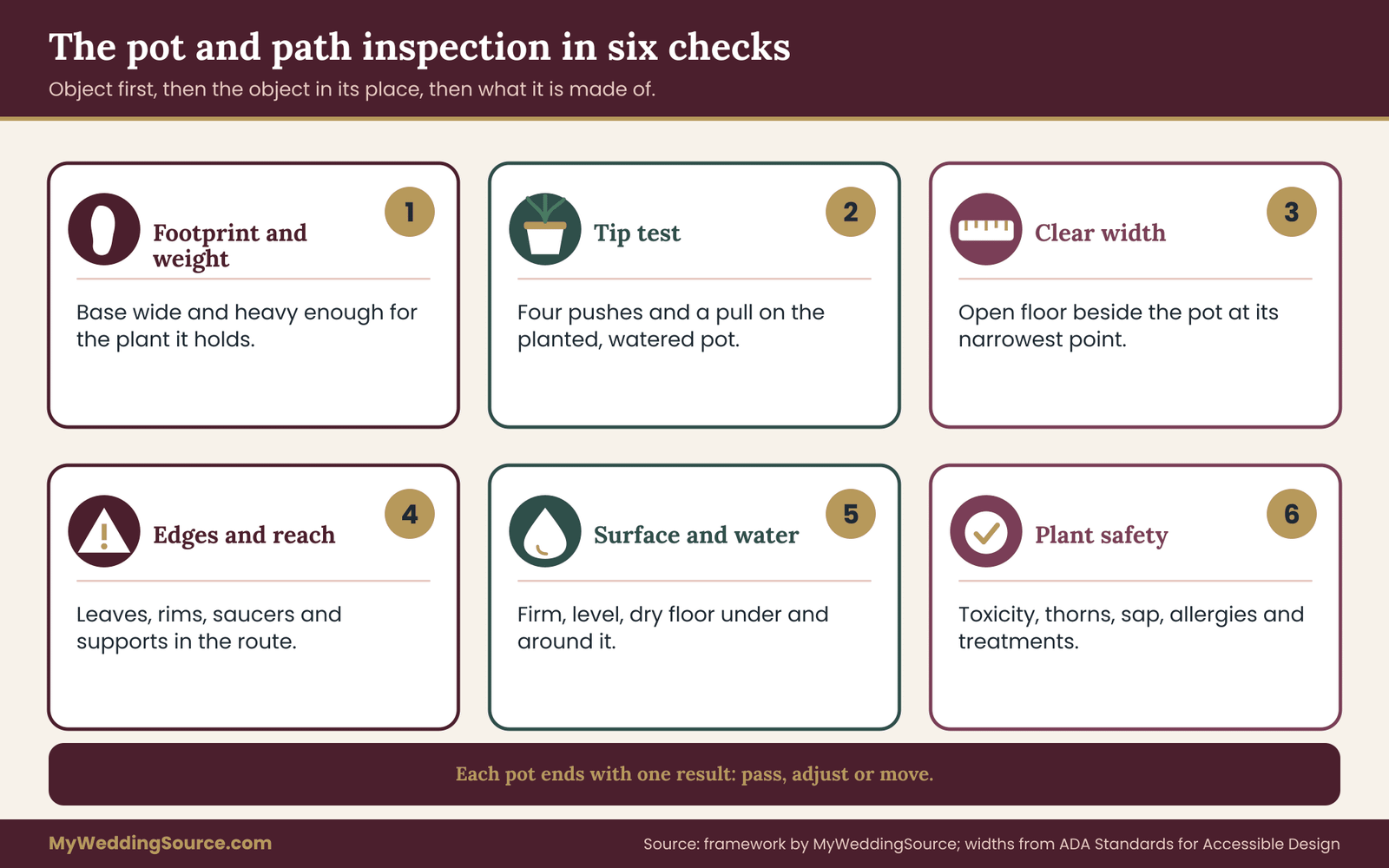
The order matters. The first two checks are about the object, the next three are about the object in its place, and the last is about what the object is made of. If a pot fails the first two checks, there is no point measuring the path yet, because the pot will need to be replaced or reinforced and the measurements will change.
Three results, not two
A plain pass or fail is too blunt for a design process. Couples tend to argue with a fail, and they tend to ignore a pass that was given grudgingly. Use three results instead.
Pass means the pot meets the check as it stands. Write it down and move on.
Adjust means the pot can stay in the location if something small changes: add weight to the base, pull the pot six inches back from the path, trim a branch, replace a saucer with a flat tray, add a low-contrast mat or rope marker. Adjust results come with an owner and a time.
Move means the pot cannot stay where it is. It goes to a wall, a table, a raised stand, a corner out of the walking route, or off the guest side of the room entirely. A move result is not a verdict on the plant. It is a verdict on the location.
Having three outcomes makes the conversation with a florist easier. Florists are used to adjusting a layout. They are less comfortable being told that a design they spent a week on has failed.
Who runs the inspection
Ideally it is run twice by different people. The first run happens during planning, with the florist or rental company, using the layout sketch, the pot specifications and the floor plan. The second run happens on site, after setup, and it should include someone who did not design the layout. A friend, a family member or the day-of coordinator works well. A fresh pair of eyes notices things the designer has stopped seeing.
If you have a guest who uses a wheelchair, cane or walker, or who is blind or has low vision, and they are comfortable with it, a short walkthrough with them before the event can answer questions that no measurement will. Ask as a favor, not as an audit, and be ready to act on what they say. If that is not possible, the measurements in this guide are a reasonable proxy, but they are not a substitute for the experience.
When to run it
There are four natural points to inspect potted plants. The first is during design, before you order, when changes are free. The second is at delivery, when the pots arrive and you can check what was ordered against what showed up. The third is at final setup, before any guest enters the room, when you walk every route in the dress shoes you will actually wear, or ones with a similar heel and sole.
The fourth is mid-event, when the room has changed: chairs have moved, coats have piled up, guests have rearranged things, and a pot that passed at four may be a problem at nine.
The mid-event check can be as simple as a ten-minute lap by a coordinator with a flashlight at the point when the room darkens or the dancing starts.
Keeping a one-page record
You do not need software to keep track of potted plants. A single page with one line per pot works. Each line has a number or a short name, the location, the result on each of the six checks, and a note for anything marked adjust or move. Number the pots on the floor plan too. When you hand the sheet to the florist and the venue contact, everyone is talking about the same pot.
For a wedding with a dozen pots, the whole record takes about as long to write as a vendor email. For a wedding with fifty, it is worth putting the numbers on small tags on the base of each pot, away from the guest-facing side.
What the inspection does not do
It does not replace the venue’s own rules. Many venues have policies about decor in corridors, near exits and on stairs. Fire codes in many places limit what can sit in an exit route, and the National Fire Protection Association publishes the model codes that local rules often draw from. Your venue manager or the local fire authority is the right source for what is required where your wedding will be held.
It also does not predict every accident. A drunk guest can trip over a perfectly placed pot. A sudden storm can overturn a pot that was perfectly stable. The inspection reduces the likelihood of a problem and makes the remaining risks easier to see and discuss. It does not remove them.
How the inspection changes the design conversation
Couples sometimes worry that an inspection will drain the beauty out of a layout of potted plants. In practice it tends to improve the design, because it forces decisions that were being avoided. Where, exactly, does the line of olive trees end? How far from the guest tables does the large planter sit? What happens to the pots during the dance? The design that comes out of the inspection is usually calmer, with potted plants placed on purpose, with fewer, larger, better-placed plants and cleaner lines of movement for guests.
There is a cost side too. A heavier ceramic pot costs more to rent and more to move. A smaller number of large plants may cost more per plant than a larger number of small ones. The inspection makes those trade-offs visible early, when you can still choose between a bigger budget, a smaller scale or a different approach for certain locations.
A short vocabulary for the team
A few terms keep conversations about potted plants short and reduce misunderstanding between you, the florist and the venue.
The footprint of potted plants is the area the base of the pot covers on the floor, including the saucer or tray if there is one. The spread is how far the foliage extends beyond the pot in any direction. The walking route is any path guests are expected or likely to use, including the shortest line between two obvious points, even if no one designated it. The clear width is the open floor between the nearest edges of two obstacles, measured at the narrowest point and counting any protruding foliage.
The overhang is any part of the plant or support that extends into the walking route above the floor. The tip load is the sideways force at which a pot begins to tip, which you can only learn by testing or by asking the supplier for data.
Using the same words every time makes the written record clearer and helps everyone on the day.
Choosing pots and potted plants for stability
Stability in potted plants is mostly decided before anyone carries a pot into the room. It comes from three things: how low the weight sits, how wide the base is, and how much of the plant extends above and beside the pot. The first check in the inspection of potted plants, footprint and weight, is where those three come together.
Low weight, wide base
Think of any of your potted plants as a lever. A plant that is tall and top-heavy, in a pot that is light and narrow, will tip with very little force at the top. A plant that is shorter, with a wide and heavy base, needs much more force. Nothing about this is specific to weddings, but weddings add crowds, wind and dim light, which are exactly the conditions that turn a small push into a fall.
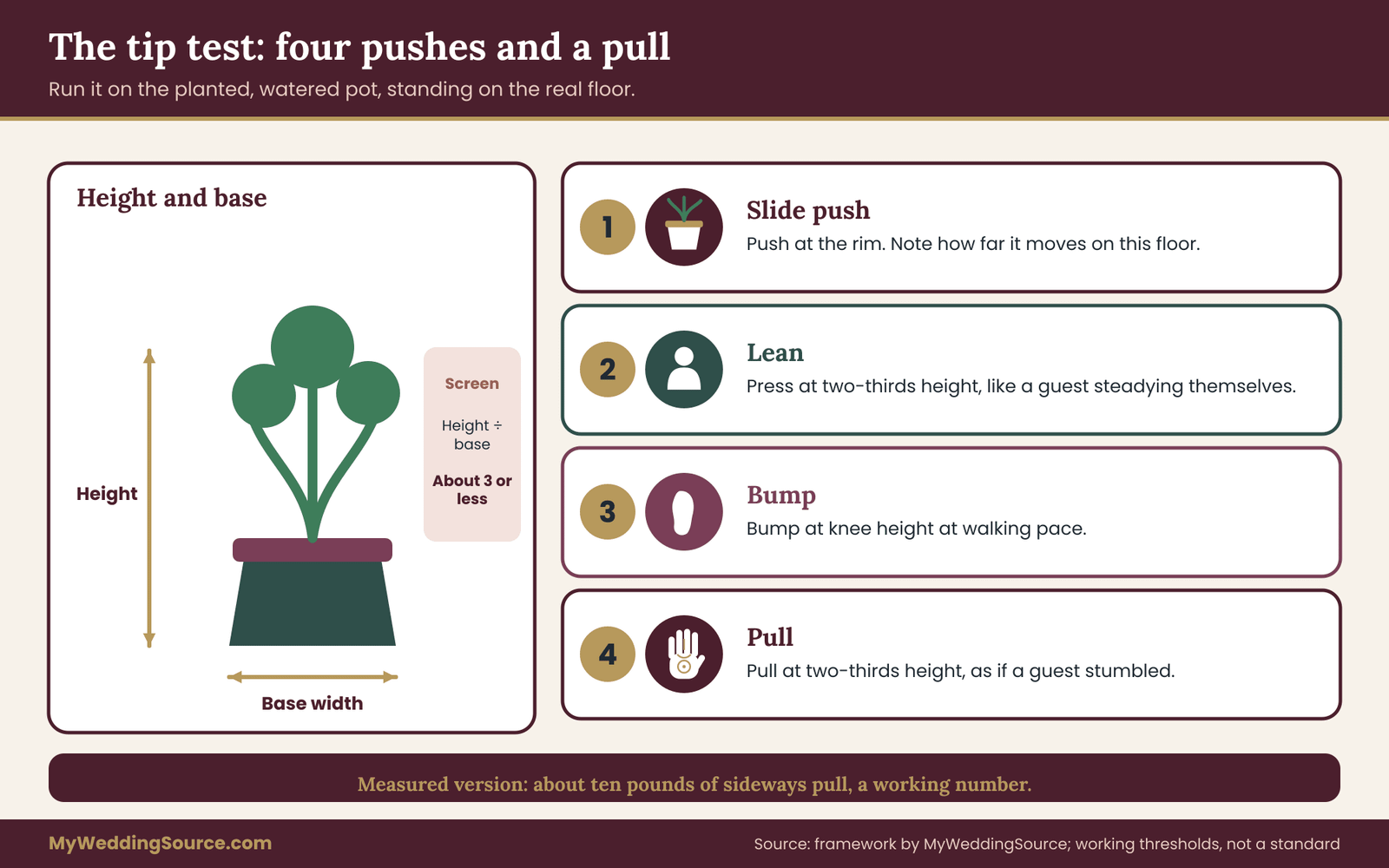
Here is a working rule of thumb for this guide. Measure the full height from the floor to the top of the plant, and measure the width of the base at the floor, including any saucer. Divide the height by the base width. If the result is around three or less, the pot is usually reasonable for a spot near a walking route.
If it is above three, the pot needs more weight, a wider base or a different location. This is not an engineering standard, and a heavy pot with a high ratio can be steadier than a light pot with a low one, so treat it as a quick screen that tells you which pots deserve the tip test first.
Round numbers are easier to use than precise ones. A pot that is fourteen inches across at the base holding a plant that is four feet tall has a ratio of about three and a half. It is a candidate for extra ballast or a move. The same plant in a pot twenty inches across has a ratio of about two and a half and is much less worrying.
Where the weight sits
Wet soil is heavy, and a root ball in a nursery pot sitting inside a decorative cover is only as stable as the cover. Many rental and florist setups use a lightweight plastic nursery container dropped into a decorative cachepot, sometimes with the gap filled with paper or moss. If the inner pot can shift, the whole assembly can rock.
Ask whether the plant is potted directly into the decorative container or sits inside it. If it sits inside, ask how it is secured. A common fix is to add a layer of weight in the bottom of the outer container before the inner pot goes in, then wedge the inner pot so it cannot slide. Loose rocks on top of the soil add a little weight, but they also scatter when the pot tips and become a slip hazard. Weight placed low and out of sight is better.
Watering matters too. A dry plant in a pot is much lighter than a watered one. A pot that was stable when watered in the greenhouse may be lighter on the wedding day. If the florist plans to water at a particular time, the tip test should be run at the state the pot will be in during the event, not during setup.
Pot materials and what they mean in a room
Each common pot material has a particular strength and a particular weakness in a wedding setting.
Terracotta and unglazed clay is heavy and stable but has a rough surface that snags hems and can chip into sharp edges. It is also porous, so it sweats water onto the floor under it, which is a surface concern more than a stability one.
Glazed ceramic is heavy, smooth and looks polished. It is also fragile, can have sharp rims if chipped, and is slippery to carry. On a hard floor, a ceramic pot can slide if bumped.
Fiberglass and resin is light for its size, which makes it easy to move and easy to knock over. It often comes in tall, narrow shapes that look elegant and tip easily. If it must be tall, it usually needs ballast.
Metal planters and galvanized buckets can look rustic and are usually mid-weight, but edges can be sharp and the surfaces can get hot in sun or cold in shade. Galvanized containers dent and can leave sharp points where they are crimped.
Wood planters and crates have a flat bottom that stays put and a rim that is easy to see. They can splinter and can leak onto floors when lined poorly.
Fabric grow bags and soft containers are light and flexible and slump when the soil settles. They are rarely stable on their own and generally need a tray, crate or decorative holder.
Plastic nursery pots are fine for hidden inner pots and not good as a visible container in a walking area, because the base is narrow compared with the plant.
None of these is wrong. The question is which one is right for the location and the plant.
The plant itself
The shape of the plant matters as much as the pot, and some potted plants are simply poor candidates for a walking route. A single-trunk tree concentrates its weight high up and can lever the pot over. A bushy plant that spreads low has a lower center of mass but also extends further into the path. A tall, thin plant, such as a bamboo or grass in a narrow pot, is easy to tip and also easy to see through, which makes it less visible to some guests.
Look at four features: the height, the spread, the stiffness of the stems and the presence of thorns, spines or sharp leaf tips. Stiff, sharp or spiky foliage near a walking route is a collision risk even when the pot is stable. Hanging or trailing foliage that reaches the floor is a trip risk. Plants with large leaves can act as sails in wind. A topiary or standard tree with a ball of foliage on a thin stem is more wind-prone than the same plant pruned to a more open shape.
Using wheels and dollies
Some rental companies supply potted plants on wheeled bases, which makes setup and removal easier. Wheels are convenient and, for guest-facing locations, risky. A wheeled base moves when pushed, which is the opposite of what you want in a path. If wheels are used, they should lock, and the locks should be engaged and checked.
Better, remove the dolly once the pot is in place, or place the pot on a flat, non-slip mat. If the plan relies on dollies for removal at the end of the night, make sure a staff member is assigned to handle it, so guests are not rolling pots out of the way.
Lifting and handling
Heavy pots are also a staff safety question. Florists, venue staff and rental delivery crews lift them, and a very heavy pot can cause a back injury long before it reaches a guest. Ask the supplier for the weight of each large pot when planted, and ask how many people are expected to move it. If a pot needs two people to lift, confirm that two people are scheduled at load-in and at load-out. Loading doors, elevators and floor protection become more important when pots are heavy.
Buying, renting or borrowing
Rental is common for large, expensive potted plants such as olive trees, citrus and palms. It is also the situation where you have the least control over the pot. Rental companies often have a catalog of standard containers, and the plant in your photo may not be the plant that is delivered.
If your layout depends on a certain height or spread, put the dimensions in the order, not just the plant name. The site’s rental planning checklist explains how to compare rental quotes, delivery windows and damage terms, and those questions apply to plants as much as to chairs and linens.
Buying potted plants for reuse in your home garden is a different path. You control the pot and the plant but not the delivery, and you need a plan for the pots before and after the wedding. Borrowing from friends is the least predictable: the pots vary in size, weight and state of repair, and each one needs its own inspection.
Matching pot and plant to location
A quick way to apply all of this is to sort your potted plants into three groups before you finalize the layout. The first group is potted plants that are stable and low enough to sit near a walking route: wide, heavy pots with compact plants. The second group is plants that are tall or top-heavy and need to be against a wall, in a corner or behind a barrier.
The third group is plants that are light, wheeled, sharp or very wide and need a different spot altogether, such as a table or a raised stand away from the path.
You will probably find that the design looks the same from the guest side, with the tall plants sitting at the edges and the lower ones closer to the center. That is the direction the next sections follow.
Running the tip test on potted plants
The tip test for potted plants is the second check, and it is the one most couples skip because it feels slightly silly. It is also the one that tells you the most. You are not trying to break anything. You are trying to find out, in a calm room two days before the wedding, what a guest would find out in a crowded room on the night.
Run it on the actual pot of each of the potted plants, planted and watered as it will be, standing on the actual floor surface, or one very close to it. A pot that is steady on carpet can slide on polished concrete, and a pot that is steady on a stone patio can rock on a wooden deck with gaps.
The four pushes
Use four simple pushes, in this order.
The slide push. Place a hand on the side of the pot near the rim and push horizontally with steady force. A stable pot resists. A pot on a smooth floor might slide a few inches. Note how far it moves. If it slides more than a few inches with a firm push, it will move when a guest bumps it with a bag or a chair, and it needs a non-slip mat or a heavier base.
The lean. Place a hand on the plant at about two-thirds of its height and push gently, as if you were leaning on it for balance. This simulates a guest steadying themselves or a child grabbing a branch. The pot should rock slightly at most. If the base lifts on one side, the pot is on the edge of tipping.
The bump. With the side of your leg, bump the pot at knee height at walking speed. Do this gently the first time. This is the push most likely to happen at a real event, and it is the one that tells you whether a pot is likely to be knocked over by a guest passing too close.
The pull. Pull the pot toward you by the plant at the same two-thirds height, as if a guest were grabbing it as they stumbled. A pot that is stable against a push may still tip toward a pull if the base is narrow.
Run each push on each of the four sides, because the center of mass is rarely in the middle. If you cannot get a friend to help, the test still works alone. The Consumer Product Safety Commission publishes tip-over safety information for furniture, and the same physics applies to a tall pot: a high load on a narrow base falls over with little warning.
A measured version
If you want a number, a hand-held spring scale, the kind sold for weighing luggage, gives you one. Hook it to a strap around the plant at about two-thirds of its height and pull horizontally. Note the reading when the base first lifts or the pot starts to slide.
There is no published standard for how much force a decorative pot should withstand at a wedding, so any threshold is a judgment call. As a working number for this guide, a pot that stays put under a steady horizontal pull of around ten pounds is a reasonable candidate for a place near a walking route, and a pot that tips well below that belongs against a wall or needs more weight.
Ten pounds is a convenience, not a safety certification. The value of the number is comparison: run it on every pot, and the weakest ones will be obvious. If a florist or rental company has their own stability data, ask for it and use it instead.
Test the state it will be in
Run the test again after anything changes. If the plant is watered, test after watering and after it has drained. If a pot will be placed on a riser, platform or stand, test it there. If a light string or a ribbon is attached to the plant, test with it attached. If a pot is moved between the ceremony and the reception, test it again in the new location.
A related point is the effect of wind and sun on weight. A pot that stands in sun all afternoon dries out and gets lighter. A pot that is watered just before guests arrive may be at its heaviest. Ask the florist when the last watering is planned, and ask what the pot weighs at the light end of that range.
Pass, adjust, move
A pot that holds against all four pushes and the measured pull passes. A pot that fails one or two but could be fixed adjusts. Typical adjustments include:
- adding ballast low in the pot, hidden under the plant, sealed so it cannot scatter;
- swapping to a wider cachepot or setting the pot in a heavy tray;
- placing a non-slip mat under the pot on a smooth floor;
- tying the plant’s top to a discreet stake, which holds the plant upright in the pot but does not stabilize the pot itself;
- pulling the pot against a wall or into a corner, where it can lean on two surfaces.
A pot that fails multiple pushes and cannot be fixed moves. Keep the plant but change its role: put it on a table, a wide plinth with a heavy base, a mantel or a window ledge, or use it as a backdrop where guests do not walk.
What not to rely on
Do not rely on guests being careful. Do not rely on a pot being heavy because it looks heavy, since fiberglass can mimic stone. Do not rely on potted plants being short, because a short pot with a wide spread can be a trip hazard even when it never tips. And do not rely on a single check done early, because weights and conditions change.
Measuring the path around potted plants
Stability protects the pot. Measurement protects the person walking past potted plants. The third and fourth checks look at the clear width of the route and whether anything sticks into the walking space at the wrong height.
A published benchmark for width
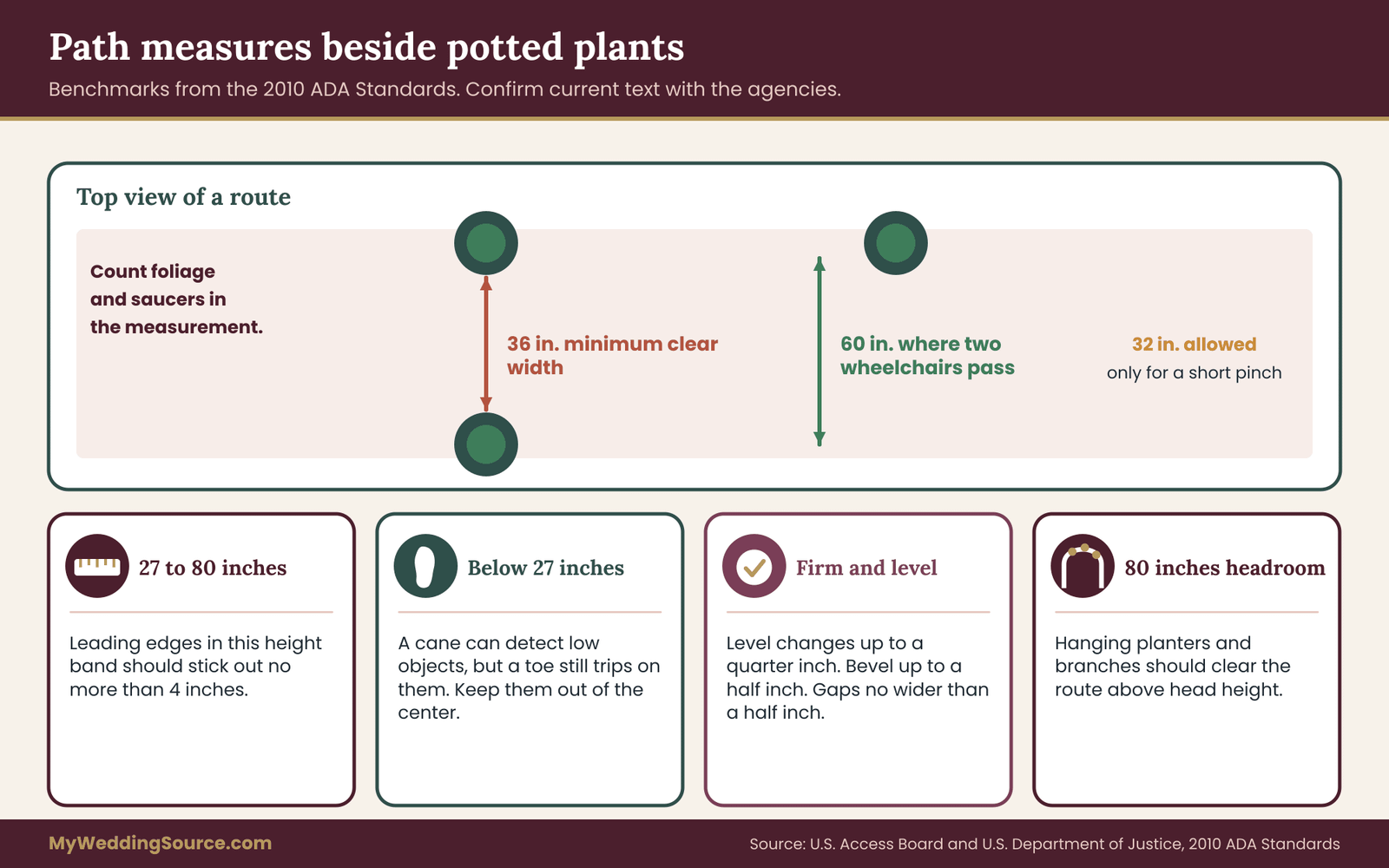
The 2010 ADA Standards for Accessible Design, published by the U.S. Department of Justice and the U.S. Access Board, set the minimum clear width for an accessible route at 36 inches, with a narrowing to 32 inches allowed for a short distance of up to 24 inches in length, such as at a doorway. They also call for a space of at least 60 inches where two people using wheelchairs need to pass each other, and for a turning space about 60 inches across where a wheelchair needs to reverse direction.
Those standards apply to buildings and facilities, not to temporary decor at a private event, and your obligations as a host are not the same as those of a public venue. Still, they are the clearest published numbers for what a mobility device actually needs, and they are a good benchmark. Check the current text of the standards on the issuing agencies’ sites before you rely on any figure, because rules are updated.
Apply the numbers to your own route like this. Measure the narrowest point between a pot and the next obstacle, whether that is another pot, a chair, a table or a wall. Count the foliage and the saucer in the measurement, since a wheelchair wheel or a walker has to clear the widest part.
If the narrowest point is 36 inches or more, the width check passes. If it is between 32 and 36 inches, it passes only if the narrow stretch is short, and it is worth asking whether a pot can move. If it is under 32 inches, the check fails.
Wider is better. A route that must carry a line of guests, such as the ceremony aisle, benefits from more than the minimum, because two people walking side by side, or a parent and a child, need room. Many couples find that 48 to 60 inches feels comfortable for an aisle. Treat that as a design preference, not a requirement.
Reach and protrusion
Height matters as much as width. The same standards describe objects that stick out into a walking route. Anything with a leading edge between about 27 and 80 inches above the floor should protrude no more than 4 inches into the route, because a person who uses a cane can detect something low, near the floor, but may not detect something at hip or head height until they hit it. Objects below about 27 inches are generally detectable by a cane. Headroom should be at least 80 inches.
For potted plants this is a practical test, not a theoretical one. Stand at the edge of the route and look at each plant from the side. Does any branch, frond or support stick out into the route at hip, chest or face height? If it extends more than a few inches, trim it, tie it back or move the pot further from the route. Large leaves that hang at face height beside a path are a common culprit, especially on tree-form plants.
Low pots and floor-level objects
Low potted plants, saucers and trays near the floor are detectable by a cane but still a trip risk for guests who do not use one. They are hardest to see in low light and when the route has patterned flooring or a runner. The safest approach is to keep floor-level objects out of the center of a walking route and to use them only at the margins, where they define the edge rather than occupy it.
If you want a line of small pots along an aisle, set them back from the route by at least a foot, so that they are clearly beside the path, not in it. A contrasting border, such as a strip of rope light or a lighter runner, helps guests see where the path ends and the decor begins.
Floor surface and level changes
The same standards ask for surfaces along an accessible route to be firm, stable and slip-resistant. For temporary events, that raises questions about lawn, gravel, sand and uneven pavers. A vertical change in level of up to about a quarter inch is generally acceptable. A change between a quarter and a half inch should be beveled, and anything higher needs a ramp. Gaps or openings in the walking surface should be no wider than about a half inch.
Potted plants placed on a lawn tend to sink slightly and tilt. Pots on gravel rock. Pots on brick or paver paths can sit on the joints and rock. If the surface is irregular, bring a flat, stable base, such as a sturdy wooden platform or a rubber mat, or choose a different location. If a mat or platform is used, make sure its edges do not create a new trip point. A beveled edge or a flush ramp edge solves most of it.
How to measure in practice
You need a tape measure, a phone, and ten minutes per area. Walk the route from start to finish, as a guest would. At each pot, measure the clear width at the narrowest point, noting foliage. Photograph it with the tape in the picture. Note the height and extent of any overhang. Mark the result on the one-page record. Photos are worth keeping because they let the florist see what you saw without a long email.
If you have access to a mobility device, even a borrowed wheelchair, push it through the route once, loaded with a bag or a person of reasonable weight, and notice where it catches. The first time you do this, you will learn more than any measurement can tell you.
Placing potted plants by zone
Once your potted plants have passed the first two checks, the next job is deciding where each one goes. The most useful habit here is to lay out the routes first and the plants second. Most layouts are drawn the other way around: the designer places the plants where they look best and the guests are expected to find their way through the gaps. A route-first layout flips that.
Draw the routes before the pots
On a floor plan, draw the routes guests will actually use. Include the obvious ones: the path from the parking area or drop-off to the ceremony seating, the aisle, the line from the ceremony to the cocktail area, the entrance to the reception, the routes to the bar, buffet or food stations, the dance floor, the restrooms and the exits.
Then add the less obvious ones that potted plants might block: the shortest line between any two of those points, the route a server will use with a tray, the path a guest in a wheelchair will take when the main route has steps, and the path out of the room in an emergency.
Give each route a width from the measurements in the previous section. Shade the width on the plan. Now place the pots in the space that is left. Many layouts that looked generous turn out to have room for far fewer floor-standing potted plants than the designer planned, and that is useful to know before the order is placed. The reception guest flow guide goes through entry, seating, food and exit patterns in detail and is a good companion for this step.
Three zones for floor placement
For floor-standing potted plants, think in three zones.
The green zone for potted plants is anywhere guests are unlikely to walk: against a wall, in a corner, behind the last row of ceremony chairs, beside a fixed structure, at the back of a stage or backdrop, or in an alcove. Large pots and tall plants belong here. Check the stability and the clear width of the nearest route, and they are usually fine.
The amber zone is the margin of a route: along an aisle, beside a doorway, at the corner of a room, at the end of a table row. Pots here need to pass every check with a margin, and they should be set back from the edge of the route. Compact, heavy, low-spread plants in wide pots are the right choice. Anything tall or wide needs to go back to the green zone.
The red zone is anywhere a pot should not stand at all. That includes the center of any route, the foot and head of stairs, the bottom of a ramp, doorways and door swings, the clear space beside an accessible seating area, any exit route or exit door, and the route to restrooms. It also includes the dance floor, buffet and bar queue areas, and the spots where guests naturally stop and cluster, such as just inside the entrance or just outside the ceremony space.

Ceremony spaces
At the ceremony, the aisle is the highest-stakes route, because every guest sees it and a parent, grandparent or wheelchair user may walk it at slow speed, possibly with an arm to hold. Keep the aisle at a comfortable width, well above the minimum, and keep floor-level plants out of it. If you want potted plants along the aisle, set the pots at the ends of the rows, away from the aisle edge, and keep any low plants on the outside of the chair ends, not the inside.
Think about the end of the ceremony as well as the start. The recessional is faster than the processional, and guests tend to stand and step into the aisle at the same time, so any pot at the end of a row can be bumped. If you plan to use plants as markers for the ceremony entrance, place them on either side of the entry at a distance from the door, not in the opening.
For outdoor ceremonies, check that pots do not sit on the line where chairs will be set or where an aisle runner will be rolled out. A runner lying over the base of a pot creates a new trip edge. If the aisle has a runner, the runner should be taped down, and no pot base should touch it.
Walking through the order of events with your officiant or coordinator helps you spot the moments when guests stand, sit and move, which are also the moments when a pot is most likely to be touched.
Entrances and photo areas
An entrance is where people bunch up. Guests arrive in groups, stop to greet one another and look around, and they do not watch the floor. A pot on either side of an entrance, well clear of the door swing, is a classic look and works if there is plenty of room. A pot inside the swing of the door, or crowding a narrow entry, does not.
Photo corners and backdrops are a second place to be careful. Photographers ask guests to step back, and guests step back without looking. A plant behind a photo spot should be a safe distance behind the line where people stand, and a floor-level pot in the area where guests will be posing is a trip risk. If you want potted plants in the photos, pick a tall plant against the backdrop, with a clear floor in front.
Dining and dancing areas
Floor-standing potted plants in the dining room should stay out of the lanes that servers use. Servers carry trays and plates at chest height, often moving fast, often looking at the tray and not the floor. If you want a pot beside a dining table, leave room for a chair to be pulled out and for a guest to stand up, which is more space than most layouts assume. A chair needs space behind it, and a person getting up needs somewhere to step.
The dance floor should have no pots on it or at its edge. Guests dance, step back, spin and gather, and the dance floor edge is where the room is at its most crowded. Put potted plants beyond the edge of the dance floor and beyond the walking area around it.
Lines at the bar and buffet bend and grow, so the area around them needs to be clear and flexible. Potted plants may sit behind the line but not beside it.
Restrooms, coat areas and accessible seating
Routes to restrooms are used by everyone, including guests who need to get there quickly or with help. Keep them clear. For guests who use mobility devices, check that the route to the accessible restroom is not narrowed by pots and that no pot blocks any door. Wheelchair seating spaces in the ceremony and at the tables should have clear access and not be hemmed in by greenery.
The site’s accessible wedding venue guide covers what to check on the venue side, and it is worth rereading once you have your layout of potted plants.
Exits and emergency routes
Exit routes and exit doors are the strictest category. Local fire rules commonly restrict what may be placed in exit access, and the National Fire Protection Association publishes model codes that many jurisdictions adopt in some form. A pot in an exit route is a hazard and may be a code violation. Ask the venue manager what is allowed, and do not rely on guesses. If the venue has a fire marshal or a policy, follow it exactly.
Water, saucers, soil and ground surfaces
The fifth check is about what is underneath and around potted plants. Water and soil are what turn a stable pot into a slippery floor, and a pot in a good location into a hazard.
Saucers and trays
Saucers are one of the most overlooked trip points. A saucer is wider than the pot, low to the ground and often the same color as the floor, so it is both invisible and exactly the right height to catch a toe. A saucer is also where water collects, so a saucer that looks neat at setup can overflow later.
Where a saucer is needed to protect a floor, keep it flush to the base of the pot. A flat tray with a low lip is better than a deep dish. Where possible, hide the drip protection inside the decorative container, so that nothing sticks out beyond the base. If the floor must be protected, use a flat mat or a shallow, wide tray, and check that its edges do not create a lip. If a tray is visible, mark it with a contrasting color.
Watering and drainage
Potted plants drain when watered, and the drainage has to go somewhere. Water the potted plants well before guests arrive, so that the excess drains away and the surface dries. Do not water on the day in a way that leaves wet soil and dripping pots in the guest area. Ask the florist to water in the holding area, let the pots drain, and then place them.
For pots left in place for hours, a light top-up at the end of the day is better than a heavy one. If water has to be added during the event, a staff member should do it outside guest hours, not during cocktails.
Soil, mulch and fallen leaves
Loose soil on top of a pot gets kicked, spilled and tracked. Cover the soil with moss, bark, a fabric layer or a wired mat that keeps everything in place. Avoid loose pebbles or glass beads on top, because they scatter. Fresh bark and moss look natural, hold moisture and stay in place.
Leaves, petals and small branches fall during an event, particularly in wind and heat. They are slippery on smooth floors and on stone. If the layout includes plants that shed, such as some flowering shrubs or deciduous trees in leaf, assign someone to sweep as part of the mid-event check, with a small broom and a dustpan placed discreetly nearby.
Ground surfaces
Lawn, gravel, sand, pavers and wooden decks each behave differently. Lawn is soft, sinks under weight and can be slick when wet. Gravel is loose, rocks under a pot base and is hard for wheeled devices. Pavers have joints that can tilt a pot, and old pavers may be uneven. Decks have gaps that can catch a cane tip or a narrow heel, and wet boards can be very slippery.
For each surface, decide whether the route is firm enough for the guests who need it. If it is not, consider adding a temporary solution such as interlocking mats or a rolled path, subject to the venue’s approval, and keep pots off the route. Do not place pots so that they narrow a path that has already been made firm.
Indoor floors
Indoors, the risk is wetness and scratching. Water under a pot can damage wood, stain stone and leave a slick film on tile. Place waterproof mats and ask the venue what protection is required. Some venues require pots to be on trays or plastic sheeting, and some ban live plants on certain floors. Ask early, since changing the plan late is costly.
A last look from the floor
Before guests arrive, crouch to knee height and look across the route, as a child or a guest with low vision might. What you see from there is different from what you see standing. Saucers, trays, cords, dollies and low leaves often become obvious at that height, and each is a chance to fix a problem that would not otherwise be seen.
Wind, weather and lighting for potted plants
A layout of potted plants that passes every check in a calm, bright, dry room can fail outdoors at dusk. Weather and light do not change the pot, but they change the forces on it and how well guests can see it. This section is about the conditions that move a pot from pass to adjust.
Wind and tall potted plants
Foliage catches wind like a sail, and potted plants stand in the open with nothing to hold them. The larger the leaf area above the pot, the more sideways force a gust applies, and the longer the lever it acts on. A standard tree with a round crown on a thin trunk is a clear example, as is any tall plant with broad leaves. A gust that does nothing to a low shrub can lift or tip the same plant if it is tall and in a light pot.
You cannot calculate this precisely at home, so the practical approach is to decide a trigger in advance. Agree with the florist and the day-of coordinator on a wind condition at which tall potted plants will be laid down, moved to a sheltered spot, tied to a fixed structure or removed from the guest area. The trigger can be simple. For example: if the forecast for the ceremony window shows gusts strong enough to move chairs, the tall plants come in.
Any number you pick is a working value agreed among the people responsible, not a standard. The National Weather Service at weather.gov publishes local forecasts and wind advisories, and a coordinator can check them in the morning and again two hours before the ceremony.
If the event is outdoors, also look at the site. Open lawns, rooftops and beaches funnel and strengthen wind. A pot beside a building can sit in a gap where wind speeds up. A pot against a solid wall is often sheltered. If you can visit the site at the same time of day as the wedding, notice how the wind moves through it.
Staking helps with the plant, not the pot, so potted plants still need a stable base. A pot can be secured to a fixed object, such as a post or a heavy bench, with a strap or a weighted line that is not across a walking area. The anchor itself should not be a trip point. A cord or strap lying across a path is worse than the pot it was meant to hold.
Rain, wet ground and temperature
Rain changes a surface fast. Wet lawn gets slippery, gravel shifts, paving darkens and loses grip, and wood decks can be treacherous. Wet soil makes pots heavier, which helps stability, but it also makes them harder and more dangerous to move quickly. If a rain plan means moving pots indoors or under cover, decide who moves them, which route they take, and where they go. A rain plan that relies on guests or on hurried staff moving heavy pots is a plan for an injury.
Heat dries potted plants and lightens pots. Cold can stiffen foliage and make leaves brittle and sharp. Frost or ice on ground near pots is a slip hazard on its own. Check conditions at setup and again close to the event.
A weather plan should name a trigger, an owner and a reset layout, not just an intention to adapt.
Lighting at dusk and after dark
Light is the most underrated factor. Many weddings begin in daylight and finish in the dark. A pot that was obvious at four o’clock can vanish at nine, especially a dark pot on a dark floor, or a saucer on a patterned surface.
Look at your potted plants for contrast. A dark green plant in a dark glazed pot beside a dark floor is hard to see. A lighter pot, a visible rim, or a light strip at the base helps. A contrasting border, such as a bright runner or a line of rope light along the edge of the path, tells guests where the route is.
Plan lighting at the level of the floor, not only overhead. Low path lights, lanterns set out of the walking line, or small uplights placed behind the plants can show the edges. Make sure that cables and power cords do not cross the route, and cover any that must, with a proper cable cover with beveled edges.
Be careful with heat and flame. Candles, lanterns and string lights near foliage can be a fire concern, and dry leaves ignite more easily than people expect. Keep open flame away from plants, and ask the venue about its rules. The lighting vendor and the florist should agree on where each light goes, so that a plant is not asked to hold a power strip and a cord is not run through a pot.
For photography, flash can wash out a dark pot, and a bright photo light can leave the surrounding path in shadow. If the photographer will use strong light in a particular area, check that the route around it is also visible to guests.
The mid-event check
Because weather and light change, the mid-event check matters. At the moment of sunset, or when the dance begins, someone should walk the main routes with a flashlight and look at each pot. They should check that nothing has moved, nothing has spilled, nothing has fallen and nothing is hard to see. That person needs the authority to move a pot, and a plan for where it goes. The ten minutes it takes can prevent the one thing that would be remembered about the evening.
Plant safety: toxicity, allergies, thorns and treatments
The sixth check on potted plants is a different kind of question. A pot can be perfectly stable and perfectly placed and still hold a plant that is a problem for the people nearby. Safety with potted plants is plant-specific, and generalizations such as “that one is fine” are exactly where mistakes happen.
Identify the plant by its botanical name
Common names are unreliable. The same common name is often used for different plants, and different common names are used for the same plant. Ask the florist or rental company for the botanical name of each plant, the genus and species, and check that name, not the common one, against a reliable source.
For households with pets, and for guests who bring dogs to a pet-friendly wedding, the American Society for the Prevention of Cruelty to Animals maintains an online list of plants that are toxic and non-toxic to dogs, cats and horses at aspca.org. For people, the Poison Help line in the United States, run through poison.org, is the place to call if someone has swallowed or been exposed to a plant and you are not sure what to do.
Keep that number on the day-of sheet. Do not wait for a symptom to look it up.
The ASPCA list is a good first screen, and it is not a guarantee. A plant that is listed as non-toxic can still cause stomach upset if eaten in quantity. A plant listed as toxic may only be a concern if chewed. The key is to match the risk to who will be there. A wedding with a dog as a guest, a toddler at a table or a cat at a venue where the couple’s own pet will visit needs a stricter approach than an adults-only evening.
Children and animals
Young children put things in their mouths, and they are at the height of low foliage, berries, seed pods and flowers. If children are on the guest list, keep any plant with a known toxicity out of reach, which in practice means out of the room or at a height they cannot touch. Berries and brightly colored fruit are especially tempting.
Animals are a separate case. Dogs and cats can chew leaves, dig in soil and drink from saucers. If animals will be present, whether guests’ dogs, a ring-bearer dog or the venue’s resident cat, check each plant and each saucer. The plan should name one person who keeps animals away from greenery.
Allergies and skin contact
Pollen, strongly scented plants and sap are all possible irritants. Some plants release a milky sap that can irritate skin or eyes, and some people with latex allergies react to certain plants. Strongly scented flowers and herbs can bother guests with asthma or sensitivities, particularly in enclosed rooms.
If you know of a guest with a plant allergy, ask them what to avoid. Include a short line in the invitation or on the website that asks guests to tell you about any needs, in whatever way you already collect dietary and access information.
Thorns, spines and sharp leaves
Some plants are visually appealing and physically harsh: citrus with thorns, cacti, agave with pointed tips, roses, some palms with serrated stems and many ornamental grasses with sharp edges. At eye or hip height beside a route, these are collision injuries waiting to happen. Keep them out of the amber zone or set them behind a barrier, such as a low rail, a planter wall or a larger plant.
Treatments and residues
Potted plants from a nursery or a wholesale supplier may have been treated with pesticides, fungicides or growth regulators. Ask the supplier what treatments were applied and when, and whether the plants are suitable for a place where guests, children or animals will touch them. Agencies such as the U.S. Environmental Protection Agency publish information on pesticide use and labeling, and a supplier should be able to explain their practices in plain terms.
If the plants will be eaten, such as herbs or edible flowers used in food, the rules are different. Plants grown only for decoration are not necessarily grown to food standards, so do not assume that a decorative plant can be eaten or touched by food. If plants will sit near a buffet, keep them downwind of the food, away from serving utensils and covered where needed.
Moving plants across borders
If any potted plants are coming from another region or country, for a destination wedding for example, plant health rules can apply. The U.S. Department of Agriculture’s Animal and Plant Health Inspection Service, at aphis.usda.gov, sets rules for bringing plants and soil into the country, and many states have their own quarantines for certain pests. Ask the supplier where plants were grown and whether any restrictions apply, and check with the agency before moving anything across a border.
A short plant safety sheet
For each plant, record the botanical name, who is nearby, whether it is toxic, whether it has thorns, sap or strong scent, how it was treated, and what you decided: keep, move, or replace. One line per plant fits on a page, and it is useful to give a copy to the day-of coordinator and to whoever might need to answer a question from a guest or from poison control.
Questions for the florist and the rental company
Most of the failures that potted plants cause can be prevented by asking specific questions before you sign. Vendors are used to being asked about price and delivery. They are less used to being asked about base width and tip loads, which is exactly why asking is useful. A vendor who answers clearly and easily has probably thought about it. A vendor who cannot answer may be a perfectly good florist who has not been asked, and the question itself prompts the thinking.
What is the height, spread and base width of each pot as delivered? What does each pot weigh planted and watered? How is the inner pot secured inside a decorative container? Are any pots on wheels, and do they lock? What is the botanical name of each plant, and which have thorns, toxic sap or berries? How were the plants treated? Who sets, waters, checks and removes them, and when? What happens if a pot is damaged, or if a plant dies before the event?
Put it in writing
Spoken answers are easy to forget. Ask for the dimensions, weights and plant names on the order or quote, and keep the confirmation. Your wedding vendor contract guide explains what a contract should spell out about substitutions, delivery windows and damage, and that applies directly here. A substitution clause matters more than usual for plants: if the olive tree you chose is unavailable and a taller, lighter one is delivered, the layout you inspected is no longer the layout you have.
Where the supplier uses a rental agreement, read the terms on damage, loss and cleaning. Terms differ between companies, so quote the current terms from your own supplier and do not assume. Ask who is responsible if a guest knocks a pot over and it breaks, and who is responsible if a plant is harmed by wind, heat or a guest. Some suppliers charge for damage, and some build a margin for it into the price.
Delivery, setup and pickup
Ask about the delivery window and the setup plan. Who places the pots, and do they place them where your plan says? Will they carry the plan with them? Will someone from the supplier be available to adjust if the on-site inspection finds a problem? A good florist will welcome a final walk with you, and it is worth scheduling one, even a short one, before the florist leaves.
Ask about pickup as well. If the venue has a curfew or a tight load-out window, plants should not be left blocking a loading route or a corridor. Confirm the time of pickup, the route out, and whether staff or you will be responsible for moving the pots to the pickup point. The venue technical walkthrough guide is useful for settling these access questions, and they are best settled in writing.
Ask for your own inspection time
Request time to run the tip test and measure routes after setup, before guests arrive. Put it in the day-of timeline, with someone assigned. If the florist is leaving before that point, ask for a phone number and a response time, or ask the coordinator to take charge of the check.
What a good answer sounds like
A good answer is specific and calm. “The tall olive is in a twenty-inch cachepot with sand ballast under the inner pot, and we have tested it against a ten-pound pull” is useful. “It’s very stable” is not an answer. “We’ll keep it back from the aisle” is a start, but it needs a distance. When the answer is vague, ask a follow-up in plain language: how far back, how wide, how heavy? Nobody has to feel awkward. You are asking for numbers that will end up on a page.
A worked example, in numbers
This example is invented to show how the process works, and the numbers are illustrative, not measurements from a real event. Imagine a couple planning an outdoor ceremony and an indoor reception in a restored hall, using fourteen potted plants in all. They have a rented set of six olive trees, four large herb planters and four small pots for the seating card table.
The first pass
On the layout sketch, the six olive trees line the ceremony aisle, three on each side, set at the edge of the chair rows. The herb planters sit two on either side of the hall entrance. The small pots stand on the floor at the corner of the card table.
The couple runs the footprint check. The olive trees are about five feet tall in pots that are twelve inches across at the base, a ratio of five. They fail the screen. The herb planters are two feet tall in twenty-inch wooden boxes, a ratio near one, and pass. The small pots are low and wide and pass.
The tip test and the width check
On the tip test, two of the six olive trees tilt under a light pull and one slides on the paved ceremony area. The herb planters hold, and the small pots hold. The couple measures the aisle at forty-eight inches between the chair ends. The pots and foliage of the olive trees intrude about twelve inches on each side, so the clear width at the narrowest point is about twenty-four inches. That is below the thirty-two-inch minimum allowed for a short pinch, and well below the thirty-six inches for a regular route.
At the hall, the double-door entrance is seventy-two inches wide, with a planter at each side extending about twenty inches into the doorway area. That leaves roughly thirty-two inches, which is marginal, and the planters also sit inside the arc of the door swing, so the door cannot open fully.
The adjustments
The couple and the florist work through the results. The olive trees are moved to the back of the ceremony space, as a backdrop behind the officiant, where there is a wall and no guest route. A shorter, wider plant, a potted rosemary in a heavy ceramic pot, replaces them along the aisle, set two feet outside the chair ends. The aisle is now the full forty-eight inches wide at its narrowest.
The herb planters at the hall entrance are moved six feet back from the door, out of the swing. The small pots on the floor go onto the card table itself, where they are out of the walking space and easy to see.
The couple adds a saucer check. The ceramic pots came with deep saucers, which the florist replaces with flat trays. A thin mat goes under the pots on the paved area. The florist agrees to water the plants the afternoon before and again at noon on the wedding day, away from the venue.
The plant safety pass
The couple asks for botanical names. They check them against the ASPCA list because one guest is bringing a dog. One plant in the herb group is listed as a concern for dogs, so it moves to the card table, which is too high for the dog to reach. They add the Poison Help number to the coordinator’s sheet.
The mid-event walk
At dusk, the coordinator walks the aisle with a flashlight. The rosemary pots are visible against the lighter runner, but one of the planters near the dance floor entrance has shifted. A staff member moves it back. The inspection took three evenings of planning, two hours on site and ten minutes at dusk.
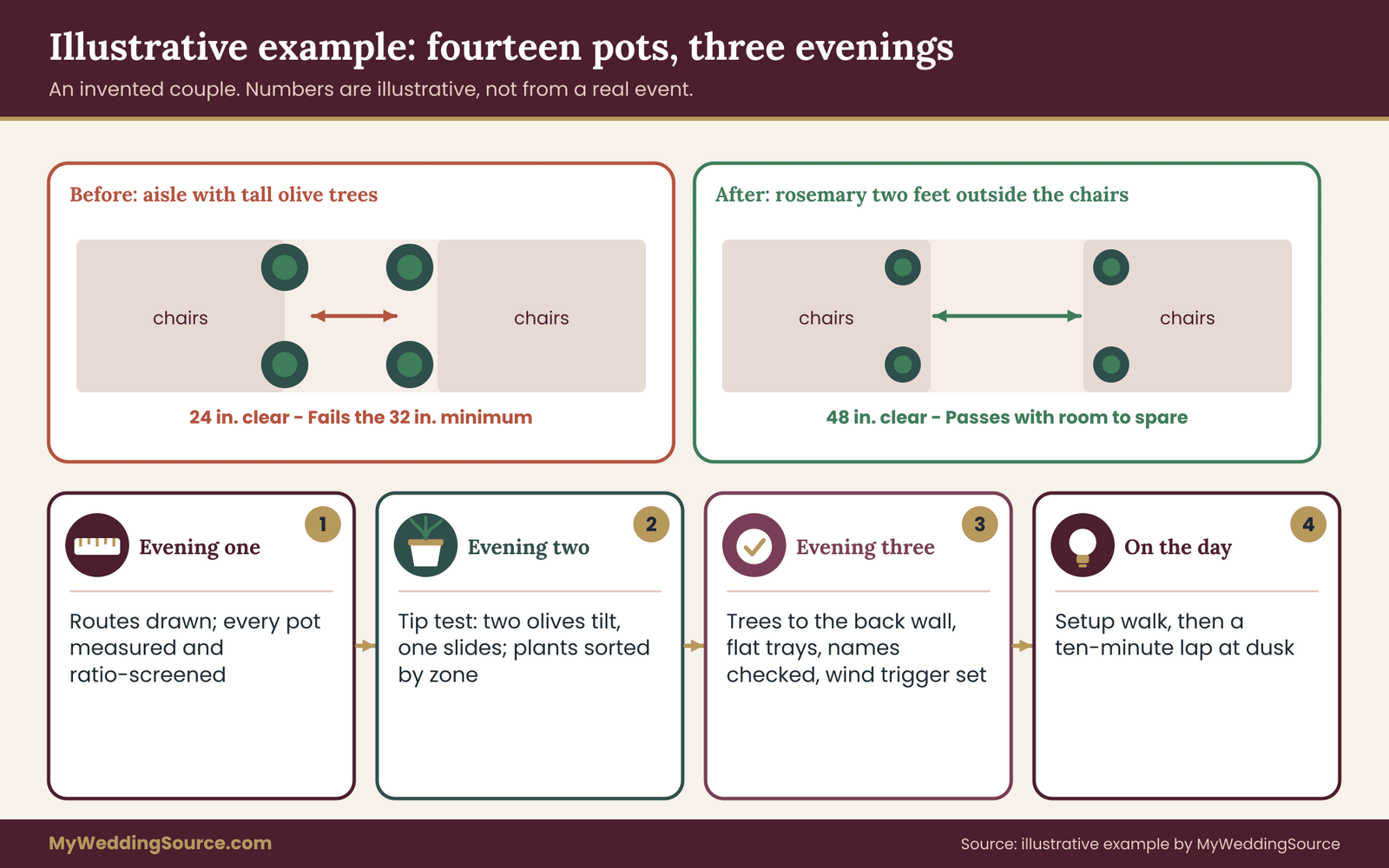
None of the changes made the room look worse. The olive trees are more striking against the back wall than they were along the aisle, and the aisle looks calmer. That is the usual result.
Comparing alternatives to floor-standing potted plants
Floor pots are not the only way to use living plants, and potted plants are not the only way to bring green into a room. For locations where a floor pot fails the inspection, there are several alternatives, each with trade-offs. The right choice depends on the room, the budget and what you want the plant to do.
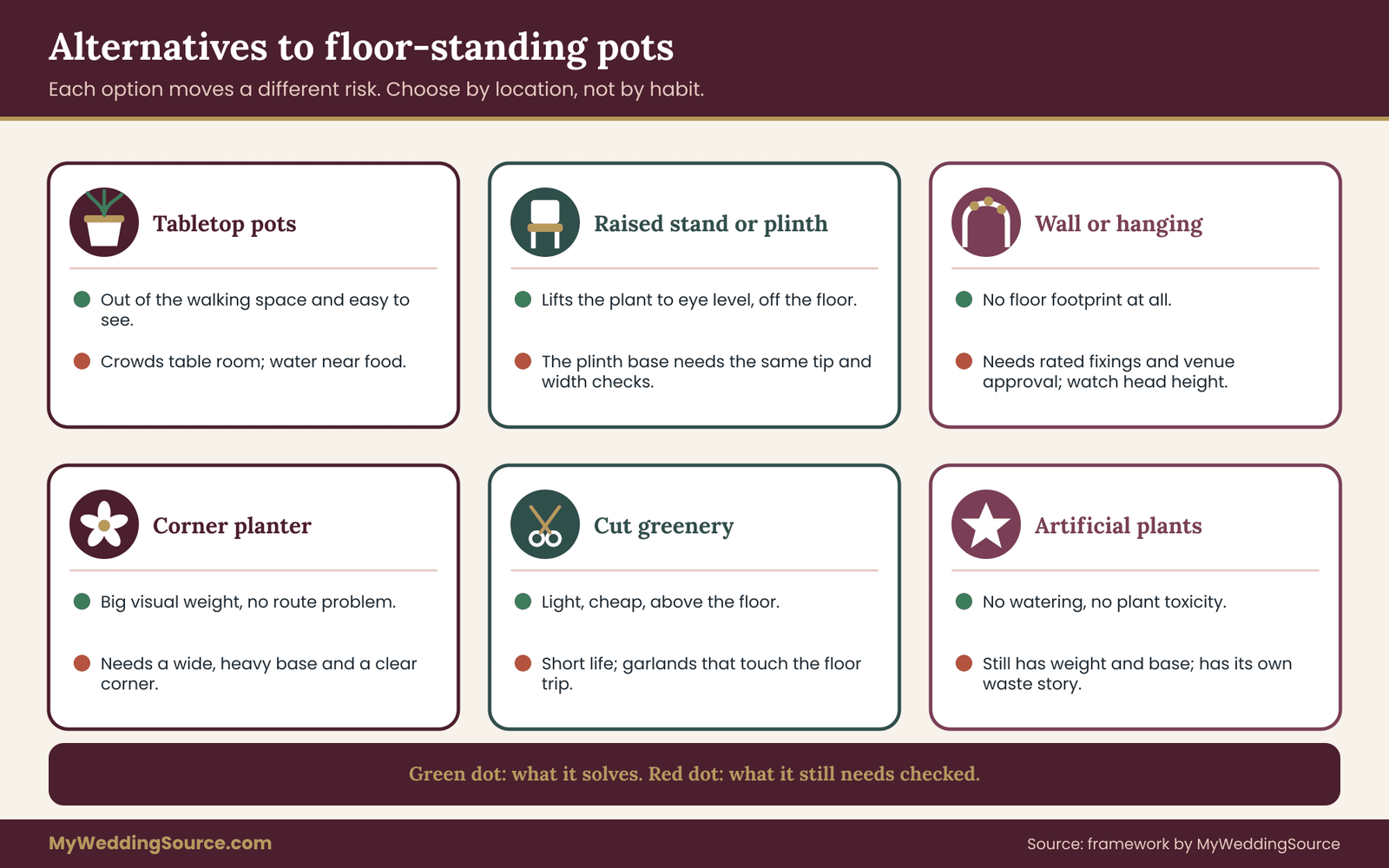
Tabletop pots. Small plants on tables or on a card table move the plant out of the walking space, and guests can look at them. They take up table room, which matters at crowded tables, and low-growing herbs and succulents handle the move well. The risk is knocked pots and spilled water onto food or linens.
Raised stands and plinths. A wide, heavy plinth lifts a plant to eye level and keeps it away from feet. The plinth itself has a base that can be a trip point, so it follows the same footprint, tip and width checks. Narrow stands with a small top and a heavy plant are a tipping risk.
Wall mounted and hanging planters. These remove floor risk but add overhead risk. Hanging planters need a secure, rated fixing, and the venue may not allow drilling or hanging from ceilings. Check the venue’s rules on drilling and rigging before you rely on them. Wall planters must clear the path at head and shoulder height.
Greenery in large vessels at the edges. A single large planter against a wall, or in a corner, with a wide base and a low center of mass is often the best use of potted plants. It gets the visual weight of a large plant without a route problem.
Cut greenery and garlands. These move the greenery above the floor, lighter and cheaper. They can be draped on railings, arches and tables. They lose the living quality and need fresh stems, and garlands that drape to the floor are a trip hazard.
Artificial plants. They do not need watering and they cannot be toxic in the way that live plants can, but they still have weight, base and footprint, and they have their own waste story. Check that the pot is stable and the materials are suitable.
The site’s waste reduction planning guide explains how to plan for reuse, donation and disposal, which is a good place to look when you decide what happens to the plants after the event.
Edge cases
A few situations do not fit the standard pattern.
Very small venues. If the room is tight, even compact pots can crowd a route. In that case, plants may need to live on tables, windowsills or walls, or the plant count drops. A single large plant in a corner can read better than twelve small ones.
Gardens and uneven ground. In a garden, the plants may already be growing in the ground. Guests will walk through the planting beds, which means roots, edging stones and irrigation lines become the hazards. Walk the route and mark anything that sticks up.
Ceremonies with processionals on a runner. Runners add a trip edge, and pots sitting on them are worse. Keep runners and pots separate.
Cultural or religious ceremonies with a path or a procession. Some ceremonies include processions through a space with many guests standing. Check with the officiant or family about the route and make room for it.
Late changes. If the florist substitutes a plant, or a pot arrives different from the order, run the inspection again on that item. A substitution is the most common reason a layout that was checked ends up with something that was not.
Guests who ask to move something. Decide who has the authority. Guests who feel unsafe should be able to ask the coordinator, and the coordinator should be able to move a pot without fuss.
Your next steps
Here is a short order of work for the next few weeks to make potted plants safe.
- Draw your guest routes on the floor plan and shade the minimum widths before you place a single pot.
- Ask the florist or rental company to list your potted plants, with the height, base width, weight and botanical name of every plant, and put them in writing.
- Sort your potted plants into the green, amber and red zones and move anything tall, light or sharp out of the amber zone.
- Run the tip test on every pot in the amber zone as planted and watered, and record pass, adjust or move.
- Replace deep saucers with flat trays, cover loose soil and plan for a sweep at the mid-event check.
- Check botanical names against the ASPCA list and add the poison help number to the day-of sheet.
- Agree a wind and weather trigger with the florist and the coordinator, and decide who acts on it.
- Schedule a short inspection after setup and a ten-minute walk at dusk.
If you can only do three, do the route drawing, the tip test and the dusk walk. They catch most of what goes wrong.
FAQ
How many potted plants can I use before the room feels crowded?
There is no fixed number of potted plants. It depends on the room and the routes. Draw the guest routes first, shade the minimum widths, and count the pots that fit in the space that is left. Many couples find that fewer, larger pots against walls and in corners look better and leave the floor clear than many small pots scattered through the room.
What is the minimum width for a path with potted plants beside it?
The 2010 ADA Standards for Accessible Design set a minimum clear width of 36 inches for an accessible route, with a brief narrowing to 32 inches allowed. Those standards apply to facilities, not to private events, but they are a useful benchmark. Wider is better for an aisle. Confirm the current text with the issuing agencies.
How do I tell whether a pot is heavy enough?
Do a tip test on your potted plants. Push the pot at the rim, lean on the plant at about two-thirds of its height, bump it at knee level and pull it. If the base lifts or the pot slides easily, add ballast, widen the base or move it. A hand-held spring scale gives a number you can compare across pots, although no published standard sets the right value.
Are potted plants safe for children and pets?
It depends on the plant. Get the botanical name of each plant and check it against the ASPCA list for pets and a reliable source for people. Keep any plant with known toxicity, berries, thorns or irritating sap out of reach of children and animals. Keep the Poison Help number available on the day.
What should I do about wind?
Agree a trigger in advance with the florist and coordinator. When the forecast shows gusts strong enough to move chairs, tall potted plants are laid down, tied to a fixed structure or moved to a sheltered place. Check the National Weather Service forecast in the morning and again before the ceremony, and assign someone to act.
Should I use wheeled planters?
Potted plants on wheels are fine only with locking wheels that are locked, or better, remove the dolly once the pot is in place. A wheeled base moves when pushed, which is the opposite of what you want near guests. If wheels are used for removal at the end of the night, assign a staff member to handle it.
How do I stop water and soil from making the floor slippery?
Water plants well before guests arrive and let the pots drain. Use flat trays or mats and not deep saucers, cover loose soil with moss or bark, and avoid loose pebbles. Check the floor under and around each pot during the mid-event walk, and keep a small broom nearby for fallen leaves and petals.
What if the venue or florist says the potted plants are fine?
Ask what that is based on. Request dimensions, weights and distances in writing, then run the checks yourself after setup. A venue may be thinking about fire codes and a florist about the design, and neither may have measured the route. Your own short inspection fills the gap and takes only a few minutes.
Sources
- ADA.gov, U.S. Department of Justice
- U.S. Access Board, ADA Accessibility Standards
- ASPCA, toxic and non-toxic plants
- Poison Help, American Association of Poison Control Centers
- U.S. Consumer Product Safety Commission
- National Weather Service
- Centers for Disease Control and Prevention, falls prevention
- USDA Animal and Plant Health Inspection Service
- National Fire Protection Association
- U.S. Environmental Protection Agency, pesticides