
A donut wall is a board of pegs that holds donuts at eye level, and it works only when you plan four things together: how many guests can reach it, how long each donut may hang, what stands between hands and food, and how every piece is labeled. This guide gives you a four-gate plan, a worked example and the questions to ask before you book.
Plan a donut wall in four gates. Gate one is reach: count eaters, not invitations, and give the wall at least two access points. Gate two is hold time: treat pegged donuts as display stock and refill from covered boxes. Gate three is cover: use wrapped pieces, domes, sleeves or a gloved attendant so bare hands never meet shared food. Gate four is labels: name the major allergens on every flavor. Then set a refill trigger, such as restocking a row when it drops to a third.
Most advice about a donut wall is about looks: peg colors, backdrop flowers, neon signs. Looks matter, because the wall is often the most photographed object in the dessert area. But a wall that photographs well and then runs bare in twenty minutes, or sits glazed and uncovered under warm lights for three hours, is a planning failure, not a styling one. The decisions that protect your guests and your budget are mostly unglamorous.
This article treats a donut wall as a small piece of food service with a stage set built around it. You will see how to count pieces, how to choose a display that suits your venue and your guests, how to keep hands, hair, insects and weather away from food that hangs in the open, how to label allergens honestly, and how to time refills so the donut wall looks full without wasting product.
It is aimed at couples and planners who have already decided that donuts are on the table, or are weighing them against other sweets.
A note on scope. This is general planning information, not legal, tax, medical or food-safety advice. Rules for temporary food service, catering licenses and allergen labeling vary by state, county and venue, so confirm the current requirements with your vendor, your venue and your local health department.
What a donut wall is and when it fits your reception
A donut wall comes in a few shapes, and the shape changes almost every decision that follows. The classic version is a freestanding board, often wood or painted panel, with dowel pegs that each hold one ring donut. A second version is a tiered stand or hanging frame where donuts sit on short rods or in rings.
A third is a wall-mounted panel that leans against a venue wall or hangs from a stand behind a table. A fourth, sometimes still called a wall by couples, is a flat backdrop with trays of donuts on a table in front of it.
The difference between hanging and tray display is not cosmetic. Hanging donuts are exposed on every surface, and guests pull them off by reaching into a grid of neighbors. Tray display exposes only the top. Because the wall is visually generous, many vendors will quote a “wall” as a rental with a certain peg count, and the product as a separate line. Keep those two numbers apart from the start, because the peg count is a display capacity, not a serving count.
Good reasons to choose a donut wall
A donut wall suits a reception when you want a dessert that is easy to eat standing up, that does not need plates or forks, and that photographs well without a cake cutting. It fits casual, brunch, daytime and late-night formats. It also suits couples who do not want a traditional cake, or who want a second dessert beside a small cake. Donuts are familiar to most guests, which helps when the guest list spans ages, and a range of flavors lets people choose without a long explanation.
It also suits events with a natural open window for sweets. A cocktail hour, a post-dinner lull before dancing, or a late-night snack at the end of the evening all give you a defined stretch of time when guests drift toward food. The wedding cocktail hour guide covers how that stretch is usually structured, which matters because a wall that opens during a crowded cocktail hour behaves differently from one that opens at nine o’clock to a thinning room.
Poor reasons, and when to choose something else
A donut wall is a weaker choice when your only reason is a photograph. A prop with no service plan tends to be touched, picked over and left. It is also a weaker choice in a hot, humid or windy outdoor setting with no shade, because glaze softens, sugar sweats and boards tip. It is a poor fit when you have many guests with serious food allergies and no way to offer a separate, sealed option, since an open grid of shared pieces is hard to keep clean.
And it is a poor fit if you expect guests to be carrying drinks and wearing formal clothing in a tight space, because glaze and powdered sugar travel.
None of this rules the wall out. It means the plan has to address the weak point directly. If you are still choosing between formats, the same questions apply to any other format: how does it behave in heat, how messy is it, and who can reach it. Ask them of the donut wall as you would of any rival dessert.
What this guide does not cover
This guide is about the donut wall itself. It does not repeat how to size a cake against other desserts, how to schedule cake production, or how to design a full menu. The wedding menu planning guide covers the whole meal, and the wedding cake timeline covers cake production from final count to cutting. If you are weighing a hot fried dessert station as an alternative, the article on churro station service timing deals with a different problem, which is keeping fried product warm and crisp in a queue.
A donut wall has the opposite problem: product that is meant to sit at room temperature in view, so the risks are exposure and time rather than heat and speed.
The four-gate plan for a donut wall
Every decision about a donut wall can be placed at one of four gates. Thinking in gates keeps you from solving the wrong problem. A beautiful peg design does nothing for gate three. A clever refill schedule does nothing for gate four. Each gate has one question, one owner and one thing to confirm in writing.
Gate one: reach. Can the guests who want a donut get one without a long wait, and can every guest, including children and wheelchair users, reach the product? The owner is you and your planner, with the venue. You confirm the number of access points and the height of the pegs.
Gate two: hold. How long can a donut hang in the open before it comes off the donut wall? The owner is the vendor, who knows the product, with your caterer if there is one. You confirm a maximum hang time and what happens to donuts that exceed it.
Gate three: cover. What stands between guests’ hands, breath and the environment and the food? The owner is the vendor and whoever staffs the wall. You confirm the physical barrier and the handling rule.
Gate four: label. Does each guest know what is in the piece they pick up? The owner is the vendor for the ingredients and you for the signs. You confirm the allergen list for every flavor.

Why the order matters
The gates are listed in the order you decide them. Reach comes first because it determines how many pieces you need and how many hands will touch the display. Hold comes second because it determines how much of the stock may be on the donut wall at once.
Cover comes third because the right barrier depends on the first two answers: a wall with two access points and a long hold time needs more protection than one served by an attendant over thirty minutes. Label comes last, because you can only label what you have chosen.
Skipping a gate usually shows up on the day. Couples who skip gate one run out of pieces or build a queue. Those who skip gate two end up with stale, sweating donuts at the end of the night. Those who skip gate three end up with a wall that has been handled by dozens of bare hands. Those who skip gate four leave allergic guests guessing, which is the failure with the most serious consequences.
Guest count math for a donut wall
The quantity question is where most donut wall plans go wrong, and it goes wrong in both directions. A wall that holds forty-eight pegs for a hundred and fifty guests is not a serving plan, and a vendor who quotes “one per guest” is leaving out the question of who counts as a guest. The method below uses three numbers and gives you a low, base and high estimate you can take to the vendor.
Step one: count eaters, not invitations
Start with the number of people who will actually be in the room, not the number you invited. Use your confirmed RSVP count if you have one, and your best estimate if you do not. Then subtract guests who will not eat from the wall.
These are usually guests who avoid sweets, guests whose allergies or medical needs mean they will have a separate dessert, babies and toddlers, and vendors or staff who will eat elsewhere. You do not need to be exact. Rough honesty beats a round invitation number.
Then add back anyone not on the RSVP list who will eat from it: your own wedding party and family members who are not in the guest count for some reason, and any late-night guests who arrive after dinner. If a late crowd is coming, count them separately and note the time they arrive, because that changes when you refill.
Step two: pick a pieces-per-eater range
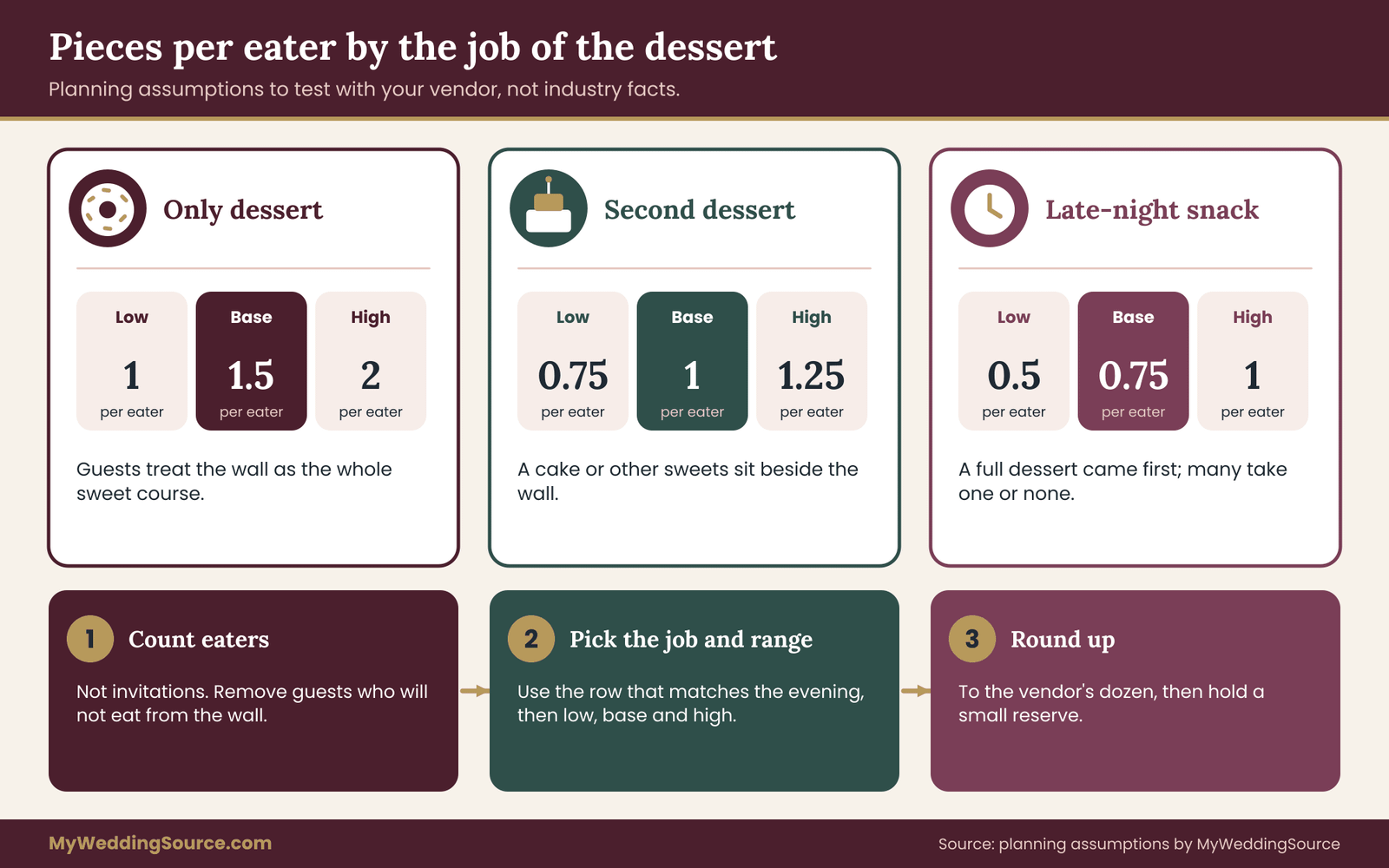
The pieces-per-eater number depends on the job the donut wall does at your reception. Treat these as planning assumptions to test with your vendor, not as industry facts, because appetite shifts with the hour, the dinner and the crowd.
If the wall is the only dessert, plan higher, because guests will treat it as the whole sweet course. A reasonable low case is one piece per eater, a base case is one and a half, and a high case is two. If the donut wall sits beside a cake or other sweets, plan lower: three quarters of a piece in the low case, one in the base case and one and a quarter in the high case.
If the wall is a late-night snack after a full dessert, many guests will take one small piece or none, so a low case of half a piece per eater is reasonable, with a base of three quarters and a high of one.
Guest age and hour change the answer. A daytime wedding with children tends to pull the number up, since children often take a donut and then come back for another. A late wedding after a heavy dinner pulls it down. Write down which of the three jobs the wall has, then use that row.
Step three: round to the vendor’s unit
Donuts are sold by the dozen or in trays, and vendors build walls by the board. Round your range up to the vendor’s unit, not down, and ask whether partial dozens are possible. Rounding up is cheap insurance against a bare wall, and any extra can be sent home in boxes or donated, as the section on leftovers explains later.
The section on the worked example shows the whole calculation with an invented couple, so you can see how the three steps fit together.
Peg board design for a donut wall: size, height and reach
The board is the visible part of the donut wall, and its design decides gate one more than people expect. Four measurements matter: the number of pegs, the spacing between them, the height of the lowest and highest rows, and how many sides guests can approach from. Each one has a practical effect on speed, mess and access.
Peg count and spacing
Ask the vendor for the real peg count of the board you are renting, and for the spacing between pegs. Spacing matters for hygiene as well as appearance. Pegs set tight together mean a guest pulling one donut brushes the glaze of the donuts on each side. Wider spacing costs space on the board but reduces the chance that one grab disturbs three pieces. If the vendor’s board is tight, ask whether they can leave every other peg empty on the rows guests reach most.
Peg length is the other detail. A short peg lets a donut slide off with a small tug, which is good for speed and bad for stability if someone bumps the board. A long peg holds better but invites a deeper reach and more contact with the neighboring piece. Neither is wrong. The right choice depends on whether your wall is served by an attendant or by guests, which the hygiene section takes up next.
Height and the reach range
Set the top row so that an adult of average height can reach it without stretching, and set the bottom row high enough that nobody has to crouch in a gown or suit. Beyond comfort, there is a fairness question. Children, people of short stature and wheelchair users cannot reach a tall board. The federal ADA Standards for Accessible Design set accessible reach ranges, and the high reach limit for an unobstructed side reach is 48 inches above the floor.
You are not building a public facility, and your venue and vendor may have their own rules, but 48 inches is a useful reference point for the rows you want everyone to reach.
A practical approach is to keep the most popular flavors in the middle rows, which are reachable by most guests, and use the upper rows for decoration or for lower-demand flavors. Alternatively, offer a small side table of the same donuts within easy reach, with an attendant, so that no guest has to ask for help to get a piece.
If a guest in a wheelchair or a parent with a child is expected, tell the vendor and place the board so the front is clear of tables and chairs.
Access points and the shape of the queue
One face of a freestanding board is one access point. Guests approach, pull a donut, step away and, if they are photographing, linger. A single face with a photo line in front of it is where queues form and where people reach over each other. If your board has two usable faces, or if you can set two boards at an angle, you double the access without doubling the product.
A simple test is to estimate the window in which guests will visit the donut wall and the speed at which a guest takes a donut. As a planning assumption, not a measured fact, suppose a guest needs about twenty seconds to choose and take a piece when the wall is uncrowded. At that pace, one access point serves about three guests a minute.
If a hundred twenty eaters are likely to visit in a forty-five minute window, that is roughly two and a half guests a minute, which is right at the limit of one face. Two faces give room to spare. Time your own pace at the vendor tasting if you can, and use the real number.
Photo behavior and the wall
Guests photograph a donut wall, and the photographers hold up the line. Decide whether you want a clear photo moment before service starts, with the full wall intact and no hands on it. Many couples schedule a brief pre-service window when the wall is complete, the photographer takes a few frames, and then the donut wall opens. That protects the look of the display and reduces the temptation to pose with donuts that are about to be handled.
Place a sign or have an attendant state the order: photos first, then pieces. A short, friendly sign works better than a rule announced at the microphone. The wedding signage system guide covers readability and placement, which applies here because the sign needs to be seen from a few feet away in dim light.
Materials, finish and cleaning
Wood boards with raw dowels absorb glaze and oil. If a vendor rents the board, ask how it is cleaned between events and whether the pegs are sealed, painted or covered. A board that cannot be wiped down is harder to keep clean. Ask also whether the board can be lined with parchment or food-safe sleeves at the peg level, so donuts do not rest directly on bare wood.
If you are building your own wall, which many couples do, choose a sealed or painted surface that can be wiped, and treat any peg that touches food as a surface you will clean.
Stability and weight
A loaded board is top-heavy. Ask how the board is weighted, how it is secured outdoors, and what the vendor does about wind. A board that tips is a safety risk to guests and a quick end to the display. The venue may also have rules about what can be attached to walls or placed on lawns, so confirm that early, as the sections on venue limits and edge cases explain.
Hygiene on a donut wall: covers, hands and exposure
Hygiene is gate three, and it is the part of a donut wall that rarely makes the vendor’s brochure. The issue is simple to state. Food hangs in the open. Dozens of people reach in. Some have not washed their hands, some are carrying drinks, and some sneeze. Any shared, uncovered display carries that exposure, and a donut wall is built to be exposed.
You will not remove all of this risk, and you do not need to. The aim is to reduce the contact that matters most, and to decide in advance who is responsible when a piece is dropped, touched or dirty. Federal food safety guidance from agencies such as the Food and Drug Administration and the U.S. Department of Agriculture’s Food Safety and Inspection Service stresses clean hands, clean surfaces and keeping food protected, and those principles map directly onto a wall.
Four levels of cover
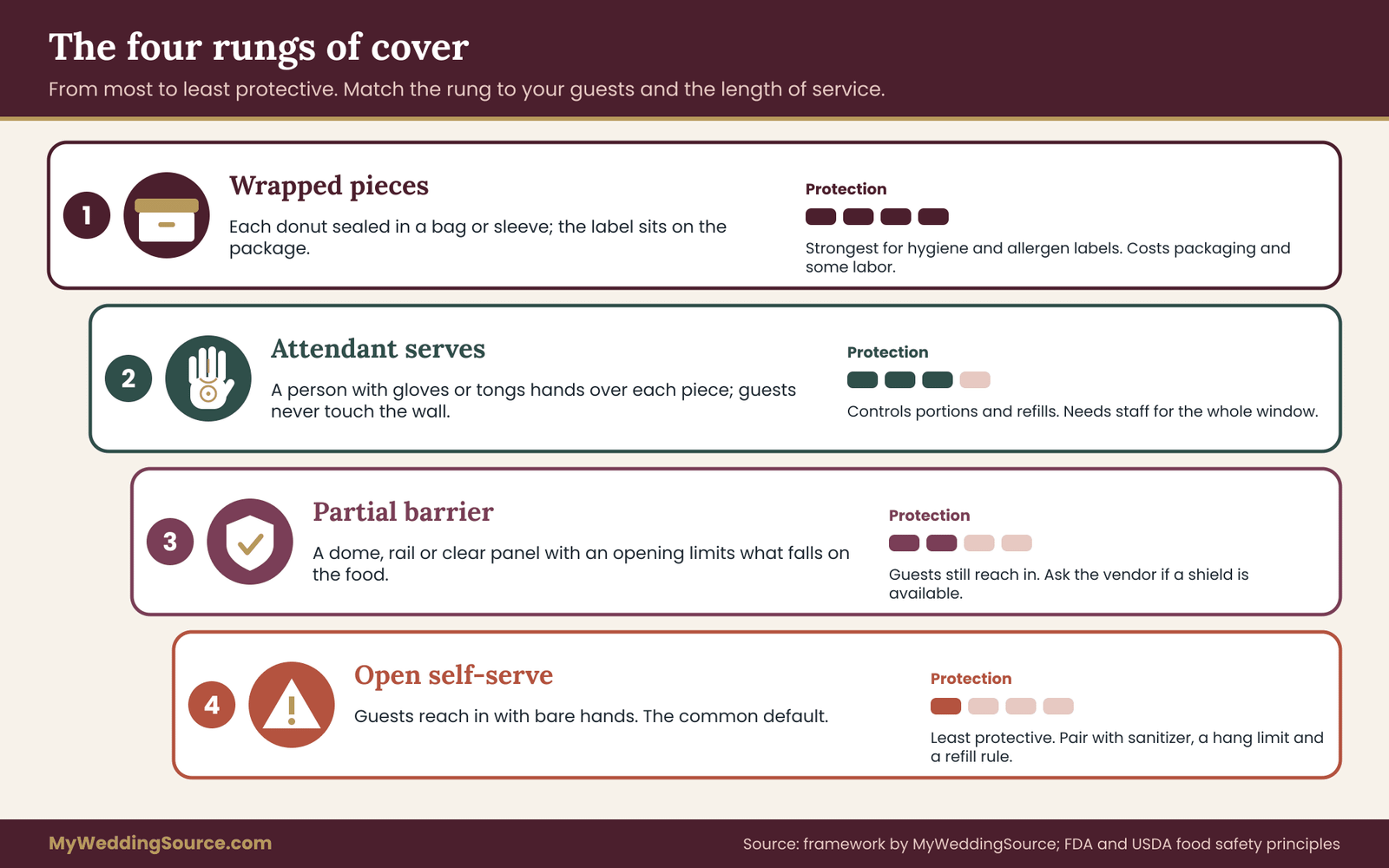
Think of cover as a ladder with four rungs, from most protective to least.
The first rung is individually wrapped or bagged pieces. Each donut is sealed in a bag, sleeve or clear box before it goes on the wall, and the guest takes the package. This is the strongest hygiene answer and also the best allergen answer, since the label can sit on the package. The cost is more packaging, a different look and a bit more labor, and it works best with an attendant who restocks.
The second rung is an attendant who serves. A person wearing food-service gloves, or using tongs and a clean tissue or sleeve, takes the donut and hands it over. Guests never touch the donut wall. This protects the display and lets you control portions, and it requires staffing for the whole service window.
The third rung is a partial barrier, such as a clear dome, a front rail, a glass or acrylic panel with an opening, or a sneeze-guard style shield. Guests still reach in, but the shield limits what falls onto the food from the front and above. Ask the vendor whether they have a shield for the wall they are renting.
The fourth rung is open self-serve. Guests reach in with bare hands. This is the common default and the least protective. If this is your plan, pair it with hand sanitizer nearby, a limited hang time and a firm refill rule, and treat it as a choice with trade-offs, not a neutral baseline.
Choosing the rung for your event
Match the rung to your guest count, the length of service and the people at risk. A small gathering, a short window and an attendant make rung two easy. A large reception with a long open window leans toward rung one or three. If older guests, young children, pregnant guests or people with weakened immune systems are expected, lean toward the more protective rungs.
You are not required to explain this to guests, but you can say, in one sentence on the sign, that donuts are served or wrapped.
Cost also matters. Wrapping a hundred twenty pieces adds supplies and labor. An attendant adds a staffing line. A shield may be a rental fee. Compare these costs against the cost of throwing away unsafe product and the cost of one guest becoming ill. You are not making a medical judgment, only a planning one: spending a little on cover is cheap next to the alternatives.
Hands, hair and sanitizer
Place hand sanitizer at the donut wall, visible and easy to use, with a short sign. Sanitizer is a convenience, not a substitute for handwashing, and it does not work well on visibly greasy or sugary hands, but a nearby station nudges guests toward cleaner hands.
Make sure the sanitizer is not placed so that drips land on the food. If an attendant serves, they should have a way to wash hands or change gloves when they touch anything other than food, such as a phone, hair, face, money or trash.
Ask the vendor how staff handle hair and jewelry, and whether staff who serve are separate from staff who handle money or move equipment. These are routine food-service practices, and a reputable vendor will have a plain answer. You are looking for a vendor who has thought about it, not a script.
Insects, dust and the air
Outdoors, flying insects are drawn to sugar. Bees and wasps are the most noticeable, and a donut wall with exposed glaze can attract them within minutes in warm weather. Domes, covers and a short exposure window all help. Indoors, the issue is dust, breath and airflow from vents or fans. Ask the venue where the air handlers are and avoid placing the wall directly under a vent, a ceiling fan or a doorway with a draft.
Keep the donut wall away from the bar and the coat area, where drinks and bags crowd against it.
Hold time and refill timing for a donut wall
Gate two is the one couples ask about least and regret most. A donut that looks perfect at six o’clock may be dry, sticky or unsafe by ten. Refill timing is how you keep the donut wall looking full and fresh at the same time, and it rests on two separate ideas that are easy to blur: how long a piece may hang, and when the wall gets restocked.
Two clocks, not one
The first clock is the hang clock. It starts when a donut goes onto a peg and stops when a guest takes it or you pull it. The second clock is the stock clock. It tracks how much of the wall is full, regardless of how long any one piece has been up.
A wall can fail on either clock. If you refill only when the wall is bare, the hang clock for the last few pieces may run for hours. If you refill on a fixed timer without watching the stock, you either waste donuts or run empty during a rush.
The practical answer is to manage both. Set a maximum hang time, and set a refill trigger based on how much is left. The two rules work together, and either one can retire a piece.
What to ask about safety limits
Food safety agencies draw a line between food that must be kept at a controlled temperature and food that is stable at room temperature. FoodSafety.gov advises that perishable foods should not sit out for more than two hours, or one hour when the air temperature is above 90 degrees Fahrenheit. That guidance is written for foods that can support bacterial growth, such as those with cream, custard, eggs, dairy or fresh fruit.
A plain glazed ring or a cake donut with a sugar glaze is generally in a different category than one filled with pastry cream, but you should not assume. Ask your vendor to name which items on your menu, if any, need refrigeration, and which are shelf-stable at room temperature.
Common problem items include cream-filled and custard-filled donuts, donuts topped with whipped cream or cream cheese frosting, and donuts with fresh fruit. If the vendor offers any of these, the safest approach is to keep them in a cooler or refrigerated case and serve them from a tray in small batches, rather than hang them on the donut wall. Plan the wall around the stable flavors and treat perishable flavors as a separate, controlled item.
Setting a maximum hang time
Beyond the food safety line, a donut has a quality limit. Glaze can soften, dry or weep, sugar can sweat in humid air, and the crumb dries out. A reasonable planning rule is to pull any donut that has hung for about ninety minutes in warm or humid conditions, and about two hours in cool, dry rooms.
This is a quality convention, not a regulation, and your vendor knows the product best, so ask for their number and use it. If the vendor’s number is shorter than yours, use theirs.
What happens to a pulled donut should be decided in advance. Options include moving it to a sealed box for staff or the wedding party, setting it aside for guests who take food home, or throwing it away. Do not rotate old donuts back onto the donut wall. A pulled piece is retired. The section on leftovers covers what to do with extra product.
The one-third refill trigger
For the stock clock, use a simple trigger. When a section of the wall, such as a row or a block of pegs, falls to about a third of its pegs filled, an attendant refills it from the reserve. The one-third rule is easy to see from a distance, it keeps the donut wall looking generous, and it avoids the half-bare look that makes a display seem picked over.
Define the sections before the day. A board with six rows can be treated as three blocks of two rows. If the vendor builds the wall in color-coded rows or by flavor, use those. An attendant should not have to decide what counts as a section in the middle of service. The size of a refill block should be small enough to restock in a minute or two, so the wall is never half-undressed in front of guests.
Reserve stock and where it lives
The reserve is the covered stock that feeds the refills. It lives in lidded boxes or trays, out of sunlight, away from heat sources and, if any items are perishable, in a cooler or fridge. Place the reserve close enough that an attendant can refill without crossing the dance floor or the service route, and far enough that guests do not graze from it. Label the reserve boxes by flavor so a refill puts the right donut on the right peg.
The reserve is also where your guest count math pays off. If the board holds forty-eight and your base case is a hundred twenty pieces, then about seventy-two pieces wait in reserve. If the reserve is too small you run out. If it is too large you waste. The first number to confirm with the vendor is how much arrives on the board and how much arrives in boxes.
Refill windows that match the evening
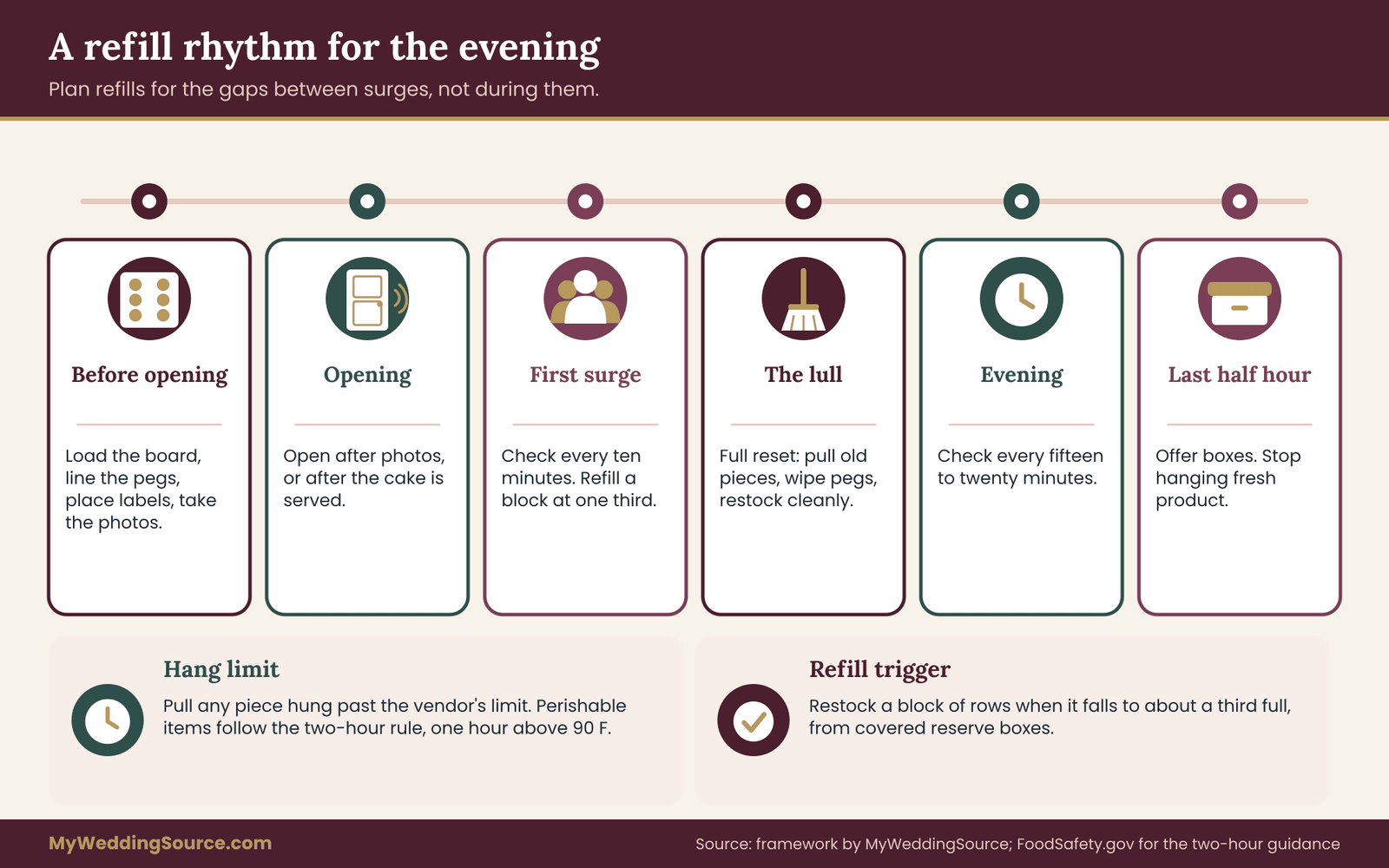
Most receptions have a few predictable surges. The first is when the donut wall opens, as curious guests arrive together. The second is after a major event, such as the end of dinner or a cake cutting, when people stand up and move. The third is near the end of the evening, when guests are leaving and take a piece with them. Plan refills for the gaps between surges, not during them.
A rough rhythm, using the base example, looks like this. Fill the board completely before the wall opens, with photos first. Check the donut wall every ten to fifteen minutes during the first surge and refill by the one-third rule. Do a full reset in the lull after the surge, pulling old pieces and restocking cleanly.
Keep the reserve light toward the end, so you do not hang fresh product that will not be eaten. Finally, in the last half hour, offer boxes or bags so guests can take a donut home, rather than keep refilling a wall nobody is using.
Who does the refilling
Refilling is a job, and it needs an owner. If the vendor staffs the wall, confirm in writing how many attendants are present, for how long, and whether that includes refills and cleanup. If you are running the donut wall yourself, with a friend or family member, give that person a one-page card with the refill trigger, the hang limit and the cover rule, and tell them what to do with a dropped piece.
A well-meaning relative who restocks by habit, with bare hands from the nearest box, undoes your gate three.
Name a backup. Receptions run long, people eat and dance, and the person assigned to the wall will leave it at some point. A backup who knows the rules prevents the donut wall from being unattended in a rush.
Late-night walls and split service
If your donut wall is a late-night snack, as many are, the clocks start differently. The donuts may arrive just before service and sit for a shorter window. Ask the vendor whether they deliver late, or whether the donuts arrive early and wait in a box. A donut that waits for hours in a closed box before it hangs is not fresher than one that hangs for ninety minutes, and the box may hold heat or moisture that spoils the glaze.
Ask about delivery timing for the whole day, not only the setup time.
Split service is another option. Keep half the product in reserve until a late crowd arrives, then open the second half. This reduces waste and gives the wall a fresh look for the late arrivals. It requires a covered reserve and a person to manage the switch, so decide ahead of time whether the effort is worth it.
Allergen labels and cross-contact at a donut wall
Gate four is the one with the highest stakes, and a donut wall makes it harder than most desserts. A bakery product is a bundle of common allergens, a wall displays many flavors side by side, and the toppings travel from one piece to the next. This section is about how to label honestly and how to separate what can be separated. It is not medical advice, and anyone with a serious allergy should decide for themselves, with their own clinician’s guidance, whether to eat any shared food.
The major allergens in a typical donut
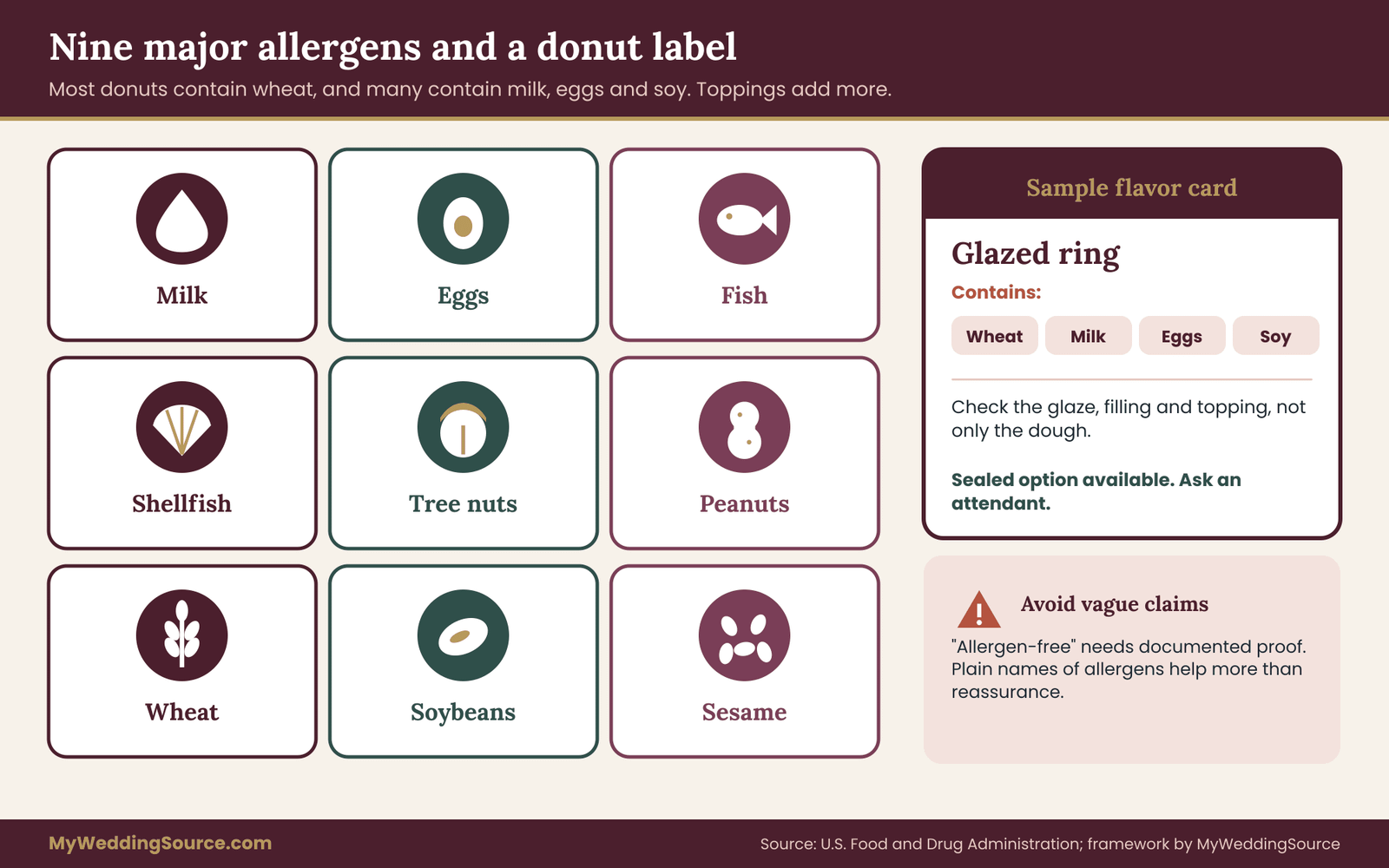
The U.S. Food and Drug Administration lists nine major food allergens: milk, eggs, fish, shellfish, tree nuts, peanuts, wheat, soybeans and sesame. Sesame was added to the list as of January 2023. Most donuts contain wheat, and many contain milk, eggs and soy, since these are common in dough, glazes and fillings. Toppings add more. Chopped nuts, peanut-based drizzles, cookie crumbs, cereal pieces and sprinkles may contain tree nuts, peanuts, wheat, soy or milk, depending on the product. Some seeds and baked toppings may include sesame.
Do not guess. Ask the vendor for an ingredient and allergen list for every flavor, including the glaze, filling and topping, and ask whether the list is based on supplier labels or only on the recipe. A vendor who cannot answer is a reason to hold the donut wall and ask more questions.
Cross-contact is different from an ingredient
An ingredient list tells you what is in a recipe. Cross-contact is what happens when an allergen travels from one food to another through hands, tools, surfaces or shared equipment. A donut that contains no nuts can pick up nut residue if it is made on the same surface as a nut-topped donut, or if the nut-topped donut sits next to it on a peg and sheds crumbs. On an open wall, crumbs and drips fall and contact is likely.
You cannot fully control this on an open display, and a bakery cannot always promise an allergen-free product. What you can do is separate. Keep nut-topped donuts on a different part of the donut wall, or serve them from a separate tray with their own tongs. Keep any allergen-aware donuts sealed, on their own, away from the shared wall. The same rule applies to any shared food table: the label must follow the food, not the table.
Labels that guests can use
A label should be short, readable at arm’s length in dim light and consistent across flavors. A small card for each flavor, or a label on each wrapped piece, should state the flavor name and the major allergens it contains, using the plain names above. Place the cards at the peg or on the front of the board, not on a sign across the room. If the wedding signage uses a script font or a low-contrast color, test it for readability, as the guide on wedding signage covers.
Consider adding a short line for guests with allergies, such as asking an attendant about ingredients, or pointing to a sealed option. Avoid wording that promises more than you can deliver, such as “allergen-free” or “safe for everyone,” unless the vendor has documented that claim and you have confirmed how they support it. A plain statement that a flavor contains wheat, milk and eggs is more useful than a vague reassurance.
A sealed option for guests who need one
For guests with a known serious allergy, the most reliable approach is a separately made, sealed dessert, discussed beforehand with the guest or their family and with the vendor. Count the guests, order one for each, plus an extra, and keep them sealed and apart from the wall until handed over. This is the same logic used for cake and other desserts, and a baker will usually have a standard process for it.
If a guest tells you they cannot eat anything from the donut wall, the plan is not a failure. A sealed alternative, or a different dessert from the kitchen, is the intended result of the process. Tell the caterer and the servers, so the guest is not asked to choose from the wall in front of others.
Questions to ask a donut wall vendor before you book
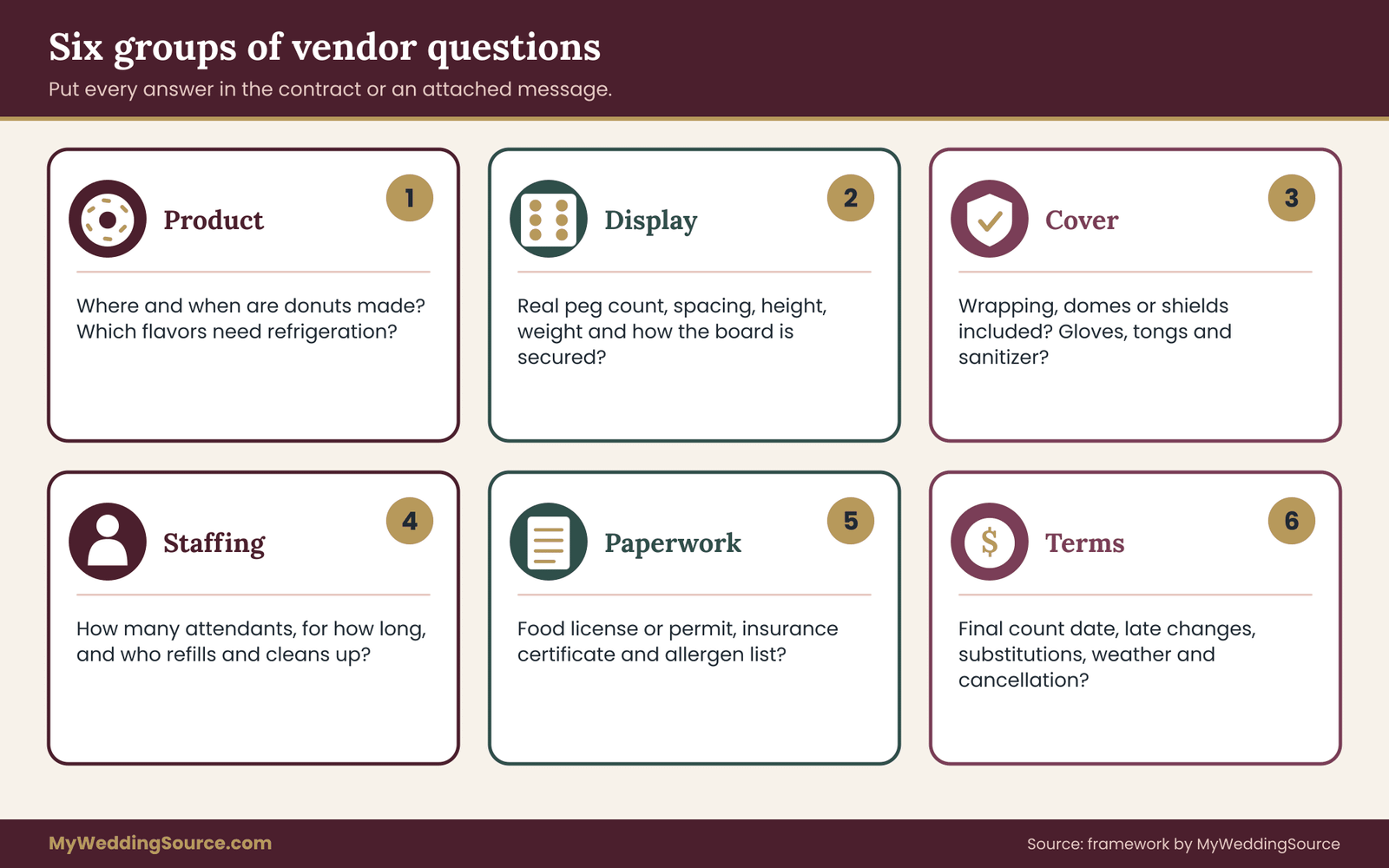
A vendor can be a bakery that also rents a board, a rental company that sources donuts from a bakery, a caterer who adds a wall to a package, or a mobile business that arrives with the donut wall, product and staff. The model matters, because it tells you who is responsible for what. Before you sign, put the answers to the questions below in the contract or an attached email, so that a promise is on paper and not only in a phone call.
Product and production
Ask where the donuts are made, when, and how they travel. A donut baked the morning of the wedding and boxed flat is different from one baked the day before and stacked. Ask whether the vendor holds a food license or permit for the jurisdiction in which they are working, and whether they can show it. Requirements differ by state and county, and a venue or caterer may ask for proof, so a vendor who can produce it quickly is a good sign.
Ask for the flavor list with ingredients and allergens, as the label section describes. Ask which flavors are perishable, which are filled, and which are stable at room temperature. Ask about gluten-free, vegan or nut-free versions and, if they offer them, how they are made and separated. A vendor who says a donut is gluten-free should be able to explain what that means in their kitchen.
Ask what happens if the vendor cannot deliver a flavor. Substitutions are common, and the allergen list may change when a topping or glaze changes. Require that any substitution be confirmed with you before the day, and that the allergen list be updated in writing.
Display, setup and cover
Ask for the real dimensions, the peg count and the weight of the board, and how it is secured. Ask what covers or shields are included, what the vendor uses to protect the product during setup, and how guests are meant to take a donut. If your plan is wrapped pieces, ask whether wrapping is included or priced per piece. If your plan is an attendant, ask whether gloves, tongs and sanitizer are provided.
Ask when setup happens and how long it takes, and when teardown happens. A wall that is set up an hour before service and left unattended is sitting for an hour before the first guest arrives. Ask where the reserve is stored, whether the vendor brings coolers or lidded boxes, and whether the venue must provide refrigeration. If they need a table, an outlet or a staging area, add that to the walkthrough list in the venue technical walkthrough so the venue can confirm it.
Staffing and service
Ask how many people staff the wall and for how long. Ask whether they refill, clean up and manage the queue, or only deliver the product. Ask what they do when a donut is dropped, touched or dirty. The answer should be simple: it is discarded, and a clean piece replaces it.
Ask who is in charge on the day, and how to reach them. A vendor who delivers and leaves means someone on your side must run the donut wall, and that person needs a plan. If the vendor stays, ask where they will stand and what the exit time is, so the wall is not left unattended near the end.
Terms, cost and cancellation
Ask for a written quote that separates the product, the board rental, delivery, setup, staffing, wrapping and any service charge. Ask when the final count is due, how late changes are priced, and what the deposit covers. Ask about a damage policy for the board, the cancellation terms and what happens if weather affects an outdoor wall. Confirm that the quote states the number of pieces and not only the number of dozens, and that it states the flavors.
If the vendor is a business you have not worked with, the wedding vendor due diligence checklist covers the basic checks on identity, insurance and references. The contract should say who is responsible for the product from delivery to service, and who is responsible for the board.
Insurance and venue requirements
Many venues require vendors to carry liability insurance and to provide a certificate. Ask whether the donut vendor can do so, and ask the venue whether it has rules about outside food vendors, outside desserts and cutting or service fees. Some venues charge a fee for food they did not supply, and some require that desserts be served by their staff. Learn this before you sign, not after.
If your venue has an in-house caterer, ask whether they will allow an outside donut wall and under what terms. A caterer may want to serve the donuts, refill the wall or charge for it. Their rules may conflict with the vendor’s, and you want one clear answer on who does what.
Staffing, cost logic and what a donut wall really costs
A donut wall looks like a simple line item and often turns out to be several. The honest way to compare it with other desserts is to price the whole service, not the product alone. This section lists the pieces of cost and describes how to compare them without relying on invented averages. Quotes in your area will vary, so use your own quotes for the numbers.
The parts of the price
Think of the price as five parts. The product is the donuts themselves, priced per piece or per dozen. The display is the board rental or purchase, plus any stand, backdrop or sign. The cover is any wrapping, domes, shields, sleeves or boxes. The labor is attendants, setup and teardown, and any refill staffing. The extras are delivery, tax, service fees, late changes and any venue fee for outside food.
When two quotes differ, compare them part by part. A low product price with no cover and no attendant is a different service than a higher price that includes them. A vendor who quotes a wall and leaves out staffing has not given you a total. Ask each vendor to quote the same plan: same piece count, same cover level, same service window. Without that, you are comparing different products.
Cost versus a cake, and the savings question
Couples often choose a donut wall to save money compared with a cake. Sometimes it does, and sometimes it does not. A cake is priced by serving, with a baker’s skill and decoration built in. A donut wall is priced by piece, with a rental and labor on top. If your wall also holds extra product to keep it looking full, the cost per eaten piece rises. If you add a cake as well, you pay for both.
A fair comparison uses cost per piece eaten, not cost per piece ordered. Divide the total price by the number of pieces you expect guests to eat, using your base case. Then compare that figure with the cost per serving of a cake, or of any other dessert you are considering. If the wall is one part of a larger dessert plan, split the total pieces between the cake and the donut wall before you compare prices, and ask your baker for the cake’s serving size first.
Waste is part of the cost
Waste is the cost people forget. Every donut that is pulled, dropped or left at the end is a cost you paid for. A tighter plan reduces waste: a reserve sized to the base case, a refill trigger that avoids overfilling, and an end-of-evening plan for extras. A looser plan buys a full-looking wall at the price of throwing away product.
You can choose that trade deliberately. Some couples accept waste for the look. Others prefer a smaller wall that looks full because it is tidy. Neither is wrong. What matters is that you know the number of pieces you expect to throw away, and that you chose it.
Staffing as a cost, and as protection
Attendant cost is the most negotiable line and the one that does the most for hygiene and refill timing. A single attendant for the service window can cover refills, serve with tongs, watch the queue and answer allergen questions. If the vendor does not supply one, a paid helper, a trusted friend or a catering server can fill the role, as long as they have the one-page card from the earlier section.
Compare the attendant cost with the effort of doing without. A wall with no one assigned tends to fall to the nearest relative, who is usually busy and unprepared.
Decide how to pay for it. Some couples add an attendant fee to the vendor’s quote, others ask their caterer to assign a server. If you are paying a gratuity, confirm whether a service charge is already included, and ask the vendor to say so in the quote.
What a modest budget can still do
If your budget is tight, you do not have to give up gates. You can keep the wall smaller and fill it fully, rather than a large wall partly empty. You can serve a limited number of flavors, which simplifies labels and cross-contact. You can wrap only the flavors that carry allergen risk.
You can run a short service window, so staffing costs less. And you can ask for a late-delivery option to reduce hang time. These are choices that cost little and improve the plan.
Weather, venue limits and edge cases for a donut wall
Plans that work in a conference room can fail on a lawn. This section collects the situations that change the donut wall plan most often: heat and humidity, wind, rain, indoor limits and a few odd cases that come up when a wall meets a real room. For each, the question is the same: which gate is under strain, and what small change relieves it?
Heat and humidity
Warm air softens glaze, makes sugar weep and speeds drying. Direct sun is worse, because a board in the sun can heat quickly, and dark pegs or backdrops absorb it. If the wall is outdoors, ask for shade, a canopy or a tent, and place the reserve in shade as well, in a cooler if any items are perishable.
Shorten the hang limit, refill in smaller blocks and consider wrapped pieces, which hold up better. Remember the food safety line from the hold section: above ninety degrees Fahrenheit, the window for perishable food shrinks to one hour.
If the forecast is hot, you can also move the donut wall’s opening later, to the cooler part of the evening, or trade one flavor for a sturdier one. A vendor will know which glazes and fillings perform in heat. Ask directly, and take their advice on what to leave off.
Wind and board stability
A tall board with pegs full of donuts acts as a sail. Ask how the vendor weights and anchors the board, and whether they have experience outdoors. Weights should be on the base and not on the board where guests can bump them. On grass, a wide base or a table behind the board helps.
If the wind is strong on the day, the vendor or the planner should be ready to take the wall down or move it to a sheltered spot, and the contract should say who makes that call.
Wind also moves powdered sugar, napkins and wrappers. Put a trash bin nearby, and have a plan for the trail of paper and crumbs that follows a busy wall.
Rain and the covered backup
If the reception is outdoors, ask where the donut wall goes if it rains. A covered porch, a tent or an indoor room can all work, but the new location must have space, a flat floor and a route for the reserve. Include the wall in the weather plan, not as an afterthought.
A venue walkthrough is a reminder that measurements and access routes are easier to confirm before the day than in a downpour, and the same applies to a small donut board that needs a clear footprint and a doorway wide enough to carry it through.
Indoor limits
Indoors, the problems are floor, space and rules. A floor that is wet, uneven or carpeted changes how the board stands. A narrow room puts the donut wall in the path of guests with drinks. Some venues do not allow items to lean on walls, tape or nails to hold a backdrop, or open flames and sparklers near displays. Others prohibit outside food or require that it be served by their staff. Confirm the rules in writing and ask whether there is a fee.
Where the wall sits relative to the bar, the dance floor and the exits changes the queue. A wall beside the bar draws a drinks-and-dessert tangle. A wall next to the dance floor draws crumbs and spilled glaze underfoot. A wall at the end of a hallway can create a bottleneck. A full guest flow plan belongs to the whole room, and for the donut wall the simple test is whether a guest can approach, take a donut and step away without crossing anyone else’s path.
Power, lighting and photography
A donut wall needs no power for the donuts, but a neon sign, a backdrop light or a fridge for the reserve does. Ask what power the venue provides and where, and avoid running cords across walkways. Lighting is the other quiet factor: dim light makes labels hard to read and hides dirt, and spotlights add heat. Place the label cards where they catch some light, and keep any heat-producing lamp away from the food.
Guests with limited mobility, children and crowds
Plan for the guests who find a standing queue difficult. An attendant can bring a plate to a seated guest, or a runner can carry a small box to a table. For children, set a table at child height with wrapped pieces and an adult nearby, so little hands do not reach into the grid.
A parent will usually want to choose the flavor, which a label helps. For a large crowd, add a second face, or stagger the opening by table, so there is no stampede after a toast.
Dropped, touched and broken pieces
A donut that falls on the floor, or that a guest touches and puts back, is thrown away. A piece that breaks on the peg is pulled. Say this once, plainly, to every person who staffs the wall. It sounds obvious, but in the moment people hesitate to waste a piece, and the rule needs to be firm. Keep a small lidded bin for pulled pieces, out of sight, so the wall is not ringed by crumbs and wrappers.
If a guest reports feeling unwell, or reacts to an allergen, the plan is not about the donut wall at all. Know where the venue’s first aid supplies are, who calls emergency services, and which staff member has the ingredient list. The ingredient list should be kept in the reserve area, on paper and also on a phone, so it can be shared quickly with a medical responder.
Leftovers and what to do with extra donuts
At the end, some product will remain. The plan should state in advance what happens to it. Options include boxed favors for guests who are leaving, boxes for the wedding party and family, a donation to a food program, or disposal. Pieces that have hung on the wall for more than the hang limit should not go home in a favor box, because a guest cannot judge how long they hung. Sealed, unhung reserve pieces are better candidates for sharing.
If you want to donate, check the rules and the recipient’s requirements first, since many food programs have limits on what they accept and how it must be handled. The wedding waste reduction planning guide covers how couples plan for leftover food, packaging and rentals, and the point for a donut wall is to decide before the donut wall opens, when you are not tired and hurrying to leave.
When the wall is not the only dessert
If the wall sits beside a cake, a cookie table or another sweet, give each its own moment. A cake cutting is a natural pause. Many couples open the donut wall just after the cake is served, which lets the guests who want a donut come to it without interrupting the cake service. If the wall opens first, guests may fill up on donuts before the cake is cut, and the cake will be left over.
The cake schedule runs through the day, and the donut wall should be slotted into it so the two do not collide.
A worked example of a donut wall: the Hartley and Nwosu reception
The numbers below belong to an invented couple, used only to show how the four gates and the quantity method fit together. They are not data from a real event, and your own figures will differ. Treat the example as a pattern for your own planning, not a template to copy.
The setup
Dana Hartley and Chidi Nwosu are planning a late-afternoon reception for a hundred forty invited guests at a garden venue with a covered pavilion. A hundred twenty-eight have said yes. They will have a small two-tier cake for the cutting and want a donut wall as a second dessert, opening after the cake is served. Dinner ends at about seven o’clock, the cake is cut at seven thirty, and dancing starts at eight. Guests will start to leave around ten.
The venue allows outside vendors with proof of insurance, and the pavilion has shade but open sides. The forecast, a few days out, shows warm weather. A vendor who is a local bakery offers a wall with a forty-eight peg board, an attendant for three hours and wrapping at an added cost per piece.
Gate one: reach and quantity
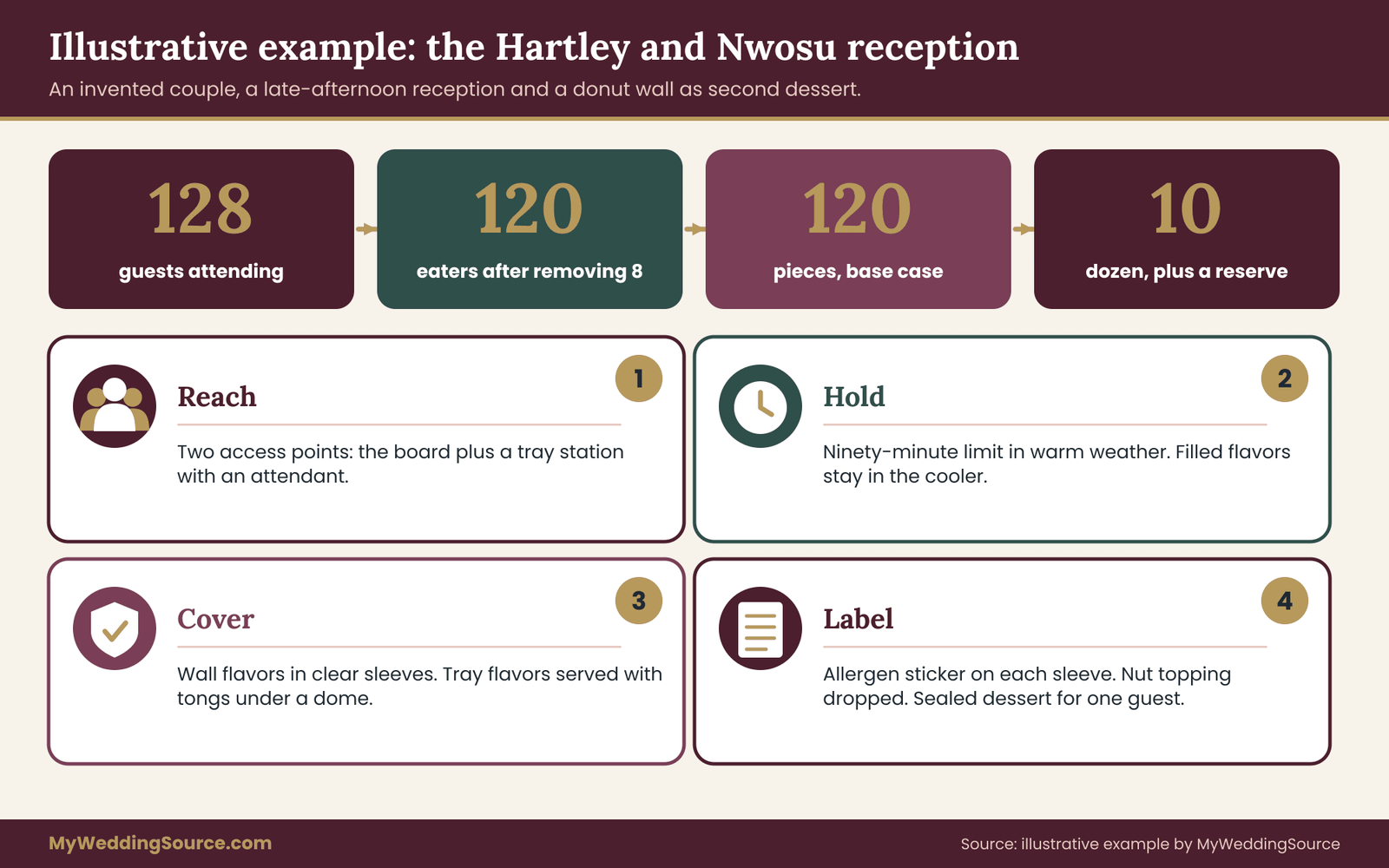
Dana and Chidi start with eaters. Of the hundred twenty-eight attending, they remove eight: two toddlers, three guests who have said they avoid sweets, one guest with a serious nut allergy who will get a separate dessert, and two vendors who will eat in the kitchen. That leaves a hundred twenty eaters. They add no late guests.
The wall is a second dessert beside a small cake, so they use the middle job: three quarters, one and one and a quarter pieces per eater. The low case is ninety pieces, the base case is a hundred twenty, and the high case is a hundred fifty. The bakery sells donuts by the dozen, so they round up to the next dozen: ninety-six, one hundred twenty and one hundred fifty-six.
They choose the base case of a hundred twenty and ask the bakery to hold a reserve of two dozen more, available at a delivery top-up if the donut wall runs lighter than expected. They decide the extra two dozen will be ordered at the final count, not before, and priced in the quote.
For access, the board has one usable face. At the planning pace of about twenty seconds a guest, one face serves roughly three guests a minute. A hundred twenty eaters visiting over about forty-five minutes is nearly three a minute, so one face is at its limit. They ask the bakery to bring a second small board or a tray station with an attendant, which gives two access points.
Gate two: hold and refill
The bakery’s menu has six flavors. Two are filled with pastry cream, and the baker confirms they need refrigeration. Dana and Chidi decide the filled donuts will not hang. They will sit in the cooler and be served from a tray by the attendant in small batches. The remaining four flavors are stable at room temperature and go on the wall.
Because the forecast is warm, they ask the baker for a maximum hang time. The baker says about ninety minutes in warm weather. They use that. The wall will open at seven forty-five, after the cake, with a full board. Pieces that hang past nine fifteen will be pulled.
They define sections as three blocks of two rows. The refill trigger is a third. The reserve is kept in lidded boxes in the shade behind the board, with the perishable flavors in the cooler. The attendant checks the donut wall every ten minutes during the first twenty minutes, then every fifteen. A full reset happens at about eight thirty, in the lull after the first surge.
Gate three: cover
With a warm evening and open pavilion sides, bees are likely. They choose a mix of the cover ladder’s rungs. The two tray flavors are served by the attendant with tongs, which is the second rung. The wall flavors are wrapped in clear sleeves, which is the first rung, and the guests take the sleeve with the donut.
A clear dome covers the tray between servings. They ask the bakery to provide sanitizer at the wall and to confirm that the attendant has gloves, tongs and a hand-washing plan.
Wrapping adds a cost for a hundred twenty sleeves and some labor. They decide the extra cost is worth it, because the sleeves also carry the allergen labels, which handles gate four at the same time. They accept that the donut wall will look a bit less like a bare donut display and ask the photographer to take a set of photos before the sleeves go on for the board. The pegs are cleaned and lined before the board is loaded.
Gate four: labels
The bakery supplies an ingredient and allergen list for every flavor. Dana and Chidi find that one topping contains tree nuts, another sesame seeds, and a sprinkle blend that includes soy. They decide to drop the nut topping and keep the sesame flavor, labeling it clearly. Each sleeve has a small sticker with the flavor name and the major allergens. The tray flavors have label cards on the front of the tray.
For the guest with a nut allergy, they speak to the guest and the baker, who offers a separately made and sealed dessert. They order one plus a spare, keep it in the kitchen and have a server bring it to the guest at the table. They tell the caterer so the guest is not asked to approach the wall.
The day and the result
On the day, the bakery delivers at six thirty, sets up the board and the second station, and stocks the reserve. The attendant, one of the bakery’s staff, remains until ten thirty. A friend of the couple, with the one-page card, is the backup. After the cake, the donut wall opens. The first surge brings about half of the guests in twenty minutes, and the attendant refills twice. The second surge comes when the dancing starts.
At nine fifteen, the attendant pulls the pieces that have hung past the limit, about a dozen, and refills from the reserve. At ten, as guests leave, the attendant offers boxed donuts from the unhung reserve, about two dozen pieces. A few are left, and the couple has already arranged for the caterer to deliver them to a local shelter the next morning, after confirming the shelter’s rules.
What the example shows
Three things stand out. The numbers are modest: they chose the base case, rounded to dozens and held a reserve, not a larger wall. The cover choice answered the weather, the labels and the guest count all at once. And almost every decision was made weeks earlier, in writing, with the vendor. On the day, nobody had to decide what to do about a dropped donut, a bee or a guest with an allergy. The plan had already done it.
If your own numbers differ, change the inputs and keep the method: count eaters, pick the job, set low, base and high cases, round to the vendor’s unit, set the hang limit and the refill trigger, choose the cover rung and label every flavor. Then check the plan against the cake schedule in the wedding cake timeline, if a cake is part of the evening, so that the two desserts do not collide.
Day-of run sheet and common mistakes with a donut wall
The last piece of the plan is a single page that someone other than you can follow. A donut wall runs at the same time as toasts, photos, dancing and a hundred small crises, and the people running it should not need to ask you anything. Write the page once, give a copy to the vendor and the backup, and keep a copy in the reserve area.
The one-page run sheet
Start with names and numbers: the vendor contact, the attendant, the backup, the venue contact and the caterer. Add the service window, with the time the wall opens, the time of the pre-service photo moment and the time service stops. List the hang limit and the refill trigger, in plain words: pull any piece hung past the limit, refill a block when it falls to a third.
Add the cover rule: which flavors are wrapped, which are served by tongs, where sanitizer is. Add the dropped-piece rule: a piece that touches the floor or is touched and returned is discarded. Add the allergen sheet: the flavor list with allergens, where the sealed alternatives are and who serves them. End with the end-of-night plan: boxes, donation, disposal, and who takes the board home.
A short timeline to copy
Roughly ninety minutes before opening, the vendor delivers and the reserve goes into shade or the cooler. About an hour before opening, the board is cleaned, lined and loaded and the labels are placed. Thirty minutes before opening, the attendant washes hands, checks the sanitizer and confirms the run sheet with the backup. At opening, the photographer takes a short set of frames of the full wall and the donut wall opens.
During the first surge the attendant checks every ten minutes. After the surge, there is a reset: pull old pieces, restock cleanly and wipe the pegs. During the evening the attendant checks every fifteen to twenty minutes. In the last half hour the attendant offers boxes and stops hanging fresh product. At close the attendant pulls everything left on the wall and the vendor packs the board.
Mistakes that show up again and again
Treating the peg count as a serving count is the most common. A board with forty-eight pegs is a display, and a hundred twenty eaters need a reserve behind it. Skipping the reserve is the usual cause of a bare wall by the middle of the evening.
Letting the donut wall run on a timer is another. Refilling every thirty minutes regardless of stock either overfills a quiet wall or underfills a busy one. Use the trigger and the hang limit together.
Hanging perishable flavors is a third. Cream-filled and custard-filled donuts do not belong on an open peg for hours. Serve them cold, in small batches, or leave them out.
Over-promising on allergens is a fourth. A label that says “nut-free” without a documented process is a risk to the guest who trusts it. State what is in each flavor and offer a sealed alternative to anyone who needs one.
Leaving the wall unattended is a fifth. A wall with no owner becomes a free-for-all, and the person who steps in is rarely the one who knows the rules.
Finally, ignoring the venue’s rules causes avoidable surprises. A venue that charges a fee for outside food, or that bars anything attached to a wall, will say so only if you ask. Ask early.
What to leave to chance, and what not to
Some things really can be left loose. The exact arrangement of flavors on the board, the color of the pegs, the style of the sign and the wording of the cards are matters of taste. They do not affect gates one to four, and you can change them late.
Other things should not be left loose. The count, the hang limit, the refill trigger, the cover rung, the allergen list and the owner of each job should be decided and written down, because they cannot be improvised on the day without risk to food, guests or budget. A donut wall is a pleasant, low-drama dessert when these choices are made in advance. It becomes a source of stress when they are made at the donut wall, in the moment, by whoever is closest.
Your next steps
Work through these in order. Each step takes a short sitting, and most can be done by message with the vendor.
First, write down the job the wall has: only dessert, second dessert or late-night snack. Second, count eaters and compute your low, base and high pieces using the three-step method, and round to the vendor’s unit. Third, ask each vendor the questions in the vendor section, and request a quote that separates product, display, cover, labor and extras.
Fourth, choose the cover rung and the number of access points, and confirm the board’s real peg count and height. Fifth, get the ingredient and allergen list for every flavor, decide which flavors hang and which are served cold, and order sealed alternatives for any guest who needs one.
Sixth, set the hang limit and the refill trigger, name the attendant and a backup, and write the one-page run sheet. Seventh, confirm the venue’s rules on outside food, insurance and placement, and plan the weather backup. Finally, decide what happens to leftovers. If you are still shaping the wider food plan, the wedding menu planning guide shows how a dessert choice fits a full menu for guests of different ages and diets.
FAQ
How many donuts do I need for a donut wall?
Count the guests who will actually eat from the donut wall, then choose a pieces-per-eater range based on the wall’s job. As a planning assumption, use about three quarters of a piece when the wall is a second dessert, one and a half when it is the only dessert, and half to one for a late-night snack. Round up to the vendor’s dozen and hold a small reserve.
How long can donuts hang on a donut wall?
It depends on the donut. Plain glazed and cake donuts are usually stable at room temperature but lose quality, so many vendors suggest pulling them after roughly ninety minutes to two hours. Perishable fillings or toppings follow food safety guidance, which advises no more than two hours out, or one hour above 90 degrees Fahrenheit. Ask your vendor for their limit in writing.
Is a self-serve donut wall sanitary?
It carries more exposure than an attended or wrapped display, because guests reach in with bare hands and neighboring pieces get touched. You can reduce the risk with wrapped pieces, an attendant using tongs or gloves, a clear dome or shield, nearby sanitizer and a firm rule that dropped or touched pieces are discarded. Choose the level of cover to match your guests and the length of service.
Do I need allergen labels on a donut wall?
Yes, it is a good practice, and your vendor should supply an ingredient and allergen list for every flavor. The major allergens recognized by the FDA are milk, eggs, fish, shellfish, tree nuts, peanuts, wheat, soybeans and sesame. Put a short label with each flavor, avoid promising “allergen-free” without documentation, and offer a sealed, separately made dessert to any guest with a serious allergy.
Can a donut wall hold cream-filled donuts?
It is safer not to. Cream, custard and similar fillings are perishable and should not sit out for hours. If you want them, keep them in a cooler or refrigerated case and serve them from a tray in small batches, or order only shelf-stable flavors for the pegs. Ask the vendor which flavors need refrigeration and follow their guidance and your local health rules.
When should I refill a donut wall?
Use two rules together. Refill a section when it falls to about a third full, and pull any piece that has hung past your hang limit. Time refills for the lull after a surge, not during it, and restock from covered reserve boxes. Name an attendant and a backup, so the wall is never left to whoever is nearest.
How high should the pegs be?
Keep the most-used rows within comfortable reach for most adults, and keep some product within reach for children and wheelchair users. The ADA Standards for Accessible Design use 48 inches as the high limit for an accessible side reach, which makes a handy reference for the rows you want everyone to reach. A side table with an attendant is another way to include everyone.
Is a donut wall cheaper than a cake?
Not always. A wall adds a board rental, possible wrapping, delivery and an attendant to the price of the donuts, and a full-looking wall means extra product. Compare quotes using the cost per piece actually eaten, with the same piece count, cover level and service window. If you also order a cake, you pay for both desserts.
Sources
- Food safety guidance for consumers, FoodSafety.gov
- Food safety for parties and events, U.S. Department of Agriculture Food Safety and Inspection Service
- Food information for consumers, U.S. Food and Drug Administration
- Food allergies, U.S. Food and Drug Administration
- Food safety, Centers for Disease Control and Prevention
- ADA Standards for Accessible Design, U.S. Department of Justice
- Consumer advice on contracts and payments, Federal Trade Commission
- Nutrition and food information, Nutrition.gov
- Government services and consumer guidance, USAGov
- U.S. Department of Agriculture