
A wedding guest recovery kit is a small, labeled set of everyday supplies, such as water, a wrapped snack, lip balm and a blister plaster, that you hand to guests at the right moment after a long celebration. This guide shows how to choose safe contents, label and pack them, and hand them off to a venue or hotel without making a single health claim.
Build a guest recovery kit around comfort, not treatment. Keep to sealed water, individually wrapped snacks with a visible ingredient list, a lip balm, a blister plaster or foot cushion in its original package, a few small grooming basics and a short printed card. Leave out medicine, supplements, anything labeled as a cure, loose homemade food and anything a hotel would not allow in a room. Pick one delivery moment (exit table, room door or morning table), label every guest recovery kit by household, and give the venue or front desk a written handoff sheet.
Long wedding days are hard on people in ordinary ways. Guests stand in dress shoes, eat at odd hours, travel in the same clothes, and often stay up later than they planned. Many couples want to ease that in some small, kind way. The trouble starts when a kind gesture turns into a bag of loose pills, an unlabeled snack from someone’s kitchen, or a box with the word “hangover” printed on the lid.
A well-built guest recovery kit avoids that trouble. It is modest on purpose. It does not promise anything about anyone’s body. It simply puts a few useful, sealed, clearly labeled things within reach of a tired guest at the moment they would otherwise go looking for them, usually at a gas station or a hotel lobby shop that closes early.
A note on scope. This is general information, not legal, medical or financial advice. Product rules, hotel policies and airline limits vary and change, so each section points you to the party who sets the rule, and the Sources section lists the agencies worth checking before you buy anything.
What a guest recovery kit is, and what it is not
The phrase “recovery kit” can mean very different things depending on who says it. Before you buy anything, decide which meaning you are using, because it controls what goes in the box and what you can safely say on it.
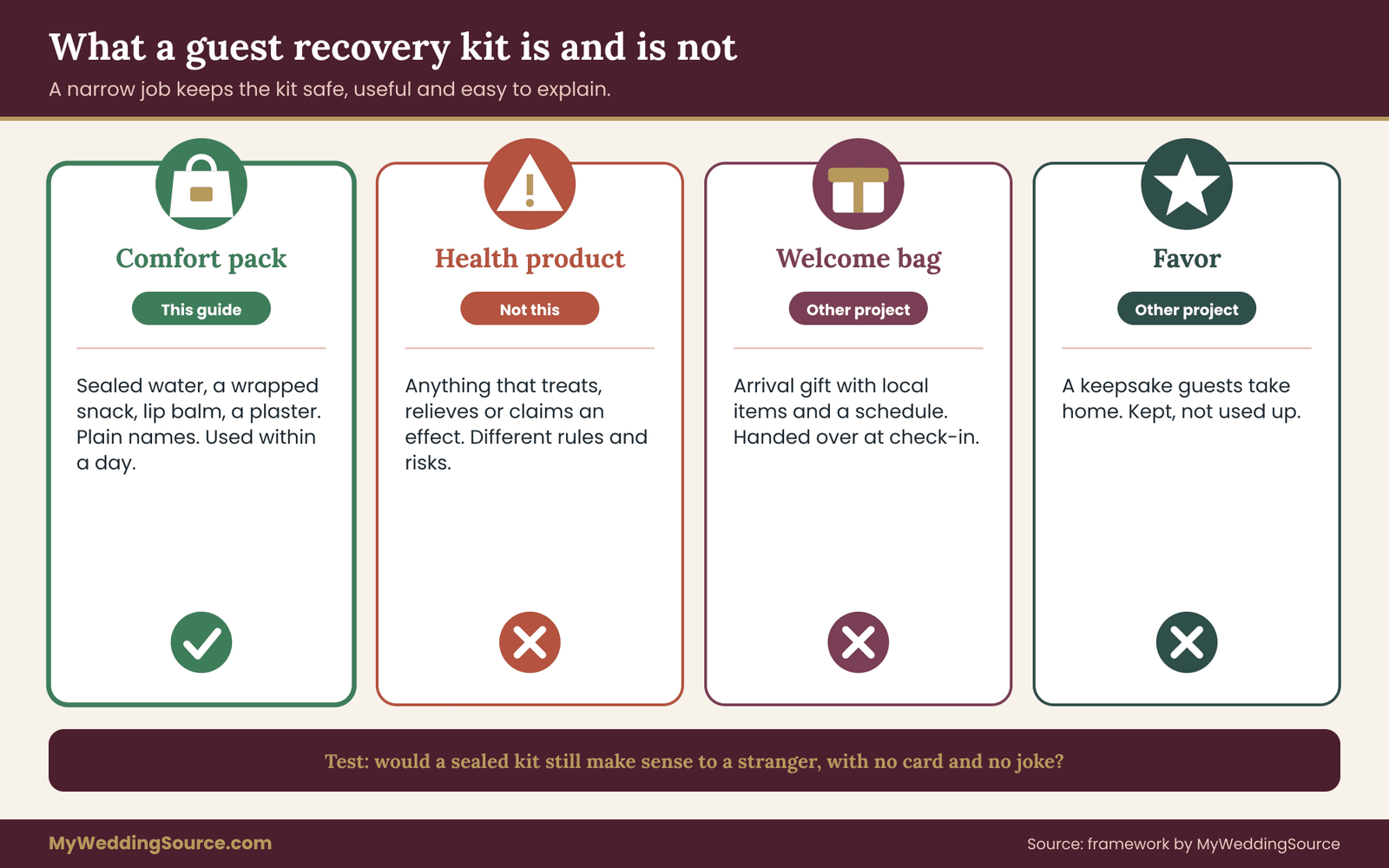
It is a comfort pack. The contents help with ordinary discomforts that come from a long day: thirst, an empty stomach at midnight, sore feet, dry lips, a stained shirt, a dead phone. Every item is something a person can buy in a regular store without advice from a professional. Every item could be described by its plain name, such as “water” or “lip balm.”
It is not a health product. A guest recovery kit that claims to prevent, relieve or cure a condition, whether a headache, nausea or fatigue, has moved into territory where the claims, the contents and the liability are all different. You do not need to be in that territory to be helpful. If a guest needs medical care, they need a pharmacist, a clinician or emergency services, not a gift box.
It is not a welcome bag. The welcome bag is the arrival gift. It is handed over when guests check in, it carries local items and a schedule, and it has to look good in photos. If you want that, it is a different project with a different brief, and the same items rarely work for both jobs. A guest recovery kit is about the end of the day or the morning after. It is plainer, more practical and often smaller.
It is not a favor. A favor is something a guest takes home as a keepsake. A recovery kit is mostly used up within twenty-four hours. That changes how much you spend per kit and how much thought goes into packaging.
Put as a one-line test: if a sealed kit would still make sense to a stranger who found it on a hotel hallway floor, with no card and no explanation, it is a comfort pack. If it only makes sense with a joke about last night, it is probably a joke gift, and the joke is where the risk hides.
Why couples and hosts build one
Hosts usually have one of three reasons. Some are hosting a destination or multi-day weekend and know guests will be far from their usual shops. Some are hosting a late reception where the last hour of the night is the hardest. And some have simply noticed that guests keep asking the venue for the same five small things.
Whatever your reason, write it down in one sentence before shopping. “We want every guest to be able to find water, a snack and a plaster at the hotel without leaving the building” is a good brief. “We want something fun for the hotel rooms” is a weaker one, because it gives you no way to decide what to cut when the budget tightens.
No host owes guests a guest recovery kit. Etiquette guidance, such as the wedding etiquette guide on this site, treats extras like this as a gracious option, never an obligation, and a plain kit given quietly is more in keeping with that spirit than a showy one.
Who this guide is for
This guide is written for couples, but it also fits the people who often end up assembling the kits: a parent, a sibling, a planner, a hotel events coordinator, or a friend with a free Saturday. If you are one of those people, ask the couple for their one-sentence brief and the delivery moment before you start buying. Those two answers prevent most of the rework described later.
Choosing the moment: three delivery windows for a guest recovery kit
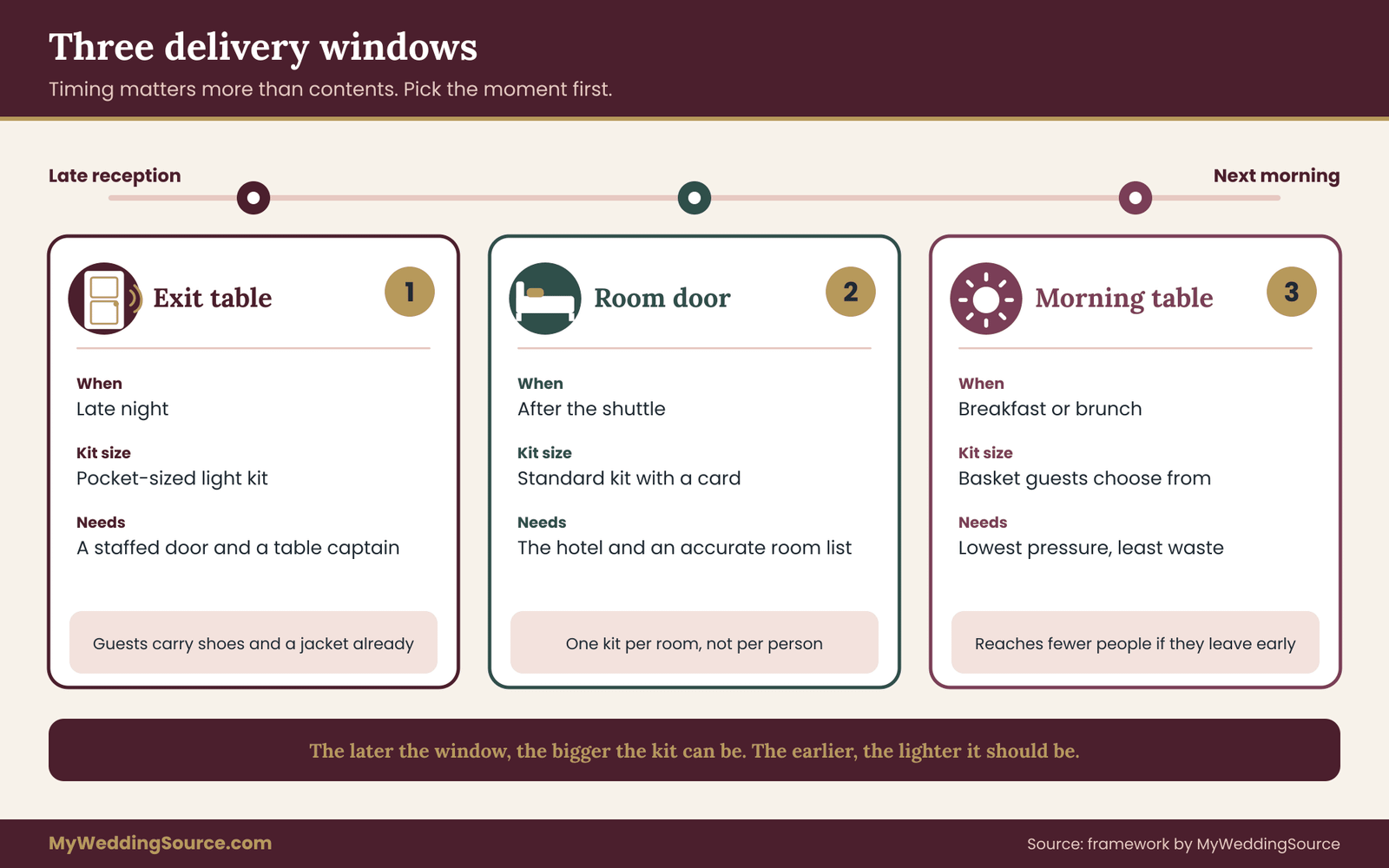
Timing matters more than contents. The same water bottle is a thoughtful gesture at 12:40 a.m. and a forgotten weight in a suitcase at noon the next day. Before you choose items, choose when the guest will use them. There are three realistic windows, and most weddings use one, sometimes two.
Window one: the exit table. Guests pick up a kit on the way out of the reception. This suits a venue with a clear last-call moment and a door staff member who can keep the table tidy. It works well for short, light kits: water, a wrapped snack, lip balm, a plaster. Items need to fit in a pocket or small bag, because many people will be carrying shoes, a jacket and a phone.
Window two: the room door. The guest recovery kit is delivered to the hotel room, either hung on the door handle in a bag or placed inside by the hotel. Guests find it when they return, which is often the right moment. It allows slightly larger items, such as a refillable bottle or a small towel, and it allows a printed card with the checkout time and breakfast details. It needs hotel cooperation and an accurate list of rooms.
Window three: the morning table. Kits sit on a table at a farewell brunch, in the lobby, or beside the breakfast room. Guests take one if they want it. This is the lowest-pressure option, since nobody has to be handed anything, and it reduces waste because only taken kits are used. It also reaches fewer people, because some guests will leave early or skip the table.
A simple decision rule
Ask two questions. First, will most guests return to a hotel where you can reach the front desk? If yes, window two is open. Second, is there a staffed exit where a table will not be ignored or raided? If yes, window one is open. If neither is true, choose window three, or put a small basket at the reception exit and a second small supply at the morning gathering.
The guest care planning guide on this site covers a related question: how to look after older relatives and families with young children across a long day, which often changes who needs a guest recovery kit most.
What changes between the windows
The delivery window decides four things: the size of the guest recovery kit, how many you need, how fragile the contents can be, and how much explanation the guest needs. An exit-table kit is small, needs only as many kits as you expect to take them, and can rely on a short card. A room-door kit needs one per room, can include a bigger item or two, and has to survive a hotel delivery. A morning-table kit can be assembled in a basket rather than in bags, since people will choose their own items.
If you want a single sentence to guide you: the later the window, the bigger and more practical the kit can be, and the earlier the window, the smaller and lighter it should be.
The safe-contents screen for a guest recovery kit
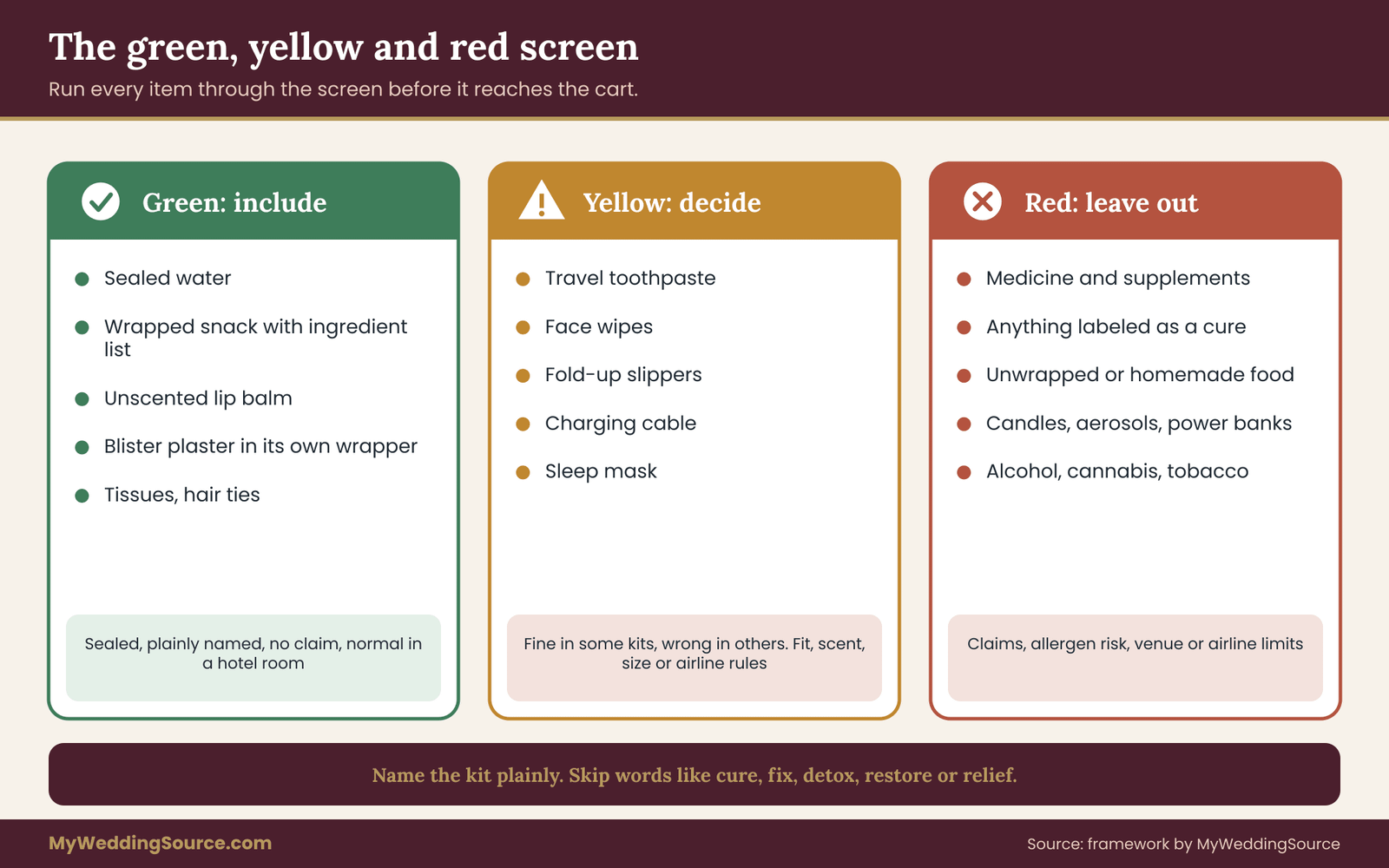
Every item you consider should pass one screen before it reaches a shopping cart. The screen has three colors, and it is meant to be quick. You can run it in your head in the aisle, or paste it into a shared note so a helper can run it too.
Green items pass without discussion. They are sold in sealed original packaging, have a plain name that makes no health claim, carry an ingredient or contents label from the manufacturer, and would not be unusual in a hotel room. Sealed water, a wrapped granola bar, a tube of lip balm, a pack of tissues and a hair tie all qualify.
Yellow items need one extra decision. They are fine in some kits and wrong in others. A travel-size toothpaste is green for a room-door kit and awkward for a carry-on-only crowd, because of the airline liquids rule. A sleep mask is green for a room kit and pointless at an exit table. A blister plaster is green if it is left in its own wrapper with the manufacturer’s printed text, and yellow if you decant it into a clear bag where the label disappears.
Red items stay out. They fall into five groups, and it helps to know them by group rather than memorizing a list.
Anything that treats or claims to treat. Pain relievers, stomach remedies, sleep aids, antihistamines, supplements, vitamin shots and any product whose package describes an effect on the body. The reasons are practical. You cannot know a guest’s allergies, medications or conditions. A friendly pill from a host can interact with something the host never heard about. And a guest recovery kit that includes medicine invites the question of who is responsible if something goes wrong.
Anything that implies a cure. Even a harmless item becomes a problem if you label it with a claim. A bag of crackers marked “hangover fix” is no longer a snack, it is a statement about a body. Keep names plain and light: “Good Morning kit” or “Late Night kit” says nothing about anyone’s health.
Anything unwrapped or homemade. Baked goods from a home kitchen, snack mixes poured into bags and candy scooped from a bulk bin have no ingredient list the guest can trust. In many places, selling or distributing homemade food is regulated, and even when giving it away is allowed, the allergen risk remains. The wedding menu planning guide explains how allergen planning works for the meal itself, and the same logic applies, in miniature, to a snack in a bag.
Anything a hotel or airline restricts. Candles, matches and lighters, aerosol sprays, loose lithium power banks in checked luggage, alcohol miniatures that violate venue policy, and anything with a strong scent that could set off a neighboring room.
Anything that is alcohol, cannabis or tobacco related. Even if you are hosting an open bar, a guest recovery kit is not the place for extra alcohol. It sends the wrong message after a long night, and the legal position varies by state and venue.
Why the screen is stricter than common sense
It can feel overcautious to rule out a pack of pain relievers that every pharmacy sells. The screen is built for a group, not for you. Among sixty or a hundred guests there will be children, people on prescriptions, people avoiding certain ingredients for religious or personal reasons and people who simply do not want to be handed medicine by a host. A rule that works for all of them is easier to follow than a judgment call per guest.
There is also a simple fairness reason. If a guest recovery kit includes one medical-type item, guests start to expect more, and the person assembling kits becomes an unlicensed dispenser of advice. Staying inside comfort items keeps the role clear: you are a host providing supplies, not a source of care.
What to do about guests who need something specific
Some guests will have real needs: a diabetic guest who needs reliable food, a guest with a severe allergy, a guest with a mobility device that needs charging. A kit cannot meet those needs and should not try.
What it can do is avoid making them worse. Put a large-print contents card in each guest recovery kit so a guest with an allergy can see immediately what is inside. Keep a small number of kits “plain,” with no food, and let guests choose at the table. And give the venue or hotel contact a way to reach you if a guest asks for something that is not in the guest recovery kit.
For guests whose needs are known in advance, a short private message works better than a generic gift. “We saw you noted a nut allergy on your reply card, so your guest recovery kit has no snacks at all and includes a bottle of water instead” is more considerate than a snack with a tiny label.
Water and snacks: the core of a guest recovery kit
If you only have the budget for two items, these are the two. Water and a food item account for most of what a tired guest looks for, and both are easy to source in sealed, labeled form.
Choosing the water
The kit is a place where water is simple. A sealed bottle from a regular retailer is the safest choice because the guest can see that it has not been opened and can read the label. A refillable bottle sounds nicer and may suit a sustainability-minded wedding, but it needs washing, it has no seal, and a guest with a flight the next morning may leave it behind. If you want a reusable option, offer it as a take-it-if-you-want item at the morning table rather than a standard kit item.
Size matters more than people expect. A large bottle is heavy at the exit table and bulky in a small evening bag. A small bottle fits a jacket pocket. For room-door kits, a standard size is fine because the guest only has to carry it a few steps.
Temperature also matters. Water left in a warm car or a sunny entry hall all afternoon is unpleasant. If kits are staged ahead of time, store the water separately and add it at the last moment. Some couples ask the hotel to place chilled bottles in the room just before arrival, which the hotel can often do for a small handling fee.
Choosing the snack
The snack is where most of the risk lives, because food is where allergen labels matter. The rules of thumb are short.
Pick individually wrapped items with a manufacturer ingredient list. Granola bars, crackers, pretzels, dried fruit packs and shelf-stable cookies are all common. The guest can turn the wrapper over and read what is in it, which is the point.
Avoid mixing brands inside a single bag without a list. If you combine items from different packages, the guest recovery kit needs a contents card that names each product, and the original wrappers must stay intact. Never pour items into a plain bag.
Think about the sort of hunger. At a late exit, guests often want something salty and light rather than sweet and heavy. In the morning, something that holds up in a bag for an hour or two is more useful than something that melts. Chocolate, for instance, is a poor choice for a summer wedding room kit.
Offer a nut-free choice, not a nut-free promise. You can choose snacks that do not list nuts as an ingredient and still not know whether they were produced in a facility that handles them. Say exactly what is true: “No snack in this guest recovery kit lists peanuts or tree nuts as an ingredient. Check each wrapper for details.” Do not say “nut-free” unless the manufacturer says it.
For local or regional snacks, treat any small-batch item with extra care. A product from a small maker is only as safe as its label, and many small makers do not print complete allergen statements. When in doubt, choose the national brand that does.
A short shelf-life check
Most packaged snacks carry a best-by date. Check it when you buy, and again when you pack. A guest recovery kit assembled two weeks before the wedding should use items with at least a few months remaining. Do not rely on the date alone for items that have been warm or in direct light. If a wrapper looks puffed, torn or dented, replace it.
Keep a spare of every food item. One damaged item in a batch of fifty is normal, and it is easier to swap it from a spare box than to rebuy the same snack on the day.
Putting water and snacks together
A pair of these two items covers the simplest version of the kit. Many couples stop there for the exit table, and that is a good decision. A short kit that nearly every guest takes is more useful than a large kit that half the guests ignore. The next section covers the small comfort items that can be added without changing the safety profile.
Comfort items that fit a guest recovery kit
Beyond water and a snack, the guest recovery kit can include a small number of items that address the other ordinary discomforts of a long day. The goal is not a full pharmacy shelf. It is three to five items that cover what guests most often reach for, each passing the green-yellow-red screen.
Foot comfort: blister plasters and cushions
Feet are the most common complaint at any wedding with dancing, a long ceremony standing or a cobblestone arrival. Two kinds of products tend to appear in kits: adhesive blister plasters and foot cushions, such as gel heel grips or ball-of-foot pads.
Both are sold as ordinary personal care products in many stores. The safe way to handle them is to treat them as packaged goods, not as advice. Keep each in its original wrapper. Do not rewrite the instructions. Do not describe what it does beyond what the wrapper says. A card that says “Foot comfort: one adhesive plaster, in its own package” tells the guest what they have without making a claim.
Some points are worth checking before you buy. Look at whether the package is sized for a heel, a toe or a general area, because a plaster that is too small is useless. Look for latex or adhesive warnings on the box, and if you are unsure, buy a version whose package states what it is made of. Skim for fragrance or added ingredients. Choose neutral. And keep the plain wrapper visible, since guests with skin sensitivities will want to read it.
A single plaster is enough for most guests. Two is generous, and a small strip of mixed sizes is a pleasant touch if the budget allows. Do not include creams, sprays or gels meant to treat skin. Those are product types with their own claims and warnings, and they belong to the yellow-red end of the screen.
Lip balm and other small personal-care basics
Lip balm is one of the most popular kit items, and it is easy to get right. A sealed stick or tube with a manufacturer label is a green item. Choose unscented or lightly scented, because a strong scent can bother some guests, and because a heavily perfumed item is more likely to trigger a complaint. Avoid products whose name includes words that suggest treatment. A plain “lip balm” is enough.
Other small personal-care basics fall in the same family:
Tissues. A small pack of pocket tissues is cheap and used by nearly everyone. Choose an unscented pack.
Hand wipes. Individually wrapped wipes help after food or a long journey. Check the package for a skin-sensitivity warning, and choose a fragrance-free option if possible.
Face wipes. Popular for removing makeup at the end of the night. They are more personal and more likely to cause a reaction, so treat them as a yellow item. Offer them in a take-if-you-want basket, not in every guest recovery kit.
Mints or gum. Individually wrapped, with a visible ingredient list. Note that some contain sweeteners or ingredients some guests avoid, so keep the wrapper.
Hair ties and hair pins. Useful, low-risk, and small. A pair of elastic bands and a few pins in a tiny pouch is welcomed by many guests.
Small fixes for clothing and gear
A second family of items solves practical problems instead of comfort problems. These items often matter more than people expect at the end of a day: a stain, a loose button, a dying phone.
Safety pins and a small sewing kit. A few safety pins in a small pouch is a classic wedding item. A sewing kit with needles is less common and slightly riskier for children, so consider leaving it out of kits for guests who are bringing young children.
A stain wipe. A single-use stain wipe is a handy item. Check the package for a strong scent and for fabric warnings.
A charging cable. A short cable is useful, but guests have a wide range of connectors, so a mismatch is likely. If you include a cable at all, put it at the room or desk, not in every guest recovery kit. Avoid battery power banks as kit items. Lithium batteries have airline carriage rules, and they are a safety issue if damaged. The Transportation Security Administration and the Federal Aviation Administration publish guidance on how batteries must be carried, and the rules are a reason to leave them out.
Slippers or flip-flops. A pair of fold-up slippers is the single most appreciated item at many weddings, but it is also the hardest to get right. Size is the problem. A one-size slipper fits few people well, takes space and costs more than any other item here. If you want to offer them, stage a table with a few sizes, rather than putting a pair in every kit.
Items that are better left out
There are items that feel natural for a guest recovery kit but cause more trouble than they are worth. A short list helps.
Medicine of any kind. Covered earlier. The rule is the same for the over-the-counter items sold at every register.
Alcohol miniatures. They add risk, and some venues prohibit them.
Anything with a strong scent. Essential oils, perfumed sprays and heavy lotions are likely to bother other guests and some hotels.
Supplements and drink mixes with wellness claims. If the package describes a benefit, the item is a product with a claim, and you would be passing that claim to guests.
Large or fragile items. Glass bottles, ceramic mugs and anything that breaks in a bag.
The three-to-five rule
Every item you add makes the guest recovery kit heavier, more expensive and harder to pack, and every item adds one more thing to check for safety. A simple rule helps: choose three to five item types total, keep the guest recovery kit small, and put anything extra in an optional basket.
A sample set that works in many situations is water, a wrapped snack, lip balm, a blister plaster and tissues. Swap one for a pair of hair ties or a stain wipe depending on your crowd. That is five items, each passing the screen, each easy to describe on a card.
Three kit sizes: light, standard and full
Different weddings need different amounts. Instead of designing one kit and arguing about it, it helps to define three sizes in advance, and then match each delivery window to the size that suits it.
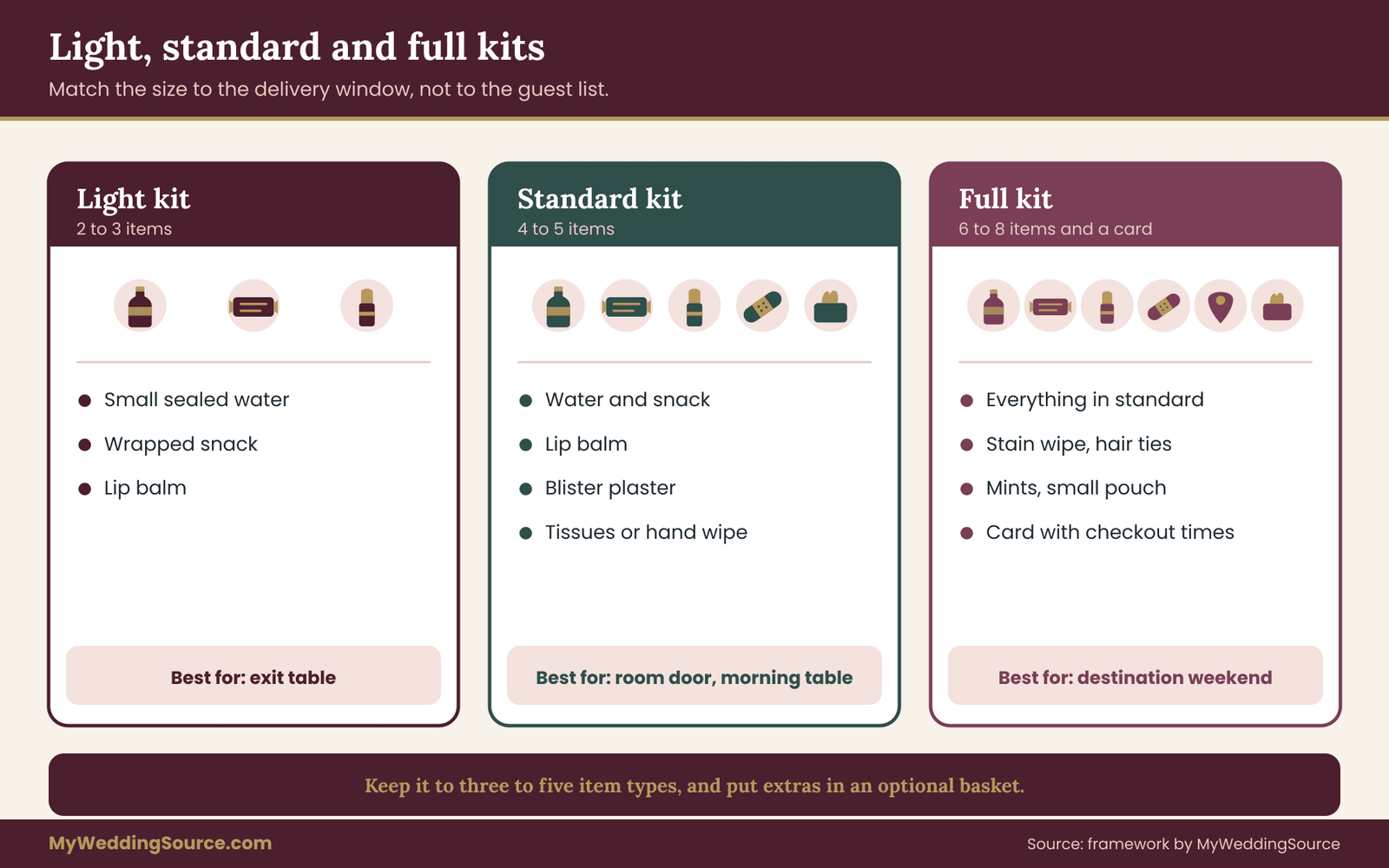
The light kit has two or three items: a small sealed water, a wrapped snack and a lip balm. It fits a pocket. It suits the exit table at a late reception where many guests are walking to a car or a nearby hotel. It is the cheapest to produce and the least likely to be thrown away.
The standard kit has four to five items: water, a snack, lip balm, a blister plaster and tissues or a hand wipe. It fits a small paper bag or envelope. It suits room-door delivery and the morning table. It is the version most hosts end up choosing.
The full kit has six to eight items and a card. It adds items such as a stain wipe, hair ties, mints, a small pouch and perhaps an eye mask. It suits a multi-day destination weekend where guests are far from shops and the hosts want to cover most small needs in one place. It costs the most and takes the longest to assemble, and it needs the strongest labeling.
Matching size to window
An exit table that offers a full kit usually fails, because the guest is carrying too much already. A room-door delivery with a light kit feels thin, because the guest has time to use more. As a rule, the light kit pairs with the exit, the standard kit pairs with the room door, and the full kit pairs with a morning table or a destination weekend.
Some couples combine windows. A light kit at the exit and a standard kit waiting in the room covers both moments, though it also doubles the cost. If budget is tight, choose one window and do it well.
A word on mixing guests
A single kit rarely suits every guest. A family with young children may need a different mix from a group of college friends. If you know your guest list well, you can create two variants: a standard kit and a guest recovery kit without food, or a guest recovery kit with a child-friendly snack. Keep it to two variants at most. Three or more variants multiply labeling errors, and a labeling error is the most common cause of a bad kit.
Use the guest list guide to group guests by household first, because it determines how many kits you actually need. A household of four sharing one hotel room needs one guest recovery kit, perhaps with extra water, not four.
Labeling a guest recovery kit: names, cards and plain wording
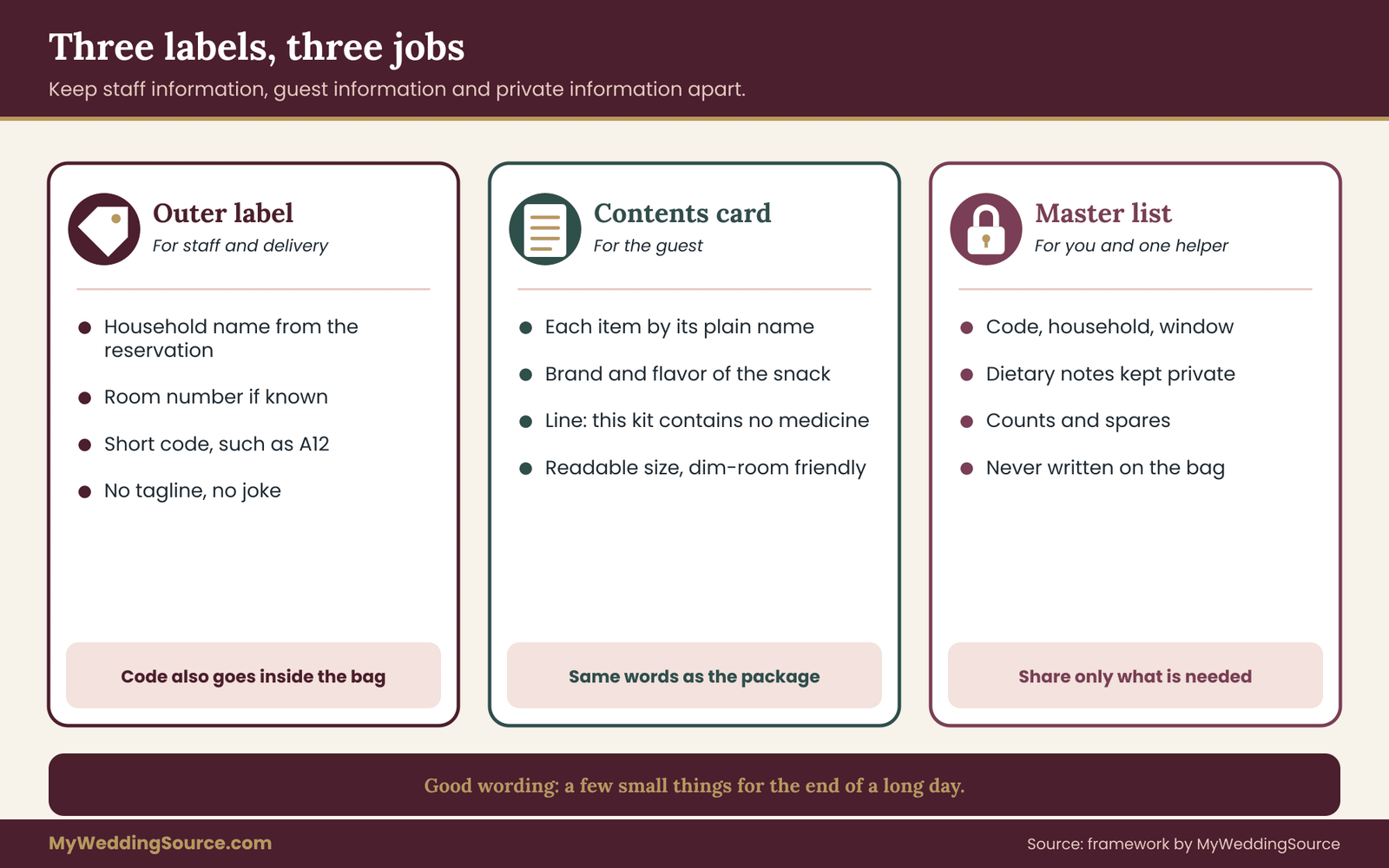
Labeling does three jobs. It tells the guest what is inside, it tells the hotel or venue where to put the kit, and it keeps you out of claim territory. Each job needs a different label, and mixing them on one sticker is how errors happen.
The outer label: who it is for and where it goes
The outer label is for staff and for delivery. It carries the household name, the room number if you know it, and a short code that matches your master list. It does not carry a tagline, a joke or a description of the contents.
Use last names or a household label such as “Okafor family” rather than first names alone, since hotels file by the name on the reservation. If the room is booked under a different name, use that name and add the guest’s name in smaller type. Mismatches between the reservation name and the label are the leading reason a guest recovery kit goes to the wrong door.
A short code, such as a letter and number, helps with sorting. “A12” can mean “Group A, kit 12” and ties back to a row on your list. If a bag is torn or a label peels, the code still identifies it. Write the code on the inside of the bag as well.
The contents card: what is inside and what is not
The contents card is for the guest. It lists each item by its plain name and states what the guest recovery kit does not contain. A short version fits on a card the size of a business card, and a longer version can go on the back.
A sample card reads in plain language: “Inside: one sealed water, one wrapped snack, one lip balm, one adhesive foot plaster, one pack of tissues. Check each wrapper for ingredients and use instructions. This kit contains no medicine.”
Several choices make the card safer. List the snack by brand and flavor, so a guest with an allergy can look up the full ingredient list. Use the same words as the package. Do not rename products with a cute name that hides what they are. State the date you assembled the kit if any items have a best-by date close to the wedding. And print the card in a readable size, since many guests will read it in a dim hotel room at the end of a long night.
The phrase “contains no medicine” is worth keeping. It removes a question a guest might have, and it reminds staff and helpers what the guest recovery kit is for.
Wording to use, and wording to avoid
The tone of the card matters as much as the content. Plain, warm, specific wording is better than clever wording.
Good wording sounds like: “A few small things for the end of a long day.” “Water, a snack and a few comforts. Take what is useful.” “Thank you for celebrating with us.”
Wording to avoid includes anything that names an ailment or promises an effect. Skip words like “cure,” “fix,” “detox,” “restore,” “boost” and “relief.” Skip jokes about the amount anyone drank, since not every guest drinks and not everyone finds it funny. Skip anything that suggests the guest recovery kit is a substitute for care. If you like humor, aim it at the day itself, such as “Dancing shoes, retired for the evening,” rather than at anyone’s condition.
If a vendor is supplying pre-made kits, read the vendor’s own claims carefully. The Federal Trade Commission explains that advertising claims must be truthful and supported, and a vendor that describes a guest recovery kit as helping with a condition is making a claim you would be passing along. Ask the vendor for the basis for any claim, and ask them to remove the claim if they cannot supply it. For a kit you build yourself, the problem does not arise, as long as your own card stays plain.
Labels for dietary information
If a guest has told you about an allergy or dietary need, make a guest recovery kit for them rather than adding a warning to a standard kit. A clearly marked “no food” kit, for example, is easy to assemble and avoids any ingredient risk. Mark it with a plain symbol or a different color of paper, and make sure the person assembling kits knows what the mark means. Do not write the guest’s condition on the outside of the guest recovery kit, because the guest recovery kit may be seen by staff or other guests.
Keep dietary information on your master list, not on the labels, and share it only with the person assembling kits.
Packing a guest recovery kit
Packing is where small decisions add up. The container, the order of items and the way you seal the kit decide whether guests find the guest recovery kit useful or messy.
Choosing the container
A paper bag with a fold-over top is the simplest container. It is cheap, recyclable, easy to label on the outside and tolerates a bit of weight. A small cotton pouch feels nicer and can be reused, but costs more and may not survive being left in a hotel room. A clear plastic bag lets the guest see the contents, which is handy, but it tends to look less warm and is less friendly to the environment.
For a door-hanger kit, use a bag with a handle or a loop, so it can hang from a door knob without being propped against the door. A flat paper bag that sits on the floor in a hallway is easily kicked or taken by someone else.
Whichever you choose, avoid anything that blocks sight of the label, and avoid containers with a strong smell, such as certain scented bags.
The order of packing
Pack heavy and hard items at the bottom, fragile and soft items on top. The water goes in first, standing upright. The snack goes beside it. The plaster, lip balm and tissues go on top. The card goes on the very top, so it is the first thing a guest sees when they open the bag.
Keep each small item in its own wrapper. If you use a small pouch for the minor items, keep the original packaging of each item visible in the pouch.
Fold the top of the bag twice and seal it with a sticker that has the household code on it. A sealed bag has a quiet advantage: a guest knows that no one has been into it, and a hotel employee knows that it should not be opened.
A packing checklist
A short list helps anyone assembling kits stay consistent.
Before packing. Lay out one finished sample kit, photograph it, and keep the photo next to the work area. Count the items for the full batch, plus ten percent spare for each item type. Check best-by dates and package condition on every food item.
During packing. Pack kits in batches of ten. After each batch, open one at random and compare it with the sample. Make sure the card is on top, the code is on the inside and outside, and the seal is closed.
After packing. Stack kits in labeled boxes by household group, with the code range on the outside of each box. Count the boxes. Count the kits. Write both numbers on a sheet taped to the box.
Storage and transport
Kits should be stored in a cool, dry room away from direct sun. A closet in a home is better than a trunk or a garage. Water and snacks are both sensitive to heat, and chocolate or soft candies are especially sensitive.
For transport, choose sturdy boxes that stack. Keep kits in the passenger area of a car, not the trunk, on a hot day. If the kits must be left in a vehicle for a short time, shade the vehicle and check the condition when you arrive.
If you are shipping kits to a hotel or venue, check the delivery rules in advance. Some hotels accept packages only within a specific window before the guest or event date, and some charge a handling fee per box. Others refuse deliveries addressed to a guest who has not yet checked in. The venue handoff section later in this guide covers those questions in detail.
Measurable checks before you call the kits finished
Four checks are quick and give you confidence that the kits are ready.
Count check. The number of kits matches the number on your master list, plus the planned spares.
Content check. A random sample of five percent of the kits, or at least five kits, has every item, in the same order, with a card on top.
Seal check. Every bag is closed and carries both the outer label and the inside code.
Date check. The earliest best-by date on any item is at least a month after the wedding.
Record the results on a short sheet. If any check fails, fix the cause, not only the one guest recovery kit, then repeat the check on a new sample.
The venue and hotel handoff checklist for a guest recovery kit
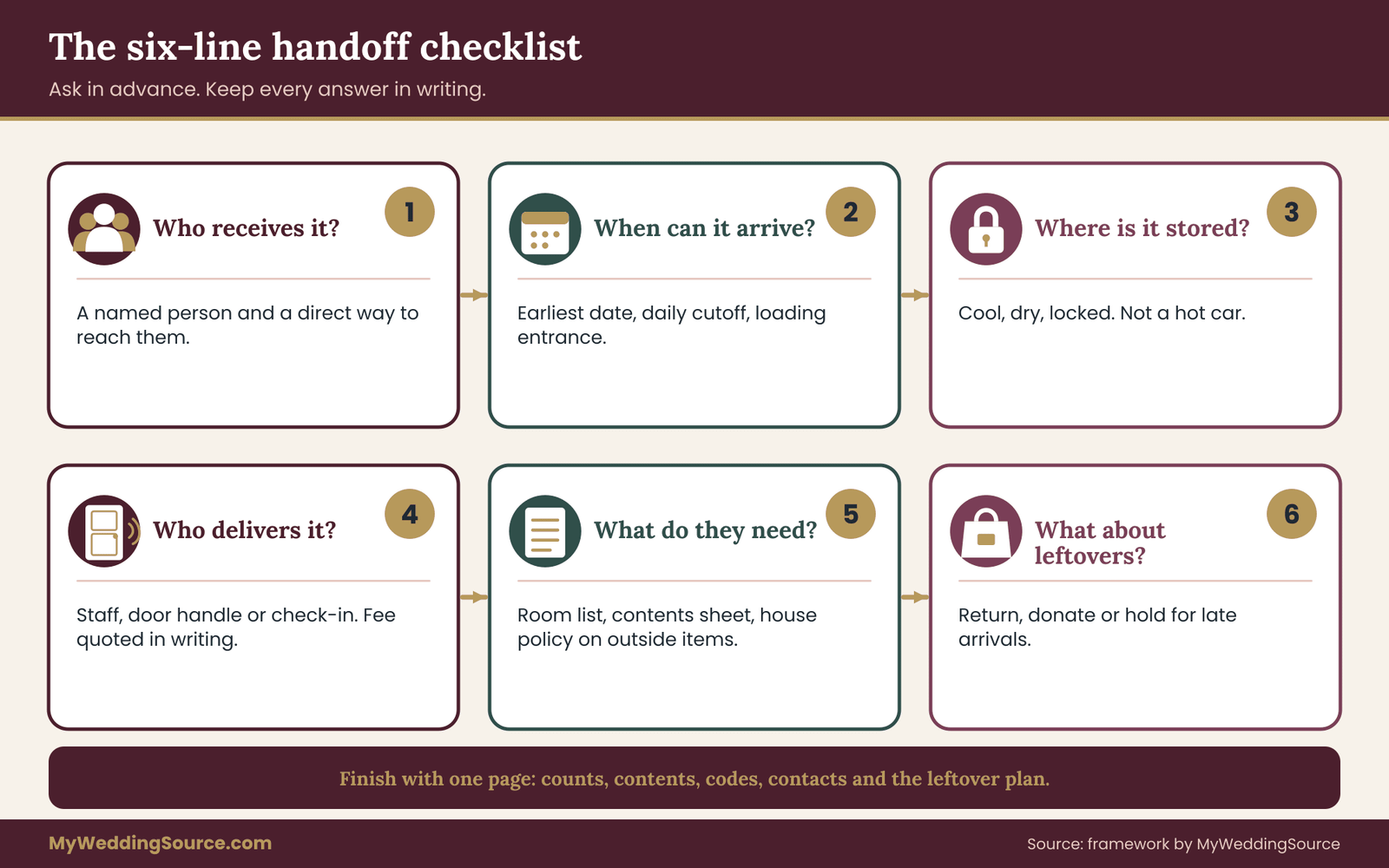
A guest recovery kit that is perfectly packed can still fail at the handoff. Hotels and venues run on routines, and a box that arrives without a name, a count or a contact person tends to end up in a storeroom. The checklist below is the original tool of this guide. It has six lines, and each line is a question you ask in advance and answer in writing.
The six lines
Line one: Who receives it? Get a name, a role and a direct way to reach that person. A front desk manager, an events coordinator or a banquet captain are common answers. A general inbox is not an answer. If the person is not available on the delivery day, ask who covers.
Line two: When can it arrive? Hotels often set a delivery window, such as no earlier than a day or two before the event, and sometimes a daily cutoff. Venues may accept deliveries only during set hours or through a loading entrance. A venue’s loading dock and delivery rules can affect when and where boxes go, so ask directly.
Line three: Where is it stored? Ask for a room that is cool, dry and locked. Ask whether water and snacks can be stored in a back office, a closet or a refrigerated space if needed. If the hotel cannot store boxes, ask what the alternative is.
Line four: Who delivers it, and how? For room-door kits, ask whether staff will place them in rooms, hang them on handles or hand them over at check-in. Ask what the hotel’s practice is for rooms with a do-not-disturb sign. Ask whether there is a fee, whether it is per kit or per delivery, and whether it is quoted in writing.
Line five: What does the hotel need from you? Many hotels ask for a list of room numbers or guest names, a time, and a contact. Some ask for a short description of the contents. A few have rules about outside food in rooms. Ask whether any item on your contents list conflicts with house policy.
Line six: What happens to leftovers? Ask whether unused kits can be returned to you, donated, or left at the front desk for guests who arrive late. Decide before the day, not after.
How to ask
A short, specific email is easier to answer than a general question. A sample message follows.
“Hello, we are hosting a wedding on [date] and would like to leave a small comfort kit in each guest room. Each kit is a paper bag containing water, a wrapped snack, lip balm, a foot plaster and tissues, with a card listing the contents. Could you tell us who receives deliveries, the earliest date you accept them, where they are stored, and whether there is a delivery fee? We can provide a room list and a contents sheet.”
Keep the reply. If the answer is given by phone, follow up with a message that repeats it: “Thank you for the call. To confirm, boxes arrive on [date] before noon, are stored in the back office, and are placed in rooms the afternoon of [date].” That confirmation is a record, and it is useful if anything goes wrong.
What the hotel will want to know about contents
A careful hotel may ask what is inside. Give a plain answer and have a contents sheet ready. The sheet lists each item, the brand where relevant, and a note that nothing in the guest recovery kit is medicine, alcohol or an open food. It also lists the allergen-relevant ingredients printed on the snack wrapper, which the hotel can pass to staff if a guest asks.
A hotel is more likely to say yes to a plain, sealed, clearly labeled kit than to a decorative basket with loose items. If the hotel declines, ask what it would accept. Some offer their own amenity service, in which they place water and snacks you provide in a branded basket. That is often an acceptable fallback.
Handoff at a venue
Venues have a different question set. If the exit table is staffed by the venue, ask who sets it up, who clears it and what happens when it is empty. Ask whether table space is reserved or has to be requested. Ask about the last-call time and the point at which the exit door closes. Put the guest recovery kit table where guests naturally pass, not in a corner. The guide on reception guest flow explains how entry, food and exit points shape where people actually walk, and the same thinking applies to a small table.
If you have a coordinator, give them a one-page sheet with the guest recovery kit location, the count, the cutoff time and who to call. If you do not have a coordinator, name a friend or family member and tell them in advance. The person who sets up the table should not be the couple.
The written handoff sheet
Prepare one page, and give a copy to the hotel or venue, a copy to the person on site and keep one yourself. It should include the date and time of the delivery, the number of boxes and kits, the contents list, the label code system, the room list or group list, the contact names and numbers, and the leftover plan. Add a line stating that kits are sealed and should not be opened.
That one page prevents most of the problems described in the next section.
Counting kits and setting a budget
Counting sounds simple, but it is where waste starts. Many hosts order one kit per invited guest, then find that half are left over. A better count starts from households and moments, not from the invitation list.
Count by household and window
Start with your confirmed guest list, then group guests by household or hotel room. A family of four in one room needs one guest recovery kit. Two friends sharing a room need one guest recovery kit, or two if you prefer. Local guests who will not stay at the hotel may need an exit-table kit, not a room kit.
For a room-door window, the count is the number of rooms in your block plus any rooms booked outside it, plus ten percent spare. The guest hotel guide on this site explains how to track rooms across different bookings, which helps here.
For an exit-table window, the count is harder. Not every guest takes a guest recovery kit. A reasonable plan is to prepare enough for about two thirds of the expected attendees, then keep a spare box nearby to refill. If the kits run out, guests will still find water and snacks. If you have too many, you can donate them or use them at the farewell event.
For a morning table, count roughly half of the households and refill from a spare box.
These are planning ranges, not measured facts. Your own crowd may differ. A late-night wedding with a lot of dancing is likely to see more takers than a short afternoon one. Adjust the spare box, not the whole order.
Cost logic without invented numbers
Cost per kit is the sum of the items, the container, the card and any delivery fee. Rather than guessing at prices, use a simple method.
First, write down the item list for the light, standard and full versions. Second, price each item at a store you will actually use, in the pack size you would buy, and divide by the number of items in the pack to get a per-item cost. Third, add the container and card. Fourth, multiply by the kit count including spares. Fifth, add delivery or handling fees quoted in writing. The total is your budget line.
If the total is higher than you want, remove items before reducing quality. A guest recovery kit with three good items beats one with six cheap ones. Also look at pack sizes. A box of wrapped snacks that holds forty may be cheaper per item than a pack of twelve, but only if you can use forty.
Where kits compete with other spending
A guest recovery kit is a small expense, but it competes with larger choices. If your budget is tight, the wedding budget guide can help decide where a small comfort gesture fits. A guest recovery kit is rarely the right place to cut corners on safety, but it is a fine place to cut volume. Fewer, better kits are better than many mediocre ones.
Leftovers and what to do with them
Plan for leftovers from the beginning. Sealed water and wrapped snacks keep well, so they can be donated to a local shelter or food pantry if the organization accepts them. Check the organization’s rules first, since some accept only unopened, in-date food. Lip balm and plasters may be accepted by community groups that serve people in need, but ask before bringing them. Use your leftover cards as scrap, and recycle the bags.
Do not keep leftover kits at the hotel without agreement. Staff have to deal with them, and unclaimed boxes tend to disappear.
Worked example: a sixty-four-guest weekend
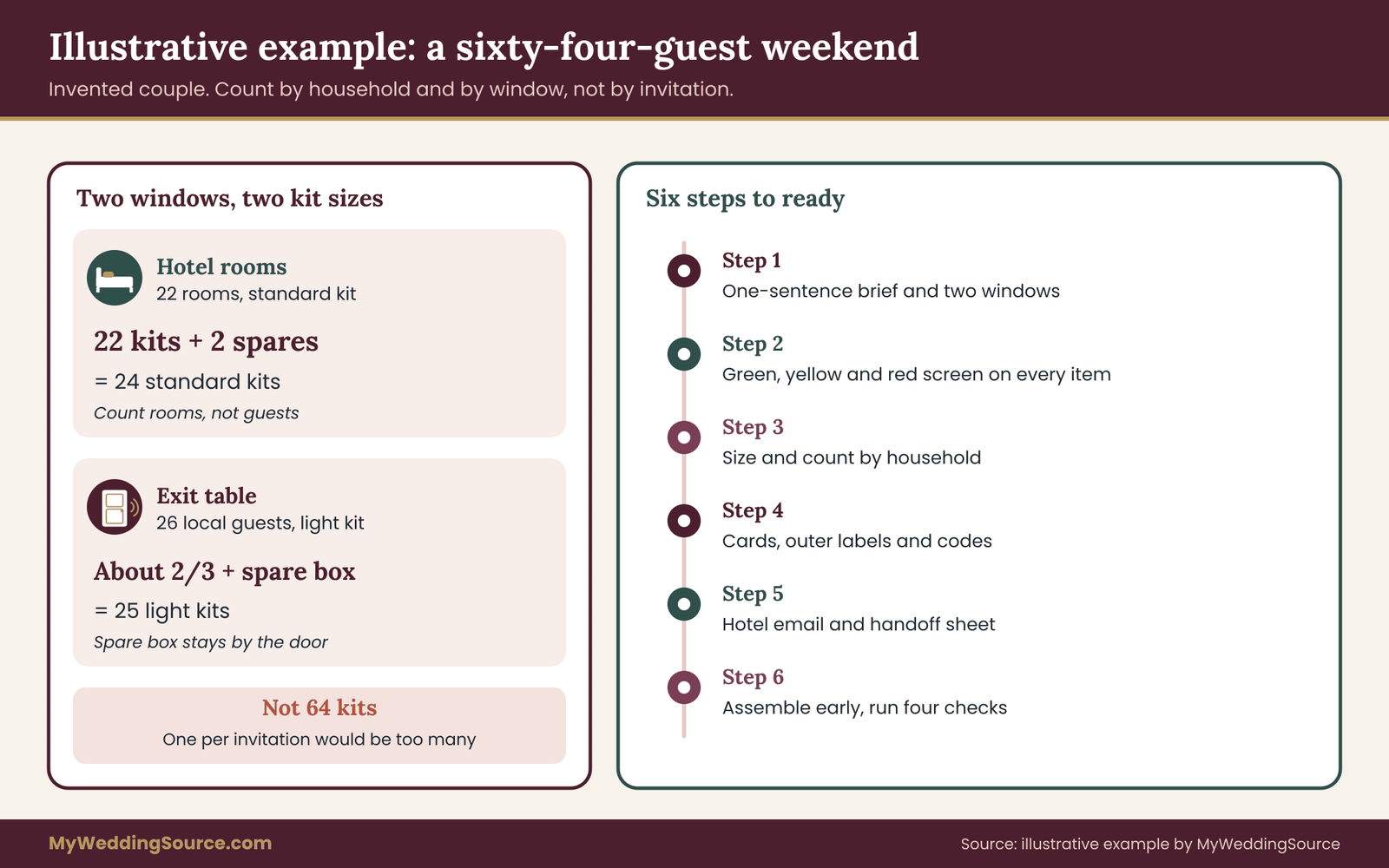
An example helps show how the pieces fit. The couple below is invented for illustration, and the numbers are planning figures, not measurements from a real event.
Priya and Daniel are hosting a Saturday evening wedding for sixty-four guests at a venue about twenty minutes from a hotel. Thirty-eight guests are staying at the hotel in twenty-two rooms, since many share. The remaining twenty-six are local or staying with relatives. The reception ends at 11:30 p.m. A shuttle runs to the hotel from 11:15 p.m. to 12:15 a.m. Brunch is not planned, but the hotel serves breakfast until 10:30 a.m.
Step one: the one-sentence brief
They write: “We want every guest staying at the hotel to find water, a snack and a few small comforts waiting in their room, and local guests to be able to pick up water and a snack on the way out.” That sentence already decides two windows: room door for hotel guests and exit table for locals.
Step two: the screen
They list candidate items and run the screen. Sealed water: green. Wrapped granola bar and a pack of crackers: green, with a note to check wrappers. Lip balm: green, unscented. Blister plaster: green in its own wrapper. Tissues: green. Travel toothpaste: yellow, skipped because it adds a liquids question and not every guest needs it. Pain relievers: red. Hangover-labeled drink mix a friend suggested: red, because of the claim on the package. Mini bottles of sparkling wine a cousin offered: red. Fold-up slippers: yellow, moved to the optional list.
Step three: size and count
For the hotel guests they choose the standard kit, five items. For the locals they choose the light kit, three items: water, a snack and lip balm. Counting by household, the hotel needs twenty-two kits plus two spares, so twenty-four. For the exit table they plan for about two thirds of twenty-six, which rounds to seventeen, and add a spare box of eight, so twenty-five light kits.
Total: twenty-four standard kits and twenty-five light kits. If they had ordered one kit per guest, they would have bought sixty-four, which is far more than they will use.
Step four: labels and cards
The standard kit card lists five items by name and says the guest recovery kit contains no medicine. The light kit card lists three. Outer labels carry the household name for the room kits and no name for the exit kits. A code such as H01 to H24 runs across the hotel kits and E01 to E25 for exit kits. One plain “no food” kit is set aside for a guest who mentioned a food allergy on a reply card. Instead of a snack it has a second water and a tissue pack.
Step five: the handoff sheet
Daniel emails the hotel using a version of the message in the handoff section. The hotel replies that boxes can arrive the day before, will be held in a locked back office, and that housekeeping can place them in rooms during the afternoon of the wedding for a flat fee quoted in writing. The hotel asks for a room list and contents sheet by Thursday. Daniel sends both and keeps the reply.
For the exit table, Priya’s cousin is named as table captain. The venue confirms a six-foot table near the door and a cutoff at 11:45 p.m. The cousin gets a one-page sheet with the count, the location of the spare box and the venue contact.
Step six: the checks
Two evenings before the wedding, Priya and a friend assemble kits in batches of ten and open one in each batch to compare it with the sample. They run the four checks: count, content, seal and date. The count check turns up one missing pack of tissues in a batch. They fix the batch, then check a new sample. The earliest best-by date is four months away.
What the example shows
The couple’s decisions were small and specific. They did not guess at a total. They counted by household, matched kit size to window, left out anything with a claim, and wrote the handoff down. Most of the work sat in a few hours of assembly and two emails. The result is a modest kit that fits the day and does not depend on anyone remembering a promise.
Guest recovery kit alternatives compared
A guest recovery kit is not the only way to give guests small comforts. Before you commit, compare it with the alternatives. Each has a different cost, effort and risk profile.
A staffed amenity station. Water, wrapped snacks and a few comfort items are set out on a table at the exit or in the lobby, and guests help themselves. Compared with pre-packed kits, a station costs less in labor and packaging because nothing is bagged. Guests can take what they want, which cuts waste. The trade-offs are that someone has to refill and watch the station, hygiene is harder to manage if items are loose, and a late-night crowd can empty it fast. It works best when every item is individually wrapped.
A hotel amenity request. You ask the hotel to place water and snacks in rooms through its own amenity service. This shifts the labor to the hotel and removes the delivery questions. It often costs more per item and limits your choices to the hotel’s catalog, but it avoids the issue of outside items. It suits couples who have little time and a hotel with a flexible program.
A vendor-made kit. A company assembles and delivers kits. This saves your time, but you have to check the vendor’s claims, the contents list and the delivery terms. Ask for the full contents with brands, and ask the vendor to remove any health claims from the packaging. Compare the total with the cost of building the guest recovery kit yourself, including your time.
A welcome bag with a few extra items. Some hosts add water and a snack to the arrival gift instead of building a separate kit. That saves a delivery, but the timing is wrong, since guests receive the items long before they need them, and a day-one snack may not last. If you want both, keep them separate.
A printed card pointing to local shops. A card that lists the nearest pharmacy, late-night store and grocery, with hours, costs almost nothing and is useful to every guest. It does not replace a kit, but it can be added to one, and in some cases it is enough on its own.
A short comparison in prose
If your priority is the lowest cost and least waste, choose the station or the printed card. If your priority is a warm gesture that requires no guest effort, choose the pre-packed kit. If your priority is your own time, choose the hotel amenity or a vendor-made kit and check the details. If your priority is guest care across a large, spread-out crowd, combine a light exit kit with a card and a station at the morning gathering.
None of these is better in every case. The right one is the one you can deliver reliably, with the people and time you have.
Questions to ask a vendor or hotel before you commit
When comparing options, a few questions apply to every provider. What exactly is in each guest recovery kit, by brand and size? Which items carry allergen warnings, and can I see the labels? Are any items described as helping with a condition, and if so, on what basis? What are the delivery window, storage conditions and fees? What happens if an item is out of stock and substituted? Is there any commercial relationship between the vendor and the brands used? Ask for answers in writing, and compare them side by side.
If you receive anything free or discounted from a supplier in exchange for a mention, or if any item is supplied through a referral arrangement, say so plainly wherever you recommend the product. Clear disclosure is basic honesty, and the Federal Trade Commission publishes guidance on material connections in endorsements.
Edge cases and how to handle them
Real weddings do not match the tidy plan, and a few situations come up often enough to plan for.
Guests flying home the next morning. Their kit needs to travel. Liquids in a carry-on are limited by the TSA 3-1-1 rule, which applies to lip balm in some forms, to lotions and to anything that is a gel or paste. A sealed water bottle cannot go through security full. Tell guests in the card, “Empty the bottle before security if you are flying.” Skip power banks and aerosol items. The carry-on welcome bag article on this site goes through what flying guests can pack, and the same limits apply here.
Guests with young children. Kits meant for adults can include items that are not safe for small children, such as small plasters, mints or sewing items. Make a child version with no small parts, and pass it through the room-door window with a note. Do not give a guest recovery kit with adult items to a child. The wider picture of caring for babies, children and older relatives is covered in the guest care guide linked earlier.
Guests who do not drink. A guest recovery kit designed around a heavy-drinking assumption excludes people who abstain. Keep the tone neutral and the contents universal: water, a snack, a comfort item. Never make the kit a gag about alcohol.
Guests with allergies or dietary rules. Offer a no-food kit, mark it quietly and keep the list private. Do not promise a food is free from an allergen unless the manufacturer says so.
A hotel that refuses outside items. Ask for the policy in writing, then fall back to an exit table, a lobby station or the hotel’s own amenity service.
A venue that closes early. If the exit table cannot stay open, move the kits to a coat check or hand them out in the last half hour with a short announcement from the host.
Hot weather. Store kits in a cool place until delivery, choose snacks that do not melt and consider adding a small cooling cloth in a sealed packet instead of anything that must stay cold.
A last-minute change in guest count. Keep a spare box, and know where to buy the same items quickly. A snack that only one store sells is a risk.
Gifts from family or friends. Someone will offer to add something, such as homemade cookies or herbal items. Thank them, and tell them plainly that kits include only sealed, labeled items. A line you can say: “That is kind. We are keeping the kits to sealed store-bought items so we can give guests the full ingredient list.”
Common mistakes with a guest recovery kit
Most problems with kits come from a handful of repeating mistakes. Knowing them in advance is cheaper than fixing them on the day.
Starting with items instead of the moment. Hosts browse a shop, fill a basket and only then ask when guests would use it. The result is a guest recovery kit that arrives at the wrong time. Choose the window first.
Letting a joke name the guest recovery kit. Cute names are fine when they are about the day. They become a problem when they imply an effect on the body, or when they make guests who do not drink feel singled out. A plain name costs nothing.
Decanting and mixing. Pouring snacks into a bag or combining brands without original wrappers removes the ingredient list. Keep each item in its own package, and list brands on the card.
Including one medical-type item “just in case.” One pill pack changes the nature of the guest recovery kit. If a guest has a bad reaction, the host is the visible source. Keep the line firm.
Ordering one per invitation. Counting by invitation rather than by household or by window wastes money and creates leftovers that nobody wants to handle.
Skipping the handoff sheet. A box that arrives at a hotel without a name, count and contact person is the box most likely to be lost. The six-line checklist takes about twenty minutes and removes most of the risk.
Leaving assembly until the last evening. A rushed team makes labeling errors and misses damaged items. Assemble a few days ahead, store the kits properly and run the four checks with time to fix problems.
Forgetting the card. The card is what makes the kit understandable to a tired guest who has not read your website. Print it in a readable size.
Ignoring flying guests. A guest recovery kit with a full bottle or a power bank is a nuisance in an airport line. A line on the card about emptying the bottle is usually enough.
Treating the guest recovery kit as the main event. A guest recovery kit is a small courtesy. It does not replace a good schedule, clear transport, enough food during the reception or a quiet place to sit. Spend your attention on those first, then add the kit.
Your next steps
You can set up a workable plan in a single evening. Work through these in order.
First, write your one-sentence brief and choose the delivery window: exit table, room door or morning table. Second, pick the guest recovery kit size, light, standard or full, that matches the window, and list three to five items. Third, run each item through the green, yellow and red screen, and drop anything that makes a claim or lacks a label. Fourth, count kits by household and window, add spares and price the total using real shelf prices. Fifth, draft the contents card with plain wording and the line stating that the guest recovery kit contains no medicine.
Then turn to the handoff. Email the hotel or venue with the six questions, keep the replies and fill in the one-page handoff sheet. Name a person who will set up and watch the table or coordinate the room delivery. Finally, assemble the kits a few days ahead, run the count, content, seal and date checks and store them somewhere cool.
For the wider question of how a gesture like this fits with the rest of hosting, the guest etiquette basics are a good companion, and the guest care planning guide helps you think through the guests who need more than a kit.
FAQ
What goes in a wedding guest recovery kit?
Keep it to sealed, store-bought comfort items: a small water, a wrapped snack with a visible ingredient list, a lip balm, a blister plaster or foot cushion in its own package, and tissues. Add a short card that lists the contents. Leave out medicine, supplements, alcohol and anything unwrapped. Three to five item types is enough for almost every wedding.
Is it safe to include pain relievers or other medicine in a guest recovery kit?
It is better not to. You cannot know a guest’s allergies, prescriptions or health conditions, and handing out medicine makes the host a visible source if something goes wrong. A guest who needs medicine can buy it or ask a pharmacist. A guest recovery kit should stay in the comfort category, and the card can say the guest recovery kit contains no medicine.
Can I call it a hangover kit?
It is safer not to. A name that points to an effect on the body is a claim, and it can also make guests who do not drink feel singled out. Plain names such as Late Night kit or Good Morning kit say what the guest recovery kit is for without promising anything about anyone’s health.
When should guests receive the kit?
Pick one of three windows. An exit table suits a late reception with a staffed door. A room-door delivery suits a hotel block where you can reach the front desk. A morning table suits a farewell brunch or breakfast area. Choose the window first, then size the guest recovery kit to fit it, because timing matters more than contents.
How many kits should I make?
Count by household and window, not by invitation. A family sharing one room needs one guest recovery kit. For room delivery, count rooms and add about ten percent spare. For an exit table, plan for roughly two thirds of attendees and keep a spare box nearby. Adjust the spare box, not the whole order, if your crowd takes more or fewer.
How do I handle guests with food allergies?
Offer a no-food version with extra water and tissues, mark it quietly and keep the list private. Never promise that a snack is free of an allergen unless the manufacturer states it. Keep snacks in original wrappers so guests can read the ingredients, and list brands on the contents card for anyone who wants to check.
What should I ask a hotel before leaving kits for guests?
Ask who receives deliveries, the earliest arrival date, where boxes are stored, who places kits in rooms, whether there is a fee, and what happens to leftovers. Ask whether any item conflicts with house policy. Confirm every answer in writing, and give the hotel a room list and a one-page contents sheet.
Can guests take a recovery kit on a plane?
Partly. Liquids, gels and pastes in a carry-on follow the TSA liquids rule, so a full water bottle cannot go through security. Power banks have their own carriage rules, so leave them out. Add a line on the card: empty the bottle before security. Lip balm and plasters usually travel without trouble, but check current airline and TSA guidance.
Sources
- Federal Trade Commission: advertising, endorsements and truthful claims
- U.S. Food and Drug Administration: food allergens and labeling
- U.S. Consumer Product Safety Commission: product safety guidance
- Transportation Security Administration: liquids rule and what can go in a carry-on
- Federal Aviation Administration: batteries and hazardous materials on aircraft
- Centers for Disease Control and Prevention: food safety
- U.S. Department of Agriculture: food safety and labeling
- ADA.gov: Americans with Disabilities Act resources for events and venues
- Food Allergy Research and Education: allergen label reading