
A bridal cape looks effortless in photos and behaves like a small piece of engineering on the day. This guide compares a bridal cape with a veil on three practical points, how each one is attached, how each one moves, and how each one photographs, and gives you a trial you can run at home before you buy, rent or commit.
A veil is held by one small anchor in your hair. A bridal cape is held at your neck, shoulders or gown, and it hangs from your body, so it pulls on whatever holds it. Choose by testing, not by taste alone. Run the Anchor, Load, Release trial: check that the attachment stays put, that it does not pull on your neck, hair or gown during ordinary moves, and that you can take it off quickly with one hand.
Then check how it looks from the front, the back and the side. A bridal cape that passes all three checks is a safe choice. One that fails the release check should not be worn, however good it looks.
Most advice about wearing a cape or a veil is written as styling advice. It tells you which one looks romantic, which one suits a cathedral and which one suits a garden. That matters, but it leaves out the part that causes problems on the day, which is mechanical. A veil slips because its comb has too little to grip. A bridal cape twists because its closure sits in the wrong place, or pulls at the neckline because its weight hangs from two thin ribbons.
Neither problem shows up in a mirror in a quiet fitting room.
The goal here is narrow. This article does not decide whether you should wear a cape at all, and it does not repeat the full wind and hairstyle discussion that the site’s cape vs veil test plan already covers. Instead it focuses on how the piece is held, how it behaves under load, how it comes off, and what the camera sees. If you are still choosing a dress, the wedding dress fit and alterations guide explains how a gown is measured and adjusted, and many of the points below depend on it.
A note on scope. This is general information, not legal, tax or financial advice. Garment construction differs by designer and maker, so the final word on any piece comes from your own fitting, your seamstress and the written terms of the shop or seller.
What a bridal cape changes about your wedding look
A bridal cape is any outer layer that hangs from the shoulders or neck and covers the back of the gown, the arms, or both. It can be sheer or opaque, short or floor-length, plain or heavily beaded. The word covers several different garments, and the differences matter for attachment.
The full cape. A long, cloak-like piece that falls to the knee, the ankle or the floor. It usually closes at the neck with a tie, a hook or a clasp, and it carries most of its weight on the neck and the tops of the shoulders.
The capelet. A short cape that ends between the shoulder blades and the waist. It weighs less, so it pulls less, but it sits right where the gown’s neckline, straps and back details are.
The cape veil. A cape-like piece made from tulle or lace that is attached at the shoulders or the back of the neck and flows over the gown and train. It is often sold as a veil, and it behaves like a bridal cape because it hangs from the body, not from the hair.
The shoulder cape or shrug. A small cover for the upper arms, often with a single front closure. It stays close to the body and moves with it.
The detachable overlay. A bridal cape that is sewn or hooked to the gown itself, so it works as part of the dress for the ceremony and comes off afterward.
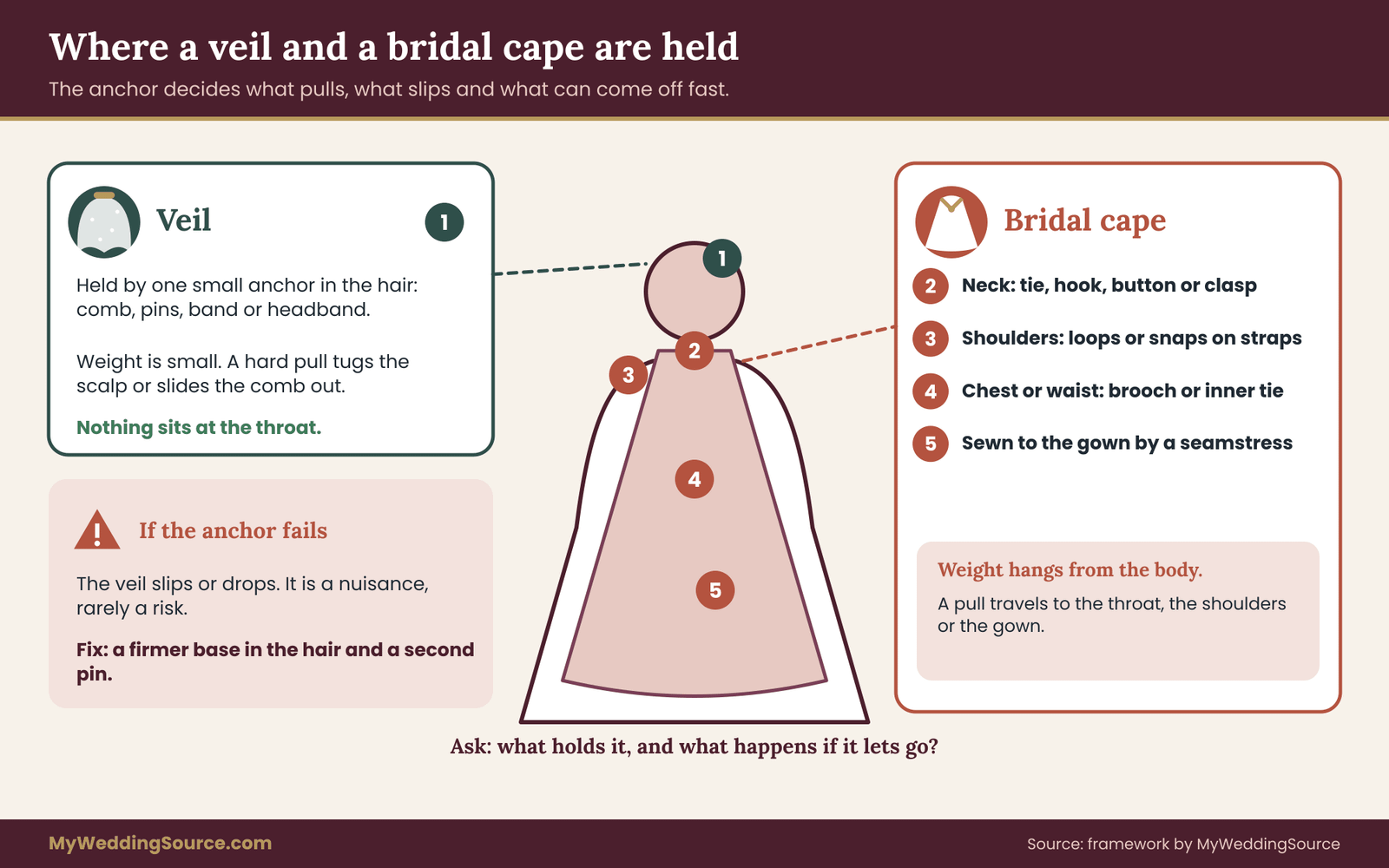
The graphic above shows where each piece rests on the body. The simplest way to read it is to ask where the weight goes. A veil sends a small weight to a small point on the head. A bridal cape sends a larger weight to a wider area, usually the neck and the tops of the shoulders, and it can also send pull to the gown beneath it.
Why attachment is the real decision
If two pieces look equally good, the attachment settles the choice. A cape that you cannot take off quickly is a problem when you feel dizzy or hot in a crowded room. A veil that slides out of your hair mid-aisle is a problem, but a smaller one, because nothing around your neck is involved.
There are three ways a worn piece can fail. It can slip, meaning it moves from where it was placed. It can pull, meaning it drags on your neck, hair, skin or gown. Or it can trap, meaning you cannot get it off easily. The trial in this guide checks all three, and it names them the same way every time so the results are easy to compare.
Where this article stops
Some topics have their own guides on the site. Wind, hairstyles and aisle layout are treated in the cape vs veil test plan. The wider question of how every accessory works together, including shoes, jewelry and backups, is in the wedding day accessories guide. This article stays with attachment points, movement, the order you put things on, and photography, and it points to the other guides where they cover a topic better.
Bridal cape vs veil: how each one is held
Put a veil and a bridal cape side by side and the difference is not length or fabric. It is the anchor. Every piece that stays on a moving person needs something to hold it, and the type of anchor decides what can go wrong.
How a veil is held
A veil usually has one of four anchors. A comb, which is a short row of teeth that slides into the hair. Pins or clips, which pass through the veil gathering and into the hair. An elastic band or a loop that sits around a bun or ponytail. Or a headband, crown or hairpiece that carries the veil on its own frame.
All four depend on your hair. Hair that is fine, freshly washed, very smooth or very short gives these anchors less to hold, which is why stylists often add a small amount of texture before placing a comb. The bridal hair and makeup planning guide covers how to talk to a stylist about this at the trial.
The force on a veil anchor is small. A typical veil is light, and the pull comes from its length, from wind, and from other people stepping on it or brushing against it. Because the anchor is in the hair, a veil that is pulled hard tends to tug on the scalp or slip out, which is uncomfortable but rarely dangerous.
How a bridal cape is held
A bridal cape has more options, and each one puts force in a different place.
At the neck. A ribbon tie, a button and loop, a hook and eye, or a clasp that closes at the front or the back of the neck. This is the most common anchor, and it puts the weight of the cape on the neck and the upper back.
At the shoulders. Loops, snaps or hooks that attach the bridal cape to the gown straps, the neckline or the shoulder seams. This sends the weight to the gown, which has to be strong enough to carry it.
At the front chest. A single pin, brooch or toggle that holds two edges together. The load is concentrated in one small area, and the piece can swing open if the closure fails.
At the waist or back. An internal tie, a belt or a set of hooks that fasten at the waist, sometimes through a sewn-in panel. It keeps the cape from lifting, but it adds a step to dressing and undressing.
Sewn to the gown. A cape that is stitched or hooked to the bodice by a seamstress so it moves with the dress. This is the most stable option, and it usually takes a visit to the alterations room.
A bridal cape also interacts with the veil. A cape closure at the back of the neck can sit directly under a comb, and a veil’s gathered edge can catch on a bridal cape’s collar. A later section returns to this crowded zone.
What the comparison means in practice
Skip the feature lists and ask two questions instead. First, what is holding this piece, and is it designed to carry the weight? Second, if the holder fails, what happens? A comb that fails drops a veil. A neck tie that fails drops a cape, and a cape that is half open can shift sideways and press on the throat. The second answer should shape how much you test and how much backup you plan.
The six attachment types for a bridal cape
Shop descriptions often say only that a bridal cape “closes at the neck”. That tells you nothing about how it behaves. The six types below cover most pieces you will meet, with what each one does well and where it tends to go wrong.
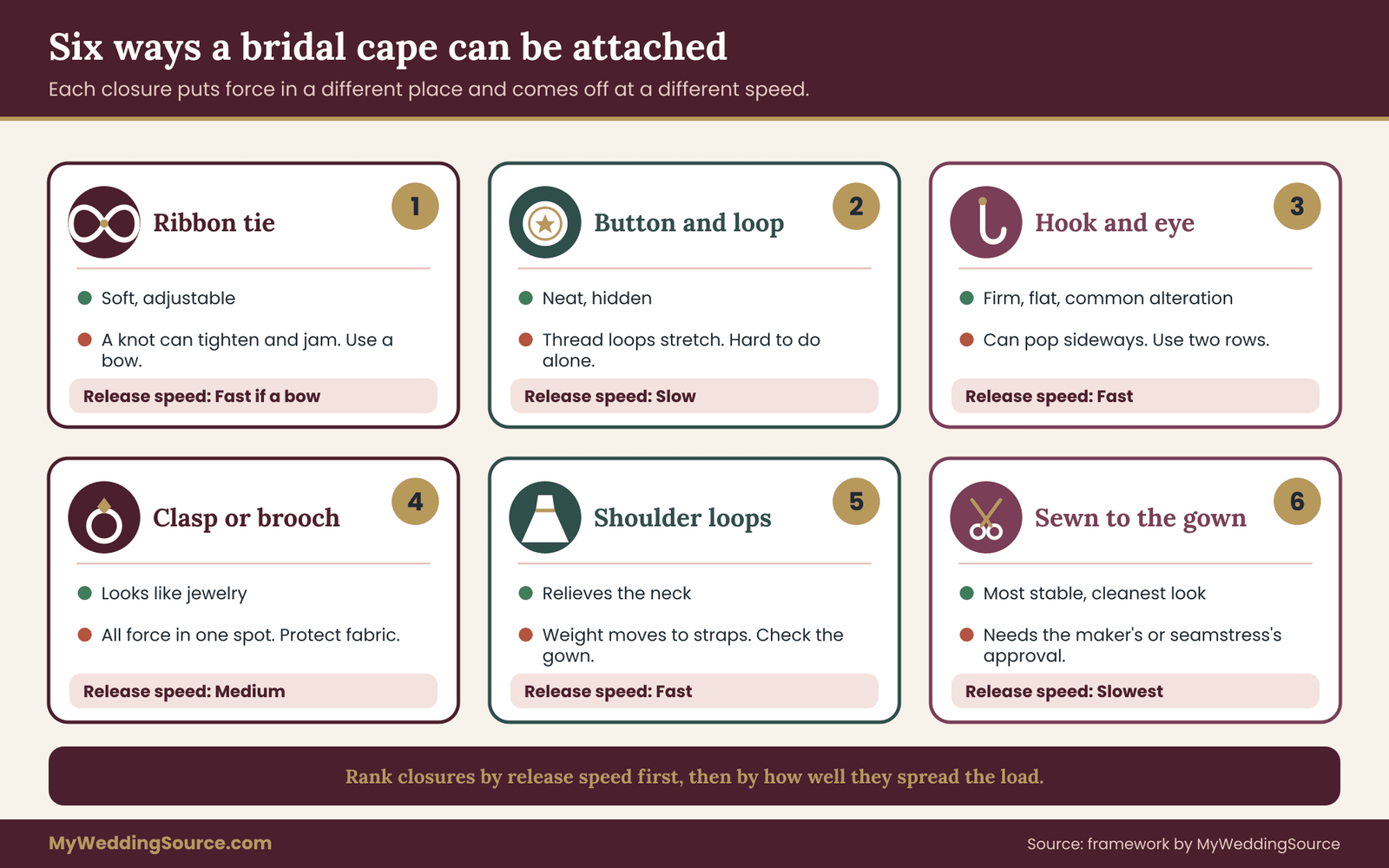
Ribbon or satin tie. Two ribbons sewn to the cape edges, tied in a bow or a knot at the front or the back of the neck. Ribbons are gentle on skin, adjustable, and quick to untie if the bow is a simple one. They also loosen as you move, and a double knot that holds well can be hard to undo in a hurry.
Ask whether the ribbon is sewn into the cape structure or only stitched onto the surface. A ribbon that is only stitched onto a thin layer of tulle can tear the tulle when the bridal cape is pulled.
Button and fabric loop. A small button at the neck that passes through a loop of fabric or thread. This is neat and quiet, and it does not show from the front. It is also slow to fasten behind your own neck, and a thread loop can stretch or snap under steady pull. Lace cuffs and beaded buttons can catch stray hair.
Hook and eye. A metal hook that catches a small wire loop. This gives a firm hold and no bulk, and it is the closure most seamstresses add when they alter a piece. It is also the type most likely to pop open if the cape is pulled sideways, and it can leave a small mark on skin if it presses against it. A double row of hooks spreads the load better than a single hook.
Clasp, brooch or toggle. A decorative closure at the front. This is the type that looks most like jewelry. It concentrates all the force in one place, and a pin-style brooch can pierce the fabric of the cape or the gown. A brooch that rests against delicate fabric needs a protector behind it.
Shoulder loops and snaps. Small loops that go over the gown straps, or snaps that attach to the gown at the shoulder seams. This relieves the neck, because the weight sits on the shoulders. It also moves the question to the gown. A thin spaghetti strap or a bias-cut neckline that has not been reinforced can stretch or distort under the load.
Sewn or hooked to the gown. A seamstress attaches the bridal cape to the bodice with hand stitches, hooks or a reinforced inner panel. This produces the cleanest look and the least slip, and it is the one that requires permission from the dress’s maker or an experienced alterations professional. Ask before any needle touches a designer gown. Some makers want to keep the dress unaltered for resale or warranty reasons.
Choosing among the six. Rank them first by release speed and second by load. A tie or a hook and eye comes off fastest. A sewn attachment holds best but comes off slowest. Most people end up choosing between two types and testing both, which the trial in the next part is built to do.
Safety at the neck, shoulders and gown
Most of what goes wrong with a bridal cape is mild: a closure pops open, a ribbon twists, a hem catches a heel. A smaller set of problems deserves more care because they involve the neck, the skin or a fall. None of this is a reason to avoid a cape. It is a reason to test one the way you would test any garment that hangs from your throat.
The neck is the sensitive point
Any closure that sits at or near the neck should meet two plain conditions. It should never tighten when the cape is pulled backward. And it should open with one hand, quickly, without needing to see it.
A bridal cape pulled backward by a gust, a guest’s foot on the hem or a sudden turn loads the neck closure. If the closure is a fixed loop of ribbon, the cape presses on the front of the throat. If the closure is a hook, the hook may open.
The second outcome is safer than the first. This is the logic behind consumer safety guidance on neck cords in children’s clothing, which the U.S. Consumer Product Safety Commission publishes for manufacturers. Adult wedding wear is different, but the principle carries over: a cord that cannot release under pull is a hazard, and a closure that releases is not.
Practical rules for the neck:
- Prefer a closure that opens under strong pull, such as a hook and eye or a snap, over a knot that tightens.
- If you use a ribbon, tie a bow with long loose ends, not a knot, and tuck the ends where you can find them.
- Keep the closure at the front or the side of the neck if you can reach it easily. A closure at the back needs a helper.
- Leave one finger-width of slack between the collar edge and your throat when the cape is on and the head is turned.
- If any closure feels tight when you swallow, tilt your head down or take a deep breath, it is too tight.
The shoulders carry more than you think
A bridal cape that is attached at the shoulders puts weight on the gown straps or neckline. A lace or beaded cape can be heavier than it looks, and the weight sits on a very small area. Over a long ceremony, that weight can leave marks on skin, pull a thin strap off the shoulder, or distort a delicate neckline.
Check three things at the fitting. Does the gown strap stay in place when the bridal cape is attached? Does the gown neckline keep its shape, with no new wrinkles or dips? Is there a spot of pressure that you notice after ten minutes? If the answer to the last question is yes, mark the spot with a small piece of tape on the inside and ask the seamstress whether a wider anchor or a lining layer can spread the load.
The gown can be damaged
Some gown fabrics tolerate a cape better than others. Silk charmeuse can show water marks and pin holes. Delicate tulle and lace snag on hooks and beads. Crepe is more forgiving. Satin can pick up thread pulls from a rough cape lining.
Look at both sides of the contact. A cape with a beaded collar rubs on the gown neckline each time you turn your head, and the beads can wear a pattern into the fabric or catch the thread. A bridal cape with a rough lining can pill the gown. A short test, wearing both pieces for twenty minutes while you move, shows whether the contact points are a problem.
Never use safety pins, straight pins or tape on a gown without the maker’s or the seamstress’s permission. A pin hole in silk is permanent, and a mark from tape adhesive on satin may be too.
Pins, brooches and skin
A pin or brooch that holds a bridal cape sits near the collarbone. Check that the pin head is covered, that the point cannot work its way loose, and that it does not press into skin when you hug someone. A pin that is fine while you stand still can dig in when a guest’s arm tightens around your shoulders.
Heat, cold and the closed collar
A cape adds a layer at the neck and shoulders, and it traps warmth. In warm weather, a closed neck can raise the temperature quickly. In cold weather, it helps. Neither is a safety problem on its own, but a hot collar is a reason to make sure you can open the cape easily. Weather safety information from the National Weather Service explains how heat and cold affect people outdoors, and it is a good place to check the forecast thresholds for your date.
Falls and trips
A long bridal cape adds hem length that the gown does not have. Stairs, ramps and uneven ground are the places where an extra hem becomes a trip hazard. If the ceremony includes steps, ask the venue to confirm the number and the width, and rehearse them in the bridal cape. Ask the venue to confirm the number and width of any steps and ramps, and measure access routes in advance.
If you or a guest uses a wheelchair, a cane or a walker, the cape needs another check. A cape that hangs over the back of a wheelchair can catch in a wheel, and one that drapes behind a walker can be stepped on. The Americans with Disabilities Act design standards describe the dimensions that accessible routes are built to, which helps you judge whether a bridal cape’s width fits a given path.
The Anchor, Load, Release trial
The trial is the working core of this guide. It is a way to compare a bridal cape and a veil, or two bridal capes, by running them through the same set of moves and scoring the result the same way. It takes about forty-five minutes, one helper and a phone for video.
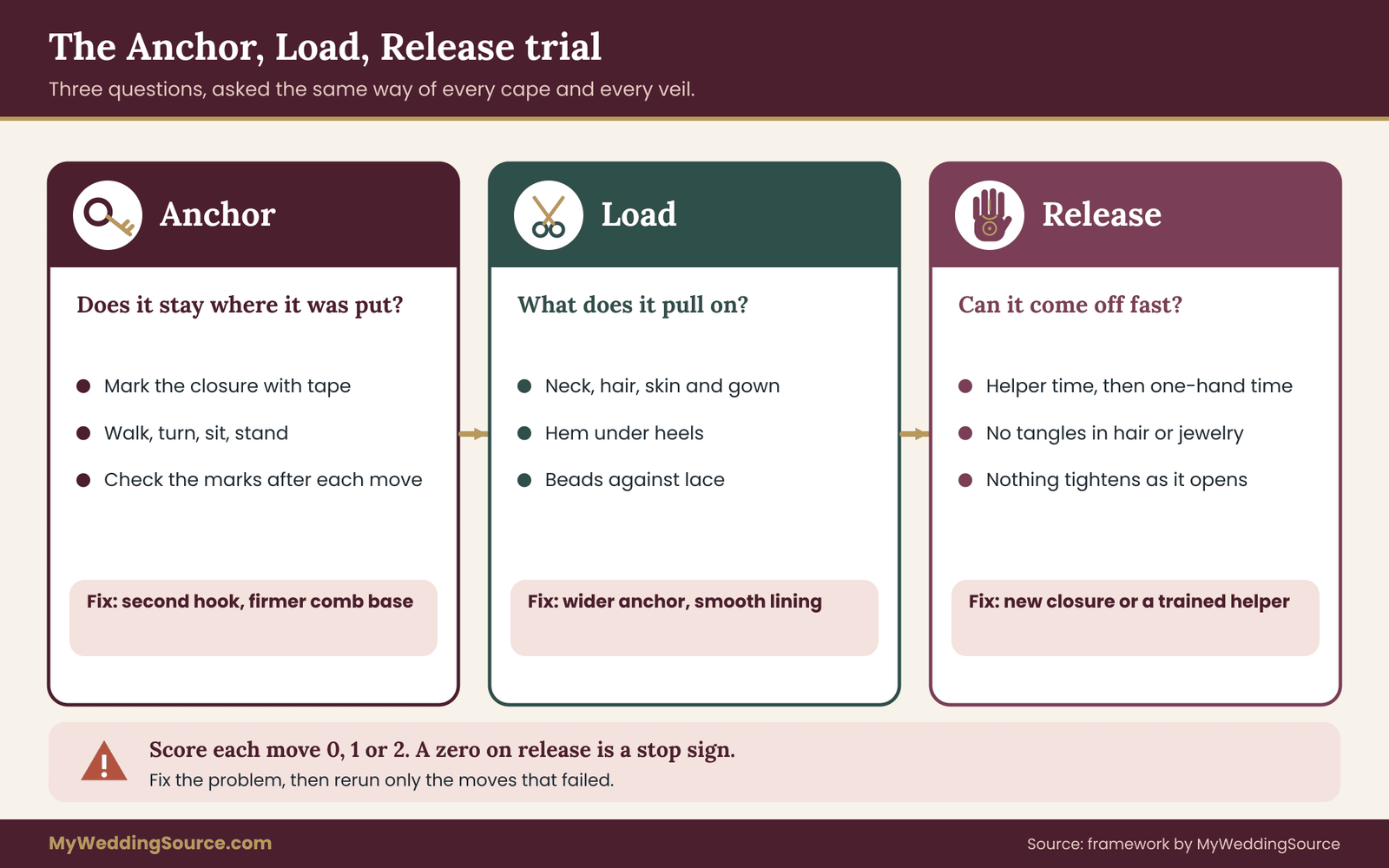
The trial has three stages, and each one asks a single question.
Anchor: does it stay where it was put? You mark the position of the closure, take ten steps, turn, sit and stand. You then look at whether the piece has moved from its marks.
Load: what does it pull on? You note every point where the piece drags on your neck, hair, skin or gown. You also note whether anything pulls on the piece, such as a hem that catches your heel.
Release: can you get it off, fast? You time the removal, with a helper and without. You also check that the piece comes off without damaging your hair, your makeup or the gown.
What you need
- The gown, or a garment with the same neckline, strap and back style. A sample gown at the shop works if the shop agrees.
- The actual shoes and the real undergarments. Heel height changes how you move, and a bodysuit or corset changes how the cape sits.
- The accessories that will be in contact, including any necklace, earrings and hair accessories.
- A helper who is willing to be honest. A partner or a close friend usually works. A stylist or seamstress is better.
- Small tape or sticky dots, to mark closure positions on the cape and on the gown.
- A phone to record short video of each move from the front, the back and the side.
- A small fan, if you want to test airflow indoors. A household fan is enough for a rough test.
Setting a baseline
Dress fully, without the bridal cape. Stand straight and note how the neckline and the back sit. Take a photo from the front and the back. Then put on the cape or veil the way you plan to wear it, adjust it once, and take the same photos. Mark the closure position with tape. This is the baseline against which every move is measured.
The scoring
Score each move from zero to two for each of the three questions.
- Two: no problem. The piece stays where it was, nothing pulls, and it comes off cleanly.
- One: a small problem that a fix could solve. The closure moved a finger-width, or you felt light pull that went away.
- Zero: a clear problem. The closure opened or twisted, something pulled hard, or you could not release it quickly.
A single zero on any release move is a stop sign. A zero on a load or anchor move calls for a fix and a retest. Add up the rest to compare options. The next section walks through the moves in order.
Why the same trial for both pieces
Running the same trial on a bridal cape and a veil lets you compare them on equal terms. A veil will score well on release and often on load, and it will lose points on anchor if your hair is smooth. A bridal cape tends to score the other way. The totals do not matter as much as the pattern, because the pattern tells you where the fix needs to go.
Ten moves for the bridal cape movement trial
Run each move first with the bridal cape, then with the veil, and then with both if you plan to wear both. Film each one. Between moves, check the tape marks. Do not adjust the piece during a move, because the point is to see what it does on its own.
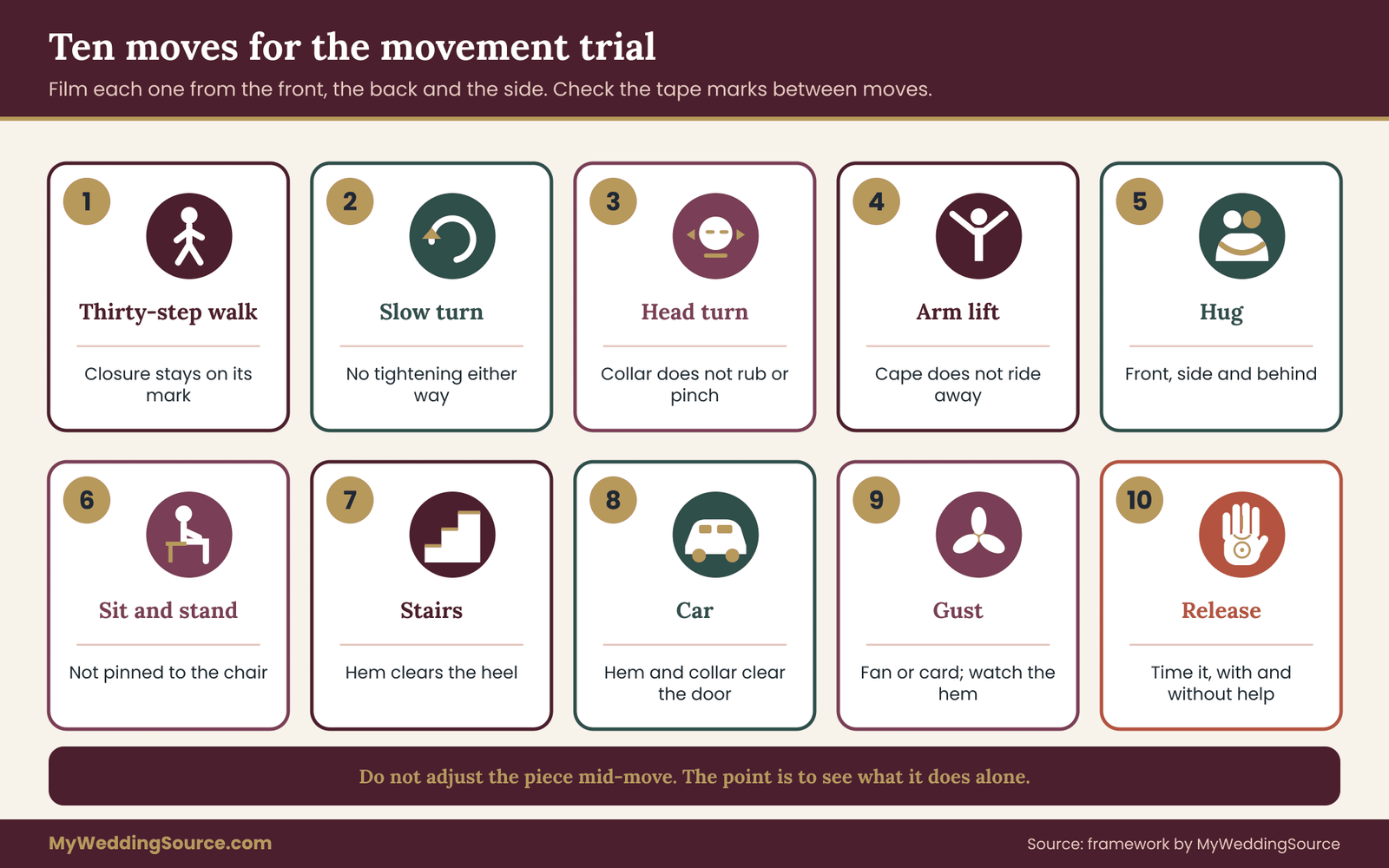
Move one: the thirty-step walk
Walk thirty steps at the pace you plan to walk down the aisle, which is usually slower than you think. A brisk walk tests the wrong thing. Keep your head up and your arms by your sides. After the walk, check whether the closure has shifted from its mark, whether the cape has twisted, and whether the hem still clears your heels.
For a veil, check whether the comb has slid and whether the veil is still centered.
Move two: the slow turn
Turn on the spot, a full circle, at the speed of a first-dance turn. Then turn in the other direction. A bridal cape that is tied at the neck often twists in one direction and not the other, because the closure is slightly off center. A veil that is pinned to one side can lift on the turn.
Look for a pull at the neck during the turn. If you feel the closure tighten, stop and note which way you were turning.
Move three: the head turn
Look over your left shoulder, then your right, as far as comfortable. This is the move for photos where you glance back at a guest. A tall collar or a closure that sits high on the neck can rub, pinch or tighten. A bridal cape with a hood or a stiff standing collar shows problems here first.
Move four: the arm lift
Raise both arms to shoulder height, then overhead, as if you were waving to a crowd. Then reach forward as if to take a flower or an arm. A cape that is fixed at the neck and the waist can lift away from the gown, bunch at the shoulders or pull at the armholes. A cape with sleeves needs a separate check for how far the sleeve rides up.
Move five: the hug
Have your helper give you a full hug from the front, then a side hug, then a hug from behind. This is the move that most often reveals a hidden problem. A brooch can press into skin, a clasp can open, a ribbon can tighten, and a beaded collar can catch in a guest’s hair or jewelry. Pay attention to what the other person feels as well as what you feel.
Receiving lines and photo lines involve dozens of hugs. A piece that passes one hug may still fail the twentieth, so repeat the hug a few times and check the closure each time.
Move six: sit and stand
Sit on a chair of the kind the ceremony will use, then stand. Do this three times.
A long bridal cape can bunch behind you, pin you to the chair back or pull at the neck when you stand. A bridal cape that falls into the chair cushion can be sat on, which pulls the closure backward. Learn to sweep it forward or to the side as you sit. The ceremony cue sheet guide explains how to mark the points in the ceremony where you sit and stand, so you know how many times this move happens.
Move seven: the stairs
If there are stairs, step up and down at least three times, with your helper walking behind you. Lift the hem the way you would in the real ceremony. A cape that trails behind adds length that your heel can catch, and a helper walking too close can step on it. If there are no stairs, test with a single curb or a step in the shop.
Move eight: the car
Get in and out of a car, or the equivalent, such as a seat of the same height. A cape that is closed at the neck can catch on the door frame, and a long hem can end up outside the door when it closes. This move feels silly and it is one of the most useful, since the car is where many wedding dresses get dirty or caught.
Move nine: the gust
Hold a household fan about three feet away, or ask your helper to wave a large folded card at your back, and watch what lifts. This is a rough test and not a wind test, but it shows which parts of the piece are free and which are anchored. Watch the closure, the collar and the hem. The site’s cape vs veil test plan has a longer treatment of wind direction and fixes for an open site.
Move ten: the release
Ask your helper to take the piece off as fast as they can without harming it. Time it. Then try to remove it yourself with one hand. Record both times and note what you had to do. This is the move that decides whether the piece is safe to wear. If a closure takes more than a few seconds to open, or you cannot reach it, you need a different closure or a trained helper standing by.
Reading the results
After ten moves, you have thirty scores for each piece: anchor, load and release for every move. Lay them out in three groups.
The stop signs. Look first for zeros on release. A zero on move ten, or any other move where you could not free yourself quickly, means the piece is not ready. The fix is a different closure, a quick-release addition, or a decision to skip the piece. Do not keep it and hope.
Next, look for zeros on load at the neck. If any move tightened a closure on your throat, change the closure.
The fixable problems. Zeros and ones on anchor and load that do not involve the neck are usually fixable. A seamstress can move a hook, add a second hook, sew a small inner loop, or add a thin lining where a collar rubs. A stylist can move a comb, add a pin, or change how the hair is gathered. Write down the fix, carry it out, and rerun only the moves that failed.
The pattern. Compare the totals only after the stop signs are cleared. A bridal cape and a veil with similar totals can have very different patterns. A bridal cape that loses points on the hug and the car needs more careful handling on the day. A veil that loses points on the turn and the gust needs a better anchor.
The pattern also tells you which helper you need. A piece that scores low on anchor needs someone who can check it every half hour. A piece that scores low on release needs someone who is within arm’s reach at all times.
What to do with a tie. If a bridal cape and a veil tie, the tiebreaker is photography. The next section shows how to compare them on camera.
How a bridal cape and a veil move differently
The trial shows the two pieces move differently, and it helps to understand why. The reason is where the weight hangs.
A veil moves from the head. A veil swings from a single point on the head. Its movement is long and gentle when it is light, and it is easy to disturb when it is long. It lifts with a breath of wind, drifts when you turn, and falls back when you stop. Because the anchor is at the top, the veil follows your head, and the head turns more often than the body.
A short veil, such as a blusher or a fingertip length, stays close to the body and rarely catches on anything. A long chapel or cathedral veil trails on the floor and is stepped on easily. The anchor takes the pull when the veil is stepped on, and a comb that does not hold lets the veil slide backward off the head.
A bridal cape moves from the shoulders. A bridal cape swings from the shoulders, so its movement is wider and slower. It follows the torso and the arms. A lightweight cape lifts into a soft shape when you walk and falls straight when you stop. A heavy cape holds its shape and moves as one mass.
Because the cape hangs from the neck and shoulders, every turn of the torso swings the whole piece. That is where the beauty comes from, and it is also where the load comes from. The weight swings away from the body on a turn and pulls the closure forward.
Fabric changes everything. Fabric decides how a piece moves more than length does. Light tulle and chiffon float, and they catch on anything rough. Heavier crepe and satin hang straight and move as a unit. Lace has a visual weight but little actual weight until it is beaded. Beaded or sequined pieces carry real weight and swing in a way that can surprise you.
When you compare two pieces, compare the fabric as much as the shape. A heavier cape with a firm closure can score better than a lighter one with a weak closure.
Weight and trim. Ask the maker or the shop for the finished weight of the piece, or weigh it at home on a kitchen scale. Do not trust the number you remember. Compare it to the gown, which will already be heavy if it has a train or beading. A bridal cape that adds a noticeable amount to what you already carry will feel heavier after an hour than it does in the first five minutes.
Trim matters too. A chain hem, a beaded border or a feathered edge each change how the cape swings and how it behaves when it touches something. Feathers shed, chains clink, and beads catch on lace.
Photography: how a bridal cape and a veil look on camera
The camera sees the piece, not the mechanics. Still, the mechanics decide what the camera sees: whether the bridal cape sits straight, whether the closure shows, whether the veil lies flat or catches the light. A good photograph of a bridal cape takes some planning, and the planning starts with what the photographer will actually shoot.
Ask the photographer three questions
Before the wedding, send the photographer a short message with the cape and veil options and ask three things. Which shots do you expect to take with the piece on? Which do you prefer without it? And how long does it take you to move between the two? The answers shape the plan.
Photographers have different habits. Some like a veil for the portrait, because it frames the face and moves in a way that looks good in still images. Some prefer a bridal cape for the back-of-gown shots, because it adds texture. Some will ask you to remove either piece for certain details. Whatever they say, put it in the timeline. If you are still choosing a photographer, ask how they usually photograph outer layers before you book.
The front view
From the front, the bridal cape frames the shoulders and the neckline. A cape that closes at the neck shows the closure, and a clasp or a bow is a feature. A bridal cape that is open at the front shows the gown beneath, so the gown’s neckline and bodice become part of the picture.
A veil from the front is a light layer over the hair and sometimes the face. A blusher covers the face until the reveal. Shorter veils rarely show in the front view except as a line near the shoulders.
Check three things from the front: the closure position, the symmetry of the two sides, and whether the cape hides any detail you chose the gown for. A cape that covers the beading on a bodice is a trade you should make on purpose.
The back view
The back view is where capes and veils differ most. A bridal cape covers the back of the gown, so a low-back or button-back gown is hidden or shown through a sheer layer. A veil covers less and shows the back through tulle.
Back photos are where closure marks and twists appear. A bridal cape that twists to one side leaves one shoulder higher in every back shot, and a visible hook or pinned edge can pull the fabric into a point. Ask the helper to check the back before each portrait. The cost of a ten-second check is small compared to a full set of images with a visible fold.
The side view
The side view shows depth. A bridal cape that stands away from the body at the shoulders adds shape to the silhouette. A cape that clings flattens it. A long veil adds a trailing line that photographers like. A heavy cape adds a straight vertical line.
Fabric, light and transparency
Sheer fabrics look different in different light. In backlight, tulle and organza glow and can show the outline of what is behind them, which is lovely if the dress beneath is clean and distracting if a closure or a strap shows through. In flat indoor light, the same fabric can look gray.
Lace casts small shadows that add texture, and beaded fabric throws spots of light. Ask the photographer to take a few test frames at the fitting if possible. If not, take your own phone photos in similar light and compare.
Color matters here. Ivory, white and champagne look different against skin and against a gown. If the cape and the gown are slightly different shades, the camera will show it more than your eyes do. Compare shades in daylight and in the venue’s light, side by side, before you decide.
The reveal and the removal
The moment the bridal cape comes off is a photograph in itself, and it needs a plan. In many ceremonies the cape comes off after the vows, before the portraits, or before the reception entrance. The helper needs to know when, where and how.
A good removal has four parts. The helper stands behind you. The closure opens in one motion. The cape is lifted straight back and away, not dragged over your hair. And someone else takes the bridal cape, so the helper’s hands are free. Practice this once. A cape that gets caught on a necklace or an earring in the middle of a ceremony is hard to recover from gracefully.
If the removal itself is a planned photo, tell the photographer which side to stand on, so the closure and the helper are not in frame.
The family photo list
Group photos are a stress test. A cape that looks perfect alone can be crushed, stepped on or pulled in a crowd. The family photo list guide helps you sequence the groups, and a useful tip from it applies here: put the groups that need you to be closest and most active, such as the ones where you will hug or kneel, after any photos that need the bridal cape to look pristine.
If a bridal cape is part of the look for family photos, decide which groups include it and which do not. Taking the cape off for a long series of group shots is often easier than keeping it from being crushed.
Layering with hair, jewelry and the gown
A bridal cape and a veil share a small area of the body, the neck and the upper back, with the hair, the necklace, the gown’s neckline and the gown’s closure. The order in which you put everything on matters, and so does the way each piece sits against the next.
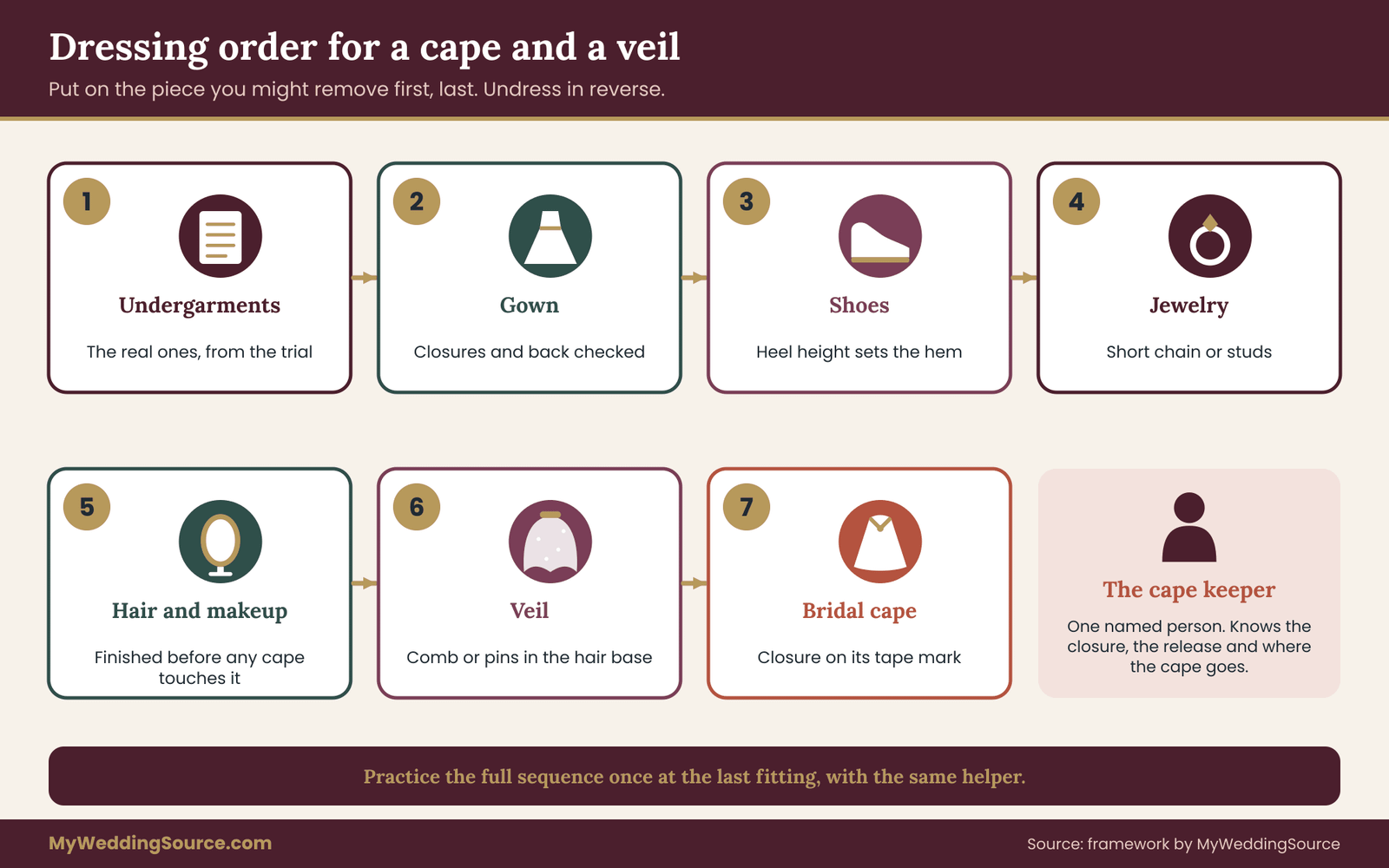
The interference zone
The interference zone runs from the crown of the head to the shoulder blades. Within it you have the hair, the veil anchor, the earrings, the necklace, the neckline, the back closure, the cape collar and the cape closure. Everything touches something else.
Three contacts cause most of the trouble. The first is hair against cape collar. Long hair worn down, or a high bun with loose pieces, catches on a collar or a hook. The second is necklace against cape closure. A chain can tangle in a hook or a bow, and a pendant can push under a collar. The third is veil anchor against cape collar. A comb at the back of the head sits at the same height as many cape closures, and a bridal cape collar that rides up can push the comb out.
Hair and the cape
Talk to your stylist about the cape before the trial, not after it. A hairstyle that works with a veil may not work with a bridal cape, and the other way around. A low bun or a loose twist at the nape pushes against the cape collar. A high bun or a side style leaves the nape clear. Hair worn down needs a plan for lifting it out of the bridal cape each time the cape goes on and off.
Scheduling a hair trial with your stylist is covered in detail on the site, including how to schedule trials, what to bring and how to ask a stylist about accessories. Bring the cape, and ideally the gown, to the hair trial. Ask the stylist to put the bridal cape on and off twice, so you can see what it does to the style.
Hairspray, texturizing products and hair oil can mark light fabric. Ask the stylist to finish the hair before the cape goes on, and keep the cape away from the spray.
Hair and the veil
A veil comb needs hair to hold. Ask the stylist to build a small base, such as a short backcomb or a small pinned section, where the comb will sit. If the cape closure will be near the same spot, ask for a base that is slightly higher or to the side.
If you wear both, think of the veil as the first layer and the bridal cape as the second, and decide which one is the one you could live without if something goes wrong. That is the piece you attach less firmly.
Makeup and fabric
Foundation, powder and lipstick all transfer onto light fabric, and a collar that touches your jaw or your neck picks up the most. Ask your makeup artist to set the neckline area, and keep a small cloth or a dry sponge in the emergency kit. Most marks come off if treated early. A cleaner who knows the fabric can advise on anything that does not.
Jewelry and the cape
Necklaces and cape closures compete for the same space. If the necklace is the star, choose a cape that closes lower or opens in the front. If the cape closure is a feature, wear a short chain or no necklace. Earrings that dangle can catch on a collar, a veil edge or a ribbon. Studs and small drops are safer. If you have a comb or tiara in the hair, check that it does not touch the cape.
The wedding day accessories guide walks through compatibility between accessories in more detail. The short version is to put every piece you will wear in a single trial.
The gown beneath
The gown closure shapes what is possible. A back zipper, a lace-up back or a row of buttons all sit under the bridal cape. A cape that closes over a button back means you cannot get into the gown’s back during the day without removing the cape. If a restroom visit or an emergency repair is likely, plan for that.
A built-in corset, bustier or bodysuit changes how the bridal cape sits at the shoulders. Wear the real undergarments to the trial. A cape that fits over a smooth bodice may bunch over a boned one.
Dressing order
The order for dressing is: undergarments, gown, shoes, jewelry, hair finish, veil, and last the bridal cape. Undressing runs in reverse. This protects the hair and makeup, keeps the cape free of hairspray and puts the piece you might remove first on top. If the bridal cape has to go on before the veil for a technical reason, such as a high collar, write that down and tell the helper.
Practice the full sequence at the last fitting, with the same helper. It takes ten minutes and prevents a very stressful twenty on the wedding day.
Wind, weather and the bridal cape anchor
Wind is where the difference between a veil and a bridal cape is most visible, and it is also where a good attachment earns its place. The longer treatment of wind direction, site layout and fixes sits in the site’s cape and veil test plan, so this section covers one narrow question: what the wind does to the anchor.
Wind loads the anchor, not the fabric
A gust does not harm a bridal cape. What it does is pull the cape away from the body, and that pull travels through the fabric to whatever holds it. A cape tied at the neck sends the load to the throat and the back of the neck. A cape hooked to the gown sends it to the gown. A veil in a comb sends it to the comb and then to the hair.
This is why the same cape can feel fine in a shop and unsettling outdoors. Indoors there is almost no load. Outdoors, the load comes and goes, and it can spike quickly. A closure that opens under a sharp pull is safer than one that holds fast, and a closure that holds but spreads the load across a wide area is the best of the two.
Three questions for an outdoor ceremony
Ask these before the ceremony.
First, which way does the site face, and where will you stand? A site with the wind at your back lifts a cape from behind and pulls it forward at the neck. A site with the wind in your face pushes the cape against you and lifts a veil upward and backward. A crosswind twists a cape sideways.
Second, how long will you stand outside? A walk of two minutes is a small test. A forty-minute ceremony, with photos before and after, is a large one.
Third, what happens if the wind rises on the day? Having a plan beforehand is the difference between a quick decision and a stressful one. The plan can be as simple as one line: if the wind is above the point where the cape lifts clear of the shoulders, it comes off and the helper holds it.
A simple way to judge wind strength
You do not need a weather station. The Beaufort wind scale from the National Weather Service describes wind strength by what you can see: leaves moving, small branches in motion, larger branches swaying. Use it to put words on what you observe at the site, and to compare it with what a forecast calls a light, moderate or strong breeze. The National Weather Service forecast for your date and location is the right place for current wind and temperature information.
Fixes that work, in the order to try them
Start with the changes that are easiest to reverse.
- Check the closure position. A closure that sits a little lower or higher can change how the load falls.
- Add a second anchor point. A tiny loop or a second hook at the shoulder spreads the load.
- Choose a different hem. A weighted hem keeps a light cape from lifting, but the weight itself swings.
- Add a hidden inner tie. A thin tie at the waist or the back keeps a cape from rising, and it needs a helper to untie.
- Switch to a shorter piece. A capelet or a shoulder cape catches less wind than a full-length one.
- Remove the piece for the outdoor part. If the wind will not cooperate, it is a perfectly good choice to wear it for photos only.
The first two usually involve a seamstress, so schedule them early. Number six costs nothing and works every time.
Cold, heat and rain
A bridal cape is often chosen as a cover for a cold ceremony. A veil adds almost no warmth. If warmth is part of your reason for a cape, test it outdoors at the temperature of your date, with your real gown. Wind chill makes a mild day feel cold, and the National Weather Service publishes plain guidance on cold and heat safety that is worth a read when you pick a date.
In heat, a closed bridal cape can be uncomfortable, especially if the fabric is not breathable. Build in a place and a time to take it off, and a helper with water. In rain, check that the cape fabric tolerates damp, because silk and satin can mark, and carry an umbrella large enough to cover the cape and the hem. Keep the cape in a garment bag until the last moment, and carry it dry.
Dressing day: roles, timing and a bridal cape emergency kit
Even a well-tested cape needs someone watching it on the day. You will be busy, and you will not see your own back. Give the job to a named person.
Name a cape keeper
The cape keeper is one person, such as a sister, a close friend or a stylist, who knows how the bridal cape is attached, how it comes off, and where it goes when it is off. They do not need to be anyone special. They need to be calm and to have rehearsed once with you.
The keeper has five tasks:
- Dress you in the agreed order, and check the closure position against your tape marks.
- Check the back of the cape before the aisle, before the vows, and before each group of photos.
- Stay within reach during the ceremony and the receiving line.
- Take the cape when it comes off, and carry it to a safe place.
- Carry the emergency kit.
If the keeper has other jobs, such as holding flowers or managing children, the cape will not get the attention it needs. Say that out loud when you choose the person.
A short written note for the keeper
Write a few lines and put them in the keeper’s phone and in the kit. Include the order of dressing, the position of each closure, the way to release it, and the time and place the cape comes off. Add the name and number of the seamstress. A note like this takes five minutes to write and saves an awkward conversation during the busiest hour.
The emergency kit for a bridal cape
Keep the kit small and put it in a pouch the keeper can carry.
- Two spare hooks and eyes, matched to the cape.
- A needle and thread in the color of the cape, with a small pair of scissors.
- Two or three small pins with covered heads, for use only on the cape and only if the maker allows.
- A small safety pin, for a hidden emergency fix on a lining.
- A lint roller or a roll of low-tack tape for lint and loose hair.
- A dry cloth for makeup marks.
- A small bottle of water and a mint, since a flustered bride rarely remembers either.
- A clear plastic bag or a garment bag for the cape when it is off.
Do not add anything that could mark the fabric. Hair spray, stain removers and adhesives are better kept in the stylist’s kit, away from the cape.
The timeline
Work back from the moment the cape goes on. Allow ten minutes for the bridal cape and veil, and add a margin. If your photographer wants a getting-ready shot with the cape, build that in. The wedding vendor timeline guide shows how to fit these small steps into the vendor schedule, and the ceremony cue sheet shows who needs to be where. Tell the photographer and the venue coordinator when the cape will come off, so nobody is surprised.
What to do if the cape fails
Decide in advance what counts as a failure and what you will do. A closure that opens can be refastened, and if it opens twice, the cape comes off. A tear in light fabric can be pinned from the inside. A twisted cape can be straightened by the keeper, quietly, between moments. If anything feels tight at the neck, it comes off at once. Say this to your keeper and to your partner, so nobody argues with you in the moment.
Buying, renting or borrowing a bridal cape or veil
The trial works best when the piece is yours to test, and that depends on how you get it. A purchase from a salon, a rental, a custom order and a borrowed family piece each come with different rules, and each one changes what you can ask for.
From a bridal salon
Ask whether you can try the cape with your gown and whether a fitting appointment is included. Ask whether the salon’s seamstress can add or move a closure, and what that costs. Ask what the return and exchange policy is for accessories, because many salons treat veils and capes as final sale once altered. Get the answers in writing, on the receipt or in an email.
Ask for the fiber content and the care instructions. In the United States, apparel generally must carry a permanent care label, and the Federal Trade Commission publishes guidance for sellers on the Care Labeling Rule. Labels on textile products also have to state fiber content under the Textile Act. If a piece arrives without a care label, ask the seller before you wear it.
From an online maker or marketplace
An online listing shows a flattering photograph and rarely shows how the closure works. Before buying, ask the seller for a close-up photo of the closure from inside and outside, the finished weight, the exact length from the neck, and the fabric. Ask what the return window is, who pays for return shipping, and whether the piece can be altered without voiding the return.
Check the dates. Many handmade pieces take weeks to make, and a custom order that arrives late leaves no time for the trial. Allow time for the piece to arrive, for the trial, for a fix, and for a second trial. The wedding vendor contract guide explains what to look for in a written agreement, and a short email confirming the details works as a record for a small purchase.
Renting a bridal cape
Some shops rent capes, wraps and veils. A rental usually cannot be altered, so the closure you see is the closure you get. That makes the release move more important, because you cannot change it. Ask about the cleaning policy, any damage fees, the pickup and return dates, and whether you can try it on with your gown before you commit.
A custom piece
A custom bridal cape lets you choose the closure, the weight and the length. It also means a maker you cannot compare against a finished sample. Ask for a toile or a fabric swatch, ask to see a closure sample, and ask what the process is if the finished piece does not fit. Agree on a delivery date that leaves at least a few weeks before the wedding.
A borrowed or family piece
An heirloom cape or veil is valuable in a way that has nothing to do with price. It is also the piece most likely to have old fabric, old thread and old closures. Before anything else, have a seamstress or a conservator look at it. Silk weakens with age, and lace can tear along old folds. The same trial still applies, with softer handling. Do the moves slowly, and consider using the heirloom for portraits and a replica for movement. Check seams, folds and any old closures for weak spots before you start.
Alterations: what a seamstress can and cannot do
A skilled alterations professional can solve most attachment problems. They can also tell you when a piece is not worth saving.
What can be changed. Common fixes include adding a hook and eye in place of a tie, moving a closure a short distance, adding a second closure, sewing a small loop to hold the cape to the gown strap, adding a lining where a collar rubs, shortening a hem, and adding a small interior weight or ribbon to keep the cape from lifting. Most take under an hour of work for a simple piece.
What is harder. Changing the shape of the collar, altering a beaded or heavily lace-covered edge, resizing a cape that has been cut on the bias, and attaching a cape to a delicate gown fabric are all more complicated. Some are possible, and some risk damaging the piece. A professional will tell you which is which, and a second opinion is reasonable if the first answer is no.
Questions for the alterations professional.
- Can this closure be changed without damaging the cape?
- Where does the load fall, and is the fabric strong enough there?
- If you add a second anchor, what will it do to the look?
- How long will the work take, and what is the latest date you can finish it?
- What is the cost, and what is included?
- Can you check the cape with my gown, after the final fitting?
Take notes, and ask for the answers in writing. The site’s guidance on fittings and gown alterations covers when to schedule fittings and how to prepare for them.
Cost logic. Prices for capes, veils and alterations vary by designer, city and fabric, so any figure written here would be a guess. Use logic instead. List the cost of the piece, the cost of the fix you need, and the cost of a second piece as a backup. Then compare the total with the cost of the alternative.
A simple piece with a firm closure that needs no work can be cheaper in total than a beautiful one that needs a custom fix. A rental with a fixed closure can cost less than buying, but it removes your ability to change the closure.
The point of the trial is to put real numbers into the comparison before you pay, not after.
Choosing between a bridal cape and a veil
Once you have run the trial, you have a pattern for each piece. The decision then has four steps. They are meant to be done in order, and each one can end the decision.
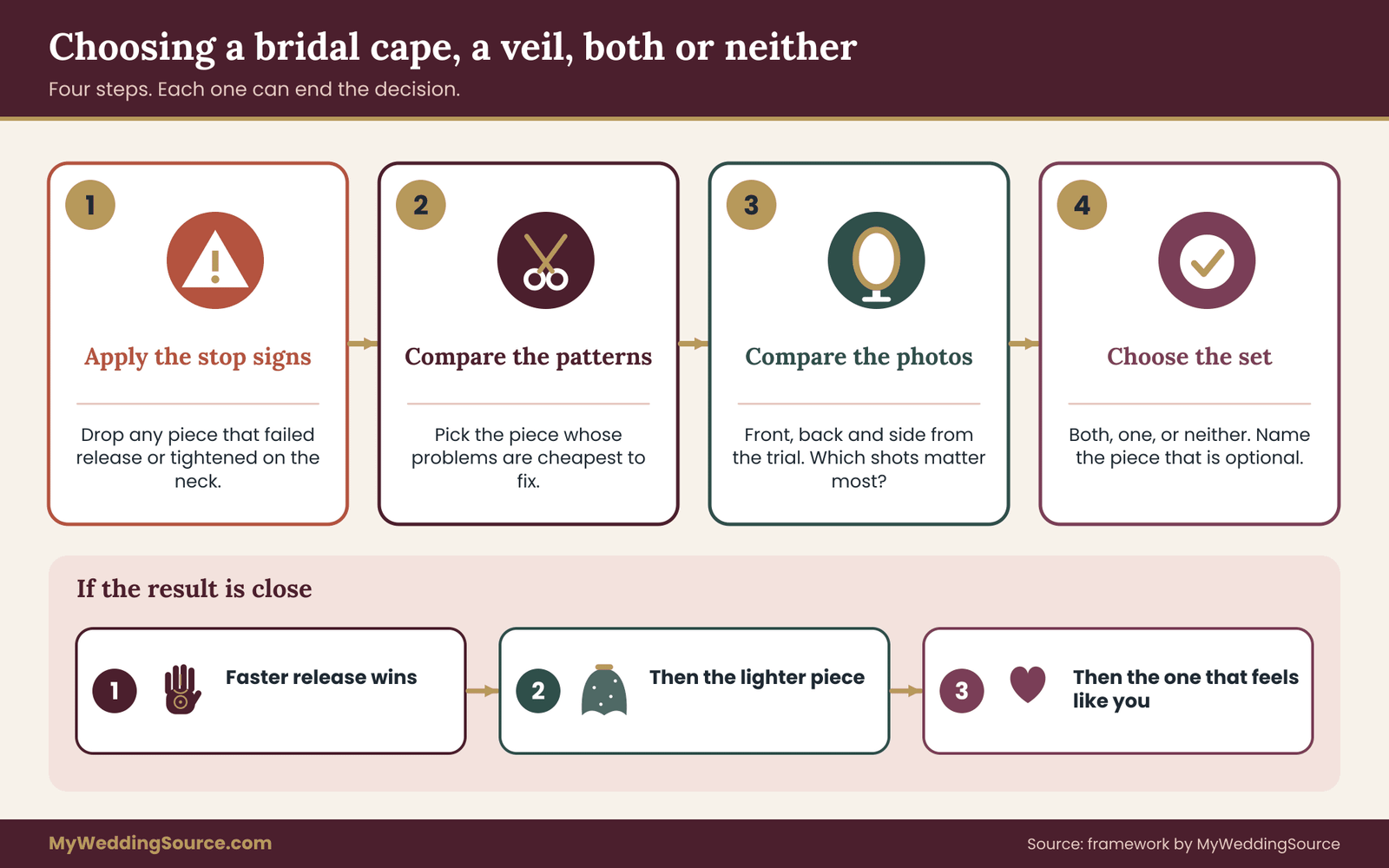
Step one: apply the stop signs
Remove any piece that failed the release test or tightened on your neck. This step is not a matter of taste. If both pieces fail, you have two choices: fix and retest, or choose a third option.
Step two: compare the patterns
Look at where each remaining piece lost points. A piece that loses on anchor can often be fixed. A piece that loses on load may need a change of closure or a lining. A piece that loses on release needs a different closure or a trained helper. Choose the piece whose problems are cheapest and easiest to fix.
Step three: compare the photographs
Look at the front, back and side photos from the trial. Choose the piece that supports the photographs you care about most. A couple who wants a dramatic back view will weigh a bridal cape differently from a couple who wants the focus on the face.
Step four: decide on both, one or neither
You can wear both, and you can wear one in the ceremony and another for the portraits. You can also decide to wear neither. If you wear both, decide which is the anchor piece, meaning the one that stays on, and which is the optional piece that can come off if something goes wrong. A piece that is optional on the day can be attached less firmly and taken off sooner.
When the result is close
If two pieces tie after four steps, choose the one with the faster release. If they tie on release, choose the lighter one. If they tie on weight, choose the one you feel more like yourself in. A trial is a way to remove the pieces that fail, not to pick a favorite among those that pass.
A worked example and the edge cases for a bridal cape
The example below is invented. It shows how the trial works on real decisions, and it uses made-up people and made-up scores. Nothing here is a statistic or a test result from a real wedding.
The example: Nadia and a September garden ceremony
Nadia is planning a late-afternoon garden wedding in September. Her gown is a crepe sheath with thin straps and a low back, and she is considering a sheer tulle bridal cape with a ribbon neck tie, or a cathedral-length veil on a comb. She wears her hair in a low twist. She has one helper, her sister Amira, and a seamstress who agrees to attend the final fitting.
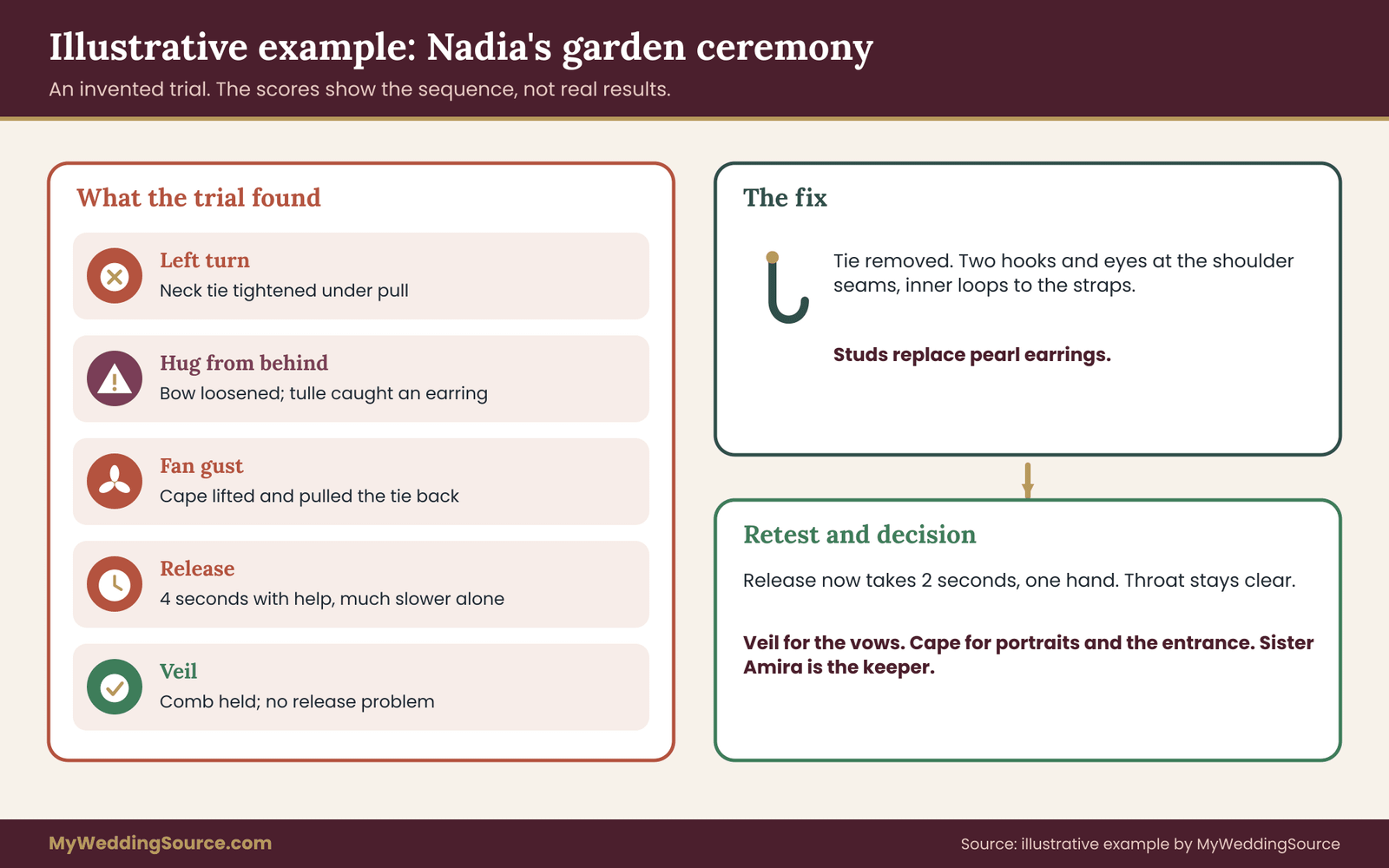
Baseline. Nadia dresses fully and marks the tie position with a dot of tape. Amira takes front and back photos.
Walk and turn. The cape tie stays in place on the walk. On the slow turn to the left, the tulle twists a quarter turn, and the tie tightens a little at the front of the throat. Nadia scores the walk two for anchor, and the left turn zero for load at the neck. The veil comb holds on both moves, but the veil swings sideways on the turn, which scores one for anchor.
Hug. Amira hugs her from behind. The bow loosens, and the tulle edge catches a small pearl on Nadia’s earring. Score: one for anchor, one for load.
Gust. A household fan lifts the tulle clear of her shoulders and pulls the tie back against her neck. The veil lifts but the comb holds. The cape scores zero for load again.
Release. Amira unties the bow in about four seconds. Nadia, using one hand, takes much longer, because the bow has turned into a small knot. Nadia scores the release as one with help and zero alone.
The pattern is clear. The cape is pretty, but its tie tightens on the throat under pull, and Nadia cannot release it alone. That is a stop sign. The veil has weaker scores on turns but no release problem.
The fix. The seamstress replaces the ribbon tie with two hooks and eyes at the shoulder seams, adds a small inner loop to hold the cape to each gown strap, and removes the tie altogether. This spreads the load across both shoulders and lets the cape come free under strong pull. Nadia reruns the turn, the hug, the gust and the release. The tulle still floats, but the throat stays clear, and the release takes two seconds with one hand. The pearl earrings are swapped for studs.
The decision. With the fix, the bridal cape passes. Nadia then compares the photographs. The cape adds a soft, airy back view that the low-back gown lacks. The veil, on the other hand, frames her face for the vows. She decides to wear the veil for the processional and vows, then have Amira remove it and put on the cape for the portraits and the reception entrance. Amira carries the kit and writes the dressing order on her phone.
What the example does not show
The scores are invented, and a real trial will look different. A real cape might fail on the hug and not on the gust, or on the stairs and not on either. Different fabrics and closures produce different patterns. The example is meant to show the sequence, not the result.
Edge cases
A very long cape or a train. A cape that is as long as the gown train adds a second length behind you. Practice the turn at the end of the aisle with both, and ask the helper to handle the cape first and the train second. A longer piece needs a firmer anchor and an earlier removal.
A hijab or head covering. If you wear a head covering, a veil can be anchored to it, and a cape’s neck closure sits near the covering’s edge. Test the cape and covering together, since a collar can pull a scarf or a pinned fold out of place. A stylist who works with head coverings can help place the anchors.
Tall or petite frames. A cape that is proportioned for an average height sits differently on a very tall or very short person. Length, shoulder width and the position of the closure all shift. Ask the seamstress to check the proportions, and photograph from several heights.
Mobility aids. A cape that hangs behind a wheelchair, walker or cane can catch or be run over. Consider a shorter piece, a capelet, or a shoulder-only design. Have the helper practice moving with the aid. If a guest uses a mobility aid, plan the processional route and the photo order with that in mind.
Children and pets. Young children grab anything that hangs. A flower girl who walks behind you may step on a cape, and a pet that carries the rings may tug at a hem. Keep a gap between the cape and the youngest attendants in the processional, or keep the cape off until after the group photos.
A sleeveless or strapless gown. Without straps to anchor to, a cape relies more on the neck closure or a sewn attachment. Ask the seamstress about an inner panel or boning that carries the load. Strapless gowns may also slip if the cape pulls at the top edge.
A heavily beaded or lace gown. Beads and lace snag. Consider lining the cape’s inner collar with smooth fabric, and make sure the cape does not rub the same spot on the gown each time you turn.
Two ceremonies in one day. If you have a religious ceremony and a civil one, or a ceremony and a separate reception, decide which pieces go with which event. Pack a bag with the spare piece, and give the cape keeper the schedule.
A bad forecast. If the day turns windy, cold or wet, the plan is already written. The cape either stays on with a helper nearby, or comes off, and the veil or a spare layer takes its place.
Common mistakes
Testing with the wrong shoes. Heel height changes the length of the hem and the way you walk. A trial in flats tells you little about a ceremony in heels.
Testing without the helper. Release is the most important check, and it requires a second person to be honest about the time.
Adding a pin at the last minute. A late pin hole in silk cannot be undone. Fix the anchor with a seamstress, early.
Skipping the back. The wearer cannot see the back, and the back is where most photographs of a cape are taken. Always film it.
Wearing both without testing both. A cape and a veil pass separately and fail together more often than people expect. Test the combination as its own piece.
Leaving the cape to a busy person. The keeper needs to be free. Name the person and say what the job is.
Limits of this guide
Gowns and capes vary by designer, fabric and maker, and a trial at home is not a substitute for a professional fitting. If something about a piece worries you, such as a closure that feels tight or a fabric that pulls, take it to your seamstress or the maker. For rules on care labels, fiber content and product claims, the Federal Trade Commission is the agency to check.
Your next steps
- Choose the bridal cape and the veil you want to compare, and ask each seller in writing about the closure, the weight, the return policy and whether alterations are allowed.
- Book one fitting, with your gown, your shoes and your real undergarments, and ask the seamstress to attend if you can.
- Ask your stylist whether the hairstyle works with both pieces, and bring the cape to the hair trial.
- Run the Anchor, Load, Release trial with a helper, film every move and score each one.
- Fix the stop signs and the fixable problems, then rerun only the moves that failed.
- Compare the photographs, decide on both, one or neither, and tell the photographer.
- Name a cape keeper, write the dressing order and the release steps, and pack the emergency kit.
- Write the plan for bad weather on one line, and share it with the keeper and your partner.
FAQ
Is a bridal cape harder to wear than a veil?
Usually, yes. A veil hangs from one small anchor in your hair, while a bridal cape hangs from your neck, shoulders or gown and moves with your body. That means more points can pull, twist or catch. A cape with a firm, quick-release closure and a clear dressing order is manageable, and a trial will show you how much work your piece needs.
What is the safest closure for a bridal cape?
The safest closure is one that opens under strong pull and that you can release with one hand. Hooks and eyes, snaps and a simple bow with long ends tend to meet that test better than a tight knot or a fixed loop. Check any closure at the neck for slack, and ask a seamstress to add a second anchor at the shoulders if the load feels uneven.
Can I wear a bridal cape and a veil together?
Yes, though they share the same neck and upper-back area, so test them together as one outfit. Check that the veil comb does not sit where the cape collar rises, and that the cape edge does not catch the veil. Decide which piece is optional, and attach that one less firmly, so you can remove it quickly if something goes wrong.
Will a bridal cape damage my wedding dress?
It can, if the closures, beads or lining rub the same spot over a long day. Delicate fabrics such as silk and lace are the most vulnerable. Wear both pieces together at the fitting for at least twenty minutes, check for marks and snags, and avoid pins or tape on the gown unless the maker or seamstress agrees. A smooth lining at the collar helps.
How early should I test a bridal cape?
Test at least a few weeks before the wedding, after your final gown fitting if you can. That leaves time for the seamstress to change a closure, for a second trial and for a replacement if the piece fails. A custom or online order needs more lead time, so check the delivery date and the return window before you pay.
What should I do if the bridal cape feels tight at the neck?
Take it off at once, or ask your helper to release it. Do not wait for a better moment. A tight collar can come from the closure position, a stiff fabric or a pull from the back. After the event, ask a seamstress to change the closure or add slack, and retest. If it still feels tight, choose another piece.
Is a cape or a veil better for photographs?
Neither is better in general. A veil frames the face and works well in front-view portraits, and a bridal cape adds texture and drama to back and side views. Look at the front, back and side photos from your trial, and ask your photographer which shots they plan. Many couples wear the veil for the vows and the cape for portraits.
How do I clean and store a bridal cape after the wedding?
Check the care label first, since the FTC requires a permanent care label on most apparel. Ask a cleaner who knows bridal fabrics about stains from makeup or food, and point them out. Store the cape in a breathable garment bag or acid-free tissue, away from heat and light. Avoid plastic for long storage, and avoid hanging heavy beaded pieces.
Sources
- Clothes Captioning: Complying with the Care Labeling Rule, Federal Trade Commission
- Threading Your Way Through the Labeling Requirements Under the Textile and Wool Acts, Federal Trade Commission
- Federal Trade Commission, consumer and business guidance
- Beaufort Wind Scale, National Weather Service JetStream
- Heat safety, National Weather Service
- Cold safety and wind chill, National Weather Service
- U.S. Consumer Product Safety Commission
- Design standards, Americans with Disabilities Act
- Consumer information on garment care, Drycleaning and Laundry Institute