
A velvet dinner jacket gives a groom, or any guest in formal dress, a rich, soft-edged alternative to the usual black tuxedo jacket, and it asks for more thought than most formalwear because velvet is hot, shows every mark and has a direction. This guide covers season and heat, formality, pile and fit, tailoring and care, so you can decide before you order.
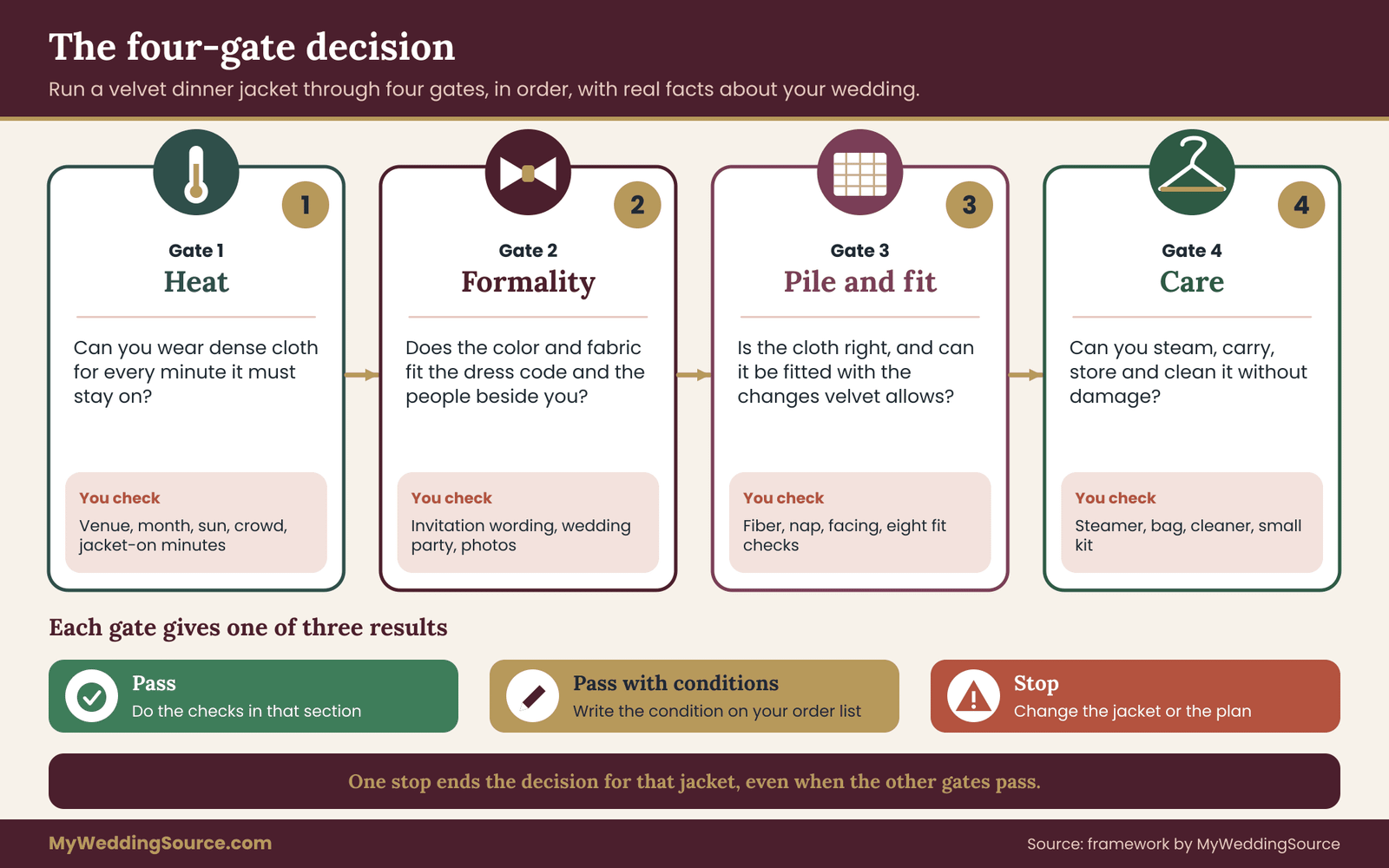
Run a velvet dinner jacket through four gates before you buy, rent or borrow one. Gate one is heat: dense pile is warm, so it suits cool evenings and heated rooms better than hot afternoons. Gate two is formality: it fits black tie optional, creative black tie and festive formal events, and needs a conversation at strict black tie. Gate three is pile and fit: choose the fiber, color and nap, then check shoulders, collar and sleeves. Gate four is care: plan steaming, transport and storage before the day.
Velvet has a quiet kind of drama. Under a ballroom chandelier a deep green or burgundy jacket reads as formal without looking like everyone else’s. Photographed in warm light, the pile catches and releases light in a way that flat wool cannot. That is the appeal, and it is real. A velvet dinner jacket also behaves differently from a wool one in ways that matter on a wedding day: it holds heat against the body, it records every press of a fingertip, and it looks a different shade when you tilt it.
None of that is a reason to avoid it. It is a reason to decide with your eyes open and to test before you commit. The people who regret a velvet jacket rarely regret the look. They regret wearing it outdoors in the wrong month, finding a crushed patch on the shoulder where a camera strap rested, or discovering at the fitting that the sleeves cannot be altered the way they assumed.
A note on scope. This guide is general information, not legal, tax or financial advice, and it cannot replace the care label on your garment or the terms of your seller. Where a rule or a policy matters, the text points you to the agency or the written terms so you can confirm the current version yourself.
This guide is deliberately narrow. It covers the choice of a velvet dinner jacket: whether it is right for your season and venue, where it sits in a dress code, how to judge the cloth, how to fit it and how to look after it.
For the broader question of how formal the whole wedding should be, the dress code sections of the wedding etiquette guide set the frame, and the wedding dress fit and alterations guide explains the fitting process that any formal garment goes through. Linen as a warm-weather cloth is a separate topic and is not repeated here.
What a velvet dinner jacket is, and what it is not
Two terms cause most of the confusion, so it helps to fix them first.
A dinner jacket is the formal evening jacket that belongs to black tie. In the United States most people call the complete outfit a tuxedo and the jacket a tuxedo jacket. In British usage the jacket is the dinner jacket and the outfit is a dinner suit. This guide uses “dinner jacket” for the jacket alone, because the word signals what the garment is for: evening, formality and dressing up with a bow tie rather than a business tie.
Velvet is a woven cloth with a dense, short pile on one face. The pile is a layer of cut fibers standing up from a base weave, which is why the surface feels soft and why it looks darker or lighter depending on the angle and on which way you brush it. That direction is called the nap. Everything that is distinctive about a velvet dinner jacket comes back to the pile: the depth of color, the warmth, the way it marks and the way it must be cut and cared for.
So a velvet dinner jacket is a formal evening jacket in a pile cloth. It is not a casual blazer in corduroy, which has a ridged pile and a daytime character. It is not a costume piece, although a bad fit or a clashing color can make it feel like one. And it is not automatically the dressiest option in the room. In many settings a plain black wool dinner jacket is still the most formal choice, and velvet is the more personal one.
The jacket anatomy that matters for velvet
Most dinner jackets share the same few parts, and each one behaves differently in velvet.
The lapels are traditionally faced in a contrasting material such as silk satin or grosgrain, or the whole jacket is made in one cloth. A velvet dinner jacket may have velvet lapels on a velvet body, satin lapels on a velvet body, or a shawl collar, which is a single rolled collar without a notch. Facing choices change the formality and the look in photographs, and a later section compares them.
The lining matters for heat and for how the jacket slides over a shirt. A full lining makes velvet glide on and off but traps warmth. A partial lining is cooler and costs more to make.
The buttons on a dinner jacket are usually covered in the same cloth as the lapel facing or are plain and dark. Shiny metal buttons push the jacket toward blazer territory.
The shoulders and sleeves are where fit shows first, and velvet hides nothing. A seam that sits wrong on a flat wool jacket looks slightly off; on a velvet dinner jacket it casts a visible shadow line.
Why people choose velvet for a wedding
There are four honest reasons, and it helps to know which one is yours.
First, color without a costume feeling. A deep, low-sheen color such as midnight, bottle green, wine or deep navy lets a groom stand out in a group of black tuxedos while staying inside the language of formal dress.
Second, a season match. Heavier cloth suits late autumn and winter weddings in cold climates, evening receptions in heated ballrooms, and holiday-season events where a festive feel is welcome.
Third, photographs. Pile absorbs light, so it photographs with depth rather than the flat black of some wool tuxedos. A lighter colored velvet can also look rich without glare.
Fourth, a piece that outlives the day. A well-made jacket can be worn again to formal dinners, galas and other weddings, which changes the cost logic discussed later in this guide.
The four-gate decision for a velvet dinner jacket
Most advice about velvet is a loose list of tips. A decision works better as a sequence of gates, each with a clear pass, a pass with conditions, or a stop. The sequence below is a framework from this site, not an industry standard, and it is meant to be used on paper, with your actual wedding details in front of you.
Gate one: heat. Will the jacket be worn in conditions where dense cloth is comfortable for the whole time it must stay on? You answer this from the venue, the time of day, the month, the guest count and how long the jacket has to be worn before it can come off.
Gate two: formality. Does the stated or implied dress code of the event allow a colored or pile-faced jacket, and does the rest of the wedding party’s clothing sit comfortably beside it?
Gate three: pile and fit. Is the cloth itself suited to your use, meaning the fiber, the weight, the color and the pile? And can the jacket be fitted to you with the alterations that velvet allows?
Gate four: care and logistics. Can you steam it, carry it, store it and clean it without damage, with the time and the help you have?
Each gate gives one of three results.
- Pass: nothing more to do beyond the checks in that section.
- Pass with conditions: go ahead, and write the condition down. An example is “wear it only after the ceremony ends” or “order it a month early so alterations have time.”
- Stop: the answer is no for this event, and a different option is better. A stop at one gate is enough to end the decision for a given jacket, even if the other three are fine.
How to use the gates
Take a sheet of paper and write the four gate names. Under each, write what you know about your wedding in one or two lines, using facts rather than hopes. “Outdoor garden ceremony at four, reception in a tent” is a fact. “Probably cool” is a hope.
Then read the matching section of this guide and score yourself. If you reach a stop, treat it as useful information rather than a failure. The most common stops are a hot outdoor ceremony, a printed strict black tie code, and a seller who cannot tell you the fiber content.
If every gate passes or passes with conditions, collect the conditions into a short list. That list becomes your order checklist, and you will return to it in the later sections on fit and on questions for the seller.
One more point about the gates. They are not equal in weight for every couple. If you plan to wear the jacket only for the portraits and the first dance, heat matters less. If you plan to keep it on for a four-hour outdoor day, heat is the gate that decides everything. Decide which gate is your tightest constraint, and look at that one first.
A quick self-check before you read further
Answer three plain questions now, and compare your answers with the sections that follow.
What is the coolest and the warmest this room or venue is likely to be during the time the jacket must stay on? What does the invitation say about attire, in the exact words? And who else is wearing a jacket that will stand next to yours in photographs?
You do not need exact numbers. You need an honest range and the exact wording. With those, the rest of this guide turns from general advice into a decision about your wedding. The next section takes the first gate, because heat is the reason a velvet dinner jacket most often goes wrong.
Season and heat: when a velvet dinner jacket is comfortable
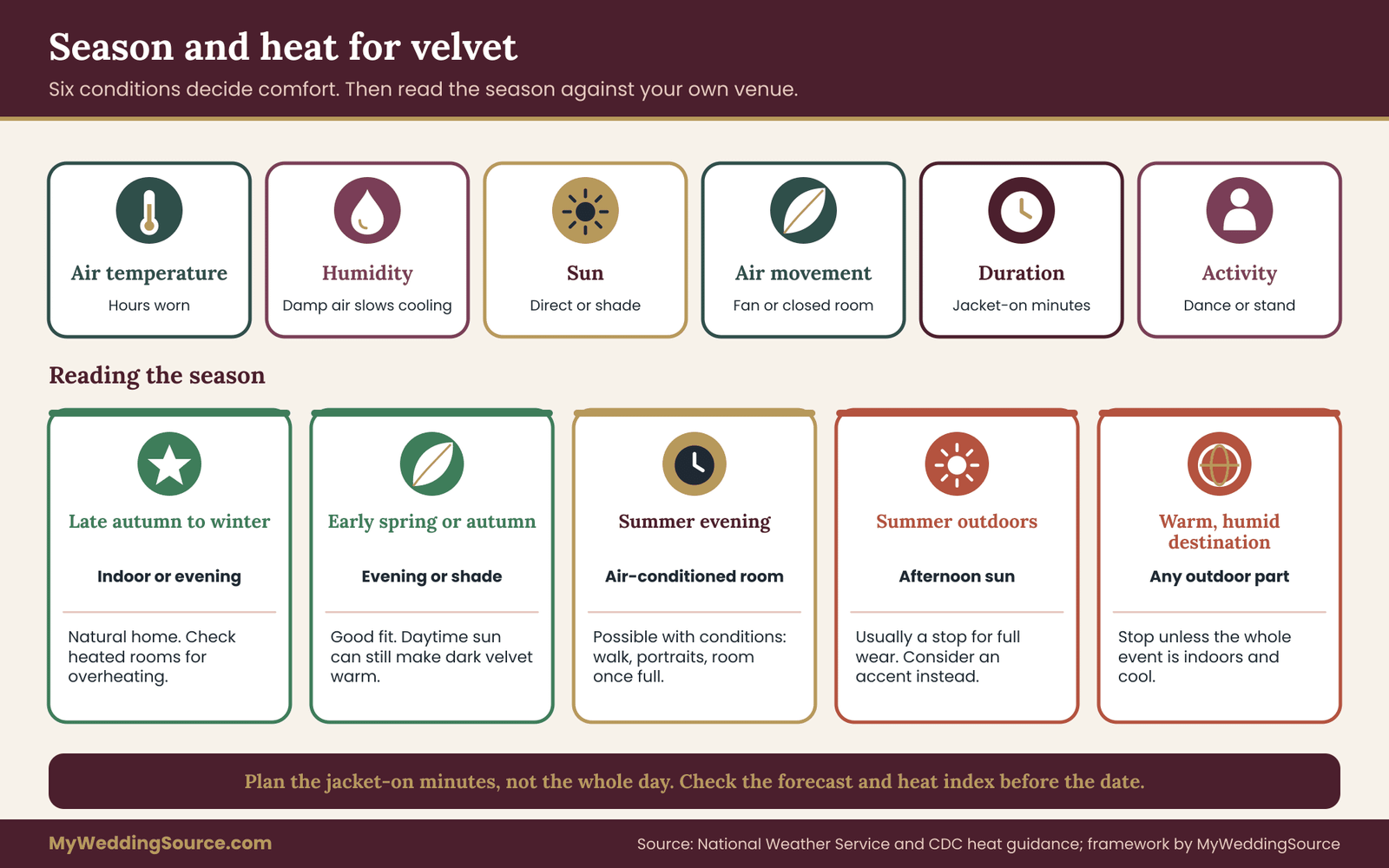
Heat is gate one because it is the gate people skip. Velvet looks cool in the sense of color and feels soft, so it is easy to forget that a dense pile cloth with a lining is closer to a blanket than to a summer shirt. A velvet dinner jacket is a cold-season garment that can be worn in other seasons with planning. It is rarely a good choice for a long outdoor day in strong sun.
Why a velvet dinner jacket runs warm
Three features combine. The pile itself holds a thin layer of still air against the fabric, which insulates. The base weave under the pile is usually tight, because it has to anchor the fibers. And most jackets are lined, sometimes fully, which adds a second layer that does not breathe well.
Fiber changes the picture only partly. Cotton velvet usually breathes better than polyester velvet, and silk and viscose sit somewhere between. But even the airiest velvet is heavier and denser than a tropical-weight wool or a linen blend of the same cut. Treat fiber as a way to reduce the problem, not to remove it.
Body and setting then decide how much that warmth matters. A tall, lean person standing in a cool church will feel the velvet dinner jacket very differently from someone dancing in a crowded room with the heating on. This is why the test in this section is about conditions and minutes rather than a temperature rule.
The six conditions that decide comfort
Write down your best knowledge for each of the six conditions below. You will use them for the rest of the section.
Air temperature. The expected range for the hours the jacket is on, not the daily high. Evening cooling can help a late reception and do nothing for a three o’clock portrait session.
Humidity. Damp air slows evaporation, so a jacket that is fine in dry heat can feel oppressive in the same temperature with high humidity. Federal heat guidance uses a measure that combines the two, called the heat index, which the National Weather Service publishes. Check the current forecast and the agency’s guidance rather than relying on the temperature alone.
Sun. Direct sunlight raises how hot you feel, and dark velvet absorbs it. Shade, a tent or an indoor room changes the answer completely.
Air movement. A breeze or a ceiling fan helps. A packed room with closed windows does the opposite.
Duration. How long must the jacket stay on? A jacket worn for a twenty-minute ceremony and then removed is a different proposition from one worn through photos, dinner and dancing.
Activity. Standing still, walking a long aisle, greeting a line of guests and dancing each add load. A group dance such as a hora or a line dance adds a lot in a short time.
Reading the season honestly
Seasons are a starting point, not a verdict, and the same month can feel different in different places. A rough way to read them follows, and you should adjust it for your own climate and venue.
Late autumn to winter, indoor or evening. This is the natural home of a velvet dinner jacket. Heated venues can still run warm, so check the room, but the baseline is comfortable.
Early spring and early autumn. Often a good fit for evening events and cool shaded settings. Daytime sun on a mild day can make dark velvet warmer than the forecast suggests.
Summer evening, air-conditioned venue. Possible with conditions. The conditions are the walk from the car, any outdoor portrait time and the temperature of the room once it fills with people.
Summer outdoors in the afternoon. Usually a stop for a full-wear velvet jacket. If you still want the look, the later options in this section may help.
Warm-climate destination weddings. Treat these as a stop unless the event is entirely indoors and cool. Humidity makes the difference between a manageable evening and a miserable one.
For help choosing a date that balances these factors against guest travel and vendor availability, the guide to choosing a wedding date covers the trade-offs, and the heat question is one more factor to put on that list.
The jacket-on minutes budget
Instead of asking whether you can wear a velvet dinner jacket all day, ask how many minutes it has to stay on and how many of those minutes are hot. This is the jacket-on budget, and it turns a vague worry into a plan.
Take your day’s schedule from the vendor timeline or your own run of show, and mark each block as one of three kinds.
- Jacket required: ceremony, formal portraits, grand entrance, first dance, toasts when you are the center of attention.
- Jacket optional: cocktail hour, dinner, general mingling. Most people take the velvet dinner jacket off here if the room allows.
- Jacket off: dancing, games, outdoor lawn time in the sun, travel between venues.
Add up the required minutes. If they fit inside the cooler hours and the cooler spaces, the jacket passes gate one, with conditions. If the required minutes land in full afternoon sun, the gate stops, or you need to move something.
You can move more than you think. Ceremony time can shift. Portraits can happen in shade or indoors. A first look can happen before the ceremony in a cooler space. Tell your photographer that comfort in a velvet dinner jacket is a scheduling input, not a fussy request.
A wear test that costs nothing
Before you order or commit to a rental, try the cloth the way you will use it. This is a comfort check for you, not a medical measure.
Wear the jacket, or the closest equivalent you can find, over the shirt you plan to wear, in a room that is as warm as the wedding is likely to be. A closed-up bedroom on a warm afternoon works. Stay for thirty minutes and do what you will do on the day: stand, walk, sit, raise your arms for a hug and reach for a glass.
Then note five things. How warm does your torso feel, compared with how you feel in a plain wool jacket? Does your shirt feel damp at the back or under the arms? Can you move your arms without the jacket pulling? Does the velvet dinner jacket look the same as before, or has the pile crushed where you sat or leaned? And how do you feel mentally: easy, or counting the minutes?
If any answer is bad, you have learned something while you can still change the plan. Stop the test if you feel faint, dizzy or ill. The Centers for Disease Control and Prevention publishes guidance on the signs of heat illness, and the right response to those signs is to cool down and get help, not to finish the test.
Making a velvet dinner jacket cooler
If your tightest constraint is heat and you still want the jacket, several adjustments help. None removes the issue, and each has a cost.
Choose a lighter build. Ask about a partially lined or unlined construction, a lighter cloth weight and a breathable fiber such as cotton. The cost is that a lighter jacket may drape differently, and a lining-free interior can show seams and wear more.
Choose a lighter color if the style works. Pale velvets absorb less sunlight than very dark ones, though they show marks and stains more easily and suit fewer dress codes.
Plan for shade and air. Hold portraits in shade, and ask the venue about fans or cooling in the room. A cooling plan can be as simple as a cold water bottle for the groom and a chair near the fan.
Take the jacket off on purpose. Agree with your photographer and your partner which photos need it and which do not. A velvet jacket carried by a groomsman for part of the day is still a velvet jacket at the key moments.
Use velvet as an accent. If heat rules out a full jacket, a velvet bow tie, a velvet cummerbund or a velvet waistcoat worn with a lighter jacket brings in the cloth without the warmth. This is a compromise, and some couples find it more comfortable than they expected.
What to ask the venue about heat
A short script saves a day of worry. Email or ask in person, and ask for the answer in writing.
“Is the reception room heated or air-conditioned during the evening, and is it controlled by the venue or by a shared system? Can the temperature be adjusted during the event? Where could someone cool down for a few minutes if they felt too warm?”
Add a second question for outdoor settings. “Is there shade at the ceremony site between four and six, and is there an indoor space we can use for portraits if it is hot?” Replace the times with your own. If the venue cannot answer, treat that as a risk for gate one and plan a backup for the jacket-on blocks.
When the season says stop
If the plan fails gate one, the answer is not always to abandon velvet. It is to choose which part of the look carries the velvet. A groom can wear a lightweight tuxedo with a velvet bow tie, or change into the velvet dinner jacket for the evening portion after sunset, or wear it only for portraits in a cool indoor room. All of these are legitimate. What does not work is ordering the full jacket on the assumption that it will be fine and finding out under a tent at four in the afternoon.
The point of the gate is that you decide on the number of hot minutes you are willing to spend, in advance, and arrange the day to match. With that settled, the next gate asks whether the velvet dinner jacket belongs at the event at all.
Formality: where a velvet dinner jacket sits on the dress code ladder
Gate two is about the words on the invitation and the clothes around you. Dress codes are conventions, not laws, and hosts use them loosely. Still, a velvet dinner jacket sends a clear signal, and it should match the signal your wedding is sending.
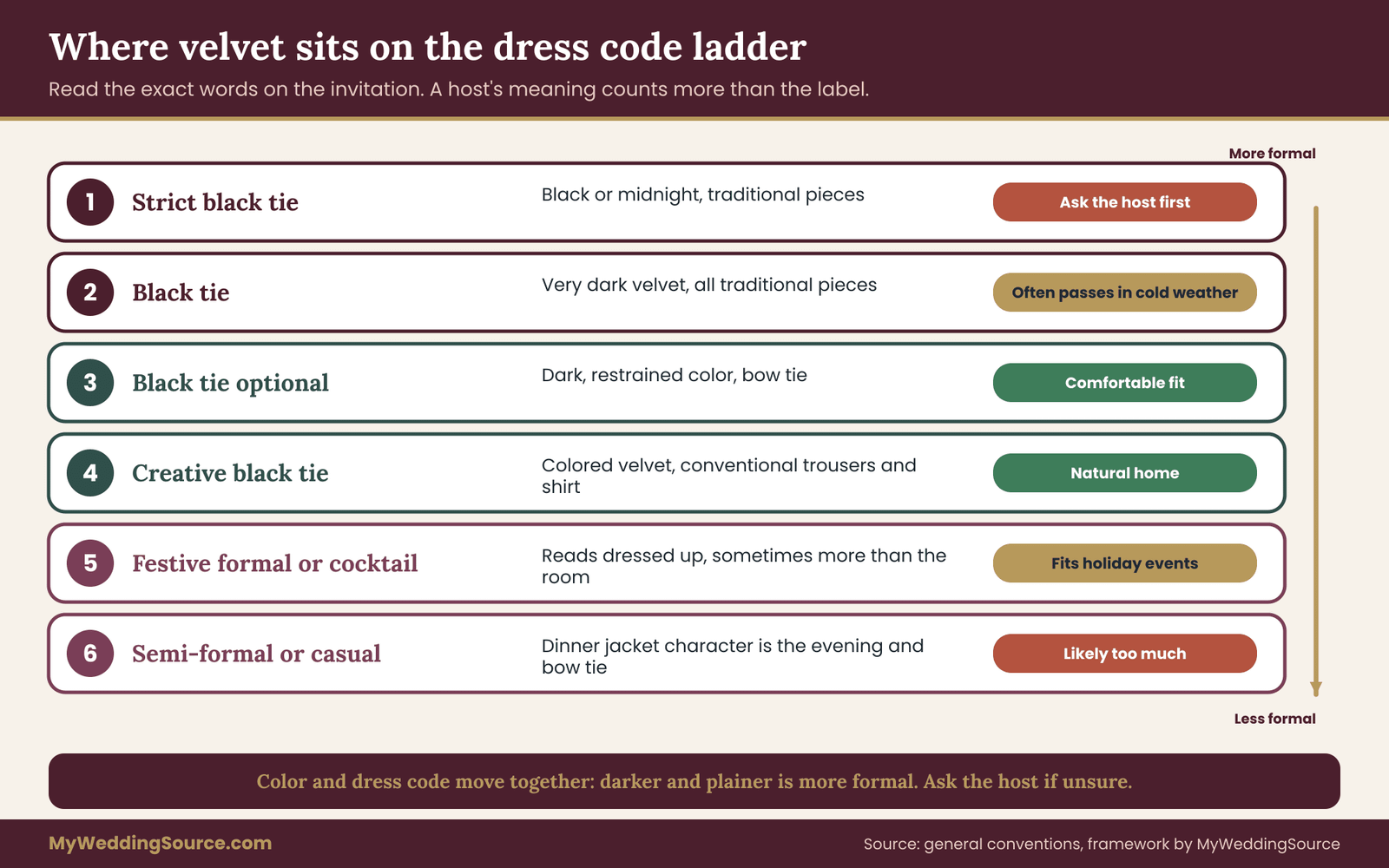
The ladder, from strictest to loosest
Formal dress codes form a rough ladder. The names vary between regions and hosts, so read the descriptions and the examples on the invitation, not only the label.
Strict black tie. The conventional outfit is a black or very dark midnight dinner jacket, matching trousers, a white formal shirt, a black bow tie and black dress shoes. A velvet dinner jacket is not part of the strict convention, though a black or midnight velvet is the closest it gets and some hosts accept it. If your invitation says black tie and means it, ask.
Black tie. The same conventions apply, loosely. A very dark velvet in black or midnight, worn with all the traditional pieces, often passes, particularly at an evening event in cold weather. A bright or light velvet may not.
Black tie optional. The host welcomes a tuxedo but accepts a dark formal suit. A velvet dinner jacket in a dark, restrained color fits here comfortably.
Creative black tie. The host invites personality within a black tie frame. This is the natural home for a colored velvet dinner jacket, with traditional trousers, shirt and bow tie keeping the outfit grounded.
Festive formal or cocktail attire. A velvet dinner jacket reads as dressed up, often more than the room expects. It can look right at a holiday-season wedding and slightly overdressed at a daytime garden event.
Semi-formal and casual. A velvet dinner jacket is likely too much, though a velvet blazer with a standard tie could work. A dinner jacket’s character comes from the evening and the bow tie.
Reading the invitation correctly
The invitation is the source of truth for your guests, and it is also the best guide for you. The wedding invitation etiquette guide explains how attire lines are worded and what hosts usually mean by them. A few points matter specifically for velvet.
If the invitation says nothing about attire, the venue and the time of day tell guests what to wear, and they will follow the groom’s and the hosts’ lead. A velvet dinner jacket on an unmarked invitation at an evening ballroom wedding will not surprise anyone. The same jacket on an unmarked invitation at a barn wedding in the afternoon might.
If the invitation says black tie, you are the host or the partner of the host, so the code is yours to interpret. Most couples are relaxed about it, but ask yourself whether you want a wedding where one person sets the exception. A groom in a dark velvet dinner jacket is a pleasant exception. A groom in an electric-bright one at a strict black tie event is a statement.
If the wedding is a family-hosted event, whoever is hosting may care about the code more than you do. A short conversation costs nothing. “We are thinking of a midnight velvet dinner jacket with a black bow tie. Does that suit what you have in mind for black tie?” Most hosts respond warmly.
Color and formality move together
The darker and more muted the velvet, the closer to strict black tie it sits. Rough guidance follows, with the caveat that undertones and sheen change how a color reads.
Black and midnight blue. The most traditional choices. Midnight blue reads nearly black in artificial light and slightly richer than black in daylight, which is why it has long been popular for evening wear. In velvet, deep black can look flat in photographs, and midnight tends to show the pile better.
Deep green, wine and burgundy. The classic colored velvet dinner jackets. They suit creative black tie and festive formal events, and they pair well with black trousers.
Navy, charcoal and deep teal. Somewhere in between. They work at black tie optional and creative black tie, and they are easier to pair with other dark pieces.
Brights and light colors. Rust, mustard, sky blue, blush and cream signal a style choice rather than a convention. They can look excellent in the right setting, and they are the riskiest choices for photographs, for stains and for harmony with the wedding party.
What to wear with a velvet dinner jacket
A velvet dinner jacket is more convincing when everything else is conventional. Each piece below keeps the outfit anchored in formal dress, and each one is easy to get slightly wrong.
Trousers. Black wool trousers, usually with a satin or grosgrain stripe down the side seam if the jacket’s lapels are faced in the same material, are the traditional match. Trousers in the same velvet make a velvet suit, which is a different, more casual-feeling outfit. Matching velvet trousers also double the heat problem.
Shirt. A white formal dress shirt, with a pleated or marcella-style front or a plain front, is conventional. Choose a collar that works with a bow tie, such as a turndown collar. Wing collars are traditional for the strictest events.
Bow tie. A black bow tie is the standard. A velvet bow tie in a matching color is a common choice with colored jackets, though a silk bow tie often looks sharper next to velvet because the surfaces differ.
Waist covering. A cummerbund or a low-cut waistcoat covers the shirt waistband. If you choose a velvet cummerbund, think about heat and about bulk under a jacket that already adds layers.
Shoes. Polished black oxfords or patent leather dress shoes are the usual pairing. Velvet slippers, sometimes embroidered, are a traditional informal choice for home and for some parties. Treat them as a style statement and check whether they suit your wedding.
Accessories. Studs and cufflinks should be simple. A pocket square in white silk or linen is classic. Avoid anything with a strong sheen next to velvet’s own sheen, which tends to compete. The wedding day accessories planning guide covers how to test accessories for movement and comfort across a long day.
The wedding party, the partner and the photographs
Standing next to a velvet dinner jacket changes how everything else looks, so gate two includes the people around you.
If the groomsmen wear black tuxedos, a velvet jacket on the groom marks him as the center of attention, which is usually welcome. If the groomsmen wear other colors, check that the velvet shade does not clash. Hold swatches together in the light of the venue, if you can.
Consider your partner’s outfit. A wine-colored velvet dinner jacket can sit beautifully next to a blush or ivory dress, and can clash with a bright red one. If your partner wears a formal gown, the two outfits should read as belonging to the same event. Test the swatches against each other and against the venue’s lighting before you decide.
Think about the photographs in more detail. Velvet has a variable sheen. In a flash photograph, a dark velvet can show bright patches where the pile lies flat, which looks like a stain even though it is just light. Ask your photographer whether they use flash, and if so, how they light dark velvet. They will have seen it before.
Edge cases at gate two
A few situations come up often enough to mention.
Religious or cultural ceremonies. Some ceremonies have their own dress conventions. If a family expects specific attire, work that out first and let the velvet dinner jacket be an evening or reception choice.
Daytime ceremony, evening reception. A popular answer is to wear a standard formal outfit for the day and change into a velvet dinner jacket for the reception. This helps with heat, formality and photographs at once. Plan where you will change and who will carry the second jacket.
Courthouse or civil ceremonies. A velvet dinner jacket can be a handsome choice, but a courthouse in daytime is a casual setting for black tie dress. Consider a velvet blazer with a tie, or save the dinner jacket for the celebration afterward.
Guests who ask what to wear. Be ready with a one-line answer. If you are wearing velvet, say so, and say what it means for them. “Black tie optional, and creative colors are welcome” is a friendly answer that matches a velvet dinner jacket on the groom.
The decision at gate two
For each possible wedding dress code, ask the same three questions. Does the jacket’s color and fabric fit this code as the host would read it? Does it sit well beside the people it will stand next to? And is there a person whose opinion matters who has not been asked?
If you answer yes, yes and no, you pass. If the answer to the first question is unclear, ask the host or adjust the color. If it is no, change the jacket or the plan. With heat and formality settled, the next gate turns to the cloth itself.
Pile, fiber and color: judging the cloth of a velvet dinner jacket
Gate three has two halves: the cloth and the fit. This section takes the cloth. A velvet dinner jacket can be made from several fibers, in several weights, with a pile cut at different heights, and the seller’s phrase “velvet” can mean any of them. The aim is to learn enough to ask a sharp question and to test a swatch in your own hands.
What pile is, and why it matters
Velvet is made by weaving or tufting extra yarns into a base cloth and cutting them so the ends stand up. The result is a surface of short upright fibers. Because the fibers lean slightly in one direction, brushing the cloth with your palm one way feels smooth and the other way feels rough. That lean is the nap.
Pile creates four practical effects for a velvet dinner jacket.
Color depth. Standing fibers trap light, which makes color look deeper than the same dye on a flat cloth.
Directional shade. Light bounces differently depending on which way the fibers lean, so the same velvet can look darker or lighter depending on how it is cut and how you stand.
Marking. Pressure bends or flattens fibers, leaving a visible patch until the pile recovers or is steamed back. Fingertips, seat belts, bag straps and a partner’s hand on the shoulder all leave traces.
Warmth. The air held among the fibers insulates, as noted in the section on heat.
Nap direction and why a tailor cares
Every piece of a velvet jacket must be cut with the nap running the same way. If one sleeve is cut with the pile running up and the other down, the two sleeves look like two different colors in the light, and no steaming will fix it. This is a cutting issue, not a quality quirk, and it is one reason velvet jackets are cut more carefully and sometimes cost more to make.
There is a convention about direction. Many makers cut with the pile running up, which tends to give a deeper, richer color, while running down gives a lighter, slightly silvery look. Practice varies, so the useful rule is consistency, not a single correct direction.
You can check this yourself. Stand a few feet from the velvet dinner jacket in good light, with the jacket on a hanger. Look at the front, the back, each sleeve and the collar. They should read as the same shade from the same viewing angle. Then run your palm lightly down the front panel and the back panel. Both should feel smooth in the same direction.
If you are buying ready-made, check before you pay. If you are ordering made-to-measure, ask the maker how they handle nap and ask them to confirm in writing that all pieces are cut in one direction.
The fiber families, in plain terms
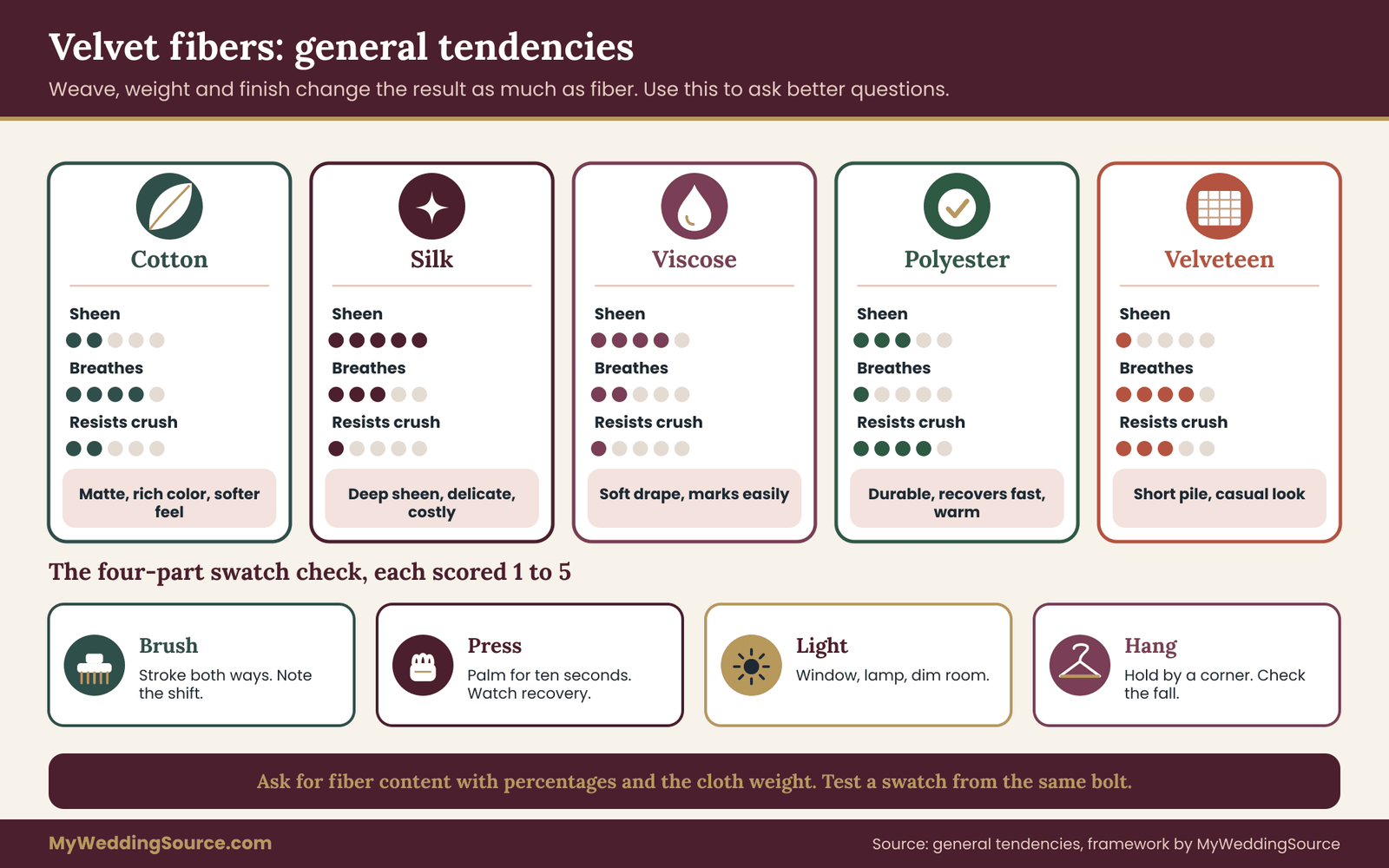
The descriptions below are general tendencies. Weave, finish and construction change the outcome as much as the fiber does, so use them to guide questions, not as rankings.
Cotton velvet. Often matte or softly lustrous, heavier in hand, and generally more breathable than synthetic velvet. It tends to hold a crisp, rich color and can crush in visible patches. Many people find it a comfortable choice for a velvet dinner jacket.
Silk velvet. Luxurious, with a deep sheen and a fluid drape. It tends to be expensive, delicate and sensitive to moisture and pressure. It suits a groom who will treat the jacket with care and wear it for a short, controlled part of the day.
Viscose or rayon velvet. Soft with a good drape and a rich surface, often used to give a silk-like look at a lower cost. It can crush and mark easily and may need careful cleaning. Check the care label closely.
Polyester velvet. Durable, usually resistant to crushing and easy to maintain. It also tends to breathe less, so heat can be a bigger issue. It can be a practical choice for rentals and for events where the velvet dinner jacket will be worn in a controlled setting.
Blends. Many velvets mix fibers, such as cotton with a small share of another fiber for strength, or viscose with silk. The label should state the fiber content and the percentages. If it does not, ask.
Velveteen. A cotton pile cloth with a shorter, denser pile, constructed differently from true velvet. It has a more matte, casual look and is common in blazers. It can look handsome but reads less formal than a lustrous velvet.
The federal textile labeling rules require fiber content to be disclosed on most garments sold in the United States, and the Federal Trade Commission explains those rules on its business guidance pages. For a seller that cannot or will not state the fiber content of a jacket, treat that as a reason to look elsewhere.
Weight, pile height and drape
Two jackets in the same fiber can feel quite different if the weight or pile height differs.
Weight. Heavier cloth holds its shape and hangs well, but it adds heat and bulk. Lighter cloth is more comfortable but may drape or wrinkle differently. Ask for the weight in grams per square meter or ounces per yard if the seller lists it, and compare two jackets using the same unit.
Pile height. A longer pile looks plusher and shows marks more. A shorter pile looks cleaner and resists marking better, but it can look flatter in photographs.
Drape. Hold the swatch by one corner. A good formal velvet falls in soft folds. A stiff, springy one will not form the clean line a dinner jacket needs.
A four-part swatch check for velvet
Ask the seller for a swatch large enough to handle, ideally the size of a hand towel or at least a large postcard. Run four checks and score each from one to five for yourself. These are your own notes on a sample, not laboratory results.
Brush. Stroke the swatch with your palm in both directions. Notice the difference in color and feel. A large shift means the nap direction will matter a lot in cutting and wear.
Press. Press your palm firmly on the swatch for ten seconds and lift it. Look at the print left behind. Check at once and again after a minute. Quick recovery is a good sign for a jacket that will be sat in and hugged in.
Light. Look at the swatch under a window, then under a lamp, then in the dim light that resembles a ballroom. Note how the color shifts. A velvet that looks right only in daylight may disappoint in an evening room.
Hang. Clip it to a hanger or hold it from a corner and watch how it falls. Look for stiffness or limpness.
Add the four scores to compare swatches with each other. Treat a swatch that scores low on press and low on light with caution for a long wear day.
Lapel facing and collar style
The way the jacket is faced changes its formality more than the color does.
Self-faced velvet. The lapels are velvet like the body. This looks cohesive and casual-formal, and it is the most common choice. It can look heavy in a strict black tie setting.
Satin or silk faced. The lapels are a contrasting smooth cloth. This follows dinner jacket tradition more closely and adds a sharp line in photographs. It also adds a second cloth that needs care, because satin shows snags.
Grosgrain faced. A ribbed, matte facing that pairs well with dark velvet. It is a quieter, more traditional alternative to satin.
Shawl collar. A rounded, continuous collar without notches. Closely associated with dinner jackets and with velvet in particular, and often considered the most formal choice for this garment.
Peak lapel. A pointed lapel that extends upward. A classic formal shape that gives the shoulders a strong line.
Notch lapel. The standard business suit shape. Less traditional on a dinner jacket, but more common in rentals and softer in appearance.
Lining, buttons and interior
The interior matters for comfort and for how long the jacket lasts. A full lining slides over a shirt and protects the inside of the velvet, but traps heat. A half lining or a lining only in the sleeves and upper back allows more airflow and can feel lighter, at a cost in construction. Check that the lining color suits the outfit if you plan to take the velvet dinner jacket off and let it show.
Buttons should be covered in the facing material or plain dark. Check that they are sewn firmly and that the jacket has a spare. Velvet pile can catch on rough threads, so ask whether buttons are shanked and smooth.
Color testing in real light
Colors in a velvet dinner jacket shift more than flat colors do, so test at the venue if you can. Carry the swatch to the ceremony site and the reception room, hold it near the clothing of your partner and the wedding party and, if possible, near the flowers. Photograph it with your phone in each place, then compare. Your phone is not a calibrated camera, but it shows relative shifts in a way your eyes may not.
If a color changes dramatically between a window and a lamp, decide which setting matters most. Most of a wedding evening is spent under artificial light, so that setting should decide.
The decision at the cloth half of gate three
By now you should know the fiber, the weight and the pile, the nap direction, the facing and the way the color behaves in your light. If you cannot state those facts in one line each, you do not yet have enough information to order. If you can, move on to fit, which is the second half of the gate.
Fit and tailoring checklist for a velvet dinner jacket
The second half of gate three is fit. Velvet is unforgiving here for two reasons. It records every flaw as a visible shadow or a shift in shade, and it cannot be altered as freely as wool. A good result starts with choosing a jacket that is close to right off the hanger, then using a tailor for the small changes that velvet tolerates.
Start with the shirt, the shoes and the posture
Try the velvet dinner jacket with the shirt you will wear, not a thick sweater or a T-shirt. A formal shirt has a stiff collar and a flat front, and both change how the jacket sits. Stand as you do when you are relaxed, not at attention. If you plan to wear a cummerbund or waistcoat, wear it. If you will wear dress shoes, wear them, because they change posture slightly.
Ask a second person to look and to take photographs from the front, the side and the back. Your own eye in a mirror hides things that a camera and a friend will show.
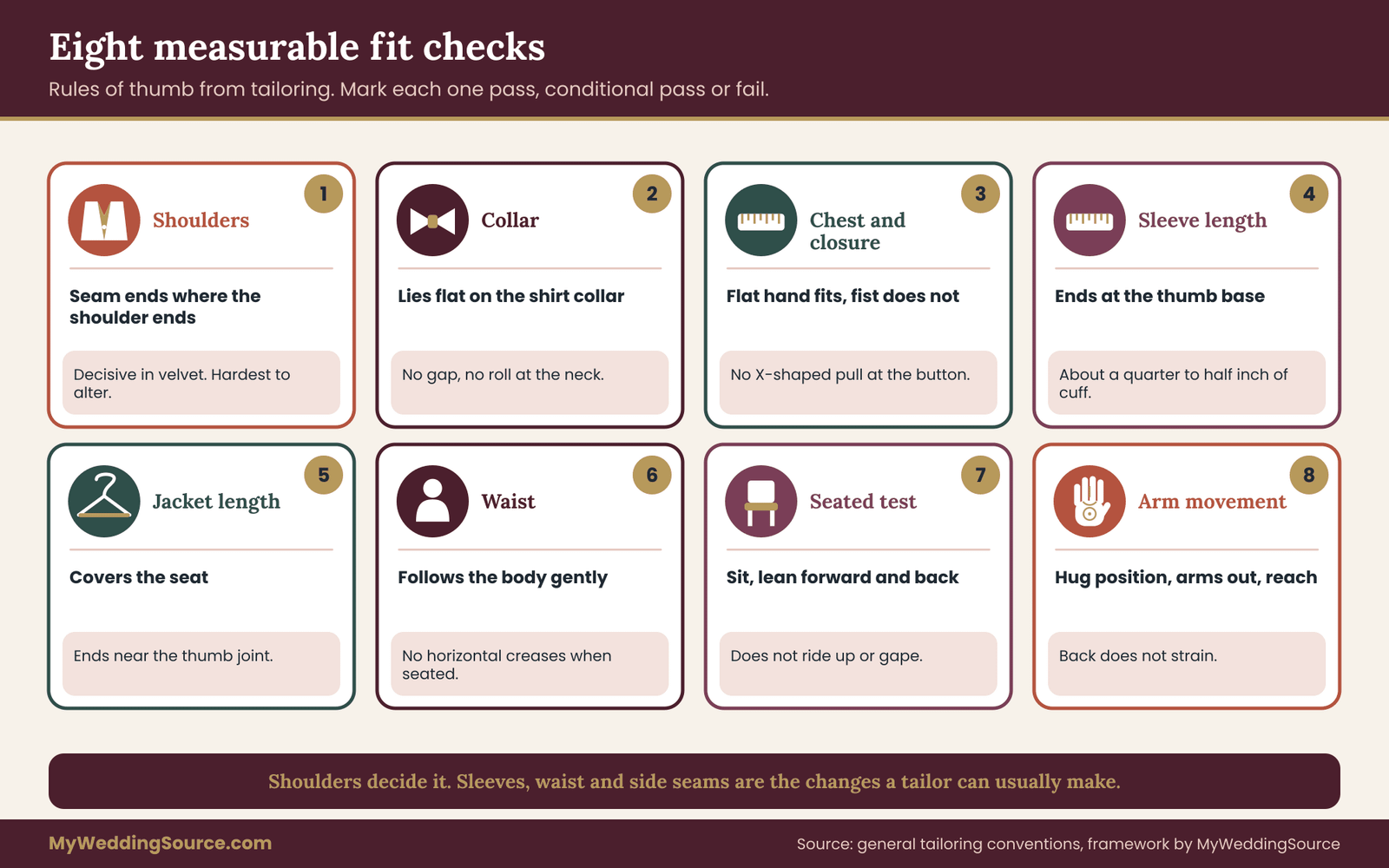
Eight measurable checks
The checks below are practical rules of thumb used in tailoring, written so you can test them with your hands and a phone camera. They are not rules about what a person’s body should look like, and the best fit is the one that lets you stand, move and feel right.
One: shoulders. The shoulder seam should end where your shoulder ends, at the point where the arm begins to curve down. If the seam droops over the arm, the jacket is too big. If the sleeve head puckers or the seam digs in, it is too small. Shoulders are the hardest part to alter in any jacket, and in velvet they are harder still, so make this check decisive. If the shoulders are wrong, try another size or another maker.
Two: collar. The back of the velvet dinner jacket collar should lie flat against the shirt collar without a gap or a roll. If it stands away, the jacket may need a collar adjustment or a different size. A shawl collar should roll smoothly, without wrinkles near the neck.
Three: chest and closure. Fasten the button. The front should lie flat, with no X-shaped pull lines radiating from the button. You should be able to slide a flat hand between the shirt and the jacket’s chest, but not a fist. If the pull lines appear, the jacket is too tight at the waist or chest.
Four: sleeve length. With your arms hanging at your sides, the sleeve end should land near the base of the thumb, and roughly a quarter to half an inch of shirt cuff should show. Longer sleeves hide the cuff and look borrowed. Shorter ones expose too much wrist and look outgrown.
Five: jacket length. The jacket should cover the seat and end around the point where the thumb joint lies when your arms hang naturally. A very short jacket looks cropped, and a very long one looks like a coat.
Six: waist. The jacket should follow the body gently, without hugging and without ballooning. A velvet jacket that is too fitted at the waist shows horizontal creases when you sit.
Seven: seated test. Sit in a chair with your arms on the armrests, then lean forward and back. The jacket should not ride up to your shoulder blades, and the front should not gape widely. If sitting makes the pile bunch or crease sharply, the jacket may be too tight across the back.
Eight: arm movement. Raise both arms forward as if for a hug, then take them out to the sides. The back should not strain, and the collar should not leave your neck. Reach as if to hold a glass above your head and see how much the hem lifts. Some lifting is normal, and a lot suggests a tight armhole.
Score the fit and decide
Give each check a pass, a conditional pass or a fail. A conditional pass means a tailor can likely fix it. A fail means the velvet dinner jacket is not right in a way that tailoring cannot comfortably correct.
If a jacket fails the shoulder check, move on. If it fails two or more checks that a tailor can address, such as sleeve length and waist, the jacket may still be workable, but get a written estimate and a timeline first. If it fails nothing, congratulate yourself and move on to care.
What a tailor can do with velvet, and what is risky
Alterations are the area where velvet differs most from wool. The notes below describe common tendencies, and you should confirm with an experienced tailor who has handled velvet.
Usually workable. Shortening or lengthening sleeves when there is enough hem allowance, taking in the side seams to shape the waist, adjusting the lining and replacing buttons.
Possible, with care. Taking in the back seam, raising the collar slightly, adjusting the jacket length. These changes involve more of the structure, and the tailor must avoid pressing marks.
Often risky or limited. Letting out seams, because the old seam line can leave a visible mark in the pile that does not steam out. Reshaping shoulders. Making major changes to a shawl collar. Any alteration that requires heavy pressing on the pile face.
Pins and stitches. Velvet can show pin marks and the holes of removed stitches. Good tailors use fine pins in the seam allowances, hand-baste where needed and avoid placing pins in visible areas.
Ask the tailor three questions. Have you altered velvet jackets before? How do you press velvet? How do you handle seams that you must open and close again? An experienced person will describe a needle board or a velvet board, a steamer used from the back and a hold-and-lift method rather than pushing an iron onto the face. If the answers sound improvised, look for someone else.
For the wider process of fittings and timelines for formal garments, the wedding dress fit and alterations guide explains how many fittings to expect and how to schedule them, and the same principles apply to a dinner jacket, with extra caution for pile.
Made-to-measure, ready-made and rental fit
How you acquire the jacket changes how much fit you can control.
Ready-made. You pick a size close to your measurements and use a tailor for adjustments. It is faster and often less costly, and it is the route where velvet’s limited alteration room matters most. Try several sizes and styles if you can.
Made-to-measure or bespoke. The maker builds the velvet dinner jacket from your measurements and, ideally, one or two fittings. This gives the most control over nap direction, shoulder shape and sleeve length. It also takes the longest and costs the most, and it needs clear communication about expectations.
Rental. Rental jackets come in set sizes, and the seller may allow some alterations, often limited to sleeve length and trouser hems. Check the policy in writing, and check whether the velvet has been steamed and cleaned between uses. The wedding rental planning checklist explains how to compare rental terms, pickup and return dates and damage policies, which matter a great deal for a fabric that marks easily.
Measurements you can take at home
If you order online, you will need accurate measurements. A cloth tape measure and a helper make this easier. Measure over a thin shirt, not over a jacket.
Chest. Around the fullest part of the chest, under the arms, with the tape level.
Waist. Around the natural waist, usually just above the navel, while breathing normally.
Shoulder width. From the edge of one shoulder to the other across the back.
Sleeve length. From the shoulder seam point, over a slightly bent elbow, to the wrist bone.
Jacket length. From the base of the collar at the back to where you want the jacket to end.
Neck. Around the base of the neck, which helps you buy the right shirt.
Write the numbers down with the date. Measure again before the fitting, because bodies change with training, diet and stress, and wedding months are not always steady.
Timeline: start earlier than you would for wool
Velvet is a slower garment to order and alter. Tailors may be less available for it, and a mistake can cost a longer wait. A sensible plan is to choose the jacket well before the wedding, schedule the first fitting once it arrives and leave time between fitting and the event for a second round. The exact lead times depend on the maker and the season, so ask for turnaround in writing and build in a buffer. If your tailor books weeks ahead in wedding season, call early.
The wedding vendor timeline and the wedding budget both benefit from a line for attire. Put the fitting dates on the calendar and the alteration cost in the budget, and the velvet dinner jacket stops being a last-minute worry.
Weight changes and the second fitting
If your weight is likely to change before the wedding, tell your tailor and leave seam allowance. Schedule a final fitting close to the event, wearing the full outfit and the shoes. At that fitting, run all eight checks again, and photograph the jacket from the front, side and back. Keep those photos, because they are the record of how the jacket looked when it was right, and they help if a dry cleaner or a vendor later alters it.
Buying, renting or borrowing a velvet dinner jacket: the cost logic
The route you take decides the money, the control and the risk. There is no universal winner, and this section sets out the trade-offs in prose so you can match them to your situation. No prices appear here because prices vary by maker, region and year. Instead, the logic below shows how to compare quotes you collect yourself.
Four routes to a velvet dinner jacket
Buy new, ready-made. You pay once, you own the velvet dinner jacket and you can wear it again. You carry the alteration cost and the risk that the cloth is not what the photograph promised. This route suits a groom who expects to wear formal clothes again, or who wants control over care.
Buy new, made-to-measure. The highest upfront cost and the longest lead time, with the best fit and the most say over nap, lining and facings. It suits a groom with a hard-to-fit shape, a strong view about the details or a plan to wear the jacket for many years.
Rent. You pay a fee for a set period and return it. The cost is lower upfront, the choice of cloth and color is narrower, and the risk of damage fees is real for a fabric that marks. It suits a groom who will wear the jacket once and does not want to store it.
Borrow or buy secondhand. A jacket from a relative, a friend or a resale market costs little. Fit is the main risk, because velvet cannot always be altered, and the care history is unknown. Inspect the jacket closely for worn patches, shiny elbows and lining damage. This route works best when the jacket already fits well.
A cost-per-wear way to compare
Instead of comparing sticker prices, compare what each route costs for the number of times you expect to wear the velvet dinner jacket. The calculation is simple arithmetic you do yourself.
Write down the total cost of each route: purchase or rental fee, alterations, cleaning, accessories you would not otherwise buy, shipping and any damage deposit. Then write down how many times you realistically expect to wear the jacket. Be honest. A velvet dinner jacket worn at a wedding and at two holiday parties is three wears. One worn only at the wedding is one wear, however fond you are of it.
Divide each total by the wears. A rental often wins at one wear. A purchase can win at three or four wears, and a made-to-measure jacket can make sense when you expect many wears or when fit is difficult elsewhere. The numbers are yours, so the answer is yours.
Add two qualitative notes. Resale value for a jacket in a bold color is uncertain, and cleaning costs recur every time you wear it. The wedding budget guide explains how to place attire among the other lines so a jacket choice does not push another category out of balance.
The hidden costs of velvet
Velvet adds a few expenses that wool does not.
Specialist cleaning. Many velvet garments need a cleaner who knows pile fabrics. Ask local cleaners whether they handle velvet and what they charge, before you buy.
Steamer or steaming service. Wrinkles and crush marks are managed with steam. A handheld steamer can be a small purchase, or you can arrange for a tailor or cleaner to steam the jacket before the event.
Garment bag and hanger. A breathable bag and a wide, shaped hanger protect the shoulders and the pile.
Alteration costs. Tailors may charge more for velvet because it takes longer and carries more risk.
Damage fees on a rental. Check how the seller treats marks, snags and stains, and whether you are responsible for cleaning.
Questions to ask the seller before you order a velvet dinner jacket
A written list helps. Ask by email so you have a record, and keep the replies with the rest of your attire papers. The questions below are grouped by what they protect. A good seller answers plainly, and a vague answer is information.
About the cloth. What is the exact fiber content, with percentages? What is the cloth weight? Is the pile cut in one direction on all pieces, and which direction? Can you send a swatch cut from the same bolt as my jacket?
About the jacket. Is it fully lined, partly lined or unlined? What are the lapels faced with? Are the buttons covered and shanked? Are there spare buttons?
About fit and alterations. What alterations can you do on this jacket, and which are not possible in velvet? How much seam allowance is in the sleeves and the sides? Do you offer a fitting, and how many? What is the turnaround for alterations in the weeks before a wedding?
About care. What does the care label say? Which cleaner do you recommend for velvet? How should I steam and store the jacket? Federal rules require a care label with at least one safe cleaning method on most clothing, so the label’s wording is your starting point. If the label says dry clean only, take that seriously.
About returns and delivery. What is your return or exchange policy for a made-to-measure or altered jacket? When does it ship, and what happens if it arrives late? If a jacket arrives damaged, what is the process?
About payment. What is the deposit, and when is the balance due? What does the invoice include? If something goes wrong, what do you do?
The wedding vendor contract guide explains what a clear written agreement should contain, and a made-to-measure order from a tailor or shop is a small vendor agreement. Get the key points in writing: fabric, delivery date, fitting dates and refund terms.
Payment and dispute basics
Pay by a method that gives you some protection. Credit card payments generally carry federal billing-dispute rights, which the Consumer Financial Protection Bureau explains on its consumer pages, and the time limits for disputes are short. Keep receipts, order confirmations and screenshots of the product page as it looked when you ordered. If the velvet dinner jacket arrives different from the description, write to the seller promptly, attach photographs and state what you want, such as a replacement or a refund.
Reading product pages carefully
Product pages for velvet jackets often use romantic words and good lighting. Read them with a few filters.
Look for the fiber content line, and be wary of pages that omit it. Look for the cloth weight. Look at all photographs, including ones of the back and the interior, and ask whether the lighting makes the color look richer than it is. Read reviews for comments on color accuracy, sizing and cloth quality, and discount reviews that read as promotional.
If a page says a jacket is “wrinkle-resistant” or “crush-proof,” treat that as a claim to test with a swatch, not as a promise. The Federal Trade Commission publishes guidance on truthful advertising, and a seller who makes strong claims should be able to support them.
Care, transport and wedding day handling for a velvet dinner jacket
Gate four is care. A velvet dinner jacket is not fragile in the sense of a museum piece, but it forgives less than wool, and most damage comes from small habits. The plan below follows the jacket from the fitting room to the closet.
Before the wedding: storage and delivery
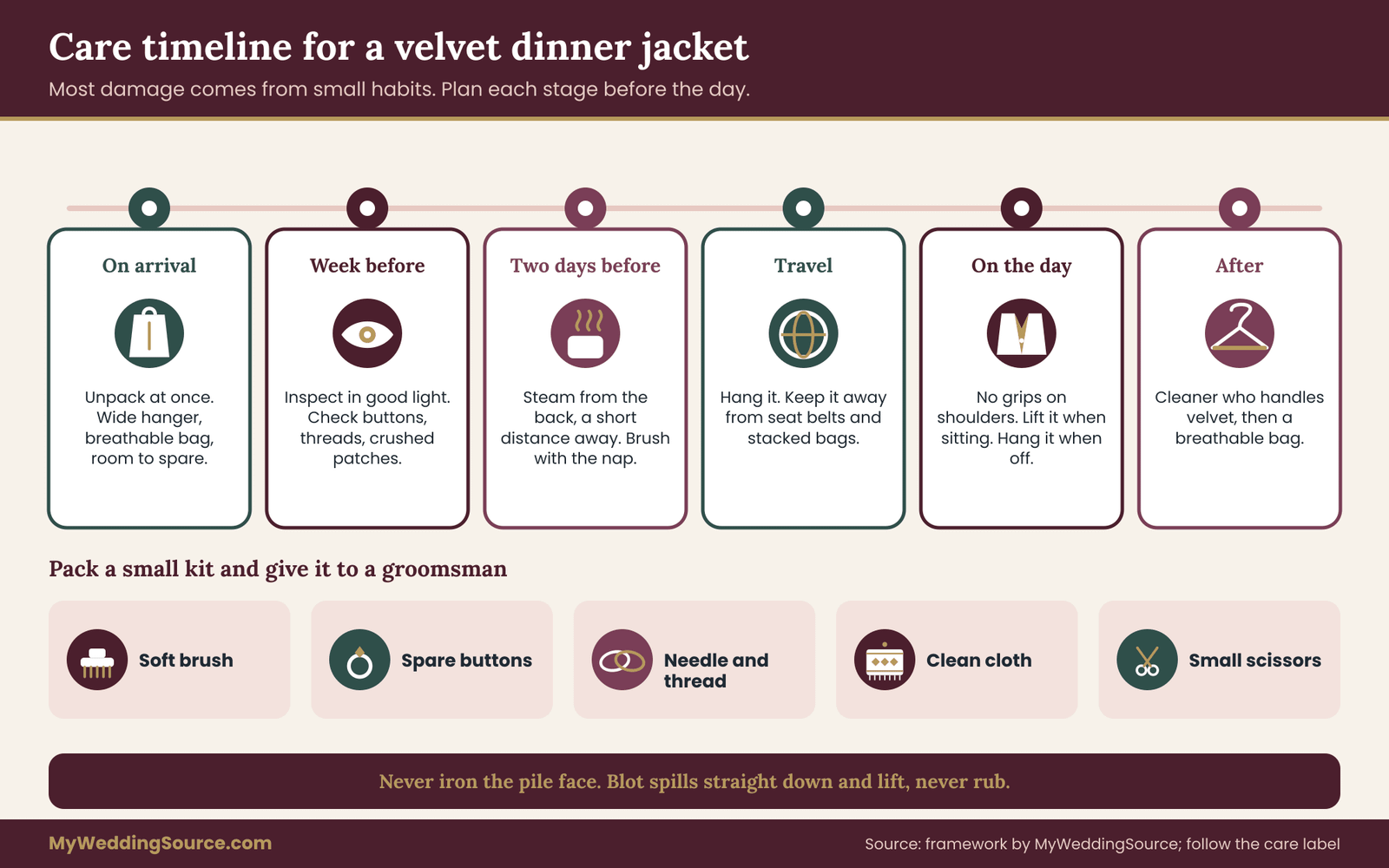
When the jacket arrives, take it out of the packaging at once. Hang it on a wide, shaped hanger, ideally one that supports the shoulders without creating dents. Do not hang it on a thin wire hanger, which can mark the shoulders and distort the collar.
Store it in a breathable garment bag, away from direct sun, and give it room. Pressing a velvet jacket against other clothes in a crowded closet can crush the pile. Keep it away from rough surfaces such as velcro or zippers, which can snag fibers.
The week of the wedding
Inspect the jacket in good light. Look for crushed patches, loose threads and missing buttons. Steam it if needed, using the method below, and let it hang for several hours before wearing.
Test the full outfit once more, with shirt, tie, belt or braces and shoes, and photograph it. Ask a friend to check the back.
Steaming velvet safely
Steam is the main tool for velvet. The aim is to relax the fibers so the pile stands up again, without pressing it flat.
Hang the jacket and hold a handheld steamer a short distance from the cloth, never pressing the head against the pile. Steam from the inside or the back where you can reach, and let the steam pass through. Work in short passes, then let the velvet dinner jacket rest. Brush the pile gently in the direction of the nap with a soft clothes brush while it is still warm. Test on an inside seam first, and read the care label.
Do not iron velvet on the pile face. Direct pressure and heat flatten the fibers and can leave a permanent shine. If an iron is the only tool you have, ask a tailor or a cleaner to steam the jacket instead.
Transport to the venue
How the jacket travels matters. Carry it in a breathable garment bag, hung rather than folded, and avoid stuffing it in a trunk beneath other items. In a car, hang it from a hook and keep it away from seat belts, which can press into the pile. If you fly, bring the jacket in the cabin as a garment bag or fold it by the method airline staff or the maker recommends, and steam it on arrival.
Allow time for the jacket to relax before you put it on. A jacket pulled from a bag and worn in ten minutes often shows the creases of its journey.
On the day: small habits that protect the pile
A few habits prevent most marks.
Ask the groomsmen not to grip the velvet dinner jacket’s shoulders or lean on the sleeves. Hold hugs lightly with the back of the hand rather than a firm press. Avoid carrying a bag or a camera strap across the shoulder. Keep the jacket away from lipstick, fragrance sprays and hairspray, which can stain or stiffen the pile.
When you sit, lift the back of the jacket so you do not sit on it. When you take the jacket off, hang it on a proper hanger or have a trusted person hold it. Do not drape it over a chair back, where the weight can crush the shoulders.
Spills, marks and emergencies
If something spills, blot gently with a clean, dry cloth, pressing straight down and lifting, rather than rubbing, which pushes liquid into the pile and spreads the stain. Do not use water or stain remover unless the label allows it and you have tested a hidden area. Take the jacket to a cleaner who handles velvet, and tell them what spilled and when.
For a crushed patch, hold the steamer near it and brush the pile gently. For a snag, do not pull the thread. Cut it flush with small scissors if it is loose, or take it to a tailor.
Pack a small kit: a soft clothes brush, a lint roller used with a very light touch, a few spare buttons, a needle and matching thread, and a clean cloth. Ask a groomsman to carry it.
After the wedding: cleaning and storage
Do not leave the velvet dinner jacket in its garment bag unattended for weeks. Take it to a cleaner experienced with velvet soon after the event, and tell them about any spills. Ask them how they clean velvet, because methods vary, and check that they do not press the pile.
After cleaning, remove the plastic bag the cleaner puts on, which can trap moisture, and replace it with a breathable one. Store the jacket on a wide hanger with space around it. Check it once a year for moths and for crushed areas, and steam lightly before wear.
If you rented the jacket, follow the return instructions exactly, take photographs of its condition before you hand it back and keep the return receipt. These small steps protect your deposit.
A worked example: one invented couple chooses a velvet dinner jacket
The example below is invented to show the method. The names, dates and scores are not real, and the numbers are the kind you would write on your own sheet, not measurements of any real garment.
Marcus and Elena are planning a December wedding in a hotel ballroom. The ceremony starts at four in the afternoon in the same room as the reception, and the invitation says black tie optional. Marcus likes the idea of a deep green velvet dinner jacket and has found two candidates: a cotton velvet from a small maker, at a medium weight, and a polyester velvet from a rental shop. Marcus is tall and lean, and his shoulders are a little narrow for off-the-rack sizes.
Gate one: heat
Marcus writes the facts. The room is heated by the hotel. It will fill with about a hundred and twenty guests. The ceremony and portraits take place before dinner, and dancing follows after the meal. A short outdoor portrait stop at dusk is possible, with a coat over the jacket.
He builds the jacket-on budget. Jacket required: the ceremony, the formal portraits, the entrance, the first dance and toasts. Jacket optional: dinner and mingling. Jacket off: the dance floor after the first hour. The required blocks happen in the heated room and in the early evening, with no afternoon sun.
He asks the hotel by email about room temperature control and a cooler spot. The hotel replies that the room can be adjusted and that a side room is available. He wears a similar-weight velvet jacket in a warm bedroom for thirty minutes and finds it warm but workable. Result: pass with conditions. The conditions are to remove the jacket for dancing, to have water nearby and to keep outdoor time short.
Gate two: formality
Black tie optional welcomes a tuxedo but accepts dark formal wear, so a deep green velvet dinner jacket with traditional trousers, a white shirt and a black bow tie fits comfortably. Marcus checks the wedding party: the groomsmen will wear black tuxedos, so the green velvet marks him out. He holds the swatch beside Elena’s ivory gown fabric and under the ballroom’s lighting and likes the pairing. He chooses black wool trousers and a silk bow tie, rather than a velvet one, to avoid doubling the pile. Result: pass.
Gate three: pile and fit
Marcus runs the four-part swatch check on both candidates.
The cotton velvet scores high on light and on brush, with a deep color that holds under lamp light, and moderate on press, with visible prints that fade within a minute. The polyester velvet scores high on press, since the pile recovers quickly, and lower on light, because the color looks a little flat and shiny in lamp light. Hang is good for both.
Both pass the cloth half, with the cotton preferred for color and breathability and the polyester preferred for crush resistance. Marcus also notes that the rental shop’s jacket has a notch lapel and a full lining, while the maker’s jacket has a shawl collar and a half lining.
For fit, he tries the polyester jacket in his usual size. The shoulder seam droops at the edge, which is a fail on the most important check. The sleeves are a little long, which is fixable. He tries one size down and finds the chest tight, which gives pull lines at the button.
He concludes the rental route does not fit him without major alteration. He asks the small maker about a made-to-measure option with a shawl collar and nap cut in one direction, and gets a quote and a written timeline with two fittings. Result: pass with conditions. The conditions are made-to-measure, two fittings and written confirmation of nap direction.
Gate four: care and logistics
Marcus lists the care steps. He buys a wide hanger and a breathable garment bag, books a cleaner who handles velvet, and asks his best man to carry a small kit with a brush and spare buttons. He plans to steam the jacket two days before the wedding and hang it overnight, and the photographer agrees to take the outdoor portraits before the jacket needs to go on. Result: pass.

The decision
Three passes and two conditions. Marcus orders the made-to-measure cotton velvet dinner jacket with a shawl collar, a half lining and a spare button, sets two fitting dates and writes the conditions on his checklist. He keeps the polyester rental as a backup if the maker cannot meet the dates, and checks the rental’s alteration and return policy before ordering.
The example shows a few things. The gates ran in minutes rather than days. A single fit check, the shoulders, decided the route. And the conditions turned worry into a task list.
Edge cases for a velvet dinner jacket
No guide covers every situation. The cases below come up often enough to deserve short answers.
The whole wedding party wants velvet. Matching velvet across a group multiplies cost, heat and care risk. If you do this, order the same cloth from the same bolt so the color matches, and consider velvet only for the groom and the best man, or use velvet bow ties for everyone else. Give each person the same care instructions.
An outdoor winter wedding. Velvet is at home in the cold, but wet weather is a problem. Rain and snow can mark pile and soak the fibers, and velvet that has been rained on needs time to dry on a hanger, away from direct heat. Bring a coat and an umbrella, and plan a dry place to hang the jacket.
A tropical or humid destination. Treat velvet as a stop for any outdoor portion. If you love the look, consider velvet in an evening-only role, in a cool indoor room, or as an accent such as a bow tie.
A hot-climate guest who wears velvet. Guests wearing velvet to a warm wedding should follow the same rules as the groom. Be generous with water and shade, and do not read a guest’s discomfort as rudeness.
Pets and lint. Pale pet hair clings to dark velvet. Use a soft brush rather than a sticky roller, and keep the jacket in a closed bag at home.
Skin and dye sensitivity. Some people react to dyes or to synthetic linings. Wear the jacket and shirt for a few hours before the wedding if you have had reactions before, and ask a doctor if you are worried.
Travel with the jacket. Carry it in the cabin if possible. If it must be checked, use a sturdy garment bag, and steam on arrival. Have a plan for steaming at the destination, such as a hotel steamer or a nearby cleaner.
Last-minute damage. Keep the kit with you. If there is a serious stain or a tear, call a local tailor or cleaner at once, and have a backup outfit in a bag. A plain black jacket in the car is a small insurance policy.
The jacket does not fit and time is short. If the shoulders are wrong, do not try to rescue the situation with a tailor who has not handled velvet. Consider a rental or a different style, and think about whether a velvet bow tie or waistcoat can carry the look.
A partner who dislikes velvet. Listen. The point of the day is that both of you feel good in what you wear, and a conversation about the reason is worth having. A velvet bow tie may be the compromise.
Your next steps
Follow these in order. Each step is short, and together they take a velvet dinner jacket from idea to ready.
- Write the four gates on a sheet. Add the facts about your wedding: the month, the venue, the time of day, the dress code wording and who will stand beside you.
- Build your jacket-on budget. Mark each part of your schedule as required, optional or off, and see whether the required minutes fall in cool, shaded or indoor hours.
- Decide where the jacket sits on the dress code ladder. If the wording is unclear, ask the host in one short message.
- Request swatches. Run the four-part check for brush, press, light and hang, and look at the color in the light of your venue.
- Choose a route. Compare buying, made-to-measure, renting and borrowing by cost per wear, and use the rental planning checklist if you rent.
- Fit it early. Run the eight fit checks, ask for written alteration terms and book fittings with a tailor who has worked with velvet.
- Prepare care. Buy or book a steamer, a hanger, a breathable bag and a cleaner, and pack a small kit.
- Put the conditions on your checklist. Keep the seller’s answers, the receipts and the fitting photographs in one folder.
FAQ
Is a velvet dinner jacket too hot for a summer wedding?
Often, yes, if you must wear it outdoors in warm or humid weather for a long time. Velvet is dense and usually lined, so it holds heat. It can work for an air-conditioned evening reception or a short ceremony. Build a jacket-on schedule, check the heat forecast with the National Weather Service, and consider velvet as an accent instead.
Is a velvet dinner jacket acceptable for black tie?
It depends on the host and the color. A black or midnight velvet dinner jacket worn with traditional trousers, shirt and bow tie often passes at black tie, especially in cold weather. Colored velvet suits black tie optional and creative black tie better. If the code is strict, ask the host before you order, and keep the rest of the outfit conventional.
What color of velvet dinner jacket works best for a wedding?
Deep, muted colors such as midnight blue, bottle green, wine and deep navy work in most formal settings and photograph well. Black velvet is the most traditional but can look flat in photos. Bright and pale shades are riskier for formality, stains and harmony with the wedding party. Test swatches in your venue’s lighting before you decide.
Can a tailor alter a velvet dinner jacket?
Yes, for some changes. Sleeve length and side seams are often workable if there is enough allowance. Shoulders, collars and let-out seams are riskier, because velvet can keep marks from old stitching and pressing. Choose a tailor who has altered velvet before, and ask how they press it. Get the cost and the timeline in writing.
How do I get wrinkles and crush marks out of velvet?
Use a handheld steamer held a short distance from the cloth, steaming from the back where possible, then brush the pile gently in the direction of the nap. Never press an iron on the pile face, which can flatten it and leave a shine. Test a hidden seam first, and follow the care label.
Should I rent or buy a velvet dinner jacket?
Compare cost per wear. Renting usually costs less if you will wear the jacket once and do not want to store it, but choice and fit are limited and damage fees can apply. Buying makes sense if you will wear it again or if fit is difficult. Add alterations, cleaning and shipping to each total before you compare.
What should the groomsmen wear with a velvet dinner jacket on the groom?
Anything formal that does not compete. Black tuxedos are a common choice because they let the velvet stand out, and matching bow ties tie the group together. If the groomsmen wear colored jackets, hold swatches together in the venue’s light first. Ask the photographer whether the shades will appear different under flash.
How should I clean and store a velvet dinner jacket?
Follow the care label, which will usually say whether to dry clean. Take the jacket to a cleaner who handles velvet, and ask that the pile is not pressed. Store it on a wide hanger in a breathable bag, away from sun and rough surfaces, with room around it. Remove the cleaner’s plastic cover afterward.
Sources
- Clothes Captioning: Complying with the Care Labeling Rule, Federal Trade Commission
- Threading Your Way Through the Labeling Requirements Under the Textile and Wool Acts, Federal Trade Commission
- Care Labeling of Textile Wearing Apparel, 16 CFR Part 423, Electronic Code of Federal Regulations
- The FTC’s Endorsement Guides: What People Are Asking, Federal Trade Commission
- Heat Index Safety, National Weather Service
- Heat and Health, Centers for Disease Control and Prevention
- Heat.gov: National Integrated Heat Health Information System
- How do I dispute a charge on my credit card bill?, Consumer Financial Protection Bureau
- Federal Trade Commission
- ASTM International, standards for textiles