
Seller photos are the only inspection you get when you buy a used wedding dress online, so the seller photos you ask for decide how much of the gown you really know before you pay. This guide covers which seller photos to request, how to read them, which authenticity and scam checks to run, and which payment and return questions to settle in writing first.
Run every online purchase through three gates: evidence, identity and recourse. For evidence, request seller photos in daylight of the full dress front, back and side, plus close-ups of seams, hem, underarms, label, closure and lining. For identity, check that the seller, the seller photos and the label all tell the same story, and never pay outside a method that lets you dispute a charge. For recourse, get the return, cleaning and shipping terms in writing before you send money. If any gate fails, pause or walk away.
Most listings for a used wedding gown look good at first glance. The dress is photographed on a mannequin or a hanger, the light is soft, the caption says “worn once” or “never worn,” and the price is a fraction of what the dress cost new. That is exactly why the first set of photos tells you so little. A listing is written to sell. It shows the best angle, often edited, and it leaves out the places where a gown wears out first.
Asking for more seller photos is not rude, and it is not a sign that you distrust the person. A seller who has taken good care of a dress usually has no trouble sending ten more pictures. A seller who refuses, delays or sends the same three images again has told you something useful. The goal of this guide is to turn that instinct into a short, repeatable process so you can compare listings fairly and decide with a clear head.
A note on scope. This is general information, not legal, tax or financial advice. Marketplace rules, card network rules and consumer protections change and differ by seller, platform and state, so confirm the current terms with the platform, your card issuer or the agency that publishes them.
Why seller photos matter more than the listing text
The words in a listing are claims. The seller photos are the nearest thing to evidence. Condition words such as “excellent,” “like new” and “minor flaws” mean different things to different people, and many sellers are not trained to judge textile condition. A bride who wore the dress for six hours and had it cleaned once may honestly call it excellent, and it may still have a weak seam under one arm. Photographs let you judge the condition yourself, or hand them to someone who can.
There is a second reason. When something goes wrong after purchase, the dispute is almost always about whether the dress matched the description. A platform, a card issuer or a seller’s own policy will ask what was promised and what arrived. Your saved seller photos, your written questions and the seller’s written answers are the record of what was promised. Without them you are comparing your memory with theirs.
What photos can and cannot prove
Be honest with yourself about the limits. Photographs can show visible damage, color, shape, trim, closure type, label and general cleanliness. They cannot show smell, stiffness, odor of smoke or storage, the strength of an old thread, or whether a fabric is about to shred when stressed. They also cannot prove who owns the dress or who took the picture.
That is why the method in this guide never relies on photos alone. Photos feed the evidence gate. The identity gate checks that the seller photos belong to this seller and this dress. The recourse gate gives you a path to resolution when photos turn out to be incomplete. Each gate covers a weakness in the others.
Listing photos versus evidence photos
It helps to separate two kinds of seller photos. Listing photos are the ones the seller chose to attract buyers. Evidence photos are the ones you ask for, with a specific purpose, so you can check a specific risk. Listing photos are usually wide, flattering and polished. Evidence photos are usually close, plain and a little unglamorous: a hem on the floor, the inside of an underarm, a zipper stopped halfway.
A good evidence request names the photo and the reason. “Please send a close-up of the inside of both underarms in daylight, without a filter” gets a better result than “more photos please.” The detail makes it easy for an honest seller to comply and hard for a careless one to send something that does not answer the question.
The three-gate method: evidence, identity and recourse
The method is simple enough to remember and strict enough to protect you. Before you pay for a used gown, it must pass three gates, in this order.
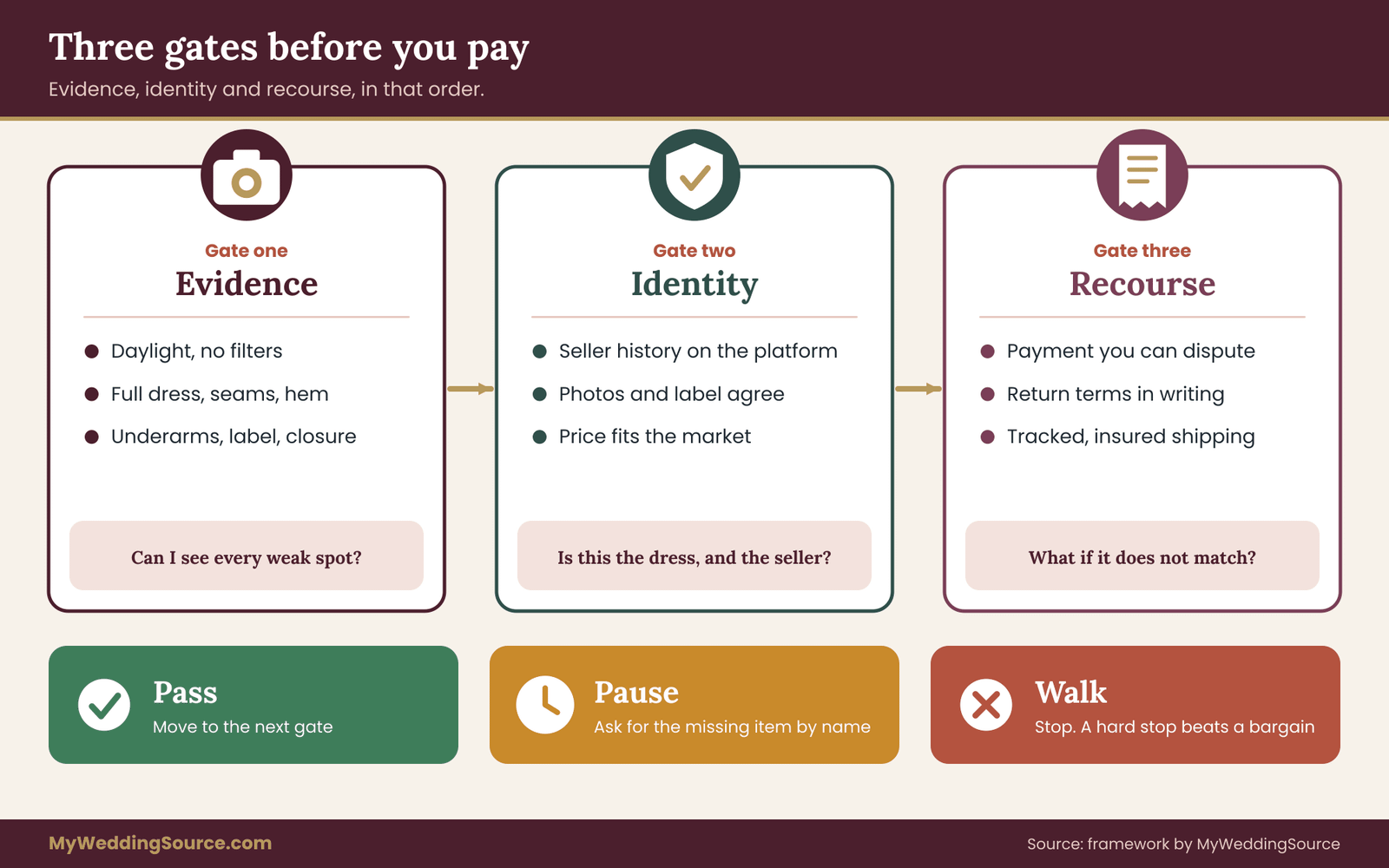
Gate one: evidence. Do the seller photos show the whole dress, in good light, including the places where gowns usually wear out? You are not looking for perfection. You are looking for completeness. An honest flaw that is shown clearly is better than a flawless picture that hides something. If you cannot see an area, you do not know its condition, and the price should reflect that.
Gate two: identity. Do the seller, the seller photos and the label agree? Does the seller have a history you can check on the platform? Do the seller photos look like they were taken of the same dress in the same place? Is the label consistent with the style the seller describes? This gate catches stolen photos, mismatched listings and sellers who do not actually have the dress.
Gate three: recourse. If the dress arrives and does not match, what happens next? Can you return it? Who pays shipping? Is there a time limit? Did you pay in a way that lets you ask for the money back? This gate decides how much risk you are carrying if gates one and two were not enough.
Why the order matters
People often start with price and work backward, asking for seller photos only once they are emotionally attached to a dress. Reverse that. Check evidence first, because a gown with hidden damage is not a bargain at any price. Check identity second, because a perfect dress you cannot actually buy is a waste of days. Check recourse last, because it is your safety net for what the first two gates could not show.
What a pass, a pause and a walk look like
At the end of each gate you reach one of three outcomes. A pass means the gate is satisfied and you move on. A pause means something is missing and you ask a specific follow-up question. A walk means you stop, because the seller refused a reasonable request or the answer revealed a problem you do not want to carry.
You will see these three outcomes again in the scorecard near the end of this guide. For now, keep the idea simple: you are allowed to pause at any point, and a seller who is annoyed by a polite, specific request is not a seller you need to buy from.
Where this guide fits in your dress search
This guide assumes you have already decided that a pre-owned dress is a real option and that you have a rough budget. If you are still weighing fit, alterations and whether a used gown makes sense for you, start with the wedding dress fit and alterations guide, which explains how much a gown can realistically be changed and what that costs in time.
This article does not cover body measurements or how to convert a seller’s numbers into a size, because the site has a separate worksheet for that. It does not cover vintage lace repair either. It stays on one question: what evidence should you collect from a seller, and what should you do when the evidence is thin?
Who this is written for
The advice applies to anyone buying from a private seller on a resale marketplace, a classifieds site, a social media group or a consignment seller that ships. It applies to a gown listed at a few hundred dollars and to one listed at several thousand. A higher price does not make a listing safer, and a lower price does not make it less worth checking. It simply raises or lowers what a mistake costs.
It is also written for the buyer who has time. If your wedding is six weeks away, you cannot run a slow process, and the scorecard later shows how to shorten each gate without skipping it. If your wedding is a year away, you have room to be patient, and patience is one of the best protections you have.
How long the process takes
For a single dress, the evidence gate usually takes one or two message exchanges over a day or two. The identity gate runs alongside it. The recourse gate takes one clear message. A buyer who knows what to ask can finish all three gates in less than a week, even with a seller who replies slowly. Where a seller is quick and cooperative, it can take an evening.
Compare that with the cost of a mistake: a dress that arrives with a split seam, a return you cannot make and a wedding date that does not move. A few days of questions is cheap insurance.
Seller photos for a used wedding dress: the shared rules
Before the specific photos, a few rules apply to every request. These make the seller photos comparable, so that you can set listings side by side and know you are looking at the same things.
Ask for daylight. Indoor lighting hides yellowing, makes ivory look white and flattens texture. Natural light from a window or outdoors shows true color, small stains and the real surface of the fabric. Ask for photos taken near a window in daytime, or outside in open shade, not in direct sun, which bleaches detail.
Ask for no filters and no editing. Beauty filters, automatic enhancement and heavy retouching change color and hide marks. Ask the seller to use the plain camera setting. Most phones can do this in seconds, and an honest seller will not mind.
Ask for one photo per question. A single wide picture cannot answer five questions. Ask for separate photos so each can be saved, labeled and compared.
Ask for a scale reference. A ruler, a tape measure or a pen laid beside a mark makes its size clear. A stain that looks like a thumbprint in a photo may be the size of a coin or the size of a plate.
Ask for originals, not screenshots. Original image files keep their detail. Screenshots and messaging apps compress pictures and blur small flaws. If the seller sends images through a chat app, ask for a second copy through email or the platform’s own messages.
Keep a photo log from the first message
As the seller photos arrive, save them in one folder and rename each file with the date and the subject, such as “hem-left-daylight” or “underarm-right-closeup.” Keep the seller’s replies in the same folder. This is not busywork. It is the record that supports a dispute later, and it makes your own comparison easier when you have three listings open at once.
Take a screenshot of the original listing, including the price, the description and the seller’s username, on the day you first contact them. Listings change, and sellers sometimes edit a description after a sale. A dated screenshot shows what was promised on that day.
What to say when a seller is hesitant
Some sellers hesitate because they are busy, embarrassed about a flaw or worried that you are wasting their time. A calm explanation helps. You can say that you are planning a significant purchase, that you want to see the condition clearly, and that you are glad to wait a few days. Most honest sellers respond well to that tone.
If a seller still refuses, ask what they are comfortable sending. If the answer is nothing beyond the original listing, treat it as a pause at the least. You can decide whether the price justifies the unknown, but you should make that decision knowingly, not by default.
Full-dress seller photos: front, back, side and flat
Start with the seller photos that show the whole gown, because they set the frame for everything else. A full set takes a seller about ten minutes, and it already tells you whether the person is organized and honest.
Front, back and both sides. Ask for four full-length photographs taken from the same distance, with the dress hung or worn in the same position. The side views matter more than they seem to. They show how the skirt falls, whether the bodice has a gap, and whether the silhouette in the listing matches the real structure of the gown.
On a hanger and on a flat surface. A dress on a hanger shows how the weight hangs and whether the shoulders or straps pull. A dress laid flat on a clean sheet shows the true shape of the skirt, the width of the hem and any waviness from old storage. Ask for both if the seller can manage it.
Worn photos, with a caution. Photos of the dress being worn are lovely, but they can mislead. A professional wedding photograph is edited, posed and lit to flatter. Ask for these as a supplement, never as a replacement for plain photos of the dress alone.
How to judge the full-dress seller photos
Look at the dress the way you would if it were hanging in a shop. Is the skirt even, or does it sag on one side? Do the layers of tulle or chiffon look crushed or yellowed in patches? Is the bodice shape clean, or does it show wrinkling that suggests a lining that has shifted? Are there dark marks near the waist, the hem or the back, where hands and floors meet fabric?
Compare the full-length photos with the listing description. If the listing says “A-line, chapel train” and the side view shows a short sweep, the listing is wrong. It may be a harmless error, but it also tells you how carefully the seller reads their own description.
Daylight versus indoor light, side by side
If a seller’s photos all seem warm, golden or oddly bright, ask for one more taken by a window in daytime. Place the two next to each other on your screen. The difference between the two will show you how much of the color you were seeing was the light and how much was the fabric. Ivory, champagne and blush are especially affected. A gown listed as ivory that looks white in daylight, or vice versa, may be a different shade from what you imagined.
If the seller says there is no daylight where they live, or that the dress cannot be moved, accept that for a moment, then ask for a photo near the brightest window in the house with the lights switched off. A single plain photo is enough.
Keep the full-length seller photos side by side on one screen when you compare listings. Three dresses seen through three different lenses are hard to rank, but the same four angles of each dress make differences in shape, color and wear obvious within a minute. If one seller’s photos are missing an angle that the others supply, you have found your first question.
The flat-lay check for the skirt
A flat photograph of the skirt reveals things a hanging photograph hides. Waves at the hem can mean the hem was folded for years. Straight creases that do not relax can mean storage under pressure. A dull band near the bottom may be old dirt that a cleaning did not lift. None of these is automatically a deal breaker, but each is a question you can ask about, and the answer affects whether a cleaning or pressing would help.
Treat these first seller photos as a baseline. Every later image should look like the same dress under the same light. If a close-up in the second round does not match the baseline, say so politely and ask for a clearer version.
Seller photos of seams, hem and underarms
These three areas fail first in used wedding dresses, because they take the most stress or the most contact. A set of clear photos of each is the most useful thing you can collect.
Seams: what to request and what to look for
Ask for close-ups of the main structural seams: the side seams from underarm to waist, the center back seam, the waist seam where bodice meets skirt, and any seam that carries the weight of beading or a heavy layer. Ask the seller to hold the seam gently open under the light, or to photograph it with a flashlight shining from behind.
What you hope to see is a straight, tight line of small stitches with no gaps and no puckering. What should make you pause is any of the following: stitches that look uneven or newer than the rest of the dress, which can mean a repair; thread that is frayed or lifting; fabric that looks stretched or thinned beside the seam; and a visible gap where the layers have begun to separate.
Ask directly whether any seam has been repaired, let out or taken in. Alterations are common and not a problem on their own. An undisclosed repair is a problem, because it means the seller either did not know or did not say. A repair done by a professional seamstress is generally reassuring if the seller can say who did it and when.
Hems: the part that touches the floor
The hem of a long gown is the part that met the ground at the wedding. Ask for a photo of the hem laid flat, a close-up of the lowest edge and, if the gown has a train, a photo of the train’s underside. Ask the seller to spread the hem out, not to hold it up to the camera.
Look for gray or brown discoloration along the edge, small tears or pulled threads, fraying on lace or tulle layers, and a hem that has been shortened. Many brides have a hem altered to fit their height, and a shortened hem cannot easily be lengthened. If the seller mentions a hem alteration, ask how much was removed and whether the original length is still available as extra fabric.
Hems and trains are where dirt, grass, rain and heels do their damage, and they are the hardest areas for a seller to clean. If the seller says the dress was professionally cleaned and preserved, ask for the cleaner’s name and the date. A receipt or a tag from the preservation box is a useful piece of evidence.
Underarms: the place most sellers forget
Underarms are where perspiration, deodorant and friction leave their marks, and they are often missed in photos because they are hidden when the dress is on a mannequin. Ask for a close-up of the inside of each underarm and of the lining around the arm opening, in daylight, with the area spread flat.
What to look for is yellow or brown staining, a stiff or crusty patch, discoloration that stops at a clear line, thin or worn fabric, and a patch that looks lighter than the surrounding area because it has been scrubbed. Stains from perspiration can darken with age, and some cannot be removed without risk to the fabric. If you see a mark, ask the seller whether it is new, whether a cleaner has seen it and what the cleaner said.
If the gown is strapless, ask for photos of the inside of the bodice under the arms, where the boning and the lining sit against the body. Make-up marks and wear tend to collect there.
A short request message you can reuse
You do not need to write a new message for every seller. A plain, polite request works well:
“Thank you for the listing. Before I decide, could you send daylight photos without filters of the full dress front, back and side, plus close-ups of the side seams, the hem, the inside of both underarms and the label? Please also tell me about any repairs, stains or alterations. I’m happy to wait a few days.”
That message is specific, reasonable and easy to answer. It also tells the seller you are a serious buyer, which tends to improve the quality of the replies.
Reading photo quality as a signal
How a seller takes photos says something, even before you look at the dress. Sharp, well-lit pictures taken near a window suggest a seller who cares about the sale. Blurry, dark or heavily cropped pictures suggest haste or something to hide, though they can also just mean an older phone.
Do not read too much into one blurry image. Do read patterns. If every photo of the seams and hem is slightly out of focus while the dress-on-hanger picture is crisp, that is worth a gentle follow-up request. If the seller reshoots the images quickly and the new ones are clear, the earlier blur was probably innocent.
Consistency across the set
Check that the seller photos in the set agree with each other. The same background, the same light, the same wrinkles and the same room should appear across the set. If the lighting changes completely from picture to picture, or the dress appears to hang differently in photos supposedly taken minutes apart, the seller photos may come from different sources. That does not prove anything, but it is a reason to move to the identity gate and look more closely.
What you can do with the seller photos you have
Zoom in on every close-up and look at it for at least a few seconds. Many problems become visible only at full size: a faint ring where a stain was cleaned, a line of tiny holes where an old appliqué was removed, a patch of slightly different texture where a repair sits. Write down anything that looks unclear and ask about it. A short list of three or four precise questions is better than a long, vague one.
If you are spending a significant amount, it is also reasonable to share the seller photos with a bridal alterations specialist or a seamstress and ask for a quick opinion on what they see. Many professionals will look at photos for a modest fee or as part of a consultation. Their opinion is not a guarantee, but it adds a trained eye to your own.
Seller photos of the label, closure and lining
The next group of seller photos covers the parts of the dress that are not visible in any listing but matter a great deal in use. Label photos support the identity gate. Closure and lining photos support the evidence gate and tell you about how the dress was made.
The label and the care tag
Ask for a clear, flat photo of the main label inside the gown, usually at the center back neckline or the waist seam, and a separate photo of the care tag. Ask that the text be sharp enough to read when you zoom in. If there are several labels, ask for each one.
The label should show a designer or brand name, and often a style number, a size, a fabric content line and a country of manufacture. The care tag shows fiber content and cleaning instructions. Together they let you check whether the dress is what the seller says it is, find the original style online, and judge whether a cleaning method is safe.
Things worth noticing on a label: whether it is stitched in neatly or looks added later, whether the lettering is clear or oddly spaced, whether the style number is present, and whether the size and fabric lines are consistent with the listing. A label that has been cut out, covered or peeled off is not proof of anything wrong, because some brides remove labels for comfort. It does mean you lose a piece of evidence, and you should treat the identity check more carefully.
What a missing label means
Some used dresses have no label because the maker did not sew one in, because the dress was custom made by a seamstress, or because the label wore away. Ask the seller to explain. A custom gown from a local designer is a legitimate purchase, and in that case the useful evidence shifts: ask for the name of the dressmaker, any receipt or order paperwork, and photos of how the dress was constructed inside.
If the seller says only that the dress is “designer” and cannot say which designer, and there is no label, that is a gap in the identity gate. You can still buy the dress on its condition and look, but you should not pay a designer price for an unnamed gown.
Closures: zippers, buttons, lacing and hooks
Closures are the part of a gown that stops working at the worst moment, so ask for photos that show how they behave, not just how they look. Ask for a close-up of the whole closure, open and closed, and a short video of the zipper moving from bottom to top and back.
For a zipper, you want to see smooth movement, intact teeth, a pull tab that is secure and a closed seam that lies flat without pulling. For buttons and loops, look for missing buttons, stretched or broken loops and fabric that has frayed around the openings. For lace-up backs, look at the grommets or eyelets for rust, bent edges or tears, and at the lacing cord for wear. For hooks and eyes, look for rust, bent hooks and loose stitching.
A closure that is difficult, replaced or worn is not necessarily a reason to walk away. A zipper can be replaced by a seamstress for a reasonable fee in many places. What matters is that you know before buying, so you can add the repair to the total cost and the schedule. The wedding day accessories planning guide also explains why a spare plan for a closure is worth having on the day, however good the closure looks now.
Label and closure seller photos work as a pair. The label tells you what the dress is claimed to be, and the closure tells you how it was built and how it has aged. A neat label on a closure that has been crudely replaced is a mixed message worth a question.
The lining, the cups and the boning
The inside of a bodice tells you how the dress will feel and whether it has been altered. Ask for a photo of the inside of the bodice, laid flat, and a close-up of the lining at the waist and the hip. If the dress has built-in cups, ask for a photo of them and whether they are sewn in or removable. If it has boning or a corset structure, ask for a photo of the inside where the channels or stays are visible.
Look for lining that has torn away from the seam, boning that pokes through its casing, cup stitching that has come loose, and stains or odor marks on the inside that are not visible outside. Ask whether any boning has been replaced or removed, since a gown that has lost its boning loses its shape.
Layers, tulle and trim
For a gown with several layers, ask for a photo that shows each layer separately. Lift the outer layer and photograph the inner one, then the underskirt or petticoat. Tulle layers snag easily, and a snag in one layer is often matched by a snag in another. Ask about any beading, sequins or appliqué that has been lost, and request a photo of an area where the trim is thickest to show whether it is intact.
If the gown has a detachable train, sleeves, an overskirt or a belt, ask to see each piece separately and confirm that all pieces are included in the sale. A listing photo sometimes shows an accessory that is not part of the price.
How to ask for seller photos without sounding suspicious
The way you ask changes the replies you get. A short, friendly, specific message gets a better response than a list of demands. These approaches work for different situations.
The standard request. Use the message from earlier, naming the seller photos and the reason in one short paragraph. This works for most sellers and takes no explanation.
The follow-up for a gap. If one photo is missing or unclear, ask for that photo alone. “Thank you for these. Could you send one more of the left underarm in daylight? I can’t quite see the lining.” Keeping the follow-up narrow makes it easy to answer.
The video request. A short phone video can show what still photos cannot: how the fabric moves, how the zipper runs, how the skirt falls when the seller turns the dress. Ask for a thirty-second video of the dress on a hanger, turned slowly, in daylight, with the seller’s voice saying the date. A spoken date is a simple way to show the video is current.
The live video call. If the dress is expensive or the seller photos are mixed, ask for a short video call where the seller shows you the areas you care about while you watch. You can ask them to tilt the gown to the window, open a seam or stretch a hem on request. Many sellers are glad to do this, because it speeds up the sale.
Plain seller photos are enough for most dresses. The video and live-call options are extra layers for a higher price or a mixed first set, and you can add them later if the first round leaves a doubt.
A timestamp or note in the photo
A simple way to link a set of seller photos to a particular day and a particular seller is to ask for a handwritten note in the picture, such as the date and your first name on a piece of paper laid next to the label. This is a common and reasonable check. It helps show that the seller photos were taken for you, by someone who has the dress in hand, rather than copied from another listing.
You do not need to do this for every purchase. Use it when the price is high, when the seller photos look polished like stock images, or when something else has made you cautious. Most honest sellers will do it without complaint.
What to do when a seller says no
Some refusals are reasonable. A seller may not want to send photos of a label because it shows a maiden name, or may be unable to take a video because of a disability or a lack of equipment. Ask whether another form of evidence would work, such as a photo with the name covered or a call with an audio description of the area. A flexible answer is a good sign.
Other refusals are warnings. “Take it or leave it,” “I have other buyers,” and “I don’t do extra photos” all push you to commit without evidence. If you notice pressure to decide quickly, treat it as a pause at least. A dress that is genuinely in demand will still be worth a day of questions.
Setting a deadline on your side
You can also set your own timeline politely. Tell the seller you will decide within a set number of days after receiving the seller photos, and ask them to confirm they are willing to hold the dress for that time. If the seller will not hold the dress, you can still proceed, but you will know that you are being asked to decide in a hurry. That is information you can use.
If you are working to a wedding date, say so. A seller who knows you have a firm date is more likely to answer quickly, and you will find out sooner whether a return would be possible in the time you have.
A worked request: what a complete set looks like
It helps to see how the requests add up. Here is a plain list of the full set of seller photos for a typical gown, in the order you might ask for them.
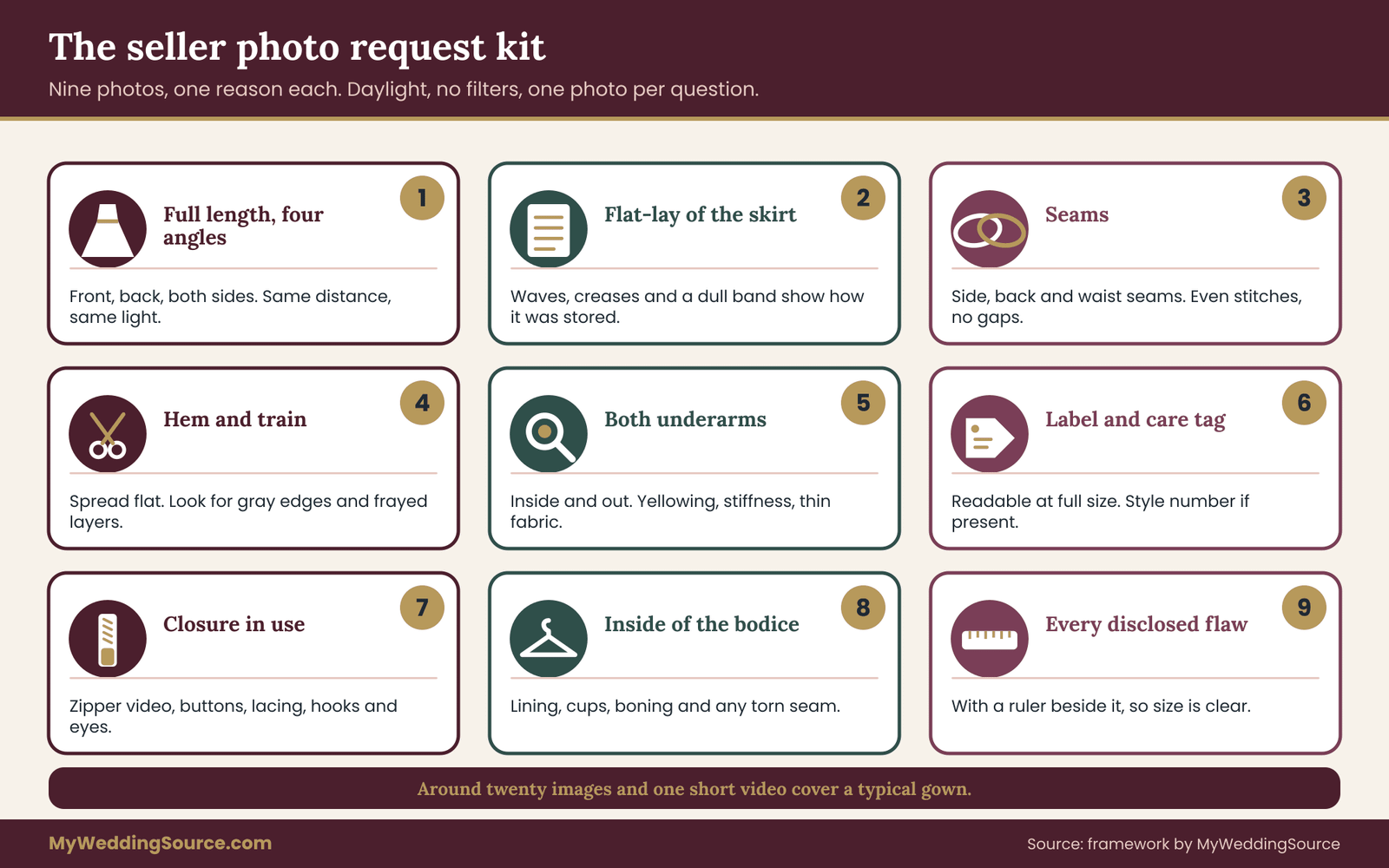
First, four full-length pictures: front, back and both sides, on a hanger or mannequin, in daylight. Second, one flat-lay of the skirt on a clean sheet, with the hem spread. Third, close-ups of the side seams, the center back seam and the waist seam.
Fourth, the hem close-up and, for a train, the underside. Fifth, both underarms, inside and out. Sixth, the main label, the care tag and any style number. Seventh, the closure, open and closed, with a short video.
Eighth, the inside of the bodice with the lining, cups and boning. Ninth, any stain, repair, tear or alteration the seller has mentioned, with a ruler beside it.
That is around twenty images and one short video. A cooperative seller can send them in one sitting. If you are worried that this is too much to ask, remember that a dress you are about to buy for hundreds or thousands of dollars deserves that level of documentation.
Grouping the requests to keep it easy
If you do not want to send one long list, split the request into two rounds. In the first round, ask for the full-dress photos, the label and the closure. These show whether the gown is the one described. In the second round, once you are still interested, ask for the seams, hem, underarms and lining, which are more time-consuming to photograph. This keeps the first request light and lets you drop out early if the first set is poor.
Two rounds also let you respond to what the first set shows. If the label reveals a style you can look up, you can compare the seller photos with the original catalog pictures before spending the seller’s time on the second round.
Checking seller photos for edits, reuse and mismatches
Once the seller photos arrive, the identity gate begins. The question is no longer “what does the dress look like?” but “are these pictures really of this dress, taken by this seller?” Most sellers are exactly who they say they are. The checks below are quick, and they protect you from the minority who are not.
Look for signs of editing
Heavy editing leaves traces. Colors that look uniformly smooth, fabric that seems to have no texture at all, edges that look blurred around the dress against a sharp background, and background objects that bend or warp near the gown can all point to retouching. Beauty and enhancement filters can also smooth lace and flatten the shadow that a stain would cast.
You cannot prove editing by eye, and you do not need to. The practical response is the same each time: ask for a new set of seller photos with the plain camera setting, in daylight, taken now. A seller with nothing to hide can do this in minutes.
Look for photos that do not belong to the dress
Compare small details between pictures. The same dress should show the same pattern of lace, the same bead spacing, the same creases and the same label in every image. If the dress in the close-up has a different neckline, a different bead pattern or a different color than the dress in the full-length photo, they may be two different dresses.
Check the setting too. A listing that claims the dress is in a home closet but shows a professional studio, a bridal salon floor or a catalog backdrop deserves a question. Many brides buy from a boutique and then resell, and they may use the boutique’s photos. That can be fine, but then you need photos of the dress you will actually receive.
If the seller photos pass the editing check, move on to the question of origin. Original seller photos are taken by the person selling, of the dress they hold. Photos copied from somewhere else are the most common reason a listing falls apart at this stage.
Reverse image search as a basic check
A reverse image search lets you upload a photo or paste its address into a search tool to see where else it appears online. If the main listing picture appears on a designer’s catalog page, a different seller’s listing or a stock photo site, the picture is not original to this seller. Run the search on two or three of the main photos, not only the first.
Treat the result as a clue, not a verdict. A seller may legitimately use a brand’s catalog image to show the style, as long as they also supply real photos of the actual dress. A catalog picture with no real photos, or a photo that appears under several different sellers’ names, is a stronger warning. If you find a match, tell the seller politely what you found and ask for original photos.
The handwritten note check
The note check described earlier is useful here. A photo of the label or the hem with a dated note and your name is hard to fake with a recycled image. If a seller will not do this, and the other signals are weak, you have a reason to slow down.
Keep your notes factual. Write what each of the seller photos shows, not what you assume it means, and mark each item as clear, unclear or missing. That list becomes the follow-up message and, later, the scorecard.
Cross-check the story
The seller photos, the listing and the seller’s messages should tell one story. If the listing says “worn once in a small ceremony” and the seller photos show a heavily soiled hem and yellowed underarms, something does not add up. If the seller says the dress was cleaned last month, ask for the receipt. If the seller says it was stored in a preservation box, ask for a photo of the box and the date on the label.
Any gap between what is said and what is shown should be raised as a question, politely, once. How the seller handles the question tells you more than the answer alone.
Authenticity checks without guarantees
Buyers often ask whether a dress is authentic. The honest answer is that nobody can promise this from photos alone, and a seller or a platform that offers a firm guarantee should be treated with some caution. What you can do is run a sensible set of checks and judge how well the evidence fits together.
Why authenticity is hard to prove online
Bridal designers do not usually publish a public database of every dress they have made, and labels can be copied. Counterfeit and copied wedding gowns exist, and so do honest copies of popular styles made by other manufacturers and sold under their own names. A dress that looks like a famous style is not necessarily that style, and a dress with a famous label is not necessarily what the label says.
That is why this guide uses the word “check” and not “verify.” You are collecting evidence that the dress is consistent with what the seller claims. You are not obtaining a certificate. If the exact designer matters to you for reasons beyond how the dress looks, say so to the seller and ask what they can provide, such as an original receipt from an authorized retailer.
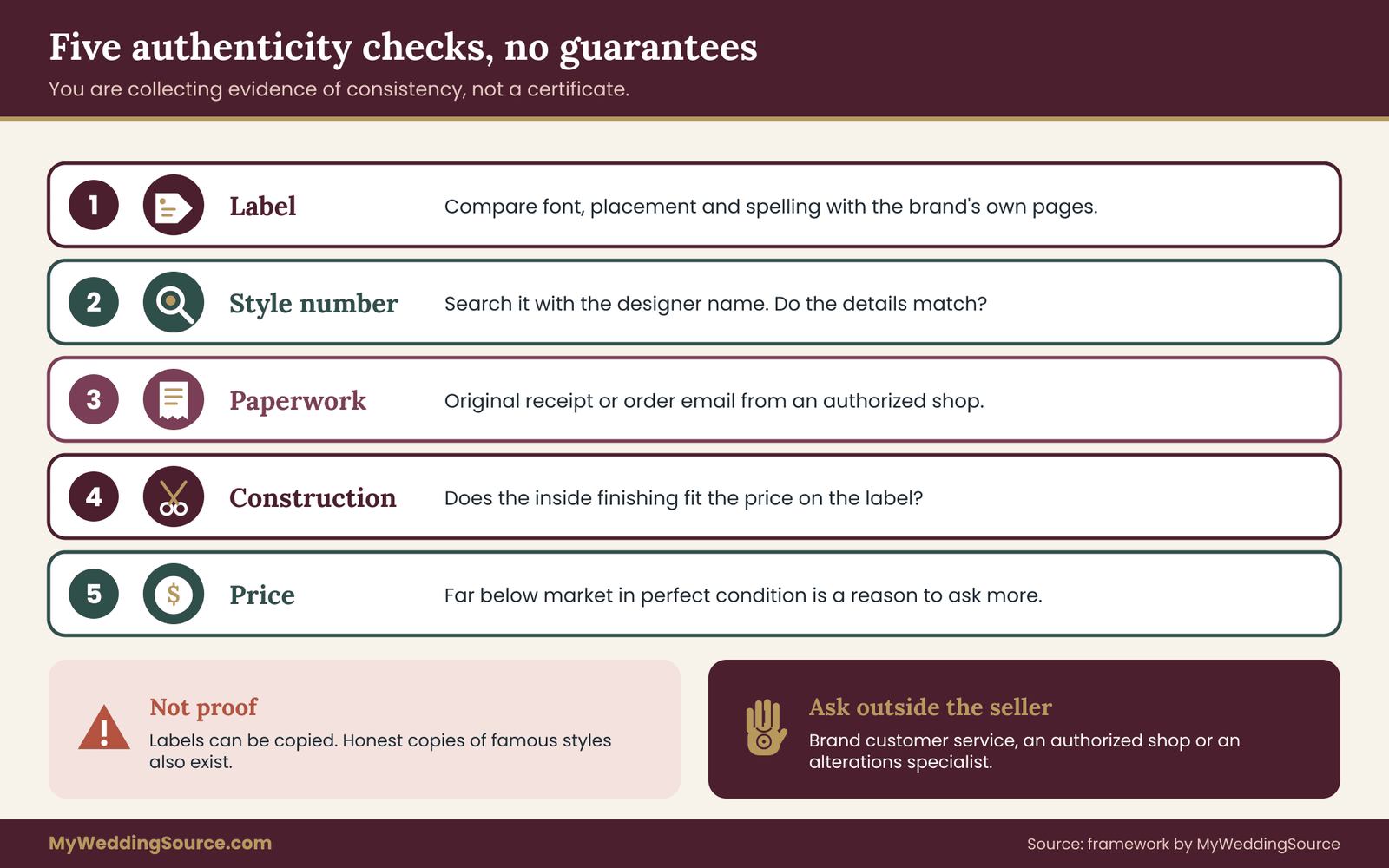
The five-point authenticity check
Use these five questions for any dress sold under a named designer.
One: does the label match the brand’s usual style? Compare the label in the seller photos with labels on the designer’s own website, in catalogs and in photos from reputable resellers. Look at the font, the placement, the spelling and the fabric of the label. Small differences can be innocent, since brands change labels over time, but large differences are worth a question.
Two: does the style number exist? Search the style number together with the designer’s name. If the style appears on the designer’s site or in archives, check that the details match: neckline, sleeves, length, fabric and color. If the number does not appear anywhere, ask the seller where they got it from.
Three: is there original paperwork? An original receipt, an order confirmation or an email from an authorized retailer is the strongest single piece of evidence. Ask for a copy with the buyer’s personal details hidden. A seller who bought the dress from a boutique can often find this in an email search.
Four: does the construction fit the price? A designer gown at a luxury price usually has clean interior finishing, neat seams, good quality lining and careful beadwork. A dress that looks rough inside, with uneven stitching and raw edges, does not match a luxury label, though it can match a mid-range or fast-fashion piece.
Five: does the price fit the market? A major designer gown at a tiny fraction of its original price, in perfect condition, is a classic pattern in both counterfeits and scams. Resale prices vary widely, and a good deal is possible. A deal that seems too good to be true should lead you to ask more questions, not fewer.
Ask the right people
If you are unsure, you have options beyond the seller. You can contact the designer’s customer service with the style number and the label photos and ask whether they can confirm the style. Some brands will say what they can, and some will not, and both answers are information. You can also ask an authorized retailer or a bridal alterations specialist whether the label and construction look consistent with the brand.
Do not expect a formal authentication. Most brands do not offer one for pre-owned gowns, and a specialist can only say what looks consistent. A mixed or uncertain answer is a reason to lower what you are willing to pay, not a reason to ignore the doubt.
When the designer does not matter
Sometimes you do not care about the label. You want the silhouette, the fabric and the price, and you are happy to buy an unlabeled or unknown-brand dress. In that case the authenticity gate narrows to a simple question: is the seller describing the dress accurately? The evidence gate, the identity check on the seller and the recourse terms still apply in full. It is only the designer claim that you can set aside.
If you take this route, avoid paying for a name. Judge the dress by its fabric, its construction and its condition, and pay what those justify.
Wording the claim carefully in your own records
When you save your records, note what the seller claimed and what you checked. Write “seller states designer X, style Y; label photo consistent with brand website; no receipt provided” and not “authentic.” This keeps your own thinking honest and, if a problem arises later, gives a clear and accurate account of what you knew when you paid.
The same care applies to anything you tell others. If you later resell the dress, describe what you know and what you were told. That is fair to the next buyer and protects you.
What consistent evidence looks like
After the seller photos and the five checks, step back and ask a single question: does everything line up? Consistent evidence usually looks like a seller with some history on the platform, photos that match across the set, a label that fits the brand and the style, paperwork or a plausible account of where the dress came from, and a price in line with other listings of the same style.
Inconsistent evidence looks like a seller with a new account and no history, photos from several settings, a label that does not match, no paperwork and a price far below the market. One of these alone does not decide the matter. Several together should move you to a walk.
The weight you give each signal
Not all signals count equally. A missing receipt is a small matter if the dress is a modest purchase, and a large one if it is expensive. A new seller account is neutral if everything else is solid and concerning if other things are off. A price far below market is the signal that most often accompanies the others, so give it more weight than the rest.
When you are unsure, write down the three strongest signals on each side and look at them side by side. The act of listing them usually makes the decision clearer than the feeling does.
Scam patterns in used wedding dress sales
Most people who sell a used gown online are brides, bridesmaids or small consignment owners with a dress and a wish to pass it on. A few are not. Scams in this category tend to follow a small number of patterns, and knowing the patterns is the best defense. The seller photos you collect in the evidence gate are also your first line of detection, because scammers struggle to produce them.
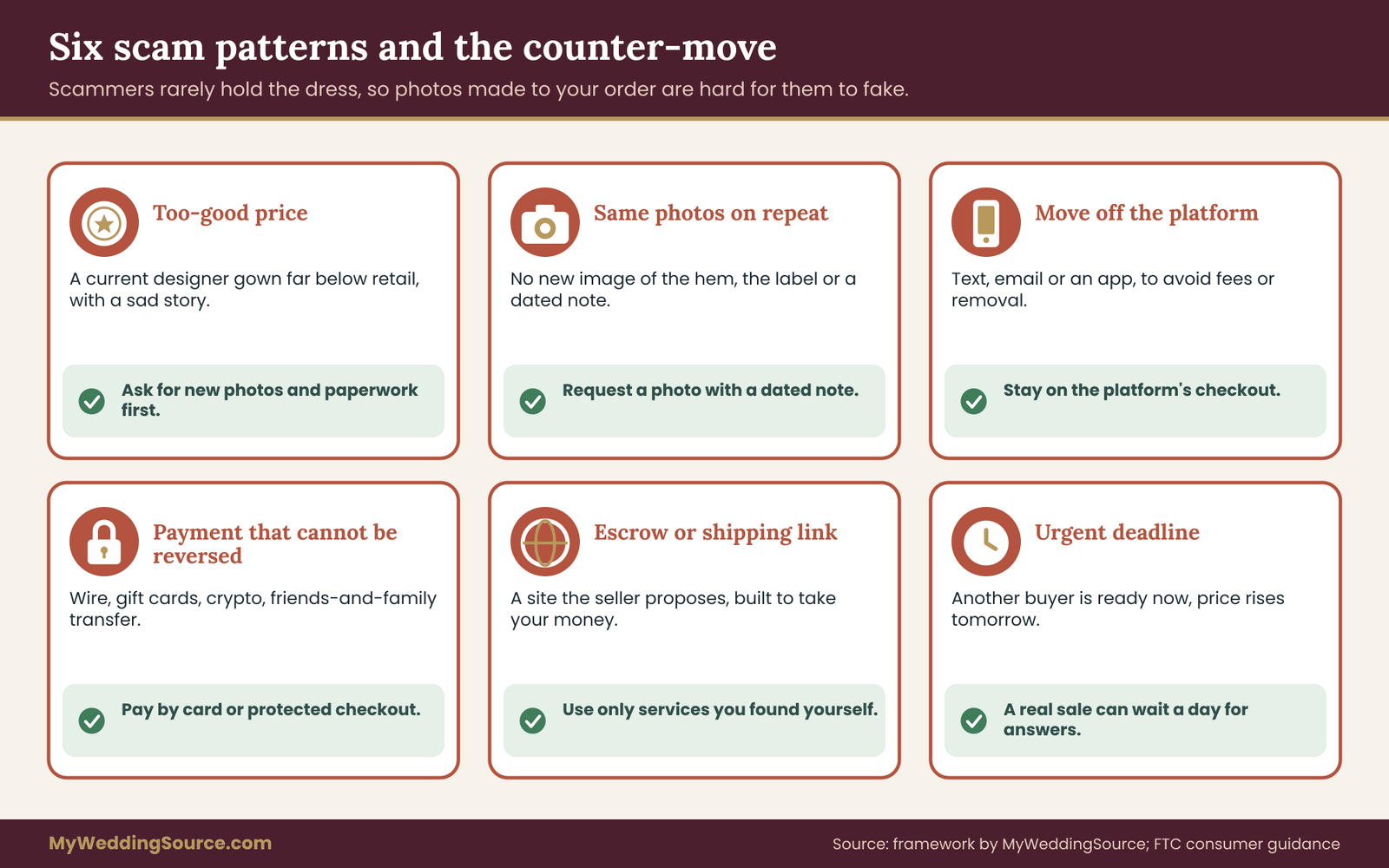
The too-good price. A current designer gown listed at a fraction of its retail price, “never worn, tags on,” with a story that explains the discount: a cancelled wedding, a move abroad, a family emergency. A cancelled-wedding story is common and often true. It is also a story that is easy to invent, so look for the rest of the evidence before you let it persuade you.
The seller photos that never change. The seller sends the same polished pictures again and again and cannot or will not provide new ones. Requests for a close-up of the hem or a dated note are met with excuses, delays or irritation. This is one of the clearest warning patterns, because a seller who actually owns the dress can take a photo in a minute.
The off-platform move. The seller asks you to leave the marketplace and continue by text, email or a messaging app, often because “the site charges fees” or “the listing will be removed.” Platform protections usually apply only to messages and payments handled on the platform itself, so moving away removes your safety net.
The payment that cannot be reversed. The seller asks for a wire transfer, a payment app set to “friends and family,” gift cards, a cryptocurrency payment or a money order. These methods are favored because they are difficult or impossible to reverse. The Federal Trade Commission’s consumer guidance lists several of them among payment methods scammers prefer.
The fake escrow or fake shipping service. The seller proposes a third-party “escrow” or “shipping agent” and sends you a link. The site looks professional and is run by the scammer. You pay, and the dress never ships. Never use an escrow or payment service suggested by the seller unless you have found it independently and confirmed it is real.
The urgent deadline. “Another buyer is ready to pay now.” “The price goes up tomorrow.” Pressure is designed to stop you from asking for seller photos or checking anything. A genuine seller may have other interest in the dress, but a short, calm delay for questions should not break a real sale.
The overpayment or refund trick. In some versions, a buyer-impersonator sends too much money and asks the seller to return the difference. The mirror image affects buyers: a seller asks you to send more than the price “to cover shipping” and promises to refund the extra later. Do not pay amounts that do not match the agreed price.
The cloned or hijacked account. A real seller’s listing is copied under a new account with a lower price, or a real account is taken over. The seller photos are genuine because they were stolen. This is why the handwritten note and a live video call are worth asking for on a higher-priced dress.
Because scammers rarely hold the dress, seller photos taken to your own specification are one of the hardest things for them to fake. A request for new seller photos with a dated note filters out most copied listings in a single exchange, which is why the request belongs at the start and not as an afterthought.
Seller history and signals on the platform
Look at the seller’s profile before you pay. How long has the account existed? Is there a history of past sales and reviews, and do the reviews describe similar items? Are the reviews varied and specific, or short and repetitive? Does the seller have other listings that look consistent, or a mix of unrelated items from different countries?
A new account with a single listing is not a scam by itself, since many brides sell exactly one dress. But it means the platform history cannot help you, and the other gates must carry more weight. Treat a new account with a high-priced gown and a low price as a pause until you have the full set of seller photos and a clear payment plan.
Matching the story to the person
Pay attention to small mismatches. The seller’s name on the payment does not match the name on the account. The shipping origin differs from the location in the listing. The messages contain odd phrasing, formal language that does not fit the situation, or an excuse for not talking by video. None of these proves anything, but each is a reason to ask a plain question and to note the answer.
If you want a deeper checklist for any online seller, the wedding vendor due diligence checklist on this site walks through how to check a business before you pay, and many of the same steps apply to a private seller.
Where to report a scam
If you suspect a scam, stop paying and save every message and image. In the United States, you can report to the Federal Trade Commission through its reporting site, and you can report internet-enabled fraud to the FBI’s Internet Crime Complaint Center. Tell the platform too, since removing the listing can protect the next buyer. Reporting does not guarantee you will get money back, but it creates a record and helps the agencies see patterns.
Payment protection questions to settle before you pay
Payment method is the largest single factor in whether you can recover your money if the dress is not what you were promised. Settle it before the seller sends an invoice, not after. A short set of questions makes the choice clear.
Ask these four questions about any payment method
Can I dispute this charge? Credit cards generally offer the strongest dispute rights, because the card issuer can investigate and reverse a charge in some situations. Debit cards, bank transfers and payment apps vary much more. Check the terms of your card issuer and of any payment service before you rely on them.
Does the platform protect this purchase? Many marketplaces have a buyer protection program that covers items not received or not as described, but only when you pay and communicate through the platform and follow its steps and time limits. Read the current policy for the platform you use. Protection programs have conditions, exclusions and filing windows.
What is the time limit for a claim? Dispute windows can be short. The Consumer Financial Protection Bureau explains that for credit card billing errors you generally must notify the issuer in writing within sixty days after the statement showing the error was sent. Platforms and payment services set their own windows, and some are shorter. Write the dates in your calendar on the day you pay.
Is this method reversible at all? Wire transfers, gift cards, cryptocurrency and some payment-app transfers are difficult or impossible to reverse once sent. For a first-time seller you cannot verify, avoid them completely, however good the discount.
Choosing a method, in order of preference
For most online purchases from private sellers, the order of safety usually runs like this: a credit card or a platform’s protected checkout first; a reputable payment service set to purchase protection, not “friends and family,” second; a debit card or a bank transfer you can contest through your bank third; and irreversible methods last or never. Your own cards and accounts may behave differently, so check the terms.
If the seller insists on a method you consider too risky, you have a clear choice. Offer a safer alternative once, politely. If the seller refuses, walk away. A seller who needs an irreversible payment from a stranger has told you what the sale is.
Do not pay a deposit by an unsafe route
Some sellers ask for a small deposit to hold the dress. A deposit on a used gown is not unusual, but it is a payment like any other. Use the same protected method, state in writing what the deposit buys and whether it is refundable, and be careful of a deposit that grows into a series of “fees” for storage, insurance or customs.
A protected payment and complete seller photos work together. Good evidence lowers the chance you will need a dispute, and a protected payment gives you somewhere to go if the evidence was not enough. Neither replaces the other.
Where payment fits in your budget
A used dress is often chosen to protect a wedding budget, so decide before you start how much risk you are willing to carry. If a failed purchase would damage your finances, choose the more protected route even if it costs a little more in fees. The wedding budget guide explains how to set aside a reserve for surprises, and the wedding cash-flow planning guide covers when payments leave your account and how to avoid being short at a bad moment.
Keep a payment record
Write down the date, the amount, the method, the seller’s name as shown on the payment and the confirmation number. Save the receipt and a screenshot of the seller’s final message agreeing to the price. This record is the other half of your photo log, and a dispute is much easier to make with both in hand.
Return and resolution terms to settle before you pay
The recourse gate is about what happens if the dress arrives and the seller photos did not tell the whole story. Private sales of used goods often have no formal return rights at all, so whatever protection you have is likely to be what you agree before paying. Settle it while the seller is still friendly and the dress is still available.
Whatever the answer, the seller photos and the seller’s written description are the standard against which the dress will be judged. That is the reason to collect them before you pay and not after the box arrives.
Business seller or private seller
Start by working out who you are buying from. A boutique, consignment shop or resale business has a business address, a published policy and sometimes legal duties that a private person does not. A private seller is usually selling “as is,” which means you take the dress in whatever condition it is in unless you agree something different in writing.
Consumer protection rules differ by seller type, state and sales channel. The Federal Trade Commission publishes rules and guidance for online and mail-order sales that apply to many businesses and often do not apply in the same way to one person selling a personal item. Check the issuing agency and your state attorney general for the current position, and do not assume a protection exists because a platform logo is on the page.
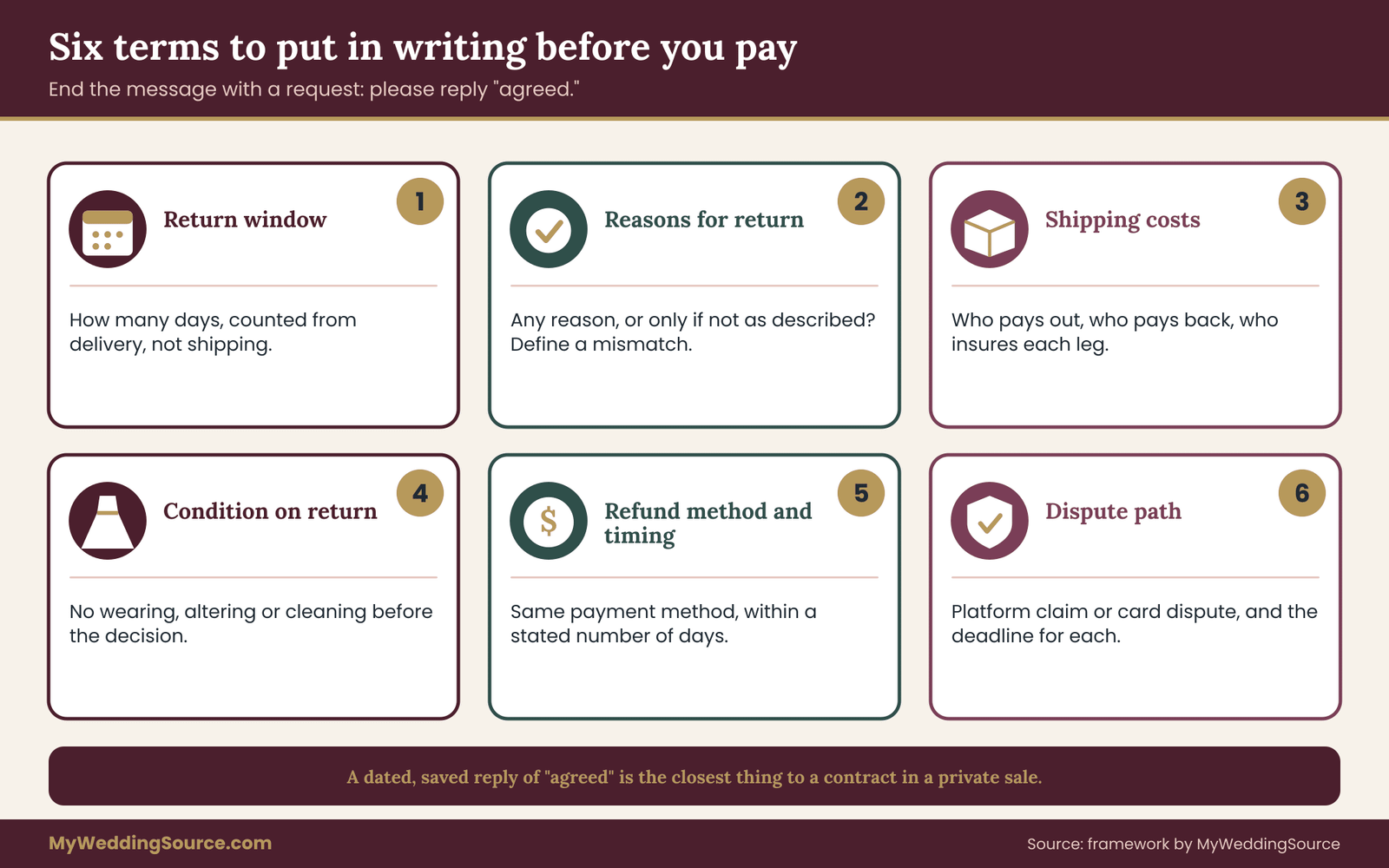
The six terms to write down
Whether the seller is a business or a person, ask for these six terms in a message you can save.
One: the return window. Can you return the dress, and for how many days after it arrives? Count from delivery, not from shipping. If your wedding is close, a window of a few days may not leave time to find another dress, so factor that in.
Two: the reasons for return. Is the dress returnable for any reason, or only if it is not as described? “Not as described” is a narrower promise, so ask the seller to say what they would treat as a mismatch, for example an undisclosed stain, a repair that was not mentioned, a missing piece or a measurement that is off.
Three: who pays shipping both ways. Shipping a full gown in a box can cost real money, and insured, tracked shipping costs more. Agree who pays for the outbound shipment, the return shipment and the insurance on each leg.
Four: the condition of a returned dress. The seller will want the dress back clean and unaltered. Agree that you will not wear it outside, alter it or have it cleaned before deciding, and ask whether trying it on is allowed. A dress that has been altered cannot be returned in most cases.
Five: the refund method and timing. Will the refund go back to the original payment method, and within how many days of the dress being received? Ask whether any restocking or handling fee applies.
Six: the dispute path. If you and the seller disagree, what happens next? On a platform, the process is usually the platform’s own claim system. In a private deal, there may be only a conversation and a card dispute. Know which it is before you pay.
Put the terms in writing
Write the terms in a short message, such as: “To confirm, I’ll pay by card at the price we agreed. The dress is returnable within five days of delivery if it does not match your photos and description. You’ll refund me in full to the same card within five days of receiving it, and I’ll pay return shipping unless it is not as described.” Ask the seller to reply “agreed.” That reply is the closest thing to a contract in a private sale.
For a larger purchase, it is reasonable to put these points in a simple written agreement signed by both sides. The wedding vendor contract guide explains which clauses matter most and how to read them, and a similar structure works for a purchase between individuals.
Match the terms to a purchase record
The sale is also a purchase order of a kind: a described item, a price, delivery terms and an acceptance step. The wedding vendor purchase order checklist shows how to turn a loose agreement into a clear scope with a final acceptance point, and that approach is useful here, too. Acceptance is the moment you confirm that the dress that arrived is the dress that was promised.
Shipping, insurance and the unboxing record
Shipping is where honest problems happen to honest sellers. A box can be crushed, wet or lost, and a gown can arrive creased or stained through nobody’s fault. Treat shipping as a risk to be managed and not as a surprise.
Shipping terms to agree
Ask how the dress will be packed: in acid-free tissue, in a garment bag, in a sturdy box, or in a plastic mailer. Ask for tracked shipping with a signature on delivery, and for insurance at the full price of the dress. Ask the seller to send you a photo of the packed box and the shipping receipt before dispatch. The postal service and the carriers publish their own claim rules and time limits, so read those for the service you choose.
Decide who owns the dress during transit. In many private sales, the buyer takes the risk once the dress is handed to the carrier, unless the seller agrees otherwise. If that is the case, make sure the insurance is in your name or that the seller will file a claim. If the seller pays for insurance and files claims, say so in the written terms.
The unboxing record
When the box arrives, do not open it casually. Record the opening on your phone from the moment you cut the tape, showing the label with the delivery address, the condition of the box and the first look at the dress. Then take new photos in daylight of the same areas you asked the seller to show you: full length, seams, hem, underarms, label and closure.
Compare these with the seller photos you saved. The point of the unboxing record is to answer one question quickly and fairly: is the dress the same as the dress in the pictures? If it is, you can go ahead with alterations and cleaning. If it is not, the side-by-side comparison is the evidence for a return or a dispute.
Your saved seller photos make the comparison fast. Open them next to the new set, work through seams, hem, underarms, label and closure in the same order and note any difference in a short list with the file names beside each item.
Act within the window
Do the comparison the day the dress arrives, or the day after. Return windows and platform claim periods are often short, and waiting a week to see whether you like the dress can mean you lose the right to return it. If you find a problem, message the seller the same day, attach the seller photos and state clearly what does not match the description.
Write your message in a calm, factual tone: what you ordered, what arrived, which photo showed what, and what you would like to happen. A factual message is more likely to produce a quick resolution than an angry one, and it reads better if a platform or card issuer later reviews the case.
When the seller does not respond
If the seller is silent or refuses, work through the options in order. Use the platform’s claim process if the purchase was made through one, and file inside the window. If you paid by card, contact the issuer and follow its dispute process, remembering the sixty-day written notice period for billing errors described by the Consumer Financial Protection Bureau. If the seller is a business, your state attorney general’s consumer office may accept a complaint. Keep copies of everything you send.
Do not alter, clean or wear the dress while a claim is open. It may weaken your case, since the seller or the platform can argue the condition changed after delivery.
What to do when the seller photos and the dress do not match
Sometimes the dress arrives and is clearly different from the seller photos. Sometimes it is only a little different, and you have to decide whether it matters. A simple sorting rule helps.
A material difference is one a reasonable buyer would care about: a stain, a tear or a repair that was not shown, a missing layer, a different color, a different style, a broken closure or a strong odor. These are grounds for a return or a claim.
A minor difference is one that does not change your decision: slight creasing from shipping, a shade that looks a little different on your screen, or a flaw the seller disclosed and you accepted. Do not claim for these.
A fixable difference sits between the two: a loose hem thread, a small stain that a cleaner may be able to treat, a closure that needs a new zipper. Decide whether you would keep the dress at a lower price and ask the seller whether they would agree to a partial refund. A partial refund is often quicker than a return, and it keeps the dress you wanted.
Negotiating a partial refund
If you want to keep the dress, ask for a specific amount based on a written quote. Get a quote from a seamstress or cleaner for the repair, send it to the seller with the seller photos and ask for that amount back. A specific request tied to a real quote is harder to refuse and easier to settle.
Be reasonable about what you ask. If the seller photos clearly showed the flaw and you bought anyway, the seller has little reason to pay. If the flaw was hidden or misdescribed, you have a fair case.
Protecting the relationship, if you want to
You may never deal with this seller again, and that is fine. Still, a polite and clear message is better for your own peace of mind than a harsh one. If the seller is a small business, a calm message also gives them a chance to correct a mistake and keep a customer.
A scorecard and walk-away rules for seller photos
The three gates only help if they lead to a decision. This scorecard turns your notes into one, so that a dress you like does not talk you past a problem you already noticed. It takes about ten minutes to fill in, and you can use it for each dress you are comparing.
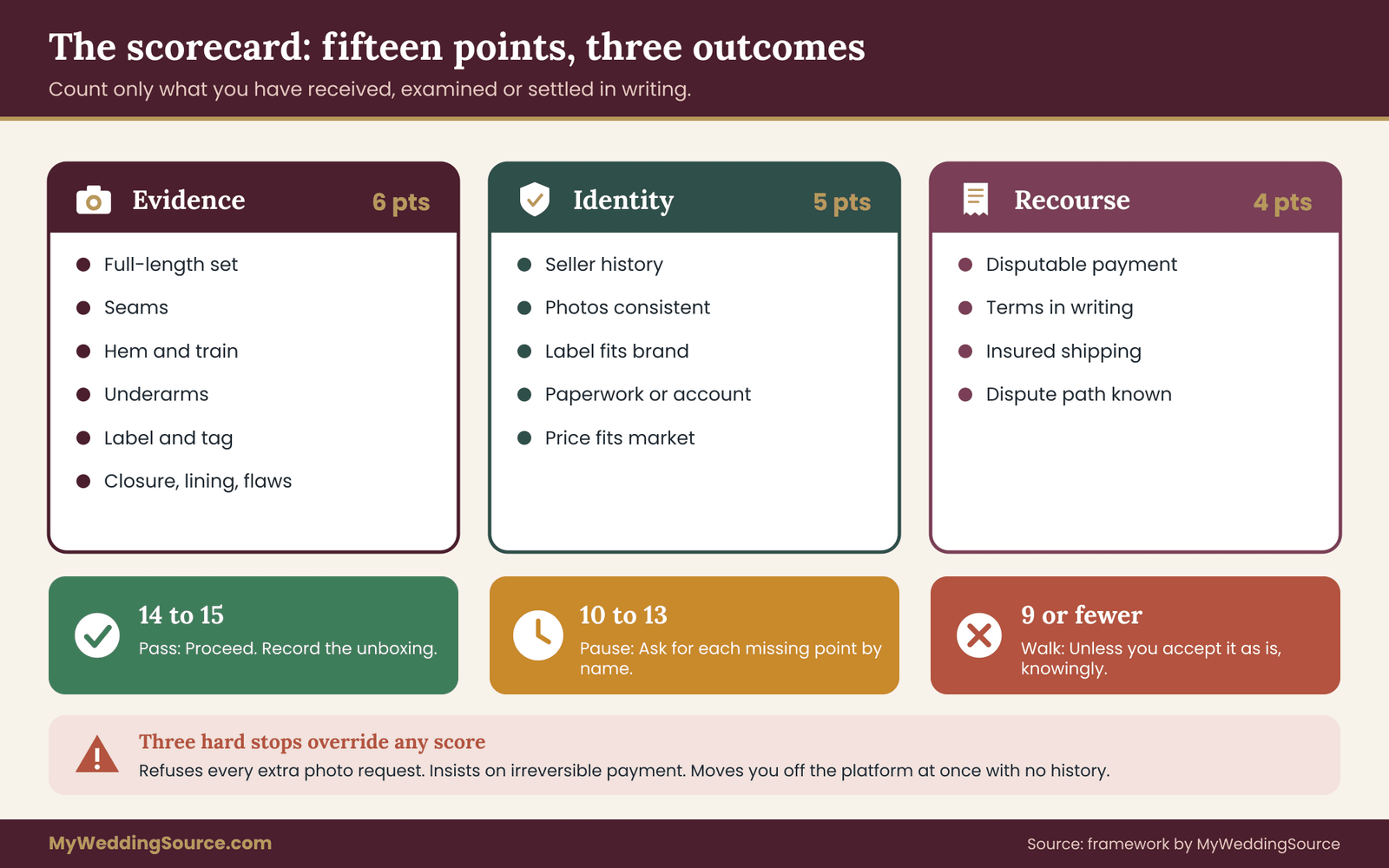
The scorecard treats seller photos as the main input, because every other gate depends on them.
Gate one: evidence, six checks
Give one point for each item you have actually received and examined, not for each item promised.
- Full-length seller photos of the front, back and side, in daylight and without filters.
- A close-up of the main structural seams, including the waist seam.
- A hem photo laid flat, with the underside of any train.
- Both underarms, inside and out.
- The label and the care tag, readable at full size.
- The closure in use, the lining and any disclosed flaw with a ruler beside it.
Gate two: identity, five checks
Give one point for each item you can honestly answer yes to.
- The seller has a history on the platform, or you have confirmed who they are another way.
- The seller photos are consistent across the set and a reverse image search found no earlier source.
- The label and style number are consistent with the brand and the listing.
- There is paperwork, or a believable and specific account of where the dress came from.
- The price is within the range you see for similar gowns, with a sensible reason for any gap.
Gate three: recourse, four checks
Give one point for each item that is settled in writing.
- You will pay by a method you can dispute, inside the platform or on a card.
- The return window, the reasons for return, shipping costs and refund timing are written down.
- Shipping is tracked, insured and signed for, and you know who files a claim.
- You know the dispute path and the deadline for it, and both are in your calendar.
Reading the score
The full score is fifteen. Fourteen or fifteen is a pass: proceed, and do your unboxing record. Ten to thirteen is a pause: list the missing points and ask for each one by name, then rescore. Nine or fewer is a walk, unless the price is so low and the gap so well understood that you would accept the dress as is with no recourse. Say that choice out loud before you pay, and accept it as yours.
Three hard stops override the score. Walk away if the seller refuses every request for additional photos, if the seller insists on a payment you cannot reverse and you have no other way to confirm them, or if the seller moves you off the platform immediately with no history. A high score can hide a hard stop, and a hard stop is never worth a bargain.
Price the unknown
Each missing item is a risk you are carrying.
If you decide to buy with gaps, lower the amount you are willing to pay by what it would cost to put the gap right, using a written quote from a seamstress, a cleaner or a restorer, and not a guess. If you cannot get a quote, that is a reason to be more careful, not a reason to shrug. The wedding dress fit and alterations guide is useful here because it explains how alterations are priced and scheduled, so that you can add real work to the real cost.
A worked example from request to decision
Here is an invented example showing how the scorecard works. The people, the dress and the numbers are illustrative only, and they are not real prices or real events.
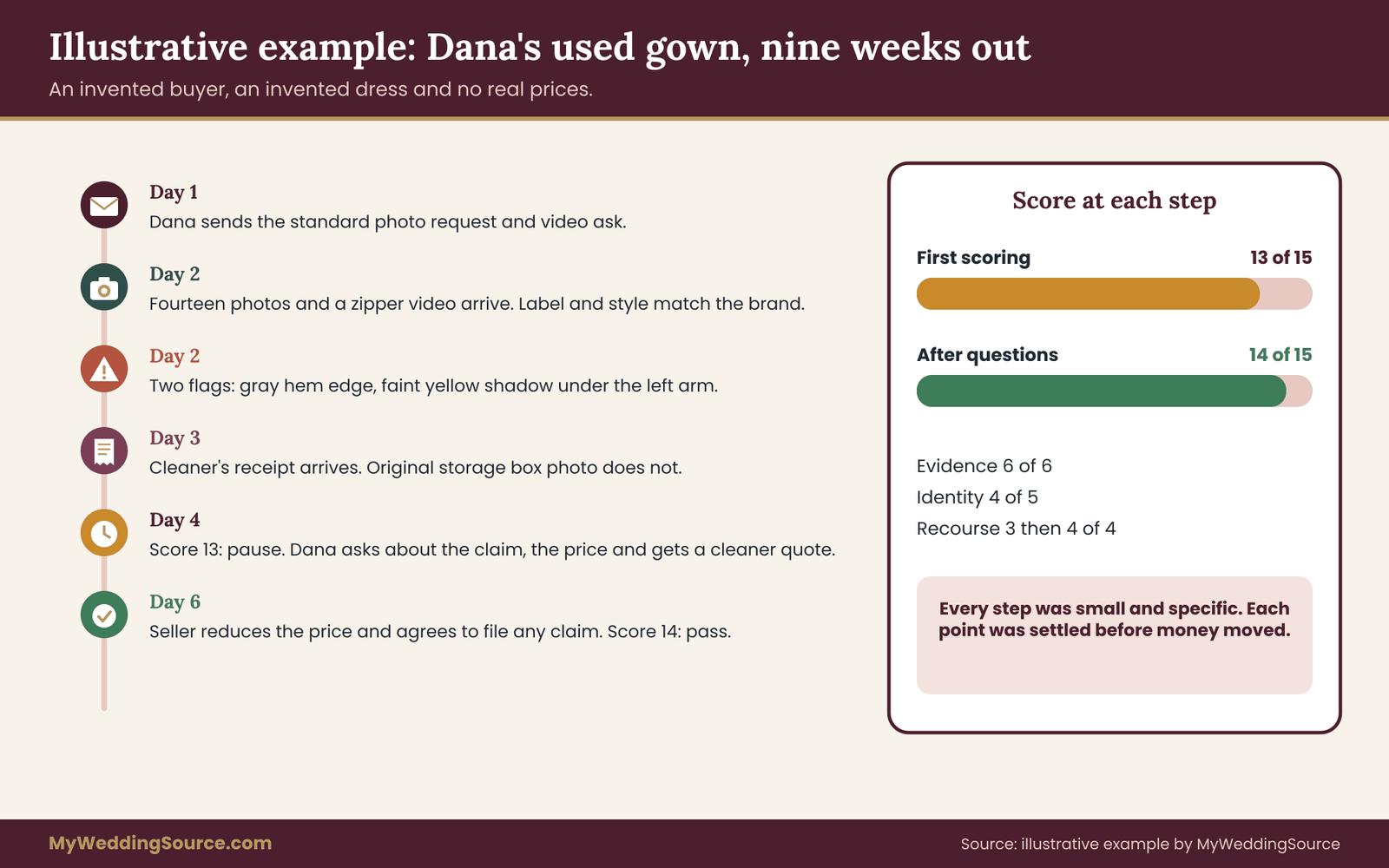
Dana is buying a used A-line gown with a lace bodice from a private seller on a resale marketplace. The listing is priced well below what similar styles often cost, with four polished photos and the line “worn once, professionally cleaned.” The wedding is in nine weeks.
Dana sends the standard request for daylight photos of the full dress, seams, hem, underarms, label and zipper, plus a short video of the zipper. The seller replies within a day with fourteen photos and the video. The seller photos are clear, and the label shows a recognizable brand and a style number. A search shows the style on the brand’s site, and the neckline and sleeve length match.
Two things stand out. The hem photo shows a gray edge along about a hand’s width of the train, and the left underarm has a faint yellow shadow. Dana asks about both. The seller says the hem touched a damp floor at the venue and that the cleaner “did what they could.” The underarm mark, the seller says, appeared in storage after cleaning. Dana asks for the cleaner’s receipt and a photo of the original storage box. The seller sends the receipt but not the box.
Scoring it
On evidence, Dana scores six: every requested photo arrived and was examined.
On identity, Dana scores four. The seller has two small past sales, the seller photos agree, the label matches the brand and the receipt supports the story, but there is no original purchase receipt and the price is lower than similar listings, though the flaws partly explain it. On recourse, the seller will accept payment through the platform’s checkout, which gives access to its claim process, and agrees in writing to a five-day return for “not as described.”
Shipping will be tracked with a signature, but the seller has not said who will file an insurance claim. Dana scores three.
The total is thirteen: a pause. Dana asks for the missing points by name. Who files a shipping claim? Would the seller reduce the price to reflect the hem and underarm marks? Dana gets a quote from a local cleaner for treating both areas, and sends it to the seller with the seller photos. The seller agrees to a reduced price and to file any shipping claim. Dana rescores at fourteen, a pass, and buys, using the platform’s checkout.
Dana’s decision rested on seller photos that were clear, specific and answered with the same care they were requested.
What happens next
When the dress arrives, Dana records the unboxing and takes the same set of photos in daylight, then compares them with the seller photos. The hem and underarm marks match what was disclosed. Dana sends the gown to the cleaner within the return window, after confirming in writing that cleaning is allowed. The example works because every step was small and specific, and each point was settled before money moved.
What would have changed the outcome
If the seller had refused the underarm close-up, Dana would have paused. If the seller had asked to complete the sale by text with a payment app set to “friends and family,” Dana would have walked, whatever the score. If the cleaner had said the yellowing might be permanent, the price discussion would have been different. The framework does not guarantee a good outcome. It makes sure you decide with the information that was available.
A shortened version when time is tight
If your wedding is only a few weeks away, you can shorten the process without skipping any gate. Ask for the full set of seller photos in one message, and tell the seller your date. Run the identity checks while you wait. Settle payment and return terms in the same exchange as the price. Skip nothing, but combine the steps, and be willing to walk if the answers are slow, because a slow seller costs you more than a lost dress.
Edge cases that change the checks
Not every purchase fits the standard pattern. A few situations call for small changes.
A bridal boutique or consignment shop selling a pre-owned gown. The evidence and identity checks still apply, but the recourse gate often looks different. A shop has a policy, a return desk and a reputation to protect. Ask for the policy in writing and check whether pre-owned dresses are final sale. Some shops allow an in-person inspection, which is better than any photo.
A seller in another country. Shipping takes longer, costs more and may involve customs duties and import paperwork. Disputes cross borders, and platform protection may not apply in the same way. Confirm costs, duties and timing before you pay, and be more cautious about irreversible payments.
A custom or independently made gown. Without a brand label, the evidence shifts toward the maker: ask for the maker’s name, any order paperwork and photos of how the dress was built. Check the maker’s own site or social presence.
A very old or vintage dress. Age raises the odds of fiber weakness that photos cannot show. This guide’s checks still apply, and the site’s separate pieces on vintage damage and lace restoration go deeper on what to ask. Add a conservator’s opinion if the price is high.
A dress that is listed again after a failed sale. A relisted dress is not necessarily a problem, but ask why the earlier sale did not complete. The answer may be innocent. It may also be the reason you want to see more photos.
Buying in person after online contact
If you can see the dress in person, do it. Bring a friend, good light and your own phone, and use the same photo list. An in-person inspection replaces many of the checks above, though the identity and payment checks still apply. Meet in a public place or at a boutique, and bring someone with you if you must meet a private seller at their home.
Your next steps
Work through these in order, and stop wherever a gate fails.
- Pick the dress you are most interested in and take a dated screenshot of the listing, the price and the seller’s name.
- Send the standard request for seller photos, with the list of areas and the request for daylight and no filters.
- Save every photo and reply in one folder, with clear file names.
- Run the identity checks: seller history, reverse image search, label and style number, price against similar listings.
- Agree the payment method and the return, shipping and refund terms in a written message, and ask for a reply of “agreed.”
- Fill in the scorecard. Proceed on a pass, ask for named missing items on a pause and walk on a walk.
- Pay only by a method you can dispute, and put the claim deadline in your calendar.
- When the dress arrives, record the unboxing, take new daylight photos and compare them with the seller photos on the same day.
If you are still building your wider schedule around dress shopping, the wedding planning checklist shows where dress decisions sit alongside other deadlines. For checking any other online seller or vendor before you pay, return to the due diligence checklist for vendors and reuse the same habit: ask for evidence, check the identity and settle recourse before money moves.
FAQ
Which seller photos should I always ask for?
Ask for full-length photos of the front, back and side in daylight, with no filters. Then ask for close-ups of the main seams, the hem, both underarms, the label, the care tag, the closure and the inside of the bodice. Add a ruler beside any flaw. That set takes a cooperative seller about ten minutes and covers the places where used gowns usually show wear.
How many seller photos are enough?
There is no magic number, but around twenty images and one short video of the zipper usually covers a gown. What matters is coverage, not count. If you can see every seam, the hem, the underarms, the label and the closure in good light, you have enough. If one area is missing, ask for that area, since a gap is a risk you carry.
Can seller photos prove a designer dress is authentic?
No. Photos can show whether a label, style number and construction look consistent with a brand, but they cannot prove authenticity, and counterfeit labels exist. Compare the label with the brand’s own site, ask for an original receipt, and consider asking the brand or a bridal specialist. Treat the result as evidence of consistency, not a certificate.
What if the seller refuses to send more photos?
Ask once, politely, for the specific photos and say why you need them. If the seller refuses everything beyond the original listing, treat that as a pause at best. You can still decide to buy on the information you have, but price in the unknown and use a payment method that offers dispute rights. Many buyers simply walk away.
What is the safest way to pay for a used wedding dress?
Usually a credit card or a platform’s protected checkout, because both offer a way to dispute a charge. Avoid wire transfers, gift cards, cryptocurrency and payment-app transfers marked as friends and family, which are hard to reverse. Terms differ by issuer and platform, so read the current policy and note the claim deadline.
Do private sellers have to accept returns?
Often they do not. Many private sales are “as is,” and consumer rules can differ for individuals and businesses. That is why you should ask for return terms in writing before paying, including the window, the reasons, shipping costs and refund timing. For current rules, check the Federal Trade Commission and your state attorney general.
How do I spot a reused or stolen listing photo?
Run a reverse image search on two or three of the main photos to see where else they appear. Look for different settings, lighting or details across the set. Ask for a new photo with a handwritten note showing the date and your first name beside the label. A seller who has the dress can usually provide it quickly.
What should I do when the dress arrives and does not match?
Record the unboxing, take new daylight photos of the same areas and compare them with your saved seller photos the same day. If the difference is material, message the seller with the seller photos, state what does not match and use the platform or card dispute process inside its deadline. Do not clean, alter or wear the dress while a claim is open.
Sources
- Federal Trade Commission: consumer advice and online purchase rules
- FTC Consumer Advice: how to spot and avoid common scams
- ReportFraud.ftc.gov: report a scam to the FTC
- Consumer Financial Protection Bureau: credit card disputes and payment protections
- FBI Internet Crime Complaint Center: report internet-enabled fraud
- USA.gov: consumer protection and where to file a complaint
- U.S. Postal Service: shipping, tracking, insurance and claims
- PayPal: buyer protection and payment dispute policies
- American Institute for Conservation: find a conservator and textile care basics
- Better Business Bureau: business profiles and scam reporting