
A linen wedding suit looks relaxed, breathes well in warm weather and wrinkles more than almost any other formal cloth. This guide explains why linen behaves that way, how to test a fabric sample before you order, how to choose a lining, and how to keep the suit presentable from the fitting room to the last dance.
Judge a linen wedding suit with three sample passes: crush the swatch in your fist and watch how it recovers, hold it to a window to check how much light and skin shows through, and hang it for a day to see how it falls. Then set a wrinkle budget, pick a lining that matches the heat you expect, and wear a jacket and trousers for 45 minutes in a warm room before you commit. Pure linen will crease. A blend creases less but gives up some of what makes linen feel cool.
Linen has a reputation that is half true. People love how it looks in a garden at four in the afternoon, and they love how it feels when the air is thick and the schedule is long. They also remember the photographs where a jacket looks as if it spent the night in a gym bag. Both memories are accurate. A linen wedding suit is a trade: you accept a certain amount of creasing and, in return, you get a cloth that moves air, dries quickly and suits warm, informal settings better than most wool does.
The mistake is not choosing linen. The mistake is choosing it from a photograph or a mannequin and then discovering, three weeks before the wedding, that the cloth in your hands is thinner, creases deeper or feels warmer than you pictured. Fabric is easy to test and expensive to regret. A small swatch, an afternoon and a few honest checks will tell you more than a product page ever will.
This guide covers one narrow question: how a linen wedding suit behaves, and how to evaluate that behavior before money changes hands. It does not decide whether a groom should wear a suit or a tuxedo, and it does not run the numbers on renting versus buying. Those are separate decisions with their own guides on the site. Here we assume you are already leaning toward linen, or you are a guest or groomsman wearing it, and you want to know what you are getting.
A note on scope. This is general information, not legal, tax or financial advice. Claims about fabric, sizing and returns vary from one maker and one store to the next, so compare the actual measurements, labels and written policies in front of you, and send questions about labeling rules to the Federal Trade Commission. If you are still sorting out the wider schedule for fittings, the guide to wedding dress fit and alterations explains how tailoring appointments are usually paced.
What a linen wedding suit is made of
Linen is a textile made from the fibers of the flax plant. Those fibers are long, strong and stiff, and they carry a natural lumpy texture that shows up as the slubs, small thicker spots, you can see in a plain linen weave. That texture is part of the charm. A perfectly even linen is usually blended with something else or heavily processed.
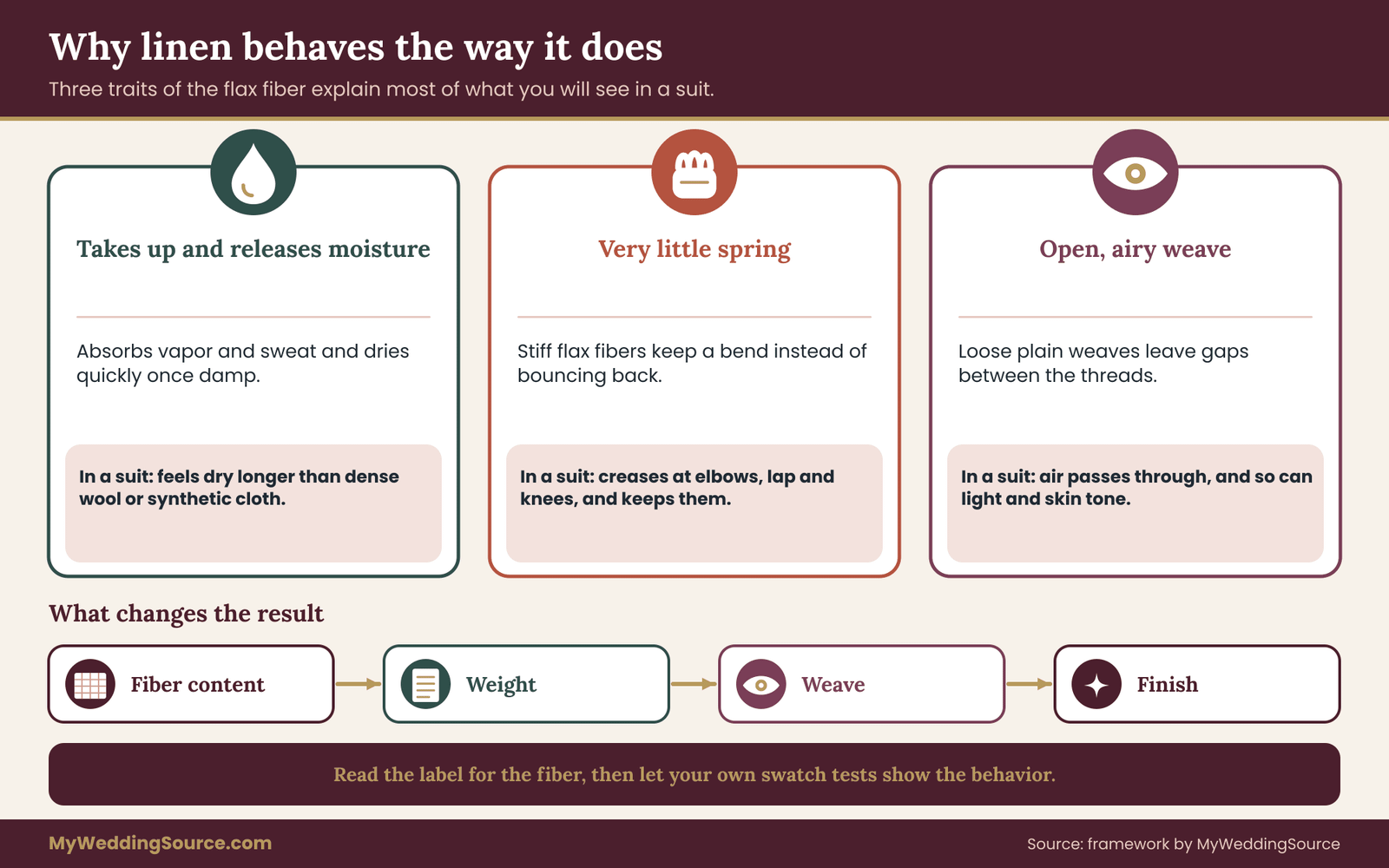
Three properties of the fiber explain most of what you will experience in a suit.
It absorbs and releases moisture quickly. Linen takes up water vapor and liquid without feeling clammy right away, and it dries faster than many fabrics once it is damp. On a warm day this helps the cloth feel dry against the skin for longer. It does not make you cooler by magic. It simply handles sweat better than a dense, closely woven wool or a polyester that holds heat.
It has very little stretch or spring. Wool fibers bend and then recover, which is why a wool jacket often shakes out its creases on a hanger overnight. Flax fibers are stiff and tend to stay where they were bent. Fold linen and it keeps the fold. This single property is the root of the wrinkling complaint.
It is open and airy when woven loosely. Many linen suit cloths use a plain weave with visible gaps between threads. Air passes through those gaps, which is helpful in heat, but light and skin tone pass through them too, which matters for color and modesty.
None of this is a fault. It is how the material works, and once you know it, you can decide which parts you value and which parts you will manage.
Linen, linen look and linen blend
Shopping for a linen wedding suit means reading labels carefully, because the word on the hanger tag and the content of the cloth are not always the same thing. In the United States, fiber content on clothing is governed by labeling rules that the FTC explains. In plain terms, the label should list the fibers and their percentages, and a product described as linen should be made of flax rather than some other fiber that merely looks similar.
You will usually meet four situations:
- A garment labeled with a single fiber, linen. This is pure linen. It carries the full crease behavior and the full airiness of the fiber.
- A garment labeled with linen and another fiber, such as cotton, wool, silk or viscose. This is a blend. The percentages tell you how much of each fiber is in the cloth, and the blend usually trades some linen character for easier wearing.
- A garment described as linen-look or linen-style. The name suggests the appearance of linen, but the label may show cotton, polyester or viscose. Read the content line before assuming anything.
- A garment with no content information you can find. Ask for it in writing. A seller who cannot say what the cloth is made of has told you something useful.
Treat the label as the starting fact and your own swatch tests as the second. The label tells you what the cloth is. The tests tell you how it behaves.
Weight and weave matter as much as fiber
Two linen suits can feel very different because of how the cloth is built. Weight is the first factor. Fabric weight is usually given as grams per square meter or ounces per yard, and it tells you how much material is in a given area. A lighter cloth moves more air and also creases and shows through more easily. A heavier cloth hangs better and hides more, but it holds more heat.
Weave is the second factor. A plain, open weave breathes freely and has the classic rustic look. A tighter or twill-like weave tends to drape more smoothly and resist creasing a little better, while giving up some airflow. Washed or softened finishes change the hand of the cloth, making it feel less stiff, though they do not remove the underlying tendency to crease.
You do not need to memorize any of this. You need to be able to ask three questions of any swatch: what is it made of, how heavy is it, and how open is the weave? The answers shape every other decision in this guide.
Why a linen wedding suit wrinkles, and what you cannot fix
Creases in linen come from two sources, and mixing them up leads to disappointment. The first is the fiber itself. Because flax does not spring back, any bend you create stays put, and repeated bending sets it deeper. The second is the cloth finish and construction: how tightly the threads are woven, whether the fabric was treated, and whether the garment has structure inside that helps it recover.
A suit puts linen through a particular kind of stress. Your elbows bend every time you lift a glass or hug a guest. Your knees fold whenever you sit. The seat of the trousers presses against a chair, and the front of the jacket collapses a little as you move between standing and sitting. Each of these areas will show creases on a long day, and the folds usually appear within the first hour of wear.
The difference between a crease and a rumple
Not all wrinkles look alike. A crease is a sharp, defined line, often at a bend. A rumple is a softer, scattered texture across a larger area. Many people who like linen are happy with rumples, because they read as casual and natural, and unhappy with deep creases at the elbow or knee. When you evaluate a swatch, you are mostly asking which of the two it will produce.
Cloth with a crisp, dry hand and a very open weave tends toward sharp creases. Cloth that has been softened, or that contains a recovery fiber such as wool or a small amount of an elastic fiber, tends toward rumples. This is a tendency, not a promise, which is why you test the actual sample in your hand rather than relying on a general rule.
What can and cannot be improved
Some wrinkle behavior can be managed. Steaming relaxes the fiber and releases many creases. Hanging a suit properly lets gravity do part of the work. A lining that stabilizes the shape keeps big folds from forming in the jacket body. Choosing a blend changes the baseline. A well-cut suit that fits without pulling creases less than one that is tight at the seat or the elbow, because tension is what sets a crease.
Other behavior cannot be changed. Pure linen will crease when worn and seated. No finish turns it into wool. A suit that creases in a showroom will crease at a wedding. Heat and humidity make the fiber softer and the creasing a little worse, and sweat adds a damp, darker look at stress points. If you cannot live with visible creasing at the elbows and knees, that is a legitimate reason to choose a blend or a different cloth, and it is better to know that before you order than after.
A useful way to frame the choice is to separate three questions. Will the suit look good for the first twenty minutes, when you are standing for the ceremony and the portraits? Will it still look intentional after two hours of sitting, hugging and eating? And can it be reset quickly if you change for photographs or dancing? A linen wedding suit tends to do well on the first, acceptably on the second if you chose the cloth and cut with care, and very well on the third when someone has a steamer on hand.
A short script for the first conversation
When you walk into a shop or open an email to a tailor, start with what you want to learn. You might say something like this:
“We are considering a linen wedding suit for a warm afternoon ceremony. Could we see swatches of the cloths you would recommend, with the fiber content and weight for each, and could we take a few home to test?”
That request is reasonable, specific and easy to answer. A good seller will hand you swatches and details without fuss. If the answer is hesitation, or a push toward a single option without any sample, treat that as information about how the rest of the process may go. The next section shows what to do with the swatches once you have them.
The three-pass sample assessment for a linen wedding suit
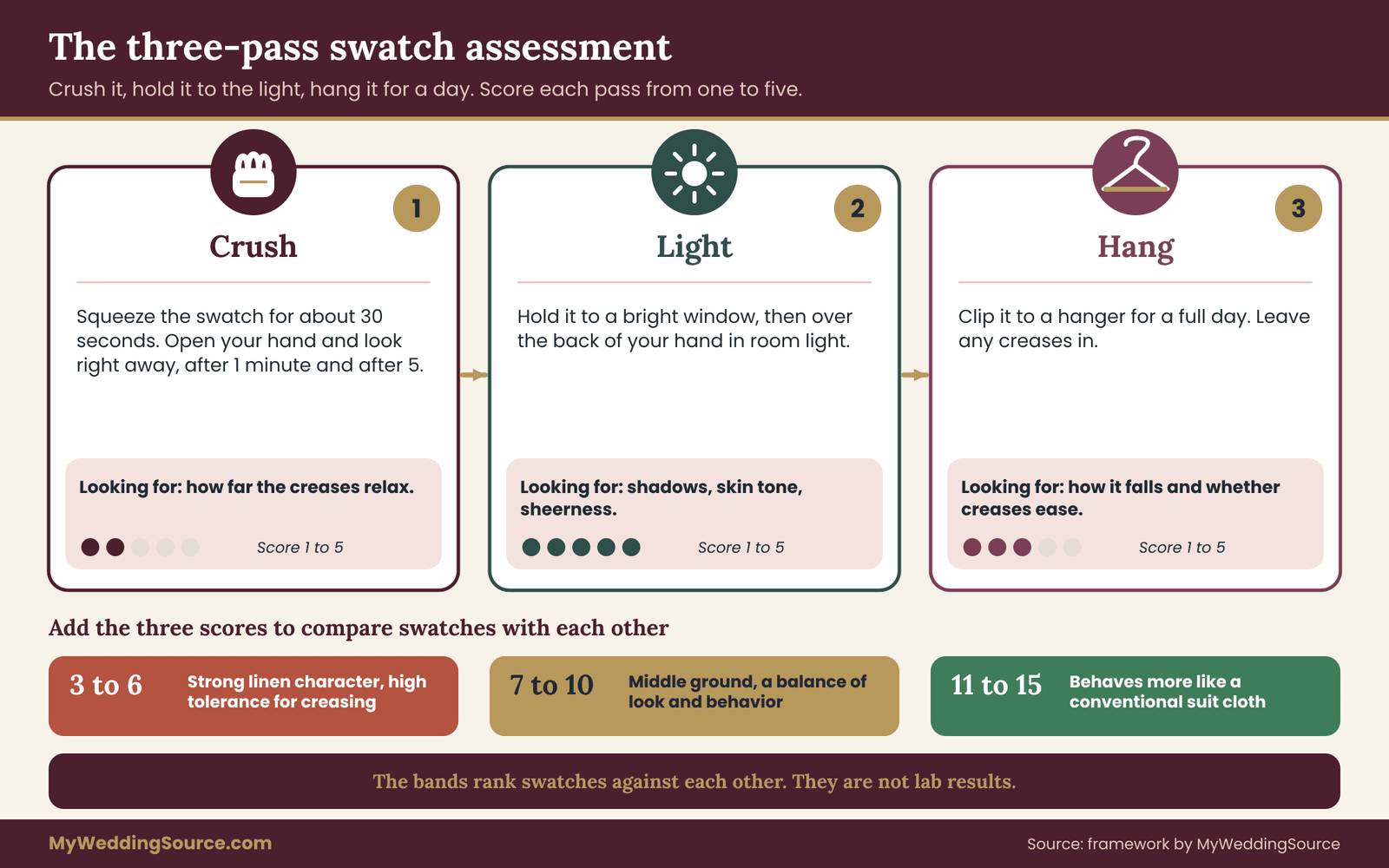
The core of this guide is a simple home test for any swatch, whether it is destined to become a linen wedding suit for you, a groomsman or a guest. It has three passes: crush, light and hang. Each takes a few minutes, needs no equipment beyond a window and a hanger, and produces a score you can compare across cloths. The scores are your own, recorded by you, and they describe the sample in your hand. They are not lab results and they do not predict every garment made from that cloth, but they are far better than guessing.
Ask for a swatch that is large enough to be useful for judging a linen wedding suit. A tiny corner tells you color and texture and little else. A piece roughly the size of a hand towel, or a few swatches of the same cloth, lets you crush, hold up and hang it. If a store cannot cut samples, ask whether you can try the same cloth on a display jacket, and run the same checks there as far as is polite.
Pass one: the crush test
Take the swatch in one hand and squeeze it firmly into a ball for about thirty seconds. Hold it the way you would hold a crumpled receipt, not so hard that you wring it. Then open your hand, place the swatch on a flat surface and watch.
What you are looking for is recovery. Check at three moments: right away, after one minute, and after five minutes. Notice whether the creases soften, stay sharp or flatten almost completely, and whether the cloth still shows a mark where your fingers pressed.
Score it from one to five:
- One: deep, sharp creases that do not move at all after five minutes.
- Two: clear creases with only a slight softening.
- Three: moderate creases that relax to a rumpled texture.
- Four: light marks that mostly fade within a few minutes.
- Five: barely any visible creasing.
You will almost never see a five from the cloth of a pure linen wedding suit. That is not a failure of the test. It is the reason the test exists: it lets you see how far a given cloth sits from the extreme, and whether a blend moves the number in a way you can live with.
One variation helps with realism. Repeat the squeeze on a damp, not wet, corner of the swatch, then let it dry. Linen often behaves a little differently when it has been dampened, and warm-day wear involves moisture. Do not soak a swatch that you borrowed from a shop, and do not do this to a sample you must return unchanged. If the sample is yours to keep, you can run this check freely.
Pass two: the light test
Hold the swatch flat against a bright window, with the sun behind it if possible, and look through it. Then place it over the back of your hand in normal room light and look at your skin.
You are checking two things. The first is opacity: can you see the outline of your fingers clearly through a single layer? The second is the effect of lighter colors, since pale cream, white and sand linen are popular for warm weddings and are also the colors most likely to show a shadow behind them. A cloth that looks solid on a flat table can look quite sheer against a body.
Score the light test from one to five too:
- One: you can see fine detail through a single layer.
- Two: you can see shapes and skin tone clearly.
- Three: you see a soft shadow only.
- Four: very little shows through.
- Five: nothing shows through.
A low light score is not a reason to reject the cloth for a linen wedding suit. It is a reason to plan. Light, open linen may call for a lining in the trousers, careful choice of underwear color, or a darker shirt layer. Pale trousers are where this matters most, and it is a topic worth raising with the tailor early, because it affects the lining decision covered in a later section.
Pass three: the hang test
Hang the swatch from a clip on a hanger or from a clothes line for a full day. If it has creases from the crush test, leave them in. After a day, look at how the cloth falls and whether the creases have eased.
This pass tells you something the other two cannot about a linen wedding suit: how the fabric behaves under its own weight. Some cloths drop smoothly and shed creases slowly, while others hold their shape and stay stiff. Light linen may feel too floaty to stay crisp, while heavier cloth may fall in a satisfying, structured way.
Score the hang test from one to five:
- One: stiff or twisted, with creases fully set.
- Two: limp with strong creases.
- Three: falls acceptably with moderate creases.
- Four: falls well and creases ease.
- Five: falls smoothly with almost no creasing.
If you can, do the hang test overnight in the room where you will store the suit. A bathroom after a shower is a common trick for relaxing creases, and a steamy room is a fair imitation of what a garment steamer does. Do not leave a swatch you must return in a wet bathroom, but a sample of your own is fair game.
Reading the three scores together
Add the three scores and look at the pattern, not only the total. A cloth that scores two on the crush test, five on the light test and four on the hang test is telling you a story: it creases, it is opaque and it falls well. That may suit a dark, structured jacket. A cloth that scores four, two, three is a different story: it recovers well but shows through, so it needs lining or careful color choices.
The total gives a rough ranking. Scores in the range of three to six across the three passes suggest a cloth with strong linen character that will need a high tolerance for creasing. Scores from seven to ten suggest a middle ground, and scores from eleven to fifteen suggest a cloth that behaves more like a conventional suit fabric. These bands are only a framework for comparing swatches against each other. They do not predict an outcome for a specific garment, and you should not treat them as measured performance.
Keep a simple swatch log for your linen wedding suit
When you are comparing three or four cloths, memory blurs. A small written log fixes that. For each swatch, note the vendor, the cloth name or number, the fiber content from the label, the weight if given, the three scores and one sentence about how it felt. Take a photograph of each swatch next to a ruler or a coin, in the same light, before you start testing and again after the hang test. The before-and-after pictures make decisions faster and prevent arguments later about which cloth was which.
Add the price per meter or the quoted price of the finished suit if you have it, but keep that in a separate column of your thinking. The point of the three passes is to learn how the cloth behaves, not to rank it by cost. Cost enters the picture afterward, once two or three cloths clear the behavior bar, and it belongs in your wedding budget alongside alterations and cleaning.
What the test does not tell you
Be honest about the limits of judging a linen wedding suit from a swatch. A swatch cannot show how the garment will be cut. It cannot show how a lining will interact with the outer cloth, how the seams will be finished or how the shoulders will hold. It does not capture heat, which needs its own test later in this guide. And a small piece behaves differently from a whole jacket, because large panels of cloth hold shape in ways a hand-sized sample cannot.
For that reason, treat the three-pass assessment as a filter. It removes the cloths you would regret, and it leaves you with a short list for the next steps: a decision about pure linen versus a blend, a wrinkle budget and a lining choice. If you have a made-to-order process, ask whether the maker can send a larger piece or a finished sample garment in the same cloth. If you buy off the rack, look for the same cloth in a jacket you can try on.
A fair test for a linen wedding suit on a shop rack
Sometimes a swatch is not available, and the only linen wedding suit is on a rack. You can still run a modified version of the three passes without damaging anything. Squeeze a small area of the jacket’s inner hem or a trouser leg lightly for a few seconds and watch how fast the marks fade. Hold the cloth up against the light of the shop window. Ask whether the jacket was hung on the rack overnight, since a fresh delivery that has just been steamed tells you little about how the cloth behaves after a day of wear.
Ask the staff how long the suit has been on display and whether it has been tried on. A display piece that has been handled many times and still looks decent is a good sign. One that looks creased after a single day on a hanger is also a useful result, although a shop will naturally steam its stock before a visit. If you see a rumpled rail of linen jackets in an otherwise tidy store, that may be the most honest sample you get.
Whatever you do, stay polite and avoid anything that could mark the garment. The aim is information, not a demonstration at the seller’s expense. A sales assistant who understands what you are doing will often help, and one who objects to a gentle squeeze of a hem is worth noting.
Using the swatch to talk to the tailor
Bring your swatch log to your tailor when you discuss the linen wedding suit. It turns a vague request such as “something that does not wrinkle too much” into specific information: this cloth scored two on the crush test, and I would like to know whether a blend of the same weave would score higher. Tailors who work with linen regularly will recognize the pattern and often have opinions about which cloths behave. Their experience is a useful second opinion on your own results, and it costs nothing to ask.
If the tailor disagrees with your reading, ask why. The disagreement itself is valuable. A cloth you scored low might be one the tailor knows relaxes well once it is cut and pressed in a jacket. Or the tailor may confirm your instinct and steer you away from it. Either way, you leave with a shared picture of the cloth rather than a hope.
Pure linen or a blend: choosing the cloth
Once a few swatches have survived the three passes, the next question is fiber content. A linen wedding suit can be made from pure linen or from a blend, and the choice changes how the suit looks, how it creases and how it feels in heat. There is no correct answer. There is a trade, and you are better off making it on purpose.
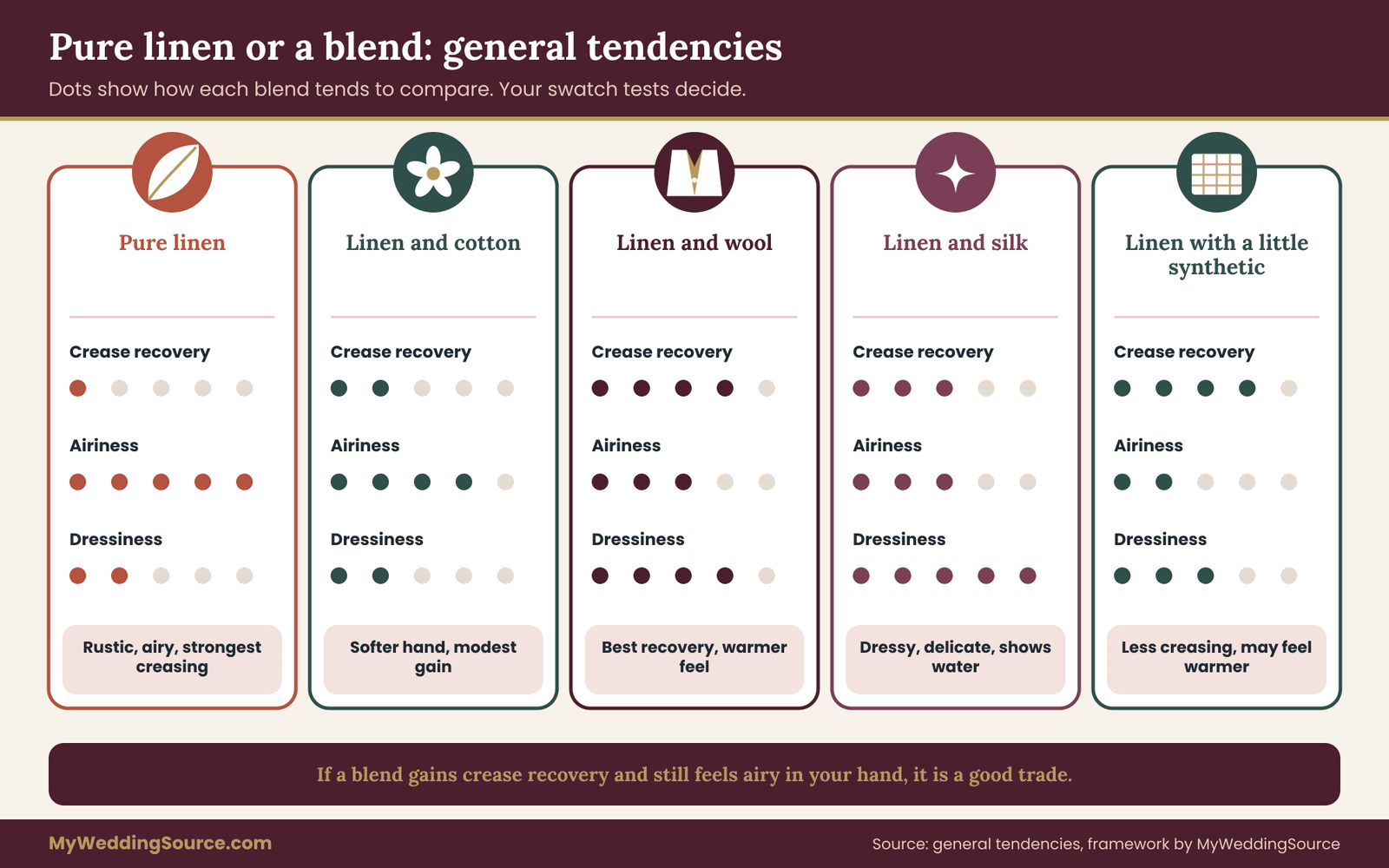
The following descriptions are general tendencies. Individual cloths vary with weave, weight and finish, so treat them as a starting point for your own swatch tests rather than as promises.
Pure linen. The most breathable and the most textured choice for a linen wedding suit. It has the strongest crease behavior and the most rustic, uneven look. People who choose it usually choose the wrinkles too, and often say the suit looks better when it looks a little lived in. It suits informal outdoor weddings where a relaxed look is part of the plan.
Linen and cotton. A common blend that softens the hand and reduces the stiffness. Cotton also creases, so the improvement in wrinkling is modest, but the cloth often feels smoother against the skin and may be easier to launder or press at home. The look is a little less textured than pure linen.
Linen and wool. Wool adds spring, which is the property linen lacks. A linen wedding suit with a meaningful share of wool tends to recover from creasing better and to hold the shape of a jacket more reliably. It also adds some warmth and a more traditional suiting look, so it suits couples who want linen character with a smarter finish. In very high heat, the wool content can make the cloth feel closer to a lightweight wool suit.
Linen and silk. Silk adds a soft, slightly lustrous feel and a smoother drape. It can look more refined and a little dressier. It is also more delicate, shows water marks and perspiration more readily, and needs careful cleaning. It tends to suit evening or formal summer weddings.
Linen and viscose or other cellulose fibers. These blends are often chosen for softness and drape. They can reduce the stiffness of linen, though they may crease in their own way and can look shiny or limp in some finishes. Check the swatch carefully.
Linen with a synthetic fiber. A small share of polyester or an elastic fiber can reduce creasing and help the cloth keep its shape. It can also reduce breathability and make the cloth feel warmer, depending on how much is added and how the fabric is built. If you choose a blend like this, make the heat comfort test in the next sections count for more.
A simple way to compare
Rather than debating fibers in the abstract, bring the swatch scores back into the picture. For each candidate, write down its crush score, its light score and its hang score. Then add two more notes from the label: the fiber content, and the weight if the seller gives it. Look at which cloth buys you the most crease recovery for the least loss of airiness.
If a blend improves your crush score by one or two points and still feels airy in your hand, it is probably a good trade for most couples. If a blend improves the score but feels dense and warm, the improvement may not be worth it in a hot venue. If pure linen scores low but you love the look and feel, go in with your eyes open and plan for steaming and a relaxed standard.
Color and cloth interact
Color changes how wrinkles look on a linen wedding suit. A pale, warm neutral such as sand or stone hides creases better than white, because white shows every shadow in a fold. A very dark navy or charcoal can show lint and shiny pressed areas. Mid-tone colors tend to forgive the most. Heathered or slightly mottled linen, where the threads are blended in several shades, camouflages creases because the eye is already seeing texture.
Color also changes heat, and a linen wedding suit in a dark shade is no exception.
Darker cloth absorbs more sunlight and tends to feel warmer outdoors, while lighter cloth reflects more of it. That does not mean a navy linen suit is a bad idea. It means that a navy suit in direct sun is a heat decision as well as a style decision, and it is worth checking with the heat comfort rehearsal later on. If you are weighing a palette for the whole wedding, the guide to choosing a wedding color palette shows how to test colors against the setting and the season.
Ask what the finish is on your linen wedding suit cloth
Many linen cloths are washed, enzyme-treated or softened after weaving. A finish can make the cloth feel less stiff and can give a slightly pre-worn look, which many people prefer to a crisp, stiff surface. Finishes can also change how the cloth behaves, so ask whether the swatch shows the finished cloth or the raw cloth. If a swatch looks very smooth and a finished garment later looks much rougher, the difference may be the finish, or the garment may simply be a different batch. Asking in advance avoids the surprise.
Ask, too, whether the cloth will shrink. Linen can shrink when it is washed, and a garment made from unwashed cloth may change size after cleaning. Many makers pre-shrink the cloth, but you want to hear that from them rather than assume it. A good answer is specific, such as which process was used and what the care label says. A vague answer is a reason to ask again in writing.
Setting a wrinkle budget for a linen wedding suit
A wrinkle budget is a decision you make before ordering, about how much creasing you will accept and where. It sounds fussy, and it turns out to be one of the most freeing parts of choosing a linen wedding suit, because it replaces a vague worry with a clear standard. When the suit creases on the day, you will know whether it is inside or outside the budget, and you will know what to do.
The idea is simple. Think of the linen wedding suit in six zones, rate each zone as a place where creasing is acceptable, tolerable or unwelcome, and write those ratings down. Then check each cloth against them.
The six zones
- Jacket front and lapels. The most visible area in photographs. Most people want this to stay smooth, because it frames the face and the shirt. A structured or partly lined jacket tends to hold this area better than a fully unstructured one.
- Jacket sleeves and elbows. Creases here are almost certain. They show up in every photograph where an arm is bent. Many people accept them as part of the look.
- Jacket back and lower body. When you sit, the jacket rides up and folds across the lower back. This tends to show in candid photographs more than in posed ones.
- Trouser seat and thighs. Sitting for dinner and the ceremony stresses these areas. Fine horizontal creases across the lap are normal, and they fall out partly once you stand.
- Back of the knee and knee front. The classic place for deep creases in linen trousers. Walking and sitting repeat the fold.
- Shirt and neckwear. Not part of the suit cloth, but they contribute to the overall look. A linen shirt under a linen jacket doubles the creasing, which suits a very relaxed look and not a polished one.
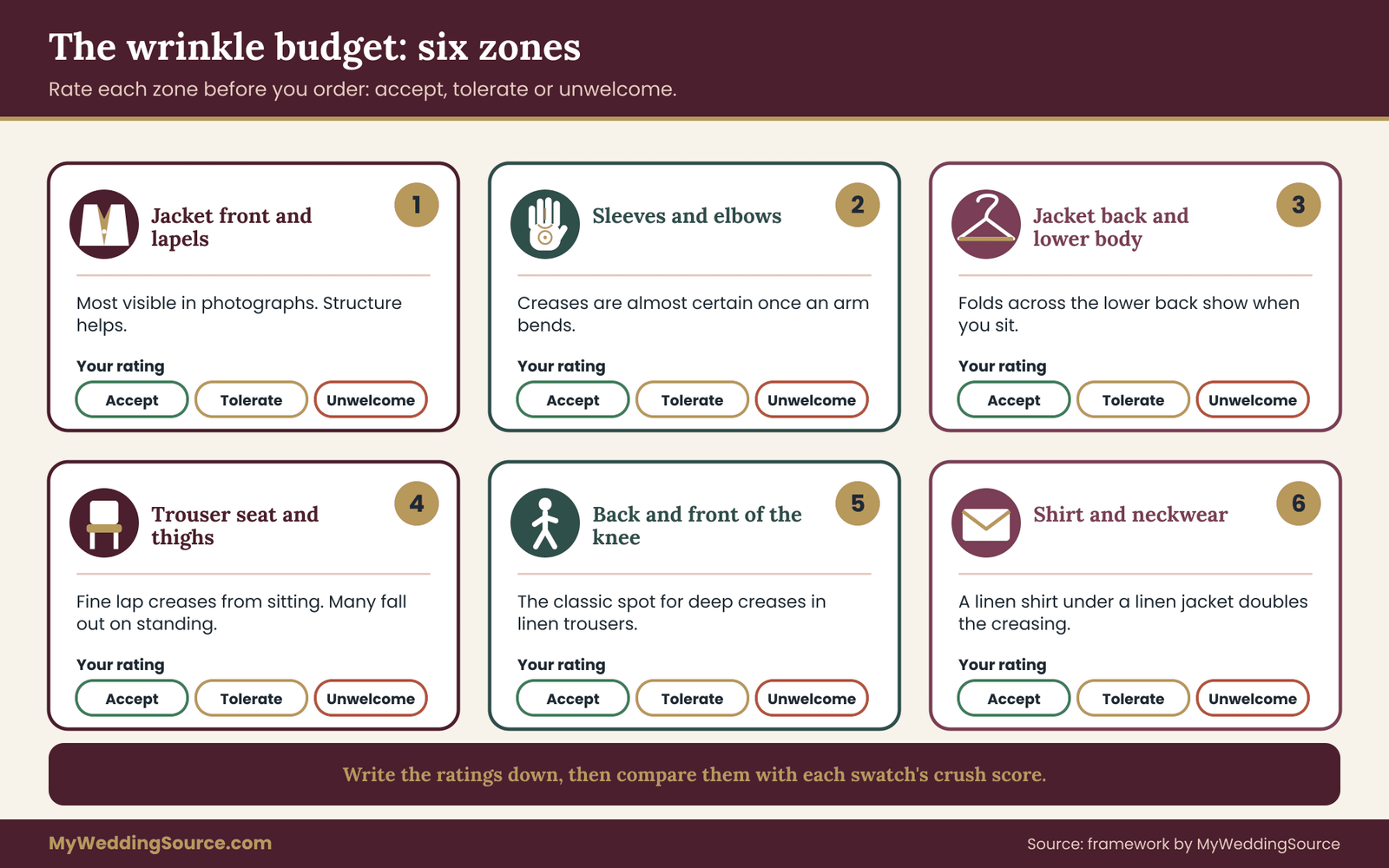
For each zone, rate it. A common set of ratings for a garden wedding might be: front smooth, elbows accept, back tolerate, seat tolerate, knees tolerate, shirt accept. For a more formal evening ceremony in linen and wool, a couple might rate the front and back as unwelcome and the knees as tolerate. There is no right set. The point is that you wrote it down.
Turning the budget into a decision
Compare the budget with your swatch scores for the linen wedding suit. If the front of the jacket is unwelcome and the cloth scores one on the crush test, you have a mismatch, and the answer is a blend, a more structured jacket or a different cloth. If you can accept creasing everywhere except the front, you might choose pure linen and plan to steam the jacket before the ceremony and again before the portraits.
Share the budget with the person who will be photographed beside you. A partner who expects a pressed, crisp groom and a groom who expects a rumpled, relaxed one will both be surprised if the suit goes in the opposite direction. Showing your swatches and your zone ratings is easier than explaining in the middle of the wedding why there are creases at the elbows.
Why the budget helps on the day
Wedding days produce small crises. A budget reduces the number of them. If a crease at the elbow was rated acceptable, nobody needs to panic when it appears. If a crease at the front of the jacket was unwelcome, a steamer and a few quiet minutes are enough to fix it. And if the budget says that the seat of the trousers is tolerable, a steamer, a stand and a brief walk will restore it without ceremony.
It also prevents a different kind of trouble: over-correcting. A person who dislikes any wrinkle may press the jacket so hard that it looks shiny, or may avoid sitting, hugging and dancing in order to protect the cloth. That is a poor trade on a day that is about the people around you. If you can accept creases at the elbows and knees, you can move freely and still look fine.
A short script for photographers and the wedding party
The people around you will also have views. Tell your photographer in advance that you are wearing a linen wedding suit and that some creasing is expected, and ask for a brief check before key portraits. You might write:
“I am wearing a linen suit, so some creasing is normal. Could we step out of the sun and let me straighten the jacket before the family portraits?”
That sets a realistic expectation and gives the photographer a cue. It also reduces the pressure to look perfect throughout. If your groomsmen are wearing a linen wedding suit too, agree on the same standard so nobody ends up looking more pressed than the rest.
Linings for a linen wedding suit: unlined, half-lined or fully lined
The lining is the layer inside the jacket, and sometimes inside the trousers, that you rarely see and always feel. It affects heat, shape, how easily the jacket slides on and off, and how the inside of the garment looks. For a linen wedding suit in warm weather, the lining decision is as important as the choice of outer cloth, and it is the one people most often leave to a salesperson.
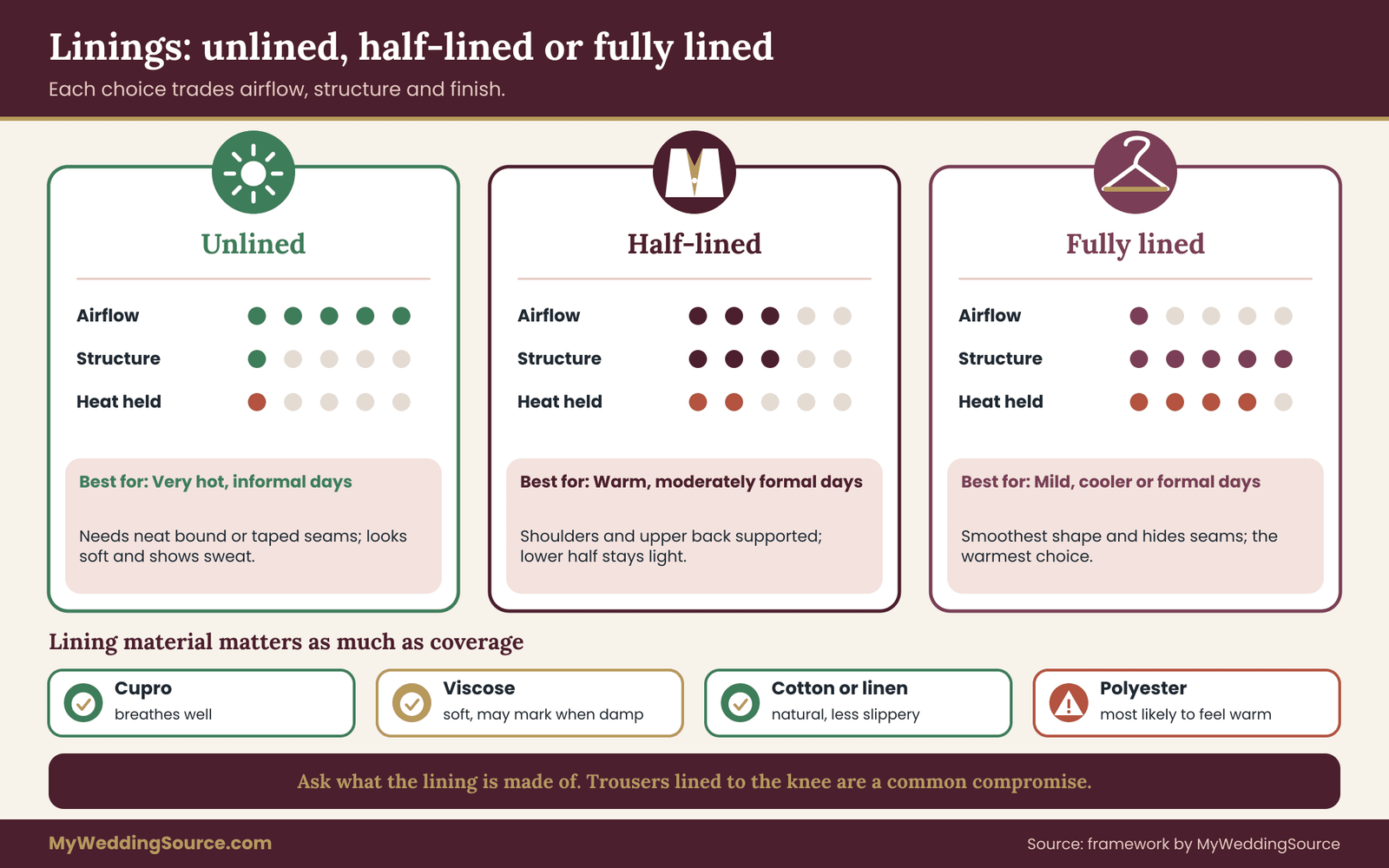
There are three common approaches. Each makes a different trade between airflow, structure and finish.
Unlined linen wedding suit jackets
An unlined jacket has no lining at all in the body or the sleeves. The seams on the inside are visible, so they are usually finished with a narrow binding or taped edges so that threads do not fray. It is the lightest and coolest option, because there is only a single layer of cloth between you and the air.
The advantages are obvious in heat: maximum airflow and minimum weight. An unlined jacket also folds and packs more easily for travel. The disadvantages are less obvious. Without a lining, the jacket has little internal support and can look limp and shapeless, especially in lighter cloth. The inside also shows more of the construction, so quality finishing matters. An unlined jacket may cling or catch on a shirt sleeve, and it is more likely to show perspiration through to the outer cloth because nothing separates it from your body.
An unlined linen wedding suit suits very hot, informal weddings and wearers who do not mind a relaxed, soft silhouette.
Half-lined linen wedding suit jackets
A half-lined jacket has lining in the upper back and across the shoulders, and sometimes the sleeves, while leaving the lower back and the front panels unlined. The seams in the lower half are finished and exposed. Many makers also line the sleeves for ease of dressing.
This is the most common compromise for a warm-weather linen wedding suit. It reduces weight and heat compared with a full lining, while still giving the shoulders and upper body some stability and helping the jacket slide on. A half lining also protects the outer cloth from the most intense contact with the body, which is helpful for sweat and friction.
The trade is that the lower half of the jacket still has little internal structure, so it can crease and collapse in a different way than the upper half. Ask your tailor whether the half lining stops at the waist or somewhere else, because that decides how the lower back will behave when you sit.
Fully lined linen wedding suit jackets
A fully lined jacket has a lining throughout, including the sleeves. It gives the jacket a smoother, more structured appearance, makes it easier to put on and off and hides the seams. It tends to hold shape better when you sit, and it reduces the visible creasing in the body of a linen jacket.
The cost is heat. A full lining adds a layer, and the lining material itself matters a great deal. Smooth synthetic linings can trap heat and moisture against the body. Breathable linings, such as cupro or viscose, handle warm weather better. Ask what the lining is made of, and treat that answer as seriously as the outer cloth.
A fully lined linen wedding suit suits cooler, more formal weddings where structure matters more than airflow, and couples who want the suit to look crisp.
The lining material question
Once you have chosen how much lining, choose what it is made of. The common options are:
- Cupro. A cellulose-based fiber with a smooth, silky feel. It breathes better than most synthetic linings and is popular in warm-weather suits. Cleaning instructions matter, so check the label.
- Viscose. Also cellulose-based and soft against the skin. It handles moisture reasonably well but can show water marks and may weaken when damp.
- Cotton or linen lining. Natural and breathable, and often used in half-lined and unlined summer jackets. It is slightly less slippery than silky linings, so the jacket may not slide on as easily.
- Polyester or other synthetic. Durable and inexpensive, and sometimes the default in lower-priced suits. It is the one most likely to feel warm in hot weather. If you are choosing a fully lined jacket for a hot day, this is the lining to question.
You can run a mini heat check on a lining swatch just as you would on the outer cloth. Hold it against your forearm for a minute, then notice how it feels. Does it cool or warm against the skin, and does it feel slick or clammy? It is a rough check, not a measurement, but a lining that feels sticky in a cool room will feel worse in July.
Lining the trousers
Trousers are often forgotten in the lining conversation, and they are where heat and creasing both concentrate. Options include:
- Unlined. Coolest and lightest. In very light or pale cloth, they can show shadows of undergarments, which is where the light test from earlier matters.
- Lined to the knee. A lining through the front thighs, ending at or just above the knee. It adds opacity and helps the cloth slide against the body, with less heat than a full lining. It also reduces creasing across the lap by supporting the area where you sit.
- Fully lined. The warmest option, rarely chosen for hot weather, but sometimes used in thicker winter linen blends.
For a pale linen wedding suit, lining to the knee is often a sensible compromise. If you plan to dance, sit and walk across grass, a knee lining also reduces friction and cling. Ask whether the lining is attached at the waistband only or also at the hem, because that influences how the trousers hang.
Structure inside the jacket
Beyond lining, jackets contain other layers that affect how a linen wedding suit behaves. Some jackets have canvas, a woven interlayer in the chest that helps the front of the jacket keep its shape. Others use fusible interfacing, which is glued to the cloth. Unstructured or deconstructed jackets, popular for linen, skip most of that padding.
An unstructured jacket is lighter and more comfortable in heat and moves with the body, but it also follows the body into every crease. A structured jacket keeps its shape better but adds weight and warmth. For a linen wedding suit, many people prefer a light structure: a minimal canvas, soft shoulders and a lining that supports the jacket where it needs help.
There is no need to learn tailoring vocabulary beyond this. What you want is an answer to a plain question: how much structure is in the front of this jacket, and how will it behave when I sit down? A tailor can show you with a finished jacket or a sample.
Seams, buttons and the inside view
Inside an unlined or half-lined jacket you will see the seams, and quality shows. Look for bound or taped seams that lie flat, tidy stitching and no loose threads. Check the buttonholes and the stitching around the armholes, since those are stress points. A poorly finished interior can fray over time, particularly in a loosely woven cloth like linen.
Look at how the jacket is cut under the arms too. Tight armholes create creases across the chest and limit movement, which is a common cause of jackets that look rumpled in photographs. A good fit at the armhole is one of the best defenses against ugly creasing, because it reduces tension where the cloth bends.
How to decide
Use the heat you expect, the structure you want and the finish you value to settle the lining of your linen wedding suit. As a rough guide:
- Very hot and informal: unlined or half-lined jacket, trousers lined to the knee or unlined, breathable lining material.
- Warm and moderately formal: half-lined jacket in a pure linen or a linen blend, trousers lined to the knee.
- Mild or cooler and formal: fully lined in a breathable lining, perhaps a linen and wool blend.
These are starting points. The heat comfort rehearsal in the next section checks them against how your own body responds, which is more reliable than a rule of thumb.
What to write down for the tailor
Once you have chosen, write the decision in plain words so that it can be repeated back to you: how much lining in the jacket, which lining material, trouser lining and where it ends, the type of seam finish inside an unlined or half-lined jacket, and how much structure in the chest. Ask the tailor to confirm it in writing on the order. A linen wedding suit is made from many small decisions, and the lining details are among those most often forgotten between the first conversation and the finished garment.
If a maker offers a standard lining and cannot change it, ask what it is. If it is a fully lined polyester jacket for a summer wedding, you have the facts to decide whether to look elsewhere. If the maker is happy to adjust, ask whether the change affects the price or the delivery date, and put the answer in the same message. A clear written decision beats a verbal memory during a stressful last month.
The heat comfort rehearsal for a linen wedding suit
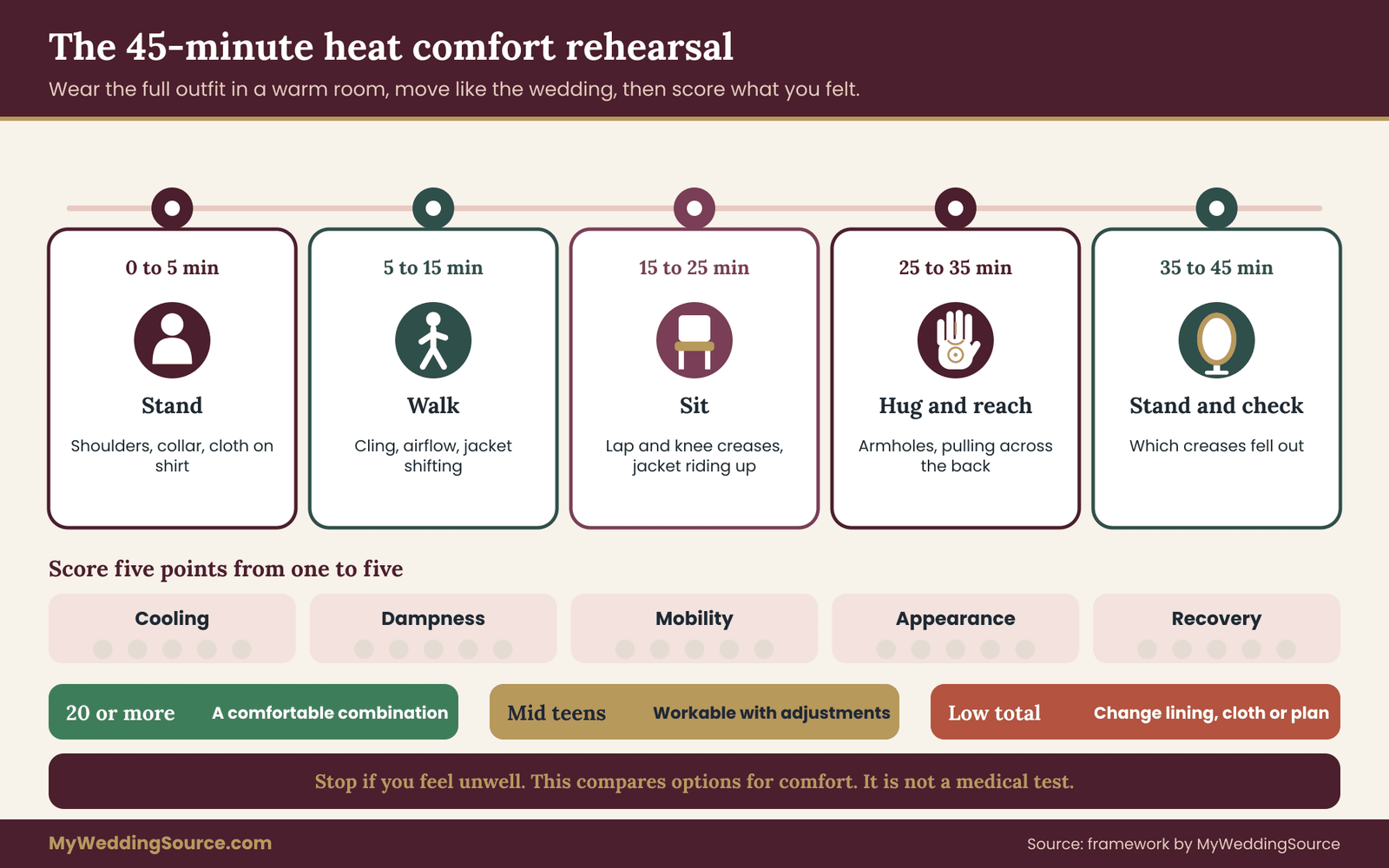
Swatches show how cloth behaves. They do not show how you behave inside a linen wedding suit. The second original check in this guide is a heat comfort rehearsal: you wear a finished jacket and trousers, or the closest sample you can get, in a warm room for about 45 minutes and record how it feels. It is not a lab test, and it is not a medical assessment. It is a structured way to notice problems while there is still time to change something.
Plan it for a time when the linen wedding suit, or a sample garment, is available in your size, ideally after the first fitting. If you are choosing between two cloths or two lining options, run the rehearsal for each on separate days so that you are comparing like with like.
Set up the conditions
You are trying to approximate the wedding, not to suffer through it, and a linen wedding suit feels different in a cool showroom than in a warm garden. Pick a room that is warm but not dangerous. A sunny room, a car parked in the shade with the windows open or an outdoor space on a warm afternoon will do. If you are testing at home in cooler weather, raise the room temperature a little and avoid exercising hard. Do not push into discomfort that could make you ill, and stop the test if you feel unwell.
Dress as you will on the day: the shirt you plan to wear, undershirt or none, the belt or braces, the shoes and socks. Anything that changes at the last moment changes the heat. If your shirt will be a heavier cotton on the day, rehearse in that shirt. Keep a notebook or a phone note handy.
The 45-minute routine
Treat the 45 minutes as five short blocks. They mirror the stages of a wedding day without requiring a whole day.
- Minutes 0 to 5: standing. Stand still as you would for the processional. Notice how the jacket sits on the shoulders and how the cloth feels against the shirt.
- Minutes 5 to 15: walking. Walk around a room or a garden at the pace you would walk to your place, greet imaginary guests and move your arms. Notice whether the cloth sticks, whether you feel airflow and whether the jacket shifts.
- Minutes 15 to 25: sitting. Sit in an ordinary chair, as you would for the ceremony or dinner, and stay seated. Note creases at the lap and the back of the knee, and whether the jacket rides up.
- Minutes 25 to 35: hugging and reaching. Raise your arms, give a few hugs, pick something up from the floor. This tests the armholes and the stress points.
- Minutes 35 to 45: a final stand. Stand again and look in a mirror. Check how many creases fell out and how many stayed.
At each block, note temperature comfort, dampness, cling, mobility and appearance. A single sentence for each block is enough.
Score what you feel
Rate each of five points from one to five, where five is excellent:
- Cooling. Does air move through the cloth and lining, or does heat feel trapped?
- Dampness. Do you notice sweat patches, cling or a clammy lining?
- Mobility. Can you lift your arms, sit and walk without pulling?
- Appearance after sitting. How does the cloth look after the seated block?
- Recovery. After the final stand, how much of the creasing has relaxed?
A total of twenty or more suggests a comfortable linen wedding suit combination. A total in the middle teens suggests you can manage with some adjustments. A low total, particularly a low score for cooling or dampness, is a flag. The scoring is for your own comparison across options, not an absolute standard.
What the results tell you about your linen wedding suit
If cooling is low and the jacket is fully lined, test again with a lighter lining or a half lining. If dampness is the problem, look at the shirt and undershirt first, because a close-fitting synthetic undershirt can trap heat regardless of the suit. If mobility is poor, the fit is likely at fault, and that belongs in the fitting appointment rather than in the cloth choice. If appearance after sitting is poor and everything else is fine, it points back to the wrinkle budget: either revise your standards or choose a more resilient cloth.
You can also use the rehearsal to judge how much of the problem a steamer or a quick hang can fix. Hang the suit for twenty minutes afterward and compare. If the creases drop out, you have your answer about on-the-day reset.
Know the outdoor conditions you are preparing for
A rehearsal indoors is a proxy. The real conditions include sun, humidity, wind and the length of time you spend outside. The National Weather Service explains that its heat index combines temperature and humidity to describe how hot it feels, and notes that standing in full sun can make it feel hotter than the number shows. Humidity matters because sweat evaporates more slowly when the air is already wet, which is why a humid day feels worse than a dry day at the same temperature.
If your wedding is outdoors and in direct sun, build in shade and water, because a linen wedding suit breathes but does not shade you. Check the forecast for the week and look at an hourly forecast closer to the day. Choose a ceremony time that avoids the hottest hours where you can, and ask the venue where there is shade. The guide to choosing a wedding date explains how season and time of day shape the whole schedule, and the same reasoning applies to a linen wedding suit.
The Centers for Disease Control and Prevention publishes guidance on heat-related illness, including warning signs. If you or a guest feels dizzy, faint, nauseated or confused in the heat, treat it as serious, move to a cool place and get help. A linen wedding suit is a comfort question until it becomes a health question, and on a very hot day the sensible choice may be to remove the jacket early, whatever the plan said.
Repeat with a hot spot check
After the 45 minutes, look at where the suit holds heat. Touch the lining at the back, the underarms and the waist. Check the shirt for damp patches. If heat concentrates at the shoulder blades, a half lining might help. If it concentrates at the waistband, look at the trouser lining and the belt. Those small findings are cheaper to fix now than at the venue.
A worked example of choosing a linen wedding suit from three invented swatches
Here is how the assessment and the rehearsal work together. The numbers below are invented for illustration. They are not measurements of any real cloth, and they show the method rather than a verdict on any fabric.
Imagine a couple planning a linen wedding suit for an outdoor ceremony in a mild climate on a warm late afternoon, with a reception in a shaded courtyard. The groom, whom we will call Sam, brings home three swatches and runs the three passes.
Swatch A, pure linen in a sand shade, open weave. Crush test: 1. Light test: 2. Hang test: 2. Total 5. Sam likes the color and the airiness. The creases barely move and the cloth is somewhat see-through.
Swatch B, linen and wool in a mid-blue, tighter weave. Crush: 4. Light: 4. Hang: 4. Total 12. It looks smarter and creases much less, though the cloth feels denser.
Swatch C, linen and cotton in a warm gray, medium weight. Crush: 3. Light: 3. Hang: 3. Total 9. Balanced all round, though it is not especially distinctive.
Sam then writes a wrinkle budget. The front of the jacket is unwelcome, the elbows are accepted, and the seat and knees are tolerated. That immediately places Swatch A at risk, because its crush score is low and the front matters. Swatch B suits the budget but may be warm. Swatch C is a fair middle.
Next comes the heat comfort rehearsal. Sam borrows a jacket in a similar cloth to B from the tailor and, a week later, tries a sample in cloth C. For B, cooling scores 2, dampness 3, mobility 4, appearance 5 and recovery 5, total 19. For C, cooling 4, dampness 4, mobility 4, appearance 3 and recovery 3, total 18. Neither is a perfect winner, and the difference is small.
The decision rests on priorities. The ceremony is at golden hour in shade and the reception is in a courtyard, so heat is moderate. Sam values a crisp front in the photographs. He chooses the linen and wool in a lighter weight if the tailor can supply one, with a half lining and trousers lined to the knee, and he plans to steam before the portraits. If the tailor cannot find a lighter wool blend, he would take swatch C and accept a more relaxed look.
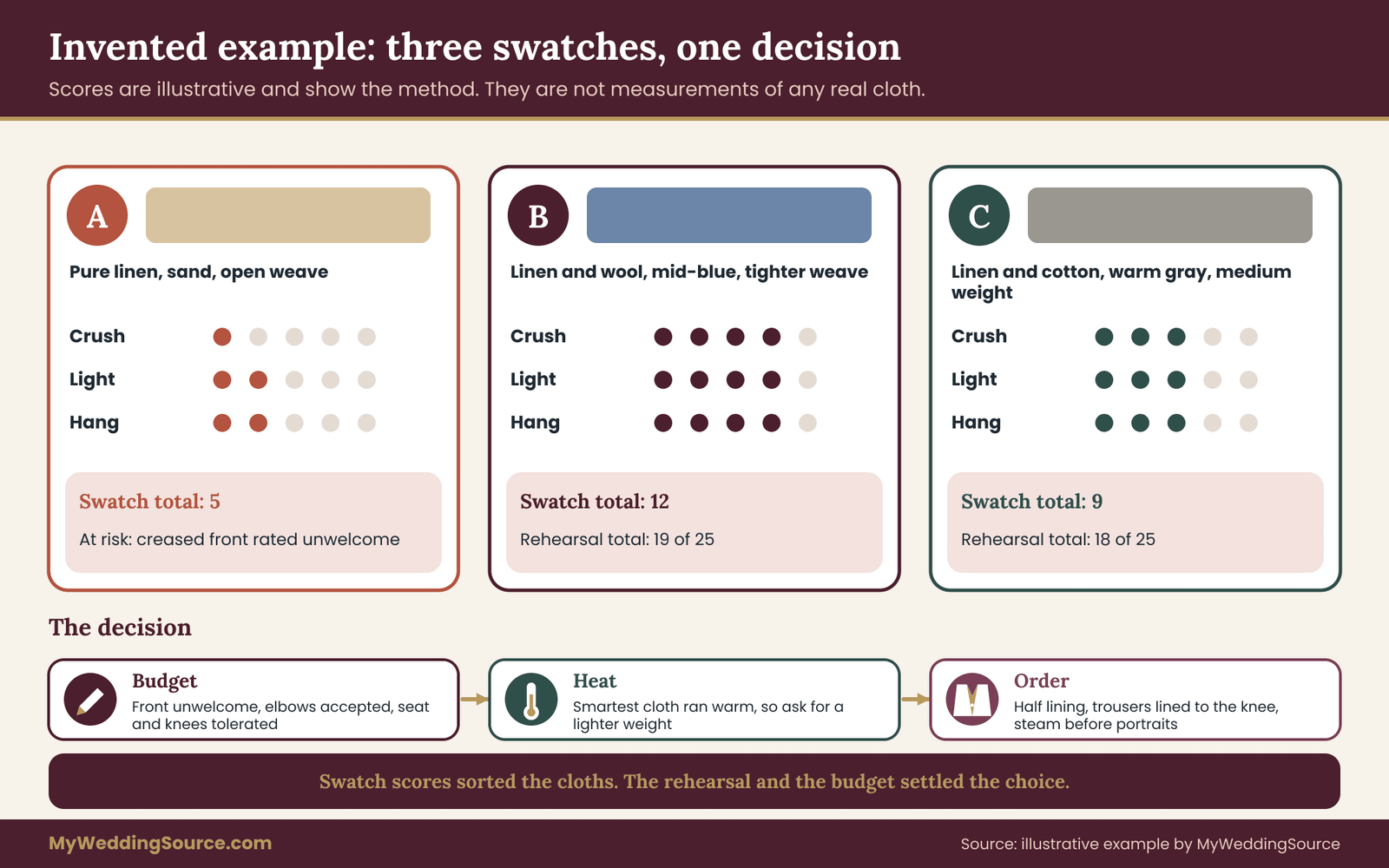
The example shows why you run both tests before settling on a linen wedding suit. Swatch scores sorted the cloths. The rehearsal showed that the smartest cloth was warm. The budget kept the decision tied to what Sam cares about. Without all three, he might have picked swatch A for its color and regretted it at the first portrait.
What to do when the scores tie
Sometimes two cloths come out equal. In that case, look at the items that differ most on your own scorecard. If one cloth is much cooler and the other much smoother, ask which problem you can solve more easily on the day. Wrinkles can be steamed; heat cannot be steamed away. Many people in that situation choose the cooler cloth and plan for the steamer.
If the tie is truly even, ask the tailor which cloth they would trust in a jacket for this wedding, and why. A knowledgeable tailor often has a quiet preference based on how the cloth sews, presses and ages. Take the opinion as one input, weigh it against your scores, and then decide.
Fitting and tailoring a linen wedding suit
A linen wedding suit rewards good fit more than most suits do. Because the fiber does not spring back, tension in the wrong place sets a crease that will not leave. A jacket that pulls across the back or a pair of trousers that grips the thigh will crease deeply wherever it strains. A linen wedding suit with a little ease, in the right places, will crease less and feel cooler, because air has room to move.
That does not mean baggy. It means the cut should follow your shape without clinging. A tailor who knows linen will often leave slightly more ease in the chest, the armholes and the seat than they would for a smooth worsted wool, while keeping the shoulders and the collar close. If you are working through alterations more broadly, the guide to wedding dress fit and alterations covers fitting appointments, timelines and what a tailor can and cannot change, and most of the logic applies to formalwear as well.
What to check at the first linen wedding suit fitting
Bring the shirt, shoes and belt you plan to wear, and stand and move naturally. Check these points in order:
- Shoulders. The seam should sit at the edge of your shoulder, without wrinkles radiating from the collar. Shoulders are the hardest part of a jacket to alter, so this is the first thing to get right.
- Collar. It should lie against your shirt collar without gapping or riding up.
- Armholes and sleeves. Raise your arms. If the whole jacket lifts or the cloth pulls across the back, there is not enough ease.
- Chest and button. With the jacket buttoned, check for an X-shaped pull at the button. An X means the jacket is too tight at the waist.
- Length. The jacket should cover the seat in a balanced way. Linen is often worn a little shorter and more relaxed than formal wool, but that is a style choice.
- Trousers. Check the seat, the thighs and the rise. Sit down in a chair. If the trousers pull tight at the knee or thigh, ask for more room.
- Hem. Decide the break, which is how much the trouser hem rests on your shoe, and keep in mind that linen trousers often look best slightly shorter, because extra length creates stacked folds above the shoe.
Ask for movement, not only stillness
Many fittings happen with the client standing still in front of a mirror. Ask to sit, walk, raise your arms and cross your legs. Watch the creases that form and ask the tailor whether they are caused by the cloth or the cut. A crease that forms because the fabric is stretched is a fit problem and can often be solved. A crease that forms because linen folds when bent is a fabric trait and should be managed.
If your tailor takes marks and pins, ask what can be changed and what cannot. Shoulder adjustments and major changes to the jacket structure are limited, while trouser hems, sleeve lengths and waist suppression are usually simple. Knowing the limits early helps you decide whether the garment is worth altering or the wrong starting point.
Allow time for two linen wedding suit fittings
The usual rhythm is a first fitting to mark changes and a second to check them, with a short final check close to the wedding. For a linen wedding suit, plan to do the heat comfort rehearsal after the first set of changes, so you can feed any results into the second fitting. Alterations take time, and busy seasons slow tailors down, so book early. The wedding vendor timeline on the site, wedding vendor timeline, shows how to line up lead times so that attire does not become the last-minute item.
A note on washing, shrinking and pressing before the fitting
If a linen wedding suit has been sitting in a store, it may carry creases from packaging. Ask the tailor to press it before the fitting so you see the real shape.
If the maker’s care label recommends a particular cleaning method, follow it, and ask whether the cloth is pre-shrunk. In the United States, the FTC’s Care Labeling Rule requires that garments carry care instructions for regular use, and a label that names only one method, such as dry cleaning, has to give a method that will not harm the garment. Read the label and ask the seller if anything is unclear. Do not wash or steam a new linen wedding suit at home until you know what the label says.
The finished-suit review
Before you accept the linen wedding suit, do a final review on the day you pick it up. Try it on with the full outfit. Check the lining and the seams. Look at the buttons and buttonholes. Look at the hem. Sit, walk and raise your arms. Confirm in writing that the garment matches what was ordered, including cloth, lining and any change you asked for. If something is wrong, raise it at once, because the time to resolve it is shrinking.
Wedding day wrinkle control for a linen wedding suit
Even a good linen wedding suit will crease, and a plan for the day keeps it under control without turning anyone into a full-time valet. The plan has three parts: how the suit travels and hangs before the wedding, how you dress and move, and how you reset between events.
Before the day
Take the linen wedding suit out of any plastic bag a day or two ahead and hang it on a wide, shaped hanger, so the shoulders keep their form. Hang it in a room with some humidity, such as a bathroom after a hot shower, with the door closed and the shower off. The moisture relaxes the fibers a little, and gravity does the rest. Do not let the cloth get wet.
Steam, if needed, with a handheld garment steamer, working from the top down and keeping the nozzle a short distance from the cloth. Test on an inside seam first. If you are unsure, ask the tailor or the shop to steam it for you. Linen generally tolerates steam better than direct heat, but the safe approach depends on the cloth and the lining, and you should follow the care label.
If you are traveling with a linen wedding suit, fold with care and use a garment bag. Fold the suit with tissue paper or a clean cloth in the folds to soften the lines. When you arrive, unpack at once and hang it. Hotel bathrooms offer a ready supply of steam, and many hotels have irons or steamers you can request.
On the morning
Dress late. A linen wedding suit creases when worn, so put the jacket on as close to the ceremony as is practical. Many grooms wear the trousers and shirt for getting-ready photographs and add the jacket only when it is time to leave. Wear a robe or an open shirt over a plain undershirt for portraits taken in the room, rather than sitting in your full outfit for an hour.
If you will drive, hang the jacket in the car instead of wearing it. Take off the jacket whenever you sit for a long stretch, such as a car ride or a pre-ceremony wait, and hang it again. These small habits cut creasing sharply.
During the wedding
Sit with care. Before you sit, undo the jacket button and lift the back of the jacket slightly. Pull up the trousers at the thigh a touch to avoid stretching the knee. Stand up as soon as you can after a long seated stretch, and shake the cloth loose. Keep your hands out of tight pockets. Use a small pocket for a handkerchief only, since weighty items pull the cloth and make it bag.
Avoid leaning against rough surfaces such as brick or a tree, which can catch loose weave and mark the cloth. Be cautious with drinks and food, since linen shows stains and takes a little time to release them. Keep a small stain-removal pen if the care label suggests it is safe for the cloth, and learn the care label before the day.
Reset between events
Most weddings include a gap: between the ceremony and the reception, or before the dinner. Use it. Hang the jacket in a cool room, let it breathe, and steam it lightly. A handheld steamer takes five minutes to use and makes a large difference. Ask the venue whether it has one, or assign the task to a trusted person in the wedding party. Make sure the person knows where the steamer is, how it works and which parts of the suit to focus on.
A small kit helps: a handheld steamer if the venue allows it, a lint roller, a few safety pins, a stain pen if the label permits, a spare shirt and a clothes brush. The guide to wedding day accessories planning covers backup items and emergency kits in more depth, and it is a good place to add the items specific to linen.
Photographs and creases
Photographers work with creases all the time, including on a linen wedding suit, and a short conversation helps. Ask for portraits early, while the suit is fresh, and for formal family groups before the reception. Standing with weight on one leg and keeping arms slightly away from the body avoids the pinching that makes creases at the elbows. A photographer can also shoot from angles and in light that soften creases, and can edit out a distracting one if it matters.
Do not let the fear of creases stop you from hugging people, sitting beside relatives or dancing. The photographs that matter most are the ones with the people you love in them, and a creased elbow in those pictures is a mark of a good day.
Questions to ask the vendor before you order a linen wedding suit
A good vendor answers questions about a linen wedding suit plainly. A weak answer is a signal. Bring a written list so you do not forget anything in the moment, and ask for the answers by email so you have a record. The list below groups questions by what they protect.
About the cloth.
- What is the fiber content, exactly, and what percentage of each fiber?
- What is the weight of the cloth, and the weave?
- Has the cloth been washed, softened or pre-shrunk? How?
- Can I take a swatch home, and can I see the same cloth on a finished jacket?
- Is the swatch from the same bolt or batch as the cloth my suit will use?
About construction.
- How much of the jacket is lined, and with what lining material?
- Are the trousers lined, and to where?
- How are the inside seams finished in an unlined or half-lined jacket?
- Is there canvas or fusible interfacing in the chest?
- What alterations are included, and what do they cost beyond that?
About care.
- What does the care label say, and is the care instruction written on the garment?
- Do you recommend dry cleaning, steaming or washing, and does the shop offer pressing?
- If I steam the suit myself, is there anything I should avoid?
About timing and policy.
- What is the lead time from order to delivery, and what happens if it is late?
- Can I return or exchange the suit, and under what conditions? Is a made-to-order garment treated differently?
- Is the deposit refundable, and what is due when?
- Who handles alterations, and how long do they take?
Save the answers with your swatch log. If a verbal promise matters, such as a delivery date or a free alteration, ask for it to be added to the written order. The general approach to written terms is explained in the guide to wedding vendor contracts, and the same habits of confirming scope, dates and refund terms apply to attire.
Labeling and claims
In the United States, the FTC enforces rules on fiber content labels and care labels, and also publishes guidance on how to describe products honestly. If a listing for a linen wedding suit says linen and the label says something else, ask for clarification, and if the answer is unsatisfactory, you may report it to the agency. Treat claims such as “wrinkle-free” or “cooling” with care. They are not defined the way fiber content is, and the only reliable check is your own swatch test and rehearsal.
Be thoughtful with reviews and recommendations too. Product reviews and ranked lists often involve commercial relationships, and the FTC expects material connections to be disclosed clearly. When you read a review of a linen wedding suit, look for a clear note about whether the reviewer was paid or received a free product, and give less weight to endorsements that do not say.
Paying and protecting yourself
Pay in a way that leaves a record, and keep the receipts, the order form and your emails together. If a problem arises with a card payment, the Consumer Financial Protection Bureau explains how disputes work and the time limits that apply, and acting early is the safest course. For the budget side of attire, which includes alterations, steaming and cleaning on top of the suit itself, a line in your wedding budget keeps those smaller costs from surprising you later.
A simple order checklist for a linen wedding suit
Before you pay a deposit, confirm that the order states the cloth by name or number, the fiber content, the lining, the trouser lining, the delivery date, the alteration terms and the return policy. If anything is missing, ask for it to be added. If the vendor will not put it in writing, consider whether the garment is worth the risk. It takes five minutes and saves a lot of trouble.
Edge cases for a linen wedding suit
Most guidance assumes a single groom in a single suit on a warm afternoon. Real weddings are messier. These situations come up often enough to plan for.
Beach and sand. A linen wedding suit suits a beach wedding, but sand, salt air and breeze change the plan. Sand catches in cuffs and lining, so choose trousers without a cuff and a hem that clears the shoe. Salt air can make linen feel damp. Wind lifts a light jacket and can show too much of the lining. Plan for steaming after the ceremony and consider a cloth with a bit more weight.
Very hot, humid venues. Where heat and humidity combine, the rehearsal matters most. A fully lined linen wedding suit jacket is rarely wise, and a light, unlined or half-lined jacket in an open weave may be the best bet. Be ready to remove the jacket for the reception and agree on this with your partner in advance, so that it feels intentional rather than a retreat.
Indoor air conditioning. A venue with strong air conditioning can leave a linen suit feeling thin and cold, particularly after being outdoors. If you move between hot outside and cold inside, a half lining and a slightly heavier cloth feel more even.
Travel and destination weddings. Pack the suit last, on top, in a garment bag. Reserve time on arrival to steam it, and find out in advance whether your accommodation has a steamer. Check airline rules about garment bags in the cabin. Ship the suit ahead only if you trust the carrier and have tracking, and keep a backup plan.
Groomsmen and matching. When several people wear a linen wedding suit, dye lots, fit and creasing vary. Ask the vendor whether the cloth will come from the same bolt, whether trims match, and whether variation is expected. Agree on one standard for shirts, ties and shoes so that creasing differences do not stand out. If a groomsman prefers a blend because of heat or discomfort, one slightly different cloth in the same color is usually less noticeable than a visibly rumpled suit next to a smooth one.
Different body shapes and sizes. A fabric with little stretch will crease at stress points that differ by build. A tailor can adjust for a rounder stomach, broad thighs or an athletic build, but the adjustment requires time. If your build creates tension in a particular area, raise it early and consider a cloth with some recovery.
Sensitive skin and allergies. Linen is rough when new, and an unlined jacket sits against the shirt only. If you have sensitive skin, test the cloth against your forearm and check the lining and the inside seams. If you know you react to a particular finish or dye, ask what treatments the cloth has had.
A linen wedding suit you plan to wear again. Repeated wear and cleaning change linen. It tends to soften with wear, and some people find that the creasing eases. Cleaning can shrink or stiffen the cloth, so ask about care before you decide. If you plan to wear the suit again, choose a color and cut you will still like.
Late weight change. Linen has little give, and a change in size close to the date is hard to fix. If you expect to change, tell the tailor, ask about extra seam allowance and schedule a final check as late as the process permits.
Rain. Linen darkens and wrinkles when wet and can take a while to relax afterward. Keep a plan for rain, such as an umbrella, a covered area and a dry place to hang the jacket afterward. Do not dry it with direct heat; hang it in a well-ventilated room and steam it lightly once dry.
Your next steps
Start this week with the swatches. Ask two or three vendors for samples of the cloths you like, with the fiber content and weight written down, and run the crush, light and hang passes on each. Record the scores and a photograph of each swatch, and drop any cloth that you would regret.
Then write your wrinkle budget in the six zones and compare it with the scores. Pick a lining to match the heat you expect, and confirm it in writing. After the first fitting, run the 45-minute heat comfort rehearsal in a warm room and score it. Adjust the lining, the cloth or the plan if the result is poor.
In the final weeks, book the last fitting, choose who will carry the steamer, pack a small kit and agree on the standard for creasing with your partner and your photographer. If you do those things, your linen wedding suit will look the way you expected it to and feel the way you hoped it would on the day.
FAQ
Is a linen wedding suit a bad idea because it wrinkles so much?
Not necessarily. Pure linen does crease, and that is part of its relaxed look. If you can accept creases at the elbows and knees, and you plan to steam before key photographs, it works well in warm weather. If you want a smooth, crisp finish, consider a linen and wool blend, or a different cloth.
How can I test a linen wedding suit swatch before ordering?
Use three passes. Crush it in your fist for thirty seconds and watch the recovery, hold it to a window to check how much shows through, and hang it for a day to see how it falls. Score each from one to five and compare swatches. A larger sample or a finished jacket gives a better picture.
Should a linen wedding suit be lined?
It depends on the heat and the look. An unlined or half-lined jacket is cooler, while a full lining gives more structure and hides seams. In hot weather, a half lining and trousers lined to the knee is a common compromise. Ask what the lining is made of, because material matters as much as coverage.
Do linen blends wrinkle less than pure linen?
Often, yes, though it varies. Wool adds spring and tends to improve recovery, while cotton gives a softer feel with a modest effect. A small share of synthetic fiber can reduce creasing but may reduce breathability. Test the actual swatch, because weave and finish change the result as much as fiber.
How do I get wrinkles out of a linen wedding suit before the wedding?
Hang the suit on a shaped hanger, ideally in a steamy bathroom, and use a handheld steamer from the top down, testing on an inside seam first. Follow the care label. Dress as late as you can, and steam again between the ceremony and the reception if there is a gap.
What color of linen wedding suit hides wrinkles best?
Mid-tone and mottled shades tend to hide creases better than white or very dark cloth, because the eye already sees texture. Pale colors also show shadow and may need lining. Darker colors absorb more sun and feel warmer outdoors. Test the color in the light where you will stand.
How long should I wear a linen wedding suit to test it for heat?
About 45 minutes in a warm room is a practical rehearsal. Stand, walk, sit, hug and reach, and note cooling, dampness, mobility, appearance and recovery. Stop if you feel unwell. The test compares options for your own comfort. It is not a medical measure and does not replace checking the forecast.
Can I wash or dry clean a linen wedding suit?
Follow the care label, which should give instructions for regular care. Many tailored linen suits are meant for dry cleaning or professional pressing, while some cloths tolerate gentle washing. Linen can shrink, so ask whether the cloth was pre-shrunk. If the label is unclear, ask the seller before cleaning.
Sources
- Clothes Captioning: Complying with the Care Labeling Rule, Federal Trade Commission
- Threading Your Way Through the Labeling Requirements Under the Textile and Wool Acts, Federal Trade Commission
- Care Labeling of Textile Wearing Apparel, 16 CFR Part 423, Electronic Code of Federal Regulations
- The FTC’s Endorsement Guides: What People Are Asking, Federal Trade Commission
- Heat Index Safety, National Weather Service
- Heat and Health, Centers for Disease Control and Prevention
- Heat.gov: National Integrated Heat Health Information System
- How do I dispute a charge on my credit card bill?, Consumer Financial Protection Bureau
- Federal Trade Commission
- ASTM International, standards for textiles