
Reading permission is the written go-ahead to use someone else’s poem, passage, letter or excerpt in your ceremony and in the printed program. This guide gives you a simple way to sort every reading by who owns it, what you plan to do with it and what proof you keep, so a lovely choice never turns into an awkward letter from a publisher.
Treat each reading as three questions: Source (who owns the words, and are they still protected?), Use (are you only saying it aloud, or also printing, projecting, recording, sharing or changing it?) and Proof (what do you keep to show you asked?). Public domain texts need a clean edition and a credit. Protected modern texts need reading permission before you print them. Ask early, because replies take weeks, and keep every answer in one folder.
Most couples pick a reading because it moved them. Someone sent it in a card, a friend read it at their own wedding, or it turned up in a search at midnight. Nobody asks who wrote it, whether it is still protected, or whether the person who typed it into a webpage had any right to do so. Then the program goes to the printer with the full text on page three, and the question becomes real.
The question is not as frightening as it sounds, and it is also not nothing. Words that someone wrote and published are usually protected by copyright for a very long time. Reading a poem aloud to your family in a living room is one thing. Printing it on two hundred programs, projecting it on a screen, posting the program as a PDF on your wedding website and streaming the ceremony to relatives overseas is a different set of acts, and each one is a use that the owner may control.
This article is about that second set of questions. It does not teach you how to write vows or how to pick a reading for emotional fit. It shows how to find out who owns the words, how to decide whether you need reading permission, how to ask for it in a way that gets answered, and how to print a credit line that does its job. If you are still choosing the order of the ceremony itself, the wedding ceremony step by step guide on this site covers that side of the planning.
A note on scope. This article is general information, not legal advice. Copyright rules differ by country, by the date a work was published and by the exact facts of your use, so where the answer matters, the person to ask is the rights holder, the publisher or a lawyer who handles copyright.
What reading permission means at a wedding
Start with plain terms. Copyright is a legal right that lets the owner of an original work decide who may copy it, share it, perform it and adapt it. In the United States, protection begins automatically when an author fixes the work in some form, such as writing it down. No registration is required for protection to exist, and a copyright symbol is not required either. A poem with no symbol and no author name on a greeting card or a social media post is not free just because it lacks a label.
A reading permission is simply the owner’s agreement, ideally in writing, that you may use a specific text in a specific way. The word “specific” does most of the work. Reading permission to print a poem in a ceremony program does not automatically cover putting it on a wedding favor, a sign or a video. Reading permission given to read a passage aloud does not automatically cover printing it. The strongest reading permissions are short, concrete and tied to a purpose: this text, this ceremony, this many copies, this credit line, no charge or this fee.
Who gives reading permission? Usually the copyright owner. That may be the author, the author’s estate, a publisher, a literary agent or an organization that manages the rights. For a poem in a magazine, the owner might be the poet, not the magazine. For an anthology, the editor owns the selection but not the poems. For a translation, a second person owns the translation even if the original is old. Part of the work in this guide is finding the right door to knock on.
What reading permission is not
It is not a license for music. If a ceremony includes a sung song or a recording, that falls under music licensing, which has its own rules and its own paperwork. Lyrics printed in a program are a text use, though, and they are protected like any other text, so they appear in this guide as a trap worth knowing about.
It is not a replacement for officiant approval. Your officiant may have content limits, especially in a religious ceremony, and the wedding officiant requirements guide explains what to ask them. Reading permission is about ownership of the words. Officiant approval is about whether the words belong in the ceremony.
It is not a promise that nothing can go wrong. Even with a clear answer, you are relying on the other party to be the real owner and to describe their rights accurately. That is why the Proof step matters: a dated record shows what you asked and what you were told.
Why this is worth twenty minutes
The honest cost-benefit is simple. For most weddings, the chance that anyone will ever object to a poem read in a ceremony is low. The chance of a problem rises when the text is printed in volume, posted online or included in a video that is shared widely, and when the text is a recent work by a living author or a publisher that protects its rights actively.
The effort of checking is small compared with the effort of reprinting two hundred programs, and a request letter that costs one evening is better than a takedown notice that arrives on a honeymoon.
There is also a plain courtesy angle. Writers earn a living from words. Many are glad to say yes to a wedding, often for a credit line and a small fee or nothing at all. A short, polite request starts a better relationship than a quiet copy and paste.
The five acts: say, print, show, record, change
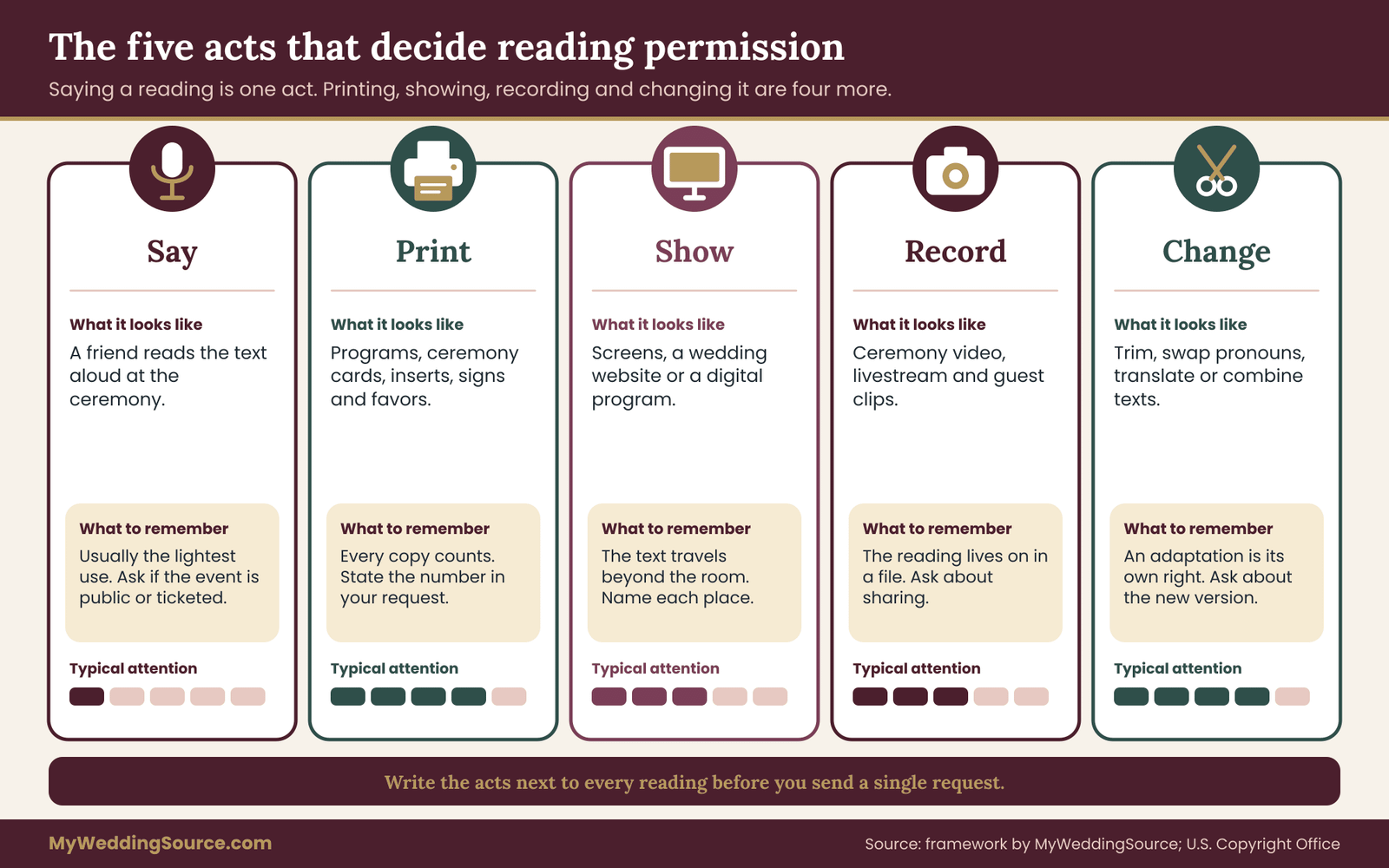
Copyright law lists several exclusive rights, and wedding readings touch most of them. Instead of memorizing the list, think of five ordinary acts. Each act has its own level of attention, and your plan should say which acts apply to each reading.
Say. Someone reads the text aloud at the ceremony. This is the act people worry about least, and for a ceremony with family and friends it is generally the least likely to raise questions. Even so, a reading by a performer at a ticketed or public event is a different situation from a private gathering, and rules can differ for places of worship. If you are unsure, include “say” in your request anyway; it costs one sentence.
Print. The text appears on paper: in a program, on a ceremony card, on an order of service insert, on a favor or on a sign. This is a reproduction, and it is the act that most often needs reading permission, because it multiplies the use. Ten copies and two hundred copies are not the same request, so the number matters.
Show. The text is projected, displayed on a screen, placed on a wedding website or shared in a digital program. Displaying and posting create copies in new places and let the text travel beyond the room. Many a reading permission is silent on digital use, so say it plainly in your request.
Record. A videographer films the ceremony, a relative livestreams it or a guest posts a clip. The reading is now inside a recording that may be shared widely. If a reading is the emotional center of the video, you may want written reading permission to include it, especially for a highlight film or public posting.
Change. You shorten the text, swap pronouns, combine two poems, translate it, set it to a tune or write your own version in the style of another. Adapting a protected work is a separate right of the owner. “I only changed a few words” is not a safe rule. Translation and adaptation get their own section later in this guide.
How the five acts change the request
Once you see the acts, the planning gets practical. A reading that is only said by a friend, from the friend’s own copy of a book, needs the least. A reading that is printed on programs and shown on a screen and filmed needs the most, and the request should list each. A reading you change, such as a translation for bilingual guests, needs the owner’s agreement on the change itself.
A useful habit is to write the acts next to each reading in your notes: “Say, print, record” or “Say only.” You will use that shorthand again in the decision list and the request letter. It also helps your officiant, your printer and your videographer, because each of them handles one act.
Here is a short example of the habit in action. A couple chooses a modern poem for a close friend to read. At first it looks like “Say only.” Then the couple decides to print the poem on the back of the program so older relatives can follow it, and the videographer will film the ceremony. The act list changes to “Say, print, record.” That change decides whether a request is needed, and it was invisible until someone wrote the acts down.
Where readings usually come from
Readings arrive from a few predictable places, and the place tells you what to check first. A sacred text or liturgy points to translation and denomination rules. A classic poem points to public domain status and a clean edition. A modern poem or a book excerpt points to a living or recent author and a publisher. A letter or a note from a relative points to the writer or their estate. A text found on a wedding website, a social media post or a printable sign points to an unknown source that has to be traced before anything else.
That last group is the riskiest and the most common. Aggregator sites collect poems with no source, no date and sometimes the wrong author. A line that “everyone knows” may be a paraphrase, a misattribution or a stanza from a still-protected work. The next part of this guide gives you a ladder for placing each reading, starting with the question you can answer fastest: who wrote it, and when?
The source ladder and public domain readings
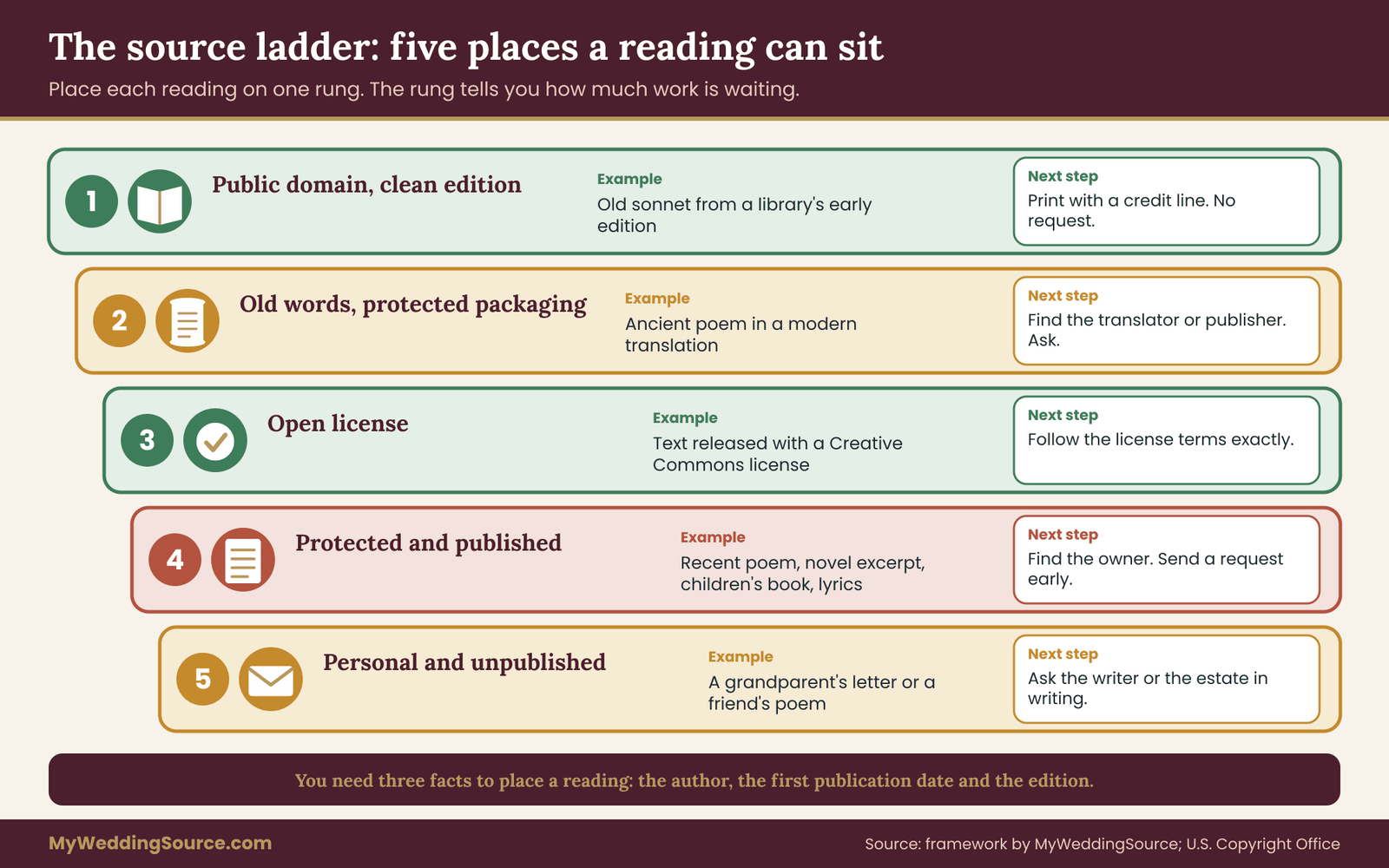
Every reading on your shortlist sits on one of five rungs. The rung tells you how much reading permission work is waiting. Work from the top down and stop at the first rung that fits.
Rung one: public domain original, clean edition. The text was written long enough ago that no copyright applies, and you are using an edition or translation that is also free to use. Examples are a seventeenth-century sonnet in its original English, or a nineteenth-century poem printed from a public domain source. Reading permission is not needed. A credit line is still good practice and honest.
Rung two: public domain work, protected packaging. The words are old, but the version in your hands has something added: a modern translation, a modernized spelling, an editor’s notes, a new arrangement or a selection that is somebody’s creative work. The old words are free. The new layer may not be. This rung traps more couples than any other.
Rung three: open license. The owner has published the text under a license that grants advance reading permission, such as certain Creative Commons licenses, with conditions like credit or no changes. Reading permission is already given, but only within the license terms, so read them and follow them exactly.
Rung four: protected and published. A living author, a recent estate or a publisher owns the text. This is where most requests happen. A modern poem, a passage from a novel or memoir, a children’s book, song lyrics, a film quote and a popular essay all sit here.
Rung five: personal and unpublished. A letter, a card, a toast, a note in a recipe book or a text a friend wrote just for you. The writer owns the words even if you own the paper. The reading permission needed is often easy, but it is still permission, and it is worth getting before the text is printed or posted.
Placing a reading on the ladder
You need three facts to place a reading: the author, the first publication date and the edition you plan to use. Missing any of the three means you are guessing.
Find the author by following the text back to a book, a journal, a speech transcript or an official collection, not another website. Check a reputable library catalog or the publisher page. If three websites give three different authors, none of them is a source.
Find the date by looking at the copyright page of the book or the publication history of the poem. Do not use the author’s birth date as a stand-in. Do not assume a text is old because it sounds old.
Find the edition by looking at the book you or your reader will actually use. A modern anthology reprinting an old poem usually has its own copyright notice covering the anthology, not the poem. Your plan should name which edition is your text source. That single note solves many problems later.
A quick worked placement
Imagine three readings on one list. The first is a sonnet by a playwright who died four centuries ago, copied from a library’s digitized early edition. That is rung one. The second is a short passage from a spiritual classic, copied from a paperback translation published in the 1990s. The original is old, but the translation is modern, so this is rung two. The third is a short poem from a contemporary poetry collection published a few years ago. That is rung four.
Three readings, three different next steps: credit only, ask the translator’s publisher, ask the poem’s publisher. Without the ladder, all three would have looked equally safe, because all three came from “a book of readings.”
Public domain readings and how to confirm them
Public domain means no one holds copyright in the text, so anyone may use it without reading permission. Works get there in several ways: the term of protection ended, the work never qualified for protection or the owner dedicated it to public use. For wedding readings, the first route matters most.
In the United States, the length of protection depends on when the work was created or published and whether certain formalities were met. For works created in recent decades, protection generally lasts for the life of the author plus seventy years. For older works published before 1978, the term is counted from publication and depends on factors such as notice and renewal. The U.S. Copyright Office publishes a circular on how to investigate the copyright status of a work, and Cornell University’s copyright office publishes a chart of public domain rules by publication date. Both are worth a bookmark.
A practical rule for November 2026: works first published in the United States many decades ago, and in particular those published before the 1930s, are the most likely to be free, but “most likely” is not “confirmed.” Check the exact publication date and the rules for that date before you print.
Three checks before calling a text public domain
First, check the date. Find the first publication date of the work, not the date of the edition you hold. A modern printing of an old poem does not restart the copyright on the poem.
Second, check the country. Copyright terms differ around the world. A work free in one country may be protected in another. If your wedding, your printer and your guests are all in the United States, U.S. rules are the main frame. If the author is from another country or you are marrying abroad, look at the rules where the use occurs and, for foreign works, at the original country’s status. Ask a copyright professional if it affects a large print run.
Third, check the packaging. Ask what you are actually copying: the author’s words or someone’s modern version of them. A new translation, a new arrangement of lines, a modernized spelling and a commentary can each be protected in their own right.
Government works and open licenses
Some texts are free for different reasons. In the United States, works created by federal employees as part of their official duties generally are not protected by copyright. An official speech from a federal office is the usual example. Be careful with this category: a quote inside a government document may come from a private source, and state and local governments follow their own rules.
Open licenses are the other route. If a poem or essay is published under a Creative Commons license, the license names what you may do and what you must do, such as give credit and note changes. Some versions forbid commercial use or modification. Read the license for that particular text. Do not rely on the logo alone, and keep a copy of the page that showed the license on the date you checked, since pages change.
What to do with a clean public domain reading
Print it from a reliable edition and give a plain credit line: author, title, original date if known and the edition you used. Spelling and punctuation vary between editions of old texts, so pick one edition and stay with it, and tell the reader which one so the printed text and the spoken text match.
If you plan to change the text, such as trimming a stanza, you are free to do so with a public domain work, but make the change clear to the reader if the program claims to quote the text. “Excerpt” or “adapted” in the credit line is honest and takes two words.
Because rung-one readings need no request, they are the cheapest and quickest choices when a program deadline is near. If you love a modern reading and the schedule is tight, ask yourself whether a classic that says something similar would do the job, and read both aloud once.
Translations, scripture and modern works that need reading permission
Translations deserve their own section because they cause the most confusion. A translation is a creative work. Even when the original is thousands of years old, a modern English translation can be protected, because the translator made choices about wording, rhythm and meaning. Those choices belong to the translator or the publisher.
So the question is never only “is this old?” It is “who wrote the English words I am about to print?” If you can answer with an old, out-of-copyright translation, you may be on rung one. If the answer is a translator working in the last century, you are on rung two or rung four, and a publisher likely handles requests.
Poetry from other languages
Wedding readings from classical poets in other languages usually arrive in modern translations. If the translation is a famous one, the translator may be the owner of the best-known English wording. Look at the book’s copyright page to see who holds rights in the translation, and then at the publisher’s reading permission page. Many publishers explain their process online and name the form to use.
A middle path exists for many couples: use a different translation that is old enough to be in the public domain, or ask a bilingual friend to make a fresh translation for you and give the friend credit. A new translation by a friend is original work by the friend, so a short written agreement from the friend about its use is enough. It will not match the famous version, and that may even be the point.
Scripture and sacred texts
Sacred texts add another layer. The original scripture is ancient, but translations vary widely. Some English Bible translations are in the public domain. Others are protected, and their publishers post quotation guidelines that allow limited use with a notice line, sometimes with limits on how much text may appear and in what context. A program that prints a whole chapter in a protected translation is a different case from a single verse quoted in a church bulletin.
Other traditions follow similar patterns. Modern translations of sacred writings, prayer books, hymnals, blessings and service texts are often published by religious bodies or presses, and some of those bodies offer a reprint license for programs or give written guidance on how to cite them.
The practical step is the same everywhere: write down the exact translation or edition you will use, find the publisher’s quotation policy or reading permission page and follow it. If your officiant or house of worship already uses a particular version, ask which one they use, since they may have a standing license for printed orders of service. The Christian wedding ceremony script guide and the non-religious ceremony script guide on this site show where readings tend to fall in a ceremony, which helps you decide what you need printed at all.
Liturgy and blessings that belong to a community
A blessing or prayer that your family recites may feel like it belongs to everyone, and in a sense it does. Legally, though, a particular written version can be owned. Oral tradition is one thing; a published, formatted text in a prayer book or a modern liturgy is another. If the version your family uses is printed, check the book’s front matter for reprint terms. If it is handed down orally, you may write it down yourself, and then the written text is yours, with credit to the community or family source.
One more distinction helps. Respecting a tradition and holding a license are different things. A sacred text can deserve care and attribution even when no reading permission is legally required, and some communities have wishes about how texts appear in print. When in doubt, ask the officiant or a respected elder what the community expects. That is not a copyright question; it is a question of respect that sits beside it.
Modern poems, books, letters and lyrics: where reading permission usually applies
Rung four and rung five are where a real reading permission request lives. They cover the readings people love most: a recent poem that said exactly the right thing, a paragraph from a novel, a line from a children’s book, a letter from a grandparent. Each has its own quirks.
Poems from living or recent authors
A poem published in a collection belongs to the poet or the poet’s estate, though the publisher often handles requests. The first stop is the book’s copyright page, which names the owner and usually the year. The second stop is the publisher’s website, where a reading permission page often lists the form, the contact route and typical response times. If the poem first appeared in a magazine, check whether rights returned to the poet.
Poets differ in how they respond. Some say yes within days and ask only for a credit line. Some refer you to an agent. Some ask for a modest fee, particularly for a large print run or commercial use. A wedding program given away free is a small use, and many rights holders treat it that way, but small does not mean automatically allowed.
If the poem has already been shared widely online by the poet, you still do not have blanket reading permission. Posting something for readers to enjoy is not the same as granting rights to reproduce it. Ask anyway; the poet may say yes warmly.
Excerpts from novels, memoirs and children’s books
Book excerpts raise the same issues, and the owner is often a publisher with a rights department. Children’s picture books deserve special mention. They combine text and illustration, and each part may have a different owner. Reading the words aloud from the book is one act. Photocopying the pages into a program or projecting them is another, and the artwork must be cleared separately from the text.
Longer excerpts need more care than short ones. A single sentence quoted with credit sits very differently from three paragraphs reproduced in full. Even so, there is no magic word count below which use is automatically fine, and that is worth saying plainly, because many people believe in one. The U.S. Copyright Office explains that fair use is decided case by case, by weighing factors, not by counting words.
Song lyrics
Lyrics trip up couples because they feel like part of the song, not part of a text. In the printed program, they are text. A couple who prints the lyrics to a song the congregation will sing, or the words to a song a friend will perform, is reproducing a protected work. Music publishers manage lyric rights, and they have processes for reprint licenses, which can take time. The cheapest fix is often to print the title and performer, not the words, or to choose a song in the public domain.
The separate question of performing music at a ceremony or reception, and of any recording, is a licensing topic of its own. Your venue or musician may already hold licenses, and it is worth asking them. This guide stays with printed and spoken words.
Letters, cards and personal writing
A letter from a late grandparent, a note from a parent or a card from a friend is very often the most moving reading of all. Legally, the writer, or their estate, owns the copyright in the writing, while you own the physical paper.
If you plan to read it aloud privately, no one will mind. If you plan to print it, project it or post it, get the okay of the writer or, for a deceased writer, the person who handles their estate. Often that is a surviving spouse, a child or a sibling, and the request is a conversation, not a form.
Do the same for a friend’s original poem or toast. A short message such as “Is it all right if we print your poem in the ceremony program and film it being read?” with a yes in writing is a complete reading permission for most purposes.
Privacy matters here too. A letter can contain details about people who did not choose to appear in a program. Ask yourself whether the text is only about the writer and you, and if it mentions health, family tensions or other people by name, read it with a sensitive eye before printing.
Film, television and online quotes
A line from a film or show is a short quotation from a protected script. A single line read aloud is rarely a concern. A full speech printed in a program, or a clip played on a screen, is a different matter, and clips are not text readings at all; they fall under video and music rules. A viral post or a message from social media belongs to its writer, and the platform’s terms rarely give you reuse rights. Ask the writer, or replace it.
Text generated by AI tools
Some couples ask an AI tool to draft a reading. Under current U.S. Copyright Office guidance, material produced entirely by a machine, without enough human authorship, is generally not protected on its own. That does not make it safe in all respects. Tools can echo existing text, and you cannot always tell. If a generated draft sounds like a known poem, search a distinctive phrase and check, and do not rely on a tool’s claim that its output is original.
The reading permission decision list
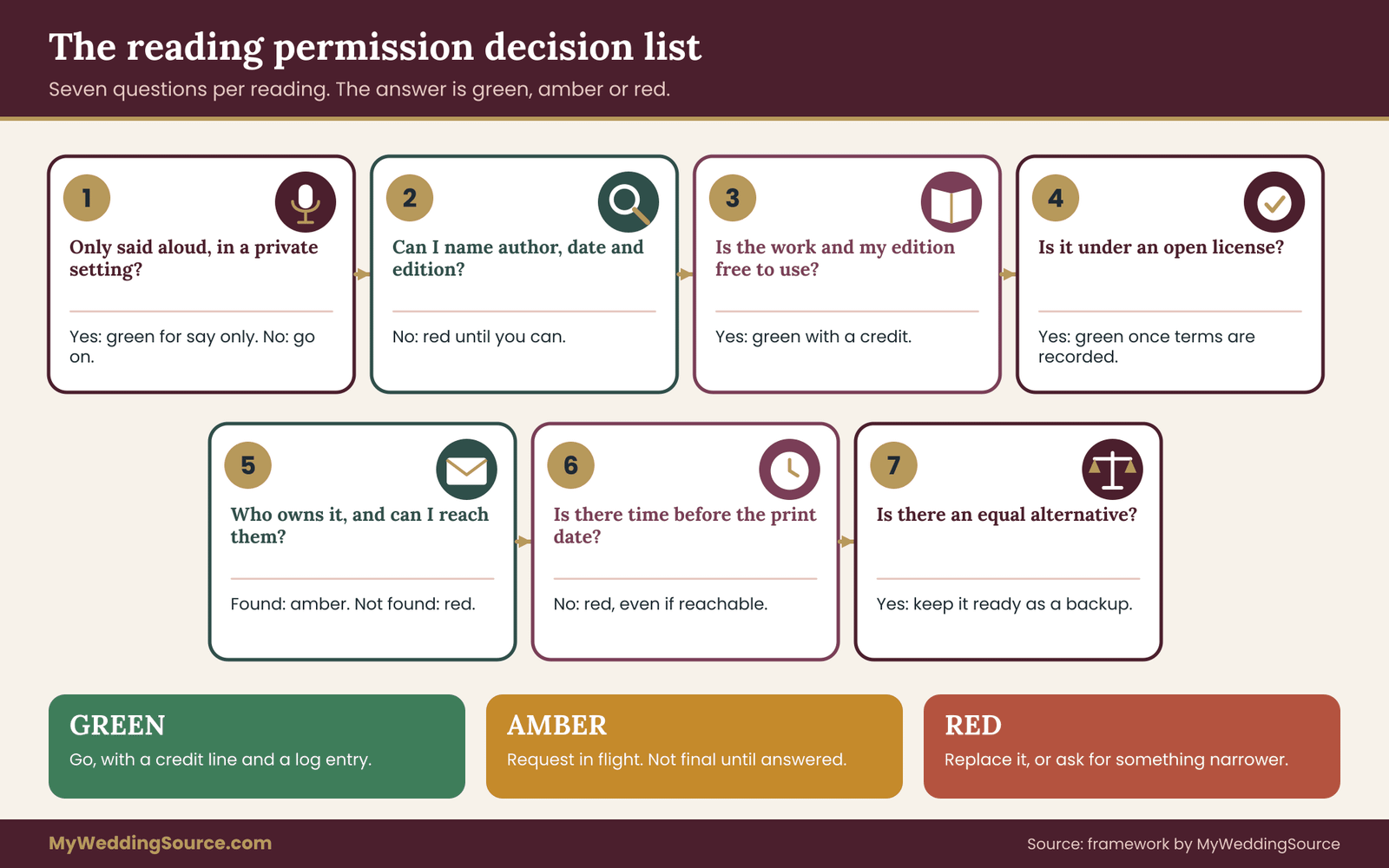
Now put the pieces together. The decision list below is a short sequence of questions you can run on every reading. It produces one of three results: green (go, with a credit), amber (check or ask before printing) and red (replace it, or ask very early). The list is the core of the method, so use it on paper, one reading per line, and write the answers down.
Question one: Is this reading only said aloud, never printed, shown or recorded? If yes, and the setting is a private ceremony with family and friends, the question of reading permission is usually minor. Mark it green for “say only” and note the source. If any other act applies, go to question two.
Question two: Can I name the author, the first publication date and the edition? If not, the reading is red until you can. An unattributed reading cannot be cleared by anyone, and you cannot credit it.
Question three: Is the work in the public domain, and is my edition free too? If yes on both, mark it green with a credit line. If the words are free but the edition is not, go to question five.
Question four: Is it under an open license? If yes, mark it green only after reading the license terms and recording them. If the license limits changes or commercial use, follow the limits.
Question five: Who owns it, and how do I reach them? Find the publisher, agent, estate or author. If you can reach them, mark the reading amber and start a request. If you cannot find anyone after a reasonable search, mark it red and plan a replacement. “Orphan” works with unknown owners exist, but a wedding program is a poor place to test them.
Question six: Do I have time? If the print deadline is closer than the time a reply usually takes, mark the reading red even if it is protected and reachable. A beautiful reading with no answer on printing day is a reading you do not print.
Question seven: Is there an equal alternative? If a public domain or original text would carry the same meaning, mark the protected reading amber and keep it as a first choice, but prepare the alternative so no one scrambles later.
Reading the results
Green means proceed, with the credit line and the log entry. Amber means a request is in flight, and the reading is not final until the answer arrives. Red means choose something else, or ask for something narrower, such as reading permission to say it aloud only and print just the title and author.
The reading permission decision list gives you a count that is easy to act on. If most of your readings are green, you are in good shape, and your remaining effort is credit lines and tidy records. If two or three are amber, schedule the requests this week. If any are red and you love them, start the search for the owner now, and settle on a backup in parallel.
Why the list asks about time
It may seem odd to include time in a reading permission decision. It belongs there because time is the reason most requests fail. Publishers and estates work at their own speed. A reply can arrive in a day or several weeks, and some never come. A plan that depends on an answer you may not receive is fragile. The list handles this by making the backup a normal part of the plan, not an emergency.
Keeping the list useful
Keep one line per reading in a shared note with these columns in plain words: the reading, the person who will read it, the acts planned, the rung, the owner, the date you asked, the answer and the credit line. Your officiant can see which readings are final. Your printer sees only final text. Your videographer knows what may be filmed. Nobody has to guess, and nobody has to track an email thread to find out whether the sonnet is cleared.
If a collaborator changes the plan, such as a relative who suggests adding a second reading at the last minute, run the new reading through the same seven questions before it joins the program. The list takes ten minutes, and it applies equally to a surprise addition and a planned one. The ceremony cue sheet guide shows how to track readers and timing, and the decision list pairs well with it.
How to find the owner and ask for reading permission
Once a reading is amber, the reading permission work is a short, practical search. You are looking for the person or office that can say yes, and you are trying to do it in a day or two of casual effort, not a research project.
Start with the book. The copyright page names the owner and the year, and often the publisher’s address for reading permission requests. If you only have a poem from a website, find the book or journal it came from; a search for a distinctive line plus the word “poem” usually leads to the first publication.
Go to the publisher’s reading permission page. Many publishers have one. It typically shows what they handle, the form or the information they need and how long replies usually take. Follow their process exactly. A request that skips their form often waits longer than one that fills it in.
Try the author’s own site or agent. Some poets and writers manage requests themselves or list an agent. If the publisher says the rights returned to the author, this is the route.
Use the public record. The U.S. Copyright Office keeps a public catalog of registrations and recorded documents. It is not complete, because registration is optional, and it does not always name the current owner. Still, it can confirm that a work was registered and point to a claimant. For deeper searching, the Copyright Office publishes guidance on investigating the status of a work.
Ask the person who gave you the reading. If a friend shared it in a card or a book, the book is in their hands, and the copyright page is a minute away.
If after a sensible search you cannot find anyone, stop. Treat the reading as red, record what you tried and move to the alternatives in a later section. Printing a text with no known owner is not the same as having permission, and no search can turn an unknown into a yes.
Who should send the request
One person on the planning side should send every request, using the same plain wording. That keeps the records tidy and avoids a publisher getting three messages about the same poem from three relatives. The couple can send it, or a parent, a friend or a planner can send it on their behalf. If a planner is involved, tell them whether they may speak for you.
The sender should say who they are, that the use is a private wedding, and that no money changes hands for the program. A request that sounds honest and small is usually answered better than a request that sounds vague.
Writing a reading permission request that gets answered
A good reading permission request is short, specific and easy to answer with one word. It should let the owner say yes without having to ask you three follow-up questions. It should also leave room for the owner to say no without friction.
Include these items, in this order:
- Who you are and why you are writing. Two sentences. Name the event and the month.
- The exact text. Title, author, the book or source and the lines you wish to use, with the page number if you have it.
- The acts. Whether the text will be read aloud, printed, shown on a screen, recorded or shared online, and in which forms.
- The numbers. How many printed programs, whether any are sold (none), how long any online version stays up.
- The credit line. What you will print, and an offer to use their preferred wording.
- The deadline. The date you need to send the program to print, stated kindly.
- The fee question. Whether there is a charge, and how to pay it.
Here is a sample you can adapt in your own words:
We are planning a small wedding ceremony this spring and would love to include a short poem. May we have your reading permission for a friend read it aloud at the ceremony, to print it in about eighty programs handed out free to guests, and to let our videographer film the ceremony for the couple’s private use? We will credit the poet and the book as you prefer. Our programs go to print on a given date, so an answer before then would help us greatly. If there is a fee, please tell us how to pay it.
Adjust the sample to the real uses. If you plan to post the program online, add a line about that. If you plan only to read the text aloud, say so and keep the request to one sentence.
Words to leave out
Do not promise “no one will ever see it.” Do not say that you will credit them “if they want.” Do not argue that the use is fair or private, and do not send a request that already says you plan to proceed whatever the answer is. The point of a request is to ask. The best tone is the one you would use with a neighbor you want to stay on good terms with.
What the timeline looks like
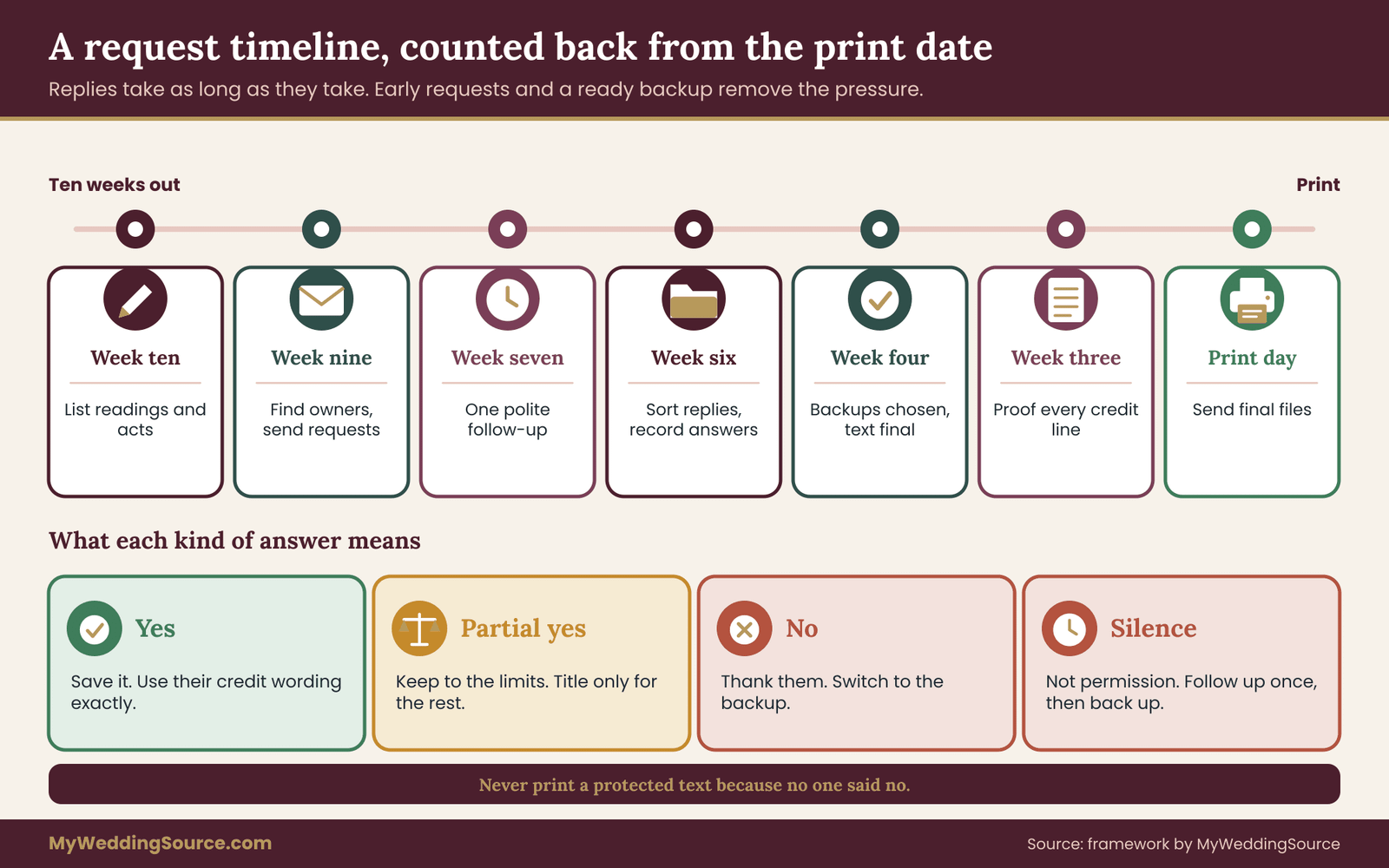
Plan the requests backward from the day the program must go to print. Allow time for the owner to answer, time for a follow-up and time to swap in a backup reading if the answer is no. A common plan is to send requests as soon as readings are chosen, follow up once after two weeks, and decide on the backup at the four-week mark.
The window will vary by publisher and by author. Some reply within a couple of days and some take longer than a month. Because you cannot predict which, send requests early and treat early as a habit, not an emergency measure.
What to do when the owner does not reply
Silence is not consent. If no answer arrives after a polite follow-up, you have not been given reading permission, and you should not print the text on the strength of a message that went unanswered. Use the backup. If the reading matters enough, try another route, such as the author’s agent or a different department of the publisher, and keep the backup ready.
It helps to say in your first message that you will plan for a different reading if you do not hear by a certain date. That is not a threat; it is a kindness that lets the owner know the stakes.
Fees, conditions and what a yes should say
A yes can arrive with conditions. Most are reasonable, and a few deserve a second look. The point of writing the terms down is that you and the owner agree on the same thing.
Credit. A credit line is the most common condition. It may require the author’s name, the title, the book, the publisher and a notice such as the year and the owner’s name. Use the wording they give you, character for character. If they give no wording, use author, title, source and year.
Fees. Some owners charge nothing for a small, free, noncommercial use. Others charge a flat fee or a fee per copy. A fee is not a trap, but it is a cost, and it changes the comparison with an alternative. Weigh the fee against the other options in the alternatives section: a reading you love at a modest fee may be a bargain, while a fee that exceeds your whole printing budget suggests a different choice.
Limits on use. The owner may say yes to the ceremony only, or to the printed program only, or may exclude video, a website or a social post. Keep to the limits, and tell the people who handle those acts. If a limit surprises you, you can ask whether they will extend it.
Time limits. Some reading permissions expire after a period, or apply only to the event named. That is fine for a one-day wedding, but note it. If you plan to keep a digital program on a wedding website forever, you need a permission that covers it.
Changes. If you want to shorten the text or alter a word, the reading permission must say so. Do not assume a yes to “this poem” includes “this poem with lines removed.”
What a clear yes says
A useful yes names the text, the uses, the numbers, the credit line, the fee if any and the date. It can be short:
Reading permission is granted for the use described, at no charge, with the credit line below, for this event only.
An email is usually enough for a wedding, as long as it comes from someone who appears to have authority and clearly says yes. Save it as a file with the date, the sender and the reading’s name in the file name. If the answer is a form with a signature, keep the signed copy and a scan.
A clear no, and a partial yes
A no is useful information. It saves you from guessing and lets you move on. A polite thank-you reply costs nothing and keeps the door open.
A partial yes is common: “You may read it aloud, but we do not license it for print.” That still helps you. Use the reading in the ceremony, and in the program list only its title and author, which are facts and not the text. Titles alone are generally not protected, so naming the poem and the poet in the program is a normal way to honor a reading you cannot print.
Who pays and who signs
If a fee is due, decide who pays and note it in your budget. A fee is a vendor-style cost, even if the owner is a poet. Keep the receipt with the reading permission. If the owner sends an agreement to sign, read it for the acts, the numbers, the dates and any promise to indemnify them. If an agreement asks you to take on obligations that sound broad, a short consultation with a lawyer is worth the cost, and the wedding vendor contract guide shows how to read agreements slowly before you sign.
What not to accept as permission
Be careful with these:
- A friend’s assurance that “it’s fine.”
- A reply from an assistant or intern with no authority to grant rights, unless they say they speak for the owner.
- A website’s “free printable” label with no license or source.
- A message from a different poet, translator or editor than the one who owns the text.
- Silence.
None of these is bad faith. They just do not constitute reading permission, and the difference matters if anyone later asks.
Print program reading permission: credit lines, copies and printers
The printed program is where reading permission becomes visible. Everything before it is planning. On the page, the choices are concrete: how much text, what credit, what notice, where and how many.
What goes on the page
A program can honor a reading in three levels, from lightest to fullest.
Level one: title and author only. The program says that a reading titled so-and-so by a named author will be read by a named person. No text appears. This level generally needs no reading permission, because it names the work and does not reproduce it. It is the right answer for any amber or red reading, and it respects the writer without a request.
Level two: a short excerpt with credit. One or two lines appear, with a credit line. This is where people hope that “just a line” is safe. It may be acceptable in some cases and not in others, and fair use is decided case by case, so do not count on it for a protected modern work. If you want the lines, ask.
Level three: the full text. The whole reading appears. For public domain texts and cleared readings, this is fine. For anything else, wait for the owner’s yes.
Programs also have a practical reason to print the text: guests who are hard of hearing, guests who speak another language, and guests who simply like to follow along. If printed text matters to you for those reasons, say so in your request, and consider a large-print copy or a handout kept at the welcome table.
Credit lines that do their job
A credit line gives the reader enough to identify the work and the owner. A simple structure works for most:
“Title,” by Author Name, from Book Title (Publisher, Year). Used with permission.
If the owner supplied a notice, print it exactly as given. If the text is public domain, say “Public domain” or give the edition. If the text is under an open license, follow the license’s attribution line, which often has a set order such as title, author, source and license name.
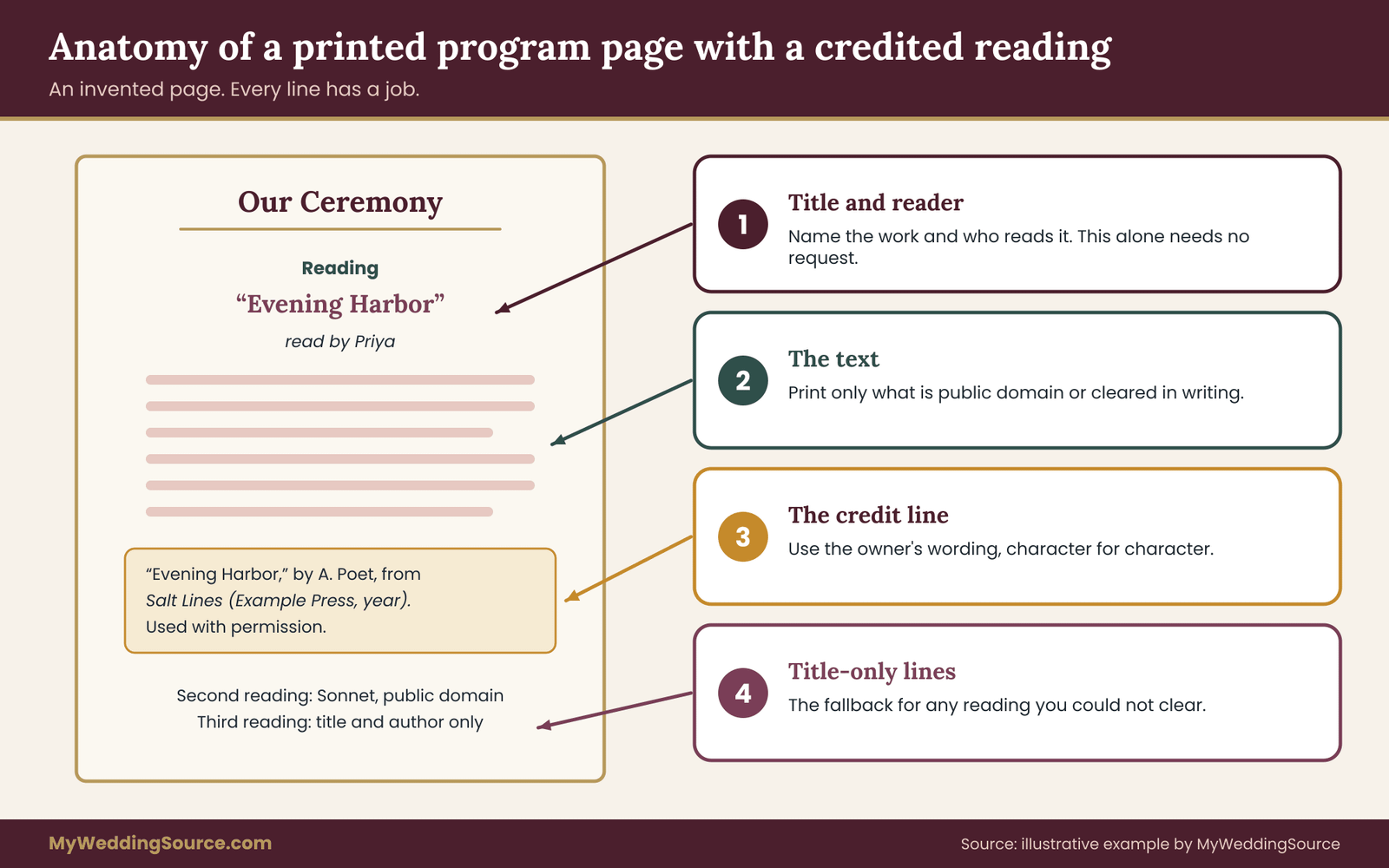
Put the credit near the text, not on a separate page that guests will not read. Keep the type legible. A credit line in a tiny font that no one can read is a poor-faith credit, and a tidy line in the same size as the text is a good-faith one.
Do not invent a copyright notice. If you wrote the reading yourself or a friend did, you may add the writer’s name and “written for this ceremony.” There is no need to add a symbol you do not need.
Copies, quantities and the number you promise
Your request stated a number, and the program printing should match it. If you asked for eighty copies and then print two hundred because the guest list grew, you have printed past the stated use. Tell the owner if the number changes materially, and ask for an update, which is usually simple. Rights holders prefer a short message to a surprise.
Count extras too. A few programs end up as keepsakes, in the officiant’s folder, with the photographer or on a memory table. That is fine if it is within the number you named. If you plan to give programs to relatives who could not attend, include them in the count.
Working with the printer
A print shop or an online printing service handles the paper, not the rights. Most printers ask you to confirm that you have the right to print the content you upload, and many include a line in their terms saying so. You are the one making that statement. Do not click it for a text you have not cleared.
Treat the printer as one more vendor in the plan. Tell them early that the program has cleared text, give them the final proofs and keep the reading permission records next to the print order. The wedding invitation printing guide covers proofing and handoffs, and the same habits apply to programs: one master file, one approver and no changes after the final proof without a note.
A related caution: template sites and design apps often include sample poems and quotes. Those samples are placeholders. Replace them with cleared text, and check the template’s terms for fonts and artwork too, since those are separately licensed. That is a design topic and not a reading topic, but the same careful mindset applies.
Version control for the text
Readings change in small ways between drafts. A line break moves, a word changes, a stanza gets dropped to fit a page. Keep a single master copy of each cleared reading and paste it from there. Note the edition it came from. If your reading permission covers the full poem as published, a version with dropped lines may fall outside it. When in doubt, print the whole poem or print less.
Recording, livestreams and the wedding website
Not every use is on paper. The three that surprise couples most are the video, the livestream and the website.
Video of the ceremony
A ceremony video includes whatever is said, including readings. For a private family video, the risk is low and the reading permission you already obtained to say the text usually matches the use. For a highlight film that will be posted on public platforms or sent widely, you want the reading permission to cover recording and sharing.
Ask the videographer two questions. Does the contract allow you to share the video publicly? And does the videographer need any confirmation about third-party content? Many videographers are used to handling music and are glad to learn that a reading is cleared. Put the answer in writing, using the same record folder.
If you read a protected poem and the reading permission covers only “said aloud,” consider telling the videographer and keeping the video private. That is a reasonable middle course: you do not lose the memory, and you do not publish the text.
Livestreams
A livestream sends the ceremony to people elsewhere in real time and often saves a copy on a platform. Platforms have their own rules on third-party content and may automatically detect protected audio. A spoken reading is less likely to trigger automated detection than music is, but the platform’s terms still apply, and you remain responsible for what you post.
Add “livestream and recording” to your request when relevant. Include how long the stream will stay available. If the owner says no, you can still livestream the ceremony and have the reader pause, or you can read a public domain text for that segment. Alternatively, you can mute or skip that reading in the saved version.
The wedding website
A wedding website is a good place to post a program for guests who want details, and a poor place to post protected text without clearance. A web page is public by default and easy to copy. If your reading permission covers print only, post a version of the program that names the reading and the reader but leaves out the text.
If the reading permission covers the web, ask for the duration, and note when to take the page down. The wedding photography consent guide deals with a parallel question about images of guests, and the same principle holds: decide what is public, what is private and who can see which version.
Social media and guests
Guests will post clips. You cannot control all of it, and a guest’s short clip of a friend reading is an ordinary part of modern life. You can nudge the pattern by asking guests to hold their phones during the ceremony, or by sharing an official clip afterward. If your readings are cleared only for private use, a polite sentence in the program such as “Please enjoy the ceremony with us now and share photos afterward” helps without turning anyone into a rule enforcer.
Translations and bilingual programs
Bilingual programs are common and kind. They also raise a specific rights question: translating a protected text creates a derivative work, and the right to make one belongs to the owner of the original.
Three situations
The text is public domain. You are free to translate it or to use an existing public domain translation. A fresh translation by a friend is the friend’s own work, so get the friend’s written okay for its use.
The text is protected and a published translation exists. Ask the owner of that translation for reading permission, and ask the owner of the original if the publisher says it is required. Often one publisher handles both.
The text is protected and no translation exists. Ask the owner for reading permission to translate it, and say who will translate and how the translated text will be used. Some owners agree readily, because the translation honors the work. Others have standards about translations and ask to review the result. Allow extra time.
Translations of your own writing and of friends’ writing
If the reading is something you or a friend wrote, you can translate it freely, but name the translator and keep a short note saying so. If a friend translates your friend’s poem, make sure both people have agreed. That is two notes instead of one, and each takes a minute to write.
Reviewing translations
Translated readings deserve a second pair of eyes, since a word can carry unintended meaning. Ask a native speaker who was not involved in the translation to read the finished text aloud once before it is printed, and fix anything that sounds stiff or says something you did not intend.
Worked example: five readings, one ceremony, ten weeks
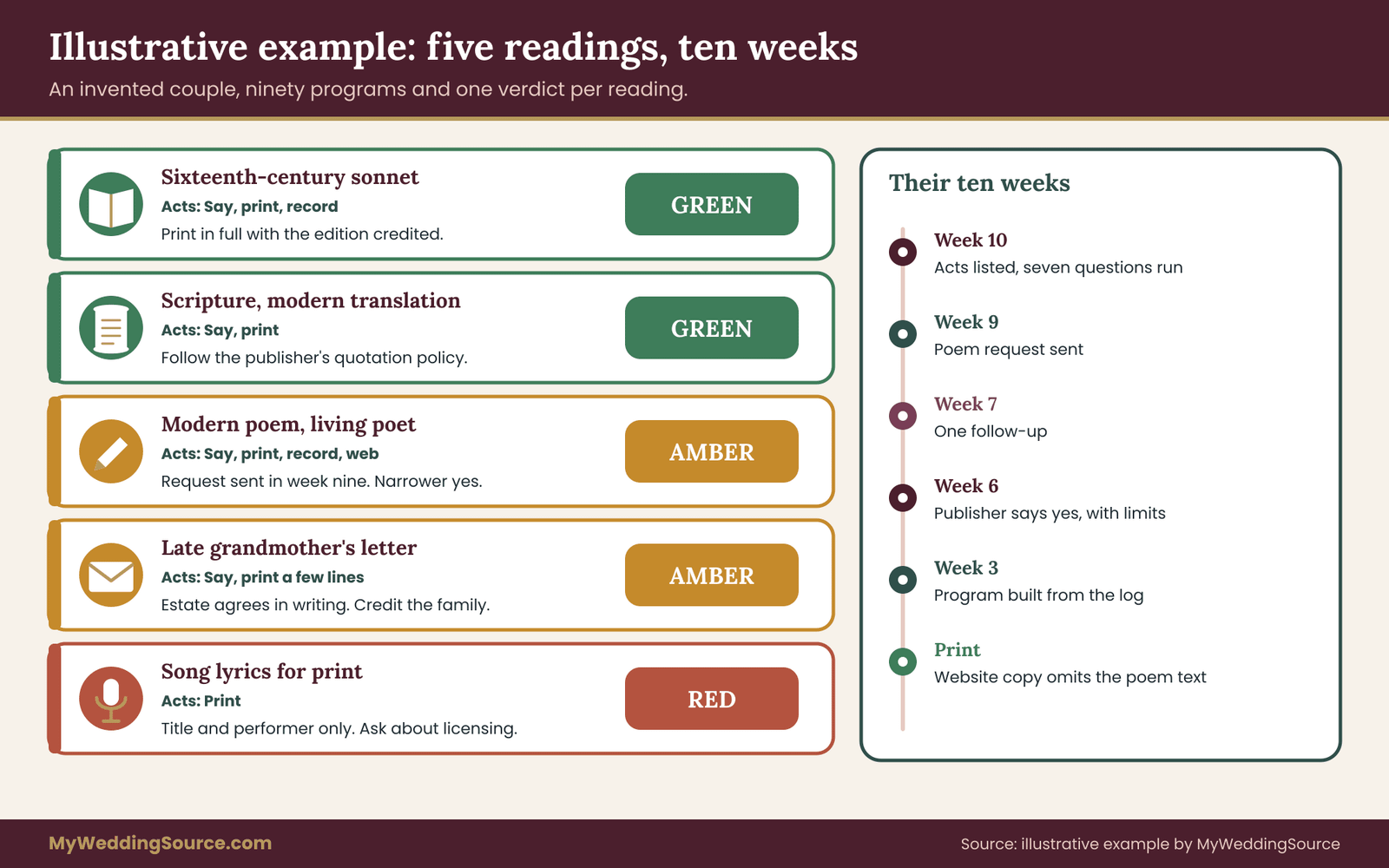
An invented example makes the method concrete. Mara and Tomas, a fictional couple, are planning a ceremony for about ninety guests. Their programs will be printed in ninety copies, a videographer will film the ceremony and Mara plans to post the program on their wedding website. They have five readings on their shortlist. The facts below are illustrative, not real works or real owners.
Week ten: sorting the list
Mara opens a shared note and writes one line per reading, with the acts beside it, then runs the seven questions.
Reading one: a sixteenth-century sonnet. A friend will read it. Mara found it in a library’s digitized early edition. Source: public domain, clean edition. Acts: say, print, record. Result: green. Action: print the full text with a credit line naming the poet and the edition, and note the library page in the log.
Reading two: a scripture passage in a modern English translation. Tomas’s aunt will read it. Mara checks the translation’s front matter and finds a publisher quotation policy online that allows limited quotation with a notice line, up to a stated length. Her passage is within the stated limit. Result: green with conditions. Action: print the notice exactly as the publisher gives it, and save a copy of the policy page with the date. If the passage had been longer than the policy allows, the result would have been amber and a request would have followed.
Reading three: a contemporary poem, “Evening Harbor.” A college friend will read it. It comes from a poetry collection published recently. The poet’s publisher has a permissions page. Result: amber. Acts: say, print, record, web. Action: send a request that day.
Reading four: a letter from Tomas’s late grandmother. Tomas wants to read an excerpt, and to print a few lines. The writer’s estate is handled by Tomas’s uncle. Result: amber, and easy. Action: Tomas calls his uncle and then sends a short written note to confirm.
Reading five: lyrics from a song they love. Mara hoped to print all the lyrics. The music publisher’s license process is slow and the fee is uncertain. Result: red for print. Action: print only the title and performer, and ask the musician who is performing the song about licensing separately.
Weeks nine to four: requests and replies
Mara sends the request for “Evening Harbor” in week nine, listing the acts, the ninety copies, the credit line and the date the program goes to print. In week seven she has no reply, so she sends one polite follow-up. In week six the publisher answers: printing in the program and reading aloud are fine with a given credit line and a modest fee; posting the full text on a public website is not included; the videographer’s private ceremony film is fine, but the film may not be posted publicly with the poem in it.
Mara weighs the fee against alternatives. The fee is small compared with the printing budget, the poem matters to her friend and the limits are workable. She accepts, pays and saves the email and the receipt in her reading permission folder.
Tomas’s uncle replies within a day and says the family is glad to share the letter, and that a credit line saying “from a letter by his grandmother” is welcome. Tomas asks him to reply in writing, and he does so in one line.
Weeks three to one: assembling the program
Mara builds the program from the log. Reading one appears in full with its edition credit. Reading two appears with the publisher’s notice. Reading three appears in full with the publisher’s required credit line and “Used with permission.” Reading four appears as a few lines with the family credit. Reading five appears as title and performer only.
For the website, Mara posts a version of the program that lists all five readings and readers but removes the full text of reading three, as the reading permission requires. She keeps the full program for the printed copies.
She tells the videographer that the film can be shared privately, and that the public highlight clip should skip the poem. The videographer notes it in the shot list.
What the example shows
Notice what saved time. The acts were written down in week ten, so the request was complete on the first try. The log held the answers, so no one had to search an inbox. The red reading got a clean fallback instead of a scramble. And the reading permission that came back was narrower than the request, which is normal; the plan simply adapted.
Notice, too, what the couple did not do. They did not ask for reading permission for the sonnet, because it did not need it. They did not treat the scripture passage as free just because the book is old. They did not assume the poet’s web post was a license. And they did not wait for the song publisher before deciding what to print.
Alternatives when reading permission is slow, costly or refused
Sometimes the answer is no, the fee is high or the timeline is hopeless. You still have good options, and several of them are better than the first idea.
Replace the reading. Choose a public domain text with a similar feeling. Read both aloud and pick the one that sounds like you. Old poems, old prose and many sacred texts fit most themes, and a different century can add depth.
Print only the title and author. The ceremony reading stays, the program honors it by name and the guests who want the words can look them up. This is the lowest-effort fix, and it respects the writer.
Say it aloud but do not print. If the owner agrees to a spoken reading but not print, keep it in the ceremony. A reader can speak from the book, and the program stays light.
Describe it instead of quoting it. A line such as “A poem about arriving home, read by a friend” tells the guests what is coming. You can write that description in your own words, and descriptions of a work are not copies of it.
Commission or write an original. A friend who writes, or a local poet, can create a reading for your ceremony. Agree in writing what the friend allows: print, record, web and whether the friend may reuse it. Pay or thank the writer, as you would any vendor.
Use an open-licensed text. Search for texts released under licenses that allow your use, and follow the terms. This is a growing source, and the license does the permission work in advance.
Ask for a narrower yes. If the full request is refused, a narrower request may succeed: one stanza, a one-day license, a spoken use only.

Comparing the alternatives in plain terms
Time is the first measure. Replacing a reading with a public domain text and printing title-only take no waiting. A commissioned original takes the writer’s time. A narrower request takes another round of email.
Cost is the second. Public domain choices and title-only listings are free. A commissioned reading is a fee or a gift. A reading permission fee is a known amount if the owner states it. Compare fees with the whole program budget, not with the price of one page.
Emotional fit is the third, and it deserves honest attention. A reading chosen for one particular line will not survive replacement by a generic one. If one line is the whole point, ask the owner for that line, or let the reader say it and print the title only. If the poem was a family favorite, say so in the request; owners respond to sincerity.
When a friend’s original reading is the best answer
A reading written by someone who loves you often lands better than any anthology piece. It has no owner to find and no fee. It still deserves a short written agreement, because misunderstandings are most likely between friends. The note can be three lines: the friend wrote this text, the couple may read it and print it for the wedding, and the friend keeps the rights. Both sign by replying yes.
Keep your backup warm
At every stage, have one alternative ready for each amber reading. The backup may never be used, but its existence removes the pressure. Pressure is what pushes couples to print without clearing, and printing without clearing is the one move this guide asks you not to make.
Edge cases that trip couples up
Real planning produces odd situations. The cases below come up often enough to prepare for.
Changing pronouns or words
Swapping “he” for “she,” changing “husband” to “spouse” or substituting names is an adaptation. For public domain texts, edit freely and say “adapted.” For protected texts, ask; many owners agree to simple changes and some do not. If the change matters to your ceremony, say so in the request and let the owner respond.
Shortening a long text
Cutting a passage for time is an edit, and the same rule applies. A public domain text can be trimmed. A protected text needs the owner’s agreement on the version you will use, not only on the original.
A reading from someone’s own copy
A reader may bring a favorite book to the lectern. Reading from the book is the act of saying. It does not prove you may photocopy the pages. If the reader’s book is also the source of printed text, the reading permission is still needed for the print.
Readings by a performer or at a ticketed event
A reading by a hired performer, or a ceremony open to the public or sold as a ticketed event, changes the picture. Public performance rules treat public settings differently from private gatherings, and a performer may carry their own responsibilities. Raise it with the owner in your request, and ask the performer what they usually do.
Venues, houses of worship and officiants
Some venues and houses of worship have printing rules, reading lists or standing licenses of their own. A congregation may already license a hymnal, a lectionary or a set of readings, and it may have a policy on printed programs. Ask them early, since their answer can save a request. Your officiant requirements conversation is a natural place to ask, and the officiant can tell you which readings the ceremony will accept at all.
Shared documents and group planning
Group notes with ten editors lose track of who asked what. Assign one keeper for the reading permission log and give others read-only access. Copy final texts into the master file once cleared, and do not edit them in the shared note.
Readings that mention living people
A text that names a living person, or reveals private information, raises a privacy matter alongside the copyright matter. Check that the person is comfortable with the program and the recording, and that the text will not embarrass them. That is a courtesy, not a legal rule, and it is worth the extra minute.
Keeping proof: the reading permission log and vendor questions
The third part of the method is Proof. A reading permission you cannot find is almost as weak as one you never had. The reading permission log takes minutes to set up and pays off in every later conversation.
What the log holds
Keep one folder called “Reading permission,” and in it one subfolder per reading. Each subfolder holds four things: the text exactly as you will print it, the source note (author, date, edition), the correspondence (your request and the owner’s reply) and any receipt or signed form. Name files with the date and the reading, for example “2026-09-14 Evening Harbor request.”
On top of the folders, keep a one-page summary with one line per reading: the title, the reader, the acts planned, the rung, the owner, the date asked, the answer, the limits and the exact credit line. This summary is what you hand to the printer, the officiant and the videographer. They do not need your email threads, only the answer and the limits.
Save web pages that matter. If a license page or a publisher’s quotation policy justifies a reading, save a copy or a dated screenshot, since pages change. If an email contains the reading permission, forward it to a mailbox both partners can reach, so it does not live in one person’s account.
How long to keep it
Keep the log at least as long as the programs and any recordings exist, and ideally for as long as the website is up. If you post the program or the film again later, the log tells you what the reading permission allowed. A reasonable habit is to review it on your first anniversary and decide what to keep, the same way you would review other records from the wedding.
Questions to ask your vendors
Each vendor handles one or two of the five acts, so each gets a short question. Put the answers in writing.
Printer or print service. “Do your terms require me to confirm I have the right to print the text? Will you keep proofs or files after the job?” The printer is not responsible for clearing text, but their terms may put the responsibility on you.
Videographer. “Does our contract let us share the film publicly? If a reading is cleared for private use only, how would you edit a public highlight clip?” Check the delivery and sharing sections of the contract too, but the question here is simple and can be asked in one message.
Officiant. “Are there content limits for readings? Do you or your organization have a standing license for printed orders of service?” The officiant may also tell you about readings that other couples used without trouble.
Planner or coordinator. “Who will send and track the requests? May you speak on our behalf?” Settle this before any message goes out.
Venue or house of worship. “Do you have printing rules or a licensing arrangement for programs and readings?” Ask only if the venue prints programs or hosts public services.
Website builder or app. “Does the platform let us restrict a page to invited guests? Can we remove content by a given date?” A password-protected page is a simple way to keep a program private.
Scripts for hard conversations
Sometimes you need to tell a relative that a beloved reading cannot be printed. A calm version is: “We asked the publisher, and they allow it to be read but not printed. We will read it aloud and list the title in the program.” Most people accept that without argument, because the decision is the publisher’s.
If someone insists on including a text without permission, you can say: “We want to be careful about printed text, so we are using only what is cleared. If you would like to send a request yourself, we are happy to wait for the answer.” That puts the effort with the person who wants the change and keeps the relationship intact.
If a rights holder objects later
It is rare, and the calm response is simple. Answer promptly and politely. Do not argue the law in your first message. Ask what they would like done, and consider taking the material down while you sort it out.
Keep your log in reach, and share what you were told and when. If the message is a formal legal demand, or if money is mentioned, a short consultation with a lawyer who handles copyright is wise, and the Copyright Claims Board, a small claims venue within the Copyright Office, is worth reading about so that you understand your options. Most of this guide exists so that you never have to read that page.
After the wedding
Reuse is a new use. Putting the program in a keepsake book, posting the film on a public video site for the anniversary or selling prints are not covered by a reading permission written for the ceremony. Read your log before you start. For personal keepsakes kept at home, the risk is low. For public posting, check the limits first.
The wedding ceremony step by step guide is the right companion if you are still shaping where readings fall in the order of events, and the choices there decide how many programs, and how much text, you will need to clear.
Your next steps
Work through these in order, and do them this week if your print date is within three months.
- List every reading and the acts. One line each: title, reader, say, print, show, record, change.
- Place each on the ladder. Author, first publication date and edition for every line. Fix the unknowns first.
- Run the decision list. Mark each reading green, amber or red, and write why.
- Send a reading permission request for every amber reading. One sender, one template, the date you need an answer.
- Choose a backup for each amber and red reading. Prefer public domain or original text, and read them aloud once.
- Decide print level. Title only, short excerpt or full text, according to the answers you have.
- Build the reading permission log. One folder, one summary page, saved permissions and credit lines.
- Brief your vendors. Send the printer final text, the videographer the limits and the officiant the summary.
- Proofread the credit lines. Match them letter for letter to the owner’s wording.
- Set a calendar date for follow-ups. Two weeks after each request, and the day the program goes to print.
FAQ
Do I need reading permission to read a poem aloud at my wedding?
For a private ceremony with family and friends, reading aloud is the act least likely to raise a question, and many owners treat it as ordinary. It can differ for public or ticketed events and for places of worship, and recording the ceremony adds another use. If a poem is central to your ceremony, a one-line request costs little and removes doubt.
Is it okay to print one line of a poem in my program?
Maybe, but do not assume so. U.S. fair use is decided case by case by weighing factors, and no word count makes a use automatically safe. For a protected modern poem, the careful route is to ask the owner. For a public domain poem, print as much as you like, with a credit line naming the edition.
How do I know whether a poem is in the public domain?
Find the author, the first publication date and the edition. In the United States, older works are more likely to be free, but terms depend on publication date and other facts, so check the Copyright Office guidance and the public domain charts. Remember that a modern translation or edited edition can carry its own protection, even when the original words are free.
Does a Bible verse need reading permission?
The original text is ancient, but English translations differ. Some are public domain and others are protected, with publishers posting quotation guidelines that allow limited use with a notice line. Check the exact translation you use, follow the publisher’s policy for programs and ask your officiant which version the ceremony uses.
Can I post my wedding program with the readings on my website?
Only if the text is public domain, openly licensed or covered by a reading permission that mentions web use. A program is public once it is posted and easy to copy. If your reading permission covers print only, post a version that lists each reading and reader without the full text, or protect the page with a password for invited guests.
What if the owner never answers my request?
Silence is not reading permission. Send one polite follow-up after about two weeks, try another route such as an agent or another department, and then use your backup. Keep the reading in the ceremony if you wish, but print only the title and author. Never print protected text because no one said no.
Do I need reading permission to translate a reading for a bilingual program?
For a protected text, yes. A translation is an adaptation, and the right to make one belongs to the owner, so ask for reading permission to translate and say who will do it. For a public domain text, you may translate it or use an existing free translation, and a friend’s new translation needs only the friend’s written okay.
Is this legal advice, and who should I ask if I am unsure?
No, it is general information to help you plan and ask good questions. For a specific text, ask the owner or publisher. For a legal question, such as a demand letter, a large public event or an unclear license, a lawyer who handles copyright can advise on your facts. The Copyright Office also publishes plain-language circulars on common questions.
Sources
- U.S. Copyright Office
- U.S. Copyright Office, Fair Use
- U.S. Copyright Office, Circulars and Informational Publications
- U.S. Copyright Office, Copyright Law of the United States (Title 17)
- U.S. Copyright Office, Public Records System
- Copyright Claims Board
- Library of Congress
- Cornell University Copyright Information Center
- Creative Commons, About the Licenses
- World Intellectual Property Organization