
A home improvement fund on a wedding registry lets guests contribute toward repairs, upgrades or renovations in the home you already share or are about to buy. This guide covers how to decide whether one fits you, how to set the amount and keep it transparent, how to word it without pressure, and what to do with the money once it arrives.
Add a home improvement fund only if you can name the project, the rough cost and who will do the work. Write a short fund statement that says what the money is for, how contributions are tracked, what fees apply, and what happens if the home improvement fund goes over or under the target. Keep the wording invitational, keep a few traditional gift options on the registry, and post a short spending update when the work is done.
Most registry advice assumes a couple starting from an empty apartment. Plenty of couples are not. They already own a toaster, a set of towels and a mismatched collection of plates. What they do not have is a working water heater, a bathroom that does not leak, or a budget to fix the roof over the kitchen. For those couples, a registry full of dinnerware misses the point, and a home improvement fund can make more sense.
It also carries risks that a stand mixer never does. Money is more personal than a mixer. Guests may wonder where it goes. Relatives may have opinions about your house. A contractor may take longer than planned, or the quote may change after the demolition starts. A fund that looked tidy on the registry page can become awkward fast if nobody explained it clearly.
This article is built around one idea: fund transparency. You do not owe anyone a gift, and guests do not owe you an accounting. But a few plain facts, stated early and kept current, remove nearly all of the friction. The sections below give you a readiness test, a scope ladder for choosing the project, a one-page fund statement, questions for the platform that holds the money, wording you can copy, a ledger for tracking, and a plan for edge cases.
A note on scope. This is general information, not legal, tax or financial advice. Gift tax rules, contractor licensing, permit requirements and platform terms differ by state, by provider and over time, so where a rule matters the article points to the agency or provider who sets it. For a broader look at what else belongs on a registry, see the wedding registry ideas guide on this site.
What a home improvement fund is, and what it is not
A home improvement fund is a registry item that accepts money, from many guests in amounts they choose, toward work on a home. The home may be one you own, one you are buying, or in some cases one you rent with the landlord’s permission. The fund can be as narrow as “a new water heater” or as wide as “repairs and updates to our first house.” The narrower the label, the easier it is to explain and the easier it is to close out.
It helps to separate this from four things it is often confused with.
It is not a down payment fund. A down payment fund asks guests to help you buy a home. A home improvement fund assumes the home exists, or is about to. The difference matters to guests, who often feel more comfortable giving toward a concrete repair than toward a mortgage. It also matters for your records, because the money has a specific job.
It is not a general cash gift request. Cash gifts handed over in cards are a long tradition and need no explanation. A fund on a registry page is a public request with a label attached, so it needs a little more framing. This guide is about the named fund that guests can see and choose.
It is not a honeymoon fund with a different name. A honeymoon fund pays for an experience that ends. A home improvement fund pays for something that stays, which changes how guests think about it and how you should report on it afterward.
It is not a crowdfunding campaign. A campaign asks strangers to back a goal, often with a public deadline and a progress bar designed to create urgency. A registry fund is offered to people who already know you, quietly, as one choice among several. The tone should match.
The shapes a fund can take
Home improvement funds usually come in three shapes, and picking the right one up front saves a lot of rewriting.
The single-project fund is tied to one job, such as replacing a furnace or refinishing floors. It has a clear target and a clear end. Guests like it because they can picture the result.
The tiered fund lists two or three jobs in priority order, such as a safety repair first, a comfort upgrade second and a cosmetic project third. It lets the home improvement fund succeed at several levels. It is the version this guide recommends for most couples, and the scope ladder later explains how to build it.
The open fund is labeled something like “Home projects” with no named job. It offers the most flexibility to you and the least clarity to guests. If you choose it, the fund statement matters even more, because the label alone tells guests very little.
Why couples consider a home improvement fund
There are good reasons, and it is worth being honest with yourselves about which ones apply.
Some couples have simply outgrown the idea of more household goods. If both partners lived on their own before the wedding, a registry of things you already own forces you to choose items you do not need. A fund directs generosity toward something you actually lack.
Some couples bought a home right before or after the engagement, and the repairs are the first thing that competes with the wedding for money. A fund can soften that tension, since you are asking for help with something real.
Some couples have older relatives who live far away and want to give something that does not need to be shipped. A contribution through a fund, a card or a check in the mail is easier for them than a boxed set of cookware.
And some couples want to avoid the pile of returns that a traditional registry creates. If you want help thinking about the after-wedding side of gifts, a guide on keeping wedding records after the event covers how to keep gift records, thank-you notes and receipts organized.
Reasons to pause
There are also honest reasons to hold off. If you do not yet know what repairs the house needs, or how a home improvement fund fits your overall wedding budget, a fund is premature. If you are still waiting on an inspection, an estimate or a decision about whether to renovate at all, wait. A fund with no plan behind it reads as a request for cash, and guests can tell.
If your family or community expects gifts in kind, a home improvement fund may land badly unless you pair it with a few traditional items. If you plan to use the money for something other than what the page says, do not publish the page. The fund label is a promise, even an informal one, and the rest of this guide assumes you intend to keep it.
The readiness test: five questions before you add a fund
Before you set up anything, answer five questions in writing. They take about twenty minutes together and they prevent most of the problems covered later.
1. Can we name the project in one sentence? “Replace the failing water heater and repair the bathroom subfloor” passes. “Fix up the house” does not. If the sentence runs long, you probably have two or three projects, and a tiered fund will serve you better than a single one.
2. Do we have at least one real estimate? One written estimate from a licensed contractor, or a plain parts-and-labor list if you plan to do the work yourselves, gives the fund a number you can defend. It does not need to be final. It needs to exist.
3. Who is doing the work, and when? A fund for a project that will not start for two years raises a fair question about where the money sits in the meantime. A project scheduled for the first six months after the wedding is easy to explain.
4. Are we prepared if the home improvement fund raises nothing? Assume some guests will give nothing to the fund and buy a gift from the traditional side of the registry or bring a card. Assume a few will give generously. Decide now how the project proceeds under each outcome, so the home improvement fund is a help and not a dependency.
5. Are we comfortable reporting back? Not to every guest individually, but through a short note on your wedding website or in thank-you messages. If the thought of showing how the money was used makes you uneasy, that is useful information about whether the fund is right.
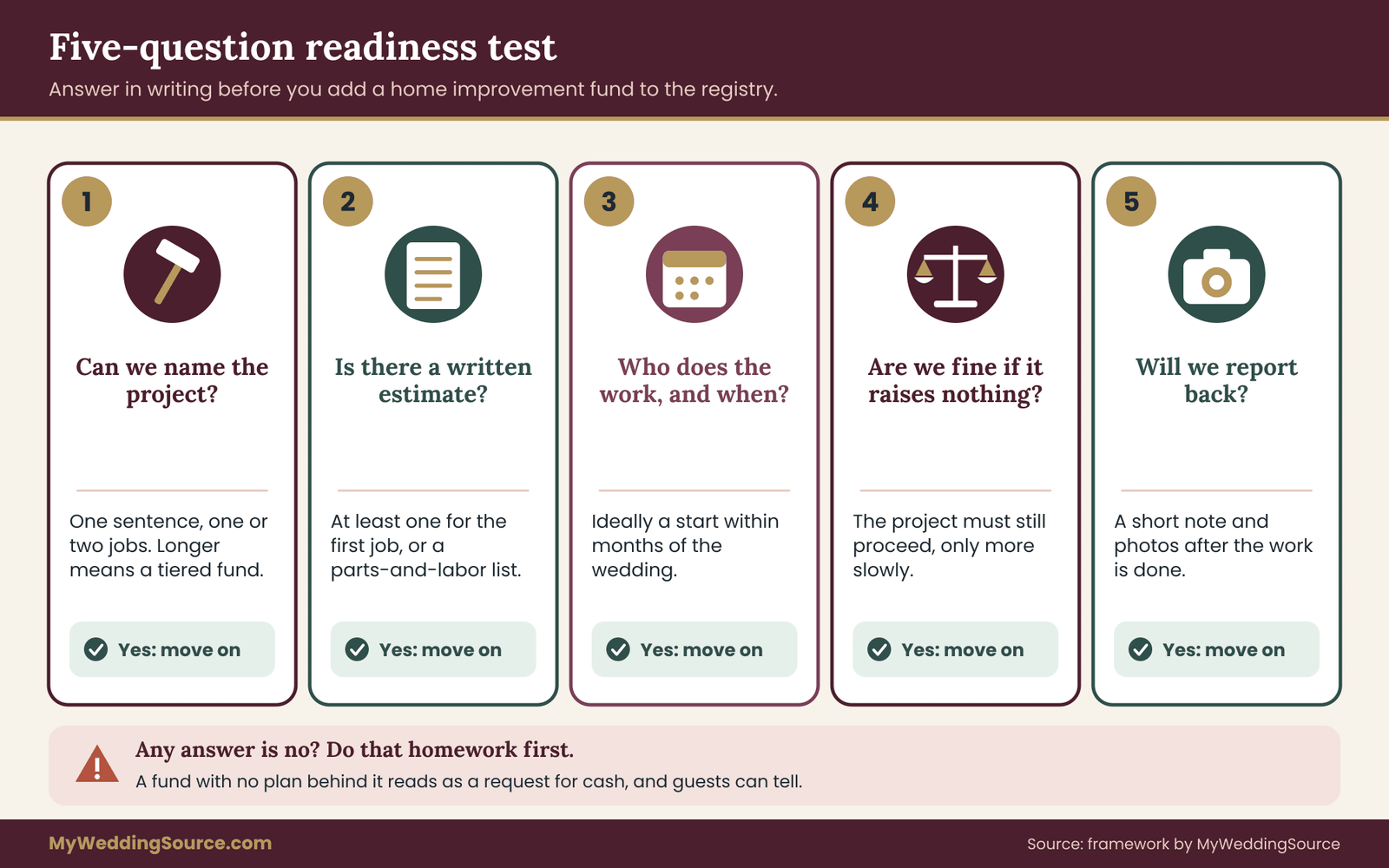
If you answered yes to all five, move on to scoping. If you answered no to one or two, the answer is usually to do a little more homework, not to give up the idea. The next section shows how to convert a vague wish for “house money” into a project list with numbers behind it.
Scoping the home improvement fund with a three-rung ladder
The hardest part of a home improvement fund is not the registry software. It is deciding what the home improvement fund is for and how much to ask. Couples tend to make one of two mistakes. Either they name a number that matches their whole renovation wish list, which looks like a request for far more than guests expect to give, or they name nothing and let the home improvement fund float.
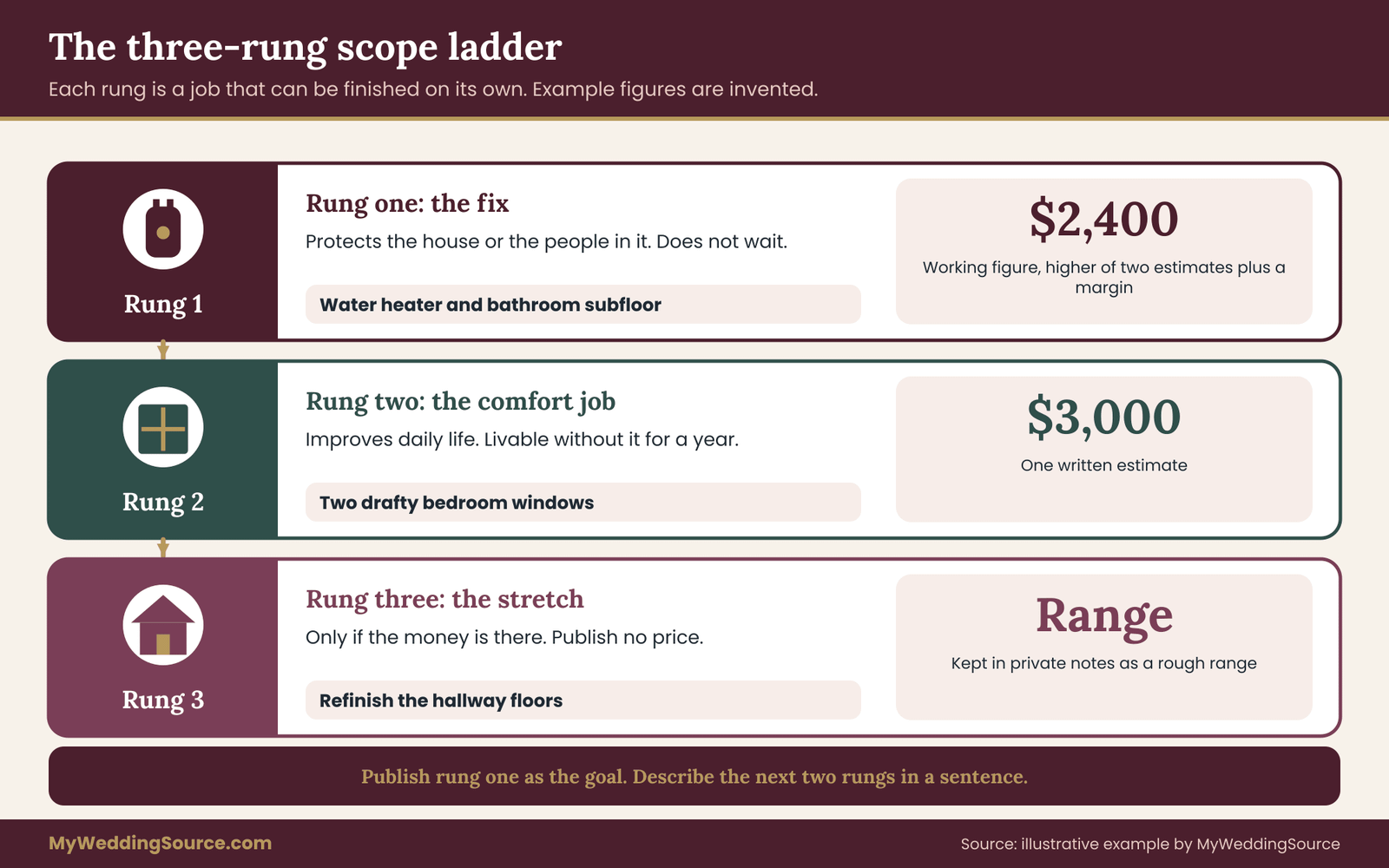
A scope ladder fixes both. It has three rungs, and each rung is a job you could complete on its own.
Rung one: the fix. This is the repair that protects the house or the people in it. A water heater at the end of its life, a roof leak, a failing electrical panel, a broken furnace, a bathroom subfloor that has gone soft. If nothing else on the list gets done, this one still must. Guests understand this rung immediately because it answers the question “what happens if you do not do it?”
Rung two: the comfort job. This improves daily life but is not an emergency. New windows in a drafty bedroom, a replacement bathroom vanity, a better kitchen faucet, insulation in the attic, a dishwasher that actually cleans. You can live without it for a year, and you would rather not.
Rung three: the stretch. This is the project you would love to do and will do only if the money is there. Refinishing hardwood floors, a new tile backsplash, a fence, a patio. It is the part of the plan that makes people smile.
Why three rungs work better than one big number
A single target forces an all-or-nothing frame. If the home improvement fund asks for the full cost of a renovation and raises half, the couple either looks like they missed their goal or has to explain a half-finished plan. With three rungs, any outcome has a natural landing place. Raise enough for rung one, and the fix is funded. Raise more, and rung two opens. The page can say so honestly: “The first goal covers the water heater. Anything beyond that goes toward the bathroom.”
It also helps guests. Someone who wants to give fifty dollars can see that fifty dollars is a real piece of the first rung. Someone who wants to give much more can see where it would go. Nobody has to guess whether a small gift matters, because the structure makes clear that it does.
Pricing each rung without inventing numbers
Do not copy a price from an article, including this one. Prices vary by region, by season, by the age of the house and by the contractor. Instead, price each rung from sources you can show.
For rung one, get at least two written estimates if the job is more than a minor repair. Compare the scope in each, not just the totals, since one estimate might include permits and disposal of old materials while the other leaves them out. Note which items are labor and which are materials.
For rung two, a single estimate or a materials list is enough. If you plan to do part of the work yourselves, say so in your private notes, and be realistic about tools, time and any rental costs.
For rung three, a rough range is fine. Label it as a range in your own notes and do not publish it as a precise figure.
Add a contingency line to your private plan for rung one. Work in older homes often turns up something unexpected once a wall or floor is open. Many contractors recommend setting aside some margin, and the size depends on the age and condition of the house. Ask your contractor what margin makes sense for this specific job, and write the answer down.
Worked example: an illustrative couple
To make this concrete, here is an invented example. The numbers are illustrations only, chosen to be easy to follow. They are not averages, and they are not what any job costs where you live.
Imagine a couple, Dana and Marcus, who bought a 1960s ranch house three months before their wedding. The inspection report flagged an aging water heater and soft flooring around the shower. They are happy with the kitchen but would like to replace two drafty bedroom windows eventually.
Their ladder looks like this:
- Rung one, the fix: water heater replacement and bathroom subfloor repair. Two written estimates came in close to each other. They use the higher one as the working figure, plus a margin their contractor suggested. Working figure: $2,400 (illustrative).
- Rung two, the comfort job: replace the two bedroom windows. One estimate. Working figure: $3,000 (illustrative).
- Rung three, the stretch: refinish the hallway floors. Rough range only, so they publish no figure.
On the registry, they do not list a single $5,400 goal. They list the home improvement fund as “Home repairs: water heater and bathroom floor first,” show the first rung as the goal, and describe the next two in a sentence. If the home improvement fund reaches $2,400 net of fees, rung one is done.
They decide in advance that anything beyond that goes to the windows, and anything beyond the windows goes to the floors, or to their emergency reserve if they would rather not stretch the project. That last decision, written down before any money arrives, is the heart of transparency.
The fund statement: five lines that remove most of the awkwardness
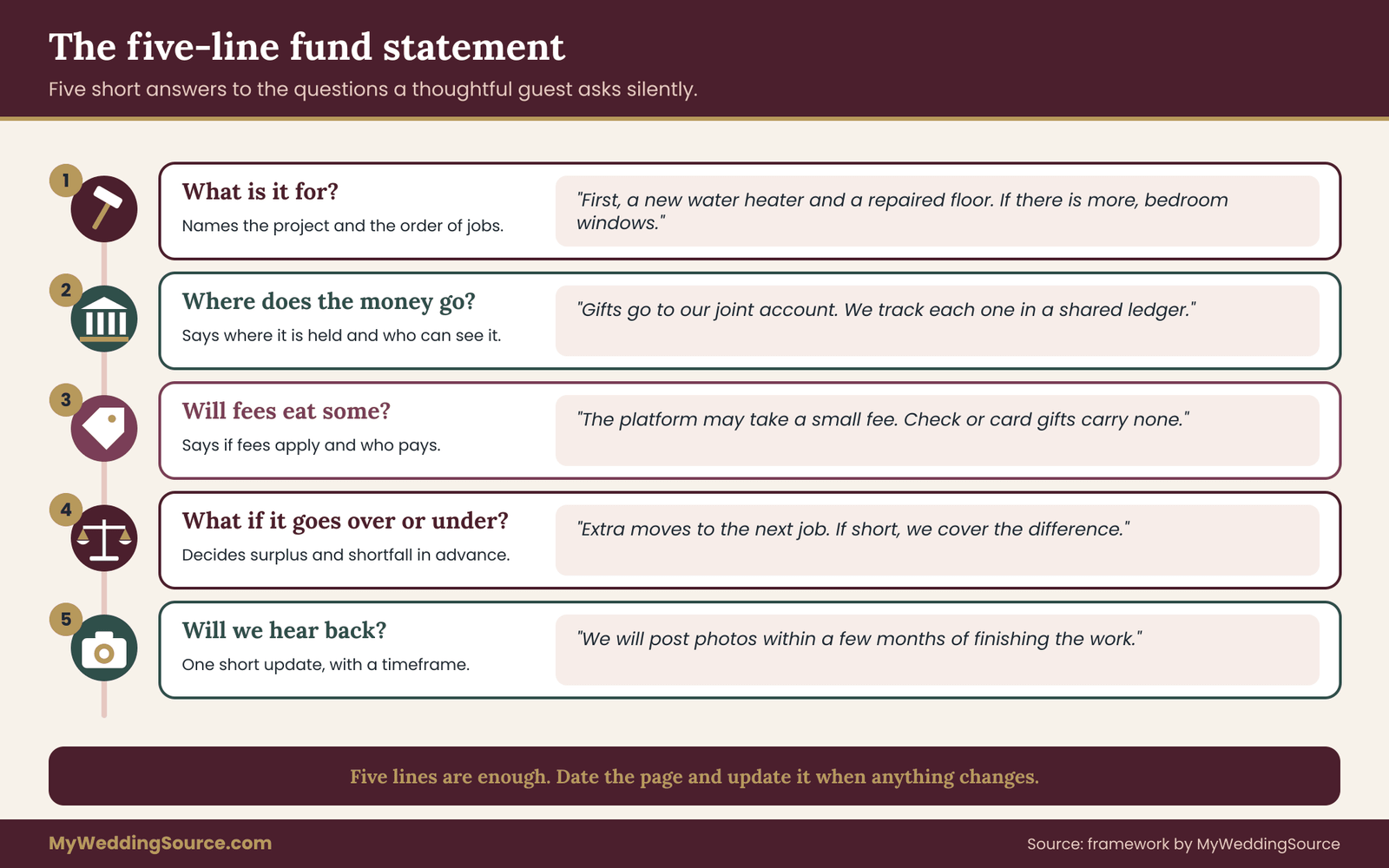
Once you have a ladder, you need to say it to guests in a way that is short, plain and complete. A fund statement is a one-page note, or a short block of text on your registry page, that answers the questions guests actually have. It has five lines. Each line is a sentence or two.
Line one: what the home improvement fund is for. Name the project and the rung order. “This fund goes toward repairs to our first house. First, a new water heater and a repaired bathroom floor. If there is more, new bedroom windows.”
Line two: how the money is held and tracked. Say where contributions go and who can see them. “Contributions go through our registry account to our joint checking account. We track each one in a shared ledger.”
Line three: what fees apply. If the platform takes a fee and you cannot absorb it, say that guests may see it, and who pays. The next part of this guide covers how to find out.
Line four: what happens if the home improvement fund goes over or under. “If the home improvement fund passes the goal, the extra goes to the next project on the list. If it falls short, we will cover the difference ourselves.”
Line five: how and when we will report back. “We will post a short photo update on our website within a few months of finishing the work, and we will mention the fund in each thank-you note.”
How the five lines fit together
Read the five lines in order and you will notice they follow the questions a thoughtful guest asks silently. What is this for? Where does my money go? Will something eat part of it? What if it does not work out? Will I ever hear about it? A fund that answers all five does not need to explain itself again in person. A guest who wants to give can do so without asking, and a guest who wants to give something else can do that, too.
The statement is not a legal document and it does not create a formal obligation. It is a courtesy. But because it is written down and public, treat it as a commitment you intend to keep, the same way you would treat any other plan you shared with people who helped you.
Keep it short and keep it current
Resist the urge to explain your whole financial situation. Guests do not need your mortgage balance or a description of how tight money has been. Five lines are enough. If something changes, for example the water heater fails earlier than expected and you replace it before the wedding, update the statement quickly instead of letting the page go stale. A fund page that describes a project you have already finished invites exactly the questions you were trying to avoid.
Put the date of the last update at the bottom in small type. It tells guests the page is maintained, and it reminds you to maintain it.
Where the home improvement fund lives: questions for the platform
A home improvement fund needs a place to receive money. Couples usually choose among four options, and each has a different mix of convenience, cost and control.
A registry platform with a cash or fund feature. Many registry sites let you add a custom fund item. Guests pay by card, the site collects the money, and you withdraw it to a bank account. This is the most common route and the easiest for guests, but fees and payout rules vary by provider.
A payment app or a joint bank account. You give guests a handle or an account link on your wedding website. There is usually no registry-style progress bar, and you have to explain the purpose in your own words. Fees, if any, depend on the app and the type of payment.
Checks and cards at the wedding or by mail. No platform fees at all, but you carry the tracking burden and have to bring cards home safely. Older guests often prefer this.
Item-level gifts from a home improvement retailer. Some stores let you register for tools, paint, smoke and carbon monoxide alarms, light fixtures or gift cards. Guests give a physical or store-credit gift instead of money. It is not a home improvement fund, but it covers part of the same need.
Most couples end up combining two of these. A registry fund for guests who like online giving, and a mailing address or a card box for everyone else. That is a good pattern, because it means no guest has to use a channel they dislike.
Ten questions to ask before you open a fund
Before you create a home improvement fund on any platform, read its current terms and fee page and answer these questions from the text. If the terms are unclear, ask the provider’s support team in writing and keep the reply. Terms change, so check again if more than a few months pass between setup and the wedding.
- Who actually holds the money, and for how long? Some platforms hold contributions until you request a payout. Others transfer automatically on a schedule. You want to know the schedule, the minimum payout and any holding period.
- What does the platform charge, and who pays? Look for a percentage, a flat fee per contribution, or both. Find out whether the fee is deducted from the contribution, added to the guest’s total at checkout, or billed to you.
- Is there a separate card-processing charge? Some platforms list a platform fee and a separate processing fee. Add them together before you draw any conclusions.
- Can we name and describe the home improvement fund freely? The label “Water heater and bathroom floor” is more useful than “Cash fund,” and a few platforms limit the text.
- Can a guest see the fee before they pay? If the answer is yes, your fund statement can say so. If the answer is no, say in your statement that fees may reduce the amount you receive.
- What happens to a contribution if the home improvement fund is closed or the account is deleted? You want a clear refund or payout path.
- How are refunds and disputed payments handled? A guest might contribute twice by mistake. A card might be disputed. Know who resolves it.
- Does the platform report payments to tax authorities, and what do we receive? Ask, and then ask a tax professional what it means for you. Do not assume.
- Can we export a contributor list with dates and amounts? You will need this for thank-you notes and the ledger described later.
- How do guests who want to stay anonymous give? Some guests prefer that other guests not see their name or amount. Check the display settings and whether you can turn off the public list.
What to do with the answers
Write the answers in a few lines in your private notes, with the date you read the terms. That record is useful later if a fee turns out to be different than you expected, and it is a small piece of the documentation your future self will want. Keep it with your contracts and receipts.
If two platforms look equal, choose the one whose fee is easier to explain in a single sentence. A fee that needs a paragraph to describe is a fee guests will ask about.
A short decision rule for choosing the channel
Use the following rule of thumb, adjusting it to your own guests.
If most of your guests are comfortable with online payment and live in different places, use a registry platform fund as the main channel. If your guest list is local and older, offer a card box and a mailing address first, and treat the online fund as a secondary option. If you expect many small contributions, favor the channel with the lowest per-contribution fee. If you expect fewer, larger ones, favor the channel with the lowest percentage.
What fees do to a home improvement fund: a worked calculation
Fees are the most common source of quiet disappointment, and they are easy to model before they surprise you. The figures below are hypothetical. They are chosen to show how the structure works, not to describe any real provider. Replace them with the numbers from the fee page you read.
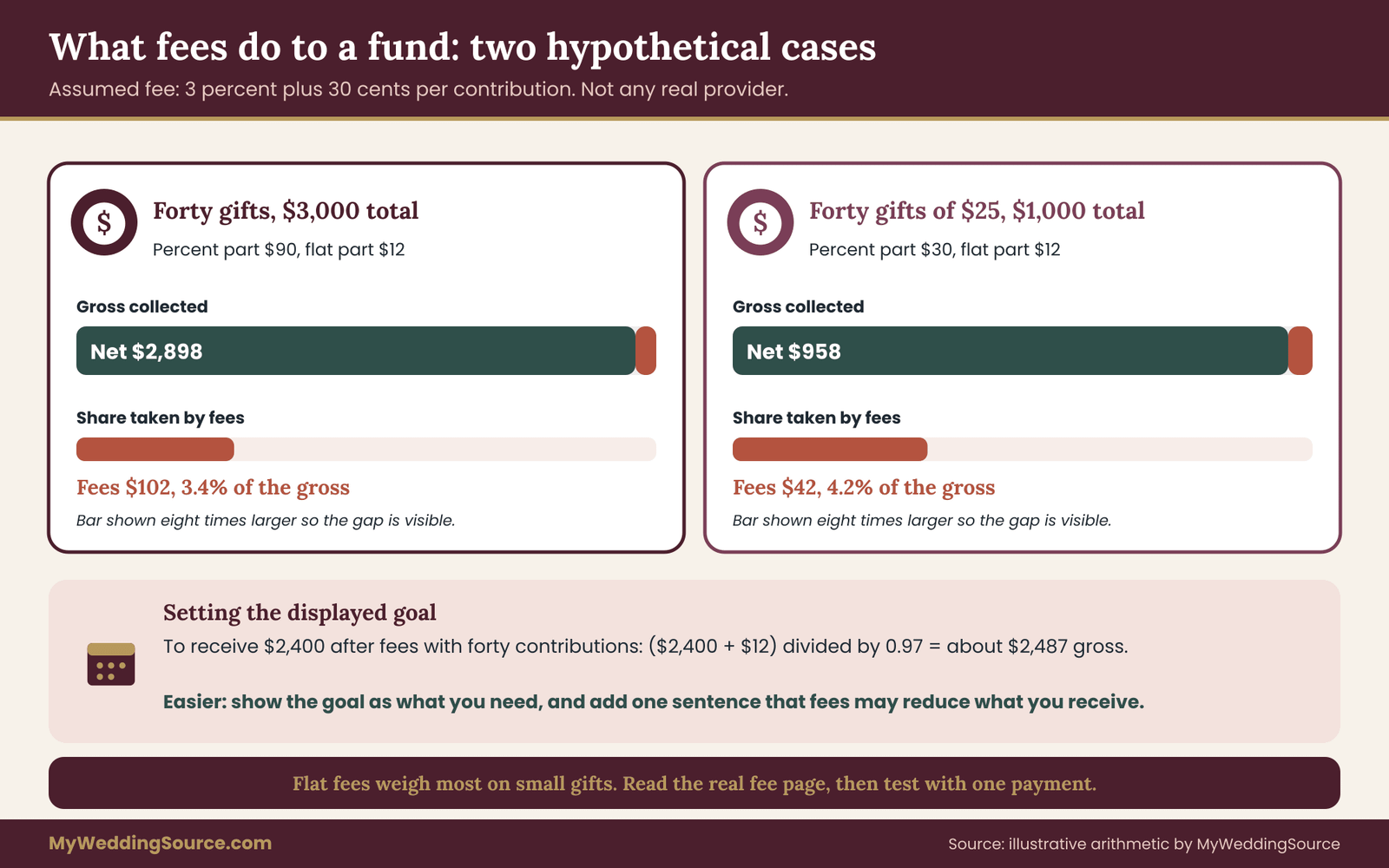
Suppose a platform charges 3 percent of each contribution plus 30 cents per contribution, and the couple’s first goal is $2,400 net, the amount they need in hand for rung one.
If forty guests contribute and the total is $3,000, the percentage part of the fee is $90. The flat part is forty times 30 cents, or $12. Total fees: $102. The couple receives $2,898. Their goal is met with some room to spare.
Now change one thing. Suppose the same forty guests each give $25, for a total of $1,000. The percentage part is $30, the flat part is still $12, and the total is $42. That is 4.2 percent of the gross, noticeably more than the headline 3 percent. The flat fee bites harder on small gifts.
Setting the displayed goal so the net matches the need
If you want the home improvement fund to deliver $2,400 after fees, the gross has to be higher. With the hypothetical fees above and forty contributions, solve for the gross G so that 97 percent of G, minus $12, equals $2,400. That gives a gross of about $2,487. You can display the goal as the net amount you need, or the gross amount guests must collectively reach. Which is better depends on how your platform displays the progress bar.
The simplest way to avoid confusion is to display the goal as what you need and add one sentence to the fund statement: “Platform fees may reduce what we receive slightly, so the home improvement fund total shown may be a little higher than what reaches us.” That is honest, short and covers the question.
Who should absorb the fee
You have three options.
Couple absorbs it. Guests give a clean amount and you receive slightly less. This is the most generous framing and the easiest to explain.
Guest pays it at checkout. Some platforms offer this setting. It protects your net, but guests see a charge on top of their gift, and some find that off-putting.
Split by channel. Use the platform fund for convenience, and invite guests who dislike fees to give by check or card at no cost to anyone.
There is no right answer. What matters is that the choice is deliberate and the page says what it is. If you cannot tell what your platform does by default, test it: place a small contribution yourself, or ask support, before you publish the page.
Keeping the fee in perspective
A fee of a few percent on a home improvement fund is a cost of convenience, and it is worth paying if the platform makes giving easy for your guests. It is not worth turning into a discussion. State it, absorb it or offer an alternative, and move on. The point of the home improvement fund is the repair, not the percentage.
If fees feel excessive for what the fund is meant to do, consider a lower-cost channel for the bulk of the money: a joint account link with a short note on your website, or a card box at the reception. A fund can be perfectly respectable with no platform at all.
Wording a home improvement fund so guests feel invited, not pressured
The wording around a home improvement fund does more work than the home improvement fund itself. The same project can read as a warm invitation or as a bill, depending on a handful of phrases. Because you cannot watch a guest read your page, you have to build the tone into the text.
Start with the principle that giving is optional and a guest who gives nothing to the home improvement fund has done nothing wrong. Everything else follows from that. The page should make it easy to give and easy not to, without drawing attention to either choice.
A five-test tone check
Read your draft aloud and ask five questions. If any answer is no, rewrite that sentence.
- Does it sound like you? If you would never say “we humbly request your generosity,” do not write it.
- Could a guest read it without feeling a deadline? Remove countdowns, “only X left to go” phrases and anything that implies time pressure. A progress bar that quietly shows the total is fine. A banner that flashes the gap is not.
- Does it avoid naming amounts per person? “A gift of any size helps” is invitational. “We hope each guest will give at least $50” is an assessment of what people owe.
- Does it leave room for other gifts? A sentence such as “If you would rather give something for the house, we have a few items on the registry too” tells guests they have choices.
- Would we be comfortable if the contributor list were visible to everyone? If not, hide it in the settings.
Copy-ready text for the registry page
Here are three versions of the short blurb on the fund item itself. Pick the one closest to your voice and edit it freely.
Plain and direct. “Our first house needs a new water heater and a repaired bathroom floor before anything else. Contributions to this home improvement fund go toward those two jobs first. Thank you for thinking of us.”
Warm and specific. “We bought a 1960s ranch house this spring and love it, and it also has a few surprises. The first is an old water heater. If you would like to help us replace it and fix the floor under the shower, this home improvement fund is how. We will post an update when the work is done.”
Light and short. “Home repair fund. First up: the water heater. Anything beyond that goes to new bedroom windows.”
All three share the same features. They name the job, they do not demand anything, and they say what will happen next. None uses the word “need” in a way that makes it sound like a failing.
Where not to put the request
Etiquette conventions suggest that registry details do not belong on the invitation itself, because an invitation says come celebrate, not bring something. The usual practice is to put the information on your wedding website, share it when asked, and let close family and the wedding party pass it along. The wedding invitation etiquette guide on this site covers where registry information fits and where it does not. A fund is no different from any other registry item on this point.
The same applies to a printed insert. If you must include something, keep it to a single line with a website address and no mention of money.
A contribution FAQ you can adapt for guests
Guests have questions they will not always ask out loud. A short contribution FAQ on your wedding website answers them in advance. Think of it as the guest-facing companion to your fund statement. Keep it to six to eight questions, in plain language, and update it if anything changes.
Here is a version you can adapt. Replace the details in brackets with your own.
What is the home improvement fund?
“It is a way to contribute toward repairs and updates to our home. We have listed the first project, a new water heater and a repaired bathroom floor, on the registry page.”
Do we have to give to the fund?
“No. Your presence is the gift we care most about. If you would like to give something, you can choose the home improvement fund, a registry item, or nothing at all.”
How much should we give?
“Whatever feels right to you. Any contribution helps, and there is no minimum or expected amount.”
Where does the money go?
“Contributions go through [platform] to our joint checking account. We use the money only for home repairs and updates on our list.”
Are there fees?
“[Platform] may take a small fee that we cover [or: that shows at checkout]. You can also give by check or card if you prefer, with no fee.”
What happens if the home improvement fund reaches the goal?
“Extra contributions move to the next project on our list. We will keep any remaining amount toward home maintenance.”
Will other guests see what I gave?
“No. We have turned off the public list [or: Your name appears but not the amount]. We will see the amounts so we can thank you properly.”
How will we know what you did with it?
“We will post a short update with photos on this page after the work is finished, and we will mention the fund in our thank-you notes.”
Why these questions, in this order
The order moves from the least threatening question to the most practical. The first two establish what the home improvement fund is and that it is optional. The next three deal with amount, destination and cost. The last three address the worries a thoughtful guest has about privacy, surplus and accountability.
Notice what the FAQ leaves out. It does not justify why you want money instead of items. It does not describe your finances. It does not argue against any objection. A short, calm answer to each question is more convincing than a defense.
Handling the awkward question in person
Sometimes an aunt or a coworker asks, in person, “Why money? Why not a toaster?” A kind and brief reply usually works. Something like: “We already have most of what we need for the kitchen, and the house needs a few repairs, so we thought this would be more useful. We are happy either way.” Then change the subject. Do not elaborate, and do not apologize.
If someone says they would rather give a gift, point them to the registry’s item list, or say “That is lovely, thank you,” and leave it there. Either choice is welcome, and you do not need to rank them out loud.
Let people who plan the shower help
If a family member or friend is hosting a shower, give them a one-sentence version of the home improvement fund and a link. Hosts get asked many registry questions and often answer from memory. A sentence in their hands prevents the fund being described as something it is not. For a broader view of how couples and families can share input without losing control of the plan, see the guide on wedding decision rights, which covers the same negotiation from a different angle.
Tracking every contribution to the home improvement fund
A transparent fund is mostly a bookkeeping habit. The habit is small, but it needs to start before the first contribution arrives, because trying to rebuild it later from emails and bank lines is tedious and error-prone.
Set up a simple ledger the day you publish the page. A spreadsheet or a notebook both work. What matters is that both partners can see and update it, and that it records the same few fields every time.
For each contribution, record the date, the giver’s name as you would write it on an envelope, the amount, the channel (platform, check, card, app), the platform fee if any, the net amount received, and whether a thank-you note has been sent. If a note or message came with the gift, keep a line of it so your thank-you can mention it.
Keep the money in its own place
Do not let fund money mingle with everyday spending. Open a labeled savings account, a sub-account within your joint account, or at least a clearly named bucket if your bank offers one. The purpose is not rigid control. It is to answer one question in ten seconds: how much of this balance came from the home improvement fund and how much is ours?
Mixing the two makes every later check harder. If the water heater invoice is paid from a joint checking account that also holds your paychecks, you can still reconcile it, but you must trace the payment manually. A separate place makes the arithmetic visible.
Five measurable checks
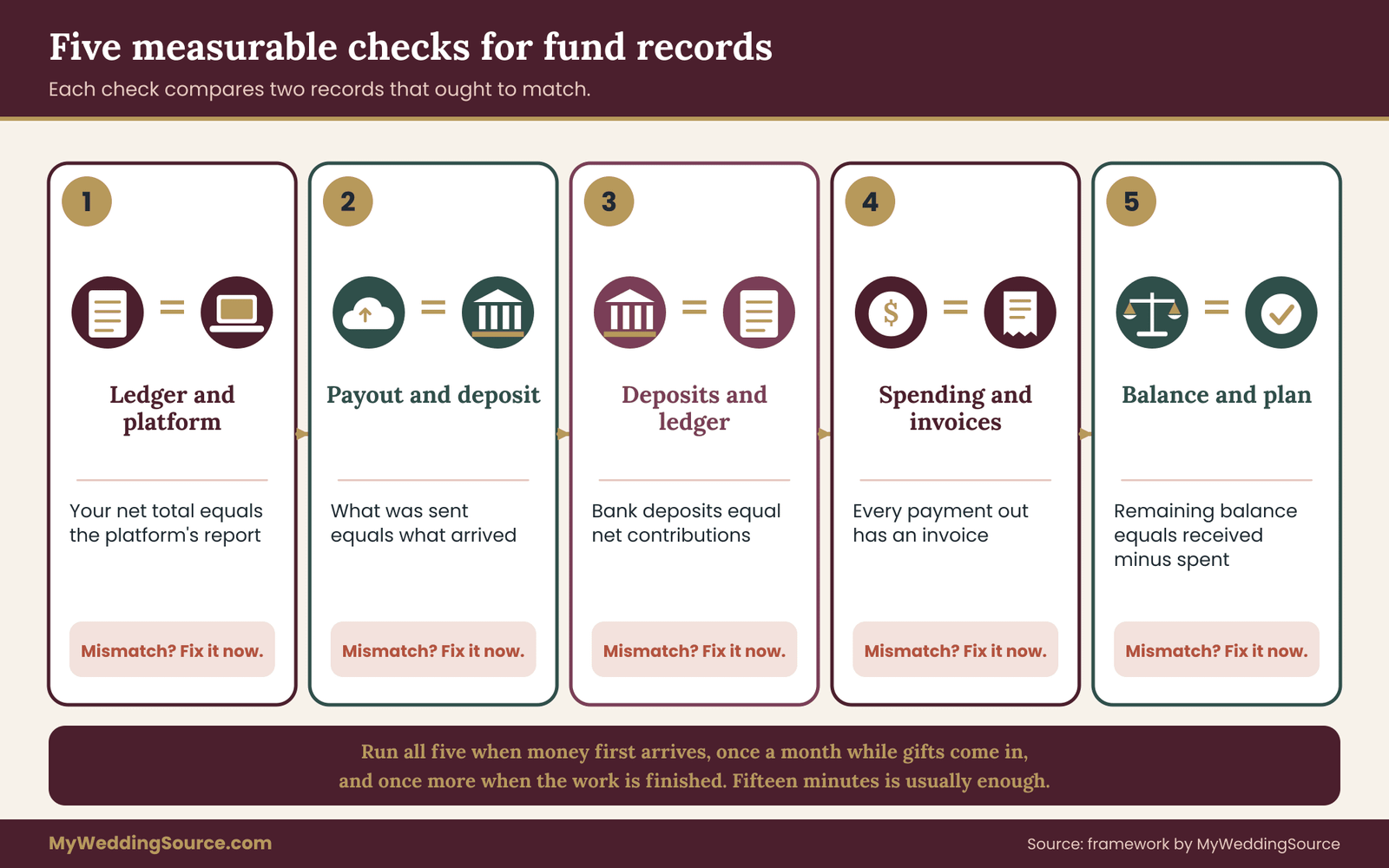
Transparency becomes real when you can check it. These five checks turn the idea into something you can do in a few minutes a month. Each one is a comparison between two records that ought to match.
Check one: ledger total equals platform total. Add up the net amounts in your ledger. Compare the sum to the platform’s report of what it has collected for the home improvement fund. Differences usually mean a missing entry or a fee you did not record.
Check two: platform payout equals bank deposit. When the platform pays out, the amount that lands in your account should match the amount the platform says it sent. Mismatches are rare, but a timing delay or a held amount is worth knowing about.
Check three: bank deposits equal ledger net. Add the home improvement fund-related deposits in your bank statement. They should equal the sum of net contributions across channels, including checks you deposited yourselves.
Check four: spending equals invoices. Every payment out of the fund account should match a written invoice or receipt, with the date, the vendor and the amount. If it does not, record the reason.
Check five: balance equals plan. The remaining balance should equal the total received minus the total spent. If you have a rung-two or rung-three plan, the remaining balance should also match what you intend to spend next.
How often to check
Run all five checks once when the money is first received, once a month while contributions are still arriving, and once more when the work is complete. Fifteen minutes is usually enough. If you find a mismatch, fix it at once, while the memory of the transaction is fresh. The records guide on wedding records after the event explains how long to keep these documents once the home improvement fund is closed.
A note on cash and checks at the reception
If guests hand you cards with checks or cash on the wedding day, assign someone to collect them and keep them safe until you can deposit them. A trusted relative or a member of the wedding party can hold a card box and take it home that night, so the two of you are not carrying it.
At the first opportunity, record each gift in your ledger before it is deposited, and note which cards held fund contributions and which held gifts for another purpose. Guests often write “for the house” or “for your repairs” in a card, and you will want that detail for your thank-you.
Spending the home improvement fund responsibly
Once the money is in, the home improvement fund has a different job: turning contributions into finished work without surprises. A few habits protect both the project and the trust behind the fund.
Hire carefully and in writing
Home improvement is an area where consumer protection agencies publish plenty of guidance, and the Federal Trade Commission and your state attorney general’s office are the places to start. The general points are simple. Get more than one written estimate. Ask for a written contract that describes the scope, the materials, the start and completion dates, and the payment schedule.
Check licensing and insurance where your state or city requires them. Be wary of any contractor who asks for the full amount up front, and avoid paying in cash without a receipt.
Ask how permits will be handled. In many places a water heater replacement, electrical work and structural changes require a permit and an inspection, and the contractor usually pulls it. Confirm that in writing before work starts. A skipped permit can cause problems later when you sell or file an insurance claim.
If your home was built before 1978, ask about lead-safe work practices. The Environmental Protection Agency has a renovation, repair and painting rule that covers many jobs in older homes and generally requires certified firms. Ask the contractor whether it applies and what they plan to do about it.
Make the payment schedule match the progress
A reasonable payment schedule ties payments to milestones: a deposit to schedule the work and order materials, a middle payment when a defined stage is complete, and a final payment after you have inspected the work and any required inspection has passed. Ask for a receipt for each payment and keep it with the invoice. The CFPB and the FTC both publish plain-language material on payment methods and the protections that come with them, and it is worth reading before you choose how to pay.
Match spending to the rung order
Spend in the order the fund statement promised. If rung one is the water heater and floor repair, pay for those first and record each payment against the home improvement fund. Only when rung one is complete and paid should you move to rung two. If you want to change the order, for instance because the floor repair turns out to cost more than expected, adjust the plan in writing and update the home improvement fund page.
The point is that the page and the actual spending should say the same thing.
What if an emergency pushes the plan aside
Home emergencies do not follow a ladder. If the furnace fails in January while the fund is earmarked for windows, use common sense. Fix the furnace, note the change in your ledger, and update the page with a short line such as “A furnace failure moved the windows to next year. The fund covered the furnace.” Most guests will not blink.
The ones who gave toward “repairs to our home” will see exactly what they funded. If your home improvement fund label was narrow, such as “bedroom windows,” a shift is harder to explain, which is one more reason to word the home improvement fund as a ladder from the start.
Close the loop with a short update
When the work is done, post a short update. It does not need to be long. Three to five sentences and one or two photos are plenty. Name what was done, thank the contributors as a group, and say what happened to any surplus. Then update the ledger with a final line: total received, total fees, total spent, balance remaining and what happens to it.
A clean close-out is the best defense against any later question about the fund. It also lets guests see the result of their gift, which is often the real pleasure of giving.
Edge cases that test a home improvement fund
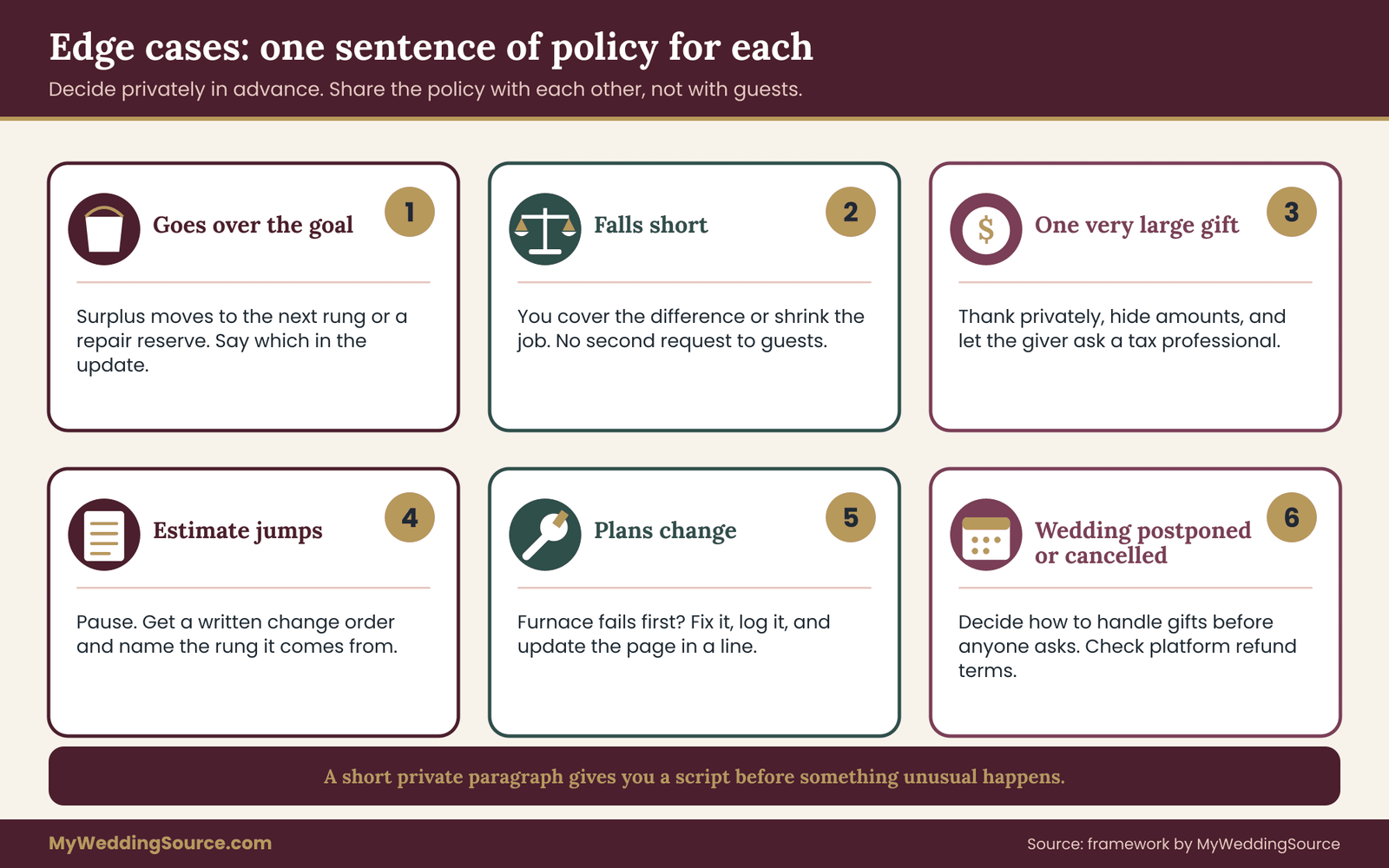
Most funds run smoothly. A few meet situations nobody planned for. Thinking through the common ones now, while nothing is at stake, lets you write a single sentence of policy for each. Where a situation touches a legal or tax question, the answer depends on your circumstances, so the notes below describe the question to ask, not a ruling.
The fund goes well past the goal
This is the happiest problem, and it still needs a plan. If your fund statement says what happens to extra money, follow it. The usual choices are to move the surplus to the next rung, to keep it in the home maintenance account for future repairs, or to add it to your emergency savings.
Whichever you pick, post the answer in the closing update. Guests who gave toward a water heater are unlikely to object to a roof reserve, but they will notice if the surplus disappears without a word.
What you should avoid is quietly spending a large surplus on something unrelated, such as a vacation, while the page still says “home repairs.” If your priorities really change, say so in the update, plainly and without defensiveness.
The fund falls short
Say the first rung needs $2,400 and the home improvement fund reaches $1,400. Your fund statement already promised to cover the difference, so do that. Do not send a second request to guests, and do not add a countdown banner. If the shortfall is large enough that you cannot cover it, reduce the scope of the job, delay the project or choose a smaller first step, and update the page.
A shortfall is not a failure of the home improvement fund. It is information about how guests chose to give, and many will have bought something from the traditional side of the registry or brought a card. Your budget should have assumed a possible zero in the first place.
One contribution is far larger than the others
Occasionally a relative gives an amount that dwarfs everything else. Thank them warmly and privately. If the contributor list is public, consider hiding amounts so nobody feels compared. A very large gift can also raise tax questions for the giver, since the Internal Revenue Service explains that gift tax rules generally apply to the person giving and that most gifts do not produce any tax. Do not give tax advice to the guest. If they ask, suggest they check with a tax professional or the IRS.
A relative wants to pay the contractor directly
A parent or a friend with building experience may offer to pay a plumber or buy the windows themselves. This can be a generous option, but it changes the record. Decide whether it counts as a home improvement fund contribution. If so, log the amount, the date and the payee in your ledger, and note it in the thank-you.
Be careful that the contractor knows who is the client and who signs the contract. Splitting responsibility between you and a relative can create confusion if the work goes wrong.
Someone offers labor instead of money
A friend who is a licensed electrician or a carpenter may offer to do a job as a gift. Accept with thanks if you want to, and treat it as a normal project: agree on scope, timing and who buys the materials, and ask about licensing and insurance where required. A gift of labor is generous but it is not exempt from permits or safety rules. Record the arrangement in your notes, and consider a written summary so both sides remember the same plan.
The estimate jumps after work begins
Contractors sometimes find hidden problems after opening a wall or lifting a floor. When that happens, pause and ask for a written change order that describes the new work and the cost before you approve it. The change-order discipline in the guide on wedding vendor purchase orders was written for wedding vendors, yet the same habit of approving scope changes in writing applies to a contractor. After the change order, update your plan: which rung does the extra cost come from, and does the fund statement still fit?
The contractor disappears or the work is wrong
If a contractor stops responding or does poor work, keep every message, invoice, photo and receipt. Send a written notice describing the problem and the date by which you expect it fixed. Your state or local consumer protection office, and the FTC’s consumer information pages, explain the options for disputes.
Do not stop documenting. If the home improvement fund covered part of the payment, the same records also support your closing report. You owe guests no detailed account of a dispute, but if the fund’s purpose is delayed you can say so briefly in an update.
The house is rented, or one partner owns it
A fund for a rental unit is a different matter, because improvements generally stay with the landlord. If you rent, a home improvement fund for portable items such as a shelving system or a good vacuum is easier to explain than a home improvement fund for paint or fixtures. If you do plan work in a rental, get the landlord’s permission in writing first.
If the house belongs to one partner from before the marriage, say so honestly in your own conversation, even if you do not state it on the page. Questions about ownership, title and what happens to a shared investment in a home are legal and financial questions, and a licensed attorney or adviser in your state is the right person to ask. The fund page does not need to address them, but you should not avoid them either.
You move or sell before the work is done
If you buy a house and then change plans, the home improvement fund’s purpose may shift. The fair approach is to tell guests briefly. “We decided to sell the house, so the repair fund is going toward the move and the next home’s first project” is clear and kind. If you would rather not redirect the money, offer to return it, although that is rarely practical. The simplest prevention is a project plan that begins soon after the wedding.
The wedding is postponed or cancelled
If the wedding is postponed, the fund page can stay as long as it is accurate. If the wedding is cancelled, decide how to handle contributions before anyone asks. Etiquette traditionally suggests returning gifts, and a home improvement fund is no different in spirit, although the mechanics depend on the platform. Check its terms for refunds and withdrawal, and consider a short, kind message to contributors.
If the contributions were sent to a joint account, the question of who holds the money is legal, and a lawyer can advise. Write your intended approach into the fund statement only if it seems natural to you, since many couples simply handle this privately.
A guest asks for a receipt
A contribution to a couple’s registry fund is a personal gift, not a charitable donation, so it is generally not tax deductible for the giver and you should not describe it as one. If a guest asks for a receipt, the platform’s confirmation email usually serves as proof of payment. Avoid saying anything that implies a tax benefit, and refer questions to the IRS or a tax professional.
Gift cards and store credit in place of money
Some guests will give a home improvement store gift card instead of using the home improvement fund. Treat it as part of the same purpose. Log the amount, the store and any expiry date. Gift cards can usually be spent on materials for a project, but they are not cash, and they sit outside the platform’s tracking, so a ledger line keeps them from getting lost.
The guide to wedding cash-flow planning shows how to schedule money that arrives at one time and is spent at another, which is the situation you are in once the home improvement fund begins to fill.
Writing your edge-case policy in one paragraph
You do not need a page of rules. A short paragraph in your private notes will do. State what you will do if the fund exceeds the goal, if it falls short, if the plan changes, if the wedding does not happen, and who decides when you disagree. Share it with each other, not with guests. Then you have a script for the moment something unusual happens, and you will not need to invent one while worried.
Comparing a home improvement fund with the other ways to ask for help
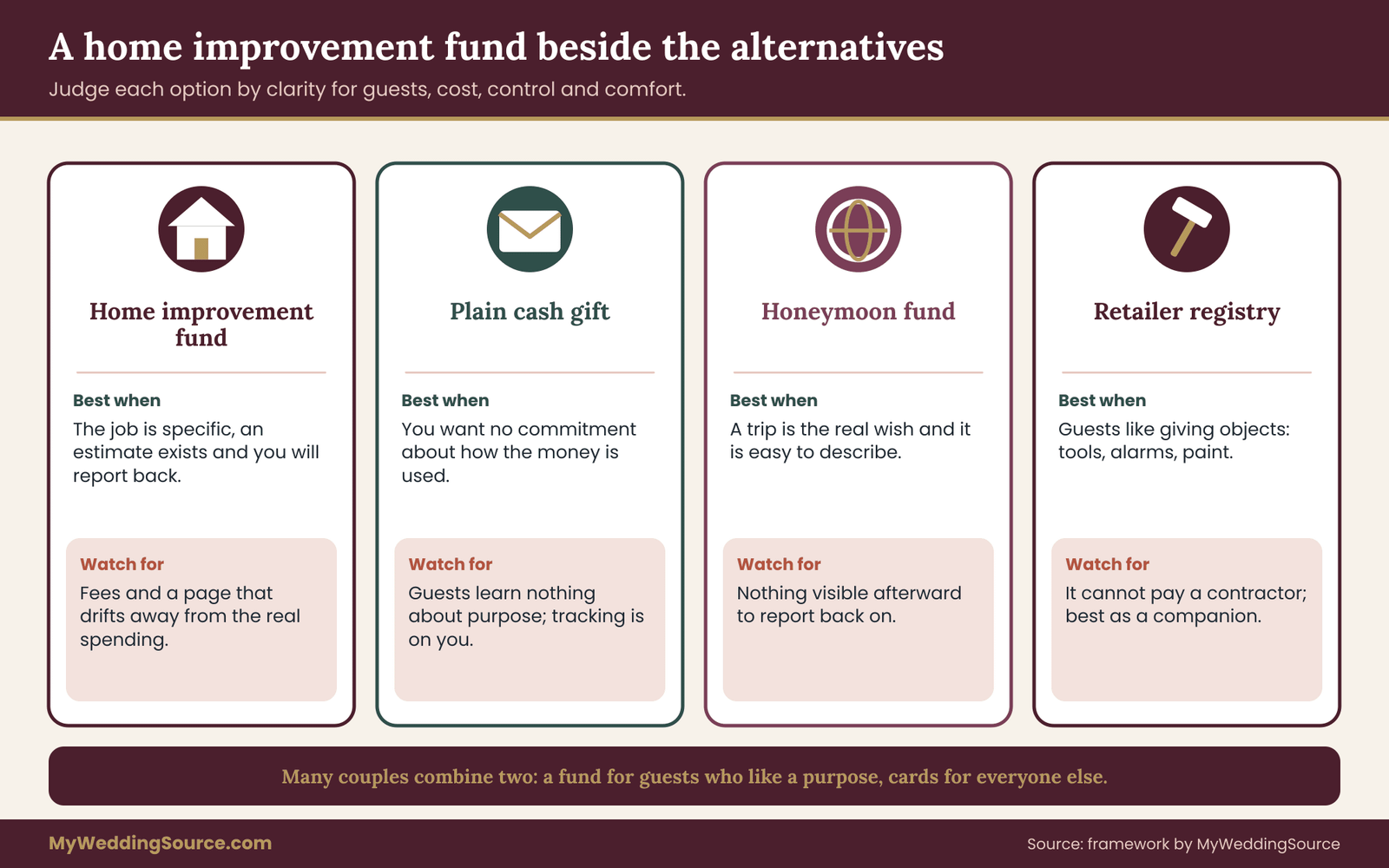
A home improvement fund is one option among several, and it is not always the best one. Comparing them honestly keeps you from choosing a home improvement fund because it is fashionable or because it sounded efficient. Use four lenses: clarity for guests, cost to you, control over the money, and comfort for everyone involved.
Against a plain cash gift
Cash in a card is the simplest alternative. Clarity is low, since guests know nothing about what it will do, but comfort is high for people who dislike registries. Cost is zero. Control is complete, because nobody has attached a label. Choose cash alone if you want no commitment about how the money is used. Choose a fund if you want guests to see a concrete purpose and you are willing to report on it.
Many couples do both. They publish a fund for guests who like a purpose, and they accept cash and checks from guests who do not.
Against a honeymoon fund
A honeymoon fund pays for a trip, and a trip leaves nothing to inspect afterward, apart from photographs and stories. A home improvement fund pays for something visible, which is helpful for reporting back and gratifying for contributors. On the other hand, a honeymoon is easier to describe and often feels lighter to ask for.
If you are choosing between the two, ask which one you would be more comfortable reporting on a year from now. If you have not decided which kind of fund suits you, the broader guide to registry choices beyond the basics compares many types of items.
Against a house or down payment fund
A down payment fund asks guests for a larger contribution toward a much larger goal, and the goal may be many years away. Clarity is lower because the project is open-ended, and the sums are often too big for casual gifts. A home improvement fund is smaller, closer in time and easier to close out. If you are still renting, a down payment fund may be the honest choice. If you already own, a repair or upgrade fund is more natural.
Against a retailer registry with home items
A home improvement retailer’s registry lets guests choose a drill, a ladder, paint, a smoke alarm or a gift card. It is concrete, it carries no fund fees, and gifts arrive as objects you can use. It requires more work from guests, who must select and ship an item, and it cannot pay a contractor. It works best as a companion to a home improvement fund, covering the small things a fund should not have to.
Against contractor-direct gifts
Some guests may offer to pay for a service directly, such as a plumber’s visit or a delivery fee. That can be generous but it takes planning on all sides. It is better to treat it as an exception, handled one on one, than to build it into the registry.
A quick way to decide
If you can answer yes to three of these four, a home improvement fund suits you: the project is specific, a real estimate exists, you are comfortable reporting back, and your guests are likely to be comfortable with online giving or a card box. If you can answer yes to fewer, a plain gift option, a retailer registry for small items, or a modest honeymoon or experience fund may be a better fit.
Launching a home improvement fund: a thirty-day plan
Setting up a fund does not take long, but doing it in order saves rework. The plan below assumes you are launching a few months before the wedding. Compress or stretch it to suit your calendar.
Days one to five: decide. Complete the five-question readiness test. If any answer is no, assign a task and a date for fixing it.
Days six to twelve: scope. Build the three-rung ladder with at least one written estimate for rung one. Decide how you will handle surplus and shortfall, and write it down.
Days thirteen to eighteen: choose the channel. Compare platforms using the ten questions. Read the current terms, note the date, and pick one main channel and one backup channel for guests who prefer another way.
Days nineteen to twenty-four: write. Draft the fund statement, the registry blurb and the guest FAQ. Read them aloud and apply the tone check. Ask one friend who is not close to the plan to read them and tell you what is unclear.
Days twenty-five to twenty-eight: set up tracking. Open the labeled account, build the ledger, and test the platform with a small contribution. Confirm that the fee, the payout and the confirmation email all behave as you expected.
Days twenty-nine and thirty: publish. Add the fund and the other registry items to your wedding website. Share the link as you normally would. Save a dated copy of the fund statement for your records.
A full example, from first conversation to final update
The example below is invented, and its numbers are illustrations, not benchmarks. It shows how the pieces connect when a couple follows the process.
Dana and Marcus bought a 1960s ranch house in March and planned their wedding for October. In April they agreed that a traditional registry made little sense, since both had lived on their own for years. They ran the readiness test over a weekend. They could name the project, two estimates were still needed, and they were not sure they wanted to report back.
Marcus admitted that the reporting part made him uneasy, so they talked about it until they agreed that a short update on their website was manageable.
In May they got two written estimates for the water heater and floor repair. The higher one, plus the margin the contractor suggested, became rung one at $2,400. A single estimate for two replacement windows set rung two at $3,000. They decided to leave the hallway floors as an unpublished stretch.
In June they compared two platforms using the ten questions. One had a lower percentage fee but a higher flat fee per contribution. They decided that most of their guests were older and would give small amounts, so they chose the platform with the lower flat fee and added a card box and mailing address as a second channel. They wrote the fund statement, the blurb and the FAQ, and a friend caught a sentence that sounded like a countdown. They removed it.
In July they opened a labeled savings account, built a ledger and tested the platform with a small contribution. The fee matched their notes.
The registry went live in July with the home improvement fund and a short list of tools and alarms from a home improvement retailer. By the wedding in October, the fund had reached a little over the first goal after fees. At the reception a cousin held the card box overnight, and Marcus entered each check in the ledger the next morning before depositing it.
In November they ran the five checks. Ledger and platform totals differed by $12, which turned out to be a contribution recorded without its fee. They corrected it. They paid the contractor’s deposit from the fund account, kept the invoice, and paid the balance after the final inspection passed.
In December they posted a short update with two photos, thanked contributors as a group, and named what happened to the small surplus: it went toward the windows, the next item on the ladder. In their thank-you notes they mentioned the water heater by name. At the first anniversary they reviewed the home improvement fund file once, confirmed the ledger was complete and moved it into their long-term records.
Nothing in this story is dramatic, and that is the point. A well-run fund is quiet. Guests see a clear purpose, spending follows what the page said, and a short update closes the loop.
Common mistakes to avoid
A few patterns cause most of the trouble, and you can steer around all of them. Vague labels such as “house stuff” invite questions. A single large goal turns a good result into an apparent miss. Fees nobody checked erode the net. Mixing fund money with everyday money makes every later check slower. And silence after the work is done leaves guests guessing.
The opposite mistake also exists. Some couples over-explain, post long financial accounts and invite debate. Five plain lines, a tidy ledger and one update are enough.
Etiquette notes worth keeping in mind
General etiquette still applies. Do not make guests feel that attendance depends on a gift. Do not publish who gave or did not give. Thank every contributor in a way that fits the gift, in a message that mentions what the money did when you can. The site’s guide to wedding etiquette covers thank-you timing and the wider conventions around gifts, and the wedding budget guide helps you see where a fund sits within your larger plan, so a registry choice never quietly becomes a financial strain.
Your next steps
Start with the readiness test this week. Write the five answers on one page and fix any that read as a no. Then get a written estimate for the first project and build the three-rung ladder. Once the ladder exists, the rest is a series of small, ordinary tasks: read two platforms’ fee pages with the ten questions, draft the five-line fund statement, test the tone with someone who has not seen it, open a labeled account and set up the ledger.
When the registry goes live, keep the habits small. Check the ledger monthly, update the page when anything changes, and post a short note when the work is done. If you do, your home improvement fund will be what it was meant to be: a clear invitation to help with something real, and a simple record that shows how the help was used.
FAQ
Is it rude to put a home improvement fund on a wedding registry?
Not by itself. Etiquette cares less about the item than the tone. A fund is fine when it is optional, described plainly, kept off the invitation and offered next to ordinary gift choices. It becomes awkward when it carries deadlines, suggested amounts per guest or guilt. Share it through your wedding website, and let guests decide whether to use it.
How much should a home improvement fund ask for?
Ask for the cost of the first job, based on at least one written estimate, and add a margin your contractor recommends. Then list the next one or two projects as later steps without a published price. A goal tied to a real quote is easier to defend than a round number, and a tiered plan lets any amount raised do something useful.
Do guests have to give to the fund?
No. A guest who attends, sends a card or chooses another registry item has been generous. Say so on the page in one sentence. A fund works best when giving to it is one choice among several, and nobody can tell from the page, or from you, who did or did not contribute.
What happens to extra money in a home improvement fund?
Whatever your fund statement says. Common choices are moving the surplus to the next project on the list, keeping it as a home maintenance reserve, or adding it to emergency savings. Decide before the first contribution arrives and say so in the closing update. Quietly spending a large surplus on something unrelated is the one choice to avoid.
Are contributions to a wedding fund taxable?
Tax treatment depends on your situation, so ask a qualified tax professional. As general background, the IRS explains that gift tax rules generally apply to the person giving the gift, and that most gifts result in no tax. A registry contribution is a personal gift, not a charitable donation, so do not describe it as deductible.
Which fees should we check before choosing a platform?
Look for a percentage fee, a flat fee per contribution, any separate card-processing charge, payout fees and any holding period. Find out who pays at checkout and whether guests see the fee first. Fees change, so read the provider’s current terms and keep a dated note. A fee that takes a paragraph to explain is worth questioning.
How do we keep the fund separate from our other money?
Open a labeled savings account or sub-account and deposit only fund contributions into it. Pay fund-related invoices from that account and keep each receipt. Then the balance answers one question quickly: how much of this money came from the fund and how much from us? Run the five checks monthly while contributions arrive.
Should we report back to guests on how the money was used?
Yes, briefly. A short note with a photo or two on your wedding website, within a few months of finishing the work, is plenty. Mention the fund in your thank-you messages, name what was done, and say what happened to any surplus. You owe guests no financial detail, only a clear sense that the money did what the page said.
Sources
- Federal Trade Commission
- Consumer advice, Federal Trade Commission
- Frequently asked questions on gift taxes, Internal Revenue Service
- Consumer Financial Protection Bureau
- Lead-safe work practices and renovation rule, Environmental Protection Agency
- Home energy and efficiency upgrades, U.S. Department of Energy
- State consumer protection offices, USAGov
- Homeownership resources, U.S. Department of Housing and Urban Development
- Internal Revenue Service