
Wedding bingo is a simple reception game that goes wrong in one predictable way: a square that makes a guest the joke. This guide shows how to design wedding bingo cards that stay light, how to screen every square before it is printed, and how to run wedding bingo so that nobody has to play, perform or explain themselves.
Write more squares than you need, then screen each one with five questions: can a guest mark it without talking to anyone, would the person described be glad to see it printed, does it avoid private facts about bodies, age, health, money, family or faith, can it be done from a chair, and does saying no cost nothing. Keep the squares that pass all five (green) and a small share that pass only the optional-chat test (yellow). Cut the rest. Then run wedding bingo with an opt-out, a no-pressure prize, and a short script from the host.
Wedding bingo looks harmless because the format is familiar. A grid, a pencil, a small prize. The trouble is that the squares are written by people who love the couple and know the guests, and the squares tend to reflect that private knowledge. “Someone’s uncle dances badly” is funny to the writer. It is not funny to the uncle, and it is not funny to the cousin who now feels watched.
This article is about designing wedding bingo so that the fun comes from the day itself and not from the guests. It covers when to use wedding bingo at all, how to write and screen squares, how to build a pool and shuffle cards, what the host should say, how to include guests who cannot or do not want to take part, what vendors should be asked, and how to test the wedding bingo cards before the wedding. A worked example, with an invented couple, shows the process from a blank page to a printed card.
A note on scope. This is general planning information, not legal advice. Accessibility duties, venue rules and printing terms vary, so where a rule matters, the article points to the agency or supplier that sets it so you can confirm the current version yourself.
What wedding bingo cards are, and where embarrassment comes from
A wedding bingo card is a printed grid, usually five squares by five, with a free space in the middle. Each square names something a guest might notice or do during the reception. Guests mark squares as they see them, and a completed line, a set of corners or a full card earns a small prize or simply bragging rights. That is the whole mechanism, and its simplicity is why it travels so well across ages.
Most wedding bingo cards fall into one of three formats, and the format matters more than the theme.
Moment bingo. Squares describe things that happen in the room: a toast that mentions travel, a guest who lifts a child onto the dance floor, a song that everyone sings along to. Guests watch, mark and do not need to speak to anyone.
Mingle bingo. Squares ask guests to find another guest who matches a description: someone who has met the couple at a particular place, someone who speaks three languages. This format puts the burden of conversation on the player, which is the single biggest consent risk in wedding bingo.
Called bingo. A host draws and calls items, and guests mark them if they appear on the wedding bingo card. Called games run on a schedule and need a caller, a microphone and a moment of the program set aside for them.
This guide mostly concerns moment bingo, because it is the format that works for the widest range of guests, and it treats mingle bingo and called bingo as variants you can compare later in the guide.
The three ways a square embarrasses someone
When a wedding bingo square lands badly, it nearly always does so in one of three ways, and learning to spot them is most of the skill.
The first is the named target. The square points at a specific person, whether by name or by an obvious description such as “the groom’s grandfather” or “the bridesmaid in the green dress”. The person did not agree to be on a card, and every guest who reads it can see who is meant.
The second is the private attribute. The square depends on something a guest might not want discussed: their age, weight, drinking, relationship status, pregnancy, finances, health, faith or family history. “Someone who is on their second marriage” is a fact about a person, not a feature of the party.
The third is the forced action. The square requires a guest to do something they might not want to do: kiss, dance, sing, drink, share a story, pose for a photo or hand over a phone number. A guest who refuses is then visible as the person who refused.
Each of these has a simple opposite. Replace the named target with an event. Replace the private attribute with something observable and neutral. Replace the forced action with something that happens whether or not a given guest takes part.
Why consent belongs in wedding bingo
Consent is an unusual word to attach to bingo, but it is the right one. A guest who arrives at a wedding agrees to attend a celebration, to eat dinner, to be photographed in the ordinary way and to be among other people. They have not agreed to be a character in a game or to perform on request. A well-built game keeps that line clear: taking part is voluntary, what is asked of a player is small and reversible, and nobody is penalized for ignoring it.
This is also practical. Guests who feel pressured go quiet, and a game that makes some guests quiet does not add warmth to a reception. Guests who feel invited, with a simple card and no obligation, tend to treat it as a pleasant thing to do between courses. If you want to see how a game like this fits into the overall movement of the evening, the reception guest flow guide shows how entry, seating, food and exit shape what guests have time and energy for.
When wedding bingo fits your reception, and when to skip it
Not every wedding needs a game, and a game that does not fit the room is worse than none. Before drawing a single square, run a quick fit check. It takes ten minutes and prevents most of the problems that come later.
Consider wedding bingo if the reception has a stretch of unstructured time, such as a long cocktail hour or a gap between dinner service and dancing. Consider it if guests come from several households and may not know each other, because shared squares give strangers something neutral to mention. Consider it if a number of children or teenagers will attend, because a card gives them a task that does not require adult conversation. Consider it if the couple likes the idea, which is the most important condition of all.
Skip wedding bingo, or shrink it, if the schedule is tight and wedding bingo would compete with toasts, a first dance or a cultural ritual. Skip it if the day includes a memorial moment or a religious service in which a game would feel out of place, or if the guest list includes people dealing with a recent loss. Skip it if the room is loud enough that guests cannot easily read cards, or the lighting is so dim that pencil marks are invisible. Skip it if the main impulse behind it is to tease particular guests.
A third answer is “do it as a small side table”. A single table near the welcome area, with a stack of cards and a pencil cup, asks nothing of anyone. Guests who want one pick one up. Guests who do not, walk past. For many couples, this low-key version is the right size.
Choosing the moment for wedding bingo in the program
Timing decides whether wedding bingo feels like a gift or a chore. The most reliable windows are the cocktail hour and the quiet stretch after the meal is served. During the cocktail hour, guests are standing, talking and waiting, and a card is a gentle prop. If your cocktail hour is long enough to justify it, the cocktail hour planning guide describes how that time is usually structured and where the dead spots fall.
Avoid putting wedding bingo during the ceremony, during toasts, during any moment of silence or blessing, and during the first dance. A game that asks guests to watch for things while a person is speaking from the heart turns attention into a scorecard. If you want a toast-related square at all, make it about a harmless object, not a person’s performance.
There is also a quiet argument for starting wedding bingo before it is announced. Leave cards on tables, perhaps with a pencil, and let guests find them. Announce wedding bingo later, if at all, and keep the announcement short. This lets guests choose how much they want to be part of it, which is the whole idea.
The five-question square screen for wedding bingo
The core of this guide is a screen you apply to every square, one at a time, before any card is laid out. It is deliberately boring. Boring is the point, because the squares that cause trouble almost always sound funny in a brainstorm and only reveal their problem when someone asks a plain question about them.
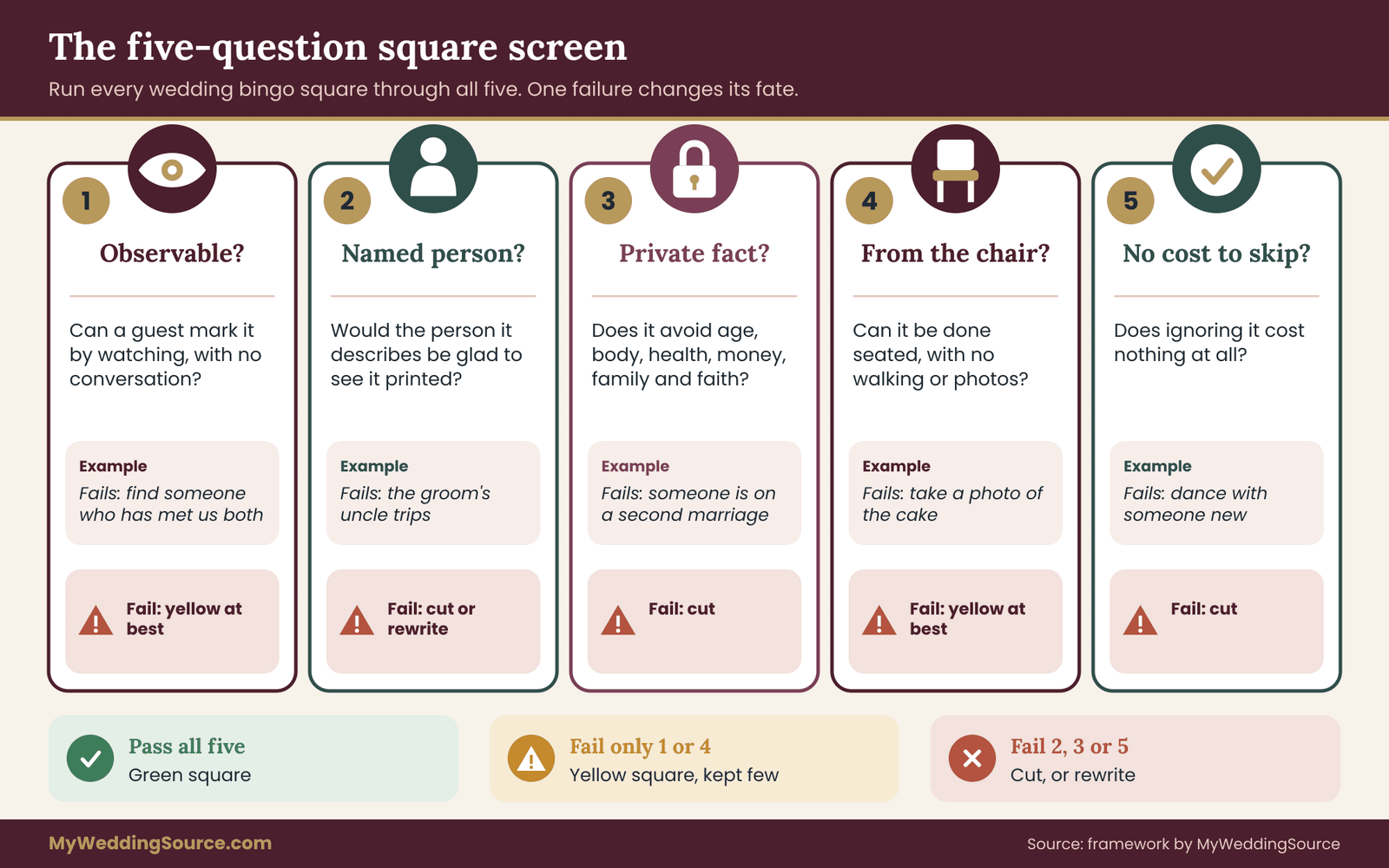
Write each candidate square on its own line in a working document. Then answer the five questions below for each one. Do not average the answers. A square that fails the second question does not get rescued by passing the other four.
Question one: can a guest mark it without speaking to anyone?
This is the observation test. A square passes if a guest can mark it by watching, listening or noticing, with no conversation required. “A toast mentions a city” passes. “Someone has been to more than three weddings this year” fails, because the only way to find out is to ask.
Failing this test does not automatically cut a square. It moves the square from the green tier to the yellow tier, which the next section explains. The point of the question is to make you notice when a square quietly turns the player into an interviewer.
Question two: would the person described be glad to see it printed?
This is the named-person test. Read the square as if you were the guest it could describe. If the square names someone, points at someone by role or appearance, or could plausibly be taken to describe one identifiable person, imagine that person reading it over their dinner.
Most squares that fail here fail without anyone noticing, because the writer is thinking of the guest as a fond character. “Someone cries during the speech” can seem tender until the person at the microphone realizes that a room of people may be watching for it. Replace the target with the event: “a speech includes a story from childhood” is a thing that happens, and nobody is held responsible for it.
This question has no tier. A failing square is cut or rewritten.
Question three: does it avoid private facts?
This is the private-attribute test. Check the square against a short list of subjects that guests may not want turned into a game: age, weight and appearance, health and ability, pregnancy and fertility, relationship status and past relationships, money and job, family conflict, faith, immigration, and alcohol use.
The list is not a ban on the topics themselves. A square can mention food, music or a city. It cannot depend on a fact about a guest that the guest has not chosen to share. “Someone orders a second dessert” depends on appetite. “A dessert is served with a candle” depends on the table.
If a square seems to depend on a private fact and you are not sure, treat it as failing. The cost of rewriting is a few minutes. The cost of a mistake is a guest who feels exposed at your wedding.
Question four: can it be done from the chair?
This is the seat test. Some guests use a wheelchair or a cane. Some have a sore knee or a long drive behind them. Some are holding a toddler. Some simply do not want to get up. A square that requires walking across the room, crouching for a photo, climbing stairs or joining a line excludes guests for reasons they should not have to explain.
“A guest takes a photo of the cake” fails the seat test, and it also quietly creates a photo-taking obligation that touches other guests’ images. “The cake has a flower on it” passes, and anyone near the cake table can see it. If you want to include squares that involve movement, make them optional and rare, and place them in the yellow tier.
Question five: does saying no cost anything?
This is the no-cost test. Imagine a guest who ignores a square entirely. Does anything happen to them? Do they lose a chance at a prize, miss a line, look unfriendly or let down a table-mate? A square passes if the answer is no.
The test catches subtle pressure. A square such as “find someone who will dance with you” fails, because declining reads as rudeness. A square such as “the dance floor has a circle of people” passes, because it is a fact about the room.
It also catches team pressure. If a table wins a prize only when every member completes a line, one reluctant guest holds everyone back. Individual cards, with no table-level consequence, remove that weight.
Recording the result
Keep a simple working note beside each square: pass or fail for each of the five questions, and a line about why. When you hand the pool to your reviewers later, the note shows them which decisions were deliberate. When you revisit the list after a week, it saves you from re-arguing squares you have already settled.
Here is a sample of what that note might look like for three candidate squares, in sentence form.
“A toast mentions a trip” passes all five and is green. “A guest wears a hat” passes four and could describe a single guest who dislikes attention, so it needs a rewrite such as “a hat appears in a photo on the table”, which is still odd, so it is probably cut. “Find someone who has met both of us” fails the first test, which makes it yellow if it passes the other four, but it also reveals who the couple has introduced, so many couples cut it.
Using the screen with a co-writer
Many couples write squares together, and many also invite a sibling, a maid of honor or a best friend to help. This is useful, and it also introduces the risk that a helper writes squares that reflect their own jokes. Share the five questions with every contributor in advance, and ask each to run their own squares through the screen before submitting them.
Then do a second pass together. A square that one writer passed and another would fail is the one worth discussing. Often the discussion ends in a quick rewrite, and the final square is better than either draft.
If the two of you disagree about a square, the tie-breaker is simple: the more cautious partner decides. A game that someone worries about is a game that someone will worry about on the wedding day.
What the screen does not do
The screen is not a substitute for knowing your guests. If a close relative has recently had a loss, a square about parents or grandparents may be fine for most guests and painful for that one. If one guest is newly sober, a square about drinks needs more thought than the five questions alone will give it. Use your own knowledge to override the screen in the cautious direction. Never use it to override in the other direction, by arguing that a square passes on a technicality.
The screen is also not a promise that no guest will ever be uncomfortable. People are individuals, and no printed card can be certain of every reaction. What the screen does is remove the avoidable causes, so that if someone is uncomfortable, it is for a reason the wedding bingo card could not have anticipated and the host can handle kindly. The rules for that moment appear later, in the section on facilitation.
A faster version for a short list
If you are building a small card for a side table and you have only a dozen squares, you do not need a long process. Ask three questions of each one: does it point at a person, does it depend on a private fact, and does it need a guest to do something? If the answer to all three is no, keep it. A short card with a short screen still protects guests, and it takes about fifteen minutes.
The longer version matters when the wedding bingo card will be printed for a hundred guests, when wedding bingo will be announced, and when the prize is large enough to create competition. The more attention a game draws, the more the screen matters.
Green, yellow and never: sorting your squares into tiers
Once every square has been screened, sort the survivors into three tiers. The tiers do two things. They keep the wedding bingo card balanced, and they give you a vocabulary for talking about risk without arguing about taste.
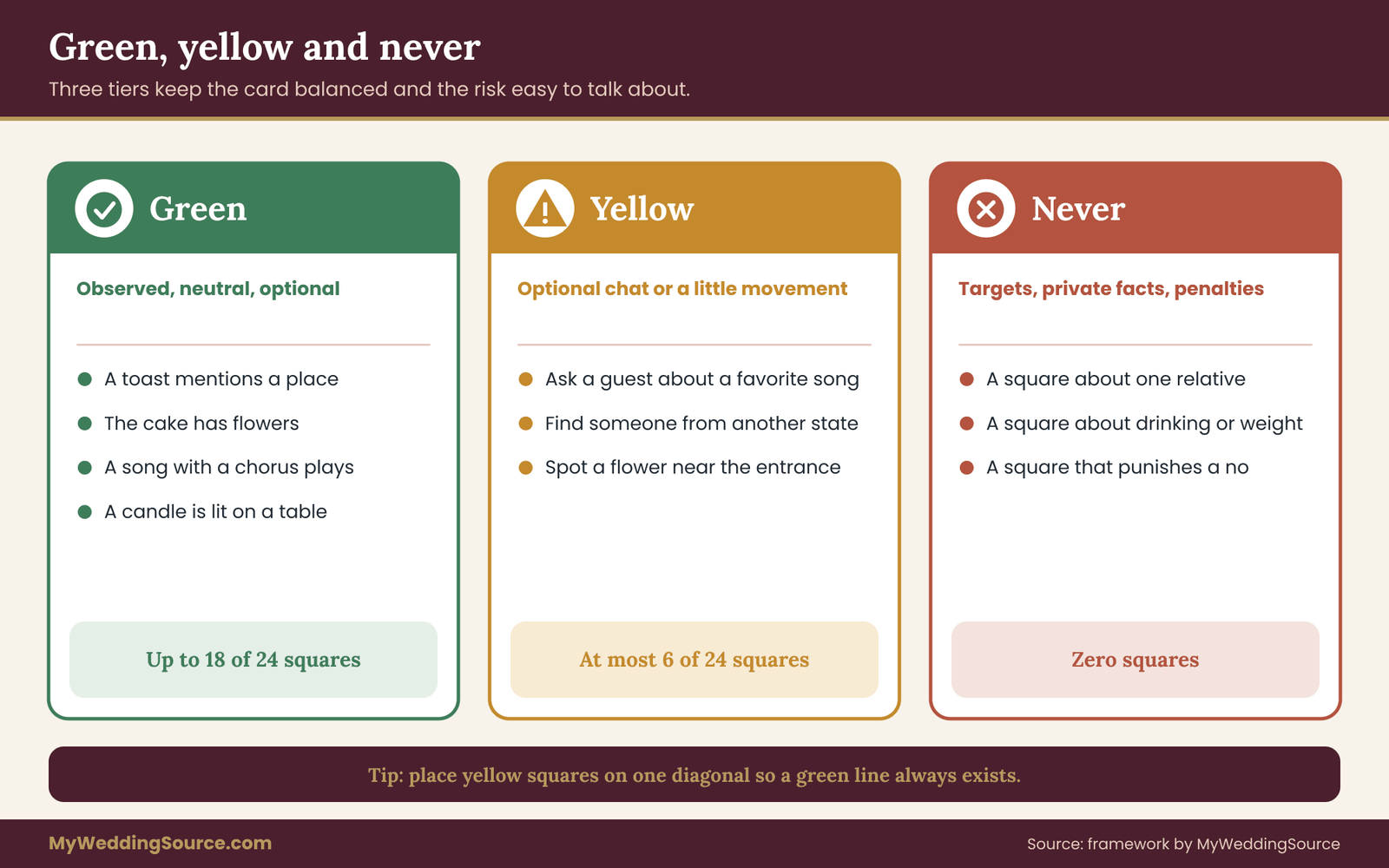
Green squares pass all five questions. A guest can mark them by observing the room. No one is named, no private fact is involved, nothing needs the guest to stand up, and ignoring them costs nothing. Examples include “a toast mentions travel”, “someone uses a napkin as a fan”, “a song from before the year two thousand plays”, “a table has a centerpiece with candles” and “the cake has flowers on it”. Most of the wedding bingo card should be green.
Yellow squares fail only the first or fourth question: they involve some optional talking or a little movement, but they pass the named-person, private-fact and no-cost tests. Examples include “ask a guest about their favorite song at the reception” or “find a guest who came from another state”. Yellow squares are fine in small numbers because a guest who prefers not to chat can simply leave them empty and lose nothing.
Never squares fail the second, third or fifth question. They target a person, require a private fact, or penalize a refusal. These do not belong on any card, even a card for a small group of old friends. Friends are guests too, and the wedding bingo cards will be seen by others.
How many of each tier belong on one card
A standard five-by-five card has twenty-four playable squares and a free space. A sensible split is eighteen green squares and no more than six yellow squares. A card with no yellow squares at all is perfectly good, and it is the right choice for a crowd that includes many shy guests, many older guests or many guests who do not share a first language.
The reason to limit yellow squares is that interaction compounds. One optional chat square is a small invitation. Six of them on a card begins to look like an assignment, especially to a guest who reads the wedding bingo card quickly and sees a lot of talking to do. Keeping yellow to a minority also helps guests who want to win a line, because they can reach a line using green squares alone.
A useful design check is to ask whether a line exists on every card that uses only green squares. If you shuffle squares randomly, a card may place yellow squares in every row, which forces a guest to do something optional to reach any line. A simple fix is to place yellow squares in a diagonal or in a single column after shuffling, so that a line of green squares always exists.
Rewriting a never square into a green one
Many never squares have a green square hiding inside them. The trick is to remove the person and keep the event. Here are a few rewrites in sentence form.
A square that reads “the groom’s dad tells a bad joke” targets one man and judges his humor. Rewritten as “a joke is told at the microphone”, it describes something that may happen without blaming anyone. A square that reads “someone gets tipsy” depends on alcohol use. Rewritten as “a glass is raised for a toast”, it describes a moment and still fits the party mood.
A square that reads “an ex shows up” is a spectacular way to embarrass two people at once. It should simply be deleted. There is no green version of it.
A square that reads “someone sings along badly” criticizes a voice. Rewritten as “a whole table sings along”, it describes joy and avoids ranking singers. A square that reads “the bride cries” is fine to leave out. The couple may well cry, and a square that treats their tears as a score turns a private feeling into a countdown.
When you cannot find a green rewrite, delete the square. A good pool of squares includes plenty of material, and losing a few weak ones costs nothing.
Squares that look green but are not
A few categories deserve a second look because they pass casual inspection and fail on reflection.
Squares about clothing, such as “someone wearing a bow tie”, can be fine, but squares about what a guest wears often hide a judgment, and the guest may have been told what to wear by someone else. If the dress code is strict, a square about clothing may feel like a quiz about compliance.
Squares about food, such as “someone eats cake with their hands”, are small judgments about manners. Squares that mention allergies or diets can feel like a spotlight on guests who already manage a lot of explaining.
Squares about children, such as “a child falls asleep”, are tender to some parents and intrusive to others. Children are also not able to agree to be part of a game. If you include any child-related square, make it about the room and not about a child: “a high chair is pulled up to a table” describes furniture.
Squares about phones and photos, such as “a guest takes a selfie”, can push guests to take pictures of others. If your guests have agreed to an unplugged ceremony or have asked not to be photographed, a photo-based square can contradict their wishes. The wedding photography consent guide covers the boundaries guests may ask for and how to honor them, and bingo should never be the reason those boundaries are crossed.
Building a wedding bingo pool, and shuffling the wedding bingo cards
With the tiers sorted, you can build the pool. The pool is the full list of approved squares from which each wedding bingo card is drawn. A bigger pool produces more varied cards, and varied cards reduce the odds that two guests call bingo at the same moment.
How big should a wedding bingo pool be
For moment bingo, a pool of about forty green squares and about twelve yellow squares is comfortable. With a pool that size, drawing eighteen green and six yellow squares for each wedding bingo card gives more than a hundred billion possible green selections alone, and nearly a thousand ways to pick the yellow ones. Those numbers are not a promise about gameplay. They show that you will not run out of distinct cards, even for a large guest list.
A smaller pool of twenty-five or thirty green squares still works for a small wedding. The cards will overlap, which is fine, but two guests may share a winning line at the same time. That is a good time to have a plan for ties, covered in the facilitation section.
Bigger pools also reduce another problem: squares that never happen. If a square describes something that may not occur at your reception, such as a specific song, it may sit unmarked on every card. A pool built mostly from squares that nearly always happen keeps wedding bingo moving. A pool with many unlikely squares makes wedding bingo feel stuck.
Balancing likely and unlikely squares
Think of squares as having three likelihoods. Near-certain squares are things you can arrange: the cake has flowers, a toast mentions a city, a song from a certain decade plays. Likely squares usually happen but are uncertain: a guest laughs at a speech, a table raises glasses at the same time. Rare squares might not happen at all: a rain shower on the patio, a guest who knows the lyrics to a song by heart.
A balanced card has about half near-certain squares, a third likely squares and a few rare ones. The near-certain squares make sure everyone marks something in the first hour. The rare ones give the wedding bingo card a little suspense. If your pool has too many rare squares, guests may finish the evening with a nearly empty card and feel that they did it wrong.
You are in a good position to create near-certain squares because you know your own program. If a toast is scheduled, a square about a toast is nearly certain. If a dessert table is planned, a square about it is nearly certain. Writing squares from your own run of events is more reliable than guessing what may happen.
Shuffling without a spreadsheet nightmare
There are three common ways to produce a set of different cards.
The simplest is a free online card generator. You paste in your list of squares, and the tool shuffles them into a set of cards that you download as a file. Check what the tool does with the text you enter, whether it adds a watermark or an advertisement to the printed sheet, and whether the file can be exported at a size that prints cleanly. The vendor questions section later in the guide lists what to ask.
The second is a spreadsheet. You can build a pool in one column, use a random-order function to shuffle a copy, and lay out twenty-four squares per card by hand. This takes longer, and it works for a short guest list. Remember that the tool may recalculate random values each time the file opens, so save a copy of each set as a fixed file after you shuffle.
The third is a printer who offers variable data printing, meaning a different card on each sheet. This is the cleanest option for a large wedding with a professionally designed card, and it often costs more. Ask for a proof of at least two different cards, and ask whether a single file can hold all the variations.
Whichever method you choose, number the wedding bingo cards in a corner, for example in small type at the bottom, so that a host can check a claimed win against the master list. The number does not identify a guest, and it avoids any need for names.
Where wedding bingo cards should live on the day
Cards can be placed at each seat, stacked on a welcome table, tucked into a program, or left at the center of a table with a pencil cup. Seat placement reaches the most guests and gives the least choice. A welcome table gives more choice and reaches fewer guests. Choosing between them depends on how much you want wedding bingo to feel optional.
If you place a card at each seat, consider how it connects to your seating plan. Cards at assigned seats should not carry a name, because a name turns a card into a possession of one person and prompts questions if someone else’s card appears. The seating chart guide explains how place settings and table assignments are normally produced, and cards can ride along in that process without any new labor.
Whichever location you choose, put one pencil with each wedding bingo card, or a cup of pencils near each table. Avoid ink daubers and markers on rented linens, because ink can mark fabric and a rental company may charge for it. The next sections return to this point under vendor questions.
Square ideas for wedding bingo, organized by moment of the day
A pool is easier to write when you work through the reception in order and ask what a guest might notice at each point. The lists below are in sentence form so that you can adapt them. Treat them as raw material, run each through the five questions, and cut anything that does not fit your day.
Arrival and cocktail hour
Guests arrive curious, so the early squares should be easy to mark. These are mostly objects and sounds: a sign with a hand-lettered message, a candle on a table, a flower in a vase, a guest book that has a pen next to it, a tray of drinks passing by, a song with a saxophone, a playlist that includes a song from a movie. Squares that describe the room reward guests for looking around, which helps them settle in.
Avoid squares that describe the guests as they arrive: who came late, who brought a plus-one, who is wearing what. Guests are already managing the small nerves of a social event, and a card that treats arrival as a scoring opportunity adds to them. If your cocktail hour has a signature drink, a square such as “a drink is garnished with citrus” is plain and observational. A square about who is drinking it is not.
Dinner and service
The dinner window has more to notice and less room to move, so it suits observation squares. Plates arrive, glasses clink, a server refills water, bread appears on the table. Squares such as “a dish arrives with a sauce poured at the table” or “dessert is served with a candle” describe the service. These squares also draw guests’ attention gently to the work of the catering team, which is a good side effect.
Avoid squares about portions, leftovers, second helpings and food choices. Food is intensely personal for guests who diet for health, faith or cultural reasons. A square that makes a guest’s plate into data is a square about them. If you want a food square, tie it to the menu: “a vegetable dish is on the table”. If the menu already carries dietary notes, take your squares from the dishes themselves and leave diets out of it.
Toasts and speeches
This is the section where couples are most tempted to write squares that judge the speakers. Resist. The speaker is nervous, the room is listening, and anything on a card that suggests the speech is a performance to be scored may be remembered for years. A good rule is to write no squares at all about speeches. If you want one, write it about the content in a neutral way: “a toast mentions a place”, “a toast includes a story from childhood”, “a toast ends with a raised glass”.
Do not write squares that predict emotion, such as tears, laughter or an awkward pause. Do not write squares that rank speakers or measure length. If a speech runs long, a square about it could become a joke at the speaker’s expense, with the couple’s names attached.
It also helps to tell speakers that bingo exists. A speaker should not learn by surprise that guests are marking squares during their toast. Telling them in advance is courteous, and the speaker can ask you to remove any square that touches their speech.
Dancing and music
Music squares are among the safest, since a song is a public object. “A song from before the year two thousand plays”, “a song with a one-word title plays” and “a guest requests a slow song” are all observational. Avoid squares that say who dances, who dances badly, who stays seated or who dances with whom. Dancing is a physical and social act, and a square that treats it as an event to be rated leaves people on the sidelines feeling observed.
If you have a DJ or a band, ask them which songs you are likely to hear and write squares from that list. The reception music planning guide describes how a set list is built across generations, and it is a good source for squares that are nearly certain to occur. A square that describes a song the DJ will not play is a wasted square.
Details of the room
Room details are green material with a long shelf life. A guest can mark them at any time, and they require no one else’s cooperation. Squares include the color of a ribbon, a pattern on a menu card, a type of flower, a candle in a glass, a sign with a quotation, an arrangement of photos on a table.
These squares also reward guests for noticing work the couple has done. If you have planned a signage system or a design theme, a few squares about it are a nice way to share it. The signage system guide discusses how signs are planned for readability, which affects what guests can notice in the first place.
The free space and the couple’s choice
Every card has a free space. You can leave it blank, mark it with the couple’s initials, or use it for a short thank-you, such as “thank you for being here”. A free space that carries a small message is a quiet detail that guests often keep. Avoid using the free space for a joke at the couple’s own expense that guests might feel obliged to laugh at.
If you want a couple’s choice square, make it something that you control and can guarantee, for example “the couple is in the room”. It is silly, and it gives every guest a reliable first mark.
A short pool-writing exercise
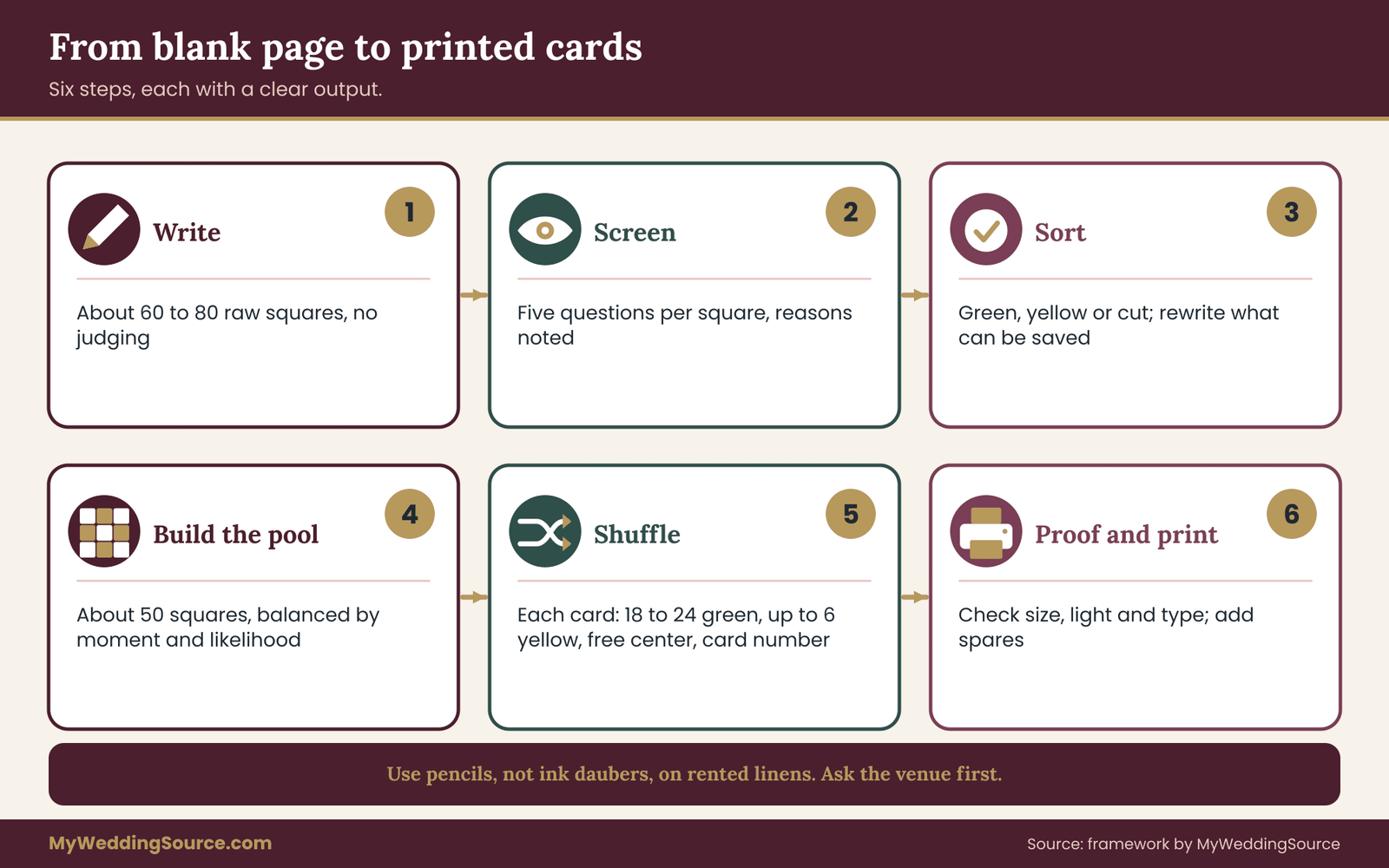
Set a timer for twenty minutes and write as many squares as you can. Do not judge them yet. Then sort them into the five moments above. If one moment has far more squares than the others, you will need to trim it so the wedding bingo card does not lean toward a single part of the evening. If one moment has too few, spend ten more minutes on it. When the list feels balanced, begin the screen.
As a rough working target, write sixty to eighty raw squares to end with about fifty usable ones. If a pool reaches fifty without any cuts, the screen was probably applied too gently.
Facilitation rules that keep wedding bingo voluntary
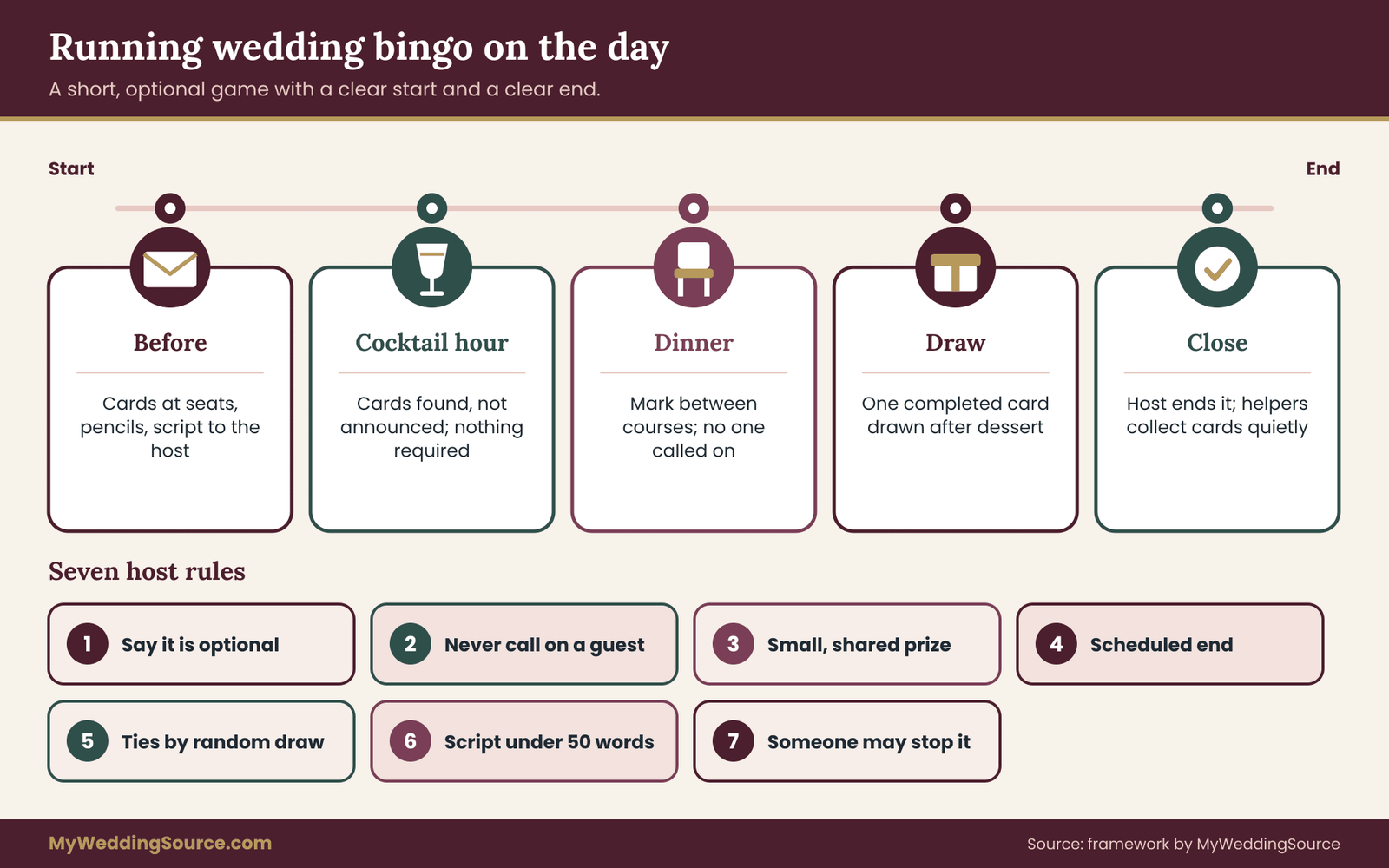
A well-designed card can still go wrong if wedding bingo is introduced badly. The host’s words, the way prizes are handled and the way ties and disputes are resolved decide whether wedding bingo feels like a gift or a test. Seven rules cover most situations.
Rule one: say that it is optional, out loud
The host should say, in plain words, that wedding bingo is optional. Guests do not need to play, and no one will check whether they did. A sentence such as “There are cards on your tables if you would like one, and there is no need to join in” removes pressure in a few seconds. If the host skips this line, guests may assume that participation is expected.
Make the same statement in writing on the wedding bingo card, at the bottom, in small type: “This game is optional. Play as much or as little as you like.” It costs nothing, and it speaks for itself if the host forgets.
Rule two: never call on a guest
No guest should be asked to stand, read a square aloud, explain a mark or show their card to the room. The host can read a square for everyone, and can ask for a show of hands only if the question is purely about the room: “Did everyone see the candles on the cake?” Asking a person to prove a mark in public turns a game into a quiz.
If a guest wins, let them come forward to the host quietly, or let a helper bring the prize to the table. A winner who does not want a moment in the spotlight should be able to avoid it. Announce the prize, if at all, without naming the person who won it, or ask the winner privately whether they would like a mention.
Rule three: make the prize small and shared
A big prize creates competition, and competition is where pressure grows. Keep the prize small: a candle, a box of chocolates, a local snack. Better still, draw a prize at random from all completed cards, so that a guest who completes a line late in the evening is as eligible as the fastest one.
Avoid alcohol as a prize. Not every guest drinks, not every guest is old enough, and the venue may restrict giving it out. Avoid prizes with small parts if children are playing, because items small enough to be swallowed are a hazard for young children. The Consumer Product Safety Commission publishes guidance on small parts and children’s products, and it is the place to confirm current rules.
A group prize also works: a basket of treats for the table that has the most completed cards. Be careful here, because a group prize reintroduces pressure on reluctant table-mates, as discussed under the fifth question. A drawn prize avoids that problem.
Rule four: end wedding bingo on a schedule
Wedding bingo should have a clear end. Announce it at the start: “We will draw a winner after dessert.” A game with no ending drags into the dance floor and leaves guests with half-finished cards. An ending lets everyone put down the pencil with a clear conscience.
A game that ends when dessert is served pairs naturally with a pause in the program. Ask your caterer for the service schedule and pick a draw time that falls in a quiet gap, not in the middle of plating.
Rule five: decide ties and disputes in advance
Two guests may complete a line at the same moment, or a guest may claim a mark that someone else doubts. Decide before the day how these cases are handled, and write the rule in one sentence on the host’s cheat sheet. A simple approach is to treat every completed card as an equal entry and draw one name from the completed cards. A claim is accepted on the honor system, with no questions asked.
The honor system is not naive. The stakes of a small prize are low, and checking marks is more disruptive than occasional generosity. If a guest marks a square that did not quite happen, nothing of value is lost. If a host asks a guest to prove a mark, something of value is lost: the guest’s ease.
For a game with a larger prize, a quiet check is acceptable. The host may take the wedding bingo card, look at it privately and give it back. The check should not happen in front of the table, and the host should assume good faith.
Rule six: keep the host’s script short and plain
The host does not need a performance. A script of about fifty words is enough, and it can be delivered from a notecard. The host welcomes guests to wedding bingo, says it is optional, says where the wedding bingo cards are, says when the draw will happen, and says what the prize is. Then the host stops. A longer introduction adds pressure.
“If you would like a card, there is one on your table. There is no need to play, and nobody is checking. We will draw one completed card after dessert for a small prize. Enjoy the evening.”
That sample is under fifty words. It names the wedding bingo cards, the optional status, the timing and the prize. Adapt it to your voice, and avoid adding jokes about guests. The host who is also a close friend of the couple should be especially careful here, because in-jokes that land in a living room can land differently in a banquet hall.
If the host is a DJ or an emcee, send the script in writing ahead of time and ask them to confirm they will use it. Some professionals have a habit of adding banter to games. A short note that says “please keep it plain and optional” prevents the banter from becoming a source of discomfort.
Rule seven: have a way to stop
A game is a guest of the party, and it can be asked to leave. Decide in advance who has the authority to end it if something goes wrong, for example if a square causes tension, if a guest becomes upset, or if the room is no longer in the mood. A coordinator, a sibling or the host can have this role. The decision should not wait for a conversation with the couple.
Stopping can be simple and quiet. The host says, “That is all for wedding bingo. Thank you for playing”, and a helper collects cards from tables without comment. No explanation is needed. Guests will assume wedding bingo has run its course, and the evening moves on.
Pre-event conversations that prevent trouble
Three short conversations in the weeks before the wedding spare you most of the day-of problems.
Talk with the host or DJ about the script, the prize, the draw time and the authority to stop wedding bingo. Talk with the speakers about whether bingo exists and whether any square touches their speech. Talk with the venue about pencils, markers, table surfaces and whether printed material may be left on tables. None of these conversations takes long, and each one removes a category of problem.
If a family member who is likely to offer extra squares wants to help, thank them and ask them to send ideas through the screen. A family member who writes a square after the wedding bingo cards are printed cannot be accommodated, and it is kinder to say so in advance.
Who might be left out, and what to change
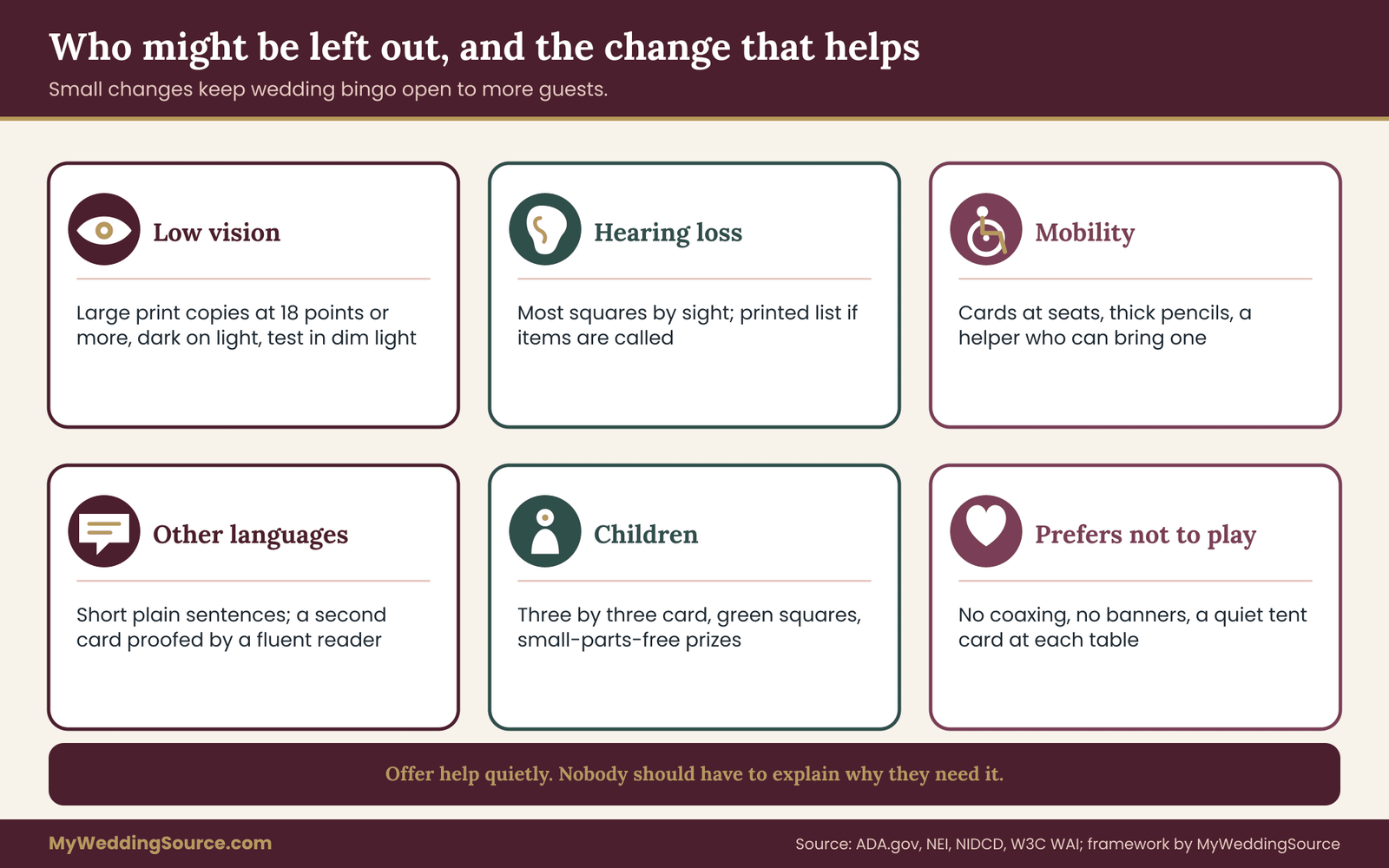
Wedding bingo is a visual, reading, writing and moving game. Each of those channels can exclude someone. Thinking about the guests who might be left out is part of the design, and a few small changes make wedding bingo open to far more of them.
Low vision and reading difficulty
Guests with low vision, or guests who left their glasses at the hotel, need larger type and strong contrast. As a working target, set squares in at least fourteen-point type for the standard card, and prepare a handful of large-print cards at eighteen points or more. Use dark text on a light background, and avoid decorative fonts with thin strokes. The W3C Web Accessibility Initiative and the National Eye Institute publish plain guidance on contrast and low vision, and either is a good place to confirm current recommendations.
Lighting matters as much as type. A card that reads well in a showroom may be unreadable in a candlelit room. Test a printed card under the same kind of lighting you expect on the day, or ask your venue what the light level will be during dinner.
For guests who cannot read a card at all, a helper at the table can read squares aloud and mark them. Offer this quietly, without making a point of it.
Hearing loss and noise
Moment bingo asks guests to listen for things such as a toast mention or a song. Guests with hearing loss may find these squares harder to mark in a loud room, and the National Institute on Deafness and Other Communication Disorders publishes information about hearing and communication. Balance the wedding bingo card so that most squares can be marked by sight. Keep sound-dependent squares to a few, and avoid making any line depend on them.
If a host reads squares aloud during a called game, supply a printed copy of the list, or display the called items on a sign or screen. A visual record lets everyone follow along.
Mobility and stamina
The seat test already removes most movement from the green squares. Beyond that, make sure the wedding bingo cards can be reached. A card placed on a high welcome table or in a corner is a card some guests cannot easily collect. Put cards at seats, or on a table at a reachable height, and have a helper offer to bring one if someone asks.
Pencils matter more than they seem. Guests with limited hand strength may find a thin pencil hard to grip. A few thick pencils or a clipboard at the table helps, and they cost very little.
Language and reading level
Guests who speak other languages may be bilingual at different levels, and a card written in complex English is a card that some guests will not try. Use short, concrete sentences, and avoid idioms and puns. If a substantial group of guests share another language, consider printing a second version of the wedding bingo card in that language, proofed by a fluent reader, not a translation tool. A mistranslated square is worse than no card.
Plain language also helps guests who are simply tired, distracted or reading in dim light. A square such as “a toast mentions a place” is fast to read and easy to mark. A square that requires a clause and a condition is slow and easy to misread.
Children and teenagers
Children can enjoy wedding bingo, and a simple card gives them a task during long speeches. A few rules protect them. Keep their squares observational and free of anything that asks them to approach adults they do not know. Place any child’s card in the hands of a parent or guardian, and avoid prizes with small parts. Do not write squares about specific children, and do not ask children to perform.
If children are among your guests, consider a shorter card with a three-by-three grid, with squares drawn only from green items. The guest care planning guide describes how couples arrange supervision and activities for children and older relatives, and the wedding bingo card should fit into that plan, not substitute for it.
Teenagers sometimes dislike anything that looks like a game made for them. A card that is the same as everyone else’s gives them a quiet option to take part without being singled out.
Guests who prefer not to take part in wedding bingo
Some guests will not play, and that is entirely normal. Reasons include shyness, fatigue, mourning, religious practice, caring for a relative, or simple indifference. The right response is no response. The host does not ask why, a friend does not coax, and the wedding bingo card is not left on a plate as a nudge. A guest who sits with a drink and a conversation is also a guest enjoying the wedding.
You can help by making wedding bingo visually quiet. Avoid large banners or table signs that insist on play. A small tent card at each table that says “Optional wedding bingo cards are on this table” is enough. If wedding bingo is announced, keep the tone light and short.
Sensitive moments in the family
Every wedding has a family history, and bingo should stay out of it. If the couple has divorced parents, estranged relatives, a recent bereavement or a guest in treatment for illness, ask whether any square could brush against these. A square about parents dancing together, a square about a missing relative, or a square about someone’s cancellation could land hard.
If a memorial moment is planned, for example a candle for a person who has died, make sure no square is anywhere near it. A game square about a memorial candle would be disrespectful, and a guest who sees it may feel the loss twice.
It helps to have one person outside the couple, someone who knows the family, read the complete card and flag any square that could touch an old wound. Choose a calm, discreet reader, and ask the question privately.
Alternatives to compare with wedding bingo cards
Bingo is not the only way to give guests something to do, and it is not always the best one. Before committing to printed cards, spend a few minutes comparing wedding bingo with three nearby formats. The comparison is about how much pressure each format puts on a guest, and it uses a plain scale: how much talking is needed, how much movement is needed, how public a guest’s participation is, and how easy it is to ignore.

Moment bingo (the format in this guide). Guests watch the room and mark squares. Talking is optional, movement is minimal, participation is private because the wedding bingo card sits in a guest’s hands, and ignoring it is easy. It suits mixed ages and a mix of strangers and friends. Its weakness is that it needs squares that really happen, which means careful writing.
Mingle bingo. Guests find others who match a description. Talking is required, movement is considerable, participation is public, and ignoring it is hard because other guests may approach. It can help a wedding where nobody knows anyone, but it moves risk onto the player, and it depends heavily on the room being friendly. If you use it, make every square a neutral, public fact, such as “someone who came from another state”, and never a personal one.
Called bingo. A host draws items and guests mark them if present. Talking is low, movement is minimal, participation is semi-public because a host speaks to the room, and ignoring it is easy if the host does not single guests out. It runs on a schedule and takes a block of program time. It works when a venue has a fixed pause, and it needs a clear voice and a working microphone.
A printed trivia or photo-scavenger card. Guests answer questions about the couple or look for items. Talking can be needed, movement can be needed, and participation can be public if answers are shared. It is a different game with a different risk profile, and this guide does not cover it in detail.
A simple way to choose
Ask three questions. How many guests know each other well? If few do, a format with a shared, neutral prompt, such as moment bingo, works better than one that asks guests to interview each other. How much unstructured time is available? If there is a long gap, a called game can fill it, and if time is short, a card guests carry will fit between other things. How comfortable is the host with a microphone? If the host dislikes speaking, choose a card that needs no calling.
If the answers point in different directions, choose the format that asks the least of a guest. A card that a guest can pick up, mark and put down is the lowest-pressure option, and it keeps the couple’s attention on the rest of the evening. If you want to see how a game sits alongside the rest of the reception, a look at how an open stretch of cocktail time is usually used shows where guests naturally have time and attention.
When no wedding bingo is the right answer
Sometimes the honest conclusion is to skip wedding bingo. If the room is already full of ritual, if the guest list is small and close, if the program is tight, or if the couple is nervous about the idea, a game adds stress. Many receptions are lovely without one. Choosing not to add wedding bingo is a design decision, not a failure of imagination.
If you are unsure, pilot a small version: a stack of cards at the welcome table and no announcement. If guests pick them up, you have your answer. If the stack is still there at the end, nothing was lost and no guest was pressured.
Printing wedding bingo cards: vendor questions and cost logic
Printing is where a good design either survives or does not. A short list of questions to the printer, the wedding bingo card tool and the venue prevents most of the surprises.
Questions for a printer
Ask what paper stock the printer recommends for pencil marks. A glossy surface can resist pencil, and a matte or uncoated stock takes it better. Ask whether the printer can give a physical proof, because screen colors and sizes differ from the paper. Ask what the minimum order is and what the price per sheet is at your quantity. Ask whether cutting is included if you want half-sheets or smaller cards, and how much extra it costs.
Ask whether the printer can produce different cards on each sheet, which is called variable data printing, and whether this costs more than printing identical cards. If you use a generator, ask the printer whether it accepts the generator’s file format and size without changes. A mismatch in size is a common problem, and a proof catches it.
Ask for the turnaround time and the deadline for changes. Work back from that date and leave room for a second proof if the first reveals problems. Squares must be final before the proof, because a change after the proof is a new order.
Questions for a card generator
If you use an online tool, read its terms before pasting in text. Ask whether the tool stores the squares you enter, whether it shares them, and whether it adds a logo or an advertisement to the wedding bingo card. Ask whether it limits the number of cards or squares in the free version, and what the paid version changes. The Federal Trade Commission publishes consumer information about online services and advertising claims, and it is a good place to check what a business must disclose.
Also ask whether the tool lets you export a file at print size and a high resolution. A card that looks fine on a screen can come out blurry on paper. If the tool does not offer a clean export, use it only to shuffle text, and set the final layout in a word processor or design program.
Questions for the venue and rental company
Ask the venue whether printed materials may be left on tables, and whether anything may be attached to table surfaces or linens. Ask whether pencils, pens or ink markers are allowed, and whether any surfaces are sensitive to ink. If tables and linens are rented, check the rental terms for charges related to stains. The rental planning checklist covers what to ask about linens, damage terms and return conditions, and ink is worth adding to your list.
Ask whether the venue has any rule about games with prizes. Some venues restrict raffles or drawings, and the rules for prize drawings vary by state and locality. If a drawing involves anything of value that guests pay for, check the rules with the appropriate local office. A free drawing at a private party with a small prize is generally a different situation, and the local rules are the source for any definite answer.
Cost logic without invented numbers
Printing prices change, so this guide gives no price figures. It gives a method that works with any quote.
Start with the number of guests. Add a spare for lost, spilled and children’s cards. A reasonable planning rule is to add one spare card for roughly every six guests, which you can adjust if you expect a lot of children or a lot of table-top spills. Divide the quote by the total cards to find the cost per card. Compare that with the cost of a cheaper alternative, such as a sheet with two cards printed and cut by hand.
Then add the extras: pencils, a cup for each table, any prize, and the time cost of cutting. Many couples find that the wedding bingo cards themselves are a small part of the total, and that the prize and pencils are a similar amount. Whatever the numbers, write them in your budget so they do not surprise you. Small items like these are easy to forget until the invoice arrives.
Compare two quotes on the same basis. One printer may quote for single sheets and another for pairs, and the apparent difference may disappear when you convert them to cost per card. Use your own comparison sheet, and keep both quotes on file.
Digital cards and QR codes
Some couples consider a digital card that guests open on a phone. This can help guests with vision difficulties who use screen readers, and it can save paper. It also assumes that every guest has a charged phone, a working signal and a willingness to use the phone at the table, and these assumptions often fail.
A printed card is more robust and more inclusive of guests who prefer not to use a phone at a wedding. If you offer a digital version, offer it in addition to a printed one, and do not require a sign-in or an email address.
Be careful with any tool that asks guests to enter names, email addresses or phone numbers. A wedding bingo game does not need personal data. Collecting it creates a task for you and a worry for them.
A worked example: one invented wedding bingo card from blank page to print
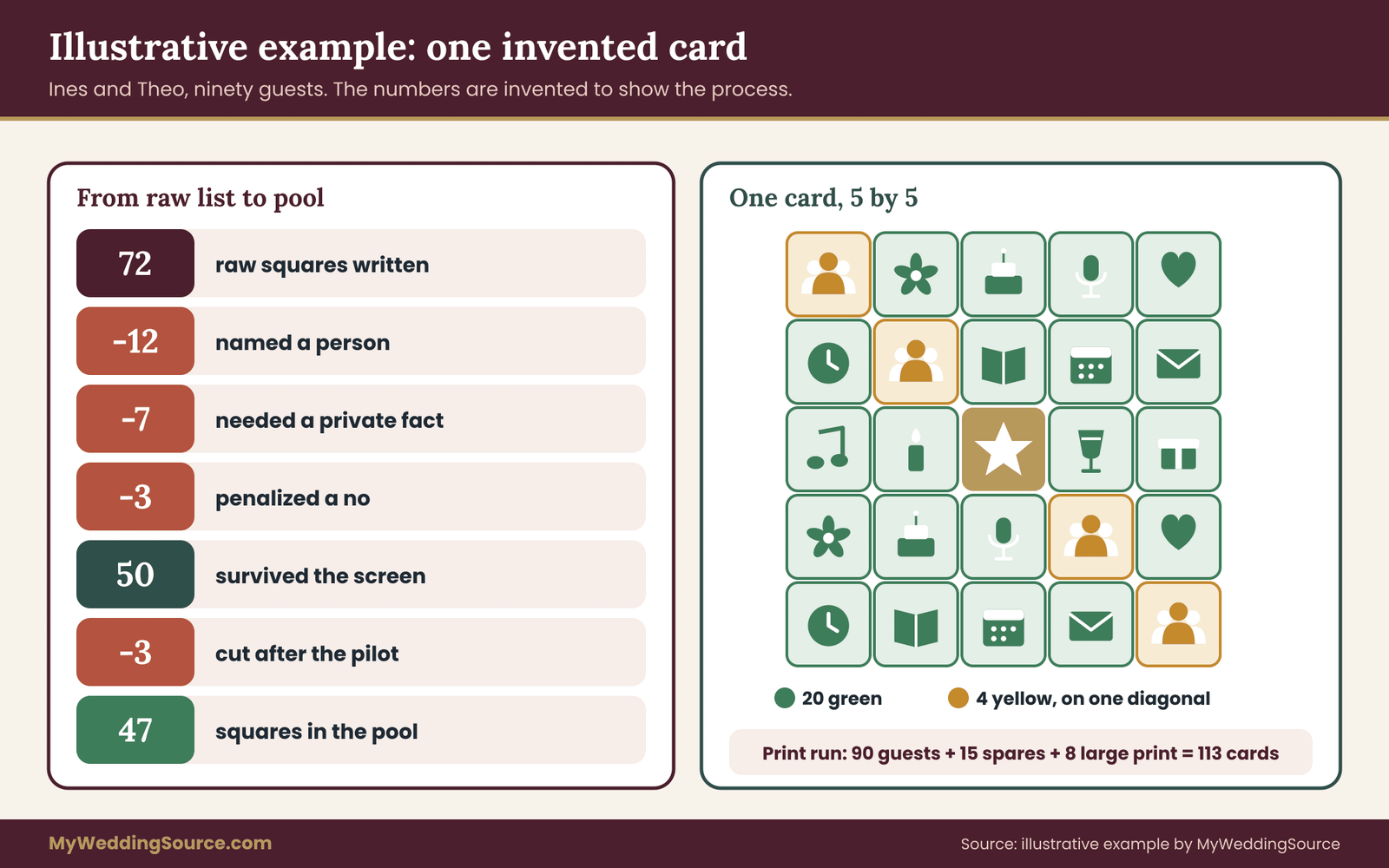
The following example is invented and meant only to show the process. The couple, Ines and Theo, are hosting ninety guests at an evening reception with a long cocktail hour, a plated dinner, four toasts and dancing afterward. Guests come from three households and many do not know each other. They want a small, optional game for the cocktail hour and the dinner, and they do not want anyone teased.
Step one: the raw list
Ines and Theo spend an evening writing squares without judging them. They end with seventy-two. A few are good. Some are the ones that cause trouble: “Theo’s brother trips on the dance floor”, “someone cries at the first dance”, “find a guest who is single”, “someone drinks more than three glasses of wine”, “Ines’s mother mentions her diet”.
They write each one on its own line, so that the screen is easy to apply.
Step two: the screen
They apply the five questions. Twelve squares fail the named-person test, including every square about a particular brother, aunt or friend. Seven squares fail the private-fact test: weight, relationship status, drinking, a parent’s health. Three fail the no-cost test, such as “dance with someone you have not met”. Nine pass the other tests but fail the observation or seat test, so they become yellow squares, for example “ask a guest about their favorite song” and “find someone from another state”.
Twenty-two squares are cut and fifty survive: forty-one green and nine yellow. The couple notes the reason beside each cut, so that when Theo’s sister asks why her favorite square vanished, they can answer in a sentence.
Step three: the pool and the wedding bingo card
The pool starts with forty-one green and nine yellow squares. Each card will carry twenty green and four yellow squares, with the free space in the center, and the four yellow squares are placed along one diagonal after shuffling, so that every card has a row or a column of green squares available.
They sort the green squares by likelihood. Eighteen are near-certain: the cake has flowers, a toast mentions a place, a candle is lit on a table, a song with a chorus plays. Fifteen are likely: a table raises glasses together, a guest asks the DJ for a song. Eight are rare: a rain sound on the roof, a toast in a second language. After shuffling, each wedding bingo card contains about nine near-certain squares, so every guest can mark something early.
Step four: the rewrites and the free space
The couple rewrites a few survivors. “A toast makes the room laugh” becomes “a toast mentions a place”, because a laugh puts pressure on the speaker. “Someone wears a hat” is cut. The free space says “thank you for being here”. Each card carries the line “This game is optional. Play as much or as little as you like.”
They also decide the format. Cards are laid at each seat, face up, with a pencil. A small tent card on each table says that wedding bingo cards are optional. A short note goes to the DJ with the script, the prize and a draw time after dessert. A line on the host’s sheet says that the DJ may end wedding bingo at any time.
Step five: the pilot and the print
Four readers test the pool, which the next section describes. They flag five squares. Two are rewritten and three are cut, leaving forty-seven in the pool. The couple orders proofs of two different cards, checks them under dim light, adjusts the type size and orders the print run.
The guest count is ninety. Adding one spare for every six guests gives fifteen more, so they order a hundred and five cards, plus eight large-print cards. The cost per card is the quote divided by one hundred and thirteen. They add pencils and a small prize to the budget line.
What the couple did not do
They did not name any guest on a card. They did not attach a prize to speed. They did not announce wedding bingo during the toasts. They did not ask guests to show marks. They did not keep any record of who played. If a guest wanted to ignore wedding bingo for the whole night, nothing about the evening would tell them they should have joined.
The pilot test: measurable checks before you print
A pilot is a short test with a few people who are not you. It catches squares you cannot see because you wrote them, and it takes about an hour of other people’s time. The checks below produce numbers, and the numbers are design targets of your own, not published standards.
Choose four readers
Pick four people who differ from each other and from you. One should be older than most of your guests. One should not know you well, for example a colleague or a friend of a friend. One should be someone who tends to avoid games. One should be a person who will read the wedding bingo card in poor light or on a small print, such as someone with low vision or without their glasses. If your wedding includes a significant language community, ask a fluent reader to take part.
Give each reader the full pool, not only a card. Ask them to mark any square that makes them uneasy, and to say why in a sentence. Do not defend squares. Write down every comment.
Run three checks
The unease check. Count how many readers flag each square. A square flagged by one reader should be rewritten or cut, and a square flagged by two should be cut without discussion. If a reader flags many squares, ask what pattern they see. Often there is a theme, such as clothing or food, and you can fix the theme at once.
The markability check. Give each reader a sample card and a short description of the reception timeline: cocktail hour, dinner, toasts, dance. Ask them to imagine the evening and mark the squares they expect to see. Count marked squares per card. As a design target, a typical guest should be able to mark at least half of the squares by the end of dessert. If readers mark far fewer, add near-certain squares and replace the rare ones.
The reading check. Hand a printed proof to each reader under the lighting you expect on the day. Ask them to read all squares and say whether any were hard to read. As a design target, a guest should be able to read the whole card in about a minute and a half. If anyone struggles, increase the type size, simplify the wording or shorten the squares.
Apply decision rules
Write down the rules before the results come in, so that the results do not tempt you to argue.
If any square is flagged by two or more readers, cut it. If any square is flagged by one reader, rewrite it, and if the rewrite is not obviously better, cut it. If fewer than half of the squares are marked on average, adjust the balance. If any reader cannot read the proof, change the type. If the pilot leaves you with fewer than thirty green squares, write more and test only the new ones with a second pass.
After the changes, run a short second round with one reader. The second round is not a full test. It checks that the rewrites solved the problem and did not create a new one.
A last review a week before printing
The week before printing, reread the whole pool once more, alone, with the five questions in front of you. Facts may have changed. A guest may have had a loss. A vendor may have swapped a flower. The final reading takes ten minutes and catches things that a long process can hide. Then confirm the proof, the quantity, the pencils and the prize.
On the day, assign one person to check that cards are at the tables, that the host has the script, and that the person with authority to end wedding bingo knows it. If you are placing cards at seats, check with whoever handles place settings, since the seating chart guide describes how that work is usually divided. Then leave wedding bingo to the guests.
Your next steps
Work through these in order, and start early enough that the pilot does not fall in the last days.
First, decide whether wedding bingo fits your reception by checking the program, the room and the guest list, and decide whether a side table is the right size. Second, write sixty or more raw squares without judging them.
Third, apply the five questions to each one and record the reasons. Fourth, sort the survivors into green and yellow tiers and rewrite or delete the rest. Fifth, build a pool of about fifty squares, balanced across the moments of the evening and across likelihood. Sixth, shuffle and lay out the wedding bingo cards, and make sure each wedding bingo card has a line of green squares.
Seventh, write the host script and the authority to end wedding bingo. Eighth, run the pilot with four readers and apply the decision rules. Ninth, ask the printer, the venue and the wedding bingo card tool your vendor questions, and get a proof. Tenth, reread the pool a week before printing and brief the host and the speakers.
A game built this way takes only a few evenings of work, and the best sign of success is how little attention it draws. Guests pick up a card, mark a few squares between courses, and put it down. Nothing else needs to happen.
FAQ
How many squares should wedding bingo cards have?
A five-by-five grid with a free center is the familiar format, which gives twenty-four playable squares. A three-by-three card with eight squares and a free space is better for children or a short cocktail hour. Choose the smaller grid when you are unsure, because a card that can be finished feels friendlier than one that cannot.
Should wedding bingo be played during the ceremony?
No. The ceremony is a moment for attention, and a card turns attention into a scorecard. Some ceremonies include religious or family rituals that deserve full focus. Start wedding bingo at the cocktail hour or after dinner is served, and keep it away from toasts, blessings, silences and the first dance.
What should I do if a guest dislikes a square?
Thank them, and offer to remove it from any later printing or from the digital version. Do not defend it. If the guest is upset, a short private conversation from the host or a family member is better than a public explanation. Then review the square with the five questions, because one guest’s reaction often reveals a pattern you missed.
Is it fine to put guests’ names on cards?
It is better not to. A name makes a card a possession and can single out one guest. It also raises the question of what to do with a card at an empty seat. If you want to number cards, use a small number in a corner and keep the master list private, because the number identifies the wedding bingo card and not the person.
What prizes work best for wedding bingo?
Small, shared and easy to enjoy. A candle, a box of chocolates or a local treat works well, and a random draw among completed cards is fairer than a race. Avoid alcohol and avoid items with small parts if children play. For any item that raises safety questions, the Consumer Product Safety Commission publishes official guidance.
How do I make wedding bingo cards accessible?
Use large, dark type on a light background, offer a few large-print copies, and keep most squares visual and seat-friendly. Provide thick pencils and a helper who can read squares aloud. Test the wedding bingo card in the lighting you expect. The ADA website, the U.S. Access Board and the W3C Web Accessibility Initiative publish official accessibility guidance.
Can wedding bingo squares mention guests at all?
Avoid it. Even a kind mention can make a guest feel watched, and others may be able to tell who is meant. Replace a person with an event. If you want to honor a guest, do it in a toast or a note, where they can choose to hear it, and not on a card where they cannot.
What if nobody plays?
That is acceptable, and it is useful information. A game that guests ignore has cost you a small stack of cards and an hour of preparation. Do not push or repeat the announcement. Let the evening go on. If you are unsure, begin with a stack at the welcome table and see how many are taken before deciding what to do next time.
Sources
- ADA.gov, U.S. Department of Justice, Americans with Disabilities Act information
- U.S. Access Board, accessible design guidance
- W3C Web Accessibility Initiative, contrast and readability guidance
- National Eye Institute, low vision information
- National Institute on Deafness and Other Communication Disorders, hearing information
- U.S. Consumer Product Safety Commission, children’s product safety guidance
- Federal Trade Commission, consumer information on online services and advertising
- Centers for Disease Control and Prevention, alcohol and public health information
- U.S. Copyright Office, copyright information for printed and designed materials
- USA.gov, official guide to U.S. government information