
A dog ring bearer is one of the sweetest ideas in wedding planning and one of the easiest to get wrong. This guide gives you a readiness checklist you can score, an eight-week training plan, a backup ring custody chain and a written exit plan, so you can decide honestly whether your dog ring bearer should do the job at all.
Your dog should be your dog ring bearer only if it passes eight measurable behavior checks, including coming when called and staying calm around a seated crowd. Even then, the real rings should never depend on the dog. Give the dog decoy rings or a secured pouch, keep the real rings with a named person, and write an exit plan that says who removes the dog, by which door, and what happens to the rings if the walk fails. If the dog scores low, use one of the alternatives later in this guide.
Most couples picture the same moment. The music changes, the doors open, and a happy dog trots down the aisle with a small pouch tied to its harness. Guests smile, the photographer lifts a camera, and the rings arrive at the altar like a gift. It is a lovely picture. It also asks a dog to do something dogs rarely do well: stay focused for a minute or two while strangers clap, flowers brush past, music plays, and the person it loves most waits at the other end.
A dog ring bearer works when the dog ring bearer is genuinely prepared, the job is small, and the people around it have a backup for every step. It fails when the idea comes first and the dog’s actual behavior is an afterthought. This guide is built to move you from the idea to a clear yes, a clear no, or a modified version, using checks you can observe rather than hopes.
A note on scope. This is general information, not legal, veterinary or financial advice. Your own veterinarian knows your dog’s health and temperament, and your venue sets its own animal rules, so confirm both before you commit. The broader question of whether to include pets at all, and how to arrange their care across the whole day, is its own topic on this site. Here we stay with one role: the dog that carries, or appears to carry, the rings.
What a dog ring bearer actually does
Before you score your dog, define the job. A dog ring bearer is asked to do five small things in sequence, and each one is a separate skill. Treating them as one vague talent called “being good” is how couples end up surprised.
Wait. The dog is held at the start of the aisle, often out of sight of the guests, for anywhere from a few minutes to a quarter of an hour depending on how the processional runs. Waiting calmly near music and movement is harder than it sounds.
Walk. The dog covers the length of the aisle, usually between thirty and eighty feet, either on a leash with a handler beside it or loose with a handler stationed at the front. Guests will be looking at it, and some will be calling to it.
Carry. The dog wears something that holds the rings or stands in for them. A harness, collar, pouch or small box adds weight and a new sensation. Some dogs ignore it. Some freeze.
Deliver. At the end of the aisle, someone takes the rings from the dog. This is a handoff, and it has to happen smoothly while the dog ring bearer may be excited, confused or both.
Exit or settle. After delivery, the dog either sits near the couple for part of the ceremony or leaves with a handler. Staying put through vows, a reading and a kiss is a long time for a dog ring bearer that has just done something exciting.
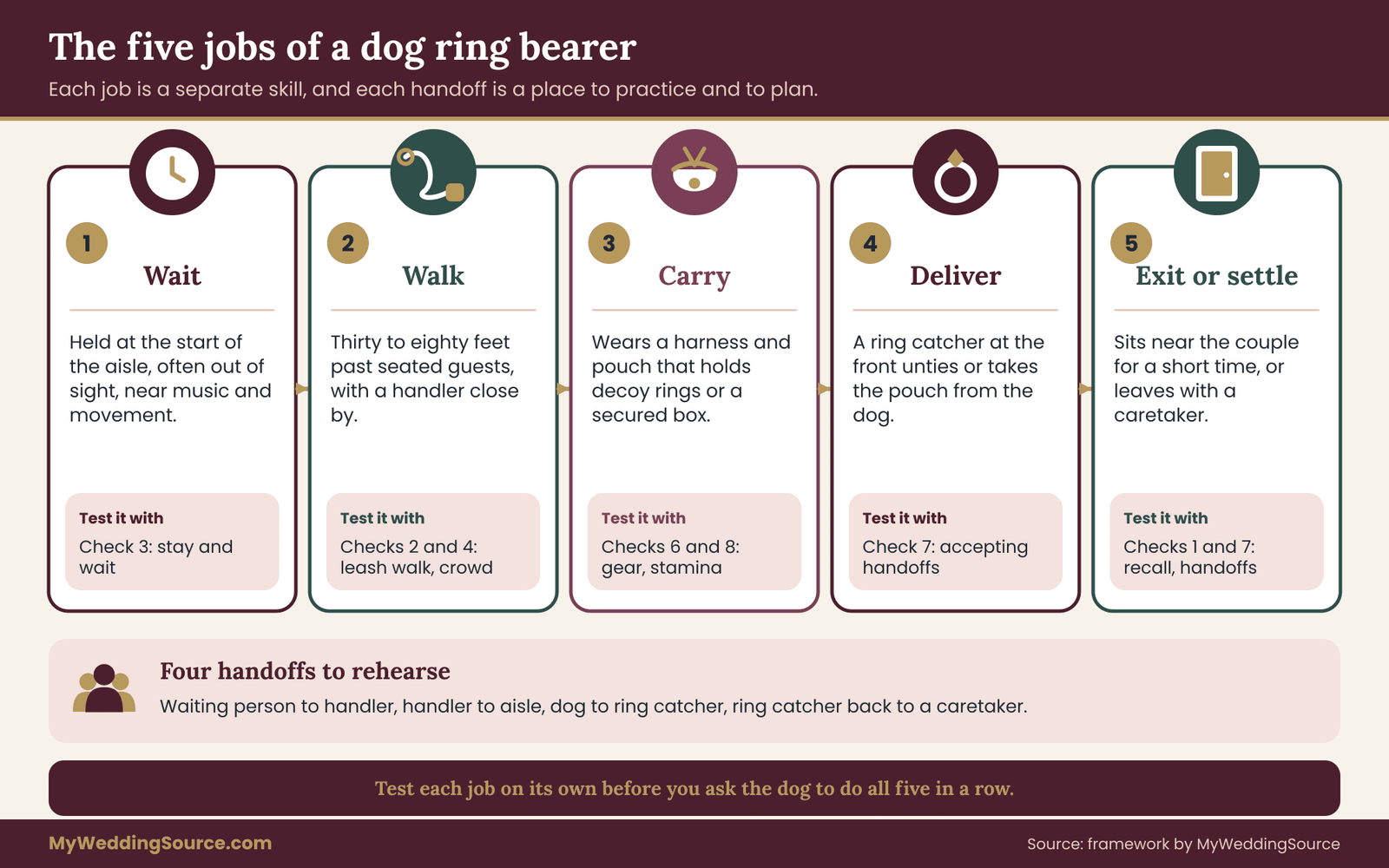
Seen this way, a dog ring bearer is a five-step performance with four handoffs: from the waiting person to the handler, from the handler to the aisle, from the dog to a ring receiver, and from the receiver back to a caretaker. Each handoff is a place where the plan can slip. Each one also gives you something concrete to practice and to write down.
Why the decision deserves more than a yes or no
Couples often ask, “Is my dog good enough?” That question hides three separate questions.
The first is about the dog: does it have the skills and the temperament? The second is about the day: is the venue, the crowd, the weather and the schedule friendly to a dog? The third is about the rings: if the walk goes badly, what protects them? You can answer yes to the first and still decide against the role because the second or third is weak. A calm, well-trained dog on a hot, crowded, noisy lawn may be better off watching from the family photo area.
A mediocre dog with a calm venue, a decoy pouch and a patient handler may do fine.
Keeping the three questions separate also protects relationships. If the dog does not make the cut, the verdict is about a score and a context, not about whether anyone loves the dog enough.
Who has the final say
The dog’s welfare outranks the picture. If a veterinarian says the dog ring bearer should not be in a crowd, or the dog shows persistent fear in training, the answer is no, and no amount of planning changes that. Venue rules also outrank your wishes: some venues prohibit animals in certain spaces, require proof of vaccination, or limit pets to specific areas. The wedding venues guide explains how to read a venue’s policies before you fall in love with a space, and the same habit applies here.
Inside those limits, the decision belongs to the couple and to the person who will actually handle the dog. Ask that person early and ask without pressure. If your sister loves the idea but will be a bridesmaid, she cannot also be the handler. The handler has to be someone who is not part of the wedding party’s main choreography, and who the dog trusts.
What this guide will and will not do
This guide gives you five tools. A readiness checklist with eight scored checks. A training plan that fits into eight weeks. A custody chain that keeps the real rings safe whatever the dog ring bearer does. An exit plan with triggers, doors and scripts. And a short list of alternatives for dogs that are not ready.
It does not tell you what breed or size makes a good ring bearer, because behavior varies far more within a breed than between breeds. It does not rank dog products or recommend brands. And it does not treat the dog as a prop. A dog that is happy in the role can make the ceremony warmer. A dog ring bearer that is stressed in the role makes the ceremony worse for everyone, including the dog.
If you are still early in planning, the wedding ceremony step-by-step guide shows where a processional element like this one fits in the ceremony, and the wedding planning checklist is a good place to track the tasks that come out of this article.
The dog ring bearer readiness checklist: eight checks you can measure
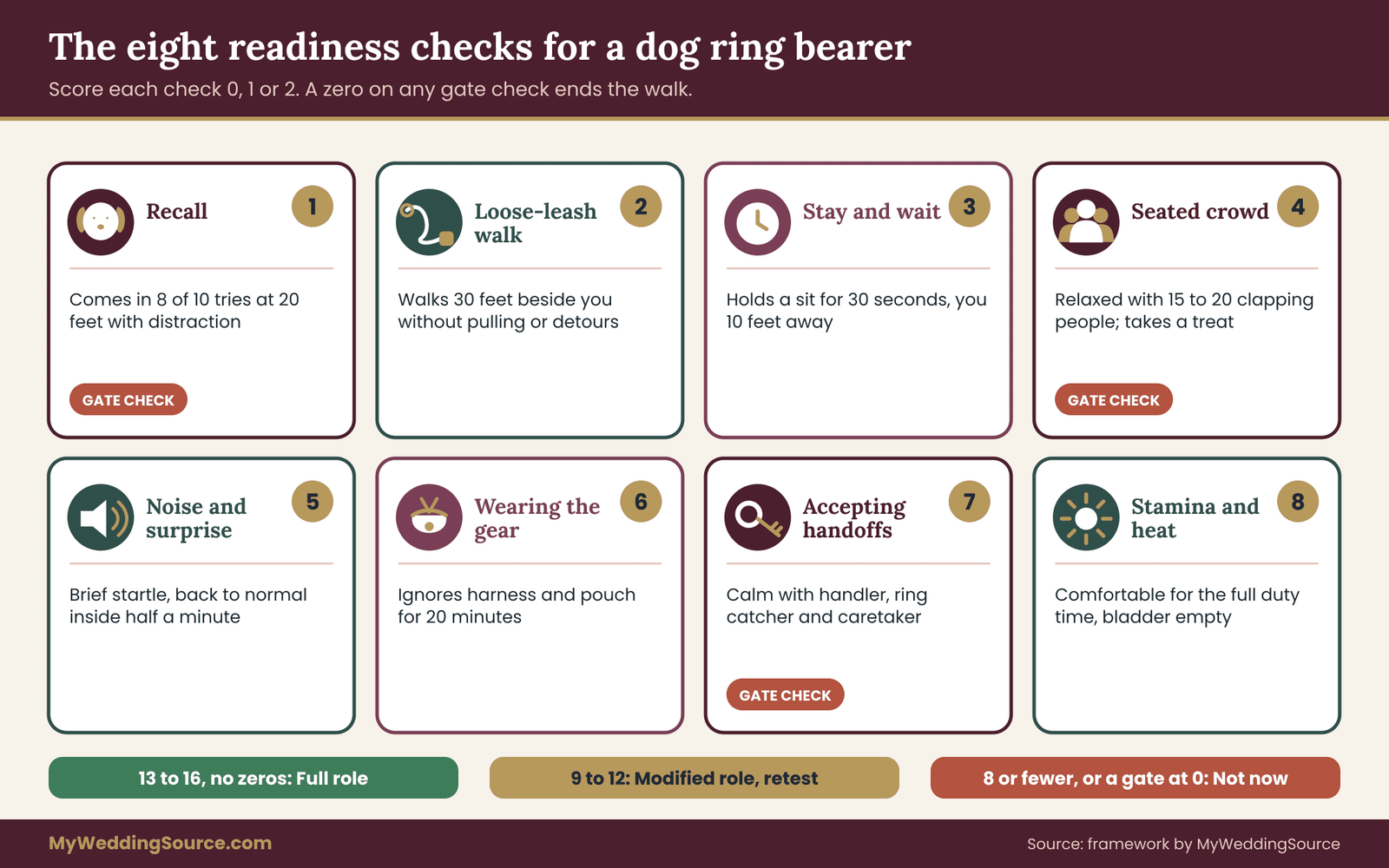
A readiness checklist only helps if each check can be observed and scored the same way twice. Vague items such as “is friendly” or “seems calm” let hope win. The eight checks below each have a test you can run in your living room, a park or a friend’s yard, and a score of zero, one or two. They are a framework written for this guide, not a veterinary test, so treat them as a structured way to look at your own dog rather than a diagnosis.
Score each check at three levels. Zero means the dog cannot do it yet. One means the dog does it most of the time, with help. Two means the dog ring bearer does it reliably, in a new place, with distractions. Run every test at least three times on different days before you write a score down, because dogs have off days and so do handlers.
Check one: recall under distraction
Stand about twenty feet away with a second person making noise or moving. Call the dog once, in a normal voice. A score of two means the dog turns and comes within a few seconds in at least eight of ten tries. A score of one means it comes in five to seven of ten, or only when you call twice. Zero means it stays with the distraction. Recall is a gate check, which means a zero here ends the conversation for an off-leash walk and probably for the role.
Check two: walking beside the handler
Mark a thirty-foot path. Walk it with the dog on a loose leash while people stand along the sides. A two means the dog stays near your knee, does not pull, and does not stop to greet people along the way. A one means light pulling or one or two detours. A zero means the dog drags the handler or cannot pass people without lunging or stopping. A dog ring bearer who cannot walk thirty feet without pulling will not improve under music and applause.
Check three: stay and wait
Ask the dog to sit or lie down, then step ten feet away and count to thirty. A two means the dog holds the position in four of five tries, including one try with a distraction. A one means it holds for ten to fifteen seconds. A zero means it follows you at once. Waiting at the start of the aisle is the longest part of the job, so this check predicts more than most people expect.
Check four: calm around a seated crowd
This is the other gate check. Arrange fifteen to twenty people on chairs, ideally including a few the dog ring bearer does not know well, and have them clap, laugh and talk. Walk the dog through. A two means loose body, normal breathing, tail in a natural position, and willingness to take a treat. A one means mild tension that eases within a minute. A zero means freezing, hiding, barking, lunging, trembling or refusing food. If you see zero here, the answer to the question in this guide’s title is no, and a different role is kinder.
Check five: noise and surprise
Play recorded music at wedding volume, clap, drop a book, and click a camera shutter nearby. A two means a brief glance and a return to normal. A one means startle with recovery inside half a minute. A zero means panic, escape attempts or long-lasting fear. Ceremonies are full of sudden sounds: applause, a baby crying, a reader tapping a microphone, a gust that bangs a door.
Check six: wearing the gear
Fit the harness, pouch or carrier you plan to use and keep it on for twenty minutes of ordinary activity. A two means the dog ignores it, plays, and eats normally. A one means some scratching or sniffing in the first few minutes, then acceptance. A zero means the dog freezes, scratches at it constantly or tries to remove it. Never judge this check on the first fitting alone. A short test on a new piece of gear tells you very little.
Check seven: accepting handoffs
Have the dog handled by the people who will be involved on the day: the handler, the ring receiver and the caretaker who will take it away afterward. A two means the dog accepts a leash being passed, a pouch being untied and a short hold from each of them without stress. A one means it accepts all but one person. A zero means it resists or panics when anyone but the primary handler touches it. This is a gate check too, because the whole custody chain depends on it.
Check eight: stamina, bladder and heat
This check is about the dog’s body, not its manners. A two means the dog can wait comfortably for the whole time it will be on duty, has emptied its bladder shortly before, and tolerates the expected temperature without heavy panting. A one means it manages but tires or pants noticeably. A zero means short fuse, frequent accidents, or trouble in warm weather. The American Veterinary Medical Association publishes pet-owner guidance on keeping dogs safe in heat, and your own vet can tell you whether your dog’s age, weight or health changes the picture.
Scoring the checklist and making the call
Add the eight scores. The maximum is sixteen. Use these rules in order.
Rule one: any gate check at zero ends the walk. Recall, calm around a seated crowd, and accepting handoffs are the gates. If any is zero, the dog ring bearer does not walk as a ring bearer this time, and you move to the alternatives section.
Rule two: thirteen or more with no zeros is a green light for the full role. That means the dog walks the aisle, delivers decoy rings or a secured pouch, and either settles near the altar or exits with a handler.
Rule three: nine to twelve is a modified role. The dog ring bearer does a shorter version, for example walking only the last third of the aisle, or appearing with the handler after the vows. You keep training and you retest in four weeks.
Rule four: eight or fewer is a no for this ceremony. The dog can still be part of the day in a role that asks less, such as the family photo section or a short greeting before the guests arrive.
These thresholds are a decision tool, not a scientific cutoff. They exist so that a hopeful couple and a skeptical parent can look at the same numbers and agree.
Adding the day factors to the score
The score describes the dog. The day adds its own multipliers, and you should write them beside the score before you commit. Ask four questions. How many guests will see the dog, and are there any with known fear of dogs or allergies? How long will the dog be on duty from arrival to exit? What is the weather forecast and is there shade or air conditioning nearby? Is there a quiet room within a short walk where the dog ring bearer can rest between steps?
If two or more answers are unfavorable, drop one level. A green light becomes a modified role, and a modified role becomes a no. This is the part couples tend to skip, because a score feels final. It is not. A score of fourteen at a crowded outdoor ceremony in midsummer heat is a very different proposition from fourteen at a small indoor ceremony with a calm room next door.
Who should score the dog ring bearer candidate
Your own scoring will lean optimistic. Ask a second person who knows the dog but is not emotionally invested, such as a trainer, a neighbor who walks the dog, or a veterinary technician, to watch two of the tests and score independently. Where your scores differ by more than one point on a check, use the lower number. Disagreement is information. It usually means the behavior is inconsistent, which is exactly the thing that hurts on the day.
You can also ask your veterinarian a plain question during a routine visit: “We would like our dog to walk down an aisle at our wedding. Is there anything about its health, age or temperament that should change that?” Vets cannot predict behavior at an event, but they can flag pain, anxiety history or age-related issues that change the plan. If the vet raises a concern, take it seriously.
Reading stress signals in a dog ring bearer
Part of scoring is learning to see what your dog ring bearer is telling you. Common signs of stress in dogs include a tucked or low tail, ears pinned back, lip licking, yawning when not tired, turning the head away, showing the whites of the eyes, shaking off when not wet, heavy panting without heat, refusing treats, and sudden stillness. Some dogs show stress by becoming very excited, with jumping, spinning or barking, and that is easy to mistake for happiness.
Write down which signs your dog shows in the crowd test. Those signs become the triggers in your exit plan later in this guide, so the effort is not wasted. The ASPCA and the American Veterinary Society of Animal Behavior both publish accessible material on canine body language and on reward-based training, and both are listed in the sources at the end.
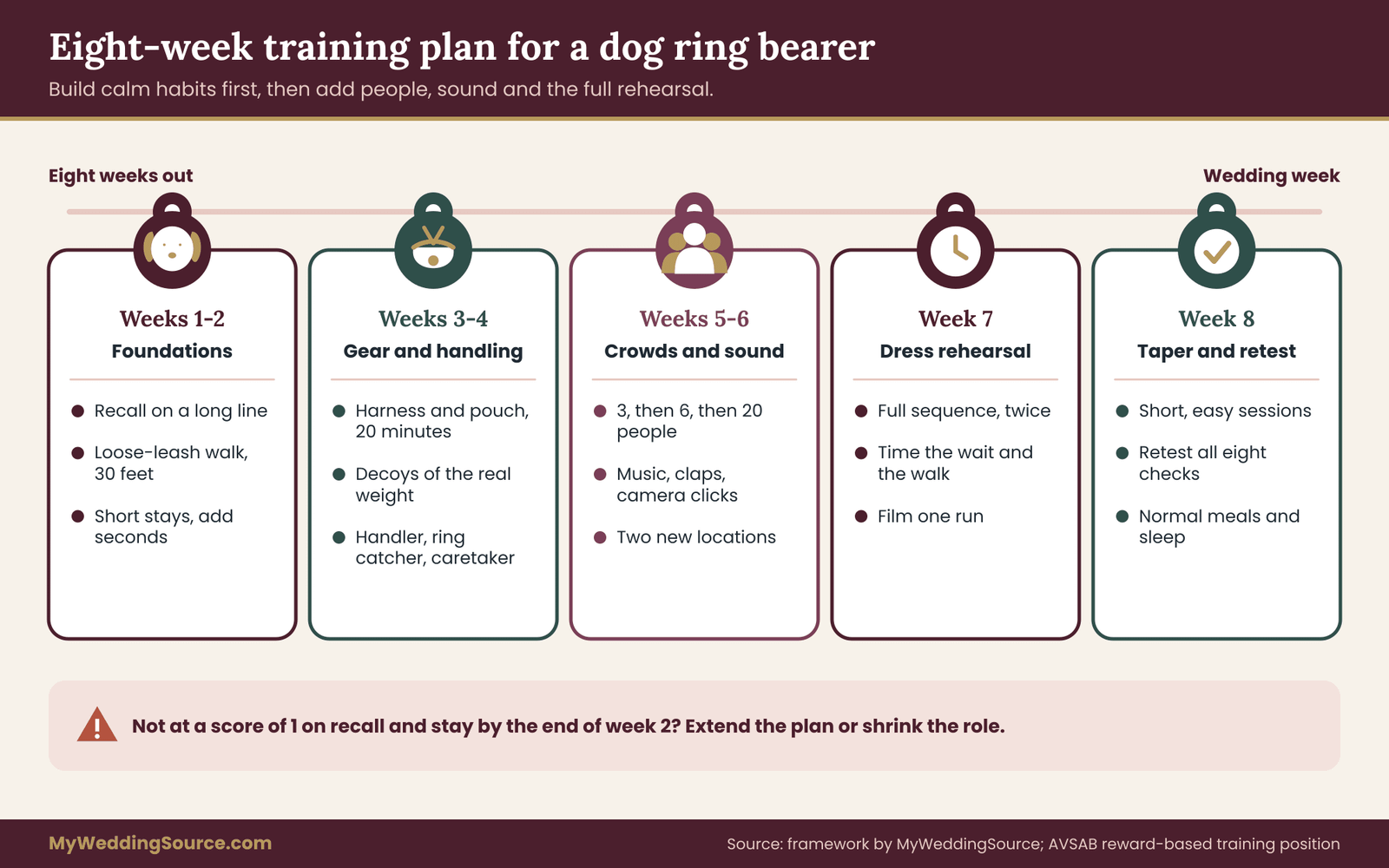
An eight-week training plan for a dog ring bearer
Training for this role is not about teaching a trick. It is about building a handful of calm habits and then testing them in progressively more wedding-like conditions. The plan below assumes your dog already knows basic cues such as sit, down, come and walk on a leash. If it does not, give yourself more than eight weeks or choose a smaller role, because a dog ring bearer cannot learn the basics and the performance in the same two months.
Use rewards your dog ring bearer actually values, keep sessions short, and end each one on a success. The American Veterinary Society of Animal Behavior states that reward-based methods are the recommended approach to dog training, and that punishment-based methods can increase fear and anxiety. That matters here more than usual. A dog ring bearer that associates the aisle with correction will carry that feeling to the wedding.
Weeks one and two: foundations for the dog ring bearer
In the first two weeks, you are strengthening the skills behind checks one, two and three. Practice recall in the yard and at the park with a long line, rewarding every successful return generously. Practice walking beside you on a loose leash along a straight path of about thirty feet, rewarding position rather than distance. Practice stay and wait at short durations, adding a few seconds at a time.
Keep sessions to five or ten minutes, two or three times a day. Do not add distractions yet. The aim is for each cue to be fast and relaxed in a quiet place before you ask for it anywhere harder.
If the dog is not at a score of one on recall and stay by the end of week two, stop and reassess. Either extend the plan, ask a certified trainer for help, or move to the alternatives. Pushing ahead on shaky basics produces a dog that looks trained in the living room and falls apart in the aisle.
Weeks three and four: gear and handling
Now introduce the equipment. Choose the harness and pouch or carrier you intend to use on the day and let the dog sniff it and eat treats near it before it goes on. Put it on for a few minutes, reward, and take it off. Build up to twenty minutes of wear during normal activity, including a walk.
Keep the load light and honest. If you plan to use decoy rings, use decoys of the same size and weight from the beginning, because a dog ring bearer can notice a change in what it is carrying. Tie the pouch snugly, but not tightly, and check that nothing dangles where the dog ring bearer can chew it.
At the same time, begin handoff practice. Have the handler pass the leash to the ring receiver and then to the caretaker, rewarding calm behavior at each handoff. Have each person untie the pouch while the dog sits. Do this in short sessions and keep them casual. The point is that being handled by these three people becomes boring.
Weeks five and six: crowds, music and surprises
The middle of the plan is the hardest and the most important. Start adding people. First two or three friends sitting on chairs, then six, then fifteen or twenty by the end of week six. Have them clap occasionally and talk normally. Walk the dog past them on a loose leash and reward calm behavior.
Add sound. Play processional music at a moderate volume and increase it over several sessions. Have someone drop a clipboard, open an umbrella, or click a camera. Reward recovery, not absence of reaction. A dog that startles and settles is doing well.
Add a new location at least twice. If the dog can only do the walk in your yard, you have not yet tested the skill. A park, a friend’s lawn, a school field on a weekend or a quiet hall all work. If you have a chance to visit the actual venue, ask permission first. Many venues are happy to arrange a short visit when it is quiet, and some will say no, which is useful information too.
Week seven: the dress rehearsal for your dog ring bearer
In week seven, run the whole sequence as it will happen on the day, with the right clothes and equipment, and with everyone in their roles. The handler waits at the start with the dog while music plays. At the cue, they walk the aisle. The ring receiver at the front takes the pouch. The caretaker leads the dog away or settles it near the altar.
Time it with a watch. Record how long the dog ring bearer waits, how long the walk takes and how long the dog stays in position afterward. These numbers go straight into your day-of timeline. If the dog ring bearer starts to show stress signs at the ten-minute mark, you now know that the wait must be shorter than ten minutes, or that the dog should join the processional later.
Run the full sequence twice, with a break between runs, and film at least one. Watching the video with a clear head often shows things that were invisible in the moment: a dog ring bearer that looks at the handler constantly, a tail that tucks near the end, a pouch that slips.
Week eight: taper and test
The last week is not for new learning. Do short, easy sessions that reinforce what the dog knows. Retest the eight checks and write down the scores. If the total has dropped, even by a point or two, the dog ring bearer may be tired or anxious from the schedule, and a lighter week is better than another rehearsal.
Plan the last forty-eight hours around the dog’s normal routine. Keep meals, walks and sleep as usual. Avoid new foods, new treats and new places that could upset its stomach or its mood. Arrange for a good walk and a bathroom break within the hour before the ceremony.
If anything feels off in the dog’s health, call your veterinarian. A dog that is sore, unwell or unusually fearful should not be asked to perform, and your guests will understand a late change far better than a dog in distress.
Training the handler, not just the dog ring bearer
Almost nobody mentions this, but the handler needs training too. The handler is the dog’s guide through the aisle and the person who decides when to carry on and when to stop. Their calm matters. A handler who is nervous about guests, about being photographed or about dropping the leash will transmit that nervousness down the line.
Give the handler three things. First, a clear script: where to stand, when to move, what to say to the dog. Second, permission to abort: an explicit agreement that if the dog shows trigger signs, the handler can stop the walk and leave without asking anyone. Third, a calm place to wait before the cue, ideally away from the busiest part of the venue.
Choose someone who is not in the processional itself. A groomsman who must walk in front of the dog cannot also manage the dog. An older relative who is not comfortable with a large dog is not a good fit even if they volunteer. Consider a trusted friend, a dog-savvy cousin or a professional pet sitter. If you hire someone, ask them what they would do if the dog refused to walk, and look for a calm, specific answer.
What to do when dog ring bearer training stalls
If you reach week five and the dog ring bearer is still at a one on the crowd check, you have three honest options. You can extend the timeline, if the wedding date allows, and work with a qualified trainer who uses reward-based methods. You can shrink the role, for example to a short walk with the handler only, with no rings and no waiting. Or you can change the role entirely.
Shrinking the role is often the best answer. A dog ring bearer that does a thirty-second walk and then goes to a quiet room can still be in the ceremony, and still be in the photos, without being asked to do something it cannot manage. There is nothing lesser about that choice.
If the dog shows aggression, extreme fear, or a pattern of getting worse with practice, stop the plan altogether and speak to your veterinarian. Behavior that deteriorates with exposure is a signal to slow down, not to try harder. Some dogs simply do not enjoy crowds, and a wedding is a place where nobody should have to pretend otherwise.
Backup ring custody: the chain that keeps the real rings safe
Now the part that protects the rings. The rule at the center of this guide is simple: the real rings must never depend on the dog completing its walk. A dog ring bearer may carry the rings, but the ceremony should still be able to go ahead if the dog stops, bolts, sits down in the middle of the aisle or decides the flower girl is more interesting.
The way to build that independence is a custody chain. A custody chain names who holds the real rings at every point from the morning of the wedding to the end of the day, and it gives each handoff a spoken check. It sounds formal, and it takes ten minutes to write. It also prevents the most common ring disaster at weddings: nobody is sure who has them.
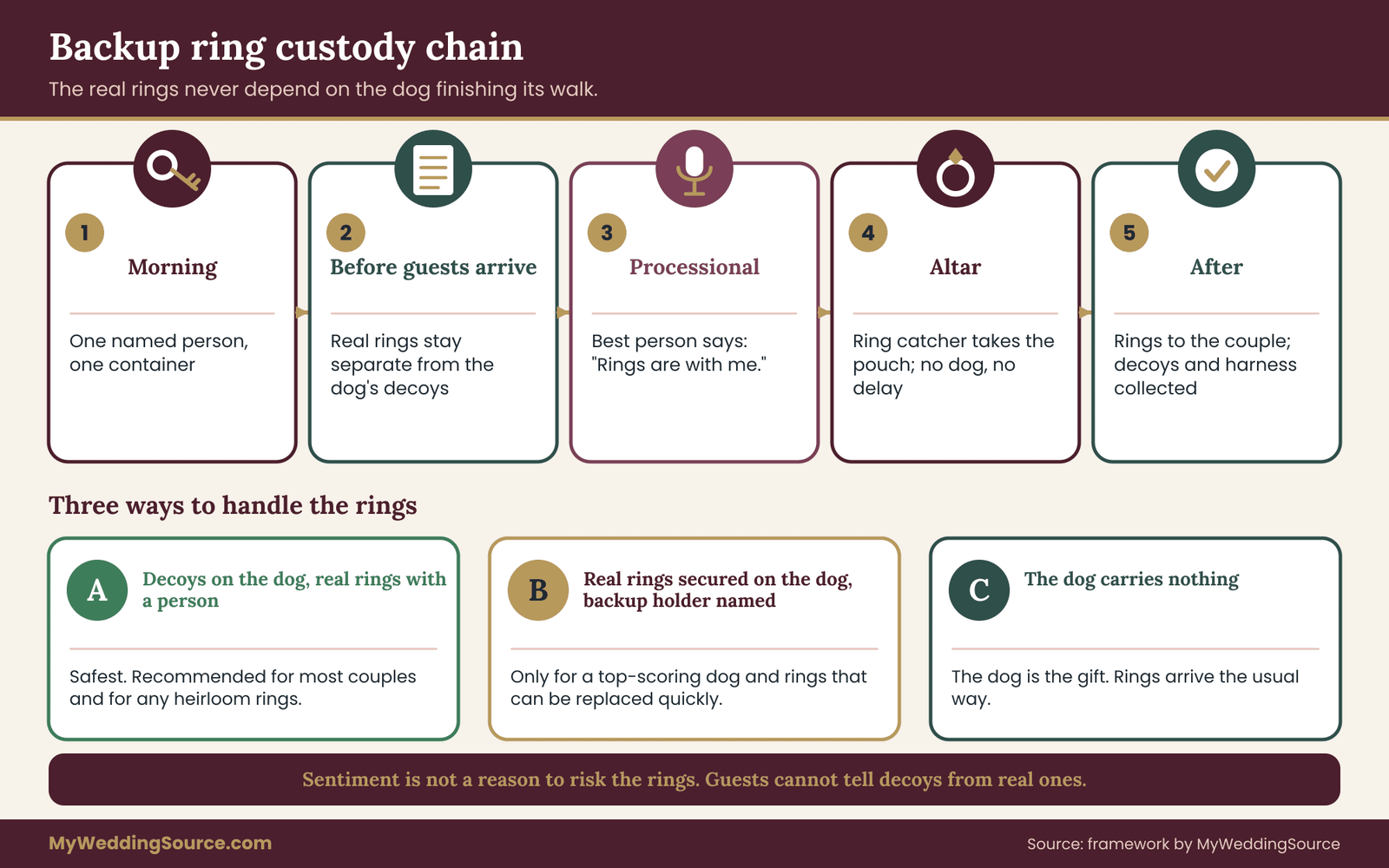
Three ways to handle the rings with a dog ring bearer
There are three configurations, and the right one depends on how replaceable the rings are and how steady the dog is.
Option A: decoy on the dog, real rings with a person. The dog ring bearer carries a pair of inexpensive stand-in rings, a ribbon with two wooden rings, or an empty pouch, and the real rings stay with the best person or another trusted holder. At the altar, the ring receiver takes the decoys and the real rings are passed in the usual way. This is the safest option and the one this guide recommends for most couples.
Option B: real rings on the dog, secured, with a backup holder. The real rings ride in a closed, secured pouch or box that is attached to the harness in a way that cannot slip off, and a second person holds a backup, such as a duplicate set of stand-ins or the rings’ insurance details. This option is for couples whose dog scored very well and whose rings are replaceable in a short time.
Option C: the dog carries nothing. The dog ring bearer walks, perhaps with a flower collar or a sign, and the rings arrive in the usual way. Many couples find that the dog’s presence is the point, not the cargo.
A decision rule for choosing
Ask two questions. First: if the rings were dropped on a lawn and not found for ten minutes, could the ceremony continue? Second: if they were lost for good, how bad would that be?
If the rings are heirlooms, custom designs or things that cannot be replaced within a week or two, choose Option A and do not reconsider. If the rings are simple and replaceable, Option B becomes possible but is still riskier than A. If the dog’s score is in the modified range, choose A or C regardless of what the rings are worth.
A related point: sentiment is not a reason to take the risk. Some couples say, “We want the real rings on the dog because it means more.” The ceremony means just as much with stand-ins on the dog and real rings in the officiant’s pocket. Nobody in the guest seats can tell the difference, and the couple knows which rings were exchanged.
Writing the custody chain
Write the chain as five lines. Each line names the location, the holder and the check.
Morning. Who has the rings while you get ready? Name one person and one container. If the rings are in a hotel room safe, say so, and say who knows the code. Make sure the person does not also hold the dog.
Pre-ceremony. Who brings the rings to the ceremony space, and who confirms they are in the right place before guests arrive? In Option A, this includes giving the decoys to the dog’s handler and keeping the real rings separate.
Processional. In Option A, the dog carries decoys, and the best person holds the real rings. In Option B, the pouch is on the dog and the backup is with the best person. In either case, the best person states a quiet check before the walk: “Rings are with me.” Saying it aloud matters more than it sounds.
Altar. The ring receiver, usually the officiant or the best person, takes the pouch from the dog or handler. If the dog ring bearer does not arrive by the cue the officiant has been given, the officiant continues with the real rings, and the dog joins later or not at all.
After the ceremony. The rings go back to the couple’s hands and the decoys are removed. Someone is named to retrieve the decoy pouch and the harness from the handler. Leftover gear has a way of disappearing into a coat pocket.
Naming a ring catcher for the dog ring bearer
The ring catcher is the person at the front who receives the dog or the pouch. This is a role of its own. It should be someone who is not distracted by their own part of the ceremony, who is comfortable with dogs, and who can kneel or crouch quickly. An officiant can do it, but only if they are told ahead of time and agree. Check with them directly, because some officiants prefer not to handle anything during the ceremony.
The ring catcher’s job has three steps: greet the dog by name in a calm voice, untie or unclip the pouch while the handler holds the dog, and hand the pouch to the best person or open it themselves. Practice this in the rehearsal. It takes ten seconds in practice and sometimes sixty on the day.
For a bigger picture of who stands where and who does what in a ceremony, the wedding ceremony cue sheet guide shows how to write cues for every participant, and a dog ring bearer fits neatly into that format.
Gear and attachments: how rings ride safely on a dog ring bearer
The gear question is more than a design question. What the dog wears has to be safe for the dog, secure for the rings and quiet enough not to distract the dog. Choose gear for function first.
Harness, collar, pouch or box
A well-fitted harness is usually a better anchor than a collar, because it spreads pressure across the chest rather than the neck. A pouch or small carrier that attaches to the harness at the back or the side is common. A tiny box on a ribbon around the neck may look charming, but anything around the neck is awkward if it swings or gets caught.
Choose a size that fits the dog’s body. A pouch that hangs low can bump the legs, and a bulky one can rub or shift when the dog trots. Test it during the two-week gear phase of training and check for chafing afterward.
Keeping the rings from becoming a hazard
Rings are small, hard objects, and dogs can swallow small things. A ring that works loose and ends up in a dog’s mouth is an emergency. Keep real rings out of reach of the dog’s mouth whenever possible, which is one more reason to prefer decoys.
If you use decoys, make them too large to swallow. Wooden rings the size of a bracelet, a ring of fabric or a ribbon loop are all safer than anything that could fit through a dog’s throat. Avoid small beads, plastic fillers and loose glue-on embellishments. If the pouch has a drawstring, make sure the cord is short enough not to wrap around the dog’s leg.
If a dog does swallow something it should not have, call your veterinarian or an emergency clinic right away. The ASPCA Animal Poison Control Center also operates a hotline for ingestion emergencies, and it is worth saving the number in the handler’s phone before the day.
Decorations that need a second look
Flower collars, petals and fresh greenery look lovely but are not always safe for dogs. Some common wedding plants are toxic to dogs, and the ASPCA keeps a searchable list of toxic and non-toxic plants. If the dog wears or walks through florals, check each variety against that list and ask your florist what is in the aisle arrangement. Loose petals on the aisle can also tempt a dog to sniff and snack.
Skip anything with strong scent, fragile glitter, or small decorations a dog could chew off. Avoid wire. Keep ribbons short and tied firmly, because long ribbons can tangle.
A note on dog clothing
A bow tie, a small vest or a dress can be part of the look, but clothing changes how a dog moves and how warm it is. Test every item for twenty minutes before the day and watch for signs of discomfort. In warm weather, skip layers. A dog ring bearer that is hot cannot tell you, and the American Veterinary Medical Association notes that dogs cool themselves mainly by panting, which limits how well they handle heat.
Spare equipment
Pack a small bag that stays with the handler. Include a spare leash, a spare harness if you have one, a small towel, water and a bowl, the usual treats, waste bags, and a written copy of the exit plan. Add the vet’s phone number and the number of an emergency clinic near the venue. This bag also holds the extra decoy rings and a few safety pins, which sounds minor until a ribbon comes loose five minutes before the walk.
The exit plan: when your dog ring bearer should leave the aisle
An exit plan is a short written agreement about how the dog leaves the ceremony if something goes wrong, and how it leaves smoothly even if nothing does. It answers four questions: what triggers an exit, who makes the call, which door the dog uses, and what happens to the rings and the ceremony in that moment. Writing it down turns a stressful improvisation into a calm routine.
Most couples skip this step because it feels negative. In practice, the plan does the opposite. A handler who knows exactly what to do is relaxed, and a relaxed handler makes a relaxed dog. The plan is part of what makes the walk possible, not a prediction of failure.
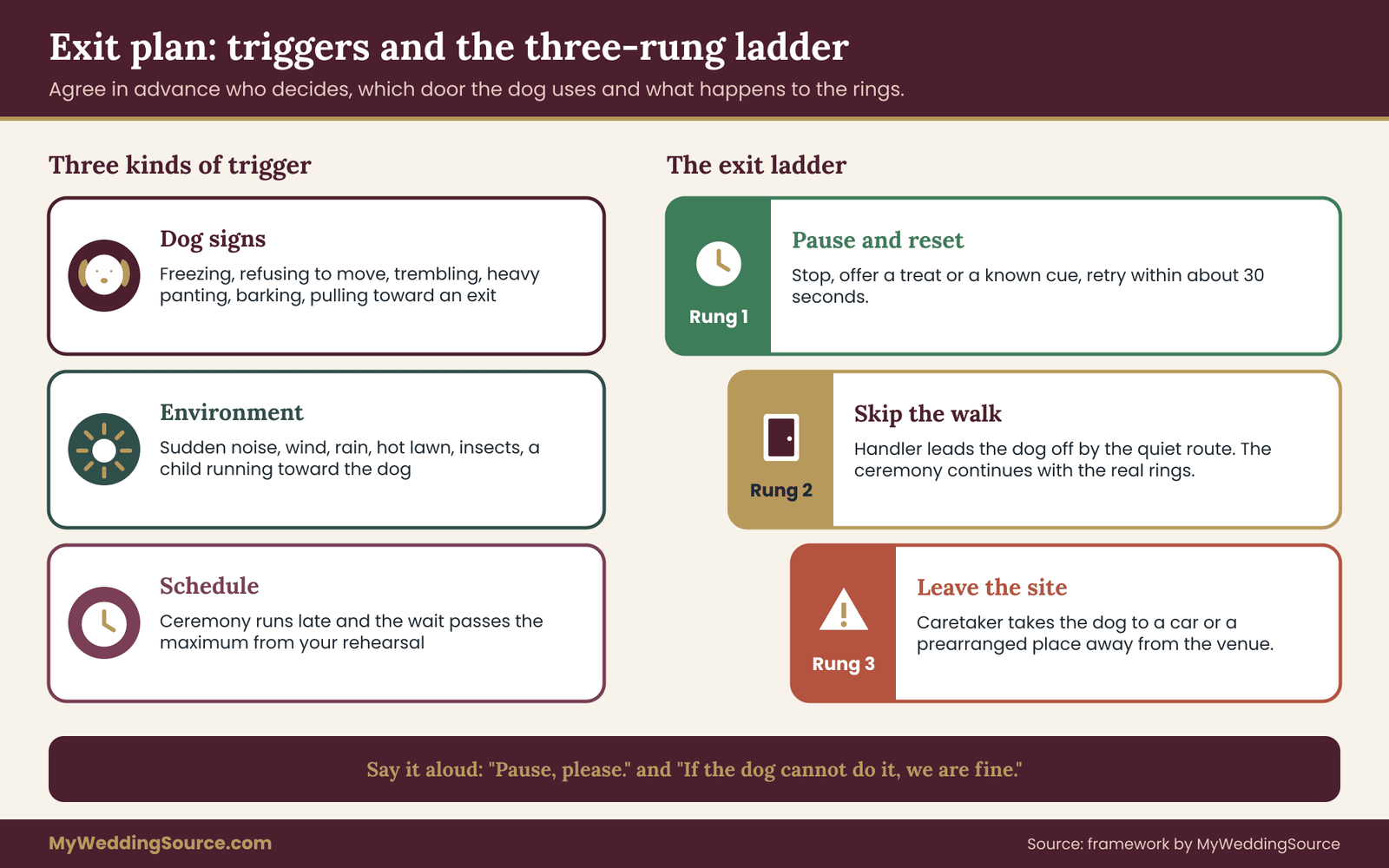
Triggers: the three kinds for a dog ring bearer
Triggers fall into three groups, and each needs its own response.
Dog triggers are signs from the dog itself. These include freezing, refusing to move, trying to retreat, heavy panting that is not explained by heat, trembling, repeated yawning or lip licking, barking or growling, sudden urination, and pulling hard toward an exit. Use the signs you wrote down during the crowd test. The handler should know the top three signs for this particular dog.
Environment triggers come from the setting. A sudden loud noise, a gust of wind, a child running toward the dog, a swarm of insects, rain, or an overheated lawn can all make a walk unwise. The handler should have permission to hold the dog back until the environment settles, even if that delays the processional.
Schedule triggers come from timing. If the ceremony starts later than planned, the dog’s waiting time grows. Set a maximum wait in advance based on your week-seven rehearsal, and have the coordinator or officiant agree to release the dog from duty if the delay passes that limit.
The exit ladder
Each trigger leads to one of three responses. Think of them as three rungs.
Rung one: pause and reset. The handler stops, gives the dog a moment, offers a treat or a cue it knows, and tries again if the dog settles within a short time, say thirty seconds. Guests will see a dog having a pause, and most will find that charming.
Rung two: skip the walk. The handler leads the dog off to the side or back, and the ceremony proceeds without it. The best person, who still holds the real rings in Option A, steps forward as usual. If the dog was carrying decoys, nothing is lost. The handler takes the dog to the quiet space and the dog may return after the ceremony for photos.
Rung three: leave the site. If the dog ring bearer is clearly distressed, ill or aggressive, the caretaker takes it to a car or to a prearranged place away from the venue. This is the rung you hope never to use. Plan it anyway, with a person, a vehicle or a ride and a destination, so that nobody has to ask for help in the middle of the ceremony.
Choosing the exit route
The route should not cross the aisle in front of guests if you can help it. Look at the venue layout during your walkthrough and identify two ways out: a main exit and a quiet exit. A side path behind the last row of chairs, a service door, or a gap in a hedge can all work. The route should lead to a place that is shaded or air-conditioned, has water, and is out of earshot of the loudest parts of the ceremony.
Walk the route with the handler and time it. If it takes ninety seconds to reach the quiet space, that is useful to know. If it crosses uneven ground, a dog on a leash with a nervous handler may stumble. If the route passes through a vendor area, tell the vendors, so a dog and a caterer do not surprise each other.
Treat the exit route the way you would treat any access route during a site visit: measure it, walk it and time it.
The quiet space for the dog ring bearer
Every plan needs a place for the dog to wait before and after its part. A quiet space has a few simple features. It is shaded or cooled, floors are not slippery, water is available, and the noise level is lower than the ceremony. It should have a door or gate that closes so the dog cannot wander. If possible, it should be near the aisle’s starting point so the handler is not rushing.
A crate, a familiar blanket and a chew toy can make a quiet space feel like home. Check with the venue whether a crate or pen is allowed in the space you choose.
The caretaker is the person responsible for the dog in the quiet space. This should be someone who is not in the wedding party’s central roles. A friend who has agreed not to drink during the ceremony hours, a hired pet sitter or a family member who prefers to avoid crowds can all do it well. Consider the guests of the wedding who may be best at this role: often a teenager who loves dogs, supervised by an adult, is a good helper, but the adult has to be present.
Scripts that make the plan work
Short phrases remove hesitation in the moment. Agree on a few and write them on the one-page plan.
“Pause, please.” This signals the handler to stop and reset.
The handler uses a quiet, steady voice with the dog, and the officiant or coordinator uses a clear line with the guests if needed: “We will give our dog a moment.” Guests will wait and will probably smile.
A cue for the officiant: “If the dog has not reached the front by the time the couple are in place, continue without it.” This avoids an awkward standoff.
A phrase for the best person: “Rings are with me.” Say it before the processional begins and again at the altar if asked. It is a small habit with a large effect.
A line for the couple: “If the dog cannot do it, we are fine.” Agree on this before the day. It gives everyone permission to follow the plan without worrying about the couple’s reaction.
After the exit
Once the dog ring bearer has left, the aim is to avoid making it feel punished. The caretaker offers water, a calm greeting and a rest. Do not scold. A dog ring bearer that exits at rung two and is welcomed quietly learns that the aisle is a place where it can choose to stop.
If the dog returns for photos after the ceremony, bring it back only when it is rested. Photographers can work around a dog’s schedule, and the wedding family photo list guide shows how to build a shot list that places each group at a sensible time, including a short slot for the dog with the couple.
Rehearsal and ceremony-day timeline for a dog ring bearer
The last piece is the schedule. A dog ring bearer is on duty for a short window, and your job is to make that window as short and comfortable as possible. A written timeline with named people removes ambiguity.
The rehearsal
If you hold a ceremony rehearsal, include the dog only if it passed the crowd and noise tests and the venue is calm. Rehearsals are often noisy and loosely organized, with half the participants talking, which is a harder environment than the ceremony itself. If the rehearsal will be chaotic, run a separate short dog rehearsal with only the handler, the ring catcher, the officiant and the couple.
At the rehearsal, practice three things. The walk, with the handler and a stand-in decoy pouch. The handoff at the front, including the untie and the pass to the best person. And the exit, along the real route, with a stopwatch. Do each one twice and leave on a good repetition.
The day-of timeline
Work backward from the ceremony start. The numbers below are a starting framework to adapt, not a rule. Use the timing you measured in week seven.
Three hours before. The dog has a good walk and a normal meal if its routine calls for one. Bathroom breaks, then rest at home or in the quiet space.
Ninety minutes before. The caretaker brings the dog to the quiet space, with water, a blanket and the spare bag. The handler and caretaker confirm the exit plan and the route.
Thirty minutes before. The harness and pouch are fitted. A short walk and another bathroom break. The best person confirms the real rings are with them and the decoys are with the handler.
Ten minutes before. The dog ring bearer moves to the start of the aisle, out of sight of the guests if possible. The handler keeps it calm and does not let guests greet it.
Walk. On the cue, the handler walks the dog down the aisle. The ring catcher receives it.
After. The dog leaves with the caretaker, or sits near the couple for a short moment before exiting. Decoys are removed and the harness comes off. The dog has water and rest.
Keep these timings with the rest of your day-of work so one person owns the whole schedule.
Keeping the dog’s total duty time short
The best single change you can make to a dog ring bearer plan is to reduce how long the dog ring bearer waits near the action. Bring the dog in late, move it out early, and keep it away from the cocktail hour and reception unless it is clearly comfortable. A dog that appears for the ceremony and has a calm afternoon at home or with a sitter has a much better day than one that is on duty from the first guest arrival to the last dance.
Questions for your venue, officiant and photographer about a dog ring bearer
Your dog’s readiness is one half of the decision. The other half is whether the people running the day can support it. Ask these questions in writing, early, and save the answers. Several of them change the plan or end it.
Questions for the venue about a dog ring bearer
Start with permission, because everything else depends on it. A venue may allow dogs in the garden but not inside, or allow them for the ceremony but not in the reception space, or prohibit animals entirely. Ask in a way that can be answered in a sentence.
“Are dogs permitted at the ceremony space on our date, and if so, what are the conditions?” Follow with the particulars. Is there a pet fee or a deposit, and what does it cover? Is proof of vaccination required? Are there leash rules? Is there a place where a dog ring bearer can wait out of sight, with shade and water? Which route can a dog take without crossing the guest area? Does the venue have other events nearby that might add noise?
Ask also about the flooring, the grounds and any treated areas. Lawns treated with pesticides or fertilizers may carry posted restrictions, and some venues have wildlife concerns such as ticks or snakes in tall grass. If the answer is “I don’t know,” ask them to find out.
Next, ask about liability. Who is responsible if the dog bites, scratches or damages property? Does the venue’s insurance cover animals, or does it require a separate rider from the couple? Get the rule in writing and keep a copy. The wedding vendor contract guide explains how to read the clauses that apply, including who pays for damage.
Questions for the officiant
Officiants control the flow of the ceremony, so they need to know exactly what is planned. Tell them the dog’s part, the exit plan and the backup cue, and ask three things. Are they comfortable with a dog at the front? Will they act as ring catcher, or would they prefer the best person to do it? Are they willing to continue without the dog if it has not arrived by the agreed cue?
Some officiants have allergies or a strong preference against animals near the altar. Others love the idea and will happily crouch for a moment. Both answers are fine, but you need to know which you have. If they say no to a dog at the front, the best person can receive the dog at the end of the aisle, or you can switch to one of the alternatives later in this guide.
Ask also whether the ceremony will include a moment when the officiant says something about the rings. If so, rehearse where the dog is at that moment. A dog sitting beside the couple during the ring exchange needs a handler within arm’s reach.
Questions for the photographer and videographer
A photographer should know the plan well enough to protect the dog’s space. Ask whether they are comfortable photographing a dog, whether they have worked with animals at ceremonies, and how they usually handle the timing. A flash can startle a dog, and so can a photographer who crouches suddenly in the aisle. Agree on a distance for the walk and a signal if the dog needs space.
Ask whether they want a separate photo slot for the dog with the couple. A calm, planned five-minute session before or after the ceremony usually produces better images than trying to capture everything during the walk. If the dog exits at rung two or three, you will still have the pictures.
The wedding photography consent guide explains how to set photo boundaries with guests and vendors, which is useful if some guests may not want to be in a dog-focused shot or if you are asking people not to call to the dog during the walk.
Questions for the planner or coordinator
If you have a day-of coordinator, they will usually own the timeline. Ask whether they are comfortable managing a dog’s schedule, and whether they can hold the processional if the dog needs a reset. Give them the one-page exit plan and the names and phone numbers of the handler and the caretaker.
Agree on who decides when a delay has passed the maximum wait. This should be a named person, not “someone.” Typically it is the coordinator, in consultation with the handler.
Questions for the florist and decor team
Ask the florist what is in the aisle arrangements, the petals and the dog’s flower collar, if you plan one. Cross-check the plants against the ASPCA toxic and non-toxic plant list and replace anything questionable. Ask whether any aisle decoration is scented or sticky, which could attract a dog’s attention.
Ask the rental company whether chairs, aisle runners or arches have loose cords or edges that could trip a dog or tangle in a leash. A runner that moves under the dog’s feet can make an otherwise confident dog hesitate.
Questions for your guests
You do not need to survey everyone, but a short note on your website or an invitation insert helps. Mention that a dog will be part of the ceremony and ask guests who have allergies, a fear of dogs, or a need for distance to let you know. Place those guests in seats away from the aisle, and consider an alternate path for anyone who needs it. Wording matters here: keep the request clear, kind and brief.
Ask guests not to call the dog by name or reach for it during the walk. A dog ring bearer that hears many voices may break from the handler. A line in the program can do the job: “Our dog is working, please let it pass.”
A worked example: one couple’s dog ring bearer plan
The following is an invented example, used to show how the tools in this guide fit together. The names, the dog and the numbers are illustrative, not drawn from a real wedding or a study.
Marisol and Dev plan an outdoor ceremony in late September with about eighty guests. Their dog, Biscuit, is a four-year-old mixed-breed who is friendly at home and nervous at busy parks. They love the idea of a dog ring bearer and have eleven weeks until the wedding.
The first scoring
In week one, they test Biscuit on the eight checks, with Marisol’s brother, a vet technician, scoring independently. Recall under distraction: one. Walking beside the handler: two. Stay and wait: one. Calm around a seated crowd: zero on the first try, with trembling and refusal of treats. Noise and surprise: one. Wearing the gear: two. Accepting handoffs: two. Stamina and heat: two.
The total is eleven, but a gate check, calm around a crowd, is zero. By the rules, the dog does not walk as ring bearer yet. They do not give up. They decide on a modified plan and a retest at week five.
The training and the retest
They follow the eight-week sequence, starting crowd work with two friends and building slowly to twelve. They add recorded music, then a clapping practice, then a visit to a quiet school field. By week five Biscuit’s crowd score is one: tension in the first minute, then relaxation and a taken treat. Recall has risen to two. The total is thirteen, but the crowd check is a one, which means a green light under rule two with no zeros, though only just.
The day factors are mixed. The ceremony is outdoors with eighty guests, which counts against, and the forecast is warm, which counts against, but there is shade, a quiet room in the barn, and a calm caretaker. They count two unfavorable answers and drop one level to a modified role.
The modified role
Biscuit will not walk the full aisle. Instead, the handler, Marisol’s cousin Ana, waits with Biscuit behind a hedge near the front. After the processional, and after the guests are seated, Ana walks Biscuit about fifteen feet to the officiant. Biscuit carries wooden decoy rings tied with a ribbon. The best person, Dev’s friend Tomás, keeps the real rings and says “Rings are with me” before the processional begins.
The exit plan
Triggers are three: heavy panting beyond what the weather explains, freezing and refusing to move, and any sudden retreat. Rung one is a thirty-second pause. Rung two is a retreat behind the hedge with Ana, after which the officiant uses the real rings from Tomás. Rung three is a short drive to a friend’s house ten minutes away, with Ana’s partner as the driver.
Maximum wait is eight minutes, a number taken from the week-seven rehearsal when Biscuit began yawning at nine. The coordinator will release the dog from duty if the ceremony delays past that point.
What happens on the day
The ceremony starts four minutes late, within the limit. Biscuit walks fifteen feet with Ana, pauses once at a clap from a guest, resets with a treat and continues. The officiant crouches, takes the decoys and says a short thank-you to the dog. Biscuit sits with Ana near the front for the vows, begins to pant, and Ana moves quietly behind the hedge under rung two. The ceremony continues without a pause. Tomás hands over the real rings as planned. Biscuit rests in the barn and appears in a ten-minute photo slot after the ceremony.
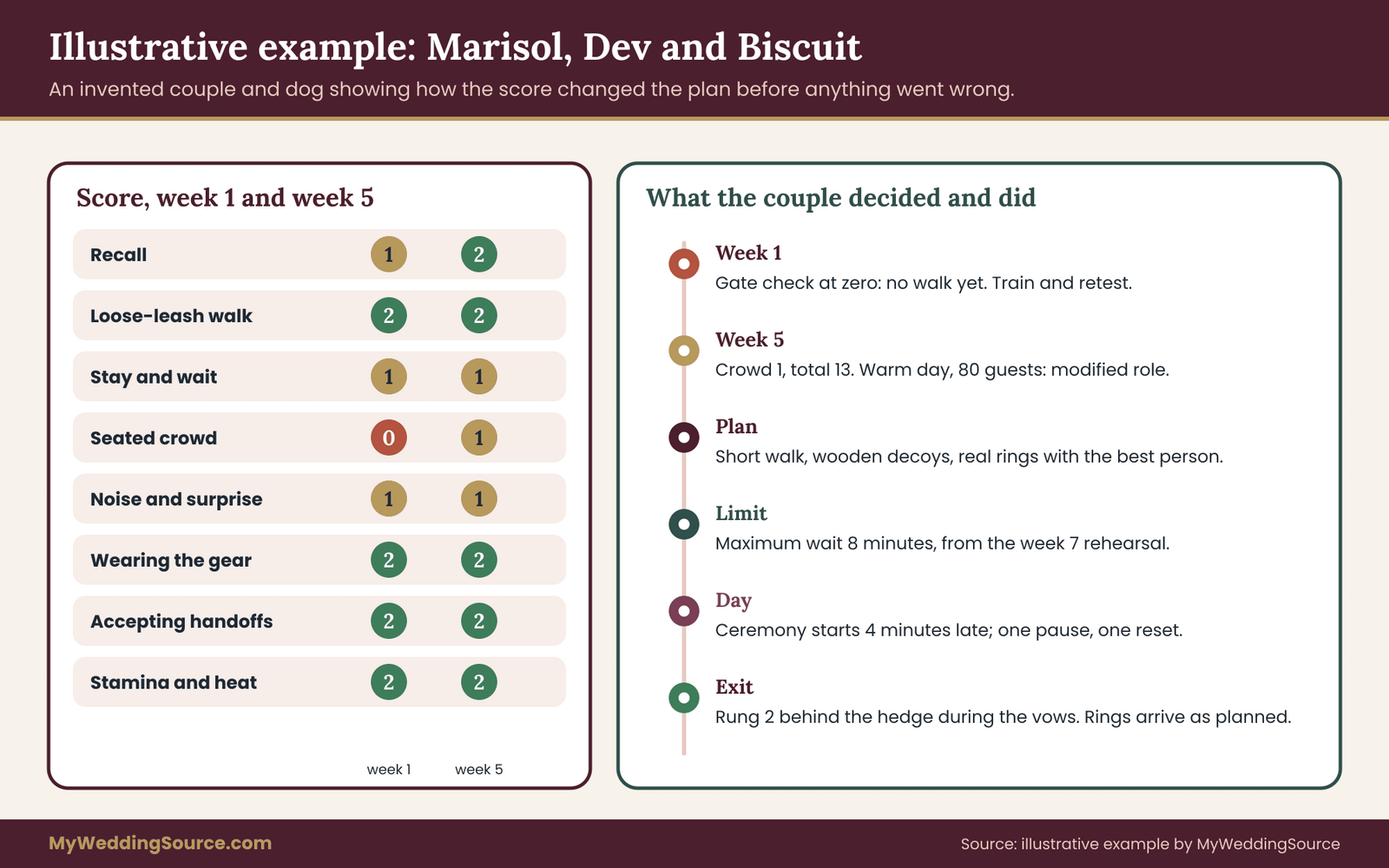
The example shows three things. The score changed the plan before anything went wrong. The custody chain meant the exit cost nothing. And the exit was a normal, planned part of the ceremony, not a failure.
Alternatives if your dog is not ready to be a dog ring bearer
A low score is not the end of the idea. It is a signal to choose a role that fits the dog, and there are several that keep the dog in your wedding without asking for a walk through a crowd. A dog ring bearer is the most demanding of the options, and the rest ask progressively less.
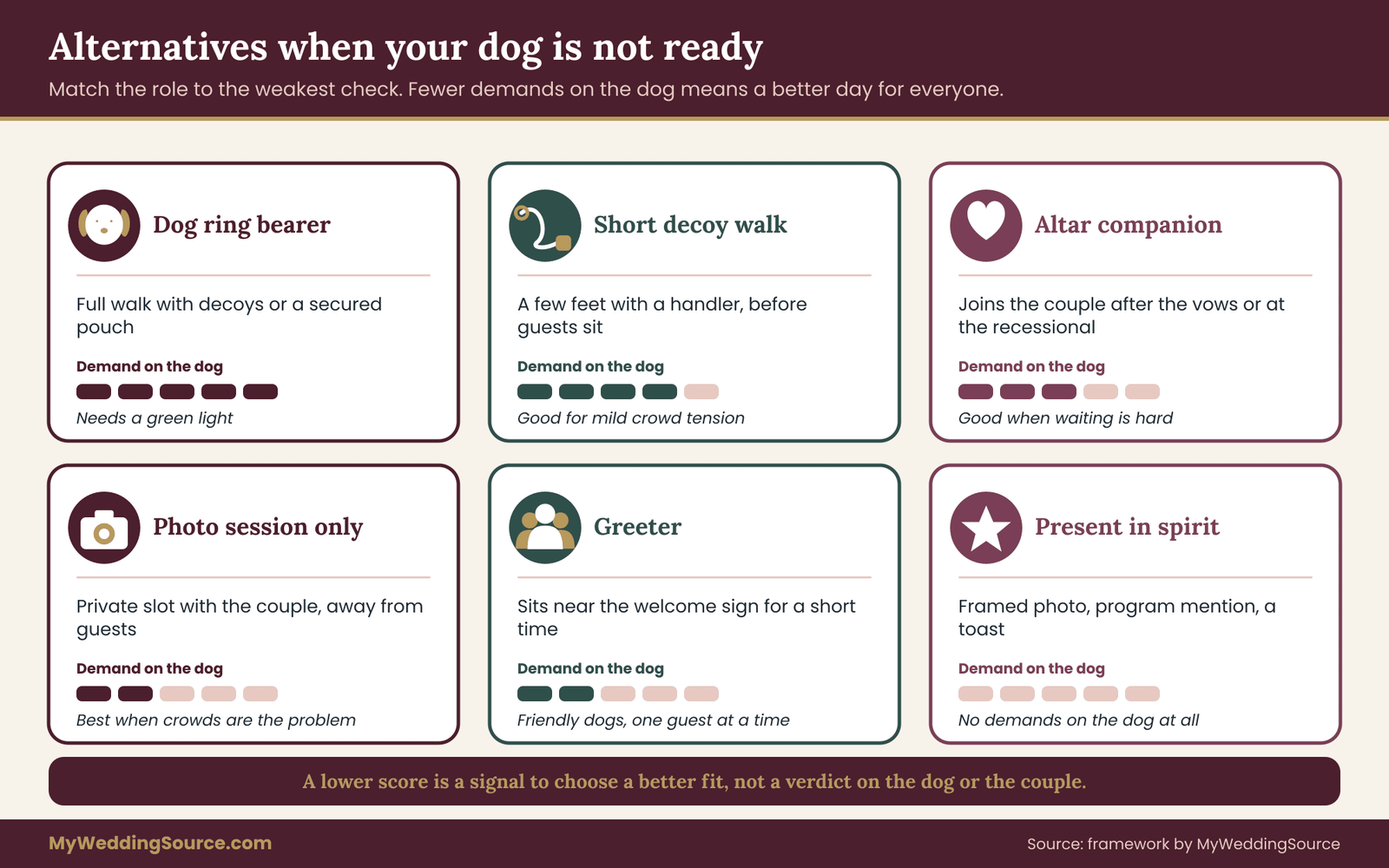
The decoy walk with a handler. The dog walks a short, shaded distance with its handler and carries decoys, but the walk happens before guests are seated or at the very end of the aisle. This keeps the picture without the crowd.
The altar companion. The dog ring bearer waits in the quiet space and joins the couple at the altar after the vows, or at the recessional. Many dogs find an end-of-ceremony cheer easier than a start-of-ceremony silence.
The photo-only role. The dog appears for a private photo session with the couple, away from guests, before or after the ceremony. This is often the best-looking choice, because the photographer can slow down and the dog can be rewarded for being calm.
The greeter. The dog sits near the welcome sign or the guest book for a short time before the ceremony, with a handler, and then goes home or to the quiet space. This works for friendly, relaxed dogs who enjoy meeting people one at a time, but not for dogs who find crowds stressful.
A human ring bearer with the dog nearby. A child or an adult carries the rings, and the dog walks next to them on a leash with its own handler. The rings do not depend on the dog, and the dog still shares the aisle. If the human ring bearer is a child, the same rule applies as with any young attendant: a child and a dog together need two adults.
No dog on the day, but present in other ways. A framed photo at the ceremony, the dog’s name in the program, a toast at the reception, or a dog-themed cocktail sign all include the dog without its presence. Some couples take engagement photos with the dog, which gets the best pictures without the day’s pressure.
Choosing among the alternatives to a dog ring bearer
Match the role to the dog’s weakest check. If the weak point is crowds, the photo-only role is best. If it is waiting, the altar companion or the end-of-ceremony appearance is best. If it is handling by strangers, keep the dog with one person throughout and choose the greeter or photo role. If stamina is the issue, choose the shortest and earliest role.
Whichever you choose, tell your guests what to expect. A line in the program or a short announcement avoids confusion. “Our dog will join us after the ceremony for photos” is clear and kind.
Telling people when the answer is no
A decision not to have your dog walk can feel awkward if parents or friends have been excited. Be direct and brief. You might say: “We tested our dog carefully and it is not comfortable in a crowd yet, so we are choosing a role that keeps our dog happy.” Most people accept that, and many will agree that the dog’s comfort matters more than the picture.
If someone pushes, offer the alternative role and move on. The decision is about a dog’s welfare, and you do not need to debate it. The same approach applies to other wedding choices you do not want to relitigate.
Edge cases and common mistakes with a dog ring bearer
Not every dog or wedding fits the standard plan. These situations come up often enough to deserve a direct answer.
Puppies as a dog ring bearer
Puppies are charming and unpredictable. They tire quickly, need frequent bathroom breaks and are in a sensitive period of social learning, when bad experiences can leave a lasting mark. A puppy is usually better as a photo-only or greeter dog for a short time, with a handler who can pick it up. Check with your veterinarian about vaccination status before exposing a young dog to crowds or public spaces.
A senior dog ring bearer
Older dogs may have joint pain, hearing loss, vision changes or lower heat tolerance. A short walk on a shaded, flat surface may be fine, but a long wait on a hot lawn may not be. Talk to your vet about what is comfortable, and favor a shorter, calmer role. A senior dog that sits for a photo beside the couple is a lovely image.
Large or strong dogs
A large dog that pulls can knock over a guest or a child. If the dog is powerful, the handler must be physically able to hold it, and the walk should avoid tight spaces with children or older guests nearby. Consider a harness that gives more control and a double-handled leash for the walk, and test the setup with the handler in advance.
Reactive or fearful dogs
If your dog ring bearer has a history of barking, lunging or biting, a ceremony crowd is not the place to test it. Choose the no-dog-on-the-day option, or a private photo session with a trained handler away from guests. Safety for guests and for the dog comes first, and a veterinarian or certified behavior professional can advise on what is appropriate.
Service dogs and emotional support animals
If a guest or one of the couple relies on a service dog, that dog is working and is not a ring bearer. The Americans with Disabilities Act defines a service dog as one individually trained to perform tasks for a person with a disability, and the ADA rules about service animals apply differently from rules about pets. Do not ask a working service dog to do ceremonial duties without the handler’s agreement, and do not let a pet dog interfere with a service dog’s work. Check the Department of Justice’s ADA service animal guidance for the current rules.
Multiple dogs
Two dogs are not twice as easy as one. Dogs that are fine alone can wind each other up. Separate handlers are essential, and each dog needs its own score and its own exit plan. If either dog scores low, run the plan for the other alone.
Heat, cold and weather
Hot weather is the largest single risk for outdoor weddings with dogs. Keep the dog in shade, provide water, shorten the waiting time, and watch for heavy panting, drooling, weakness or collapse, which are signs of heat stress and need veterinary attention. In cold, wet or windy weather, consider whether the dog ring bearer will tolerate the gear and the surface. Rain can also make a runner slippery and a pouch heavy.
Always have a weather backup. If the ceremony moves indoors, check that dogs are allowed in the new space. If not, switch to a photo-only role.
Children and the dog
Children are drawn to dogs, and the dog may not enjoy it. Do not seat young children near the aisle edge during the dog’s walk without an adult. Tell the children ahead of time: look but do not touch, and let the dog pass. If a flower child is part of the processional, decide whether the two walk together or separately, and keep them apart unless both have rehearsed together. The wedding guest care planning guide covers the supervision side for children at the event.
Common mistakes with a dog ring bearer
Choosing the role before testing the dog. The picture comes first and the behavior comes second. Reverse the order.
Skipping the crowd test. A dog ring bearer can be perfectly behaved with two people and fall apart with twenty.
Putting real rings on the dog. The dog’s job is to appear to bring the rings. The custody chain protects the actual ones.
Making the handler a wedding party member. The handler needs to be free from other duties.
Forgetting the exit plan. Every plan needs a way out, and every handler needs permission to use it.
Keeping the dog on duty too long. Bring the dog late, take it home early.
Treating a dog’s stress as cute. A dog that trembles or pants is not being funny. It is asking for relief.
Overlooking the venue’s rules. Ask in writing, early, and save the answers.
Your next steps
Start with the dog, not the aisle. This week, run the eight checks and write down the scores, with a second observer for two of them. If any gate check is zero, pick an alternative from the list above and stop here.
If the dog ring bearer passes, do three things in order. Ask your venue about dog permission and conditions in writing. Name the handler, the caretaker and the ring catcher, and ask each one directly. Then write the custody chain and the one-page exit plan, and put the dates for your eight-week training on your calendar, ending with a dress rehearsal in week seven. Use the wedding planning checklist to track the tasks.
On the day, keep the dog’s duty time short, keep the real rings with a named person, and let the exit plan do its quiet work. The best outcome for a dog ring bearer is a calm dog, a smooth ceremony and a few good pictures. The rest is a bonus.
FAQ
How do I know if my dog is calm enough to be a ring bearer?
Test it, rather than guess. Run the crowd test with fifteen to twenty seated people clapping and talking, and watch for a loose body, normal breathing and willingness to take a treat. Freezing, trembling, hiding or refusing food mean the dog is not ready. Run the test at least three times on different days, and have a second person score it independently.
Should a dog carry the real wedding rings?
Usually not. A dog ring bearer can drop, chew or lose a pouch, and the rings are hard to replace on the day. Most couples are better served by decoy rings on the dog and the real rings held by the best person. If you choose real rings, use a closed, secured pouch and name a backup holder.
How long does it take to train a dog to be a ring bearer?
Plan on at least eight weeks if the dog already knows basic cues such as sit, down and come. Allow longer if it does not, or if it is nervous in crowds. Use short, reward-based sessions, add people and noise gradually, and run a full dress rehearsal in the second-to-last week.
Who should handle the dog during the ceremony?
A calm person the dog trusts, who is not part of the main wedding party and does not have other duties. A friend, a cousin or a professional pet sitter can all work. The handler should know the exit plan and have permission to stop the walk and leave if the dog ring bearer shows signs of stress, without asking anyone first.
What if the dog will not walk down the aisle on the day?
Follow the exit plan. Pause for a short reset, and if the dog ring bearer is still unwilling, the handler leads it away to the quiet space and the ceremony continues with the real rings held by the best person. Do not scold the dog. A planned exit costs nothing when the custody chain is in place.
Do venues allow a dog ring bearer?
It varies. Some venues allow dogs only in outdoor areas, or for the ceremony only, or require vaccination records or a fee. Others prohibit animals. Ask in writing early, and ask who is responsible for any damage. Do not assume that a pet-friendly space means pet-friendly on your date or in every room.
Is a dog ring bearer safe around guests and children?
It can be, with planning. Ask guests with allergies or fear of dogs to tell you in advance and seat them away from the aisle. Keep young children from the dog’s path unless an adult is with them. A leash, a capable handler and a clear request not to call to the dog reduce the risk.
What can we do instead if our dog is not ready?
Choose a smaller role. Options include a short walk before guests are seated, joining the couple after the vows, a private photo session, or a greeting near the welcome sign. You can also have a person carry the rings while the dog walks beside them on a leash. A framed photo or a mention in the program is another way to include the dog.
Sources
- Pet owners, American Veterinary Medical Association
- Humane dog training position statement, American Veterinary Society of Animal Behavior
- Dog care, American Society for the Prevention of Cruelty to Animals
- Toxic and non-toxic plants, American Society for the Prevention of Cruelty to Animals
- Animal Poison Control Center, American Society for the Prevention of Cruelty to Animals
- Healthy pets, Centers for Disease Control and Prevention
- ADA requirements: service animals, U.S. Department of Justice Civil Rights Division
- Pet care resources, The Humane Society of the United States
- Animal care and welfare, American Animal Hospital Association