
A bridal pantsuit can be the most practical and the most photogenic outfit for a civil ceremony, but only if the fabric, the cut and the fit have been tested against the real conditions of a courthouse morning. This guide gives you a mood board method and a seven-point fit test for choosing, tailoring and photographing a bridal pantsuit without guessing.
Build a one-page civil ceremony outfit mood board with five panels (setting, light, fabric, shape and finish) before you shop. Choose a fabric with some weight and recovery, such as crepe or a wool blend, over thin satin that shows every crease. Then run the seven-point fit test in your actual shoes: sit, climb stairs, reach, hug, twist, stand for thirty minutes and use a restroom. A bridal pantsuit that passes all seven is ready for the ceremony and the photographs.
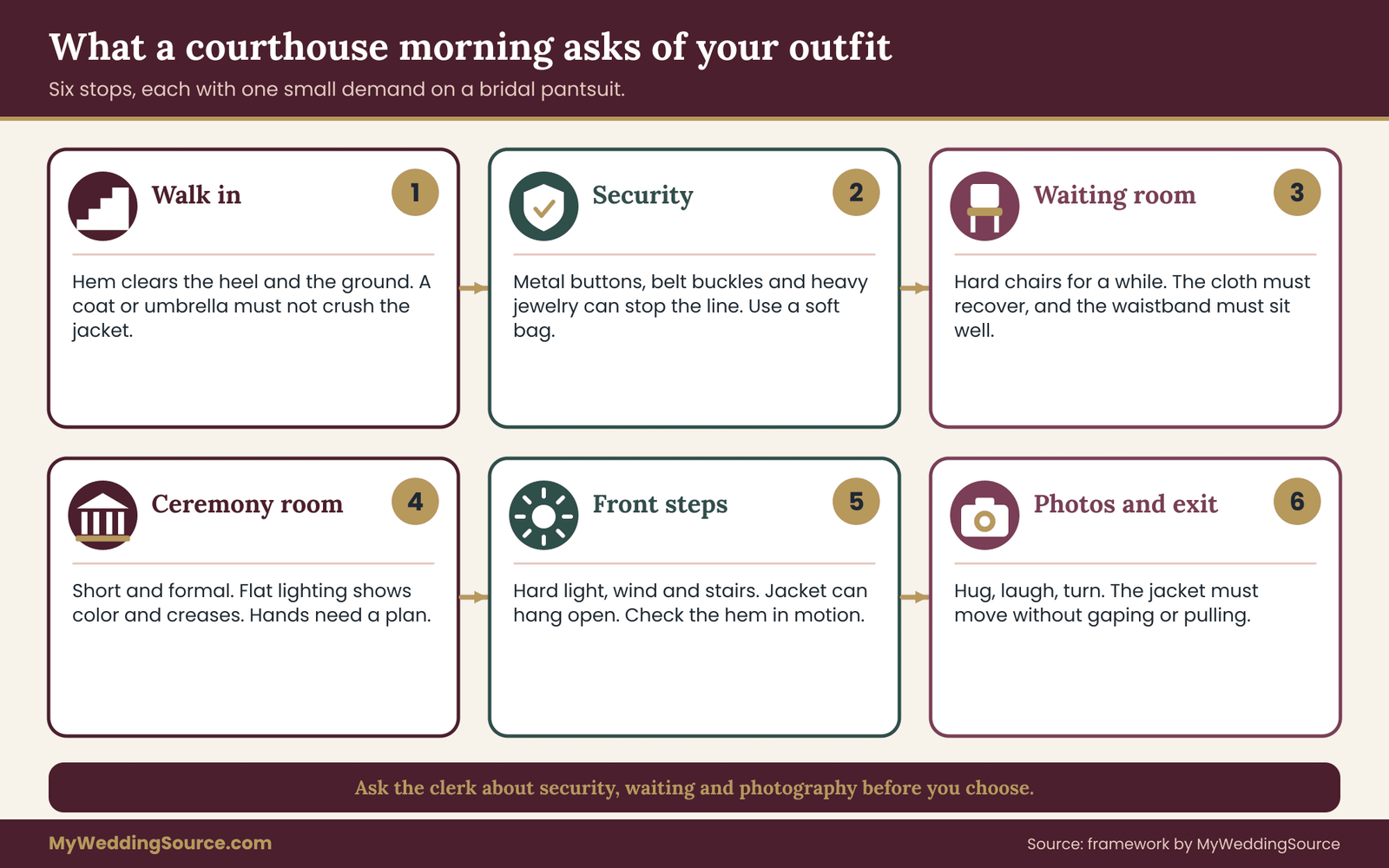
Civil ceremonies reward clothes that behave. There is usually a security checkpoint, a waiting room with hard chairs, a staircase or an elevator, a short ceremony in a room you did not decorate, and then photographs on steps or in a hallway with mixed light. A long gown can struggle in that sequence, and a bridal pantsuit is a natural alternative. A well-made bridal pantsuit often does not, because trousers move with you and a jacket gives the photographs a clean, structured line.
That does not make a pantsuit automatically easy. A bridal pantsuit is a fitted garment with more seams, more places to pinch and more ways to look slightly wrong in a photograph. A jacket that gapes at the button when you lift your arms, trousers that drag under a shoe heel, or a fabric that wrinkles across the lap in the first ten minutes can undo the whole look. The goal of this guide is to help you find those problems early, while you can still fix them.
A note on scope. This is general information about clothing and planning, not legal, tax or financial advice. Courthouse rules, security procedures and photography policies differ by county and by building, and they change. Where a rule affects your outfit or your photos, the article tells you which office to ask so you can confirm the current version yourself.
What a bridal pantsuit changes at a civil ceremony
Start by being clear about what you are choosing. A bridal pantsuit is a matched or deliberately coordinated jacket and trouser, worn by the person getting married, in a color and fabric that reads as bridal rather than as office wear. Some people choose a three-piece set with a waistcoat, some add a skirt option or a removable overlay, and some wear a jacket over a camisole or bodysuit. All of these sit inside the same decision, and the same tests apply.
It helps to separate three questions that couples often blur together. The first is whether you want trousers at all. That is a matter of taste and comfort, and nobody else needs to approve it. The second is whether this particular bridal pantsuit will function in the day you have planned. That is a practical question with testable answers. The third is whether it will photograph the way you imagine. That depends on color, light and posture, and it can be improved with simple preparation.
Why civil ceremonies suit trousers
A civil ceremony compresses the day. In many places the ceremony itself is brief, and the surrounding time is spent moving between parking, security, a clerk’s office, the ceremony room and a spot for pictures. A bridal pantsuit, like any clothing for that kind of day, should handle repeated sitting and standing, narrow doorways, stairs, a coat or umbrella, and possibly a walk from a parking structure in weather you cannot control.
A bridal pantsuit handles those things without special management. There is no train to carry, no hem to lift on stairs and no petticoat to rearrange in a small restroom stall. If your ceremony is at a registry office, a city hall or a judge’s chambers, the formality of tailored clothing also matches the building. Many people find that a structured jacket feels appropriate in a room with flags, wood paneling and an official seal behind the officiant.
What a bridal pantsuit does not solve
Trousers remove some problems and introduce others. The waistband and rise must sit correctly when you sit down. The hem has to be set for the shoe you will really wear, not the pair you try on in the shop. The jacket must close, or hang open, without pulling. Fabric that looks crisp on a hanger can crush quickly when worn.
There is also the matter of reading as bridal. Some people want the bridal pantsuit to be obviously celebratory, and others want it to look like their favorite well-cut suit. Either is fine, but the choice should be deliberate. A mood board, covered shortly, is the simplest way to make that choice visible before you spend money.
The two tools this guide uses
The guide rests on two original tools. The first is the civil ceremony outfit mood board: a single page with five panels that forces you to describe the building, the light, the fabric, the shape and the finishing details before you look at any garment. The second is the seven-point fit test: a short, repeatable set of movements that you perform in the outfit, in your shoes, before you commit. Between them, they replace the usual pattern of falling for a photo online and hoping the real garment behaves the same way.
The general fitting process, including how many appointments to expect, is covered in the wedding dress fit and alterations guide, and much of it applies to a suit as well. If you are still comparing a pantsuit with other trouser options, the outfit-level questions about mobility are covered separately on the site. This guide stays with the pantsuit itself: what to look for in the cloth, how to judge a cut, how to work with a tailor, and how to be photographed in it.
How a courthouse shapes the outfit decision
Before you choose anything, find out what your building is actually like. Courthouses and city halls differ widely. Some marriage rooms are small, windowless and lit by overhead fluorescent tubes. Others are grand rooms with marble, tall windows and good daylight. Some buildings have a separate wedding chapel, and some use a courtroom or a clerk’s counter. The room affects fabric choice, color choice and the kind of photographs you can expect.
Call or visit the clerk’s office or the marriage license bureau and ask a short list of questions. What is the process on the day? Is there a security screening for everyone, and are there items that cannot enter? Is there a wait, and where do people wait? Are photographs allowed in the ceremony room, in hallways, on the steps or outside? Can a guest or photographer take pictures during the ceremony, or only afterward? Can you bring flowers, and is there a place to set them down? Answers differ, and the person who answers the phone will usually know.
Security and the outfit
Many public buildings screen visitors with a metal detector and a bag scan. This matters for a pantsuit more than for most outfits. Structured jackets can have metal buttons, lining hardware, boning or belt buckles that might trigger a scanner. A belt, a heavy brooch, a metal-heeled shoe or a clutch with a clasp can add to the stop. None of this is a problem if you expect it. It becomes a problem if it delays the ceremony or forces you to remove a jacket in a public lobby.
Plan to carry small valuables in a way that is easy to put in a tray. Know where your officiant or witnesses are meeting you. If you have a ring box, flowers or a garment bag, ask whether they will need to be scanned separately. The official guidance for federal buildings is published by the federal courts, and local rules vary, so treat the clerk’s answer as the final word for your building.
Waiting, sitting and stairs
The part of a civil wedding that people forget is the waiting. You may sit for a while on a bench or a plastic chair before your name is called. A fabric that wrinkles at the lap will show it in every photograph afterward. A waistband that is comfortable standing but tight sitting will make the waiting miserable.
Stairs matter too. Courthouses often have impressive entrances with wide steps, and those steps are the classic photograph location. Trousers that are too long can catch under a heel on stairs. Trousers that are hemmed for flat shoes will look short when you change into heels for pictures. Part of building the mood board is deciding which shoe goes with the pantsuit and committing to it, so the tailor can hem correctly.
Time of day and light
The same garment photographs differently at nine in the morning and at two in the afternoon, indoors and out. Morning light is soft and directional. Midday light is hard and shows texture, including wrinkles and the weave of a fabric. Indoor fluorescent lighting can shift whites toward green or gray. If you can choose your appointment time, treat light as one of the variables. If you cannot, plan the fabric and color around the worst light you expect, not the best.
Building the civil ceremony outfit mood board
A mood board is usually a collage of pretty images. This one is different. It is a working document with five panels, and each panel has to be filled in with words and a decision, not only a picture. The point is to turn a vague idea of a bridal pantsuit into a short brief you can hand to a stylist, a tailor or a shop assistant.
If you want the full order of events in the ceremony room before you fill in the setting panel, the wedding ceremony step by step guide lists the usual sequence.
Use a single sheet of paper, a note on your phone or a slide. Draw five boxes. Label them setting, light, fabric, shape and finish. Under each label, write one sentence of fact and one sentence of choice. The fact is something you know or have confirmed. The choice is what you decided because of it.
Panel one: setting
Write down the building, the room, the approximate time and the route you will walk. For example, a fact might be that the ceremony room is on the second floor and reached by an elevator or a wide staircase. The choice that follows might be that trousers should clear the floor by a small margin in your chosen shoe, so there is no hem to catch on the stairs.
Add anything you learned from the clerk about security, waiting and photography. If photographs are only allowed outside, the steps become the main backdrop. If they are allowed in the ceremony room, the wall color and the lighting in that room matter more. Write both down. The setting panel is the one that keeps the rest honest, because every other choice has to survive it.
Panel two: light
Describe the light you expect in each place you will be photographed. Is the ceremony room bright or dim? Are the steps in sun or shade at that hour? Is there a window behind the officiant? Light affects how color reads, how fabric shows creases and whether a pale outfit looks cream, white or washed out.
If you can, visit the building at the time of day you will be there and photograph a plain piece of white or ivory fabric, or even a sheet of paper, in each spot. You do not need professional equipment. A phone photo of a plain swatch will tell you more about how your color will behave than a dozen online images taken in other buildings.
Panel three: fabric
This panel records the cloth you are considering and why. Record the fiber content from the label, the weight in plain terms (light, medium or heavy), whether it is lined, and how it recovers from creasing. A short test can answer the recovery question in a shop: crush a corner of the cloth in your fist for several seconds, release it and watch how much of the crease remains. The next major section covers fabrics in detail, so for now the panel only needs a first choice and a reason.
Panel four: shape
Describe the silhouette in terms you can say to a tailor. Jacket length, number of buttons, lapel width, and whether the jacket is fitted at the waist or straight. Trouser rise, leg width and hem length. A photograph from a store can show a shape, but only words and measurements can specify it. If you cannot describe the shape, you probably do not yet know what you want.
Panel five: finish
The finish panel covers everything that is not the suit: shoes, shirt or camisole, belt, jewelry, veil or hat if any, hair and makeup, flowers and a bag. Treat these as part of the bridal pantsuit rather than as extras, because shoes decide the hem, the camisole decides the neckline, and the hair decides how a collar sits. The finishing panel is where the outfit becomes personal.

How to use the board
A finished board should fit on one page and answer five questions in a sentence each. If a panel still has a blank, that is a task, not a failure. The board does three jobs.
First, it screens options. When you see a garment you like, hold it against the board. Does it work in the light you described? Is the fabric one that recovers from creasing? Does the shape match the stairs and the elevator? A bridal pantsuit that fails a panel is not necessarily wrong, but you should know which panel it fails and why before you buy it.
Second, it makes conversations shorter. A stylist who sees a five-panel brief knows immediately that you need a fabric that holds up in fluorescent light and a trouser that clears stairs. An alterations professional who sees the shoe, the height of the heel and the planned hem can quote accurately. Vendors give better advice to people who are specific.
Third, it protects you from a common mistake: buying for a photograph you saw rather than a day you will live. Pictures of a bridal pantsuit online are usually staged in controlled light, on a model standing still, often pinned or clipped at the back. The board brings the decision back to your own conditions.
A short worked board
To show how this looks in practice, here is an invented example. The couple, Dana and Priya, are marrying at a city hall on a weekday morning. Dana is choosing a bridal pantsuit. Priya is wearing a dress. Nothing here is a real person, and no outcome is predicted; it is simply a demonstration of the format.
Setting: second-floor ceremony room reached by elevator; photographs allowed on the front steps and in the hallway; security screening at the entrance. Choice: no belt with a metal buckle, trousers hemmed to clear the floor in the planned shoe.
Light: windowless room with overhead lights; steps face east and are in direct sun at the appointment time. Choice: an ivory with a slight warmth, not a stark white, so it does not turn gray indoors or glare outdoors.
Fabric: a medium-weight crepe in a wool blend, lined. Choice: crepe because it drapes, resists creasing and does not show the weave in harsh light.
Shape: single-breasted jacket with one button, hip length; straight trouser with a mid-to-high rise. Choice: one button so the jacket can hang open for the steps photographs, mid-to-high rise so the waistband sits flat when sitting.
Finish: a silk camisole, low block heel, small earrings, a short bouquet that can be held in one hand. Choice: block heel because it is steady on stairs and sets the hem length.
The board does not choose a specific garment. It sets the criteria. A shop assistant can now bring Dana five options instead of fifty, and Dana can reject three of them in a minute by checking them against the sheet.
When the board changes your mind
Sometimes the board reveals that a favorite bridal pantsuit idea does not fit the setting. A heavy velvet looks beautiful in a photograph, but in a warm, crowded marriage room it may be uncomfortable within minutes. A very wide trouser looks elegant when standing still and can be awkward on narrow courthouse stairs. A pure white that looks crisp in a studio can read harshly in a room with cool overhead lighting.
When that happens, you have options. You can keep the idea and change the conditions, for example by booking a different time or choosing a different photo location. You can keep the idea and change the garment, for example by choosing a lighter weight of the same fabric. Or you can drop the idea. All three are reasonable. What matters is that the decision is made with the facts on the page, not discovered at the door of the ceremony room.
Sharing the board with other people
You do not have to show the board to anyone, but it helps in three situations. If a friend or family member is helping you shop for a bridal pantsuit, the board stops the conversation from turning into a debate about taste, because you can point to a panel instead. If you hire a stylist or a seamstress, the board shortens the first appointment. And if a photographer is working with you, the light and setting panels tell them where to stand and what to expect from the outfit.
The same discipline helps if you decline advice politely. When someone says a dress would look more bridal, you can answer that you have chosen this bridal pantsuit for stairs, security and a short ceremony, and that you are happy with it. A written brief makes the reasoning easy to repeat without defensiveness.
How long the board should take
An hour is enough for a first draft. Most of that hour is the phone call to the clerk and a short visit to the building, if you can manage one. The rest is writing a sentence per panel. Revisit the board after each fitting, and update the fabric and shape panels as you learn. By the time you are ready for the final fitting, the board should read like a description of the bridal pantsuit you are wearing, and nothing in it should surprise you.
Fabrics for a bridal pantsuit
Fabric is where most bridal pantsuit decisions succeed or fail. Two jackets with the same pattern can behave completely differently in a courthouse if one is a crisp crepe and the other is a thin satin. Weight, weave, fiber, lining and finish all matter, and none of them show up well in a product photograph. The rest of this section describes the common choices in plain terms and what each one does under the conditions of a civil ceremony.
First, a few definitions. Weight is how heavy the cloth feels in the hand, and it affects drape and warmth. Weave is how the threads are interlaced, and it affects texture, shine and crease behavior. Fiber is what the thread is made of, and it affects breathability, recovery and care. Lining is the second layer inside the jacket and sometimes the trousers, and it affects how the garment slides over what you wear beneath it. Finish is what has been done to the cloth after weaving, such as pressing, coating or brushing.
Crepe
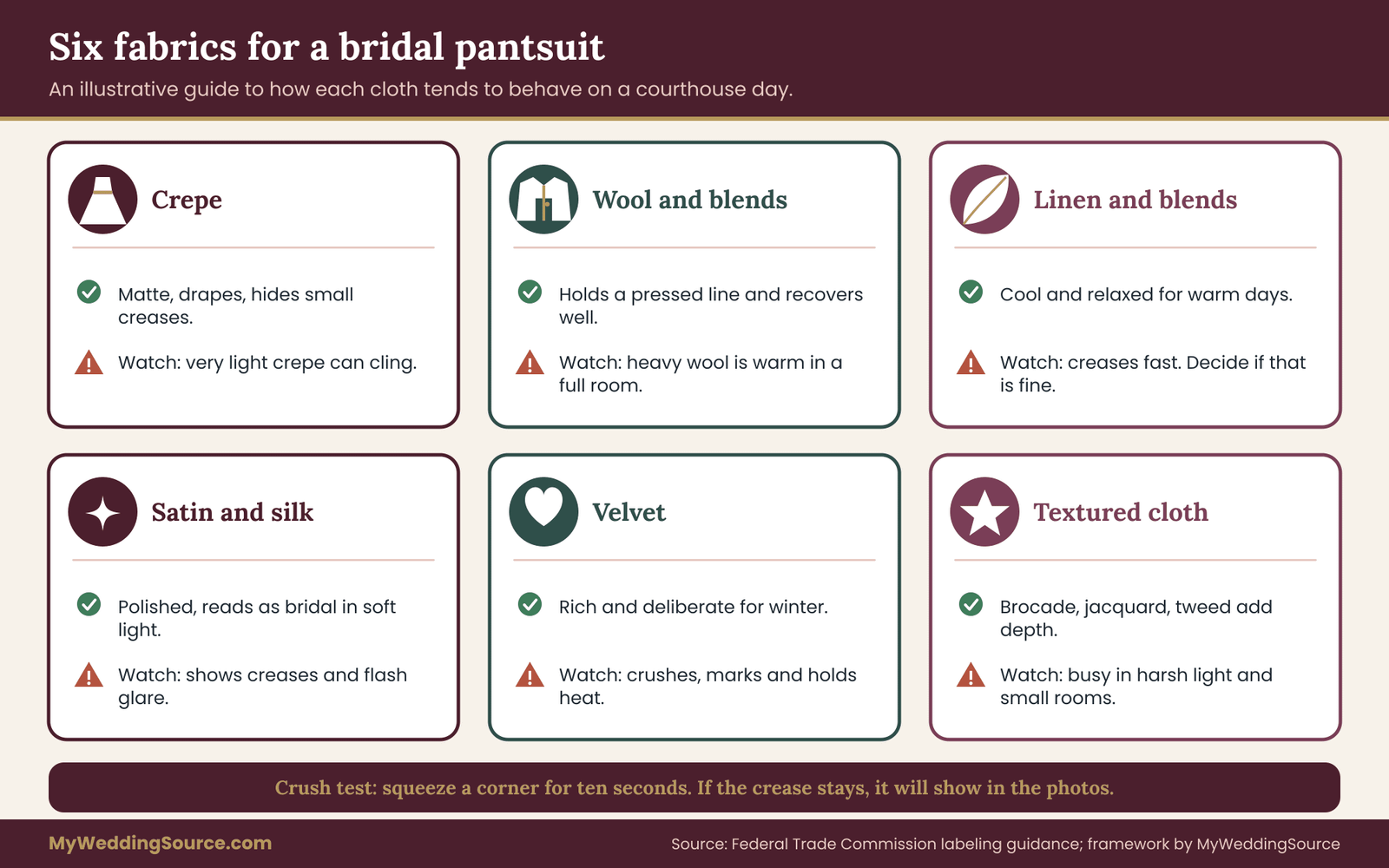
Crepe is a fabric with a slightly pebbled surface created by tightly twisted yarns. It drapes well, hides small creases and has a matte look that photographs softly. Many bridal pantsuits are made from crepe, often a blend with polyester or elastane for recovery. A crepe bridal pantsuit is a sensible default for a civil ceremony because it sits well, does not shine under flash and tolerates sitting.
The trade-off is that very light crepe can cling, and very stretchy crepe can show the outline of what is underneath. Check the cloth in daylight, with the lining, and ask whether the jacket is lined to the hem.
Wool and wool blends
Wool suiting gives a bridal pantsuit the structure of a traditional suit. Light wool tropical or a fine worsted breathes, recovers from creases well and holds a pressed line. It suits cooler months and formal rooms. Heavier wool can be too warm for a crowded marriage room or a warm climate, and it is less forgiving to alter because the cloth has less give.
Wool blends with a small percentage of synthetic fiber are common and perfectly good. The label will show the exact fiber content, and the Federal Trade Commission requires fiber content and care instructions on most clothing sold in the United States. If a seller cannot tell you what a garment is made of, treat that as a signal to look elsewhere.
Linen and linen blends
Linen looks relaxed and breathes well, which makes a linen bridal pantsuit attractive for a warm-weather ceremony. It also wrinkles easily. Some people accept wrinkles as part of the look, and a pale linen suit can be charming in a garden or at a small city hall in summer. If you want crisp photographs, a linen blend with viscose or a little synthetic fiber reduces creasing, though it will not remove it.
Decide in advance whether wrinkles are acceptable. If they are, linen can work beautifully. If they are not, choose another cloth, because no steamer will stop linen from creasing in the lap during a thirty-minute wait.
Satin, duchess satin and silk
Satin has a smooth, shiny face that reads as bridal and photographs elegantly in soft light. It also reflects light strongly, shows every crease and sometimes every seam, and can look stiff or cheap if it is thin. A heavy duchess satin or a silk-faced satin has more body and can make a striking bridal pantsuit, but it is less forgiving to fit because small errors show as ripples.
If you are drawn to shine, look for a weight that holds its own shape and a fabric that is matte on one side. Test it under strong light, and photograph it with flash before you decide. A cloth that looks refined in a shop can turn glaring in a courthouse lobby.
Velvet, brocade and textured cloth
Velvet suits a winter bridal pantsuit and gives a rich, deliberate look. It crushes, shows pressure marks where you sit and holds heat. Brocade, jacquard and tweed bring pattern and texture, which can look stunning on the steps and busy in a small room. Texture also catches harsh light and can look different in every photograph.
These cloths work best when the setting panel of your board says the ceremony is in a cool, well-lit space and you are comfortable with a statement garment. If the room is warm or the wait is long, consider a lighter weight or a single textured piece, such as a jacket with plain trousers.
Lining, opacity and what is underneath
Pale trousers in a bridal pantsuit raise a practical question that is easy to overlook until the day: how opaque are they? Under bright light, thin pale cloth can show the outline of what is underneath. Check opacity by holding the trouser fabric over your hand in daylight and in front of a lamp. Ask whether the trousers are lined, partially lined or unlined, and whether a lining can be added.
Plan the layer beneath with the same care. A smooth, skin-tone-matched layer shows less than white against ivory or cream. A tailor can often add a lining to trousers, or a slip, though lining a garment that was not designed for it takes skill and time. Raise this at your first appointment rather than at the last.
How a fabric recovers
Recovery is how well the cloth returns to shape after bending, sitting or being folded. It is the quality that matters most on a civil wedding day, and it is the one you can test yourself. In a shop, take a corner of the fabric and crush it in your hand for ten seconds. Release it and watch. A cloth that bounces back within a minute will survive the waiting room. A cloth that holds the crumple will wrinkle across the lap by the time your name is called.
Better still, if the shop allows it, sit in the garment for several minutes and stand up. Look at the lap and the back of the knees in a mirror. If there are deep creases within five minutes, picture them an hour later, and picture them in a photograph. Ask yourself whether that is acceptable for this bridal pantsuit.
Reading the care label and fiber content
In the United States, clothing generally carries a label showing fiber content and care instructions, and the Federal Trade Commission sets the rules behind those labels. Read them before you buy. A fabric that is dry-clean only affects your cost and your timeline. A fabric that cannot be pressed with steam changes how you prepare it on the day. A blend that includes elastane may behave differently when altered.
The care label also tells you what the tailor can do. Some cloths shrink or mark if pressed incorrectly, and some synthetic blends hold a crease in a hem that cannot be removed. If you plan to alter the garment, ask the tailor to look at the label and the cloth before you commit to a purchase. They will know what the fabric tolerates.
Weather and season
Season changes the answer. In cooler months, a wool or heavier crepe bridal pantsuit is comfortable, and a velvet jacket may be pleasant. In warmer months, a lightweight crepe, a linen blend or a tropical wool keeps you comfortable in a crowded room. The National Weather Service publishes forecasts and heat guidance, and the Centers for Disease Control and Prevention publishes advice on heat and health, which is worth reading if you expect to stand outdoors in a lined jacket during hot weather.
If you cannot predict the weather, choose a fabric that works across a range. A medium-weight crepe bridal pantsuit with a breathable lining is more forgiving than either heavy wool or thin satin. Keep the jacket removable, so you can take it off between the ceremony and the photographs if the temperature calls for it.
Fabric and budget logic
Cost follows a few predictable patterns, and you can reason about it without any invented figures. Natural fibers and fine blends usually cost more than basic synthetics. Lined, fully constructed jackets cost more than unlined ones. Heavier cloth generally costs more per yard. But price alone does not tell you whether the cloth will survive a day of sitting and standing.
A better question is cost per wear and cost per fix. A less expensive garment that needs significant alteration may end up costing more than a better-cut garment that needs a hem. A very inexpensive cloth that creases badly may cost you in steaming, pressing and stress. Ask the retailer about the return policy on the bridal pantsuit before you buy, and keep the receipt, because the return window may be shorter than the delivery time of an alteration.
A quick fabric decision rule
Here is a simple rule for choosing a bridal pantsuit cloth. Start with the room. If it is warm and crowded, choose a light to medium weight with good recovery. If it is cool and formal, you can afford more structure. Then look at the light. If it is harsh, choose a matte cloth. If it is soft, you can afford a subtle sheen. Finally, check recovery. If the cloth fails the crush test, move on, however beautiful it looks.
That three-step rule, applied to your mood board, will cut most options quickly. It will not pick a favorite for you, and it should not. It will make sure the favorite you pick can survive the day.
Color and shade for a bridal pantsuit in courthouse light
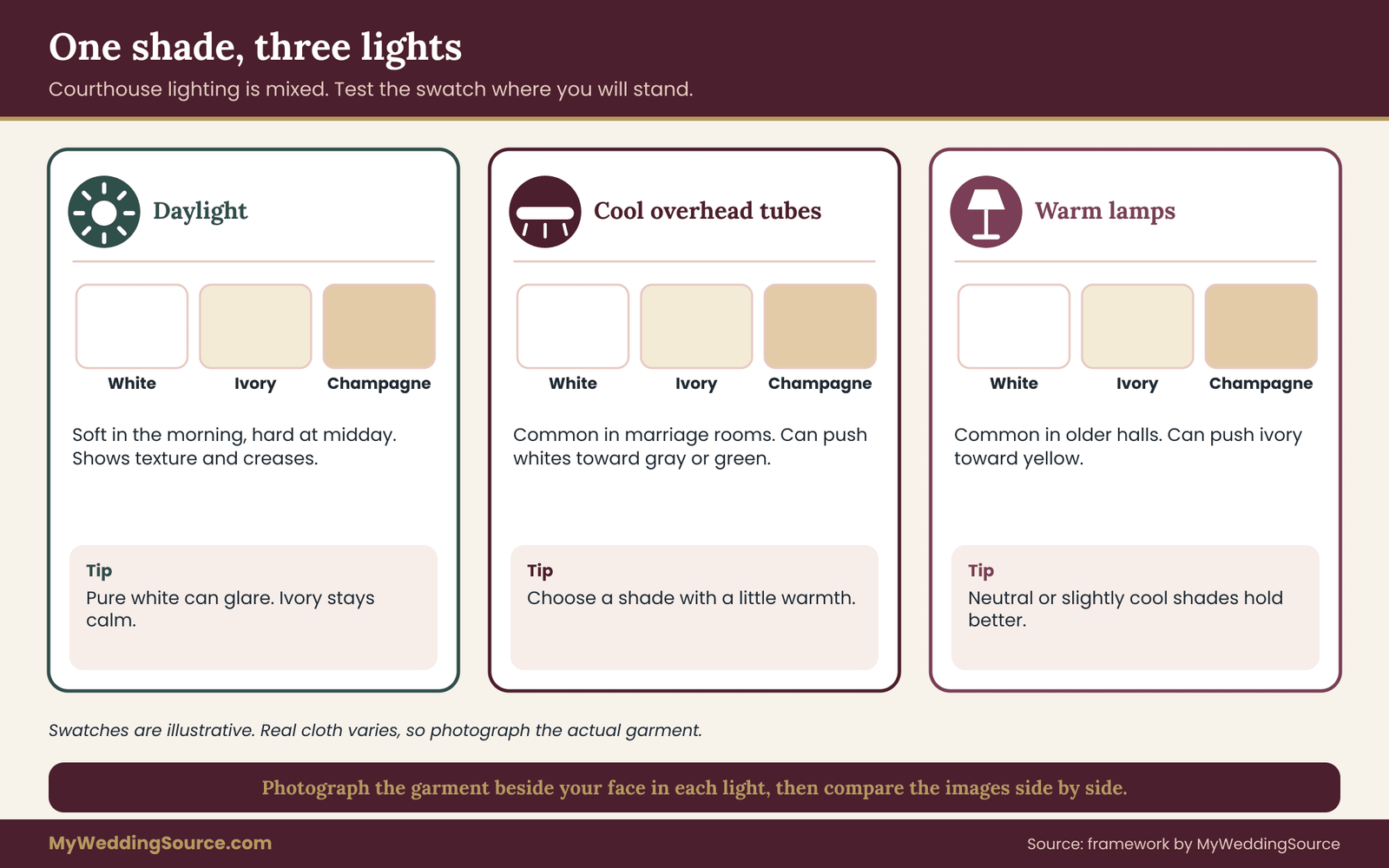
White is not one color. A bridal pantsuit labeled white, ivory, cream, champagne, blush or oyster can look very different in the shop, in a hallway and on a screen. Because courthouse lighting is often mixed, with daylight from a window, cool overhead tubes and sometimes warm wall lamps, shade matters more here than at a venue chosen for its light. The aim is a color that looks deliberate in every place you will be photographed.
Three things decide how a shade reads. The first is the undertone of the cloth: warm (yellow or pink), cool (blue or gray) or neutral. The second is the undertone of your skin and hair, which determines whether the cloth flatters you or flattens you. The third is the light itself. A cool white under cool light can look gray. A warm ivory in direct sun can look yellow. You are looking for the combination that stays close to what you intended.
How to test a shade
Never judge a shade only in the shop. Ask for a swatch or take the garment to a window, and then to an indoor spot with overhead light. Take a phone photograph of it in each place, beside your face if possible, and compare the images side by side. Do it with the auto settings and with a plain background, so the results are honest.
Look at three things in the photographs. Does the cloth look the color you chose, or has it turned gray, green or yellow? Does it look flat, or do the seams and folds show depth? And does it look good beside your skin, or does it make you look tired? If a shade passes in two of the three lights and fails in one, you can usually work around the third by choosing a photo location.
Contrast with the building
The backdrop matters. Courthouses often have gray or beige stone, dark wood, green or blue carpet, and heavy metal doors. A pale bridal pantsuit stands out against dark wood or gray stone and can blend into cream marble. A deeper shade, such as champagne, soft gray or a muted color, has more presence against light walls. If you plan to be photographed on the steps, look at the stone color and match accordingly.
If your bridal pantsuit is pale and the building is pale, you can add contrast with flowers, a darker shoe, a belt or a contrasting lapel. If your outfit is deep and the building is dark, add a pale accessory or a lighter shirt. The mood board’s setting and light panels tell you which of these is needed.
Pure white, ivory and cream
A pure white bridal pantsuit photographs crisply in soft light and can glare in strong sun or look blue under cool lighting. Ivory is a safe middle ground, because it keeps a warm, soft look across most conditions. Cream is warmer still and suits warm light and many skin tones. If you are unsure, ivory is the least risky choice for a bridal pantsuit that must work in several lights.
Remember that pale cloth shows marks. Makeup transfer at the collar, shoe scuffs at the hem, and rain splashes will all show. Plan for a spot of stain remover, a lint roller and a small towel. A matte pale bridal pantsuit forgives more than a shiny one.
Beyond white
Many people choose a color other than white for a civil ceremony: soft blue, sage, blush, charcoal, navy, burgundy, black or a bold print. A colored bridal pantsuit is perfectly fitting for a civil wedding, and it often handles stains, rain and long days better than pale cloth. The same tests apply, because color still shifts in different light and fabric still has to recover.
If color is part of your wedding scheme, you may want to think about how it sits with the flowers, the partner’s outfit and the guests. The site’s guide to a wedding color palette can help you check the colors against one another. Photograph the pantsuit with the flowers and with your partner’s outfit, not only on its own.
Flash and the courthouse photograph
Direct flash flattens a scene and reflects off glossy cloth. If a photographer is working in a hallway, they may use flash or bounce it off a ceiling. Satin and shiny synthetic cloth can look bright in a flash photograph, and pale colors can lose detail. A matte crepe or wool tends to hold its texture. If you are being photographed by a friend with a phone, remind them to avoid flash when possible and to stand with the light on your face.
The camisole, shirt and layer under the jacket
What you wear under the jacket changes the color story of a bridal pantsuit. A white camisole under an ivory jacket can look stark, and a camisole a shade lighter or darker than the jacket often looks more refined. Check the neckline against the jacket lapel in a mirror. If the jacket is to be worn buttoned, the visible triangle is small and every detail counts. If it is to be worn open, the layer becomes a major part of the look.
Choose a layer in a fabric that sits flat, does not ride up and does not show through. Try it on with the jacket, sit down and raise your arms. If the layer bunches or slides, change it. Some people choose a bodysuit to keep the line clean at the waist, which also keeps the shirt from escaping at the trouser band.
Shape and proportion in a bridal pantsuit
Shape is the part of a bridal pantsuit that most depends on your body, your height and your sense of style. It is also the part that tailors can influence the most, within limits. The goal is a silhouette in which the jacket and the trousers belong together and the proportions look intentional in a photograph taken from a few feet away, from above, from below and from the side.
Think of a bridal pantsuit in three zones: the jacket, the waist and the trousers. Each has its own variables, and they interact. A long jacket suits a slim trouser. A cropped jacket suits a higher waist and a wide leg. A fitted jacket needs a trouser with enough room not to look severe. Seeing the three zones separately makes it easier to describe what you want.
The jacket
Jacket length is the first decision when shaping a bridal pantsuit. A hip-length jacket is classic, and it skims the top of the trousers. A longer jacket creates a strong vertical line and can read as a coat, which suits cool weather and a tailored look. A cropped jacket ends at the waist or just below, showing the trouser rise. It looks modern but exposes the waistband and any shirt gap.
Next comes the closure. A single-breasted jacket with one button is easy to open for photographs. A double-breasted jacket makes a bolder statement and needs a precise fit across the chest, because the overlap pulls when you reach or hug. A jacket with no closure, sometimes called an open-front blazer, drapes well and avoids gaping, though it relies on the layer underneath.
Lapel width and shape change the mood. A notch lapel is traditional and sits comfortably with most outfits. A peak lapel is sharper and more formal. A shawl lapel is softer and often suits a dressier look. Wide lapels frame a neckline and draw attention to the upper body, and narrow ones look sleek.
Shoulders and sleeves
The shoulder is the hardest area to alter in a jacket. If the shoulder seams do not sit at the edge of your shoulder, or if the sleeve pulls across the upper arm, the garment is probably the wrong size or the wrong cut, and a tailor may be unable to correct it without significant cost and risk. When you try on a jacket, raise your arms, cross them and reach forward. If it binds, move on.
Sleeve length is easier. The sleeve should end around the wrist bone, so a small amount of the layer or cuff shows. Check with your arms bent as well as straight, because sleeves ride up when you hold a bouquet or reach to sign.
The waist and the rise
The rise is the distance from the crotch to the top of the waistband. A high rise sits at or above the natural waist and lengthens the leg line. A mid rise sits a little lower. A low rise rests on the hip and tends to be less flattering under a short jacket. For a civil ceremony, a mid-to-high rise is usually more comfortable when sitting, because it does not slip down or gap at the back.
Test the waist in three positions: standing, sitting and bending slightly. A waistband that feels fine standing can dig in when you sit. Look for a smooth line, with no folds pulling at the front and no gaping at the back. If you plan to wear a belt, check that the belt loops sit correctly and the buckle is not metal that will trip a scanner.
The trousers
Trouser shape sets the whole mood of a bridal pantsuit. A straight leg is the most versatile and suits most shoes. A wide leg flows and photographs beautifully in motion, but it needs a longer hem and a higher heel, and it can catch on stairs. A tapered or cigarette leg is sleek and works with flats and low heels. A cropped trouser shows the shoe and the ankle and is practical in wet weather.
Pleats add room and softness at the waist. Flat fronts give a cleaner line. Neither is better; it depends on your build and on how you sit. Ask a tailor to check how the pleats open when you sit, because a pleat that gapes can look untidy in a photograph.
Hem length and the shoe
The hem is where a bridal pantsuit fails most often. A trouser hemmed in flat shoes will drag with a heel, and one hemmed for heels will look short in flats. Commit to the shoe before the hem. Bring the actual shoe to every fitting, and stand naturally, not on tiptoe. A standard length for formal trousers reaches the top of the heel at the back and breaks lightly at the front. Cropped styles stop above the ankle bone. A tailor can advise which suits your leg and the cut.
If you intend to change shoes between the ceremony and the photographs, decide which pair you will wear for both, or accept that one pair will look different. A trouser that works with a two-inch difference in heel height is unusual. It is better to choose a hem that is correct for the shoe you wear in most photographs and to wear the other pair only when sitting or not photographed.
The seven-point fit test for a bridal pantsuit
The fit test is the second original tool in this guide. It is a set of seven movements that mirror what a civil wedding day asks of your clothes. You perform them in the garment, in the shoes, with the layer underneath and the accessories you plan to wear. The test takes about fifteen minutes. Do it at the first serious try-on, again at the final fitting and once more at home before the day.
Each point has a pass condition. If a point fails, write down why, because the reason tells you whether a tailor can fix it. With a bridal pantsuit, some failures are alterations, such as a hem. Some are construction problems, such as a shoulder that is too narrow. And some are fabric problems, such as a cloth that will not recover. Knowing which one you have saves money and time.
Point one: sit
Sit on a hard chair for five minutes, as you would in a waiting room. Then stand up and look in a mirror. The pass condition is that the waistband stays comfortable, the jacket does not ride up uncomfortably, and the trousers show no deep creases at the lap or behind the knee. Check the seat seam too. A tight seat shows when you sit, and it can split in a way that is embarrassing and costly.
If the waistband of the bridal pantsuit digs in, the rise may be too low, or the trouser may need to be let out. If the creases are deep, the fabric is the likely cause, and no alteration will change that. Be honest with yourself at this stage, because a bridal pantsuit that wrinkles in five minutes will wrinkle in your photographs.
Point two: stairs
Climb and descend a staircase in the bridal pantsuit, ideally a full flight, holding a bouquet or a bag in one hand. The pass condition is that the hem clears the floor and the heel, the trousers do not catch, and the jacket does not swing or twist. Look down at the hem as you step. If it touches the heel at the back, it is too long for that shoe. If the leg is very wide, check that you can see your feet well enough to climb safely.
If you cannot find a staircase near the shop, do this test at home with the final shoes before the wedding. It is also a good time to check footing. A shoe that feels stable in a shop can feel unsteady on polished stone steps.
Point three: reach
Raise both arms overhead, then reach forward as if to sign a document or take a ring. The pass condition is that the jacket does not bind across the back or the upper arm, the sleeves do not ride far up the forearm, and the layer underneath stays in place. Try crossing your arms and reaching to the side as well. A bridal pantsuit that restricts your arms will be uncomfortable in the very moments that matter.
If the jacket binds, the problem is usually the shoulder or the armhole, which are the hardest areas to change. Note it, and do not assume a tailor will solve it.
Point four: hug
Ask someone to hug you, or wrap your arms around yourself. The pass condition is that the jacket back does not strain, buttons do not pull, and nothing tears or pinches. You will be hugged several times on the day, and the first hug is often right after the ceremony. A jacket that can only be worn stiffly is a poor choice for the most emotional few minutes of your wedding.
Point five: twist and turn
Turn to look over each shoulder, bend to pick something off the floor and turn to sign a document at a counter. The pass condition is that the bridal pantsuit moves with you without gaping, pulling or exposing the waist. Pay attention to the back of the waistband, which can gape when you bend, and to the front of the jacket, which can swing open.
Point six: stand for thirty minutes
Wear the entire bridal pantsuit outfit, including shoes, for thirty minutes while doing ordinary things: standing in a line, walking, sitting briefly. The pass condition is that nothing slips, itches, pinches or becomes unbearable. The thirty-minute test often reveals what a five-minute try-on cannot, such as a seam that rubs, a lining that clings, or a waistband that loosens and slides. Heat also shows up in this test. If you are warm in the shop, you will be warmer in a crowded room.
Point seven: restroom
Go into a small stall, if you can, or simulate it at home, and practice the sequence: unfasten, sit, stand, refasten, check. The pass condition is that you can manage the clothes alone, in a few minutes, without touching the floor and without help. A bridal pantsuit with many hooks, a zipper at the back or a complicated closure can be a real problem here. Know in advance how the fastenings work and whether a friend could help if needed.

Scoring the test
Mark each point as pass, fix or fail.
A pass needs no action. A fix means a tailor can address it, such as a hem, a waistband or a sleeve length. A fail means the garment is wrong for the day, such as a cloth that wrinkles badly or a shoulder that binds. If you have three or more fixes, ask the tailor for a combined quote before you commit. If you have one fail in a garment you love, ask yourself whether you are willing to live with it, and whether the cost of changing it makes sense compared with starting over.
Keep the notes. They are useful at the fitting, because you can tell the tailor exactly what happened and when, rather than saying it feels tight. Specific descriptions lead to better work.
What the test does not tell you
The fit test cannot predict the weather, the line at security or whether the clerk is running behind. It does not replace trying the full outfit with your hair and makeup done and with your partner nearby. And it does not guarantee that the garment will look right in photographs, which also depend on light, angle and posture. It does tell you whether the clothes will let you move through the day without distraction, and that is a large part of looking relaxed.
Tailoring and fittings: what a bridal pantsuit can and cannot change
A good tailor is as important as a good garment. Most bridal pantsuits need some alteration, and a few need a lot. Understanding what can be changed, what is difficult and what is impossible lets you shop with realistic expectations and book fittings at the right time. The guide to working with an alterations professional covers the general process, and the same principles apply to a suit.
What is usually straightforward
Hems are the simplest change. Shortening trouser length, adjusting the break and re-hemming a jacket sleeve at the cuff are routine jobs for most tailors. Taking in or letting out the waist of the trousers by a small amount is also common, provided there is seam allowance to work with. Adding or moving a button, adjusting belt loops and replacing a lining in trousers are usually possible too.
Narrowing the leg from the knee down, adjusting the rise slightly and tapering the trouser are more involved but still achievable on many garments. Ask your tailor to explain what they can do to the cut you have chosen, because it depends on how the garment was made.
What is harder
Jacket alterations are more complex than trouser alterations. Shortening a jacket sleeve at the shoulder, changing the length of a lined jacket body and reshaping the waist all involve opening and rebuilding the lining and the canvas. Some tailors do this routinely, and some will decline. Costs rise with complexity.
Taking in the back of a jacket, narrowing the shoulders, and adjusting the armholes are among the hardest alterations. They can be done by experienced tailors on some garments, but they are limited by the seam allowance and the construction. Prevention is better: choose a jacket that fits the shoulders and chest, and alter the waist and the sleeves.
What is usually impossible
A tailor cannot add fabric that is not there. If a garment has very small seam allowances, it cannot be let out significantly. A tailor cannot change a cloth that wrinkles easily. They cannot restore a color that has faded or removed a permanent mark. And they cannot make a garment designed for one body shape into a different silhouette without effectively rebuilding it.
If you need a size between standard sizes, or very different measurements for the jacket and the trousers, consider buying separates, which lets you choose each size independently. Many shops sell jackets and trousers separately, and that can reduce the amount of tailoring needed.
Timing and fittings
Allow plenty of time. A reasonable plan has a first fitting soon after purchase, a second fitting once the main alterations are done and a final fitting close to the date, with a little time left in case something needs a quick fix. The exact weeks depend on the tailor’s workload and on how complex the alterations are, so ask the tailor for a schedule in writing and plan the final fitting with a margin.
Bring everything to each fitting: shoes, the layer underneath, any belt or jewelry, and your notes from the fit test. Wear the same undergarments you plan to wear on the day, because they change the line. If your weight or shape may change before the wedding, tell the tailor, and ask how much room there is to adjust.
Questions to ask an alterations professional
Ask what work they recommend and what they would not do. Ask whether they have altered this type of garment before and whether they can show examples. Ask how many fittings are included and what the quote covers. Ask about the timeline and what happens if the work is late. Ask about the policy on mistakes, and who is responsible if the garment is damaged.
Get the quote and the schedule in writing, and keep receipts. If a deposit is required, understand what it covers and when it is refundable. The Consumer Financial Protection Bureau explains how to dispute a credit card charge, which is useful to know if a service is not delivered as agreed. A calm, specific conversation at the start prevents most problems.
A worked example
Here is another invented case, to show how the test and the tailor fit together. Marcus is choosing a bridal pantsuit for a courthouse ceremony and has found an ivory crepe set. At the first try-on, he runs the seven points. Sit: pass, no deep creases. Stairs: fix, the hem catches on the heel. Reach: pass. Hug: pass. Twist: fix, the waistband gapes slightly at the back when he bends. Thirty minutes: pass. Restroom: pass, though the hook closure is fiddly.
Marcus has two fixes in the bridal pantsuit, both of which a tailor can handle. He brings the shoes to the tailor, who hems the trousers for the heel and adds a small dart at the back of the waistband. At the final fitting, he repeats the test, and every point passes. The restroom point still bothers him, so he asks the tailor to replace the hook with a larger one. Nothing here is dramatic, and that is the point: the test turned a vague worry into two small jobs.
Photo styling for a bridal pantsuit
Photographs from a civil ceremony are often taken quickly, in public spaces, in light you do not control. That makes preparation more valuable than equipment. A bridal pantsuit photographs well when the jacket line is clean, the trousers hang straight, the hands have something to do and the color reads correctly. All of that can be rehearsed in ten minutes at home.
Start by deciding who is taking the pictures. A professional photographer will have their own ideas about posing, and a short conversation about the outfit helps them. A friend or relative with a phone needs more direction, because they may not know where to stand or what to avoid. Either way, a short written list of the pictures you want, in order, keeps the session calm.
Posture and the jacket line
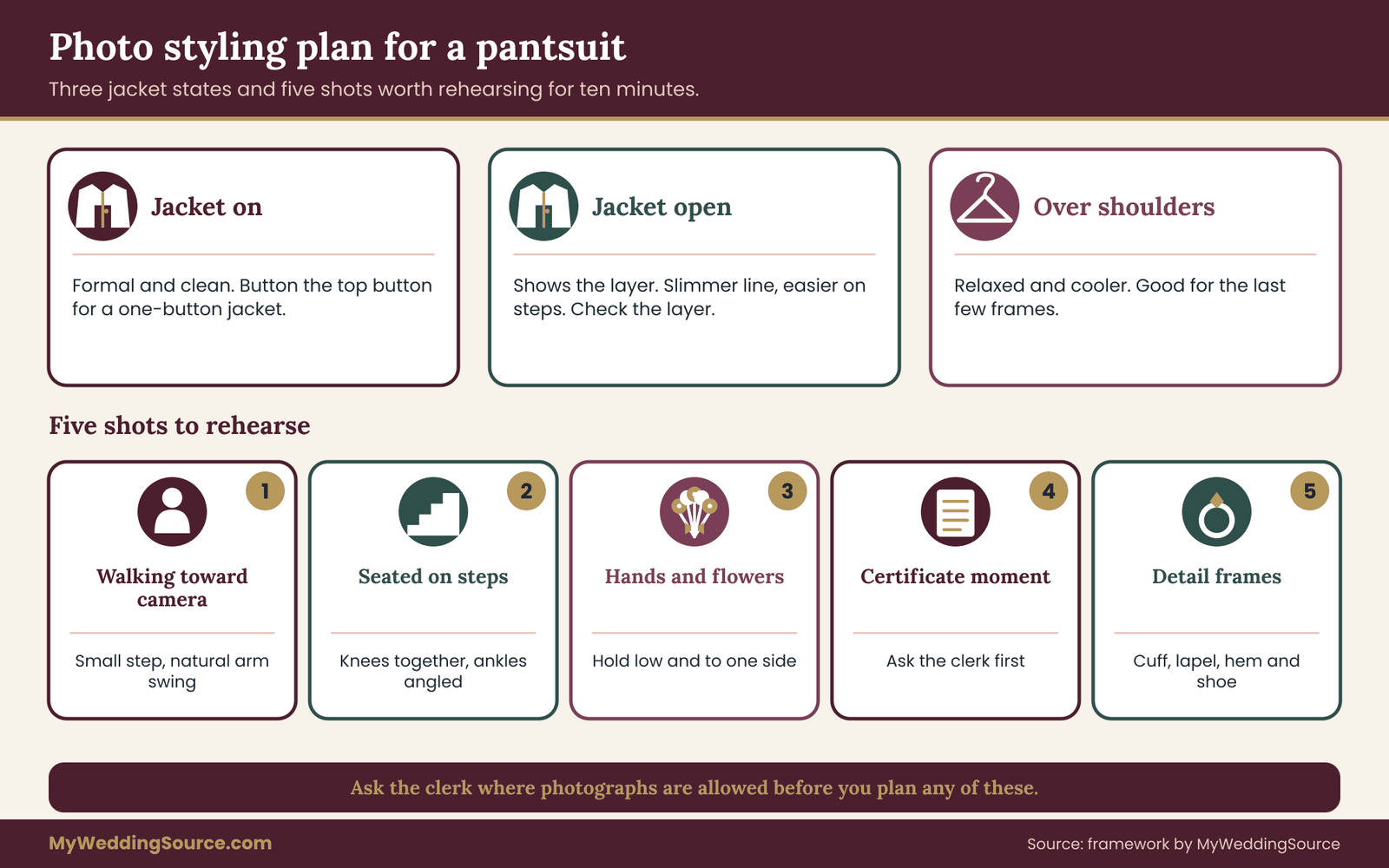
A bridal pantsuit jacket looks best when it hangs from the shoulders without being pulled forward. Stand with your weight slightly on one leg, your shoulders relaxed and your chin level. Button the jacket if it is designed to be buttoned, with the top button for a one-button jacket, and unbutton it when you sit, as is standard for tailored jackets. Smooth the front panel with a hand and check that the lapels lie flat.
Avoid stuffing hands deep in pockets unless the pockets are designed for it, because it pulls the fabric and creates bulges. If the pockets are sewn shut, leave them closed. A light hand on a pocket edge, with the thumb out, can look natural. Practice in front of a mirror, and have someone take a few test photos so you can see what the jacket does.
Poses that suit trousers
A bridal pantsuit allows movement and confident poses that long skirts do not. Walking toward the camera, with a small step and a natural arm swing, shows the drape of the fabric and the length of the leg. A pose with one foot slightly forward and the weight on the back leg lengthens the line. Sitting on steps or a low wall, with the knees together and the ankles crossed or angled, shows the hem and shoes.
Pay attention to the hem in every pose. When you step, check that the trousers still clear the shoe and that the fabric is not bunching at the knee. If you are laughing or turning, the jacket may swing open, so decide whether you want that. A short test with the photographer, even if only for a few frames, shows how the bridal pantsuit behaves in motion.
Jacket on, off and over the shoulders
A jacket can change the picture. Worn on, it gives a formal look. Worn open, it shows the layer beneath and a slimmer line. Draped over the shoulders, it reads as relaxed and can be useful on a warm day. Decide which versions you want, and plan the order so you are not constantly changing. A common approach is to wear the jacket for the ceremony and the first set of photographs, then to take it off for a few relaxed pictures at the end.
If you plan to remove the jacket, check what is beneath. The layer should be as polished as the jacket, since the pictures with the jacket off will show it. Make sure the back of the layer is neat and that the waistband of the trousers is smooth.
Hands, flowers and props
Flowers solve the problem of what to do with your hands, but they add a variable. A small bouquet, a single stem or a corsage is easier to manage than a large arrangement, especially on stairs and in a security line. Hold flowers at the waist, slightly to one side, so they do not hide the jacket buttons. If you are not carrying flowers, a small clutch, a folded document holder or your partner’s hand can fill the gap.
Rings and documents are part of the story, too. If a clerk hands you a certificate, you might want a picture of it. A short list of these moments helps the photographer anticipate them. The wedding family photo list is useful if relatives will be present and you want a quick set of group pictures after the ceremony.
Photographing the details
Details tell the story of a bridal pantsuit: a lapel pin, a cuff, a button, a hem and shoe, a ring on a hand against the jacket. Ask for a few pictures of these, taken in natural light, either before or after the ceremony. They are quick to take and they make a set of pictures feel finished. Hang the jacket on a door or a hanger by a window for a clean picture of the whole garment.
Permission and courthouse photo rules
Rules about photography in public buildings differ. Some courthouses prohibit photography in courtrooms and hallways, some allow it in a designated wedding room and some allow it only outside. Federal court buildings have their own policies, and the federal judiciary publishes information about them. Ask the clerk before you arrive, and ask whether a professional photographer needs permission or a fee.
If guests are photographing, ask them to respect the rules and the other couples waiting. The article on wedding photography consent covers how to handle permission from guests and vendors, which is worth a look if you plan to share pictures online. A calm, polite approach in a shared building makes the day easier for everyone.
Finishing a bridal pantsuit: shoes, hair, makeup and accessories
The finish panel of the mood board decides whether the outfit looks complete. Because a pantsuit has fewer decorative elements than a gown, the accessories carry more of the personality. At the same time, each item adds a practical consideration, so choose with care.
Shoes
Shoes decide the hem, the stance and the comfort. Choose them early, break them in, and bring them to every fitting. A block heel or a low heel is steadier on stone steps than a stiletto. A loafer, an oxford or a flat sandal gives a different look and a different hem. Pale trousers show scuffs, so consider a clean cloth and a small repair kit.
If you intend to change shoes, think about whether the hem works for both pairs. If it does not, pick the one you will wear for most of the pictures. Keep the other pair for comfort between photographs.
Hair and makeup
Hair interacts with the jacket collar and the neckline. Hair worn down can hide a collar or catch on lapels. Hair worn up shows the neckline and the shoulders, and it suits a structured jacket. Make sure that makeup will not transfer to a pale collar, and test a few options before the day. The guide to bridal hair and makeup planning covers trials and timing, and it is worth reading if you are hiring someone.
A pale bridal pantsuit is unforgiving of foundation transfer. Set makeup with powder, use a barrier layer such as a thin scarf or a tissue when pulling the garment over your head, and carry blotting papers. If you are wearing a camisole under the jacket, keep a spare in your bag.
Jewelry, belts and scanners
Jewelry should work with the neckline. A pendant that sits on the layer beneath the jacket can look elegant, and one that sits on the lapel can look cluttered. Earrings are easy to add or remove. Belts add definition and also add metal. If you wear a belt, check how it fits through the loops and whether the buckle is a security concern.
For the security line, wear items you can take off quickly and put in a tray. Heavy bracelets and brooches are easy to remove. Rings are best kept on. A small bag with a soft closure is easier to scan than a hard clutch with metal frames.
Veils, hats and hair accessories
A veil with a bridal pantsuit is a personal choice, and a short veil, a headband, a comb or a hat can add a bridal note. Think about how the accessory interacts with the collar and the jacket. A long veil can catch on a jacket button or a belt. A hat can cast a shadow on the face in strong sun. Test each one in the full outfit, with the hair as it will be, and photograph it from several angles.
The guide to wedding day accessories planning offers a broader checklist for the items you will carry, wear and hand off, and it can help you avoid missing something small but important, such as a pen, tissues or a safety pin.
Layers for cold or wet weather
A coat over a bridal pantsuit raises practical questions. A long coat can hide the outfit in photographs and crush the jacket. A short wrap or cape sits over the shoulders without squashing the lapels. An umbrella is better than a hood in rain, because it protects the hair and the hem. Plan where the coat will be kept during the ceremony, and who will hold it for the pictures. If you are wearing the coat for the walk in and out, take it off for the pictures and put it on straight afterward.
Buying, renting or commissioning a bridal pantsuit
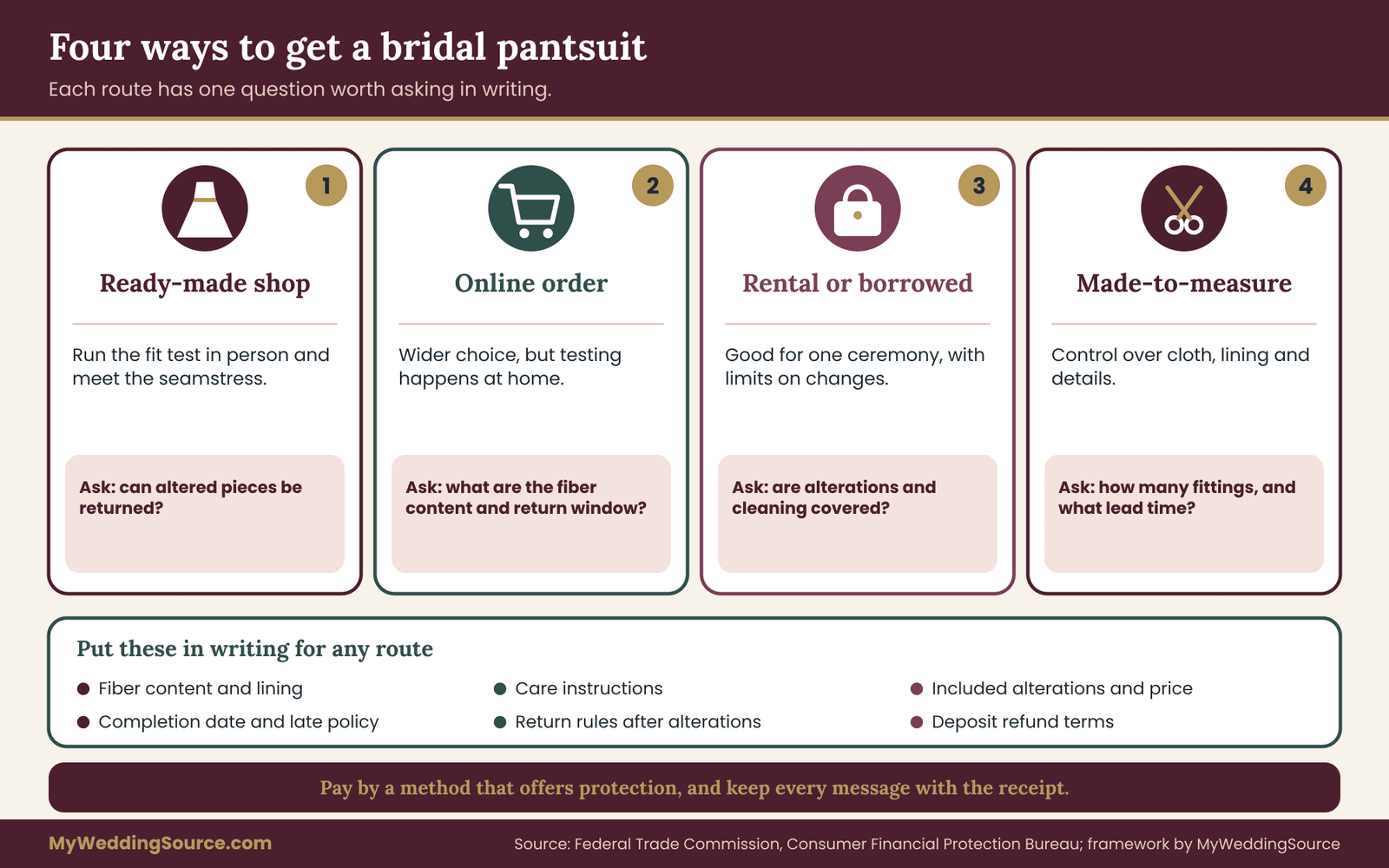
Once the board and the fit test are in hand, the question is where the bridal pantsuit comes from. There are four common routes: buying ready-made from a bridal or suiting retailer, buying from a general fashion retailer, renting or borrowing, and commissioning a custom or made-to-measure garment. Each has its own risks, timelines and questions to ask.
Ready-made from a bridal or suiting shop
A shop with a fitting room lets you run the fit test in person and speak to a seamstress. It is usually the easiest route for a first-time buyer. Ask whether the shop does alterations or recommends someone, how long they take and whether the price includes them. Ask whether the garment can be returned or exchanged after alterations, because most shops will not take back altered clothing.
Bring your mood board, your shoes and the layer you plan to wear. A good assistant will respond to the specifics, and a poor one will steer you toward whatever is in stock. If the shop cannot answer questions about fabric and construction, it may not be the right place for a garment that has to perform.
Online and general retailers
Buying a bridal pantsuit online widens the choice and lowers the price in some cases, but it moves the testing to your home. Read the size chart, the fiber content and the return policy before you order. Order early enough that you can return and re-order if needed. Try the garment at home, run the seven points and check the return window.
Be skeptical of photographs that look unusually perfect. Fit problems are common in online orders, and sellers often show garments pinned or clipped on a model. If a listing does not state the fabric, the lining or the weight, ask. The Federal Trade Commission publishes guidance for consumers on online shopping and on how its rules apply to clothing labels, which helps when a listing seems vague.
Renting or borrowing
Renting a bridal pantsuit is less common than renting a formal suit, which is standard for the other half of a wedding party, and some services offer women’s and non-binary suits too. It can be a reasonable choice for a single ceremony. Check the fit options, the alteration rules and the cleaning policy. Many rental companies do not allow permanent alterations, which limits how much you can adjust. Ask what happens if the garment arrives late or does not fit.
Borrowing from a friend or relative can work well if the sizes match, and it has a human story attached. Be clear about what alterations are allowed, who pays for cleaning and what happens if something is damaged. Put the answers in writing, even if it feels formal, so nobody is surprised later.
Made-to-measure and custom
A made-to-measure bridal pantsuit starts from a pattern adjusted to your measurements. A fully custom one is cut from scratch. Both give you control over fabric, lining, buttons and details, and both take longer and cost more than ready-made. Ask the maker about the number of fittings, the lead time and the policy if the garment is not right. Request a written timeline and a firm date for the final fitting.
Check the maker’s work before you commit. Ask to see garments they have made, ask about the fabric source and ask whether they have made a pantsuit or similar tailored piece before. A seamstress who excels at gowns may not have the same experience with tailored jackets, and the reverse is also true. Skill with a particular construction matters more than a general reputation.
Questions to ask any seller or maker
Whatever the route, a short list of questions protects you. What is the fiber content and is it lined? What are the care instructions? What alterations are included, and what is the price of common ones? What is the delivery or completion date, and what happens if it is late? What is the return or exchange policy, and does altering the garment change it? How is payment handled, and when is a deposit refundable?
Write the answers in an email or a message, and keep them with the receipt. If a dispute arises, the Consumer Financial Protection Bureau explains how to dispute a card charge, and a record of what you were told makes the case clearer. Pay by a method that offers some protection, and avoid sellers who insist on payment methods that cannot be reversed.
Comparing a bridal pantsuit with other options
You may still be deciding between a pantsuit and something else. A short comparison, in prose, can help. This is not a ranking, because the right choice depends on the board and the test.
A bridal pantsuit offers structure, pockets in some cuts, movement and a tailored look. It needs careful fitting, and it may need two or three alterations. It is usually easy to wear again in some form, especially if the jacket and trousers can be worn separately.
A short dress offers ease and a clear bridal look, with fewer seams to fit. It can be more vulnerable to wind and to the angle of a camera. A long gown offers drama and a traditional look. It is harder to manage on stairs, in security lines and in small restrooms, and it may need a helper.
A jumpsuit gives a single-piece line. It can be harder in the restroom and more difficult to alter in the torso. A two-piece set of a top and a skirt or trousers sits between the dress and the pantsuit, with the flexibility of separate sizing.
None of these is better in itself. If your mood board says that stairs, security and a short ceremony are the main constraints, a bridal pantsuit does very well. If it says that you want a train and a veil in a grand room, a gown may fit better. The honest answer is the one you can defend with your own panels.
The ceremony itself and who is legally needed
The bridal pantsuit is a small part of what makes a civil wedding valid. The license, the officiant or authorized person and the filing steps are set by your state or county, and they have nothing to do with what you wear. The guide to wedding officiant requirements explains the general idea, and your county clerk or marriage license bureau gives the current rules. Confirm them early, so your outfit planning does not distract from the paperwork.
The day-of kit
A small kit in a bag makes a bridal pantsuit easier to manage. Pack a lint roller, a small steamer or a travel-size wrinkle spray if the fabric allows it, safety pins, double-sided fashion tape for lapels and necklines, a stain pen, a small sewing kit with matching thread, blotting papers, tissues, a spare layer, bandages for shoes, a small mirror and a pen. Keep everything in a clear pouch so it passes through security quickly.
Assign someone to carry it, or keep it in the car. If a button comes loose or a hem drops, a quick repair keeps the day on track. Do not try complicated fixes in a public restroom; a few pins and a calm friend will do more than a clever plan.
Edge cases worth planning for
A few situations deserve a line each. If your bridal pantsuit ceremony is outdoors on the courthouse lawn, grass and mud affect the hem and the shoes, so choose a hem that clears the ground and a shoe with a firm sole. If you are traveling to the ceremony, hang the garment rather than folding it, and steam it in the hotel bathroom. If you are expecting a change in weight or body shape, tell the tailor and leave extra seam allowance.
If you use a mobility aid, check that the hem will not catch on wheels or crutches, that the jacket sits correctly when seated, and that the building is accessible; the Americans with Disabilities Act sets accessibility requirements for public buildings, and the clerk can tell you which entrance to use. If you need to nurse or pump, choose a jacket and layer that open easily. If the ceremony may be moved or delayed, keep the outfit ready and keep a spare layer handy.
If something goes wrong with the garment shortly before the day, such as a torn seam or a stain, call your tailor immediately and be specific. Most tailors will try to help with an emergency, and a clear description saves time. Keep a backup option, such as a plain jacket or a simpler outfit, in case a repair fails. Having a plan for the worst case makes the ordinary case calmer.
Your next steps
Work through these in order. Each takes a short sitting, and together they turn a vague idea into a finished outfit.
- Call the clerk or marriage license bureau and ask about security, waiting, and photography rules.
- Draw the five panels of the mood board and fill in a fact and a choice for each.
- Photograph a plain swatch in the light you expect, and note how it reads.
- Choose your shoes, and commit to a hem height that works with them.
- Shortlist two or three garments that pass the board, and check fiber content and return policies.
- Run the seven-point fit test in each, in your shoes, and mark pass, fix or fail.
- Book a tailor, get a written quote and schedule, and plan the final fitting with a margin.
- Write your photo list and share the light and setting notes with whoever is taking pictures.
- Pack the day-of kit, and ask someone to carry it.
- Do one last test at home, a week before, and let the outfit rest on a hanger.
FAQ
Can a bridal pantsuit be worn at a courthouse wedding?
Yes. Courthouses generally have no dress code for couples marrying, and tailored clothing often suits the setting well. Some buildings have rules about attire for court proceedings, but marriage rooms and clerk’s offices are usually less strict. If you are unsure, call the clerk’s office and ask. Also ask about security, because structured jackets and metal accessories can slow screening, and plan extra time on the day.
What fabric is best for a bridal pantsuit?
There is no single best cloth, but a medium-weight crepe or a wool blend suits many civil ceremonies because it drapes well, recovers from creasing and photographs softly. Linen is cool but wrinkles easily, thin satin shows every crease, and velvet can be warm in a crowded room. Test recovery by crushing a corner of the cloth in your hand and watching how much of the crease stays.
What color should I choose for a bridal pantsuit?
Choose the shade that stays close to what you intended in the three kinds of light you expect: daylight, cool overhead light and warm indoor light. Ivory is often the least risky pale option, and a colored suit can be easier to keep clean. Photograph a swatch or the garment in each location with your phone and compare the images before you decide.
How early should I order a bridal pantsuit?
Order as early as is practical, so there is time for a return, a second size or several fittings. The exact lead time depends on the seller and the tailor, so ask each for a written schedule. Plan the first fitting soon after delivery, a second once the main changes are done and a final one close to the date, with a margin in case something needs a quick fix.
Can a tailor alter a bridal pantsuit?
Usually, within limits. Hems, waistbands, sleeve lengths and small adjustments to the leg are routine. Jacket shoulders, armholes and large changes to the body are much harder and may be impossible, depending on how the garment was made and how much seam allowance exists. Ask a tailor to look at the actual garment before you buy, and get the quote and schedule in writing.
Should I wear a bridal pantsuit with heels or flats?
Either works, but the hem has to match the shoe. Trousers hemmed for flats will look short with heels, and trousers hemmed for heels will drag with flats. Choose the pair you will wear in most photographs, break them in, and bring them to every fitting. A block or low heel is usually steadier than a stiletto on courthouse stairs and polished stone floors.
Do I need a different outfit for photos after the ceremony?
Not necessarily. A bridal pantsuit is designed to move through the whole day, and a jacket you can take off or wear open gives variety without a second outfit. If you do want a change, keep it simple, such as a different layer or shoes, and make sure the hem works for both. Plan the order of photographs so you change as little as possible.
Can I rent a bridal pantsuit instead of buying one?
Sometimes. Formal suit rental is common, and some services offer a range of cuts for women and non-binary people. Check the sizing options, whether alterations are allowed, the cleaning policy and what happens if the garment arrives late or does not fit. Many rentals cannot be permanently altered, so run the seven-point fit test on delivery and have a backup plan ready.
Sources
- Federal Trade Commission: clothing labels and care instructions
- Consumer Product Safety Commission: clothing and textile safety
- Consumer Financial Protection Bureau: disputing credit card charges
- U.S. Courts: federal courthouse visitor information
- USAGov: getting married and marriage licenses
- ADA.gov: accessibility requirements for public buildings
- National Weather Service: forecasts and heat safety
- Centers for Disease Control and Prevention: heat and health
- ASTM International: textile standards
- AATCC: textile care and color standards