

A preowned wedding dress can save real money and still look like it was made for you, but only if you judge it by condition, fit, return terms and total cost instead of by the photo and the price tag. This guide gives you a condition grading checklist and an all-in cost worksheet you can use on any gown, from any seller, before you pay.
Grade a preowned wedding dress in seven zones (fabric surface, seams and structure, closures, lining and boning, hem and train, stains and odor, embellishment), then add every cost beyond the asking price: shipping, insurance, cleaning, repairs, alterations and the cost of a failed return. Buy only when the gown scores well on condition, the seller will put condition and return terms in writing, and the all-in total still beats your alternatives. If a seller will not answer plain questions, treat that as your answer.
Buying a gown that someone else wore, tried on, or ordered and never used is a different job from buying one at a salon. A salon sells you a promise. A seller of a preowned wedding dress sells you an object, usually in one photo set, with a description written by a person who wants it gone. The gap between those two things is where money gets lost.
This is a long guide because the decision has many moving parts. You do not need to read it in one sitting. The grading checklist is in the third and fourth sections, the money worksheet is in the sixth, and the plain-language scripts for sellers are scattered where you will need them. If you are short on time, read the quick answer above, then jump to the section that matches where you are stuck.
A note on scope. This is general consumer information, not legal, tax or financial advice. Return rights, payment protections and platform rules change and differ by state and by seller, so where a rule matters this guide points you to the agency or company that issues it. Everything here is written for buyers in the United States, in November 2026.
Why a preowned wedding dress needs its own buying method
Most dress advice assumes you are standing in a boutique with a consultant, a fitting room and a return policy printed on the receipt. Almost none of that carries over. With a preowned wedding dress you often cannot try the gown on first, you cannot see the fabric under daylight, and you cannot assume the seller knows how to measure. You also cannot assume the seller is hiding anything. Most sellers are brides who want the dress to go to a good home and do not know what a buyer needs to see.
That mix of good faith and missing information is the real problem. A gown can be described honestly and still arrive unwearable, because the seller never noticed the underarm discoloration, did not know the zipper had been replaced, or measured the bust over the lining instead of the fabric. A buyer who knows what to ask turns most of those surprises into questions answered before payment.
The method in this guide has two parts, and they work together.
The first part is the condition grade. You look at the preowned wedding dress zone by zone, assign a letter grade from A to D to each zone, and attach a repair path to every grade below A. The point is to convert vague words like “excellent” and “gently worn” into something you can compare across gowns.
The second part is the all-in total. You add the asking price to every other cost the gown will create before you walk down the aisle, then compare that total to what the same outcome would cost by other routes. The point is to stop treating the asking price as the cost.

Used together, the two parts give you a walk-away rule, and the walk-away number itself comes from your overall wedding budget. A preowned wedding dress that grades well and totals well is a buy. A gown that grades poorly but totals low may still be a buy if the repair path is clear and a specialist agrees. A gown that totals low only because you left out the repairs is a trap. The rest of this guide shows you how to tell which is which.
What counts as a preowned wedding dress
“Preowned” is a loose word, and sellers use it to cover situations that carry very different risk. Knowing which kind you are looking at tells you what evidence to ask for.
Worn once by a bride. This is the classic case. The gown has been to a wedding, usually has been cleaned or not, and may have been altered to fit the first owner. The alterations matter most. A dress hemmed for a short bride, taken in at the waist, or bustled with permanent stitching may be hard to return to its original shape.
Never worn, bought by a bride who changed course. These gowns come from canceled weddings, changed minds or a second dress purchased later. They can be in near-perfect condition, but they may also have sat in a closet for years. Storage matters as much as wear. Ask where and how the preowned wedding dress was kept.
Salon sample or floor model. Stores sell samples to make room. These gowns have been tried on many times, often by many body types, and are commonly sold in a single size with visible handling wear at the hem, underarms and zipper. Sample gowns can be a fair deal precisely because their wear is predictable. The cost section compares sample sales with peer-to-peer purchases.
Consignment or resale shop stock. A shop has looked at the gown, may have cleaned it, and has a reputation to protect. You usually pay more than a private sale, and you often get a return or exchange policy, even if it is narrow. The shop’s stated condition standards are worth asking for.
Peer-to-peer listings. A private seller lists a preowned wedding dress on a marketplace or resale site. Price is lowest, information is thinnest, and the platform’s own rules decide what happens if the gown is not as described. Read those rules before you read the listing.
Custom or made-to-order gowns resold. A gown made for one bride’s measurements and proportions is the hardest to fit on someone else, however beautiful the photos are. These gowns can work, but only if your measurements are close and the seam allowances are generous.
Vintage gowns. There is no single line where “vintage” begins, and a vintage gown is a textile conservation question as much as a shopping one. Fiber age, old dyes and brittle thread behave differently from modern fabric. If you are leaning toward one, treat the grading checklist below as a starting point and bring in a specialist early.
Keep this list in mind when you read a description. A listing that says “worn once, professionally cleaned, never altered” is a different object from “sample, tried on, sold as is,” even if both say “excellent condition.”
Where a preowned wedding dress comes from, and what each source owes you
The source of a preowned wedding dress tells you how much of the checking you must do yourself. A shop that takes gowns on consignment has already looked for the obvious problems. A private seller on a marketplace has not, and often cannot.
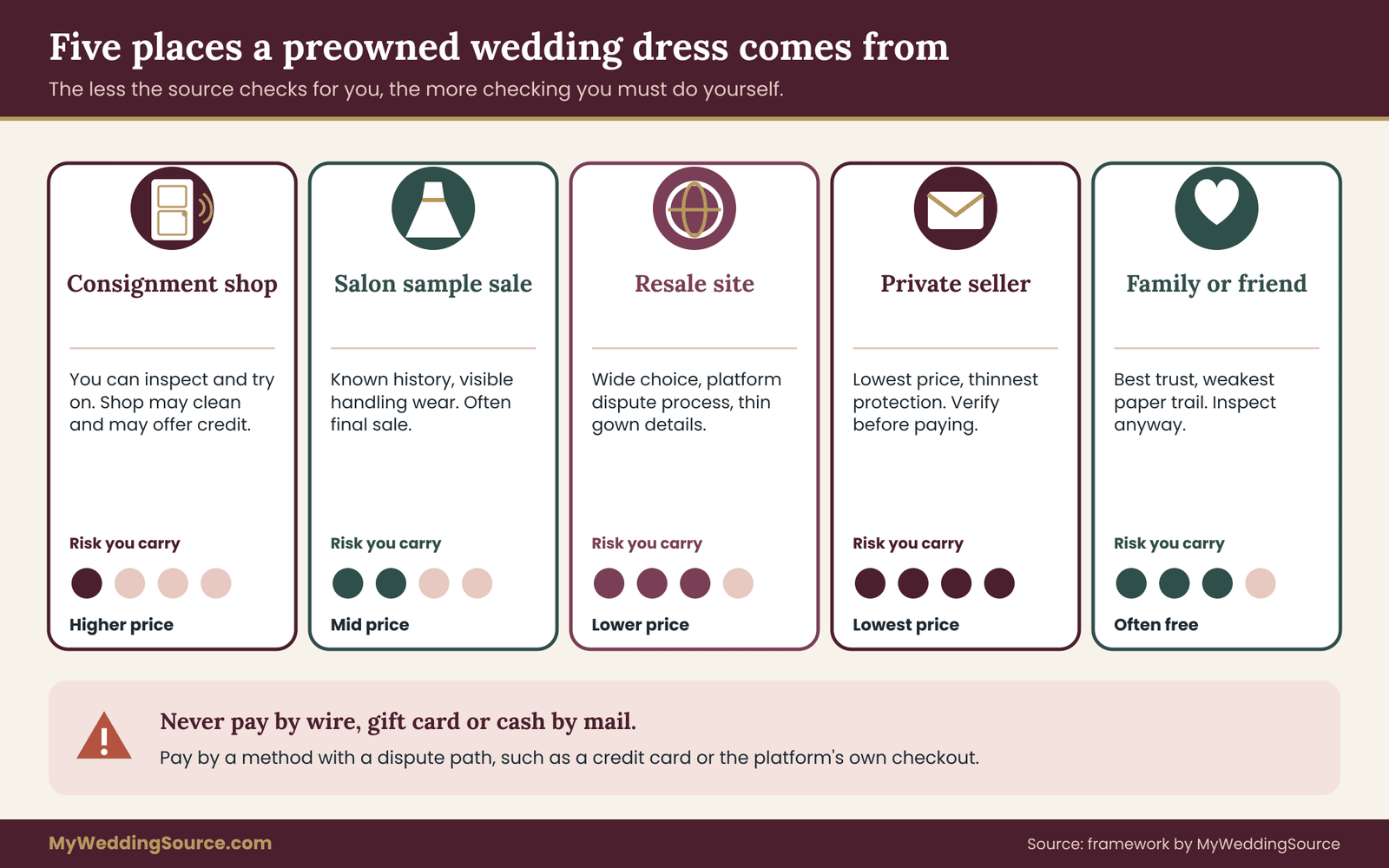
Think of the sources as a spectrum of who carries the risk. At one end, a local shop lets you touch the fabric, try the gown on and speak to someone who answers for it. At the other end, a distant private seller gives you photos and a message thread. Neither end is better in every case. The local shop usually costs more and the distant seller usually costs less, and the savings come directly out of the risk you accept.
Here is how to read each source in practice.
Local shops and consignment boutiques. You can inspect the preowned wedding dress in person, which removes most of the information problem. Ask what the shop does when it accepts a gown: whether it inspects seams and closures, whether it cleans, and whether any exchange or store credit applies. Ask for the policy in writing, and read what it says about alterations, because many shops treat a gown as final the moment you alter it.
Salon sample sales. The salon knows the gown, often has the original design details, and can tell you how long it was on the floor. Samples are almost always sold as is, and many are final sale. What you gain is a known history. What you give up is any promise about wear, which is often visible at the hem and underarms.
Online resale sites with seller reviews. Reviews tell you whether a seller ships on time and describes things honestly, which is useful. They do not tell you whether this preowned wedding dress matches its listing. Treat a good review history as a reason to keep talking, not as a reason to skip the evidence request.
Social media groups and classifieds. These are the highest-risk sources for fraud, because payment and communication happen outside any platform’s protection. Later sections cover payment methods and what to do with a seller who pushes you to pay in a way that cannot be reversed. The short version is that you should not send money by a method that has no dispute path.
A friend or relative. A gown handed down within a family has the best provenance of all, and the weakest paper trail. You will be tempted to skip the inspection because you trust the person. Do the inspection anyway, kindly. A relative’s storage, cleaning history and alterations are just as important as a stranger’s.
One more distinction is worth making now. Some sellers describe themselves as “authorized” or claim a preowned wedding dress is “authentic designer.” Be careful with those claims. A seller can sincerely believe a gown is genuine and still be wrong, and a buyer who relies on the label alone has no remedy if it is not. Later in the guide you will see how to ask for provenance without demanding something the seller cannot supply.
How the two-part method works on a real gown
Before the detailed checklists, here is the whole process in order, so each later section has a place to sit.
Step one: screen the listing. Before you spend time on any gown, check that the seller answers questions, that the photos show the whole gown in decent light, and that measurements are given in inches or centimeters rather than only a size label. A listing that fails these checks can be set aside quickly.
Step two: request the evidence. You ask for a standard set of photos and facts, listed in the next section. This request is also a test. A seller who sends everything promptly, or says plainly which items they cannot provide, is easier to trust than one who dodges.
Step three: grade the seven zones. You work through the condition checklist, assigning A to D to each zone from the photos and the seller’s answers. Anything you cannot judge gets an “unknown,” which you treat as a C until proven otherwise.
Step four: price the fit. (The guide to wedding dress fit and alterations covers the sewing side in depth.) You compare the gown’s measurements to yours and estimate how much alteration it needs, then ask a local alterations specialist to confirm before you buy if the gown is expensive or the changes are large.
Step five: fill in the all-in worksheet. You add the price, shipping, insurance, cleaning, repairs and alterations, plus a line for the cost of the preowned wedding dress not working out.
Step six: lock the terms. You get condition statements and return terms in writing, pay by a method that has a dispute path, and set an inspection window for arrival.
Step seven: inspect on arrival and decide. You inspect the gown within a short window, photograph everything, and either keep it or start the return before the clock runs out.
That is the whole structure. Each of the remaining sections takes one or two of these steps and goes deep. If you are comparing several gowns at once, run steps one through five for all of them before you commit to any, because the cheapest asking price is often not the cheapest total.
The evidence to request before you pay for a preowned wedding dress
The evidence request is the cheapest protection you have. It costs the seller ten minutes and costs you nothing, and it separates sellers who know their gown from sellers who are guessing. Send the whole list in one message so the seller can answer in one sitting.
Ask for these photos, taken in daylight or near a window, on a hanger or a form, with no filters:
- The full front, full back and both sides of the preowned wedding dress.
- A close shot of the neckline and bodice, front and back, with the lining visible if the gown has one.
- The inside of the bodice, including the boning channels, any cups, the care label and the size tag.
- The closure at full length: the zipper, buttons or corset laces, both closed and open.
- The underarm seams on both sides, inside and out.
- The hem all the way around, including the inside edge where it meets the floor.
- The train, laid flat, and the bustle points if there is a bustle.
- Any stain, mark, repair or flaw the seller already knows about, next to a ruler or coin for scale.
Then ask for facts in plain words:
- Flat measurements, with the tape laid on the fabric and not the lining: bust, waist, hip, back length from the nape to the hem, and the length of the train. Ask whether each number is taken flat and doubled, or around a form.
- Whether the preowned wedding dress has been altered, and exactly how. Hem, bustle, straps, taken in, let out, zipper replaced, beading added or removed.
- Whether it has been cleaned, when, by whom, and how it was stored afterward.
- Whether it has ever been worn, and for how many hours, indoors or outdoors.
- Whether the seller has the original receipt, tags, care label instructions or alteration invoices.
- Whether the gown has any smell, such as smoke, perfume, mildew or storage odor.
None of those questions is rude. Phrase them as help for a buyer: “I want to be sure this fits and arrives the way you describe it, so could you send a few extra photos and answer a few questions?” Sellers who want the preowned wedding dress to go home with someone happy will respond. Some will say they cannot take certain photos, and that is useful information.
How to read the seller’s answers
An answer is not just words. It is also what was left out, how fast it came and whether it agrees with the photos. Read it the way you would read a contract: slowly, once for meaning and once for gaps.
Specific beats general. “Professionally dry-cleaned in March, stored in a breathable bag in a closet” is a specific answer. “Cleaned and stored properly” is a general one. General answers are not lies, but they give you nothing to verify. Ask a follow-up: “Which cleaner did you use, and do you have the receipt?”
Consistent beats polished. Check that the measurements match the photos. If a size 8 gown is described with a thirty-inch waist and the photo shows a visibly gathered back, ask about it. Inconsistencies are usually honest mistakes, but they are the thing you are looking for.
Willing to say “I do not know.” A seller who says “I never checked the lining under the arms, but I can look tonight” is behaving well. A seller who answers every question with certainty and no detail is not necessarily dishonest, but the certainty is not evidence.
Reasonable about timing. A gown that sold too quickly to answer questions, or a seller who says other buyers are waiting, is applying pressure. A real gown at a fair price can wait a day for photos. If a seller sets an urgent deadline and refuses to supply basic evidence, you may be dealing with a listing that is not what it looks like.
Careful with provenance claims. If a seller says the preowned wedding dress is from a named designer or is a limited edition, ask what they have that supports it: the original receipt, a designer label inside the gown, an order confirmation from the boutique. You are not asking them to prove authenticity beyond doubt, which they usually cannot do. You are asking what they know and how they know it.
The Federal Trade Commission publishes consumer guidance on online shopping and scams, and its site is a useful place to learn the general patterns of fraud before you start. See the Sources section at the end of this guide. For the broader question of how to vet a service provider rather than a gown, the wedding vendor due diligence checklist covers the same instincts for businesses.
Scripts for the questions that feel awkward
Many buyers skip the hard questions because they feel rude. These short scripts keep the tone friendly and the questions clear. Adjust them to your own voice.
To request more photos. “The preowned wedding dress is beautiful and I am seriously interested. Before I commit, could you send a few more photos: the inside of the bodice, the underarms, and the hem close up? I want to make sure I understand the condition.”
To ask about alterations. “Was anything changed from the original design, like the hem, the bustle, the straps or the zipper? If so, could you tell me exactly what was done, and whether the original fabric is still there to let out?”
To ask about cleaning. “Has the gown been cleaned since the wedding? If so, who cleaned it and do you have the receipt? If not, are there any marks you noticed after the event?”
To ask for return terms. “Would you be willing to accept a return if the preowned wedding dress arrives in a condition that is different from the listing? I would send it back at my own cost within a few days, with photos of the problem.”
To decline a risky payment request. “I am happy to pay through the platform’s checkout or a method with buyer protection. I am not able to send money by a method I cannot reverse.”
To end a conversation politely. “Thank you for answering everything. I have decided to keep looking, and I appreciate your time.”
Notice what the scripts do not do. They do not accuse. They do not threaten. They give the seller a clear way to say yes, no or “I cannot.” Most of the time, you will learn what you need to learn by the reply.
Red flags that should slow you down
A single red flag is a prompt to ask a better question. A pattern of them is a reason to walk away. Keep a running count as you read the listing and the replies.
Photos that do not match each other. Different lighting, different backgrounds, a gown that looks a different color from one photo to the next, or images that look like a store’s catalog photo rather than a real room. Ask for a new photo with a handwritten note or today’s date in the frame. A real seller can do it in a minute.
A price that is far below the going range with no explanation. A preowned wedding dress listed at a fraction of what similar gowns cost, with no flaw mentioned, deserves suspicion. There is sometimes a good reason, such as a move or a quick sale. Ask the reason, and weigh the answer.
Pressure to pay outside the platform. If a seller asks you to move the conversation to a private messaging app and pay by a transfer that has no buyer protection, slow down. The platform’s rules exist to protect you, and leaving them removes the protection. The Consumer Financial Protection Bureau and the FTC both publish guidance on payment methods and scams, and both are listed in the Sources section.
Refusal to give measurements. A seller who will not measure the gown is either unwilling to engage or does not own it. Either is a problem.
Vague or contradictory condition language. “Perfect condition, a few tiny flaws” or “worn once, never worn” tells you nothing. Ask for a list of every flaw, however small.
A request for a deposit to “hold” the preowned wedding dress. A deposit to hold is not unusual in a local shop, but for a distant private seller it is a way to take money before you have seen anything. If you do agree to a hold, keep the terms in writing, including what happens to the deposit if the gown does not match.
No return path at all, with a high price. Many private sellers sell as is, and that is within their rights. The higher the price, the more weight you should give to how much risk you are being asked to carry alone.
When you feel uneasy, trust the feeling enough to ask one more question. If the answer does not settle it, you can walk away from a gown. Another one will come along.
Authenticity, designer claims and what you can reasonably ask
Authenticity is the question that causes the most worry and the least clarity. A designer’s name raises the price of a preowned wedding dress, and a counterfeit or a lookalike sold as the original is a real problem in resale. At the same time, no private seller can give an authenticity guarantee, and no buyer should rely on one.
What you can do is gather evidence that supports a claim and see whether it holds together.
Look at the labels and construction. Genuine designer gowns usually carry a sewn-in brand label, a care label and a style number, and the stitching and finishing match the price tier. You are not looking for perfection. You are looking for consistency: a label that is sewn in the way the rest of the gown is sewn, and a style number that matches the listed design.
Ask for the purchase trail. The original receipt from an authorized boutique, an order confirmation, or an email with the boutique are all supporting documents. They do not prove everything, but a seller who has them is a stronger bet than one who does not.
Check the style number with the maker. Many designers will confirm whether a style number exists, and some will tell you the year and original color. This is a courtesy, not an obligation, and the designer may decline.
Compare to known photos. Match the listing photos against the designer’s catalog for that style. Differences are not proof of a fake, because dresses are altered and photographed in different light, but large differences deserve a question.
Avoid relying on the platform’s word. A marketplace that says it “verifies” gowns may be checking something narrower than you assume. Read what the verification covers before you rely on it.
If a preowned wedding dress’s value to you depends on its being genuine, such as a limited collaboration you have wanted for years, ask yourself how much of the price is the label. When the label is most of the price and the proof is thin, the risk is yours. When you like the gown and would wear it unlabeled, the claim matters much less, and the grading checklist matters much more.
That is the right frame for a preowned wedding dress in general: spend your attention on what you can verify, which is condition, fit and terms, and be modest about what you cannot, which is anything the seller cannot document.
The condition grading checklist for a preowned wedding dress
Here is the first half of the method. You will grade seven zones of the gown. Each zone gets a letter, and each letter carries a plain meaning and an action. The goal is not to be harsh. The goal is to see the gown the same way every time, so that two gowns can be compared on one scale.
The grades work like this:
- A: sound. No visible issue, or only a trivial one that needs no work. Buy with confidence on this zone.
- B: minor. A small, known issue that a cleaner or a seamstress can fix at modest cost. Price in the fix.
- C: unclear or significant. Either something is wrong that needs real work, or you cannot tell from what you have. Do not buy until you have more evidence or a specialist’s view.
- D: serious. Damage that is hard or impossible to reverse, or that changes the preowned wedding dress. Walk away unless the price reflects a project and you want a project.
An “unknown” counts as a C. This single rule protects you from the most common mistake, which is treating missing information as good news.

Now the zones.
Zone one: fabric surface
This is the outer fabric you see and touch. Look for yellowing, gray dullness, water marks, snags, pulls, pilling, thin spots, shine from friction and any difference in color between panels.
What to ask for. Photos in natural light, including one of a flat area of skirt and one of the underarm area. Photos taken under warm indoor lamps can hide yellowing or fake it.
How to grade. An even, clean surface is an A. A few small snags on tulle or a faint mark in a hidden place is a B. Yellow or gray patches, water rings or thin areas are a C or D, depending on size and fiber. Fiber matters: polyester satin and tulle are forgiving, while silk and old silk blends can mark permanently from water or sweat.
Repair path. Light surface soil can often be cleaned. Water rings on silk, age yellowing and sweat damage are less predictable, and a cleaner who specializes in wedding gowns will tell you what is realistic.
Zone two: seams and structure
This is the skeleton of the gown: side seams, waist seams, center back, bodice-to-skirt join, and any internal support such as a built-in petticoat or corset.
What to look for. Pulled thread, puckering along seams, a seam that has been re-stitched, gaps between bodice and skirt, and fraying at stress points.
How to grade. Clean, flat seams are an A. A seam that has been neatly repaired is a B, though ask who repaired it. Open seams, strained stitching or a waistline that has pulled away from the bodice are a C. Fabric that has torn at a seam is a D.
Repair path. Seam repair is usually straightforward when the fabric around it is sound. When the fabric itself is weak, a repaired seam will not hold. Ask the alterations specialist to look at the fabric, not just the stitching.
Zone three: closures
Zippers, buttons, hooks, corset laces, ribbon ties and any hidden snaps.
What to look for. A zipper that sticks, splits or has a visibly different thread, missing hooks, loose buttons and corset grommets pulled through the fabric.
How to grade. A closure that works smoothly, and is original or neatly replaced, is an A. A few loose buttons or a missing hook is a B. A zipper that needs replacing is a B or C depending on the preowned wedding dress, since replacing a zipper on a lined gown with beading nearby can cost more than you expect. A corset back with torn grommets is a C.
Repair path. Zipper replacement and button repair are common and usually modest. Ask the seller for a photo of the closure at full length, and ask if it has been used with strain.
Zone four: lining, boning and built-in support
Many gowns hide their structure inside: a lining layer, boning channels, cups, a waist stay or a petticoat. This is where gowns often show age.
What to look for. Boning that has curled or poked through, cups that have shifted or shrunk, lining that has torn at the hem, discolored underarm lining, and a stiff or sticky feel from old adhesives.
How to grade. Smooth, flat support is an A. Cups that need replacing or a lining tear at the hem is a B. Boning that has broken through or lining that is stained at the underarm is a C. A built-in structure that has deformed the bodice permanently is a D.
Repair path. Replacing cups and re-stitching lining are routine for a seamstress. Replacing boning in a heavily structured bodice is more involved and more costly.
Zone five: hem and train
The hem takes the most abuse of any part of a gown. It touches floors, shoes, grass and other people’s feet.
What to look for. Gray or brown dirt along the edge, frayed or torn tulle, cut or shortened hems, loose bustle loops or buttons, and a train with scuffs or pulled threads.
How to grade. A clean, intact hem is an A. Light soil that cleaning can lift, or a few loose bustle loops, is a B. Ground-in dirt, torn layers or a hem that has been shortened is a C. A hem that has been cut with no extra fabric is a D for anyone taller than the previous owner.
Repair path. Hem cleaning is often part of a general cleaning. Hem rebuilding, especially on layered tulle or lace, is detailed work. Ask whether the preowned wedding dress was hemmed, and ask for the hem photo.
Zone six: stains and odor
Stains are easy to see. Odor is easy to forget.
What to look for. Yellow, brown or gray marks, rust spots, makeup near the neckline, deodorant residue at the underarm, wine or food stains, and any smell: smoke, mildew, perfume, stale closet or chemical cleaner.
How to grade. No marks and no smell is an A. A small, known mark that the seller says is surface soil is a B. Multiple stains, marks of unknown type or any persistent odor is a C. Mildew, mold spots, or old oxidized stains are a D, because the damage can be in the fiber, not just on it.
Repair path. Fresh surface soil often lifts. Older stains, sweat and oxidation are unpredictable and no cleaner can promise the result. Smoke and mildew odors can persist. A specialist cleaner can give an honest estimate when shown photos, and a good one will tell you if the odds are poor.
Zone seven: embellishment
Beads, sequins, lace appliqué, embroidery, pearls and crystals.
What to look for. Missing beads, loose threads from beading, lace that has lifted from the tulle beneath it, tarnished sequins, yellowing pearls, and areas where beads have been removed or added.
How to grade. Intact, evenly distributed embellishment is an A. A few missing beads in a hidden place is a B. Visible bare patches, lifting lace or heavy loss at the hem or train is a C. Large areas that have been stripped or replaced is a D.
Repair path. Replacing a few beads is affordable if matching beads exist. Re-attaching large lace sections or re-beading wide areas takes time, which means money. If beading is a major part of the design, ask for close-ups of the hem and the underarms, where losses cluster.
Turning seven grades into one decision on a preowned wedding dress
Seven letters are only useful if you can combine them. Use a simple rule and stay with it.
Count your zones. Any D in a zone you cannot work around is a stop. A “C” in two or more zones is a stop until you get more evidence. A single C is a pause: ask a specialist or ask the seller for more evidence, then regrade. All A and B is a go, subject to the cost worksheet.
Weight the zones by what you can fix. A hem you can hide with a petticoat or a bustle matters less than a bodice you cannot rebuild. Structure and fabric surface are the hardest to repair, so they carry more weight than closures, which are the easiest. If you must choose, forgive a B in closures before you forgive one in seams or fabric.
Write the repair path next to every grade below A. Do not leave it as a vague note. “Zipper: replace, local alterations shop” is a task you can price. “Zipper: fix somehow” is a surprise waiting to happen.
Photograph your grading. Save the photos and the seller’s answers in one folder, labeled by zone. If something goes wrong, you will have a record of what you were told and what you saw. Written terms and saved records matter whenever money changes hands, and the habit starts here.
Here is the grading logic as a short worked example. Imagine a gown listed as worn once. The photos show a clean surface, flat seams, a working zipper and an intact lining. The hem photo shows light gray soil along the front edge. The underarm photos show faint discoloration on the left side. The seller says the gown was not cleaned. Your grades: fabric A, seams A, closures A, lining B (underarm), hem B, stains and odor C (the underarm discoloration is unexplained, and no cleaning has been done), embellishment A.
A single C sends you to the next step. You ask the seller for a close photo of the underarm, and you ask a specialist cleaner what the likelihood is of lifting it. If the cleaner says it is a surface deodorant mark, the C becomes a B and the preowned wedding dress moves forward.
If the cleaner says it looks like sweat damage in the fiber, the C stays and you decide whether the price covers a gown that may never be fully clean. The grading did its job. It told you exactly what question to ask.
Fabrics and what they forgive
The same flaw means different things on different fabrics. A quick guide to the common ones saves you from guessing.
Polyester satin, crepe and chiffon. These synthetic fabrics tolerate cleaning and moisture well. They tend to show snags and shine, and they trap odor. A polyester gown is usually the most forgiving preowned wedding dress to buy at a distance.
Silk satin, silk crepe and silk charmeuse. These look beautiful and mark easily. Water spots, sweat and age can leave permanent changes. Silk takes cleaning well in expert hands and badly in careless ones. If the gown is silk and the stain history is unclear, weigh that heavily.
Tulle and net. Tulle is light, forgiving of storage and prone to tearing at the hem. It usually shows damage clearly, which helps a buyer, and it can often be patched invisibly if the tear is small.
Lace. Lace varies enormously. Machine-made lace is sturdy. Fine, old or hand-made lace is delicate. Ask about the lace type, and look for lifting at edges and thin patches near stress points.
Beaded and sequined fabric. Beads add weight and complexity, and weight stresses seams. A heavily beaded gown needs a closer look at the seams and the lining beneath the beading.
Taffeta, brocade and heavy structured fabric. These hold shape and crease permanently. Look for crushed areas, permanent fold lines and fabric that has cracked along old folds. Storage in a box rather than hanging can leave marks that no cleaning removes.
If a seller cannot name the fabric, check the care label photo. The fiber content is almost always printed there, and it tells you more about how a preowned wedding dress will behave than any adjective in the listing.
Fit: what a preowned wedding dress can and cannot become
Condition tells you whether a preowned wedding dress is sound. Fit tells you whether it can be yours. The two are separate questions, and a gown can be perfect on one and hopeless on the other.
The most common fit mistake with a preowned wedding dress is trusting the size label. A label is a pattern size chosen by a designer, not a measurement. Two gowns marked 10 from different makers can differ by several inches, and an altered gown no longer matches its label at all. Measurements are the only honest language, and the seller’s flat measurements are worth more than any tag.

Think of alterations as a ladder, with the easy rungs at the bottom and the rungs that change the gown at the top. The lower the rungs you need, the safer the purchase. The detailed methods for each kind of change are covered in the wedding dress fit and alterations guide, so this section stays focused on one question: how far up the ladder will this gown make you climb?
The alteration ladder for a preowned wedding dress
Bottom rungs: simple and low risk.
- Hemming a preowned wedding dress that is too long, when the skirt is plain or the lace edge can be handled.
- Adding a bustle.
- Taking in a seam a small amount, such as at the sides or center back.
- Adjusting straps, adding hooks or replacing a zipper.
- Adding cups or replacing worn lining.
Middle rungs: skilled work, higher cost.
- Taking in a gown more than a size, especially through a lace or beaded bodice.
- Letting out a seam when the seam allowance is generous enough.
- Re-boning or restructuring a bodice.
- Hemming a preowned wedding dress with lace appliqué or beading at the edge.
- Adding sleeves, straps or a layer to change coverage.
Top rungs: rebuilding, often not worth it.
- Letting out a gown that has narrow seam allowances or has already been taken in.
- Changing a neckline or silhouette.
- Re-cutting a bodice for a different torso length.
- Adding significant width to a fitted gown.
- Repairing fabric that has been cut or damaged and has nothing left to work with.
The rule is simple. A preowned wedding dress that needs only bottom-rung work is a safe candidate. A gown that needs middle-rung work is a candidate with a price tag attached, and you should ask for that price before you buy. A gown that needs top-rung work is usually a project, and the total will often exceed a simpler gown that fit better from the start.
Taking your own measurements, and reading theirs
You cannot judge fit from someone else’s numbers unless you have your own. Take your measurements before you start shopping, with a soft tape, in the undergarments you plan to wear, standing straight and breathing normally. A friend makes this much easier.
The measurements that matter most are bust at the fullest point, natural waist, hips at the fullest point, torso length from the top of the shoulder to the waist, and your height in the shoes you plan to wear. Add the distance from your waist to the floor, because that tells you more about hem length than height alone.
Then compare, zone by zone, with the seller’s flat measurements.
Bust and waist. Gowns with zippers or lace-up backs have some give. A lace-up corset back can adjust by a couple of inches in each direction. A zipper has almost none. If the gown’s bust and waist are within a size of yours, a seamstress can usually work with it. More than that, and you are climbing the ladder.
Hips. Fitted gowns need the hips to match closely. A mermaid or fit-and-flare silhouette is unforgiving at the hip, because the shape depends on it. A ball gown or A-line is more forgiving.
Torso length. This is the hardest measurement to change, because it affects where the waist seam, the bust shaping and the boning sit. If the preowned wedding dress’s torso length is more than an inch or so off yours, the proportions of the whole bodice are affected. Ask the seller for the length from the top of the strap or neckline to the waist seam.
Hem length. Hem length depends on the shoes. A gown listed as floor-length on a woman in flats may drag on you in flats and be short in heels. Ask the seller what height she is and what shoes she wore, then adjust.
Seam allowances. The amount of spare fabric inside the seams tells you how much a preowned wedding dress can be let out. Ask for a photo of the inside of a side seam, with a ruler laid beside it. A generous allowance is a quiet gift to a buyer who needs more room. Many factory seams are narrow, and many altered gowns have had their allowances trimmed.
If the numbers disagree with each other, believe the one that is hardest to change. A gown that is two inches too long can be hemmed. A gown that is two inches too short in the torso cannot be fixed by hemming.
Questions that save an expensive mistake
A seller who has worn the preowned wedding dress can often answer these, and the answers are worth more than another photo.
- “How tall are you, and what shoes did you wear?”
- “Was the gown taken in or let out, and by how much? Is there fabric left in the seams?”
- “Did you wear it with a bra, shapewear or a petticoat, and does the preowned wedding dress include any built-in support?”
- “Is the corset back adjustable, and how many inches of adjustment does it have?”
- “Were the straps shortened? Is there more strap length available?”
- “Is there a bustle, and is it original?”
Write the answers down. If a seller says the gown was “taken in two sizes,” that is a gown that cannot easily go back. If the seller says “it fit me with room to spare and I never needed it let out,” that is a gown with spare capacity. Both answers are useful and neither is a verdict until you compare them to your measurements.
When to see a specialist before you buy
For a low-priced gown with a minor fit gap, you can reasonably decide on your own. For a higher-priced gown, a large gap, or a preowned wedding dress with lace, beading or complex structure, spend an hour with a local alterations specialist before you commit. Many specialists will look at photos and measurements for a small fee. Some will want to see the gown in person.
What to bring: the seller’s photos, the seller’s measurements, your own measurements and the listing. What to ask: “What would it cost to make this fit me, and is there any risk the gown cannot be fitted?”
A specialist can see things you cannot. They know how a particular lace behaves when it is taken in, whether a seam has room to move, and whether a bodice has the structure to hold a change. They also know their own schedules, which matters because alteration appointments take weeks to book, and a preowned wedding dress that arrives late in your timeline limits your choices.
This is also the stage at which to ask about the specialist’s own rules. Some will not alter a gown they did not sell, some require a fitting window, and some charge a rush fee. Ask the rules before you buy the gown, not after. The wedding vendor timeline is a good reference for where alterations fall in the larger schedule.
Worked example: a gown that fits on paper and not on you
To see how the fit questions play out, consider an invented buyer, Maya, who is five feet six inches tall and plans to wear two-inch heels. She finds a lace fit-and-flare gown listed in her size, at a fair price, from a seller with good reviews.
She asks for measurements. The seller reports a bust of 36, waist of 29 and hips of 39, all taken flat and doubled, and a back length of 58 inches from nape to hem. Maya’s own numbers are a bust of 37, waist of 30 and hips of 40, with a waist-to-floor distance that suggests she needs roughly 59 inches in her heels. At first glance, the preowned wedding dress is about an inch small everywhere and an inch short.
Maya asks about seam allowances. The seller sends a photo of the side seam with a ruler: half an inch. She asks about alterations. The gown was taken in at the waist by the original bride, which means the allowance may already be spent. She asks about the hem. It is lace-edged and has never been shortened, so there is no extra length to let down, because the lace edge is the finished edge.
Here is what the gap means. A preowned wedding dress an inch too small in a lace fit-and-flare with half-inch allowances and an earlier waist alteration has little room. The inch of extra length is the lace edge itself, which cannot be extended. Maya is climbing to the top of the ladder on several counts at once.
She sends the photos and numbers to a local alterations specialist, who tells her honestly that the gown could be made to work only with a visible compromise in the proportions, and that the work would likely cost more than a gown that fit better to begin with. Maya passes on the gown. She spent a small consultation fee and avoided the larger mistake. That is the method working as intended.
Notice that nothing was wrong with the preowned wedding dress. The seller was honest, the condition was good and the price was fair. The gown simply was not hers. Fit and condition are separate tests, and a gown must pass both.
Sizing across different bodies and gown types
Some situations call for extra care. Naming them now will save you from learning them the hard way.
Plus-size and larger gowns. The pool of preowned gowns in larger sizes is smaller, and prices for them are often less discounted. Be careful about buying a smaller gown with a plan to “let it out,” since seam allowances rarely cover more than a size or two. Prefer a gown that already fits at the bust and hips, and alter the rest.
Petite and tall buyers. Length is the issue. A petite buyer can usually hem, but lace-edged hems and beaded hems are more costly, and a very long train may need a shorter bustle. A tall buyer needs spare length, which is rare, and should treat a preowned wedding dress that was shortened as a probable no.
Pregnancy and weight changes. If your size may change before the wedding, favor a gown with a lace-up back or a forgiving silhouette, and book fittings late in the schedule. Zipper backs and fitted bodices allow little change.
Custom gowns. A preowned wedding dress made to one person’s measurements and proportions can be wonderful, but it fits other people less often. Ask for her measurements and compare. Do not assume a gown in your size on paper will sit right on you.
Gowns with built-in cups and boning. Built-in support is shaped for the first owner. Cups placed for a different bust can sit wrong, and boning follows the original torso. Plan to replace or adjust them, and add that to the all-in cost.
The point of this list is not to discourage you. Many people find a preowned wedding dress that fits well with modest changes. The point is to recognize your own situation early and ask the right questions for it.
Returns, payment and shipping when you buy a preowned wedding dress
This is the second half of the protection layer, and the least glamorous. The grading checklist tells you what you are buying. The terms decide what happens if you were wrong.
Start with a hard fact: there is no single return rule for a preowned wedding dress. A private seller on a marketplace may sell as is. A consignment shop may offer store credit only. A platform may have a buyer protection program with a narrow window. A salon sample sale may be final sale. Whatever the terms are, you want them stated clearly and in writing before you pay, because a verbal promise is hard to prove later.
Return terms to ask for, and what each one means
Ask the seller to confirm, by message or email, each of these points. Keep the thread.
Is the sale final, or can the gown be returned? If it can, for what reasons and within how many days of delivery? A return for “not as described” is different from a return for “changed my mind,” and many sellers will accept only the first.
Who pays return shipping? Typically the buyer does, unless the preowned wedding dress was not as described. Ask the question directly so there is no later argument.
What condition must the gown be in when returned? Unaltered, unworn, in the same packaging, with tags. A seller who allows a return will expect the gown to come back as it left. Do not alter, clean or wear a gown you may return.
How quickly will a refund be issued, and to what method? A refund to the original payment method is the cleanest. A store credit or a refund minus fees is a different deal.
What happens if the preowned wedding dress is damaged in transit? Who files the insurance claim, and who bears the loss while it is pending? This question is easy to skip and expensive to skip.
What is the inspection window? Some sellers will agree that a gown is yours only after a stated number of days of inspection. If the seller offers no window, you can still set your own internal deadline, and plan to inspect and decide within it.
If a seller will not agree to anything and the price is high, you are being asked to treat the purchase as final. You can still buy, but be honest with yourself that you are taking the whole risk. A lower price or a different seller may suit you better.
Payment methods and what each protects
How you pay changes what you can do if something goes wrong.
Platform checkout. Most marketplaces hold the payment until the buyer confirms delivery, or for a set period. The protection depends on the platform’s own policy, which varies, so read it before you buy. Keep the whole transaction on the platform, including messages, because off-platform agreements are often outside the protection.
Credit card. Credit card payments carry dispute rights under federal law, and the Consumer Financial Protection Bureau explains how billing disputes and chargebacks work on its site. Deadlines are short, commonly measured in days or weeks from the statement date, so check your card issuer’s rules as soon as something goes wrong rather than later.
Debit card. Debit payments generally have weaker or different protections than credit cards. If you have a choice, pay with the method that gives you the stronger dispute path.
Payment apps and person-to-person transfers. Many of these are designed for paying people you know. Some have limited or no protection for purchases, and a transfer can be difficult or impossible to reverse. Check the app’s current terms before you use it for a purchase, and be careful when a seller insists on one particular app.
Wire transfers, gift cards, cryptocurrency and cash by mail. These are the payment methods scammers prefer, because the money cannot be pulled back. The Federal Trade Commission lists them among the red flags for fraud. For a preowned wedding dress from a seller you have not met, refuse these methods.
Escrow services. An escrow service holds the money until you accept the preowned wedding dress. This can be a sound option for a high-value gown from a distant seller, but verify the service is real, because fake escrow sites are a known fraud. Go to the site yourself rather than clicking a link the seller provides.
The simplest rule is this: pay by the method that gives you the best way to get your money back, and never let a seller talk you out of it.
Shipping and insurance
Shipping is where a good purchase can still go wrong. A wedding gown is bulky, light and easily crushed, and it is expensive to replace.
Ask how it will be packed. A gown should travel in a breathable garment bag or acid-free tissue inside a sturdy box, not in a sealed plastic bag where moisture can build up. Beaded gowns need padding so the beads do not press through the fabric.
Insure for the full value. The carrier’s standard coverage is usually well below the preowned wedding dress’s value. Add insurance for the price you paid, and keep the receipt. The United States Postal Service and the major carriers publish their own coverage terms, so read them for the service you choose.
Require tracking and a signature. A signature requirement prevents a package left on a porch from disappearing. Tell the seller you want it.
Ask for photos of the packed gown. A photo of the gown in its packaging before it leaves creates a record of its condition. It also tells you something about the seller.
Plan for time. Shipping, inspection, cleaning and alterations all take time. A preowned wedding dress that arrives two weeks before the wedding leaves no margin for anything. Build the schedule backward from the wedding date and add a buffer. A general wedding planning checklist is a reasonable place to see where the gown sits in the whole sequence.
Think about the return trip too. If you need to send the gown back, you will want the packaging it came in. Keep the box, the bag and the tissue until the gown is accepted.
For a local purchase, ask how the preowned wedding dress will be moved from the shop to your home. A gown carried in a car must hang or lie flat, never be folded in a trunk.
The arrival-day inspection protocol
When the gown arrives, the clock starts. Your return rights, if you have any, may last only a few days. Inspect the same day or the next day, and do it deliberately.

First hour: document the package. Photograph the box, the label and any damage to the packaging before opening it. Film yourself opening it if you can. If the box is damaged, tell the carrier right away, because insurance claims have their own deadlines.
Next: remove and air the preowned wedding dress. Take it out gently and hang it or lay it flat in a clean, dry space with good light. Let it breathe for a while. Smells that sat in a sealed box often soften when air reaches them. Wash your hands first and keep the gown away from pets, food and anything that could mark it.
Then: run the seven-zone check again. Go through the grading zones with the gown in your hands, and compare what you see with the photos and answers you saved. This is the stage where you find out whether the listing was accurate. Look at the underarms and hem in daylight. Smell the gown at the neckline and the underarm lining.
Check the fit with a trial. If the return terms allow, try the preowned wedding dress on with the undergarments you plan to wear. Do not wear it for long, and do not wear shoes that might scuff the hem. Ask a friend to help with the closure, and photograph the fit from the front, back and side. If the terms say “unworn,” ask the seller whether a brief trial is allowed before you try it on. The safest answer is to ask first.
Measure it. Lay the gown flat and measure the bust, waist, hips and length. Compare to what you were told.
Decide within your window. Write down the return deadline and the steps to start a return. If the preowned wedding dress matches its description, keep it and book the alterations. If it does not, document each difference with photos and send a clear message to the seller the same day, stating what you were told and what you found.
Keep the evidence. Save the photos, the listing, the messages and the shipping records in one place. If the matter goes to the platform or to a card dispute, those records are what you will need.
If the seller refuses a return that the terms allow, the platform’s buyer protection process and your card issuer’s dispute process are the next steps. Both have deadlines, and both ask for the evidence described above. For general consumer rights and complaint routes, the Federal Trade Commission and the Better Business Bureau are listed in the Sources section.
Documenting the transaction
A paper trail takes ten minutes to build and can be worth hundreds of dollars. For every preowned wedding dress purchase, keep a folder with these items:
- The original listing, saved as a screenshot or PDF, with the price and date.
- All messages with the seller, including the answers to your evidence request.
- The seller’s photos and your own arrival photos, in separate subfolders.
- The payment confirmation and the receipt.
- The return terms, in the seller’s words.
- Shipping and insurance records.
- Any alteration quotes, cleaning receipts and specialist notes.
This is not paranoia. It is the same habit that protects you with any large purchase, and it will also help if you later decide to resell the gown. The wedding vendor contract guide walks through what written terms should include whenever money changes hands for a wedding service or product, and the same reasoning applies to a private sale of a gown.
The all-in cost worksheet for a preowned wedding dress
Now the second half of the method. The asking price is the first number, never the last. A preowned wedding dress becomes a wearable gown only after a chain of other costs, and some of those costs are not obvious until you list them.
Build the worksheet as a list of lines. Fill in every line for every gown you are seriously considering, using a quote or a plain estimate you can defend, and mark which lines are real quotes and which are guesses.

Line one: the asking price. The number in the listing, or the number you have agreed with the seller.
Line two: platform and payment fees. Some marketplaces add a buyer fee, and some payment methods carry a fee. Look for it at checkout.
Line three: shipping and insurance. Both directions if there is any chance of a return. A preowned wedding dress may need a box large enough to avoid crushing it, and insurance priced to its value.
Line four: sales tax. Some sales carry tax and some do not. Check the final checkout total rather than assuming.
Line five: cleaning. Many preowned gowns need professional cleaning, even when the seller says they are clean. Ask a wedding-gown cleaner for a quote and what the quote includes.
Line six: repairs. Every grade below A in the checklist should have a price here. Zipper replacement, hem repair, lining repair, bead replacement, strap work.
Line seven: alterations to fit. The work to make the gown fit you, from the alteration ladder. Ask a local specialist for a written estimate, and ask what is included, such as fittings, a bustle and pressing.
Line eight: accessories the preowned wedding dress needs. A petticoat, a slip, shapewear, a veil that suits the neckline, or shoes that match the hem. Not every gown needs these, but some do, and they can add up.
Line nine: pressing and storage. A final steaming or pressing before the wedding, and a garment bag or box for storage. The wedding day accessories planning guide covers the supporting items that tend to be forgotten.
Line ten: the cost of it going wrong. This is the line almost nobody writes down. If the gown fails inspection and there is no return, what do you lose? If the return costs shipping both ways and a restocking fee, what do you lose? Put a number on it. If you cannot lose that number comfortably, the gown is too risky at that price.
Line eleven: your time. Appointments, shipping waits, fittings, repeated messages with sellers. Time is not always a dollar figure, but for a tight timeline it can decide whether a preowned wedding dress is workable.
Add the lines. That total, not the asking price, is the gown’s cost to you.
Comparing the total against your alternatives
A total only means something next to another total. Compare each preowned gown to at least two alternatives, and compare on the same basis: a preowned wedding dress you can wear on the day, fitted, with every line paid.
A new gown from a salon. The price usually includes a consultation, fittings, a return or order protection for manufacturing errors, and a known delivery schedule. It also usually includes a higher price and a long lead time. Ask the salon what is included in alterations, since many bundle some work and charge for the rest.
A sample gown from a salon. Often cheaper than new, often final sale, and visibly worn in the usual places. The total includes cleaning and alterations, which are commonly needed.
A rental. Some companies rent wedding gowns for a limited period. A rental may suit a short timeline or a gown you do not need to keep, but alterations are restricted and damage terms vary. Read the damage terms before you rent.
A different preowned gown. Often the best comparison is another preowned wedding dress that fits better and needs less work.
The question to ask is: what is the cheapest route to a preowned wedding dress that fits me, is in good condition and arrives on time? Sometimes the answer is the cheapest listing. More often it is the one with the fewest unknowns, and the difference in total is smaller than the difference in asking price.
The option matrix, in prose
A matrix would put these in a grid, but a sentence per option is clearer. Here is how the main routes compare on the dimensions that matter.
Local consignment shop. Highest control, because you can inspect, try on and ask questions. Moderate price. A possible return or credit policy. The lowest risk of the used routes, and a smaller selection.
Salon sample sale. Good control, because the gown is in front of you. Usually the lowest price among in-person options. Usually final sale, and usually visible wear, so grade carefully and price cleaning.
Online resale site with a verified seller program. Wider selection, moderate control, and a platform dispute process. The price is lower than local, and the information is thinner.
Private seller by direct message. The widest selection and the lowest prices, with the thinnest protection. Reserve it for gowns you can verify and payments you can reverse.
Family or friend. Lowest price, often free, highest trust, and the usual risks of an unexamined gown. Do the inspection anyway.
Custom or designer resale at a premium. Highest price in the used market, and the most reliant on provenance. Bring in a specialist early.
The right route depends on how much risk you can carry, how much time you have and how close you are to the seller. A buyer with a long timeline and a local shop can afford to wait for the right gown. A buyer with a short timeline needs a route that can deliver quickly and predictably.
Three worked examples of a preowned wedding dress total
The numbers below are invented to show the arithmetic. They are not market prices, and you should replace them with quotes from your own area. The point is the structure of the comparison, not the figures.
Example one: the local consignment gown. Asking price 900 dollars. No shipping. Tax 70. Cleaning quote 150. Hem and bustle quote 180. Fit alterations quote 120. Pressing and a garment bag 60. Total about 1,480 dollars. The return policy is store credit within a week, so the risk line is small. The preowned wedding dress is in front of you, so the unknown lines are few.
Example two: the private online gown. Asking price 450 dollars. Shipping both ways, insured, 90. Platform fee 25. Cleaning estimate 180, but the seller has not cleaned the gown, and the underarm grade is a C, so add a margin of 60. Zipper replacement estimate 85. Fit alterations estimate 350, higher because the seam allowances are narrow. Pressing and storage 60. Total about 1,300 dollars, with several lines still estimates.
Add the risk line: if the gown fails and the seller refuses a return, a loss of at least the 450 price plus shipping. A buyer who cannot lose roughly 550 dollars comfortably should think twice. A buyer who can, and who has an alterations specialist’s advice, may find this a good deal.
Example three: the salon sample. Asking price 700 dollars. No shipping. Tax 55. Cleaning 160. Hem repair for worn tulle 120. Fit alterations 250. Bustle 80. Total about 1,365 dollars. Final sale, but the preowned wedding dress is in hand, and the wear is visible in advance, so the risk line is modest.
Look at what the comparison shows. The private online gown had the lowest asking price and a total that is close to the others. Its risk line is the highest, and several of its lines are still guesses. The consignment gown had the highest asking price and the most predictable total. The sample sits between them. None of these is the right answer for everyone. The worksheet shows the buyer what each cheap-looking price is really made of.
Setting a walk-away number
A walk-away number is the highest all-in total you will accept for the gown, decided before you fall in love with one. Without it, every gown feels like a bargain while you are looking at the photos.
Set the number in three steps.
Start with your gown budget. The amount you set aside for the dress, alterations and accessories together. The wedding budget guide explains how to place the preowned wedding dress within the larger picture so it does not crowd out other categories.
Subtract the fixed lines. Cleaning, pressing, accessories and a margin for alterations are close to certain for any gown. Take them off first.
What remains is the most you can pay for the gown itself. If a listing’s asking price plus its known extra costs exceeds the remainder, set it aside, unless you are willing to move money from another category.
Once the number is set, write it down where you will see it. When a preowned wedding dress is tempting and a little over, ask whether you would pay that all-in total for a gown you could try on and return. If the answer is no, the gown’s price is higher than its value to you.
A walk-away number is also a kindness to your future self. It turns a stressful decision into a comparison, and it gives you permission to say no to a gown that is lovely and wrong.
Putting it together: a decision path for a preowned wedding dress
You now have the pieces. This section ties them into one path you can follow for each gown, so that a decision does not depend on mood, a deadline or a sales message.
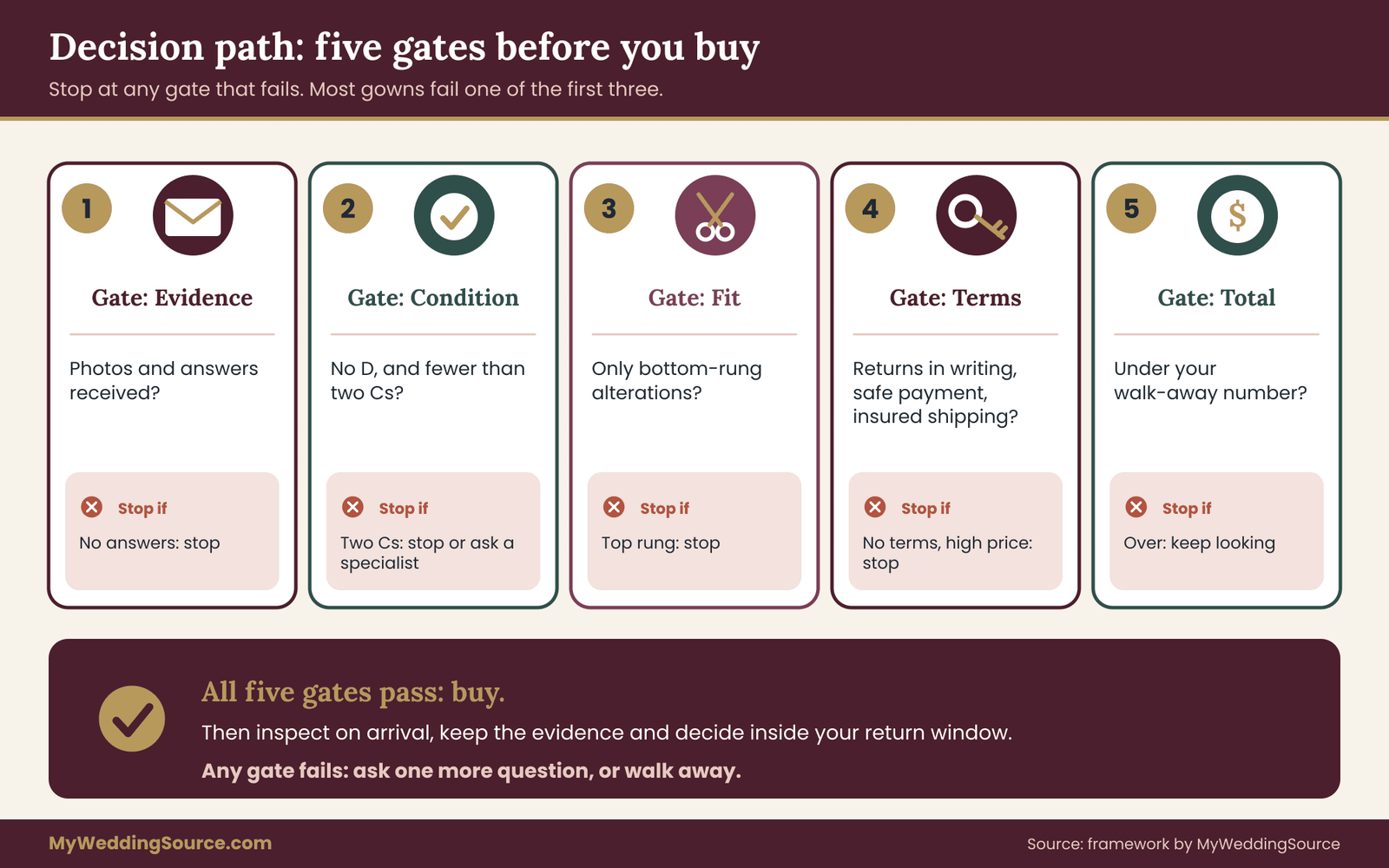
Gate one: can you get the evidence? If the seller will not send the photos and answer the questions, stop. Nothing else on the path works without evidence.
Gate two: does the condition grade hold? Any D, or two or more C grades, means stop or get a specialist’s view. A single C means pause and ask. All A and B means continue.
Gate three: does it fit, or can it be made to fit? Compare measurements. If the preowned wedding dress needs only bottom-rung alterations, continue. If it needs middle-rung work, get a written estimate first. If it needs top-rung work, stop unless you want a project.
Gate four: are the terms acceptable? Return terms in writing, payment by a method with a dispute path, and insured shipping. If the seller will not agree and the price is high, stop or lower your risk by lowering your price.
Gate five: does the all-in total beat your alternatives and sit under your walk-away number? If yes, buy. If no, keep looking.
After purchase: inspect within your window, keep the evidence, and either confirm or start a return.
Most gowns will fail at gate one, two or three. That is not a sign the process is too strict. It is a sign that the process is doing its work, which is to filter out the gowns whose cheapness was an illusion.
Limits of this method and edge cases
No method covers every gown. Knowing where this one is weak will keep you from leaning on it too hard.
You cannot grade what you cannot see. Photos hide a lot. Light, angle and editing change what a surface looks like, and no photo shows smell or hand-feel. The method reduces risk and does not remove it. For a gown that matters a lot to you, an in-person look is worth travel.
Condition grades are judgments. Two careful people might grade the same underarm differently. Use the grades to structure your questions, not to claim certainty.
Cleaning outcomes are not promised. Even a skilled cleaner cannot guarantee a result on old stains, sweat damage or yellowing. If your decision depends on a stain lifting, price the preowned wedding dress as if it will not.
Alteration estimates change once the gown is open. A seamstress may find a problem inside a seam that was not visible in a photo. Ask whether the quote is firm or an estimate, and keep a margin.
The cost examples are illustrations. Prices differ by region, by gown and by the specialist. Use your own quotes.
Authenticity cannot be settled by a buyer alone. You can gather evidence. You cannot always reach certainty. Decide how much the label matters to you before you pay for it.
Rules and platform policies change. Check current terms with the platform, the card issuer, the carrier and the agency that publishes the rule. This guide points you to them rather than quoting terms that may be out of date.
Vintage gowns need more. Old fabric, old dyes and old thread behave differently, and handling can cause damage. If a vintage gown is your target, a textile conservator or a specialist in vintage garments is worth consulting before purchase.
Cultural and religious garments. Some wedding garments carry meaning that a resale listing does not capture. If a preowned wedding dress or garment belongs to a tradition you are not part of, consider asking the community or the seller about how it is worn and whether it is appropriate for you to wear.
Special situations worth a second look
A gown that has been dyed or dip-dyed. Dye changes can be permanent and uneven. Ask for photos in daylight and ask whether the dye has been tested for colorfastness. Dyed gowns are hard to restore.
A preowned wedding dress with sleeves or illusion fabric added later. Added parts can change the weight and the seams. Ask who added them and when.
A gown from a smoke-free versus smoking household. Smoke odor is among the hardest to remove. Ask directly, and trust your nose on arrival.
A preowned wedding dress sold with its original box. Many salons ship gowns in a box for the buyer to take home. A gown stored in a box for years may carry fold marks or discoloration at the folds. Ask for photos along the old fold lines.
A gown stored in a plastic bag. Plastic can trap moisture and cause yellowing or mildew. A sealed plastic bag in a hot closet is among the worst storage options. Ask where and how it was stored.
Buying for a destination wedding. Travel adds creasing and handling. Choose a fabric that travels well, and plan for steaming at the destination. The twelve-month wedding checklist can help you place gown tasks in the larger sequence.
Reselling later, and why it matters now
A preowned wedding dress is also a future resale. If you buy a gown you may resell after the wedding, a few choices now will help.
Keep the receipt, the photos and the cleaning records. Avoid permanent alterations if you can, such as cutting the hem, and prefer reversible ones such as a hand-sewn bustle. Store the preowned wedding dress properly afterward, in a breathable box or bag in a cool, dry place. A gown with a clear history and reversible changes is easier to sell and sells for more.
If you buy a gown that has already been permanently altered, that is a reason to expect a lower resale value, and a reason to factor it into your total.
Your next steps
Work through these in order. Each takes an evening or less.
- Take your own measurements and write them down, including bust, waist, hips, torso length and waist-to-floor in your shoes.
- Set your gown budget and walk-away number, using the all-in worksheet lines as a guide.
- Pick the routes you will search: local shops, sample sales, online resale, or all three.
- For each gown you like, send the evidence request and read the answers.
- Grade the seven zones, write the repair path beside every grade below A, and note any unknowns as C.
- Ask a local alterations specialist and a preowned wedding dress cleaner for quotes on your top candidates.
- Fill in the worksheet for each candidate and compare with your alternatives.
- Confirm return terms in writing, choose a payment method with a dispute path and insure the shipping.
- Inspect on arrival the same day, document it and decide within your window.
The first time through, the process feels slow. By the second gown, it takes an hour. And a preowned wedding dress chosen this way is far more likely to be the one you are glad you bought.
FAQ
How do I know if a preowned wedding dress is in good condition?
Grade it in seven zones: fabric surface, seams and structure, closures, lining and boning, hem and train, stains and odor, and embellishment. Ask the seller for daylight photos of each zone and write an A to D grade beside it. Treat anything you cannot see as a C until you have more evidence. A seller who answers plainly and sends the photos you asked for is a good sign.
Is it safe to buy a preowned wedding dress online without trying it on?
It can be, with care. Ask for flat measurements and compare them with your own, ask whether the gown was altered, and get return terms in writing. Pay with a method that has a dispute path, such as a credit card or the platform’s checkout. Inspect the gown the day it arrives. The risk is lower for forgiving silhouettes and higher for fitted or custom gowns.
How much does it really cost to buy a preowned wedding dress?
The asking price is only the start. Add shipping and insurance, any platform fee, cleaning, repairs, alterations, accessories, pressing and storage, plus a line for what you would lose if the preowned wedding dress failed and could not be returned. Ask local specialists for written quotes, because prices vary by region. The total, not the listing price, is what you compare with other routes.
Can a preowned wedding dress be returned?
That depends on the seller. A private seller may sell as is, a shop may offer store credit, and a marketplace may have a buyer protection program with a short window. Ask before you pay, and get the answer in writing. Do not clean, alter or wear a gown you may need to return. Keep every message and photo in case you need to dispute the sale.
What if the seller claims the dress is an authentic designer gown?
Treat the claim as something to check, not as a guarantee. Ask for the original receipt, the boutique’s order confirmation and photos of the sewn-in label and style number. Some designers will confirm a style number if asked. A private seller cannot give a true authenticity guarantee, so decide how much the label matters to you before you pay a premium for it.
Can any stain on a preowned wedding dress be cleaned?
No, and no cleaner should promise it. Fresh surface soil often lifts, while old stains, sweat damage, oxidation, mildew and some water marks can be permanent. Send clear photos to a wedding-gown cleaner before you buy and ask for an honest view of the odds. If your decision depends on a stain coming out, price the preowned wedding dress as though it will not.
How much can a seamstress change the fit of a preowned wedding dress?
Usually a size or less is realistic, depending on seam allowances, fabric and structure. Hems, bustles, straps and small seam changes are the easy work. Letting out a gown, changing a neckline or fixing a torso that is too short is hard. Ask for a photo of an inside seam with a ruler, and ask a local specialist before you buy anything costly.
Should I buy from a shop, a salon sample sale or a private seller?
Each trades price against protection. A local consignment shop lets you inspect and try on, a salon sample sale usually sells final but shows its wear, and a private seller offers the lowest price and the thinnest protection. Choose by how much risk you can carry and how much time you have, then compare the all-in totals, not the asking prices.
Sources
- Federal Trade Commission: consumer protection rules and guidance on online shopping, scams and returns.
- FTC Consumer Advice: plain-language guidance on avoiding fraud and recognizing risky payment requests.
- Consumer Financial Protection Bureau: information on credit card billing disputes, chargebacks and payment apps.
- Internet Crime Complaint Center: where to report online fraud.
- United States Postal Service: shipping, tracking, signature and insurance terms.
- National Park Service Museum Management Program: guidance on the care and storage of textiles.
- American Institute for Conservation: information on conservation professionals and textile care.
- Better Business Bureau: business profiles and complaint filing.
- U.S. Consumer Product Safety Commission: general consumer product safety information.
- USA.gov Consumer Protection: directory of federal and state consumer protection agencies.