
The suit vs tuxedo decision is less about taste than about three things you can check: what the occasion calls for, how each garment will fit your body, and what each suit vs tuxedo path costs once you count the whole life of the outfit. This guide gives you an occasion ladder and a lifetime cost ledger so the choice rests on evidence, not on a salesperson’s preference or a friend’s habit.
For most weddings, the suit vs tuxedo choice comes down to the invitation’s dress code and the time of day. A true black-tie evening wedding points to a tuxedo. A daytime, garden, barn or casual celebration points to a suit. Everything between is a judgment call. Score your wedding on the occasion ladder below, then compare rent, buy and made-to-measure costs on the suit vs tuxedo ledger, including alterations, accessories, cleaning and the number of times you will wear the outfit again. Fit decides whichever you pick.
Most grooms get pushed toward an answer before they have asked the suit vs tuxedo question. A rental shop leads with the tuxedo package. A department store leads with the suit. A friend who wore a tuxedo at his own wedding is sure it is the only correct choice. Each of them is describing a different wedding from yours, and none of them has done the suit vs tuxedo arithmetic for your day.
The better approach is to treat the suit vs tuxedo question the way you would treat any other major wedding decision. Define what you need, collect a few facts, set a deadline, and then choose. Nothing about it requires expertise in menswear. It requires a tape measure, a calendar, two or three honest price quotes and a clear picture of the day you are planning.
This article is built around two tools. The first is the occasion ladder: six rungs from white tie down to casual, with a short scoring method that places your wedding on the suit vs tuxedo ladder using the invitation wording, the start time, the venue, the season, your partner’s attire and the photos you expect to keep. The second is the lifetime cost ledger, a way of adding up what each path actually costs from the first fitting to the last time you wear the garment.
Between those tools sit sections on what really separates the two garments, how fit and tailoring differ, how contracts and deadlines work, how weather and venue change the answer, and three worked cases with invented couples so you can see the method run from start to finish.
A note on scope. This is general information, not legal, tax or financial advice. Prices, sizing, shipping and return terms vary by seller and change often, so confirm anything that matters with the shop in writing. Where a consumer rule applies, the article names the agency and the Sources section lists where to check the current version.
If you are still choosing every piece of the groom’s look, the wedding day accessories planning guide covers the whole set, including backups. This article stays on one decision inside that set: the jacket-and-trouser decision that everything else gets built around.
What the Suit vs Tuxedo Decision Really Decides
It helps to be exact about what is on the table. A suit vs tuxedo choice is not only a choice between two jackets. It sets the formality of the photographs, the shirt, tie or bow tie, shoes, belt or suspenders, and often the outfits of the groomsmen and fathers. It also decides how you will buy it, because tuxedos are sold and rented through a different system than suits.
That last point surprises people. A tuxedo is easy to rent because rental shops are organized around it, and the wedding rental planning checklist shows what to confirm with any rental vendor. A suit is easy to buy because retailers and tailors are organized around it. Renting a suit is possible but less common, and buying a tuxedo is possible but usually costs more per wear unless you attend formal events. So the suit vs tuxedo choice quietly steers you toward a purchase path, and the purchase path steers the cost.
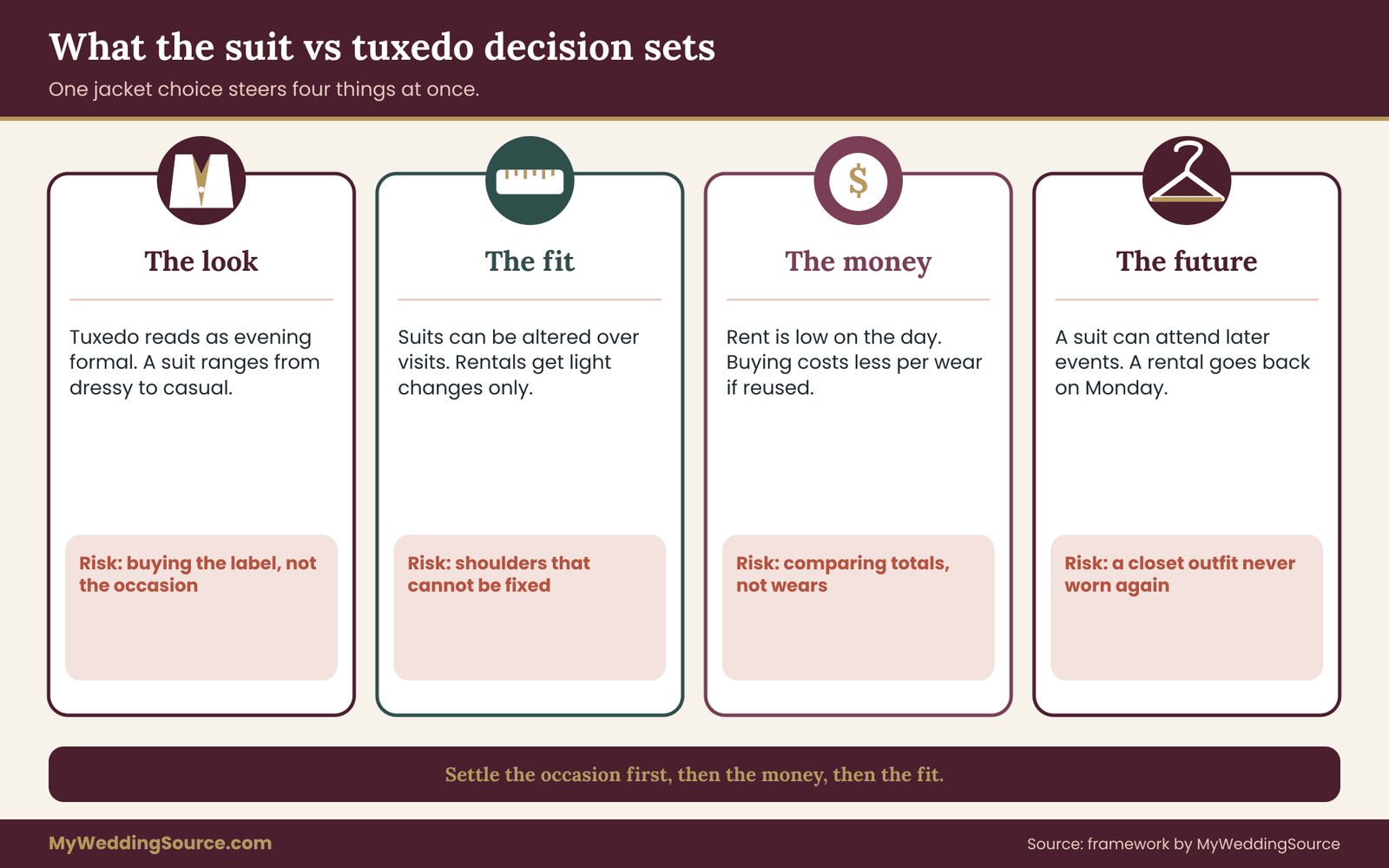
There are four things the suit vs tuxedo decision touches, and it is worth naming them before going further.
The look. A tuxedo reads as evening formal almost everywhere. A suit reads as formal to dressy-casual depending on color, fabric, and styling. Neither side of the suit vs tuxedo divide is automatically more elegant. A well-cut navy suit in good fabric looks better than an ill-fitting rented tuxedo every time.
The fit. Suits are cut and altered by tailors who work with the garment daily. Rented tuxedos are altered lightly if at all, and the shop expects returns in near-original condition. Fit rules for each are covered in the fit section later, and the bride’s side of the same conversation is laid out in the guide to fit and alterations for the bride, which a groom’s tailoring appointment closely resembles.
The money. The ledger section prices each suit vs tuxedo path. The headline is that the cheaper garment on the day is often not the cheaper garment over time.
The future. A suit can often go to a job interview, a funeral, a christening or a friend’s wedding next spring. A rented tuxedo goes back to the shop on Monday. A purchased tuxedo waits in a closet for an invitation that may never come.
The questions behind the question
When couples say they cannot decide, one of four questions is usually underneath. It might be “What will we look like in the photos in twenty years?” That is a taste and timelessness question. It might be “What is expected?” That is a dress code question. It might be “What will this cost us?” That is a ledger question. Or it might be “Will I be comfortable standing, dancing and sweating in this for ten hours?” That is a fabric and season question.
Name which suit vs tuxedo worry is yours before you shop. A groom who is worried about expectations should start with the ladder. A groom who is worried about money should start with the ledger. A groom who is worried about comfort should start with the season section. The same facts feed all three, but the starting point changes how fast you reach a decision.
Who gets a vote
The groom wears it, so the groom has the strongest say. The partner has a real interest too, mostly in how the two outfits look together in photographs. Parents sometimes hold opinions and occasionally hold the wallet. If you are splitting decision rights across a larger group, the wedding decision rights guide explains how to share input without losing control, and the same approach works for something as specific as what the groom wears.
A useful rule is to agree on the occasion first and the garment second. Families rarely argue about whether the wedding is formal or relaxed once they see it written down. They argue when one person has silently decided the answer and the other discovers it at the fitting.
Reading Dress Codes Before You Settle the Suit vs Tuxedo Question
Dress codes are shorthand, and shorthand drifts. “Formal” on a wedding invitation can mean tuxedos to one family and dark suits to another. The first job in any suit vs tuxedo comparison is to find out what your own invitation promises, because your guests will dress to that wording, and your attire should sit comfortably alongside theirs.
The ladder of formality in plain terms
Think of dress codes as a ladder with six rungs. Higher rungs are more formal and more standardized. Lower rungs leave more room for personal choice.
White tie is the top rung. It is rare at weddings in the United States. It means a tailcoat, a white waistcoat, a white bow tie and formal trousers, and it belongs to very formal evening events. If your wedding is white tie, you will already know, and your venue and planner will have told you.
Black tie is the classic tuxedo rung. The expected outfit is a dinner jacket or tuxedo in black or midnight blue, matching trousers, a formal shirt, a bow tie and polished black shoes. It assumes an evening event, and guests know the code.
Black tie optional invites guests to wear a tuxedo or a dark formal suit. For the groom, both a tuxedo and a well-cut dark suit are correct, which is why this rung is where the suit vs tuxedo debate lives.
Formal or cocktail attire generally means a dark suit and tie for men. A tuxedo would look a step above most guests, which is fine for the groom but worth noticing.
Semi-formal and dressy casual point to a suit in a lighter color or a lighter fabric, possibly without a tie, depending on the venue.
Casual covers beach, backyard and barn weddings where guests may wear linen, shirtsleeves or sport coats.
Where the wording on your invitation comes from
The dress code line is usually written by the couple, sometimes by the planner. If it was copied from a template, it may not match your wedding. Read it as a promise to guests and ask whether you meant it. If your invitation says black tie but the ceremony is in a vineyard at noon, either the wording or the plan needs to change before you buy anything.
For help with the wording and tone of the invitation itself, the wedding invitation etiquette guide walks through how dress code lines are usually phrased and where they appear. That is a separate task from choosing the groom’s garment, but the two should agree.
Check the venue, not only the card
Venues have opinions. A hotel ballroom, a historic club or a city museum often carries an expectation of formality whether or not the invitation says so. A farm, a beach or a backyard carries the opposite expectation. Ask the venue coordinator whether other weddings there tend to be dressy, and ask what the staff and photographers usually see. They have watched hundreds of weddings and will answer plainly.
Also check any rules that affect clothing. Outdoor venues may have uneven ground, grass or sand that wrecks leather soles and long hems. Some historic venues restrict where you can stand or sit for photos. These practical limits belong on the ladder as well, because a tuxedo with patent shoes on wet grass is a different experience from a suit with leather-soled oxfords on the same lawn.
A short script for asking
“We are deciding between a suit and a tuxedo for the groom. What do most of your weddings look like in this space, and is there anything about the venue, the lighting or the ground that we should plan around?”
Keep the answer. You will use it in the next section, where the suit vs tuxedo ladder turns these observations into a number.
The Occasion Ladder: Scoring Your Wedding Before the Suit vs Tuxedo Choice
A dress code word on an invitation is one data point. The occasion ladder combines six data points into a single placement, so you can see whether your wedding sits on the tuxedo end, the suit end or in the contested middle. It takes about twenty minutes and one conversation with your partner.
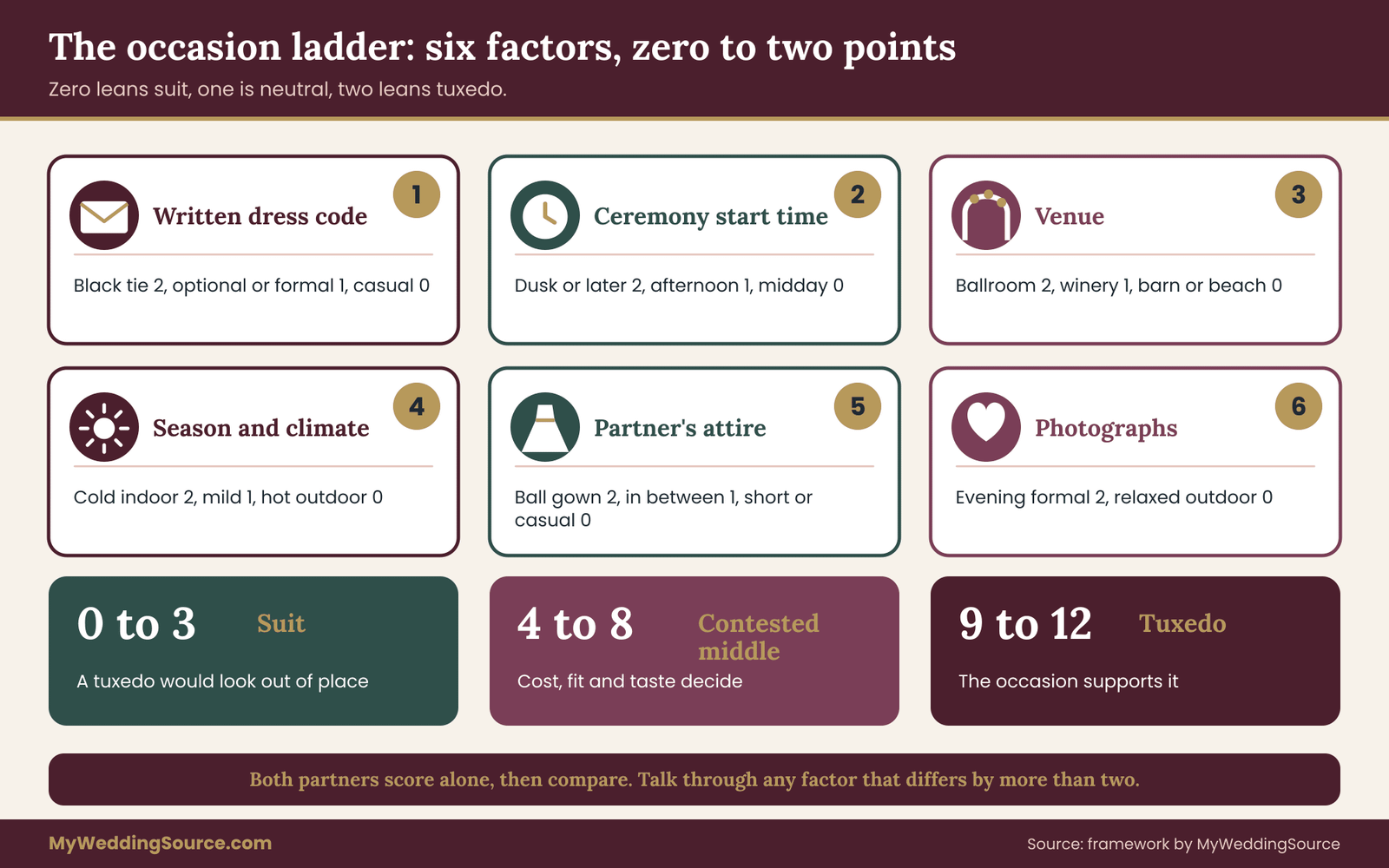
Score each factor from zero to two. Zero leans toward a suit, one is neutral, and two leans toward a tuxedo. Then add them up. The scoring is a thinking aid, not a law, and you are free to override it. The value is that it makes your reasons visible.
Factor one: the written dress code
If the invitation says black tie, score two. If it says black tie optional, formal, or cocktail, score one. If it says semi-formal, dressy casual, or nothing, score zero. If the code is unwritten, ask yourselves what you would write today and score that.
Factor two: the start time of the ceremony
Traditional black tie belongs to the evening, with a common rule of thumb that tuxedos begin after about six o’clock. A daytime ceremony in a tuxedo is not wrong, but it can look heavier than the light suggests. Score two for a ceremony that starts at or after dusk. Score one for late afternoon. Score zero for morning or midday.
Factor three: the venue
A ballroom, a historic hotel, a private club, a cathedral or a city museum scores two. A restaurant, a winery or a mid-size hall scores one. A barn, beach, park, backyard or courthouse scores zero. If you have two venues, such as a church and a separate reception hall, score the one where you will spend more time and take more photographs.
Factor four: the season and the climate
Heavy dark wool and satin trim are comfortable in a cold, indoor evening and punishing in an outdoor July afternoon. Score two for a cold-weather indoor event. Score one for a mild one. Score zero for hot, humid or outdoor summer weather, because comfort is part of the suit vs tuxedo decision and a groom who is overheated in photos does not look elegant.
Factor five: your partner’s attire
Photographs capture both of you. A floor-length ball gown or a formal evening gown pairs naturally with a tuxedo and scores two. A tea-length dress, a short dress, a jumpsuit or a lighter fabric pairs well with a suit and scores zero. Anything in between scores one. Talk to your partner about this early, because it is the only factor you cannot decide alone.
Factor six: the photographs you want to keep
Close your eyes and picture the portrait on your wall in twenty years. If you see two people in rich evening formality, score two. If you see a relaxed outdoor portrait with both of you in color and soft fabric, score zero. This factor is subjective by design. It catches the real preference behind the practical factors.
Reading your total
Add the six scores. The total ranges from zero to twelve.
A total of nine to twelve points toward a tuxedo. The occasion supports it, so the remaining question is how to obtain one (rent, buy or made-to-measure), which the cost sections cover.
A total of four to eight is the contested middle. Both garments can be correct, and the suit vs tuxedo decision belongs to cost, fit and personal taste. Many weddings land here, which is why this article gives so much space to the suit vs tuxedo ledger.
A total of zero to three points toward a suit. A tuxedo would look out of place, and you can stop worrying about it.
What the ladder does not do
The ladder will not tell you what is fashionable this year, and it does not know your family’s traditions. A religious or cultural ceremony may carry its own clothing expectations that override everything above. If your wedding includes traditional attire from your heritage, treat that as the starting point, and see the later section on special cases for how to combine it with a western suit or tuxedo.
The ladder also ignores money on purpose. Mixing cost into the score would let the cheaper path quietly win a question that is really about the occasion. Settle the occasion first, then bring in the ledger.
Comparing your score with your partner’s
Both partners should score independently and compare. This surfaces disagreements early, and the disagreements are usually informative. If you score the venue at two and your partner scores it at zero, one of you is picturing a different building. If you score the photographs at two and your partner at zero, you have found a real difference in taste that deserves a conversation.
When scores differ by more than two points on any single factor, talk through that factor only. Do not average and move on. An average hides the disagreement and brings it back at the fitting, when it is more expensive to resolve.
Questions to ask before you lock the suit vs tuxedo answer
Scores are only as good as the honesty behind them. Before you carry a total into the shops, put four plain questions to each other.
Would you be comfortable if every guest saw you in the garment this score points to? A suit vs tuxedo choice made to impress a relative who will not attend is a poor reason. Is the garment something you would choose if nobody commented on it? That question separates real preference from performance.
Would you be content with the same garment in a photograph twenty years from now? The suit vs tuxedo choice lives longest in pictures, so give that horizon real weight. Finally, is anyone paying for something they did not agree to? If the suit vs tuxedo decision involves a parent’s money, confirm that they know the likely range.
Write the answers beside your scores. When both partners can read the reasons, the later conversation with a shop gets short.
A worked placement with invented details
Consider an invented couple, Dana and Theo. Their invitation says “festive formal,” the ceremony begins at four in the afternoon in a restored mill, it is early October, Dana is wearing a satin A-line gown, and Theo pictures a warm, candlelit portrait.
Dress code: festive formal is one. Time: late afternoon is one. Venue: a restored mill, a dressy but not grand space, is one. Season: early October indoors is one. Partner’s attire: a satin gown is two. Photographs: warm and candlelit is two. The total is eight, at the top of the contested middle.
The ladder did not decide for them, and that is its honest answer. A tuxedo would be correct. A deep navy or charcoal suit in a rich fabric would also be correct. They moved on to fit and cost with a clear reason for each option, which is more useful than a forced verdict.
The one-sentence brief
After scoring, write a single sentence that states your wedding in plain terms, such as “an early-evening indoor wedding in a restored mill, dressy but not stiff.” Print it. Take it to every fitting and every conversation with a shop. It keeps salespeople from selling you the wrong wedding, and it gives your tailor the context to advise you.
What Actually Separates a Tuxedo From a Suit
Many couples cannot name the difference between the two sides of the suit vs tuxedo divide. That is understandable, because the line has blurred. Knowing the suit vs tuxedo difference protects you from paying for a tuxedo that is really a black suit with a different label, or buying a suit that does not deliver the formality you expected.
The traditional features of a tuxedo
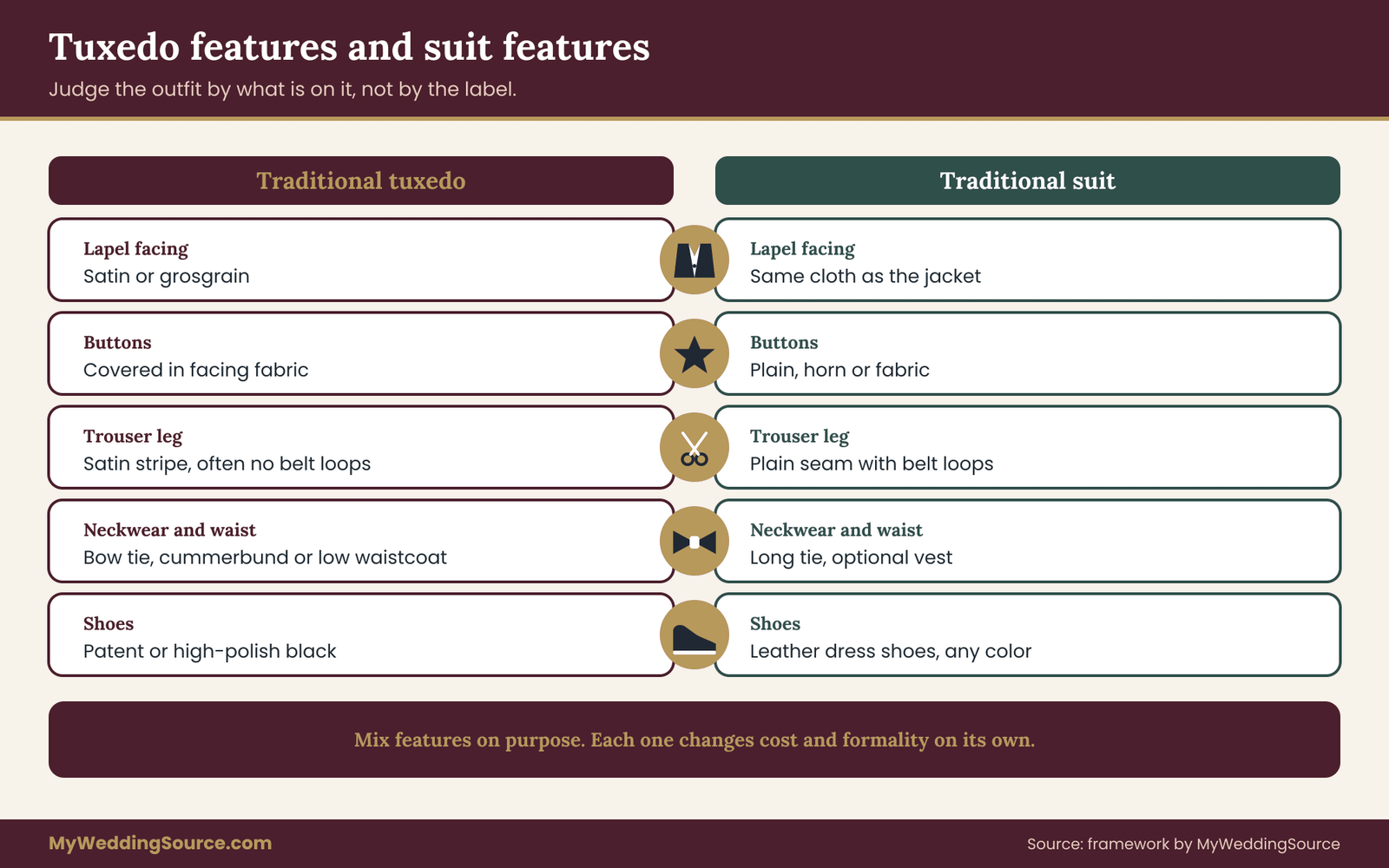
A traditional tuxedo has five features that a regular suit lacks, and all of them are about evening formality.
Satin or grosgrain on the lapels. The facing on the lapels is silk or a similar smooth fabric with a sheen, instead of the same cloth as the rest of the jacket. Peak and shawl lapels are classic, and a notch lapel on a tuxedo is accepted today though some traditionalists still avoid it.
Covered buttons. The jacket buttons are covered in the same facing fabric, not shown as plastic or horn.
A stripe or braid on the trouser leg. Tuxedo trousers carry a satin or grosgrain stripe down the outside seam. They traditionally have no belt loops and are worn with suspenders or side adjusters.
Formal accessories. A bow tie, a formal dress shirt (often with a pleated or piqué front and sometimes studs and cufflinks), and a waist covering such as a cummerbund or low waistcoat.
Dressy shoes. Black patent or highly polished black oxfords, sometimes opera pumps for very traditional dress.
The traditional features of a suit
A suit is cut from one cloth for jacket and trousers, with ordinary fabric-covered or contrasting buttons, belt loops on the trousers and ordinary dress shirt and tie. It comes in a wide range of colors and fabrics, from charcoal wool to tan linen to deep green velvet, and each has a different formality.
The jacket of a suit may be worn with a necktie, a bow tie or open collar. That flexibility is one of its great strengths at a wedding and a real point in the suit vs tuxedo comparison, because a groom can dress it up or down depending on the occasion.
Why the line has blurred
Stores sell “tuxedo-style” black suits with a satin lapel. Rental shops offer “suits” in midnight blue with matching vests. Fashion has also moved toward velvet dinner jackets in burgundy, green and navy, worn with a bow tie, which borrow from the tuxedo without being traditional. Grooms are choosing the pieces they like and ignoring the labels.
The practical advice is to judge the outfit by its features and context, not its tag. If the garment has satin lapels, a stripe, a bow tie and polished shoes, it will read as a tuxedo whatever the shop calls it. If it has a plain lapel, a tie and ordinary shoes, it will read as a suit.
A short feature list to take to a shop
Before you try anything on, decide which of these features matter to you, and ask the shop to show you exactly that, not their package.
Lapel facing: satin, grosgrain or self-fabric. Button style: covered or plain. Trouser stripe: yes or no. Waist covering: cummerbund, waistcoat or none. Neckwear: bow tie or long tie. Shoes: patent, polished or leather-soled dress shoes. Each feature changes the cost and the formality independently, so you can build the garment you want without defaulting to a bundle.
The dinner jacket and the white option
In warm climates and warm seasons, a white or ivory dinner jacket with black trousers is a traditional alternative to a black tuxedo jacket. It reads as formal, not casual, and can work well for summer weddings with a black-tie feel. It is also less forgiving of stains and requires careful cleaning, so ask about care before you commit.
A midnight blue tuxedo is another traditional option. Under artificial light, midnight blue can look blacker than black, and in photographs it often reads richer. Some tailors prefer it for that reason. It is a worthwhile alternative if you want a tuxedo with a little more depth.
What a suit can do that a tuxedo cannot
A tuxedo is single-purpose. A suit is a general tool. It can be worn to the ceremony, the rehearsal dinner, the welcome party, the wedding brunch and a series of later events. If you plan events around the wedding, a single suit can cover several of them with a change of shirt and tie, which is part of why the suit vs tuxedo ledger often favors a suit when more than one occasion is involved.
Fit and Tailoring in the Suit vs Tuxedo Choice
Fit decides how any outfit looks in photographs, and fit works differently on each side of the suit vs tuxedo question. A suit you buy can be altered by a tailor over several visits. A tuxedo you rent is usually altered lightly or not at all, and a tuxedo you buy can be altered, but the satin details and stripes limit how much. Knowing those limits changes which garment you can realistically make fit, and it belongs in every suit vs tuxedo comparison.
Five measurements that matter most
Tailors check dozens of points, but five decide most of the visible result.
Shoulders. The jacket seam should end where your shoulder ends. If it hangs past the bone, the jacket looks borrowed. Shoulders are the hardest part to alter on any jacket and sometimes impossible, so choose the size by shoulders first and adjust everything else around them.
Chest and waist. The jacket should close without pulling into an X shape at the button and should skim your torso without hanging in folds. A good jacket shows a gentle taper to the waist.
Sleeve length. The jacket sleeve should end at the wrist bone, showing about a quarter to half an inch of shirt cuff. Sleeves are easy to shorten at the cuff on most suits and can be lengthened only if there is spare fabric inside.
Jacket length. The jacket should cover the seat of the trousers. Too short looks boyish, and too long shortens the legs.
Trouser break and rise. The hem should fall to a clean line on the shoe, with a slight break or none, depending on the style. The rise should sit comfortably at your waist or just above your hips, so the shirt does not bunch when you sit.
What a tailor can and cannot do
Tailors can usually shorten sleeves and hems, take in or let out the waist by a small amount, taper trouser legs and adjust the jacket’s back seam. They have much less room to change shoulders, the collar roll, the lapel shape or the overall pattern. The consumer lesson is simple: buy the garment that fits at the shoulders and ask the tailor to fix everything else.
For a deeper walk through what a tailoring appointment involves, the guide to wedding dress fit and alterations covers how to prepare, what to bring and how many fittings to expect, and nearly all of it carries over to a groom’s garment.
Fit on a rented tuxedo
Rental tuxedos come in standard sizes, often described by chest size plus a length designation such as short, regular or long. Shops may adjust sleeve length and trouser hem and may offer an altered waistband, but they rarely recut the jacket. Rental shops stand behind a sizing process, not a tailoring process.
That makes accurate measurements the most important step. Many rental shops ask for measurements taken by a tailor or by an employee at the shop, and a few accept self-measured numbers for online orders. If someone else takes them, ask to see the numbers written down. If you measure yourself, measure twice on different days, wearing the shirt you will wear, and have a second person hold the tape.
Fit on a purchased suit
An off-the-rack suit is a starting point. Buy the one that fits at the shoulders and chest, and plan on alterations for sleeves, hems and waist. Budget for them. A good fit often costs a modest amount over the sticker price at a tailor, and a poor fit can ruin a good garment.
A made-to-measure suit is cut from your measurements and a base pattern, and a bespoke suit is cut from a pattern drawn for you. Both take longer. Lead times for made-to-measure orders are often several weeks, and fittings add time on top. The earlier you start, the more room you have for a second round of changes.
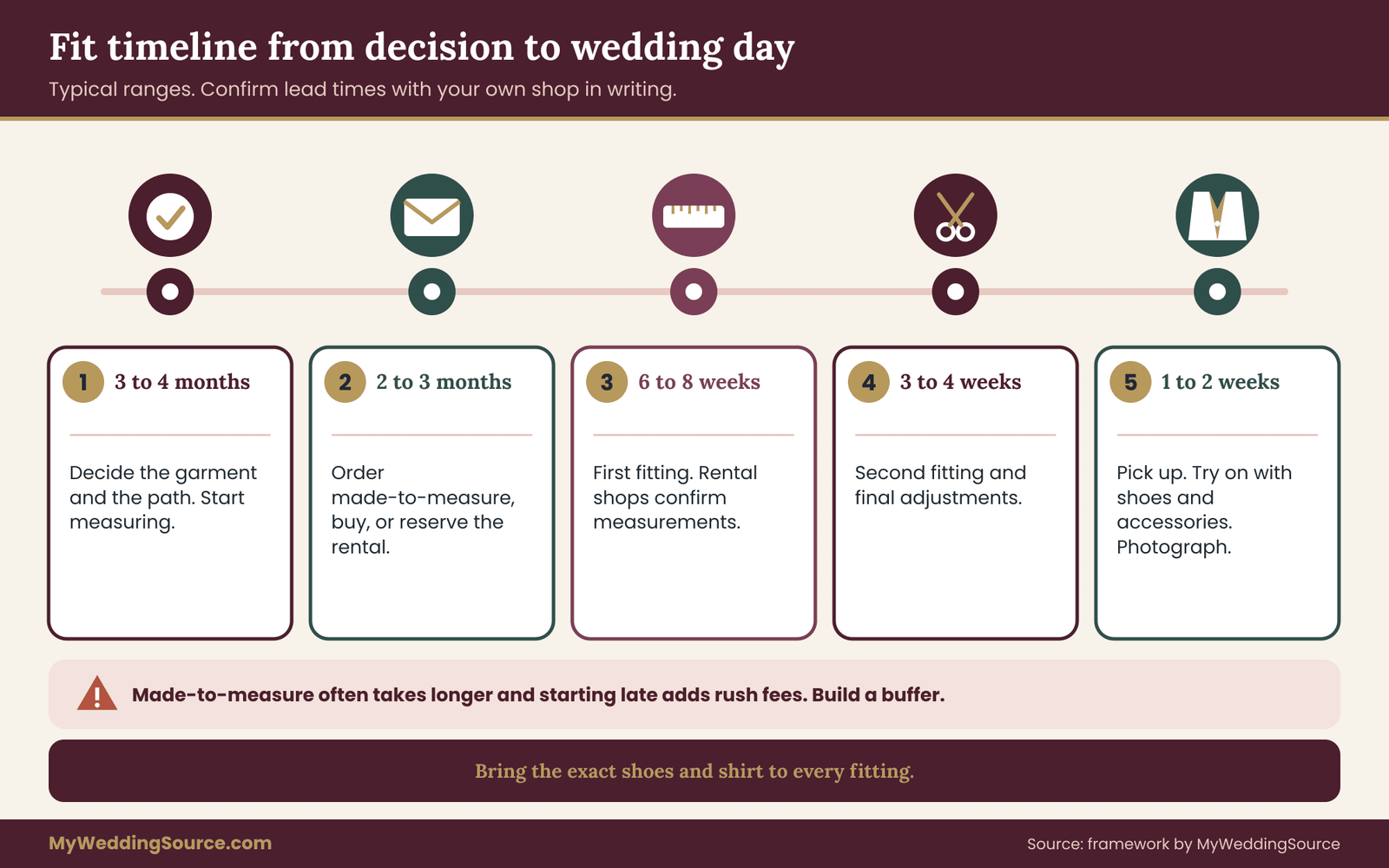
The fit timeline for each path
Whichever side of the suit vs tuxedo choice you pick, the same sequence prevents panic.
Three to four months out: decide the garment and the path. Start measuring.
Two to three months out: order made-to-measure, or buy off the rack, or reserve the rental.
Six to eight weeks out: first fitting for purchased garments. Rental shops often confirm measurements here.
Three to four weeks out: second fitting and any final adjustments.
One to two weeks out: pick up the garment, try it on completely dressed with shoes and accessories, and photograph yourself from front, side and back.
These ranges are typical, not promises. Ask your own shop or tailor for their lead times and confirm them in writing.
Weight and body changes
Body changes affect the suit vs tuxedo decision more than most couples expect.
Bodies change over a year of wedding planning. Some grooms lose weight from stress or a fitness goal, and others gain it from stress or celebration. A suit with a generous seam allowance can be adjusted by a small amount, but major changes may require a new garment. Rentals are easier to resize if you ask early, because the shop swaps sizes before the event.
If you expect a change, schedule your final fitting as close to the wedding as the shop allows, and take the measurements again on the day of the final fitting. Tell the tailor honestly what has changed. They have seen it before.
Checking the fit in motion
A garment can look right standing still in a fitting room mirror and fail the moment you move. Test it with the poses a wedding day demands. Raise both arms as if hugging someone. Sit down in a chair with the jacket buttoned and then unbuttoned. Lean forward to sign a document. Turn your head and look over each shoulder. Bend to pick up something from the floor.
Watch for pulling across the back, a collar that lifts away from your neck, sleeves that jump up past the wrist, and trousers that dig in at the waist when you sit. If any of these happen, tell the tailor which pose caused it. The shirt matters as much as the jacket here, so wear the exact shirt and tie to every fitting and check the collar against the jacket.
Shoes, belt and suspenders
Tuxedo trousers are traditionally cut to be worn with suspenders or side adjusters, and the waistband sits higher than on most suit trousers. A suit generally uses a belt, though suspenders work with the right trousers if they have buttons for them. Bring the shoes you will wear to every fitting. The break of the trouser depends on the shoe, and changing shoes after the hem is set can ruin the line.
Break in new leather shoes before the wedding. Wear them around the house for a few evenings, and add insoles if your feet need them. A groom who limps through the reception is not in a good position to dance, and shoes are one of the few fit problems no tailor can solve on the day.
Fit problems to catch early
There are several issues worth catching at the first fitting, not the last. A shoulder that does not fit is not a fix, so reject the garment. A collar that stands away from the neck can be adjusted, but it takes time. A waist that needs more than about two sizes of change is a sign the garment is the wrong cut. Trouser rise that is clearly wrong is a sign the pattern does not suit your body and should be changed.
If a shop cannot explain a fit problem or says it will resolve itself, take that as a warning. A good tailor names the issue, proposes a fix, and gives you a date.
Fit documentation to keep
Take photos at every fitting, in the same pose, from the same three angles. Keep them in one folder with the date. If there is a later dispute about whether the garment was altered as agreed, you have a record. If the shop changes a measurement, ask them to write the new figure on the receipt.
This is dull work, but it is the cheapest insurance available in any suit vs tuxedo purchase. A tailor with nothing to hide will not mind, and a rental shop that declines to document measurements is telling you something about how it handles returns.
Building the Lifetime Cost Ledger for Suit vs Tuxedo
Price tags compare the wrong thing in a suit vs tuxedo comparison. A rental quote and a purchase price describe different bundles over different periods, so putting them side by side tells you nothing. The lifetime cost ledger fixes that by listing every cost line for each suit vs tuxedo path, then dividing by the number of times you expect to wear the outfit. It is the second tool of this guide, and it is built to make the suit vs tuxedo money question honest.
Every number in this section is an invented example used to show arithmetic. Your own quotes will differ. Replace the example figures with real quotes from real shops, in writing, before you decide anything.
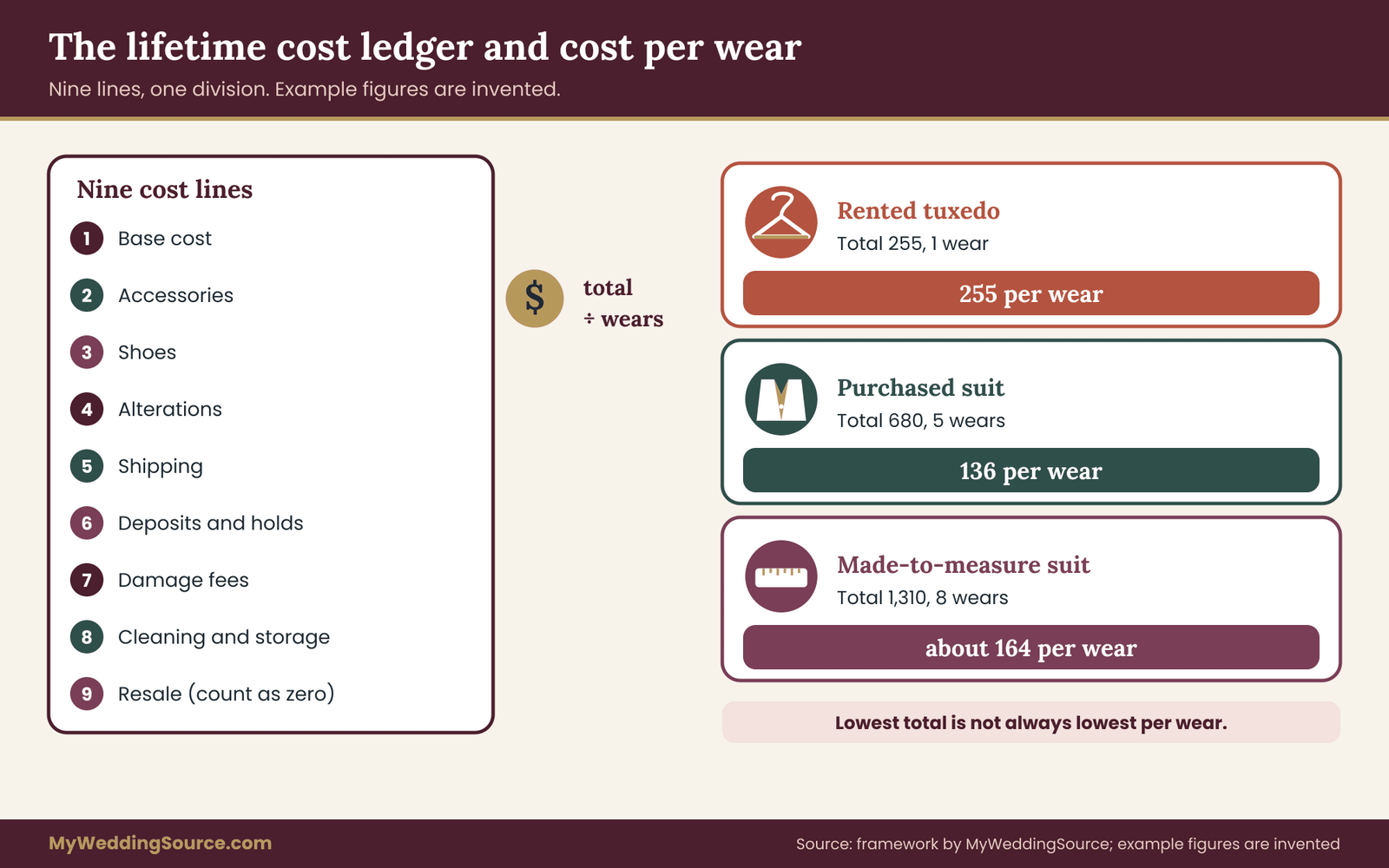
The cost lines for every path
Whatever path you consider, collect each of these lines. Leave a line at zero if it does not apply, and do not skip it, because the skipped line is usually the surprise.
Base cost. The rental fee, the purchase price of the jacket and trousers, or the made-to-measure price.
Accessories. Shirt, bow tie or tie, cummerbund or waistcoat, cufflinks, studs, suspenders, belt, pocket square and socks. Rental packages often include some of these, and purchases rarely do.
Shoes. Rented, bought new, or already owned. Patent shoes are an item people forget until the week of the wedding.
Alterations. Hemming, sleeve work, waist adjustment, and any rush fees.
Shipping and handling. Outbound, return, insurance, tracking and any signature requirement.
Deposits and holds. Money paid early that may or may not be refundable, with the terms written down.
Damage and loss fees. The charges that apply if a rental is stained, torn or returned late.
Cleaning and storage. Dry cleaning, a garment bag, hangers and the closet space they occupy.
Resale or reuse value. What you could get if you sell the garment, or the cost you avoid by wearing it to future events.
Dividing by wears
Add the lines, then divide the total by the expected number of wears. A wear is one event where you would actually put the garment on. Be honest. A navy suit worn to the wedding, the rehearsal dinner, a cousin’s wedding, two job interviews and a funeral is six wears. A purchased tuxedo that sees one gala in five years is two wears. A rental is one wear.
The result is a cost per wear. It is not a perfect measure, because a wear at the most important day of your life is worth more than a wear at a funeral. But it forces a comparison across paths that would otherwise be incomparable, and it exposes the cases where a cheap path costs the most per use.
Three invented examples
Here are three invented paths for the same groom, with made-up numbers. The figures show how the method works. They are not prices you should expect.
Path one, a rented tuxedo. Rental fee of two hundred dollars, which includes the shirt and bow tie. Shoes rented for twenty-five. Shipping both ways at thirty. Total two hundred fifty-five. One wear. Cost per wear: two hundred fifty-five.
Path two, a purchased suit. Suit at four hundred fifty, shirt and tie at one hundred, shoes already owned, alterations at ninety, dry cleaning twice at forty. Total six hundred eighty. Expected wears: five. Cost per wear: one hundred thirty-six.
Path three, a made-to-measure suit. Suit at nine hundred, shirt and tie at one hundred, shoes at one hundred fifty, alterations at one hundred twenty, cleaning at forty. Total one thousand three hundred ten. Expected wears: eight over five years. Cost per wear: about one hundred sixty-four.
Notice what happened. The rented tuxedo had the lowest total and the highest cost per wear. The made-to-measure suit had the highest total and a middling cost per wear. The purchased suit won on cost per wear but would lose if the groom wore it only once. The answer depends entirely on the wear count, which is why you must estimate it honestly.
A ledger page you can copy
Keep the page simple, so you will actually fill it in. Put the path at the top, such as rented tuxedo, purchased suit or made-to-measure suit. Under it, list the nine cost lines from above in a column and write the quoted amount beside each, with the name of the shop and the date of the quote.
At the bottom, write the total, the honest wear count and the cost per wear. Then add one line in words: the reason this path would be the wrong choice for you. Writing the downside of each option is a quiet way to test a suit vs tuxedo preference, because a path whose downside you cannot name is a path you have not examined.
Make one page per path and compare them side by side. The suit vs tuxedo ledger works best when every page uses the same lines in the same order.
The break-even question
For any pair of paths, you can ask how many wears it takes for the more expensive path to match the cheaper one. In the invented example, the purchased suit costs six hundred eighty and the rental costs two hundred fifty-five per wear. The suit breaks even after three wears, because three rentals would cost seven hundred sixty-five.
Rentals are usually sensible only in two cases. One is when you will really wear the garment once. The other is when you have strict storage or money limits and the rental price is lower than any other option that meets the dress code. If you will wear formal clothing more than a couple of times in the next several years, purchase starts to win.
Costs people forget
Several line items disappear from early budgets and appear on the final bill.
Rush alteration fees, if you start late. A second fitting. A replacement shirt if the first does not fit. Cufflinks, studs and a tie bar. A garment bag for travel. Steaming or pressing before the ceremony. A second set of shoes for dancing. A replacement for something lost during the day.
If you are traveling for the wedding, add airline baggage fees or shipping to the hotel, and see whether the suit vs tuxedo choice changes the packing. A tuxedo with several accessories takes more space than a single suit with one shirt.
Fitting the ledger into the wider budget
The groom’s outfit is one line among many in the larger plan, and it should have a ceiling set early. The wedding budget guide explains how to set category ceilings, and the ledger gives you the number for the attire line. Decide the ceiling before shopping, because a salesperson with no number to hit will find you one.
Also decide who pays. Some families expect the groom’s side to pay for the groom’s attire, some split it, and some pay for the whole wedding party. Say the arrangement out loud and write it down. Disagreements about who pays for a tuxedo rental are small and common, and they are easier to settle before the deposit than after.
The groomsmen multiplier
If the groomsmen will dress to match, every ledger line multiplies by the number of people, and every line is paid by someone. A rental that costs one amount for you costs the same amount for each of them, plus shipping. A purchase asks each person to buy a garment they may not want.
Ask the groomsmen what they can afford before you choose, and give them a ceiling. A matching tuxedo rental is often the simplest choice for large groups because the shop coordinates sizing, but individual suits in an agreed color can cost less if the men already own something that qualifies. Neither is wrong, and the suit vs tuxedo ledger will show which fits your group.
Putting a real number on resale value
It is tempting to let an imagined sale tip the suit vs tuxedo decision.
Resale value is the line people argue about most in the suit vs tuxedo ledger. A suit you no longer need can be sold secondhand, donated or kept. A worn tuxedo is harder to sell than a worn suit because fewer buyers want a garment so tied to one occasion. Do not count on resale to fund anything. Treat it as a small bonus if it happens.
A fair rule is to put resale at zero in your ledger. If you do sell it, the money improves the result. If you do not, the ledger was already honest.
Writing the ledger down
A written ledger keeps the suit vs tuxedo conversation grounded in numbers.
Make one page per path, with the lines above, the quote source, the date of the quote and the expected wear count. Keep the quotes in one folder. Compare totals and cost per wear, then circle the lowest of each. If the same path wins both, the suit vs tuxedo decision is easy. If different paths win, you are choosing between spending less now and spending less per use, and that is a values question, not an arithmetic one.
Rent, Buy, or Made-to-Measure: Three Paths for the Suit vs Tuxedo Decision
Once the occasion and the suit vs tuxedo ledger point in a direction, the next question is how to obtain the garment. Each path has its own timeline, its own risks and its own paperwork. This section walks through all three so you can match the path to your situation, not to a shop’s default. Each path changes the real cost of the suit vs tuxedo choice.
Path one: renting
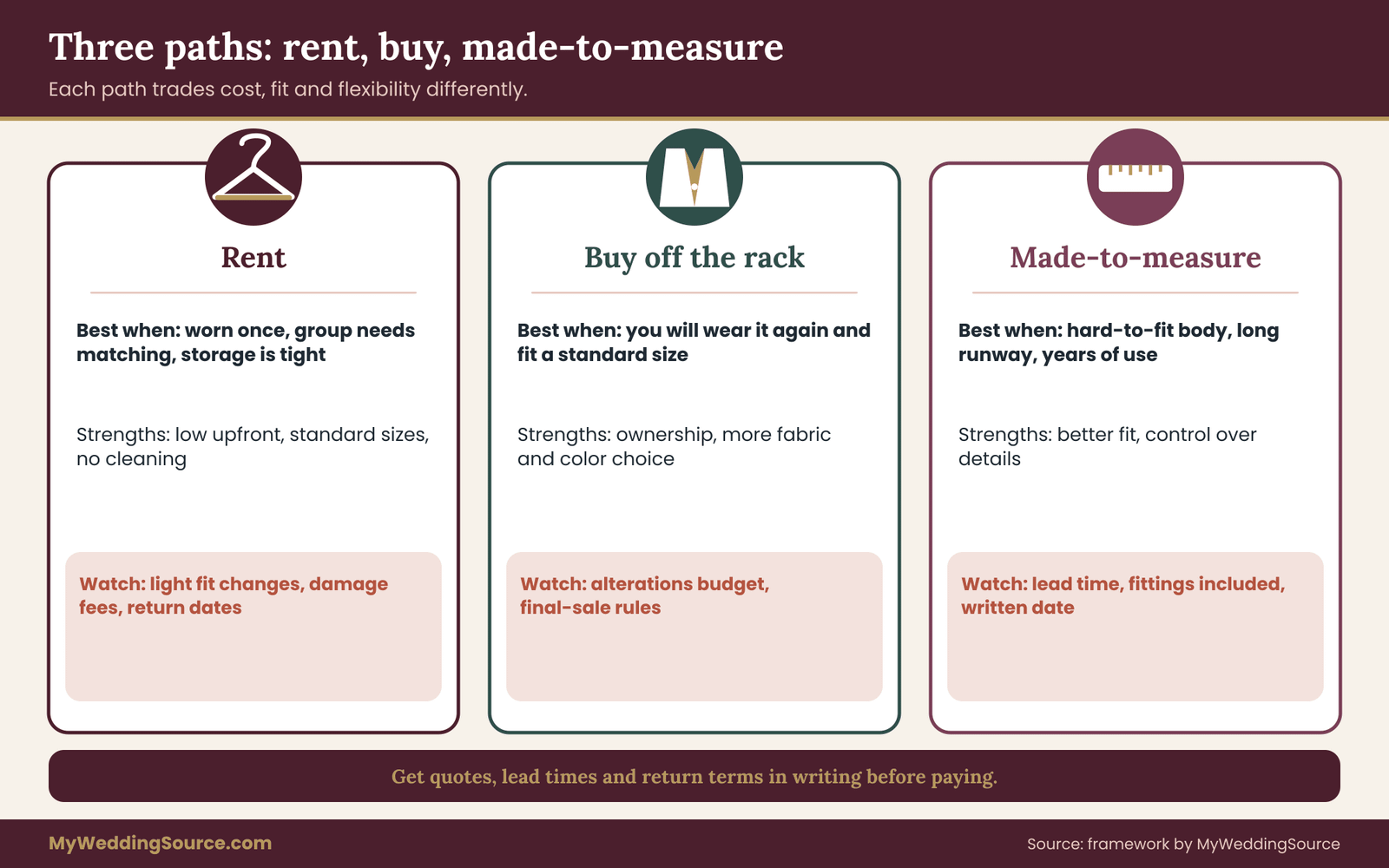
Renting suits situations where you will wear the garment once, where storage is limited, or where a group needs matching outfits managed by one vendor. It is the dominant path for tuxedos and the weaker path for suits, which is why the suit vs tuxedo choice often decides the path.
The strengths are low upfront cost, standard sizing, group coordination and no cleaning after the event. The weaknesses are limited fit, limited choice, fixed pickup and return dates, and the risk of damage fees. Rentals are also less personal. Hundreds of other men have worn the same cut, and the details show it if you look closely.
When you evaluate a rental shop, look past the price. Ask how far ahead you must order, when the garment arrives, how long you have to try it on, what happens if the size is wrong, and how the return works. The wedding rental planning checklist on this site, linked below, lists vendor questions in general, and the points here apply the same logic to attire.
Read the rental vendor checklist before you sign anything, then bring its questions to the shop.
Questions to ask a rental shop
“If the garment does not fit when it arrives, how many days do we have to swap it, and who pays shipping?”
Beyond that, ask these in writing. What is the total with tax, shipping and insurance? What does the damage waiver cover, and what does it exclude? Are stains from food, drink and makeup treated as damage? When is the return due, and what is the late fee? Is the deposit refundable, and when? What is the cancellation window? Does the price cover the shirt, shoes and accessories, or only the jacket and trousers?
Keep every answer. If a staff member promises something on the phone, ask for it by email. A promise that exists only in memory is difficult to enforce.
Path two: buying off the rack
Buying a suit off the rack suits grooms who want something they can keep, who fit a standard size reasonably well and who have time for alterations. It is the most common path for suits and is available for tuxedos at specialty and department stores.
The strengths are ownership, reuse, a wider choice of fabric and color, and alterations that make it your own. The weaknesses are a higher upfront cost, the need for storage and cleaning, and the risk that the garment does not suit your body without extensive work.
Shop with your measurements and your brief. Ask about the return policy before you pay, because many retailers treat altered garments as final sale. If you buy online, find out whether returns are free and whether the garment can be returned after a tailor has marked or cut it.
Path three: made-to-measure and bespoke
Made-to-measure garments are cut from your measurements and adjusted at one or more fittings. They suit grooms with hard-to-fit bodies, grooms who want a specific fabric or details, and grooms who plan to wear the garment for years.
The strengths are better fit and more control. The weaknesses are higher price, longer lead time and the need to trust the maker. Reviews and references matter here. Ask to see finished garments, ask how many fittings the price includes, and ask what happens if the finished suit does not match the agreed measurements.
Get the deadline in writing. Lead times for made-to-measure work can slip, and a suit that arrives a week after the wedding is not a suit. Build in buffer, and have a backup garment ready if the date is tight.
Online and mail-order purchases
Online sellers complicate the suit vs tuxedo decision because trying the garment on is impossible.
Ordering a suit or tuxedo online can work, especially when you know your size and the seller has a clear return policy. It adds risk, because you cannot try the garment before buying, and shipping delays can arrive at the worst time.
Check whether the seller is a real business with a physical address and a reachable phone number. Read the return terms in full. Photograph the garment on arrival, and try it on the day it comes, not the week of the wedding. If the seller advertises a delivery date, ask what the remedy is if it is missed.
Borrowing and secondhand
Borrowing is a legitimate answer to the suit vs tuxedo question when the fit is right.
Borrowing a suit from a relative or buying secondhand costs little and can produce excellent results if the fit is right. A tailor can often rework an inherited suit, though large changes may cost more than the garment is worth. Ask the tailor for a quote before you commit, and try the garment on with the shirt and shoes you plan to wear.
Be honest about condition. Check lining, underarms, buttons and trouser seats for wear. A garment that looks fine on a hanger may be thin where it matters.
A short conversation with your partner about the path
Money and storage are shared, so the choice of path is a shared decision even when the garment is the groom’s. Sit down with the ledger pages and ask three things. Which path would we regret least if the wedding went perfectly? Which would we regret least if something went wrong with the order? And which leaves us with something useful afterward?
A rented tuxedo leaves nothing but photographs. A purchased suit leaves a garment and a maintenance task. A made-to-measure suit leaves a garment and a relationship with a tailor who can adjust it as your body changes. None of these answers is wrong. The suit vs tuxedo path simply needs to match how you live, and how you live is a fact only the two of you hold.
Matching the path to the situation
A groom who will wear formal clothes once, has a black-tie wedding and has a tight budget fits the rental. A groom with a mid-formal wedding who will wear a suit again fits purchase. A groom with unusual proportions, a sizable budget and a long runway fits made-to-measure. Most real cases fall between, and that is fine.
Contracts, Deadlines and Group Coordination
The formal paperwork around a suit vs tuxedo order is short, but it carries the same risks as any vendor agreement. A rental contract, a made-to-measure order and an online purchase each create obligations, and each deserves a careful read.
What belongs in writing
For any path, get these items on paper or email. The garment, with brand, color, size and style. The price, with every fee itemized. The delivery or pickup date. The fitting dates. The alteration list. The return or cancellation terms. The remedy if the garment is late or wrong.
The broader wedding vendor contract guide explains how to read these clauses and what to ask for when something is vague, and its logic applies to a shop as much as to a photographer or caterer.
Payment and disputes
Pay with a credit card where you can. The Consumer Financial Protection Bureau explains that federal law gives credit card holders a way to dispute billing errors, and the notice generally has to reach the card issuer in writing within sixty days after the statement showing the error was sent. Keep that timeline in mind if a garment does not arrive or is not as described. Confirm current rules on the agency’s site.
Keep records of every payment: receipts, confirmation emails and statement lines. If a dispute arises, the contract and proof of payment settle it. A calm, dated record is stronger than an angry phone call.
The Federal Trade Commission and consumer claims
The Federal Trade Commission publishes consumer guidance on shopping, refunds and unfair practices. If a seller advertises something it does not deliver, or refuses a refund it promised, the FTC’s consumer pages explain how to report it. The FTC also administers rules on textile and care labeling, so a garment should carry a label stating fiber content and care instructions. If a label is missing or confusing, ask the seller.
None of this replaces a good conversation with the shop. Most problems resolve when you raise them early, politely and with documents in hand.
Deadlines to put on your calendar
Create a short list of dates and put each on your calendar with a reminder a week earlier. Order or reserve date. First fitting. Final fitting. Pickup or delivery. Wedding day. Return date for rentals, with the shop’s cutoff time. Deadline for any refund or swap. Dry cleaning drop-off for purchases.
Rental returns deserve special attention. A groom leaving for a honeymoon the morning after the wedding needs someone else to return the garment, and late fees accrue by the day. Assign the return to a specific person and give them the shop’s address, the order number and the cutoff.
Coordinating groomsmen and fathers
When several people dress together, the logistics multiply. Choose one point person to coordinate sizes and deadlines. Send a single message with the garment details, the cost, the deadline for measurements and the shop’s contact. Ask each person to confirm in writing.
Expect someone to miss the first deadline. Build in a gap of a week between the measurement deadline and the shop’s cutoff, so stragglers can be chased without pushing the order late. If someone lives far away, use a local tailor or the shop’s remote measurement process, and let them confirm the numbers themselves.
Handling disagreements about matching
Some groomsmen will prefer a different color or fit. Decide the level of matching early. You might ask for identical garments, matching colors with individual styles, or a shared palette with free choice within it. Say the rule and its reason. People accept guidelines more readily than surprises.
If your wedding party includes people with different budgets, give each a way to meet the standard without embarrassment. Offer a rental option next to a purchase option, and do not ask anyone why they chose the cheaper one.
Season, Venue and Comfort in the Suit vs Tuxedo Decision
A garment that looks perfect on a hanger can feel miserable by the third hour. Weather, ground and movement shape comfort in either side of the suit vs tuxedo choice, and comfort shapes how you look in candid photographs. This section treats comfort as a real input to the suit vs tuxedo question, not an afterthought.
Heat and humidity
A traditional tuxedo is made of dense wool with satin facings, a formal shirt and often a waist covering. In a warm outdoor setting, that is a lot of fabric. A suit in lightweight wool, cotton, linen or a blend breathes better, and unlined or half-lined construction reduces weight further.
The Centers for Disease Control and Prevention publishes guidance on heat-related illness, and the National Weather Service issues heat advisories and forecasts. Check the forecast for your date and place as the wedding approaches, and plan for the worst case. A groom who is sweating through a jacket at the ceremony is not enjoying the day, and a groom who feels faint is a problem for everyone.
Practical measures help. Choose lighter fabrics and linings. Take the jacket off between the ceremony and photographs when the photographer allows. Keep water within reach. Pack a spare shirt. Plan shade for waiting periods. A white dinner jacket is a traditional response to heat, though it needs careful cleaning.
Cold and wet weather
Cold favors heavier fabrics and layers. A tuxedo in wool handles winter well, and a suit in flannel or tweed does the same with a different look. Plan for the walk between the car and the door, and bring an overcoat that suits the outfit. A dark topcoat over a tuxedo looks right. A puffy jacket does not, though warmth matters more than looks if the weather is severe.
Rain and snow ruin shoes. Carry a spare pair for the reception, and ask whether the venue has covered walkways or mats. Dark fabrics hide moisture better than light ones, but water marks on suede or on satin are hard to remove.
Outdoor ground
Grass, sand, gravel and uneven stone change what shoes work. Leather soles slip on wet grass and damp stone. Thin soles pick up every pebble. Patent leather scratches on gravel. If the ceremony site is outdoors, walk it in the shoes you plan to wear, and ask whether the ground will be firm or soft on the day.
Trouser hems also matter. A long hem drags on wet grass and collects dirt. A shorter hem looks neat but must be set with the shoes in mind. Tell the tailor about the surface, and they will adjust the length.
Indoors, lighting and photographs
Venues with heavy air conditioning can be cold, and venues with crowds and dancing can be hot. Layers help in both directions. Photographers also work with lighting that changes the look of fabric. Black can appear flat under flash. Midnight blue holds richer tones. Charcoal and navy photograph well in most conditions, and very light colors can overexpose in bright sunlight.
Ask your photographer about the lighting at your venue and whether a certain fabric or color tends to photograph better there. They will have views based on many weddings.
How comfort moves your suit vs tuxedo score
Comfort can push a borderline score in either direction. A wedding that totals seven on the ladder but takes place on a hot terrace should lean toward a suit, because the same score in a cool ballroom might lean toward a tuxedo. Treat the weather as a tiebreaker for the suit vs tuxedo question, not a veto.
Write one sentence about the likely temperature and the likely ground, and add it to your brief. If the sentence says hot, outdoor and uneven, favor light fabrics and sturdy shoes. If it says cold, indoor and polished, a tuxedo in heavier wool is comfortable and appropriate. If it says both, plan for layers and a jacket you can remove, and make that a stated requirement when you talk to a shop.
Comfort belongs in the suit vs tuxedo conversation early, because fabric is chosen at the order stage and cannot be swapped later.
Movement and the long day
Plan the day’s movement. Standing for the ceremony, sitting for dinner, dancing for hours and perhaps hugging a hundred guests asks a lot of a garment. Check that the jacket moves with you, that the trousers allow a full step, and that the shirt stays tucked. Test the outfit by doing the things you will do on the day.
For a wedding with a long day or several events, consider a second outfit or a change of shirt. A second, lighter jacket for the reception is common. Agree who carries the spare garment and where it waits, so the change takes minutes and not a search.
Special cases that change the answer
Some situations alter the whole question, and it helps to recognize them early.
Cultural and religious attire. If your tradition has specific wedding clothes, start there. Many couples combine them, wearing traditional garments for the ceremony and a suit or tuxedo for the reception, or adding traditional elements such as a scarf, sash or accessories to a western suit. Ask an elder or officiant what is expected, and let that guide the rest.
Destination weddings. Travel changes everything. Rental shops may not deliver abroad, suits wrinkle in luggage, and climate may differ from home. Pack the garment in a carry-on garment bag if you can, and plan a steamer or a local tailor for pressing. A lighter, more forgiving suit often beats a tuxedo for a destination wedding.
Courthouse and small weddings. A courthouse ceremony or a small gathering usually points to a suit, and the garment can then serve at a later celebration.
Second weddings. There is no rule that changes for second marriages. Pick the garment the occasion calls for.
Very short or very tall grooms, and larger or athletic builds. Standard rental sizes serve some bodies badly. Made-to-measure or careful alterations often cost less than the stress of an ill-fitting rental. Talk to a tailor early.
Grooms who will not wear a tie. An open-collar suit works at relaxed weddings and fails at formal ones. Decide whether the suit vs tuxedo ladder supports it.
Matching your partner
The partner’s outfit often settles a close suit vs tuxedo call.
Photographs record both of you, and the pairing matters more than either garment alone. A partner in a long ballgown looks balanced beside a tuxedo. A partner in a short dress or a casual gown looks balanced beside a suit. If your partner is wearing a suit or a jumpsuit, mirror the formality, and let the colors complement without matching exactly.
Share swatches and photographs. Hold fabrics next to each other in daylight and in indoor light. Colors that look alike in a shop may differ in photographs.
The final comfort check
This last check closes the suit vs tuxedo decision with evidence.
A week before the wedding, put on the whole outfit, shoes included, and spend an hour in it. Sit, stand, walk, climb stairs and raise your arms. Note anything that pinches, slips, itches or overheats, and tell the tailor or shop while there is still time. A short list of small fixes is much better than a long list of regrets.
Three Worked Cases and a Decision Flow
Frameworks are easier to trust when you watch them run, and a suit vs tuxedo framework is no exception. These three cases use invented people and invented numbers. They are teaching examples, not data. Each starts with the suit vs tuxedo ladder, moves through the suit vs tuxedo ledger and ends with a decision and a reason.
Case one: Marcus and the black-tie ballroom
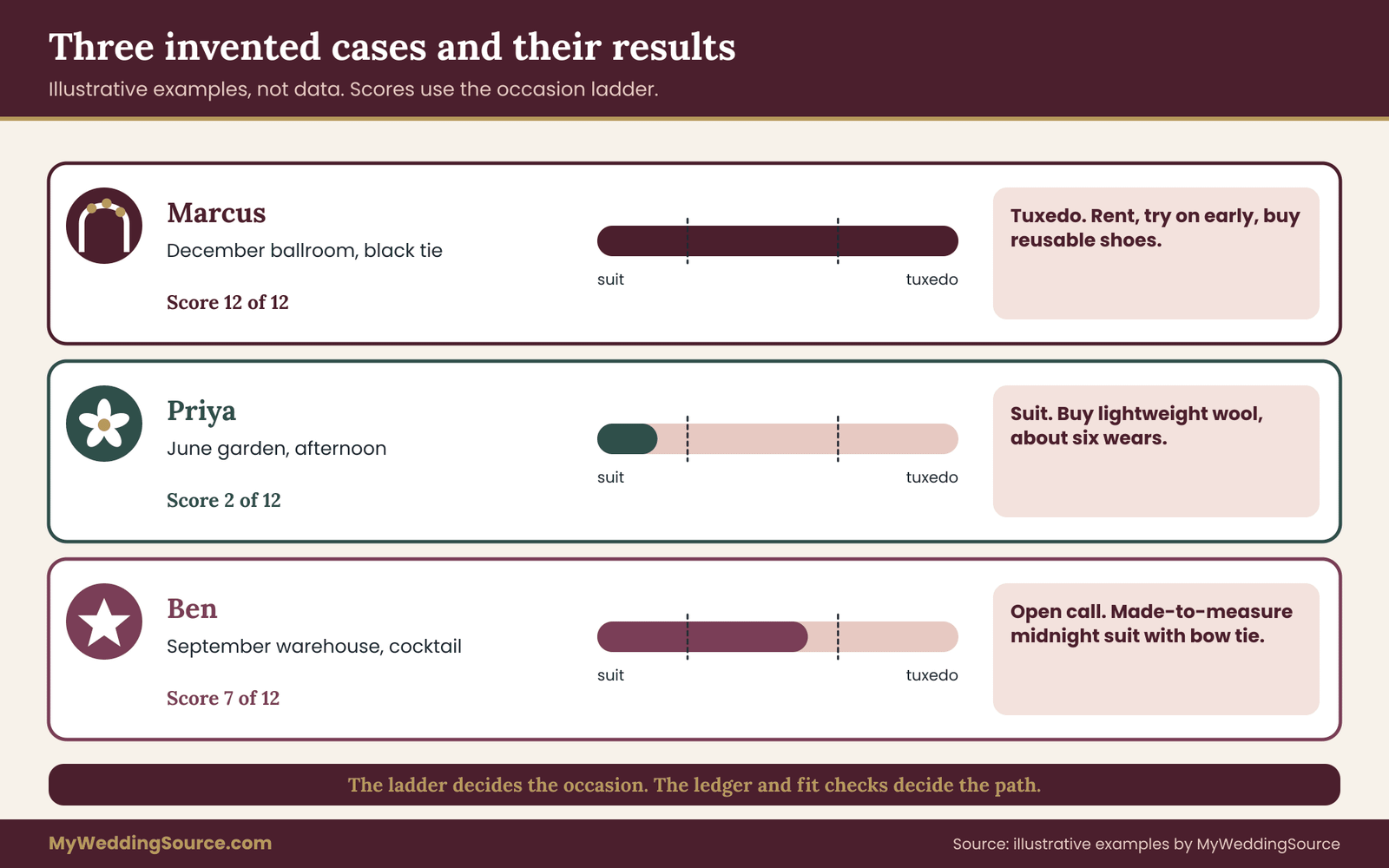
Marcus is marrying in a hotel ballroom in December. The invitation says black tie, the ceremony is at six, and his partner is wearing a floor-length gown. On the ladder he scores two for code, two for time, two for venue, two for season, two for partner’s attire and two for photographs. The total is twelve.
The suit vs tuxedo question is settled by the occasion. A suit would look underdressed beside the guests. Marcus will not wear formal clothing again for at least three years, so the ledger leans toward rental. He compares a rental at two hundred sixty with a purchased tuxedo at nine hundred and decides to rent, but he asks for a try-on three months out, a swap window and a written damage policy.
His one adjustment is shoes. He buys a pair of black oxfords he can wear again and skips the rental shoes. The suit vs tuxedo decision took one evening because the occasion was clear.
Case two: Priya and the garden afternoon
Priya is marrying at two in the afternoon in a botanical garden in June. The invitation says garden party attire, the venue is outdoors and her partner is wearing a tea-length dress. The ladder total is two: nothing about the day supports a tuxedo.
A suit is the answer, and the suit vs tuxedo ledger now decides which kind. Priya expects to wear the suit to the rehearsal dinner, two weddings of friends, and work events, which gives about six wears. A purchased suit in lightweight wool at five hundred, plus alterations and a shirt, comes to a cost per wear near one hundred twenty. A rental has nothing to offer.
Her extra concern is heat. She chooses a half-lined fabric in a mid-tone color, packs a spare shirt and plans to remove the jacket for portraits. She orders ten weeks out to leave room for two fittings.
Case three: Ben and Alex in the contested middle
Ben and Alex are marrying at five in the evening in a restored warehouse in late September. The invitation says cocktail attire. Ben’s partner Alex is wearing a velvet suit in deep green. The ladder gives one for code, one for time, one for venue, one for season, one for the partner’s attire and two for photographs. The total is seven.
Seven sits in the contested middle, so the suit vs tuxedo debate stays open and cost, fit and taste decide it. Ben prices three paths. A rental tuxedo costs two hundred fifty, a purchased tuxedo costs eight hundred, and a made-to-measure midnight blue suit costs eleven hundred with alterations. He expects to wear a good dark suit to many events, and a tuxedo almost never.
He chooses the made-to-measure midnight blue suit with a bow tie, which gives him evening formality now and a flexible garment later. The deciding fact was not price. It was that he could picture himself wearing the suit again, and could not picture the tuxedo.
The decision flow in six steps
The ladder, the ledger and the fit checks combine into one suit vs tuxedo process, a short sequence you can follow without a salesperson.
Step one: score the ladder. Both partners score independently and compare. Write the one-sentence brief.
Step two: sort the result. Nine or higher points to a tuxedo, three or lower to a suit, and four to eight stays open.
Step three: collect quotes. Get written quotes for at least two paths, with every ledger line.
Step four: divide by wears. Be honest about the wear count and put resale at zero.
Step five: check fit and time. Confirm the lead times and the number of fittings, and count back from the wedding date.
Step six: decide and document. Pick the garment, pay with a card where possible, and put every date on the calendar.
What to tell a salesperson
Shops sell what they stock, so bring your own framing. Open with the one-sentence brief, then state the ledger ceiling, then say which path you are considering. A suit vs tuxedo conversation that starts with your occasion and your number is quicker and more honest than one that starts with the shop’s package.
You might say, “We have a black-tie optional evening wedding in an indoor venue in October, our attire line is capped at this amount, and we want to compare a rental with a purchase. What would you suggest and what does each include?” That one request gives the salesperson everything needed to advise you well.
Ask them to show you the feature list from earlier, so the suit vs tuxedo difference is visible in the garment itself. If a shop pushes you toward a bundle that ignores your ceiling, say so politely and move on. Plenty of good shops will answer the question you actually asked.
Leave the shop with written quotes, not impressions. A quote in hand lets you compare calmly at home, and a calm comparison is how the suit vs tuxedo choice stays yours.
Pitfalls that catch careful couples
A few mistakes appear again and again. Choosing the garment before the occasion. Comparing a rental with a purchase without dividing by wears. Ordering too late for alterations. Skipping the written damage policy. Forgetting shoes. Assuming the groomsmen can afford the same outfit. Ignoring the weather. Trusting a verbal promise.
Each is cheap to prevent. The ladder prevents the first, the suit vs tuxedo ledger prevents the second, the timeline prevents the third and the written record prevents the rest.
When to change your mind
Revisiting a suit vs tuxedo decision is normal when facts change.
Decisions can move. If the venue changes from a garden to a ballroom, rescore. If the date moves into a hotter month, recheck comfort. If your partner changes the dress, recheck the pairing. If a quote rises, rerun the ledger. Changing your mind early costs little, and changing it late costs a rush fee.
Set a freeze date, usually when the order or reservation is placed, and change only for a serious reason after it.
Your Next Steps
Work through these in order, and give each a date.
- Write the one-sentence brief for your wedding and share it with your partner.
- Score the occasion ladder separately, then compare totals and talk through any factor that differs by more than two points.
- Check the venue and the forecast for comfort, and ask the coordinator what most weddings there look like.
- Collect written quotes for at least two paths, with every cost line, and fill in a ledger page for each.
- Estimate the honest number of wears and compute cost per wear.
- Confirm lead times, fitting dates and return terms in writing.
- Place the order or reservation, pay by credit card where possible, and keep the receipt.
- Calendar every date with a reminder a week early, and assign someone to handle rental returns.
FAQ
Is a tuxedo always more formal than a suit?
Usually, but not always. A tuxedo carries traditional evening features such as satin lapels and a trouser stripe, so it reads as the formal choice at most weddings. A dark suit in fine fabric with a white shirt and tie can look just as formal at a daytime event. Judge the outfit by its features and the occasion, not only by its label.
Can a groom wear a suit to a black-tie wedding?
Black tie calls for a tuxedo, so a suit may look underdressed beside guests who followed the code. If the invitation says black tie optional, a dark, well-cut suit is correct. When in doubt, ask your planner or venue, and consider whether the invitation wording matches the wedding you are actually hosting.
Is it cheaper to rent a tuxedo or buy a suit?
A rental usually costs less on the day, but cost per wear can be higher. A purchased suit costs more upfront and can be worn to later events, so it often wins when you will wear it several times. Add every line to a ledger, including alterations, accessories, shipping and cleaning, then divide by honest wears.
How far ahead should a groom order?
Plan on three to four months for a suit that needs alterations, and longer for made-to-measure. Rentals often need about two to three months, though shops vary. Confirm lead times in writing, and leave room for two fittings. Starting late limits your choices and can add rush fees, so earlier is almost always calmer.
Can a rented tuxedo be tailored?
Rentals are usually adjusted in small ways, such as hem and sleeve length, and rarely recut. The shop expects the garment back in near-original condition, so major changes are off the table. Accurate measurements and an early try-on matter most. Ask what the shop can adjust and get the answer in writing.
What should groomsmen wear if the groom wears a tuxedo?
Choices include matching tuxedos, matching suits in a shared color, or a simpler style that keeps the groom distinct. Decide how closely to match, set a cost ceiling and ask what each person can afford. Rentals suit large groups because one shop coordinates sizes, while individual suits can cost less if people already own something suitable.
What if the weather is hot on the wedding day?
Choose a lighter fabric and lining, plan shade and water, and let the groom remove the jacket when the photographer allows. A white dinner jacket or a lightweight suit is more comfortable than heavy black wool. Check the forecast near the date and carry a spare shirt. The Centers for Disease Control and Prevention publishes heat safety guidance.
What if a rental arrives late or does not fit?
Contact the shop right away and follow the written terms for swaps and remedies. Photograph the garment and keep all messages. If the shop does not resolve it, you may be able to dispute the charge with your card issuer, which generally requires written notice within sixty days of the statement. Have a backup garment ready.
Sources
- Federal Trade Commission: consumer protection and business guidance
- Consumer Financial Protection Bureau: credit card billing disputes
- USA.gov: consumer protection resources
- Electronic Code of Federal Regulations (care labeling and textile labeling rules)
- Centers for Disease Control and Prevention: heat safety
- National Weather Service
- U.S. Postal Service: shipping and tracking
- Better Business Bureau
- U.S. Consumer Product Safety Commission