
Packaging waste from wedding rentals is the cardboard, shrink film, foam, straps, crates and pallets that arrive around tables, chairs, linens, glassware and lighting, and that somebody has to deal with before the party starts. This guide gives you a packing material count and a return-trip checklist so the delivery crew, the venue and you agree on who handles what.
Treat packaging waste as part of the rental contract, not as an afterthought. Ask the rental company which packaging is theirs and must go back, which is single-use and can be discarded, and which the venue will take. Count and photograph it at delivery, stage returnable items where the crew will collect them, and sign off at pickup. Most disputes and most needless trash come from nobody having decided these things before the truck arrived.
A rental delivery looks simple from the outside. A truck pulls up, strangers unload, and by the afternoon the room has chairs. What the room also has, for a few hours, is a growing pile of material that was never part of the design: stretch wrap that held chair stacks together, cartons that carried glassware, wooden crates, foam corners, plastic strapping, hangers and garment bags for linens, and sometimes pallets. At a reception of any size, packaging waste is the single largest visible pile that appears before the first guest does.
That pile creates three problems at once. It blocks aisles, doors and loading areas at the exact time vendors need them clear. It can be mistaken for trash and thrown away when it is actually owned by the rental company and billed if lost. And whatever is truly waste ends up in the venue’s bins, where it can trigger a cleanup fee or simply go to a landfill because nobody sorted it.
Managing packaging waste does not need a sustainability degree. It needs a few specific questions, a simple count, a staging plan and a calm conversation with the people who carry the boxes. This article covers all of that for rented items, which is where most wedding packaging waste comes from.
A note on scope. This is general information, not legal, tax or financial advice. Recycling rules, venue policies, rental terms and fees vary by company, city and county, and they change. Where a rule matters, the article points you to the agency or company that sets it so you can confirm the current version.
Why packaging waste from wedding rentals needs its own plan
Couples who care about waste usually start with food and flowers, and the broader wedding waste reduction audit on this site covers those streams along with paper, décor and cleanup. Rental packaging waste gets missed because it is invisible in the budget and arrives on the busiest morning of the whole event.
Three features make it different from other waste.
It is mostly not yours. In a typical rental, the packaging waste that protects items in transit is part of the rental company’s logistics. Crates, dollies, racks, stackable bins and reusable linen bags are equipment. If a reusable crate is thrown into a dumpster, the company may bill you for it, and the loss also disrupts their next job.
It appears and disappears fast. Packaging waste exists for a short window, usually between the moment crews unwrap stock and the moment they load it again. You cannot audit it afterward. If you want to know what you generated, you have to count it while it is there.
It depends on people you do not control. You choose the menu and the flowers. You do not choose how the crew stacks the truck. That is why the useful tools here are communication tools: a question list, a delivery note, a staging map and a sign-off.
What counts as packaging in a rental delivery
It helps to name the pieces, because each behaves differently once the truck leaves.
- Stretch film and shrink wrap. Thin plastic film that holds stacks of chairs, linens or small items together. Plastic film is often not accepted in ordinary curbside recycling, so check local rules before you assume otherwise.
- Corrugated cardboard. Cartons for glassware, flatware, votives and small décor. Clean, dry cardboard is widely recycled, but wet or greasy cardboard is a different matter.
- Foam and molded inserts. Expanded polystyrene corners and cut foam trays. These are commonly excluded from curbside programs.
- Wood and plastic crates, racks and pallets. Almost always owned by the vendor and meant to be reused.
- Garment bags, hangers and linen sleeves. Usually reusable and counted by the linen vendor.
- Straps, bands, tape and labels. Small, mixed and mostly trash, but they contaminate cardboard if left attached.
- Paper and plastic dividers. Sheets between plates, pads between chair backs and similar fillers.
What this article does not cover
Packaging from items you buy yourself, such as favors, shipped signage or décor you own, follows different rules because you own the material. Food packaging and catering disposables have their own guides on this site. The focus here is rental deliveries and the return trip, including the quieter question of who owns each piece of packaging after setup.
The ownership map: four kinds of packaging waste in every delivery
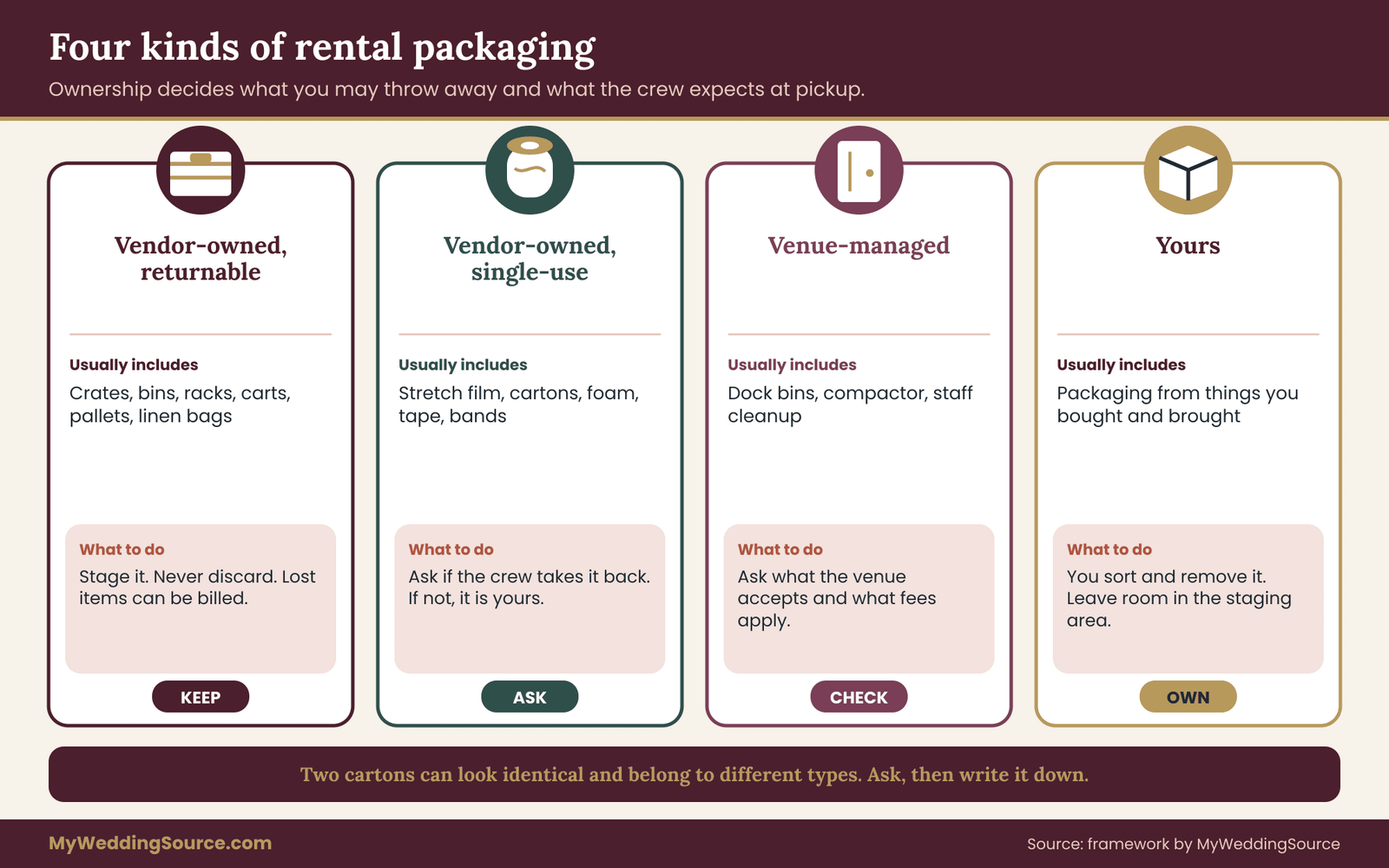
Before counting anything, sort the packaging waste you expect into four ownership types. Everything else in this article depends on this sort, because ownership decides what you may throw away, what you must keep staged and what a crew expects to find at pickup.
Type one: vendor-owned and returnable. Crates, bins, racks, pallets, dollies, reusable linen bags and padded chair carts. The rental company wants these back. If they go missing, expect a replacement charge under the contract. Never discard anything in this group.
Type two: vendor-owned but single-use. Stretch film, cardboard cartons the company reuses sometimes but does not require, foam pads, tape and bands. The company usually does not want these back, but the contract may say it does. Ask. If the answer is that they are yours to dispose of, you now own a disposal task.
Type three: venue-managed. Some venues have a loading dock with a compactor, recycling bins or a staff process for cleaning up after vendors. A venue may also forbid leaving anything behind or require vendors to take their own packaging away.
Type four: yours. Packaging from anything you or your family bought and brought. This article leaves it aside, but your staging space has to hold it too.
The trap is that two items that look identical can fall into different types. A cardboard glass carton from one company is a returnable box that gets reused many times. The same carton from another company is single-use and expected to be recycled. You cannot tell by looking. You have to ask, and you have to write the answer down.
A one-minute test for any piece of packaging
When a piece of packaging waste appears and nobody is sure what it is, run the same three questions in order. Whose is it? Does the crew need it back? If not, where does it go? If you cannot answer the first, do not discard it. Set it aside in the staging zone, label it with tape and a marker, and ask the crew lead before they leave. A box that sits for twenty minutes costs nothing. A thrown-away crate can cost a replacement fee and a difficult conversation.
Why ownership affects cost
Rental agreements often distinguish between rented goods and the equipment used to move them.
Some companies charge a delivery fee that includes picking up crates and wrap. Others charge a separate fee if returnable containers are not ready at pickup, or if items come back unsorted, dirty or in wrong containers. Whether any of this applies to you is a contract question. If your contract is silent, that silence is itself a reason to ask before the event, because it means the policy exists somewhere but you have not seen it. The guidance in the wedding vendor contract guide on reading terms before signing applies here too.
A related point is that rental companies run on tight schedules. A crew with six more stops that afternoon will not wait while you sort cardboard. Packaging that is staged, labeled and counted when they arrive leaves with them in minutes. Packaging that is scattered through three rooms leaves behind a trail of loose film and boxes, and it may be gone from your control before you realize it.
How rental deliveries actually run, and where packaging waste comes from
You will plan better if you can picture the logistics. Most event rental deliveries follow the same arc, even when the details differ by company and venue.
The truck loads in the order of use, in reverse. Items needed first are loaded last so they come off first. Chairs and tables usually arrive earliest, linens and glassware later, and fragile decorative items just before the vendors who need them. Each category ships in its own protective packaging, which is why packaging waste appears in waves through the morning rather than all at once.
Crews unload at a door, not at a seat. A delivery crew typically stages items near a loading entrance, then sets or distributes them according to a diagram. If you have not given a diagram, they will ask where things go, or put them where it is easiest, which may be wherever the door is. Packaging often stays near that door because it is the last thing anyone moves.
Some companies unwrap and set, others only drop. Full-service setup means the crew places chairs, unwraps stacks and sometimes removes the packaging themselves. Drop-and-go delivery means the crew leaves boxes and bundles at the venue and you or someone else unpacks them. In the second case, packaging waste becomes your responsibility the minute the truck leaves.
Pickup happens after the event, sometimes the next morning. Many rentals are collected the following day. That means packaging, crates and bins may sit at the venue overnight, and someone must decide where they stay and who guards them. Some venues require rentals out by a certain hour, and the pickup window may not match.
The decision that sets everything else: drop-and-go or full setup
The most important single fact for managing packaging waste is whether the rental company unpacks and sets the items or simply delivers them. Ask it in plain words: “Does your crew unwrap and set up, or do you drop the items and we handle unpacking?” The answer changes who holds the packaging, who removes it, how much staging space you need and what time the packaging waste appears.
With full setup, you will likely see packaging waste in a short burst, and the crew can often take reusable pieces away immediately. With drop-and-go, the packaging waste accumulates in the room as someone unpacks, and it may take a team of helpers hours to clear. In that case the counting and staging steps later in this guide matter even more, and you should assign a named person to own the job.
Where the delivery meets the venue
Venues add their own layer. A venue may restrict delivery hours, require insurance certificates for vendors, limit which doors and elevators crews may use, and set rules about what may be left behind. The venue technical walkthrough guide covers how those constraints shape setup, including doors, elevators and timing. For packaging, the relevant question is simple: where may packaging waste stand while the event runs, and where does the venue want waste to go?
If the venue has a dock with dumpsters and a recycling bin, a clean flow exists. If the venue has only a small trash room and a shared bin with other tenants, bulky packaging waste has nowhere good to go, and the crew needs to haul it or you need to arrange something in advance.
Time pressure is the real cause of messy packaging waste
Almost every case of lost crates, damaged items, blocked exits or overflowing bins traces back to a time squeeze. The truck is late, the caterer is early, the florist needs the same door, and the room is being photographed in ninety minutes. Under that pressure, people stop sorting and start piling. You cannot remove the pressure, but you can lower its effect by making the right behavior the easy one: a labeled staging spot, bins that are already out, and a crew lead who has seen the plan.
The packing material count: a simple way to measure packaging waste
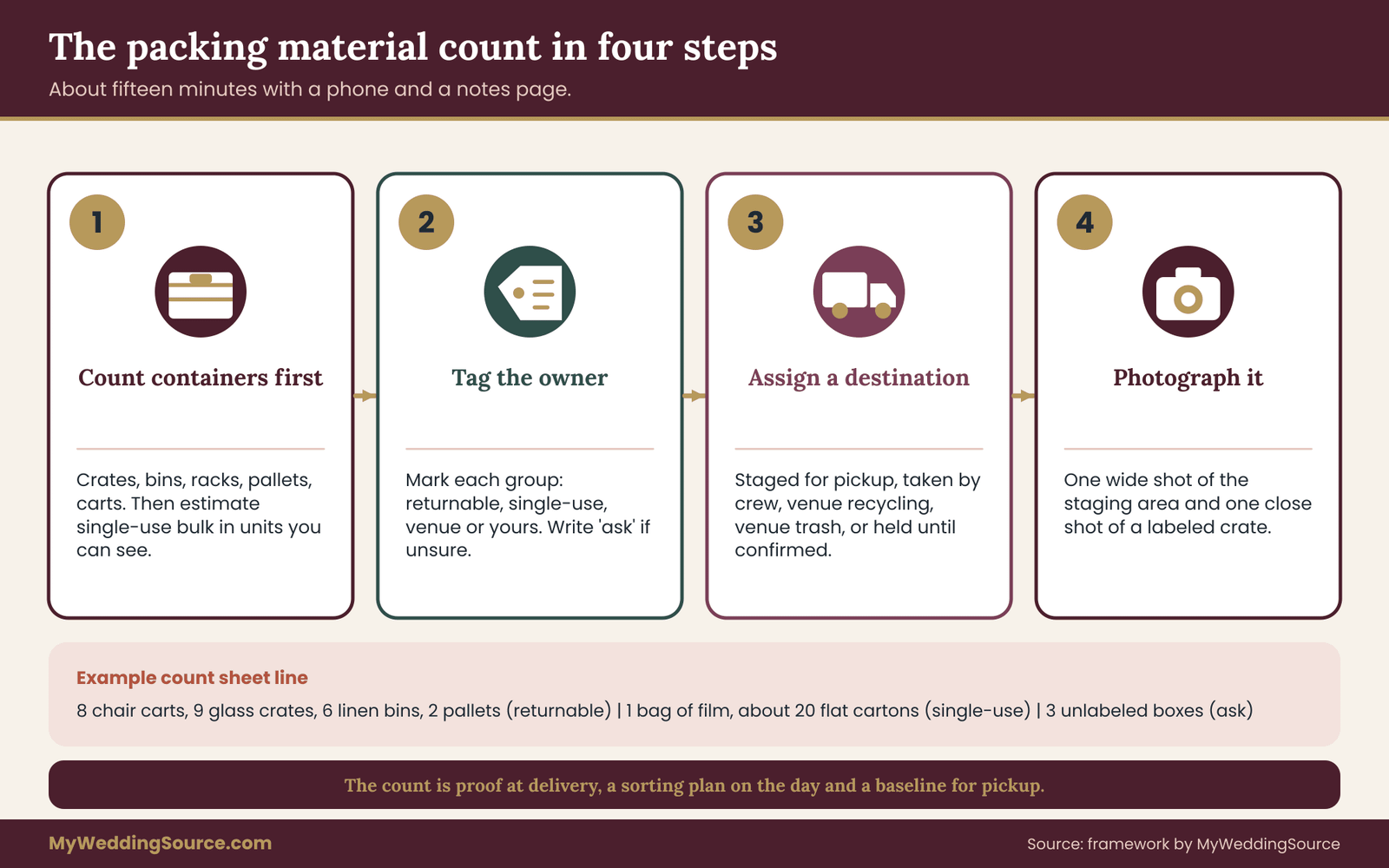
Here is the core tool of this guide. The packing material count is a short written record, made at delivery, that tells you what packaging waste arrived, what type it is and what happens to it. It takes about fifteen minutes with a phone and a notes page, and it gives you three things you rarely have: proof of what was delivered, a basis for sorting, and a record to compare against the pickup.
The count has four columns in your head, even if you write it as a list: what it is, how much, who owns it, and where it goes. You do not need precision to the ounce. You need enough detail that two people looking at the pile agree on what it is.
Step one: count the containers, not the pieces
Count the large, returnable things first, because they are the ones that cost money if lost. Write down the number of crates, bins, racks, pallets and dollies, and note any with the company’s name or labels on them. A line such as “six wooden glass crates, four chair carts, two pallets” is enough.
Then count the single-use bulk. You do not need to weigh anything. Estimate in units you can see: “about twelve broken-down cartons,” “one large garbage bag of stretch film,” “eight foam corner sets.” The point is a rough size of the waste stream so you can plan bins and helpers, and so you can notice if the pile at the end of the day is much bigger or smaller.
Step two: tag each item with an ownership type
Using the four types from the previous section, mark each group. Returnable crates are type one. Film and tape are type two unless the contract says otherwise. Anything the venue has asked to manage is type three. If you are not sure, mark it “ask” and settle it with the crew lead before they leave.
Step three: assign a destination
Every group needs a destination before the crew drives away. For returnable items, the destination is “staged for pickup” at a specific place. For single-use materials, it is one of four: take-back by the crew, venue recycling, venue trash, or your own removal. For anything still unknown, it is “held until confirmed.”
Write the destination next to the group on your list. When someone asks “what do I do with this?” you can answer in five seconds instead of improvising.
Step four: photograph and timestamp
Take one wide photo of the staging area after the crew finishes unloading, and one close photo of any returnable container with its label visible. Photos are not about distrust. They are the quickest way to settle a later question about condition, count or location. Your phone adds the time automatically.
What the count tells you
After the first count, you can read a few things from it. If the number of returnable containers is large, you need a bigger staging zone and a firm pickup agreement. If the single-use pile is mostly film and foam, expect trash rather than recycling unless local programs say otherwise. If cardboard dominates, you may have a clean recycling stream, provided it stays dry and free of tape and food.
You can also use the count to ask better questions of your next vendor. If three companies each deliver in different packaging, you may prefer the one that uses returnable crates and takes film away, because it leaves you less to manage. That comparison is far more concrete than asking a company whether it is “eco-friendly.”
A short script for the count
Many people feel awkward doing anything that looks like inspecting a crew’s work. A friendly framing helps. When the lead arrives, you can say: “We are trying to keep the packaging waste sorted so nothing gets thrown out by mistake. Can we agree on which crates go back with you, and where you would like the wrap left?” Most crew leads welcome this, because it saves them from searching for their own equipment later.
Keep it light. You are not auditing them. You are making their pickup easier.
Who does the counting on the day
A count only works if someone does it, and the bride or groom should not be that person. On the wedding day, the couple has better things to do and delivery often happens while they are elsewhere. Assign the count to one reliable, named person, such as a planner, a coordinator, a family member who is good with logistics, or a venue contact. Give them the one-page list, the staging map and the crew lead’s phone number.
If your event has no planner, ask the venue coordinator whether they can be present for the main deliveries. Many venues are happy to meet crews because it protects the venue’s own space.
What the delegate needs in hand
Give the person a short written note with six items: the rental company name and phone number for the day, the delivery window, the staging location for packaging, the list of returnable containers expected, the bins and where they are, and who to call if a decision is needed. Keep the note to one page. If it takes longer than a minute to read, it will not be read at the moment it is needed.
When nobody is available
Sometimes no one can be at the venue during delivery. In that case, your best tool is a delivery note taped inside the loading entrance. It should say, in plain language: which items go where, where packaging waste should be left, which containers are vendor-owned, and whom to call with questions. Ask the venue to let the crew in, and ask the rental company to text a photo when the delivery is done. A photo from the crew lead, taken after unloading, can serve as your count photo.
This is not as good as a person on site, but it is far better than leaving a crew to guess.
Asking the rental company before you sign: questions about packaging waste
The easiest time to settle packaging responsibilities is before the contract is signed or, at latest, a few weeks before delivery. A rental company that handles hundreds of events has answers ready. You only need to ask. The questions below are specific and answerable in one sentence each.
About delivery.
- Does your crew unwrap and set up the items, or do you drop them for us to unpack?
- Which items arrive in packaging that stays at the venue until pickup?
- Will the crew remove any packaging at delivery, and if so, which?
About ownership.
- Which crates, bins, racks and bags belong to you and must be returned?
- What is the replacement charge if one is lost or discarded?
- Is any packaging yours to dispose of, and if so, where should it go?
About pickup.
- When is pickup, and how long is the window?
- What condition must items be in for pickup: counted, stacked, scraped, rinsed, boxed?
- Do you charge extra if items are not packed in their original containers?
About sustainability.
- Do you reuse cartons and crates, and how many times?
- Do you accept film, foam or cartons back for your own recycling?
- Can you tell us what you do with materials you collect?
You do not need every answer. Even two or three will reveal a lot about how the company works. If they cannot answer the sustainability questions, that is information, not a failure. Many small rental companies are careful and efficient without having a written environmental policy.
How to ask without sounding like an inspector
Keep questions practical and tied to your logistics, not to values. “We want to avoid anything being thrown away by mistake or left in the venue” is a request almost any operations manager respects. It treats the packaging as equipment and the company as a professional. That framing gets better answers than a request that sounds like a test.
Put the answers in writing. A short email that restates what you understood is enough: “Thanks for confirming that crates and carts are yours and go back at pickup, that film and foam are single-use and we may discard them, and that pickup is Sunday between nine and noon.” Ask them to reply with “confirmed” or a correction. This creates a record without turning the exchange into a negotiation. The same habit appears in the wedding vendor due diligence checklist, which covers what to verify before and after you hire.
Red flags and green flags in the answers
A company that answers quickly and specifically, names its returnable equipment, states a pickup window and explains its fees is usually easy to work with. A vague answer is not a disqualifier, but a refusal to give any pickup terms or a policy that charges for “disposal” without explaining it is a reason to ask more. Be careful, too, with unexplained claims that all packaging is “eco-friendly” or “fully recyclable.” Whether packaging waste is recycled depends on local facilities, not on the label, and the Federal Trade Commission’s Green Guides explain how environmental marketing claims should be qualified.
Working with the delivery crew: handling packaging waste on delivery day
Delivery crews are the people who decide, in practice, what happens to packaging waste. They are skilled, rushed and usually friendly if treated as colleagues. The way you work with them on the day is worth more than any policy statement you collected beforehand.
Meet the crew lead, not the whole crew
Every delivery has a lead, often the driver or the person holding the paperwork. Introduce yourself or your delegate to that person at the start and agree on the plan for packaging waste in under two minutes. Confirm three things: where the packaging waste goes while the crew works, which items they take back at the end, and whom to call if something is unclear. Then leave them to work.
Repeating the plan to every crew member is slow and unnecessary. The lead will brief the others, and a single point of contact keeps confusion low.
Give them a staging spot that works for them
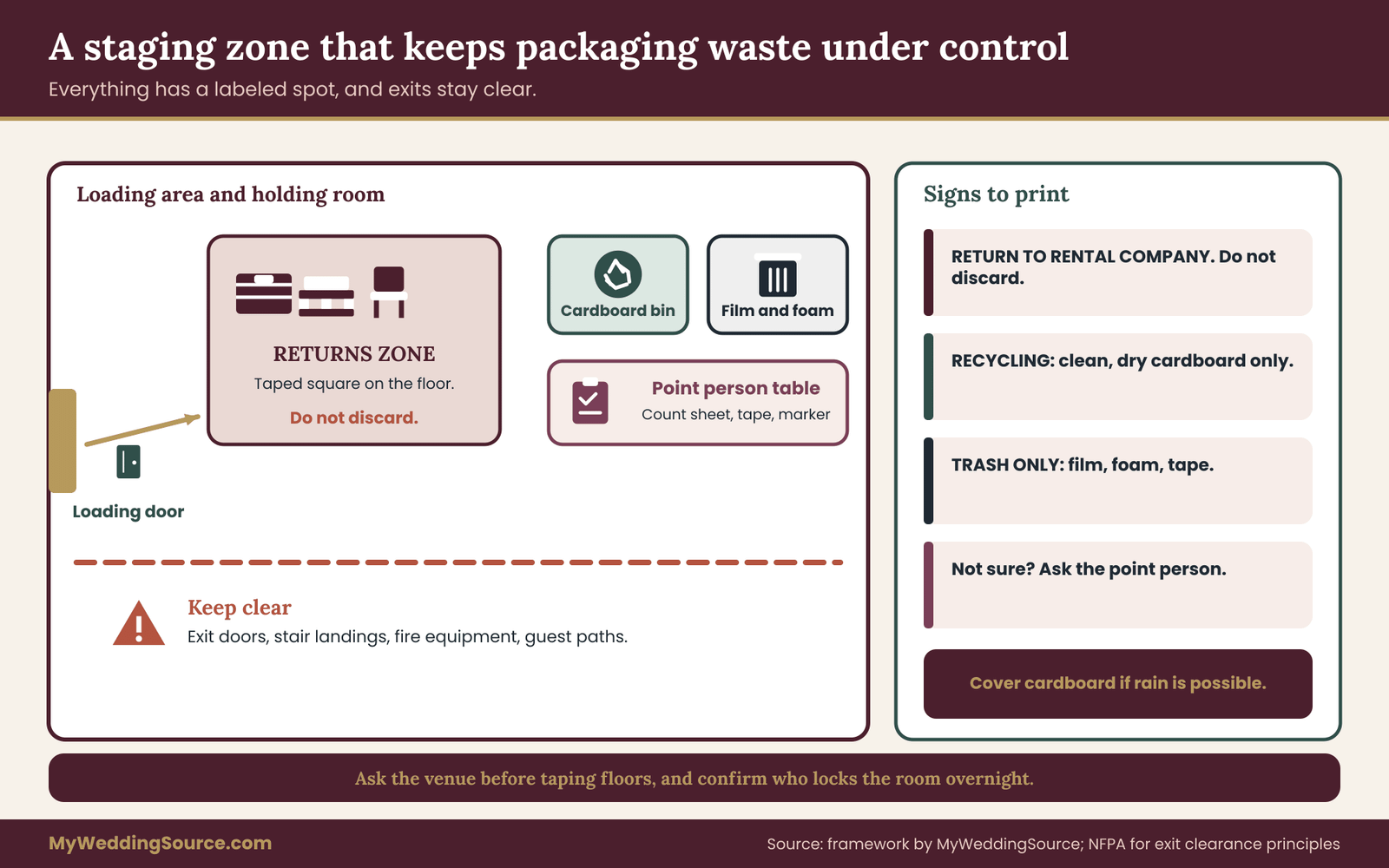
A staging spot is a defined area for returnable containers and for packaging waste waiting for removal. For the crew, a good spot is close to the loading door, out of the guest and vendor paths, flat, dry and easy to reach with a dolly. For you, it should be out of sight lines for photos and away from exits and fire equipment.
Mark it clearly. A strip of painter’s tape on the floor and a sheet of paper that says “Rental returns, please leave here” works better than a verbal instruction forgotten by noon. Ask the venue before you tape anything, since some surfaces and finishes do not take adhesive.
Keep exits and equipment clear
Packaging waste is bulky and light, which makes it easy to pile in corners and on stairs. Fire codes and venue rules generally require exit paths, stairwells, fire doors and extinguishers to stay clear of storage. The National Fire Protection Association publishes the codes that many local rules build on, and your venue or fire marshal can tell you what applies in your location. Practically, that means no crates in front of exit doors, no stacks of flattened cartons blocking a hallway, and no wrap or foam piled near a heat source.
What to say when a crew member starts to throw things away
It will happen. Someone will see a pile of film and cardboard and carry it to the nearest dumpster. A calm, specific question is better than a correction: “Just checking, is that stuff going back with you or is it okay to throw out?” If it is returnable, the crew member will know immediately. If it is trash, you have confirmed that and can ask where the venue wants it.
Do not scold. A crew that feels watched becomes slower. A crew that feels respected becomes helpful.
Tipping and thanks
Gratuity customs for delivery crews vary by company and region, and some companies include crew pay in the delivery fee or forbid cash tips. Ask the rental company what is appropriate, and do it through their process if one exists. Use the company’s own guidance first. A simple, sincere thank-you and cold water on a hot day are always fine and often remembered.
A compact delivery-day script
Many problems can be avoided with five sentences said at the right time. Adapt the wording to your own voice.
At arrival: “Thanks for coming. Can I walk you to where the packaging waste should stay until pickup?”
At staging: “Crates and carts that belong to you go here. Wrap and cartons you want to take today, we can leave by this door.”
At the end of unloading: “Before you go, can we do a quick count of what’s staged so we’re all on the same page?”
At sign-off: “Is there anything you’ll need us to do differently before pickup?”
At departure: “Thank you. Here is the number for the person on site tonight.”
These take less than five minutes total. They create a shared picture of the packaging, which is exactly what the later pickup relies on.
Staging the room: where packaging waste lives during the event
A reception is not a place where a pile of crates can sit in plain view. After the crew finishes setting up, someone has to move packaging waste out of the event space, and that someone needs a destination that is secure, dry and out of the way. This is a common gap.
Designate a holding area before the day
When you walk the venue, look for a closed room, a storage cage, a loading-dock corner, a corridor with no traffic or an outbuilding where vendor equipment can wait. Ask the venue manager whether it is allowed and who has access. If rentals will be picked up the next morning, the holding area also needs to be a place where nobody will confuse the crates with trash, and a place that stays locked or at least supervised.
If the venue has no room at all, the rental company may be willing to remove packaging waste and return it at pickup, sometimes for an added fee. Ask early, since crews cannot change this on the day.
Protect packaging that must stay dry
Cardboard and paper dividers go limp in rain or wet floors, and wet cardboard is far harder to recycle. If the holding area is outdoors or at a dock, cover it. A tarp, a plastic bin lid or a spare linen bag will do. The same applies to glass crates: damp cardboard separators can tear, and falling glass in a crate is a safety hazard for the crew.
Separate returnables from trash visibly
The most reliable system uses two things: a labeled zone for returnables and a labeled bin or bag for trash and recycling. Use plain words on paper: “RETURN TO RENTAL COMPANY. Do not discard.” and “TRASH ONLY” or “RECYCLING.” Colored tape helps people who cannot read the label in a hurry. These are small touches, but they tend to be what actually prevents a lost crate.
Plan for the unexpected pieces
Some packaging comes with surprises: a late delivery, an item delivered in a different container than expected, extra boxes from a vendor you forgot to count. Keep a small stock of supplies in the holding area: painter’s tape, a marker, a few large trash bags, a roll of paper for labels, a box cutter if the venue allows it, and a pair of work gloves. They cost very little and save a lot of improvisation.
Sorting packaging waste at the venue: what can go where
Once you know what is waste, the next question is where it goes. This depends heavily on local programs and the venue, so treat the guidance below as a way of asking good questions rather than a list of answers.
Cardboard
Clean, dry corrugated cardboard is accepted by most recycling programs. Flatten boxes, remove excess tape and labels if the program asks, and keep them out of wet areas. Boxes soaked with food or grease usually cannot be recycled and belong in the trash. Large amounts of cardboard may need a separate pickup, and the venue may have a baler or dedicated bin.
Plastic film and wrap
Stretch wrap and shrink film are thin and tend to jam sorting machines. Many curbside programs do not accept them. Some retail stores run drop-off bins for clean, dry film. Check your local program or the retailer’s page before assuming. If nothing is available, film is trash, and the most useful action is to reduce it by asking the crew whether they can reuse or take back wrap.
Foam
Expanded polystyrene and foam inserts are rarely accepted in curbside programs. Some companies reuse foam pads and corners. Ask the rental company first. If it is single-use and no local option exists, it goes to trash. The EPA’s page on sustainable materials management explains the general approach of prioritizing reuse and source reduction over disposal, which is why asking the vendor to reuse comes before searching for a recycler.
Wood and pallets
Pallets are valuable to the people who own them and are usually reclaimed. If any wood is truly waste, local programs, pallet recyclers and some municipal yards accept clean wood. Do not burn treated wood and do not leave pallets at the curb without checking local rules.
Mixed and contaminated items
Tape-covered cardboard, wrap stuck to foam, boxes with plastic liners and anything wet are mixed materials. They are the main reason that packaging waste ends up in the trash even when part of it could have been recycled. The simplest improvement is to separate items as they are unpacked, before the pile forms.
Who actually takes it
For each stream, the question is the same: who will pick it up, when and at what cost? Options include the venue’s waste hauler, the rental company’s own return process, a municipal drop-off, a commercial hauler booked for the event and, occasionally, a family member with a pickup truck. Pick one, tell the person responsible and write it on the count sheet.
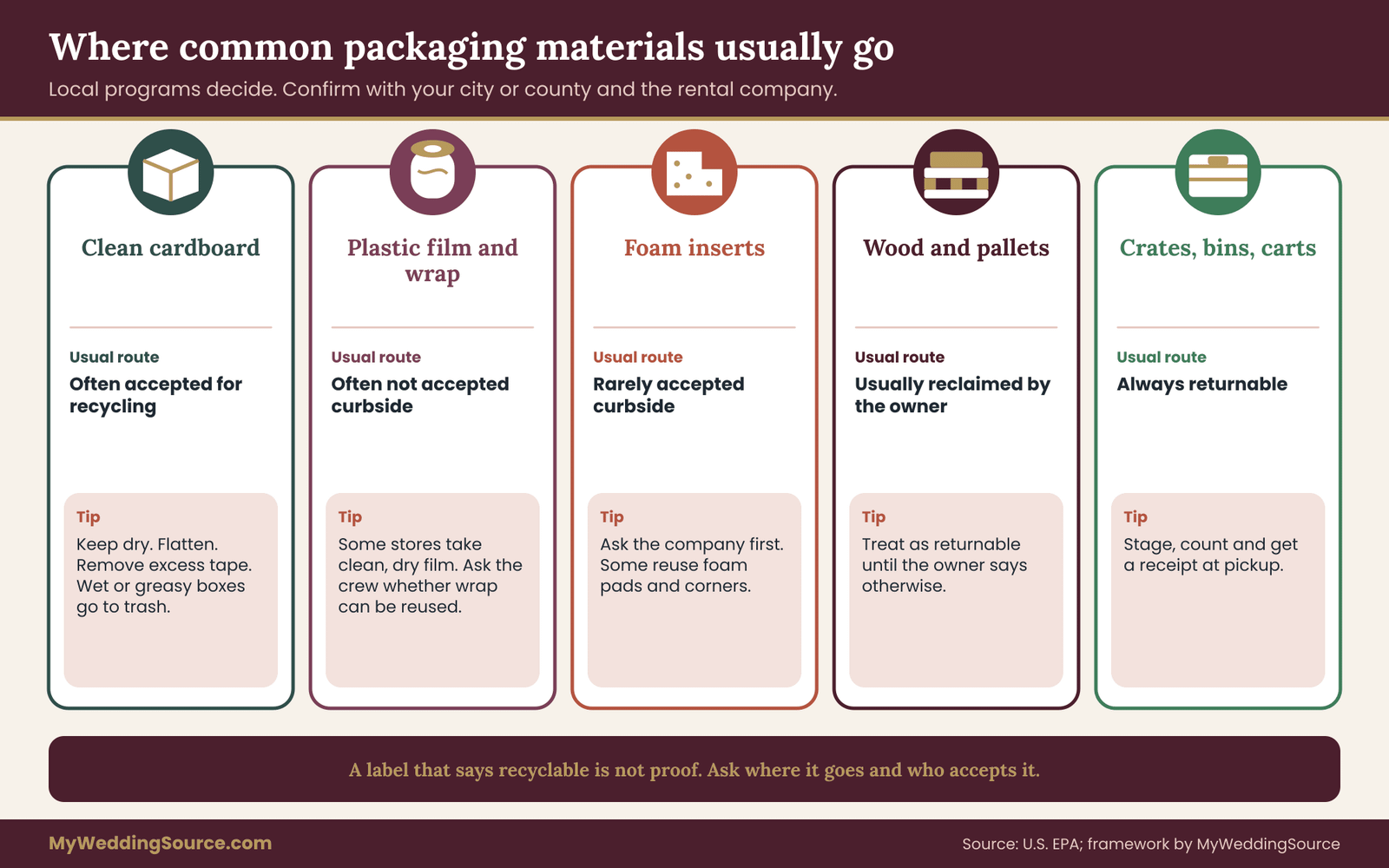
A small caution on greenwashing. If a vendor or venue tells you that packaging “will be recycled,” ask where and how they know. Whether a material is recycled depends on collection, sorting and markets, not on the intention. The Federal Trade Commission’s Green Guides discuss recyclability claims and the need to qualify them when facilities are not widely available. You do not have to investigate every claim, but you should not repeat one that nobody can support.
The reverse logistics checklist for rental packaging waste
Reverse logistics is the industry term for moving goods backward, from the customer to the vendor. At a wedding, it means everything that happens after the last dance and before the rental company signs off. This is where a good count pays back, and where most avoidable fees and trash appear.
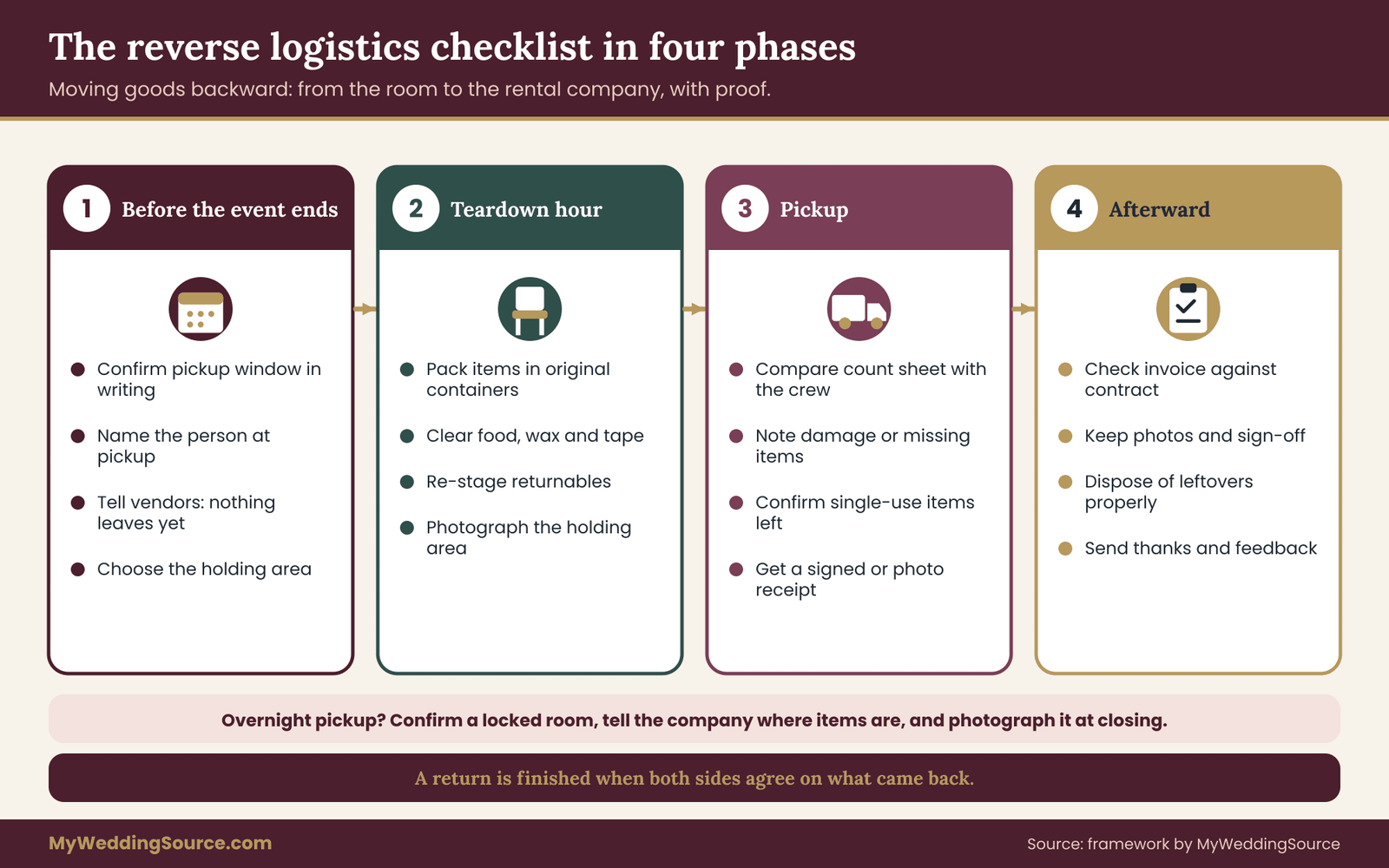
The checklist below runs in four phases. You do not need to complete every item at every event. Use it as a menu and keep the items that match your rentals.
Phase one: before the event ends
- Confirm the pickup time and window with the rental company in writing, and tell the venue the same.
- Name one person who will be present at pickup and give them the count sheet and photos.
- Tell the caterer and any vendors using rented items that nothing should be discarded or removed.
- Identify the holding area where all rentals and packaging waste will gather after the event.
- Check that cleaning requirements are known: scraping plates, rinsing glassware, folding linens, emptying bins, and so on.
Phase two: the teardown hour
- Collect rented items in the order the company prefers, often by category and in their own crates.
- Return each item to its original container where possible, since the packaging is designed for it.
- Remove food, wax, tape and decorations from rented goods before packing; residue is a common cause of cleaning charges.
- Re-stage returnable packaging by the pickup point and keep single-use waste separate.
- Take a final photo of the holding area with containers visible.
Phase three: pickup
- Meet the crew with the count sheet.
- Walk through the staged containers and agree on the number.
- Note anything missing, damaged or soiled, and ask the lead to record it on the paperwork.
- Confirm that single-use packaging the company agreed to take has gone with them.
- Get a signed or photographed receipt showing the number of items and containers returned.
Phase four: afterward
- Compare the final invoice to the contract and the count, and ask about any line that does not match.
- Keep photos, the count sheet and the sign-off for the period in which charges or disputes may arise.
- Dispose of any remaining waste in the right place, and record where it went.
- Send a brief thank-you to the company, with feedback if something worked well or not.
The sign-off is the real finish line
A return is not complete until both sides agree on what came back. A signed delivery receipt or a photo of the lead holding the paperwork is usually enough. If the crew is rushed and cannot sign, send a text or email within an hour: “Confirming that on Sunday at 10:15 the crew collected six crates, four chair carts and two pallets. Please tell us if your count differs.” Silence after that message is not proof, but it is evidence of your good faith and of the count at that moment.
When the pickup is the next day
Overnight storage is the weakest link in the chain. Items sitting in an unlocked room are at risk of loss, damage or removal by other vendors. If next-day pickup is the only option, ask the venue to confirm security, tell the rental company where items will be, and take a closing photo of the locked room or staged area. Some couples assign a friend to meet the crew in the morning, which also gives you a person for sign-off.
What venues expect: packaging waste and the venue contract
Venues have their own rules about delivery, storage and waste, and they interact with the rental company’s rules in ways couples rarely anticipate. Reading the venue agreement for these points will save difficulty.
Clauses to look for
Search the venue agreement for sections on vendor deliveries, load-in and load-out, trash, cleaning, damage and fees. Look for specific language such as: who removes vendor packaging, whether dumpsters are provided, whether vendors may use venue bins, how long equipment may stay overnight, and what the venue charges for waste removal or for items left behind.
Some venues include a flat cleaning fee. Others charge by the hour for extra labor. Some require a security deposit that can be reduced by cleanup problems. If the agreement says the client is responsible for removing all trash and vendor materials, you now own that task, even if the vendors created it.
Questions to ask the venue
- Where may vendors place packaging waste during setup and during the event?
- Is there a dumpster or compactor, and is recycling available?
- Are vendors allowed to leave packaging waste in venue bins?
- What is the deadline for removing rentals and equipment after the event?
- What fees apply if materials are left behind?
- Who will be on site at pickup to let the crew in?
Keep the answers with your other venue paperwork. The wedding vendor purchase order checklist shows one way to track what each vendor delivers and what each vendor takes back, which makes packaging waste easier to follow.
Shared properties and multi-tenant spaces
Some venues sit in buildings with shared loading docks, shared trash rooms or other businesses. In that case, building management may have its own rules on hours, elevator reservations and waste. Ask whether your event can use the building’s recycling, or whether materials must be carried away. A packaging pile that stays in a shared corridor can create a problem for other tenants and for the venue’s relationship with the building.
Outdoor and home venues
At a private home, farm or park, there may be no waste service at all. Crews will need clear instructions about where they may stage items, and you need a plan for the packaging waste that remains. Public land often has rules against leaving materials behind and may require permits for deliveries. Confirm those with the land manager well before the event. The wedding planning checklist on this site is a good place to add these as dated tasks.
Cost logic: what packaging waste can add to a rental bill
Cost is where good intentions meet the actual contract. Packaging waste can add expense in a few predictable ways, and managing it costs little compared with what it can prevent. This section lays out the logic without assuming any figures, since fees vary widely.
Fees to look for
- Replacement charges for lost or discarded crates, bins, racks, carts and pallets.
- Cleaning or re-packing fees when items return soiled or in the wrong containers.
- Disposal fees when the company has to remove packaging waste you were supposed to handle.
- Late pickup or extra trip fees when containers are not staged or the pickup window is missed.
- Venue cleanup or trash fees when packaging waste is left behind or overflows bins.
Each of these is a contract term, so the cost of any of them depends on your agreement. Ask for the schedule of fees in writing and compare it to the count.
The cheapest dollar is the one you do not spend
A packing material count costs a phone and fifteen minutes. A staging zone costs tape and paper. A script costs nothing. Compare that with a replacement fee for a few crates, or a cleanup charge for a pile of film. Even when the fees are small, the avoided stress is worth the preparation. For larger events with more rentals, the amounts at risk grow, but the method is the same.
Do not trade a fee for a bad environmental outcome
Occasionally a company offers to haul away all packaging for a fee. That can be reasonable. But paying for removal does not tell you where the material goes. If the claim is that packaging waste will be reused or recycled, ask how the company knows. If the answer is vague, treat it as disposal and judge it on cost and convenience, not on environmental benefit.
You can read more about weighing costs against benefits across the whole event in the wedding budget guide, which covers how to set aside a small contingency for exactly this kind of line item.
Reducing packaging waste before the truck arrives
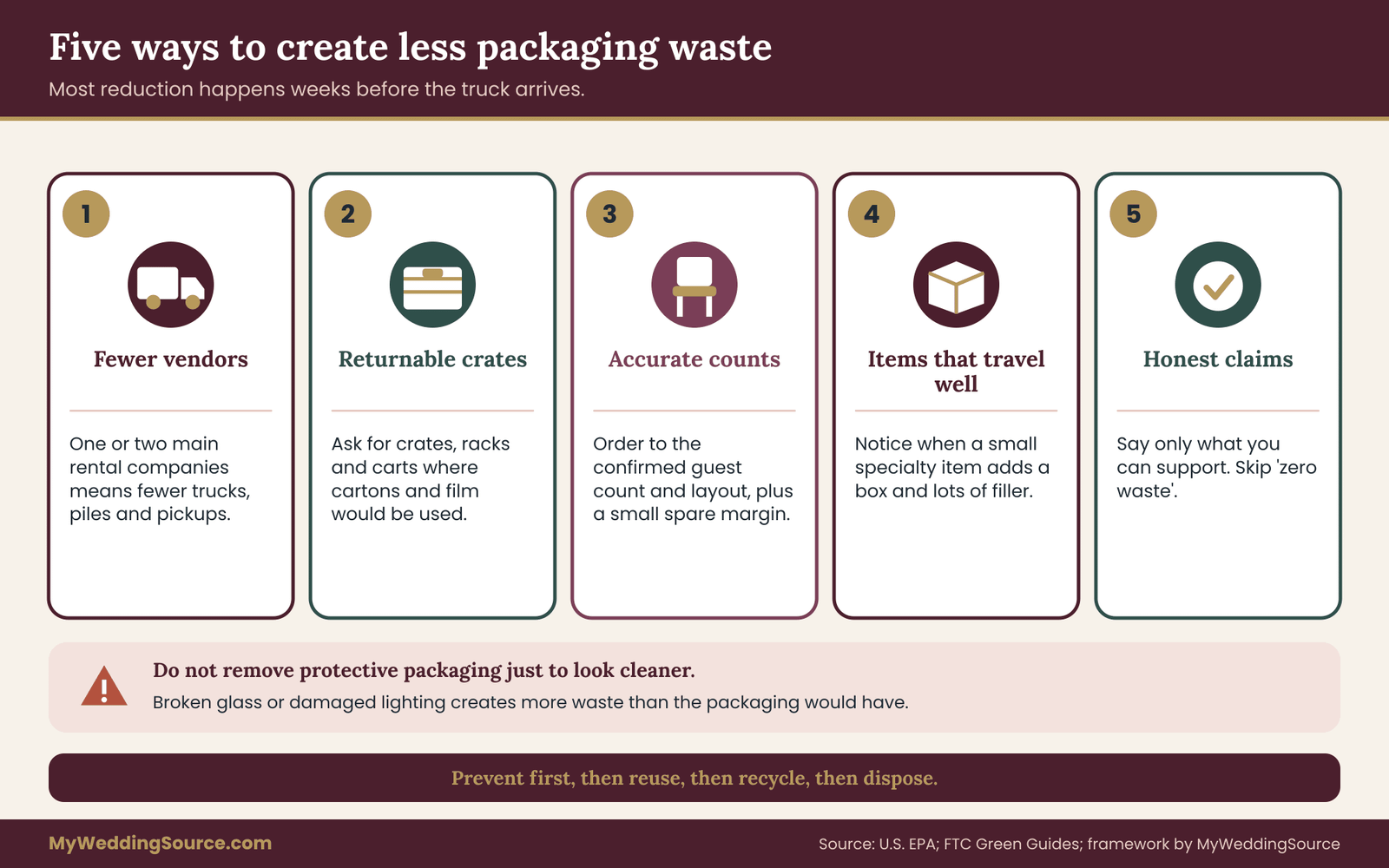
The cheapest way to handle packaging waste is to create less of it. Most reduction happens in decisions made weeks earlier: how many rental companies you use, what you order, how it is delivered and how it is returned. None of these require giving up anything you actually want.
Consolidate vendors where it makes sense
Every separate rental company brings its own truck, crew and packaging. Ordering tables, chairs, linens, glassware and tableware from one provider generally means fewer deliveries, fewer separate piles and one pickup to manage. The tradeoff is that the best chair company and the best linen company may not be the same business, and quality matters more than a tidy pile.
A practical middle path is two companies at most for the main furniture and tableware, with specialty items such as lounge sets or lighting from a third only when you need them. Fewer parties also means fewer people to coordinate at teardown.
Ask for returnable and bulk packaging
Many rental companies already ship in returnable crates, racks and bins. If a company uses cardboard and film for items that could travel in crates, ask whether crates are available. Some companies will deliver glassware in the same racks they use for washing, which removes cartons entirely. You will not know unless you ask, and most are glad to say yes when it also protects their stock.
For chairs, ask whether they come on carts or in shrink-wrapped stacks. Carts are reused indefinitely. Film is used once. Some crews still prefer film for outdoor jobs because it keeps dust and rain off, so listen to their reason before pressing.
Choose items that travel well
Some rental categories need heavy protective packaging, and some do not. Heavy lighting, delicate glassware and linens each need specific protection. Chairs and tables need little. You do not have to avoid fragile items, but you can notice when a choice adds a lot of packaging waste for little benefit. A single-use specialty item with its own box, such as a small decorative piece, may create more packaging waste per use than a large set that arrives in one crate.
Keep quantities accurate
Over-ordering creates extra items, extra packaging waste and extra handling. Final counts for chairs, place settings and linens should match your confirmed guest count and layout, with a small spare margin the company recommends. The wedding rental planning checklist walks through how to count quantities, which also reduces the number of boxes that have to be opened, repacked and carried.
Ask what happens to unused packaging
Some deliveries arrive with extras: spare crates for items you did not use, additional film rolls, filler. If an item went unopened, you may be able to send it straight back. Ask the crew lead before they leave, and note it on the count sheet so nobody later wonders where it went.
Packaging waste claims: avoiding greenwashing
Rental companies, venues and even couples sometimes describe packaging as “green,” “eco,” “biodegradable” or “recyclable.” Some of those claims are accurate. Many are incomplete. Because the point of this exercise is a real reduction in waste, not a nicer label, it helps to know how to read them.
Words that need a follow-up question
“Recyclable.” A material can be technically recyclable and still not be accepted where you live. Whether a package is actually recycled depends on local collection, sorting and markets. The Federal Trade Commission’s Green Guides advise marketers to qualify recyclability claims when facilities are not available to a substantial share of consumers. When someone says a package is recyclable, a fair follow-up is: “Where does it go, and does it get accepted there?”
“Compostable.” Compostable packaging usually requires specific composting conditions and a facility that accepts it. In most places, such items are not accepted in home compost or ordinary recycling bins. If you see compostable film or boxes, ask the company how they expect it to be processed. If the answer is “in the trash,” the claim does not change the outcome.
“Biodegradable.” The word is vague and often discouraged in marketing because nearly everything biodegrades eventually. Without a time frame and conditions, it tells you very little.
“Eco-friendly” and “green.” These are general terms with no standard meaning. Ask what specifically makes it so, and compare that with what you can see.
Better evidence than a label
You will usually learn more from a simple observation. Does the company reuse its crates? Does it take back film and foam? Does it have a process for collecting cardboard? Specific practices carry more information than a claim. And if a company does none of these but is honest about it, you still know what you are dealing with and can plan accordingly.
Do not overstate your own results
If you manage your rental packaging waste carefully, you may want to say so on a wedding website, in a message to guests or on social media. Keep it accurate. “We asked our rental company to reuse their crates and took back all film” is a statement you can support. “Our wedding was zero waste” almost certainly is not, and the EPA’s discussion of sustainable materials management is a useful reminder that reducing and reusing come before recycling and disposal. The full wedding waste audit covers how to measure results so your claims stay honest.
A decision framework for packaging waste: count, classify, route, record
Everything so far can be folded into one repeatable method. It has four steps, and each has a short question you can ask at any point.
Count. What packaging waste is here, and how much? Containers first, bulk second.
Classify. Whose is it, and do they want it back? Use the four ownership types.
Route. Where does each group go, and who moves it? Staged for pickup, taken by the crew, venue recycling, venue trash, your own removal, or held until confirmed.
Record. What proves it? Photos before, a sign-off after, and a one-line note of any exception.
The value of the method is that it works under pressure. When the truck is late, the florist is waiting and a guest has just arrived early, you do not need to remember a policy. You need to say count, classify, route, record, in that order, to whoever is helping.
Applying it to a late or changed delivery
Suppose a delivery arrives an hour late and the crew wants to unload fast. Skip the full count. Do the minimum: a wide photo, the ownership question for the largest returnable items and a staging spot. Then do the full count after setup, once the crew has left. The method scales up or down, as long as the four steps are completed at some point before pickup.
Applying it to multiple vendors
If several vendors deliver packaged items, run the same four steps for each, but share one staging zone with separate labeled areas. Give each vendor a short card: “Your returnable items go here. Single-use packaging waste goes here.” It is surprising how rarely venues provide this, and how much it simplifies the day.
When the method does not apply
A very small event with a few rented items may need only the ownership question and a note to the delivery crew. If your rentals are limited to a handful of items picked up by your own car, you are also the crew. Use the method as a mental checklist and skip the paperwork. The aim is clear responsibility, not bureaucracy.
Worked example: one reception, one count, one pickup
The following example is invented to show the method in use. The couple, the company and the numbers are illustrative, not real, and your own rental terms will differ.
Dana and Marcus are hosting a reception for about one hundred and twenty guests in a converted warehouse with a small loading dock. They rent chairs, round tables, linens and glassware from a single company. The company’s contract mentions delivery and pickup but says nothing about packaging waste.
Three weeks before
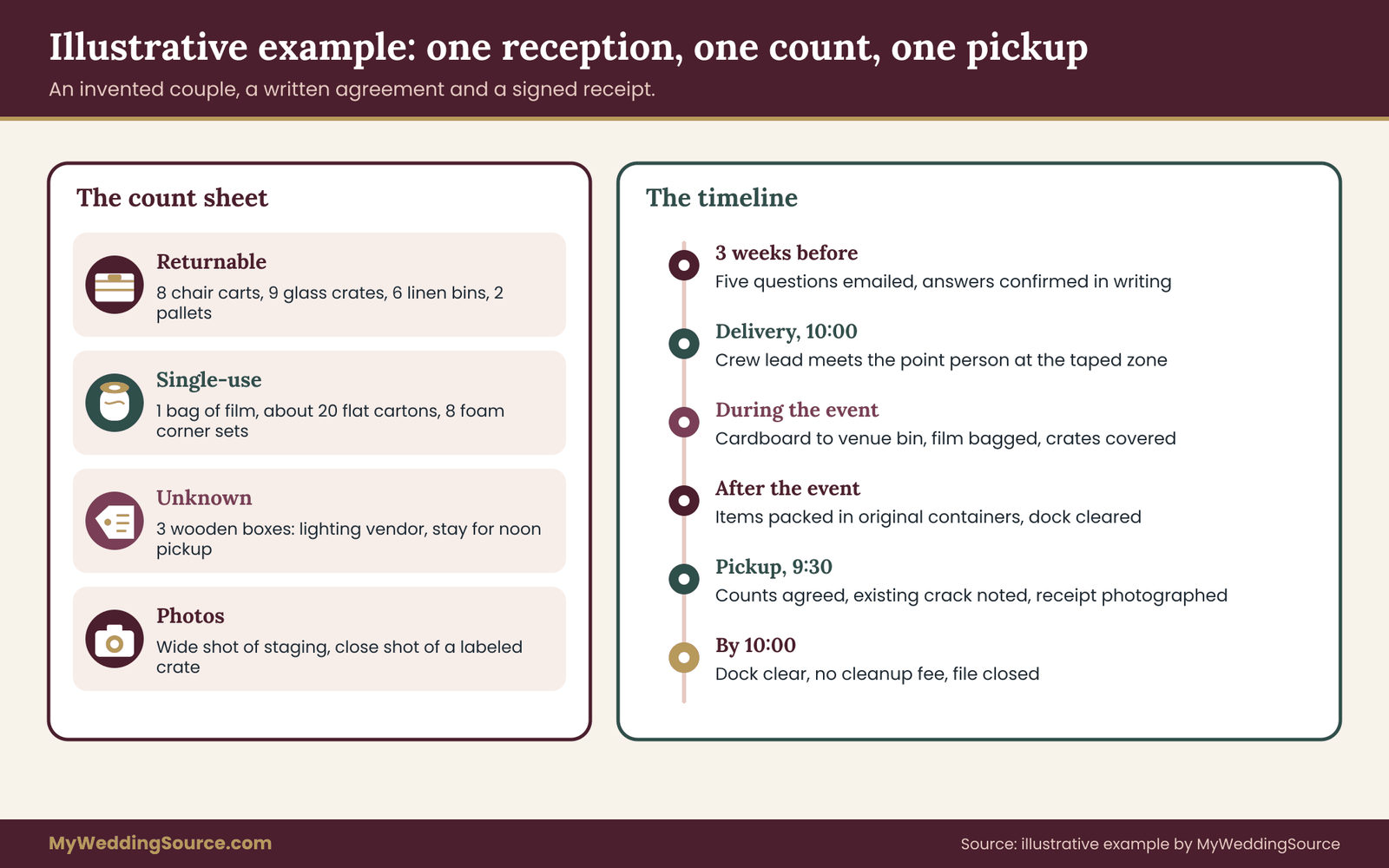
Dana emails the rental company with five questions: does the crew unwrap and set, which containers are theirs, whether film and cartons can go back with the truck, what the pickup window is, and what fee applies for lost crates. The company replies that the crew sets chairs and tables, drops linens and glassware in their crates, and takes crates and carts at pickup. Film and cartons are single-use. Pickup is the next morning between nine and noon. Crates carry a replacement charge listed in an attached fee sheet.
Dana restates this in a reply: “Confirming what we understood,” followed by the five answers. The company writes back “confirmed.”
Marcus calls the venue. The venue has a dumpster and a cardboard bin at the dock, but no pickup for film, and it asks that vendors remove their own wood and crates. A cleaning fee applies if the dock is not clear by ten the next morning.
Delivery morning
Dana’s cousin Priya, who agreed to be the point person, meets the crew lead at ten. She walks him to a corner of the dock marked with tape and a sign: “Rental returns. Do not discard.” The crew unloads, and Priya counts as they go.
Her count sheet reads, in her own shorthand:
- Returnable: eight chair carts, nine glass crates, six linen bins, two pallets.
- Single-use: roughly forty feet of film in one large bag, about twenty flattened cartons, eight foam corner sets.
- Unknown: three wooden boxes with no label.
She asks the lead about the wooden boxes. He says they are from the lighting vendor and belong to that company, not his. Priya texts the lighting vendor, who confirms and asks that they stay at the dock for pickup at noon.
She takes two photos: a wide shot of the staged returns and a close shot of one crate with the company label visible.
During the event
Priya has set a recycling bin for cardboard and a trash bag for film and foam beside the staging area. At the end of the delivery, she moves the cartons to the venue’s cardboard bin, keeps the film bagged and covers the staged crates with a clean linen bin lid to keep out a light drizzle.
The venue manager asks about the foam. Priya explains it is single-use and asks whether the venue can take it. The manager says yes, as a one-time courtesy, and that the venue would otherwise ask the company to remove it. She makes a note.
Teardown and pickup
At the end of the night, the caterer and the bar team return their rented glassware to the glass crates, with food residue removed and linens folded into bins. Priya adds the lighting vendor’s boxes to the staging area. A friend takes a closing photo with all containers visible.
The pickup crew arrives at nine-thirty. Priya hands the lead the count sheet. They agree on eight carts, nine crates, six bins and two pallets. Priya notes that one glass crate has a cracked divider, a condition she had photographed at delivery as already worn. The lead records it as existing wear.
He signs a delivery receipt listing the containers. Priya photographs it. The dock is clear by ten.
What the example shows
Three things made it work. The packaging waste questions were answered in writing weeks ahead, which meant nobody had to improvise. A single named person held the count and the staging plan. And the photos and receipt created a record that closed the file. None of this required extra money, special products or unusual effort. It required a few messages and a morning of attention.
Edge cases and awkward situations
Real events rarely follow a clean script. These situations come up often enough to plan for.
Tented and outdoor receptions
A tent company brings poles, stakes, sidewalls, flooring, lighting and often wraps components in film or tarps. Packaging and transit gear is more bulky and less obviously reusable. Ask the tent company how it removes stakes, leaves ground clear of film and handles protective wraps. Wind is a real problem: loose film and paper blow off a site quickly and are hard to retrieve. Weigh down anything light and keep waste bagged. A rented tent usually requires the crew to return, often at an hour you do not control, so confirm access to the site.
Multi-day events
If rentals stay for a rehearsal dinner, the wedding and a farewell brunch, packaging may need to sit for days. Ask the company whether containers can stay on site and for how long, whether they carry insurance for storage and who is responsible for loss. Keep a labeled, locked area and re-photograph it each day.
Destination and remote venues
At a remote location, waste services may be distant or absent. Rental companies may add travel fees and may require clean containers because they will not return for a second trip. In that case, packaging decisions are logistics decisions: the less packaging waste you generate, the less you have to carry out. If you must haul waste yourself, ask your venue about local transfer stations and their hours before the event.
When rentals are delivered to a home or hotel
A hotel may have a receiving dock with strict hours, a limited holding area and a policy that all deliveries go through a manager. A private home may have a driveway and a garage, neither of which suits a pile of crates. Ask the hotel or host where deliveries can stay, and bring bins and bags.
When a crew arrives with different packaging than described
Sometimes the delivery does not match what you were told. A company that promised returnable crates may arrive with cartons because crates were in use elsewhere. Do not argue on the spot. Update your count, ask what should happen to the cartons, and make a note. If it affects cost, address it in writing afterward.
When something is damaged or missing
If packaging is torn, a crate is cracked or an item is missing at delivery, photograph it and tell the crew lead immediately so they record it on their paperwork. Damage found after the crew leaves is hard to prove either way, which is why the early photo and count matter so much. For a broader approach to disputes with vendors, see the guidance in the wedding vendor contract article on how to document and resolve problems.
When a family member wants to help, and does it wrong
A well-meaning relative may clear the dock and throw everything away because “it looked like trash.” Prevention is a short briefing and a sign. Tell helpers at the start: “Anything on the taped area stays. If you are not sure, ask Priya.” People generally like having a clear instruction because it removes the chance of making a mistake.
Ready-to-use messages for rental packaging waste
Short, specific messages do most of the work in this guide. These templates are meant to be edited into your own voice. None of them requires any special knowledge, and each can be sent in under a minute.
An email to the rental company before delivery
“Hello, we are confirming details for our delivery on the date in our order. Could you tell us whether the crew unwraps and sets the items or drops them, which crates, carts and bins belong to you and must be returned, and whether film and cartons can leave with the crew? We would also like to confirm the pickup window and any fee for missing containers. We will stage returnable items by the loading door. Thank you.”
Keep it short. Ask the questions as a list if the company prefers that. If they reply by phone, send a follow-up email that restates what you heard.
A note taped at the loading entrance
“Rental deliveries: please leave crates, carts and bins on the taped area. These go back with the rental company. Film and cartons can be left in the marked bin or taken by your crew. If you are unsure, call the number below before moving anything.”
Add the point person’s name and number, and tape it at eye level.
A message to the point person
“Thank you for taking this on. The crew should arrive around the delivery window. Please agree with the lead where packaging waste goes, take two photos of the staged returns and fill in the list. If anything is unclear, call the rental company first and us second. At pickup, please ask for a signed receipt or take a photo of the crew lead holding the paperwork.”
A confirmation after pickup
“Hi, thanks for collecting this morning. We counted eight carts, nine crates, six bins and two pallets going back with your crew, and we noted a cracked divider that was already there at delivery. Please let us know if your count differs. Thank you for the smooth pickup.”
Send it from your phone within an hour. Messages written close to the event are more credible than ones written weeks later.
Common mistakes and limits with rental packaging waste
Most problems repeat. Knowing them in advance is half of avoiding them.
Assuming packaging waste is trash. The most expensive mistake is throwing away something the company owns. Always ask before discarding anything unlabeled.
Assuming packaging waste is the company’s problem. The opposite error leaves you with a pile and a cleanup charge because the contract made it your task. Read the terms.
Skipping the count. Without it you have no basis for comparison at pickup and no evidence of condition at delivery.
Not assigning a person. A task shared by everyone belongs to no one. Name one individual.
Staging in the wrong place. Crates in a guest corridor, film near a candle, cardboard in the rain. Look at the site before the day.
Believing labels. “Eco” and “recyclable” claims are only as good as the facilities behind them. Ask where the material goes.
Letting the pickup window slip. A missed window can mean an extra trip fee, and a crew that arrives to a locked door has to leave.
Overspending on disposal. Paying a hauler to take everything is easy and sometimes necessary, but it should be a deliberate choice rather than a default.
Forgetting other vendors. The caterer, florist and lighting company generate packaging waste too. Include them in the staging plan.
Forgetting the paperwork. A photo, a receipt and a short email are cheap and decisive if a charge appears later.
Limits and honest caveats about packaging waste
This guide has limits that are worth stating plainly.
First, packaging waste from rentals is a small part of the total environmental footprint of a wedding. Travel, food, venue energy and purchases usually matter more. The reason to manage it is practical: it avoids fees, protects the venue relationship and prevents needless trash. Any environmental benefit is a bonus, and it depends on materials, transport and local facilities.
Second, local rules vary. A material accepted in one county’s recycling program may be rejected in the next. The Environmental Protection Agency publishes national information and points to state and local programs, but your own city or county sets the actual rules.
Third, rental terms differ. Nothing here replaces reading your contract and asking the company. If your terms conflict with a suggestion in this article, follow the terms and ask for clarification.
Fourth, some packaging exists for safety. Glassware, lighting and delicate décor need protective material, and removing it to reduce waste can cause breakage that creates more waste than it saves. Never trade protection for a cleaner look.
Fifth, crews and venues have constraints you cannot see. A crew that cannot take film back may be limited by company policy, truck space or local rules about waste. Treat refusals as information, not as bad faith.
What a realistic result looks like
A realistic result is not zero waste. It is a delivery in which returnable items go back without a loss charge, single-use material goes to the right bin or is taken by the crew, nothing blocks an exit, and the final invoice matches the contract. If you achieve that, you have done what most events do not.
Your next steps
- This week: list every company delivering rented items and write down the delivery window and the pickup window for each.
- This week: send each company the packaging waste questions from the ownership map and ask for a reply in writing.
- Two weeks before: ask your venue where packaging waste may stay, where waste goes and what fees apply, then choose a holding area.
- One week before: name your point person, give them the one-page note and print the loading entrance sign.
- Delivery day: meet the crew lead, agree on the staging spot, count containers and single-use bulk, and take two photos.
- Teardown: return items to their original containers, clean off residue and keep waste separate.
- Pickup: compare your count with the crew’s, get a signed or photographed receipt and send a short confirmation.
- After the event: check the final invoice against the contract and the count, and keep the paperwork for the period in which charges may arise.
For the larger picture of what else to reduce and measure, the wedding waste reduction audit is a good place to continue.
FAQ
Who is responsible for packaging waste from wedding rentals?
It depends on the contract. Returnable containers such as crates, carts and bins almost always belong to the rental company and must go back. Single-use film, cartons and foam may be the company’s to remove, yours to discard or the venue’s to handle. Ask before delivery which applies, and get the answer in writing so there is no confusion at pickup.
Should I throw away the cardboard and wrap after delivery?
Not until you know who owns it. Some cartons are reused by the rental company and billed if lost, while film and foam are usually single-use. Ask the crew lead before they leave, label anything uncertain and keep it in a staging area. If the answer is that it is yours, sort it into the right bin or bag.
Can packaging from wedding rentals be recycled?
Sometimes. Clean, dry cardboard is widely accepted, while plastic film and foam are often not accepted in curbside programs. Whether something is actually recycled depends on your local program and facilities. Check your city or county rules, or ask the venue what its hauler accepts, rather than relying on a label that says recyclable.
What is a packing material count?
It is a short written record made at delivery of what packaging waste arrived, how much, who owns it and where it will go. You list returnable containers first, then estimate the single-use bulk, tag each group by ownership and take photos. It takes about fifteen minutes and gives you a basis for sorting at the event and comparing at pickup.
Who should be present when the rental crew picks up?
One named person who knows the plan and has the count sheet. That could be a planner, a venue coordinator, a relative or a friend. The couple should not need to do it. The person agrees on the count with the crew lead, notes any damage and gets a signed receipt or photo of the paperwork before the crew leaves.
What if a crate or container is lost or thrown away?
Contact the rental company promptly, explain what happened and ask what the replacement charge is under your contract. Check your delivery photos and count to see whether the item was ever delivered. Sometimes the container is found at the venue or with another vendor. Pay only what the contract supports, and keep a record of the exchange.
Do I need to tip the delivery crew?
Customs vary by company and region. Some include crew pay in the delivery fee, and some do not allow cash tips. Ask the rental company what is appropriate and follow its process. A sincere thank-you, cold water on a hot day and a clear, well-organized staging area are always welcome and make the crew’s work easier.
How do I avoid greenwashing when talking about my rentals?
Say only what you can support. “We confirmed crates go back with the company and took the film to a store drop-off” is specific and checkable. Claims such as zero waste or fully recyclable usually are not. The Federal Trade Commission’s Green Guides explain how environmental claims should be qualified, and they are a good test for your own wording.
Sources
- U.S. Environmental Protection Agency: Sustainable Management of Materials
- U.S. Environmental Protection Agency: Recycling
- U.S. Environmental Protection Agency
- Federal Trade Commission: Green Guides
- Occupational Safety and Health Administration
- National Fire Protection Association
- Consumer Financial Protection Bureau
- USA.gov: Local government and waste services