
Destination wedding suit pressing is the plan for getting a suit from a suitcase to the ceremony looking calm and clean, using a hotel service, a local tailor, a travel steamer, or a sensible mix. This guide gives you a pressing-risk comparison, a delivery deadline log and a worked example, so one wrinkled jacket does not become a crisis on the morning of the wedding.
Choose your suit pressing route after you read the care label, not before. A hotel service is convenient but you hand over custody and heat control. A local tailor gives the best skill but needs lead time and a shared language. A travel steamer gives you control but needs the right voltage, clean water and a test patch. Pick one primary route and one backup that fails for different reasons, then write the pickup and delivery times in a deadline log with a hard stop at least three hours before photos.
A suit that spent twelve hours folded in a bag looks very different from one that spent twelve hours on a hanger. Most couples planning a wedding abroad think carefully about the dress, the rings and the guest hotel block. The suit gets a line on a packing list. Then someone opens the garment bag at the resort, finds a hard crease across the lap, and starts asking the front desk whether anyone there knows how to iron.
That moment is avoidable, and it is also easy to overreact to. A suit is a structured garment. Heat, moisture and pressure can fix it, and the same three things can ruin it. A shiny patch on wool does not come out. A water stain on silk lining does not come out. A scorched lapel does not come out. So the real question is not how to remove every wrinkle. It is how to get the right amount of smoothing, from the right person or tool, at a time that leaves room to fix a mistake.
Good destination suit pressing therefore has three parts. First, know what the suit is made of and how much heat it tolerates. Second, compare the three routes honestly on risk, not just on price. Third, write down who holds the suit, when, and what happens if that person is late. The rest of this article works through each part with decision rules you can reuse for every suit in the wedding party, so each suit pressing choice rests on the same logic.
A note on scope. This is general information, not legal, tax or financial advice, and care labels, airline rules and hotel terms differ, so confirm current details with the garment maker, the airline and the hotel before you rely on them.
What destination wedding suit pressing involves
Pressing sounds like one job, but it is really a family of jobs that people lump together. Understanding the differences stops you from asking a hotel for the wrong thing or paying a tailor for work you did not need, and it keeps your suit pressing request short and clear.
Steaming uses hot vapor to relax fibers so creases fall out. Nothing touches the cloth with a hot plate. This is the gentlest method for most suits and the one most travelers can do themselves.
Pressing uses a heated iron or a press machine with pressure, usually with a cloth between the iron and the suit. It sets sharp creases in trousers and flattens seams and lapel edges. It also carries the highest risk of shine or scorching if the temperature or the cloth is wrong.
Dry cleaning is a chemical cleaning process that usually includes a press at the end. For a suit you plan to wear in a few days, it is normally the wrong choice, because it is an unnecessary stress on the fabric and canvas, and it adds time and risk. If a stain needs treating, that is a different conversation with a cleaner.
Touch-up pressing is a short, targeted job: the trouser creases, the back of the jacket, the collar roll, the sleeves. When you ask for suit pressing at a hotel or tailor, this is usually what you mean, and the phrase “pressing only, no cleaning” is worth saying out loud.
Why a destination changes the problem
At home, a suit that needs touching up goes to a cleaner you know, on a day you choose, and comes back in a hanging bag. A destination takes away every one of those comforts. You may not know the language. You may not know whether the shop is open on the day you need it. You do not know the hotel’s laundry cutoff times, and you cannot easily go back for a second try.
Three things shift when you travel. The first is time. A normal local errand turns into a chain of handoffs, and each handoff has a deadline. The second is custody. The suit is no longer in your closet, and at some moment it sits in a stranger’s hands. The third is equipment. Voltage, plug shapes, water quality and even whether the hotel iron works are all unknowns. Destination suit pressing is mostly the work of replacing those unknowns with answers before you leave. Every question answered at home is one fewer surprise during suit pressing at the resort.
The three routes in one view
The same suit can reach the ceremony through three realistic routes, and most couples end up combining two of them.
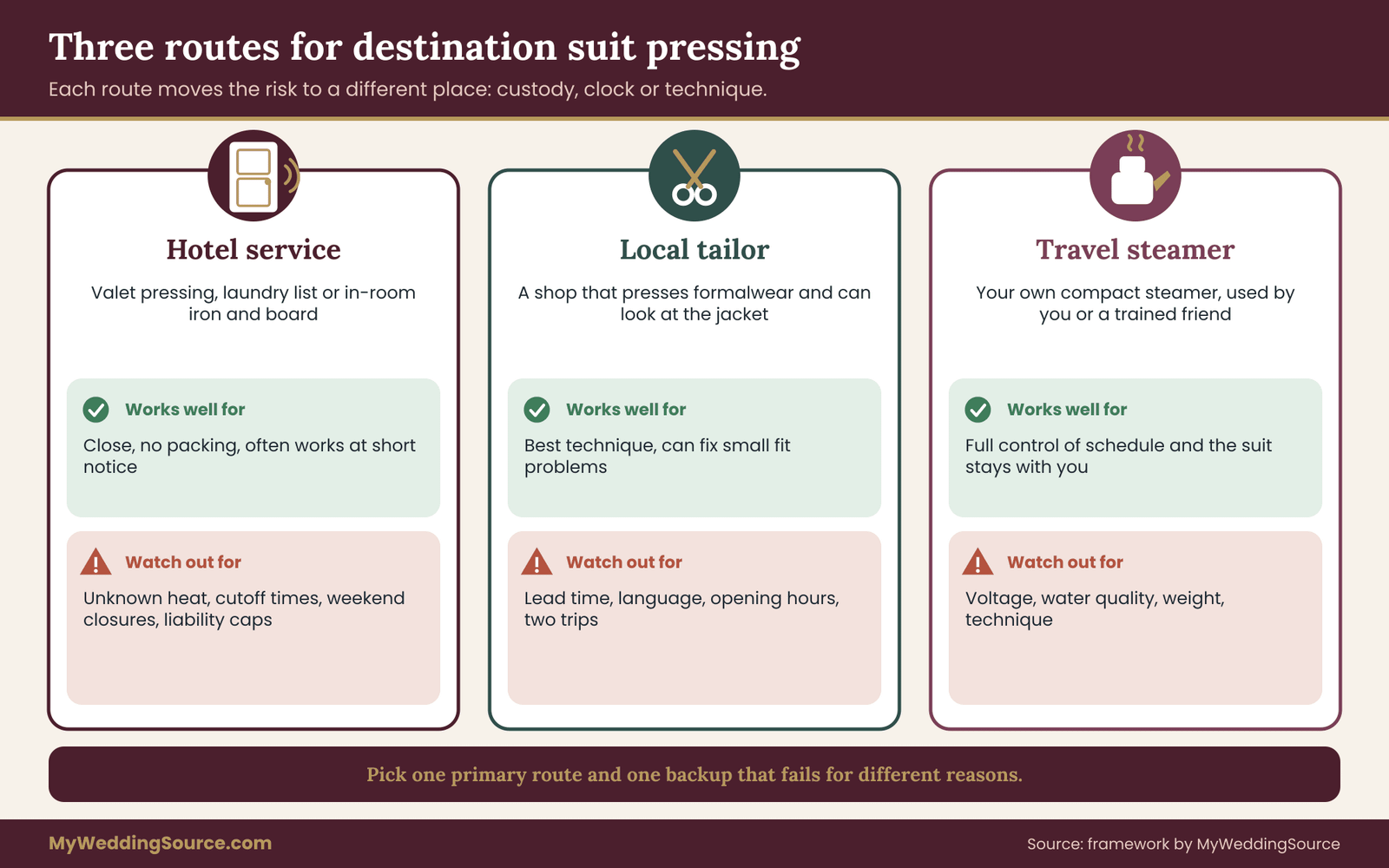
Hotel route. You use the hotel’s valet or laundry service, or the in-room iron and board. It is close, it needs no packing and it often works on short notice. The trade-off is that you rarely know who does the work, what temperature they use or how liability is handled if something goes wrong.
Tailor route. You find a local tailor or a cleaner who does suit pressing only. This usually gives the best technique, and a good tailor will treat a lapel with the respect it needs. The trade-off is lead time, language, opening hours and the need to find someone trustworthy in a place you do not know.
Travel steamer route. You pack a compact steamer and do the work yourself, or hand it to a groomsman who has practiced. It gives you control and flexibility. The trade-off is voltage, water, weight in the bag, time and your own technique, plus the rules about carrying a steamer on a plane.
None of the three is best in every situation. The right choice depends on the fabric, the number of suits, the distance from the hotel to the venue, and the lead time you have. The comparison later in this guide turns that into a scorecard for suit pressing decisions.
What this guide does and does not cover
This guide covers suits, meaning jackets, trousers and vests in wool, wool blends, linen, cotton and similar fabrics, plus the shirts and ties that travel with them. It also applies to a suit worn by any member of the wedding party, including a partner who chose a suit rather than a dress. The same suit pressing logic holds for each of them.
It does not cover the wedding gown, which has its own risks and its own handling rules. For the broader set of garments, shoes and small items that travel to a wedding, the wedding day accessories planning guide lays out compatibility, movement and emergency backups. Here the focus stays narrow: the suit pressing decision, the people involved and the clock.
Who should own the suit pressing decision
Pick one person to own the decision, and make it someone who will be physically present. In many wedding parties that is the best man or another close friend, in other cases the partner who is wearing the suit, or a planner if you have hired one. The owner does three jobs: keeps the deadline log, confirms every handoff, and decides when to use the backup.
Naming an owner sounds bureaucratic, but it prevents a very common failure. Everyone assumes someone else asked the hotel about the laundry cutoff, and nobody did. One name on the log removes that assumption. It also gives the hotel, tailor or steamer a single contact, which cuts down on conflicting instructions.
A short vocabulary to use out loud
When you talk to a hotel desk or a tailor, plain phrases get better results than technical ones. Say “steam only” when you want no iron contact. Say “press with a cloth” when you want the iron to touch only a protective layer. Say “no dry cleaning” if the item is only wrinkled, not dirty. Say “trouser creases and jacket touch-up” for a typical job. And say the time you need the suit back, not the time you would like it, because the first is a deadline and the second is a wish.
If you have a language gap, write the phrases down in the local language using a translation tool and show them on your phone. A written instruction avoids the mistake of a confident nod that means nothing. Always take a photo of the suit and the claim ticket at drop-off, so you have a record of condition and a time.
Fabric and packing: reducing the suit pressing you need
The cheapest wrinkle to fix is the one that never forms. Before you compare routes, read the label, understand the fabric and pack the suit so that it arrives needing a light touch rather than a rescue. This section covers both, because a good packing method can turn a hard suit pressing job into a simple steaming job.
Read the label before you choose a route
In the United States, the Federal Trade Commission’s Care Labeling Rule requires most clothing to carry care instructions, and the label should give at least one safe method of cleaning. Read it as a ceiling, not a recipe. A label that says “dry clean only” tells you the maker tested that method, but a suit with that label can often be steamed lightly. A label that says “do not steam” or shows a crossed-out iron is different. Treat it as a hard stop for that method and ask the maker or a tailor before anything else.
Look for three things on the label inside the jacket and on the trousers. First, the fiber content, which tells you how the cloth reacts to heat. Second, the iron symbol, which shows whether suit pressing is allowed and at what heat level. Third, any note about steaming. If the label has worn off, a tailor can usually identify the fiber with a quick look and touch, but you should photograph what remains before you travel.
Take a clear photo of every label and keep it with the deadline log. If you hand the suit to a hotel or a tailor abroad, showing the photo is the fastest way to explain the limits. It also protects you if the language is a barrier.
Fabric by fabric: how each one behaves
Different cloths forgive different mistakes. The infographic below sets out a rough heat guide, and the notes after it explain the reasoning.
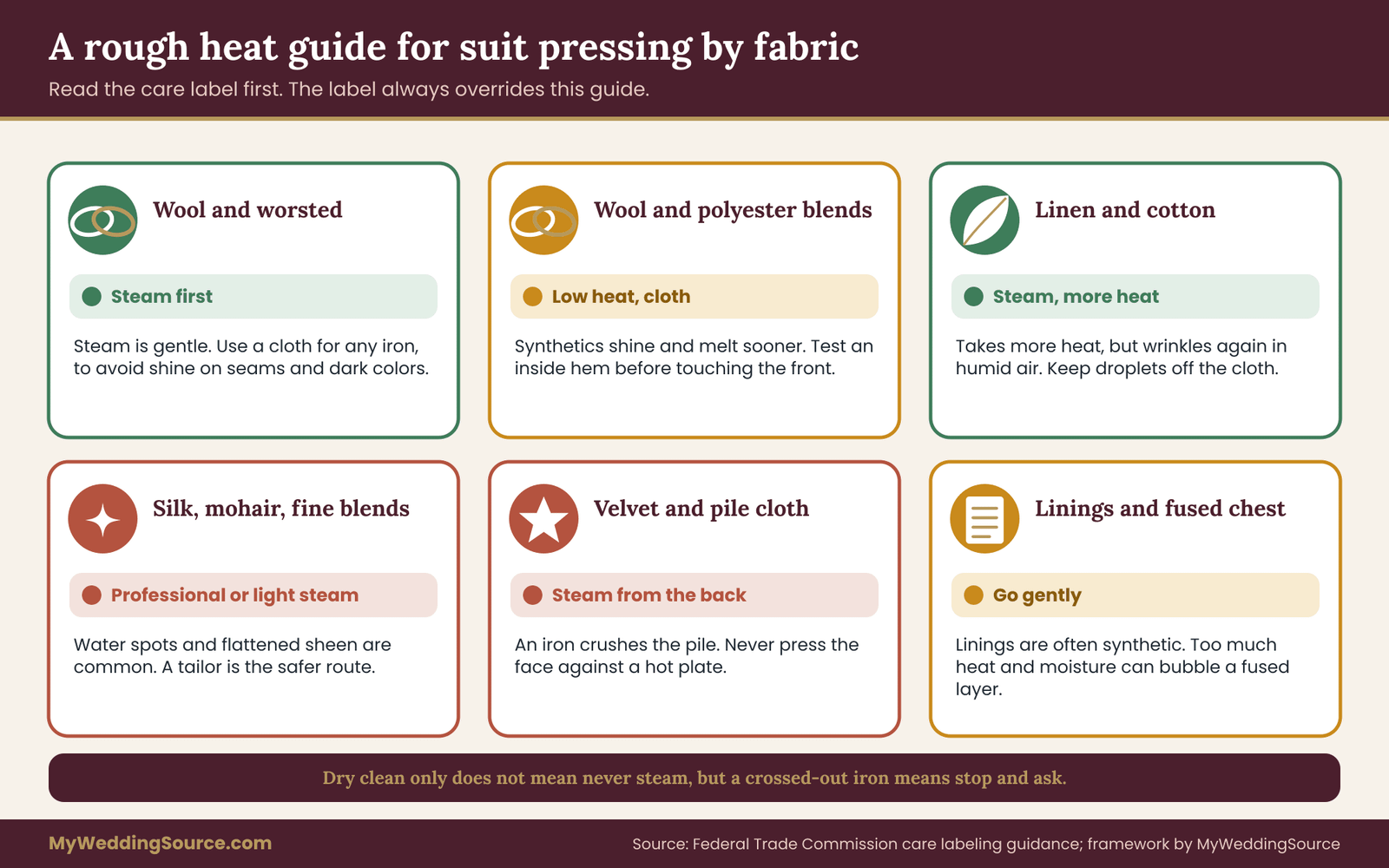
Wool and worsted wool. The classic suit cloth. Wool relaxes well with steam and often recovers on a hanger overnight, which is why many tailors prefer steaming to ironing. Direct iron contact can leave a shine, especially on dark colors and on seams, so a pressing cloth is essential if an iron is used at all.
Wool blends with polyester. These recover from folding quickly but can melt or shine at a lower heat than pure wool. Use low heat, a cloth and a test on an inside hem. Synthetic fibers are the ones most likely to be damaged by a hotel iron set too hot.
Linen and linen blends. Linen wrinkles by nature, and many destination grooms choose it knowing that. It takes more heat than wool, but it wrinkles again in minutes in humid air. A tropical beach wedding in linen will look relaxed, not crisp, and it helps to accept that in advance rather than chasing crispness.
Cotton and cotton blends. Common in summer suits. Cotton responds well to steam and moderate heat, but it can water-spot if droplets fall from the steamer. Keep the steamer head moving and wipe condensation before it lands on the cloth.
Silk, mohair and fine blends. These need caution. Water droplets can leave marks on silk, and mohair has a sheen that heat can flatten. For these, a professional who handles formalwear is the safer path, or very light steam at a distance with a test first.
Velvet and textured cloths. Velvet crushes under an iron, because the pile flattens. Steam from the back or from a distance, and never press the face against a hot plate.
Linings, interlinings and trims. The outer cloth is only part of the jacket. The lining is often synthetic and may be more heat-sensitive than the shell. Many jackets also contain a fused or canvas layer inside the chest and lapel, and too much moisture and heat can loosen a fused layer and cause bubbling. This is why suit pressing of a jacket is a more delicate job than pressing trousers.
A simple fabric gate
Use a three-step gate before every suit pressing job. Step one: is the fiber known and is steam allowed on the label? Step two: does the suit have a feature that raises risk, such as velvet, a shiny weave, a fused lapel that looks tired, or a lining you cannot identify? Step three: how hard is the wrinkle?
If the answers are “known, no risk feature, light wrinkle,” a steamer or a gentle hotel iron with a cloth is reasonable. If any answer is “unknown,” or if the suit is a delicate cloth, move toward a tailor. If the label forbids steam, ask a professional before you let anyone near it. A gate takes two minutes and prevents most suit pressing accidents. Run it for every suit, because suit pressing risk belongs to the garment, not to the wedding.
Packing so the suit arrives in better shape
Wrinkles come from folding, compression and moisture. Pack to reduce all three.
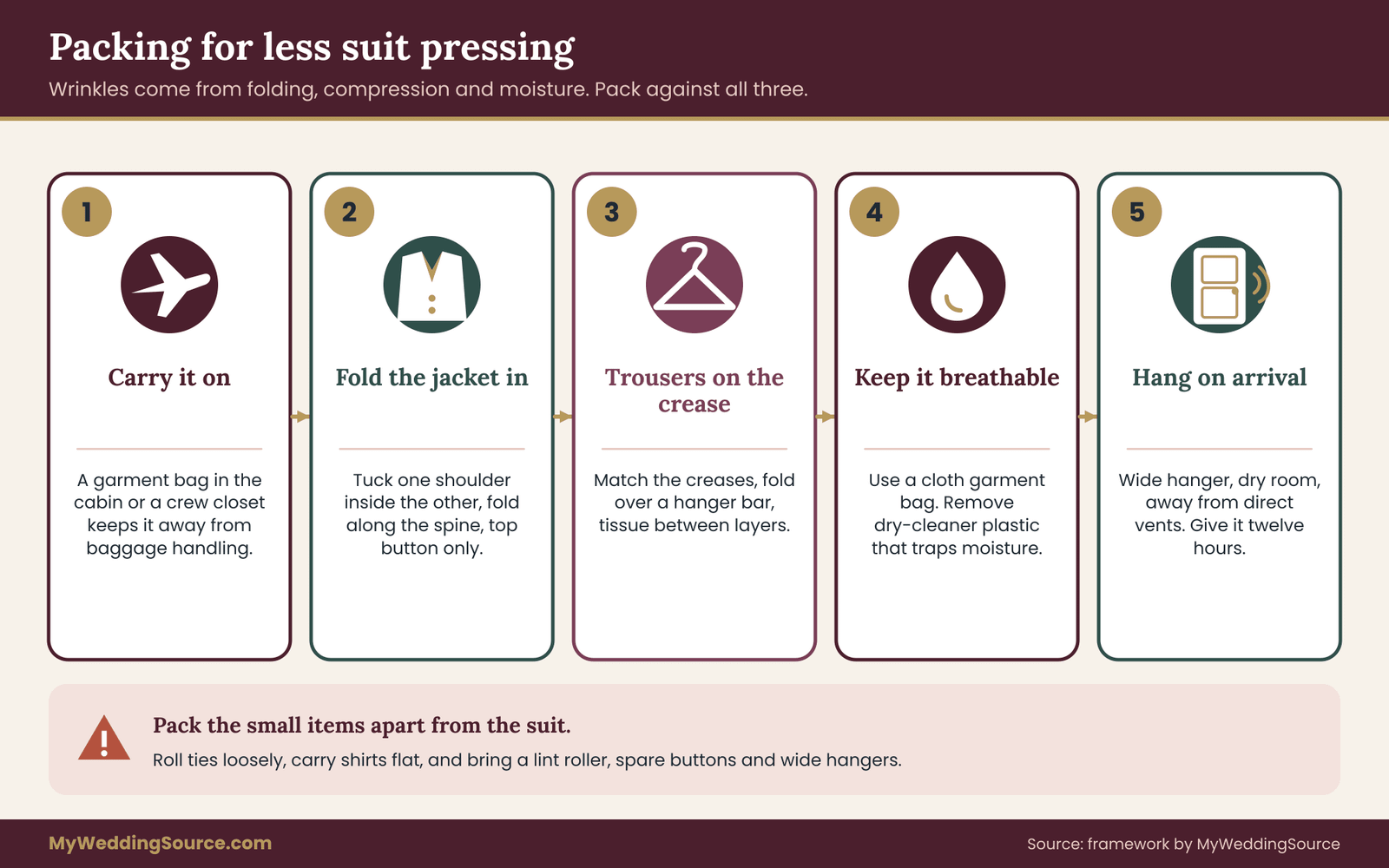
Carry the suit on if you can. A garment bag that fits in the overhead bin or a closet keeps the suit away from baggage handling. Check the airline’s rules for garment bags, since some airlines allow them in a crew closet and others treat them as carry-on size items. If the suit must be checked, a hard-sided case with a good fold reduces crushing, but you are accepting more risk, including delay.
Use the jacket shoulder fold. Turn one shoulder pad inside out so it tucks into the other, then fold the jacket in half along the spine. The shoulders hold their shape, and the fold lands on the back, where creases are hardest to see. Keep the jacket buttoned at the top button only so the front lies flat.
Fold the trousers along the crease. Lay them flat, matching the creases, and fold over the bar of a hanger or over the jacket. Tissue paper or a thin dry-cleaner bag between layers reduces friction and cuts down on sharp new creases.
Keep it dry. A plastic dry-cleaner bag can trap moisture if the suit is slightly damp, and moisture breeds wrinkles and odor. Use a breathable garment bag for travel and remove any plastic wrap on arrival.
Pack the small items separately. Shirts, ties, pocket squares and belts travel better apart from the suit. A tie should be rolled loosely, not folded, to avoid hard creases in silk. Ironing a collar in a rented room is far easier than rescuing a crushed jacket.
Photograph the suit before you leave. A quick photo of the front, back and lining gives you a baseline. If you later suspect damage in transit or at a suit pressing service, you can show what the suit looked like at the start.
The hang-first rule
The most effective suit pressing step costs nothing: hang the suit as soon as you arrive. Hanging is the first step of any suit pressing plan. Unpack it right away, remove any plastic, put the jacket on a wide-shouldered hanger and the trousers on a clip hanger by the cuffs. Wool in particular is springy. Many ordinary travel wrinkles fall out within a day if the suit simply hangs in a dry room.
How long should it hang before you judge? Give it at least twelve hours, and if you arrive two or three days before the wedding you should have a full day. A hanging suit that still looks rough after a night has real wrinkles, and that is when you move to the route you chose. A suit that has improved needs far less work, and sometimes none. Skipping unneeded suit pressing is the safest suit pressing of all.
Avoid hanging the suit in direct sun, near an air conditioner outlet that blows hard, or in a closet that smells of smoke or damp. Hotel closets sometimes have hangers too narrow for a jacket, and a thin wire hanger will leave shoulder dimples. If the room has only thin hangers, ask the front desk for wider ones, or bring a pair of your own, as they weigh little.
Humidity and the bathroom trick
Many people hang a suit in the bathroom while a hot shower runs. This can relax light wrinkles, but it is uncontrolled. Droplets can land on the cloth, the humidity can linger, and the suit can pick up the smell of the room. If you use it, keep the suit well away from the water, close the door and let it hang afterward in a drier room until it is fully dry. It is an emergency measure for light wrinkles, not a plan.
In a humid climate, a pressed suit can soften again quickly. Linen and cotton suffer most. This does not mean the suit pressing failed. It means that you should time the final touch-up as late as possible and keep the suit in an air-conditioned room until it is time to dress.
How the fit connects to suit pressing
A suit that fits well also wrinkles less visibly, because the cloth is not strained at the seat, the elbows or the back. If an alteration is still pending, finish it at home before you travel. The wedding dress fit and alterations guide explains fitting timelines for garments in general, and the same logic applies to suits: leave no alteration to the final week, because a tailor abroad cannot reproduce a fit they have never seen.
Pack a small suit pressing kit
A small kit weighs little and covers most small problems that come up between suit pressing sessions. Pack a lint roller, a soft clothes brush, a few safety pins, spare buttons that match, a small sewing kit, a stain-pen the label allows, a clean white cotton cloth for use as a pressing cloth, and a pair of wide hangers. If you bring a steamer, add a short travel extension cord only if it is rated for the steamer’s wattage. Leave out anything that depends on liquids that airport screening may remove.
Hotel suit pressing: what the service really does
Hotel suit pressing is the default for most travelers, because it is already in the building. It is often the right choice, and sometimes it is a poor one. The difference lies in the questions you ask before you hand over the suit. Good hotel suit pressing starts with those questions, not with the iron.
Three kinds of hotel help
Hotels usually offer some mix of three things, and each carries different risk.
In-room iron and board. Many rooms have a small iron and a board, or can send them up on request. This keeps the suit in your hands, so custody risk is low. The risk moves to the iron itself: the temperature dial may be vague, the soleplate may be dirty or scratched, and the water tank may leak rusty drops. If the iron is the only tool, test it on an inside hem with a cloth first.
Valet or laundry suit pressing. You fill in a laundry list, hand over the suit and get it back at a set time. This removes your labor but also removes control. The person pressing may handle dozens of garments a day, use a commercial press at a fixed setting and work from a short instruction on a tag.
Concierge referral. The desk may know a nearby tailor or cleaner and arrange pickup. That turns the hotel into a middleman, and it can be the most useful form of help in a town you do not know, as long as you confirm who is doing the work and when the suit will come back.
Questions to ask the hotel desk
Ask these questions in writing if you can, a few weeks before you travel, and again in person when you arrive.
First, ask whether the hotel offers pressing only, and whether that can be done without dry cleaning. A clear yes saves a lot of confusion. Second, ask for the cutoff time for same-day service, and for the cutoff for next-day service. A request placed ten minutes after the cutoff may wait a full day.
Third, ask whether the service runs on the day you need it. Many hotel laundries reduce or stop service on Sundays and public holidays, and in some countries on local rest days. The weekend of your wedding is exactly when you cannot afford to find this out late.
Fourth, ask who performs the work: an in-house team or an outside contractor. Fifth, ask what the express surcharge is, because last-minute service is often priced at a higher rate. Sixth, ask how the hotel handles damage, and whether the laundry terms limit liability. Many hotels print a cap on their responsibility for garments in the guest directory or on the laundry list. Read it before you sign.
Reading the laundry terms
The small print on a hotel laundry list matters more than most guests think. Some lists state that the hotel is not responsible for color changes, shrinkage or damage caused by care label problems. Others set a maximum payment per item. These terms are common in the industry, and they are not a sign of a bad hotel, but they change how much risk you should accept.
If the terms limit liability to a small amount, and the suit is worth much more, that is a signal to choose a route in which you keep more control. It does not mean you cannot use the hotel. It means you should use it for lower-risk jobs, such as trousers, shirts and a simple steam, and keep the jacket in your own hands.
Do not rely on a verbal promise. If a manager agrees to a special arrangement, ask for it in an email or a written note and keep a copy in the deadline log. A friendly promise from a night shift employee is not a record.
What to put on the instruction tag
A short written instruction attached to the suit reduces mistakes. Include the guest name and room number, the date and the time you need it back, the words “steam or press with cloth, low heat, no dry cleaning,” and a note about any risk feature, such as a delicate lining or a pale color. If the label forbids steam or heat, add that too.
Attach the care label photo if the desk will print it, and keep a copy on your phone. Take a photo of the suit hanging in its tag before you hand it over, and photograph the claim ticket. If the item is picked up from your room, make sure the staff member signs or notes the time on the list. These small records are the foundation of the deadline log described later.
Timing: the cutoff chain
The real risk with hotel suit pressing is rarely the iron. It is the clock, and clock risk is the quiet failure of most suit pressing plans. A request passes through a chain: you call the desk, the desk logs the request, housekeeping or a runner collects the suit, the laundry presses it, a runner returns it, and the desk delivers it to your room. Each link can slip by an hour, and the total can slip by half a day.
Work backward. If you need the suit in your room by noon on the wedding day, and the laundry’s same-day cutoff is nine in the morning, then the suit should be in the laundry’s hands the evening before, not on the morning of. Add a buffer for a second pass if something is wrong.
A common mistake is to treat the quoted turnaround as a promise. It is a target, and the deadline log should show a promised time and a hard stop that is earlier than the moment you actually need the suit. Treat every suit pressing quote the same way.
Cost logic without guessing numbers
Hotel suit pressing prices vary widely by property and country, so this guide does not quote them. Use the logic instead. Ask for the price per piece in writing, for both standard and express service. Count how many pieces need work: a jacket, trousers and a vest are three pieces, not one suit, and the price may be per piece.
Multiply by the number of suits in the party. If four groomsmen each need a jacket and trousers touched up, the total can grow quickly, and at that point a steamer that you carry and share can cost less than hotel service, even after counting the weight in your bag. If only one suit needs work, hotel service can be the cheapest and simplest. The cost comparison comes down to the number of garments and the surcharge for urgency, so ask for both numbers before you decide.
When the hotel route works well
Hotel suit pressing works best in five situations. The suit is made of a forgiving fabric such as wool or a wool blend. The wrinkles are light. The hotel has a clear process and a stated turnaround. You have at least a day of buffer. And the stakes of an imperfect result are low enough that you can fix it with a steamer if needed.
It also works well for shirts, trousers and other simple pieces, even when you want to handle the jacket yourself. Many couples split the job: the hotel presses shirts and trousers, and a steamer or tailor handles the jackets. This reduces the number of items at risk while keeping the work manageable.
When to avoid the hotel route
Avoid relying on the hotel for suit pressing in four situations. The fabric is delicate, such as silk, mohair or velvet. The suit is expensive or irreplaceable, such as a family heirloom or a custom piece. The hotel cannot confirm who does the work or what temperature is used. Or the timing leaves no buffer, such as a same-day request on the morning of the wedding with a noon cutoff already passed.
In these cases, move the suit to a tailor or handle it yourself with a steamer. If the hotel is the only option, ask to supervise the iron setting or to press it yourself in a quiet room with a cloth. Many hotels will allow it if you ask politely and explain that you only need a few minutes with the board.
Guest hotels and the wedding party
If the wedding party stays in the same hotel, the laundry can be overwhelmed. A dozen guests requesting suit pressing for the same morning is a real possibility. Coordinate the requests: submit them together the day before, ask the desk to confirm the plan, and stagger the return times so that the groom’s suit is not queued behind everyone else’s.
If the wedding party stays in several hotels, give each person a copy of the plan. The guide on coordinating wedding guest hotels across budgets and mobility needs covers the wider issue of lodging logistics, and the suit pressing question can be added to the questions you already ask a hotel about early check-in, luggage storage and room blocks.
A script for the front desk
A short, clear script helps. You might say: “I have a wool suit that needs light suit pressing before a wedding on Saturday at four. I need it back by noon. Can you steam or press it with a cloth, with no dry cleaning? What time do you need it, and what is the cost? Who will do the work, and is the service running on Saturday?” Then write down the answers, the name of the person and the time of the call.
If the answers are vague, treat that as information. A hotel that cannot tell you the cutoff or the process is a hotel where the route has a weak point, and you should line up a backup. A hotel that answers clearly, in writing, is a good primary route for the right suit.
Tailor or dry cleaner abroad: suit pressing with a local expert
A good tailor treats a suit as a built object. They know where the canvas sits, how a lapel is rolled and how much heat the cloth will take. That skill is the main reason to choose a local professional for suit pressing, and the main risk is finding the right one in a place you do not know. Tailor suit pressing is the route that rewards advance research.
What a tailor does differently
A tailor or a formalwear specialist usually presses with a combination of steam, a pressing cloth and shaped tools. They use a ham or a sleeve board to press curved areas without flattening them, and they work the lapel from the back so the roll stays soft. A high-volume cleaner may use a large steam press that applies the same pressure to every garment, which is quick but less forgiving on a structured jacket.
This does not mean a cleaner is always worse. Many cleaners have skilled pressers, and in some places the best suit pressing is done by a family laundry that has handled suits for decades. The point is to find out how the work will be done before you leave the suit there, and to prefer a shop that takes a few minutes to look at it.
How to find a trustworthy shop
Start with people, not search results. Ask the venue coordinator, the wedding planner or the hotel concierge who they use for formalwear, because venues that host weddings regularly tend to know a reliable tailor. A shop that already serves wedding parties understands deadlines and will be less surprised by a Friday request.
If you search online, look for shops with recent photos of suits, clear opening hours and reviews that mention pressing or tailoring rather than only general laundry. Read reviews with some skepticism: a handful of detailed, specific comments is more useful than a high number of short ones. Check the address on a map and confirm that it is reachable from your hotel without a long trip.
If you have time before the trip, send a short message from home with the request. A reply that is prompt, specific and clear about the price and the time is a good sign. A reply that avoids the question is a warning.
The visit, step by step
Visit in person a day or two before the wedding if you can, rather than relying only on messages. Bring the suit, the care label photos and a written instruction in the local language if you need one. Ask the tailor to look at the suit and tell you what they would do. Their first questions show their experience: a good one will check the label, feel the fabric and ask about the lining.
Ask for the work in plain terms: pressing only, steam preferred, no cleaning. Ask for the price and the pickup time, and ask them to write both on the ticket. Take photos of the suit and the ticket before you leave. If the tailor offers to deliver to the hotel, confirm the address, the room or desk and a named contact on your side.
Finally, ask what time the shop opens and closes on the days that matter, and whether they will be open on a holiday or local market day. In some places a shop may close in the middle of the day or for a full day each week. A wrinkled suit locked behind a shuttered door is the worst version of this plan.
Lead time and the double-visit rule
A tailor route needs more lead time than a hotel route, because it involves a trip to the shop and a return. Treat it as two visits: a drop-off and a pickup. If you can, schedule the drop-off at least two days before the ceremony and the pickup the day before, so you have time to correct a problem.
The double-visit rule is simple. Never plan a tailor pickup on the morning of the wedding unless you also have a backup. A single late pickup, a traffic problem or a closed shop can cascade into a missed photo window. If the shop cannot guarantee a pickup the day before, treat the tailor route as a secondary plan and rely on another route for the primary.
Language and communication
Language gaps cause more suit pressing mistakes than any machine. Even with a shared language, terms like “press,” “iron” and “steam” can mean different things in different places. In some regions “pressing” suggests a full dry-clean-and-press, and “ironing” may mean a hand iron at high heat.
Use a translation app to build a short written instruction and read it back to confirm. Show photos of what you want, such as the trouser creases and the soft lapel roll. Point to the lapel and make a motion to show that it should not be flattened. A calm, friendly approach and a clear written note generally outperform a long verbal explanation of your suit pressing needs.
If the shop cannot communicate clearly with you, consider asking a local contact to call on your behalf, such as the planner, the hotel concierge or a bilingual friend. The result is a shared understanding, which is the real goal.
Price and what you are paying for
Tailor prices vary by region and by the work. Rather than guess numbers, ask for a quote per piece and for any rush fee, and write it on the ticket. Compare it to the hotel’s price for the same job and to the cost of carrying a steamer. Count the full cost, including transport to and from the shop and your time.
Be wary of a quote that is far below the others without an explanation. It may reflect a high-volume steam press, a lower level of care or a surprise charge added later. At the same time, the highest quote is not automatically the safest. The better test is how the shop answers your questions about the process.
Dry cleaning is not suit pressing
Some shops treat suit pressing and dry cleaning as a bundle. For a suit that needs only wrinkle removal, cleaning adds cost, time and stress to the cloth. Repeated dry cleaning can dull wool and wear fused layers, which is why many tailors advise cleaning a suit sparingly. Say “pressing only” and confirm that the ticket says so, since a clear suit pressing request avoids a cleaning charge.
If the suit has a stain, that is a separate issue. A stain is easier to treat early, but a stain treatment right before a wedding is risky if the shop does not know the fabric. Ask a trusted tailor for advice, and consider the stain’s location. A small mark under the lapel may be less visible than a damp patch on the front of the jacket.
Check the work before you leave the shop
Inspect the suit at pickup, in good light, before you pay. Look at the lapels and the front of the jacket for shine, at the trouser creases for sharpness and alignment, at the sleeves for a double crease, and at the lining for marks. Check the buttons, the pockets and the seams. Feel the cloth for dampness: a suit that is still damp should not go into a bag.
If something is wrong, say so politely and immediately, while the work is fresh. A good shop will correct a light problem on the spot. This is why the double-visit rule matters, because a pickup the day before leaves time for a second pass. A suit picked up three hours before the ceremony leaves no such room. Plan tailor suit pressing for the day before, not the day of.
Respecting the tailor’s time
A tailor who works on a wedding suit abroad is doing you a favor, and a rushed, vague request makes it harder. Arrive with a clear request, a care label photo, an agreed time and a calm attitude. Offer to pay promptly and thank them. A little courtesy goes a long way, particularly in a small shop where the person you meet is also the owner.
If the shop declines the job because they cannot guarantee the schedule, take that as a helpful honest answer. A shop that says no clearly is easier to work with than one that says yes and misses the deadline.
When the tailor route works best
The tailor route works best when the suit is valuable or delicate, when the wrinkles are heavy, when you have at least two days of lead time, and when you have a recommendation from a source you trust. It is also the best choice for jackets, which are the hardest part of the suit to press well, and for fabrics that react badly to hotel equipment.
It works less well when time is tight, when the shop is far from the hotel, when language blocks communication, or when you cannot confirm the hours. In those cases, use the tailor for a quick look and rely on a steamer for the actual work, or keep the tailor route as the backup.
Tailors for alterations in an emergency
A tailor abroad can also solve small fit problems that appear on arrival, such as a loose button, a split seam or a hem that needs a quick adjustment. These are simple jobs for a skilled hand, and many tailors can do them in a short time. Ask whether they offer this service when you drop off the suit, and keep the contact in the log for the day itself.
The contact is also helpful for the groomsmen and other guests, since someone may have a suit problem on the day. A trusted local tailor with a phone number in your log is one of the best forms of insurance a destination wedding party can have, and it costs nothing to ask for the number when you visit.
Travel steamer suit pressing: power, water and technique
A travel steamer puts suit pressing in your own hands. It is light, quick to heat and gentle on most suit fabrics, which makes it popular with destination couples. It also adds three things to think about: electricity, water and your technique. Steamer suit pressing rewards preparation more than any other route.
Handheld, travel and garment steamers
Handheld travel steamers are small units with a tank that holds a few ounces to a cup or more of water. They heat in a minute or two and are easy to pack. They produce less steam than larger models, so they suit light wrinkles and touch-ups better than heavy creases.
Compact garment steamers have a larger tank, a hose and sometimes a pole. They produce steady steam and cope with several suits in a row. They are bulky, but a wedding party that shares one can often justify the space.
Cordless or battery steamers avoid outlets, but they use rechargeable lithium batteries, and airlines have rules for those. Check the Federal Aviation Administration’s guidance on batteries in carry-on and checked bags, and the Transportation Security Administration’s page on what you may bring, before you pack one. Rules can change, so confirm them close to the travel date.
Voltage and plugs
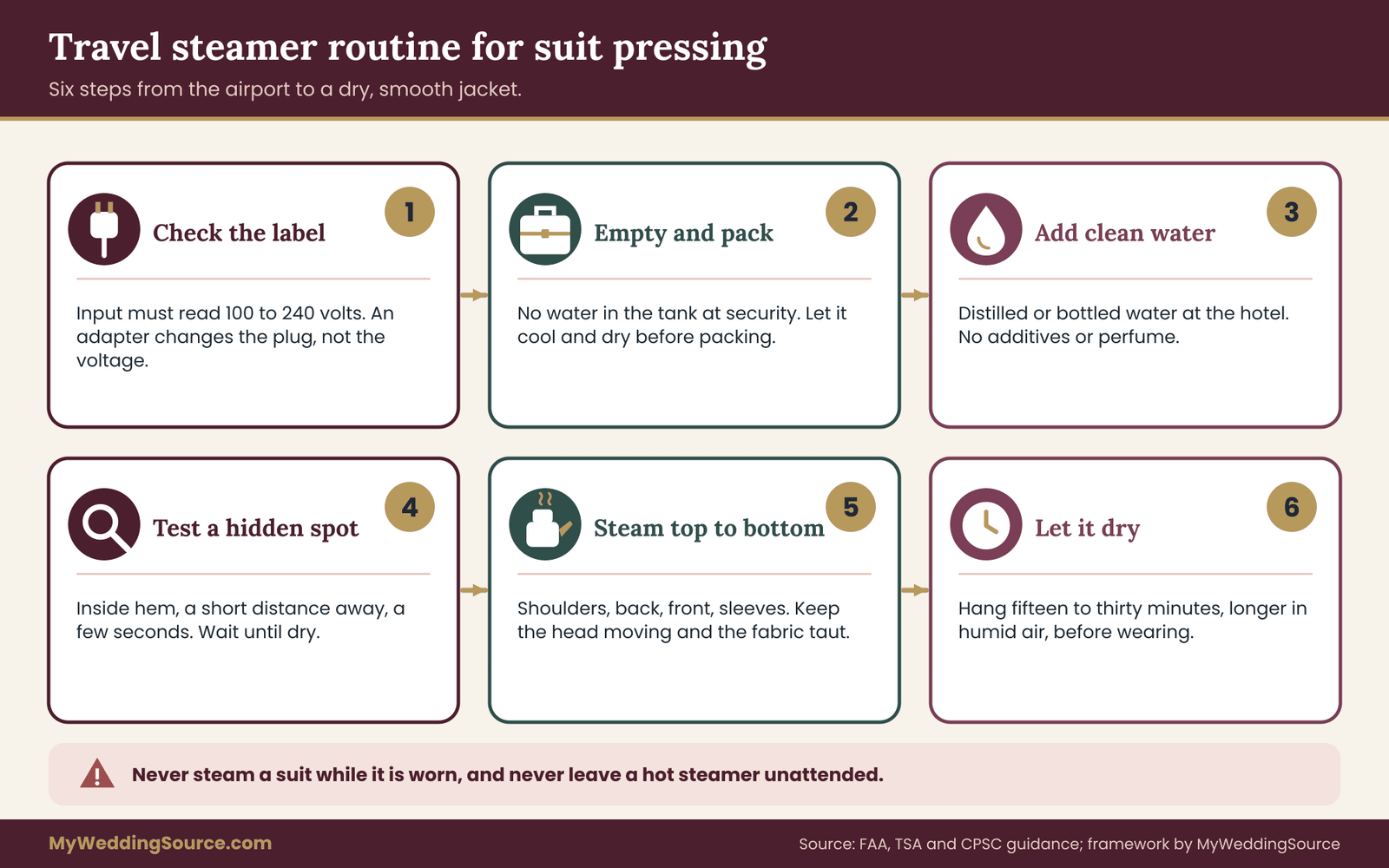
Electricity is the most common reason a travel steamer fails abroad. In the United States, outlets supply a lower voltage than in many other countries, and a device built only for the lower voltage can be damaged or destroyed on the higher one. The label on the steamer shows the accepted input, such as 100 to 240 volts, which means it is dual voltage and only needs a plug adapter.
If the label shows only one voltage, do not plug it into a mismatched outlet. A plug adapter changes only the shape of the plug, not the voltage. A voltage converter or transformer can work, but heating devices draw a lot of power, and a small converter can overheat. If the steamer is not dual voltage, buy a dual-voltage model before the trip, or choose another route.
Also check the wattage. A steamer rated at a high wattage can trip a hotel room’s circuit if other devices are running. Unplug the kettle and hair dryer before you start, and avoid cheap extension cords. Product safety agencies such as the Consumer Product Safety Commission publish guidance on safe use of small appliances and cords, and it is worth a read before you travel.
Water: the quiet problem
A steamer is only as clean as its water. Tap water in some places is hard, and minerals can leave scale inside the tank and spit rusty or white droplets onto the cloth. In other places the water may be unsafe to drink, and heated vapor from untreated water is not what you want near a white shirt.
Use distilled water if you can find it, or bottled water if you cannot. Do not carry water through airport screening in the tank. Empty it fully before you leave home, let it dry, and refill at your destination. If the steamer spits, stop, hold it away from the suit, and run it over a towel until it steams cleanly.
Never use perfumed additives, fabric softener or anything not listed in the manual. Additives can clog the unit and stain the cloth.
The test patch
Before you steam the suit, test the method on a hidden spot, such as the inside of a trouser hem or the underside of the jacket facing. Hold the steamer a couple of inches away, steam for a few seconds and watch the cloth. Check that the fabric does not shine, darken, spot or pucker. Wait until it is dry before you judge.
Do this test at home if you can, and repeat it briefly at the destination because the water may differ. A test takes a minute and tells you whether the fabric and your tool are compatible. If the patch shows any change, stop and move to a different route.
Technique, step by step
Hang the jacket on a wide hanger on a door or a rail, with room around it. Let the steamer heat fully before you start, because a cold steamer spits.
Work from the top down. Hold the head close to the cloth but not touching it, and move steadily, letting the steam relax the fibers. Use your free hand to pull the fabric lightly and keep it taut, since tension helps the wrinkle fall out. Do the shoulders and the back first, then the front, then the sleeves, working from the shoulder to the cuff.
Steam the inside of the jacket as well, since steam passes through the cloth and relaxes it from behind. This is a gentle way to treat the lapel roll and the chest area. Avoid steaming the face of the lapel from very close, which can flatten the roll.
For trousers, hang them from the cuffs or a clip hanger, and steam each leg from the waist to the hem, pulling lightly. Steam alone will soften wrinkles but will not restore a sharp crease. If the crease matters, line up the seams and press the crease gently with a pressing cloth and a low-heat iron, or accept a softer crease that a tailor can sharpen.
Let the suit dry fully on the hanger before you wear it, ideally for at least fifteen to thirty minutes, and longer in humid air. A damp suit wrinkles again as soon as it is worn.
What not to do with a steamer
Never press the steamer head against the cloth for long. Direct contact with hot metal or very close steam can create shine and water spots. Never steam a suit while it is on a person, because the heat and the vapor can burn skin. Never steam silk ties from a close distance, because droplets leave marks.
Do not steam over buttons with a metal shank for long, since they get hot. Keep the steamer upright to avoid spitting, and never leave it running unattended on a hotel bed or carpet. Burns from hot steam are a real hazard, and the Centers for Disease Control and Prevention publishes basic first aid guidance for burns that is worth knowing before you travel.
Fire and room safety
Hotel rooms have smoke detectors that steam can trigger, and a steam cloud near a detector can set off an alarm. Use the steamer in the bathroom with the fan on, or near an open window. Keep the cord away from water and from walkways, and switch off and unplug the unit when you are done.
Place a hot steamer on a stable, heat-resistant surface while it cools, and never pack it until it is fully cool and empty. A warm steamer in a suitcase can melt plastic and damage clothing.
Weight, space and sharing
A steamer adds weight to your bag, and airlines charge for overweight luggage. Weigh the steamer and cord before you decide. A shared steamer is a good solution for a wedding party, because only one person has to carry it and everyone can use it. Appoint a keeper, put it on the packing list, and decide where it will be during the weekend.
If your party is large, one steamer can become a bottleneck. Set a schedule for who steams when, starting with the suit that needs the most care and the person who needs to dress first. The deadline log in a later section helps with this.
Practice before you go
The best preparation is a rehearsal. Steam a spare jacket or an old suit at home, learn how long it takes, how the steam behaves and how long the cloth takes to dry. Practice on the trousers as well. A person who has steamed three garments at home is far more confident than one who opens the box in a hotel room the night before a wedding. Rehearsed suit pressing is calmer suit pressing.
If a groomsman will do the steaming on the day, let them rehearse too, and give them a short written guide that includes the label limits for each suit. The guide does not have to be long, and a one-page suit pressing note is enough. It should say the fabric, the maximum steam distance, the time to dry and the person to call with a question.
Steaming a rented suit
If the suit is rented, check the rental company’s terms before you steam or press it. Some companies ask renters not to alter or clean garments, and a damaged rental can lead to a charge. The wedding rental planning checklist explains what to ask a rental provider, and suit pressing rules belong on that list. If you are allowed to steam, test it as you would your own suit, and photograph the garment before and after.
The pressing-risk comparison: scoring all three routes
You now know how each route works. This section turns that into a repeatable decision. The comparison scores each route on four risks, then adds a fifth question about fallback. It is a method you apply to each suit, because a linen jacket and a wool tuxedo do not share the same answer. Treat it as a scorecard for suit pressing, not a verdict.
The four risks
Heat risk is the chance that the method damages the cloth through scorching, shine, melting or water spotting. It depends on who controls the temperature, the equipment and the fabric.
Custody risk is the chance that the suit is lost, delayed, mixed up or handled by someone you cannot reach. It rises whenever the suit leaves your sight.
Clock risk is the chance that the work is not done by the time you need it. It depends on cutoff times, opening hours, distance and how many handoffs the route has.
Skill risk is the chance that the person or tool does not do the job well, even without damage. A wrinkle left in or a crease in the wrong place is a skill problem.
A fifth question sits beside the four: what is the recovery path? If the route fails, how many hours and what resources do you need to fix it? A failure with a clear recovery path is a small problem. A failure with none is a crisis.

How the three routes usually score
Scores depend on the situation, so treat the following as a typical pattern rather than a rule.
The hotel route usually carries moderate heat risk, because you do not control the temperature, and moderate to high custody risk, because the suit leaves your room. Clock risk depends on the cutoff chain and can be high on weekends. Skill risk is variable. The recovery path is often short, because you can usually fall back to an in-room iron or a steamer.
The tailor route usually carries low heat risk when the shop is skilled, and moderate custody risk, because the suit goes to another building. Clock risk is moderate to high, because of travel and opening hours. Skill risk is low if you choose well. The recovery path can be long, since a closed shop leaves little else.
The steamer route usually carries low to moderate heat risk, since steam is gentle but your technique matters, and low custody risk, because the suit never leaves you. Clock risk is low, since you control the schedule. Skill risk depends on practice. The recovery path is strong, because a working steamer can fix most light problems in minutes, though a broken steamer or the wrong voltage can end that route abruptly.
Adjusting the scores for your suit
Scores change with the garment. For a delicate or expensive suit, raise the weight of heat and custody risk. A tailor or a careful steamer then gains, and the hotel loses. For a simple wool-blend suit and a tight schedule, raise the weight of clock risk. The hotel and the steamer gain, and the tailor drops.
For a linen suit in a humid place, the question changes, because linen will wrinkle again quickly. The best route is the one closest to the ceremony in time, which usually means a steamer in your own room. For a heavy jacket with a fused lapel, skill risk dominates, and a professional wins.
A simple way to apply this is to rank the four risks from most to least worrying for this suit, then choose the route that is lowest on the top two. Do not average the scores. One high risk in the wrong place can outweigh three low ones.
The two-route rule
Choose one primary route and one backup. The backup should fail for different reasons than the primary. If the primary is the hotel laundry, which fails through clock and custody risk, a good backup is a steamer, which has low custody risk and a schedule you control. If the primary is a steamer, which can fail through voltage or breakage, a good backup is a hotel in-room iron or a nearby tailor.
Two routes that depend on the same thing are not a real pair. A hotel laundry and a hotel in-room iron both depend on the hotel’s staff and equipment, and they may both be unavailable on a holiday. A steamer and a hotel iron both depend on the room’s power. Pair routes by their points of failure, not by their convenience.
Write the backup into the log, with the time you will switch to it. A backup that is decided only after the primary fails is usually a rushed one.
Costs without invented numbers
A fair cost comparison needs three numbers that only you can collect: the price per piece at the hotel and at a tailor, the price and weight of a steamer, and the number of garments. The cost of a failure matters too. If the suit is rented, a damage charge can exceed the cost of the whole suit pressing exercise. If it is custom made, the cost is the suit itself and the time to replace it.
Consider also the value of your time and calm. A route that costs a little more but removes a source of stress on the morning of the wedding may be worth it, and a cheaper route that adds a risky handoff may not be. These are judgment calls, and the point of the comparison is to make them visible.
A worked scoring example
Imagine a wool-blend navy suit that arrived with moderate wrinkles. The label allows steaming and low-heat suit pressing with a cloth. The hotel laundry has a noon cutoff for same-day service and is closed on Sundays, and the wedding is on Saturday afternoon. A tailor is twenty minutes away and open until evening on Friday.
The top two risks are clock and heat. The hotel scores high on clock risk because of the cutoff, so it fits only as a Friday-morning request with a buffer. The tailor scores well on heat but has travel risk, so a Friday drop-off with a Friday-evening pickup would work. The steamer scores well on both and is the best primary choice, with the hotel iron for the trousers as a backup.
That reasoning, which takes ten minutes, replaces a vague plan to find somebody to iron it. It is the whole point of planning suit pressing in advance. The result is a primary route, a backup and a set of times to put in the log.
The delivery deadline log: working backward from the ceremony
The second tool in this guide is a log of every handoff and every deadline. It sounds formal, but it is a single page of notes, and it is what protects you when the hotel runner is late or the tailor’s shop is closed. A suit pressing log turns hope into a schedule.
What the log contains
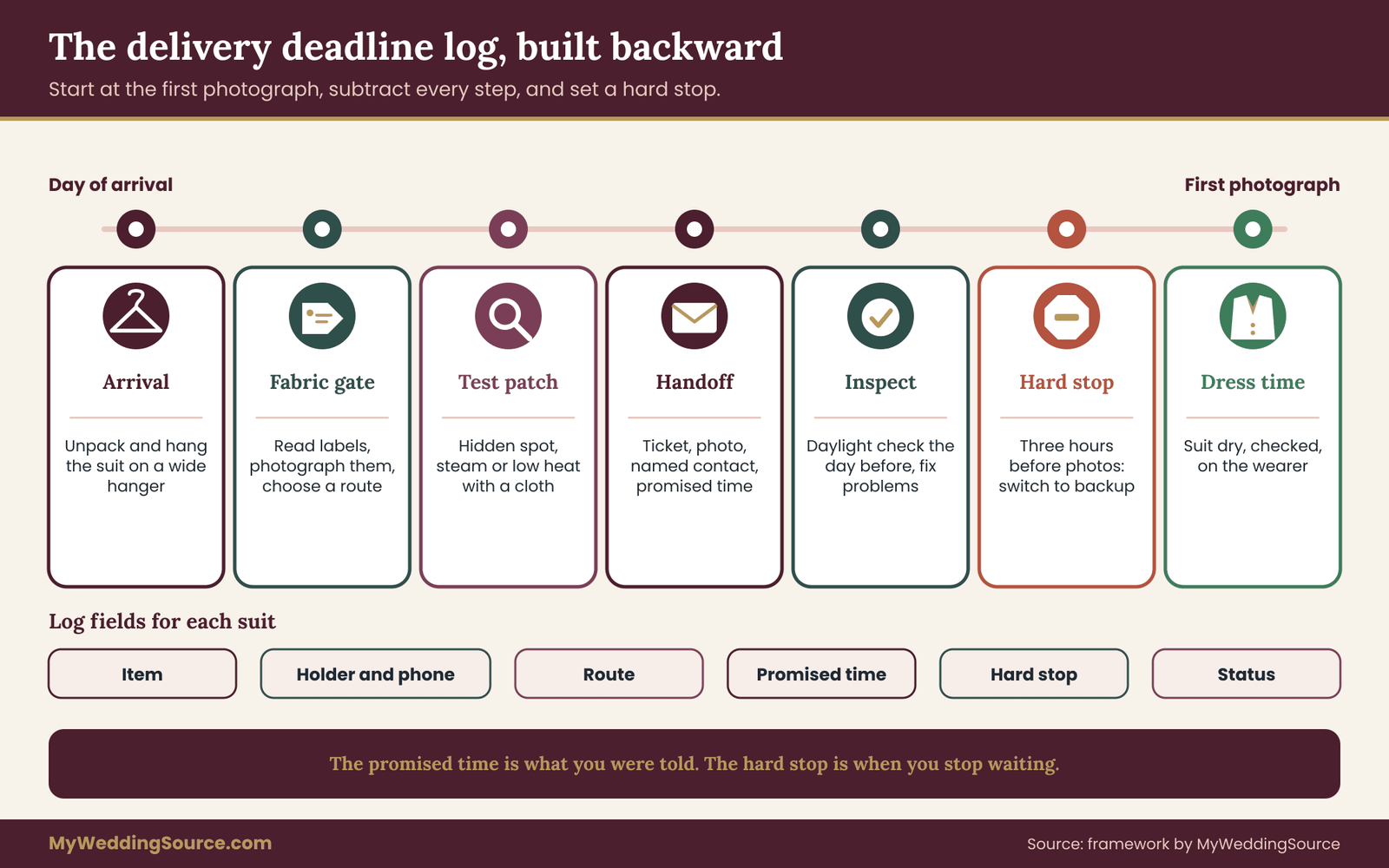
For each suit, the log has six fields. Item: which piece and whose. Holder: who has it right now, with a phone number. Route: hotel, tailor or steamer. Promised time: when the holder says it will be ready. Hard stop: the latest time at which you can still use the backup. Status: waiting, in progress, returned, checked.
The promised time and the hard stop are different on purpose. The promised time is what you were told. The hard stop is when you stop waiting and switch. A good rule is to place the hard stop at least three hours before the first photograph, or before the ceremony if there is no earlier photo session, so that a steamer can repair a problem in time.
Building the log backward
Start with the moment the suit must be on the wearer. If the first photographs start at one in the afternoon, that is the zero point. Subtract the time the person needs to dress and groom, often an hour or more. Subtract the drying and settling time, since a freshly steamed suit needs to hang until it dries. Subtract the time for a final inspection. Subtract the hard stop buffer.
That gives you the latest time the suit can be in your hands, checked and ready. Then work back through the route: delivery time, pressing time, pickup time, drop-off time. Each step gets a promised time and a buffer.
The milestones to log
Whatever the route, a typical destination log has the following milestones. The arrival hang is when you unpack and hang the suit, ideally the moment you reach the room. The fabric gate is when you check the label and decide the route. The test patch is when you try steam on a hidden spot.
The handoff is when the suit leaves your hands, if it does. The pickup or return is when it comes back. The inspection is when you check it in good light. The hard stop is the last moment to switch to the backup. And the dress time is when the wearer puts it on.
Some of these happen on the same day, and some days earlier. The more days between arrival and the ceremony, the more room you have to fix a problem. If you arrive the night before, you cannot use any route with a long lead time, which is worth knowing when you plan travel.
Who updates the log
The suit pressing owner updates it. Each time a handoff happens, they write the time, the person and the status. If a promised time passes without an update, they call, using the number in the log. This sounds like a lot of effort, but each call takes a minute and it prevents the usual failure, which is discovering a missed deadline at the last moment.
Share the log with one other person, such as the planner or a second groomsman. If the owner is delayed or ill, someone else can take over without starting from scratch. A shared note on a phone works well, and a printed copy is a good backup if the phone dies.
Time zones, public holidays and local customs
Check dates in the local time zone, not your own, and check whether the wedding weekend overlaps a public holiday, a local festival or a religious observance. Services may close or run on reduced hours. In some places, shops close in the afternoon, and in others, they do not open at all on a certain day of the week.
The U.S. State Department’s travel pages and the destination’s official tourism pages are a reasonable place to look for holidays, and a local planner will know the rest. Do this a month before the trip, and again a week before, because plans change.
The hard stop and the switch rule
The hard stop is useful only if you act on it. Write a plain rule: “If the suit is not in my hands by the hard stop, I switch to the backup without further waiting.” Decide this in advance, when you are calm, so that you do not argue with yourself later.
The switch rule also applies in the other direction. If the primary route has delivered a good result early, cancel the backup and enjoy the calm. A log that records both outcomes makes it easy to see where you stand at any moment.
Worked example: a Saturday ceremony abroad
The following example is invented to show how the tools fit together. The people, the town and the numbers are illustrative, not real, and your own situation will differ. It follows one groom, Marcus, who is wearing a navy wool-blend suit to a ceremony at four in the afternoon on Saturday, in a coastal resort town, with photographs starting at two.
The setup
Marcus and his partner arrive on Wednesday evening. Four groomsmen arrive on Thursday. The suit travelled in a carry-on garment bag. The label shows a wool-blend with a polyester lining, and the iron symbol allows low heat. Marcus photographed the label and the suit before leaving.
Before the trip, his best man, Luis, took the role of suit pressing owner. He emailed the hotel and learned three facts: the laundry takes same-day requests until nine in the morning, it does not run on Sunday, and it holds liability to a stated amount per item. The concierge recommended a tailor twenty minutes away, open until six on Friday. Luis also packed a dual-voltage travel steamer after testing it on an old jacket at home.
The fabric gate and the route choice
On Wednesday night, Marcus hangs the suit in a dry corner of the room, away from the air conditioner. On Thursday morning, Luis runs the fabric gate. The fiber is known, steam is allowed, and no risk feature is present. The jacket has moderate wrinkles across the back and a hard crease at the lap, which had been folded in the bag. The trousers have a soft crease.
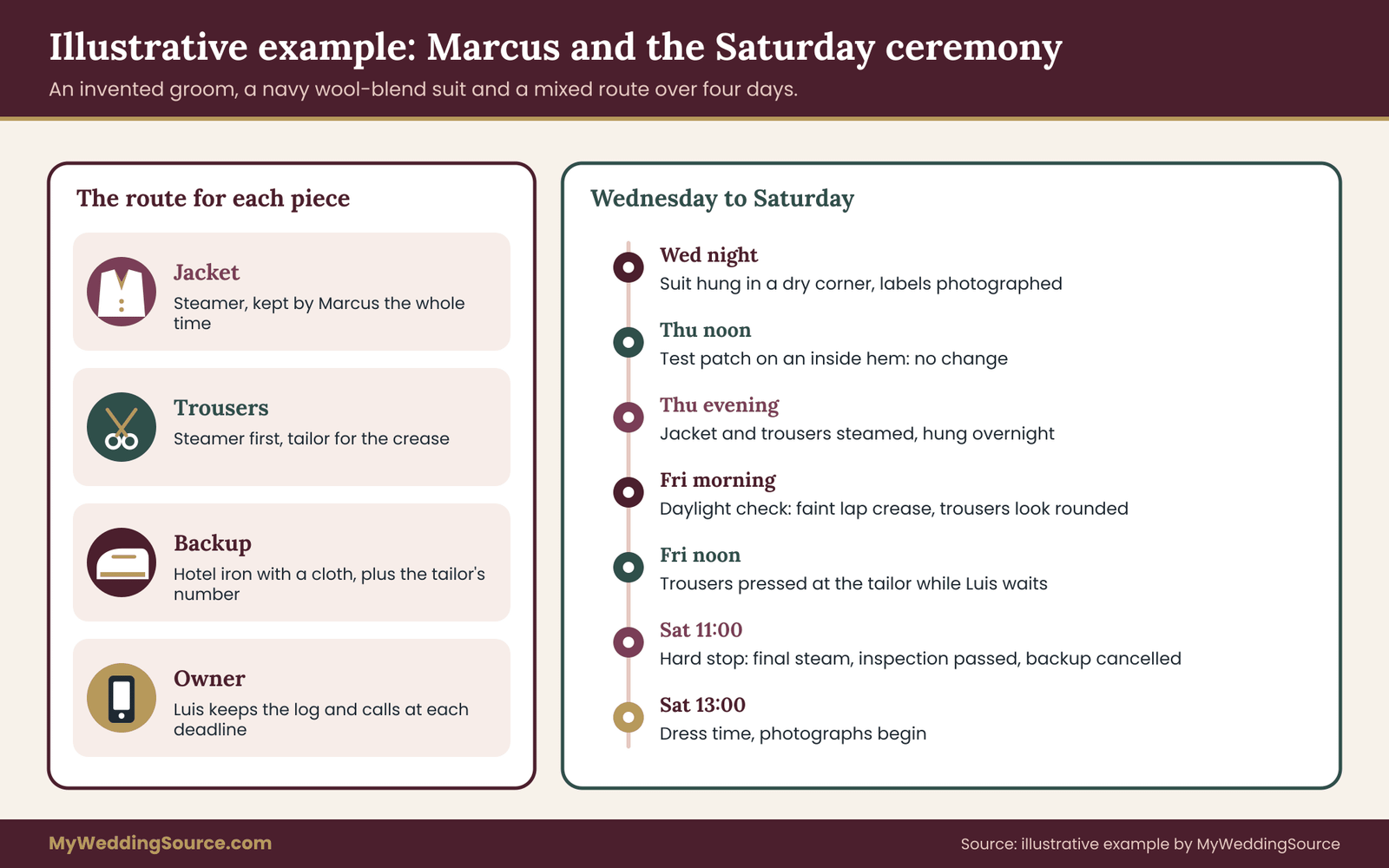
Luis scores the routes. Heat risk is acceptable for all three, but the polyester lining makes him cautious about a hotel iron at an unknown setting. Clock risk is high for the hotel on any day the laundry is closed, but fine on Friday. The steamer has low custody risk and a controllable schedule. He picks the steamer as primary, with the Friday tailor as backup for the trousers and a second look at the jacket.
The log
Luis writes the log on a shared note. Thursday: suit has hung for a day, label and photos saved. Test patch on the inside hem at noon, no change in color or texture. Thursday evening: steam the jacket and trousers, then hang overnight. Friday morning: inspect in daylight. Friday noon: hard stop one, because if the lap crease or trouser line is not acceptable, the suit goes to the tailor by two in the afternoon. Friday evening: pickup, if used. Saturday morning: final touch-up and inspection. Saturday eleven: hard stop two, with a final steam. Saturday one: dress time.
The hard stop on Saturday is set at eleven, three hours before the photographs, which gives Luis time to steam again and let the suit dry. Marcus’s phone and Luis’s phone both hold the log, and a printed copy sits in the garment bag.
What actually happens
On Thursday evening, the steamer works well on the jacket back and the trousers. The lap crease softens but does not disappear. On Friday morning, in daylight, Luis sees a faint line remaining. He decides it is acceptable for photographs, but the trouser creases look rounded, so he takes the trousers, not the jacket, to the tailor at noon with a request for pressing only.
The tailor presses the trousers while Luis waits, which takes a short time because they have a gap. The jacket stays with Marcus. On Saturday morning, Luis steams the jacket once more, checks the lining and the lapels, lets it dry and hangs it by the window. At the hard stop the suit passes inspection, and the backup is cancelled.
What the example shows
Several things made this work, and none of them were expensive. The suit was hung on arrival, the label was read, a test patch was done, the high-risk item, the jacket, never left Marcus’s hands, and the low-risk item, the trousers, went to a professional. The hard stops were set well before they were needed. And the owner kept a log so that every decision had a time attached.
The example also shows a mixed route, which is more common than a pure one. Real suit pressing plans usually mix methods. The steamer handled the jacket, the tailor handled the trouser crease, and the hotel was kept as a fallback for Friday if needed. Mixed routes let each method do what it does best, and a mixed suit pressing plan has more than one way to recover.
Edge cases when suit pressing goes wrong
Even a good plan can meet a surprise, and suit pressing is no exception. These are the most common ones, with a calm way to handle each.
The suit arrives badly creased or damp
If the suit is wet from rain or a leaking bag, do not steam it. Hang it in a dry, ventilated room, lay towels under it, and let it dry fully before you do anything else. Use a fan on low if you have one, but keep the suit away from direct heat. Once it is dry, run the fabric gate again. Wool can look alarming when wet and recover well, but a damp suit that is steamed or pressed can set stains and creases.
If a suit is badly crushed after a checked bag was delayed, take photographs and report the issue to the airline promptly. The U.S. Department of Transportation publishes information about airline baggage rules and complaints, and airlines set their own deadlines for reporting damage, often measured in days or even hours. Check the airline’s policy for the exact time limit.
The steamer fails or the voltage is wrong
If the steamer does not heat, produces a burning smell or trips the power, stop and unplug it. Do not try again with a converter. Move to the backup route, and note the failure in the log. A hotel in-room iron, used with a cloth and the test patch method, is a reasonable backup for trousers, and a nearby tailor is the better choice for the jacket.
To reduce this risk, test the steamer at the hotel soon after arrival, not the night before the wedding. A problem found on Thursday has many solutions. A problem found on Saturday morning has few.
The hotel laundry is closed
If the hotel laundry is closed on the day you need it, the concierge may still arrange outside help. Ask early, and ask for a named person and a phone number. If nothing is available, the steamer and the in-room iron are your tools, and the quality of your technique matters more. This is the reason to know the laundry’s schedule weeks before the trip, not on arrival.
The tailor is closed or late
If the shop is closed on the day you planned, call the number on the ticket, and ask the concierge to call too. If the suit is inside, you may need to wait. This is why the double-visit rule moves the pickup to the day before the wedding. A closed shop on Friday is a problem. A closed shop on Saturday morning with the suit inside is a crisis.
If the tailor is running late, decide at the hard stop. If the suit is not in your hands, switch to the backup for any items you still have, and tell the tailor politely that you will collect it later. Do not leave the decision until the last minute.
Shine, scorch or a water spot
If suit pressing leaves a shine, a mark or a water spot, stop. Do not rub, scrub or press again. A shine on wool can sometimes be softened by gentle steaming with a cloth from a distance, but heat damage and scorching usually do not come out. Water spots on some fabrics fade when the cloth dries fully, and others do not.
Photograph the damage, let the suit dry, and consult a tailor. If a hotel or a shop caused the damage, show them the photos, the ticket and the log, and ask them to review the matter calmly in writing. If the suit is rented, call the rental company before you try to fix it yourself.
A rushed fix on the morning of the wedding
If the suit has a noticeable problem on the morning of the wedding, ask three questions in order. Will the problem be visible in photographs from a normal distance? Can it be hidden by the way the jacket is worn, such as by buttoning it? Can a quick light steam improve it? Many creases that seem serious at arm’s length disappear at photo distance, and a calm decision is better than a panicked one.
If the answer is that a quick steam can help, steam from a distance, let the suit dry and check again. If the answer is no, consider simple changes, such as a different jacket from a groomsman, a vest instead of a jacket for part of the day, or taking early photographs with the less affected side. These are last-resort options, and the point of the log is to avoid reaching them.
Humid air and a suit that will not stay smooth
In humid air, a freshly steamed suit may soften again within the hour. Keep the suit in an air-conditioned room until the last moment, dress as close to the photographs as you can, and carry a small steamer or a lint roller for a quick touch-up. Accept a relaxed look in linen and cotton, and choose a venue and a schedule that suits the fabric.
A change of plan on the day
Weather, delays and schedule shifts can move the photograph time. Tell the suit pressing owner when the schedule changes, and have them update the hard stops. A moved ceremony may help or hurt: an earlier start shortens the time you have, and a later start gives you more room for suit pressing.
Remember that the log is a tool, not a rule. If the situation changes, change the log. The aim is a calm decision at each stage, with a clear record of who is doing what.
Your next steps
Work through these suit pressing steps in order, starting about a month before you travel.
First, photograph the care labels and the suit, and read the label for each garment, using the fabric gate. Second, ask the hotel about its suit pressing service, its cutoff times, its weekend and holiday schedule and its liability terms. Third, find a tailor through the venue or the planner and confirm the opening hours for the days that matter.
Fourth, choose a primary route and a backup for each suit using the pressing-risk comparison, and decide who will be the suit pressing owner. Fifth, if you take a steamer, check the voltage, the wattage and the airline rules, and test it at home on a spare garment. Sixth, build the deadline log backward from the first photograph, with a hard stop at least three hours earlier.
Seventh, pack the suit carefully, carry it on if you can, and hang it the moment you arrive, because early hanging reduces the suit pressing you need. Eighth, run the fabric gate and a test patch within a day of arrival. Ninth, update the log with every handoff and make the switch decision at the hard stop.
For the wider checklist of garments and small items that travel to a wedding, see the guide to emergency backups for wedding day accessories. Add the suit pressing tasks to your wedding planning checklist and your wedding vendor timeline, and add any steamer or suit pressing fees to your wedding budget so the cost does not appear as a surprise on the final bill.
FAQ
Should I use a hotel, a tailor or a travel steamer for destination wedding suit pressing?
It depends on the fabric, the schedule and the number of suits. A steamer gives control and low custody risk, a tailor gives skill for delicate jackets, and a hotel gives convenience for simple pieces. Most couples combine two routes. Choose a primary route and a backup that fails for different reasons, then log the times.
How early should I do suit pressing before the ceremony?
Hang the suit as soon as you arrive and give it at least twelve hours to relax. Do the main steaming or suit pressing one to two days before, and a light touch-up on the morning. Set a hard stop at least three hours before photographs, so a backup route has time to work.
Can I steam a suit that says dry clean only?
Often yes, but check. A dry clean label tells you the maker tested that cleaning method, not that steam is forbidden. If the label shows a crossed-out iron or says not to steam, stop and ask the maker or a tailor. Test a hidden spot first, hold the steamer a short distance away and let the cloth dry fully.
Can I bring a steamer on a plane?
Rules differ by airline, steamer type and battery. A corded steamer with an empty tank is usually simpler than a battery model, but you should check the Transportation Security Administration and Federal Aviation Administration pages, and your airline’s policy, close to the travel date. Always empty the tank before security and let the unit cool.
Will my steamer work with foreign outlets?
Only if it is dual voltage. Check the label for an input range such as 100 to 240 volts. If it is dual voltage, you need a plug adapter. If it is single voltage, a plug adapter will not protect it, and a converter may overheat. Buy a dual-voltage model or choose another route.
What should I ask a hotel about suit pressing?
Ask whether it offers suit pressing without dry cleaning, the cutoff for same-day and next-day service, whether it runs on weekends and holidays, who does the work, the express fee and how damage is handled. Get the answers in writing, and keep the claim ticket and a photo of the suit at drop-off.
What if the suit gets a shine or a water spot?
Stop at once and do not rub or press again. Photograph the area, let the suit dry and ask a tailor for advice. Some water marks fade as the cloth dries, but heat shine and scorching usually remain. If a hotel or a shop did the work, show them the photos, the ticket and the log.
Who should be in charge of the suit pressing plan?
One named person who will be on site, often the best man, a planner or the wearer. They keep the deadline log, confirm every handoff and decide when to use the backup. Share the log with a second person, so that someone can take over if the owner is delayed or unwell.
Sources
- Federal Trade Commission: Care Labeling Rule and clothing guidance
- Electronic Code of Federal Regulations: 16 CFR Part 423, Care Labeling of Textile Wearing Apparel
- Transportation Security Administration: what can I bring
- Federal Aviation Administration: batteries and personal electronic devices on aircraft
- U.S. Department of Transportation: air travel and baggage consumer information
- U.S. Consumer Product Safety Commission: small appliance and cord safety
- Centers for Disease Control and Prevention: burn prevention and first aid
- U.S. Department of State: international travel information
- ASTM International: care symbols for textile products
- U.S. Fire Administration: hotel and home fire safety