
Cake delivery without refrigeration is a timing problem more than an equipment problem. When the venue has no cold storage for dessert, the cake has to arrive late enough to stay safe and early enough to be set up, and your bakery and caterer should both approve that window in writing before the week of the wedding.
Ask your bakery how many hours each part of the cake can safely stay out of the cooler, then count backward from the moment of the cut to find the latest cake delivery time that still leaves room for setup. Choose one plan for the cold gap (late cake delivery, staged cold storage, a recipe change, or a cold hold on site), write it on a one-page timing sheet, and have the bakery, the caterer and the venue each initial it. Keep a margin, because weddings run late.
Dessert is one part of the larger wedding menu, and most couples picture cake delivery as a single moment: a van pulls up, someone carries a box inside, and the cake appears on a table. Behind that moment sits a chain of small decisions about temperature, time, access and who is allowed to touch the cake.
If the venue has a walk-in cooler or a reach-in refrigerator that the caterer controls, the chain is short. If it does not, every link needs a name and a time.
This guide is for the second situation. It covers the venues that people love for good reasons and then discover cannot hold a cake overnight or even through an afternoon: barns, gardens, historic halls, beaches, rented tents, city rooftops, community halls and homes. It gives you a timing chart you can fill in, the questions that produce honest answers from a bakery, and a worked example with real clock times so you can see how the numbers fit together.
A note on scope. This is general planning information, not legal, food-safety or medical advice. Temperature limits depend on what is inside the cake, how it was made and what your local health department requires, so the person who approves your plan should be the bakery, the caterer and, where relevant, the local health authority. Treat the numbers here as a starting frame for those conversations, not a replacement for them.
Why cake delivery without refrigeration is a timing problem
A refrigerator does two jobs for a cake. It slows the growth of bacteria in anything perishable, and it keeps soft coverings and fillings firm. When you take the refrigerator away, you do not lose the cake. You lose the ability to park it. Every minute the cake is out of cold storage now counts against a budget, and the whole plan is about spending that budget where it helps you.
Think of the budget in three parts. The first is travel: the time between the cake leaving the bakery’s cold storage and arriving at the door. The second is setup: carrying, stacking, decorating, placing and photographing. The third is waiting: the hours the finished cake sits on its table while dinner, toasts and dancing happen.
Waiting is usually the largest part, and it is the part couples forget, because the cake looks finished long before it is served. Travel is where cake delivery starts costing time.
That is why the same cake can be fine at one wedding and risky at another. A cake delivered at noon for a nine o’clock cutting has been out for nine hours before anyone touches a knife. The same cake delivered at six has been out for three. The recipe did not change. The window did.
What “no refrigeration” usually means in practice
Venues describe their kitchens in loose terms, so the first job is to translate. “No refrigeration” can mean at least five different things, and each one changes your options. The wording changes what cake delivery will require.
The venue may have no kitchen at all, and the caterer brings everything in coolers and a prep tent. The venue may have a kitchen but the equipment belongs to an in-house team that will not store outside food. The venue may have a refrigerator that is full, shared or locked. The venue may have cold storage that works but sits a long walk from the dining room. Or the site may be an outdoor space with power only for lighting.
Each of these asks for a slightly different fix. A caterer who brings a refrigerated truck can often hold a cake. A venue with a locked kitchen may allow it if you ask in writing a month ahead. A tent site needs the late cake delivery approach or an insulated cold box. You will not know which you are dealing with until someone answers specific questions, which is why the question list later in this guide is so literal.
Who owns the problem
Responsibility for the cake is easy to blur. The bakery made it and knows what is inside. The caterer controls the food service and usually the staff who cut and plate. The venue controls the building, the loading access and the rules. The couple, or a planner, holds the schedule together.
When nobody owns the cold gap, it falls between them: the bakery assumes the caterer will refrigerate the cake, the caterer assumes the bakery will deliver at the last minute, and the venue assumes a cake is simply a decoration. Clear ownership is the foundation of safe cake delivery.
Your goal is a single written decision that names each person’s job. If your bakery already does its own cake delivery and setup, that person owns the cake until the moment it is cut, and your task is to make sure their schedule matches the venue’s access hours.
If you pick the cake up yourself or a friend drives it, the couple takes on the ownership, and the plan needs to be even more explicit. The wedding cake timeline covers the earlier production steps; this article picks up at the cake delivery itself.
Sorting your cake by what it is made of
The first question the bakery will ask you, or should ask you, is what the cake is made of. Not the flavor name on the menu, but the parts. A “strawberry lemon cake” might be a sponge baked with butter and sugar, filled with a cooked fruit compote, covered in a butter-and-sugar frosting and wrapped in fondant. Each of those parts behaves differently without a fridge.
Food-safety agencies divide food into the kinds that can sit out and the kinds that cannot. The general rule from the U.S. government’s food-safety guidance is that perishable food should not stay in the range between 40 and 140 degrees Fahrenheit for more than two hours, and for only one hour when the air temperature is above 90 degrees.
A cake is not a casserole, and many bakeries have recipes that tolerate long room-temperature holds. But a bakery is the right authority to say which of its cakes do, and which do not.
The three groups to ask about
When you talk with the bakery, ask them to sort every layer, filling and covering into one of three groups. This gives you a vocabulary for the rest of the plan.
Stable at room temperature. Dense sponge, some pound-style cakes, and many butter-and-sugar frostings that bakeries routinely leave out for display. Fondant over a stable frosting. Dry decorations and sugar flowers. The bakery decides how many hours it is willing to stand behind, and that number is the start of your budget.
Conditional. Components that hold for a limited time or under limited conditions. A buttercream made with a high share of butter may soften in heat well before it becomes unsafe, which is a quality and structure issue rather than a safety one. Ganache can hold shape in cool rooms and slump in warm ones. A bakery may approve these for a few hours indoors and for fewer hours outdoors.
Perishable. Fresh cream, whipped toppings, custard, pastry cream, cream-cheese fillings, mousse, fresh-cut fruit, and anything with eggs or dairy that is not fully cooked or preserved. These belong in cold storage, and they are the parts that drive the whole conversation when the venue has no refrigerator.
Notice that the same cake can contain all three groups. A tier may be stable on the outside and perishable in the middle. If the bakery tells you a filling is perishable, you have several honest choices, which the later sections lay out: move the cold part to a separate cooler, replace the filling, serve that tier from the caterer’s cooler, or shorten the entire cold-free window.
Why the structure matters as much as the safety
Heat does not only affect safety. It affects whether a tiered cake stays upright. Soft frosting under a heavy tier can bulge, and supports can shift as the cake warms. A cake that is entirely safe to eat can still lean, sweat, slide or lose its decoration. That is why the bakery’s approval should cover both questions: how long it is safe, and how long it looks and stands as intended.
Tiered cakes rely on internal supports that the bakery designs. For this article, the point is that structure gives you a second clock that may be shorter than the safety clock. If a bakery says its buttercream holds shape for three hours at an outdoor reception in warm weather, then three hours is your budget, even if a food-safety table would allow longer.
A short note on allergens and cross-contact
Changing a recipe to solve a cold problem can introduce an allergen problem. A swap from cream filling to a nut-based or soy-based alternative changes who can safely eat the cake. If you or your guests have allergies, tell the bakery before you discuss substitutions, so that the fix for temperature does not create a new risk.
The same goes for a second kitchen sheet cake, which should be labeled and cut with separate tools if any guest has a serious allergy. The bakery and caterer, not a general article, decide how that is handled.
Questions that produce a usable answer
Ask the bakery for numbers in hours, not adjectives. “It holds fine” is not an answer you can build a schedule on. Useful questions are specific: How many hours can this cake sit at normal room temperature before you would want it refrigerated? Does that number change in a hot room or an outdoor tent? Which components are the limiting ones? If you had to deliver to a site with no fridge, what would you change about the design?
That last question is worth asking early. Bakeries that deal with outdoor and rural weddings often have a standard answer, such as a sturdier frosting, a smaller perishable component or a late cake delivery with the baker present. If the first bakery you talk to does not have an answer, that tells you something about whether they are the right fit for this venue.

Write the bakery’s answers on the first line of your timing sheet. Everything else in this guide is arithmetic built on that line. If the bakery gives you a range, use the lower number and treat the higher as a margin you hope to keep. Every later step of cake delivery depends on it.
The cake delivery window, counted backward from the cut
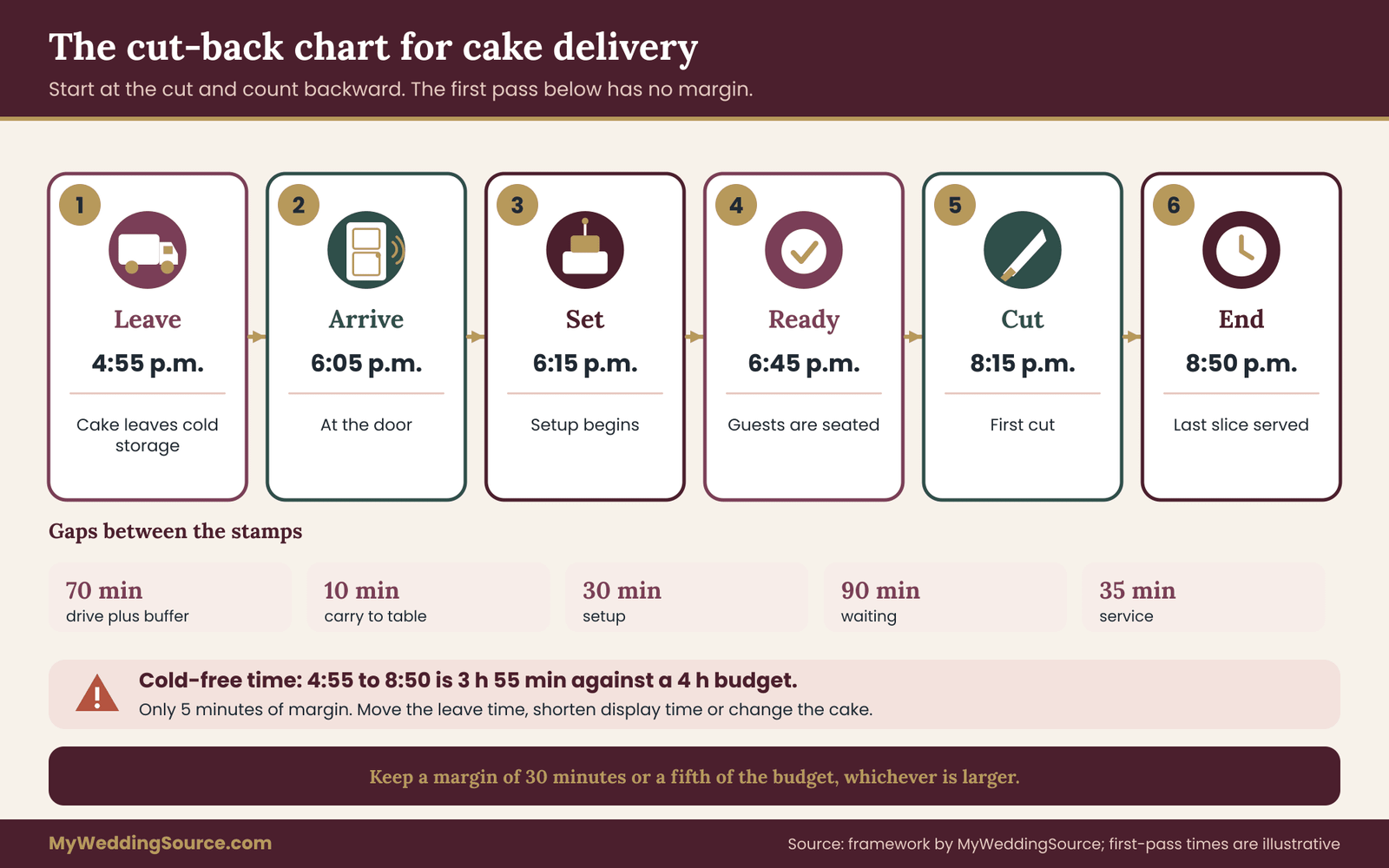
Most schedules for a wedding day start in the morning and move forward. A cake delivery plan works better in reverse. The only fixed point is the moment the couple cuts the cake, and everything else is calculated backward from it. This is the idea behind the timing chart used in the rest of this guide. Call it the cut-back chart: five time stamps, each one earlier than the last, with a name beside each. Working this way keeps the cake delivery plan honest.
The five stamps are the cut, the ready time, the set time, the arrival time and the leave time. Fill them in from the bottom up, and the chart tells you the latest cake delivery you can accept and the earliest you can allow without exceeding the cold-free budget.
Stamp one: the cut
This is the scheduled time the couple makes the first cut. Take it from the day-of timeline, not from a guess. In many receptions the cut happens after dinner and before or during dancing, but plenty of couples cut earlier for a toast or later for a dessert break. Ask the caterer and the DJ or bandleader where the cut sits in the run of show, and write the time as a clock time, like 8:15 p.m.
Then add a second number beside it: the end of service. This is when the last guest has been offered a slice and the cake is either put away or thrown out. For a plated dessert course the service may take twenty minutes; for a seated cake cutting followed by a dessert table, it can run for an hour. The clock that matters for safety runs until service ends, because cake that has been out the longest is the cake served last.
Stamp two: the ready time
The ready time is when the finished cake must be standing on its table, with flowers placed and nobody still working on it. Many couples want it ready before guests enter the dining room, so that people see it, photograph it and talk about it through dinner. That preference moves the ready time much earlier than the cut and eats into the budget. Others are comfortable with the cake being brought out just before the cut, which shortens the waiting time dramatically.
This is a real choice with a real cost. A cake displayed from the start of the reception sits out for the entire event. A cake brought out at the cut sits out for the service period only. Neither is wrong. The decision is whether the visual moment of a displayed cake is worth the shorter margin it leaves, and whether your bakery or caterer can offer a middle path, such as a decorated display tier that is not the serving cake.
We discuss that later.
Stamp three: the set time
The set time is the moment setup begins. It is earlier than the ready time by however long assembly and decorating take. A single-tier cake carried in one piece may need ten minutes. A stacked cake that arrives in separate tiers, with a final decoration step on site, can need forty-five minutes to an hour. Fresh flowers, if the florist is placing them, add their own minutes and sometimes a different person who has to be on site at the same time.
Ask the bakery for their own number and then add a cushion. The most common planning error is a set time that assumes everything goes right, with no allowance for a table that is the wrong height, a tablecloth that has to be replaced or a missing cake stand. A realistic setup number matters as much as the drive when you plan cake delivery.
Stamp four: the arrival time
Arrival is when the cake reaches the venue’s door, loading area or designated drop point. It sits before the set time by the time needed to carry the cake from the vehicle to the table. At a venue with a ramp and a short hallway, that is five minutes. At a venue with stairs, a long grass path or a service elevator, it can be fifteen or twenty, and it may require two people and a cart.
The arrival time is also the time the venue cares about. Venues set delivery windows, and many have strict rules about when vendors may enter, which door to use and whether anyone has to be on site to receive them. The first thing to check is whether the arrival time you calculated falls inside the venue’s allowed hours.
If it does not, the chart has to be rebuilt around the venue’s limits, not the other way around. Loading docks, service doors and vendor hours are the usual constraints. Venues write their rules around cake delivery as they do for any vendor.
Stamp five: the leave time
The leave time is when the cake leaves the bakery’s cold storage or the bakery door. It is earlier than the arrival time by the drive, plus a buffer for loading and for traffic. The drive is the one number you can look up with a map app, but the buffer is a judgment call.
A Saturday afternoon in a college town, a route that crosses a bridge, or a venue down an unpaved road all deserve more padding than a straight run on a highway.
The leave time starts the cold-free clock. It is the moment the cake is first outside controlled cold. This is the number you subtract from the end of service to find out how many hours the cake will spend without refrigeration.
The cold-free budget
Once you have the end of service and the leave time, you can calculate how long the cake will be out. Subtract the leave time from the end of service. The result is your cold-free time, and it has to be smaller than the bakery’s number. That subtraction is the heart of any cake delivery plan.
Here is the rule used in the rest of this guide. Keep a margin of at least thirty minutes, or a fifth of the bakery’s budget, whichever is larger. This is a planning habit, not a legal or food-safety standard. It exists because the real day will almost always run later than the printed schedule, and the margin is what absorbs the difference. If your calculated cold-free time uses up the whole budget, the plan has no room to slip, and you should change something.
What the chart looks like filled in
Imagine the bakery states a four-hour budget for a buttercream-covered display cake. The couple plans a cut at 8:15 p.m. and expects service to finish by 8:50. The cake should be ready before guests are seated at 6:45. Setup takes thirty minutes, carrying takes ten, and the drive is fifty minutes with a twenty-minute buffer. Counting backward: set begins at 6:15, arrival is 6:05 at the latest, and the leave time is 4:55 p.m. at the latest.
Cold-free time from 4:55 to 8:50 is three hours and fifty-five minutes, which sits only five minutes under the four-hour budget and fails the margin rule. This is what a first pass at cake delivery often looks like.
The chart is now doing its job. It shows that the plan, as drawn, has no cushion. The fixes are all simple once you see the problem: cut the display requirement and bring the cake in later, shorten service, choose a bakery team that sets up faster, or ask whether the bakery can approve a longer budget for that cake in that room. Without the chart, nobody notices until the cake is already sweating on its table.
Common mistakes when filling in the chart
Several errors recur. The first is starting the clock at arrival rather than at departure, which quietly removes an hour or more of cold-free time. The second is ending the clock at the cut rather than at the end of service, which ignores the slices served last.
The third is forgetting that a cake carried through a hot parking lot is warming even before setup begins. The fourth is trusting a vendor’s “usually” without a number. Each one makes cake delivery look safer on paper than it is.
A subtler error is using the bakery’s budget for an indoor, air-conditioned room when the reception is in a tent in July. Ask the bakery directly whether the number assumes a particular room temperature, and ask for a second number for your actual conditions. A good bakery will either give it or say honestly that outdoors it would want to deliver later and stay on site.
Who fills in which line
You do not need to calculate any of this alone, and it is better if you do not. The couple or planner owns the cut and the end of service because they control the schedule. The bakery owns the leave time, the set duration and the budget because they know the cake. The caterer owns the cold plan for any perishable parts and for leftover service.
The venue owns the arrival rules. When each person fills in their line, you can compare the five stamps and spot conflicts fast. If you use a shared vendor calendar, put the five times there. A shared vendor timeline is a simple place to do that. Everyone who touches cake delivery should see the same five numbers.
Rounding and the problem of false precision
A chart with minutes can feel exact, but it is built on estimates, and it helps to be honest about that. Drive times shift with traffic. Setup times depend on who is carrying. The cut can slide by thirty minutes if toasts run long. Rather than aiming for an exact result, aim for a chart where every stamp has a reasonable reserve and the whole plan survives the most likely slips.
A margin you never use is cheap. A margin you wish you had is not. Wedding cake delivery will always carry some uncertainty.
One practical habit is to round every stamp in the safer direction: round the leave time later only if that still keeps the arrival inside the venue’s window, and round durations up. If rounding forces a contradiction, that contradiction is the real finding, and it is better to meet it a month before the wedding than the afternoon of.
When the schedule moves
Once a chart exists, any change to the timeline, such as an earlier cut or a later dinner, should trigger a recalculation. Put a note on the sheet that says who is responsible for telling the bakery when the schedule changes, and by when. Many bakeries want their final timing about a week before the wedding, and a late change to the cut may be impossible to accommodate if the bakery has already planned its van and staff.
Ask for their cutoff date and write it on the sheet. Treat the sheet as a living document until cake delivery is finished.
Four ways to cover the cold gap
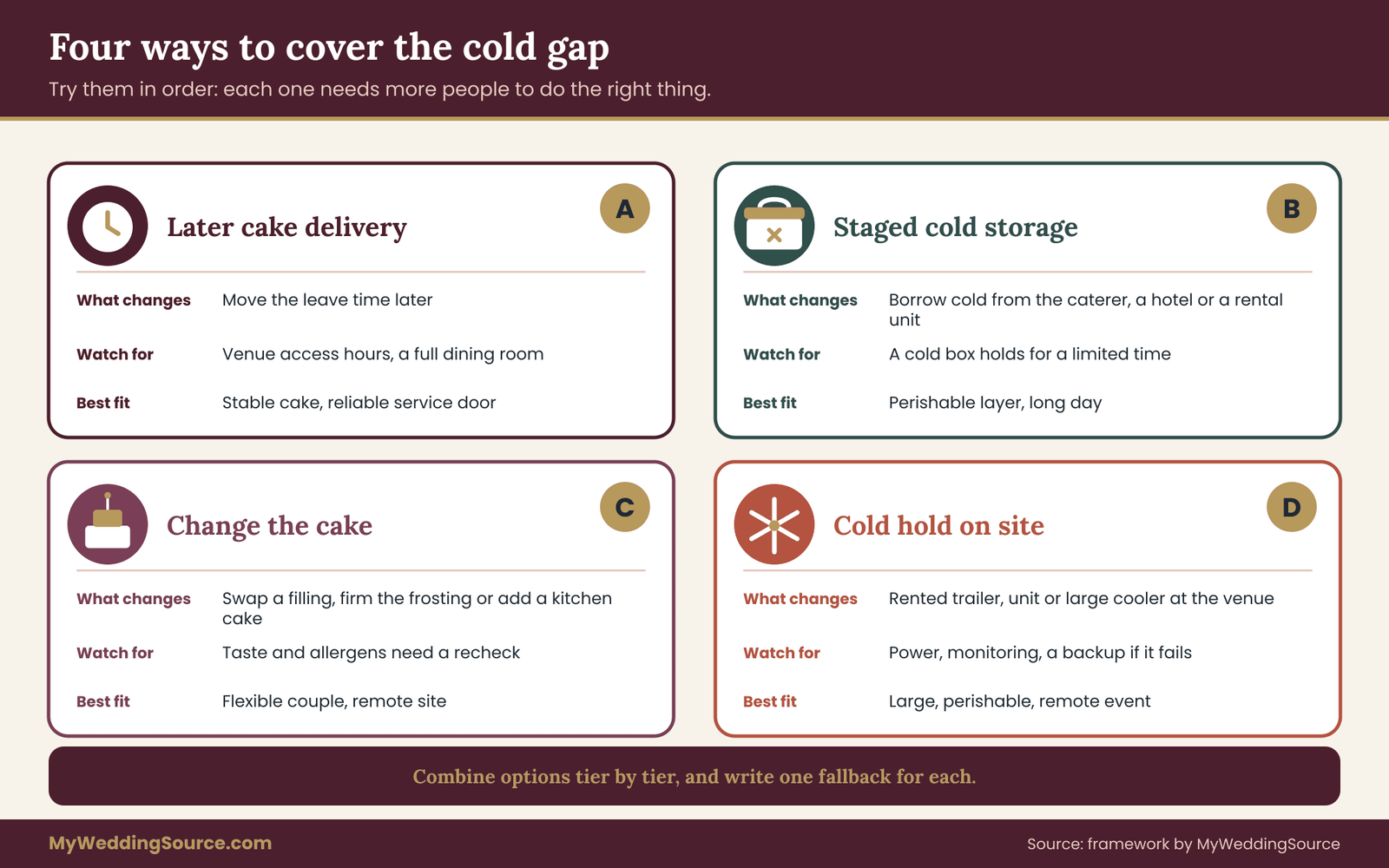
Once the chart is filled in, one of two things is true. Either the cold-free time fits inside the bakery’s budget with a margin, in which case you can stop and sign off, or it does not. When it does not, you have four ways to close the gap.
They are not ranked, and you can combine them. The right one depends on the venue, the cake and how much the bakery is willing to do on the day. These are the standard ways a couple can close the gap in wedding cake delivery without refrigeration.
Each option below describes what it changes, what it costs in practical terms, who has to agree and where it tends to go wrong. Costs are described as logic rather than numbers, because bakery fees, rentals and labor vary by region and by vendor, and you should ask for quotes. Each is a different way to make cake delivery work.
Option A: later cake delivery
The simplest fix is to move the leave time later. If the venue allows a cake to arrive during the cocktail hour or early dinner, the cake sits out for far fewer hours. The chart does the work: every thirty minutes you shift the leave time later gives back thirty minutes of margin. Late cake delivery is the least complicated change, and it is the first one to try.
The limits are the venue and the room. A late arrival means the cake comes through the building while guests are present or while the caterer is busy. Some venues forbid vendors in the dining room after guests arrive. Others cannot spare a door or a person to receive the cake. And a cake that arrives late may not be on display for the early part of the reception, which affects photos. Not every venue can host a late cake delivery.
The cost of late cake delivery is mostly the bakery’s staffing: a baker or driver has to be available at an inconvenient hour, and many bakeries charge for delivery by time or distance, and sometimes for waiting. Ask whether a late arrival changes the fee and whether the same person who sets up will also stay for the cut, which is not always the case.
Late cake delivery is the best fit when the cake is the stable kind, the venue has a reliable service entrance and the couple does not need the cake in the room before dinner. It is a poor fit when the access window is narrow or when dinner is plated and the room is full.
Option B: staged cold storage
The second option borrows cold storage from somewhere other than the venue. The cake or its perishable component travels in an insulated box with cold packs or in a refrigerated vehicle, and it comes out only when needed. Possible hosts for cold storage include the caterer’s truck or walk-in, a nearby hotel kitchen, a restaurant willing to hold a box, or a rented refrigerated unit on site.
The key here is that a cold box is not a refrigerator. An insulated container with cold packs holds temperature for a limited time that depends on its quality, the outside temperature and how often it is opened. Ask the bakery to state how long its containers hold, and whether the cake should be in the box or only the perishable part. A box that gets opened repeatedly to check on the cake is not doing its job.
Staging often moves the final assembly into the kitchen area or a prep tent. For tiered cakes, this means the bakery brings the tiers chilled and stacks them right before display, which can be faster than assembling a warm cake. It also means the cake has to be carried a second time, from the staging area to the room, and that carry must be on the schedule. Staging changes where cake delivery ends, because the cake stops first at the cold host.
The cost depends on who hosts. A caterer may include cold storage in their package or charge for it. A rented unit has a cake delivery fee and sometimes a power requirement. A hotel or restaurant may do it as a favor, but that is not a plan unless someone in charge has agreed in writing. Never assume a nearby business will hold a cake because it is convenient. None of this works unless the plan treats cake delivery and cold storage as one decision.
Option C: change the recipe or the design
The third option addresses the cake itself. If one component is the problem, replace it with something that tolerates room temperature. A fresh-cream filling becomes a cooked or sugar-based filling. A custard becomes a preserve. Fresh fruit moves from inside the cake to a garnish added at serving time. A soft frosting becomes a firmer one.
A design change can also shrink the risky part. A small display cake can be fully stable and decorative, while the cake served to guests comes as plain sheet cake from the kitchen. This is a common approach, and many bakeries offer it. The display cake is what everyone sees, and the kitchen cake is what everyone eats. The couple still cuts the display cake for the photo, and the caterer serves from the kitchen.
Recipe changes carry costs that are easy to miss. Taste is the obvious one, and it is worth a tasting of the modified version rather than assuming it will be the same. Allergens are another, as noted earlier. And some alternatives are more expensive for the bakery than the original, which may show up on the quote. Ask for the change in writing so there is no surprise. A changed recipe still has to fit the cake delivery schedule.
This option is best when the venue is a poor fit for options A and B, for example a remote site with strict access, and when the couple is flexible about flavors. It is a poor fit when the couple has their heart set on a particular filling and is unwilling to change it.
Option D: a cold hold on site
The fourth option puts cold storage at the venue. That could be a rented refrigerated trailer, a commercial refrigerator brought by the caterer, a portable cooler with active cooling, or a large chest cooler with ice, depending on the cake’s size and how much cold time is needed.
On-site cold holds make sense when the cake is large and perishable, the venue is remote and the event is long. They are the option with the most moving parts. Someone has to supply power, someone has to monitor temperature, someone has to move the cake in and out and someone has to be accountable if the unit fails.
For wedding-scale cakes, a standard household cooler is rarely large enough, and a cake that has to be tilted to fit is a cake that gets damaged. Few couples need this for a standard cake delivery, but it exists for the hard cases.
If you go this route, ask whether the unit is food-grade, who cleans it, what temperature it holds under load, and what the backup is if power drops. The questions in a rental planning checklist about delivery, setup and pickup apply here too.
The practical cost is rental, delivery, power and staff time. It can also add an insurance question if a rented unit is being installed at someone else’s property. Ask the venue whether it allows outside equipment and whether it wants a certificate of insurance from the rental company. The rental company normally supplies that document.
Combining the options
The options are not exclusive. A common combination is a stable display cake delivered late (option A), a kitchen sheet cake held in the caterer’s cold storage (option B) and a modified filling for the display cake’s top tier (option C). Another is to deliver the stable tiers earlier and the perishable tier in a cold box at the last moment. The chart should record exactly which combination you chose, tier by tier. Layered fixes are normal in wedding cake delivery.
A decision rule for choosing
If you want a way to choose without a long debate, use the following order of questions. First, can the cake arrive late enough that the cold-free time fits with a margin? If yes, choose option A and stop. If no, is there any real cold storage within reach that someone has agreed to in writing?
If yes, add option B. If neither fully works, is a recipe or design change acceptable to the couple? If yes, add option C. Reserve option D for large, remote or long events where the first three do not close the gap. Use it every time cake delivery gets complicated.
This order is not about preference. It follows the amount of coordination each option needs, from least to most. The simpler the fix, the fewer people have to do the right thing on a busy day.
Costs without made-up numbers
It helps to think about what each option adds, without assuming a price. Late cake delivery adds driver time and maybe waiting time. Staged cold storage adds container costs, host fees or labor. A recipe change adds a tasting and sometimes ingredient costs. An on-site cold hold adds rental, power and someone’s time to monitor it. Ask the bakery and the caterer to put each line on the quote, so that you can compare real figures rather than guesses.
Also ask what happens if the plan changes. If the venue refuses late access a week before the wedding, who pays to shift to a different option? A clear answer in the contract prevents an argument at the worst moment. Name one person who can approve a change, so a switch does not stall.
What to do if the first option fails
Plans fail in predictable ways. A venue rescinds a late-access permission, a caterer’s cooler turns out to be full or a bakery’s refrigerated van breaks down. For each option you choose, write one sentence about the fallback. If late cake delivery is the plan, the fallback might be that the bakery stays on site with the cake in a cooled vehicle.
If staged cold storage is the plan, the fallback might be to serve the perishable part from the kitchen cake. A fallback does not have to be elegant; it has to exist. A cake delivery plan without a fallback is a hope, not a plan.
Cake delivery logistics: vehicle, route and handoff
Cake delivery fails in ordinary ways: a van with no air conditioning, a route that crosses a street closed for a festival, a tier that slides on a bumpy road, a venue door that nobody opened. The cold gap makes each of these more costly because every delay is a minute off the budget. This section looks at the physical journey and the handoff at the end of it. Good cake delivery depends on dull details handled early.
The vehicle and the load
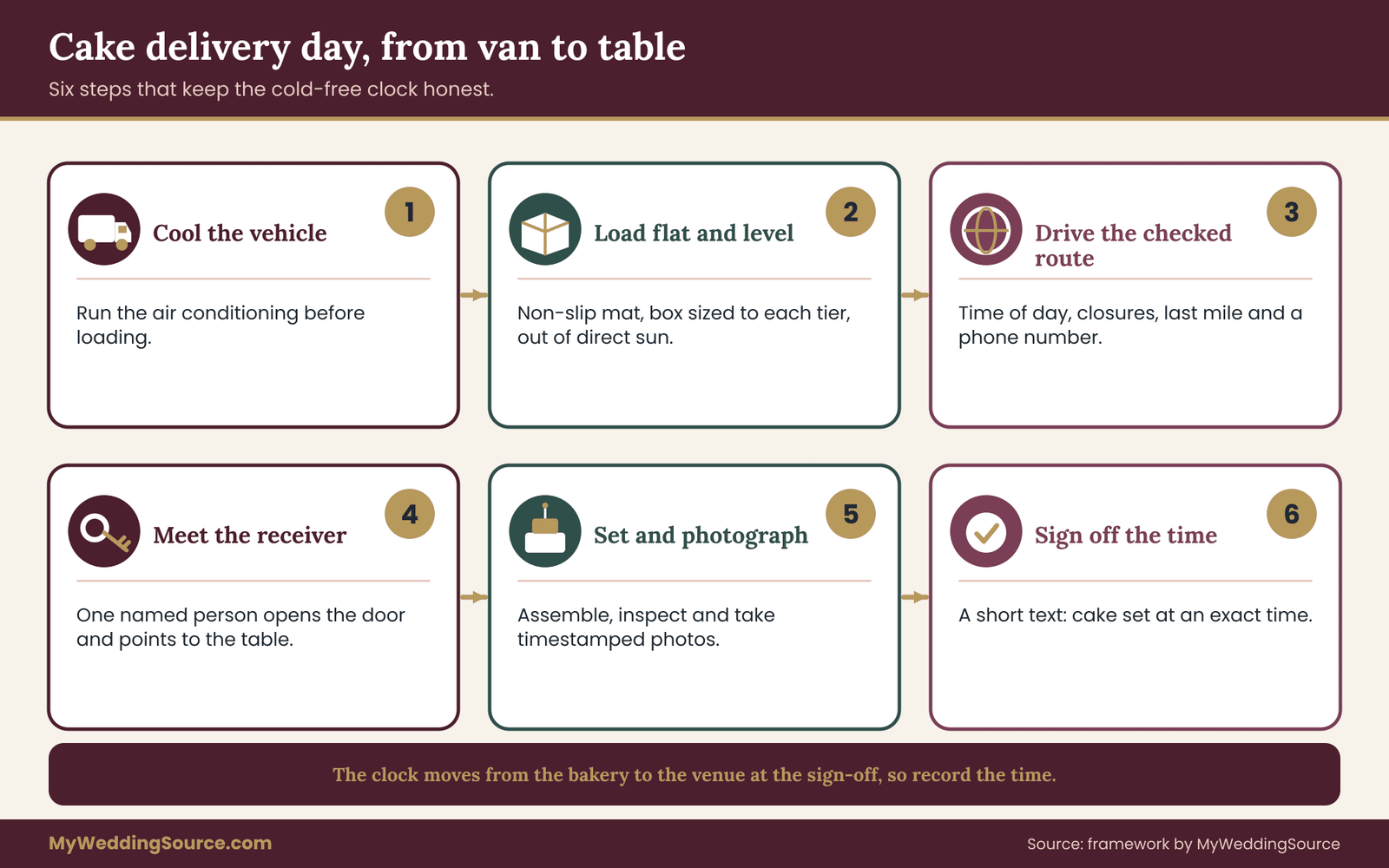
A cake rides best in a vehicle where temperature is controlled and the floor is flat and steady. Bakeries that deliver tiered cakes regularly use vans or cars with air conditioning running well before loading, non-slip mats and boxes sized for each tier. If the cake travels in a personal car, as it often does when a friend or relative picks it up, the cooling and the flat surface are the first things to check. Careful cake delivery starts at the loading step.
Ask the bakery what they need from the person transporting the cake. Typical instructions include running the air conditioning before loading, placing the box on a flat surface rather than a seat, keeping it out of direct sun and driving gently. These are not fussy rules. A soft frosting on a warm seat can mark and a tilted tier can shear. If you or a friend are doing the pickup, ask the bakery to demonstrate loading and to hand over written instructions.
The better choice for a multi-tier cake with a cold gap is bakery delivery. The bakery knows the cake, carries it, assembles it and stays accountable. The fee reflects that. A friend delivering a cake saves money but takes on responsibility the bakery would otherwise carry, and the cold plan must account for that person’s driving time and their ability to carry and assemble.
The route
Plan the route twice: once with a map application at the time of day the cake will travel, and once by asking the venue about their access. A navigation app does not know that the main drive is closed for a different event, that a service road is gated or that a bridge has a weight limit for vans. The venue’s coordinator usually does. Route planning is part of cake delivery, not an afterthought.
Check three things about the route. First, the drive time at the hour of departure, not at midnight when you looked it up. Second, any obstacle such as a ferry schedule, a train crossing or a seasonal road closure. Third, the last mile: the surface, slope and any gate. A cake that has to travel on a rough gravel track slows to walking pace, and the drive time on the app may not reflect it. Each one can add minutes to cake delivery.
Also have a backup route and a phone number. The driver should have the venue contact and the bakery’s number, and the venue should have the driver’s number. An arrival time is only useful if someone is watching for it.
The drop point and the door
Where the cake enters matters as much as when. Ask the venue which door to use, whether there is a ramp, whether the route passes through the kitchen or a guest area, and how far the drop point is from the cake table. The last carry is the riskiest, because the cake is assembled, heavy and usually carried by people who do not do it every day. Decide the drop point when you book cake delivery, not when the van arrives.
Distance and stairs change the staffing. A cake that has to go up a flight of stairs or across a field needs two or more people, and a cart or a trolley with large wheels helps on grass. Ask the bakery whether they bring their own cart and carry a spare.
If the venue provides a cart, confirm it is available at the arrival time and that nobody else is using it. Elevators and shared lifts matter most in city venues, so book them for the arrival time.
Meeting the receiving person
A cake needs a person to receive it, and that person needs authority to open doors and point to the table. Name this person on the sheet. It might be a venue coordinator, a caterer’s captain or a planner. If no one is available at the arrival time, the cake waits in the vehicle, and the clock keeps running.
The fix is to schedule the arrival when someone is certain to be there, and to give the driver a phone number for that person. A named receiver keeps cake delivery from stalling at the door.
Never leave the cake with a person who has not been told about it. At a busy venue, a staff member who does not know a cake is coming may tell the driver to leave it in a hallway, in a warm kitchen or beside a pile of boxes. A short email the week before, copying the venue and the caterer, avoids that.
Walking the path in advance
If you can, walk the route from the drop point to the cake table, or ask the planner or venue to send photos. You are looking for steps that are not obvious on a floor plan, doors that open the wrong way, tight turns and slick surfaces. A venue visit is a good moment for this, and a technical walkthrough lists the other items worth checking at the same time, such as power, lighting and sightlines.
Take the table height too. A cake on a table that is too low looks squat, and one on a table that is too high is hard to cut. The bakery usually has a preference. If the venue’s tables are rented, ask for the dimensions and match them to the bakery’s stand.
Weather on the way
Weather affects delivery in two ways: heat in the vehicle and rain at the door. Heat is a straightforward reason to deliver late and to confirm the vehicle’s cooling. Rain is a reason to have a covered path, an umbrella handler and a plan for the last twenty feet.
A bakery will not carry a cake through rain if there is a way to avoid it, and a venue that cannot offer cover may need a tent over the drop point or a different door. Cake delivery in summer deserves extra margin.
Check the forecast the week before, again the day before and again the morning of. The National Weather Service publishes forecasts and heat advisories, and a heat advisory is a reason to call the bakery and ask whether the plan should change. Do not wait for the bakery to call you.
The handoff at the table
The handoff is the moment the cake goes from the bakery’s hands to the venue’s care. It deserves a short routine that is the same every time. The bakery sets the cake, inspects it, takes photos of the finished cake as delivered and tells the receiving person what to do and not to do. The receiving person confirms the cake is where it should be. Handoff is the last step of cake delivery and the first step of venue care.
Those photos are useful. If something goes wrong later, a timestamped photo of the cake on the table shows how it looked when it left the bakery’s hands. A short sign-off, even a text message saying “cake set at 6:40, looks good”, records the time the clock moved from the bakery to the venue. It is not about blame. It is about knowing where the cake stood at any hour.
Who stays, and who goes
One decision that changes the cold plan is whether the bakery stays. A baker who stays until the cut can respond to a drooping tier, an unexpected breeze or a warm room, and can take the cake back into the van to cool if necessary. A baker who leaves hands the cake to the venue and caterer, who may not know what to do.
Staying costs more, and many bakeries offer it as an add-on or require it for outdoor events. A baker who stays turns cake delivery into cake care.
If the bakery does not stay, ask for a one-page care sheet for the caterer: where the cake should and should not sit, what to do if it starts to soften, who to call, and how to cut it. If the bakery cannot supply one, write one together. Then make sure the caterer has it before the wedding, not in the middle of it.
What the vendor will not do
Be clear about the boundaries. Many bakeries will not set up in a room that is not ready, will not deliver without a named receiving person, and will not assemble a cake outdoors in direct sun. Many caterers will not accept responsibility for a cake they did not prepare or store unless it is in the contract.
Many venues will not allow vendors outside agreed hours. Find these lines early. They are not rudeness. They are the same lines you would draw if you were responsible for the cake.
When the cake is not delivered by the bakery
Some couples choose to pick up a cake from a grocery store, a home baker or a shop that does not deliver. The same chart applies, and the cold gap is often larger, because the cake is usually collected earlier in the day. Ask the seller the same budget question and be ready to accept an honest answer that the cake is not a good match for a venue without cold storage.
A home baker or small shop may have a legitimate limit. If the cake is made at home, your local rules on home-prepared food may affect what can be sold or served. Ask the seller to explain the rules they follow, and check with your local health department if you are unsure. A seller who cannot discuss temperature and handling in plain terms is a seller to think twice about for this venue.
Backup if the cake is late
Late cakes happen. The plan should state what the couple does if the cake is more than thirty minutes late: who calls whom, whether the schedule shifts, and whether a backup dessert is available. A common backup is to hold the cutting until the cake arrives, serve dessert from the kitchen and do the cut later.
Another is to have the caterer prepare a small cake or plated dessert as insurance. The cost is small compared with the stress of an empty cake table. Plan for late cake delivery the way you would plan for a late guest of honor.
Questions for the bakery, caterer and venue
The chart only works if the people on the chart agree to it. That means conversations, and good conversations start with specific questions. This section gives you the questions and the reasons behind them, grouped by who you are asking. Ask in writing when you can, so you have a record. Ask each of them about cake delivery in the same terms.
For the bakery
Ask how long each component can safely stay out of the cooler at normal room temperature and at your venue’s expected temperature, and ask them to put the numbers in an email. Ask which parts are perishable, which are conditional and which are stable. Ask whether the structure has a separate limit from safety. Ask what they recommend for a venue without refrigeration, and whether they have done one before.
Ask about delivery: who delivers, in what vehicle, how the cake is cooled in transit, how long the setup takes and whether the baker stays. Ask what the fee covers and what changes it. Ask what they do if it is hot on the day. Ask for their final timing cutoff, the date after which changes become difficult. Ask the same set of questions of every baker you consider for cake delivery.
For the caterer
Ask whether the caterer has any cold storage on site, and how much. Ask whether they are willing to hold the cake, or part of it, and under what conditions. Ask whether they will cut and serve it, and whether they charge a cake-cutting fee, a common line on caterer quotes. Ask what they do with leftover cake, and whether they have a plan for any perishable component.
Also ask where they plan to be set up and how far that is from the cake table. A caterer working from a tent behind the building may not be able to monitor a cake in the dining room. If they will not take responsibility for the cake while it is out, say so on the sheet, so that the responsibility is not assumed.
For the venue
Ask for the cake delivery hours and the rules for outside vendors, including any restriction on delivery during an event. Ask which door to use and who will be there to open it. Ask whether there is any cold storage anyone can use, even briefly, and if not, whether there is shade, air conditioning or a cool room where a cake could be held. Ask whether the cake table can be in a spot out of sun and away from heaters, speakers and doors.
Ask about power and, for outdoor sites, wind and shelter. Ask whether there is a backup indoor space if the weather turns. These are standard questions for a venue and are likely to have standard answers. If the venue has no answer, that is information too.
A short script for the first message
Many couples are unsure how to open the conversation. A brief message works well: “We are planning wedding cake delivery for a venue with no refrigeration. The cut is at 8:15 and service should end by 8:50. Could you tell me how long each part of the cake can stay out of cold storage, and what delivery time you would recommend?
We would like to put the answer on a single timing sheet that the caterer and venue can see.” It is polite, specific and reads as a request for information, not a complaint. Keeping the message short helps the bakery answer cake delivery questions quickly.
Following up in writing
After any phone call, send a short email that repeats what was agreed. “Thank you for the call. To confirm, the bakery will deliver at 6:05, set up in thirty minutes and stay until after the cut. The perishable layer will be held in the caterer’s cooler.” People are far more careful with something they can see in writing, and it fixes the memory of what was said.
Setting the cake on site: placement, shade and who touches it
Once the cake is inside, the next risk is where it sits. A cake with a cold gap should live in the coolest, steadiest, most protected spot the room offers, and the cake table is the place where decor preferences and safety needs argue most openly. The look of the display is a design question. This section adds the heat and handling side, which tends to be overlooked. Setup is the second half of cake delivery.
Choosing the spot
Start with what to avoid. Direct sun through a window or a tent wall, which can heat a cake faster than the air around it. Space heaters and stage lighting. Kitchen doors and service corridors that open and close and bring warm air. Speakers, which vibrate. Dance floors, where a bump of the table shakes the tiers. And any spot near a bar with a lot of foot traffic. Each of these shortens the safe life of a cake after cake delivery is complete.
Then choose a place with a few things going for it. Shade or interior positioning. Air conditioning or a draft that moves cool air across the table. A flat, stable floor. Enough room around the table for the cutting and photographs. Clear access for the bakery and the caterer’s cutters, and a position that fits the way guests move through the reception space.
A cake in the corner of a room is easy to protect and easy to forget, so decide whether guests should see it or whether a spot a few steps off the main path serves better.
If the venue is outdoors, check the sun angle at the cut time, not just at setup. A table in shade at six may be in direct light at eight in midsummer, depending on the site. A tent with open sides can make a cake table cooler or hotter, depending on how the air moves.
The bakery or the venue coordinator may have seen the space in the evening and can say what to expect. Outdoor cake delivery and setup should be timed to the shade.
The table and the stand
Do not underestimate the table. A wobbly table is the source of many cake mishaps. Ask the venue or rental company for a sturdy table with a tablecloth that does not hang low enough for guests to tug on, and confirm that it is level. If the ground is uneven, use shims under the legs and check them before the cake goes on.
Place the cake at the end of the setup rather than the beginning, so that the table is set first and the cake spends the least time out. Confirm the table before cake delivery, not after it.
The stand matters too. A good stand is wider than the bottom tier, balanced and not dependent on the tablecloth for stability. The bakery will tell you what it prefers, and may provide the stand as part of the cake delivery. If you rent or bring one, send the dimensions to the bakery in advance.
Flowers and decorations
Fresh flowers on a cake should be arranged by someone who knows the rules for food contact. Some flowers are not safe to eat or to touch food, and florists and bakers handle that in different ways. Ask the bakery which blooms are acceptable. For the cold gap, the point is timing: if the florist adds the flowers on site, that step belongs on the set time, and the florist and baker need to be in the room at the same time or have a clear order of work.
Fresh flowers on a cake should be arranged by someone who knows the rules for food contact. Some flowers are not safe to eat or to touch food, and florists and bakers handle that in different ways. Ask the bakery which blooms are acceptable. For the cold gap, the point is timing: if the florist adds the flowers on site, that step belongs on the set time, and the florist and baker need to be in the room at the same time or have a clear order of work.
Keep other decorations away from the cake. Candles near a cake can melt a soft frosting, and a topper that is heavy can lean the top tier. If you plan to use sparklers or candles for the photo, confirm with the bakery, the venue and the fire rules. Many venues have restrictions on open flame.
The question of display versus serving cake
A display cake that is not served can be a sensible way to handle a cold gap, because it does not have to be as safe to eat as a serving cake. A decorated tiered cake that is partly or fully a decorative structure can stand for hours with no risk, while the cake the guests eat sits in a cool place and appears at service.
The cutting ceremony uses the display cake for the photo, and the caterer serves slices from the kitchen cake. Many couples use it when cake delivery has to happen early.
This is an honest, common approach, and it works as long as it is explained. If guests expect to eat the display cake, they should be told. A small card, a staff member’s word, or a line in the program can do it. Sizing the kitchen cake against your guest count is a calculation worth doing with the bakery.
Watching the cake during the event
Someone should be accountable for looking at the cake at regular intervals. At a wedding that person is rarely the couple. It might be the planner, a caterer’s captain or the baker if they stay. Give them a short list: check for softening, leaning, melting, insects, direct sun or a guest touching the cake.
Give them the baker’s number and tell them what to do. In many cases the response is simple: move the cake to a cooler spot, turn a fan on it, shade the window or remove the cake to a cooler area until the cut. This person carries the plan once cake delivery is over.
A quick check every thirty minutes is enough for most receptions. If it is a hot day or an outdoor event, check more often. The point is to catch a problem early, because soft frosting gets worse quickly once it begins to slump. Treat it as the final stage of cake delivery.
Fans, shade and simple tools
Simple tools help. A battery-powered fan or a portable air conditioner, where the venue permits and the power is available, can reduce the temperature around the cake. Umbrellas, pop-up shades or a cloth screen can shield it from direct sun. A cake dome or cover protects from insects and drafts, though it can trap heat, so ask the bakery before using one.
Ice packs placed near, not on, the cake are sometimes used for tiers that are particularly sensitive, and the bakery will say whether that is a good idea.
Ask the bakery to approve any tool you add. A fan that blows directly on a frosted cake can dry the surface, and an ice pack that touches the cake can cause condensation. The bakery’s advice is worth more than a general tip.
Insects, pets and guests
At outdoor events, flying insects are a real nuisance for a cake. A cover, a light screen or placing the cake inside until the cut reduces the problem. Pets, where they are allowed, need to be kept away. And at any event, guests who want to poke the frosting, or children who like to touch, may need a polite staff presence nearby. A sign that says “Please do not touch” is usually enough, and a person standing near the table is better.

From the cut to the last slice
The cut is a photo moment, but it is also the beginning of the last phase of the cold plan. After the cut, the cake is served, and the leftover cake has to be dealt with. The decisions made here protect guests and keep the cake from becoming a problem after the party. Cake delivery ends at the table, but the cold plan does not.
Who cuts and who serves
Typically the couple makes the first cut, and the caterer or bakery staff take over. Decide in advance who will cut the cake, with what tools and how many slices are to be prepared in advance. The bakery can tell you how to cut a tiered cake into servings, and many bakeries provide a cutting guide.
If you are not sure how many servings you have, ask the bakery for the count by tier, because it affects how much of the cake is displayed and how much is held in the kitchen.
If a perishable layer is served, it should go to the table promptly and not sit on a counter. If the caterer is serving from a kitchen cake, they should keep the portions in the cool until they are plated. The caterer knows how to run a dessert service and should be given the bakery’s instructions, not a guess.
The end of service
The end of service is the point where the clock stops, and it should be a decision rather than a drift. Once the last guests are served, anything left out should be handled. Perishable items that have been out beyond their limit should be discarded, even if that feels wasteful. The general food-safety rule is that perishable food left out beyond two hours, or one hour in heat above 90 degrees, should not be saved.
If the cake was served on the cold-free schedule, the caterer or bakery will say what remains acceptable to keep. Write that decision on the same sheet as the cake delivery plan.
Leftover cake and the top tier raise a common question. Many couples want to save the top tier for an anniversary, which is a sentimental choice and also a food-safety one. If the top tier has been out for hours, it should not be treated as a freezer keepsake without the bakery’s advice. A bakery may recommend that the top tier be a separate, not-yet-served small cake, boxed and delivered separately, for exactly this reason. Ask them early.
Takeaway boxes and donations
If you plan to send slices home with guests, ask the caterer about boxes and labels, and remember that any slice sent home leaves your control. A box that sits in a hot car for three hours is a different food from a slice at the table. A simple note, “Best eaten today,” is reasonable. Do not send perishable cake home with guests unless the filling is stable and the bakery has said so.
If you hope to donate leftover food, the rules are particular and often depend on local law and the receiving organization. Ask the receiving organization what it accepts. Cake that has been out without refrigeration for hours is generally not a candidate for donation, and many food banks will not accept it. Ask the receiving organization before the wedding.
Cleanup and the cake stand
Decide who takes the cake stand, the cake board and any rental pieces at the end of the night, and who returns them. A bakery may collect its own boxes and stand the next morning or the same night. If the bakery’s pieces stay overnight, record who is responsible for them and where they are stored. The same goes for the caterer’s cake knife and server, which are often forgotten in the rush to leave.
A cake that is cut is a cake that is committed. Plan for its end as carefully as you planned for its start.
A worked example of cake delivery to a barn with no cold storage
Numbers make the chart concrete, so here is an invented case from start to finish. The couple, Hannah and Luis, are marrying at a restored barn about fifty minutes from their bakery. They are fictional, and so are the bakery’s numbers, which stand in for the figures a real bakery would give you. The aim is to show how the five stamps and the cold-free budget work together. The case follows one cake delivery from first question to final sign-off.
The setup
The barn has a serving kitchen with a sink and a prep counter, but the caterer reports that the only refrigerators belong to the barn’s caretaker and are not available. The caterer brings insulated chest coolers and keeps cold food in a shaded service tent. The ceremony is at 4:30 p.m., cocktail hour runs from 5:30 to 6:30, dinner begins at 6:45 and the cake cut is scheduled for 8:15. The couple expect to serve about one hundred and twenty guests.
The couple wants a three-tier cake. They have chosen a lemon sponge with a raspberry filling, covered in buttercream. At the first conversation the bakery sorts the parts. The sponge and the buttercream are stable at room temperature for the bakery’s stated budget of four hours in an indoor room and three hours outdoors.
The raspberry filling is a cooked preserve and sits in the same group. The bakery adds that a cream-cheese frosting the couple had considered for one tier is perishable, and recommends staying with buttercream. Their cake delivery has to cover three tiers and a kitchen cake.
Filling in the chart
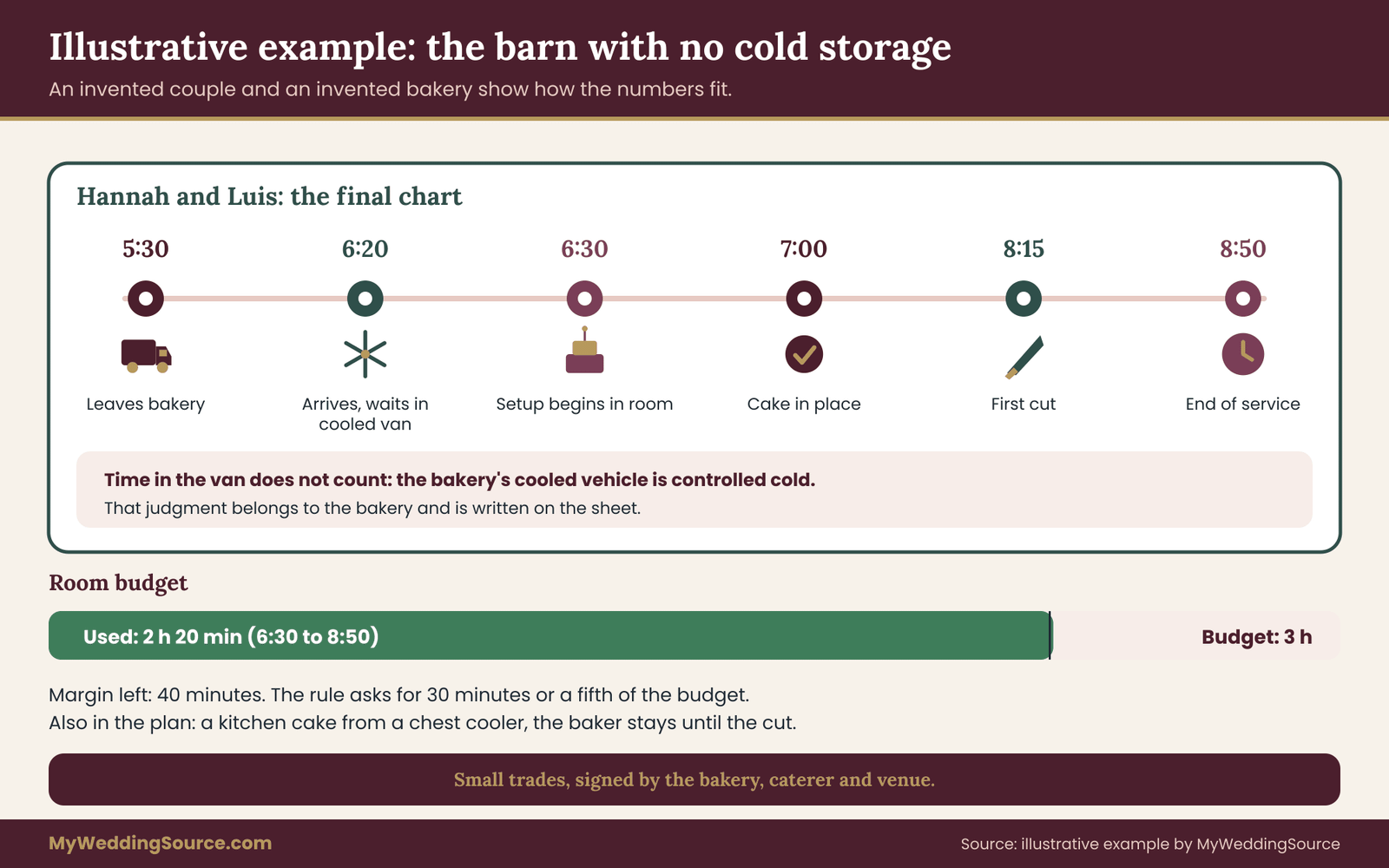
The couple works from the bottom of the chart. The cut is at 8:15 p.m., and the caterer says service for a cake this size takes about thirty-five minutes, so the end of service is 8:50. The room is a barn with large fans and no air conditioning, so the bakery treats it as a warm room and uses the lower three-hour figure to be careful, since the weather forecast for the day is warm.
The couple would like the cake in the room before dinner so guests can photograph it. That sets the ready time at 6:30, when cocktail hour ends. The bakery says setup takes thirty minutes, so the set time is 6:00. The barn’s service door is a short walk from the cake table, with no steps, so the carry takes ten minutes, which puts arrival at 5:50.
The drive is fifty minutes, and the bakery wants a twenty-minute buffer for traffic and loading, so the leave time is 4:40 p.m.
Now the budget check. From 4:40 to 8:50 is four hours and ten minutes, against a three-hour budget. The plan is over the limit by an hour and ten minutes, and about an hour and forty-five minutes over once the margin is counted. The chart has found the problem a month before the wedding.
Trying the options
The couple works through the decision rule. Option A, later cake delivery, is the first question. If the leave time moves to 6:30, the cake arrives at 7:20 and is set by 8:00, in place before the cut, and the cold-free time becomes two hours and twenty minutes, which fits with a forty-minute margin. But then the cake is not in the room during the cocktail hour or dinner, and the barn says guests are seated in the dining area from 6:45, so setup in a full room is awkward.
The caterer also notes that the service door is used for dinner service through 7:30. Late cake delivery is the first thing they test.
So the couple tests a variation. The cake leaves the bakery at 5:30 p.m., arrives at 6:20 and is held in the bakery’s air-conditioned van in the parking area until 6:30, when setup begins in the dining room. Counted from the bakery door, that is three hours and twenty minutes, still too long for a three-hour budget, even though part of it is spent in a cooled vehicle.
What they choose
The couple and the bakery land on a combination. The tiers are stable, so the first change is to count the cooled van time differently: the bakery states that time in its own air-conditioned van does not count against the room-temperature budget, since the cake is in controlled conditions. This is the bakery’s judgment, written into the sheet, and it is the kind of detail a bakery decides rather than the couple.
With that, the clock starts at 6:30 when the cake enters the room, runs to 8:50, and totals two hours and twenty minutes, inside the three-hour budget with a forty-minute margin.
The second change is to serve from a kitchen cake. The couple orders a plain lemon sheet cake with the same buttercream, made by the bakery, to be cut by the caterer and served from the kitchen. The display cake is cut for the photo, and the top tier is separate and small, boxed to be saved.
The bakery notes that the display cake serves only a few slices and the guests eat from the kitchen cake, which is simple, cheaper than it sounds and removes the pressure on the display cake’s budget.
The third change is the bakery staying on site. The baker will stay until the cut, then collect the display cake’s stand and boxes. That costs an additional hourly fee, which the couple accepts because it gives the cake an owner.
The final chart
For the record, the finished chart reads as follows. The bakery leaves at 5:30 p.m. and the cake waits in the cooled van near the barn from 6:20 to 6:30. Setup starts at 6:30 and finishes at 7:00, so the cake is in place during the first course, later than the couple first wanted, a compromise they agree to.
The cut is at 8:15, the end of service is 8:50 and the cold-free time in the room is two hours and twenty minutes. The kitchen cake is held in the caterer’s chest cooler until 8:00 and plated from the service tent.
The sheet records who confirmed what. The bakery manager approved the budget and the van arrangement. The caterer approved the cooler hold and the service plan. The venue approved the arrival window and the door. Each person added initials and a date, and the couple’s planner has the sheet in a shared folder. That is the full deliverable.
What the example shows
The example makes four points. The chart found a problem the couple had not seen. The easy fix, delivering later, collided with the venue’s service hours, which is common. The solution came from combining modest changes rather than from one big one. And the final arrangement hinged on a bakery judgment, the van time, that only the bakery could make.
If the couple had made that assumption themselves, the plan would have rested on a guess. Real cake delivery plans usually involve a few small trades like these.
It also shows how a margin works. The final plan leaves thirty minutes unused. If toasts run twenty minutes long, the cut slides, the end of service slides and the margin absorbs it. If they run an hour long, the sheet tells the planner to tell the bakery and caterer, who may decide to cut the display cake early or move the kitchen cake out first. A margin is what lets cake delivery survive a normal day.
When cake delivery plans break: delays, heat and venue surprises
Even a good chart meets a bad day. The most useful thing a plan can do is state in advance what happens when something slips. Here are the usual failures and the decision rules for each. They work best when the people involved have read them before the day. Cake delivery is where most of these failures begin.
The cake is late
If the cake is thirty minutes or more behind the arrival time, the receiving person calls the bakery and the planner. The decision is whether to hold the cut. If the cake can arrive and be set before the cut, nothing changes except the display time. If it cannot, the caterer serves a kitchen dessert and the cut moves.
A cake that arrives late has also spent less time out, so lateness itself is not a safety problem, as long as the final cut is handled calmly. A late cake delivery is an annoyance, not a disaster.
The schedule runs long
If dinner or toasts run long, the cut and the end of service both move later, and the margin shrinks. The rule is simple: when the cut slides past the margin, the person watching the cake tells the bakery, and the bakery decides whether to serve the cake sooner, move it to a cooler spot or remove the perishable parts. Do not assume the cake will be fine because it looks fine. Appearance and safety are different questions.
The room is hotter than expected
If the room is warmer than the bakery assumed, use the lower budget. Move the cake to a cooler spot, add shade or a fan, and ask the bakery whether to shorten the display. A heat advisory in the forecast is a reason to call a week ahead. The National Weather Service and local forecasts are the reference points, and the bakery decides what to do with them.
The cake is damaged or the structure shifts
If a tier leans or a decoration falls, the baker, if present, repairs it. If no baker is present, the caterer or planner calls the bakery and follows their instruction by phone. The couple does not need to handle it. Photograph the problem, which helps with any later conversation. Keep the notes factual and short.
The venue changes the rules
Venues sometimes tighten rules at the last minute: a new cake delivery window, a new door, a cap on vendors in the room. When that happens, go back to the chart and recalculate. The new limit might push the cake outside its budget, and you may need to switch option. The sooner the bakery hears, the better the options. A change a week before is manageable. A change on the day is a scramble. A new rule can break an otherwise sound cake delivery plan.
Power or cold storage fails
If a cooler or a rented unit stops working, move the cold items to the next best place and tell the bakery. The fallback line on the sheet is the answer. If the fallback is the caterer’s second cooler or the bakery’s van, the plan is to use it. If there is no fallback, the perishable part is served early or not at all.
Someone wants to change the plan
On the day, a friend or a relative may suggest moving the cake, cutting it earlier or putting it somewhere “better”. Name one person who can say yes or no, and give them the sheet. Without that, the cake is open to well-meant advice from everyone, and nobody owns the outcome. A polite response is available: “The bakery and caterer set the timing, so let me check with them.”
The one-page sign-off sheet
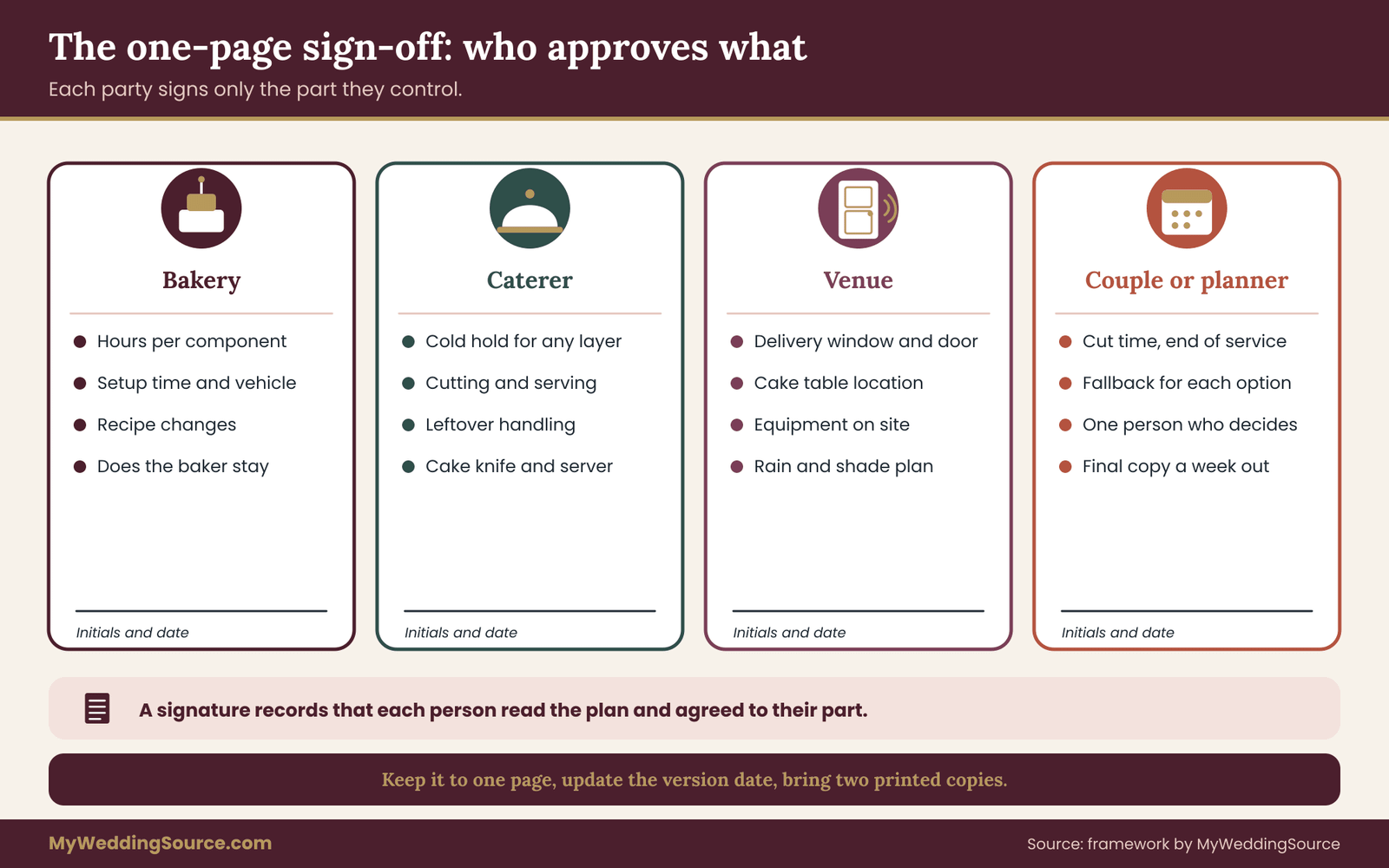
Everything above ends in one page. The sign-off sheet is a short document, kept where everyone can open it, that records the cake delivery plan and shows who approved it. It is the deliverable that turns a set of conversations into a commitment. You do not need a special template. A plain page with the following sections does the job. Write the sheet before the final week of cake delivery planning.
What goes on the sheet
At the top, put the date, the venue and the names of the bakery, caterer and venue contacts with phone numbers. Below that, the bakery’s budget by component: stable, conditional and perishable, with hours for each and the room conditions the numbers assume. Then the five stamps: the cut, the ready time, the set time, the arrival time and the leave time, with clock times and the end of service.
Next comes the cold plan: which option or combination you chose, tier by tier, and the fallback for each. Add the receiving person, the door, the route and the cake table location. Add the watch plan: who checks the cake and how often. Add the end-of-service plan: who cuts, what happens to leftovers and the top tier, and who collects the stand and boxes. Finally, leave a signature or initials line for each party, with a date.
Who signs and what they are signing
Each party approves only the part they control. The bakery approves the budget, the setup duration, the vehicle and any recipe changes, and says whether the baker will stay. The caterer approves the cold hold, the cutting and serving plan and the leftover handling. The venue approves the cake delivery window, the door, the cake table location and any equipment on site. The couple or planner approves the schedule and the fallbacks. Anyone who touches cake delivery should sign.
Be honest about what a signature means. It is not a legal guarantee that nothing can go wrong. It is a record that each person read the plan and agreed to do their part. That record is what you rely on when a conversation on the day goes sideways, and it is a good reason to keep the sheet short and clear. It documents cake delivery responsibilities, not a guarantee.
Putting it in the contract
A sheet is helpful, and a contract clause is stronger. If the bakery’s contract lists a cake delivery time, make sure it matches the chart. If the contract allows the bakery to deliver at any time in a broad window, ask for the specific time. If the sheet describes a recipe change or a baker staying on site, ask for it to be added to the order or the contract.
A guide to the wedding vendor contract explains how to read the terms around delivery, changes and cancellations, and a vendor due diligence checklist covers the general questions to ask any vendor. Put the cake delivery terms in writing where both sides will see them.
Pay attention to three kinds of terms. First, delivery and setup terms: who delivers, when, what the fee covers and what happens if the vendor is late. Second, change terms: how a schedule change is handled, the cutoff date and any fee. Third, liability terms: what the vendor is responsible for once the cake is set.
If the contract says the bakery is not responsible after setup, then the caterer’s responsibility matters more, and the sheet should say so. Contracts often say little about cake delivery beyond a time.
Keeping the sheet current
Revise the sheet whenever something changes, and send the new version to every party. Put a version date at the top. A week before the wedding, send a final copy with a short email asking each party to confirm they have it. Print two copies for the day: one for the planner or coordinator and one for the person who receives the cake.
If you use a digital version, make sure it opens without a signal, because many venues have poor reception. A late change to cake delivery should be visible to everyone at once.
Verifying the facts locally
Rules about food, temperature, home-prepared food, mobile vendors and cold storage vary by place. The U.S. government’s food-safety resources give general guidance, and your state or local health department sets the rules that apply to the caterer and the venue. Before you finalize the plan, ask the caterer which rules they follow, and ask the bakery whether their license and practices cover delivery to a venue like yours.
Do not rely on this article, or any article, for rules and fees. Check with the issuing agency or the vendor, and recheck near the wedding date, because policies change. Check them for your own cake delivery before the wedding week.
A note on the couple’s own role
The couple’s job is to decide what matters and to make sure the right people talk. You do not need to be an expert in food safety. You need to ask for numbers, write them down, put the right people on the same page and keep a margin. If a vendor cannot or will not give a clear answer, treat that as part of your decision about who to hire for this venue.
A vendor’s calm, specific answers on a day when nothing has gone wrong tell you how they will behave on a day when something does. Calm questions about cake delivery are enough.
Your next steps
Here is a plain sequence you can follow, starting as soon as the venue is booked and the cake is on your list.
- Ask the venue exactly what cold storage, shade and power exist, and what delivery hours apply. Get the answer in writing.
- Tell the bakery the venue has no refrigeration and ask for hour-based budgets for each component, in indoor and outdoor conditions.
- Confirm the cut time and end of service with the caterer and your timeline, and fill in the five stamps of the chart.
- Calculate the cold-free time and compare it with the budget, keeping a margin of thirty minutes or a fifth of the budget, whichever is larger.
- If the chart does not fit, choose from late cake delivery, staged cold storage, a recipe or design change or an on-site cold hold, and write down a fallback for each.
- Name the receiving person, the door, the route, the table location and the person who will watch the cake.
- Collect initials from the bakery, caterer and venue on a one-page sheet, and add any agreed changes to the contracts.
- Recheck the forecast, the route and the chart a week before, the day before and the morning of the wedding.
If you are still building the wider plan, the wedding planning checklist places the cake alongside the other tasks, and the guide to menus across ages and dietary preferences shows how dessert fits with the rest of the meal.
FAQ
Can a wedding cake sit out all day without refrigeration?
It depends on what is in the cake and how long it sits. Many stable cakes handle several hours at room temperature, but perishable fillings such as cream, custard or fresh fruit generally should not stay out more than two hours, or one hour in heat above 90 degrees. Ask your bakery for hour-based limits for each layer and plan around the shortest one.
What time should the cake be delivered if the venue has no fridge?
As late as the venue’s access rules and the setup time allow. Count backward from the cut: subtract setup time, carry time, the drive and a buffer. Keep a margin of at least thirty minutes between the bakery’s time limit and the end of service. Your bakery and caterer should approve the final time in writing.
Who decides whether my cake is safe at room temperature?
The bakery that made it decides what its recipes can handle, and the caterer decides what they will hold and serve. Local health authorities set rules for commercial food. General sources such as foodsafety.gov give baseline guidance, but they do not replace the specific approval of the people responsible for the cake.
Can the caterer store the cake for me?
Sometimes. Some caterers bring refrigerated trucks or large coolers and will hold a cake or a filled tier, and some will not take responsibility for a cake they did not make. Ask early, ask what it costs and ask what space they have. Get their answer on the timing sheet, so the bakery and venue know the plan.
Is a display cake with a kitchen sheet cake a good idea?
It is a common solution when cold storage is limited. The display cake can be fully stable and decorative, while the caterer serves plain cake from the kitchen, held cold until service. Tell guests which cake is served. Ask the bakery to size the kitchen cake against your guest count, and to match the flavors.
Can I use ice packs or a cooler for the cake?
Insulated boxes with cold packs can protect a perishable layer for a limited time, but they are not a refrigerator and hold temperature only for the time the bakery states. Ice packs touching a frosted cake can cause condensation. Ask the bakery to approve any cooler, how long it holds and whether the cake or only the filling should go in it.
What if the weather is hot on the wedding day?
Use the lower of the bakery’s budgets, move the cake to the coolest spot available and check it more often. Call the bakery before the day if a heat advisory is forecast, because they may suggest a later cake delivery, a smaller display or a changed plan. The National Weather Service publishes forecasts and heat warnings.
Should we save the top tier after a no-fridge reception?
Only if the bakery says so. A top tier that sat out for hours is a different food from a freshly boxed one. Many bakeries suggest a separate small cake, kept cold and boxed for the anniversary. Ask about it early, so the plan includes a safe version of the keepsake instead of a rescued one.
Sources
- FoodSafety.gov, U.S. Department of Health and Human Services
- USDA Food Safety and Inspection Service
- U.S. Food and Drug Administration, Food
- FDA Food Code and retail food protection
- Centers for Disease Control and Prevention, Food Safety
- National Weather Service, heat safety
- Food Allergy Research and Education (FARE)
- U.S. Federal Trade Commission, consumer advice
- Association of Food and Drug Officials