
Buffet ingredient labels are the small cards that tell guests what is in each dish, and writing them well means being exact about what you know without promising what you cannot control. This guide gives you a five-gate approval workflow and a cross-contact warning plan so every card is accurate, signed off by the caterer and honest about the limits of a shared serving line.
Have the caterer supply a written recipe sheet for every buffet dish, including sauces, oils and garnishes. Check it against the actual product packaging, then write each card with a plain “Contains” line for the nine major allergens. Add one honest shared-kitchen and shared-line notice instead of words like “allergy-safe” or “nut-free.” Get the final card text approved in writing by the caterer, check the ingredient labels against the dishes on the day, and send guests with serious allergies to a named person who can answer questions.
A buffet looks generous and relaxed. For a guest with a food allergy it is also the hardest format to read. Dishes sit side by side, one pair of tongs may serve three trays, and the person at the end of the line cannot see how anything was made. A card in front of each dish is the only information that guest has in the moment, which is why buffet ingredient labels deserve more care than their size suggests.
Most couples approach the task from the wrong direction. They ask the caterer for “allergy cards,” get a stack of printed tents on the morning of the wedding, and place them without reading closely. The ingredient labels may be accurate. They may also say “gluten-free” on a dish that shares a tray with croutons, or list “no nuts” on a sauce whose base was never checked. Nobody lied. Nobody verified, either.
This article is about the verification and the wording. You will learn who should supply the ingredient information, how to check it, how to write a card that tells the truth in a few words, and how to handle the part no card can fix: the shared serving line. There is a worked example of a full buffet near the end, a script for what to say to guests who ask, and a short list of what to confirm with your caterer and your local health department.
A note on scope. This is general information, not legal, medical or food-safety advice, and rules for food service vary by state and county. Where a rule matters, the article points you to the agency that issues it so you can confirm the current version.
What buffet ingredient labels are for, and what they cannot do
An ingredient label at a buffet does one job: it lets a guest decide whether to eat a dish. It does that by disclosing what the caterer put into the food. It does not, and cannot, certify what happened to the food between the kitchen and the guest’s plate.
That distinction drives everything else in this guide. Disclosure is something you can verify. A recipe sheet can be read, a package label can be checked, and a card can be compared against both. Safety is something a kitchen can work toward but a card cannot prove. A tray that was clean at six o’clock can pick up a crumb from a neighboring dish at seven.
So a sound label makes two kinds of statements and keeps them apart. The first kind is a statement of fact about ingredients: “Contains milk, wheat and egg.” The second is a statement of process or limitation: “Prepared in a kitchen that also handles peanuts and tree nuts. Served on a shared line.” Neither one promises that a particular guest will be fine. Both give that guest something real to weigh.
Here is a useful way to think about the three audiences for a card.
Guests with a serious allergy read every word and often ask a staff member to confirm it. They need complete ingredient disclosure, an honest note about shared preparation, and a person to ask. A vague or overconfident card is worse than no card, because it invites trust the kitchen has not earned.
Guests with preferences or mild intolerances want to avoid a dish without a fuss. For them, a quick “Contains dairy” is enough, and vegan, vegetarian or halal markers help them move quickly down the line.
Everyone else simply wants to know what they are looking at. A card that names the dish and its main ingredients also makes the buffet feel organized and cared for.
Writing for all three at once is possible, but it requires discipline about what the card claims. The rest of this guide builds that discipline into a repeatable process, so you are not improvising wording the week of the wedding.
One more limit is worth stating early. You are probably not a licensed food business, and you are not the person who prepares the food. The caterer or the venue kitchen holds the food license, controls the kitchen and carries the practical responsibility for what goes on the buffet.
Your role is to ask for accurate information, to make sure it reaches the ingredient labels unchanged, and to avoid adding promises of your own. If a family member is cooking, the same logic applies with extra care, and a later section covers that case.
If you have not yet settled the overall menu, the broader guide to wedding menu planning across ages and dietary preferences covers how to build a menu around different diets. This article starts after the dishes are chosen and the question becomes how to describe them truthfully.
The rules and food-safety background behind ingredient labels
You do not need to become a regulator, but a few facts keep your ingredient labels grounded.
The nine major allergens. Under U.S. federal law, nine foods are identified as major food allergens: milk, eggs, fish, crustacean shellfish, tree nuts, peanuts, wheat, soybeans and sesame. Sesame was added to the list by a law that took effect at the start of 2023. These nine are the standard set that packaged-food labels must declare, and they are the sensible backbone of a “Contains” line on a buffet card.
The U.S. Food and Drug Administration maintains the current list and guidance on its food allergies pages, and it is worth checking there for any updates before you print.
Packaged-food rules versus prepared-food practice. The federal labeling requirements apply to packaged foods sold in stores. A tray of baked chicken made in a caterer’s kitchen is not a packaged product, so those rules do not directly govern your buffet ingredient labels. State and local retail food rules may add their own expectations for allergen notices in food service, and they differ widely. That is why one of the first questions for your caterer is whether the local health department requires any allergen notice, and what wording it expects.
Why packaging matters anyway. Even though your card is not a package label, the ingredients inside the dish arrive in packages. The soy sauce, the stock base, the dessert filling and the bread all have manufacturer labels that list allergens. A careful kitchen reads those labels. Your approval workflow asks the caterer to confirm exactly that, because the manufacturer’s label is the most reliable record of what is inside a bought-in ingredient.
Cross-contact. Food safety professionals use the term cross-contact for the unintended transfer of an allergen from one food to another, and they distinguish it from cross-contamination, which usually refers to germs. A grain of wheat flour on a gluten-free dish or a shared spoon between a nut sauce and a plain sauce are classic examples. Cooking does not destroy an allergen, so heat does not solve cross-contact. Cleaning with soap and water, separating equipment and controlling the order of service do help.
Claims such as “gluten-free.” Certain words have specific meanings in federal rules for packaged food. For example, the FDA defines when a packaged product may be labeled gluten-free. A buffet card that uses such a phrase invites guests to apply the same expectation. Unless the caterer can document how the dish was made and kept separate, a safer card says what the dish contains and describes the shared-kitchen reality instead of using a claim word.
Advertising honesty. If you describe dishes on a menu card, a website or an invitation insert, the usual principle applies: do not state or imply something you cannot support. The Federal Trade Commission’s general advertising guidance expresses that principle for businesses, and it is a good habit for couples publishing a menu, too. “Made with local honey” is a claim you should be able to back up. “Safe for all allergies” is a claim nobody can back up.
None of this requires a law degree. It requires four steady habits: list the nine allergens accurately, verify against packaging, describe process honestly and let the caterer and local authority tell you what is required where you are. For current rules and any local requirements, the issuing sources are the FDA’s food allergy pages, the FDA Food Code for retail food service, your county or city health department, and your caterer’s own food-safety certification. The Sources section lists the agency pages to start from.
Think of it this way. The rules set the floor, and your ingredient labels should sit well above it, because the floor was written for packaged goods and your guests are standing in front of an open tray.
The five-gate approval workflow for buffet ingredient labels
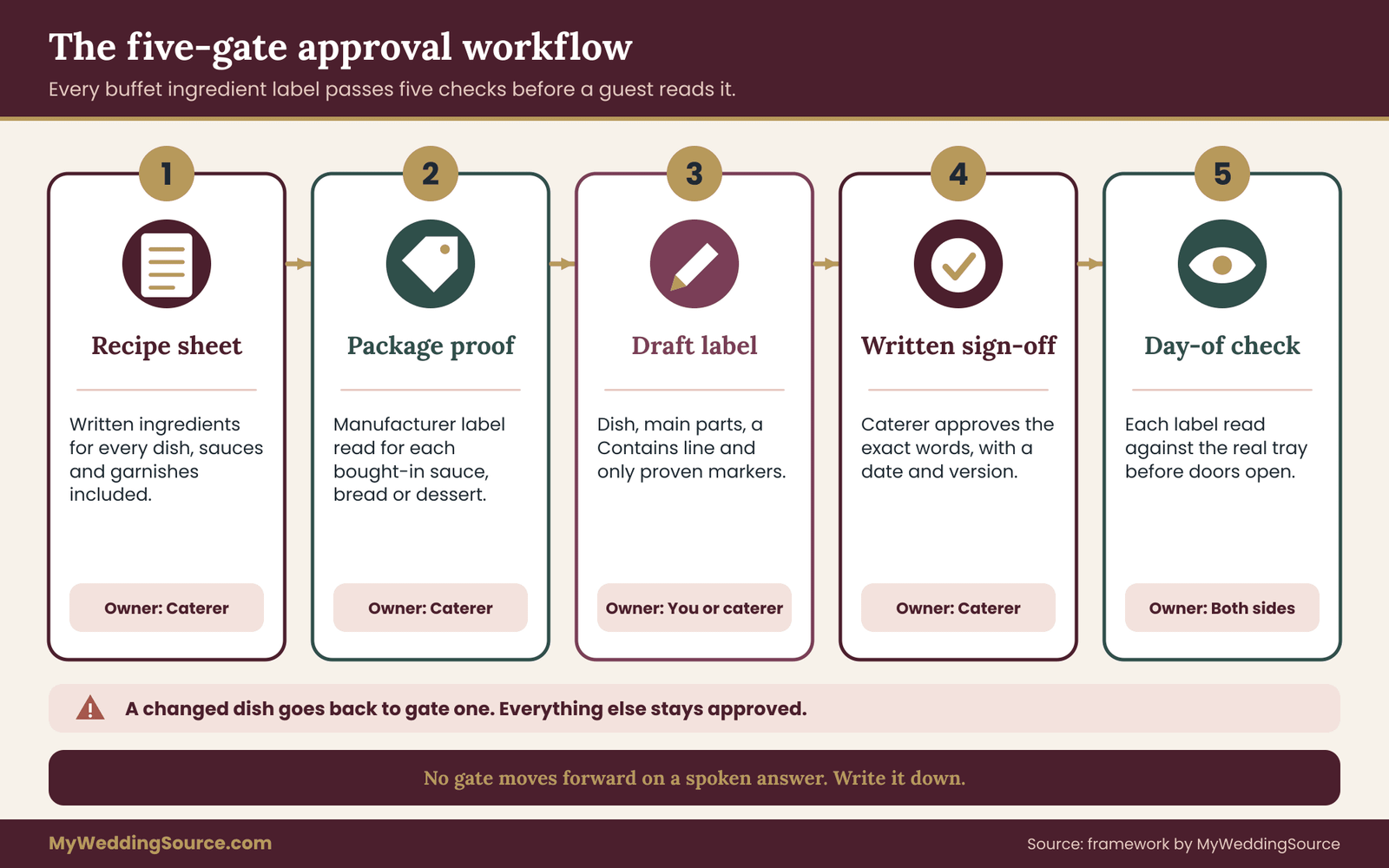
Think of the process as five gates that every one of your buffet ingredient labels passes through before a guest ever reads it. Ingredient labels that skip a gate are not necessarily wrong, but you cannot know that they are right. The gates are simple on purpose, because you will run them during a busy stretch of planning.
Gate one: the recipe sheet. The caterer supplies a written list of every ingredient in every dish, including the parts people forget: sauces, glazes, oils, marinades, seasoning blends, breading, stock, garnishes and the topping sprinkled on at the last minute.
Gate two: package proof. For each bought-in component, the kitchen confirms the allergen information from the manufacturer’s current label. A brand name and a product code go on the sheet, so the check can be repeated.
Gate three: the draft card. You or the caterer’s team write the ingredient labels in plain words: dish name, main ingredients, a “Contains” line for the nine major allergens, and any dietary marker the kitchen can support.
Gate four: written sign-off. The caterer’s responsible person approves the exact card text in an email or a signed document, with a date and a version label. From this point, the text is frozen unless it goes back through the gates.
Gate five: the day-of check. Someone reads each printed card against the dish that is actually on the tray before service begins, and a named person owns any change after that.
Several rules keep the gates meaningful rather than ceremonial.
One owner per gate. Gates one, two and four belong to the caterer, because only the kitchen knows what is in the food. Gate three can be yours or theirs. Gate five should be shared, with the caterer’s lead checking the food and a person from your side checking the print. When everyone owns a gate, nobody does.
Nothing moves forward on a verbal answer. “Oh, there’s no nuts in that” is a useful lead and a poor record. If the answer matters enough to put on a card, it matters enough to be written down on the recipe sheet. That protects the caterer, too, because it makes the source of every statement clear.
Changes restart the relevant gates. If the menu changes after sign-off, for example the caterer swaps a sauce because a supplier ran out, that dish goes back to gate one. Everything else stays approved. You are not redoing the whole buffet, only the dish that changed.
The sign-off covers text, not intentions. The caterer approves the words on the card. If the card says “Contains milk and wheat,” the approval means the kitchen agrees those words are accurate, not that the dish is free of everything else in the world. That is another reason to keep the card’s claims narrow.
The workflow also gives you a way to compare caterers. A caterer who already works this way will respond to your request for a recipe sheet in a day or two with a tidy document. A caterer who has never been asked may need a week and a few prompts, and one who resists the idea entirely is telling you something about how the kitchen handles allergen information.
The article on vendor due diligence has a broader set of questions for judging any vendor, and this workflow is a food-specific version of the same idea.
A practical point on timing. Gates one and two take the longest, because they depend on the kitchen’s schedule and its suppliers. Start them as soon as the menu is chosen, which for most weddings is a few months before the date. Gates three and four can happen in a single week. Gate five happens on the day, in about fifteen minutes. A later section lays out a timeline you can copy.
Gates one and two: recipe sheets and package proof
Every one of your ingredient labels depends on the first two gates, so they deserve the most detail.
What a usable recipe sheet looks like
A recipe sheet is not a menu. A menu says “herb-roasted chicken with lemon jus.” A recipe sheet says what is in the chicken, the herb rub, the lemon jus and anything that touches them. It does not need to reveal trade secrets or exact quantities. It needs to list ingredients, and it needs to be complete.
Ask for one sheet per dish with these fields:
- The dish name exactly as it will appear on the card.
- Every ingredient, including oils, butter or margarine, stock or broth, seasoning blends, sweeteners, thickeners and garnishes.
- The brand and product name for any pre-made component, such as a sauce, a dressing, a bread or a dessert filling.
- The nine major allergens that the dish contains, marked yes or no.
- A note on what the dish is cooked and held on, such as a shared griddle or a dedicated pan.
- The date the sheet was prepared and the name of the person who prepared it.
These fields are the raw material for your ingredient labels. Seasoning blends and stocks are the usual blind spots. A “spice rub” may include wheat-based fillers, and a bouillon base may include milk or soy. A kitchen that buys these in bulk may not have the label handy, which is why gate two exists.
If the caterer uses a standard internal template, accept it. The goal is complete information, not a particular format. If they have no template, you can send one of your own, and a plain document or spreadsheet is fine. Keep it dull and practical.
How package proof works
For each pre-made component, the kitchen reads the manufacturer’s label and records the allergen statement. Federal labeling rules require packaged foods to disclose the major allergens, usually in the ingredient list or in a “Contains” statement, and many manufacturers also add a voluntary advisory such as “may contain” or “made in a facility that also processes.” Those advisories are not standardized, which means a kitchen should record them as written rather than interpret them.
Accurate ingredient labels begin with accurate package information, and package proof has three habits attached to it.
Use the current package. Manufacturers change formulas and suppliers. The label on last month’s case may differ from this month’s, so the kitchen should check the product that will actually be used for your event, close to the date.
Record the product and the date. A line such as “Brand and product name, label read on a given date, contains soy and wheat” is enough. If the product later changes, you can see what was approved.
Flag substitutions. Ask the caterer to tell you if any component is replaced before the event. A different brand of the same sauce can carry a different allergen profile.
Not every component comes in a package. Fresh produce, plain meat and fish, rice, and similar basics have no ingredient list because they have one ingredient. The recipe sheet simply names them. The risk with these items is rarely their content and more often what they are cooked on, coated with or marinated in, which the sheet should also capture.
Handling a dish the caterer cannot document
Sometimes a dish cannot pass gate two. A family recipe, a cultural specialty made by a relative, or a vendor who buys a finished product without keeping the packaging all fall into this group. You have three honest choices.
First, you can drop the allergen claims for that dish and label it with what you know for certain, adding a plain note such as “Ingredients not fully verified. Please ask before eating.” That is truthful and gives guests a reason to check.
Second, you can request the documentation before finalizing the card, and keep the dish off the buffet until it arrives.
Third, you can move the dish out of the buffet line and serve it to a specific table or on request, which gives you control over who eats it and what they are told.
What you should not do is guess. A card that says “no nuts” because the dish “never has nuts” is a guess dressed up as a fact. The workflow exists to replace guesses with records.
A short script for requesting recipe sheets
Many couples hesitate to make this request because it feels like an audit. It does not have to. A calm email works: “We would like to put ingredient labels by each buffet dish. Could you send a written ingredient list for each dish, including sauces and garnishes, and let us know which of the nine major allergens each one contains? We will draft the ingredient labels and send them back for your approval.” That is polite, specific and easy for a kitchen to answer. Most professionals have heard it before.
Writing buffet ingredient labels: the wording rules
Once the recipe sheet and package proof are in hand, writing the card is the easy part, provided you hold to a few rules about what the words may and may not say. Good buffet ingredient labels share one habit: they state what is in the dish and stop there. Ingredient labels that do this are easy to approve and easy to defend.
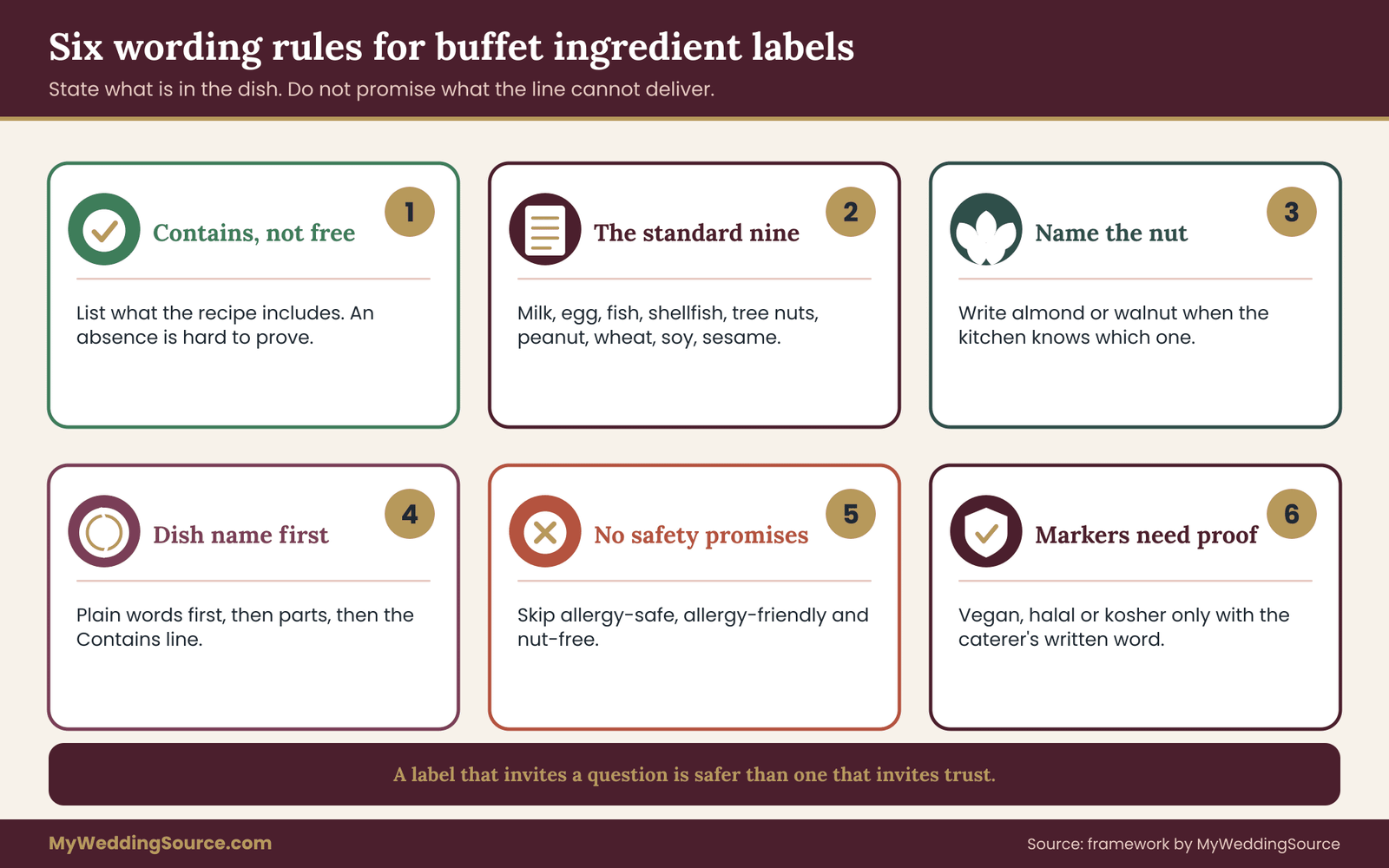
Rule one: use “Contains,” not “Free.” A “Contains” line lists the major allergens that the dish includes by recipe. It is verifiable from the recipe sheet. A “Free” statement, such as “nut-free” or “dairy-free,” claims an absence, and an absence is much harder to prove, because it depends on every ingredient, every surface and every spoon. Prefer the verifiable statement.
Rule two: name allergens in plain words, using the standard nine. Write “milk,” “egg,” “wheat,” “soy,” “peanut,” “tree nuts,” “fish,” “shellfish” and “sesame.” Do not shorten to “dairy” on one card and “milk” on another, and do not hide an allergen inside a fancy ingredient name. A guest scanning quickly should find the same word every time.
Rule three: name the specific tree nut or fish if you know it. “Contains tree nuts (almond)” helps a guest who reacts to some nuts and not others. If the kitchen cannot say which, “tree nuts” alone is acceptable and honest.
Rule four: describe the dish in ordinary language first. Lead with what a guest would call it, such as “Herb-roasted chicken, lemon sauce.” Then list the main components, then the “Contains” line. Marketing adjectives like “artisan” or “signature” add nothing and push the useful words down.
Rule five: avoid safety promises. Phrases such as “allergy-safe,” “allergy-friendly,” “safe for nut allergies” and “100% gluten-free” make a promise on behalf of the kitchen and the serving line. If a guest relies on that promise and has a reaction, the card becomes part of the story. The wording should invite the guest to ask, not to relax.
Rule six: mark dietary categories only when the kitchen can support them. Vegan, vegetarian, halal and kosher each have particular meanings. “Vegetarian” means no meat or fish, but it may still include dairy and egg. “Vegan” means no animal products at all, including honey in a glaze or gelatin in a dessert. Halal and kosher involve sourcing and preparation rules, and sometimes certification. Use these markers only when the caterer confirms them in writing, and consider a small plain marker rather than a long claim.
Examples of weak and strong card wording, in prose
It helps to see how the same dish reads when its ingredient labels follow different approaches.
A weak card says: “Mac and cheese, nut-free, kid-friendly.” It claims an absence, which nobody verified, and adds a vague label. It also leaves out the allergens the dish plainly contains.
A better card says: “Baked macaroni and cheese. Pasta, cheddar, milk, butter, bread crumb topping. Contains milk, wheat.” It is complete, verifiable and quiet.
A weak card for a dessert says: “Gluten-free brownies.” The claim may be true of the recipe, but the brownies sit next to a wheat-based tart on the same platter, and the guest cannot tell.
A better card says: “Chocolate brownies made with almond flour. Contains egg, tree nuts (almond), milk. Made without wheat flour. Served on a shared dessert table.” It states the recipe fact (“made without wheat flour”) and the service fact together, which lets the guest decide.
That last example shows a useful pattern. “Made without wheat flour” describes the recipe, which the kitchen can document. It does not claim the dessert is gluten-free in the regulated sense. The shared-table sentence tells the truth about the setting. A guest with celiac disease can read it and ask a better question, which is the result you want.
How to handle the “may contain” problem
Manufacturers often print advisory statements such as “may contain tree nuts” on packages. Kitchens sometimes copy these onto their ingredient labels, and the ingredient labels become long and confusing. A restrained approach works better.
Keep the card focused on ingredients in the recipe. Put process and facility information in one separate notice that covers the whole buffet, which the next sections describe. If a specific component carries a strong advisory that matters, the caterer can mention it to guests who ask, and you can record it on your master sheet. Repeating every advisory on every card makes guests stop reading, and a card that nobody reads protects nobody.
Sauces, dressings and sides served separately
Treat any item a guest can add to a dish as its own item with its own entry among your ingredient labels. A dressing served in a pitcher, a crumble served in a bowl next to the salad, a sauce passed at the end of the line all need their own entries. Otherwise the card on the salad describes a product the guest is about to change.
Keep the vocabulary short
Ingredient labels are read standing up, usually with a plate in one hand and a person waiting behind. Aim for a dish name, no more than a short line of components and one “Contains” line. If you find yourself writing a paragraph, the information probably belongs in a binder at the end of the line or on a master sheet that staff can consult, and the card can say “Ask us about ingredients.”
Layout and readability for buffet ingredient labels
Carefully worded ingredient labels fail if nobody can read them. Layout is part of the accuracy.
Anatomy of a clear card
Reliable ingredient labels share a fixed structure, so guests learn it by the second dish.
- Dish name at the top, largest on the card.
- Components in a short line below, in ordinary words.
- “Contains” line in a consistent position and a bold weight, using the standard allergen words.
- Dietary marker, if any, as a small plain icon or word, only when the caterer confirmed it.
- Version label in tiny print at the bottom, such as a date or a version number, so staff can match the card to the approved text.
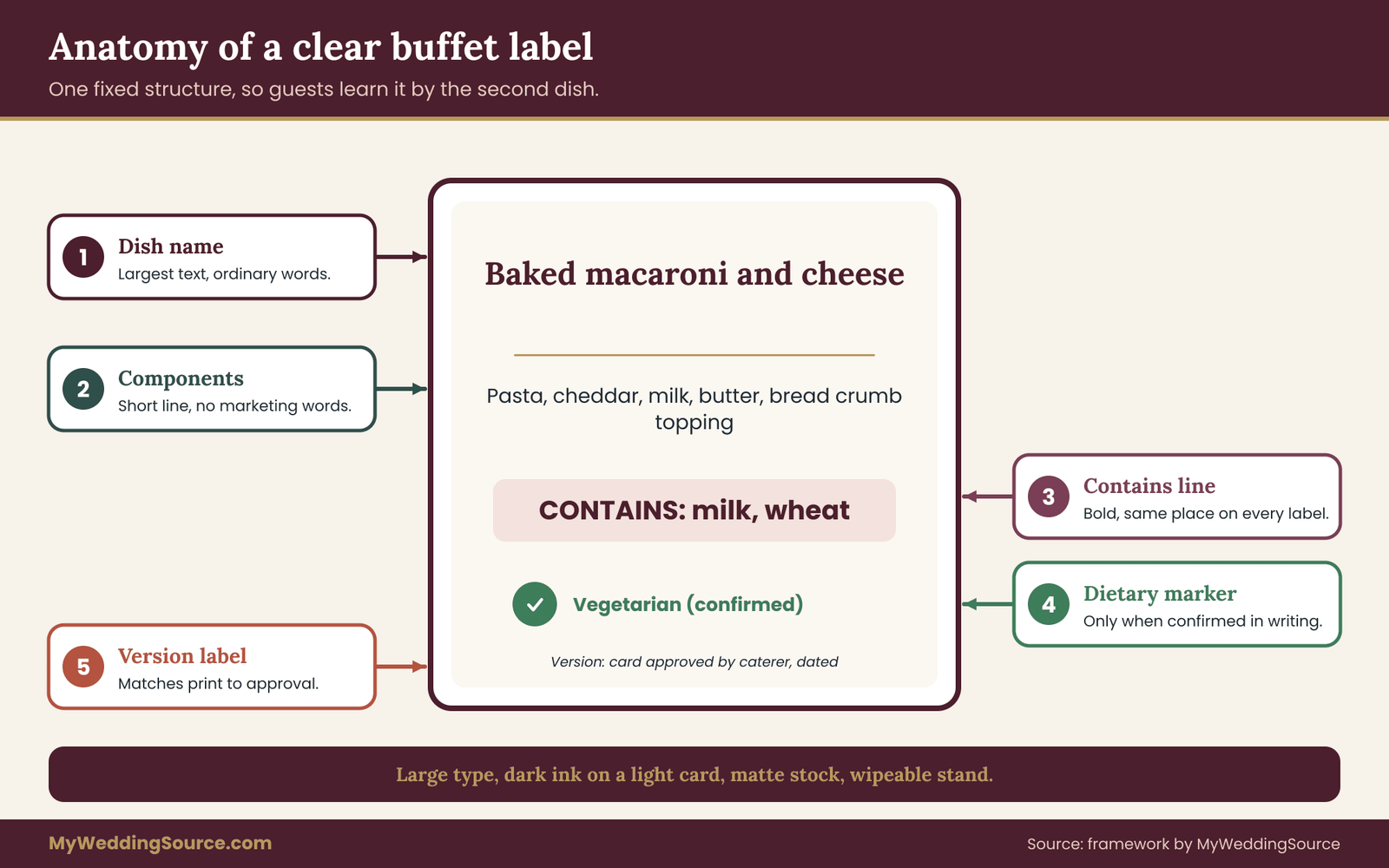
The version label is a quiet but valuable detail. If a card is reprinted after a change, the date on the card tells your day-of checker which copy is current. It also helps if a card gets mixed up with another. The same habit works for any printed item that may be revised and reprinted before the event.
Type size and contrast
Guests read these ingredient labels at arm’s length or farther, often in dim light, and many have limited vision. Use a clean typeface, dark text on a light background and a “Contains” line that is at least as large as the component line. Avoid script fonts, pale ink and glossy stock that reflects the lights. If you want a decorative card, keep the decoration around the text rather than behind it. The broader wedding signage guide goes deeper on readability, placement and venue permissions for any printed sign.
Placement on the line
Put each card directly in front of its dish, at the guest’s eye line if possible, and on the guest’s side of the tray so a serving person does not block it. Tent cards on small stands work on most tables. Avoid placing a card between two dishes, where it might describe either. If a tray holds two dishes, separate them with a visible divider and give each its own card.
Position matters for another reason. A card that sits behind a sneeze guard or under a tray rim may get splashed. A wet or stained card is hard to read and looks careless, so many caterers laminate or use plastic stands. Whatever you choose, make it wipeable.
One master sheet behind the ingredient labels
Keep a single printed or digital master sheet that lists every dish, its ingredients, its allergens and its version date. Give one copy to the caterer’s lead, one to your day-of coordinator and one to the person you name as the allergy contact. When a guest asks a question the card does not answer, staff can check the master sheet instead of guessing. The master sheet is also your record if anything changes late.
Buffet ingredient labels handle what is in each dish. The cross-contact warning plan handles what the line itself can do. This is where honest wording matters most, because it is also where overpromising is most tempting.
The plan has three parts: a clear statement of what level of separation you actually have, a set of physical controls the caterer agrees to, and a short list of guests or dishes that get special handling. You build it from the caterer’s answers, not from hopes.
Three honest levels of statement
Almost every buffet fits one of three levels, and the notice you display should match the level you can truthfully claim.
Level one: ingredients disclosed, shared line. This is the baseline for most weddings. The ingredient labels list ingredients and allergens. The kitchen prepares many dishes, including some with major allergens, and the line is shared. The notice says so in plain words. For example: “Our dishes are prepared in a kitchen that handles milk, eggs, wheat, soy, peanuts, tree nuts, fish, shellfish and sesame, and are served on a shared line. Cross-contact is possible. Please ask about ingredients.”
Level two: controls in place for named dishes. The caterer has agreed to specific steps for specific dishes, for example a separate prepared tray with its own utensil for a dish that avoids a certain allergen, plated and carried out from the kitchen rather than served from the line. The notice names the dish and the step: “The wild rice pilaf is prepared first in clean pans and served with its own spoon from a separate tray.” That is a statement of process, not a promise of safety.
Level three: individually prepared meal. For a guest with a serious allergy, the best arrangement is usually an individually prepared and plated meal, made by the kitchen’s allergen lead and brought directly to the guest. That removes the guest from the shared line altogether. Buffet ingredient labels are not part of this arrangement, but the guest should still be told what is in the plate.
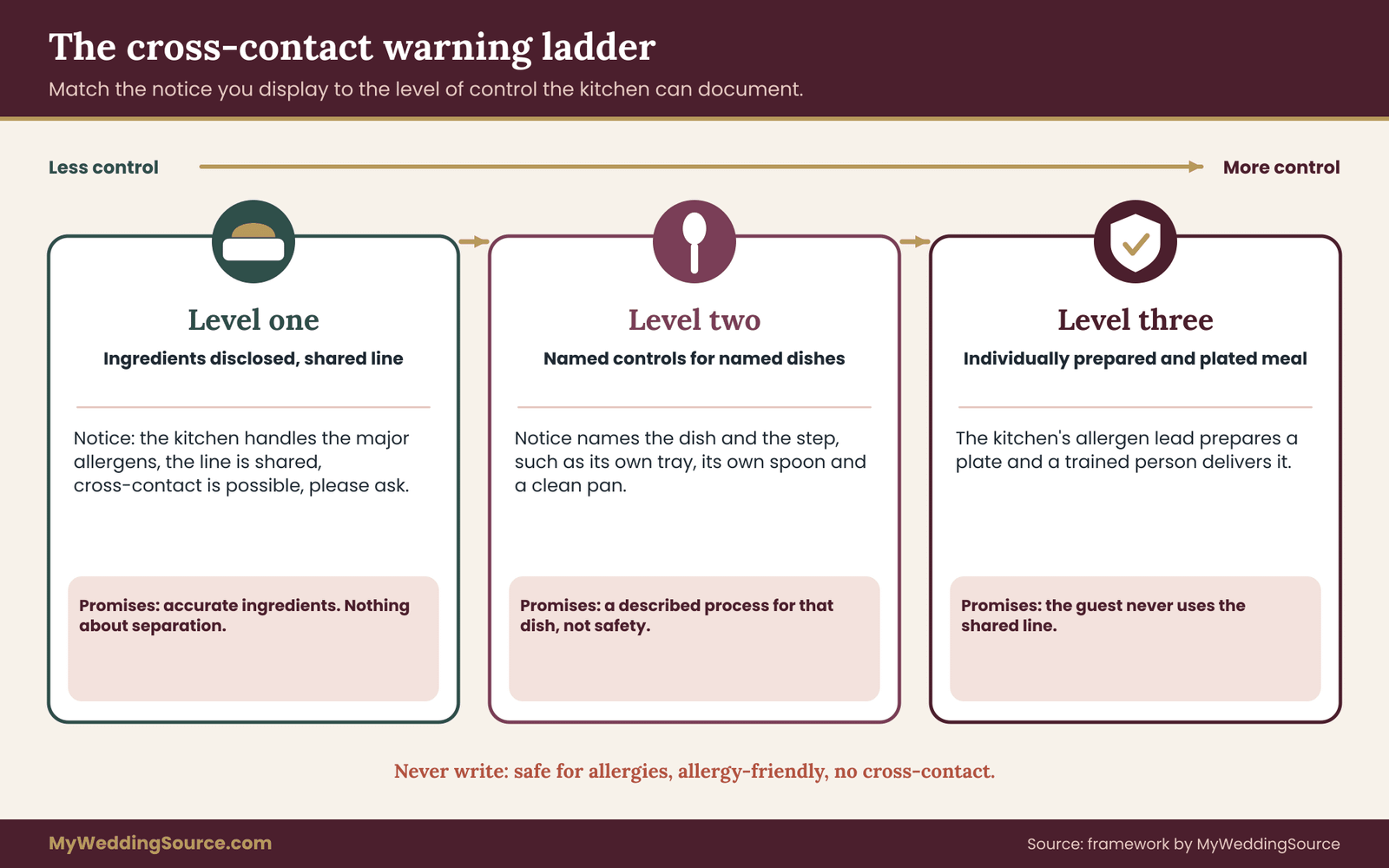
Match the notice to the level, and match your ingredient labels to the same level. Ingredient labels that imply level two or three when the kitchen is operating at level one are the classic way a well-meaning couple ends up promising allergen safety they cannot deliver.
Physical controls to ask the caterer about
Nobody can remove all risk from a shared line. Many caterers, however, have routines that reduce it. Ask what they do and write the answers down. The following list covers the controls that matter most for a buffet.
- One utensil per dish. Every tray gets its own spoon, tongs or server, and utensils are never moved between dishes. Ask whether the kitchen uses color-coded or labeled utensils and what happens when a guest drops one in the wrong tray.
- Utensil rests. Utensils should rest in the dish or on a clean holder, not across the neighboring tray, where drips can land.
- Order of the line. Putting dishes with the same allergen next to each other, and keeping them away from dishes that avoid it, reduces accidental drips and swapped spoons. Where possible, place dishes that contain nuts or shellfish at the end of the line, so guests do not carry a plate past them.
- Separation of risky categories. Bread, crackers and croutons shed crumbs. Sesame seeds and chopped nuts scatter. Keep these items on their own station or away from dishes that guests with those allergies may choose.
- Fresh trays for refills. When a tray is topped up, the kitchen should bring a fresh, labeled pan, not scoop from a different dish. Ask how staff keep refills matched to cards.
- Staff placement. Served buffets, where a staff member portions each plate, give more control than self-serve lines. If the budget allows, a staff member at the highest-risk stations can reduce misuse of utensils and answer questions.
- Hand hygiene and gloves. Staff who handle allergen foods should wash hands and change gloves between tasks. Ask whether the team has a written practice for it.
- Cleaning. Allergen protein is removed by washing with soap and water and not by a quick wipe. Ask how serving equipment is cleaned before the event and whether new equipment, dedicated to allergen-sensitive dishes, is available.
A reasonable caterer can describe most of these without hesitation. A caterer who cannot, or who says “we’ve never had a problem,” has not given you information, and your notice should stay at level one.
Where cross-contact actually happens
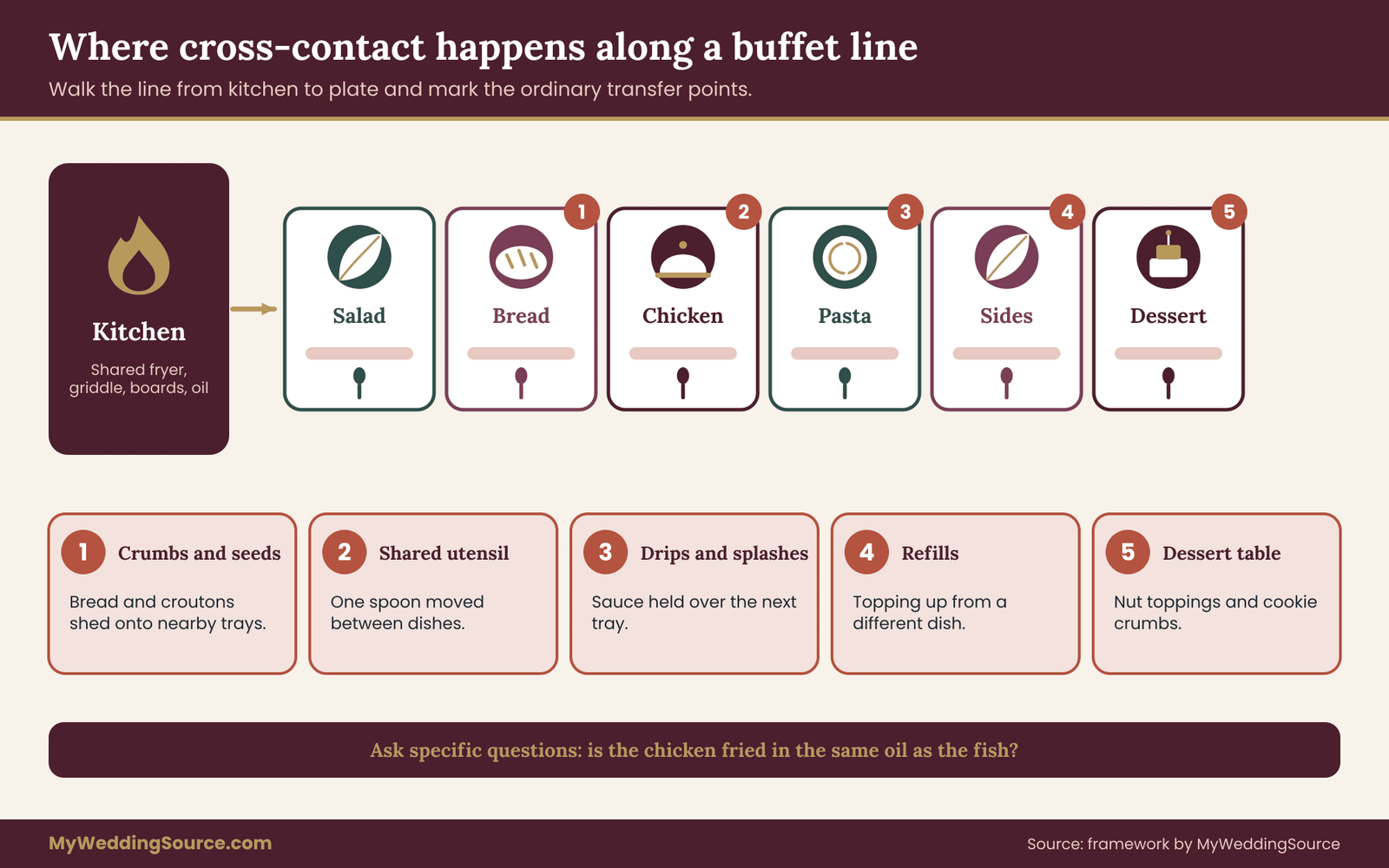
It is worth walking the buffet from the kitchen to the table and looking for the points where transfer occurs, because most are ordinary.
In the kitchen, shared fryers, griddles and cutting boards, and the same oil used for several items, are common sources. At holding, a hot tray lid placed on a neighboring dish or a splash between pans carries food over. On the line, the shared spoon, the guest who uses the wrong utensil, the drip from a sauce held over another tray and the crumbs from the bread basket are the typical culprits. At the dessert table, the same dynamics repeat with frosting, nut toppings and cookie crumbs.
Knowing these points lets you ask better questions. Instead of “Is it safe?” you can ask “Is the chicken fried in the same oil as the shrimp?” and “Where will the bread be placed relative to the gluten-free option?” Specific questions get specific answers, and specific answers go in the notice or into your ingredient labels.
Writing the shared-line notice
The notice sits beside your ingredient labels and does a different job: the labels describe dishes, and the notice describes the line. It should be short, calm and visible at the start of the line and again at the dessert table. It has four sentences or fewer.
- Say that the kitchen handles the major allergens.
- Say that the line is shared and cross-contact is possible.
- Tell guests to read the ingredient labels and ask about ingredients.
- Name a person or place for questions.
Here is a model: “Our caterer’s kitchen handles milk, eggs, wheat, soy, peanuts, tree nuts, fish, shellfish and sesame. Dishes are served on a shared line, so cross-contact is possible. Please read each card, and ask Jordan, our caterer’s lead, if you have any questions.”
That is honest and useful. It does not apologize, does not alarm and does not promise.
Who gets individually prepared meals
Some guests will need more than a card. A guest with a serious, life-threatening allergy, or a guest with celiac disease, may not want to take any risk on a shared line, and that is reasonable. The best way to find them is the RSVP. The next section covers how to ask, but the principle is simple: if a guest tells you about a serious allergy, offer an individually prepared meal and talk to the caterer about it directly.
Do not make the guest fight for it. Collect the information early, pass it to the caterer in writing, and confirm that the kitchen’s allergen lead has read it. On the day, make sure the plated meal is delivered to the guest by someone who knows it is special, and that the server states what it contains and what was done to prepare it. The caterer owns that hand-off, and you own checking that it is set up.
What the notice should never say
A few phrases never belong in a cross-contact notice.
“Safe for allergies.” “Allergy-friendly.” “Nut-free kitchen” unless the kitchen truly is. “No cross-contact.” “We guarantee.” Each of these makes a promise on behalf of people and processes you do not control.
Equally, avoid the opposite error of scaring guests with a long list of every ingredient the kitchen has ever touched. A notice should help a guest decide, not frighten them out of the line.
Special cases that complicate buffet ingredient labels
Standard dishes are the easy part, and ingredient labels for ordinary dishes follow the rules above. A few situations come up often enough at weddings that they deserve their own rules.
Sauces, gravies and dressings
Sauces carry the most hidden ingredients. A gravy may be thickened with wheat flour, a cream sauce contains milk and butter, a stir-fry sauce often has soy and sometimes wheat, a pesto may contain tree nuts or cheese, and a Caesar dressing may contain fish and egg.
Because a sauce sits on top of a dish, it can change the whole card. If the sauce is poured by the kitchen, the dish’s label covers the finished dish. If guests pour it, the sauce gets its own entry among your ingredient labels.
Bread, rolls and crackers
Baked goods are usually bought in, so package proof is the right route. Ask for the bakery’s allergen information in writing, and note any seeds or toppings. Sesame, in particular, can sit on a roll that looks plain. Place bread away from dishes that guests with wheat or sesame allergy may select, and give the bread basket its own tongs.
Desserts and the dessert table
Desserts often come from a separate bakery, and the kitchen may not know every ingredient. Bakery ingredient labels should be collected the same way as the caterer’s. Treat the bakery as a vendor in its own right and run the same workflow: written ingredient list, allergen statement and sign-off.
If you are also serving a cake, ask the bakery whether it can document the cake’s ingredients and its preparation. The guide to wedding menu planning for different ages and diets covers building the dessert course around different needs, and the same record-keeping applies.
Gluten-free options
Because “gluten-free” has a specific regulatory meaning for packaged food, treat it with care on a buffet. A dish can be made without wheat, barley or rye ingredients and still pick up gluten from a shared spoon, a shared fryer or a nearby crouton. For a guest with celiac disease, those small amounts matter.
The honest card says what the recipe leaves out and what the line does: “Made without wheat, barley or rye ingredients. Served on a shared line.” If the kitchen can prepare a truly separate gluten-free meal, offer it as an individually plated option and say how it is prepared.
Vegan, vegetarian, halal and kosher dishes
These are dietary or religious categories rather than allergen categories, and they are separate questions. A vegan dish may contain tree nuts and soy. A halal dish may contain milk and egg. Keep the “Contains” line on every card regardless of the dietary marker, so a guest can see both pieces of information. For halal or kosher claims, ask the caterer what the claim means in their kitchen: sourcing only, separate equipment or third-party certification. If the kitchen cannot document the claim, do not print it.
Cultural dishes and family recipes
Many weddings include dishes with deep personal meaning: a grandmother’s recipe, a regional specialty or a dish cooked by relatives. These dishes are often the hardest to label, because the recipe lives in someone’s memory and the ingredients may include pre-made pastes, spice mixes and imported products with labels in another language. The same workflow applies, with a human touch.
Ingredient labels for family recipes are only as good as the notes behind them, so sit down with the cook, write the recipe as they make it, and photograph the packaging of each component. If a label is in another language, ask the importer or a translator to confirm the allergen terms rather than guessing.
If a family member cooks for the buffet, tell them plainly that the dish will be labeled with whatever they can document, and that you will not make allergen claims beyond that. Most people understand, and many are relieved to be asked.
Potluck and homemade buffets
Not every wedding uses a caterer. If friends and relatives bring dishes, you are in a different position: nobody holds a food license for the whole spread, and you are the organizer. Keep your promises small.
Ask each cook to supply a simple card with the dish name and a plain ingredient list, so that the buffet still has ingredient labels in front of every dish. Mark that the food was prepared in a home kitchen and may include any allergen, and avoid the words “safe” and “free.” Add a notice that says the food was prepared by several households and that cross-contact is possible.
A guest with a serious allergy should be told about this early, so they can bring their own food or arrange something else. Some places regulate food sales or events differently, so check with your local health department if the event is unusual.
Beverages and the bar
Drinks can contain allergens too. Cream liqueurs contain milk, some cocktails use egg white, almond liqueur contains tree nut flavor and some mixers include soy or sulfites. If your cocktail hour includes signature drinks, small ingredient labels for drinks follow the same logic. The wedding cocktail hour guide discusses how to structure that part of the evening, and the bar service planning guide covers the practical side of the bar.
Late additions and substitutions
Weddings run on schedules that change. A supplier runs short, a dish does not set, or a vendor swaps a product. Agree in advance that any change to a dish after sign-off triggers a call or text to your named contact, and that the dish card is corrected or the dish is removed before service. This is the most common point where an accurate card turns into an inaccurate one, so name a person who can make the decision at that moment.
Collecting guest needs before the day, and what to do with the answers
Ingredient labels work best when you also know who needs them most. Gathering that information is quick, and it changes how the whole buffet is run.
Asking on the RSVP
A short, specific question on the response card or website form gives you usable answers. Something like: “Do you have any food allergies or dietary needs we should share with our caterer? Please tell us what you avoid.” A broader “dietary restrictions” line tends to produce replies such as “vegetarian” or “no pork,” which are useful but do not distinguish a preference from a medical need.
If you want to make the difference clear, add a second line: “If your allergy is serious, please tell us so we can arrange a meal prepared for you.”
The RSVP etiquette guide covers how to word response cards, follow up with late guests and record answers. The same discipline applies to allergy information: record it in a single list and keep track of who has replied.
Following up with guests who report a serious allergy
A short, personal message does more than a form. Something like: “Thank you for telling us about your allergy. We are asking our caterer to prepare a meal for you and will share the ingredient information beforehand. Would you like to speak with the kitchen directly?” Many guests appreciate the offer and will want to talk with the kitchen themselves. If they do, make the introduction and let them speak.
Keep the information private. A guest’s medical details belong to them, so share them with the caterer and the day-of lead and nowhere else. Do not announce it on a seating chart or group message.
Sharing ingredient information ahead of time
For guests with serious allergies, offering the master sheet in advance respects their time and lets them decide about the meal before they arrive. You can send the relevant dish list a week or two ahead, once sign-off is complete. Include the date of the sheet, so they know which version they have.
Seating and service for guests with allergies
If you are using a plated meal for some guests and a buffet for others, make sure the kitchen knows where each allergy guest sits. The seating chart guide explains how to build tables, and a simple code on the caterer’s table list works well: a small symbol next to the guest’s name that tells the server which guests have an individually prepared meal. Do not print the allergy on anything visible to other guests.
A working timeline
A buffet’s label process runs on a calendar. The following sequence works for most weddings, though your caterer’s schedule may shift the weeks.
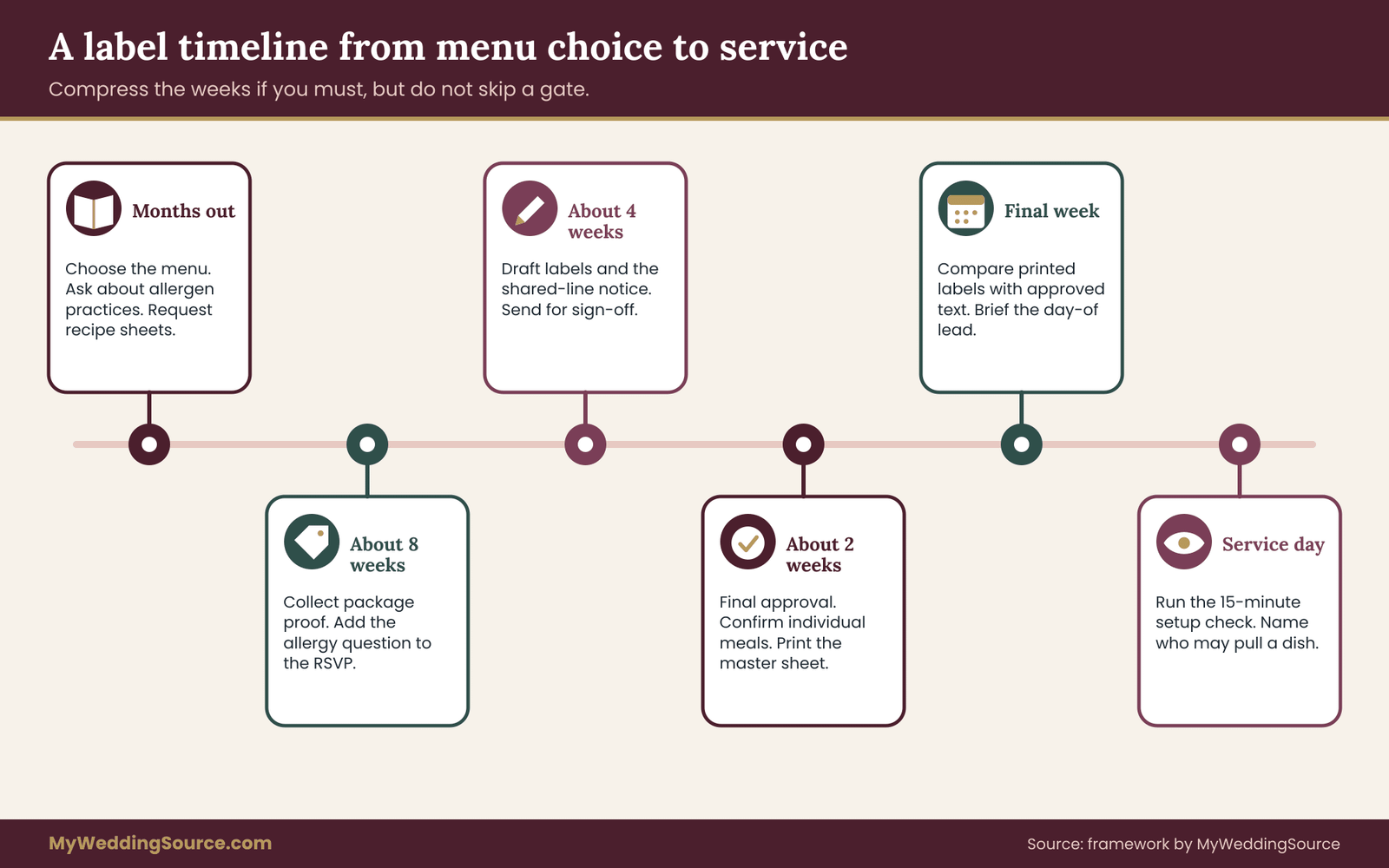
In the months before the wedding, choose the menu, ask the caterer about their allergen practices and request recipe sheets. About two months out, collect package proof and draft the ingredient labels. A month out, send the ingredient labels and the shared-line notice for sign-off, and gather guest allergy responses along with the final headcount.
Two weeks out, finalize the ingredient labels, confirm any individually prepared meals and print the master sheet. In the final week, check printed ingredient labels against the approved text and brief your day-of contact. On the day, run the setup check before the doors open.
Each step in this sequence protects the accuracy of your ingredient labels. The calendar is not rigid. If your wedding is in six weeks, compress it, but do not skip a gate. The only step you can shorten safely is the writing of the ingredient labels, which takes an afternoon.
Day-of control for buffet ingredient labels
The ingredient labels are approved, printed and boxed. What remains is making sure they stay true for the three or four hours of service. This is gate five, and it is quicker than it sounds.
The setup check
Before guests are allowed near the buffet, two people walk the line together: one from the caterer’s team who knows the food, and one from your side who holds the master sheet. They go dish by dish and ask four questions.
- Does the card in front of this tray name this dish?
- Does the “Contains” line match the master sheet and the dish the kitchen says is in the tray?
- Is the card on the guest’s side of the tray, readable and dry?
- Does this tray have its own utensil, and is it resting where it cannot touch another dish?
Then they walk the dessert table and the bar with the same questions. The whole check takes about fifteen minutes for a typical buffet, and it is the single best use of those fifteen minutes in the hour before doors open. A ten-minute check like this catches more errors than any amount of careful drafting, because it compares the ingredient labels with the real food. Photograph the finished line if you like, since a dated photo is a useful record of what was out.
Briefing the staff
A card is only as good as the person standing behind it. Before service, the caterer’s lead should brief servers on three things: where the master sheet is kept, who the allergy contact is, and what to say when a guest asks about a dish. A good rule for servers is to never answer from memory. “Let me check the sheet” is a fine thing to say, and far better than a confident guess.
The brief also covers behavior at the line. Servers should not move utensils between trays, should replace a dropped utensil with a clean one and should report any spill that crosses between dishes. If a guest sees a mix-up and mentions it, staff should treat it as information and fix it without defensiveness.
What happens when something changes
Changes are normal. A tray runs out and a replacement arrives, a dish is swapped, a delivery is late. The rule is short: a dish with a changed recipe gets a new card, or it gets pulled, before it is served.
To make that practical, keep a small stack of spare blank cards in a consistent format and a marker or printer on hand, or ask the caterer to carry a few pre-printed “Please ask about this dish” cards. If a change cannot be verified in the moment, the safe move is to label the dish as unverified and tell the line staff to answer questions only from the master sheet.
Name one person who may decide. It should not be you, as the couple, since you will be elsewhere. It should be your day-of coordinator or the caterer’s lead, and they should have the authority to pull a dish.
Handling a guest’s question at the line
Staff will get questions, and a calm script helps. A guest asks whether a dish contains a particular allergen. The server checks the master sheet and reads the answer: “The sheet says this dish contains milk and wheat. It does not list peanuts. It is prepared in a kitchen that also handles peanuts, and it is served on a shared line. Would you like me to bring the lead over?” That answer states a fact, states the limit and offers a person. It does not say “it’s fine.”
If a guest says they have a serious allergy, the server should not decide for them. The server should bring the caterer’s lead, who can speak to the kitchen’s practices and suggest the individually prepared meal.
After service
Once the buffet closes, keep the ingredient labels and the master sheet, and note any changes made on the day. If a guest reports a reaction, or a concern about the food, write down what happened while it is fresh. Do not argue about it in the moment.
Call or message the caterer the next day, share what you have recorded and ask for their account. Even if nothing went wrong, a one-page note on what worked and what did not is useful, especially if you are planning another family event.
A worked example: an invented buffet from recipe sheet to card
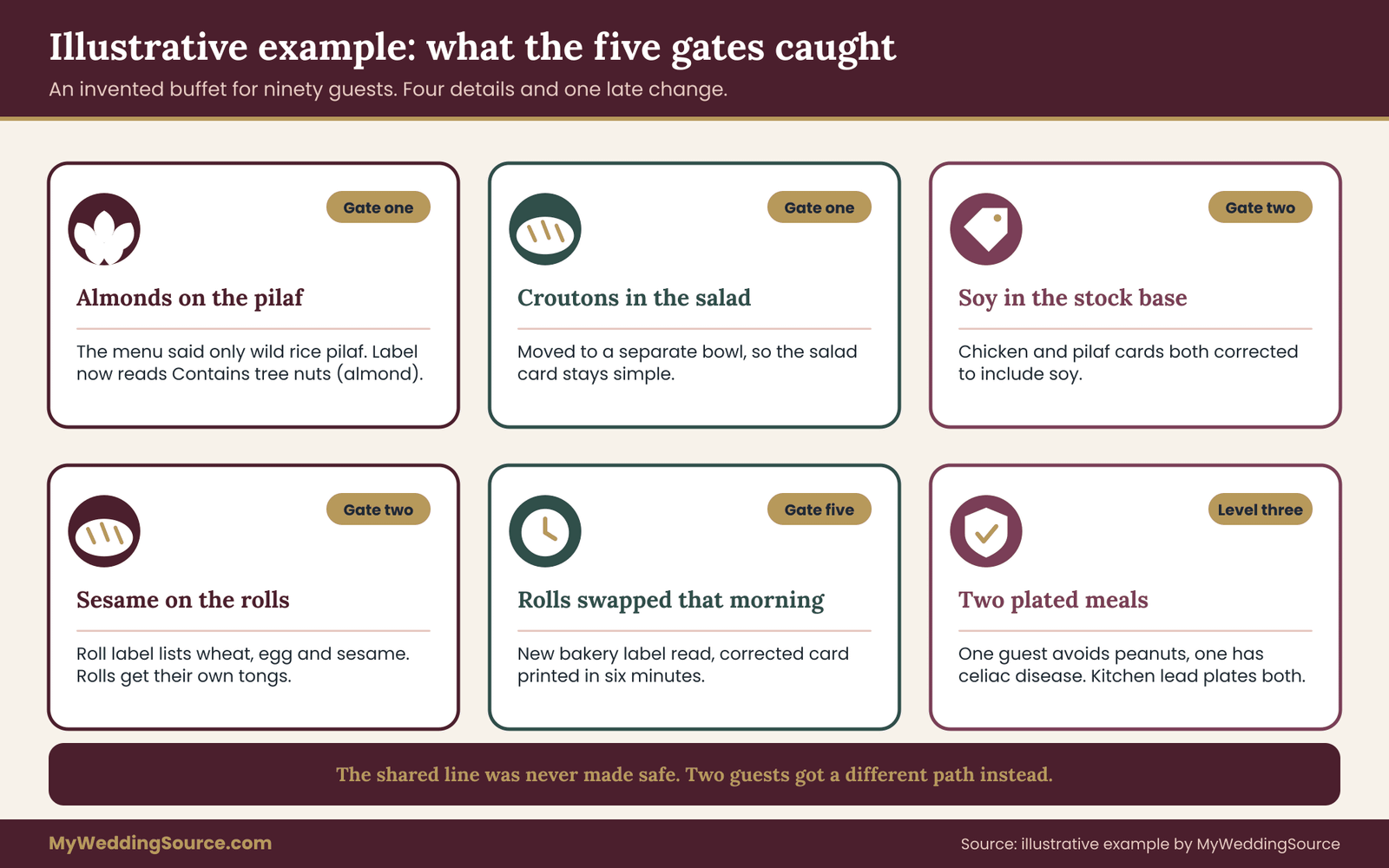
The following example is invented for illustration. It shows how the five gates behave on an ordinary menu, including the places where the process catches things. The couple, the caterer and the dishes are made up.
Hartley and Nguyen are planning a buffet for ninety guests. They chose eight savory dishes and two desserts from a caterer’s catalog. Two guests told them about allergies on the RSVP: one has a peanut allergy and one has celiac disease. The couple follows the workflow and decides that every one of their buffet ingredient labels will trace back to a written source.
Gate one: what the recipe sheets revealed
Three months out, they ask for recipe sheets. The caterer sends them within a few days. Reading carefully, the couple notices two things the menu did not mention. The rice pilaf is finished with toasted almonds, which the catalog describes only as “wild rice pilaf.” And the Caesar salad lists croutons tossed through the salad, not served separately.
Neither item is a mistake. Both are simply the kind of detail that a short menu description leaves out. The almonds go on the card as “Contains tree nuts (almond).” The couple asks whether the croutons can go in a separate bowl, and the caterer agrees. That one change keeps the wheat off the salad and makes the salad card simpler.
Gate two: what package proof caught
Two months out, the caterer sends the product details for bought-in components. The couple finds that the chicken stock base, used in the lemon jus and the rice, lists soy. The recipe sheet for the chicken had marked soy as “no,” because the chef did not think of the stock base as a source. The sheet is corrected, and both the chicken and the pilaf cards now include soy.
The dinner rolls come from a local bakery. The bakery’s information sheet shows sesame seeds on top. The roll card says “Contains wheat, egg, sesame,” and the rolls are placed on their own small table, away from the main trays, with their own tongs.
The dessert bakery’s sheet lists the flourless chocolate cake as containing egg, milk and soy, and carries an advisory that the bakery handles tree nuts. The couple records the advisory on the master sheet and leaves the card focused on recipe ingredients.
Gates three and four: drafting and sign-off
A month out, the couple drafts all ten ingredient labels in the same structure: dish name, components, “Contains” line, dietary marker if confirmed and a version date. The caterer confirms vegetarian status for four dishes in writing and the vegan status for the chickpea curry. The couple does not print “gluten-free” on any card. The curry card says “Made without wheat, barley or rye ingredients,” and the shared-line notice appears at the start of the line.
They send the ingredient labels and the notice back to the caterer, who approves them by email on a single date. The couple files that email with the master sheet.
The cross-contact plan for this buffet
The caterer is at level one for the main line. The couple asks about utensils, and the lead confirms that each tray gets its own server, that the kitchen replaces trays instead of topping them up, and that a peanut-free line, which the couple asked about for one guest, cannot be promised when the kitchen handles peanuts and serves from shared trays. So the plan moves the two guests with serious needs to level three.
The kitchen’s allergen lead will prepare and plate two individual meals, one that avoids peanuts and tree nuts, and one that avoids wheat, barley and rye ingredients with separate equipment. The couple sends each guest the relevant ingredient list a week ahead and offers a phone call with the lead. Both accept.
Gate five: the day of the wedding
At setup, the caterer’s lead and the couple’s coordinator walk the line with the master sheet. They find that the dinner rolls delivered that morning came from a different bakery than planned, because of a supply problem, and the new rolls have no sesame. The card now overstates the allergen, which is an easier error than the reverse, but it is still wrong.
The lead confirms the new bakery’s label, the coordinator writes a corrected card with a new version date, and the old one is set aside. The change takes six minutes because the spare cards and the master sheet were ready.
During service, a guest asks whether the lemon jus contains soy. A server checks the sheet and answers correctly, then brings the lead, who confirms the stock base. The two plated meals arrive at the right tables, and the servers state what each contains.
What the example shows
Nothing dramatic happened, and that is the point of good ingredient labels. The process caught four details: almonds on the pilaf, soy in the stock base, sesame on the rolls and croutons in the salad. It also caught a late change before it reached a guest. None of it required special expertise from the couple, only a habit of asking for written information and comparing it to the card.
It also shows the limit. The shared line was never made safe for the two guests with serious allergies. The plan solved that by giving them a different path, not by promising that the line was safe for them.
Common mistakes with buffet ingredient labels
Most problems with ingredient labels come from a short list of habits. Knowing them in advance is cheaper than learning them at the line.
Copying the menu into the card. A menu description is written to sound appealing, not to be complete. Ingredient labels built from it inherit every omission, such as the almond garnish or the stock base.
Letting the printer write the content. Some stationers offer “allergen icons” as a design flourish. An icon is only as accurate as the information behind it. If the icon was chosen by a designer who did not see the recipe sheet, it is decoration, and a wrong icon is worse than none.
Using “free” language because it feels kind. “Nut-free” sounds reassuring, and that is the problem. It tells a guest to relax about a thing you cannot guarantee.
Skipping the dessert table. Couples spend weeks on the main course and an afternoon on dessert. Yet cakes, tarts and cookies are rich in milk, egg, wheat, tree nuts and soy, and often come from a bakery separate from the caterer.
Forgetting add-ins and toppings. Cheese shavings, crushed nuts, seeds, croutons, sauces and garnishes are added after the dish is described. If it goes on the plate, it belongs on the sheet.
Approving once and never again. A sign-off from three months ago does not cover a substitution made yesterday. Keep the master sheet current and require a re-approval for any change.
Hiding behind the caterer. Saying “the caterer takes care of it” is a way of not reading the ingredient labels. You do not need to cook, but you do need to read every one of the ingredient labels that will be placed in front of your guests.
Overloading the card. A card with a paragraph of caveats is skipped. Keep one fact per line, put the process notice at the start of the line and keep the rest on the master sheet.
Sharing guests’ health details too widely. The goal is to inform the people who prepare and serve the food. It is not to publish a list of who has what. Share on a need-to-know basis.
Treating the notice as legal protection. A sentence on a sign does not make a risky practice safe. The notice is there to inform. If the kitchen cannot control cross-contact, the answer is a different arrangement for the guests who need one, not a longer warning.
Edge cases and judgment calls
Some situations do not fit the standard process. These are the ones that come up most.
Several vendors on one line
Weddings sometimes combine a main caterer, a separate bakery, a food truck and a family dish. Each food source needs its own recipe sheets and sign-off, and the master sheet should list the source for every dish. The shared-line notice should say that more than one kitchen contributed. If any vendor cannot supply documentation, label their dishes as unverified or place them on a separate table with a clear sign.
Food trucks and stations
Food trucks and action stations, such as a taco bar, a pasta station or a carving station, change the risk profile. Staff handle food directly, which can reduce misused utensils but increases the chance of transfer between guests’ plates and shared toppings. Ask the vendor to describe their process for a guest with a serious allergy, and ask whether the staff can prepare a dish separately on request.
Outdoor and cold-weather buffets
Outdoor service adds wind, insects, rain and long holding times. Cards can blow over or get wet, and covers may be removed and replaced between trays. Use weighted or clipped stands and consider a plastic sleeve. The shared-line notice stays the same, but the setup check should happen after the tent and tables are final, not before.
Buffet with a plated option for some guests
If most guests are on the buffet and a few have plated meals, the plated meals must be tracked as carefully as the ingredient labels. Have the caterer confirm in writing which guests receive which meal, and make sure the plate is delivered by a person who knows what is on it. A mismatched plate at a table is a worse failure than an imperfect card.
Guests who bring their own food
Some guests with serious allergies prefer to bring their own meal, and that is a sensible choice. Treat it as a normal request. Tell the caterer so the kitchen can reheat or hold it if the guest wants, and do not put pressure on the guest to eat anything from the line. The goal is for them to enjoy the evening.
Children’s menus and snack tables
Children’s options, such as chicken fingers, pasta or fruit cups, often come from different suppliers than the main menu and may contain different allergens. Give them cards in the same format, and consider placing them on a separate small table with a card for each item. Parents will check the ingredient labels as carefully as anyone. For broader ideas on meals by age, see the wedding menu planning guide.
When a guest’s allergy information arrives late
A guest may mention a serious allergy a few days before the wedding or at the door. Do not promise a solution you cannot arrange. Call the caterer immediately, explain the situation and ask what the kitchen can do. Often the kitchen can prepare a simple individual plate with ingredients they can fully verify. If it cannot, tell the guest honestly and let them decide what to eat. An honest “we are not able to guarantee this on short notice” is kinder than a hopeful promise.
This is the point at which to put what you have learned into a short list of questions. Ask them early, ask them in writing and keep the answers with your contract. The broader article on wedding vendor contracts explains how to record promises so they are enforceable, and food promises are among the most important ones to write down.
Ask the caterer:
- Can you supply a written ingredient list for every dish, including sauces and garnishes?
- Do you check the manufacturer’s label for bought-in components, and can you share the product details?
- Which of the nine major allergens does your kitchen handle, and how do you separate them?
- What is your practice for utensils, trays, refills and cleaning on a buffet line?
- Do you have a staff member trained in food allergen safety, and can that person speak to my guests?
- Can you prepare an individual meal for a guest with a serious allergy, and how is it delivered?
- Who is responsible for approving the final cards, and how will changes on the day be handled?
- What certifications or training does your team hold, and can you share them?
Ask the local health department:
- Does a food service event at this venue need any allergen notice or particular wording?
- Are there rules for food prepared by non-licensed cooks at a private event?
- Who should we contact if a question comes up on the day?
Ask the venue:
- Does the venue kitchen or catering policy restrict outside food, labels or signs?
- Who in the venue team is responsible for food service rules on the day?
Rules and fees vary, so rely on the issuing agency and on written answers. The FDA’s food allergy pages describe the major allergens and labeling rules for packaged foods, and the CDC and NIAID pages describe food allergy basics. Your local health department sets the rules for retail food service where you live.
Your next steps
Start with one email. Ask the caterer for written recipe sheets for every dish and for the product details behind bought-in sauces, breads and desserts. While you wait, add an allergy question to your RSVP, and write down the five gates on a single page so everyone involved sees the same process.
Then work through the gates in order: check the sheets against packaging, draft the ingredient labels in a fixed structure, get the caterer’s written sign-off, and hold a fifteen-minute check on the day. Add one honest notice at the start of the line, offer individually prepared meals to guests with serious allergies and name one person who can answer questions. Good buffet ingredient labels will not make a shared line risk-free, but they will give every guest accurate information and an honest way to ask for more.
FAQ
Do we legally have to put ingredient labels on a wedding buffet?
It depends on where you are and who is serving the food. Federal packaged-food labeling rules do not directly cover a caterer’s prepared dishes, but state and local food service rules may require allergen notices. Ask your caterer and your local health department what applies to your venue, and get the answer in writing. Even where nothing is required, ingredient labels are a considerate practice.
Which allergens should a Contains line cover?
Use the nine major allergens identified under U.S. federal law: milk, eggs, fish, crustacean shellfish, tree nuts, peanuts, wheat, soybeans and sesame. These are the standard set for packaged food, and they give guests a familiar frame. If a dish contains another ingredient that guests commonly avoid, such as mustard or celery, you can list it as a plain ingredient on the card.
Can we write “nut-free” or “gluten-free” on a buffet card?
It is better not to. Those phrases claim an absence, and on a shared line you cannot prove it. Describe the recipe instead, for example “made without wheat, barley or rye ingredients,” and add a shared-line notice. If the caterer can document a fully separate preparation and service for a specific dish, state that process in plain words rather than using a claim word.
Who should write and approve the ingredient labels?
Either you or the caterer can write the draft, but the caterer’s responsible person should approve the final text in writing, because the kitchen knows what is in the food. Keep the approval email with a date and version label. If the menu changes later, the changed dish goes back through approval before it is served.
What should a shared-line notice say?
Keep it short and calm. Say that the kitchen handles the major allergens, that dishes are served on a shared line so cross-contact is possible, that guests should read the ingredient labels and ask questions, and who to ask. Avoid phrases like “allergy-safe” or “we guarantee.” The notice should inform guests, not reassure them beyond what the kitchen can control.
How do we help a guest with a serious allergy?
Ask on the RSVP, follow up personally and talk to the caterer early. The best arrangement is usually an individually prepared and plated meal made by the kitchen’s allergen lead, delivered by someone who knows what is on it. Share the ingredient information beforehand, offer a call with the kitchen and keep the guest’s details private.
What if the caterer changes a dish on the wedding day?
Agree in advance that any change after sign-off must be reported to a named person, and that the card is corrected or the dish is pulled before service. Keep spare blank cards and the master sheet at hand. If the change cannot be verified, label the dish as unverified and have staff answer questions only from the sheet.
Do we need ingredient labels at a cocktail hour or dessert table?
Yes, if guests can serve themselves or choose between items. Appetizers, passed bites, desserts and signature drinks can all contain major allergens. Use the same card structure and the same approval process, and treat any separate bakery or bar vendor as its own source of recipe information.
Sources
- Food allergies, U.S. Food and Drug Administration
- FDA Food Code, U.S. Food and Drug Administration
- Food allergies, Centers for Disease Control and Prevention
- Food allergy, National Institute of Allergy and Infectious Diseases
- Food safety, FoodSafety.gov
- Food safety and inspection, USDA Food Safety and Inspection Service
- Food, U.S. Food and Drug Administration
- Advertising and marketing guidance for businesses, Federal Trade Commission
- Food safety and allergen training, ServSafe