
An arrival buffer is the block of time between the moment a guest lands and the moment they are expected to be rested, dressed and seated at your ceremony. When guests cross time zones and your ceremony starts early, that buffer is the difference between a guest who is glad to be there and a guest who is awake for the wrong reasons. This guide shows how to build an arrival buffer chart by origin and by flight schedule, with a worked example you can copy.
For each group of guests, work out three things: how many time zones they cross, in which direction, and what time their flight lands. Then set an arrival buffer made of three layers: travel day, body clock and early start. For a morning ceremony, ask most long-distance guests to land the day before, and set a landing deadline for that evening. Put the arrival buffer in your hotel block dates, your invitation wording and one clear page of travel guidance, and verify every airline and hotel rule with the company itself.
Early ceremonies are lovely. The light is soft, the venue is often cheaper, the day has room for a long lunch, and nobody is waiting through an afternoon in formal clothes. They also carry a quiet cost that couples rarely count when they pick the hour: every guest who flies in is being asked to be dressed and attentive at a time their body may regard as the middle of the night.
A ceremony at 9:30 in the morning in Boston is 6:30 in the morning in Seattle. For a guest from Seattle the alarm goes off at what feels like 5:00, if they want a shower, breakfast and a ride. For a guest from London it is already 2:30 in the afternoon, and they may have been awake since an overnight flight. Neither guest has done anything wrong. The schedule simply did not leave them room.
Planning an arrival buffer is how you leave that room on purpose. It is not complicated, but it does require you to stop thinking about “when do people arrive” as a single question. It is several questions that depend on where each group is coming from and which flight they can reasonably take.
A note on scope. This is general planning information, not legal, travel, medical or financial advice. Airline rules, hotel policies and health guidance differ by company and by person, and they change. Where a rule matters, this guide points you to the company or agency that issues it, so you can confirm the current version yourself.
What an arrival buffer is and what it protects
Most wedding schedules have a guest timeline that begins at the ceremony: seating opens at a certain time, the processional begins, the reception follows. The arrival buffer sits before all of that, and it belongs to the guest, not to you. It is the margin that absorbs everything that can happen between wheels-down and a seat in the second row.
It protects four things. The first is the ceremony itself. A guest who arrives in a rush, or does not arrive, is a visible gap among the people you care about most. The second is the guest’s health and comfort, especially for older relatives and anyone with a medical condition.
The third is your timeline, because a late guest who must be seated mid-processional costs the officiant and the photographer a moment they planned to spend elsewhere. The fourth is your budget, because last-minute rescue measures such as a rebooked car, a hotel night purchased at walk-up rates or a replacement flight cost more than a planned extra night.
Buffer is not the same as an early flight
The phrase can mislead. A large arrival buffer does not mean guests must travel on the earliest flight of the day. It means the guest lands with enough hours, and ideally enough nights, to be in good shape. A guest who lands at 4:00 in the afternoon the day before has a much bigger arrival buffer than a guest who lands at 5:30 that morning, even though the second guest may have left home earlier.
If you are also deciding where guests will sleep, the guide to coordinating wedding guest hotels covers budgets, mobility needs and block contracts, and this guide focuses on the timing layer that sits on top of those choices.
For the same reason, the arrival buffer is measured two ways. One measure is hours of slack between landing and the first thing you need them for. The other is nights of sleep in the destination time zone before the ceremony. Both matter, and the chart later in this guide uses both.
Why this problem is bigger for early ceremonies
For an afternoon or evening ceremony, a guest who lands the same morning can often manage. They may be groggy, but they have the middle of the day to nap, eat and adjust. A ceremony before ten in the morning removes that cushion. The guest must be awake, presentable and attentive in the first hours after the travel day, which is exactly the part of the clock that a time-zone change disrupts first.
If you have not yet fixed the ceremony hour, choosing a wedding date and time with guest travel in mind is easier than patching around it later. If the hour is fixed, this guide helps you work with it.
How time zones change an early ceremony
Before building a chart, get the basic direction rule straight, because it decides who needs the largest arrival buffer.
When a guest flies east, the clock at the destination is ahead of the clock at home. A guest from Seattle landing in Boston has to start the day three hours earlier than their body expects. When a guest flies west, the destination clock is behind. A guest from Boston landing in Seattle can sleep until what feels like a late hour and still be up early on local time.
Travel advice from public health agencies commonly describes eastward travel as the harder direction, because it asks the body to fall asleep earlier and wake earlier than it wants to.
For a morning ceremony, that general pattern creates a clear priority list. Eastbound guests and guests crossing many time zones in either direction need the most careful buffer. Westbound guests crossing one or two zones need the least, though they have their own risk: they tend to wake very early and fade by evening, which affects a rehearsal dinner or a late reception.
Convert the ceremony time to every guest’s body clock
The most useful thing you can do is write the ceremony time in each origin’s clock. Do this once, on paper, and look at the result.
Take a 9:30 a.m. ceremony in the Eastern time zone, during a period when standard time is in effect. For a guest from Chicago it is 8:30 a.m. For a guest from Denver it is 7:30. For a guest from Seattle it is 6:30. For a guest from Honolulu it is 4:30. For a guest from London it is 2:30 in the afternoon, and for a guest from Tokyo it is 11:30 at night. The same moment feels like very different parts of the day.
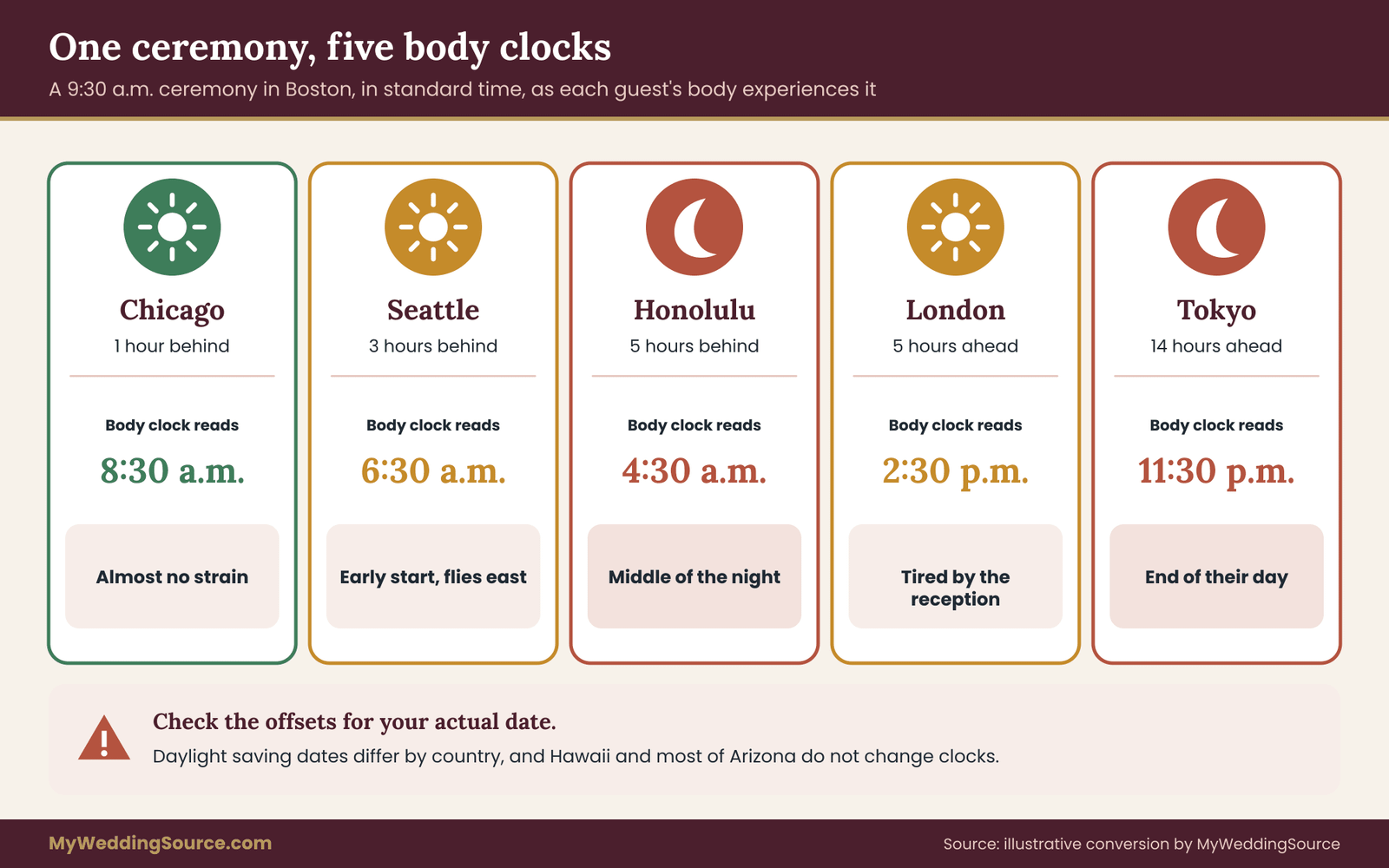
Look at those numbers as an organizer. The Chicago guest has almost no problem. The Seattle guest is starting a day at 6:30 body time, which is demanding but common. The Honolulu guest is being asked to perform at 4:30. The Tokyo guest has a different problem entirely: they are wide awake in the afternoon and at the end of their day, and they may be wide awake at 3:00 a.m. on the night before the ceremony.
Daylight saving time changes the gap
The hour difference between two places is not fixed all year. Most of the United States changes clocks twice a year, but Hawaii and most of Arizona do not. Many other countries change on different dates, or do not change at all. In practice, the gap between Boston and London is five hours for most of the year, but there are weeks in spring and autumn when it is four. The gap between Boston and Honolulu is five hours in winter and six in summer.
So convert using the actual ceremony date, not a rule you remember. A related but separate problem arises when the clocks change on the wedding weekend itself, so check whether any origin or the destination changes clocks within a few days of your date.
The three layers of an arrival buffer
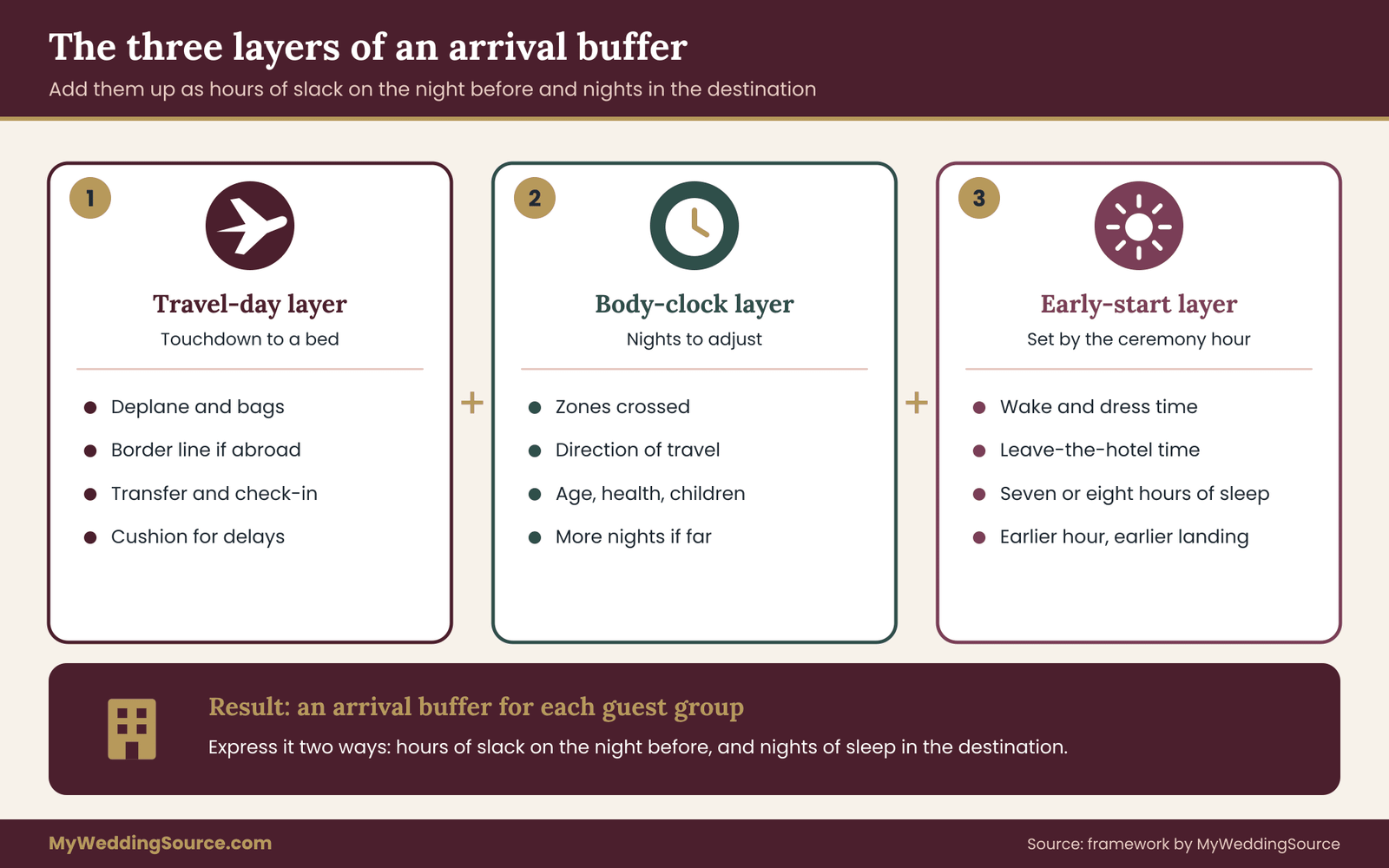
A useful arrival buffer is not one number. It is three layers added together, and separating them makes the planning honest. Each layer answers a different question, and each can be shortened or lengthened without disturbing the others.
Layer one is the travel-day layer. This is the time it takes to get from touchdown to a bed. It includes taxiing and deplaning, waiting for checked bags, getting through immigration for international guests, finding the ground transport, the ride itself and checking in at the hotel. These are logistics, not biology, and they are the part that delays hit hardest.
Layer two is the body-clock layer. This is the allowance for the time-zone change itself. It answers a single question: how many full nights of sleep in the new time zone does this guest need before they can be expected to function at your ceremony hour? The answer grows with the number of zones crossed and is larger for travel in the eastward direction.
Layer three is the early-start layer. This is the margin demanded by your ceremony time. A 9:30 ceremony requires someone to get up, dress and leave a hotel well before 9:30. The earlier the ceremony, the more of the previous night is consumed by getting ready, and the more the other two layers have to compensate.
Layer one in detail: landing to bed
Treat the travel-day layer as a list of steps with their own risks, because that is how it fails. Count each step and assign it a planning allowance that you can adjust with local knowledge.
The first step is deplaning and walking to baggage claim or the exit. In a large hub this can take a long time. The second is baggage. A guest with only a carry-on skips it, which is one reason to suggest that guests pack light.
The third is border processing for guests arriving from abroad, and for some guests it is a short line while for others it is a long one. The fourth is the transfer. A rental car pickup, a rideshare, a shuttle or a taxi each has its own waiting time. The fifth is hotel check-in, which at a busy hotel on a wedding weekend can have a queue.
Add them up using your own knowledge of the airport and the destination. Ask the hotel group-sales contact or the airport’s website about typical conditions. Then add a cushion for delays. A flight that is scheduled to land at 8:00 in the evening is, for planning purposes, a flight that may land at 9:30.
Layer two in detail: the body-clock allowance
There is no single rule that applies to every person. Public health agencies describe jet lag in general terms, and they note that its severity depends on how many zones are crossed, which direction the traveler goes, and individual differences such as age, sleep habits and health. For planning, you do not need a medical model. You need a conservative rule of thumb that gives guests a fair chance, and you need to understand that it is a planning tool and not a promise.
A simple way to set the second layer is to use bands. For one hour of difference, the body-clock layer is minimal.
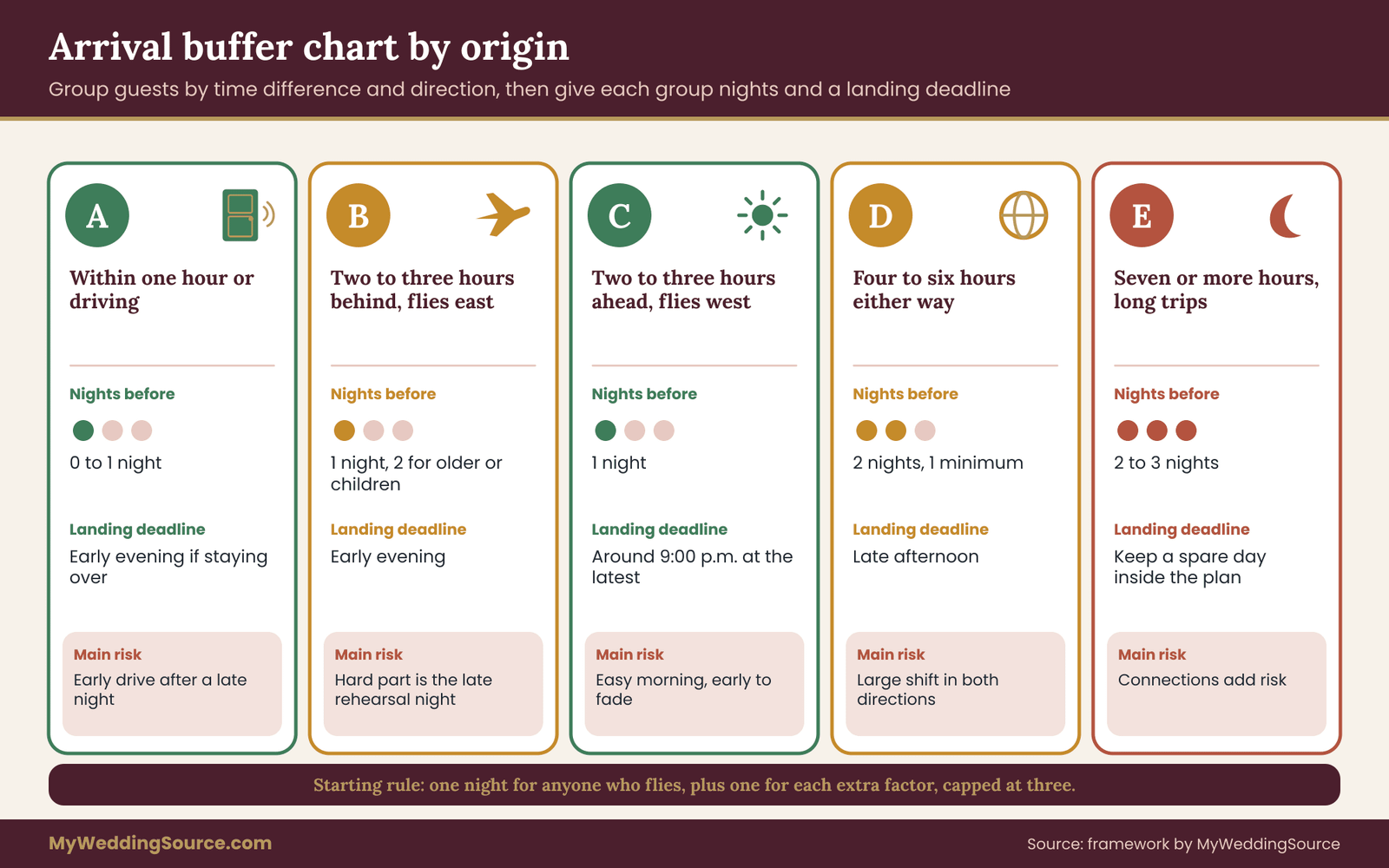
For two or three hours, one full night in the destination time zone before the ceremony is a sensible target. For four to six hours, aim for at least one night, with two being more comfortable for an early start. For seven hours or more, including long international trips, plan for two nights, and accept that some guests will still be tired. These are planning allowances that organizers commonly use, not clinical findings, and a traveler with a medical condition should ask their own clinician.
Layer three in detail: working back from the ceremony
The early-start layer is calculated from the ceremony time, backward. Suppose seating opens at 9:00 for a 9:30 ceremony. A guest who needs 45 minutes to dress, 20 minutes to eat something and 20 minutes to reach the venue should leave the hotel room at about 8:25 and wake by 7:15 or earlier. If they want seven hours of sleep, they must be asleep at around midnight.
Now compare that with the other layers. A guest who lands at 9:30 p.m. and needs two and a half hours to reach a hotel bed will be in bed at midnight, at best, and with no time to eat, unwind or deal with a problem. That guest has met the early-start layer exactly and nothing more. One delay and the margin is gone.
How the layers of the arrival buffer combine
Add the three layers and express the result in two forms: hours of slack on the night before, and number of nights in the destination. A guest from Chicago on a morning flight the day before has a travel-day layer measured in hours, a body-clock layer of almost nothing and an early-start layer that is easily met. A guest from Seattle has the same travel-day layer but a larger body-clock layer, so the safe plan is to land well before evening on the day before, not late that night.
A guest from London has the largest body-clock layer, and the early-start layer is actually a smaller problem for them in one respect: they tend to be awake at odd hours anyway. The main risk is that they collapse in the middle of the reception. For a transatlantic guest, an arrival buffer of two nights is a kindness that pays off through the whole weekend.
A rule for adding the layers without a spreadsheet
You can do this in your head with a small convention. Start with one night before the ceremony as the default for anyone who flies, since a same-morning arrival for a morning ceremony is rarely wise.
Add one night for each of these that applies: the guest crosses four or more zones, the guest is older or has a health condition that makes recovery slower, the guest is traveling with young children, or the itinerary includes a connection through an airport known for disruption. Cap the result at three nights, because beyond that the cost to the guest outweighs the benefit.
This gives you a number between one and three nights for each group. The arrival buffer chart in the next section turns the number into something a guest can read.
Where the arrival buffer layers collide
The layers sometimes pull against one another, and it helps to know where. A long body-clock layer suggests an earlier arrival day, but a long travel-day layer on that earlier day may mean the guest still lands late. A guest who lands at 11:30 p.m. on the day before has used a night of buffer on paper and none in practice.
That is why the next sections handle flights and landing deadlines separately. The number of nights is only the first step. The time of day the guest lands decides whether those nights are real.
What the couple controls and what they do not
Be clear with yourself about what you can change. You control the ceremony hour, the block dates, the guidance you write, any transfer you arrange and any lodging you choose to subsidize. You do not control flight schedules, airline delays, individual sleep or what a guest decides to book. An arrival buffer is a way of shifting the odds in your guests’ favor, and a good one works even when a few people ignore it.
That clarity changes how you write. You are not instructing guests. You are giving them a recommended arrival and the reason for it, and you leave the decision with them. Guests respond well to a clear reason, and a vague “please arrive early” does not give them one.
Building your arrival buffer chart by origin
The chart is the practical center of this guide. It is a one-page reference that tells you, for each group of guests, the recommended number of nights and the latest sensible landing time. You build it in four steps, and you can do it in an evening with your guest list open.
Step one: group guests by origin, not by individual. Do not make a chart with a hundred rows. Count how many guests come from each place, using the RSVP data from your wedding guest list, and cluster those places by the time difference to the venue. In most weddings there are four to six clusters. A couple marrying in Boston might have a New England cluster that drives, a mid-Atlantic cluster that takes a short flight or train, a Midwest cluster, a West Coast cluster and an international cluster.
Step two: write the time difference, with direction, for each cluster. Use the actual ceremony date and a reliable source for current offsets. Write “3 hours behind, flies east” or “5 hours ahead, flies west”. The direction matters, so write it every time.
Step three: apply the three-layer rule to get nights and a landing deadline. The next two sections explain the landing deadline. For now, give each cluster a number of nights.
Step four: add the note that makes the chart useful. For each cluster, write one line that explains the main risk, such as “flights from this region are mostly overnight” or “only one direct flight a day”. That line is what lets you decide whether to adjust the plan.
Cluster A: within one hour, or driving distance
Guests who drive, or who live in the same zone or one hour away, need almost no body-clock allowance. Their main risk is an early morning drive after a late rehearsal dinner. For a ceremony at 9:30, ask those who live more than about ninety minutes away whether they would like a hotel night, and be ready to say that a stay is entirely optional. Guests with a long drive often prefer to sleep at home and leave early, and that is a fine choice.
For this cluster the arrival buffer is mainly a matter of road time. Suggest an arrival at the hotel or the area by early evening the day before if they choose to stay, and leave it at that.
Cluster B: two or three hours behind, flying east
This is the cluster that gets caught most often, because it feels close. Two or three hours does not sound like much. For a 9:30 ceremony it means a body clock reading 6:30 or 7:30. The guest wakes up early on the morning of the wedding and also has a night of poor sleep, since they cannot fall asleep at 9:00 p.m. local time after a day of travel.
Recommend one full night before the ceremony, with a landing deadline in the early evening. For older guests and families with young children, recommend two nights. The ceremony itself is not the hard part for this cluster. The hard part is the rehearsal dinner or a late welcome party on the night before, which feels like the middle of the night for them and which they may skip.
Cluster C: two or three hours ahead, flying west
Guests who fly west gain hours rather than losing them. A guest from Boston at a Seattle wedding has a 9:30 ceremony that feels like 12:30 in the afternoon. They will probably wake early, and they will probably be tired at the late reception. For an early ceremony this is the easiest cluster to plan for.
One night before the ceremony is a sensible recommendation, mainly to remove the risk of an unplanned delay. Same-day arrival is possible if the flight is early and reliable, but the cost of a hotel night is small compared with the cost of missing the ceremony. Tell this cluster that the biggest risk is staying out too late on the first night, because their bodies will tell them it is early.
Cluster D: four to six hours of difference
This cluster includes, for a ceremony on the East Coast, guests from Hawaii and Alaska and most guests from Western Europe. The time difference is large enough that a single night may not fully reset anyone, and the early start is hard on the body in either direction.
Recommend two nights before the ceremony for anyone who is able, with one night as the minimum. Set the landing deadline earlier than you would for other clusters, because a late landing consumes the night that is supposed to help. For guests from Europe flying west, the body clock is on your side in the morning and against you late in the evening. For guests from Hawaii flying east, the early start is a severe problem, and a ceremony at 9:30 is 4:30 or 3:30 in the morning for them.
Cluster E: seven or more hours, including long international trips
Guests from East Asia, South Asia, Australia and some other regions face the largest shift, and they often face long itineraries with connections. Whatever your ceremony time, an arrival buffer of two nights is a reasonable minimum, and three is generous but sensible for older guests.
Here the tradeoff is less about sleep than about uncertainty. Long itineraries have more places where something can go wrong. A missed connection or a cancelled leg can consume a whole day. For this cluster the best arrival buffer is one that contains a spare day, and it is often wise to say so directly in your travel guidance.
What to put in the chart
When you finish, each cluster has five fields: the number of guests, the time difference with direction, the recommended nights, the landing deadline and the one-line risk note. Keep it to a single page that you can read at a glance. A chart you cannot read in a minute will not be used.
If you want to go one step further, add a column for the lodging action: whether the cluster should be in the hotel block from one night earlier, whether you are offering to cover any extra night, and whether a transfer is part of the plan. Those lodging actions turn the chart into a working document that you share with your hotel contact.
Checking the chart against the guest list
Once the arrival buffer chart exists, test it against the guest list. Take your ten most important guests, perhaps parents, grandparents, wedding party members and anyone with a role in the ceremony, and read down the arrival buffer chart for each of them. Ask whether their arrival buffer feels adequate. The people with roles in the ceremony deserve the largest buffer, because their absence or exhaustion changes the ceremony itself, and their arrival day is worth confirming personally.
A parent or a reader who flies in the same morning for a 9:30 ceremony is a risk you can eliminate with a phone call. For wedding party members, many couples simply book the room for the extra night and treat it as part of the cost of the day.
When the arrival buffer chart disagrees with a guest’s budget
Sometimes the arrival buffer chart says two nights and the guest can afford one. Treat the arrival buffer chart as a recommendation and the budget as a fact. Offer a plan B: a guest who can afford only one extra night should choose the earliest realistic landing time on that night, fly with a carry-on only, and agree to skip the late events on the night before. That is a much better outcome than telling the guest to follow the arrival buffer chart or stay home.
The same reasoning applies if you are building a block around different budgets and mobility needs, as the hotel guide for different budgets and mobility needs explains. The arrival buffer sets a preferred date range, and the lodging plan has to offer choices at more than one price point within that range.
Keeping the arrival buffer chart honest
Two habits keep the arrival buffer chart useful. First, update it when RSVPs arrive. A chart built from the invitation list is a guess, and the real cluster sizes appear only after replies. Second, date it. Flight schedules change, and a plan that was right in January may not be right in June. Note the date you last checked the key flights, and set a reminder to check again about six weeks before the ceremony.
The next section moves from where guests come from to how they travel, because the same origin can need a very different arrival buffer depending on the flight.
Matching the arrival buffer to flight schedules
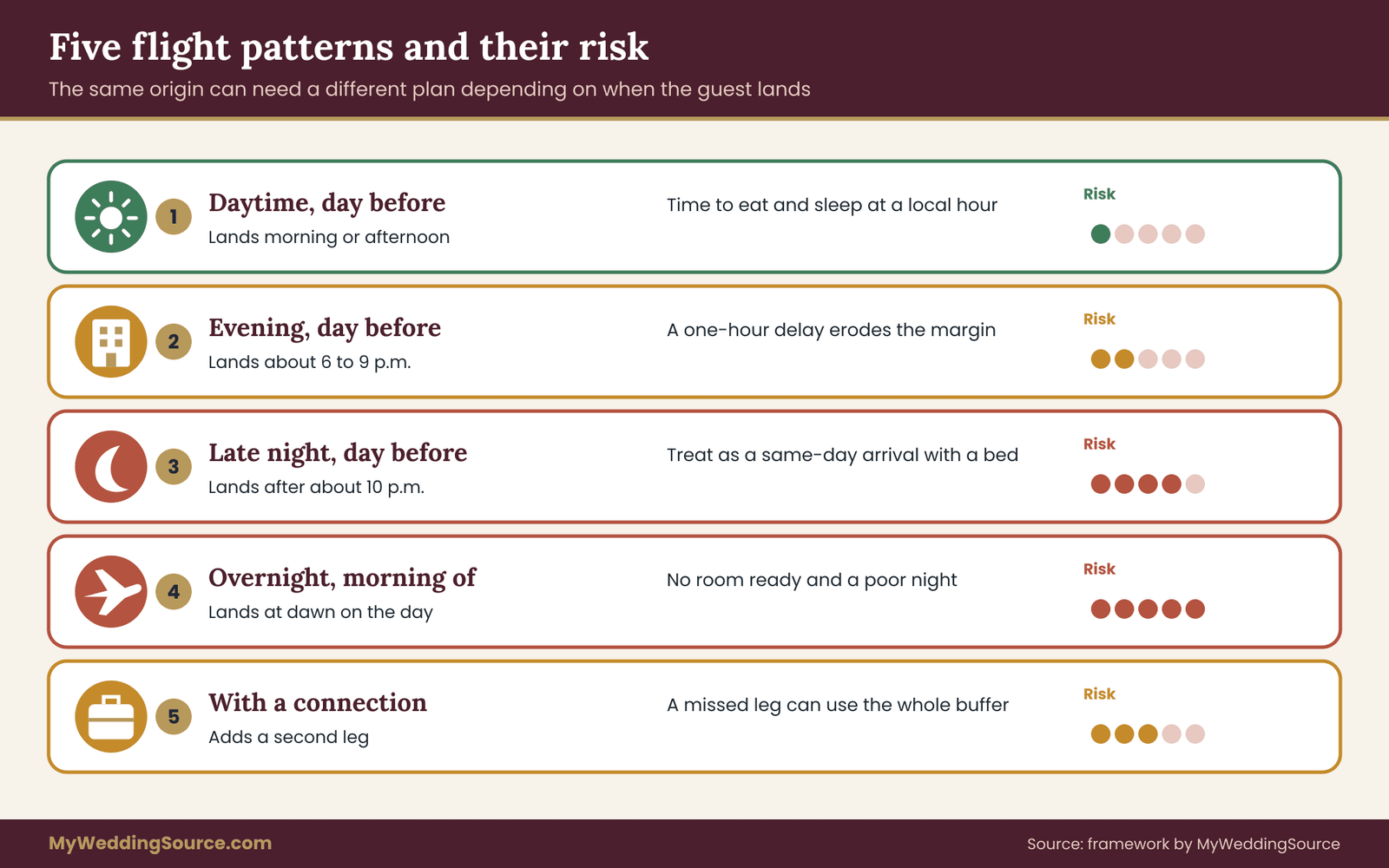
Two guests from the same city can need very different plans, because one lands at 2:00 in the afternoon and the other at 11:40 at night. The second half of the arrival buffer chart is therefore organized by flight schedule. There are five common patterns, and each has a typical risk.
Pattern one: daytime arrival the day before. The guest flies in during the morning or afternoon on the day before the ceremony. This is the strongest arrival buffer a single night can provide. The guest has the evening to eat, wind down and sleep at a local hour. For most guests in most clusters this is the pattern to recommend.
Pattern two: evening arrival the day before. The guest lands between about 6:00 and 9:00 in the evening. This still works for near clusters, but the arrival buffer is thinner. A one-hour delay can push the guest into the late-night pattern, and a guest from a far cluster may reach the hotel too tired to sleep well.
Pattern three: late-night arrival the day before. The guest lands after about 10:00 at night. On paper they arrived the day before, and in practice they have no buffer at all. They reach the room around midnight and must be dressed within hours. For a morning ceremony this pattern should be treated as a same-day arrival with a hotel bed.
Pattern four: overnight flight landing the morning of the ceremony. The guest boards the previous evening and lands early on the day. For a 9:30 ceremony this is the pattern most likely to fail. The guest has had a poor night, may have a delay, and has no hotel room ready, since standard check-in is usually in the afternoon.
Pattern five: connecting itineraries. Any pattern can be combined with a connection. A connection adds a second place where a delay can occur, and it adds a second set of rules, since a missed connection may mean a rebooking onto the next day’s flight. The risk grows with the number of flights per day on the route. A route with many daily flights is forgiving, and a route with one is not.
How the patterns interact with clusters
Combine the two halves of the arrival buffer chart by asking two questions of each group. What is the cluster’s nights recommendation? And which flight patterns will let them achieve it? For a far cluster with a recommendation of two nights, a late-night arrival on the first night is acceptable, since the second night is the one that counts. For a near cluster with a recommendation of one night, a late-night arrival is a problem, and the guest should be steered toward an earlier flight.
This is why one number is never enough. A “two nights” rule and a “land by 6:00 p.m.” rule have different effects. The first protects against jet lag and the second protects against a compressed last night. You usually need both.
Reading the flight schedule before you recommend anything
Before telling the West Coast cluster to take a morning flight, check whether a morning flight exists. Look at the schedules of the airports nearest your venue, using the airlines’ own websites or the airport’s website. Note the first and last departures from your main origin cities, the number of direct flights, and the times at which they land.
You are not choosing flights for guests. You are checking that your advice is realistic. If the only direct flight from a major origin lands at 11:00 at night, recommending a daytime landing would be unhelpful, and the honest advice is to arrive two days before or to connect on an earlier itinerary. The schedules you see are examples and can change, so describe them in general terms in your guidance rather than naming specific flight numbers.
Choosing between a direct flight and a cheaper connection
Many guests will choose by price. A cheaper connecting itinerary can be fine, but the arrival buffer has to absorb its extra risk. If a guest picks a connection, they should treat the landing deadline as stricter. A practical rule is to move the target arrival one flight earlier than the one that would otherwise suffice, or to add a night.
You do not need to forbid anything. A short line in the guidance does the job: “If your trip includes a connection, consider landing a day earlier than the guidance above, since a missed connection can use up the arrival buffer.” That sentence leaves the choice with the guest and gives the reason.
Weather season and flight reliability
Season matters too. A wedding in the winter in a region prone to snow has a different risk profile from a wedding in a calm season, and a wedding in late summer in a hurricane-prone region has its own. You cannot predict weather, but you can scale the arrival buffer. For a ceremony in a season with known disruptions, recommend that out-of-town guests arrive a day earlier than the arrival buffer chart says, or at least keep one spare day for travel.
If a guest’s flight is canceled close to the date, the spare day inside the arrival buffer is what makes a rebooking possible. Do not rely on a general promise about refunds or rebooking. Airline rules differ, and the U.S. Department of Transportation maintains consumer information on what airlines owe passengers in different situations.
Setting the landing deadline for the night before
A landing deadline is the latest time you recommend a flight touch down on the day before the ceremony. It converts the abstract idea of an arrival buffer into one clock time that guests can check against a booking confirmation. It should be different for each cluster, and it should be earlier than you first think.
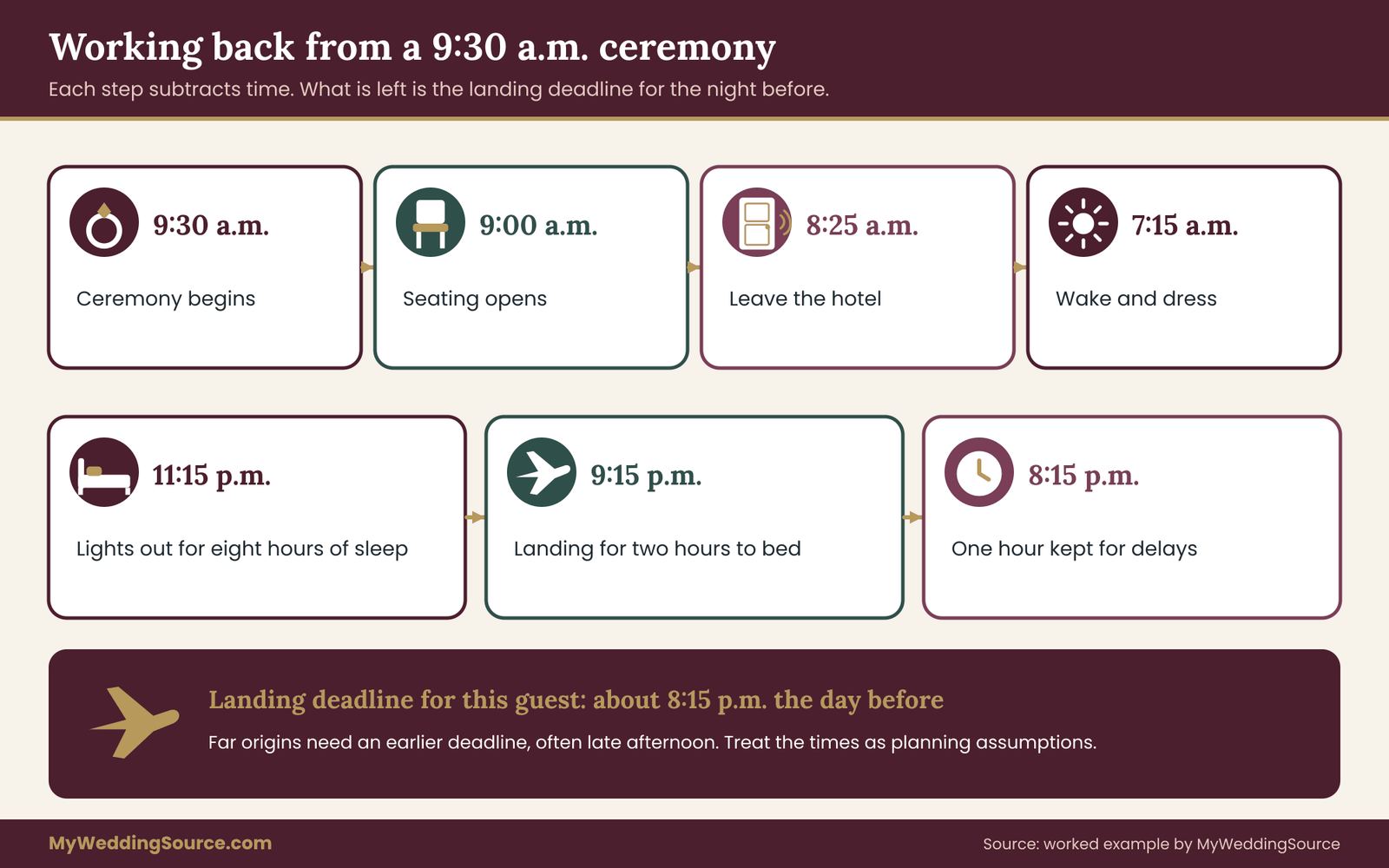
Work backward in five steps, using a worked ceremony time of 9:30 a.m., with seating at 9:00.
First, the departure time. The guest should leave the hotel about 35 minutes before seating, to allow for the drive and parking. That is about 8:25.
Second, the wake-up time. The guest needs about an hour to wake, wash, dress and eat. Wake-up is about 7:15.
Third, the sleep window. If the guest sleeps seven hours, lights out is about 12:15 a.m. If they sleep eight hours, it is 11:15 p.m. Seven or eight hours is a reasonable target, and a tired traveler will probably want the longer one.
Fourth, the landing-to-bed allowance. Use the travel-day layer. If it takes two hours from touchdown to bed, a guest who wants lights out at 11:15 must land by 9:15.
Fifth, the delay margin. Subtract an hour or more for the delays that regularly happen. The landing deadline is then about 8:15 p.m. for guests from near clusters.
Adjusting the deadline by cluster
Far clusters need an earlier deadline, because the body-clock layer eats into the sleep window. A guest whose body clock says it is much later than local time cannot fall asleep on command, and they need a longer quiet period before bed. For these guests, a landing deadline around 5:00 or 6:00 in the afternoon is more realistic, and a two-night plan is better still.
Westbound guests can have a later deadline, since the clock is on their side in the evening. Even so, a deadline at midnight is not a plan. Pick a sensible time, such as 9:00 p.m., and explain that it applies because the venue and the hotel front desk are easier to deal with in the evening.
Putting the deadline into words
The deadline is easiest to communicate as a single sentence in a travel section: “To arrive rested for a 9:30 ceremony, we suggest landing by 6:00 p.m. the day before, and by earlier if you are coming from the West Coast or overseas.” Add a short reason and a link to the hotel block, and the guest has what they need.
One caution applies. Do not set a landing deadline that you cannot support with lodging. If your block begins on the day before the ceremony, a guest who lands two days early has to buy the extra night at whatever rate they can find. The block dates and the landing deadline have to be set together, which the lodging section below returns to.
What happens if a guest misses the deadline
Plan for it. Some guests will book a flight that lands after the deadline, because it is cheaper or because their schedule demands it. The fallback is a simple conversation. Tell them what the late landing means, ask whether they have a plan for sleep and transport, and confirm that the hotel will hold a room for a late arrival. The guest may be fine with it, and your job is to make sure they have chosen it knowingly.
A late-night arrival also affects the front desk. A hotel that holds a room for late arrival has policies about what time it releases the room. Confirm the late-arrival policy with the hotel directly, and ask the guest to tell the hotel their expected arrival time. The next sections return to this in detail.
Worked example: a Boston ceremony with five guest groups
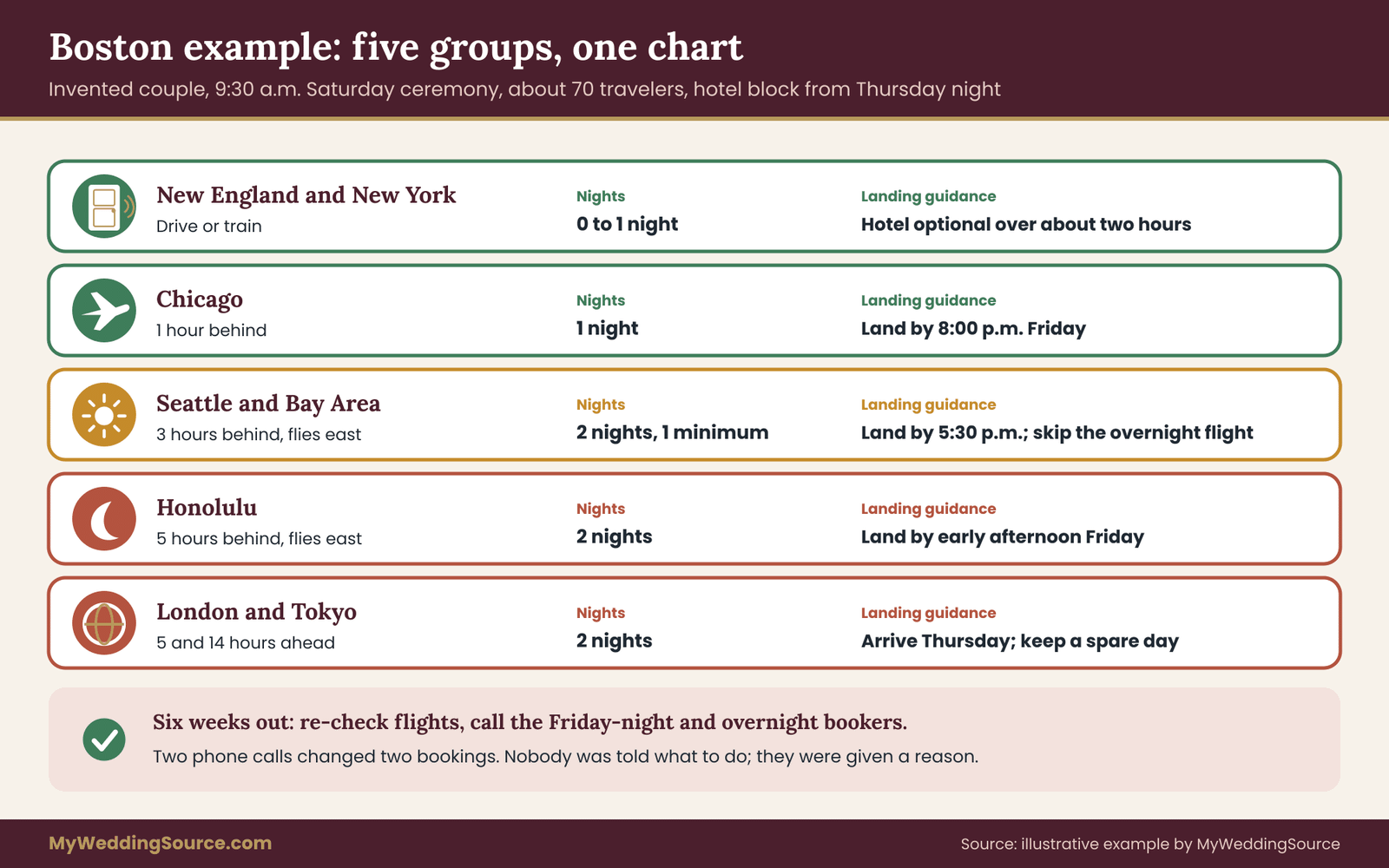
Examples make a chart easier to trust, so here is a complete one. It is invented for illustration, and every number is a planning choice, not a statistic. Imagine a couple, Dana and Marcus, marrying on a Saturday in November at 9:30 a.m. at a venue outside Boston. Standard time is in effect. Seating opens at 9:00, and a brunch reception follows. They have 120 invited guests, and about 70 are expected to travel.
They sort travelers into five groups by origin. The first is a New England and New York group that drives or takes a train. The second is a Midwest group flying from Chicago. The third is a West Coast group flying from Seattle and the Bay Area. The fourth is a small group from Honolulu. The fifth is a group of eight from London and one from Tokyo.
Step one: write the time differences
Boston is on Eastern time. In November, once clocks have changed, Chicago is one hour behind, Seattle is three hours behind and Honolulu is five hours behind. London is five hours ahead for most of that period, and Tokyo is fourteen hours ahead. The couple checks these against the actual date, since the changes in the US and the UK happen on different weekends and the gap can be briefly different.
At 9:30 a.m. in Boston the ceremony is 8:30 a.m. in Chicago, 6:30 a.m. in Seattle, 4:30 a.m. in Honolulu, 2:30 p.m. in London and 11:30 p.m. in Tokyo. They write these on the arrival buffer chart as “body-clock time” and notice that the Honolulu and Seattle groups are being asked for something real.
Step two: apply the three layers of the arrival buffer
For the New England group, the travel-day layer is a drive of one to three hours. They need almost no body-clock allowance. The couple offers an optional hotel night to anyone driving more than about two hours, and adds nothing else.
For the Midwest group, the body-clock layer is one hour, which is trivial. The travel-day layer is a flight of about two hours and a transfer. They recommend a daytime or early-evening landing the day before, with a landing deadline of 8:00 p.m.
For the West Coast group, the body-clock layer is three hours, flying east. This is the group the arrival buffer is most important for. They recommend two nights where possible and one night as the minimum, with a landing deadline of 5:30 p.m. on the day before. They also recommend that this group not take the overnight flight that lands the morning of the ceremony.
For the Honolulu group, the layers are large. The body-clock layer is five hours, flying east, and the travel-day layer includes a long flight and probably a connection. They recommend arriving two days before the ceremony, giving the guest two full nights, and they set a landing deadline of early afternoon on the day before as a hard floor.
For the London and Tokyo groups, the body-clock layer is the largest. They recommend arriving two days before, giving two nights. They tell the London group that the hardest period is the late afternoon of the first full day, when the body wants to sleep, and they suggest a short walk outdoors instead of a nap. They tell the Tokyo guest that jet lag is likely to continue through the weekend and that the early ceremony is the best part of the schedule for them, since they will probably wake early on local time.
Step three: translate into the lodging plan
The couple talks to the hotel group-sales contact about the block. They first ask about the block dates. A block that starts on Thursday night and ends on Sunday morning covers the two-night recommendation for long-distance guests and the one-night recommendation for the others. They ask for a list of rates for Thursday, Friday and Saturday nights, and whether the Thursday rate can be offered at the same price as the others.
They also ask three questions that affect the arrival buffer directly. Is there a late-arrival hold policy, and until what time? Can guests who arrive early in the day leave bags with the front desk? Is early check-in available, and if so, how does the hotel handle requests? The answers are written down and tied to the date of the conversation.
Two things the couple does not promise: a specific room type, or early check-in for anyone. The hotel’s contract and its staff decide those, and the couple’s note to guests says only that they can ask.
Step four: communicate it
The couple writes a travel page with a one-paragraph summary at the top. It states the ceremony time, converts it into the three most relevant time zones, and recommends that most long-distance guests land the day before, with the landing deadline for each region. It links the hotel block. It lists what to do if a flight is delayed: call the hotel to say you are late, and message a named family contact, not the couple.
They also send a short message to the eight guests with roles in the ceremony, including both sets of parents, the officiant, a reader and the wedding party, confirming flight times personally. This takes an evening and removes the largest risk in the day.
Step five: check and adjust
Six weeks before the wedding, the couple rechecks flights and the replies. They find two surprises. A group of three guests from Chicago booked a flight landing at 11:00 p.m. on Friday, and a cousin from Seattle booked the overnight flight arriving at 6:00 a.m. on Saturday.
For the Chicago group the late landing has a modest cost, since the time difference is one hour. The couple sends a note about the hotel’s late-arrival policy and leaves it. For the Seattle cousin, the couple calls, explains the 6:30 body-clock problem, and suggests a Friday afternoon flight. The cousin switches. The couple pays nothing, and the cousin buys one night. This phone call is a typical use of a time-zone arrival buffer: it takes ten minutes and changes the outcome.
What the worked example shows
Three things are worth noticing. The arrival buffer chart is short. Each group gets a recommended number of nights, a landing deadline and a note. The time spent on the plan is small compared with the time that late arrivals would cost on the day. And the couple does not try to control everything. They steer, they check the biggest risks and they leave small ones alone.
The example also shows that the right arrival buffer for a group is not constant. The Honolulu group and the New England group have different needs, and treating them identically would either burden the near group or fail the far one. The work is in the grouping.
A variation: an afternoon ceremony
To see how much the ceremony hour changes the plan, run the same wedding at 4:00 p.m. The West Coast group’s body clock now reads 1:00 p.m., which is an ordinary hour. The early-start layer shrinks. A same-day arrival is possible for the Midwest and West Coast groups if flights land in the morning, and the landing deadline for the night before becomes a recommendation rather than a requirement.
Far clusters still benefit from two nights, because the body-clock layer does not change with the ceremony hour, but the urgency drops. A couple choosing between a morning and an afternoon ceremony can use this comparison as a cost: the earlier hour adds about one night of lodging for several groups. That is a trade worth weighing when picking the time, and it is easy to see once the arrival buffer chart is built.
Hotel block rules that protect the arrival buffer
An arrival buffer that the hotel contract does not support is only advice. The block is where your recommendation either becomes easy for guests or becomes expensive. There are five terms to read, and each is a place where the arrival buffer can quietly disappear.
Block start date. If the block starts on the night before the ceremony, guests who follow your advice to arrive two days earlier are outside it. They pay whatever the public rate is, which may be higher, and they may not get the same room type or location. Ask whether the block can include one extra night before the ceremony, even if you expect few guests to use it.
Rates for the extra night. Some hotels extend the group rate to nights adjacent to the block, and some do not. Ask directly and write down the answer with the date. Treat it as a quote, not a commitment, until it appears in the contract.
Cutoff date. The block usually has a cutoff after which unreserved rooms return to general inventory. Guests who change a flight late may find that their extra night is no longer available at the group rate. A cutoff set a few weeks before the event gives you time to adjust the arrival buffer for late changes.
Late-arrival handling. A guest who lands at 11:00 p.m. needs a room that was not released at midnight or earlier. Ask what the hotel does with a reservation when the guest has not checked in by a certain hour, and what a guest should do to let the hotel know. Policies differ by property and by how the reservation was secured, so use the hotel’s own wording.
Early arrival and luggage. Standard check-in is often in the afternoon, and the guest who lands at 7:00 a.m. needs somewhere to put bags and a place to wait. Ask whether the front desk holds luggage, and whether early check-in can be requested, noting that a request is not a promise. A neutral phrase in your guidance such as “ask the hotel about early check-in; it depends on availability” is safer than any claim.
Should you pay for a night?
Some couples decide to cover a night of lodging for a few people, such as parents, the wedding party or an older relative who would otherwise arrive too tight. This is a personal decision, and it is easier to make once you see the arrival buffer chart. The cost of one extra night for a handful of guests is often modest compared with the total wedding budget, and it removes the largest single risk.
If you cover a night, say so plainly and keep it limited. Making a general offer to everyone can create expectations. Making a specific offer to named people with roles in the ceremony is easy to explain, since their arrival is directly tied to the ceremony. Book the extra night in your name or provide the confirmation number, and check the hotel’s cancellation rules before you do.
Using a block when guests are spread across hotels
Not every guest will stay in the block. Some will stay with family, some will use a short-term rental, and some will choose a different hotel. The arrival buffer still applies, since it is about time, not about location. Your guidance should say that the recommendation holds wherever the guest sleeps, and should give a plain statement of the venue’s distance from the main airports and hotel areas.
If the wedding party and family are spread across several properties, the question of how people reach the venue becomes part of the arrival buffer. A guest who has to coordinate a ride at 8:00 in the morning in an unfamiliar city is taking a risk. A shuttle or a shared car schedule from the main hotel is worth considering, as is a clear note about rideshare availability, which varies by place and time of day.
Hotels without a block
Small weddings and small towns often have no block. The arrival buffer still applies, but you cannot rely on a group rate or a contract. In that case, give guests a short list of nearby lodging with the distance to the venue and the dates you suggest, and tell them to book early, since a wedding weekend can fill small properties. The same timing rules apply, and the guidance is the only tool you have.
Verifying with airlines, hotels and the venue
You cannot know current rules from memory, and you should not repeat them as facts in your guidance. What you can do is verify the few items that decide whether your arrival buffer works, and send readers to the party that owns each rule.
What to ask the hotel
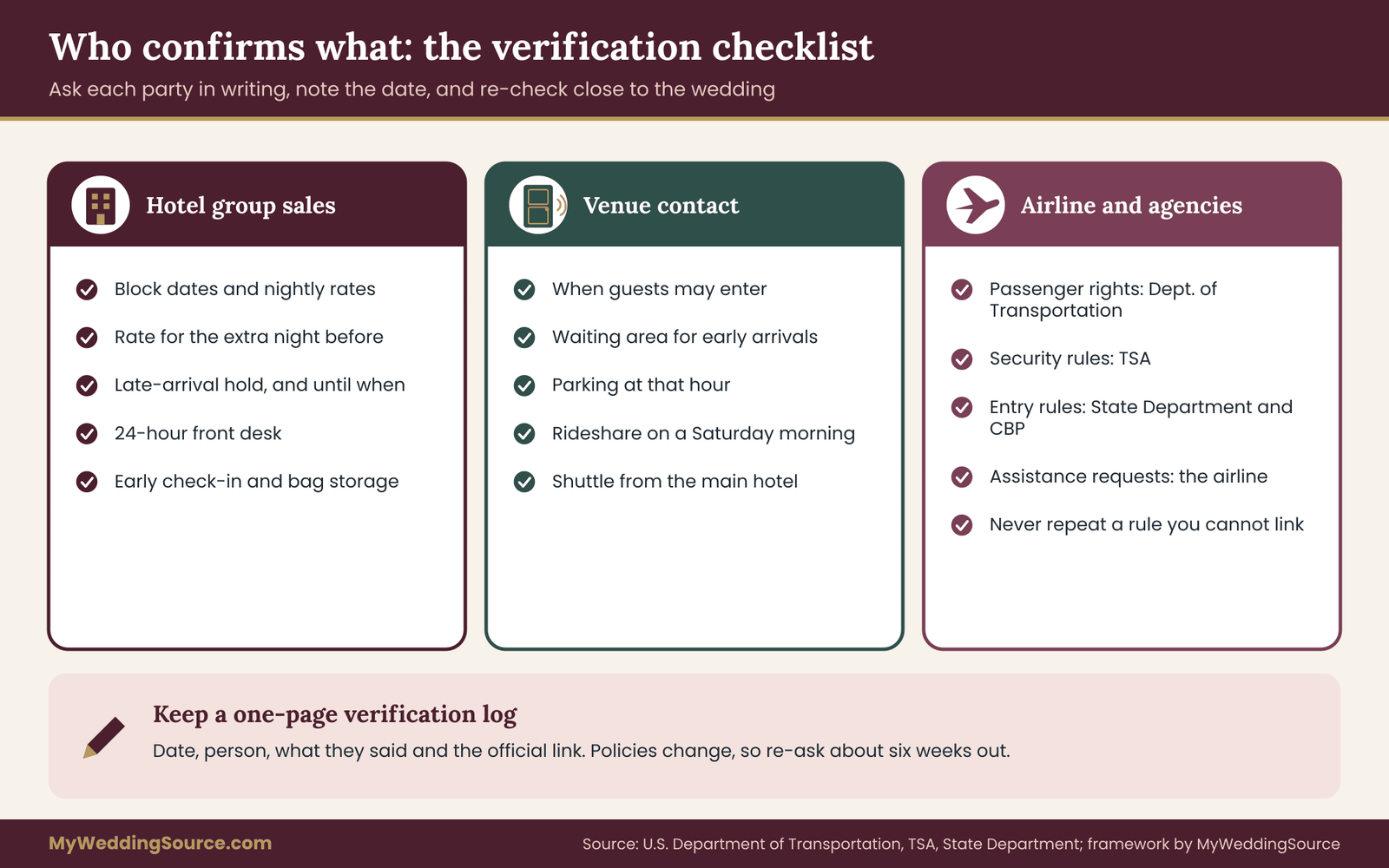
Call or write to the group-sales contact and ask in plain terms. What are the block dates and the rate for each night? Is there a late-arrival policy and what time does it end? Is there a 24-hour front desk, and who is on it at 2:00 a.m.? How does the hotel handle early arrival and bag storage? What is the cancellation policy for individual guest reservations, and does it differ for the nights outside the block? Keep the answers in writing, and note the name of the person and the date.
Treat answers as accurate for that day. Hotel staffing and policies change, and a policy described in January may be different in October. Re-ask about six weeks before the wedding, and again in the final week for any detail that matters.
What to check with the venue
The venue controls the other half of the early-morning plan. Ask when it opens for guests, whether there is a waiting area for early arrivals, how parking works at that hour and whether the venue has a rule about when guests may enter. If the venue is outside the city, ask about the usual rideshare availability on a Saturday morning. The ceremony cue sheet guide helps you turn the venue’s answers into a minute-by-minute morning.
A venue contact who has hosted early ceremonies before often has useful, practical knowledge about the timing of arrival at that hour.
What to read at the airline and the government source
For anything involving airline obligations, refunds or rebooking, direct guests to the airline and to the U.S. Department of Transportation’s aviation consumer protection pages, which explain passenger rights in general terms. Do not describe a rule in your guidance unless you can link to the page that states it, and do not suggest that any ticket type carries a promise. The same applies to baggage and security: the Transportation Security Administration publishes its own guidance, and rules change.
For international guests, the entry rules belong to the destination country’s authorities. For travel to the United States, the Department of State and U.S. Customs and Border Protection publish the relevant information. Your job is to remind guests to check the rules early, since processing time can be longer than expected. You are not an immigration adviser and should not act like one.
A verification log
Keep a single page where you record each check. Write the date, who you spoke to, what they said and the link to the official page if there is one. A short log is enough: it lets you answer a guest’s question in thirty seconds and tells you what to re-check. It also protects you from the common mistake of repeating a policy that was true last year.
If you are working with a planner or a travel agent, ask them to follow the same log. The verification is what separates a useful arrival buffer from a guess.
Timeline for the checks
A plausible order is this. As soon as the date and time are fixed, convert the ceremony into each origin’s clock and build the first draft of the arrival buffer chart. When the block is negotiated, confirm dates, rates and late-arrival terms. When invitations or save-the-dates go out, include the recommended arrival window.
Around eight weeks before the ceremony, check the schedules again for key routes. Around six weeks before, review RSVPs and call guests whose bookings conflict with the arrival buffer chart. In the final two weeks, confirm every person with a role in the ceremony.
The wedding planning checklist on this site gives the broader sequence of planning tasks, and the arrival buffer checks fit inside the lodging and guest-communication stages of it.
Accessibility, children and health in the arrival buffer
Some guests need a larger arrival buffer for reasons that have nothing to do with time zones. Build them into the plan from the start, since adding them late is harder.
Guests who use mobility aids or need assistance. Airports, connections and transfers take longer for a traveler who needs wheelchair assistance, boarding help or a slower pace. These guests should request assistance directly from the airline, and the Department of Transportation explains passenger rights regarding disability on its aviation consumer pages. Give them a more generous landing deadline and a second night where possible, and confirm that the hotel and the transfer are accessible rather than assuming it. The same hotel guide covers how to verify accessible rooms and routes.
Older guests. Recovery from travel is slower for many people as they age, and an early ceremony after a long trip is demanding. Offer a quiet seat near the entrance, a ride from the hotel and a second night where you can. Ask the guest what they prefer, and avoid assuming.
Families with babies and young children. Children’s sleep is tied to routine, and a three-hour shift can unsettle a whole household. Recommend arriving a day earlier than the arrival buffer chart says, and consider whether a 9:30 ceremony is realistic for a young child at all. A quiet room, a nearby grocery and a plan for naps matter more than extra sightseeing. A hotel with a crib or a refrigerator should be confirmed in writing.
Guests who take medication on a schedule. A time-zone change affects the timing of doses. The couple is not in a position to advise on that, and the guest should ask their own clinician or pharmacist how to adjust. Mentioning that this is worth doing before the trip is helpful, and saying more is not.
Guests who are anxious about flying or about arriving late. A generous arrival buffer is itself a kindness. Telling a guest that you would prefer they arrive early and relaxed removes a source of stress.
Not turning the plan into a burden
Be careful about tone. A recommended arrival buffer is helpful when it is framed as a way to enjoy the weekend, and it becomes a burden when it sounds like an obligation to spend money. Guests with limited budgets or limited leave from work may truly be unable to arrive two days early. Offer a plan B and make it easy to choose.
Guests also differ in how well they handle travel. Some can land at midnight and be fine at 9:30. Respect that. Your recommendation is a default, and the guest knows their own body better than any chart.
Communicating the arrival buffer to guests
Even a perfect chart does nothing if guests never see it. The communication has three parts: the wording, the placement and the follow-up.
The wording
Keep it short, concrete and kind. State the ceremony time and the reason you recommend an early arrival, give a landing deadline, point to the lodging and leave the decision with the guest. Here is one plain version:
“Our ceremony starts at 9:30 on Saturday morning, which is early for anyone traveling east or from far away. We suggest flying in on Friday and landing by 6:00 p.m. if you can. A room block is held at the hotel from Thursday night, and the details are on our travel page.”
For a guest from a far cluster, you might add one sentence that is specific to them: “From the West Coast, 9:30 will feel like 6:30, so a Thursday arrival makes the morning much easier.”
For a guest who has booked a late arrival, a gentle message works: “We noticed your flight lands at 11:00 on Friday night. Would a daytime flight work instead? If not, no problem. We want to make sure the hotel holds your room.”
The placement
Put the recommended arrival in three places. The first is a short line on the save-the-date or invitation insert, which is enough to alert guests before they book. The second is the travel page on your wedding website, with the arrival buffer chart in plain language and the converted ceremony times for your main origins. The third is a direct message to guests with roles in the ceremony and to anyone whose booking conflicts with the guidance.
The invitation itself should not carry a paragraph of travel advice. The wedding invitation etiquette guide covers what belongs on the invitation and what belongs on a separate card or page. A short line pointing to the website is enough, and the detail lives where it is easy to update.
The timing
Guests book flights months ahead, so the guidance must be available before they buy tickets. If you send a save-the-date six to nine months before the wedding, include the ceremony time, since that is what decides the arrival buffer, and a line that a travel page will follow. When the block is confirmed and the website is live, send the detailed guidance. The wedding RSVP etiquette guide is a useful companion for deciding when to ask guests about travel plans.
The follow-up
The follow-up is where the time pays off. After RSVPs arrive, read each reply against the arrival buffer chart. Message guests whose plan conflicts with the guidance. Remind the whole group about three weeks before the ceremony with a short note: the ceremony time, the landing deadline and a contact name for travel problems. Ask them to message that contact, not you, on the day.
Limits: where an arrival buffer fails
An honest plan names its limits. There are six situations where an arrival buffer does less than you hope.
First, delays and cancellations. A buffer reduces the damage of a delayed flight and does not remove it. If a flight is canceled the day before, the guest may be unable to arrive in time at any price. Having a spare day inside the plan is the best protection, and the rest is up to the airline.
Second, individual differences. Two guests with the same itinerary can feel very different on arrival. Some people sleep anywhere, and some do not sleep at all in a hotel. A chart works on averages, and the guest decides what is true for them.
Third, hotel inventory. A busy weekend, an event in the same city or a small property can limit what you can offer. If the block cannot include an extra night, your recommendation may cost guests more than you intended, and you should say so.
Fourth, rule changes. Clock-change dates, airline policies, hotel terms and entry rules all change. What you verify today is a snapshot, and you should re-check before you publish and again before the wedding.
Fifth, guest choice. People decide for their own reasons, including cost, work and family. You cannot require a particular itinerary, and you should not try. The goal is informed choice.
Sixth, the ceremony hour itself. If many guests face a punishing schedule, the best solution may be a later ceremony. The arrival buffer chart shows that cost clearly. If your venue or officiant allows a later start, and the benefits are real for a large share of the guests, consider it. If not, build the arrival buffer and accept what remains.
Your next steps
This week, write down the ceremony time and convert it into the clock of each origin on your guest list, using the actual date. Group guests into four to six clusters and give each one a recommended number of nights and a landing deadline. Call the hotel’s group-sales contact and ask about block dates, the rate for the extra night and the late-arrival policy.
Next, write the one-paragraph travel guidance and place it on your save-the-date or website. Message the guests with roles in the ceremony personally. Six weeks before the wedding, review the RSVPs and flights against the arrival buffer chart, and speak to anyone whose plan conflicts with it. Keep the verification log current, and re-check it in the final week.
FAQ
How many nights early should guests arrive for a morning ceremony?
For most guests flying in, one night before is the practical minimum for a morning ceremony. Guests crossing four or more time zones, older guests and families with young children often do better with two. These are planning allowances, not medical advice. Offer a recommended range, explain the reason, and let each guest decide based on cost, health and schedule.
Is traveling east harder than traveling west for an early ceremony?
Public health guidance commonly describes eastward travel as harder, because the body has to sleep and wake earlier than it wants to. For a morning ceremony, eastbound guests face a body clock that reads several hours earlier than local time. Westbound guests usually wake early but feel less strain at the ceremony itself, though they may fade in the evening.
What is a sensible landing deadline for the day before the ceremony?
Work backward from seating time. Allow time to leave the hotel, dress, sleep seven or eight hours, get from the airport to bed, and absorb a delay. For a 9:30 ceremony, that usually points to an evening landing deadline for near origins and an earlier one, often late afternoon, for far origins. Adjust it to your venue and the hotel.
Should we pay for an extra hotel night for some guests?
Only if it fits your budget and you can explain it simply. Many couples cover an extra night for people with ceremony roles, such as parents, readers or the wedding party, because their arrival affects the ceremony directly. Keep the offer specific, confirm the hotel’s cancellation terms, and avoid making a general promise that creates expectations you cannot meet.
What if a guest can only land the morning of the ceremony?
Talk with them early, and make sure they know the risks. Suggest a daytime flight the day before if any exists, a carry-on bag only, and a hotel room for the night so they can rest or change. If they must arrive that morning, plan the transfer carefully and have a backup contact, and avoid giving them a role with a fixed time.
Does daylight saving time change the planning?
It can. The hour difference between two places is not fixed all year, and some places do not change clocks. Convert the ceremony time using the actual wedding date and a reliable time source. If any origin or the destination changes clocks near your date, check the gap again, and write the converted times in your guidance.
Can we promise guests an early check-in or a certain room?
No. Early check-in, room type and room location depend on the hotel’s availability on the day, and you should not promise them. Ask the hotel what it can do, tell guests to request early check-in, and suggest luggage storage as a fallback. Describe it as a request, and confirm any special arrangement in writing with the hotel.
Where should the arrival guidance go?
Put a short line on the save-the-date or invitation insert, a full explanation on your wedding website and a personal message to guests with ceremony roles. Guests book flights months ahead, so the guidance must appear early. Update the page if the block or the schedule changes, and remind everyone a few weeks before the date.
Sources
- Aviation Consumer Protection, U.S. Department of Transportation
- Air Travel Consumer Information, U.S. Department of Transportation
- Travelers’ Health, Centers for Disease Control and Prevention
- Official U.S. time, National Institute of Standards and Technology and U.S. Naval Observatory
- Time and Frequency Division, National Institute of Standards and Technology
- Travel information, Transportation Security Administration
- International Travel, U.S. Department of State
- Travelers, U.S. Customs and Border Protection
- Information and Technical Assistance on the ADA, U.S. Department of Justice
- Federal Aviation Administration