
A wedding date decision deadline is a calendar date, agreed before the argument gets heated, by which the wedding date will be chosen even if every family member is not equally happy with it. This guide shows how to build one: a short decision-rights charter, a deadline escalation tree, scripts for the hard conversations and a worked example.
Before you debate any date, write down who has a say, who has a veto and who makes the final call. Then set a decision deadline that sits a few weeks ahead of the first date that costs you money, such as a venue hold expiring. Offer families a short list of dates, collect their input in one round, and move up a simple escalation tree if the group stalls. At the decision deadline, the couple decides, announces it kindly and does not reopen it.
Most disagreements about a wedding date are not really about the date. One side of the family wants a religious holiday avoided, another has a cousin graduating that weekend, a grandparent travels only in spring, and somebody’s parent would simply like to have been asked first. Each concern is reasonable. Together they can keep a date open for months, and an open date quietly holds up almost everything else you want to book.
This article is about the part of the problem that is not about the calendar itself: the process, and the decision deadline that holds it together. A decision deadline does not tell you which Saturday to pick. For that, the guide to choosing a wedding date around guest availability, vendor capacity and travel disruptions covers the scheduling side. Here the question is narrower. How do you make sure a decision actually gets made, on time, with the right people heard and without a family feud?
A note on scope. This is general planning information, not legal, tax or financial advice. Contract terms, license rules and deposit policies differ by venue and by state, so where a rule matters, the article points you to the office or business that issues it.
Why a decision deadline matters when families disagree
An undecided date feels like a neutral state, a pause while everyone thinks. It is not neutral. Every week the date stays open, three things happen at once. Your best venue and vendor options get booked by other couples. Guests who need to arrange travel, leave or childcare cannot start. And the disagreement itself hardens, because people who have been asked for an opinion four times start defending it instead of weighing it.
That last point is easy to miss. Early in a discussion, relatives are often flexible. They mention a preference, and they would be fine with an alternative. Left alone for months, the same preference turns into a position, and a position is harder to move than a preference. A firm decision deadline limits how long that hardening can go on.
A decision deadline also protects the people who are not loud. In most families, one or two voices dominate the conversation. Quieter relatives, including the grandparent who would never complain, the sibling who travels the farthest and the in-law who does not want to seem pushy, rarely get a fair hearing in an open-ended argument. A structured round of input with a closing date gives them a real chance to speak before the choice is made.
There is a fairness argument too, and it cuts in the couple’s favor. Without a stated end point, whoever is willing to keep pushing longest tends to win. That rewards stubbornness, not the quality of the reasoning. A decision deadline replaces endurance with a process, and it lets you say, truthfully, that every concern was collected on the same terms.
Finally, a decision deadline gives you something to point to. When a relative reopens the question after the choice is made, you do not need a new argument. You can say that the family had a clear window to weigh in, that the window closed and that the decision is made. That sentence is far easier to say calmly than a defense of the date itself.
A decision deadline is not the same as a disagreement over the date
It helps to separate two things that get tangled. The date disagreement is about substance: which day is better for the people involved. The decision deadline is about governance: when and how the choice gets made. You can have a lively, even tense, discussion about substance and still run a clean process about governance.
Many couples try to solve both at once. They hold a family call to find the perfect date, and they expect that call to produce agreement. It rarely does, because the group has no shared answer to the earlier question of how the decision will be made. Deciding the process first, while nobody has yet lost anything, is far easier than deciding it in the middle of a fight.
That is the logic behind the two tools in this guide. The decision-rights charter settles who gets what kind of say, before any date is on the table. The deadline escalation tree settles what happens if the group does not converge by the time the decision deadline arrives. Both are written down, short and shareable.
What a decision deadline is, and what it is not
A wedding date decision deadline has four parts. It is a specific calendar date, not a vague “soon” or “by the end of the month.” It has an owner, meaning the person or people who will actually make the call. It has a defined input window, which is the period when relatives can send their concerns. And it has a stated consequence: on that date, the date is chosen, and the next set of decisions begins.
If any of those four parts is missing, the decision deadline tends to dissolve. A date without an owner becomes a suggestion that everyone assumes someone else will enforce. An owner without an input window leaves relatives feeling steamrolled. A window without a consequence turns into a polite request for more discussion. And a vague date is not a decision deadline at all.
Here is what a decision deadline is not.
It is not an ultimatum. You are not telling relatives that they must agree or be excluded. It is not a vote either, unless you choose to make it one; most couples are better served by a process in which input is gathered but the decision belongs to the couple, or to the couple and whoever else is paying and has been given a defined role.
And it is not a way to avoid listening. The input window is a real one, and a couple who treats it as theater usually finds that out when the resentment shows up at the rehearsal dinner.
The narrow job this decision deadline does
Think of the decision deadline as protecting one specific thing: the ability to make the next set of bookings. Venue contracts, photographer availability, caterer calendars, hotel room blocks and guest travel plans all hang on the date. The decision deadline is the point at which the couple stops being the bottleneck. It is not a statement about how much the couple loves anyone or whose opinion matters more.
That framing is useful when you present it to relatives. “We have to lock a date by March fourteenth so we can hold the venue we all liked” lands very differently from “We are tired of arguing about this.” The first points to a shared external constraint. The second sounds like an accusation. Whenever you can, anchor the decision deadline to something real, such as a hold expiring, a booking window or a travel purchase, and not to your own patience.
When you should not set a hard decision deadline
A hard decision deadline is not always the right tool. If a close family member is seriously ill and the timing of the wedding depends on their treatment or recovery, a firm date set weeks out may be the wrong approach. The same goes for a situation where a key relative’s visa, military leave or work schedule is genuinely unknown and will become clear within a short, known period.
In those cases, a different approach works better: a conditional decision deadline. You set the date by which you will decide, and you also name the single piece of information you are waiting for and the latest day it can arrive. If the answer is not in by that day, you proceed without it. This keeps the process moving while respecting a real constraint. A later section shows how to build one.
There is also a smaller category of cases where a decision deadline is premature. If you have not yet agreed with each other, as partners, on your own priorities, no family process will go well. Settle your own two or three non-negotiables first. A couple that is visibly uncertain tends to invite every relative to fill the gap with an opinion.
Who this guide is for
The method here is meant for couples whose families disagree in ordinary ways: differing holiday calendars, competing family events, travel limits, preferences about season, or a parent who feels left out. It also suits couples where two sets of parents are paying, where one family is much larger than the other, or where a blended family has several households with different needs.
It is less suited to situations involving safety concerns, coercion or a family member who is trying to control the wedding in ways that make you uncomfortable. A decision deadline is a scheduling tool. It cannot fix a relationship in which one person refuses to accept that the wedding belongs to the couple. In that case, a counselor, a trusted mediator or a clergy member you both respect may be a better first step, and the process below becomes the secondary tool.
If you are in the middle of broader family friction about the wedding, the wedding decision-making guide covers how couples handle disagreements across many choices, not just the date. This article stays with the one decision that comes first and affects everything after it.
The real cost of waiting: what moves while the decision deadline is still open
Before you set a decision deadline, find out what the delay is actually costing. Couples often skip this step and pick a decision deadline based on a feeling, such as “let’s give it until the end of the month.” A decision deadline tied to real consequences is easier to defend and easier for relatives to accept. It also stops you from setting one that is either too tight to allow honest input or too loose to protect your options.
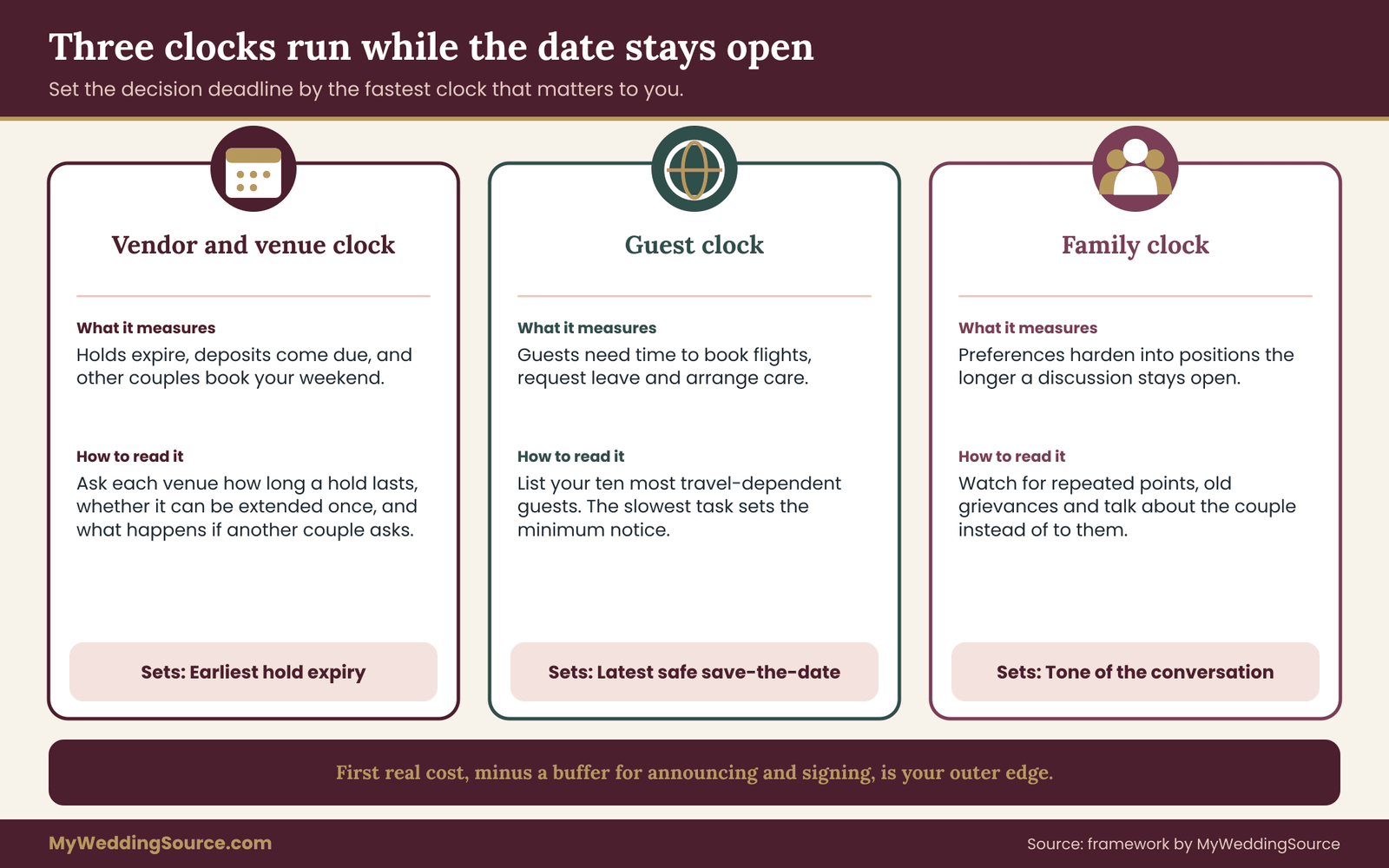
The simplest way to think about it is that three clocks are running at the same time. They tick at different speeds, and your decision deadline should be set by the fastest one that matters to you.
Clock one: the vendor and venue clock
This is the clock with the clearest edges. Venues usually allow a tentative hold on a date for a limited period, and then they release it or ask for a deposit and a signed agreement. Some venues are flexible about extending a hold. Others have a waiting list and will not extend, because a second couple is waiting for the same Saturday. You will not know which kind you have until you ask.
Photographers, caterers, bands, florists and officiants run on the same principle. A vendor with a limited number of weekends in a busy season can accept only so many bookings. Each time another couple signs for a date you were considering, your option set shrinks. Nobody is being unfair; it is simply how a calendar works.
A decision deadline built on a real expiry date is far easier to defend than one built on impatience. The practical question is not “when will vendors book up?” because you cannot answer that for the whole market. The better question is “what is the earliest date on which I will have to pay or sign something to keep the option I care about?” That date, minus a margin for the discussion process, becomes the outer edge of your decision deadline.
To find it, ask each venue you are seriously considering three plain questions. How long will you hold a date without a deposit? Can that hold be extended once, and for how long? And what happens to the hold if another couple asks for the same date? Write down the answers with the date you asked and the name of the person who replied. A verbal answer that you cannot find later is not much use in a family discussion.
The wedding venues guide covers venue selection in general, but holds deserve their own attention, because they are the mechanism behind most venue clocks. A courtesy hold is typically a tentative reservation, not a binding one, and the terms differ widely. Read the exact wording on any hold confirmation, and do not assume it means what the word suggests.
Clock two: the guest clock
Guests do not book anything with you, but they run a clock of their own. People who need to buy flights, request time off, find childcare or arrange care for a relative need notice, and the amount of notice they need varies enormously. A local friend can decide the week before. A cousin flying across the country with two children and a grandparent needs far more lead time, and a guest who is saving for the trip needs it even more.
This matters for the decision deadline because a late date decision does not just delay your planning. It compresses everyone else’s. If you announce the date late, the relatives with the least flexibility are the ones who lose the most. Those are often exactly the older or more distant family members whose attendance the families were arguing about in the first place.
You can estimate the guest clock without inventing numbers. Make a short list of your ten most travel-dependent guests. For each, ask yourself what they would need to do in order to attend: book a flight, take leave, arrange a caregiver, get a visa, obtain time away from a shift job. The slowest of those tasks sets the minimum notice for the group. If a guest has to request leave through a process that takes a long time, that is your floor.
The save-the-date is the tool that stops this clock. It tells guests the date and the place early enough for them to start. Anything that delays the date delays the save-the-date, and it is worth tying the decision deadline to the day you want those go out, working backward from there.
Clock three: the family clock
The third clock is the least visible and the one that most often goes wrong. It measures how long the family can keep discussing the date before the discussion itself becomes the problem. It is not measured in days. It is measured in tone.
Signs that the family clock is running out are easy to recognize once you know them. The same points are repeated in each conversation. People start to reference old grievances that have nothing to do with the date. Relatives begin to talk to each other about the couple instead of to the couple. Someone suggests a family meeting, a phone tree or a “neutral party.” These are not signs that you need more time. They are signs that more open-ended discussion will make things worse.
If you see them, the right response is to move the decision deadline earlier, not to extend it. That feels backwards, but the logic holds: the fastest way to calm a stalled discussion is to bring it to a clear end, with a defined round of input and a defined moment of decision.
Working backward from the first real cost
With the three clocks in view, you can set the outer edge of your decision deadline using a simple rule. Find the earliest date on which you will lose something you care about if the date is still open. That might be a venue hold expiring, a deposit window closing or the last date on which you could send save-the-dates and still give your most travel-dependent guests reasonable notice.
Then subtract a buffer. The buffer should cover three things: the time to announce the decision to families, the time to take the next step, such as signing the venue contract, and a few days for anything that goes wrong. A buffer of a week or two is common, but the right length depends on how fast you and the venue can move.
Here is a short example of the arithmetic, using invented dates. A venue says it will hold a Saturday in October until the first of March. The couple wants to send save-the-dates by the middle of March and expects the contract to take a few days. They allow a week for announcing the decision and a few days for contract review. Working back, the decision deadline lands in the middle of February. That leaves roughly a month for the input round before then, which is plenty if it starts promptly.
Notice what the process does. It converts a vague sense of urgency into a date that you can defend with facts. When a relative asks “why February?”, the answer is not “because we said so.” It is “because the venue releases the date on March first and we need time to sign.”
What to do if you have several possible dates and holds
Couples sometimes try to protect themselves by placing holds on several dates at once. This is common and, if done honestly, it is reasonable. The risk is that it hides the real decision deadline. If you hold three Saturdays at three venues, your first expiring hold is the one that matters, and the others can give you a false sense of room.
If you use multiple holds, keep a short list with the venue, the date, the hold expiry and what the venue said about extensions. Release holds you are no longer considering promptly, since another couple may be waiting for them. That is both courteous and sensible. A venue that learns you reliably release dates early is more likely to give you the benefit of the doubt later.
The wedding vendor timeline can help you see which bookings usually have to be made first, and in what order. It is a useful companion when you are working out which of your real costs lands soonest.
The cost of changing the date later
Another reason to decide on time is that changing a date after you have signed is rarely free. Contracts differ. Some allow one date change with a fee, some treat a change as a cancellation and a new booking, and some do not allow changes at all. Deposits are often non-refundable. This does not mean you should rush into a date out of fear. It means you should know what a later change would cost before you sign anything, and that the cheapest time to resolve a family disagreement is before the contract, not after.
If a relative asks you to “just pick something and change it later if it does not work,” read the change clause first. In many cases, “change it later” is the expensive option, and a calm explanation of that fact can end the suggestion quickly. The guide to wedding vendor contracts explains what to look for in date-change and cancellation terms.
Turning the costs into a one-page fact sheet
The most useful thing you can do with all of this is write it down in a single short page that you can share with relatives. It does not need to be long. It should state the dates you are considering, the first expiry date, the guest notice needed and the date by which you plan to decide.
Sharing facts, not feelings, changes the tone of a family discussion. Instead of a couple who “cannot make up their minds,” the families see a couple working within specific constraints and asking for input within a specific window. Disagreement about the date still happens, but it now happens around shared facts. Attach that page to every message about the decision deadline, so the facts travel with the request. The next section explains who gets to say what within that process.
The decision-rights charter: who gets what kind of say
The first of the two tools is the decision-rights charter. It is a half-page document that states, in plain words, who has which kind of influence over the wedding date. It is written before any date is proposed, shared with the people it names and kept short enough that nobody can claim they did not read it.
The reason a charter helps is that most date arguments are really arguments about rights. A parent who is paying for a large share of the wedding may feel they should be able to veto a date. A grandparent may feel that their health limits should settle the matter. A sibling in the wedding party may feel entitled to a vote because they will be giving up a weekend. Without a charter, each person silently assumes the rule that favors them, and the conflict appears when those assumptions collide.
A charter replaces silent assumptions with stated ones, and it gives the decision deadline a firm footing, because everyone already knows who decides. It does not need to give everyone what they want. It needs to be clear, consistent and agreed in advance.
The four levels of say
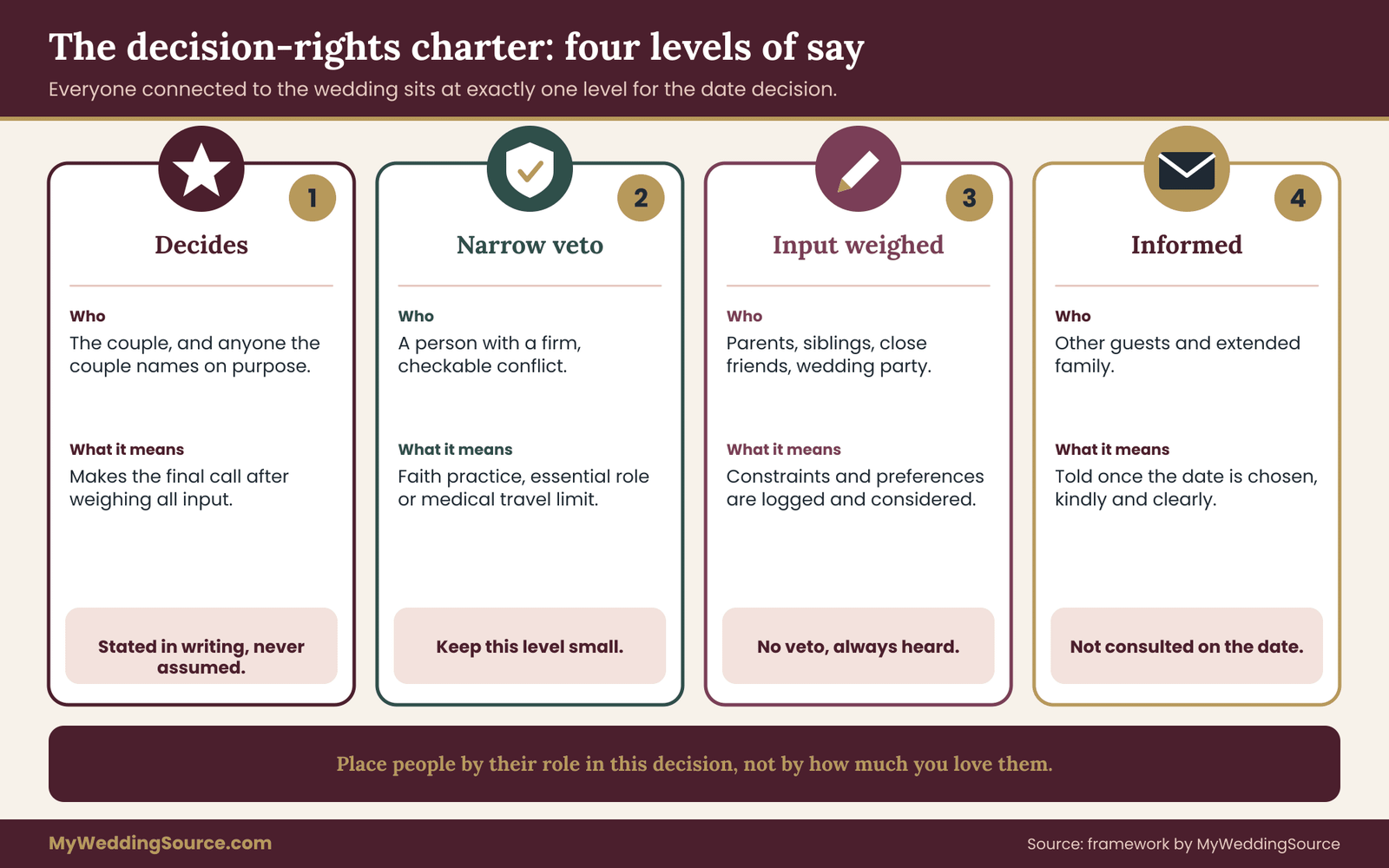
The simplest version of a charter uses four levels. Every person or group connected to the wedding gets assigned to exactly one level for the date decision, and the levels mean the same thing for everyone.
Level one: decides. These are the people who make the final call. For most couples this is the two partners. In some families, parents who are funding a major share of the wedding may be added here by mutual agreement, but that is a choice, and it should be stated, not assumed.
Level two: holds a veto on a narrow, stated ground. A veto is the strongest form of influence short of deciding, and it should be rare. A good veto is tied to a specific, checkable reason, not a general feeling. For example, a date that falls during a religious observance in which a person’s faith forbids attending a celebration, or a date on which a person who is essential to the ceremony has a known, unavoidable conflict. The narrower the ground, the easier the veto is to respect.
Level three: has input that must be considered. These people supply information and preferences. They are heard in the input round, their stated constraints go into the fact sheet, and the decision-makers agree to weigh them. They do not get a veto, but their concerns are visible and recorded.
Level four: is informed. Everyone else is told the outcome once the date is chosen. This includes most guests, extended family and friends. They are not consulted, and they are not excluded from affection. They simply are not part of the decision process.
Deciding who sits at which level
Most couples find that the hard part is not defining the levels but placing people in them. Two principles keep the placement honest.
First, place people by the role they play in the decision, not by how much they love you or how much you worry about their reaction. A grandmother may be one of the most important people in your life and still belong at level three for the date, because her health limits are information, not a veto. Placing her at level three does not diminish her. It says that her needs will be counted and that the choice remains yours.
Second, keep level two small. Every additional veto holder multiplies the chance of deadlock. Ask yourself, for each person you are tempted to place at level two, whether there is a narrow, stateable reason that would make a date impossible for them. If there is, name it in the charter. If the answer is “they would just be upset,” that is level three. Being upset is a real thing and deserves care, but it is not a reason that forecloses a date.
Money and decision rights
Money is the most common source of unspoken decision rights, so it deserves direct attention. When parents or other relatives contribute funds, they often expect some influence, and sometimes the expectation is never said aloud. Left unstated, it comes out later and sounds like a demand.
A charter can handle this in a straightforward way. Decide, as a couple, whether any contributor’s role includes a say over the date. If it does, name the level and the ground. If it does not, say so kindly and early: “We are grateful for the help, and we are keeping the date decision between the two of us, with everyone’s input.” That sentence can be rehearsed and softened, but it should not be left out.
If you and your partner disagree about this, that is important to know now. Work it out between you before bringing the charter to anyone else. A couple that presents an unresolved split to their families gives each family a reason to pull its own child toward its own preference.
The wedding cash flow planning material on the site is a place to look when you are thinking through how contributions are structured, although a financial adviser is the right person for questions about your own situation. For the purposes of the charter, the point is narrower: whether money confers a vote on the date is a decision to make deliberately, not a default to drift into.
What a charter looks like on one page
A usable charter fits on half a page. It has five short parts.
The first part states the decision: “We are choosing a wedding date.” The second part names the owners: “The final decision belongs to [partner names], after considering input from everyone below.” The third part lists any narrow vetoes and the exact ground for each. The fourth part lists the people whose input will be collected and the date the input window closes. The fifth part states the decision deadline and what happens on that date.
Keep the language neutral and free of history. A charter is not the place to settle old family disputes or to explain why you ranked people as you did. If someone asks why they are at level three, the answer is that the levels describe roles in this one decision and say nothing about their place in the family.
Presenting the charter without starting a fight
How you introduce the charter matters almost as much as what it says. A charter dropped into a group chat with no context can read as a power grab. A charter shared in a calm one-to-one conversation, with an explanation, reads as respect.
A few habits help. Share it with each family separately, ideally by the person who is closest to that family, before anything goes to a group. Frame it as a way to make sure everyone is heard, not as a way to limit anyone. Invite correction on facts, such as whether someone’s stated constraint is described accurately, but be clear that the levels themselves are the couple’s call.
If a relative objects to their level, listen for the underlying worry. Often it is a fear of being ignored, and the answer is a clear commitment about how their input will be recorded and considered. Sometimes the objection is a real argument that the level is wrong, and it is fine to adjust if the argument is good. Do not adjust simply because the objection is loud. Changing levels under pressure teaches everyone that the charter can be bargained with, which defeats its purpose.
Charter pitfalls to avoid
Several mistakes show up often enough to name. The first is writing a charter with too many vetoes, which recreates the deadlock you were trying to avoid. The second is writing one so vague that no one can tell what it means, such as “we will consider everyone’s feelings.” Feelings are welcome, but a charter has to say how they will be considered.
The third mistake is using the charter as a weapon against a particular relative, by placing them low and everyone else high as a hidden message. People notice. The fourth is forgetting that the charter binds the couple too. If the charter says a certain person’s constraint will be honored, honor it, or explain honestly why you could not.
The fifth is delay. A charter that arrives after the arguments have started is harder to accept than one that arrives before. If the arguments have already begun, say so plainly: “We should have set this up sooner, and we are doing it now so that everyone gets a fair hearing.” Admitting the timing is usually more persuasive than pretending the charter was always the plan.
A sample charter in plain words
Here is a sample written for an invented couple, to show the tone. It is a model, not a form to copy.
“We are choosing our wedding date. Sam and Priya make the final decision. Two people have a narrow veto: Priya’s grandmother, because her doctor limits her travel to certain months, and Sam’s brother, who is officiating and has a fixed work commitment in the autumn. Both parents’ families, and our two closest friends, will share input by February first through a short form. Everyone else will be told once the date is set. We will announce our decision by February fifteenth, which is our decision deadline, and we will not reopen the date after that.”
Notice what it does not do. It does not argue for a date, assign blame or promise that everyone will be pleased. It simply states roles, a window and a decision deadline. That plainness is what makes it hard to dispute and easy to accept.
Once the charter is agreed, the next question is where to place the decision deadline itself, and how to explain it and how long the input window should be. That is the subject of the next section.
Choosing the decision deadline date and the input window
With the three clocks identified and the charter agreed, the decision deadline is the next piece to settle, you can now set the decision deadline itself. This is a short, practical step, but it benefits from a method. The decision deadline has two ends: the last day input is accepted, and the day the decision is made and announced. Treating them as one date is a common mistake, because it leaves no time to think between hearing everyone and deciding.
The three dates to put on the calendar
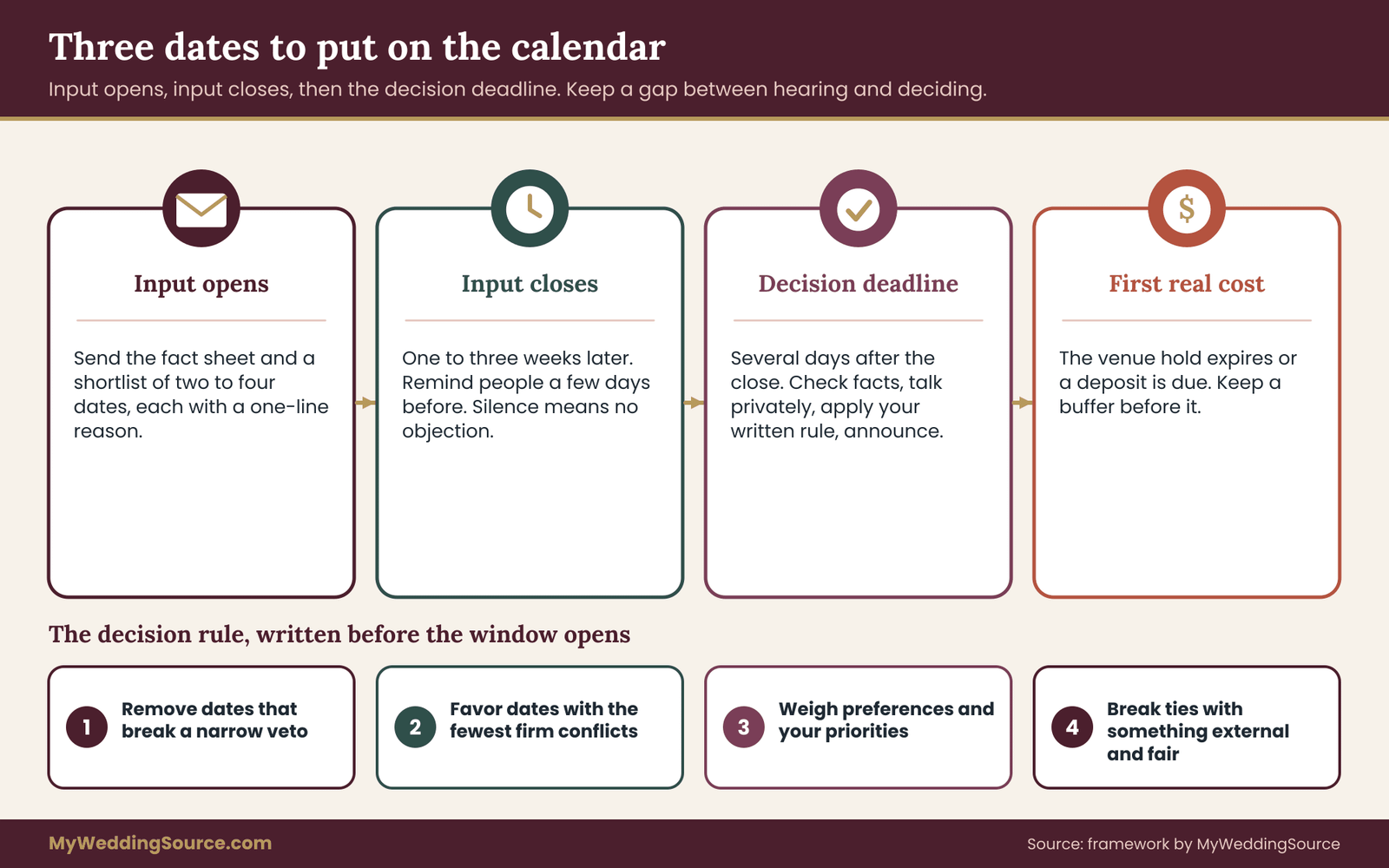
Set three dates, in this order. The first is the input opening: the day you send the fact sheet and the shortlist to the people at levels two and three. The second is the input close: the last day anyone can send constraints or preferences. The third is the decision deadline: the day you announce the result.
A workable spacing for many families is a window of one to three weeks between opening and close, followed by several days to a week before the decision deadline. The gap after the close is not idle. It is when you check any claims that need checking, such as whether a stated conflict is real, and when you and your partner talk the options through without relatives present.
How long should the input window be? Long enough that a person who travels or works irregular hours can respond, and short enough that it does not drift. For a large, scattered family, two to three weeks is often reasonable. For a small, close family, a week may be plenty. If you are unsure, ask one trusted person in each family how quickly their relatives usually reply to group messages, and use that as a guide.
A good decision deadline is visible, so put all three dates in writing, in the same message, so that nobody can say they did not know the window was closing. Repeat the close date in a reminder a few days before it arrives. A reminder is not nagging. It is part of making the input round fair to people who are busy.
Building a shortlist instead of asking an open question
The single most useful change you can make to the input round is to ask a closed question. “What date do you want?” invites every relative to produce a personal wish list, and the answers cannot be compared. “Which of these three dates works, and is there any date on this list that you cannot attend?” produces answers that can be tallied and discussed.
Build a shortlist of two to four dates before the window opens. Choose them based on your own priorities and on the facts from your clocks: venue availability, the seasons you prefer and any known conflicts. A shortlist should contain dates you would genuinely be happy with. Do not include a date you are hoping people will reject, because they may choose it.
When you present the shortlist, say why each date is on it. A short note such as “this one is when the venue has the garden open” or “this one avoids the long weekend” gives relatives context and reduces the urge to argue for a different date. It also shows that the shortlist was not chosen at random.
Leave room for a surprise constraint. Add one line asking whether there is any reason, such as a religious observance, a medical limit or a fixed obligation, that would make any shortlisted date impossible. That line brings real vetoes to the surface early and keeps minor preferences from masquerading as hard limits.
Separating constraints from preferences
The most important sorting task in the input round is separating constraints from preferences. A constraint is something that makes a date unworkable: a person who is essential to the ceremony cannot attend, a faith practice forbids attending a celebration on that day, or a medical or legal situation prevents travel. A preference is something that would make a date better or worse but does not rule it out.
The distinction sounds obvious, but in practice it is blurry, because people present preferences as constraints when they care a lot. A relative who says “I can’t come that weekend” may mean “I’d rather not.” Neither response is wrong, but they call for different treatment.
A gentle way to sort is to ask a follow-up question that does not accuse anyone: “Is that a firm conflict, or would you come if we chose that date?” Most people answer honestly when the question is asked kindly. Record the answer in a simple two-column list in your notes, with constraints on one side and preferences on the other. You will use that list at the decision deadline.
Be generous with real constraints. A date that excludes someone who is essential, such as an officiant, a parent or a grandparent who cannot travel at other times, is usually a date to cross off the shortlist, because the wedding will feel the absence. Be firm but kind with preferences. If three people prefer a different date than you, and none of them has a constraint, you can weigh their preference and still choose differently.
A decision rule for the final choice
At the close of the input window, you will have a shortlist, a list of constraints and a list of preferences. A simple decision rule turns those into a choice without anyone feeling that it was arbitrary.
First, remove any date that violates a constraint held by someone at level two, since those are the narrow vetoes in the charter. Second, check how many level three constraints each remaining date violates, and favor the dates that violate the fewest. Third, among the dates that remain, weigh preferences and your own priorities. Fourth, if two dates are still close, choose the one that gives your venue and vendors the most certainty, since that is the reason you set a decision deadline in the first place.
Write the rule down before the window opens, not afterward. If relatives can see in advance how the decision will be made, they are less likely to suspect that the outcome was decided first and justified later. You do not need to share every detail, but the outline, such as “we will remove dates that conflict with a firm constraint and then choose the one that works for the most people,” is worth sharing.
If the rule leaves you with a tie that you honestly cannot break, break it with something external and fair: the date that the venue prefers, the date that is least expensive, or the date that avoids the longest travel for the most guests. Avoid coin flips in front of relatives, which can feel dismissive, but a fair tie-breaker is entirely legitimate.
Setting a conditional decision deadline when one fact is unknown
Sometimes a single unknown holds everything up. A grandparent is waiting on a medical review, a sibling is waiting for a work schedule, or an officiant will know their availability on a certain day. In these cases, a conditional decision deadline keeps the process moving without ignoring the unknown.
A conditional decision deadline has two parts. The first names the piece of information you are waiting for, and the latest day it can arrive. The second names what you will do if it has not arrived. For example: “We are waiting to hear whether the officiant can attend the October date. If we do not hear by February tenth, we will decide using the information we have.”
This approach respects the person who is waiting on something outside their control, and it protects you from an open-ended pause. Be honest in the wording. If the person’s attendance is essential and you will cancel the date without them, say so. If it is not essential, say that you will proceed without them and that you hope they can join.
The risk of a conditional decision deadline is that it can multiply. If you allow one unknown, a second and third often appear. Limit yourself to one condition per decision, and make sure it is something that genuinely changes the outcome, not merely something that would be nice to know.
Choosing the time of day and the medium for the announcement
It is also worth deciding how the decision deadline will be delivered. The date is a piece of news that will land differently depending on who hears it and when. A few simple choices reduce the chance of hurt.
Tell the people closest to the decision first, and tell them individually where you can. A parent who hears the result from a sibling or a group message feels treated as a bystander. A parent who gets a personal phone call before the general announcement feels respected, even if they would have chosen a different date.
On the day of the decision deadline, keep the message short, warm and clear. State the date, thank people for their input and say that the decision is final. Avoid long justifications, which tend to open new arguments. If someone asks why, answer briefly and kindly, and then return to the next step.
Avoid announcing a decision on the eve of a holiday or a family milestone. A date announced during a stressful time will be read through that stress. Choose a calm day, ideally one where you will be available to answer calls and messages afterward. That availability matters, because relatives who need to talk should not be left waiting.
The next section covers what to do when the input window closes and the group still has not converged, which is the situation the escalation tree is designed for.
The deadline escalation tree, rung by rung
The second tool is the deadline escalation tree. It answers a question the charter cannot: what happens if the input window closes and people still disagree? Without an answer, a disagreement can sit unresolved right up to the decision deadline and then explode. With one, each step has a purpose, an owner and a time limit.
The tree has five rungs. You climb them only as far as you need to. Most disagreements end at the first or second rung, long before the decision deadline arrives, and only a few reach the fourth. What matters is that the climb is predictable, so that nobody is surprised by the next step.

Rung one: the fact round
The first rung is the input window described in the previous section. Everyone at levels two and three receives the fact sheet and the shortlist, and everyone has the same time to respond. This rung resolves a large share of disagreements on its own, because many conflicts disappear when people can see the facts: that the venue is booked on the other weekend, that the only alternative costs more or that the preferred date collides with a holiday travel peak.
The owner of this rung is the couple. Their job is to be fair, prompt and clear: send the materials on the day promised, acknowledge replies, and log constraints and preferences in the two-column list. If someone does not reply, a single friendly follow-up is enough. Silence by the close date counts as no objection, and the fact sheet should say so.
At the end of this rung, check whether a date emerges. If one date violates no constraint held at level two and works for most people, you can often decide with a short note and skip the rest of the tree. Do not manufacture conflict that is not there.
Rung two: the one-to-one conversation
If a real disagreement remains, the second rung is a direct, private conversation with the person or people who are objecting. The conversation is not a negotiation of the date. It is an attempt to understand the concern well enough to see whether it can be met in some other way.
Come prepared with the fact sheet, the constraint list and one or two options that might address the concern. For example, if a relative cannot attend because of a work shift on the preferred date, you might ask whether a different arrival time or a shortened visit would help, or whether the ceremony could be timed around the shift. If a relative objects on grounds of tradition, ask what, specifically, the tradition requires, and whether any version of the date would respect it.
Listen more than you speak. People often ask for something different from what they actually need. A parent who says “that date is wrong” may be saying “I feel left out of this.” Naming the feeling without conceding the date is often enough: “I can hear that you want to be part of this decision, and I want that too. Tell me what you would want us to consider.”
Keep a short note of each conversation: who, when and what was raised. Not for use as ammunition, but so that your memory of what was said is the same a month from now. This rung should take days, not weeks. Set a limit at the start, such as “I would like us to talk by the twentieth,” and keep to it.
Rung three: the bridge person
If the one-to-one conversation does not resolve the concern, the third rung introduces a bridge person. This is a trusted relative or friend, respected by the people involved, whose role is to carry information in both directions. They are not a judge. They do not decide anything, and they do not take sides.
Choose the bridge carefully. The right person is calm, reasonably neutral and trusted by the objecting party. A sibling of the objecting relative, a long-standing family friend or a respected elder can work. A parent is rarely the right choice, because parents often have a stake of their own and tend to carry their child’s side into the conversation.
Brief the bridge in plain terms. Give them the fact sheet, the charter and the decision deadline, and tell them what the couple is willing to adjust and what it is not. Ask them to listen to the objection, to restate it accurately and to carry the couple’s explanation back. Make it clear that their role ends when the decision is made.
Do not use the bridge as a way of avoiding a difficult conversation you should be having yourself. The bridge is useful when the relationship between the couple and one relative is strained enough that direct conversation keeps going wrong. If you are using a bridge because you would rather not talk, the conflict will return in another form.
A practical limit applies here too: no more than one bridge per disagreement. Several intermediaries create a game of telephone, in which each retelling changes the message. One person, one conversation and one report back is enough.
Rung four: the couple decides
The fourth rung is the decision itself. On the decision deadline, the couple applies the decision rule from the previous section, chooses the date and writes the announcement. Nothing about this rung requires unanimous agreement. It requires only that the process in the charter was followed.
Before announcing, do a brief check. Does the chosen date violate any constraint held at level two? If so, you have either a flaw in the process or a choice to make consciously: you are overriding a veto, and you should know why. In most cases, you will adjust the choice rather than override. If the veto turns out to be weaker than it first appeared, explain that in your notes before deciding.
Next, check that you and your partner agree. A decision announced by one partner and quietly doubted by the other tends to unravel. If one of you is hesitant, find out why before the announcement, not after. The hesitation might be about the date, or it might be about how a relative will take it, and those need different responses.
Then announce. Use the plan from the previous section: tell the closest people first, individually, and then send a short, warm message to the wider group. State the date, thank people, say that the decision is final and describe the next step, such as the save-the-date or the venue contract.
Rung five: aftercare and the reopening test
The fifth rung is easy to overlook, and it is the one that keeps the decision from being reopened. It has two parts: aftercare for the people who were disappointed, and a clear test for when the date can be revisited.
Aftercare means follow-up. A relative who lost the argument is more likely to accept the result if someone checks in a few days later. A short call or message that says “I know that was not the date you wanted, and I want you there” matters more than most couples expect. If there is something you can do to ease the situation, such as adding a remote option for someone who cannot attend, offer it, but do not promise what you cannot deliver.
The reopening test is a simple rule for when the date may be revisited. Reopen only for a new, material fact that was not known during the input window and that would have changed the decision under the charter. A death in the immediate family, a serious illness of someone essential, a venue closure or a vendor failure meets the test. A relative changing their mind or a better idea from a friend does not.
State the test in your announcement, briefly: “We will keep this date unless something serious changes.” This line prevents the quiet pressure that follows a decision, because everyone knows what would be required to reopen it. It also protects you from your own second thoughts at midnight.
When the tree runs out of rungs
Occasionally, even a fair process does not produce acceptance. A relative may refuse to accept the date, may threaten not to attend or may continue to campaign after the decision. At this point, the tree and the decision deadline have done their job: the decision was made, on time, with a fair hearing. What remains is a relationship question, not a scheduling one.
You have a few choices. You can hold the date and accept that one person may not come. You can have a calm, final conversation to say that you hope they will be there but the date will not change. Or you can ask a trusted person, such as a faith leader or family counselor, to talk with them. What you should not do is reopen the date because the pressure has become uncomfortable, because that teaches everyone, including future conflicts, that pressure works.
It may help to remember how rare this outcome is. Most disagreements settle at rung one or two. The tree exists for the cases that do not, so that you are not improvising in the middle of a crisis.
Keeping the tree on a single page
Like the charter, the tree should be short enough to share. Write each rung in one or two sentences, with a time limit and an owner. A version that fits on a half page will actually be read. The next section turns the rungs into specific words you can use at each step, since knowing the process is one thing and finding the sentence in the moment is another.
Scripts for the conversations along the tree
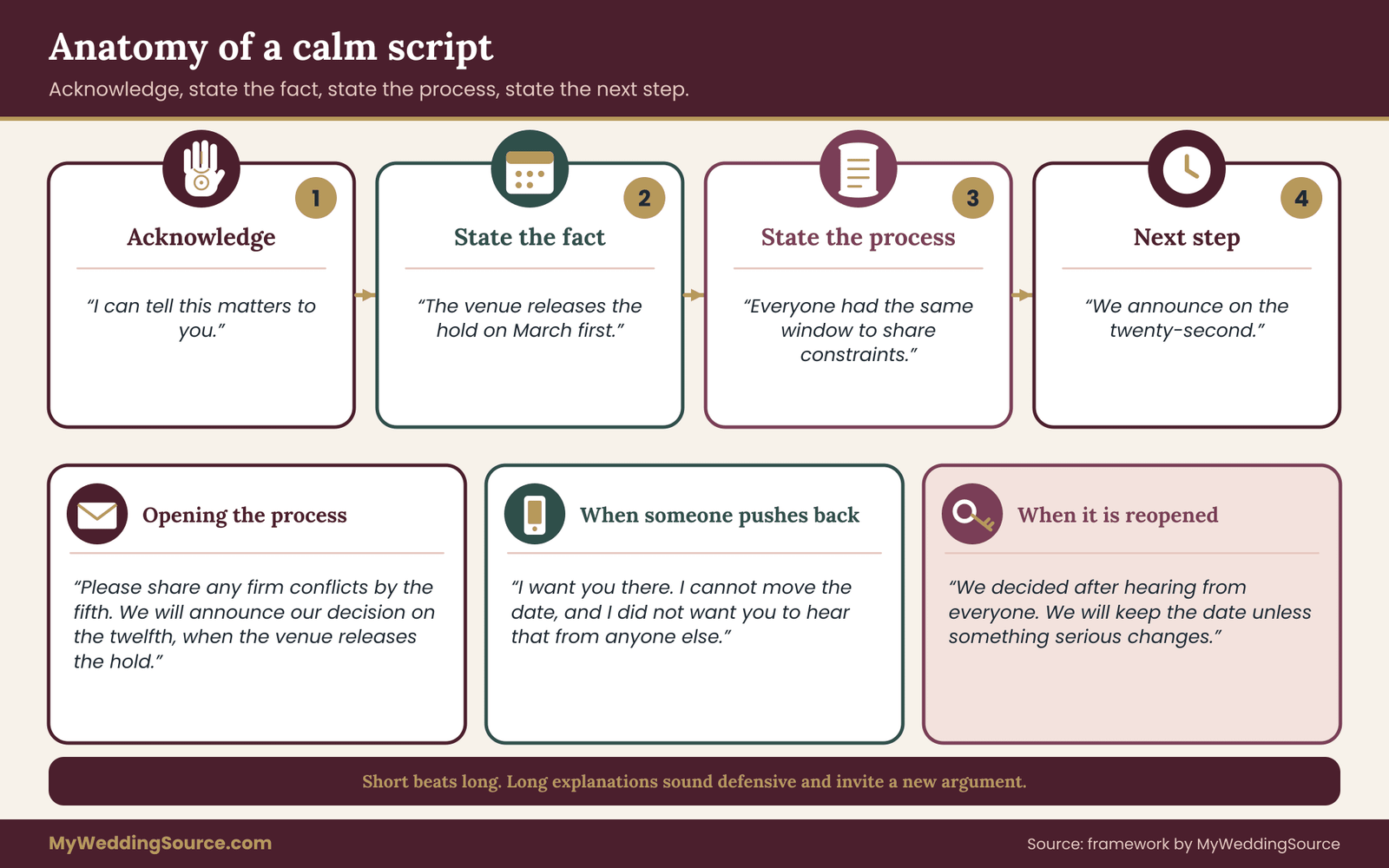
Knowing the process is one thing. Finding the right sentence while a parent is upset is another. The scripts below are starting points, written in a plain, warm tone. Change the wording to fit how you and your family talk, and keep the structure: acknowledge, state the fact, state the process, state the next step.
Scripts for a decision deadline work best when they are short. Long explanations sound defensive, and defensiveness invites argument. If a sentence feels too brief to carry the weight, that is usually a sign that it is the right length.
Opening the process
When you first tell families that you are setting a decision deadline, the goal is to explain the reason, not to defend the idea. A version that works for many couples: “We want to pick our date in a way that gives everyone a fair chance to be heard. We are sending a short list of dates and the reasons for them, and we would like your input by the fifth. We will announce our decision on the twelfth, because that is when the venue releases the hold.”
Notice that the script gives a specific reason for the date. It also states that input is wanted, not merely tolerated. If a relative asks why the couple does not simply discuss it on a call, a short answer is enough: “A call is fine for questions, but we want to give everyone the same chance to share their constraints, including people who cannot be on the call.”
For the parents or contributors who might expect a larger role, add a private line: “We would love your thoughts on the date, and the final choice will be ours. We want you to know that your input will be taken seriously.” Say it warmly, and say it before the process starts, not after a relative is already frustrated.
Asking for constraints without inviting a debate
The input request should ask for facts. “Is there any date on this list that you cannot attend, and is that a firm conflict?” is a fact question. “Which date do you like?” is an opinion question, and both are useful, but they should be separated so that opinions do not get presented as constraints.
If a relative replies with a long explanation of why the date is wrong, thank them and restate the fact. “Thanks for explaining. So the main issue is that the fifteenth is a family event for your side. I will add that to our list.” That response confirms that you have heard them without agreeing to change the date. Be careful to avoid phrases like “I understand, but,” which tend to cancel everything said before the word “but.”
When a relative proposes a date that is not on the shortlist, treat it as input and check it. “That is a good thought. We checked and the venue is not available that weekend, so we cannot add it, but I am glad you raised it.” Honest, specific and brief is better than vague and hopeful.
The one-to-one conversation at rung two
This is the most delicate conversation in the process, and it helps to rehearse. Start with the relationship, not the date. “I want you to be at our wedding, and I want to understand what matters most to you about the date.” Then listen. Do not interrupt, and do not offer solutions until the person has finished.
After they have spoken, reflect back what you heard in your own words. “So the biggest concern is that the weekend collides with your sister’s anniversary, and you would have to choose. Did I get that right?” People relax when they feel accurately understood, even if the outcome is not what they wanted.
Then, if there is something you can adjust, offer it. “We cannot move the date, but we could start the ceremony later in the day so you can be at both.” If there is nothing to adjust, say so kindly: “I do not see a way to change this, and I did not want you to hear that from anyone else.” Honesty at this stage prevents the more painful discovery later that you were stalling.
Finish with the timeline. “We will be deciding on the twelfth. If there is anything else you want us to consider before then, please tell me by the fifth.” The goal is that the person leaves the conversation knowing what will happen next and when.
Briefing a bridge person
If you use a bridge person at rung three, give them a short written brief, so that nothing is lost in a verbal handoff. A few lines are enough: the date the decision will be made, what the couple is willing to change, what is not negotiable and what you would like them to find out. Ask them to report back by a specific day.
You might say: “Would you be willing to talk with Aunt Rosa about the date? We would like to understand her concern and make sure she knows we want her there. We are not asking you to persuade her of anything. We would just like to hear how she is feeling and let her know we are listening.”
Be clear about what the bridge should not do. They should not negotiate on your behalf, promise changes or carry messages that sound like threats. If they hear something that surprises you, they should report it plainly and leave the response to you.
The announcement script for the decision deadline
The announcement is the moment where tone matters most. Keep it short and kind. “We have chosen the twelfth of October for our wedding. Thank you for sharing your thoughts; they helped us a great deal. We know that not every date could work for everyone, and we are grateful for your understanding. We will send details soon. We will keep this date unless something serious changes.”
For the person who was most disappointed, a personal addition helps: “I know this was not your first choice, and I appreciate how openly you told us why. It means a lot that you want to be there.”
Avoid attaching reasons to the announcement that invite counterarguments. If you write “we chose this because it is the cheapest,” a relative may reply with a cheaper date. State the choice, thank people and move on.
Responding when someone reopens the question
After the decision deadline, some relatives will try to reopen the date. A calm, repeatable response is the most useful tool you can have. “We made this decision after hearing from everyone, and we are keeping the date. If something serious changes, we will let you know.” Say it the same way each time, with the same warmth.
If a relative escalates, do not match their intensity. “I can tell this matters a lot to you. I am not going to change the date, and I do not want it to come between us.” Then change the subject or end the conversation kindly. You are not obliged to continue a debate that has already been settled.
A short check before you respond: does the new message contain a material fact that the input window did not capture? If it does, apply the reopening test honestly. If it does not, hold the decision and say so.
A worked example: one decision deadline, three families
The following example is invented for illustration. The names, dates and details are not real, and it is not a case study. It is meant to show how the charter, the three dates and the escalation tree fit together in a realistic situation.
Maya and Daniel want to marry in the autumn. Maya’s family is large and lives within a few hours’ drive. Daniel’s parents are divorced and live in two different states, and each of them has a different set of relatives. Daniel’s grandmother, who is elderly, lives with his father. Maya’s mother is helping with the costs and has quietly assumed she will have a say on the date.
Step one: the three clocks
Maya and Daniel ask their top venue about holds. The venue will hold a Saturday in October for a few weeks without a deposit, and it has said it will not extend because another couple is asking about the same weekend. That sets the vendor clock: the hold expires on the first of March.
For the guest clock, they list their most travel-dependent guests. Daniel’s mother must arrange leave and flights from another state, and his grandmother needs to plan travel with her son. They decide that save-the-dates must go out by mid-March, so guests have time to prepare.
The family clock is already showing signs of strain. Maya’s mother has mentioned three different dates in the last month, and Daniel’s father and mother have each said the other “always gets their way.” They agree that the process has to start now and that the decision deadline should be tight enough to prevent drift.
Step two: the charter
Maya and Daniel talk first, alone. They agree that the final decision belongs to the two of them. They also agree that Daniel’s grandmother holds a narrow veto because her doctor limits her travel to certain months, and that Maya’s brother, who will officiate, holds one because of a fixed work commitment in late autumn.
Maya’s mother and both of Daniel’s parents are placed at level three: input that will be weighed, with no veto. Maya raises the issue of her mother’s contribution directly. They decide that the contribution does not confer a vote on the date, and they plan a warm conversation to say so before the process starts.
They write the charter in half a page and share it first with each parent individually, by the person closest to that parent. Maya’s mother pauses at her level, so Maya has the planned conversation: “We are so grateful for your help, and we want the date to be our decision with your input. Please tell us what matters most to you.”
Step three: the decision deadline, the dates and the shortlist
Maya and Daniel set three dates. The input window opens on the first of February, closes on the fifteenth and the decision deadline is the twenty-second, which leaves a week before the venue’s hold expires. They allow the gap after the close for checking facts and for a private conversation.
Their shortlist has three Saturdays in October. Each has a one-line reason: the first has the garden in best light, the second avoids a local festival that fills hotels, and the third is the venue’s preferred weekend. They send the fact sheet and shortlist to the level two and level three people with one question: “Is any of these dates impossible for you, and if so, is it a firm conflict?”
Step four: the responses and the sorting
Replies arrive within a week. Daniel’s grandmother’s doctor confirms that she can travel in early or middle October but not late October, which removes the third date. Maya’s brother can attend either of the first two. Maya’s mother prefers the third date because of a family tradition, but when Maya asks gently whether it is firm, her mother says it is a preference.
Daniel’s mother says the second date collides with a work obligation, and when asked, she says she could probably arrange it but it would be hard. Daniel’s father has no conflicts. That leaves two dates and one soft concern, plus one disappointed parent whose date was removed by a real constraint.
Step five: the tree in action
The first rung, the fact round, narrowed the list from three dates to two. The disagreement that remains is between the first date, which fits Daniel’s mother but not the festival hotel situation, and the second date, which is better for hotels but harder for her.
At the second rung, Daniel calls his mother. He listens to her concern, explains the hotel issue and asks whether any adjustment would help. She says an earlier flight on Friday would let her manage the work schedule, and she is willing to try. That resolves the conflict without a bridge.
Maya’s mother is still unhappy that her preferred date was removed. Maya has a one-to-one conversation and explains that the date conflicts with a doctor’s limit for Daniel’s grandmother. Her mother says she had not realized and accepts it, though she is still a little disappointed. They skip the third rung entirely.
Step six: the decision and the aftercare
On the decision deadline, Maya and Daniel apply their rule: remove dates that violate a level two constraint, then favor the date that works for the most people. The second date remains. They confirm with each other that they both agree, and they call each parent before sending a group message.
The announcement on the decision deadline is brief, thanks everyone and includes the line about keeping the date unless something serious changes. A few days later, Maya checks in with her mother and Daniel checks in with his. They sign the venue contract before the hold expires, and the save-the-dates go out in the first half of March.
What made the difference was not that everyone was pleased. It was that everyone had the same chance to speak, the real constraints were respected, and the decision came on a date that people had known about for weeks. {{INFOGRAPHIC:6}}
What to verify before your decision deadline passes
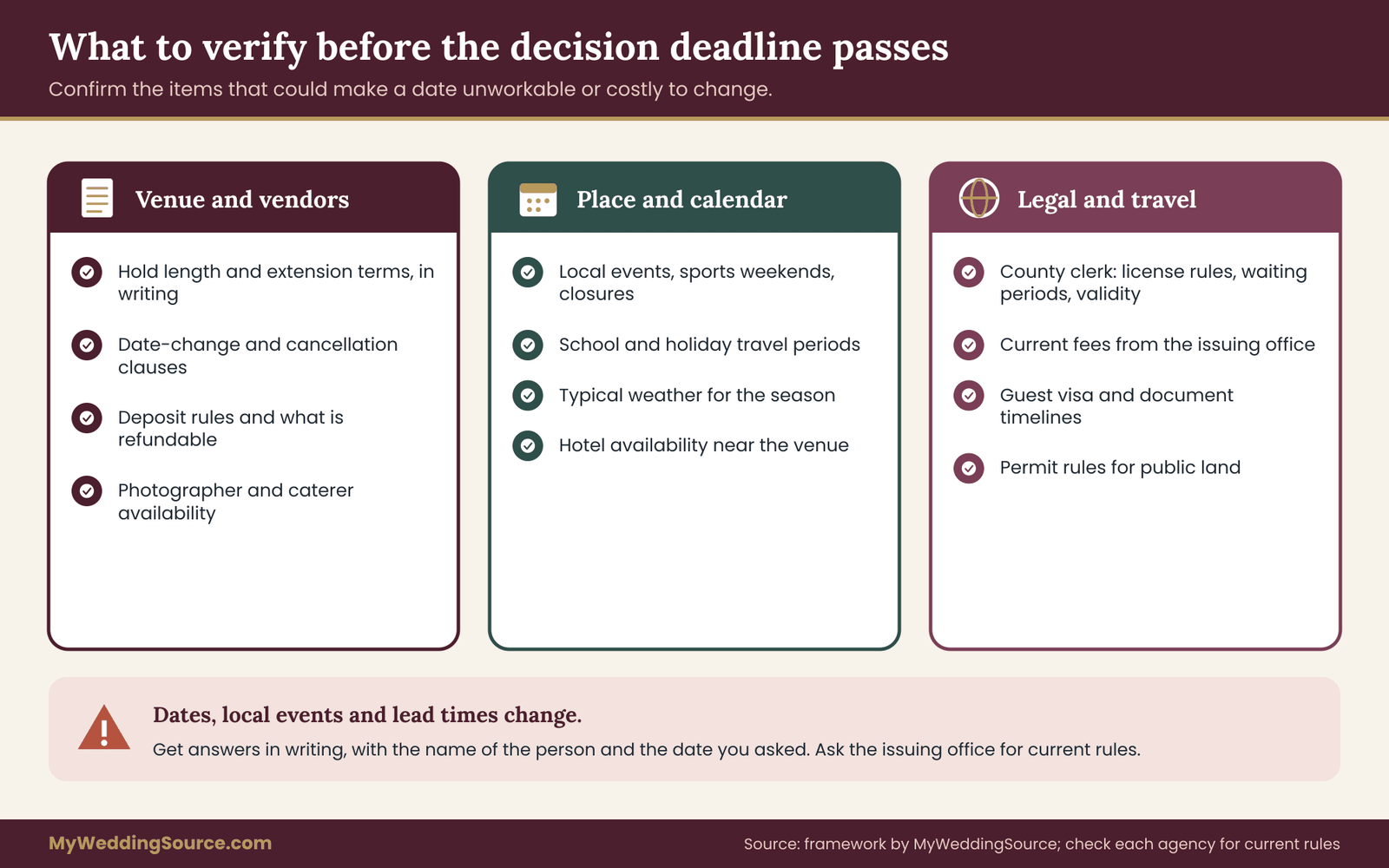
A decision deadline is only as good as the facts underneath it, so verify before it arrives. Before you announce a date, confirm the items that could make it unworkable or expensive to change. This is not busywork. It is the difference between a decision that holds and one that falls apart a month later.
Venue and vendor terms
Read the exact hold terms in writing. Confirm how long the hold lasts, whether it can be extended and what happens if another couple asks for the date. If the venue gives you an answer by phone, ask for it in an email so that you can find it later.
Check the contract language on date changes, cancellations and deposits before you sign. A contract that treats a date change as a cancellation has very different consequences from one that allows a single change for a small fee. Questions about what a clause means in your situation are for the venue and, if you wish, a lawyer licensed in your state. The wedding vendor contract guide lists the clauses worth reading first.
Confirm that your other key vendors are available on the date before you announce it, or at least that you have asked. A date that suits the family but not the photographer or caterer is a problem you will have to solve in a hurry. If you are early in booking, the twelve-month wedding checklist shows how the decisions usually fall in order.
Local conditions and the calendar
Test the date against the place, not just the people. Check for local events, school calendars, large conferences, sports weekends or road closures that could affect hotel availability and traffic. A single large event can fill a town’s rooms, and the venue or local visitor office can often tell you what is scheduled.
For an outdoor wedding, look at the National Weather Service’s climate information for the region and season, and treat it as a guide to what is typical, not a promise. Dates, local events and lead times change, so check again close to the date.
If guests will travel, check holiday travel periods and the airlines’ published change and cancellation policies, and read the Department of Transportation’s air-travel consumer information for what passengers are entitled to when flights are disrupted. Do not assume rules you have not read.
Legal and administrative items
Marriage license rules are set by states and counties, not by a national authority. Some jurisdictions have waiting periods, and licenses are valid for a limited time that varies by place. Contact the county clerk or the office that issues licenses in the place where you will marry, and ask for the current rules and fees, since these change. Make sure your chosen date allows enough time to meet them.
If any international guests need visas or travel documents, the Department of State’s travel information is the place to start, and processing times can be long. Check the official pages for current guidance rather than relying on a friend’s experience. If a guest’s attendance depends on paperwork, build that into the conditional decision deadline.
For ceremonies on public land, such as parks, check the managing agency’s permit rules and lead times, since permits can be limited or booked in advance.
Limits of this method
This guide offers a process, not a guarantee, and a decision deadline is only one part of it. It will not make families agree, and it cannot settle disputes that are really about something else. Some conflicts will continue regardless of how clearly a decision deadline is set, and in those cases the process still helps by creating a record of fair treatment, but it will not heal the underlying issue.
The method also assumes that the couple has the standing to decide. In some families, cultural or religious expectations give parents or elders a defined role in the choice of a date. If that is true for you, the charter should reflect it honestly, and you may need to place those people at a higher level, by agreement. A process that ignores a real cultural structure will not feel fair to the people it affects.
Finally, a decision deadline can be misused. A couple who sets one only to shut down discussion, or who ignores real constraints, will feel the consequences later. The input window must be real, and the constraints must be weighed. Used honestly, the tools here protect everyone. Used cynically, they are just a more elaborate way of getting your own way, and families usually notice.
If you or a family member feels unsafe, pressured or controlled in connection with the wedding, a scheduling process is not the right tool. Talk with a counselor or another trusted professional.
Your next steps
Start with the part you control. Talk with your partner and settle your own priorities for the date: two or three things that matter most. Then work through the steps below in order, and keep each one short.
- Ask your top venues how long they will hold a date, whether the hold can be extended and what happens if another couple asks. Write down the answers and who gave them.
- Work out the earliest real cost and the notice your most travel-dependent guests need, then set the decision deadline a week or two before the first of them.
- Write the one-page decision-rights charter and agree on it with your partner before showing anyone.
- Build a shortlist of two to four dates you would be happy with, each with a one-line reason.
- Set the three dates: input opens, input closes and the decision deadline. Send them together with the fact sheet.
- Sort responses into constraints and preferences, apply your written rule and climb the escalation tree only as far as needed.
- Announce the decision personally first, then to the group, and include the reopening test.
- Add the date to your wedding planning checklist and begin the bookings that were waiting on it.
If you want a broader view of how date choice fits with guest availability and travel, the guide to choosing a wedding date covers it in detail, and the wedding etiquette guide offers help with the tone of family conversations.
FAQ
How long should a wedding date decision deadline be?
There is no standard length, so tie it to your real costs. Find the first date that you lose something, such as a venue hold expiring, and set the decision deadline a week or two before it. Allow one to three weeks for family input, plus several days between the close of input and the decision, so you can check facts and talk privately with your partner.
Who should have the final say on the wedding date?
In most cases the couple does. Some families agree that parents who contribute funds, or elders with a defined cultural role, have a stronger voice, and that is a legitimate choice if it is stated clearly. What matters is that the decision-rights charter names the decision-makers in advance, so nobody has to guess or assume when the decision deadline arrives.
What if one relative threatens not to attend after the date is chosen?
Respond kindly and do not reopen the date under pressure. Say that you hope they will come and that the decision is final, and check whether their concern fits the reopening test, meaning a new material fact. If not, hold the decision. A counselor or trusted faith leader can help with the relationship, since the scheduling process has already done its job.
Is it fair to set a decision deadline when someone is waiting on health news?
It can be, if you use a conditional decision deadline. Name the one piece of information you are waiting for, the latest day it can arrive and what you will do if it has not. This respects a real constraint while keeping the process moving. Be honest in the wording, and limit yourself to one condition so the decision deadline does not slip repeatedly.
Should I let parents who are paying vote on the date?
That is a choice to make deliberately, not a default. Decide with your partner whether any contribution carries a role in the date decision. If it does, put it in the charter at a stated level. If it does not, say so warmly and early, thanking them for the help while explaining that the decision belongs to the couple, with input from everyone.
Can I hold more than one date at different venues while we decide?
You can, but keep it honest and organized. Track each hold, its expiry and what the venue said about extensions, and release dates you no longer want promptly, since other couples may be waiting. Remember that your earliest expiring hold sets the real decision deadline, and extra holds can hide that. Read the exact hold terms in writing.
What counts as a good reason to reopen the date after the announcement?
A new, material fact that was not known during the input window and that would have changed the decision under your charter. Examples include a serious illness or death of someone essential, a venue closure or a vendor failure. A relative changing their mind, or a friend’s better idea, does not meet that test, and the date should stand.
How do I tell families about the decision deadline without sounding harsh?
Give a specific, external reason and invite input. Something like: we want everyone to have a fair chance to share constraints, so please reply by the fifth, and we will announce our decision on the twelfth because the venue releases the hold then. Anchoring the decision deadline to a real constraint sounds practical, not demanding, especially when you say it warmly.
Sources
Check each agency or business directly for current rules, fees and terms, since these change.
- USA.gov: federal government portal with links to state and local government offices, including those that issue marriage licenses.
- Federal Trade Commission: consumer protection information on contracts, deposits and business practices.
- Consumer Financial Protection Bureau: consumer guidance on payments, deposits and disputes.
- National Weather Service: forecasts and climate information by region.
- Ready.gov: official preparedness guidance for severe weather and travel disruptions.
- U.S. Department of Transportation: air-travel consumer information and passenger rights when flights are disrupted.
- U.S. Department of State, Travel: visa and international travel information for guests.
- National Park Service: permit information for ceremonies on national park land.
- Transportation Security Administration: airport screening and travel guidance for guests.