A fake vendor is a person or group who copies, invents or hijacks the online presence of a wedding business so that couples send a deposit for services that will never arrive. This guide gives you a five-gate check, a phone script and a worked example, so you can tell a real vendor from a fake vendor before any money moves.
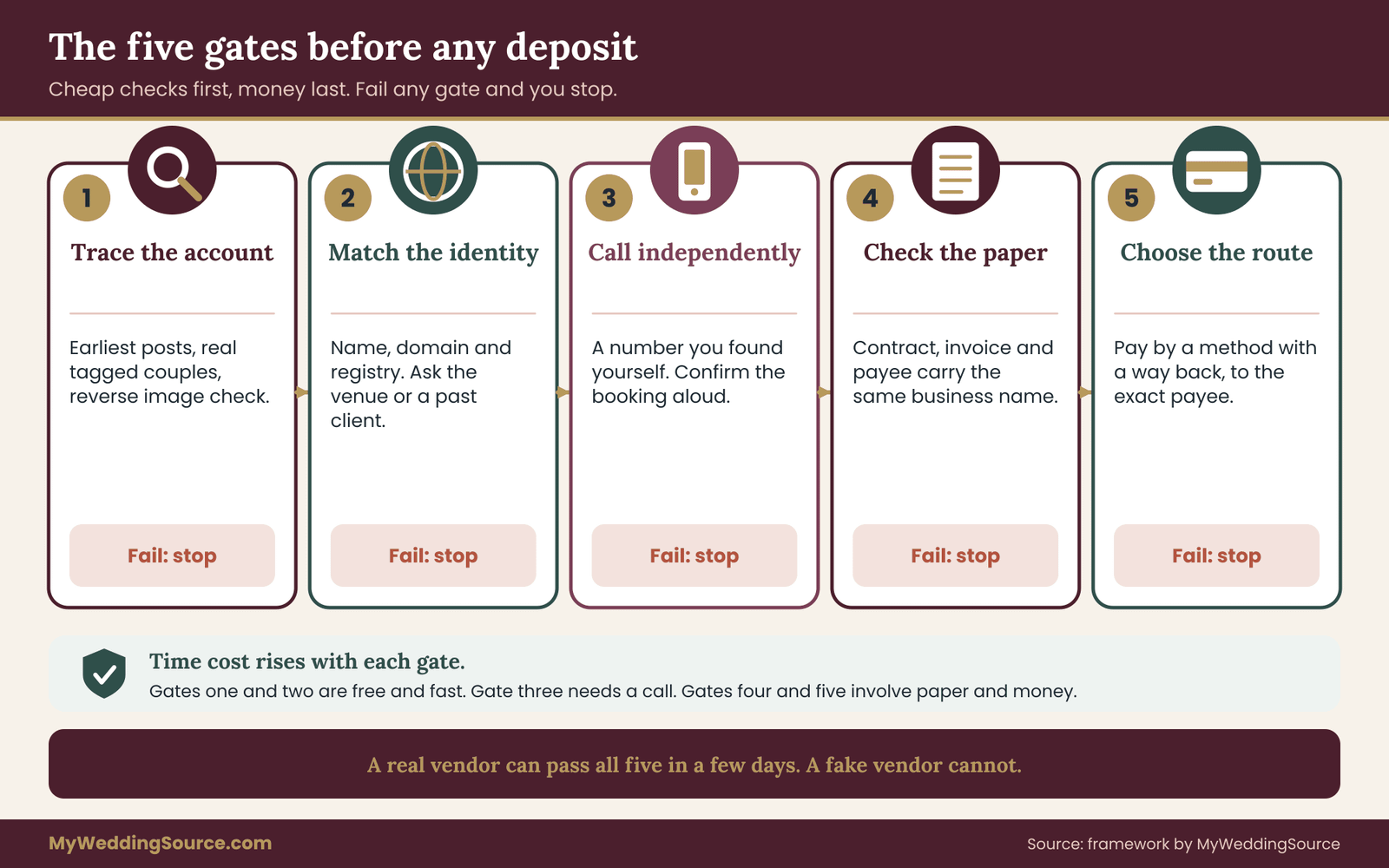
Before you pay any deposit, make the vendor pass five gates in order: the account has a believable history, the business identity matches across independent places, you have reached them by a phone number you found yourself, the paperwork carries the same business name as the payee, and the payment route has a way back. If any gate fails, stop and do not pay. A fake vendor usually fails at the phone call, because the real business will not know your name and the fake vendor cannot afford to be called.
Most couples picture a wedding scam as something obvious: a badly spelled message, a price that is far too low. The ones that work are quieter. A photographer’s real portfolio appears under an account with a slightly different handle. A florist’s messages are warm, quick and professional. A deposit link arrives with a small discount for booking today. Nothing looks wrong until the date gets close and the vendor stops answering. Learning to spot a fake vendor is mostly a matter of slowing down at the right moments and checking the right things.
This article is about one narrow job: confirming that the business you are about to pay is the business you think it is. It does not tell you how to compare quotes or which clauses belong in a contract. For that, the site has a separate guide to the wedding vendor contract, and a longer checklist for wedding vendor due diligence. Here the question is simpler and earlier: is this really who they say they are, or could this be a fake vendor?
A note on scope. This is general information, not legal, financial or fraud-investigation advice. Consumer remedies, bank rules and local laws differ and change, so where a rule matters, the article points you to the agency or company that issues it, and you should confirm the current version yourself.
How a fake vendor scam works from first message to lost deposit
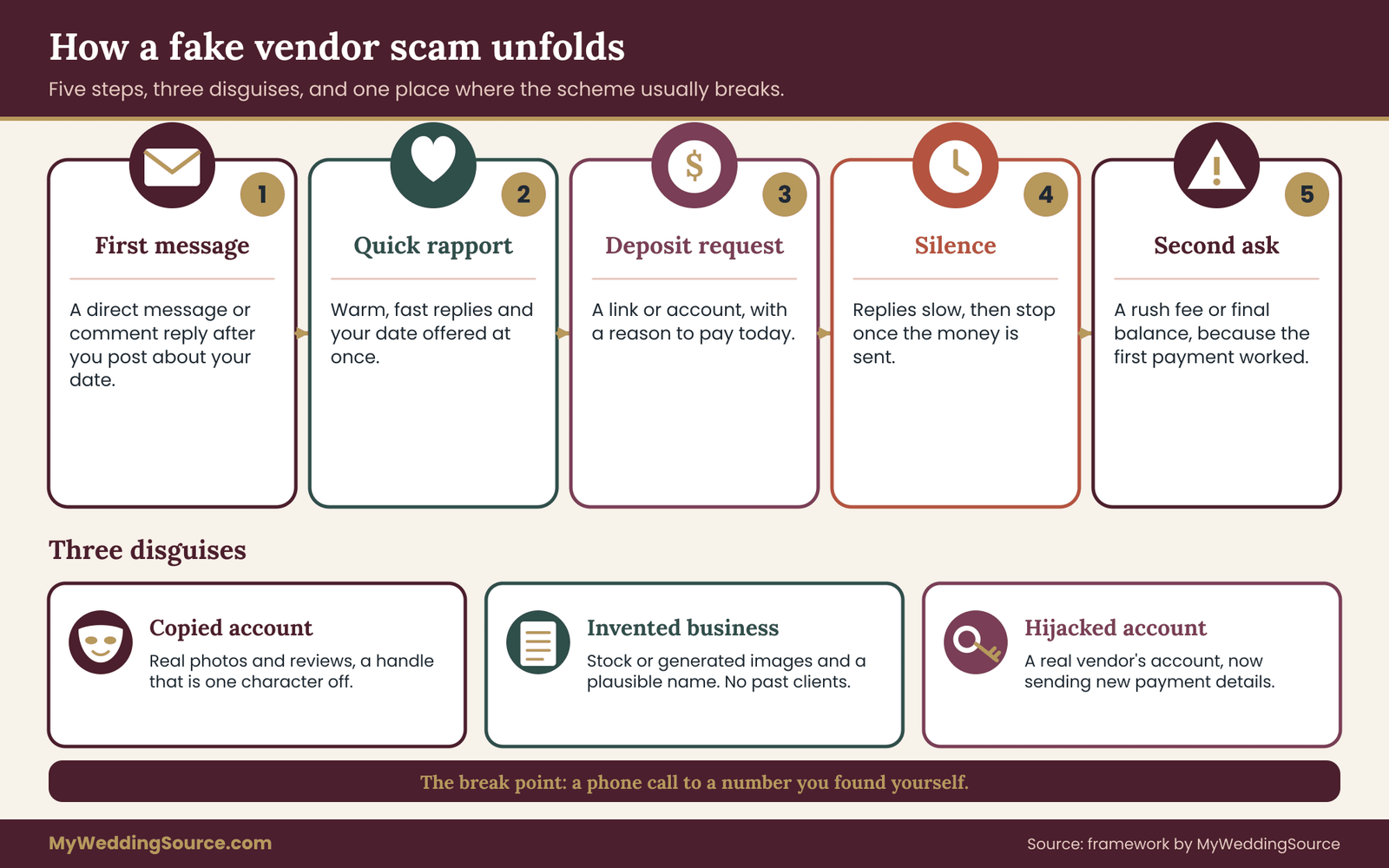
Understanding the mechanics makes the warning signs easier to see. Almost every fake vendor scheme in the wedding world follows one of three patterns, and each fails a different check.
The copied fake vendor account. The fake vendor takes real photos, captions and reviews from a working business and posts them under a new profile. The profile name is nearly identical: an extra period, an underscore, a swapped letter, a different ending such as “events” instead of “studio.” Followers can be bought. Comments can be pasted. The work shown is real, but it belongs to someone else, and the person messaging you has never made any of it.
The invented business. Here there is no victim business to copy, so the fake vendor is built from nothing. The fake vendor builds a profile from stock images, edited photos or images generated by software, adds a business name that sounds plausible and posts for a few weeks. This pattern is harder to catch through the photos alone, because nothing is stolen from a single source. It tends to fail on history and on identity: no tagged clients, no venue that remembers them, no business record.
The hijacked or taken-over account. A real vendor’s account gets compromised, and the criminal uses its reputation and its existing followers. The history looks perfect because it is real. What changes is the behavior: a new payment instruction, a sudden request to move to a different app, a slightly odd tone, a rushed deadline. This is the pattern that catches careful couples, and it is the reason the phone call matters more than the profile.
Across all three, the sequence is similar. Contact starts in a place with little friction, usually a direct message on social media or a reply to a comment. The conversation moves quickly toward availability for your date. A deposit request follows, often with a reason to act today. After payment the replies slow down, then stop. Sometimes the fake vendor asks for a second payment first, a “final balance” or a “rush fee,” because the first payment worked.
What a fake vendor needs from you
Every version of the scheme depends on four things from the couple: speed, a payment they cannot reverse, a conversation that stays inside one channel, and the absence of a second person who can verify. Take away any one of these and the scheme gets expensive for the fake vendor. That is the logic behind the five gates later in this guide. Each gate removes one of those four conditions.
Speed is removed by a rule you decide in advance: no deposit on the day of first contact, whatever the offer. A payment you cannot reverse is addressed by the payment route gate. The single channel is broken by the independent phone call. And the second person is simply you asking a venue, a planner or a friend who has worked with the vendor.
Why a fake vendor is a decision problem, not a gut-feeling problem
Couples often say afterward that something felt off. That is true, and it is also the problem: feelings are unreliable under time pressure and wedding excitement, and a good scammer works on exactly that. A written process beats a feeling. It lets you say to yourself, and to a partner or parent who says “just book them,” that the vendor has not finished the checks yet. The process also makes it easier to be polite to a real vendor who is slow to respond, because you are not accusing anyone. You are completing steps that every vendor can pass in a day or two.
Why wedding deposits attract a fake vendor
Weddings are close to an ideal target for this kind of fraud, and it helps to know why. The reasons are practical, and none of them are about couples being careless. Each one gives a fake vendor an opening.
First, the purchases are large and booked months ahead. A deposit for a photographer, a venue hold or a florist can be a meaningful amount, and the payment happens long before the service. That gap between payment and delivery is where a scam hides. If a vendor never shows, you may not find out for nearly a year.
Second, wedding buying happens in public. Couples post their date, their venue and their color palette. They tag vendors, ask for recommendations in comment threads and join groups where they describe what they need. A fake vendor can read all of this. A message that says “I saw you are looking for a florist for a June date at that venue” can be sent in seconds to anyone who posted.
Third, the culture of the industry favors informal contact. Many excellent small vendors really do take inquiries by direct message, quote through chat and send deposit requests through payment apps. So a fake vendor using the same tools does not stand out. A couple who refuses to deal with anyone on social media would eliminate many real vendors, which is why the answer is not to avoid the channel but to verify beyond it.
Fourth, there is emotional pressure, and a fake vendor knows how to use it. Popular dates and popular vendors sell out, and couples worry about losing a favorite. A fake vendor will often say that another couple is waiting, that a date is almost gone, or that a discount ends tonight. The pressure is the product. A real vendor can be pressed for time too, so urgency alone does not prove fraud, but urgency combined with a payment method you cannot undo is a combination worth stopping for.
The stakes are bigger than the deposit
The deposit is only the direct loss. A fake vendor also costs you time you cannot get back. If you find out that you booked a fake vendor three months before the wedding, you must find a replacement in the same market, often at higher rush prices, for a date other couples have already claimed. If you find out the week before, the cost can include a missing photographer or an empty cake table.
Planning around the risk is therefore about protecting the date as much as the money. Where the loss would hit the budget, the site’s guide to wedding cash flow planning shows how to keep a buffer so a single failed deposit does not derail everything else.
Who is most exposed
Anyone can be fooled, but the risk rises when several things line up. A booking made far in advance gives a fake vendor more time before anything can be checked. A booking made quickly, within days of the first message, removes your chance to check. A booking made from a different city or country, where you cannot visit or phone a local venue easily, makes verification harder.
And a booking where one partner handles all the messages alone, with nobody else looking at the conversation, removes the second pair of eyes. None of these is a reason to panic. A fake vendor is not more skilled in these cases; the checks are just harder to run. They are reasons to apply the checks more strictly, and the five gates work in all of these situations.
What the five gates do not cover about a fake vendor
Before going deeper, be clear about what this guide leaves out. It does not rank vendors, rate quality or suggest how much anything should cost. It does not replace reading the contract, which the wedding vendor purchase order guide covers from scope agreement to final acceptance. And it cannot guarantee that a vendor who passes every gate will deliver well. A real vendor can still be disorganized, overbooked or unskilled. The gates answer a narrower question: is the entity taking your money the entity it claims to be, or is it a fake vendor, and can you reach a real person if something goes wrong?
Red flags that point to a fake vendor account
No single sign proves anything. Real vendors have thin profiles, forget to answer messages and have odd payment habits. The useful approach is to sort signs into hard flags, which should stop you on their own, and soft flags, which count only when two or more show up together.
Hard flags that can expose a fake vendor
A payment instruction that cannot be undone. A request for a gift-card code, a wire transfer, a cryptocurrency transfer or a payment app transfer to a personal account marked “friends and family” is a hard flag. The Federal Trade Commission lists these as the payment methods scammers prefer, because the money is difficult or impossible to recover. A real vendor may well accept a bank transfer or a payment app, so this is not proof of fraud, but it moves the booking straight to the payment gate for a closer look.
A refusal to talk by phone or video. If you ask for a short call and the answer is always “message is easier,” that is a hard flag. Photographers, florists and bakers talk to clients constantly. A genuine business may be slow to schedule a call, but it will not refuse one forever. A fake vendor cannot afford the call, because a voice that does not match the business is hard to fake in real time.
A payee name that does not match the business. The account is “Willow & Pine Florals,” but the invoice says to pay a person with an unrelated name, or a company you cannot find. Small businesses sometimes operate under a trade name and invoice through an owner or a legal entity, so a mismatch is not automatic proof. But you need a clear, documented explanation before paying, and the explanation should be one you can check independently.
A changed instruction after you thought it was settled. An email that says “our bank details changed” or “please use this new link for the balance” is a classic sign of a hijacked account or a copied message thread. Treat it as a hard flag regardless of how the message sounds.
A request to leave the platform. If you found the vendor on a marketplace or directory that provides protection or reviews, and they ask you to complete the booking and payment outside it, think carefully. Platforms have their own rules about this, and the rules exist partly because it is a common way for fraud to start.
Soft flags: weigh them together before you call it a fake vendor
A very new account with a large following. This is common for a fake vendor, The profile was created recently, yet has thousands of followers and a polished feed. The follower count may be bought. Check the date of the earliest posts, and see whether comments look like real clients or like the same short phrases from accounts with no photos.
A feed made of work the account never tagged. Real vendors tend to tag couples, venues and other vendors, and those accounts tend to tag back. A feed of beautiful images with no tags, no location, no behind-the-scenes posts and no clients speaking in comments is worth a closer look.
A handle that is almost a known business. Compare the account name with the website, the business listing and other places the vendor appears. A single extra character, or a different suffix, is a classic sign of a copycat. When two accounts claim to be the same business, assume at least one is false until you have confirmed which.
Prices or availability that are too convenient. A vendor who is famous in your market, usually booked a year ahead, offers your date at a discount if you pay immediately. That fits a scam story better than a business story.
Generic replies. Answers that do not address your actual question, messages that repeat phrases from other threads, or a vendor who cannot describe their own process in specific terms. A real wedding photographer can tell you what they do in the first thirty minutes of a timeline. A fake vendor often cannot, because a fake vendor has never worked a wedding.
A strange mismatch in details. Photos of a venue that does not exist in the stated city, reviews that mention services the business says it does not offer, a website with no address, or a business name that appears on a different continent’s directory.
Pressure, secrecy or flattery. Asking you not to tell the venue, to keep the discount quiet, to book before you talk to your partner, or to move fast “because you seem like a great couple.” Pressure of this kind is a deliberate technique.

How to weigh them
Use a simple rule. One hard flag stops you until it is explained with evidence you gathered yourself. Two or more soft flags also stop you. One soft flag by itself is a reason to keep going carefully, not a reason to abandon the vendor. This rule prevents two kinds of mistake. It stops you from paying someone who set off a bright warning, and it stops you from rejecting a real vendor whose profile is simply new, small or untidy.
A short example shows how this works. A new bakery account has 400 followers, a fresh feed and two tagged clients. That is one soft flag at most, since young businesses start somewhere. The same account asks you to send the deposit to a personal account by a payment app and declines a phone call. That is two hard flags. The first account might be a genuine small business at an early stage. The second profile should not receive money until it clears the later gates.
Fake vendor or just a bad real vendor: telling the difference
Not every unpleasant booking involves a fake vendor, and the response differs. If a real business is disorganized, you have a contract dispute. If the business is not real, you have a fake vendor and a fraud. Mixing them up leads to wasted effort, because the remedies are different.
A real but unreliable vendor will usually have these things: a verifiable physical or registered presence, a track record you can find in venue records or past clients, a contract in the business’s own name, and a person who answers when you call the number on their official page. Their failures tend to be late replies, vague deliverables or disputes over fees. You may need to escalate through a contract claim, a card dispute or a small claims route, depending on where you live.
A fake vendor, by contrast, tends to have no verifiable presence outside the social account, no past clients who will confirm anything, and no stable contact other than the message thread. The usual failure is silence after payment. The remedies lean toward fraud reports, financial-institution disputes and law enforcement reports, covered later in this guide.
Why the distinction matters for what you do next
If you suspect a real but sloppy vendor, you can keep talking, ask for a written remedy and set a deadline. If you suspect a fake vendor, further conversation can make things worse, because you may be giving a fake vendor more time to move money or more details to use. This is why the first thing to establish in any troubled booking is whether the business exists in the way it claimed. The next sections give you the sequence to do that, before payment and, if needed, after.
A fake vendor posing as the business you already booked
There is a second situation that deserves attention: you hired a genuine vendor, and a third party impersonates them later. This usually happens after payments have been scheduled. An email arrives that looks like it came from your florist, using a logo and a signature copied from earlier messages. It says the remaining balance should go to a new account. Because you really do owe a balance, the message seems routine. The defense is a rule: any change in payment details gets confirmed by a phone call to a number you already had on file from before the change. This works whether the vendor is large or tiny.
Reviews and the fake vendor
Reviews help but can mislead. A real review on a platform with its own verification, such as a directory that requires a booking record, carries more weight than comments on a social post. Fake reviews are cheap to buy, and a fake vendor will often buy them.
Look at their timing: a cluster of five-star comments within a few days, written in a similar style, from accounts with little history, is weaker evidence than a spread of reviews over two years with specific details about the day. Look also for the review that mentions a specific person on the vendor’s team by name, then check that the person exists on the vendor’s own website.
The sections that follow turn those weighing rules into a repeatable sequence of five gates. The order matters, because the early gates are free and fast, while the later ones involve other people and money.
Gate one: trace the account before you trust the photos
The first gate asks a simple question: does this account have a history that matches the business it claims to be? You can answer it in about twenty minutes without contacting anyone.
Start with the account itself. Scroll back to the earliest posts. A genuine business that has operated for years usually shows steady posting, some visible change in style over time and posts tied to dated events, such as a particular season’s weddings. An account whose earliest post is recent, yet whose feed claims years of experience, deserves a closer look.
Next, check the tags. Open a few of the most recent client tags and look at who those accounts are. Are they real couples with their own history, who posted about their wedding in the correct month, and who credit the vendor? Or are they accounts with no posts and no followers? Look at how the vendor responds in comments. A real business tends to reply to clients by name, with details.
Third, check images. A reverse image search can show whether the photos on the account appear elsewhere under a different business name. This is a common technique against copied fake vendor accounts. If the same wedding gallery appears on a website in another city under another name, one of those is the original and one is not. Be careful here: a vendor may legitimately have shared images with a venue, a magazine or a planner, so a match to another site is not automatically a copy. What matters is whether the other site is credited to the same business.
Fourth, check the platform’s own signals. Some platforms display a verified badge, show the account’s creation date or country, or list a business category and contact details. A badge is not proof of honesty, and badges can be misleading too, but its absence for a vendor claiming a large operation is useful information. Instagram’s help center explains how to report impersonation accounts, and it is worth knowing where that page is before you need it.
What a pass looks like at gate one, and what a fake vendor looks like
A pass does not mean the account is perfect. A fake vendor account tends to fail several of these at once. It means that what you see fits a real business of the size it claims. You can find at least a couple of years of consistent posting, several tagged clients who seem real, comments that fit real interactions, and no copied galleries.
If you cannot reach a pass, mark the vendor as unverified and decide whether you want to continue. Often a real vendor with a thin social presence will have a website and a business listing that fill the gap, and gate two is designed to use exactly those.
Gate two: match the identity and catch a fake vendor
An account can say anything. The second gate asks whether the same business appears, with the same name and details, in places where the vendor does not control what is written. The more independent the source, the more it counts, and the harder it is for a fake vendor to supply.
Evidence the vendor controls, and evidence they do not
Sources the vendor controls include the social profile, the vendor’s own website, a directory listing they wrote themselves and any email signature. These are useful for collecting claims: a name, an address, a phone number, a service area. But they prove little on their own, because a copycat fake vendor can write the same claims.
Sources the vendor does not control include the venue where they have worked, a planner who has used them, a state business registry, a local licensing office, a past client who agreed to talk and a review platform that checks bookings. These are the sources that turn a claim into evidence.
A practical way to run gate two
Collect the claims first. Write down the business name, the person’s name, the city, the website domain, the phone number and any registration or license numbers the vendor mentions. Then check them against sources outside the vendor’s control, one at a time.
The website domain. Look at the address carefully. Is it a domain the business seems to have used for a long time, or one with a slight variation, such as a hyphen or a different ending? Many a fake vendor uses a domain that mimics a known business. A web page that looks professional but was built last month is a soft flag. A domain whose spelling differs by one character from the one on a venue’s preferred-vendor page is a hard one.
The business record. Many U.S. states keep an online business search through the secretary of state or a similar office. A vendor operating as a limited liability company or corporation should appear there. Sole proprietors may operate under a trade name filed at the county or city level, or may not have to file anything at all, depending on location. So absence from a registry is not automatic proof of fraud. Presence, though, is useful: the entity name, the registered address and the date of formation give you details to compare with the contract and the payee.
The venue and other vendors. This is often the strongest check available, and the most overlooked. If your venue has a list of vendors who have worked there, ask whether the vendor on your shortlist has worked there recently and whether the coordinator has a contact for them. A venue coordinator who has seen the vendor load in at the dock is a better witness than any profile. Use the venue’s published contact details, not those a vendor gave you.
A past client. Ask the vendor for two recent couples who would be willing to say a few words. A real vendor will usually have some. A fake vendor might supply names of invented clients, so do not rely on contact details supplied by the vendor: find the couple through their own public posts, and send them a message independently. If a couple tagged in the vendor’s feed says they never worked with that account, you have learned something important.
What should match, and what may differ
The business name on the social account, the website, the contract and the payee should line up. A few acceptable differences exist: a trade name versus a legal entity name, a person’s name on a sole-proprietor invoice, or a payment processor name on the card statement.
What you want is a clear explanation for each difference, ideally written, and a way to confirm it from a source other than the vendor. Ask in a friendly way: “The invoice shows a different business name than your account. Could you tell us how the two connect, so we can match our records?” A real business will answer easily. A scam will often deflect.
Gate three: independent phone confirmation catches a fake vendor
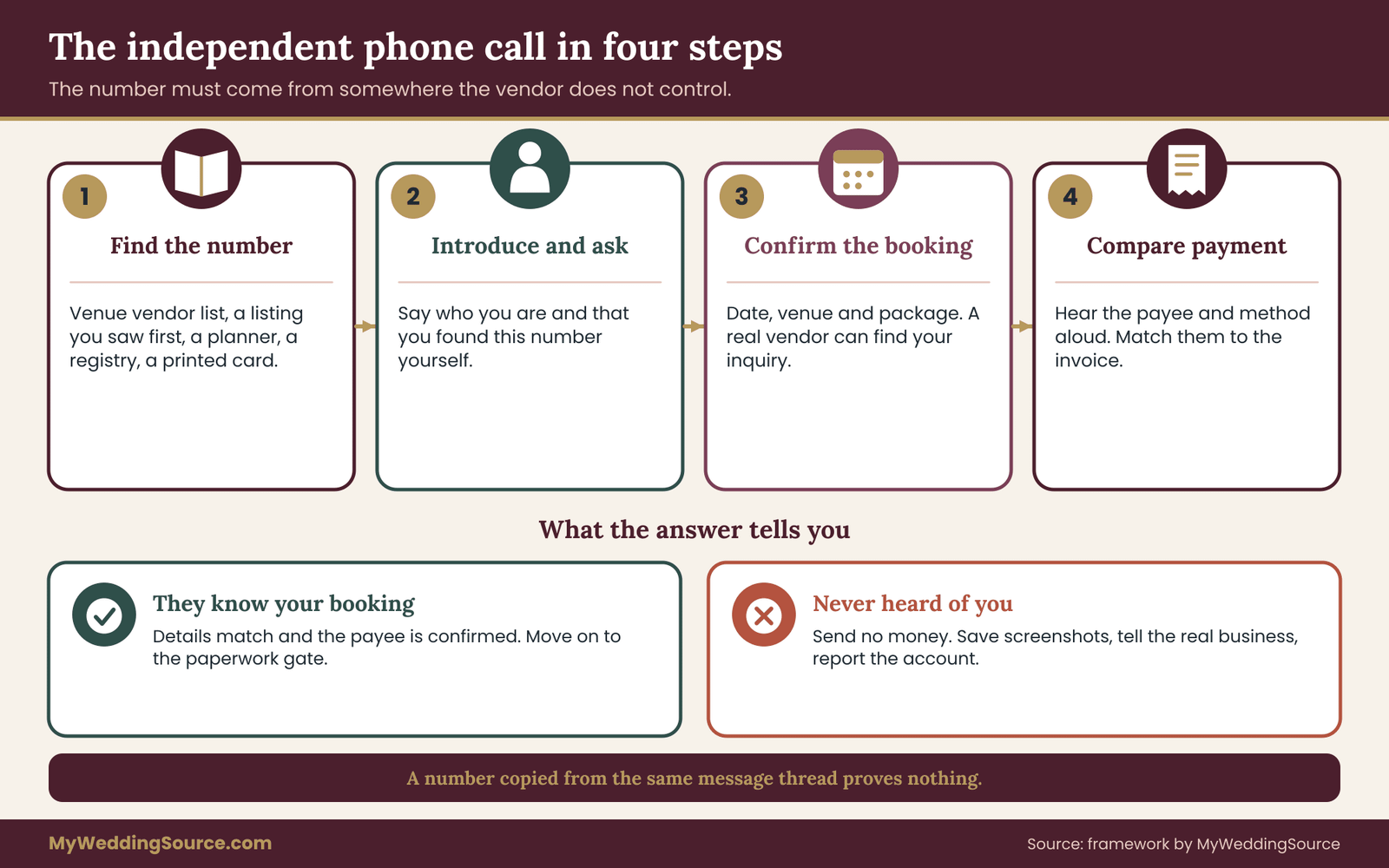
This is the gate that stops most fake vendor attempts, because it requires something the fake vendor cannot easily supply: a real conversation, over a channel you chose, with a person who knows your booking. The word that matters is independent. A call to a number the vendor sent you in a message proves nothing, because a fake vendor would supply a number they control. The number has to come from a source you found yourself.
Where to find a number you can trust
Look for the number in places the vendor does not control and that predate your contact. The venue’s preferred-vendor list or coordinator is one. A business listing you found before you ever messaged them is another. A planner’s records are a third. A state business registry sometimes lists a contact. A printed vendor card from a bridal show you attended is a fourth. If the only number you have came through the same message thread you are trying to verify, you have not yet completed this gate, and you should look for another source.
If a vendor appears truly to have no phone that you can find outside the social account, consider whether you are comfortable booking someone whose only contact is a message thread. Many real small vendors do have a business number, even if it is a mobile line. Not having one is a flag.
What to say, and what to listen for
You do not need to accuse anyone. The call has a simple job: confirm identity, confirm that the booking conversation is real and confirm the payment details. A useful structure has four parts.
Introduce yourself and the context. “Hi, this is a caller from a couple planning a wedding in June. We have been messaging with an account named in your business’s name about a deposit. I found this number on the venue’s vendor list and I want to confirm we are talking to the right business.”
Ask them to confirm the booking details. A real vendor can say which date, which venue and which package was discussed, or will look it up. If they say they have no record of your inquiry, you may have been talking to someone else. This is exactly the point where a copied fake vendor account falls apart.
Ask about payment instructions. “Could you tell us the exact name and method for the deposit, so we can compare it with the invoice we received?” The key is to hear the details from the business and then compare them with what the other account sent. They should match to the letter.
Ask how they will confirm the booking in writing. A real vendor will mention a contract, a signed agreement or an invoice from their usual system. A vendor who says a message is enough is giving you a soft flag.
Listening for the signs of a real business
A real business answers in a way that feels ordinary. They may have background noise, a pet, a team member in the room. They know their own pricing structure and offer, without stumbling, how they handle a date hold. They are not bothered by being asked to confirm. If the person on the phone says “Oh, I do not have a profile on that account,” you have found a copycat, and the right move is to thank them, tell them about the impersonation, and report the account.
If the real vendor says they never heard of you
This is not a failure of the call; it is the call exposing a fake vendor. Record what you were told, take screenshots of the thread and the account, and do not send money. Tell the real business, because they will probably want to know that someone is using their name. They may ask you for the account handle and screenshots so they can file reports with the platform. You can also report the account yourself, as the next sections explain.
If a possible fake vendor will not take the call
Some vendors work only by message because they travel or work irregular hours. A reasonable middle path is to ask for a short video call at a time of their choosing, or a call within a week, and to say that you are happy to wait. A real vendor will understand. A fake vendor will push for payment now, which tells you the answer. If you cannot get any live contact, do not pay a deposit, however good the portfolio looks.
A rule for couples who cannot call
Some people avoid phone calls because of hearing, speech, anxiety or time zone differences. The principle still applies. The goal is a live, independent confirmation, and there are other ways to reach it. A video call with captions, a call placed by a partner or a trusted friend, a message sent to the venue to ask them to confirm contact details, or a visit to the vendor’s studio or shop can all do the same job. What matters is that the contact route came from you and that someone real answers.
Gate four: paperwork that proves a fake vendor wrong
The fourth gate asks whether the paper trail names the same business at every step. A fake vendor often avoids paperwork or produces paperwork that looks official but contains small contradictions. Checking it carefully takes less than an hour.
What the contract and invoice should show
A usable agreement names the vendor entity in full, lists the services and the date, states the price and the payment schedule, and identifies who will provide the service. It also states what happens if either side cancels. The site’s wedding vendor contract guide covers the clauses themselves in depth. For fraud checking, only a few items matter.
The business name. It should match the name used for the account, the website and the payee, or the differences should be explained in writing. If the contract names a legal entity and the account uses a brand, ask the vendor to add a line such as “doing business as” so the two are formally linked.
A physical or registered address. Not every home-based vendor wants to publish a street address, and that is reasonable. A registered mailing address or a business address on file with a state office still gives you a point of contact. A contract with no address of any kind and a signature that is only a typed first name is a soft flag.
Matching signatures and dates. Use a proper electronic signature tool or a signed PDF with a date. Be wary of a contract that arrives only as an image in a message, with no editable text and no named signatory.
A cancellation and refund section. Fake documents often lack one, or include one so vague that it cannot be applied. Real vendors have usually refined this language from experience.
The payee line. Compare the payment instructions in the contract with those in the invoice and with those you confirmed on the phone. They should all be identical. If any one differs, stop and ask which is right, using the independent phone number.
Paperwork the fake vendor will not have
A real business often has things that are slow and boring to forge: a certificate of insurance from the venue’s requirements, a sales-tax or business registration number, a business bank account name that appears on a check image, a record in a booking system with your name. If a venue requires vendors to carry insurance, you can ask the venue whether they have a current certificate on file for this vendor. You do not need to chase the vendor for it. Simply ask the venue directly, since a venue coordinator will usually say yes or no quickly.
Be careful about documents a vendor sends as proof. A screenshot of a business license, a photo of an ID or a copy of a registration can be edited or taken from somewhere else. Use them only to collect details, such as a registration number, then check those details yourself with the issuing office. That makes the document a lead, not a proof.
Contract language that suits online-first vendors
Many genuine small vendors book through message threads and tidy contracts. For them, it is reasonable to propose a short written agreement even for a small deposit. A single page that lists the names, the date, the services, the deposit, the due date for the balance and the refund terms will do. A real vendor will either sign it or reply with their own. A fake vendor often finds a reason not to, because a signed agreement with a real name creates evidence.
Gate five: a payment route that has a way back
The fifth gate is about how the money moves, because a deposit sent by a method that cannot be reversed is the one thing a fake vendor needs most. If you have passed four gates and the vendor is real, you can still choose a payment route that gives you protection against mistakes, closures and disputes.
Methods compared in plain terms
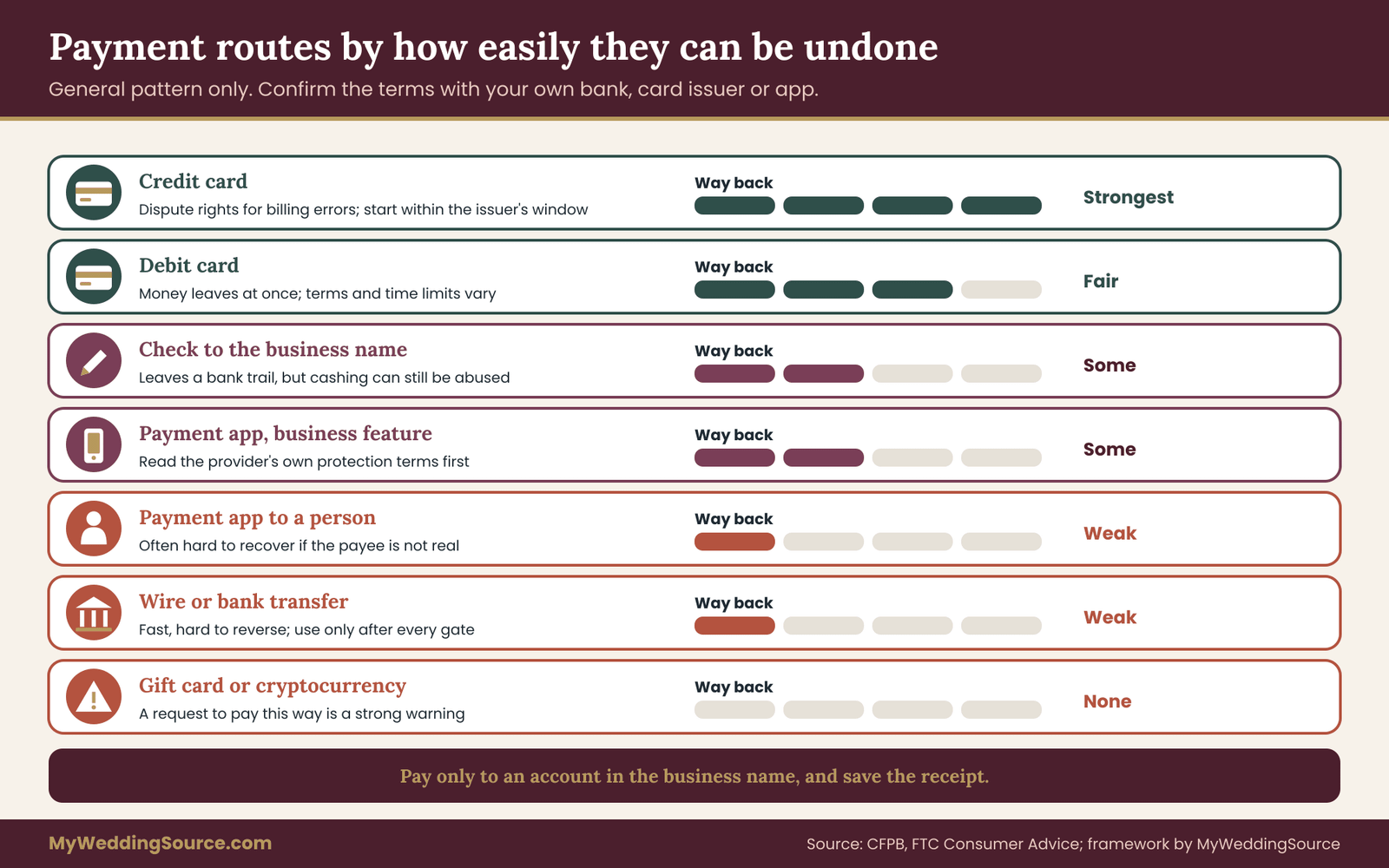
Different payment methods give different levels of recourse, and the rules vary by country, bank and provider, so confirm the details with your own card issuer or bank. The following are general patterns, not guarantees.
Credit card. In the United States, federal rules give card users the right to dispute certain billing errors, and many issuers have processes for goods or services not delivered. The Consumer Financial Protection Bureau explains how to dispute a charge. A dispute usually needs to start within a limited window after the statement, and you need documentation. Using a credit card is often the strongest route for a deposit, though some vendors add a surcharge, so ask about that before you agree.
Debit card. Debit cards may have different dispute rights and time limits, and the money leaves your account at once. Check your bank’s terms.
Payment apps and bank-to-bank transfers. Many payment apps warn that payments to people you do not know may not be recoverable. Sending to a business account through a business payment feature may offer different protections than sending to a person. Check the provider’s own buyer-protection terms before relying on them. A transfer sent to a fake vendor’s account is often hard to recover, so these routes belong at the end of the sequence, after all other gates are passed, and preferably for a small amount.
Check. Writing a check to the exact business name gives you a record and a bank-level trail, and it forces the payee to match. A check can still be cashed by a fraudster who opened an account in a business name, so it is not a substitute for earlier gates.
Wire transfers, gift cards and cryptocurrency. These are the routes most often tied to losses, and the Federal Trade Commission treats a request to pay this way as a strong warning. A real vendor has few reasons to insist on one of them. If your only option is one of these, do not proceed.
Two payment habits that reduce risk
Pay a small first installment and confirm. If the vendor’s terms allow a split, pay a modest first amount, then confirm receipt and the invoice from the vendor’s own system. The balance should follow the pattern in the contract, not a message request. For a longer view of how to schedule payments, the site’s wedding vendor purchase order checklist walks through approvals and acceptance steps.
Pay only into an account in the business name, and compare the confirmation. Before you click send, look at the name shown on the payment screen. Some apps and banks show the registered account name before you confirm. If it differs from the contract, stop. Afterwards, save the receipt, and note the date and amount in the same place as your contract.
Keep a ledger from day one
A simple record of every payment, with the date, amount, method, payee name and what it was for, helps if something goes wrong. It also makes a dispute easier, since banks and card issuers ask for dates and documents.
Why you should not pay the whole amount early
Some vendors offer a discount for paying in full today. Sometimes that is an honest cash-flow request. But for a vendor you have only just verified, paying the whole amount months ahead raises your exposure to a vendor that closes or disappears. If you do take such an offer, make sure the contract says what happens to the money if the date is canceled or the business cannot perform. The less you have paid before the date, the less a failure costs you.
Why the order of the five gates matters
The gates are designed to run from cheap to costly. Gate one costs only time. Gate two takes a few lookups. Gate three requires a phone call. Gate four needs documents, and gate five involves money. If you started with the payment, you would have no way to back out. If you start with the profile, you may reject a fraud before anyone else is involved.
The order also protects real vendors from unfair suspicion. A small business that passes gates one and two with a thin social presence and a clear registry listing will usually pass gate three without trouble, and then you can commit with confidence. You are not treating anyone as guilty. You are asking for the same evidence from everyone.
How long it takes
For most vendors, the entire sequence can fit within a few days of the first message. Do the profile and identity checks on the first evening. Place the call within a day or two, at a time the vendor can answer. Review the contract on the third day. If a vendor refuses to give you that much time for a booking worth hundreds or thousands of dollars, that is information about the vendor, not about you.
What if the date is truly at risk
Sometimes a popular vendor says someone else is waiting. There is a middle path: ask whether they can hold the date for forty-eight hours without payment, or accept a small refundable holding fee through a protected method while you finish checks. A real vendor can usually say yes or explain why not. Venues often work the same way with a short written hold, and the same principle applies to vendors.
A worked example: how one couple stopped a fake vendor
The following example is invented for illustration. The names, the amounts and the business are not real, and the steps are meant to show the sequence in use, not to describe an actual event.
Dana and Marcus are planning a June wedding at a restored mill outside a mid-sized city. They have a photographer already, and they want a florist. In a local wedding group, Dana comments asking for floral recommendations. Within an hour she gets a direct message from an account called “Ashgrove Floral Studio,” which has a polished feed and about 6,000 followers. The sender says there is one June Saturday left, that the studio loves the mill, and that a deposit by the end of the day would lock in a ten percent discount.
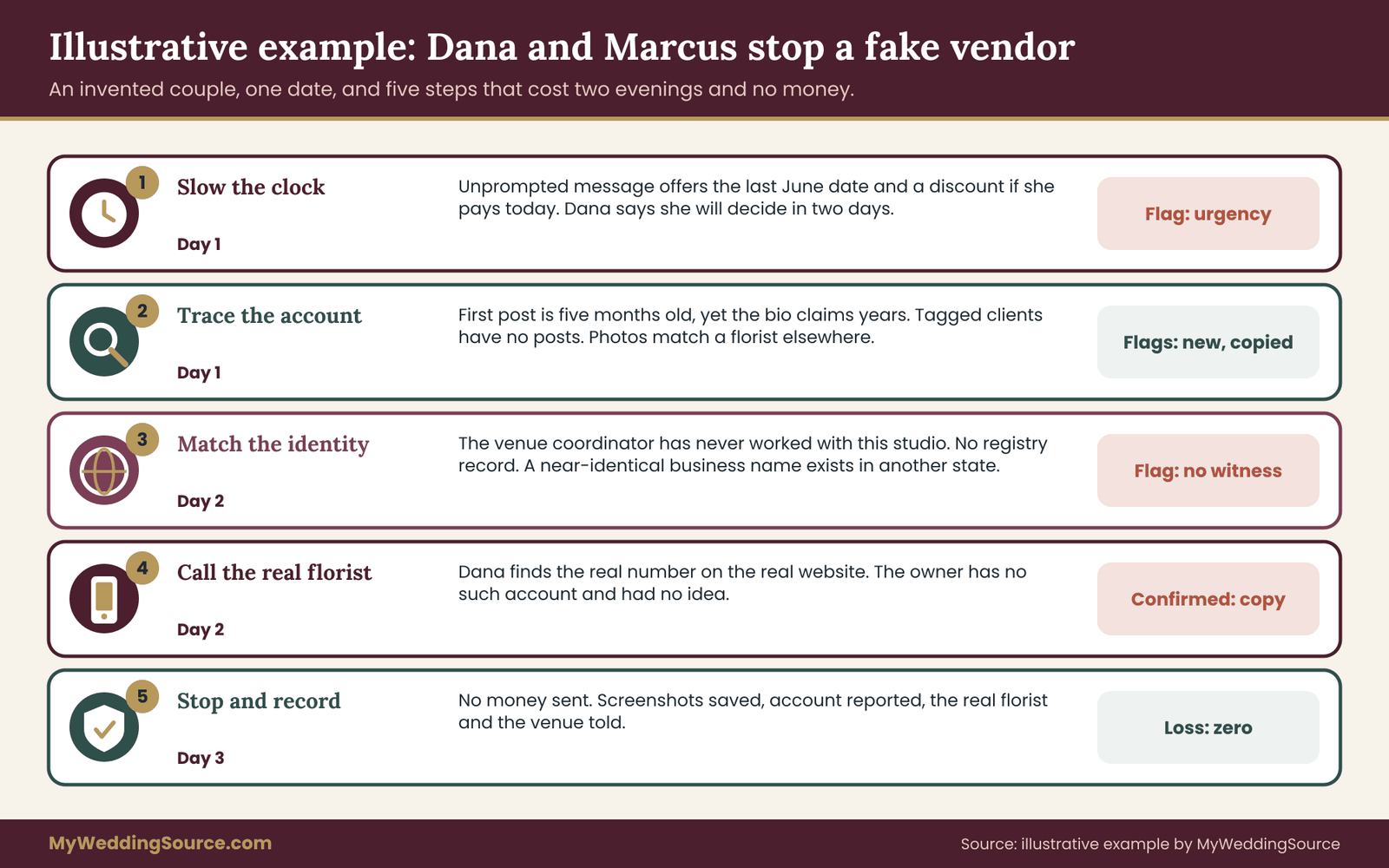
Step one: slow the clock
Dana tells the sender she will decide in two days. The sender replies that the date might be gone. Dana notes that the message uses urgency and a discount, and that it came to her unprompted. That is already one soft flag. She tells Marcus, and they agree not to pay anything today.
Step two: gate one, trace the account
Dana scrolls to the earliest posts. The account says it was founded years ago, yet the first post is only five months old. Several of the “client” tags lead to accounts with no posts. The comments are short and repetitive. Using a reverse image search on three photos, she finds the same arrangements on a florist’s website in another state under a different name. That is two more flags: a young account claiming a long history, and images that appear to belong to someone else.
Step three: gate two, match the identity
Dana searches the state business registry for “Ashgrove Floral.” She finds nothing under that name, though she knows sole proprietors may not appear. She emails the venue coordinator using the address on the venue’s website, asking whether the mill’s preferred florists include this studio. The coordinator says no one by that name has worked the mill, but offers the names of florists who have. She also notes that the real florist whose photos were copied has a similar name, “Ashgrove Flowers,” in another state. A single-word difference is exactly the pattern of a copied fake vendor account.
Step four: gate three, call
Dana finds the real florist’s business number on its own website and calls. The owner says they do not have a social profile under the name Dana described, have never taken orders for that city and had no idea their photos were being used. She thanks the owner and sends screenshots of the account and the thread. The owner says they will file a report with the platform. Dana does too.
Step five: stop and record
The fake vendor account asked for a deposit through a payment app, to a personal name, marked as a gift. Dana never sent it. She saves screenshots of the account, the messages and the payment instructions in a folder. She reports the account through the platform’s impersonation tool. She also files a short report with the Federal Trade Commission, though no money was lost, because reports help agencies see patterns.
What the example shows
Three things stand out. First, no single check settled the matter: the young account, the copied photos, the venue’s answer and the real florist’s phone call each added a piece. Second, the call was decisive, and it was possible only because Dana found the number independently. Third, the loss to Dana was zero, and the cost was a couple of evenings. When she later hires a florist the venue has worked with, the same sequence runs faster, because the venue coordinator confirms the business exists in the first conversation.
A variation: the vendor is real but the message is not
Suppose instead that Dana had already hired a real florist, and a week later receives a message saying “please send the balance to our new account.” The sender uses the correct first name and refers to the correct date. The sequence is different but the principle is the same. Dana calls the florist’s number from her original contract, not the number in the new message.
The florist says nothing has changed and that their email account may have been compromised. Dana tells the florist, who resets their password, and the couple saves the messages in case a report is needed. In this case, the call prevented a loss without any suspicion of the vendor.
What to do if you already paid a fake vendor
Sometimes the discovery comes after the money. The first hours matter, so act in a sensible order and keep records as you go. Remember that recovery is never certain and depends on the payment method, the timing and the institution, so the goal is to give yourself the best chance without making things worse.
The first day
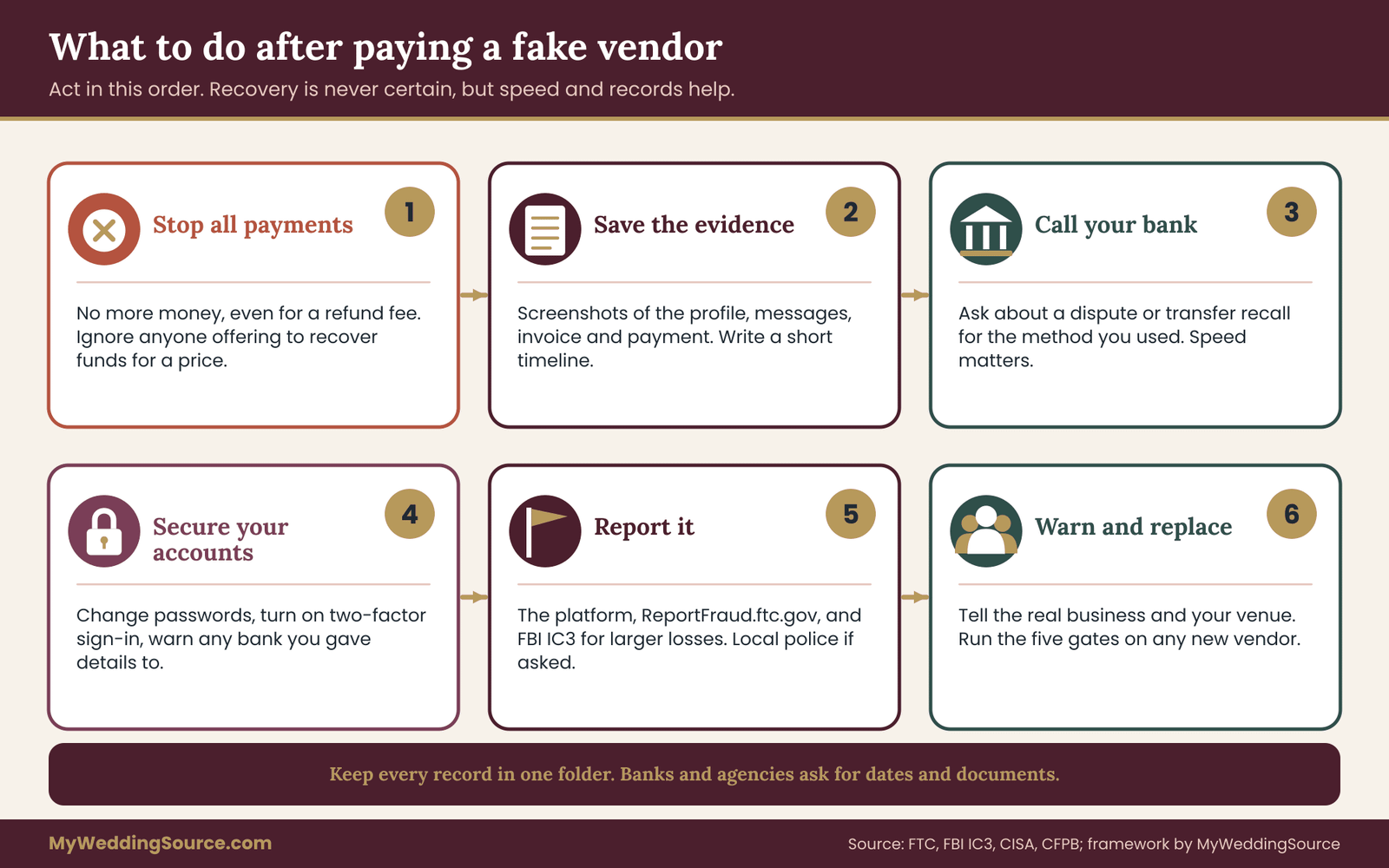
Stop all further payments and contact. Do not send more money, even if the person offers a refund for a fee, or says a payment will resolve a problem. Recovery scams exist in which a second fraudster claims to be able to retrieve your money for an upfront cost. Do not respond to them.
Preserve evidence. Take screenshots of the profile, the messages, the payment confirmation, the invoice and any website. Save them to a folder before the account is removed or blocked. Write a short timeline: dates, amounts, names used, methods and handles.
Contact your bank or card issuer right away. Tell them you were the victim of a scam and ask what options exist for the payment method you used. For credit cards, the Consumer Financial Protection Bureau explains that you may dispute charges, and time limits apply. For transfers, ask whether the bank can contact the receiving bank. The speed of your call can matter, since some payment systems can act more easily in the first hours or days.
Change any credentials you shared. If you gave a password, a verification code or an ID image, change passwords, turn on two-factor sign-in and tell the relevant bank or account holder. The Cybersecurity and Infrastructure Security Agency publishes guidance on recognizing and reporting phishing, which is useful if a link or a form was involved.
The first week
Report it. In the United States, the Federal Trade Commission accepts fraud reports through ReportFraud.ftc.gov. The FBI’s Internet Crime Complaint Center takes online-crime reports, particularly for payments that involved a transfer, and may be relevant for larger losses. Report the account to the platform through its impersonation or fraud tool. If you live outside the United States, check your country’s consumer protection or police reporting service.
Tell the real business, if there is one. If a copied fake vendor account used a genuine vendor’s photos or name, the owner will want to know. They can report the account through their own channels, which helps get it removed.
Tell your venue and other vendors. Your venue may know about other couples hit by the same account, and may warn others. A coordinator can also help you find replacement vendors quickly.
Consider a local police report. A police report may be useful for bank or insurance claims, and some institutions ask for one. Rules about what police can do for online fraud vary.
Replacing the vendor
After the report, put your attention on the date. Contact vendors already recommended by the venue first, since they can be checked quickly. Put the new vendor through the same five gates, even though you are in a hurry, because a couple under time pressure is exactly the target for a second scammer. The guide on wedding vendor timing can help you see how late a replacement can still be booked for each service.
Insurance and legal options
Some wedding insurance policies cover vendor failure, but the terms differ, and fraud by a vendor who was never real may be treated differently from a business that fails. Read your policy or ask the insurer. A lawyer or a local consumer protection office can tell you whether other remedies exist in your state. This guide cannot predict what applies to your situation, and a licensed professional should review any claim.
A fake vendor after booking, in groups and at the edges
When someone impersonates the vendor you already booked
A fake vendor does not always show up before the booking. After you hire a real business, an outsider can copy its identity to redirect money that you already owe. The couple has done everything right up to that point, and the scam works because it arrives inside a trusted relationship.
How the later-stage version looks
The message might arrive by email, text or a direct message. It uses the vendor’s name, a copied logo and phrasing close to the real thing. It may mention your date and venue, because the sender has seen earlier messages or has read your public posts. The request is usually small and plausible: the vendor’s bank changed, an invoice must be paid through a new link, or the final balance is due early because of a staff change. Sometimes the sender asks you to keep the change quiet until the vendor “sorts out the paperwork.”
The defense is a standing rule that you agree on with your partner at the time of booking: no change to payment details is accepted by message alone. Any change is confirmed by calling the number that appears on your signed contract, or one you verified before. Say this to the vendor in a friendly way at signing: “If we ever receive new payment details, we will call you to confirm before paying.” Most real vendors appreciate it, since they also worry about their clients being targeted.
Make it easy for the real vendor
Ask the vendor to put the payment details in the contract or in the original invoice, and to mention how they will notify you of any change. Ask which email domain and which phone number they use for billing. Write those down in your records. If the vendor uses an invoicing platform, ask which sender name and which link domain you should expect. These details turn a vague feeling about a message into a concrete comparison.
Check the sender, not just the content
When a billing message arrives, look at the sender’s address and the link target, not just the display name. A message from a domain with a small spelling difference, or from a free email service when the business always used its own domain, is a warning. Hover over a link to see where it goes before clicking, or better, go to the vendor’s site yourself rather than clicking. The Cybersecurity and Infrastructure Security Agency’s guidance on recognizing phishing explains these signs in more detail.
When a vendor tells you their account was hacked
If a real vendor says their account was taken over, take it seriously and calmly. Ask them to confirm by phone which messages sent in the last weeks were really theirs. Review any payment you made in that period. Contact your bank if any payment followed a message with changed details. Write down the dates. The vendor, in turn, has an interest in telling all clients quickly, and many do so by a post and a message to every active booking.
Protecting a family-run or group booking from a fake vendor
Weddings are often planned by more than two people. Parents may pay for part of the day, a sibling may handle the photographer search and a friend may offer to arrange the flowers. This helps the budget and complicates verification, because the person who talks to the vendor may not be the person who pays them.
Decide who is the single point of contact
Pick one person to hold the vendor relationship, and tell everyone else to send recommendations to that person instead of paying directly. A family member who pays a deposit to a vendor they found on social media, without telling the couple, may bypass every gate. If a relative insists on helping, ask them to share the vendor’s handle first, then run the five gates together. Present it as a team method: “We have a short checklist for every vendor, and we would love to run it with you.”
Share the process, not only the result
It is more useful to teach family and friends the logic of the five gates than to say “check with us first.” Show the one-page checklist at the end of this guide. When people understand that the phone call and the payee name check are standard, they apply them without feeling that they are being suspicious.
Agree on a payment rule in advance
A rule that every deposit over a certain amount needs a second person to look at the contract and the payee name before it goes out can prevent a rushed mistake. The amount is your choice. The point is that a second pair of eyes is built in. The site’s guide to wedding decision making offers general ways to settle who decides what when several people care about the outcome.
When a planner is involved
A professional planner brings an advantage: planners have worked with many vendors and often know which ones are real in their market. If you have a planner, ask them to confirm any vendor you find on your own, and tell them about any message you receive about changes to payments. A planner is also a target, since scammers may impersonate a planner’s vendors to the planner. Make sure the planner follows the same phone confirmation rule, and ask how they handle payments on your behalf.
Limits of verification, and honest uncertainty
No process can make fraud impossible, and it would be wrong to pretend otherwise. The five gates lower the chance of paying a fake vendor sharply, but several limits are worth knowing.
A determined scammer can fake some evidence. A sophisticated group may build a website, register a business name, buy reviews and even answer a phone. The usual weak point is the independent source: a venue that has never heard of them, a past client who does not exist, a registry listing that does not match. Each added check raises their cost.
Real vendors can fail. Passing the gates shows that the business exists and that you are dealing with it. It does not prove they will deliver well, remain solvent or avoid a double booking. Contracts, payment schedules and insurance still matter, and they are covered elsewhere on the site.
Rules differ by place. Business registration rules, payment protections, and reporting channels differ between states and countries. A registry search that works in one state may be unavailable in another. A payment method that carries protection with one issuer may not with another. Use this guide as a method and confirm local details with the relevant office.
Some real vendors are informal. Many talented people in this industry work part-time, from home and through message threads. They may not have a registered business, a website or a landline. Treating them as fake would be a mistake. For these vendors, give extra weight to the venue’s word, to past clients you can reach independently, and to meeting in person or by video. The goal is evidence of a real person with a track record, not a corporate appearance.
Verification takes goodwill. If you ask for a call, an independent reference and a written contract, a small vendor may feel pressed. Explain why you ask, and thank them for their time. Most understand, since they know that fraud affects the whole industry.
What to do when the evidence is mixed
Sometimes the results of the gates are unclear. The profile passes, the venue has not worked with them, the vendor answers the call and gives sensible answers, but the payee name differs slightly. In that case, ask for the missing evidence in writing, and set a short time limit for it. If the gap closes, proceed. If it does not, move on. Mixed results are not a reason to take a risk with a payment you cannot recover; they are a reason to ask one more question.
Edge cases that change how you apply the checks
The five gates apply to every vendor, but some situations need adjustments.
Destination weddings and vendors in another country
If you are planning far from home, a venue visit and a phone call to a local number may be harder. Use the venue or a local planner as your independent source. Ask about local business registration and the local equivalents of consumer protections, which may differ greatly. Keep in mind that payment methods that give you recourse at home might work differently across borders, and currency conversions may add costs. Ask your card issuer about foreign transactions before paying.
Last-minute replacements
If a vendor has canceled and the wedding is in a few weeks, the pressure to book quickly rises, and so does the risk of a fake vendor. Ask the venue or planner for names first. Make a compact version of the sequence: check the venue’s knowledge of them, make the call, confirm the payee and pay by card. Even a fast version beats paying on a promise.
Venue and rental impersonation
Scammers also copy venues, rental companies and officiants. A listing for a venue with photos copied from a real property and a price below the market is a known pattern. Apply the same gates: contact the venue through the number on a government tourism site, a trusted directory or the property’s long-standing website, and compare the payee name to the owner of the property when possible. The site’s guide to wedding venues explains how to evaluate them beyond identity.
Vendors who ask for cash
Some small vendors prefer cash at pickup, such as a baker or a rental. If the arrangement is real, you meet in person, see the product, and pay at handover. Cash paid in advance, to someone you have not met, is the version to avoid. If you must pay cash, get a signed receipt with names, date and amount.
Vendors you meet at in-person events
A bridal show or a venue open house makes a fraud less likely, but it is not proof. A person at a booth can still be unreliable. Get a printed card or a business name, then run the gates at home, without the sales pressure of the room.
Discount and giveaway offers
Messages that say you won a free service, or that offer a deep discount in exchange for tagging friends, may be marketing or may be an attempt to collect payment details. Treat any offer that starts with an unsolicited message as unverified until it passes the gates.
Scripts for the awkward moments with a possible fake vendor
Knowing what to say makes the process easier, especially if you dislike confrontation. These scripts are plain, polite and easy to adapt. They treat the other person as a real business until the evidence says otherwise.
Asking for a call. “Thanks for the quick reply. Before we put down a deposit, we like to have a short phone call with every vendor. Could we find a time this week?” If the answer is a refusal, follow with: “We understand if calls are hard. Would a video call work instead?” A vendor who still refuses has told you what you need to know.
Explaining that you will call a number you found yourself. “For every booking we confirm the contact details with the venue before paying, so we will call the number they have on file. It is a routine step for us and nothing personal.” This works for real vendors because it sounds like a policy, not an accusation.
Questioning a payee name. “The invoice shows a payee that is different from your business name. Can you tell us how they are connected, and add the business name to the contract so our records match?” A real vendor can answer in one message.
Declining urgency. “We would love to book, but we need two days to finish our checks. If the date goes in the meantime, we understand.” If the date was really at risk, a genuine vendor will say they will try to hold it. A fake vendor will often escalate the pressure.
Handling a payment change. “Thanks for letting us know about the new account. We will call you at the number from the contract to confirm before paying.” Whoever replies, a real vendor will welcome the call.
Telling a real vendor their name is being used. “We found an account using your business name and photos, with a slightly different handle. We have not paid anyone. Here are screenshots, in case they help you report it.” This is a kindness to the business, and real owners usually respond with gratitude.
Saying no to a pushy relative. “We have a checklist for every vendor, and this one is not finished yet. We would rather lose a date than lose a deposit.” It is firm without blaming anyone.
Keep the tone steady
Fraud detection can make couples sharp with real vendors. Keep a calm, businesslike voice. A real vendor who feels accused may walk away, and you may lose a good professional because of a process that was meant to protect you. The scripts above stay friendly because the checks apply to everyone.
How to report a fake vendor account
Reporting does not always bring your money back, but it can protect other couples and may support a dispute or an insurance claim. Use more than one channel.
The platform. Most social platforms have an impersonation or fraud reporting tool. Instagram’s help center describes how to report an account that is pretending to be a business or another person. Report the profile and any specific messages, and include the handle and the link of the real business if you know it.
The Federal Trade Commission. In the United States, ReportFraud.ftc.gov takes reports from consumers about scams, including those that start on social media. Your report becomes part of data that investigators can use to spot patterns. The agency’s consumer site also publishes current scam descriptions and tips.
The Internet Crime Complaint Center. The FBI’s IC3 accepts reports of internet-enabled crime, which can include payment fraud tied to fake businesses. It is most useful when money was sent.
Your financial institution. Tell your card issuer or bank, even if you are not sure the payment can be reversed. It creates a record and may open options.
The real business, the venue and the local wedding community. A short warning to your venue and to a local planner or vendor group can protect others. Share facts, such as the handle and the date you were contacted, without speculation about who is behind it. Keep your message accurate and avoid naming a person unless you have clear evidence, because a mistaken accusation can harm someone innocent.
What to put in a report
Include the account handle and a link, the dates of the messages, the amounts and methods requested or paid, the payee names, screenshots and any phone numbers or addresses given. A report that is organized is easier for an agency or a bank to use.
A one-page checklist you can copy into your notes
Here is the whole method in a form you can paste into a notes app or print. Run it for each vendor before any deposit, and keep the completed notes with the contract.
Gate one: the account. Earliest post date and posting pattern. Tags and comments from real couples. Reverse image check on three photos. Any copied galleries or handle lookalikes.
Gate two: the identity. Business name, person’s name, city and domain written down. Website domain compared character by character. State or local business record checked, where one should exist. Venue or planner asked whether they know the vendor. One past client reached independently.
Gate three: the call. Number found from a source the vendor does not control. Call placed. Booking details confirmed by the person who answered. Payment details heard aloud and compared with the invoice. Contract or invoice from the business’s own system promised.
Gate four: the paper. Contract names the business, services, date, price, schedule and refund terms. Business name, payee and signature agree. Venue confirms insurance or vendor status if relevant. Any document sent as proof used only to collect details to check.
Gate five: the payment. Method has a way back, such as a credit card. Payee name on the payment screen matches the contract. Small first installment where terms allow. Receipt saved. Balance paid only as the contract says.
Decision rule. Any hard flag stops the booking until explained by evidence you gathered. Two soft flags also stop it. All five gates passed means you can book. Anything else means you decide with open eyes, or you move on.
Where to keep it
Keep the checklist with the contract, the invoice and the payment receipt in one folder per vendor. If you are later in a dispute, this folder tells the story in order. The site’s guide to planning a wedding lays out where vendor selection fits in the larger schedule, which helps you decide how early to start verification.
Your next steps
Start with the vendors you have not paid yet. List each one and note which gates are complete. For any vendor where the phone number came only from the message thread, find an independent number this week and place the call. Next, check the payee names on every invoice against the contracts, and write down the method you will use for each deposit.
For vendors you have already paid, confirm that the account you paid belongs to the business in your contract, and agree with your partner on a rule: no change to payment details without a call to a verified number. Finally, put the one-page checklist in your notes, tell the people helping you plan about it, and use it each time a new vendor appears. A few careful evenings now are much cheaper than replacing a missing vendor close to the date.
FAQ
How can I tell if a wedding vendor on Instagram is real?
Look at the history of the account, the tags and comments from actual couples, and whether the photos appear under another name elsewhere. Then confirm the business outside the account, through your venue, a registry or a past client, and call a number you found yourself. No single sign settles it, so combine several checks before paying a deposit.
Is it a red flag if a vendor only communicates by direct message?
It is a soft flag, not proof of fraud, since many small vendors work this way. It becomes more serious if they refuse any call, push you to pay quickly or give personal payment details. Ask for a short phone or video call, and confirm their identity independently before you pay anything.
What is the safest way to pay a wedding deposit?
A credit card usually offers the strongest dispute options in the United States, but terms vary, so ask your issuer. Avoid gift cards, wire transfers, cryptocurrency and payment app transfers to personal accounts for unverified vendors. Pay only to an account in the business name, save the receipt and follow the payment schedule in the contract.
What should I do if the real vendor says they never heard of me?
Do not send money. Save screenshots of the profile, the messages and any payment instructions. Tell the real business, which may want to report the fake vendor account. Report the account to the platform and to the Federal Trade Commission. Then find a verified replacement, using the venue or planner as an independent source.
Can I get my money back from a fake vendor?
Sometimes, but not always. Contact your bank or card issuer right away and ask about disputes or transfer recalls, since speed matters. Report the fraud to the platform, the Federal Trade Commission and, for larger losses, the FBI’s Internet Crime Complaint Center. Recovery depends on the payment method and timing, so avoid anyone offering to retrieve funds for a fee.
Should I verify a vendor my venue recommended?
Yes, but the check is shorter. Venue lists are strong evidence, since the coordinator has seen the vendor work. Still confirm that the contact details and the payee on your invoice match the vendor the venue knows. A message that claims to be from a recommended vendor can still be an impersonation, so confirm by phone.
What if a vendor changes their payment details after I booked?
Treat it as a possible fake vendor message until confirmed. Do not reply with money. Call the number on your signed contract, or one you verified earlier, and ask the vendor directly whether anything changed. If they confirm, ask for the new details in writing and update the contract. If they deny it, report the message and tell your bank.
Does a business license or registration prove a vendor is real?
It helps but does not prove everything. A registry record gives you a name, an address and a formation date to compare with the contract and the payee. Documents sent by a vendor can be copied, so check the number with the issuing office. Some real small vendors are not registered where you look, so use it with other gates.
Sources
- Scams, Federal Trade Commission Consumer Advice
- ReportFraud.ftc.gov, Federal Trade Commission
- Internet Crime Complaint Center, Federal Bureau of Investigation
- How do I dispute a charge on my credit card bill?, Consumer Financial Protection Bureau
- Scams and fraud, USAGov
- Recognize and report phishing, Cybersecurity and Infrastructure Security Agency
- Consumer guides, Federal Communications Commission
- Help Center, Instagram
- Consumer Financial Protection Bureau