
An invoice dispute with a wedding vendor starts when the final bill does not match what you agreed to, and it is won or lost on paperwork rather than on volume. This guide shows how to build an evidence packet for an invoice dispute: a short index of proof, a three-bucket sort for every charge, and a neutral written query that gets a real answer from the vendor.
For any invoice dispute, do five things in order. Sort each line of the final bill into confirmed, unclear or disputed. Pay what is confirmed on time. For every other line, write one evidence index entry with the charge, its basis in the contract, your proof, the arithmetic and your specific ask. Send one neutral written query that quotes the documents and asks a question instead of making an accusation. Then keep a dated log of every reply, and escalate only after the vendor has had a fair, written chance to answer.
The final invoice usually arrives at the worst possible moment. The wedding is over or about to happen, the balance is due in days, and the number at the bottom is higher than the number in your head. Sometimes the vendor made an honest mistake. Sometimes a verbal change was never written down. Sometimes a fee was in the contract all along and nobody read it closely. In each case the first useful move is the same: stop reacting to the total and start examining the lines.
This article is about one narrow job, which is preparing a calm, documented invoice dispute. It does not try to teach you how to choose vendors or how to write a contract from scratch. For that, the site’s guide to the wedding vendor contract covers the clauses that decide who owes what. It also does not cover a service that was never delivered, which is a different problem with different remedies. Here the vendor delivered something, the bill arrived, and you believe part of it is wrong.
A note on scope. This is general information, not legal, tax or financial advice. Consumer remedies, contract law, card rules and insurance terms differ by state and by situation, so confirm the current rules with the agency or professional that applies to you.
One more framing point before the detail. An invoice dispute is not a fight you win by being right on day one. It is a process that you can run well even if some of your suspicions turn out to be wrong. Couples who handle it well often discover that one or two lines were legitimate and one or two were errors, and they come out with a corrected bill, a clear record and a vendor relationship that still functions. That outcome is worth more than a dramatic confrontation.
What an invoice dispute is, and what it is not
An invoice dispute is a written disagreement about the amount, the basis or the timing of a charge on a bill you have received. The disagreement can be about a single line, such as a service charge that appears twice, or about the total, such as a balance that does not equal the contract price minus your deposits. It sits inside a contract that already exists. You are not asking to cancel the deal. You are asking the vendor to reconcile the bill with the deal.
That distinction shapes everything else. If you treat an invoice dispute as a complaint about quality, the vendor hears criticism and defends the work. If you treat it as a reconciliation request, the vendor hears an accounting question and checks the numbers. The second path is faster, cheaper and far more likely to end with a corrected invoice.
Four things an invoice dispute usually is not:
It is not a service failure claim. If the florist never delivered the arch, that is a missed deliverable, and the site’s guide to a wedding vendor missed deliverable describes how to record facts and ask for a remedy. Some bills involve both problems at once. Keep them in separate files so each argument stays clean.
It is not a refund demand for a style you disliked. Taste is not an invoice error. Unless the contract promised a specific standard, “I did not love it” gives the vendor nothing to reconcile.
It is not a chargeback in disguise. Card disputes exist and have their own rules, but they are a later step, and starting there can end the conversation with the vendor before it has begun. A later section explains the order.
It is not an accusation of fraud. Most wrong invoices come from rushed bookkeeping, unrecorded changes or a misunderstanding about a fee. Writing as though the vendor is dishonest hardens positions and gives them reason to stop cooperating.
Why a final bill goes wrong in the first place
Understanding where mistakes come from tells you where to look. Wedding invoices are built from many moving parts: a base package, add-ons chosen over months, a guest count that changed three times, rentals priced per piece, staffing priced per hour, taxes and service charges layered on top, and deposits paid on different dates. Any of these can drift.
The most common sources of a wrong final bill fall into a handful of patterns.
Unrecorded changes. You asked for a different dessert, an extra hour or fewer chairs in a phone call. The vendor’s system still shows the original order, or shows the addition but not the subtraction. The site’s guide to the wedding change order approval chain explains why every change should leave a written trace, and this is the reason.
Guest count reconciliation. Per-person pricing is applied to a final count. If the count used on the invoice is the guarantee number, the number you gave on the deadline date, or the number who actually attended, the total changes. Contracts often say which one governs, and many couples never check.
Percentage fees applied to the wrong base. A service charge or gratuity might be calculated on food only, or on food plus beverage, or on the pre-tax subtotal, or on the post-tax subtotal. A small difference in base produces a visible difference in the total.
Deposits not credited. A deposit paid by card on one date and a second payment by check on another can both be real while only one appears on the invoice. This is a plain bookkeeping gap, and it is one of the easiest errors to prove.
Overtime and timeline drift. If the reception ran long, overtime may be legitimate. If the vendor’s own timing caused the delay, or if the overtime clause has a grace period, it may not be.
Fees introduced after signing. A new delivery fee, a fuel surcharge, a card processing fee or a cleaning fee can appear without any amendment. Whether it is allowed depends on what you signed. The site’s guide to wedding vendor credit card surcharges is useful when the line in question is a processing fee.
Duplicate lines. The same item entered under two names, such as “linen package” and “table linens,” is a classic quiet duplicate.
Genuine charges you forgot. This one belongs on the list because honesty about it saves time. Sometimes the bill is right and your memory is wrong. A good evidence process finds that out early, before you send an embarrassing message.
The mindset that makes the invoice dispute packet work
Three attitudes separate a strong packet from a weak one.
The first is that the vendor is a counterparty, not an enemy. You still need them to finish, deliver, release a gallery, return a deposit or write a reference. A neutral tone is not weakness. It is the tone that lets the other side say “you are right, we will fix it” without losing face.
The second is that every claim needs a document. “I was told the delivery fee was waived” is an assertion. “The attached email from March 4 says delivery within the city is included” is evidence. If you cannot attach something to a claim, it belongs in the unclear bucket, where you ask a question instead of stating a fact.
The third is that you only dispute what you can state in one sentence with a number in it. “The invoice charges a twenty percent service charge on the pre-tax subtotal, while the contract page three says eighteen percent” is something a bookkeeper can check in a minute. “The bill feels too high” is not.
If you have been tracking payments as you went, as described in the site’s guide to wedding vendor payment tracking, you already hold half the invoice dispute packet. If you have not, the next sections show how to rebuild it quickly from what you have.
The three-bucket sort that comes first in an invoice dispute
Before you write anything to the vendor, sort every line of the final invoice into one of three buckets. This step takes about an hour for a large invoice and it prevents most of the damage couples do to themselves in the first week.
Confirmed. You can match the line to the contract, an amendment or a written message, and the arithmetic is right. These lines are not part of the invoice dispute. Pay them on time. Doing so also shows good faith, which matters later.
Unclear. You cannot match the line to anything yet, or the description is vague, or the arithmetic needs an explanation. These lines get a question, not a claim. Most of your work with the vendor will happen here.
Disputed. You can show, with documents and numbers, that the line conflicts with something the vendor agreed to. These lines get the full evidence index entry and a direct request for a correction.
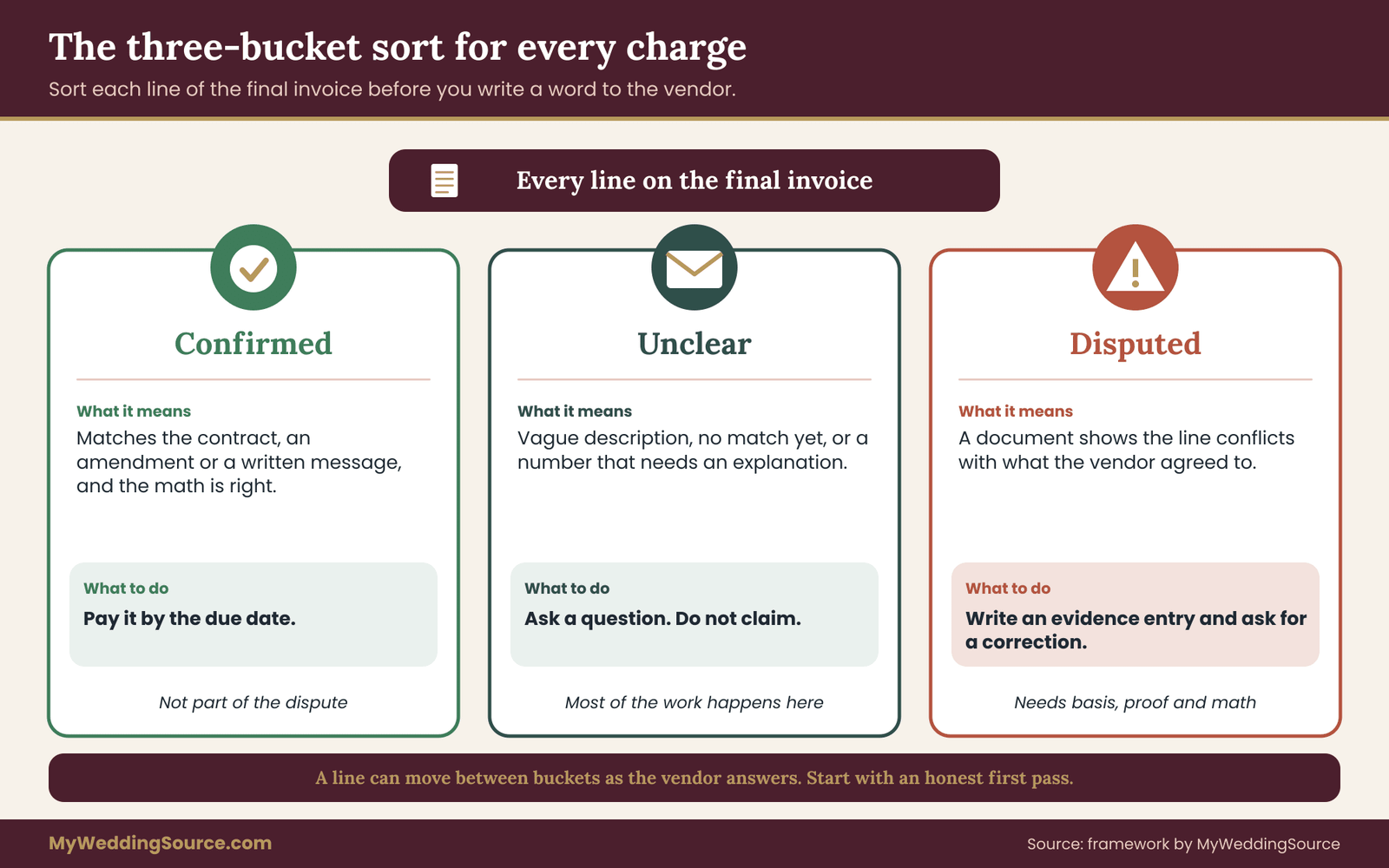
The sort is not permanent. A line can move from unclear to confirmed when the vendor explains it, or from unclear to disputed when their explanation contradicts the contract. What matters is that you start with an honest first pass instead of treating the whole invoice as wrong. A vendor who sees that you accepted most of the bill and questioned three lines responds very differently from one who sees a blanket rejection.
Read the invoice like a procurement clerk
Procurement clerks in large organizations check every incoming invoice against three things before approving payment: the purchase order, the delivery record and the arithmetic. You can borrow that routine. It is dull, and it works.
Start with the arithmetic, because it is the least emotional. Add up the lines yourself. Check that the subtotal equals the sum, that each percentage fee was applied to the base the contract names, that taxes were calculated on the right items, and that every deposit you paid appears as a credit. Write down any difference, even a small one. Small differences are often the clue to a larger pattern.
Then check the description of each line against the contract. Does the item exist in the agreement? Is the quantity the same? Is the unit price the same? Is the date or time range the same? The site’s guide to wedding vendor purchase orders describes how a scope agreement becomes a checkable list of deliverables, and the same list is the quickest way to audit a final bill. If your contract is a single page with a lump sum, the audit is shorter, but you still compare the invoice to every promise written down.
Finally, check delivery. Did the thing actually arrive or happen? You may have photos, timestamps, a delivery receipt, a guest count sheet or a run-of-show. These are the second leg of the invoice dispute packet, and the next section shows how to organize all three legs into an index you can hand to someone else and have them understand in five minutes.
The invoice dispute evidence index
The evidence index is the heart of this method. It is a numbered list, one entry per disputed or unclear line, written in a fixed shape so that anyone reading it can follow the logic without hearing the backstory. You can keep it in a plain document or a notes app. It does not need to look impressive. It needs to be consistent.
Every entry has five fields. The order matters, because it forces you to move from the invoice to the agreement to the proof before you ask for anything.
Charge. Copy the line exactly as it appears on the invoice: the description, the quantity, the unit price and the line total. Do not paraphrase. If the vendor later says you misread the line, you want your index to match their paper character for character.
Basis. State where the contract, an amendment, a quote or a written message supports or contradicts the charge. Give the document name, the date and the section or message. If nothing supports the charge, write “No basis found” and say where you looked.
Proof. List the evidence that shows what actually happened: a delivery photo, a timestamp, a payment record, a guest count message, a run-of-show, a vendor email. Each piece of proof gets a short label so you can refer to it later.
Math. Show the arithmetic that leads from the documents to the number you believe is correct. Keep it to a few lines. If the issue is a percentage, show the base, the rate and the result. If the issue is a missing credit, show the deposit amount and date.
Ask. Write the specific thing you want: a corrected line, a credit of a stated amount, a written explanation, a copy of a document. A vague ask gets a vague answer.
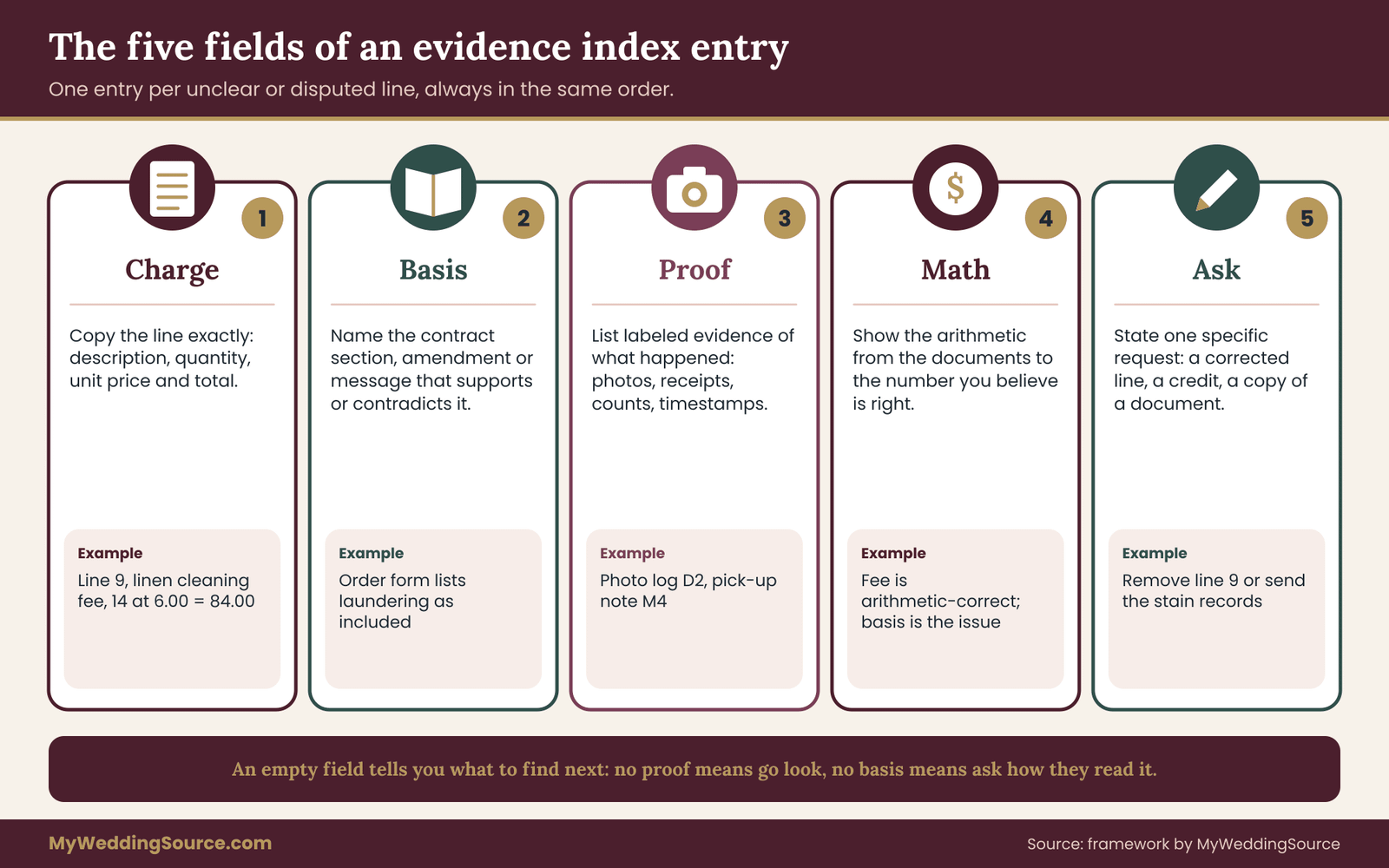
When all five fields are filled in, the entry is a self-contained argument. When one is empty, you have learned something useful. An entry with a clear charge, a clear basis and no proof tells you which document to go find. An entry with strong proof and no basis tells you the contract may not cover the situation, and the ask should be a question about how the vendor interprets it. This is the same discipline that a good wedding vendor contract review builds, applied at the other end of the relationship.
How to number and label evidence so it stays usable
Labels sound minor and they are not. A packet with forty unlabeled screenshots forces the reader to guess. A packet with labels lets you write “see E7” in a message and have the vendor open exactly the right thing.
Use a short prefix and a running number. Contracts and amendments can be C1, C2 and so on. Written messages can be M1, M2. Payment proof can be P1, P2. Photos or logs from the event can be D1, D2 for “day records.” The invoice itself can be I1 for the first version and I2 if the vendor sends a corrected one. Keep the numbers stable once you assign them, even if you later remove an item, so that earlier messages still point to the right thing.
Name files with the same labels. A file called “M3_email_2026-03-04_delivery_included.pdf” tells you everything at a glance. A file called “Screenshot 2026-03-04 at 4.12.png” tells you nothing and will cost you twenty minutes when you need it. If you take screenshots of text messages, include the date and the contact name in the frame, and save the original message thread too if your phone allows an export.
Add a one-line cover note at the top of the invoice dispute index: the vendor name, the invoice number, the invoice date, the total, the amount you have confirmed and the amount in question. That single line lets you pick the file up after a week away and know where you are. The site’s guide to organizing wedding records after the event has a fuller folder structure if you want the invoice dispute packet to live inside a larger archive.
Where proof actually lives
Most couples have more proof than they think. It is scattered, and the first hour of packet building is a collection exercise. The places to look fall into a few families.
The signed documents. The contract, every amendment, the proposal or quote that preceded it, any order form or menu selection sheet, and any addendum with a fee schedule. If the vendor used an e-signature system, download the completed copy with the signature certificate.
Written messages. Email threads, portal messages, direct messages on social platforms and text messages. Search by the vendor’s name, by the item in question and by words like “included,” “waive,” “fee,” “extra,” “count” and “deposit.” Search your sent folder as well as your inbox, because your own confirmations often carry the date of an agreement.
Payment records. Card statements, bank transfer confirmations, check images, payment app histories and the vendor’s own receipts. A deposit is only provable if you can show money left your account on a certain date for a certain amount.
Event records. The timeline you gave the vendor, the guest count sheet, the final headcount message, the seating chart version that went to the caterer, photos of delivered items, and any record of start and end times. If your day-of coordinator kept a log, ask for a copy. Overtime and timing questions are decided by these records more than by anything else.
Third-party records. A venue’s schedule, a delivery driver’s receipt, a rental company’s pick-up slip, or a hotel’s banquet event order can all corroborate what happened without relying on either your memory or the vendor’s.
The vendor’s own materials. Their website’s terms, a published price list, a policy page and their emails to other clients are not yours to use, but a policy page that was live when you signed and that is referenced in your contract can matter. If the contract refers to terms “available on our website,” capture a dated copy of that page now, because pages change.
Preserve first, argue later
Before you send any message, preserve the evidence. This takes a short afternoon and protects you from the most frustrating failure in an invoice dispute, which is finding out that the key message was in an email account you can no longer open or a portal that expired.
Export email threads as PDF or save the original files. Download any portal documents. Take dated screenshots of web pages that contain terms. Export text message threads or photograph the screen with the date visible. Copy everything into one folder that is backed up in at least two places. The site’s guide to wedding records after the event describes a simple three-copy habit that works well here.
Do not edit, crop or annotate the originals. Keep the original and make a separate working copy for highlights. If a dispute ever reaches a third party, an unaltered original carries weight and an edited image invites questions.
Keep a short log of what you collected and when. A single line per item is enough: the date you saved it, where it came from and its label. This is the beginning of the invoice dispute log described later, and it makes the invoice dispute packet credible.
Reading the contract for the clauses that matter to a bill
A contract is not read front to back during an invoice dispute. You read it for the handful of clauses that decide how bills are built and challenged. Mark them in your index so they are easy to cite.
Price and what it includes. Look for the base price, the list of included items, the number of hours or people, and any phrase such as “up to,” “approximately” or “minimum.” These words decide whether a changed quantity should change the price.
Payment schedule. Look for deposit amounts, due dates, what each payment is called (retainer, deposit, installment) and whether deposits are refundable or creditable. The site’s guide to wedding retainer vs deposit contract wording explains why those labels can change what happens to the money, though you should only rely on it for orientation and read your own text carefully.
Fees and add-ons. Look for service charges, gratuity, administrative fees, delivery or setup fees, travel fees, overtime rates, cleaning fees, cancellation or change fees and late payment fees. For each, note the rate, the base it applies to and any conditions.
Changes and amendments. Look for how changes must be made. If the contract says changes must be in writing and signed, a verbal agreement may be hard to prove. If it allows email, your email thread becomes strong evidence.
Final count and deadlines. Look for the date by which the final guest count or final selections must be given, and what happens after it. Some contracts lock the number. Some allow reductions only up to a percentage.
Dispute and notice terms. Look for any requirement to raise a billing issue within a certain number of days, to send notice to a specific address or person, to attempt mediation, or to use a named venue for disputes. Missing a notice window can matter, so find this clause on day one.
Governing law and fees. Some contracts state which state’s law applies and whether the losing side pays attorney fees. You do not need to interpret these, but you should know they exist, because they affect how far you should push before getting licensed advice.
If a clause is ambiguous, do not invent a meaning. Write it in the invoice dispute index as stated, note that the meaning is unclear, and turn the invoice dispute into a question for the vendor.
A short example of one index entry
Seeing one entry written out makes the format concrete for any invoice dispute. Suppose a rental company’s final invoice includes a line reading “Linen cleaning fee, 14 units at 6.00 each, 84.00.” The entry might read as follows, in plain sentences.
Charge: I1, line 9, “Linen cleaning fee,” quantity 14, unit price 6.00, total 84.00.
Basis: C1, section 4 says linens are returned “laundered by the renter or cleaned at the rental company’s expense where stains are present.” C2, the order form, lists “linens, standard laundering included” at no extra cost.
Proof: D2 is a photo log of the returned linens taken at pick-up, showing them folded and stain-free. M4 is the driver’s pick-up note saying “linens returned, no issues.”
Math: Fourteen units at 6.00 is 84.00, and the arithmetic on the line is correct. The question is the basis, not the sum.
Ask: Please remove line 9, or send the documentation showing which linens were stained and the policy that applies.
Notice what this entry does not say. It does not call the fee illegitimate, it does not guess at the vendor’s motive, and it does not demand an apology. It states what the paperwork shows and asks for one of two clear outcomes. That is the shape a reasonable person on the other side can respond to quickly.
Keeping the invoice dispute packet proportionate
An invoice dispute packet should match the size of the problem. A twenty-dollar line does not need twenty exhibits. A four-figure disagreement deserves a fuller file. As a rough habit, if the amount in question is small, write the invoice dispute index entry, attach the one or two documents that matter most, and send a short query. If the amount is large or the vendor has already refused once, build the full index with labeled evidence.
There is also a cost-of-time decision to make honestly. Your own hours have value, and so does your peace of mind in the weeks after a wedding. For a small amount, a pragmatic partial resolution may be the better outcome. The point of the invoice dispute packet is not to win every dollar. The point is to make sure you choose a resolution on purpose, with the facts in front of you, instead of paying a wrong bill because the argument felt tiring or refusing a right one because the number felt unfair.
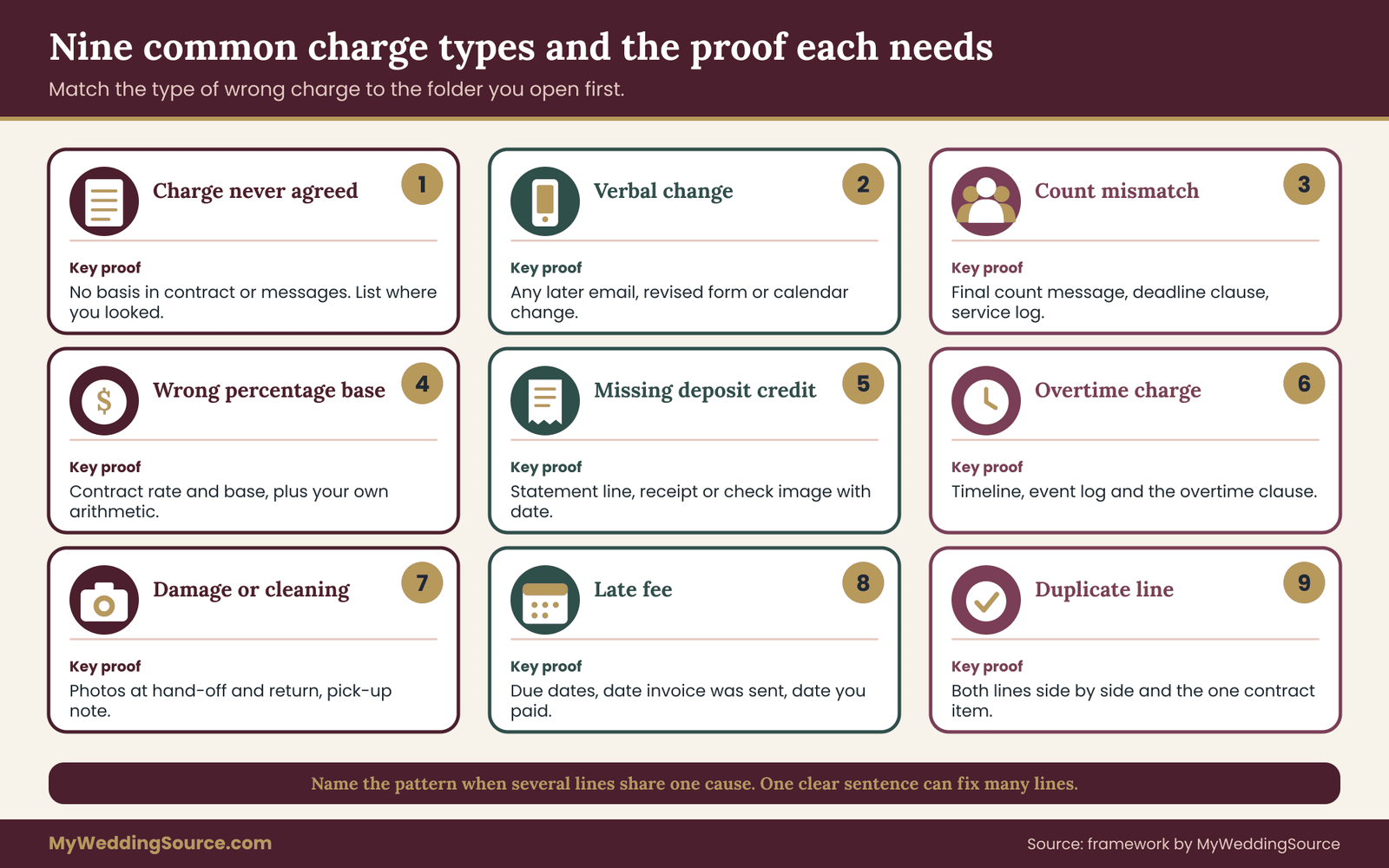
Common types of invoice dispute and the proof each one needs
Not every invoice dispute needs the same evidence. The type of disagreement tells you which documents will carry the argument. Learning the pattern saves time, because you can go straight to the right folder instead of rereading everything.
The charge that was never agreed
This is the line that does not appear in the contract, any amendment or any message. It might be a delivery fee, a setup fee, a “venue access” fee or a surcharge for a holiday weekend. In this kind of invoice dispute, the strongest evidence is the absence of a basis, which means you must show you looked. List the documents you checked and state that none mention the fee. Then ask the vendor to point to the agreement that supports it.
Be careful with one trap. Some contracts include a clause allowing the vendor to pass through third-party costs, such as a venue’s loading fee or a permit. A line that looks unagreed may be covered by that clause. If so, the right question is not “why is this here” but “please send the third-party invoice and the clause you are relying on.” That version of an invoice dispute is cheap to resolve and it keeps you from making a claim that the contract defeats.
The verbal change that was never written
You and the vendor agreed on a phone call to drop an item, reduce a quantity or swap a menu choice, and the final bill still shows the original. This is one of the most common reasons for an invoice dispute and one of the hardest to prove if nothing followed in writing.
Look for any message that mentions the change, even indirectly: a thank-you email that says “thanks for updating the order,” a revised floor plan, a menu selection form with different numbers, or a calendar invite with a changed time. If you find nothing, do not claim the change as fact. Put the line in the unclear bucket and write, “My notes show we agreed on a phone call around this date to reduce this item. I do not have a written confirmation. Can you check your call notes or order history?” That wording is honest and it gives the vendor a path to agree.
Going forward, the site’s guide to the wedding change order approval chain describes how to confirm every change by email within a day. Nobody does it every time, and the habit is the cheapest way to prevent this type of invoice dispute entirely.
The guest count or quantity that does not match
For per-person or per-piece charges, the count on the invoice must match a number that governs under the contract. Gather the final count message you sent, the date you sent it, the contract’s final count deadline and any attendance record. Then compare four numbers: the original contract quantity, the count you sent by the deadline, the number the vendor billed and the number who actually attended or were served.
Which number governs depends on the contract. Many catering contracts bill the greater of the guarantee count and the actual count. Some bill the guarantee count even if fewer attend. Some allow a small percentage reduction. If the contract does not say, ask rather than assume. Write the question in terms of the document: “Section 5 refers to a final guarantee. Which count is the invoice based on?”
The percentage fee on the wrong base
A service charge, administrative fee, gratuity or tax is calculated as a rate times a base. The two ways it goes wrong are a different rate and a different base. Show the math in the invoice dispute index. For example, if the contract says a stated percentage applies to food and beverage before tax, and the invoice applies it after tax, the difference is the rate times the tax amount. You can calculate that to the cent and put it in one sentence.
Tax questions deserve a cautious tone. Whether a service charge is taxable, whether a gratuity is taxable and how tax applies to rentals vary by state and sometimes by locality. Do not assert that a tax treatment is wrong unless a state revenue agency’s guidance says so. Instead ask the vendor which tax rule they applied, and check your state’s department of revenue for current rules. For tips on understanding what percentage lines usually represent, the site’s guide to wedding service charge and gratuity is a useful reference, but check that your own contract’s definitions control.
The missing deposit or payment credit
This is the cleanest type of invoice dispute because it is arithmetic. The proof is a payment record, and the ask is a credit. Gather each payment with the date, the amount, the method and a confirmation. Compare to the “payments received” section of the invoice. If one is missing, show the statement line or the check image and ask for the credit to be applied.
Two cautions apply. First, check whether the vendor applied the payment to something else, such as a separate booking or a different invoice. Second, if you paid by card, check whether the vendor added a processing fee that changes the credited amount. A mismatch of a few dollars may be that fee, not a missing credit.
The overtime or extra-hours charge
Overtime depends on start and end times, and on whose actions set those times. Collect the contracted hours, the timeline you provided, any message changing the schedule, the actual end time from a log or a venue record, and the contract’s overtime clause. Look at the clause for a grace period, a rounding rule and the rate.
If the vendor’s own late arrival pushed the whole schedule back, say so with evidence. If the event ran long because of a guest-driven delay, the charge may be legitimate. In the unclear case, ask for their record of start and end times, and offer yours.
The damage, loss or cleaning charge
Rental and venue invoices sometimes add charges for damaged items, missing pieces, extra cleaning or lost deposits. The central evidence is condition at hand-off. Photos at delivery and at return, a signed checklist, the pick-up note and the vendor’s own inspection report all matter. Ask for a photo of the claimed damage with a date, and ask which line in the contract defines normal wear. If you have no condition records, learn from it for the next vendor and handle this one as a question.
The late fee or interest charge
A late fee depends on the due date, the date you paid and whether the invoice was received in time. Find the due date in the contract and on the invoice, the date the invoice was sent to you, and the date your payment left your account. If the invoice reached you after the due date, say so. If the contract has a grace period, cite it. If the vendor’s invoice carries a different due date than the contract, treat the mismatch as the question.
The duplicate or overlapping line
Two lines that describe the same thing under different names are easy to miss and easy to fix. Quote both lines side by side in the entry, point to the one contract item that covers both, and ask the vendor to confirm whether both were intended. Vendors usually respond quickly to this type because it looks like a data entry issue, which it often is.
The charge for something not delivered
This crosses into the missed deliverable territory. If the invoice bills for an item or service that did not happen, keep the invoice question and the performance question connected but separate. The invoice entry should state the line, the contract basis, the proof of non-delivery and the ask for removal or credit. The broader story of what went wrong belongs in a separate record.
Which type of invoice dispute are you facing
Many bills have more than one problem. When you sort lines into types, you will often see a theme. Three duplicate-looking lines suggest a data entry issue and a gentle query will do. Several unrecorded verbal changes suggest the vendor’s order system never captured an update, and the right ask is for a full reconciliation against your latest confirmed order. A pattern of percentage fees on the wrong base suggests a template error, and one correction may clear several lines.
Naming the pattern in your message helps. “Several lines appear to reflect the original order before our March changes” invites a global fix. Listing eight separate complaints invites eight separate arguments. Where the pattern is real, a single clear sentence that identifies it often resolves the whole invoice dispute in one reply.
Edge cases worth knowing about
The vendor is a very small business. A solo photographer or a one-person baker may keep records informally. A polite offer to share your documents, and to go through the invoice together by phone with a written summary afterward, often works better than a formal packet. Keep the invoice dispute packet in your back pocket anyway.
The invoice came from a platform, not the vendor. If a marketplace or booking platform issued the invoice, the platform’s terms may add rules about how disputes must be raised and by when. Check those terms early and follow their process while keeping a direct, courteous channel with the vendor.
The vendor changed business names or billing entities. If the payee on the invoice differs from the name on the contract, ask for an explanation in writing before paying the new entity. This is a basic protection against both honest confusion and payment scams, and the Federal Trade Commission’s consumer pages describe common payment red flags.
The invoice arrives by text, with a payment link. Treat a payment link like any other invoice, and verify it through the contact details on your contract. Pay only through a method you can document.
A parent or relative paid part of the bill. Proof of payment still must match the invoice. Ask the person who paid for a confirmation, and keep it in your payment folder with the same label system.
The bill includes items for other people’s services. If a venue includes a third-party vendor’s fee on your bill, ask for that third party’s invoice. You are entitled to understand what a pass-through covers before you accept it.
The neutral written query for an invoice dispute
Once the invoice dispute index is ready, you need one message that turns it into a response. The neutral written query is a short, structured message with six parts. It states facts, quotes documents, asks a question and names a date. It does not argue, characterize or threaten. In an invoice dispute, this single message does more work than a long phone call, because it creates a record and it gives the vendor something specific to answer.

The six parts, in order, are these.
Reference. Name the vendor, the invoice number, the invoice date and your event date. This lets a bookkeeper pull the right file without writing back to ask.
Position. State what you have done so far. “We have reviewed the invoice against our agreement and are paying the confirmed items by the due date.” This line signals reasonableness and also protects you on late fee questions.
Observation. State what you see, as a fact, with a label. “Line 9 charges 84.00 for linen cleaning. Our order form (C2) lists standard laundering as included.” Keep each observation to one or two sentences and point to the evidence label.
Question. Ask what you need to know. “Can you tell us which linens were stained and which policy supports the fee?” A real question invites a real answer, and it leaves room for you to be wrong without anyone losing face.
Request. Say what you would like to happen if the answer supports your reading. “If the fee does not apply, please send a corrected invoice.” Be specific about the form: a corrected invoice, a credit memo, a written explanation.
Date. Offer a reasonable window for reply and say what you will do next in neutral terms. “We would appreciate a reply by Friday the 14th. After that, we will follow up by phone to understand how to proceed.”
A fill-in template in plain language
Here is a template written in sentences so that it works in an email or a portal message. Replace the bracketed parts with your own facts and delete anything that does not apply.
Subject: Question about invoice [number], [event date], two lines
Hello [name],
Thank you for the final invoice dated [date] for our [event] on [event date]. We have gone through it against our agreement dated [date] and our later messages. We are paying the confirmed items by the due date of [date], and we have two questions about the remaining lines. Our notes are attached as a short index with labeled documents.
Line [number], [description], [amount]. Our agreement (C1, section [number]) says [short quote or paraphrase]. The invoice appears to [short factual description of the gap]. Could you help us understand how this line was calculated?
Line [number], [description], [amount]. Our email of [date] (M3) confirmed [short factual description]. This does not appear to be reflected on the invoice. If that is an oversight, could you send a corrected invoice?
We would appreciate a reply by [date]. If it is easier to talk it through, we are glad to schedule a call, and we would follow up in writing afterward so we both have the same record.
Thank you, [name, contact details]
Notice how little of the message is about feelings. That is deliberate. The vendor can read it in two minutes, forward it to the person who handles billing and answer each question in turn. It also reads well to any neutral party who might see it later.
Words to use and words to avoid
Word choice in an invoice dispute changes how quickly the other side moves. A few swaps help.
Prefer “appears to,” “our records show,” “we would like to understand” and “could you confirm.” These phrases are accurate when you have documents but not certainty, and they keep the door open.
Avoid “you overcharged us,” “this is a scam,” “unacceptable” and “we expect a full refund.” They convert a bookkeeping question into a personal one. They also commit you to a position before you have the vendor’s explanation.
Avoid legal language you cannot back up. Words like “breach,” “fraud” and “negligence” have specific meanings, and using them casually can end cooperation and may undermine you. If the situation does call for legal language, get a licensed professional to write or review the letter.
Avoid dating your message with emotion. “After everything we have been through” tells the vendor nothing about the numbers.
Keep subject lines factual. “Question about invoice 2217” gets opened and routed. “URGENT problem” may get ignored, or may put the vendor on defense before they read a line.
Timing and channels for an invoice dispute
Timing matters in two directions. Sending too late can weaken your position, especially if the contract has a notice window or if you plan to use a card dispute later. Sending too early, before you have checked your own records, can make you retract claims and lose credibility.
A workable rhythm is this. Review the invoice within a day or two of receiving it. Spend the next two to four days on the three-bucket sort and the index. Send the query within about a week of receipt, or sooner if the contract states a shorter window. Pay the confirmed amount by the due date regardless of the open questions, unless a clause or professional advice says otherwise.
If the invoice arrives right before the event, you may be dealing with a venue or caterer who needs final payment before service. In that case, pay what you must to protect the day, state in writing that payment is made under reservation on the unclear lines, and then pursue the question after the wedding.
A short message such as “We are paying the full balance to avoid delays on the event date, and we reserve the right to ask for correction of lines [numbers]” preserves your position without creating conflict on the day. Whether that language has legal effect varies, so treat it as a clear record of your intention rather than as a sure protection.
Channel: put it in writing, and keep it in one thread
Written channels beat verbal ones for every part of an invoice dispute, because writing leaves a record and calls produce memories. If the vendor prefers to talk, accept the call and then send a summary: “Thanks for the call today. As we understood it, you will check the order history for line 9 and reply by Friday. Please tell us if anything here is wrong.”
Choose one channel and stay in it. A conversation split across email, text, a portal and social media messages makes your evidence harder to assemble and gives each side room to claim they never saw something. If the vendor replies on a different channel, bring the reply back to the main thread with a short note.
Send the query to the person named in the contract for notices or billing if there is one. If the vendor’s owner is also the salesperson, address the owner. If you have been working with a coordinator, copy the coordinator and ask them to confirm the facts they witnessed, without asking them to take sides.
Keep your attachments sensible. A single PDF index with labeled documents is easier to forward than twelve loose files. State in the message which labels are attached, so a missing file is noticed.
What to do about the phone call
Phone calls are useful when a vendor is quick to explain and slow to type. Use them with a plan. Before the call, write down your three questions and the numbers you need. During the call, ask the person to repeat any figure that matters and take notes with the date, time and name. After the call, send the summary email described above.
Do not record a call without checking the rules. Recording laws vary by state, and in some places all parties must consent. If you want a recording, ask permission at the start and note the agreement. Otherwise, rely on your written summary.
If the call turns tense, you can end it gracefully: “I want to make sure I get this right. Could you send that explanation in writing, and I will reply by Wednesday?” That one sentence cools most calls and moves the exchange back to the record.
Dealing with a quick reply that does not answer the question
Vendors sometimes reply with a short note that sounds helpful and answers nothing: “Our pricing is clear in the contract,” or “That is our standard fee.” Do not argue with the sentence. Return to the question, quoting the section you asked about. “Thank you. Could you point us to the section that lists the fee and its rate? We were not able to find it in our copy.” If the answer is vague twice, the fact that you asked twice, politely, is itself part of your record.
Sometimes the vendor replies with a partial correction. Treat that as progress. Confirm in writing what was corrected, ask for the revised invoice, and move on to the remaining lines. A partial win recorded clearly is better than a total win demanded loudly. This is also the point where a good invoice dispute process saves the most emotional energy, because every reply, even an unhelpful one, has a place in the log.
Keep a simple invoice dispute log
The invoice dispute log is a running list with four columns written in prose form: date, who contacted whom, how, and what was said or promised. Add a line every time you send or receive something. Include the date you next expect to hear back. If a promise is made, such as “we will send a corrected invoice by Monday,” write it in the log and put the date on your calendar.
This log will matter if the invoice dispute continues. It shows you were consistent, polite and timely, and it helps you notice when a stated deadline passes. It also stops you from sending a third message in frustration when the second one has not yet had a fair chance to be answered.
A worked invoice dispute example, step by step
The example below is invented, and the names and amounts are illustrative only. It shows how the pieces fit together on a realistic final bill. It is not a prediction of what any real vendor will do, and real contracts vary.
Imagine a couple, Dana and Marcus, who hired a caterer for a reception of about one hundred and twenty guests. Their contract set a price per person for dinner, a bar package per person, a service charge expressed as a percentage of food and beverage before tax, and a deposit paid in two installments. They changed the dinner choice for one table by email in the spring, and they sent a final count by email before the stated deadline.
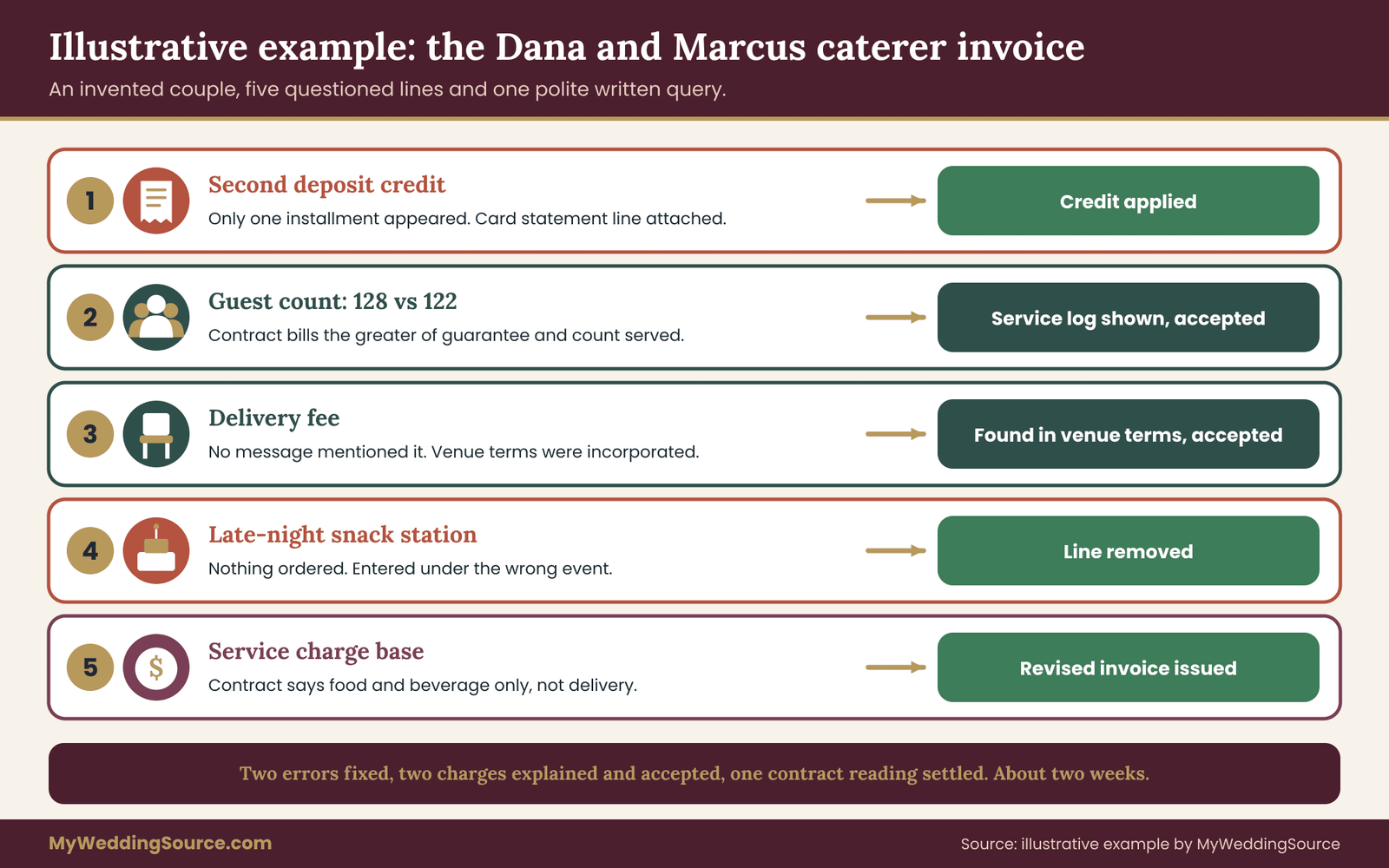
Two days after the wedding, the final invoice arrives. Dana opens it and feels her stomach drop, because the balance is far higher than the number in the couple’s budget sheet. She does not reply. She and Marcus decide to spend an evening with the invoice, the contract and their email folder.
Step one: the arithmetic
They add the lines themselves. The dinner line multiplies the per-person price by one hundred and twenty-eight guests. Their final count email said one hundred and twenty-two. The bar line uses the same count. The service charge is calculated on a subtotal that includes the delivery fee, which the contract lists separately. Only one of their two deposit installments appears under payments received.
So the first pass finds four things: a count that differs from the one they sent, a service charge base that may include something it should not, a missing deposit credit and a delivery fee they do not recall agreeing to. They also notice that the invoice includes an item for “late-night snack station” that they did not order.
Step two: the three-bucket sort
They go line by line. The per-person dinner price matches the contract. The bar price per person matches. The rental of glassware matches the order form. Those lines go in the confirmed bucket. They calculate the confirmed total and note that they can pay it on time.
The count goes in the disputed bucket only if the contract says the final count message governs. They check section five, which says the caterer will bill the greater of the guarantee count and the count served, with the guarantee set by the final count message. Their message said one hundred and twenty-two. The caterer’s count served may have been higher because of unexpected guests. This line moves to unclear, because the answer depends on the caterer’s service count.
The service charge base goes to unclear. The contract says the percentage applies to food and beverage, and the delivery fee is listed as a separate charge, so the base seems wrong. But the contract might define delivery as part of service. They ask rather than claim.
The missing deposit credit is disputed. They have a card statement line for the second installment with the date and amount. The delivery fee goes to unclear, since no document mentions it. The late-night station goes to disputed if they can show they never ordered it, and they search their email for any mention. They find none.
Step three: the index entries
For each unclear or disputed item, they write the five fields. Here are two of them in plain sentences.
Entry one, the missing credit. Charge: I1, payments received, shows one deposit of the first installment amount. Basis: C1, section three lists two installments with dates. Proof: P1 is the card statement for the second installment, dated in the spring, with the caterer’s name and the amount. P2 is the caterer’s emailed receipt for that payment. Math: the contract total minus both deposits is lower than the balance on the invoice by exactly the second installment. Ask: apply the second deposit credit and send a corrected invoice.
Entry two, the count. Charge: I1, line 2, dinner, one hundred and twenty-eight guests at the per-person price. Basis: C1, section five says billing follows the final guarantee or the count served, whichever is greater. Proof: M6 is the email of the final count message with the date, before the deadline. Math: six more guests than the final count at the per-person price equals the amount in question. Ask: please share the service count record, and confirm whether the six additional guests were counted from a service log.
Step four: the neutral query
They draft the message from the template. It is short. It states that they are paying the confirmed items on time. It lists the five lines with questions and requests, one short paragraph each. It attaches the index and the labeled evidence as a single PDF. It asks for a reply by a specific date a week away and offers a call afterward with a written summary.
They avoid sentences like “we were shocked” and “this is clearly wrong.” They write “appears to” about the service charge base and the delivery fee, and “we do not have a record of ordering” about the late-night station. Dana reads it aloud to Marcus, and they cut two sentences that sounded defensive.
Step five: the reply and the follow-up
Within four days, the caterer’s office replies. They agree that the second deposit was missed and will correct it. They explain that the count of one hundred and twenty-eight came from the service log, and they attach a copy showing the head count from the bar and buffet stations. They say the delivery fee is in the venue’s access terms, which the contract incorporates by reference. They agree to remove the late-night station because the order was entered under the wrong event.
Dana and Marcus now have a clearer picture. The deposit and the snack station are fixed. The count is explained with evidence, and they decide, after discussion, that the six extra guests were real and the charge is fair. The delivery fee needs one more look: the contract does incorporate the venue terms, and they find the fee in those terms. They accept it. The service charge base remains in question, and the caterer says it was applied to the subtotal as their standard practice.
Step six: closing the remaining line
For the service charge, Dana writes back: “Thank you for the clear answers. On the service charge, section four of our contract says the percentage applies to food and beverage. Could you show us how the delivery fee came to be part of the base?” The caterer replies with a revised invoice that applies the percentage to the food and beverage subtotal only, which reduces the total slightly.
The result is a corrected invoice. Two lines were errors, two were legitimate once explained, and one was a matter of reading the contract. Dana and Marcus pay the revised balance, ask for a “paid in full” note and save the whole thread in their vendor folder. The entire invoice dispute took about two weeks, with perhaps four hours of their time.
What the invoice dispute example teaches
Several habits made this outcome possible, and none of them requires special skill.
They paid the confirmed amount on time. This kept the vendor’s goodwill and removed any argument about late payment.
They separated claims from questions. Where they had a document, they stated a fact. Where they did not, they asked. As a result, when two of their suspicions turned out to be wrong, no one had to retract anything.
They let a legitimate charge stand. Accepting the six extra guests and the delivery fee after seeing evidence increased their credibility on the remaining lines.
They kept the exchange to one thread, with labeled attachments. Everything they said later could be traced to something already sent.
They did not escalate. At no point did they need a card dispute, a complaint to an agency or a letter from anyone. The majority of invoice disputes, in this kind of structured form, close at this stage.
A second, shorter example for a small vendor
Consider a different case: a florist who sends a one-page invoice by text with a payment link. The couple notices the total is eighty dollars more than the quote. The quote was a lump sum and said “delivery and setup included.”
There is no need for a full packet. The couple writes: “Thanks for the invoice. Our quote from March 12 lists delivery and setup as included, and the invoice adds a delivery line of eighty dollars. Could you confirm whether that line should be removed? Quote attached.” That is the whole message. The florist replies within an hour and removes the line, with an apology for a template error.
The lesson is proportion. The same method, reduced to three sentences and one attachment, fits a small disagreement. The invoice dispute packet is a tool that scales up or down. What stays constant is the habit of pointing to a document and asking a specific question.
Mistakes that weaken an invoice dispute
Some errors show up often enough to name.
Paying nothing while arguing. Withholding the whole bill because part of it is in question invites late fees and can shift the vendor’s attitude from helpful to defensive. Pay the confirmed part unless advised otherwise.
Mixing issues. Combining an invoice question, a complaint about service and a demand for a review change in one message makes every point easier to dismiss.
Sending the invoice dispute packet to the wrong person. A message sent to a sales rep who has left, or to a general inbox no one reads, loses days. Use the contact in the contract’s notice clause.
Leaving the contract unread until the invoice dispute starts. The earlier guidance on vendor due diligence explains why reading fees and notice terms before you sign avoids many problems later.
Posting online before the vendor has a chance to respond. A public review written in anger can complicate a settlement and may create separate risks. Keep the invoice dispute in private channels until you have exhausted a fair written exchange.
Letting a deadline pass in silence. If the vendor promises a corrected invoice by Monday and Tuesday arrives with nothing, send a short, friendly reminder that day. Silence over days lets the invoice dispute drift and weakens your record.
Paying during an invoice dispute without losing leverage
The hardest practical question in an invoice dispute is what to pay and when. Pay too little and you invite late fees or a halted service. Pay everything and feel you have given up the argument. The answer depends on the situation, and the choices are easier once you separate three cases.
The vendor still controls something you need. A venue that must release a space, a caterer who has not yet served, a photographer who holds your gallery, or a planner who holds your final timeline all have leverage. If you are before the event, pay what is needed to protect the day and put your reservation in writing. If you are after the event but the vendor still holds deliverables such as a gallery or an album, consider paying the confirmed portion and ask in writing for the deliverables to be released while the open lines are reviewed.
The vendor has finished everything. If all services and deliverables are complete, you have more room. Pay the confirmed amount by the due date, state the open lines in writing and keep the rest of the balance while they are reviewed. Check the contract for any clause that treats partial payment as default, and check late fee terms before deciding.
The amount in question is small. If the open amount is smaller than the time and stress of pursuing it, paying under reservation and recording the issue can be reasonable. Decide deliberately, and write the decision in your log so that later you remember it was a choice and not an oversight.
Whichever case applies, avoid a surprise. Tell the vendor what you are paying and why in the same message as your query. “We are paying lines 1 through 8 today and will pay the rest once lines 9 and 10 are clarified” is something a bookkeeper can act on. Silence followed by a partial payment looks like an error.
Payment method matters in an invoice dispute, earlier than you think
How you paid the original deposits decides what options you have later. This is why the site’s guide to wedding cash-flow planning suggests choosing payment methods and dates with the documentation trail in mind.
Credit cards. The Consumer Financial Protection Bureau explains that federal rules give card holders a way to dispute certain billing errors, and the Federal Trade Commission explains the notice requirement and the time window in its pages on disputing credit card charges. In general, a billing error notice must be in writing and sent within a limited number of days after the statement containing the error, so read the current guidance and your card agreement.
Not every disagreement counts as a billing error. A disagreement about quality is treated differently from a charge for an amount that differs from what was agreed, and the rules have conditions. Confirm the specifics with your card issuer and the agencies.
Debit cards, bank transfers and payment apps. Protections for these vary. Some provide strong error resolution for unauthorized transfers, but many payments you authorize are harder to reverse. Check your bank’s terms, and do not assume a payment app will refund a dispute with a vendor.
Checks and cash. Once cashed, a check is hard to reverse. Cash leaves almost no record unless you get a receipt. If you paid by either, your proof is a signed receipt or a cleared-check image.
Payment plans or financing. If a vendor offered installments through a third party, the third party’s terms control how disputes are raised. Read those terms and notify the provider early if a charge is in question.
You do not need to choose a payment method based on a possible dispute, and most weddings never reach that point. Still, if you are making a large deposit and have a choice, the method with documentation and an error resolution process gives you more room. The site’s guide to wedding vendor credit card surcharges covers the cost side of that choice, since a card fee can change the math.
A word on card disputes as a later step
A card dispute is a formal process with its own paperwork, and it is not a substitute for talking to the vendor. In most cases card issuers expect you to have tried to resolve the invoice dispute with the merchant first, and the process asks for documents that your evidence packet already contains.
If you reach that stage, the index becomes your submission. The charge, the basis, the proof and the ask map onto what an issuer wants: what you were charged, what you were supposed to be charged, what you did to resolve it and what you are asking for. Keep your exchange with the vendor factual and your log accurate, because the issuer may read it.
Some cautions are worth stating plainly. A card dispute can affect your relationship with the vendor and, in some cases, how they treat other pending items such as gallery delivery. It may not succeed, and the outcome is decided by the issuer under its rules and applicable law, not by how strongly you feel. Time limits are strict, so if a card dispute is at all likely, calendar the deadline from the first day. A licensed professional or the issuer’s customer service can explain how the process applies to your situation.
When the vendor says no: a calm invoice dispute escalation ladder
Most invoice disputes close after one or two written exchanges, so an invoice dispute rarely needs the heavy tools. When they do not, you can move up a ladder of steps in order, each one more formal and each one building on the last. Moving step by step keeps your record clean and avoids jumping to a heavy tool when a lighter one will work.
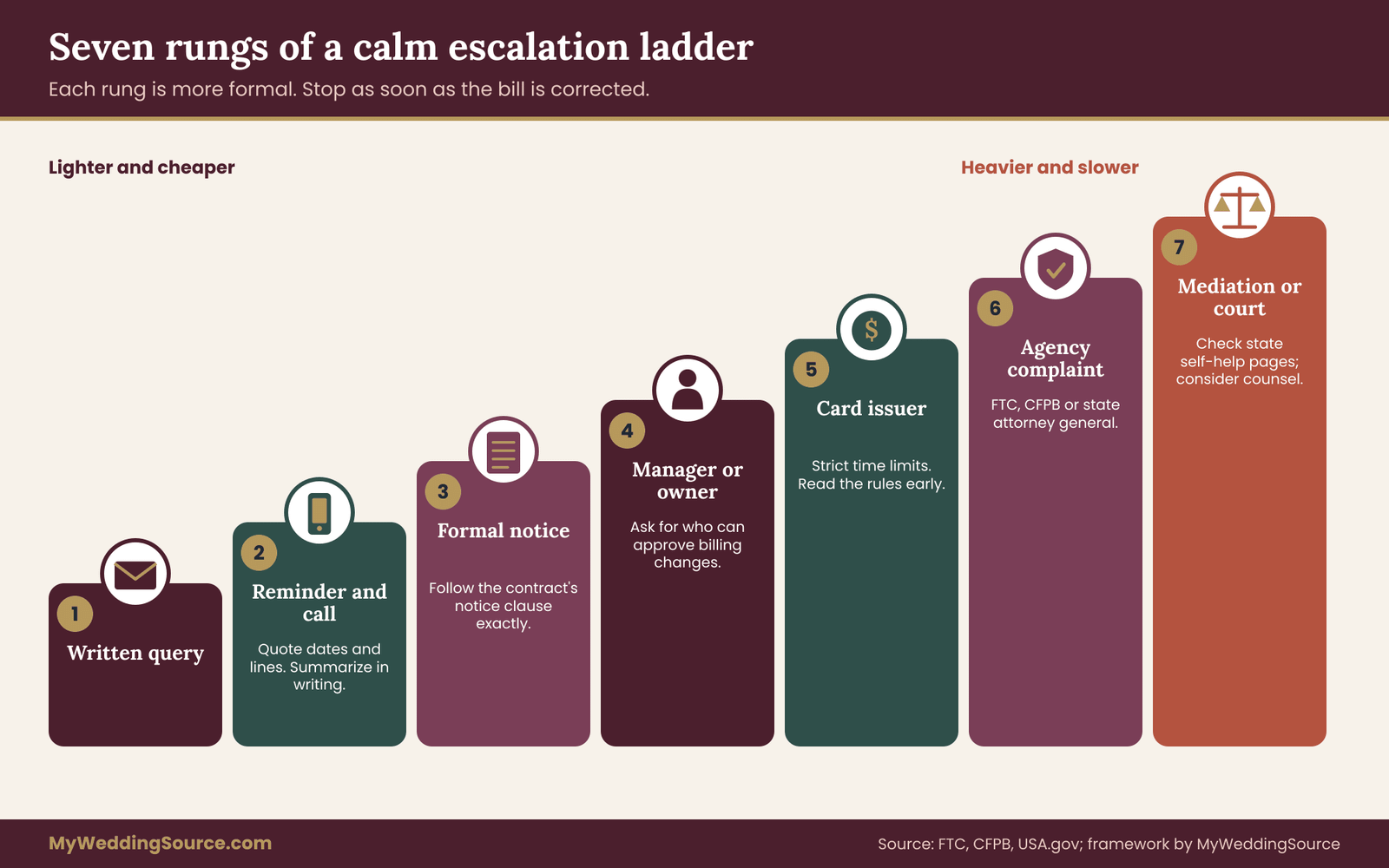
Step one: the written query. This is the message described above. Allow a reasonable time for a reply, commonly a week.
Step two: a short reminder and a call request. If there is no reply, send a brief follow-up that quotes the date of your first message and the specific lines. Offer a call and promise a written summary.
Step three: a formal written notice. If the contract has a notice clause, follow it exactly: the address or email, the form, the information required. A formal notice restates the lines, the evidence labels, the specific correction and a date. It stays neutral in tone. This is the step where it may make sense to have a professional review the letter, especially if the amount is large or the contract has a notice or cure period.
Step four: a manager or owner. If you have been dealing with a staff member, ask politely for the person who can approve billing adjustments. Provide the same attached index.
Step five: the payment provider. If you paid by card and the time limits allow, the card dispute process may be available. Review the issuer’s current process and the agency guidance before filing.
Step six: a consumer complaint. The Federal Trade Commission, the Consumer Financial Protection Bureau and your state attorney general’s consumer protection office accept complaints, and they explain what they can and cannot do. These offices usually do not resolve individual disputes for you, though a complaint can prompt a vendor to respond and can contribute to patterns the agencies track. Review each agency’s page for what the process involves.
Step seven: mediation or small claims. If the amount justifies it, mediation services and small claims courts exist in most states. Limits, filing fees, procedures and whether you need to send a demand letter first vary by jurisdiction. Check the state court’s own self-help pages, and consider a short consultation with a licensed attorney or a legal aid service before filing.
You do not need to climb every rung. Many couples stop at step two or three. The ladder is a map so you know the next step is available and so you do not skip to the heaviest option out of frustration.
Deciding whether to keep going with an invoice dispute
At each rung, ask four questions. How much money is in question, after the items you have accepted? How strong is the documentation for each remaining line? What would the next step cost in time, money and stress? And what outcome would you be satisfied with?
Writing the answers down helps you resist two common traps. One is the sunk cost trap, where you keep escalating because you have already put in effort. The other is the exhaustion trap, where you accept a wrong bill because you want the matter over. A third option often sits between them: a negotiated middle, such as splitting the amount in question, receiving a partial credit or getting a deliverable in lieu of money. A settlement is a legitimate outcome of an invoice dispute and does not mean you were wrong.
If you do settle, put it in writing. A short message that states the agreed amount, what each side will do and that the matter is considered closed gives both sides a record. Ask for a revised invoice or a credit note that matches. Do not rely on a verbal “we are good” to close a financial issue.
Protecting deliverables while the invoice is open
Couples are sometimes surprised to find that a vendor withholds a gallery, a video, a final file or a keepsake while an invoice is unresolved. Whether the vendor may do this depends on the contract. Many photo and video contracts state that final files are delivered after payment in full. Read that clause early.
If a deliverable is at stake, consider keeping the delivery issue and the invoice issue in the same message, with a sensible proposal: payment of the confirmed balance now, release of the files and a time limit for resolving the remaining lines. Offer something concrete. Vendors tend to agree when the proposal gives them most of their money and a clear end date.
If the vendor holds something irreplaceable, such as unedited original files from a one-time event, put extra weight on keeping the tone constructive. The site’s guide to wedding photography consent is not about billing, but it is a reminder that image rights and delivery terms are written into contracts that can matter during a dispute, so read them. If the stakes feel high, a short consultation with a licensed attorney before you escalate is a reasonable investment.
Who sends the message when the payer is not the signer
Sometimes the person disputing the bill is not the person who signed the contract or paid. A parent may have paid a deposit, a planner may have negotiated terms, or a partner may have signed alone. The vendor’s duty and your standing depend on who the contract names. Before you send anything, confirm that the sender is the contracting party or has written authority to act. If the contract names one partner, that partner should send the query or explicitly authorize the other to do so.
A planner or coordinator who handled the vendor relationship can be a valuable witness to facts. Ask them for their notes and for copies of what they sent. Ask them to describe what they saw and did, not to opine on who is right.
When money moves after the wedding: tracking the resolution
After you reach an agreement, close the loop with a short reconciliation. Confirm that the corrected invoice matches the agreement line by line. Confirm that any credit or refund arrives in the form and by the date promised, and note the date it actually arrives. Match the final payment to a statement line.
Then move the whole packet into the vendor’s folder with a final note: “Invoice dispute resolved on [date]. Corrected total [amount]. Paid on [date] by [method]. Refund or credit of [amount] received on [date].” That note is a compact record for taxes, for future reference and for your own peace of mind.
Preventing the next invoice dispute while you still plan
The cheapest invoice dispute is the one that never starts. Most of the prevention happens months before the final bill, in small habits that cost minutes each. Couples still planning can use the timeline below, and couples who are already mid-dispute can use it to see which step failed and fix it for the next vendor.
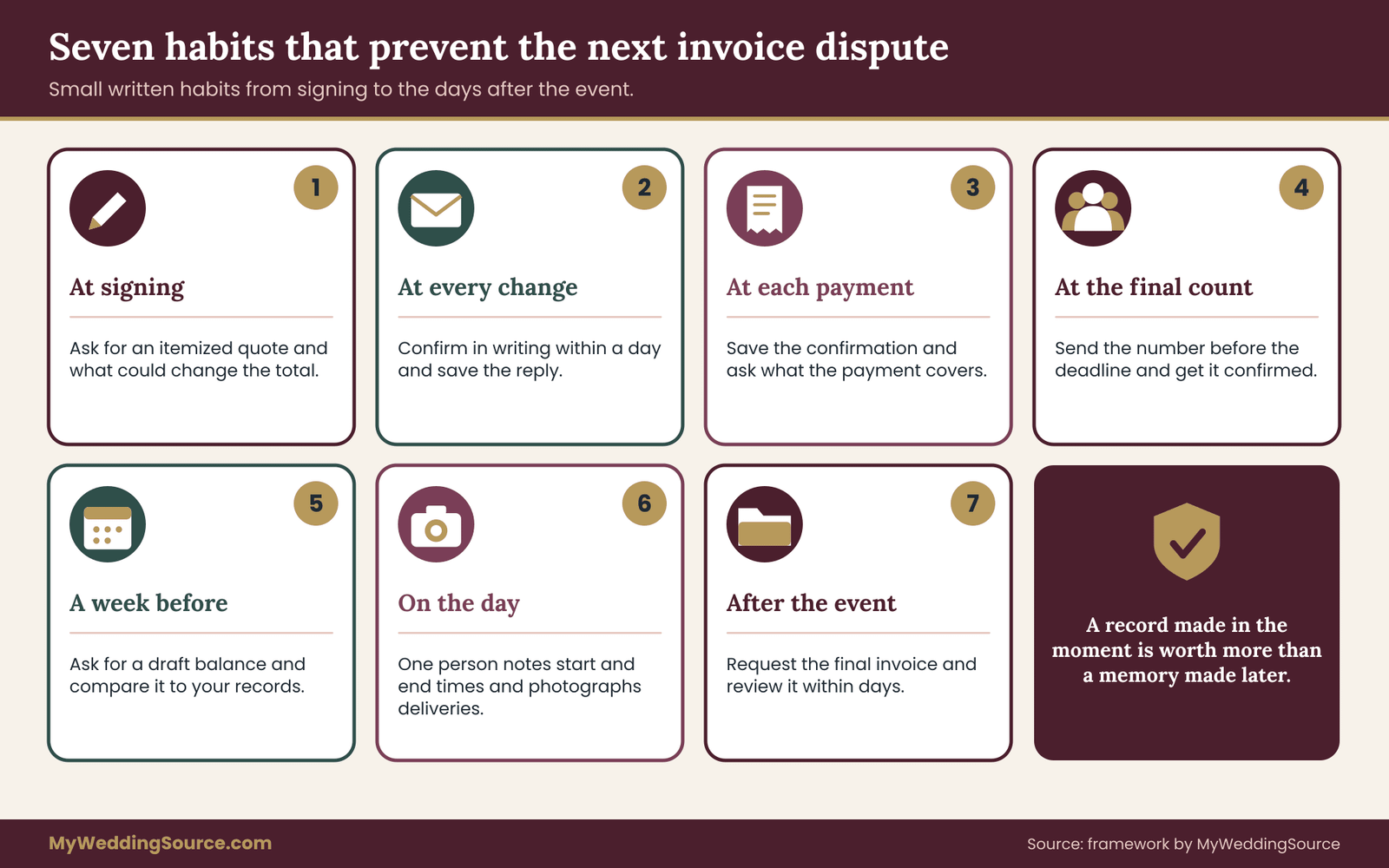
At signing. Ask the vendor for an itemized quote that lists quantities, unit prices, fees and the base for each percentage. Ask what could change the final total: guest count, hours, delivery, overtime, taxes. Write the answers in the margin of your copy. The site’s guide to wedding vendor timeline planning shows when each vendor’s key dates tend to fall, so you can calendar the final count and final payment dates as soon as you sign.
The guide on scope agreement to final acceptance for vendor orders shows how a signed scope becomes a checklist you can compare with the final bill.
At every change. Confirm in writing within a day. A two-line email is enough: “Confirming that we changed the dessert order from forty to thirty-five pieces, effective today. Please update the invoice.” Save the reply. If the vendor does not reply, send it again once. A silent vendor and an unconfirmed change is a future invoice dispute waiting to happen.
At each payment. Save the confirmation and match it to the contract’s schedule. Ask for a receipt that states what the payment covers. Keep a one-page payment list per vendor with dates and amounts.
At the final count. Send the final count with the contract deadline in mind and ask for confirmation of the number the vendor will use. This one message prevents the most common per-person billing disagreement.
A week before the event. Ask for a draft of the final invoice, or at least a statement of the expected balance. Comparing it to your records while there is still time to correct it is far less stressful than doing it afterward.
On the day. Assign one person, ideally a coordinator or a reliable friend, to note start and end times for key services and to photograph delivered items. The goal is not surveillance. It is a small, friendly record that is useful if overtime or a delivery question comes up.
After the event. Request the final invoice promptly and review it within a few days. Do not let it sit in an inbox while a notice window runs.
The limits of an invoice dispute evidence packet
A packet is a strong tool, and it has edges. Knowing them keeps your expectations realistic.
It does not make a vendor agree. A vendor can read your index and still decline. What the invoice dispute packet does is make a refusal specific and documented, which matters if you escalate.
It does not replace legal advice. Contracts, consumer law, tax rules, card rules and insurance terms vary and change. The invoice dispute packet helps you describe your situation clearly to any professional or agency, and it may reduce the time a consultation takes. Whether you have a legal claim is a question for a licensed attorney in your state.
It cannot fix missing documents. If a change was verbal and nothing was written, you are in the unclear zone, and the best outcome may be a goodwill adjustment rather than a corrected invoice.
It does not decide who is morally right. Honest disagreements happen when two people remember a conversation differently. The method aims to resolve the number, not to rule on character.
It is not a guarantee of a particular timeline. Vendors vary in how fast they reply. Some are slow because they are small, some are slow because they are busy in peak season and some are slow on purpose. Your log will tell you which is which.
It does not cover every situation. Insurance claims, venue security deposits, cancellations, a vendor going out of business and wedding-day injuries all follow their own rules and deserve their own research. The site’s guide to wedding budget planning can help you decide how much reserve to hold for such surprises, and the guide to wedding vendor contracts explains where cancellation terms usually live.
Verifying rules and fees with the right office
Because rules and fees change, treat everything here as a method rather than a source of current numbers. Before you rely on any figure or deadline, check the issuing source.
For card disputes, check your card agreement and the guidance published by the Consumer Financial Protection Bureau and the Federal Trade Commission. For complaints about a business, check the Federal Trade Commission’s complaint site, the CFPB’s complaint portal where a financial product is involved, and your state attorney general’s consumer protection office. For small claims, check the court’s own pages for your county or state, where filing fees and monetary limits are posted. For tax questions about service charges, gratuities or deductibility, check your state’s department of revenue and the Internal Revenue Service, or ask a tax professional.
For vendor-specific rules, check the contract and any terms it incorporates. If the contract refers to terms “on our website,” get a dated copy. If a venue or platform has its own dispute policy, read it now, not after a conflict starts.
If a rule matters to a large amount, call the agency or a legal aid service and ask what they recommend. Many state bar associations list low-cost consultation programs, and many courts publish self-help guides. These are free or inexpensive ways to confirm that the process you plan to follow still matches the current rules.
Using the invoice dispute packet beyond the dispute
Even if the invoice dispute ends well, the invoice dispute packet is worth keeping. It shows how you tracked a vendor relationship, which helps with budget reconciliation, tax records and future reviews. The site’s guide to organizing wedding records after the event describes where to keep it and how long. A short summary of what you learned is also useful for the next big purchase, whether that is a move, a renovation or a baby.
Keep a “lessons” line at the end of the vendor folder. Perhaps you learned to ask for a draft invoice a week out, to confirm every change in writing or to read the notice clause before signing. Those few lines make the next contract easier to read.
Your next steps
If a final bill is in front of you now, here is a short path you can start today.
- Do not reply to the vendor yet. Read the whole invoice once and write down the total and the due date.
- Check the contract for a notice or billing-dispute window and for late fee terms.
- Add up the lines yourself and compare each to the contract, amendments and messages.
- Sort every line into confirmed, unclear or disputed, and pay the confirmed amount by the due date.
- Write one evidence index entry per unclear or disputed line, with the charge, basis, proof, math and ask.
- Label the evidence, preserve the originals and back them up in two places.
- Send one neutral written query with the six parts, attach the index and ask for a reply by a stated date.
- Keep a dated log, send one friendly reminder if the date passes, and decide on the next rung only after a fair written exchange.
- After resolution, get a corrected invoice, match the payment, ask for a paid-in-full note and file the invoice dispute packet.
FAQ
How soon should I raise an invoice dispute after the final bill arrives?
Review the bill within a day or two and send your written query within about a week, or sooner if the contract sets a shorter notice window. Card billing error rules also have strict time limits, so check your issuer’s terms and the Federal Trade Commission or CFPB guidance. Pay the confirmed amount by the due date while you wait for answers.
Should I pay the whole bill while we sort out an invoice dispute?
Usually pay the lines you have confirmed, and tell the vendor in writing which lines are open and why. If the vendor controls something you still need, such as the event itself or a gallery, you may decide to pay in full under a written reservation. Check late fee and default terms in your contract, and consider licensed advice for large amounts.
What counts as proof in an invoice dispute?
Signed contracts and amendments, emails and messages that confirm changes, payment records, delivery photos, headcount messages, timelines and third-party records such as a venue schedule or a pick-up slip. The best proof is dated, unedited and labeled. A verbal agreement with nothing written is weaker, so ask a question about it instead of stating it as fact.
Is a card dispute the first thing I should try?
No. Start with a written query to the vendor, because most errors are corrected at that stage and issuers often expect you to try. A card dispute is a later step with strict time limits and conditions. Read your card agreement and the CFPB and FTC pages early, so you know the deadline if you need it.
What if the vendor ignores my message?
Send one short follow-up that quotes your first message date and the specific lines, and offer a call with a written summary. If the contract has a notice clause, send formal notice the way it requires. After that, consider the payment provider, a consumer complaint to an agency or your state attorney general, and finally mediation or small claims.
Can I leave a bad review while the bill is unresolved?
It is wise to wait. Posting while a dispute is open can harden positions, may complicate a settlement and can create separate risks depending on the contract and the facts. Keep the matter in private channels first. If you later write a review, stick to verifiable facts, and consider asking a professional if the contract has a review clause.
What if I find out the vendor was right about a charge?
Say so plainly and pay it. Accepting a legitimate charge costs little and protects your credibility on the lines that are still open. A short message such as “Thank you, that explanation matches the contract, and we will pay that line” is enough. Then continue with the remaining questions.
Do I need a lawyer for an invoice dispute?
Often not, especially for small amounts and clear errors. A lawyer becomes worth considering when the amount is large, the contract has complicated notice or fee terms, the vendor threatens action or your evidence is mixed. A licensed attorney in your state can tell you what applies to your situation.
Sources
- Consumer advice, Federal Trade Commission
- Disputing credit card charges, Federal Trade Commission
- How do I dispute a charge on my credit card bill?, Consumer Financial Protection Bureau
- Submit a complaint, Consumer Financial Protection Bureau
- Report fraud and bad business practices, Federal Trade Commission
- Where to file consumer complaints, USA.gov
- State consumer protection offices, USA.gov
- National Association of Attorneys General
- How long should I keep records?, Internal Revenue Service