
A wedding contingency reserve is money set aside for costs you could not price in advance, and it only works if you decide before the bills arrive which costs may use it. This guide gives you a two-question test, based on contract obligation and replaceability, that sorts every surprise expense into draw, negotiate first, cap, or refuse.
Ask two questions about each unplanned cost. First, are we obligated to pay it under a signed contract or a policy we accepted? Second, can the item or service be replaced, reduced or dropped before the deadline? Owed and fixed costs are drawn from the contingency reserve at once and logged. Owed but flexible costs get a short negotiation first. Urgent costs you do not owe get a capped draw that one partner can approve. Optional wants never touch the contingency reserve.
Most couples open a contingency line in the budget and then make one quiet mistake. They treat it as a general cushion, so the first tempting upgrade, a nicer chair or a longer bar package, quietly spends it. By the month of the wedding the cushion is gone, and the real surprises, a vendor price clause or a rental damage fee, land on a credit card with no plan behind them.
The fix is not a bigger number. It is a set of rules written down while nobody is stressed. When a bill arrives, you do not debate whether it feels fair or whether you deserve a treat. You run it through two questions and follow the result. That removes most arguments, and it keeps the contingency reserve alive until the costs that genuinely need it show up.
A note on scope. This is general consumer information, not legal, tax or financial advice. Contract terms, refund rights and fee rules differ by vendor, state and situation, and they change. Where a rule matters, this guide points you to the agency or the document that settles it so you can confirm the current version yourself.
The guide is built around one differentiated tool, the contingency reserve trigger test, plus a worked example and the edge cases that bend the rules. If you still need the broader picture of when money leaves your accounts across the whole engagement, the wedding cash-flow planning guide covers deposits, final balances and timing. This article starts where that one hands off: the money is set aside, and something unexpected has just arrived.
What a wedding contingency reserve is and is not
A contingency reserve is a defined sum, held apart from your spending accounts, that you may use only for unplanned costs that meet your written draw rules. Three parts of that definition do the work. It is defined, meaning a number you chose on purpose. It is held apart, meaning you cannot spend it by accident while paying a florist. And it is rule-bound, meaning the rules exist before the surprise does.
It helps to be exact about what the contingency reserve is not, because the confusion is the reason reserves fail.
It is not the budget line for things you forgot. If you know you will need a cake stand, a marriage license fee or a tip for the delivery crew, those are line items. A budget that hides predictable costs inside the contingency reserve looks tidier and behaves worse. The contingency reserve then drains on certain expenses and has nothing left for uncertain ones. The wedding budget guide explains how to build the planned categories so the reserve can stay for true surprises.
It is not an upgrade fund. Wanting a better version of something is a normal and legitimate feeling, but it is a preference, not a surprise. Upgrades belong in a separate and clearly named place, which the fourth rule later in this guide describes.
It is not an emergency fund for your household. Your personal safety net for job loss, medical bills or rent is a different pool with a different purpose. Mixing the two means a wedding problem can spend your safety net, or a household problem can spend the wedding. Keep them as separate accounts, or at least separate named buckets, so neither can be drained by the other without a deliberate decision.
It is not borrowed money. Some couples treat a credit limit as their reserve. A credit limit is a way to pay, not a sum you have. If the only thing standing behind your contingency reserve is available credit, you have a financing plan, not a reserve, and this guide does not give borrowing advice. The Consumer Financial Protection Bureau publishes plain-language material on credit cards and loan costs if you are weighing that route.
Why rules beat a feeling
A feeling is flexible, which is its problem. In week two of planning, a feeling says the contingency reserve is for emergencies. In week forty, with an overdue vendor email and a tired partner, the same feeling says this one counts. Rules written earlier cannot be negotiated by the tired version of you.
Rules also help the two of you disagree well. If one partner wants to draw on the contingency reserve for a cost the other thinks is optional, the question stops being whose taste wins. It becomes which quadrant the cost falls into, and you can look at the answer together. That is a calmer conversation than a debate about priorities during the busiest month of planning.
Where the contingency reserve sits in the money flow
Think of wedding money as moving through three layers. The first layer is the planned budget: deposits, balances and every line you priced. The second is the contingency reserve: uncertain costs that meet the rules. The third is the leftover, which only exists after the wedding when everything is paid and the contingency reserve has been settled. Keeping the layers distinct is what lets you see, at any moment, how much surprise you have absorbed and how much room remains.
A short example shows why this matters. Suppose a caterer’s final invoice comes in a little higher than the quote because the guest count rose. If that difference came from the planned layer, it would look as if your budget had failed. Because it came from the contingency reserve and was logged, it looks like what it is: one expected kind of surprise handled by the tool built for it. The budget stays honest, and the contingency reserve stays informative.
What the reserve can and cannot fix
A contingency reserve fixes cash problems. It does not fix a contract that is vague, a vendor who is unresponsive or a date that clashes with something else. For those, the vendor documents matter more than the money. The wedding vendor contract guide explains what to look for in terms, deposits and cancellation language, and it is worth reading before you rely on any reserve to cover a vendor dispute.
One more boundary. The contingency reserve does not replace insurance. Event insurance, where you choose it, responds to defined events under defined terms, and its exclusions can be broad. The National Association of Insurance Commissioners and your state insurance department are the places to check what a policy covers and how to file a complaint. A good reserve plan assumes that insurance may not pay and that any payout may be slow, so it is built to cover a short cash gap on its own.
The two-question test behind every reserve draw
Every unexpected cost fits into a small grid defined by two questions. The first is about the contract. The second is about whether the thing can be swapped or dropped. Answer both in about two minutes, using the documents, and the grid tells you what to do.
Question one: are we obligated to pay this? Obligation means a signed contract, an accepted written quote, an invoice that references a clause, or a policy you agreed to, such as a venue damage deposit. If you can point to the sentence, the answer is yes. If you cannot, the answer is no, even if the vendor sounds confident on the phone. A verbal expectation is not an obligation, and a surprise fee that is not in your documents is one you may be entitled to question.
Question two: can the item be replaced, reduced or dropped? Replaceability asks whether the function can be met some other way within the time you have, at a cost lower than the one in front of you. A pricier flower substitution can be replaced with a cheaper stem. An extra hour of venue overtime can be dropped by ending the night earlier. A vendor who has vanished cannot be replaced at no cost, because a new vendor has their own price and deadline.
The answers fall into four quadrants, which the infographic below summarizes.
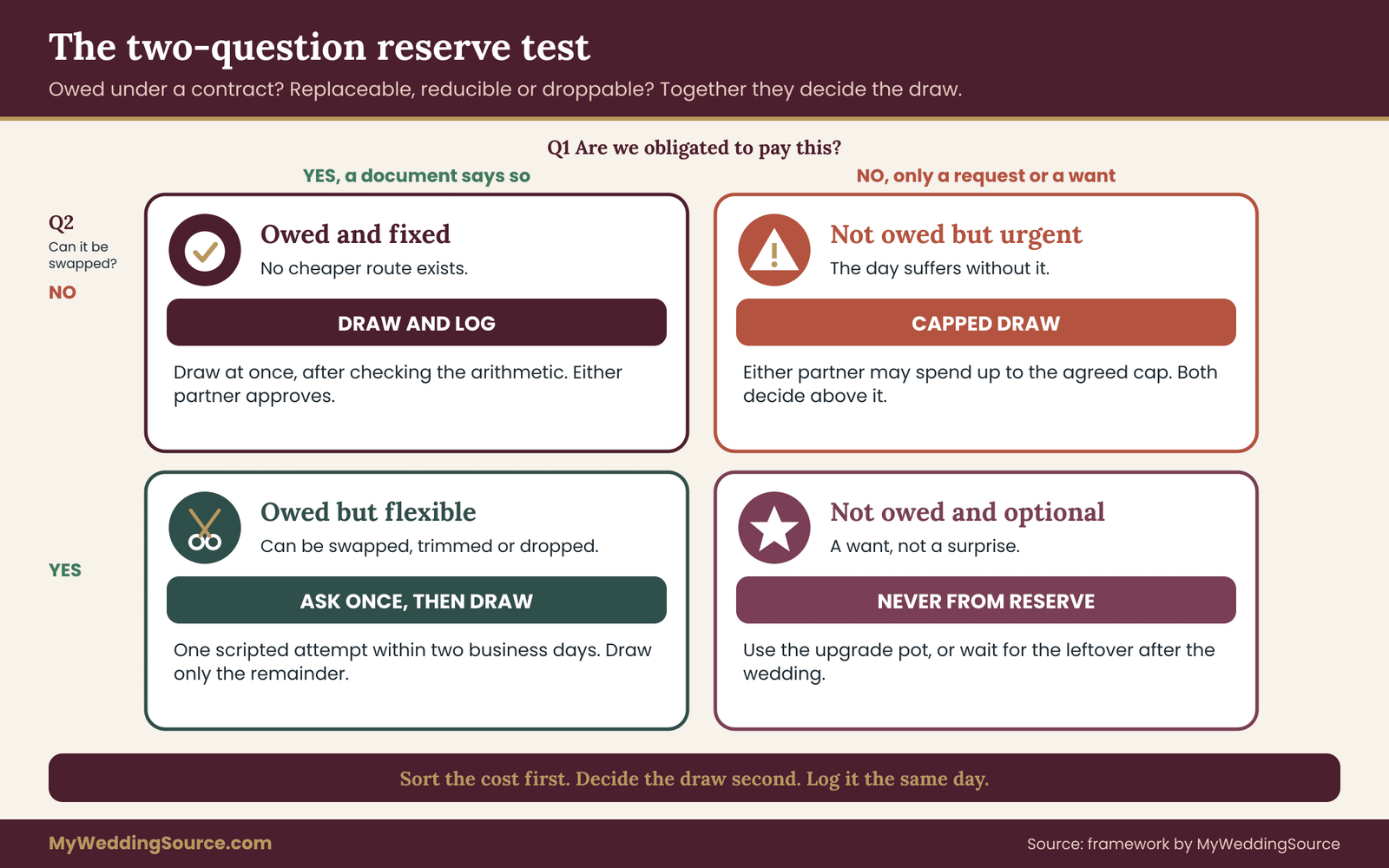
Owed and fixed. You are obligated, and there is no cheaper route. These costs draw from the contingency reserve automatically. You pay, you log it, and you move on. Arguing about it wastes the effort you will need for the other quadrants.
Owed but flexible. You are obligated, but the cost can still be reduced, swapped or avoided. The rule here is to pause for a short, scripted negotiation before drawing. Only the unavoidable remainder comes out of the contingency reserve.
Not owed but urgent. There is no contract behind it, but the wedding will suffer without it, such as an emergency repair. These get a capped draw. A defined spending limit lets one partner act quickly, and anything above the limit needs both of you.
Not owed and optional. This is a want. It never draws from the contingency reserve. It either waits for a defined upgrade pot or it waits until the wedding is over and the leftover is known.
Why two questions and not one
Sorting only by urgency makes everything feel urgent. Sorting only by obligation misses that some owed costs are negotiable. Combining the two forces the useful follow-up: if we owe it, can we shrink it, and if we do not owe it, is it urgent or just attractive. The two together separate the bills you must pay from the bills you can still shape, and that is what keeps a reserve from being spent on the wrong things.
It is also a test you can run on a phone while a vendor waits. You do not need a spreadsheet. You need the contract, a pen and the habit of saying aloud which of the two questions you are answering. In practice, the first question usually takes a minute with the document in front of you, and the second takes another minute of honest thought about alternatives.
What you need on hand to run the test
You need three things within reach before any draw decision. First, the signed contract and any amendments, ideally as one file per vendor. Second, the written quote or invoice that triggered the decision. Third, the current balance of the contingency reserve and your draw log. If you keep your vendor files and payments organized as you go, the test is quick. The wedding vendor purchase order checklist shows one way to confirm what you ordered and what you agreed to pay before the invoice ever arrives, which makes question one much easier to answer.
A note on emotion
Costs that arrive close to the wedding carry emotional weight that has nothing to do with their size. A ninety dollar fee two days before the ceremony can feel like an emergency, while a four hundred dollar fee six weeks out feels routine. The test is meant to take the emotion out of the sorting.
If a cost lands in the optional quadrant, the fact that it arrived at an anxious moment does not change that. If it lands in the owed and fixed quadrant, you do not need to feel good about it to pay it. You only need to log it and keep going.
Question one: is the cost owed under a contract?
The first question sounds simple, and in practice it is where most wrongly drawn reserve money goes. People assume a bill is owed because it arrived. A bill is owed because a document says so. This section shows how to read your vendor documents for obligation, and how to grade what you find.
The four grades of obligation
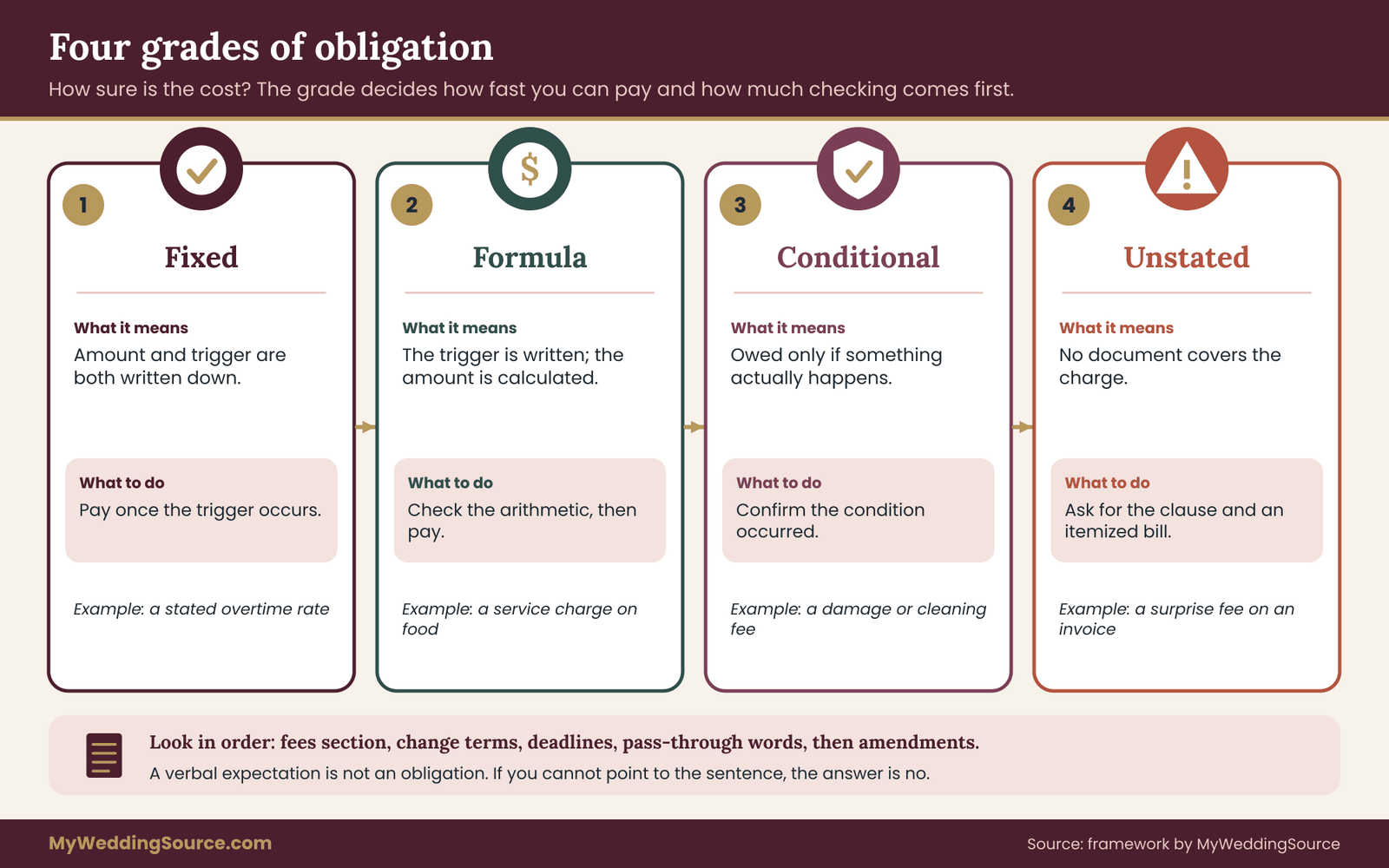
Not every owed cost is equally certain. It helps to grade each one on a short scale, because the grade decides how fast you can act.
Fixed. The amount and the trigger are both written down. A signed contract says the venue charges a stated fee per extra hour, or that the caterer bills a stated price per added guest. Nothing is left to judgment. If the trigger happens, the amount is owed.
Formula. The trigger is written down, but the amount depends on a calculation. A service charge calculated on the food and beverage total, a fuel surcharge tied to a stated index, or a gratuity expressed as a percentage all fall here. You can check the arithmetic against the contract, and you should, because formula costs are where honest mistakes and padded invoices both live.
Conditional. The cost is owed only if something happens, and you control or influence whether it does. A damage fee applies only if an item is actually damaged. A cleaning fee applies only if the space is left beyond a stated condition. A late-cancellation fee applies only if you cancel inside the window. Conditional costs deserve a look at whether the condition truly occurred.
Unstated. Nothing in your documents covers the charge. The vendor may still ask for it, and it may still be reasonable, but you are not obligated until you agree. This is the grade that most often ends up as a negotiation rather than a payment.
Where obligation hides in a vendor file
Obligation rarely sits on the first page. When you run question one, look in these places in order, and write down what you find so you are not repeating the search later.
Start with the pricing or fees section, which usually lists unit prices, overtime rates and service charges. Then look at the terms covering changes, because guest count adjustments, date changes and substitutions are almost always governed there. Next, check the schedule of deadlines. Many contracts set a final guest count date, a final payment date and a last day to alter an order, and a cost that arrives after a deadline is treated differently from one that arrives before it.
After that, search for the words that signal pass-through costs: taxes, surcharges, fees, minimums, administrative, gratuity, overage, replacement, damage and loss. These words usually sit close to the sentences that create or limit your liability. Finally, check the amendments and email threads. An amendment, a written change or a signed addendum can alter the original terms, so a cost the original contract allowed may now be capped or removed.
If you want a deeper look at what a sound contract should say before you ever reach this point, the wedding vendor due diligence checklist covers the questions to settle before signing. The better those answers are, the fewer unstated charges you will meet later.
What to do when a charge is unstated
An unstated charge is not automatically a scam, and it is not automatically yours to pay. The calm approach has three steps.
First, ask the vendor to point to the clause. A plain request is enough. Vendors who know where the charge comes from will cite it quickly. Vendors who cannot find it will often adjust. Second, ask whether the charge can be itemized in writing. A written breakdown separates a legitimate pass-through, such as a venue fee the vendor must pay on your behalf, from a loosely worded add-on.
Third, decide whether the cost, if legitimate, is something you would have chosen to pay. A cost you would have chosen is a negotiation about price. A cost you would not have chosen is a dispute about whether it applies at all.
“Thank you for the invoice. Could you point us to the part of the agreement that covers this charge, and send an itemized breakdown? We would like to confirm it before we pay.”
That message does not accuse anyone. It also creates a written record, which matters if the disagreement continues. If the amount is large and the vendor will not cite a clause, the Federal Trade Commission and your state attorney general’s consumer protection office are the places that handle complaints about unfair or unexpected charges. They are a backstop, not a first move, and most disagreements resolve before anyone needs them.
Payment method and your leverage
How you paid the original deposit affects what you can do if a charge is wrong. The Consumer Financial Protection Bureau explains that a credit card billing error generally has to be disputed in writing within sixty days of the statement that shows it. That window runs from the statement date, not from the date of the wedding, so a surprise charge that shows up on a statement is on a clock. Check the current rules and the exact process on the CFPB site or with your card issuer rather than relying on memory.
This does not mean every disagreement should be a chargeback. A dispute is a formal step and has consequences for your relationship with the vendor. It means two things for reserve planning. First, a charge you believe is wrong should not be paid from the contingency reserve immediately if there is time left to question it. Second, a charge you paid and later discover was wrong becomes a recovery task, and the draw log should mark it as disputed so the money can return to the contingency reserve if it comes back.
The habit of matching every payment to a document helps here, and the timing logic in the cash-flow guide shows when each payment is due. When each payment has a reference to its contract clause, question one is answered at the moment you pay, not three weeks later.
Policies you accepted without signing
Some obligations come from places that are not contracts. A venue may give you a house policy sheet. A rental company may publish a damage waiver on its order form. A shuttle company may include a cancellation policy on a booking confirmation. If you clicked accept or signed the order, those are part of your agreement.
The practical habit is to save the version you accepted. Screenshots of online terms, dated and stored with the vendor file, protect you in two directions. They show what you agreed to, and they show if a vendor later claims terms that were not there when you accepted. Terms change, and a vendor who updates a policy after you accepted is not automatically allowed to apply the new version to your booking. If it matters, ask the vendor in writing which version governs.
Mapping obligation to the draw
Once you have graded the cost, the draw follows. Fixed costs are drawn at once. Formula costs are drawn after you check the arithmetic, which usually takes minutes. Conditional costs are drawn only after you confirm the condition occurred. Unstated costs are held back until you have asked the vendor for a clause, an itemization or both. The grade does not change whether the cost belongs in the contingency reserve; it changes how quickly you pay and how much checking you do first.
A couple of quick illustrations show the difference. A venue contract that states a fixed overtime rate per half hour is fixed. If the night runs a half hour long, the cost is owed and you can draw without further checking. A caterer’s invoice showing a service charge at a different percentage from the one in the contract is a formula cost with a problem.
You pay the correct amount and ask for a corrected invoice. A rental company charging a cleaning fee for linens that were returned folded and clean is conditional, and the condition did not occur, so you question it.
Question two: can the item be replaced, reduced or dropped?
The second question is where you get money back. Obligation tells you what you owe. Replaceability tells you whether you must owe all of it. A cost that is owed but replaceable is often smaller after a short conversation, and a cost that is not owed but irreplaceable is the one that truly belongs to an emergency draw.
Three kinds of flexibility
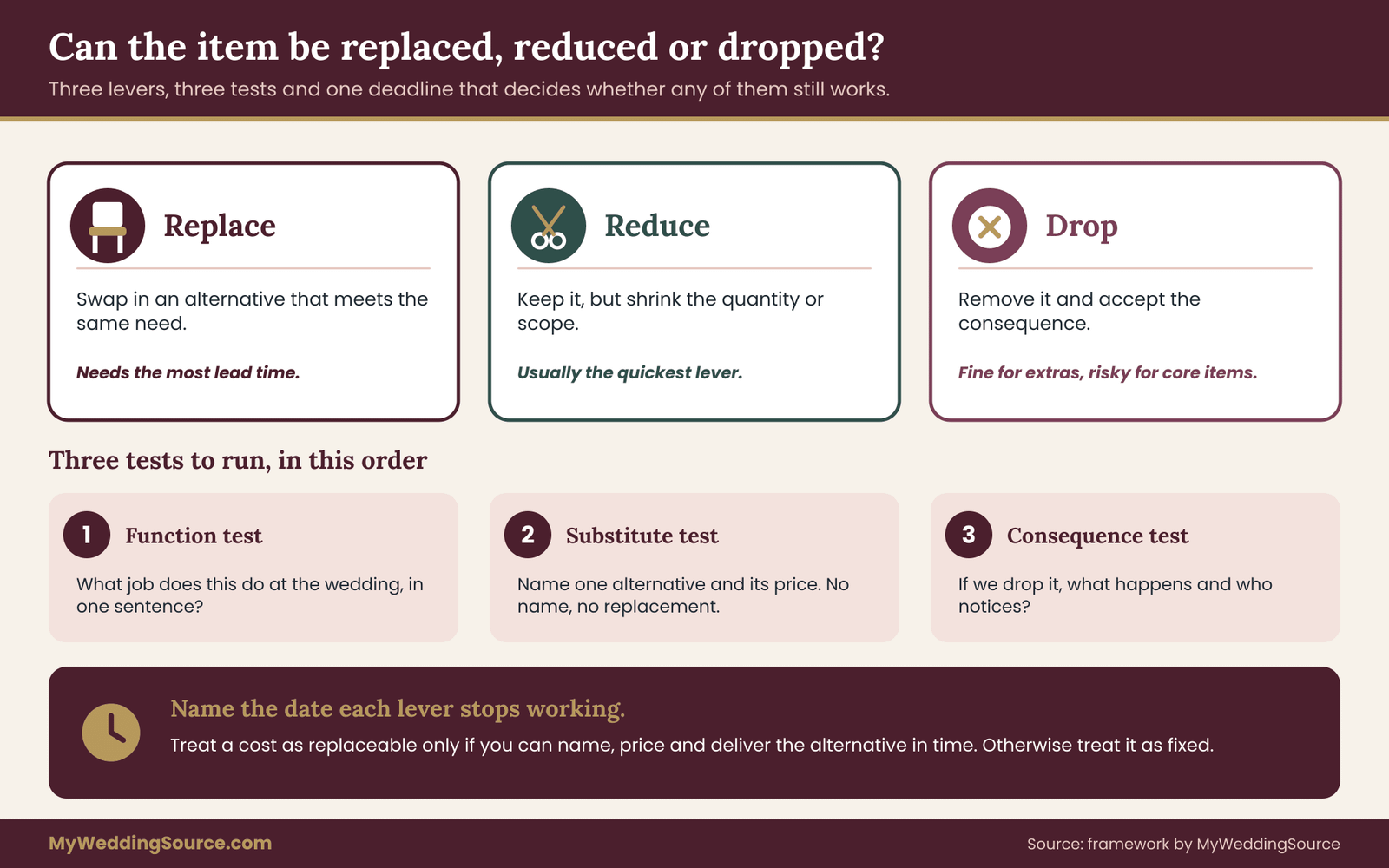
Think of flexibility as having three levers. You can replace the item with an alternative that meets the same need. You can reduce the quantity or scope so the cost falls. Or you can drop the item altogether and accept the consequence. Each lever has its own deadline, and the deadline is half of the answer.
Replace. Swap in something different at a lower cost that still meets the need. A florist substitution that uses a more available stem is a replacement. So is borrowing a part of a decoration set from family instead of renting it. Replacement usually needs the most lead time, because the alternative has to be found, approved and delivered.
Reduce. Keep the item but shrink it. A rental order can drop a few chairs. A cake can lose a tier if the guest count fell. A bar package can lose an hour. Reduction is often the quickest lever, because it only requires the vendor to agree, not a new supplier.
Drop. Remove the item completely. If the cost is for a nice-to-have, such as an extra lighting package, dropping may carry no consequence beyond a plainer room. If the item is core, dropping it has a cost of its own, and it may not be an option at all.
The replaceability deadline
Flexibility expires. An item that was replaceable three weeks ago may not be replaceable now, because suppliers have closed their order books, because the final guest count date passed, or because the substitute cannot be delivered in time. When you run question two, name the specific date by which the lever stops working. If that date is today, the item is effectively fixed, no matter how flexible it was in principle.
This is why the order of the questions matters for timing. Run question one first because it is quick, and run question two as soon as you know the cost is owed. If the replaceability deadline is close, spend your first hour on that, not on drafting a perfect email about the invoice.
Three tests for replaceability
Use three plain tests, in this order, and write the answers beside the cost in your draw log.
First, the function test: what job does this item do at the wedding, in one sentence? A job described as having flowers in the room can be met many ways. A job described as getting the guests to the ceremony on time may have only one workable answer. Second, the substitute test: name at least one alternative and its price.
If you cannot name one, the item is not replaceable in practice. Third, the consequence test: if we drop it, what actually happens, and who notices? If the honest answer is that guests will not notice, the item is probably droppable.
A simple rule for the gray cases
Many costs are neither clearly replaceable nor clearly fixed. A useful rule is to treat the cost as replaceable only if you can name an alternative, price it, and confirm it can arrive in time, all before you commit. If any of the three is missing, treat the cost as fixed. This rule guards against the hopeful assumption that something cheaper will turn up, a hope that tends to expire exactly when the deadline does.
The reverse also holds. If a cost is plainly optional, do not dress it up as an emergency to justify a draw. Costs that sound urgent because of the date, not because of the function, are the ones that most often drain a contingency reserve for no good reason. A plainly optional cost can wait until after the wedding, when you know whether any money is left over.
The four draw rules for your contingency reserve
With the two questions answered, the rules are short enough to fit on one page. Each rule names a quadrant, says what to do, and sets the approval needed. Write them in your own words, agree on them together and keep the page with your vendor files. The aim is that nobody has to remember them under pressure.

Rule one: owed and fixed costs draw automatically
When a cost is owed under a document and no cheaper route exists, it comes out of the contingency reserve without a discussion. Either partner can authorize it, provided the draw is logged the same day with the cost, the clause it rests on, the date and the new balance.
This rule exists to save your energy. Costs in this quadrant include per-guest increases after the final count date, an hourly overtime rate you agreed to, a fuel or administrative surcharge written into a contract, and a damage or replacement fee for something that was actually broken. You may not like these charges, but you agreed to them, and delaying payment only adds stress and sometimes late fees.
Before drawing, do the two checks that take a minute. Confirm the arithmetic matches the contract, and confirm the trigger really occurred. Then pay and log. If the check turns up a mismatch, the cost moves to a different quadrant, usually the owed but flexible one, because now you have something to negotiate.
Rule two: owed but flexible costs get one negotiation first
When a cost is owed but the item can be replaced, reduced or dropped, you pause. You have one scripted attempt, ideally within two business days, to lower the cost before drawing. The attempt takes one of three forms: ask for a substitution, ask for a reduction in scope, or ask for a courtesy adjustment.
A substitution request is a specific alternative. A reduction request names exactly what to remove. A courtesy adjustment is the softest, and it works best when you have been a clear, prompt and polite client. Vendors have discretion in many cases, and they are more likely to use it for a client who asks plainly than for one who sends an angry message.
“We understand the increase applies under our agreement. Before we approve it, is there a comparable option at a lower cost, or a way to reduce the scope? We would like to keep the overall result the same.”
If the vendor offers a workable alternative, take it and draw only the new, smaller amount. If not, draw the full amount and log what you tried. The log matters. Over several draws, it shows which vendors are flexible, and it is useful information if you ever write a review or recommend them to friends.
One caution. Do not let the negotiation drift past the replaceability deadline. If the vendor is slow to reply and the lever expires, the cost converts to owed and fixed, and you pay it. Set a two-business-day limit on the first reply, and decide in advance what you will do if silence arrives.
Rule three: urgent costs you do not owe get a capped draw
Some surprises have no contract behind them. A zipper fails an hour before the ceremony. A speaker stops working. A vendor employee gets sick and a replacement is needed on short notice. These are genuine needs, but the contract question comes back no, and the cost is urgent.
The rule is a spending limit. Decide together, in advance, a per-item cap that either partner can authorize alone, without asking the other, because during the event or the final week the other partner may be unreachable. Anything above the cap needs both of you, or a person you named in advance.
How do you set the cap? Use the replaceability question in reverse. Ask what single repair or replacement you would be willing to pay for without hesitation if it saved the day. For many couples that number is small relative to the whole budget, and that is the point. A cap should be big enough to fix ordinary problems and small enough that no single impulsive decision damages the reserve.
Another way to see it is as a quick-action allowance. The cap is not a target. It is a ceiling that protects speed. If the best fix costs less, you pay less. If the best fix costs more, you stop and decide together, and the pause is worth it. You can also name a trusted person, such as a planner or a family member who is not in the wedding party, who may approve draws on the day if neither of you can be reached.
Rule four: optional wants never touch the contingency reserve
This rule is the one that protects every other rule. If a cost is not owed and not urgent, it does not come from the contingency reserve. Period. This includes upgrades, new ideas, additional decor, bonus time and anything you want rather than need.
Does that mean you can never spend on a want? No. It means wants are paid from a separate source. Two sources work well. The first is an upgrade pot, a small, clearly named sum you set aside at the start. When it runs out, wants stop. The second is the leftover after the wedding, which is a nice way to treat yourselves when you know what remains. Some couples use the leftover for a honeymoon extra or an anniversary dinner rather than a decor upgrade, and that is a perfectly good use of a surplus.
The reason for a hard rule is practical. A reserve that can be spent on wants will be, and it will happen slowly and with good reasons each time. A hard rule means you never have to re-argue it. When one of you says it would be so nice to have this, the other can answer kindly that it is a want, and the want pot has room or it does not.
How the rules handle two costs at once
Sometimes two surprises arrive in the same week, and the contingency reserve cannot cover both. The rules help here too, because they set an order. Owed and fixed costs go first, since delay can create late fees or put a vendor relationship at risk. Urgent unowed costs go second, within the cap. Owed but flexible costs go third, once the negotiation has run its course. Optional wants are never in the queue.
If the contingency reserve cannot cover the owed and fixed costs, you have a different problem, which is a planning gap, not a draw problem. The right response is to look at the planned budget for flexible lines to trim, not to start borrowing without a plan. A cash-flow view of deposits and balances shows where timing and shortfalls collide, so you can decide calmly.
Two partners, two approval levels
Decide on three approval levels and write them down. Level one is any single cost under the cap in the urgent quadrant: either partner may act. Level two is any cost above the cap, or any owed but flexible cost where a negotiation is still open: both partners confirm, even if by a short message. Level three is any draw that would bring the contingency reserve below a floor you set, for example below the amount you want to keep for the final week: both partners confirm and you review the plan for the remaining weeks.
The floor matters more than it might seem. A reserve that is spent evenly in the first half of the planning period leaves nothing for the last two weeks, which is when many of the costs actually arrive. Setting a floor that rises as the wedding approaches protects the late surprises. A simple version is to say that after the final guest count date, at least half of the original reserve must remain unless both of you agree otherwise.
Writing the rules on one page
A one-page version of the rules might read, in your own words, something like this: owed and fixed costs, we draw and log; owed but flexible costs, we ask once, then draw; urgent costs we do not owe, either of us may spend up to the cap, and both decide above it; wants come from the upgrade pot or from the leftover. Add the cap amount, the floor, the contingency reserve balance and the name of a backup approver. Keep it with your vendor files, and read it together when the first surprise arrives, not the tenth.
Writing the rules is also a useful conversation to have even before any surprise shows up. It surfaces differences in how the two of you think about money. One partner may want a high cap because speed matters, while the other wants a low cap because every draw feels like a loss. Better to find that out while planning than while standing in a hallway with a broken sound system.
What the rules do not decide
The rules sort costs. They do not decide whether a vendor is behaving fairly, whether a contract was well written or whether you should have chosen a different supplier. Those are separate questions. The rules assume you already hold an agreement and are trying to handle the bills that come from it. If the bills reveal that the agreement was unclear, the right response is to note it for your own learning and, where it matters, to raise it with the vendor, not to bend the reserve rules to compensate.
Sizing and timing the contingency reserve
The size of the contingency reserve is a decision you can make with reasoning rather than a rule of thumb you copy from a forum. The reasoning starts with exposure: how much of your budget is genuinely uncertain, and how likely is it to move.
Start with the exposed lines
Go through the planned budget and mark each line as fixed, formula-based, conditional or discretionary, using the same grades from question one. A flat-rate venue fee paid in full is mostly settled. A per-person catering price multiplied by a guest count that is not final is exposed. A rental order with a damage waiver is conditionally exposed. A rental of linens with a cleaning clause is exposed to condition.
Total the exposed lines. That sum is the part of your budget that can still move. The contingency reserve does not need to cover all of it, because not every exposed line will move and not every one will move fully. It needs to cover a realistic share of the movement, and you decide what counts as realistic by looking at the specific lines.
Estimate movement, not percentages
Rules of thumb that say to set aside a stated percentage of your budget are common, and they are not wrong so much as blunt. Two couples with the same total budget can have very different exposure. A couple with a small guest count at a venue that includes everything may face little movement. A couple with a large, uncertain guest list and several hourly or per-person charges may face a lot.
A better habit is to estimate movement for the main exposed lines in plain terms. If the guest count could rise by a handful of guests, multiply the per-guest price, including any service charge, by that handful. If the night could run a half hour or an hour over, use the contract’s overtime rate. If rental items could be damaged, use the damage waiver or replacement terms. Add those, then add a modest amount for things you cannot foresee. The result is a number tied to your actual contracts.
Timing: when the contingency reserve is needed most
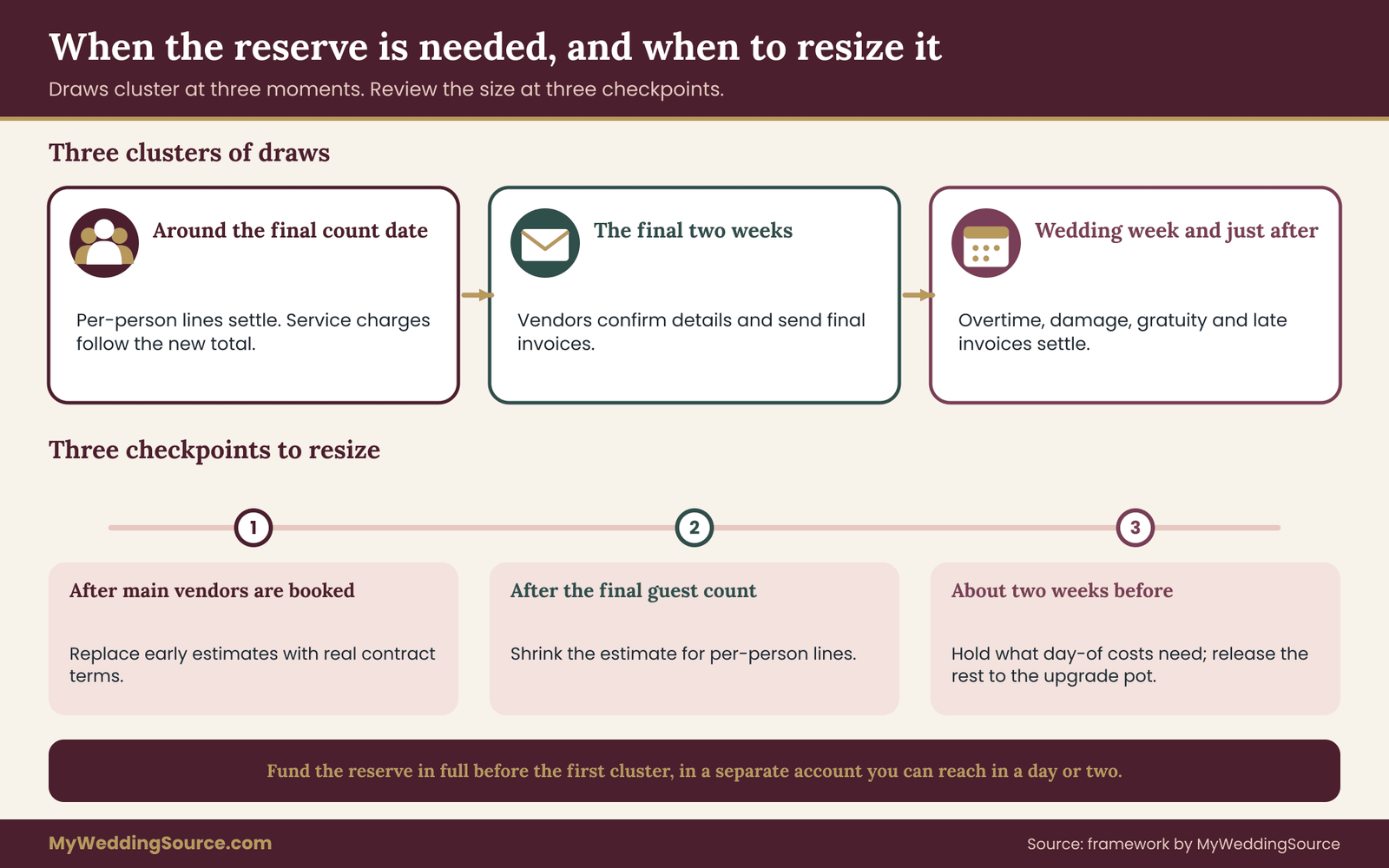
Reserve draws cluster at three moments. The first is around the final guest count date, when per-person lines settle. The second is in the final two weeks, when vendors confirm details and finalize invoices. The third is the week of the wedding and the days just after, when day-of costs such as overtime, damage and gratuity settle.
This clustering has a practical consequence. The contingency reserve should be funded in full before the first cluster, not saved up gradually through the last week. If your cash flow makes that hard, map when each payment is due, and it is better to confirm the timing early than to find a gap in the final fortnight.
Where to hold the money
Hold the contingency reserve somewhere safe, accessible and separate. A savings account at an insured bank or credit union is a common choice, and the Federal Deposit Insurance Corporation explains how deposit insurance works and what the current limits are. Check the current figures with the FDIC or your institution rather than assuming. Separate means a distinct account or a clearly named sub-account, so the reserve cannot be spent by accident when you pay a deposit from your everyday account.
Accessible means you can move the money within a day or two. A reserve locked in a product with a penalty for early withdrawal defeats its purpose, because the draws that matter most are the ones that come with short notice. If you must keep some of it in a slower account, keep the part that covers owed and fixed costs in the fast one.
Revisit the size at three checkpoints
Do not set the size once and forget it. Review it at three points. At the first checkpoint, after the main vendors are booked, confirm the contingency reserve against the real contracts instead of the early estimates. At the second, after the final guest count, shrink the exposure estimate for per-person lines because the number is known. At the third, about two weeks before the wedding, compare the remaining exposure with the contingency reserve balance and decide whether any of it can be released to the upgrade pot or must be held for day-of costs.
A worked example: one reserve, eight charges
The example below is invented to show the method. The couple, the vendors and the amounts are illustrative, and your own documents will differ. Treat it as a model for the reasoning, not as a guide to what any real vendor charges.
Imagine a couple, Tomás and Priya, planning a wedding for about ninety guests with a planned budget of thirty thousand dollars. They hold a contingency reserve of three thousand dollars in a separate savings account. They also keep a small upgrade pot of five hundred dollars, a spending cap of one hundred fifty dollars per urgent item that either of them can approve alone, and a floor of fifteen hundred dollars that applies after the final guest count date.
Their rules are the four from the previous section, written on one page and stored with their vendor files. Their draw log has a line for each event: date, cost, clause or reason, quadrant, decision, amount drawn and new balance.
Charge one: the guest count rises
Ten weeks before the wedding, the final count date arrives. Four more relatives confirm, and the guest count moves from ninety-two to ninety-six. The caterer’s contract states a per-guest price of seventy-eight dollars and a service charge of twenty percent on food and beverage.
Question one: obligated? Yes. The price and the service charge are written down, and the trigger, a count increase after the final date, occurred. The grade is formula. Question two: can the item be replaced or dropped? Not at this point, because the relatives are coming and the count is closed. Quadrant: owed and fixed.
The arithmetic is four extra guests at seventy-eight dollars, which is three hundred twelve dollars, plus twenty percent, which brings the cost to three hundred seventy-four dollars and forty cents. They check it against the contract, draw it and log it. Reserve balance: two thousand six hundred twenty-five dollars and sixty cents.
Charge two: the florist substitution
Six weeks out, the florist writes that the chosen peonies are not available in the quantity needed. The contract lets the florist substitute and pass along any price difference, and the proposed substitute carries an extra one hundred eighty dollars.
Question one: obligated? Partly. The substitution right is in the contract, but the amount is the florist’s proposal. Grade: formula, with room to question the price. Question two: replaceable? Yes, a different flower can meet the same function, which is to have full, soft arrangements in the right colors. Quadrant: owed but flexible.
They use their one scripted negotiation and ask whether a more available stem in the same palette would lower the cost. The florist proposes ranunculus for an extra ninety dollars. Because the look is close, they accept and draw ninety dollars. Reserve balance: two thousand five hundred thirty-five dollars and sixty cents. Note the saving: the first quote would have cost ninety dollars more than the final.
Charge three: the shuttle surcharge
Four weeks out, the shuttle company sends a revised invoice with a fuel surcharge of one hundred twenty dollars. The contract includes a fuel clause tied to a stated rate. Tomás checks the clause and the rate on the date stated and confirms the arithmetic.
Quadrant: owed and fixed. Question two has no answer worth the time, because the guests need the shuttle and no other provider is available on the date. Draw one hundred twenty dollars, log it. Reserve balance: two thousand four hundred fifteen dollars and sixty cents.
Charge four: the second photographer
Three weeks out, Priya suggests adding a second photographer for six hundred dollars to capture both families arriving. The photography contract does not require it, and the main photographer has said coverage is already planned.
Question one: no. Question two: the need is a preference, not a function that will fail. Quadrant: not owed and optional. The contingency reserve does not pay for it, and the upgrade pot has only five hundred dollars, so the answer is no. They agree to ask a friend to take a few extra arrival photos instead. This is rule four doing its job: the want met a boundary, and nobody had to say whose idea was better.
Charge five: the hair trial
Two weeks out, one of them wants a second hair trial for one hundred ten dollars. Again, not owed, not urgent. They pay it from the upgrade pot, which drops to three hundred ninety dollars. The contingency reserve is untouched.
Charge six: the zipper
On the wedding day, a dress zipper fails in the hour before the ceremony. A local tailor on call can repair it for ninety-five dollars.
Question one: no contract covers it. Question two: it cannot be dropped, and there is no cheaper alternative in the time available. Quadrant: not owed but urgent. The cost is under the cap of one hundred fifty dollars, so Priya authorizes it herself. She logs it that evening. Draw ninety-five dollars. Reserve balance: two thousand three hundred twenty dollars and sixty cents.
Charge seven: overtime
During the reception, the room is full and the dancing is good. The venue contract allows extra time at two hundred dollars per half hour, and the night runs half an hour over.
At the moment of the decision, the cost is owed but flexible, because they could end on time. They had agreed in advance that one half hour of overtime was acceptable if both of them wanted it, and they both said yes on the dance floor. After the event, the cost is owed and fixed. They draw two hundred dollars. Reserve balance: two thousand one hundred twenty dollars and sixty cents.
Charge eight: the linen cleaning fee
The week after the wedding, the rental company sends an invoice with a sixty-five dollar linen cleaning fee. The contract says the fee applies only if linens are returned beyond a stated condition. The couple’s return receipt shows the linens were counted, folded and accepted by the rental company’s staff.
Question one: conditional, and the condition did not occur. They do not draw. They send a short message with the return receipt and ask for a corrected invoice. The company removes the charge. The draw log shows the line with an amount of zero and a note of disputed and resolved.
Closing: the final reconciliation
Two weeks after the wedding, they compare every vendor invoice with its contract and payment record. Everything matches. The reserve is closed with a balance of two thousand one hundred twenty dollars and sixty cents, which moves to savings as leftover. They decide to use part of it for an anniversary trip and keep the rest.

What the example shows
Count what happened. Of the eight charges, four drew from the contingency reserve in full or in part, one drew a reduced amount after a negotiation, one was refused outright, one went to the upgrade pot, and one was recovered after a dispute. The contingency reserve was never below the floor, and nobody argued about taste. The total drawn was eight hundred seventy-nine dollars and forty cents, less than a third of the contingency reserve.
Two lessons are worth drawing out. First, the contingency reserve was large enough to absorb the real surprises, and it stayed intact because wants were kept out. If the second photographer and the hair trial had come from the reserve, the balance would have dropped by seven hundred ten dollars for costs nobody owed.
Second, the log is what made the closing calm. At the end, each line showed what was drawn, why and under which rule. If a vendor had later claimed that something was unpaid, the couple could have answered with dates and documents instead of memory.
Variations on the example
Change one assumption and the outcome shifts, which is a good way to test your own rules. Suppose the final count had risen by twelve guests instead of four. The cost would have been about one thousand one hundred twenty-three dollars at the same price and service charge, and the floor rule would have required a conversation about whether the contingency reserve should be topped up or whether the planned budget had room to trim. The contingency reserve rules would not have solved the problem, but they would have named it early.
Suppose instead the florist had refused any alternative. The cost would have moved from owed but flexible to owed and fixed, and the full one hundred eighty dollars would have been drawn. The negotiation still would have been worth the attempt, because the attempt costs nothing and the log records it.
Suppose the zipper repair had cost three hundred dollars because the tailor had to rebuild the seam. That amount is above the cap, so Priya would have called Tomás or the named backup approver before agreeing. A short call is a small price for keeping the cap meaningful.
Edge cases where the rules bend
No set of rules covers every situation, and a few recurring ones deserve their own treatment. In each case, the two questions still apply. What changes is how you read the answers.
A vendor cancels or does not show
A vendor failure is a special case because the cost you now face is a result of someone else’s breach, not a cost of your own choosing. Question one is partly reversed: you may be owed a refund or a remedy. Question two: you must replace the service, usually quickly, at a market price that may be higher than the original.
Treat the replacement as a capped or both-approve draw depending on the amount, and treat the lost payment as a recovery task. Record the original deposit and the contract’s cancellation or non-performance terms, and ask in writing for a refund or credit. If the vendor accepted a deposit and the contract is silent, the state attorney general’s consumer protection office and the Federal Trade Commission accept complaints about vendors who take payment and do not perform.
The cost of the replacement is drawn from the contingency reserve, the possible refund is marked as pending in the log and, if it arrives, returns to the contingency reserve.
A short preparation helps here. The wedding day digital contingency plan guide covers keeping contact details, confirmations and backups reachable, which matters when a vendor goes silent and you need a replacement quickly.
A vendor raises the price without a clause
Sometimes a vendor announces a price increase for a reason that appears nowhere in your agreement: costs went up, a staff member left, a supplier changed terms. Question one comes back no, or at best unstated. Many couples draw from the reserve at this point because the vendor sounds firm and the wedding is near, and that is the moment to slow down.
Ask the vendor to point to the clause that allows the increase. If none exists, a signed price is generally the price, though the legal position depends on the contract and the state, and a contract attorney or a legal aid clinic is the right place to ask. In practice, many vendors drop an unsupported increase once you ask politely in writing.
If the vendor insists and you decide to pay to keep the relationship stable, treat it as a not owed but urgent draw: capped, both-approve if large, and logged as paid under protest. Note that phrase in the log so the amount can be revisited after the wedding.
Weather and outdoor plan changes
An outdoor wedding with a tent or indoor backup can generate costs that no one wanted to predict. A tent order may be placed at the last moment, heaters may be needed or a venue may charge to flip a room.
Run the two questions. If the contract with the venue or the tent company gives the cost as a stated fee for a stated trigger, such as a weather decision made by a stated time, it is owed and fixed once the trigger occurs. If the cost is a new item you decide to add, such as heaters for guest comfort, it is not owed.
Whether it is urgent depends on the actual need. Comfort in cold weather is arguably a function and not a preference, but the choice of how much to spend on it is flexible, so the capped draw with a both-approve limit fits well.
The practical lesson is to read the weather terms before the forecast is a worry. Know the decision time written into the contract, the cost of switching and who calls it. A reserve is easiest to use well when the decision time and cost are known in advance.
The guest count falls instead of rising
Surprises are not always increases. A drop in the guest count can create credits, minimums and penalties. A caterer with a minimum spend may not reduce the bill when guests cancel. A rental order may be adjustable until a deadline and fixed afterward.
Here the two questions help with a different job: deciding whether to pay the minimum or negotiate a swap. If the contract sets a minimum and the guest count falls below it, the shortfall is owed, but it is also flexible. The caterer may agree to upgrade the menu, add an appetizer course, or let you apply the difference to something you actually want. That is a better use of money you will pay anyway than a simple loss. Treat any such swap as a negotiation under rule two and log the result either way.
Taxes, service charges and gratuity
Costs that look small at the line level add up in the total. Sales tax rules differ by state and sometimes by item, and service charges and gratuity are treated differently from one vendor to the next. A service charge may or may not include gratuity for staff, and the contract should say which.
If your contingency reserve rule says owed costs draw automatically, then the question is whether the final invoice follows the contract. Add up the pieces. A percentage applied to a total that already includes another percentage will give a different number from a percentage applied to the base. Ask the vendor to show the calculation if it looks off.
Where tax is concerned, your state revenue department explains what applies in your state, and the Internal Revenue Service publishes general guidance on tax topics, but it is the contract and the invoice that settle what you owe the vendor.
Gratuity deserves its own line in the planned budget. If the contract does not require it and you plan to tip, it is a planned cost, not a reserve draw. Drawing on the contingency reserve for expected tips is one of the ways reserves quietly drain.
Card surcharges and payment fees
Some vendors add a fee for paying by card, or charge a fee for payment plans. Rules on card surcharges vary by state, and the amount allowed is limited by card network rules, so the right move is to ask before paying and to check with your state attorney general’s office or your card issuer if you are unsure. If the surcharge appears in your contract, it is owed. If it appears for the first time on an invoice, it is unstated.
You may be able to avoid the fee by paying another way. That makes it a replaceable item, and the sorted result is owed but flexible. Ask whether a check or bank transfer carries no fee, then weigh that against the protection a card gives you. Credit card billing-error rights, explained by the Consumer Financial Protection Bureau, are one reason couples choose to pay larger deposits by card even at a small cost. The decision is yours, and the contingency reserve should not silently absorb a fee you could have avoided by choosing differently.
Family contributions and shared money
When parents or relatives contribute, they sometimes expect a say in how reserve money is spent, or they cover a surprise cost directly. Decide early how contributions interact with the contingency reserve. A gift to the wedding generally belongs in the planned budget or the contingency reserve according to what the giver intended, and the intention is worth asking about plainly.
If a relative offers to cover a surprise cost on the day, note it in the log. A payment from a third party for a not owed but urgent cost reduces the draw but does not change the quadrant. Record who paid, the amount and whether any repayment is expected. Misunderstandings about money between families last longer than most wedding decisions, and a log entry is the cheapest way to prevent one.
The wedding decision rights guide covers how couples and families can share input without losing control, which is relevant when someone with a financial stake wants a voice in draw decisions. A sound pattern is to let contributors know the rules, not to give them veto power over individual draws.
Insurance and claims
If you bought event insurance, a surprise cost may be partly recoverable. Policies differ widely in what they cover and exclude, and they usually require notice within a stated time and documentation of the loss. The National Association of Insurance Commissioners and your state insurance department explain policy basics and how to file a complaint.
For reserve purposes, assume insurance is slow and uncertain. Draw from the contingency reserve first for the owed and urgent costs, file the claim promptly with the documents the policy asks for, and mark the draw as claim pending in the log. If the claim pays, the amount returns to the reserve. If it does not, you have lost nothing you had not already planned to lose. Do not delay a needed payment while you wait for an insurer’s answer, because delay can create new costs.
Refundable deposits and damage holds
Many venues and rental companies take a refundable deposit or place a hold on a card against possible damage. These are not reserve draws. They are money that belongs to you and is temporarily held, and mixing them with the contingency reserve makes both harder to follow.
Track them in a separate line with the expected return date. If part of a deposit is withheld for a reason you accept, such as a clearly damaged item, then the withheld amount is an owed and fixed cost, drawn from the contingency reserve only if you were not planning for it in the budget. If part is withheld for a reason you dispute, mark it disputed and follow the same documentation habits as any other disagreement. Ask for the reason in writing and for photographs or other evidence where condition is the claim.
When the cost is shared with another event
Some weddings involve related events: a rehearsal dinner, a welcome gathering, a morning-after brunch. A surprise on one event can be mistaken for a surprise on the main wedding. Decide which budget each event belongs to and which reserve, if any, covers it. A single reserve for several events is workable, but each draw should name the event it served so the log stays readable.
Disagreement between the two of you
Sometimes the rules do not resolve a disagreement because the two of you read the answers differently. One partner thinks a cost is urgent, the other thinks it is a want. Use a tie-break you set in advance. A simple one is that when you disagree about the quadrant, the cost waits twenty-four hours and goes to the cheaper alternative if one exists.
Another is to name a trusted third person, perhaps a planner or relative, who breaks ties. The tie-break matters less than having one, because an agreed method keeps the disagreement from turning into a verdict on whose judgment is better.
When the contingency reserve runs out
Occasionally the contingency reserve is spent and another surprise arrives. Resist the urge to treat the planned budget as a second reserve without a decision. Look at the planned lines and ask which can be reduced, replaced or dropped without harming the day, using question two on the budget itself. Then decide together whether to trim, pause a want or move money from another goal. The planned budget lines you marked as flexible earlier are the place to look first.
If the shortfall is larger than trimming can cover, you are making a financing decision, and that deserves a separate, unhurried conversation. The Consumer Financial Protection Bureau publishes plain-language material on the costs of credit, which is a better starting place than a vendor’s payment plan offered in a hurry. This guide does not give borrowing advice, and the rule remains that no draw happens outside the rules without both of you agreeing.
Keeping a draw log and closing the contingency reserve
A reserve without a record is a feeling with a balance. The log is what turns the rules into something you can check, share and learn from. It does not need software. A shared note or a simple sheet works if both of you will actually use it.

What each log line holds
Keep each entry short and the same shape every time. Record the date, the vendor or source, the amount and what triggered it. Then record the answer to question one in a few words, with the clause or document that supports it. Then the answer to question two, with the alternative you considered. Then the quadrant, the decision and the approver. Finally, record the amount drawn and the new reserve balance.
Add two optional fields that earn their place: a status and a recovery note. The status says whether the draw is final, disputed, claim pending or paid under protest. The recovery note says what must happen for money to return, such as a corrected invoice, a refund or an insurance payment. These two fields turn the log from a list of costs into a list of open tasks.
Habits that keep the log honest
Log the same day, before the memory of the reason fades. A one-line entry made at the time is worth more than a detailed one reconstructed a month later. If a draw happens on the wedding day, make the entry that night, even if it is only the amount and the word zipper.
Attach the document. Save the invoice, the email or the photo in the vendor file and write the file name in the log. When someone asks later why a charge was paid, the answer is one click away.
Review the log together at fixed points: after each vendor final invoice, at the three checkpoints for sizing and in the week after the wedding. A five-minute review prevents the quiet drift where one partner knows the balance and the other does not.
Spotting patterns while you still have time
The log is also an early warning. If three draws in a row come from the same vendor, the contract may be weaker than you thought, and it may be worth a conversation about the remaining invoices. If most draws land in the owed but flexible quadrant, your negotiation habits are working and you may be able to release a little of the reserve later.
If many land in the not owed but urgent quadrant, the plan may be missing a function, such as an on-site helper or a repair kit, that costs less to add now than to patch repeatedly.
If most draws land in the owed and fixed quadrant, the planned budget may have been optimistic about formula costs. That is useful to know before the final invoices arrive, and it is a reason to recheck the remaining per-person and hourly lines against their contracts.
The after-wedding reconciliation
After the wedding, every draw needs a final check. Compare each vendor’s final invoice with its contract and with the payments you made. For each draw in the log, confirm that the amount matches the invoice, that the status is final and that any recovery task is closed. For each disputed or pending item, decide whether to keep pushing, accept the result or close it with a note.
Keep this separate from emotions about the day. Some couples want to avoid paperwork after a wedding, which is understandable. A short, scheduled session, say one evening within two weeks, is enough for most files. The wedding records after the event guide shows how to organize contracts, receipts and deadlines once the wedding is over, and it fits naturally with this reconciliation.
Watch the deadlines that run from statement dates. A credit card billing error is generally something you must raise in writing within a limited window after the statement that shows it, so do the reconciliation while those windows are still open. The Consumer Financial Protection Bureau describes the process, and your card issuer sets the practical steps.
Releasing what is left
When all draws are final and all recovery tasks are closed, the remaining balance is leftover. Decide in advance what happens to it, ideally before the wedding. Common choices include returning it to savings, putting it toward a honeymoon, covering thank-you costs such as printing and postage, or setting aside a small share as a first-year household cushion.
Be careful about one thing. Do not release the contingency reserve too early. A vendor invoice can arrive after the wedding, a claim can be reopened, and a refundable deposit can be partly withheld weeks later. A sensible rule is to hold the contingency reserve until the last vendor file is closed or a stated date passes, whichever you choose, then release it. The date is yours to set. Your vendor contracts and your records will show when the last obligation ends.
Teaching the rules to helpers
If a planner, a relative or a trusted friend will handle things on the wedding day, give them a short version of the rules. They do not need the log. They need to know the cap, who may approve above it and who to call. A single index card or a note in their phone is enough.
Most helpers appreciate the clarity. A helper who knows that anything under the cap is fine and anything above needs a call can act quickly and confidently. A helper who does not know the limit either freezes or spends too much, and both outcomes are avoidable.
What a good reserve looks like at the end
You will know the contingency reserve worked if three things are true. First, no surprise forced a scramble, because each one had a place to go. Second, nobody felt pressured to approve something they did not understand, because the rules decided the path. Third, you can explain every draw in a sentence, with a document to support it. Whether the contingency reserve was spent or not is less important than whether it was used on purpose.
If a good deal of it remains, that is not a sign you set it too high. Uncertainty was resolved in your favor, and exposure estimates are estimates. Use what you learned to size the next reserve you ever need, whether for a move, a renovation or any large plan where costs are uncertain. The method carries over unchanged: grade the obligation, test the flexibility, set the rules before the bills arrive and keep a record.
A one-page template in words
For convenience, here is the structure of the one-page rule sheet, described in prose so you can copy it into your own notes. At the top, put the contingency reserve amount, the account where it sits and the date it was funded. Next, list the four rules in one sentence each. Then add the cap, the floor and the three approval levels.
After that, name the backup approver and the tie-break method. Finish with the leftover plan and the date after which the reserve may be released. Both partners initial it, or reply to it in a shared message, so there is a record that you agreed.
Your next steps
You can set this up in about three evenings, and none of it needs special tools. The order below keeps the effort small and puts the most protective steps first.
Evening one: write the rules. Sit down together and agree on the four rules, the cap, the floor, the backup approver and the tie-break. Write them on one page and save it with your vendor files. If you disagree on the cap, start low and revisit it after the first surprise.
Evening two: grade your contracts. Open each vendor file and note the obligation grades for the costs that could still change: per-person prices, overtime rates, surcharges, damage terms and cancellation windows. Write the deadline beside each one. Where a clause is missing or unclear, send the vendor a short written question now, while you have time to act on the answer.
Evening three: size and fund the contingency reserve. Total your exposed lines, estimate the realistic movement for each and add a modest amount for the unforeseeable. Open a separate account or named sub-account and move the money, using the deposit and balance timing in your cash-flow plan to decide when it must be in place. Then create the draw log with the fields described earlier and enter the opening balance.
After that, keep the habit small. Log each draw the day it happens. Review the log after each final invoice. Re-run the sizing at the three checkpoints. And when the wedding is over, do the reconciliation within two weeks, while the statement windows are still open.
FAQ
What is a wedding contingency reserve?
It is a defined sum, held apart from your spending accounts, that you may use only for unplanned costs that meet written draw rules. It is not the line for expenses you forgot, an upgrade fund, your household emergency savings or borrowed credit. Its value comes from having a set amount and set rules before any surprise arrives, so decisions under pressure follow a plan instead of a mood.
Which expenses should trigger a draw from the contingency reserve?
Costs you owe under a contract or accepted policy, such as a per-guest increase after the final count or a stated overtime rate, should draw once you confirm the arithmetic. Urgent costs you do not owe, such as an emergency repair, can draw up to a pre-agreed cap. Costs that are owed but negotiable should get one attempt at reduction first. Wants should not draw at all.
How much should a wedding contingency reserve be?
There is no single correct figure, and a flat percentage ignores how exposed your own contracts are. Start with the lines that can still move, such as per-person prices, hourly overtime and conditional damage fees. Estimate realistic movement for each, using the rates in your contracts, then add a modest amount for the unforeseeable. Review the size after the main bookings, after the final guest count and about two weeks before the wedding.
Should upgrades and new ideas come out of the contingency reserve?
No. An upgrade is a preference, not a surprise, and a reserve that can fund preferences will be spent on them. Keep a small, separate upgrade pot for wants, or wait until the wedding is over and the leftover is known. When the pot is empty, wants wait. This single rule protects the contingency reserve for the owed and urgent costs it was created to cover.
What if a vendor adds a charge that is not in the contract?
Ask in writing which clause allows it and request an itemized breakdown. Many vendors withdraw or reduce charges they cannot support. If you decide to pay to keep the peace, treat it as a capped draw and log it as paid under protest so you can revisit it later. For disputes you cannot resolve, the Federal Trade Commission and your state attorney general accept consumer complaints.
Can two partners both approve reserve draws?
Yes, and you should set levels in advance. Either partner may approve urgent costs below the agreed cap. Anything above the cap, any draw with a negotiation still open and any draw that would take the contingency reserve below your floor needs both of you. Name a trusted backup approver for the wedding day in case neither of you can be reached quickly.
Does wedding insurance replace a contingency reserve?
No. Event insurance covers defined events under defined terms, exclusions can be broad, and claims can take time to pay. Plan to cover a cash gap from the contingency reserve, file any claim promptly with the documents the policy requires, and mark the draw as claim pending. If the insurer pays, the money returns to the reserve. Your state insurance department can explain policy basics and complaint options.
When can we release the leftover reserve?
Release it only after every draw is final, disputed items are resolved or closed and the last vendor file is finished. A late invoice, a reopened claim or a partly withheld deposit can arrive weeks after the wedding. Set a release date before the wedding, check your contracts for the last obligation that could still produce a charge, and decide in advance how the leftover will be used.
Sources
- Consumer Financial Protection Bureau: credit card billing disputes, credit costs and consumer financial guidance.
- Federal Trade Commission: consumer protection, unfair charges and how to file a complaint.
- FTC Consumer Advice: plain-language guidance on payments, scams and disputes.
- USAGov: directory of state and local consumer protection offices and attorneys general.
- Internal Revenue Service: general federal tax guidance.
- National Association of Insurance Commissioners: insurance basics and state regulator contacts.
- Federal Deposit Insurance Corporation: how deposit insurance works and current coverage limits.
- Investor.gov: U.S. Securities and Exchange Commission savings and money-management basics.
- Federal Reserve Board: consumer information on credit and payments.