Fake cake tiers are decorated display tiers made of foam or a similar form that guests never eat, and they only work when a real cake is cut and served somewhere behind them. This guide shows how to count the real servings, assign each portion to a source, and hand the cutting off from the display table to the kitchen without a gap.
Treat fake cake tiers as decoration and nothing else. Start from the number of people who will actually eat cake, subtract nothing until you have decided on another dessert, then cover that number with real cake: a small real tier for the cutting, a kitchen cake for the crowd, and a separate small cake for any special diet. Write the count on a one-page handoff sheet that names who moves the cut cake, who removes the display, and who answers allergen questions. Ask your baker and caterer to confirm every number in writing.
Picture the moment most couples care about. The two of you stand at a table with a tall, beautiful cake, a knife with a ribbon on it, and a photographer crouched at the right angle.
What the room does not see is that the bottom two tiers are foam, and that the cake everyone will eat is sitting on a rack in the kitchen, already cut or waiting to be. That arrangement is common, it is perfectly reasonable, and it fails in a few very predictable ways. Nobody is cutting the display, so the cut cake has no route to the kitchen. The kitchen has the wrong count. A guest with a nut allergy asks which cake is which and gets three different answers.
The ordinary reasons for choosing fake cake tiers are practical. A real six-tier cake for a small guest list is expensive and mostly wasted. A tall display photographs well and costs less than the same height in real cake. Some venues and caterers also prefer to cut and plate from the kitchen, because it is faster and cleaner than carving a stacked cake in front of the room. Whatever the reason, the choice moves the real work of serving out of sight, and that is exactly where couples stop paying attention.
This article focuses on one narrow question: how to coordinate the real servings behind the display. It does not repeat the full production schedule, which the guide on planning wedding cake production from final guest count to cutting service already covers from the first tasting to the last plate. Here the scope is the display-to-kitchen handoff and the portion count that sits underneath it.
A note on scope. This is general information, not legal, tax or financial advice. Bakery practices, food safety rules and venue policies differ by place, so confirm the specifics with your bakery, your caterer and your local health department.
What fake cake tiers are and when couples choose them
The phrase covers more than one thing, so a clear definition helps before any counting starts. In wedding work, fake cake tiers are display forms, usually foam or a similar rigid material, that a baker covers in real icing or fondant and decorates to match the rest of the cake. They are sometimes called dummy tiers or display tiers. They have the same silhouette as real cake and none of the servings.
Bakers who use them tend to combine them in one of three ways. Understanding the three setups matters, because the servings math and the handoff are different for each.
All display, with a separate cutting cake. Every visible tier is a form. A small real cake, often called a cutting cake, sits on the same table or on a nearby cart. The couple cuts that cake. The kitchen cake handles everyone else.
Mixed stack. Some tiers are real and some are forms. A common version has a real top tier, which is cut in the ceremony, and forms below it to add height. A less common version puts a real tier at the bottom, in reach of the knife, and uses forms above.
Real cake with display accents. The cake is mostly real and a single foam tier or topper section adds height or a particular shape. Here the servings math barely changes, but the cutting and moving of the structure still need a plan.
Couples reach for these setups for four reasons, and it helps to know which reason is yours.
Cost is the first. A baker prices real cake by the serving, so a tall look for a modest guest list can be disproportionately expensive in real cake. Appearance is the second: some designs, such as very tall, very wide or very ornate stacks, would be hard or unsafe to build entirely in real cake. Logistics is the third, because forms are lighter and often easier to transport and assemble on site. Service style is the fourth. A plated dessert course, a dessert bar or a venue that does not want guests waiting at a cake table all make the display purely visual.
None of these reasons is better than the others, but they point to different mistakes. A cost-driven couple often under-counts the real servings to save money. An appearance-driven couple may forget that the real cutting still needs to look good in photographs. A logistics-driven couple may assume the baker and the caterer have discussed the handoff when they have not. A service-driven couple has the most to coordinate, because the kitchen is serving cake that nobody ever saw on the display.

Two terms will come up repeatedly, so it helps to fix them now. The display is the visible stack, including any fake cake tiers. The kitchen cake is any real cake that is cut and served out of sight. The cutting piece is whatever real cake the two of you cut in front of guests. Sometimes the cutting piece and the kitchen cake are the same cake. Often they are not. A good plan names which is which.
One more point before the counting starts. Fake cake tiers are not a way to avoid thinking about serving. They push the thinking earlier. When the display is real, it is easy to assume the cake will handle itself, because the baker will cut it. When the display is a form, nobody can assume anything. Someone has to decide how many portions exist, where they come from, who cuts them and where they are stored until dessert. That decision belongs on paper before the final guest count is due.
How fake cake tiers change the wedding servings math
With a fully real cake, servings are a property of the cake. The baker’s chart says a tier of a certain size yields a certain number of portions, and you add the tiers up. With fake cake tiers, the visible size of the cake tells you nothing about the real servings. A cake that looks like it could feed two hundred may feed twelve. That gap is the reason this article exists, and it is also the reason guests sometimes ask the wrong question at the wrong moment.
The first change is that the display stops being part of the count. Every portion has to come from something that can actually be eaten. The count therefore starts from people, not from the cake. How many people will plausibly eat cake? What is each person’s portion? Which real cake covers which part of that number? Those three questions replace the usual shortcut of reading the serving chart off the tier sizes.
The second change is that you pay for two things, and you should see them as two line items. One is the decoration: the forms, the icing on them, the matching design work. The other is the food: the real cake, its flavors and fillings, and its cutting and boxing. If the bakery quotes one price for everything, ask for a breakdown. A breakdown tells you whether a cheaper display actually saves money once the kitchen cake is priced properly, and it tells you which part of the quote to cut if the budget is tight.
The third change is that the real servings become less visible, which makes errors harder to catch. In a normal setup, a cake that is too small is obvious: the staff run out at the table. With a kitchen cake, the same shortage shows up later and out of sight, when a server comes back from the kitchen with fewer plates than guests, or when the last tables get cake after everyone else has finished. A shortage that guests can see is still awkward, but a shortage that is only visible in the kitchen has often already happened by the time you hear about it.
The fourth change affects the story the room is told. Guests who see a tall cake will assume they are eating it. Some will assume the cutting is the serving. If the real cake arrives on plates in a different flavor or shape, a few will be confused or disappointed, and a few will ask. A short sentence from the emcee or a small sign near the display turns that confusion into a non-event. Part of the handoff plan is deciding who says that sentence and when.
It is worth being plain about what changes and what does not. Slice size is the same as it would be for real cake. Allergen rules are the same, with one extra consideration for the display, which comes later. Typical catering questions such as plated versus buffet, serving time and the number of servers are the same. What changes is the route a piece of cake takes from the oven to a plate, and the number of people who touch it.
A simple way to see the change
Think of every real serving as having an origin and a destination. The origin is a particular cake: the cutting piece, a kitchen cake, a special-diet cake or a spare. The destination is a plate in front of a guest. In a fully real display, the origin and the first cut are in the same place, so you can often watch the whole path with your own eyes. With fake cake tiers, the origin is behind a door. That means the plan has to carry information that the room cannot see: how many portions exist, where they are, and who is responsible for them at each step.
Here is a small example in prose rather than a table. A couple invites 100 guests, and 92 say yes. Counting the two of them, 94 people are in the room. If the baker’s chart gives 12 servings for the small real tier and 48 for a half-sheet in the kitchen, those two cakes together supply 60. The remaining 34 servings have to come from somewhere, and nobody will see them running short until the plates stop arriving. A worksheet that starts from the 94 and works toward the cakes catches that shortage weeks before the event.
The rest of this article builds that worksheet step by step. The next section helps you decide whether fake cake tiers suit your wedding at all, because the answer depends on what your venue, your caterer and your budget actually allow.
Deciding whether fake cake tiers fit your wedding
Before the counting, a decision. Fake cake tiers are a good answer to some situations and a poor answer to others, and it is cheaper to find out early than after the design is approved. A useful way to decide is to put the idea through four checks, in this order. Each check can stop the plan, redirect it, or let it through.
Check one: does the venue or caterer allow a kitchen cake?
Some caterers are glad to cut and plate a cake from the kitchen. Some charge a cake-cutting fee for it. Some insist that only their own staff touch the cake, and a few venues want outside desserts delivered to a particular door at a particular time. None of this is unusual, and all of it affects whether a display-plus-kitchen plan works.
Ask the catering manager three direct questions. Will you cut and plate cake that a bakery delivers, and what does that cost per person or per cake? Where is there refrigerator or cool storage for the kitchen cake before service, and for how long can it sit out? Who is the person on the day who will receive a cake from the bakery and sign for it? If the answers are vague, the plan has a gap before it begins. The guide on the wedding vendor contract explains how to get answers like these written into the agreement rather than left in an email thread.
Check two: is the saving real?
Fake cake tiers can save money, and they can also cost more than you expect, so test the saving instead of assuming it. Forms must be bought or rented, decorated to match, and sometimes retrieved afterward. The kitchen cake is a second cake with its own flavors, fillings and delivery. A cutting cake adds a third. A simple all-real cake of the same serving count can sometimes cost less than a display plus two real cakes, especially if the design is plain.
The way to check is to ask the baker for two quotes for the same guest count: one for an all-real design and one for the display-plus-kitchen plan, with the display, the cutting piece and the kitchen cake priced separately. Compare the totals, then compare what each totals buys in photographs and in servings. If the difference is small, the simpler plan may be the better one. If it is large, the display plan earns its place. The wedding budget guide can help place the cake line in the context of everything else you are paying for.
Check three: does the design really need the height?
Tall designs are the usual reason couples ask about fake cake tiers. Ask yourself whether the height is the point. For some couples it is, perhaps because the cake is the visual centerpiece or the venue has a high ceiling and a big empty wall. For others it is a default. A shorter real cake with fresh flowers, a well-chosen stand and good lighting can look generous without any form at all.
A practical test is to ask the baker for two sketches or reference photos at your serving count: one with a single real stack and one with a display. If you cannot tell which you prefer, the real stack avoids the whole handoff problem and is the lower-risk choice.
Check four: can you afford the coordination?
This is the check couples skip. A display-plus-kitchen plan needs one more conversation than a real cake does, and it needs a person on the day who owns the handoff. That person might be a planner, a caterer’s captain, a day-of coordinator or a trusted friend with a clipboard. If your wedding has none of those, a display of fake cake tiers asks for more oversight than you may have.
Be honest about the answer, because fake cake tiers ask more of the people around them than a plain cake does. A wedding with a planner and a catering captain can run a handoff easily. A backyard reception with a family caterer and no coordinator can run one too, but only if someone is named in advance and briefed. The riskiest setup for fake cake tiers is the one where everyone assumes somebody else will carry the cut cake to the kitchen.
Reading the result
If all four checks pass, fake cake tiers are a sound choice for your wedding and the rest of this guide applies directly. If one check fails, you have a choice: fix the gap, change the plan, or pick a simpler design. A failed check is not a reason for alarm. It is the reason to do the check.
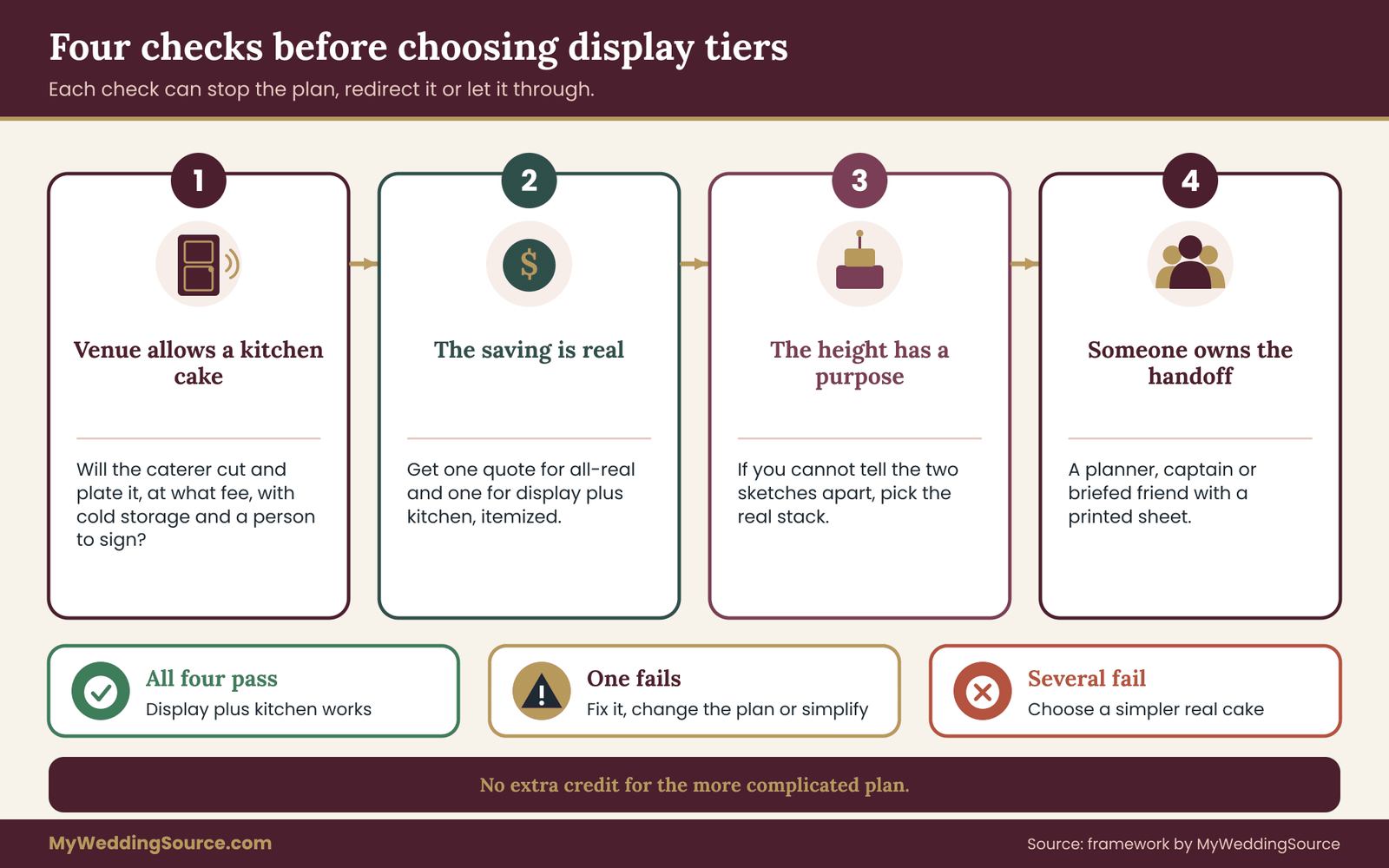
A short rule of thumb sums it up for fake cake tiers. Use fake cake tiers when the height has a purpose, the venue accepts a kitchen cake, the quotes show a real saving or a real design benefit, and someone owns the handoff. Skip them when any of those is missing and cannot be fixed cheaply.
The portion ledger: counting real servings behind fake cake tiers
The worksheet at the center of this article is a six-line ledger for fake cake tiers and the real cake behind them. It is not a complicated formula. It is a sequence of questions that forces each number onto paper, so that nobody has to infer a count from the look of a cake. Work through it in order, with a pencil and with the baker or caterer, and keep the finished page with your vendor files.
Line one: people in the room
Start with the final guest count from your own list and RSVPs, not with an estimate of what you think you invited. The guide to the wedding guest list explains how the count tends to move between invitations and the final headcount, and why the number your caterer needs is the number of people actually present, not the number invited.
Add yourselves, if you are not already counted. Add children who will take cake. Add anyone you want to offer a slice to who is not on the guest list, such as the photographer, the band or the officiant. Some of these people are fed from a vendor meal, and some eat cake with everyone else, so decide on purpose. Write the total as line one.
Line two: people who will not take cake
This line is a decision, not a prediction. If the cake is the only dessert, assume that nearly everyone will take a portion, or at least be offered one, and leave this line at zero or very close to it. If there is another dessert, such as a late-night snack table, a dessert bar or a plated dessert course, guests will split their appetite and the count can come down.
Be careful with this line. It is the one that couples reduce to save money, and it is the one that causes the shortages. A good habit is to leave it at zero until you have written down the other dessert in the same ledger. If there is no other dessert, the number stays at zero. If you do reduce it, set a limit you can defend, and record why.
Line three: the real servings you need behind fake cake tiers
Subtract line two from line one. That is the number of real portions the cakes behind the display must supply. It does not include the display, because fake cake tiers supply no servings at all.
Line four: the portion size
Ask your baker for the serving chart they use. The words “serving” and “slice” mean different things at different bakeries. Many bakeries quote servings based on a modest slice cut from a tier, often sized for a plated dessert rather than a large piece. Others use a larger cut. A caterer who cuts in the kitchen may cut smaller or larger than the baker’s chart. Ask the caterer what size they will cut, and ask the baker what size their chart assumes. If the two differ, the number of real servings you buy will not match the number of plates the kitchen can produce.
Write the chart’s servings per cake beside each real cake on the ledger. Do not copy a general chart from the internet. Use the one the person who will bake the cake uses, because that is the one the baker will build and price against.
Line five: the supply
List each real cake and its servings. The usual entries are the cutting piece, the kitchen cake or cakes, a special-diet cake if you need one, and any spare. Add the servings across all of them. That total is your supply.
Line six: the spare
Subtract line three from line five. The result is the spare. A small positive spare is healthy. It covers the portion that is dropped, the slice that comes out uneven, the guest who wants a second piece, the person who arrives late and the portion you forgot to count. A spare of zero leaves no room for any of these. A very large spare is cake you paid for that no one eats.
A useful range to aim for is a spare of roughly five to ten percent of the need. That is a working rule, not a standard, and your baker may suggest something different for good reasons. If the spare is smaller than five percent, look for a cheap way to add a few servings, such as a small extra cake. If it is above fifteen percent, check whether the kitchen cake can come down one size.

A check on the ledger itself
When the six lines are filled in, read them back as sentences. “We expect 94 people. We are offering cake to all 94. We need 94 real servings. The baker’s chart says each cake yields these numbers. Together the cakes supply 108. The spare is 14.” If the sentences sound strange, the ledger is wrong. This habit catches transposed numbers and mismatched charts more reliably than checking the arithmetic.
Then send the ledger to the baker and the caterer together, not separately. When they see the same page, they can spot a difference in slice size in a single reply. When they see two pages, each assumes the other has the right count.
When the ledger changes
The ledger is not a one-time task. The final guest count arrives later than the first draft, and it usually moves. Recalculate when the final count is confirmed, when a major dessert decision changes, and when the baker revises the design. Date each version. If the cake is already in production, find out from the baker how late a change is still possible, and what it costs, before you need the answer.
Choosing the real cakes that stand behind fake cake tiers
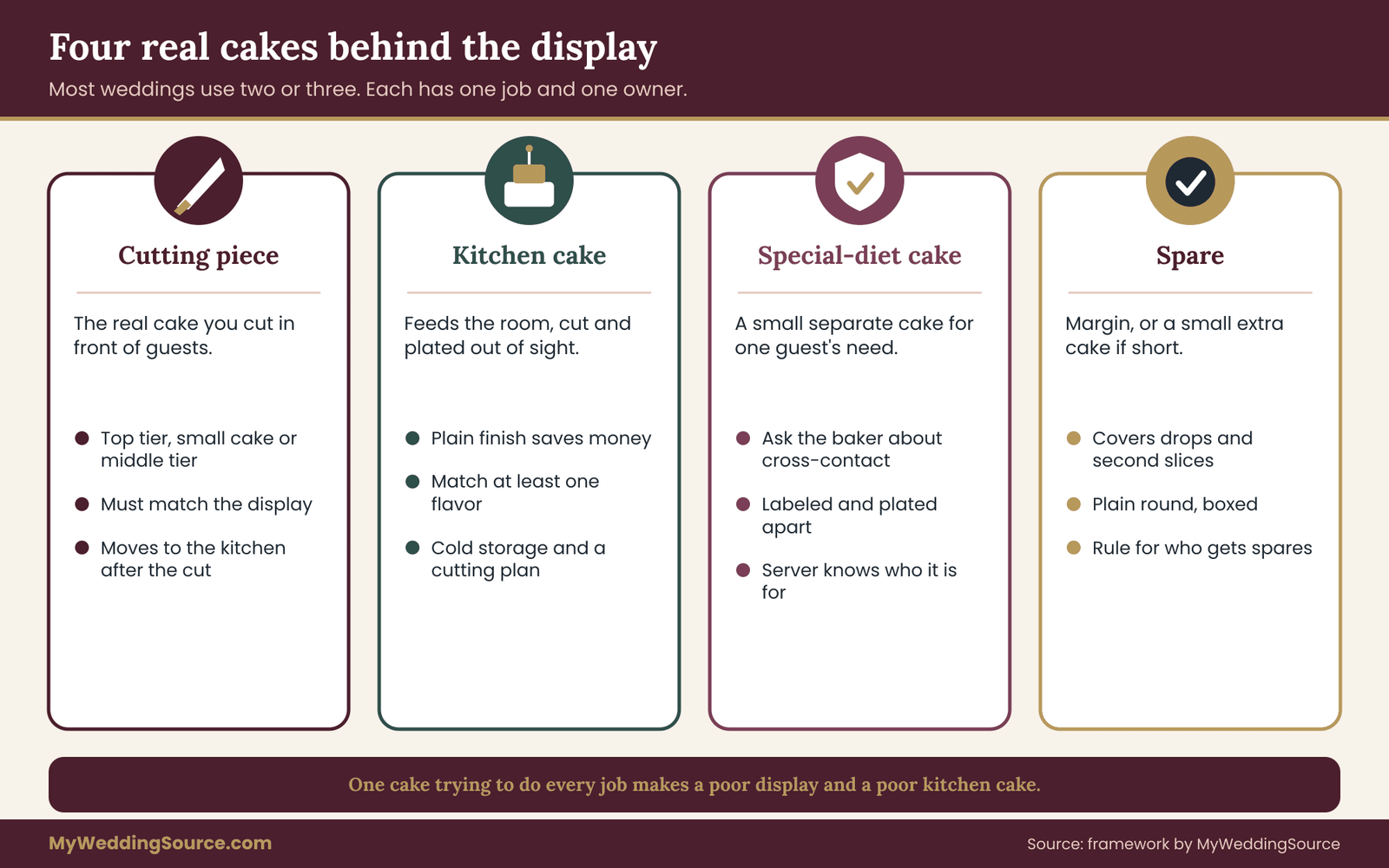
Once the ledger tells you how many real servings you need behind your fake cake tiers, the next task is to decide which real cakes supply them. Four kinds of real cake can sit behind a display, and most weddings use two or three of them. Each has a distinct job, and the job determines its size, its flavor, its timing and who handles it.
The cutting piece
The cutting piece is the real cake you actually cut in front of guests. It exists because fake cake tiers, being foam, cannot be cut. It needs to look like part of the display, because photographs of the cut will be among the most-shared images of the day. It also needs to cut cleanly, so that the first slice comes away without a struggle.
Most couples who use fake cake tiers choose one of three versions. The first is a real top tier, which is the most traditional and usually the easiest for the baker to match to the rest of the design. The second is a small separate cake, placed beside or in front of the display on the same table or a small stand. The third is a real tier at a workable height somewhere within the stack, which the baker builds so the display remains stable when that tier is cut.
Each version has a trade-off. A real top tier is high up, so the cut may need a step stool or a lift, and it may disturb the stack if the baker has not planned for it. A separate cutting cake is easy to reach and easy to move, but it can look out of place if its design does not match. A real tier in the middle looks elegant, but the baker needs to be comfortable that the structure stays upright once one side has been cut.
Ask your baker which version they recommend for your design and why, and ask them to explain how the cutting piece will be separated from the display afterward. If the answer is “someone will lift it off,” ask who and how.
The size of the cutting piece also matters for the ledger. A small cutting cake usually yields a dozen or fewer real servings, so it contributes to the supply, but it rarely carries the load. Many couples assign the cutting piece to the family table or to the couple and a few guests, and let the kitchen cake handle the rest.
The kitchen cake
The kitchen cake feeds the room, because fake cake tiers cannot. It is usually a simple sheet cake or a set of plain round or square cakes, cut in the kitchen into uniform portions. Because it is not on display, it does not need to be decorated. A simple finish, such as plain icing, is normally enough, and saves money.
The kitchen cake should usually match the display’s flavor, at least in one layer, because guests assume the cake they eat is the cake they saw. If the cutting piece is chocolate and the kitchen cake is vanilla, nothing is wrong, but the emcee or a small sign should say so. Some couples deliberately offer two flavors, using the cutting piece and the kitchen cake to supply them.
When the display has several flavors, the kitchen cake is where flavor choice becomes a logistics problem. If each tier of the display was supposed to be a different flavor, the kitchen cake needs to follow the same set, or guests will find that the cake they get matches none of the labels. Decide in advance whether the kitchen cake offers the same flavors, one flavor, or a deliberately different set.
Size and format matter. A baker typically quotes a sheet cake at a serving count based on the chart discussed earlier. Check how many cakes of what size are needed to reach the supply you calculated, and ask whether it is cheaper to order one large format or several small ones. Several small cakes are easier to refrigerate and rotate. A single large cake is simpler to cut but needs a big cold surface.
The special-diet cake
If any guest has a food allergy, celiac disease or a dietary restriction that rules out the main cake, plan a separate cake for them. Do this early, because the decision affects the baker’s production schedule and the caterer’s handling.
A separate cake should be made in a way that reduces cross-contact, and the baker should be able to tell you how. Some bakeries do not handle certain allergens at all. Others handle everything in one kitchen and cannot promise separation. Ask directly and listen to the answer. The FDA’s food allergy pages describe the major allergens in the United States, and they are a sound reference when you write your list of questions.
The special-diet cake should be small, labeled and plated separately. It should travel and be stored apart from the other cakes. The person who serves it should know who it is for. This is one place where the handoff sheet earns its keep, because the kitchen may cut the main cake long before the special-diet cake reaches the table.
Do not rely on fake cake tiers for an allergen answer. Guests will look at the tall cake and ask what is in it, and the honest answer may not match what they eat. That is worth knowing before the question is asked, and it is covered in more detail in a later section.
The spare
A spare is not a separate cake in most plans. It is the extra margin in the others. In some plans, though, a small extra cake is a cheap way to cover a shortage. If the ledger shows a spare below five percent of the need, add a small spare cake to the order. It can be a plain round of an agreed flavor, boxed for the kitchen, with no decoration. If the spare turns out to be unused, it can go home with a family member or be sent to a vendor team.
Matching the pieces to the plan
At this point, the ledger can be updated with real cakes, sizes and servings. Review it as a whole. Is the cutting piece placed so the couple can reach it? Is the kitchen cake large enough, and does the kitchen have a place to cut it? Does the special-diet cake have a clear route from the baker to the right plate? Does every flavor in the display appear somewhere in the real cakes, or has the plan decided which ones do not?
A quick way to test this is to read the cake order aloud as a sequence of events. “The baker delivers three cakes at two o’clock. The captain signs for them and puts two in the walk-in. The cutting piece goes to the display table at six-forty. At seven, the couple cut it. The captain takes it back to the kitchen, and the kitchen cuts the rest.” If a sentence sounds like it has no subject, someone is missing.
Two common mistakes with the real cakes behind fake cake tiers
The first is trying to make one cake do every job. A single large cake that is also the cutting piece, the kitchen cake and the display base tends to be a poor display and a poor kitchen cake. It is easier to treat the display, the cutting piece and the kitchen cake as separate objects, even when the baker builds some of them in the same visit.
The second is forgetting the cake that is not on the list. A guest who arrives with a surprise dietary need, a child who will not eat the flavor, a vendor who is offered a slice at the last minute. A modest spare and a clear rule for who gets the spare slices keep these requests from becoming a problem.
What to ask the baker
A short list of questions, in plain terms, will draw out most of what you need.
How many servings does each real cake yield on your chart, and at what slice size? Can the cutting piece be separated from the display without disturbing it? What flavors and fillings do you recommend for the kitchen cake, and can the special-diet cake be made without the allergens we need to avoid? What happens if our final count changes after the order is placed? How will the real cakes be labeled when they arrive, so the kitchen knows which is which?
Ask for the answers in writing, and bring them to the caterer. The next section covers the handoff itself, which is the thing most likely to go wrong even when every cake is right.
The display-to-kitchen handoff for fake cake tiers
Everything so far has prepared for one event: the moment the cut cake leaves the display table and becomes plates in the kitchen. With fake cake tiers this moment is the single point where the plan can break, because it crosses between two teams who may not have met. The baker built the display. The caterer serves. The couple stands in between with a knife. A written handoff makes the crossing deliberate, and it is the cheapest protection a couple with fake cake tiers can buy.
What a handoff sheet contains
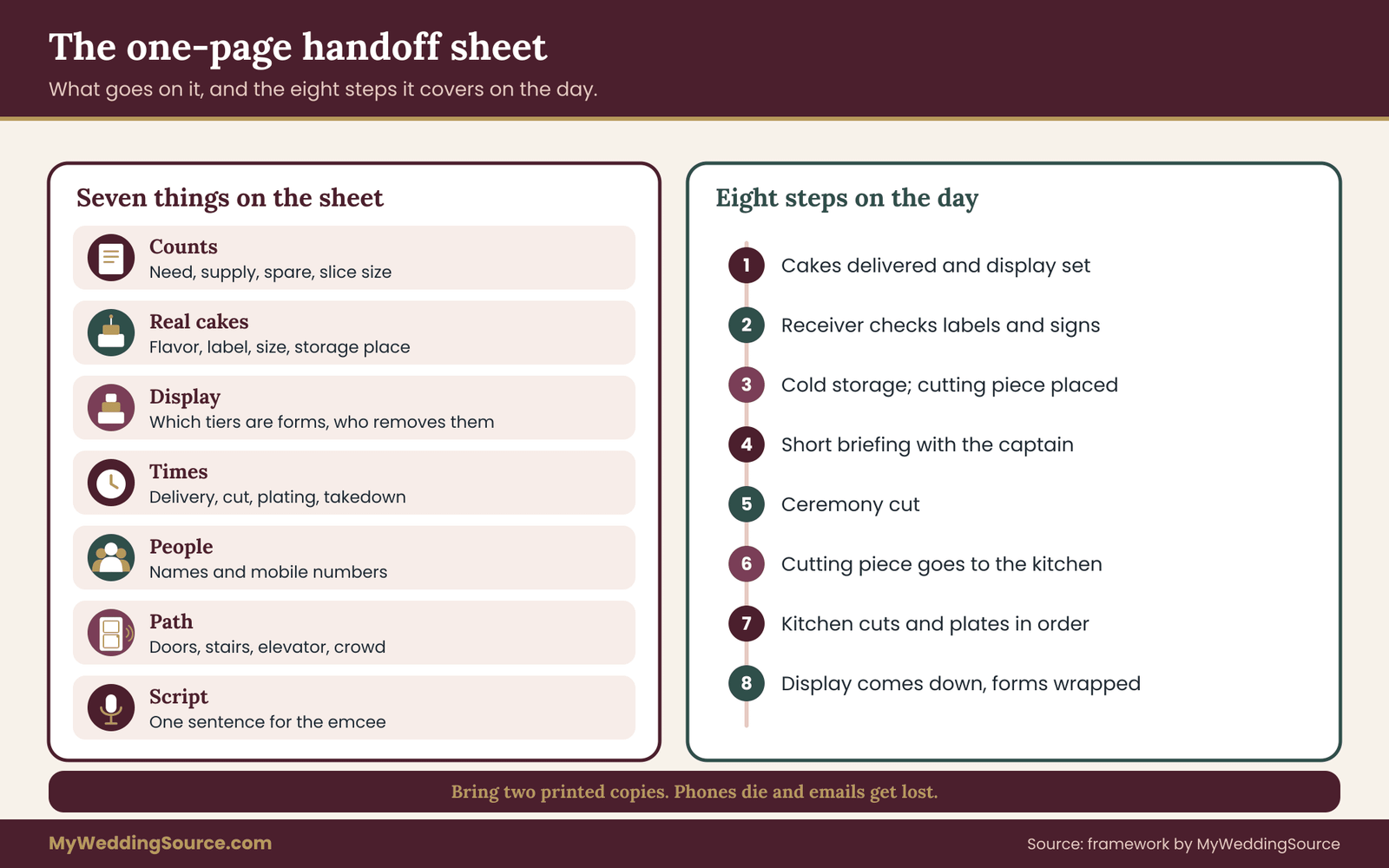
The handoff sheet is one page. It is not a contract and it does not need to be formal. It needs to be specific, and it needs to reach every person it names. Here is what goes on it, in the order the information is used.
The counts. The need, the supply and the spare from the ledger, with the serving chart and slice size used. If any number changes, the date of the change goes beside it.
The real cakes. Each real cake by name: the cutting piece, the kitchen cake or cakes, the special-diet cake and any spare. For each, the flavor, the label, the size, the servings and the storage place.
The display. A short description of the visible stack, which tiers are forms and which are real, and a clear statement that the forms are not food. Include who will remove the forms at the end of the night and where they go.
The times. When the baker or a representative delivers and sets up. When the real cakes go to cold storage. When the cutting piece is placed on the display. When the cut happens. When the kitchen is expected to begin plating. When service begins. When the display comes down.
The people. The name and mobile number of the person who receives the cakes, the person who moves the cutting piece, the person who cuts in the kitchen, the person who answers allergen questions and the person who removes the display. Several of these can be the same person. The point is that none of them is “someone.”
The path. Where the cutting piece travels from the display to the kitchen, including doors, stairs, any elevator and anything that needs to be cleared. If the route crosses a guest area, note that.
The script. One or two sentences that the emcee or captain will say to explain the display to guests.
Who owns what
The handoff works only if each step has exactly one owner. A shared step usually becomes nobody’s step. Some owners are easy. The baker owns the build and the delivery. The caterer owns the plating. Others need a deliberate choice.
The person who moves the cutting piece after the ceremony is often the caterer’s captain or a trained server, because they know the route and the kitchen’s rhythm. A baker’s representative can do it too if they are still on site, but many bakers drop off and leave. A coordinator can own it if they have been briefed. Avoid assigning this step to a family member who is also supposed to be in photographs or at the head table, since the timing conflicts are predictable.
The person who removes the fake cake tiers is a separate question. Forms can be bulky, and the icing on them may be fragile. If the forms are rented or must be returned to the baker, someone has to wrap them, label them and put them where the baker can collect them. If you own them, someone has to take them home. Do not leave this as an afterthought, because a set of display tiers left in a venue storeroom is the kind of thing that causes an awkward email a week later.
The person who answers allergen questions should not be improvising. The best choice is a person who has the baker’s ingredient list in hand and has read it. That is often the captain, a planner or the baker, if they remain through service.
The sequence on the day
A workable sequence has about eight steps. Adapt it to your event, but keep the order.
First, the baker delivers or assembles the display and the real cakes arrive, labeled. Second, the receiving person checks the labels against the order and signs. Third, the kitchen cake and the special-diet cake go into cold storage or into the place the plan assigns, and the cutting piece goes on the display table. Fourth, a short briefing with the captain, the coordinator and the person who will move the cutting piece, reviewing the sheet.
Fifth, the ceremony cut. Sixth, the cutting piece is moved to the kitchen. Seventh, the kitchen cuts and plates the real cakes and delivers them in the planned order. Eighth, the display comes down and the forms are wrapped and removed.
Each step has a possible failure. The sign-off at step two can be skipped because the delivery is rushed. The briefing at step four can be skipped because everyone assumes they know. The move at step six can be delayed because the photographer wants more pictures and no one wants to interrupt. The plating at step seven can start late because the kitchen did not know the cut had happened. A single person watching the clock, with permission to say “we are moving the cake now,” solves most of these.
Scripts for the people involved with fake cake tiers
A short script lowers the chance of a misunderstanding about fake cake tiers. The wording below is a model. Adjust it to your own voice.
For the baker, when confirming the plan: “We are using display tiers with a real cutting piece and two real cakes for the kitchen. Please confirm the servings on your chart, how each cake will be labeled and who will be present at delivery.”
For the caterer, when sharing the sheet: “The cake on display is partly foam. The real cakes are listed on this page with servings. Will your team cut and plate them, and where will they be kept before service?”
For the person moving the cutting piece: “After the cut, please take this tier to the kitchen right away. The kitchen cake will be cut in sequence with it. If a guest asks, the display itself is not served.”
For the emcee: “The tall cake is mostly for the photographs. The cake you are about to eat is made fresh in the kitchen, and it will arrive at your table in a few minutes.”
For the person at the dessert table, if there is one: “The cake on the table is decorative. Cake is being served from the kitchen. If you have an allergy, please ask the server and we will check the label.”
What to do if there is no coordinator
Many weddings have no planner or coordinator. That does not rule out fake cake tiers. It does mean that one trusted person has to carry the sheet. Choose someone who will be at the reception for the whole evening, who is comfortable speaking to a catering captain, and who does not have a special role in the ceremony. Brief them in person if you can and give them a printed copy. Also give the sheet to the caterer and the baker, so a single missing person does not stop the plan.
If nobody is available, simplify. A real cake that the baker or caterer cuts is easier to run without supervision than a display with a hidden kitchen cake. The risk of fake cake tiers goes up as the number of people with a clear role goes down.
A short pre-event call
The most efficient way to confirm the handoff is a short call, about fifteen or twenty minutes, in the week before the event. Put the baker, the caterer’s captain and the person who owns the handoff on it, with the sheet in front of everyone. Read it aloud. The call tends to surface two or three details that no email would have, such as a door that is locked, an elevator that is out of order, a cake box that does not fit through the kitchen entrance or a start time the kitchen understood differently.
Follow the call with a message that restates any changes, and attach the updated sheet. Keep it with the contracts, as the guide on planning the vendor timeline suggests for every confirmation that affects the schedule.
Food safety, allergens and labels when fake cake tiers are on show
Fake cake tiers raise a few food questions that a plain cake does not. The display looks edible and is not. The real cakes are out of sight and may spend part of the evening in a kitchen. And any guest with an allergy has a harder time reading the situation than usual. None of this is cause for alarm. All of it is cause for a few specific decisions.
The usual caveat applies. Temperature, allergen handling and structural details are matters for the bakery and the caterer, who work under local health rules. The sources at the end of this guide point to the agencies that set the general standards, and your local health department sets the rules that apply to your venue.
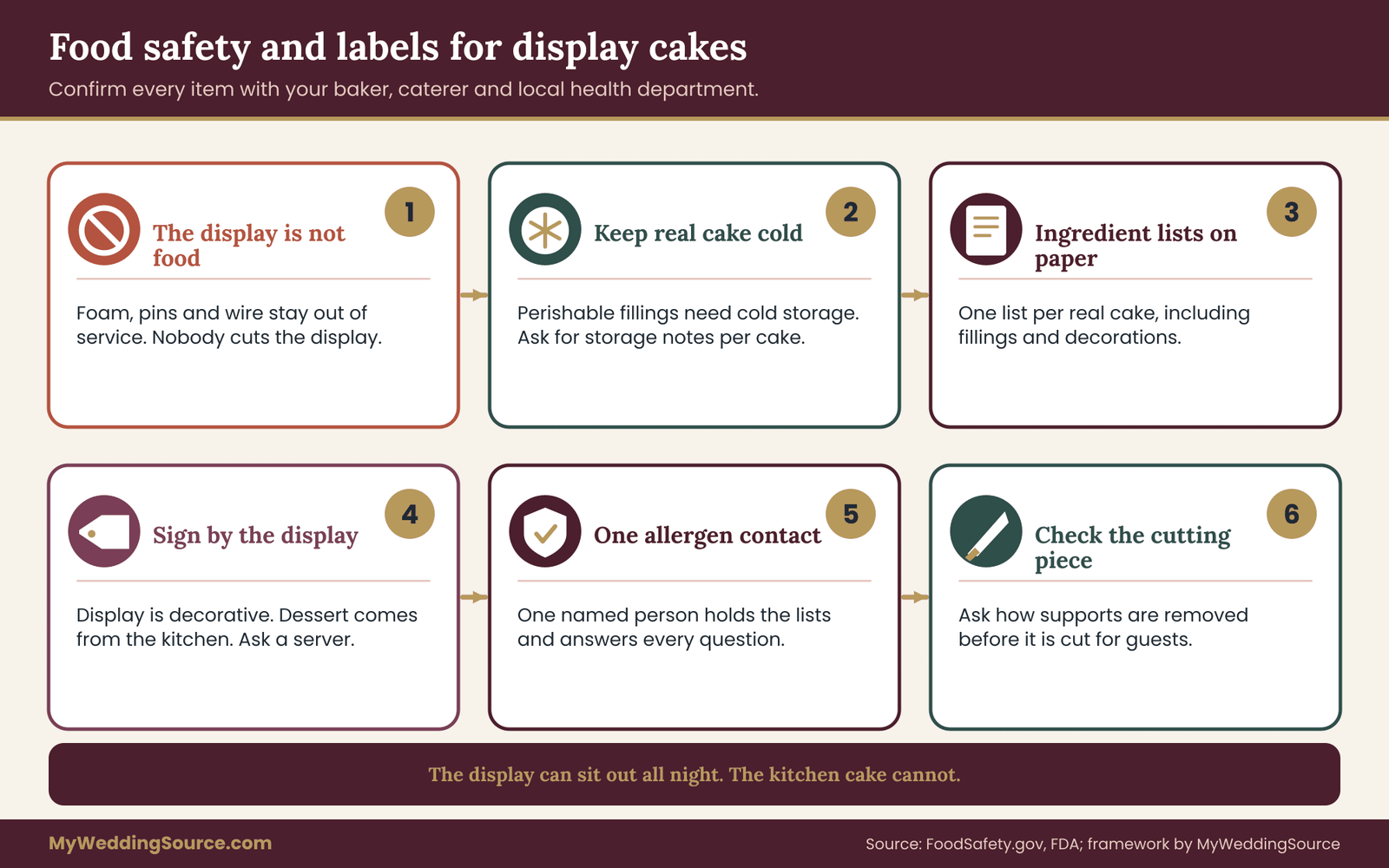
Fake cake tiers are not food
The most obvious point is also the one most worth stating out loud. A foam form covered in icing is a decoration. Even if the icing is edible, the form beneath it is not, and the form may be held together with pins, wire, dowels or adhesive that no one should eat.
Three practical consequences follow. The first is that nobody should cut fake cake tiers for service. If a well-meaning guest, a child or a server reaches for the display with a knife, the staff should know the answer is no. A small sign, a word at the briefing and a table that is not near the dessert line all help.
The second is that the display should be removed before any cake is carved near it. A display that sits next to a cut cake and a stack of plates invites confusion. If the cutting piece is placed on the same table, plan for the cut cake to leave the table promptly after the ceremony.
The third is that the display should not be left within easy reach of children, pets or anything that could damage it, since the forms and the pieces that hold them together are not meant to be handled. That is not a food safety point so much as a good-sense one, and it belongs in the same briefing.
Keeping real cake safe
Real cake has the same food safety needs it would have in any setup. Perishable fillings and frostings need to be kept cold until service. General guidance from government food safety sources says that perishable food should not sit at room temperature for more than about two hours, and for less time in hot weather. Your baker will know which of your cakes are perishable and which are shelf-stable, because the answer depends on the fillings and the frosting. Ask the baker for the storage instructions for each real cake and put them on the handoff sheet.
Fake cake tiers can lull people into a false sense of security here. A stack of fake cake tiers that sits out for hours with no ill effect says nothing about the real cake in the kitchen, which may contain cream, custard or fresh fruit. Keep the two separate in your thinking. The display can stay under lights all night. The kitchen cake cannot.
Ask the caterer three practical questions. Where is the kitchen cake stored between delivery and service? Is there cold space for it, and who has access to that space? How long before service will it be taken out, and who decides? Write the answers down. If the caterer has no cold space, the baker may deliver closer to service, which affects the timeline.
If the real cakes travel from a bakery to a venue, the transport conditions matter. Bakers usually have their own methods, such as insulated boxes and cooled vehicles. Ask what they use and what they do on a hot day. The venue’s heat, its shade and the length of the drive can all play a part, and a short conversation avoids surprises.
Allergens and the display question
Allergen handling is where fake cake tiers cause the most confusion, so it deserves its own plan. A guest looks at a tall cake and asks, reasonably, “what is in it?” The answer that matters is what is in the cake they will eat. The answer about the display is a different matter, and it can mislead.
The FDA identifies a set of major food allergens that must be declared on packaged foods in the United States, and its allergen pages are a good starting reference for the questions to ask. A bakery should be able to tell you which of those allergens appear in each cake, and whether any are present in the kitchen where it is made. A bakery that cannot answer is telling you something useful.
Three steps keep the allergen story clear.
Label the real cakes, not the display. Ask the baker to provide an ingredient list for each real cake, including fillings, frostings and any decorations. Keep one copy on the handoff sheet and give another to the captain. If flavors differ between the cutting piece and the kitchen cake, the lists will differ too.
Say plainly that the display is decoration. A short sign near the display can state it without drama: “Display cake is decorative. Dessert is served from the kitchen. Please ask a server about ingredients.” That one sentence prevents guests from asking the wrong person about the wrong cake, and it reduces the chance that someone assumes the display is safe for them.
Give one person the job of answering. A guest with an allergy should not have to ask three people. Name the person who holds the ingredient lists and make sure the servers know to send questions to them.
If a guest has told you about a serious allergy, speak to that guest, or a family member, ahead of time. Ask what they need. Pass it to the baker and the caterer. A separate cake, a sealed individual portion or a plated alternative may be the right answer. This is a conversation to have in the weeks before the event rather than at the cake table.
Sharp objects and structure inside the display
Forms are often assembled with dowels, rods or pins, and some designs include wire or flower supports. These parts are meant to stay inside the display. When a cutting piece is separated from a stack, a dowel can be exposed, and when a display comes down, a pin can come loose.
Ask the baker how the cutting piece is built, and whether any support material runs through it. If it does, ask how it will be removed before the cake is cut for guests, and by whom. This is a question about the cutting piece rather than the display, but it belongs in the same conversation. The baker is the right person to explain the specifics of your design.
When the display comes down, someone should check the table and the floor for stray pins or pieces before guests walk past. A short sweep at the end of the night costs nothing.
Labels and signs that help
Signs are small and useful. Three are worth considering. A sign by the display saying it is decorative. A discreet card at the dessert station naming the flavor and noting that ingredient lists are available. A card with the special-diet cake that identifies it and who it is for, shown only to the server.
Keep the wording plain and avoid claims you cannot support. “Gluten-free” and similar terms have specific meanings in food regulation, and a bakery that makes a claim should be able to explain how it supports it. If in doubt, say “made without wheat flour” or whatever the baker can truthfully state, and add “please ask about ingredients.”
When a mistake happens
Even a good plan for fake cake tiers can fail. If the kitchen discovers that a real cake is not what the label says, or that a flavor arrived that differs from the order, the right response is to tell the person who owns the handoff and the baker right away, not to improvise quietly. The couple does not need to hear about it during the reception, but the people responsible should.
If an allergen error is suspected, the safest course is to stop serving that cake and confirm with the baker. This is another reason to keep the ingredient lists at hand, and to keep the phone number of the baker on the sheet. It is a small precaution that rarely gets used, and it matters a great deal when it does.
A worked example of fake cake tiers wedding servings
Numbers make the ledger for fake cake tiers concrete, so here is a full walk-through. The couple and every figure below are invented for illustration. The serving counts are examples of what a bakery chart might say, not standards. Your baker’s chart will differ, and the real answer is whatever they put in writing.
The setup
An invented couple, Priya and Daniel, plan a reception for people they know well. They invited 130 and have 112 yes replies. They want a tall cake as the centerpiece of the room and have a modest budget. Their venue has a caterer who will cut and plate a cake from the kitchen for a flat fee. They choose a display with two foam tiers at the bottom, a real top tier for the cutting, and real cakes in the kitchen.
The ledger, line by line
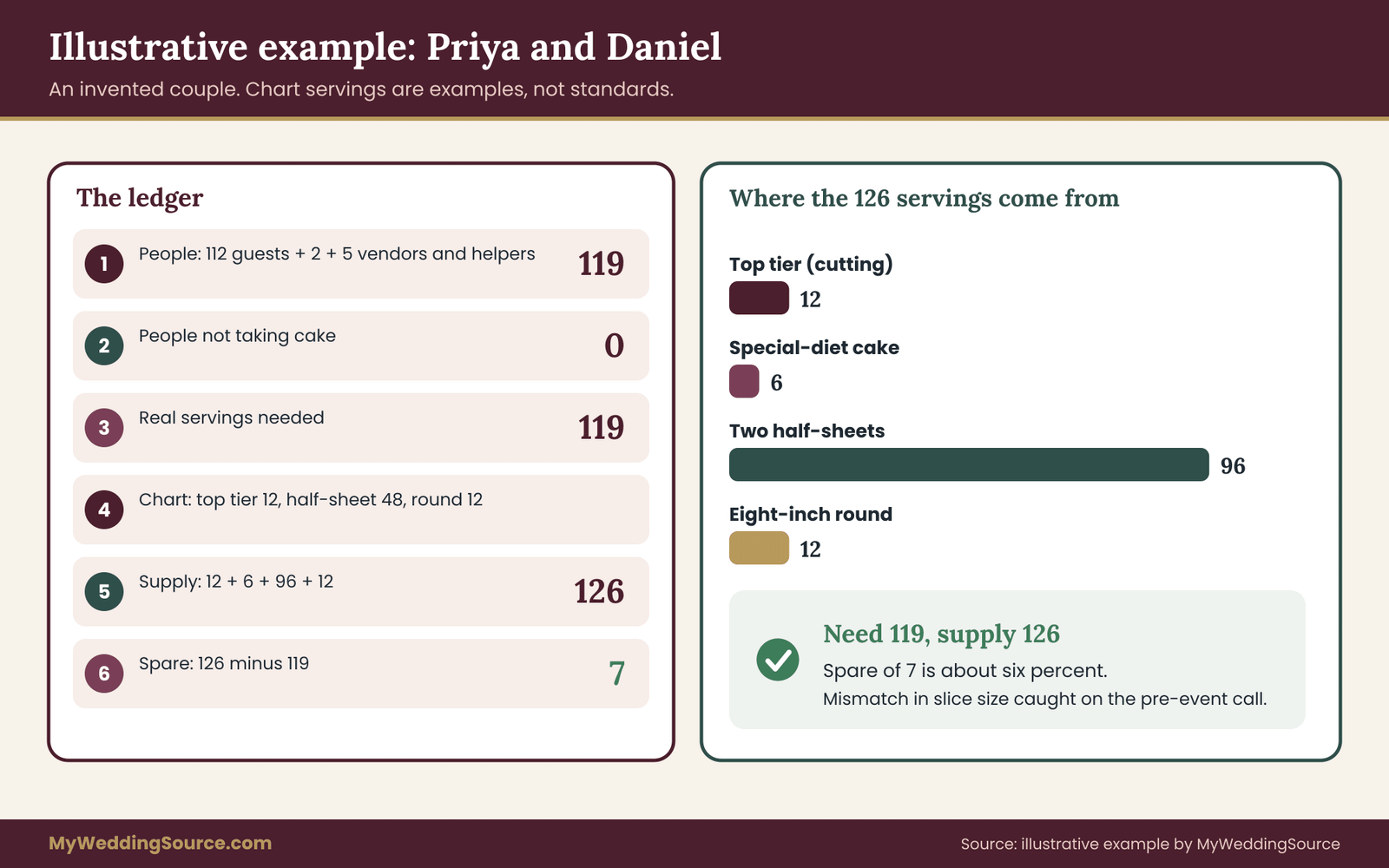
Line one, people in the room. 112 guests plus the two of them is 114. They want to offer slices to the photographer, the videographer, the DJ and the day-of coordinator, who is four more people. A friend will also be helping at the cake table and wants a slice, which makes five. Line one is 119.
Priya and Daniel then recall that two of the guests are infants who will not eat cake. They leave the count alone rather than subtract, because the caterer prefers a clean number and a slightly higher count costs very little. A deliberate choice like that belongs on the page too.
Line two, people who will not take cake. There is no other dessert, so the line is zero. They note on the ledger that if they add a late-night snack later, they will review this line again.
Line three, the real servings needed. 119 minus zero is 119.
Line four, the portion size. The baker’s chart yields 12 servings from the small real top tier and 48 from a half-sheet kitchen cake. The caterer says they cut to the chart’s portion size, so the two numbers are comparable. The couple asks for that in writing.
Line five, the supply. The couple needs a special-diet cake for one guest who cannot eat wheat or nuts. The baker proposes a small cake with 6 servings, baked separately. The top tier supplies 12 servings and the special-diet cake 6. That is 18 so far. The remainder is 119 minus 18, which is 101. Two half-sheets give 96. Adding a small eight-inch kitchen round that the chart rates at 12 brings the kitchen total to 108.
The supply is 12 plus 6 plus 96 plus 12, which is 126.
Line six, the spare. 126 minus 119 is 7. That is about six percent of 119, inside the working range. The couple is satisfied and does not add another cake.
Read aloud, the ledger says: “We expect 119 people to be offered cake. We need 119 real servings. The cakes supply 126. The spare is 7.”
What the baker’s quote looks like after this
When Priya and Daniel ask for itemized quotes, the baker lists the display tiers and their decoration, the real top tier, two half-sheet cakes, one small round, the special-diet cake and delivery. The couple compares this with an all-real design of the same height, which the baker prices as noticeably higher. They also see that a display with fewer real parts would have saved less than they hoped, because the kitchen cakes cost what they cost. The itemized quote makes both facts visible, and they proceed with the display plan.
If the comparison had come out the other way, the simpler all-real design would have been the right choice. The worksheet is not an argument for fake cake tiers. It is a tool for deciding whether fake cake tiers earn their place.
The handoff sheet for the example
Their handoff sheet names the caterer’s captain as the person who signs for the cakes at 2:00 and the day-of coordinator as the owner of the handoff. The top tier goes on the display table at 6:40. The cut is scheduled for 7:00. At 7:02 the captain takes the cut tier to the kitchen, where it joins the half-sheets for plating. The special-diet cake is stored and served separately by the captain. The baker’s representative returns at 10:30 to wrap and collect the foam tiers.
The sheet also records that the emcee will say a sentence before the cut, explaining that the tall cake is mostly for photographs and that dessert will come from the kitchen. The sign by the display repeats it.
Where things nearly went wrong
Even in a tidy example of fake cake tiers, three snags are worth noting, because they are typical.
The first is that the venue’s service elevator is shared and is booked for another delivery at 2:00. The captain spots this on the pre-event call and moves the cake delivery to 1:30. A phone call a week before the event found the problem. A conversation on the day would have found it too late.
The second is that the baker’s chart and the caterer’s portion size turn out to differ slightly. The baker’s chart assumes a slice that the caterer thinks is a little small. The caterer would cut a slightly larger piece for a plated course. The couple asks the baker to restate the kitchen cake servings at the larger size. The result is a lower serving count per cake and a smaller spare. The couple adds a second small round, and the spare goes back up. The mismatch cost one extra cake. Left unchecked, it would have cost about twenty missing servings.
The third is that one guest’s partner turns out to have a serious allergy that the couple had not known about. Because the ingredient lists are on the sheet and the captain is named as the person who answers, the issue is solved in a few minutes with a conversation at the table.
What the example teaches
Four lessons come out of this invented wedding, and they apply to real ones too.
First, the count starts from people, and it is explicit about who is included. Second, the portion size has to be agreed between baker and caterer before anything else is final. Third, the handoff is a set of named people with times, not a general understanding. Fourth, a short call before the event is cheap and surfaces problems that are expensive afterward.
One more observation. Priya and Daniel spent perhaps three hours across several weeks on the ledger, the sheet and the call. Most of that time went into asking questions and writing down answers. None of it required special skill. That is typical of vendor coordination in general, and it is why a clear page is worth more than a clever idea.
Coordinating the venue, the caterer and guest flow around fake cake tiers
So far, this guide has focused on the cake itself. The people and places around the cake matter just as much. A display is also a piece of furniture in a room full of guests, and a kitchen cake is a piece of work in a room full of staff. Both interact with the layout, the schedule and the rules of the venue.
Where the fake cake tiers go
The display needs a table, a position and a clear view. It is usually near the dance floor or the head table, in a place that works as a photograph background and keeps a clear path to the kitchen. Placement near a door, a speaker, a window with strong sun or a heater can create problems for the display and for the real cakes on the table with it.
Think about the path the cutting piece will take from the display to the kitchen. If the shortest route goes through a crowd or across the dance floor, the move will be slower and the cake will be jostled. If the kitchen is on another floor, the route needs an elevator and a person with a key. The guide on reception guest flow explains how to think about the movement of people and objects through a reception space, and the same thinking applies to a cake cart.
Ask the venue for a floor plan with the cake table and the route marked. If they do not have one, sketch it on paper and share it. A hand-drawn map often spots a problem faster than a conversation does.
Timing the cut and the service
The cut is a short moment, and the service that follows takes longer. Plan a gap between the cut and the first plated slice, and tell the room about it. A good rule is to schedule the cut at a time when the kitchen has finished the previous course and can turn to cake, not at a time that suits the music or the speeches alone.
If dessert is served at tables, the kitchen needs time to cut, plate and carry. A larger guest count needs more time or more hands. Ask the caterer how long it will take from the moment the cut cake arrives in the kitchen until the last table is served, and plan the emcee’s talk and the next event around that answer. A gap that is announced feels like a pause. A gap that nobody mentions feels like a mistake.
If dessert is a buffet or a station, plan how the real cake will be set out. A station can sit near the display, or elsewhere. In either case, the display and the station should be clearly different, so guests do not try to cut the foam.
Venue rules that affect the plan
Venues often have rules about outside desserts, cake-cutting fees, delivery windows, loading doors and what can be left behind overnight. A venue may charge a fee for cutting a cake that a bakery brings, and it may have a policy about leftover cake and display pieces. Ask for these rules in writing before you sign anything that depends on them.
If the venue has a loading dock or a freight elevator with a schedule, the cake delivery has to fit in. The guide to venue technical walkthroughs describes how to inspect the practical parts of a space ahead of time, including the doors, power and routes that a delivery will need. A cake delivery is a small version of the same exercise.
Keeping everyone on the same page
The common thread with fake cake tiers in all of this is the same: one page, shared with every person who touches the cake. When the baker, the caterer, the venue and the coordinator all work from the same sheet, they find mismatches early. When they work from different emails, they find mismatches at 7:00 on the day.
A last practical step is to bring two printed copies of the sheet on the day, one for the person who owns the handoff and one for the captain. Phones die and emails get lost. A piece of paper in a folder does neither.
Costs and contract wording for fake cake tiers
Money questions around fake cake tiers are less about the sticker price and more about what the price covers. Because a display-plus-kitchen plan has more parts, the quote has more places for something to be missing. This section lists the cost items to look for and the wording worth asking for, without suggesting what any of them should cost. Prices vary by region and by bakery, and the only reliable numbers are the ones in your own quotes.
The line items to expect with fake cake tiers
An honest quote for a display-plus-kitchen plan tends to include several lines. The display itself, including the forms and the decoration. The real cutting piece. Each kitchen cake. The special-diet cake. Delivery and setup, and sometimes a separate charge for retrieving the display. A rental or deposit for any stand or form the baker supplies. And, on the caterer’s side, a cake-cutting or plating fee, which may be charged per person or as a flat amount.
Ask to see these separately. If a baker bundles the display and the real cakes into a single figure, ask them to split it, so you can compare the all-real option on the same basis. Ask also what happens to the forms after the event. Some bakers reuse them and expect them back. Some sell them to the couple. Some charge a disposal or storage fee. Any of these is acceptable, and none should be a surprise.
Costs that hide in the handoff
Three costs often escape the first quote. The first is the caterer’s fee for cutting and plating a cake the bakery supplied, which may be higher than expected for a larger guest count. The second is extra time for the baker or the captain to be present at specific points, such as the ceremony cut or the retrieval of the display. The third is the cost of a correction if the count changes late, such as a further small cake or a rush delivery.
None of these is large on its own. Together they can change the comparison between fake cake tiers and an all-real cake. Ask for each of them in plain terms, and add them to the budget line before you decide. Hold the total beside everything else you are paying for.
Wording worth asking for
A vendor agreement does not need to be long, but a few sentences clarify the points that cause trouble. The guide on the wedding vendor contract covers the structure of an agreement in general. For a display-plus-kitchen plan, the specific points are these.
That the real servings are stated by number, with the chart and slice size used. That the display is described as decorative and not served. That the baker will confirm in writing how the cutting piece is separated from the display. That the final count deadline and the cost of any later change are stated. That delivery windows and setup times are written down, with a named person receiving the cakes. That ownership and return of the forms, stands and boards are described. That ingredient lists for each real cake are provided in advance.
A contract is not a promise that nothing will go wrong. It is a record of what each side expects. If a dispute arises, the written count and the written times are far more useful than a memory of a conversation.
Keeping the paper trail
Save the itemized quotes, the signed agreement, the ledger, the handoff sheet and the confirming messages in one folder. If there is a problem, the sheet shows what each person agreed to. If everything goes well, the folder is a short record you may never open. In either case, it takes ten minutes to assemble.
Limits, edge cases and when to skip fake cake tiers
Fake cake tiers are one option among several for a wedding cake, and some situations make them a poor fit. Knowing the limits helps you decide with open eyes, and it keeps the guide honest about what a worksheet cannot do.
Edge cases worth planning for
A very small wedding. With a handful of guests, the savings from fake cake tiers shrink, because a small real cake is already small and inexpensive. A tiny wedding is often better served by a modest real cake and a good stand.
A very large wedding. With hundreds of guests, the kitchen cake is large and the handoff is busy. Fake cake tiers still work, and the ledger matters even more, but the logistics of cutting and plating at scale belong with an experienced caterer, not with a friend.
A weekday or morning event. Timing and staffing differ, and a kitchen cake may be easier or harder depending on the venue. Ask early.
A buffet-style meal. A dessert table may make fake cake tiers the focal point, which raises the risk that guests try to cut it. Plan signs and a nearby real cake.
An outdoor or hot-weather wedding. Real cake in heat is a matter for the baker, and a display made with forms may hold up better than a real tall cake in the sun. This is one case where forms can help for practical reasons. The kitchen cake still needs cold storage.
A cake that will be saved. Some couples want to freeze a real tier for an anniversary. If so, make that tier a separate real cake, not the cutting piece, or tell the baker so they can plan for both a cut and a keepsake. The ledger should show what is saved and what is served.
A cultural or family tradition about the cake. In some families, the cutting and sharing of cake carries meaning, and a hidden kitchen cake may feel wrong. Talk to the people involved. The display plan can adapt, for example by cutting the real tier and sharing it with the family first.
What a worksheet cannot do
A ledger counts servings. It cannot tell you whether the cake will taste right, whether the baker will deliver on time, or whether the captain will remember the sheet. It cannot replace a tasting, a reference check or a conversation with the venue. The guide to planning wedding menus can help place the cake in the context of the whole meal, and the wedding planning checklist is a place to keep these tasks beside everything else you have to do.
The worksheet also does not replace professional judgment on structure, temperature or allergens. Those areas belong to the baker, the caterer and, for serious allergies, the guest’s own medical guidance. Treat the sheet as a way to ask better questions, not as a substitute for the answers.
When to simplify
If the checks in the decision section raised several concerns, take that seriously. A real cake that your baker cuts, or a small cake for the ceremony and a dessert table for the rest, can look lovely and carry far less coordination. There is no extra credit for the more complicated plan. The goal is a cake that tastes good, serves everyone and does not cause stress on the day.
Your next steps
Take these in order. Each step is small, and together they turn a design idea into a plan.
- Decide whether the display is worth it by running the four checks with your venue and your caterer.
- Ask your baker for itemized quotes for an all-real design and a display-plus-kitchen design at the same guest count.
- Fill in the six-line ledger from your latest guest count, using the baker’s chart and the caterer’s slice size.
- Pick the cutting piece, the kitchen cake, the special-diet cake and any spare, and update the ledger.
- Draft the one-page handoff sheet with counts, cakes, times, people, the path and the emcee’s sentence.
- Share the ledger and the sheet with the baker and caterer together, and ask for written confirmation.
- Schedule a short call the week before the event and read the sheet aloud.
- Print two copies for the day, and put the paper trail in your vendor folder. For the wider schedule, see the full wedding cake production plan and work backward from the date.
FAQ
What are fake cake tiers?
Fake cake tiers are display forms, usually made of foam or a similar material, covered with icing or fondant and decorated to match the rest of the cake. They give the cake height and shape but cannot be eaten. A real cake is cut and served separately, so the display is for appearance only.
How many servings do fake cake tiers provide?
None. The display supplies zero servings no matter how large it looks. Every portion has to come from a real cake, such as a cutting piece, a kitchen cake or a special-diet cake. Count your servings from the number of people who will eat cake, then match them to real cakes using your baker’s serving chart.
How do I count real servings behind fake cake tiers?
Start with the people in the room, including yourselves and any vendors you want to offer a slice. Subtract only those you have decided will not take cake. Match the result to real cakes using your baker’s chart and the caterer’s slice size, then check that the supply leaves a small spare.
Can we cut a display made of fake cake tiers?
No. Foam cannot be cut, and the parts that hold a display together are not food. Plan a real cutting piece instead, such as a real top tier or a small cutting cake beside the display. Ask your baker how it will be separated from the display afterward and who will carry it to the kitchen.
Who moves the cut cake to the kitchen?
Name one person in advance. A catering captain, a trained server or a briefed coordinator usually works best, because they know the route and the kitchen’s timing. Avoid assigning it to a family member who is also needed for photographs. Put the person’s name and the time on a one-page handoff sheet.
Are fake cake tiers cheaper than real cake?
Sometimes, but not always. The display saves on real cake, yet you still pay for the forms, the decoration and a separate kitchen cake, plus a possible cutting fee from the caterer. Ask your baker for itemized quotes for an all-real design and a display design at the same guest count, then compare the totals.
What should I tell guests with allergies?
Tell them that the display is decorative and that dessert comes from the kitchen. Give one person the baker’s ingredient lists and make that person the contact for questions. For a serious allergy, speak with the guest or a family member beforehand and ask the baker about a separate cake or a plated alternative.
Should we skip fake cake tiers for a small wedding?
Often yes. With few guests, a small real cake is already inexpensive, and a display adds coordination for little savings. A modest real cake on a good stand keeps the plan simple. Consider a display when the height has a purpose, the venue accepts a kitchen cake and someone owns the handoff.
Sources
- FoodSafety.gov, U.S. Department of Health and Human Services
- Food Safety and Inspection Service, U.S. Department of Agriculture
- Food, U.S. Food and Drug Administration
- FDA Food Code, U.S. Food and Drug Administration
- Food allergies, U.S. Food and Drug Administration
- Food safety, Centers for Disease Control and Prevention
- Food allergies, National Institute of Allergy and Infectious Diseases
- Federal Trade Commission
- Heat safety, National Weather Service