
Two officiants can share one wedding ceremony cleanly, but only if the couple decides in advance who holds the legal role, who speaks which part, and exactly how the microphone, the script and the attention pass from one person to the other. This guide gives you a role chart, a block-by-block split of the ceremony, handoff cues, a rehearsal routine and a worked example.
Start by confirming with the office that issues your marriage license which one of the two officiants is the legal solemnizer, and whether the second may sign or must only speak. Then divide the ceremony into blocks (welcome, story, charge, vows, rings, pronouncement, signing), give each block one named owner, and write a one-line bridge for every handoff. Put the legal anchor on the blocks that carry the legal words, test the microphones with both voices, and rehearse the handoffs rather than the whole script.
Picture a ceremony where the couple loves two people equally. One is the pastor who has known the family for twenty years. The other is a close friend who makes everyone laugh and who has been asked to “say a few words.” Both are standing at the front. The pastor finishes a prayer, and the friend, who thought the pastor would introduce them, waits. The pastor, who thought the friend would simply begin, also waits. Eleven seconds pass. Guests start to shift. Nothing is wrong, exactly, but the moment has gone soft.
That small silence is the typical failure of a ceremony with two officiants. The people are not the problem. The missing piece is a decision about who owns which moment. When two officiants have a clear split, the ceremony feels fuller and more personal, because each voice brings something the other does not. When the split is vague, the ceremony feels like a relay race with no baton.
This article is for couples who have already decided, or are close to deciding, that two officiants suit their day. It does not walk through the whole ceremony from processional to recessional, because the wedding ceremony step-by-step guide already does that. It does not cover how to write a whole cue sheet for every vendor either, since the wedding ceremony cue sheet guide handles that. This guide focuses on the single question those guides leave open: what changes when two people share the officiant’s job.
A note on scope. This is general information, not legal advice, and the rules for who may solemnize a marriage differ by state and county, so confirm every legal point with the office that issues your license.
When two officiants make sense, and when one is enough
Not every couple needs two officiants. A single officiant is simpler to schedule, simpler to pay, simpler to rehearse and simpler to hear. Adding a second person adds a second voice, a second set of notes and a second set of handoffs. It is worth doing when the second person brings something specific.
There are a handful of common reasons couples ask for two officiants, and it helps to name yours before you invite anyone, because the reason shapes the role.
Two faith or cultural traditions. A couple from different religious backgrounds may want a clergy member from each tradition. Here the two officiants usually own separate blocks of the ceremony, each with its own language, readings and rituals. The interfaith wedding ceremony planning guide covers who owns which ritual in more depth; this article covers the speaking mechanics once that ownership is settled.
One professional and one personal voice. A licensed officiant or clergy member handles the formal structure and the legal words. A friend or relative speaks the personal story. This is probably the most common pairing, and it is the one the worked example later in this guide uses.
Two languages. If a good share of the guests speak a different language than the other half, a second officiant can deliver a block in that language rather than having one person translate line by line, which slows everything down.
A mentor and a newcomer. Sometimes a friend is becoming an officiant for the first time, and the couple wants an experienced person standing beside them to hold the legal frame and step in if nerves take over.
Two partners’ families. Each family has someone they trust to speak for them, and neither feels comfortable being left out.
A symbolic honor. The couple simply wants to honor two people, and the second person’s role is ceremonial rather than structural.
Now the other side. One officiant is usually enough when the real wish is only a personal story or a few kind words. A reading, a toast-style tribute, a welcome from a family member or a blessing can be given by a participant who is not an officiant at all. Involving guests through short, planned participation belongs here too. Giving someone the title of co-officiant when what you want is a reader or a speaker invites confusion over the legal role and over who is in charge of the pacing.
A simple test before you commit
Before you invite a second person, answer these three questions in one sentence each.
What will the second officiant say or do that the first cannot? If the answer is vague, such as “just to be involved,” consider a reader’s role instead.
Which part of the ceremony will stay entirely under the first officiant’s control, and which part under the second’s? If everything is shared everywhere, the ceremony is likely to feel unsteady.
Who decides, on the day, if the two of them disagree about timing or wording? Pick one person, in advance. In most ceremonies it should be whoever holds the legal role, because that person carries the responsibility for the license.
If you can answer all three plainly, two officiants are a good fit. If you cannot, talk through the plan with both people before anyone commits.
The cost and time side
A second officiant has a cost even when they are a friend. Some professional officiants charge for each additional person included in rehearsals or on the license paperwork, and some charge nothing. Ask early. A friend who is not paid still needs time: a call to align on the script, a rehearsal, travel, and an outfit that coordinates with the first officiant’s robe or attire. The reasonable approach is to ask both people what they need, write the answers down, and budget for them as you would for any other ceremony role.
Time in the ceremony matters too. Two voices mean at least two additional handoffs, and each handoff costs between a few seconds and half a minute if it is smooth. A ceremony that was planned at twenty minutes with one officiant may run four to six minutes longer with two, especially if each person has a different pace. Do not trim the personal parts to compensate. Instead, decide the target length at the start and cut duplicated content, such as two welcomes or two thank-yous, which tends to be where two officiants repeat each other.
Confirm the legal anchor before anything else
The most consequential decision in a ceremony with two officiants is not creative. It is legal. A marriage license has to be completed and returned by someone the state recognizes, and the rules about who qualifies vary. You need to know, before you build anything else, which of your two officiants is the legal anchor.
The anchor is the person who is authorized under your state’s law to solemnize the marriage and who will sign and return the license. The other person is a ceremony participant with a speaking role. In some places that second person may also be authorized, and in some places they cannot sign at all. You should not assume either way.
What to ask the issuing office
Contact the county clerk, registrar or other office that issues your marriage license, and ask in plain language. The general portal at USA.gov points to state marriage license information, and each state’s own page or clerk can give you the current rule. Questions worth asking:
Who is authorized to solemnize a marriage here, and is there a registration or ordination requirement for the person doing it?
Can a friend or relative become authorized for a single ceremony, and what does that take? Some states offer a temporary or one-day designation, and some require advance paperwork with a waiting period.
Does the license have space for one officiant’s signature, or can more than one person sign? Does a second person sign as a witness, as a co-officiant or not at all?
How many witnesses are required, if any, and can an officiant also be one?
What is the deadline to return the signed license, and who may return it?
If one officiant is from another state, does that change anything about their authority to act here?
Write down the answers with the date and the name of the person you spoke to. The wedding officiant requirements guide on this site walks through the general pattern of those rules, and you can use it to frame your questions, but only the issuing office can give you your answer.
Three legal arrangements you may find
Depending on where you marry, you may find that the rules fall into one of a few shapes. These are not exhaustive and they are not legal categories; they are practical situations to expect.
One authorized solemnizer, one speaker. The anchor signs the license. The second officiant has no legal role and is simply a person with an important speaking part. This is common and easy to plan for.
Two people who could both be authorized. Perhaps the two officiants are clergy or both are registered. You still pick one as the signer of record, because a license normally has one signature line for the officiant. The other may sign a different line or may not sign at all, depending on the form.
A friend who needs temporary authority. Some places allow a person to be designated for a single wedding. The process may need to be completed weeks ahead. If your second officiant is hoping to hold the legal role, start this early, and keep a backup plan in case the paperwork is not done in time. A cleaner plan is often to let the experienced person hold the anchor role and let the friend speak.

What the anchor owns on the day
Once you know who the anchor is, give that person these responsibilities in writing.
They confirm the couple’s consent at the point the state’s law or their own practice requires it. Many ceremonies include a question of intent or a declaration; the anchor should know whether the license process in your state expects specific words or simply a recognizable act of marriage.
They handle the pronouncement, the words that declare the couple married. Even where the law does not dictate exact language, it is wise for the anchor to speak this, so that no one wonders later who actually solemnized the marriage.
They complete the license correctly, in the right ink, with the right names, and they return it by the deadline. They also confirm that the witnesses have signed if witnesses are required.
They hold the final say over the ceremony order if there is a disagreement or a delay.
The second officiant, in turn, needs to know that none of this falls to them. That clarity is a kindness. It lets a friend relax into a personal role without worrying about paperwork they were never meant to carry.
Building a role chart for two officiants
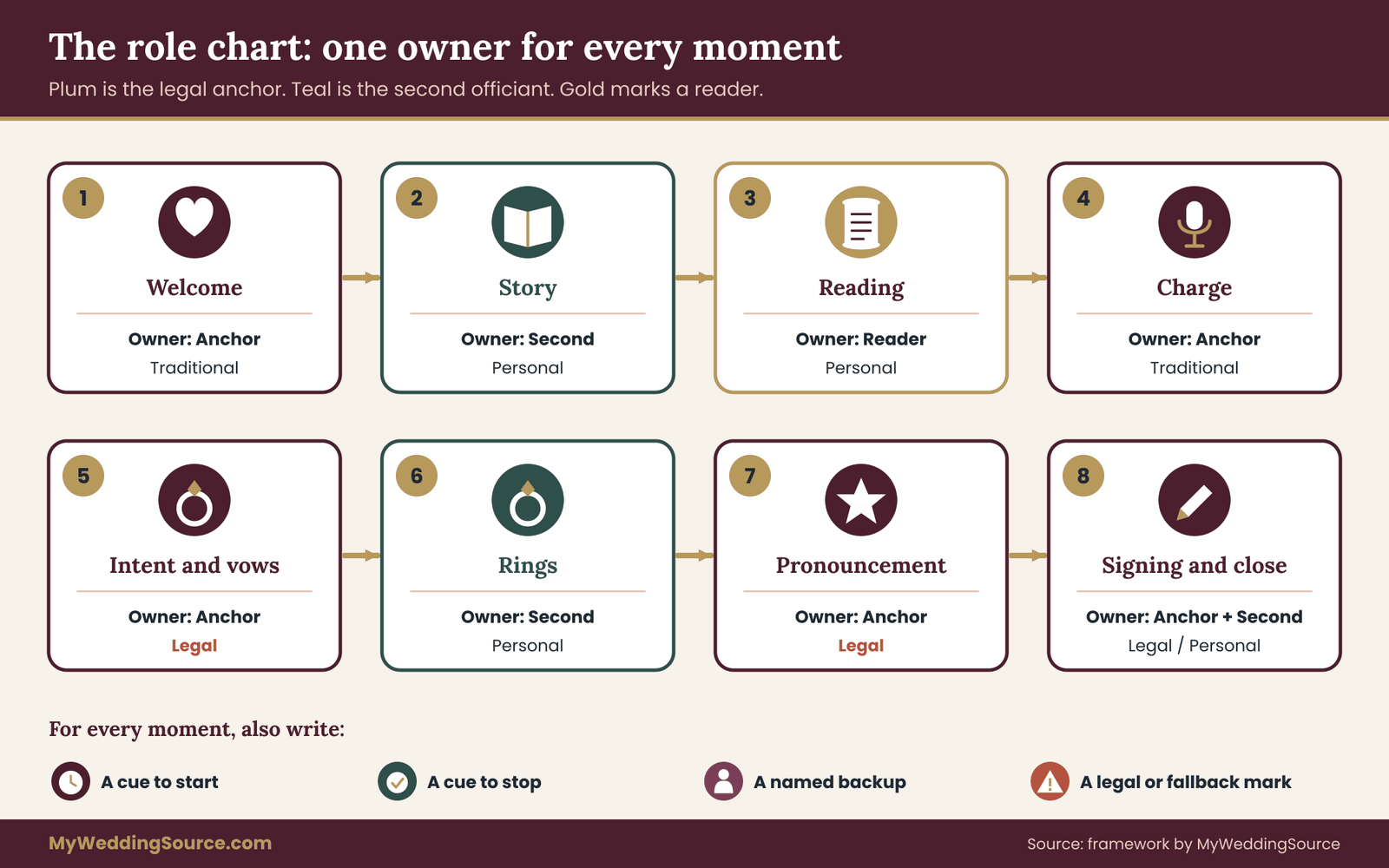
Once the legal anchor is settled, the next tool is a role chart. It is a one-page plan that says, for every moment of the ceremony, who speaks, who stands where, who holds the microphone and who is the backup. It is the single most useful document for a ceremony with two officiants, and it takes about an hour to draft.
The chart has five questions for each row. Think of the rows as moments, and the questions as the details you fill in for each.
Who owns it? One name per moment. Never two. “Both” is not an owner, because when both are responsible nobody is.
What is the legal weight? Mark each moment as legal, traditional or personal. Legal moments are the ones that carry the words or acts your state expects, or the ones the anchor must perform. Traditional moments belong to a faith or cultural practice. Personal moments are the stories, jokes and tributes.
What is the cue to start? The trigger could be a piece of music ending, a nod, a phrase the other officiant says, or a physical movement such as stepping forward.
What is the cue to stop and hand off? Equally important. Most overruns happen because nobody wrote down the end of a moment.
Who covers if the owner cannot? A named backup. If the owner is a nervous friend, the backup is almost always the anchor.
A sample role chart in prose
Here is how a chart reads when you describe it row by row. The couple in this example is invented, and the ceremony is a mid-length indoor one.
The welcome belongs to the anchor, who is the licensed officiant. It is a traditional moment, triggered by the end of the processional music, and it ends when the anchor says a short bridge line that introduces the second officiant. If the anchor is unavailable the second officiant opens.
The story of the couple belongs to the second officiant, a close friend. It is personal, triggered by the bridge line, and it ends when the friend says a closing phrase agreed in advance. The backup is the anchor, who has a printed copy of the story in case the friend freezes.
The reading belongs to a third person, a reader who is neither officiant. It is personal and is introduced by the second officiant. It ends when the reader returns to their seat, and the anchor then steps forward.
The charge to the couple, which is a short address about marriage, belongs to the anchor. It is traditional. The cue is the reader sitting down, and it ends with the line that introduces the vows.
The vows belong to the couple, but the anchor prompts them. The consent question or declaration of intent sits with the anchor. This is the legal moment.
The rings are exchanged with words given by the second officiant, so that the friend has a physical, meaningful role while the anchor holds the pronouncement for the end. The ring bearer or best person hands over the rings on the second officiant’s cue.
The pronouncement and the kiss belong to the anchor. It is the legal moment of declaration.
The signing of the license, if done during the ceremony, belongs to the anchor, with witnesses as the state requires. If the signing is private after the ceremony, the anchor still owns it.
The closing and the introduction of the couple belong to the second officiant, who has the lighter, warmer tone and sends the couple down the aisle with a final bright line.
Notice the pattern. The anchor holds the structural and legal moments. The second officiant holds the moments that benefit from a personal voice. The two meet at defined bridges. That pattern is not mandatory, but it works well enough to be a safe default.
The three marks that keep the chart honest
A chart that lists names and cues but does not mark legal weight, overlap risk and fallback tends to fail on the day. Add these three marks to every row.
A legal mark next to any moment that touches the license or the formal declarations. If the second officiant is not authorized, they should never be given a legal row. If you cannot tell whether a row is legal, it probably is, and the anchor should own it until you confirm otherwise.
An overlap mark next to any moment where the two officiants might be tempted to speak. The welcome and the closing are the usual offenders. Two welcomes in a row feel like a stall. Where you see an overlap risk, decide in writing which person has the line, and cut the other person’s version.
A fallback mark that names who steps in. A fallback is not a failure plan; it is a courtesy to the person who might be nervous. Telling a friend, “If you lose your place, I will pick up from the next paragraph and nobody will notice,” is far kinder than letting them find out on the day.
Who edits the chart
One person writes the master chart, and it should be the person who knows the most about the ceremony as a whole. Often this is the anchor, sometimes the couple, sometimes a ceremony coordinator or planner. The two officiants each review it and mark their own rows. The couple approves it. Then it is frozen, with a date at the top, and every later change is made on the master and sent to the two officiants. Two sets of slightly different charts are one of the quietest ways a ceremony with two officiants goes wrong.
Choosing who takes which role
Knowing that you will split the ceremony is half the job. The other half is deciding which person suits which block. There is no single correct assignment for two officiants, but a few principles make the decision easier.
Match the block to the temperament
Some people are excellent at structure, and some are excellent at warmth. A person who has led many ceremonies tends to be steady with the formal words and calm about silence. A friend who has known the couple for years tends to tell the best story, because the story is theirs. Put each person where they are strongest, and do not ask either to carry the other’s weight.
A friend who is nervous in front of groups should not be given the longest block. A short, meaningful moment, such as the ring exchange or a single reading, gives the friend a real role without making the ceremony depend on their composure. A friend who is a confident speaker can take the story, and the anchor can keep a shorter charge.
Match the block to the vocabulary
If one officiant speaks another language, or uses a different religious vocabulary, give that person the blocks where that language belongs. For example, a blessing in a second language works best as a complete block, not as a few phrases scattered through the other person’s text. A block gives the audience a clean shift, and the listeners who speak that language feel addressed rather than glanced at.
Match the block to the legal weight
As covered above, keep the legal blocks with the anchor. If you are tempted to split a legal block, such as the declaration of intent, because it would be moving for the second person to speak it, check first. Some places expect the person performing the solemnization to ask the questions, and splitting could cause a question later. If the second officiant wants to be part of the emotional moment, give them the words just before the legal act, such as a blessing, and let the anchor take over for the question itself.
Match the block to the time
Count minutes. If the anchor takes the welcome, the charge, the vows prompts, the pronouncement and the signing, and the second takes only a story and a closing, the ceremony will feel lopsided in a way that is hard to fix. Aim for a split in which both voices appear early, once in the middle and once near the end. The audience should hear each voice often enough to recognize it, and rarely enough that each appearance feels like an event.
A rough rule that many ceremonies find comfortable is roughly a sixty-forty split of speaking time, with the anchor holding the larger share because of the structural words. If the split is much more even, give each person at least two separate appearances, so that the second voice is not a single intrusion.
Invite the second officiant properly
When you ask a friend or relative to be the second officiant, ask in a way that lets them say no. Describe the role in specifics: the block, the length, the number of rehearsals, the outfit, the fallback. Some people say yes out of affection and then dread it. A clear description at the start lets them accept with eyes open or decline gracefully, and both outcomes are better than a last-minute scramble.
If both officiants are professionals, tell each of them who the other is, how you found them, and what role you have in mind. Professionals are used to sharing a stage, but they like to hear it from you rather than discover it at the rehearsal. Ask each whether they have worked alongside a second officiant before, and what they would want in place. Their answers often contain useful practicalities, such as a preference about who stands on the left.
When the two do not know each other
Two officiants who have never met are common when a couple hires a professional and invites a friend, or hires two professionals from different traditions. Schedule a short call between them, even fifteen minutes, before the rehearsal. They should hear each other’s voice, swap scripts, agree on the bridge lines and mention anything they dislike. A call also reveals mismatches early. If one person speaks with a strong formal tone and the other is casual, the couple can decide whether to blend them or lean into the contrast on purpose.
What to do if they disagree
Disagreements usually arrive over wording, not over substance. One officiant might want a prayer, the other would rather not include one. One might want a longer story, the other a shorter one. The couple should be the decision makers on content, and the anchor should be the decision maker on timing and legal wording. Say this early, in an email to both, and the disagreements shrink to preferences you can settle in a short phone call.
Dividing the ceremony into blocks for two officiants
A ceremony with one officiant is a single line of speech with pauses for music and action. A ceremony with two officiants is better thought of as a short series of blocks, each with one voice in charge. The word block matters. A block is a stretch of the ceremony that begins with a clear trigger, has one owner, and ends with a clear exit. Inside a block, nobody else speaks unless the script says so.
Here are the blocks most ceremonies contain, with notes on how two officiants handle each. Not every ceremony includes every block, and your tradition may add others.
Block one: the welcome and opening words
The welcome greets the guests, acknowledges why everyone is there, and sets the tone. It is short, usually under two minutes, and it normally belongs to the anchor, because the opening sets the legal and structural frame.
The risk with two officiants is a double welcome. The anchor says hello and the second officiant, wanting to be included, also says hello. Avoid it by deciding that the first person welcomes and the second person is introduced during the welcome, in one sentence. The anchor says something like, “I am joined today by Jo, who has known Priya since they were eleven, and who will tell you a little about the two of them.” That line introduces the second voice and gives the guests a reason to listen to it.
Some ceremonies open with a prayer, a land acknowledgment, a moment of silence or a short ritual. If the second officiant owns that part, because it belongs to their tradition, then the order should be spelled out: who welcomes, who opens with the ritual, who returns to the structure.
Block two: the story or the reflection
The story of the couple, how they met, what they value, what the guests know about them, is the natural home of the second officiant when that person is a friend or relative. It is the most personal block, and a personal voice does it best.
Keep the story shorter than you think it should be. Three to five minutes is usually enough. A friend who prepares a ten-minute story forces the anchor to make awkward decisions about cutting. Ask the friend to write it, read it aloud to someone with a timer, and send it to the couple and the anchor a week before the wedding.
Agree on what the story will not include. Some couples have a list of topics to skip: past relationships, stories that depend on inside jokes, anything that embarrasses an older relative. It is easier for a friend to hear this in advance than to guess.
Block three: readings and rituals
Readings are often given by guests who are neither officiant, such as siblings or friends. The role of the officiants is to introduce each reader and thank them. Decide which officiant does it. Usually it is the same person for each reading, so that guests learn the pattern, or it alternates in a planned way. Random choice looks random.
Rituals such as a unity candle, a sand ceremony, handfasting, a wine ceremony or a blessing of the rings belong to the tradition they come from. In a ceremony with two officiants the officiant who knows the ritual should guide it, because that person knows the steps, the words and the small physical details that go wrong when someone else improvises. The other officiant stands to the side and supports.
Block four: the charge or address
The charge, a short talk about marriage given to the couple, is a classic anchor block. It gives structure to the middle of the ceremony and leads into the vows. If the two officiants want to speak about marriage, resist splitting the charge in half. Two half-charges rarely cohere. Instead, give one person the charge and give the other a personal blessing or a closing line later. If you truly want both voices, let the second officiant offer a short wish after the charge, introduced by the anchor in one sentence.
Block five: vows and the declaration of intent
The vows are spoken by the couple, and in some ceremonies they repeat after an officiant, line by line. If the couple repeats after the officiant, one voice leads the lines, and it should be the anchor. Two people feeding lines creates confusion about who the couple should look at.
The declaration of intent, where the officiant asks whether each person consents to the marriage, is often the legal heart of the ceremony. It belongs to the anchor. Ask the issuing office whether your state expects particular words. In many places it does not require a precise script, but the anchor should know. This is also the moment when the second officiant should be quiet, still and attentive. A second officiant who fidgets, looks at their notes or whispers during the vows pulls the room’s attention away.
Block six: the rings
The ring exchange gives the second officiant a lovely role. They can introduce the rings with a short sentence about what rings mean in the couple’s tradition, ask for the rings from the person holding them, and hand each ring to the partner who will place it. The anchor stands near and keeps the rhythm of the ceremony.
Practical details matter here. Decide who holds the rings: a ring bearer, best person or a person standing near the second officiant. If the second officiant holds them, they need pockets or a small box and a plan. A pair of rings dropped on a stone floor is a story nobody wants to tell. A full cue sheet usually has a line for ring handling that you can adapt.
Block seven: the pronouncement and the kiss
The pronouncement belongs to the anchor. Two people saying “I now pronounce you” in unison is a recipe for muddle, and the second officiant is better placed offering a closing blessing before or after. Nothing in the pronouncement block should be shared.
The kiss follows. The anchor should step slightly aside so the photographer and guests can see. The second officiant steps aside as well. Decide in advance where each stands, so that neither is in the frame.
Block eight: the signing and the closing
If the license is signed during the ceremony, a table is needed, with a pen that works, and witnesses present. The anchor signs, and the witnesses sign if required. The second officiant should have an assigned role here too, even if it is simply to help guests stay engaged, perhaps by announcing a short musical interlude or saying a few closing words while the signing takes place. Silence during a signing is fine, but it can feel long.
The closing, the introduction of the couple as newly married, and the recessional cue often go to the second officiant, because their lighter voice sends the room off. The anchor, by then, is occupied with paperwork. That division works naturally.
How blocks relate to time
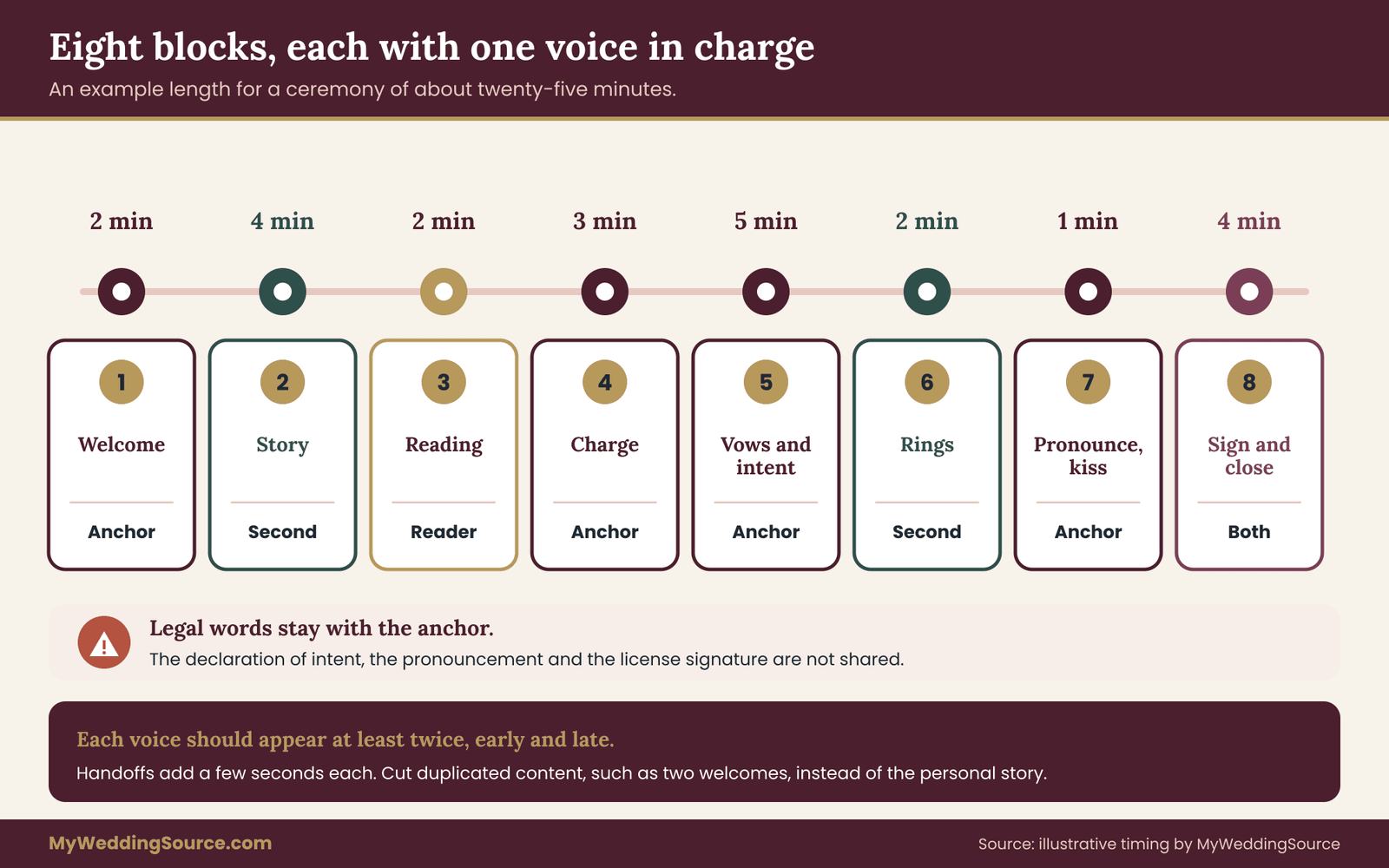
Add up the minutes. A sample ceremony of about twenty-five minutes might run like this: the welcome at two minutes, the story at four, a reading at two, the charge at three, the vows and intent at five, the rings at two, the pronouncement and kiss at one, the signing at three and the closing at one.
That makes twenty-three minutes plus a few for music and movement. With one officiant there would be no handoffs. With two there are about six, and each costs a little time. Plan for that, and shorten a personal block if you must. Do not skip the handoffs themselves, because those are what keep the transitions clean.
Handing off between two officiants
Between two officiants, a handoff is the moment the microphone, the attention and the responsibility pass from one officiant to the other. When it is done well, guests barely notice it. When it is done poorly, the room feels the seam. The best way for two officiants to handle handoffs is to treat each one as a small piece of choreography with three parts: a spoken cue, a physical cue and a technical cue.
The spoken cue
The spoken cue is a single sentence that the outgoing officiant says to introduce or release the incoming one. It does three things: it names the next block, it tells the guests who is about to speak, and it tells the incoming person it is their turn. Write it, in full, into the role chart.
Good bridge lines are short and specific. They do not gush. For example: “Jo is going to tell you about the day she met Priya.” Or: “Now Father Alvarez will lead us in a blessing.” Or: “I will hand things back to Jo for the closing.” There is no need for a long compliment before each handoff. Two or three of those and the ceremony starts to sound like an awards show.
Vary the pattern. If every handoff is “And now, to continue, please welcome,” the guests start to hear a script. Use the plain version when the moment is plain, and a warmer line when the second officiant is about to speak something moving.
The physical cue
The physical cue is what the two officiants do with their bodies. It might be a small step to the side, a nod, a hand gesture toward the incoming officiant, a handover of a folder or a book. It tells the guests where to look.
Agree on a consistent physical pattern. For example, the officiant who is speaking stands center, and the other stands a step back and to the side. At each handoff, the outgoing officiant takes a step back and the incoming officiant steps forward. Guests learn the pattern within one or two handoffs, and the pattern makes the whole ceremony feel designed.
Be careful with large movements. Two officiants swapping places across the couple, passing in front of the partners, or crossing in front of the photographer creates a clumsy picture. Keep movements small and to the sides.
The technical cue
The technical cue concerns the microphone and anything else electronic. If there is one microphone and two speakers, it must be passed, and passing takes seconds and risks a thump. If there are two microphones, they need to be tested and assigned, and the sound technician needs to know when each is live. The next section covers this at length.

Three handoff styles
Couples often ask which style is best. Each suits a different kind of ceremony.
The introduction handoff. The outgoing officiant introduces the incoming one by name, with a sentence of context. It works best at the start of a ceremony and wherever the guests have not yet heard the second voice.
The bridge handoff. The outgoing officiant says a sentence that connects the two blocks: “That is the story of how they met. Let me turn to what they want to say to each other.” The second officiant then speaks without an introduction. This feels smoother and is good for mid-ceremony transitions.
The silent handoff. A nod and a step, with no words. It works when the guests already know who is speaking and when the music or the action makes the shift obvious, such as after a reading or a song. It is the hardest to rehearse, because it depends entirely on timing.
A single ceremony often uses all three. The first handoff is an introduction, the middle ones are bridges, and the closing is silent or very short.
The handback
Do not forget that the return trip is also a handoff. The second officiant finishes, and the anchor needs a way back in. A closing phrase from the second officiant, agreed in advance, tells the anchor the block is over. Without it, the anchor may wait for a pause that never comes, or start too early. Write the final words of the second officiant’s block into the anchor’s notes as a trigger. It is the same technique a stage manager uses, and it works the same way.
Microphones, positions and movement with two officiants
With two officiants, the sound system is where many otherwise careful plans come apart. A ceremony with one officiant needs one voice to be heard. A ceremony with two officiants needs two voices to be heard equally, from two spots, with no loud thumps between them. It is also where venue rules, the sound vendor and the weather join the conversation.
Decide how many microphones you need
There are four common setups, and each suits a different venue and budget.
One handheld microphone passed between officiants. It is cheap and simple, and it works for small rooms where voices carry. The downside is the pass itself. A handoff that includes handing over a microphone is slower and noisier, and a person holding a microphone cannot hold a script and a book comfortably.
One stand microphone the two officiants share. The two stand close to the stand and speak into it. This keeps their hands free, but it forces them to stay near each other, and it flattens any physical choreography. Heights differ, so the stand needs adjusting, and adjusting it mid-ceremony is clumsy.
Two lavalier or headset microphones. Each officiant wears a small clip-on microphone. The sound technician unmutes the speaker and mutes the other. Hands are free, voices are consistent, and the handoff is invisible. This is the cleanest setup, but it needs a technician who understands the cue sheet, and it needs working batteries and a spare.
No amplification. In small, quiet rooms, two officiants can speak without a microphone. This works only if both have strong voices and the room has no echo. Test with a person in the back row.
Choose based on the room and the number of guests, and ask your sound vendor or venue what they recommend. If you are using wireless microphones, ask the venue about any restrictions on radio equipment, and see the guidance on wireless microphone use from the Federal Communications Commission if you plan to bring your own gear, since wireless systems operate on regulated frequencies. Your sound vendor will normally handle this, but it is worth asking.
Match microphones to roles
If the anchor and second officiant have very different voice strength, pair the quieter voice with the better microphone and place the louder one slightly farther from the source. The sound technician can also adjust levels per person. During sound check, each officiant should speak the first and last lines of their own blocks, at the volume they intend to use, from the position they will actually stand in. A technician who hears only a counting test will miss the difference between a rehearsal voice and a performance voice.
Handle the muting plan in writing
If you use two wireless microphones, the sound technician needs a cue for muting and unmuting. Put it in the role chart: when the bridge line ends, the technician switches. Technicians often prefer to listen for the bridge line than to follow a stopwatch, because ceremonies run at human speed. Give the technician the exact bridge lines and the exact end phrases. If the technician is a venue employee who has never seen your ceremony, they may need a printed copy of the cue sheet and a short conversation.
Always plan for failure. If a microphone dies, the other officiant should have a plan for continuing, such as a handheld backup placed nearby, or a short pause while the technician swaps batteries. Tell the two officiants what to do. A calm instruction, such as “if the microphone cuts out, keep speaking and slow down while the technician fixes it,” is better than leaving them to guess.
Where the officiants stand
Position matters for sightlines, photographs and the feeling of the ceremony. A few standard layouts are worth knowing.
The center-and-side layout. The anchor stands center, behind or in front of the couple depending on the venue, and the second officiant stands to one side, a step behind. When the second officiant speaks, they move forward to a mark. It is simple and legible, and guests understand who is in charge.
The flanking layout. The two officiants stand on either side of the couple, equally forward. It works for symmetric ceremonies, such as interfaith ones where the two traditions deserve equal weight. It looks balanced, but the couple gets squeezed in sound and in photographs. It also means each officiant faces the other across the couple, and eye contact for cues becomes harder.
The facing layout. The couple stands facing the two officiants, who stand together. It suits small, intimate ceremonies, and it makes handoffs easy because the officiants are shoulder to shoulder. It means the couple has their backs to most of the guests, which some couples dislike.
The rotating layout. The speaking officiant moves to the center and the other steps aside. It is the most theatrical, and it needs rehearsal.

Mark the floor
Small tape marks or flower petals can indicate where each officiant stands. Venue rules may restrict tape on floors, so ask. At outdoor venues, a small stone or a bent grass mark can do. The marks matter because people drift while speaking, and drift changes the sightlines for the photographer and for guests seated at the sides.
Plan for the officiants’ materials
Each officiant carries their own text. Printed pages are more reliable than phones in sunlight, and a folder or book prevents pages from blowing away. Decide who holds what. Some ceremonies use one shared binder passed between the officiants, but that adds to the handoff. Two separate folders, each with the officiant’s blocks and the immediate bridge lines before and after, are simpler.
Font size is a quiet matter. A friend who is nervous may need a large font, double spacing and the first few words of each paragraph in bold. Printing the text in a larger size costs nothing and prevents a lost place.
Outdoor and windy conditions
Wind is a problem for both sound and paper. Ask the sound vendor about windscreens for lavalier microphones, and use weights or clips for papers. If the ceremony is on a beach, in a park or at a farm, where the officiants have no walls behind them, voices disappear. Plan for slightly slower speech and more breaks. Parks and public lands often have rules about amplified sound and permits for ceremonies, so check with the managing agency, such as the National Park Service if the site is a national park, well before the day.
Accessibility during handoffs
Think about every guest who needs to hear and see the handoffs. If a sign language interpreter is part of the ceremony, the interpreter needs a clear sightline to both officiants and a place to stand that is visible to the guests who rely on them. When two officiants speak, the interpreter must know who is speaking at each moment. Share the role chart with the interpreter ahead of time, and ask them where they want the officiants to stand. The Americans with Disabilities Act pages at ADA.gov explain general obligations around communication and access, and your venue should be able to answer questions about assistive listening systems.
A hearing loop or a loaner receiver can make a real difference to a guest with hearing loss, and it works best when the two officiants speak clearly into their microphones.
Guests in wheelchairs or with limited mobility should have a clear view of the two officiants. If the stage is raised, check ramp access for the officiants themselves. A second officiant who uses a mobility aid should not be placed on a platform that is not accessible. Ask both officiants about their needs in the first conversation, and plan from there.
Music cues and the officiants
Music is another cue source. A song that ends, a chord that resolves, a pause after a processional: all can serve as triggers for the officiants. Tell the musicians where each officiant begins, and tell the officiants which musical event cues them. If a musician plays during a ritual, such as the lighting of a candle, the officiants need to know the length of the piece, so the second officiant does not start speaking over the last bars.
Who looks at whom
When two officiants share the front of the room, eye lines are part of the show. Eye lines are choreography too. While one officiant speaks, the other should look at either the speaker or the couple, not at their notes. Guests read the second officiant’s face as a signal about how the ceremony is going. A second officiant who reads their own script during the other’s block looks distracted, however well they are prepared. Ask both to rest their notes at their sides during the other’s block, and to keep a warm, quiet face.
A worked example with two officiants
The following example of a wedding ceremony with two officiants is invented, and it is here to show how the pieces fit together. It does not describe a real couple, and the details are chosen to illustrate decisions, not to prescribe them.
Priya and Tom are marrying on a Saturday afternoon in a garden venue, in front of about ninety guests. They want a ceremony of roughly twenty-five minutes. They have two officiants in mind. Reverend Alma Reyes is a licensed officiant who married Priya’s cousin and whom Priya trusts for structure and calm. Jo is Priya’s oldest friend, a confident talker, who has been asked to tell the story of the couple. Tom’s family is quiet, and his father will do a reading.
Step one: the legal question
Priya calls the county clerk’s office. She learns that the person who solemnizes the marriage must be authorized under state law, that the license has one line for the officiant, and that two witnesses are required. Jo is not authorized and has no wish to become so. Reverend Reyes is. The couple writes in their notes: legal anchor is Reverend Reyes, who signs the license and returns it within the deadline the clerk gave. Jo is a speaking participant. Priya writes the date of the call and the name of the clerk who answered.
Because the clerk said the license can be returned by mail or in person within a set number of days, Reverend Reyes agrees to file it in person the Monday after the wedding. She also agrees to send the couple a message when it is done.
Step two: the purpose of the second voice
The couple answers the three questions from the first section. Jo will tell the story, because she knows both of them, and no one else can do it as well. The anchor will keep the welcome, the charge, the vows and intent, the pronouncement and the signing. The tiebreaker on timing is Reverend Reyes. The couple decides content questions together.
Step three: the role chart
They build a chart. The welcome belongs to Reverend Reyes and ends with a bridge line introducing Jo. Jo’s story runs four minutes and ends with a phrase the two have agreed: “and that is why I am so glad we are all here.”
Tom’s father reads next, introduced by Jo with a single sentence, and returns to his seat. The charge is given by Reverend Reyes. The vows are spoken by the couple, with Reverend Reyes asking the question of intent. The rings are introduced by Jo, who holds them in a small pouch and hands them over. The pronouncement belongs to Reverend Reyes. During the signing, Jo says a short closing blessing the couple has chosen. After the signing, Jo introduces the couple to the guests and the recessional begins.
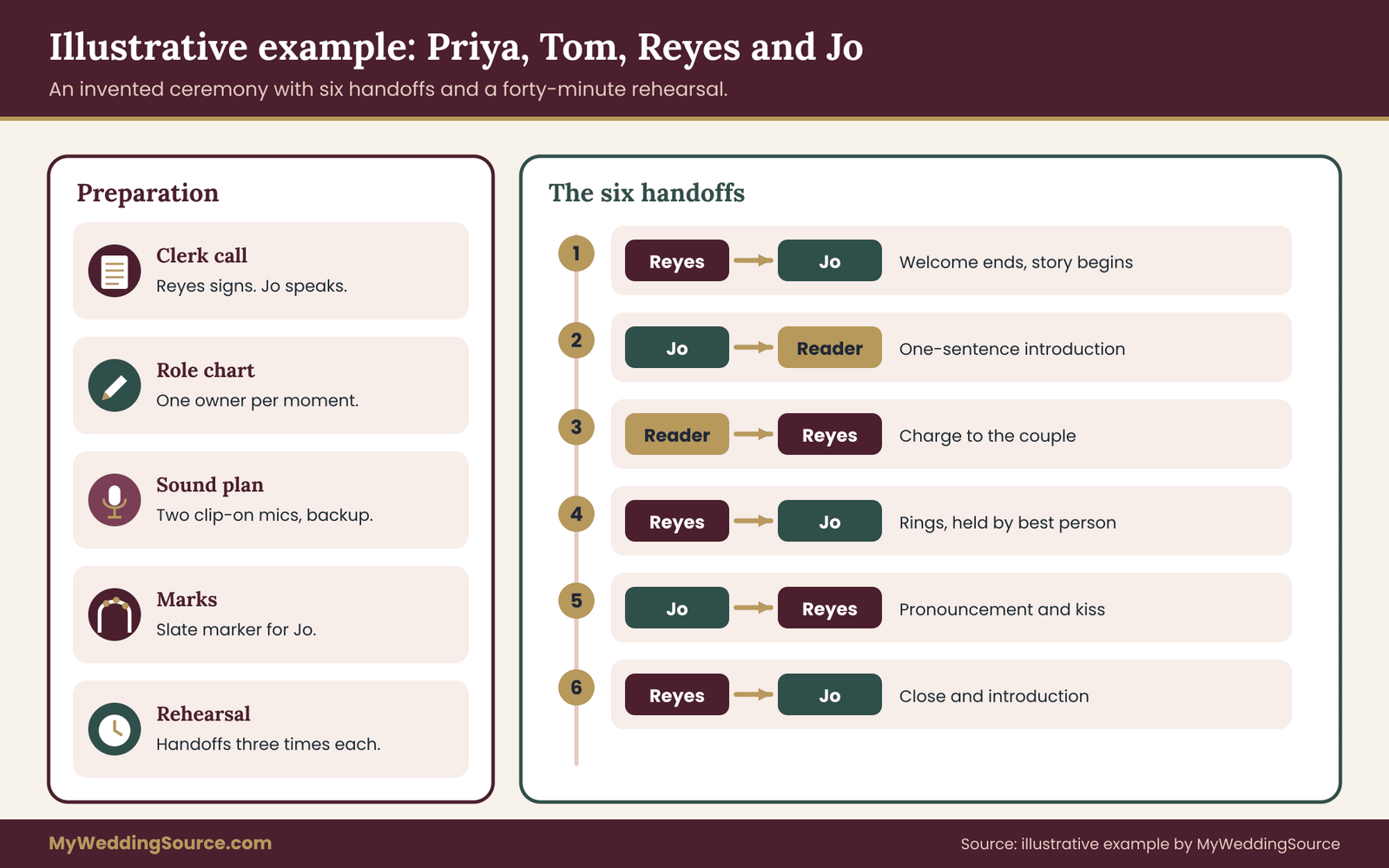
The chart shows six handoffs: Reyes to Jo, Jo to the reader, the reader to Reyes, Reyes to Jo for the rings, Jo back to Reyes for the pronouncement, and Reyes to Jo for the close.
Step four: the sound plan
The garden is open air, and there is a light breeze. The sound vendor suggests two lavalier microphones with windscreens and a backup handheld. The two officiants wear microphones. The technician receives a copy of the role chart, marked with the exact bridge lines. The vendor agrees to mute and unmute on the lines. Jo and Reverend Reyes both attend a sound check an hour before the ceremony, speaking the first and last lines of their blocks from their actual standing marks.
Step five: positions and movement
The couple stands facing the guests under a simple arch. Reverend Reyes stands center, behind and between the couple. Jo stands to the left, a step behind. When Jo speaks, she steps forward to a small slate marker that the florist has placed at the base of the arch, and she steps back when she finishes. The reader approaches from the first row on the right.
The photographer is told about the marks and the six handoffs. She decides to stand to the left of the guests’ aisle so she can see the two officiants.
Step six: rehearsal
The rehearsal takes forty minutes the evening before. They do not rehearse the story or the charge. They rehearse the six handoffs three times each, then run the whole ceremony once with the microphones on, then once more with the rings.
Reverend Reyes notices that Jo tends to start her story before the music has fully faded. They agree that Jo will wait for Reyes to finish her bridge line and take one breath. Jo notices that her pouch tangles with her microphone pack, and they move the rings to Tom’s best person, who will hand them to Jo at the right moment. A small detail, fixed on a Friday evening instead of in front of ninety people.
What the example shows
The lesson is not that two officiants are always better. It is that two officiants work when the plan is specific.
Three decisions did most of the work. First, the couple confirmed the legal anchor and wrote it down before drafting any text. Second, they put one name against every moment and defined each handoff with a spoken, a physical and a technical cue. Third, they rehearsed the seams, not the speeches. None of that required special talent. It required about three hours of preparation across two weeks, and a few honest conversations.
Another feature of the example is worth pointing out. The couple used the second officiant for the roles that benefited most from a personal voice and avoided putting her anywhere near the legal words. If Jo had asked to say the declaration of intent, the couple would have asked the clerk whether that was allowed, and, whatever the clerk said, would probably have given Jo a blessing just before the question instead. The aim is a ceremony that feels shared without making the legal part uncertain.
Scripts for the handoffs
People planning a ceremony with two officiants often know what they want to say but get stuck on the transitions. This section offers sample bridge lines, in plain language, so that you can adapt them to your own voices. They are examples to modify, not text to copy, because the best bridge lines sound like the person speaking.
Opening and introduction
From the anchor, after the welcome: “I am glad to share the front of this room with Jo today. She has known Priya longer than almost anyone here, and she is going to tell you something about the two of them.”
For a faith pairing: “We are fortunate to have two traditions represented here. Father Alvarez will lead us in the first blessing, and Rabbi Stein will lead the second.”
For a bilingual ceremony: “We will move between English and Spanish today, and each of us will speak our part in the language that is closest to it. You do not need to follow every word to feel the meaning.”
Mid-ceremony bridges
From the second officiant to the anchor, after the story: “That is a little of how these two came together. Alma will guide us through what comes next.”
From the anchor to a reader, via the second officiant: “Tom’s father has a reading he has chosen, and I would like to invite him up.”
From the anchor to the second officiant before the rings: “Jo has the rings, and she will say a few words about them.”
Closing and handback
From the second officiant, closing: “Thank you all for being here. It is my pleasure to introduce, for the first time, Priya and Tom.”
If the anchor closes after the signing: “I will hand things back to Jo for the last words.”
Lines for the awkward moments
If a microphone fails: “We will give the technician a moment. Please bear with us, and I will speak up in the meantime.”
If someone loses their place: the other officiant, quietly, “Take your time. We are right with you.”
If a child or guest interrupts: a short, warm smile and a phrase such as, “That is the sound of a happy day,” and a return to the script.
What makes a good bridge line
Short, specific, plain. Between two officiants, a good bridge line names what comes next and who is speaking, and it adds no content of its own. It does not repeat the previous block, which tends to happen when one officiant tries to praise the other. It does not announce itself with the word “transition.” It also leaves a small pause after it, one breath, so that the incoming officiant has time to step forward.
Read bridge lines aloud, in the same room as the other officiant if possible. A line that looks fine on paper may sound stilted or too formal. Replace it with the version both people can say without effort.
Keeping the voices distinct
When two officiants speak, the audience hears two styles, and that is often a pleasure. Do not try to make the two voices sound alike. The anchor may use measured, formal language, and the second officiant may speak in an easy, personal way. Let the contrast stand. With two officiants, the one thing to avoid is a contrast that feels like disagreement, such as one officiant correcting the other’s phrasing or glancing at the clock. That is a private conversation for the rehearsal.
Rehearsing two officiants and writing the cue sheet
A rehearsal for two officiants should be shorter and more targeted than a full ceremony run-through. The goal is not to perfect the words. The goal is to find the seams where the ceremony could stumble, and to fix them while the stakes are low.
Before the rehearsal: the preparation call
At least a week ahead, hold a short call or meeting with the two officiants, and with the couple if they wish. Cover four things. First, read the role chart together, row by row, and confirm that each person agrees with their rows. Second, read the bridge lines aloud. Third, discuss the length of each block and agree on the maximum. Fourth, ask each person what they are nervous about. The last question surfaces problems no chart will, such as a fear of the microphone, a bad knee that makes standing difficult or a worry about the ring handoff.
Send the call notes in writing afterward. People forget spoken agreements, and a written note is a reference when memories differ.
The rehearsal itself
Plan about forty-five minutes to an hour. A useful order is below.
Walk the space. Let the two officiants the two officiants stand on their marks, see the sightlines and test the sound. If the venue allows access the evening before, use it. If not, ask for a short window on the day.
Run the handoffs alone. Take each handoff in turn, from the last words of the outgoing officiant to the first words of the incoming one, including the spoken, physical and technical cues. Repeat each three times. This is the heart of the rehearsal and takes the most time.
Run the legal moments. Walk through the declaration of intent, the pronouncement and the signing. Check the pen, the table, the witnesses and the license. The anchor should say the legal lines aloud, and the couple should hear them in the real voice and tempo.
Run the whole ceremony once. Do it at performance speed, with the microphones on if possible. Do not stop for small errors. Make notes and discuss them afterward.
Repeat any part that went poorly. Do not run the whole ceremony again and again. Two officiants who rehearse the whole ceremony six times tends to lose its freshness, and the officiants begin to sound like recordings.
Finish with a short debrief. Ask each person one thing that worked and one thing they would change. Write it down.
What not to rehearse
Do not rehearse the couple’s own vows, if they have written personal ones. Do not rehearse the story the second officiant tells, beyond a timing run. Do not rehearse the emotional parts to the point of exhaustion. Their power depends on a certain freshness.
The cue sheet for a ceremony with two officiants
The role chart is the planning document. The cue sheet is the day-of document, shorter and organized by time. For the full structure, the wedding ceremony cue sheet guide explains how to build one for all the people involved. For a ceremony with two officiants, add the following to it.
The name of the legal anchor, with their phone number, at the top, so the coordinator knows who to find.
A row for each handoff, with the exact bridge line, and the physical and technical cue.
A note about which microphone is live for each block.
The deadline and the method for returning the license, and the person responsible.
The names of the witnesses, if the state requires them.
A fallback for each officiant. The coordinator should know that if the second officiant is delayed, the anchor takes the second officiant’s blocks, and which blocks to shorten.
Make three copies of the cue sheet: one for the coordinator, one for each officiant. Give the sound technician an excerpt covering only the cues relevant to them.
Who should have what
Give the second officiant only what they need. A friend does not want the vendor contact list or the timeline of the whole day. Give them their blocks, the bridge lines before and after, the positions, the microphone plan and the call time. Give the anchor the whole sheet. Give the coordinator a summary. Different people need different amounts of information, and overloading a nervous friend creates anxiety.

Risks and edge cases for two officiants
Most ceremonies with two officiants go smoothly. When they do not, the cause is usually one of a few predictable problems. Knowing them in advance lets you plan a calm response.
The second of the two officiants freezes
Stage fright is common, especially in friends and relatives who have never spoken in front of ninety people. Plan for it. The anchor should have a copy of the second officiant’s text and know where each paragraph begins. A quiet agreed phrase, or a hand on the arm, signals that the anchor will take over. The anchor then reads the remaining text or summarizes it, and carries on. Guests rarely notice, and the friend is spared embarrassment. Tell the friend in advance that the fallback exists. Often that knowledge alone prevents the freeze.
The anchor is late or ill
If the legal anchor cannot attend, the situation is serious. The second officiant may not be authorized to solemnize the marriage, so the couple may have no one who can complete the license. Ask the anchor, well in advance, what their emergency plan is, and whether they know a colleague who can step in. Some professional officiants keep a trusted backup. If your state has a temporary authorization process, you might arrange a backup in advance. Ask the issuing office what is possible on short notice. The couple should have the anchor’s phone number and the backup’s phone number on the cue sheet.
Do not assume that an illness is unlikely. A ceremony that depends on one authorized person has a single point of failure, and that is true whether you have one officiant or two. With two officiants, there is at least a second person who can keep the ceremony going while the couple resolves the legal question, but you should never rely on that second person to sign unless the clerk has told you they can.
The license problem
Mistakes on the license, such as a wrong name, a missing signature or an illegible entry, can delay recording. The anchor should check the license before the ceremony, and again before signing. Use the pen the office recommends, and fill each line carefully. After the ceremony, the couple should confirm the return date and keep a record of when and how it was sent. Once the record exists, order a copy and read every name and date on it.
The officiants disagree on the day
It is rare, but it happens. One person wants to add a reading, the other wants to cut one. The couple should have given the anchor authority on timing and the couple authority on content. If a disagreement arises on the day, the anchor can say, quietly, “We will keep to the plan the couple chose.” Then the rehearsal debrief can sort out the rest. Prevent the issue by sending the final script to both people a week ahead and asking for any last changes by a stated date.
The ceremony runs long
Two officiants tend to run long, because each adds small flourishes. Build in a time check. A coordinator or a trusted friend can signal the anchor at the midpoint, perhaps with a discreet sign. If the ceremony is running long, the anchor can shorten the charge or skip an optional ritual. Decide in advance what is optional. The second officiant’s story is not usually the right thing to cut, because it is the personal heart, but a longer reading or a second blessing might be.
The microphone fails
The usual solution is a backup handheld microphone. The anchor holds it or places it where both can reach it. Tell both officiants to slow down, project and keep going. A short pause while the technician fixes the issue is fine. The guests are patient if the officiants are calm.
The two officiants clash in tone
A formal anchor and a casual second officiant may produce a mismatch that bothers the couple on the day. The cure is preparation. In the call before the rehearsal, listen for the mismatch and decide whether to blend or lean in. Some couples enjoy the contrast. Others want a more even tone. Tell the officiants which you prefer.
A guest or relative objects
Occasionally a relative objects to the second officiant’s role, or to a ritual, or to the presence of two traditions. That is a family conversation, not a ceremony problem, and it belongs well before the day. If it arises on the day, the couple, not the officiants, should decide how to respond. The anchor should not argue in front of the guests.
Last-minute substitutions
Sometimes a ceremony planned for two officiants becomes a ceremony for one. If the second officiant cannot attend, the couple should have a plan: the anchor takes the blocks, a trusted friend reads the story, or the ceremony is shortened. Rewrite the role chart quickly, and tell the sound technician. Keep it simple. A good ceremony with one officiant beats a complicated one with two that has been patched at the last minute.
Pairings across faith, language and culture
Many shared ceremonies exist because two traditions are meeting. A few practical points help them go well, without pretending to cover any tradition in depth.
Start by asking each officiant what is non-negotiable in their practice. A prayer in a particular language, a specific blessing, a ritual object, a posture or a place to stand may matter a great deal to one person and be invisible to the other. Ask early, and write the answers into the role chart. The interfaith planning guide mentioned earlier discusses who owns each ritual, and the christian wedding ceremony script and non-religious wedding ceremony script pages show how different ceremony structures are shaped, which helps when one officiant is religious and the other secular.
Give each of the two officiants a complete block, not scattered phrases. If two languages are used, plan whether the second language is translated or simply spoken. Printing a short bilingual program, with the key readings in both languages, helps guests follow along without slowing the ceremony.
Do not ask one officiant to perform another tradition’s ritual. A well-meaning attempt may sound wrong to the people for whom the ritual matters. If a ritual needs a person from that tradition, invite them, even briefly. A short role as a blesser or a reader can honor the tradition while keeping the structure clear.
Finally, check whether either tradition has expectations about who may stand where, who may touch ritual objects or what may happen during certain times of year. Raise these early and without assumptions. Most officiants are glad to be asked, and a question asked in March is easier to answer than a surprise in June.
A last word on tone
A ceremony with two officiants should feel like one ceremony. The best sign is that guests, afterward, talk about the couple and the day rather than about the logistics of who spoke when. If they remember the story and the vows and the way the room felt, the planning did its job. If they remember an awkward silence, the next ceremony you attend, or plan for a friend, will benefit from what you learned.
Your next steps
Work through these in order when you plan a ceremony with two officiants. Each can be done in a short sitting.
First, name the reason for the second voice in one sentence. If you cannot, consider whether a reader or speaker role would serve you better.
Second, call the office that issues your marriage license. Ask who may solemnize, whether a second person may sign, how many witnesses are needed and when the license must be returned. Write down the answers and the date. Use the wedding officiant requirements guide to shape your questions.
Third, name the legal anchor, and give that person the legal moments in writing.
Fourth, draft the role chart. One owner per moment, a cue to start, a cue to stop, a fallback.
Fifth, write each bridge line, and read them aloud with the two officiants on a call.
Sixth, talk to your sound vendor about microphones and muting, and give them the cue lines. Share the plan with any interpreter or accessibility provider.
Seventh, schedule a forty-five minute rehearsal that focuses on the handoffs, and put the date on your wedding vendor timeline so that everyone knows when to arrive.
Eighth, build the day-of cue sheet, add the backup plan for each officiant, and give copies to the coordinator and to both people.
Ninth, confirm who returns the license, by what date and how, and ask for a confirmation when it is done.
FAQ
Can a wedding have two officiants?
Yes, in most places a ceremony can include two people in officiant roles, but usually only one of them is the legal solemnizer who signs the license. The other speaks as a participant. Rules differ by state and county, so ask the office that issues your license who may sign and whether a second person may be listed.
Do the two officiants need to be legally authorized?
Usually not. One authorized person normally holds the legal role, and the second can speak, lead a ritual or give a blessing without signing anything. If you want both to hold legal authority, ask the issuing office whether the license form allows it, because many forms have one officiant line.
Who should be the legal anchor if one officiant is a friend?
In most cases the experienced or licensed person should hold it, because they know the paperwork and the deadlines. A friend can take a personal block such as the story or the rings. If the friend wants the legal role, ask the clerk about temporary authorization early, since some places need advance steps.
How do two officiants split a ceremony?
Divide it into blocks and give each block one owner. A common split gives the anchor the welcome, charge, vows prompts, pronouncement and signing, and gives the second officiant the story, the rings and the closing. Aim for each voice to appear several times, and write a short bridge line for every handoff.
Will two officiants make the ceremony longer?
Usually a little. Each handoff adds a few seconds, and two people tend to add small flourishes. Expect a few extra minutes unless you trim duplicated content such as two welcomes or two thank-yous. Set a target length at the start, and have a coordinator give the anchor a time check at the midpoint.
How many microphones do we need?
It depends on the room. Two clip-on microphones give the cleanest handoffs, because each person has free hands and a technician can mute the other. One handheld passed between speakers is cheaper but noisier. Small quiet rooms may need none. Ask your sound vendor, and test both voices from their standing marks.
Should two officiants rehearse together?
Yes, and briefly. Focus on the handoffs, the legal moments and the microphones rather than the full script. About forty-five minutes is enough for most ceremonies. Hold a short call a week before, so both officiants have agreed on the bridge lines and the role chart before they stand in the room.
What if one officiant cannot attend?
Have a plan on the cue sheet. If the second officiant is absent, the anchor takes their blocks or a reader covers the story. If the anchor is absent, you may have no authorized signer, so ask the anchor about a trusted backup and ask the issuing office what is possible on short notice.
Sources
- USA.gov: Get a marriage license
- USA.gov: State governments
- CDC National Center for Health Statistics: Where to write for vital records
- ADA.gov: Americans with Disabilities Act information and technical assistance
- Federal Communications Commission
- National Park Service
- USA.gov: Government services and information
- Federal Trade Commission: Consumer advice