
A bilingual wedding DJ has three jobs at once: playing music that two groups of guests both enjoy, speaking clearly in two languages when the microphone is on, and handling requests without losing the room. This guide gives you a two-language briefing sheet, a pronunciation guide, announcement scripts, transition rules and a request policy, so the person running your sound knows what to do before the first guest arrives.
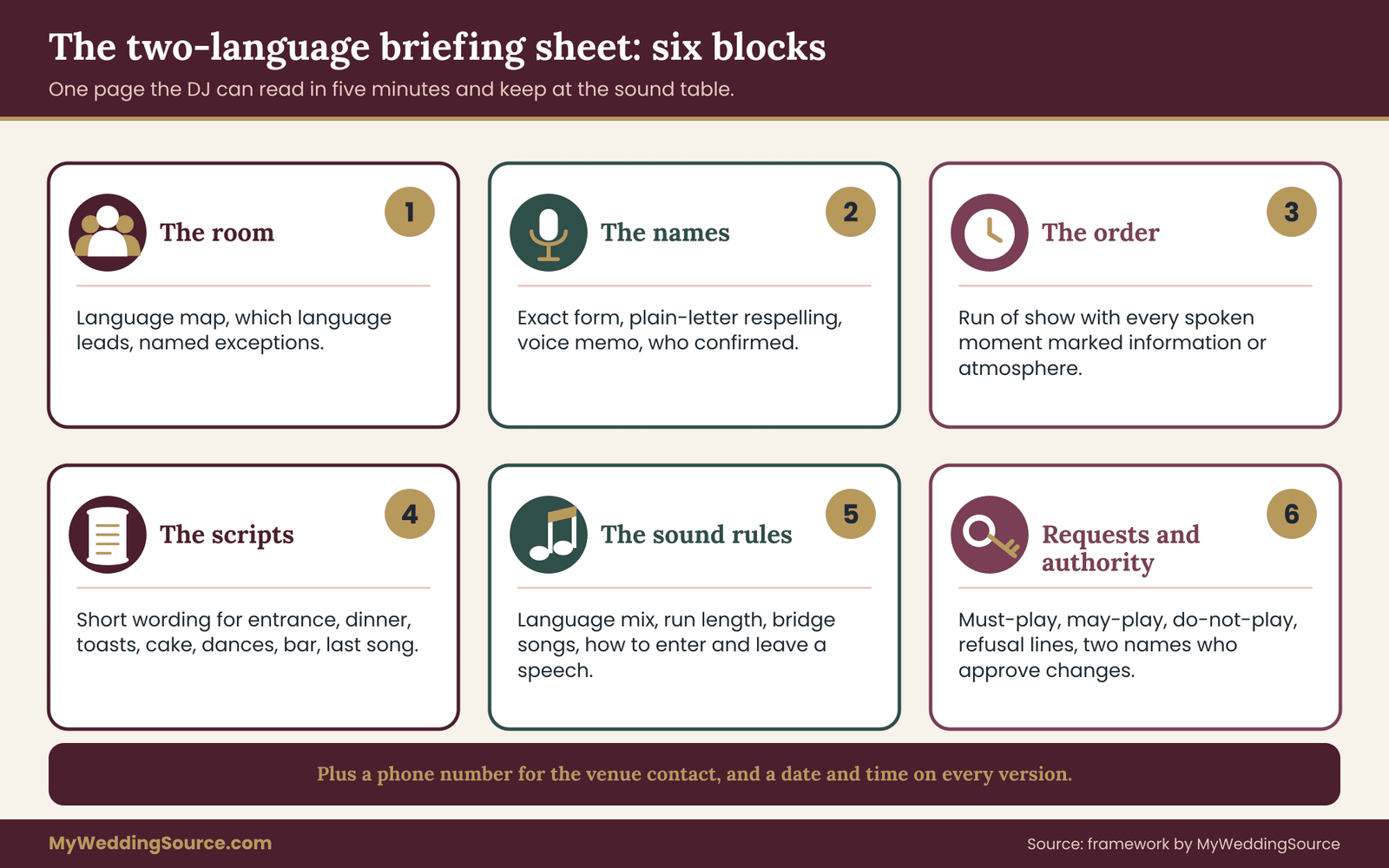
Do not hand your bilingual wedding DJ a playlist and hope. Hand over a one-page briefing sheet with six blocks: who is in the room and which language each group understands, the names with phonetic spelling, the order of the evening, the scripts for each announcement, the language and energy rules for transitions, and a request policy with a named person who approves changes. Keep every announcement short in both languages, say each name the same way every time, and decide in advance what happens when a guest asks for a song that does not fit.
Most couples planning a two-language reception think about the music first. They build a list with songs from both cultures, send it to the bilingual wedding DJ, and consider the job done. Then the evening arrives and the problems turn out to be about words, not songs. The DJ mispronounces a grandmother’s name. The welcome is spoken in one language and half the room hears a minute of noise.
A cousin hands over a phone with a request in the second language and nobody on the sound table can read the title. A toast is delivered in one language and never summarized for the other side of the family.
None of these is dramatic, and all are avoidable. A bilingual wedding DJ set works when the preparation is written down, the roles are clear, and the DJ has a short script for each recurring moment. This article is about that preparation. It is deliberately narrow. It does not rebuild the whole music plan for a reception; for that, the reception music planning guide covers the broader questions of generations, dance styles and set structure. Here the focus is what changes when two languages share one microphone and one dance floor.
A note on scope. This is general planning information, not legal advice. Music licensing, venue sound rules and performance rights vary by place and by contract, and the article points you to the agencies and organizations that issue the current rules so you can confirm them yourself.
What a bilingual wedding DJ actually has to handle
The phrase “bilingual DJ” sounds like one skill. In practice it bundles three different jobs, and a person can be strong at one and weak at another. Separating them early helps you ask better questions and write a better briefing.
Job one is the music. A bilingual wedding DJ needs a working library in both languages, in the versions you actually want. That includes the original recordings, radio edits where the lyrics matter, and the older songs that guests in their sixties and seventies expect without being asked. The skill here is not owning the songs. It is knowing how to sequence them, so that a song in one language is followed by something that feels like a natural next step rather than a hard switch.
Job two is the voice. Anyone who has attended a wedding with a poor emcee knows that speaking into a microphone is a separate craft. A bilingual wedding DJ who also acts as emcee must read names correctly, keep announcements short, and be intelligible in both languages, including to listeners who know the language less well than the speaker.
Fluency in conversation is not the same as clear delivery over a sound system in a loud room. Some excellent DJs speak only one language and bring in a second person for the microphone. That is a legitimate solution, and a later section compares the options.
Job three is the room. Requests arrive in both languages. Elders may ask for a song by humming or by naming a singer rather than a title. A guest may speak to the bilingual wedding DJ in the language the DJ does not read well. Someone will want a song that is wrong for the moment or wrong for the couple. The DJ handles all of this while the dance floor is changing in real time. A written request policy takes most of the pressure off.
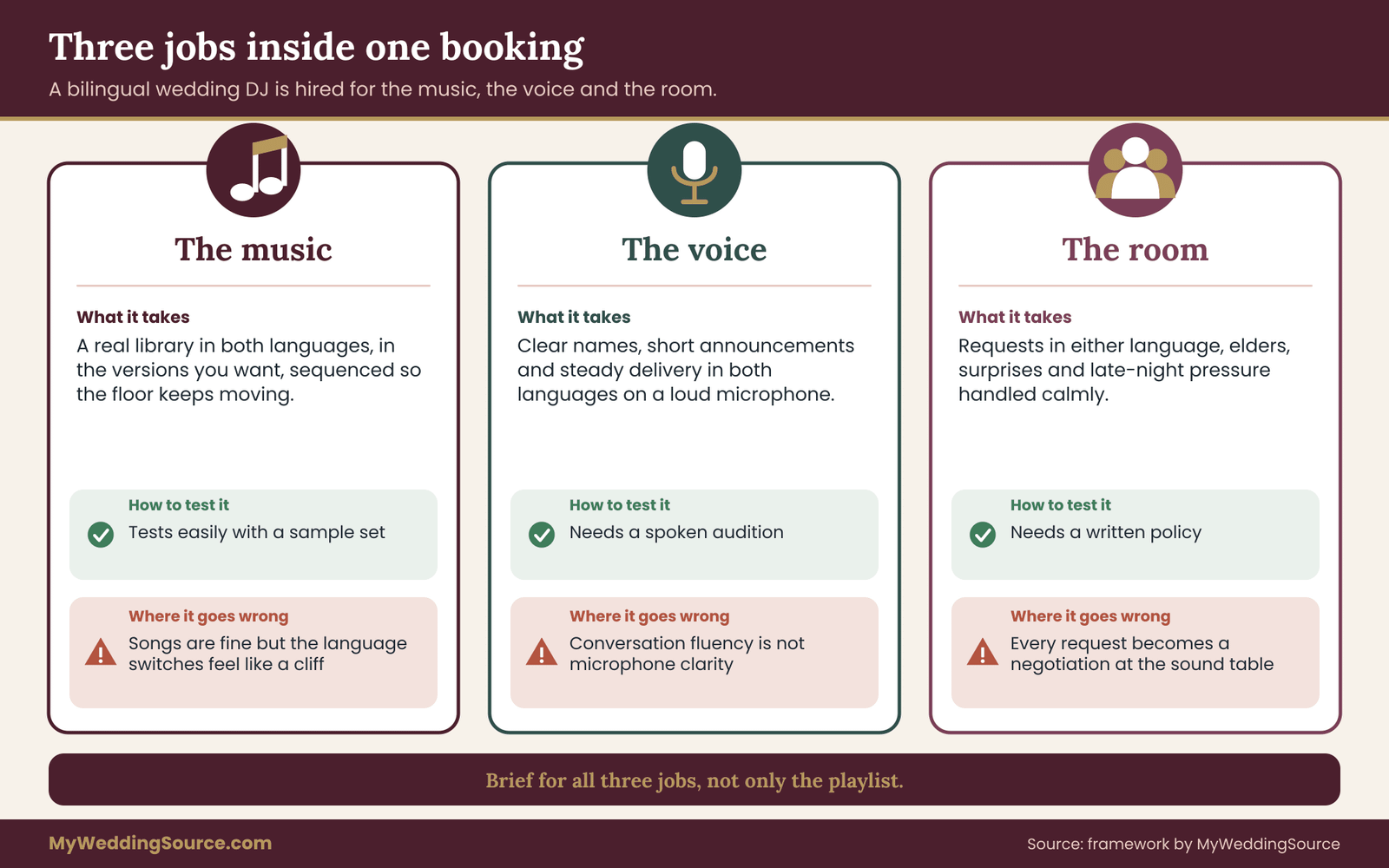
If you treat the three jobs as one, you tend to hire for the one you can test easily, usually the playlist. The voice and the room are harder to test and more likely to go wrong. That is why a good briefing covers all three, and why the interview questions later in this guide focus on the second and third.
What this guide assumes about your wedding
The guide is written for couples and families where two languages are in regular use at the reception. The two languages might be the first language of two families, the language of the older generation and the language of the younger one, or the language of the country where you marry and the language of the people you invited from elsewhere. The advice does not depend on which languages they are. Where an example helps, it uses an invented Spanish and English wedding, and it says so.
The advice also assumes that the bilingual wedding DJ is hired for the reception and may also handle the cocktail hour and dinner background music. If your ceremony music is run by someone else, the ceremony cue sheet guide covers how to hand music cues to an officiant and readers. Keep ceremony language decisions separate from reception ones; the audiences overlap but the formats differ.
One more assumption: your goal is that everyone in the room feels included without the evening turning into a translation exercise. That means accepting some trade-offs. You will not translate every sentence in full. You will not play half the night in each language on a stopwatch. You will make deliberate choices about what must be understood by everyone, what can be understood by tone, and what can be left in one language because the moment is about music or movement and not information.
The difference between information and atmosphere
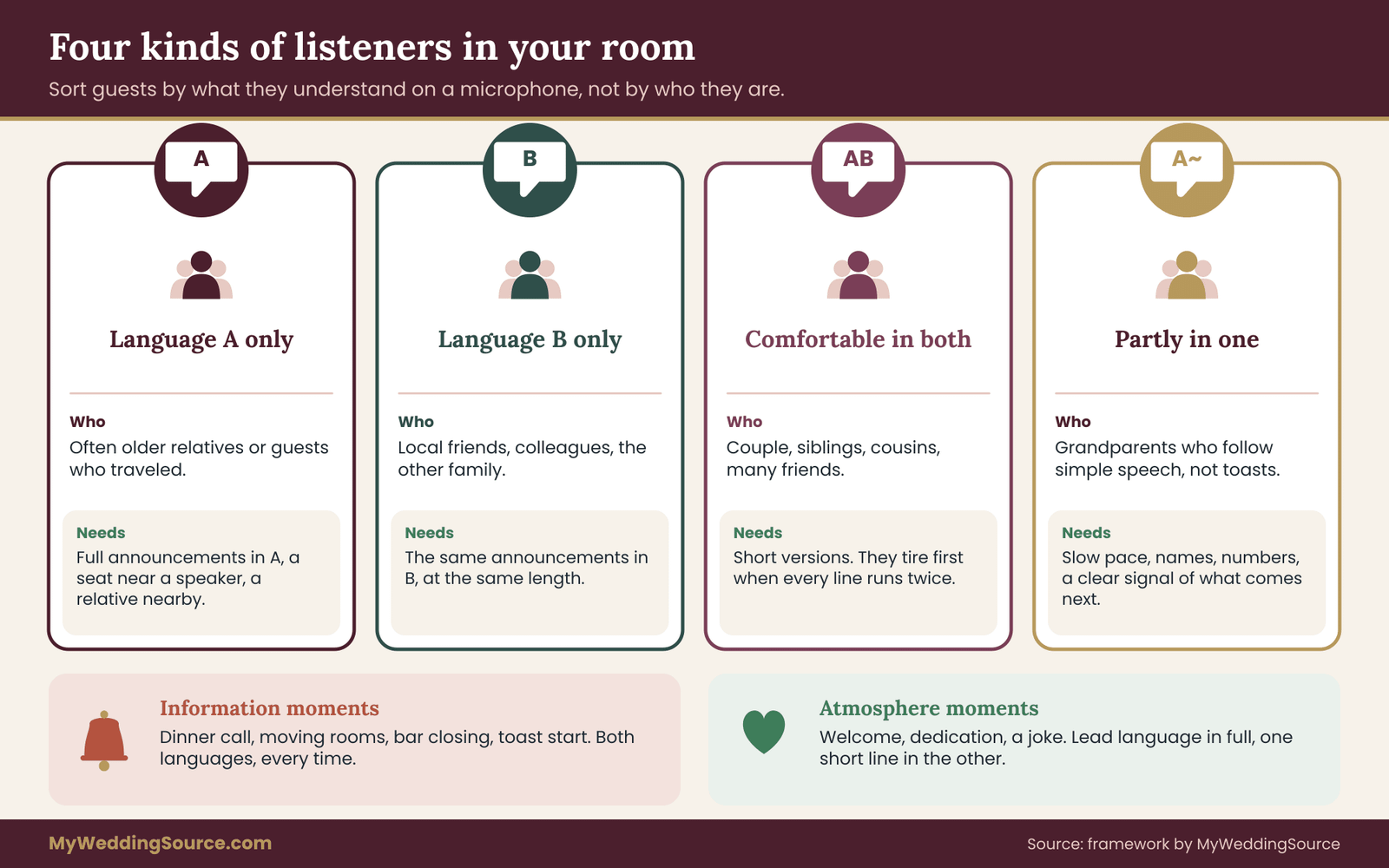
A useful distinction runs through the rest of this guide. Some moments carry information. The call to dinner, the instruction to gather for the cake, the notice that the bar closes in fifteen minutes, the warning that a toast is about to start: a guest who misses these is inconvenienced or left out. These need both languages, every time.
Other moments carry atmosphere. A joke from the best man, a warm welcome, a dedication to a grandparent: the feeling matters more than each word. These can often run in one language with a one-sentence summary in the other, or with a gesture, a smile and a name that everyone recognizes.
Treating all speech as information makes announcements long and tiring. Treating all speech as atmosphere leaves guests lost. Sorting each moment into one group or the other is the first real decision in a bilingual wedding DJ plan, and the briefing sheet in this guide asks you to make it.
Start with the room: mapping languages across your guests
Before you brief anyone, you need an honest picture of who will be in the room. This is not a survey of cultural identity. It is a practical map of what people understand when someone speaks into a microphone and what they enjoy when music starts.
Start with your guest list and sort guests into four groups for language purposes. You can do this by household, which is faster, and adjust for individuals where you know better.
Group one understands the first language only. Often this includes older relatives who emigrated, or guests who traveled from another country. They need announcements in their language, and they may need someone to tell them what is happening before it happens.
Group two understands the second language only. These guests may be the couple’s local friends, colleagues, or relatives from the other family. They need the same announcements in theirs.
Group three understands both. This group is often the couple, their siblings, cousins and friends who grew up with two languages. They are the most flexible, and the most likely to become impatient if every announcement runs twice at full length.
Group four understands one language well and the other partly. Many guests live here. A grandparent may follow simple spoken English but not a toast. A younger cousin may follow family conversation but not formal speech. These guests do best with short sentences, slow delivery, names and numbers they can recognize, and a clear signal for what is happening next.
You do not need exact counts. A rough picture is enough: which group is largest, which is smallest, and where the people who most need help are seated. Write it in a few lines. For example: “About two thirds of guests are comfortable in English. About a quarter are comfortable in Spanish only, mostly the bride’s grandparents, aunts and uncles. The rest are comfortable in both.” That sentence is worth more to a bilingual wedding DJ than a spreadsheet.
Use the guest data you already have
You probably already hold what you need. If you asked guests about dietary needs and accessibility on your RSVP, you could add one optional line about language preference for announcements. Keep it light and optional. If you did not ask, your parents and the people who know each household can fill gaps in minutes. The point is to find the guests who most depend on announcements, not to label everyone.
Plan seating and microphone placement together
Language groups tend to sit together, and that is a fact to use, not a problem to fix. If the grandparents who follow one language are seated near the front, announcements can be paced for them, and a family member at their table can add a quiet summary where a gap remains. If your reception space is large, check that the speakers cover every table.
A guest who cannot hear clearly in a language they know only partly has almost no chance. Your reception guest flow plan is the place to confirm where tables sit relative to speakers, the dance floor and the entrance, because the same layout affects both movement and sound.
Decide which language leads, and when
The most common source of friction is the question of order: which language goes first. There is no neutral answer, and families sometimes feel strongly. A calm approach is to decide on a rule and write it down, so nobody argues about it at the microphone. Three workable rules:
The first is alternating by moment. The first announcement leads in one language, the next leads in the other, and so on through the evening. It feels fair and is easy for a bilingual wedding DJ to follow.
The second is audience first. The language of the people who most depend on the announcement goes first. When the announcement is about the senior relatives, their language leads. When it is about the dance floor, the language of the guests who will dance leads.
The third is host language first. The language of the place or of the couple’s household leads, and the other follows each time. This is simple and predictable, but it can feel like a ranking.
Pick one and tell the bilingual wedding DJ, along with the exceptions. If a grandparent will be honored, the grandparent’s language leads that announcement regardless of the rule. A rule with named exceptions is easier to follow than a rule with none, because it matches how real events work.
The quiet guests who need the most help
Finally, think about the people who will not tell you they are lost. A guest who understands little of either language, a visitor who has never attended this kind of celebration, someone with hearing loss: these guests are easy to miss in a plan that assumes everyone speaks up. Ask a few family members who know them to flag who may need extra help. A card on the table, a seat near a speaker, a relative who sits beside them and signals when to stand, and a clear visual cue from the bilingual wedding DJ at key moments cost almost nothing and matter a great deal.
For guests who are deaf or hard of hearing, effective communication is a legal topic in some settings, so the Americans with Disabilities Act site and the National Association of the Deaf are the places to check what applies and what is practical for your venue.
Choosing and interviewing a bilingual wedding DJ
Hiring is where most of the later trouble is decided. A bilingual wedding DJ who advertises both languages may be fluent in both, may be a native speaker of one and a conversational speaker of the other, or may simply own songs in both. Advertising does not tell you which. The interview does, if you ask the right things.
Four ways to staff the two-language microphone
Before you interview, decide what structure you want. There are four common setups, and each suits a different situation.
One bilingual wedding DJ who does everything. One person plays the music and speaks both languages on the microphone. This is the simplest to coordinate and the cheapest, and it works well when the DJ is truly comfortable in both languages and the program is not heavy with formal speech. The risk is that a single person is carrying three jobs. When something goes wrong in the music, the announcements suffer, and the reverse.
A bilingual wedding DJ plus a bilingual emcee. One person runs the sound, a second person holds the microphone. This costs more, but it separates the jobs cleanly. It suits weddings with a long formal program, many toasts, or a mix of ceremonial moments in both languages. It also lets you hire the best music person and the best speaker as separate decisions.
A bilingual wedding DJ plus a family or friend emcee. A relative or friend who is fluent in both languages takes the microphone for announcements, scripted in advance. This is warm and personal and costs nothing, but it carries risk. Friends get nervous, drink at the party, or want to join the dancing. If you choose this route, give them the script, a rehearsal and a backup.
A bilingual wedding DJ who speaks one language, with printed or recorded support. The DJ plays music in both languages, but announcements are made in one language by the DJ and the second language is covered by a bilingual host, a printed program, a screen, or table cards. This is a fallback when a bilingual speaker is not available, and it works only if the second language truly has a visible channel.

There is no single right choice. The question to ask is where the largest risk sits for your event. If it is the volume of speech, add an emcee. If it is the music library, vet the DJ’s collection in both languages. If it is budget, a family emcee with a rehearsal can be an honest compromise.
What to ask on the first call
Most interview lists focus on equipment and pricing. Those matter, and the vendor due diligence checklist covers insurance, references and reliability. For a bilingual wedding DJ, add questions that test the two languages directly.
Ask: In which languages have you spoken on a microphone at weddings, and which one is your strongest? The answer should be specific. “Both” is not an answer. “Spanish at home, English at work, and I have emceed in both” is.
Ask: How do you handle names you are unsure about? A good DJ says they ask in advance, write the name phonetically, and confirm at the venue. A weak answer is “I’ll figure it out.”
Ask: What is your process for requests in a language you read less well? A good DJ has a written method: a request card in both languages, a sound-table helper, or a rule that a family contact approves anything the bilingual wedding DJ cannot read.
Ask: How do you decide the order of languages in an announcement? You want a bilingual wedding DJ who asks you for your rule, not one who has a fixed habit.
Ask: Can you share a clip or a recording of a two-language announcement? Not every DJ has one, but many can describe a past event in detail, and some can share a short audio sample. Listening is more useful than a testimonial, because pacing, volume and clarity are audible in a minute.
Ask: What happens if you are sick or delayed? Every vendor should have a backup plan. For this specific job, ask whether the backup can also speak both languages. A substitute who plays good music but cannot read the names is a quiet failure.
Ask: Do you bring your own licensing, and what does the venue require? Licensing is covered in a later section. For now, note the answer and ask for it in writing.
A short audition for the voice
If you hire an emcee or a bilingual wedding DJ who will also speak, ask for a ten-minute check at your venue walkthrough or a video call. Give them three things to read aloud: a list of five names from your family, a two-sentence announcement for the dinner call, and a one-sentence translation of a toast that you provide.
Listen for four things. Is each name clear and consistent? Is the pace slow enough for someone who knows the language only partly? Does the voice stay warm when the language changes, or does it become stiff? Does the speaker stay audible when you move to the back of the room?
You are not grading accent. Many people who learned a language as adults are excellent speakers, and many native speakers talk too quickly on a microphone. You are grading clarity and care. If you do not speak one of the languages yourself, ask a relative who does to listen in. A relative can catch what you cannot: a wrong word, a tone that sounds blunt, or a regional choice that will strike the older generation as odd.
What to confirm in the contract
Once you pick someone, put the two-language details in writing. A standard DJ contract rarely mentions language. Yours should. Ask the vendor to confirm, in the contract or in an attached addendum, the following points:
The languages the person on the microphone will use, and who that person is. If the person you met is not the person who will work your event, say so, and require that the substitute meet the same description.
The hours of service, including setup, sound check and any time you need the bilingual wedding DJ before the reception, such as a rehearsal of the announcements.
The names of the people who may change the music or the program on the day. This is the most important sentence in the contract for a bilingual event, and it comes up again in the request policy.
The equipment: at least one wireless microphone you can hand to a toast-giver, a second microphone for an emcee or interpreter, and a plan for a backup if one fails. If you expect a toast in the second language, ask whether there is a microphone you can pass along a table.
The music rights and venue rules that apply. Ask the bilingual wedding DJ to state who holds any performance licenses and to confirm any venue requirements in writing.
The cancellation and substitution terms, and what is returned if the vendor cancels. The vendor contract guide walks through clauses you should read in any wedding contract, and the same logic applies here.
You are not asking for anything unusual. A clear contract protects both sides, and a bilingual wedding DJ who resists writing down the language arrangement is giving you information about how the evening will go.
When to book and when to brief
Book early if you want a DJ or emcee fluent in a particular language, because the pool is smaller than for general DJs. Timing is covered in the wedding vendor timeline. Brief late, however. The briefing sheet in this guide depends on your final guest list, your final program and your final timeline.
If you send it too early, you will send it twice. A sound approach is to share a rough version at booking, so the vendor knows what is coming, and send the final sheet about three to four weeks before the wedding, with a final confirmation in the last week.
A cost-logic check without invented numbers
Pricing varies by region, season and vendor, and any figure printed here would be a guess. What you can do is compare structures. Ask each vendor for a quote on the one-person setup and on the bilingual wedding DJ plus emcee setup, with the same hours and equipment, and ask them to list each line. Then compare what the second person actually adds.
If the quote for adding a bilingual emcee is small compared with the total cost of your reception, and your program has many spoken moments, the extra cost is usually worth it. If your program is light, with a welcome, a dinner call and a couple of toasts, one skilled person may be enough.
Think about cost in terms of risk, not only price. The most expensive failure in this part of the wedding is not a bad playlist. It is a moment that makes a family feel overlooked, such as a name said wrongly or a grandparent left out of an announcement. Those moments are cheap to prevent and hard to repair. A fee for a second person or a rehearsal is small next to what you are protecting.
The two-language briefing sheet for your bilingual wedding DJ
The briefing sheet is the core deliverable of this guide. It is one page, two at most, and it replaces the long email thread that usually ends up carrying the same information in pieces. A bilingual wedding DJ should be able to read it in five minutes the night before and keep it at the sound table during the event. It has six blocks, and each one answers a question the DJ would otherwise have to guess.
Block one: the room
Write the language map from the earlier section in three or four lines. State which group is largest, where the guests who rely most on announcements are seated, and which languages are used for which kind of moment. Add the rule for which language leads and its exceptions. If you wrote that grandparents are honored in their language first, say so here. This block sets the tone for every other decision.
Block two: the names
List every person who may be named on the microphone, with the exact form to use, a phonetic spelling and a note on who confirmed it. The next section explains how to build this list. For now, remember that the names block is the part a bilingual wedding DJ will refer to most often, so keep it near the top and use a clear layout, even if that means a second page.
Block three: the order of the evening
Give the DJ a simple run of show with times, and mark each spoken moment as information or atmosphere, using the distinction from the first section. A line might read “6:45 dinner call, information, both languages, short” or “8:10 welcome from father of the bride, atmosphere, in his language, one-line summary after.” This is not a replacement for your full timeline. It is a version that tells the bilingual wedding DJ what voice work is coming.
Block four: the scripts
Write the exact words for the recurring announcements: the entrance, the dinner call, the toasts, the first dance, the cake, the bouquet, any special dances, the bar notice and the last song. Provide each in both languages. Keep them short. A later section gives sample scripts and explains how long each should run. Giving the bilingual wedding DJ real sentences makes it much more likely that the announcements sound the way you want. It also protects you from a DJ who improvises a joke you would not have chosen.
Block five: the sound rules
State what the bilingual wedding DJ should do with the music at each point: the language and energy mix, what the rule is for switching between languages, and what the transition into and out of each announcement should be. A sample rule is: “No more than three songs in a row in one language during open dancing, unless the floor is full.
Always follow a slow song with a song in the other language if the first was in the older generation’s language.” The rule should match your guests, not a template. The transitions section later in this guide explains how to build one.
Block six: requests and authority
Name the people who may approve changes to the music or the program, and say how requests should be handled. List at least two names, in case one is on the dance floor. Include the do-not-play list and the must-play list, a rule for explicit lyrics, and a script for declining a request politely in both languages. The request policy section expands this block.
A seventh item: contact and escalation
At the bottom, list a phone number for the person who can answer questions at the venue, and a second number as a backup. Put it in the sheet as a plain line, not as a block, because it is not part of the planning. Do not put personal email addresses on a sheet that other vendors may see; use a phone number or have the planner or a trusted family member act as the point of contact.
Share it, then check it was read
Sending a document is not briefing. After you send the sheet, schedule a fifteen-minute call. Ask the DJ to read one script aloud and to tell you, in their own words, how they will handle a request in the second language. This call often turns up a gap you did not see.
It also tells you whether the sheet is understood or merely received. Bring a printed copy to the venue so the bilingual wedding DJ is working from the same version as you, and agree that any change after the call is written down and sent to the same people.
Name one person who updates the sheet and sends each new version to the bilingual wedding DJ, the planner and any family emcee, and put the date and time at the top so everyone can tell which version is current. The wedding planning checklist is a good place to track who holds the final version of each document.
A pronunciation guide your bilingual wedding DJ can read cold
Names are the single most visible failure in a bilingual event. A name said wrongly on a microphone is heard by everyone, usually in front of the person whose name it is. A name said correctly, with care, is a small gift. The pronunciation guide is a list built so that a bilingual wedding DJ who has never met your family can say each name properly at the first attempt, even when nervous and reading under low light.
Who goes on the list
Include anyone who is likely to be named aloud. That means the couple, parents and stepparents, grandparents, wedding party members, anyone giving a toast, honored guests, the officiant if they will be acknowledged, and any family members who will be asked to stand, wave or come forward. Also include family surnames, because grand entrances often announce “the family of” someone. Add place names or terms that might come up, such as the name of a hometown, a dish, a dance or a tradition that will be introduced.
If a guest list has a lot of people with names in one of the languages, you do not need to include all of them. Include those who are named in the program. For everyone else, ensure that the bilingual wedding DJ asks before reading from the seating chart.
How to write a pronunciation entry
A good entry has four parts, and each one does a specific job.
The written form. The name as it should appear, with accents and special characters. If the bilingual wedding DJ will read from a screen or printed sheet, include the accents.
A phonetic respelling in plain letters. Write how the name sounds in the bilingual wedding DJ’s stronger language, using capital letters for the stressed syllable. For example, the Spanish name Lucía can be written as “loo-SEE-ah,” and Alejandro as “ah-leh-HAHN-droh.” Do not use technical phonetic symbols unless the DJ asks for them. A reader under pressure wants plain letters.
A short note on anything tricky. If a sound has no English equivalent, say so in a few words: “rolled r,” “soft h,” “the double l is a y sound.” If a name has two accepted forms, state which one this person uses.
The source. Note who confirmed it: “per the bride’s mother” or “per the groom himself.” This tells the bilingual wedding DJ who to ask if they are unsure and signals that the entry has been checked.

Record a voice memo
Written respelling is useful, and audio is better. Ask a native speaker, ideally the person whose name it is, to record the names on a phone and send the files. A recording captures pitch, stress and rhythm, which respelling cannot. Keep each recording short and label it with the name. Ask the DJ to listen before the event and again on the day, and to practice saying each name aloud. If you have many names, a single continuous recording in the order of the program works well.
When the person is unavailable, a relative who knows them can make the recording. If you do not have access to a native speaker for a language the bilingual wedding DJ does not speak, ask the DJ or the venue whether they know someone who can help, or use a reputable online pronunciation resource and have a relative confirm it. Do not rely on automated voices alone for names, because they are often wrong in small ways that matter.
Titles, honorifics and relationships
Names are only part of it. Many languages carry titles and forms of address that tell the room how a person is regarded: a word for grandmother used in the family, a title for an uncle, a formal term of respect for an elder, a professional title. Decide how each honored person is to be introduced, and put it in the entry.
“Abuela Consuelo” may be right in one family, “Doña Consuelo” in another, and “Consuelo Herrera, mother of the bride” in a third. If you are not sure, ask the person. Most elders appreciate being asked.
Also decide how relationships are described. Terms for in-laws, stepparents and partners differ across languages and can carry different meanings. An announcement that says “the groom’s mother” in a language where that phrase sounds cold may be softened to a name and a smile. If a family has a complicated structure, with divorce, remarriage or estrangement, decide in advance who is announced and how, so the bilingual wedding DJ is not improvising in front of everyone.
Order, stress and consistency
Say the names in the same order and form every time. If the entrance announcement says “Lucía and Ben Carter,” the first toast should not say “Lucy and Benjamin.” Consistency tells guests that the bilingual wedding DJ knows the family. Mark in the sheet which form is used in announcements and which is used in conversation.
Think about stress, not only sounds. In many languages the stressed syllable changes meaning, and a name with the wrong stress sounds foreign even when every sound is right. That is why the capital letters in the respelling matter.
Think about order, too. In some cultures the family name comes first. Tell the bilingual wedding DJ which order to use and whether to say both. If a guest uses a name in daily life that differs from the name on their documents, use the one they use.
Rehearse the hard ones
Pick the five names the bilingual wedding DJ is least likely to say correctly and rehearse them on a call. Do this with the person on the microphone, not only the lead DJ. If you cannot arrange a call, ask the DJ to record themselves saying the names and send the file, so a family member can confirm. Corrections at this stage are easy. Corrections on the night are awkward.
Announcements in two languages: order, length and scripts from your bilingual wedding DJ
An announcement is a tiny piece of theater with a job to do. It gets attention, says one thing, and returns the room to what it was doing. In a bilingual reception the same piece has to do this twice, and the second pass is where audiences drift. The solution is not to talk faster. It is to cut more.
The four-beat structure
Almost every announcement fits one pattern, and giving your bilingual wedding DJ that pattern makes scripts easy to write and to remember.
Beat one is the attention cue. A sound, a short musical phrase, a lowered volume, or a plain “Good evening, everyone.” Pick one cue and use it all night so guests learn it. A cue that works across languages, such as a chime or a drop in the music, saves a second round of “may I have your attention.”
Beat two is the message in the first language. One idea, as short as it can be. “Dinner is now served. Please find your table.” Not “We hope you are all enjoying yourselves so far, and we wanted to let you know that…”
Beat three is the message in the second language. The same idea, not a full translation of a long speech. It should be the same length or shorter. If the second version is longer, the first was too long.
Beat four is the next action and the return to music. A direction or a thank you, then the music returns. If guests are expected to move, say where.
Stay close to this length: about ten to fifteen seconds per language for a simple notice, and about thirty seconds for a longer one such as a cake cutting with a toast. Those are working guidelines, not rules, but anything much longer begins to lose people in both languages.

Which announcements need both languages in full
Use the information and atmosphere distinction. Announcements that tell guests to do something, or that affect their safety or comfort, are information, and they run in both languages every time. Examples include calls to dinner, instructions to move to another room, the reminder to keep the dance floor clear while a performance happens, the notice about the end of the bar service, transportation information and anything that affects children or older guests.
Announcements that are mostly atmosphere can be shorter in one language. A grand entrance can name the couple in a single flourish, the first language leading and the second following with just the names and a welcome. A dedication to a grandparent can be spoken fully in the grandparent’s language, with a short line in the other, such as “This one is for Abuela Consuelo, with love from all of us.” Keep it true, and keep it brief.
Sample scripts, in plain wording
Scripts should be written by you and adapted to your voices. The following examples show the length and the tone to aim for. Each is shown in one language here to save space; your sheet should carry both. Use them as models, not as text to copy.
Entrance. “Please welcome, for the first time as married partners, Lucía and Ben.” Then repeat the names with the second language’s welcome, using the pronunciation from the guide. Do not add a story. Let the music do the work.
Dinner call. “Dinner is ready. Please follow the staff to your tables. Tables one to four first.” Repeat in the second language with the same table numbers. Numbers are easy to mishear, so say each one clearly and show it on a sign if you can; numbers on a sign are a helpful backup to a voice.
Toast introduction. “We would like to invite Daniel, the brother of the groom, to say a few words.” Add: “Daniel will speak in English. A short summary in Spanish will follow.” This tells the room in both languages what is about to happen and sets expectations about translation.
Cake. “In a few minutes we will cut the cake. Please gather near the cake table.” Short, clear, movement included. Photographers often rely on guests gathering at the right moment, so the call also helps the pictures.
First dance. “Please clear the floor for the first dance.” Then, after a pause, the couple’s names. Do not describe the song. Let guests discover it.
Bar and last song. “The bar will close in fifteen minutes. We have time for a few more songs.” And at the end: “This is the last song of the night. Please join us on the floor.” In both languages, in a friendly tone.
How to handle toasts in two languages
Toasts are where bilingual receptions come under the most strain. A speaker may be nervous, may speak at length in a language half the room does not know, and may want the audience to laugh at a joke that does not translate. A few tools help.
First, ask each speaker which language they will use, and tell them the sheet will include a time limit. Many speakers appreciate a limit. Three minutes in one language, with a one-sentence summary after, is usually plenty.
Second, offer two ways to cover the other language. One is a sentence-by-sentence interpreter, a bilingual guest who stands beside the speaker and renders each sentence. It works for short speeches and doubles the time. The other is a summary after the toast, in which the bilingual wedding DJ, the emcee or a relative gives the main points in the second language in about twenty seconds. For long speeches the summary is more realistic, because it respects the audience’s attention.
Third, ask the speaker for a copy of the text if they will read one. A translator can then prepare a short version in advance, and the emcee can read it with accuracy rather than improvise. If the speaker will not share, a rehearsal with the interpreter is the next-best option.
Fourth, be honest with speakers about jokes. A line built on wordplay will not travel. Suggest that speakers include at least one moment that works in both languages, such as a name, a shared memory or a gesture, so that the whole room laughs at the same time.### Accessibility and the visible channel
Some guests will not hear well, whatever language the DJ uses. A few practical measures help. Keep the microphone close and the speaker’s mouth visible where possible. Use printed programs or small cards for key announcements. If a guest is deaf and uses sign language, ask in advance whether they want an interpreter and who will arrange it; the National Association of the Deaf and the Americans with Disabilities Act site explain how interpreting and communication access are typically handled. Treat the answer as a venue and vendor question and not only a bilingual wedding DJ question.
Transitions in a bilingual wedding DJ set
Transitions are the moments between songs and between segments of the evening. In a monolingual event they are mostly technical. In a two-language event they are also emotional, because a change of language on the speakers can feel like a change of sides. A guest hears the first notes of a song in their grandmother’s language and a cousin hears the first notes of a pop song in the other, and each feels either welcomed or left out. Good transitions make the shift feel like a bridge.
The three kinds of transition
There are three kinds, and each needs its own rule.
Song to song. The most common. Here the principle is to find something the two songs share: tempo, key, mood, an instrument, a familiar chorus, or a rhythm that the whole floor can move to. A bilingual wedding DJ can move from a song in one language to a song in the other without the audience noticing the change if the energy is continuous. The language shift will be noticed less than a sudden drop in energy.
Music to voice. The move from a song to an announcement and back. Rule: bring the energy down gently before the announcement and bring it back up after it. Do not cut a song in the middle of the chorus for an announcement unless it is urgent. If you must interrupt, resume with the same song or a related one, so guests feel the party continue.
Segment to segment. The shift between cocktail hour, dinner, dancing and the last hour. These are the planned changes, and the language balance can shift with them. Dinner background may lean toward the older generation’s language and instrumental music. Open dancing may lean toward the younger generation’s. The last hour may return to mixed sets and sing-alongs. The cocktail hour guide describes the early part of the evening, and it is worth reading beside this one because the opening mix sets the tone.
The bridge song
The most useful tool for crossing languages is the bridge song. A bridge song is a track that both groups know, or that works without lyrics: an instrumental, a song with a repeating chorus both groups can hum, a well-known international hit, or a recording by an artist who has released versions in both languages.
When the bilingual wedding DJ wants to move from one language to the other, a bridge song sits between. Ask each family to name two or three songs that the other family would also recognize. The answers are often surprising, and they become the DJ’s safest transitions.
Rules of thumb for language balance
A strict ratio is unrealistic and often unwelcome. A looser guide works better. Here are three rules that couples find useful.
Match the room, not the clock. If the dance floor is full during songs in one language, stay with that language a little longer, and use a bridge song to move. If the floor empties, switch. The floor tells the bilingual wedding DJ what to do.
Avoid long runs in one language. A long run in one language can leave half the room sitting. Many DJs find that three or four songs in a row is a natural limit, but it depends on the crowd. The goal is that nobody waits too long to hear a song they know.
Pair generations deliberately. After a slow song for the older generation, follow with something upbeat that mixes both languages. After a high-energy block for the young, bring in something an older guest will recognize, and the DJ can use the microphone briefly to invite them to the floor in both languages.
Spoken transitions
Occasionally the bilingual wedding DJ will say a few words between songs. Keep them to a sentence. “This one is for the grandparents. Esta es para los abuelos.” The line should be easy to say, kind, and understandable even by guests who know only a little of either language. Avoid commentary on the songs or the guests. Avoid questions to the crowd unless the DJ is confident the whole room can answer.
Lyrics and meaning
A song in a language that part of the room does not understand might carry lyrics you would not choose if you understood them. A song in a language you do not read may be a love song, a lament, or something unsuitable. Check the lyrics of every song in a language you do not speak, with the help of a relative who does. The same applies to the other direction: older guests may not follow the English lyrics of a popular song and not mind, while the younger group may be sensitive to what is being said.
Ask the bilingual wedding DJ to share the version or edit of each song they plan to play, and have a family member review the ones that matter. Reviewing lyrics takes time, and two languages mean two lists to check.
Playlist planning for a bilingual wedding DJ: lists, versions and balance
Playlist work for a two-language event is not the same as a double-sized playlist. It is a set of decisions about what must be played, what may be played, what must not be played, and how the pieces fit together by moment. This section builds that structure. For the wider question of how music works across ages and dance styles, the guide to programming music for different generations and dance styles covers the foundations, and this section adds what changes with two languages.
Three lists, not one
A single list of favorites mixes together three different kinds of request, and the bilingual wedding DJ cannot tell which is which. Split it into three.
The must-play list holds the few songs that carry real meaning: the first dance, the parent dances, a song a grandparent has asked for, a song that is part of a family tradition. Keep it short. Every song on it should have a reason, and the reason should be written next to it so the DJ understands the moment and the placement.
The may-play list is the larger pool the bilingual wedding DJ can draw from, in both languages. It should include songs you enjoy, songs your guests are likely to know, and songs you think will work on the floor. The DJ’s skill lies in choosing from it based on the room.
The do-not-play list is as important as the others. It includes songs you dislike, songs tied to people or events you want to avoid, songs with lyrics that would be inappropriate for the mix of guests, and songs in either language whose meaning you have not checked. A bilingual wedding DJ will often ask for this list and is relieved when it exists.
Write each list in both languages if you can, or at least with the original title and artist, because translated titles often differ from original ones and a DJ searching under an English translation may not find the song.
Record the exact version
Many songs exist in multiple versions: the original, a live recording, a remix, a cover by another artist, a radio edit, a version with a different intro or a language change halfway through. For a bilingual event, the version often matters more than the title. A pop song may have an original in one language and a re-recorded version in another. A traditional song may exist in dozens of arrangements, some slow and some fast.
Note the artist and version that you want, and a link or a file if the bilingual wedding DJ needs it. If you are not sure which version you mean, play it for the DJ over a call. When the DJ asks for a file, send the file instead of a description.
Check the lyrics in both languages
A song whose lyrics you do not understand is a risk, and a song whose lyrics the older generation understands better than the younger generation may be a risk of a different kind. Have a native speaker review every song in the language you do not speak. Look for explicit content, content about violence or betrayal, references to people or places that could cause pain, and humor that will not land.
For songs with a clean version, confirm the bilingual wedding DJ has it. Where a clean version does not exist, decide whether to skip the song, or to have the DJ fade it at a known point. A guest who is a child, a grandparent, or a person from a different background will notice what you did not.
Matching songs to moments
The best use of the briefing sheet is to link songs to moments. Think in segments and assign each a purpose and a language mix.
Arrival and cocktail hour. The goal is welcome and conversation. Instrumental or low-key music works in either language. A light blend that includes familiar songs from both sides signals that both families belong here.
Dinner. Background, quiet enough for conversation. This is a good time for older-generation songs and for instrumentals. Keep volume low, and avoid songs with lyrics in a language half the room would find distracting while talking.
Toasts and special dances. These are carried by voice and attention. Music in these segments is part of the structure: a short piece before a toast, a quiet bed during a presentation, a specific song for a parent dance. Check the length of each piece against the length of the moment.
Open dancing, first block. Aim for songs nearly everyone knows. This is the time to rely on bridge songs and widely known hits. Establish the floor early.
Open dancing, middle block. Use the room. This is where the language balance does its main work. A bilingual wedding DJ can follow the floor, using the rules from the transitions section.
Final block. Return to songs that bring people together: sing-alongs in both languages, songs that all generations know, and a last song that matters to the couple.
You do not need to specify every song for every block. Name the purpose and the language mix for each block, and let the bilingual wedding DJ fill it. That is what you are paying for.
Handling genres and dances that need participation
Some traditions bring a dance that needs instruction: a line dance, a circle dance, a partnered pattern, a game. In a bilingual room, these are both a joy and a risk. A guest who does not know the steps may stay at the table. Help them with a brief announcement in both languages that names the dance, says how to join, and invites everyone.
A short demonstration by a family member, or a pair of relatives who start and call out steps, often works better than a long explanation. Mark these in the sheet as “participation moments” and plan the music length, as some songs are long.
Also plan the opposite case: a dance that you do not want to run long. If a song has a seven-minute version and you want the three-minute version, say so. If you want the bilingual wedding DJ to fade after two or three rounds if the floor thins, say so.
Streaming, files and copies
If the bilingual wedding DJ plays from a library of purchased or licensed files, ask which sources they use and whether they have the songs in the versions you want. If the DJ plans to use a streaming service, ask what happens without internet, and whether the account type allows public performance. Many consumer streaming plans have terms that restrict use to personal, non-commercial listening, so a professional performance usually requires a service or library licensed for that.
This is a point for the bilingual wedding DJ to confirm in writing, and an area where “everyone does it” is not an answer. The next sections return to licensing. For the playlist, the practical advice is: ask for downloaded copies of every must-play song, have a backup on a second device, and test the sound check with the exact files.
Guest requests: a policy your bilingual wedding DJ can follow
Requests are where a plan meets people. Guests mean well, they have favorite songs, and they believe a request is a compliment. If the DJ has no policy, each request becomes a small negotiation, in a language the DJ may read slowly, at a time when the dance floor needs attention. A written policy takes the pressure off the DJ and spares guests from awkward refusals.
Decide what you actually want
There are three broad positions, and each suits a different couple.
Open requests. Guests may ask for songs, and the bilingual wedding DJ uses judgment. This works when you trust the DJ, the crowd is relaxed, and you have a clear do-not-play list.
Filtered requests. Guests may ask, but requests pass through a designated person, such as a planner, a sibling or the emcee, who checks them against the lists and the moment. This suits events with a lot of family sensitivities or a tight program.
Closed requests. The bilingual wedding DJ plays only from the approved lists. This suits couples with a strong vision, or events where the music is part of a ceremony or a program. It must be communicated clearly, so guests do not feel dismissed.
For a bilingual event, the filtered approach tends to work best, because a bilingual relative can read requests in both languages and can speak to the older guests in their own language. The relative becomes a bridge between the guests and the sound table, and the bilingual wedding DJ stays focused.
Make it easy to request in either language
A simple request card, printed in both languages, makes a difference. It has two lines: song title and artist. The back may have a line for a dedication. Place the cards at the sound table or hand them to the designated person. A card avoids misheard titles and gives the bilingual wedding DJ something to read. For guests who prefer to speak, a bilingual helper near the dance floor can write the request for them.
Be ready for requests that are not titles. An older guest may hum a tune, name a singer, or describe a film the song appeared in. The helper’s job is to turn that into a title. A short list of well-known songs by famous artists in each language, kept on a phone, can speed this up. If the title cannot be found, the helper says so kindly and offers to try again later, or suggests a similar song.
The decision rule at the sound table
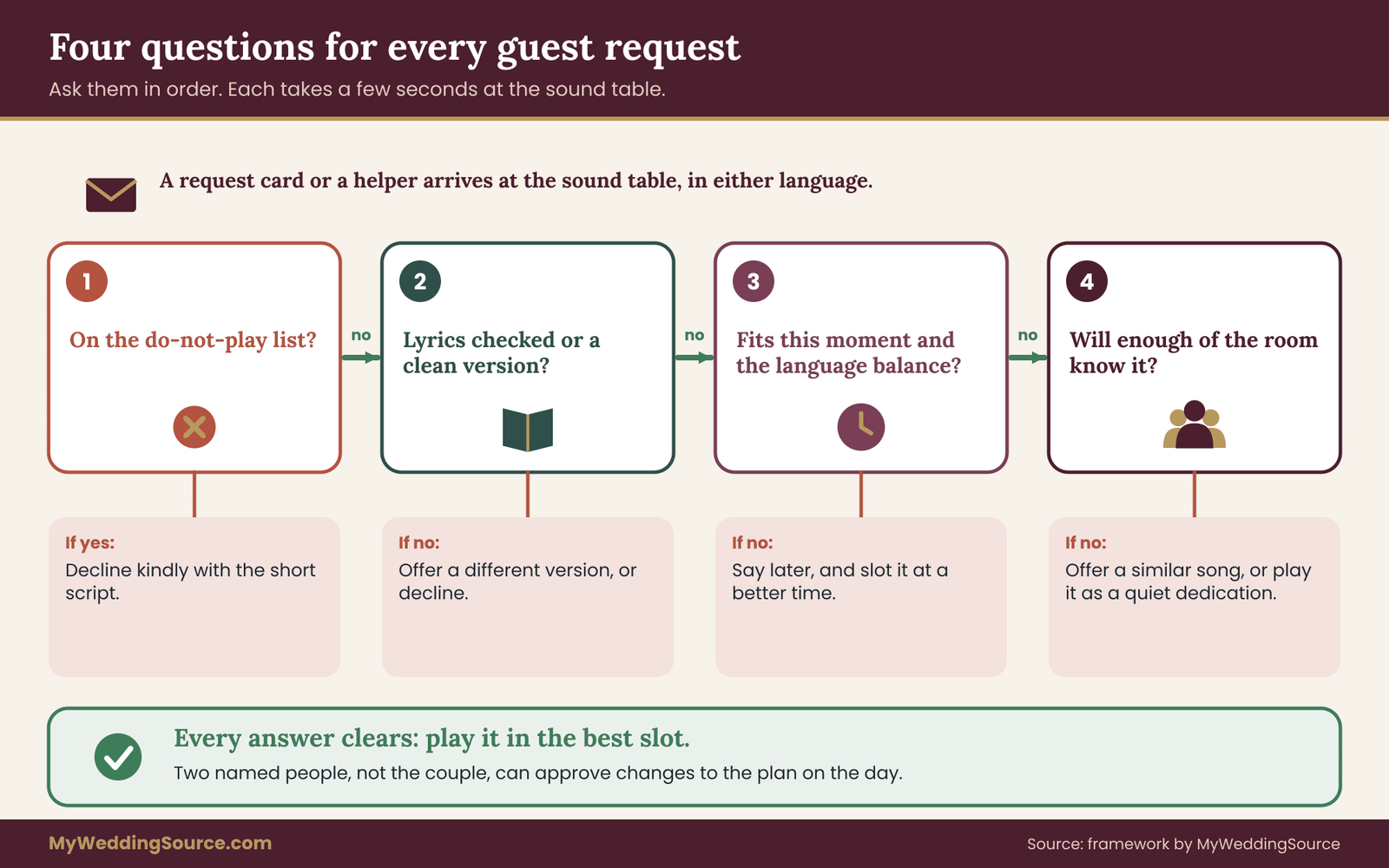
When a request arrives, the bilingual wedding DJ or the helper runs it through four questions, in order. The questions are short enough to apply in a few seconds.
First, is it on the do-not-play list? If yes, decline, using the script below.
Second, is it appropriate, with lyrics checked in both languages or a clean version available? If not, decline or offer a different version.
Third, does it fit the current moment and the language balance? A slow ballad in the middle of a peak dance block can empty the floor. If it does not fit now, say “later” and mean it, then choose a better slot.
Fourth, is it likely to work for the room? If the guest is the only person who knows it, the bilingual wedding DJ can still play it as a dedication, in a quiet moment, or can offer something similar that will carry more of the room.
If the answers allow it, play it, at the best slot. If not, say no kindly. The sequence is the same every time, and it gives the DJ a clear reason that is not personal.
Scripts for saying no, in both languages
A refusal should be short, warm and honest. Do not blame the couple unless you must, and do not make up a reason. The following lines give the tone.
“Thank you for the request. We have a plan for the night, and I will see if it can fit. I’ll do my best.” This leaves the door open without promising. If it will not happen, the bilingual wedding DJ need not return to say so.
“That one is on our list for later. Thank you.” Use it only if it is true.
“We have a short list from the couple, and I can’t add songs to it. They asked me to thank you for the idea.” Direct, and puts the decision where it belongs.
“I can’t play that version, but I can find something close.” Useful when a request has explicit lyrics.
Put each line in both languages in the sheet. The bilingual wedding DJ should not translate a refusal on the fly, because a refusal with the wrong tone in the second language can offend more than the refusal itself.
Who approves changes
Name the people who can change the plan on the day. Often it is the couple, but they will be busy and should not be at the sound table. Choose two others: a planner, a sibling, a friend. Tell them they have the authority and the responsibility. Tell the bilingual wedding DJ to follow their word. This single decision, written in the sheet and the contract, prevents most disputes. If a parent insists on a change, the DJ points to the named person, who can decide kindly and quickly.
Dedications and surprise moments
Guests may plan dedications and surprises: a song for the couple, a performance by a relative, a toast with a musical piece. Ask each family to share anything they plan, so the bilingual wedding DJ can include it or manage it. A surprise that appears without warning risks timing problems and, in a bilingual event, language gaps: nobody has prepared the other language. Ask guests to give notice, and say why. Most are glad to be included in the plan.
Worked example: the Herrera and Carter reception
An example makes the system easier to see. The following is an invented example, not a real event, and its details are only meant to show how the pieces fit together.
Lucía Herrera and Ben Carter are planning a reception for about one hundred and forty guests. Lucía’s family speaks Spanish at home, and her grandparents and several aunts and uncles are most comfortable in Spanish. Ben’s family and most of the couple’s friends speak English. Many of Lucía’s cousins and the couple themselves speak both. The venue is a hall with a dance floor, a separate lounge, and a house sound system with two wireless microphones.
The language map
The couple writes three lines for the sheet. About half the guests are comfortable in English only. About one fifth are comfortable in Spanish only, mostly the older relatives seated near the front. The rest follow both. The language rule is alternating by moment, with an exception: any announcement that honors Lucía’s grandparents leads in Spanish.
The staffing choice
They interview two DJs. The first plays a strong mixed library but speaks only English. The second is comfortable in both languages, though stronger in English. The couple chooses the first DJ for the music and asks Lucía’s cousin Marisol, who is fluent in both languages and has public speaking experience, to act as emcee. They rehearse once, by video, and agree on a backup: Lucía’s aunt can take the microphone for Spanish announcements if Marisol is delayed. They record this in the contract addendum, with the cousin’s name and the aunt’s.
The names and the scripts
They list twenty-two names. Each has a phonetic respelling, and each of the six most difficult names, including the grandmother’s, has a voice memo recorded by the person who owns it. They decide that Lucía’s grandmother is introduced as “Abuela Consuelo” in both languages. The scripts for the entrance, dinner call, toast introductions, cake, first dance, bar notice and last song are each five or six lines, in both languages, with the Spanish first for the grandparent-related ones and alternating for the rest.
The toasts
There are four toasts. Two are in English, one is in Spanish and one is in both. Each speaker has a three-minute limit. For the two English toasts, Marisol gives a twenty-second summary in Spanish. For the Spanish toast, she summarizes in English. For the mixed toast, no summary is needed. The speakers send their texts a week ahead, and Marisol prepares short summaries. They agree that a speaker who runs over is signaled by a small light at the table, not by an announcement.
The sound plan
Cocktail hour begins with soft instrumental music and a blend of familiar songs, with the first two in Spanish and the next two in English. Dinner includes a long run of older Spanish songs the grandparents requested, with the volume low. The first dance is followed by the parent dances, then an upbeat block that starts with a bridge song both families named, an international hit with a chorus everyone knows.
The DJ alternates between languages by following the floor. Late in the night, a sing-along in Spanish is followed by one in English, and the last song is one the couple chose together.
The request policy
The couple chooses filtered requests. Lucía’s brother, who is bilingual, sits near the sound table with printed request cards in both languages. He checks each card against the must-play, may-play and do-not-play lists and passes suitable ones to the DJ. The do-not-play list includes three songs with explicit lyrics and one song tied to a past relationship. The brother and the planner are named as the people who can approve changes. They write refusal scripts in both languages.
What went right, and what still needed care
In this example, the bilingual emcee is the person who makes the system work, because the DJ can focus on music and the family can see the Spanish announcements being handled by someone they know. The names list prevents the most visible errors. The request policy prevents friction late in the night.
Still, some things need watching. The emcee must stay sober and available, which is why a backup exists. The summaries of toasts must be accurate, so speakers share their texts. The sound check must happen with both microphones in both positions. And the sheet must be current: when a great-aunt arrives unexpectedly, the planner adds her name and her preferred form of address, and sends the update to the DJ and the emcee. These are small, ordinary tasks. Together they are what a bilingual wedding DJ set looks like when it is prepared.

Music licensing, venue limits and what to verify before the day
Music is protected by copyright, and the rules about playing it for an audience are not the same as the rules about listening on your own. Most couples never think about this, and most weddings pass without a problem. Still, if you hire a professional and pay for a venue, it helps to know who is responsible for what. This section is general information, not legal advice. For anything specific, ask the vendor, the venue and, if the stakes are high, a lawyer who works with music or event contracts.
Public performance in plain terms
In the United States, copyright law generally gives the owner of a musical work the right to control public performances of it. Organizations known as performing rights organizations collect and distribute fees for these performances on behalf of songwriters and publishers. The best-known are ASCAP, BMI, SESAC and Global Music Rights. Venues such as hotels, restaurants and event halls often pay for blanket licenses that cover music played on their premises, and some DJs and bands carry their own arrangements.
Whether a particular wedding venue’s license covers a hired DJ is a question for the venue, and the answer is not always the same from one venue to the next.
The point is not to alarm you. It is to avoid assuming. The U.S. Copyright Office explains the basics of copyright and public performance on its site, and each performing rights organization explains how its licensing works and who needs it. Use these sources for the current rules, because licensing practice and fees change.
Questions to ask, and to whom
Ask the venue: Do you hold performance licenses for music played in the space, and do they cover a hired DJ playing recorded music? Do you require the bilingual wedding DJ to hold a particular license or to provide proof of insurance? Are there rules about live music, amplified sound or the use of the house system?
Ask the bilingual wedding DJ: Which music source do you use, and is it licensed for professional performance? Do you hold any performance licenses yourself, or do you rely on the venue’s? Will you provide documents the venue asks for?
Ask both to confirm in writing. If they give different answers, resolve it before the wedding. A short email thread saved in your records is enough. If either party seems unsure, ask a lawyer who knows event contracts, or contact the licensing organizations for an answer. For a vendor-by-vendor view of contracts and written confirmations, see the earlier note on the contract.
Streaming services and personal playlists
A consumer streaming account is generally licensed for personal listening. Many services say in their terms that commercial or public use is not allowed under a standard plan. A bilingual wedding DJ who plays from a personal streaming account at a paid event may be outside those terms, and may also lose the music if the internet fails.
Professional DJs commonly use downloaded libraries from services built for professional use, or their own licensed collections. Ask what your DJ uses. If you plan to supply the music yourself, check the terms and ask the venue and the DJ whether they accept it.
Recording and sharing the music
If a videographer films the reception, the music in the background may appear in the video. Sharing the video privately is usually uneventful. Posting it online can trigger automated copyright checks, and the platform’s own rules apply. If you plan to post video, ask the videographer how they handle music, and consider asking them to use licensed tracks for the edited highlight. This is a separate matter from the bilingual wedding DJ’s performance license, though both rest on the same copyrights.
Sound limits, curfews and venue rules
A venue may have rules about volume, hours and equipment that affect the plan. Common ones: a decibel limit, a hard stop for amplified sound, a requirement to use the house sound system, a ban on certain effects, restrictions on where speakers may be placed. Local noise ordinances can add limits, especially outdoors. Loud music also affects the people who stand closest to the speakers for hours, and the National Institute for Occupational Safety and Health publishes information on noise and hearing; a quieter zone for older guests and children, and speakers kept away from the nearest tables, are kind and sensible measures.
Ask the venue for its rules in writing, and share them with the bilingual wedding DJ. If the venue has a technical walkthrough, bring the DJ; the venue technical walkthrough guide covers the measurements and access routes that matter. Note the power, the location of the sound table, the sight lines to the dance floor and any rules for load-in.
For a two-language event there is one extra point. If the venue limits microphones or requires its own staff to run the system, ask whether a second microphone for an emcee or an interpreter is allowed, and who will hand it over.
What this guide cannot settle
Some limits are worth stating. This article cannot tell you what your venue’s license covers, what your bilingual wedding DJ’s contract says, or what the law requires where you marry. It cannot verify the skill of a particular vendor or the accuracy of a translation. It does not replace a native speaker’s review of names, lyrics and scripts.
It also uses an invented example, and real events vary. The rules and fees of licensing organizations change, and so do venue policies. Treat the sources at the end as starting points, check the current pages, and keep written confirmations from the people responsible.
Common mistakes with a bilingual wedding DJ, and how to recover
Most failures in this area are small, and most can be repaired in the moment if the plan is clear. Here are the ones that come up most often, with a response for each.
Assuming fluency means clarity. A DJ who speaks both languages well in conversation may still be hard to follow on a microphone. Test the voice at an interview and a sound check. If the voice is weak, add an emcee. During the event, if announcements are unclear, ask the planner to step in or have a relative repeat the key line.
Sending the playlist and nothing else. The most common mistake. The fix is the briefing sheet. If you realize this late, send a short version now: the language map, the names, the order and the request rule. A half-page sent a week before is better than nothing.
Translating everything. Full translation makes announcements long and tires the room. Sort moments into information and atmosphere, and translate only what guests need. If a speaker has already run long, summarize and move on.
Forgetting the oldest guests. Plans are often tuned to the people who are actively involved, and the guests who rely most on announcements are quiet. Seat them near a speaker, assign a relative to sit beside them, and have the emcee address them directly at key moments. Ask them what they would like.
Leaving requests unmanaged. Without a policy, the bilingual wedding DJ becomes the target of every guest’s favorite song. Use the filtered approach and the refusal scripts. If a guest is persistent, hand the matter to the named person.
Mispronouncing a name. It will happen at some point. Correct it once, calmly, and move on. Ask the relative whose name it was to say it again. Do not let the speaker apologize at length.
Letting a surprise take over. A guest grabs the microphone, or a surprise performance runs long. Make sure the bilingual wedding DJ knows who can approve use of the microphone, and have the planner ready to step in.
Skipping the sound check in the second language. A microphone that works for one speaker may fail for another. Check each one, at the seats where guests will hear, with each speaker.
Not having a backup. If the emcee falls sick or the DJ is delayed, the whole plan depends on a substitute who can speak both languages. Name them in advance and send them the sheet.
Planning once and never revising. If the guest list or the program changes, update the sheet and send it. Put a date on each version.
A short recovery routine
If something goes wrong in the room, the same four steps help. Pause the music gently if needed. Say the correction or the missing information in both languages, briefly. Return to the music with a song the whole room can enjoy. Afterward, note what happened so the plan can improve. Guests rarely remember a small error, and they do remember how the evening felt. Keeping the voice calm and the music flowing is worth more than any individual fix.
Your next steps
This week, write the language map for your guests in three lines, and decide which language leads and what the exceptions are. Next, decide how you will staff the microphone, and ask each candidate the voice and request questions from this guide. Then start the names list with a phonetic respelling and a voice memo for each person who will be named.
Over the next few weeks, write the scripts for the entrance, the dinner call, the toasts, the cake, the first dance and the last song in both languages. Draft the must-play, may-play and do-not-play lists, with a native speaker reviewing lyrics. Name the people who can approve changes. Confirm licensing and venue rules in writing.
About three to four weeks before the wedding, send the briefing sheet and hold a fifteen-minute call. In the final week, print copies, confirm the backup, and check the sound with both microphones. When the preparation is written down, your bilingual wedding DJ can spend the evening on the room and not on guesses.
FAQ
Does a bilingual wedding DJ have to speak both languages fluently?
Not always. The DJ plays the music, and someone else can handle the microphone: a bilingual emcee, a family member or a host. What matters is that someone on the team speaks each language clearly and reads names correctly. Fluency in conversation is not the same as clarity over a sound system, so ask for a short audition of names and one announcement before you book.
How long should an announcement be in each language?
Aim for about ten to fifteen seconds per language for a simple notice, and about thirty seconds for something longer. Say one idea, give the same information in the second language, and return to the music. If the second version runs longer than the first, cut the first. Long, repeated speeches lose the room, so save full translation for moments that carry information guests need.
Which language should go first?
Pick a rule and write it down. Common choices are alternating by moment, giving priority to the language of the guests who most depend on the announcement, or using the host language first. Add named exceptions, such as leading in a grandparent’s language when honoring them. A simple rule with a few exceptions prevents arguments at the microphone and is easy for the DJ to follow.
How do we make sure names are pronounced correctly?
Build a list with the written form, a plain-letter phonetic respelling with the stressed syllable in capitals, a note on tricky sounds, and who confirmed it. Add a short voice memo recorded by the person whose name it is, or by a relative. Rehearse the five hardest names with the person who will speak them, and keep the list at the sound table.
Should we allow guest requests?
You can, with a policy. Many couples choose filtered requests: guests fill out a card in either language, and a designated bilingual person checks it against your must-play, may-play and do-not-play lists before it reaches the DJ. Write short refusal scripts in both languages and name two people who can approve changes. That keeps the DJ focused and spares guests from awkward answers.
How many songs in a row should be in one language?
There is no fixed number. Many DJs find that three or four songs is a comfortable limit, but the dance floor should decide. If it is full, stay a little longer. If it empties, switch, using a bridge song that both groups know. Aim to avoid long stretches in which a large part of the room hears nothing familiar.
Do we need a license for the music at our wedding?
Public performance of copyrighted music generally requires licensing, and venues and professional DJs often handle this through blanket licenses or their own arrangements. Which party covers it varies. Ask your venue and your DJ in writing, and check the U.S. Copyright Office and the performing rights organizations for current rules. A personal streaming account is usually licensed only for private listening.
How do we include guests who are deaf or hard of hearing?
Ask early, ideally on the RSVP or through family, and take their lead on what helps. Options include seating near a speaker, printed programs and cards for key announcements, a visible host, and an interpreter if requested. The Americans with Disabilities Act site and the National Association of the Deaf explain how communication access is usually handled. Confirm any arrangement with the venue.
Sources
- U.S. Copyright Office
- ASCAP, performing rights organization
- BMI, performing rights organization
- SESAC, performing rights organization
- Global Music Rights, performing rights organization
- Americans with Disabilities Act, U.S. Department of Justice
- National Association of the Deaf
- Noise and hearing loss prevention, National Institute for Occupational Safety and Health
- Language use in the United States, U.S. Census Bureau