

Wedding keepsake storage comes down to a few quiet decisions: which room the box lives in, what touches the fabric or paper, and whether the container can breathe, and archival boxes are one good tool for those decisions, not the only one.
Quick answer
For wedding keepsake storage, where you keep the box matters more than what the box is made of, and what touches the item matters more than the outer shell. Museum and archive guidance points to the same basics: a cool, dry, dark, stable spot away from attics, basements, and garages; clean items; unbuffered acid-free tissue or clean white cotton against textiles; photo-safe enclosures for prints; and no rubber bands, tape, glue, or unknown plastics. An archival box is worth paying for when it holds a dress, silk, original photographs, or paper you cannot replace. For sturdy objects such as glassware or a cake topper, a clean everyday container with the right wrapping can do the job.
What wedding keepsake storage is actually protecting against
People often think of storing a wedding dress as “putting it somewhere safe,” but most damage is slow and quiet. A box in a hot closet does not fail on one dramatic day. It yellows, softens, creases, and absorbs moisture over years, and by the time anyone opens it, the harm is done. Good wedding keepsake storage is mostly about slowing a handful of ordinary processes, so it helps to name them before comparing any containers.
The ordinary enemies of keepsakes
Archives, museums, and conservation labs describe nearly the same short list of threats to wedding keepsake storage. Once you can recognize them, you can look at a closet, a bin, or a product page and judge it without a lot of jargon.
Light
Light damage is cumulative and cannot be reversed. The Northeast Document Conservation Center (NEDCC), a nonprofit conservation lab, notes in its guidance that light damage adds up over time, and recommends keeping collections off top shelves and away from windows. The Smithsonian’s advice for textiles at home says the same thing more plainly: choose a dark spot, because sunlight and indoor lighting both harm natural fibers. That is one reason a lidded box in a closet is a better home than an open shelf by a window.
Heat and moisture swings
Heat speeds up chemical aging, and damp invites mold and insects. The National Archives (NARA), in its family archives guidance, suggests keeping items below 75°F and below 65% relative humidity, and warns against damp basements, garages, and hot attics. NEDCC’s leaflet on caring for photographs says chemical deterioration roughly doubles with each 10°F rise. Just as important as the number is the swing. NEDCC notes that temperature changes settle within hours, while moisture changes take days to months to work through materials, and that wide swings can damage collections. A steady, ordinary room often beats a “perfect” room that fluctuates.
Acid and off-gassing
Paper made from wood pulp contains lignin, which breaks down into acid over time, according to National Park Service guidance on storage materials. That acid can migrate into whatever sits against it. Some materials also give off fumes. NEDCC lists wood, particleboard, paints, adhesives, carpeting, and some plastics among indoor sources of gaseous pollutants, and the Canadian Conservation Institute warns against unsealed wood and unbaked painted coatings near textiles. This is why a cedar chest, a cardboard shoebox, and a cheap colored gift box are not the neutral containers they look like.
Pests, dust, and handling
Dust is abrasive; the Smithsonian says to store textiles clean because dust can cut fibers. Food crumbs and damp attract insects and rodents, which is why NARA advises keeping items away from food and water. Handling matters too: skin oils and dirt can leave marks on photographs, and rough folding wears the same creases again and again. None of these needs special equipment to prevent. They need clean hands, clean items, and a container that closes.
What “archival” does and does not promise
The word “archival” appears on everything from scrapbooking paper to wedding dress boxes. NEDCC’s leaflet on photo enclosures says bluntly that “archival” on its own is not a meaningful term, and that labels such as “acid-free,” “lignin-free,” or “buffered” do not guarantee a product is safe for photographs. The practical answer is to look for specific tests and specific materials, not a single reassuring adjective.
The label words, translated
Acid-free generally means the paper is pH 7 or higher and made with little or no lignin, according to the National Park Service. Lignin-free means the wood-pulp compound that turns acidic has been removed. Buffered means an alkaline reserve, usually calcium or magnesium carbonate, has been added to the paper so it can neutralize acids over time. Unbuffered (or neutral) paper has no such reserve. All of these can be sensible choices for different items, and none of them is “better” in the abstract.
Buffered or unbuffered: why it depends on the item
The National Park Service explains that buffered paper tends to suit many paper documents, while unbuffered neutral paper is the safer default when you are unsure. For textiles, it says its Harpers Ferry Center recommends unbuffered neutral tissue for all textiles, and describes that as a practical simplification, not a chemistry law. The Smithsonian’s Museum Conservation Institute adds that buffered papers suit cotton and linen but are potentially harmful to silk or wool. NEDCC recommends unbuffered paper for color photographs and a few other alkali-sensitive print types. If you remember one rule, make it this: tissue or paper that touches fabric or color photos should be unbuffered unless a conservator tells you otherwise.
The Photographic Activity Test
The Photographic Activity Test, or PAT, is a laboratory test defined in the standard ISO 18916, and storage materials for photographs are covered by a related standard, ISO 18902. NEDCC explains that the PAT has two parts: one looks for image fading caused by chemicals in the enclosure and the other looks for staining between the enclosure and the photographic emulsion. Suppliers often note PAT results in their catalogs, and a product without a note has not necessarily failed; it may simply not have been tested. For photographs, “passes the PAT” is a far more useful phrase than “archival quality.”
Archival boxes and everyday containers for wedding keepsake storage
The common version of this question is “should I spend money or not?” A more useful version is “what job am I asking this container to do, and does it do that job for this particular item?” In wedding keepsake storage, a box has four jobs: block light, keep out dust and pests, support the item’s shape, and avoid releasing anything harmful. Compare containers against those jobs, not against a price tag.
What an archival box actually buys you
A well-made archival box is mostly a matter of controlled materials and a good fit. It is not a vault, and it will not fix a bad location.
Controlled materials
Boxes sold for museum-style wedding keepsake storage are made from board that is acid-free and lignin-free, and some are buffered. The National Archives recommends lignin-free, acid-free, or buffered board and folder stock for family papers, and says photographs should pass the PAT. In wedding keepsake storage, buying a box that states its materials and testing is a way of outsourcing the chemistry question, so you do not have to guess whether a cardboard carton has been recycled from something acidic.
A fit that avoids creases and shifting
NARA advises boxes large enough for originals to lie flat or stand upright without bending, sized so items do not shift, with spacer boards in partly filled upright boxes and no overstuffing. Archival suppliers make costume and textile boxes in long, shallow shapes for exactly this reason. A dress folded into a small bin will have sharp folds in the same places for decades, and fabric fibers weaken along those lines.
A lid that keeps out light and dust
The Canadian Conservation Institute (CCI) says to use lidded boxes for flat textile storage and never leave textiles uncovered on open shelving. A deep lid is also a simple shield against dust and light. Any container with a close-fitting lid does this job. It does not have to be expensive to do it.
What everyday containers do well, and where they fail
Plastic tubs, cardboard cartons, shoeboxes, and cedar chests are everywhere, cheap, and sturdy. They can be a good outer layer, and they can also be a trap.
Where an everyday container works
For rugged, non-porous items such as glassware, ceramics, and many metal keepsakes, a clean, dry, lidded tub with sensible wrapping is a perfectly reasonable choice. A tub also resists crushing and water splashes better than paper board. CCI lists molded polypropylene, polypropylene and polyethylene, acid-free card, and corrugated polypropylene sheet (the plastic cardboard sold under names like Coroplast) as options for textile boxes, which tells you that some plastics are fine when they are the right kind. CCI suggests checking for the polypropylene and polyethylene recycling symbols on molded boxes.
Where an everyday container fails
The weaknesses are mostly about what the container is made of and how it closes. Standard cardboard cartons and shoeboxes are often acidic and not made to be lignin-free. Cedar chests and wooden drawers release volatile compounds, and CCI lists unsealed wood among materials to avoid near textiles. Unknown plastics may contain PVC, which NEDCC says is chemically unstable and will deteriorate photographs. And an airtight tub can trap moisture, which the Smithsonian warns against for textiles because they need some air movement.
The problem with airtight
It is tempting to treat “sealed” as the safest word, but the guidance is more careful. The Smithsonian says not to seal textiles in airtight containers, since trapped moisture can do damage, and that if you use plastic at all, it should be loose and not touching the fabric directly. NEDCC’s photo guidance makes a related point: plastic enclosures can trap moisture and cause ferrotyping, where an emulsion sticks to the plastic, especially in humid conditions or after water emergencies. A box that breathes slightly and sits in a stable room is usually safer than a sealed box in a room that swings between damp and dry.
A hybrid usually beats either extreme
Most households do best by treating the container and its contents as two separate decisions in wedding keepsake storage. The inner layer, which touches the item, is where chemistry matters. The outer layer mostly provides structure and protection.
Spend where it touches
In wedding keepsake storage, put the money, if you spend any, on the layer against the item: unbuffered acid-free tissue, clean white cotton, photo-safe sleeves, or a lined archival box for the most delicate piece. The National Archives says to wrap each artifact individually in unbuffered, acid-free tissue and to separate parts that could rub together.
Save on the shell
An everyday tub or sturdy carton can then serve as the outer layer for a group of well-wrapped items, provided it is clean, dry, and not sealed tight. This is our editorial synthesis of the guidance, not a rule from any one source, and a conservator may suggest a different arrangement for a particularly valuable or fragile piece.
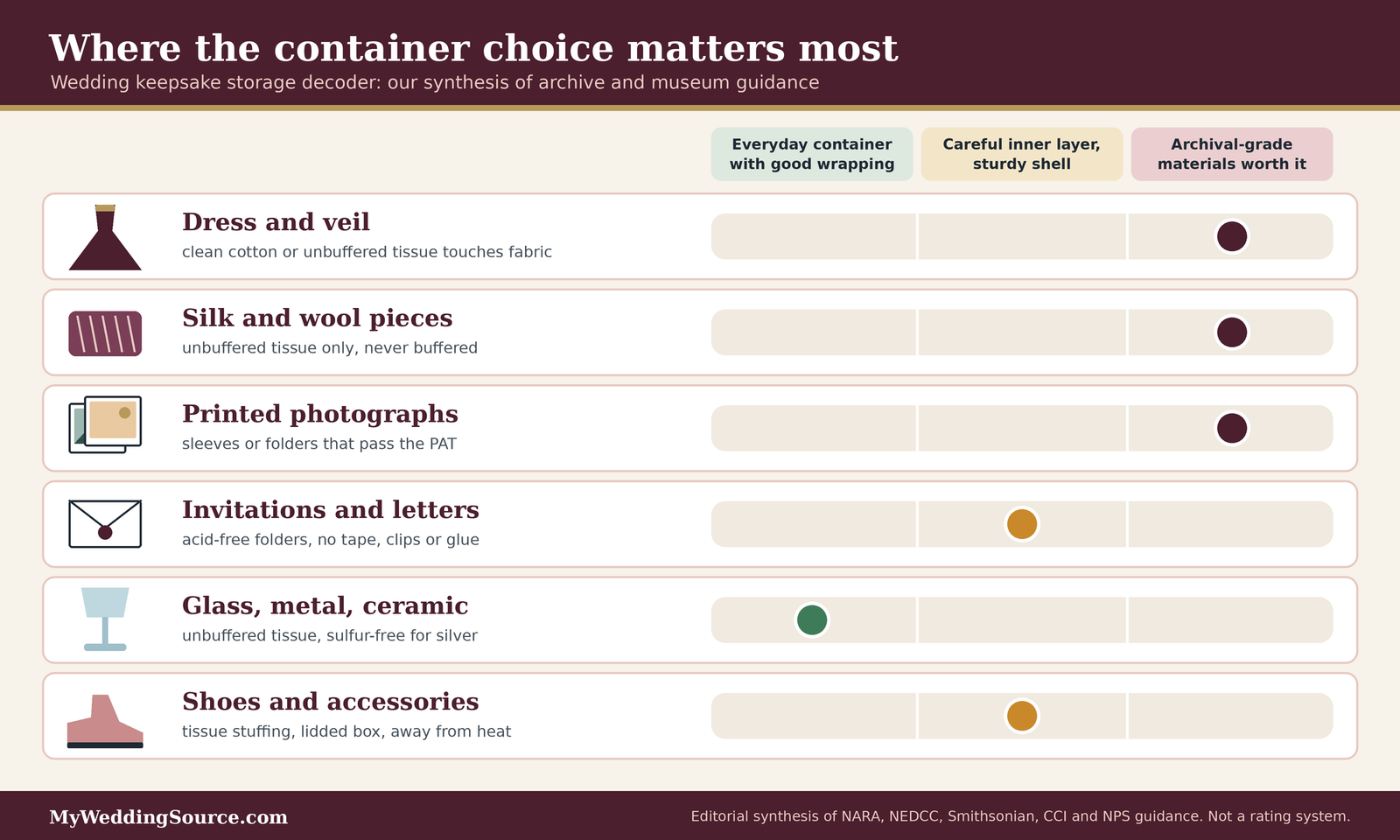
| Keepsake | How much the container choice matters | Layer that touches the item | Outer container that works |
|---|---|---|---|
| Wedding dress and veil | High | Clean white cotton or unbuffered acid-free tissue | Lidded archival textile box, or a clean lidded box that fits without sharp folds |
| Silk or wool items | High | Unbuffered tissue only | Lidded box in a stable, dark spot |
| Printed photographs and negatives | High | Photo-safe sleeves or folders that pass the PAT | Photo-safe box, horizontal where possible |
| Invitations, letters, programs, cards | Medium to high | Acid-free folders, no adhesives | Lignin-free box sized to the paper |
| Glass, ceramic, metal keepsakes | Medium | Unbuffered tissue; acid-free and sulfur-free for silver | Clean lidded tub or box with padding |
| Shoes, sturdy accessories | Lower to medium | Unbuffered tissue stuffing | Lidded box, away from heat |
Wedding keepsake storage, item by item
A single rule for all wedding keepsake storage would be simpler, but a wedding leaves you with fabric, photographs, paper, glass, metal, and flowers, and they age in different ways. The sections below take the common items one at a time, and the dried flowers have their own guide in our bouquet preservation article.
The wedding dress and veil
The dress is usually the largest, most delicate, and most emotionally loaded keepsake, and it is where wedding keepsake storage choices have the most visible effect. It is also the item with the most sales pitches attached to it, so careful wedding keepsake storage for a gown starts with the questions below, not with a product page.
Start with a clean, dry, inspected garment
The Smithsonian says to store textiles clean, because dust and soil abrade fibers, and to store them unironed and unstarched. CCI adds that textiles should be inspected for insects and mold before they are stored, and that an item with an infestation should be sealed in a clean polyethylene bag and kept apart from other textiles. We did not verify claims about how any particular cleaning method treats stains, sequins, or beading, so ask the cleaner what is used, what is guaranteed, and what is not, and keep a copy of the answer. CCI publishes a technical note titled “Commercial Dry Cleaning of Museum Textiles,” which signals that this is a specialist question, not a routine one.
Box or hanger
For a dress, the main wedding keepsake storage question is whether the garment can carry its own weight. The National Park Service says sturdy, structured garments in good condition can hang on padded hangers, but advises against hanging garments that are fragile, heavy, or heavily embellished, or that lack dimensional stability, such as bias-cut or knit pieces. Those belong flat in properly sized boxes or drawers. Hanging puts stress on the shoulders, neck, and bodice. The National Park Service gives no weight limit, and says dresses with heavy skirts may need support from the waistline, so a heavy gown is a case for a textile conservator, not a guess.
If you do hang a dress for a while, the same guidance prefers padded hangers made from polypropylene or acrylic, not wood, which releases acids.
Folding without creating permanent creases
The Smithsonian suggests storing textiles flat with as little folding as possible, padding any sharp folds with washed unbleached muslin or old sheets, and periodically refolding along different lines so the same fibers do not bear the stress every time. CCI recommends padding folds with accordion-pleated unbuffered acid-free tissue and repositioning folded textiles regularly. A volume of tissue stuffed into a bodice or sleeves, which the Smithsonian’s Museum Conservation Institute calls stuffing or interleaving, helps the garment keep its three-dimensional shape and keeps surfaces from rubbing. The practical result in wedding keepsake storage for a gown is a box that is longer and shallower than most people expect.
Which tissue touches the fabric
The Smithsonian says that antique textiles should not touch wood, blue tissue, regular tissue, or other wrapping paper, which is usually acidic, and that clean white cotton such as old sheeting or muslin is a safe wrap. The National Park Service recommends unbuffered neutral tissue for textiles, and the Museum Conservation Institute says buffered papers are potentially harmful to silk and wool. Gift-shop tissue, colored tissue, and wrapping paper are the wrong choice. CCI warns that colored paper can transfer dye.
Veils, shoes, and accessories
These smaller pieces are easy to toss into the same box as the dress, but they behave differently from the gown and often deserve their own wrapping.
Veils and other delicate fabric
A tulle or lace veil benefits from the same approach as a dress: clean, unfolded as much as possible, wrapped in unbuffered tissue or white cotton, and not pressed under heavier items. The Smithsonian advises placing antique fabrics on top in a drawer, not beneath heavy items, which can cause sharp folds and splits. If the veil has a metal comb or beaded edge, isolate the metal with tissue so it cannot rust or abrade, a point CCI makes about pins, staples, and corroded fasteners.
Shoes, belts, and headpieces
Stuff shoes and headpieces with crumpled unbuffered tissue so they hold their shape, wrap each piece separately, and keep them in a lidded box away from heat. We did not find a single authoritative source for bridal shoes specifically, so this advice borrows from the general museum guidance on stuffing and wrapping objects. For anything with leather, adhesives, or glued trim, ask a conservator, because those materials age differently from cloth.
Photographs and albums
The photographs from the day are the one keepsake that is probably also stored somewhere else, which makes the choices simpler: you are deciding how to care for the prints you actually want to hold. Wedding keepsake storage for photographs is mostly a matter of enclosures and a stable room. Our guide to how to sort wedding photos for albums covers choosing the images; this section covers keeping the prints once they exist.
Prints in sleeves and boxes
The Library of Congress says to house prints in photo-safe folders or sleeves that pass ISO 18902, including the PAT, and to store enclosed prints in photo-safe boxes. Plastic sleeves should be uncoated polyester, polyethylene, or polypropylene, and NEDCC says polyester is the most inert of the three and polyvinyl chloride (PVC, or “vinyl”) should be avoided entirely. Paper enclosures are opaque and breathe, but you must remove the print to see it. Store prints horizontally, and keep boxes comfortably full so they do not sag, according to NEDCC.
Albums: what to look for and what to skip
The Library of Congress says photo-safe albums are acceptable for family photographs and warns against albums with colored pages, “magnetic” pages, or sticky self-adhesive pages. NEDCC adds that self-stick album pages are often highly acidic and can permanently bond to photographs. NARA lists self-adhesive magnetic albums, rubber cement, pressure-sensitive tape, and PVC among materials to avoid, and advises mounting items without adhesive using acid-free pages, stable plastic sleeves, or acid-free corners. If you already own an old sticky album, we would not pull the photos out by force. We did not find a source on removal, so ask a conservator first.
Handling, labeling, and light
Use clean, dry hands or clean nitrile gloves when you handle prints, and hold them by the edges. NEDCC says cotton gloves can shed fibers, which is a reason to prefer nitrile or clean hands. If you must label a print, the Library of Congress recommends a soft graphite pencil on the back near the edge, or labeling the housing instead. NEDCC notes that color photographs fade fairly quickly in light, so rotate any displayed prints and keep a copy for display and the original in the box.
Invitations, letters, programs, and cards
Paper keepsakes are the easiest part of wedding keepsake storage and the easiest to damage with good intentions, because the supplies that seem helpful, such as tape, glue, and paper clips, are exactly the ones conservators tell you to avoid.
What to keep as paper
You do not need every scrap. A reasonable shortlist is one invitation suite, one program, a few cards that mean something, handwritten vows or letters, and anything signed. Our guides to wedding invitations and thank-you cards explain what goes into those suites if you are still collecting them.
How to house paper
NARA advises lignin-free, acid-free, or buffered folders and boxes large enough for originals to lie flat without bending, with one item per sleeve if you use polyester L-sleeves for brittle or torn sheets, and no sleeves inside books because their sharp edges can tear pages. Avoid rubber bands, paper clips, non-stainless staples, glue, and pressure-sensitive tape. Skip “magnetic” album pages as well.
Official records are a separate question
Marriage certificates and similar records are legal documents, and the correct process for copies, replacements, and storage varies by jurisdiction. This guide is not legal advice. Check the county clerk or vital-records office that issued your record before you decide where an original or certified copy lives, and see our explainer on the difference between a marriage license and a marriage certificate if the terms are confusing.
A shortlist review workflow before anything goes in a box
The most common wedding keepsake storage mistake is not a bad container. It is putting everything into one container without looking at it first. A short review catches mold, sorts what is worth the space, and gives every item a destination. This is our own workflow, built from the practices described by the archives and conservation sources cited in this guide.
Pass one: gather and shortlist
Collect every keepsake in one clean, dry room, and sort into three piles: keep as an object, keep as a photograph or scan and decide later, and let go. One way to make the third pile easier is to photograph an item, such as a sash or a card, before you release it. For printed photographs, shortlist the images you truly want to hold. Our photo-sorting guide covers how to narrow a large set without burning out.
Pass two: inspect and clean
Look for the problems the sources describe: musty smell or visible mold, insect evidence, stains, rust from pins or fasteners, and sticky residue. CCI says to inspect for insects and mold, to isolate infested textiles in clean polyethylene bags, and to store only clean textiles. NARA says to keep items away from food and water. If you find active mold or an infestation, do not box it with healthy items. Isolate it and ask a conservator or a qualified cleaner what to do next.
Pass three: choose a container with the decoder
Match each pile to the wedding keepsake storage decoder table above. Textiles, photographs, and irreplaceable paper get the careful inner layer. Hard objects can go in clean tubs with wrapping. Group like with like, as NARA suggests, so that metal, ceramic, and textile items sit in separate boxes, with heavier items at the bottom of any stack.
Pass four: label, log, and schedule a check
NARA says to label the box or wrapping, not the artifact. Keep a one-page inventory, either on paper in the box or in a note on your phone, listing what is in each box and where the box lives. Then put a recurring reminder on your calendar to open each box lightly once a year, look for odors, moisture, or pests, and refold textiles along different lines, as the Smithsonian advises.
Glass, metal, ceramic, and small objects
Champagne flutes, a cake topper, a ring box, a ceremony candle holder, and guest book pens do not behave like fabric, but they still react to moisture, rubbing, and acid, and wedding keepsake storage for them is mostly about wrapping and separation.
Wrap each piece, and keep materials apart
NARA says to wrap each artifact individually in unbuffered acid-free tissue, wrap each part of a multi-part piece separately, pad empty space with tissue rolls to stop shifting, and keep metal, ceramics, and textiles in separate boxes with heavier objects on the bottom. It also warns against overcrowding a box, forcing an item in so the lid will close, and gluing broken pieces back together. If something is chipped or cracked, store it as it is and consult a conservator.
Silver and other metals
The National Park Service recommends acid-free and sulfur-free tissue for silver to prevent tarnish and soft neutral tissue for soft metals to avoid scratching. For jewelry and rings, the same logic applies: soft, clean wrapping, no rubber bands, and a dry location. If a metal piece has been treated or plated, ask the maker how to clean and store it. We did not research jewelry care in this article beyond these general points.
Where wedding keepsake storage should live: a room-by-room map
A perfect box in a bad room loses to a plain box in a good one. Every source we read puts location first in wedding keepsake storage, and the guidance is consistent enough to turn into a simple map of a typical home.
The best and worst places in a typical house
The institutions cited here write most of their numbers for archives and museums, and NEDCC’s environment leaflet gives no home-specific figures. Treat the figures as a direction to aim for, not a pass-fail test.
Places to avoid
For wedding keepsake storage, NARA says to avoid damp basements, garages, and hot attics, and to keep items away from pipes, windows, and known roof leaks. The Library of Congress adds vents, fireplaces, radiators, and exterior walls to the list, because condensation and heat sources cause swings. The Smithsonian says the same about basements and attics for textiles. These are not exotic risks: an attic in summer, a basement after heavy rain, or a garage in winter is exactly where many families keep boxes.
Places that tend to work
For wedding keepsake storage at home, the Smithsonian suggests a clean, cool, dry, dark spot with as few swings as possible, and recommends setting aside one drawer or chest for heirlooms. Gaylord, a retailer of archival supplies, lists a closet or under a bed as typical textile storage spots, provided light is limited and temperature and humidity are steady. An interior closet on a main floor, away from exterior walls and bathrooms, matches most of this guidance. A shelf off the floor in that closet is better than the floor itself, because NARA advises shelves off the floor.
The numbers, in plain terms
Different sources give slightly different wedding keepsake storage targets because they protect different materials. For general paper and photographs, NARA suggests keeping storage below 75°F and below 65% relative humidity. For photographs, the Library of Congress suggests 30% to 50% relative humidity and 70°F or cooler. For textiles, the Smithsonian’s household advice suggests 65°F to 70°F and 40% to 50% relative humidity. A comfortably conditioned interior room is more likely to land near those ranges than an attic or a basement, though only a thermometer and hygrometer can confirm it.

Stable beats perfect
A common instinct is to chase a specific number. For wedding keepsake storage, the sources suggest chasing steadiness instead.
Why swings are the quiet problem
NEDCC explains that moisture changes move through materials slowly, and that rapid moisture absorption and release can distort paper and bindings. Because temperature also changes relative humidity, even a small temperature swing can shift humidity. An unheated spare room that is cold in winter and warm in summer may cycle more than an interior closet in a heated home.
A low-cost way to check
A small digital thermometer and hygrometer, left in the spot for a few weeks, shows you what the room really does. NEDCC has a leaflet on monitoring temperature and relative humidity for institutions, but we did not review its details and do not recommend a specific device. Compare your readings with the ranges above, and move the boxes if the spot is repeatedly damp or hot.
How to pack a box for wedding keepsake storage, step by step
Once the location and container for your wedding keepsake storage are chosen, packing is a calm, practical task. The steps below combine the guidance from the National Archives, the Smithsonian, the Canadian Conservation Institute, and the National Park Service. They are written for a dress-sized box, and the same logic scales down to smaller ones.
Gather the supplies first
You need fewer supplies than a sales page suggests, and most of them are plain.
The short supply list
Clean, lidded box that fits the item; unbuffered acid-free tissue in a large quantity; clean white cotton sheeting or muslin if you prefer fabric against fabric; nitrile gloves or freshly washed hands; a soft pencil; and labels for the outside of the box. The Museum Conservation Institute notes that clean undyed cotton sheeting can be washed and reused, and it cautions that in humid sub-tropical areas, extra paper and cotton can encourage mold and cost more than they help, so use materials sparingly there.
What to leave out
Good wedding keepsake storage leaves out rubber bands, tape, adhesive labels on the item, loose staples and pins, colored tissue, and wood in any form. Gaylord also advises against mothballs, which it says can damage fabric and are toxic to people, and says cedar is not a reliable insect deterrent. We did not independently verify that last point beyond the retailer’s statement, so take it as retailer guidance and ask a conservator if pests are a real concern in your region.
Pack in order
The sequence matters more than any single material, because it keeps weight, folds, and contact where they should be.
Line, place, pad, cover
Line the box with a single large piece of cotton sheeting or unbuffered tissue, cut large enough to fold back over the item. CCI says one large piece is better than several small ones, and that it doubles as a lifting aid. Place the dress with as few folds as possible. Pad any fold with accordion-pleated tissue or roll tissue to support the bodice and sleeves, as Gaylord and CCI both describe. Fold the lining over the top and close the lid.
Label, log, and place
Write on the box or on a label attached to the box, never on the garment. List the contents, the date packed, and a short note on whether the item was cleaned. Add the box to your inventory and put it in the location you chose.
Check on a schedule
The Smithsonian advises airing out and inspecting stored items periodically, and refolding along different lines. Once a year is a reasonable rhythm, and a few minutes with the lid off is enough. Look for odor, dampness, discoloration, or insect evidence. If something looks wrong, isolate the box and get advice before you repack.

What wedding keepsake storage costs, and what to ask before paying
Wedding keepsake storage supplies are not expensive compared with a wedding budget, but they are not free, and some of the most expensive options solve problems you can handle at home.
What this actually costs
For wedding keepsake storage, two retailers show the range. Gaylord, an archival supplier, lists a buffered barrier-board wedding dress and costume preservation kit from $104.65, and describes it as including 25 sheets of unbuffered acid-free tissue and cotton gloves. David’s Bridal lists a dress cleaning and preservation service whose Premium Preservation tier adds $60 to the base service, and the page we read did not state a base price. Prices change, so confirm on the seller’s page. The expensive part is rarely the box. It is the service attached to it, and whether that service lets you open the box.
A sample budget for a careful household
Prices vary widely, and we did not survey the market, so the figures below combine the two retailer prices we found with our own arithmetic, which is an estimate.
The two sourced price points
The Gaylord kit from $104.65 is a do-it-yourself purchase: you supply the cleaning and the packing. The David’s Bridal service bundles cleaning, anti-yellowing treatment, steaming, folding, boxing, and tissue wrapping, according to the retailer, with insurance and a different box at the Premium tier. They are not like for like, because one is supplies and the other is labor plus supplies.
Cost per year as an estimate
If a $104.65 kit protected a dress for twenty-five years, the supplies would cost roughly $4.19 per year. That is our estimate, and it assumes the kit performs for that long in a good location, which no one can promise. The point of the arithmetic is only that the supplies are a small number next to the rest of the wedding, and a bad location can cancel the benefit of any box.
Reading a preservation kit or service claim
Some marketing language around wedding keepsake storage deserves a second look. This is not a warning against any seller, only a list of questions to ask.
“Sealed” and “airtight”
David’s Bridal says its preservation kit “seals out dust and moisture.” The Smithsonian’s household guidance for textiles says not to seal them airtight. Those two statements are not necessarily in conflict, since “sealed” can mean many things, but they are a good reason to ask exactly how the box closes, whether you can open it to inspect the gown, and what the seller warrants if you do. In 1998 the Federal Trade Commission issued an administrative complaint against a New York gown-cleaning company alleging, among other things, that its preservation guarantee did not disclose that opening the sealed container voided the warranty. Those were allegations in a complaint, and we cite them only as a reason to read the terms.
“Archival,” “museum quality,” and “acid-free”
As NEDCC notes, these terms alone do not guarantee a product is safe. Ask for the material (barrier board, polypropylene, unbuffered tissue), whether the box is buffered, and whether the supplier says it passed the PAT. Gaylord’s product page states that its box is buffered while the tissue provided is unbuffered. That pairing is consistent with Gaylord’s own tip that a buffered box can protect protein items if they are fully wrapped in unbuffered tissue. It is still worth asking any seller which of their materials touch the fabric.
Insurance and guarantees
David’s Bridal lists insurance amounts for its tiers. Insurance and guarantees are contract terms, and we are not giving legal or financial advice. Read what is covered, what voids it, and how a claim works before you pay, and keep the paperwork with the inventory.
Edge cases that change your wedding keepsake storage plan
Real homes are not archives, so wedding keepsake storage sometimes needs adjusting. A few common situations need a slightly different approach.
Climate and space
Where you live and how much room you have change what is practical.
Humid climates
The Museum Conservation Institute says cotton sheeting and acid-free papers are useful in mixed climates and dry desert regions, but that in sub-tropical humid areas they should be used sparingly because excess material can encourage mold. NARA suggests relative humidity below 65% to prevent mold. The Library of Congress warns that plastic enclosures for photographs can stick to emulsions above 70% relative humidity. In a humid place, wedding keepsake storage depends more on a dehumidified interior room than on any box, and sealed plastic is riskier than usual.
Small apartments
If there is no good closet for wedding keepsake storage, choose the most stable corner of the most stable room and keep boxes off the floor. NARA says to use shelves off the floor, and the Library of Congress says to stay away from exterior walls, which NEDCC notes are affected by outdoor temperature. A bedroom closet’s interior wall, or a lidded box on a shelf in a hallway closet, usually beats a bed frame next to a window.
Storage units and moves
Climate-controlled and non-climate-controlled units differ, and we did not research specific facilities. Apply the same tests: avoid hot, damp, or swinging conditions, and ask the facility what temperature and humidity range it maintains. NEDCC advises letting new construction or renovation off-gas before moving collections in, which is a reason not to unpack keepsakes into a freshly painted or newly carpeted room right away.
Risk and responsibility
Some situations are about water, borrowed items, or shared family history.
Water, leaks, and floods
NARA says to keep items away from pipes, windows, and roof leaks. NEDCC warns that plastic photo enclosures can trap moisture and cause ferrotyping after water emergencies, and the Library of Congress advises against plastic enclosures in humid, uncontrolled spaces. A lidded plastic tub can protect against a minor splash, and a damp sealed tub can also hold moisture against the contents. If a box gets wet, open it promptly, and ask a conservator about anything valuable. We do not give disaster-recovery instructions here.
Rented or borrowed attire
Rented dresses, suits, and decor go back to the seller, and storage for them is the seller’s job. See our guides to renting wedding dresses and groomsmen rental returns, and the forthcoming guide to returning wedding rentals after a Sunday reception.
Decor, gifts, and items you will not keep
Not every object deserves a box. If you plan to sell centerpieces or signs, our upcoming guide to wedding decor resale covers that choice, and a gift inventory spreadsheet helps you track presents you want to keep or return. Our after-wedding checklist puts keepsake tasks in order with everything else that follows the day.
Valuable or historic pieces
The American Institute for Conservation says there are many things you can do yourself to care for family heirlooms, but sometimes you need advice or treatment from a conservation professional, and its Find a Professional Member directory lists peer-reviewed conservators. Gaylord also recommends consulting a conservator before handling any textile of historical value. If a piece in your wedding keepsake storage is old, fragile, valuable, or has been in your family for generations, one consultation costs less than a mistake.
Questions to ask before you buy wedding keepsake storage supplies or services
Most buying mistakes in wedding keepsake storage come from skipping one or two questions. These are the ones that matter most, and they work for a retailer, a cleaner, or a framer.
Questions for sellers
Ask these before you pay, and keep the answers.
About the box and materials
Questions worth asking before you buy
- What exactly is the box made of, and is it buffered or unbuffered?
- Is the tissue unbuffered and acid-free, and is it supplied?
- Does the product state that it passed the Photographic Activity Test, if it will hold photographs?
- Can I open the box to inspect the item, and what happens to any guarantee if I do?
- What is the guarantee, in writing, and what voids it?
- What is cleaned, how, and what are the known limits for beading, sequins, or stains?
- What size is the box inside, and will the item fit without sharp folds?
- Is the packaging meant to be airtight, and how do you address trapped moisture?
About the service and the terms
If a business is cleaning or boxing the item, ask who does the work, what happens if something is damaged, how insurance applies, and how long the item stays with them. Keep receipts and photographs of the item before you hand it over.
Questions for yourself
The best answers often come from asking what you will actually do with the item.
Will you open it?
If you expect to take the dress out for a daughter, a niece, or a photo, a box you can open and close without ceremony is more useful than a sealed one.
Will you maintain it?
In wedding keepsake storage, a box that you check once a year in a good location beats a sealed box you never open and cannot inspect.
FAQ: wedding keepsake storage questions
Containers and materials
Is an archival box really necessary for wedding keepsake storage?
Not strictly, but it helps. What matters is a clean dress, a box that fits without sharp folds, unbuffered tissue or clean white cotton against the fabric, and a stable location. A well-chosen archival textile box meets those needs in one purchase, while a plain lidded box can work if you supply the lining carefully.
Are plastic tubs safe for a wedding dress?
They can be fine for sturdy objects, but airtight tubs are a poor fit for fabric. The Smithsonian advises against sealing textiles airtight, since trapped moisture can do damage, and says plastic should not touch the fabric directly. If you use a tub, line it with cotton or tissue, and avoid sealing it in a damp space.
Should the tissue be buffered or unbuffered?
For textiles, unbuffered neutral tissue is the safer default. The National Park Service recommends it for all textiles, and the Smithsonian’s conservation institute says buffered paper can harm silk and wool. If you are unsure what your dress is made of, use unbuffered tissue or clean white cotton, and ask a conservator about anything valuable.
Location and care
Where is the best place at home for wedding keepsake storage?
An interior closet on a main floor, on a shelf off the floor, away from exterior walls, windows, pipes, and bathrooms, is usually the best candidate. Archives and museums advise against attics, basements, and garages because heat, damp, and swings are hardest to control there. A thermometer and hygrometer can confirm how stable your spot is.
How often should I check stored keepsakes?
Once a year is a reasonable rhythm. The Smithsonian advises airing out and inspecting stored textiles periodically and refolding along different lines. Open the box briefly, look for odor, dampness, discoloration, or insect evidence, and put it back. If you find a problem, isolate the box and get advice before repacking anything.
Can I hang a wedding dress instead of boxing it?
Sometimes, for a sturdy, structured gown in good condition. The National Park Service advises against hanging fragile, heavy, or heavily embellished garments, or bias-cut and knit pieces, because vertical hanging stresses the shoulders and bodice. Those should lie flat in a properly sized box. If you are unsure, a textile conservator can assess the dress.
Photos and paper
What is the safest way to store printed wedding photos?
Use enclosures made of uncoated polyester, polypropylene, or polyethylene, or photo-safe paper that passes the Photographic Activity Test, and keep them in a photo-safe box in a cool, dry, stable spot. Avoid PVC, sticky or magnetic album pages, rubber bands, and tape. Hold prints by the edges with clean hands or nitrile gloves.
Should I keep my marriage certificate with my other keepsakes?
That depends on your jurisdiction, and this guide is not legal advice. Rules for originals, certified copies, and replacements vary, so check with the county clerk or vital-records office that issued the record. Decorative keepsakes and official records often live in different places, so confirm what you need before you decide.
Your next steps
Decide where the boxes will live
Walk the house with the map
Check each candidate spot for your wedding keepsake storage against the places to avoid: attic, basement, garage, exterior walls, windows, pipes, vents, and the floor. Pick the interior closet shelf or similar spot, and leave a thermometer and hygrometer there for a few weeks. Our wedding planning checklist can hold this task alongside the others.
Clear the space before you buy anything
Good wedding keepsake storage starts with the location. Moving the existing boxes out of a damp or hot spot costs nothing and does more than any new container. Buy supplies after you know where they will sit.
Sort, clean, and pack
Run the four-pass review
Gather, inspect and clean, choose the container with the decoder, then label and log. Our after-wedding checklist and photo-sorting guide can help with the order of the tasks around it.
Get the photo files in order too
If you also want to know what your photographer should deliver, see our photography deliverables guide and the explainer on raw files.
Put a yearly check in your calendar
Open each box once a year
A short check for odor, dampness, discoloration, and insects catches problems while they are small. Refold textiles along different lines, and note the date in your inventory.
Ask for help when a piece is valuable
For a fragile, historic, or family heirloom piece, consult a conservation professional before you decide how to store it.
Sources & methodology
How we built this guide
What we relied on
This guide to wedding keepsake storage draws on household-level preservation guidance from the U.S. National Archives, the Library of Congress, the National Park Service, the Smithsonian, the Northeast Document Conservation Center, the Canadian Conservation Institute, and the American Institute for Conservation, plus product pages from two retailers and one Federal Trade Commission complaint. Where a statement comes from a retailer, we say so, because a retailer’s advice reflects what it sells. Several sources are written for museums and archives, and we say so where it matters. The cost-per-year figure and the decoder table are our own arithmetic and editorial synthesis, not findings from any source. We checked the pages listed below on November 12, 2026, and we did not verify that every page has been updated recently.
What we did not do
We did not test boxes, tissues, or plastics, and we did not conduct a price survey. We did not research digital storage, jewelry care, or bridal shoe construction in depth. We do not give legal, financial, or conservation-treatment advice. Rules for marriage records vary by jurisdiction, so check with the issuing county clerk or vital-records office. For a valuable or fragile piece, consult a conservation professional.
Source list
Government and regulatory sources
- U.S. National Archives, Storing family papers and photographs: https://www.archives.gov/preservation/family-archives/storing
- U.S. National Archives, Artifacts (holdings maintenance): https://www.archives.gov/preservation/holdings-maintenance/artifacts
- Library of Congress, Care, handling, and storage of photographs: https://www.loc.gov/preservation/care/photo.html
- National Park Service, Conserve O Gram 4/9, Buffered and unbuffered storage materials: https://www.nps.gov/subjects/museums/upload/04-09_508.pdf
- National Park Service, Conserve O Gram 4/5, Storage techniques for hanging garments, padded hangers: https://www.nps.gov/articles/000/conserve-o-gram-4-5-storage-techniques-for-hanging-garments-padded-hangers.htm
- Federal Trade Commission, administrative complaint, Continental Gown Cleaning Service, Inc. (1998): https://www.ftc.gov/sites/default/files/documents/cases/1998/05/continen.cmp_.htm
Conservation and museum sources
- Northeast Document Conservation Center, 5.5 Storage enclosures for photographic materials: https://nedcc.org/free-resources/preservation-leaflets/5.-photographs/5.5-storage-enclosures-for-photographic-materials
- Northeast Document Conservation Center, 5.3 Care of photographs: https://www.nedcc.org/assets/media/documents/Preservation%20Leaflets/5_3_CarePhotographs.pdf
- Northeast Document Conservation Center, 2.1 Temperature, relative humidity, light, and air quality: https://nedcc.org/02-01-enviro-guidelines
- Smithsonian Institution, How do I store antique textiles at home: https://www.si.edu/faqs/antique-textile-storage
- Smithsonian Museum Conservation Institute, Acid-free tissue paper for textile and costume storage and handling: https://mci.si.edu/acid-free-tissue-paper-textiles-costume-storage-handling
- Canadian Conservation Institute, Notes 13/2, Flat storage for textiles: https://www.canada.ca/en/conservation-institute/services/conservation-preservation-publications/canadian-conservation-institute-notes/flat-storage-textiles.html
- Canadian Conservation Institute, Textiles and costumes: https://www.canada.ca/en/conservation-institute/services/care-objects/textiles-costumes.html
- American Institute for Conservation, Find a conservator: https://www.culturalheritage.org/about-conservation/find-a-conservator
Retailer sources
- Gaylord Archival, Buffered barrier board wedding dress and costume preservation kit: https://www.gaylord.com/Preservation/Textile-Preservation/Storage-Boxes/Gaylord-Archival%26%23174%3B-Buffered-Barrier-Board-Wedding-Dress-%26-Costume-Preservation-Kit/p/HYB09624
- Gaylord Archival, Foundations of textile preservation: https://info.gaylord.com/resources/foundations-of-textile-preservation
- David’s Bridal, Wedding dress cleaning and preservation kit: https://www.davidsbridal.com/product/wedding-dress-cleaning-and-preservation-kit-cleanandpreserve