

Honeymoon destinations are easiest to choose when you stop comparing photographs and start comparing constraints: the weather in your travel month, the hours it takes to get there, the pace you actually want, the style of trip you will enjoy, and the money you are willing to spend.
Quick answer
Pick two non-negotiables from five filters (weather window, travel burden, pace, style, budget shape), let the other three flex, and score three to five finalists against them. Check official storm seasons and each country’s entry page before you fall in love with any of the honeymoon destinations on your list. A straight-line flight to Hawaii from Chicago is roughly nine hours by our estimate, to Cancún roughly three and a half, so the same week of leave buys very different amounts of actual vacation. Hold refundable bookings until your dates and documents are settled.
What honeymoon destinations really ask of you
Honeymoon destinations look effortless in an image and demanding on a calendar. Before you read about specific places, it helps to know what kind of decision this is. Choosing among honeymoon destinations is a trade between a handful of measurable things and one or two things that only the two of you can rank. The rest of this guide gives you a way to compare honeymoon destinations on the first group and a way to be honest about the second.
If you are still working out the bigger frame of the trip, such as how long to be away, whether to leave straight after the reception, and how to split the work, our honeymoon planning guide covers that. This guide picks up where that one leaves off and focuses on the destination choice itself.
Start with constraints, not photographs
Most couples begin with a mood: turquoise water, old stone streets, a mountain hut. Moods are useful for generating a long list, and poor at narrowing it, because almost every destination can be photographed to match almost every mood. Constraints narrow the list quickly and fairly, since they do not care how a place looks online.
Write down the fixed facts first
Open a shared note and record the facts that are not up for debate: the weeks of leave each of you can take, the month or months you can travel, the airport you will leave from, the passports you hold and when they expire, and any health or mobility needs. These facts alone remove more honeymoon destinations than any preference does. A couple with eight days of leave and a late-summer wedding has already ruled out some places and put others under a weather question, before a single article has been read.
Treat your leave as a budget in days
Money is not the only thing you spend on a honeymoon. Days are a budget too, and the flight is the biggest line item for far-away trips. If you have eight days and a one-way journey takes the better part of a day, you are paying roughly a quarter of the trip for transit before you count arrival fatigue. We show the arithmetic later in the guide. For now, simply decide whether your leave is the scarce resource or your money is, because that single answer reorders the whole shortlist.
Pick two non-negotiables
Every couple has five filters, whether or not they name them. Weather window is the match between your travel month and the season at the destination. Travel burden is the door-to-door time and the number of connections. Pace is how much you want to do each day. Style is the kind of trip you will enjoy, such as beach, city, nature, or road trip. Budget shape is not just the total but where the money goes. The mistake is treating all five as equally important, because none of the honeymoon destinations on a shortlist wins on all five at once.
Choose the two that would ruin the trip if they failed
Ask each person privately which two filters, if they went wrong, would ruin the trip. One partner may say pace and weather. The other may say travel burden and style. Compare the lists. Where they overlap, you have found your real constraints. Where they differ, you have found a conversation that is much better to have in a kitchen than in an airport.

Let the other three flex on purpose
Once the two are named, decide how far the others may bend. A couple who cares most about rest and a short flight might happily accept a crowded beach in the shoulder season. A couple who cares most about hiking and a particular month might accept a long travel day. Naming the flex in advance stops a persuasive travel website from quietly moving your priorities for you.
What the survey data show, and what they do not
Survey figures about honeymoon destinations can anchor your expectations, as long as you remember they describe other couples. The Knot publishes honeymoon data based on its own studies, and it is the most widely cited source for U.S. couples, so we use it here and say exactly what it covers.
What couples reported for 2024
According to The Knot’s reporting, about 41% of couples stayed in the United States for their honeymoon in 2024, up from 38% in 2023, and Hawaii, Florida, and California were the top states. Overall, 59% traveled abroad, with the Caribbean and Mexico the leading regions and Europe third. Beach or tropical getaways were the most popular style, chosen by 48% of couples. The typical honeymoon lasted about seven days, and 28% lasted one to two weeks. The Knot’s cost average of about $5,300 is based on a study of nearly 17,000 couples who married in 2024, and the style and destination breakdowns come from a separate 2024 honeymoon study of 662 U.S. couples who took or planned a honeymoon in 2024 through 2026.
Why popular honeymoon destinations are not the same as right for you
Those numbers tell you that short-haul beach trips and U.S. destinations are common, which is partly a story about how much leave and money couples have. They do not tell you whether a given couple enjoyed the trip, and they do not break out the choices by home airport. A couple who lives in Los Angeles and a couple who lives in Boston face very different flights to the same island. Use the survey to feel less alone in a choice, not to make it for you.
Weather: matching honeymoon destinations to your travel month
Weather is the one filter for honeymoon destinations that can end a trip rather than merely dim it. A rainy afternoon is a story. A named storm that closes an airport is a rebooking. The goal of this section is not to predict weather, which no guide can do, but to show you how to read the official windows so that you take weather risk on purpose.
Official storm windows you can verify
The best weather facts are the dull ones from official agencies, because they have a method and a date. They will not tell you how a given week will feel, but they tell you when to be careful.
The Atlantic and Pacific hurricane seasons
The National Hurricane Center states that the Atlantic hurricane season runs from June 1 to November 30, with activity peaking around September 10 and most storms forming between mid-August and mid-October. For the eastern Pacific, the official season runs from May 15 to November 30, with a less pronounced peak in late August, and most storms forming between late June and early October. That is a long window, and it covers many popular beach destinations in the Caribbean, along both coasts of Mexico, and along the Atlantic coast of the United States. The page does not give official dates for the Central Pacific around Hawaii, so for an island honeymoon there, ask the lodging and the airline how they handle storm disruptions rather than assuming a calendar.
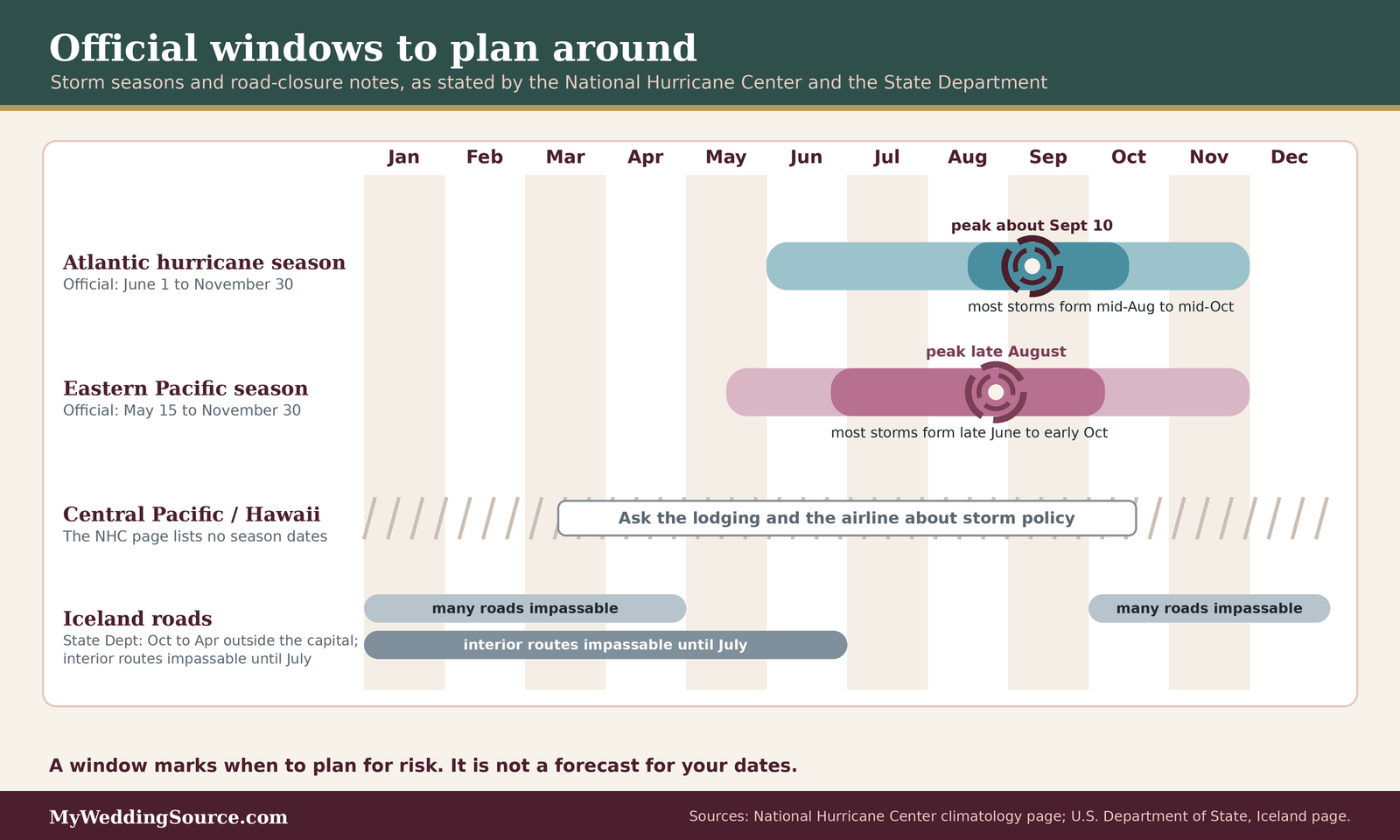
What a window does and does not mean
A hurricane season is not a forecast that your trip to any of these honeymoon destinations will be hit. The window simply marks when the risk is real enough to plan for, and it does not mean your particular dates will be affected. In practice that means three things: buy flexible or refundable arrangements, read the lodging’s storm policy before you pay, and decide in advance what you would do if a storm formed a week before departure. Our guide to wedding insurance explains how event coverage differs from the trip coverage we discuss later.
Hazards that are not weather
Some of the most useful warnings about honeymoon destinations are about land rather than sky. The U.S. Department of State’s country pages routinely mention them, and they are easy to skip when you are looking at beaches.
Earthquakes, volcanoes, and flash floods
The State Department’s page for Japan notes that the country is prone to earthquakes, typhoons, tsunamis, and landslides, and it points travelers to the government’s alert system. Its page for Costa Rica says the country lies in an active earthquake and volcanic zone, warns that popular rafting spots can become dangerous in flash floods, and says air quality varies by season. None of that means you should skip those places. It means a calm honeymoon there includes knowing how local alerts reach your phone, choosing lodging with a clear emergency plan, and checking river and road conditions before an excursion.
Roads and daylight
Some destinations are limited more by roads than by weather. The State Department’s page for Iceland says weather and road conditions can change quickly, especially in rural areas during winter when daylight is limited, that less than a third of the road network is paved, and that many roads outside the capital are impassable from October through April. It adds that many interior routes stay impassable until July because of mud and swollen rivers from snowmelt. For a couple planning a self-drive trip, that is the whole planning calendar in a sentence. Costa Rica’s page makes a similar point about poor road conditions and single-lane bridges, and advises against driving through water when you cannot see its depth.
A season-check routine you can reuse
We are deliberately not giving you a table of best months for every one of the honeymoon destinations we mention. We could not verify month-by-month climate claims for most places from an official source while writing this, and a confident table that is wrong costs you more than no table. Use the routine below instead, which works for any place.
Four questions to answer from official sources
First, what are the official storm, monsoon, or typhoon windows for the place and the month, and who publishes them? Second, what do the national weather service and the country’s tourism authority say about rainfall and temperature in your travel week, using multi-year normals rather than a single forecast? Third, what does the State Department’s country page say about natural hazards? Fourth, what does your lodging say it will do if a storm, closure, or road problem hits? Write the answers in your shared note next to each finalist.
Decide your weather tolerance in advance
Rank your tolerance honestly. Some couples would happily swap a week of sun for a week of lower prices and fewer people. Others would be miserable. A useful rule is to decide the worst weather you would still enjoy, such as rain every afternoon, and the worst you would not, such as a storm that cancels the main reason for the trip. Any of your honeymoon destinations that regularly produces the second kind in your travel month should either be moved to another month or dropped.
Flight time and the door-to-door burden for honeymoon destinations
Travel burden is the filter couples underestimate most, because a flight listing for honeymoon destinations shows hours in the air and ignores everything around them. The honest measure is door to door: leaving your home, getting through the airport, flying, connecting, clearing entry, and reaching your bed on the first night.
Distance arithmetic you can do yourself
Rather than quote flight times we could not verify, for the honeymoon destinations in this guide we computed straight-line distances between major airports and turned them into rough durations. This is our own estimate, so treat it as a way to compare honeymoon destinations with each other, not as a schedule.
How we estimated the hours
We calculated the great-circle distance between a departure airport and a destination airport, divided by an assumed average speed of 500 miles per hour, and added 30 minutes for taxi, climb, and descent. Real flights follow different routes, meet headwinds, and often connect, so a real itinerary is usually longer, never shorter, than a straight-line nonstop. For far-away destinations such as Bali or the Maldives, expect at least one connection, which can add many hours. We used New York (JFK), Chicago (O’Hare), and Los Angeles (LAX) as example departures. Your own airport will change the numbers, so redo the arithmetic with it.
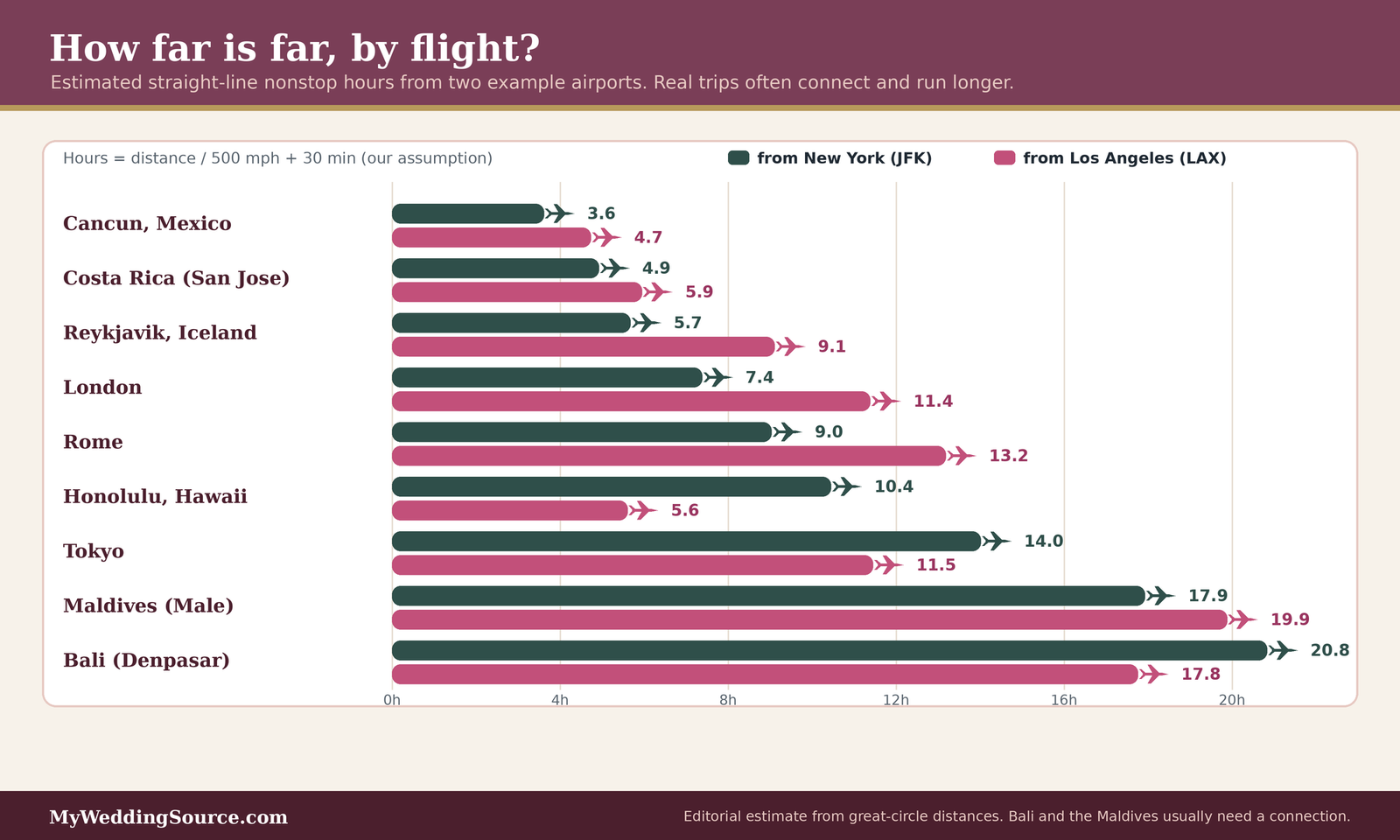
What the numbers show
The pattern across honeymoon destinations is more useful than any single figure. From New York, our estimate puts Cancún near 3.6 hours, Costa Rica’s San José near 4.9, Reykjavik near 5.7, London near 7.4, Rome near 9, Honolulu near 10.4, Tokyo near 14, and Bali near 21. From Los Angeles, Honolulu is only about 5.6 hours, while Tokyo is about 11.5 and Bali about 17.8. Distance depends on where you start: Hawaii is a medium trip for a Los Angeles couple but one of the longest for a New York couple, and Iceland is a shorter trip from New York than Rome. Check your own pair before you decide that a place is out of reach or an easy hop.
Turning hours into lost days
A flight burden becomes real when you count it against the leave you have. The simplest way is to count travel days separately from vacation days, as we also suggest in our honeymoon planning guide.
A worked example with assumed leave
Suppose a couple has eight days of leave. They are choosing between two honeymoon destinations, one with a 4-hour trip and one with a 14-hour trip. With an assumed three hours of airport time and transfers on each end, the first costs about seven hours each way, and the second about seventeen. If the longer trip also requires an overnight flight and a recovery day, the couple loses roughly one extra day on arrival and another on return. Out of eight days, the near destination leaves about six or seven days of vacation, and the far one leaves perhaps four. These numbers are assumptions chosen to show the method, but the shape is real: the extra distance does not cost eight hours, it costs most of a weekend.
When a long trip still makes sense
A long journey is not a mistake. It is a trade, and it can be a good one if you have two weeks, want a place that is hard to reach, or have saved leave for exactly this. The practical advice is to lengthen the trip rather than compress it. Seven days on the ground after a day of travel is a very different holiday from four days on the ground after the same day of travel. If you cannot lengthen the trip, choose a closer place and spend the difference on a better room.
Jet lag, time zones, and the first day
Time zones are the other half of travel burden for far-away honeymoon destinations, because your body does not live on the airline’s schedule. Mayo Clinic describes jet lag as a mismatch between your internal clock and local time, with symptoms such as poor sleep, daytime tiredness, trouble concentrating, and stomach upset, usually appearing within a day or two of crossing at least two time zones.
Direction and recovery
Mayo Clinic says the more time zones you cross, the worse jet lag tends to be, with roughly a day of recovery per zone, and that traveling east is usually harder than traveling west because you lose time. For a U.S. couple that matters in a concrete way. A trip west to Hawaii asks your body to gain hours, which tends to be easier. A trip east to Europe or Asia asks it to lose them. Mayo suggests arriving early if something important is scheduled, sleeping well beforehand, shifting your schedule gradually before departure, staying hydrated, and adopting the local schedule as soon as you land. None of this removes jet lag, but it can shorten it.
Plan the first day for a tired version of you
Because the first day is when you are least yourselves, build it around low stakes. Choose lodging with early check-in or a late checkout on departure, book no timed excursions on day one, and avoid driving on unfamiliar roads while exhausted. Our guide to wedding planning stress is a reminder that you will arrive tired from the wedding itself, which compounds the effect of a long flight.
Connections, transfers, and the last mile
The final stretch of a trip is where honeymoon destinations quietly differ the most. Two places can have the same flight time and very different arrival days.
Resort transfers and daylight limits
The State Department’s page for the Maldives warns that many resorts stop boat transfers after sunset, so travelers arriving at night may need to stay overnight in Malé or at an airport hotel, and it advises confirming transfer arrangements in advance. Even if you never visit the Maldives, the lesson applies elsewhere: ask the lodging how you reach it after dark, what it costs, and who is responsible if a flight lands late.
Count connections as risk, not just time
Each connection is another place for a delay to separate you from your bags and your first night. If you must connect, prefer a longer layover on the same ticket over a tight one, keep medications and one change of clothes in your carry-on, and keep hotel and transfer confirmations offline. Airline refund rules, covered later, matter most when a schedule change strikes a trip with several legs.
Pace and travel style: the filters that are easy to misjudge
Pace is the most personal of the five filters for honeymoon destinations, and the one couples most often assume they share. Style is the one that gets chosen from a photograph. Both are worth testing against how the two of you behave on ordinary vacations.
Measuring pace without guessing
Pace means how many things you want to do each day, and how much you want to do nothing. It is not a personality test, and it can differ between partners and between halves of the same trip.
Use your last vacation as evidence
Look at your last trip together, or each separately. How many planned activities did you actually do, and how many days did you wish had been emptier? How much did you enjoy the days with a booked tour versus the days without one? This is evidence about you, not a theory. A couple whose best memory is a day with no plan should be skeptical of an itinerary packed with timed entries.
Try a three-pace menu
Think of three paces as a menu rather than a label. A slow pace has one anchor activity a day, often in the morning, and the rest open. A medium pace has one anchor and one optional second plan. A fast pace has several fixed entries a day and tolerates early alarms. Most couples want a different pace for different parts of the trip, such as fast for the first three days in a city and slow for the last four on a beach. Matching one pace to the whole trip is usually what causes the mid-trip argument.
Matching style to the place, not the other way around
Style is the kind of experience you want from honeymoon destinations: beach and rest, city and food, nature and trails, a road trip with changing scenery, or a cultural trip around history and museums. The Knot reports that beach or tropical getaways were the most popular style among couples in its 2024 data, chosen by 48%, which also means a majority wanted something else.
Beach, city, nature, and road trip
A beach trip front-loads rest and usually concentrates costs in the room. A city trip distributes costs across meals, transit, and entry tickets, and demands more walking. A nature trip depends on weather and often on roads and guides, so it is the most sensitive to the season. A road trip gives you changing scenery and the most control over the pace, and it puts you at the mercy of driving conditions, which is why the State Department’s warnings about roads in Iceland and Costa Rica matter more for road-trip honeymoon destinations than for a resort stay. Knowing which of these four you want helps you read a destination’s profile for what it actually delivers.
Combining two styles without doubling the logistics
Many couples comparing honeymoon destinations want two styles, such as a few days in a city and a few on a beach. That can work, but each leg adds a transfer, a check-in, and a repack. A simple rule is to give each leg at least three nights, to put the busier leg first when you are fresh, and to end on the restful leg so that you return home calm. If the second leg requires another flight, count it as its own travel day in your budget of days.
The same place at different paces
The place does not set the pace; the way you plan it does. The same destination can be a rest trip or a challenge, depending on what you book.
A slow week and a fast week in the same place
Take any popular island among honeymoon destinations. A slow week there is one pool day, one beach day, one short excursion, a long dinner each night, and no alarm clocks. A fast week is a snorkel tour, a hike, a food tour, and a day trip, with early starts and transfers. Both are legitimate. The mistake is booking the second week while hoping to feel as if you had the first.
Leave one day with nothing on it
Whatever pace you choose, reserve at least one day with nothing booked. It acts as a buffer for weather, a late flight, or simple tiredness, and in practice it is often the day couples remember best. It also gives a storm day somewhere to land if the forecast changes, which ties back to the weather filter.
Budget shape: where the money goes in different honeymoon destinations
Total cost matters, but shape matters more when you are comparing honeymoon destinations. Two trips with the same total can feel entirely different if one spends most of its money on flights and the other on rooms. The questions to ask are where the cost sits, how much of it is fixed before you leave, and how much you can still control once you arrive.
Reported averages and their limits
Anchoring on a published average is reasonable as long as you know what it measures. The Knot reports an average honeymoon cost of about $5,300 for couples married in 2024, compared with $5,700 for 2023 and $5,100 for 2022, based on a study of nearly 17,000 couples. That is a survey average, so it blends domestic and international trips, short and long ones, and planned and paid amounts.
Domestic is not automatically cheaper, but it often differs
The Knot says domestic trips can cost significantly less than its overall average, but it does not give a separate figure, so we cannot give you one either. What we can say is that airfare to a distant island is often the largest line item, which is why distance appears twice in this guide on honeymoon destinations, once as a time cost and once as a money cost. For the wider conversation on funding the trip, our guides to how to pay for a wedding and the wedding budget calculator help you place the honeymoon inside the full picture.
Use the average as a sanity check, not a target
If your shortlist of honeymoon destinations prices out at double the reported average, it is worth asking whether that is a deliberate choice or an accident of browsing. If it comes in far under, ask what has been left out. Taxes, resort or service charges, airport transfers, baggage fees, visas or entry fees, insurance, and tipping are the usual omissions, and any of them can move the total.
Cost note
The Knot reports an average honeymoon cost of about $5,300 for couples married in 2024, from a study of nearly 17,000 couples. That is a survey average, not a quote. The NAIC says travel insurance often costs about 5% to 10% of the trip price, and that adding cancel-for-any-reason coverage can raise the insurance cost by about half. Our own two-trip example below uses invented numbers to show how a trip’s cost shape changes with distance; it is not a price list for any place.
Compare cost shape with a two-trip example
The easiest way to see cost shape across honeymoon destinations is to compare two trips on the same budget. The numbers below are hypothetical, chosen to illustrate the method. Please replace them with real quotes for your dates.
A hypothetical near trip and far trip
Imagine a couple with about $6,000 to spend on seven nights. Trip A is a nearby beach among honeymoon destinations. We assume flights at $450 per person ($900 for two), lodging at $300 a night ($2,100), and $200 a day for food, transfers, and activities ($1,400), for a subtotal of $4,400. Trip B is a far-away place with lower daily costs. We assume flights at $1,600 per person ($3,200), lodging at $180 a night ($1,260), and $120 a day on the ground ($840), for a subtotal of $5,300. If insurance costs 7% of the trip price, a mid-point of the NAIC’s range, Trip A adds about $308 and Trip B about $371.
What the example shows
Including insurance, Trip A totals about $4,708, or roughly $673 per night, and Trip B about $5,671, or roughly $810 per night. Trip B’s cheaper days did not make up for its flights, and it also costs more days of leave. This is a feature of the invented numbers, not a universal rule: a different origin city, a sale fare, or points could reverse the result. The method still holds. List flights, lodging, daily spending, and insurance separately, compute a cost per night on the ground, and compare shapes, not just totals. Our honeymoon planning guide explains how to normalize quotes that include different things.
Where honeymoon funds come from
Funding changes which honeymoon destinations you can responsibly book. A trip paid from savings has different flexibility from one partly funded by gifts that have not arrived yet.
Gifts, registries, and timing
Many couples ask guests to contribute toward the trip through a honeymoon fund on a registry platform. Money that arrives after the wedding cannot pay a deposit due before it, so match deadlines to cash you hold, not cash you expect. Our wedding registry guide covers how registries work, and you should read any platform’s fee terms before asking guests to use it.
Keep a reserve for the unplanned
Set aside a reserve, such as a modest percentage of the trip cost, for the things that happen: a missed connection, a medical visit abroad, or a change fee. The State Department says medical evacuation can cost more than $50,000 depending on location and condition, and that few standard health plans pay for it, so insurance, not a reserve, is the right tool for that risk. A reserve is for the small surprises, and insurance is for the large ones.
Honeymoon destinations by type, with what official sources flag
The profiles below are not rankings. They group honeymoon destinations by the kind of decision they pose, and each one reports what the State Department and other official sources say, as we read them in November 2026. Official pages change, so confirm each point before you book.
Closer to home: Caribbean, Mexico, and U.S. beaches
This group is common for good reasons. The Knot’s 2024 data show the Caribbean and Mexico as the top international regions and Hawaii, Florida, and California as the top U.S. states. Short flights and familiar logistics make them the easiest to fit around limited leave.
Caribbean and Mexican beach resorts
The main planning questions for these honeymoon destinations are the storm window and the paperwork. The National Hurricane Center’s Atlantic season runs June 1 to November 30, and the eastern Pacific season runs May 15 to November 30, so a Caribbean or Mexican beach trip in those months should be booked with flexibility. The State Department’s page for the Dominican Republic says your passport must be valid at entry with at least one blank page, a visa is not needed for stays under 30 days but visitors without a Dominican visa must buy a $10 tourist card, and travelers should exercise increased caution because of crime. It also says tap water is unsafe to drink, that mosquito-borne illnesses such as dengue and chikungunya are present, and that most providers accept only cash for medical care, often before treatment. We were not able to read the State Department’s Mexico page, so check it directly before you plan a Mexican trip. This kind of trip suits couples who want rest and a short flight, and may not suit those who want to walk through a historic city.
Hawaii and other U.S. destinations
A domestic honeymoon avoids passports and foreign entry rules, and it also avoids foreign medical billing. For flights within the United States, the TSA says you need a REAL ID-compliant license, an enhanced license, a passport, or another accepted ID, with enforcement starting on May 7, 2025, so check your card for the star before you travel. Hawaii is a long trip from the East Coast and a medium trip from the West Coast by our estimate, about 10.4 hours from New York and 5.6 from Los Angeles, which makes it a very different choice for different couples. Because the NHC page gives no Central Pacific season dates, ask your lodging about its weather policy.
Far-flung islands: Bali and the Maldives
These are the honeymoon destinations where distance dominates. They suit couples with two weeks, saved leave, or a willingness to treat the journey as part of the trip.
Bali and Indonesia
The State Department’s page for Indonesia says your passport must be valid for at least six months beyond arrival with at least two blank pages. A visa on arrival is available at some entry points for about 500,000 rupiah, roughly $35, lasting up to 30 days, and an electronic version can be requested in advance for Jakarta and Bali airports. It adds that you must leave on the same passport you entered with and that overstaying carries a daily fine and possible detention. The page calls for increased caution due to terrorism and natural disasters. For a couple that means checking passport validity early, since six months is a stricter rule than many travelers assume, and our estimate of about 21 hours from New York and 18 from Los Angeles in a straight line means you should expect connections.
The Maldives
The State Department’s page for the Maldives asks for a passport valid at least six months beyond departure with a blank page, an onward ticket, proof of funds, and a free 30-day visa on arrival. It also requires an electronic Traveler Health Declaration within 96 hours before travel, both into and out of the country. It says crime on resort islands is rare but unattended valuables can be stolen, that many resorts stop boat transfers after sunset, that alcohol is a restricted item to check in luggage, and that care outside Malé is limited and often requires payment up front. It strongly recommends supplemental medical evacuation insurance. That page showed an April 2024 update when we read it, so verify the current rules. This destination suits couples who want remoteness and rest and accept a long journey and limited medical access.
Cities and culture: Japan, the United Kingdom, and Europe
City honeymoon destinations spread the cost across meals, tickets, and local transit, and they suit couples who enjoy walking and planning.
Japan
The State Department rates Japan at Level 1, normal precautions, needs at least one blank passport page, and says you must carry your passport at all times. The visa-free stay length is not stated on that page, so check the Embassy of Japan’s website. It warns of earthquakes, typhoons, tsunamis, and landslides, and says some medications that are routine in the United States, including Adderall, are banned, so carry medicines in original packaging with your prescription and check the Japanese Ministry of Health. Our estimate is roughly 14 hours from New York and 11.5 from Los Angeles, so give the trip at least ten days if you can.
The United Kingdom and continental Europe
The State Department’s UK page says your passport must be valid for your entire stay with at least one blank page, no visa is needed for stays under six months, and anyone traveling to marry needs a visa in advance. The UK government’s page says most visitors, including U.S. nationals, usually need an Electronic Travel Authorisation, which costs £20, and warns against look-alike sites charging more. For Europe’s Schengen area, the State Department’s Iceland page, our only continental source, asks for a passport valid three months beyond your departure, though it recommends six, with two blank pages and no visa for stays under 90 days. We could not read the Italy page or verify the status of any new Europe-wide travel authorization, so check the official EU and country pages before booking.
Nature and adventure: Costa Rica and Iceland
These honeymoon destinations depend on weather, roads, and your tolerance for unpredictability.
Costa Rica
The State Department gives Costa Rica a Level 2 advisory, citing crime, notes blank pages are needed at one per entry stamp, requires a return ticket, and says authorities may admit tourists for up to 180 days. It does not state a passport validity period, so check with the embassy. Beyond the earthquake, volcano, and flash-flood notes above, it says roads can be poor and advises carrying copies of ID. Our estimate is roughly five hours from New York and six from Los Angeles. It suits couples who want hikes, guided activities, and warm weather, and may not suit anyone who wants a zero-planning week.
Iceland
Iceland is Level 1 on the State Department’s page. The page’s road warnings make it a destination where the month decides the style: a self-drive trip in the shoulder of winter is a different trip from one in the high season, and the page’s note on interior routes staying impassable until July matters for anyone hoping to see the highlands. Our estimate of about 5.7 hours from New York makes it one of the closest far-feeling places for East Coast couples. It suits couples who like variable weather and driving, and may not suit anyone who dislikes short daylight or changing plans.
Scoring finalists: a method for choosing among honeymoon destinations
A shortlist of honeymoon destinations needs a tie-breaker that is not whoever argues better. A simple weighted score does that job, and it works because it forces you to say how much each filter matters before you see the results. It is our own editorial tool, not a standard, and it is only as honest as the weights you give it.
The weighted-fit method
The method has four steps, and it takes about twenty minutes with a shared note.
Set weights that add up to 100
Give each of the five filters a weight, with the two non-negotiables carrying most of the points. A couple who ranks travel burden and pace first might weight them 30 and 25, with weather 20, budget 15, and style 10. A couple who ranks style and weather first might reverse the order. Each partner should set weights privately first and then average or negotiate, so the louder partner does not set them by default.
Score each finalist from 0 to 5
For each of your honeymoon destinations, score every filter from 0 (poor fit) to 5 (excellent fit), using the evidence you gathered: our flight-hour estimate for travel burden, official storm windows for weather, the cost-shape comparison for budget, and your last-vacation evidence for pace and style. Multiply each score by its weight, add the results, and divide by five to get a total out of 100. Then ask whether the ranking surprises you. A surprise is useful information about what you actually value.
Two hypothetical couples
The examples below use invented couples and invented scores to show the arithmetic. They are not recommendations about any destination.
A rest-first couple with short leave
Couple A lives in Chicago, has eight days, and wants rest. They weight travel burden 30, pace 25, weather 20, budget 15, and style 10. Table 1 shows their scores. The Caribbean-style beach resort wins because it is strong on the two heaviest filters, even though its weather score is middling for a September trip inside the hurricane window.
| Filter (weight) | Caribbean beach | Hawaii | Costa Rica |
|---|---|---|---|
| Travel burden (30) | 5 | 2 | 4 |
| Pace (25) | 5 | 4 | 3 |
| Weather window (20) | 3 | 4 | 3 |
| Budget shape (15) | 4 | 2 | 3 |
| Style fit (10) | 4 | 5 | 3 |
| Weighted total (of 100) | 87 | 64 | 66 |
An adventure-first couple with flexible leave
Couple B has two weeks and wants trails and variety. They weight style 30, weather 25, budget 20, pace 15, and travel burden 10. By the same method, a Japan-style city-and-culture trip and an Iceland-style road trip both come out at 73, and a Costa Rica-style nature trip at 70. The tie is the useful part. When two finalists tie, stop adding numbers and go to the tie-breakers: which one has the better refundable options, which one fits the dates without a storm or road-closure window, and which one makes both partners say yes without hesitating.
Reading the result honestly
A score is a conversation starter, not a verdict. It can still be wrong in three ways, and it is worth naming them.
Garbage in, garbage out
If the scores are guesses, the totals are guesses with decimals. The method works best when each score points to something you can look up: an hours estimate, a storm date, a quote. When you notice you have no evidence for a score, mark it as unknown and go find it before ranking.
Gut checks still count
If the top score leaves one of you flat, either the weights were wrong or something is missing from the filters. Perhaps you care about a food scene, or a family connection, or a place that matters to your story. Add it as a sixth filter, rescore, and see what changes. The purpose of the exercise is to make the real reason visible, not to overrule it.
Entry rules, safety, and insurance for each of your honeymoon destinations
The paperwork and protection layer for honeymoon destinations sits between a decision and a booking. It is also where official sources are most useful, because rules are specific and change. The table summarizes what the State Department and other official pages said when we read them in November 2026, so use it as a prompt to check, not as a substitute.
Passports and entry rules
Passport rules for honeymoon destinations are not the same everywhere, and the strictest rule on your itinerary, including any connection, is the one that applies. Passport timing also matters, because renewals and first-time applications take time, which our honeymoon planning guide covers in more detail.
What the official pages said
| Destination | Passport and entry points on the official page | Other notes the page raised |
|---|---|---|
| Dominican Republic | Valid at entry, one blank page; $10 tourist card for stays under 30 days without a visa | Increased caution for crime; tap water unsafe; cash often required for care |
| Indonesia (Bali) | Six months beyond arrival, two blank pages; visa on arrival about $35 | Leave on the same passport you entered with; terrorism and natural disaster caution |
| Maldives | Six months beyond departure, one blank page; onward ticket and proof of funds; free 30-day visa | Health declaration within 96 hours before travel; limited care outside Malé; page dated April 2024 |
| Japan | One blank page; visa-free length not stated on the page | Level 1; carry your passport; some common U.S. medications banned |
| United Kingdom | Valid for the whole stay, one blank page; no visa under six months | Visa needed to travel to marry; GOV.UK says an ETA of £20 is usually needed |
| Iceland (Schengen) | Three months beyond Schengen departure (six recommended), two blank pages; no visa under 90 days | Level 1; road and weather warnings |
| Costa Rica | Blank pages needed; return ticket required; up to 180 days | Level 2 for crime; earthquake and volcano zone |
Name matching and check-in
The name on a ticket must match the ID you show. Many couples travel on their existing names and complete name changes after the trip, an approach our honeymoon planning guide explains. If your passport and driver’s license show different names, decide before you book, not after.
Safety, health, and medical care abroad
Health and safety sections on official pages about honeymoon destinations can sound alarming when read quickly. They are best read as a list of preparations.
Read the advisory as a to-do list
The State Department’s advisory language ranges from normal precautions to increased caution to higher levels, and each page explains why. Costa Rica’s and the Dominican Republic’s pages cite crime, Indonesia’s and the Maldives’ cite terrorism, and Japan’s is at the lowest level. Most of the practical steps are the same everywhere: keep valuables out of sight, use licensed transportation, keep copies of documents, and register with the embassy program if it suits you. None of this is a reason to avoid a place, and all of it is a reason to read the page.
Prescriptions and care
The State Department advises bringing enough medication for your whole trip plus a few extra days, carrying a doctor’s letter listing conditions and medications by generic name, keeping medicines in labeled containers, and confirming with the destination’s embassy that they are allowed. Its Japan page makes the point sharply by naming some medications that are banned there. We are not able to give medical advice. If you take regular medication or have a condition, talk to your own clinician well before you go.
Insurance, refunds, and booking protections
Insurance is the tool that matches the largest risks, and its terms vary a lot between policies. This section is general education and not insurance, financial, or legal advice.
What travel insurance covers, according to the NAIC
The National Association of Insurance Commissioners describes trip cancellation, interruption, and delay coverage, which reimburses prepaid nonrefundable costs; baggage coverage; travel medical coverage; and medical evacuation. It describes cancel-for-any-reason coverage as an add-on that reimburses a partial amount, roughly half to three-quarters, for reasons the base policy does not cover, usually with a purchase window and the requirement to insure the full trip cost. It lists common exclusions, including pandemics, civil unrest at the destination, and risky activities, and notes that pre-existing conditions are a common exclusion. Read the policy, not the brochure. Our wedding insurance guide explains how event coverage differs from travel coverage.
What airline refund rules cover
The U.S. Department of Transportation says that if an airline cancels your flight and you choose not to travel or take a credit, you can get a refund, and that a significant change also qualifies, such as a departure or arrival shifted by three or more hours on a domestic flight or six or more on an international one, a change of airport, or an added connection. It also describes a 24-hour rule for tickets bought at least seven days before departure, which requires airlines to offer either a full refund within 24 hours or a hold at the quoted price. That rule does not apply to tickets bought through travel agents or online agencies, so contact them first. Refund rules do not cover hotels and tours, so check those policies separately.
Questions to ask before you book
- What is the official storm, monsoon, or road-closure window for my travel dates, and who publishes it?
- What does the State Department country page say about entry rules, health, and natural hazards today?
- What is the door-to-door time from my airport, including connections and any after-dark transfers?
- Is the lodging’s cancellation window long enough to survive a change in dates or a storm forecast?
- What exactly does the quote include: taxes, service or resort charges, transfers, baggage, activities?
- Does my insurance cover trip cancellation, medical care abroad, and medical evacuation, and what does it exclude?
- Are my passports valid long enough for every country on the itinerary, including connections?
Frequently asked questions
Choosing honeymoon destinations
How do we choose between honeymoon destinations we both like?
Score your finalists on five filters, weather window, travel burden, pace, style, and budget shape, after each of you sets the weights privately. If two finalists tie, compare refundable options, storm or road-closure windows in your dates, and which one both of you can say yes to without hesitating. The aim is a shared reason, not a perfect number.
How far ahead should we decide?
The Knot quotes a travel expert who suggests booking about a year ahead for the best room availability and rates, though the survey does not report an average lead time. A shorter runway can work. Settle your dates and passports first, then hold refundable flights and lodging while you finish choosing, and note every cancellation deadline.
Are domestic honeymoon destinations a lesser choice?
No. The Knot reports that about 41% of couples stayed in the United States in 2024, with Hawaii, Florida, and California the top states. A domestic trip avoids foreign entry rules and can fit a short leave. It still needs a REAL ID or passport for flying and a look at storm seasons.
Does a long flight ruin a honeymoon?
Not necessarily, but it changes the arithmetic. Mayo Clinic says jet lag worsens with more time zones crossed and is usually harder traveling east. If you have two weeks, a long trip can still make sense. If you have one, a closer destination often leaves more usable days and a calmer first day.
Weather, documents, and protection
When is hurricane season for beach honeymoon destinations?
The National Hurricane Center says the Atlantic season runs June 1 to November 30, peaking around September 10, and the eastern Pacific season runs May 15 to November 30. A season marks when to plan for risk, not a forecast for your dates. Book refundable arrangements and read the lodging’s storm policy before paying.
Do we need a passport for international honeymoon destinations?
For international travel, yes, and many countries add rules about validity or blank pages. The State Department says Indonesia and the Maldives require six months of validity, while Japan’s page asks for a blank page. Check every country on your route, including connections, and allow time for processing if you need to renew.
Is travel insurance worth it for a honeymoon?
It depends on how much you have prepaid and how flexible it is. The NAIC says travel insurance often costs about 5% to 10% of the trip price and that cancel-for-any-reason coverage can raise the cost by about half. The State Department notes medical evacuation can exceed $50,000. Compare policies and exclusions before choosing.
Can we get married abroad and honeymoon in the same place?
Possibly, but treat the legal marriage as its own checklist. The State Department’s UK page, for example, says anyone traveling to marry needs a visa in advance. Check the destination’s official requirements, and read our marriage license guide for the basics. This is general education, not legal advice.
Your next steps
Narrow the list
Name your two non-negotiables
Each of you should pick the two filters that would ruin the trip if they failed, compare lists, and write the overlap at the top of your shared note. Then choose three to five honeymoon destinations as finalists and run the weighted-fit method from this guide.
Do the arithmetic for your own airport
Redo our flight-hour estimate from the airport you will actually use, add your assumed airport and transfer time, and count travel days separately from vacation days. If the result eats more of your leave than you expected, lengthen the trip or move closer.
Lock in the details
Check the official pages
For each of your honeymoon destinations, read the State Department country page, the official storm or road-closure information for your month, and the lodging’s cancellation policy. Our wedding planning checklist and wedding timeline guide help you fit these tasks around everything else.
Hold refundable first, commit last
Book refundable flights and lodging first, note each deadline in a calendar, and commit to nonrefundable pieces only after dates, passports, and funds are settled. If your wedding is small, our micro-wedding planning guide shows how couples sometimes redirect savings toward the trip. The decision rule to keep for honeymoon destinations: if a place fails one of your two non-negotiables in your travel month, choose another month or another place.
Sources & methodology
How we built this guide
What we relied on
This guide combines country information pages and health guidance from the U.S. Department of State, hurricane-season dates from the National Hurricane Center, airline refund rules from the U.S. Department of Transportation, acceptable-identification rules from the Transportation Security Administration, the UK government’s Electronic Travel Authorisation page, travel-insurance information from the National Association of Insurance Commissioners, jet-lag information from Mayo Clinic, and honeymoon survey reporting from The Knot. Where a statement comes from a company, such as The Knot’s survey reporting, we say so. The flight-hour estimates, the cost-shape example, and the weighted-fit scores are our own arithmetic and editorial tools. They use assumed speeds, assumed prices, and invented couples, and they are not quotes, forecasts, or recommendations about any place. We read these sources in November 2026.
What we did not do
We did not price any trip, test any booking site, or verify month-by-month climate claims for individual honeymoon destinations, so we do not give a best-months table. We could not read the State Department’s pages for Mexico and Italy, the Hawaii visitor pages, or any official page about a new Europe-wide travel authorization, so we make no claims about them. The State Department’s Maldives page showed an April 2024 update when we read it. Entry rules, fees, advisories, and refund policies change. This guide is general education and is not legal, financial, insurance, or medical advice.
Source list
Government and regulatory sources
- National Hurricane Center, Climatology: https://www.nhc.noaa.gov/climo/
- U.S. Department of State, Indonesia country information: https://travel.state.gov/content/travel/en/international-travel/International-Travel-Country-Information-Pages/Indonesia.html
- U.S. Department of State, United Kingdom country information: https://travel.state.gov/content/travel/en/international-travel/International-Travel-Country-Information-Pages/UnitedKingdom.html
- U.S. Department of State, Japan country information: https://travel.state.gov/content/travel/en/international-travel/International-Travel-Country-Information-Pages/Japan.html
- U.S. Department of State, Costa Rica country information: https://travel.state.gov/content/travel/en/international-travel/International-Travel-Country-Information-Pages/CostaRica.html
- U.S. Department of State, Maldives country information: https://travel.state.gov/content/travel/en/international-travel/International-Travel-Country-Information-Pages/Maldives.html
- U.S. Department of State, Iceland country information: https://travel.state.gov/content/travel/en/international-travel/International-Travel-Country-Information-Pages/Iceland.html
- U.S. Department of State, Dominican Republic country information: https://travel.state.gov/content/travel/en/international-travel/International-Travel-Country-Information-Pages/DominicanRepublic.html
- U.S. Department of State, Your health abroad: https://travel.state.gov/content/travel/en/international-travel/before-you-go/your-health-abroad.html
- U.S. Department of Transportation, Airline refunds: https://www.transportation.gov/individuals/aviation-consumer-protection/refunds
- Transportation Security Administration, REAL ID: https://www.tsa.gov/real-id
- GOV.UK, Electronic Travel Authorisation: https://www.gov.uk/eta
Industry, survey, and consumer-health sources
- The Knot, Average cost of a honeymoon: https://www.theknot.com/content/average-cost-of-honeymoon
- The Knot, Domestic honeymoon cost: https://www.theknot.com/content/domestic-honeymoon-cost
- National Association of Insurance Commissioners, Travel insurance: https://content.naic.org/insurance-topics/travel-insurance
- Mayo Clinic, Jet lag: https://www.mayoclinic.org/diseases-conditions/jet-lag/symptoms-causes/syc-20374027