
Ring sizing looks like a small task, but a ring that is half a size off ends up in a drawer, on a different finger, or in a jeweler’s workshop, so it pays to get the number right with a few patient measurements before anything is ordered, cut, or engraved.
Quick answer
Measure the finger the ring will actually live on, more than once, on different days, and not when your hands are cold, hot, or swollen. If you land between two sizes, the sources we read lean toward the larger one, and wide bands usually call for going up about a half size. Most solid gold, platinum, and similar bands can be resized by roughly one to two sizes, but full eternity bands, tension settings, and very hard metals such as tungsten and titanium often cannot, so choose the size before you commit to a style that cannot change. This guide is general information, not medical advice.
What ring sizing measures, and what it leaves out
Before choosing a tool, it helps to know what number you are chasing. Ring sizing is the process of matching the inside of a ring to the part of your finger it has to pass over and then rest on. That sounds simple, and it mostly is, but several details are easy to miss, and they explain why two people with the same measurement can still disagree about whether a ring “fits.”
A ring size is a length, not a feeling
A size on a chart stands for a physical dimension of the ring’s inside opening. A ring that feels right on a warm afternoon may feel tight at a cold morning meeting, and the chart will not know the difference. Keeping that in mind makes every later decision easier, because you stop looking for one perfect number and start looking for a range that works in most conditions.
Sizes describe the inside opening
The Knot explains that standard ring sizes are based on the inner circumference of the ring, measured in millimeters. Other sources describe the same opening by its inside diameter, and the two are linked by simple geometry, which we use later in a worked example. Either way, you are matching a hole to a finger, not matching a ring to a hand in general.
A size is a standard, and standards are loose
The reference article on ring sizes quotes a 1921 circular from the U.S. Bureau of Standards saying that many similar standards exist because specific dimensions were never fixed, and it adds that the system has not been improved since. In practice that means a size 7 from one maker can fit a hair differently from a size 7 from another. Sizing across countries also differs: according to The Knot, the United States and Canada use a numerical scale with half and quarter sizes, while some other countries use letters and whole sizes only. If you are buying from an overseas maker, ask for the inside diameter in millimeters rather than relying on a converted number.
What this guide covers, and who it is for
This guide is about the decisions that ring sizing forces on you: how to measure, how much to trust each method, why the answer shifts, how band width and knuckles change the fit, and how risky it is to resize later. It is written for people sizing an engagement ring or a pair of wedding bands, for people sizing a partner without being noticed, and for anyone with a ring that has stopped fitting.
Engagement ring or wedding band
An engagement ring and a wedding band are often worn together, and a stacked pair fills more of the finger than either alone. Our guide to pairing an engagement ring with a wedding band covers how the two sit together, and our overview of wedding rings places sizing among the other decisions. Here the focus stays on the measurement itself.
What we leave to other people
We do not give medical advice. Some reasons a finger changes size are personal or health related, and a ring cannot answer them. Where those come up, the guide says what the sources report and leaves any health question to a qualified clinician. We also do not recommend a seller, and we have not measured fingers or tested products ourselves; everything attributed to a jeweler or retailer is that company’s own published guidance.
Ring sizing at home: tools, units, and the arithmetic behind them
Home ring sizing is cheap and low risk, and it is a fine first step, but none of the methods is exact. Jewelers Mutual states plainly that none of the common home methods is one hundred percent accurate, which is the reason most guides tell you to use more than one. The goal of ring sizing at home is a good estimate that a jeweler can confirm.
The tools and what each does well
Four home tools come up in nearly every guide: a strip of string or paper, a printable sizer, a ring you already own, and an adjustable plastic sizer. They fail in different ways, so using two of them is better than repeating the same one three times.
String or paper strip
Jewelers Mutual describes wrapping a strip about 6 inches long snugly around the base of the finger without stretching it, marking where it overlaps, and measuring that length in millimeters. Gabriel & Co. describes the same method and says to compare the figure with a U.S. size chart. The weak points are stretch and slack. String can stretch, and paper can bunch, so a result is only as good as the tension you used.
A ring you already own
If you have a ring that fits the same finger well, measure its inside diameter in millimeters or lay it over a printed chart of circles. The Knot suggests lining the ring up with printed circles and rounding up if you fall between sizes. This is the quickest method, and it also works for sizing someone else if you can borrow a ring, as long as the borrowed ring truly fits the intended finger and is not a ring worn loosely on another one.
Printable and adjustable sizers
A printable sizer is only as accurate as your printer. Both Blue Nile and Gabriel & Co. say to print at one hundred percent scale, not “fit to page,” and Gabriel adds that you should check the printed scale with a ruler on U.S. letter paper. An adjustable plastic sizer, the kind that loops through a buckle, avoids the printing problem. Jewelers Mutual advises tightening it until it is comfortable, then shaking your hand to check that it is not loose, while Gabriel notes that it should slide over the knuckle with a little resistance.
Converting millimeters into a size
If you measure with string, you end up holding a length in millimeters and need a size. The conversion is short, and knowing it lets you check a chart rather than trust it blindly.
The divide-by-pi shortcut
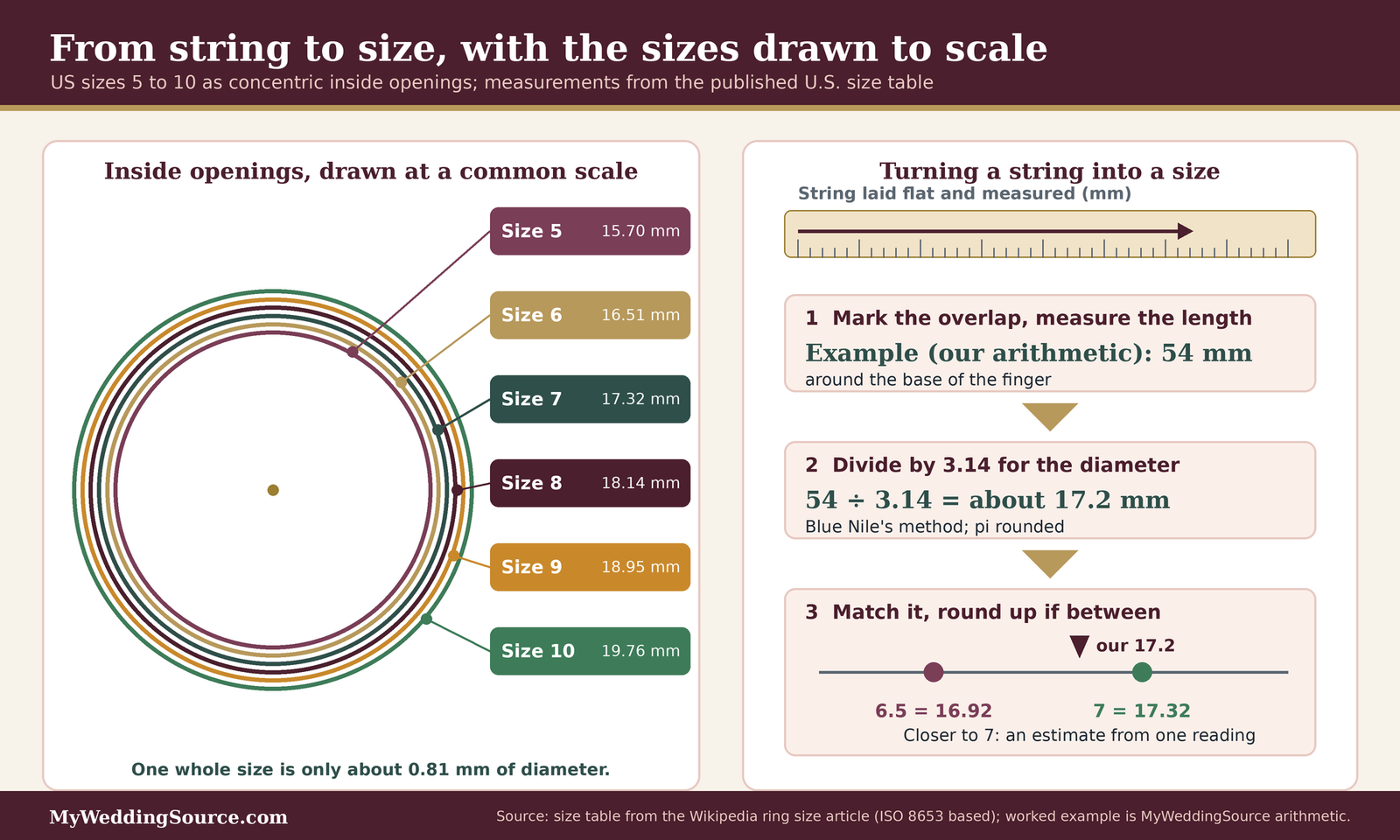
Blue Nile says to divide the string length by 3.14 to get the diameter, then match that diameter to its chart. This works because the string length is a circumference and a circle’s diameter is its circumference divided by pi. The reference table on U.S. sizes, which we use below, lists both numbers for every size, so you can check either one.
A worked example (our arithmetic, labeled as an estimate)
Say your string measures 54 millimeters. Divided by 3.14, that is about 17.2 millimeters across. The reference table lists size 6.5 at an inside diameter of 16.92 millimeters and a circumference of 53.1 millimeters, and size 7 at 17.32 millimeters and 54.4 millimeters. A reading of 54 sits between them, closer to size 7. That is an estimate from one measurement, which is why the next sections ask you to repeat it.
Rounding when you land between sizes
For ring sizing, the tie-breaker matters more than it seems. Three of the sources agree on the tie-breaker. The Knot says to choose the larger size when you fall between two, Blue Nile says the same, and Jewelers Mutual gives the same instruction. Gabriel & Co. adds that measurement error alone can move a result by half a size or more. A ring that is slightly large can be held in place with an adjuster, while a ring that will not go over the knuckle is simply unwearable, which is a reason the sources lean toward rounding up.
| US size | Inside diameter (mm) | Inside circumference (mm) |
|---|---|---|
| 5 | 15.70 | 49.3 |
| 5.5 | 16.10 | 50.6 |
| 6 | 16.51 | 51.9 |
| 6.5 | 16.92 | 53.1 |
| 7 | 17.32 | 54.4 |
| 7.5 | 17.73 | 55.7 |
| 8 | 18.14 | 57.0 |
| 8.5 | 18.54 | 58.3 |
| 9 | 18.95 | 59.5 |
| 9.5 | 19.35 | 60.8 |
| 10 | 19.76 | 62.1 |
What a half size is worth
The same reference says each whole size differs by about 0.81 millimeters of inside diameter, or about 2.55 millimeters of circumference. Halving that, our arithmetic puts a half size at roughly 1.3 millimeters of circumference. That is a tiny length of string, and it explains why a small slip in tension or a slightly swollen finger can change the answer.
Why ring sizing gives a range, not one number: when fingers change
The most useful thing to understand about ring sizing is that your finger is not a fixed object. Every source we read says finger size varies, and several describe the causes. A ring sizing measurement is a snapshot, so the sensible response is to take several snapshots under different conditions.
Changes within a day that affect ring sizing
Short-term changes are the ones you can control by choosing when and how you measure. They are also the easiest to see: a ring that spins in the morning or sticks in the evening has told you something.
Temperature, time of day, and heat
Gabriel & Co. says cold fingers shrink and heat or swelling makes them larger, and it advises against measuring right after a workout, a hot shower, or sun exposure. Jewelers Mutual advises avoiding extreme hot or cold days and letting your body come to room temperature first. Blue Nile says fingers can change with temperature, time of day, and even which hand you use most. A measurement taken in one extreme tells you about that extreme.
Food, drink, and activity
Jewelers Mutual advises skipping salty foods, alcohol, and strenuous exercise beforehand, because they can cause swelling, and keeping lotion or oil off your hands. The Knot likewise links finger size to temperature, activity level, and diet. These are practical cautions from jewelry and insurance sources, not medical findings, and we report them as such.
The sources disagree about the best hour
This is a useful place to notice that published advice is not uniform. Jewelers Mutual recommends measuring at midday, because fingers tend to swell in the morning and in the evening. Blue Nile recommends the end of the day, when fingers are warm and slightly larger, and Gabriel & Co. says afternoon or evening. Rather than pick a winner, take measurements at two different times and compare them. If they differ, the wider fit is the one you should pay attention to, and if they match, you have good reason to trust the number.

Slower changes
Some changes play out over weeks, months, or years, and they cannot be solved by measuring at a better time of day. They are the reason a ring that fit at the proposal can feel different at the wedding or at an anniversary.
Weight changes and long-term shifts in ring sizing
Gabriel & Co.’s FAQ cites weight fluctuations as a cause of size change, and advises having a professional resize the ring if your finger size changes. Jewelers Mutual also says size can vary with diet and other factors. Beyond that, we have no sourced figures on how much a finger changes over time, and we are not going to invent any. If your fit changes noticeably, the practical step is to remeasure and talk to a jeweler.
Your two hands are not twins
Jewelers Mutual advises measuring the finger you plan to wear the ring on, because left and right ring fingers can differ. Blue Nile says hand dominance can affect size. This matters for anyone who plans to wear a ring on a different hand or finger than expected, and for any measurement borrowed from a ring worn on the other hand.
A note on health and swelling
Swelling can have causes that have nothing to do with jewelry. We do not give medical advice, and a ring guide is not the place to interpret it. If your finger size changes in ways that concern you, or a ring feels dangerously tight, speak with a qualified clinician, and seek professional help rather than forcing a ring on or off.
Band width, knuckles, and style: why the same ring sizing result fits differently
Even careful ring sizing can lead to a ring that feels wrong, because the measurement is of your finger and the fit depends on the ring’s shape too. Two features matter most: how wide the band is, and how large your knuckle is compared with the base of your finger.
Wide bands feel tighter in ring sizing
A wide band covers more of the finger, and there is less room for skin to give. The sources we read agree on the direction of the adjustment, although they differ on the exact amount.
What the sources suggest
Blue Nile says wider bands feel tighter and suggests going up half a size. Gabriel & Co. says to go up half a size for bands wider than 10 millimeters, and that thicker bands in general may call for a quarter or half size more. Jewelers Mutual also says wider or thicker bands have less give over the knuckle and suggests sizing up. These are retailer and insurer rules of thumb, not standards, so treat them as a starting point and try the actual band if you can. For more on how width changes the feel of a band, see our guide to wedding band width.
Try the width, not only the size
The Knot notes that band width and setting design change how a ring feels, and recommends trying rings on together or at home. A narrow solitaire and a wide pavé band in the same nominal size will not feel the same, so the most reliable test is a sizer or sample in the width you plan to buy. If that is not possible, ask the seller about its exchange and resizing terms before you order, which we cover in the timing section.
Knuckles and the slide-over test
The part of the finger that decides whether a ring goes on is often the knuckle, while the part that decides whether it stays on is the base. When those two differ, one number cannot serve both.
Measure both and compare
Blue Nile says that if your knuckle is wider than the base of your finger, you should measure both and choose a size in between. Jewelers Mutual advises measuring just below the knuckle and notes that a ring which only gets past the knuckle with difficulty is too small. Our reading is that the two ideas fit together: measure the base for the target, measure the knuckle for the limit, and look for a size that satisfies both.
The resistance test
Gabriel & Co. describes a good fit as one that slides over the knuckle with slight resistance, sits snugly without pinching, and is neither tight nor loose. Blue Nile gives a similar test: snug enough not to slip off, loose enough to pass the knuckle. Neither is a scientific threshold for ring sizing, and both are a good reminder that “fit” is a judgment you make with your own hand, not a number you can read off a chart.
Choosing a ring sizing method: home, jeweler, or borrowed ring
Different situations call for different ring sizing tools. A couple sizing bands together can visit a jeweler, while someone planning a surprise proposal cannot. The table below compares the methods in this guide using only what the sources say about them, with our own reading of reversibility added and labeled as such.
| Method | What the sources say about accuracy | Reversible? | Works best when | Consider a jeweler when |
|---|---|---|---|---|
| String or paper strip | Prone to stretch and slack; use more than one method | Yes, free to repeat | You want a quick first estimate | The result falls between sizes or varies day to day |
| Printable sizer | Depends on printing at actual scale; check with a ruler | Yes | You own a ring that fits the finger | You cannot confirm the print scale |
| Existing ring on a chart | Quick, but only as good as how the ring fits | Yes | The ring fits the same finger well | The ring is a different width than the one you plan to buy |
| Adjustable plastic sizer | Better than printing; can be read directly | Yes | You can wear it for a day or two | The knuckle is much larger than the base |
| Jeweler’s ring gauge or mandrel | Described as the most precise approach | Yes | The ring is wide, unusual, or high stakes | You need a size for a style that cannot be resized |
Home ring sizing methods, in order of effort
If you are starting from scratch, a reasonable order is a printable chart or string for a first number, then an adjustable sizer to test it on the finger. This order costs little and uses a physical object for the second check, which helps catch the printing or stretch errors the first method can introduce. Using two different tools also protects against one tool’s particular bias.
When to stop ring sizing at home
You can reasonably stop at home if two methods on two different days give the same size and the ring is a plain band that a jeweler can resize later. The Knot calls a home sizer cheaper and more convenient than a professional fitting but less accurate, which is a fair summary of the trade.
When home is not enough
Gabriel & Co. calls a jeweler visit the ideal way to be sized, and the Knot describes jewelers using a mandrel, a graduated metal wand, and reading the size where the ring stops. Jewelers Mutual lists a metal finger-gauge sizer and a mandrel as the most precise options. If the ring will be hard to resize, such as an eternity band, or if your home measurements will not agree, a professional measurement is worth the trip.
Ring sizing for someone who does not know
Surprise proposals are where ring sizing is hardest, because you cannot hand over a sizer. The published ring sizing advice is consistent about the main approaches and about the safety net behind them.
Borrow a ring, or take a safe look
Brilliant Earth suggests borrowing a ring your partner wears on their left ring finger, ideally one they rarely wear, and then measuring it with a printed guide, tracing the inner circle, or having a jeweler size it. It adds that any traced measurement should be verified by a jeweler. The Knot also mentions pressing a ring into a bar of soap to make a mold a jeweler can use. Whichever you choose, borrow the ring only for a short time and return it where you found it.
Bring in one or two trusted people
Brilliant Earth also suggests enlisting a friend or family member who has shopped for jewelry with your partner, and says to keep the circle to one or two confidants. This is a practical point as much as a social one: every extra person who knows is another chance for the surprise to slip.
Lean slightly large and plan for the exchange
Brilliant Earth says a ring that is slightly too big is better than one that is too small, and that a loose ring can be secured with sizing beads or an adjuster until it is resized. The Knot says that if you are unsure, a size larger is the safer choice, since resizing down is easier than resizing up. Brilliant Earth also describes a temporary setting you can return within 60 days to choose a permanent one together, and notes free exchanges and resizing on most designs. These are one retailer’s policies, so confirm the terms of whichever seller you use. Our engagement ring guide covers the wider decisions around the purchase.
Questions to ask
- What is the inside diameter, in millimeters, of the size you are quoting me?
- Can this exact ring be resized, and by how many sizes up and down?
- Is there a free resize or exchange window, and when does it start and end?
- Does resizing affect the stones, the engraving, or the finish on this design?
- Who does the work, and is it done in-house?
- How long will a resize take, and what do you charge once the free window ends?
- What happens to my warranty or return rights after a resize?
A checkpoint process for ring sizing
Good ring sizing keeps the early steps free and reversible, and saves the irreversible steps for when you are sure. The sequence below follows that rule. Each checkpoint states what to measure, how to know it passed, and what to do if it did not.
| Checkpoint | What to do | Pass test | If it fails |
|---|---|---|---|
| 1. Pick the finger | Decide which finger and which hand the ring will go on | You can name the hand and finger | Measure both hands and compare |
| 2. First number | Measure with string or a printable sizer, away from heat and cold | Two readings on the same day agree within a half size | Repeat after resting your hands at room temperature |
| 3. Second day | Repeat at a different time of day on another day | Same size or within a half size of day one | Use the larger size and try a sizer |
| 4. Knuckle check | Compare the knuckle with the base of the finger | A sizer slides over with slight resistance and does not spin freely | Choose a size between the two measurements |
| 5. Width adjustment | Adjust for the band’s width using the seller’s guidance | A sample or sizer in that width feels snug but comfortable | Try a half size up and test again |
| 6. Confirm the policy | Read the resize and exchange terms for this design | You know the window, the size range, and the fee | Ask for it in writing or choose a design that can change |
| 7. Final sign-off | Approve the size before any engraving or finishing | The size is written down and photographed | Do not engrave until it is settled |
Take reversible ring sizing steps first
Steps one to four cost nothing and can be repeated as often as you like. That is where most of the effort belongs, because every later step costs money or risks the ring. A single sloppy measurement is the most common way for a wrong size to enter the ring sizing process.
Verify before cutting, ordering, resizing, or engraving
Engraving is the clearest example of an irreversible step that depends on size. Brilliant Earth says resizing may affect an original inscription, and that post-purchase engraving typically takes two to three weeks. Our guide to ring engraving explains why the text should wait until the size is final. The same logic applies to any custom order: confirm the size, then order.
Save measurements before anything changes
For ring sizing, write down every measurement with the date, time, method, and conditions, and photograph the sizer or the string against a ruler. If a measurement turns out to be off, the record shows which method or day was the outlier. It also gives a jeweler something to work from, and it is far more useful than a memory of “about a 7.”
Check the fit at each stage
In ring sizing, fit is a moving target, so checking at several points gives a better answer than relying on a single moment. The worked scenario below shows how that plays out.
Do not rely on one measurement
Both The Knot and Jewelers Mutual advise using more than one method, and Jewelers Mutual suggests repeating the measurement on different days. In ring sizing, a single measurement is easy to distort with a cold hand, a salty dinner, or a loose string. Two methods and two days will tell you whether your number is stable or whether you are looking at noise.
Test in the conditions you will wear it
Try the sizer in the places the ring will be worn: after a walk in warm weather, on a cool morning, or while washing your hands. The Knot says that if you are between sizes, sizing up avoids a ring that becomes uncomfortable after walking or in hot weather. The test is not a laboratory exercise. It is an honest answer to whether the ring would bother you on an ordinary day.
A worked scenario (illustrative)
Imagine a couple ordering matching bands, one 6 millimeters wide and one 4 millimeters wide. Our hypothetical partner measures about 52 millimeters of string on a cool morning and 54 in the evening. The reference table puts 52 near size 6 and 54 near size 7, a full size apart, which tells us the finger has a real swing and that a morning-only reading would have been too small. The sizer on the second evening slides over the knuckle with slight resistance at size 7 and spins at 6.5. With a 6-millimeter band, the sources would suggest considering a half size up, so the couple asks the jeweler to try a 7 and a 7.5 in that width and picks whichever feels snug but not tight. This is a made-up example to show the method, not a statistic.
When resizing is risky, and what that means for ring sizing
Resizing is the safety net behind every ring sizing decision, so it helps to know where the net has holes. The sources on ring sizing agree that most simple bands can be resized, and that the exceptions are specific and predictable.
What resizing does to a ring
Resizing changes the metal, and the changes are not always invisible. A jeweler is doing real work to a finished object, and the quality of that work varies.
Making a ring larger
Blue Nile describes enlarging a band by adding a small piece of matching metal, soldering it in, and polishing it. Robinsons Jewelers notes that enlarging may require added metal that does not match the original color or finish. The Knot and Jewelers Mutual both put the practical range at about one to two sizes, so a large enlargement is more likely to need extra metal and more likely to show.
Making a ring smaller
Blue Nile says that to make a ring smaller, a small section is removed and the band is reshaped and refinished. Robinsons Jewelers says shrinking can make a band look thicker or misshapen. The more metal a jeweler removes or adds, the more the original design is altered, which is why every source we read limits the practical range.
Rings that are hard or impossible to resize
Some designs are close to final from the day they are made. If you are buying a ring that falls into one of these groups, the size needs to be right at the start.
Eternity bands and stones all the way around
The Knot says that diamonds set all the way around a band cannot be resized after manufacture without risking the stones. Blue Nile lists eternity rings with a set number of stones per size among the rings it cannot resize. Some retailers instead offer an exchange window, which makes the exchange policy more important than the resizing policy for this style. Our guide to wedding bands covers how band styles differ.
Very hard metals
Jewelers Mutual lists titanium, tungsten carbide, and stainless steel among the metals that cannot be resized, and The Knot says tungsten is very difficult to alter and titanium needs specialized tools. Gabriel & Co. adds ceramic. The sources also conflict on silver: Blue Nile includes silver among the rings that cannot be resized, while Gabriel says silver can usually be resized. That is a reason to ask the seller about the specific ring rather than the metal in general. For the pros and cons of each metal, see our guide to wedding ring metals.
Tension settings and ornate details
The Knot says resizing can upset the pressure that holds a stone in a tension setting. Blue Nile also names milgrain and ornate bands among the designs that cannot be resized. In short, the more the design depends on exact geometry, the less room there is for change.
Details that can be damaged
Even when a ring can be resized, particular features are more vulnerable to the process. Here the sources are consistent and specific.
Stones, pavé, and channel settings
Robinsons Jewelers says that stretching or compressing the metal can loosen small stones, especially in pavé or channel settings, and that halo settings and milgrain detailing can also be affected. Stone work also raises the price, which we return to in the cost section.
Engraving and fine patterns
Robinsons Jewelers says fine engravings and patterns can lose detail during an adjustment, and Brilliant Earth says resizing may affect an original inscription and depends on engraving placement. Our ring engraving guide explains where a jeweler usually cuts, and why placement matters.
Color, finish, and rose gold
The Knot’s expert advises avoiding changes of more than a full size for rose gold, which can be resized but is more vulnerable to damage afterward. Robinsons Jewelers adds that a poor resize can leave visible seams, uneven edges, or weaker structure. The point is not that resizing is dangerous, but that the work should be done by someone who does it often, on a design they understand.

If your ring sizing is off: safe fixes and irreversible ones
Sometimes the ring is already bought and the fit is wrong. The useful question then is which fixes can be undone and which cannot, because the order in which you try them matters.
Adjustments you can undo
The Knot and Robinsons Jewelers list several options that leave the ring itself untouched. These are worth trying before any metal is cut, especially when the problem is mild or may be temporary.
Guards, beads, and spacers
The Knot suggests sizing beads or an invisible ring guard for a ring that is too large, and sizing balls or “shots” inside the band for a ring that spins. Robinsons Jewelers also lists ring guards or spacers as a temporary fit. These are inexpensive stopgaps, and they let you wear the ring while you decide whether a permanent change is needed. Brilliant Earth mentions sizing beads or an adjuster for a loose ring until it can be professionally resized.
Another finger, a stack, or a pendant
For a ring that is too small, The Knot suggests wearing it on a different finger or using a temporary sizing solution. Robinsons Jewelers lists stackable bands for a snugger fit and, for heirlooms, wearing the ring as a pendant. None of these changes the ring, which matters most when the ring cannot be replaced.
Exchanges and return windows
Some retailers offer an exchange window as an alternative to resizing. Blue Nile says certain rings that cannot be resized may be exchanged within 30 days, and Brilliant Earth mentions free exchanges for a new size within 30 days on most designs. Windows differ by seller and by design, so read the terms for the ring in your hands and write down the dates.
Fixes that cannot be undone
Permanent work should come after the reversible options, not before. The reason is simple: metal that has been cut, soldered, or thinned stays that way.
Cutting, soldering, and stretching
Both enlarging and shrinking a ring change its metal, as described above. A single, clean resize on a simple band is routine. The risk grows with the amount of change and with the complexity of the ring, and Robinsons Jewelers says excessive resizing can weaken the metal over time, with repeated work leading to cracks or breaks.
Repeated resizing and heirlooms
If a ring has been resized before and the finger changes again, ask the jeweler how much metal is left to work with. For irreplaceable rings, Robinsons Jewelers suggests a custom replica in the right size, and the pendant option, so the original is preserved. That is a decision about sentiment as much as about metal, and you do not need to rush it.
Cost note
Published resizing prices vary widely. The Knot, citing a jeweler and updated in January 2024, gives a typical range of about $20 to $200 depending on the ring’s complexity, with more for intricate designs or stones, and does not cite a dataset behind it. Jewelers Mutual gives a range from about $20 to a few hundred dollars. Treat both as orientation, not a quote, and ask for a written price for your ring. Add any resize to your wedding budget calculator as a line item, since it is easy to forget.
Time, cost, and policy: planning ring sizing and resizing around the wedding
A resize is a small job with a calendar attached, and ring sizing mistakes are the usual reason it is needed. It rarely takes long, but the policy windows and workshop schedules can interact with your wedding date in ways that are easy to miss.
What ring sizing mistakes can cost
Cost depends on the work and on the policy. The numbers below are published ranges and retailer policies, not our estimates, and they will not match every jeweler.
Reported price ranges
As noted above, The Knot and Jewelers Mutual both place a typical resize between roughly $20 and a few hundred dollars. The Knot says intricate designs and rings with stones may cost more, and Robinsons Jewelers says complex designs and platinum raise the price, with extra repairs such as tightening stones adding more. Because the ranges are wide, the best figure for your budget is a written quote from the jeweler who will do the work.
What retailers include for free
Some sellers include a free resize. Blue Nile says it offers one free resize, up or down two sizes, within six months of purchase if the design allows. Brilliant Earth says engraved rings qualify for complimentary resizing within 60 days, and another Brilliant Earth page describes free resizing within one year on most designs. Those two statements come from the same retailer and still differ, which is a good illustration of why you should read the terms on the exact ring you are buying and keep a copy.
When it happens, and how to plan backward
A resize takes anywhere from an afternoon to a couple of weeks, depending on the work and the jeweler. The planning problem is not the work itself but the sequence: size first, then engraving, then wear.
Turnaround times
The Knot says simpler jobs without diamonds can take one to two days, while its expert says a resize takes roughly one week depending on urgency. Jewelers Mutual describes about a day or so, with longer waits possible. Brilliant Earth says post-purchase engraving typically takes two to three weeks. Tell the jeweler about your wedding date, as The Knot advises, so the work can be scheduled around it.
A backward timeline (our suggestion)
Working back from the wedding, here is a cushion we would build in as an editorial suggestion, not an industry rule. Settle the size and confirm it on two days before ordering. Allow time for engraving if you want it, using the longest published turnaround as your guide. Try the ring on a few weeks before the day, so a fix is still possible, and keep a free-window date in your calendar. Our wedding timeline guide shows where this fits, and our wedding planning guide covers the wider schedule.
Ring sizing records and a fit that keeps changing
The last step of ring sizing is easy to skip and surprisingly useful. A written record of the size, the ring, and the seller turns a future resize or replacement from a guessing game into a routine request.
What to write down after ring sizing
A short record takes ten minutes and can save a lot of back and forth. Keep it where you can find it, and share it with the person whose ring it is.
Measurements and dates
Record the size, the method that produced it, the date, the time of day, and anything unusual such as hot weather or a recent workout. Add the width and metal of the ring, and whether the size was adjusted for width. If you used a jeweler’s mandrel or gauge, note the size it gave and whether it was read on the outside or inside edge, since The Knot says jewelers may measure from either and charts can vary slightly.
Seller, policy, and receipts
Save the receipt, the product page, and the resize and exchange terms as they stood on the day you bought. Write down the free-window dates. If the ring is insured, our guide to engagement ring insurance and hidden costs covers what a policy may require you to document, and a resize or an engraving belongs in that record too.
Care, storage, and what resizing means later
A ring that fits today may need attention later, and a little foresight makes that easier. Everyday wear and any later work both affect what the ring can take.
Store sizing aids with the ring
Keep any ring guard, sizing beads, and the sizer you used in the box with the ring, and note which one you used. If a jeweler adds a guard, ask how to remove it, and whether it is safe to leave in. Our overview of wedding jewelry places rings alongside the other pieces you may be wearing and storing around the wedding.
Check the fit once a year, or when something changes
There is no sourced schedule for how often a ring should be rechecked, so this is our suggestion: look at the fit when the seasons change and whenever you notice the ring spinning or sticking. Gabriel & Co. says a professional should resize the ring if your finger size changes, which is the point where home ring sizing ends. Because each resize uses up some of the metal’s margin, a measured decision beats a series of small fixes. The metal matters too, and our comparison of gold and platinum wedding bands explains how the two differ in everyday wear.
FAQ: ring sizing questions
Measuring
What is the most accurate way to find my ring size?
A jeweler using a ring gauge or mandrel is described as the most precise option by Jewelers Mutual and The Knot. At home, no single method is fully accurate, so use two different tools on two different days and take the larger size if the results fall between sizes. Confirm the number with a jeweler for important rings.
What time of day is best to measure?
Sources disagree. Jewelers Mutual suggests midday, while Blue Nile and Gabriel & Co. suggest the afternoon or evening when fingers are warmer. Because published advice differs, measure at two different times on different days and compare. Avoid measuring right after exercise, a hot shower, or in the cold, which can shift the result.
Should I size up for a wide band?
Several retailers say yes. Blue Nile suggests going up half a size for wider bands, and Gabriel & Co. suggests half a size up for bands wider than 10 millimeters. These are rules of thumb, not standards, so try the actual width if you can, and ask about exchanges before ordering a wide band.
Changes and resizing
Can my finger size change after I buy the ring?
Yes. Retailers say size can vary with temperature, time of day, diet, and weight changes. A temporary change is different from a lasting one, and we cannot tell you which you have. If the fit keeps changing, remeasure and ask a jeweler about options. For health-related swelling, ask a qualified clinician instead.
How many sizes can a ring be resized?
Jewelers Mutual and The Knot both say most rings can be changed by about one to two sizes up or down, depending on the design, and larger changes can compromise the ring. The Knot advises limiting rose gold to about a full size. Ask the jeweler about your specific ring, and get the answer in writing.
Which rings cannot be resized?
Sources commonly list full eternity bands, tungsten, titanium, stainless steel, and ceramic, along with tension settings and ornate or milgrain designs. Silver is listed as unresizable by Blue Nile but resizable by Gabriel & Co., so ask about your ring. For these designs, the exchange policy matters more than the resizing policy.
Surprises and costs
How do I find a partner’s size without asking?
Brilliant Earth suggests borrowing a ring they wear on that finger and having it sized, asking one or two trusted people, or using a temporary setting you can return later. Lean slightly large if unsure, since a loose ring can be held with beads or an adjuster. Check the seller’s exchange and resizing terms before you buy.
How much does a resize cost, and how long does it take?
The Knot gives about $20 to $200 depending on the ring, and Jewelers Mutual gives about $20 to a few hundred dollars. Time ranges from a day or two for simple bands to roughly a week or longer. Retailers may include a free resize for a limited time, so read the terms and note the dates.
Your next steps
Get the number
Measure twice, on two days
Use two different tools, avoid heat, cold, and heavy exercise, and write down each result with the date and time. Choose the larger size if you land between two, and adjust for band width using the seller’s guidance.
Try the ring or a sizer in the right width
If you can, wear a sizer or a sample in the width you plan to buy for a day. Check that it slides over the knuckle with a little resistance and does not spin at the base.
Protect the decision
Read the policy before you order
Find the resize window, the size range, the fee after the free period, and whether the design can be resized at all. If it cannot, check the exchange terms and the dates.
Settle the size before the extras
Wait to engrave until the size is final, and keep a written record with your receipt. Our guides to ring engraving and wedding rings cover the next choices.
Sources & methodology
How we built this guide
What we relied on
This guide combines published ring sizing and resizing guidance from jewelers, retailers, and an insurer with a reference table of U.S. ring sizes and a federal rule on how jewelry is described. Where a statement comes from a retailer or jeweler, we attribute it, because policies, prices, and time frames vary by seller and change over time. The arithmetic in the worked examples and the half-size figure are our own estimates from the reference table, and the backward timeline and checkpoint thresholds are our editorial suggestions, not industry standards.
What we did not do
We did not measure fingers, test sizing tools, or compare sellers, and we do not recommend one. We give no medical advice. Prices, free-resize windows, and policies were current when we read them and may have changed, and some sources disagree with each other, as noted in the text. Confirm sizes, fees, and terms with the jeweler who will hold your ring.
Source list
Government and regulatory sources
- Federal Trade Commission, Guides for the Jewelry, Precious Metals, and Pewter Industries, 16 CFR Part 23, final revisions (Federal Register, August 16, 2018); background on how jewelry and metals must be described, not a source for sizing claims: https://www.govinfo.gov/content/pkg/FR-2018-08-16/html/2018-17454.htm
Sizing and reference sources
- Wikipedia, Ring size (U.S. size table and standards history): https://en.wikipedia.org/wiki/Ring_size
- The Knot, Ring size chart and how to measure (updated April 18, 2025): https://www.theknot.com/content/ring-size-chart-how-to-measure
- Jewelers Mutual, How to measure ring size: https://www.jewelersmutual.com/the-jewelry-box/how-to-measure-ring-size
- Blue Nile, Find your ring size: https://www.bluenile.com/education/rings/find-your-ring-size
- Gabriel & Co., How to measure ring size at home: https://www.gabrielny.com/blog/how-to-measure-ring-size-at-home/
Resizing, policy, and surprise-sizing sources
- The Knot, Engagement ring resizing (updated January 25, 2024): https://www.theknot.com/content/engagement-ring-resizing
- Robinsons Jewelers, What are the cons of getting a ring resized: https://robinsonsjewelers.com/blogs/news/what-are-the-cons-of-getting-a-ring-resized
- Brilliant Earth, Engraving and resizing options: https://www.brilliantearth.com/wedding-ring-guide/engraving-resizing-options
- Brilliant Earth, How to find out her ring size without her knowing: https://www.brilliantearth.com/news/how-to-find-out-her-ring-size-without-her-knowing