

Choosing among engagement ring settings is mostly a question of how you live, because the setting decides how much metal protects the stone, how high the ring rides on the finger, how often it needs a jeweler, and how easily it can be resized later.
Quick answer
Pick the setting for the life you actually lead, then pick the look inside that group. If your hands are busy, favor these engagement ring settings: a bezel, a low prong or basket head, or a low cathedral. If you want maximum light and plan regular checkups, a prong setting is the most common of the engagement ring settings: The Knot’s 2024 study put it at 35% of engagement rings. A halo or pavé design adds sparkle and apparent size but has many small stones to keep secure, and it is harder to resize. Whatever you choose, ask for the setting height, the prong or rim details, the resizing limit, and the repair policy in writing.
This guide is about engagement ring settings, meaning the metalwork around the stone, not the stone itself. If you are still deciding on the diamond or the budget, our engagement ring guide covers the bigger picture, and this page picks up once you are looking at designs. We describe settings the way the Gemological Institute of America (GIA) and U.S. jewelers do, we attribute retailer claims to the retailer, and we label our own arithmetic as estimates. Nothing here is financial or insurance advice.
What to settle before you compare engagement ring settings
Most regret about engagement ring settings comes from a mismatch between the design and the wearer’s day, not from a flaw in the ring. A few honest answers about daily life narrow the field more than any gallery of photos.
Turn daily life into selection criteria
Every one of the engagement ring settings is a trade among four things: protection, light, comfort, and maintenance. You cannot maximize all four. Among engagement ring settings, prong styles let the most light reach the stone, according to GIA, while enclosed styles protect the edge better. Writing down which of the four matters most to you makes later comparisons quicker.
Describe the hands that will wear it
Think about a normal week. Do you type, garden, lift weights, cook, care for children, wear gloves, or work with tools? A ring from the more raised engagement ring settings that catches on a knit sweater once a day will irritate you long before it fails. Jewelers writing for retailers commonly advise low or moderate profiles for active wearers, and one retailer’s guide notes that tall heads snag on fabric and feel top-heavy by the end of a long day. That is a seller’s view, but it matches what the setting geometry would predict.
Separate must-haves from preferences
Make two short lists before you shop for engagement ring settings. Must-haves are things that, if missing, would make you stop wearing the ring: it must not snag, it must sit flush with a straight wedding band, it must be resizable, it must still be comfortable when your fingers swell. Preferences are things you would enjoy: a hidden halo, a particular prong shape, an openwork gallery. Shop from the must-haves first, then use preferences to break ties. This keeps a persuasive display case from turning a preference into a purchase.
Learn the terms you will see on product pages
Product pages for engagement ring settings mix two vocabularies. One describes how the stone is held, such as prong, bezel, or channel. The other describes the overall arrangement, such as solitaire, halo, or three-stone. GIA separates them in its own guide, and keeping them apart helps you read listings correctly.
Holding method versus overall style
A ring can combine one term from each group. A “hidden halo cathedral” is a cathedral shank (arches that lift the head) with a halo of small stones beneath the center stone, and the center stone itself is almost always held by prongs. When you read a listing, ask separately: how is the center stone held, how are the small stones held, and what shape is the shank?
Words that deserve a follow-up question
Some phrases in engagement ring settings listings sound precise but are not. “Secure setting” does not say how many prongs or how thick the metal is. “Low profile” does not give a height. “Total carat weight” combines several stones, so it says little about the center stone. “Micro-pavé” does not say how big the stones are or how they are fastened. The Federal Trade Commission’s Jewelry Guides add rules on weight: a stated diamond weight must not be misrepresented, a weight in decimal form must be accurate to the last place shown, and fractional weights need a notice that they are not exact. Ask for the center stone’s exact weight on the paperwork, not just a rounded total.
The main engagement ring settings, one by one
We group engagement ring settings by how they hold the stone, then by overall style, then by shank design. Descriptions of these engagement ring settings follow GIA’s guide unless we name another source. For each one we give what it does well, what it asks of you, and who tends to be happiest with it.
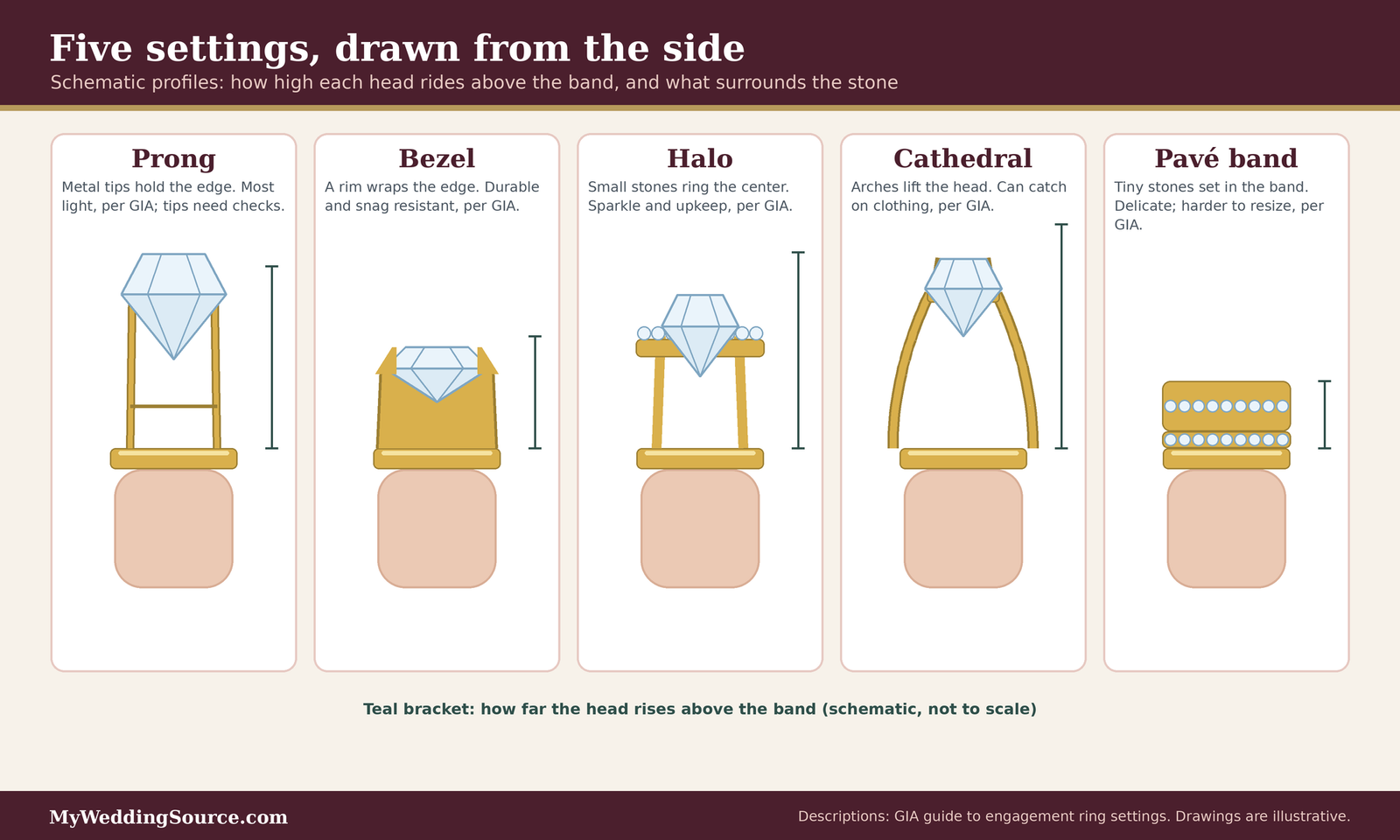
Prong settings and their variations
Metal tips bend over the edge of the stone to hold it. GIA describes prongs as the setting that gives maximum light and a clear view of the stone, with the trade-off that the raised metal can catch on fabric and the tips need regular checks and occasional re-tipping.
Four prongs, six prongs, and the look of the stone
On a round stone, four prongs show more of the stone and can make it look slightly squarer, and six prongs emphasize its roundness, according to GIA. The Knot’s guide adds that six prongs are more secure but can overwhelm a small stone. Neither number is “better.” More prongs mean more points of contact and more metal to look at. Fewer prongs mean a cleaner view and fewer points of support, so the quality of the work matters more.
Claw, V-shaped, and basket variations
Claw prongs are tapered and pointed, with an antique feel, and are often used on larger stones. V-shaped prongs wrap pointed corners on shapes like pear, marquise, heart, and princess, which GIA says reduces chipping risk. A basket adds horizontal supports beneath the stone; GIA says this helps stop prongs from spreading over time, and The Knot says it sits lower than a standard prong head, which reduces the risk of chipping. If you want the open look of prongs among engagement ring settings and expect hard wear, ask to see a basket version.
Enclosed settings: bezel, flush, and channel
These engagement ring settings hold stones inside or between walls of metal. They give up some light in exchange for protection and a smoother surface.
Bezel: a metal rim around the stone
A bezel wraps the edge of the stone fully or partly. GIA calls it durable, chip resistant, and snag resistant, with the cost that slightly less light enters the stone. A retailer’s everyday-wear guide, StoneBridge Jewelry, rates it the most protective option for daily wear and notes that the rim can make a stone look a little smaller than a prong-set stone of the same size. That is a retailer’s rating, not a laboratory test.
Flush (gypsy) and channel settings
In a flush setting the stone sits level with the band. GIA notes it is highly durable and low profile but needs a wider, thicker shank and admits less light. In a channel setting, stones sit side by side between two metal walls; GIA says this protects them and reduces snagging, but that channel work is difficult to resize, especially when stones extend far around the band. Channel settings are most common for side stones and wedding bands.
Overall styles: solitaire, halo, three-stone, and pavé
Styles describe the arrangement, not just the holder, and they are the part of engagement ring settings people notice first. This is where the look of the ring is mostly decided.
Solitaire: one stone, little else
GIA describes a solitaire as a single center stone with little added decoration, usually in a prong or bezel mount, and notes that it pairs with many wedding bands. A solitaire has the fewest parts, so it has the fewest things to loosen. It also puts the whole weight of the design on the stone’s quality and shape.
Halo and hidden halo
Among popular engagement ring settings, a halo surrounds the center stone with a ring of small stones. GIA says it adds sparkle and can make the center stone look larger, and that the many small stones need more upkeep to stay secure and clean. The Knot’s 2024 study found hidden halos, where the accent stones sit under the center stone and show mainly from the side, at 18% of rings, a large jump that moved them into the top two settings. The Knot also lists a classic halo at 13%. Retailers often point out that a halo can let a buyer choose a smaller center stone for the same look, which may lower cost. Treat that as a trade, because a smaller center stone with a halo is a different ring from a larger bare stone.
Three-stone and toi et moi
A three-stone ring has a center stone flanked by two side stones that add width or color. GIA notes the popular past-present-future symbolism and suggests side stones within about two color grades of the center stone when all are diamonds. A toi et moi places two stones side by side, which GIA describes as personal and distinctive. Both put more stones on the finger, so check that every stone is protected from side blows.
Pavé: tiny stones set close together
In pavé, small stones are set closely with tiny beads or prongs, so the metal nearly disappears. GIA says pavé adds brilliance and a delicate look, that stones need periodic checks to stay secure, and that it can be harder to resize because adjusting the band may disturb the stones. The Knot says it needs an experienced jeweler. Its 2024 data put pavé bands at 13% of rings.
Shank shapes: cathedral, comfort fit, and the band beneath
In engagement ring settings, the shank is the part of the ring that wraps the finger. Its shape changes height, comfort, and how a wedding band sits beside it.
Cathedral: arches that lift the head
GIA describes cathedral arches rising from the shank to lift the center setting, which emphasizes the stone and leaves room for hidden detail underneath. The trade-off is that the raised structure may catch on clothing more easily, although GIA says the arches add stability. The Knot’s 2024 study put cathedral at 9% of rings. A jeweler’s blog, Finnies, calls the cathedral a middle option for wedding-band fit because the arches can lift the stone enough for a flush fit in many designs while staying low-snag. A lower arch is easier to live with than a tall one.
Comfort-fit interiors and shank thickness
A comfort-fit interior is gently domed inside the band so it touches less skin. The Knot’s 2024 study lists comfort fit at 9%. In many engagement ring settings a thin shank looks refined but gives the ring less metal to absorb knocks, and Jewelers Mutual lists thinning or cracked shanks among things a jeweler checks during an inspection. If you favor a delicate band, ask how thin it is at the bottom, where wear concentrates. Our wedding band width guide explains how width and thickness change feel.
Compare engagement ring settings by use case, not by popularity
Popularity among engagement ring settings tells you what many people chose. It does not tell you what suits your hands. The Knot’s 2024 figures for engagement ring settings, shown below, are useful context, but they are a snapshot from one survey and say nothing about how those rings held up over years.

A short list built around different lives
Use the table of engagement ring settings as a starting conversation with a jeweler. The ratings are our qualitative synthesis of GIA’s descriptions and the retailer and jeweler guides we cite, not test results.
| Setting | Best fit | Trade-offs | Specs to ask about | Resizing | Upkeep and failure risk |
|---|---|---|---|---|---|
| Four- or six-prong solitaire | Wearers who want maximum light and simple lines | Raised metal can snag; tips wear | Prong thickness, tip condition, head height | Usually straightforward for a plain shank | Regular checks and re-tipping over time |
| Basket prong | Active wearers who still want an open look | Slightly more metal visible | Basket height, prong count | Usually straightforward for a plain shank | Lower spreading risk than a plain head, per GIA |
| Bezel (full or partial) | Hands-on work, children, sports | Slightly less light; stone can look smaller | Rim thickness and height, partial or full | Plain shank is easier than a decorated one | Rim can wear thin; check the rim is intact |
| Flush or gypsy | Very low profile and snag resistance | Needs a wider shank; less light | Shank width and thickness | Ask the jeweler | Low snag risk; fewer stone edges exposed |
| Classic halo | Looks larger, adds sparkle | Many small stones to keep secure and clean | Accent stone size, prong or bead type | Check how far the stones extend | More points to inspect |
| Hidden halo | Sparkle seen from the side | Many small stones to keep secure and clean | How the hidden stones are held | Check with the jeweler | More points to inspect |
| Pavé band | Extra shine without a bigger head | Delicate; stones can loosen | Stone size, bead thickness | Harder; may disturb stones | Frequent checks, per GIA and The Knot |
| Channel | Side stones and bands that need a smooth surface | Hard to resize; hard to repair | Channel wall thickness | Difficult, per GIA | Walls can wear; check stone alignment |
| Cathedral | Lifted center stone, stacking bands | Arches can catch on clothing | Arch height, how it meets the head | Usually workable | Check where arches meet the shank |
| Tension | Modern floating look with a hard stone | Stone more exposed; a hard blow can shift it | Stone hardness, engineering, warranty | Very difficult or impossible, per GIA | Careful wear; depends on precision |
| Three-stone | Balanced look, symbolism | More stones, more exposure | Side stone protection and height | Check with the jeweler | Moderate; more parts |
Who each option tends to suit
Among engagement ring settings, prong solitaires suit people who like clean lines and are willing to schedule checkups. Bezels suit people whose rings take daily knocks, and flush settings suit those who want almost nothing to catch. Halos and pavé suit buyers who want sparkle and visual size and accept the upkeep. Cathedrals suit people who want the stone lifted and expect to stack bands. Tension suits careful wearers who like a modern look and understand that resizing is very limited.
Who should think twice
If you routinely wear knit gloves, work with hair or fabric, or lift heavy objects, a tall prong head or a high cathedral may frustrate you. If you expect your finger size to change, as many people do with age, pregnancy, or changes in weight, think twice about tension, channel, and fully set eternity styles, because GIA says channel work is hard to resize and tension resizing is very difficult or impossible. If you do not want regular appointments, a pavé or halo design may not suit your habits.
Trade-offs that product pages tend to skip
A product page for engagement ring settings is designed to sell the look. The costs of owning a ring show up later.
Comfort, upkeep, and delivery
Upkeep is the quiet cost of engagement ring settings. Jewelers Mutual suggests professional inspection and cleaning about twice a year, and says a ring worn daily, such as an engagement ring, may warrant checks every three to four months. Delivery is another one. A made-to-order setting depends on the maker’s schedule, so confirm lead time in writing before you set a proposal date. Our wedding planning timeline shows where a ring fits in the larger sequence.
Resale and trade-in
Engagement ring settings rarely carry the resale value of the stone. If you may trade up or sell later, ask the seller in writing how they treat the setting, and whether the stone can be removed and reset without damage. We could not find a neutral source quantifying setting resale value, so treat anyone who quotes a number as quoting their own policy.
What it costs to fix a wrong choice
A mismatch among engagement ring settings is not always permanent, but fixes cost money and sometimes time. Some are small, such as adding a sizing bead. Some change the ring’s structure, such as lowering a head or rebuilding a shank.
Cost note
We did not find a neutral source that publishes typical prices for setting changes, so we do not quote one. Retailer and jeweler prices vary widely by metal, labor, and region. Instead, ask for a written estimate before any change, and ask the seller what is covered. Per Jewelers Mutual, a standard retailer warranty typically covers structural defects but usually excludes worn, bent, or broken prongs, which often appear only in an extended plan at extra cost. Our wedding budget calculator can help you set aside a reserve.
Fixes that are usually small
Re-tipping worn prongs, tightening a loose stone, polishing, and cleaning are routine maintenance. Jewelers Mutual lists bent, broken, or worn-down prongs and loose or cracked settings among what an inspection looks for. These repairs on engagement ring settings are far cheaper when caught early than after a stone is lost.
Fixes that are really rebuilds
Changing the height of a head, converting a prong setting to a bezel, or replacing a shank that has worn through are rebuilds. They may be possible, but they depend on the design and on a jeweler’s judgment. Ask before buying whether the design can be altered later, and who would do it. Getting the setting right at purchase is nearly always cheaper than changing it afterward.
Setting height, wedding bands, and stacking
The engagement ring rarely lives alone, so engagement ring settings should be judged with a wedding band in mind. Within a few months it usually shares a finger with a wedding band, and the setting decides whether the two sit flat together or leave a gap. Thinking about this now is much cheaper than discovering it at the wedding band appointment.
How height changes everyday wear
Height is the quietest difference among engagement ring settings: the distance the head rides above the finger. We could not find a neutral source that publishes standard heights in millimeters, and the retailer guides we read are qualitative, so treat height as something to judge by eye, from the side.
Judge the ring from the side
Photos of engagement ring settings are taken from above, where every one looks flat. Ask to see the ring in profile, and look at how far the head rises and whether the prongs or rim stand proud of the stone. A retailer’s everyday-wear guide recommends judging height from the side rather than only from above. A jeweler’s blog, Holdsworth Bros., says high-set rings catch more easily on knitwear, hair, and gloves, while low-set bezel or flush styles have fewer snag points and slide under gloves and into pockets more easily.
Try everyday motions
Try the engagement ring settings you like while you type, grip a bag, zip a jacket, and slide a hand into a pocket. If you can, do this with a sample at the same size and height, not a photograph. A setting that feels fine in a quiet showroom may feel different after an hour of ordinary tasks.
How setting shape changes the wedding band you can wear
Two rings sit together well when their outlines cooperate, and some engagement ring settings cooperate better than others. A tall head leaves room underneath, and a low head may block a straight band.
Straight, curved, and notched bands
Finnies, a jeweler, says a high-set ring is the easiest match for a straight wedding band because the raised head gives the band room to pass beneath, and that a low-set ring where the basket or bezel sits close to the finger usually leaves a gap with a straight band. Its suggested fixes are a contoured band that curves around the basket, a notched or chevron band for pointed shapes like marquise or pear, or a custom band carved to match. Holdsworth Bros. makes a similar point: a low head, bezel, or flush setting often needs a curved or notched band. The answer to “do I want a straight band later?” should therefore shape your setting now. Our engagement ring and wedding band pairing guide goes into this in depth.
Stacking, spacing, and metal
If you plan a stack, check widths and metals together. A band that is wider than the shank can crowd the head, and mixed metals wear differently. Our wedding ring metals guide explains how common metals scratch and bend, and gold vs. platinum wedding bands compares two popular choices. If you are still choosing a band, our wedding bands and wedding rings overviews cover the options.
Care, inspection, repair, and insurance for each setting
Every one of the engagement ring settings needs some care, and the schedule depends on how many small parts it has. Think of upkeep as part of the price of engagement ring settings, not a surprise.
Inspection schedule and warning signs
Jewelers Mutual, an insurer that specializes in jewelry, suggests professional inspection and cleaning about twice a year. It says daily-worn pieces such as engagement rings may need checks every three to four months. It also notes that some insurance policies require annual inspections and that some warranties require periodic visits to stay valid.

What a jeweler checks
An inspection under a loupe or microscope looks for bent, broken, or worn-down prongs, loose or cracked stones, loose or cracked settings, thinning or cracked shanks, weak spots in the metal, and uneven wear. Jewelers Mutual notes that loose stones and weakened settings are hard to spot yourself.
Warning signs you can notice
Jewelers Mutual describes three signs that a prong or stone needs attention: one prong looks shorter than the others or its tip looks narrowed, a prong is bent or missing, or the stone sits unevenly or has turned. If you see any of these, take the ring to a jeweler promptly, and do not bend a prong back into place yourself.
Warranty, service plan, and insurance are different things
These three are often confused when buyers compare engagement ring settings, and they cover different problems. Our engagement ring insurance guide goes deeper; here is the summary that matters for settings.
What a retailer warranty usually covers
According to Jewelers Mutual, a standard warranty typically covers structural defects from materials or workmanship, and prong work is generally not part of the base warranty. Prong replacement, tightening, re-tipping, and stone resetting usually appear in extended plans at extra cost, and many warranties require periodic inspections at the original seller. Missing those visits or having a third party do repairs can void coverage, so read the terms before you assume you are covered.
What insurance adds
Jewelry insurance is designed for loss, theft, disappearance, and damage, which warranties leave out. Homeowners or renters policies often have low sublimits for jewelry. A warranty or service plan handles defects and upkeep, and insurance handles loss, so many owners keep both. This is general information, not advice about your policy; read yours and ask your insurer.
Resizing and life changes
Fingers change, and engagement ring settings differ in how forgiving they are. Weather, pregnancy, aging, and weight changes all alter ring size, and the setting decides how forgiving the ring will be.
Which settings resize easily
A plain shank with a prong or bezel head is usually the easiest to resize. Robinson’s Jewelers, a jeweler, says resizing up or down about two sizes is generally low risk for many rings, and that larger changes need a consultation because they can weaken the structure and strain the settings. The same jeweler says channel patterns can lose alignment if the band is stretched or compressed too much, and that tension designs can be weakened by resizing. For eternity bands, where stones run all the way around, it says resizing usually means removing and resetting stones, which it calls costly and risky, and suggests sizing beads or a guard as often better alternatives.
Which settings resize poorly
GIA says channel settings are difficult to resize when stones extend far around the band, that pavé can be harder to resize because adjusting the band may disturb the stones, and that tension settings are very difficult or impossible to resize. If you expect a size change, favor a plain shank, or ask the seller in writing how many sizes the ring can be adjusted and what that costs.
A scoring method you can reuse
Because no two buyers weigh trade-offs the same way, we built a simple scoring method for comparing engagement ring settings. It is our own editorial tool, not a standard, and the numbers are yours to set. It exists to make your preference among engagement ring settings visible so a salesperson cannot quietly replace it with theirs.
Weight what matters to you
Start with the four trade-offs from the beginning of the guide and give each a weight.
Assign weights that total ten
Split ten points across protection, light, comfort, and upkeep tolerance. A nurse who wears gloves all day might give protection 4, comfort 3, upkeep 2, and light 1. An office worker who loves sparkle might give light 4, protection 2, comfort 2, and upkeep 2. There is no right answer, only an honest one.
Score each design from one to five
For each ring on your short list, score the four criteria from one (poor for you) to five (strong for you), using GIA’s descriptions and the jeweler’s answers. Multiply each score by its weight, add them, and compare totals. Treat the total as a prompt for discussion, not a verdict. If a ring you love scores low, the score tells you what you are trading, and you may still choose it.
Three worked scenarios
These scenarios about engagement ring settings are invented to illustrate the method. They are not real customers, and the scores are our judgment.
A nurse who changes gloves forty times a day
Weights: protection 4, comfort 3, upkeep 2, light 1. A bezel scores high on protection and comfort and low on light. A six-prong head scores high on light and lower on snagging. The method points toward a bezel or a low basket head. A low cathedral could also work if the arches sit close to the finger. The scenario also shows why this wearer might choose a plain shank so resizing stays simple.
A designer who wants a hidden halo and checks the ring often
Weights: light 4, protection 2, comfort 2, upkeep 2. A hidden halo scores well on light and visual size, and the owner is willing to book frequent inspections. The method flags a few questions: how are the underside stones held, what happens to resizing, and does the seller offer an extended plan that includes prong work? The answer might be yes to the halo, with a written resizing limit and an inspection schedule.
A couple planning a straight wedding band
Their must-have is a flush fit with a straight band. A high-set prong head or a cathedral with enough clearance fits that must-have, while a very low bezel may need a curved band. The method asks them to test a straight band against the ring in person, and to price a curved band as a fallback, so nothing surprises them at the second appointment.
Stone shape, setting choice, and choosing for someone else
The stone’s outline changes which holders make sense, and many buyers are choosing without the wearer in the room. Both facts affect how you read the options above.
Match the holder to the shape
Round stones are forgiving in most engagement ring settings because they have no vulnerable corners. Pointed and square shapes have corners that take hits first, so the way the corners are protected matters more than the style name.
Corners need a plan
GIA says V-shaped prongs wrap the pointed corners of heart, princess, pear, and marquise shapes to reduce chipping risk. On a bezel, a partial rim can leave corners exposed unless the jeweler shapes the metal to cover them. Ask the seller to point to the corners on the actual ring and explain what covers each one. If the answer is vague, treat that as information.
Shape trends are a snapshot
The Knot’s 2024 study, as reported on its own pages, found round at 28% of rings and oval at 25%, and said oval has climbed from 2% in 2015 while round has fallen 21% since then. These are one survey’s figures about what couples chose in a recent year. They help you recognize what retailers will stock, but they do not make one shape a better fit for a given setting.
Choosing without the wearer present
Many rings are bought before a proposal, which adds risk to any choice among engagement ring settings. The wearer’s taste, hands, and daily habits are all assumptions until she or he tries the ring.
Gather clues about engagement ring settings without asking directly
Look at the jewelry the person already wears for hints about engagement ring settings they would enjoy. Do they favor delicate chains or bold pieces, yellow metal or white, minimal studs or sparkle? Notice whether they take rings off for work or wear them everywhere. A friend or family member can often describe their taste and ring size. These clues point toward a family of engagement ring settings, such as low and simple or lifted and ornate, without fixing one design.
Plan for adjustments after the proposal
Ask the seller, before you buy, whether the ring can be exchanged for a different setting or size after the proposal, how long that window lasts, and whether any fee applies. Some sellers allow exchanges and some treat custom pieces as final, so the policy matters more here than anywhere else. A plain shank with a prong or bezel head is generally the easiest to adjust, which is another reason to prefer simple construction when the size is a guess.
Verify the final choice before money becomes nonrefundable
The best time to ask hard questions about engagement ring settings is before you pay. After the sale, you are relying on policy, and a policy you did not read is a weak foundation. Our guidance here is general consumer education, not legal advice. Read your own paperwork, and check state rules if a dispute arises.
Ask for proof, samples, and written scope
A specific ring should come with specific paperwork, and engagement ring settings are no exception. Vague promises on a product page should become exact terms on the invoice.
Turn vague promises into contract language
Replace “durable” with a described setting: number of prongs, rim or prong thickness, and shank thickness. Replace “fits any wedding band” with a statement about which bands fit. Replace “resizable” with a limit in sizes and a note on whether stones will be reset. The FTC’s Jewelry Guides also address how products are described. They cover the exact weight of diamonds, disclosure of treatments that are not permanent or that need special care, and lab-grown stones, which need a clear disclosure before the gem name, so ask that the invoice state the stone’s weight, whether it is natural or lab-grown, and any treatments. Gold must be marked with its karat; the guides accept forms like “14K gold.” See our wedding ring metals guide for metal choices.
Check return, cancellation, alteration, and replacement rules
Ask whether custom or altered rings are returnable, what happens if the finished ring does not match the sample, and who pays if the setting must be remade. Ask how long a custom order takes and what the deadline is if you have a proposal date. Ask whether engraving is included and whether it limits returns; our ring engraving guide explains how engraving interacts with resizing.
| Item | What to get | Why it matters | Fallback if missing |
|---|---|---|---|
| Sample or proof | Photos from the side, or an in-person sample at the same height | Product photos of engagement ring settings hide height and profile | Ask for a refundable trial or a return window in writing |
| Specs | Prong count, rim thickness, shank thickness, head height | Turns “secure” into something checkable | Hold the purchase until provided |
| Stone paperwork | Exact weight, natural or lab-grown, any treatments | FTC Jewelry Guides address weight and disclosures | Do not buy without it |
| Metal marking | Karat or purity stamp | FTC guides address karat marking | Ask the seller to confirm in writing |
| Resizing limit | Number of sizes and cost | Some settings resize poorly | Choose a plain shank or add a sizing bead |
| Warranty terms | Covered repairs, inspection rules, who may repair | Prong work often excluded from base warranties | Budget for extended coverage |
| Insurance | Appraisal, policy terms, inspection rules | Warranties do not cover loss or theft | Ask your insurer before the proposal |
| Lead time | Delivery date and what happens if late | Custom rings take time | Keep a ready-made backup |
| Return and exchange | Window, restocking, custom exceptions | Custom rings are often final | Know it before paying |
Run a final fit test
Before you hand over a card, run your chosen engagement ring settings through your actual life.
Test against the venue, the timeline, and the hand
Put the ring beside the wedding band you expect, on the finger that will wear it, at the end of the day when fingers are larger. Try a sample if you can. Check the date: if the ring is a surprise, you need a plan to confirm the size discreetly, and a policy for resizing after the proposal. Our wedding photographer shot list is a useful reminder that rings will be photographed up close, and a clean, well-kept setting looks better in detail shots.
Define the fallback if the preferred option fails
Decide in advance what you will do if your engagement ring settings cannot be made in time, does not fit with the band, or arrives with a defect. A ready-made alternative, a written exchange policy, and a repair contact are your fallback. If you are choosing a ring for someone else, bring along a trusted friend or relative who knows their taste and size, and keep receipts together with insurance and warranty papers. For related jewelry decisions after the ring, see our wedding jewelry overview.
Questions to ask before you pay
Good questions turn a sales conversation into a comparison. Ask for the answers in writing, and keep them with your receipt, your appraisal, and your warranty papers.
Questions about the ring itself
The first group is about how the ring is made, and it is the group a product page is least likely to answer.
Construction and protection
Ask how the center stone is held, how many prongs or how thick a rim the ring has, and what protects each corner of the stone. Ask how the small stones, if any, are fastened, and whether any of them sit where a knock would reach them first. A confident seller can point to each detail on the actual ring.
Height and fit with a wedding band
Ask how high the head sits, and ask to see the ring from the side. Ask which wedding bands sit flush with it and which would leave a gap, and whether a contoured or notched band would be needed. Bring any band you already own and test it against the ring.
Questions about policies and timing
The second group is about what happens after you pay, which is when a policy matters more than a promise.
Coverage and care
Ask what the warranty covers, whether prong work is included or sold as an extended plan, and whether repairs must be done by the seller to keep coverage. Ask how many sizes the ring can be adjusted and what that costs. Our engagement ring insurance guide covers the insurance side.
Delivery, returns, and exchanges
Ask for a delivery date in writing, and ask what happens if the ring is late. Ask whether custom or altered rings can be returned, how long an exchange window lasts, and whether any fee applies. If a proposal date is fixed, ask for a ready-made backup so a delay does not decide the day.
Questions worth asking before you buy
- How is the center stone held, and how many prongs or what rim thickness does this ring have?
- How high does the head sit, and can I see the ring from the side?
- Which wedding bands fit flush with this ring, and which would leave a gap?
- How many sizes can this ring be resized, and what will it cost?
- Does the warranty cover prong work, and do I have to return here for inspections?
- Is the stone natural or lab-grown, and are there any treatments?
- What is the lead time, and what happens if the ring is late?
- What is the return or exchange policy for this exact ring?
FAQ: engagement ring settings questions
Choosing a setting
What is the most durable of the engagement ring settings?
Enclosed styles such as bezel and flush protect the stone’s edge best, according to GIA, which calls bezel durable and chip resistant. Durability also depends on metal, thickness, and workmanship. Ask the jeweler to show you the rim or prong thickness rather than relying on the style name alone.
Is a prong setting a good choice for an active person?
It can be, if you accept regular checks. GIA says prongs give maximum light but can catch on fabric and need periodic re-tipping. A basket or a lower head can reduce snagging. Jewelers Mutual suggests inspections about twice a year, or every three to four months for daily-worn rings.
Do halo settings make a stone look bigger?
GIA says a halo can make the center stone look larger and adds sparkle, though its many small stones need more upkeep. Some retailers say this lets buyers pick a smaller center stone. It is a visual effect, not extra weight, so confirm the center stone’s actual weight on the paperwork.
Which settings are hardest to resize?
GIA says channel settings are difficult to resize when stones extend far around the band, pavé may be harder because adjusting the band can disturb stones, and tension settings are very difficult or impossible to resize. If you expect size changes, ask for a plain shank or a written resizing limit.
Fit, upkeep, and coverage
Will a low setting fit a straight wedding band?
Often not without a gap. Finnies says low-set rings usually leave a gap with a straight band, and suggests a contoured, notched, or custom band. A high or cathedral setting often fits more easily. Test your preferred band against the ring in person before you commit.
How often should I have my ring inspected?
Jewelers Mutual suggests professional inspection and cleaning about twice a year, and every three to four months for daily-worn pieces like engagement rings. Some warranties and insurance policies require inspections to remain valid, so check your paperwork and keep records of each visit.
Does a warranty cover worn prongs?
Usually not in the base plan. Jewelers Mutual says worn, bent, or broken prongs are typically excluded from a standard warranty, and prong work often appears only in an extended plan at extra cost. Read the exact terms, including whether repairs must be done by the original seller.
Is the stone’s shape related to the setting?
Yes. GIA says V-shaped prongs protect pointed corners on shapes like pear, marquise, heart, and princess to reduce chipping risk. The Knot’s 2024 study reports round at 28% and oval at 25% of rings. Ask the jeweler which protection a given shape needs.
Your next steps
Narrow the field
Write your must-haves and weights
Name your top three must-haves for engagement ring settings and set the four weights from the scoring method. Pick two or three settings that fit, and ignore the rest for now.
See the rings from the side
Visit a jeweler or request side photos. Try a straight band against each ring, and ask about height, resizing limits, and repair terms. Our engagement ring guide and wedding rings overview can help with the wider decision.
Lock in the paperwork
Get specs and policies in writing
Use the checklist table to collect specs for your engagement ring settings, stone paperwork, warranty terms, and lead time before you pay. Schedule the first inspection when you buy, so it does not slip.
Set aside a care budget
Add a line for inspections, a possible extended plan, and insurance. Our wedding budget calculator can hold that line with the rest of your plan.
Sources & methodology
How we built this guide
What we relied on
This guide combines GIA’s guide to ring settings, The Knot’s 2024 study figures as reported on its own pages, a federal rule on how jewelry is described and marked, Jewelers Mutual’s guidance on inspections and warranties, and jeweler and retailer guides on height, resizing, and wedding band fit. Where a statement comes from a retailer or jeweler, we say so, because those sources reflect the seller’s products and habits. The scoring method is our own editorial tool and its example scores are illustrative.
What we did not do
We did not test rings, inspect settings, or give legal, insurance, or financial advice. The Knot’s figures come from its own surveys, and we could not verify them independently or confirm sample sizes. We found no neutral source for setting prices or setting heights in millimeters, so we do not quote any. Read your own warranty and insurance terms, and ask a jeweler about your specific ring.
Source list
Government and professional sources
- Federal Trade Commission, Guides for the Jewelry, Precious Metals, and Pewter Industries, 16 CFR Part 23, final revisions (Federal Register, August 16, 2018): https://www.govinfo.gov/content/pkg/FR-2018-08-16/html/2018-17454.htm
- GIA, Guide to engagement ring settings: https://4cs.gia.edu/?p=39609
- Jewelers Mutual, Guide to jewelry inspections: https://www.jewelersmutual.com/the-jewelry-box/guide-to-jewelry-inspections
- Jewelers Mutual, 6 warning signs your jewelry is about to break: https://www.jewelersmutual.com/the-jewelry-box/6-warning-signs-your-jewelrys-about-to-break
- Jewelers Mutual, Engagement ring warranty vs. insurance: https://ode1.jewelersmutual.com/resources/individuals/jewelry-insurance-basics/engagement-ring-warranty-vs-insurance
Survey, jeweler, and retailer sources
- The Knot, Engagement ring statistics (2024 Jewelry and Engagement Study): https://www.theknot.com/content/the-knot-engagement-ring-stats
- The Knot, Engagement ring settings 101: https://www.theknot.com/content/engagement-ring-settings-101
- StoneBridge Jewelry, Best ring settings for everyday wear: https://stonebridgejewelry.com/blog/best-ring-settings-for-everyday-wear-how-to-choose-comfort-and-security
- Holdsworth Bros., High-set vs. low-set engagement rings: https://www.holdsworthbros.com/high-set-vs-low-set-engagement-rings/
- Finnies the Jeweller, High vs. low ring settings and wedding band fit: https://www.finnies.com/pages/high-vs-low-ring-settings-choosing-a-mount-that-sits-flush-with-a-wedding-band
- Robinson’s Jewelers, Ring resizing 101: https://robinsonsjewelers.com/blogs/news/ring-resizing-101-how-many-sizes-up-or-down-are-safe-your-guide-to-a-perfect-fit