

A wedding ceremony does two jobs at once, a legal act that a government will record and a public moment that your guests will remember, and the best plans treat them as separate workstreams that meet in a single room for about half an hour.
Quick answer
Plan the wedding ceremony in this order: jurisdiction and officiant first, then venue and date, then the order of events, then readings, vows and music, then seating and access, and last the paperwork hand-off. The legal rules come from the place where you get the license, not from the place where you throw the party, and they differ by state on waiting periods, how long a license lasts, who may officiate, whether a witness is needed, and how fast the signed license must go back to the clerk. Most of the rest is a matter of taste, so keep it short enough that the people you love are still paying attention at the end. Nothing here is legal advice; confirm every rule with the clerk who will issue your license.
This guide is long on purpose. It is meant to be the page you come back to at each stage of planning, and it hands you reusable tools along the way: a decision-gate roadmap, a timing budget for the wedding ceremony itself, a comparison of what three states require, a seating and access layout, and a change-impact matrix for the moment something moves. Where a figure comes from a published source we say so and name the year and the sample. Where it is our own arithmetic or a planning habit, we label it as an estimate.
What a wedding ceremony actually has to do
Most couples picture the wedding ceremony as the pretty part, the processional and the vows and the kiss. Underneath, it is the only part of a wedding day that a government cares about. A reception can be a backyard barbecue or a ballroom dinner, and no state will ask how it went. The wedding ceremony is where two people, in front of an authorized officiant and often a witness, state that they take each other as spouses, and where a license turns into a marriage record. Keeping that straight makes every later choice easier, because it tells you which decisions are flexible and which have to be correct.
The legal act inside the wedding ceremony
The legal act is small. In the places we reviewed, it comes down to a valid license, an authorized person to solemnize the marriage, the couple saying the required words in that person’s presence, a witness in some states, and a signed license returned to the right office on time. Everything else is optional from the law’s point of view.
What the law asks for, in plain terms
New York’s state health department describes the core in a single sentence: the parties must say, in front of an authorized officiant and at least one witness, that each takes the other as spouse, and no particular script is required. Texas’s state law library says the law gives few details about what is said or done and focuses instead on time periods. FindLaw’s general overview agrees that the wording is not legally mandated and that most couples use the familiar script because it is familiar. For you, that means the wedding ceremony can be warm, funny, religious, secular, bilingual or brief, as long as the statement of intent happens in front of the right people and the paperwork follows.
What the law leaves to you
Almost everything else belongs to the couple: length, music, readings, who walks, who stands, whether there is an aisle at all, whether the couple faces the guests, whether rings are exchanged, and whether you add a ritual from your family’s tradition. A few venues, religious bodies and officiants have house rules, and those are real constraints, but they are agreements between you and a specific organization. They are not state law, and it helps to know which is which when someone tells you that a thing “has to” happen.
The wedding ceremony as an experience
The experience is where the work lives. Guests will sit in one place, probably in their dress clothes, for a stretch of time you control. They came to witness something, and what they remember is mostly how it felt: whether they could hear, whether they could see, whether the officiant sounded like they knew you, whether anything dragged.
The ceremony is the one part guests cannot skim
At a reception people drift between conversations, the bar, the dance floor and the photo booth. At the wedding ceremony everyone faces the same direction and listens. That captive attention is why small flaws, a muffled microphone, a long reading, a late start, are noticed so strongly, and why small kindnesses, a printed program, a shaded seat, a clear start time, matter more than another floral arrangement.
Meaning is made by specifics
The moments people quote afterward are specific ones: a story the officiant told that only your friends would know, a reading chosen by a sibling, a vow that referred to a real afternoon. General language about love and commitment fills time without leaving a trace. As you plan, look for places where a particular detail can replace a generic one, and cut the generic parts first.
Start with the decisions that everything else depends on
Most wedding ceremony planning problems are sequencing problems. A couple books a venue and then learns that the venue only allows its own officiants, or picks a date and then learns the officiant they wanted is away, or writes ten minutes of vows and then discovers their ceremony slot is fifteen minutes long. The fix is to decide a small number of things first, write them down, and treat each as a gate that must be open before the next vendor commitment.
Define the constraints in writing before you choose details
A constraint is a fact you cannot change by being more organized. Writing the constraints on one page, before you start collecting inspiration, keeps you from falling in love with options that are already ruled out.
Write the non-negotiables on one page
Sit down together and list what the wedding ceremony must include and must not include. Typical entries are a religious or cultural element that a family expects, a person who must be able to attend and therefore a venue that must be accessible, a limit on total time because of a vendor’s schedule, and an upper bound on spending. Write them as short sentences, not wishes. “Grandmother uses a walker, so the route must be step-free” is a constraint. “Something romantic” is a mood. Keep the page to one side; if it grows longer, you are listing preferences, and those belong in a separate list that can be traded away.
Turn assumptions into numbers, dates and yes/no rules
For each non-negotiable, convert the assumption into something checkable. “Short ceremony” becomes “under 25 minutes, with the officiant’s script capped at about 8 minutes.” “Family only” becomes “no more than 30 chairs.” “Outdoors” becomes “we move inside if forecast rain probability is above a threshold we choose today.” The point is not precision for its own sake. It is that a number lets someone else, an officiant, a planner, a venue coordinator, make the call without phoning you, which is exactly what you want in the final week. Our guide to the wedding budget calculator is a good companion for turning the money constraint into a figure you can hold vendors to.
Sequence the decisions so later work is not redone
A dependency chain is simply the order in which one choice limits the next. If you decide in the wrong order you will undo earlier work.
Identify the dependency chain
For a typical wedding ceremony the chain runs like this. The place where you will get the license and the state where you will marry determine the legal rules. The rules and your preferences determine what kind of officiant you can use. The officiant’s availability and your guest count determine the date and the venue. The venue and time of day determine your music, sound and weather plan. The order of events determines the roles you need to fill. The roles and the venue determine seating and the processional. Finally, the paperwork steps hang off the end: signing, returning, and ordering certified copies. If you notice yourself choosing something late in this chain before an earlier link is settled, pause. Our wedding planning timeline places these steps in calendar months, and this guide supplies the ceremony-specific detail.
Set a decision gate before each vendor commitment
A decision gate is a short question you must be able to answer yes to before you sign or pay. The table below is a reusable roadmap. The “owner” column is meant to prevent the most common failure, two people each assuming the other one has it. The “deadline” column gives a planning habit, not a rule, and you should replace it with your own dates once you know them.
| Gate | Decision | Inputs needed | Owner | Plan to decide | What it unlocks |
|---|---|---|---|---|---|
| 1 | Where the license will be issued and used | State and county rules, residency, waiting period, validity | Couple | Before booking a venue or officiant | Who may officiate; how far ahead to apply |
| 2 | Officiant type and name | Gate 1, tradition, budget, venue rules | Couple | As early as the date is set | Date, rehearsal, script, fee |
| 3 | Date, time of day, venue | Officiant calendar, guest count, weather, daylight | Couple, with planner if any | After gate 2 | Photography, music, seating, rain plan |
| 4 | Length and order of events | Officiant style, traditions, vendor schedule | Couple and officiant | Several months out | Roles, readings, music cues |
| 5 | Readers, witnesses, honored guests | Order of events, who is comfortable speaking | Couple | After gate 4 | Rehearsal list, program, seating |
| 6 | Music and sound | Venue rules, length, order of events | Couple; musician or DJ | After gate 4 | Equipment, power, cue sheet |
| 7 | Seating and access plan | Guest count, accessibility needs, venue layout | Couple and venue | After gate 3 | Chair count, aisle width, signage |
| 8 | Paperwork packet and custodian | License rules, certified copy plan | Couple; named helper | Before the final week | Signing, return, certificates |
You do not need to hold a formal meeting at each gate. The habit is to say the gate out loud, confirm the inputs, and record the answer in a note both partners can see.
Choosing who leads the ceremony
The officiant sets the tone more than any other single choice. They decide how long the wedding ceremony feels, how personal it sounds, and whether the legal parts are done properly. They also carry a quiet responsibility, because in most places the person who solemnizes the marriage is the one who returns the signed license.
Who is allowed to officiate
The law decides who may solemnize a marriage, and it decides by state. Your preferences come second, and it is worth being precise about the rules before you ask a friend to take the role.
Religious officials, civil officials and the deputized friend
FindLaw’s overview says that states generally recognize both religious and civil officiants, that every state allows an authorized member of a religious denomination in good standing to solemnize, and that civil officiants are typically judges, justices of the peace and similar officials. It also notes that a friend or relative can sometimes be deputized by a county clerk or judge, often for one day and one wedding. California’s public health department lists the categories there: priests, ministers and rabbis of any denomination, various judges and court officers, certain elected officials, and deputy commissioners of civil marriages, who can officiate in any California county. Texas’s state law library lists a licensed or ordained Christian minister or priest, a Jewish rabbi, an officer of an authorized religious organization, and a current, former or retired federal or state judge, and adds that Texas has no official registration for people authorized to conduct a marriage ceremony.
Online ordination and where it can stop working
FindLaw reports that most states recognize someone ordained online as a valid religious officiant, with exceptions. It names New York State as not accepting Universal Life Church ordination certificates as evidence of clerical authority, and says Tennessee looks for a “deliberate and responsible process.” New York’s health department describes eligible officiants as people listed in the state’s Domestic Relations Law, including ordained clergy authorized by a church body, and says that to officiate inside New York City an officiant must be registered with the City. We are not able to say how every state treats every ordination. That is the point: before a friend spends an evening getting ordained, ask the clerk in the county that will issue your license whether that exact route is accepted, and ask for the answer in writing or on the clerk’s own web page.
What the different kinds of officiant offer
Beyond legal eligibility, officiants differ in how much of the wedding ceremony they write, how much they rehearse, and how they are paid. Knowing these differences helps you match a person to the wedding ceremony you want.
Religious, secular, civil, and friend or family
The Knot’s editors describe four common paths. A religious officiant usually has no fee to officiate, but donations are encouraged, with $200 to $300 a common donation and sometimes a travel fee. A secular professional charges anywhere from $200 to $1,000 or more depending on whether they simply sign the license or write and lead a fully custom ceremony. A civil officiant costs the marriage license fee, which The Knot puts at $30 to $100 depending on the state, plus a possible ceremony fee. A friend or relative may spend $10 to $100 on ministry classes or state registration, plus a thank-you gift. These ranges come from The Knot’s editors and are not survey results, so treat them as orientation and not as quotes.
Matching the person to the ceremony you want
If the wedding ceremony is mostly about the legal act and the rest of the day carries the emotion, a civil official or a brief professional may be exactly right. If you want a script that reflects specific stories, a secular professional who interviews you will usually do more of that work than a friend with no experience, but a friend who knows you well can supply what a stranger cannot. If tradition is central, a religious leader who knows the ritual can be the whole point. Whichever you choose, ask how they handle the paperwork. A beautifully written ceremony does not help if the license is returned late.
What it costs and how to compare quotes
An officiant fee is small next to most wedding costs, which tempts couples to stop asking questions. The quote still deserves a careful read, because the things that change the fee are the things that change your experience.
The published average and what moves it
The Knot’s 2026 Real Weddings Study covers couples married in 2025 and drew on 10,474 U.S. couples invited by email through The Knot and WeddingWire. It reports an average officiant cost of $260, which The Knot says is just under 1 percent of a typical budget. By location type the average is $240 for a hometown wedding, $320 for a destination wedding, $300 for a domestic destination and $460 for an international destination. Because respondents come from The Knot’s own audience, the figures describe its users and not every American couple. The page does not explain how the average was computed.
Normalizing quotes so they can be compared
Quotes are hard to compare because they bundle different things. The Knot says officiant quotes commonly reflect consultations billed by the hour, the length of the wedding ceremony, a custom script or vows, license signing, a rehearsal billed by the hour, and travel. A simple method is to build a one-line list of what each quote includes: number of meetings, whether the script is original, whether the rehearsal is included, whether travel is included, who files the license, and what happens if they are sick. Then price the same bundle from each person. A quote that looks $150 higher but includes the rehearsal and the license return can be the cheaper choice in practice.
The legal hand-off, from license to certificate
The paperwork is the least romantic part of a wedding ceremony and the one with the least room for improvisation. It is also easy, once you see it as a short chain with a clock on every link: get the license, wait if required, hold the wedding ceremony inside the license’s lifespan, have it signed, return it on time, and then order the certified copies you will actually use. This section describes what three states publish. They are examples to show how much the rules vary, not a substitute for your own clerk.
Getting the license and holding the ceremony inside its window
A marriage license is a time-limited permission. It generally cannot be used on the day you receive it in every state, and it expires if you wait too long.
Waiting periods, validity and where the clock starts
New York’s health department says a license is issued immediately but the wedding ceremony may not take place within 24 hours of the exact time of issue, though a judge can waive that period, and that the license is valid for 60 calendar days starting the day after issue, or 180 days for active-duty military applicants who show proof at application. Texas’s state law library describes a 72-hour waiting period between issue and ceremony, with certain exceptions, and says the license expires if the wedding ceremony is not held by the 90th day. California’s public health department says a license is valid for 90 days from issue and does not mention a waiting period on the page we read, so confirm that with the county clerk. The practical lesson is to learn the window for your own county, mark both ends on a calendar, and avoid applying so early that a postponement strands you without a valid license.
Who has to be in the room
California’s public health department says the parties, the officiant and a witness “if applicable” must be physically present together. New York’s department says at least one witness besides the officiant is required, with no minimum age. FindLaw notes that a marriage certificate may require signatures from the officiant and witnesses. Texas’s guide, in the section we read, does not address witnesses. Rather than memorize anything, ask your clerk one direct question: “Does our license require a witness, how many, and do they sign the license?” If a witness is required, choose one person and an alternate, and ask each to bring identification if the clerk or officiant requires it.
The officiant’s part and the return deadline
Most couples assume the officiant will take care of the paperwork, and in many places that is literally the law. The risk is not malice. It is that a friend who has never done it before does not know the deadline.
What officiants usually record and sign
Texas’s guide says the officiant records the date of the ceremony, the county and their own information on the license before returning it to the county clerk, and that the officiant must check whether the license has expired and may not perform the wedding ceremony if it has. California’s public health department says the person who solemnized the marriage must return the original license to the county within 10 days. New York’s department describes a separate step: the issuing clerk sends a Certificate of Marriage Registration within 15 days after the officiant returns the completed license. In all three, the officiant is a link in the chain, not a bystander.
Return deadlines, compared
The deadlines differ, and the differences are the reason to ask. Texas says the signed license must be returned no later than the 30th day after the wedding ceremony. California says within 10 days. New York’s page we read does not state a return deadline for the officiant, but it does say that if you have not received the Certificate of Marriage Registration within four weeks of the wedding, you should contact the issuing clerk. If you are using a friend as officiant, hand them a one-page card with the deadline, the office address, and what to do if the license is lost. The infographic below sets the three states side by side.

After the ceremony: certificates and records
The license is not the document you will use for the next year. The certified copy of the marriage record is, and you may not be able to order it until the clerk has processed the returned license.
Certified copies and what they are for
New York’s department says a certified copy can be requested from the town or city clerk who issued the license for $10, or from the New York State Department of Health for $30, and that for licenses issued in New York City you apply to the Office of the City Clerk. Fees and offices elsewhere differ, so check yours. FindLaw notes that the certified marriage certificate is often issued after the wedding day, so do not plan a trip that needs it in the first week.
Names, records and the order you update them
If either of you plans to change your name, the Social Security Administration’s application form says a document supporting a name change must be recent and identify you by both your old and new names, and that originals or certified copies are required. The form does not name marriage certificates specifically, so ask the agency which document it will accept for your case. A reasonable order, which is our suggestion and not an agency rule, is to start with the agency whose record other offices check, then update identification, banking, employer and insurance records. Our wedding planning checklist has a place for these tasks so they do not get lost after the honeymoon.
The order of events and how long each part takes
A wedding ceremony is a sequence of short moments, and the sequence is more flexible than most couples assume. The traditional order is a good default because guests recognize it, but each element is optional except the exchange of the legal words.
The standard sequence
The Knot and Zola describe nearly the same arc. The processional comes first, then the officiant’s opening, readings, vows and declaration of intent, rings, pronouncement and kiss, and the recessional. Zola adds an optional unity ritual and closing remarks.
The usual order, step by step
The Knot lists the processional with the officiant first, followed by the partners and wedding party, then the opening in which the officiant welcomes guests, then readings, then the vows and declaration of intent, which The Knot calls the legally binding part, then the ring exchange, then the pronouncement and first kiss, then the recessional in reverse order. Zola describes a traditional sequence of eight roles in the processional beginning with the mother of the bride and ending with the bride and her escort, and notes that the order is flexible. Treat both as menus: each step exists because it does a job, and if the job is already done another way, the step can go.
What each element is for
The processional moves people into place and tells guests it is time to be quiet. The opening names what is happening and why everyone is there. Readings give people you love a moment to take part. Vows are the emotional peak. The declaration of intent is the legal statement. Rings give the moment a physical object. The pronouncement and kiss are the signal that everyone can cheer. The recessional gets everyone out and releases the room. If you ask what job a proposed element is doing, you will quickly see what can be shortened. If you are selecting bands, our guides to wedding ring metals, wedding band width and ring engraving cover the objects that appear in that moment.
Building a timing budget
Published sources do not give a single typical ceremony length in minutes. The Knot’s order page, for instance, says a Muslim Nikah usually lasts 30 to 40 minutes and that Hindu weddings can span several days, and gives no typical figure for a secular ceremony. So the most honest method is to build your own budget and test it by reading the script aloud.
A worked example of a twenty-five-minute plan
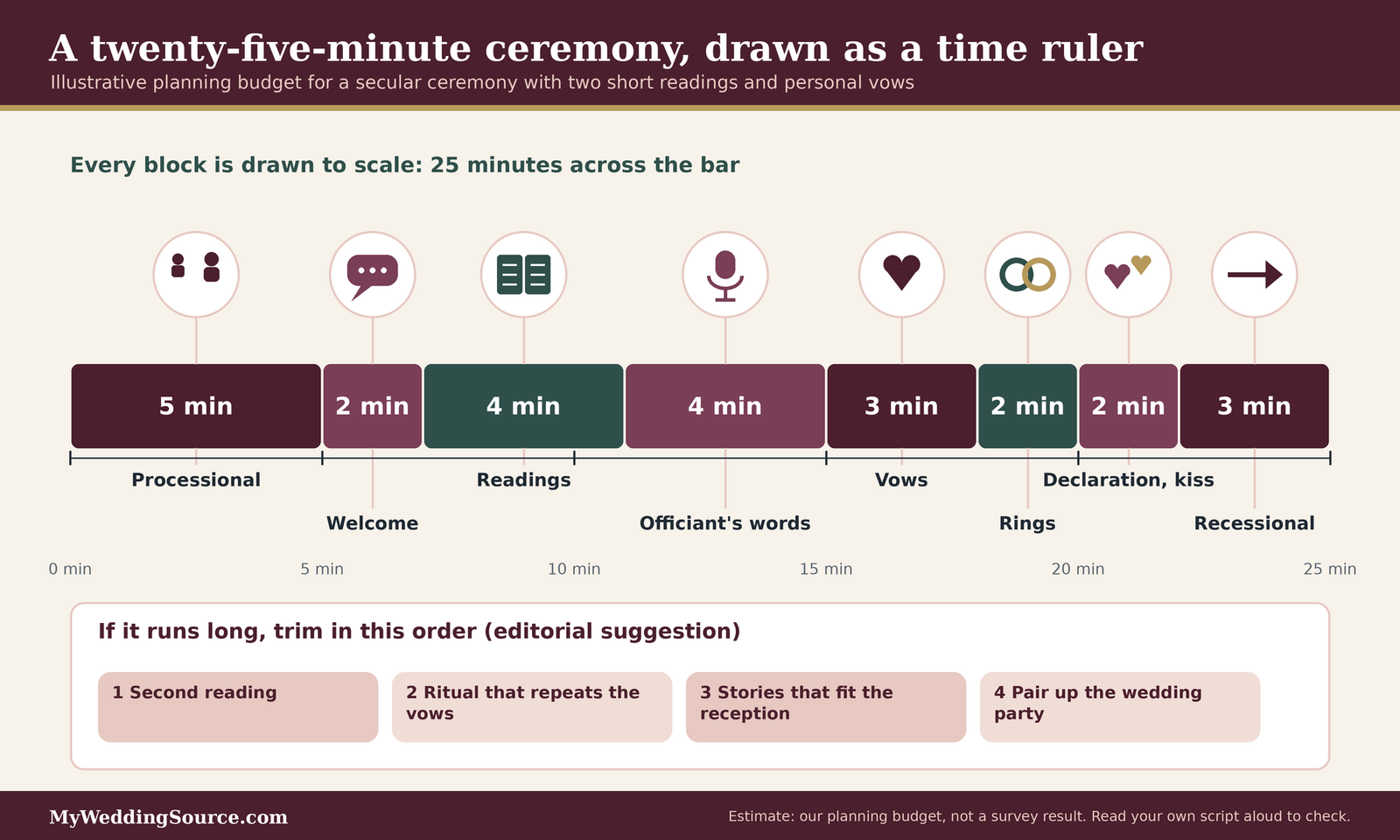
The figure below is our planning estimate for a secular wedding ceremony with one reading, a short officiant address, personal vows and a ring exchange. It is not a survey result, and your own pace will differ. Processional five minutes, welcome two, two readings of two minutes each, officiant’s address four, vows three, rings two, declaration and kiss two, recessional three. That adds to 25 minutes. Guests are usually seated before that clock starts, so the full time they spend in the wedding ceremony space is longer than the wedding ceremony itself.
How to shorten or lengthen without losing the point
To shorten, cut in this order: a second reading, a unity ritual that duplicates the vows, officiant stories that could be told at the reception, and the length of the processional by walking with the wedding party in pairs. To lengthen, add things that give guests something to do, such as a family blessing or a song that everyone sings, instead of another speech. If your tradition requires a longer ceremony, tell guests in the invitation or program so the time does not surprise them. Read the whole script aloud with a stopwatch, speaking slowly, because nerves slow you down more often than they speed you up.
Shaping the order around who is in the room
The right order depends on your guests as much as on tradition. A room of elderly relatives who must sit for a long stretch needs a different pace than a room of friends who will happily stand.
Comfort limits for guests
Think about heat, cold, sun, sitting surface, and the need for restroom access. A midsummer afternoon ceremony in direct sun with no shade is a physical challenge for guests regardless of how lovely the words are. Cut the wedding ceremony before you cut the comfort measures, and put the comfort details in the program. This is an editorial suggestion drawn from common sense and from the accessibility guidance we cite later, not from a measured standard.
Children, rituals and religious obligations
If a faith tradition requires a specific ritual, it sets a floor for length and for who must be present. Ask the officiant which parts are required and which are customary. If young children are in the wedding, plan a way for them to leave quietly if they become restless, and name an adult who will take them. Zola notes that unity rituals can include breaking a glass, lighting a fire or planting a tree, which gives a sense of how varied the optional additions can be.
The people who carry the ceremony
Weddings run on roles. A wedding ceremony with a clear owner for each role feels calm to guests even when something goes wrong, because someone is already acting.
The roles inside the ceremony
On the day, you need a small set of named people. Some are visible, like readers and ushers, and some are not, like the person who holds the license and the person who cues the music.
The visible roles
The officiant leads. The partners speak the words. Readers read. Witnesses watch and sign if the license requires it. Ushers seat guests. Attendants stand with the couple. A ring bearer, if any, carries rings, and some couples have a trusted adult hold the real rings and give the ring bearer a decoy. If you want photographs of the processional and the exchange, our wedding photographer shot list explains how to ask for those frames.
The invisible roles
Someone starts the music and ends it. Someone brings the license to the officiant and takes it away afterward. Someone, ideally not the couple, answers vendor questions in the last hour. Someone checks that the program, the signing table, the pen and the chairs are present. If you have no planner, ask friends and say exactly what you are asking: not “help out,” but “you are our license courier, you will hand it to the officiant before the ceremony and take it to our house afterward.” For the broader question of who plans what, see our plan-a-wedding overview.
The processional and who sits where
Seating and walking are where family feelings concentrate. They are also where a little advance conversation prevents a lot of hurt.
Processional order and the traditional default
Knot and Zola both give a traditional order, and both say couples often change it. Common alternatives include both partners entering together, each partner walking with their own parents, entering from opposite sides, or having everyone already standing in place when guests arrive. Choose the one that fits your family, and tell each person in it what you have decided. Nobody should find out their role from the rehearsal.
Seating family and divorced parents
Emily Post’s guidance places the first partner’s parents in the front row on one side and the second partner’s parents in the front row on the other, with immediate family in reserved rows behind. If divorced parents get along, they can share the front row. If there is tension, each is seated separately: in that guidance the mother, and her spouse if she has remarried, takes the front row, and the father sits about three or four rows back with his own spouse and family, even if he is hosting. Many families now arrange this differently, so use it as a starting point for a conversation and not as a rule. A widowed parent may bring a companion who is treated as an honored guest. Emily Post also notes that unassigned seating suits informal weddings or cases where one side has many more guests, though the front rows are still typically held for close family. Whatever you choose, ask yourself whether a guest will feel unwelcome, and prefer the version that avoids that.
Words, readings and rituals
The spoken parts of a wedding ceremony are the parts most likely to be remembered, and the parts most likely to be over-written. This section is about how to choose and shape them so they sound like you and fit the time you have.
Vows and the declaration of intent
Vows and the legal declaration are different things, and mixing them up causes needless anxiety. The vows are personal and optional in form. The declaration of intent is the statement the law cares about.
Keeping the legal words and the personal words distinct
New York’s health department says each party must state in front of the officiant and a witness that each takes the other as spouse, and that no specific form is required. Texas’s state law library describes few requirements about what is said. FindLaw says the wording is not legally mandated. The cleanest approach is to ask your officiant to include a short plain statement of intent in whatever words you like, then add personal vows before or after it. That way the personal vows can be as free as you want without anyone wondering whether the marriage is valid, and the officiant can confirm with the clerk’s instructions if the license form has any language of its own.
Writing vows that fit the time
Personal vows are easier to listen to than to write. A practical limit, offered as an editorial rule of thumb, is about a minute to a minute and a half each when spoken at a natural pace, which usually means a few short paragraphs. Pick one or two specific memories, one promise you can actually keep, and one line that your partner will recognize as yours. Read the vows aloud together before the day to check that they are balanced in length and tone; mismatched lengths feel awkward even when nobody says so. If either of you will find it hard to speak in public, ask the officiant to have you repeat after them in short phrases. That is a long-standing option, not a failure.
Readings and who gives them
Readings give people a role without asking them to improvise. They are also the easiest place to run long, so give them a limit.
Choosing a reading
A reading can be a poem, a passage from a sacred text, a letter, a piece of literature or a few words the reader writes themselves. Zola lists sacred texts, literature, songs, personal letters or journals, prepared speeches and off-the-cuff remarks as possible sources. Choose something that you would be happy to hear spoken in the reader’s voice, and keep it to about two minutes. A good test is whether the reader can stand without notes for the first and last lines, because that is where nerves show.
Copyright and permissions in plain terms
The U.S. Copyright Office explains that works in the public domain may be used freely without permission of the former copyright owner, and that infringement generally occurs when a protected work is reproduced, distributed, performed, displayed or adapted without the owner’s permission. A short reading aloud at a private ceremony is a very different thing from printing a full poem on a program that you distribute widely or posting a video online, and we are not able to tell you where a particular use falls. If the text matters, check whether it is in the public domain, and if you want to print it or share a recording, ask the publisher or choose an older text. This is general information, not legal advice.
Rituals and cultural elements
Rituals can make a wedding ceremony feel rooted in family history. They can also be added because a list said they should be. Include them only when they mean something to someone in the room.
Adding a tradition from your family
If a tradition belongs to your family or faith, ask the person who knows it best to explain what it is for and what it requires. The Knot’s order page notes that a Muslim Nikah is led by an imam, a Jewish ceremony by a rabbi and cantor, and a Unitarian Universalist ceremony by a minister or lay chaplain, and that Hindu weddings can run for days, which shows how widely the structure varies. If your ceremony brings two traditions together, ask each family what they most hope to see, and choose one element from each instead of trying to include everything.
Explaining it to guests
Guests who do not know a ritual can feel left out, even if it is beautiful. A line in the program or a short spoken explanation by the officiant, thirty seconds at most, gives everyone the same understanding and often makes the ritual more moving. If a ritual has a rule that matters to some guests, such as when to stand or what not to photograph, say so briefly in the program.
Music and sound
Music marks the transitions in a wedding ceremony, and sound decides whether anyone hears the words. Both are technical problems wearing a romantic costume, and both are easier to solve early.
Planning the music
Most ceremonies use music at four moments: as guests arrive, for the processional, during any signing or ritual, and for the recessional. Each has a different job.
The four musical moments
Prelude music fills the time while guests find seats and sets the mood. The processional announces the start. Music during a signing or ritual covers what could be an awkward pause. The recessional is the release. Decide which of these you want live, which recorded, and which silent, because silence is a valid choice for the signing, and outdoors it can be lovely. The Knot’s published averages we found list reception music figures, a live band at $4,500 and a DJ at $1,800 on average, but no ceremony music figure, so we cannot give you a verified average for ceremony musicians. Get quotes that name hours, travel, and equipment.
Choosing songs without losing time
Each piece should be timed. A processional that is too short leaves the last attendant walking in silence, and one that is too long leaves the couple standing awkwardly. Ask your musician or DJ to cue the track to start on your signal, not on a clock, so that a late start does not throw off the music. Have a short edit of any song ready for the recessional so it ends neatly when the couple has left, and ask whoever runs the sound to fade, not stop.
Making sure everyone hears
The most common practical failure at a wedding ceremony is that guests cannot hear. Soft voices, wind, passing traffic and large spaces all work against the officiant.
Microphones, power and the weather plan
Ask the venue whether a sound system is provided, whether it will be on for the wedding ceremony and who operates it. If the wedding ceremony is outdoors, ask where power comes from and what happens if it rains. If you are using a friend as officiant, ask them to practice with a microphone. A lapel microphone frees the hands for a ring or a book, and a handheld one is more forgiving for someone who is nervous. Test everything at the actual time of day, because the sun and the wind do not behave the same in the morning as they do at four o’clock.
Assistive listening and a printed program
The Department of Justice’s archived guidance on accessible meetings recommends providing assistive listening systems for people who are deaf or hard of hearing, confirming the systems work and have enough battery power for the whole event, asking attendees in advance whether they use hearing aids or cochlear implants, sharing a written program with start and end times, and arranging interpreters or captioning early because sourcing can take weeks. The guide is written for meetings, not weddings, and we are borrowing its principles, not claiming it governs your venue. Even so, a printed program and an offer to arrange an interpreter cost little and may matter greatly to a guest.
Space, seating and access
How a space is arranged changes how a wedding ceremony feels. Chairs that are too close together, an aisle that is too narrow, or a platform with steps can make a gorgeous setting hard for guests and for the wedding party.
Laying out the room
The layout is a simple diagram that answers four questions: where do people enter, where do they sit, where does the couple stand, and where does the couple leave.
The aisle, the front and the reserved rows
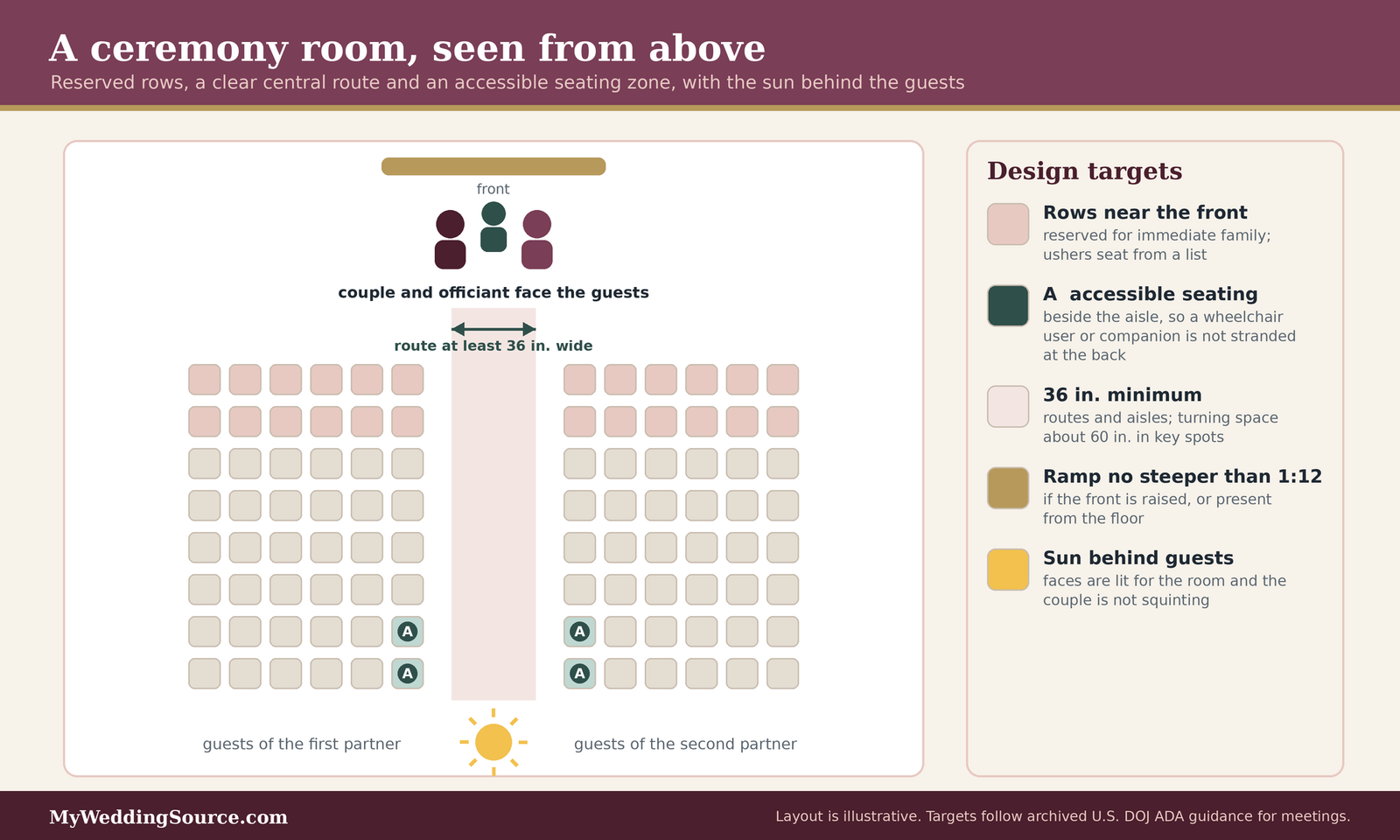
Reserve rows for immediate family on each side and decide how many. Emily Post describes reserved rows kept for the couple’s immediate families, which ushers can seat from a list or pew cards. Decide whether the center aisle is also the route for the processional and whether a second route exists for anyone who cannot use it. The diagram below shows a layout with a clear central route, reserved rows, and an accessible seating zone near the aisle.
Where the couple stands and what guests can see
Stand the couple where the largest number of people can see their faces. If you are outdoors, think about where the sun will be at the time of the wedding ceremony so neither of you squints and no one’s face is lost in backlight. The accessibility guide recommends arranging seating so people are not backlit by windows, which makes lip reading harder, and the same logic applies to a wedding ceremony in front of a bright window or sunset.
Access for guests and for the wedding party
Access is not a special request from a few people. It is a property of the space that affects anyone who is older, injured, pregnant, pushing a stroller or just wearing unfamiliar shoes.
Routes, widths and surfaces
The archived Department of Justice guide recommends at least one accessible route from accessible parking and drop-off areas to an accessible entrance, routes at least 36 inches wide without abrupt level changes or steps, ramps no steeper than 1:12, aisles at least 36 inches wide with turning space of about 60 inches in key spots, and avoiding long tablecloths that catch wheels and canes. It adds that if a stage or platform is not accessible to all speakers, you should not use it, or should use a portable ramp or have speakers present from the main floor. Apply these as design targets and ask the venue for the specifics. Lawns, gravel and sand are common wedding surfaces that can be difficult to cross, so ask about a firm path.
Telling guests what to expect
The same guide recommends including accessibility information in invitations, including how to request services and accessible ways to respond. For a wedding, that can be one line on the website or invitation: the surface, the distance from parking, the seating, and who to contact. The point is to let guests plan, not to put them on the spot. If you are also thinking about attire for the day, our guide to cocktail attire can help you word a dress-code line that does not leave guests guessing.
What a wedding ceremony costs, and where the money goes
The ceremony is often the cheapest part of the day, which makes it easy to under-plan. This section separates what is published from what is arithmetic, and then shows where costs hide.
What this actually costs
The Knot’s 2026 Real Weddings Study, covering couples married in 2025 and based on 10,474 U.S. couples, reports an average officiant cost of $260, an average guest count of 117 and an average cost per guest of $292. Multiplying the last two gives roughly $34,000 for an average wedding, which is our arithmetic and not a figure we are quoting from the study. The officiant is a small share of that total, but the venue, the music and the license are separate lines, and the license fee, which The Knot’s editors put at $30 to $100 depending on the state, is the only truly required expense.
Published figures and what they cover
Published averages are a useful reality check as long as you know what they measure. They are not quotes.
The Knot’s figures, with their limits
The Knot’s vendor-cost page says the study covers couples married in 2025 and was sent by email to members of The Knot and WeddingWire, which means the sample is people who use those platforms. The officiant average is $260, with the location breakdown given earlier. The same page does not give a dollar average for the license, a wedding ceremony site separate from the reception, or ceremony musicians, so we do not offer those numbers. If you need them, ask local vendors and your county clerk.
The ceremony’s share of the budget
Using the two published figures, an officiant at $260 is about 0.8 percent of a roughly $34,000 total, which is consistent with The Knot’s statement that it is just under 1 percent. We include the arithmetic to show the scale, not to suggest the officiant is unimportant. It is a reminder that the biggest money decisions are elsewhere, and that a better officiant costs very little compared with the other items.
Costs that hide inside the ceremony
The costs that surprise couples are rarely the officiant. They are things attached to the wedding ceremony location, the sound, the chairs and the rain plan.
Rentals, sound, chairs and the rain plan
If your venue does not include chairs, a sound system or a covered backup space, each can be a separate rental. A venue’s rain plan may mean that the wedding ceremony moves into a room that holds fewer guests, or that you pay for a tent. Ask the venue to put the rain plan, the setup time and the cost of any change in the contract. Our budget calculator guide gives you a place to hold these lines so they do not disappear into a generic “ceremony” total.
Fees that vary by place and by person
License fees differ by state and by county, and officiant travel and rehearsal fees differ by person. Ask each vendor what is included, what is extra, and what happens if the date moves. If a destination ceremony is under consideration, The Knot’s average officiant cost by location suggests that destination weddings run higher, but a published average cannot tell you what a particular officiant will charge. Get it in writing.
A worked scenario: one weekend, three kinds of wedding ceremony
The following examples are invented to show how the tools in this guide behave under different constraints. They are illustrative, not case studies, and the details are ours. The rules cited are the published rules we summarized earlier, and each couple would still need to confirm them with their own clerk.
Two couples, two sets of constraints
Same tools, different results. The point is to see how the gates and the matrix change the plan.
A small backyard wedding ceremony in Texas
Imagine a couple planning a thirty-person wedding ceremony at a family home in Texas. Gate one tells them that Texas describes a 72-hour waiting period with exceptions, a license that expires on the 90th day, and an officiant who must check that the license is still valid. The couple wants a close friend to officiate. Texas’s state law library says there is no official registration for people authorized to conduct a ceremony, but it also lists who is authorized, so the friend needs a qualifying route, such as a recognized religious ordination, and the couple should confirm that route with the county clerk before anything else. They decide to apply for the license three weeks ahead, so that the waiting period has long passed and the 90-day window is not at risk. Because the friend has never officiated, the couple gives the friend a card that says the license must be returned to the issuing clerk no later than the 30th day after the wedding, and they ask a sibling to remind the friend a week after the date. Their time budget is 20 minutes, with one reading and no ritual, and their layout is thirty chairs on a lawn with a firm path laid from the driveway to the front row.
A larger wedding ceremony at a California venue
Now imagine a 120-guest wedding at a California venue. The license is valid for 90 days, and the person who solemnizes the marriage must return it within 10 days, according to the state health department. The couple chooses a civil officiant because the venue requires a vendor from an approved list, and they confirm that the officiant is on the list of people California allows. The large guest count raises the matrix items for chairs, the aisle, amplification and a rain plan. The venue offers an indoor room that holds fewer guests, so the couple asks in writing whether a guest cap applies in the rain location and what the setup fee is. They cut the planned unity ritual because their written schedule for the wedding ceremony ran 32 minutes when read aloud, and they would rather start the reception on time. The two weddings differ in almost every detail, yet each follows the same sequence of gates.
One couple, one moving date
A change in the date is the best test of whether the plan holds together, so we follow one hypothetical couple through it.
The move and what it touches
A couple planning a New York wedding ceremony has a license issued with a 60-day validity that begins the day after issue, and the wedding ceremony may not occur within 24 hours of issue. Six weeks before the wedding, the venue tells them it must move the date back by four weeks. Using the matrix, they look first at the license: the new date falls outside the validity window, so a new license is needed, and they ask the clerk whether the first license can be used or must be replaced. They then check the officiant’s calendar, the musician’s availability and the date-based pricing in their deposits. The seating and access plan changes only if the new date brings different weather.
What the change log records
The couple writes one line for each vendor: new date, what changed, who needs to know, and whether they have been told. When the officiant confirms and the license is reissued, they update the line. The result is not glamorous. It is a short list that resolves, a month later, who told the DJ.
What the scenarios teach
Taken together, the scenarios show three patterns that apply to almost any wedding ceremony.
Rules first, preferences second
In each example the legal and venue constraints were checked before the creative choices. Neither couple discovered a rule late. That order costs a few phone calls and removes most of the surprises that appear in wedding stories.
Small written lists beat large plans
The most effective items in the scenarios were short: a card for the friend, a written rain-plan question, a time budget read aloud, a one-line change log. Each took minutes. None required special software. If you take only one habit from this guide, make it the habit of writing a one-line answer to each decision and putting it where both partners can see it.
When something changes: guests, date, venue or budget
Plans move. A guest list grows, a venue changes its rules, a date shifts by a month, a budget gets cut. A wedding ceremony is connected to many other decisions, so a change in one place needs a quick scan of the others. The goal is not to prevent change but to make each change cost an hour and not a weekend.
The change-impact matrix
The matrix below lists what to revisit when one of four things moves. It is our own planning tool, built from the dependency chain earlier in this guide, and it is meant to be copied into your notes.
How to read the matrix
Find the row for the thing that changed. Each cell lists the items that depend on it. Not every change touches every cell, and some cells will say “no change,” which is a useful answer in itself. The point is to see the knock-on effects before a vendor tells you about them.
| If this changes | Revisit the license | Revisit the officiant | Revisit seating and access | Revisit music and sound | Revisit cost |
|---|---|---|---|---|---|
| Guest count | Rarely affected | Rarely affected, unless the venue caps guests | Chair count, aisle width, reserved rows, overflow | Amplification for a larger space | Rentals, programs, venue minimums |
| Date | Waiting period and expiry window; reapply if the license will lapse | Availability, travel, rehearsal date | Daylight, weather, surface conditions | Musician availability, outdoor noise | Date-based pricing, deposits and change fees |
| Venue or location | State or county rules if the location changes jurisdiction; who may officiate there | House rules, officiant registration if required | Entire layout, route and surfaces | Sound system, power, venue restrictions | Rental, rain plan, travel |
| Budget | Fee is fixed; rarely a lever | Fee, rehearsal, custom script | Rentals, flowers, programs | Live versus recorded | Which lines to cut first |
What each change usually sets in motion
A date change is the most dangerous because it moves the license window. If you have already obtained a license, check whether it will still be valid on the new date, and whether the new date falls after the waiting period. A venue change in another county or state can change who may officiate, so check the rules before you assume the officiant can follow you. A guest count change affects chairs and the aisle first, then amplification, then cost. A budget change most often lands on the things you control: music, flowers and rentals.
A review rhythm that catches drift
Drift happens when each decision was reasonable alone but the combination no longer works. A regular review catches it before the cost of fixing it rises.
Recheck money, guest count and timing together
Once a month, spend twenty minutes on three numbers: the total committed spend, the current guest count, and the date and time of the wedding ceremony. Ask whether each still matches what the vendors have been told. If one has shifted, walk across the matrix. The review is brief on purpose, because a review that takes an evening gets skipped. A calendar reminder with a fixed day, such as the first Sunday of the month, is more effective than good intentions.
Keep a change log
When one decision moves, write a single line: the date, what changed, who needs to know, and whether they have been told. A shared note works better than memory or scattered messages. The change log also resolves the later argument about who was supposed to tell the officiant, because the answer is written down. If you are working with a planner, ask them to keep the same log.
The final week and the day-of hand-off
By the last week, the goal changes from deciding to delivering. Everything left should be a task with a name and a time, not a question. A good test is whether the wedding could proceed if neither partner answered the phone for the entire day.
Assign ownership for final execution
The couple should not be the people solving problems in the hour before a wedding ceremony. Choose a person, and give them the authority to act.
Name the person who can decide without you
This might be a planner, a coordinator from the venue, a sibling or a close friend. Give them a one-page sheet: the schedule, the contact numbers for each vendor, the rain-plan threshold you chose earlier, the spending limit they can approve without asking, and the order of who to call if they cannot reach someone. Tell vendors the name so they call that person and not you. The aim is a clear answer to “who decides?” before anyone needs to ask it.
Give every hand-off a time, place and fallback
A hand-off is any moment when something passes from one person to another: the license to the officiant, the rings to the best person, the program to the ushers, the music cues to the DJ. For each, write a time, a place and a fallback. For example, “License goes to the officiant at 3:15 at the signing table; if the courier is late, the coordinator brings the spare folder.” The fallback does not need to be elaborate. It only needs to exist. Our wedding planning guide covers how a day-of schedule fits into the wider plan.
What a successful final week looks like
A successful final week is quiet. Questions have been answered, documents are in a folder, and the people responsible know their jobs.
Remove open questions from your inbox
Make a list of everything that still depends on you: final headcount to the venue, song list to the DJ, timeline to the photographer, seating to the ushers, payment dates, and the rehearsal time. Do it a week out and resolve each item or hand it to someone. If you cannot resolve something, record the default that will apply if you do not answer. This eliminates the late-night decisions that are easy to get wrong.
Close the loop with confirmations and documents
Confirm every vendor in writing a few days before, and ask each to restate arrival time, setup requirements and the name of the person on site. Build a folder, paper and digital, with the license, the contact sheet, the program, the music cues, the script, the wedding ceremony schedule and the return instructions for the signed license. Give a copy to your hand-off person and a copy to the officiant. If the license has an expiry date, put that date at the top of the page. Our wedding planning timeline can help you place these steps on the calendar.
The rehearsal
A rehearsal is not a performance. It is a short working session in which everyone learns where to stand, when to move and who is in charge.
What to rehearse and what to leave alone
Rehearse the processional, the positions at the front, the handing of the rings, the signing, and the recessional. Do not rehearse the vows or the readings aloud unless a reader wants practice; the first time you hear them in full is part of the moment. Walk the real route, with the real surface and the real chairs, because that is where timing and access problems show up. Keep it to about half an hour so that people are not worn out before the day.
Who attends and who runs it
The officiant, or a coordinator, should run it, and the couple should mostly listen. Invite the wedding party, the readers, the people handing items, and the sound person if possible. Give each person a copy of the order and a clear spot to stand. If any key person cannot attend, send them the order in writing and name someone to stand in for them.
Questions to ask before you commit
These questions protect you from vague promises and from the gaps between vendors. Ask for the answers in writing and keep them in the folder you build for the final week.
Questions worth asking before you commit
- What are the license rules in our county: waiting period, validity, witnesses, and return deadline?
- Is this officiant, in this form of ordination or role, accepted by the clerk who will issue our license?
- Who returns the signed license, by when, and what happens if it is lost?
- What does the officiant’s quote include: meetings, script, rehearsal, travel and license return?
- What is the ceremony space’s rain plan, and who decides whether it is used?
- Does the venue provide a sound system, power, chairs and an accessible route, and what does each cost?
- Is there a step-free route from parking to the seats and to the front?
About the legal side
These questions make sure the marriage is valid and recorded.
The clerk
Call or visit the county clerk and ask the license questions above, and ask for the answers on the office’s own web page or in an email. Rules change, and a page found years ago may be out of date. Ask whether the clerk supplies instructions for the officiant, and whether there is a form the officiant must complete.
The officiant
Ask the officiant how they qualify in your state, whether they have solemnized marriages in this county before, and how they handle the license. If the officiant is a friend, offer to walk through the steps with them and the clerk. This is a kindness, and it protects the friendship.
About the venue and vendors
These questions make sure the room, the sound and the schedule work.
The space
Ask about setup and teardown times, the rain plan, the surface, restrooms, shade or heat, and what changes if the guest count rises. Ask whether the venue has house rules about officiants, music or décor, and whether they apply to the wedding ceremony.
The sound and music
Ask who runs the sound, whether there is a microphone for the officiant and readers, and how long it takes to set up. Ask the musician or DJ for the cue sheet and for how they handle a late start.
FAQ: wedding ceremony questions
Planning and structure
How long should a wedding ceremony be?
There is no required length, and published sources we reviewed do not give one typical figure. Many secular ceremonies can fit a clear structure into about 25 minutes, which is our planning estimate, and religious traditions can run longer. Choose a length that fits your guests, your traditions and your venue, then read the script aloud with a stopwatch.
Does a wedding ceremony have to follow a particular order?
No. The Knot and Zola describe a common order, processional, opening, readings, vows, rings, pronouncement and recessional, but both say couples vary it. The legal requirement in the places we reviewed centers on a statement of intent made before an authorized officiant, and a witness in some states, not on a script.
Officiants and the law
Can a friend officiate our wedding?
Often yes, but it depends on the state and county. Some places let a friend be deputized for a day, some recognize online ordination, and some do not. New York State, for example, is reported not to accept Universal Life Church certificates. Ask the clerk who will issue your license before the friend does anything.
What happens if the license is not returned on time?
We cannot give a general answer, because rules differ and we are not offering legal advice. Texas says the license must be returned no later than the 30th day after the ceremony, and California says within 10 days. Ask the clerk what happens if the deadline is missed, and have the officiant mail it promptly.
Words and music
Do we have to say traditional vows?
No. New York’s health department says no specific form or script is required, as long as each party states that they take the other as spouse in front of an officiant and a witness. Texas and FindLaw make similar points about wording. Personal vows can be added to a short plain statement of intent.
Can we use any poem or song in our ceremony?
Not always without thought. The U.S. Copyright Office says works in the public domain may be used freely, while protected works generally need permission to be reproduced or performed. A short private reading differs from printing or recording, so check the text, and ask a lawyer or publisher if you are unsure.
Access and cost
How do we make the ceremony accessible?
Start with a step-free route at least 36 inches wide from parking to the seats, aisles with turning space, a firm surface, assistive listening if guests need it, and a printed program. These come from archived Department of Justice guidance for meetings, used here as design targets. Tell guests in the invitation how to ask for help.
How much does the officiant cost?
The Knot’s 2026 Real Weddings Study, covering couples married in 2025, reports an average of $260, with $240 for hometown weddings and $320 for destination weddings. Individual quotes vary with the type of officiant, the script and travel. Ask each officiant to list what the fee includes so you can compare quotes fairly.
Your next steps
Settle the foundation
Call the clerk and write down the rules
Before you choose a venue or an officiant, find out where you will get the license and what that office requires. Record the waiting period, the validity, witness rules, who may officiate and the return deadline. Put the expiry window into your calendar once you have a date.
Choose an officiant and confirm eligibility
Interview at least two candidates, ask them the questions in this guide, and confirm with the clerk that the person is eligible. Ask for the quote in writing with a list of what it includes. For the money side, our wedding budget calculator gives you a place to hold the numbers.
Shape the ceremony
Draft the order and time it
Write the order of events, assign a time to each, and read the script aloud with a stopwatch. Cut a reading or a ritual if you are over your limit. Then decide the roles, name the readers and the person who will hold the license, and tell each person what you are asking.
Walk the space and fix the layout
Visit the wedding ceremony space at the time of day you will use it. Check the route, the surface, the sound and the sun, and confirm the rain plan. If you are still deciding where the wedding fits in the larger plan, our wedding planning guide and wedding planning checklist are good places to continue.
Finish cleanly
Build the hand-off folder
Put the license, the order, the contact sheet, the music cues and the return instructions in one folder. Give a copy to your named decision-maker and to the officiant, and write the license expiry date at the top.
Plan the paperwork after the day
Ask the clerk when certified copies will be available and what they cost. If you are changing a name, ask the relevant agency which document it requires. Then enjoy the day, knowing the paperwork has an owner.
Sources & methodology
How we built this guide
What we relied on
This guide draws on state government publications for three examples of license and officiant rules, the U.S. Copyright Office’s explanation of public domain, the Social Security Administration’s application form, archived Department of Justice guidance on accessible meetings, a legal information overview of who can officiate, and wedding-industry survey and editorial pages from The Knot, Zola and Emily Post. Where a statement comes from a publisher or a survey, we name it and give the year and sample where the source did. The twenty-five-minute timing plan, the decision-gate roadmap, the change-impact matrix and the budget arithmetic are our own editorial tools and estimates.
What we did not do
We did not interview clerks or officiants, test venues, or verify rules in all fifty states. Some pages we tried to read did not load, including a USA.gov page on marriage licenses and the Emily Post processional page, so we did not rely on them. We do not give legal, financial or religious advice. Marriage law changes and differs by county, so confirm every rule with the clerk who will issue your license, and confirm religious requirements with the leader of your tradition.
Source list
Government and public-agency sources
- California Department of Public Health, California Marriage License General Information: https://cdph.ca.gov/Programs/CHSI/Pages/California-Marriage-License-General-Information.aspx
- New York State Department of Health, Information on Getting Married in New York State (publication 4210): https://www.health.ny.gov/publications/4210/
- Texas State Law Library, Marriage in Texas, Conducting the Ceremony: https://guides.sll.texas.gov/marriage-in-texas/conducting-the-ceremony
- U.S. Copyright Office, Copyright definitions (public domain): https://www.copyright.gov/help/faq/faq-definitions.html
- Social Security Administration, Application for a Social Security Card (form SS-5): https://www.ssa.gov/forms/ss-5.pdf
- U.S. Department of Justice, ADA, Planning accessible meetings (archived): https://archive.ada.gov/business/accessiblemtg.htm
Legal information, industry and etiquette sources
- FindLaw, Who can officiate my wedding: https://www.findlaw.com/family/marriage/who-can-officiate-my-wedding-.html
- The Knot, The Average Wedding Cost, According to The Knot Data (2026 Real Weddings Study): https://www.theknot.com/content/average-wedding-vendor-costs
- The Knot, Wedding officiant fees, donations and basics: https://www.theknot.com/content/wedding-officiant-fees-donations-basics
- The Knot, Wedding ceremony order: https://www.theknot.com/content/wedding-ceremony-order
- Zola, A guide to the wedding ceremony order of events: https://www.zola.com/expert-advice/a-guide-to-the-wedding-ceremony-order-of-events
- Emily Post Institute, Ceremony seating arrangements: https://emilypost.com/advice/ceremony-seating-arrangements/