
Baby invitation wording is the small set of lines on your invitation, RSVP card and website that tell a family whether their baby is invited, where the baby is welcome, and what to expect once they arrive. This guide shows how to write those lines so that parents can answer yes or no with confidence, and so that you do not spend the month before the wedding untangling misunderstandings.
Decide your policy first (babies welcome everywhere, welcome in some parts, or adults only with a nursing-infant exception). Define “baby” with an age or mobility line so it means one thing. Name every invited person on the envelope or the RSVP card. Then put the details in three layers: one clear line on the invitation, a counting line on the RSVP card, and a short infant accommodation and expectation FAQ on your website. Good baby invitation wording answers who, where, how many and what is provided before a parent has to ask.
Babies make wedding invitations harder than almost any other guest category. A toddler either gets a seat or does not. A six-week-old does not need a plate, but does need a parent who can stand in the back, step out for a feed, and leave early if things go badly. A guest with a newborn is deciding about travel, sleep, feeding, a long ceremony and a loud room, usually while tired, and the invitation is the document they will use to decide.
Most couples do not think about baby invitation wording until the first RSVP arrives with a question mark in the margin. By then the printed pieces are done and the only fix is a stream of individual explanations. A better path is to treat baby invitation wording as a small design job with its own steps, and to do it before the invitations go to the printer.
A note on scope. This is general planning information, not legal, medical or financial advice. Questions about a baby’s health, feeding, sleep, vaccination or travel belong to the baby’s pediatrician and the parents, and nothing here should be read as a health recommendation. Where a medical or safety point matters, the article names the agency that publishes current guidance so you can read it yourself.
What baby invitation wording has to do
It helps to be specific about the job. Baby invitation wording is not about etiquette points. It is about information a parent needs in order to make a decision, delivered in the places a parent will look.
A parent holding your invitation is trying to answer six questions. Is our baby invited? If so, to which parts of the day? Does the baby count as a guest on the RSVP? Will there be somewhere to feed, change or settle the baby? What time does everything start and end, and is there a natural point to leave? And is there anything we should bring or arrange ourselves?
Your baby invitation wording works if a parent can answer all six without messaging you. It fails if even two of them stay open, because open questions become texts to the couple, to the couple’s parents and to other guests, and each of those people answers slightly differently.
Good baby invitation wording also has a second audience: guests who do not have babies. A line that welcomes infants should not read as a warning to everyone else, and a line that excludes children should not read as an insult to the parents of an infant. The tone needs to be matter-of-fact. Most readers handle a plain sentence well. They struggle with sentences that apologize, hedge or hint.
There is a third consideration, which is scope. The broader topic of who is invited and how to structure a guest list lives in the wedding guest list guide, and the general rules for formal invitation phrasing are in the wedding invitation etiquette guide. This article covers only the narrow slice that is specific to babies: policy, definitions, names, counts, accommodations and expectations, and the exact lines that carry them.
The three places the information lives
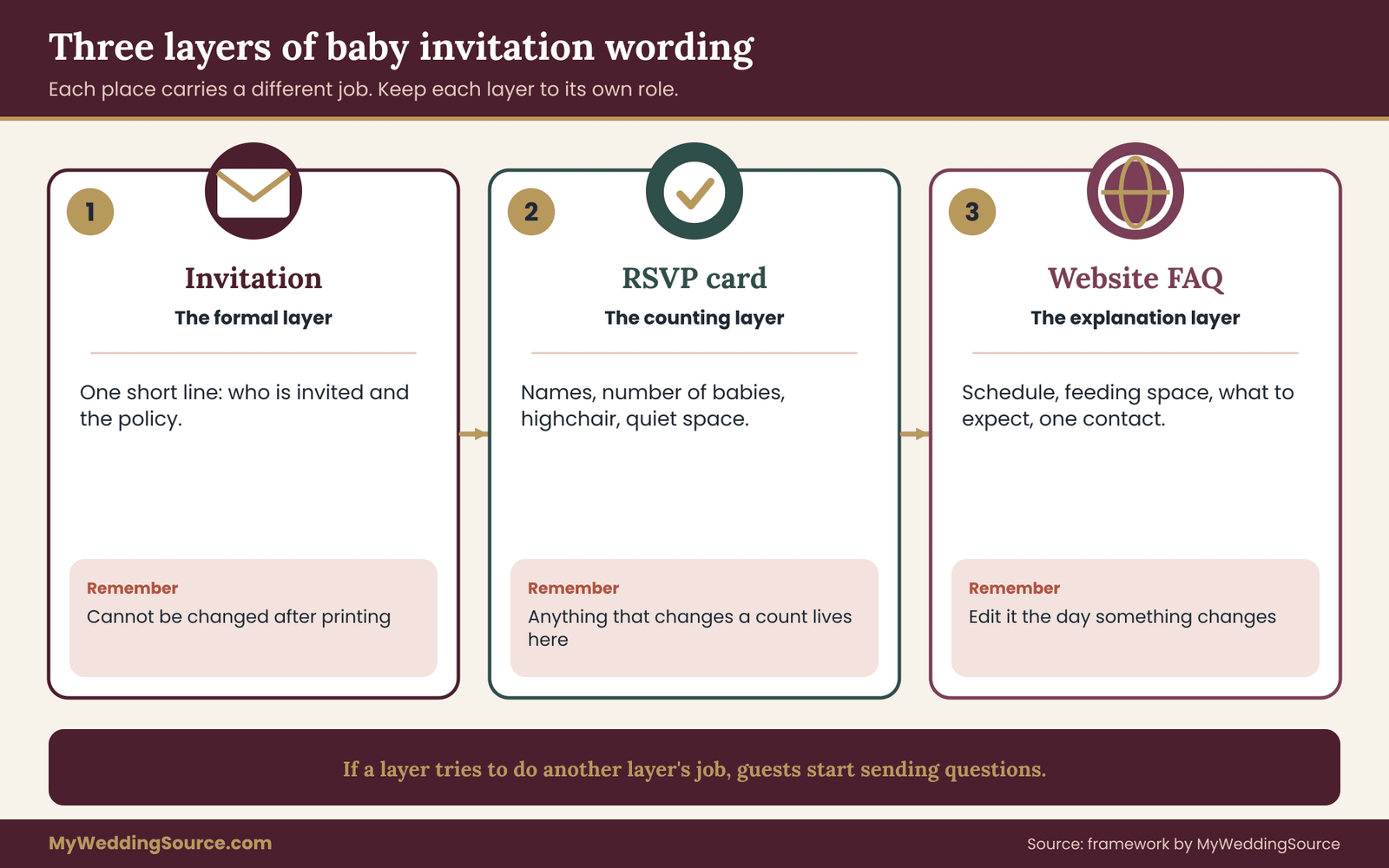
Baby information can sit in three places, and each has a different job.
The invitation itself is the formal layer of baby invitation wording. It carries the invitation, the names and the policy in one short line, and it should not carry logistics. Printed space is limited, and anything printed cannot be corrected without a reprint.
The RSVP card, or the online RSVP form, is the counting layer for baby invitation wording. It is where you learn how many seats, how many highchairs and how many cribs or portable beds a household needs, and where a parent can tell you in one line that a baby will be with them. Anything that changes a count belongs here.
The website, or a one-page insert, is the explanation layer for baby invitation wording. It holds the infant accommodation and expectation FAQ described later in this guide. It can be edited the day you learn something new, such as a changed nursing room or an ending time that moved.
Couples get into trouble when one layer tries to do another layer’s job. A website FAQ cannot fix an envelope that left a baby’s name off. A printed invitation cannot explain where the changing table is. An RSVP card cannot carry a paragraph of policy. If you keep each layer to its role, your baby invitation wording stays short and your explanations stay current.
Decide the baby policy before you write a word
The most common source of confusing baby invitation wording is a policy that was never actually decided. The couple says “babies are fine” in conversation, the parents say “we assumed no kids,” and the invitation ends up saying nothing. Before any drafting, choose one of four policies, in writing, and make sure both partners and anyone paying for the wedding agree.
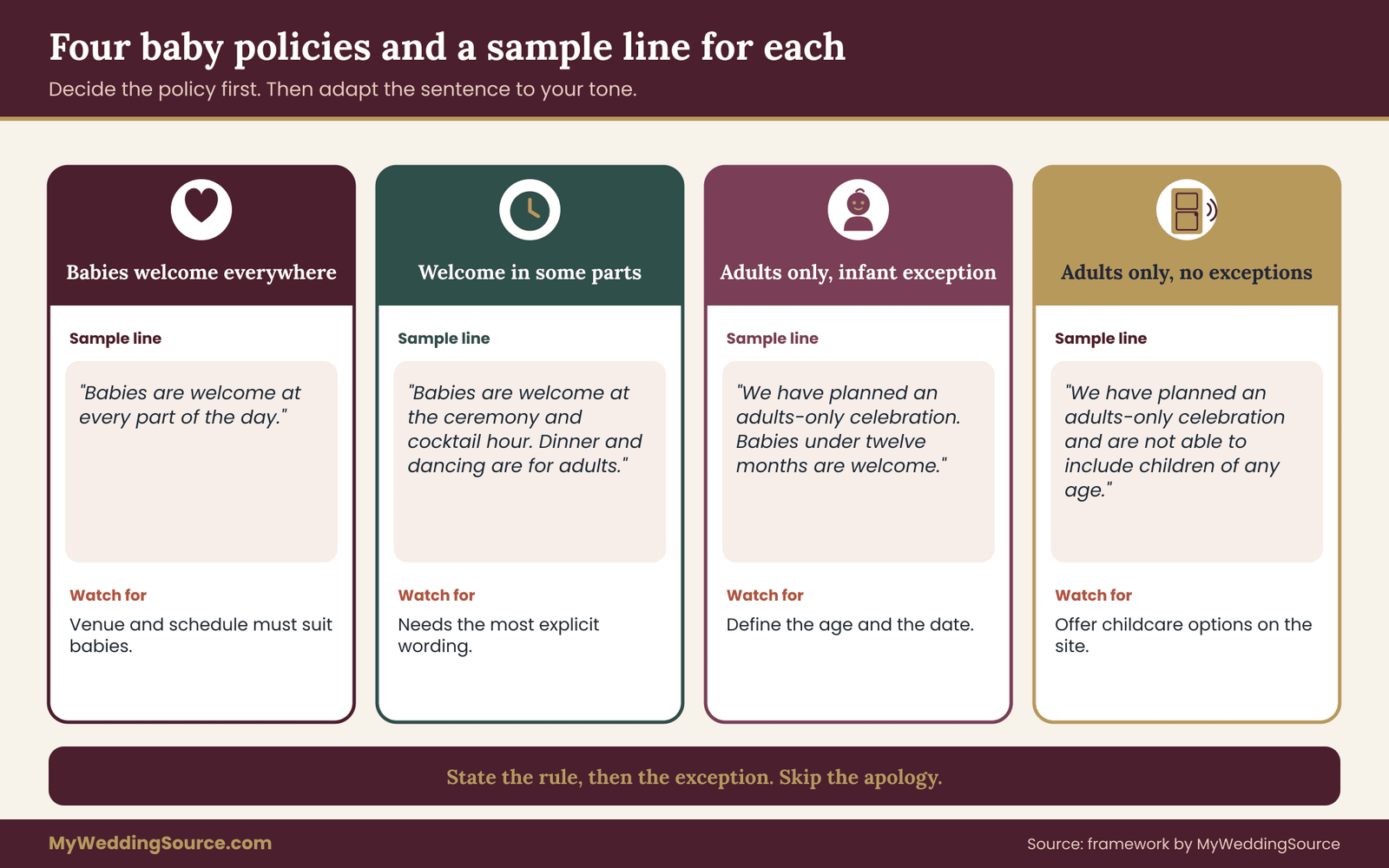
Policy one: babies welcome everywhere. Every baby is invited to every event on the schedule, including the ceremony, the dinner and the dancing. This is the simplest policy to word. It also has the largest operational footprint, because the venue, caterer and schedule all need to work for babies, as covered in the wedding guest care guide.
Policy two: babies welcome in some parts. For example, babies are welcome at the ceremony and the cocktail hour but not at the plated dinner, or welcome until a set time in the evening. This works for many weddings, but it is the policy that most needs explicit baby invitation wording, because a parent will otherwise assume the broadest version.
Policy three: adults only, with a nursing-infant exception. Children are not invited, but babies who are still fed by the parent and carried are welcome. This is a common and workable policy. The exception needs a definition, because “nursing” is not a precise term and guests will interpret it differently.
Policy four: adults only, no exceptions. Nobody under a set age is invited, babies included. This is a legitimate choice. It requires the clearest baby invitation wording of all, because it will land hardest on exactly the guests who are least able to attend without help, and it works best when you add practical alternatives, such as a list of local childcare options, a childcare room, or a clear note that you understand if a family cannot come.
The decision is yours. It does not need to be justified to the guest list, and it does not need to match what the couple’s friends chose. What it needs is to be consistent. If your policy is adults only with a nursing-infant exception, then your cousin’s six-month-old is welcome and your cousin’s two-year-old is not, and both families should hear that from your baby invitation wording rather than from each other.
A short test for your baby invitation wording policy
Before writing, test your chosen policy against three real guests. Pick a guest with a newborn, a guest with a crawling baby, and a guest with a toddler. For each, ask: would they be invited under this policy, would they know it from our baby invitation wording, and would we be comfortable with the exact situation that results? If the answer to the third question is no for any of the three, the policy is not finished.
A typical failure looks like this. A couple chooses “babies welcome everywhere” and then realizes the dinner is a long seated tasting menu in a small room with a string quartet. The policy was fine in principle. It was never tested against the evening. The fix is not to change the baby invitation wording; it is to change the policy to “welcome until the dinner begins,” or to plan a way for parents to eat in shifts.
Who else needs to agree
Two groups tend to be surprised by a baby policy. The first is the couple’s parents, especially when they are hosts or contributors. If a parent assumed no children and learns of a “babies welcome” line when the proof arrives, the proof is not the place to resolve it.
The second group is the venue and the caterer. A venue may have rules about guests under a certain age, noise after a set time, or strollers in the main room, and a caterer may count infants differently from children. Ask both for their written position before you finalize the baby invitation wording, and keep the replies with your contracts.
Put the final policy in a single sentence that you can paste anywhere: for example, “Babies under twelve months who are carried are welcome at the ceremony and reception; older children are not invited.” Every piece of baby invitation wording you write after this point is a version of that sentence, adapted to the layer where it appears. Whenever your baby invitation wording is in doubt, return to the sentence. ## Define “baby” so your baby invitation wording means one thing
The word “baby” is vague in a way that matters. To a new parent it means a person who is a few weeks old. To a grandparent it may mean anyone who is not yet in school. If your baby invitation wording uses the word without a definition, you have delegated the policy to each reader.
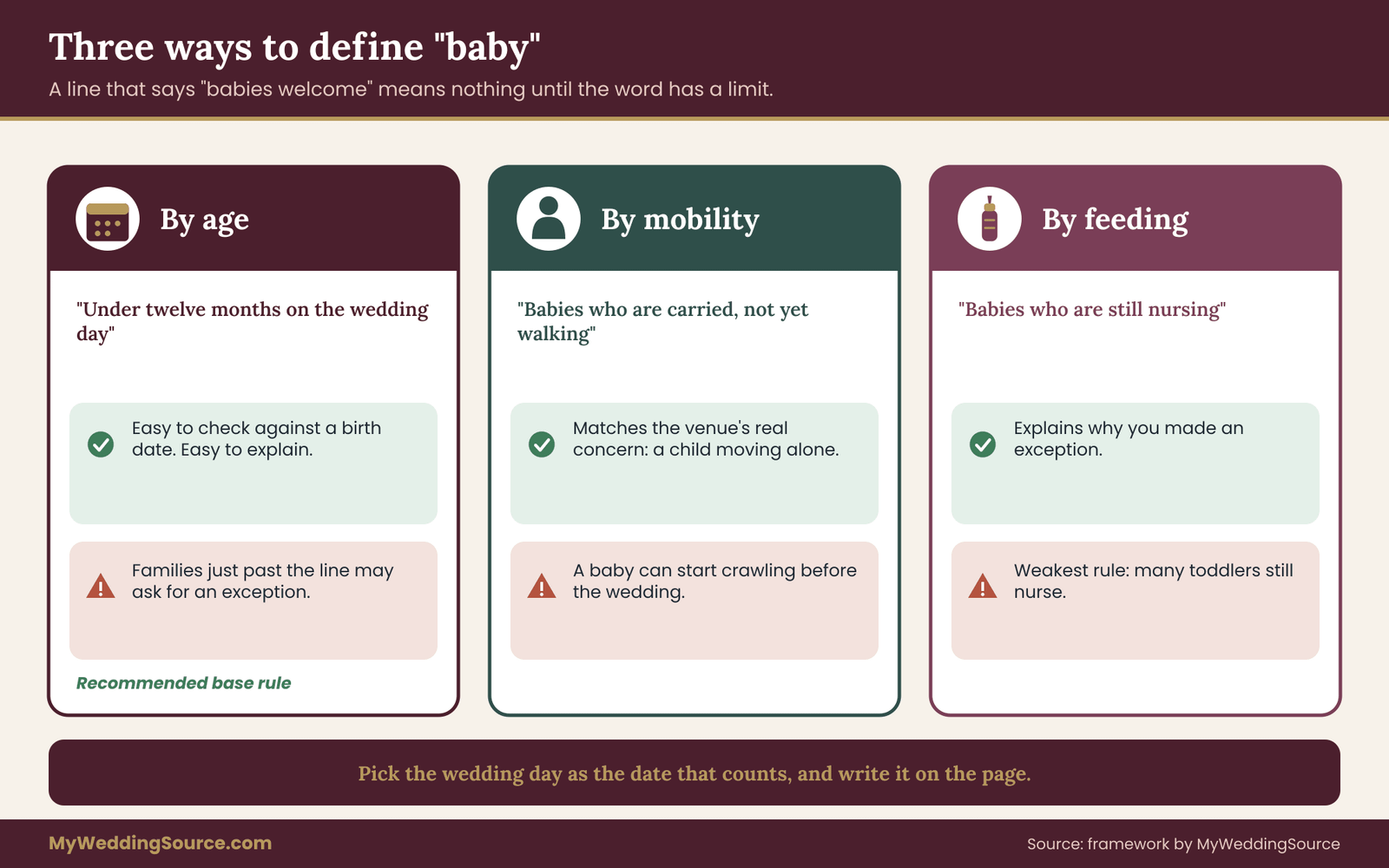
There are three practical ways to define it, and you can combine them.
By age. “Babies under twelve months” is clean and easy to check against a birth date. Its weakness is that guests with a thirteen-month-old will feel the line was drawn through their household, and a few will ask for an exception. That is not a flaw in the baby invitation wording. It is the line doing its job, and you should decide in advance whether you will make exceptions, because the second family who asks will notice if the first received one.
By mobility. “Babies who are not yet walking” or “babies who are carried” describes the thing you care about, which is whether a child can move around a room unassisted. It reflects the venue’s real concern, but it is harder to apply, because a baby’s mobility can change in the weeks between the RSVP and the wedding. A baby who is carried in March may be crawling by June.
By feeding. “Babies who are still nursing or bottle-fed” is the weakest definition for your purposes. Many toddlers are still nursed, and readers will interpret the phrase differently. It is more useful as a description of why you made the exception than as the rule itself.
The safest baby invitation wording for most weddings is age plus a plain sentence about why, such as “Babies under twelve months are welcome, because we know a newborn is hard to leave at home.” If your venue has a hard rule, such as no children under a certain age in the main room, state that rule rather than your own.
Edge cases in baby invitation wording to settle in advance
A few situations come up so often that you should decide them before the invitations are printed.
A baby who turns the cutoff age before the wedding. If the rule is “under twelve months on the wedding day,” say so, because “under twelve months” could mean the day you send the invitation, the day of the RSVP deadline or the day of the wedding. Pick the wedding day and write it.
An expected baby. Guests who are pregnant when invitations go out may deliver before the wedding. Do not put them in an awkward position. A line such as “If your family grows before the wedding, let us know and we will talk through it” on the website keeps the door open without promising anything.
Twins and multiples. A household with twin infants needs two seats, two highchairs or none, and possibly more help at the venue. Ask on the RSVP for the number of babies rather than assuming one.
Babies belonging to the wedding party or family members with active roles. A bridesmaid with a nursing infant is a different planning problem from a guest with one. Her baby may need to be with a helper during the ceremony, or she may need a short break in the schedule. That conversation should happen in person, not through the invitation.
Babies of vendors. A photographer or DJ with a baby is not a guest, and the baby is not on the invitation. If a vendor asks to bring a family member, handle it through the vendor contract rather than the guest list.
Decide what happens if someone brings a baby anyway
Even with clear baby invitation wording, a small number of guests will bring a baby who was not invited.
The baby invitation wording cannot prevent that, but a decision made in advance can limit the damage. For an adults-only wedding with no exceptions, decide who will speak to the guest, what they will say, and whether you can offer a solution, such as a quiet room with a helper. For a wedding with a nursing-infant exception, decide in advance how you will respond to a nine-month-old who was not covered. Having two sentences ready, said kindly, is better than improvising on the day.
Name every invited person on the envelope
The envelope is the first and quietest place your baby invitation wording appears. A guest looks at the names on the outside and the inner envelope, and takes the list of names as a list of people who are invited. If the list of names is complete and accurate, many questions never arise.
For a household, the usual practice is to write the invited people by name. For a family with a baby, that might mean writing the parents’ names on the outer envelope, and listing the baby’s name on the inner envelope or on a second line. If you are not using inner envelopes, a line beneath the parents’ names works well, such as “and Noor,” so that the baby appears as an invited person by name rather than being inferred.
The point is to make the invitation specific. “The Okafor Family” invites a guess about how many people that includes. “Ms. Adaeze Okafor, Mr. Tunde Okafor and Noor” does not. If you are following a more formal custom, a formal etiquette reference covers how titles and inner envelopes work, and the same custom extends to a baby’s name.
Some things to avoid. Do not write “and guest” when a guest plus a baby is possible; the word “guest” will be read as an adult plus-one. Do not write “and family” if your policy is “babies yes, other children no,” because “family” will be read as everyone. Do not write “and little one,” which sounds sweet and is ambiguous about whether a baby is invited, a toddler is invited, or the line is a figure of speech.
Addressing mixed households
Households where some children are invited and others are not are the hardest to address, and the envelope is where it is resolved. If you invite a nursing infant but not a four-year-old sibling, the envelope should list the invited people only. Do not rely on the omission alone to convey that the four-year-old is not invited. Add a single line on the inner envelope or insert, such as “We have reserved seats for you, Tunde and Noor.” The word “reserved” and the names do the work together.
If you cannot add a line, mention the situation in a direct message to the parents before the invitation arrives. A short call or text is better than a surprise on the envelope, because a parent who learns about the exclusion of one child from a card has had no chance to respond.
Preferred names and spelling
For babies, check spelling and names with a parent. A baby’s name is often new to the extended family, and a spelling error on an envelope is an easy way to start the conversation badly. If a baby does not yet have a name, or the parents have not shared it, write “and baby” in a way that is explicit about the number: “and baby” reads as one baby. For twins write “and the twins,” or ask for the names.
If you are using a printed address list or a shared spreadsheet, add a column for the names of babies and a column for their ages or birth dates, as described in the RSVP etiquette guide in its treatment of household counts. A single column of names is enough to prevent most mistakes, and the age column makes it easy to apply your definition of “baby” without guessing.
A quick envelope review of your baby invitation wording
Before the envelopes are addressed, read each household line aloud and ask three questions. Does this line include every person we intend to invite? Does it exclude every person we do not? Could a reasonable parent read it differently from how we mean it? If the answer to the last question is yes for any line, rewrite that line. It takes a few minutes and spares a family a confusing conversation.
One more habit helps. Have someone who is not involved in the planning, ideally a parent of a small child, read three sample envelopes and tell you who they think is invited. Their answer is more reliable than your own, because you already know what you meant. If they disagree with your intent on even one of the three, the line needs work.
For couples who send digital invitations, the same principle applies to the guest list in the invitation tool. Each person should appear by name, and the invitation should show the names of everyone in the household who is invited. An online form that shows a household of four when only three are invited is a design error you can fix in a few minutes, and it is much easier to fix before sending than after. ## Baby invitation wording for the main card
With the policy decided, the definition set and the envelopes planned, you can write the baby invitation wording that appears on the invitation itself. The rule for this layer of baby invitation wording is brevity. One sentence, sometimes two, set in a spot where it will be seen, and nothing that requires an explanation.
Below are sample lines for each policy. They are starting points in plain language, not a script you have to follow word for word. Change the tone to fit the rest of your invitation, and keep the content.
Babies welcome everywhere. “Babies are welcome at every part of the day.” This is often enough. If you want to add warmth, add “We will have a quiet space for feeding and settling,” but only if you have actually arranged the space.
Babies welcome in some parts. “Babies are welcome at the ceremony and cocktail hour. Dinner and dancing are for adults.” The two short sentences do not apologize. They give a parent the information needed to decide whether to attend the whole day, attend part of it, or arrange care for the evening.
Adults only with a nursing-infant exception. “We have planned an adults-only celebration. Babies under twelve months are welcome.” The second sentence is the exception and the first is the rule. Reading them in that order lets the parent see the exception as part of the policy, not an afterthought.
Adults only, no exceptions. “We have planned an adults-only celebration and are not able to include children of any age. We hope you can join us.” This is direct, kind and complete. Do not add a justification, such as the venue’s size or cost, unless it is the real reason, because a stated reason invites debate about whether it applies.
Where the baby invitation wording goes on the card
Position matters as much as the baby invitation wording itself. A line at the bottom of the invitation, in small type beneath the reception details, is the usual place, and it is read last. Many readers skip it. If your policy is not the default for your community, give it a place where it will be seen, such as directly under the date and venue line.
If your invitation suite has multiple pieces, the policy line can go on the reception card, the details card, or the RSVP card. Choose the piece that most guests read carefully. For most couples that is the RSVP card, because a guest handles it while making a decision. The next section of this guide describes what to put on it.
For the broader mechanics of producing the printed pieces, including proof checks and quantities, the wedding invitation printing guide is the place to look. For this article, the point is that a baby line is cheap to add at the proof stage and expensive to add afterward.
Baby invitation wording to avoid
Some phrases appear on invitations all the time and cause the most confusion.
“Adult reception.” It is meant to say that children are not invited, but it can be read as a description of the party’s mood, and it says nothing about babies. If you use it, add a sentence that deals with babies.
“We love your little ones, but…” The first half of the sentence will be remembered, and the second half will be explained differently by each reader. State the policy and leave the sentiment out of the sentence.
“Please leave the kids at home.” It is blunt and implies that you assume guests have children old enough to be left. For a household with a newborn, “leave the kids at home” is not just curt but also unclear about what a newborn is.
“Kids are not invited.” It is accurate and does not mention babies. Parents of infants will ask whether a baby counts as a kid. Add the age line.
“No babies.” If your policy is adults only with no exceptions, you can say so, but “No babies” sounds harsher than the same policy stated as “We have planned an adults-only celebration.” The meaning is identical. The tone is not.
“Babies are welcome, within reason.” This asks the guest to interpret what is reasonable. Parents of infants frequently decide that reasonable includes a baby who cries for a minute, and sometimes it includes a baby who cries for twenty. Replace it with something observable: “If your baby becomes unsettled, there is a quiet room near the ceremony space.”
“Small children may attend.” This is not a policy. It does not define small, and it does not say which events.
Tone for baby invitation wording: calm, specific, kind
Good baby invitation wording sounds like a person speaking calmly. It states what is true. It does not apologize for the policy, because an apology invites the reader to argue. It does not flatter. “We adore your sweet little angels” might feel generous, but it is padding, and the guest still has no answer to their question.
Test your sentence by reading it aloud to someone who has not seen the invitation. If they can repeat the policy back to you in their own words, the sentence works. If they say “so, are babies allowed?”, rewrite it.
Also test the sentence from the point of view of a guest who is not invited under your policy. A parent of a two-year-old reading “Babies under twelve months are welcome” learns that their child is not invited. The line should not make that parent feel judged. Keep the sentence about the policy rather than about the child, and give them the practical information they need to plan: the start time, the end time and the date.
A second sentence that earns its place
If you have room for a second sentence, use it for the single most useful practical fact. Which fact depends on the policy.
For babies welcome everywhere, the most useful second sentence is about space: “A quiet room is available next to the ceremony.” For babies welcome in some parts, it is the transition time: “Dinner begins at six, and we will have a team member available to help families with babies find a quiet place.” For nursing-infant exceptions it is whether the venue can accommodate a feeding: “A private room will be available for feeding.” For adults only it may be the list of resources: “Our website lists local childcare options.”
Do not promise anything you have not arranged. “A private room will be available” must be true, with a room, a door and a chair. If it is not yet certain, say “We are arranging a quiet space and will confirm it on our website.” That is more useful than a vague promise, because it tells the parent when to look for the answer.
Before and after: rewriting weak baby invitation wording
The fastest way to improve baby invitation wording is to see weak drafts next to stronger ones. The pairs below use the same policy in each case and change only the sentence.
Weak: “Please leave the little ones with a sitter.” Stronger: “We have planned an adults-only celebration. Babies under twelve months are welcome.” The first version tells a parent what to do with their child. The second states the policy and the exception, and it leaves the childcare decision where it belongs.
Weak: “Babies are welcome, but we hope you understand if they get noisy.” Stronger: “Babies are welcome at the ceremony. If your baby is unsettled, a quiet room is next to the hall.” The weak sentence asks for understanding. The stronger one gives a place to go, which is what a parent actually needs from baby invitation wording.
Weak: “No kids, please.” Stronger: “We are not able to include children, including babies. We hope you can join us.” The weak version leaves the baby question open, and a parent will ask it. The stronger version closes it in the same breath.
Weak: “Kids welcome!” Stronger: “Children of all ages are welcome at every part of the day.” The weak version is friendly and vague. The stronger baby invitation wording says which children and which events, so no one has to guess.
Weak: “Adults-only reception.” Stronger: “The reception is for adults. Babies under twelve months are welcome.” The weak version is silent about infants, so it is the version most likely to generate individual messages. In each pair the improvement comes from the same two changes: naming the people covered and naming the events covered.
Formal and informal invitations
Formal invitations rarely carry baby invitation wording on the main card, because the formal style leaves a lot unstated and relies on the envelope to convey who is invited. If you are using a traditional suite, the wedding invitation etiquette guide describes what belongs on each piece. In that style, put the baby policy on the reception card or the enclosure, use formal phrasing such as “The favor of a reply is requested,” and keep the policy sentence in the same register.
Informal invitations, including postcards, folded cards and digital invitations, can carry baby invitation wording directly. A friendly register works, as long as the content is specific. “Babies are welcome through the ceremony and cocktail hour, and we have a quiet room for settling” is both warm and complete.
Reading the baby invitation wording as a guest would
A final check before you send anything to print. Give the finished baby invitation wording to two people: one who has a baby and one who does not. Ask the parent: “Do you know what to do with this?” Ask the other person: “Does this sound reasonable?” The parent’s answer tells you whether the line works. The other person’s answer tells you whether the tone does. If either one hesitates, rewrite before you print.
If you are producing the invitation with a designer, ask them to leave room for the baby invitation wording, even if you are still deciding. Baby invitation wording added at the proof stage is a small layout change. The same wording added after printing is an insert, a reprint, or a flurry of messages, and any of those costs more than the first. ## The RSVP card and counting babies
If the invitation carries the policy, the RSVP card carries the count, and the baby invitation wording on it has to be exact. This is where your baby invitation wording becomes data: how many seats, how many highchairs, how many portable cribs, how many meals. Getting the card right saves you from a count that is off by a handful of people at the moment your caterer needs it.
The general mechanics of replies, deadlines and follow-ups are covered in the wedding RSVP etiquette guide. The sections below deal only with the baby-specific pieces.
Why babies break ordinary RSVP counts
A standard RSVP card asks for names and a yes or no. That structure assumes every person occupies a seat and eats a meal. Babies break both assumptions, and not in the same way.
A baby who is carried or held may not need a seat at all, but the baby may need a highchair, a bassinet space or a spot for a stroller. A baby who is crawling needs floor space and supervision. A baby who has started solid foods may need a small meal, which a caterer may or may not price. A baby who sleeps through the ceremony may be fine, and the same baby may need to leave early.
Because of this, a single “number attending” line is not enough. A guest who writes “3” could mean two adults and a baby, three adults, or two adults and a toddler you did not invite.
A card layout for baby invitation wording that separates the counts
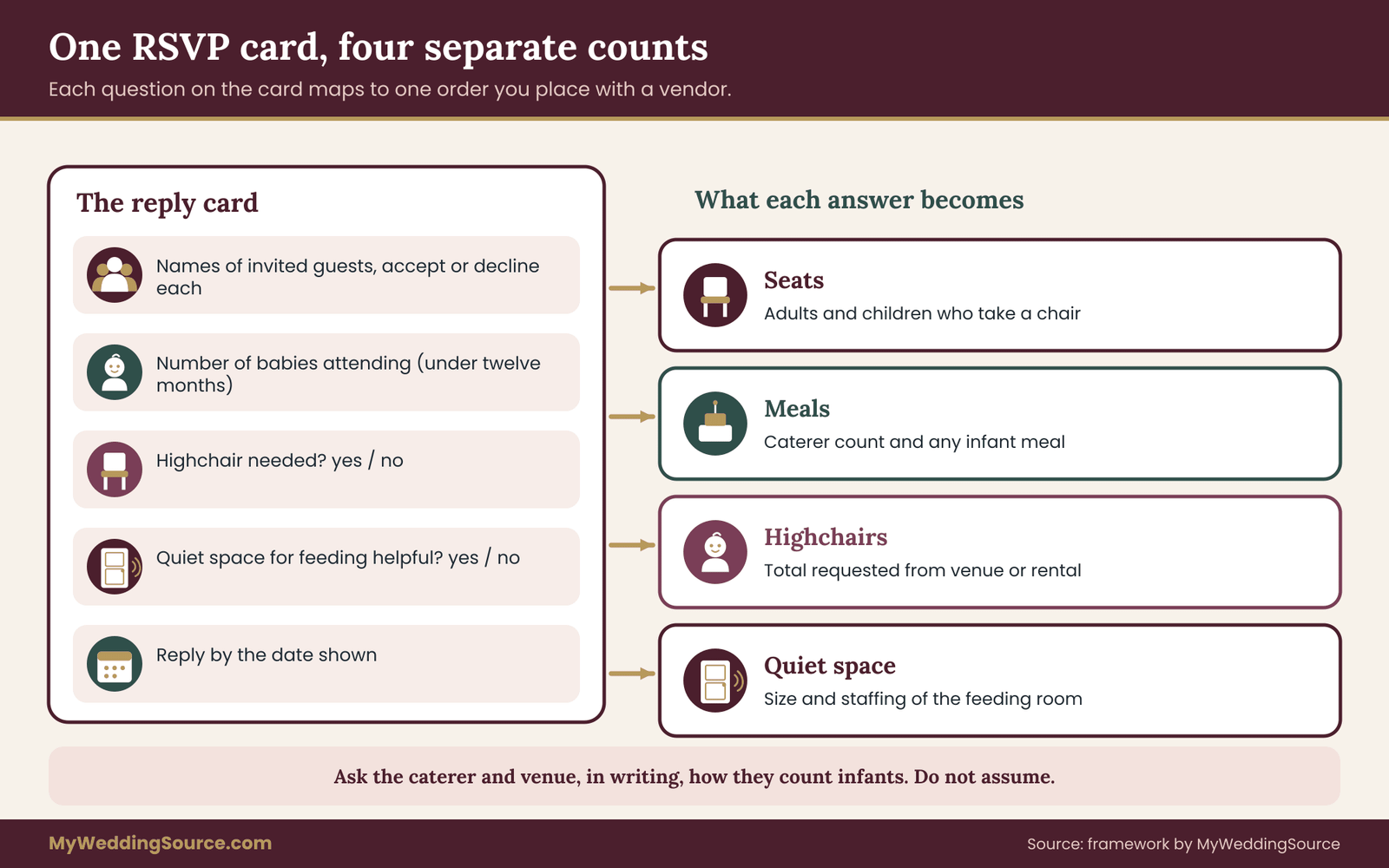
The cleanest approach is to ask for people by name and then ask three short follow-up questions, each of which maps to a decision you have to make.
First, a line for names. Print “The favor of a reply” and a line for each invited person, or print the invited names and ask guests to circle accept or decline beside each. This keeps the count tied to people rather than a number.
Second, a line that asks about the baby directly. For a policy that welcomes babies, “Number of babies attending: ___” works well. For an adults-only policy with an exception, “Infant attending (under twelve months): yes / no” is clearer.
Third, an optional line for needs. “Highchair needed: yes / no” and “Quiet room or feeding space helpful: yes / no” tell you what to plan. Keep these short. A parent who is filling in a card at a kitchen table will not write a paragraph.
If you use an online RSVP form, the same logic applies, and you have more room. A form can show the baby questions only to households that have a baby on the invitation, which keeps the form short for everyone else.
Do babies count toward the headcount?
This is a planning question, not a courtesy question, and the answer depends on the contract. Ask the venue and caterer, in writing, how they count infants for four things: the minimum guest count, the meal count, the seating capacity and the fire or occupancy limit.
Caterers vary. Some do not charge for infants who do not eat. Some charge a reduced rate for a children’s meal, which may start at a stated age. Some count every person in the room for service staffing. The venue’s occupancy limit may count everyone physically present, including babies in carriers. Do not assume; ask, and keep the reply with your contracts. You can settle the baby question by asking the caterer one specific question: “At what age does a child count as a meal and as a seat?”
Once you have the answer, record it on your guest spreadsheet in separate columns: seats, meals, highchairs and portable beds. That way the final counts you send to vendors are totals of columns rather than guesses.
Baby invitation wording for the follow-up questions
Short questions get answered. Here are examples that keep the language plain.
“How many babies (under twelve months) will be with you?” The parenthetical repeats your definition at the point of decision.
“Will you need a highchair?” It is a yes or no, and it makes the count of highchairs a total rather than a guess.
“Would a quiet space for feeding be helpful?” This is an invitation to say yes. Some parents will not ask for a space unless asked, and this line makes it normal to want one.
“Is there anything we should know to make the day easier for your family?” An open question at the end gives a parent a way to mention a nap schedule, a dietary need or a mobility issue without feeling that they are making a demand. Use it only if you are ready to read and respond to the answers.
Avoid asking for the baby’s age in months unless you need it, and avoid asking for health information of any kind. If a parent chooses to mention that their baby was born prematurely or has a condition, that is their decision to share. The card should not ask.
When an RSVP does not match your intent
A reply will sometimes arrive that does not match what you intended. A family adds a toddler to the count. A guest crosses out “babies under twelve months” and writes “(fourteen months).” A guest writes “plus baby” on a card that was addressed to a single adult.
For each of these, the response should be a short, kind message that restates the policy and offers a concrete alternative if you have one.
A script that works for most cases: “Thank you for replying so quickly. We are not able to include children over twelve months, and we are sorry that will make it harder for you. We would love to see you at the ceremony, and our website lists local childcare for the evening.” The message does three things: it thanks them, it states the rule without reopening it, and it offers a next step.
If you decide to make an exception, make it deliberately and for a reason you can state, such as a nursing mother who is traveling a long distance. Write down the exception so you apply the same reasoning to the next similar request.
Counting late additions without rewriting the baby invitation wording
A baby may arrive after your RSVP deadline. A guest who was pregnant at the time of the invitation might reply “Yes, we will have a newborn.” Tell guests in advance what to do: “If your family grows before the wedding, tell us as soon as you can so we can adjust seating and meals.” This keeps a happy surprise from becoming a catering emergency.
Set a last date after which changes are not possible, and name it. Your caterer will have a final guarantee date, and your venue may have a cutoff for seating changes. The date on your website for baby-related changes should be a few days earlier than the caterer’s date, so you have time to pass the numbers on.
Proofing the baby invitation wording against the RSVP
Once the RSVP card is drafted, read it next to the invitation as a guest would, one after the other. The baby invitation wording on the invitation and the questions on the card should use the same words for the same things. If the invitation says “babies under twelve months,” the card should not say “infants” or “little ones.” A parent who sees two different terms will wonder whether they mean two different groups.
Check the numbers the same way. If the invitation promises a quiet room, the card should ask whether one is helpful. If the card asks about highchairs, the website should say how many exist. Each promise in the baby invitation wording needs a matching question, and each question needs a matching answer somewhere the guest can find. When one link in that chain is missing, the first sign is usually a guest message that begins “I was wondering about…”
A short checklist for the card
Before approving the RSVP card, check that it: names each invited person; asks for the number of babies separately from the number of adults; repeats the age definition; asks about highchairs and quiet space; gives the deadline; and tells the guest where to find more information, such as your website address. If the card does all of those things in a small space, it is doing its job.
If you cannot fit everything, drop the quiet space question first, and keep the number of babies and the highchair question. These two are the ones that change your orders. The rest can be asked on the website form.
Keeping the count honest once baby invitation wording brings replies
The cards are an input, not the final answer. Once replies arrive, reconcile them against your list. For each household, compare the names on the card with the names on the envelope, and note any difference. A card returned with an extra name, a missing name or an altered number should be resolved before you send final counts to the caterer. This is a few minutes of work per household, and it prevents the mismatch that usually appears at the registration table.
Do the reconciliation again about two weeks before the wedding, after late replies have come in, and again in the final week when you confirm numbers with vendors. At each step, send the count to your venue coordinator in writing, so that your records match theirs. ## The infant accommodation and expectation FAQ
The invitation tells a parent whether the baby is welcome. The website answers the next layer of questions, and this is where most of your baby invitation wording work happens. The tool for this is a short page, which we will call the infant accommodation and expectation FAQ: a list of plain answers split into two halves.
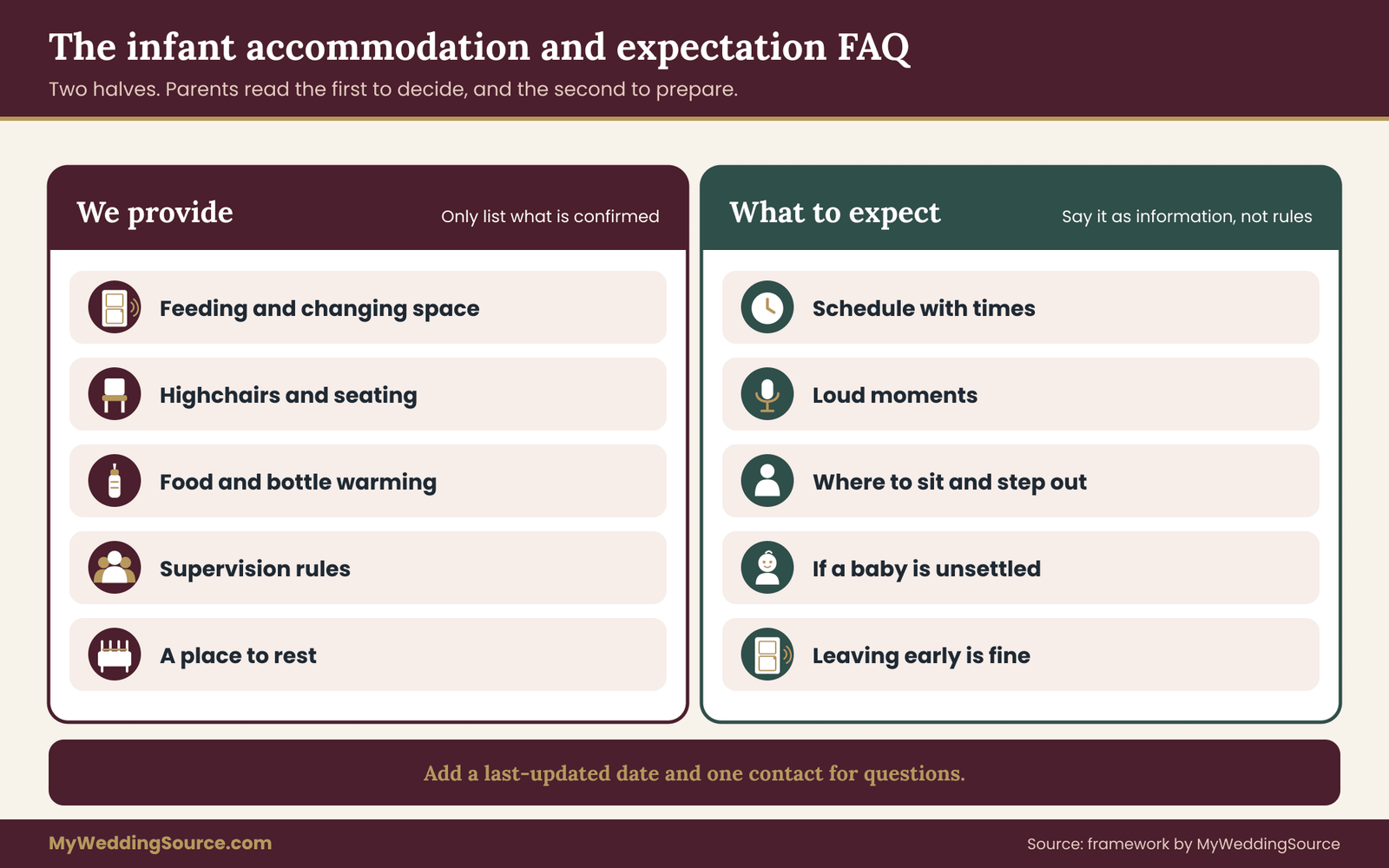
The accommodation half says what you are providing. The expectation half says what you hope guests will do, and what they can expect from the day. Splitting the page this way matters, because parents read the first half to decide whether to come and the second half to decide how to prepare.
Build the accommodation half of your baby invitation wording page
List only what is real. For each item, write one sentence, and if you can, name the place and the time.
Feeding and changing. Is there a private space for feeding? Where is it, and how far is it from the ceremony and dinner rooms? Does it have a chair, a surface and an outlet? Is there a changing surface in a restroom, or does a parent need to bring a portable one? If the venue has a nursing or lactation room, say so. If it does not, say what you are using instead and how a parent can find it.
Seating. Will there be highchairs, and how many? Are they included or by request? Are there seats near an exit for parents who may need to step out? Can a stroller or carrier stay with the family during the ceremony, and where is it stored during dinner?
Food. Is there a baby or toddler meal? Is there a place to warm a bottle? Can parents bring their own food for the baby? If the caterer has rules about outside food, state them rather than leaving the parent to find out.
Safety and supervision. If there is a play space, who supervises it? If you are not providing supervision, say so: “We are not providing childcare, and children should stay with a parent or guardian.” This is not an unkind sentence. It sets a clear expectation.
Rest. Some parents want a place where a baby can nap. If you are offering a quiet room with a portable bed, say so. If you are not, say that the room is for feeding and settling, not for sleeping.
Do not list a facility that is not confirmed. If you have asked the venue but not received an answer, leave the item off and add it once confirmed.
Build the expectation half
The second half is the one that couples most often leave out. It is also the one that prevents the most misunderstandings, because it is how you describe the day’s shape without sounding like a rulebook.
The schedule. A short list of times: guests arrive, ceremony begins, ceremony ends, cocktail hour, dinner, speeches, dancing, last song. Parents of a baby plan around nap and feeding times, and they cannot do that without a schedule. If the ceremony is forty minutes, say forty minutes.
The loud parts. If there is amplified music, a toast with a long clapping moment, a sparkler exit or a fireworks display, say so. Parents of infants may prefer to leave before those, and a note in advance lets them plan.
Where to sit. If you are encouraging parents to sit near an aisle or at the back for the ceremony, say so. “If your baby becomes unsettled, please feel free to step out. A seat near the back is reserved for families.” This normalizes leaving, and it is the single most reassuring sentence a parent can read.
What happens if a baby cries. A short sentence is enough: “Babies are welcome to make noise, and we ask that parents step out during the vows if a baby is very upset.” State your actual preference. Some couples are relaxed about it. Others hold a ceremony where vows are being recorded or the room is very quiet. Both are reasonable, as long as the guest knows.
Photography and video. If a photographer will be taking photos of guests, and a parent has a view about their baby’s image, a line about the photographer’s presence matters. If you have a policy about sharing photos of guests, say so; say that as well, so parents are not surprised.
Leaving early. Say that early departures are welcome, and say how to leave. “No one will mind if you head out after dinner. There is a coat check and a rear entrance for quiet exits.” For many parents this is the line that settles the decision to come.
Questions your baby invitation wording page should answer in order
The order of questions follows the order in which parents decide. First: is my baby invited? Second: what is the schedule? Third: where can I feed, change and settle my baby? Fourth: is there a highchair and food? Fifth: what happens if my baby cries? Sixth: can we leave early? Seventh: who do I ask if I have a question? Keep each answer to two or three sentences. If a question needs more, link to a separate page.
A good FAQ also names a single contact for baby questions. This might be a sibling, a friend or a wedding coordinator. It should not be you, in the weeks before the wedding, and it should not be a parent of the couple unless they are happy to be that person. State the name and the best way to ask. A contact name is not an email address; if you use a form or a messaging tool, name the tool instead.
Matching the FAQ to the venue’s reality
A FAQ is only as useful as it is accurate. Before publishing, walk through the venue with the page in hand, and check each line. Is the room really where you said? Does the door lock? Is the highchair count confirmed? Does the restroom have a changing surface? Do the schedule times match the contract? The way guests move through a venue is covered in the reception guest flow guide, and it is worth looking at before you describe the route from the ceremony space to the feeding room.
If the venue cannot provide something you were counting on, change the FAQ, not the reality. A page that says “A quiet room is available” and then points to a coat closet will cost you the trust of every guest who read it.
Keeping the FAQ short and current
Resist the urge to write a long page. The FAQ should fit on a phone screen in a few scrolls. If it grows, split it: one page for babies and children, one page for travel and lodging, one page for the day. Parents who are tired and distracted will read a short page and skim a long one.
Add a “last updated” date at the top. Parents will return to the page several times, and a date tells them whether anything changed. When you change something, change the date and mention what changed in one line. If you send a text update to guests, as described in the wedding guest care guide, include the baby section only when it changed.
A few small habits help. Link to the FAQ from the RSVP form. Put the page address on the invitation insert. Mention it once in your save-the-date follow-up message. If a parent asks a question that is not on the page, answer it, and then add it, so the next parent does not have to ask.
What baby invitation wording on the FAQ should leave out
Do not include medical advice. Questions about vaccination, illness, travel with an infant or exposure to crowds are for the baby’s pediatrician and the parents to decide, and a wedding website is not the place to give an opinion. If you want to help, say what you are doing as hosts, such as having hand sanitizer available or asking guests who are ill to stay home, and leave it at that. For current public health guidance on infants, send readers to a government source such as the Centers for Disease Control and Prevention.
Do not include judgment about parenting choices. A line such as “Please keep your babies quiet” is a request to control something that a parent cannot control. A line such as “If your baby becomes unsettled, a quiet room is available” is a request that a parent can meet.
Do not include information that belongs elsewhere. Hotel details, parking and dress codes have their own pages. The baby page should be about babies. ## A worked example of baby invitation wording
The following example is invented for illustration. The couple, the guests and the venue do not exist, and the details are chosen to show how the steps fit together, not to suggest what any real wedding should do.
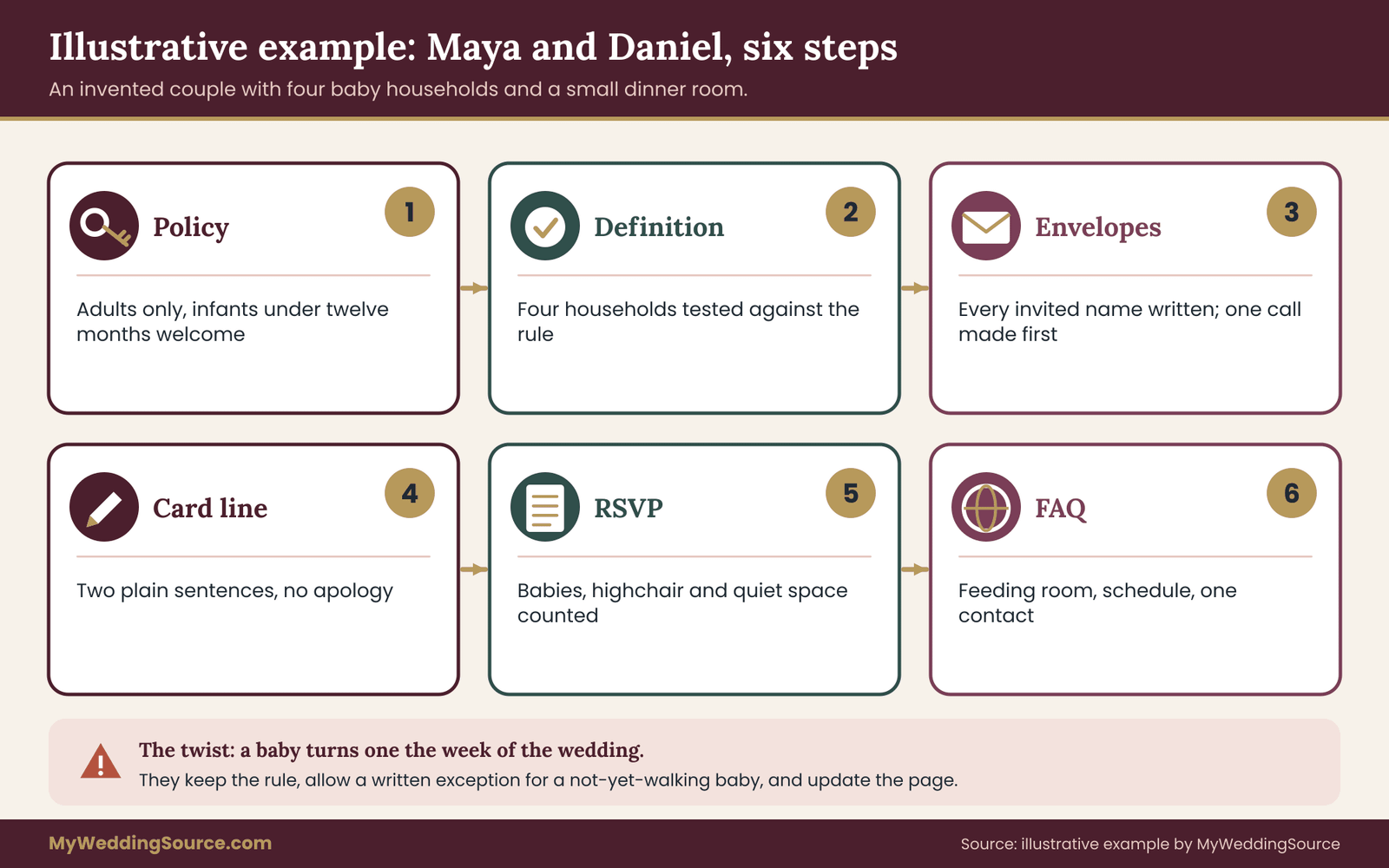
Maya and Daniel are planning a late-afternoon wedding for about eighty guests at a restored mill with a ceremony in a main hall and dinner in a separate room across a courtyard. Their guest list includes four households with babies: a cousin with a six-week-old, two friends with infants of about seven and ten months, and Daniel’s colleague with a fourteen-month-old.
Step one: the policy behind the baby invitation wording
Maya and Daniel start by testing policies against the venue. The dinner room is small and the tables are close together. The string trio plays through dinner. They decide against “babies welcome everywhere” and choose “adults only with a nursing-infant exception,” which they define as babies under twelve months on the wedding day. They write the policy as one sentence: “Babies under twelve months are welcome at the ceremony and reception. Older children are not invited.”
They confirm with the venue that infants in carriers do not count toward a separate fee and that the occupancy limit is by room, not by count of people by age. They ask the caterer in writing about infant meals, and the caterer replies that babies who do not eat do not need a meal count.
Step two: the definition
They check each of the four households against the policy. The cousin’s six-week-old, and the seven- and ten-month-old babies, fall inside it. The fourteen-month-old does not. They talk about whether to make an exception for the colleague and decide not to, because the dinner room is the issue, not the colleague. They plan a direct call to the colleague before the invitations arrive and a link to local childcare on the website.
Step three: the envelopes
The envelopes are addressed with every invited person’s name. For the cousin, the envelope reads with both parents’ names and a second line, “and baby Priya.” For the two friends, the second line is the baby’s name. For the colleague, the envelope lists only the two adults, and the inner note says, “We have reserved two seats for you.” The call to the colleague has already happened, so the envelope is not a surprise.
Step four: the baby invitation wording on the card
The reception card carries two sentences: “We have planned an adults-only celebration. Babies under twelve months are welcome at the ceremony and reception.” Beneath it, a small line reads “Details for families with babies are on our website.” There is no apology and no justification.
Step five: the RSVP
The RSVP card lists invited names, asks for the number of babies attending, and asks whether a highchair would be needed. The card also includes a line, “Quiet space for feeding helpful? yes / no.” Replies come back, and all three baby households say yes to the quiet space; one asks for a highchair. Maya adds the numbers to a spreadsheet with separate columns for seats, meals, highchairs and quiet space.
Step six: the FAQ that backs up the baby invitation wording
The website page has two halves. The accommodation half says that a small room next to the main hall will be set up for feeding and settling, with a chair, a table and a lock, and that one highchair will be at the dinner room. The expectation half gives the schedule, notes that a sparkler send-off ends the night, and says that parents may step out at any time. The contact for questions is Maya’s sister.
What goes wrong with the baby invitation wording, and the fix
Three weeks before the wedding, the ten-month-old’s mother writes that her baby will turn one the week of the wedding. Maya checks the definition: “under twelve months on the wedding day.” Strictly, the baby will be one year old, so the rule says no.
Maya and Daniel go back to their reasoning. The concern was the small dinner room, and a baby who is just past twelve months and still carried does not change that. They decide on a narrow exception for a baby within a month of the cutoff who is not yet walking, write down the exception and its reason, and send the family a short note. They also update the website page: “Babies who turn one within a month of the wedding are welcome if they are not yet walking.”
The change is small, but it shows how the system works. The family got an answer. The rule became more precise. The page was updated. The colleague with the fourteen-month-old, who is walking, was not affected.
What the example shows about baby invitation wording
Notice what the couple did not do. They did not write a paragraph on the invitation. They did not apologize. They did not leave the definition vague and hope. They made one decision at a time, in order, and each decision made the next one easier.
Notice also what they did before writing: they tested the policy against real guests and against the venue. A policy that sounds generous in conversation can fall apart against a small dinner room, and the time to learn that is before the invitation is printed.
This example is a pattern, not a prescription. A couple with a large outdoor venue and a casual schedule would choose differently. A couple with a quiet chapel ceremony might shift the line to the ceremony and ask parents to step out if a baby is upset. What carries over is the sequence: policy, definition, names, line, count, FAQ, and an update process.
Hard cases for baby invitation wording
A few situations do not fit neatly into the sequence. Handle them with the same discipline.
A newborn and a long journey
A guest with a newborn who lives far away may need to travel with the baby, find a place to stay and bring equipment. They will ask questions you cannot predict.
The best response is a short list of facts rather than reassurance: the distance from the lodging to the venue, the start and end times, where a baby can be settled, and whether a portable crib can be provided. Put the lodging and travel questions on your task list with a date, and let your own hotel page carry the details. A parent who is considering a long trip with a newborn is also making a medical and practical decision, and the guidance belongs to their pediatrician.
A guest who is postpartum or still pregnant
A guest who is expecting or recently gave birth may not know if they can attend until close to the date. The invitation cannot solve that. A simple line on the RSVP, such as “If your plans change, tell us as soon as you can,” is enough. Do not ask guests about their health or due dates, and do not discuss them on the page. The American College of Obstetricians and Gynecologists publishes patient information on pregnancy and postpartum care, and that is the place for guests to get guidance, not your invitation.
Adults-only with a guest who needs to bring a baby for medical reasons
Some parents cannot leave a baby with another person for reasons connected to feeding, health or the baby’s needs. They will tell you directly, and you should listen. You do not need to ask for details. Say that you will make an exception, or explain what is possible, and keep the response kind and short. If you have an adults-only policy with no exceptions and a family tells you they cannot attend because of this, say you understand and that you would love to share photos afterward.
A wedding party member with a baby
A bridesmaid or groomsman with an infant has a different set of needs. The baby may need a caregiver who stays with them during the ceremony, a place to rest during photographs, and a plan for the wedding party’s schedule. Talk with them about this directly and early. Do not rely on the website. The goal is to make it easy for them to be part of the day while caring for their baby.
A baby brought without notice
You will occasionally find an uninvited baby at the door. The kindest response is to treat it as a logistics problem. If the policy has an exception for infants, accept the baby. If it does not, speak privately, state the policy once, offer a solution if one exists, such as a quiet room with a helper, and let the family decide. Have the sentence ready. Have the person who will say it chosen in advance, and do not make it the couple. ## A review routine for baby invitation wording
Baby invitation wording is easier to keep consistent if you review it on a schedule. The routine below takes about an hour in total and spreads across the weeks before and after the invitations go out.
Before printing. Read the baby invitation wording aloud to someone who has not seen it. Ask them to tell you, in their own words, which babies are invited and to which events. Compare the answer with your one-sentence policy. If it differs, rewrite the line. Then check the envelope list against the guest spreadsheet, household by household, and confirm that every invited baby appears by name and every uninvited child does not.
When invitations are mailed. Publish the website page on the same day, and check that the page, the card and the invitation say the same thing. Send the direct messages you promised to households whose situation is the hard case, such as the family with a toddler. Doing this on the day the invitations land means those families hear it from you first.
As replies arrive. Keep a short log of every question you receive about babies. If two guests ask the same thing, the baby invitation wording or the page is missing an answer. Add it, change the last-updated date, and tell the people who asked. This log is also the best source for the final version of your page.
Two weeks before the wedding. Reconcile the counts, confirm the quiet room and highchairs with the venue in writing, and read the page once more against the actual schedule. If any time has moved, correct the page and send a short update to households with babies.
The week after. Note what worked. If you will help a sibling or friend plan a wedding, the notes on your own baby invitation wording will save them most of the first draft.
When baby invitation wording fails, and what to do instead
Even careful wording fails sometimes. Naming the failure conditions in advance helps you spot them early and respond with a plan rather than a scramble.
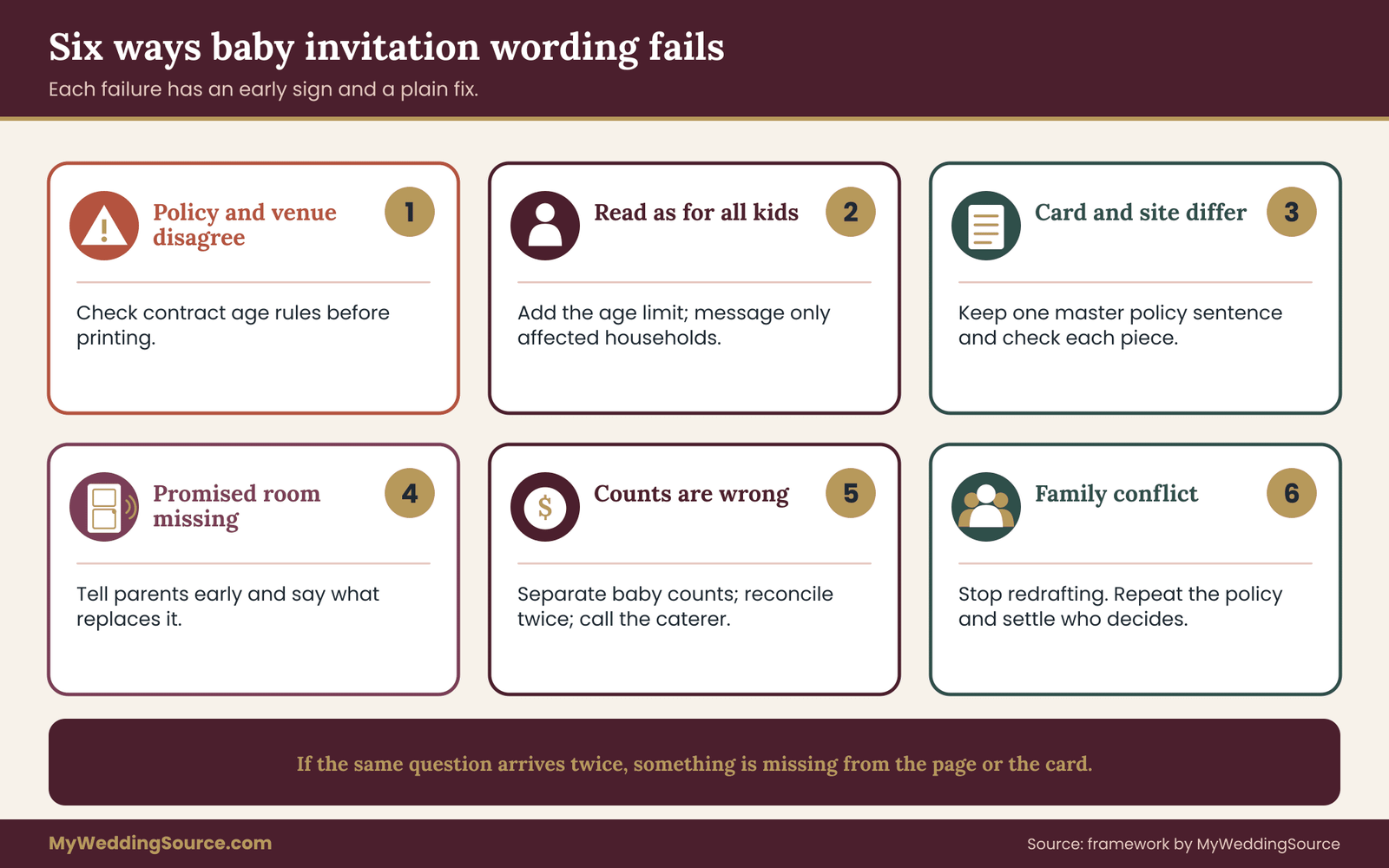
Failure one: the policy and the venue disagree. The invitation says babies are welcome, and the venue’s contract limits guests by age, bans strollers in the main room or caps occupancy by headcount. Check the contract language for any age rule before you print. If you find a conflict after printing, correct it on the website the same day, send a short message to affected households, and ask the venue whether an exception can be written into the contract.
Failure two: the baby invitation wording is read as an invitation to everyone. A line such as “Babies are welcome” can be read by a parent of a toddler as “children are welcome.” The fix is the age definition. If the line has already gone out, send a clarification to the households affected, rather than to everyone, and keep it short and factual.
Failure three: the website says one thing and the card says another. This happens when the website is updated and the printed pieces are not. Keep one master version of the policy sentence and check each piece against it whenever anything changes. If the printed card is older than the website, the website should say “This replaces the policy on the printed invitation,” and name the change.
Failure four: a promised accommodation does not exist. If you promised a quiet room and the room is unavailable, tell parents as soon as you know, and tell them what you will do instead. A parent who arrives expecting a room and finds a corridor will remember the surprise, not the apology.
Failure five: the count is wrong. If the number of babies, highchairs or meals differs from what you gave the caterer, you may have too few or too many. This is why the RSVP card asks the questions separately, and why the reconciliation steps matter. If you find a gap close to the date, call the caterer rather than emailing, and confirm the change in writing.
Failure six: the baby invitation wording causes a conflict you cannot resolve. A family may be hurt by the line, or a relative may insist on an exception for their grandchild. When a conflict turns into a family dispute, the baby invitation wording is no longer the problem. Decision rights and boundaries are. Return to the one-sentence policy you wrote at the start, repeat it calmly, and settle who has the final say before you draft anything else.
Alternatives when baby invitation wording is not enough
If you find that your policy is generating more friction than you expected, there are alternatives that change the situation rather than the sentence.
A childcare room with a vetted provider. Some couples arrange childcare at or near the venue so that parents can attend the ceremony and dinner. This changes the policy from “babies are not invited” to “babies are looked after nearby,” and it needs its own vetting and contracts, which are beyond the scope of this guide.
A split schedule. A ceremony that welcomes babies and a reception that does not, with a gap in between, lets families choose how much of the day to attend. It requires clear timing on the invitation and an honest conversation with parents about the gap.
A separate casual gathering. A brunch or picnic the next day that welcomes families, as a complement to an adults-only evening. This gives guests who cannot attend the main event a way to celebrate with you. It adds cost and logistics, so decide it early.
A livestream for guests who cannot come. Parents who cannot attend because of a baby may want to watch. If you plan to livestream, say so on the website, and check the venue’s connection and the guests’ privacy preferences first.
None of these is better than another in general. Which one suits your wedding depends on your venue, your budget and the people involved.
How to know the baby invitation wording worked
A practical test is the number of questions you receive. If your baby invitation wording is working, parents will ask very few questions about whether their baby is invited and where they can feed or change, and the questions they do ask will be unusual ones. If you are still receiving the same question from several guests, the page or the card is missing something. Add it.
A second test is the day itself. If the first guest with a baby arrives and knows where to go, where to sit and when things start, the wording did its job.
Your next steps
Start with the one-sentence policy. Write it, test it against three real guests and your venue, and confirm that both partners and any hosts agree. Then add the age definition and decide your exception rules. With those two lines settled, address the envelopes by name, write one or two sentences for the invitation, and add a counting line and a highchair question to the RSVP. Last, draft the two-part FAQ for your website and walk the venue with it in hand.
Keep the policy sentence somewhere you can find it, and use it whenever a question arrives. If you are still working through the larger list of tasks, the wedding planning checklist is a good place to keep this work alongside everything else. Clear baby invitation wording is a small job, and it spares your guests and yourselves a good many awkward messages.
FAQ
What is the best way to word an invitation for guests with babies?
State your policy in one plain sentence and define the age. For example: “Babies under twelve months are welcome at the ceremony and reception.” Put it where guests will see it, such as the reception card or the RSVP card, and put the details on your website. Avoid apologies and vague words such as “little ones.” A clear line answers the parent’s question before they have to ask you.
Should we say “adults only” if we welcome babies?
Say “adults-only celebration” only if you follow it with the exception for babies, because otherwise a parent of an infant will assume the baby is not invited. A better sentence names the exception directly: “We have planned an adults-only celebration. Babies under twelve months are welcome.” The two sentences together give the rule and the exception in a way no reader can misread.
How do we address an envelope for a family with a baby?
Write the name of every invited person. Put the parents’ names on the outer envelope and the baby’s name on the inner envelope or a second line, such as “and Noor.” Do not write “and guest” or “and family,” because each of those can be read as a different number of people. If you invite a baby but not an older sibling, name only those invited.
How do we count babies on the RSVP?
Ask for babies separately from adults. Use a line such as “Number of babies attending (under twelve months)” and a short follow-up about whether a highchair is needed. Then ask your caterer and venue, in writing, how each counts infants for meals, seats and occupancy. Record seats, meals and highchairs in separate columns so your totals match what each vendor needs.
What belongs in an infant accommodation and expectation FAQ?
Two halves. The accommodation half says what you provide: a feeding space, changing surface, highchairs, food options and who supervises. The expectation half says what to expect: the schedule, loud moments, where to sit, what happens if a baby is unsettled and whether leaving early is fine. List only what is confirmed, and add a last-updated date and one contact for questions.
What if a guest brings a baby we did not invite?
Decide in advance who will speak to the guest and what they will say. Stay private and kind, state the policy once and offer a practical solution if you have one, such as a quiet room. If your policy includes an exception for infants, apply it consistently. Writing down any exception you make helps you respond the same way to the next family.
Can we ask about a baby’s health on the RSVP?
No. Do not ask for health information of any kind. Parents decide about travel, crowds and illness with their pediatrician, and the invitation is not the place to ask. If a parent offers information, listen and respond kindly. For general public health guidance on infants, point guests to the Centers for Disease Control and Prevention or the American Academy of Pediatrics rather than giving your own advice.
When should we send the baby details to guests?
Put the policy line on the invitation, and publish the website FAQ before or when invitations are mailed so it is available when parents begin to decide. Update the page when anything changes and give it a last-updated date. Send a short message only when a change affects a decision, such as a changed time or a different feeding space.
Sources
- Patient education on pregnancy, postpartum and newborn care, American College of Obstetricians and Gynecologists
- Parenting and infant health information, American Academy of Pediatrics HealthyChildren.org
- Breastfeeding information for families and employers, Centers for Disease Control and Prevention
- Respiratory syncytial virus and infants, Centers for Disease Control and Prevention
- Vaccines for infants and children, Centers for Disease Control and Prevention
- Safe sleep for babies, Centers for Disease Control and Prevention
- Child and infant product safety, U.S. Consumer Product Safety Commission
- Traveling with children, Transportation Security Administration
- Car seats and booster seats, National Highway Traffic Safety Administration
- Addressing standards for mail, United States Postal Service