
Medication storage at a wedding venue is a small logistics problem with a large privacy edge: someone needs a safe, cool or locked place for their medicine, and a few people need to know just enough to make that work. This guide sorts the needs into three types, sets a four-ring rule for who is told what, and gives you the questions to ask a venue about refrigeration and secure space.
Start by sorting each person’s medication storage need into one of three types: it stays on the person, it needs a cool place, or it needs a secure place. Medicine that may be needed in minutes, such as an inhaler or an auto-injector, stays within the owner’s reach and is never put in storage. Share only the logistics (where, when, who holds the key) and never the diagnosis. Ask the venue about refrigeration, locking, access hours and staff changes in writing, and keep a fallback ready in case the answer is no.
Most wedding planning documents assume a healthy, flexible body. Then someone in the wedding, the family or the guest list needs to refrigerate an injectable, keep a controlled medicine away from curious hands, or take a dose at a fixed time that lands in the middle of the portrait hour. The venue has a catering kitchen, an office and a bridal suite, but nobody has asked which of those can hold a small insulated bag. The question tends to surface at the last minute, in a hallway, with too many people listening.
That hallway moment is where privacy leaks. A person who simply needs a shelf in a refrigerator ends up explaining a condition to a banquet captain, a florist and an uncle. Good medication storage planning avoids this by splitting the problem in two. The first half is practical: what has to be stored, at what conditions, for how long.
The second half is about information: who actually needs to know any of it, and in what words. Medication storage done well is almost invisible to everyone except the owner and one or two helpers.
This guide covers both halves for weddings. It is written for couples, planners and anyone who is the “owner” of a medication storage need and wants it handled quietly. It does not tell anyone what to take, how to store a particular drug or what is safe. Those answers come from the prescriber, the pharmacist and the label. What this guide covers is the part those professionals do not: the venue, the schedule, the people and the paperwork. Keep that goal in view: medication storage should be dull, predictable and private.
A note on scope. This guide is general planning information, not medical, legal, tax or financial advice, and each person’s own care team makes decisions about their treatment.
What medication storage at a wedding venue involves
A wedding day is unusual for medicine. It stretches across many hours, it moves between several rooms, it is often warm or crowded, and the person involved is busy and may be nervous. Normal routines such as taking a dose with breakfast at home, with the medicine in the bathroom cabinet or the kitchen refrigerator, no longer map onto the day. Medication storage at a wedding becomes a question about places and handoffs instead of habits.
Four elements are in play every time, and it helps to name them. These four elements describe any medication storage need, whether it involves a couple, a guest or a vendor.
The item. What needs to be kept, in plain terms such as “a small refrigerated item”, “a locked item” or “an item that travels with me”. You rarely need the drug name or the reason. The venue needs the storage condition, not the diagnosis.
The place. A refrigerator, a lockable drawer, a cabinet, a bag that travels with the owner, a hotel room, a car. Each has strengths and weaknesses that later sections cover in detail.
The people. The owner, a backup person, venue staff, a planner, and in an emergency, responders. Each needs different information.
The timing. When the item must be accessible, when it must be returned to storage, and how long it can safely sit out. The pharmacist or prescriber supplies that last part; the planner builds the schedule around it.
Why privacy belongs in the same conversation
Storage decisions and privacy decisions arrive together. To ask for a refrigerator shelf, you have to say something to somebody. The choice of whom to say it to, and how much to say, is the privacy decision. A short request to the venue contact (“one guest needs a small refrigerated space, and we would like it in a private area”) reveals much less than a long explanation to the caterer.
Many people are comfortable disclosing a lot to one trusted person and almost nothing to everyone else. The planning approach should honor that.
Health information also feels different from other wedding logistics. A seating chart error is embarrassing; an unwanted guess about someone’s health can be hurtful, and it cannot be taken back. That is the reason this guide treats the “who needs to know what” question as a design step and not an afterthought. Medication storage touches that sensitivity directly, because a bag or a refrigerator shelf can reveal a lot.
What this guide does not cover
Three nearby topics have their own guides, and this article will not repeat them. If the person needs a caregiver or aide on site, the guide on coordinating a wedding caregiver explains roles, breaks and handoffs. If the concern is that the venue itself may not be accessible, the red flags in an accessible wedding venue are the right place to start. And if the issue is pacing a day around fatigue, that is a scheduling problem rather than a medication storage problem.
What remains is narrow and specific: where does the medicine live during the event, and who is told what. A narrow focus makes the answers concrete. Narrow medication storage questions get narrow, usable answers, and each one is easy to put in writing.
Sorting medication storage needs into three types
Not all medication storage needs are the same, and the type decides almost everything else: the questions to ask, the people to tell and the fallback to prepare. Sort each item into exactly one of the three types below. If an item fits two, treat it as the more demanding type. A short sort at the start prevents most medication storage mistakes.
Type one: stays on the person
Some medicine must always be within the owner’s reach, or within a few steps of them, because the need can arise quickly. Common examples include rescue inhalers, epinephrine auto-injectors and certain emergency items for diabetes or seizures. The owner, together with their prescriber, decides which of their items belong here.
For this type, medication storage is not a place at the venue. It is a carrying plan. The question is how the item stays on the person through a ceremony, a portrait session, a dance floor and a change of outfit. A wedding dress without pockets, a fitted suit, a swimsuit for a pool party and a bridesmaid’s strapless gown each solve it differently, which is why a planner should ask about outfits early.
If the item must be on the person, the clothing has to be able to carry it, or a nearby person has to.
The rule for this type of medication storage is that it never goes into a “storage room.” Putting an emergency item in a locked cabinet because it seems tidy defeats its purpose. If the venue offers to hold it, the answer is no thank you.
Type two: needs a cool place
Some items have a label instruction such as “keep refrigerated” or “do not expose to heat”. This type introduces the venue refrigeration questions: where is the unit, who can open it, what else is inside, how is the temperature kept, and how will the owner get to it.
The owner or the pharmacist sets the exact conditions for medication storage. A planner should not guess, and should not offer to “just keep it in the cooler” without the owner’s agreement. A cooler with ice packs, a small portable unit, a hotel room refrigerator and a catering walk-in are four different environments, and a pharmacist is the right person to say which is acceptable for a particular item and for how long.
Type three: needs a secure place
Some items should be locked away or kept out of general reach. These include medicine the owner does not want others to see, items that could be misused, medicine that must be kept away from children, and any controlled substance. The concern is less about temperature and more about access and visibility.
Secure medication storage does not have to mean elaborate. A lockable bag the owner carries, a lockable drawer in the venue’s office, or a bag in a hotel safe can all work. What matters is that the person who needs the item can get to it when they need it, and that the person who should not reach it cannot.

Mixed items and edge cases
Real situations do not always sort neatly. An item may stay on the person for most of the day but need a cool place for a dose that is due at dinner. A travel pack may include one refrigerated item and three ordinary ones. A guest may have a device, not a medicine, such as a continuous glucose monitor or a sleep machine that needs power and a private place. A single weekend can hold three kinds of medication storage at once, one for each person involved.
When an item fits two types of medication storage, plan for the more demanding one and write both requirements on the owner’s one-page sheet. Section by section, the rest of the guide reuses this three-type language, because it keeps the conversation with the venue short: “one item, type two, needs a refrigerator shelf between two and nine in the evening” is clear without sharing anything else.
A quick sorting exercise
Take five minutes with the owner, away from other people, and answer three questions for each item. Must it be within reach at all times? Does its label say anything about temperature? Is there any reason it should be locked or hidden? The first “yes” decides the type, in that order, because reach beats temperature and temperature beats privacy when they conflict.
Then write the answer on a sticky note, not in a group chat. The next section explains why. Medication storage decisions made this way take minutes, and they save an awkward conversation later. ## Need to know: the four-ring privacy ladder for medication storage
The central tool in this guide is a ladder of four rings. Each ring is a group of people, and each ring gets a defined, limited amount of information. The rule is simple: tell a person the smallest amount that lets them do their part, and tell them no earlier than they need it. It is the heart of private medication storage planning, and the rest of the guide hangs on it.
Ring one: the owner. The person whose medicine it is. They hold all the information and make every decision about it, including whether to disclose anything at all. Nobody else can waive the owner’s privacy for them, not a partner, not a parent and not a planner.
Ring two: one backup person. Someone the owner trusts and who will be near them on the day. This person knows where the item is, what to do if the owner cannot get to it, and whom to call. They may know more than that if the owner chooses, but the minimum is location and the plan.
Ring three: logistics contacts. The venue manager or coordinator, the planner, and sometimes the caterer. They need to know the storage condition, the timing and the access arrangement. They do not need the name of the medicine, the diagnosis or the history.
Ring four: emergency responders. If an emergency happens, medical responders need whatever helps them most, quickly. That is a different standard, and it is covered in the failure-conditions section. A written card in the owner’s pocket and a verbal briefing to the backup person handle it without telling anyone else.

What “need to know” means in practice
The phrase is easy to say and hard to apply. A useful test is to ask of each person, “What would they do with this information?” If the answer is “nothing”, they do not need it. If the answer is “hold a key”, “open a refrigerator” or “call me at four o’clock”, they need exactly that and no more.
Consider a banquet captain. They need to know that a small insulated bag will be placed on a shelf in the kitchen refrigerator and that a specific person will collect it at a set time. They do not need to know what is in the bag. Staff who handle it should be asked to treat it like any labeled item: do not open it, do not move it without the owner or backup present, do not discuss it. This is medication storage handled as a small, ordinary kitchen request.
Consider a bridesmaid who is not the backup person. She may notice the owner leaving at four o’clock every day. She does not need an explanation. A simple line that the owner prepared in advance, such as “I have a short break scheduled, I will be right back,” closes the question. People are generally content with a plain statement that does not invite follow-ups.
Words that disclose less
Phrasing matters as much as the list of people. Compare two versions of the same request to a venue. The first says that a guest has a medical condition and needs to store a medicine. The second says that a guest needs a small refrigerated space and a place to sit for a few minutes. The second one passes the necessary information and nothing more.
Some phrasing habits help across all rings:
- Use “item” or “personal item” in written requests, not the name of the medicine or the condition.
- Describe the need as a condition of the space (“refrigerated”, “locked”, “private”), not as a feature of the person.
- Use “one guest” or “a member of the wedding party”, not a name, in early inquiries, and share the name only when the venue needs it to make an arrangement.
- Keep the written record short, and put it in an email the owner approves before sending.
A caution on group chats and shared documents
Wedding planning runs through group chats, shared spreadsheets and cloud folders. These tools are convenient and they are poor places for health information. A shared run-of-show that includes “insulin at 4 pm” has now disclosed the information to every vendor with access. A group chat with fifteen people has disclosed it to fifteen.
The fix is easy. Keep the medication storage sheet separate from the shared documents. Put only a neutral line in the shared schedule, such as “4:00 pm private break, 10 minutes,” and put the real details on the one-page sheet held by the owner and the backup person. If the planner needs the sheet, send it to the planner alone and ask them to keep it out of vendor packets.
The wedding day digital contingency plan covers backup files and permissions for the rest of the event in more detail. Medication storage details do not belong in any file a vendor can open.
Who may not be told, and what to do when they ask
Sometimes a well-meaning relative or vendor asks directly. The owner has three options: decline politely, give a general answer, or share more. All three are legitimate. A short script helps: Questions about medication storage are the most common ones, because bags and refrigerators are visible.
“Thank you for asking. It is a personal item and it is taken care of. If we need anything from you, we will say so.”
Said once, in a calm voice, this ends most conversations. If someone presses, the backup person can step in with the same answer. Nobody is owed more.
Who owns the medication storage plan
Medication storage needs show up for different people in a wedding, and the right owner of the plan depends on who it is. Settling this early prevents two common mistakes: a planner who takes over and over-shares, and an owner who is left to arrange everything alone on a day when they have other things to do.
One of the couple
When one partner has the need, they own the plan, and the other partner is usually the natural backup. That is convenient and it has one weakness. On the wedding day the partners are together, so a single event, such as a delay, can strand both. A second backup person who is not in the couple’s immediate circle, such as a sibling or close friend, removes the single point of failure. The guide on wedding decision rights is useful if family members start offering opinions about how much to share.
A member of the wedding party
Attendants often have the need and say nothing, because they do not want to make a fuss. The couple can open the door with a general question to everyone in the party, such as “Does anyone need a place to keep personal items, a quiet space or a fixed break?” No names, no reasons. Replies arrive privately, and the couple or planner then arranges the logistics one person at a time. Many people with medication storage needs stay silent until someone makes it easy to ask.
A guest
Guest needs are the hardest to plan, because the couple often has no information. A gentle general line on the invitation website or RSVP, offering to help with access and medication storage needs on request, sets up a private channel. The guide on wedding guest hotels and mobility shows how to run a similar question for lodging.
For the day itself, the couple should not hold a guest’s medicine. The guest or their own companion keeps it, and the couple arranges only the space. Guest medication storage is hardest because the couple starts with no information.
An older relative or someone with a caregiver
When a caregiver attends, the caregiver often handles medicine and storage already. The planner’s job is to give the caregiver a place and a schedule, not to replace their judgment. The relative remains the owner of information, even when a caregiver holds the bag.
A vendor or staff member
Photographers, DJs, bartenders and servers also have medicine needs, and they work long hours. A venue should have a standard answer for staff, and a couple can ask the vendor’s manager what their policy is. This is a minor point of respect: a vendor who must ask the couple for a refrigerator shelf is in an awkward position, and a vendor whose own company has a policy is not.
The rule that applies to all of them
Whoever owns the plan, the same three duties apply. The owner decides how much to disclose. The planner or couple provides the logistics and keeps the information narrow. And a backup person exists, so the day does not depend on one set of hands. Those three duties are the backbone of any medication storage arrangement.
Deciding when to start
Begin as soon as you know there is a need, because venue answers can take days and some arrangements, such as a dedicated refrigerator shelf or an extra key, require approval from a manager who is not always on site. Raising it at the final walkthrough is possible but leaves little room for a fallback. Raising it at the tour or at contract time lets the venue add it to the agreement, and lets you compare venues on the answer.
The wedding venues guide explains how to compare venues on other practical points, and medication storage fits into the same list of questions. Early medication storage questions also give you room to compare venues fairly.
A short worksheet for each owner
For each person with a need, write one line under each heading, in this order: type (one, two or three), condition of the space, timing windows, the backup person, the logistics contact and the fallback. That is six lines. If it takes more than six lines, you are probably recording more than the venue or the backup person needs. The sheet stays with the owner and the backup person. The next section turns the first two headings into questions for a venue.
Venue refrigeration questions for medication storage
For a type-two item, the venue’s answers decide whether medication storage works at all. Venues vary enormously. A hotel ballroom may have a full kitchen with several units, a barn may have a rented catering trailer, and a garden may have nothing but a portable cooler. The goal of the venue conversation is to learn which situation you are in, in writing, before you sign. Strong medication storage depends on specific answers, so keep a written list of what each venue says.
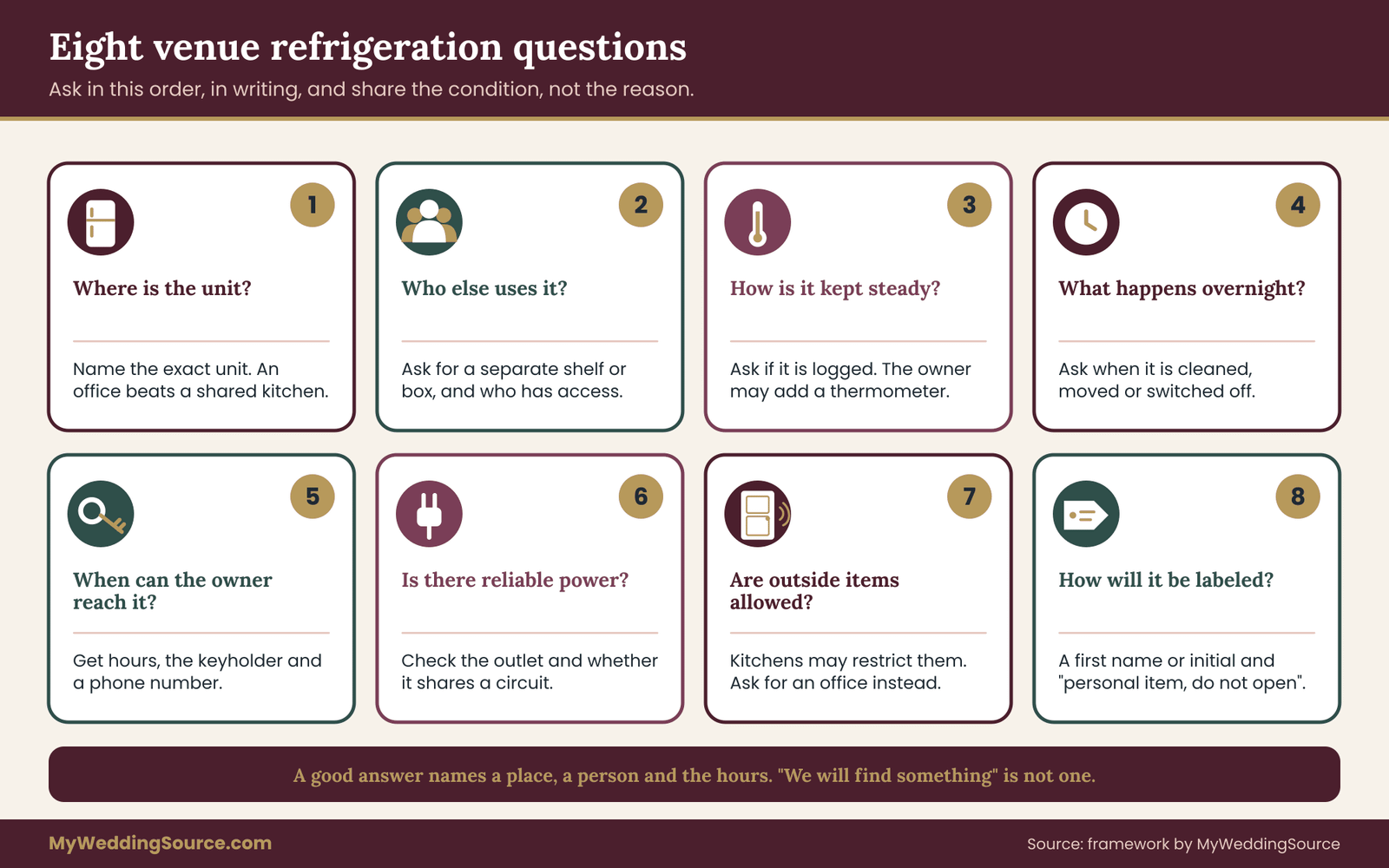
Ask the questions below in order. Each comes with the reason it matters and what a useful answer sounds like. Share the item type and the time window, not the reason for either.
Question one: is there a refrigerator the owner can use, and where is it?
You are asking about location and ownership. A unit in the catering kitchen is usually shared with food, and a unit in a private office or the bridal suite is often better for medication storage because it is quieter and less visited. A useful answer names the exact unit, such as “the small refrigerator in the manager’s office”. A vague answer, such as “we will find something,” is a signal to ask again.
Question two: who else uses it, and who can open it?
A catering refrigerator opens dozens of times during service. If the item sits among trays of food, the risks are contamination, mix-ups and curious staff. Ask whether the unit is shared, whether a separate shelf or a sealed container can be set aside, and who has access during the event. The answer should name roles, not just “staff”. Shared units are the weakest form of medication storage for that reason.
Question three: how is temperature kept and checked?
The pharmacist tells the owner the acceptable range. The venue does not have to know the range, but it does need to say whether it can keep a unit steady and whether anyone checks it. Some venues log temperatures for food safety, which is a good sign. Others have older units with no display. If the owner’s pharmacist has asked for a thermometer, ask whether the owner may place one inside, and whether the unit might be switched off or unplugged overnight.
Question four: what happens to the unit between setup and breakdown?
Refrigerators are unplugged for cleaning, moved for deliveries or shut down at the end of an event. A unit in a rental trailer may be returned the next morning. Ask about the schedule of the unit: when is it turned on, when it is cleaned, and who is on site at what time. Pair this with the owner’s timing windows so the item is never in a unit that might lose power.
Question five: can the owner reach it at the times needed?
Access is the question that couples forget. A refrigerator in a locked kitchen is useless at nine in the evening if the kitchen closes at eight. Ask for the hours of access, the person with the key and a way to reach that person. If the owner may need a dose in the middle of the portrait hour, ask whether the unit is near enough to the portrait location, or whether a small portable option is better.
Question six: is there power, and is it reliable?
For a portable unit or a device that charges, the question is whether there is an outlet nearby and whether it shares a circuit with sound or lighting equipment. The venue technical walkthrough explains how to map outlets and loads ahead of time, and the same mapping works for a small refrigerator.
Question seven: what is the policy on outside items in the kitchen?
Some venues and caterers restrict what may enter a commercial kitchen because of food-safety rules. A venue may say no for a reason that has nothing to do with the owner’s need. Ask whether an exception is possible, and whether an alternative space such as an office is offered. If the venue can only say no, move to the alternatives section and do not argue about the kitchen. A venue may refuse the kitchen and still offer a good medication storage alternative elsewhere.
Question eight: will it be labeled, and by whom?
A sealed bag labeled with a first name, or an initial, and the words “personal item, do not open” is enough. Ask whether the venue has a standard label or prefers the owner to bring one. The label should reveal nothing about the contents and nothing that could identify the person to someone who walks past.
What a good written answer looks like
A good reply from a venue is short and specific. For example: the unit is in the manager’s office, it is not shared with food, the manager and one named coordinator can open it, the office is open from noon until the end of the event, and the unit stays on overnight.
A weak reply is “No problem, we will take care of it.” The first can be put into the contract or an email thread. The second cannot be checked later. Anything less precise should be treated as an open question about medication storage, not a yes.
If the venue seems uncomfortable
Some venue staff have never been asked and are unsure how to respond. Keep the tone ordinary. Say that it is a small, routine request and that you would like to avoid causing the staff trouble. Offer to bring your own insulated container, a thermometer and labels so the venue does not have to improvise. Most staff respond better to a clear, small request than to a vague big one.
Secure space questions for medication storage
Type-three items depend on a different set of questions, because the main risks are access and visibility. A secure space can be a locked drawer, a lockable cabinet, a safe, a private room with a lock or a bag the owner carries and locks. The questions below help you find the right one. Secure medication storage is more about people than equipment.
Who has keys or codes, and how many copies exist?
A lock only helps if you know who can open it. Many venues have a master key that opens every internal door, and many venue offices are unlocked for most of the day. Ask who holds keys to the specific cabinet or drawer, whether a separate lock can be used, and whether the codes are shared with temporary staff. A useful answer is “the manager and the coordinator, and nobody else”. Keys are the center of secure medication storage.
Is the space watched, or is it passed through?
A cabinet in a corridor that every vendor walks through is less private than a cabinet in a closed office. Ask about foot traffic and, where relevant, cameras. Cameras are not a privacy problem for the item, but they can matter if the owner is concerned about being seen retrieving it. Some venues have cameras in service corridors and not in private rooms.
How is the item handed back?
Plan the handoff as carefully as the storage. The owner or backup collects the item from a named person at a set time, and the person releasing it confirms the label and the identity of whoever collects it. This protects against someone picking up the wrong bag and against a stranger claiming to be the owner’s friend.
What happens if the keyholder is unavailable?
Staff leave early, shifts end and managers are pulled away. Ask for a second keyholder and for a phone number that reaches someone during the entire window. If a controlled item is involved, think through what happens if the only person with the key leaves the building at nine and the owner needs it at ten.
Can the owner keep the item on their own person instead?
In many cases, the better answer to a security question is that the item never leaves the owner. A small zippered pouch, a lockable travel case or a bag held by the backup person may be safer and more private than any shelf at the venue. The venue answer then becomes “no medication storage needed, only a place to sit and a short break.” Sometimes the most private medication storage is the owner’s own pouch.
Rules for controlled medicines
Some prescription medicines are controlled substances, and the rules about carrying, storing and transferring them are specific. The owner should keep these in the original labeled container and should never hand them to another person to hold, mix with other items or leave unattended. A venue is not a pharmacy and should not be asked to take custody. Any question about the legal handling of such an item goes to the pharmacist or prescriber, and agencies such as the Drug Enforcement Administration publish general information for the public.
Children, pets and curious guests
At a family wedding, young children and pets may be in rooms where adults leave bags. Medicine left in a purse on a chair or in a coat pocket in a cloakroom is easy to reach. A lockable pouch, a bag kept with the backup person or a locked drawer all reduce the risk. If children will attend, a supervised children’s area, with its own adult in charge, also keeps bags away from small hands.

The one-sentence answer test
After the venue answers, summarize the arrangement in one sentence: “The item is in a locked drawer in the manager’s office, only the manager and the coordinator have keys, and the backup person collects it at four.” If you cannot say it in one sentence, the arrangement is too loose. Ask again until it is clear, then record it in writing.
Scripts for asking about medication storage
Knowing the right questions is half the job. The other half is wording them so the venue answers clearly and the owner stays in control of the story. The scripts below are templates in plain language. Adjust names and times, and keep each one short. A request that fits in four sentences gets a clearer answer than a long explanation. Clear scripts keep medication storage requests short and calm.
The first email to the venue
Send this from the couple, or from the planner on the owner’s behalf, once the owner has approved it.
“One member of our party needs a small refrigerated space for a personal item from about two in the afternoon until the end of the evening. We would like it in a private area, not shared with food, and we would like to know who can open it. Could you tell us what you have available, who has access, and what hours that person is on site? We are happy to supply our own labeled container.”
This version names the condition, the window and the privacy preference. It does not say who, why or what. It is a model for any medication storage request.
A follow-up when the answer is vague
“Thank you. To confirm, the item would be kept in the manager’s office refrigerator, not the kitchen, and only the manager and the coordinator could open it. Is that right? And would the unit stay powered on overnight?”
Restating the arrangement in your own words, with a question mark, gets a yes or a correction. Either one is useful.
A request for a secure space
“We would like a lockable place for a personal item for the afternoon and evening. It does not need to be cool. Could you tell us who holds the key or code, and whether the owner or a named backup could collect it at set times?”
Telling the planner
A planner is in ring three, so they need logistics and little else. Keep the written message short and send it only to the planner.
“One of our guests will need a private break at about four, and a small refrigerated space that is not shared with food. We would prefer to keep the reason private. Please do not add details to vendor documents. We will give the venue the logistics directly.”
A good planner will not ask for the reason. If they do, the owner may say, “I would rather keep that private, and the logistics are everything you need.” Planners who handle medication storage well do not need the story.
Telling the caterer
Caterers and servers are often the ones who see the refrigerator. If the item will be anywhere near the kitchen, one line to the catering manager avoids surprises.
“A sealed, labeled personal bag will be on a shelf in the unit from two until close. Please treat it as an item that stays closed and stays where it is, and call the coordinator if anything about it is unclear.”
Telling the backup person
This is the most important script, and it is spoken, not written. The backup person needs to know, in this order: where the item is, when the owner needs it, what to do if the owner cannot reach it, and whom to call.
“If I am not near my bag at four, please bring it to me. It is in the manager’s office, and the coordinator has the key. If anything seems wrong, call the number on this card first. I will explain anything else you want to know, but you do not need it today.”
The final sentence matters. It tells the backup person that the owner has set the limit, and it keeps the conversation friendly.
Telling the wedding party
When no one needs to be told, no one is told. If the owner will be absent from the line-up for ten minutes, the photographer and the planner need the time, and the rest need nothing. A line on the schedule that reads “4:00, private break, ten minutes” is enough. If someone asks, the owner can say, “I’m taking a short break.” That is true and it ends the conversation.
Inviting guests to share needs privately
A guest-facing line should be general, warm and voluntary. Something like the following works on a wedding website or in a message with the RSVP.
“If you have any access, rest or medication storage needs for the day, such as a quiet place or a spot to keep personal items, tell us and we will work it out privately. You do not need to explain.”
The last sentence is the one guests remember. Without it, many people stay quiet. With it, a few will reply, and each reply gets its own private handling.
Answering a guest who asks for storage
When a guest replies, answer within a day or two, and keep your reply as short as theirs. Ask only what you need: the condition (cool, locked, within reach), the time window, and the best way to reach them on the day. Do not ask for the name of the medicine, the condition or a doctor’s note. If the guest volunteers the detail, accept it quietly and do not repeat it to anyone else.
Tone and timing
Two habits make these conversations easier. First, treat the request as routine: a calm, matter-of-fact tone tells the other person that it is routine for you, and it usually becomes routine for them. Second, send requests in writing where possible, and confirm verbal agreements by email afterwards. A short written record helps the owner if staff change, and it gives you something to point to if the arrangement slips on the day. Medication storage requests become routine when they are handled in a routine way.
What to avoid saying
A few phrases make things worse. Avoid asking a vendor to “keep an eye on” an item, because it implies responsibility they have not accepted. Avoid describing the owner in front of others (“she has a condition”). Avoid asking staff to hold items that must stay within reach. And avoid using a name in a group email, even a first name, if the sentence also describes the need.
Texting versus calling
A phone call lets you hear hesitation and respond in real time, which is useful when a venue manager seems unsure. It leaves no record. A text or email leaves a record and no tone. The best pattern for medication storage is a short call to open the conversation and a written confirmation immediately after, such as “Thanks for the call.
To confirm, the item will be kept in the manager’s office unit and collected by the backup person at four.” The confirmation turns a good conversation into something you can rely on.
When someone breaks the confidence
Mistakes happen: a vendor mentions a guest’s need to another vendor, or a relative repeats what they overheard. If this happens, do not blame the person in public. Speak to them privately, say what happened and what you need them to do now, and tell the owner.
The owner decides whether to say more to anyone. Then tighten the paper trail by removing details from shared documents and reminding the vendors who must act on the information. The cost of a calm correction is small, and it keeps a lapse from becoming a pattern.
A note about hotels and rental houses
A wedding weekend often includes lodging, and hotels have their own answers. A room refrigerator, a minibar that is emptied for guest use, or a front desk that can hold items are different tools. When you ask the hotel, use the same language: a small refrigerated space, a private place, a named person with access.
The same approach you use for lodging in general applies, and the question you add is whether a room refrigerator can be set up at check-in without comment. Ask for it as a routine request rather than a medical one. Medication storage at a hotel follows the same logic as at the venue. ## Worked case: medication storage across an invented wedding weekend
The example below is invented to show how the steps fit together. The people, venue and timings are made up, and nothing here is a recommendation about any real treatment. The point is the process: sort, set the ring, ask, confirm, rehearse and keep a fallback. Treat it as a model of medication storage planning, not a medical template.
The setup
Dana and Priya are marrying on a Saturday at an event venue with a ceremony lawn, a reception hall and a catering kitchen. Dana’s brother Marcus is a groomsman and needs medication storage for one item. Dana’s aunt Joyce, a guest, will travel two hours and needs a cool place for one item and a locked place for another. Priya has a small device she wears all day and needs a power outlet during the reception. None of them wants the story told widely.
Step one: sort the items into types
Marcus’s item is one that his pharmacist says must stay cool. That is type two. Joyce has two items: one that stays cool and one that she prefers to keep locked, so one type two and one type three. Priya’s device stays on her and needs charging. That is type one, plus a small power question. It is the simplest kind of medication storage, and it still needs a plan.
Marcus also carries an emergency item that must be within reach all day. It is type one, and the groomsmen’s suits are fitted. Marcus and Dana talk about it privately, and the tailor adds an inside pocket. No venue question is needed.
Step two: choose the rings
Each person picks one backup. Marcus picks his husband, Elliot, who will be at the wedding all day. Joyce picks her daughter Mei. Priya picks her best friend Tomás. Dana, who is also the planner for the day with a small team, is in ring three for all three, along with the venue manager. The caterer needs to know only that the manager’s office is the storage location, not the kitchen.
Dana sends a short general message to the wedding party and one to all guests, as in the scripts section. Marcus and Joyce reply privately.
Step three: ask the venue
Dana emails the venue with the first-email script, asking for a refrigerated space for two personal items, a lockable space for one and an outlet near the head table. The venue manager replies in two days: the small refrigerator in the manager’s office can be used, no food is stored in it, the manager and one coordinator have keys, and the office is staffed from one in the afternoon until the end of the night. For the locked item, the manager offers a lockable drawer in the same office.
Dana confirms back in writing, repeating the arrangement, and adds the one detail she cares about: does the unit stay on overnight? The manager says it does.
Step four: check the weak points
Dana looks for the places where this arrangement could break. The office closes if the manager leaves early; the second keyholder is the coordinator, who also runs the cake cutting at six. The two overlap. Dana asks for a third person and the manager names the assistant manager. The unit is a household-size refrigerator and the manager has no thermometer, so Marcus and Joyce each bring their own, as their pharmacists suggested. This is the step that turns a hopeful plan into reliable medication storage.

Step five: the day-of timeline
Joyce arrives at one with Mei and carries her items in an insulated bag. Mei hands the bag to the coordinator at the office door. The coordinator checks the label, places the bag in the unit and puts the locked item in the drawer. Mei writes the time on a small card and keeps it.
Marcus’s bag goes in at one thirty with the same routine. Marcus’s next need is at about five. At four forty, Elliot reminds him in a low voice, and they walk to the office together. The assistant manager opens the door, Marcus collects the bag, and they walk to the reception hall’s quiet corner. The break takes about ten minutes, and the photographer has been told about “a short private break” and nothing else.
Step six: what goes wrong
At five o’clock, the coordinator is busy with a missing cake knife, and the manager has stepped out. Elliot calls the phone number on the card, reaches the assistant manager in two minutes and gets the door opened. The backup plan works because it was rehearsed once on paper and the number was reachable.
Later, the reception hall’s power trips briefly during the first dance. This affects the sound system, and Priya’s device charger, which shares the circuit. Tomás had brought a portable battery pack because Dana had suggested it, and Priya switches to it. The venue moves the charger to another circuit before dinner.
Step seven: the handback and the review
At the end of the night, Mei collects Joyce’s items with the card, signing nothing and saying little. The assistant manager checks the label and hands them over. The unit is left on, as promised. The next morning, Dana sends a short thank-you to the venue manager, with a note that the arrangement worked and a request that the same approach be written into its standard guest-support notes.
What the example shows
The case works because of ordinary habits more than special ones. Each item was sorted into a type before anyone called the venue. Every ring was kept narrow. The venue’s answer was written down and then restated. A third keyholder was found before the day. A thermometer, a battery pack and a card with a phone number cost almost nothing. And the people who were not told anything were never confused, because they were never given half a story. That is how medication storage should feel: ordinary, quiet and predictable.
What you could change
Not every wedding has a manager’s office. If this venue had no refrigerator outside the kitchen, Dana would have asked the catering manager for a closed container on a high shelf with a label and a named collector. If the venue could not help at all, the alternatives in a later section come into play, such as a hotel room refrigerator near the venue or a portable unit the owner brings. The structure of the plan stays the same, and only the place changes.
Day-of handoffs and the carry kit
On the day, medication storage becomes a series of small handoffs. Each handoff is a chance for an item to go missing or for a detail to be said aloud. A few small habits keep the handoffs quiet and reliable. Each handoff in medication storage should be planned, short and private.
The carry kit
Each owner keeps a small kit that holds the practical pieces, whatever the pharmacist recommends for their situation. The kit is not a medical kit; it is a logistics kit. Useful contents include: a copy of the one-page sheet, a card with the backup person’s phone number and the venue contact, a pen, a small label, a spare thermometer if one is used, a portable battery pack for any device, and a sealed bag for the item itself. The owner decides everything else.
A card in the owner’s pocket or bag with the information that responders would need, written by the owner and their clinician, is also useful. It should be kept private and handed over only in an emergency.
The one-page sheet
The sheet has six lines, as described earlier: type, space condition, timing window, backup, contact and fallback. Keep two copies, one with the owner and one with the backup person. Do not hang it in the planner’s binder, and do not put it in the vendor packet. If the planner needs it, send it only to the planner. The sheet is the single record of the medication storage arrangement.
Handoff rules
Whenever an item changes hands, follow the same four steps: check the label, say the time, confirm the next collection and put it in writing on the card. Do not discuss the item in a room with other people. When you collect it, thank the person and leave. Nobody should have to wonder what happened.
Quiet signals
Owners often prefer a signal that does not require speech. A small mark on the schedule, a tap on the shoulder or a short text from the backup person at a set time all work. A phone alarm labeled “break” can serve as a reminder. Agree the signal beforehand, and keep it free of medical words, in case someone sees the screen.
The photographer and the schedule
Portrait sessions and receiving lines are where timing slips. If a dose or a break falls inside a block of photos, the photographer and planner should simply be told that a person needs a ten-minute break at a given time. They do not need the reason. If the schedule is tight, move the photos instead of asking the owner to move the dose. The practical advice in the guide to the wedding reception guest flow on pacing entry, seating and food helps with the same issue at the reception.
Alcohol, food and heat
Food and drink timing can interact with medicine, and the guest or the owner’s clinician is the person to ask. From a planning standpoint, what helps is making food available when it is needed, making water easy to reach, and giving the owner a shaded or air-conditioned place to rest. A caterer can often plate an early meal or set aside a portion without any explanation.
Outfit changes and travel between rooms
If the owner changes clothes mid-day, the item must move with them. A bag in the dressing room is a bag that someone else may move. Assign the backup person to carry or watch it, and put the item in the new outfit’s pocket or bag before the owner leaves the room.
For a rooftop ceremony, a lakeside photo session or a bus to a second location, check the route, because the route is where bags are left behind. The backup person keeps a hand on the bag until it is back with the owner. ## When the venue cannot offer medication storage: alternatives
Sometimes the answer from the venue is no. The refrigerator belongs to a caterer who will not share it, the office is locked by an outside security company, or the outdoor site has no building at all. That is a normal outcome, and it is not a failure of planning if a fallback is ready.
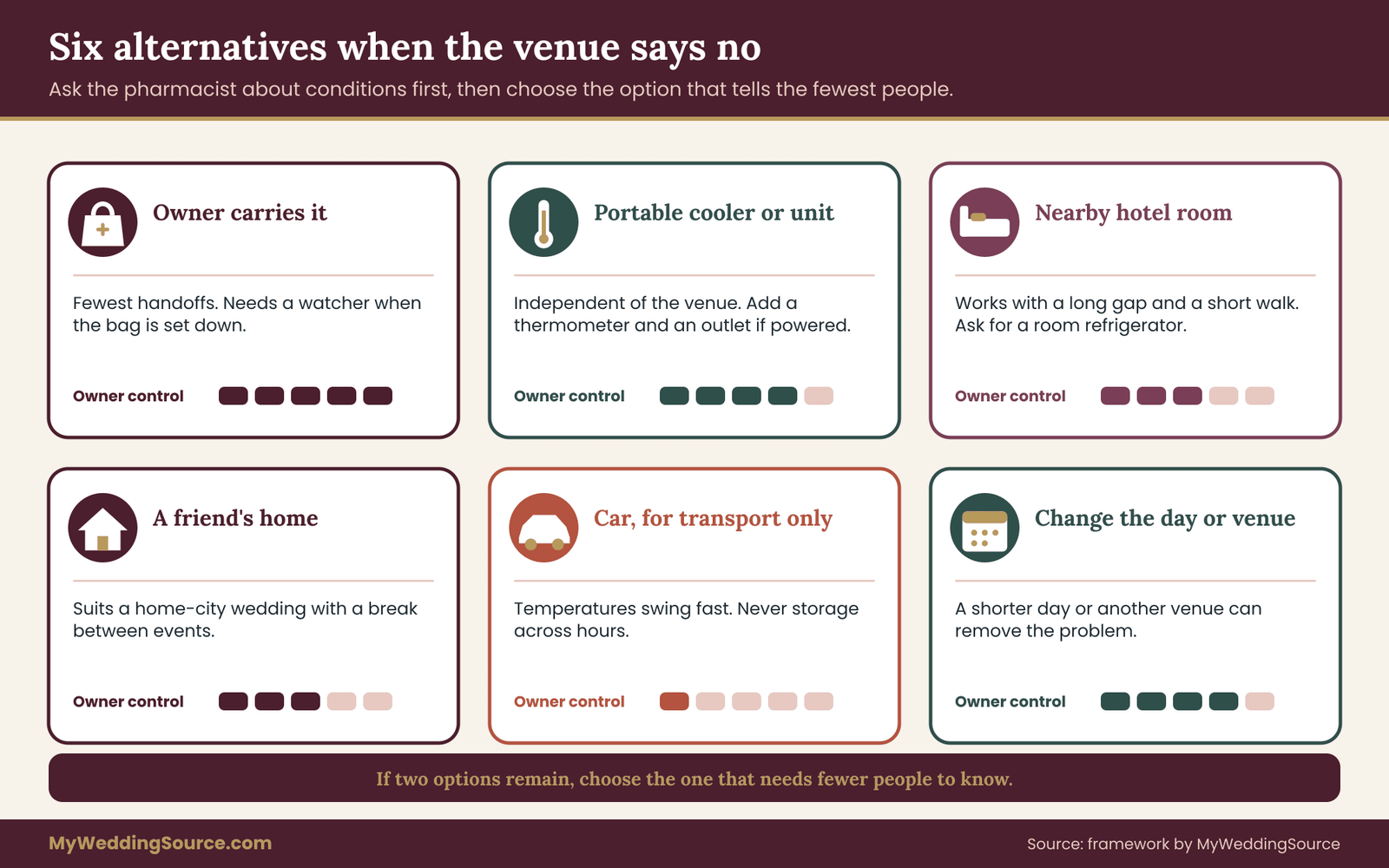
The alternatives below are ranked loosely by how much control the owner keeps. Which one fits depends on the item type, the length of the day and what the pharmacist says about conditions. When medication storage is not on offer, the fallback decides how the day goes.
Alternative one: the owner carries it
The most private option is that the item never leaves the owner. A small insulated pouch, a lockable case, or a bag carried by the backup person keeps the medicine under direct watch. This works well for type-one items and for short days. For type-two items, whether it works depends on how long the item may sit out of a refrigerator, which only the pharmacist or prescriber can answer. Ask them for the time limit in plain numbers, then compare it with the schedule. This is medication storage with the fewest handoffs.
The weaknesses are practical. A bag is awkward during a ceremony, a dance or a photo session, and it can be set down and forgotten. A second person who owns the job of watching the bag helps.
Alternative two: a portable cooler or small unit
A portable insulated bag with cold packs, or a small powered unit, gives the owner a cool space that does not depend on the venue. The questions are how long the cooling lasts, whether the item must avoid direct contact with ice, and how the owner will confirm the temperature. A thermometer in the bag answers the last one. The pharmacist is the person to ask about the rest. Portable medication storage is also the easiest to take to a second location.
A powered unit needs an outlet and a place to sit, and it is visible. Ask the venue whether it may be placed in a private room, behind the head table or in a service corridor.
Alternative three: a nearby hotel room
If the venue is near a hotel where guests are staying, a room with a refrigerator can serve as a storage point. The owner or backup person walks over at set times. The room needs to be close, because a twenty-minute round trip may not fit into the schedule. Ask the hotel for a room refrigerator at booking, and ask whether it can be set up without extra comment. Keep the request simple: ask the front desk for a standard room with a refrigerator, and explain nothing.
Alternative four: a car or a vehicle
A parked car is the weakest option for most medicines, because temperatures swing. In a hot or cold climate, a car can be far outside the range on the label within minutes. If a car is the only choice, the decision belongs to the pharmacist, who can say whether the item can tolerate it and for how long. In most cases, a car should be used only for transport, never for storage across hours.
Alternative five: a partner’s home or a nearby friend
For a weekend wedding in a home city, a relative or friend within a short drive can host the item. This works well for a day that has a long gap, such as a four-hour break between ceremony and reception. It adds a travel leg and a person who must be told something.
Alternative six: changing the schedule
Occasionally the best fix is not to move the medicine but to move the event. A shorter day, a daytime ceremony, a reception that begins earlier, a longer break in the middle or a different venue can each remove the medication storage problem. The couple weighs these against the cost and the meaning of the day. Shaping a day around a body’s limits is a topic of its own, and the same logic applies: change the schedule first, and the medication storage problem often shrinks.
Alternative seven: a different venue
When storage cannot be solved, and the need is serious, the venue itself may be the problem. At the tour stage, ask the medication storage questions beside questions about parking, restrooms and ramps, and let the answers weigh in the decision. The guide to accessible wedding venue red flags helps with the wider list, and the narrower medication storage list in this guide can be added to it.
Choosing among alternatives
Use three questions in order. First, what does the pharmacist or prescriber say about conditions and time limits? This removes some options at once. Second, what does the owner prefer about privacy and control? Some will accept a hotel room and others will not. Third, what does the schedule allow? A long gap makes a nearby room feasible, and a short one does not. The right alternative medication storage option is the one that meets the label, the owner’s wishes and the schedule together.
If two options remain, choose the one that needs fewer people to know. Every additional person, even a trusted one, is another conversation to manage.
Failure conditions in medication storage plans
A plan is only useful if you know how it fails. This section describes the conditions under which a medication storage arrangement can break, the early signs and what to do. It does not give medical instructions. If a medicine has been exposed to conditions outside its label, or if the owner feels unwell, the right step is to follow the label, contact the pharmacist or prescriber, and use emergency services when there is a real emergency. Every medication storage arrangement has weak points, and naming them is the cheapest prevention.
Failure one: the item is out of reach when needed
This is the most serious failure, and it comes from a mismatch between the schedule and the storage. A locked office closes, a backup person is away, or a bag is left in the wrong room. Early signs include a coordinator who is not sure who has the key and a timing window that overlaps with a busy moment such as the cake cutting.
The prevention is a second keyholder, a reachable phone number and a collection time that avoids the busiest hour. The response, if it happens anyway, is to reach the keyholder by phone, then the manager. If anyone is in danger, call emergency services without delay.
Failure two: the item is stored under the wrong conditions
A refrigerator is switched off, a cooler warms up or a bag sits in the sun. Signs include a unit that is warm to the touch, a bag that is no longer cold or a thermometer reading outside the owner’s range. The prevention is a thermometer, a check at a set time and an overnight plan. The response is for the owner to contact the pharmacist or prescriber about the specific item, since only they can say whether it is still usable.
Failure three: the item is lost, moved or mixed up
Bags look alike, staff clean up, and items go home with the wrong person. Signs include a label that has fallen off or a bag that looks different from where it was left. The prevention is a plain label, a card with a time and a name, and a handoff routine. The response is to notify the venue contact, check the likely places and confirm with the backup person. If a controlled item is missing, tell the venue manager immediately and follow the prescriber’s guidance about reporting.
Failure four: privacy is breached
A vendor mentions the need to someone else, a document is shared too widely or a guest overhears. The prevention is narrow rings, neutral language and separate sheets. The response is covered in the scripts section: speak to the person privately, correct the record, tell the owner and let the owner decide what to say.
Failure five: the venue changes its answer
Managers leave, policies change and a verbal “yes” turns into a “no” on the day. The prevention is a written confirmation and, where possible, a line in the contract. The response is to switch to the fallback quickly, which is why the fallback is built before the day. A fallback chosen at four in the afternoon is usually worse than one chosen at four in the morning, three weeks earlier.
Failure six: the plan depends on one person
A single backup, a single keyholder or a single phone number is a weak point. If that person is delayed, ill or busy, the plan stops. The fix is a second person at each link, as in the worked case.

Emergencies are different
A medical emergency is not a medication storage problem. If someone is unwell, the venue’s emergency procedures and local emergency services come first, and privacy yields to safety. The owner’s card, the backup person’s knowledge and the venue’s own emergency contacts should be arranged ahead of time, which a separate wedding-day emergency plan should cover in more depth. Responders may ask what the person takes and what conditions they have, and the backup person should be ready to say, or to hand over the card.
After a failure
Whatever happened, write three lines the same day: what failed, how it was caught and what will change. Share these only with the people who need to act on them. If the event involved a vendor or the venue, send a calm written note afterwards, so they can fix the process for the next guest.
Records and contract wording for medication storage
Written records protect the owner, the couple and the venue. They do not have to be formal. A short email thread, a line in the venue agreement and a one-page sheet are enough for most weddings. What matters is that the arrangement exists in writing before the day, that it is specific, and that it contains no more health information than it needs. Medication storage records should be short, specific and private.
What to put in the venue agreement
Most venue agreements are long and silent on this topic. If the venue is willing, ask for one or two lines in the agreement or in an attached schedule. The guide to wedding vendor contracts explains how to review a contract and request changes in general. For medication storage, the lines can be short:
- The venue will provide a refrigerated or lockable space for one or more personal items, in a private area not shared with food.
- Named roles, such as the manager and the coordinator, will have access during stated hours.
- The unit will remain powered overnight if requested.
- Staff will not open, move or discuss the contents.
Notice what is missing: the contents, the person’s name and the reason. If the venue insists on a name for its records, give a first name or an initial and ask how the record is stored and who can read it.
Written confirmations are enough when the contract will not change
Many venues will not modify standard terms. In that case, a confirmation email from the manager that restates the arrangement can serve the same purpose. Send your summary, ask the manager to reply “confirmed”, and file the thread with your other vendor records. If the manager changes before the event, forward the thread to the new manager at once. Even a short email can document medication storage clearly.
Rules that may apply to the venue
Venues that are open to the public are generally covered by disability access laws in the United States, and many are required to consider reasonable modifications to their policies. The Americans with Disabilities Act is the federal law, and the ADA site publishes plain-language guidance. Private events at a private venue may raise different questions, and rules vary by state and by facility.
This guide does not try to say what a particular venue must do. If a venue refuses a simple, reasonable request, read the official guidance, ask the venue to explain its policy in writing, and consider whether another venue serves you better. These rules can shape what a venue says about medication storage, so read the official source.
Why venue staff are not like a clinic
Health professionals and health plans are bound by health privacy rules in the United States, and the Department of Health and Human Services explains them. Event venues and caterers usually are not covered by those rules in the same way, so the protection you have is the protection you arrange. Neutral language, narrow rings and short records are the practical tools. This is another reason to share logistics and not conditions.
Records the owner keeps
The owner keeps a small file, either paper or digital, with the one-page sheet, the confirmation email, the card with phone numbers and any pharmacist guidance on conditions. After the event, the owner decides what to keep and what to delete. The couple deletes any copies of the sheet they hold unless the owner asks them to keep it.
Travel and destination weddings
When the wedding involves flights, the medication storage question starts at the airport. The Transportation Security Administration publishes information for travelers carrying medication and medical devices, and the airline publishes its own rules. Carry items in the original labeled container, keep them in a carry-on and bring a copy of the pharmacist’s guidance on conditions. For international travel, check the destination country’s rules with its official source before packing. These are traveler responsibilities and the couple’s role is to give guests time and notice.
Privacy for the couple’s own team
Planners, assistants and photographers sometimes see more than they should: a bag on a table, a text on a phone, a name on a list. Add a short line to the planner’s and vendors’ instructions: personal items belong to guests and the wedding party, and staff should not open, discuss or photograph them.
A photographer should avoid including a person’s medical items in a photograph and should delete one if the owner asks. A short instruction up front is easier than a correction afterwards. Medication storage privacy depends as much on staff habits as on documents.
Photos and social media
A medical device, a refrigerated bag or a break that gets photographed can end up on a public feed. The owner decides whether any image that shows medication or a device may be shared. If the answer is no, tell the photographer and ask the guests, in the same gentle way as for other photo boundaries. Treat it like any other photo boundary.
When to update the sheet
Review the sheet at three points: when the venue is booked, a month before the event and the day before. Each review checks four things: has the owner’s need changed, has the venue’s answer changed, are the backup person and the keyholders still available, and does the fallback still make sense. Changes are common, and a one-minute review catches most of them. A medication storage review should take about a minute.
After the wedding
When the event is over, close the loop. Thank the venue contact. Collect any items. Remove the sheet from shared storage. If the arrangement worked, tell the venue so, and if you have permission, suggest they adopt it as a standard answer. A short note to the venue helps the next couple or guest, and it reinforces that the request was ordinary and that the venue handled it well.
Your next steps
- Sort each item into one of the three types, with the owner, in private.
- Name the owner of each need, and choose one backup person plus a second one for the key link.
- Write the one-page sheet with six lines: type, space condition, timing window, backup, contact and fallback.
- Email the venue the questions from the refrigeration or secure space sections, using neutral language, and ask for a written reply.
- Confirm the arrangement in writing, and name a third keyholder or a reachable phone number.
- Prepare the fallback and test it on paper: which alternative, who, when and how long.
- Hold a one-minute review the day before, and give the backup person the card.
- Check current venue policies and official guidance before the event, since rules and policies change.
FAQ
Do I have to tell the venue what the medicine is?
No. The venue needs the storage condition, the time window and the access arrangement, such as a small refrigerated space or a locked drawer. It does not need the name of the medicine or the reason. If a venue asks for more, you can explain that the details are private and offer to supply the logistics in writing. If the owner is comfortable sharing more with one trusted manager, that is the owner’s choice.
Should emergency medicine be put in a venue’s storage?
Generally no. Items that may be needed within minutes, such as a rescue inhaler or an auto-injector, are usually kept on the person or within immediate reach, and the owner’s prescriber decides what that means. A venue storage room is the wrong place for them. Plan clothing, bags and a backup person who stays close, and ask the care team about anything unclear.
What if the venue only has a shared kitchen refrigerator?
Ask whether a closed, labeled container can go on a separate shelf, who has access, and whether an office unit is an alternative. If neither works, use an alternative such as a portable cooler with a thermometer, a nearby hotel room refrigerator or a carried pouch. Ask the owner’s pharmacist about the conditions and time limits first, because those decide which options are acceptable.
Who should know about a guest’s medication storage need?
The guest, one backup person of their choosing, and the logistics contacts who must act, such as the venue manager or the planner, each with only the logistics. Other guests, vendors and family do not need to know. A general message inviting private requests lets guests speak up without explaining. Do not add health details to shared schedules, group chats or vendor packets.
Is a venue legally required to provide refrigeration for medication?
That depends on the venue, the type of event and local rules, and this guide cannot say. The Americans with Disabilities Act covers many public-facing businesses and asks them to consider reasonable modifications, but private events and private venues can raise different questions. Read the official ADA guidance, ask the venue about its policy in writing, and consider another venue if you do not get a workable answer.
Can a car be used to store medication during a wedding?
It is usually a poor choice. Temperatures inside a parked car can move well outside the range on a label, in hot or cold weather, and quickly. Use a car for transport only unless the pharmacist says the item can tolerate it and for how long. A carried insulated pouch, a venue unit or a nearby room refrigerator is safer for many items.
How do I handle photographers and videographers?
Tell them only about the schedule, such as a ten-minute private break at a set time. Ask them not to photograph medical items or devices, and to delete any frame the owner asks them to delete. Put that instruction in writing with the rest of the shot list or photo boundaries. They do not need to know the reason for the break or what is in the bag.
What if something goes wrong on the day?
Use the fallback, call the named keyholder or manager, and bring in the backup person. If anyone is unwell or in danger, call emergency services and let the venue’s emergency procedures lead. If an item may have been kept outside its label conditions, ask the pharmacist or prescriber about that specific item. Afterwards, note what failed and fix it for next time.
Sources
- ADA.gov, U.S. Department of Justice: Americans with Disabilities Act information and technical assistance
- U.S. Food and Drug Administration: Drugs and consumer medicine information
- Centers for Disease Control and Prevention: Health and safety information for the public
- HHS: Health information privacy under HIPAA
- Transportation Security Administration: Traveling with medications and medical devices
- Drug Enforcement Administration: Controlled substances information for the public
- MedlinePlus, National Library of Medicine: Medicine safety and storage information
- Job Accommodation Network: Accommodation guidance and ADA resources
- Federal Trade Commission: Consumer privacy and protection information