

Whether to invite an ex-spouse to a blended family wedding is not a question of manners alone. It is a question of boundaries: whose safety, whose children, whose comfort and whose consent are involved. This guide gives you a four-gate test, five levels of involvement, one worked case, scripts for each conversation and a list of the ways the plan can fail.
Do not start with “Should we invite them?” Start with four gates: safety, children, both partners’ consent, and the ex-spouse’s own willingness. If any gate is closed, the ex-spouse is not a guest, and you can still handle child exchanges and communication calmly. If all four are open, choose the smallest involvement that works, from a handoff outside the event up to a full seat at the reception. Decide in writing, tell people before the invitations go out, and prepare a quiet plan for the day.
Couples planning a second or blended wedding often discover that the guest list has a question no etiquette column quite settles. One partner’s former spouse shares custody of the children who will walk in the ceremony. Or the former spouse is on good terms with everyone and would be hurt to be left out. Or the former spouse is the reason one guest will not come. Each of these is a different situation, and the same advice does not fit all three.
The common advice runs to two extremes. One camp says that a wedding is for the couple, so the ex-spouse stays home and nobody needs to explain. The other says that a truly mature blended family invites everyone and shows the children what cooperation looks like. Both slogans skip the real work. The first can leave children carrying messages or sitting through an awkward drop-off at the venue door. The second can turn a day that belongs to the couple into an unpaid mediation session with a seating chart.
This article takes a third approach. It treats the question as a set of boundaries that you can name, test and write down. You will still make a human decision, but you will make it with the facts on the table rather than with a stomach ache.
A note on scope. This is general planning information, not legal, tax or financial advice. Custody orders, parenting plans and protective orders are legal documents, and what they require varies by state and by case, so ask the family’s lawyer or the court that issued the order about anything that affects who may be where.
Why the ex-spouse question is a boundary question
Most guest-list decisions are about space and money. You have a venue with a capacity and a budget with a per-head cost, and you cut by closeness and by whether a person has shown up in your life lately. The broader mechanics are covered in the wedding guest list guide, and that is the right place to start if you have not built a list yet.
An ex-spouse is different because the invitation carries a message in both directions. To the ex-spouse, it says something about your view of the past. To the children, it says something about whether the adults in their lives can share a room. To your new spouse, it says something about whether their wedding day will include a person who may, rightly or not, make them uneasy. To guests, it says what kind of family this is. You cannot control how each audience reads the message, but you can know which messages you intend to send.
That is why a boundary framing helps. A boundary is a statement of what you will and will not do, and what you need from others, without telling them how to feel. “We are not inviting my former husband, and we will arrange the children’s handoff the evening before” is a boundary. “He is not welcome because he is a terrible person” is a verdict, and verdicts invite arguments.
Three questions that sort most cases
Before building anything, answer three plain questions on paper, separately if possible.
First: is there any history that makes shared space unsafe or legally restricted? This covers abuse, harassment, stalking, threats, a protective order, or a court order that limits contact. If yes, the rest of this guide narrows to one question, which is how to keep everyone safe, and the ex-spouse is not a guest.
Second: do any minor children, or adult children who are close to the ex-spouse, take part in the day in a way that will bring the ex-spouse near the event? Children in the processional, children who will sleep at the ex-spouse’s home before or after, and adult children who will want a parent present all create a point of contact whether you invite the ex-spouse or not.
Third: what do we each want, and is it the same? Many couples find that they have never said the answer aloud. One partner assumed the ex-spouse would obviously not come. The other assumed the children’s other parent would obviously be at least a part of the day. Finding that gap in week one costs nothing. Finding it at the rehearsal dinner costs a lot.
What the framework gives you
The rest of this guide builds a small toolkit. Four gates tell you whether an invitation is even possible. Five levels, which this guide calls seats, give you a range of options between “no” and “front-row guest.” A worked case shows the process from start to finish for an invented couple. Scripts let you say the hard sentences without improvising. And a section on failure conditions lists the situations where a plan that looked fine will need to change.
Nothing in this approach promises that anyone will feel good about the outcome. A calm decision can still hurt a person. The goal is a decision that you can explain, that protects the people who need protecting and that does not require the children to manage adult feelings.
What counts as an ex-spouse invitation: five situations
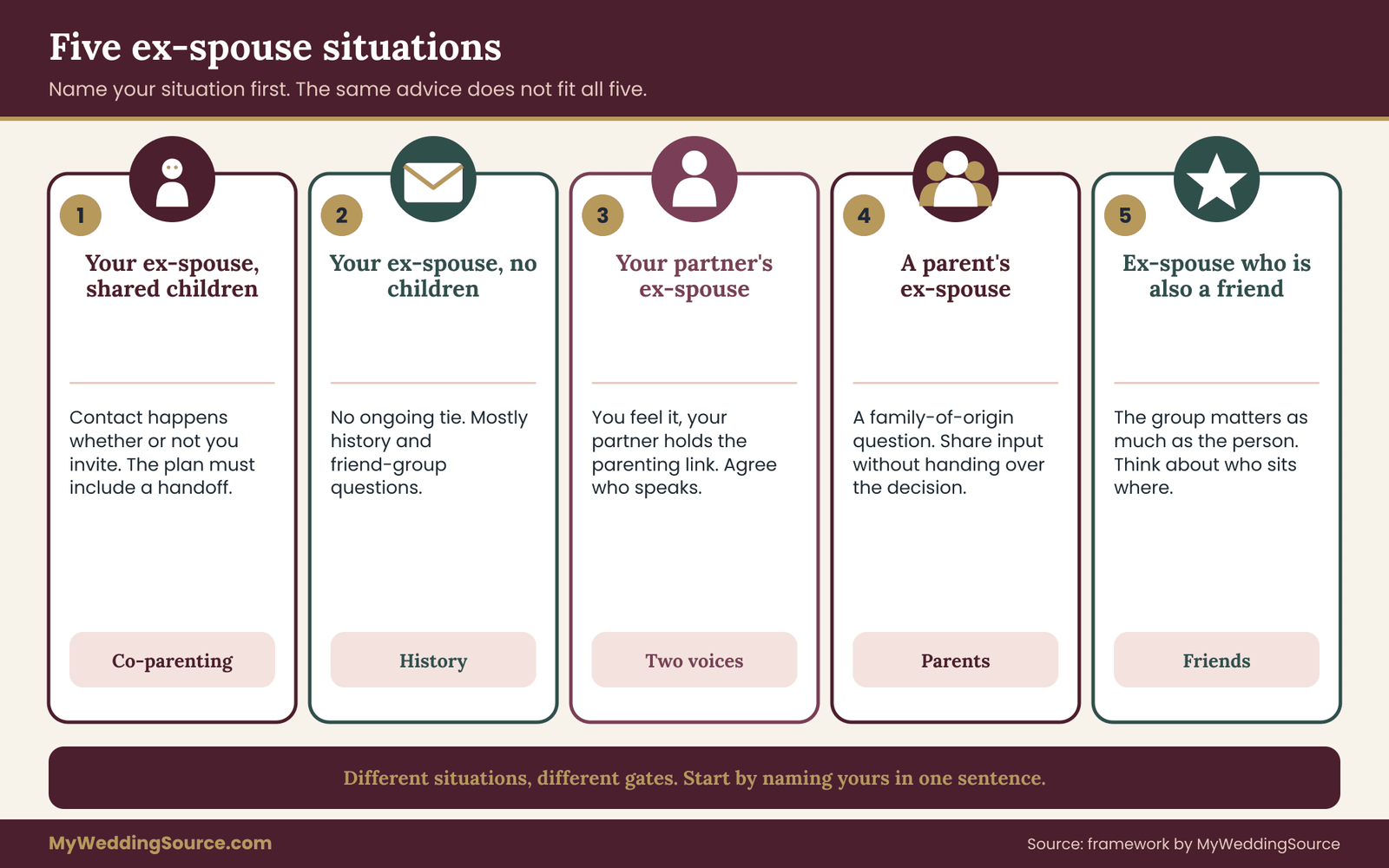
The phrase “ex-spouse” covers more ground than it seems to. Before you test any gate, work out which of these situations you are in, because the gates apply differently to each.
Your own ex-spouse, who is the parent of your children. This is the most common case in a blended family wedding. The ex-spouse shares custody or at least regular contact, children will be present, and the two of you must continue to cooperate for years after the wedding day. The invitation question is bound up with the co-parenting relationship.
Your own ex-spouse, with no shared children. There is no ongoing parenting tie. The question becomes mostly about history, mutual friends and whether the person is a real friend or just a former partner who happens to be in your phone.
Your new spouse’s ex-spouse. You are the one who might feel uneasy, and the children in question belong to your partner. Your voice matters here, but your partner holds the parenting relationship, and the two of you need to agree who communicates with the ex-spouse.
An ex-spouse of a parent of the couple. Perhaps one of you is the adult child of divorced parents, and now one parent’s former spouse, who may also be your parent, is on the question list. This is a family-of-origin question more than a blended-family one, and the hub on wedding decision rights covers how to share input with parents without handing over the decision.
An ex-spouse who is also a longtime friend or relative. The ex-spouse is a cousin’s former partner, a colleague, or a person woven into the friend group. Here the question is about the group’s dynamics more than about the couple.
Why the difference matters
Take the first case and the second. If you share children, a handoff has to happen on the wedding weekend whether or not the ex-spouse is invited. Declining to invite does not remove the contact, so the plan has to include it. If you share no children, declining to invite removes the contact entirely, and the decision is simpler.
Take the third case. Your partner’s ex-spouse is not your relationship, and an invitation sent without your agreement is a boundary crossed in your own wedding. At the same time, your partner’s children may care deeply about the ex-spouse being acknowledged, and a flat “no” imposed by you can feel to your partner like an attack on the children. These are tensions to work through together, not to resolve by volume.
In the fourth and fifth cases, you are often dealing with a third party’s feelings. A guest may say, “If she comes, I will not.” The invitation then becomes a negotiation over someone else’s preferences. The framework below handles this by separating what you owe a guest from what you owe your own household.
A short note on language
Choose neutral words and keep using them. “Former spouse,” “the children’s other parent” and “their mother” or “their father” are accurate and quiet. Nicknames, sarcasm and “the ex” in front of children turn a logistics question into an emotional one. Children hear more than adults think, and a wedding is a day when they listen closely.
Also avoid assuming how anyone feels. A former spouse might be hurt not to be invited, relieved not to be invited, or indifferent. You will not know until you ask, and sometimes you will not ask at all. The framework is designed to work without mind-reading, because it is built on boundaries and logistics, not on guesses about feelings.
With the situation named, you can now test it. The next section sets out the four gates in order. The order matters, because an early closed gate saves you from spending energy on later questions. ## The four gates: a boundary test for any ex-spouse
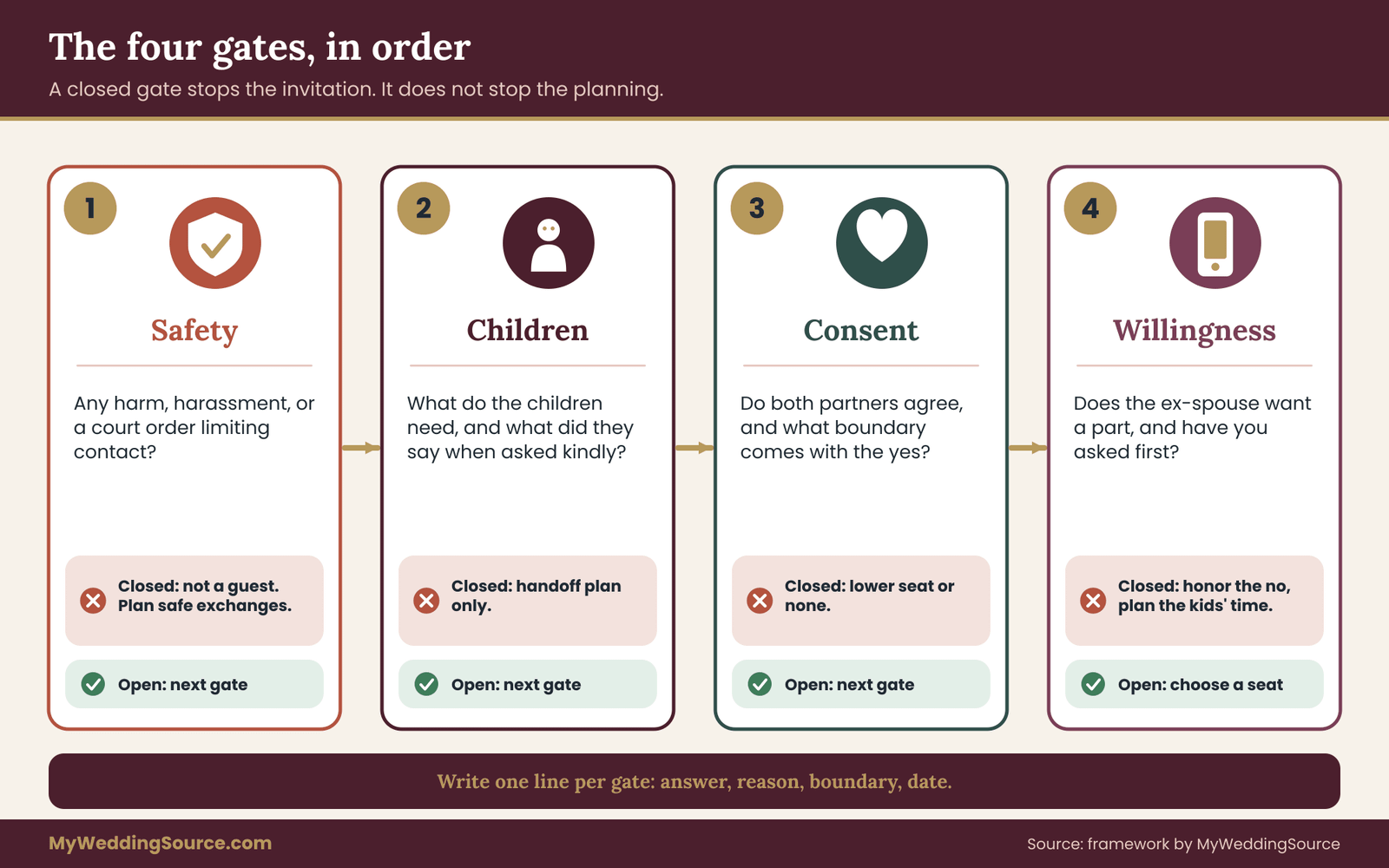
The four gates are questions you answer in a fixed order. Each is a yes or a no, with a short written reason. A “no” at any gate closes the invitation for now, though it may leave a smaller form of contact open, which the next section covers. The gates are safety, children, consent and willingness.
Write the answers in one shared document, with both partners adding their own view before reading the other’s. The point is to surface differences while they are still cheap.
Gate one: safety
The first gate asks whether the ex-spouse can be in the same room without risk to anyone. Risk here has a plain meaning. It covers physical danger, harassment, intimidation, stalking, a history of public scenes that required someone to leave, active substance problems that have previously led to harm, and any legal order that restricts contact.
If a protective order or a court order limits contact between any two people involved, the gate is closed, and no wedding preference changes that. Ask the issuing court or the family’s lawyer how the order applies to events and to child exchanges. If there is a history of abuse, even without an order, treat the gate as closed unless the person who was harmed says otherwise, and say it without pressure. Organizations such as the National Domestic Violence Hotline can talk through safety planning, and the Sources section lists them.
Gate one is not a place for compromise. It is also not a place for a debate with relatives. “There are safety reasons” is a complete sentence, and you are not obliged to supply details. If relatives push for explanations, repeat the sentence calmly.
A subtler version of this gate concerns the guests. Sometimes the ex-spouse is not a threat but another guest is, to the ex-spouse or to someone else. If an ex-spouse and a guest have a history of conflict, the question moves from “invite or not” to “can the room be managed,” and the answer belongs in the logistics section of this guide.
Gate two: children
The second gate asks what the children need, not what the adults would like. It has three parts.
The first is contact. Will the children be at the wedding? If yes, where will they be before and after, and who will transport them? A child who sleeps at one home the night before and attends the ceremony from the other home creates a handoff, and the handoff must be planned even if the ex-spouse is not invited. Good handoffs are boring: set time, set place, a trusted adult, and no heavy conversation in front of the child.
The second is the child’s wishes. Ask them, with care. A twelve-year-old may genuinely want their other parent present, or may dread the thought. A six-year-old may not understand the question. A grown stepchild may have views of their own. Offer limited choices rather than a weighty decision: “Would you like Dad to come to the ceremony, or would you rather see him afterward?” is a question a child can answer. “Do you want your father at our wedding?” asks them to take sides.
The third is the children’s role in the day. If a child has a job, such as carrying rings or walking a parent down the aisle, the ex-spouse’s presence may either help or distract. The guide to sharing input without losing control gives language for letting children contribute without letting them govern.
One point deserves emphasis. Children should never be the messengers. Do not ask a child to carry an invitation, a refusal or a rumor. Adults speak to adults.
Gate three: consent
The third gate asks whether both partners genuinely agree. This is separate from the first two because a safe, child-friendly invitation can still be wrong if it is imposed on a partner who is not comfortable.
Consent here does not mean enthusiasm. A partner may say, “I would not choose it, but I can handle a brief presence at the ceremony if the children want it.” That is a real yes, with a boundary attached. Other versions are “yes to the photo, no to the dinner” or “yes if I can meet them beforehand.” The boundary is the useful part, so write it down.
Watch for a false yes. It sounds like “whatever you think” or “I do not want to make it a thing.” That response often means the person has decided that raising an objection costs more than silently enduring. The remedy is to ask a different question: “If this were entirely my call, what would I pick?” Then listen without arguing.
Where the ex-spouse is your partner’s, you carry less history but real feelings. Your comfort counts. If your partner insists that the invitation is non-negotiable, you are facing a larger conversation about decision-making in your marriage, and a wedding guest list is a poor place to settle it. Consider speaking with a counselor or an officiant who does premarital work. Many couples find that someone neutral can help them name what they each need.
If either partner wants to invite the ex-spouse and the other cannot, the default is not to invite. A guest whose presence ruins the day for one of the two people being married is a poor trade, whatever the intention.
Gate four: the ex-spouse’s willingness
The fourth gate asks whether the ex-spouse wants a part in this at all. It is easy to forget, because the planning feels so much like a decision you make alone. But an invitation is an offer, and some people decline.
The ex-spouse may have a new partner who would feel awkward. They may be grieving the end of the marriage years later. They may be fine with the idea but unsure about the new spouse. Or they may simply prefer not to spend a Saturday that way.
You do not have to resolve any of that. You only need to know whether a conversation is worth having. Gate four is therefore an exploratory one: with the other three gates open, make a low-pressure approach and see whether a seat is possible. The scripts section shows how.
Do not skip this gate by announcing a decision. “We have decided you will be at the ceremony” is not an invitation, and it creates the resentment you were trying to avoid. Also do not use the invitation as a test of anyone’s maturity.
How to record the result
Make a short record for each gate: the answer, the reason in one line, any boundary attached and the date. Keep it in the document where you track other decisions, the way you would a vendor choice. The point is not bureaucracy. It is that, six weeks from now, when a relative says “I thought you were inviting him,” you will not need to reconstruct your reasoning from memory.
Here is a model entry for gate three, written in neutral language.
Gate three: both partners agree to a seat limited to the ceremony and group photo. Partner B is not comfortable with a reception seat. Revisit only if the children ask and both partners agree.
An entry like that closes loops. It also protects the relationship, because the boundary is on paper rather than on someone’s patience.
What a closed gate does and does not mean
A closed gate stops the invitation, not the relationship. If gate two is closed because the children’s schedules make a shared event unworkable, you still need a handoff plan. If gate four is closed because the ex-spouse prefers to stay away, you still owe the children a way to see their parent around the wedding. If gate one is closed, you still need a safe plan for exchanges, and the family’s lawyer or the court that issued the order can help you design it.
This is why the framework ends with five seats and not a simple yes or no. Between “not invited” and “full guest” lie several smaller arrangements that serve the children and respect the boundaries of the adults. The next section sets them out.
If the gates are all open, you are not required to pick the largest seat. In fact the safest default is the smallest one that meets the real need. Many ex-spouse situations that go badly do so because the couple chose a seat that was bigger than any of the adults could comfortably hold. ## Five seats: from not invited to full guest
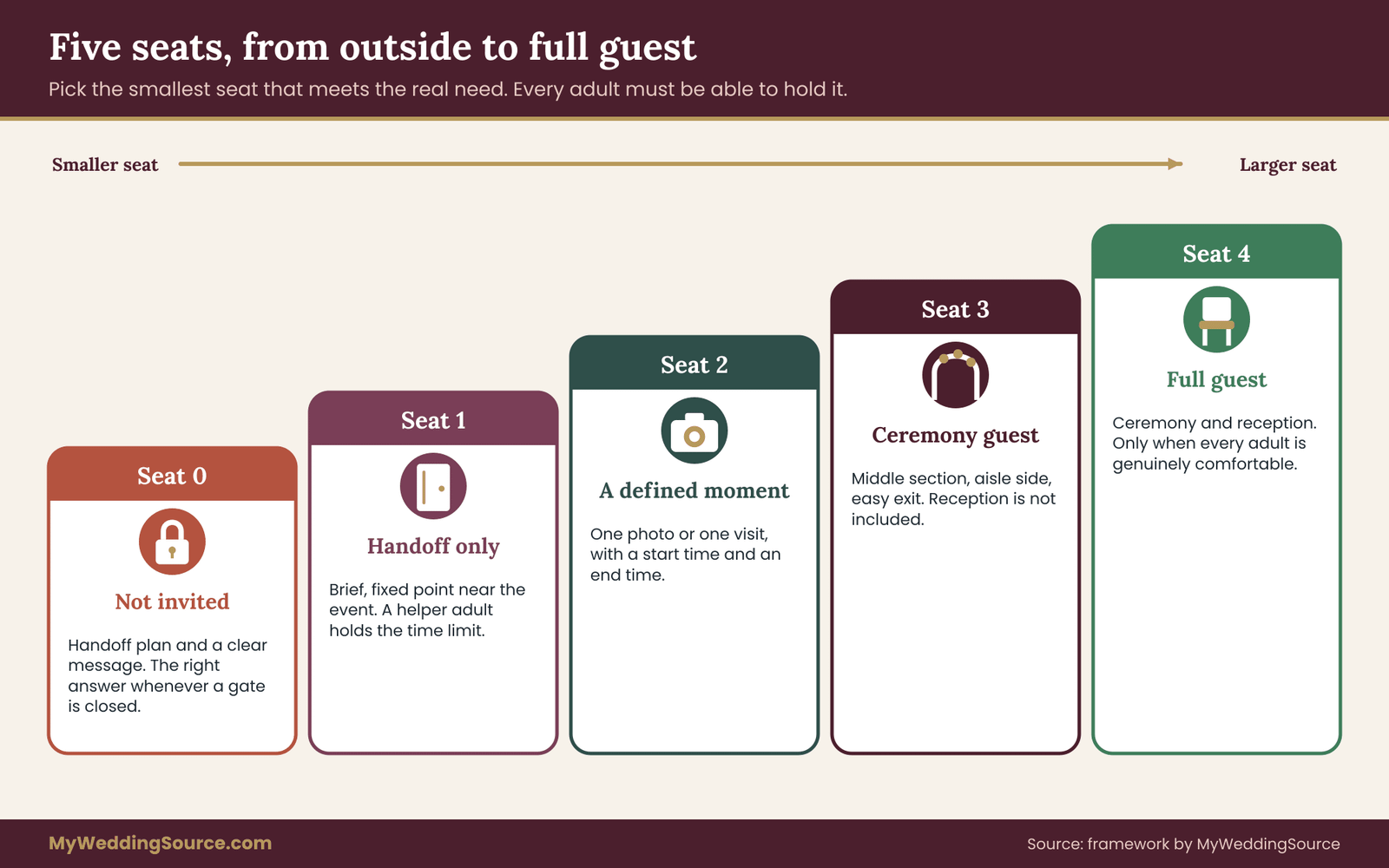
Once the gates are open, the next job is choosing how much room the ex-spouse takes up. This guide uses the word “seat” for a level of involvement. The seats run from zero to four, and each has its own purpose, cost and risk. They are not a ladder you must climb. You choose one, and you can choose differently for different events in the weekend.
Seat zero: not invited, with a handoff plan
At seat zero the ex-spouse is not a guest. This is the right answer whenever a gate is closed, and it is a legitimate answer when the gates are open but the couple simply prefers it. A wedding is a private celebration of a new marriage, and a former spouse is not owed a place.
Seat zero is not the same as ignoring the ex-spouse. If children are involved, you still plan the exchange. Pick a neutral location, a time away from the ceremony and a reliable adult who is not the bride, groom or either partner, so that the couple is not doing logistics in formal clothes. A grandparent, a trusted friend or an aunt works well. Tell the children in advance what will happen, in two sentences.
Seat zero also needs an honest message to the ex-spouse, which later sections script. The message does not need an apology and it should not offer false hope. “We are keeping the guest list to a small group, and we will send the children’s schedule by the first of the month” is respectful and complete.
Seat one: handoff only
At seat one the ex-spouse is present near the event for a brief, defined purpose, usually dropping off or collecting a child, but is not a guest. This is common when the children are young, when the schedule makes transport awkward or when the ex-spouse would like to see the children in their wedding clothes.
The key is a fixed point. A handoff outside the venue, at a time that does not overlap with the ceremony or the photographs, keeps everyone comfortable. A pickup at the hotel lobby the morning after is an equally good option. If the venue is private or has security, tell the venue manager who will arrive and why, so that no one is surprised.
The cost is mostly coordination. The risk is drift: a five-minute handoff becomes a twenty-minute conversation in a car park. Set a plan for ending it, such as “we have to leave for photos at three,” and let the helper adult hold the line.
Seat two: a defined moment
At seat two the ex-spouse is invited to one specific part of the day, such as a pre-ceremony photograph with the children, a short visit at the cocktail hour or a brief moment after the ceremony. The invitation is explicit about what it includes and what it does not.
This seat suits situations where the children care a lot about their other parent being included, but neither partner wants the ex-spouse at a full seated dinner. It is also a good test of the relationship. If a thirty-minute moment goes well, you have information for the future. If it goes poorly, the damage is contained.
For a photo, coordinate with your photographer in advance. The guide to the family photo list covers how to group family portraits, and this seat simply adds a group: the children and their other parent, taken before the ceremony so that nobody is rushing. The photographer can capture it in five minutes and move on.
Be careful about the word “moment.” People hear it differently. Say “from three to three-thirty, in the garden” and not “sometime around the ceremony.”
Seat three: ceremony guest
At seat three the ex-spouse attends the ceremony and leaves before the reception, or stays only for the cocktail hour. They sit with a designated person, perhaps a friend, the ex-spouse’s own partner or a relative who is comfortable in the situation.
This seat works when the ceremony is where the children need their parent to be, and the reception, with its alcohol, speeches and long hours, is where the risk of discomfort rises. It also reflects a reasonable view that the legal and emotional core of the event is the vow exchange, and everything after is a party.
Plan the seating deliberately. The ex-spouse should not be in the first row of the couple’s side, and should not be placed where the couple must pass them. A seat toward the middle, aisle side, with an easy exit, helps. For more on ceremony order and who sits where, the wedding ceremony step-by-step guide gives the standard sequence you can adapt.
The risk at seat three is the transition. Someone has to tell the ex-spouse, kindly, that the reception is not part of the invitation. Put that in the invitation itself, not at the door.
Seat four: full guest
At seat four the ex-spouse is a regular guest at the ceremony and the reception, seated at a table, with a plus-one if the guest list allows. This is the largest seat, and it is available only when all four gates are open and when the couple, the children and the ex-spouse are all comfortable.
Some blended families do this successfully. The ex-spouse is a friend, the divorce was long ago, the parenting is cooperative and the new spouse has a warm relationship with them. In those cases the full seat can feel natural and can ease the children’s mind.
Even then, plan for it as you would any sensitive seating. Where is the ex-spouse’s table? Who is at it? Who is likely to make a toast? What will the officiant say when naming family? The reception details are in the logistics section.
A common mistake is choosing seat four because it looks the most generous. Generosity is a fine motive, but a seat that exceeds what the adults can hold turns the day into a performance. If any adult is performing comfort, step down one seat.
How to choose between seats
Use three tests, in this order.
The need test: what is the children’s real need? If the need is simply to see their other parent around the weekend, seat zero or one meets it. If they need their parent at the ceremony, seat three. If they want a parent present throughout, seat four, but only if the adults genuinely agree.
The comfort test: what is the highest seat that every adult can hold without pretending? Ask each person alone. Take the lowest answer as the ceiling. Do not choose a higher seat because one person feels they ought to be able to cope.
The trial test: has the arrangement worked before? If the ex-spouse and the new spouse have been in the same room at a school event or a child’s birthday and it went reasonably, a higher seat is more likely to hold. If they have never met, start lower. A wedding is a poor first meeting.
Mixed seats across the weekend
You can combine seats. Seat three for the ceremony, seat one for the morning after. Seat two for a photograph, and seat zero for the evening. Weddings are multi-part events, and different parts have different needs. The rehearsal dinner, in particular, is usually a smaller, more intimate event, and an ex-spouse’s presence there changes its tone far more than at a 150-person reception.
Resist the pull to make everything the same seat for simplicity. A rule such as “ceremony only” is easy to explain, but a more tailored arrangement may serve the children better. Just write it down so everyone, including your helper adults, knows the plan.
The plus-one and the new partner
If the ex-spouse has a new partner, the seat question applies to them too. The simplest approach is to extend the same seat. If the ex-spouse is a ceremony guest, the partner is a ceremony guest. If the ex-spouse is at seat two for a photograph, the partner is not part of the photograph unless the children ask.
Do not leave this unspoken. An invitation to “you and a guest” can pull a stranger into a sensitive family moment. Name the people. If you know the new partner, a warm, specific sentence works: “We would be glad to see you both at the ceremony.”
When a seat changes
Seats are not permanent. A seat can be lowered if something changes before the wedding, such as a conflict, a new custody dispute or a safety issue. It can also be raised if the relationship improves. Decide in advance who has authority to change it. The safest rule is that the seat can be lowered by either partner at any time, and raised only by both together.
Write that rule down along with the seat. It saves arguments when a Tuesday email makes everyone nervous on a Saturday. ## A worked case: an invented couple and one ex-spouse
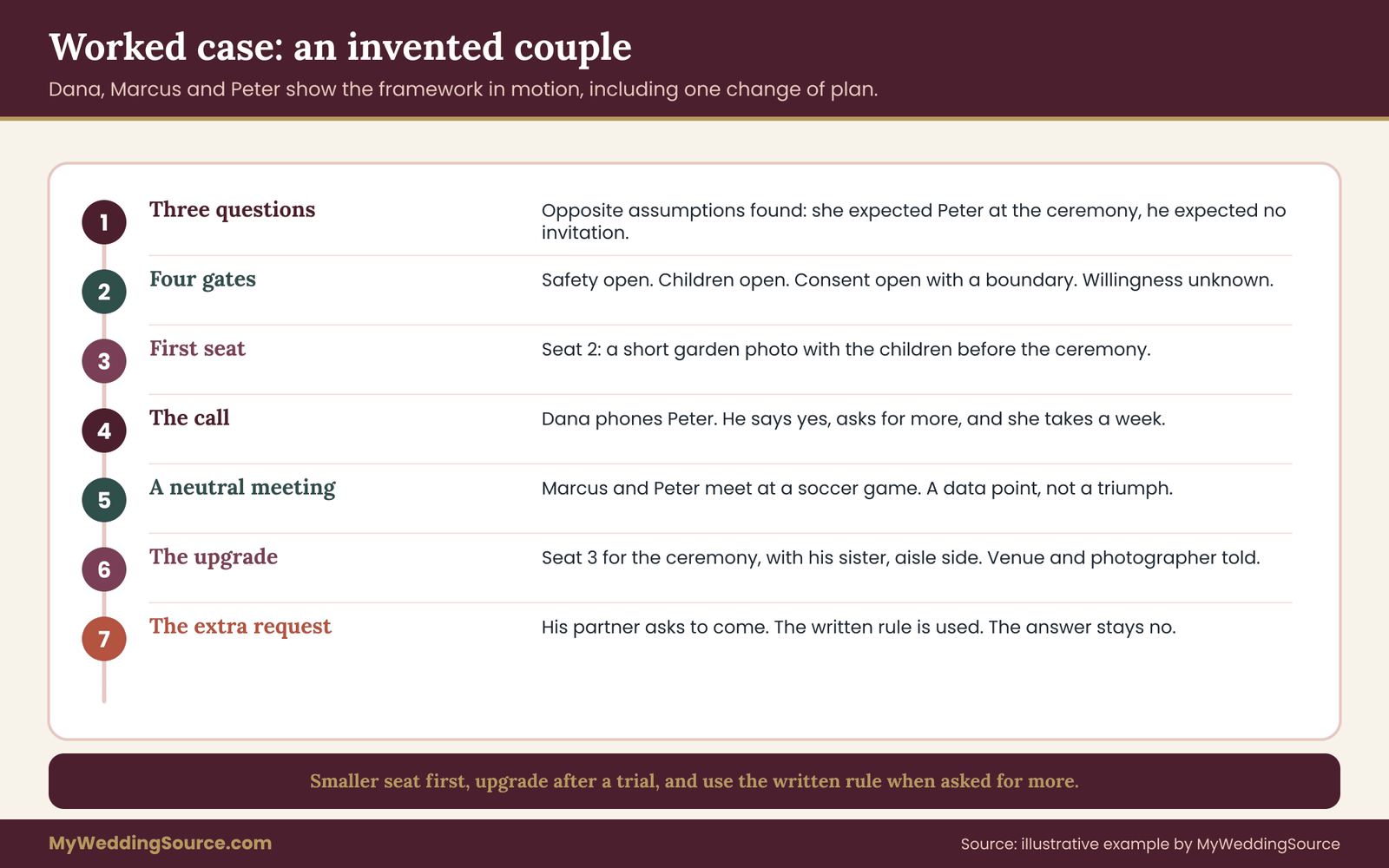
The following example is invented for illustration. It is not a real couple, and it does not show typical results. Its purpose is to show the framework in motion, including a decision that changes midway.
Meet Dana Hale and Marcus Moreno, who are planning a wedding for about eighty guests. Dana has two children, aged eleven and fourteen, from a first marriage that ended four years ago. Their father, Peter, lives forty minutes away and shares custody on a week-on, week-off schedule. Marcus has no children and no former spouse. The two plan to marry on a Saturday in October.
Step one: three questions
Dana and Marcus each wrote answers separately. On safety, both wrote “no history, no orders.” On the children, Dana wrote that the eleven-year-old, Ivy, would likely want her father present, while the fourteen-year-old, Theo, “might not care or might care a lot.” On what each wanted, Dana wrote that she assumed Peter would come to the ceremony for the children’s sake. Marcus wrote that he assumed Peter would not be invited at all, because he had never met him.
That gap was the first finding. They had spent three months planning without noticing that each held an opposite assumption. Talking it through took forty minutes and a pot of tea, and it ended without a decision, which was fine.
Step two: the four gates
Gate one, safety: open. Peter had never been threatening, and no legal order existed.
Gate two, children: open, with conditions. Dana asked Ivy and Theo a limited question each. Ivy said she would like her dad to see her in the dress. Theo shrugged and said, “Whatever, as long as it’s not weird.” Dana noted that Theo’s answer was neither yes nor no, and she did not press.
Gate three, consent: partly open. Marcus said he was uneasy about meeting Peter for the first time at his own wedding, and he did not want Peter at the dinner. He was willing to meet him earlier. That was a real yes with a boundary, so they wrote it down: “Marcus agrees to a limited seat if he meets Peter beforehand and the reception is not included.”
Gate four, willingness: unknown. They had not asked Peter.
Step three: choosing a seat
Using the three tests, they weighed seat two and seat three. The need test said Ivy wanted her father to see her in her dress, which a photograph before the ceremony could do. The comfort test put Marcus’s ceiling at the ceremony. The trial test was the problem, since Marcus and Peter had never met. They decided on seat two for the day, a short photograph with the children and Peter before the ceremony, with a possible upgrade to seat three if the pre-wedding meeting went well.
Notice what they did not do. They did not pick seat four because it sounded mature, and they did not pick seat zero because it was easiest. They matched the seat to the actual need and the actual comfort.
Step four: the conversation with Peter
Dana called Peter rather than texting, since a text can read as colder than intended. She had a plan. She said the wedding was in October, that the children had mentioned wanting him to see them dressed, and that she and Marcus would like to offer him a photograph with the children at the venue before the ceremony. She said it would be short, about fifteen minutes, and that the ceremony and reception were family and close friends only. She asked whether that worked for him.
Peter said yes to the photograph. He asked whether he could stay for the ceremony. Dana said she would talk to Marcus and come back to him within a week. She did not agree on the spot.
That last step matters. A request made in the moment is easy to grant out of surprise or guilt. Taking a week respects both partners.
Step five: the pre-wedding meeting
Marcus and Peter met at a children’s soccer game, where a short, neutral conversation was natural and Marcus could leave whenever he wished. It went well, in the sense that both were polite and neither felt trapped. Marcus said afterward that he felt less anxious. That does not mean it was a triumph. It was a data point.
Step six: the upgrade
With the meeting behind them, Dana and Marcus moved to seat three for the ceremony. Peter would attend the ceremony, sit with his sister in the middle section on the aisle side, and leave afterward unless the children asked otherwise and both partners agreed. They sent a short written note to Peter, with the time, the location and what the invitation covered. They also told the venue manager and the photographer.
The photographer’s schedule had a five-minute window for the group photograph with Ivy, Theo and Peter before the ceremony, in the garden. It was labeled on the shot list so the assistant could handle it.
Step seven: the failure
Two weeks before the wedding, Peter’s new partner, Kim, asked if she could come too. The invitation had not included her. Dana felt cornered. Marcus said he preferred to keep to the plan. They checked the rule they had written: a seat could be lowered by either partner at any time and raised only by both. Both partners now had to decide about Kim, and they did not agree on the spot.
They resolved it by saying that the ceremony was a family event with a firm limit on numbers, that Peter was invited as the children’s father, and that Kim would be welcome to meet the family at the children’s next school event. Dana called Peter, repeated this in plain language and did not apologize more than once. Peter was disappointed but said he understood.
The seat held, and the plan did not collapse, because it had a written rule for exactly this moment.
What the example shows
A few things are worth pulling out. The couple’s biggest early problem was a mismatch in assumptions, not a hostile ex-spouse. The framework surfaced it. They tested gates in order. They chose a smaller seat than they might have, then upgraded it based on a trial. They put the decision in writing. They told the venue and the photographer. They handled an unplanned request by returning to the written rule.
The example also shows what the framework does not do. It does not make Peter’s feelings easy, or Marcus’s, or Dana’s. It does not prevent a disappointed guest. It gives the couple a path to an answer they can defend, and a way to respond when someone asks for more.
Talking to the ex-spouse: scripts for each seat
Many couples lose weeks to dread over a conversation that lasts five minutes. Scripts help. They are not scripts to read aloud like actors but starting points that you can put in your own words. The pattern is the same for every seat: state the decision, state what it covers, state what is next, and stop.
Principles that hold across seats
Speak to the adult, not through the children. Use a call or a face-to-face talk for anything sensitive, and follow up in writing so the details are clear. Keep your tone factual. Avoid “we hope you understand,” which sounds like a request for forgiveness, and avoid “you should know,” which sounds like a warning. Give a deadline for any response you need. Do not discuss the new spouse’s feelings in detail. Do not bargain.
If the other person becomes upset, you may acknowledge it without changing the decision. “I can hear this is disappointing” is accurate and does not reopen the topic. If the conversation goes in circles, end it politely and follow up in writing.
Script for seat zero
“I wanted to tell you before it comes up with the kids: the wedding is in October, and we’re keeping the guest list to a small group of family and close friends. You won’t be on it. For the children, I’ll send you the schedule by the first so you can see how the weekend works, and the exchange will be at the hotel lobby at ten on Sunday.”
This is short because it needs to be. It states the decision, then the part the other person actually needs, the schedule. It does not apologize for the list, and it does not argue the merits.
Script for seat one
“The kids will be at the wedding on Saturday, and I’d like to make the exchange simple. Could you drop them at the hotel by one o’clock? Marcus’s aunt will meet you in the lobby, and she’ll bring them back on Sunday morning.”
Here the helper adult is named, which lowers tension. If the other parent wants to see the children dressed, a brief photograph in the lobby is a simple add-on.
Script for seat two
“The kids would love for you to see them dressed up. Would you be willing to come to the garden at the venue at three for a short photo with them? It would be about fifteen minutes, and then we’ll start the ceremony prep. The ceremony itself is for the immediate family and close friends only.”
The script makes the window and the limit clear. If the answer is yes, confirm by message the same day.
Script for seats three and four
“We’d be glad to have you at the ceremony. It’s at four on Saturday, and you’d sit with your sister in the middle on the aisle. We’ll let you know about anything else by the first of the month. Could you let me know by the fifteenth?”
For seat four, add the reception details. For seat three, state that the invitation covers the ceremony. If you worry that this sounds blunt, remember that clarity prevents later hurt.
If the answer is no
Sometimes the ex-spouse declines an offer. Take it gracefully. “That’s fine, thank you for thinking about it. I’ll make sure the kids can see you afterward.” Do not press, and do not ask them to explain. Their reasons are theirs. ## Children, grandparents and in-laws around an ex-spouse
An ex-spouse does not stand alone. Around them are children, grandparents, former in-laws and mutual friends, and each group has its own stake in what happens. A decision that looks tidy on the guest list can still ripple through these relationships, so it helps to think through each group before you announce anything.
The children’s part
Children of different ages need different things. Young children need predictability: who will be there, where they will sleep, who takes them home. Tell them early, in plain words, and repeat it as the day gets closer. Pre-teens and teenagers often want some say, but not a burden. Adult children may feel strongly and may speak for themselves.
Give children a way out. A child who is asked to sit near both parents may feel unable to leave without hurting someone. Offer a quiet place and a trusted adult they can find at any time. A simple signal, such as going to find a specific cousin, can be arranged beforehand. This is not drama management. It is the same kind of exit plan you would give a guest who might feel unwell.
Do not ask children to manage the adults’ emotions. Avoid phrases such as “Be nice to Dad’s new girlfriend for me.” If you want civility, ask an adult.
Avoid making a child choose publicly. If the ex-spouse is at the ceremony, the child who walks up the aisle with one parent should not be told to go and thank the other in front of the guests. Let those moments happen if they happen.
Finally, plan for the days after. A child may be tired and tender the morning after a wedding. A familiar routine, a quiet breakfast and a calm handoff matter more than the event itself.
Grandparents and former in-laws
Grandparents are easy to overlook. A paternal grandmother may have a warm relationship with the children’s father and may feel unsure whether she is welcome at the wedding of her son’s former wife. A maternal grandfather may be uncomfortable with an ex-spouse who hurt his daughter. Neither feeling is about the wedding, and both can show up in it.
Reach out before the invitation arrives. A short call to a grandparent who is close to the ex-spouse, in which you explain the plan and thank them for what they mean to the children, can prevent a hurt that is much harder to repair later. You are not asking for permission. You are being courteous and informing them.
Former in-laws are a separate case. They are family to the children but not necessarily to the couple. If the children are close to their paternal aunts, uncles and cousins, the question of who is invited expands. A good rule is to decide by closeness to the children and to the couple, not by their relationship to the ex-spouse. Those who are not invited may be told, kindly, that the guest list is small and that you hope they will see the children afterward.
The etiquette guidance in the wedding etiquette guide offers general principles on handling relatives who feel left out, which apply here too.
Mutual friends
Friend groups split after a divorce, and the wedding can expose the split. Some friends were closer to the ex-spouse. Some have kept both relationships. Others have chosen a side. If you invite the ex-spouse, you may see these dynamics play out in public.
Think about who will be at the same event and whether any pair might clash. If two friends have not spoken since the divorce, a quiet conversation with each beforehand, saying you hope they will both come and you would be grateful for kindness, is better than hoping it works out. If someone says they will not attend if the ex-spouse does, you can accept that without persuading them. Their choice is theirs, and so is yours.
When a guest says, “If they come, I won’t”
This sentence deserves its own treatment, because it arrives often. A guest, often a relative, announces that they will boycott if the ex-spouse is present. The pressure is real. The framework answers with a distinction between what you owe a guest and what you owe your household.
You owe every guest courtesy and notice. You do not owe them a veto over who sits in your ceremony, especially if the ex-spouse is there for the children. The couple, and the children’s needs, come first. A kind response is: “I understand this is hard for you. We’ve thought it through and the plan is set. I would love to have you there, and I understand if you decide otherwise.”
There is one exception. If the guest’s objection rests on a safety issue they know about, such as a history that the couple has not fully understood, listen. Ask for details privately. Gate one is not a gate only the couple may open.
Logistics when the ex-spouse attends: seating, photos, bar and exit
If the ex-spouse attends any part of the day, the logistics need as much care as the guest list. The aim is not to hide anyone but to remove the small frictions that turn uneasy situations into bad ones.
Arrival and parking
Plan arrival times. An ex-spouse who arrives at the same time as the couple’s families will meet them in the car park, and the first thirty seconds set the tone. Offer a slightly earlier or later arrival window, a different entrance if the venue has one, or a greeter who walks them to their seat. Tell the greeter the plan.
If the venue has a security desk or an event manager, give them the names of the people involved and the agreed seat. Sharing this is not paranoia. It is the same briefing you would give about a guest who needs wheelchair access or a vendor who needs a loading dock.
Seating
For the ceremony, place the ex-spouse in a section where they will not be directly in the couple’s line of sight and not in a place the processional must pass. A seat with an aisle and an exit is best. Put a friendly person beside them, and tell that person the plan.
For the reception, if the ex-spouse stays, the wedding seating chart guide explains how to build tables around relationships. Use that thinking here: seat the ex-spouse with people they know and like, away from the head table, and not directly opposite a guest with whom they have a history. Avoid placing them with the children’s table if the children are likely to feel observed.
Photographs
Tell the photographer in plain terms who is who. A short note listing each person, how they relate to the couple and any group photographs that include or exclude them prevents embarrassing mistakes such as calling the ex-spouse to the “family” photograph. Decide whether the ex-spouse appears in the main family photographs, and make that choice before the day.
If the ex-spouse is in a single photograph with the children, schedule it separately and keep it brief. If they are not in any photograph, tell the photographer that too, and tell them that the children may sometimes wander to that person during candid moments. The photographer can then take those pictures without needing to ask.
The bar and the timeline
Alcohol raises the risk of any strained situation. If you know that the ex-spouse or anyone else tends to drink more at emotional events, talk to the bar staff about service limits, and consider offering a quiet, interesting non-alcoholic option. If the ex-spouse is a seat-three guest who leaves before the reception, that already reduces the risk.
A clear timeline helps too. Tell the ex-spouse when to arrive, when the ceremony ends and when they are expected to leave. Ask the officiant to avoid naming the ex-spouse or the previous marriage during the ceremony unless you agree to that wording in advance.
Toasts and speeches
At the reception, someone will want to speak. Ask speakers in advance to keep comments focused on the couple and their future, and not to mention former spouses. If you are not sure, ask to read the toast beforehand. The principle is simple: it is far easier to ask for a change at a draft stage than to repair a remark said into a microphone.
A designated helper
Assign one person as the ex-spouse’s point of contact on the day. This person is not a member of the wedding party, is not a family member who has history with the ex-spouse, and is able to speak calmly. They hold the schedule, they greet the ex-spouse, they know where the quiet room is and they can step in if the ex-spouse is uncomfortable. Give them a short written brief and the couple’s contact in case of need, but ask them to try to resolve things themselves.
{{INFOGRAPHIC:5}} ## Saying no to an ex-spouse without starting a feud
For many couples the right answer is seat zero. That answer deserves as much care as any other, because the way you deliver it decides whether the next ten years of co-parenting are workable. A firm no and a courteous tone can coexist.
Why the timing of the message matters
Tell the ex-spouse before they hear it elsewhere. Children talk, relatives talk, and a former spouse who learns about a wedding from an eleven-year-old at the dinner table will feel blindsided. Aim to give the news in person or by phone as soon as the date is set and the guest list direction is clear. The invitations themselves, covered in the wedding invitation etiquette guide, come later and are not the way to deliver this particular information.
At the same time, do not announce too early. If the plan might change, wait until the gates are answered. A message that gets reversed creates more distrust than a slightly later one.
What to say and what to leave out
Say the decision, the reason in general terms, and what the ex-spouse needs to know. Leave out the history, the comparisons and the explanations about the new spouse’s feelings. Every extra sentence is an invitation to argue.
A useful frame is “the guest list is X, and that is how we have decided.” Notice it makes no claim about what the ex-spouse deserves. It describes the list. If the ex-spouse says, “Not even for the kids?” you can answer that you will plan the weekend so the children see them. If they say, “That’s unfair,” you can say you understand it is disappointing, and leave it there.
Do not offer a consolation prize you cannot give. A sentence such as “Maybe next time” suggests a future wedding. A sentence like “I’d like us to keep a good relationship for the children” is honest and forward-looking.
The new partner or the ex-spouse’s family
If the ex-spouse has a partner, the message goes to the ex-spouse, who may choose to share it. Do not send a separate message to the partner unless you know them well.
If the ex-spouse’s relatives, such as the children’s grandparents, ask you directly, a brief reply is enough. “We’re keeping the list small, and we’ll make sure the children see you soon.” Offer to arrange a family lunch for the week after the wedding. That gives relatives a visible alternative.
When the ex-spouse reacts badly
Some ex-spouses will express anger. Some will escalate, perhaps with messages to the children or to relatives. Keep these steps in mind.
Keep your replies brief and factual. Do not match the heat. Save messages that cross a line, and if there are threats or harassment, contact the family’s lawyer or the authorities, as appropriate. Tell the children’s other trusted adults what has happened so they do not carry it alone. If you share a parenting app or a mediator, use it for logistics. Do not argue the guest list in the same channel as the pickup schedule.
Try not to defend the decision at length. The more you explain, the more the conversation becomes about whether the reasons are good enough. The decision stands even if the reasons do not satisfy everyone.
Warning signs that call for extra care
Some patterns suggest that the plan needs support beyond a script. These include repeated attempts to contact the new spouse directly, threats to appear anyway, pressure on the children to take sides, or demands that the ex-spouse be given a role in the ceremony. If any occur, tell the venue manager, make sure a trusted adult stays with the children, and consider whether the family’s lawyer or a mediator should be involved. Write down what happens and when.
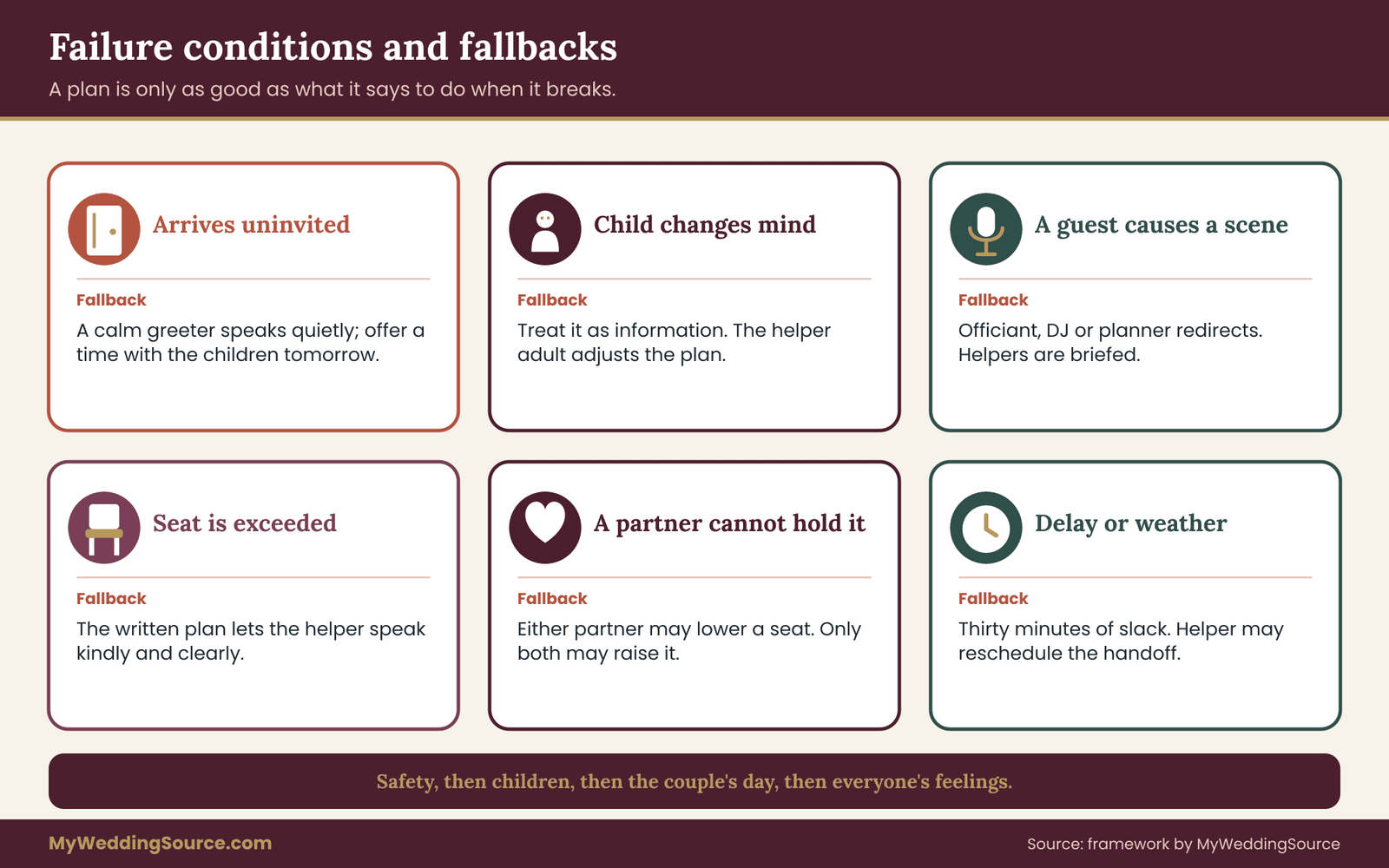
Failure conditions and fallback plans
A good framework says when it will fail. These are the situations where a plan that seemed sound will need to change, with a fallback for each.
The ex-spouse arrives uninvited. This is rarer than people fear, but a plan should exist. Assign a calm person to meet them at the door and speak quietly. The message is short: “We are not able to have you here today. We’ll arrange for the children to see you tomorrow.” Do not ask a child to deal with it. If the person refuses to leave or becomes aggressive, the venue’s staff or the police are the right resource. The couple should not handle it themselves.
The children change their minds on the day. A child who wanted a parent present may find, on the morning, that they do not. A child who did not want them may suddenly miss them. Build slack into the schedule, and treat a child’s change as information, not as an obstacle. The helper adult can adjust the plan, and the couple should not take it personally.
A guest causes a scene. A guest, not the ex-spouse, may bring up the divorce, make a joke or take a side. Brief your helper adults, and ask the officiant and DJ to redirect. The planner or coordinator, if you have one, is the right person to step in.
The seat is exceeded. The ex-spouse comes to the ceremony and stays for the reception without having been invited to it. Because you wrote down the plan, the helper adult can speak to them kindly and clearly. If the reception is private, the venue’s rules may also help.
A partner changes their mind. Either partner may find on the day that they cannot hold the seat. The rule, that either partner can lower a seat and only both can raise it, lets them say so without a debate. The helper adult then carries out the change quietly.
The weather, the schedule or a delay disrupts the plan. A late ceremony, a long photograph session or a storm can crush a carefully timed handoff. Build thirty minutes of slack into any plan that includes a handoff, and give the helper adult discretion to reschedule.
A legal order changes. If a court order changes in the weeks before the wedding, the plan changes. Ask the family’s lawyer or the court that issued the order how it applies, and revise the seats accordingly.
The fallback hierarchy
When something goes wrong, the order of priorities is: safety first, children second, the couple’s day third, and everyone’s feelings fourth. This is not because feelings are unimportant, but because the earlier items cannot be repaired afterward and the later ones usually can. A guest who was embarrassed can be thanked next week. A child who was frightened takes longer to settle.
Keep a one-page contingency sheet with the helper adult’s phone number, the venue manager’s number, the schedule for any handoff and a line that says “If in doubt, call the planner or the helper.” Share it with only the people who need it.
Alternatives to inviting an ex-spouse
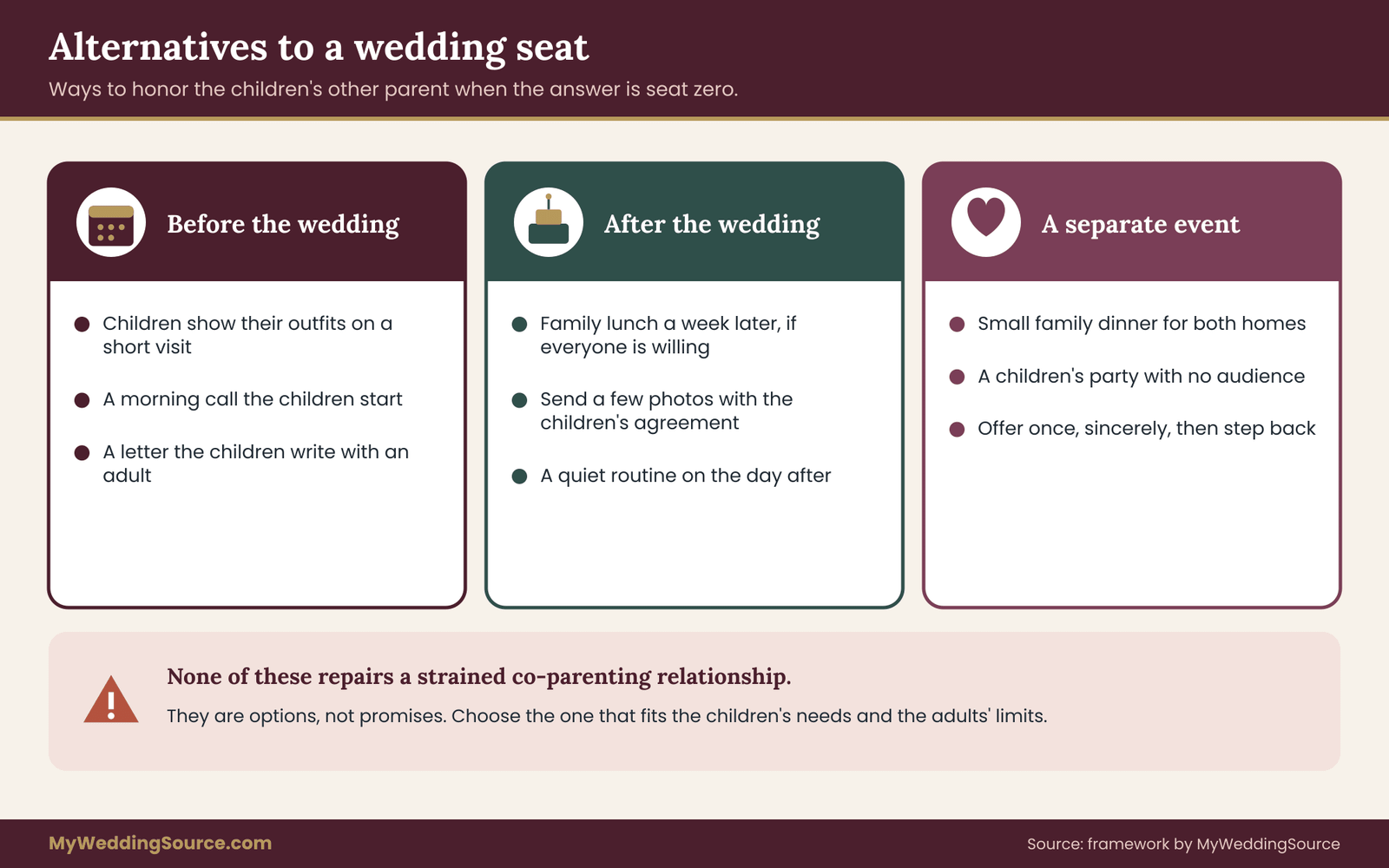
A wedding invitation is not the only way to acknowledge a former spouse as the children’s parent. If the gates are closed, or the couple prefers seat zero, other gestures can meet the children’s needs and show respect without a seat at the wedding.
Before the wedding
A short pre-wedding visit, in which the children show their other parent their outfits or the venue, can give a sense of inclusion. A phone call on the morning of the wedding, which the children initiate, lets them share their feelings with the other parent. A short letter from the children, written with a trusted adult’s help, can express what the day means.
Neither gesture needs the couple’s involvement. They are the children’s relationship with their parent, and the couple’s role is to make room for it.
After the wedding
A small family lunch or dinner a week later, with the children, the couple and the ex-spouse, if everyone is comfortable, can mark the new family without the pressure of a wedding. Not every family will want this. When it works, it is often easier than a wedding-day meeting, because there is no audience and no schedule.
Another option is sharing photographs. Send the ex-spouse a handful of the children’s pictures from the day, with the children’s agreement, a few days later. It is a small courtesy that costs nothing and often means a great deal.
A separate celebration
If the children are the center of the question, consider a small separate event, such as a family dinner or a children’s party, where the ex-spouse and the new family can meet in a relaxed setting. The wedding remains the couple’s, and the children have a space to bring both homes together on their own terms.
What alternatives cannot do
None of these will repair a damaged co-parenting relationship, and none is a promise that anyone will feel fine. They are options. If the ex-spouse is hurt, a gesture may soften it or may not. Offer once, sincerely, and then step back. ## Your next steps
You do not need to settle everything in one evening. The steps below follow the order of the framework, and each can be done in a single sitting. Work through them over two or three weeks, and leave a day between steps so that no one decides while upset.
Step one: write the three sorting answers. Each partner writes, alone, whether any safety history exists, how the children connect to the ex-spouse around the event, and what they would choose if the decision were theirs alone. Swap the pages and read them without arguing. Mark every place where your answers differ.
Step two: run the four gates in order. Safety, children, consent, willingness. Write a one-line reason for each. If a gate is closed, stop there and move to the handoff plan and the message for seat zero. If you are unsure about the children’s wishes, ask a limited question, not an open one.
Step three: choose the smallest seat that meets the real need. Apply the need, comfort and trial tests. If the two of you land on different seats, take the lower one. Record the rule for changing it, which is that either partner can lower it and only both can raise it.
Step four: choose your helper adult and brief the venue. Pick one calm person who is not in the wedding party and not part of the history. Give them the schedule, the seat, the quiet place and the contact numbers. Tell the venue manager and the photographer what they need to know. If you are still building the broader list, the wedding guest list guide shows how to count heads and tiers, and the ex-spouse’s seat is one more line in it.
Step five: speak to the ex-spouse. Use the script for your seat, by phone if possible, and follow up in writing. Give a date for any reply you need. Do not negotiate on the spot.
Step six: tell the children what will happen. Use short, concrete sentences and repeat them. Give each child a quiet exit and a trusted adult. Do not ask them to carry messages.
Step seven: send the invitations that match. The wording on the card should reflect what you have agreed. If the ex-spouse is a ceremony guest, the invitation should say so, and the RSVP etiquette guide can help you set a clear reply date.
Step eight: rehearse the failure plans. Spend twenty minutes with the helper adult walking through the arrival, the seating, the handoff and one failure scenario. Make sure someone has the contingency sheet.
Step nine: protect the days after. Plan the morning-after handoff, the children’s routine and a quiet check-in call. If the ex-spouse attended, send a short thank-you, which costs little and can ease the next year of co-parenting.
When you have finished, put the written record where both partners can find it. If you are weighing who has final say in other areas of the wedding, the guide on sharing wedding decisions with family offers a way to keep control of the plan while still listening.
FAQ
Do we have to invite an ex-spouse if we share children?
No. Sharing children means you will keep dealing with each other, but it does not create a right to a seat at the wedding. What it does create is a need for a plan: the children’s schedule, the handoff and a way for them to see their other parent around the weekend. Many couples meet that need without an invitation.
What if the children ask us to invite their other parent?
Take the request seriously, and do not decide on the spot. Ask what they hope will happen, then run the four gates. A smaller seat, such as a photograph before the ceremony or a place at the ceremony alone, often satisfies the wish without bringing a full guest into the reception. Explain your decision kindly and keep the children out of the middle.
Can my new spouse veto inviting my ex-spouse?
In a healthy plan, neither partner imposes an invitation on the other. If one of you cannot hold the seat, the default is the lower seat or none. The aim is not winning but finding the highest seat both can hold honestly. If the disagreement runs deeper than the guest list, a counselor or an officiant who does premarital work can help.
Should the ex-spouse’s new partner be invited?
Only if you extend the same seat to them deliberately. An invitation to the ex-spouse does not automatically include a partner, and the partner may be a stranger to you. Name the people on the invitation or in your message. If you decline, say so plainly and kindly, and expect that it may disappoint.
How early should we tell the ex-spouse our decision?
Early enough that they do not hear it secondhand, and late enough that the plan is settled. Once the date is set and the gates are answered, a phone call is best, followed by a short written note. Do not wait until the invitations go out, since children and relatives may mention the wedding before then.
What if a relative threatens not to attend if the ex-spouse comes?
You may express regret and keep the plan. Thank the relative for their honesty, say you would love to see them and accept that the choice is theirs. The exception is a safety concern you were unaware of. In that case, ask privately for details and reassess the first gate before deciding.
Is it rude not to invite an ex-spouse who is on good terms with everyone?
No. A wedding guest list is the couple’s choice, and being friendly with a former spouse does not create an obligation. If you want to acknowledge them, a small gesture such as a family dinner after the wedding can express goodwill without a seat. State the decision kindly and do not apologize more than once.
What if the ex-spouse shows up uninvited?
Have a plan before the day. A calm greeter, not a family member with history, speaks to them quietly at the entrance and explains that the invitation did not include them. Offer a time for the children to see them afterward. If they refuse to leave, involve the venue staff or the police. Neither partner should handle it alone.
Sources
- Child Welfare Information Gateway: federal guidance on supporting children through family change.
- American Psychological Association: research-based guidance on divorce, co-parenting and family relationships.
- Administration for Children and Families: federal resources on parenting, child support and family programs.
- National Domestic Violence Hotline: safety planning information for anyone with a history of abuse.
- American Bar Association: general information on family law and finding legal help.
- U.S. Courts: information on federal court orders and how courts operate.
- USA.gov: directory of state and local court and family services for current rules.
- The Knot: wedding etiquette and planning articles for second weddings and blended families.
- The Emily Post Institute: etiquette guidance on invitations and family situations.