
Park decor is everything you bring into a public park to make a wedding ceremony look the way you imagined: arches, signs, lights, flowers, runners, candles and the small things in between. This guide gives you a two-gate test for deciding what a public park will usually allow, what needs written approval, and what to plan on leaving at home.
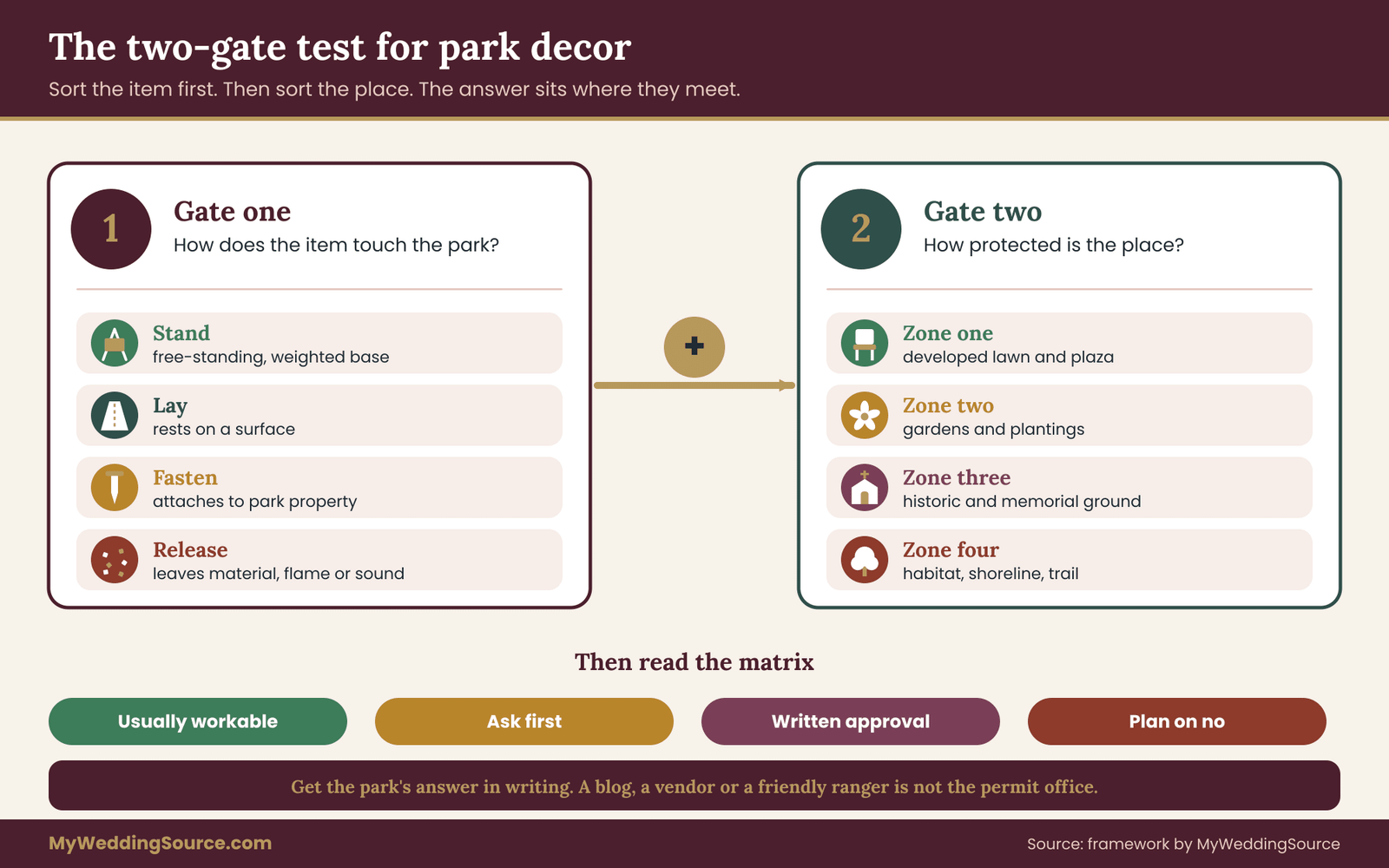
Often yes, but not freely. Most public parks allow some park decor, and almost all of them limit how it touches the site. Run every item through two gates. Gate one asks how the item touches the park: does it stand, lie, fasten or release? Gate two asks where it will be: lawn, garden, historic or memorial ground, or natural habitat. Free-standing items on a developed lawn are the easiest to approve.
Anything fastened to a tree, driven into the ground, burned, scattered or released is the hardest. The park office, not a vendor or a blog, gives the final answer, and it should give it in writing.
Couples tend to ask the question in one of two ways. Some ask, “Can we hang string lights in the trees?” and get a quick yes from a friendly ranger, then find out on the day that the person who said yes did not control that part of the park.
Others assume the answer is no, give up on park decor entirely, and stand under an open sky wondering why the ceremony looks so bare. Both mistakes come from treating park decor as a single question when it is really a series of small ones.
This article separates those small questions. It does not teach you how to book a park or how permits work in general. The broader walk through of site permits, guest limits and park rules belongs in a different guide, and where you need a venue-level overview, the wedding venues guide on this site covers the choices around park, garden, barn and hall. Here the subject is narrower: the stuff you carry in, and whether the ground it sits on will tolerate it.
A note on scope. This is general information, not legal advice. Park rules vary by city, county, state and federal agency, and they change, so this guide points you to the questions to ask and the offices that answer them rather than stating what any particular park allows today.
What park decor means, and what it does not
Start with a plain definition, because the word “decor” hides a lot. In this guide, park decor means any item you place in, on or above park property for the purpose of the ceremony, whether it stays for ten minutes or three hours. That includes the obvious pieces, such as a ceremony arch and a welcome sign, and the less obvious ones, such as the tape that holds a sign to a post or the rice-sized bits of paper tossed at the end.
Park decor does not include the park’s own features. A gazebo, a fountain, a rose garden, a lake view and a stand of old oaks are the reason you chose the place. They are not yours to modify. Treating them as a backdrop that you may adjust, wrap, color or light is the most common way couples run into trouble. The rule of thumb is simple: the park’s furniture and plantings are fixed, and your park decor has to work around them.
It also does not include rentals that the park itself provides. Some parks rent out chairs, tables or a pavilion as part of a reservation. Those items come with their own terms, and the park usually decides where they go. You still need to ask about them, but they follow a different set of rules than the things you bring.
Park decor also differs from decor at a private venue in one respect that matters for every decision that follows. At a private venue, you are a paying client of one owner, and the owner’s contract tells you what you can do. At a public park, you are one of many users of land held for everyone. The park is not selling you a decorated room. It is lending you a reservation and asking you to leave the place as you found it.
That difference explains almost every restriction you will meet. Rules about stakes, tape, tree attachments, open flame, confetti and balloons are not arbitrary. Each one protects something: underground pipes, bark and roots, fire safety, the people who clean up afterward, the wildlife that eats what is left behind, or the next couple who has the same lawn tomorrow.
A useful habit for park decor is to describe each item in a sentence that includes where it touches the park. “A six-foot arch standing on four weighted feet on the paved plaza” is something an office can answer in one reply. “An arch” is not. The more precisely you describe the contact, the less the answer depends on the mood of whoever picks up the phone.
Why public parks treat park decor differently from private venues
The same arch can be a non-issue at a rented estate and a problem in a public park, and the reasons are structural rather than personal. Understanding them helps you predict which requests will meet resistance and which will not.
First, a public park has a duty to many users. A permit gives you the use of a space for a window of time, but it does not remove the park’s obligation to everyone else. Paths stay open, restrooms stay available, and people walking dogs may still cross the edge of your ceremony.
Park decor that blocks a path, covers an accessible route or crowds a shared feature runs into this duty first. If you want to see how venue-level access thinking works in practice, the venue technical walkthrough shows how to measure routes and clearances before you commit to a layout.
Second, parks hold physical assets that you cannot see. Irrigation lines and utility conduits run under many lawns, often a few inches below the surface. A tent stake or an arch spike that would be harmless in a backyard can break a line and cost the park money and time. That is why stakes and ground anchors draw so much scrutiny, and why the national call-before-you-dig service exists at all. If staking is ever permitted, the park, not you, should say where.
Third, parks protect living things. Tree bark is a living layer, and wire, rope or even soft ties can girdle a branch if left in place. Gardens and meadows are planted on purpose, and a spread of petals or a dropped candle does not look the same to a gardener as it does to a bride. Natural areas are habitats, and food-like litter, small plastic pieces and balloon remnants can harm animals. These are the same concerns that federal land agencies describe in their visitor guidance.
Fourth, parks answer to rules that private venues do not. A city park follows city code. A county park follows county code. A state park follows state parks regulations. A national park follows federal regulation and the superintendent’s own compendium of local rules. Two parks a mile apart can follow different rulebooks. That is why any answer you read online, including this one, can only describe patterns, not the rule at your site.
Fifth, enforcement of park decor rules is different. A private venue manager can say yes on the spot and will usually honor it. A park staff member on the day may not know what the permit office approved, and may enforce the written rule rather than the promise made months earlier. This is the single biggest reason to get park decor approval in writing and to carry it with you.
Finally, parks tend to treat cleanup of park decor as a condition rather than a courtesy. In a private venue, a cleaning fee is a line on an invoice. In a park, the expectation is that the site looks untouched when you leave, and some permits make the couple responsible for any damage or extra cleanup the park has to do. That expectation shapes what counts as acceptable decor in a way no contract clause has to spell out.
The shape of the answer to “can you decorate”
Taken together, those reasons produce a predictable pattern. Parks are generally comfortable with park decor that is self-contained, removable in minutes and leaves no trace. They get cautious as park decor touches living things, buried infrastructure, historic fabric or open flame. They resist park decor that releases material into the environment. The rest of this guide turns that pattern into a decision process you can apply item by item.
The process for park decor has three parts. Gate one sorts each item by how it touches the park. Gate two sorts the place by how sensitive it is. The restriction matrix then combines the two into one of four outcomes, so that a long wish list shrinks into a short, defensible request. After that, a worked example shows the method on an invented case, and later sections cover alternatives, setup and teardown, and the conditions under which you should drop a park decor idea entirely.
If your park is a federal site, such as a national park, forest or wildlife refuge, the rule set is different again and tends to be stricter about natural features. The agency’s own site, starting from its main page, is the place to confirm current rules. The National Park Service, for instance, publishes visitor rules and permit information on its main site, and each park posts its own special-use information. Treat everything here as a way to prepare better questions for that office. ## Gate one: sort each item by how it touches the park
The first gate ignores where you are and looks only at the item. Every piece of park decor falls into one of four classes, based on what it does to the ground, the plants, the structures and the air around it. Sorting your park decor list this way takes about twenty minutes and removes most of the guesswork before you ever contact the park office.
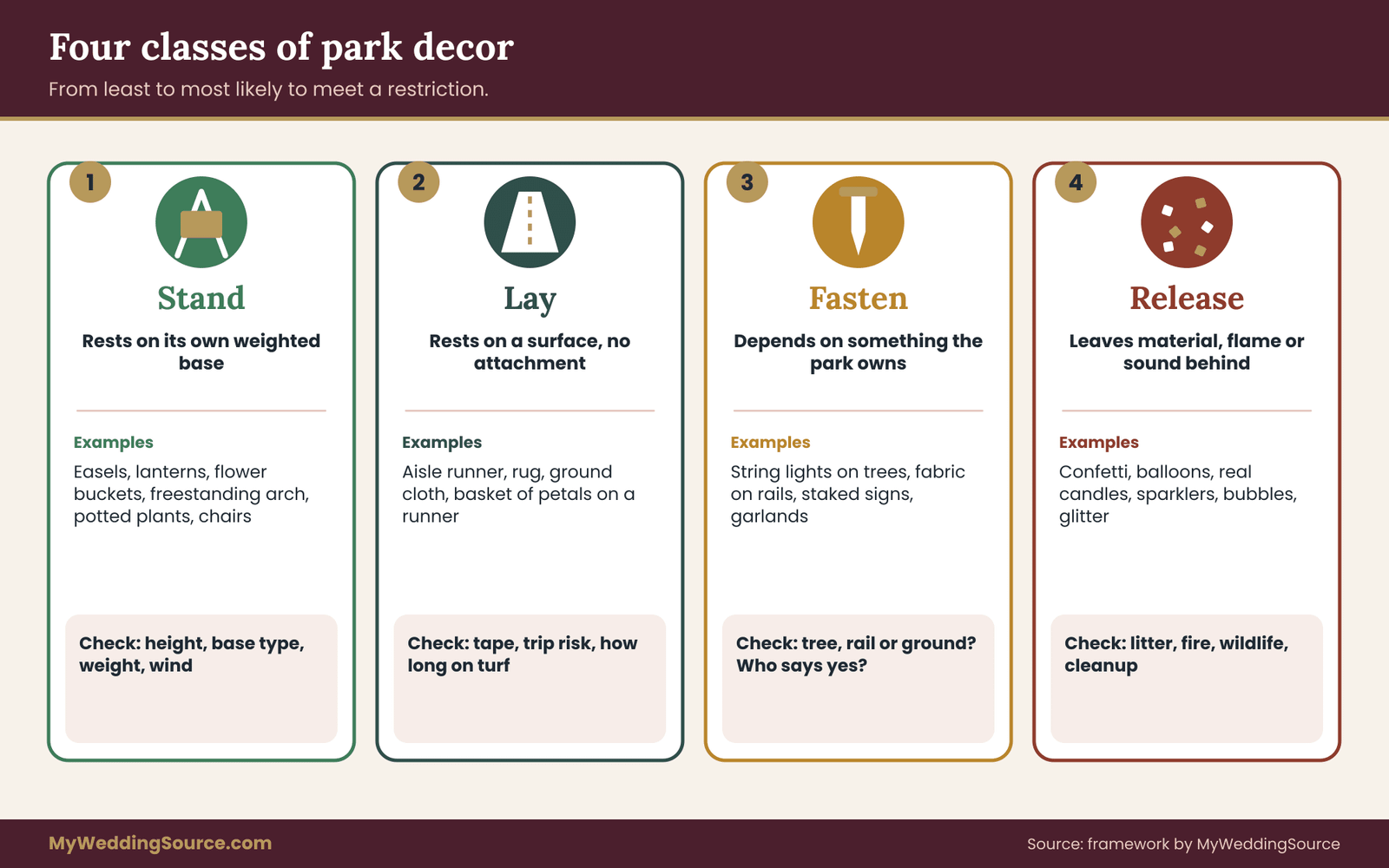
The four classes are Stand, Lay, Fasten and Release. They run from least to most likely to meet a restriction. Keep that order in mind, because it tells you where to spend your effort. A park decor wish list heavy with Stand items is easy to defend. A list heavy with Release items is a list you should expect to shrink.
Stand: free-standing items with a weighted base
A Stand item rests on its own weight and touches the ground only through a base. Easels with welcome signs, lanterns on the ground, flower buckets, a freestanding arch on flat feet, potted plants in their own containers, and ceremony chairs all belong here. Nothing is driven in, tied on or left behind.
Stand items are the park decor that parks tend to approve first, because removal takes minutes and the site looks the same afterward. Even so, two details decide whether a Stand item is truly harmless. The first is stability.
A tall arch on a breezy day can tip, and a park that is worried about injury or damage may ask for sandbags, water-filled bases or a height limit. The second is the footprint. Four small feet on pavement differ from four heavy feet pressed into wet turf, which leaves marks that last for days.
When you describe a Stand item to the park, give its height, width, base type and approximate weight. That description does more than any assurance that it is “just a small arch.”
Lay: items that rest on a surface
A Lay item covers or lies across part of the site. An aisle runner, a rug under the ceremony space, a ground cloth, a line of petals in a basket-guarded row and a fabric panel on the grass all fit. Nothing is attached, but the item changes the surface, and surfaces are where parks have their strongest opinions.
On a paved plaza, a runner is usually a safety question: does it lie flat, and does it create a trip hazard for guests and the people using the plaza later? On grass, a runner or tarp left in place can smother the turf, so parks sometimes limit the time an item may stay down.
In a garden bed or meadow, the answer is more often no, because walking and laying anything on the planting itself damages it. Loose petals sit between classes. Placed on a runner, they are Lay. Thrown by guests, they become Release.
Ask also about tape on park decor. Runners often come with double-sided tape or adhesive strips. Adhesive on a paved or historic surface can leave residue and is the kind of detail that appears on written conditions. A runner that stays down with its own weight or with a few weighted corners avoids the question.
Fasten: items that attach to something the park owns
A Fasten item depends on something the park owns to stay up. String lights looped around a tree, fabric tied to gazebo rails, a sign zip-tied to a fence, a garland across a pergola, a ribbon on a lamp post and a stake driven into the lawn all fasten. The park’s tree, rail or ground becomes part of your installation.
This is the class where permission is most likely to be limited, and the reasons differ by what you attach to. Trees can be damaged by wire, nails, screws, staples and even tight cord. Historic railings and posts can be scratched, painted or marked by adhesive. Ground stakes may hit pipes or cables. Fixed structures such as pavilions and bandstands may allow temporary fabric ties but prohibit anything that touches the roof or electrical fixtures.
Some parks will say yes to a very narrow version of a park decor request of a Fasten request, such as soft fabric ties on a specific rail, removed the same day. Others will say no across the board, and that policy is easier to plan around than a case-by-case judgment. Either way, Fasten items almost always require asking before the day, and many require written approval.
One practical test helps. Imagine the item hanging from its attachment point for the entire event while a strong gust pulls on it. If the park’s object takes any load at all, treat the item as Fasten. A balloon arch tied to a gazebo post is Fasten even if the balloons weigh little, and a lantern hung from a branch is Fasten even if the branch is thick.
Release: items that leave material, light, heat or sound behind
A Release item puts something into the environment or consumes itself in doing so. Confetti, rice, birdseed, flower petals thrown by guests, bubbles, sparklers, candles with an open flame, fireworks, smoke or fog machines, helium balloons, balloon releases, lanterns that fly, powdered color, glitter and chalk all release. So do amplified sound and drone flights, though those usually run under separate rules.
Parks tend to be strictest here for reasons that appear again and again in agency guidance: litter that outlasts the event, small items wildlife may eat, fire risk, and cleanup burden. Some parks permit one narrow form of release, such as dried petals or a specific eco-friendly toss, while banning the rest. Others ban all of it. If a toss or a send-off is part of your ceremony, see the alternatives section later, because most send-offs can be reworked as something that stays in your hands.
Candles deserve a separate mention because they look gentle. An open flame near dry grass, a tent, fabric or tree canopy is a fire matter, and parks and fire authorities often regulate it directly. Battery-powered flameless candles belong in Stand instead, and they usually cause no objection. The difference between a real flame and a good imitation is often the difference between a no and a yes.
Edge cases that do not fit cleanly
Some items straddle classes, and it helps to decide on purpose rather than hope. A hanging basket of flowers hooked on a gazebo is Fasten even though the flowers are living and the basket is light. A heavy freestanding arch with stakes added “for the wind” becomes a Fasten item the moment a stake touches the ground. A tent is Stand or Fasten depending on whether it uses weights or stakes, and many parks regulate tents by size regardless of anchoring.
A rented sound system is Stand but may trigger a noise rule. A rented generator is Stand but may be banned for fuel and noise reasons. Signs are Stand when on an easel and Fasten when taped, tied or staked. The same sign, in other words, can sit in two different classes based on how it is held up, and that is exactly why the sorting exercise is worth doing.
If an item resists sorting, put it in the higher-numbered class. Treating it as the more restricted type will cost you a few extra questions and prevent a surprise.
A short worksheet in sentences
For each item on your list, write one line with four facts: the item, its class, the surface or object it touches, and how long it stays. “Welcome sign, Stand, on an easel on the lawn, two hours” is a complete line. “String lights, Fasten, two oak branches near the aisle, three hours” is another. When you finish, you will see your list as a set of contact points rather than a mood board, and that is the form the park office can respond to.
Notice how much a park decor list shrinks in significance when written this way. A dozen items might include seven Stand items, two Lay items, two Fasten items and one Release item. Those seven Stand items need little discussion at all. Your effort belongs on the other five. That is the practical gain of this gate for any park decor plan: it moves your attention from the whole vision to the handful of pieces that carry real risk of a no.
Count the Release and Fasten items on your own park decor list before reading on. If the count is zero, you probably need only to confirm your Stand and Lay items and read the park’s general conditions. If the count is three or more, plan to spend a couple of email rounds with the park office, and plan to have fallback versions ready. The later sections on alternatives and on written approval show how to prepare both.
One more habit saves arguments later. Photograph or sketch each piece of park decor as you intend to use it, with its dimensions written next to it. A simple picture of an arch standing on its base, with the height and base width labeled, helps a permit office decide in a minute.
It also gives you something to attach to an email, and it gives the vendor who delivers the item a clear picture of what the park has approved, so the item that arrives matches the item you described. ## Gate two: sort the site by how protected it is
Gate one told you how each item touches the park. Gate two asks about the ground, plants and structures it will touch. Every public park contains more than one kind of place, and the kind you choose for the ceremony changes the answer to nearly every park decor question. A ceremony on a paved plaza and a ceremony on a meadow edge in the same park can be governed by very different expectations.
Sort your chosen spot into one of four zones. These are working labels for this guide, not official categories, and your park may describe its areas in other words. The aim is to read the site honestly, using what you can see and what the park’s own materials say.

Zone one: developed lawn, plaza and picnic ground
This is the most forgiving zone. It includes mown lawns that are built for gatherings, paved plazas, bandshell areas and picnic grounds with shelters. The ground is durable, the use is expected, and the park has seen a thousand events here. Stand and Lay items are usually workable, and Fasten items may be possible on structures built for the purpose, such as a rental shelter with posted rules.
The hidden risks are under the surface. Irrigation lines, lighting conduits and drainage run beneath many developed lawns. That makes stakes and spikes a question even here. There is also the question of shared use: a plaza near a playground or a path system stays open to the public, and your layout may have to leave a clear route through it.
Zone two: gardens and managed plantings
Rose gardens, botanical gardens, arboretums, flower beds, planted borders and memorial gardens belong in this zone. The plants are the attraction, and many are labeled, irreplaceable or in the care of volunteers and gardeners with firm opinions. Park decor here is judged against the planting.
Expect stricter limits on foot traffic off paths, on petals and confetti, on anything placed in or on beds, and on attachments to plants, trellises and pergolas. Many gardens welcome small ceremonies on specific lawns or terraces and restrict the beds themselves. Some charge a separate fee for garden use or require a staff member to be present. Flowers you bring are also a consideration: some gardens object to cut flowers placed in the ground as if planted, and some prohibit potting soil because of pest or disease concerns.
If your ceremony is in a garden, the realistic goal for park decor is decor that frames the space without touching it. A Stand arch placed on a path, flowers in vessels set on hard surfaces and a sign on an easel are the usual ceiling. Florals built to be reset or moved quickly suit this setting best.
Zone three: historic, memorial and cultural ground
Historic buildings, monuments, memorials, cemeteries, battlefields, ceremonial grounds, shrines and places of cultural significance make up this zone. It can sit inside a larger park, and it may be governed by an additional set of rules from a historic or cultural authority.
For park decor here, the principle is that nothing you do should alter, mark or compete with the site. Attachments, adhesives, stakes and nearly all Release items are commonly prohibited. Some places restrict photography setups or amplified sound. Some ask you to avoid specific areas entirely or to hold ceremonies only at a designated spot. In places of remembrance, the issue is also tone. Even permitted park decor can feel out of place, and staff may have a view about it.
For a ceremony in or near this zone, begin by asking whether a ceremony can be held there at all, and where. Park decor comes second. When park decor is allowed, it is often limited to a few Stand items that arrive and leave with you.
Zone four: natural habitat, shoreline and trail
Natural areas include forest edges, meadows left to grow, wetlands, shorelines, dunes, riverbanks, alpine areas, desert and the trails that run through them. The park exists to protect the land and the animals living on it, and visitor rules reflect that.
Park decor in this zone shrinks to its smallest. Release items of park decor are almost always off the table. Fasten items are limited because trees, rocks and soil are the habitat. Even Stand items may be restricted by size or by the number of people a site can handle. Some shorelines and dunes have seasonal closures for nesting birds or other wildlife, and a site that is open in one month may be restricted in another. Fire rules can also be strict in dry seasons.
Leave No Trace guidance, widely used by land agencies, offers a useful mindset here: leave what you find, dispose of waste properly, and minimize the effects of anything you bring. If you plan to use the zone for a ceremony, set the goal as leaving it indistinguishable from before your arrival.
How to place your spot honestly
Couples often place their chosen spot in the friendlier zone because they like the idea. A ceremony at the edge of a rose garden is easy to call “lawn.” A ceremony beside a war memorial is easy to call “just a park.” Try the opposite approach. Place the spot in the stricter zone whenever it could belong to two, and let the park tell you that it is looser than you thought.
Ask yourself three questions. Is there anything within a few steps of your setup that was planted, built or dedicated on purpose? Does the park’s map, sign or website name the area, such as a garden, memorial, grove or reserve? Would a staff member describe the area with a word that suggests protection, such as sensitive, historic, restoration or habitat? Any yes moves you toward the stricter zone.
Also check what the permit actually covers. Some reservations cover a specific numbered area or a pavilion and nothing beyond it. If the permitted area ends at the edge of the lawn, park decor placed in the planting just beyond it is outside your permit, whatever the zone.
Sometimes your ceremony touches two zones at once, for example a plaza where guests sit and a garden edge where you stand. In that case, judge each item by the zone it actually touches. Chairs on the plaza face one standard, and an arch at the garden edge faces another. That split is common, and it is a reason to describe each item with its own location instead of describing the ceremony as a whole.
Water adds a layer of its own. A ceremony beside a lake, river or ocean beach often falls under additional rules for shoreline and water quality, and agencies may restrict anything that could blow or wash into the water. Light fabric, paper and small park decor tend to travel, so the shoreline is where wind-prone park decor gets the most scrutiny. If your zone is near water, put every lightweight item in the higher-risk group for that reason alone.
Why the zone matters more than the park decor item
It helps to see how the two gates interact with a pair of examples. A set of battery candles in glass jars, a Stand item, is a nonissue on a plaza and a mild question in a memorial garden. The same item changes little, while the zone changes the reaction. A thrown handful of petals, a Release item, may be tolerated on a developed lawn that gets mown and swept the same evening, may be limited in a garden, and will likely be refused in a habitat or at a memorial.
This is why a vendor’s blanket statement, such as “parks let us do that all the time,” tells you little. They may be describing Zone one. Your spot may sit in Zone three. When someone gives you a yes, ask which part of the park it applied to.
The park decor restriction matrix
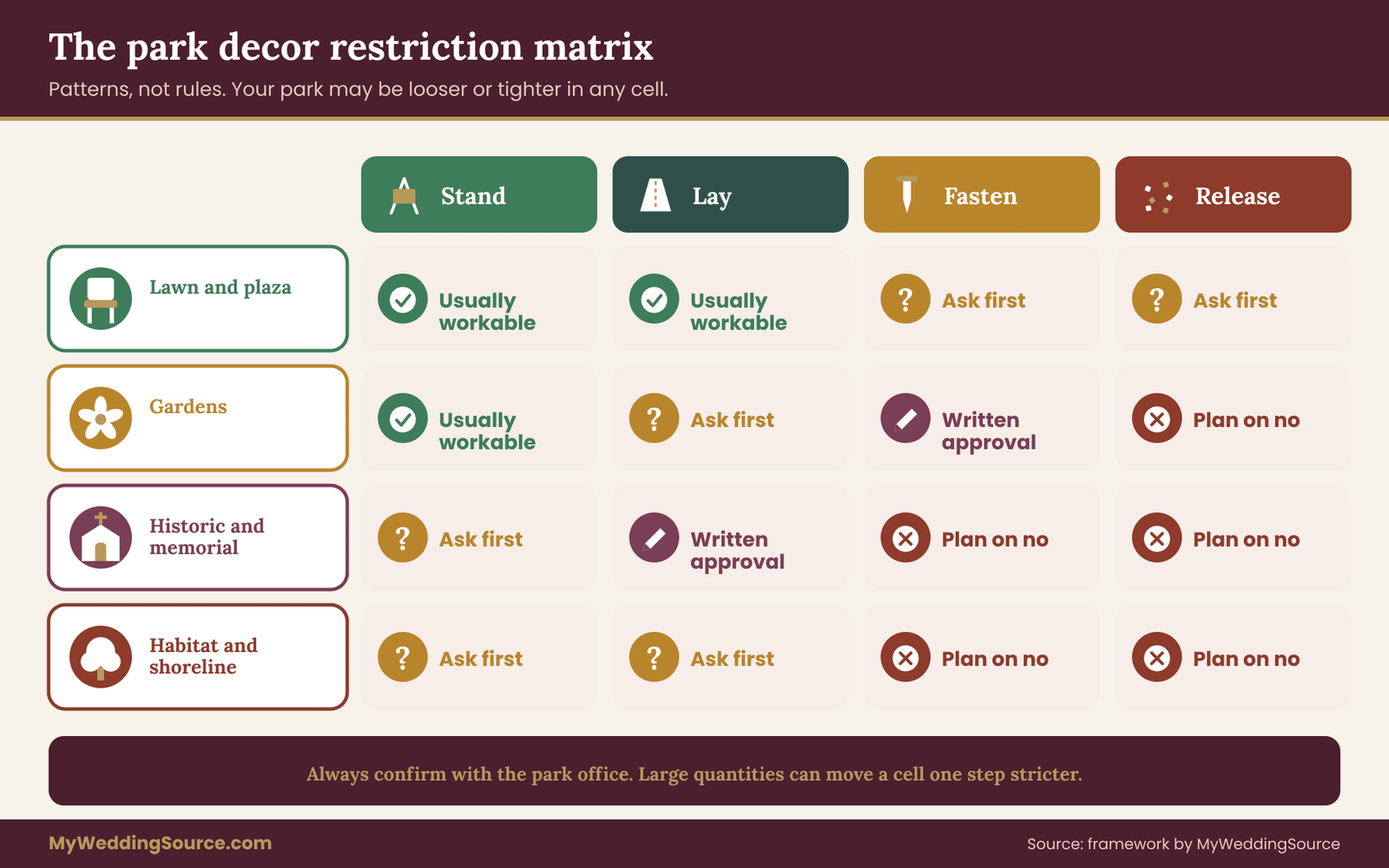
Put the two gates side by side and you have a four-by-four matrix with sixteen cells. Each cell answers one question: for this kind of item in this kind of place, what do parks usually say? The answers fall into four outcomes. Usually workable means the item is commonly allowed with standard conditions.
Ask first means a short written question is worth sending, and the answer varies. Written approval means do not proceed without a specific, signed or emailed yes. Plan on no means the item is rarely allowed and your plan should not depend on it.
These are patterns, not rules. They summarize how land managers commonly think, and your park may be looser or tighter in any cell. Use the matrix to decide where to focus your questions, never as a replacement for the park’s answer.
Reading the matrix by zone
On developed lawn and plaza, Stand items are usually workable. Lay items are usually workable too, though adhesive and trip hazards bring an ask first. Fasten items are ask first when a structure is built for it and written approval when the item touches trees or ground. Release items are ask first at best, and often plan on no for anything that cannot be swept up the same hour.
In gardens, Stand items are usually workable on paths and hard surfaces, and ask first anywhere else. Lay items are ask first, and plan on no in beds. Fasten items need written approval or are a no. Release items are plan on no, with a narrow exception for something the garden itself offers.
In historic and memorial ground, a handful of Stand items may be workable, but even those start as ask first. Lay items need written approval. Fasten and Release items are a plan on no.
In natural habitat, shoreline and trail, Stand items are ask first because of size, group limits and seasonal rules. Lay items are ask first or no. Fasten and Release items are plan on no.
What the park decor matrix does not tell you
The matrix says nothing about permit fees, guest limits, reservation windows, vendor access, parking, amplified sound, alcohol or insurance. Those are separate rules found in permit conditions, and the broader permit conversation lives elsewhere. It also does not capture temporary restrictions, such as fire bans, drought conditions, nesting closures or events scheduled nearby.
It also assumes that you are asking for ordinary quantities. Ten battery candles are a different request from two hundred, and one sign differs from twenty. Park offices think in terms of footprint, handling time and cleanup. Large amounts can push a cell from usually workable to ask first without changing the item at all. ## A worked example: a gazebo near a rose garden
The example below is invented to show the method. The couple, the park and the outcomes are illustrative, not a record of a real event, and a real park may answer differently. What matters is the sequence of steps and how a long list becomes a short, approvable request.
Imagine a couple, Dana and Marcus, planning a ceremony for about sixty guests at a city park. The reservation covers a stone gazebo and the lawn in front of it. A rose garden begins about fifteen feet to the left, behind a low hedge. Old oaks line the path to the gazebo. The couple has a wish list of ten pieces of park decor.
Step one: write each item as a contact line
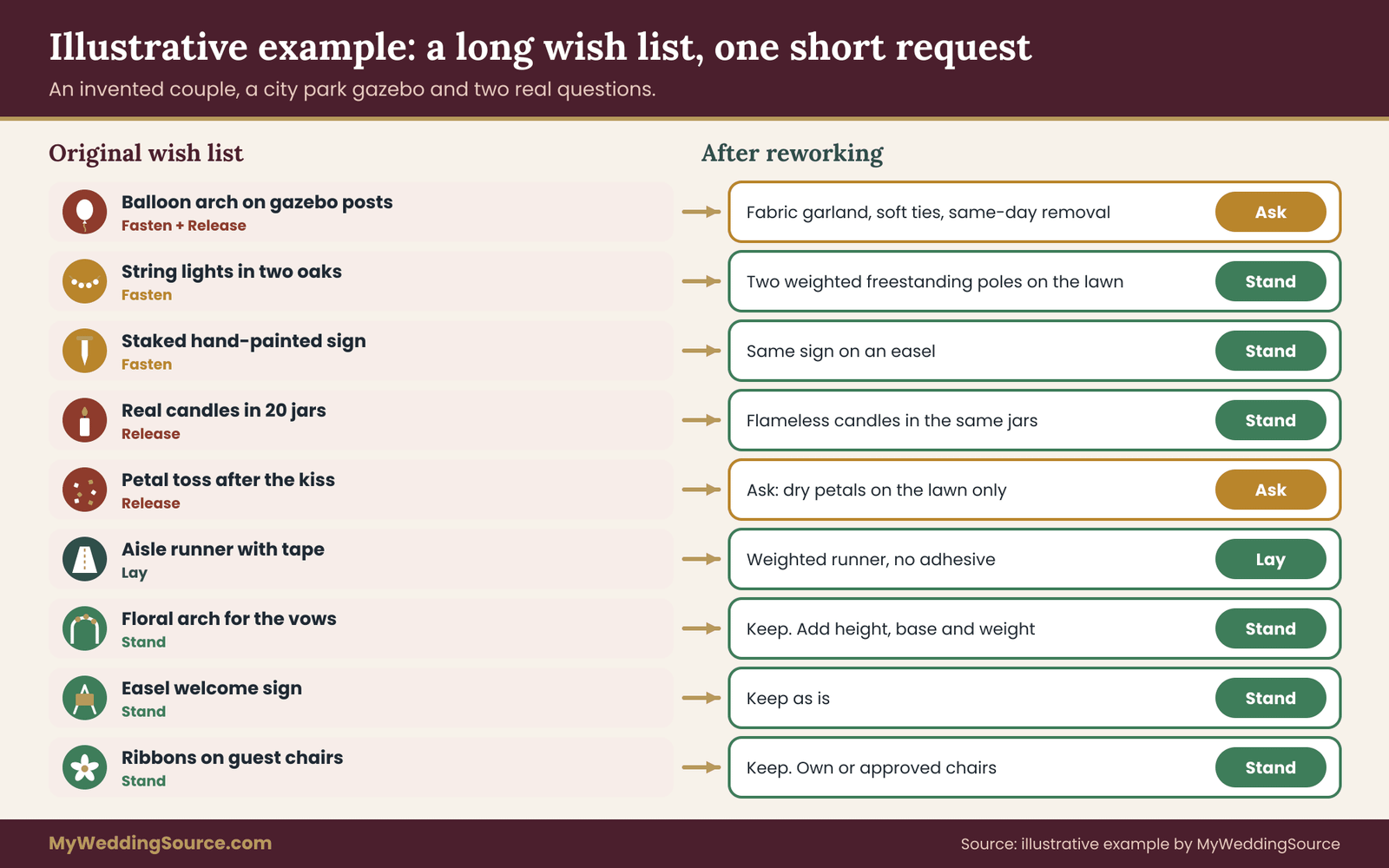
Dana and Marcus list each item with its class, what it touches and how long it stays. The list reads: a balloon arch tied to the gazebo posts; string lights looped through two oaks; a freestanding floral arch for the vows; an aisle runner with tape; a welcome sign on an easel; petals thrown after the kiss; twenty glass jars with real candles; a ribbon on each guest chair; a hand-painted sign staked at the path entrance; and a flower garland across the gazebo rail.
Sorted by class, the balloon arch, string lights, garland and staked sign are Fasten. The runner is Lay. The floral arch, easel sign, ribbons on chairs and jars are Stand, except that the candles are Release because they burn. The petal toss is Release. Reading the list this way, they see four Fasten items, one Release item that is hiding inside a Stand item, and one plain Release item.
Step two: place the site in a zone
The gazebo and lawn are developed lawn, Zone one. But the oaks are mature trees with bark and roots the park cares about, and the rose garden edge is fifteen feet away. Dana and Marcus decide the gazebo is a Zone one structure, the oaks are a Zone two question, and any item placed at the left edge of the lawn would be close enough to the garden that they should treat it as Zone two.
They also check the reservation. The permit covers the gazebo and the lawn. The garden is outside it, and so is the area under the oaks beyond the lawn line. That settles several items before the matrix even opens.
Step three: read the matrix
On the lawn and gazebo, the Stand items are usually workable: the floral arch, the easel sign and the jars with flameless candles instead of real ones. The chair ribbons are a Stand-class item attached to the couple’s own rentals, so they are workable too, provided the chairs are theirs or the park allows it. The runner is Lay on a lawn: ask first, mainly about the tape.
The Fasten items are the real questions. The string lights in the oaks are written approval or no, because they touch trees. The garland across the gazebo rail and the balloon arch are ask first or written approval, depending on whether the gazebo is a protected structure.
The staked sign is a no until the park says where, if anywhere, a stake can go. The petal toss is ask first on the lawn, and a likely no near the garden. The real candles are a plan on no because of the open flame and the dry oak canopy.
Step four: rework before asking
Before writing to the park, they remove what they do not need to ask about. The staked sign moves onto the easel. The candles become flameless candles, which changes them from Release to Stand. The string lights come off the oaks and onto two freestanding poles with weighted bases on the lawn, converting Fasten into Stand.
The balloon arch is replaced by a fabric and flower garland that they would only ask to drape on the gazebo rail with soft ties, removed the same day. The petal toss becomes a petal basket on a runner, or, if the park allows, a dry, plant-based toss limited to the lawn.
The result is a request with two real questions rather than ten: soft ties on one rail, and whether a petal toss is allowed on the lawn. Everything else is Stand, with dimensions attached.
Step five: send a specific request
The email Dana sends to the park office is short. It names the reservation, lists eight items with class, size and location, asks the two questions, states that everything arrives and leaves with the couple on the day, and asks for a written reply. It attaches a sketch and photos of the arch, poles and easel. It does not describe the vision in paragraphs. The park office can answer in a few lines because the request is built from contact points.
The park replies that the Stand items are fine within the reserved lawn, the poles must be weighted and kept off the path, soft ties on the gazebo rail are allowed if removed after the ceremony, the petal toss is not allowed because of the sweeping burden, and the runner must lie flat with no adhesive. Dana saves that reply in the event folder and sends the relevant lines to the florist and the lighting vendor.
What the park decor example shows
Three things stand out. First, most of the original wish list survived, but in modified form. The look of the ceremony stayed close to the picture in the couple’s heads, because the changes touched how items were held up, not what they were. Second, the work happened before the first email, not after. A long, vague request would have produced a vague, cautious answer. Third, the only item that failed outright, the petal toss, had a clean substitute.
The example also shows the limits of the framework. The park’s answers did not follow the matrix on every point. The park was stricter on the toss than the matrix suggests for a developed lawn, and looser on soft ties than a cautious reading would predict. That is normal. The matrix prepares the questions. The park supplies the answers.
How to get park decor approved in writing
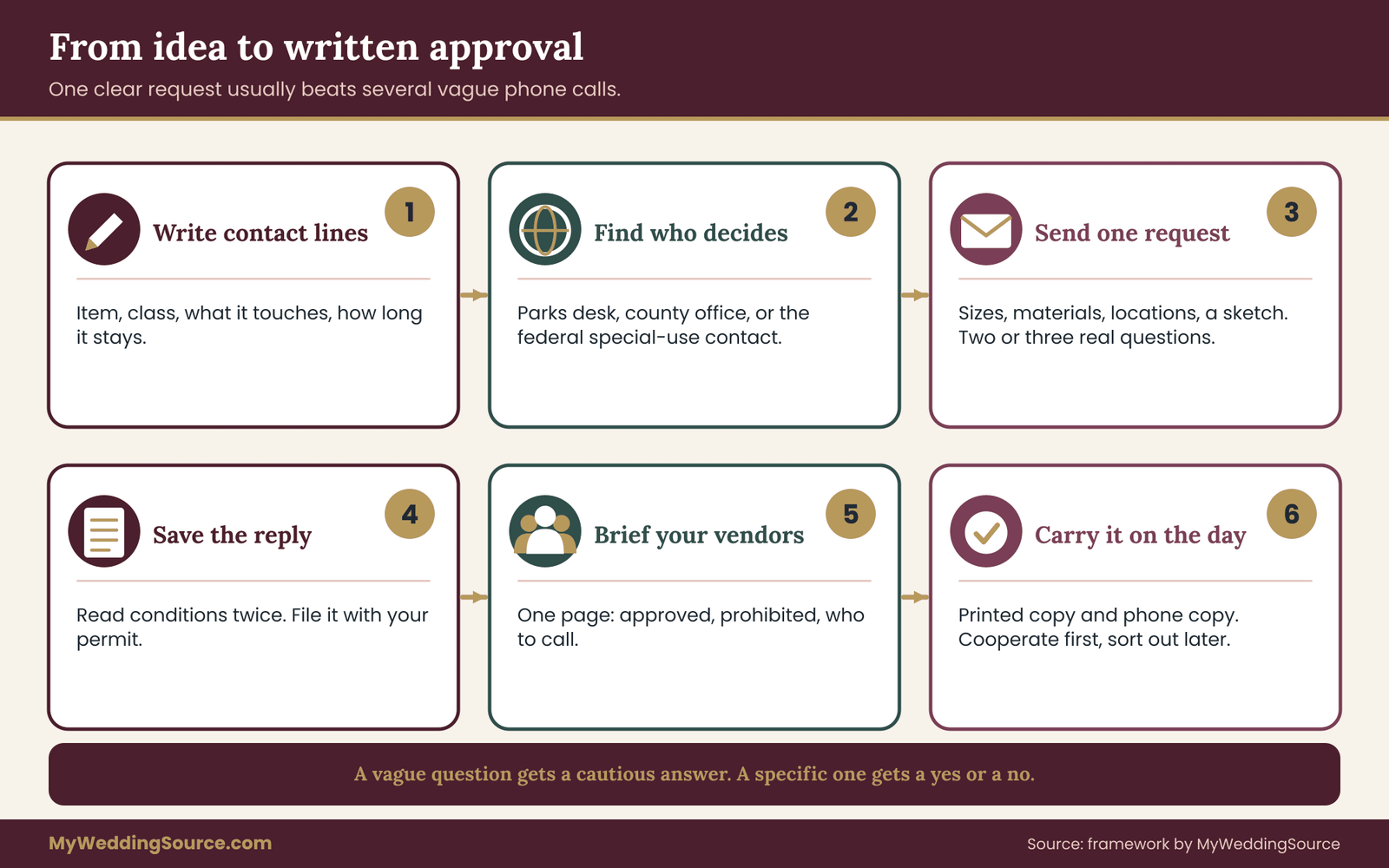
A verbal yes from a ranger on the phone is a good start and a weak foundation. The person you reach may not be the person who decides, may not remember the call, and will not be present on the day. Written approval turns a conversation into something you and your vendors can point to.
Begin by finding the right office. In many cities, event use of parks goes through a recreation or parks department permit desk. County and state parks often route through a reservations or special events office. National parks and other federal land use a special-use or commercial-use permit process, with a named contact. Start from the park’s own page, and confirm who owns the specific spot, because a path, a historic structure or a lakefront may belong to a different department than the lawn beside it.
What a good request includes
A request that gets a useful answer usually includes the event date, time window and reservation number or permit number; the exact location by name or map reference; the number of guests; a list of park decor items, each with class, dimensions, material, how it will be held up and how long it stays; any items you are unsure about, flagged as questions; and a plain statement that everything will be removed and the area restored.
It should not include a long description of the ceremony’s meaning, an appeal to how beautiful it will look, or a bundle of unrelated questions about parking, alcohol and amplified sound. Send those separately or fold them into the permit conversation so the park decor answer stays easy to find.
A short script for the first call
If you call before writing, a few lines keep the conversation on track. You might say: “I have a reservation for the gazebo lawn on a date in June. I’m planning mostly free-standing park decor and I want to confirm what’s allowed before I order anything. Who handles that, and can I send a list?” The goal of the call is to learn who decides, what format they want and how long they take to reply. Write down the name, the date and the answer.
Then follow up in writing the same day. A one-paragraph email that restates what you were told and asks the office to confirm is often enough to turn a call into a record.
What to do with the park decor answer
When the written reply arrives, read it twice. Look for conditions that attach to approvals, such as height limits, no adhesives, removal by a certain time, an on-site monitor or a fee. Copy the relevant lines into your day-of folder. Send the exact wording to every vendor who brings or installs park decor, so that their drivers and installers know the limits and do not assume they apply to a different site.
If the answer is vague, ask a narrower question. “Is park decor allowed?” invites a general reply. “May we use two freestanding poles with weighted bases on the lawn, away from the path?” invites a yes or no.
If the answer is no, ask whether anything close to the item would be acceptable. Staff often know what has worked for other events and can suggest a version that fits. Be ready to accept the no. Arguing with the person who holds the permit, a week before the date, rarely changes the outcome and can sour the rest of the relationship.
For the paperwork side of vendors who bring and install items, the wedding vendor contract guide explains how to put venue limits into the agreements your vendors sign. ## Alternatives when a park decor idea is a no
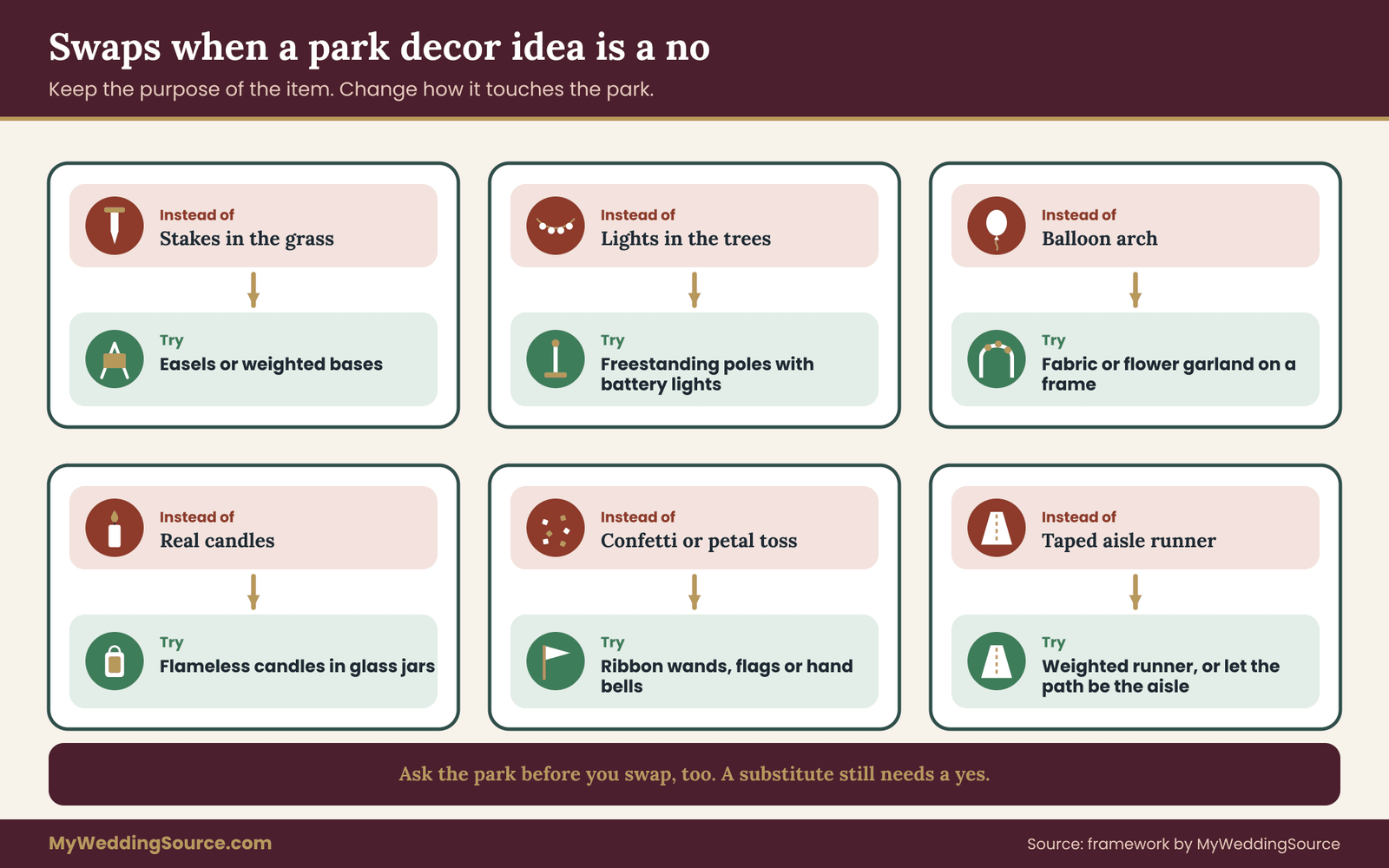
A refused item does not have to mean a plainer ceremony. Most park decor ideas serve a purpose that can be met another way: framing the vows, lighting the evening, marking the aisle, welcoming guests, or creating a moment at the exit. Name the purpose first, then look for a Stand or Lay version that serves it without touching what the park protects.
Instead of tying park decor to trees or rails
If the goal is height and framing, bring your own structure. A freestanding arch, a set of tall planters, a pair of columns or a fabric panel on weighted stands creates the frame without touching anything. Choose bases that sit flat and spread weight, and check the surface: pavement and firm lawn handle weight well, while soft or wet ground does not.
If the goal is a canopy of lights, freestanding poles with weighted bases can carry the strings, and shorter pole sets can mark the edge of the seating area. Battery-powered lights avoid cords and generators, and they avoid the question of electrical fixtures. Test the weighted poles with a gust in mind, since a pole that holds in still air can fall in wind.
If the goal is draped fabric, a freestanding frame is the cleanest answer. A frame carries the fabric the same way a gazebo rail would, and it leaves the rail alone.
Instead of stakes in the ground
Stakes and ground spikes are among the first things parks refuse. For signs, use easels, weighted stands or sign holders that rest on their own base. For arches and tall pieces, use water-filled or sand-filled bases, or concrete-free weighted bases that you remove afterward. For tents and canopies where the park permits them at all, ask whether weights are accepted in place of stakes, and expect rules on size and placement.
When you describe a weighted base, give its material and weight so the park can judge it. Sandbags are not always welcome, since a torn bag leaves sand behind, so ask. Water barrels or purpose-built weights are cleaner.
Instead of confetti, rice or a petal toss
The send-off is a moment, not a material. Guests can hold something that is not released: small flags, ribbon wands, hand-held bells, handkerchiefs, pinwheels or a simple cheer. Each works as a visible, photographable exit and leaves nothing behind. Bubbles are sometimes allowed and sometimes not, because the soap film can leave a slick on pavement. Ask before you plan around them.
If the park allows a toss in principle, ask what kind. Some accept dried, plant-based material on a developed lawn and require that you sweep it up. Others refuse everything, including petals, because even natural material draws wildlife or attracts complaints.
Whatever the answer, a Release item you do not need is one fewer thing to clean up on a day when you have other things to do. For more on the waste and reuse side of ceremony choices, the guide to reducing wedding waste lays out options for park decor that does not end up in a bin.
Instead of balloons and releases
Helium balloons, balloon arches and balloon releases draw objections from many agencies, partly because the remains travel and partly because animals can eat or become tangled in them. A cloth or paper garland, a flower arch, large paper pompoms on stands, banners on weighted poles or a cluster of potted plants delivers a similar visual weight. Fabric flags and ribbon wands add movement without leaving a trace.
Instead of open flame
Flameless candles in glass jars, lanterns and hurricane lamps with LED lights capture the look and avoid the fire question. They also avoid wax on benches, pavement and clothing. If a real flame matters to your ceremony for a religious or cultural reason, raise it directly with the park and the local fire authority instead of hoping it passes unnoticed. Some places have a process for ceremonial flame in a controlled setting, and the answer may be a limited yes with conditions.
Instead of aisle tape and adhesive
A heavy runner needs no tape. A lighter one can be weighted at the corners with small, discreet weights covered by flowers. A line of potted plants or low lanterns can mark the aisle without any runner at all. On historic or garden paths, consider skipping the aisle covering and letting the path be the aisle.
Instead of putting flowers in the ground
Live plants in containers that sit on the surface are generally easier to approve than planting. Cut flowers in vessels belong in Stand. Planting anything in the ground, even as a keepsake, is a different request. Parks may allow a dedication through a formal program for trees and benches, which has its own process and costs. That is a separate conversation from ceremony decor and is better handled long before the date.
Using the park as the decor
The cheapest, easiest and most accepted park decor is often the park itself. A well-chosen spot with a natural backdrop does more than an arch does. Spend your park decor energy on framing it: a short aisle that follows an existing path, chairs placed to face the best view, and a small number of Stand pieces that echo the surroundings in color. The wedding color palette guide can help you pick tones that sit well against green, stone and sky instead of competing with them.
Park decor on the day: delivery, setup, hold and teardown
Approval does not end the work. Park decor succeeds or fails in the hours around the ceremony, and most day-of problems come from handoffs between people who never saw the written approval.
Build a one-page park decor brief
Make a single page that every vendor and helper receives. It lists the park’s name and the specific location, the reservation window including setup and teardown time, a short list of approved items with sizes and positions, a short list of prohibited items, contact details for the park contact and your own point person, and the text of the park’s written conditions. Keep it plain and short. People read one page and skip five.
Include a rule that applies to everything: if an item is not on the approved list, it does not go out of the vehicle. That single sentence stops a florist from adding a staked arrangement on impulse.
Time the setup around the permit, not the vision
A reservation window usually includes setup and teardown, and it can be shorter than you expect. Count backward from the ceremony: how long to place chairs, install the arch, set lights and test them, place signs and carry in flowers. Add time for the unexpected, such as a car that cannot reach the drop point or a base that will not sit level. If the park limits vehicle access, plan carts and carrying distances, since a heavy arch is a different problem when it must travel two hundred yards.
Assign a teardown owner
Teardown is where park decor plans most often fail quietly. Everyone is tired, the light is fading and the party is elsewhere. Name one person, not a team, to own teardown and give them a trash bag, a few extra bags for found litter, and the brief. Their job is to leave the area cleaner than the park’s baseline, including anything dropped by guests. Photograph the area before setup and after teardown with a timestamp. Those photographs are your record if a question arises about damage or cleanup.
Plan for weather and wind
Wind is the enemy of park decor that stands on its own. Arches, signs, poles and fabric act like sails. Decide in advance at what wind level you will lay items down, remove fabric panels or drop the arch altogether.
Rain brings its own issues: wet lawns mark under heavy bases, runners become slick, and paper signs fail. If the park has a weather policy for events, read it and ask what happens to your reservation if conditions change. The day-of digital contingency plan shows how to keep decisions and contacts reachable when conditions change fast.
Keep the paperwork on site
Carry a printed copy of the written approval and the permit, and keep a digital copy on a phone. A park staff member who arrives on the day may not know what the permit office agreed. Handing them the written approval resolves most questions in a minute. Keep the tone calm and cooperative. If a staff member asks you to remove something that your approval allowed, comply first, and sort out the discrepancy afterward with the permit office. Arguing on the day, in front of guests, rarely wins.
Brief the vendors who bring the most items
Florists, rental companies and lighting vendors carry the most park decor, so they need the most careful briefing. Tell them the zone, the surface, the weight limits and the prohibited methods. Ask them to bring versions of their work that match the Stand and Lay classes, and ask what they do at other parks so you can compare. A vendor with park experience will know to bring weighted bases, extra ties and cleanup bags. One without may arrive with stakes in the truck. ## Failure conditions: when to drop a park decor idea
A decision framework needs a stopping rule. Without one, couples keep negotiating for an item the park will never allow, or they install it anyway and hope. These are the conditions under which a park decor idea should be dropped, replaced or moved to a different site.
The park decor item cannot be described by its contact
If you cannot say where the item touches the park, you cannot get a useful answer. When a vendor says only “we will figure it out on site,” treat the item as unapproved. A park decor piece whose method depends on improvising at the park is a Fasten or Release item in disguise, and the improvisation will happen when you have the least time to ask.
The answer arrives too late to change the order
Some park offices reply slowly, and some reply only after a permit is paid. If the answer on a long-lead item, such as a custom arch, a lighting rental or printed signs, will not come before the vendor’s order deadline, order the version that needs no approval. A Stand version that you can use anywhere is worth more than a Fasten version that might be refused. Think of the order deadline as the real deadline for the question.
The park says no, and the alternative changes the point
Not every substitute works. If the whole meaning of an item depends on the method, such as a ceremonial fire, a release with spiritual weight or a specific tree, a workaround may not serve it. In that case, the choice is between a different version of the ritual and a different site. Be honest with yourselves about which you would accept, and decide before the reservation is paid for. The guide to wedding ceremony order and structure helps you see which moments carry the meaning and which are decoration.
The approval depends on someone who will not be there
A yes that depends on one staff member’s presence, or on a conversation nobody wrote down, is fragile. If your approval is verbal and cannot be turned into an email, assume the on-the-day answer may differ. Either get it confirmed in writing or plan as if the answer were no.
The conditions cost more than the item is worth
Some approvals come with strings: a staff monitor charged by the hour, a refundable deposit, a certificate of insurance, a fee per structure or a required cleanup crew. Weigh the cost of the condition against the value of the item. A twenty-minute rental that triggers a separate fee and a monitor is rarely worth it. Ask the park to list every condition and fee in one message so you can compare options without surprises. Do not guess at amounts; the park or the vendor supplies them.
The site cannot take the park decor volume
Even permitted items can fail when there are too many of them. A lawn that welcomes a small arch and a few signs may not welcome forty chairs, twenty lanterns, three tents and a lounge set. If your park decor list requires more than the space can hold while keeping routes clear, cut the list, not the routes. Public paths, accessible routes and emergency access are not yours to give away.
The conditions on the day are unsafe or protected
Fire bans, high wind, lightning, nesting closures, flooding and a sudden change in the park’s own work schedule can all remove permission without notice. Decide in advance which items you will drop under which conditions. A line in your brief such as “if wind exceeds the vendor’s limit, the arch comes down and the ceremony proceeds without it” saves a debate when guests are already seated.
The park is not the right place for your park decor
Sometimes the honest conclusion is that this park, this spot or this season does not suit the vision. If your priorities are string lights in trees, a candlelit aisle and a petal send-off, a developed lawn in a city park may never satisfy them, and a private garden or an outdoor venue built for decor might. That is not a failure of planning. It is the planning working: you found the mismatch before the deposit. The wedding venues guide compares the venue types that carry more decor freedom.
Special cases that change the answer
The framework holds across most public parks, but a few situations deserve their own attention.
Federal and other protected land
National parks, national forests, wildlife refuges and lands run by other federal agencies operate under federal rules and local compendiums. Weddings often fall under special-use or similar permit processes, and park decor is judged within those conditions. The National Park Service main site, the U.S. Forest Service, the Bureau of Land Management and the U.S.
Fish and Wildlife Service each publish visitor and permit information. Natural and cultural resource protection is central to all of them, so expect the Gate two zones to lean toward the stricter end. Confirm every item, including things as small as a ribbon, with the managing office.
Signs and wayfinding
A welcome sign, a direction sign at the park entrance and a sign for parking are separate questions. Signs inside your reserved area are normally Stand items. Signs outside it, at an intersection, along a road or on park posts, may fall under different rules entirely, and some jurisdictions restrict temporary signs on public property in general.
The wedding signage system guide covers readability and placement, and it is a good place to check how directional signs should work before you ask the park. If guests are likely to get lost, a map in the invitation or text message is often a safer alternative to roadside signs.
Lighting and power
Light is a frequent request, and power is often the catch. Many parks do not allow generators and may not provide outlets for private use. Battery-powered lights, rechargeable lanterns and warm LED strings on freestanding poles avoid these issues. Check whether the ceremony will run past sunset or a park closing time, because lighting for a late ceremony can conflict with posted hours more than with decor rules.
Tents and canopies
Tents and canopies are regulated in many places by size, even without any park decor attached. Some parks require a permit for any structure above a certain size, and many require that stakes be approved or banned. Some fire authorities also regulate tent materials and heaters. Ask early, because tents often carry separate deadlines. If a shade or rain plan depends on a tent, treat it as a core part of the reservation, not as decor.
Accessibility
Park decor must never cut off an accessible route. Runners, cables, signs, chairs and floral pieces can narrow a path or create a trip hazard for someone using a mobility device, a cane or low vision.
Keep a clear path of travel from the parking area and restrooms to the ceremony space, leave room for wheelchair users to sit with their companions rather than in a separate corner, and avoid loose edges. The U.S. Department of Justice’s ADA site is the reference point for accessibility requirements at public facilities, and many park offices have their own guidance for event routes.
Food, drink and amplified sound
These are rarely decor, but they interact with it. A dessert table, a drink station or a speaker adds equipment, power and trash to the site. Alcohol and amplified sound are commonly regulated or banned in parks, and permits spell out the limits. Treat them as part of the same conversation with the park, in the same written reply, so no one finds a conflict at the last minute.
Photographers and drones
A photographer who brings reflectors, stands or a ladder is bringing Stand items and should be briefed. Drone flights are often prohibited or tightly regulated in parks, and federal land generally restricts them heavily. Ask in writing before planning any aerial photography.
What park decor really costs, without made-up numbers
This guide does not list prices, because costs vary by park, region and vendor and any figure here would be a guess. Cost logic is still useful, since it tells you where money goes and where it can be saved.
The first cost of park decor is purchase or rental of the item itself. Stand items usually cost more up front than improvised Fasten items, because weighted bases, frames and poles are real equipment, but they avoid permit conditions and repair risk. Many can be rented, which spares you storage.
The second cost of park decor is labor: delivery, setup, teardown and cleanup. Park decor that needs several trips, long carries or careful placement raises labor, and vendors may price it separately. Ask each vendor to quote setup and removal, and ask what changes if access is limited to a cart or a long walk.
The third cost is conditions: fees, monitors, deposits and insurance. These depend on the park, so request the list in writing and add it to your comparison.
The fourth cost is risk: a refused item on the day, a damage claim, a fine, or a deposit withheld. This one never appears on an invoice, which is why it is easy to ignore. Choosing Stand and Lay items, getting written approval and assigning a teardown owner are cheap ways to lower it. ## Your next steps
Work through these park decor steps in order. Each takes less time than the one before it, and the first two do most of the work.
- Write your park decor list as contact lines. For each piece of park decor, note the item, its class (Stand, Lay, Fasten or Release), what it touches and how long it stays.
- Place your spot in a zone. Choose the stricter zone whenever your spot could belong to two, and check what your reservation actually covers.
- Rework before you ask. Convert Fasten and Release items to Stand or Lay versions wherever the look survives. Keep only the real questions.
- Send one written request. Include sizes, materials, locations and a sketch, and ask for a written reply. Save the answer in your event folder.
- Build a one-page brief. Give it to every vendor and helper, name a teardown owner, and carry printed approval on the day.
- Set your stop rules. Decide which items you will drop for wind, fire bans or a late answer, and write that into the brief.
If the park turns out to be the wrong match for your park decor plans, the wedding venues guide and the rental planning checklist help you compare other settings and what each will let you bring. For measuring routes and clearances at any site before you order, return to the venue technical walkthrough.
FAQ
Can you decorate a public park for a wedding ceremony?
Usually in a limited way. Many public parks allow free-standing park decor such as easels, weighted arches and flameless lanterns, while restricting anything fastened to trees, driven into the ground, burned or scattered. The rules come from the agency that manages the park and the conditions on your permit, so confirm each item with the park office and get the answer in writing.
Do I need a permit just to bring park decor?
Park decor itself is rarely permitted separately. It is normally covered by the event or reservation permit, which lists conditions on what you may bring. Some parks require extra approval for tents, structures or amplified sound. Ask the park office whether your reservation covers park decor, and ask for any conditions in writing before you order anything.
Can I hang string lights or fabric from trees?
Often no. Trees are living assets, and wire, rope, nails or tight ties can damage bark and branches. Many parks prohibit attaching anything to trees. Freestanding poles with weighted bases, battery lights and freestanding frames give a similar effect without touching the park. If the park does allow it, expect narrow conditions and written approval.
Are balloons, confetti and petals allowed?
Frequently restricted. Parks often limit balloons, confetti, rice, birdseed and petals because of litter, wildlife and cleanup. Some allow dried plant-based material on a developed lawn if you sweep it up. Ask what the park permits, and consider hand-held alternatives such as ribbon wands or flags that leave nothing behind.
Can I use real candles or open flame?
Often not. Open flame near grass, trees, fabric or tents is a fire concern, and many parks and fire authorities restrict it, especially in dry seasons. Flameless candles are the usual answer. If a real flame matters for religious or cultural reasons, ask the park and local fire authority directly about any process for ceremonial use.
Can I put stakes in the grass to hold a sign or arch?
Many parks say no, because irrigation lines and cables can lie just under the surface. Use easels, weighted bases or water-filled stands instead. If the park allows stakes at all, it should tell you where, and the written answer should be kept with your permit paperwork.
What if the park says yes by phone but the staff on site says no?
Show the written approval and comply with the instruction on the spot if staff insist, then sort out the discrepancy with the permit office afterward. This is why a written reply matters. If you only have a verbal yes, send a follow-up email restating it and ask the office to confirm before the event.
Do national and state parks follow the same park decor rules?
No. National parks follow federal regulation and local park rules, state parks follow state regulation, and city or county parks follow local code. Federal and natural sites tend to be stricter about resource protection. Check the managing agency’s own pages, and ask the specific park about any item you plan to bring.
Sources
- National Park Service – visitor rules, special-use permit information and park-specific regulations for national parks.
- U.S. Forest Service – recreation and special-use permit information for national forests.
- Bureau of Land Management – permit and recreation rules for public lands.
- U.S. Fish and Wildlife Service – refuge visitor rules and wildlife protection guidance.
- Call 811 – the national call-before-you-dig service for locating underground utilities.
- National Recreation and Park Association – park and recreation agency resources.
- ADA.gov – U.S. Department of Justice accessibility guidance for public facilities.
- National Fire Protection Association – fire safety codes and standards for open flame and temporary structures.
- Leave No Trace Center for Outdoor Ethics – principles for minimizing impact on outdoor sites.
- U.S. Environmental Protection Agency – environmental guidance on litter and waste.