
First dance lessons are a small, bounded project: a few hours of instruction and a few weeks of short practice that turn a two-to-four-minute song into something you can do without panic. This guide helps you choose a style, compare formats of first dance lessons, set a timeline, and follow a four-week practice outline with a clear plan for what to do if it goes sideways.
Decide the goal before you book anything. Pick the song’s tempo and your comfort level first, then choose the lightest format of first dance lessons that reaches that goal: a group class, a few private sessions, a short choreography package, or a video course. Start six to eight weeks out if you can, and ask the instructor for a written outline. Practice in short sessions, in the shoes and clothes you will wear, and settle the venue floor and music cue with your DJ before the final week.
Most couples ask the wrong question first. They ask which instructor to hire, or whether they should “take a class,” when the more useful question is what they want the dance to look and feel like on the day. A slow sway with a dip at the end and a rehearsed three-minute routine are different projects. They need different amounts of help, and paying for the wrong one is the most common way first dance lessons turn into a source of stress instead of a pleasant evening out together.
This article is built around decisions. It gives you a way to pick a style, a comparison of five kinds of first dance lessons by what each one actually delivers, a timeline you can count backward from your wedding date, and a four-week practice outline you can print. It also includes one worked case, clearly marked as invented, and a list of failure conditions so you know in advance when to simplify.
A note on scope. This is general planning information, not legal, tax or financial advice, and it does not make medical claims. Studio policies, prices and accessibility arrangements vary, so confirm the details with the people you hire.
What first dance lessons actually cover
The phrase covers a wide range of services, and studios use it loosely. Before comparing options, separate the four things couples usually mean when they ask about first dance lessons.
Basic partner dancing. A few core steps, a comfortable hold, a way to lead and follow, and a way to turn without tangling. This is the base for almost every style, and for many couples it is all that is needed.
Song-specific choreography. An instructor listens to your actual song and arranges steps, turns and a finish to fit its phrases. This is what people picture when they say “choreographed first dance.” It takes more sessions than basic steps.
Performance coaching. Posture, eye line, where to face the photographer, how to enter and exit the floor, and how to recover when something goes wrong. This part is often skipped, and it is where nerves do the most damage.
Confidence and pacing. Learning that you can stop, laugh, restart a phrase or simply sway for the last minute. It sounds soft, but it is practical, because most first dances last under four minutes and the couple controls more of that time than they think.

A good set of first dance lessons names which of these four you are buying. If a package description only says “wedding dance prep,” ask which parts are included and how many sessions each one usually takes. The answer tells you whether the price is attached to real instruction or to a brand name.
What lessons do not do
First dance lessons cannot fix a mismatch between your song and your goals. A fast, complicated song with a fast, complicated routine will be hard for beginners regardless of the teacher. First dance lessons also cannot guarantee how the day goes, and an honest instructor will not promise that. What good instruction can do is shorten the learning curve, give you a shared vocabulary, and make the first run-through in front of guests feel like the fiftieth.
They also do not replace the practical work of coordinating with your venue and your music provider. The reception section of your day belongs in a larger schedule, and the guide to reception music planning covers how the dance fits among toasts, dinner and open dancing.
Who this guide is for
It is written for couples who have never taken partner dance lessons and for couples who have some experience but have not danced together. It is also written for couples who are not sure they want to dance at all. If you are in that last group, the next section is for you, because the cheapest and kindest form of first dance lessons may be none.
Do you need first dance lessons at all?
Many couples assume first dance lessons are expected. They are not. A first dance is a tradition, and traditions can be shortened, reshaped or skipped. The decision deserves a few minutes of honest thought before any money changes hands.
Here is a simple way to sort it. Answer three questions separately, and write the answers down.
How much do you want it to look planned? If you are happy with a slow sway and a gentle spin, you may not need an instructor. If you want a set sequence with a finish, you probably do.
How comfortable are you being watched? Dancing in front of friends and relatives is different from dancing in a living room. If the idea makes one or both of you tense, instruction on posture and entering the floor is useful even for a simple dance.
How much practice time do you realistically have? Wedding months are crowded. A plan that needs three evenings a week is a plan that gets abandoned. Be generous with yourselves about what is possible.
Reading the answers
If you want something simple, are comfortable, and can find a few short sessions, a do-it-yourself plan with one or two refresher sessions is enough. If you want something planned, but are nervous and short on time, a small private package of first dance lessons is a better use of money than a long group course. If you want a full routine, plan for a choreography package and a longer runway.
There is also a fourth outcome: you decide a traditional couple’s dance is not the right fit. A later section covers alternatives such as a shorter dance, a dance with the whole room, or a quiet moment with the song and no steps at all.
The cost logic, without invented numbers
Prices for first dance lessons depend on your area, the instructor’s experience, whether sessions are private or shared, and whether the studio bundles choreography with a number of hours. This guide does not quote prices because any figure would age quickly and vary widely. Instead, use the logic below when you compare quotes.
First, count the hours you are actually buying, not the package name. Second, ask whether the instructor’s time includes music editing, a recorded practice video, or a final run-through at your venue. Third, check what happens if you need to reschedule, and whether unused sessions expire. Fourth, compare the cost per hour of instruction to what a single group class costs in your area. Finally, put the total into your wedding budget with the rest of your entertainment costs, so that the wedding budget shows the real cost of first dance lessons instead of a late surprise.
A short script for deciding together
If you are talking this over and the two of you want different things, try using this prompt at the kitchen table. Each person finishes the sentence “On the day, I would feel good if the dance…” in one line, and each person finishes “I would not want the dance to…” in one line. Compare the four lines. Overlaps tell you the goal. Differences tell you what to ask an instructor to balance.
For example, one partner might want a rehearsed finish while the other worries about forgetting steps. That points toward a short, simple routine with a clear fallback, which is a very common and very workable plan. If you cannot agree even after the exercise, take a single trial lesson before committing to a full set of first dance lessons. A trial costs less than a package and tells you quickly whether the format suits both of you.
What the instructor needs from you
Whichever route you choose for first dance lessons, bring information. Instructors work faster when they know the song, the approximate length you want, the shoes you plan to wear, how much space the floor is likely to offer, and anything about your bodies, habits or comfort that you want them to plan around. You decide how much to share. A short, plain message works well: here is the song, here is the date, here is our goal, here is what we are nervous about.
It also helps to bring a recording of the music in the version you will really use. If you plan to shorten or edit the track, say so at the first session, because phrase lengths drive the choreography. A twelve-second change in the intro can change where a turn lands.
Keep this early conversation friendly and specific. Instructors are used to couples who are anxious about looking foolish. They would much rather hear “we are nervous about the lift at the end, so we would like to avoid it” than watch two people quietly struggle through something they dislike. Saying it out loud also protects your budget, because the instructor stops spending session time on elements you have already ruled out.
Choosing a style before you book first dance lessons
Style is the decision that shapes everything after it in first dance lessons: how many sessions you need, what shoes make sense, how much floor you need, and which instructor to approach. Choose it before you shop. Otherwise the studio chooses for you, and studios naturally steer toward what they teach.
The song is the best starting point, because it already has a tempo, a feel and a length. Play it and tap along, because first dance lessons begin with the music you already love. Is it slow enough that you could walk to it comfortably, or does it push you faster? Does it feel like it has a steady beat or does it float? Those answers narrow the styles quickly.
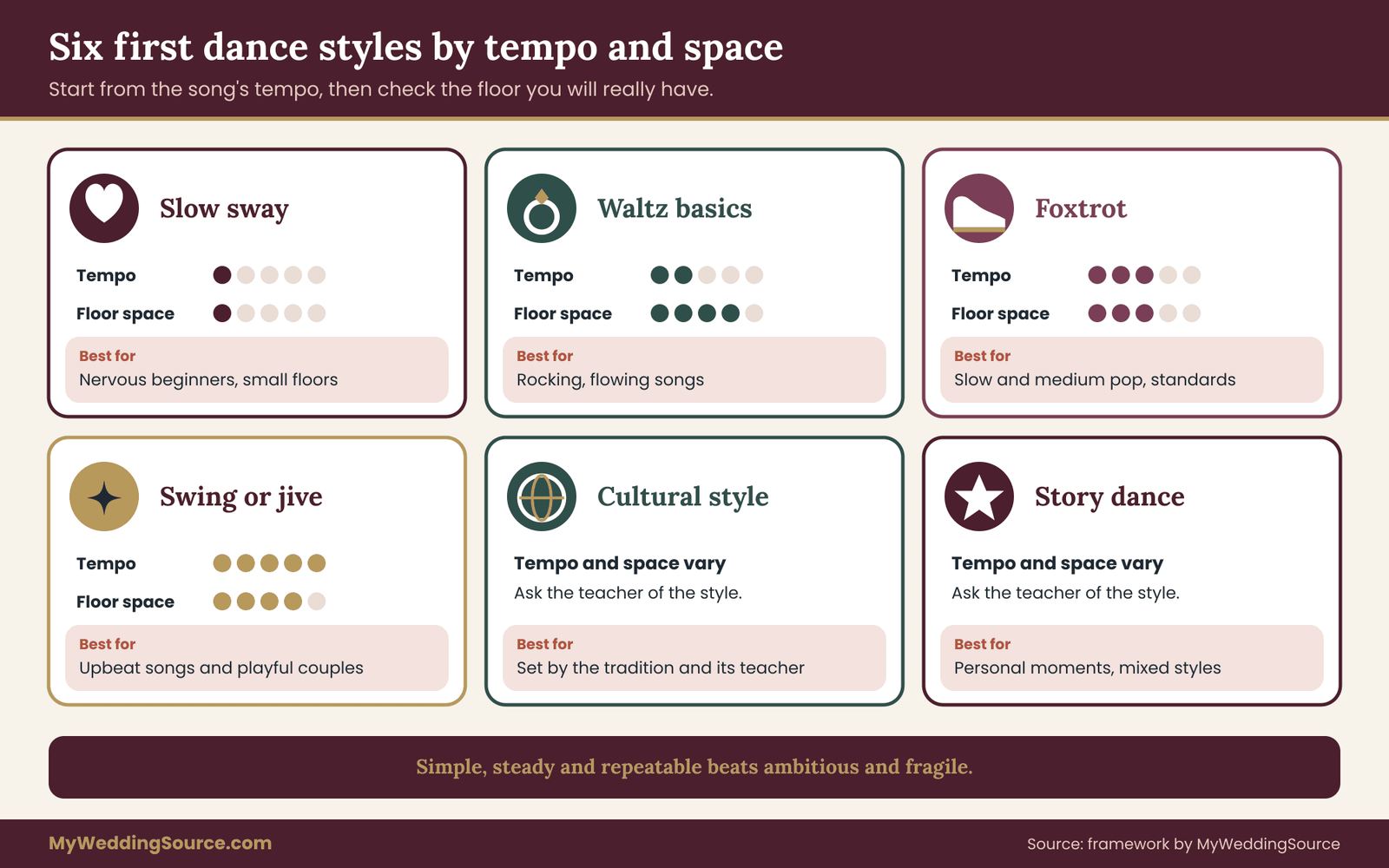
Six styles couples commonly choose
The slow sway. Two people in a close hold, stepping side to side in time, with a few turns. It suits slow songs, small floors and nervous beginners. First dance lessons for a sway are short, often one or two sessions, and the focus is on posture, hold and an ending.
Waltz or slow-waltz basics. A three-count rhythm that suits songs with a rocking, flowing feel. It gives a more traditional look and travels around the floor. It needs more space than a sway and a few more sessions to feel steady.
Foxtrot or simple ballroom. A smooth, slow-quick rhythm that fits many slow and medium-tempo pop and standard songs. It reads as polished on camera. First dance lessons for foxtrot take a little longer than a sway, but the basic pattern repeats, which helps.
Swing or jive-style. Brighter and faster, suited to upbeat songs. It is playful and good for couples who like to laugh through a dance. It asks for more floor space and more energy, and it benefits from regular short practice.
Cultural or family-rooted styles. Many couples want a dance that reflects their heritage, a family tradition or a regional style. These often have their own teachers, their own music and their own expectations about who joins in. Ask family elders and a teacher from that tradition directly, and agree on who will dance and when.
A story or freestyle dance. Part choreography, part improvised, built around moments that mean something to the two of you: a shared joke, a step you made up on a first date, a spin you always do in the kitchen. This takes the most planning, but it can feel the most personal.
A three-question style filter
Rather than picking from a list by looks, use a filter that ties the style to your real constraints.
Question one: what is the song’s tempo in practical terms? Slow and steady points to a sway, waltz or foxtrot. Medium and bouncy points to foxtrot or easy swing. Fast points to swing, or a freestyle with a slow start and a fast finish. If the tempo shifts in the middle, ask the instructor how to handle it, or consider a song edit.
Question two: how much floor will you really have? A large open floor allows travelling styles. A small or crowded floor favors turning in place. You will not know the exact answer until your venue shares a floor plan, so ask early and revisit the plan once the layout is fixed.
Question three: how much do you want to learn? A lighter style with a short routine is a good outcome. A heavier style with a long routine can be a good outcome too, but only if you have the runway. When in doubt, choose the lighter version and add flourishes later.
Matching a style to the couple, not the other way around
A common mistake is choosing a style because it looked impressive in a video. That video usually showed professional dancers, an edited song and a practiced floor. A style, and the first dance lessons that teach it, should fit your skill level, your attire and your comfort with each other, and it should still look good if you perform it at eighty percent.
A useful test is the kitchen test. Put the song on at home, in socks or flat shoes, and try the style’s basic movement for one minute. If you are laughing and want to try again, the style fits. If you are both irritated by the second pass, either the style or the song needs to change, and it is better to learn that before paying for a package.
What about mixing styles?
Many couples combine two. A slow sway for the opening, a few waltz turns in the middle, and a simple dip or spin at the end is a favorite shape. It gives variety without asking for deep skill in any one style. Ask whoever teaches your first dance lessons to keep the combination consistent, because switching style every sixteen counts is hard to remember under pressure.
Another popular combination is a slow opening followed by an invitation to the room. The couple dances alone for a short stretch and then the DJ invites guests to join. This lowers the pressure, because the dance is shorter and the room fills quickly. It also fits well into the reception schedule described in the reception music planning guide, where the opening dance leads naturally into general dancing.
Style and attire
Style also depends on what you will wear. A full skirt or a long train changes how you turn and where your partner can stand. A structured jacket changes the hold. Rental or fitted outfits may restrict how far you can step. Mention attire to your instructor at the first session, and plan at least one practice session in the real shoes and, if you can, the real hem length.
If your outfit changes, adjust the style rather than forcing the outfit. A style that needs wide steps in a narrow skirt will look strained, however well you practice.
Style and the people watching
Think briefly about the audience. A large crowd with many older relatives may enjoy a recognizable, traditional dance. A younger crowd may prefer something playful. A mixed crowd usually responds best to warmth, not complexity. Whatever style your first dance lessons teach, the thing guests remember is whether you looked like you were enjoying it.
That is also why many instructors suggest keeping the dance short. A well-done ninety seconds is better than an uneven three minutes, and many songs can be edited to suit. The separate topic of editing a song is a different decision with its own rules, so settle your style first and then decide how much of the track you need.
Writing down your style decision
Before moving on, write one sentence that captures the choice: for example, “A slow foxtrot to our song, about two minutes, ending in a simple turn, with the DJ inviting guests after the second chorus.” That sentence becomes the brief you give instructors, and it helps you compare quotes fairly. Instructors can respond to a clear brief with a clear plan. Vague briefs get vague packages.
If you cannot write the sentence yet, you are not ready to buy. Take a trial lesson, try the kitchen test, or ask one instructor for a short consultation first. Many studios offer an introductory class or a brief phone conversation at low or no cost, and that is a sensible way to learn what is possible.
Common style-choice errors
One error is choosing the style first and the song second, which often produces a mismatch between the music and the steps. Another is picking a style that needs a partner skill you do not yet have, such as fast turns or precise leading, without budgeting the time to learn it. A third is letting one partner choose alone, which usually leaves the other partner feeling like a performer in someone else’s plan.
A fourth is forgetting that the dance has to survive real conditions: a floor that may not be what you rehearsed on, lighting that may be dim, an audience that may be talking, and a body that will be warmer and more nervous than at home. Choose a style that still works when conditions are imperfect. Simple, steady and repeatable beats ambitious and fragile almost every time.
Lesson scope comparison: five ways to take first dance lessons
Scope is how much of the work your first dance lessons do for you. A narrow scope teaches skills and leaves you to assemble the dance. A wide scope builds the dance for you and leaves you to memorize it. Neither is better. The right scope is the narrowest one that reaches your goal with a comfortable margin.
The comparison below uses prose instead of a grid because the differences are about trade-offs, not numbers. For each format you will see what it delivers, what it leaves to you, who it suits, and the quiet cost that is easy to miss. Think of first dance lessons as a ladder: each step up adds instructor time and removes some of your own planning.
Format one: a group class series of first dance lessons
A group class teaches basic steps to several couples at once, usually weekly over a set number of weeks. It is the lowest-cost way to learn partner dancing and the best way to get used to dancing in a room with other people.
It delivers a solid base: a hold, a basic pattern, a turn or two, and a feel for the rhythm. It also gives you built-in weekly practice and a social setting that makes the whole thing feel lighter.
What it leaves to you is everything specific to your song. You will not get a routine, an entrance or a finish, and the music will not be yours. Group classes also run on the studio’s schedule, which may not match yours, and a missed week can leave you behind.
It suits couples who want a simple dance and enjoy learning in company. The quiet cost is time: a series that runs many weeks is a commitment of evenings, and a series that ends before your date leaves a gap.
Format two: a few private first dance lessons focused on basics
Here you book a small number of one-on-one sessions, with the instructor teaching the base for your chosen style and adapting it to the two of you. The instructor sees how you move together and fits the lesson to that.
It delivers personal attention and quick correction. It is flexible, because you and the instructor set the schedule, and it is often the most efficient route for couples with a simple style in mind.
What it leaves to you is the assembly. You will leave with steps and a sense of rhythm, but you must put them into the structure of your song, and you must remember the order. If you are comfortable doing that, this format is a good fit.
The quiet cost is that couples sometimes drift to the cheaper-seeming “basics only” version, then find in the final week that they needed an ending and an entrance. Ask whether the sessions can include a simple structure for your actual song, even if full choreography is not part of the package.
Format three: private first dance lessons with song-specific choreography
This is the traditional “choreographed first dance.” The instructor listens to your track, divides it into sections, and builds a routine with entrance, main pattern, a highlight and an ending. Sessions teach the routine in pieces and then in full.
It delivers a finished product. You know what you are doing at every moment, and the dance looks intentional. It also gives you a recording or notes to practice from, if the instructor provides them.
What it leaves to you is memory and repetition. A choreographed routine is only as good as your practice, and it is the format most likely to fall apart if you stop rehearsing for two weeks. It also leaves you with less flexibility on the day, because a missed step can feel like a crisis when you expect precision.
The quiet cost is the extras. Music editing, recorded videos, additional sessions to fix a section and a final run-through at the venue are sometimes priced separately. Ask for the full list before you agree.
Format four: online first dance lessons or a video course
Video-based first dance lessons teach the dance at your own pace, often with a library of steps and a few songs or sample routines. Some include live sessions or feedback on videos you upload.
It delivers flexibility and low cost. You can repeat a section as many times as you like, practice at midnight, and do it in your living room.
What it leaves to you is correction. Without a person in the room, small habits can settle in, such as a rigid hold or an uneven rhythm, and no one tells you. Video also cannot adapt to your song, your attire or your floor, so you must do that translation yourself.
It suits couples who are self-directed, short on time or short on budget, and who have some dance comfort. The quiet cost is the effort of self-correction. A useful hybrid is to use video for the basics and book a single live session to check your hold, your timing and your ending.
Format five: a rehearsal at the venue or a final polish session
Some instructors will meet you at the venue, or on a similar floor, for a final run-through. They check spacing, entrance, exit and the exact spot where photographers will stand. They can also practice the cue with the DJ.
It delivers confidence about the real conditions. Many problems that appear on the day, such as running out of floor, are discovered here, when there is still time to fix them.
What it leaves to you is the earlier learning. This is not a standalone format. It is an add-on that works best after you have learned the dance by another route, and it depends on venue access, which not every venue grants. The quiet cost is travel and scheduling. Ask the venue early whether an empty-room rehearsal is allowed and when.

A scope ladder you can use
To turn this into a decision, picture the five formats as rungs. Start from the bottom and climb only as far as your goal requires.
Rung one is a group series or video course. Rung two adds a few private sessions to correct and adapt. Rung three adds song-specific choreography. Rung four adds a venue or final-polish session. The fifth route, doing it yourself with no formal lessons, sits beside the ladder and is covered in the alternatives section.
Ask yourself at each rung: if I stopped here, would I be comfortable? If the answer is yes, stop. If it is almost yes, add the smallest piece that closes the gap, such as one private session for the ending. This habit saves money and keeps the dance proportionate to how much you want to rehearse.
Matching the ladder to common goals
A simple sway to a slow song usually needs rung one or two. A traditional waltz or foxtrot with a finish usually needs rung two or three. A routine with several sections, a mashup or a story dance usually needs rung three and benefits from rung four. If the music has a tempo change or the dance has a lift or dip, plan on rung three at minimum, and ask the instructor to tell you plainly whether the move is realistic for your time and comfort.
Notice that rung four is rarely the first thing to buy. It is the cheapest insurance, and it works only when there is something to polish.
What a fair package description looks like
Whatever first dance lessons you choose, ask for the scope in writing. A fair description lists the number of sessions, their length, what each covers, whether the song is edited, whether a practice video is provided, how rescheduling works, and what happens to unused hours. If a description only says “complete first dance package,” ask the studio to break it down.
You can use the questions in the next section as a checklist. If a studio will not answer them clearly, that tells you something. If you are hiring an independent instructor, the principles in the wedding vendor due diligence checklist apply here too: confirm who you are paying, what is promised and how disputes are handled.
Questions to ask before you pay an instructor
Good questions about first dance lessons save sessions. Bring these to a first call or a trial lesson, and write down the answers so the two of you can compare them later.
About experience. Has the instructor taught beginners who are marrying, and for which kinds of songs? Do they teach the style you chose or would they steer you elsewhere? There is no single credential that proves good wedding instruction, so ask about how they teach and listen to how they explain.
About the plan. How many sessions does the instructor expect for your goal, and what would make it fewer or more? What will you be able to do after each session? Will you get notes or a video to practice from?
About adaptation. How does the instructor handle different heights, different comfort levels, injuries or limits you choose to share, and attire like a long skirt? A good instructor describes how they adjust the steps. They do not tell you to adjust your body to fit the steps.
About the music. Will they help edit the song, and who pays for the edit? Do they need the exact version you will play? Edits and licensing are separate matters from instruction, so confirm who handles them.
About logistics. Where do sessions happen, what is the cancellation policy, how long is the package valid, and can you split sessions across several weeks? Does the studio carry insurance, and is the floor suitable for the shoes you plan to wear?
About money. What is included, what is extra, how is payment scheduled, and what is refundable? Keep the written terms with your other vendor paperwork, in the same place you keep the agreements described in the wedding vendor contract guide.
Reading the answers
You are listening for specifics. An instructor who says “it depends on how you pick things up, but most couples with your goal use a small number of sessions, and we reassess after the second” is giving you an honest answer. An instructor who says “everyone is ready in one session” is selling. Likewise, be wary of promises about how the day will go. Instruction improves your odds. It does not control a floor, a room or a mood.
Also notice how the instructor responds to your limits. If you say you do not want a dip or a lift and they respect that without argument, you are in good hands. If they push, move on. First dance lessons should leave you feeling more capable, not more pressured.
A timeline for first dance lessons, counted back from the wedding
The most useful way to schedule first dance lessons is backward from the wedding date. Pick the day, subtract the weeks, and fill in the milestones. Counting back keeps the work of first dance lessons in small pieces and leaves room for the unexpected, such as a sick week, a travel week or a song change.
The timeline below assumes a modest goal, a simple dance of two to three minutes with a short instructor-led learning phase. Adjust it upward if your style or song is more ambitious, and downward if you are happy with a sway. If you are building a longer vendor calendar, the wedding vendor timeline shows where entertainment decisions sit among the rest of your bookings.
Four to six months out: decide and shortlist
At this stage you have no steps to learn yet. You have decisions. Choose the song or a short list of songs, decide on a style using the filter from the previous section, and write your one-sentence brief. Then shortlist two or three instructors or studios, and ask for their scope in writing.
This is also the moment to ask your venue about floor size, floor type and whether empty-room rehearsal is possible. Venue answers can take time to arrive, and you will want them before you commit to a style that needs space.
Three months out: book first dance lessons and take a trial
Book your instructor for first dance lessons, or book a trial lesson first if you are unsure. A trial costs less than a package and tells you whether the instructor’s way of teaching suits both of you. Settle the package scope, the number of sessions and the cancellation terms. Put them in writing.
Also confirm the final version of the song. Instructors build around phrase lengths, so a late song change can cost you sessions. If you plan to edit the track, order or request the edit now so that your practice recording matches what the DJ will play.
Two months out: learn the basics in first dance lessons
This is the learning phase. Take the first lessons, whichever format you chose. The aim is to be able to do the basic pattern without thinking about each step. You are not yet trying to perform it.
If you are mixing formats, this is where video or group classes do their work. Use the week-to-week rhythm to practice in short bursts. Many couples find that three or four short sessions a week at home beat a single long one, because the pattern stays fresh.
Six to eight weeks out: add the song
Now fit the steps to your music. If you have a choreography package, this is where the routine is built. If you are doing it yourself, this is where you decide where the turns land and how the dance ends. Keep the structure simple, and write the sequence down in plain words, not in dance terminology.
By the end of this phase, you should be able to run through the whole song, with mistakes, without stopping.
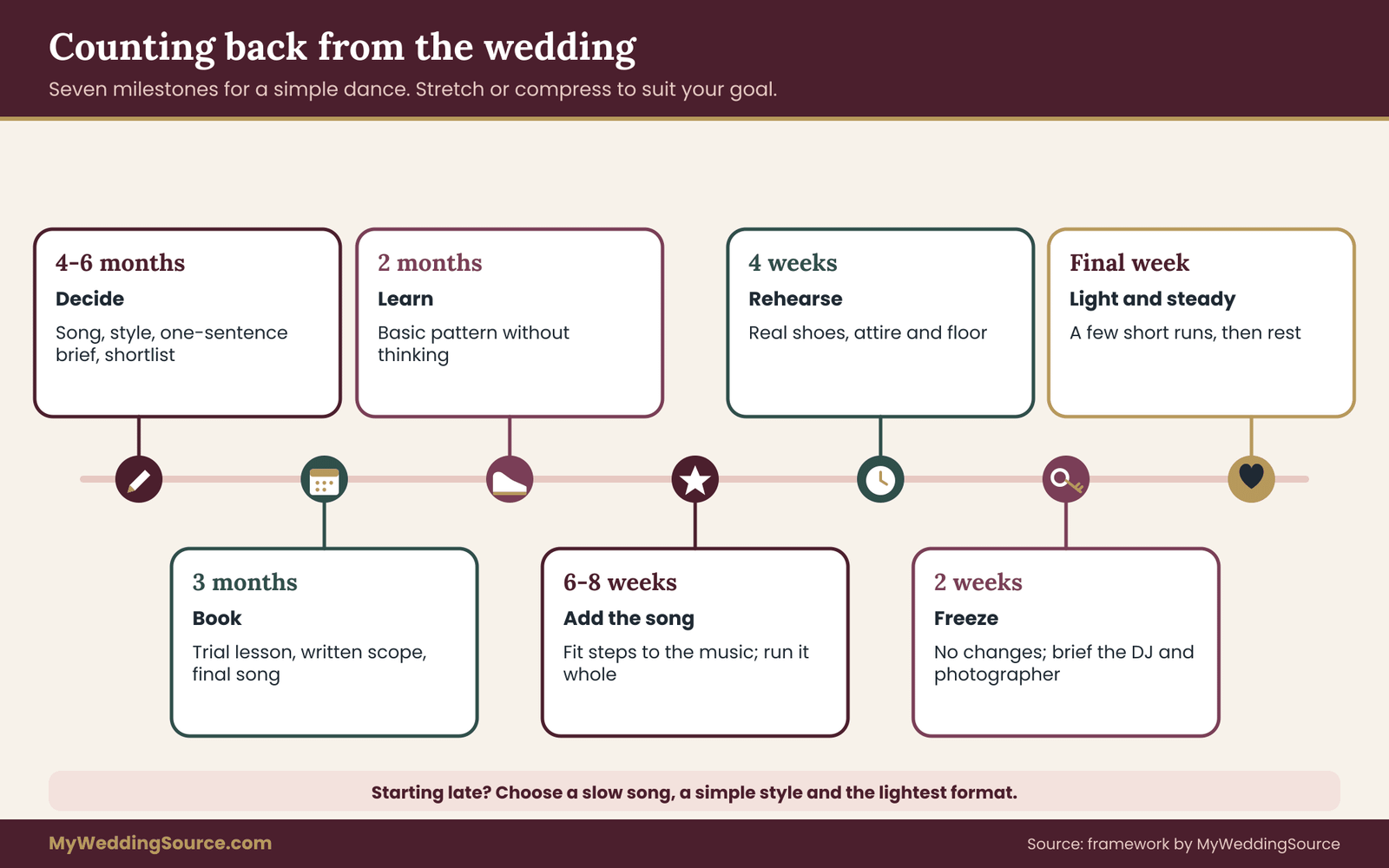
Four weeks out: the practice outline begins
The final four weeks have their own structure, described in the next section. The key idea is to shift from learning to rehearsing, and to start practicing in realistic conditions: the right shoes, the right attire where possible, and a floor similar to the venue’s.
This is also the time to send your music, your cue and your plan to your DJ or band, and to tell your photographer and videographer when the dance will happen, so they can position themselves. The guide to reception music planning describes how to brief a music provider, and the same brief works here.
Two weeks out: freeze the dance
Stop changing things. A routine that is still being edited in the last two weeks does not stick. Freeze the sequence, the music and the ending, and practice only what you have. If something is not working, simplify it rather than patching it.
Confirm logistics at this point. Who cues the DJ, where do you stand, how do you enter, and what will the lighting be? If you have a final session with your instructor, schedule it for about a week before the wedding, so any fixes can still settle.
The final week: light and steady
Practice a few short times, then rest. Do one or two full run-throughs in the shoes you will wear. Avoid learning anything new. Check that the music file is on the right device and in the right version, and that your DJ has the same file you practiced to.
On the day itself, a brief warm-up in a quiet room, with the song at low volume, is enough. Many couples benefit from one slow run-through to settle their nerves and then stopping. Do not rehearse repeatedly on the wedding day, because tension builds quickly and mistakes become more noticeable.
If you have less time for first dance lessons
Not everyone has six months. If you are starting closer to the date, the plan compresses but does not break. Choose a simple style, a slow song and a lighter format of first dance lessons, such as a few private sessions or a video course with one live check. Cut the optional elements, and keep the ending simple.
With about a month, a sway with a gentle turn and a clean finish is realistic for most couples, and an instructor can usually help you get there in a small number of sessions. With less than a month, consider a very short dance, or the alternatives later in this guide. Rushing a complicated routine is the most reliable way to create stress.
If you have more time before first dance lessons begin
If you have a year, you can afford to slow down. Take a group class series first to find what you enjoy, then choose a style and book private sessions closer to the date. The risk with a very long runway is that the practice fades and then gets crammed into the final month. Schedule two or three checkpoints along the way, such as a short refresher session every couple of months, so the skill stays alive.
Fitting lessons around other wedding tasks
The lead-up to a wedding is busy, and first dance lessons can feel like one more appointment. Put them in the calendar as fixed, short blocks, and treat them as dates the two of you protect. Many couples find that a regular weekly slot helps, and that attaching practice to an existing habit, such as the evening after dinner on certain days, is easier than finding extra time.
It also helps to avoid scheduling lessons directly after high-pressure tasks like a final fitting or a vendor meeting, because tired, tense dancers learn slowly. A session that is hard to attend is a session that is easy to skip, and skipped sessions are where timelines fall apart.
Cost timing for first dance lessons
The cost of first dance lessons usually arrives in clusters: a deposit when you book, a balance before or after the sessions, and sometimes a fee for music editing or a venue session. Put these dates into your cash-flow calendar early. If your studio sells packages that expire, note the expiry date alongside the wedding date, and make sure the sessions can all be used before the day.
If you hire an independent instructor, ask how payment works, whether you are paying per session or up front, and what the refund rule is if you cancel. Where possible, pay by a method that gives you a record. If a dispute arises, the Consumer Financial Protection Bureau explains how card disputes generally work, and that is a good place to check the current rules.
Keeping the timeline honest
A timeline is only useful if you check it. Every two weeks, do a five-minute review. Ask whether you are on track, whether you need an extra session, and whether the goal still fits. If the answer to the last question is no, change the goal, not your sleep. A smaller dance done well is a better outcome than a larger one done anxiously.
Write the milestones in one place, somewhere both of you can see them. A shared calendar works. So does a single sheet on the fridge. The act of seeing the next step makes it easier to take.
The four-week practice outline for first dance lessons
This outline starts after your first dance lessons have taught the basic steps and have the song structure. It assumes four weeks and a few short sessions each week. It is a template, not a rule. If you started with a longer runway, you can stretch it. If you have less time, compress weeks one and two.
The goal of the four weeks after first dance lessons is simple: move from “I know the steps” to “I can do the dance in front of people, in the right shoes, to the right music, and recover from a slip.” Each week has a single theme, a small set of tasks and a check that tells you whether to move on.
Anatomy of one practice session
Every practice session, in every week of first dance lessons or home rehearsal, follows the same short shape. This makes starting easy, because you always know what comes first.
Warm up the music, not just the body. Play the first thirty seconds of the song and stand in your starting position. Breathe, settle, and take a moment to look at each other.
Do one focused pass. Choose one section, such as the entrance or the middle turn, and run it three or four times. Stop after each pass and say one thing out loud that went well and one thing to adjust.
Do one full run. Play the whole song and do not stop, even if something goes wrong. Keep going, as you will on the day.
Finish on a good note. End on a run that feels fine, even if it takes one extra try. Ending in frustration makes the next session harder to start.
Most practice sessions fit in a short block of time. Shorter and more often is better than long and rare, and you can stop early whenever you are tired. Comfort matters more than counting minutes.

Week one: lock the structure
Theme: know the dance as a sequence.
In the first week, write the dance down in plain words. Something like: enter, hold, sway for eight counts, turn, sway, turn the other way, final pose. Put it where you can both see it. Then walk through it without music, slowly, saying the sequence aloud.
Add the music at a slow speed if your device allows. Many players can slow a track a little without changing pitch, and this is a safe way to get the order right. Do not worry about style or polish yet.
Tasks for the week: walk the sequence without music, run it with slowed music, and decide on a cue word each of you will use if you lose your place, something short and friendly like “next” or “turn.”
Check before moving on: can you both say the order of the dance without looking at the notes? If not, repeat the week.
Week two: full speed and full songs
Theme: dance at the real tempo.
Now the music plays at its true speed. This week you do full runs, and you learn how it feels when the music does not wait. Expect more mistakes at first, and treat them as information.
Record a run on a phone, from a few feet away and from the angle a photographer would see. Watch it together, once, with a light attitude. Look for three things: where your eyes are, where your feet are in relation to each other, and whether the ending is clear. Choose one thing to improve.
Tasks for the week: three or four full-speed sessions, one recorded run and one honest review. Do not review more than once, because endless video review can make people self-conscious.
Check before moving on: can you complete the whole song at speed, even with some errors, without stopping?
Week three: real conditions
Theme: practice as you will perform.
This is the week to rehearse in the shoes you will wear, on a floor that is similar to the venue’s, and with as much of the attire as is practical. If you have a long skirt, practice with a length that matches it. If you have a jacket with a fitted cut, wear it for at least one session.
Practice the entrance and the exit too, which most couples forget. Know where you walk from, how you take your starting position and how you leave the floor. If your venue allows a rehearsal in the room, this is the time to use it.
Add distractions on purpose. Ask a friend to watch, or practice with the television on, or at a time of day when you are tired. This is practice for focus, not endurance, so keep it brief.
Tasks for the week: two sessions in real shoes, one session with attire where possible, one session with an audience of one or two people, and one rehearsal of the entrance and exit.
Check before moving on: can you complete the dance in realistic conditions without a major interruption, and recover when something small goes wrong?
Week four: freeze, confirm and rest
Theme: stop changing things.
In the last week, do not add steps. Run the dance a small number of times, and stop. Use the rest of your attention for the details that make the dance easy on the day.
Confirm the music file and the version. Send your DJ or band the final song, the start cue and the plan for what happens afterward. Check where you will stand and who will signal the start. If your first dance lessons include a final session with your instructor, it should happen early in this week.
Tasks for the week: a few light runs, a final check with the DJ and the photographer, and one slow, relaxed run the night before or the morning of.
Check at the end: do you both know the cue, the first move and the final pose? If yes, you are done.
Recovering from a slip
Mistakes in the middle of a dance are normal. The skill that matters is recovery, and it can be practiced. Agree in advance on two simple rules. First, if one person loses their place, both continue with the basic step until the next clear moment, such as the start of a phrase. Second, if the whole thing stalls, go back to a simple sway, smile, and pick up the ending.
Practice this once in week three, on purpose. Deliberately skip a turn, then recover. It feels silly and is remarkably useful, because the rest of the room rarely notices a recovery that is calm and quick. What they notice is panic.
Solo practice and partner practice
If one partner learns faster, resist the urge to coach the other during practice. Corrections from a partner, however kindly meant, often feel like criticism. A better pattern is to ask the instructor to give the feedback, or to use a shared habit, such as saying one thing that went well before suggesting anything.
Each person can also practice alone, with the song, walking through their own part. Solo practice builds memory without pressure, and it is especially useful for the person who feels less confident.
Tracking progress without turning it into homework
A simple log helps. After each session, write one line: the date, what you practiced and one thing to try next time. A page on the fridge or a note on a phone is enough. The log keeps you honest about whether you are practicing, and it gives you something to show an instructor if you need a tune-up session.
If you notice that you are skipping sessions, ask why. Often the cause is a goal that is too big, a schedule that is too tight or a mismatch between the partners. Fix the cause rather than pushing harder.
Adjusting the outline to your first dance lessons
You can shorten the outline by merging weeks one and two if you learned the structure quickly. You can lengthen it by repeating a week. The principle to keep is the order: structure first, then speed, then real conditions, then freeze. Skipping real conditions is the most common shortcut and the one most likely to cause trouble on the day.
If your wedding date falls earlier than four weeks from the start, keep the order and shrink each phase. Choose the simplest version of the dance you can still be proud of.
When practice space is limited
Not everyone has an open room at home. Apartments, shared houses and busy family homes make practice awkward. You can still run the outline with a small space by practicing the turns in place and the sequence on a short line, then using one or two sessions at a studio, community hall or other rented room to test the full floor pattern. Ask your instructor whether they rent practice time, and ask about any venue open hours that might allow a brief run on the actual floor.
Quiet neighbors matter too. If you are practicing in the evening, keep the volume low and use headphones for the learning phase, then use the speaker only for the full-speed runs. A small amount of consideration goes a long way toward keeping practice pleasant.
One worked case: a couple, six weeks and a slow song
The following is an invented example, built to show how the decisions fit together. The couple and the numbers are fictional, and nothing here is a report of real people or results. Use it as a pattern, not a prediction.
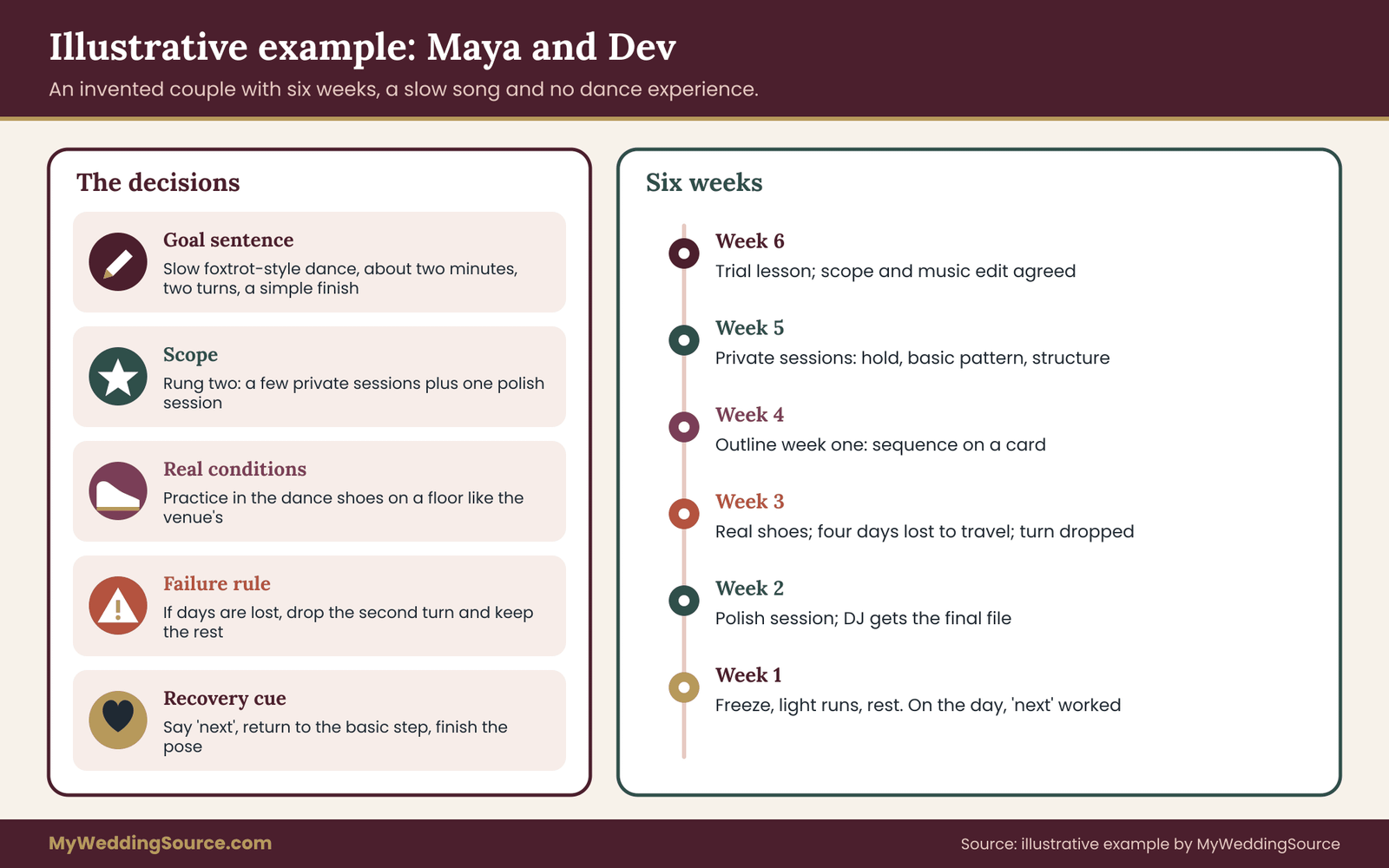
Call the couple Maya and Dev. They have six weeks until the wedding. Neither has taken first dance lessons or any partner dance lessons. Maya is anxious about being watched. Dev is happy to be silly but dislikes memorizing. They have a slow song they love, and their venue is a restaurant with a moderate floor in front of a window wall.
Step one: the goal sentence
Each of them finished the two prompts from earlier. Maya wrote, “I would feel good if the dance looks calm and we are together,” and, “I would not want to forget what comes next.” Dev wrote, “I would feel good if we laugh at least once,” and, “I would not want a routine that feels like a test.”
Their combined goal sentence: a slow foxtrot-style dance to their song, about two minutes after an edit, with two turns and a simple finish, and the DJ inviting guests after the second chorus.
Step two: the scope decision for first dance lessons
On the ladder, the goal pointed to rung two. They did not need a full choreography, but they wanted help shaping the song. They booked a short trial of first dance lessons first, found that the instructor listened well, and agreed on a small private package focused on basics and a simple structure for their song, with one final polish session in the last two weeks.
They skipped the group class, because the schedule did not fit, and they skipped a video course, because Maya wanted a person to tell her if her hold looked tense.
Step three: the timeline
Counting back from the date, the couple put the milestones in a shared calendar. Weeks six and five held the private sessions, where they learned the basic pattern and settled the structure. Week four started the practice outline. Weeks three and two were the real-conditions phase. Week one was the freeze.
They also sent their venue a message asking for floor dimensions and whether a short empty-room walk-through was possible, and asked the DJ whether the edited song file should be sent as a specific format.
Step four: the practice outline in action
In week one of the outline, they wrote the sequence on a card: enter, hold, sway, turn, sway, turn, pose. They agreed on the word “next” as their recovery cue. In week two they did full-speed runs and recorded one. Watching it, they noticed that Dev looked at his feet during the first turn. They fixed it by agreeing on a spot on the wall to look at.
In week three they practiced in the shoes they would wear, which turned out to matter. Maya’s shoes were slippery on their kitchen floor, so they moved practice to a carpeted-edge hallway and then to the studio floor for one session. They swapped to a different pair of shoes for the dance, and kept the original pair for photographs.
Step five: the failure condition arrives
In week three, Dev had a work trip and they lost four days. Their written failure conditions, which they had set at the start, said that if they missed more than a few days in the last three weeks, they would drop the second turn and keep the rest. They did. The dance became simpler, and neither of them felt like they had failed. They had simply used the plan.
On the day, the DJ cued the song, they walked out, and the first few counts were slightly early. Dev said “next,” they settled, and the rest went as practiced. Most guests did not notice.
What the case shows
Three things about first dance lessons. First, the goal sentence made every later decision easier. Second, the scope was chosen by climbing only as far as needed. Third, the failure rule was written before it was needed, so it felt like part of the plan, not a defeat. None of this depended on talent. It depended on deciding, in order, what mattered.
Real conditions: floor, shoes, venue and DJ
A rehearsed dance meets reality in the last hour before it happens. The floor, the shoes, the lighting and the sound all shape the result, and each can be checked in advance. The point is not to control everything. It is to remove the surprises you can remove.
The floor
Before your first dance lessons get specific, ask your venue what the dance floor is made of, how large it is, and whether it will be a dedicated floor or a section of the room. Hardwood, tile, carpet, a rented platform and grass over a floor system all behave differently under shoes. If you will dance on a rented floor, ask the venue or the rental company about the surface and how it is installed.
Venues may also have rules about what can be used on their floors, including certain shoe types or tapes. Ask before you buy anything specific. Your teacher of first dance lessons can tell you how a particular surface affects turns, and a practice session on something similar is worth the effort.
The space
Compare the floor’s dimensions with the space your dance needs. A travelling waltz needs more than a turning-in-place sway. If the floor is smaller than your routine, adjust the routine, not the other way around. The guide to reception guest flow shows how the dance floor, seating and sightlines fit together, which helps you decide where guests will stand and what they can see.
Think too about where guests will stand during your dance. If tables crowd the edge, you may have less room than the floor plan suggests. A quick conversation with the venue coordinator on the day, before guests arrive, can confirm the space.
Shoes and attire
Practice in the shoes you will wear, at least three times. If you plan to change shoes for the dance, practice with the pair you will really dance in. Check the soles for grip and glide on a surface similar to the floor, and ask your instructor about suitable soles for your style.
For attire, test how the hem or sleeves move during turns, how a jacket affects the hold, and whether any accessory could catch. If you notice a problem, the earlier you find it, the more options you have, including alterations or choosing a different outfit for the dance.
Lighting and sound
Dim rooms make some couples feel more private and others more lost. Ask whether there will be a spotlight, and if so, where it will point. If the dance happens in low light, practice once in a dim room so the visual cues you rely on are still available.
For sound, ask your DJ or band whether the dance will have a sound check, what the volume will be and whether the song will start at the beginning or at a cue point. If you use an edited track, confirm that the DJ has the edited file and that a backup copy is available on a second device.
Accessibility and adaptation
First dance lessons should work for the people taking them. That includes couples who use a mobility aid, couples with a hearing or vision difference, couples who need to sit during part of the dance and couples who want to avoid certain movements. A good instructor adapts the dance to the dancers. A good venue adapts the space.
The ADA is a federal civil rights law, and ADA.gov explains how it applies to businesses that are open to the public, which can include dance studios and venues. The Access Board publishes the technical standards that shape accessible routes and surfaces. For specific questions, ask the studio and the venue directly how they accommodate access needs, and ask for the answer in writing. The checklist in the accessible wedding venue red flags article is a useful companion when you are assessing the room.
You do not need to share personal details to ask for an adaptation. A plain request works: “We would like a dance that can be done seated for part of the song. Can you help us plan that?” Instructors who work with weddings are used to such requests, and many enjoy the creative challenge.
Working with the DJ and photographer
Tell both what you are doing. Give your DJ the exact file, the start cue, the length and the plan for what follows. Give your photographer the time, the place and the moment you most want captured, such as the finish. Ask them where they plan to stand, and check that it does not block your path.
A short written note works well. It prevents the misunderstandings that happen when three people each assume someone else is handling the cue.
Failure conditions and what to do about each
A plan for first dance lessons should say when it stops working. Failure conditions are the situations in which you change the plan, written down in advance, so that changing it feels like following instructions and not giving up. Each condition below has a simple response.
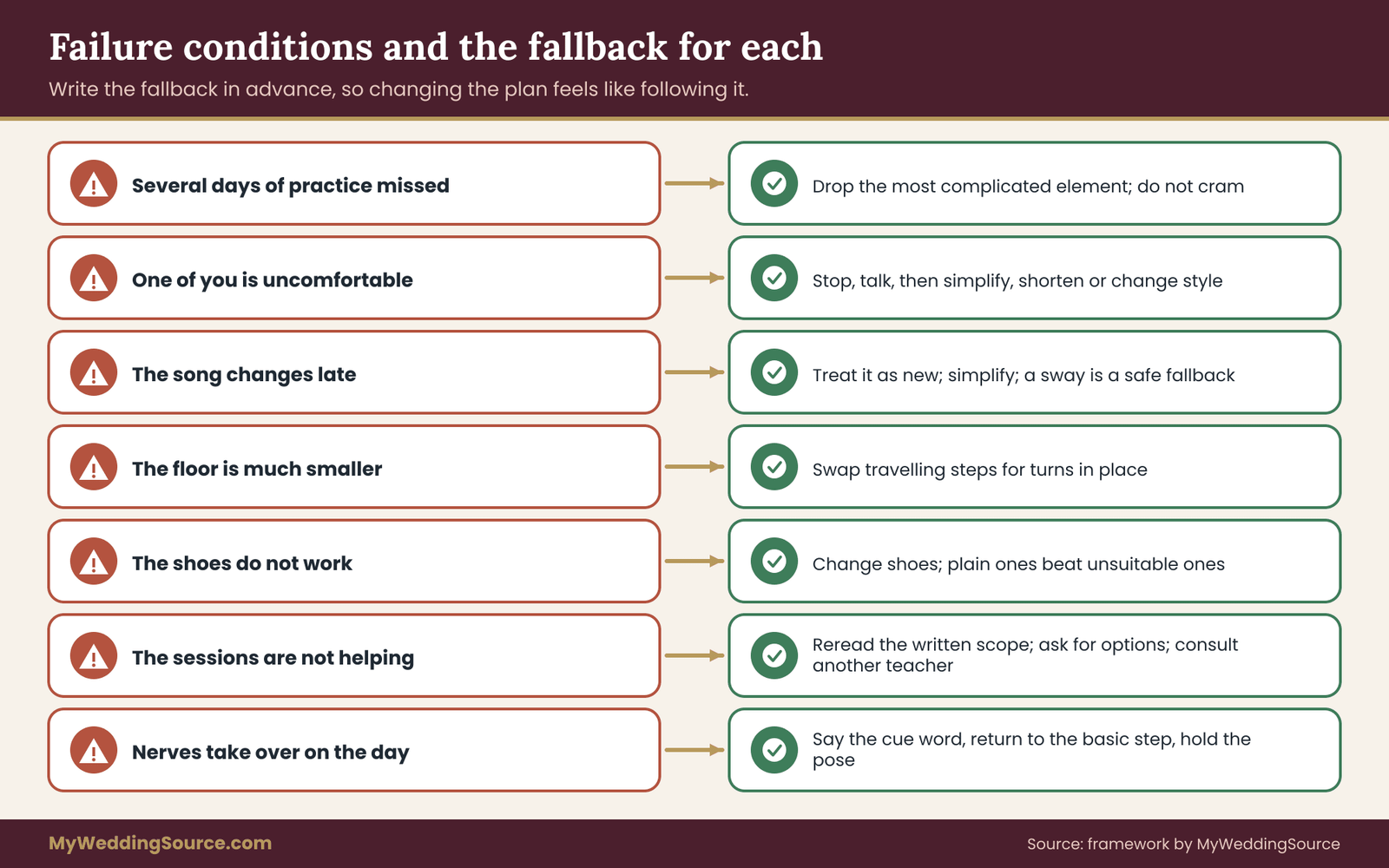
You miss several days of practice in the last three weeks. Drop the most complicated element, and keep the rest. Do not try to catch up with long sessions.
One of you is consistently uncomfortable. Stop and talk. Ask the instructor to simplify, shorten the dance, or change the style. A dance that one person dreads is not worth the cost.
The song changes late. If the new song has a different tempo or length, treat it as a new project and simplify. If a late change is unavoidable, a sway to the new track is a safe fallback.
The floor or space turns out to be much smaller. Replace travelling steps with turns in place. Ask the venue whether the floor can be extended or moved.
The shoes do not work. Change shoes. A dance in unsuitable shoes is worse than a dance in plain ones, and it is better to know before the day.
The instructor is unavailable or the first dance lessons are not helping. Check your written scope and ask the studio for options. If it is not resolved, look at the contract’s cancellation and refund terms, and consider a short consultation with another instructor.
One of you is unwell or injured. Adapt without pressure. Shorten the dance, seat part of it, or move to an alternative described below.
Nerves take over on the day. Use the cue word, return to the basic step and finish with the simple pose. Remember that guests are on your side.
Alternatives when first dance lessons are not the right fit
Sometimes the honest answer is that first dance lessons are not the right tool. The budget is tight, the schedule is full, one partner would dread it, or the couple simply wants something different. None of these is a problem. A first dance has no required length, style or level of polish.
Below are the alternatives that work most often, with a note on when each one makes sense. Each can be combined with a single trial session or a short consultation if you want a little guidance without a package.
Do it yourself, with a plan instead of first dance lessons
Use the four-week outline without an instructor. Choose a slow song, learn a simple sway from free or low-cost video, and rehearse in your real shoes. This works best for couples who are comfortable with each other and happy with a modest result. The risk is that small habits go uncorrected, so consider a single live session near the end to check your hold, your timing and your finish.
A very short dance
Edit the song to a minute or ninety seconds, then invite guests to join. This reduces the performance time to something most people can manage with a few repetitions, and it moves the room into general dancing sooner. Many couples find that the shorter version feels more natural to the room, because attention shifts as soon as guests join. How to cut the track, and who handles the edit, is a decision to make with your music provider.
A dance with the whole room
Skip the solo performance entirely. The DJ announces the dance, and everyone, or a chosen group such as both families, joins from the first note. It removes the sense of being watched, and it can be warm and lively. Photographers can still capture you in the middle of the crowd. If this appeals, tell your DJ early so the announcement and the song choice suit a crowd.
A dance with parents or family
Some couples replace or add to the couple’s dance with a dance involving parents, grandparents or other relatives. These dances are usually shorter and simpler, and they are often built on a few shared steps. They have their own considerations, including who is asked and in what order, which are worth discussing carefully with the families involved.
A quiet moment, not a dance
You can stand together as the song plays, or hold each other in a slow sway in the middle of the floor, with no steps at all. It can be one of the most moving moments of the day. It needs almost no practice, only an agreement about when it starts and ends and a plan for the DJ.
A seated or adapted dance
If standing for the whole song is not right, plan a dance that includes a seat, a simple arm movement, or a section where one partner is seated. Instructors who work with adaptive dance can design these, and the structure can be as personal as any standing routine. The point is to dance in the way that suits you, and the ADA resources in the Sources section explain access responsibilities for businesses open to the public.
Skipping the first dance
It is fine to skip it. Some couples prefer a toast, a walk, or simply moving to the open dance floor together. Tell your DJ and your coordinator so that no one waits for an announcement that is not coming, and consider whether to mention it to close family, who may be expecting the tradition.
How to decide among alternatives
Return to the three questions from earlier. How much do you want it to look planned, how comfortable are you being watched, and how much time do you realistically have? Mostly planned and comfortable points to first dance lessons. Less planned and less comfortable points to a short dance, a room dance or a quiet moment. If you are unsure, take one trial lesson and let your reaction to first dance lessons answer the question.
Whatever you choose, tell your vendors, write down the plan in a sentence, and keep any payments and written terms organized with your other entertainment agreements. The wedding planning checklist is a handy place to record the decision and the date by which each piece is due.
FAQ
How many first dance lessons do most couples need?
It depends on the style, your goal, your song and your practice habits. A simple sway may need only a couple of sessions, while a choreographed routine needs more. Ask the instructor to estimate for your goal, and to say what would make it fewer or more. Plan a buffer, and check your progress after the second session before you commit to more.
When should we start first dance lessons?
Six to eight weeks before the wedding is comfortable for a simple dance, and a few months suits a longer routine. If you have less time, choose a slow song and a simple style, and book a short private package. Starting earlier is fine, but schedule check-ins so the practice does not fade and then get crammed into the last weeks.
Are private first dance lessons better than a group class?
Neither is better in general. Group classes cost less and teach basics in a social setting. Private first dance lessons adapt to your song, your attire and your pace, and they are the usual route to a song-specific routine. Many couples combine a short group series or video course with a few private sessions, which spreads the cost and the learning.
Can we replace first dance lessons with online videos alone?
Yes, if you are self-directed and happy with a modest dance. Videos let you repeat sections and practice anywhere, but nobody corrects your hold or timing. A useful compromise is to learn from video and book one live session to check the basics and the ending. Video also cannot adapt to your song or floor, so you must do that yourself.
What should we ask before booking first dance lessons?
Ask what the package includes in hours and sessions, whether they edit the song, how they adapt steps to different bodies and attire, what the cancellation and refund terms are, and whether unused sessions expire. Ask for the scope in writing. A clear instructor answers in specifics and respects your limits without pushing you toward moves you do not want.
What if one of us hates dancing?
Say so early, and design around it. A short dance, a room dance with everyone joining, or a quiet sway with a simple ending can all work. An instructor can keep the steps minimal and the pressure low. If the idea still feels wrong, skipping the first dance is a legitimate choice, and a few honest sentences with your DJ will handle the logistics.
Do we need to tell the venue and DJ about our dance?
Yes. Tell the venue about the floor, space and any rehearsal access. Give the DJ the exact song file, the start cue and the plan for what follows. Tell the photographer when and where it happens. Sending a short written note to all three avoids the common problem of everyone assuming someone else is handling the cue.
How do we handle a studio that will not refund first dance lessons?
Start with the written terms you agreed to, and ask the studio to explain how they apply. If you paid by credit card, the Consumer Financial Protection Bureau describes how disputes generally work. For advertising that seems misleading, the Federal Trade Commission accepts reports. Keep your receipts and messages together, and check current rules with those agencies.
Your next steps
This week, take twenty minutes together. Each of you completes the two sentences about how you would feel good and what you would not want, then you write one sentence that states your style, song length and ending. Play the song, try the kitchen test for one minute, and decide whether the style fits.
Next, count back from your wedding date and put the timeline milestones into a shared calendar. Ask your venue about floor size and rehearsal access, and shortlist two instructors with written scope requests. Then book a trial or the lightest format of first dance lessons that reaches your goal, set your failure rules in writing, and start the four-week outline when its week arrives. A calm, simple dance, practiced in real conditions, is a good outcome.
Sources
- Americans with Disabilities Act, U.S. Department of Justice, ADA.gov
- Introduction to the ADA, U.S. Department of Justice
- Guidelines and standards for accessible design, U.S. Access Board
- Business guidance resources, Federal Trade Commission
- Ask CFPB: consumer questions and answers, Consumer Financial Protection Bureau
- U.S. Copyright Office
- USAGov: consumer protection and complaints
- USA Dance, national organization for partner dance
- National Dance Council of America