
A pet tribute is a deliberate way to include an animal in your wedding when the animal itself will not be there: a portrait on the welcome table, a line in the program, a framed photo, an embroidered detail, a gift in the pet’s name. This guide gives you a simple board for choosing a few gestures, checking each one for the animal’s welfare and your own deadlines, and avoiding the awkward or stressful versions.
Settle the animal’s care for the wedding day first, because that decides everything else. Then choose no more than three gestures for your pet tribute: one lasting anchor (such as a portrait), one moment (a program line or a toast), and at most one small extra. Score each idea on five checks: welfare, fit, lead time, guest effort and day-of footprint. Work backward from the wedding date to find the last day you can order anything custom. Keep the pet tribute modest, and let the photos and keepsakes do the remembering.
Plenty of couples want their dog, cat, rabbit or horse in the story of the day, and plenty of venues, travel plans and animals make that impossible. The venue may not allow animals. The dog may be old, sick, anxious or untrained. The wedding may be a flight away. The animal may simply be happier on the sofa with a sitter than standing through a two-hour ceremony in formal clothes. Leaving the animal at home is often the kindest decision, and a pet tribute keeps that from meaning leaving the animal out.
The trouble is that “include the pet somehow” is a vague goal, and vague goals produce a pile of half-formed ideas. A cardboard cutout gets ordered in a panic. A custom painting is commissioned three weeks before the date and arrives after it. A grandmother is confused by a drink named after a dog she has never met. A well-meant plan to FaceTime the animal during the vows eats five minutes of a schedule that had four to spare. A good pet tribute is smaller, calmer and more planned than any of that.
A note on scope. This is general planning information, not veterinary, legal or financial advice, and your own veterinarian and your venue’s written policy outrank anything in this article.
If you are still deciding whether the animal should attend at all, the question of how to weigh the animal’s welfare against your wishes belongs to a different decision. This article starts after that decision is made. The animal is staying home, or at least is not on the guest list for the ceremony, and your question is what to do instead.
For the wider schedule that all of this has to fit into, the wedding planning checklist lays out the overall order of tasks. This guide covers only the pet-shaped part of it.
What a pet tribute is, and when it makes sense
In this guide, a pet tribute means any planned gesture that brings a pet into the wedding without bringing the pet. It can be visual (artwork, photos, signage), spoken (a line in the program or a mention in a toast), physical (an embroidered item, a charm, a paw-print detail), or charitable (a donation or collection in the animal’s name). It can be for a living animal that cannot come, or, in a gentler version covered near the end, for an animal who has died.
A pet tribute is not a replacement for the animal. It does not try to simulate the animal’s presence, and it should not ask guests to behave as if the animal were there. The most common mistakes in a pet tribute come from blurring that line: a stand-in dog borrowed from a friend, a stuffed toy that gets passed around as a mascot, a video call that turns the ceremony into a broadcast. Those are different projects with different risks, and the sections that follow explain why most of them are not worth the trouble.
The situations that call for one
The situations differ, and the best gesture differs with them.
The venue does not allow animals. Some venues allow only service animals under the Americans with Disabilities Act and nothing else. If the policy is written and firm, the pet tribute is the main way to include the animal. Here, the policy is simply a fact to design around.
The animal is too old or unwell. A senior dog with arthritis, a cat with a heart condition or a rabbit that struggles with heat has no business at a wedding. For these animals the pet tribute often carries more emotional weight, so it is worth doing carefully, and it should be finished well before the wedding rather than squeezed in beside it.
The animal is anxious or untrained. A dog that barks at strangers, a cat that hides when the doorbell rings, a young dog that jumps on guests. Welfare and guest comfort both point toward home.
Travel makes it impractical. A destination wedding, a long drive in summer heat or an airline policy that makes carrying the animal risky. For travel questions, the U.S. Department of Agriculture’s animal health agency and the airline’s own written policy are the places to check, and your veterinarian can tell you whether the trip is wise for this particular animal.
The animal is not a pet in the usual sense. A horse on a family farm, a bird, a reptile, a large dog that does not fit in a car with the wedding party. The principle is the same.
The animal has died. This is a different emotional situation and deserves its own approach, covered later.
The four moments where a pet can appear
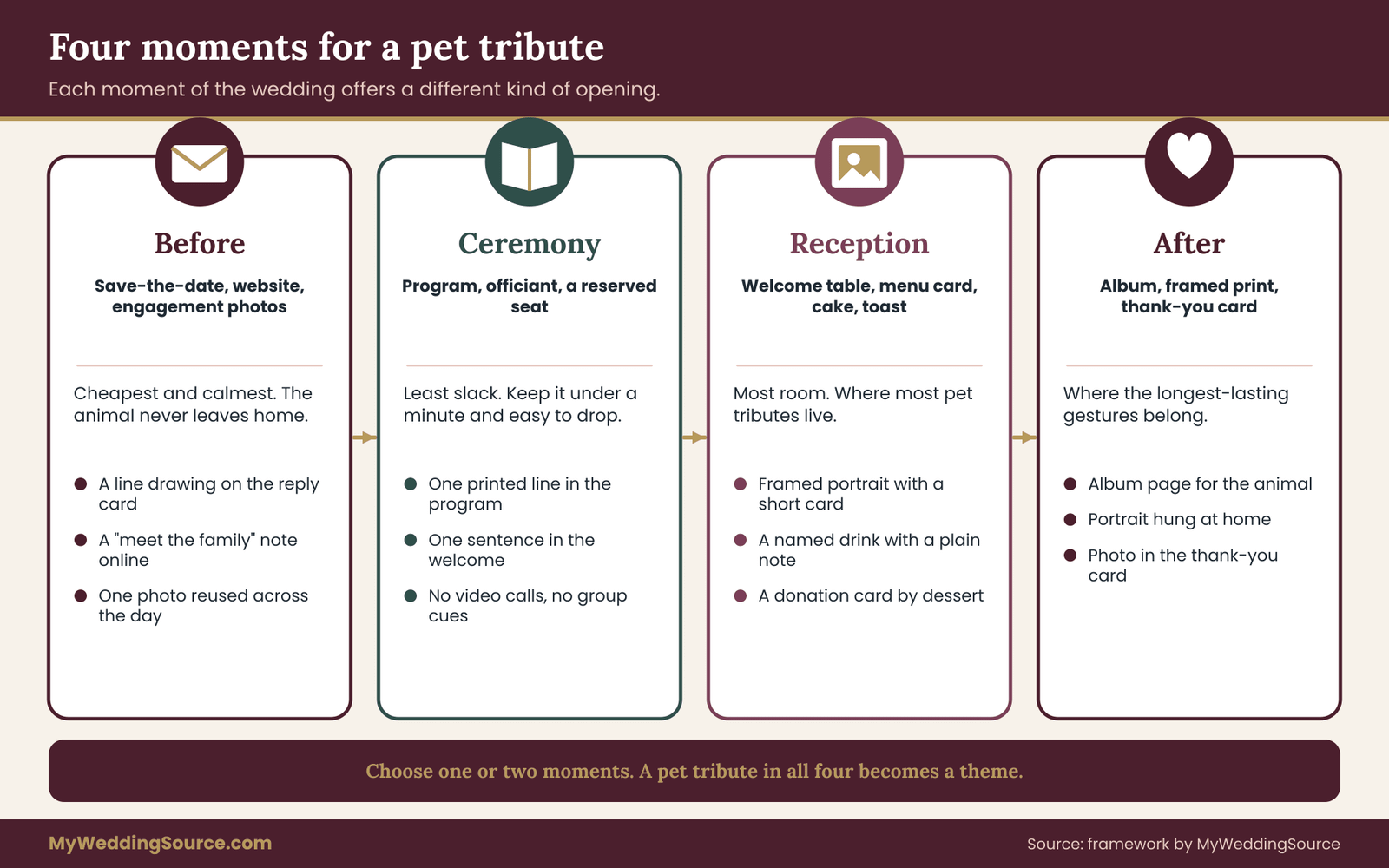
Think of a wedding as four moments, because each one offers a different kind of opening for a pet tribute.
Before. Save-the-dates, invitations, the wedding website and any engagement photos. This is the cheapest and lowest-risk moment, and it is the one most couples overlook. The animal can appear in a photo, in a signature, in a one-line note on the website.
Ceremony. The program, a reading, a short mention by the officiant or a seat or flower marked in the animal’s honor. The ceremony is the moment with the least slack, so anything here must be brief and must not depend on guests doing something unfamiliar.
Reception. Signage, a table, a cocktail name, a cake detail, a photo display, a toast. This is where most pet tributes live, because the room has time and space and people are in a mood to look at things.
After. The album, a framed print, a keepsake, a donation or a thank-you note with the animal’s picture on it. The tribute continues once the day is over, and it is where the longest-lasting gestures belong.
You do not need something in every moment of the pet tribute. In fact you should not try. A pet tribute that appears in all four moments and in a dozen forms starts to feel like a theme, and a theme is a different thing from a tribute. The next sections explain how to choose.
Make the day kind to the animal before planning any pet tribute
Before choosing a portrait or a program line, settle one question: what will the animal be doing on the wedding day, and who will be with it? This is not a side issue. A pet tribute built on a lovely painting is a poor trade if the animal spends the day alone, frightened by the noise of a house being emptied and then refilled, or if the sitter has never met the animal.
The American Veterinary Medical Association publishes general guidance on pet care, and your own veterinarian knows your animal’s history. The questions below are not a substitute for either. They are the questions a planner should ask so that nobody is guessing.
A home-care plan for the wedding day
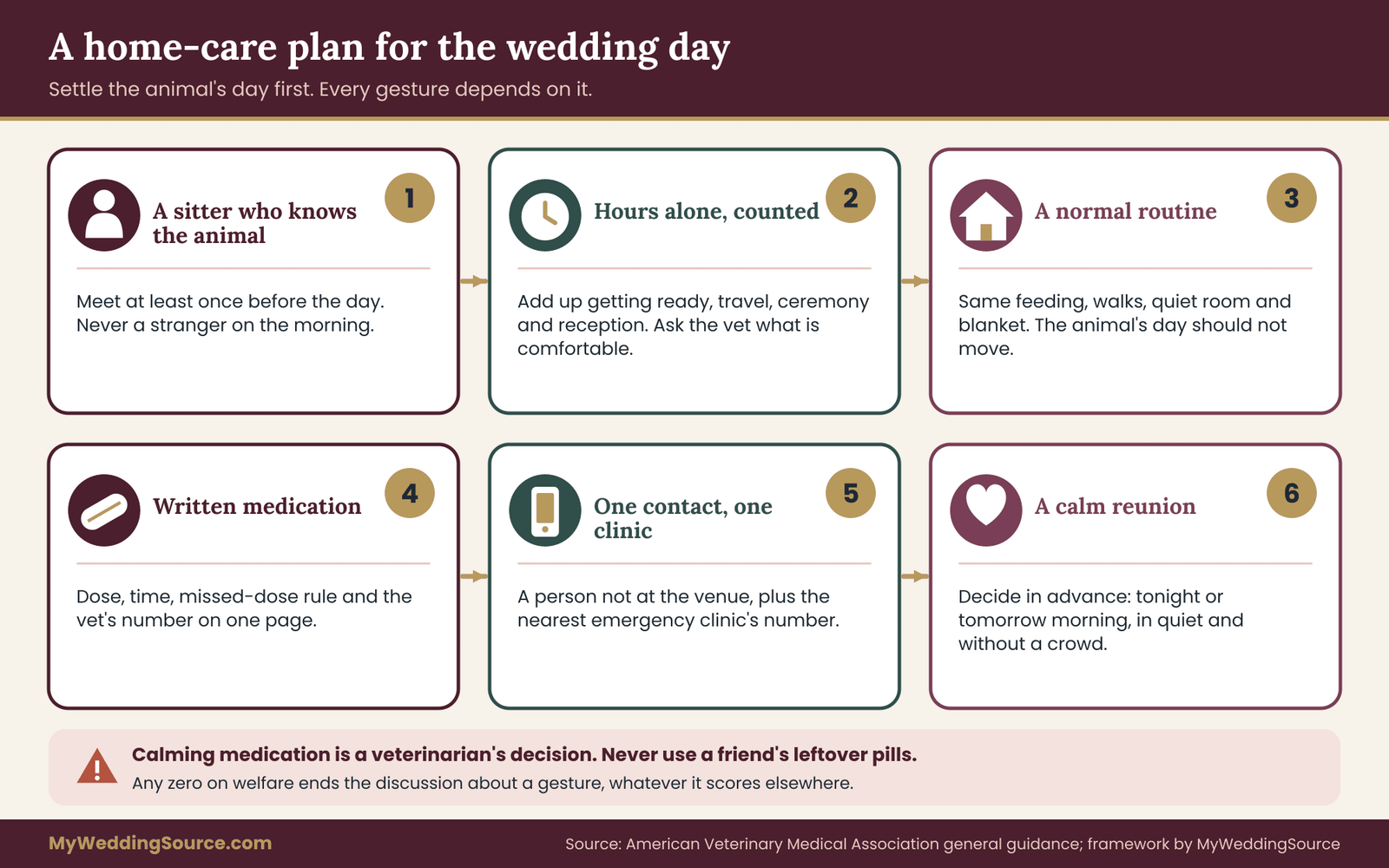
Who is staying with the animal, and have they met it? A sitter who is a stranger on the morning of the wedding is a poor plan for any animal, and a worse one for an anxious animal. Arrange at least one visit before the day. If a family member is the sitter, make sure that person is not also supposed to be somewhere else at two o’clock.
How long will the animal be without a person present? Take the full schedule, including getting ready, travel, the ceremony, photos, the reception and the trip home, and be honest about how many hours that is. Ask your veterinarian how long this animal can comfortably be alone, because the answer differs widely with age, species, health and temperament. If the answer is shorter than your wedding day, the plan needs a second person or a midday visit.
What does the animal’s normal day look like, and can it stay normal? Feeding times, walks, medication, litter, a favorite blanket, a quiet room. Weddings disrupt routines for the people involved; the animal’s routine should be the part that does not move.
Does the animal take medication, and is the dosing written down? If anyone other than you will give it, write the dose, the time and what to do if a dose is missed, and leave the veterinarian’s number where the sitter can see it. Do not hand a sitter a verbal list at the door.
Who gets the call if something goes wrong? Choose one contact who is not in the wedding party and not at the venue. Give the sitter that number and your veterinarian’s number, and the number of the nearest emergency clinic. The wedding schedule is not the time to look for one.
What is the plan for the reunion? The animal may be unsettled after a day of strangers, and a couple arriving home in formal clothes, perhaps late, perhaps with others, can be overwhelming. Decide in advance whether the animal sees you that night or the next morning.
A small note on sedatives. Some people consider asking a veterinarian for a calming medication for an animal left at home during a stressful day. That is a decision for the veterinarian, who knows the animal’s health, and it should never be improvised from a friend’s leftover pills.
Why this comes first
Welfare comes first in any pet tribute because it constrains the rest. If the animal is staying with a sitter in a quiet house, you can plan a pet tribute that does not involve the animal at all, and you will be calm about it. If the animal’s day is uncertain, every pet-related detail at the wedding will carry a little worry with it, and a photo on a table will not help.
It also comes first because it protects the pet tribute from a common failure. Couples often plan a gesture that quietly requires the animal to take part after all. A pre-wedding photo shoot at the venue, a paw print taken on the morning of the wedding, a video of the dog greeting the couple in their outfits. Each of these has a place, and the later sections describe how to do them gently.
But each one asks something of the animal on a day that is already busy. When the animal’s care plan is written down, you can see whether it can absorb a request or not, and you can move the request to a quieter week.
Finally, it is simply the right order of priorities. The point of a pet tribute is affection for the animal. A tribute that costs the animal a bad day has missed its own point, and guests who know animals will notice.
The Stand-In Board: a way to choose your pet tribute
Most advice on planning a pet tribute is a list of ideas. Lists of pet tribute ideas are easy to find, and they are not the hard part. The hard part is deciding which three of forty ideas suit your animal, your venue, your guests and your calendar. The Stand-In Board is a short procedure for doing that. It has three rules and five checks, and it fits on one page.
The three-gesture rule
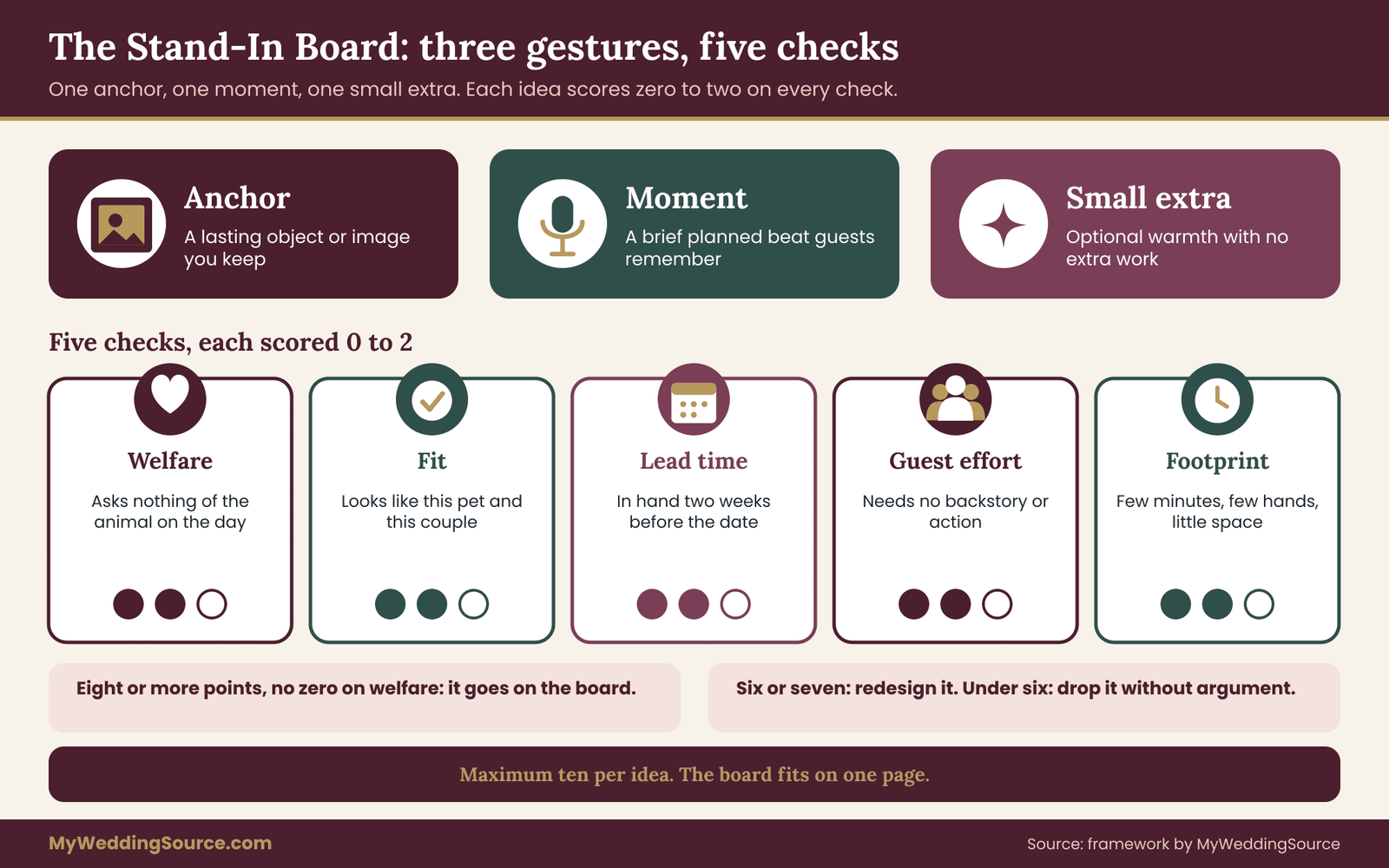
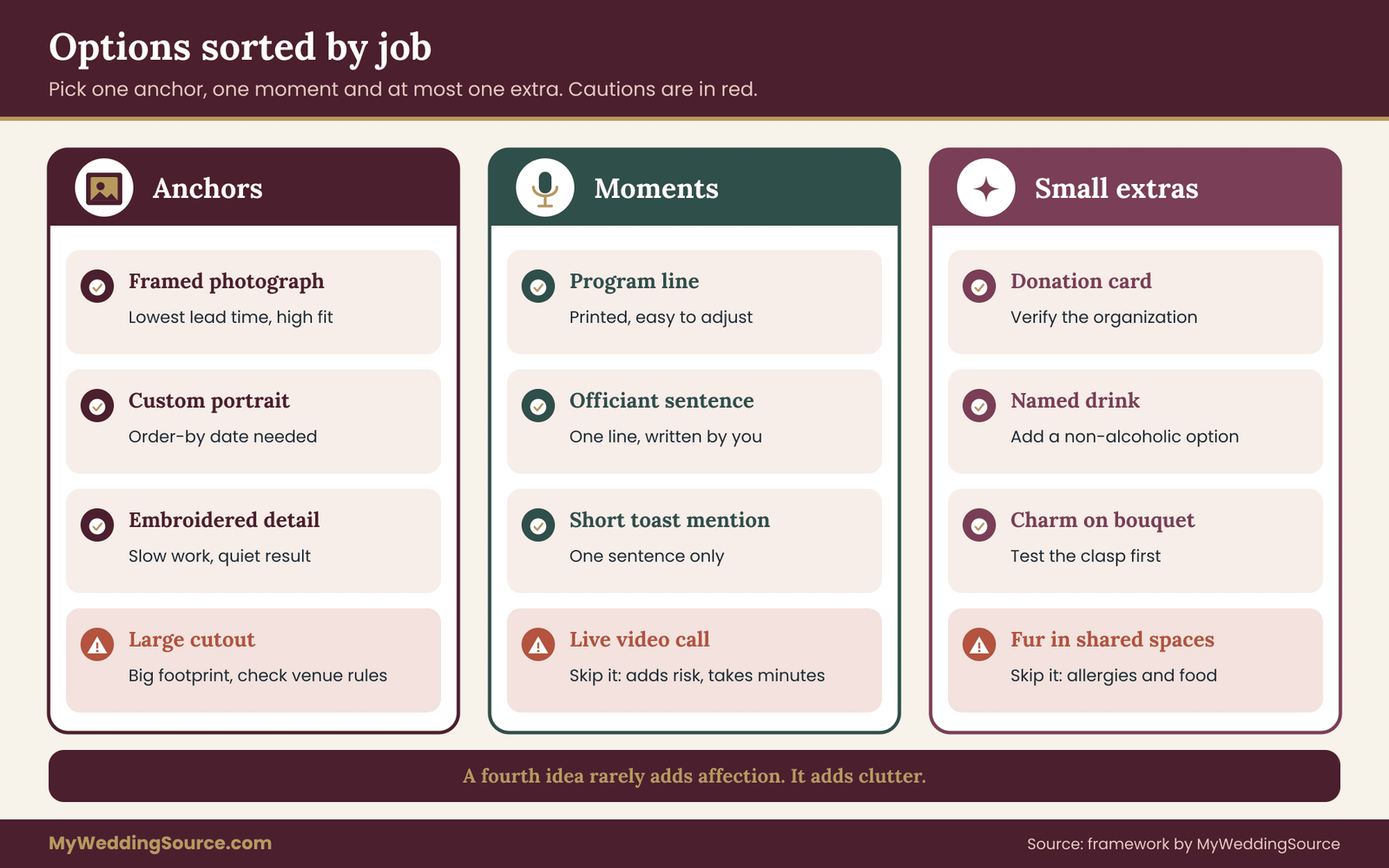
Limit the pet tribute to three gestures, and give each a job.
One anchor. A lasting object or image that is clearly about the animal and that will outlive the wedding: a portrait, a framed photograph, an embroidered piece. The anchor is the thing you keep.
One moment. A brief, planned beat in the day: a line in the program, a sentence from the officiant, a toast, a short note on the dessert table. The moment is the thing guests remember hearing.
One small extra, optional. A detail that adds warmth without adding work: a pet-name cocktail, a charm on the bouquet, a paw print on the thank-you card. The extra is the thing that makes people smile.
Why three? Because each part of a pet tribute costs something: money, lead time, space on a table, a minute of a schedule, a task for a vendor or a relative. Three gestures cost three times as much as one, and the fourth and fifth rarely add affection; they add clutter. A couple who chooses an anchor, a moment and a small extra ends up with a pet tribute that looks intentional. A couple who chooses eight things ends up with a pet theme.
The rule also protects against one common pattern: each family member suggests something, the couple says yes to be kind, and the result is a collection nobody designed. When someone offers an idea, you can answer honestly that the plan has three slots and ask which of their idea or the current ones should hold the slot.
The five checks
Score each candidate for the pet tribute from zero to two on each of five checks. Zero means a clear problem, one means acceptable with a caveat, two means no concern. The maximum is ten.
Check one: welfare. Does the gesture ask anything of the animal on the wedding day or in the days around it? Does it involve anything the animal could eat, chew or be harmed by, such as flowers, ribbons or small beads left within reach at home? Does it involve fur, a paw print or a photo session that the animal tolerates poorly? Two points mean the animal does not take part at all or takes part in a way the veterinarian would call routine.
One point means it involves a short, calm session at a quiet time. Zero points means it needs the animal at the venue, restrained, sedated, dressed up against its will or handled by strangers. Any zero here ends the discussion, whatever the other scores.
Check two: fit. Does it look like this animal and sound like this couple? A realistic watercolor of a wiry terrier with one ear down is a two. A generic illustration of a smiling dog that could be any dog is a one. A mascot-style cartoon on the signage when the couple’s style is quiet and formal is a zero, even if it is cute.
Check three: lead time. Can it be finished, in hand and checked at least two weeks before the wedding? The next sections give the arithmetic for working backward. Two points for comfortably yes, one for yes if you decide this month, zero for no or unclear. Items with unclear timelines, such as handmade work from a vendor who has not quoted a date, should score zero until someone writes down a date.
Check four: guest effort. Does a guest need to understand a backstory, perform an action or handle an object for it to work? A framed portrait asks nothing, and scores two. A request that each guest sign a paw-print card asks a little, and scores one. A game that requires explaining the pet’s life story to a hundred people scores zero.
Check five: day-of footprint. How much table space, setup time and handling does it require, and who does the work? A small framed print that the venue coordinator places with the other tabletop items scores two. A large easel, a cutout that has to be carried from a car and a speech that must fit between two other speeches score lower. Count the minutes and the pairs of hands.
Add the five scores. Gestures with eight or more points and no zero in welfare go on the board. Gestures with six or seven can be redesigned: a gesture that loses a point on lead time can often be simplified to a version that does not, such as swapping a custom painting for a framed print of an excellent photograph. Gestures below six go away without argument.
The one-page board
Write the board on a single page, or in a shared note, with four columns’ worth of information laid out as plain lines:
The anchor, with its score, the vendor or maker, the decision-by date and the in-hand date.
The moment, with its score, the person responsible and the exact minute in the schedule where it happens.
The small extra, with its score and who sets it up.
The animal’s wedding-day plan, with the sitter’s name, the veterinarian’s number and the reunion plan.
That is the entire pet tribute. If you can describe it in four lines, it is a plan. If you cannot, it is still an idea.
The board does something else useful: it makes the conversation with a family member easier. If an aunt wants to bring a two-foot cardboard cutout of the dog and put it at the head table, you do not have to argue about taste. You can run the cutout through the five checks with her, and sometimes it will pass. If it fails because of the footprint check or the fit check, you have a reason that is not “we do not like your idea.”
How to decide when two pet tribute ideas tie
Ties are common, because many gestures score eight or nine. Use these tiebreakers, in order.
First, prefer the gesture that the animal’s own veterinarian would call lowest risk, since that protects the animal if anything changes. Second, prefer the one that is finished earliest, because early items can be checked and corrected. Third, prefer the one that the couple will still want in ten years, which usually means a visual item over a consumable one. Fourth, prefer the one that costs less, since the money is better spent on a good print than on a mediocre custom item.
If you are still tied after that, flip a coin or ask the animal’s favorite person. It is a small decision.
A note on pet tribute cost without invented numbers
This guide gives you no price averages, because prices for portraits, frames, embroidery and printing vary by artist, region and size, and any average printed here would be a guess. The board therefore works in relative terms: low, middle, high within your own quotes. Collect two or three quotes for anything custom, write them beside each gesture and decide whether the whole pet tribute fits comfortably within the share of your budget you set for personal details.
The wedding budget guide explains how to set those categories, and a small, deliberate pet tribute fits almost any budget, because its most valuable ingredient is a good photograph you probably already own.
What the board is not
The board is not a scoring contest and the numbers are not magic. Its purpose is to slow down a decision that tends to happen in a rush, usually late at night after seeing something appealing online. It is a way of asking five small questions before you pay a deposit.
It is also not a way to rank how much you love the animal. A pet tribute is not a measure of devotion. A couple with a one-gesture pet tribute is not less devoted than a couple with three. Some of the most affecting tributes are a single photograph in a plain frame, placed next to the guest book, with the animal’s name and a date on a small card.
Who should help with the board
Fill in the first draft yourselves, because the animal’s temperament, your style and your calendar are the inputs. Then show it to two people. The first is the person responsible for the animal on the wedding day, who can say whether any part of the plan asks too much of the animal. The second is the person who will set up the venue details, whether that is a coordinator, a venue manager or a relative with a car. That person can say whether the footprint and timing checks are realistic.
If a photographer is hired, ask the photographer one question too: are there any photographs of the animal that already exist at a quality good enough to print large? Many couples discover that the best portrait of their pet is on a phone from last summer, and that a print of it beats an expensive commission.
Setting the decision date
Put two dates on the board. The first is the last day to choose; if you pass it, the pet tribute simplifies to whatever can still be done on time. The second is the date you will review the board with fresh eyes, usually two or three weeks after the first draft. Reviewing it later catches the gestures that seemed sweet in the moment and no longer fit. It also leaves time to trim, which is easier than adding.
Once the board is on one page, the remaining sections of this guide serve as a reference for each kind of gesture. Skim to the ones on your shortlist rather than reading every option, since each section includes its own checks, questions and failure points.
Before the wedding: save-the-dates, invitations and the website
The earliest moment is the cheapest place for a pet tribute, and the one with the least pressure. Nothing here has to be set up on the day, no guest has to do anything and the animal never leaves home.
Where the animal can appear in an early pet tribute
On the save-the-date or invitation. A small illustration or a photograph is common. If the animal appears on printed stationery, treat it as a design element and not a joke. A line drawing in the corner of the reply card fits most styles. A full-color photo with the pet in a bow tie fits a relaxed, playful wedding and looks out of place on a formal letterpress invitation.
The wedding invitation etiquette guide covers wording and tone; the only extra question here is whether the animal’s appearance matches the formality of the rest of the suite.
In a signature or a postscript. Some couples add a small paw print or a line such as “with love from the two of us and Pickle” to a note or website message. That is a sweet, low-effort gesture. It needs no lead time beyond the print schedule.
On the wedding website. A short “meet the family” section, a photo and a note that the animal will be at home that day is helpful for guests who know the animal, and it quietly answers the question, “Will the dog be there?” before anyone asks. If your guests are likely to ask, saying it once, early and kindly, prevents a dozen separate conversations.
In engagement photos. A session with the animal can be done at a park or at home, on a quiet day, well before the wedding. These photos can later supply the images for the program, the portrait and the album. The details of that session are in the photo section further on.
Guest communication that prevents awkwardness
Guests react in three ways to a pet tribute and to news that a beloved animal is not attending. Some are disappointed, some are relieved and some assume nothing and then wonder. A short, warm, specific message handles all three.
Say that the animal is staying home, say why in one honest phrase, and say what you have planned. For example, “Biscuit is staying home with a sitter, since crowds are hard on her these days, but you will see her all over the day.” Avoid long explanations of health conditions, since the animal’s medical details are the family’s business and do not need a public airing. Avoid apologetic framing. You are making a decision for the animal’s comfort, and it needs no apology.
If someone offers to bring the animal anyway, a brief, friendly answer works: “Thank you, that is kind, but the venue does not allow animals and we think she is happiest at home.” Then change the subject to something you are glad they will see.
If a relative insists, point to the venue’s written policy. A policy is easier to defer to than a personal preference, and it keeps the discussion off your parenting of the animal.
Printing and postage details
When a pet tribute appears on printed pieces, two practical points matter. First, an image with fine detail, such as a photograph with a busy background, can print poorly on textured paper. Ask the printer for a proof on the paper you chose, and compare the photograph there with the original on a screen. Second, unusual shapes, thick paper and non-standard sizes can change mailing costs.
The United States Postal Service publishes its rules for letter and flat sizes, thickness and rigidity, and the printer or the post office can confirm what an unusual invitation will cost to mail. A die-cut paw shape or a heavy keepsake insert can move an invitation into a more expensive category.
Artwork: commissioning a portrait for the pet tribute
A portrait is the classic anchor for a pet tribute, because it lasts, it asks nothing of the animal and it can hang on a wall afterward. It is also the gesture with the longest lead time and the most ways to go wrong, so it is worth planning like any vendor job.
Choose a medium that suits your wedding and your home
Watercolor or ink. Soft and personal. Works for most weddings and often photographs well on a welcome table. Watercolor can fade in strong light, so ask the artist about paper and about framing under glass that filters ultraviolet light.
Oil or acrylic on canvas. Heavier and more formal, with a longer production time, and the work needs to dry fully before shipping. Poor choice if you are short on time.
Pencil or charcoal. Quick, understated and inexpensive compared with painted work. Smudges easily, so it needs glazing.
Digital illustration. Often the fastest, with easy revisions and the option to print in several sizes. It is the most flexible choice if the deadline is tight, and the print quality depends on the printer and paper rather than the artist’s brushwork.
Embroidery or needlework portrait. Distinctive and personal, usually slow and often limited by the artist’s calendar.
Silhouette or line drawing. Very quick, very forgiving and good for stationery or signage as well as framed art.
None of these is better than the others for a pet tribute. The question is which one fits your timeline and the wedding’s style.
Working backward from the wedding date
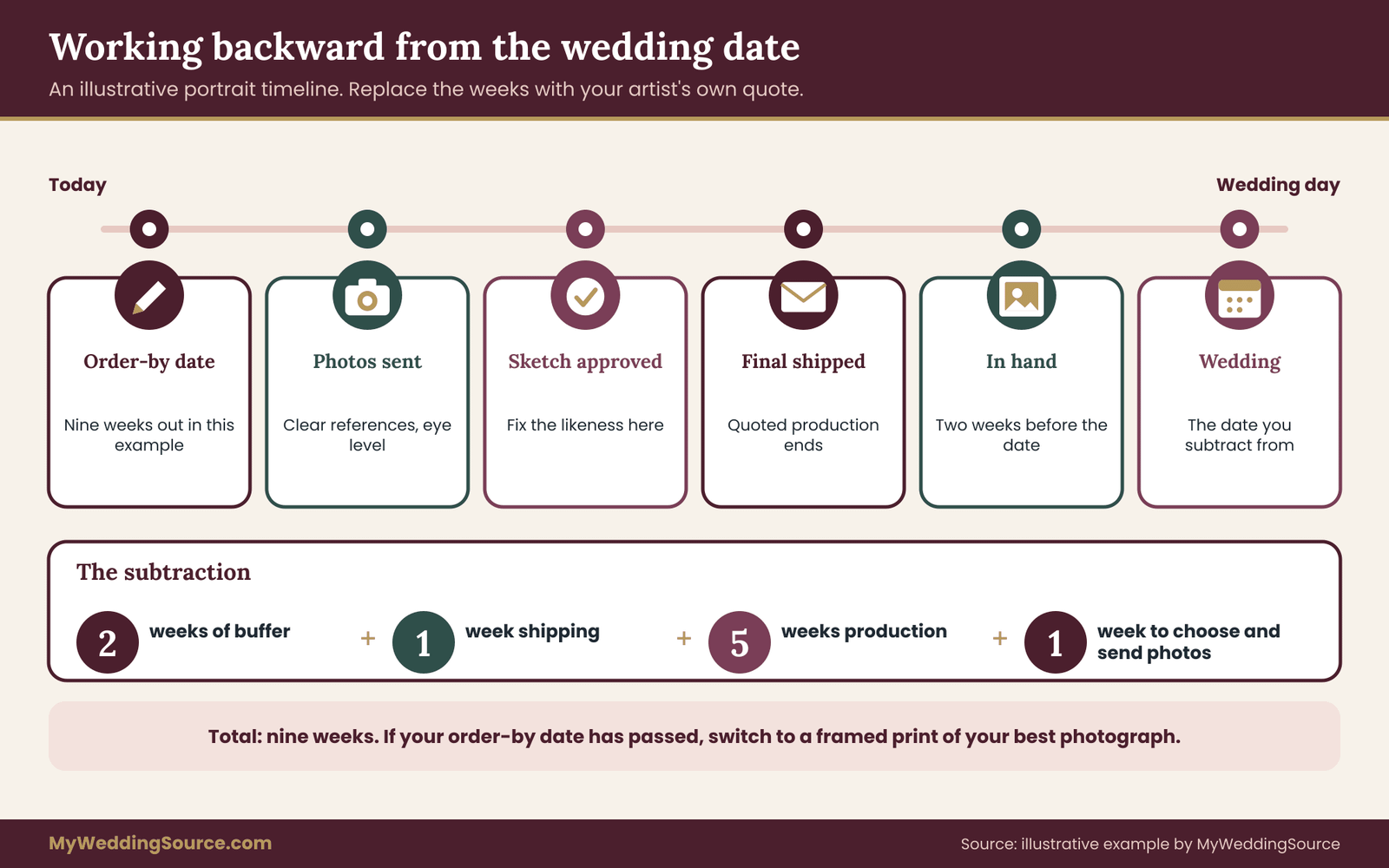
The single most useful calculation in this whole guide takes about two minutes. Write the wedding date at the top of a page. Subtract the following, in this order, to find your last day to commission the artwork:
First, subtract a buffer of at least two weeks, so that the finished piece is in your hands, checked and framed, well before the wedding.
Second, subtract the shipping time you have been quoted, plus a few days for delays.
Third, subtract the artist’s stated production time, including the time for the number of proof or revision rounds you expect.
Fourth, subtract the time you need to send the artist your reference photographs, answer questions and approve the first sketch.
The date you reach is your commission-by date. If it has already passed, the portrait is no longer a safe anchor. Switch to a faster medium, such as a digital illustration or a print of an existing photograph, or move the portrait to a gift for after the wedding, with a card or a framed placeholder on the day.
Here is an illustrative example. Suppose the wedding is on a Saturday in June. The artist quotes five weeks of production including one round of revisions, shipping takes a week, and you want the finished piece two weeks early. Count back eight weeks from the wedding. Add a week for choosing the artist and sending photos, and your commission-by date is nine weeks before the wedding.
If you are at twelve weeks, you have three weeks of slack, which you can spend choosing carefully. If you are at six weeks, a custom portrait has already failed the lead-time check and you should switch.
Reference photographs
Good artwork for a pet tribute starts with good references, and many disappointing portraits come from poor photos. Send the artist several clear, well-lit photographs of the animal, taken at the animal’s eye level and in natural light. Include a close-up of the face, a full-body shot for proportions and any image that shows a defining feature, such as a crooked ear, a coat pattern or a way of tilting the head. If the animal has changed with age, say which age you want depicted.
If your best photos are old, blurry or taken in poor light, say so early. Some artists can work from imperfect images, and some will decline or charge more. It is better to learn that in the first email than in the second round of proofs.
Do not stage a new photo session just for the artist if the animal dislikes the camera. A relaxed animal in the garden for a few minutes with treats from the owner is enough, and an animal that is stressed by it should be left alone.
Questions to ask the artist before you pay
Ask these in writing and keep the answers:
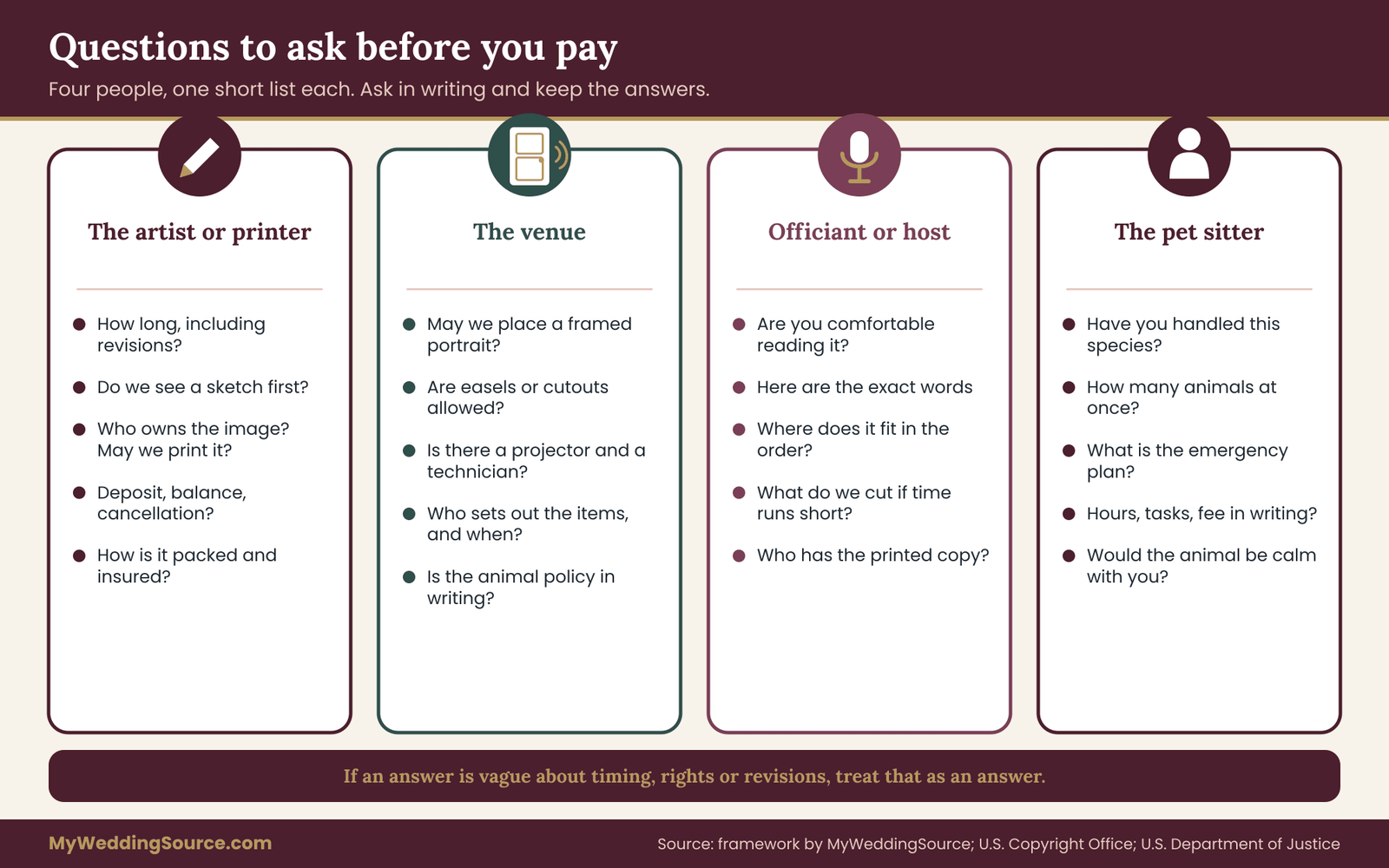
How long will the work take, including revisions, and what happens if it is late?
How many revisions are included, and what do extra revisions cost?
What is the final size, the medium and the paper or canvas, and is framing included?
Will you show a sketch before the final work, and can we approve it?
What is the deposit, when is the balance due and what is refundable if we cancel?
Who owns the image, and may we print copies for the program, the thank-you cards and a few frames? The U.S. Copyright Office explains that the person who creates a work generally owns the copyright unless there is a written transfer or the work was made for hire. If you plan to print the image on stationery or signage, get the permission in writing.
How will it be shipped, insured and packed, and what is the process if it arrives damaged?
If an artist is vague about timing, ownership or revisions, treat that as an answer. A good artist, even a part-time one, can say how long a piece takes and what is included.
Likeness approval
Approve the likeness at the sketch stage, not the final stage. At the sketch stage, changing an ear, a color or a proportion costs the artist a few minutes. At the final stage it can mean starting again. Look at the eyes, the markings and the expression first. People who live with an animal notice small errors in a face that a stranger would not. If you cannot say what is wrong, hold the sketch next to a favorite photograph and compare features one at a time.
If the artist offers a quick sketch for free or at a low price, that is a good sign. If the artist refuses a sketch stage on a custom piece, the risk shifts to you.
Alternatives to a custom portrait
If the timeline is short or the budget is tight, a print of an excellent photograph is a strong anchor. Choose the photograph for its quality and the animal’s expression. Print it at a lab or shop on good paper, ask about the largest size the image supports without looking soft, and frame it with a mat. A good print in a plain frame often feels more personal than a stylized painting, because it looks like the animal.
You can also commission a small piece, such as a pocket-size portrait or a pencil sketch, which is faster and cheaper than a large one. And you can combine: a quick small portrait for the day, and a larger piece as a first-anniversary gift.
Keepsakes for a pet tribute: objects that carry the animal without the animal
Keepsakes are the physical anchor candidates and extras in a pet tribute: things you can hold, wear or carry. They are also where welfare and guest comfort need the most attention, because physical objects can involve fur, ink, small parts and materials that either the animal or a guest might react to.
Items that work well in a pet tribute
An embroidered detail. A small embroidered portrait or a name stitched inside a jacket pocket, on a handkerchief or on the ring pillow. It is quiet, personal and has no footprint on the day. It does need lead time, since embroidery is slow work, and it needs a clear image of what to stitch.
A charm or a pin. A small metal charm with the animal’s name or silhouette attached to the bouquet stem, a boutonniere or the inside of a dress. Choose one that is securely fastened, small enough not to snag and made of a material that does not irritate skin. Ask the maker how it attaches, and test the clasp before the wedding. A charm that detaches during the processional is a tribute no one needed.
A framed print or a small portrait. The simplest of all, covered above. It can sit on the welcome table, the guest book table or the dessert table with a small card that names the animal.
A name on something already there. A line on the thank-you card, a name on a cocktail menu card, a name on the program. These cost almost nothing and need no extra setup.
A paw print, handled carefully. Many couples like an ink-free paw print kit, which presses the paw into a soft material without ink, and some veterinary clinics offer prints. If the animal tolerates having its feet handled, this can be a calm moment at home, at a quiet time well before the wedding. If the animal dislikes it, skip it. A paw print on a card is not worth a frightened animal. Ask your veterinarian whether any product you plan to use is safe for the animal’s skin, because animals lick their paws.
A donation or a gift in the animal’s name. A contribution to a shelter, a rescue or a veterinary fund, announced on the website or with a small card at the reception. Verify the organization before listing it. The Federal Trade Commission publishes guidance for checking a charity, and the Internal Revenue Service offers a search tool for tax-exempt organizations. If you are collecting donations at the wedding in place of gifts, check the venue’s rules about collection boxes and decide who will handle the money after the event.
Items to think twice about
Fur or hair keepsakes. Some people keep a lock of fur in a locket or a framed shadow box. If it is private and stays at home, that is entirely your choice. If it appears at the wedding, such as fur sewn into a garment or placed in a bouquet, remember that guests may have allergies, and that food areas and fur do not mix. Keep fur out of anything near food, and keep it out of shared spaces.
Anything edible made in the animal’s likeness. A cake topper shaped like the dog is fine. A cookie or a cake decoration that someone might later offer to the animal is not, because many human foods are unsafe for dogs and cats. If you plan to bring home leftovers, keep sweets and anything containing chocolate, grapes, raisins or xylitol away from animals. The ASPCA’s animal poison control resources list foods and plants that are dangerous to pets.
Anything small, shiny or stringy that ends up on the floor at home. Beads, ribbons, flower stems and charms can be swallowed. If you take decorations home, store them where the animal cannot reach.
A stuffed toy or lookalike plush at the venue. A plush toy dressed in a tiny bow tie, carried down the aisle, can look charming in a photograph and feel strange in person. It is more likely to draw attention than to evoke the animal. If you want one, treat it as a photo prop for the portrait session and not as a ceremony item.
A borrowed lookalike animal. Do not borrow another person’s animal to stand in. It exposes that animal to the same welfare risks you are trying to avoid for your own, and it changes the day’s logistics.
The ring pillow and similar carriers
The ring bearer pillow is a traditional moment for an animal, and a natural place to put a pet tribute without the pet. Embroider the animal’s name or silhouette on the pillow, or attach a small charm. Make sure the rings are secured with ribbons that can be undone easily, and that nothing on the pillow can catch the rings. The person who carries the pillow should know what is on it and what the detail means.
A pet that carries the rings itself is a different decision with its own welfare checks.
Ceremony moments for a pet tribute: brief, planned and optional
The ceremony has the least slack, so this is the moment to be most disciplined. A pet tribute at the ceremony should take under a minute, should not depend on guests doing anything unfamiliar and should be easy to drop if the schedule runs long.
A line in the program
In the program, a short line for the pet tribute, such as “Our dog Pickle is at home with his favorite blanket and sends his love,” tells guests what they need to know and takes up no time at all. A program line is also the easiest ceremony gesture to adjust, since it is printed and will not change on the day. It scores well on every check.
A mention from the officiant
If your officiant is comfortable with it, a single sentence early in the ceremony can acknowledge the animal. Write the sentence yourselves and give it to the officiant in advance, because an officiant who improvises about a pet the officiant has never met can strike the wrong tone. Keep it to one sentence, specific and warm, and avoid jokes that depend on the guests knowing the animal.
The wedding ceremony step-by-step guide explains where short acknowledgments fit in the order of a ceremony, and a good place for a pet mention is near the beginning, in the welcome, where it is brief and does not interrupt the vows.
A reading or a vow that mentions the animal
Some couples include the animal in their vows, with a line about the family they are making. If you do, keep it to a phrase. A vow is a statement to each other, and a long section about a dog can shift its weight. A reading chosen by a friend can mention animals more generally, which suits couples who do not want a specific tribute.
A reserved seat or an item on a chair
Placing a framed photograph on a chair in the front row, or tucking a small sprig of flowers there, is a visual way to include the animal in the ceremony. This is tender when the animal has died and can feel odd for a living animal that is simply at home. Consider your guests’ reactions, and think about whether the tone fits. If it does not, move the photograph to the reception.
Things to avoid in the ceremony
Do not plan a live video call to the animal during the ceremony. It adds a phone, a signal, a sitter’s attention and the animal’s reaction to the sound of voices, none of which helps the animal or the ceremony. Do not ask guests to do anything unexpected, such as barking, clapping on a cue or passing an object around. Do not add a ceremony ritual that needs to be explained to the whole room. Do not assign a task to a family member who has other duties in the same ten minutes.
If a ceremony gesture would be the fifth thing the officiant has to remember, drop it. A pet tribute works best when it is easy and quiet.
When the family expects more
Some families have strong expectations. A parent may want the dog in the photographs, a grandparent may want a speech about the animal and a friend may insist on a surprise. The Stand-In Board handles this: tell them the plan has three slots, show them what is in them, and ask which one they would like to improve. Often, offering someone a role, such as writing the program line or choosing the frame, satisfies the wish to take part. People rarely mind a modest plan when they have a say in it.
Photo alternatives that put the animal in the wedding story
Photographs are the strongest way to build a pet tribute for an animal who cannot come, because the animal looks like itself and no one has to interpret anything. A pet tribute built on good photographs also has the lowest lead time and the lowest cost of any option. The key is to make the photographs before the wedding and to use them in more than one place.
A pre-wedding session at home
A short session at home or in a familiar park, a few weeks before the wedding, gives you images of the couple and the animal together in ordinary clothes. This is often the best use of the animal’s time, because it happens on a calm day, on the animal’s terms, with no crowd and no schedule.
Keep it short and low-pressure. Choose the time of day when the animal is most relaxed and the light is soft. Bring treats the animal already eats, and stop at the first sign of stress, such as lip licking, yawning, turning away, a tucked tail or hiding. Let the animal wander. A photograph of a dog sniffing a flower bed while the couple laugh nearby can say more than a posed portrait.
Do not dress the animal in anything it is not used to. A harness, a bandana or a bow tie that the animal has worn before is fine for a short session. Something new, tight or itchy is not. Dog attire has its own safety questions, and the short version applies here: if the animal shows discomfort, take it off.
Tell the photographer about the animal beforehand. A photographer with experience of animals will know how to work quickly and quietly. If your wedding photographer will do the session, ask whether it is included, how long it takes and whether the images are covered by the same license as the wedding photographs. If you use a separate pet photographer, ask the same questions and check how long the delivery takes.
Using the photographs
One good session can supply every image in the pet tribute. A single photograph can become the portrait reference, the program image, the website photo, a frame on the welcome table, a page in the album and a thank-you card. Choose three or four strong images and use them consistently, rather than spreading twenty weaker ones across the day.
If the wedding photographer will be shooting family portraits on the day, consider whether a framed photograph of the animal can appear in one or two of them, such as on a table beside the couple. Add it to the shot list the wedding family photo list guide describes, as a single line item, so that it does not take extra time or require extra posing.
Cutouts and enlarged photographs
A life-size or large cutout of the animal is the most visible stand-in, and the one most likely to fail the five checks. It has a large footprint, it needs to be carried and placed, and it can look comic or unsettling depending on the setting. If your wedding is playful and you know your guests will enjoy it, a cutout placed near the photo area can be a hit, and it works as a prop for guests’ photographs.
Check three things before ordering one. First, the venue’s rules on freestanding items, because some venues restrict anything that could tip over. Second, who will carry it and where it will be stored between the ceremony and the reception. Third, the print quality, since an image enlarged to a large size from a phone photograph will look soft. Ask the printer for the minimum resolution it recommends, and compare it with the original file.
A smaller version for the pet tribute, such as a head-and-shoulders cutout on a stick, is easier to carry and easier to store, but it invites guests to wave it around. Decide whether that is what you want.
Using a photograph in the album
In the album, a full-page photograph of the animal, placed in the section about getting ready or the home you share, turns the pet tribute into a permanent part of the wedding record. Ask the album designer about the layout early, and send the photograph at the same time as the other images. If the animal also appears in the pre-wedding session, consider placing one of those images at the beginning of the album as a page on its own.
A short film or a slideshow
A short video of the animal at home, shown at the reception, can be charming. It also adds an audio-visual task, a screen, a cable, a speaker and a person who is not dancing. If the venue already has a projector and a technician, a thirty-second clip can be added to a slideshow.
If not, skip it. Any video you add needs three safeguards: a copy on a device, a copy with the venue and a person who knows how to play it.
Keep it short. A video of the animal doing something characteristic, such as bringing the same toy to the door, is more affecting than a montage.
What not to do with the animal for a pet tribute on the day
Do not ask the sitter to bring the animal to the venue for photographs, even briefly, unless the venue has agreed in writing and the animal has been cleared by your veterinarian and is accustomed to the place. Do not schedule a “reunion” photo on the wedding day when the animal is likely to be nervous. Do not ask a photographer to take pictures of the animal in the middle of the sitter’s care without the sitter’s consent. The animal’s day should stay quiet, and the photographs you need are the ones you took earlier.
Reception details: signage, a table, drinks and cake
The reception has room for the most visible gestures of a pet tribute, and it is where the most extravagant pet tributes end up. Aim for a few well-placed details.
A welcome table or a small pet tribute display
A framed portrait or photograph on a small table, with a card naming the animal and a line about them, is the simplest reception tribute. Place it where guests arrive, near the guest book or the seating chart, and make sure it does not block the flow of people. The wedding signage system guide covers placement, readability and venue permissions, and the same rules apply: confirm with the venue whether you can bring a stand or easel, and whether tape or nails are allowed.
The card should be short. A name, perhaps a breed or a nickname, and one sentence. “This is Juniper, who supervised our engagement from the couch.” Avoid long biographies. Guests will read a few lines while holding a drink.
A line on the menu or the bar card
A signature drink or a dish named after the animal is a popular idea, and a good extra, if you check three things. First, whether the name will make sense to guests who do not know the animal. A note on the menu card with the animal’s name and one fact, such as “named for the day we met,” solves that.
Second, whether the drink works as a non-alcoholic option too, since many guests do not drink. Third, whether the ingredients are safe near the animal at home, since leftovers and spilled drinks can end up within reach. Alcohol, caffeine, chocolate, grapes and some artificial sweeteners can harm pets, and a drink brought home from the reception should stay out of reach.
The wedding cocktail hour guide explains how to plan a drinks menu and how much time guests spend at it. If a signature drink is your extra, the cocktail hour is where it earns attention.
A cake detail
A small topper, a sugar silhouette or a piped pawprint on the cake is cheap and easy to organize if you tell the baker early. Show the baker the photograph and ask what is realistic in the material. A topper that does not look like the animal draws more comment than no topper. Keep the cake itself off the floor, away from animals at home, and do not give cake to the animal as a “wedding treat.” Plain, safe treats are a better idea.
A donation or a “give in their name” card
A card on the dessert table that says a donation has been made to a shelter in the animal’s name is a quiet, useful gesture. It asks guests for nothing, and it keeps the focus on the animal’s welfare. If you do invite guests to contribute, name the organization, say how and give a simple method. Do not collect cash at the wedding unless someone has agreed to handle it.
Seating the animal at a table
Some couples assign the animal a seat or a table card, with a photograph on a chair or a place card with a paw print. It is playful and gentle. Consider whether the seat takes a place that a guest could use, and whether the humor fits your crowd. A framed photograph at the head table, among the flowers, achieves the same effect with less fuss.
The toast
A short mention in a toast, from the couple or from a friend, can end the tribute on a warm note. Keep it to a sentence. The person making the toast should know the animal, or should be given the sentence in advance. A speech that dwells on the animal at length can feel like a eulogy to guests who do not know the animal, and an awkward one if the animal is alive and well.
Keeping the reception footprint small
Add the footprint of every item. A framed print on a table is one item. A cutout, an easel, a menu card, a cake topper, a donation card and a video screen is six. If six sounds like a lot, it is, and the three-gesture rule has already told you to cut. A pet tribute that takes ten minutes to set up and two minutes to take down is a good one. The person setting up should have a one-page list, a photograph of how it should look and permission from the venue.
Vendor questions and contract checks for a pet tribute
A pet tribute usually involves two or three outside people: an artist, a printer or framer and sometimes a baker, a florist or a photographer. Each is a small vendor job, and each benefits from the same basic discipline as any larger booking. The wedding vendor contract guide explains what a written agreement should cover; the questions below are the pet-specific additions.
Questions for the artist, printer and framer behind your pet tribute
Scope. What exactly will be delivered: the size, the medium, the number of copies, the frame, the mat and the glass? Ask for it in writing, with the price.
Timeline. When will each stage be done: sketch, revision, final, shipping? What is the latest date for us to approve a sketch if we want the piece two weeks before the wedding?
Revisions. How many rounds are included? What does an extra round cost and how long does it add?
Rights. May we print the image on stationery, signage and a thank-you card? Is there a fee? Is the permission written?
Materials. Are the paper, ink and frame archival, and will they hold up under light? For pieces that will hang in a home, ask about glazing that protects from ultraviolet light.
Delivery. How is the work packed and insured, and who is responsible if it arrives damaged? Is there tracking?
Payment and cancellation. What is the deposit? When is the balance due? What happens if we cancel, or if the artist cannot deliver on time?
Backup. If the piece is late, is there a fast alternative, such as a digital file we can print locally? A digital version, delivered early, is useful insurance.
Questions for the venue
The venue should know about any pet tribute object, even a framed picture, because venues have rules about what can be placed, where and how. Ask:
May we place a framed portrait and a small card on a table? Can we bring a small easel?
Are cutouts or freestanding displays allowed, and are there rules about weight, stability or placement near exits?
Does the venue have a projector and a person who can run a short clip?
Is anything about the animal’s name or image restricted? This is rare, but a few venues have branding rules for signage.
Who sets out the items, and by what time, if we are not present?
If the venue allows only service animals, ask for the policy in writing, so family members who push for an exception have a document to read. The Americans with Disabilities Act sets out rules for service animals at public places, and a venue’s policy may apply those rules, so do not assume that a pet falls outside or inside them.
If a guest arrives with a service animal, that is a separate matter from your own pet tribute, and it should be handled kindly under the venue’s rules. The Department of Justice’s ADA pages explain the basics.
Questions for the officiant, the DJ or the host
If a program line or a toast mentions the animal, ask the officiant or host whether they are comfortable reading it, and send the exact words. If you plan a short video, ask the DJ or technician what format the clip should be in, who loads it and when to test it. Do not assume that a file that plays on your phone plays on the venue’s equipment.
Questions for the pet sitter
The sitter is the vendor the animal depends on most. Ask for references, ask how many animals the sitter handles at once, ask what happens in an emergency and ask whether the sitter has handled animals with the same needs, such as medication or anxiety. Write down the arrangement: the hours, the tasks, the fee and the contact numbers. The question to ask yourself is the simplest: would the animal be calm with this person?
Measurable checks for a pet tribute before you pay
Three checks turn good intentions into numbers.
The date check. For each custom item, write the wedding date, the in-hand date (two weeks before) and the order-by date. If any order-by date is in the past, switch the gesture.
The people check. For each gesture, name the person who will do each task and the time they will do it. If two tasks fall to one person within the same fifteen minutes, move one.
The minute check. For any moment in the schedule, write how many minutes it takes. If the total for the pet tribute across the ceremony and reception is more than about three or four minutes of actual program time, trim it. The rest of the day has other claims on those minutes.
Write these checks next to each gesture on the board, and update them when anything changes.
Keep one folder for the whole pet tribute
Create a single folder, shared with your partner and whoever is helping, that holds the quotes, the reference photographs, the approved sketch, the printer’s proofs, the sitter’s instructions, the vet’s number and the venue’s written replies. When a question comes up in the last week, the answer is in one place.
It is the same record-keeping principle that applies to any vendor, and it takes ten minutes to set up. Add a line to your master wedding planning checklist for each gesture, with its order-by date, so the pet items are tracked beside everything else and not in a separate notebook.
A worked example: Pickle and a historic hall
The following example of a pet tribute is invented, and is meant to show the board at work. The numbers are illustrative and are not drawn from any real couple.
Dana and Marcus are planning a June wedding in a historic hall that allows only service animals. Their dog Pickle is a thirteen-year-old beagle mix with stiff hips who gets anxious when strangers come into the house. Their veterinarian has said that long days in a crowd would be hard on him, and that a familiar sitter and a quiet routine matter most. It is sixteen weeks before the wedding.
Step one: the care plan
They confirm that Marcus’s sister, whom Pickle knows well, will stay with him. She will visit the evening before, and she will keep his usual feeding and walking times. Dana writes the medication schedule on one page and leaves it on the fridge with the vet’s number and the nearest emergency clinic’s number. A neighbor, not in the wedding, is the single contact if anything goes wrong. The couple will see Pickle the next morning, not late that night.
Step two: the candidates
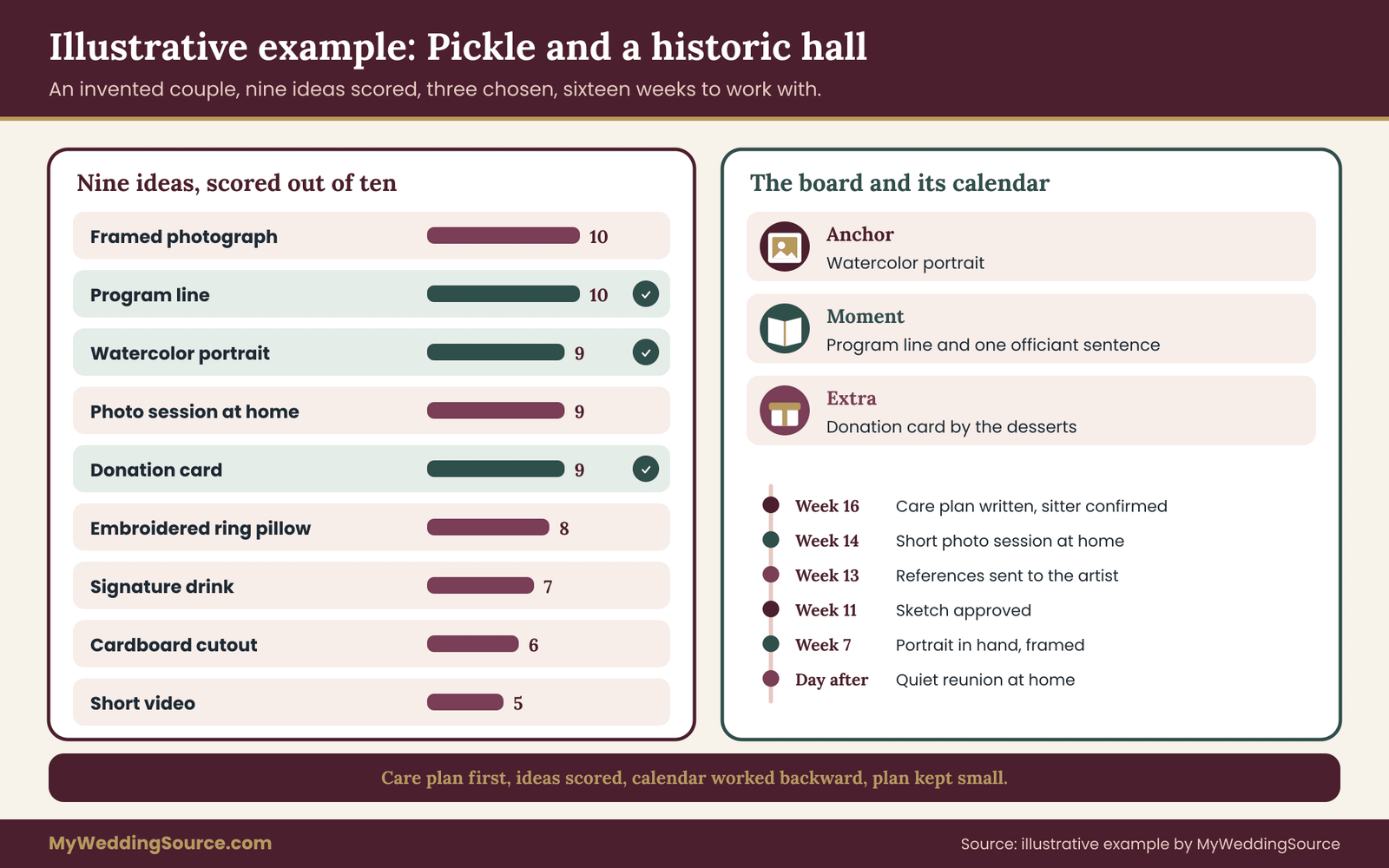
They list nine ideas: a custom watercolor portrait, a framed photograph, an embroidered ring pillow, a cardboard cutout, a pre-wedding photo session, a program line, a signature drink, a donation card and a short video.
Step three: the scoring
The watercolor scores two on welfare, two on fit once they see the artist’s examples, one on lead time (it works if they decide this month), two on guest effort and two on footprint, for nine. The framed photograph scores ten. The cutout loses a point on fit, since their style is quiet, and two on footprint, since the hall has narrow doorways and little storage, for six, which sends it to redesign and then out.
The photo session scores nine, since a short, quiet session at home suits Pickle. The program line scores ten. The signature drink scores seven, because one guest group does not drink and the name needs explaining, and it is dropped to leave room. The video scores five, since the hall has no projector. The donation card scores nine. The embroidered ring pillow scores eight, and holds a place as a candidate.
Step four: the board
They choose the watercolor portrait as the anchor, a program line plus a one-sentence mention by the officiant as the moment, and the donation card as the small extra. The photo session is not a gesture on the board, but a source: it will supply the reference photos for the artist, the image for the program and the album page.
Step five: the dates
Dana contacts two artists and chooses the one who quotes five weeks of work, including a sketch and one revision, plus a week of shipping. Working back from the wedding: two weeks of buffer, one week of shipping, five weeks of work and a week for choosing and sending photos gives nine weeks before the wedding.
At sixteen weeks, they have seven weeks of slack. They decide to hold the photo session at week fourteen, send photos to the artist at week thirteen, approve the sketch at week eleven and have the final piece in hand by about week seven, well ahead of the two-week buffer.
Step six: the day
On the welcome table, the framed portrait stands beside the guest book with a card: “This is Pickle, who is at home with a blanket and a very good sitter.” The program has the same line. The officiant says one sentence in the welcome. A small card by the dessert table says a donation has been made to the local shelter. Setup takes the venue coordinator about three minutes. At home, Pickle has his usual dinner and is asleep before the first dance. The next morning, Dana and Marcus come home to a quiet reunion.
What the pet tribute example shows
The example shows four habits that matter more than the specific gestures. The care plan came first. The ideas were scored before they were bought. The calendar was worked backward from the wedding date. And the final plan was small enough that it was easy to carry out and easy to enjoy. A different couple, with a cat who loves the window and a venue that allows a small display, would reach a different board, and that is the point of having a procedure and not a template.
Edge cases: grief, allergies, disagreements and plans that change
Most pet tributes go smoothly. The cases below are the ones that need a little more thought, because they involve feelings, health or a change of plan.
When the animal has died
A pet tribute for an animal who has died is a different kind of gesture, and the Stand-In Board still helps, with adjustments. The welfare check no longer applies to the animal, but it still applies to people: grief is unpredictable, and a tribute that surprises a guest or the couple can land hard. Give it a quiet place, such as a framed photograph near the guest book or a line in the program, and avoid putting it in the middle of the ceremony.
Ask yourselves whether you both want the pet tribute, and how each of you will feel in the moment. One partner may find a photograph comforting and the other may find it difficult on the day. Agree in advance, and agree on a way to remove or move the item if it becomes too much. Warn close family, so no one is caught off guard. If the loss is recent, a private moment before the ceremony, with no one watching, can be better than any public gesture.
Do not use wording that implies the animal is attending in spirit in a way that may not suit all your guests’ beliefs. A plain statement, such as “In memory of Juniper, who was with us for fourteen years,” is warm and fits every tradition. If guests of different backgrounds are present, a simple photograph and a name do the job. For other kinds of remembrance at a wedding, a quiet, consent-based approach to family wishes works in most cases.
When a guest has an allergy or a fear
Some guests are allergic to animals or afraid of them. A pet tribute without the animal is gentler for these guests, but fur keepsakes, strongly scented items from the animal’s home and anything that has been in contact with the animal can carry allergens. Keep any fur out of shared spaces and away from food, and keep keepsakes that have been at home with the animal in a sealed bag until needed.
If a guest has told you about an allergy, place a framed print rather than a handled object near them. A photograph carries no dander.
For guests who fear animals, a life-size cutout or a realistic image of a large dog can still be unsettling. A small framed photograph is less likely to trigger a reaction.
When family members disagree
One side of the family may think a pet tribute is silly, and the other may expect a large one. The three-gesture rule gives you a polite structure. Share the board, say that it is a deliberate plan, and ask for ideas within the slots. Where the disagreement is about taste, such as a cutout versus a framed portrait, use the five checks as a neutral language.
Where the disagreement is about whether to do it at all, remember that a pet tribute is a small, optional element, and the final decision is the couple’s. Your master checklist is a good place to record decisions so they are not reopened every week.
If a relative proposes to bring the animal anyway, as a surprise, make the policy clear in advance, and make sure the person who would handle the animal knows that the answer is no. An animal at the door of a venue that forbids it puts the animal, the venue and the relative in a bad position.
When the venue changes or the policy turns out to be softer
Sometimes a venue’s policy is flexible, or a different venue allows animals in certain areas or at certain times. That opens the option of a brief, controlled appearance, for example in photographs before the ceremony. If you consider it, go back to the welfare check first. Get the permission in writing, have your veterinarian’s view on whether it suits this animal, and arrange a handler whose only job is the animal. If any of those is missing, the animal stays home and the pet tribute stands.
When the timeline for a pet tribute slips
If the artwork is late, the printer makes an error or the sketch is not right, do not rush a bad result onto the table. Use the fallback: a framed print of your best photograph, which you can have printed locally in a few days. Put the portrait on the table at the first anniversary instead, with a short note. Late work can be a gift, and a missing piece does not need a public explanation.
If the animal’s health changes close to the wedding, adjust the plan. Cancel any session that would burden the animal, simplify the board and let your veterinarian guide the care plan. A pet tribute is a small thing next to the animal’s comfort, and nobody will think less of a modest one.
When the animal is not a dog or cat
Everything above applies to rabbits, birds, horses, reptiles and other animals, with the caveat that handling, safety and stress differ by species. Ask a veterinarian who knows the species. A horse on a farm can often be photographed on its own turf before the wedding, and a bird may be best left entirely undisturbed. The tribute does not need the animal’s participation.
After the wedding: keeping the pet tribute going
The best pet tributes continue after the day. Hang the portrait where you will see it. Put the photograph in the album, and keep the file in more than one place so a lost phone does not take the only copy. The Library of Congress publishes personal digital archiving advice that covers file formats, backups and naming, and it applies to the photographs and the artwork scans.
If you made a donation, keep the receipt with your records. If you promised guests a photograph of the animal in the thank-you card, send it with the card. If the framed portrait was in any group photographs, note which ones on your family photo shot list so the album designer can find them.
A year later, look at the board again and note what you would change. The notes are useful to anyone you advise.
A last check before the day
Two days before the wedding, run a short check. Is the animal’s care plan confirmed, with the sitter’s name and number in the right hands? Is every pet item delivered, checked and packed? Does the person who sets up have the list, the photograph of how it should look and the venue’s permission? Is the program line correct, with the animal’s name spelled right? Is the officiant’s sentence in hand? Is the donation organization still active? If the answer to any of these is no, there is still time to fix it.
Your next steps
Start with the animal, not the decoration. This week, write the care plan for the wedding day: who is with the animal, for how many hours, with what routine and with which numbers on the fridge. Share it with your veterinarian if you have any doubt.
Then build the board. List the ideas that appeal to you, score each on the five checks and choose one anchor, one moment and, if you want it, one small extra. Work backward from the wedding date to find the order-by date for anything custom, and put those dates on your calendar. Collect a few good photographs, or schedule a short, calm session, and write the program line.
Finally, ask the venue, the artist and the officiant the questions in this guide, and keep the answers in one folder. A pet tribute planned this way is small, kind and finished on time, and it gives the animal a place in the day without asking the animal to be there.
FAQ
How can I include my dog in the wedding if the venue does not allow dogs?
Choose up to three gestures that do not need the dog on site: a framed portrait or photograph on the welcome table, a short line in the program, and perhaps a donation card in the dog’s name. Ask the venue to confirm in writing where a small display may stand. The dog stays home with a familiar sitter, and the pet tribute carries the affection.
How far ahead should I order a custom pet portrait?
Work backward from the wedding date. Subtract two weeks of buffer, the shipping time, the artist’s quoted production time including revisions and a week to choose the artist and send photos. That gives your order-by date. If the date has passed, switch to a framed print of a strong photograph, which can usually be printed locally within days.
Is it rude to leave the pet out of the wedding?
No. Many animals are safer and calmer at home, and many venues do not allow them. Tell guests briefly and kindly that the animal is staying home, then show them what you have planned instead. Guests tend to respond well to a clear, warm message, and few ask for more than a photograph and a name.
Can I put my pet’s fur or paw print in a wedding keepsake?
You can, with care. Fur can trigger allergies, so keep it out of shared spaces and away from food. For a paw print, use an ink-free kit only if the animal tolerates having its feet handled, and ask your veterinarian whether the product is safe, since animals lick their paws. If the animal dislikes it, skip it.
Should the officiant mention the pet during the ceremony?
It can be a warm touch if the officiant is comfortable with it. Write one specific sentence yourselves and send it in advance, so nothing is improvised. Place it in the welcome, near the start, where it does not interrupt the vows. If the ceremony schedule is tight, a line in the printed program does the same job.
Can we video call the pet during the wedding?
It is better not to. A call adds a device, a signal and the sitter’s attention, and the sound of voices can unsettle the animal. It also takes minutes from a tight schedule. A short recorded clip played in a reception slideshow, if the venue has the equipment, gives the same warmth with less risk.
What if a relative wants to bring the pet anyway?
Point to the venue’s written policy and the animal’s care plan, and thank the relative for the thought. Offer a role in the pet tribute instead, such as choosing the frame or writing the program line. Make sure the person who would handle the animal knows the answer is no before the day arrives.
How do I include a pet who has died?
Keep it quiet and agreed by both partners: a framed photograph near the guest book or a plain line in the program, such as a name and the years the animal was with you. Warn close family beforehand, avoid placing it at a high-emotion moment and decide in advance how to move the item if the day becomes hard.
Sources
- Pet care, American Veterinary Medical Association
- Pet owner resources and animal poison control, ASPCA
- Healthy Pets, Centers for Disease Control and Prevention
- Pets and travel, Animal and Plant Health Inspection Service, U.S. Department of Agriculture
- Service animals and the ADA, U.S. Department of Justice
- Copyright basics, U.S. Copyright Office
- Charity fraud and giving guidance, Federal Trade Commission
- Tax Exempt Organization Search, Internal Revenue Service
- Mailing standards for letters and flats, United States Postal Service
- Personal archiving: preserving your digital memories, Library of Congress