
Written updates are the simplest fix for a problem many couples meet around month four of planning: a vendor who calls without warning, asks for a decision on the spot, and leaves nothing on paper afterward. This guide gives you a communication preference rider, a response SLA you can offer vendors, a worked case, the alternatives to try when a vendor resists, and the failure conditions that tell you when to escalate.
Decide in advance which channel you want (a shared email inbox works for most couples), then put your request for written updates on paper before you pay a deposit. Send each vendor a short rider that names the channel, one urgent exception, and a response time you will both honor. Ask them to confirm every phone conversation in a written summary. If a vendor will not agree to written updates at all, choose an alternative from this guide or reconsider the hire, because the contract is only as clear as the messages around it.
Most wedding vendors run their business by phone. A florist calls from the van, a caterer rings between tastings, a venue manager leaves a voicemail that says “call me back about the thing.” For some couples this is fine. For others it is a steady drain: the call arrives while they are at work, the question needs a spreadsheet they do not have in front of them, and the answer they give in thirty seconds turns out to commit them to something they would have chosen differently with an hour to think.
Asking for written updates is a reasonable, ordinary request. Plenty of couples prefer email for reasons that have nothing to do with how they process information: they work shifts, they live in different time zones, they share decisions with a parent who is paying, or they simply want a record. This guide is written for any couple who wants written updates, and it pays particular attention to couples who find unscheduled calls hard to absorb, whatever the reason.
A note on scope. This is general planning information, not legal, medical or accessibility advice, and nothing here diagnoses anyone or assumes that two people with similar needs want the same thing. Where a rule matters, such as what the Americans with Disabilities Act requires of a business, the guide points you to the agency that publishes the current version.
What written updates are, and what they are not
Written updates are messages from a vendor that tell you where things stand, in a form you can read when you are ready and keep afterward. An email with a clear subject line counts. A message in a shared planning portal counts. A text message counts if both sides agree it is a legitimate channel and you can export or screenshot it. A voicemail does not, and neither does a phone call, however friendly.
In practice, written updates come in six common kinds. A status update says where a job stands: the dress is cut, the flowers are ordered, the permit is filed. A confirmation repeats a detail so you can check it, such as an arrival time or a headcount. A change notice announces that something moved, whether a price, a date or a substitution. A delivery notice tells you what is coming and when. A reminder points to a deadline. And a summary records what was said on a call or at a meeting.
A vendor who sends all six kinds as written updates leaves you with a complete file; a vendor who sends none leaves you with a memory.
The distinction that matters is not the app. It is whether the message is asynchronous (you read it when you can), searchable (you can find it in October when you need to know what was promised in March), and complete (it contains the facts, not just a hint that there are facts to discuss).
Written updates also differ from the casual back-and-forth most couples already have with vendors. A casual email thread is better than a phone call, but it can still bury the one decision that matters in the fourth paragraph of a reply. The practice this guide describes is a little more structured: a stated channel, a predictable format, a promised response time, and a rule for what happens when someone uses the phone anyway.
It is also worth saying what written updates are not. They are not a refusal to ever speak to your vendors. Many couples who ask for written updates still hold a scheduled video call at the start of a relationship, or a ten-minute call to settle a tricky timeline. The goal is to remove the surprise and the pressure, not the human contact.
Nor is it a way to avoid hard conversations. If a vendor has made a mistake, a calm written message that describes the problem and the fix you want is often more effective than an emotional phone call. You will see a script for exactly that situation later.
Why written updates beat surprise phone calls
Three problems recur when planning runs on unscheduled calls, and each one has a practical cost, not just a comfort cost.
The first is the decision made under time pressure. A caller who needs an answer now has an advantage, usually unintentionally. They know the schedule, the pricing and the options; you are hearing them for the first time. “We can hold the rain plan tent for you if you let me know today” may be perfectly true, but it leaves no room to check the budget, ask your partner, or read the contract. A written version of the same offer arrives with a deadline you can see and a choice you can compare.
The second is the missing record. A phone agreement is not worthless, but it is hard to prove and easy to remember differently. If the caterer says by phone that the bar package now includes a second bartender, and the final invoice lists one, you have your memory against theirs. The same sentence in an email is a line item you can quote. The guide on wedding vendor contracts explains why amendments belong in writing; written updates are the everyday habit that keeps those amendments from getting lost.
The third is the cost of interruption. Calls that land in the middle of a workday, or during a rare quiet evening, cost more than their duration.
A person who needs to prepare for a conversation, or who needs time to switch tasks, may spend an hour dreading a call and another hour recovering from it. Couples who describe themselves as neurodivergent, anxious, or simply phone-averse often name this as the main reason they ask for a different channel. You do not need to explain or justify the preference to a vendor, and you do not need a label to have it.
None of this means vendors are doing something wrong by calling. They are using the tool that works for most of their clients. The point of the rider is to tell them, early and politely, what works for you.
What changes when you move to written updates
A shift to written updates changes more than the medium. It changes who controls the pace, what gets recorded, and how misunderstandings surface.
You control the pace. You can read a message at the time of day when you think best, draft a reply, and wait before sending it. For a couple who share the inbox, either partner can pick up the thread without a relay conversation about what the vendor said.
The vendor, in turn, has to be clearer. A call lets a vendor trail off, assume you know what they mean, or skip the details. A message forces a complete sentence. In practice this is the single biggest quality gain: many problems that surface at the final walkthrough, such as a delivery window nobody wrote down, begin as something that was easy to say and easy to forget.
Misunderstandings surface earlier. A message that says “we will arrive at 2 p.m.” can be checked against the timeline; a conversation that included “sometime in the afternoon” cannot. The wedding vendor timeline is stronger when every arrival time in it can be traced to a written confirmation.
There are costs, too, and an honest guide names them. Written updates are slower for genuinely urgent matters. They can feel cold at the start of a relationship with a vendor who likes to chat. They also put more work on the couple, because someone has to read, file and answer the messages. The rest of this guide is built to keep the costs of written updates small: an urgent lane for emergencies, a warm tone in the first message, and a simple log so the paperwork does not become a second job.

Who this guide is for, and who should still call
You will get the most from written updates if at least one of these is true. You find unscheduled calls disruptive. You make better decisions with time and a document in front of you. You and your partner both need to see what a vendor said. You are paying for part of the wedding with someone else’s money and need records. Or you work hours that make daytime calls impractical.
There are also situations where a call is simply the better tool, and a sensible rider leaves room for them. Resolving a conflict that has gone three rounds by email, settling a sensitive family matter with an officiant, or talking through a design idea that needs back-and-forth: these go better when two people can interrupt each other. Even then, a call you schedule, with an agenda, and followed by a written recap, keeps most of the benefits.
If you share a language other than English with a vendor, written updates can also be easier to translate and to double-check. If a vendor has a disability that makes email difficult, the same flexibility you are asking for should be offered to them. The aim is clear communication between two parties, and the rider is a tool to get there, not a rule to impose.
Finally, a word about timing, because the moment you ask for written updates shapes how the request is heard.
The best moment to ask is before you sign. A vendor who hears “we work from written updates” during the inquiry stage treats it as a feature of the working relationship. A vendor who hears it after three months of phone calls may hear it as a complaint. If you are already mid-planning, there is a section later in this guide on how to reset the channel without souring anything. ## Decide your written updates policy before you contact vendors
A rider only works if the two of you agree on what is in it. Spend one evening on a short internal policy, because vendors will test it within a week, and a policy you have not agreed on will collapse the first time someone is flustered.
Start with a plain question each: what is the most disruptive way a vendor can reach me, and what is the least? For some people the answer is “a call at lunchtime” and “an email I can answer that evening.” For others a text feels intrusive and a scheduled call feels fine. Write both answers down and look for the overlap. The overlap is your default channel; the differences are the places where one partner will need a delegate or an exception.
Next, decide who owns the inbox. A shared address that both partners can read, created just for the wedding, solves most problems. It keeps vendor messages out of personal mail, lets either person answer, and can be handed to a planner or a trusted relative later. Do not use an address you will close after the wedding if you need the records afterward, and do not publish the address on a public site where it will collect unrelated mail.
Then decide your reciprocal promise. Asking vendors for a response time while you answer in a week is not a fair trade, and vendors notice. A simple commitment is to acknowledge every message within one business day, even if the acknowledgment is “received, we will decide by Thursday,” and to decide within three business days of any message that asks for a choice. If you cannot keep that, set a longer number and offer it honestly.
Finally, choose the one person who can take a call for you in an emergency. This is the delegate. It might be a planner, a sibling, a best friend or a day-of coordinator. They need your permission to speak for you on a defined list of topics and a clear instruction on what they may not agree to alone, such as changes to the price. You will use this person in the urgent lane described below.
Put these four decisions on a single page; they are the whole foundation of your written updates policy. That page is the source for your rider.
The communication preference rider, clause by clause
A communication preference rider is a short document, one page or less, that you send to a vendor with your first message or attach to the contract. It states how you will communicate and what you ask of the vendor. It is a preference statement, not an ultimatum, and it should read like one: warm, specific and easy to agree to.
The rider below has eight clauses. Adapt the wording to your voice, and shorten it for vendors with small, simple jobs. The language in quotation marks is sample text, not required wording.
Clause one, purpose. One sentence that explains the preference without requiring justification. For example: “We use written updates for wedding planning so both of us can see every detail and respond thoughtfully.” This sentence does the heavy lifting. It frames the request as a quality practice rather than a personal limitation, and it gives the vendor an easy reason to say yes.
Clause two, primary channel. The address, portal or thread where messages go, with a note that it is read by both partners. State the channel as a fact: “Please send all written updates to our shared planning inbox, [address].” Use your real address when you send the rider; keep it out of anything you publish.
Clause three, message format. A short request for how messages are written. Ask for one subject line that names the topic and the date (for example, “Florist: delivery time confirmed for the ceremony”), one decision per message, and any deadline in the first two lines. Vendors who send newsletters-style updates with six topics in them are a common source of confusion, and this clause quietly fixes it.
Clause four, no-call default and exceptions. The heart of the rider. State that unscheduled calls and voicemails are not the way to share news or ask for decisions, and list the exceptions: a delivery-day problem, an emergency, or anything the vendor believes cannot wait. For those, give the urgent lane (clause six).
Clause five, response times. The SLA, set out in the next section. Name the response times each side will keep, and the business days they cover.
Clause six, urgent lane. One number and one person for emergencies. Write: “For anything that cannot wait, text [delegate name] at [number] with the word URGENT and one sentence.” Keep it narrow; an urgent lane that opens for every question defeats the rider.
Clause seven, confirming spoken information. The safety net. Say that anything discussed by phone or in person is not final until the vendor confirms it in writing within one business day, and that you will do the same. This clause protects you even when a vendor ignores clause four and calls anyway.
Clause eight, review. A line saying that either side may suggest a change to how written updates work at any time, and that you will check in after the first month. It signals flexibility and gives the vendor a face-saving way to raise problems.

Sample rider text you can adapt
Here is how those eight clauses read when they are put together for a mid-sized vendor, such as a caterer or a photographer. The couple and vendor names are placeholders.
“Thank you for working with us. To make sure both of us see every detail, we run our planning on written updates. Please send updates to our shared planning inbox, [address], and use a subject line that names the topic, such as ‘Catering: final count deadline.’ Please keep each message to one topic and put any deadline in the first two lines.
“We do not take unscheduled phone calls about planning, and voicemails may not be heard promptly. If you would like to talk, send a message with two or three times that suit you and we will confirm one. For anything urgent in the final week, text [delegate name] at [number] with the word URGENT.
“If we speak by phone or in person, please confirm what we agreed by email the next business day, and we will do the same. We will acknowledge every message within one business day and answer any request for a decision within three business days. We hope you can reply to routine messages within two business days. If that does not work for your schedule, tell us what does, and we will adjust.
“We will review how this is working after the first month.”
That is about two hundred words, and it covers all eight clauses. A vendor can read it in a minute, and agree with a one-word reply. Notice what the sample does not do. It does not apologize, it does not offer medical or personal explanations, and it does not threaten consequences. Each of those omissions is deliberate: apology invites negotiation, explanation invites debate, and threats start a relationship badly.
Adjusting the rider for different vendors
One rider does not fit every vendor. The size of the contract, the vendor’s habits and the stage of planning all change what is reasonable.
For a single-purchase vendor, such as a rental company or a cake baker with a short order, shrink the rider to three sentences: the channel, the confirmation rule and the urgent contact. Long documents for small jobs make you look difficult.
For a vendor with a long relationship, such as a venue or a planner, expand the rider with a short meeting calendar: how often you will have scheduled calls, who will attend, and which documents will be shared before each one. This gives the vendor the structure of a phone relationship without the surprise.
For vendors who work through an agency or a coordinator, address the rider to the person who writes your messages, and ask them to pass the rider to the people who actually appear on the day. A florist’s driver or a caterer’s captain is not going to read your email thread, so the rider should also feed the day-of cue sheet. Confirmed details then feed the day-of cue sheet that staff can follow.
For a vendor who already has a phone-heavy process, add a line that offers a specific alternative. “We are happy to do a scheduled fifteen-minute call on the first Tuesday of each month” tells the vendor what you will do, not only what you will not.
Last, adjust the tone to the vendor. A friendly, chatty small business responds to a warm, informal rider; a corporate venue prefers something it can file with the contract. The facts do not change. The voice does. ## A response SLA for written updates
SLA stands for service level agreement, a term borrowed from business. In a wedding it means something modest: a shared promise about how quickly each side replies to each kind of message. It turns “please respond soon” into a number both of you can check, and it protects you from the quiet failure where silence is mistaken for agreement.
Before the tiers, a word about what the vendor’s side of the promise looks like. A good vendor message in a written-updates arrangement has four parts: what changed or what is being asked, the date it applies to, the next step and who takes it. A message that carries those four parts is a complete written update. One that carries only “just checking in” is a nudge, and it should not count as a response in the SLA. Say so in the rider if a vendor tends to answer with vague reassurance.
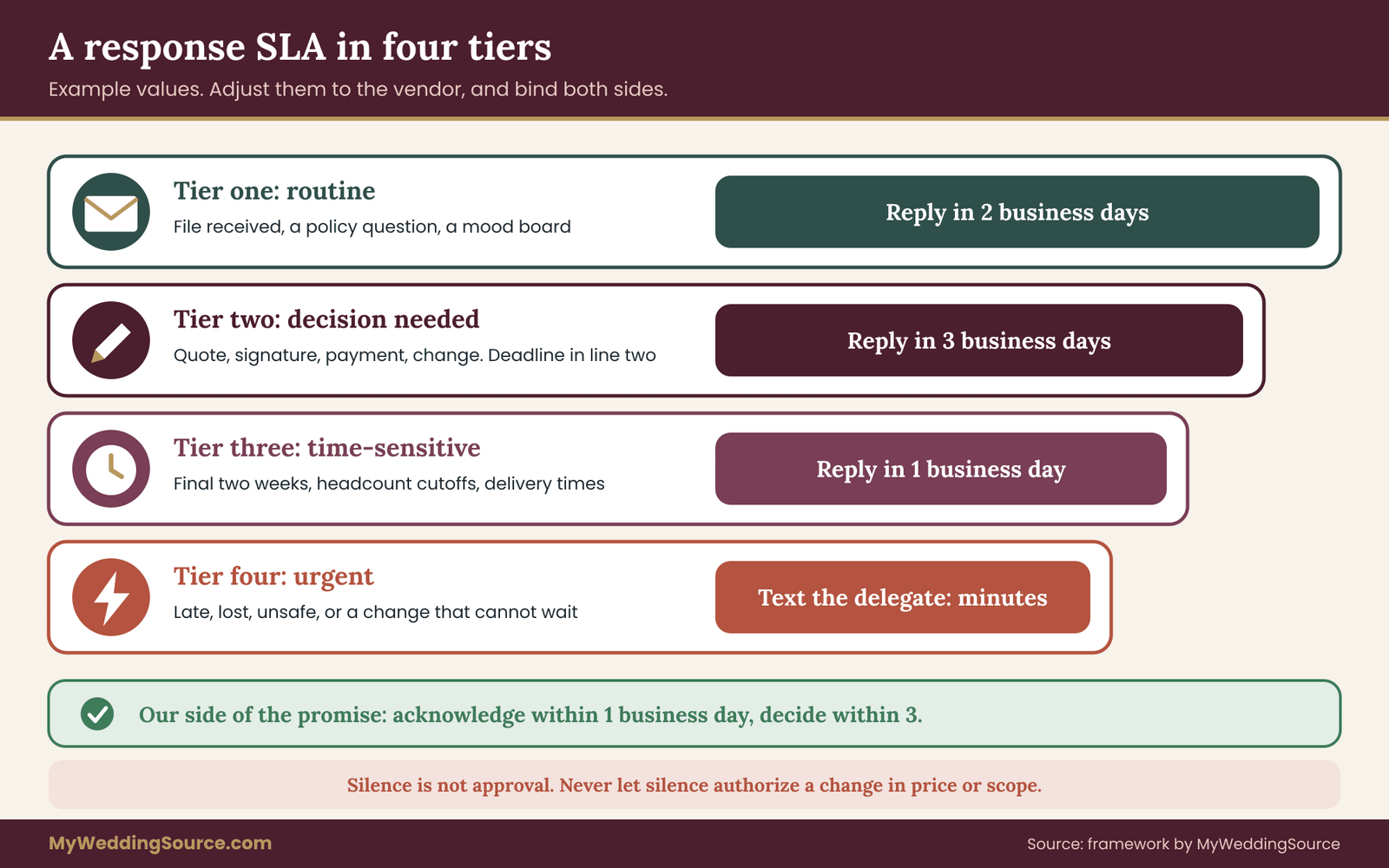
The SLA for written updates has four tiers. Sort messages into tiers by how much damage a late answer would do, not by how important they feel.
Tier one, routine. Questions with no deadline: confirming a file was received, asking about a policy, sending a mood board. A reasonable promise is a reply within two business days. A late reply here costs almost nothing, so the number can be generous.
Tier two, decision needed. Messages that ask for a choice, a signature or a payment. The sender states a decision deadline in the first two lines, and the recipient replies, even with “we need until Friday,” within three business days. The deadline must be at least three business days away unless there is a stated reason.
Tier three, time-sensitive. Anything within roughly the last two weeks before the wedding, or any message with a supplier cutoff attached, such as a final headcount. Replies within one business day, from both sides.
Tier four, urgent. Day-of problems or last-minute emergencies. These go through the urgent lane to the delegate by text, and the expected response is measured in minutes, not days. The delegate, not the couple, receives them.
Those values are examples, and the point of the exercise is the structure. A vendor who works weekends and takes Mondays off will not be able to count Monday as a business day; say so in the SLA. A vendor in another time zone may need a reply “by the end of the next business day” rather than within twenty-four hours.
The SLA must bind both sides. A one-sided demand is a rule, and rules invite quiet non-compliance. Write the couple’s own response times into the same sentence as the vendor’s: “We will acknowledge within one business day and decide within three.” Fairness is what makes vendors comfortable agreeing.
What the SLA should say about silence
The most useful sentence in an SLA is what happens when nobody answers. Without it, a missed deadline turns into an argument about intentions.
Write a silence rule for each tier. For tier one, no rule is needed; follow up politely after the window passes. For tier two, state that silence does not mean approval, and that the sender will send one reminder after the deadline and then treat the matter as unresolved. For tier three, add a second channel: if there is no reply within one business day, the sender may use the urgent lane once.
Be careful with automatic-approval wording such as “if we do not hear from you, we will assume yes.” Vendors sometimes propose it, and it can be a trap in both directions. A silence-means-yes clause on a cost increase can make you liable for a charge you never saw. Agree to a silence rule only for low-stakes items, like a delivery window that has already been confirmed, and keep money and scope changes out of it.
A silence rule also protects you from your own backlog. If you know you sometimes lose a week, put a recurring calendar reminder on a weekly check of the inbox. The consumer-facing guidance on the Consumer Financial Protection Bureau site makes a similar point about payments: dates you do not track tend to pass quietly. A written decision log, covered later, helps the same way.
Where to place the rider so vendors see it
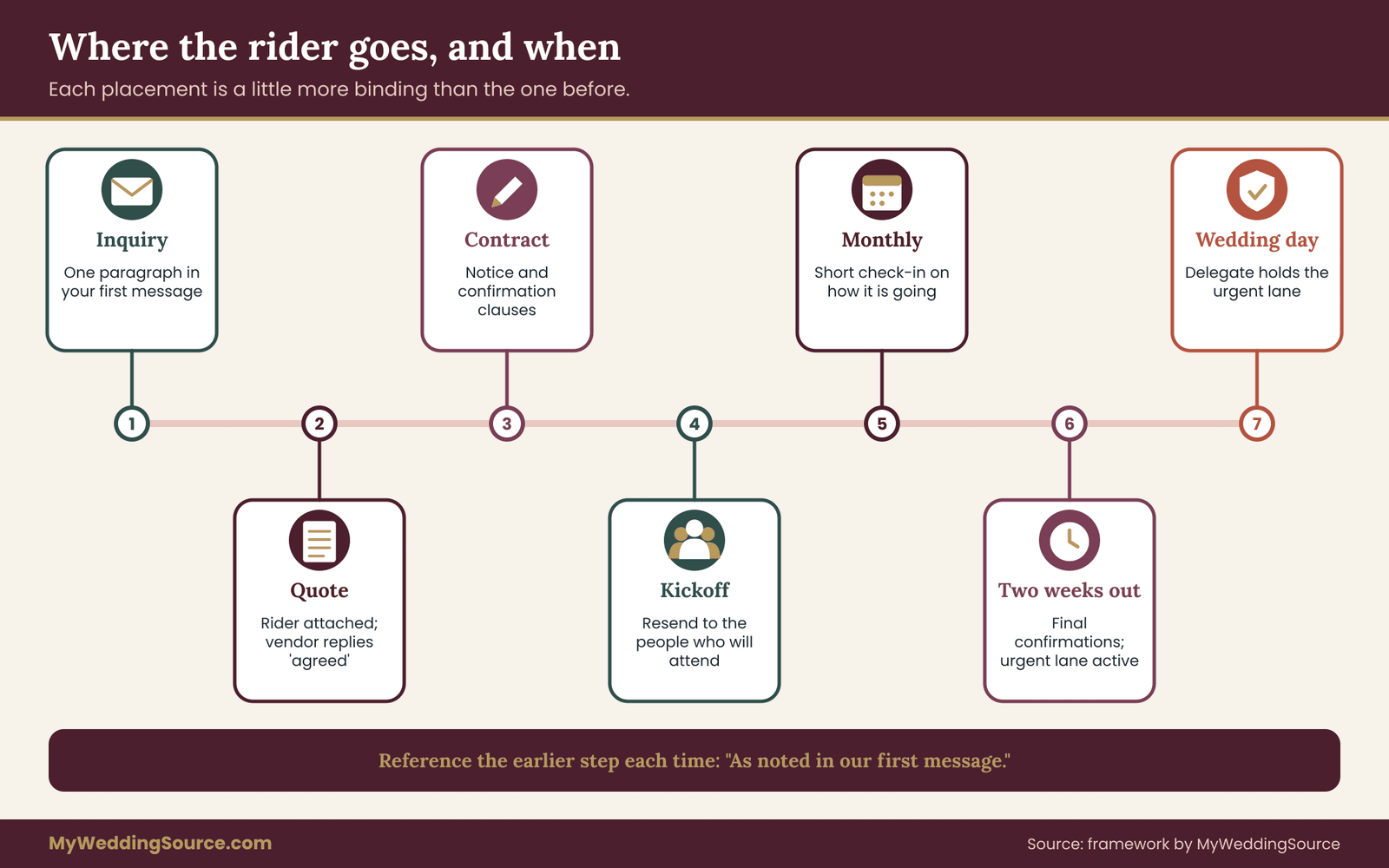
Where the rider lives matters as much as what it says. A rider buried in a forty-page contract is read by nobody. A rider sent after a conflict reads as a complaint. Aim for three placements, each a little more binding than the last.
First, in your inquiry message. When you contact a vendor for the first time, add a short paragraph: “We use written updates; here is how to reach us.” This is the lightest touch and costs you nothing. It also works as a screening step. Vendors who answer with a warm “of course” are showing you something about how the working relationship will go.
Second, as an attachment to the proposal or quote. Once you have chosen a vendor, send the rider and ask them to reply with agreement. A one-line “agreed” in writing is enough to show the arrangement is mutual.
Third, in the contract itself, as an addendum or a communication clause. This is the strongest form. A short clause such as “Vendor will send all notices and changes by email to the address above and will confirm in writing anything discussed by phone” turns the preference into a term. The wedding vendor contract hub shows where clauses like this usually sit and why amendments need signatures. If the vendor will not alter their standard contract, ask whether they will accept the rider as a signed addendum, or whether a countersigned email will do.
Every placement should reference the previous one. “As noted in our first message” tells the vendor the preference is consistent, not new.
Three contract clauses that support written updates
If the vendor will add language to the contract, three short clauses do most of the work. They are examples to bring to the vendor, and a qualified professional can adapt them to your state.
The first is a notice clause: changes to price, date, time, scope or personnel will be sent as written updates to the stated address, and take effect only when both sides have confirmed them in writing. The second is a confirmation clause: anything discussed by phone or in person is summarized in written updates within one business day, and the summary controls if the two sides disagree about what was said. The third is a response clause: each side will acknowledge written updates within the agreed time, and silence does not approve a change in price or scope.
Together these clauses make written updates the official record without banning the phone. Vendors who sign a contract with these terms rarely have trouble following them, because the clauses describe good practice they already use with larger clients. If the vendor edits the wording, accept reasonable changes but keep the heart of each clause: written updates for changes, written confirmation of calls, and no approval by silence.
Scripts for the first message and common replies
Words matter here, and many couples freeze at the first email. These scripts are starting points. Change the wording until it sounds like you, and keep each one short.
The first message. “Hi [name], thank you for your quote. Before we decide, a quick note on how we work: we rely on written updates for wedding planning so we can both see every detail. Could you send them to [address]? We will reply within one business day and can do a scheduled call whenever a conversation would help. Does that suit you?”
When a vendor says they prefer to call. “That makes sense, and we appreciate you wanting to talk it through. We find we make better decisions with the details in front of us. Could you send the main points by email first? If something needs a conversation, tell us two times that suit you and we will confirm one.”
When a vendor calls anyway. If you answer, stay brief and warm: “Thank you for calling. I want to give this proper attention. Could you send that in an email, and we will reply today?” If you do not answer, do not call back. Send: “We saw your call. Could you share the details by email? We will respond within one business day.”
When a vendor confirms a call in writing. “Thank you for the summary. We agree with points one to three. For point four, please give us until Thursday to decide.”
When you need to correct something. “We noticed the delivery time in your latest message is 3 p.m. and our contract says 2 p.m. Could you confirm which is correct, and send the update in writing?” State the facts, quote the source and ask for a written answer.
When you must decline a call without sounding rude. “We would love to chat, and we find a written summary works best for us. Here are three times next week when we could do a short scheduled call, with an agenda attached.”
Notice the pattern. Each script thanks the vendor, states what you will do, and gives a way forward. The refusals are always paired with an offer, and the offer is always specific: a time, a topic, a promise.
Avoid scripts that explain a diagnosis or apologize for needing the change. Neither is required, and both make the request look like a favor rather than a working method. The Job Accommodation Network at askjan.org publishes workplace guidance on communication preferences, and its approach is a useful model: describe the format that works, offer an alternative, and keep the focus on the task.
Choosing the channel for each vendor
Email is the default, but it is not the only choice, and the best channel varies by vendor type. Match the channel to the work, then record the choice in the rider.
Email suits vendors with contracts, quotes and attachments: venues, photographers, caterers, planners. It handles long documents and leaves a clean trail.
A shared planning portal suits large vendors who already use one. Many venues and some caterers manage orders in a portal with a message feed. Ask for a notification email to your shared inbox so you are not forced to log in constantly.
Text message suits small, fast-moving vendors such as a florist or a rental driver. Agree on it explicitly, keep it to confirmation and logistics, and move any real decision to email. Save screenshots of anything that changes price or timing.
A shared document, such as a timeline everyone can see, suits cross-vendor coordination. It is discussed again with the vendor timeline later, and the wedding day digital contingency plan covers what to do if the channel itself fails on the day.
Voice notes and video messages sit in between. A short recorded message can be easier than writing for some people, and it can be transcribed. Treat it as an alternative, not a primary channel, because it is harder to search and easier to lose.
Whatever you choose, tell every vendor the same thing about how written updates will reach you. Mixed channels are the largest source of lost messages. ## A worked case: one couple and four vendors
The example below is invented to show the process. The couple, the vendors and the dates are made up, and nothing here reflects a real wedding or real vendor. Use it to see how the decisions connect, not as a benchmark.
Imani and Theo are planning a wedding for about ninety guests, eight months out. They have signed with a venue and are choosing the rest of their team. Imani works shifts and cannot take calls during the day. Theo finds unplanned calls hard to recover from and prefers to read, think, and answer. Neither wants to explain this to every vendor, and neither wants written updates to look like a complaint.
Their internal policy, written in one evening, has four lines. Channel: a shared wedding inbox. Acknowledgment: within one business day. Decisions: within three. Delegate: Imani’s sister Nia, who has agreed to take urgent texts in the last two weeks and who may approve changes under a set amount but not alter the contract.
They attach a one-page rider to every inquiry. Here is how each of four vendors responds.
The photographer replies within a day: “Email works well. I will send a shot list and a timeline by Friday.” This is the easy case. The rider goes into the contract as an addendum with one added sentence: the photographer will email the gallery delivery date and confirm it once the date is set. Nothing more is needed.
The florist is a small shop that works by text. The owner writes back: “I’m in the field most days, can I text?” Imani and Theo accept text for logistics and ask that anything about price or quantity go to email. The florist agrees. The result is a hybrid arrangement, written down in two sentences in the rider, and it works because both sides chose it.
The caterer is the hard case. The sales manager says, “I really prefer to do a final walk-through call; it saves everyone time.” The couple do not refuse. They propose a scheduled thirty-minute call six weeks out, with an agenda the couple sends in advance and a written recap the caterer sends the next day. The caterer agrees. This is the alternative described in this guide as a scheduled call with a written recap, and it preserves what the caterer values while protecting what the couple needs.
The venue has a coordinator who calls whenever something comes up. The first call arrives on a Tuesday morning and goes to voicemail. Theo does not call back. He replies by email: “We saw your call. Could you share the details by email? We will respond within one business day.” The coordinator, a little surprised, sends an email that afternoon. After two more rounds of this, the calls taper into messages.
None of these vendors was asked to change their whole business to provide written updates. Each was asked for something small and specific, and each was given an easy way to agree.
How the worked case plays out over the first month
The first thirty days decide whether the arrangement sticks. In Imani and Theo’s case, three things happen.
In week one, they send riders to all four vendors and log the replies in a shared document. The log has five columns of information in plain list form: vendor, channel agreed, response time agreed, the date the agreement was confirmed, and the next scheduled contact. Two vendors reply within a day, one within three, and the venue coordinator does not reply to the rider at all, but changes behavior after the second voicemail-to-email reply.
In week two, a message arrives from the caterer asking for a decision about the passed-appetizer count. The deadline is in the first line, as the rider asked. Theo reads it that evening, checks the budget the next morning, and replies by midday. The whole decision takes under a day, and the thread contains the question, the choices and the answer. The same decision by phone would have happened while Theo was between meetings with no spreadsheet open.
In week four, the review clause comes into play. Imani sends each vendor a two-line check-in: “How is our written updates arrangement working for you? Anything we should change?” The florist asks to move urgent items from text to a quick call on the day, and the couple agree to route it through Nia. The photographer says nothing needs changing. The caterer says the scheduled call format is helpful. The review costs five minutes of writing and prevents silent frustration on either side.
The worked case also shows two small failures, which are normal. In week three the venue coordinator calls again with news about a ceiling-height restriction. Because the call comes after the rider, Theo sends a short email asking for a written summary and gets one by the end of the day. The restriction affects the lighting plan, and having it in writing means the lighting vendor can be sent the exact wording.
A second small failure is an email from the florist that includes three questions in one message. The couple answer all three, and send a gentle reminder of the one-topic request. Neither failure is a breach. They are the ordinary friction of a new habit.
What the worked case teaches
Three lessons carry beyond the example.
First, each vendor got a different version of the same rider. The photographer needed an addendum, the florist needed a channel exception, the caterer needed a scheduled call, and the venue needed only a gentle redirect. Written updates succeed when you accept variation inside a consistent frame, and fail when you insist on one rigid rule for everyone.
Second, the couple made the offer concrete. Phrases such as “scheduled call with an agenda” and “recap within one business day” gave the vendors something to say yes to. A bare request for “no calls” gives them only something to resist.
Third, the delegate made the arrangement safe. Without Nia, the urgent lane would have led back to Imani or Theo, and the whole structure would have collapsed at the first real emergency. A delegate is not an extra; she is the reason the couple can say no to calls the rest of the time.

Written updates to request from each vendor type
A rider says how updates travel. A short list of what to ask for makes the written updates themselves useful. Adapt the list to the contract, and ask each vendor to confirm it in a reply.
From the venue, ask for written updates on access times, load-in routes, room changes, curfew and noise rules, and any restriction that appears after booking. From the photographer, ask for written updates on the shot list, the family-photo schedule, the delivery date and the gallery length. From the caterer, ask for written updates on the menu, allergen handling, the final-count deadline, staffing and the service timeline.
From the florist, ask for written updates on the design as approved, the delivery window, who will set up and what must be returned. From the music provider, ask for written updates on the set plan, the equipment list, the power needs and the do-not-play list. From a rental company, ask for written updates on quantities, delivery and pickup times and damage terms. From transport, ask for written updates on pickup points, times and the name of the dispatcher.
Put these requests in the contract or the rider as a list, and ask vendors to send each item as a written update by a date you choose. The finished set becomes the backbone of your day-of documents, and you have a clear trail if any item changes.
Wedding week, wedding day and the urgent lane
The last two weeks are where an otherwise calm system is most tempted to give way. Vendors call more, headcounts lock, delivery windows tighten and last-minute changes arrive. Plan for this period in advance rather than hoping the earlier habits hold.
Two weeks out, send every vendor a final written confirmation request. Ask each to reply with their arrival time, the name and mobile number of the person who will be on site, the exact items they are delivering and any setup needs. This is the written version of the final walk-through call, and it feeds the day-of vendor timeline and cue sheet.
One week out, switch to tier three. Replies are expected within one business day from both sides. Move the urgent lane from “available” to “active” and send the delegate’s number to vendors again, with the single sentence they should send.
On the day, the couple should not be reachable for planning questions. This is not a luxury; it is what the delegate is for. The delegate answers calls and texts, decides within the limits you set, and sends a brief written note afterward to the shared inbox. A good delegate also knows which vendors have to be reached by phone, because they will not read a message in a moving truck.
The urgent lane works because it is narrow. Three kinds of message belong in it: a vendor who is late or lost, a safety problem, and a change that must be approved before the event. Everything else waits, including “quick questions.” A vendor who sends five urgent texts a day is a signal to review the arrangement, not to widen the lane.
Back up the system with a plan for when the channel itself fails. A dead phone, a locked email account or a venue with no signal can cut off the lane on the day. A guide on backup communication, files and permissions pairs well with a printed contact sheet kept by the delegate. ## Alternatives when a vendor will not agree to written updates only
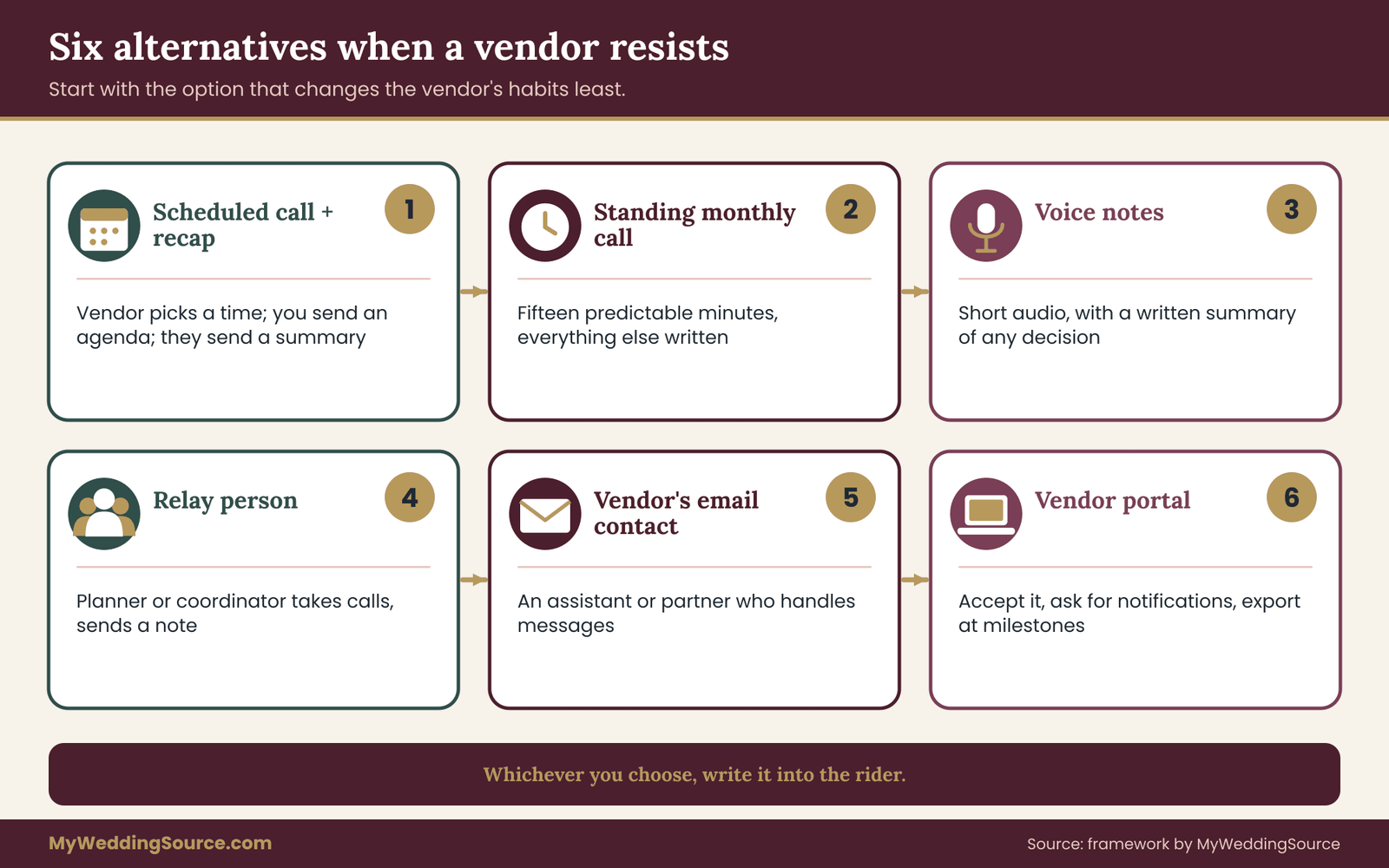
Some vendors will resist. A venue with a decades-old phone routine, a family-run bakery or a vendor who has had bad experiences with email may say no, or say yes and quietly keep calling. Before you walk away, run through a ladder of alternatives. Each step keeps more of the benefit than doing nothing, and most vendors will accept one of them.
Alternative one, the scheduled call with a written recap. The vendor chooses the time from a short list, the couple sends an agenda two days ahead, and the vendor sends a recap within one business day. This keeps the human conversation and removes the surprise. It suits vendors who say “it’s faster to talk.”
Alternative two, a standing call. One fixed call on a fixed day, such as the first Tuesday of each month, for fifteen minutes. Between calls, everything is written. A standing call turns an unpredictable interruption into a predictable appointment, which many people find easier to prepare for.
Alternative three, voice notes or recorded messages. A short audio message that you can play when ready, and that the vendor can send in return. Ask for a transcript or a short written summary of any decision it contains. This suits vendors who dislike typing, and couples who find listening easier than reading.
Alternative four, a relay person. A planner, a day-of coordinator or a relative takes the calls and sends you a written note. This works when the vendor insists on a phone relationship. The relay must have a clear list of what they can agree to without you, and must send the note within a business day.
Alternative five, a vendor-side email contact. Many small businesses have an assistant, partner or booking person who handles messages. Ask: “Is there someone on your team who handles email for scheduling and details?” The principal then talks to the delegate, and the couple receive writing.
Alternative six, the portal. If the vendor already uses an online platform, accept it, and ask for notifications. A portal puts the record in the vendor’s system, which is a weakness, so export or screenshot the thread at each milestone.
The ladder has a sensible order. Start with the options that change the vendor’s habits least, and move down only when needed. Whichever one you choose, record it in the rider, so the written updates you receive match the arrangement you agreed. An arrangement that exists only in your head will not survive a busy week.
When the answer is still no
Occasionally a vendor will refuse every alternative. The reason deserves a moment’s thought before you decide what to do.
Sometimes the refusal is about capacity. A one-person business that answers messages in batches may honestly not be able to promise a reply time. In that case, ask what they can offer: “What response time can you commit to?” A realistic promise of three business days is more useful than an optimistic promise of one that is never kept.
Sometimes the refusal is about control. A vendor who says “I only do business by phone” and refuses any written confirmation is telling you something about how they treat records. The advice in the wedding vendor due diligence checklist applies here: a vendor who resists putting terms in writing is a risk regardless of how pleasant their phone manner is.
And sometimes the request touches a legal question.
If you have a disability and a vendor refuses a reasonable adjustment to how they communicate, the Americans with Disabilities Act may be relevant. The ADA’s effective communication requirements apply to many businesses that serve the public, and the Department of Justice publishes plain-language guidance at ada.gov.
Whether a particular vendor is covered, and what counts as reasonable, depends on the facts, and a request like this is usually settled by conversation, not by a legal claim. Treat the ADA as background that informs how you ask, and ask the agency or a qualified professional if you want a view on your situation.
You do not need to decide in the moment. A short, calm reply works: “We understand. We will think about how to proceed and write to you by Friday.” Then use the failure conditions in a later section to decide whether the vendor is a fit.
Mixing channels without losing the thread
Real planning uses several channels. A florist texts, a venue uses a portal, a planner emails, and a family member sends photos by chat. The risk is not the mix; it is the lack of a single place where the truth lives.
Use a single source of truth. This can be a shared document, a spreadsheet or a notes file that lists each vendor, the agreed channel, the latest confirmed details and the date of confirmation. Every time a message changes a fact, update the source. When a vendor says “as I texted you,” you can check the source instead of searching a chat.
Establish a confirmation habit. Any fact that arrives through a secondary channel, such as a text or a portal note, gets copied by you into the main email thread with a one-line message: “Confirming by email: delivery at 2 p.m. at the north entrance, per your text this morning.” The vendor can correct you if you misunderstood, and now the fact lives in the primary place.
Limit the number of live channels per vendor to two. One primary and one backup is manageable. Three or four are not, and they usually produce the very confusion written updates were meant to prevent.
Keep the family out of vendor channels. A parent who is helping pay may want to call the caterer directly, and a vendor may quote different things to different people. Agree in advance who may speak to which vendor. The wedding decision making guide covers how couples can share input without handing over control, and the same principle applies to vendor messages: input is welcome, decisions go through the couple.
Making written updates readable for both sides
A written channel is only as good as the messages inside it. Both sides have a stake in making them short, clear and easy to act on, and this is a place where a few habits matter more than the medium.
Write for a reader who is tired. Put the request or decision first, then the reason. A message that begins “I need a yes or no on the extra hour by Thursday” is far easier to answer than one that begins with three paragraphs of background.
Use plain, concrete words. The Plain Language guidelines published by the federal government, at plainlanguage.gov, recommend short sentences, active voice and everyday words. The advice was written for agencies, but it fits a vendor email just as well. “We will deliver the arch at 2 p.m.” beats “Delivery of the arch will be effected in the early afternoon window.”
Use lists for options. When a vendor offers three packages, ask for them as three short lines with price and what is included. Do not ask for a table; a short list reads well in any email program and on any phone.
Send attachments with a description. A file named “final.pdf” is nobody’s friend. Name it “Florist proposal, June version, signed” and mention it in the message.
Keep one topic per message, with a subject line that names it, so each of the written updates can be found later. This lets either partner find the message later and lets the vendor reply without answering questions they did not mean to.
Finally, read your own message before sending. Ask: could someone who knew nothing about this thread act on it? If not, add the missing fact.
How often should vendors send written updates
Cadence is the part of written updates most couples forget to set. Without it, some vendors send nothing for two months and then send six messages in a day. Agree on a rhythm that matches how much the work changes.
For a venue or a planner, a short monthly written update is reasonable, with a fuller one at the six-week and two-week marks. For a photographer or videographer, written updates can wait until the milestones: the shot list, the timeline sign-off, the delivery date.
For a caterer, the key written updates are the tasting notes, the menu confirmation and the final count. For a florist or a baker, a confirmation after the design is set and another a week before delivery is usually enough. For rental companies, one written update after the order and one before delivery covers it.
Ask each vendor to name their own rhythm, and write it into the rider. A vendor who proposes the cadence is more likely to keep it. If a month passes with no written update, send one short message asking for a status line; that single prompt is part of the arrangement, not a complaint.
Teaching a vendor your preferred format
Many vendors have never been asked for a particular format, and the easiest way to get consistent written updates is to show them one. Offer a four-line template in your first reply: status, next step, date, and any question for you. A vendor can fill it in within a minute, and you get written updates that read the same way every time.
If the vendor cannot or will not use the template, do not push. Reformat their message yourself into the same four lines and reply with it: “Here is what we understood; please correct anything that is wrong.” This turns every untidy message into a clear record and gives the vendor a painless way to confirm, with the written updates arriving in your preferred shape even when they are sent in theirs.
Neurodivergent couples and written updates
Many couples who ask for this arrangement describe themselves as neurodivergent, or have a partner who does. The word covers a wide range of people and needs, and no two couples are the same. Some find phone calls overwhelming; others find text hard to process and prefer voice. This guide does not assume which applies to you, and it does not suggest that the preference is a problem to solve.
What helps is the same for most people, with a few extra considerations. Predictability matters: a stated channel, a stated schedule and a stated format remove many of the small surprises that cost energy. Time matters: a written message allows a person to prepare a response, check a detail or take a break before replying. And clarity matters: a message that separates facts from requests, and lists deadlines, is easier to act on for anyone.
The Centers for Disease Control and Prevention and the National Institute of Mental Health publish general information about autism and ADHD, but a rider does not need a diagnosis, and you do not need to share one with a vendor. If you want a fuller picture of planning choices, sensory needs and communication together, the planning guides on this site are a general starting point for sequencing the work.
You can also ask vendors for small accommodations that are not about channel: a quiet corner during a tasting, an agenda before a walkthrough, or one named contact instead of a rotating team. These are the same idea, a request for predictability, and they are best handled in the same written rider. ## Failure conditions when written updates break down
Any communication arrangement can fail, and it is better to define failure in advance than to argue about it afterward. A failure condition is a specific, observable event that tells you the written updates are not working and triggers a defined response. It is not an accusation. It is a tripwire that both sides agreed to.
Here are six failure conditions worth naming. Add them to your internal policy; you do not need to put all of them in the vendor-facing rider.
One, a missed tier-two deadline. The vendor does not reply to a decision request within the agreed time, and a reminder does not produce an answer within one more business day. Response: use the urgent lane once, then record the miss in your log.
Two, a repeated unconfirmed phone agreement. The vendor calls, agrees something by phone, and does not send the written confirmation within one business day, twice in a row. Response: send your own written summary and ask for a yes or correction; if the pattern continues, treat the phone agreement as unconfirmed.
Three, a conflict between channels. A text says one thing, an email says another, and the vendor insists the text controls. Response: ask the vendor to resolve it in a single written message, and check the contract’s order of precedence.
Four, a change in price or scope with no written record. Any invoice line, availability or deliverable that differs from the contract and was not confirmed in writing. Response: do not pay the difference until you have a written explanation and, for scope changes, a signed amendment.
Five, a vendor who ignores the urgent lane. An emergency message to the delegate goes unanswered for longer than the agreed time. Response: call, because the lane has failed, and then review whether the vendor can be relied on for the day.
Six, a pattern of pressure. The vendor repeatedly demands immediate answers, uses deadlines that change, or calls after being asked not to. Response: restate the rider in one calm sentence, and if it continues, escalate to the vendor’s manager or consider ending the relationship.
Notice that each condition has a response that is proportionate. One missed email is not a reason to cancel a contract. A pattern is.
An escalation path that stays calm
When a failure condition arrives, resist the urge to jump to the most dramatic response. A staged path is more effective and leaves the relationship intact whenever possible.
Stage one is a plain written reminder about the missing written update. “Following up on our message of Tuesday about the final count. Could you reply by Friday?” Keep the tone neutral, include the deadline and the item.
Stage two is a scheduled call with an agenda. If a reminder fails, propose a short call. It is the one time the phone is the right tool, because it breaks a stalemate. Send the agenda beforehand and the recap afterward.
Stage three is an escalation to another person. Write to the vendor’s manager, partner or booking contact, and attach the thread. State the facts, quote your agreement and ask for a specific outcome.
Stage four is a contract question. If the issue involves money or scope and the vendor does not respond, review the contract for the dispute and cancellation terms. The wedding vendor purchase order checklist shows how scope agreements and final acceptance are documented, which helps you tell what was promised from what was assumed. For payment disputes on a card, the Consumer Financial Protection Bureau explains time limits for reporting billing errors, and those limits run from the statement date, so do not wait.
Stage five, if needed, is a decision about the relationship. Weigh what it would cost to replace the vendor against what it costs to keep them. Ask whether the problem is the channel, or whether the channel is exposing a deeper problem of reliability.
At each stage, keep your own messages short, factual and free of blame. They may be read later by someone who was not in the room, such as a bank, a mediator or a small-claims judge.

Keeping the paper trail without a second job
Written updates create paper. Without a simple routine, the paper turns into clutter and the benefit disappears. A light system works better than a thorough one you abandon.
Use one folder per vendor in your shared inbox, or one label if you use one. Name them after the vendor and the job, such as “Florist” or “Caterer.” File each message once, when you reply.
Keep a one-page decision log for the whole wedding, in plain list form. Each entry has the date, the vendor, the decision, who decided and where the written confirmation lives. A line takes under a minute to write. When a vendor says in October that you agreed to a change in March, you can answer from the log.
Save the rider and each vendor’s agreement to it in the same folder as the contract. If a vendor disputes your written updates arrangement, you want the original agreement within reach.
Export text and portal threads at milestones: after the deposit, after the final headcount and after the wedding. Screenshots are fine if they show the date and the sender.
After the event, keep the records according to the guidance in the wedding records after the event article, which sets out how long to keep contracts, receipts and messages. Do not delete the inbox until the last refund, gallery and warranty window has closed.
Keep the archive private. The shared inbox contains addresses, payment details and schedules. Use strong, unique passwords and two-step sign-in, and share access only with people who need it, such as the delegate in the last two weeks. Remove the delegate’s access afterward.
Edge cases and common questions in practice
A few situations come up often enough to deserve a short answer each.
You are already mid-planning with phone-heavy vendors. Reset gently. Send each vendor a message that begins with thanks, introduces the written approach as a change in how you work, and offers a start date: “From next week we will move our planning to written updates by email.” Do not accuse past behavior. Most vendors adapt within a few weeks.
A vendor sends a voicemail and a text at the same time. Treat the text as the message and ignore the voicemail unless the text says otherwise. Reply by email, quoting the text.
You have a planner. Give the planner the rider and ask them to enforce it. A planner is the natural first stop for calls, and a good one converts them into written updates before they reach you. Check that the planner’s own contract describes how they will communicate.
Language is a barrier. Written messages can be run through a translation tool, but treat the translation as a draft and confirm key facts, such as dates and amounts, in both languages if a mistake would be costly. Ask the vendor to confirm in writing.
A vendor needs a signature, not just an email. Many contracts and amendments need a signature. Electronic signatures are generally accepted for commercial agreements in the United States, and the Federal Trade Commission publishes consumer information about e-signatures and online contracts. Ask the vendor what their process is, and keep the signed copy.
The vendor’s staff change. A new coordinator may not know your rider. At each handoff, resend it and ask the new person to confirm.
A vendor uses a voice assistant or auto-dialer. Automated calls and texts that you did not agree to are regulated, and the Federal Communications Commission explains how to handle unwanted calls and texts. A real vendor calling about your own contract is not usually an unwanted robocall, but the FCC’s page is a good reference for what the rules cover.
You receive a message on a day you are off. You do not owe an immediate answer, but you do owe the acknowledgment you promised. A one-line “received, will respond Thursday” keeps the promise at almost no cost.
What written updates cost, and what they save
An honest account of costs helps you decide how much structure you need. The costs are mostly time and attention; there is rarely a direct fee.
The upfront cost is an evening to write the policy and an hour to adapt the rider for each vendor. If you have eight vendors, that is perhaps a day of work spread over a week. Ongoing costs are the minutes you spend reading, filing and replying, which are often fewer than the minutes you would spend on calls, because you skip the small talk and the preparation.
There is a possible social cost. A vendor who values rapport may find a rider cold, and some will treat the request as a mild annoyance. A warm tone and a concrete offer of a scheduled call usually remove the friction. If a vendor reacts badly to a polite, reasonable request, the reaction is information.
There is a possible timing cost. Written updates are slower for true emergencies, which is why the urgent lane exists. The cost shows up if you let the lane lapse or use it too often.
The savings are less visible but larger. Written updates reduce the chance of paying for something you did not order, of missing a deadline you did not hear, or of arguing over what was said. They also reduce the mental load of remembering conversations. For many couples, that last saving is the main one, because it frees attention for the parts of the wedding they actually want to enjoy.
These costs and savings are qualitative. This guide does not give price figures because vendors, regions and contracts differ too much. If cost is a concern, ask each vendor whether extra communication carries a fee, and get the answer in writing. ## Common mistakes and a final review before you send
Most problems with written updates trace back to a handful of mistakes. Read this list before you send your first rider, and again a month in.
Sending the rider after a conflict. A rider that arrives in the middle of an argument reads as a punishment. Send it at the start of a relationship, or at a calm moment with a neutral reason, such as a new planning phase.
Making the rider too long. A three-page document signals distrust. If a vendor needs more than a minute to read it, cut it. The core is the channel, the confirmation rule and the urgent contact.
Forgetting the reciprocal promise. A rider that lists only what vendors must do for written updates feels like a demand. Include what you will do and keep to it, or the first slow reply from you will undermine everything.
Leaving the delegate uninformed. A delegate who learns of the role on the morning of the wedding cannot do the job. Give them the rider, the contact list, the decision limits and a short list of vendors who need a call, at least a week before.
Letting the urgent lane grow. Every exception you grant in month two becomes a habit by month five. Keep the lane to emergencies and review it at the monthly check-in.
Treating a silent vendor as a yes. Silence is not consent, and a missing reply to written updates is not a yes. Follow up in writing, and do not pay for or authorize anything on the basis of silence.
Putting everything on one partner. If one person reads every message, written updates fail when that person is ill or busy. Share the inbox and agree on who answers which vendor.
Skipping the written recap after a call. A call without a recap is exactly what the rider was meant to prevent. Send the recap yourself if the vendor does not, and ask them to correct it if it is wrong.
A last review before you send
Before the rider goes out, run a short check. Is the channel real, with an inbox both of you read? Are the response times ones you can keep? Does the urgent lane name a person who has agreed? Does the confirmation rule apply to both sides? Is the tone one you would be comfortable with if the vendor read it aloud to a friend? If any answer is no, fix that first.
Then, one month in, look at what actually happened. How many messages arrived outside the channel? How many decisions took longer than the SLA? Which vendor needed the most reminders? The answers tell you where to adjust, and they are better evidence than a general feeling that the system is or is not working.
Treat the review as a conversation with each vendor, not a report card. Ask what is working for them as well. A vendor who suggests a small change, such as sending a summary on Fridays, is invested in the written updates and often gives you a better version of what you asked for.
Your next steps
This week, write the four-line internal policy: the channel, your acknowledgment time, your decision time and the delegate. Create the shared inbox if you do not have one, and test that both of you can read and send from it.
Next, adapt the rider from this guide to one page, then send it with your next vendor message rather than as a separate announcement. Start with the vendor you talk to most, so you learn quickly what needs adjusting and how your written updates request lands. Add the rider to the contract for any vendor you have not yet signed, using the placement steps in this guide.
Then start the log. A single page with the vendor, the agreed channel, the response time and the confirmation date is enough. Set a calendar reminder for a month from now to review how the written updates are going, and another for two weeks before the wedding to resend the urgent lane details.
If you want to line the work up with the rest of your schedule, the wedding planning checklist shows where vendor decisions usually fall. Keep your written updates simple, keep it kind, and revise it when it stops serving you.
FAQ
What is the easiest way to ask a wedding vendor for written updates?
Add one short paragraph to your first message: you use written updates so both partners can see every detail, here is the address, and you will reply within a business day. Offer a scheduled call whenever a conversation would help. Framing it as a working method, rather than a complaint or a personal explanation, makes it easy for a vendor to agree.
Do I have to explain why I prefer written updates?
No. A preference for written communication is a normal business request, and you do not owe a vendor a reason, a label or a diagnosis. A single sentence such as “we make better decisions with the details in front of us” is enough. Share more only if you want to, and only with people you trust to use the information well.
Can a wedding vendor refuse to communicate in writing?
A vendor can say no to a preference, and many will offer a compromise, such as a scheduled call with a written recap. If you have a disability, the Americans with Disabilities Act may apply to some businesses; ada.gov explains effective communication. Whether it covers a particular vendor depends on the facts, so ask the agency or a qualified professional.
How long should a vendor take to reply to written updates?
Use tiers. Routine questions can wait about two business days, requests for a decision about three, and anything inside the last two weeks about one business day. These are examples to adjust, not standards. The useful part is that both sides write the numbers down, and that you keep your own side of the promise.
What should I do when a vendor calls me anyway?
Stay brief and kind. If you answer, thank them and ask them to send the details by email. If you miss the call, do not call back; send a short message asking for the information in writing and promising a reply within one business day. Repeated calls after a request are a failure condition, so note them in your log.
Is a text message enough as a written record?
It can be, if both sides agree that text is a legitimate channel and you can export or screenshot the thread with dates and sender names. For anything involving price, scope or timing, copy the fact into an email and ask the vendor to confirm. A text is easy to lose, and email is easier to search and file.
Who should handle urgent messages on the wedding day?
A delegate you trust: a planner, day-of coordinator, sibling or friend. Give them the contact list, the rider and clear limits on what they may agree to without you, such as no changes to price. Share their number with vendors in the last two weeks, and ask them to send a short written note to your inbox afterward.
How long should we keep vendor messages after the wedding?
Keep them at least until every refund, gallery, warranty and billing-dispute window has closed, and longer for contracts and proof of payment you may need later. The Internal Revenue Service and the Consumer Financial Protection Bureau publish general guidance on records and billing errors. Store the inbox export with your contracts, and check the rules that apply to you.
Sources
- Effective communication, ADA.gov, U.S. Department of Justice
- Americans with Disabilities Act home page, U.S. Department of Justice
- Job Accommodation Network, U.S. Department of Labor Office of Disability Employment Policy
- Federal plain language guidelines, PlainLanguage.gov
- Stop unwanted robocalls and texts, Federal Communications Commission
- Consumer information, Federal Trade Commission
- Ask CFPB, Consumer Financial Protection Bureau
- Autism spectrum disorder, National Institute of Mental Health
- ADHD, Centers for Disease Control and Prevention
- Government services and information, USAGov