

Wedding seasickness is the part of a boat wedding that nobody wants to put on the invitation and everybody wonders about quietly. This guide shows hosts how to plan for it as a hospitality matter: how to read the vessel and the route, offer a real choice between boarding and staying ashore, write a plain guest note, and brief the crew, all without giving medical advice.
Treat wedding seasickness as a guest-choice problem, not a health problem. Give every guest three doors: board for the whole event, board for part of it and step off, or stay ashore and join at a land-based moment. Put the doors in a short, neutral note on the invitation or website. Ask the captain how the route, speed and deck layout affect motion. Never recommend, hand out or promise remedies. Send guests with health questions to their own clinician or pharmacist.
A couple books a boat because the water is beautiful. Their guests, a few weeks later, wonder whether they will spend the evening feeling unwell in front of people they are trying to impress. Some guests will say so. Most will not. They will simply accept the invitation, dread it, and either arrive anxious or quietly cancel two days before.
That is the real cost of ignoring wedding seasickness. It is rarely a dramatic scene at the rail. It is a handful of guests who decline late, a grandparent who sits in the car, a bridesmaid who disappears below deck during the toasts, and a couple who never find out why. A good plan does not eliminate any of that. It makes the discomfort visible early enough that guests can decide for themselves.
This article is written for hosts, not for clinicians. It will not tell you what anyone should take, avoid or do about their own body, because that belongs to a doctor or pharmacist who knows the person. What it can do is give you a planning method, a guest information template, a worked example and a list of the conditions under which the wedding seasickness plan fails.
A note on scope. This is general planning information, not legal, medical or safety advice. Vessel rules, passenger limits, alcohol policies and weather decisions vary by boat, operator and waterway, and the captain has the final say on safety. Where a rule matters, this guide points you to the agency or the operator who sets it.
What a wedding seasickness plan covers, and what it leaves out
The phrase “seasickness planning” can mean three very different jobs, and mixing them up is how couples end up either doing too little or overstepping badly. It helps to separate them before anything else.
The first job is hospitality design. This covers how the event is structured so that a guest who dislikes motion still has a dignified way to take part. It includes the timing of boarding, whether the vessel sits at the dock for some of the evening, where seating is, and what is offered on land. This is entirely within a host’s remit, and it is the subject of this guide.
The second job is safety management. This covers the vessel’s passenger capacity, life jackets, crew briefings, weather decisions and emergency procedures. These belong to the operator and the captain. A host asks about them, reads them in the contract and respects them. A host does not improvise them.
The third job is individual health advice. This covers what a particular person should take, eat, drink or avoid before a trip, and what to do if someone is unwell. It belongs to licensed professionals and to the guests themselves. A host who starts handing out pills or suggesting treatments has stepped outside the wedding seasickness plan, and may create real problems for people with allergies, pregnancies, medications they already take or conditions the host knows nothing about.

A sound wedding seasickness plan stays in the first lane, coordinates with the second, and politely stays out of the third. That boundary is not a legal nicety. It is what makes the wedding seasickness plan trustworthy. Wedding seasickness advice from a host, however kind, is still advice from someone who is not qualified to give it. Guests can tell the difference between a host who says “here are your options, decide what suits you” and one who says “just take this and you will be fine.”
How this differs from general boat-wedding planning
Most advice about boat weddings covers capacity, charter terms, weather and photography. Those matter, and the wedding vendor contract guide covers the paperwork side of them. A wedding seasickness plan sits beside that work rather than replacing it. It asks a narrower question: given that some guests will feel uneasy on the water, what choices and information do they need, and who provides them?
That narrower question has its own outputs. A charter contract tells you what the operator will do. A wedding seasickness plan tells guests what they can do. The two documents should agree, and when they do not, the contract wins on safety and the plan has to adjust.
What the plan actually produces
By the end of this guide you will have five concrete things, and they are worth naming now so you can see where the article is heading.
- A short risk picture of your own event, built from the vessel, the route, the timing and the guest mix.
- A set of three participation options, called doors, that every guest can choose from.
- A list of optional land-based alternatives that are genuinely good, not consolation prizes.
- A guest information note, written in neutral language, with a template you can adapt.
- A set of failure conditions, so you know in advance when the wedding seasickness plan needs to change.
None of this requires special expertise. It requires an hour of honest thinking, a phone call to the captain, and a willingness to write down a few sentences that feel slightly awkward the first time.
Why wedding seasickness is a hosting problem, not a medical one
It is tempting to treat motion sickness as a personal matter and leave it to each guest. That works for a small group on a short ride. It breaks down at a wedding, for three reasons that are about social structure rather than physiology.
First, guests do not know how they will react. Someone who has sailed happily for years may feel unwell on a particular boat, in particular water, after a particular meal. Someone who has never been on a boat has no baseline at all. People tend to overestimate or underestimate their own tolerance, so a host who asks “who gets seasick?” gets unreliable answers.
Second, leaving early is socially expensive. At a land venue, a guest who feels unwell can step outside, sit in a car, or leave. On a moving vessel, the exit may be two hours away. The more committed the format, the more anxious guests become, and anxiety is itself a reason people avoid the invitation.
Third, the couple owns the format. Guests did not choose the boat. The couple did. That is not a criticism, because the boat may be the whole point of the wedding. It does mean the host carries some responsibility for making the format workable for the people invited into it. The wedding venues guide makes a similar point about any unusual venue: the more distinctive the setting, the more the host owes guests clear information about it.
Where the line sits
There is a useful rule for deciding whether something is hospitality or medicine: if it would be just as reasonable to offer it to every guest regardless of their health, it is hospitality. If it only makes sense as a response to a specific condition or symptom, it is health advice.
A seat near the open rail, offered to anyone who prefers it, is hospitality. A pamphlet explaining how a particular medication works is not. A bottle of water at each seat is hospitality. A recommendation to take a certain product an hour before boarding is not. A dock-side tent with chairs and refreshments, open to everybody, is hospitality. A “recovery station” that implies guests will probably be ill is a decision about tone that deserves care, which later sections cover.
This test is simple, and it keeps hosts honest. It also keeps the wording of your guest note out of trouble. When you describe options in terms of participation (board, board and step off, stay ashore) rather than symptoms, you give people room to choose without asking them to explain themselves.
Why couples hesitate, and why they should not
Many couples avoid the topic because they fear it will make the boat sound unpleasant, or that it will plant the idea in people’s heads. That fear is understandable, and it is usually wrong in practice, for a simple reason: guests who are worried are already thinking about it. A calm, matter-of-fact note does not create the worry. It answers it.
There is also a fairness point. The guests most likely to stay silent are the ones with the most at stake: older relatives, pregnant guests, people with health conditions, children and anyone who simply does not want to be the reason the evening is disrupted. A visible plan tells them that their choice will be respected before they have to ask. The wedding guest care guide covers the same principle for babies, children and older relatives, and it applies here as well.
Finally, there is a practical argument. A plan that is announced early lets you adjust headcounts, catering and transport while those adjustments are still cheap. A plan discovered on the day is a plan you pay for in stress, and possibly in money, if a group of guests ends up needing to be shuttled from the dock.
What this guide will not do
It will not rank remedies, because that is not a host’s job and the evidence and suitability differ from person to person. It will not suggest that any approach makes a guest immune. It will not offer statistics about how many people get motion sickness, because a figure borrowed from somewhere else says little about your particular boat and your particular guests. And it will not treat the problem as shameful, because it is not. Plenty of capable, healthy people feel unwell on the water. Wedding seasickness says nothing about courage or fitness. Good hosting assumes that, and plans accordingly.
What it will do is help you build a day in which a guest who feels unwell has somewhere to go, something to do, and someone who knows what to say, none of which requires a single piece of medical advice from you.
Reading the vessel, the route and the timing before you decide anything
You cannot plan for wedding seasickness in the abstract. The same guest list can have an easy evening on one boat and a hard one on another. Before you write a note or design alternatives, build a short risk picture from four inputs: the vessel, the route, the timing and the guests. The captain or charter manager can answer the first three. You answer the fourth.
None of this is about predicting who will feel unwell. Nobody can do that reliably. Wedding seasickness varies from person to person and from day to day. It is about estimating how much motion your event will involve and how much choice guests will need as a result.
The vessel
Ask what kind of vessel it is and how it behaves. A large, wide, multi-deck boat with stabilizing features usually moves differently from a small, narrow one, and a boat that is moving underway behaves differently from one tied up at a dock. You do not need naval vocabulary. You need the captain’s plain description. Useful questions include how the boat typically moves in light chop, which decks and seats are steadiest, whether there is covered indoor space and open air space, and whether passengers can move freely or must stay seated.
Ask also about the passenger limit and the documentation behind it. The U.S. Coast Guard regulates commercial passenger vessels, and inspected vessels carry a certificate that states how many passengers they may carry. A reputable operator will tell you the number and the basis for it. Capacity matters here because a crowded boat limits where guests can sit and how easily they can reach air, and because your headcount planning depends on it. The vendor due diligence checklist lists the general questions to put to any operator before you sign.
The route
The route is the most underused variable. A loop that stays in a sheltered harbor or river is a different experience from one that crosses open water. Ask whether the route is fixed or can change on the day, where the boat will be in the open and where it will be sheltered, and whether there are stretches where the boat is stationary, such as anchoring for dinner or tying up for a ceremony.
Stationary periods matter more than most couples realize. If the ceremony and dinner can take place with the vessel at rest, the moving portion becomes a short, optional pleasure rather than the whole event. That single design choice can reduce discomfort for many guests without any special measures at all, and it also tends to be better for speeches, dining and photography.
The timing
Time of day, season and the sequence of the evening all affect how the water feels, though the captain is the one who can say how, for your waterway. Ask about typical conditions at your time of day and year, how wind and wake traffic usually change through the evening, and who decides when the weather is too poor to sail. The National Weather Service publishes marine forecasts, and operators rely on them. Your role is not to forecast. It is to know who makes the call and what happens to the event when they make it.
Sequence matters too. A boarding that happens right after a large meal, a long stretch underway immediately after a toast-heavy cocktail hour, or a ride home at the end of a long night are all moments where guests may feel worse. A host cannot control how bodies respond, but can avoid stacking the movement at the end of the day.
The guests
Finally, look at who is coming. Do not make a list of who you think will be sick. Make a list of who will need more choice, whatever the reason: older relatives, guests who are pregnant, young children, people with mobility limits, guests with known anxiety about boats, and anyone who has told you they dislike the water. This is simply a planning list, and it should stay private. Treat it as a hospitality list, not a wedding seasickness watch list. It tells you how many alternatives to prepare and how much seating to hold on the steadiest deck.
Putting the four inputs together
Write down a rating for each input: low, medium or high motion exposure for vessel, route and timing, and low, medium or high need for choice among your guests. You are not building a score to defend. You are making your assumptions visible so you can notice when they change.
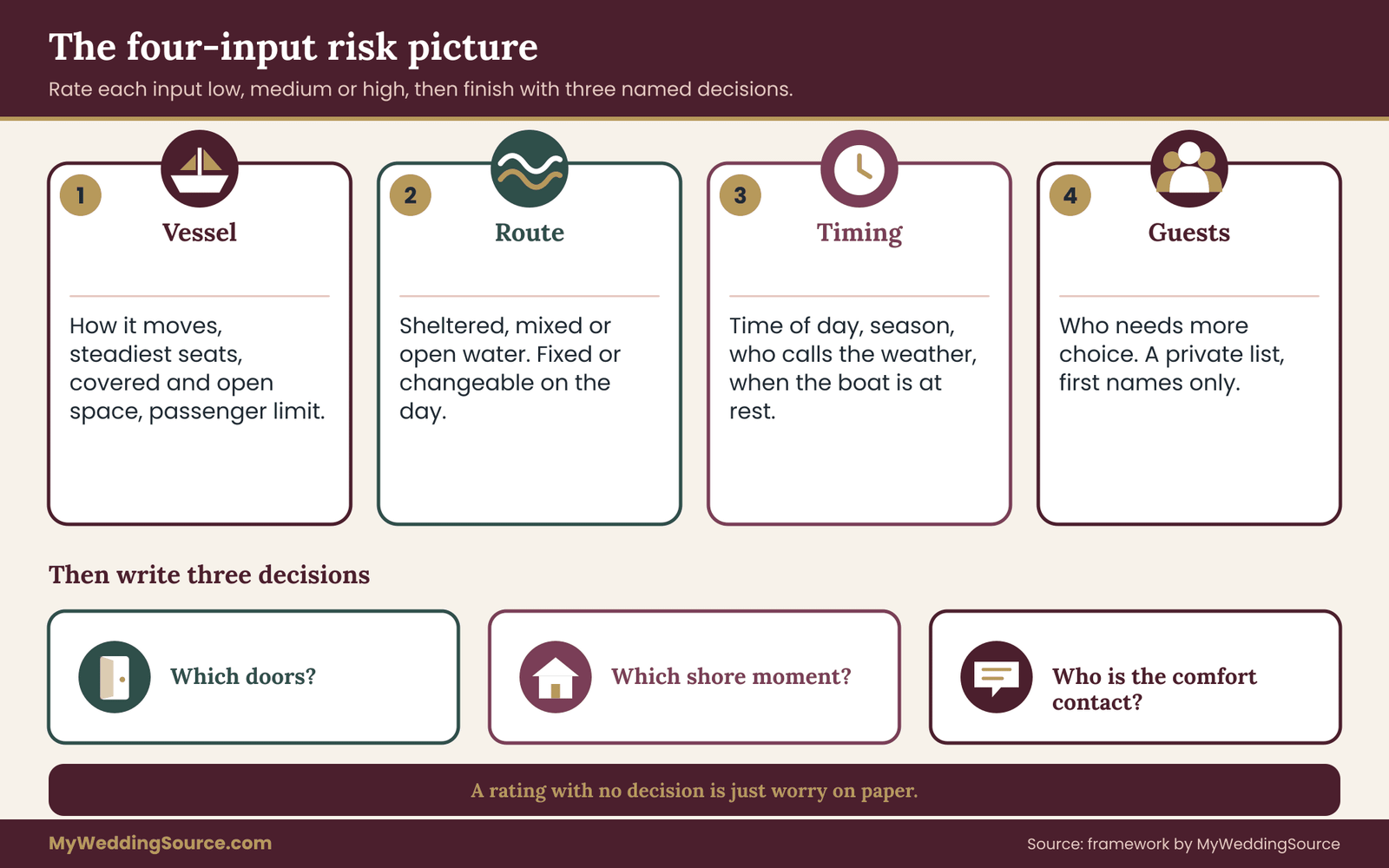
If three inputs are low and the guest need is low, a light version of the wedding seasickness plan is fine: a clear note and a seat choice. If two or more are high, build every layer, including a proper land-based option, because the cost of being wrong rises quickly.
A short worksheet for your own wedding seasickness risk picture
Keep this to one page. Write the vessel type and the captain’s description of how it moves. Write the route in three words, such as sheltered, mixed or open. Write which parts of the event are stationary. Write the time of day and the season. Then list the guests who may need more choice, using first names only and keeping the list private.
Under that, write three decisions. Which doors will you offer? Which shore moment will you host? Who is the guest comfort contact? A wedding seasickness risk picture that ends in three named decisions is useful. One that ends in a rating and nothing else is just worry on paper.
Revisit the worksheet when anything changes. A switch of vessel, a longer route or an added guest group can change the picture, and the wedding seasickness plan should change with it.
The three-door plan for wedding seasickness
The core of this guide is a simple structure. Every guest gets three doors, and each one is a respectable way to attend. The names are plain on purpose, because they will end up in your note and in conversations.
Door one: board for the whole event. The guest travels with the group from boarding to disembarking. This is the default and it is what most guests will choose.
Door two: board and step off. The guest boards for the stationary portions, such as the ceremony or the dinner at the dock, and leaves before or after the underway portion. Or they join for the underway portion only and leave afterward. This door depends on the vessel being at a dock for some of the event, so it is only available if you design the schedule that way.
Door three: stay ashore. The guest does not board but takes part through a land-based moment, such as a dockside welcome, a gathering before boarding, a farewell when the boat returns, or an event the following day.
Why three, not two
Most couples offer two options, implicitly: come on the boat or do not come. The middle door is the one that changes the outcome. Door two lets someone who is unsure try the boat without committing to it. A guest who is nervous can board for the ceremony at the dock, see how it feels, and decide whether to stay for the cruise. A guest who feels unwell can step off at a planned moment without it looking like an escape.
It also protects the couple’s priorities. If the ceremony is the heart of the day, door two allows nearly everyone to be present for it, even guests who would not choose a full cruise.
Making each door dignified
A door only works if guests do not feel they are choosing the lesser option. Three principles help.
Name them neutrally. “Full voyage,” “dockside only” and “join us ashore” are fine. “Seasick option” is not. Nobody wants to pick a door with a label that describes their stomach.
Give each door a real event. Door three should have its own moment worth attending, not a waiting area. A welcome drink on the dock with the couple present, a toast at the farewell, or a brunch the next morning all count. The section on land-based alternatives covers how to build these well.
Make switching easy. A guest who boards and feels unwell should be able to move toward door two or three without paperwork or embarrassment. That means a crew member who knows what to do, a place to wait, and a transport plan that does not depend on the guest asking loudly.
Choosing which doors your event can offer
Not every event can offer all three. Door two requires the boat to be at the dock for a meaningful stretch. Door three requires a land-based moment, which in turn requires someone to host it. Be honest about what you can deliver.
If you can offer only one door beyond boarding, door three is usually the more robust, because it does not depend on the vessel’s schedule. If your schedule includes a long dockside dinner, door two becomes natural and you may not need much else.
What you should not do is offer a door you cannot support. A “stay ashore” option with nothing planned for those guests turns into an announcement that they are excluded. If you cannot staff and host a land-based moment, say so honestly in the invitation and let guests decide with that in mind. A realistic, slightly smaller promise beats a generous one that falls apart on the day.
How the three doors change your numbers
Each door affects headcounts, so settle them early. Ask guests to choose in the response process, with a simple prompt, and treat answers as intentions rather than commitments. People change their minds on the day, so build in a small buffer on both sides: extra seating ashore, and extra room aboard if some door-three guests decide to board after all.
Catering, transport and seating all follow from those numbers. A dinner served aboard needs a count of who will be aboard. A dock-side welcome needs a count of who will be there. If door two guests step off partway, someone needs to know when and where they will be picked up. A written run sheet that names each handoff keeps those moments from depending on memory.
Designing land-based alternatives that guests actually want
The weakest part of most boat-wedding plans is the shore side. Couples spend months on the vessel and treat the alternative as a footnote: “there will be chairs at the dock.” A guest who chooses door three because they worry about wedding seasickness deserves better than a folding chair and a view of other people leaving.
The test for any land-based option is simple. Would a guest who feels perfectly well still be happy to attend it? If the answer is yes, it is a real event. If the answer is “only if they had no choice,” it is a consolation prize, and guests will sense it. Good wedding seasickness planning treats the shore side as a feature of the wedding, not an exception to it.
Five kinds of shore-side moment
There are five common shapes, and most couples combine two.
The dockside welcome. Everyone, including the guests who will board, gathers on land before departure for a drink, a toast and photographs. Door three guests stay for it and then wave the boat off. This works well because it is the same event for everyone, so nobody is singled out.
The farewell reception. When the boat returns, a short gathering greets it. Door three guests join the couple for dessert, a toast or a last dance as the boarders disembark. Because the return is a natural gathering point, the stay-ashore group feels part of the closing moment.
The ceremony ashore. Some couples hold the ceremony at the dock or on the waterfront and take the cruise as the reception. This design makes the ceremony fully inclusive and turns the cruise into a celebration that guests may join or skip. It is the strongest structural fix available, and the trade-offs between a ceremony aboard and a ceremony at the dock are worth weighing before you decide where the ceremony sits.
The next-day gathering. A casual brunch or walk the next morning gives stay-ashore guests, and anyone who left early, a chance to spend time with the couple. It costs more, and it works only if you would have hosted something anyway.
The parallel table. A reserved, comfortable table or tent near the dock, with proper food and drink, where guests can sit with the couple’s relatives and watch the boat’s activities, perhaps with a screen or a live photo feed. This is the weakest of the five on its own, but it can complement a farewell reception.
What makes a shore option feel good
Four details separate a real event from a waiting area.
Someone hosts it. A relative, friend or planner who is a named host makes it feel organized. Without a host, guests drift and wonder whether they are missing something.
There is food and a drink worth having. Not a token tray. The shore guests should eat as well as the boarders, in their own way. The wedding bar service planning guide covers pacing and staffing that apply equally here.
The couple shows up. A short visit from the couple before boarding, or at the farewell, tells shore guests they matter. It takes a few minutes and counts for more than any decoration.
There is a clear way to rejoin. Door three should not be a one-way decision. If a guest changes their mind, a crew member or host should know how they can board, subject to the captain’s approval and the vessel’s rules.
Choosing between shore options with a simple rule
If you can only afford one or two shore moments, decide using two questions. First, how many guests are likely to use door three or door two? Use the response card and a few private conversations to estimate, and expect the real number to move. Second, where is the natural meeting point? A moment that already exists in the schedule, such as the departure or the return, costs far less than one you invent.
Then rank the options. The dockside welcome and the farewell reception reuse moments that already exist, so they come first. The next-day gathering is a bigger commitment and fits couples who are hosting a weekend anyway. The parallel table is a supplement, not a plan. Pick the cheapest option that makes a stay-ashore guest feel genuinely included, and add a second only if the guest list needs it. Every wedding seasickness choice on the shore side should be judged against that one standard.

Transport and comfort ashore
Think through the practical details. Is there shade, shelter and seating at the dock? Are there restrooms? Is the walk from parking to the dock reasonable for guests with mobility limits? Will there be a ride for people who want to leave when the boat leaves? None of this is exotic, and all of it affects whether guests choose door three willingly. The accessible wedding venue red flags article is a good checklist for the physical side.
Cost logic without inventing numbers
You do not need to guess prices to decide whether a land-based alternative is worth it. Compare three things in your own quotes: the cost of hosting the shore moment, the cost of the guests who would otherwise decline, and the cost of last-minute changes.
If a handful of guests would decline without a shore option, their absence has a real cost to you in disappointment, even if the invoice does not show it. If the shore moment reuses existing arrangements, such as the dockside welcome that you would host anyway, its marginal cost is small. If it needs new staffing, a tent or extra catering, price it and decide whether it fits your priorities.
The honest decision rule is this: invest in the shore side in proportion to how much your guest list needs choice and how much of the event happens underway. A short, sheltered cruise with a dockside ceremony needs a light shore option. A long open-water evening with a mostly older guest list needs a strong one.
Writing the guest information note for wedding seasickness
The wedding seasickness guest note is the visible part of the wedding seasickness plan, and it is where couples most often go wrong. They either bury the information in a footnote or write it in a tone that sounds like a warning label. A good note is short, warm, specific and neutral. A wedding seasickness note that reads like a notice from a ferry company has missed the tone.
Where the note goes
Put the core note on the wedding website, in a section about the boat or the venue, and repeat a one-line version on the invitation insert or in the response card. Repeat the key logistics in the final reminder message, so guests see them again when they are making travel decisions. The wedding invitation etiquette guide explains how insert cards and reply cards are usually handled.
What the note must contain
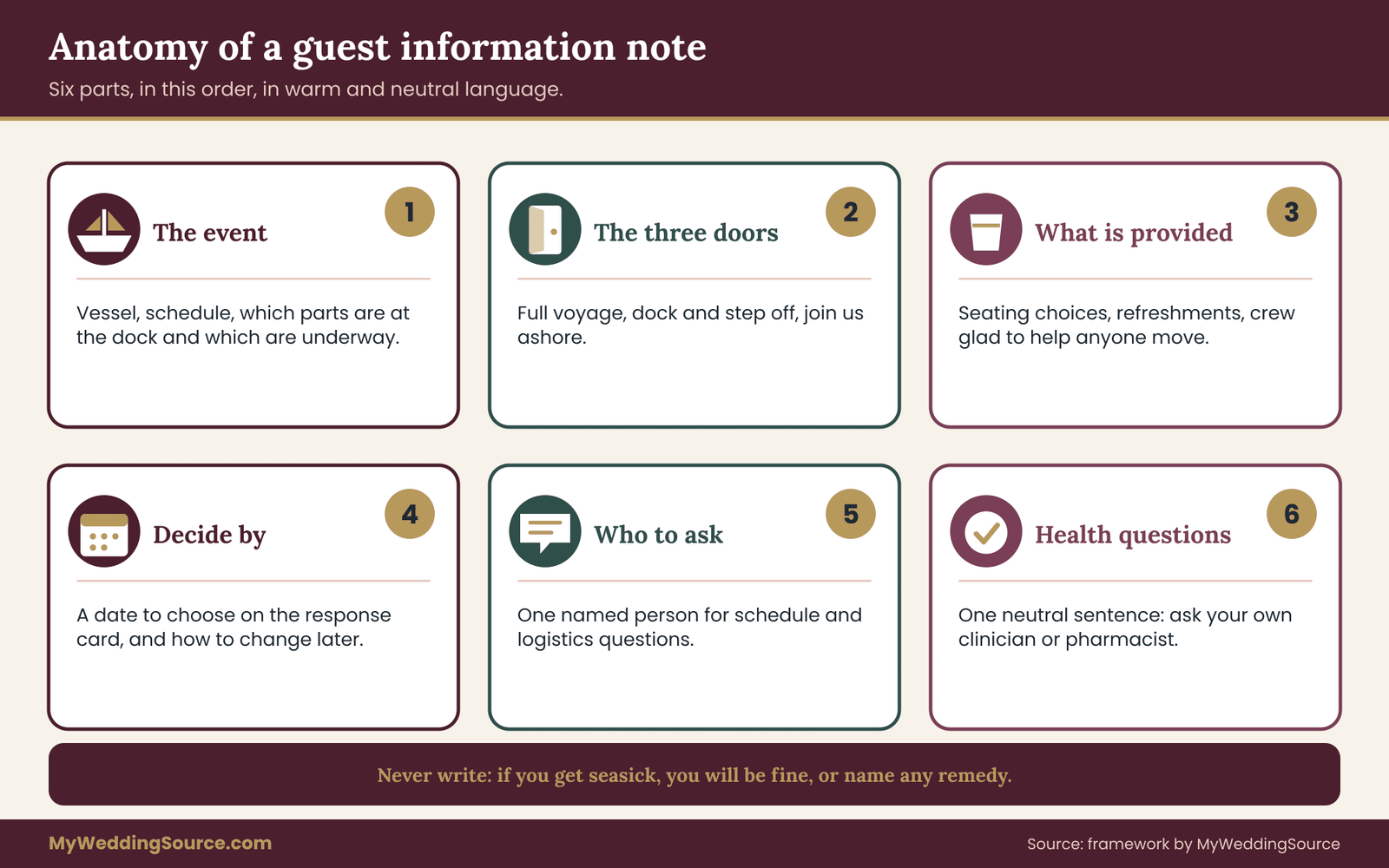
A useful note answers six questions, in this order.
- What is the event? A sentence describing the vessel, the schedule and which portions are at the dock and which are underway.
- What are the options? The three doors, in plain words.
- What will be provided? Seating choices, refreshments, and a crew that is ready to help guests who want to step off.
- What should guests decide, and by when? A date for choosing, and how to change later.
- Who do they contact? A named person who can answer questions about the schedule and logistics.
- Where do health questions go? A single neutral sentence directing guests to their own clinician or pharmacist.
That last item is the safeguard. It gives guests a place to take their questions without the host giving advice.
A template you can adapt
The wording below is a starting point. Replace the bracketed parts with your own details.
We are celebrating aboard [vessel name] on [date]. The ceremony and dinner take place at the dock from [time] to [time], and the cruise runs from [time] to [time]. We want everyone to enjoy the day in whatever way suits them, so there are three ways to join us.
Full voyage: board with the group and stay for the whole evening. Dock and step off: join us for the ceremony and dinner at the dock, and step off before the cruise. Join us ashore: welcome drinks before boarding and a farewell toast when the boat returns.
Seating on board includes open-air and covered spaces, and crew members will be glad to help anyone who would like to move or step off. Please let us know which option you prefer by [date] on the response card. You can change your mind later. Questions about the schedule can go to [name]. For any health questions about travelling on the water, please speak with your own clinician or pharmacist.
The tone is deliberate. It says nothing about illness, does not mention symptoms, and treats each door as a normal choice. Guests who worry about wedding seasickness will recognize themselves in it without being named.
Words to avoid in the note
Avoid anything that sounds like a diagnosis, a prediction or a promise. Do not write “if you get seasick,” “you will be fine,” or “nothing to worry about.” Avoid naming any remedy or product. Do not describe the water as calm or rough unless the captain has said so and conditions may change, because a promise on paper becomes a complaint on the day. Avoid jokes at the expense of guests who feel unwell, even affectionate ones.
Keeping the note current
Review the note when anything changes: the vessel, the route, the schedule or the weather plan. A guest who made a decision based on an earlier version deserves to hear about a material change. A short update message is enough, and it is far better than a surprise at the dock.
What to say, and what not to say, when guests raise wedding seasickness
Even with a good note, guests will talk to you, to your parents, to the wedding party and to the crew. Each conversation is a chance to reassure someone or to accidentally give advice. It helps to decide in advance what the standard responses are, and to share them with the people most likely to be asked.
The aim is a consistent, kind and bounded answer. Everyone who speaks for the couple should say roughly the same thing.
The three sentences every helper should know
None of these three sentences is about wedding seasickness remedies, and all of them are about choice. Give them to your parents, wedding party and planner, to say in their own words:
- “There are three ways to join, and all of them are welcome.”
- “The crew can help anyone who would like to move or step off, and the captain makes the safety decisions.”
- “For anything health-related, a doctor or pharmacist is the right person to ask.”
Those three cover almost every situation. They offer choice, point to the crew and redirect medical questions. They also give helpers a way out of conversations that would otherwise drift into advice. Every wedding seasickness conversation should end with the guest knowing their options.
Scripts for common situations
A guest says they are nervous about being sick on the boat. “That is completely understandable, and plenty of people feel the same. You can board for the ceremony and dinner at the dock and decide about the cruise later, or join us ashore for the welcome and the farewell. Whatever suits you is fine with us.”
A guest asks what they should take. “I am not the right person to recommend anything, and what suits one person may not suit another. Your doctor or pharmacist can advise you. What I can do is make sure you have a seat you like and an easy way to step off.”
A guest says they got sick last time and wants to cancel. “I would hate for you to miss it. There is a dockside part of the day where you can be with us without sailing. Would you like me to put you down for that and you can see how you feel?”
A guest feels unwell during the event. “Let us find you a seat in the fresh air, and I will let a crew member know.” Then do exactly that, and let the crew take the lead on anything beyond comfort.
A parent offers a remedy to a guest. “That is kind of you. Let us leave suggestions like that to each person’s own doctor.” This one is the hardest, because it comes from affection. Say it warmly and move on.
What not to say
Some phrases feel supportive and cause trouble.
“You will be fine.” You do not know that, and if the guest is unwell, the phrase makes them feel they have failed.
“It is all in your head.” It is not, and the remark is dismissive.
“Just look at the horizon.” Fixing the gaze on a distant point is a common piece of folk advice, but offering it as a cure is the kind of individual suggestion this guide asks hosts to avoid. A guest who knows it works for them will do it unprompted.
“Take one of these.” Never hand a guest anything to swallow, however harmless it seems. You do not know what else they take, what they are allergic to or whether they are pregnant. This is the clearest line in the whole plan.
“Do not worry, we have buckets.” Humor about the possibility makes people anxious and embarrasses the ones who need help.
Training the wedding party without scaring them
The wedding party hears the plan once, usually in a group message. Make it a short conversation instead. Explain the three doors, explain that wedding seasickness is a hosting topic and not a medical one, and ask each person whether they have any concerns of their own. Give them the three sentences and the name of the guest comfort contact.
Then ask for one thing: when a guest raises wedding seasickness, listen first, offer the doors second, and hand any health question back to the guest’s own clinician. People who have practiced those two moves handle the awkward moment well, and they do not need a script for every case.
If a guest does feel unwell: a plain sequence for helpers
A few steps cover most situations, and none of them involve treatment.
First, stay calm and speak quietly. A guest who feels unwell is often embarrassed, and visible concern makes it worse. Second, offer a move: fresh air, a steady seat, or a quieter area. Third, tell a crew member, because they know the boat and may have a better place. Fourth, offer water and a choice, to step off at the next dock opportunity or to stay. Fifth, if the guest seems seriously unwell or mentions a medical condition, tell the crew right away so they can follow the operator’s procedures.
Notice what is missing: no pills, no remedies, no diagnosis. Moving, sitting, water and company are hospitality. Anything beyond that belongs to the crew’s procedures and, if needed, to emergency services.

Handling the “just come” pressure
Some couples, and many relatives, will pressure a reluctant guest. “It is only a few hours.” “You will love it once you are on.” The pressure is usually well meant and it undermines the whole point of the wedding seasickness plan. A person who has chosen door three should hear “we will miss you on the water and we are glad you will be with us on land,” not a second sales pitch. The same tone you would use when a guest declines any invitation applies here: accept the answer, keep the warmth and do not ask for reasons.
Working with the captain and crew on wedding seasickness
The captain and crew are the other half of your plan. They know the boat, the route and the water, and they will be the ones who respond when a guest feels unwell. A plan the crew has not heard about is only a hope. Wedding seasickness is a normal topic for an operator, so raise it plainly.
The conversation to have before you sign
Raise the subject early, and treat it as a normal operations question rather than an awkward one. Operators handle motion discomfort regularly, and they will not be offended. Ask directly:
- How does this vessel usually behave on this route at this time of year?
- Where are the steadiest seats, and where is the best fresh air?
- Can the schedule include a stretch at the dock, and for how long?
- If a guest wants to step off mid-event, what is possible, and what is not?
- What does the crew do if a guest feels unwell, and what are they trained for?
- Who decides to change the route or turn back, and on what basis?
Write down the answers. If any of them affect the schedule, such as the length of a dock stop or a turning-back rule, make sure they appear in the written agreement. The site’s guide to turning verbal promises into contract terms explains how to get them into writing, and that principle matters particularly here, where the promises concern timing and flexibility.
What the crew can and cannot do
Be realistic about what to ask. A crew can usually offer seating in a different area, access to open deck space, water and a place to rest. They may be able to adjust speed or heading within safe limits. They cannot give medical treatment unless they are trained and the operator’s policies allow it, and they cannot always return to the dock on demand, because safety and traffic rules come first.
Ask what the operator’s policy is on first aid and emergency response, and what they do if a passenger’s condition needs real medical attention. Those answers belong to the operator, and they come from the operator’s own safety procedures. The U.S. Coast Guard’s boating safety resources explain the general framework for passenger vessels, and your operator should be able to explain how it applies to their boat.
The crew briefing
On the day, a five-minute conversation between your coordinator and the lead crew member can prevent most problems. Cover these points.
The three doors. Tell the crew how the wedding seasickness plan works, so they can answer a guest who asks.
The step-off moments. Identify when and where guests may leave, and who will meet them on the dock.
The quiet signal. Agree how guests can ask for help without announcing it. This might simply be telling the nearest crew member or the coordinator.
The comfort spaces. Confirm which deck areas are best for fresh air and which are best for resting.
The boundaries. Make clear that the couple and the coordinator will not offer or ask the crew to offer remedies, and that medical questions go to professionals.
Also tell the crew what you are not asking. You are not asking them to change the route for one guest’s comfort, to override a safety rule or to take on duties outside their role.
Roles on the day
Assign one person from your side, not the couple, as the point of contact for guest comfort. This person knows the three doors, has the transport plan for stepped-off guests and speaks to the crew. The ceremony cue sheet guide shows how to give named people specific responsibilities in a timeline, and the same approach works for the dock handoffs.
Give that person authority to make small decisions without finding you, such as moving a guest to a better seat or arranging a ride. The couple should not be the helpline on their own wedding day.
When the captain says no
Sometimes the captain will decline something you ask for. A dock stop might not be possible because of traffic, or a route might not be changeable. Treat that as information, not an obstacle. A captain who explains a limit clearly is giving you what you need to adjust the design. If the vessel cannot support the doors you want, change the wedding seasickness plan, the schedule or, in the end, the vessel.
Onboard comfort and the guests who need extra thought
Once the doors and the note are settled, the next layer is what the boat itself offers. This is where hosts feel the temptation to start “helping” with wedding seasickness in ways that look like treatment. The better approach is to design the environment, and leave the person alone.
Everything in this section is about space, schedule and service. None of it is a recommendation about what any individual should do or take. A wedding seasickness plan that stays on the hospitality side of the line is easier to defend and easier to run.
Seating as a design choice
Seat assignments on a boat deserve more thought than at a land venue. Offer a deliberate mix: some seats in open air, some under cover, some in the steadiest part of the vessel as the captain describes it, and some near an easy exit to the deck. Then let guests choose where possible. A formal seating chart with rigid table assignments takes away the flexibility that a guest who feels unwell most needs.
If you do use assigned tables for dinner, make at least a few of them near the open air and tell guests they may move. A guest who moves to a better seat without fuss is the wedding seasickness plan working. Even a loose plan that lists tables by area, rather than by seat, leaves room for people to move.
Avoid putting the couple’s most anxious or most senior guests in the deepest interior seats unless they ask for them. Interior seating can be fine, and it can also feel closed in. The point is choice. Wedding seasickness is easier to manage when guests can move without asking permission.
Schedule and pacing
A few scheduling choices help almost everybody, whether or not they worry about motion.
Keep the stationary portions stationary. If dinner is served at the dock, do not start the cruise mid-course. Plated meals, speeches and toasts tend to be easier when the boat is still, and they are also easier to hear and photograph.
Do not stack everything underway. Put the cruise in a defined window rather than letting it run through the entire evening. A window of moderate length with a clear end gives guests a finish line.
Leave breathing room. A gap of unscheduled time between boarding and the first major activity lets guests settle in, find a seat and get a feel for the boat before anything demanding begins.
Plan the return. The ride home or the disembarking is often the weakest point, because guests are tired and the group wants to leave at once. Stage the exit so the dock does not turn into a crush. Pacing alcohol across the evening matters here, because heavy drinking before a moving ride can change how a night feels for everyone.
Food and drink as hospitality
Offer water freely and visibly. Offer a range of food that is not heavy or unusual, and make sure there is something plain for guests who want it. Ask the caterer to avoid dishes that depend on strong smells in enclosed spaces, because cooking odors in a small galley area can be unpleasant for anyone. The caterer can tell you what the vessel’s galley allows.
None of this is a treatment. It is the ordinary good sense of serving a varied crowd. If a guest asks whether a particular food or drink will help or harm them, the answer is the same as before: their own clinician or pharmacist can say.
What to place around the boat
Think about plain, neutral comforts that any guest might appreciate: water stations, towels, shaded spots, a clearly marked place to sit away from the crowd, and a visible way to find a crew member. Keep signage minimal and cheerful. A sign saying “Fresh air this way” is fine. A sign saying “Feeling sick?” is the kind of label this guide advises against.
If you want to provide a small welcome item, choose something that is the same for every guest and unrelated to health, such as a printed schedule card with the three doors and the dock handoff times.
What not to put around the boat
Do not set out bowls of remedies, bags or tablets of any kind. Do not display products with health claims, however natural they look. Do not place buckets or bags where guests will see them as a prediction. If the operator requires certain safety or sanitation supplies, let the crew handle them quietly and out of sight.
The reason is not squeamishness. It is that supplying anything to swallow places the host in the role of adviser, and creates risk for guests with allergies, medications or conditions that you cannot see. Supplying nothing is always safe.
Keeping wedding seasickness off the schedule card
A printed schedule card is a useful guest item, and it should describe the evening, not the problem. List the times for the dock welcome, the ceremony, the first course, the step-off window, the cruise and the return. Mark the step-off window with a small, neutral symbol. Leave out any mention of wedding seasickness itself, because the card is for every guest and the note has already covered the subject.
The same restraint applies to the toast and the announcements. A host who jokes about wedding seasickness from the microphone turns a quiet option into a public one. A host who simply says “the boat casts off in ten minutes, and anyone who would like to step off can do so now” gives people the same choice without the attention.
Think of wedding seasickness planning as plumbing: when it works, nobody notices it. The test of a good plan is how little the guests talk about it afterward.
A day-of timeline for the three doors
A simple run sheet keeps the doors working. Adapt the clock times to your own event and keep the order.
Before boarding. The shore host is in place, the dockside welcome is set, and the coordinator has the list of door choices. Guests who chose door three are greeted by name and told where the farewell will happen.
Boarding. The crew oversees the gangway. Boarders find seats and settle in before anything demanding begins. The coordinator quietly confirms with the lead crew member that the quiet signal is understood.
Ceremony and first course at the dock. Door two guests are fully included. Photographs are taken while the boat is still.
The step-off moment. Just before casting off, the coordinator announces a short window for anyone who wishes to step off, framed as a normal part of the schedule. Door two guests leave to their ride or to the shore gathering.
Underway. The crew leads. The coordinator stays reachable. A named person looks after the comfort of guests who ask.
Return. The farewell is ready on the dock, and the couple greets the shore guests. Disembarking is staged to avoid a crowd at the gangway.
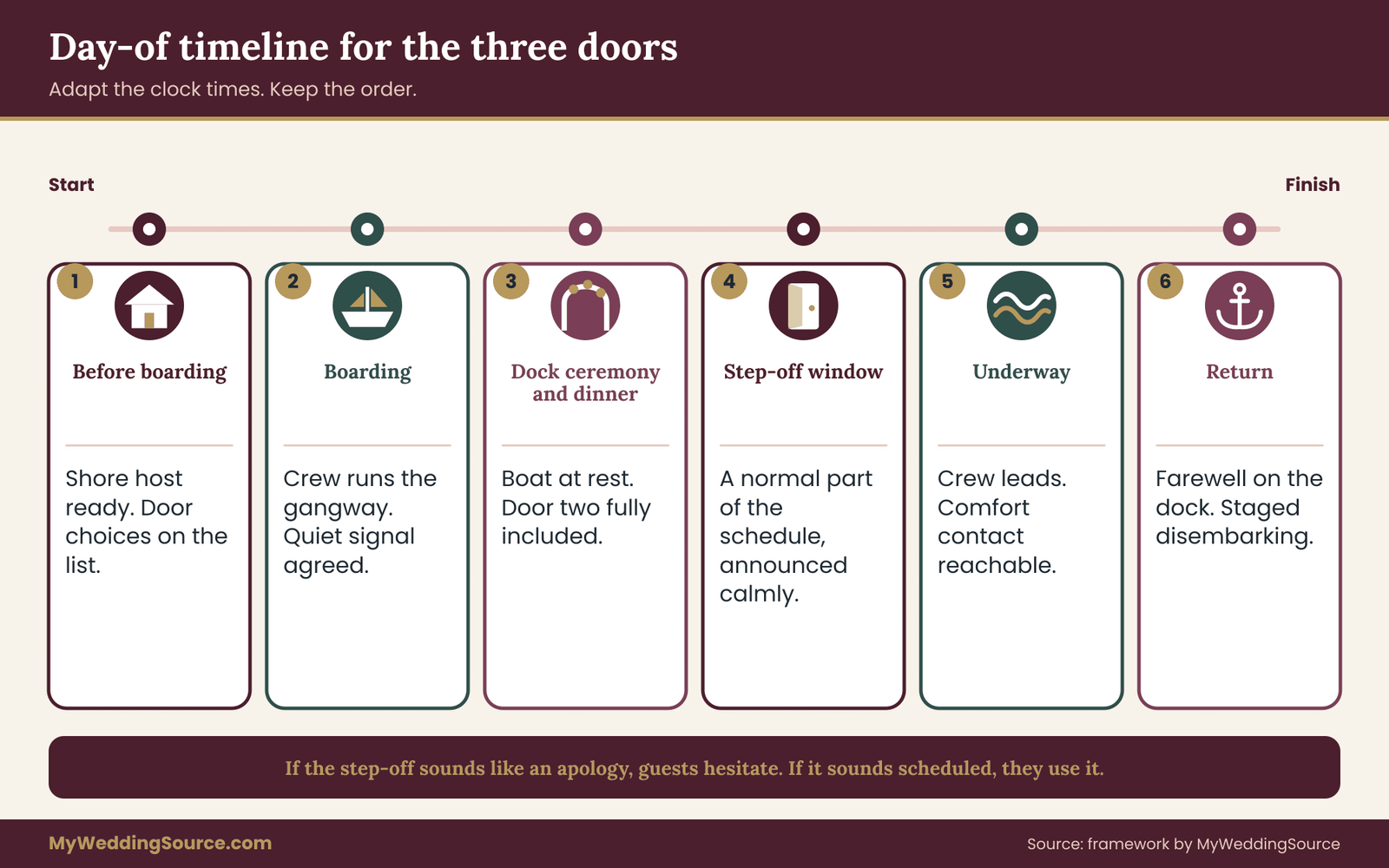
Treat the step-off announcement as a design choice. If it sounds like an apology, guests will hesitate. If it sounds like part of the evening, they will use it.
Guests who need extra thought
Some guests warrant additional planning, not because of who they are, but because the cost of a poor plan falls more heavily on them. The aim for each is the same: more choice, more information, and nobody forced to explain themselves. That is what wedding seasickness planning looks like for people, as opposed to for logistics.
Older relatives
Older guests are often the most likely to stay silent about discomfort and the most likely to be left without a seat when things get crowded. Offer a reserved, comfortable seat in a steady location. Make sure the boarding path has support and a clear route, and ask the operator about handrails, steps and gangway conditions. Offer a trusted family member as an escort for the day.
Consider door two or three for older relatives who attend mostly for the ceremony, so they can be present without the cruise.
Pregnant guests
Pregnant guests may feel more sensitive to motion, smells and heat, and they may also be reluctant to announce their situation. Do not ask who is pregnant. Offer the same three doors to everyone and let guests decide. Because the note directs health questions to a clinician, a guest who is unsure about boating can take the question to someone qualified.
Children and babies
Children react to boats in unpredictable ways, and they are also a safety concern on any vessel. The operator will have rules about life jackets and supervision, which take priority over anything in this guide. Offer parents the same doors, and ask whether children’s meals and a quiet place to rest are available. Ask also whether strollers and car seats can be stored safely at the dock.
Guests with mobility limits
Boarding is physical, and it may be the hardest part of the day for guests who use mobility aids. A guest who cannot board comfortably has, in effect, only door three. That is a reason to make door three excellent, and to ask the operator about accessible boarding before you sign. Accessibility rules and vessel features vary, and the Americans with Disabilities Act sets out obligations for many public accommodations, with the specifics depending on the vessel and the operator. Ask the operator what the boat can and cannot do, and describe it honestly in the note.
Anxious guests
Some guests are not worried about being sick so much as about being trapped. For them, door two is particularly valuable, because it lets them test the boat with a known exit. A calm, direct note, a named contact and a predictable schedule matter more than any reassurance you could offer in the moment.
Guests who say nothing
The hardest group to plan for is the one that does not speak up. You cannot identify them, and you should not try. What you can do is make the wedding seasickness plan visible, the doors normal and the crew approachable, so that a quiet guest can use the wedding seasickness plan without a conversation. That is the reason the note is written in neutral language and why the same options are offered to everyone.
Wedding party and family
Do not forget the couple’s own side. Parents, siblings and the wedding party often have photographs, speeches and duties that depend on being on board, and some of them may also be uncomfortable on the water. Have the same conversation with them in private, give them the same doors, and agree who covers their duties if they step away. A ceremony that depends on a single person staying aboard is a fragile plan, and the fix is to name a backup before the day.
A worked case: one invented couple and a three-door evening
The example below is invented. It is not a real wedding, a real vessel or a real result, and it uses no prices or statistics. Its purpose is to show the planning method from the first phone call to the day itself, so you can see how the pieces fit.
Call the couple Marlowe and Reyes. They have chosen a harbor dinner cruise for their wedding, with about ninety guests. They love the idea of the water. Marlowe’s grandmother, three of the Reyes cousins and a close friend who is expecting a baby are on the guest list, and Marlowe has said quietly that she herself is not a confident sailor.
Step one: the risk picture
They call the charter manager and ask the four questions from earlier. The vessel is a broad, two-deck boat with an enclosed lower salon and an open upper deck. The route is a harbor loop that stays in sheltered water for most of the trip and crosses a short open stretch near the harbor mouth. The captain says the boat can tie up at a dock for the ceremony and for the first part of dinner. The timing is early evening, with a return before dark.
Marlowe and Reyes rate vessel motion as low to medium, route as low to medium because of the short open stretch, and timing as low. Their guest need is medium to high, because of the grandmother, the expecting friend and several children. They conclude that a full version of the wedding seasickness plan is justified, mainly because of the guest mix, not the water.
Step two: the doors
They hold the ceremony at the dock and serve the first course there. The cruise begins after the main course and lasts for a defined window. That structure creates all three doors without extra effort.
Door one, full voyage: board at the start, stay for the cruise and return. Door two, dock and step off: attend the ceremony and first course, then leave when the boat casts off, with a ride arranged. Door three, join ashore: welcome drinks before boarding and a farewell toast and dessert when the boat returns.
They name the doors in friendly terms, “full voyage,” “dock and dinner” and “join us ashore,” and they decide that door three guests are welcome to board for the ceremony as well, since it takes place at the dock.
Step three: the shore side
A cousin offers to host the farewell. The couple arranges a covered area near the dock with seating, water, coffee and dessert, and agrees that the couple will greet shore guests briefly before boarding and again at the return. The caterer prepares the dessert for the return in a way that does not depend on the boat. A reserved ride waits for the door two guests who step off, with a named family member responsible for them.
Step four: the note and the process
They write the wedding seasickness guest note from the template, with a link on the website and a one-line version on the response card. The note names the three doors, a date for choosing, a named contact, and the single sentence directing health questions to a clinician or pharmacist. They do not mention illness anywhere.
They also ask a few close guests, including Marlowe’s grandmother, to hear the wedding seasickness plan in a personal call before the note goes out. The call is short and warm and says nothing about what anyone should take.
Step five: the crew and the day
The coordinator speaks with the lead crew member the week before and again on the day. They confirm the dock handoff, the seating areas, the quiet signal and the boundaries: no remedies, no medical advice, the captain decides safety. The crew member mentions a policy about stepping on and off at the dock, and the coordinator adds it to the run sheet.
On the day, a few guests choose door two. One of the cousins boards, feels uneasy as the boat leaves the sheltered stretch, and quietly asks a crew member for fresh air. The crew member moves her to the open deck, a family member joins her, and she stays for the rest of the cruise without incident. Nobody makes an announcement.
What the example shows
The wedding seasickness plan did not prevent anyone from feeling uncomfortable. It gave a guest a way to handle it without drama. Marlowe and Reyes never promised anyone relief from wedding seasickness. They promised choices. That is the realistic goal for wedding seasickness planning: not elimination, but dignity and choice.

The example also shows where the effort went. Most of it was in the schedule, which created the doors, and in the shore side, which made door three a real event. The note and the crew briefing took far less time. If you have limited energy, put it in the schedule and the shore side first.
A contrasting case: the same couple, a harder boat
Suppose Marlowe and Reyes had chosen a smaller vessel with no dock stop, an open-water route and a late departure. The same method gives a different answer. Vessel, route and timing now rate medium to high, and the guest need is unchanged. Door two disappears, because there is no dock stop in the schedule.
That leaves two honest choices. They can move the ceremony and first course ashore, which restores a stationary stretch and a version of door two. Or they can keep the format and invest heavily in door three, with a strong shore event and a clear message to guests that the cruise is optional. The point of the contrast is that a wedding seasickness plan responds to the event. The same couple, with the same guests, needs a different plan when the boat changes.
If neither choice appeals, the method has done its job in another way: it has shown early that the vessel and the guest list may not fit. Changing the boat in the planning stage is cheap. Changing it after guests have booked travel is not.
Failure conditions: when the wedding seasickness plan breaks
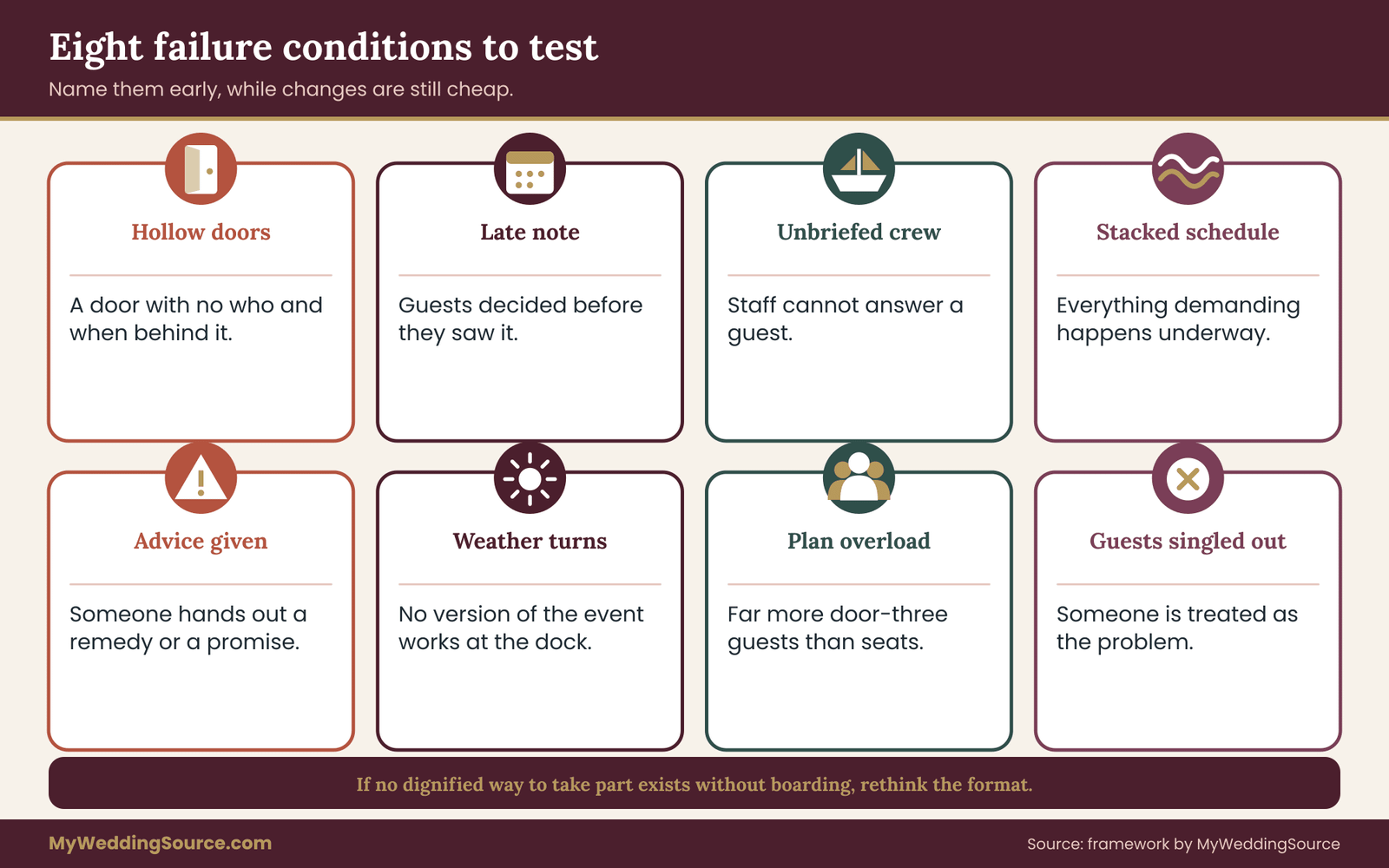
Every plan fails under some conditions. A wedding seasickness plan is no exception. Naming them in advance is not pessimism. It is how you notice trouble while there is still time to change something.
The doors are not real
The wedding seasickness plan fails when the doors exist on paper only. Door two without a dock stop, door three without a host or a ride, or door one without a way to step off mid-event are all hollow. Test each door by asking “who does what, and when?” A wedding seasickness plan is only as real as its least-built door. If you cannot answer in one sentence, the door is not built.
The note arrives too late
A guest who receives the information after they have bought travel, arranged childcare or decided to decline cannot use it. The note should be live by the time invitations go out and repeated before the final headcount. If your timeline slips, send the note by itself rather than waiting for the next mailing.
The crew is not briefed
A plan the crew has not heard about leaves guests asking staff who do not know the details. Confirm the briefing in the contract or in writing, and do it again on the day. Record these commitments in the written agreement.
The schedule is stacked underway
If all the demanding events happen while the boat is moving, door two disappears and everyone is committed. This is the most common structural failure, and it is fixed before the day, in the schedule.
Someone gives advice
The moment a helper hands out a remedy, recommends a product or makes a promise about how a guest will feel, the wedding seasickness plan has left its lane. This is a behavioral failure, and the cure is the three-sentence briefing and a gentle reminder to the wedding party.
The weather changes
Weather can alter the route, delay boarding, or cancel the sailing altogether. The captain decides, and the contract should say what happens. Your plan needs a version that works at the dock, so the event still functions if the boat stays tied up. If the water becomes rougher than expected, the doors give guests a graceful way to adjust, and the weather plan gives you a fallback. The wedding venues guide covers backup planning for venues more generally.
The guest list outgrows the plan
If many more guests than expected choose door three or door two, the shore side can become overloaded. Reassess seating, food and transport as responses come in. If a large share of the guest list needs choice, ask whether the whole format fits the group, and consider moving the ceremony or the main meal ashore.
Guests feel singled out
If a guest feels that a crew member, relative or coordinator treated them as the problem, the wedding seasickness plan has failed socially even if it worked logistically. Quiet signals, neutral language and a no-questions-asked attitude prevent this.
A decision rule for the whole plan
If after testing the doors, the note, the crew briefing and the weather plan you still cannot offer a dignified way to take part without boarding, be honest with guests, and consider whether the event as designed is the right one. A smaller promise that you can keep is better than an inclusive one that fails on the day.
Your next steps
Work through these in order, and stop when the plan fits your event. Each step builds the wedding seasickness plan a little further, and none requires medical knowledge.
- Call the charter manager and ask the four risk-picture questions: vessel, route, timing and the operator’s rules for stepping off.
- Rate the event and the guest list as low, medium or high for wedding seasickness risk, and write down the assumptions.
- Decide which of the three doors your wedding seasickness plan can honestly support, and design the shore moment for door three.
- Adapt the wedding seasickness guest note, keeping health questions pointed at clinicians and pharmacists.
- Put the schedule, the dock stop and the step-off rules in writing with the operator.
- Give your helpers the three sentences and brief the crew before the day.
- Review the failure conditions once more a week before the event and again when the forecast firms up.
Check current rules, permits and vessel terms with the issuing agency and the operator before you commit, because they change.
FAQ
Can we tell guests what to take for wedding seasickness?
No. What suits one person may be wrong for another because of allergies, pregnancy or medicines they already take. Point guests to their own clinician or pharmacist in one neutral sentence, and spend your effort on choices you control: the schedule, the seating, the dock stop and a real shore option for guests who prefer to stay on land.
Should the invitation mention wedding seasickness directly?
Usually not by name. Describe the options instead: full voyage, dock and step off, or join ashore. Guests who worry will recognize themselves without being labeled, and nobody has to explain a symptom. Put the fuller note on the website and a short line on the response card.
What if only a few guests choose to stay ashore because of wedding seasickness worries?
Keep the shore moment small but real, because a wedding seasickness plan is judged by how it treats the few. A host, a drink, a short visit from the couple and a farewell at the return cost little and matter a lot. Do not cancel it because the numbers are low, since the guests who use it are often the ones who needed it most.
Is it rude to offer a land-based alternative for wedding seasickness concerns?
No. For wedding seasickness concerns it is thoughtful hosting, because guests did not choose the boat. The alternative should be a genuine event, not a waiting area. Offering the same three choices to everyone keeps it from singling anyone out, and it usually lowers late declines.
Can the crew handle wedding seasickness by giving a guest something for nausea?
Do not assume so. Crew duties and first aid policies belong to the operator, and many crews are not permitted or trained to dispense anything. Ask the operator what they do in your planning call, and put any answer in writing. The couple should never ask the crew to provide remedies.
Does wedding seasickness planning change if the weather is rougher than expected?
The captain decides, and the contract should say what happens if sailing changes or is cancelled. Plan a version of the event that works at the dock. If the water is rough, the three doors give guests a graceful way to adjust without a scene.
How early should we raise wedding seasickness with the captain?
Before you sign. Wedding seasickness questions are ordinary operations questions, and the answers about route, dock stops, seating and step-off rules affect the schedule and the contract. An operator who treats the questions as normal is a good sign. One who dismisses them is worth noting before you commit money.
What do we do about wedding seasickness if a guest feels unwell during the event?
Stay calm, offer fresh air, a steady seat, water and a choice to stay or step off at the next opportunity, and tell a crew member. Do not offer remedies or a diagnosis. If the person seems seriously unwell or mentions a medical condition, tell the crew right away.
Sources
- U.S. Coast Guard: regulation and safety information for commercial passenger vessels, including inspection and capacity.
- U.S. Coast Guard Office of Boating Safety: recreational and passenger boating safety resources.
- National Weather Service marine forecasts: official marine weather forecasts and warnings.
- National Oceanic and Atmospheric Administration: weather, tides and coastal information.
- Centers for Disease Control and Prevention, Travelers’ Health: general traveler health information, including motion sickness.
- U.S. Food and Drug Administration: official information on medicines and consumer health products.
- ADA.gov: Americans with Disabilities Act requirements and guidance for public accommodations.
- National Transportation Safety Board: passenger vessel safety investigations and recommendations.
- Federal Trade Commission: consumer protection guidance on vendor claims and contracts.