

Wedding flowers are easy to love and hard to hand off, and the couples who donate flowers successfully are the ones who treat the pickup as a small logistics job instead of a kind gesture. This guide gives you a three-gate pickup pass, a recipient acceptance script and a plain list of failure conditions, so the bouquets do not end up wilting in a lobby that never asked for them.
Before you donate flowers from a wedding, clear three gates. Gate one is freshness: are the stems healthy, hydrated and free of damage? Gate two is transport: can someone move them cool, upright and on a fixed schedule? Gate three is acceptance: has a named person at the receiving organization agreed, in writing, to the item types, the quantity, the pickup window and the handling? If any gate fails, switch to a different plan, such as composting, keeping a few stems, or asking the florist to repurpose them.
Most advice about what to do after the party is a single sentence: “Donate them to a hospital or nursing home.” Couples who try to donate flowers that way often find the details harder than the advice. It sounds generous and it is often wrong in the details.
Some hospital units do not accept fresh flowers at all. Some senior communities love them but have no one on staff at 11 p.m. on a Saturday. Some shelters want loose stems for a craft program, not wired centerpieces. Meanwhile the couple is exhausted, the venue wants the room cleared, and the florist’s buckets are already in the van.
This article is about the unglamorous middle: what a recipient needs before it will say yes, how to judge whether your flowers are still worth giving, how to move them without ruining them, and how to document the handoff. If you want the bigger picture of cutting waste at a wedding, the guide to wedding waste reduction covers catering, rentals and cleanup. Here the focus is narrow: one decision, whether to donate flowers or not, and the steps behind it. A couple who wants to donate flowers needs a method more than good intentions.
A note on scope. This is general information, not legal, tax or financial advice. Donation rules, facility policies, food-safety and infection-control practices, and tax treatment vary by organization and by place, so confirm current requirements with the recipient and the relevant agency before you rely on anything here.
Why couples donate flowers and where the plan breaks
People choose to donate flowers for three honest reasons. The first is waste: a wedding can involve hundreds of stems that were cut, shipped and arranged for a single evening, and tossing them feels wrong. The second is meaning: flowers that sat at the ceremony can brighten a place where people are lonely or ill. The third is cost avoidance in a quiet way (it is cheaper to donate flowers than to pay for extra disposal, when the handoff works), because it is cheaper and kinder to hand them off than to pay for extra disposal.
The plan usually breaks in one of four places.
Timing. Weddings end late. Recipients operate on business hours. A rehabilitation center may accept deliveries between 9 a.m. and 4 p.m. only, which means the flowers must survive an overnight in a cool room first, and someone must be available to carry them over in the morning.
Condition. Flowers that stood in a hot tent for six hours, or that were handled by a hundred guests, may look fine at midnight and be limp by noon. A recipient who receives drooping stems feels obliged to be polite and then quietly throws them away.
Materials. A centerpiece is not only flowers. It is floral foam, wire, tape, pins, sometimes glitter or dye, plus a rented vase that belongs to somebody else. The recipient cares about all of it.
Ownership and permission. The flowers may belong to the couple, but the containers, stands and arches often belong to the florist or a rental company. The venue may also have rules about what leaves the building and when.
Naming those four failure points is useful because each one maps to one of the three gates in the pickup pass described later. Fix the points before the wedding and the choice to donate flowers becomes routine. Ignore them and you improvise at midnight.
What “donating” really means in practice
When a couple says they will donate flowers, they might mean any of several different actions. They might mean dropping finished arrangements at a local organization. They might mean giving loose, trimmed stems to a volunteer program that rebuilds small bouquets. They might mean passing centerpieces to guests at the end of the night, which is a gift, not a donation, though it is a perfectly good outcome. Or they might mean letting the florist take the flowers back to reuse them, which may be neither a gift nor a donation.
The distinction matters for two reasons. First, each path has a different recipient and a different set of questions. Second, if you want a receipt, you need a qualified organization on the other end, and that is a separate question from whether anyone wants the flowers. The Internal Revenue Service publishes guidance on qualified organizations and receipts, listed in the sources below. Fresh flowers have limited resale value, so most couples donate flowers for the good of it rather than for a deduction, and that is fine.
What recipients accept when you donate flowers
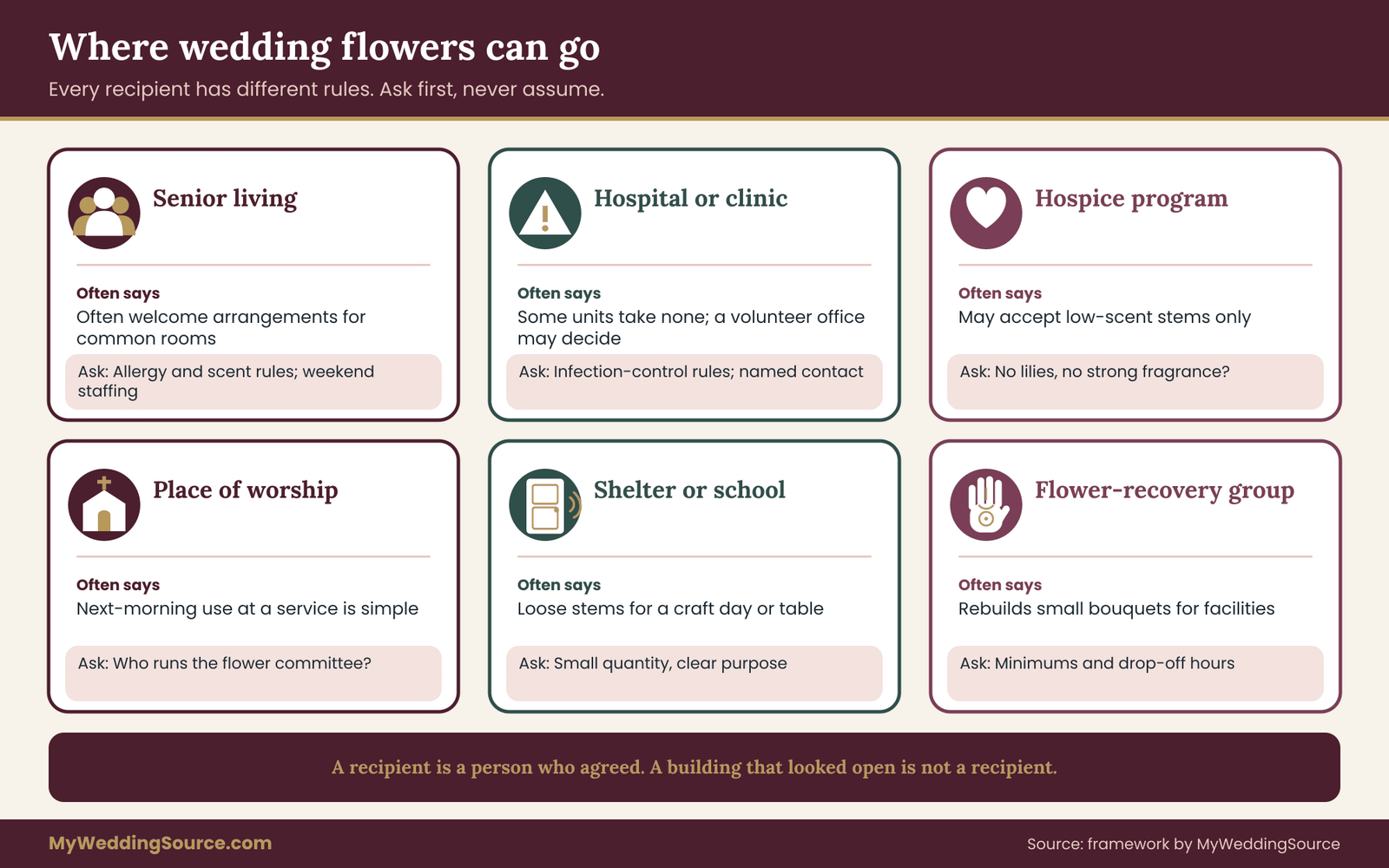
There is no single rule, because recipients are very different organizations with different constraints. What follows is a set of patterns, not promises. Each kind of recipient is a possibility to ask about, never an assumption.
Hospitals and clinics. Many hospitals restrict fresh flowers in some units, for infection-control, allergy or fragrance reasons. Intensive care, oncology and transplant units are the usual examples. A hospital may still run a volunteer or auxiliary program that handles gifts, but the answer comes from that program, not from the front desk. If you cannot reach a named person, treat the answer as no.
Nursing homes and senior living communities. These are often the warmest fit. Activity directors tend to like bright arrangements for common rooms and dining areas. They also often have a daily rhythm, so a Sunday late-morning delivery may be welcome while a Saturday night drop is not. Ask whether they prefer finished arrangements or loose stems, and whether residents with allergies or oxygen equipment affect the choice.
Hospice and palliative care programs. Some accept flowers gladly, others have fragrance-free policies. Lilies and other strongly scented stems are the most common problem. Ask the coordinator what they can take, and be prepared to hear “only low-scent flowers.”
Funeral homes and places of worship. A funeral home may reuse flowers for a service if they are fresh and the family consents, but many will say no to anything used at an earlier event. A congregation may happily use ceremony flowers on the altar the next morning, which is one of the simplest and most reliable paths if your wedding was nearby.
Shelters, community centers and schools. These recipients often need flowers for a purpose: a craft day, a welcome table, a classroom lesson. They may want a small number of stems, not 14 centerpieces. A phone call that begins with “what could you actually use?” works better than one that begins with “we have a lot of flowers.”
Flower-recovery nonprofits. In some cities, volunteer groups collect leftover event flowers, rebuild them into small bouquets and deliver them to facilities. Where such a group exists, it handles the recipient relationships you would otherwise have to manage. Availability depends on your area, so search locally and ask about service windows, minimum quantities and coverage for weekends.
None of these is a default. When you donate flowers, the right question is always the same: what, specifically, will you accept, from whom, on which day, and who will meet the car?
The recipient’s side of the table
It helps to picture what the person on the other end is weighing. They want to say yes to a generous offer. They also know a few things that you do not. Flowers create work: someone must unwrap them, trim them, find vases, change water and clear them when they die. Volunteers are scarce on weekends. Rooms have rules about scent, pollen and potted plants. Some facilities have policies about outside food or plants and treat flowers the same way.
When you recognize that, the conversation about whether to donate flowers changes. You are not asking for a favor; you are offering a small, well-packaged resource and making it easy to accept. The better prepared you are, with a count, a photo, a pickup window and a clear statement of what is in each arrangement, the more likely the answer is yes, and the less likely you are to cause a headache for someone who was trying to be kind.
The pickup pass: three gates before anyone drives
The method in this article is a pickup pass. It is a one-page document, either printed or saved on a phone, that travels with the flowers. It exists because three different people usually touch a donation (the couple, a helper and the recipient), and each one holds only a third of the facts. The pass puts those facts in one place.
The pass has three gates, and each gate has a single yes-or-no outcome.
Gate one: Fresh. Are these stems still worth giving? This gate is about the plant material itself and is judged at the end of the event, then again the next morning.
Gate two: Moves. Can they be moved the way the recipient needs, at the time the recipient needs? This gate is about vehicles, containers, water, temperature, a driver and a fixed window.
Gate three: Wanted. Has a named person agreed to this specific delivery? This gate is about the recipient’s stated rules, quantities and handling capacity, written down.
You donate flowers only when all three gates are open. If one is closed, you do not push harder on the others. You change the plan. That sounds obvious, and it is the step most couples skip, because the generous impulse says “we will figure it out.” A flower that passes freshness but fails acceptance is not a gift. It is a delivery nobody asked for, and you have not managed to donate flowers at all.

Why gates, and not a long checklist
Long checklists get ignored in the last hour of a wedding, and that is exactly when you need to donate flowers. Three gates are easy to remember, and each one can be given to a different person to own. The couple owns Gate three, because they are the ones who made the promise. A florist or a trusted friend owns Gate one, because they can judge the stems. A driver or the venue contact owns Gate two, because they control the vehicle and the loading time.
Splitting ownership also reveals problems early. If nobody can name the Gate two owner a week before the wedding, there is no plan to donate flowers, only a hope. If the recipient has not given any answer by the day before, Gate three is closed and the plan should switch.
The pass itself
The pass is a single page with six lines. You can write it by hand.
- Event date, flower count in plain terms (for example, “about a dozen table arrangements and two arch pieces”).
- Recipient name, contact person, phone number and the exact address and entrance.
- Accepted item types, in the recipient’s words: loose stems, finished arrangements, potted plants, nothing wired, nothing scented.
- Pickup or delivery window, with a backup window.
- Who carries, who signs and who stays with the flowers until handoff.
- What happens if the plan fails: the fallback recipient or the composting arrangement.
The sixth line is the one people leave blank. It is the most useful, because on the day the failure case is already decided and nobody has to improvise.
When to build the pass
Start two to three weeks before the wedding. That is early enough for a recipient to check with colleagues or a volunteer coordinator and still say yes.
It is also early enough for you to tell your florist that you intend to donate flowers, which affects how the flowers are built in the first place. A florist who knows that the arrangements are going to a care home can leave out wired pieces, skip heavily scented stems and pack in a way that makes transport easier. A florist who finds out at the end of the night can only do what is left.
If you are working with a planner or day-of coordinator, hand over the pass as part of the vendor timeline. The wedding vendor timeline guide shows how teardown and load-out windows fit together, and the flower handoff belongs in that same schedule rather than in a side conversation.
Gate one: judging freshness at the end of the night
Freshness is about two things: how healthy each stem was to begin with, and what happened to it during the event. Neither is visible in a photograph, so anyone who wants to donate flowers has to handle them. Both can be assessed in about ten minutes by someone who is willing to handle the flowers.
The most reliable method is a three-way sort. Take each arrangement, or each bucket of loose stems, and place it into one of three groups: Go, Trim or Stop.
Go means healthy stems, firm necks, bright centers, no browning at the petal edges, no slime on stems, no sour smell from the water. Go flowers can be offered as they are, after a fresh drink and a cool rest.
Trim means salvageable with work. Some blooms are tired but the stems are sound. Outer petals may be bruised. A few stems may have been bent or broken. Trim flowers can be donated after someone removes the damaged parts, recuts the stems and rebuilds a smaller arrangement. This is the group where a volunteer rebuild program is useful, because the recipient may prefer a small fresh bouquet over a large tired one.
Stop means visibly spent: heavy browning, mushy stems, strong odor, mold, insects or flowers that wilted and did not recover with water. Stop flowers do not go to a recipient, however good the intention. They go to compost or the green bin, and the compost or green-waste route in an audit of wedding waste is the better place to send them.

Signs that matter, in plain language
You do not need a horticulture degree. You need to check a short list.
Stems. Pinch the stem a few inches below the bloom. It should feel firm. A soft, slimy or discolored stem means bacteria and an early end.
Heads. Hold the bloom gently. Roses that are fully open with loose, falling outer petals are late. Tight, still-closed buds can continue to open, which makes them attractive for donation because they will look good for a few more days. Hydrangeas that hang their heads may recover in water, but only if the stems were recut.
Foliage. Greenery tends to last longer than blooms. Eucalyptus, ruscus and similar stems often outlast roses, which is useful: a bucket of greens with a few strong blooms can be a better donation than a dozen exhausted centerpieces.
Water. If the arrangement sat in a vase with floral foam, check whether the foam is still wet. Dry foam means the stems were not drinking. If the water is cloudy or smells, bacteria have grown.
Pollen and sap. Lilies drop orange pollen that stains fabric and skin. Some recipients specifically do not want them. Removing the anthers before donation is standard practice and takes seconds, though the stems may still be a problem if the recipient has scent limits.
The difference between “look fine” and “will last”
A common mistake among couples who donate flowers is judging by appearance at midnight. Flowers that have been in warm, bright rooms for six or eight hours are already stressed. They may look perfect and then collapse during the drive or overnight. A fair rule: if a flower is not clearly healthy at the end of the event and is not given water and a cool rest, assume its remaining life is short, and plan to donate flowers the same night or the next morning at the latest.
The reverse is also true. Flowers that were kept cool, had good water and were handled gently can look excellent two or three days later. If your ceremony flowers were kept in a shaded space or in the florist’s cooler until the last minute, they may be better candidates than reception centerpieces.
For deeper detail on how long different greenery lasts in a vase, which affects what you can promise a recipient, the site has a separate guide to greenery vase life. Treat any shelf-life figure from a seller or a chart as general; your flowers’ actual condition decides.
A fresh drink and a cool rest
Whatever sorting group a stem lands in, and whether or not you donate flowers from it, the same two steps help before any move. Give the stems a fresh drink: recut about an inch off each stem at an angle with clean shears, and place them in clean water. Then give them a cool rest in a shaded, cool room, away from fruit bowls and heaters. Fruit and some vegetables release ethylene gas, which can shorten the life of some cut flowers, so a kitchen with a fruit bowl is a poor overnight holding spot.
These two steps change what you can honestly offer a recipient. Instead of saying “we have flowers from last night,” you can say “we have stems that have been recut, hydrated and held cool since midnight.” Recipients appreciate that kind of detail, because it tells them how much work the flowers will need on arrival.
Which flowers are best to donate
Not every stem makes a good gift, and knowing which ones do helps you decide what to offer. Sturdy flowers with long vase lives are the easiest to donate flowers from. Spray roses, carnations, chrysanthemums, alstroemeria and most foliage tend to hold up under rough handling and long evenings, which is why florists lean on them. Delicate stems such as sweet peas, ranunculus and some garden flowers wilt quickly and are poor candidates if the recipient cannot take them the same night.
Ceremony flowers are often better than reception flowers when you plan to donate flowers the next day. They spend less time in warm rooms and fewer hands touch them. If you have an arch, aisle markers or a few large vases from the ceremony, move them to the cool room first and treat them as your best stock.
Bouquets and boutonnieres are a special case. Most couples want to keep or preserve the bouquet, and boutonnieres are wired and small. Leave both out of the offer unless the recipient asks. The point of the pass is to donate flowers that fit a recipient’s needs, and a pile of tiny wired pieces is rarely one of them.
How to donate flowers built with foam, wire and tape
Fresh stems are only part of what leaves the venue when you donate flowers. The other part is everything that holds them together, and recipients react to it strongly. A care home activity director who receives a centerpiece full of floral foam, wire stems and sparkly pins must decide whether residents can be near it, whether it will crumble and whether anyone will have to take it apart. Most will not. They will quietly discard the lot.
So the second half of Gate one is a materials check. Before you donate flowers, sort each arrangement into its parts.
Floral foam. The green block is common in arrangements. It is hard to reuse, it sheds fine particles, and many recipients and environmental groups prefer not to receive it. Whether to accept foam is the recipient’s call, and when you donate flowers the honest default is to remove stems from foam and offer them loose, in clean water. If your florist can build with chicken wire, moss or vases without foam, say so at the design stage.
Wire and floral tape. Wired boutonnieres and corsages have thin wire in the stem. Wired stems are awkward for volunteers and can pose a small injury risk. Pull wire out or leave those pieces out of the donation.
Pins, picks and decorations. Corsage pins, plastic picks, glued-on gems, glitter and artificial berries are hazards for residents who might handle them, and for pets in a facility. Strip them.
Dyed or sprayed stems. Painted or glittered flowers and any stems that were sprayed with something for effect are best kept out of facilities where people might touch them or eat near them. If you are unsure what a florist sprayed, ask before you offer.
Vases and containers. A recipient may love the vase more than the flowers. A glass vase is useful, but if it is a rental you cannot give it away. Containers also need to be stable and the right size for tables where the flowers will land.
Rebuilding for the recipient
If the recipient wants small arrangements, a rebuild session is the usual solution. A few volunteers, or the florist’s team, take apart large centerpieces and make smaller bouquets in clean jars or small vases, with fresh water and no foam. That takes time, which is itself a cost. Decide who does it before the wedding, and decide when. Couples who donate flowers without a rebuild plan usually end up carrying large centerpieces nobody wants.
For many couples, a pragmatic option is to pay the florist for a short post-event service: break down, sort, rebuild and package. Some florists include it, some charge for it, and some say no. The rental planning checklist is a good place to see how teardown, returns and pickup labor are normally listed in a vendor agreement, and the same logic applies when you donate flowers.
A materials rule you can say out loud
To keep this simple, use a one-line rule that anyone can remember: if it is not a stem, a leaf or clean water, it does not go to the recipient unless they asked for it by name. That rule sets aside foam, wire, glitter, tape and anything dyed in one move, and it is easy to teach a helper at midnight.
There is one exception worth noting: a recipient who specifically wants finished arrangements in a vase. Some care homes and churches do. In that case ask whether the vase stays or returns, and check that it is not a rental. Write the answer on the pass.

Scent, pollen and allergies
Scent and pollen are not just comfort issues. Residents and patients may have asthma, allergies or sensitivities, and facilities often set rules to protect them. Strongly scented flowers such as lilies, stock and some roses can bother people. Heavy-pollen flowers, especially lilies, can stain linens and clothing. Ask the recipient for a plain statement: low scent only, no lilies, no pollen, or no restrictions.
For pets, a separate point applies to anyone who plans to donate flowers. Some common wedding flowers are harmful to cats and dogs, lilies being the best-known example for cats. If the recipient has a resident animal, or if the arrangements might travel to homes with pets, check a poison-control or animal-welfare source before you donate flowers. The animal poison resources listed in the sources below are the right place to check, and a florist’s assurance is not a substitute.
A short conversation at the start avoids a longer one later: “Are there any flowers you cannot have, because of scent, pollen or pets?” Write the answer on the pass, and share it with the florist if the order is not final.
Gate two: moving flowers without ruining them
Gate two is where the plan to donate flowers meets a minivan. Moving flowers involves more than driving them. It involves water, temperature, upright positioning, a schedule and a person who is not the bride at 11 p.m.
The first rule is that flowers need water the whole way. An arrangement in a vase with water travels best if the vase is stable and the container is held in a crate or box with towels as packing. Loose stems travel best in buckets with a few inches of clean water, or wrapped at the cut ends in damp paper towel and sealed in a plastic bag, then laid in a box. Dry transport shortens life, and an overnight without water is usually the end, whether or not you donate flowers afterward.
The second rule is temperature. Flowers are best kept cool, not hot and not frozen. A parked car in sunlight, even in cool weather, can become warm quickly. A trunk is better than a back seat window. If the drive is long, plan the route and the stops. If the weather is hot, avoid leaving the car anywhere.
Third, flowers need to stay upright and unsquashed. Vases tip, buckets slosh and heavy arrangements crush lighter ones. Use crates or boxes, pack with towels and do not stack unless the load is designed for it.
Fourth, protect the stems from heaters, fans and fruit. The same ethylene issue that matters in a kitchen matters in a car with a bag of produce.
Who drives, and when
Name the driver in advance, because nobody can donate flowers that never leave the venue. This is the most common failure in the whole plan: everyone assumes someone else will take the flowers. The driver should not be the couple. They have their own evening, and they will be tired and, in some cases, not safe to drive. A friend, a family member who is not drinking, a day-of coordinator or a paid courier can do it. Pay for the delivery if it makes the plan reliable, and treat the cost as a normal logistics line in the budget.
Choose between delivery the same night, delivery the next morning and recipient pickup. Same-night delivery is rare because most recipients are closed. Next-morning delivery is the most common, which means the flowers must spend the night in a cool, shaded room with fresh water. Recipient pickup puts the responsibility on them, so it requires them to have a vehicle and staff available. Each option has a different risk, and the pass should state which one applies.
The handoff window
A handoff window is a short, fixed period when the recipient expects the flowers. Set it with the recipient, not for them. For example, “between 10:00 and 11:00 on Sunday, at the side entrance, to the activities coordinator.” Add a backup window, and include a phone number for the driver and the recipient.
The window matters because the people at the other end have other work. A delivery that arrives early may find no one to receive it. A delivery that arrives late may find the room already set up for lunch. A person standing at the door with a clear time and a name is a much easier request to accept than a van that appears.
Include in the window the practical details: where to park, which door to use, whether a cart is available and whether the driver must sign in at a front desk. Facilities with security or visitor policies may require ID or a short wait.
A short transport kit
A small kit, packed ahead, saves the night. It does not need to be fancy.
- Sturdy crates, cardboard boxes or buckets that fit the vehicle.
- Clean towels or newspaper for packing.
- Clean shears or scissors for recutting.
- A few large plastic bags and rubber bands for wrapping wet stems.
- Water in a clean jug.
- A printed pass with the recipient’s name, number and the window.
- A marker and tape for labels such as “fragile” and “recipient name.”
The kit belongs to the person who owns Gate two. If your florist offers to pack the flowers, ask whether they include buckets or boxes and whether they expect them back.
Weather, season and distance
Conditions outside the venue change what is realistic. In hot weather, a car can become a heater within minutes, so shorten the drive and keep flowers shaded. In freezing weather, a cold trunk overnight can damage tender stems, so keep them inside. In wet weather, protect packaging from rain and keep boxes off the ground. Season also matters: spring flowers tend to be delicate, and winter greens are often hardier.
Distance matters as much as weather. If you plan to donate flowers to an organization across town, add the drive time to the freshness clock. A short trip to a nearby care home is usually a better use of a Sunday morning than a long one to a larger organization, even if the larger one sounds more impressive. Choose the recipient the flowers can actually reach in good condition.
If a storm or a road closure disrupts the plan, use the fallback. It is better to compost healthy flowers than to risk an unsafe drive.
Gate three: what recipients need before they say yes
Gate three is the heart of this article, and the title promises it: what recipients need before pickup. The gate is open only when a named person at the receiving organization has said yes to a specific delivery, in writing, with a time. A friendly voicemail does not open it. A general “we love flowers” does not open it. A short email or text that restates the details does.
Recipients need information in a consistent order, so anyone who wants to donate flowers should prepare it first. If you give it to them that way, they can decide quickly. If you scatter it, they must ask follow-up questions, and busy people often respond by not responding.
The eight things a recipient wants to know
Here is the set of details to share when you offer to donate flowers. Each is a question the recipient is probably asking silently.
- Who are you, and what is the occasion? A sentence is enough: “We were married on Saturday at a venue nearby, and we would like to donate flowers from the ceremony and reception.”
- What exactly is it? Count and type, in plain words: “about twelve table arrangements in glass vases and two arch pieces, mostly roses, spray roses and greenery.”
- What condition are they in? Say how they have been kept: “held cool overnight, recut and in fresh water.”
- What is in them? State what contains foam, wire or decoration, and what you will remove.
- What are the scent and pollen facts? Name any lilies or other strongly scented stems.
- When and how will they arrive? Delivery or pickup, window, door and who is driving.
- What happens to the containers? Vases stay or return, and who owns them.
- What if you cannot take them? Give them an easy way out: “If this does not suit, no problem at all.”
The last item is as important as the others. A recipient who feels pressured will say yes and then resent the task. A recipient who feels free to decline will either accept sincerely or decline early, which is better for you, because the earlier you learn of a no, the more time you have to find another route.
A script for the first call or email
Short and specific works best when you ask someone to accept flowers. Here is a pattern you can adapt, in your own words.
“Hello, my name is [name]. We are getting married on [date] and would like to donate flowers from the event afterward. We would have roughly [count and type]. They would be recut and in fresh water, with no foam or wire unless you want it. We could deliver them on [day] between [times], or you could collect them. Is this something your [role] could accept? If it helps, I can send photos and details by email. If not, we completely understand and will find another place.”
Notice what the script leaves out. It does not use the word “free,” which can sound like unwanted stuff. It does not claim a tax benefit. It does not say “they are beautiful,” because the recipient will judge. It gives the recipient only the facts it needs to answer.
Written confirmation
After the call, send a short confirmation by email or text and ask for a one-line reply: “To confirm, we will deliver about twelve arrangements with vases to the side entrance on Sunday between 10 and 11. Please let me know if anything changes.” Save the reply with the pass.
Written confirmation does three jobs. It makes sure both sides understood the same thing. It gives the driver something to show at the door. And it is a record, which matters for the same reasons other wedding paperwork does. The guide to wedding records after the event explains why a short note filed with the vendor paperwork can save time later.

Acceptance by type: what to ask each one
Different recipients need different questions, and each changes how you donate flowers to them. The set of eight above is the core. These additions apply to specific kinds of organizations.
Facility with residents or patients. Ask about fragrance and allergy policies, restricted units, outside-plant rules, and whether flowers must come through a volunteer office. Ask whether there are infection-control or sanitation rules, such as requiring new vases or clean water only. Public health agencies publish general infection-prevention information for healthcare settings, and the recipient’s own policy decides, not yours.
Community nonprofit or shelter. Ask what the flowers will be used for, whether they want loose stems for crafts, whether they can store them cool, and how many people will handle them. A small organization may be happy to receive a bucket of stems and glad not to receive fifteen finished centerpieces.
Place of worship. Ask whether the flowers will be used at a service, which day, and whether any tradition applies. Some congregations have a flower committee that decides, so ask who that is.
Funeral home. Ask directly whether reused flowers are ever accepted. Some are not. Do not offer flowers for a service without the family’s agreement through the funeral home.
Recovery group or volunteer flower nonprofit. Ask for their intake rules: minimum volume, drop-off times, types of flowers they take, whether they take arrangements or only stems, and whether they pick up. Because they manage many events, they usually have a standard form. Fill it in early.
Receipts, thanks and records
If you want a written receipt, ask whether the organization is a qualified charity and whether it issues receipts for donated goods. Many do not value flowers, and some will not give a receipt for them at all. That is normal. If a receipt matters to you for tax reasons, check the IRS guidance and ask a tax professional before the event rather than after.
A thank-you note afterward is a small courtesy that keeps the door open for the next couple. The wedding etiquette guide covers thank-you notes in general, and a note to a care home or volunteer coordinator is welcome but never required.
Edge cases worth deciding in advance
The recipient says yes, then cancels. It happens, even to couples who carefully donate flowers. This is why line six on the pass, the fallback, exists. Have a second recipient or a composting plan agreed before the wedding.
The recipient wants more than you have. Do not stretch. Offer what you have, and do not make promises about quantities that depend on the florist’s final count.
The recipient wants flowers for an event, not a room. If they need flowers for a specific day, such as a memorial or party, confirm the date and ask whether the flowers will still be fresh by then. If the gap is too large, say so. A refusal for freshness is helpful, not rude.
The recipient is far away. Distance raises the cost and lowers the freshness. If the drive is long, consider a nearer recipient, or whether a courier is worth paying for.
Flowers from several sources. Before you donate flowers, check who owns each one. Guests’ bouquets, a florist’s work and DIY pieces may all be in the room. Settle who has authority to give which flowers. If a family member brought their own arrangements, ask them separately, and do not donate flowers that belong to someone else.
What to send with your offer
A short, concrete message gets faster answers than a long one. When you offer to donate flowers, attach two or three clear photos taken in daylight, not wedding-gallery shots, so the recipient can see the actual size and color. Add a one-paragraph description with the count, the types and the condition, then the proposed window. If the recipient wants to forward your offer to a colleague or a volunteer coordinator, a clean message makes that easy.
Keep the tone matter-of-fact. You are not asking for gratitude, and you are not asking them to solve your problem. You are telling them what exists and letting them decide. Couples who donate flowers this way tend to hear back sooner, because the recipient can answer in a single reply. If you hear nothing within a few days, send one polite follow-up, then move to your fallback and tell the first recipient the offer is withdrawn.
Never promise a specific quantity before the florist confirms the final order. If the number changes, tell the recipient promptly, even if the change is small.
Who owns the flowers: contracts, rentals and venue teardown
Before you can donate flowers, you have to be sure they are yours to give. That sounds trivial, and in most weddings it is, but several common arrangements create gray areas. A short look at the paperwork a few weeks before the event prevents an awkward discovery at midnight.
Read what the florist agreed to
Start with the florist’s contract or proposal. Look for three things. First, which items are purchased and which are rented. Vases, stands, arches, aisle runners, candle holders and lanterns are frequently rented, even when the flowers on them are yours. Second, what the contract says about pickup of rentals: a window, a fee and a condition clause. Third, what the florist does with leftover flowers if you do not take them. Some florists reuse, some compost, some leave them at the venue.
If the contract is silent on what happens to the flowers after the event, ask. The vendor contract guide explains which clauses cover post-event handling, pickup and fees, and it is a useful reference when a florist’s paperwork is thin. A one-line email is enough: “After the event, may we take the flowers, and may the florist’s team help break them down for donation? Is there a charge?”
Separate flowers from rentals in writing
The cleanest arrangement for anyone planning to donate flowers is a short list, kept with the pass, that sorts every floral item into two columns: ours to give and not ours. Do this with the florist if possible. For each rented container, note who collects it and when. For each purchased arrangement, note whether it may leave in the container or must be moved to a different one.
This single page prevents the most common donation mishap: a lovely arrangement leaves the venue in a rental vase, and the rental company bills you for a missing item. It also protects the recipient, who might otherwise be asked to return a vase that they did not know belonged to a third party.
What the venue expects at teardown
Venues set rules about when you can access the space after the event, how long vendors have to remove items, and what may leave through which door. Some require vendors to load out through a freight entrance or a loading dock, and some charge overtime if teardown runs late. The flowers will be moving through the same constraints as the tables and linens, so ask early if you want to donate flowers on the night.
Ask the venue: Can flowers stay overnight in a cool room? Is there a place where buckets can sit? Who locks up, and when? Can a helper come back the next morning? If the venue does not allow overnight storage, your plan has to shift to a same-night handoff or an off-site holding place at a home or the florist’s shop.
For loading and access details, the venue technical walkthrough guide is a useful companion, since the same measurements and access routes apply to buckets and crates. The rental planning checklist also covers how to keep pickup times for rented items consistent with the end of the event.
Guests and the arrangements on their tables
Centerpieces sit in front of guests. Some guests will assume they are free to take them home, and they may be right. If you plan to donate flowers, tell your guests clearly: a small sign or a quiet announcement that centerpieces will be collected at the end of the night prevents guests from walking off with them, and also avoids hurt feelings. Alternatively, give guests a clear opt-in, such as “Take a stem or a bud vase, and the rest will go to a local care home.”
One common and perfectly good compromise is to split: let guests take a stem or a small arrangement from the head table, and donate the rest. This gives guests a keepsake and keeps the donation plan simple. The general principle is to state expectations before the moment, not during it.
A short ownership check
Use this check one week before the wedding.
- Has the florist confirmed which items are ours and which are rentals?
- Is a pickup time for rentals in writing?
- Does the venue allow overnight storage of flowers, or only same-night removal?
- Is there a named person who will handle the flowers at the end of the night?
- Does the pass list the vase and container decisions?
If any answer is no or unknown, treat Gate one, two or three as not yet open. That is useful information, not a failure.
A worked case: one Saturday wedding, three possible recipients
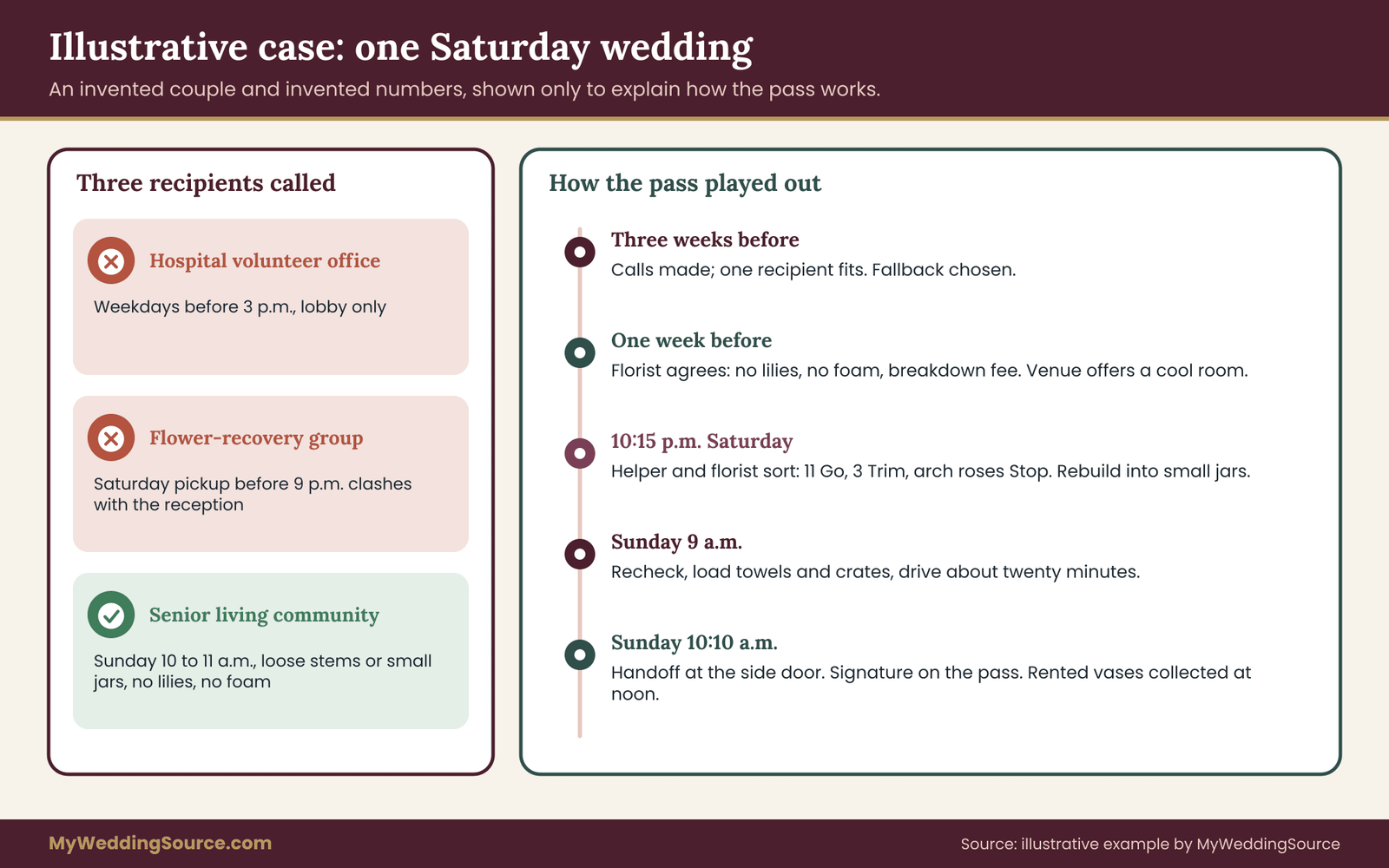
What follows is an invented, illustrative case, built to show how the pass works in practice. Nothing here is a real event or a real organization, and the numbers are made up for explanation only.
The setup. A couple, whom we will call Dana and Marcus, are marrying on a Saturday in October. The ceremony is at 4 p.m. and the reception ends at 10 p.m. They have fourteen table arrangements in rented glass vases, one ceremony arch with loose greenery and roses, two bouquets and a handful of boutonnieres. The florist’s contract states that vases are rented and will be collected Sunday at noon. They want to donate flowers rather than throw them away.
Three weeks before. Dana makes calls. A hospital volunteer office says no fresh flowers on most units and offers to take a small number for a lobby, only if they arrive before 3 p.m. on weekdays. A senior living community’s activity director says yes, preferably loose stems or small jars, delivered Sunday between 10 and 11 a.m. A local flower-recovery volunteer group says it can collect, but only Saturday evenings before 9 p.m., which clashes with the reception.
Dana notes the facts on the pass. The hospital is not a fit, because the reception ends too late for a weekday drop and the lobby is not the real need. The recovery group is not a fit because of timing. The senior community is a fit, with one condition: no lilies and no foam. That is Gate three, open for one recipient.
One week before. Dana tells the florist that she and Marcus want to donate flowers. The florist agrees to avoid lilies, build without foam in the table pieces and pack the rest in buckets. They agree to break down the arrangements at the end of the night for a flat fee, and to collect the rented vases on Sunday as planned. The venue confirms that a cooler room is available overnight and that a friend can return at 9 a.m. That is Gate two, mostly open.
The night of the wedding. At 10:15 p.m. a trusted friend, Priya, who has agreed to be the helper and is not drinking, works with the florist’s assistant. They sort the flowers into Go, Trim and Stop. Eleven of the fourteen table pieces are Go. Three have been bumped and show bruised roses; they go to Trim. The arch roses sat in the afternoon sun for a few hours and are Stop, along with the boutonnieres, which are wired and are not offered.
Priya and the assistant take the Go and Trim stems out of the vases, discard the wilted outer layer, recut the stems and rebuild smaller jar arrangements with a mix of roses, spray roses and greenery. They end up with about twenty small jars and two buckets of loose stems. Everything goes into the cool room with fresh water. The Stop material goes to the florist’s compost bin.
Sunday morning. At 9 a.m. Priya loads the crates into a car lined with towels. She drives to the senior community, arrives at 10:10, meets the activity director at the side door and gets a signature on the pass. Total drive time: about twenty minutes. The vases are collected by the florist at noon, as agreed.
What the case shows. Three things are worth noticing. First, only one of three possible recipients was a fit, and the couple learned that early, with time to spare. Second, they were able to donate flowers because the florist and venue agreed beforehand, not because the flowers were special. Third, the plan included a clear Stop group, which meant they chose to donate flowers that were good rather than every flower.
Cost logic in the worked case
The case also shows where costs appear, without inventing prices. The couple might pay the florist for breakdown and rebuild labor. They might pay a friend or a courier for the drive, or cover fuel.
They might buy a few crates, jars and towels, or borrow them. None of these is large, and each is a line item you can ask about in advance. For a wider view of how these extras fit into a total, the wedding budget guide covers how to reserve a small cushion for post-event logistics. If the cost of trying to donate flowers seems high compared with the value to the recipient, that is a legitimate reason to choose another route, such as keeping the flowers or composting them.
Alternatives when you cannot donate flowers
A good plan to donate flowers has an exit. Plenty of weddings reach the end of the night and discover that nobody can take the flowers, or that they are not in the condition they hoped. That is not a failure. It is a branch in the plan, and the pass already has a line for it. These are the main alternatives, in rough order of effort.
Keep a few stems. Many couples want some flowers for themselves. A small bunch in a vase at home, a bud vase in the bedroom or a few stems pressed in a book is a gentler end than any logistics. If you keep the bouquet, tell the florist early, because bouquets used for photos may need special care. A short list of preservation options is in the keepsake-related guides on the site, but a bouquet in water and a cool room is enough for the first few days.
Pass them to guests. At the end of the night, a table of stems and small jars with a sign that says “take one home” is the lowest-effort alternative. It also solves the problem of fifty guests who wanted a flower and did not like to ask. Guests who take flowers become the recipients, and nobody needs a receipt. The one downside is that some arrangements will end up abandoned in cars or hotel lobbies, so only offer what you are comfortable seeing go.
Move them to the next morning’s event. If the couple has a brunch, a family lunch or a farewell gathering the next day, ceremony flowers can be carried over. This is the same logic as a place of worship using flowers the next day. It works best with sturdy stems and a plan for who carries them.
Ask the florist to reuse or repurpose. Some florists reuse hardy greenery, containers or undamaged stems for a later event. Whether a florist will do this, and whether you want it, varies. A florist who offers to take the leftovers is solving a real problem, but ask whether the flowers will be used at another event or discarded. Do not assume.
Compost or green-bin them. If flowers are past Gate one, composting is the honest alternative. Many cities have yard-waste collection that accepts cut flowers, and some have rules about wire, foam, ribbon and plastic, so strip those first. Others do not accept flowers at all. Check your local rules, and use the wedding waste audit as a reference for how to sort the rest of the event’s waste at the same time. The EPA’s materials on reducing and recycling organic waste give a general framework, and your local solid-waste office sets the actual rules.
Dry them. Some stems, such as roses, lavender, statice, baby’s breath and many greens, dry well hung upside down in a dark, airy room. Dried stems can become keepsakes or craft material, and they can be donated later to a school or art program if someone wants them. This option changes the nature of the gift, so it needs a fresh conversation with a recipient.

Choosing between them
Use the same three gates, applied in reverse. If Gate one is closed because of condition, compost or dry. If Gate two is closed because nobody can move them, offer them to guests on site, or keep a few. If Gate three is closed because no recipient said yes and you cannot donate flowers, try one more phone call to a different organization, then fall back to the earlier choices.
What you should not do, if you cannot donate flowers, is decide at midnight to drop the flowers at the nearest building with a light on. A bag of flowers left at a doorstep is not a donation. It is a task for someone who did not agree to it, and in many places in some places an unannounced drop-off creates problems for the building.
When the alternative is the better choice
There are weddings where it makes sense not to donate flowers even though it is possible. The arrangements may be tiny and not worth a drive. The couple may be flying out at dawn. The flowers may be mostly dried or silk, which many recipients do not want. The recipient may be far away or unavailable. In those cases, an alternative is the responsible choice, not a lesser one. Waste reduction is about matching the flowers to a realistic outlet, not about forcing every stem through a channel to donate flowers.
If you are weighing fresh flowers against a more durable choice for a future event, the site’s comparison of rental silk and fresh florals covers the trade-offs without overstating what a comparison can show.
Failure conditions: when to stop and let go
A plan like this should say plainly when it should not proceed. Here are the failure conditions for the pickup pass. Each is a clear signal to stop, change the plan or pick the fallback. None is a judgment of you.
Failure one: no named person. If you cannot reach a specific person who says yes, you cannot donate flowers yet, because Gate three is closed. A generic inbox, a front desk shrug or “just drop them off” is not an acceptance. Switch to the fallback.
Failure two: the answer is conditional on something you cannot control. “If we have volunteers on Sunday” or “if the room is free” is not yes. Ask for a decision by a certain date, and move on if it does not come.
Failure three: the flowers are in the Stop group. Any sign of mold, slime, odor or collapse means you do not donate flowers that stem, regardless of how generous the intention. Offering spent flowers burdens the recipient.
Failure four: the materials cannot be separated. If foam, wire or decoration cannot be removed and the recipient does not want them, you should not donate flowers in that form, or limited to the stems that can be freed.
Failure five: the transport has no owner. If there is no driver, no vehicle or no time window, Gate two is closed. Guess-and-hope is not a plan.
Failure six: the vessels are rentals and nobody has agreed on returns. Giving away something that belongs to a third party creates a billing problem. Stop and resolve ownership first.
Failure seven: the timeline is too long. If the flowers must sit for two days before the recipient can accept them, their remaining life is probably too short. Find a recipient with a shorter window or choose an alternative.
Failure eight: allergies or pet hazards are unresolved. If the recipient has not answered the scent, pollen and animal questions, do not guess. A pet hazard is a safety matter, so consult an animal poison resource.
Failure nine: the donation would strain the recipient. If it would take more of their time than the flowers are worth to them, that is a polite no, even if they said yes out of kindness. Read the tone of the conversation.
Failure ten: the couple is overloaded. The wedding weekend is already full. If the plan to donate flowers is adding stress, simplify. Keeping a few stems and composting the rest is a respectable result.
How to say no gracefully
If you must cancel a donation, call the recipient as early as possible, thank them and offer a brief reason, such as “the flowers did not hold up as we hoped.” Do not leave them waiting. If the issue is on their side, thank them for the time and move on without pressing. The relationship matters more than the flowers, and next year’s couple may call the same office.
Checking local rules
Local rules can affect each alternative. Some places restrict what goes in a yard-waste bin, some venues restrict what leaves the premises, and some facilities restrict what enters. A short call to your city’s solid-waste office, the venue manager and the recipient covers all three. If you want to donate flowers through an organization that handles many events, ask whether they have a standard intake form, because completing one early usually saves a day of back-and-forth.
When you use the guest option, keep an eye on how the flowers leave. If the venue’s cleanup crew finds arrangements left in restrooms or parking lots, the couple or the florist may hear about it. A clear sign and a staffed table, even for ten minutes, keeps things orderly. Couples who plan to donate flowers and give some to guests should decide in advance which arrangements go where, so nobody has to guess.
A countdown from three weeks out to the morning after
The pass works best when it is tied to dates. This countdown is a suggested rhythm, not a rule. Compress it for a short engagement, and stretch it if your recipient needs more notice.
Three weeks before. Decide whether you want to donate flowers at all, and tell your florist and planner. Make the first calls and emails to two or three recipients. Ask the eight questions from Gate three. Do not commit to one recipient until you have heard from at least one, and keep a second as a fallback.
Two weeks before. Confirm the recipient in writing. Ask the florist about foam, wire, scent and pollen, and about a breakdown service. Ask the venue about overnight cool storage and teardown access. Name your three owners: one for freshness, one for transport and one for the recipient relationship. Book a paid courier if you do not have a driver.
One week before. Print the pass. Pack the transport kit. Tell guests how centerpieces will be handled. Confirm the pickup window again, and confirm the fallback.
The day before. Check the weather, because heat or storms change the plan. Confirm the helper’s phone number and the venue contact. Put the kit in a place where it will not be forgotten.
The evening of the wedding. At the end of the night, the helper sorts the flowers into Go, Trim and Stop, removes the materials that do not belong when you donate flowers and gives the stems a fresh drink. Rented containers are set aside with a note for pickup. Flowers go into the cool room. The couple leaves. That is the whole assignment for the night, and it does not need the couple.
The morning after. The helper checks the flowers again. Anything that has failed overnight moves to the Stop group. The driver loads the car, delivers within the window, collects a signature and takes a photo of the handoff if the recipient agrees. The couple sends a short thank-you later in the week.
One week after. File the pass, the written confirmation and any receipt with your other post-event paperwork. Return any borrowed crates. Pay the florist or courier invoices. Note anything that went well or badly so that you can pass it on to a friend who is planning a wedding.
A quick test before you commit
If you are not sure whether you can realistically donate flowers, ask three questions. Do I know the first and last name of the person who said yes? Do I know who will drive, and at what time? Do I know what happens if the flowers do not hold up? If you answer yes to all three, the plan is ready. If any answer is no, you have found the gap while there is still time to fix it.
Your next steps
Pick the smallest version of this plan that fits your wedding and begin there. Couples who donate flowers successfully usually start small.
- Decide whether you want to donate flowers, keep some or compost them, and tell your florist and planner.
- Make a short list of two or three possible recipients near your venue, and send each the eight details from Gate three.
- Ask the florist about foam, wire, scent, pollen, breakdown service and rented containers.
- Confirm overnight cool storage and teardown timing with the venue.
- Name an owner for each gate and a driver for the handoff.
- Fill in the one-page pass and keep a fallback on line six.
- Sort and prepare the flowers at the end of the night, deliver in the agreed window and file the paperwork afterward.
If you only do one thing, do the second step. A named person who agrees in writing makes it far easier to donate flowers on the day.
FAQ
Can I donate flowers from my wedding to a hospital?
Sometimes, but not by default. Many hospitals restrict fresh flowers in some units, often for infection-control, allergy or scent reasons. A volunteer or auxiliary office may be able to say what is possible, such as lobby arrangements or approved units. Call ahead and ask for a named person. If you cannot get a clear yes in writing, choose another recipient, such as a care home or a place of worship.
How soon after the wedding should I donate flowers?
As soon as the recipient can accept them, usually the next morning. Flowers that stood in a warm room for hours have a short remaining life, so overnight storage should be cool and in fresh water. If the recipient cannot accept for two days or more, the stems may not hold up. In that case, consider keeping a few or composting the rest.
Do I need a receipt when I donate flowers?
Not usually. Fresh flowers have little resale value, and many charities do not issue receipts for them. If you want documentation for tax reasons, ask the organization whether it is a qualified charity and whether it gives receipts for donated goods. Check the IRS guidance on charitable contributions and ask a tax professional before the event. A written confirmation of the handoff is still worth keeping for your records.
What should I take apart before I donate flowers?
Remove floral foam, wire, pins, tape, glitter and any decorations unless the recipient asked for them by name. Offer stems and greenery in clean water, or small rebuilt jars. Remove lily anthers if you are including lilies at all. A simple rule helps: if it is not a stem, a leaf or clean water, it does not go unless requested.
Can I donate flowers that were in rented vases?
Only if you own the vase or the rental company agrees. Many vases, stands and arches are rented and must be returned, even when the flowers in them are yours. Check your florist’s contract and ask who collects each container. Move the stems into your own jars or buckets before you donate flowers, and set the rentals aside for pickup.
What if no one wants my wedding flowers?
That happens, and a plan should include it. Offer stems to guests at the end of the night, keep a few at home, carry them to a next-day brunch, dry some or compost the rest. Do not leave them at a door without permission. Ask the recipient politely once more, and then use your fallback without guilt.
Is it safe to donate flowers where pets or allergies are involved?
It depends on the flowers and the setting. Lilies are dangerous to cats, and strongly scented or high-pollen stems can bother people with allergies or asthma. Ask the recipient about scent, pollen and animals before you offer, and check poison-control or animal-welfare resources for plant hazards. If the answer is unclear, leave those stems out.
Should my florist handle the donation for me?
It can help, since florists know how to sort, recut and rebuild flowers, and they may have buckets and a cooler. Ask whether the florist offers a breakdown service, what it costs and whether they will deliver. You still own the acceptance step, because the recipient must agree to the delivery. Put the florist’s role in writing in the contract.
Sources
- U.S. Environmental Protection Agency: Reducing and recycling food and organic waste
- Internal Revenue Service: Charitable organizations and contributions
- Centers for Disease Control and Prevention: Infection prevention in healthcare settings
- ASPCA Animal Poison Control: Toxic and non-toxic plants
- Poison Control (U.S. national poison help line)
- UC Davis Postharvest Technology Center: Cut flower handling
- U.S. Department of Agriculture: Plant and food resources
- USDA Animal and Plant Health Inspection Service