
Missing wedding rings, discovered shortly before the ceremony, are one of the most stressful small emergencies a couple can face, and one of the most solvable. This guide gives you a timed rescue ladder, stand-in options with ready-to-use wording, and a ring custody routine that makes the problem far less likely.
If you discover missing wedding rings before the ceremony, work in this order: search the three most likely places for ten minutes, send one person to retrieve only if the round trip fits the clock, buy a plain stand-in band only if a shop is close, and otherwise use a symbolic stand-in and exchange the real rings later. A ring exchange is a tradition, not a legal requirement in most places, so the marriage does not depend on the metal. Confirm local rules with your county office, and name one custodian for the rings at every stage.
Almost every wedding involves a moment when two small objects have to travel from a drawer, a jewelry box or a store counter to a particular pair of hands at a particular minute. That journey passes through a hotel room, a car, a bag, a pocket and sometimes a child or a dog. It is not surprising that, now and then, missing wedding rings become the story of the morning. The wedding rings are in the nightstand at home. They are in the wrong jacket. They are on the dresser of a hotel room that is a twenty-minute drive away.
Missing wedding rings feel enormous because the exchange is the part of the ceremony everyone can picture. But the moment is smaller than it feels. Guests are there to see you commit to each other, and that commitment does not need jewelry to be real. What the situation needs is a calm decision order, a short stand-in script and a few people who know their jobs.
This guide is built for the specific situation of missing wedding rings shortly before the ceremony starts. It does not repeat the whole ring-exchange sequence, which the wedding ceremony step-by-step guide already covers. It does not cover choosing, sizing or insuring rings in general. It covers the next sixty minutes, the options you really have, and the custody habits that keep you out of this position.
A note on scope. This is general information, not legal, tax or financial advice. Marriage rules, insurance terms and shop hours vary, and where a rule matters the article points you to the agency or professional who can confirm the current version.
What missing wedding rings actually means
The phrase covers several different situations, and the right response depends on which one you are in. Sorting your situation takes about a minute and saves you from running toward the wrong fix.
The rings exist but are not here. They are at the hotel, in a bag at home, in a car, or with a person who has not arrived yet. These are the most common cases and the most recoverable. The ring is safe, and the only question is whether the trip to get it fits the time you have.
The rings are somewhere in the building and nobody knows where. They were handed off during the morning and the handoff was not clear. A groomsman thinks the planner has them, the planner thinks the officiant has them, and the box is sitting in a coat pocket. This is a communication problem, and the fix is a few direct phone calls.
The rings are truly lost. They fell out of a pocket, went down a drain, or were left in a rental that has already been returned. This is rare. The response is to stop searching early, switch to stand-ins and handle the search afterward.
Only one ring is missing. One partner’s band is present and the other’s is not. This is more common than a full loss, because rings are often kept in separate places. The ceremony still works with a one-ring or stand-in exchange.
The rings are here but unusable. A ring does not fit because of swelling, weather or a sizing mistake, or it is damaged, or it is in a locked case and the key is elsewhere. For the purposes of the ceremony, an unusable ring behaves exactly like a missing one.
Decide which of the five kinds of missing wedding rings you are facing before anything else. A written one-line label, such as “both rings, at hotel, twelve minutes away”, turns a panic into a problem with a size.
Why this is more solvable than it feels
Three facts make missing wedding rings easier to manage than they first appear.
First, the legal act of marrying does not usually depend on rings. The requirements are typically a valid license, an authorized officiant, any witnesses your state requires and the spoken declarations. The wedding officiant requirements page explains how those pieces fit together, and your county office can confirm the specifics where you are.
Second, missing wedding rings are easy to make up for afterward, because a ring exchange can be repeated. Many couples hold a private exchange the same evening or on the honeymoon. Others hold a short second exchange at the reception, in front of the same guests. The meaning of the gesture survives the delay.
Third, a symbolic stand-in is a long-standing and respected solution. Couples have exchanged flowers, ribbon, a family member’s ring, or a simple hand clasp when the metal was absent. Guests tend to remember how calmly the couple handled the moment more than what was in their hands.
What this guide will not promise
No plan can promise that nothing will go wrong. The protocol below reduces the chance of missing wedding rings, and it limits the damage if the rings still go missing, but the day has too many moving parts for any guarantee. The final section on failure conditions says plainly where the protocol stops working, so you can decide what extra backup is worth it for your wedding.
The first ten minutes with missing wedding rings
Time is the main variable. A discovery two hours before the ceremony allows almost any fix. A discovery ten minutes before allows a few. The ladder below gives you a decision order that depends on the clock rather than on how you feel.
The ladder has five rungs: search, reach, replace, stand-in and defer. You move down it only as fast as the clock requires. Each rung has a clear trigger for when to stop and go to the next one.
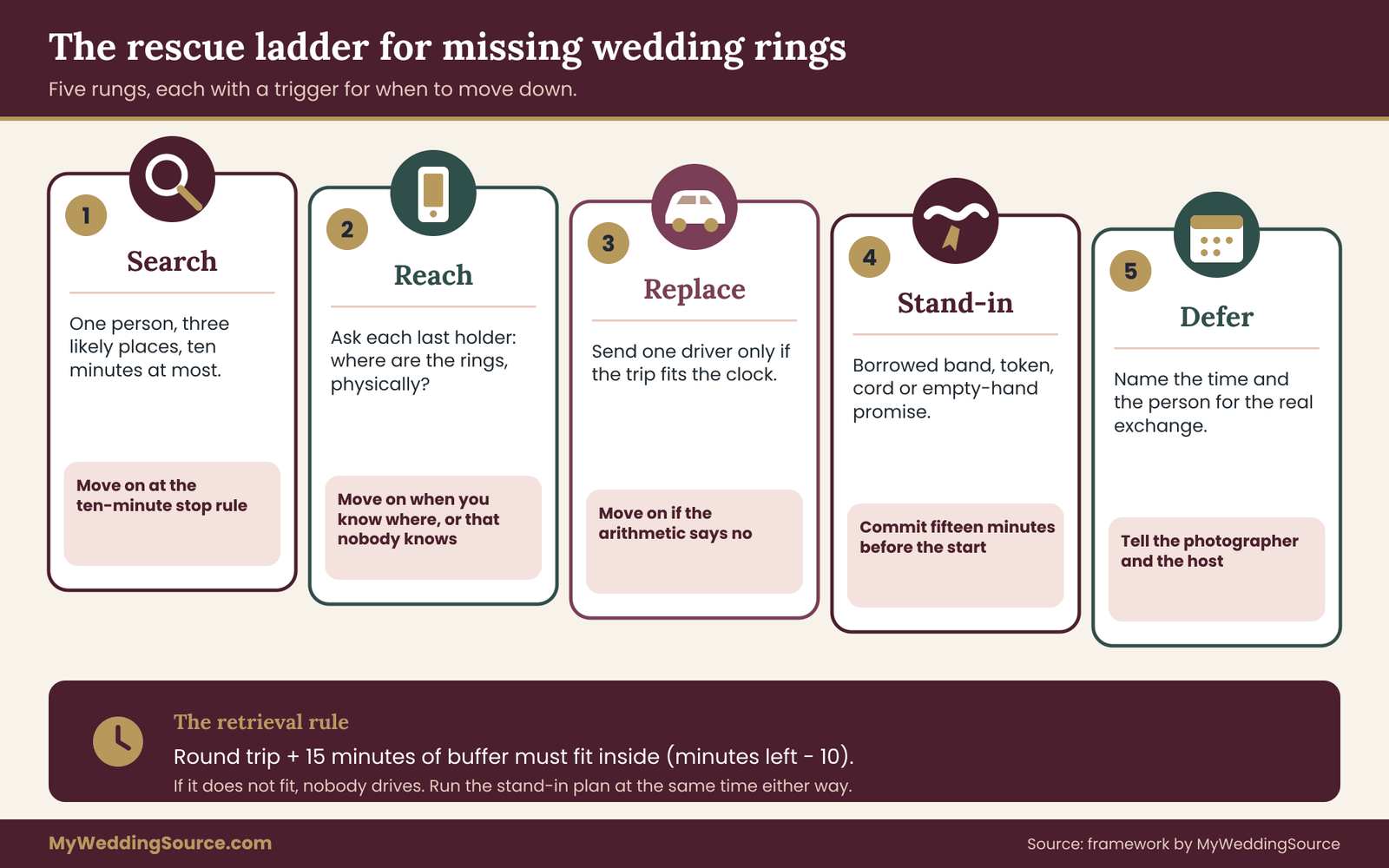
Rung one: search, for ten minutes at most. Pick one person, not the couple, to run the search. The couple should stay out of it where possible, because hunting through bags in wedding clothes is the quickest way to damage a dress or a mood. The searcher checks the three most likely places for missing wedding rings from the next section, and the clock starts when the first question is asked.
Rung two: reach. If the search turns up nothing, the question becomes who is holding the rings or who can get to them. The searcher makes direct calls to the people who last had custody. Ask each one the same plain question, “Where are the rings right now, physically?”, and ask for a yes or no, not a guess. Reach ends when you know either where the rings are or that nobody knows. Both answers are useful when you are dealing with missing wedding rings.
Rung three: replace, only if the arithmetic works. Use this rule. Take the round-trip travel time to wherever the real rings are, add fifteen minutes of buffer, and compare that sum with the minutes left before the ceremony, minus ten. If the trip fits, send one driver, who is not in the wedding party, and keep going with preparations. If it does not fit, do not send anyone, because a late ceremony start and a rushed driver cost more than the rings are worth that day.
Rung four: stand-in. If the rings cannot arrive in time, choose a stand-in from the options later in this guide and brief the officiant. This is a decision, not a failure, and it should be made calmly with a clear cutoff. A good cutoff is fifteen minutes before the ceremony, because that leaves time for a short conversation and one practice run of the wording.
Rung five: defer. The real exchange moves to a later moment: after the ceremony, at the reception, that night or later. Decide when and who will bring the rings, and tell the photographer and the person who will make announcements.
Reading the clock
With missing wedding rings, the most useful habit is to write the ceremony start time on a piece of paper and the current time beside it, and to update the paper every time a new fact arrives. A written clock keeps the decisions honest. People under stress underestimate travel time and overestimate how quickly a shop will find the right size.
For example, imagine a four o’clock ceremony and a discovery at five past three. That leaves fifty-five minutes. If the rings are in a hotel room twelve minutes away, the round trip is twenty-four minutes. Add the fifteen-minute buffer and you reach thirty-nine. Fifty-five minus ten is forty-five. The trip fits, so rung three applies. If the hotel were twenty-five minutes away, the sum would be sixty-five, and the answer would be no.
That arithmetic feels cold when missing wedding rings are the problem, but it protects you from the most common mistake: sending a car for the real rings when the drive cannot possibly fit, and then discovering at five minutes to four that you still have no stand-in plan. Always run rungs three and four at the same time. While the driver is gone, someone else prepares the stand-in. If the driver returns in time, you do not need it. If not, you are ready.
Who is allowed to make the call
One person should own the decision. In most weddings that is the planner or day-of coordinator, and where there is none, a calm family member or a best friend who is not in the wedding party. The couple’s role is to approve the stand-in choice and the wording, nothing more. That division of labor holds for any case of missing wedding rings. Naming the decision owner in advance, ideally as part of the schedule in your wedding planning checklist, prevents the common spiral in which six people offer six plans for the missing wedding rings at once.
Where missing wedding rings usually turn out to be
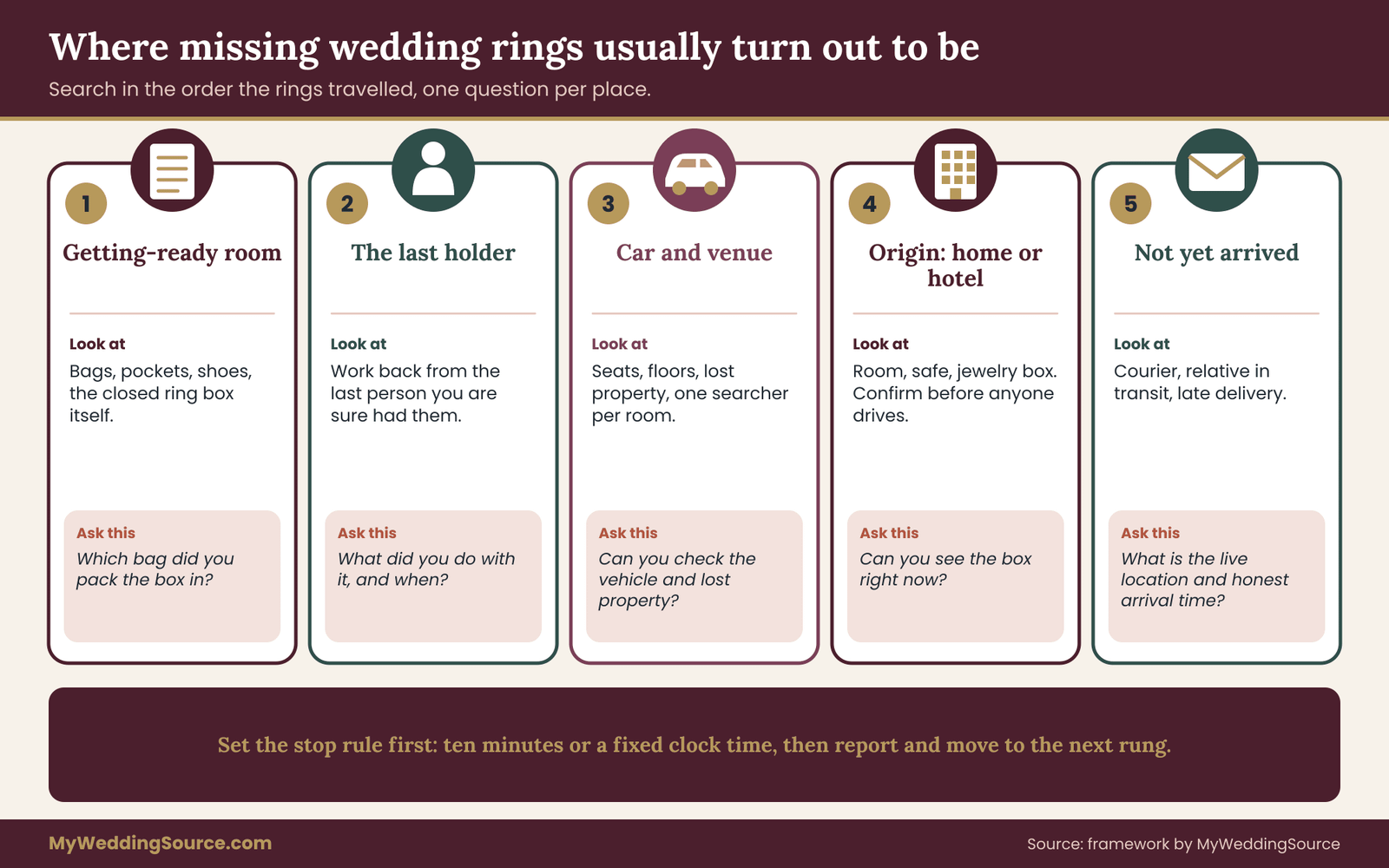
Most missing wedding rings are not lost. They are misplaced in one of a handful of predictable spots, and a short, structured search finds them more often than a frantic one. The search order below follows the path the rings took, starting with the places where the most handoffs happened.
Place one: the getting-ready room
Start where the couple dressed. Rings often travel in a small box in a bag, and bags get moved when rooms are cleared for photographs. Check the bag the rings were last seen in, the pockets of the jacket or dress, the dresser and bathroom counters, and the bottom of any garment bag. Look inside shoes and inside the ring box itself, because a closed box that looks empty is sometimes holding the rings in a slot you cannot see.
Ask whoever packed the bags a precise question: “Which bag did you put the ring box in, and did anyone open it after that?” A specific question gets a useful answer. “Have you seen the rings?” gets a worried guess.
Place two: the person who was handed them
Most ring handoffs are casual. The partner gives the box to the best man, who gives it to a groomsman to hold while he ties a tie, who puts it in his pocket. The chain is easy to reconstruct if you ask each person in turn what they did with it and when. Work backward from the last person you are sure had the rings.
If a child was the designated ring carrier, do not assume the child has them. Check with the adult responsible for the child. Children put things down, lose track of them and hand them to other children. Where a child or a pet has been given real rings, treat the case as a custody problem and read the later section on how to avoid it.
Place three: the vehicle and the venue
Next check cars, rideshares, shuttles and the venue itself. Rings slip out of pockets onto car seats and floors, particularly after a long dress or suit has been folded into a seat. Ask the driver or shuttle company to check the vehicle, and ask the venue manager whether anything has been turned in. Venues sometimes have a lost-and-found location that nobody mentions until asked.
A fast way to cover the venue is to assign a person to each room: ceremony space, reception space, restrooms and dressing rooms. Each person checks only their room, for five minutes, and reports back by text with a yes or no. Splitting the search this way takes a fraction of the time of a single person walking the whole building.
Place four: the original home, hotel or storage
If the previous places are empty, the rings are probably where they started: the home, the hotel room, the safe or the jewelry box. This is the case of missing wedding rings that sends someone on a drive. Before sending anyone, get a confirmation that the rings are really there. A call to a roommate, a parent or a hotel front desk can establish this in two minutes, and it prevents the worst outcome, which is a round trip that finds nothing.
If the rings are in a hotel room safe, find out who has the code or key, and whether the front desk can open it. Some safes need the guest’s identification at the desk, and some hotels will not open a safe without the registered guest present. Knowing this in advance changes whether the trip is practical.
Place five: the not-yet-arrived
Sometimes the rings are with a person who is on their way, or with a courier, or in a package that has not been delivered. If the missing wedding rings are inbound, get a live location or a delivery status and an honest estimate. Apply the same arithmetic as before: does the arrival plus a buffer fit inside the minutes available? If the answer is uncertain, treat the rings as missing and prepare the stand-in in parallel.
Setting a stop-search rule
Searches for missing wedding rings expand to fill the time available. Set a hard rule at the start: the search runs for ten minutes, or until the clock reaches a fixed point, whichever comes first. When the rule hits, the searcher reports and the decision owner moves to the next rung. Without a rule, people keep opening the same bag for the fourth time, and the stand-in plan that would have saved the ceremony never gets built.
The searcher should also keep a short written list of where they looked and who they asked. If the rings turn up later, you will know exactly where. If they do not, the list is useful to an insurer, a venue or a hotel when you file a report. The same list belongs in your wedding planning checklist folder, together with the other day-of records.
What to do if the rings were stolen
Most cases of missing wedding rings are mix-ups, not thefts. If you have a real reason to suspect theft, for example a bag is gone and someone saw a stranger near it, tell venue security and, where appropriate, contact local police. Do this calmly and in parallel with the stand-in plan, not instead of it. A police report also matters later for any insurance claim.
Do not accuse anyone. Ask the venue to check any camera coverage of the area and to look at who had access to the room. Save the accusation conversation for after the wedding, and then only if the evidence supports it.
Reading the situation before you run
Not every case of missing wedding rings calls for the full ladder. A quick triage of four questions tells you which rung to start on and how loudly to ask for help.
How many rings are missing? A single missing ring is a smaller problem than two missing wedding rings, because the partner who has a ring can still take part in a meaningful exchange. It also changes the stand-in options. If one ring is present, a single-ring exchange followed by a later full exchange can work well.
How much time is left? More than ninety minutes means every rung is open. Between sixty and thirty minutes, replace is possible only for a nearby trip, and the stand-in plan must start now. Under thirty minutes, go straight to stand-in, and treat anything that arrives in time as a bonus.
Where is the nearest known source of a ring? A known location, such as a hotel room, a parent’s house or a jeweler holding the rings for pickup, is a very different case from a total unknown. The nearer the known source, the more the replace rung is worth trying.
Who is the calmest person available? This is a practical question. The person who runs the search should be someone who can ask simple questions and stay quiet when answers are slow. The couple’s parents are often not the right choice, even though they are the most motivated.
Why the couple should step back
It is tempting for the couple to take over the search, and it is almost always a mistake. Partners in wedding clothes, with hair and makeup done, cannot search a building quickly. They cannot drive without risking the clothes, and their stress spreads to everyone around them. The most helpful thing a couple can do is to stay in a calm place, approve decisions and keep their own preparation on schedule.
A practical way to hold this line is a single sentence agreed in advance: “If something is missing, tell the coordinator first, and the coordinator tells us only what we need to decide.” It sounds blunt, but it protects the mood of the room. Couples who have said this out loud to their party before the wedding usually find that the missing wedding rings problem, if it happens, is handled in the background.
The first message to send
When the search for missing wedding rings starts, send one short message to the people who need to know. It should say what is missing, where it was last seen, who is searching and when the next update comes. A model:
“Update at 3:05: both rings missing from the ring box. Last seen in the hotel room at 11. Dana is searching the getting-ready room, Marcus is calling the hotel. Next update at 3:15.”
Notice what the message does not contain: speculation, blame or a request to everyone to start looking. Every extra person in the search makes the information messier. Send the message to the coordinator, the best man and maid of honor, the officiant and the person holding the stand-in kit if you have one. Everyone else can learn later.
Keeping the schedule alive during the search
While the search for missing wedding rings runs, the rest of the day should keep moving. Hair, makeup, photographs and music checks do not stop because the rings are in doubt. A coordinator who lets the whole schedule stall turns a ring problem into a timing problem, which is worse. Keep photography on its normal path. If the photographer is already shooting details, they can simply skip the ring shots and take them later, once the real rings are found or after the later exchange.
If the ceremony start time needs to move, decide that early and tell the officiant, musicians and venue staff directly. A fifteen-minute delay announced at T-minus forty is a minor adjustment. A fifteen-minute delay announced at T-minus five is a visible problem. The wedding vendor timeline is a good place to check which vendors have fixed end times that a late start could affect.
Stand-in options when missing wedding rings stay missing
If missing wedding rings cannot arrive in time, you need something to hold, place or offer during the exchange. The options below are ranked by how closely they preserve the feel of a ring exchange, not by cost. Each has a best use and a pitfall, and the right choice depends on what you have within reach and what matters to the two of you.

Option one: borrowed rings from family or guests
With missing wedding rings, a parent, grandparent or friend may be wearing a plain band that can be lent for the ceremony. This option has real emotional weight, especially when the lender is a married relative who is glad to be part of the moment. It works best when the lender’s ring is close to the right size, since a ring that cannot be slid onto a finger loses the point of the gesture.
The pitfall is that a borrowed ring can feel like a loan the couple now owes. Ask the lender directly and privately, explain that the ring will be returned right after the ceremony, and make sure they are comfortable removing it. Never take a ring from someone who hesitates. A hesitant lender will watch their hand through the whole ceremony.
A practical tip: ask the lender to place the ring on a pillow or in a small dish, and return it in the same way. Handled that way, the borrowing is clearly a loan and not a gift, and nothing awkward is left over.
Option two: a plain stand-in band bought nearby
If a jeweler, department store or accessories shop is within a few minutes and open, a simple inexpensive band is a workable stand-in. The aim is a temporary ring for the exchange, not a replacement for the real one. Pick a plain band that fits loosely enough to slip on, and buy it with the receipt in hand, because many shops will accept a return of an unworn item and some will not.
This option has the highest risk of eating the clock, since finding a shop, parking and finding a size all take longer than expected. Use it only when the shop is very close and you have already confirmed it is open. Do not start a shopping trip with fewer than forty minutes left. The Federal Trade Commission publishes guidance on how metal content and descriptions of jewelry are meant to be presented, which is useful if you want to know what a label means, but a temporary ring does not need to be an investment.
Pay with a credit card where possible. The Consumer Financial Protection Bureau explains how card dispute rights work if a purchase goes wrong, and a card gives you a clearer record than cash.
Option three: a token ring made on the spot
A ring does not have to be metal. A twist of ribbon, a braided strand of grass or ivy, a loop of florist wire wrapped in tape, or a ring cut from a flower stem can serve as a symbol. Florists and bridesmaids carry materials for this. A florist will often make a simple flower ring from stem and wire in five minutes.
This choice has a gentle charm and works well in outdoor and informal ceremonies. It is less suited to a formal church or a very traditional family, where a token may be read as a joke. Judge the room honestly, and consider the officiant’s view. A token ring is also temporary by nature, so the couple should expect to keep it as a keepsake and not wear it afterward.
Option four: a ribbon or cord for binding
Some traditions use a cord, ribbon or cloth wrapped around the couple’s joined hands in place of a ring exchange, a custom often called handfasting. If it fits the ceremony’s style, it can hold the whole substitution. The couple’s hands are bound loosely while the officiant speaks the stand-in words, and the cord is later kept as a keepsake.
If you choose this, use a cord long enough to wrap twice and soft enough not to chafe. Practice the wrap once, because a cord that slips off during the vows makes more of a scene than a missing ring would. Make sure the symbolism fits the tradition of your ceremony. If a faith tradition is part of the day, ask your officiant or religious leader whether a cord is acceptable in place of the rings.
Option five: an empty-hand exchange with a promise
The simplest option is no object at all. The couple faces each other, holds hands, and says the ring words as a spoken promise that the real rings will follow. The officiant describes the pause plainly: the rings are not here today, but the promise is, and the exchange of rings will take place later.
For missing wedding rings, this is the least fussy choice and the one that holds up under any circumstance. It leaves no loose objects, needs no preparation and cannot be forgotten. Its only cost is the visual: the photographer has no ring close-up for the moment. Many couples find the plain version the most moving because of that.
Option six: delaying the ceremony
Sometimes the right answer to missing wedding rings is a short delay. If the rings are close and a late start would be minor, you can hold the ceremony for ten or fifteen minutes. Guests will usually take a short delay in stride if someone tells them kindly, often through the officiant or a musician filling the time with a softer piece.
Set a hard limit before you choose this option. A delay of fifteen minutes is manageable. A delay of thirty minutes strains guests, children and caterers, and it may cut into vendor hours that are paid by the minute. If the rings are not in hand by the limit, go ahead with a stand-in. The wedding vendor contract overview is a good place to check which vendors charge overtime for late starts.
Choosing between them
A short rule of thumb works for missing wedding rings. If the rings can be there within fifteen minutes, delay. If a shop or a loan is available and the fit matters to you, use a borrowed or bought stand-in. If the ceremony is informal and the setting suits it, make a token. If none of those fit the room or the clock, use the empty-hand exchange. All of them are acceptable. None of them makes the marriage less real.
The symbolic substitution script
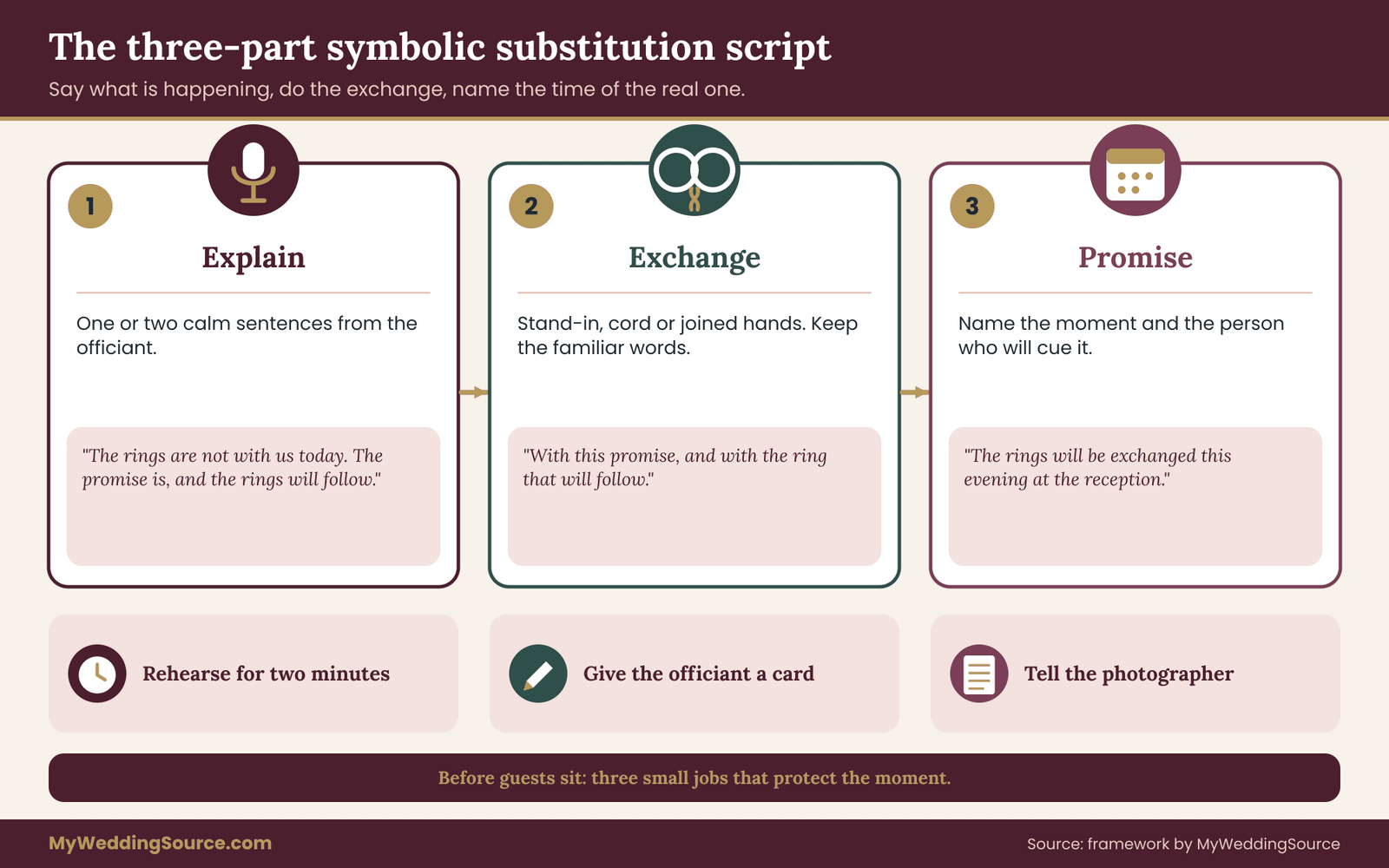
Once you have chosen a stand-in for missing wedding rings, the ceremony needs a few lines that name what is happening. Without them, guests watch a strange moment and wonder. With them, the pause becomes part of the story. The script has three parts: a short explanation, the exchange itself and a promise about what follows.
Part one: the plain explanation
The officiant should say, in one or two sentences, that the rings are not here today and that the couple will exchange them later. The tone should be calm and a little warm, never apologetic or comic. Humor can work if it is the couple’s style, but a joke that makes the couple the butt of the moment will linger in the room.
A model for the officiant:
“As you may have noticed, the rings are not with us today. What matters is the promise, and that promise is here. We will use a simple stand-in for now, and the rings will follow.”
Keep it short. Guests have already figured out something is different, and a long explanation reads as embarrassment. One sentence of context is enough.
Part two: the exchange with the stand-in
The couple then performs the exchange with whatever you have chosen. For a borrowed or bought band, each partner places the stand-in on the other’s finger as usual and says the ring words. For a token or cord, the officiant guides the gesture. For the empty-hand option, the couple joins hands and says the words aloud.
If your ceremony has set words, such as “with this ring, I thee wed”, you can keep them or adapt them. A line such as “with this promise, and with the ring that will follow” fits an empty-hand exchange. Keep any change small. Familiar words steady the room, and heavy rewriting in a stressful minute invites mistakes. The wedding ceremony step-by-step guide lays out where the ring words fall in a typical ceremony, so the officiant can mark that spot.
Part three: the promise
The officiant closes the moment with a promise about the real exchange, and says when it will happen. Naming a time matters. It tells guests that the plan is real, and it gives the couple a task to complete. A model:
“The rings will be exchanged this evening, and we invite you to witness it at the reception.”
If you cannot say when, say simply that they will be exchanged soon. Do not promise a public moment unless you intend to hold one.
Practicing the script once
A two-minute run-through with the officiant, before the guests are seated, protects the moment. Read the three parts aloud, and decide who hands what to whom. Where the stand-in is a borrowed ring, decide who holds it and how it returns to the lender. Where it is a ribbon, decide who ties it and who unties it. This tiny rehearsal prevents the fumbles that would otherwise happen in front of everyone.
If the officiant is a family friend rather than a professional, give them the script on a card. People who officiate rarely, and who have just learned of a problem, do better with words in their hand. A card with the three parts and the time of the later exchange takes thirty seconds to write.
What the photographer needs to know
Tell the photographer and the videographer about the missing wedding rings, in a sentence. They can adjust, shoot the exchange from a different angle, and avoid zooming in on empty fingers. They can also plan to capture the later exchange, which becomes a bonus scene. The photographer does not need a long explanation, only the plan.
A good phrase to use is: “The rings are not here, so we will exchange stand-ins and do the real rings tonight. Please skip the ring close-ups for now.” A photographer who has heard this once will not need reminding, and the album will tell a clear story. If a ring shot is wanted for the album, schedule it after the real rings turn up, in a quiet few minutes at the reception.
Rings, the marriage license and the officiant
Couples facing missing wedding rings sometimes worry that the marriage will not be valid without the exchange. In general it will be. Understanding why helps you stay calm, and it helps you talk to your officiant with confidence.
What makes a marriage legal
The legal steps vary by state, but the core elements are consistent: a marriage license issued by the proper local office, an officiant who is authorized to perform marriages, the required witnesses where a state requires them, spoken consent from both partners, and a signed license returned to the issuing office within the time the state sets. USAGov publishes a plain overview of how to get a marriage license and where to find your state’s rules.
Rings are not on that list. They are a custom, tied to culture, faith and family. Some ceremonies include them, some do not, and many couples marry in a courthouse with no jewelry at all. If missing wedding rings is your only problem, the legal side of your wedding is untouched.
When the ceremony itself calls for rings
There is one caution. Some religious ceremonies treat the ring exchange as a formal part of the rite, and some faith leaders have particular expectations about when and how it happens. A priest, rabbi, imam, pastor or other officiant may want to follow the usual order, or may have a preferred way to handle a stand-in.
Ask early, and ask plainly: “If the rings are not here, how do you want to handle that part of the ceremony?” Most officiants have faced this before and have a ready answer. Their answer will usually be better than anything you improvise, and it protects the integrity of the rite. If your tradition requires the exchange to be completed, the officiant may suggest a borrowed ring as the closest honest option.
Talking to a professional officiant
A professional officiant has often seen missing wedding rings before and will have a wording ready. Share the facts in thirty seconds: which rings are missing, what the plan is, when the real exchange will happen and which stand-in you have chosen. Give them the script from the previous section or ask for their own.
Professionals also know that the ceremony’s pacing matters. They will ask about timing, and they can fill a short delay with a reading or a moment of music. If you are marrying with a friend or relative as officiant, they may be nervous. Take two minutes to hand them the card, tell them the plan and ask if they are comfortable. Their confidence affects the room more than anyone’s.
Do not hold up the paperwork
The license is separate from the rings, and it should never be the thing that gets postponed. Do not let the ring problem delay the signing, the witness signatures or the return of the license. Assign someone to make sure the license is signed in all required places after the ceremony. A missing ring can be fixed in a day, but a wrongly handled license can take weeks to repair.
If you are unsure what your county requires, call or visit its marriage license office. The office can tell you what must be done, by whom and within what time. That is where the current rules live, and it is the right place for a question that your officiant cannot answer. Where you have a destination wedding or a ceremony in another state, check that state’s rules rather than assuming they match your home state.
Ring custody before the wedding day
The best answer to missing wedding rings is a plan that makes them very unlikely. A ring custody routine is not elaborate. It is a handful of agreements about who holds the rings, where, and when each handoff happens, written down so that no one has to remember. Most of the work happens in the weeks before the wedding, and the hard part is being specific.
Name one custodian per stage
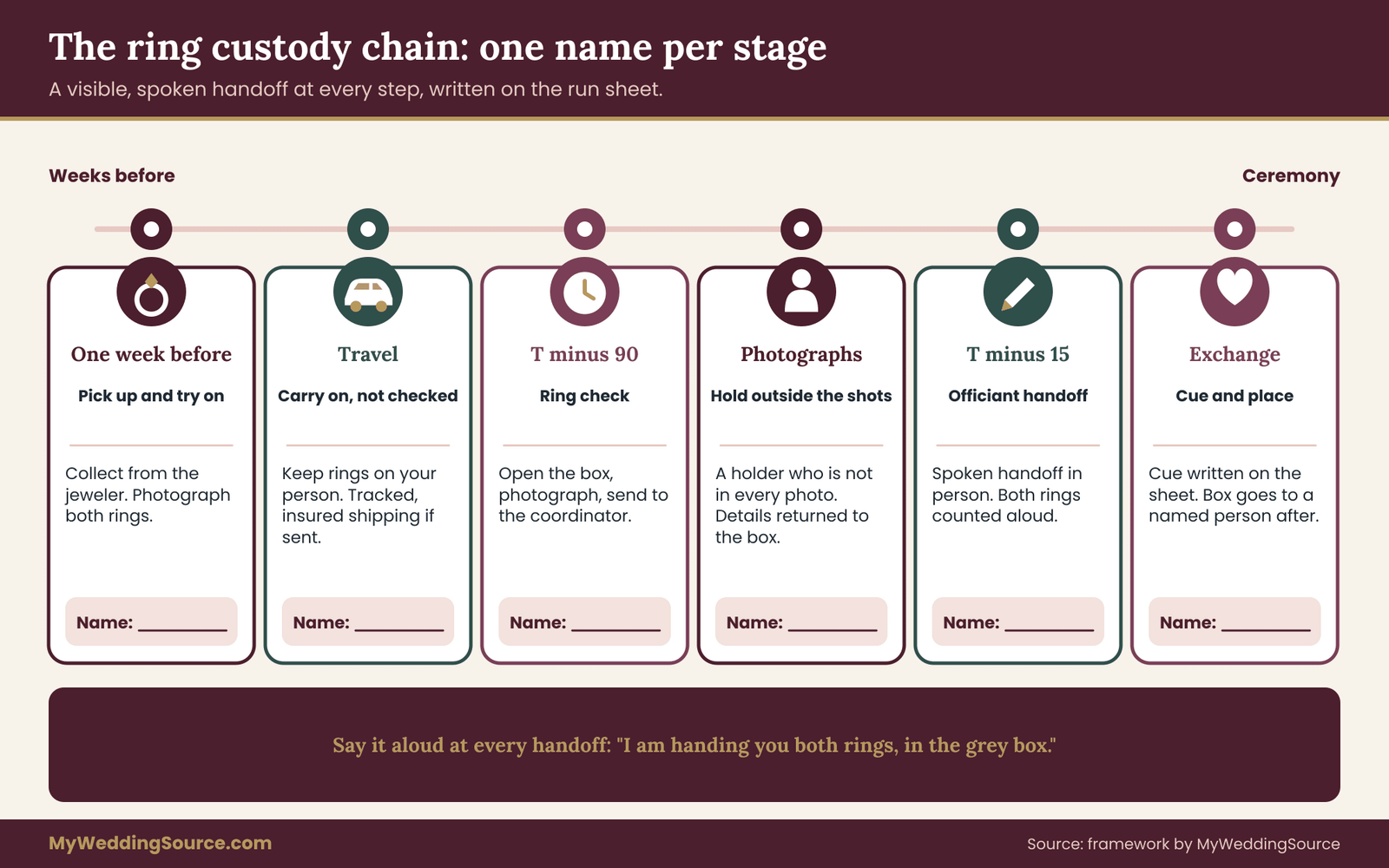
A custody chain is a list of stages, with exactly one named person responsible at each stage. The stages are usually these: storage before the wedding, travel to the wedding location, the getting-ready period, the hold during photographs, and the handoff to the person who presents the rings at the ceremony. One person, one stage, one name.
The failure pattern behind many missing wedding rings is shared responsibility, where two people each assume the other has the rings. Shared custody feels safer because there are two sets of hands, but it is actually weaker because neither person feels fully accountable. If you want redundancy, add a second person who checks, not a second person who holds.
Separate the rings from other valuables
Keep the rings apart from the bag that holds a wallet, phone, keys and makeup. Those bags move constantly, are opened often, and are left in cars. A small dedicated ring box or pouch, kept in a pocket or a small inner compartment, is more stable. Many couples assign this to a trusted friend or relative rather than to a partner, because partners are the busiest and most distracted people on the day.
It also helps to keep each ring in a place that does not depend on the other. If both rings are in a single box and the box is lost, both are lost. If they are in two places, a single failure leaves one ring. That is a better situation for the ceremony, and it makes a stand-in less likely.
Check sizing and fit in advance
Some cases of missing wedding rings are really fit crises. A ring that does not slide on because of weather, swelling or a sizing mistake becomes useless at the key moment. Try both rings on the week before the wedding, and again the day before. If a ring is tight, ask the jeweler about a quick adjustment while there is still time. The Gemological Institute of America offers consumer education on jewelry that is useful if you want to understand metals and settings before talking with a jeweler.
Also check for engraving, finish and clasp problems, and pick up the rings from the jeweler at least a week before the date. Last-minute pickups are a common source of trouble, because the shop may be closed, the order may not be ready or the jeweler may need another day. A pickup a week early leaves room to fix anything.
Plan travel for out-of-town weddings
Travel is where missing wedding rings most often begin. When flying, carry the rings in your hand luggage, not in checked baggage, and keep them with you through screening. The Transportation Security Administration publishes screening guidance for travelers, and it is worth reading before the trip so that you know how jewelry is handled. Keep the ring box in a visible but secure pocket, not at the bottom of a bag.
If a ring needs to be shipped, for example from a jeweler to a destination, use a service with tracking, signature on delivery and insurance, and allow several days of margin. The United States Postal Service describes its tracking and insurance options, and any carrier can explain what its coverage includes and excludes. Do not ship rings at the last minute. A ring that is in transit on the wedding day is, for practical purposes, a missing ring.
Put the rings in the paperwork
Add the rings to your day-of document, so that missing wedding rings are caught early. The ring custody chain, the names of the custodian at each stage and the time of the ring check should appear beside the other day-of details in your wedding planning checklist or your coordinator’s run sheet. A written custody chain turns a vague worry about missing wedding rings into a routine, and when something goes wrong, anyone can read the sheet and see who last held the rings.
If you have a day-of coordinator, give them the chain in writing and ask them to confirm it with each custodian the day before. Coordinators are experienced at this kind of confirmation, and it takes only a few messages. If you do not have a coordinator, ask a calm friend to play that role for this one task.
Photograph the rings before they travel
Take a clear photograph of the rings in their box, with a timestamp, on the morning of the wedding or the day before. The photo serves three purposes. It proves what the rings look like, which helps in a search or a claim. It gives you a record of the last known position. And it reminds everyone involved that the rings exist and need to be accounted for.
Send the photo to the custodian and the coordinator. When a custodian hands the box to the next person, the next person looks at the photo and confirms the rings in the box match. This takes ten seconds and removes the most common failure, a box that has quietly become empty.
Create a stand-in kit
A small stand-in kit makes the ladder for missing wedding rings faster. It can be a pouch with a length of ribbon or cord, a laminated card with the three-part script, two inexpensive plain bands in common sizes or a florist wire ring set, and a clear note listing the plan for borrowing. The kit lives with the coordinator or the best man and is brought to every wedding event, including the rehearsal.
The kit costs very little and may never be opened. The wedding day accessories planning guide covers other small items worth backing up, such as spare pins, hem tape and buttons. Its value is that it removes the need to invent a plan for missing wedding rings under pressure. Couples who prefer not to buy spare bands can leave those out and rely on the ribbon and the card. Even the card alone changes how the first ten minutes feel.
Ring custody on the day: the handoff chain
On the wedding day the rings pass through a small number of hands, and each handoff is a chance for missing wedding rings to begin. The goal of the day-of routine is to make every handoff visible and brief. Visible handoffs mean that someone else is watching. Brief ones mean there is less time for a mistake.
The ninety-minute ring check
Choose one fixed moment, ninety minutes before the ceremony, for a ring check. The custodian opens the box, looks at both rings, takes a photograph and sends it to the coordinator with a one-line message: “Both rings here, in the box, in my jacket.” The coordinator replies with a thumbs-up or a simple “got it.”
This check does three things. It happens early enough that every fix on the ladder is still open. It forces the question “do we have the rings?” at a calm time, not a stressful one. And it gives you a timestamped record that the rings were present at ninety minutes, which narrows any later search to the stretch between the check and the ceremony.
If the check reveals missing wedding rings, you now have ninety minutes, and the situation is routine. Most of the incidents described in this guide become minor problems when found at this point.
Hand off with words, not just hands
Every handoff should include a spoken sentence from both people. The giver says “I am handing you both rings, in the grey box.” The receiver says “I have both rings, in the grey box.” It feels slightly silly the first time, and it is extremely effective. People who say the sentence aloud remember it, and people who hear it can confirm it.
Silent handoffs are where missing wedding rings begin. A box passed over a shoulder while both people are talking to someone else is the typical failure. If a handoff cannot be done face to face and aloud, do not do it. Wait until the two people can speak.
Keep the rings with the person, not with the bag
During the day, the custodian should keep the box in a pocket or on their person, not in a bag that can be set down. Bags get moved, borrowed, picked up by the wrong person and left in cars. A pocket stays with its owner. If the custodian’s clothing has no suitable pocket, choose a different custodian, or use a small pouch on a cord or belt loop.
At the ceremony site, the custodian should keep the rings until the moment they are needed, and should know the exact cue. The wedding ceremony cue sheet guide explains how to write that cue so that the person presenting the rings is not guessing about the timing.
Put the rings in the officiant’s hands early
A common approach is to hand the rings to the officiant before the ceremony, either in a small box or on a pillow, so that they are already at the front. Officiants are used to this and keep track of the rings during the processional. The couple does not have to think about them, and the ring bearer, if there is one, can carry a decoy.
If you use this approach, do the handoff aloud and in person, ten to fifteen minutes before the start, with a brief check that both rings are in the box. Then the officiant becomes the single custodian until the exchange. The key point is that the officiant’s name goes on the chain with the same weight as everyone else’s.
The ring bearer problem
Children are delightful ring bearers and unreliable ring custodians. They drop things, hand things to friends and wander. A common safe practice is to give the child a decoy: a box with ribbon-tied fake rings, a small pillow or a simple wooden bit, while the real rings stay with the best man or the officiant. The child feels important, and the real rings never travel the aisle in a small hand.
The same applies to pets. A dog carrying a pouch down the aisle is a lovely sight, but the pouch should hold a decoy. A dog can slip a leash, chew a ribbon or simply run off. Treat the animal’s ring role as a visual and keep the real rings with an adult. The way a family ring bearer role is shaped is a design choice, and it has nothing to do with whether the real rings are present.
Decide who holds the rings during photographs
The period between the ninety-minute check and the ceremony is the riskiest, because it is full of photographs, group arrangements and clothing changes. Decide ahead of time who holds the rings during this stretch, and make it someone who is not being photographed constantly. The best man or maid of honor are often in many photos, so a close friend or relative who is not in the wedding party can be a better holder.
If rings must be used in a photograph, such as a detail shot, the photographer should photograph them with the custodian present, and return them straight to the box at the end of the shot. A ring left on a styling surface for “one more frame” is among the commonest ways to end up with missing wedding rings.
Closing the chain after the exchange
After the exchange, the rings are on fingers, and the custody chain is complete. But a second, smaller chain starts: the stand-in or any spare items go back to their owners, the ring box goes to a named person, and the couple decides who handles the rings during messy parts of the reception such as dancing and cake. Many couples take their rings off during dinner or sports and put them in the custody of a trusted person. Do the same here, with the same discipline.
A worked example of missing wedding rings
A worked example of missing wedding rings makes the ladder concrete. The couple below is invented for illustration. The details are chosen to show the decision rules at work, not to describe any real event.
The setup
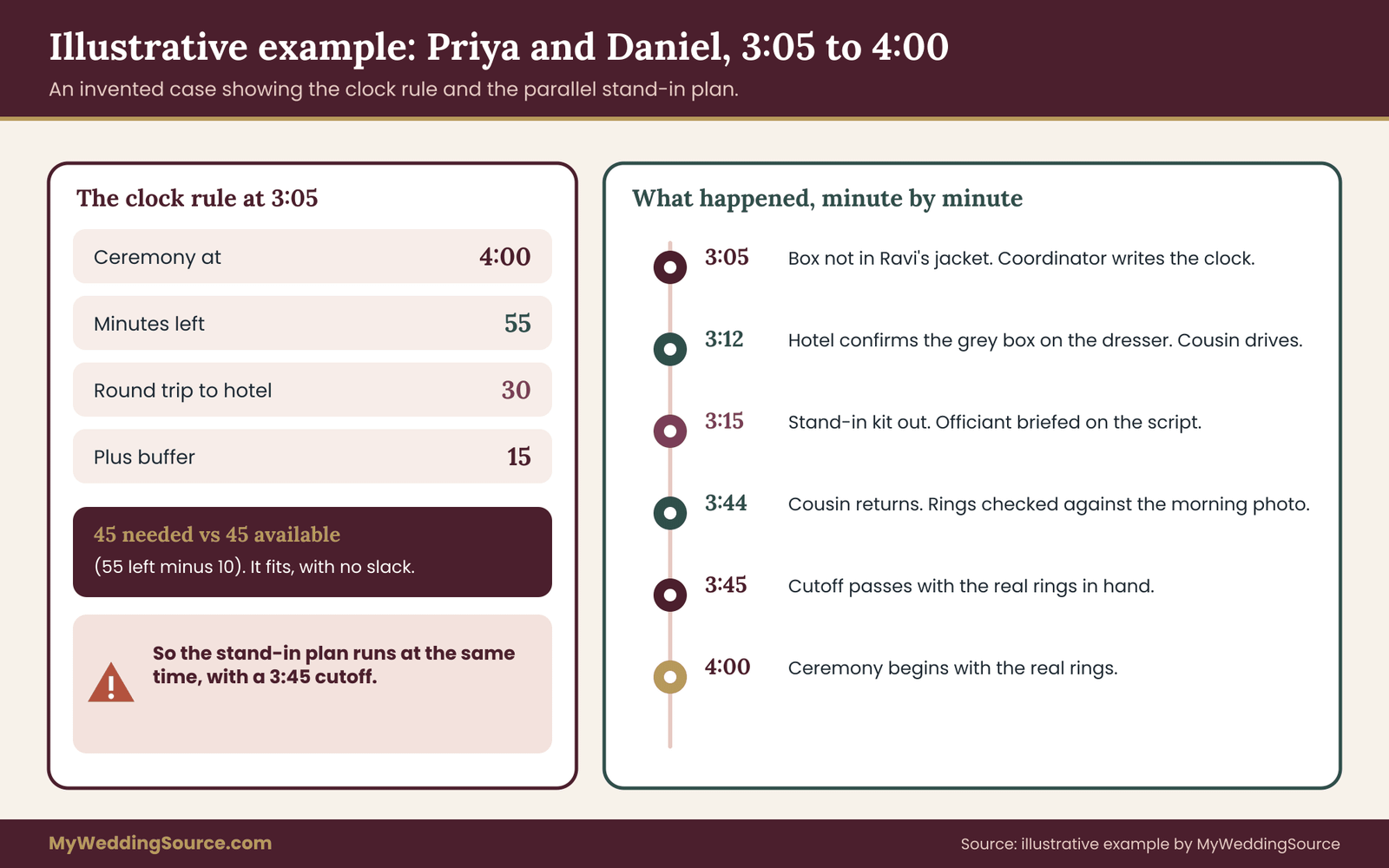
Priya and Daniel are marrying at a garden venue at four in the afternoon. They dressed at a hotel about fifteen minutes from the venue. The rings were in a small box that Daniel’s brother, Ravi, was supposed to carry. The couple’s coordinator, Maya, has a written custody chain, but the ninety-minute check was missed because the photographer arrived early and the morning moved quickly.
At five past three, Maya asks Ravi for the rings to place them with the officiant. Ravi reaches into his jacket and finds only a handkerchief. This is a classic case of missing wedding rings: not lost, just not here. He thinks he left the box on the hotel dresser when he changed.
Step one: classify and write the clock
Maya identifies the case of missing wedding rings in one line: both rings, probably in the hotel room, fifteen minutes away. She writes the clock on a card: ceremony at 4:00, now 3:05, fifty-five minutes left. She sends the update message to the officiant, the best man and the planner, and tells Priya and Daniel only that she is handling a small problem and will report in ten minutes.
Step two: search and reach, ten minutes
Maya asks the hotel front desk by phone to check the room. The hotel says housekeeping has not yet cleaned the room and that a staff member can look. Meanwhile Ravi checks his car and the venue’s dressing room. Within eight minutes the front desk reports that a small grey box is on the dresser. The rings are found, fifteen minutes away.
Step three: run the arithmetic
The round trip is thirty minutes. With a fifteen-minute buffer, the total is forty-five minutes. Fifty-five minutes left, minus ten, gives forty-five. The trip fits, but with no slack. Maya decides on both options at once: Ravi’s cousin, who is not in the wedding party, will drive, and the stand-in plan begins in parallel.
Step four: prepare the stand-in anyway
Maya takes the stand-in kit from her bag. She briefs the officiant with the three-part script. She decides the cutoff: if the cousin is not back with the rings by 3:45, they will use the empty-hand exchange with a ribbon on the couple’s joined hands and perform the real exchange at the reception. She tells the photographer to skip ring close-ups until she gives the word.
Step five: the outcome
The cousin leaves at 3:12, finds the grey box with the hotel’s help, and returns at 3:44. Maya checks both rings against the morning photograph, confirms the sizes and gives the box to the officiant. The ceremony starts at 4:00 with the real rings.
Had the traffic been worse, the 3:45 cutoff would have triggered the stand-in. The example shows that, with missing wedding rings, the arithmetic and the parallel plan work together: the arithmetic decides whether to try retrieval, and the parallel plan means the ceremony does not depend on it.
What the example teaches
Notice three things about handling missing wedding rings. First, the couple was kept out of the search, and learned of the problem only after it was solved. Second, the decision owner had a written clock and a written cutoff, which stopped the problem from expanding. Third, nobody had to invent anything, because the stand-in kit and the script were already in the coordinator’s bag.
Notice also what the example did not do. It did not claim the stand-in would always be unnecessary. It did not treat the cousin’s drive as a certainty. And it did not build in a sense that someone had failed. Ravi’s slip was a normal one, and the lesson Maya took was to run the ninety-minute ring check even when the morning is busy. The custody chain would have caught it at 2:30, when there was still an hour and a half.
If you want to adapt the example, change the numbers to fit your own venue. A hotel five minutes away makes the arithmetic easy. A hotel forty-five minutes away makes it impossible, which is why a couple with a distant getting-ready location should hold the rings at the venue, not in the hotel. That single decision, made weeks before, removes most of the risk of missing wedding rings from the day.
Failure conditions: when the protocol itself breaks
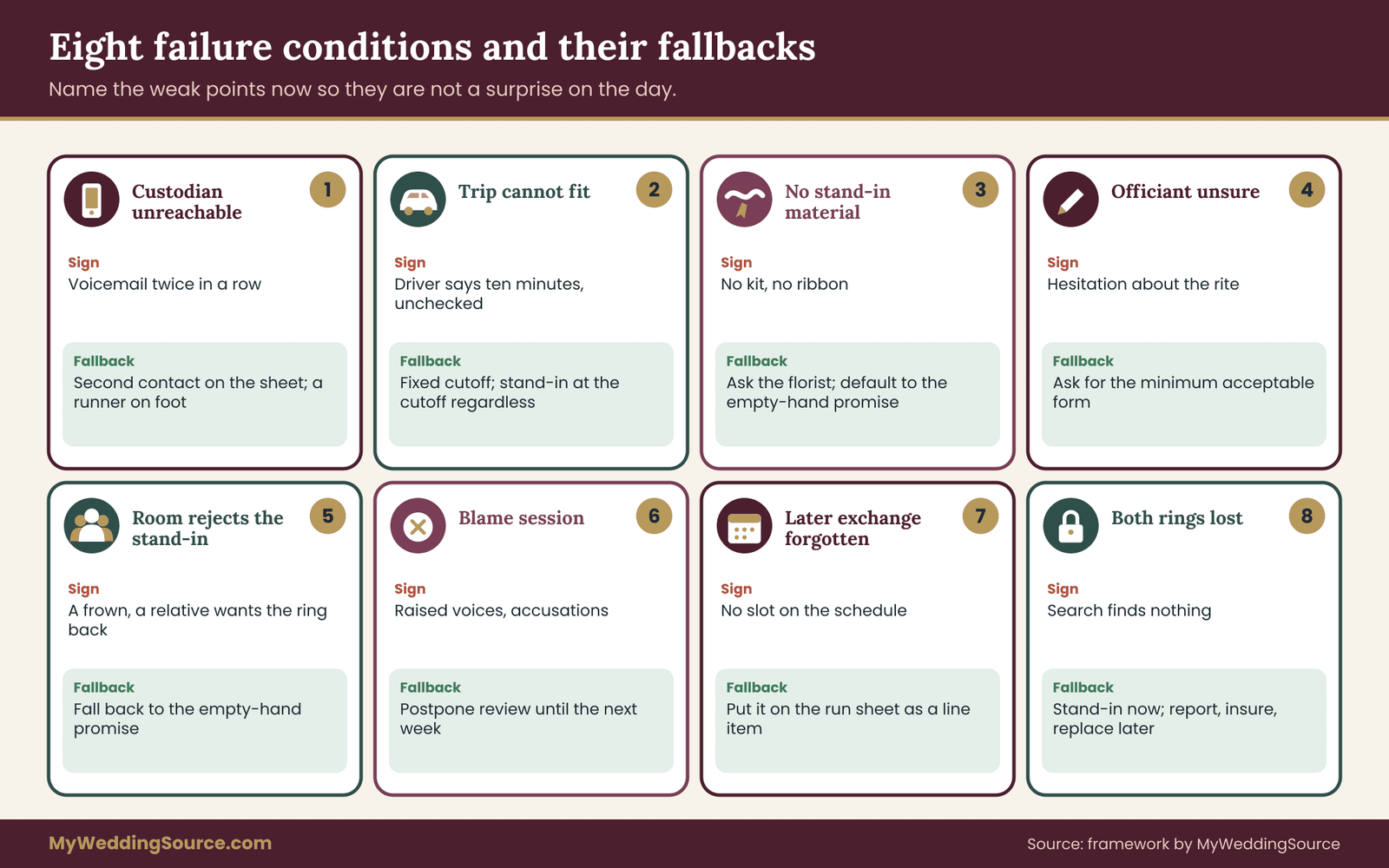
A protocol for missing wedding rings that only describes the happy path is not much use. This one has known weak points, and it is better to name them now than to find them in the middle of the day. Each failure condition below has a sign to watch for and a fallback.
Failure one: the custodian cannot be reached
The chain that guards against missing wedding rings depends on a named person being reachable by phone. If the custodian has no signal, a dead battery or a silent phone, the whole ladder slows down at the first call. The sign is a phone going to voicemail twice in a row. The fallback is a second contact for every custodian, written on the run sheet, and a rule that the coordinator tries both numbers before moving on.
Venues with poor reception are a particular risk. Ask the venue before the wedding whether phones work in the getting-ready area and the ceremony space, and where the weakest spots are. Where reception is weak, keep a plain fallback: a person on foot who can carry a message between the rooms.
Failure two: the retrieval trip cannot fit
The arithmetic rule for missing wedding rings only protects you if the numbers are honest. Underestimated drives, unexpected traffic and parking are the usual causes. The sign is a driver who says “ten minutes” without having checked. The fallback is the fixed cutoff: whatever the driver’s progress, the stand-in plan is used when the clock reaches the cutoff time, and the driver is told to keep going and bring the real rings for the later exchange.
Never allow a driver to speed or take a risk. If the driver reports that they will arrive with a few minutes to spare, treat that as a probable failure. A relaxed arrival and a calm start are worth more than a tight one.
Failure three: no stand-in material is on hand
An empty-hand exchange works without any material, but a token or cord needs something to make it from. The sign is that the coordinator has no kit and no ribbon. The fallback is to ask the florist, a bridesmaid or the venue for ribbon or wire, or to default to the empty-hand exchange. Keep the plan to the options that can be done with nothing.
Failure four: the officiant refuses or is unsure
Some officiants are firm about the order of a rite. The sign is an officiant who hesitates, or who tells you the ceremony cannot proceed without rings. The fallback is a direct, calm conversation about what the tradition allows. Ask what the minimum acceptable form is, such as a borrowed ring, and whether the real exchange may follow. If the officiant truly cannot proceed, that is a major issue, and it should have been raised at your pre-wedding meeting.
Raise the question early. A quick question at your first meeting with the officiant, “what do you do if the rings aren’t there?”, surfaces any hard rule weeks ahead.
Failure five: the stand-in is rejected by the room
A token ring that reads as a joke at a formal ceremony, or a borrowed ring that a relative wants back right away, can produce an awkward moment. The sign is a family member who frowns, or an older relative who is visibly upset. The fallback is the empty-hand exchange, which cannot offend. Having it as the default means no stand-in has to be defended.
If a guest voices an objection before the ceremony, listen briefly and decide with the couple. Do not argue the point. The couple’s decision stands, and a short sentence such as “we have decided this is how we will do it” ends the debate.
Failure six: the search turns into a blame session
The sign is raised voices, accusations about who last had the rings and the couple being drawn in. The fallback is a rule that blame is postponed until after the wedding, and the coordinator’s willingness to say so aloud. Save the review for a calm conversation the next week. It is usually clear by then that a normal handoff mistake caused the problem.
Failure seven: the later exchange never happens
Delayed exchanges are easy to forget, especially after a long day. The sign is a reception schedule that has no slot for it. The fallback is a named person, usually the best man or maid of honor, who holds the rings and cues the exchange at the agreed time. Put it on the run sheet as a line item, like the cake cutting.
Without a slot, many couples find the real exchange drifts into “sometime next week”, which is a letdown. If you promised guests a later moment, give it a time and honor it.
Failure eight: both rings are truly lost
If a search for missing wedding rings finds nothing, you have lost two items, not a marriage. The fallback is a plain stand-in for now, a police report if theft is plausible, notification to your insurer and a conversation with your jeweler about replacement. Many jewelers can replicate a ring from records and photographs if they made it, which is another reason to keep your photographs and receipts together.
Plan for a replacement timeline for missing wedding rings measured in weeks, not days. Custom work takes time, and a rushed replacement is more expensive and often less good. The next section covers what to do afterward.
Where this protocol is weak
Be honest about what the protocol for missing wedding rings cannot do. It cannot stop a ring from being stolen by someone determined. It cannot recover a ring dropped into a lake or a drain. It cannot replace the legal and religious steps of the ceremony, which depend on your jurisdiction and tradition. And it cannot promise that a stand-in will feel as good as the real thing, because it will not. What it can do is keep the ceremony on schedule and keep the couple’s attention where it belongs.
A good protocol for missing wedding rings is one you can actually follow. If a rule feels too heavy for your wedding, drop it and keep the core: one custodian per stage, a ninety-minute check, a fixed cutoff and a ready stand-in. Those four habits do most of the work. The rest is detail.
Telling people about missing wedding rings without making it the story
How you share the news of missing wedding rings shapes how guests remember it. A calm, brief and honest account lets the moment pass. A long apology or a joke at the couple’s expense can make it the main memory of the day.
Who needs to know, and when
Tell the officiant, the coordinator, the photographer and videographer, and the person responsible for any announcements about the missing wedding rings. Tell the wedding party only what they need: who is searching, who is on a task, and that the ceremony will go ahead. Guests do not need advance notice unless the start is delayed, and then the message should be one sentence through an usher or the officiant.
Parents are a special case with missing wedding rings. They will notice, and they are likely to be worried. A short private word from the coordinator, such as “the rings are being handled and the ceremony will go ahead”, is kinder than silence. Do not give them tasks that put them in the search, because their worry can spread to the room.
What to say to guests
If the stand-in is visible, a single sentence from the officiant is enough. If a delay needs to be explained, an usher can say, “We are a few minutes behind and will begin shortly.” No one needs the full story. If asked, a short truthful answer is fine: “The rings are on their way, and we are doing the exchange later.”
With missing wedding rings, guests tend to take their cue from the couple. A couple who smile and carry on tell the room that all is well. A couple who look anxious tell the room to be anxious. This is why the couple should be shielded from the search and told only what they must decide.
Humor, used carefully
A light touch can help. A guest or the officiant might say that the rings will make a better story than the ceremony, and a wedding party may laugh with the couple. The line between humor that includes the couple and humor that corners them is thin. Let the couple set the tone, and avoid jokes about who lost the rings. A person who feels teased at their friend’s wedding will remember it.
Handling the person who misplaced the rings
If the missing wedding rings were left behind by a specific person, that person is probably mortified. Make a point of thanking them for their help during the day and of treating the slip as ordinary. People make this kind of mistake all the time, and the way the couple responds teaches the party what happens when something goes wrong.
Do not discuss fault at the wedding. A brief private word afterward, thanking them for their part in solving it, goes a long way. If you hold a ring, you hold it with care, and a slip does not change that.
Protecting the couple’s own feelings
The couple may feel disappointed, even if the ceremony goes well. That is normal. A moment that was meant to be a visual high point turned into an improvised one. Give yourselves permission to feel that, briefly, and then let the later exchange carry the weight the first one could not.
Many couples say, in retrospect, that the second exchange felt more private and more their own. You do not have to feel that way, but it is a common outcome. Plan the later exchange as its own small ceremony, with the real rings, a few words you write yourselves, and the people you want present. It is a second chance to do the gesture on your own terms.
After the ceremony: finding, replacing and protecting the rings
Once the ceremony is over, the work on missing wedding rings changes from rescue to recovery. The urgent part is behind you, and what remains is mostly patient follow-up. A few steps in the right order keep a stressful day from becoming a lingering loss.
Step one: complete the later exchange
If you used a stand-in, hold the real exchange at the time you named. Treat it as a small event, not a chore. Have the rings in hand beforehand, confirm the custodian and the cue, and give the photographer notice. A two-minute exchange at the reception, or a private one with a handful of people, can be one of the warmest moments of the day.
If the exchange is private, still tell the photographer or ask a friend to take a few frames. A single clear photograph of the real rings on real hands closes the story, and it is the image you will want when you look back.
Step two: keep looking, within reason
If the rings have not turned up after the wedding, keep the search for the missing wedding rings organized. Ask the hotel, venue and any transport company to check lost property, and leave a contact with each. Give a plain description, a photograph and a dated note. Follow up after a week and again after a month, and do not expect an answer from a front desk that did not take your details the first time.
A search for missing wedding rings that goes on indefinitely wears on the couple. Set an end date, perhaps thirty days, after which you treat the rings as lost and move to replacement. That date gives you permission to stop looking and begin to repair.
Step three: file a report where one applies
If theft is plausible, a report with local police creates a record. If the loss happened at a venue, tell the venue manager in writing, with the date, the place and the item. If a vendor or transport company was involved, tell them too. These records matter if you later make an insurance claim, and they cost only a few minutes.
Keep copies of every message and report in the same folder as your other wedding documents, as described in the guide to wedding records after the event.
Step four: check your insurance
Missing wedding rings are sometimes covered by a separate jewelry policy or a rider on a home or renters policy, and sometimes not covered at all. Look at the policy documents, and call the insurer to ask what is covered, what proof is needed and how much time you have to report a loss. The National Association of Insurance Commissioners provides consumer information on how insurance works, and your state’s insurance department can help with a problem.
Do not assume coverage. Policies differ on whether they cover loss, theft and accidental damage, and some have limits that are lower than a ring’s value. If you have no coverage, now is a good time to consider it for the replacements. Ask for the terms in writing.
Step five: replace the rings sensibly
If missing wedding rings cannot be recovered, ask the original jeweler first. A jeweler that made or sold the rings often has records, measurements and a design file, and can reproduce them. Allow time, and ask for a written quote with a delivery date. If you buy from a new jeweler, ask about return policies and the metal markings, and keep every receipt.
Pay with a credit card where you can, as the Consumer Financial Protection Bureau explains how card disputes work if a purchase is not delivered as promised. A written record of what you ordered, what you were promised and when is more useful than a verbal assurance.
Step six: change the custody habits for next time
You may not exchange rings again, but you will likely wear them for decades, and the habits transfer. Keep a regular spot for the rings when they come off, and a photograph of them in your records. If you remove them for sports, gardening or swimming, give them a fixed, safe place. Many everyday losses happen at a sink, a gym or a beach, and a fixed spot prevents most of them.
Step seven: write down what you learned
Within a week, write a short note on what happened, what worked and what you would change. Two paragraphs are enough. If you are a coordinator or a friend who helped, share the note with the couple. It helps them remember the day with accuracy, and it helps anyone else who plans a wedding in your circle.
If you would like to use the experience for something practical, add a line to the checklist you reuse for future events, such as an anniversary or a vow renewal. The same ninety-minute check applies to any ceremony where rings or small valuables are exchanged.
Your next steps
Pick one short session this week and do four things. First, name the custodian for each stage of the ring journey and write the names beside the other day-of details in your wedding planning checklist. Second, set the ninety-minute ring check and the fixed cutoff time on the run sheet. Third, ask your officiant how they want to handle a ceremony when the rings are not there, and hand them the three-part script. Fourth, put together a small stand-in kit and give it to the coordinator.
Then, a week before the wedding, try both rings on, collect them from the jeweler and photograph them. If you do those things, missing wedding rings become a small and well-rehearsed problem instead of a crisis. You will probably never need the plan, but the ceremony will feel calmer for having it.
FAQ
Is a marriage legal with missing wedding rings at the ceremony?
In general, yes. A valid license, an authorized officiant, any required witnesses and spoken consent are what make a marriage legal, and rings are a custom. Requirements differ by state, so confirm with the county office that issues your license. If your tradition treats the exchange as part of the rite, ask your officiant how to handle it.
What is the fastest fix for missing wedding rings left in the hotel room?
Confirm the rings are really there with a call to the front desk or a companion, then run the arithmetic: round trip plus fifteen minutes of buffer must fit inside the time left minus ten minutes. If it fits, send a driver who is not in the wedding party and prepare a stand-in at the same time, with a fixed cutoff.
Can we borrow a ring from a guest?
Yes, and many couples do. Ask privately, choose someone who is clearly comfortable lending it, and pick a ring that is close to the right size. Explain that it will be returned immediately after the ceremony, and use a small dish or pillow so the loan is clear. Never press a hesitant guest into lending.
What should the officiant say about missing wedding rings?
A short, calm explanation works best: that the rings are not here today, that the promise is, and that the rings will be exchanged later. Name a time for the later exchange if you can. Avoid long apologies and jokes at the couple’s expense. A card with the three parts helps a nervous or first-time officiant.
Should the ring bearer carry the real rings?
It is safer not to. Children and pets are charming but unreliable custodians, so many couples give them a decoy box or pillow while the best man or officiant holds the real rings. The child still has a proud role, and the real rings never travel unattended down the aisle.
How early should we collect the rings from the jeweler?
At least a week before the wedding, and earlier for custom work or out-of-town travel. Try both rings on, check the fit and any engraving, and photograph them. A late pickup leaves no time to fix a sizing problem or a delay, and it is one of the more common causes of missing wedding rings on the day.
What if only one ring is missing?
Hold the exchange with the ring you have and a stand-in for the other, or use an empty-hand exchange for both so the moment feels balanced. Then complete the pair later. Which option feels right depends on the couple, so choose the one that does not leave one partner feeling singled out.
Does insurance cover missing wedding rings before a ceremony?
It depends on the policy. Some jewelry riders and home or renters policies cover loss, and others exclude it or cap the amount. Read your documents, call the insurer to ask about proof and reporting time limits, and keep receipts and photographs. Your state insurance department can help if you are unsure what your coverage means.
Sources
- Ready.gov, preparedness and emergency planning, Federal Emergency Management Agency
- Make a plan, Ready.gov
- How to get a copy of a marriage certificate or a marriage license, USAGov
- Transportation Security Administration, travel and screening guidance
- Federal Trade Commission, consumer protection and jewelry guidance
- How do I dispute a charge on my credit card bill?, Consumer Financial Protection Bureau
- National Association of Insurance Commissioners, consumer insurance information
- United States Postal Service, tracking and insurance options
- Gemological Institute of America, jewelry education
- Federal Emergency Management Agency