

A wedding interpreter is a trained professional who carries spoken words from one language to another while a ceremony, toast or conversation is happening, and choosing one comes down to two decisions: the mode (simultaneous, consecutive or whispered) and the staffing and equipment that mode requires. This guide shows how to make both decisions before you sign anything.
Choose the mode segment by segment, not for the whole day. Use consecutive interpretation for vows, readings and toasts, where pauses already feel natural. Use simultaneous interpretation, delivered through headsets, for a long officiant address when many guests need it at once. Use whispered interpretation only for one or two listeners. Simultaneous work needs a pair of wedding interpreters, a transmitter and receivers, and a sound plan. Ask every candidate for a short trial brief and a written scope before paying a deposit.
Couples usually reach the question of a wedding interpreter late and from the wrong direction. They have already decided that grandparents on one side speak little English, or that half the guests speak a language the officiant does not, and the next thought is a phone call to find “someone who speaks both languages.” That phone call leads to a quote that does not say what kind of interpreting is being sold, how many people will do it, or what equipment will carry the voice to the listener.
The mismatch is expensive in two ways. If you hire too little, a nervous cousin ends up murmuring over a stranger’s shoulder during the vows, and the people you wanted to include still miss most of the ceremony. If you hire too much, you pay for a booth, two specialists and a technician to cover a seven-minute ceremony that a single consecutive wedding interpreter could have handled with two minutes of extra time.
This guide is about the decision between those outcomes. It does not repeat the broader work of translating invitations, signs and websites, which the site covers in its guide to bilingual wedding planning and related invitation pages. It stays on one moment: the live spoken word, and the people and equipment that carry it.
A note on scope. This is general planning information, not legal advice, and it does not replace a written agreement with the professional you hire. Fees, certifications, equipment rules and accessibility obligations vary by place and by supplier, so confirm current details with the wedding interpreter, the venue and the agencies named in the Sources section.
What a wedding interpreter does, and what the job is not
An interpreter works with speech. A translator works with text. People swap the words constantly, and some suppliers use them loosely, so it helps to hold the distinction while you read quotes. A wedding interpreter renders what someone says aloud into another language as they say it or just after. A translator would be the person who converts your printed program, your vows on paper or your website copy. Many professionals do both, but they are different skills with different tools and different ways of failing.
The core of the wedding interpreter’s work is meaning, not word-for-word substitution. Languages order ideas differently, so a sentence that is short in one language may need a longer phrase in another, and a joke that depends on a pun may need to be explained or replaced. A good interpreter keeps the speaker’s register, whether that is formal, tender or playful, and does not add opinions, soften what was said or edit it for the audience.
That neutrality is part of the professional ethic, and it is one reason a family member is a poor substitute in many situations. A relative has opinions, history and a seat in the family.
The job at a wedding is narrower than people think
At a wedding, the interpreter is usually responsible for a defined set of spoken moments: an officiant’s welcome and address, readings, the exchange of vows and rings, blessings, toasts and sometimes announcements by an emcee or DJ. The professional is generally not responsible for conversation at the cocktail hour, the dinner table or the dance floor unless you hire them for it and the contract says so.
Guests who want to talk across a language gap during the evening are served better by seating, by bilingual hosts at tables and by a warm introduction than by a wedding interpreter standing between them.
Three other jobs that often get bundled in by accident are worth separating now:
Coordination. Someone has to decide when the ceremony starts, who receives which headset and who tells the sound technician about a late change. That is the work of a planner, a day-of coordinator or a trusted friend, not of the wedding interpreter, who needs to concentrate on listening. The site’s guide to the ceremony cue sheet shows how to give each of those jobs a named owner and a time.
Translation of printed material. If your program, readings or vows exist in writing, they should be translated and checked as text before the day, then handed to the wedding interpreter as preparation. Do not ask someone to sight-translate a printed program during the ceremony as a substitute for printing it in both languages.
Cultural advice. A skilled interpreter often notices what will not carry over, such as a ritual phrase with no equivalent or a blessing that sounds different in another register. They may offer a short note. That advice is a courtesy, not a deliverable, unless the scope says so.
When no one is interpreting but someone is deaf or hard of hearing
Spoken-language interpreting and sign-language interpreting are different professions, with different training, credentials and working conditions. If a guest uses American Sign Language or another signed language, you need a sign-language interpreter, and the right source for a qualified one is the Registry of Interpreters for the Deaf or a local agency, not a general language service. The Americans with Disabilities Act website explains how effective communication obligations work for businesses and government, and it is the place to start if a venue or vendor says it cannot accommodate the request.
Whether the ADA applies to your private event depends on the facts, and the venue may have its own obligations, so ask the venue directly and ask the guest what works for them. This article focuses on spoken-language interpreting, but most of the staffing logic below also applies to signed languages.
What interpreting cannot fix
Interpreting gives listeners access to what is said. It cannot create a bond the couple has not built, and it does not remove the work of making guests feel welcome. If the entire ceremony is in a language half the room does not speak, a very good interpreter still leaves those guests a step behind, listening through a delay.
A ceremony designed in two languages from the start, with shorter spoken passages and some lines delivered in both, often feels warmer than a monolingual ceremony with a wedding interpreter attached. Later sections return to this trade-off.
Simultaneous and consecutive modes in plain terms
Almost every quote for a wedding interpreter will use one of three terms. Understanding what each describes, in practical terms rather than jargon, is the fastest way to avoid paying for the wrong one.
Consecutive interpreting
In consecutive mode, the speaker says a segment, pauses, and the interpreter renders it into the other language. Then the speaker continues. The interpreter may take notes, especially for longer segments, using a personal shorthand to hold names, numbers and the order of ideas.
Consecutive suits short, deliberate speech: vows repeated phrase by phrase, a reading of a few lines, a toast of two or three minutes, a welcome to the guests. The pauses feel natural at a wedding, because a ceremony already breathes. It needs no equipment beyond a good microphone, which the room may need anyway. It also keeps the wedding interpreter visible and audible to everyone, which can be a feature when the audience is bilingual and wants to hear both versions.
The cost is time and rhythm. Consecutive interpreting roughly doubles the length of whatever is being interpreted, because every segment is spoken twice. A ten-minute officiant address becomes close to twenty minutes of speaking. Guests who understand both languages hear everything twice, and restless children or a heat-struck outdoor audience feel the length.
Simultaneous interpreting
In simultaneous mode, the wedding interpreter speaks while the speaker is still talking, usually a few seconds behind. Listeners who need the interpretation wear headsets. Everyone else hears only the original speaker. The ceremony runs at its normal pace, and no one waits.
This is mentally demanding work. The interpreter listens, understands, restructures and speaks at once, which is why professional teams alternate. In a conference setting, simultaneous interpreters work in pairs and swap roughly every half hour, and the international association of conference interpreters publishes working-condition standards on this. A wedding ceremony may be shorter than that, but the pair is still standard, because one wedding interpreter cannot cover pauses, a coughing fit, a mispronounced name or a technical problem without losing the thread.
Simultaneous mode needs equipment: a way to capture the speaker’s voice, a way for the interpreter to hear it clearly, a way to send the interpreted voice to listeners, and receivers with headsets. The equipment section covers the options. It also needs a quiet working position for the wedding interpreter, which at a wedding may be a corner of a tent or a table at the back.
Whispered interpreting
Whispered interpreting, sometimes called chuchotage, is simultaneous interpretation delivered quietly into the ear of one or two listeners, with the wedding interpreter seated next to them. It needs no equipment. It also does not scale. It strains the interpreter’s voice, it can disturb nearby guests, and it puts the wedding interpreter in a physical position that is awkward during a ceremony with a standing procession.
It works for a very small need, such as two grandparents sitting in the front row. It is a poor fit for ten listeners, for a noisy outdoor space or for a long event. If someone proposes whispering to a whole section of guests, treat it as a signal that the person is not thinking about the room.
Summary or “gist” support
A fourth option appears in some quotes under names like “liaison” or “escort” interpreting. This is a person who is bilingual and accompanies particular guests through the day, explaining what is happening in short bursts instead of rendering every word. It is a legitimate service for guests who do not need the entire ceremony but would like to follow the main events and handle the practical questions of the day. It is not a substitute for interpreting the vows.

The infographic above shows how each mode moves time and sound. Keep it beside you when you read quotes. If a supplier cannot tell you which of these modes they are quoting, ask them to rewrite the quote with the mode named for each segment of your event. That one sentence settles most misunderstandings before they cost money.
Which words to use with a supplier
Suppliers differ in vocabulary, so say what you mean in plain terms. “We would like the officiant’s address interpreted at the same time, with headsets for about this many guests” says more than “we need translation.” “We would like the vows interpreted one phrase at a time, with the wedding interpreter standing near the couple” describes consecutive without using the word.
Plain descriptions also reveal whether the supplier has done the work: someone who has handled a ceremony will usually ask follow-up questions about the microphone, the order of speakers and the room.
Mapping the ceremony: which moment gets which mode
The most useful habit in this whole process is to stop asking “which mode should we choose?” and start asking “which mode fits this segment?” A wedding is a chain of very different speaking moments. Some are short and scripted, some are long and improvised, some happen with the couple facing each other and some happen with a microphone passed down a table. One mode for all of them is almost always wrong.
Here is a way to build a segment map. Write the ceremony and the reception speaking moments in order, then give each one three attributes: how long it runs, who has to hear it in the second language, and how much of it is scripted. Then match the segment to a mode with the rules below.
The five segment types
Procession and music. There is little or no speech. No interpreter is needed, but if an officiant or emcee gives spoken cues, such as “please rise,” a printed line in the program or a quiet signal from an usher usually does the job. Do not pay for coverage of silence.
Welcome and opening remarks. These run a few minutes and set the tone. They are good candidates for consecutive interpreting, especially if the officiant or a family member can speak in short chunks. If the welcome is already planned in two languages, the interpreter may not be needed here at all.
Officiant address or homily. This is the longest spoken passage in many ceremonies and the one where mode matters most. A religious sermon or a personal address of ten minutes or more is the textbook case for simultaneous interpretation, because consecutive would double the time and break the flow. If the address is short, under about three or four minutes, consecutive may be fine.
Readings, vows and ring exchange. These are intimate, scripted and often precious. Consecutive works well, because each phrase gets its own beat and the wedding interpreter can match the emotion. If the couple wants to say their own vows in their own language, the wedding interpreter can render a version afterward. Some couples prefer to share both versions in print instead and avoid interrupting the vows at all.
Toasts, speeches and announcements. These run from one minute to five. They are usually unscripted, and speakers tend to go off the page. Consecutive is the usual choice, because simultaneous requires either equipment at the tables or a quiet booth, and it is rarely worth it for a handful of toasts. The interpreter needs a microphone too, so listeners hear the second language clearly.
A simple decision rule
Within each segment, run through three questions.
First, how long is the segment? Under about four minutes, consecutive is acceptable and keeps the cost down. Over about ten, simultaneous is much kinder to the room, if the budget supports it. Between four and ten, other factors decide.
Second, how many guests need the second language? One or two listeners point to whispering or to a bilingual companion. A cluster of five to forty points to simultaneous with receivers. Most of the room points away from interpreting and toward designing the segment bilingually.
Third, how scripted is the segment? Scripted text can be translated and rehearsed in advance, so even consecutive interpreting becomes smooth. Unscripted speech is harder, and the interpreter needs briefing on names, relationships and likely topics. The more improvised the segment, the more you want a well-matched, experienced interpreter and the less you want to stretch a single person across it.

Why the map saves money
The map often shows that only one or two segments need simultaneous coverage. A common pattern is a long officiant address in simultaneous mode and everything else in consecutive. That pattern means you pay for headsets and a pair of interpreters only during the ceremony, not for the full evening. Some interpreters will price that as a ceremony block plus an hourly rate for toasts. Others will quote a day rate. Neither is wrong, but the map lets you compare them fairly.
The map also shows where not to use interpreting at all. A first dance has no speech. A cake cutting needs one sentence from the emcee, which can be said in both languages. A farewell can be handled by a printed card. The less spoken material the wedding interpreter must cover, the more attention they give to the segments that matter.
Edge cases the map should catch
A religious ceremony with liturgical language. If part of the ceremony is spoken in a liturgical or heritage language, such as Latin, Hebrew, Sanskrit, Arabic or Old Church Slavonic, the wedding interpreter may need to be someone who understands that tradition, not just the guests’ languages. Ask the officiant or the community’s leader whether the liturgy is normally explained to guests, and by whom.
In many traditions an explanation printed in the program or spoken briefly by the officiant is the usual practice, and a live interpreter adds nothing. The site’s guide to interfaith ceremony planning shows how couples handle shared rites across traditions.
A third language. If you have guests who speak a third language, the cost does not rise by one-third. Each language pair needs its own interpreters and its own receiver channel. Two target languages in simultaneous mode means two teams and two channels. At that point many couples switch to a printed program for the third language and put interpreting only on the languages with the most guests.
A relay situation. If your wedding interpreter speaks language A and B but a guest speaks C, a wedding interpreter may relay through a pivot, which adds delay and risk. Plan these cases in advance and keep them rare.
A bilingual officiant. If your officiant is comfortable speaking both languages, they may deliver the address in both. That solves the interpretation problem for that segment and replaces the interpreter with a script, so confirm the officiant’s real fluency and check the timing in rehearsal.
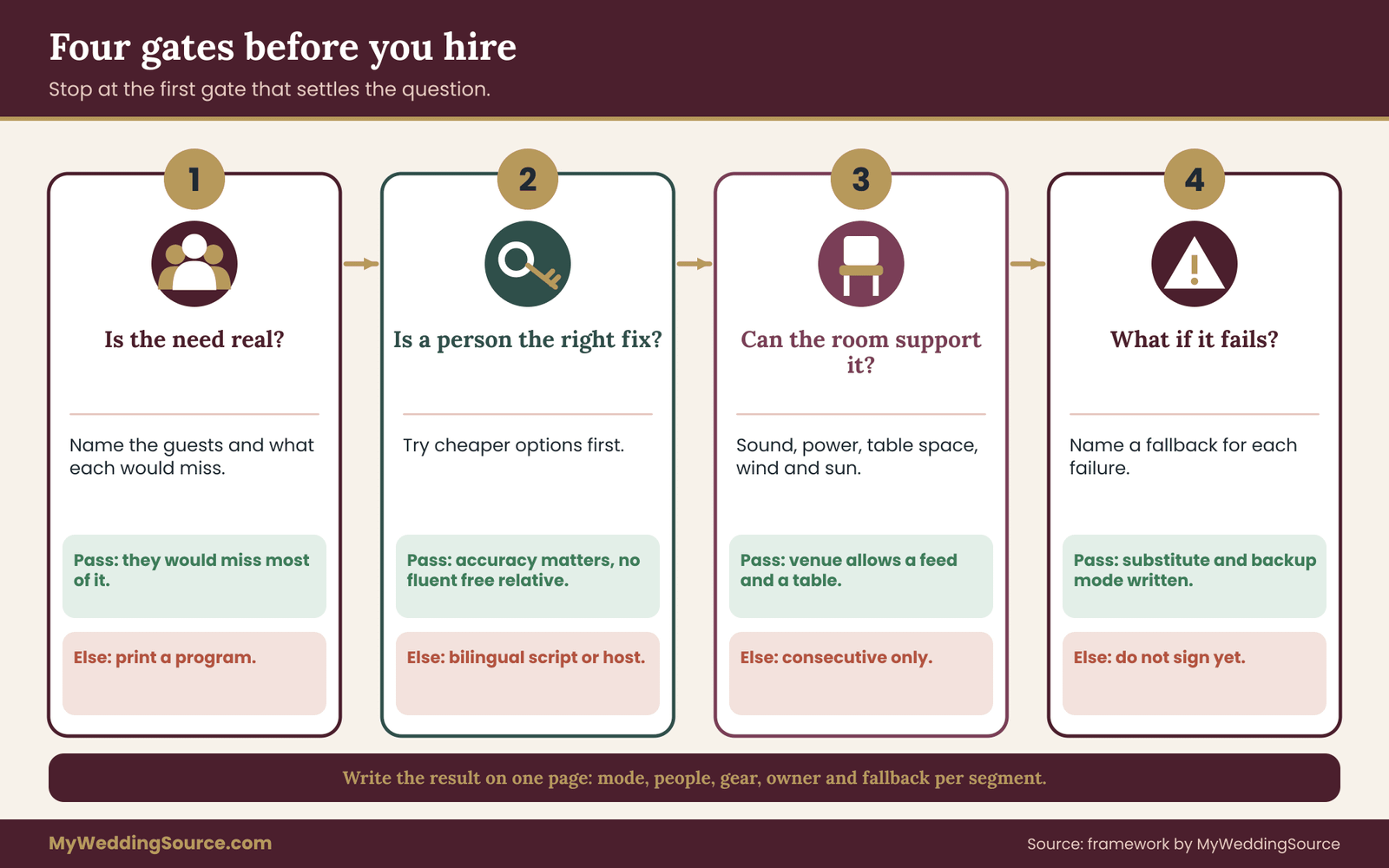
Wedding interpreter hire: a four-gate decision
Once the map is done, you know which segments could use which mode. The next step is a decision about whether to hire at all, how much, and in what form. A four-gate process keeps this from drifting into a pile of quotes.
Gate one: Is the need real? Write the names or the number of guests who cannot follow the ceremony in the main language. For each one, write what they would miss. A guest who speaks some English and has heard the ceremony script in advance may need only a printed program. A guest who speaks none and is the groom’s grandmother needs a person. The gate keeps the focus on actual people instead of a general wish to be inclusive.
Gate two: Is a person the right solution? For each affected guest or cluster, list the options in order of effort: printed bilingual program, a bilingual host seated near them, a family volunteer, a hired consecutive wedding interpreter, a hired simultaneous team. Most couples find that a few segments need a hired professional and the rest are covered by cheaper tools. A wedding interpreter hire makes sense when accuracy matters and no one in the family is both fluent and free to participate.
Gate three: Can the room support the chosen mode? Simultaneous needs a workable sound environment and a place for the wedding interpreters. An outdoor ceremony in wind, a small chapel with a fixed lectern or a historic building with a strict wiring policy may rule out some options. Ask the venue before you ask the wedding interpreter. The equipment section below lists what to ask.
Gate four: What happens if it fails? Every plan needs a fallback. If the transmitter fails, can the interpreters step forward and switch to consecutive? If one wedding interpreter is ill, is there a substitute with comparable skills? If the microphone dies, is there a handheld backup? A plan without a fallback is a hope.
Writing the decision down
Put the result in a short note that fits on one page. For each segment: the mode, the number of listeners, the number of interpreters, the equipment, the owner who checks it and the fallback. That note becomes the basis of your request for quotes and, later, of the rehearsal. Without it, suppliers quote from their own assumptions, and quotes become hard to compare.
How this differs from hiring a translator
If you also have written material that needs translating, such as a program or a menu, that is a separate hire with a separate timeline. Written translation can be done weeks ahead and reviewed by a second person. Interpreting is live and cannot be redone. For that reason, a wedding interpreter’s preparation time matters as much as their hours on the day, and you should treat their preparation as part of the engagement, not an extra.
Each deliverable and each hour of work should be written down, as the contract section below explains.
What to prepare before you request quotes
Before you contact anyone, assemble these items. The date and time of the ceremony. The venue name and the room or outdoor area. The order of the ceremony and the speaking moments, even if rough. The languages and the dialects or regional varieties, which matter more than people expect.
The approximate number of listeners per language. Any religious or cultural content. Whether the event will be recorded or livestreamed. And your budget range, which you can share or not. With that package, a supplier can answer in an afternoon, and you can compare the answers.
Dialect and variety deserve a sentence on their own. Spanish spoken in one region differs from Spanish elsewhere in vocabulary and formality. Mandarin, Cantonese and other Chinese languages are not interchangeable. Portuguese in Brazil and in Portugal differ in ways older relatives notice. Name the variety in your request, and ask the wedding interpreter whether they work in it comfortably.
Equipment and venue: how the voice reaches the listener
Simultaneous interpreting is as much an audio problem as a language problem. The best interpreter in the world cannot help a guest whose headset crackles or whose receiver has a dead battery. This section explains the equipment chain in plain terms, so you can read a quote and spot what is missing.
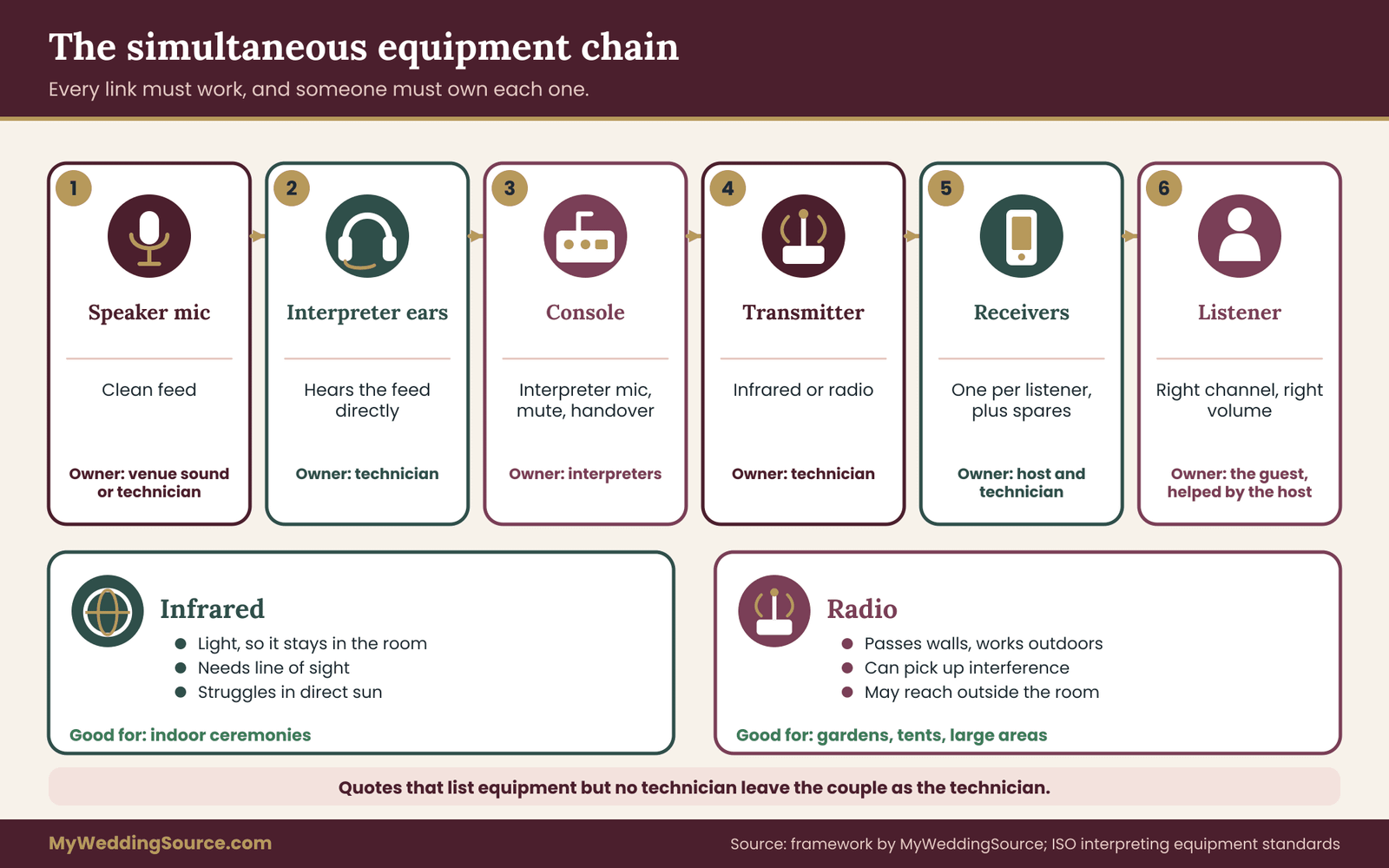
The signal chain, in order
Every simultaneous setup has the same links, whatever the brand.
Source microphone. The officiant’s voice has to be captured cleanly. This is often the venue’s lectern microphone or a lavalier clipped to the officiant. The interpreter should hear the same clean signal, not the muffled sound of the room.
Interpreter’s listening point. In a formal conference, the interpreter sits in a soundproof booth and listens through headphones to a feed from the room. At a wedding, a full booth is rare. More often the wedding interpreter sits at a small table near the back or side of the room, with a headset and a small console, and hears the officiant through a direct audio feed.
Interpreter’s microphone and console. The interpreter speaks into a close microphone, which feeds a transmitter. A console may let them mute their microphone, adjust volume and signal that they want to hand over to their partner.
Transmitter. This sends the wedding interpreter’s voice to listeners. It is either infrared, which uses light, or radio, which uses radio waves.
Receivers and headsets. Each listener wears a lightweight receiver with a headset, set to the right channel. Someone has to hand them out, explain the volume control and collect them afterward.
A person who runs it. A trained technician sets up the link, tests every receiver, monitors the signal during the ceremony and fixes problems without interrupting anyone. Quotes that list equipment but no technician leave the couple to be the technician, which is a bad trade on the day.
Infrared versus radio
The two transmission types behave differently, and the difference matters in a wedding venue.
Infrared transmitters send the interpreter’s voice by light, so the signal stays within the room and needs a line of sight between the emitter and each receiver. It does not pass through walls, which gives it some privacy and avoids interference with outside systems. It does poorly in direct sunlight, so an outdoor ceremony under open sky is not a good match. It can also drop out when a guest stands up or something blocks the path.
Radio, usually in a band set aside for such devices, passes through walls and works outdoors and across a larger area. It can pick up interference from other wireless devices, and in some setups it can be received outside the room. Suppliers who use it generally check the frequencies in advance, and the Federal Communications Commission publishes information about wireless microphone and related device rules. You do not need to master it. You need to ask the supplier which type they use and how they handle interference.
A further distinction is whether the system is a portable “tour guide” style system or a full conference setup. Tour guide systems are compact, easy to carry and usually used for a single language channel and modest group sizes. They suit a wedding party of a few dozen listeners. Larger systems carry multiple channels and are priced accordingly.
International standards for equipment
For readers who want to check a supplier’s claims, the International Organization for Standardization publishes standards on interpreting equipment and booths. They cover things like the sound quality a wedding interpreter needs, the size and ventilation of booths and the requirements for mobile units. A supplier who cites them is signaling that they know the field.
You are not expected to audit compliance, but you can ask whether their equipment meets the relevant standard and how they test it before an event. The standards are for sale from the organization and its national members, so a supplier may summarize instead of sending the text.
Comparing the equipment options in prose
Think of four practical setups, from lightest to heaviest.
No equipment, consecutive only. The interpreter stands near the couple or the officiant with a handheld microphone or a clip-on, and speaks after each segment. Cost is the lowest, setup is the simplest, and the main risks are pacing and microphone quality. This suits ceremonies under about twenty minutes of spoken material.
Whispered, no equipment. One interpreter sits beside one or two guests. This is simple, but only for a very small number of listeners.
Portable simultaneous set. Two interpreters at a small table with a console and transmitter, a technician and a bag of receivers for the listeners. This is the standard wedding solution for a long officiant address in a room that fits it. Equipment can often be rented as part of the interpreting package or separately from an audio company.
Full booth system. A mobile booth, a technician, multiple channels. This is for a very large event, formal setting or several languages. For most weddings it is more than the occasion requires, and it can feel like a conference, so ask yourself whether the formality suits the day.
Questions to ask the venue first
Before you commit to a mode, ask the venue and its sound provider five things. Does the venue have a house sound system, and can a feed be taken from it for the wedding interpreters? Are there restrictions on bringing outside audio equipment, or on wireless devices? Where could a small interpreter table go without blocking an aisle or a sightline? Is there power at that spot? And is there anything about the room, such as stone walls, an open courtyard or heavy wind, that would affect sound or infrared?
Venues sometimes require their own approved audio provider or charge a fee for outside vendors, so raise the question early. The site’s guide to the venue technical walkthrough shows how to test sound, power and sightlines on site, and the vendor due diligence checklist gives a template for the questions to ask each supplier.
Hearing devices and accessibility
Some guests wear hearing aids or cochlear implants. A neck loop or a telecoil setup, sometimes called a hearing loop, can carry a feed directly to those devices. If a guest uses such a device, ask whether it can receive the wedding interpreter’s channel, or whether a separate setup is needed.
Do not assume a standard headset sits comfortably over a hearing aid. This is another reason to ask guests what works for them well before the day, and to include the question in your RSVP process, as covered in the guide to RSVP etiquette.
Where listeners sit
If the listeners who need interpretation are clustered, simultaneous works smoothly. Seat them together, near enough to the interpreters’ table that the technician can reach them quickly, and where they can still see the couple. A common mistake is scattering the guests who need the headsets among the rest of the room, which means the technician walks the aisles during the ceremony.
Clustering also protects dignity. Guests with headsets are visible, and some people feel awkward about it. Explain it kindly in the program or at the welcome, and consider offering receivers to anyone who wants them, not only those who need them. Bilingual guests sometimes like to hear both versions.
Power, batteries and backups
A transmitter and receivers run on batteries or rechargeable packs. Ask how many spare batteries the supplier brings, how receivers are tested before the event and what happens if a receiver fails mid-ceremony. A prudent supplier brings more receivers than the listener count, usually a margin of at least a few extra, and keeps a spare transmitter or can switch to a backup mode.
Outdoor events add wind, which a lavalier can pick up as noise, and sun, which can wash out infrared. Ask whether the supplier has done outdoor ceremonies and what they do about wind noise, such as foam covers and microphone placement.
Recording and livestreaming
If you plan to record the ceremony or livestream it, tell the wedding interpreter and the sound provider early. A recording can capture the interpreter’s voice as a second audio track, so remote relatives can hear the interpretation. That is a feature worth considering when guests are watching from far away.
It also raises a consent and fee question, because many interpreters ask for their voice to be recorded only with permission and sometimes at a separate rate. The contract should say whether recording is allowed, who owns the file and whether a fee applies.
Staffing a wedding interpreter team: pairs, relief and a technician
Staffing is where quotes diverge most, and where couples are most tempted to cut. The question is not “how many interpreters can we afford?” but “how many people does this mode need to work safely?” The answer depends on the mode, and it is more consistent than the price range of quotes suggests.
Consecutive: one interpreter, sometimes two
A single consecutive wedding interpreter can handle a ceremony of moderate length. The work is demanding in a different way: the wedding interpreter holds a segment in memory, often with notes, and then delivers it. A ten-minute officiant address interpreted consecutively means about ten minutes of listening and ten minutes of speaking, with the cognitive load of retention in the middle.
One interpreter is reasonable when the total interpreted material is short, the speakers are well prepared and the event is compact. Two make sense when the interpreted material runs long, when it includes both ceremony and several toasts, or when the day is spread over many hours. If a wedding interpreter is expected to work through a ceremony, a cocktail hour and a dinner with toasts, ask how they manage rest, and ask whether the quote assumes breaks.
Simultaneous: pairs are the norm
Professional practice for simultaneous interpreting is to work in pairs, alternating at intervals. Conference standards from the international association of conference interpreters describe teams of two per language pair for any assignment of more than a short stretch, with turns commonly about half an hour. A wedding ceremony may be shorter than that.
Even so, the partner is not idle during the other’s turn. They support with a glossary, write down names and numbers, catch a missed word and step in if the first interpreter needs a pause or a sip of water.
If a supplier offers a single wedding interpreter for a long simultaneous assignment, that is a warning sign. It may be acceptable for a very short passage under about ten minutes, but ask why the supplier chose one person and what happens if they lose the thread. A reasonable answer mentions preparation and a fallback to consecutive. An unreasonable answer says that it will be fine.
The technician
A simultaneous setup needs a person who understands the equipment, even if the wedding interpreters bring a console. Their jobs include placing the transmitter, pairing receivers, testing each headset with a listener, adjusting levels once the speakers begin and handling replacements. They also act as the point of contact for the couple’s coordinator, so the interpreters can stay focused.
At a small wedding, the technician may be the venue’s sound operator working with the wedding interpreters. At a larger one, an audio company often supplies both equipment and operator. Either way, the quote should name the technician role and say who provides it. If the answer is “one of the interpreters will do it,” ask how, because a wedding interpreter cannot interpret and troubleshoot at the same time.
A host for the listeners
A less obvious role is the person who hands out receivers and answers guest questions. This can be an usher, a bilingual friend or a member of the planning team. Their job is to meet listeners before the ceremony, explain how to use the headset, point out the channel and the volume control and offer to swap one that does not work. The role is simple enough that a calm friend can do it with a one-page instruction card.
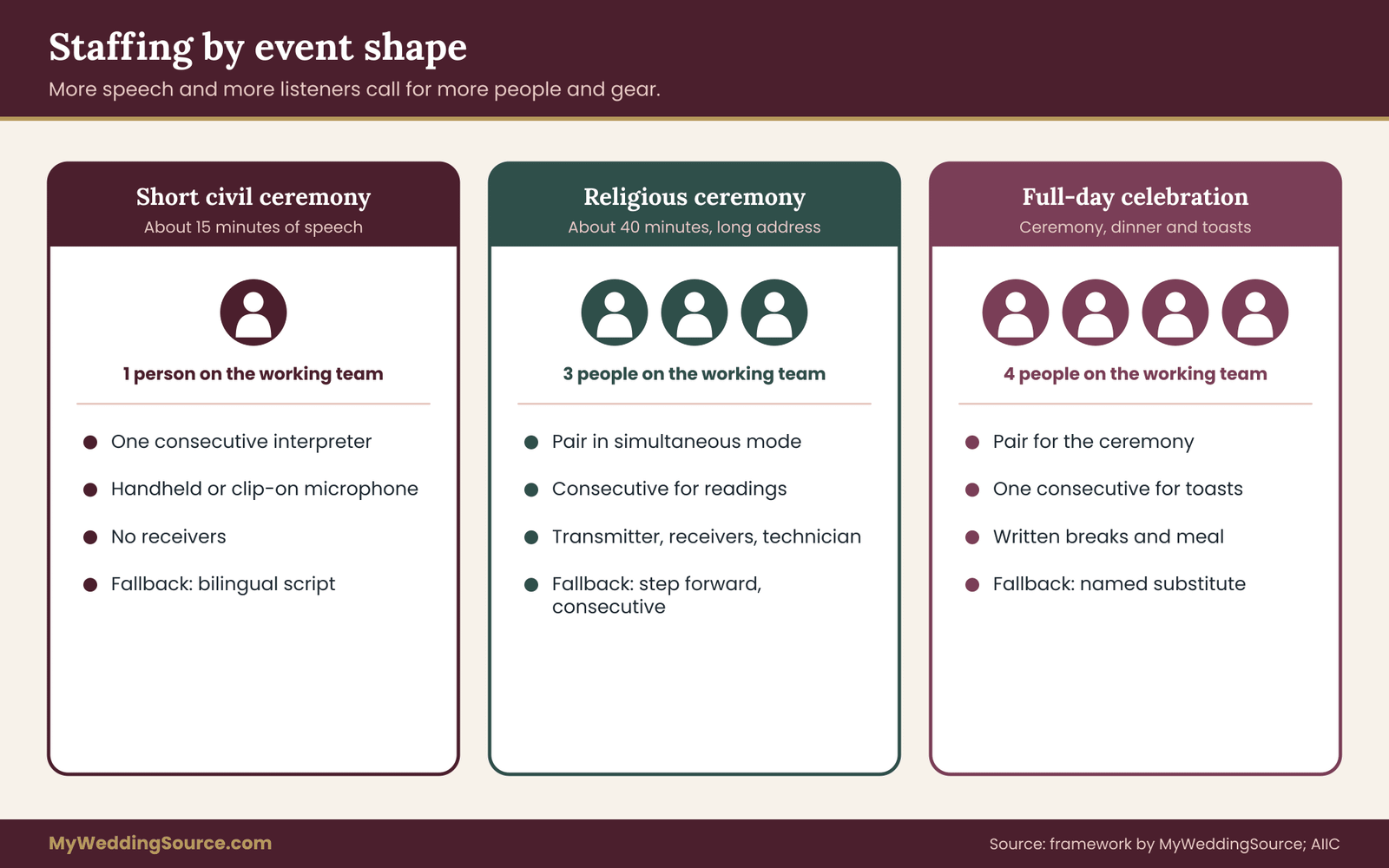
Staffing by event length: examples in prose
Consider three shapes of event, kept deliberately generic.
A short civil ceremony of about fifteen minutes, with a brief address and the vows. A single consecutive wedding interpreter standing near the couple is often enough, with total spoken material that doubles to about thirty minutes at most. No equipment is needed beyond a microphone for the wedding interpreter.
A religious ceremony of about forty minutes with a ten-minute sermon and several readings. A pair of interpreters in simultaneous mode for the sermon, a consecutive pass on the readings, a portable transmitter and a technician. The pair can alternate between the sermon and the readings, which spreads the load.
A full-day celebration, with a ceremony, a cocktail hour, a seated dinner and several toasts. The staffing question becomes one of stamina. Many couples hire the pair for the ceremony and a single consecutive wedding interpreter for the toasts, or arrange the schedule so the wedding interpreters have a break between the ceremony and the dinner. Whatever the pattern, write the schedule into the agreement.
Breaks, meals and working conditions
Interpreters need rest, water and a meal. They also need a place to sit, good light to read their notes and a spot where they will not be pulled into conversation. Treat them as working professionals. Offer them a meal at the same time as the kitchen serves the vendors, and tell them where to find it. A quiet room or a corner for the break is a courtesy that pays back in accuracy.
Also tell them the dress code. Interpreters generally dress to blend into the setting, in clothing that is neutral and does not compete with the couple. Ask the interpreter what they plan to wear, and say whether you want them visible or discreet.
Substitution and backup
Illness and travel disruption happen. Ask how the supplier handles a substitute: whether they have a roster of colleagues with similar training, how quickly they can bring one, whether the substitute receives the same preparation materials and whether the price changes. A credible answer names a process. It does not name a guarantee. If the supplier is a single freelancer, ask who they would call, and consider whether you want to hire a second wedding interpreter as insurance.
Who sits where during the ceremony
The interpreters’ position affects both quality and the photographs. In simultaneous mode, they sit where they can see the officiant and hear clearly, often near a side wall or the back. In consecutive mode, they stand beside or slightly behind the speaker, where the audience sees them but they do not block the couple. Walk this through with the photographer and the officiant at the rehearsal, because the photographer will want to know where a standing interpreter will be, and the officiant will want to know where to look.
Vetting a wedding interpreter and preparing them to work
No single license covers event interpreting in the United States for spoken languages. Credentials exist in specialized areas, such as courts, healthcare and sign language, but for weddings and similar events, you are judging a mixture of training, track record and fit. That makes your own checking more important, not less.
What to ask for
Ask for a short description of the wedding interpreter’s training and experience in the specific mode. A person who interprets consecutively in business meetings is not automatically ready to interpret simultaneously for forty minutes. Ask whether they are members of a professional association, such as the international association of conference interpreters or national and regional interpreter and translator groups, and ask what that membership involves. Ask for references from events of a similar shape, and speak to the references yourself.
For a signed-language interpreter, ask for the credentials that the Registry of Interpreters for the Deaf recognizes, and confirm that the wedding interpreter is comfortable with the setting. For other languages, ask about the variety of the language, the interpreter’s native or primary language and their working direction. Many interpreters work into their strongest language only, so a team may be needed if you want both directions.
The trial brief
A short, paid trial is the best test. Give the candidate a brief paragraph that resembles what they will interpret, such as an officiant’s welcome of about two hundred words, and ask them to deliver it in consecutive mode. If you have a bilingual friend who can listen, ask them to judge accuracy and tone.
If you do not, ask a second professional to review it. A paid trial of thirty minutes is reasonable and shows how they respond to instruction, deal with a name they have not seen and handle an emotional passage.
Do not ask for unpaid test work at length. A professional will politely decline long unpaid samples, and the request signals that you do not value their time.
Red flags
A supplier who cannot say which mode they are quoting. A single wedding interpreter proposed for a long simultaneous assignment. No mention of preparation time. A promise that anyone bilingual can do the job. A refusal to put the scope in writing. No answer about substitutes. An unwillingness to share the equipment details. Each one is a reason to ask a follow-up, and a few together are a reason to look elsewhere.
Why relatives are a risky substitute
A bilingual aunt may be the first person you think of, and in some weddings she is a fine choice. The risks are practical. She is a guest, so she will be emotional and distracted, and she cannot sit at a transmitter table while the rest of the family is photographed. She may soften, shorten or editorialize, which is natural for family but unfaithful to the speaker.
She may also feel obliged and be unable to say no. If you want a family member to take part, give them a defined, short role, such as reading a passage in both languages, and hire a professional for the interpretation.
Briefing materials
The better the preparation, the better the result. Send the wedding interpreter, ideally at least a week ahead, a package that includes the ceremony order, the officiant’s script or notes if they exist, the readings, the vows if the couple is willing, a list of names with correct pronunciations and relationships, any ritual or religious terms, the songs with lyrics if sung in a language the wedding interpreter handles, and a plan of the room.
Ask the interpreter to prepare a glossary and to send it back so the couple or a bilingual friend can check terms of special importance.
Be careful about readings that come from a copyrighted source or a sacred text. A reading may have an official or accepted translation in the tradition, and the wedding interpreter should use it, not invent a new rendering. Ask the officiant which translation is standard, and give the wedding interpreter that text. The site’s guide to officiant requirements is a helpful place to start when you are uncertain about what the officiant will or will not say.
The meeting before the day
Hold a short call or visit with the interpreter, the officiant, the planner or coordinator and the technician. Use it to walk through the order of events, agree on cues for starting and stopping, decide where each person stands and agree how the wedding interpreter will signal a problem.
Ten minutes of agreement here saves a stumble on the day. If your officiant has not worked with a wedding interpreter before, tell them the habits that help: speak in complete thoughts, avoid long subordinate clauses, pause between paragraphs, and do not rush when the wedding interpreter is working.
The quote and the agreement: what to put in writing
A quote for interpreting services can be one line or ten pages. The length matters less than what it says. You are buying a defined service for a defined time, and the agreement is the only place where that definition lives. The site’s guide to wedding vendor contracts covers the general principles, and this section lists what is specific to interpreting.
The scope paragraph
State exactly which segments will be interpreted, in which mode, in which language directions, by how many people. For example, the officiant’s address and the vows in the ceremony, the toasts at dinner, nothing else. State the start and end times, including setup, the rehearsal and the briefing call. Many disputes come from a vague phrase such as “ceremony coverage,” which one party reads as twenty minutes and the other as the entire afternoon.
Hours and how they are counted
Ask whether the quote is by the hour, by the half day, by the day or by the assignment. Ask whether travel time, setup and preparation are included or billed separately. Ask whether there is a minimum, which is common for professionals who must reserve a day for a short assignment. And ask what happens if the event runs over: is overtime billed, at what rate and who authorizes it. These points shape the real price much more than the headline rate.
Equipment, delivery and pickup
If equipment is included, list it: transmitter, number of receivers and headsets, spare batteries, interpreter consoles, microphones and cables. State who delivers, who sets up, when, and who collects it. State what happens if a receiver is lost or damaged, and whether the couple is responsible for guests’ handling. If equipment comes from a separate audio company, make sure both quotes name the same components and the same technician.
Preparation and materials
Write down that the couple will provide briefing materials by a date, and that the interpreter will review them and provide a glossary by a date. Write down whether the preparation time is billed. This keeps the engagement from starting on the day and gives you a date to check.
Recording, confidentiality and use of the interpreter’s voice
Interpreters often ask for the right to approve any recording that includes their voice. They may charge extra for it or decline. They are also generally bound by a code of confidentiality, which matters when the family shares private details. Put both points in the agreement: whether recording is permitted, in what form, for what use and who owns the files, and a plain statement that the wedding interpreter will treat what they hear as confidential.
Cancellation, rescheduling and substitution
Ask what happens if the date changes, if the guest count falls, if the ceremony moves indoors, or if the wedding interpreter cannot attend. Look for the amounts and dates for deposit and balance, the conditions for a refund, and the process for a substitute. An agreement that says nothing about substitution leaves you with no remedy if the person is ill. One that names a process gives you something to act on.
Payment and how to protect the deposit
Pay deposits in a way that leaves a record, and keep copies of the agreement and receipts. If you pay by credit card, the Consumer Financial Protection Bureau explains how billing disputes work, including the time limits for notifying the card issuer in writing. That is a reason to keep your statements and check them promptly. The Federal Trade Commission publishes general consumer guidance on contracts and refunds. For anything that looks like a legal question, such as a dispute over a cancellation, contact a qualified professional in your state.
Cost logic without invented numbers
Prices vary widely by city, language pair, event length and the interpreter’s experience, so any number printed here would be a guess. Instead, use the logic that drives the price, so you can read any quote.
The price of a consecutive assignment is mostly the wedding interpreter’s time, including preparation and travel. The price of a simultaneous assignment adds a second wedding interpreter, the equipment and the technician, so it is a multiple, not an increment. A third language adds another team. Rare language pairs cost more, because fewer professionals work in them and travel may be needed. Short notice costs more. A weekend date with strong demand may cost more.
That logic tells you where to save. Reduce the number of segments that need simultaneous mode. Choose languages carefully and cover the lesser-used ones with print. Give the wedding interpreter good materials and the preparation time shrinks. Book early. Avoid paying for coverage of segments where nothing is said.
Comparing two quotes fairly
Put the two quotes side by side by listing, for each, the same items: segments covered, mode, number of interpreters, equipment, technician, preparation, travel, minimum hours, overtime, recording permission, cancellation terms and substitution. If a quote leaves an item blank, ask. Often the cheaper quote leaves out the technician or the second interpreter, and the real comparison only appears once both quotes list the same items. Do not choose on headline price until the lists match.
Who signs and who pays
Decide which of you signs, and whether a parent is paying. If a family member is covering the cost, confirm in writing who is responsible for the deposit and the balance, to avoid a surprise. The site’s guide to the guest list is a reasonable place to settle how many guests will need headsets before you sign, since the number of receivers is one of the few line items that changes with the headcount.
A worked case: one couple, one decision
The following example is invented, to show how the process works. It is not a report of a real event, and the numbers are chosen for illustration.
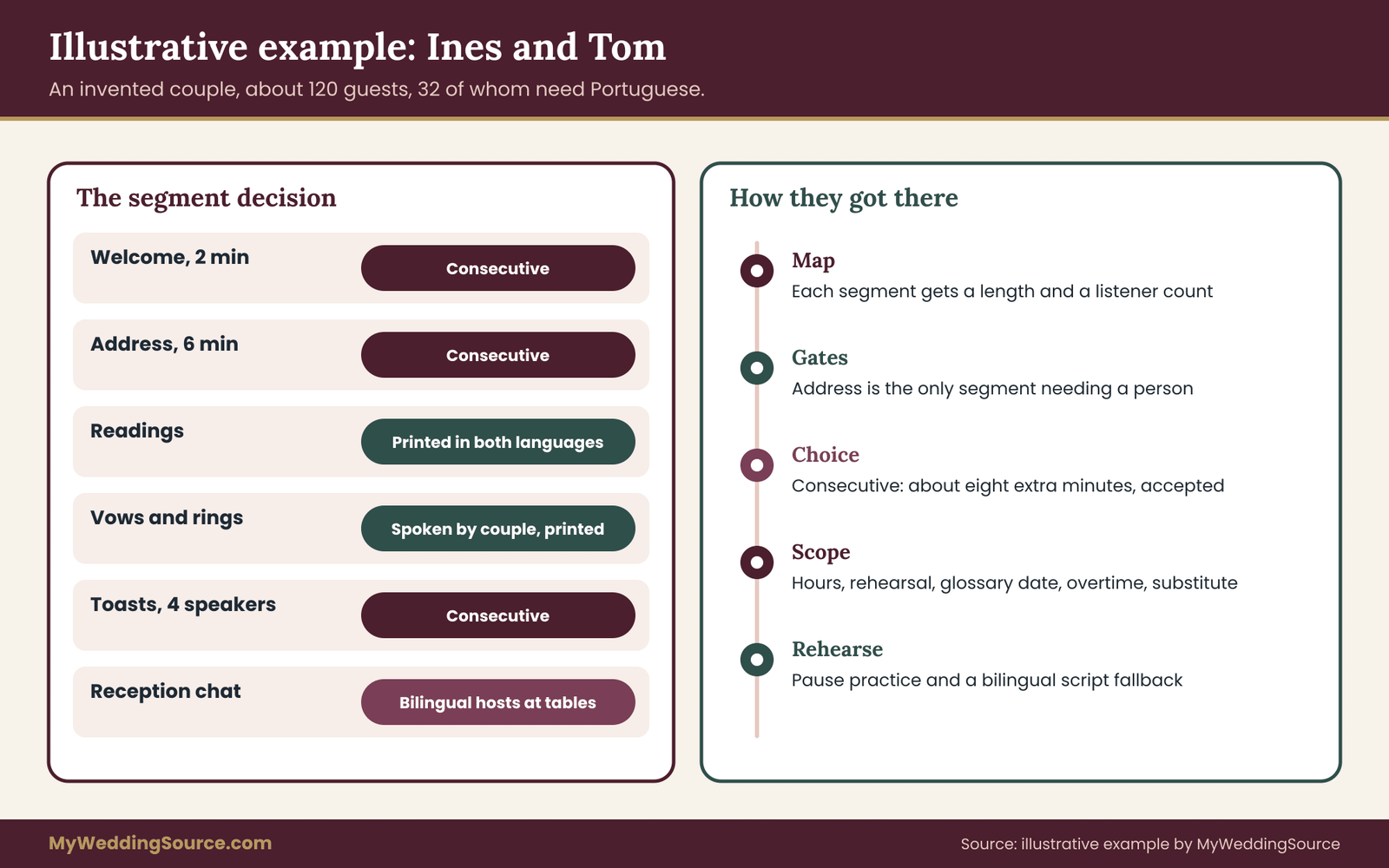
Ines and Tom are planning a wedding for about one hundred and twenty guests. Tom’s family speaks English. Ines’s family speaks Portuguese, and thirty-two of her relatives, including two grandparents and a group of aunts and uncles, speak little English. The ceremony will be led by an English-speaking officiant, who plans a six-minute address, three short readings and standard vows. Toasts at dinner include four speakers.
Step one: the segment map
They write out the ceremony and give each segment a length and a listener count. Procession and music: no speech. Welcome: two minutes, thirty-two listeners. Address: six minutes, thirty-two listeners, lightly scripted. Readings: three of about a minute each, scripted. Vows and rings: three minutes, scripted. Toasts: four speakers of two to three minutes, unscripted, thirty-two listeners.
Step two: the four gates
Gate one confirms the need is real: thirty-two guests would miss most of the ceremony. Gate two tests alternatives. A printed bilingual program covers the readings and vows if the text is shared in advance, and the couple likes the idea of the vows in both languages from the couple themselves. The address is the only segment where a person is clearly needed, and at six minutes it sits in the middle of the range.
Gate three checks the room. The ceremony is in a garden with a fixed pergola and light wind. Infrared would struggle in direct sun, so a radio-based portable set is the realistic choice if they go simultaneous. Gate four asks about failure. If the transmitter drops, the interpreter needs to be able to step forward and switch to consecutive.
Step three: the choice
The couple decides on a hybrid. The welcome and the address are interpreted consecutively by one professional standing near the officiant, because the total spoken material is short and the guests are clustered at the front. Consecutive adds about eight minutes to the ceremony, which the couple accepts. The readings and vows are printed in both languages and spoken by the couple and two relatives in their own languages. The toasts at dinner are interpreted consecutively by the same professional, who takes a break between the ceremony and the dinner.
They considered simultaneous for the address, and chose against it, because for six minutes the cost of a second wedding interpreter, a technician and receivers outweighed the benefit. They wrote down the condition that would change this: if the officiant’s address grew beyond about ten minutes, or if the guest group needing interpretation grew significantly, they would revisit.
Step four: the written scope
The agreement names the segments, the mode, the wedding interpreter’s hours including a rehearsal and a briefing call, the dates for materials and glossary, the break between ceremony and dinner, the rule for overtime, the permission for audio recording, the cancellation terms and the substitution plan. It also names a backup: a bilingual colleague on call who would cover if the wedding interpreter fell ill, with the same briefing package.
Step five: rehearsal and failure conditions
At the rehearsal, the officiant practices pausing every few sentences. The interpreter notes two names to confirm. The couple decides that if the officiant runs long, the coordinator will signal and the officiant will trim. They also decide what they will do if the interpreter is unavailable on the day: the officiant will deliver a shortened address in both languages from a prepared bilingual script, and a bilingual relative will help.
This case shows how the segment map, the gates and the written scope fit together. It also shows that the right answer is not always the largest. A decision to stay with consecutive interpreting is a good decision when the segment is short and the group is small.
Alternatives to hiring a wedding interpreter
A professional is one option among several, and for some weddings it is not the best one. Looking honestly at the alternatives keeps you from hiring out of anxiety, and it often reveals a cheaper design that feels warmer to the guests.
A ceremony written in two languages
The most elegant solution is often to design the spoken parts in both languages from the start. The officiant says each key line twice, once in each language. The readings are divided so each language gets one. The vows are spoken in the couple’s own languages with the translation printed.
This takes some writing and some rehearsal, but it removes the delay of live interpreting, and it signals that both families belong. It works best when the officiant or a co-officiant is truly comfortable in both languages, so confirm that before building the plan on it.
The downside is that the ceremony may feel longer to guests who understand both languages. Keep each spoken passage short to offset this. A well-edited bilingual script of fifteen minutes can feel lighter than a monolingual one of twenty-five.
Two officiants
Some couples ask two officiants, one for each language community, to share the ceremony. The two can alternate, or one can lead while the other offers a short blessing in their own language. The interfaith guide linked earlier discusses how to arrange shared leadership so the handoffs feel deliberate.
A bilingual master of ceremonies for the reception
For toasts, announcements and the flow of the evening, a bilingual emcee can often replace a wedding interpreter. The emcee introduces each speaker in both languages and gives a brief summary after a toast. This is not a faithful interpretation and should not be described as one, but for light toasts and logistics it is adequate and costs less.
Family volunteers in limited roles
A bilingual relative can do real good in a role that does not require them to carry the ceremony. They can sit with a grandparent and offer a short summary after each segment. They can greet guests in the second language at the welcome. They can read a passage. The key is a clear, short job, agreed in advance, that does not make them miss their own moment at the wedding. If a relative says they would rather simply attend, believe them.
Printed and digital support
A bilingual program can include the order of ceremony, a short description of each ritual, the readings in both languages and key phrases such as “we are glad you are here.” Keep multilingual printed material readable, with each language set in the same type size. A card in the program that explains what each speaking moment is about gives non-native listeners a map to follow, and sometimes that is all they need.
Phone and machine tools
Translation apps and live captioning tools are improving, and they may serve as a last-resort fallback. They are not a substitute for a professional wedding interpreter at the ceremony. They can mishear in noisy rooms, handle names and ritual terms poorly, mistranslate a phrase with emotional weight and sound flat in a moment that needs warmth.
Treat the output as a rough aid, never as an authoritative or ceremonial rendering, and never put machine output into a legal or religious document without human review. If you do use a tool as a fallback, test it at the venue with your actual officiant’s voice and the actual room noise.
Sign-language interpreters for deaf guests
If a guest needs a sign-language interpreter, the alternatives above are not substitutes. The right route is a qualified interpreter, usually found through the Registry of Interpreters for the Deaf or a local agency, and the guest should have a say in who is hired, since signed languages and personal preferences vary. The National Association of the Deaf publishes guidance on working with interpreters and on access in general.
Plan sight lines so the guest can see both the wedding interpreter and the couple, with good lighting on the wedding interpreter, and place the guest and the interpreter near the front. The ADA website is the starting point for questions about what a venue or business must provide.
How to choose among the alternatives
Use a simple ladder. Start with the least effort that serves the guest, move up only when the guest would still be left out, and stop when the segment is covered. A bilingual program covers the order of the day. A bilingual host covers conversation. A bilingual script covers short passages. A consecutive interpreter covers the address and toasts.
A simultaneous team covers long, unscripted passages for a group. Each step costs more in money and in coordination, so each step needs a reason. The site’s guide to invitations and wedding etiquette offers a good starting point for the language that goes out to guests ahead of time.
Failure conditions, fallbacks and the day-of run sheet
A plan that has never been tested is a draft. Interpreting plans fail in a handful of predictable ways, and each has a fallback you can decide in advance. Write them on the page so the person running the day does not improvise under pressure.
The common failures
The interpreter does not arrive. Causes include illness, traffic and a mix-up about the venue or time. Fallback: a named substitute with the same briefing materials, plus the bilingual script plan described earlier. Ask the wedding interpreter to confirm arrival at a set time and to text the coordinator when they are at the venue.
The microphone or transmitter fails. Causes include dead batteries, interference and a dropped cable. Fallback: spare batteries, a backup microphone and a switch to consecutive mode, where the wedding interpreter steps forward and speaks after each segment. The technician has to know that this is the plan, and so does the officiant, because switching modes changes the pacing.
Listeners cannot hear. Causes include receivers on the wrong channel, volume set too low or a headset worn badly. Fallback: the host with the instruction card, a quick check before the ceremony and a clear spot to raise a hand. The technician has spare receivers.
The officiant speaks too fast or too long. The interpreter falls behind or loses details. Fallback: an agreed hand signal, a prepared script and an officiant who has rehearsed pausing. If the address is long, the interpreter may summarize, which should be agreed in advance, so no one is surprised.
An unscripted speaker goes off the page. Toasts are the usual cause. Fallback: ask speakers to share the main points ahead of time, keep them short and pause between thoughts. The interpreter will adapt, but the fewer surprises the better.
A name, a ritual term or a joke does not carry over. Fallback: the glossary, a note in the program and permission for the wedding interpreter to explain briefly or leave a pun untranslated if the speaker agrees.
The weather changes the room. An indoor move changes the sound, the position of the wedding interpreters and the receivers’ range. Fallback: a plan B layout, checked with the technician, and a second look at infrared and radio behavior in the new space.
The schedule runs long. Interpreters are booked for a window. If the ceremony starts late or the toasts run over, overtime may apply, or the wedding interpreter may have another commitment. Fallback: agree the overtime rule and build a buffer into the schedule.

The rehearsal
A rehearsal for interpreting is not a long event. About thirty minutes at the venue is usually enough, with the officiant, the interpreter or team, the technician and the person who will host the listeners. Walk through each segment. Test the microphone and the transmitter. Have a listener sit in the farthest seat to check the signal and the volume.
Walk the interpreters’ route to their table and the host’s route to the guests. Run the opening of the officiant’s address with the wedding interpreter in the mode you chose, to feel the pace. Rehearse the fallback, because a fallback that is practiced once is far more reliable than one on paper.
A run sheet for the day
A short run sheet keeps everyone aligned. It can fit on one page and should list, in time order, the following items: the arrival time of the wedding interpreters and the technician; the time equipment is set and tested; the time guests who need receivers are met and equipped; the time of the final check with the officiant; the start of the ceremony; each interpreted segment and its mode; the break; the toasts; the time equipment is collected; and the contact for each person.
Give the run sheet to the coordinator, the officiant, the technician and the interpreters. A cue sheet layout adapts well to this.
After the event
Collect receivers and count them against the list. Thank the wedding interpreters and ask if they have feedback about what helped. Pay the balance promptly, and write a brief note about what worked for your own records or to share with another couple. If you recorded the interpretation, store the file with the other wedding media and honor any agreement about its use. If something went wrong, write down exactly what, while you remember it, and raise it with the supplier in writing, using the agreement as your reference.
Your next steps
Work through these in order, and stop at the first step that settles the question for your wedding.
- List the guests who cannot follow the ceremony in the main language, and write what each would miss.
- Build the segment map: each speaking moment, its length, its listener count and how scripted it is.
- Apply the four gates and write a one-page note with the mode, staffing, equipment, owner and fallback for each segment.
- Ask the venue about sound, power, placement and outside equipment rules.
- Request quotes using the one-page note, and ask each supplier to name the mode, the number of interpreters, the technician and the equipment.
- Run a short paid trial with your top candidate, and check references.
- Send briefing materials at least a week ahead, and hold a pre-event call.
- Sign a written agreement that covers scope, hours, equipment, recording, cancellation and substitution.
- Rehearse at the venue, including the fallback.
- Hand out a one-page run sheet, and name one person to check the listeners are connected before the ceremony starts.
If you do only two things, make them the segment map and the written scope. Those two steps prevent most of the problems described above.
FAQ
How many interpreters do we need for a wedding ceremony?
It depends on the mode. A short consecutive assignment can be handled by one wedding interpreter. Simultaneous interpreting is normally done by a pair, who alternate so each can rest and support the other. If a supplier proposes one person for a long simultaneous passage, ask how they will manage fatigue and what happens if the equipment fails. Treat vague answers as a reason to compare another quote.
Is consecutive or simultaneous better for wedding vows?
Consecutive is usually better for vows. The pauses feel natural, no equipment is needed and the wedding interpreter can match the emotion of each phrase. Simultaneous suits long passages for many listeners, such as an officiant’s address. Another option is to print the vows in both languages and let the couple speak them in their own languages, which avoids interrupting the moment altogether.
Can a bilingual friend or relative interpret instead of a professional?
Sometimes, for a short and informal role such as helping one grandparent follow along. For the ceremony itself, a guest is likely to be emotional and distracted, may shorten or soften what is said, and cannot be in two places at once. A professional is trained to stay neutral and accurate. Give a relative a smaller job and hire a professional for the important segments.
What equipment does simultaneous interpreting need?
A clean feed from the speaker’s microphone, a place for interpreters to sit and listen, a wedding interpreter microphone and console, a transmitter, receivers with headsets for each listener and a technician to run it. Transmitters are infrared or radio, and each behaves differently outdoors and in different rooms. Ask the supplier which type they use, how they test it and what spares they bring.
How much does a wedding interpreter cost?
Prices vary by city, language pair, event length, experience and mode, so a single number would mislead. Simultaneous work costs more than consecutive because it adds a second wedding interpreter, equipment and a technician. Preparation, travel, minimum hours and overtime also affect the total. Ask for itemized quotes that list the same components, and compare those items, not just the headline rate.
Do we need a sign-language interpreter, and is that different?
Yes, it is a different profession. If a guest uses sign language, hire a qualified sign-language interpreter, usually through the Registry of Interpreters for the Deaf or a local agency, and ask the guest about their preferences. The ADA website explains effective communication obligations for businesses and government, and you can ask the venue what it provides. Plan sight lines and lighting for the interpreter.
Can we use a translation app instead of an interpreter?
Only as a last-resort aid. Apps can mishear in noisy rooms, handle names and ritual terms poorly and miss tone. They should not be treated as an authoritative or ceremonial translation. If you want a fallback, test the tool at the venue with your officiant’s actual voice, and keep a human plan as the main option.
How early should we hire and brief the interpreter?
Book as soon as the date and venue are set, because strong interpreters and equipment are in demand on popular dates. Send the briefing package, including the order of the ceremony, readings, names and any ritual terms, at least a week ahead, and earlier if the material is complex. Schedule a brief call with the wedding interpreter, the officiant and the technician before the day.
Sources
- Americans with Disabilities Act (ADA.gov)
- International Association of Conference Interpreters (AIIC)
- American Translators Association
- Registry of Interpreters for the Deaf
- National Association of the Deaf
- International Organization for Standardization
- Federal Communications Commission
- Consumer Financial Protection Bureau
- Federal Trade Commission
- LEP.gov: Federal Interagency Website on Language Access