
A renewal after hardship is a promise made again by two people who now know what the first promise cost. This guide shows how to decide whether the time is right, what each of you should think through alone, how much of the hard period belongs in the words and in the room, and what to do if the plan starts to ask more of the marriage than it can give.
Plan a renewal after hardship in this order. First, check readiness: safety, both partners genuinely wanting it, and outside support if the hard period is not settled. Second, each partner answers six reflection prompts alone. Third, fill in a wording boundary card that sorts every detail into say it, soften it, or keep it private. Fourth, pick the smallest format that carries the promise. Fifth, write down stop signals before invitations go out, so either of you can pause without a fight.
Most advice about renewing vows assumes a happy anniversary and a guest list that wants cake. That is fine for many couples. But some couples come to a renewal from somewhere harder: an affair that was survived, a long separation, a serious illness, a bankruptcy, a death in the family, a stretch of estrangement, or a year when the marriage nearly ended and then did not.
For them the renewal after hardship is not a party with a nice speech. It is a decision about what to say aloud, to whom, and what to keep.
Those couples tend to run into the same few problems. One partner wants a public moment and the other wants a quiet one. A parent asks what the event is “for.” Someone suggests a vow that names the hard thing, and the room holds its breath.
Or the plan quietly becomes a way to prove that everything is fine, which is a heavy job for an afternoon. Each of these problems is common in a renewal after hardship, and each is easier to handle before the invitations go out.
This guide handles the planning side of that situation. If you are still deciding between a renewal and an anniversary party, the difference is covered on this site in the general ceremony material, and this guide assumes you have already leaned toward a renewal. If you are searching for the order of events in a standard ceremony, the wedding ceremony step by step guide lays out the sequence.
Here the question is narrower and more personal: how to plan a renewal after hardship so that it is honest, private where it needs to be, and safe to say yes to.
A note on scope. This is general information, not legal, tax or financial advice, and it is not therapy, clergy counsel or medical guidance. A renewal after hardship does not change your legal marital status, and it does not replace counseling if the hard period left real work undone. Where rules matter, such as how to get a copy of a marriage certificate, the guide points you to the official source.
What a renewal after hardship is, and what it is not
Start with plain definitions, because much of the conflict in these plans comes from two people using the same word for different things.
A renewal ceremony is a non-legal ceremony in which people who are already married restate their commitment. You do not need a new license. You do not need a legally authorized officiant in most places, because nothing is being created legally. The marriage that exists stays exactly as it is.
That is good news for planning, since it frees you to choose who speaks, where, and how long it lasts. The U.S. government’s guidance on marriage certificates, at USAGov, is the place to confirm anything about your existing record.
A renewal after hardship adds one more ingredient: the hard period is part of the reason the ceremony exists, even if it is never named aloud. That changes the planning in three ways.
First, the stakes are uneven. For one partner the hard period may have been something done to them. For the other it may have been something they did, or something that happened to both. A ceremony that feels like closure to one person can feel like a spotlight to the other.
Second, the audience is not neutral. Some guests know part of the story. A few know a version that one of you would dispute. Almost none know how the two of you actually repaired things. Any wording that points at the hard period decides, in public, whose version stands.
Third, the renewal after hardship is not the repair. The repair happened or is happening in conversations, counseling, changed habits and time. A renewal after hardship can mark that work, but it cannot do it. When couples ask the event to carry weight that the repair has not earned, the day often feels thin or strained. The planning below is designed to keep the ceremony honest about what it is.
What it is not
A renewal after hardship is not a legal reset. It does not forgive anything on anyone’s behalf, and it does not require anyone to forgive anything they have not forgiven. It is not an apology performance, and it is not a message to a third party. It is not a requirement imposed by the partner who was harmed, and it is not a trade for something else.
It is also not necessary. Plenty of couples repair a marriage and never hold a ceremony. Some of the strongest plans in this guide end in a private evening with no guests, or in a letter exchange, or in nothing public at all. The renewal after hardship is one option among several, and a later section of this guide compares the alternatives.
The two questions underneath everything
Almost every disagreement in these plans traces back to two questions. The first is who is this for. The second is what are we promising that we were not already promising. If both of you can answer those in a sentence, and the answers are compatible, the rest is logistics. If you cannot, the rest will keep stalling, and it is worth stopping to talk before spending a deposit.
A useful exercise is to write each answer separately and compare them over a quiet meal. “For us, and nobody else needs to understand why.” “For our kids, who saw the worst of it.” “For my mother, who thinks we are fine.” Those are three very different events, and the third has a problem that planning will not solve.
Deciding whether to hold a renewal after hardship at all
Before picking a date, run a readiness check. It is not a test you can fail forever. It is a way to catch the situations where a ceremony would add pressure instead of meaning, and to notice early when something needs to be done first.
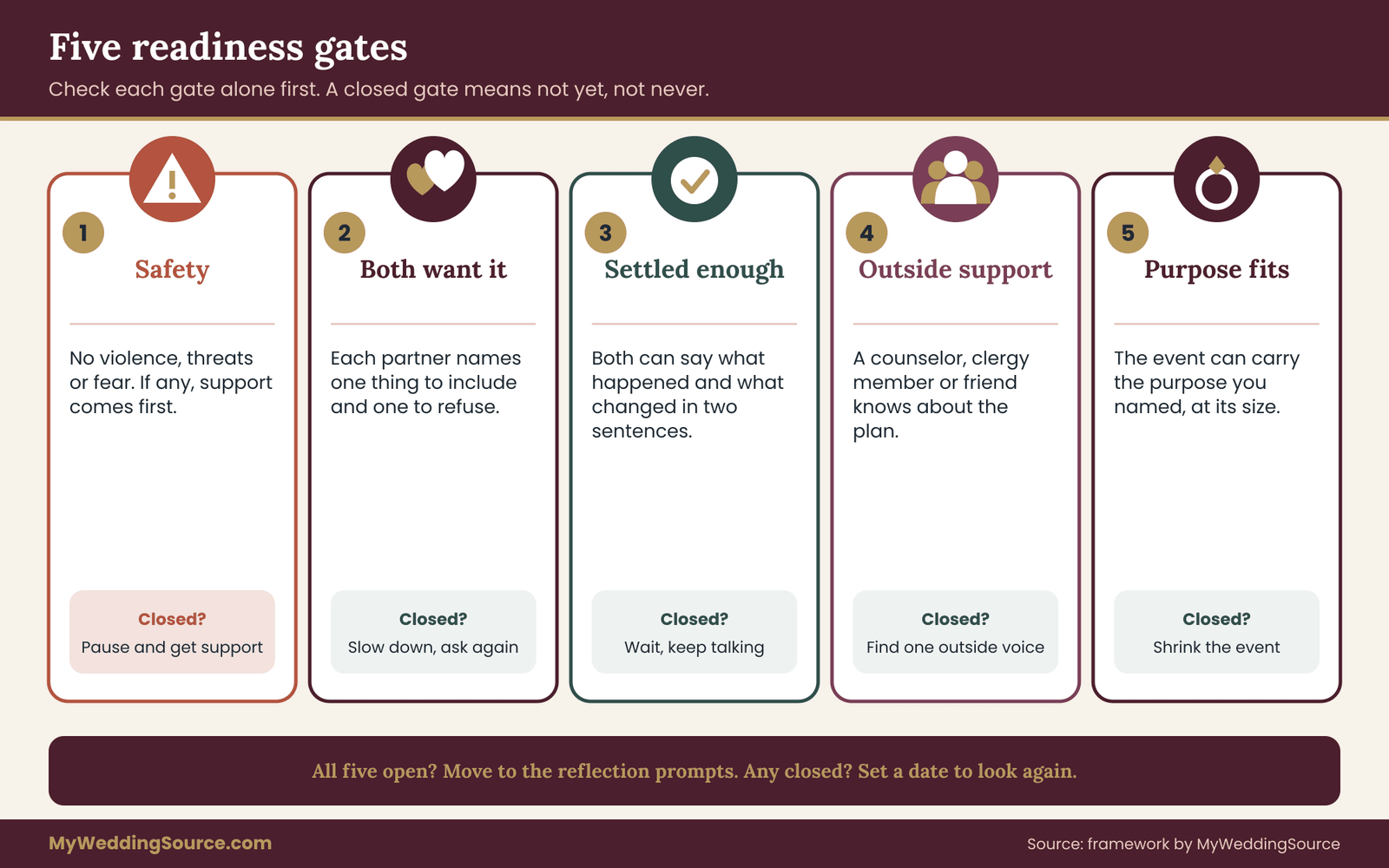
The check has five gates, shown in the figure below. They are written as questions each partner answers honestly, alone, before comparing. Treat them as a conversation starter for a renewal after hardship, not as a verdict on the marriage.
Gate one: safety
The first gate is not negotiable. If the hard period involved physical violence, threats, coercive control, stalking, or ongoing fear, a renewal ceremony is not the right next step, and planning one can become a tool of pressure. If that describes your situation, or if you are not sure, the National Domestic Violence Hotline (1-800-799-7233, or its website) offers confidential support, and you can contact it without telling your partner. A renewal can wait. Safety cannot.
If the hard period involved a mental health crisis or thoughts of self-harm for either of you, the same principle applies: current support comes before ceremony planning. In the United States, the 988 Suicide and Crisis Lifeline is available by call or text at 988.
Gate two: both partners actually want it
This sounds obvious and is often skipped. One partner proposes, the other says “sure,” and the planning begins on a yes that was really relief that the conversation ended. A good test is to ask the more hesitant partner to name one thing they would want in the ceremony and one thing they would refuse. If they can name both, the yes is probably real. If they go silent or say “whatever you want,” slow down and ask again, kindly, without an audience.
Pay attention to timing as well. A renewal proposed during an argument, or immediately after a reconciliation that is days old, is usually an emotional expression more than a plan. Waiting a few weeks costs very little. The proposal will still be true in a month.
Gate three: the hard period is settled enough to speak about
You do not need to have everything resolved. You do need to be past the stage where each of you is still discovering facts. If new information about the hard period is still arriving, or if one of you is still deciding whether to stay, the renewal after hardship would be built on moving ground. A reasonable standard is that both of you can describe, in two sentences, what happened and what has changed, and that the other would not correct the account.
Gate four: someone outside the marriage knows
If the hard period was serious, at least one person or professional outside the marriage should know about the plan. That could be a counselor, a clergy member, a trusted friend, or a support group. The point is not approval. It is a second set of eyes on the pace of the plan and on the stress it creates. Couples who plan alone sometimes mistake momentum for readiness.
Gate five: the purpose fits the size of the event
The last gate asks whether the purpose you named earlier can be carried by the event you are picturing. A promise to be more honest with each other fits almost any size of event. A hope that guests will finally see you as a united couple does not fit any event, because it depends on strangers’ reactions that you cannot control.
If one or more gates fails, the answer is “not yet,” and “not yet” has real work attached. The next sections give you tools for that work, starting with six reflection prompts each partner answers privately. If every gate holds, you can move to planning with a much lower risk of turning the ceremony into a stress test. Many couples pass the gates on a second look, and a renewal after hardship planned later is usually calmer.
A short script for raising the idea
If you are the partner who wants to propose a renewal, a calm opening helps more than a grand gesture. Something like this keeps it low pressure.
“I have been thinking about whether we might want to mark where we are now with a small ceremony. No decision. I would like us each to think about it alone for a couple of weeks, and then talk.”
The script works because it names a time frame, removes the yes-or-no pressure, and makes space for the answer to be no, or later, or something else. A renewal after hardship that begins as a shared decision tends to hold together under the strain of planning. One that begins as a surprise rarely does.
Six private reflection prompts before planning a renewal after hardship
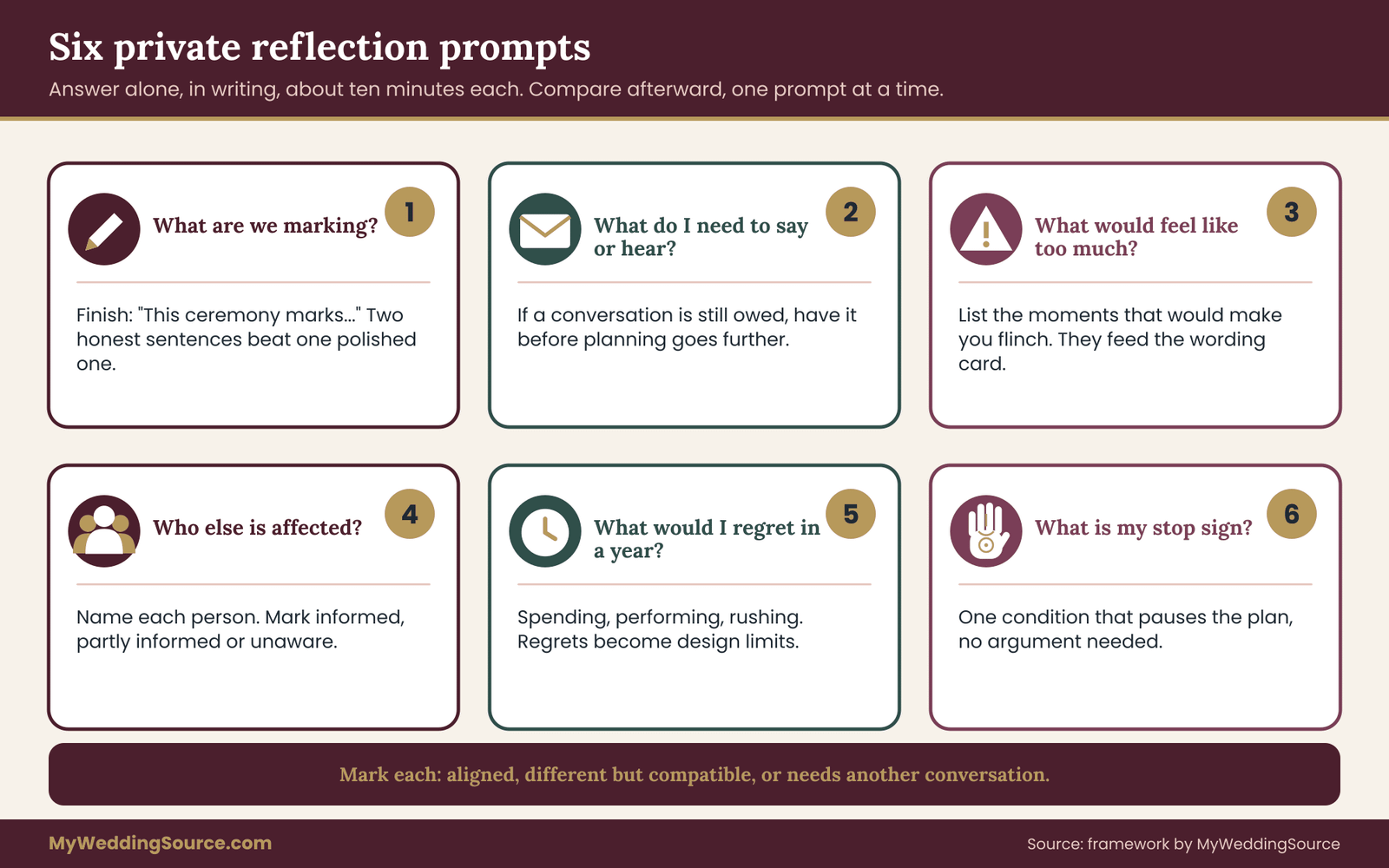
The reflection prompts are the first original tool in this guide. They are meant to be answered by each partner separately, in writing, before either of you sees the other’s answers. The rule of separate answers matters. When the prompts are answered together, the louder or more fluent partner usually sets the tone and the other edits themselves in real time.
Writing alone first gives you two honest drafts, and the differences between them are the useful part. Think of them as the foundation of any renewal after hardship that you plan.
Give each prompt about ten minutes. Use a notebook or a private document, not a shared one. Nothing you write has to be shown. What you decide to share afterward is a separate choice, and the next section gives you a way to make it.
Prompt one: what are we marking?
Write the one sentence that completes “This ceremony marks…” Avoid the word “forgiveness” unless you mean it fully. Better sentences name something observable: “that we stayed,” “that we are living differently,” “that we are choosing this again with open eyes,” “that we got through the year.” If you write two different sentences, you have found the first thing to talk about, and it is not a problem. Two honest sentences are better than one polished sentence that only one of you believes.
Prompt two: what do I need to hear, and what do I need to say?
Most people who have been through a hard period carry one sentence they are waiting to hear and one they are afraid to say. Write both. Then ask whether the renewal after hardship is the right place for either. Often the answer is no, and the sentence belongs in a private conversation held before the planning goes any further.
A vow cannot carry an apology that was never made in a room with only two people in it. If there is a conversation still owed, have it first. The conversation comes before the planning of a renewal after hardship, not during it.
Prompt three: what would feel like too much?
List the things that would make you flinch if they happened on the day. A guest asking how you are “doing now.” A reading about second chances. A toast that jokes about the rough patch. A photographer capturing the exact moment someone cries. A relative who knows the story making a pointed remark.
Be specific, and be honest about it even if the list seems petty. These items become the raw material for the wording boundary card in the next section, and for the briefing you will give your officiant and your helpers.
Prompt four: who else is affected by what we do?
Children, parents, the other person in an affair, a friend who took sides, a sibling who gave money or housing. Write down the names of people whose lives touched the hard period, and next to each name write one of three words: informed, partly informed, or unaware. Then write whether you would want that person to attend, to be told something in advance, or to be left alone. This prompt tends to surface the invitations that are really obligations, and the omissions that are really protection.
One caution. If a third party was part of the hard period in a way that hurt one partner, such as an affair partner, their name does not belong in the ceremony, the program or the guest conversation. The hurt partner has the final say on anything that touches that.
Prompt five: what would make me regret this in a year?
Imagine the ceremony took place and write a sentence about what, specifically, you would regret. Many people write things like “saying more than I meant,” “doing it for someone else,” “spending money we needed,” “having a room full of people watching me perform being fine,” or “rushing it before I was ready.” These regret sentences double as design constraints. If your regret is spending money you needed, your format is small. If it is performing, your guest list is short or empty.
Prompt six: what is my stop sign?
Write one condition under which you would want the plan paused or cancelled, with no argument and no explanation required. Examples: a relapse, new information surfacing, a missed counseling appointment, a family member’s reaction, or simply the feeling that the plan has become a pressure instead of a gift.
This prompt is the most useful and the one couples most often avoid. A stop sign written in advance, agreed to by both, takes the sting out of using it. It becomes a rule you made together instead of a rejection.
Comparing answers
Set aside a time to compare, with no phones, preferably not in the room where you have your hardest arguments. Take turns reading one prompt at a time. The reader says it; the listener does not respond until the whole answer has been read. After each prompt, the listener repeats back one sentence of what they heard. That is all. No rebuttal, no fixing.
Afterward, mark each prompt with one of three marks: aligned if your answers fit, different but compatible if you answered differently without conflict, and needs another conversation if the answers pull against each other. Do not push to turn every mark into “aligned.” The marks you most need to see are the third kind, because that is where a hidden plan would otherwise go wrong.
If more than two prompts end up marked “needs another conversation,” pause the planning and spend the time on those conversations instead, with a counselor or clergy member if you have one. That pause is not a failure. It is the readiness check doing its job.
Support, counseling and clergy: what a renewal after hardship cannot replace
A renewal ceremony is an event. A repaired marriage is a process. The two are connected, but the event cannot stand in for the process, and planners who treat it as a substitute tend to cause harm without meaning to.
What a ceremony can and cannot carry
A ceremony can mark a decision, give it witnesses, give it language, and give you a day to point back to. It can make a private resolve feel real. For some couples it is a meaningful turning point precisely because it is a deliberate act after a period when nothing felt deliberate. A renewal after hardship works best as a mark on the path, not as the path.
A ceremony cannot resolve an unanswered question about trust. It cannot repair a pattern of behavior that has not changed. It cannot manage a hurt partner’s pain on a schedule, and it cannot carry the weight of an apology that never arrived. If any of these are still open, the honest course is to work on them first, or alongside, and let the ceremony mark progress instead of standing in for it.
Working with a counselor or clergy member
If you already work with a counselor, bring the six prompts and the readiness gates to a session. A professional can help you read the marks and decide which “needs another conversation” items to take up first. If you do not have a counselor, a primary care provider, a faith leader, or the resources listed by the Substance Abuse and Mental Health Services Administration (SAMHSA) can help you find one.
The National Institute of Mental Health also publishes plain-language information on getting help, which is useful when you are not sure where to begin. A renewal after hardship is a fair topic for any counseling session.
If you are working with a faith leader, ask early what their tradition expects. Some traditions have defined rites for reaffirming marriage and may expect preparation or conversation beforehand. Others have no formal rite at all, and the leader may be glad to help you create a blessing instead. Either way, confirm venue and faith customs individually, since they vary widely and no general rule covers all of them.
The wedding officiant requirements guide covers what officiants do and do not need to be for a legal ceremony, and most of that is relaxed for a renewal, but a faith community may still have its own expectations.
When the hard period involved a crisis
If either partner is in an active crisis, such as untreated addiction, an unfolding health emergency, a legal case, or a financial emergency, put the ceremony after the crisis, not into it. Couples sometimes plan a renewal after hardship as a way to hold on to something steady during chaos. The impulse is understandable. In practice, planning a ceremony while the ground is shifting adds one more obligation to a day that already has too many, and a stable date is hard to promise when circumstances change weekly.
A good rule is to wait for a stretch where your lives have been steady enough that a calendar date feels like a plan and not a hope. That stretch looks different for every couple. For some it is a few weeks. For others it is a year. Nobody outside the marriage can set that bar for you, though a counselor can help you notice when you have reached it.
When children are involved
If you have children, the question of what they know and what they should see is part of the plan. Children who lived through the hard period often understand more than adults assume. A ceremony that treats everything as fine can confuse them, and one that narrates too much can frighten them. A reasonable middle path is to tell children, in age-appropriate words and before the day, what the renewal after hardship is for in the simplest honest terms, and to give them a role that is theirs and not a performance of the adults’ feelings.
A younger child who holds a card, or an older child who reads a short passage they chose, is taking part without carrying the story. A renewal after hardship looks different through a child’s eyes than through an adult’s.
Ask a pediatrician, school counselor, or family therapist if you are unsure how much to share. The right answer depends heavily on age and on what the child already saw.
Money and the hard period
Financial hardship deserves its own brief note. If money was part of the hard period, the cost of the renewal after hardship is part of the plan, not an afterthought. A renewal after hardship that adds stress to a fragile budget can undermine what it is meant to celebrate.
The wedding budget guide offers a way to think about what to spend and what to defer, and the same logic applies at a smaller scale. For a renewal after hardship, the working rule is simple: choose a size that leaves you more settled afterward, not less.
Wording boundaries for a renewal after hardship: the three-lane card
The second original tool is the wording boundary card. Its job is to settle, before anyone writes a sentence, which parts of the hard period may be spoken in public, which may be hinted at, and which stay between the two of you. Without it, wording decisions get made late, alone, under emotion, and sometimes in the middle of a ceremony. Every renewal after hardship benefits from it.
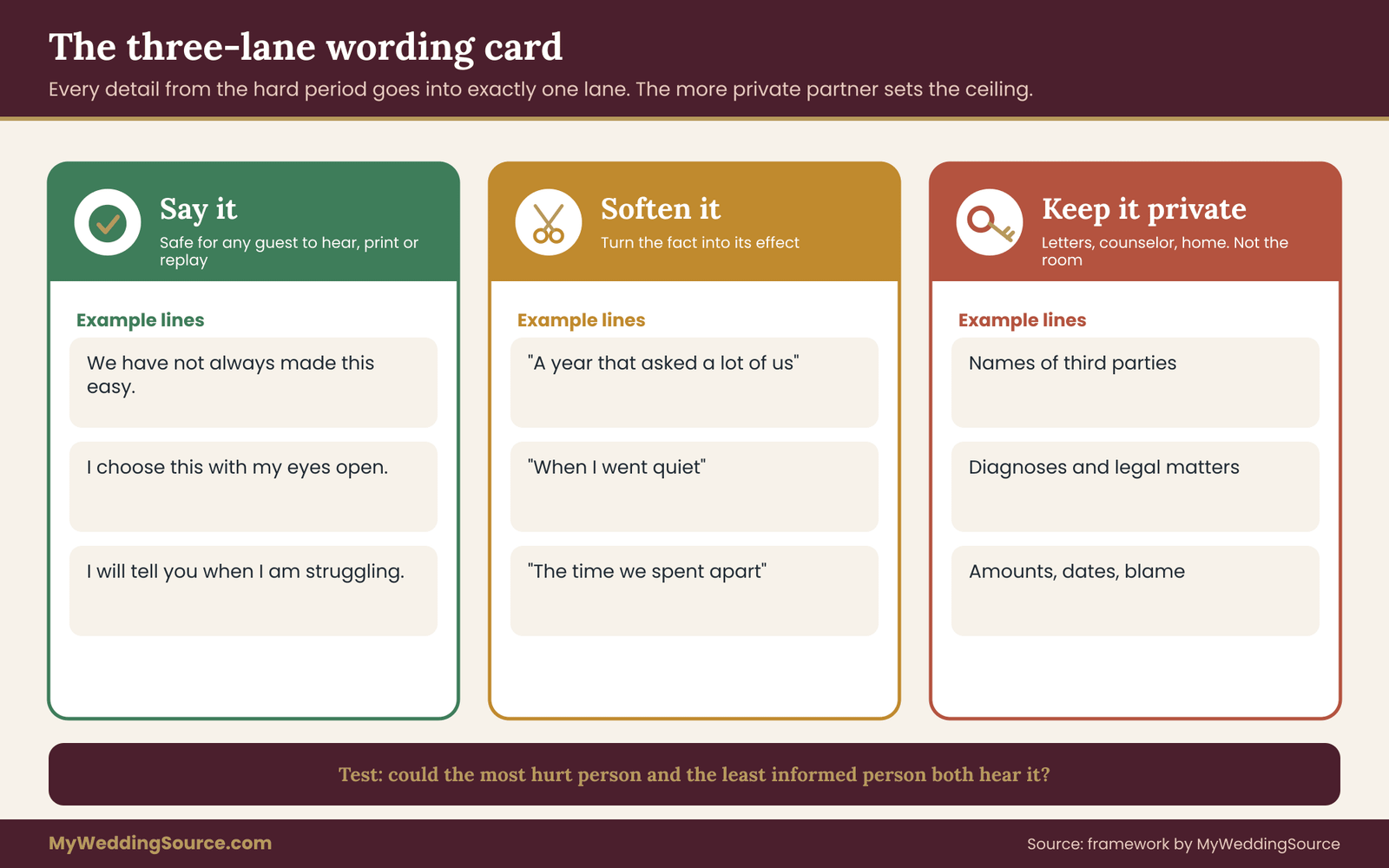
The card has three lanes. Every detail from the hard period goes into exactly one lane, and both partners must agree on the lane. If you cannot agree, the detail goes into the more private lane until you can.
Lane one: say it
This lane holds what can be spoken aloud, printed in a program, recorded, or repeated by a guest afterward without exposing anyone. Typical items are the fact of lasting, a general acknowledgment that the marriage went through a hard time, and promises about the future. Examples of language that tends to fit: “We have not always made this easy.” “We know more about each other now than when we started.” “I choose this with my eyes open.”
Notice that none of these names the event, the date, the person, or the cause. They describe the effect on the two of you in words any guest could hear. The test for lane one is simple: could the most hurt person in the room, and the least informed person in the room, both hear this sentence without being exposed or surprised? If yes, it belongs here.
Lane two: soften it
This lane holds details that matter but cannot be said plainly. The move is to turn the fact into its effect, or to turn the specific into the general. “After the year my father was sick” becomes “after a year that asked a lot of us.” “When I lost my job and wouldn’t talk to you” becomes “when I went quiet.” “After the affair” almost always belongs in lane three, but if the two of you decide an acknowledgment is right, it might become “after I broke your trust,” said by the partner who did it, in their own voice, with the other partner’s agreement.
The soften lane is where most of the hard writing happens. Each soften item needs two checks. First, does the softened version still say something true? A softening that hides the point entirely may leave a vow that rings hollow to the partner who was hurt. Second, does the softened version point at a third party in a way they would object to? If yes, it moves to lane three.
Lane three: keep it private
This lane holds the details that do not leave the two of you, or the two of you and a counselor. Names of third parties. Diagnoses and medical details, which are the health information of the person they belong to. Legal matters. Financial specifics. Anything one partner has said they are not willing to have repeated. Anything involving children that they have not agreed to have shared. The cause of the hurt, when naming it would restart it.
Private does not mean denied. It means the renewal after hardship is not the place. A private detail can still be addressed in a letter, in a conversation at home, or with a professional. The lane exists so that private things stay private on purpose, instead of leaking into a speech because a draft ran long.
How to fill in the card
Take the answers from your reflection prompts and list every concrete detail that came up. Write each on its own line. Then, going one by one, assign a lane. Use these rules in order.
Rule one: the more private partner sets the ceiling. If one partner wants a detail in lane one and the other wants it in lane three, it goes to lane three. A disclosure cannot be taken back. An omission can be added later.
Rule two: ownership decides. A detail about one partner’s body, behavior or history belongs to that partner. They choose its lane for themselves. A detail about both of you is decided by both. A detail about someone else is not yours to put in lane one without their consent.
Rule three: lasting beats listing. If the choice is between naming the hard period and naming how you have changed, prefer the change. Vows are promises. Promises look forward.
Rule four: when in doubt, soften and test. Draft the softened line and read it aloud to your partner. If either of you winces, move it to lane three.
Who sees the card
The card is for the two of you. After it is agreed, share the relevant parts with the people who need them: your officiant, any readers, the photographer, and any friend who will act as a gatekeeper on the day. They do not need the full story. They need the boundaries. A sentence such as “Please don’t ask guests how we are doing, and please don’t mention the last two years in any toast” is enough, and it protects both partners without telling anyone the history.
The wedding photography consent guide covers how to set guest boundaries around cameras and image use, which matters here because a candid photo shared online can carry more of the story than any spoken line.
A set of example lines
Examples help most when they show a hard detail moving across lanes. These are illustrative only, written as patterns, not scripts to copy. Each pattern could apply to a renewal after hardship of almost any kind.
A detail: one partner was away for months for treatment. Lane three: the diagnosis and the name of the facility. Lane two: “the year I was away, and the year you carried everything.” Lane one: “Thank you for holding on while I got well.”
A detail: a long separation. Lane three: where each person lived, who moved out, who said what. Lane two: “the time we spent apart.” Lane one: “We came back to each other on purpose.”
A detail: debt that strained the marriage. Lane three: the amount, the cause, the creditors. Lane two: “a hard stretch with money.” Lane one: “I promise to tell you the truth about our money, even when it is hard.”
A detail: an affair. Lane three: nearly all of it, including the fact, the person and the timeline, unless both partners explicitly decide otherwise. Lane two, only if both agree: a plain acknowledgment from the partner who broke trust, in their own words, in a way the other partner approves in advance. Lane one: a promise about honesty and about choosing this marriage again.
The affair example needs a note. Some hurt partners want a public acknowledgment, and some would be devastated by one. Neither wish is wrong. The point of the card is that it is the hurt partner’s call, made calmly, not a surprise on the day.
Wording for the officiant
Officiants vary in how much they say. A short, plain brief tends to work better than a story. You might give the officiant three things: the sentence that completes “This ceremony marks…”, the list of phrases to avoid, and one sentence about tone. For example: “Warm, brief, no reference to the past. We want the focus on the promise.” A renewal after hardship is a delicate assignment for any officiant, so clarity helps.
If the officiant is a family member or friend who knows the story, be especially clear, and give them the brief in writing. Even a loving person can slip into a story when the room is quiet. A written boundary is easier to remember than a conversation held two months earlier.
Phrases that tend to cause trouble
Some phrases, however well meant, reopen the hard period for at least one person in the room. Treat these as flags that prompt a second look. “Second chance” implies someone needed to be forgiven. “Through the storm” invites guests to imagine the storm. “We almost didn’t make it” turns a private fact into a public one.
“Everything happens for a reason” can land badly with anyone who suffered. “Stronger than ever” makes a claim about the future that nobody can promise. In a renewal after hardship the same phrase can mean something different to each guest.
None of these is banned. A couple may choose one deliberately, with eyes open. The flag is only a prompt to check the lane.
Reading, music and program text
Wording boundaries apply beyond the vows. A poem chosen for the renewal after hardship can say more than you intend. Song lyrics for a processional or a first dance can point at a story that guests half know. Program notes that explain the occasion can disclose too much in print, where words last. Review each of these against the card, and ask the same question for each: could the most hurt person and the least informed person both hear or read this without being exposed?
Copyright is a separate matter for text and music that is not yours. The U.S. Copyright Office explains how copyright and fair use work, and short quotations in a private ceremony are very different from reproducing a poem in a printed program, a livestream or a recording. If you plan to print or record, check the source’s terms or choose public-domain text.
Choosing a format for a renewal after hardship: the privacy ladder
Format is where the reflection prompts and the wording card turn into a real plan. The mistake most couples make is picking a format from pictures: a beach, a backyard full of friends, a church with the original wedding party. The better method is to pick from constraints. How private must it be? How much can you spend?
How much of your own energy will the day take? The privacy ladder puts the common formats in order from most private to most public, so you can choose the lowest rung that carries your promise. A renewal after hardship deserves a format chosen from constraints, not from photographs.

Rung one: the two-person evening
Two people, a quiet place, and words said to each other. It might be at home, on a walk, at a spot that means something, or at the table where the hardest conversation happened. There may be a letter, a ring, or a candle. There is no officiant and no recording unless you choose one.
This rung fits couples for whom the hard period is still tender, or where one partner is very private, or where the main thing that needs to happen is the promise itself. It costs almost nothing. It also avoids the question every other rung must answer, which is what to tell guests. Its limit is that nobody else witnesses it, so if part of the point is for your community to see the two of you choosing each other, it will feel incomplete.
Rung two: the tiny witness circle
Add two to six people who already know the full story, or enough of it. Parents who stood by you, a sibling, a close friend, a counselor, a faith leader. They are there as witnesses, not as an audience. There is little or no program. The words are short and can be more direct than in a larger setting, since everyone present already understands the context.
This rung suits couples who want a human witness without performing. The risk is guest chemistry. A relative who took sides during the hard period can make a small room tense very quickly, so invite on the basis of who will be steady, not who is closest by blood. A small circle also works well as a private ceremony before a larger gathering, which a later section describes. A renewal after hardship at this rung is the quietest version there is.
Rung three: the family ceremony
Ten to thirty people, usually immediate family and closest friends, in a home, a garden, a place of worship or a small rented space, followed by a meal. A short ceremony with an officiant or leader, a reading or two, and the vows. This rung is where the wording boundaries do most of their work, because some guests know the story and some do not.
Plan this rung with deliberate roles. Decide who greets, who manages the schedule, and who is the gatekeeper for awkward moments. The wedding ceremony cue sheet guide has a structure for the order of speakers and timing, and a lighter version of it works well for a family ceremony. It is easy to overlook that the gatekeeper role matters more at this size than it does at a bigger event, because intimate rooms invite intimate questions.
Rung four: the celebration
A larger gathering with a mixed guest list, a venue, catering, music and a program. It is the most public rung and the one most like a second wedding. Couples choose it when the hard period is well behind them and they want to celebrate, or when community has played a major part in the repair and they want to say thank you.
At this size you cannot control what every guest knows or says. Plan for that. Keep the wording in lane one and lane two, brief the officiant and the toast-givers, and consider a rule such as “no toasts from the floor” so that nobody improvises on the hard period. Budget carefully. The cost of a celebration scales with guest count, and the cost of the hard period may already be in your finances.
Matching rung to constraints
Choose the lowest rung that satisfies every item on this checklist, written in prose so you can adapt it.
- If either partner still flinches at the thought of guests knowing the story, stay at rung one or two.
- If the hurt partner wants any say in who attends, hold the guest list to rung two or three until they are confident about the circle.
- If money was a part of the hard period, do not pick a rung whose cost you would need to finance.
- If the main goal is to mark a private decision, rung one fully serves it.
- If the main goal is to thank the people who helped, rung three or four may fit, but a private thank-you dinner for those people is an alternative.
- If a child’s feelings are a major factor, consider how much of the day they should witness.
You can also stage the formats. A common and sensible pattern is rung one, then later rung three. The private evening settles the promise. The later gathering is a celebration of a settled thing instead of a test of an unsettled one. Staging also gives you a natural stop point: if the private evening does not feel right, the gathering does not happen.
A comparison in plain prose
Rung one has the highest privacy, the lowest cost, and the least outside support. Rung two keeps privacy high, adds a few trusted witnesses, and costs little. Rung three balances privacy and community, with moderate cost and a real need for guest management. Rung four offers the most celebration, the least control and the highest cost, and it is the one most likely to feel like a performance if the readiness gates were not truly passed.
There is no ranking of quality across the rungs. A rung-one renewal is not a lesser version of a rung-four celebration. For many couples after hardship, it is the more honest event. A small renewal after hardship is not a lesser one.
Timing and season
Choose a date that stands on its own. An anniversary of the wedding is the obvious choice and often the right one. It can also be heavy if the hard period happened close to that date, so check your calendar for the dates that carry weight for either partner: the day something was revealed, the day someone died, the day treatment began, the date of a separation.
Avoid a date that sits on top of one of those, or at least ask whether the more sensitive partner feels fine about it.
Allow time as well. A renewal after hardship should not have a short fuse. Even at rung one, give yourselves a few weeks after the reflection prompts to let the answers settle before choosing a date. At rungs three and four, many couples want several months. Rushing tends to carry the hard period into the planning. A renewal after hardship tolerates a slow timeline far better than a rushed one.
Venue and setting choices
Setting does a lot of emotional work. A place connected with the hard period, such as the hospital’s garden, the house you nearly sold, or the restaurant where a conversation went badly, may carry meaning that is more difficult than helpful. A neutral place, or a place connected to the earliest good memories of the relationship, tends to hold up better.
If you want to return to the original wedding venue, call early, since availability and policies differ and many venues do not host renewals in the same way as weddings. The setting for a renewal after hardship should hold the good memories, not the heavy ones.
Ask the venue about outside food, music, recording, and the hours available. Confirm accessibility needs for guests who use mobility devices. The ADA website explains accessibility rules for places that serve the public, and a venue should be able to describe its access in practical terms. Ask for terms in writing, including the cancellation and refund policy, so that a pause for stop signs does not cost you the deposit unexpectedly.
Who knows what: guest circles and invitations for a renewal after hardship
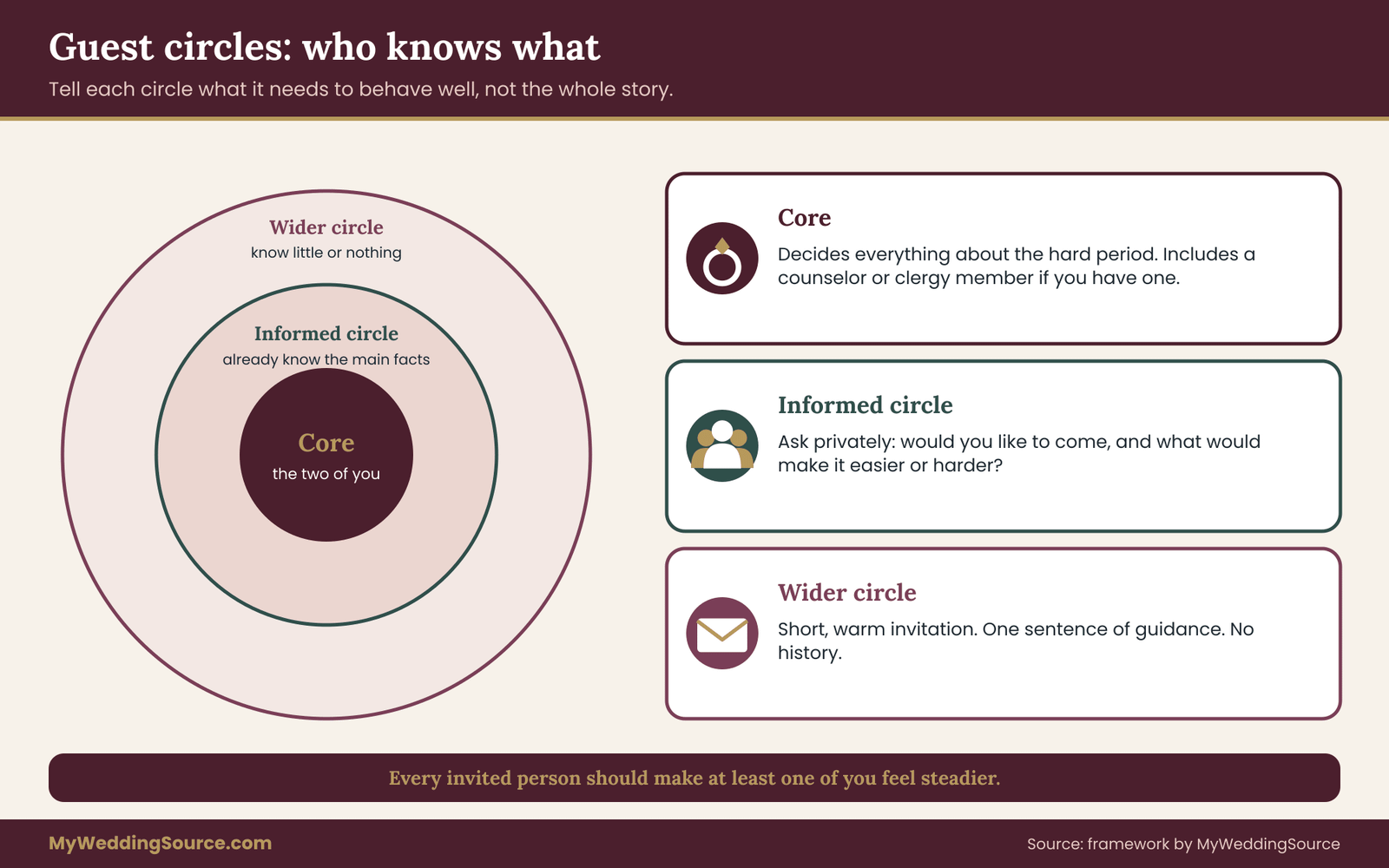
At rungs two through four, a renewal after hardship raises a question that standard ceremonies do not: how much does each guest already know, and what do they need to be told? The guest circle method handles it with three circles drawn around the two of you. The three circles keep the guest question for a renewal after hardship manageable.
The core circle
The core circle is the two of you, plus any counselor or clergy member who is part of the repair. They know everything. Planning decisions about the hard period are made here and nowhere else. A cousin’s opinion does not enter this circle.
The informed circle
These are the few people who know the main facts: perhaps a parent, a sibling, a best friend, the person who let you stay with them for a while. The test for membership is that they already know, not that they are close. You do not need to tell them anything new, but you do need to ask what they would be comfortable with.
A person in this circle who is angry at one partner may need to hear from the other in advance, or may need a different seat in the room. Ask each of them privately, with a version of this question: “Would you like to come, and is there anything that would make it easier or harder for you?”
The wider circle
Everyone else: relatives who heard fragments, friends who sensed a rough patch, colleagues, neighbors. The wider circle knows little or nothing. They need an invitation that says what the event is without telling them what it was about, and a sense of how to behave. They do not need the story, and giving it to them rarely helps the couple.
Writing the invitation
The invitation sets the tone for the whole event. A short, warm invitation that names the occasion plainly serves a renewal after hardship better than one that hints at a journey. Something like: “Please join us as we renew our vows and celebrate our marriage.” That is true, brief and neutral.
Avoid phrases such as “after everything we’ve been through” or “a second chance at love,” because they announce a story that guests will then try to guess. The invitation to a renewal after hardship should leave the story out.
For printing, proofing and mailing, the wedding invitation etiquette guide on this site covers wording and timing that carry over to a renewal. The one change is that you can say less. A renewal does not need the formality of a first wedding, and informal wording helps keep the event relaxed.
The guest list decision
The guest list is where the privacy ladder and the guest circles meet. The most common mistake is to invite people out of obligation. For a renewal after hardship, obligation guests carry a particular cost: they are the ones most likely to ask questions the couple does not want to answer.
A simple rule is that every invited person should be someone whose presence will make at least one of you feel steadier. If they would make either partner feel watched, they are a candidate for a different gesture, such as a note or a later meal.
The wedding guest list guide offers ways to tier a list and to handle the hard conversations that come with cutting it. The same tiering works at a smaller scale: core, informed and wider can be used directly.
What to tell people in advance
You do not owe an explanation to everyone. You might still decide to give some people a small amount of context so they behave well. A helpful way is to give a sentence of guidance instead of a sentence of history. For example: Guidance works better than history at a renewal after hardship.
“We are keeping the day simple and forward-looking. Please do not bring up the last couple of years. We would like to enjoy the day.”
Say it to the people who are likely to ask, such as a talkative aunt, and ask a trusted friend to say it for you if you would rather not. This is a boundary, not a confession. Most people respect it when it is put kindly and early.
The person who objects
Sometimes a family member objects to the renewal itself, because of loyalty to a partner who was hurt or because they think the marriage should not have continued. You cannot manage their opinion. You can decide what you will do with it. The options are to invite them with a clear request for civility, to leave them off the list, or to talk with them separately beforehand.
If the hurt partner’s family is struggling to accept the renewal, the hurt partner’s wishes lead. They are the person who has the most at stake. If you are the partner who did the harm, the most useful thing you can do is stay quiet about how the family should feel and make the hurt partner’s comfort easy to honor.
Kids and the guest list
Children are part of the list, and a few practical points follow from earlier sections. Tell them in advance, in simple honest words, what the day is for. Give them a role they chose. Arrange an adult they trust to stay with them so that they can step out if the day is too much.
Do not ask them to stand in the middle of any family tension. If the children are adults and have strong feelings of their own, ask them what they would like before you decide the guest list for them.
The officiant, the vendors and the paperwork
A renewal is simpler than a wedding in some ways and more delicate in others. This section covers the practical pieces so that the logistics do not undermine the emotional plan. Keep the logistics of a renewal after hardship as small as the format allows.
The legal side
A renewal after hardship does not create a new marriage. There is no license to apply for and no legal filing. The marriage certificate from your original wedding remains the record. If you need a copy of it, for any reason, USAGov explains how to request one from the state or county that issued it, and the process depends on where you married.
Do not assume a keepsake certificate from a renewal after hardship has any legal effect. Some couples receive a decorative certificate from an officiant, and it is a keepsake only.
If you are renewing because something about the legal marriage is actually in question, such as a doubt about whether it was properly recorded, that is a different matter and a reason to talk to the issuing office or a lawyer. A renewal ceremony is not a way to repair a legal defect. This guide is not legal advice, and the issuing office can tell you what applies to you.
Choosing and briefing the officiant
You can ask almost anyone to lead a renewal: a friend, a relative, a faith leader, a professional celebrant, or one of you. The question to ask of any candidate is whether they can hold the boundaries you set. Ask them directly, and give them the written brief from the previous section. A professional is often better at this than a loved one, since they will stay on script, but a loved one who understands the stakes can make the day warmer.
Share the order of the ceremony ahead of time. If a faith community is involved, confirm what they require or prefer. For general information about what officiants do, the wedding officiant requirements guide is a good reference, though most of the legal requirements there do not apply to a renewal.
Vendors
Fewer vendors are needed at lower rungs, and some of the usual ones may not be right at all. A photographer might be a good idea at rung three or four, with a clear brief on what not to photograph. At rung one there might be none. A musician can be welcome or unwelcome depending on how emotionally loaded the music is. Catering may be a family meal at home.
For any vendor you hire, ask for the contract in writing and read the cancellation and rescheduling terms, because the stop signs you wrote earlier only protect you if the contract allows you to use them. The Consumer Financial Protection Bureau publishes general guidance about deposits and disputes with card payments, and the Federal Trade Commission offers consumer protection basics. Both are useful starting points if a vendor will not return a deposit.
Recording and sharing
Decide before the day whether the renewal after hardship will be recorded, photographed, livestreamed or posted. A renewal after hardship is exactly the kind of event where a casually posted clip can create a lot of unwanted attention. Ask guests to refrain from posting or to wait until you share something, and let people know in the invitation or at the entrance. If you do want a recording, decide which parts, who holds the file, and where the copies go.
Budget in plain terms
Keep the budget as simple as the format. A rung-one evening has a cost close to zero. At rung three, the big costs are the meal and the space. At rung four, the venue and guest count dominate. Write the number you are comfortable with, and then subtract a cushion, because a renewal after hardship has a way of surfacing unplanned expenses: a relative’s travel, a last-minute change of venue, a counseling session you add to the calendar.
If you cannot name a figure without a knot in your stomach, the format is probably too large.
Writing the words and running the day
With the boundaries settled and a format chosen, the writing is the easier part. The card has already told you what you may say. What remains is saying it in your own voice, briefly, and in a way you can deliver while feeling a lot. A renewal after hardship is easier to write once those choices are made.
Structure for a short renewal vow
A renewal vow after hardship works best in three beats. The first beat is one sentence from lane one that names the present: where you stand now. The second beat is two to four promises, each about the future and each concrete enough to be recognized if it is kept. The third beat is a closing line that says you choose this, in the plainest words you have.
The promises are where the hard period does its quiet work. A couple who went through a stretch of silence might promise to say what is true even when it is uncomfortable. A couple who went through money trouble might promise to look at the numbers together every month. A couple who went through an illness might promise to ask for help earlier. Each promise grows from what the hard period taught, and none of them needs to mention it.
Test each promise
A promise is only worth saying if it could be broken. Ask of each one: could I tell, a year from now, whether I kept this? “I will always love you” cannot be tested. “I will tell you when I am struggling instead of going quiet” can. The second kind is more vulnerable to say and more meaningful to hear. If a promise cannot be tested, rewrite it until it can. This test suits any renewal after hardship.
Then ask whether you can honestly make the promise today. A renewal after hardship is a bad place for an aspiration dressed as a commitment. If you are not yet able to promise something, say what you intend to work toward, or leave it out. Your partner will hear the difference.
Length, pace and delivery
Short wins. Many couples find that one to two minutes each is plenty, and the shortest versions often land hardest. Time yours aloud at the pace you will actually speak, which is slower than reading silently. Mark breaths in the margin. If you tend to cry, plan for it by placing the steadiest line at the end and holding a card in your hand. Pausing is normal and no guest will mind. Brevity helps a renewal after hardship more than polish does.
Decide whether to exchange the words from memory, from a card, or by repeating after the officiant. Repeating after the officiant can be a relief if you fear freezing, and it keeps the text short. Reading from a card is entirely acceptable. Memorizing adds pressure that this kind of event does not need.
The swap and veto step
Exchange drafts with your partner a few weeks before the date. Each of you may veto any line that describes you, with no explanation. This is the final check on the wording card. A line that exposes you, however loving, is yours to remove. Keep the veto asymmetric: you may remove lines about yourself, not demand edits to your partner’s feelings.
Do not use the swap as a negotiation about the hard period. It is a privacy check. If it becomes an argument, set the drafts aside and talk about the argument, not the draft. The swap protects each partner in a renewal after hardship.
The private letter
Many couples find that the real things they want to say do not fit in a vow, and they should not be forced in. The private letter is for those. Write it to your partner, hand it over before or after the ceremony, and treat it as private. It can hold the names, the specifics, the apology or the thanks that lanes two and three keep out of the ceremony. It is often what the partner remembers longest.
Do not make the letter a condition of anything or a demand for a reply. Give it as a gift. If the letter would reopen something your counselor would want to see first, bring it to a session.
Run of the day
Keep the day short and plain. A sample outline for a family-sized event, adaptable to any rung: guests arrive and are welcomed by a designated friend; the officiant says a few words about the occasion without reference to the past; one or two readings; the vows; the rings or another small gesture if you wish; a brief closing; then a meal.
The whole ceremony can be ten to fifteen minutes. A longer program rarely improves the event and often multiplies chances for the wrong sentence to be said. A quiet program suits a renewal after hardship.
Assign roles in writing: who greets, who manages the schedule, who handles guest questions, who looks after children, who holds the rings or cards, who is the gatekeeper. Give the gatekeeper permission to steer conversations away from the hard period and to step in if a guest pushes. A line they can use: “They would love to talk about the day. Let’s save the rest for another time.”
During the day: three quiet protections
First, give each partner an exit. At a family-sized event, agree on a signal that means “I need a few minutes,” and a place to go. Second, agree on a pause plan if something goes wrong, such as a guest saying something hurtful. The officiant or gatekeeper handles it and the ceremony continues.
Third, hold something back for yourselves. A walk, a quiet meal for two, a hotel room, an hour with the phones off. A renewal after hardship takes emotional energy, and the energy may arrive after the guests leave.
After the day
Do not schedule anything important for the next day. Expect a drop. Even a good ceremony can stir the old feelings, since it brought the hard period close to the surface. If it does, that is not evidence the ceremony failed. It is a sign it touched something real. Talk about it, with your counselor if you have one, and give each other room.
The photos and recordings, if any, should be stored with a plan. The same care that applies to wedding photographs applies here, and it is wise to decide who holds the originals and who may share. If either of you does not wish to see the images for a while, put them aside and revisit later.
A worked example: one illustrative couple
The following is an invented example, written to show how the tools fit together. It is not a real case and not a statistical claim. The couple, the details and the choices are made up so that you can see the decisions in sequence. It follows one renewal after hardship from first conversation to the second event.
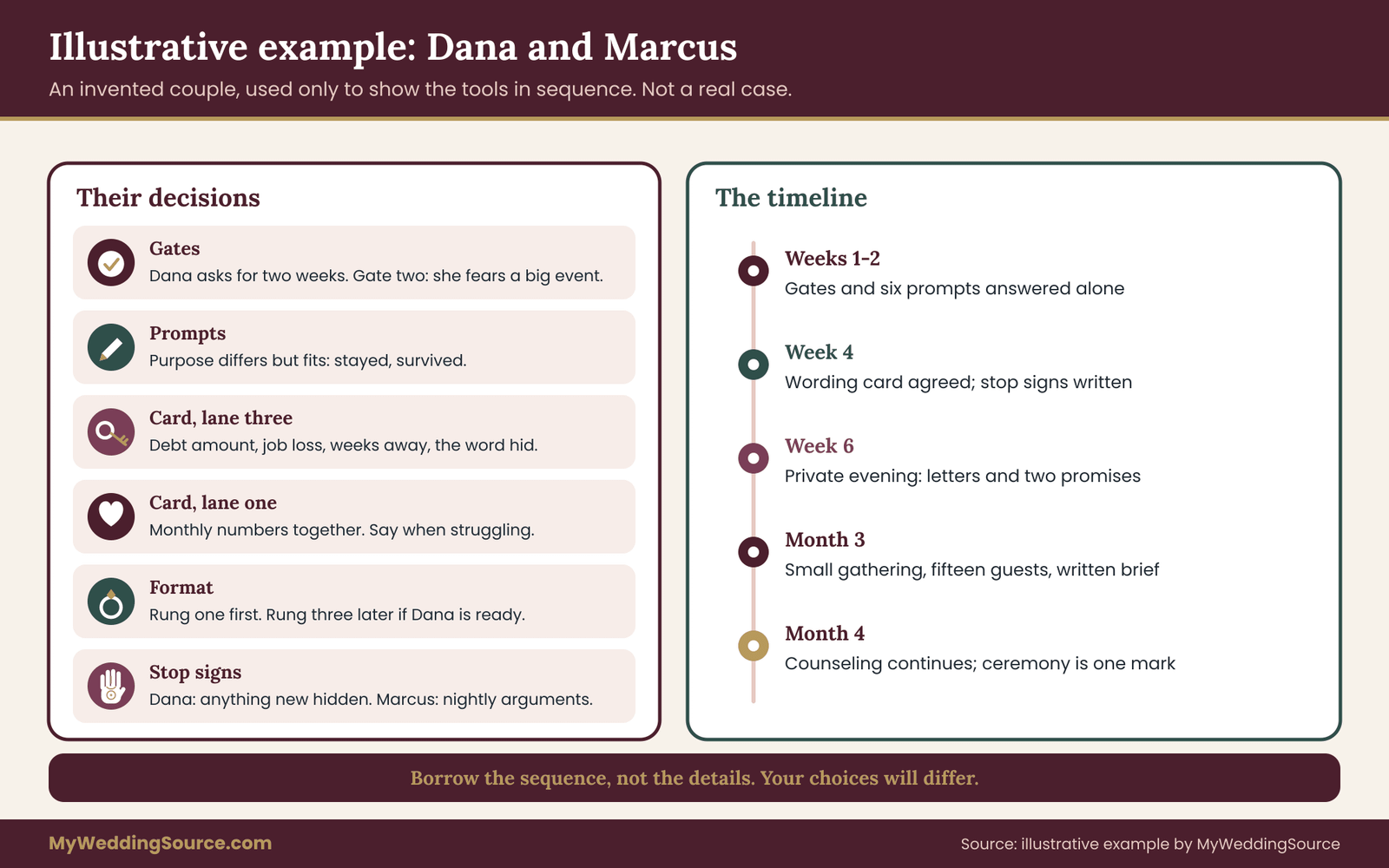
Call them Dana and Marcus. They have been married for twelve years. About two years ago, Marcus lost his job and, over the following months, hid the extent of their money trouble from Dana. When she found out, she was angry and moved into her sister’s home for six weeks. They returned, began seeing a counselor, and have worked at it since. Marcus has a new job. Dana says she is “mostly steady, with bad days.” On their anniversary, Marcus suggests a renewal.
Gates and prompts
Dana does not say yes right away. She asks for two weeks. They run the readiness gates. Safety is not an issue. On gate two, Dana says she wants the ceremony but is afraid of a large event; Marcus wants a party. On gate three, both can describe the hard period in two sentences, though Dana notes that she is still working through the hiding, not the money.
They have a counselor, so gate four holds. On gate five, Marcus realizes his hope is that the family will see them as okay, and he names it as the wrong job for a ceremony.
They answer the six prompts separately. Dana’s answer to “what are we marking” is “that we are staying and that things are different.” Marcus writes “that we survived.” Their sentences differ, and they mark it “different but compatible.” Dana’s answer to “what would feel like too much” lists her sister’s presence, any mention of money, and a photographer capturing her crying.
Marcus’s list includes his father asking about the job. Both write stop signs: Dana would stop if Marcus hid anything new; Marcus would stop if the planning was making them argue every night.
Card and format
On the wording card, lane three holds the amount of the debt, the job loss, the six weeks at the sister’s, and the word “hid.” Lane two holds “a year that asked a lot of us” and “when I went quiet.” Lane one holds Marcus’s promise to look at the numbers with Dana every month and Dana’s promise to say when she is struggling rather than withdrawing.
Dana’s discomfort with a large event decides the format. They choose rung one first, a private evening on their anniversary, with an exchange of letters and the two promises. They agree that a rung-three gathering may follow later if Dana feels ready, with fifteen guests, a short ceremony and a meal.
What changed in the plan
The private evening goes well, though Dana cries more than she expected. Two months later, they hold the small gathering. The officiant is a family friend who receives the written brief. Marcus’s father is told in advance, kindly, to keep the day forward-looking. Dana’s sister attends, having been asked first and having said yes. Nobody toasts from the floor.
The example is simple on purpose. Notice what the tools did. The gates caught Dana’s fear of a large event before money was spent. The prompts surfaced a mismatch in purpose that turned out to be compatible. The card kept the money story out of the room. The staging gave the couple a natural stop point. Real couples will make different choices. The sequence is the part to borrow. Your own renewal after hardship will have different details.
What the example does not show
It does not show what happens when the gates fail, when one partner’s stop sign is triggered, or when a family member refuses to cooperate. The final sections cover those. It also does not suggest that a renewal fixes anything. Dana and Marcus continued counseling afterward, and the renewal after hardship was one mark on a longer path.
Alternatives to a ceremony
Sometimes the honest finding of the readiness check is that a ceremony is not the right form for what the two of you want to do. That is not a failure of the plan. It means the promise needs a different container. These alternatives cover most of the cases. Not every renewal after hardship needs a ceremony.
A letter exchange
Each partner writes a letter and gives it to the other, in private, on a date that matters. There are no guests and no cost. Letters allow the full story, in a lane-three sense, because nobody else will hear them. They also allow revision, which spoken words do not. Agree on a few ground rules: no demands, no deadlines for replies, and no sharing without permission. Keep the letters somewhere safe, and agree about when, if ever, you will reread them together.
A private recommitment with a counselor or faith leader
Some counselors and faith leaders will hold a short session or rite in which you restate your commitment, with the weight of the room being the professional’s, not an audience’s. It can be a natural end to a stretch of work. Ask what your counselor or community offers. A conversation with a faith leader may turn up a rite you did not know existed, or a blessing they are glad to write.
A trip or a repeated ritual
A weekend somewhere quiet, a hike to a place that matters, a yearly dinner on a chosen date. The act of repeating something is itself a kind of renewal. It has the advantage of staying lighter. It does not need a script, and it can quietly become a tradition. If a place is chosen, check what the local conditions are, and keep the plan flexible.
A thank-you gathering
If the main purpose is to thank the people who stood by you, a meal for those people, without vows, may fit better than a ceremony. You can say a few words of thanks without saying anything about the hard period beyond the fact that they helped. This format avoids the risk of putting the marriage on a stage.
Marking it only in private, with no event at all
Some couples decide to mark their renewal by living differently, with no event. They keep a promise to a certain practice, such as a weekly check-in, and let that be the renewal. It is a legitimate choice, and it may suit people who find ceremonies uncomfortable. It does not require anyone’s approval, and it is entirely private.
Waiting
Finally, the alternative that is hardest to accept: wait. The readiness check may tell you that the time is not yet. Waiting does not mean the marriage is failing. It means you are protecting the ceremony from being used for a purpose it cannot serve.
Set a date to look again, perhaps six months out, and use the time to do the work that was flagged. A renewal after hardship that happens a year later, on firmer ground, is worth more than one that happens now on shaky ground.
When a renewal after hardship goes wrong: failure conditions and repairs
The honest part of planning is naming the ways the plan can fail. A plan that has no stop conditions is a plan that cannot be stopped. This section lists the conditions that should pause or end the plan, and what to do about each one. Every renewal after hardship needs one.
Stop signals
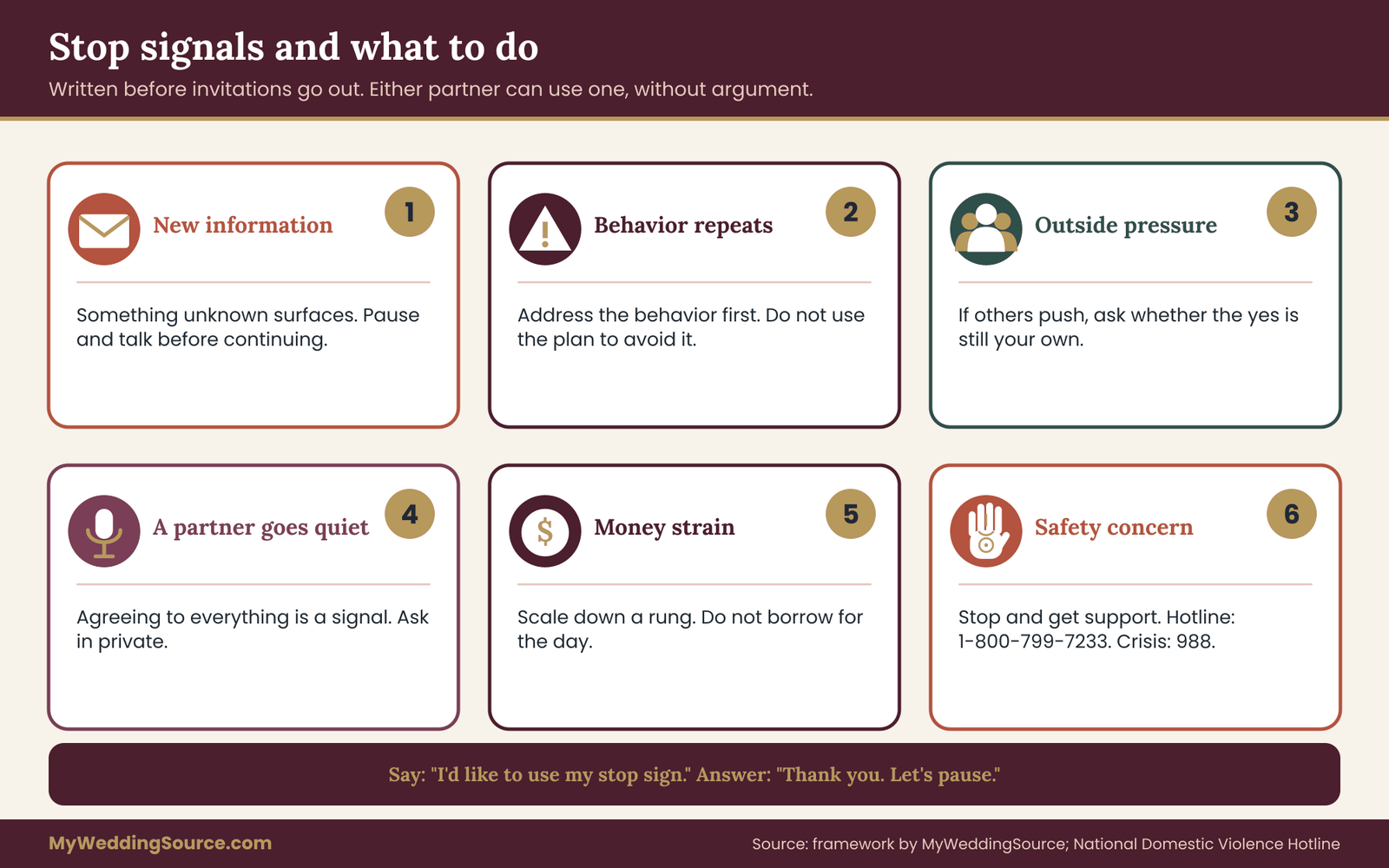
New information surfaces. If something about the hard period comes to light that one partner did not know, pause. A renewal built on an incomplete account is a renewal of the wrong promise. Take time to talk, and if needed to speak with a counselor, before deciding whether to continue.
A repeat of the harmful behavior. If the behavior that caused the hard period recurs, the renewal after hardship is not the next step. Address the behavior first. Be honest about whether the plan has become a way to avoid that conversation.
Pressure from outside. If a parent, a friend or a faith leader is pressing for the ceremony, especially as a way to settle a family dispute, pause and ask whether the couple still wants it for their own reasons. Outside pressure does not make a ceremony wrong, but it can make the yes unreliable.
A partner who has gone quiet. If one partner stops offering opinions, agrees to everything, or avoids the topic, the plan has probably outrun them. Slow down and ask directly, in private, whether they want to continue.
Escalating arguments about the plan. Planning disagreements are normal. A pattern in which every planning conversation turns into a fight about the hard period is a signal that the renewal after hardship is being asked to settle something it cannot. Set the plan aside and work on the underlying issue.
Money strain. If the cost of the plan is straining the budget, scale down a rung. Do not borrow for a renewal after hardship.
A safety concern. If at any point either of you feels unsafe, stop the plan and seek support. The National Domestic Violence Hotline and, for a crisis, 988 are the places to start.
How to stop without a fight
The stop sign each partner wrote earlier is the tool. When one of you invokes it, the other’s job is to say “okay” first and ask questions later. A script helps.
“I’d like to use my stop sign. I am not asking you to agree it is a good reason. I am asking us to pause for a few weeks and talk about it.”
The partner who hears this says: “Thank you for telling me. Let’s pause.” Questions can come after a day or two. The agreement to honor the stop sign without argument is what makes it safe to use. If it is not honored, that is itself information about the plan.
Repairing a ceremony that went badly
Sometimes a ceremony takes place and something goes wrong. A guest says the wrong thing, a partner reacts badly, or a reading touches a nerve. The repair has three steps. First, talk as soon as both of you are able, without blame, about what each of you felt.
Second, decide what, if anything, needs to be said to the guest or the officiant. Third, remember that one moment does not undo the promise. A renewal after hardship is a marker, not a verdict. Couples who handle a hard moment well may find it strengthens the day.
If the day stirs up old pain, give it room. Return to your counselor if you have one. Plan a quiet day soon after.
Refunds, deposits and cancellations
Practical failure matters as well. If you pause or cancel, a deposit may be at stake. Read the contract before signing, and keep records of every payment and message. The wedding vendor contract guide is not written for a renewal, but its list of clauses to check, especially cancellation, rescheduling and refund terms, is directly useful. If a dispute arises, the Consumer Financial Protection Bureau and Federal Trade Commission have plain-language consumer guidance.
When the answer is that the marriage is ending
It is possible that, in working through the readiness check, one or both of you realizes the marriage is not going to continue. That is a hard finding, and it is not a failure of the process. The reflection prompts and the stop signs exist to protect both people from a ceremony they would regret.
If you reach this point, a counselor, a mediator or a lawyer in your state can help with next steps, and for emotional support SAMHSA and the 988 Lifeline are available. Planning stops. Care continues.
Your next steps
Begin with one evening and no planning. Read the five readiness gates and answer each privately. If a gate fails, decide what needs to happen first, and set a date to look again. If every gate holds, each of you writes the six reflection prompts alone, then compare them over a quiet meal and mark each aligned, different but compatible, or needs another conversation.
Next, fill in the wording boundary card together, agree on a rung of the privacy ladder, and write your stop signs. Only then choose a date and a venue, brief your officiant in writing, and send invitations that say little. Draft the vows with promises first, swap drafts, and keep the private letter for what the renewal after hardship cannot hold. Plan a quiet day afterward. A renewal after hardship does its best work when it follows the repair instead of replacing it.
FAQ
Is a vow renewal after a difficult period different from a regular vow renewal?
The renewal after hardship itself can look the same, but the planning differs. After a hard period, the questions of what to say, who to invite, and how much to disclose carry more weight, and one partner may be more hurt than the other. Use the readiness gates, private reflection prompts and a wording card to keep the event honest and private where it needs to be.
Do we need a legal officiant or a new marriage license?
No. A renewal after hardship does not create a new marriage, so there is no new license or legal filing, and your original marriage certificate stays the legal record. A friend, relative, faith leader or professional celebrant can lead the ceremony. Confirm any faith community rules individually, and see USAGov for how to get a copy of your existing certificate.
Should we mention the hard period in our vows?
Usually only its effect, not the event. Many couples keep names, dates, diagnoses, money figures and blame out of the ceremony and speak instead about what they learned and what they now promise. A wording card sorts each detail into say it, soften it or keep it private. The more private partner sets the limit, since a disclosure cannot be taken back.
What if one of us wants a big celebration and the other wants privacy?
Let the more private partner set the ceiling for anything that touches the hard period. Staging often solves the conflict: hold a quiet two-person evening first, and a small gathering later only if both feel ready. The private evening settles the promise, and the gathering celebrates it. If you cannot agree, a counselor or faith leader can help.
How long should we wait after a hard period before planning a renewal?
There is no set time, and nobody outside the marriage can set it. Look for a stretch where life has been steady enough that a date on the calendar feels like a plan and not a hope, where safety is not a concern, and where both of you can describe what happened without correcting each other. A counselor can help you judge readiness.
Can a renewal ceremony fix a marriage that is still struggling?
No. A ceremony can mark a decision and give it witnesses, but it cannot rebuild trust or change a pattern of behavior. Repair comes through conversation, changed habits, time and often professional support. Treat the ceremony as a marker of progress, not a replacement. If real work remains undone, do that first or alongside, and let the ceremony follow it.
What should we say to guests who know about the hard period?
Offer guidance, not history. A short request such as “We are keeping the day forward-looking, so please do not bring up the last couple of years” works for most people. Ask a trusted friend to deliver it to anyone likely to ask questions, and give your officiant and gatekeeper the same wording so they can steer conversations kindly.
What if the hard period involved abuse or fear?
Do not plan a renewal after hardship as part of repair, and do not let anyone pressure you into one. Safety comes first. The National Domestic Violence Hotline at 1-800-799-7233 offers confidential support, and you can contact it without telling your partner. In a crisis in the United States, call or text 988. A ceremony can wait; your safety cannot.
Sources
- USAGov: How to get a copy of a marriage certificate
- 988 Suicide and Crisis Lifeline
- National Domestic Violence Hotline
- Substance Abuse and Mental Health Services Administration
- National Institute of Mental Health
- U.S. Copyright Office
- Americans with Disabilities Act information, ADA.gov
- Consumer Financial Protection Bureau
- Federal Trade Commission
- HIPAA privacy information, U.S. Department of Health and Human Services